A fledgling nonprofit with an outlandish name that launched in Portland six years ago, now sees itself alongside 17 other organizations statewide who have come to the same conclusion: “Highway expansions are pulling our country into an environmental, budgetary, and public health crisis and it’s time to end this destructive, unsustainable practice and set a responsible course toward a cleaner and more equitable future.”
No More Freeways formed to fight the I-5 Rose Quarter project in 2017 and has been stalwart in its mission ever since. Today they are one of 195 organizations who signed onto a letter that pressures elected officials to put a moratorium on highway expansions. That line above is just the opening salvo in a call-to-action that not only demands no more freeways, but also offers a prescription to repair our ailing transportation infrastructure machine.
The organizations, led by national nonprofit America Walks, are marshaling their respective troops to contact lawmakers and urge them to pause all existing highway projects until climate, equity, and maintenance goals are met. This demand is similar to what Portland-based activists have been asking the Oregon Department of Transportation to do on the I-5 Rose Quarter project for years now: Complete a full and transparent environmental impact statement before investing more money and time into the wrong kind of project.
Advertisement
In today’s statement, the signees call for “community-first infrastructure” which they define as, “increasing frequent, reliable, and accessible public transportation; policies that build homes close to jobs and amenities; and making neighborhoods healthier, quieter, and safer.”
Instead of continuing to spend billions to make driving on freeways even easier and more convenient, here’s what this new coalition wants DOTs to spend money on:
1. Fix It First: maintain existing roads and bridges before building new, larger ones. 2. Safety Over Speed: retrofit dangerous roads and streets to make them safer for people walking, biking, and driving. 3. Make Transit Work: provide capital and operations funding for reliable, affordable public transportation that connects people to jobs, services, amenities, health care, and each other. 4. Reconnect Communities: dismantle targeted highways and invest in the communities around them to increase opportunity and redress the harms these projects have inflicted.
Here are the 17 Oregon-based groups who’ve sign onto this campaign:
1000 Friends of Oregon
350PDX
AORTA-Association of Oregon Rail and Transit Advocates
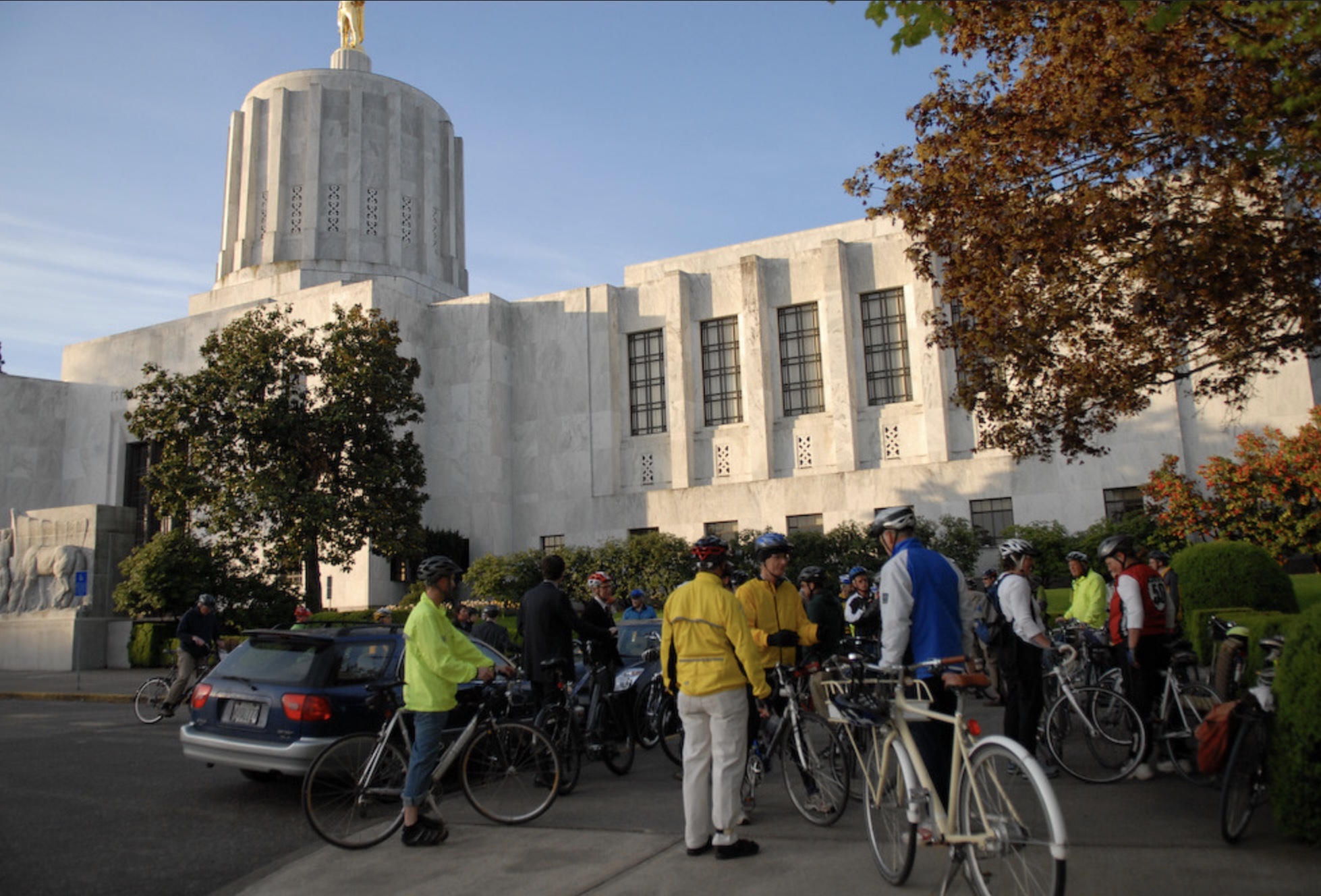
State Capitol building in Salem in 2009. (Photo: Jonathan Maus/BikePortland)
Note: If you are aware of a transportation-related bill that’s not on this list, please contact me.
The 2024 session of the Oregon Legislature kicked off Monday and now there’s a 35-day sprint to make new laws before the gavel comes down. It’s a short session (Oregon only has full sessions on odd-numbered years), so pundits like to say the only things that will get attention are major bills from the most powerful players. But you never know, and judging by the hundreds of bills already filed, it appears many lawmakers are willing to roll the dice.
I’ve spent a bit of time wading through the Oregon Legislative Information System (OLIS) and have found a bunch of bills that have transportation implications. Note that there are some bills we expect to see that I could not track down. Those include: A funding request for safety upgrades on inner SE Powell Blvd; a change to bike lane law being pushed by trucker advocates, and a bill to clarify Oregon’s recreational immunity law (it just came out 2/9, see below). I’ll update the list below if/when I find those and any other bills that may come to my attention in the coming days.
Check out the list below to see the bills BikePortland will be keeping an eye on this session…
Advertisement
House Bills
HB 4048 (Overview) Sponsored by Reps Helfrich and Breese-Iverson (Rs) Summary: “relaxes housing standards, establishes a housing office to enforce housing laws, allows a new UGB amendment and limits counties’ role in UGB amendments.”
This bill would relax housing regulations in Oregon. It would limit the power of Metro and the State of Oregon enforce development within the Urban Growth Boundary and give more of that power to local counties. Among the housing regulations it would allow local governments to adjust are bicycle parking standards for residential units.
HB 4067 (Overview) Sponsored by Reps Nguyen D and Nelson (Ds) Summary: “Creates the Task Force on Electric Micromobility.”
As BP reported last month, this bill would help raise the profile of electric bicycles and all types of non-car e-micromobility vehicles by setting up a statewide task force where new policy ideas could be discussed and vetted.
HB 4103 (Overview) Sponsored by Rep Levy Summary: “… kids under 16 years of age may ride Class 1 e-bikes. The Act also states that only those 16 years of age and older may operate Class 2 and Class 3 e-bikes. The Act creates the offense of unsafe e-bike riding. If a person violates the law, the person could face a fine of up to $100. Modifies the definition of electric assisted bicycle for purposes of the Oregon Vehicle Code. Adds definitions of Class 1, Class 2 and Class 3 electric assisted bicycles. Provides that children under 16 years of age may operate Class 1 electric assisted bicycles and provides that only persons 16 years of age and older may operate Class 2 and Class 3 electric assisted bicycles. Creates the offense of unsafe electric assisted bicycle riding. Punishes by maximum fine of $100.”
This is the “Trenton’s Law” bill we wrote about back in November. It would be a major change to the legal standing of electric bikes in Oregon.
Advertisement
HB 4110 (Overview) Sponsored by Joint Committee on Transportation Summary: Would award $6 million to the Port of Cascade Locks for Bridge of the Gods project
HB 4147 (Overview) Sponsored by Reps Neron, Hudson, Ruiz, Boice (Bipartisan) Summary: “Permits an education provider to have stop arm cameras on school buses for the purpose of recording persons who fail to stop for bus safety lights.”
Who can possible say no to this law that would allow any educator or school district in the state to install automated cameras to photograph scofflaws?!
HB 4165 (Overview) Sponsored by Rep Boshart Davis (R) Summary: “Requires the Department of Transportation to prepare and submit a report on the statutory changes necessary to balance transportation cost responsibility between light and heavy vehicles.”
This is part of a large debate this session that revolves around who pays their “fair share” of road taxes — especially how much freight truck drivers pay in taxes, versus the damage they have on the system and the benefits they get out of it. Many lawmakers believe trucking companies are paying too much in weight-mile taxes and that ODOT has failed to use the funds to ease freeway congestion. (Expect more from BP about all this soon. And see SB 1519 and SB 1543 below.)
Advertisement
WES from Beaverton to Salem? Lawmakers want to take a closer look at that idea. (Photo: Jonathan Maus/BikePortland)
Senate Bills
SB 1512 (Overview) Sponsored by Joint Committee on Transportation Summary: Would award $6 million to the Port of Cascade Locks for Bridge of the Gods project
This is the Senate version of HB 4110.
SB 1519 (Overview) Sponsored by Sen Boquist (R) Summary: “lowers weight-mile taxes. The Act directs ODOT to adopt rules so that ODOT may issue refunds to taxpayers who overpaid weight-mile taxes in recent years.”
One of the legislative attempts to change taxation of freight trucks and alleges that ODOT has overcharged trucking companies.
Another attempt to right what some see as unfair taxes on trucking companies and this one goes a bit further by requiring the legislature to establishing budgetary limits for ODOT in specific project categories.
Advertisement
SB 1556 (Overview) Sponsored by Sen Weber, Representative Javadi, Stout (Rs) Summary: Requires ODOT to conduct a study conditions on Highway 30 between Rainier and Astoria and determine what it would take to bring the highway up to a state of good repair.
The bill would require lawmakers to share the report with the Joint Committee on Transportation. This might be an opportunity to advocate for safer shoulders and bicycle infrastructure on this very sketchy section of Hwy 30 that could be much more welcoming to many bike tourists.
This bill would update existing GHG reduction goals and set a new aspiration for the State of Oregon to achieve “net zero emissions as soon as practicable, but no later than 2050.” It would also change the term “global warming” to “climate change” in existing statutes.
Advertisement
SB 1563 (Overview) Sponsored by Senator Anderson (R) Summary: This bill would require ODOT to complete a study of Hwy 101 between Lincoln City and Coos Bay.
Unfortunately it looks like this bill is written in a way that is very car-centric. It says ODOT needs to study the corridor and intersections along it, “to relieve congestion and produce safer driving conditions.” If this passes, ODOT needs to make sure they take a complete streets/safe systems approach to their study.
This exciting bill will be an opportunity for rail advocates to engage with the legislature around a concrete plan to extend existing TriMet WES service to Salem. WES currently runs only between Beaverton and Wilsonville.
SB 1576 -3 (Text) Sponsored by request of Judiciary Committee
This is a legal omnibus bill that includes language to clarify Oregon’s recreational immunity law after a case in the City of Newport led to confusion among many cities and counties and has resulted in dozens of closed biking and walking trails around the state.
Did I miss anything? Please let me know if you’ve heard of something that should be on our radar.
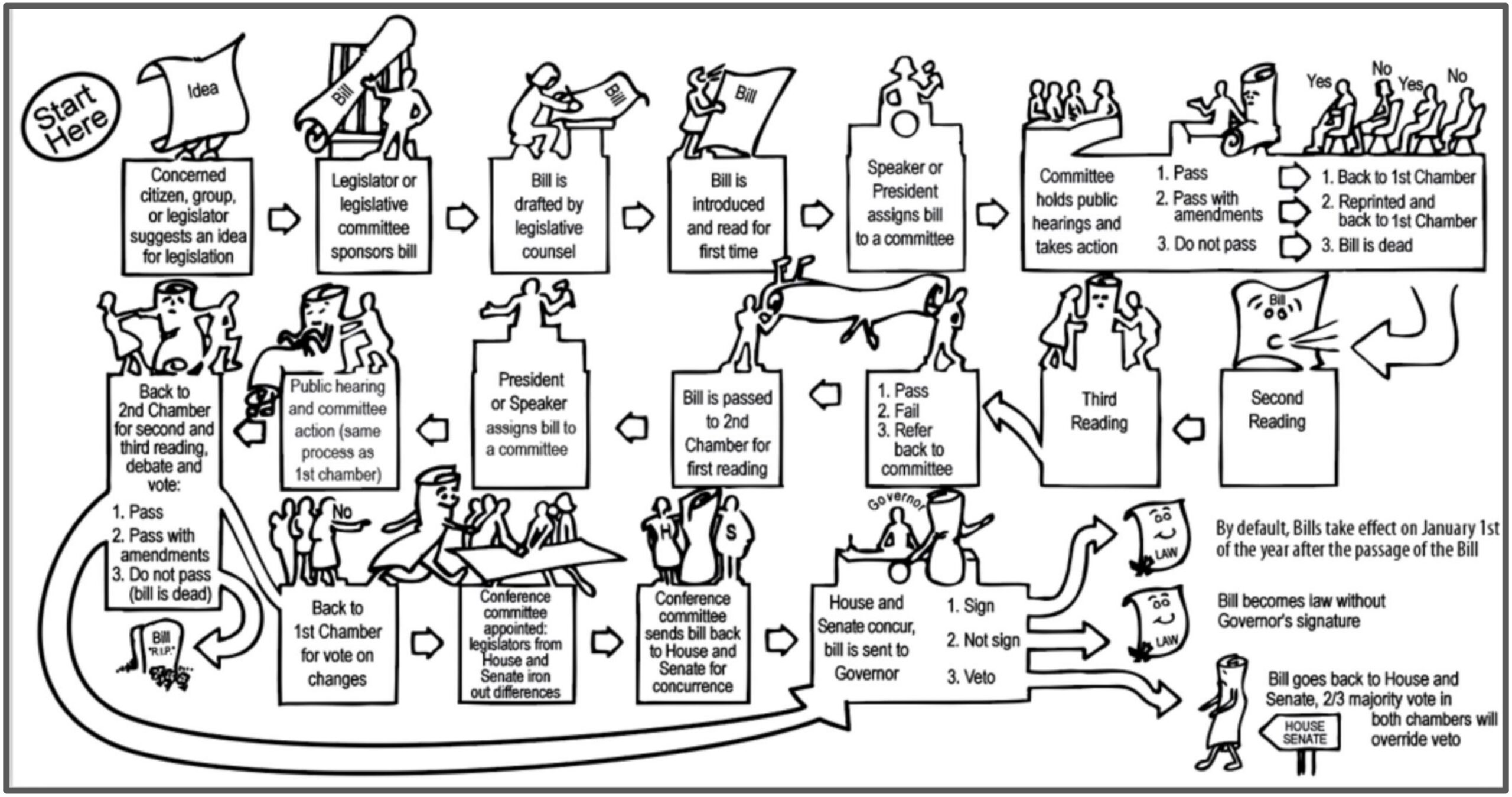
How a Bill Becomes Law. (Source: State of Oregon)
The next step for these bills is to await committee assignments (see the full process of how a bill becomes law in the graphic above). Then they’ll need to earn a public hearing and a vote in committee. There are deadlines for all these steps and as time goes on we’ll discover which of these — if any — has the momentum and support it takes to reach the finish line.
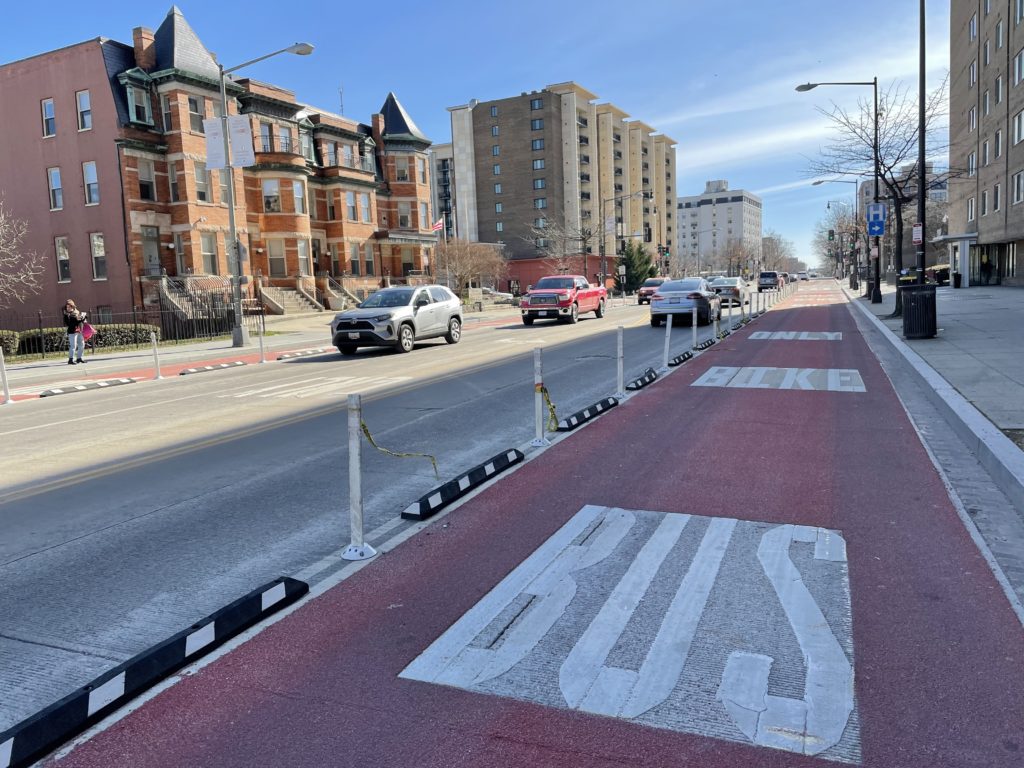
Barriers keep people out of bus lanes. (Photo: Smart Growth America)
Garrison Christian is a 20 year old undergraduate student at Portland State University. He is studying Urban Planning, with hopes of becoming a professional transportation planner.
Garrison Christian at a recent Bike Happy Hour. (Photo: Jonathan Maus/BikePortland)
As most of you already know, 82nd Avenue is going to be redesigned by the Portland Bureau of Transportation (PBOT) in the coming years. This is our chance to make it much better. In this post, I’ll share my ideas for how to achieve a safer, more equitable 82nd.
The street faces many challenges for safe transportation. 82nd is a high crash corridor, with multiple pedestrian deaths over the past 5 years, including one at SE Flavel Monday morning that marked the second one so far this year alone. Sidewalks along the corridor are particularly narrow, often with utility poles blocking the right-of-way. Many sidewalks lack ADA curb ramps, and 82nd is home to TriMet bus line 72, the highest ridership route in the entire Portland metro area.
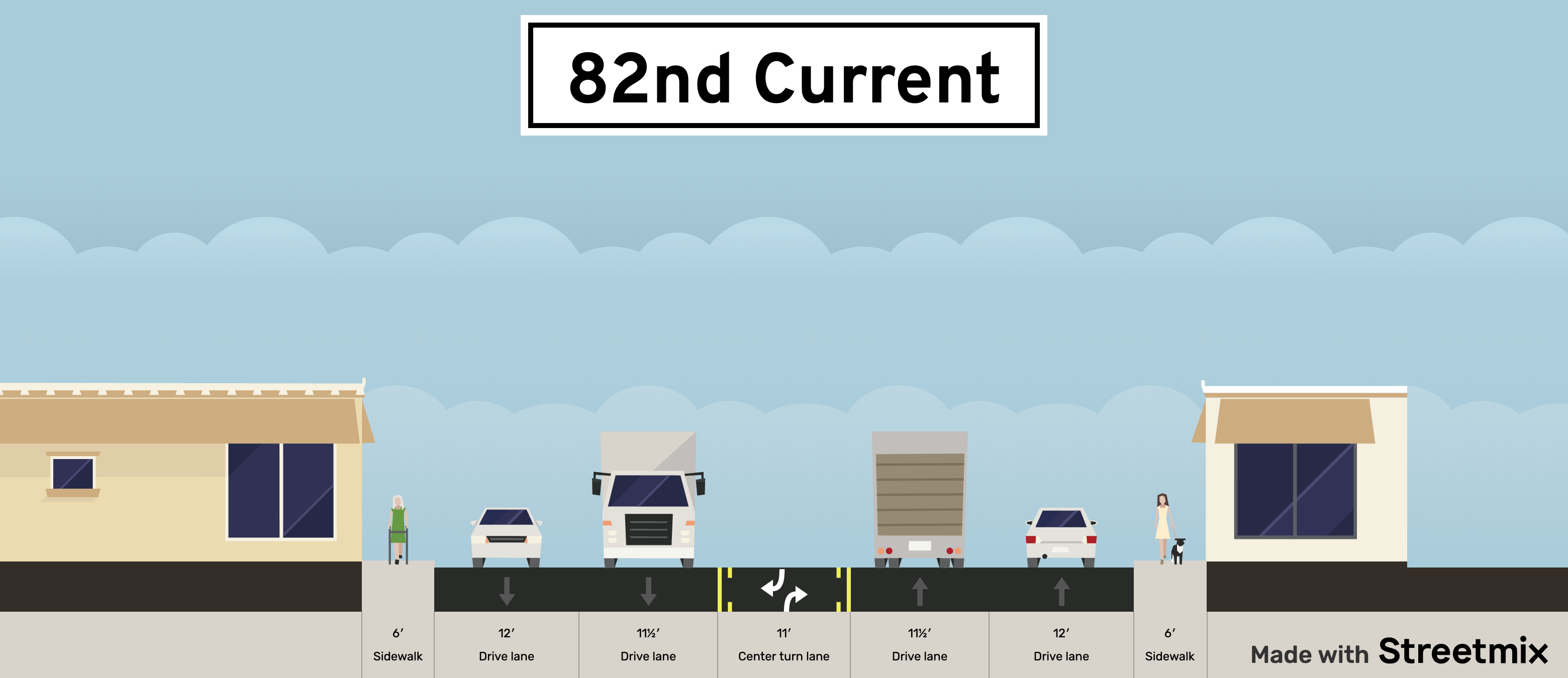
PBOT is currently implementing ‘critical fixes’ along 82nd; these will be done in the next few years, addressing some, but not all of the concerns listed above. Following this, a comprehensive redesign will be done in the coming years, likely leading to an adjustment of how street space is allocated. The current street is five lanes wide, with one center left turn lane, flanked by two general purpose lanes on each side. In January, I attended Metro’s 82nd Avenue transit project advisory board meeting. This body is tasked with deciding how to best implement transit along the corridor. While bus-only lanes are under consideration, I have concerns with how they will be implemented.
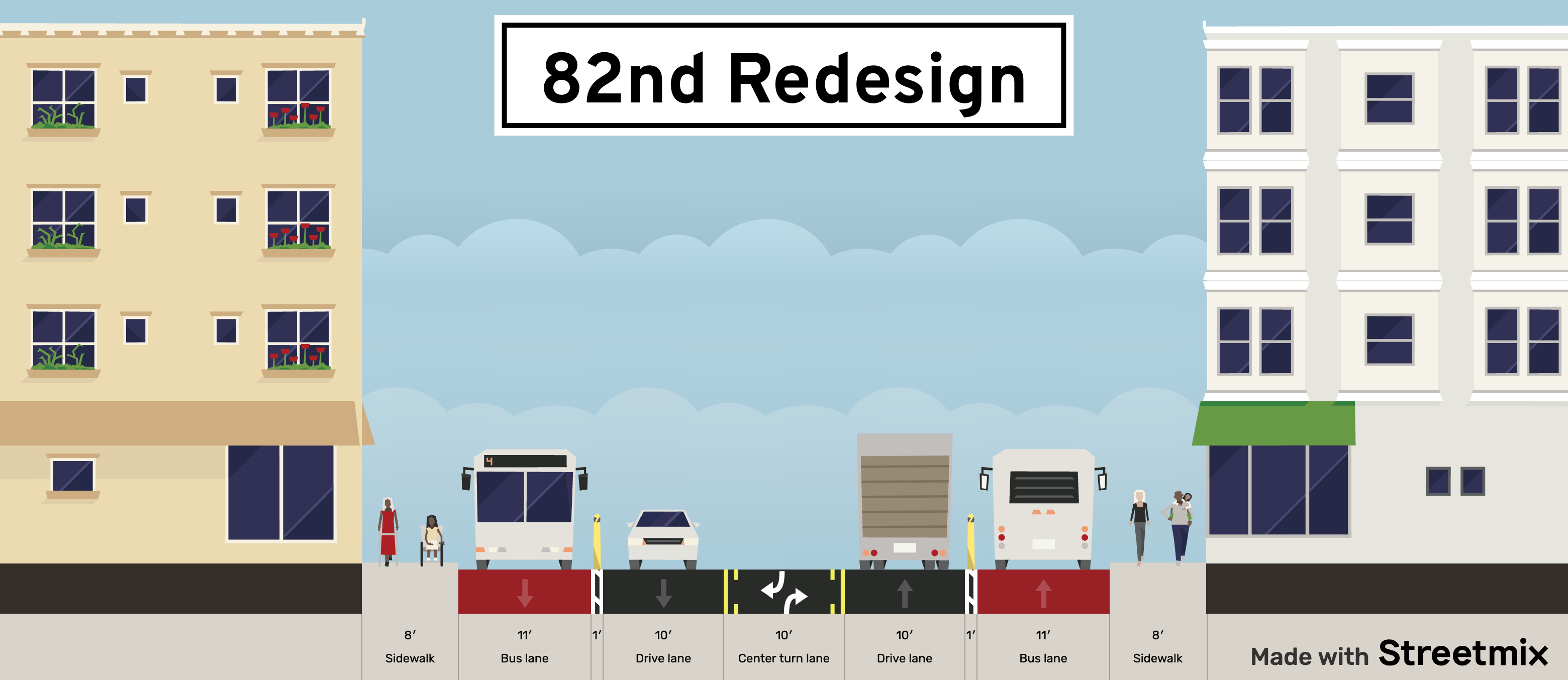
PBOT staff said they are likely to choose business access and transit (BAT) lanes for 82nd. While fine in a vacuum, BAT lanes need proper design and enforcement to best serve buses. Here are the changes I would like to see applied: First, bus lanes must be implemented on 82nd! I propose keeping the center turn lane, with one general purpose lane in each direction, and bus lanes against the curb. However, putting in bus lanes alone is not enough to improve bus service. Across town, our limited set of bus lanes are often clogged with cars illegally using the lane, which slows down buses. This is due to poor design and lack of enforcement.
Design measures such as a physical barrier should be used along 82nd to keep cars from driving in the bus lanes. Other cities have used Jersey barriers, concrete curbs, or even flex posts as barriers. An issue to contend with is driveway access for the many businesses along 82nd. The barriers between bus and general purpose lanes can have gaps to allow for turns into driveways. If planners refuse to use physical barriers, automated camera enforcement is another option. Cameras can be deployed to fine those who drive in the bus lane, with an exception given to cars turning to enter/exit the street.
Bus riders deserve to not be inhibited by cars clogging up the bus lane, and well executed design can prevent this conflict.
Advertisement
Raised crosswalks, like this one in New York City, are key to slowing vehicle speeds and welcoming walkers. (Photo: NYC DOT)Effects of speed on stopping distance
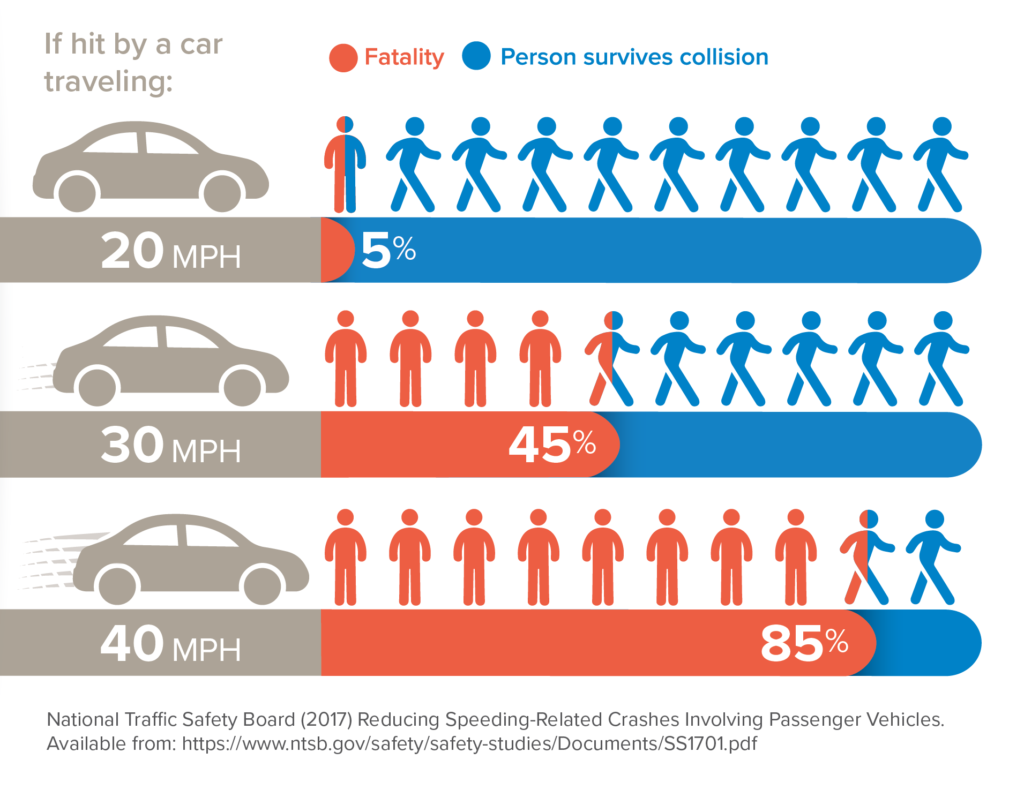
As for pedestrian safety, there are many design treatments we can use to improve 82nd. First off, sidewalks should be made wide, to accommodate foot traffic, as well as those with mobility devices. A minimum standard for sidewalks is six feet, but I propose 8-10 ft sidewalks, which allow for greater separation from traffic, and less crowding. Raised crosswalks are also a great tool to improve pedestrian safety. While having a posted speed limit of 30 mph, the wide lanes of 82nd allow for car speed of 40 mph or faster. Collisions between cars and pedestrians at this speed almost always leads to death of the pedestrian. Raised crosswalks force cars to slow down and this reduced speed gives drivers more time to react, drastically lowering the chances of death if a collision occurs.
The posted speed limit on 82nd should be 25 mph. Measures we can put in place to enforce this behavior through design including 10-foot lanes. 10-foot lanes lead to more cautious driving. By comparison, many streets use 11-13 foot lanes, which have been proven to lead to faster, unsafe speeds. Raised crosswalks are especially useful to prevent vehicles from turning at high rates of speed. A turn taken at 15 mph is much safer than one at 30 — for both the driver and pedestrian.
In conclusion, we have a once-in-a-generation opportunity to change 82nd for the better. We can achieve better safety along the corridor for all road users, reduce our emissions by improving bus service, and create a more hospitable environment for pedestrians. As the public participation process starts for this project, be sure to tell PBOT you want the changes listed above, so we can have a better 82nd, and community at large.
PPB Traffic Division social media post. Inset: BikePortland Fatality Tracker yeart-to-date traffic death toll.
New roadside memorial sign program offers hope these deaths won’t go unnoticed.
On Sunday, February 4th at 8:46 pm, the Portland Police Bureau Traffic Division posted to X (formerly Twitter): “Extremely excessive speeds in Portland this week. Mustang: 137 in a 45 on Marine drive racing a motorcycle. BMW: 122 in a 60 at I-84/148th Ave.”
Three hours before that post, a pedestrian was killed by a car driver on SE Foster and 97th. And 24 hours after that post, two more people who were walking on Portland streets were hit and killed by car drivers. One of them was killed while walking on SE 82nd near Flavel in the early morning hours of Monday morning. The driver in that collision did not stop and police are still looking for the suspect. The other person was killed while walking at NE Gertz Road and Martin Luther King Jr. Blvd on Monday evening. Police who responded to that scene said they received calls about, “a person struck by multiple vehicles.”
These are just three of the five pedestrian fatalities to happen in Portland in the past two weeks, putting us on a pace that’s already ahead of our abysmal, tragic, and unacceptable traffic death toll in 2023. Just 37 days into 2024 we have endured the deaths of seven people using Portland roads — six of whom were what Oregon statute refers to as a, “vulnerable user of a public way.”
Advertisement
Given the current state of our traffic culture, I shudder to think how many people will be killed in traffic this year. Will it be someone I know? A member of family? Me? And what is being done about it? We have city leaders who say they’re aware of this crisis and that they care about it, but I don’t see any major shift in approach to the problem. It’s as if we think mere acknowledgment of the problem is enough to stop it from being a problem.
New sign that will begin appearing where someone is killed in traffic.
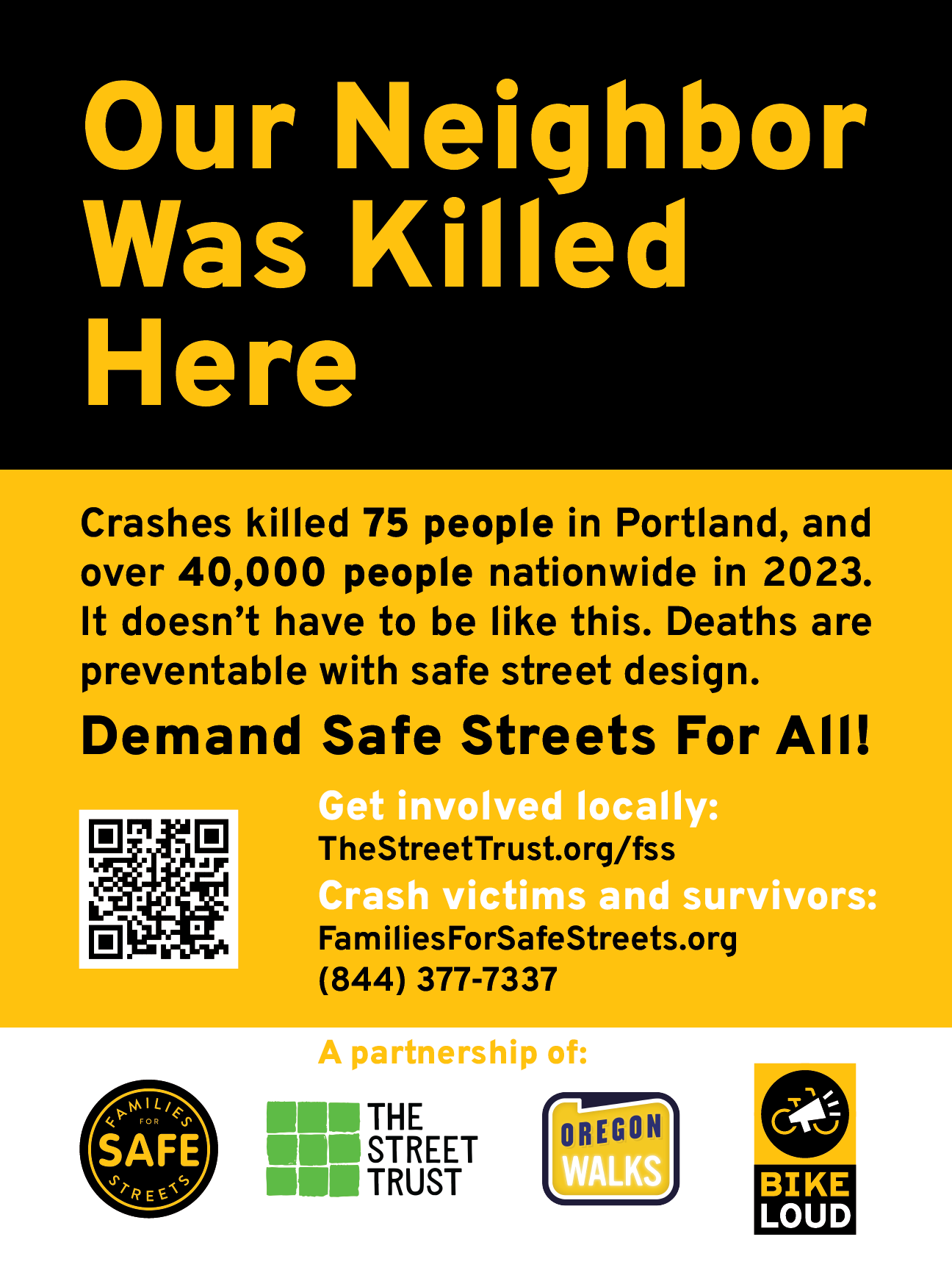
Some local road safety activists are trying something new this year they hope will appeal to peoples’ conscience, raise awareness of the responsibility we all have as road users, and reinforce the tragic consequences of shirking it. Volunteers with BikeLoud PDX have partnered with Families for Safe Streets OR/WA, The Street Trust, and Oregon Walks to create high-visibility signs that will be posted at the site of every fatal crash. Based on similar signs used in New York City (where the nonprofit Families for Safe Streets began), they read, “Our Neighbor Was Killed Here: Demand Safe Streets for All.” The signs include links to resources where people get involved in the fight for safe streets or find legal or mental health resources.
Each one of these crashes leaves a trail of trauma and grief among survivors. Families of survivors and the family of a driver that killed someone have reached out to me in recent weeks, wanting to make sure the community understands what they are going through. Next week, the family of Jason Ruhmshottel will accompany local activists to place a ghost bike on North Portland Road where he pedaled his trusty commuter bike for the last time. We can only hope people slow down enough to see it and let its meaning sink in.
Programs Mechanic Coordinator
Status: Hourly, 32-40 hours/week
Pay: $22-24 per hour
Union/Non-Union: Union, ILWU Local 5
Location: Portland, Oregon
Benefits: Includes health & dental
Reports to: Education Manager
Start date: Monday March 4th
Organizational Overview
We love Portland and bikes. So, we put our two passions together nearly 30 years ago, creating a nonprofit organization on a mission to broaden access to bicycling and its benefits. Our goal is to help create a healthy, sustainable Portland for all community members. Our vision is to help build a vibrant community where people of all backgrounds use bicycles to stay healthy and connected. We believe that all Portlanders—regardless of income or background—should have the opportunity to experience the joy, freedom and health benefits of bicycling. This is the motivation behind everything we do.
In addition to delivering dynamic programs that benefit underserved communities, we operate a storefront space in NE Portland offering a DIY workspace, retail shop, and community classroom. We also collaborate with community partners to generate pathways to numerous supports to meet the needs of the people we serve.
The Community Cycling Center (CCC) is an equal opportunity employer and strongly values diversity, equity and inclusion. Individuals with diverse backgrounds, abilities and experiences are encouraged to apply.
Essential Functions
The Programs Mechanic Coordinator provides material support to meet the bicycle maintenance and repair needs of the programs department. This role also provides limited instructional support focused on the repair and maintenance of commuter bicycles. A successful Programs Mechanic Coordinator will apply a student-centered, trauma-informed, culturally responsive teaching approach to support students and program participants in developing new skills, self-confidence, and independence.
In addition to supporting the programs department’s service needs throughout the calendar year, this role will also provide in field support for the STEM program at alternative high school sites, the Repair Hub in north Portland, as well as a variety of community events that take place around the region. The Programs Mechanic will provide some level of support to shop operations, which may include the facilitation of fee-for-service maintenance classes.
The Programs Mechanic Coordinator is supervised by the Education Manager. They work a 32 hour per week schedule on average across the year, with up to 40 hour weeks during the summer months. Successful candidates will have enthusiasm and experience working with and teaching underserved youth as well as an interest in active transportation and transportation justice.
Bike production and service (30%)
● Assist the Education Manager in accomplishing the Programs Department’s bike build and service needs across the span of the calendar year.
○ This includes but is not limited to building new bikes from the box for Bike Clubs and Bike Camp participants, refurbishing used bikes for teen/adult program participants, supporting Holiday Bike Drive production, maintaining programs bike fleets through consistent service, and providing seasonal tune-ups for programs staff’s work bikes,.
Direct Service Support (30%)
● Support the New Columbia Repair Hub operations May through September as the lead mechanic. This includes working on site for some portion of shifts throughout the season.
● Support STEM classroom instruction as needed with Education Manager
● Support community events that involve remote repair. May include providing mechanical support to community rides.
Administration (25%)
● Engage in the production and service schedule as managed by the Education (STEM) Manager
● Work with the shop’s Bicycle Production Coordinator to establish best practices for bicycle repair out of the Repair Hub space.
● Attend Repair Hub meetings
● Support Hub youth interns during the Repair Hub season (May-September)
● Support Hub volunteer mechanics during the Repair Hub season (May-September); access to volunteers mechanics will be facilitated by the Volunteer Coordinator
● Assist with grant reporting process as assigned
Other responsibilities (15%)
● Support shop-based, fee-for-service classes, and other shop operations as needed
● Other duties as assigned
Required qualifications and experience
● 3+ years of bike mechanic experience. This can be a combination of volunteer, and professional experience.
● Prior personal, professional, or volunteer experience working with children and adults from low income backgrounds, communities of color, and/or immigrant communities
● Prior personal, professional, or volunteer experience in group facilitation (i.e. instructing at a summer camp or after-school program, lived experience as a parent or raising young family members, volunteering at a group home for youth, facilitating a shift meeting for a former job, etc.)
● Proven commitment to advancing equity and creating and maintaining an inclusive environment that is welcoming for all identities and abilities
● Ability to communicate effectively with coworkers, students, families, and supervisors
● Ability to balance competing priorities and meet deadlines
● Ability to maintain composure and a respectful, cooperative attitude in high stress situations
● Passion for cycling and other forms of active transportation
● Basic computer skills, especially familiarity with the Google Suite. Willingness to engage with project management software (we currently use Asana).`
● Ability to ride a bicycle 5 miles per day and lift up to 50 pounds
○ Reasonable accommodation will be made for staff with a disability
● Because this position works directly with youth, a background check is required
Preferred
● 5+ years of professional bike mechanic experience.
● Proficiency in one or more languages spoken in Portland’s communities (e.g., Spanish, Vietnamese, Somali, Russian)
● Lived experience as a member of a marginalized community
● Existing relationships with North, Northeast, and/or East Portland Title I school communities
● Experience leading group bike rides with youth and/or adults
● Prior experience coordinating volunteers
● Valid Driver’s License
START DATE: MONDAY MARCH 4th
How to Apply
Please submit a cover letter and resume with “Programs Mechanic Coordinator” as the subject line to jobs@communitycyclingcenter.org
NON-DISCRIMINATION POLICY
The Community Cycling Center is an equal opportunity employer. We will not and shall not discriminate on the basis of race, religion, sex, age, national origin, gender identity, sexual orientation, citizenship, veteran status, marital status, sensory disabilities, physical disabilities, mental disabilities and/or any other bases protected by state and federal law. We take proactive measures to ensure against discrimination in hiring, compensation, promotions, and termination of staff, selection of volunteers (including board members) and vendors, and provision of services. We are committed to providing an inclusive and welcoming environment for all members of our staff, customers, clients, volunteers (including board members), subcontractors, vendors, and other members of our community.
How to Apply
Please submit a cover letter and resume with “Programs Mechanic Coordinator” as the subject line to jobs@communitycyclingcenter.org
Last week’s post about PBOT’s newly released design for 82nd Avenue brought out an interesting bunch of comments. I liked reading all of them, I think because they were so authentic. Not too much internet grandstanding, mainly just people sharing their thoughts. Altogether a “no drama” group of responses.
There was one calm comment which has kept worming its way into my mind over the past few days. Clearly this commenter hadn’t yet picked up that confident and commanding internet “voice.” The comment’s lack of bombast was endearing, even kind of soothing.
Here’s what a commenter named “E” had to say about bike riders on 82nd:
Advertisement
I live near 82nd closer to the southern city limit and drive on 82nd often for groceries/shopping. I see more people biking on 82nd (they have to use the inadequately narrow sidewalk to do so) than on some other commercial streets in Portland. Whereas I would never want to bike along that street in its present form, my guess is that a lot of people are forced to bike on it to get to businesses that serve their basic needs or to and from work. At the same time, I think these folks are hardly going to participate in PBOT’s outreach sessions and take the time to fill out surveys or make their voices heard. I think that there is a real need for bike facilities along 82nd, which would most likely not be reflected in PBOT data.
Thank you E for contributing to BikePortland. If folks want a recommendation for a comment thread to read, I’d pick this one, there are some neat ideas in it, and it doesn’t get bogged down with arguing. You can read E’s comment directly in context with others here. Enjoy!
Here are the most notable stories our community came across in the past seven days…
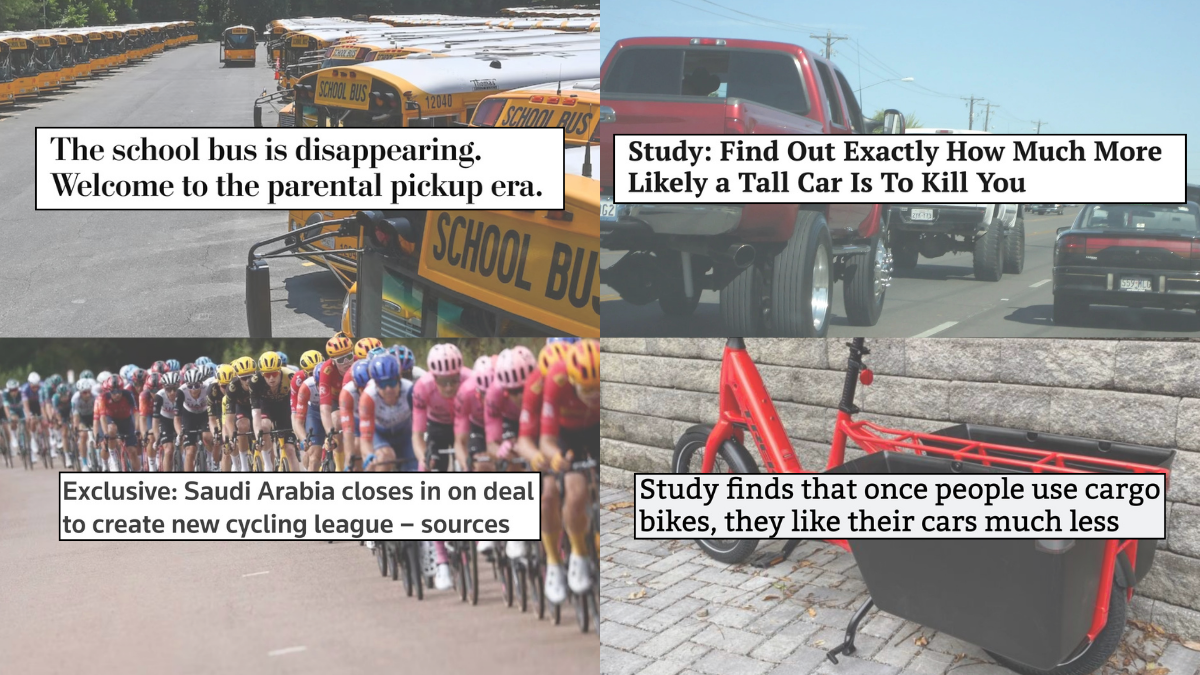
Sad but true: Really important deep dive into the data and demographic trends that have led to the “end of the school bus era” and the explosion of really terrible school pick-up lines. (Washington Post)
Dutch formula: Figured we can always use another reminder of why so many people bike in Dutch cities: Driving is hard and inconvenient and biking and transit are easy and convenient. (Global Cycling News)
Height matters: More solid research that draws a direct line between an increased chance of fatal pedestrian collisions and the height of vehicle hoods. (Streetsblog USA)
Saudi cycling league: There’s buzz in the pro cycling world about a possible $270 million infusion from Saudi investors into a new cycling league that would count some of the sports biggest teams as founding members. (Reuters)
Advertisement
Cargo bikes > cars: A survey of over 2,500 people in Germany found that 18% of them decided to get rid of at least one car after experiencing the joy and convenience using a cargo bike. (Ars Technica)
Price of cars: The collusion between Big Concrete, Big Rubber, Big Oil, automakers, and DOTs becomes a lot easier to understand when you read this article about how car companies are pulling in billions while Americans who need cars get squeezed and the option of simply making transit better is hardly mentioned. (The Guardian)
Nashville too: It’s simultaneously comforting and frustrating that in almost every American city, folks working to make cycling better, are frustrated by the lack of physical protection and terrible behavior by drivers. (The Contributor)
“Mobility imaginaries”: Armed with the premise that, “Radical change of mobility requires radical ways of thinking,” and “Radical ways of thinking requires new imaginaries,” someone collected a list of powerful visuals they help will change how society sees the role of streets. (Linkedin/The Lab of Thought)
Group ride etiquette: The nationally syndicated “Miss Manners” column featured a question many of us can relate to. (Washington Post)
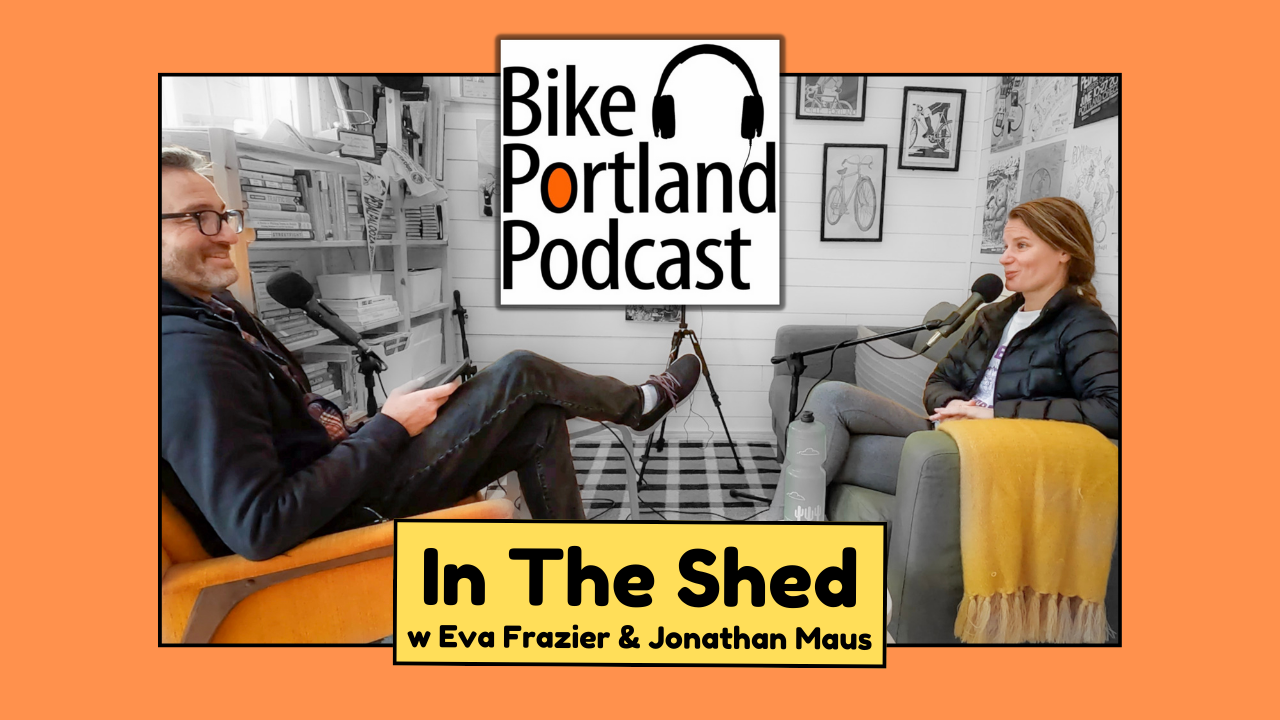
Eva Frazier and I are back with another episode of “In The Shed.” This episode was recorded earlier today in the BikePortland Shed as unseasonably warm weather beckoned us outdoors.
As usual, we had a really great chat about a wide range of stuff.
Office hours chat with City Council candidate Chris Flanary (D3-SE)
Bike parking and access at Belmont Public Library remodel
Everyone in Portland is running (as in, jogging) right now and we should enlist them in the war on cars
Southerly Ladies ride
Caddyshack ride and the new Ghostbusters movie
Why we need a Shift Calendar for basketball in Portland (aka Jonathan’s side hustle dream to cover local basketball)
Thanks to Brock Dittus of Sprocket Podcast fame for our fantastic theme music. Listen in the player above or wherever you get your podcasts. Thanks for listening!
Three more platforms like this one in front of the Schnitz are being built this month. (Photos: Jonathan Maus/BikePortland)
If you see city construction crews tearing up the bike lane on SW Broadway through downtown, don’t fear. They are not removing the protected bike lanes so many riders depend on for their safety every day. The work is part of an expected project from the Portland Bureau of Transportation to install new loading zone platforms.
If you recall from our coverage back in late September, before the big Broadway bike lane kerfluffle, PBOT was talking to managers and operators of hotels along the street about how to mitigate safety concerns voiced by valet staff, guests, and road users. As early as March 2023, PBOT staff told hotel operators they could receive the same type of loading platform in front of their business that the city had already installed in front of Arlene Schnitzer Concert Hall. The platforms raise the bike lane to sidewalk level, include green color for added visibility, and provide easier access to business entrances for people who park adjacent to the bike lane. The combination of the ramp, along with more robust signage and pavement markings increase awareness of the potential conflict zone for all users: valet staff, hotel guests, and bicycle riders.
Advertisement
PBOT announced on Monday they’ve begun construction on three new platforms. At a cost of about $90,000 each, they’ll be installed in front of the Benson (SW Oak), Heathman (SW Salmon), and Vance (SW Columbia) hotels. Each location should take about two weeks to build and you should expect a work zone environment as you cycle through. PBOT hopes to button up construction by mid-March. Final pavement markings won’t be done until spring because crews need dryer, warmer weather to install the materials.
In addition to building these platforms, PBOT said back in September they would release an evaluation of issues on SW Broadway and proposed upgrades that reflect the concerns from the public and business operators Commissioner Mingus Mapps and PBOT Director Millicent Williams used as justification for their planned changes. That evaluation would come with public outreach so a true, community-wide conversation could be had about how to improve SW Broadway. Three new signal upgrades at SW Oak, Taylor and Jefferson to separate bicycle through traffic from right-turning cars were also promised.
According to PBOT Public Information Officer Dylan Rivera, the evaluation report is ongoing. PBOT staff have prepared concepts and have presented them at the Central City in Motion Workin Group on October 18th (and the Downtown Neighborhood Association). The draft “hardening concept” shows concrete medians and protected corners throughout the corridor between NW Hoyt and SW Clay. Rivera says more public engagement is planned once they secure funding. As for the promised bike signals at Oak, Taylor and Jefferson, Rivera says two of them (Taylor and Jefferson) will be bundled with the upcoming SW 4th Avenue bikeway project slated to break ground this spring. PBOT still hasn’t found the funding to install the third signal (at SW Oak).
Portland City Council District 2 (N/NE) candidate Mariah Hudson joined me for a brief interview today. I was first introduced to Mariah through her role as chair of the PBOT Bureau & Budget Advisory Committee. When I heard she was running for council and was a daily rider who bikes with young kids, I knew I had to chat with her.
The interview above (and just posted to the BP YouTube channel, which you should subscribe to!) is part of a new series, “15 Minutes With” where I chat with interesting folks for 15 minutes (or so). Thanks for your patience while I dial things in and make this part of our regular offerings. I’ve got an exciting list of folks I want to talk to; but if you’ve got ideas or want to be interviewed yourself, please send me an email – maus.jonathan@gmail.com.
Now, back to Mariah…
Advertisement
In our interview she shares that she’s got two kids in Portland Public Schools (first and seventh grades) and is a daily bike commuter from the Alameda neighborhood to OHSU where she works in public health communications. Mariah is also on the PPS budget committee and has served as a leader of the Northeast Coalition of Neighborhoods. Asked why she’s running for council, Mariah said, “To try and make a difference, to clean up the city, to help people with safety so that my kids and others will want to live here and can afford to live here in the future.”
Mariah rides a Rad Power Radwagon, longtail e-cargo bike and said, “It’s been a game changer, especially in terms of going into work.” Having the e-bike has made her 10-mile round trip commute often quicker than driving and she can show up to work without being sweaty.
Here are a few other exchanges from our conversation:
What are some things about PBOT’s budget you were surprised about or learned by being on the committee?
“Our group is a community advisory group for the budget, and it’s intended to provide accountability and really make sure that community priorities are reflected in those budgets. I think something that would surprise a lot of people is how much of the PBOT’s transportation budget is really not flexible, it’s committed to long-term projects — everything from the Sellwood Bridge to long-term road projects. There’s really only about 20% of the budget that’s flexible in any given year that can be assigned to things like safety or potholes or special projects or Sunday Parkways that’s not already committed.”
How should Portland balance the tension between solving transportation congestion problems through maintaining a lot of car traffic like we have now, or shifting that space and using it for mass transit and bike lanes?
Advertisement
“Well, you’re right, there is a tension and oftentimes that tension plays out in terms of ‘Do people really have the ability or not to shift modes easily?’ And when I say the ability, I mean the ability within our current system. Like, if it’s 20 minutes to take a bus downtown and it’s 10 minutes to drive. It might be more like an hour if you’re coming from certain parts of Portland. How feasible that is for you is something that we absolutely need to consider.”
Given you experience with schools, what’s your opinion about school pick-up and drop-off lines and do you think there’s something that a city council member could do about that issue?
“Well, my personal pick-up and drop-off line is very, very short because I can scoot on my bike or I can walk my kids. I’m also in the Alameda neighborhood, so I take the bike bus with my kids sometimes on Wednesdays. And I will say I think that’s a great direction that our city can expand in terms of getting kids to school and really thinking about those safe routes to school. And there’s safety in numbers. We’re also training kids for the future, showing them it’s possible, showing them it’s fine to ride in the rain.
I don’t know what the answer is at the [school entrance] for cars, but you know, for people who are a little farther out, giving them that taste of what it could be like to ride or to walk is a great place to start.”
Listen to the full interview above, and come to Bike Happy Hour next week (Weds, 2/7) to meet Mariah in person. Learn more about her at MariahForPortland.com.
The recent weather and this shot from the Rose Ride on June 16th, 2023 has me pining for spring! (Photo: Jonathan Maus/BikePortland)
Happy weekend everyone! Remember, I always appreciate an email or other message about the event you’re hosting or ride you’re leading. I try to track everything, but I sometimes miss stuff.
Also, Sunday is fareless transit citywide thanks to TriMet and their efforts to honor Rosa Parks, a Black woman who changed the course of history when she refused to give up her seat to a white man on a segregated city bus in Montgomery, Alabama in 1955.
Have fun planning your weekend!
Friday, February 2nd
WeBike Winter Light Fest Ride – 6:00 pm at Lloyd Center (NE) Enjoy a fun route on opening night of the PDX Winter Light Fest. This ride is “for anyone who does not benefit from cis male privilege.” More info here.
Saturday, February 3rd
Caddyshack Ride – 12:00 noon on I-205 Path (NE) It’s the 14th annual Bill Murray tribute ride that rolls through a selection of public golf courses. First 20 riders get a commemorative spoke card. Led by Maria “Bicycle Kitty” Schur! More info here.
Ride to Illuminated Bike Ride – 5:45 pm at Beaverton Transit Center (Westside) Join friends from the westside for a group ride to the Light Fest ride. More info here.
Advertisement
In the Dirt Film Screening – 7:00 pm at Clinton St Theater (SE) This is it folks! Don’t miss this exciting opportunity to see a cool new documentary about how members of the Navajo Nation are building community around biking on their land. Stars of the film will be on-hand for questions. More info here.
Illuminated Bike Ride – 7:30 pm at Rose Equipment Annex Parking Lot (SE) The official group ride to kick off the 2024 Portland Winter Light Festival. Led by NakedHeartsPDX, expect a family-friendly vibe, good music and good times. More info here.
Sunday, February 4th
Palm Tree Ride – 10:00 am at Bipartisan Cafe (SE) Shawn from Urban Adventure League will take you on a journey of tropical delights as he informs you about interesting palms that live in our city. More info here.
Belmont Goats Ride – 10:00 am at Parkrose/Sumner Transit Center (NE) Portland Bicycling Club is leading this intermediate-paced ride (13-15 mph) that will be about 25 miles long. Expect a bakery stop! More info here.
Transit Equity Day – 12:00 pm at The Street Trust Hub (Lloyd Center NE) It’s free fare day in honor of Rosa Parks and what better way to celebrate than by learning how to put your bike on a TriMet bus and get all your burning multimodal questions answered by experts while you indulge in transit-friendly swag with other train and bus lovers? More info here.
— Don’t see an event? Please tell us about what’s going on in your neighborhood by filling out our contact form, or just email me at maus.jonathan@gmail.com if it’s easier.