

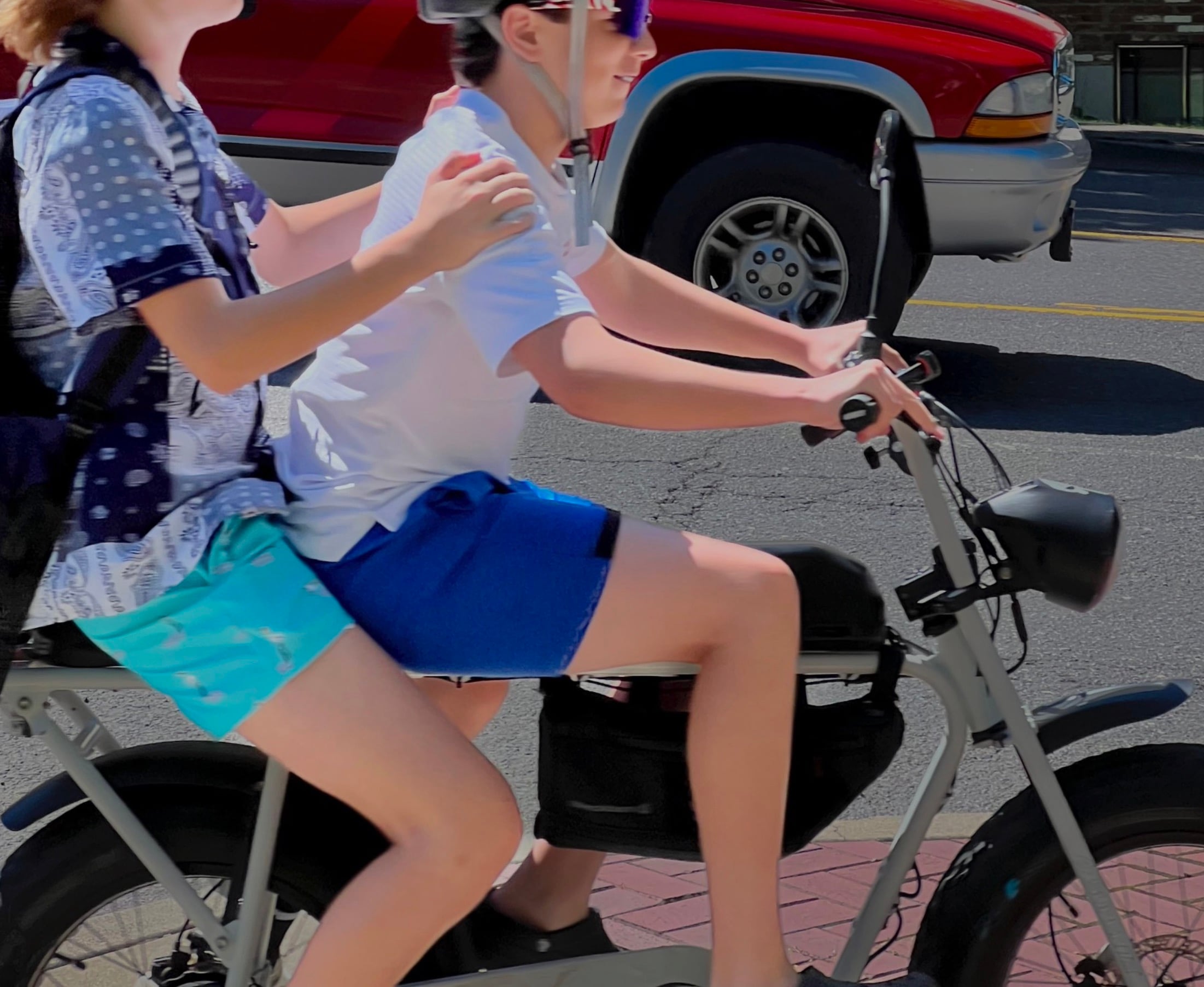
Oregon lawmakers have a chance to clean up laws related to electric bikes and the growing number of other battery-assisted vehicles that are showing up on our streets. House Bill 4007, championed by The Street Trust and based on a nearly identical bill from the 2025 legislative session, seeks to make several significant changes to existing law — including lowering the legal age for riding an e-bike from 16 to 14.
The bill is based on HB 3626, a similar bill from the 2025 regular session that passed the Joint Committee on Transportation, but got held up in Ways and Means (where bills with a fiscal impact often go to die).
Missing from this bill is the provision from the previous bill that would have required the state to establish an e-bike safety information and education campaign. Jake Weigler, a political consultant helping TST get this bill over the finish line, said that’s because during the short session it’d be impossible to move this bill if it required funding. Given that this is a short session (just 34 days left), only bills that have broad support, have been previously vetted, and don’t impact the budget are likely to pass.
HB 4007 aims to fix several elements of our current e-bike and battery-assisted vehicle laws: a market flooded with dangerous, low-quality batteries; confusion from products sold as “e-bikes” that are more akin to mopeds or motorcycles; concern from parents and police officers about age requirements; and the lack of clear definitions for new types of vehicles.
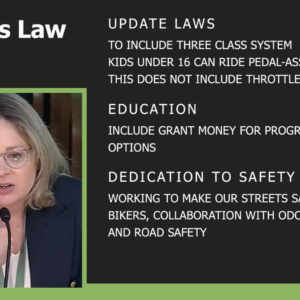
HB 4007 aims to help on all fronts. Here’s what it does, according to a one-pager created by The Street Trust:
- Creates offenses of improper sale or lease of a vehicle and selling imposter bikes, punishable by maximum fine of $250.
- Requires all riders under 16 to wear a safety helmet and that they must be at least 14 to use a class 1 e-bike or e-scooter that provides power up to a speed of 20 mph.
- Defines a micromobility device as including a propulsion system that provides assistance up to a speed of 28 miles per hour (mph), while distinguishing them from e-bikes, e-scooters, mopeds, motorcycles, and wheelchairs.
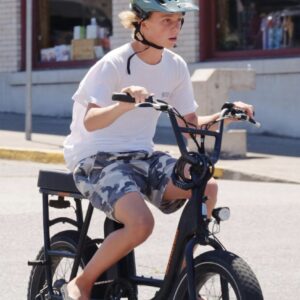
The bill also raises the speed limit of e-scooters from 15 mph to 20 mph.
Asked why TST feels this bill is urgent enough for the short session, Weigler told BikePortland this morning they need to react to the popularity of e-bikes and e-motos in the market, and the dangers some of them pose to young people. “There are a lot of kids excited about these bikes and we want to facilitate using them safely, and now there’s not a lot of clarity in the market to help families make good decisions,” he shared.
As Hood River School District youth biking educator Megan Ramey shared on BikePortland last session when HB 3626 was still in play, Oregon currently treats Class 1 e-bikes — the lowest-power category of bikes that can go a maximum of 20 mph without pedal-assist — “like a car.” “And because under-16s are barred from riding them, schools can’t even legally provide education to the age group most eager to learn,” Ramey wrote.
Ben DeJarnette, owner of a business that rents e-bikes in the Columbia River Gorge, supports the bill’s changes to the age requirement. “We frequently have families come into our shop looking to rent e-bikes with their teenage kids (who have ridden e-bikes in other states) and we currently have to turn them away or require them to ride as passengers,” DeJarnette said in testimony submitted in advance of tomorrow’s hearing on the bill. “Updating Oregon’s e-bike laws will help small businesses like ours grow while creating a smarter, safer regulatory framework for micromobility devices.”
Another key provision of HB 4007 is to add a definition for “powered micromobility device” into Oregon law. The intent of this is to create a legal framework for devices like OneWheels, e-skateboards, and electric unicycles that separates them from e-bikes, mopeds, motorcycles, ATVs, and so on. PMDs would be vehicles that are designed to transport a person, have some type of propulsion system, have a maximum speed of 28 mph and an unloaded weight less than 100 pounds. The bill also explicitly allows PMDs to be ridden on bicycle lanes and paths.
HB 4007 also aims to discourage the sale and use of e-motos that can go over 28 mph, but are often marketed as e-bikes. The bill would make it illegal to sell an “impostor vehicle” — that is, selling a vehicle advertised as one thing, but that actually fits the legal definition of another. So if an Oregon retailer sold a battery-powered motorcycle that didn’t have functional pedals and could travel faster than 28 mph as an “e-bike,” they would receive a Class D traffic violation (with a presumptive fine of $115).
Batteries will also be more tightly regulated if HB 4007 passes. The bill would make it a Class D traffic violation to sell batteries that don’t come with a stamp of approval from, “an accredited testing laboratory as recognized by the United States Occupational Safety and Health Administration, the United States Consumer Product Safety Commission or an independent laboratory that has been certified by an accrediting body for compliance with nationally recognized battery standards or other standards deemed sufficient by the Department of Transportation.”
While it seems like a lot for lawmakers to ponder in a short session, keep in mind most of these provisions already passed committee last session. Also keep in mind that HB 4007 is an omnibus bill that House is using to stuff other, related laws into. That’s why there’s an entire section of this bill about laws for hauling milk (no, I’m not kidding).
Learn more about the bill on the official legislative session website and if you want to weigh in, here’s information about tomorrow’s public hearing.
Thanks for reading.
BikePortland has served this community with independent community journalism since 2005. We rely on subscriptions from readers like you to survive. Your financial support is vital in keeping this valuable resource alive and well.
Please subscribe today to strengthen and expand our work.
I’m not sure I like the idea of allowing mini gasoline powered motorcycles onto MUPs. Nor do I see the logic in dealing with safety concerns by lowering age limits and increasing the speeds of scooters.
This bill seems to me to be mostly anti-human-powered-vehicles. Remember those?
(Assuming the riders pictured are under 16 and are in Oregon, I count at least 4 legal violations in the lead photo. See if you can spot them.)
“””I’m not sure I like the idea of allowing mini gasoline powered motorcycles onto MUPs.”””
I am absolutely sure I do not like the idea. In fact, I hate it. There are already dudes ripping around on stinky, loud mini bikes and it sucks. The MUPs should be a chill place to walk, jog, ride and without the stink and noise of 2 stroke engines.
Safe streets advocates: nearly every fatal collision is at greater than 20 mph
Also safe streets advocates: bikes need motor assist up to 28mph
Really?
I realize that sensible limits wouldn’t be competitive with bootleg e-bikes, but those bikes are a product of the unregulated market traditional bike brands initially wanted. This doesn’t look like safety to me, this looks like those brands want a bailout.
Electric bike nay-sayers: keep electric bikes off our MUPs and protected bike lanes!
Also electric bike nay-sayers: electric bikes don’t need to go 28mph!
I don’t know if you personally say both, but I hear a lot of both kinds of complaints about e-bikes. They’re contradictory.
Contradictory? How so?
I’ve given up using logic and reason with ebike haters, they’re like MAGA people denying climate change. Whenever I get harassed by militant bikers I just smile and say “share the road, one less car” and pedal on past them.
If you are regularly getting harassed by people in public for any reason, you might want to look in a mirror.
Aside from people having a mental health crisis, I can’t think of a time I’ve been harassed by anyone in public.
I also find it rare, but a lot of people here claim to be routinely harassed by drivers.
Funny you should mention Mirrors.
I guess you need an example: Me minding my own business rolling up to a stoplight as it turns green and since I have something called momentum, I keep pedaling past a bike that was at a dead stop for the red light. They yell something brainy at me like “F-ing ebike, I didn’t know you were there” Of course 99.9% of the time this person does not have a rear view mirror and has air pods, or even full ear coverage headphones, impairing their awareness, but I’m the bad guy? If cars and motorcycles are legally required to have rear view mirrors to operate on public roads, shouldn’t bikes need them? It seems like common sense for the most populated city in the state. You’re on a public street, not a velodrome, a little mirror isn’t going to cause that much drag.
Do you consider strangers swearing at you harassment? Maybe I should have used a different word?
It’s funny that I’ve seen people here type “you can hear ebikes coming from 2 blocks away” but then when you pass them they get upset. I always leave plenty of space, what is there to get upset about?
I’ll remember that if I see the 2 guys in the sports car who harassed me verbally and getting as close as possible while driving beside me as I was biking. It was not fun and as a matter of fact, it was the last time I’ve been on my bike.
Count yourself lucky.
The debate over a 28 mph limit often misses the reality of our infrastructure. I live on a 35 mph arterial road with no bike lane, where traffic regularly flows at 40 mph. To even get to a protected bike path, I have to mix with those cars. Being capped at 20 mph on a road like that creates a dangerous speed differential that invites being rear-ended, aggressive close-passes and road rage.
Having the capability to flow closer to traffic speeds—around 30 or 35 mph—allows a rider to safely take the lane and move with the ‘pack’ until they can transition to a protected path. Once on that path, of course, the rider should slow down to 15 mph. We should be regulating behavior on the paths, not hardware capability.
The ‘incapable of’ standard in HB 4007 is also technically out of touch. High-speed bikes are already everywhere, and these limits are almost always software-based and easily unlocked. Punishing versatile commuter tools, even licensed ones, that can handle both a 40 mph road and a 15 mph path just makes the roads more dangerous for those of us trying to get out of our cars and onto two wheels.
If two wheels and high speeds are important, get a motorcycle. I don’t actually believe that a bicycle is safe at 35 mph, and certainly most riders are not equipped for a crash at that speed. No leather and a helmet that will crack like an egg shell.
Oh a good bicycle is totally safe at 35 mph. With bicycle disc brakes it’s still easy to do a stoppie even at 35 mph without overheating them, so they are clearly powerful enough. Overheating the brakes is the only concern with them being so small but you’d have to really work at it to overheat them I think – and to be fair overheating brakes is a problem cars and motorcycles can often have as well.
I’ve hit over 50 mph on my road bikes downhill on sections of PCH. 30-40mph is common for many riders on moderate descents even.
don’t need leather at 35 mph either, with normal cloths you get cut up and scraped up and it’s not fun but nothing to go to the hospital for. I’ve got a lot of crash experience at different speeds from armature road racing – and been taken out by car drivers twice as well (both from behind from drivers trying to blow by me while I’m trying to hug the shoulder – both in LA though.)
Who is going to regulate the behavior? If we actually had funding for that, I feel like people like you would complain on here because they got a ticket for going 22mph on the Springwater on their e-motorcycle.
“”I was only a few mph over the limit! This is bias against e-bikes!”
We shouldn’t allow vehicles capable of keeping up with 40mph traffic in our car-free spaces.
Problem is you already are and you won’t be able to tell. Here are some examples of ebikes that can hit 40 mph that hardly look like ebikes…
https://lunacycle.com/luna-fixed-stealth-ebike/
https://chimerabmx.com/collections/bikes/products/chimera-electric-bmx-steel
There are a bunch more too…. so how are cops supposed to regulate these? Isn’t measuring speed and ticketing based on behavior the only way?
I mean heck even if you had an actual legal 20 mph cut out bike and a cop saw you going 30 mph they wouldn’t be able to prove that you weren’t hitting 30 mph from pedaling – yet another reason why regulating by software setting is nearly impossible compared to regulating behavior.
The Street Trust:
Cycling numbers are way down because our streets are really dangerous and cars are a threat to kill us due to terrible infrastructure.
Our answer:
Raise the speed limit for vulnerable users and lower the age for vulnerable users on our dangerous streets.
Why do they get money from anyone?
Being able to cruise at traffic speed on narrow local streets increases safety, especially going up hill. Getting passed by cars on these roads is sketchy, especially trucks with big mirrors.
My kid is 14 and has bad Knees. He cannot ride his bike like he loves to because the law, as currently written, does not allow him to have electric assist to overcome his mild disability.
I think this point is moot; the drivers who are doing sketchy passes of people on bikes riding 9mph are also doing sketchy passes of people on ebikes riding 20mph. This is more an issue of driver education and traffic law enforcement IMO.
No where I’m at, I live on a 35 mph road with curves and no bike path and bicycling on it at 9 mph is way more dangerous than 28. It would be so easy to get rear-ended. If I was capped at even 20 mph I would bike way less because I have to go on this road to even get to a bike lane or bike path.
Lower speed differentials are a proven way to increase safety and we aren’t providing enough bike lanes to avoid 35 mph roads so if we actually care about safety we should riders have the safest option – be able to go closer to traffic speeds when you have to mix and then slow down and enforce slower speeds for bike paths.
Why do you think enforcing speeds on bike paths will work when enforcement on the arterial road in front of your home doesn’t?
Who said it doesn’t work in front of my home? it does work, I regularly see people pulled over – it’s just that cops decided for some reason to give people a 5 mph grace so… 35 mph becomes 40mph but anything over that and people get pulled over. I mean I agree that if the limit is actually 35 mph they should enforce it instead of doing 35+5 but clearly they do actually enforce a speed limit on the road in front of my home.
So yes I think they could on bike paths as well as I have seen other states and countries do.
Sorry, I thought you lived in Portland. My bad.
Not in the city but I live in the metro area, CCSO policies my road I believe.
Your point is well taken: it sucks to ride with high speed differentials and no physical protection. Even experienced cyclists feel uncomfortable on narrow shoulders with fast cars, and there is no way I would take somebody I was trying to convince to bike more into such a situation. It’s terrifying. I’m curious, though, about the actual danger. I’ve heard (read in BP comments) that rear end collisions are a small fraction of collisions, which are dominated by crashes at intersections. I wonder if there is a solid understanding of the risk and what it is.
Good point Barrett. It makes sense to me that these vehicles are allowed on roads. Do you think 14 year olds should be able to operate them? Do you think they belong on sidewalks? ON trails? ON shred paths? In bike lanes? Should people eb required to wear a helmet when operating one? I am definitely not opposed to fast e-things, but I think they should not be called bikes and they don’t all belong everywhere bikes belong. This proposed language seems OK but pretty tame and incomplete.
I think we should regulate behavior not machines. We need on the ground cops to enforce anything right? so why make them try and figure out maximum device speeds and watts which can be changed instantly with settings – why not have the regulate behavior. Cops are already used to measuring speed – have them enforce speed limits on bike paths and trails regardless of vehicle type. This seems like it would be much easier to actually regulate for and would allow micro mobility to thrive and for people to choose the safest route with the speed trade offs they want.
Right now I’m forced to pick… do I ride a legal e-bike capped at 20 mph and have to ride down some 45 mph streets with out clear bike lanes or do I get a plate for my ebike / emoto that can do ~40 mph but then I don’t get to use protected paths when I can… Trying to go anywhere for me involves a route that has to use some of these fast roads but for safety sake I would certainly love to go slower on protected paths as much as possible, I just don’t want to give up the safety of being able to keep up better with the traffic.
Regulating by behavior speed solves both problems – the unclear enforcement questions and the mixed route safety issue.
I always were a helmet – a full face even when using a normal bicycle and make my kids do the same, so personally I’m pro-helmet but it’s probably a trade off, in the EU often places where bicycles are most used helmets aren’t common at all so maybe not having to wear a helmet encourages more people to ride? Making it the law for kids at least makes sense to me though.
14-year-olds should not be operating anything that doesn’t rely solely upon human power, for the same reason that there’s an age limit on driving a car or motorcycle.
Kids’ brains aren’t fully formed at that age, and their impulse control is still sketchy.
Do I want to get smacked by a kid operating a gas- or electric-powered vehicle, especially if they jump the curb and end up on the sidewalk?
And do I trust enforcement to keep kids from doing anything dangerous when it already isn’t working to manage the adults who mismanage their motorized vehicles?
It’s a hard no from me on both fronts.
I hear you but the same logic should apply to cars, trucks, and SUVs. 16 is not old enough to be operating those same machines. At least a dumb kid on an e-scooter isn’t going to end a lineage in one fell swoop like a dumb kid in a pickup truck. Hell, most male brains don’t fully form until the age or 25. As a male brain owner whose brain did some dumb shit before then I can confirm.
Maybe the driving age should be raised.
What does that have to do with whether 14-year-olds should be riding motorized bicycles?
The driving age absolutely should be raised.
My point is that we do all this hand wringing about kids on ebikes but as soon as they turn 16 we let them operate something much deadlier.
Personally I think lowering the age for ebikes to 14 is dumb, especially without the corresponding education for operating them safely. After giving it a lot of consideration I think that kids & teens need to just be riding regular bikes.
You used to be able to get a restricted motorcycle license in OR at age 14. As we move age limits higher and higher we delay self-efficacy resulting in emerging adulthood as sociological research calls it where we institutionalize adolescence where we push back the age people feel independent and you get even 25 year old’s who don’t feel like adults yet and don’t have their lives together.
By pushing back independence, we prevent young people from developing the logistical competence and risk-management skills they need.
We’ve legislated away the very milestones—like independent transport—that build an adult brain.
I happen to know a whole hell of a lot of independent adults who never rode an e-bike before their 16th birthday.
I’ll bet you know quite a few as well.
Kids can develop logistical competence and self-management skills on a bicycle just fine.
“for the same reason that there’s an age limit on driving a car or motorcycle.”
Yeah but it’s not the same reason. These bikes are light weight and have a top speed of slow. It makes no sense to have a jump from not allowing any motors at all to allowing a 16 year old to operate a multi ton vehicle capable of towing an RV and going 0-60 in a few seconds.
14 year olds can handle minor e-assist. And if they can’t, don’t put your kid on one.
Or we could raise the driving age to 21. Honestly, I’m up for that too!
Totally disagree – it just comes down to practice, age is hardly a factor. I see kids as young as 4 racing motocross all the time, kids as young as 8-9 who can ride better than most adults.
How many adults can do an emergency stop on a bike, gently lifting the wheel or braking just to the limit of sliding? not many, but kids that ride a lot can.
Totally agree regarding skills. Judgement is another matter. An age limit certainly doesn’t weed out everybody with poor judgment, but a lot of folks get wiser as they age. I know I did.
I bicycled several miles to school from around 11 including roads with 45 mph speed limits, being able to go a bit faster would have made it easier and less dangerous. Plenty of judgement is needed when around that much traffic regardless of normal bike or ebike.
28 mph seems way too fast – someone is going to get hurt or killed. Cap it at 20 mph, which still seems too fast, but regulating speed is the only way to regulate the PMD space.
In Europe, it’s all capped at 20 *kph*.
How are we getting this so wrong? Oh well. Genie’s out of the lamp now…
Check out this bicycle
In USA, if it goes over 28mph, it goes past the ebike classification and is no longer considered an ebike.
Thanks for showing us this definitionally electric motorcycle
Except it has pedals, and you will absolutely see people riding it on MUPs and in bike lanes. No one enforces anything.
With just a slight, invisible tweak to the software, it transforms into a perfectly legal e-bike.
The problem with capability-based definitions is that they are unverifiable. I have a friend whose son has a stolen/hacked Lime scooter that does well over 30mph (I’ve seen it go, it is insane). It is physically indistinguishable from a “normal” motorized scooter.
People own these here, now. I work in the bike industry and I only know about this brand because some here guy wanted a kickstand for it. I was floored to learn this goes nearly 50 mph. I don’t want to share paths with these things, ever.
Also, what Chris I said. No one enforces anything.
28 mph is too slow for the road my house is on… it’s 35 mph with some fast blind corners that cars go 40 mph on… I have an ebike I bought a decade ago that can go about 32-34 mph if I really peddle hard and even then I get a lot of people honking at me :/
20 mph I would have been rear ended by now.
I want to remind everyone, if it has a throttle and you do not need to pedal at all, you have an electric motorcycle. The rules for these should be the same as for gasoline powered motorcycles, like a Harley Davidson. You actually need a motorcycle license for a Harley, right???
Most of those ebikes are closer in speed and weight to a vintage moped (no MC endorsement needed), not a Harley, Your statement seems to say a 50 pound, 20 mph scooter is the same as a 600 to 900 pound, 100mph plus Harley, not really the same thing…
You are wrong. Throttle only up to 20 MPH is a CLASS 2 e-bike, legally defined by ORS. No active pedaling required.
If it does not have pedals than it is not a bicycle under the same ORS definition.
Why in the world would The Street Trust push for lower age limits and higher speeds? I’m so glad I stopped giving them money years ago when they put in Inarone as Executive Director. RIP TRENTON BURGER. SAY HIS NAME!
https://ktvz.com/news/accidents-crashes/2023/06/17/15-year-old-bend-e-bike-rider-struck-fatally-injured-by-minivan-at-ne-bend-intersection/
Trenton Burger was killed by a negligent driver; not an ebike.
“ negligent driver”
Citation please.
It’s right there in the article that Tropical Joe linked. The driver neglected to look at the sidewalk both ways before blasting through a right turn. Just because they “cooperated and remained at the scene” does not absolve them of the moral responsibility for ending someone’s life because they prioritized their own convenience.
I think allowing kids age 14 and up to ride pedal-assist, non-throttle e-bikes, with a top speed of 20 mph, as this bill proposes, is a sensible way to give high schoolers much needed freedom and independence, particularly in hilly or sprawled out communities where riding an “acoustic” bike is less feasible, like Hood River or the west side of Portland.
I also think it is important to create a legal definition for powered micro mobility devices, as this bill does, to make clear what rules of the road governs them. Those vehicles are popular already, like it or not, and we need legal clarity around how they should be treated. Giving them the same rights and responsibilities as bicyclists makes sense to me, and I think a 28 mph cap is reasonable, with the understanding that they will still be subject to applicable speed limits and will have the duty (as we all do) to use reasonable care.
Contrary to a couple of comments on here, this bill will not allow gas-powered vehicles in bike lanes or multi-use paths.
I ride an acoustic bike most days, and an e-bike when I am hauling kids or cargo. I understand the resistance by some of the commenters here to these electric devices, but they are here to stay and it is important that we find a way to incorporate them into our traffic laws.
14 is not a high schoolers. Regardless they should a some idea of road rules that is expected. Like stop yield etc.
What? I was 14 as a freshman, turned 15 a month before the end of the school year.
Anyone that walks where there is traffic or rides a normal bike should should also have an idea of those rules though, I bicycled to school several miles from age 12 and had to know all the road rules then too, an ebike wouldn’t have made it anymore dangerous, might have made it safer if I could have kept up with traffic better.
Instead of giving them independence and freedom, we are teaching them to be slaved to a power source and to be dependent on what is given to them rather than what they can do and earn on their own.
I know it was a long time ago, but I rode the bus freshman and sophmore years, bought a car at 16, and drove to school and work before starting bicycling (with a Specialized that I still miss) 12 miles each way (but not uphill in the snow) on a shoulder without a bike lane during my senior year. Teenagers are amazing and strong and motivated. They don’t need to be shackled to a powersource before understanding what freedom of movement really is. When I went to college I sold my car as the school provided either a parking permit or a county bus pass and since I bicycled most everywhere by then the bus pass was more valuable.
I don’t agree that anything with a power source is the same as a bicycle and should not be considered legally the same. If it has pedals and a power source its a moped, regardless of speed. If it has a powersource and without pedals its a scooter or motorcycle, depending on top speed potential.
“Contrary to a couple of comments on here, this bill will not allow gas-powered vehicles in bike lanes or multi-use paths.”
As introduced, HB 4007 would define a two (or four) wheeled gasoline powered vehicle weighing under a hundred pounds as a “powered micromobility device” unless it met the legal definition of a moped, motorcycle, or ATV, and would grant riders the same rights as a bike rider, and they would consequently be allowed in bike lanes and MUPs. A lightweight go-kart might qualify, for example.
I suspect this also means they would not need to stop at stop signs.
Safety my ass.
You are correct that the statute does not explicitly limit the propulsion system to electric motors, but I think that is clearly what they intend, and you would be hard pressed to find a vehicle commonly used on Oregon’s roads that is gas-powered, under a hundred pounds, and not captured by one of the exceptions.
Your example above, that this would capture “mini gasoline powered motorcycles” does not work because those would fall under the legal definition of mopeds or motorcycles, and are therefore excluded.
Would you support this bill if it were explicitly limited to electric propulsion?
The law is what is written, not what was intended*.
I’ll grant you that the definition of “motorcycle” in Oregon seems pretty all-encompassing, including e-bikes (unless they are excluded elsewhere), so maybe that includes minibikes and other small vehicles.
But the DMV asserts that pocket bikes and mini-motorcycles are not legally considered motorcycles, so could be considered micromobility devices under the new law if they met the other requirements. Interestingly, that document does not say that a moped needs to have pedals.
I have seen dudes riding what appear to be home-brewed bicycles powered by small two-stroke engines (loud and stinky) that might well fall under the weight limit, but might not meet the definition of motorcycle that the DMV is using, and there was at least one dude living along the I-205 path who routinely rode a go-kart along there, so even without the law, folks are getting creative.
As to your question about whether I would support this if limited to electric vehicles, I’m unsure. I am generally less happy about the motorization of bicycling than many folks here, not out of a sense of purity, but out of a concern for the experience is for riders of normal bikes and pedestrians.
I think we need to have a wholesale rethink about what sorts of behavior we want to allow on MUPs and in bike lanes. I find it very disconcerting to be close-passed by a rider going 25mph+ when I’m walking on a trail, and I can’t imagine I’m alone in that. That’s not what this bill is changing, but it would further normalize motorized bicycling and make it available to younger children which I don’t think is a good thing.
As a former high-schooler with a bike in a town whose geography was defined by hills, I can assure you that freedom is available for those who want it (and whose parents allow).
*Certain state constitutional amendments excepted
https://oregon.public.law/statutes/ors_801.365
https://www.oregon.gov/odot/forms/dmv/6619.pdf
This right here; regulate the behavior, not the vehicles. Trying to control what is and isn’t classified as whatever is a dead end IMO. Making clear rules about MUPs and bike lanes, like setting speed limits or minimum passing distances (which should also apply to asshole lycra guys) is much more digestible for the average person/municipality.
Enforcing those rules could be tough though I guess.
Right. Any vehicle on an MUP as long as it’s traveling under 20.
I think it should be fine to regulate the power source. It should be electric or nothing. This wouldn’t be a new precedent, power source, emissions, etc, are regulated all the time. I don’t want people riding a chainsaw on a bike frame.
I have encountered e-quads on the Naito bike path. Would they be considered a micro-mobility device?
Under the law they would if they weighed under 100 lbs and weren’t considered ATVs.
I agree with Chris here! This law will divide a category that has been one (for the most part) in to three – E Bikes, Powered Micro-mobility Devices and Electric Motorcycles. These distinctions are helpful. It also clarifies what is allowed in the bike lane and what youth at specific ages are allowed to operate. Seems it cleans up a lot, making the law much more clear!
Chris,
Why do you think this excludes gas-powered bikes, scooters, and skateboards?
I am mostly OK with this but think there ar a couple of things missing:
Micromobility things and e-bikes are great- way better than cars and trucks- but their size, speed, and power should exclude them certain locations and situations. This seems to skirt that important aspect or regulation.
If speed limits on our Greenway streets and in business districts like Hawthorne and much of inner SE Division is 20, why are they condoning vehicles that can go 28 on those streets and paths (some of which are posted at 15). Especially concerned about use by kids in the 14-16 age range, as others have mentioned, due to their generally undeveloped decision-making skills.
Will 14-16 year olds be legal on a 28 mph PMD? That was not clear to me. The article says that 14-16 yos can ride an E-Bike which by the definition stated is an assist that governed at 20 mph. Did I miss something?
I think banning all vehicles that go over 20 from greenways, Hawthorne, and SE Division would be celebrated by many folks who live car-free lifestyles. That might not be too popular among car drivers.
Creating or defining a class of vehicle with gas powered engines that can go up to nominal limit of 28 mph on an MUP seems to beg for word of mouth advertising of a new ‘sport’ in unregulated space* that could be popular with anyone who likes to tinker with motors and doesn’t have a motor vehicle operator’s license for whatever reason, including perhaps DUI convictions. This sounds like a textbook case of unintended consequences.
*Unregulated because police patrols are totally absent without a 911 report of a crime or a crash.
They should just enforce those speed limits then, why make trips where you have to do a mix of paths and fast surface streets more dangerous and slower – just enforce the lower speed when it’s called for.
We have some experience that tells us about our ability to regulate travel speeds in the public right of way.
Have no illusions that it will somehow be possible to enforce speed limits on shared paths. It won’t be.
Surely it would be a lot easier than enforcing device speed caps though which are just software settings that can be changed easily. Enforcement is needed regardless but it’s going to be much easier for an officer to measure current actual speed than watts or current vehicle speed limit setting.
How would you do it? With bike path cops, when we can’t even afford a robust traffic enforcement response on dangerous city streets?
My position is that neither approach is tenable. I don’t see a third option, unless we’re willing to implement some sort of geofencing regime similar to what drones have.
Geo fencing wouldn’t work either and doesn’t work for drones – at least all the ones I have you can simply turn it off in the software settings, the same would be true of ebikes / emotorcycles which are legal for private property and OHV areas anyway.
Yes for any regulation we’d need cops for enforcement of course. I’ve seen it done well other places. In Santa Monica the bike paths were very well regulated by cops enforcing speed limits. I saw one on the path at least once a week and always on the weekends – often writing lots of tickets, I suspect they might have written so many tickets it paid for the enforcement even – maybe tickets need to be more $$ here?
You’re probably right. It was my only idea. Portland has proven unable to hire even enough police to manage our streets, and that seems unlikely to change.
Maybe we’re headed toward a future where the bike paths, filled with fast, motorized vehicles driven by 14 year-old thrill seekers are more dangerous than the wide, calmer streets where the vehicles are largely automated, orderly, and safe.
What a world!
Haha yea I rode in a Waymo and I guess if they were all automated like that I could maybe buy that. Although if all the 5000lb cars were automated in a safer way maybe we wouldn’t need protected bike lanes for commuting safety and they could really be more reserved for recreational biking, walking etc.
I think Portland actually does a lot better at keeping speeds reasonable than LA does for it’s car roads. However the bike paths in LA were patrolled better – with speed enforcement.
“bike paths in LA were patrolled better”
LA has more than twice as many cops per capita as Portland does. They can do things like enforce speed limits on bike trails, or even on roads, that we can only dream of.
https://www.wweek.com/news/2022/09/28/portland-ranks-48th-among-50-big-cities-for-cops-per-capita/
Ahh thanks for the data. I mean I guess with no cops to enforce device limits or speed limits it doesn’t mater as much which one we pass. Still don’t you think it would be much easier to enforce speed limits if we someday get enforcement?
As I said they do seem to do a better job keeping car speeds more in check than they do in LA still which is nice.
I think this is a fundamental problem with the existing e-bike classification scheme, which allows vehicles with a throttle to be classified as bikes. The proposed language talks about “functional” pedals, when the real issue is the throttle, which allows the vehicle to move without using the pedals. It seems that it would be simpler and more clear to say that if it has a throttle, it is not an e-bike. Period.
Makes sense, Larry!
Throttle makes no difference, so nah.
The pedals are a throttle. I don’t know how people don’t understand this. There is no requirement, or feasible mechanism to implement or enforce, some minimum amount of effort the rider has to output. You can imagine an e-assist that if the pedals are moving, the bike accelerates at full power. Or close enough that speed can be modulated.
So how is that not a throttle? We’re playing stupid word games and getting hung up on some ridiculous notion that e-bike riders are “cheating” (at what, exactly?).
Just allow throttles across the board. It is none of your damned business the shape of the button someone presses to make their bike go. It’s not your business. The only thing you have any business sticking your nose in is the speed and weight of the bike, because that’s what has an outward impact on other people.
“Throttle makes no difference”
If that’s true, why do we need them?
It sounds like you are coming around to my idea that we no longer have distinct categories of vehicles, rather a spectrum with some somewhat arbitrary cut points.
I’m not coming around to that, it seems obvious. We can regulate speed, behavior, power source. Those can be classified like we do now by their speed, but the classification based on a throttle is no different than legislating disc vs caliper brakes.
We should regulate the things that actually matter. The throttle doesn’t matter.
Why does power source matter?
This a joke?
We regulate things we do and don’t want to happen. Gas powered bikes are dirty and pointless. We should ban them just like leaf blowers.
Maybe “we” don’t want throttle bikes or 28 MPH motor bikes either. Judging from the comments here, at least, some of “we” clearly don’t.
Personally, I’m fine with getting rid of all gasoline and diesel powered vehicles, and the sooner the better. Go electric!
I agree about the spectrum with some somewhat arbitrary cut points. The device speed limit regulation itself is pretty arbitrary – what does it mean to have a vehicle incapable of a speed faster than 20 mph? can I just have a mode I toggle? after all the way these actually work that limit is just a software setting easily modified, it’s not a property of the actual motor or hardware.
“can I just have a mode I toggle?”
This question illustrates why the entire conversation is so challenging. I don’t think there is any effective way to regulate what people do on MUPs, and that the future is ever more motorized vehicles traveling increasingly faster, squeezing out conventional bicyclists and pedestrians with an increasing injury and death toll.
Something at some point will have to give, but I don’t know what it will be. I think the motorists among us have won this round.
The solution to me is to just enforce speed limits – isn’t that already the case in places some paths have 15 mph limits for example which is already slower than the ebikes and normal bikes can go?
I used to live in Santa Monica and commuted by bicycle on the beach path and they enforced a 20 mph limit their very strictly even before ebikes.
At the end of the day they need officers there to enforce whatever law it is – why make it hard, just enforce a speed limit which officers already have tools and training to measure – that seems WAY easier than officers trying to figure out what the max speed or watts etc.
Even banning ebikes entirely would be harder to enforce – motors are getting smaller and it’s getting harder to tell.
Who would do this? All the extra cops we have?
I will say that an e-bike that is so subtle that it becomes undetectable doesn’t seem like a problem. I’d happily live with that if it allowed us to get rid of motorbros on low-powered motorcycles using our bike paths.
The same cops that we expect will enforce the current regulations – only it would be much easier for them because they would have something they could actually enforce unlike speed limit modes and undefined motor watts
Isn’t the problem not how they look but how fast some of them are ridden? You can get e bikes that look normal these days but go 40+ mph.
So why not enforce based on that?
Because we just cannot hire enough cops. PPB has been short staffed for years now, and I see no reason why that’s going to change.
Tell you what — we’re having the same conversation in two different threads. Please pick one and let’s abandon the other.
I know what we can do. Let’s cede the MUPs to motorized devices. The bums (us) lost this round. Then we build technically challenging (slow) singletrack next to them. The bikes will be able to get places within the city and have fun while doing it.
Hasn’t this already happened?
No. I still ride the Springwater and rarely see things more closely resembling motorcycles than bicycles.
These days, there are a lot of motorized devices that do not resemble motorcycles, and many of them are very common on the Springwater.
When I ride the Springwater to work, I mostly see walkers, cyclists, and runners. Occasionally a scooter. Sometimes an ebike going just fast enough that it takes me a minute to pass them.
Not sure when you’re riding to have such a radically different experience.
Whats the difference between a person in an ebike doing 28mph with pedal assist and a person on an ebike foing 28mph using a throttle?
None, but it bruises my ego!
(But also that’s too fast for most paths, a separate issue)
15-year-old kids are legally allowed to drive a vehicle with no limitation on speed beyond the posted speed limit. I see no problem with allowing 14-year-old kids to operate an e-bike with a maximum legal speed of 28 mph where appropriate.
This is a fundamental change that needs to happen in our society in order to move beyond motornomativity. With increased ridership, we decrease the number of vehicles on our roadways and increase the overall safety. Instilling the ability to get around without driving at a young age is how we achieve our transportation and climate goals. Do not try to throw up arbitrary roadblocks to systemic change or cherry-pick incidents as to why this isn’t a good idea.
Is an e-bike not a motorized vehicle?
Motorized bikes absolutely contribute to “motornormativity”, to the extent that riders don’t recognize it even as they have succumbed.
I mean, I understood it as more along the lines of “carbrain” but I think it’s important to be precise in how we talk about e-micro mobility. I ride an ebike to work most days but it’s not lost on me that it has a motor. On windy days like today, I say out loud “sure am glad I have a motor”. I still think e-bikes and scooters and all are good in that they are lower impact than single occupancy vehicles and dirt cheap to operate. But I go 15 mph on my Gazelle so I personally don’t see why people need to be ripping down Woodward at 28mph.
I ‘rip’ down Klickitat, Multnomah, and Naito at an average speed of 20mph on my Class 3 Tern to and from work. That is the posted speed on those roads and if cars are allowed to go that fast (but go faster) I am well within my rights to travel at that speed. My bike is much smaller and way more nimble than a car, so it’s easy to avoid other cyclists and pedestrians most days. Occasionally there is ‘congestion’ and I slow down to order to navigate safely. The only issues I have encountered has been with selfish drivers of automobiles.
MORE BIKES, MORE E-BIKES, MORE PEDESTRIANS, MORE PEOPLE TAKING TRANSIT! MORE INFRASTRUCTURE FOR US!
FEWER AUTOMOBILES!
https://en.wikipedia.org/wiki/Motonormativity
“car dependency”
“private motor car ownership and use”
“It is a type of normativity based on the presupposed role of cars in society.”
Based on that, it certainly does seem like “motonormativity” only refers to cars, even though motors are common on bicycles, scooters etc. I’d rather see “carnormativity” used, since that seems to be what’s actually meant, at least according to wikipedia.
It makes me wonder if “motonormativity” became prevalent rather than “carnormativity” because motors have become so normalized that people who popularized the word “motonormativity” were blind to motors becoming prevalent on bikes and scooters–which in an ironic way proves that motonormativity is a real thing, if it did mean blindness to motors becoming normalized.
As more and more bicycles are coming with motors, and we allow children to ride them, it seems like we more more towards “motornamativity”.
The biggest issue for me is that this doesn’t address the gaping hole in education for kids riding bikes/scooters/onewheels/e-whatevers. Unless a kid is lucky enough to have a dedicated parent to teach them how to ride around town safely, or go to a school that does bike safety (PPS used to do this, or maybe still does I think) they won’t ever learn anything past their parents taking the training wheels off their first bike. Don’t even get me started on folks who are teaching cycling using training wheels instead of balance bikes in the first place.
We should levy a tax on e-bikes to pay for the integration of cycling education in elementary school PE curriculum. I say that as someone who owns an ebike and is currently shopping around for another.
Ah, no special tax is needed. If PPS has PE classes anymore it can just become a week long course in early Fall or Spring. Nothing stopping PPS from doing it now other than lack of vision.
It takes a little more than simply “vision” to get an entire PE class on bicycles.
You may be living under a rock, but PPS and many other districts in the state are facing massive budget holes and are cutting staff left and right.
I think the kids above the age of 14 riding illegal bikes should not be impounded or find if they aren’t doing anything wrong but if they’re caught recklessly riding, then they should be impounded or fined