

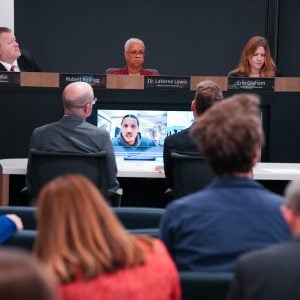
Tyler Frisbee has done her homework. The TriMet Board Member questioned 82nd Avenue Transit Project staff at the January 28th board meeting about the influence of the Oregon Department of Transportation — and whether the agency is following its own policies when it comes to concerns about bus lane impacts on congestion.
I was pleasantly surprised when I heard Frisbee asked 82nd Ave Transit Project Manager Jesse Stemmler:
“I was going back through ODOT’s 2023 strategic plan, where the OTC [Oregon Transportation Commission] specifically directs them to move away from level of service [LOS] as a metric and to move towards a more multimodal approach to performance and was sort of realizing that had gotten lost in this conversation. Has there been any discussion from ODOT execs of how that direction is being incorporated in the way they’re showing up here?”
Stemmler did his best to answer, even though the question was really for ODOT. “The conversations we’re having,” he replied, “Are really around those vehicle capacity thresholds that are baked into their Highway Design Manual.”
Then, after an awkward silence where both Stemmler and Frisbee tried to read each other’s body language, Frisbee relented with a smile. “Okay, I don’t want to put words in your mouth because you have relationships with partners. But what I’m hearing from that is it sounds like the direction from the OTC has maybe not trickled down to the staff level, particularly when it comes to project implementation.”
As I reported last month, ODOT recently ran a traffic analysis on how TriMet’s proposed “business access and transit” (BAT) lanes would impact state-owned facilities. The biggest area of concern is where SE Powell Blvd (Hwy 26) crosses 82nd. ODOT says they have concerns that drivers who divert away from the bus lanes would get backed up on Powell. But Frisbee is concerned that ODOT seems to have only considered driver volumes, and not transit rider volumes.
The 2023 Oregon Transportation Plan makes a clear recommendation that the quantity of cars that can fit on a street should not be the most important metric in determining road designs and plans. Below is one of the objectives adopted by the OTC in that plan:
Policy MO.2.1
Prior to adding new motor vehicle capacity, assess whether the capacity or other needs can be reasonably addressed by a cooperative approach among agencies to carry out one or a combination of the following:
Multimodal investments (e.g., increased transit service and passenger safety, multimodal network completion, and connectivity improvements that are non-auto),
- Transportation options programs (e.g., education and outreach, transportation options information, trip planning, or rideshare support),
- Transportation system management improvements (e.g., ramp metering, signal coordination, or roadway lane reconfiguration), or
- Context-appropriate pricing strategies (e.g., roadway tolling, charging for parking, or incentives).
Strategy MO.2.1.1: Establish an investment prioritization process to emphasize throughput of individuals and freight (e.g., multimodal freight-and people-movement capacity) rather than the quantity of vehicles (e.g., volume-to-capacity ratio of a roadway).
Frisbee has put the project team and ODOT on notice that she is watching closely to see how vehicle capacity concerns impact this project. Watch video above for full context and more of my thoughts.

Thanks for reading.
BikePortland has served this community with independent community journalism since 2005. We rely on subscriptions from readers like you to survive. Your financial support is vital in keeping this valuable resource alive and well.
Please subscribe today to strengthen and expand our work.
If you have time, could we get a transcription of her remarks? It would be helpful for people who can’t watch the video. Thanks!
yeah for sure. I am working on something else right now and just wanted to get this up. Also, pretty sure YouTube has a transcript available in the description.
Understood and appreciated!
I don’t really understand your headline. From the video it seems that ODOT is putting car drivers first and everyone else second, so wouldn’t it be “cars above people”? Or maybe “ODOT is prioritizing car drivers over all other users” since the poor old crates of metal and plastic aren’t (yet) sentient creatures?
yeah it was a typo. fixed it.
Great coverage as usual. However, policy you read was about taking actions before ADDING auto capacity. This project is proposing to REMOVE auto capacity. Seems like a slight disconnect.
I hear you Steven. But I think it applies because what ODOT is talking about here are potential mitigations or changes to the project that would add auto capacity.
Also, Tyler continues to rock!
fyi Jonathan – I think comments are disabled on the Monday Morning round up. I don’t see the box or comment area showing up on my phone or my browser.
Ooops. Yes they were closed. Just opened them. Thanks so much for letting me know.
is ODOT somehow exempt from METRO RTP ??
If they are, then they probably should not be.
If they think they are, but really are not, then why are they in this conversation?
We need jurisdictional transfer of Powell and Lombard ASAP.
What happens when a new housing project is built?
Do the city, ODOT or TriMet say, “Sorry, no you can’t do that, it’ll make traffic worse!”
No, they say we want more people to live here, expand the tax base.
What happens when a new business, Dutch Bros drive through, or strip mall is built?
Do the city, ODOT or TriMet say, “Sorry, no you can’t do that, it’ll make traffic worse!”
No, they say we want more business to locate here, make the city more attractive, more fun, more options, and more livable.
What happens when a new Transit project is built?
ODOT & MetroChamber says “HEY YOU CANNOT do that, it’ll make traffic worse!”
We cannot grow and also think that cars solve transportation. they do not.
Growth means density and density means transit.
The RTP aims to triple transit, bike, and pedestrian mode shares relative to the base year. METRO wants to triple transit !!!
https://www.oregonmetro.gov/sites/default/files/2025-12/2023-regional-transportation-plan-chapter-7-measuring-outcomes.pdf
What does ODOT/MetroChamber want ? CARS CARS CARS !!
2022 Portland Insights survey:
Most people, 60.2%, in Portland want to ride transit and 45.4% want to ride bicycles, assuming it would be affordable and safe.
https://www.portland.gov/budget/documents/2022-portland-insights-survey-report-pdf/download
No, ODOT is a primary contributor and subject of any regional transportation plan. If you look at the project list contained within the RTP the usual suspects of highway expansions are included, regardless of if they have a transit component. Metro’s primary function is disbursement of federal and state funds in their capacity as the regional metropolitan planning organization (MPO), and while they thus have some influence on the decision making process of something like 82nd or TV Highway, they tend to be deferential to TriMet. There’s a similar dynamic for roadway projects – they distribute grants to PBOT and other local transportation agencies and thus dictate policy via the RTP, but they wouldn’t intervene to change designs. For local governments, they are more concerned with meeting Metro grant requirements than TriMet is – since there are lots of local governments, but only one transit agency*.
TriMet being constrained by ODOT’s policies is something that would be best addressed by the state removing some of the analysis requirements or changing the standards by which a transit project is judged by. I don’t think Metro would have much to do with any of that.
* technically there are other transit agencies operating within the UGB, but I don’t think things like Sandy Area Metro’s Gresham service is of much interest to Metro.
COTW
It’s frustrating as ODOT crowed from the rooftops about its Blueprint for Urban Design work, which was supposed to have been integrated into its Highway Design Manual.
The Blueprint is the sort of people-first design that’s supposed to be used in areas with significant numbers of pedestrians (i.e. 82nd Ave).
Unfortunately ODOT is still full contradictions and roadway engineers from 25 years ago who ignore the thoughtful work the other ODOT staff have been trying to get integrated into the agency, and sacrifice lives at the altar of Level of Service [sic], really Level of Auto Throughput.
The ODOT staff person had a concern about crashes between people in cars that might occur in the future on I-205 ramps. Are they aware of the crashes that are harming people outside cars on streets near the freeway? Those are not hypothetical and some of the people are dead, but since they were not in cars they don’t arise to be Transportation and they do not need to be managed by a Department of…
Recently, Broadway from NE 7th to NE 15th (I think) was reduced from 3-lanes to 2-lanes with a ‘separated’ bike lane on the northside curb. Before this, the 3 lanes of traffic travelled in larger quantity and faster. Maybe when a trio of cars leave a stoplight, at least one intends to change lanes to pass and this sets the speed for the two other leading cars plus the following cars maintain?
I’m studying a scenario where MLK & Grand could follow this lead. I wouldn’t locate a bike lane, but would install a wider sidewalk (not on the streetcar side) and curb extensions to slow traffic there.
My point is, reducing traffic from 3-lanes to 2-lanes is not the same as reducing a corridor like 82nd from 2-lanes to 1-lane. The example of doing that is Interstate Ave which doesn’t make a fair comparison; bus median stops would be miserable for transit riders.
Thank you for covering this! And thanks to Tyler Frisbee for continuing to bring to the conversation the need to consider people outside of cars and not fall back on the old metrics that prioritize car throughout over sustainable and functional multimodal urban transportation.