

Welcome to the week.
Below are the most notable stories that came across my inbox this past week…
What could possibly go wrong?: “The Trump administration is planning to use artificial intelligence to write federal transportation regulations, according to U.S. Department of Transportation records and interviews with six agency staffers.” (ProPublica)
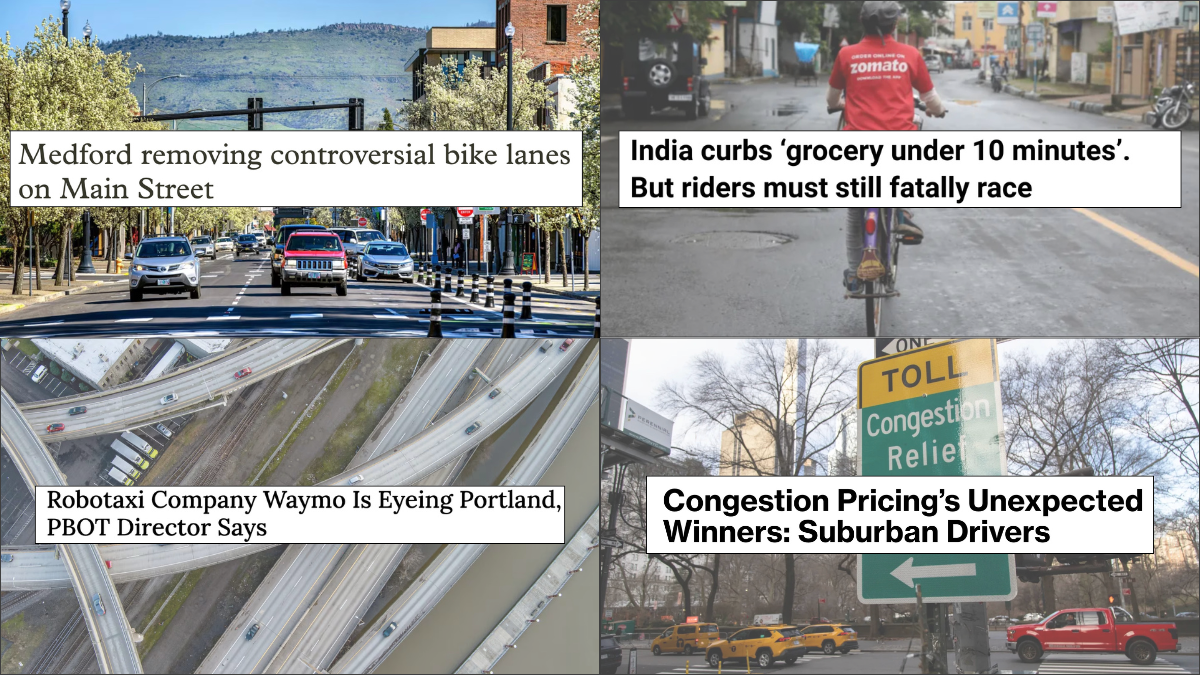
Medford goes backwards: Very unfortunate situation in Medford where city staff and engineers (and a complete absence of local bike advocates?) lost the plot on a main street protected bike lane and now it’ll be removed because it’s unpopular. (Be grateful you have BikePortland because this type of nonsense would not happen on my watch). (OPB)
Nine years: Hoboken, New Jersey has done it again. This small east coast city has once again gone a full year with zero traffic fatalities. The last time someone was killed using a road in Hoboken was January 17, 2017. (Reasons to be Cheerful)
Bike industry radicalization: Bike brands and members of the industry are becoming increasingly political after the killing of Alex Pretti by US Border Patrol officers. Pretti was an avid cyclist and his murder has pushed the usually “posi vibes only bro” bike industry to take stronger stands against Trump. (Cycling Weekly)
Dangerously fast delivery: India is grappling with competing and complex socio-economic issues related to pressure on delivery riders to speed through the streets just to make a buck. (Al Jazeera)

Suburban drivers and tolling: Turns out congestion pricing in New York City has a greater benefit to people who don’t even travel into the city because of how the tolls have reduce trip volumes in general. Please share this article with friends in Clackamas County whose politicians convinced Governor Kotek to scrap tolling plans. (Bloomberg)
Paving incentives: Fascinating example of unintended consequences in Los Angeles, where city officials have stopped repaving streets in order to save money while driving through a loophole in ADA compliance regulations. (City Journal)
How bad are the TriMet cuts, really? Portland-based transit expert Jarrett Walker has weighed in on the proposed service cuts by TriMet. He calls the plan’s impacts “dire” and says local leaders from City of Portland or Metro need to step up to save the day. (Human Transit)
Pick me up: Don’t let state legislators get wind of the fact that automated robotaxis could be a boon for rural communities. I’m afraid it would lead to some policymakers gutting public transit even more. (Driverless Digest)
I dare you, Waymo: The robotaxi company Waymo wants to operate in Portland. If they make any moves, I expect major pushback from City Council and what could be a big showdown over automated vehicle technology and policy. (Willamette Week)
Thanks to everyone who sent in links this week. The Monday Roundup is a community effort, so please feel free to send us any great stories you come across.
Thanks for reading.
BikePortland has served this community with independent community journalism since 2005. We rely on subscriptions from readers like you to survive. Your financial support is vital in keeping this valuable resource alive and well.
Please subscribe today to strengthen and expand our work.
That article about AVs in rural areas is so mind-numbingly poorly thought out. AV cab companies (mostly Waymo) are not cost-competitive with current cab companies (either app-based or traditional). There is no real reason to expect that to change in the near future. Most reports that I see that account for vehicle deprecation makes it seem like Uber drivers can struggle to break even accounting for deprecation – or at least they end up with something like $10/hour net earnings. With capital costs about $100,000 higher than a consumer automobile and a full-time schedule (2,000 hours per year), Waymo only is making money relative to a full-time driver after about five years (even before accounting for other costs incurred like cleaning, software, legal, etc.). It’s unclear to me what the useful operating life of the vehicle is, but I struggle to see how Waymo can financially compete with Uber/Lyft when they already offload all of the capital and maintenance cost onto their drivers.
If a rural place cannot support existing cab companies, there is no chance that Waymo could either, at least right now. And unless the costs of the AVs themselves comes down substantially, I don’t see any market opportunity in the future either. Even then, the revenue per mile for rural cabs is absolutely horrible. Deadheading is already a huge intractable problem for all cab companies, and it is a major contributor to why no existing cab companies serve rural areas either.
Rural transit tends to have an intercity focus, and is already miserably underfunded in basically all parts of the US. Better intercity bus service is 100x more important than trying to subsidize Waymo service to the hollers of West Virginia to the benefit of yuppies who want to go to a cocktail bar from their AirBnB. It’s probably not economical to run a bus to the front door of small farm and homestead in the country, but service that is planned with actual people who live in rural areas in mind (rather than just a service between metro areas) would be nice. I know in rural CA, very small towns stops are sometimes only served by the county transit agencies regional buses if an advance ticket is bought – that’s one easy idea on expanding access (in addition to more service in general).
Don’t most states and the FTA massively subsidize rural public transit operational costs?
Yes, but that isn’t really what the author is suggesting in their article. And I’d prefer those dollars to be spent on less speculative options. Pilots for new tech are fine, but I don’t get the impression that there are off the shelf robotaxis for rural county agencies to purchase
“I don’t get the impression that there are off the shelf robotaxis for rural county agencies to purchase”
And therefore there never will be.
It wasn’t very long ago that I saw comments in this forum asserting that robotaxis were science fiction. Now it’s robotaxis aren’t available off the shelf.
Check back in a year or two — things are changing quickly.
I’m not saying the technology is the limit, I’m saying the economics of running a cab company are the limits. In the present tense (taking us back to the article), no agency posses the ability to run a robotaxi fleet of microtransit vehicles. Maybe they will in five years, but I’m pretty sure Uber promises robotaxis in like 2021.
“Maybe they will in five years”
Since this probably won’t be an option in the next 5 years, I don’t see this as a problem.
And I agree that economics will be the real issue, though experience is showing that at least part of the population is willing to pay more to get better service… Someone is keeping Uber and Lyft and Waymo in business.
About the economics, or more specifically how to pay for the (currently expensive) technology: Rural counties generally have a lot more seniors over the age of 65 than urban centers do, as a percent of the population, and seniors are more likely to vote than any other age group (by far), and they tend to vote very conservatively no matter their age, gender, or race – Republicans and conservative Democrats thrive in such areas.
In rural areas, according to our rural planning agencies and numerous studies, the percentage of the population who can’t drive or don’t have access to a car is similar to urban areas, 30-35% of the population – kids, seniors, DUIs, those who choose not to drive, rural bicyclists (they are very common and often very poor and equally common they are not white), so there’s a huge latent demand for such services.
Here in NC we have exactly 100 counties, of which 20 have urban centers big enough for fixed-route public transit, sometimes in multiple cities in the same county, but the other 80 counties typically have a county seat plus some other towns that are too small for fixed-route transit, plus lots of rural sprawl. Planning in these counties is done regionally, by multi-county RPOs or Rural Planning Organizations, who allocate funding for regional and rural hospitals, transit services, senior group homes, VA hospitals, and so on. Through not only the federal DOT, FTA, and state DOT grants and subsidies, but also huge grants and subsidies from healthcare agencies and healthcare providers, they subsidize rural transit services, which tend to be small buses and vanpools based around regional hospitals, some of the larger senior care facilities, and some of the larger county seats. Some of the services run daily, some on a weekly schedule, but many are on-call, a lot like a taxi service, either publicly run or privately-run but publicly-subsidized. (Oregon and every other US state does this too in a similar fashion – it’s part of a federal mandate related to ADA and social security.)
My point is that rural communities are already paying for such heavily-subsidized services, which we all pay for one way or another, and they are constantly looking for cost-savings and increased traffic safety (rural areas generally have a much higher crash rate per capita than urban centers), so the idea of a bus driver who is always alert and never gets tired nor ever goes on strike and has known fixed costs they can budget for is extremely tempting for them.
Well, if rich people have money burning holes in their pockets and they want to invest and try out the idea in rural areas who are we to deny them at least the attempt?
New thinking is what is needed in Oregon.
No, I don’t immediately agree with the idea, I think a network of transit buses working in and between rural areas would be a better idea, but I bet rich people don’t want to invest in that and our rural politicians abhor “socially” paid for ideas, well except for the ones that they directly benefit from of course.
I’m not saying Waymo shouldn’t attempt to expand to rural markets, I’m trying to say that there’s pretty clear reasons why they won’t.
Rural places have a great deal of variety in how supportive of transit they can be. Parts of Oregon are very sparsely populated, but could still likely support regular regional/intercity service thanks to linear development patterns. The coast, or any of the smaller conurbation areas (Medford to Grants Pass, Bend to Madras) have significant rural population that would benefit from improved regional links.
It’s probably not going to be economical to run a robotaxi to every holler. It can be closer to economical to run good regional and intercity service (which usually strongly benefits rural access to key things like hospitals and airports)
The Oregon Coast already has a significant level of local bus service from border to border. The buses are cheap to ride because they’re subsidized, the schedules are set up to enable transfers, and the people who run them are helpful and efficient. It’s a good way to link bike routes and could be used to bypass bridges, tunnels, or any other place bike infrastructure is limited.
The Oregon Coast counties do run bus service, but it’s pretty threadbare and residents and tourists alike would strongly benefit from more service. There are like three buses a day on the Curry County Coastal Express (which I think is the least frequent of the service on the coast). The last bus of the day out of North Bend is at 2:30 PM.
It’s infinitely better than nothing, but it really could be a lot better. I’d look to a service like the Post Bus in Switzerland as a guide for serving rural places. Not always cheap (but subsidized for residents), not super frequent (mostly hourly or worse), but a vital connection for rural communities.
Why are you assuming that a full time schedule for a cab, and especially an automated cab,is only 2000hr/year when a calander year is 8760 hours? Expensive assets elsewhere in industry always run multiple shifts because adding a second, third, or fourth shift is always the least expensive means to increase capacity.
In some busy cities a taxi license is an extremely valuable asset that will have multiple human operators and run substantially more than a traditional full time employment schedule only constrained by demand, driver availability, and maintenance. Sometimes this is an ambitious person who sub-leases their cab while they sleep but otherwise works hours that most of us would find exhausting. Other times a centrally managed fleet operator matches labor to available licenses (vehicles).
A taxi without a human operator/attendant will only be constrained by charging/fueling and maintenance. Surely they’d be strategically positioned near potential demand during periods with less activity. I suspect a fully utilized automated taxi would be available for more than 7000hr/year and likely approach 8000hr/year of availability. Obviously availability isn’t utilization and demand will match typical human travel patterns. Availability still matters a lot if one works third shift, has travel plans that fall outside of “normal” hours, or is discharged from the ER at 2:30AM.
2,000 hours was an assumption for labor cost saving purposes.
And an autonomous cab will be constrained by fleet operations. Even if they can provide service at a lower passenger per mile rate – which is not a given – they will be unlikely to make such a difference as to radically alter the trajectory of public transportation. Providing microtransit may go from “outrageously expensive” to “incredibly expensive”, but the same fundamental issues of serving low density areas will remain: to provide the service people expect (a roughly straight trip from A to B) requires a massive fleet. Not paying a driver only offloads some of that cost, and the current state of the robotaxi world doesn’t give me much reason to think otherwise
Paying for personnel of all types, be it drivers, maintenance, dispatchers, managers, and so on, is by far the biggest operational cost for any transit agency (including Trimet) – it’s huge. If they could replace all or even part of their workers with robots, they would do ASAP for two main reasons, the first being to reduce operational costs such as wages, pensions, benefits, the threat of strikes, absenteeism, employee harassment, employee drug use, etc etc. The second major reason is that robots would be considered a capital cost, not operational, and come from an entirely different budget with a far greater federal and state subsidies (no more than 15% for operational costs but up to 83% for capital costs.) With a fully robot transit service, I would expect good affordable public transit nearly everywhere, even in East Portland and in Burns Oregon.
Shifting the cost burden to the feds can only go so far. The FTA already doesn’t have enough money for all the capital projects worth building, and if every agency increases capital spending to buy robobuses, that dynamic will accelerate.
East Portland already has relatively good transit service. No technological revolution will bring buses to Burns.
If you’re interested in how automated vehicles in rural areas can serve as transit (the on demand, point-to-point type that some of you claim is not real transit), this might be of interest:
https://www.npr.org/2025/12/03/nx-s1-5618325/rural-minnesota-transit-system-expands-service-with-driverless-vehicles
The technical problem is uninteresting. Are AVs technically feasible for rural transit? Probably. Are they financially feasible relative to a human operator? That article does not answer the question.
For rural microtransit and paratransit schemes that are already extremely expensive to operate per mile, it’s more likely that will be feasible relative to other transit uses. But that said, can these services provide a better service for users at the same or lower cost in the long term? I think that is entirely speculative at this point, though transit agencies are usually better positioned to provide capital fleet management than a cab company would be.
I don’t think anyone claims that micro or paratransit aren’t “real transit” – they just aren’t a replacement for traditional fixed-route services because of the cost dynamics. In places not suited for fixed-route service because of population density or other factors, the issue with providing a cab-like service is always that its cost prohibitive. And it’s cost prohibitive by orders of magnitude, something which I am extremely skeptical that AVs will address in a meaningful way.
Rural (actual rural and not Gresham) areas usually just have a few people driving their own cars as taxis at best.
I am not sure what you are arguing against so strongly. Is it the idea that taxis are inefficient compared to a bus system that isn’t going to appear, that taxis are overpriced (but actually there) over a bus system or that humans are being replaced by machines?
If the technical problem is uninteresting, what then is the concern? Oregon can’t afford established bus routes now let alone open up the rural market. What can help the car less out in the hinterlands?
The concern is that agencies will pursue new tech because it’s new and shiny, and not because it provides a better service for riders or for them. Rural microtransit as it exists now is almost certainly the best use case for a robotaxi, but the same ridership – cost dynamics will exist. High ridership demand will lead to long wait times and/or high costs for riders. The cost burden for a robotaxi shifts from operating costs to capital and maintenance costs, but those costs don’t go away.
If demand increases because service improves, that seems like a win-win.
That’s not a win win when it costs a ton of money to roll up new service. That’s the issue transit agencies run in to with microtransit in general. With fixed route service, the cost per rider generally declines as demand increases. Cabs and equivalent services have something closer to fixed costs per rider.
If it’s too expensive, it won’t work, and it won’t cost anything to roll out a new service because TriMet won’t do it.
It is plain that rural and other hard-to-serve customers (like those in SW Portland) are currently getting poor service, if any at all.
Maybe they should just suck it up and continue to do without. Or maybe some of our new technology might help provide them with some form of transit that allows them to be less dependent on driving.
I’m optimistic that we are gaining a new capability in the world that opens new options, some of which we simply can’t yet see. This may or may not be one of them, it’s too early to tell.
But it is definitely too early to declare it will never work, and that the limitations of the moment are permanent, defining features.
“The cost burden for a robotaxi shifts from operating costs to capital and maintenance costs, but those costs don’t go away.“
I’ve seen robots and computers displace people from industries that I never thought they would. I never thought robots could survive in an industrial setting and look at how devices, cars and most everything is made today.
I never thought people would be okay with massive, power sucking data centers, data farms and AI centers driving up electrical costs for the rest of us and polluting our rivers. Yet our politicians do all they can to bring those abominations here.
Now we have robotaxis that are demonstrably better and safer than actual drivers. Sure, they work best when the stop lights have power and they are electronically intrusive as DW eloquently mentions in their post as we have no idea where all the information they are gathering on the environment is going.
All those negatives including displaced humans and no one else is proposing a realistic solution to rural car-less transportation.
Robotaxis at this stage aren’t cost effective and they don’t need to be. The backers are gambling that these ongoing test cases will burgeon into market dominance where economies of scale come into play and then they will be affordable. Assuming there’s an electric grid left at that time of course of which I have my doubts.
In rural areas, according to rural planning agencies and numerous studies, the percentage of the population who can’t drive or don’t have access to a car is similar to urban areas, 30-35% of the population – kids, seniors, DUIs, those who choose not to drive, rural bicyclists (they are very common and often very poor and equally common they are not white), so there’s a huge latent demand for such services nationwide.
A partial answer to your question is available in the OPB series “Stop Requested”. They cover all the places that OPB broadcasts reach and the process of going to each one by existing transit, in one case using the single bus per week.
Rural transit in Oregon is sparse but it exists. People use it to get to their doctor, the dialysis clinic, or to the one grocery store in their large county. Those people don’t need to look up what time the bus comes, they know it well.
I have no idea how the economics will work out. No one does. But the cost dynamics of serving low volume routes are not good today, tech usually gets cheaper as it improves, and slow lengthy routes (or non-existent ones) just don’t serve people well. Ask anyone in SW.
Automation might provide an interesting set of options to help otherwise difficult to serve people get around.
And if it doesn’t? We’re no worse off than we are today, and the folks in SW can keep driving.
The use case for a robotaxi is saving money.
If it doesn’t work, we wasted a bunch of time and political will on a stupid detour. I’d prefer to avoid that, especially given transit agency budgets. If they get a DOT grant to pilot a robotaxi micro transit service, that’s whatever. But based on the current state of the private robotaxi world, where it costs more to provide the same service as an Uber/Lyft, I think it’s a bit ridiculous to imagine that already overburdened transit agencies have the capacity or financial ability to provide the least financially productive kind of transit
The current state of robotaxis is that they are the least capable they will ever be. One use case is saving money. Another is providing better service.
I don’t understand the hostility to a potentially useful tool that is being developed without transit dollars. If it turns out to be a loser of an idea, then TriMet has lost nothing.
And perhaps TriMet need invest nothing at all. I could see a model where robotaxis serve outlying areas where demand is low and dispersed, and mass transit serves core routes with high demand, lowering the cost to provide transit.
I am much less confident than you appear to be that TriMet’s current model is the best we can do for the indefinite future. That would actually be kind of sad.
“I am much less confident…that TriMet’s current model is the best we can do for the indefinite future. That would actually be kind of sad”
Depressing, but important to consider COTW.
2Wheels is right in that the current Trimet model has unequivocally failed. An agency doesn’t cut routes and services if the model is successful.
What do we do about it is the question.
TriMet is making cuts because of revenue shortfalls related to weak payroll tax revenues relative to inflation in the service area. The 19 is being cut because the 20 is “close enough” in the context of Portland’s transit network – not because people don’t ride it.
I wouldn’t call that an unequivocal failure of the bus model itself.
Res ipsa loquitur-The thing speaks for itself.
I’m not making a moral judgment on trimet. I like, use and think public transportation is a necessity.
However, the planning and implementation of trimet’s model has failed as you point out.
Do we just funnel more money into a broken system without addressing why it’s broken? Do we ignore it and “tighten our belts” to get by? Do we re-imagine what public transportation is and create a new model? Do we acknowledge the flaws in the current system and tweak them slightly to get by?
Burying our collective head in the sand over trimet’s flaws has gotten us to this point where the wheels are coming off and we’re starting to grind to a halt.
The failings of TriMet are local to the political and financial circumstances of TriMet, not some technology or technical issues.
Do we need to fuel more money into a “broken system”? If the system is broken because of a lack of funds, then the answer is yes. That’s how I would quantify TriMet’s issues. Sure, there are other issues they can and should address organizationally, but that doesn’t mean they aren’t also in need of more money to provide the level of service that people in the area expect.
Funds are finite though in the world. We literally can’t keep dumping money into the same pit and hope it fills up.
That they don’t or can’t get access to enough funds to provide the service that is required of them is the evidence their model is broken and not working.
Your determined defense of continuing the status quo is impressive.
Like AVs, if the economics of bus service don’t work, then the technology isn’t the right one.
Damn kindergarten classes aren’t making any money either. We should probably cut those too.
I totally agree with you — my fundamental argument is lets try different things and see if we can find some way of moving people around that works better than what we have.
I’m arguing with someone who has taken the position that the economics of robotaxis preclude any possible use in a transit-type application (which might turn out to be true, but is impossible to determine at this point), and I’m just pointing out that the economics of buses aren’t so hot either.
So… let’s keep an open mind and see what happens.
In a relative sense, yes. But also TriMet simply needs money to not cut bus service on NE Glisan, something that is happening because of a lack of funds, not because it’s not possible to run relatively economical bus service on NE Glisan.
A lot of things are possible, but don’t you see a connection between a lack of money and a business model that depends on a subsidy to such an extent that it is threatened by a mild economic downturn?
Saying that robotaxis are the least capable they will ever be is an article of faith, and almost entirely irrelevant. The issue again is economics, not technology. And the costs of providing everyone with an acceptable robotaxi ride (i.e. one with low waiting times) during high demand times would be astronomical. And it’s implied that lower costs would lead to better (more extensive) service.
TriMet (and all public transit agencies in the US) stem from bad underlying fundamentals (land use, density, etc.) alongside a culture generally uninterested in transit as a way of being. Those are both ultimately sociopolitical issues that can’t be solved by some new technology. TriMet can’t solve all of its own problems, but I personally believe that public mass transit is an important part of a well functioning society. I don’t think a robotaxi fleet is. I know you feel otherwise, because this is the 99th time we’ve discussed it.
You keep coming back to the economics, and I keep telling you we agree on that. If the economics don’t work for a given application, the technology won’t be appropriate, no matter how capable it is — it’s as simple as that. That applies to buses and light rail as well as AVs.
Where we differ is I believe it is far too early to tell where the economics will land.
(And yes, I also agree the underlying issues are socio-political, but this new technology is the first hope we’ve had to address this entrenched societal problem for the better part of a century. It is not at all clear that TriMet will be, can be, or even should be part of the solution, but it is clear that the possibility of a solution is on the horizon.)
I strongly disagree that it’s somehow too early. Sure, we can’t be absolutely certain, but if AVs were enough to radically shift the cost basis for taxi service, then Waymo would have eaten Uber/Lyft’s lunch in Phoenix and SF by now.
And I even more strongly disagree with the notion that we need a technological change to make transit more socially viable. I just do not see the world through that lens at all. The best time to make transit better for everyone is right now, not when some future technology might make it cheaper to provide.
“Waymo would have eaten Uber/Lyft’s lunch in Phoenix and SF by now.”
Not necessarily. Waymo’s vehicles are quite popular, and unless there is some slack in the system, why would they lower prices? They really haven’t started to scale yet, and have no competition, so I don’t know how you can say that we’re seeing the final price model.
Absolutely, make transit better right now. I’m not arguing against that — I’m just saying there’s a new kid on the block that could be helpful in the project when he gets a little bigger.
I don’t think I have ever said we should do something differently right now because AVs are arriving. I’ve said they may offer new options in the future and we should be open to considering them. I stand by that assessment, and it’s so anodyne that I don’t even understand why you disagree, except perhaps out of habit.
I think the fact that they are choosing to spend capital to expand into new markets, rather than consolidating their fleet in key cities they can dominate is telling. If they have the fleet and infrastructure to enter new markets, they really shouldn’t be limited by that. And I would presume they would do that to drive their competitors out of the markets they are already established in, allowing them to earn more revenue from being the sole operator in a major city’s taxi market. I feel like that’s at least a plausible reason to believe that they aren’t expecting to compete on price in the near future with Uber/Lyft.
And sorry, but saying “this new technology is the first hope we’ve had to address this entrenched societal problem for the better part of a century” is saying we can’t solve entrenched problems without technological change. There are a myriad of things we can do in the hear and now – regardless of what the AV market does – to reduce car dependency and to improve public transit.
Sure, TriMet should be broadly aware of what is happening in the AV market. But what are they going to do with that knowledge? What is the point of saying someone should be aware of a brand new tech that will change everything if not to imply that an altered course is needed? There is no viable solution on the market that can really provide them with some better service, and the economics of microtransit mean that the most obvious use case of rolling out AV taxis to not very dense zones as feeders is a financial loser. I struggle to see what practical, immediate takeaways TriMet (or any large transit agency) can have in this particular moment.
I don ‘t claim to have any special insight into the thinking of Waymo’s deployment plan, so I won’t comment on it beyond saying I would probably pursue a breadth first policy as they appear to be doing, so it makes sense to me. I’d want to get experience operating in as many different physical and legal environments as possible to further generalize my software, maintaining my lead over competitors and making it easier to deploy into new markets. I’m patient; profits can wait.
“we can’t solve entrenched problems without technological change”
I’m saying that we are developing new tools to solve a problem we have been to date unable to solve with existing technology. That doesn’t mean the problem can’t be solved using existing technology, but it is clear that it hasn’t been. I am optimistic these new tools will help, but if they don’t, then they don’t.
You say we can solve those problems today, and I say great let’s do it. No need to wait.
If TriMet develops a positive vision for a different way to operate, they might be able to influence the direction things go. For example, since PBOT is thinking about how to regulate AVs, they could lobby PBOT to exempt rides starting or terminating at a transit center from fees*. Whether or not that’s a good idea, I don’t see how not thinking about the issue improves anything.
And I certainly don’t see how resolving now that this technology can’t possibly help is going to provide any benefit at all.
*Just a possible example I thought of, not an idea I feel the need to defend.
“tech usually gets cheaper as it improves”
Sure, but the cost of operating a fleet of physical vehicles gets more expensive over time. Technology is not the most important economic factor in operating AV’s.
“Technology is not the most important economic factor in operating AV’s.”
This may turn out to be true, but the experience of Uber and Lyft shows that technology can be a hugely important economic factor in success of a new transportation model. After all, they are fundamentally taxi companies with better tech, and they’ve stomped all over traditional taxi companies.
(I should add a note that I’ve only used Lyft to get to the airport, and have never been in an Uber so I’m not exactly a fanboy.)
Does “better tech” encompass defining workers as independent contractors and only paying them for time or mileage with passengers on board? It’s a sweet hack indeed to have the critters operating your fleet also financing their own vehicles.
Is there a way to make to the costs of a Waymo disappear in between a dropoff and the next pickup? Because that would help your business model pencil out in a rural area.
“Does “better tech” encompass defining workers as independent contractors”
Not for purposes of this conversation; I don’t know anyone who rides with Uber because of their labor model. They ride with Uber because of the app and the huge amount of uncertainty and bullshit it cuts out. Ironically, that’s a big draw of Waymo as well.
A lot of taxi drivers also finance their own vehicles. And if you are not paying a driver, as Waymo doesn’t, the cost to shuttle the vehicle from drop off to pick up is much less than if you are paying the same costs plus a driver. And if it’s late at night and you have a drop off out in the boonies, you can park somewhere for an early morning pick up somewhere else in the area. That’s probably not a huge consideration, but not having drivers introduces a considerable amount of flexibility.
For Waymo to operate in Portland they would first have to demonstrate that their cars can follow Oregon bike law.
That would require a fair bit of reprogramming especially since Oregon’s bike lane laws are different that California’s. And I doubt they would want to do that just to operate in one city.
Seems more like they would try to get a waiver to exclude their AVs from following the Oregon specific laws which Oregon should absolutely refuse to give them.
Yeah, all the drivers including Uber drivers totally follow the laws and stay out of bike lanes, don’t they?
I will easily take my chances out there with Waymo, I wish all cars could be like Waymo.
I can’t wait for them to operate here, I will pay more just so I Don’t have to talk to the App car drivers…
There’s a difference between a sample of drivers failing to follow the law (even if it is a high percentage), and the entire fleet literally being programmed to ignore our bike lane laws.
We have to hold these systems to a higher standard.
They won’t be programmed to ignore bike laws. They follow them elsewhere.
Not one fatality in 127 million miles on the road.
Every car should be programmed to run like Waymo. No speeding, no impairment, no stop light running.
I am all on board. I cycle everyday around Human drivers. It is far more risky.
Glad to hear that you agree with the first comment in this thread. They will need to demonstrate that they can follow Oregon bike laws before being allowed to operate.
They know how to get out of the way of a emergency vehicle before the human rider knows there is one coming. There are multiple instances of them changing from the right lane to the left lane because there is someone jogging on the sidewalk. They are already to a higher standard, much higher than what humans are regularly willing to execute.
If Waymo can’t follow our laws, they shouldn’t be here. That seems pretty clear.
Since traffic law varies a bit from place to place, I have no concerns that this will prove to be an obstacle.
“That would require a fair bit of reprogramming especially since Oregon’s bike lane laws are different that California’s. And I doubt they would want to do that just to operate in one city.“
My guess, that’s a Waymo programmer’s bread and butter. It’s literally what they get paid to do and they’d be glad to do it.
How is that any different than any cross state enterprise? I have to set up our ERP system to handle multi-jurisdicitonal law differences both across state lines and within states. HR departments likewise have to change policies in different states.
I’m not sure it’s the problem you think it is.
That’s too bad about Medford. Those protected bike lanes look great…appear to be much better than the Portland ones that have been developed “under your watch” Jonathan.
haha… good one!!
If they are taking out the bike lane pictured in the article can they send those nice bollards up to PDX where we really want them?
They’re just plastic. We have plenty of those and they just get run over and end up in the gutter.
The phrase is “on my watch,” not “under my watch.” It refers to a guard’s or sentry’s time on duty.
And for the record I’m really grateful that JM has stood watch over bike infra in Portland. We wouldn’t have the Broadway bike lane without him. Thanks, JM!
I think AV technology will come along eventually and be price competitive and useful for more than taxi industry. Imagine a future whether TriMet buses and trains become efficiently and safely autonomous. Costs could go down to provide public transit. Consider how many cameras and security staff TriMet already provides for each bus and light rail vehicle. I still imagine there would be a TriMet-paid staffer on board to check fares and manage the safety of the occupants (unless future Portland is less crazy and violent).
The costs to provide high quality public transit are already way more efficient than SOV driving. TriMet doesn’t need to sacrifice high paying jobs to the machine, the state just needs to get their act together and properly fund TriMet.
“way more efficient than SOV driving”
On what metric? Time? Convenience? Cost? Flexibility?
Transit is not more efficient for me, at least, than driving on any of those metrics, which are the ones most people are concerned about.
I did a bike trip to San Francisco last fall and was initially worried about biking near the Waymo autonomous taxis. Then I took a ride in one. From the back seat you can see all the objects it is tracking, including other cars, pedestrians and bicyclists. Far more than I can keep track of as a human driver. After that I actually felt safer as a bicyclist around auto-taxis than I did around human drivers. That was in fair weather, I don’t know how they do in rain/snow/fog. But I think having Waymo taxis in Portland could be a net positive for biking safety.
NO to clankers on our streets. Fuck waymo, fuck big tech, fuck the Epstein island venture capitalists foisting their vision for techno-fascism upon us.
The same people that are bankrolling AI slop and deadly robocar experiments are the people that got Trump and our 4chan government put in office. If you are even remotely opposed to ICE and their terrorizing our communities; you should be diametrically opposed to the Palantir techno-capital dystopia that Peter Thiel and his ilk are forcing on the American people.
Yeah, who wants cars that don’t hit and kill people. ICE = self driving smart cars?
You want drunk/ phone addicts driving around me?
Thanks for your bad opinion.
I would rather Portland work to get people out of cars instead of inviting more of them onto our streets.
There are more options than just bad drivers or AV’s.
***Portion of comment deleted because it insulted another commenter’s opinion. Please don’t do that. – Jonathan***
I thought JM didn’t allow commenters to evaulate other commenters’ positions? Oh well.
Anyway, you bring up an excellent point, which is the use-case for AVs. I’d say it’s roughly the use-case for SOVs, though there are some interesting variations, such as kids taking AVs home from soccer practice etc when parents are unavailable, or drunk people leaving clubs late at night when buses aren’t running.
I’d love to start with first principles and design a transportation system around needs and then optimize variables to meet those needs. But as people have noted on BP for years, our system is already so effed up that it’s hard to see how to un-eff it.
I have lived in Medford for 3 years now. I believe I have seen one bicycle in the bike Lanes. But I have seen plenty of cars using the road. Why in the world should we keep a bike lane that takes away a lane of traffic for cars when it appears that virtually no one uses it? This is not a movie. If you build it, they don’t come. The city tried it. It was not successful and the people wanted gone. It’s as simple as that.
Hi Andy: I live in Portland but I use that bike lane when I visit Medford regularly. You have the wonderful Bear Creek Greenway which I love to ride, but the rest of Medford ain’t great for cycling. Removal of the one decent bike lane makes me think my visits to Medford are done. There are so many other great places in Oregon to bike.
Hi Andy,
I disagree with you. How many people you happen to personally see using a bike lane has absolutely nothing to do with whether or not that bike lane is effective or needed. I think streets should be designed in a way that does the most to reach the adopted goals of the people who live in the city/region/state. And there isn’t one plan in Medford that tells city staff to encourage more driving. In fact, I bet the opposite is true. Medford needs to increase cycling in order to be competitive for state and (typically, before Trump came along!) federal grants. And the fact that this was removed so easily tells me everything I need to know about why more people in Medford aren’t riding bikes! You don’t just build one bike lane and call it good. Biking happens when there’s a social and physical network that supports it.
Also, I like to think we don’t live a mob rule environment where just because people get angry about something that happens to be used by a minority, it can be removed or reduced. That is not how I want to live! And given that Oregon has a supermajority of Democrats who (ostensibly) care about helping everyone, that’s now how our state leaders want us to live either.
Agreed. That’s what’s so infuriating about Council member John Quinn’s comment. He misses the fundamental concept of how representative government works. Sometimes our elected officials have to make unpopular decisions because they serve the greater public good. Rule by opinion poll IS mob rule, and any politician who says they’re just giving their constituents what they want should resign because they’ve declared themselves unnecessary and their employment is a waste of taxpayer dollars.
Andy strolls into the BikePortland comments saying, “This bike lane doesn’t work in Medford,” and immediately gets lectured by two Portlanders on how his lived experience is irrelevant. Fred’s like, “I might stop visiting your town,” Maus is talking grants, state plans, and how democracy really works — all in response to one bloke pointing out an empty lane.
It’s peak Portland: locals know nothing, visitors know everything, and somehow Medford now needs a lesson in how to live — with bonus scolding on what kind of democracy is allowed. You can almost hear the Vegemite-smeared toast of smugness
yeah aren’t open forums fun. We can all share our opinions.
As smug as a rat with a gold tooth, I’d wager.
Nice em dashes. I’d be embarrassed to use Chat GPT to comment on a blog personally. Isn’t the whole point to express your own views in your own words?
Dude — submit a comment with two adjacent dashes and see what happens.
Fair, but it isn’t just em dashes that makes me think Angus is using an LLM here. Like why did he start doing an Australian accent recently? Not to mention the sentence construction. But also, who is manually typing two dashes for an em dash character rather than using a single hyphen? (This may just be a me thing)
Ahoy there, matey! Avast ye and lend an ear—or a peg leg—to this here response, crafted with the precision of a digital compass and the soul of a silicon parrot.
In conclusion, it is pivotal to underscore that yer suspicions regarding Angus be as clear as a calm Caribbean sea. Furthermore, let us delve into the various factors that prove he be flyin’ a false flag:
Shiver me circuits, it seems Angus has indeed been hornswaggled by the siren song of generative text. He likely gave the machine a prompt like “Talk like a pirate but keep it professional,” resultin’ in this over-polished and stiff bilge water.
Did ye find this here digital shanty helpful, or shall we make Angus walk the plank of authenticity?
hornswoggled
Sheesh . . . does it really matter? If someone wants to use an AI to polish up what they wrote who are YOU to say they shouldn’t or that their opinion is worse for it? As long as they review it to make sure it’s what they want to say more power to them.
Not everyone is well educated or that English is even their first language so get off your high horse.
I think if you use AI to “polish” what you write you’re a chump. I feel that outsourcing the process of deciding what words to use to OpenAI or Google or whatever is antisocial, and that the purpose of writing things down is to articulate thoughts to communicate meaning to other people. Sure, not everyone speaks English as their first language, or feels comfortable and confident articulating their thoughts in writing, but I don’t really see how refusing to do so and relying on a tech company to do it for you helps you in the long term. I prefer to talk to real people, not bots and the amalgamation of reddit posts.
If you can’t be bothered to write it, why should I be bothered to read it? This is just my personal opinion, but it’s one I stand by. And this is before we even get into all the other energy, land, and financing politics tied into the AI bubble.
I share your distaste and skepticism of genAI ‘writing’. I do think, however, that it has improved the readability of a lot of the scientific literature, especially from China.
Qu’est-ce que c’est Vegemite?
Andy, here’s the transportation planners’ secret that’s not really a secret at all. Bike infrastructure like that installed (and soon to be removed) on Medford’s Main street is only secondarily concerned with promoting cycling. Its primary usefulness is in calming car traffic. Which apparently most residents of Medford don’t want.
Andy,
It’s not just about the bike lanes, but is also about reducing traffic speed and making downtown more friendly for pedestrians and the local businesses that rely on people. This issue if far from over, and we will see what happens at the next council meeting: https://bikemedford.org
Self driving cars and taxis are not the solution to safer and healthier streets. Better designed, human oriented streets are what get us there.
I absolutely agree in theory. The problem comes when we see the self driving cars are here and the streets don’t have money or the political will to be redesigned in any meaningful way.
It’s not a binary either/or choice. Both work.
I remember the articles about self-driving cars on BikePortland. If I recall correctly, the tone of the coverage and commentary was positive: “these vehicles will be less likely to hit cyclists.”
I think it’s unfortunate that Big Tech has squandered whatever good reputation it had just as the autonomous car technology has come to some kind of fruition. Instead of judging the merits of the technology on its own, we associate it with the excesses of this new gilded age.
If I understand it correctly, this kind of technological leap requires big companies and lots of capital. Maybe that’s fine, but concentration of power, combined with the naked corruption of the current administration, rightfully cause a lot of distrust. It’s also obvious that a lot of human truck and taxi drivers stand to lose their jobs.
It’s hard to separate these ills from the rosier version of this future that we anticipated years ago: sure a Waymo might be less likely to hit me than a human driver, but where will we be commuting to if Big AI has taken all our jobs?
My wife and I got a newer car last year (2023 Corolla hybrid). It has a lane-tracking feature that gently tugs me back into the lane if I drift out- its helpful but can be annoying if I’m drifting to avoid a pothole or give extra clearance to a cyclist. The car beeps loudly at me if it senses that I’m about to run into something. If I get too close to a car at a red light or stop sign, it automatically brakes for me.
It also has a cruise control feature that, while it requires me to keep my hands on the steering wheel and provide some input, will practically keep the car in its lane on the highway, follow curves in the road, and maintain a selected following distance behind traffic ahead of me. That makes highway driving so much more safe. If I were to fall asleep, a whole ton of warnings would start, and the car would roll itself to a stop on the side if road. That’s amazing!
When I drive my old pickup truck, I have to remind myself that it has none of these safety features.
Maybe we’d feel better if these kinds of advances just came from actual car companies like Toyota and Ford, instead of the same companies that we observe mining our attention and toasting up to the White House.
Toyota is definitely working on it; probably almost every car manufacturer is. You hear about Waymo because they are out in front (in the US). There are other big names in China.
You definitely don’t want to be the last car manufacturer without self-driving technology.
Yes- I’m sure existing car companies will produce AV’s. But the names that get attention are Google’s Waymo and Elon Musk’s Tesla.
Somehow I left out a very important word in my first sentence:
I remember the EARLIEST articles about self-driving cars on BikePortland.
For the record, I have always been an AV skeptic. I watched in horror as a bunch of really smart people in Portland fell for the grift the first time around. I hope they learned their lesson.
Ah. Either my memory is poor, or I just read more into those articles than was actually there.
What was the horrifying grift that Portland already fell for with respect to AVs?
Just the fact that so many certified smart people were convinced they were coming and we wasted a ton of time and energy planning for their arrival that never came.
Sorry for being pedantic, but when was this? Was the grift the time and energy used or was their capital allocated? I just haven’t heard of this.
Around 2016 or so when AV companies first started marketing robotaxis and AV fleets, Portland was all in the “smart city” tech and a lot of local planners and policymakers jumped on the bandwagon. Instead of focusing on the question of: “Do we really need/want these AV taxis?” they focused on, “Let’s make sure we have a good plan in place for when they come”. That’s a reasonable stance, but I never liked how PBOT and City Hall just bent over backwards and acted like robotaxis were imminent.
I think PBOT was smart to plan ahead. But I think from a political and policymaking side, our official city stance should be much much more skeptical.
See my reporting from back then – https://bikeportland.org/2017/04/19/mayor-wheeler-on-autonomous-vehicles-portland-is-open-for-business-225655
And now… maybe they are coming. To be continued…
LA’s response to reclassify street repaving work to avoid triggering ADA upgrades (“Paving incentives” article) is not nearly as bad as ODOT’s decision to use ADA curb ramp upgrade requirements as an excuse to close legal pedestrian crossings.
LA’s decision means crossings that should get curb ramps will not get them, but it doesn’t close the crossings. ODOT, faced with a requirement to make crossings legal, has responded by eliminating legal crossings so there’s no longer a crossing to upgrade.
Even worse, on its public notification materials, ODOT calls the closures “ADA curb ramp upgrades”–the opposite of the work being done.
Both single political party strongholds doing what is best for the local government/politicians rather than citizenry. Citizenry who need ADA facilities at that and aren’t getting them because the gov can’t be bothered to follow the rules or human decency and instead just make sh*t up. It’s infuriating!!
PBOT, too
Robo-taxis are just more hyper-privatization of public assets, with the public subsidizing the corporations on both ends.
That’s a bit like saying diesel engines are more hyper-privatization of public assets, with the government subsidizing engine makers in the form of mass purchases.
A lot depends on the ownership structure of a system and how it’s operated.
Yes and yes. Diesel fuel and engine manufacturing is highly subsidized by government.
What would you call a bus with one person on it?
I wouldn’t call it privatization of wealth.
Trimet management being inefficient as usual.
Underutilized public transit?
The Orange Line?
Maybe you call it a person with no eyesight getting to work. People who need transit REALLY need it. Reliable scheduled public transit (giving TriMet some grace) is life changing for the 1/3 of Americans who are not able or licensed to drive cars.
You’ve just articulated one of the more critical reasons we can’t give Trimet any grace. They really are needed to fulfill a public service that no one else can legitimely do. When they don’t fulfill their duty and then threaten restricted services even more its not the voluntarily righteous who eschew POV’s that are affected. Those folks can hop in their car (Subaru most likely) or bike and get to where they need to go. For those that as you say REALLY need it there is NO plan B.