🚨 Please note: BikePortland is currently on hiatus and only publishing guest articles. Learn more here. Thank you. - Jonathan 🙏

Guest Article: Right turn on red laws and what they mean for cyclists

(Photo: Jonathan Maus/BikePortland)

This article was written by Susan Rosenthal. It has been guest-edited by Adrienne So.

Given policy discussed last month at Portland City Council that could ban right turn on red for drivers at another 200 intersections, it behooves bicycle riders to know more about this traffic policy.

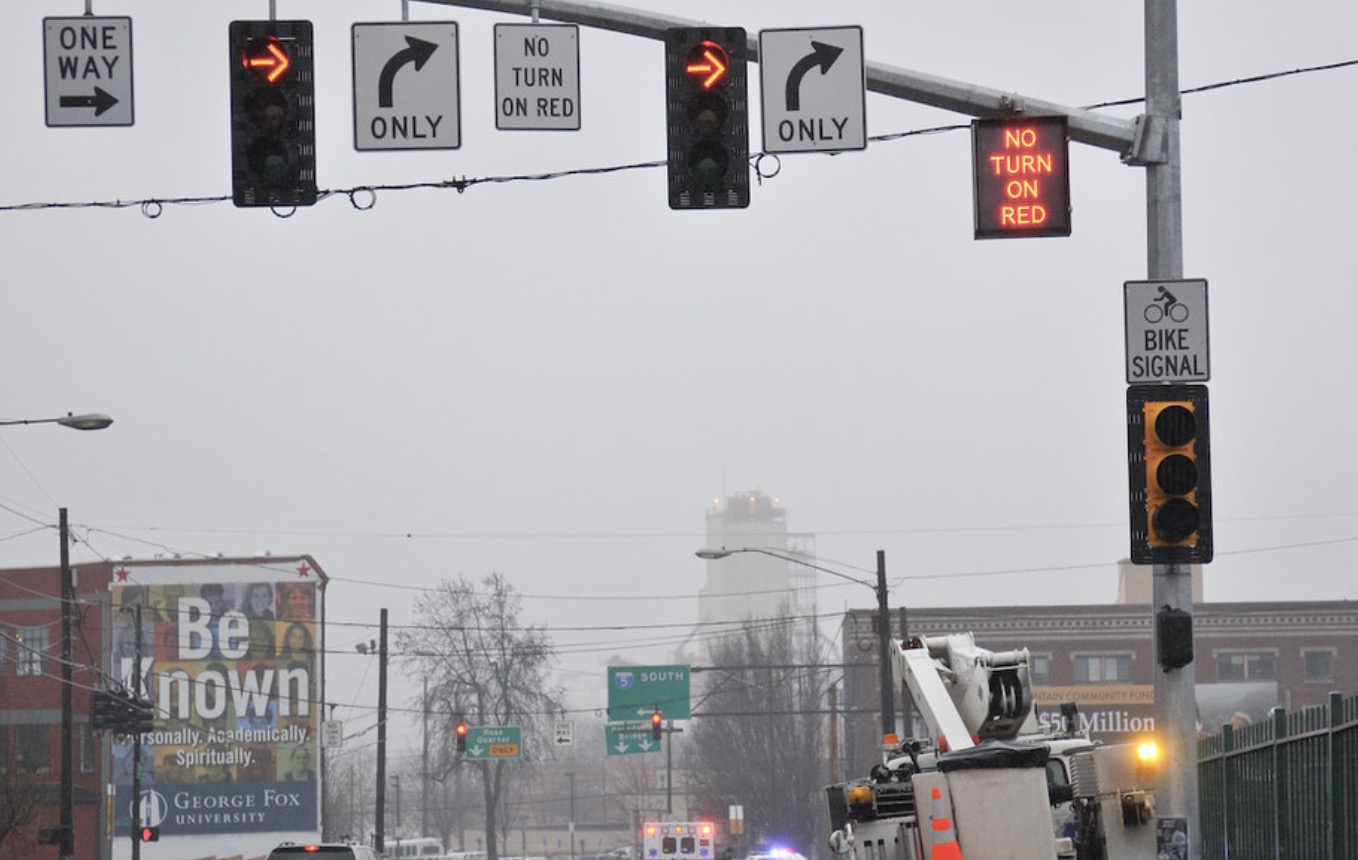
Right Turn on Red Laws (RTOR) allow motorists to make right turns on red lights after coming to a full stop. The motorist is required to yield to pedestrians and cyclists who are in the right of way. In 1947, California was the first state to allow RTOR. Oregon, Washington, Nevada, and Arizona followed suit in the 1950s, with other states gradually adopting the practice through the 1970s.

RTOR laws were adopted throughout the country after the US Congress passed the Energy Policy and Conservation Act in 1975, in response to the US energy crisis. The law, which is still in place, required that every state allow right RTOR or lose their federal transportation funding. It was designed to save energy by reducing the amount of time drivers spent idling at stoplights. 

As a result, RTOR is permitted at almost every intersection in the country. Municipalities can ban them at intersections that have significant pedestrian traffic, or under other special circumstances. For example, RTOR is banned in most of New York City. They are also prohibited on SW 6th Avenue and SW Broadway in Portland, where these roads cross the MAX tracks at Pioneer Square. (I learned about the ban at Pioneer Square when I turned right on red on my bicycle in the late 1990s and got an expensive ticket.) 

At every intersection that bans right turns, municipalities must post signs or traffic lights stating that such turns are prohibited. The US, Canada, Mexico, Brazil, Colombia, China and a few other countries allow RTOR with few restrictions. RTOR turns are prohibited or restricted in most other countries. 
Advertisement

Fuel Savings and Safety Issues

The impact of RTOR has been hotly debated. The practice may reduce travel time for drivers and reduce congestion at intersections. It is difficult to determine whether RTOR laws have reduced fuel consumption. To perform a legal RTOR, a driver must come to a complete stop, then accelerate again. In many cases, drivers are stopping and starting multiple times, which lowers the fuel savings that can be achieved. 

The economic theory known as Joven’s Paradox also plays a role. Economist William Joven noticed that changes that increased the efficient use of coal led to an increase in coal consumption. Reducing the usage cost incentivizes people to use more of the resource, and consumption increases. RTOR red laws make driving easier and faster, which may contribute to our auto-dominant culture. 

The automobile landscape has changed greatly since RTOR laws were enacted.  Automatic transmissions have replaced manual transmissions in the United States The adoption of hybrid and electric vehicles means that some cars produce no emissions. The car market and our roads are dominated by SUVs and light trucks. It is likely that these changes have affected the fuel savings achieved by RTOR laws.

In recent years, there has been much debate about safety issues raised by RTOR. The risk of RTOR comes from the fact that drivers look to their left for oncoming traffic before making a right turn. They may not see pedestrians who are in front of them or positioned on the right side of the intersection. This can be a particular problem for drivers of SUVs and light trucks, because their large size and high clearance make it difficult to see vulnerable road users. These crashes represent a small percentage of total vehicle crashes, but RTOR does increase risks for pedestrians and cyclists. 

In 2024, the Mineta Transportation Institute published a study that determined that right-turn collisions were responsible for 39,000 crashes and 217 fatalities in California between 2011 and 2022. Over half of the crashes involved pedestrians and cyclists. Race played a role in pedestrian collisions, with Black pedestrians at higher risk than White pedestrians.  Black cyclists were not at higher risks for collisions than White cyclists. Neighborhood socioeconomic status also impacted the rate of collisions, with lower income neighborhoods showing higher collision rates than higher income areas. There were also higher collision rates at intersections that were close to public transit.

The Future of RTOR

Some municipalities have banned or restricted RTOR in recent years. In 2024, Cambridge, Massachusetts banned the practice for drivers and cyclists at all city-managed intersections. Washington, DC banned RTOR in a process that was completed in 2025. The process took several years and began with 100 intersections. Studies showed that collisions were reduced by 92 percent, so the practice was expanded to all city-managed intersections. 

Seattle has banned RTOR on many downtown intersections for years, but has recently extended the ban to all new traffic lights and intersections. San Francisco started a pilot project which banned RTOR at 50 intersections. The project was extremely successful at reducing collisions and has been expanded to 200 intersections. The city council is now debating a proposal to ban RTOR at all intersections

Traffic engineering problems often have multiple causes, and this is the case with RTOR safety. Engineering standards, like those outlined in Beaverton’s engineering design manual, often require a minimum of a 25-foot turning radius when a local street intersects with an arterial or connector street. On the other hand, the National Association of City Traffic Officials (NACTO) recommends a maximum 15-foot turning radius, with a preferred turning radius of 5 feet for collectors and arterials. A smaller turn radius forces drivers to slow down and to look to their left when turning. In recent years, many transportation activists have worked with transportation officials to adopt NACTO standards.

Advertisement

PBOT has recently developed standards for regulating RTOR at intersections that previously allowed the practice. These restrictions are concentrated in dense or dangerous zones, such as the Northwest pedestrian district, West Burnside Street, and near school grounds.  In 2024, Wendy Cawley, the Portland Bureau of Transportation’s Chief Engineer, spelled out top priorities for regulation in an executive memo:  

  1. When there are exclusive pedestrian or bicycle phases at intersections. In other words, if there is a signal phase in which bicyclists or pedestrians are allowed to move, but cars must remain stopped
  2. Where bike boxes are present, at Neighborhood Greenways, and where turns cross separated paths.
  3. High conflict intersections where there have been more than 3 RTOR collisions reported in a 12 month period for a particular approach of an intersection. If two or more of these crashes are bicycle or pedestrian crashes in a five-year period, then that intersection should also be considered for No Turn on Red (NTOR) signage. 
  4. Geometric or operational characteristics of an intersection that might result in unexpected conflicts, such as inadequate sight distance to vehicles approaching from the left or the right, skewed angle intersections, or intersections where U turns are allowed

The executive memo contained a chart which identified intersections that met these standards.  The intersection of NW Couch St and 11th Ave was chosen because it had an exclusive pedestrian phase and a pedestrian head start. Additional factors included the fact that the intersection is close to schools and a pedestrian district. RTOR has been banned at this intersection. 
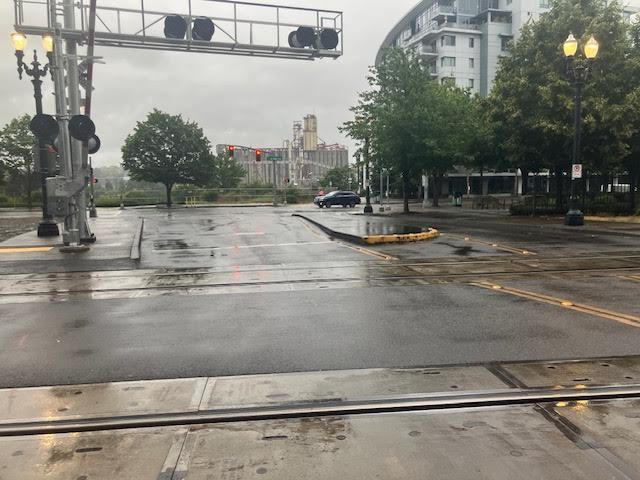
The Intersection at NW Front and NW 9th Ave. (Susan Rosenthal)

The intersection of NW Front and 9th Ave is also on the list. This intersection has a rail crossing, so the right turns conflict with a unique signal phase, as well as with the infrastructure for the rail crossing. NTOR has not been implemented at this intersection. RTOR laws were implemented in response to the crisis created by the oil embargos of the 1970s. The vast changes that have occurred in the automobile industry since that era, as well as the threat that right turns pose for pedestrians, mean that many people are re-evaluating the value of this practice, particularly in urban settings like Portland.
BikeLoud Stands in solidarity with Boston transportation advocates 

Louisa Gag speaking about street safety as a leader of the Livable Streets Alliance in Boston

The article below was written by BikeLoud PDX Vice-chair Kiel Johnson and was first published in that organization’s newsletter.

On July 9th, 36 year old Louisa Gag (above) was struck and killed by a truck driver. She was riding in a painted bike lane on a street in Boston that the city had long identified as dangerous. There was a funded plan to dramatically improve this street, which the mayor’s administration had halted and then defunded after backlash from businesses and community groups. Gag worked for the advocacy group LivableStreets and was a transportation planner for the city. She spent her career trying to prevent tragedies like the one that claimed her life. 

In 2021, the mayor of Boston was elected on a platform to improve street safety, but paused and backed away from making improvements after community and business complaints about loss of parking and car lanes. For people in Portland, this story is very familiar

We mourn the loss of Louisa Gag and stand in solidarity with Boston’s transportation advocates. Her death is a heartbreaking reminder that our decisions about street design have real human consequences. We have solutions to prevent tragedies like this one. In Boston they had the plan and even the money. What they lacked was the political will. 

Her death is a heartbreaking reminder that our decisions about street design have real human consequences.

Advertisement

Transportation safety is either a priority or it isn’t. Growing the number of people who bike is either a goal or it isn’t. When elected leaders pledge to build safer streets but retreat when car-centric opposition arises, those commitments become little more than words. Little by little, this erodes our faith in leadership. Every delayed project and every watered-down design leaves dangerous conditions in place. In Portland, the list of missed opportunities continues to grow. 

After Louisa’s death, Boston’s transportation advocates wrote a powerful letter calling on their city to match its values with its actions. We couldn’t help but think it could have been written about Portland and we wanted to share it with you.

Dear Mayor Wu,

Enough is enough.

We are parents, families, and neighbors from across Boston. Many of us have met you — at safety walks, at community meetings, on Hyde Park Avenue and on corridors like it across the city. For years, we have told you, in public and to your face, that continued delay on street safety would cost lives.

Last week it cost the life of Louisa Gag — a transportation planner in your own administration, a person who devoted her career to making our streets safe. Louisa was killed on her bicycle blocks from an intersection your administration has studied and stalled. She was not the first. We have been losing neighbors to these streets for years, and we have been warning you, specifically and repeatedly, that more deaths were coming.

You know as well as anyone how beloved Louisa was. She began her career in public service on your own staff, when you were a city councilor, and she spent it working tirelessly for the residents of Boston — beside the advocates she organized, her colleagues in City Hall, and neighbors across this city whose streets are safer because of her. She was killed on the streets she spent her career trying to fix. Years ago, one of her professional responsibilities was keeping the list of people killed by cars in Boston. Now her name has been added to it.

For at least eighteen months, your administration has stalled and re-studied safety projects that were designed and funded. You have told us these projects need more process, more consensus, more perfection. But consensus never arrives for the dead, and a study protects no one.

Budgets are moral documents. The budget you put forward placed safety projects on hold and cut transportation funding at the very moment the city needed the opposite.

We are not asking for better messaging or communication strategies. We are asking you to act:

  1. Unpause every stalled street-safety project within 30 days, with a published, dated construction schedule for each.
  2. Restore the street-safety and transportation funding cut in your budget.
  3. Build fast and fix later. End the practice of holding projects hostage to perfect designs and unanimous approval. Use quick-build materials now; refine as you go.
  4. Appoint a permanent, qualified Chief of Streets with a broad public mandate to eliminate traffic deaths.
  5. Be accountable. Publish a public timeline for every high-crash corridor — including Tremont Street and Hyde Park Avenue — with a named official responsible for each.

None of us is willing to raise our families in a city whose leadership will not answer for preventable deaths on its own streets. We are asking you to do what is right. And if you cannot or will not, you will have forfeited the trust a mayor needs to govern — and no study or prolonged consensus project will win it back.

Signed,

The people of Boston who walk, bike, and cross your streets — and who are done waiting.

Guest Opinion: PCEF e-bike rebate program should include traditional bikes

A rider pedals on the Springwater Corridor near Ross Island Bridge on November 17, 2025. (Photo: Jonathan Maus/BikePortland)

This guest article was written by Keith Daellenbach and edited by Adrienne So.

On April 6, the City of Portland announced an innovative $20 million electric bike rebate program for qualified residents. Stated goals include reducing carbon emissions, lowering economic barriers for low- and moderate-income citizens, and making Portland more resilient to climate change.  

All of these are admirable, and as a citizen who regularly bikes 17 miles one-way across town to work in Beaverton and over 3,000 commuting miles annually, I am a fan of getting as many people as possible on bicycles and out of cars.  

But there’s no way to avoid it. E-bikes consume electricity, which is generated from sources like natural gas, coal, wind, and solar panels. E-bikes have an operational carbon footprint and corresponding environmental impact. Conventional, human-powered bicycles consume no electricity and generate zero carbon emissions. And even more salient, an entry- or mid-level bike costs roughly a third the price of a comparable e-bike and offers lower maintenance costs.  All stated program goals are satisfactorily met with conventional bicycles, yet they are given short shrift. 

Advertisement

This is a program blind spot. I published a letter to the editor in The Oregonian on this matter on April 12, 2026.

Why is the city intentionally and unnecessarily restricting rebates to e-bikes? Does the city think low- and moderate-income citizens are unable to ride conventional bicycles? Why miss expanding the quantity of bicycles by casting the net wider to include cost-effective conventional bikes? With the program’s three-year time horizon, it should be updated now to include bicycles without motors. 

I emailed my letter to the editor to Mayor Keith Wilson, all 12 city councilors, the Portland Clean Energy Fund (PCEF), and the Bureau of Planning and Sustainability (BPS), which operates the rebate program. I quickly heard positive feedback from the offices of Mayor Wilson, Councilor Steve Novick, Councilor Tiffany Koyama Lane, and Councilor Candace Avalos, all indicating that my advocacy would receive further review.

Why is the city intentionally and unnecessarily restricting rebates to e-bikes?

– Keith Daellenbach

On Tuesday 14 April, I attended the Portland Bicycle Advisory Committee’s (BAC) April 2026 meeting.  During the public comment period, I again advocated for an expansion of the PCEF bicycle rebate program to include conventional bicycles and again got what I would consider to be a general positive response. 

If you are interested in also advocating for an expansion of the rebate program to include conventional bicycles, please consider sharing your input directly with Mayor Wilson, all nine city councilors, PCEF, and BPS leadership. Let’s make even more progress towards achieving the lofty goals of the rebate program by expanding it to include conventional bicycles and apply the $20 million rebate money as efficiently as possible over the next three years.

Guest Post: Yes, River View Cemetery is a critical cycling route. The data tells us why

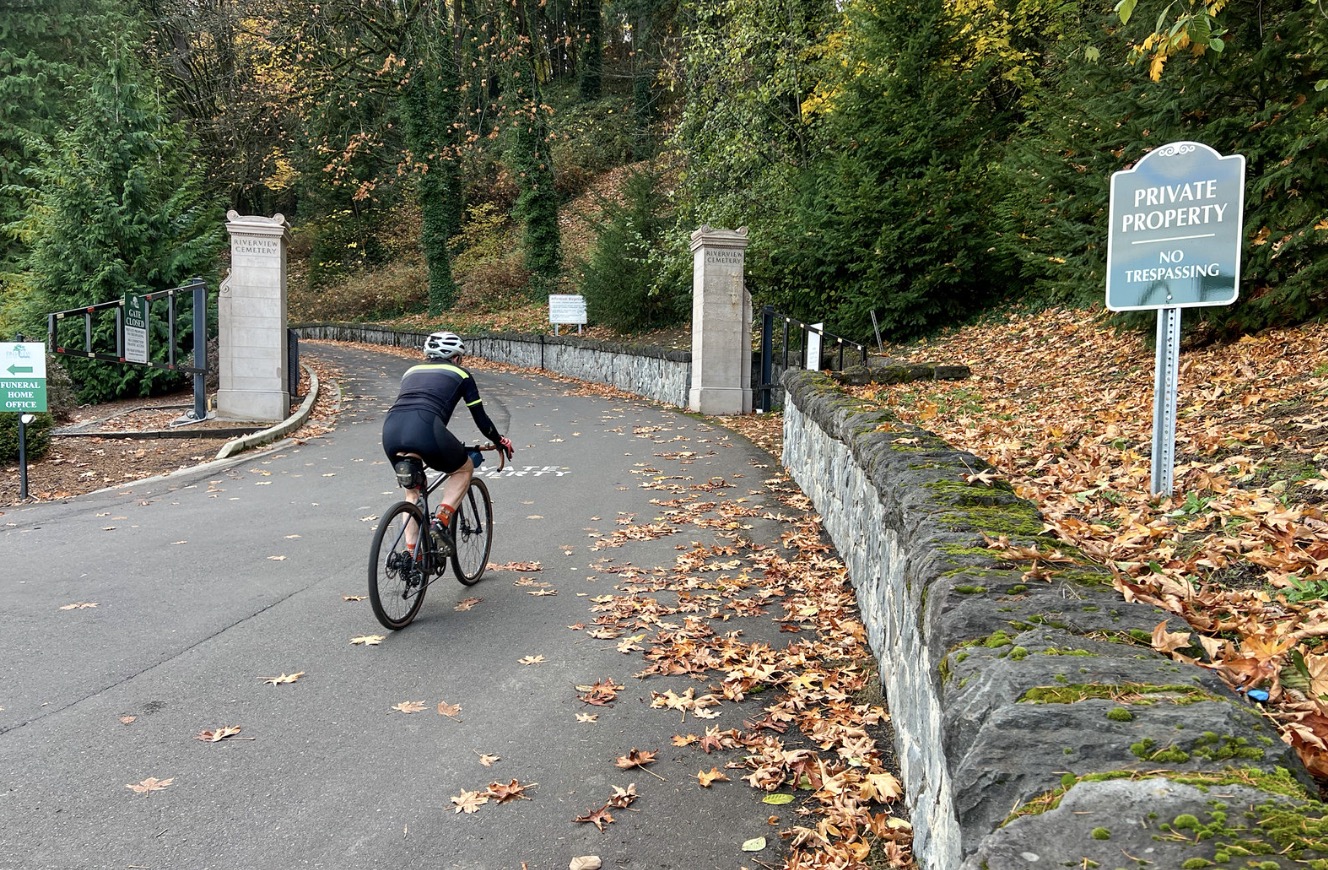
A rider enters River View Cemetery entrance on SW Macadam near the Sellwood Bridge. (Photo: Jonathan Maus/BikePortland)

This guest article was written by Matt Zajack, who we previously profiled for his work on a traffic counting device. This story was edited by Adrienne So.

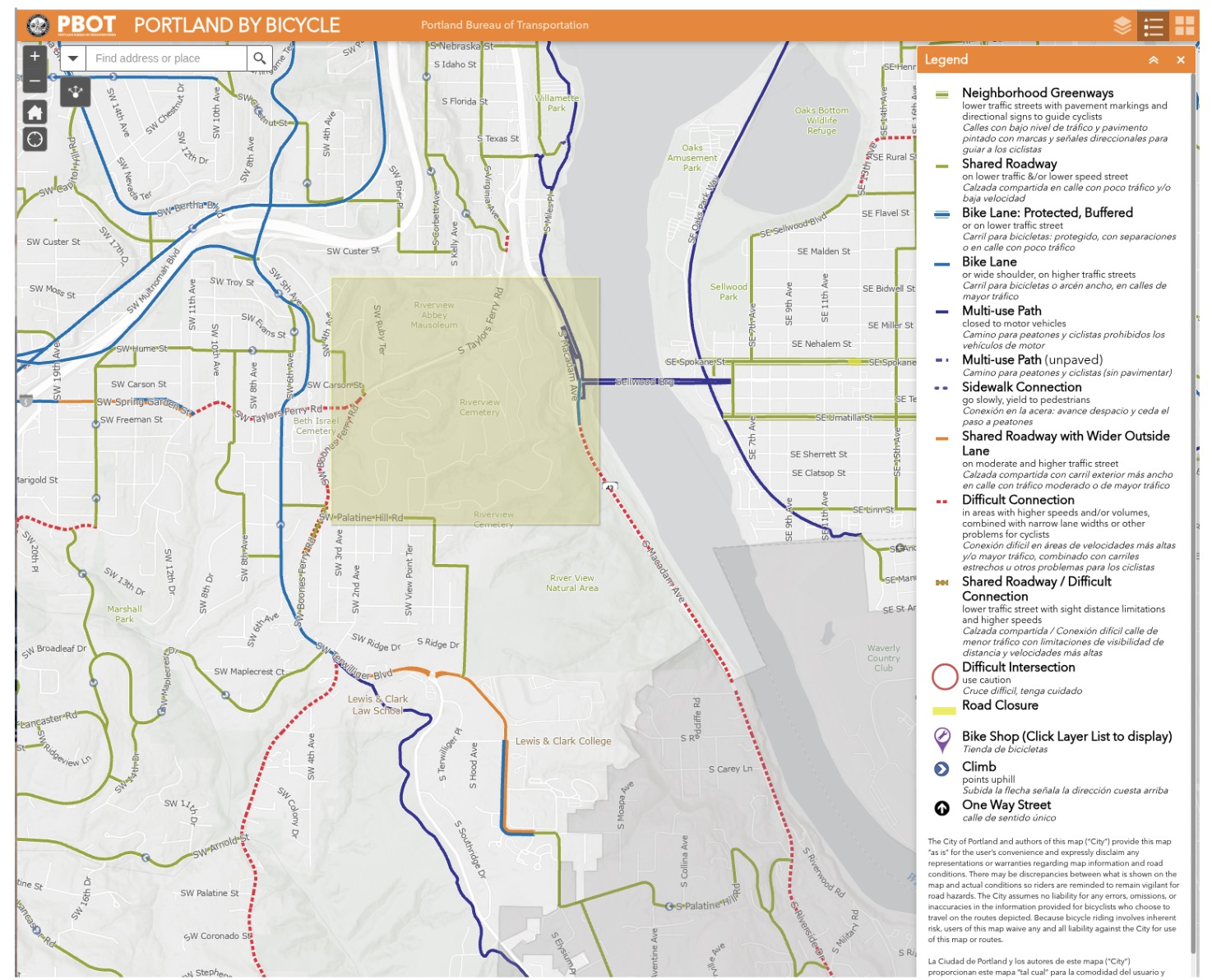
The River View Cemetery (RVC) route is a high-traffic, though fragile, de facto public connector that happens to run through private property. For decades, Portlanders on bikes have relied on the goodwill of cemetery officials to provide a critical transportation link between Sellwood and SW Terwilliger Blvd (the alternatives are much too busy, or else closed to cycling).

Last year’s closures underscored the urgency to find a safe, public, all-weather alternative, but supporting data has been hard to come by. Portland’s Bureau of Transportation (PBOT) has been asked to deploy traffic counters, but has been unable to do so. We also suspected that a few hours of counting would not be able to capture the necessary data to show who is using the RVC and when. My company, Green Dormer Solutions, partnered with Lewis & Clark College to provide a pro bono, data-driven analysis of the route’s usage with the Traffic Monitor device to provide both cyclists and city planners with evidence to justify the creation of a safe, public route.

Please Don’t Speed

We collected data over a 36-day period, split between summer (August 15-28, 2025) and autumn (September 19-October 10, 2025), at the Macadam entrance gate. Bicyclists accounted for the largest volume of users, with no meaningful statistical difference between weekdays and weekends—the RVC is used for both commuting and recreation. 

Advertisement

Significantly, the data showed that significantly more bicycles were recorded entering (uphill) the cemetery than exiting (201 vs. 103). This strong directional trend suggests the cemetery route is a preferred, safer path for the challenging climb to the Southwest Portland neighborhoods, as alternatives like Taylor’s Ferry Road are perceived as dangerous. 79 percent of group rides (clusters of at least 5 bicycles) also travel uphill, which solidifies the need for a safe alternative to the SW Portland climb.

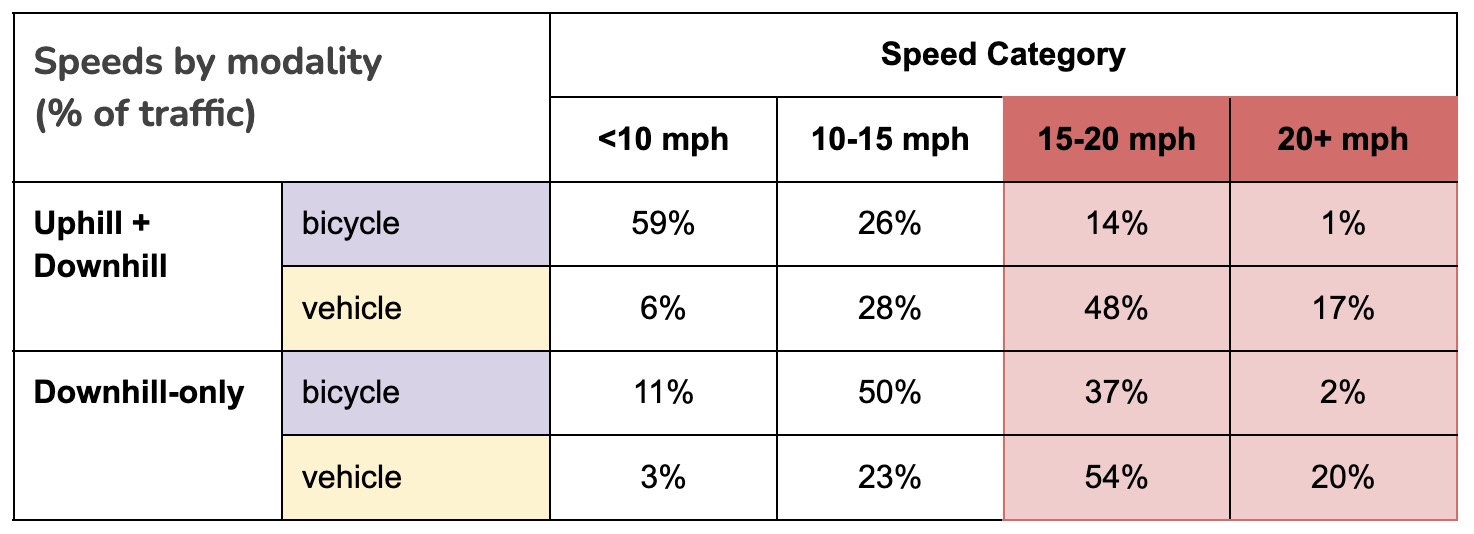
(Chart comparing speeds of bicycles and motor vehicles (cars, trucks, motorcycles). Matt Zajack/Traffic Monitor)

Other key findings included: 

  • RVC is a cut-through route for commuters. While bicycle volume was evenly distributed after 8 am, with a slight bump from 4-6 pm on weekdays, motorized vehicle volume was concentrated during the evening commute. This indicates that car drivers are using RVC as a cut-through route. 
  • Speed makes the RVC a high-risk environment. The speed limit in RVC is 15 mph, but 66 percent of autos and 15 percent of bicycles were captured moving over this limit. The speeding auto cut-through traffic creates a high-risk environment on private roads that were never designed for this volume and speed.
  • The alternative is worse. The primary public alternative, Taylor’s Ferry Road, has an Average Daily Traffic (ADT) of over 5,560 westbound autos with an 85th percentile speed of 49 mph (posted 35 mph limit). The data confirms the high volume of bicycle traffic relies on RVC precisely due to the unsafe nature of alternatives.

Avoiding the Uphills

The RVC serves a critical function, primarily because the public alternative is a challenging and dangerous route. S Taylors Ferry Rd, is an uphill/eastbound slog, with an 85th percentile speed of 44 mph (in a 35 mph zone) and high Average Daily Traffic (ADT) counts of over 6,000. Overall, there were significantly more bicycles entering the cemetery (going uphill) versus exiting (going downhill) at a ratio of 201 to 103 bicycles ADT.

City bicycle map with River View Cemetery shaded.

The opposite trend was observed for cars and pedestrians, with more exiting (downhill) than entering, indicating that drivers see the cemetery as a viable link for downhill travel as high-speed cut-through to avoid potential congestion on Taylor’s Ferry or Macadam. This also creates more potential conflict, as daily pedestrian count is slightly higher than cars, at 90 vs 88 ADT. All user activity increases during the evening commute time.

The most alarming discovery relates to speed. The speed limit within River View Cemetery is 15 mph. The data shows that cars are routinely exceeding this limit. 66% of automobiles were captured moving over 15 mph (the speed limit), compared to just 15% of bicycles, and this speed differential is magnified when traveling downhill: 74% of cars vs. 39% of bicycles were over 15 mph.

This confirms that the cemetery’s roads are being treated as a high-speed, non-residential street by most drivers, directly contrasting with the intended quiet nature of a cemetery and the safety needs of active transportation users. The risks are compounded by the presence of vulnerable road users and the narrow, winding nature of the roads.

Furthermore, our seasonal and time-of-day analysis showed that autos were significantly faster in autumn than in summer, with more cars driving 20-30 mph. This increase in speed is a dangerous trend that increases risk for all users as the days get shorter and weather worsens.

Advertisement

Shedding Light on Group Rides

We also looked at group cycling, which has been a point of contention for cemetery users. Group rides were defined as at least five bicycles clustered within 10 seconds and had no way of differentiating recreational or commuter rides.

While group rides might be controversial, they make up 8 percent of total daily bicycle volume. Weekday morning commuter group rides are largely uphill and are likely the result of a “platoon effect”, caused by the traffic light at Macadam. 

A Note on Scalable Traffic Monitoring

City agencies often face capacity constraints. Traffic counters take time and money and would not be able to showcase the rich data captured here. The TrafficMonitor.ai device highlights how communities and advocates can gather the robust data they need to spur action.

The Alternative Route Crisis

The precarious nature of the cemetery access was recently thrust into the spotlight with temporary closures due to construction, prompting a familiar outcry from the community. But RVC is the only safe option. The data provided by the analysis confirms that the alternatives are significantly longer, steeper grades, and often unsafe.

The most direct alternative, S Taylors Ferry Rd, is not a designated bicycle route. It is a high-speed, high-traffic environment where the only way to feel safe descending is to take the lane at a speed nearing traffic. The fact that the 85th percentile speed on Taylors Ferry is 49 mph westbound and 44 mph eastbound—far exceeding the 35 mph posted limit—makes it a dangerous prospect for most cyclists.

The predicament presented by the roadway data—high-speed motor vehicles, peak commuter traffic, and the ever-present threat of closure—deserves immediate and concrete action. While the discussion is often complicated by debates over private property, tax exemption, and the sanctity of cemeteries, the core issue remains: There is no safe, public, guaranteed, and direct connection for active transit and non-vehicular users between the Sellwood Bridge area and SW Portland.

The comprehensive traffic and speed data, focused on holistic roadway data— not just car-centric numbers, and collected over a six-week period— is crucial for informing stakeholders, which includes Lewis & Clark College, River View Cemetery, and Portland City Council District 4 representatives. For more information, the full case study is on Matt Zajack’s website. He also does pro bono work; you can sign up using this form.

Advertisement

Methodology 

The data was collected at the cemetery entrance gate near the Sellwood Bridge, using a trafficmonitor.ai device—an open-source smart city traffic monitoring solution utilizing edge machine learning object detection and Doppler radar. This data collection study was estimated at less than $1,000 to implement. Comparable private counting and speed analysis on a multi-modal route often costs upwards of $29,000.

The trafficmonitor.ai system prioritizes privacy. The device uses local object detection inferencing and Doppler radar, not capturing or storing identifying visuals (no images, license plates, or faces). It only records the object class (bicycle, automobiles, pedestrian), times, speed, and direction for fully local data de-identification. This ensures ethical, granular, and holistic data collection on traffic patterns for urban planning, without compromising user identity or personal information.

Data Definitions

CategoryTimeframeDuration
SummerAug 15-28, 202514 days
AutumnSep 19-Oct 10, 202522 days

Object detection labels and classification:  

AI Transparency disclosure: This analysis utilized the public domain Coral SSDLite MobileDet based on the public domain COCO dataset with the following labels:

  • Bicycle: combined ebikes, bikes
  • Vehicle: combined cars, trucks, motorcycles
  • Pedestrian: person (minus) bicycle (may include scooters and non-bicycle micro-mobility)

Dispatch from hiatus and update on the future

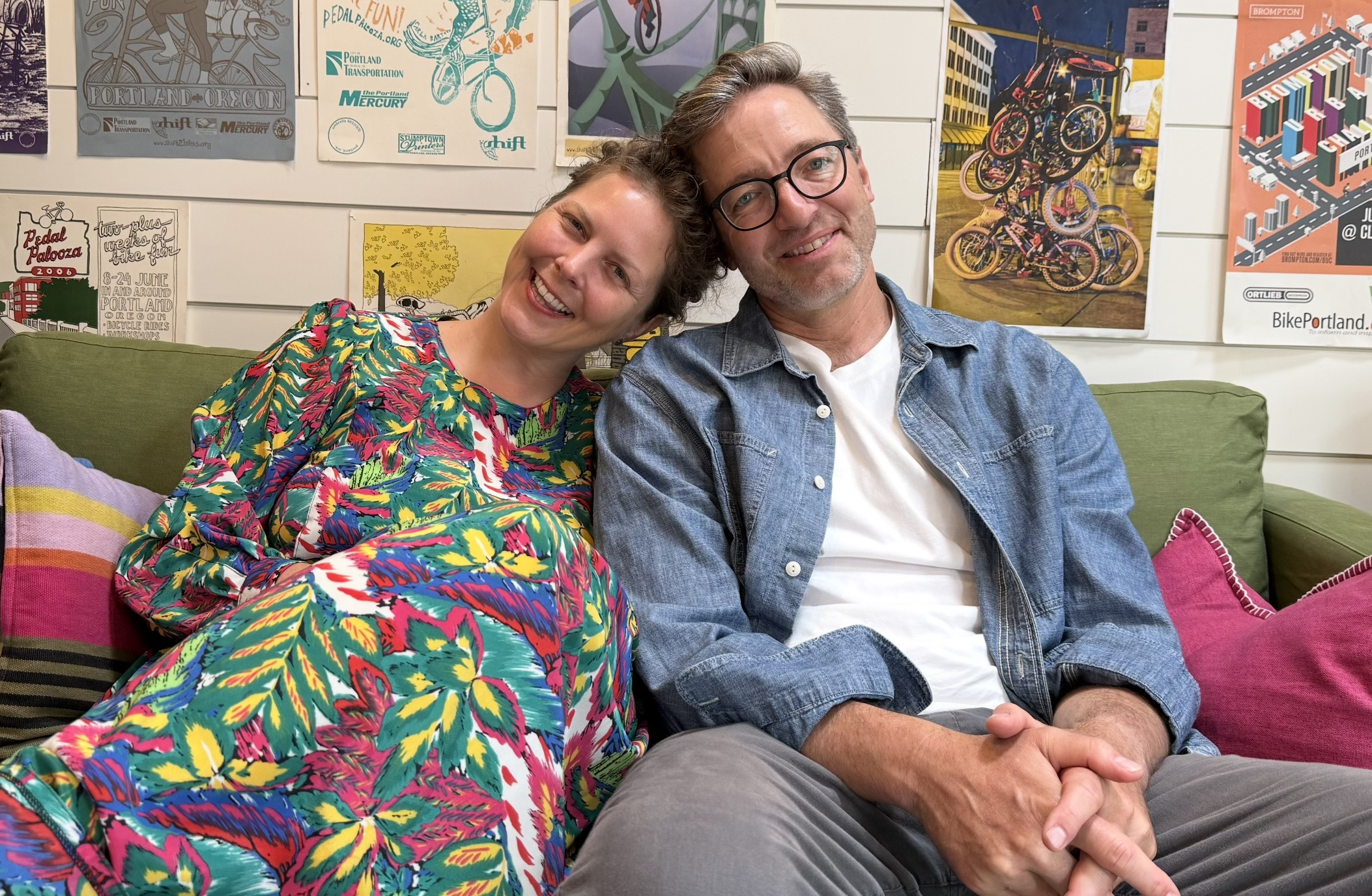
Bike Summer organizer Meghan Sinnott and I after a chat in the Shed last week. (Photo: J Chris Anderson)

Hi! I’ve missed you! I am grateful for your support and hope you’re enjoying Bike Summer — or just summer even if it doesn’t include as much “bike” as you’d like. It’s been a minute since my last check-in and it’s time to share an update on what I’ve been doing and thinking since I announced a hiatus from BikePortland.

But first… thanks for coming to the 20th anniversary party! It was a night I’ll never forget and I truly appreciate each and every person who was there. Nice things were said, hugs were given, food was eaten, and we sold 10 cases and two kegs of (very delicious) Bike Happy Pale Ale! Migration hit it out of the park with that beer and I highly recommend trying it before it’s gone (4-packs still available at their various locations).

In some respects, that big party felt like closure. It tied a bow on 20-plus years of hard work and a part of me felt like, “OK, that was great. I did something special. Now I can move on.” And in some ways, this hiatus is a trial run of what it would feel like if I did move on.

It’s the first time in over two decades I’ve completely turned off BikePortland. And oh, what a feeling! Yes, I’ve been on a few vacations where I didn’t actively post or create content, but the work remained in the back of my mind: Not turned off, just turned to a lower volume. This time has felt very different. And it has felt good. It has given me the space to breathe, to let other things into my life, and to get a more objective read on my relationship to BikePortland and the community.

I’ve also listened to and read a lot of feedback from you. I’ve heard loud and clear that the platform, leadership, and information provided by BikePortland remains vital and necessary. In recent weeks I’ve also met with a bunch of people. They’ve been sounding boards and advice-givers. They’ve helped open some doors and close others.

Those meetings, along with having time to think, has helped me discover that being “the BikePortland guy” was amazing and wonderful in many ways; but it has also extracted a lot out of me and it’s no longer my preferred state of being. I want to be more than BikePortland, but my previous relationship with it didn’t leave room for that. Going forward, I want to find someone else to take the reins — or at least share them with me. I want BikePortland to relaunch; but with me playing a different role. Whether I become BikePortland’s publisher (sort of like CEO), editor in chief (final decision maker in charge of editorial direction), just a contributor, or something else, remains to be seen. It all depends on what grows from the seeds I’ve already planted, and what might yet still bloom in the near future.

On that note, you should know that I’m exploring other opportunities. I’ve loved building BikePortland; now I want to build something else. Whether it’s on my own or (preferably!) with a team of other passionate people doing cool things. I’ve already started building a place for myself in the local basketball world, and that’s an area I plan to continue pursuing. And while I take a shot at basketball, look for help with a BikePortland relaunch, I’m also open to something different. On that note, I might have an exciting opportunity in the local media. If that opportunity materializes, and if I choose to take it, it would solidify my path considerably.

As to all the questions about Bike Happy Hour: That weekly gathering continues (and makes its first reappearance at Gorges Beer Co. on Southeast Ankeny Rainbow Road today from 4:00 to 7:00 pm!), but with a new host at the helm. I’m stepping back and letting the folks from BikeLoud PDX take over as organizers.

To recap: A BikePortland relaunch, a second career as a basketball coach, a new job unrelated to BikePortland — if my path still seems unclear, that’s because it is! And that’s O.K. Having options is the point. And taking time to consider them is the right move for me.

So like I mentioned above, if you want to be a part of BikePortland’s next chapter, please contact me! And if you or your business/organization is doing something cool and could use someone with my unique set of skills and experiences, let’s talk. The best way to reach me is via email at maus.jonathan@gmail.com.

I appreciate your ongoing support.

Stay tuned, and I’ll see you in the streets.

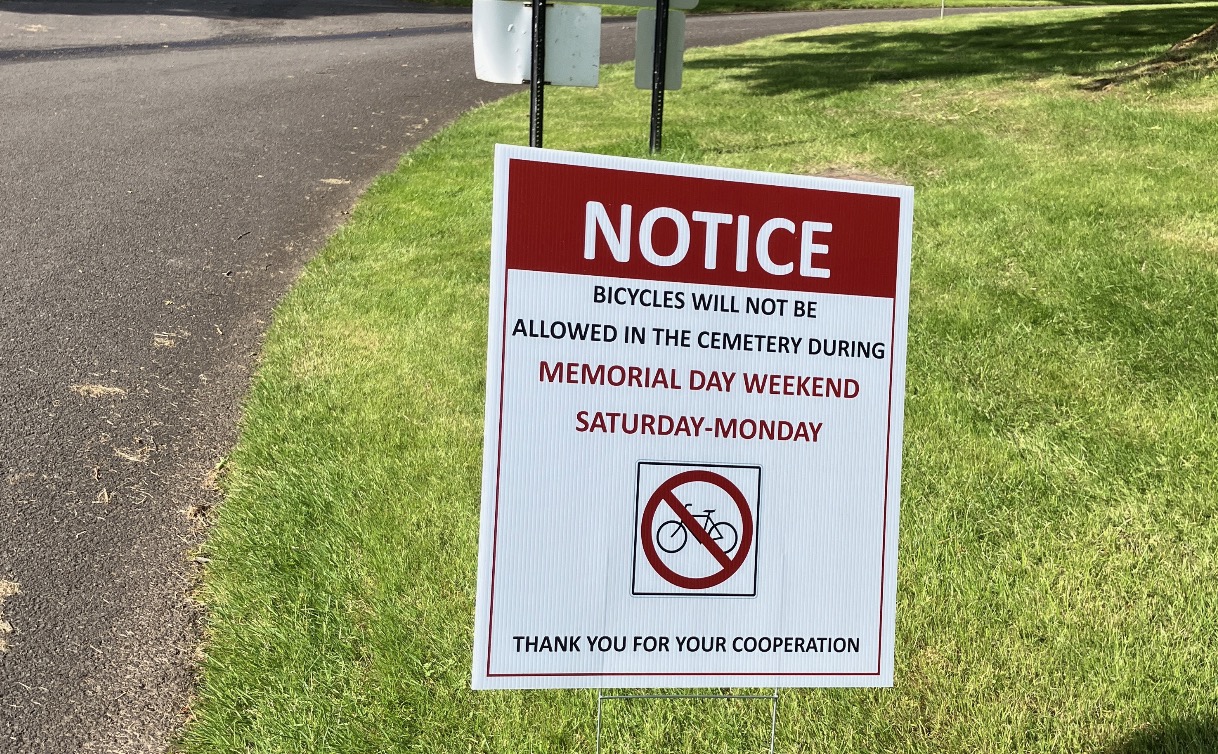
Reminder: No riding through River View Cemetery during Memorial Day Weekend

(Photo: Lois Leveen)

— This guest article comes from Lois Leveen — an author, activist, bicyclist, and ukulele player in Portland.

If you are one of the many bicyclists who enjoys pedaling through River View Cemetery for your commute or your recreational rides, you may already have seen the signs notifying cyclists that the Cemetery will be closed to bicyclists from Saturday 5/23 through Monday 5/25. This annual observance of Memorial Day weekend maximizes access for those mourning and remembering loved ones. 

It is also a good reminder that River View Cemetery is a private entity that kindly allows bicyclists and pedestrians to pass through their property. For those of you who make this ride regularly, you know it is a beautiful route, and the only safe way to get to/from/through much of Southwest Portland. Please comply fully with this closure, and always be respectful whenever passing through River View Cemetery during the rest of the year.

Although many of us treat Memorial Day as we do other holidays and long weekends, and particularly as a kickoff to summer fun, it’s worth pausing for some Memorial Day-specific reflection. So as you read this and as you bike and walk your way around this coming weekend, it’s a good opportunity to remember the many Portlanders, Oregonians, and United Statesians we lose to vehicular violence each year (as well as the countless others whose lives are shortened/worsened by pollution, the climate crisis, and other aspects of unfettered car culture). May their memories be an inspiration as we work to make the places we live and ride safer for all our community members.

Guest Article: Demand a pause on PBOT’s SW Alder decision

This guest article is an action alert from Portland bike advocacy organization BikeLoudPDX.org.

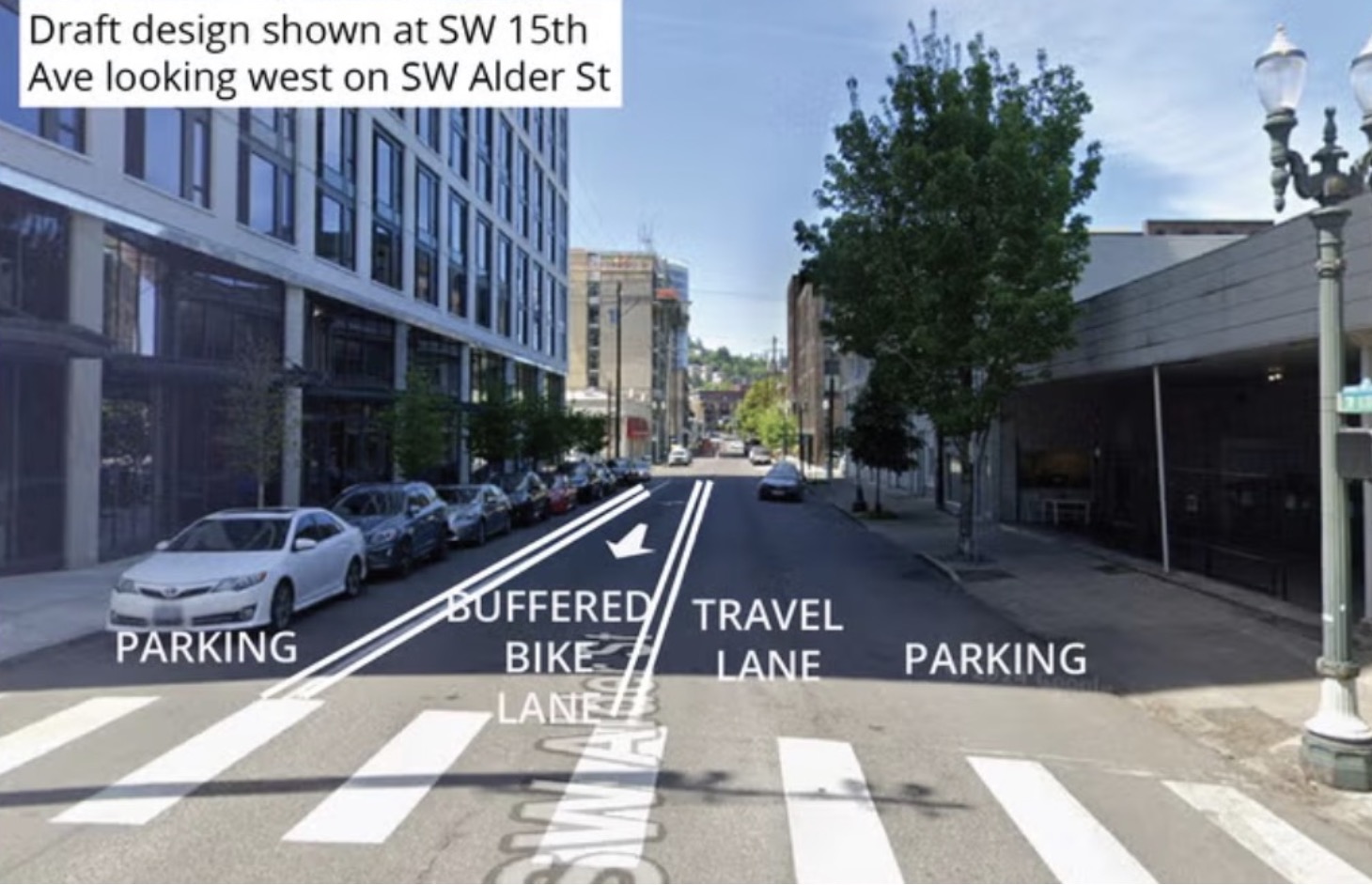
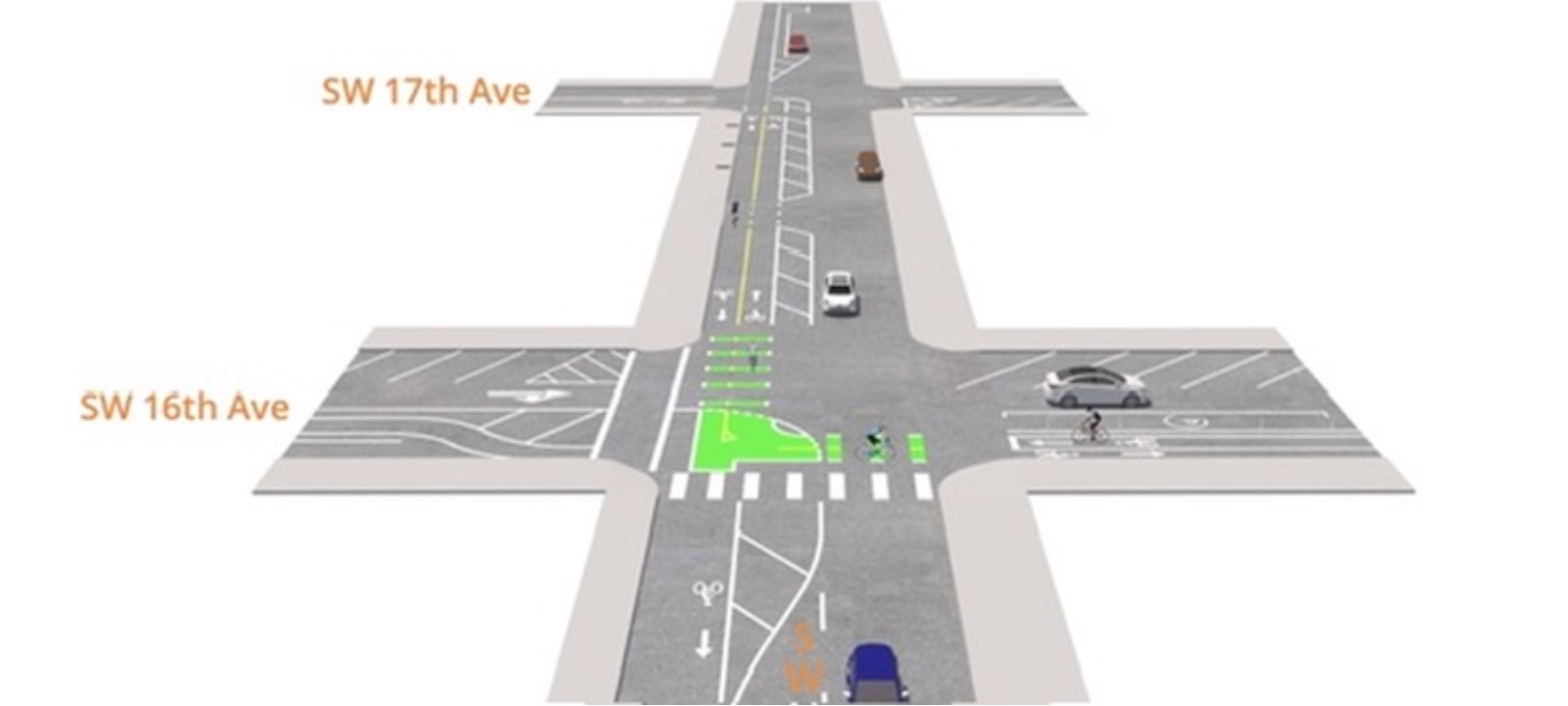
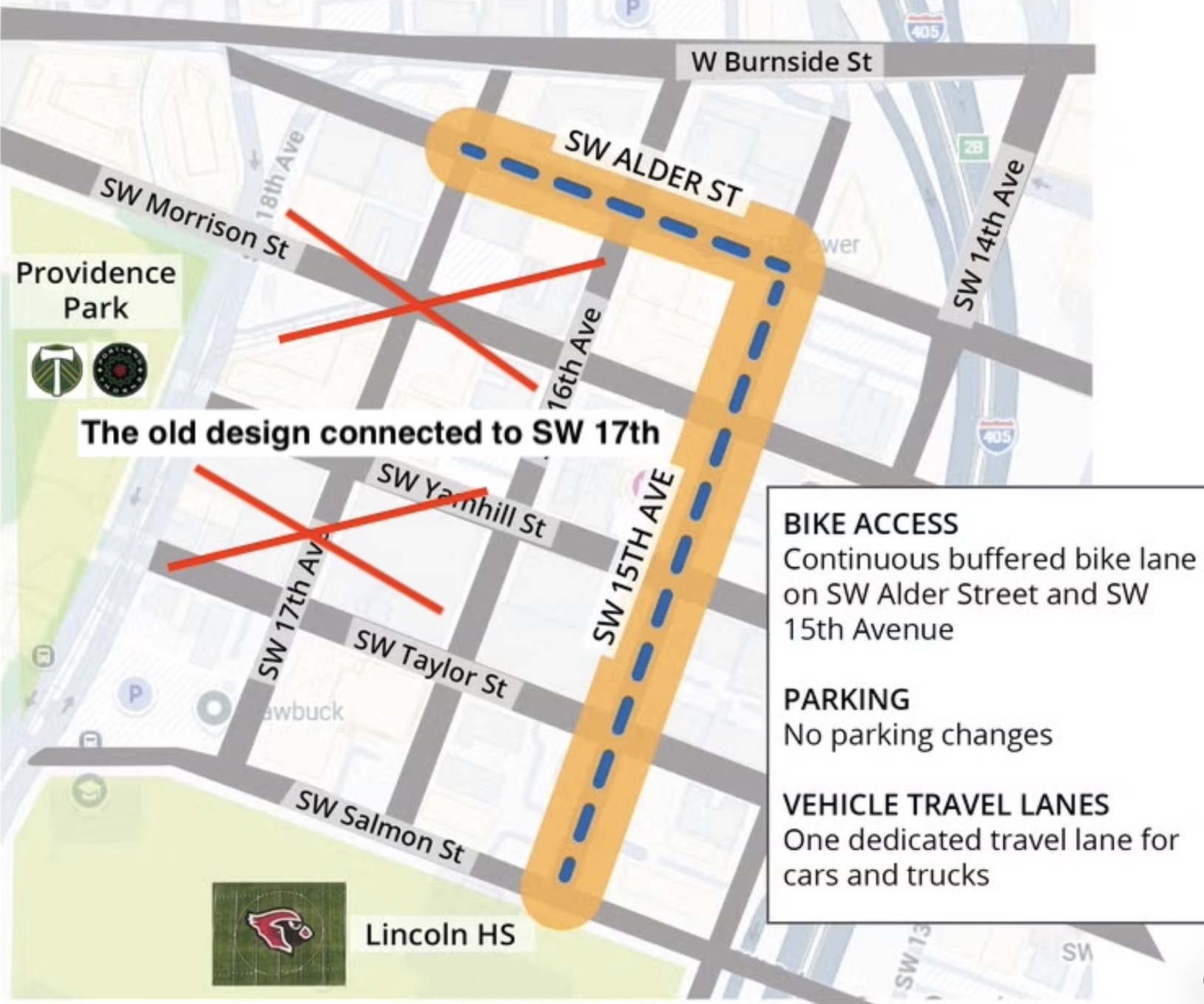
PBOT’s altered design that preserves curbside auto parking.

Last week, PBOT announced their intention to abandon a decade-long plan to install a two-way protected bike lane on SW Alder between 14th and 15th after hearing pushback from neighbors about the loss of car parking. 

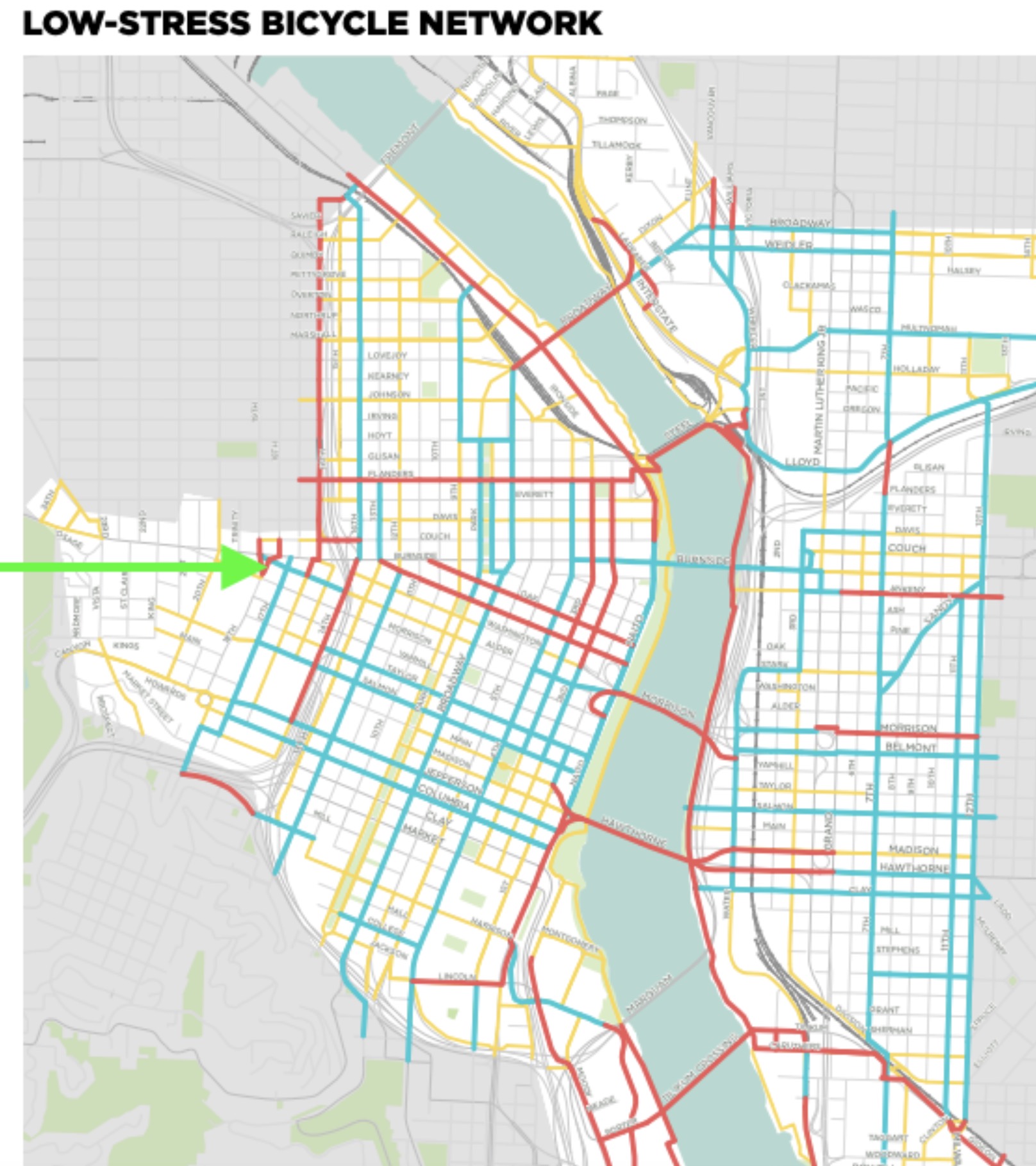
This design was part of the City Council-approved Central City in Motion plan. The two-way bike lane was the missing link to the network, connecting the rest of NW Portland to the Max, Providence Park, and Lincoln High School. But as BikePortland shared earlier this year, tenants at an adjacent residential building expressed concern over a loss of auto parking. That pushback led to a meeting between the tenants and PBOT to discuss alternative designs.

Under the current plan proposed by PBOT, people riding bikes will have to ride two extra blocks to get to these destinations. Instead of riding on a protected two-way bike lane up to SW 17th, you will have to drop down to 15th and then go back up on an unprotected bike lane. Only 42% of people feel safe on the new design, while 93% feel safe on the old one. 

On January 22 2026, Mayor Keith Wilson said, “We are and have to be the biggest bike mode city in the nation. Our multimodal focus has got to be at the center of every decision we make.” This is an opportunity for our mayor to show Portland that his words have meaning and for the City Council to demand accountability for the plans that they have passed. 

We need you to write to our city council and mayor and ask for an immediate pause on this major route change. Large changes, like this, that impact the usability and route of our bike network should be presented to the Bicycle Advisory Committee before being decided on. Use the blue banner to send an email to the Mayor, D4 City Councilors, PBOT Director, and City Manager.

Click here to view and send a sample email to city leadership.

Guest Opinion: The bike beat lives on in all of us

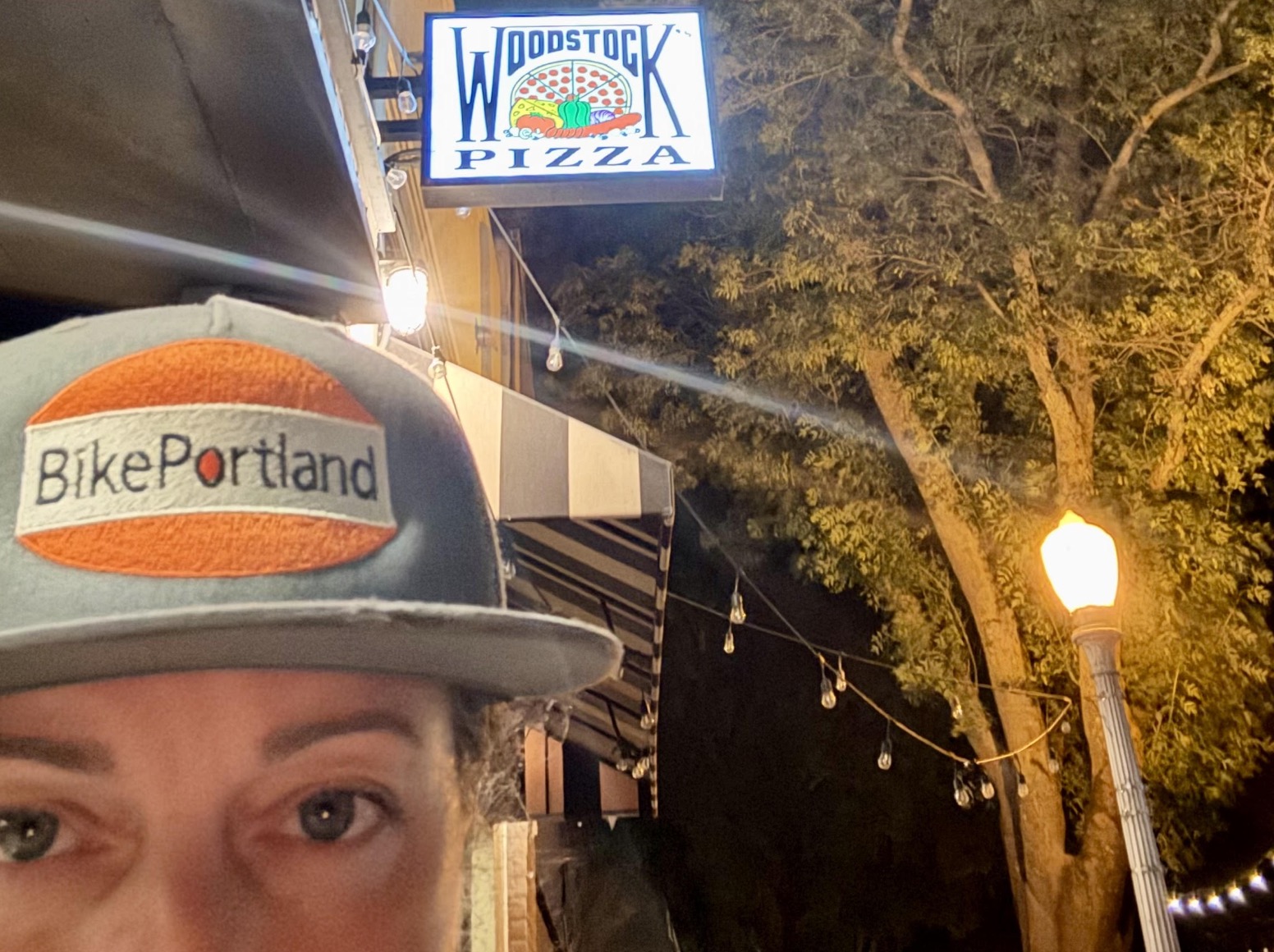
Selfie with my new hat at a pre-train ride pizza stop in Davis, California.

This guest article is from Jessica Fletcher, the organizer and leader of the James John Elementary School Bike Bus. Jessica just returned from a trip to Davis, California where she became a League Certified Cycling Instructor. She wrote this in Davis while waiting for her train back to Portland.


I attended BikePortland’s 20th anniversary party recently and bought a $20 hat. Simple enough purchase. But every time I wear it, I suddenly feel like I’m on duty, like I’m representing something bigger than myself.

And lately, maybe that matters.

With Jonathan Maus in transition at BikePortland, there’s a feeling that a beat in Portland journalism may need to evolve. Not disappear, just look different.

The bike beat.

Because maybe the bike beat was never only one person covering meetings, infrastructure fights, ribbon cuttings, crashes, and community victories. Maybe it has always also belonged to the people riding the lanes, teaching safe cycling, organizing rides, advocating for better streets, and simply showing up.

I’m writing this from Davis, California, after returning from a ride from Woodland where I earned my League Cycling Instructor certification through League of American Bicyclists. I’m waiting for the train home, wearing that Bike Portland hat, feeling strangely accountable to an idea.

Not Portland-the-place, exactly.

But Portland-the-practice.

The belief that cities can be shaped around people instead of just cars. That transportation can build community. That local stories about bike lanes and crossings and near-misses matter because human beings move through them every day.

Maybe the future of Bike Portland, and local bike advocacy generally, is more distributed. More participatory. Less about one newsroom voice and more about a network of people paying attention where they are.

A teacher in East Portland.
A commuter in Beaverton.
A parent biking with kids in Lents.
Someone waiting for a train in Davis, California after a long ride.

The beat continues because we continue.

And maybe wearing the hat means accepting a little responsibility for that.

Job: Part-Time Sales Associate – NwProGear Bicycle Shop & Repair

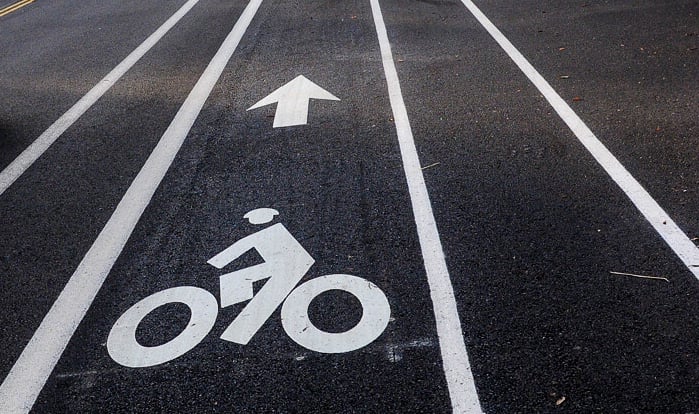
Buffered Bike Lane with a bike symbol and arrow pointing forward

Job Title

Part-Time Sales Associate

Company / Organization

NwProGear Bicycle Shop & Repair

Job Description

Part-Time Sales Associate – NwProGear Bike Shop

NwProGear is looking for a part-time sales person to join our team! We are a busy, family-owned bike shop in Portland with an awesome crew, a huge selection of new and refurbished bikes, and a strong focus on helping customers find the right bike without the pressure.

This is a part-time position with the potential to become full-time during the busy summer season. Sunday availability is required, as Sundays are one of our busiest days. We are closed on Saturdays, so Saturday will always be a day off.

We are looking for someone with previous bike shop experience and a solid baseline knowledge of different types of bikes, including mountain bikes, road bikes, gravel bikes, commuter bikes, kids bikes, and e-bikes. We work with 15+ brands for our new bike lineup and also have a vast used bike inventory. In total, we stock 400+ bikes, so this is a great fit for someone who enjoys being around a wide variety of bikes and helping customers find the right one.

You do not need to know everything, but you should be comfortable talking with customers, understanding their needs, helping with sizing, explaining basic bike features, and working as part of a fast-moving team.

Part of this role will also include helping keep the shop clean, organized, and flowing well. That means restocking inventory, moving bikes and boxes, keeping the sales floor presentable, and helping with the day-to-day tasks that keep a busy bike shop running smoothly. Applicants must be able to lift and handle 50+ lbs. Mechanical experience is a plus, but not required.

Responsibilities include:

* Greeting customers and helping them find the right bike or gear
* Answering basic questions about different bike styles, sizing, and components
* Helping with test rides and customer follow-ups
* Keeping the sales floor clean, organized, and presentable
* Restocking inventory and helping maintain shop flow
* Moving bikes, boxes, and inventory as needed
* Working with the service team to help customers with repairs, accessories, and bike setup
* Providing friendly, honest, low-pressure customer service

What we are looking for:

* Prior bike shop experience is required
* Good baseline knowledge of different types of bikes
* Sunday availability is required
* Able to lift and handle 50+ lbs
* Friendly, reliable, and comfortable talking with customers
* Able to work in a busy shop environment
* Strong communication skills
* Willingness to learn and be part of a team
* Mechanical experience is a plus

Shop perks:

* New and used bike/parts hookups
* Rad coworkers and a fun shop environment
* Espresso machine in the shop
* Saturday is always off
* Potential for full-time hours during the summer season
* A huge variety of bikes to learn from and work around

About us:

NwProGear is a local, family-owned bike shop serving the Portland area for over 11 years. We carry a wide range of quality new and certified refurbished bikes, working with 15+ new bike brands and stocking 400+ bikes in total. From mountain bikes and road bikes to gravel bikes, commuters, kids bikes, and e-bikes, we take pride in offering customers a wide selection, knowledgeable help, and a low-pressure shopping experience.

This is a great opportunity for someone who loves bikes, enjoys helping people, and wants to be part of a growing shop with a strong team.

How to Apply

Please send us your resume and a short note about your bike shop experience and what types of bikes you are most familiar with.
to nwprogear1@gmail.com

Job: Safe Routes to School (SRTS) Coordinator – p:ear

Buffered Bike Lane with a bike symbol and arrow pointing forward

Job Title

Safe Routes to School (SRTS) Coordinator

Company / Organization

p:ear

Job Description

About This Position
bike works by p:ear is seeking a Safe Routes to School (SRTS) Coordinator to support youth, families, schools, and community partners in building safer, more connected opportunities for walking, biking, rolling, and using transit throughout East Portland and East Multnomah County.
The SRTS Coordinator will work closely with the SRTS Program Manager, Bicycle & Pedestrian Safety Education staff, school districts, SUN programs, jurisdictional partners, and community-based organizations to implement education, encouragement, engagement, and planning strategies that improve transportation safety and increase access to active transportation for students and families.
This position plays a key role in advancing bike works by p:ear’s mission to create equitable, community-centered transportation systems by delivering culturally responsive programming, supporting school-based events, strengthening community partnerships, and helping families feel confident choosing active transportation.

Position Details
Position: Safe Routes to School Coordinator
Schedule: Grant-funded through 6/30/2029 (with the possibility for extension); occasional evenings and weekends required
Reports To: SRTS Program Manager
Compensation: $75,108 annually, (base pay + fringe benefits stipend)
Location: East Portland / East Multnomah County, with regular regional travel
Position Summary
The ideal candidate is an organized, relationship-driven self-starter with strong facilitation, communication, and project management skills, along with a demonstrated commitment to transportation equity, youth engagement, and community-led systems change.
The SRTS Coordinator will support the planning, implementation, and evaluation of Safe Routes to School programming, including bicycle and pedestrian safety education, e-bike education, school events, encouragement campaigns, family engagement, and community outreach.
This role requires collaboration across multiple sectors, including schools, local government, transportation agencies, nonprofit partners, and neighborhood communities.

Essential Duties & Responsibilities
Program Implementation & Education
Deliver bicycle (traditional and electric), pedestrian, and traffic safety education programming for K–12 students, families, and community members
Coordinate and facilitate school- and community-based SRTS activities, including:
Walk + Roll events
Bike rodeos
Community rides
Safety trainings
E-bike education and hands-on riding instruction
Support safe and accessible use of electric bicycles through education, demonstrations, and community engagement activities
Support the development and implementation of culturally responsive active transportation curriculum and educational materials
Promote safe walking, biking, rolling, transit use, and e-bike transportation through encouragement campaigns and community outreach

School & Community Engagement
Build and maintain strong partnerships with school districts, administrators, SUN programs, teachers, families, and community organizations
Serve as a liaison between bike works, schools, public agencies, and community stakeholders to align programming and identify community needs
Support community engagement efforts related to transportation safety, school access, and neighborhood mobility barriers
Cultivate youth and community leadership around active transportation and transportation justice

Planning, Coordination & Data
Coordinate logistics, scheduling, supplies, and communications for programs and events
Maintain accurate participation records, program data, and outcome tracking
Support grant reporting, evaluation, and documentation requirements
Assist with outreach materials including flyers, presentations, toolkits, newsletters, and digital communications
Transport bicycles, equipment, trailers, and event supplies using organizational vehicles, including vans and larger fleet vehicles

Organizational Support
Collaborate with bike works staff on related programming, advocacy efforts, and special initiatives
Represent bike works by p:ear at community meetings, trainings, tabling events, and partner convenings
Support additional duties as needed in alignment with organizational and program goals
Required Qualifications & Competencies
Minimum one year of experience working with youth, families, schools, and/or diverse communities
Experience facilitating educational programming, workshops, or community outreach preferred
Strong commitment to equity, inclusion, and culturally responsive community engagement
Excellent interpersonal, communication, and relationship-building skills
Strong written, verbal, and public speaking abilities
Excellent organizational, time management, and project coordination skills
Ability to work independently while collaborating across teams and partner organizations
Adaptability, problem-solving skills, and comfort working in a nonprofit/community-based environment
Commitment to nonviolence, compassion, and trauma-informed engagement practices
General knowledge of bicycles, pedestrian safety, and/or active transportation preferred
Familiarity with electric bicycles and/or willingness to learn e-bike operation, safety practices, and maintenance basics preferred
Experience riding bicycles in urban environments and confidence discussing active transportation safety with youth and community members preferred
Valid driver’s license and clean driving record required
Ability and willingness to drive organizational vehicles, including vans and larger vehicles used for program operations and event support
Comfort transporting bicycles, equipment, and materials throughout the Portland/Gresham metro area
Ability to stand for extended periods, work outdoors in varying weather conditions, and lift/move up to 40 pounds
Reliable transportation or ability to travel regularly throughout the Portland/Gresham metro area
About bike works by p:ear
bike works by p:ear is East Portland’s nonprofit bike shop, advocacy hub, and youth workforce development program. Founded in 2017, bike works works to create safer, more equitable transportation systems by advocating for connected bicycle and pedestrian infrastructure, providing community education and programming, and ensuring historically underrepresented communities have a voice in transportation planning and policy.
Mission:
To advocate for a world-class network of active transportation infrastructure in East Multnomah County that provides equitable access for people of all ages and abilities.
Vision:
A safe, convenient, and seamless active transportation network that connects people to where they live, work, learn, and play.
Equal Opportunity Employer
bike works by p:ear is an equal opportunity employer and values diversity at all levels of the organization. We encourage applicants of all backgrounds, identities, and lived experiences to apply.
Reasonable accommodations will be provided for qualified individuals with disabilities.
Additional Information
This job description is intended to describe the general nature of the role and is not a comprehensive list of all duties or responsibilities. As a nonprofit organization, flexibility, collaboration, and a willingness to support evolving organizational needs are expected.

How to Apply

TO APPLY:
Please send a resume and cover letter to info@bikeworkspdx.org with “SRTS Coordinator” in the subject line. Position open until filled. Email only; no phone calls please.

Job: Lead E-Bike and Community Shop Mechanic – bike works by p:ear

Buffered Bike Lane with a bike symbol and arrow pointing forward

Job Title

Lead E-Bike and Community Shop Mechanic

Company / Organization

bike works by p:ear

Job Description

bike works by p:ear
bike works by p:ear is seeking an experienced and community-minded Lead E-Bike and Community Shop Mechanic to support our nonprofit bike shop and youth internship program in East Portland. This position combines high-quality bicycle and e-bike repair with mentorship, relationship-building, and community engagement.
The ideal candidate is a skilled mechanic who values accessible transportation, enjoys working collaboratively, and is excited to support young people in developing both technical and professional skills. This role requires strong traditional bicycle mechanic experience alongside hands-on knowledge of modern e-bike systems.

Position: Lead E-Bike and Community Shop Mechanic
1 FTE: Tuesday-Saturday. Requires occasional evenings and Sundays
Reports To: p:ear Works Director & Shop Manager
Compensation: $60,463 + benefits: Benefits include 3 wks. paid vacation, health, dental, 2% Simple IRA match, short-term disability, 8 paid sick days

Bike Mechanic Job Description

As our E-bike mechanic, you are a dynamic individual who will help support our non-profit community bike shop and youth internship program in East Portland. We are seeking a skilled and motivated E-Bicycle Mechanic to join our team. The ideal candidate will have a strong proficiency with modern bicycle and e-bike technology. You’ll play a crucial role in ensuring customer satisfaction by delivering high-quality service, ensuring safety, and keeping e-bikes in peak condition

The ideal candidate is an experienced and highly competent bicycle mechanic who is equally passionate about community impact, mentorship, and accessible transportation. They are comfortable working independently, thrive in a collaborative nonprofit environment, and bring both strong traditional bicycle mechanic skills and modern e-bike technical expertise.

Core Qualifications
• Minimum 3 years professional bicycle mechanic experience preferred
• Minimum 1 year professional e-bike mechanic experience required
• Strong proficiency servicing traditional bicycle systems and modern e-bike technology
• Experience working in a professional bicycle retail or service environment
• Familiarity with major e-bike systems such as Bosch, Shimano STEPS, Brose, Yamaha, or similar platforms
• Commitment to safe battery handling and thorough repair safety inspections
• Excellent customer service, communication, and organizational skills
• Ability to work independently while contributing to a collaborative team environment
• Strong attention to detail and ability to manage workflow in a busy community shop
• Commitment to equity, inclusion, trauma-informed care, and compassionate engagement with youth and community members
• Ability to mentor and positively support youth interns from diverse backgrounds
• UBI, BBI, Bosch, Shimano STEPS, or similar certifications preferred
• Valid driver’s license required

Essential Duties & Responsibilities

• Exemplifies compassion and understanding around the barriers of homelessness and underrepresented populations in the community
• Maintain an organized and efficient work environment
• Proficiently execute assembly, repairs and maintenance for all types of bicycles, particularly used and older bicycles
• Represent bike works and p:ear and its mission positively and professionally
• Identify barriers and recommend solutions to better serve the community
• Teach and model safe and professional mechanic practices for youth interns
• Break down technical concepts into accessible, age-appropriate instruction
• Support interns in developing confidence, accountability, and workplace readiness
• Collaborates with PCEF grant manager around grant reporting

Technical Qualifications
• Minimum 3 years professional bicycle mechanic experience preferred
• Minimum 1 year hands-on professional e-bike mechanic experience required
• Advanced proficiency diagnosing and repairing traditional (“acoustic”) bicycle systems including:
o drivetrains
o hydraulic brakes
o wheel truing
o hub and bottom bracket systems
o headset/fork service
o suspension setup and maintenance
• Experience diagnosing and servicing e-bike electrical systems including:
o motors
o batteries
o displays
o wiring harnesses
o firmware/software updates
o torque and cadence sensors
• Familiarity with major e-bike systems such as Bosch, Shimano STEPS, Brose, Yamaha, Bafang, SRAM, etc.
• Ability to safely troubleshoot electrical/mechanical integration issues
• Ability to accurately document repairs and communicate technical issues clearly to customers and staff
• Diagnose mechanical and electrical issues on a wide range of e-bike systems
• Perform firmware updates and manufacturer-recommended diagnostics when applicable
• Maintain service records and communicate repair timelines clearly
• Stay current on evolving e-bike technologies and service standards
• Support fleet maintenance for program and community-use bicycles
• Assist in developing preventative maintenance schedules for e-bike fleets

Shop Operations
• Assist Shop Manager with a variety of tasks, including maintaining an inventory of new and used parts, placing orders with distributors as needed, maintaining shop tools and restocking as necessary
• Assist customers in the shop with purchases and bicycle repairs during sales
• Strong proficiency with bicycle tech

Community Programming
• Help maintain and support SRTS e-bike programs
• Build and sustain relationships with the East Portland community
• Represent p:ear and its mission positively and professionally
• Work on integrating and developing long term proposed strategies: community outreach, youth and adult classes and bicycle programs
• Participate in Sunday Parkways, Free Bikes 4 Kids, as well as the occasional Community bike ride events (Safe Routes to School, Oregon Walkways etc.)

p:ear Intern Support
• Develop healthy, mentoring relationships with youth interns
• Maintain appropriate boundaries

Physical Demands
The physical demands described here are representative of those that must be met by an employee to successfully perform the essential functions of this job.

While performing the duties of this job, the employee is regularly required to talk or hear. The employee is frequently required to stand; walk; use hands to finger, handle or feel; and reach with hands and arms.

• Able to sit or stand and walk throughout the scheduled work shift
• Ability to lift and/or move up to 75 lbs

Travel
Some local travel expected for this position.

AAP/EEO Statement
It is the policy of p:ear to provide equal employment opportunity (EEO) to all persons regardless of age, color, national origin, citizenship status, physical or mental disability, race, religion, creed, gender, sex, sexual orientation, gender identity and/or expression, genetic information, marital status, status with regard to public assistance, veteran status, or any other characteristic protected by federal, state or local law. In addition, p:ear will provide reasonable accommodations for qualified individuals with disabilities.

Other Duties
Please note this job description is not designed to cover or contain a comprehensive listing of activities, duties or responsibilities that are required of the employee for this job. Duties, responsibilities and activities may change at any time with or without notice.

How to Apply

Cover letters and resumes can be sent to: nathan@bikeworkspdx.org with “Bike Works Mechanic” in the subject line. This position will remain open until filled. Email only, no phone calls please – phone calls will not be returned.