🚨 Please note: BikePortland is currently on hiatus and only publishing guest articles. Learn more here. Thank you. - Jonathan 🙏

How would 42 Portland political candidates help us reach Vision Zero?

Ghost bike for Mark Angeles on corner of SE Gladstone and Cesar Chavez. (Photo: Jonathan Maus/BikePortland)

NOTE: This is the second post in a series. The answers shared have been highly edited for brevity. Please read the full responses at Bike Loud’s website.

Local bike advocacy nonprofit BikeLoud PDX asked all City of Portland candidates* to answer eight questions gleaned from their members. The second question, “How would you help Vision Zero succeed, and reduce the number of people killed and injured by automobiles in Portland?” was answered by 38 city council candidates and four mayoral candidates.

I’ve gone through the submissions and pulled out 1-2 particularly salient sentences from each candidate. The very abbreviated answers below are based on what I personally found to be the most interesting/notable/newsworthy parts of their responses. For the full answers, visit BikeLoud’s website. I’ve also shared photos of each candidate in the order their responses were shared (if you’re on mobile, be sure to hit the arrow and scroll through the images.) The photos were taken from the Rose City Reform candidate tracker.

Read edited responses from all 42 candidates below:

City Council District 1

Timur Ender

I will advocate for protected intersections where signal timing phases are separated between bicycle and pedestrian movements and right turning cars.

Sonja Mckenzie

… start by supporting the creation of an education and community engagement plan for our community…

Steph Routh

First, we need to believe as a city that Vision Zero is possible. Second, we need to be clear about the devastating impacts of traffic deaths in our communities.

David Linn

Use data-driven upgrades to target high-risk areas, especially routes to schools and bike/bus transit routes can help us invest our money prudently.

City Council District 2

Elana Pirtle-Guiney

… we have to slow cars down and make more spaces and more space (different things, and both important) for bike and pedestrian users.

Christopher Olson

Create a network of protected urban trails across the city. 

Nat West

Close the intersection where a death or car-on-bike/ped crash occurs until inexpensive and temporary traffic calming measures can be installed… Immediate application of daylighting on all city intersections. 

Michelle DePass

I’m in favor of more enforcement. Just this week I’ve witnessed cars in bikes lanes on Williams Avenue, and multiple red light runners at the intersection of Fremont and Williams.

Debbie Kitchin

Road signage and marking should be consistent across the city so all users understand what is expected… combine driver education with more diligent enforcement of driving rules.

Mariah Hudson

… implementing protective barriers and dedicated lanes to minimize the risk of collisions. There needs to be a culture shift and greater responsibility among motorists if we want to significantly reduce the incidence of accidents.

Jonathan Tasini

We need to prioritize people by prioritizing other modes of transportation rather than cars by investing in public transportation, bicycling, and changing the city’s physical infrastructure to save lives.

Mike Marshall

I’d work with the OLCC to evaluate reducing overall access to alcohol and shutting down establishments linked to continued fatalities.

Laura Streib

We need separate streets for vehicles and for bikes to reduce the number of people killed/injured by autos.

Will Mespelt

… we need to start enforcing traffic regulations in a meaningful way to protect bikers and increase general safety for all non car users.

City Council District 3

Tiffany Koyama Lane

Introduce and fight for policy that centers SAFETY for our streets over SPEED.

Rex Burkholder

Higher penalties for motorists who hit vulnerable road users or break speed limits, run signals/stop signs including license suspensions and loss of vehicles. 

Theo Hathaway Saner

Lowering speed limits in areas with high bike traffic and installing speed bumps can reduce accidents.

Daniel Gilk

To achieve real systemic change, we need to redesign our transit systems to better incentivize residents to drive less.

Angelita Morillo

Environmental changes such as [the Arleta Triangle Square Plaza project at SE 72nd & Woodstock] can have tremendous affects on neighborhoods and pedestrian safety – we just need to prioritize them.

Jonathan Walker

We need the resources so every hit and run is fully investigated and prosecuted… For the plan to work, the city needs to get serious about making sure cars are registered and have license plates.

Matthew Thomas Anderson

A fundamental change is needed to the visibility of the bike. Light is not the only visual cue we use to identify a moving car or threat when driving.

Daniel DeMelo

When we adopted Vision Zero, we failed to establish a timeline for achieving our goal of zero traffic deaths. This oversight has made it difficult to assess whether our safety investments are delivering the expected results.

Philippe Knab

I would focus on improving infrastructure, enhancing public awareness, and enforcing traffic laws.

Sandeep Bali

More accountability for reckless drivers.

Jesse Cornett

I will lobby in Salem to eliminate the preemption that does not allow Portland to tax alcohol… Portland should pass a tax on beer and wine and use part of the revenue for better public education about the danger of drinking and driving.

Chris Flanary

Paint alone doesn’t stop vehicles, we need to create the protective bike lanes and traffic-calming measures to slow cars down.

Council – District 4

Mike DiNapoli

Increase visibility for all commuters with additional street and safety lighting.

Olivia Clark

Bring back and expand the Portland Police Traffic Division for enforcement.

Ben Hufford

Traffic Rules and are a language that people learn… Consistent rules, physical separation of bikes from cars and prioritizing maintenance of systems should be the standard.

Chad Lykins

I will propose legislation that prohibits the removal of infrastructure for pedestrians, cyclists, and public transit before (1) the completion of comparable alternatives and (2) validation that these alternatives function as well or better than the infrastructure being removed.

Sarah Strawberry Silkie

Increase enforcement of speed violations – traffic is consistently 5-20 mph over the posted speed limit…

Michael Trimble

I want to make many streets car free zones giving pedestrians and cyclists their own walkways/bike lanes.

Eli Arnold

We need stricter traffic enforcement combined with an end to street camping along roadsides. 

Andra Vltavín

I will be working toward phasing out fossil fuel use altogether. 

Eric Zimmerman

I think standardization of lanes leads to safer streets. We have also introduced a lot of distracting factors to the roadway for all users… These are creating different decision-making and norms across the city and it is not helpful from a safety perspective.

Lisa Freeman

We need to de-prioritize cars in our decision making, and prioritize safety, especially that of our most vulnerable populations…

Bob Weinstein

Increase funding for safe infrastructure: Allocate more resources to redesign dangerous intersections, expand protected bike lanes, and implement traffic calming measures in high-risk areas.

Mitch Green

…treat traffic injuries and deaths as a public health issue… Shelter and house our most vulnerable who are living on roadways so that people driving cars don’t kill them.

Mayor

Liv Østhus

Using data around specific areas and intersections, I will advocate for PSUs urban planning teams to join in evidenced based solutions. 

Durrell Javon Kinsey Bey

Work with the several non profits that have already been doing this work…

Keith Wilson

I do not consider paint and flexible poles adequate safety infrastructure. I support permanent materials to protect biking corridors.

Carmen Rubio

I want our police department to work with the District Attorney’s office to see what evidence and process would be needed to prosecute more drivers for vehicular homicide or assault. While I generally do not support sending more people through the justice system, I also recognize the fear of prosecution can be a strong deterrent.


I find the format of this project by BikeLoud interesting and useful in large part because they’ve received such a large volume of responses. That means we can see what folks have in common and what issues we might find some consensus and political majority for. On that note, I noticed 16 candidates mentioned the need for stronger enforcement. 12 specifically called out the need for physical protection of bicycling facilities, and six mentioned the need to address homelessness due to the vulnerability of people who live along streets.

What other trends or commonalities did you find in the answers?

BikeLoud will post more responses in the weeks to come. Stay tuned for question #3 and see related posts for more 2024 Portland election coverage.

*BikeLoud sent the questionnaire to all candidates that had filed a letter of intent as of May 27th.

Don’t miss Bike Happy Hour this Wednesday!

See you Wednesday. (Photo: Jonathan Maus/BikePortland)

Summer has been sublime so far on the Bike Happy Hour (BHH) patio. I love seeing all of your beautiful faces every Wednesday afternoon. And I hope you’re ready for another great time because there’s a special BHH coming tomorrow.

But first…

If you missed last week, we heard speeches by two mayoral candidates: Marshall Runkel and Keith Wilson (videos below). Marshall told a story about how he handled a very wild constituent call into city hall while he worked for a former city commissioner. And Keith outlined how he’ll provide all Portlanders a shelter and how he believes we need a bike lane on Sandy Blvd and better bike lane maintenance.

Mayoral candidate Keith Wilson at Bike Happy Hour, 06/19/24.
Mayoral candidate Marshall Runkel at Bike Happy Hour, 06/19/24.

We also heard a speech from City Council District 4 candidate Michael Trimble. Michael promised free transit, more enforcement against people who park in bike lanes, and really excited the crowd with his passion. There were other folks on the mic as well, including District 2 candidate Will Mespelt. Each week around 5:00 is open mic where anyone can come up and share what’s on their mind. In addition to political stump speeches, we have people asking for volunteers, promoting events, and just sharing projects they’re working on.

What’s on your mind? You don’t need an invitation to speak at BHH. It’s an open, community space!

And you don’t want to miss the fun this week. That’s because BHH will be the end spot for BikeLoud’s General Member Meeting Ride with groups of folks descending on the patio from four corners on the city.

BikeLoud will meet with members to discuss issues in each new political district. Then they’ll take four different routes to BHH to join us on the patio. BikeLoud leaders will then grab the mic to share what they heard at each district meet-up and tell you what actions you can take to help improve cycling.

In addition, we have City Council candidates Jesse Cornett (D3) and Mitch Green (D4) who will share a short speech.

Also tomorrow from 3:00 to 4:00, I’ll be streaming the live audio from the Portland City Council meeting where the Bureau of Planning & Sustainability will present an outline of the forthcoming e-bike rebate program funded by the Portland Clean Energy Fund.

Hope to see you on the patio.

Portland earns fifth place in national bicycle network ratings

A rider opts for the sidewalk on SE 122nd to avoid drivers and a dirty bike lane. (Photo: Jonathan Maus/BikePortland)

Portland ranked fifth among 173 large cities and saw minor improvement to its score over last year in an annual ranking of bike-friendliness by a national nonprofit cycling advocacy organization.

People for Bikes, a nonprofit supported by bicycle companies (that was formerly known as Bikes Belong) gave Portland a score of 59 out of 100 in their 2024 City Ratings — that’s up 3 points from last year’s score. Portland was rated fifth in the large city category (population above 300,000), coming in behind Minneapolis (71), Seattle (65), San Francisco (64), and St. Paul (61). There were 173 large cities Portland’s score has grown steadily since the first year of these ratings in 2018.

People for Bikes uses a methodology called Bicycle Network Analysis (BNA) to form the basis of their rankings. The BNA is built on six main factors: safe speeds, protected bike lanes, reallocated space for biking and walking, intersection treatments, network connections, and trusted data. Using those factors, People for Bikes determines what parts of a city’s bike network is “low-stress” and then overlays the stress map with important destinations.

The BNA score is then calculated by a process that considers how well a city’s bike network connects to six categories of access: where other people live, jobs and schools, core services like health care and grocery stores, recreational riding opportunities, shopping areas, and transit hubs. Each category is weighted and scored from 0 – 100.

Portland scored highest (72) in access to shopping centers and lowest (41) in access to transit (see chart above right).

Portland’s score of 59 is over double the average city score and is nine points over what People for Bikes considers the “tipping point to becoming a great place to bike.”

People for Bikes rated 34 cities in Oregon. Portland came in third in our state behind Ashland (73) and Corvallis (70). Below are the scores of all Oregon cities included in the ratings:

Ashland73
Corvallis70
Portland59
Bandon55
Cascade Locks49
Astoria46
Rockaway Beach42
Brookings41
Lincoln City41
Eugene39
Hillsboro37
Cornelius34
Forest Grove33
Grants Pass31
Beaverton31
Klamath Falls31
Bend30
Medford29
Milwaukie28
Tigard27
Hood River27
The Dalles24
Springfield24
Roseburg24
Albany24
Prineville23
Oregon City23
Salem23
Troutdale23
Gresham22
Lake Oswego21
Redmond21
Happy Valley20
La Grande17
Portland’s social bike culture is unrivaled, but it doesn’t earn us any extra points in these ratings. (Photo: Jonathan Maus/BikePortland)

These ratings are a helpful way to track our network quality over time, but they lack a major part of what makes Portland such a great cycling city: our social bike culture. Take the three months of Bike Summer/Pedalpalooza going on in Portland right now. This festival of free cycling events features welcoming group rides that transform city streets into casual critical masses. Many people find the safety of riding in a group and easy socializing opportunities to be more attractive than a protected bike lane; but none of Portland’s world-beating bike culture is figured into these ratings.

I’ve always said that when our bicycle network quality improves it will combine with our existing bike culture to make Portland the greatest cycling city in the world. If People for Bikes added a measurement for free bike events and the fun-on-bikes potential of a city, Portland would be rated #1 every single year.

— Learn more and review more ratings here.

Oregon Parks and Recreation considers changes to e-bike rules

Woman riding a Class 2 e-bike (throttle-assist, 20 mph top speed) on the Historic Columbia River Highway State Trail. (Photo: Jonathan Maus/BikePortland)

Oregon Parks and Recreation Department (OPRD) has launched a project to consider new rules for electric bike use in campgrounds, beaches and other parks facilities.

The effort comes as e-bike use has skyrocketed statewide and a new law that clarified e-bike types was passed by the Oregon Legislature last session.

You’ll recall in 2017 we reported on an unfortunate wrinkle in OPRD rules that meant bikes with battery motors were technically not allowed on the popular bike paths throughout the State Park system. That legal glitch was cleared up in 2018 when the State Parks Commission approved a new administrative rule that allowed e-bikes to be ridden on trails and roads wider than eight feet unless otherwise posted.

Now they seek to re-evaluate the rules to account for different types of e-bikes and different trail types. According to OPRD, the resulting change in rules is expected to be made later this year and could, “expand, limit or continue where e-bikes can be used.”

(Keep in mind, Oregon parks are managed with Oregon Administrative Rules (OAR), not the Oregon Vehicle Code.)

House Bill 4103 passed the legislature earlier this year. It brought Oregon in line with national standards and adopted a three-class system: Class 1 includes bikes that can go up to 20 mph with only pedal and battery power; Class 2 includes bikes that can go up to 20 mph with a throttle; and Class 3 includes bikes that can go up to 28 mph with only pedal-assisted power.

“OPRD’s current e-bike rules do not account for these differences between e-bike classes, so now is an ideal time to revisit current regulations and assess whether changes are appropriate,” reads an OPRD webpage.

A new survey is the first step in the public outreach process that will help inform which new rule(s) OPRD ultimately adopts. The survey asks respondents what type of activities they do in parks, how often they encounter e-bikes, and whether, “e-bikes on trails impact your recreational experience.” Another question: “Do you have any concerns about e-bikes sharing trails?” makes it clear that this process will tilt heavily toward ameliorating complaints from some park users that some e-bike riders don’t ride with respect to others.

I sincerely hope OPRD does not over-regulate e-bikes. They should focus on regulating behaviors, not bicycle types, just like they do with other types of vehicles. Any type of blanket exclusion of a particular type of e-bike could risk limiting access t recreational activities for many Oregonians.

The survey is open through August 31st. Take it here.

Stay tuned for the public comment period and any other news on this front.

Comment of the Week: to e-bike or not to e-bike

This week’s Comment of the Week comes from reader “X” in response to our story about River City Bicycles going 100% electric. The story’s 68 comments sorted into the usual e-bike debates — do they replace car trips; what we should call conventional bikes to distinguish them from e-bikes; concerns about the environmental impact of batteries; riding etiquette.

X’s comment stood out because of its clarity and simplicity. Also, I liked it because X moved from an abstract discussion to something personal by mentioning a recent decision to electrify one of their several bikes.

I tried to fact-check X’s 2% figure, but couldn’t easily find a citation. However, I came across a review published by the Institut Polytechnique de Paris about the carbon footprint of electric bikes, and it did a good job of attaching some facts to our e-bike discussions (including the carbon footprint of a frame).

Here’s what X had to say:

Here’s a number that has to be in the e-whatever debate: 2 percent. As in, an e-bike is a very small proportion of a car at all points of the cycle. For another person who is morally opposed to extracting materials from the ground I understand that and could admire them for making their own shoes. I’ll join them for a walk any time.

If we scrapped five percent of the cars now existing that would provide enough materials to build every living person a new bike.

In global terms, I’m rich. I have several bikes and am still second-guessing my decision to convert one to an e-bike. Possibly I could have better used the resources to make the bike lighter and more efficient since my ability to wheel it in or out, and park it, may be limiting before my ability to pedal it around would have been.

Thank you “X.” You can read X’s comment in the context of the BP comment section’s ongoing discussion of all things e-bike, below the original post.

Monday Roundup: Hawai’i win, e-bike emissions, and more

Welcome to the week.

Let’s start things off with a recap of the best stories our community came across in the past seven days…

This weeks’ roundup is sponsored by River City E-Bikes,
who invites you to their first-ever E-Bike Open House event on June 29th.

Could it be?: It’s fun to go down the rabbit hole of whether or not an electric bike is actually better for the earth than a conventional bike. This writer thinks so and it’s based largely on food consumption and energy used. (Cycling Electric)

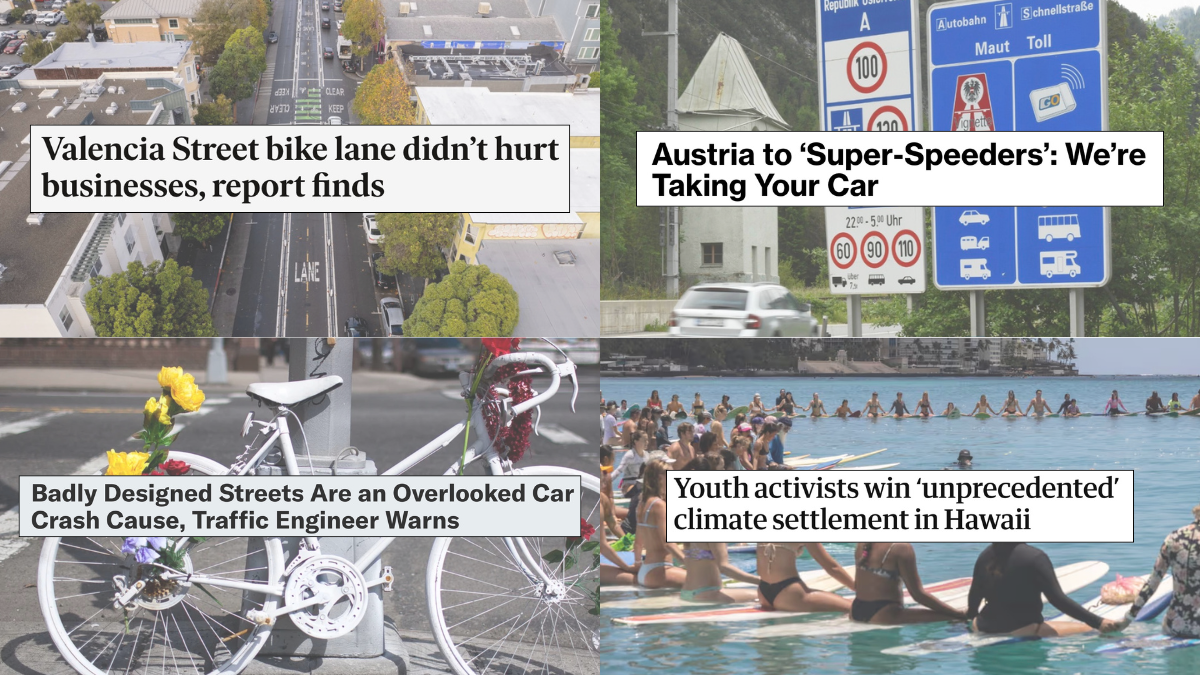
Transportation decarbonization: Youth plaintiffs in Hawaii scored a major win in a lawsuit against their state DOT, who they say isn’t doing enough to reduce carbon emissions that jeopardize their future existence. (The Guardian)

Engineering profession in the hot seat: Another week, another chance for “Killed by a Traffic Engineer” author Welsey Marshall to blow the whistle on why some traffic engineers implement designs that are inherently unsafe. (Scientific American)

Horrific crash caught on video: A man driving a Subaru was allegedly drunk when he plowed directly into a group of people riding bicycles. He was later arrested, but not before video of the incident went viral. (NBC DFW)

Bus enforcement: What if a bus could automatically cite drivers who block bus lanes? We don’t have to wonder anymore because a pilot with NYC’s MTA has begun. (Gothamist)

Car confiscation: Austria is joining other European countries who don’t mess around when it comes to extreme speeders: Authorities have the right to take someone’s car away if they break the speed limit by a large amount. (Bloomberg)

Cars a burden for Black families: “A stunning 76 percent of Black households in the U.S. that owned cars are spending more than 15 percent of their income on vehicle-related expenses every month.” (Streetsblog USA)

Off-road riding at the coast: A planned mountain biking area near Cape Lookout in Tillamook County on the Oregon Coast is sparking the classic debate over whether more MTB trails will be better or worse for the local landscapes and lifestyles. (OPB)

Business owners and bias: The fact that a study found no link between a bike lane in San Francisco and a slump in adjacent businesses just validates my ongoing belief that most business owners will jump at the chance to use “the bike lanes are bad” as a catch-all scapegoat for their grievances. (The San Francisco Standard)


Thanks to everyone who sent in links this week. The Monday Roundup is a community effort, so please feel free to send us any great stories you come across.

City reveals new concepts for North Park Blocks extension

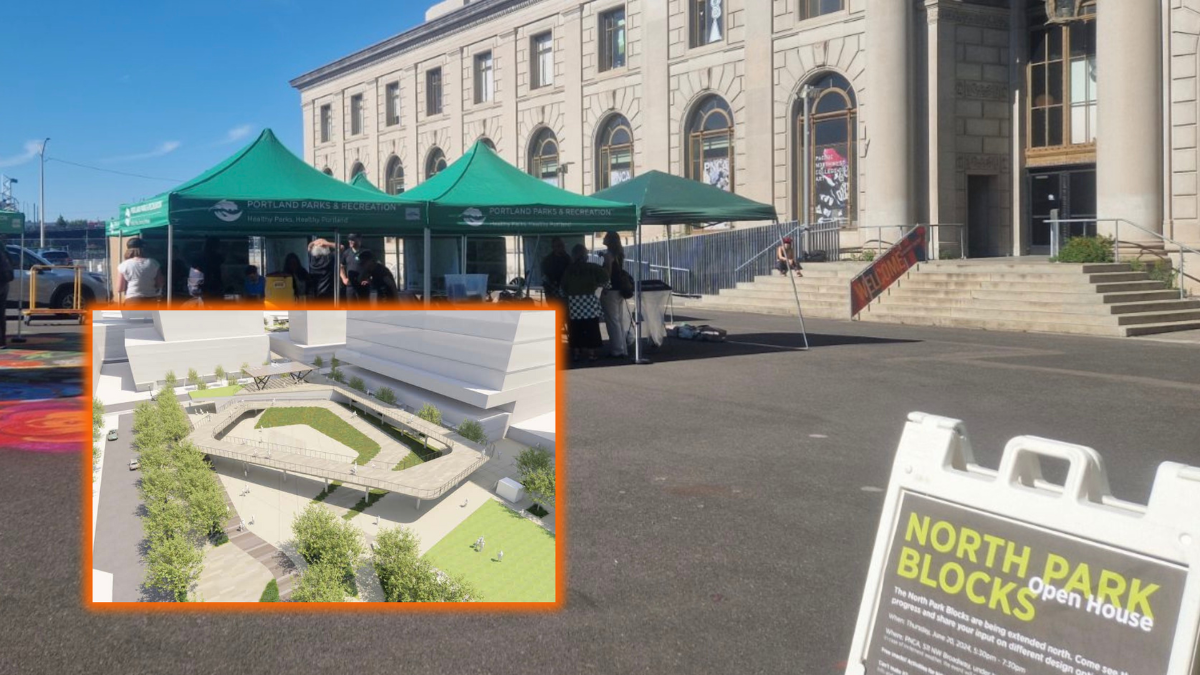
Inset: “Table” design option. Background photo from yesterday’s open house event sent in by a reader.

The City of Portland hosted its second open house for the North Parks Blocks Extension project last night.

As we shared back in February, the Parks & Recreation bureau is looking to extend the existing linear park that exists between W Burnside and NW Glisan, north to Hoyt (behind Pacific Northwest College of Art, which is why some folks refer to this as the “PNCA Block). The project looks to design a new, 30,000 square foot park. It was spurred by the Broadway Corridor development and will also be a key piece of the future Green Loop.

Last night under tents in an outdoor plaza outside PNCA, design consultants and city staff unveiled three new design options. The designs were gleaned in large part from over 500 public comments received at the first open house on February 29th. The new renderings give us our clearest view yet of how we might some day pedal our bikes from the North Park Blocks, through the Broadway Corridor, and onto the western end of the Broadway Bridge at NW Lovejoy.

The design team shared three options at last night’s event: Option A, Quilt; Option B, Table; and Option C, Clearing. Each option consists of landscaping, infrastructure, and other elements that could help define three blocks of park space between NW Glisan and NW Johnson (which will be extended through the site as part of this plan).

Check them out below:

Option A: “Extend a quilt and celebrate”

Option B: “Spread a table and invite”

Option C: “Reach a clearing and congregate”

Learn more about each option in the presentation graphics shared at last night’s open house.

If you have feedback, stay tuned to the project website for news of upcoming open houses and surveys. You can also contact the project manager via email at gary.datka@portlandoregon.gov. Construction is set to begin in 2026 with an anticipated opening in spring 2027.

What would 40 Portland political candidates do to boost bicycling?

If it’s possible to reach our bicycling goal, how exactly should we do it? (Photo: Jonathan Maus/BikePortland)

NOTE: The answers shared in this post have been highly edited for brevity. Please read the full responses at Bike Loud’s website.

Local bike advocacy nonprofit BikeLoud PDX asked all City of Portland candidates* to answer eight questions gleaned from their members. The first question, “How would you work to increase the bike mode share?” was answered by 40 candidates, including four mayoral hopefuls.

Here’s the full question:

The City’s stated goal is that 25% of trips be made by bicycle by 2030, but we are currently far short of that goal. How would you work to increase the bike mode-share?

I’ve gone through the submissions and pulled out 1-2 particularly salient sentences from each candidate. The very abbreviated (in most cases) answers below are based on what I personally found to be the most interesting/notable/newsworthy parts of their responses. (For the full answers, visit BikeLoud’s website). I’ve also shared photos of each candidate in the order their responses were shared. The photos were taken from the Rose City Reform candidate tracker.

City Council District 1

Timur Ender

I would continue to champion popular programs… this includes a mix of aggressive support for PBOT’s transportation wallet, neighborhood greenways, protected bike lane infrastructure investments, street lighting, Sunday Parkways, and expanding Biketown to cover the entirety of East Portland… I would work to address housing affordability and production which I believe is key to increasing mode share.

Sonja Mckenzie

I would recommend more bike parking infrastructure for bikes in addition to better traffic signaling for bikes/pedestrians.

Steph Routh

Right now, people can’t realistically choose anything other than driving. That’s the work before us. To build true choice into our transportation system.

David Linn

Much of the outer city was designed for cars and we have not done a good enough job of extending the bike and bus routes that the inner parts of the city have. Continued efforts to slow down cars will help.

City Council District 2

Elana Pirtle-Guiney

When biking feels easier than driving we will get more people out of their cars.

Christopher Olson

I would look to a city like Paris that has seen an increase in biking since investing in bike infrastructure.

Nat West

I don’t think we will hit 25% by 2030. That is too aggressive and may create burnout among policymakers since it appears impossible. I would advocate for adjusting that number to rolling goals based on a combination of aspiration/vision and reality.

Michelle DePass

…the real meat is in bringing people along, and making cycling more accessible, rather than more elitist. The gap between those who cycle, and those who don’t could be explained in terms of race and income; we have the data to prove it.

Debbie Kitchin

We need more connectivity in bike routes because having 2/3 of the trip feel safe but harrowing sections in between safe areas absolutely discourages more biking.

Mariah Hudson

Let’s prioritize early engagement by ensuring every child has access to bikes and learns safe riding practices. Safe riding is just as important as swim lessons.

Jonathan Tasini

Along with physical investments… the city must invest by partnering with community members and organizations to expand effective and culturally relevant bicycle programming and services. The only way to meet the goal of 25% of trips is to make bike ridership reflect Portland.

Mike Marshall

Use PCEF funds to provide subsidies for bike purchases.

Laura Streib

Accessibility programs for free/reduced cost bikes and e-bikes.

Will Mespelt

If people feel safe riding their bikes and simple quick routes exist, they will see the benefits to riding a bike.

City Council District 3

Tiffany Koyama Lane

I would bring attention to and personally participate in powerful organizing tools like Bike Buses, bike events and Bike Happy Hours to draw attention to groups who are fighting for safer streets.

Rex Burkholder

Create parking fee districts to reduce traffic in business districts… expect our elected leaders to lead by example and ride their bikes, walk or take transit!

Theo Hathaway Saner

Ensure that bike lanes and paths connect key areas of the city, such as residential neighborhoods, business districts, schools, and public transit hubs.

Daniel Gilk

The city is happy to implement easy wins for bike transit but hesitant to make tough decisions that might impact car travel. We need to start thinking bigger, which likely means repurposing existing space dedicated to cars for the use of cyclists and pedestrians.

Angelita Morillo

Work towards a bike lane going down Sandy Boulevard. As an obligate transit user, I know how critical these investments can be in our communities towards making our communities more livable, more person-oriented, and more safe.

Jonathan Walker

We need to increase our investment in true protected bike lanes. We need to make it so people feel they can safely travel nearly anywhere in Portland on a bike without fear of cars.

Matthew Thomas Anderson

Improve the road surface.

Daniel DeMelo

To hit the 25% goal by 2030, we need to target an even higher mode-share during the summer months, possibly around 50%, to balance out the winter drop-off. We’ll make winter cycling more appealing by improving bike lane maintenance and implementing weather-resistant infrastructure, ensuring that cycling remains a viable option year-round.

Philippe Knab

To increase the bike mode-share in Portland, I would advocate for the expansion of protected bike lanes and safe bike infrastructure to ensure cyclists feel secure on the roads.

Sandeep Bali

I’d like to champion bike riding in our city but find a healthy balance between biking and car transport. Sometimes one just needs a car, others one needs a nice bike ride.

Jesse Cornett

Specific actions to be considered include enhancing bikeways, lowering speed limits, creating more buffered bike lanes, public awareness campaigns that highlight the benefits of cycling both on the rider and the community, adding more bike-friendly traffic signals, and incentivizing builders to invest in more secure bike parking and business to have amenities such as showers will all work to increase the bike mode share in Portland.

Chris Flanary

I would push the thoughtful, researched and community approved solutions proposed in the 2035 Comprehensive Plan. I’d love to pilot a free bike share program.

Council – District 4

Mike DiNapoli

Reboot Trimet’s Fareless Rail downtown.

Olivia Clark

More traffic calming efforts and dedicated bike lanes.

Ben Hufford

What Portland lacks is follow-through and commitment to getting things done. A five-foot bike lane on a major traffic collector, with blackberries and trash and gravel is NOT a bike centered infrastructure, it is checking a box.

Chad Lykins

Affordability: The market is driving down the price of entry-level bikes and ebikes. Low-cost and no-cost bike-share programs can also be expanded to cover more neighborhoods. We should also have well-lit, secure storage next to bus and train stops to encourage multi-modal transit.

Sarah Strawberry Silkie

…. increasing access to e-bikes for people with physical limitations.

Michael Trimble

I want to double down on fining cars parked in bike lanes and reinstate the street cleaners to keep the bike lanes clean and free of tire puncturing debris. In addition to lowering the costs of bike ownership, I will work with TriMet on fare free transit for all cyclists bringing their bikes on board.

Eli Arnold

I believe improving road safety, improving the public perception of safety on Trimet, and looking for new routes which separate bikes from vehicular traffic is key.

Andra Vltavín

First, we need to streamline zoning and permitting to make it more possible to have a walkable/bikeable city.

Eric Zimmerman

Riding a bike regularly shouldn’t require advanced knowledge of the various types of bike lanes, signage, and bike friendly streets vs non-friendly. I think making the choice to ride a bike in Portland has got to be easy to understand and common across neighborhoods if we are going to see more people make a choice to ride instead of drive.

Lisa Freeman

I would seek funding for the projects identified in the SW and NW In Motion plans for short term solutions to safety and stress reduction for bikers and walkers.

Bob Weinstein

Increase bicycle parking and end-of-trip facilities. Improve integration with public transit.

Mayor

Liv Osthus

As Mayor, I will encourage council to advocate for their neighborhoods (particularly in east Portland) for safer bike avenues.

Durrell Javon Kinsey Bey

One thing for sure is I would like to assist with providing all Youth from at least 3rd grade to 12th with an e-bike or regular bike of their choice.

Keith Wilson

I want to prioritize accommodating e-bikes in all forms of public transit and double TriMet ridership by 2030. Bicyclists will prioritize other transportation options when facing routes blocked with tents, unregistered cars, and derelict RVs. We must end unsheltered homelessness in Portland, which I will do within the first twelve months of taking office.

Carmen Rubio

Prioritize the identify routes in high-need areas that have capacity to serve the most potential new riders and set public timelines for development – for transparency and consistency for the public. We also need the state to look at creating a [e-bike purchase subsidy] program and to sufficiently resource it. I would want the City’s legislative agenda to include lobbying the governor and legislature for such a program.


BikeLoud will post more responses in the weeks to come. If this summary was useful to you, let me know and I’ll consider posting the same thing for the rest of the questions.

*BikeLoud sent the questionnaire to all candidates that had filed a letter of intent as of May 27th.

Near notorious Tualatin Valley Hwy, even alternate bike routes aren’t all that great

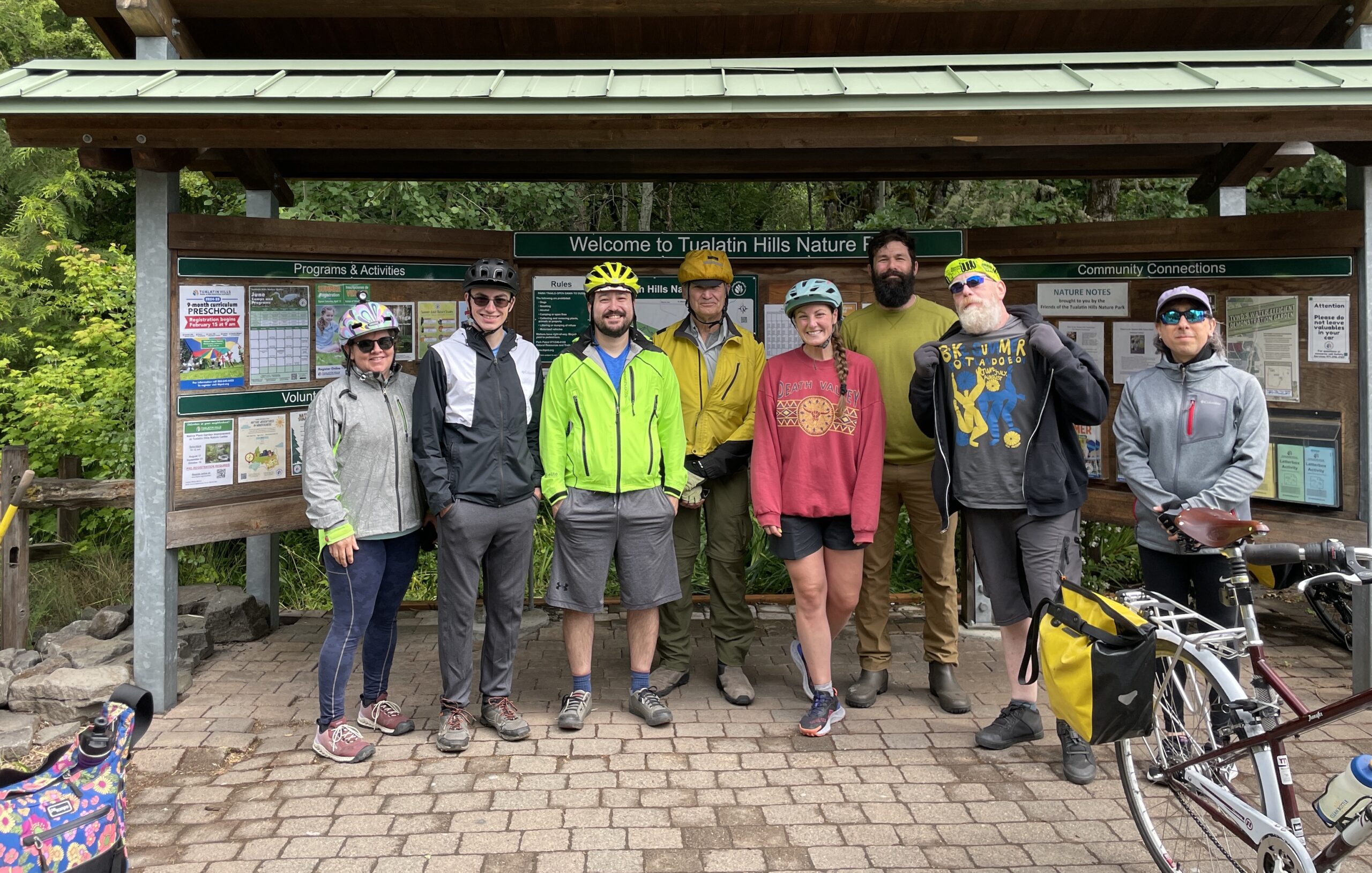
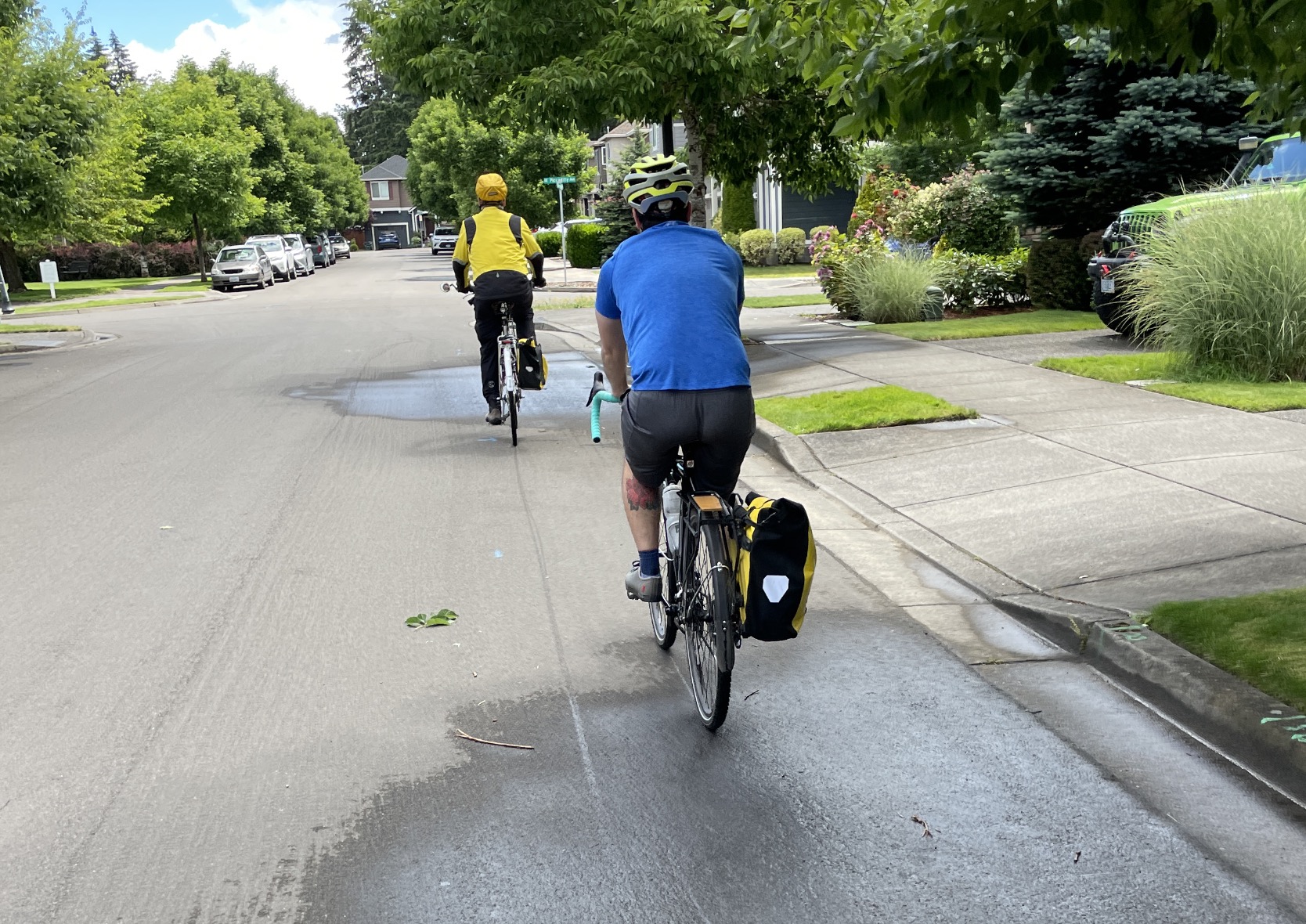
Our intrepid crew at the start of the ride. (Photos: Tina Ricks/BikePortland)

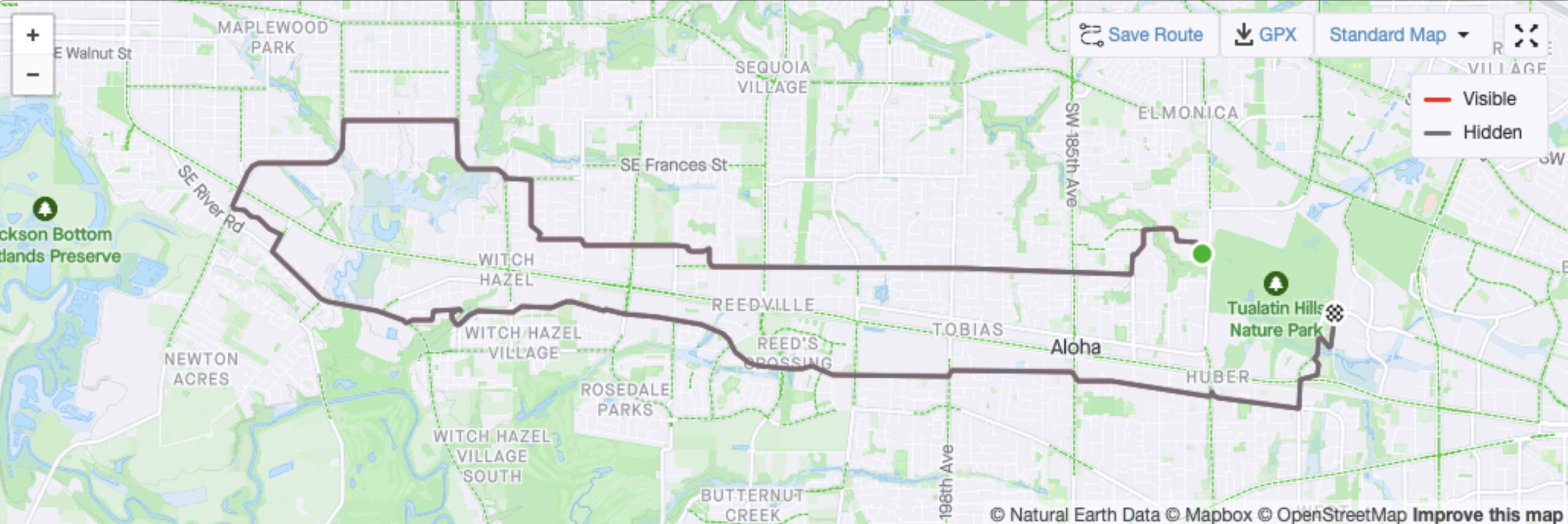
It’s no secret Tualatin Valley Highway, also known as Highway 8 or TV Hwy, is dangerous. Numerous news outlets have named it in the top ten most dangerous roads in Oregon across a span of many years. So on Saturday, June 15, Ride Westside, set out to explore alternative routes to get from Beaverton to Hillsboro and back by bike — without risking life and limb on TV Hwy.

Our route.

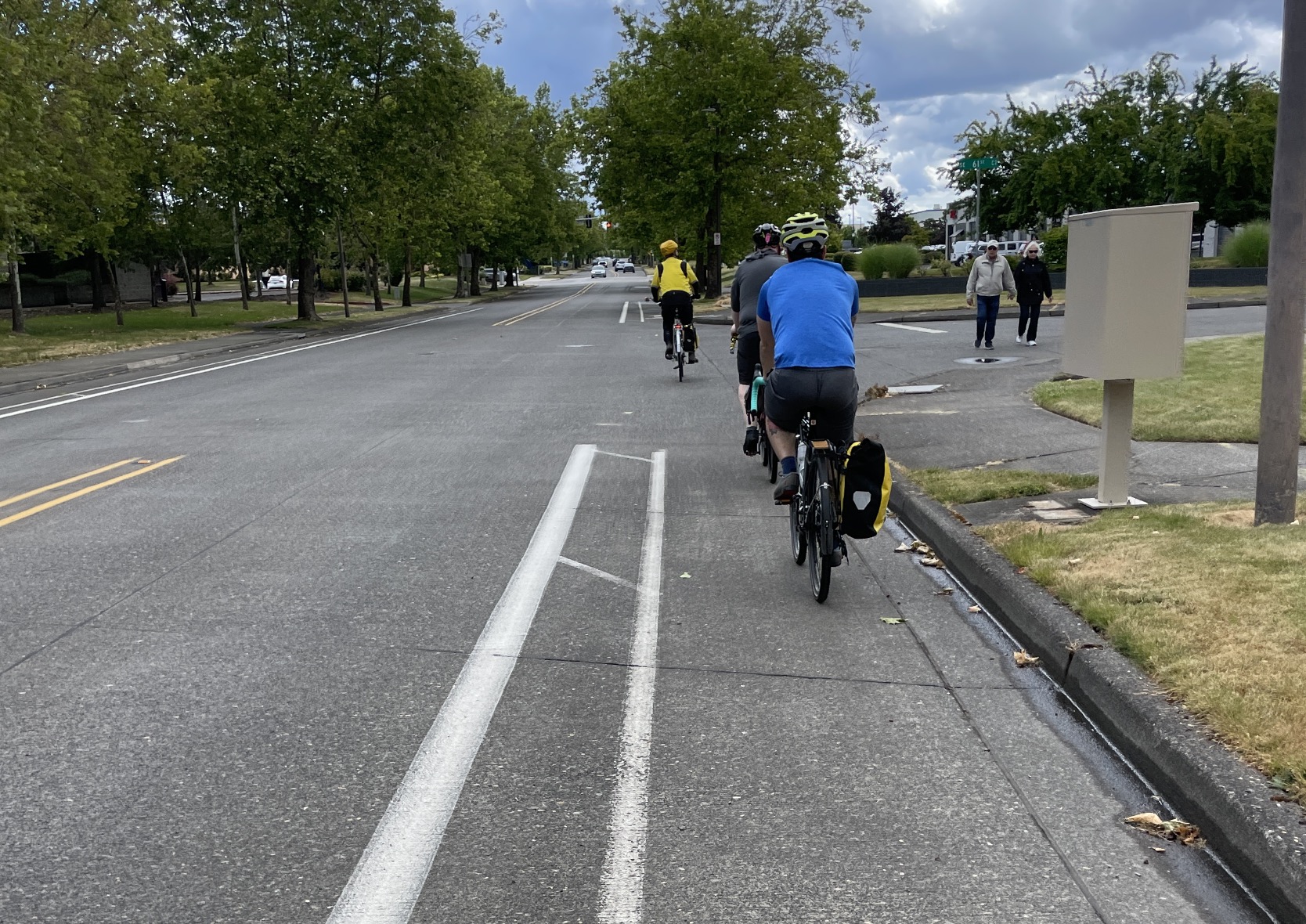
Ride leader Tim Wayman (second from left above) promoted this ride as part of Bike Summer and labeled it suitable only for riders 21 and over due to a few difficult crossings. That meant Ride Westside’s usual brigade of bakfiets, bucket bikes, and baby seats was notably absent. 

Wayman’s inspiration for the ride was to share his two preferred east-west routes on either side of TV Hwy. “These are the two routes I take from my house in Hillsboro to Beaverton. They’re better than the bike lanes on TV Highway, but that’s a very low bar.” 

We met at the Tualatin Hills Nature Park, and set off in between rain showers.

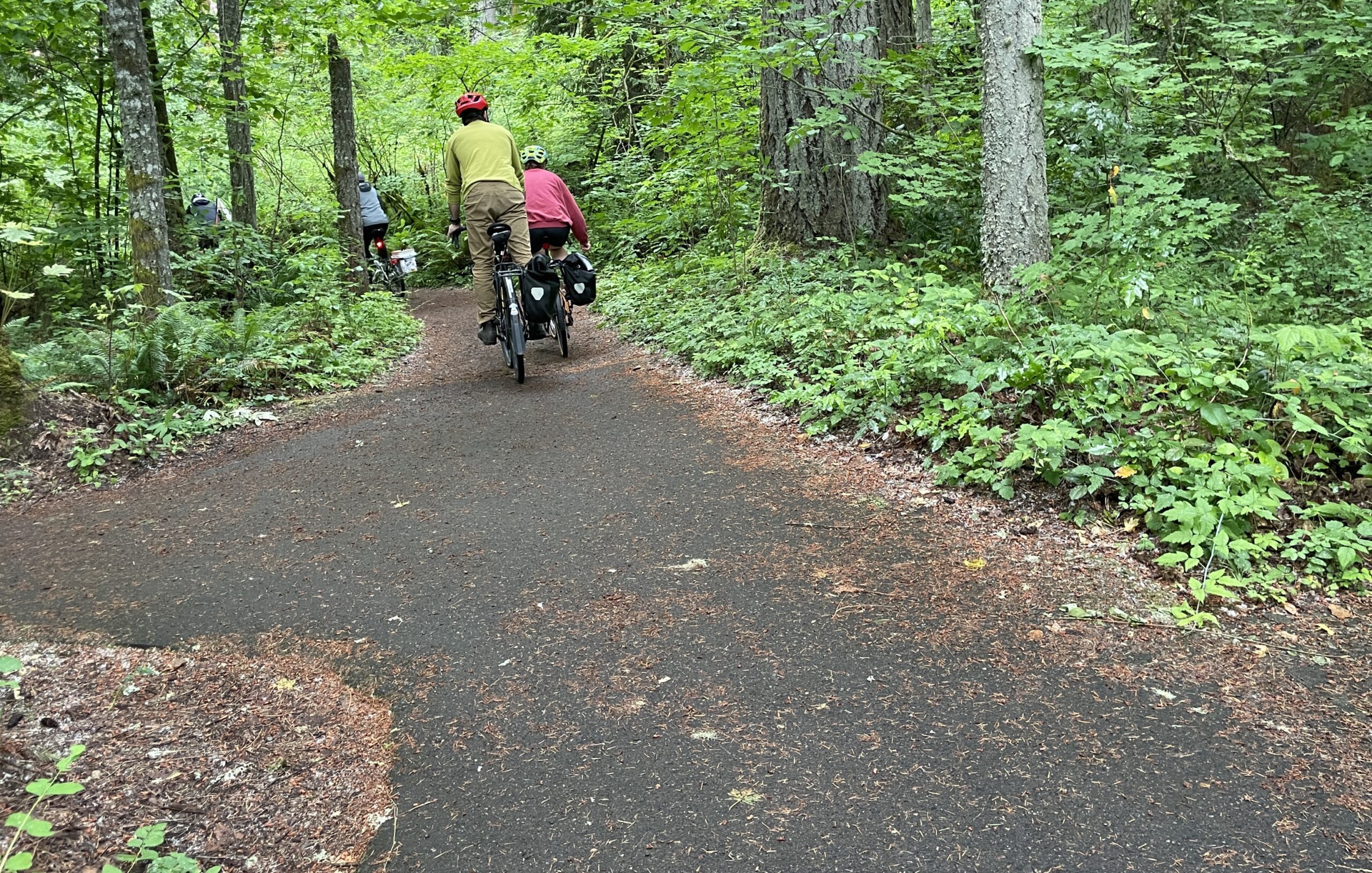
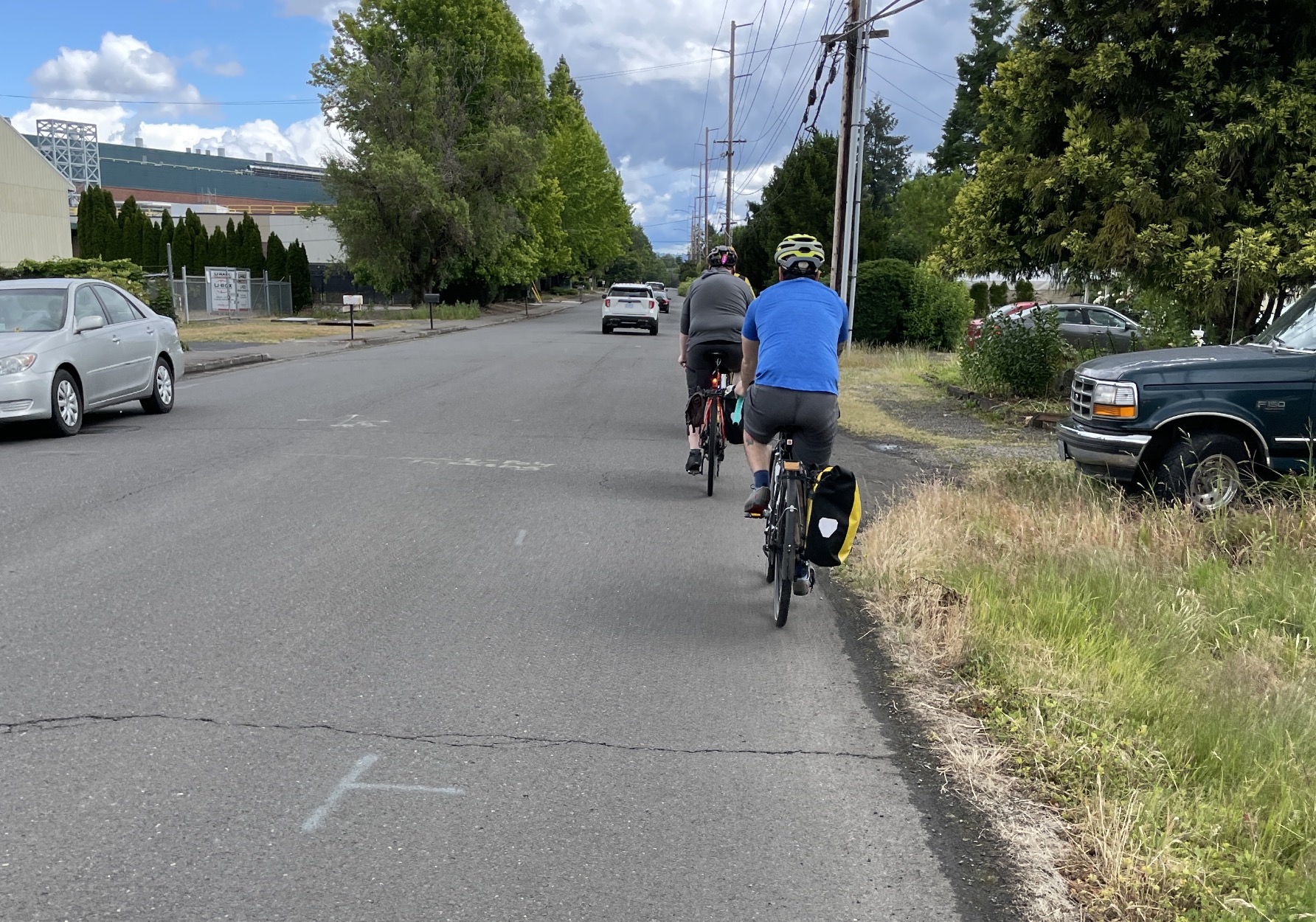
The path through the park was beautiful, but also narrow and shared with a lot of people walking. It was a Saturday, and there was a volunteer work party happening in the park. It meant riding slowly, carefully, and single-file.

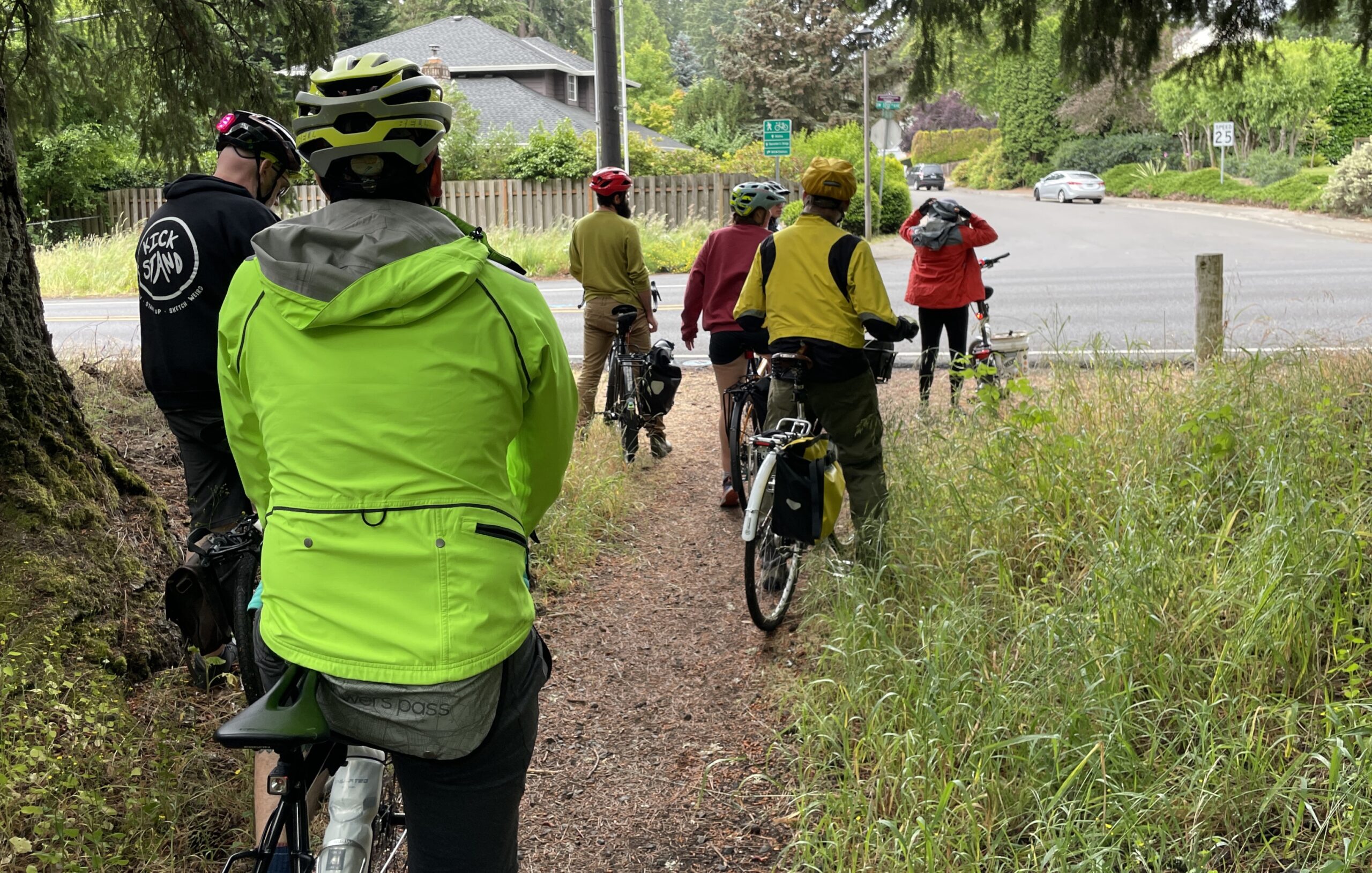
The first hairy crossing was at SW 170th at the edge of the nature park. Tim specifically asked us not to cork for this crossing, as the traffic coming over the hill on SW 170th was going fast and couldn’t see us until it was too late to stop. We crossed in two groups, waiting and listening carefully.

After crossing 170th, we biked through some low-traffic neighborhood streets, crossed the pedestrian bridge on SW Augusta Lane that joins neighborhoods over the Beaverton Creek gully, and found our way to Johnson Street. Johnson is a through street that parallels TV Hwy most of the way to Hillsboro (we took it as far as Hillsboro’s SE 72nd Avenue). It tends to be narrow in places, with bike lanes that appear and disappear, and we were close-passed several times by drivers that seemed impatient with people on bikes. 

“If I could, I’d like to turn Johnson Street into something like a neighborhood greenway, with car blockers [diverters] that prevent it from being a through street. Right now, drivers use it as an alternative to TV Hwy too,” Tim said.

Not long past Johnson, our intrepid ride leader had a mechanical failure. The bolt on Tim’s seat on sheared off entirely, sending him (and his seat) flying. There were no injuries, but Tim headed home standing on his pedals, and John Haide from Hillsboro stepped in as our leader for the rest of the ride.

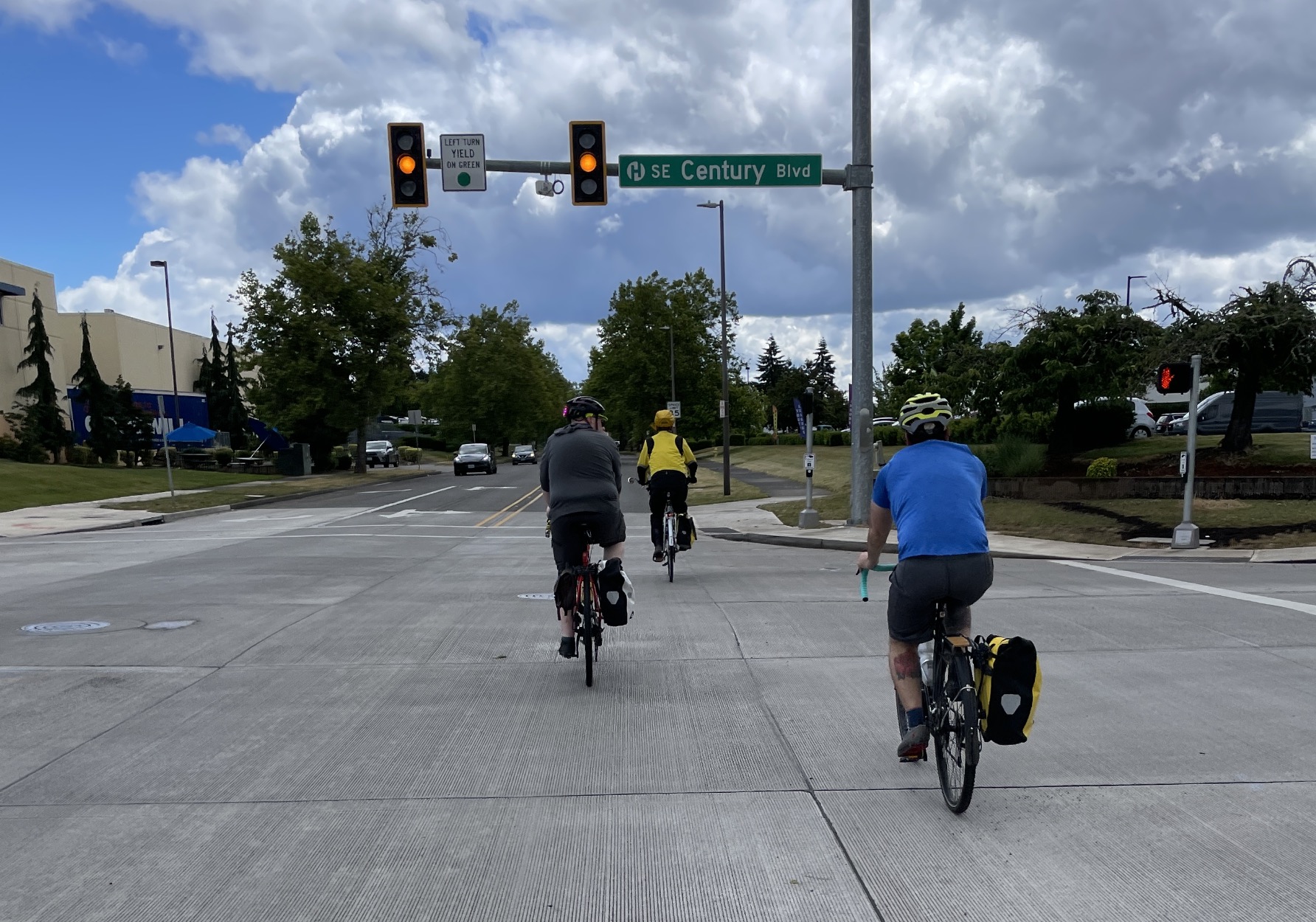
When Johnson Street ended, we picked up SE Drake Road, and then skirted around marshy park lands where Rock Creek, Turner Creek, and Reedville Creek join. We eventually crossed TV Highway on SE Cypress Street (by the Hillsboro Home Depot and Lowe’s), tootled through big box parking lots, and came out on SE River Road. 

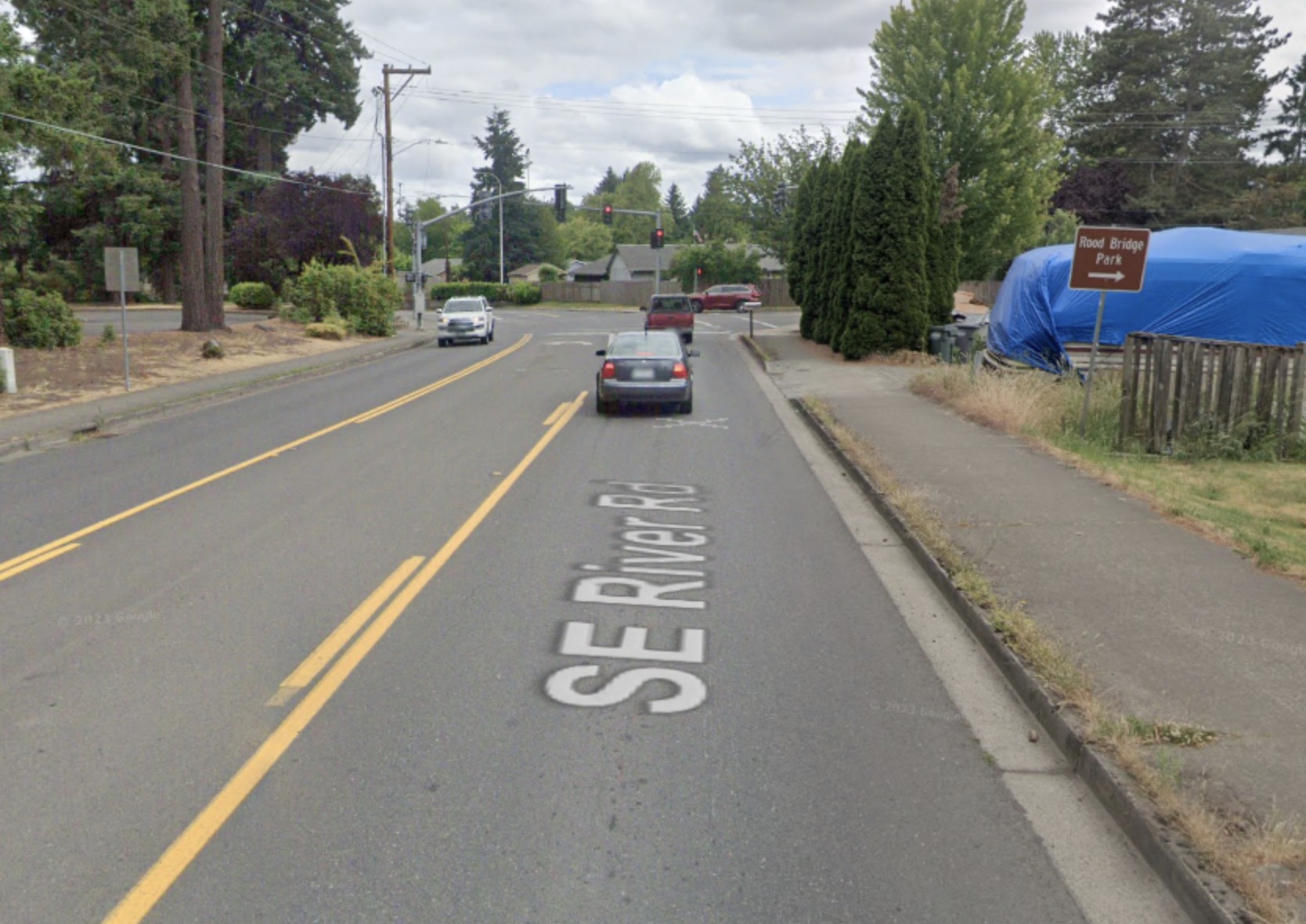
SE River Rd has three general travel lanes — one lane each direction plus a center turn lane — with sidewalks, but no bike lanes. Our group had dwindled to four from our original eight, and we mostly rode the sidewalk. This part of the ride was uncomfortable, and I was more worried about traffic than taking pictures, so I pulled a few shots from Google Street View.

We left River Rd into neighborhoods again at SE Discovery St, and I was less worried about wrecking my bike and traffic enough to take more pictures. This portion was fairly typical low-traffic suburban streets — quite a relief after SE River Rd.

On SE Alexander St, which is handy for biking as it goes behind many TV Hwy businesses, there are painted bike lanes (a welcome change from River Rd) and many cross-streets to access TV Hwy from the back.

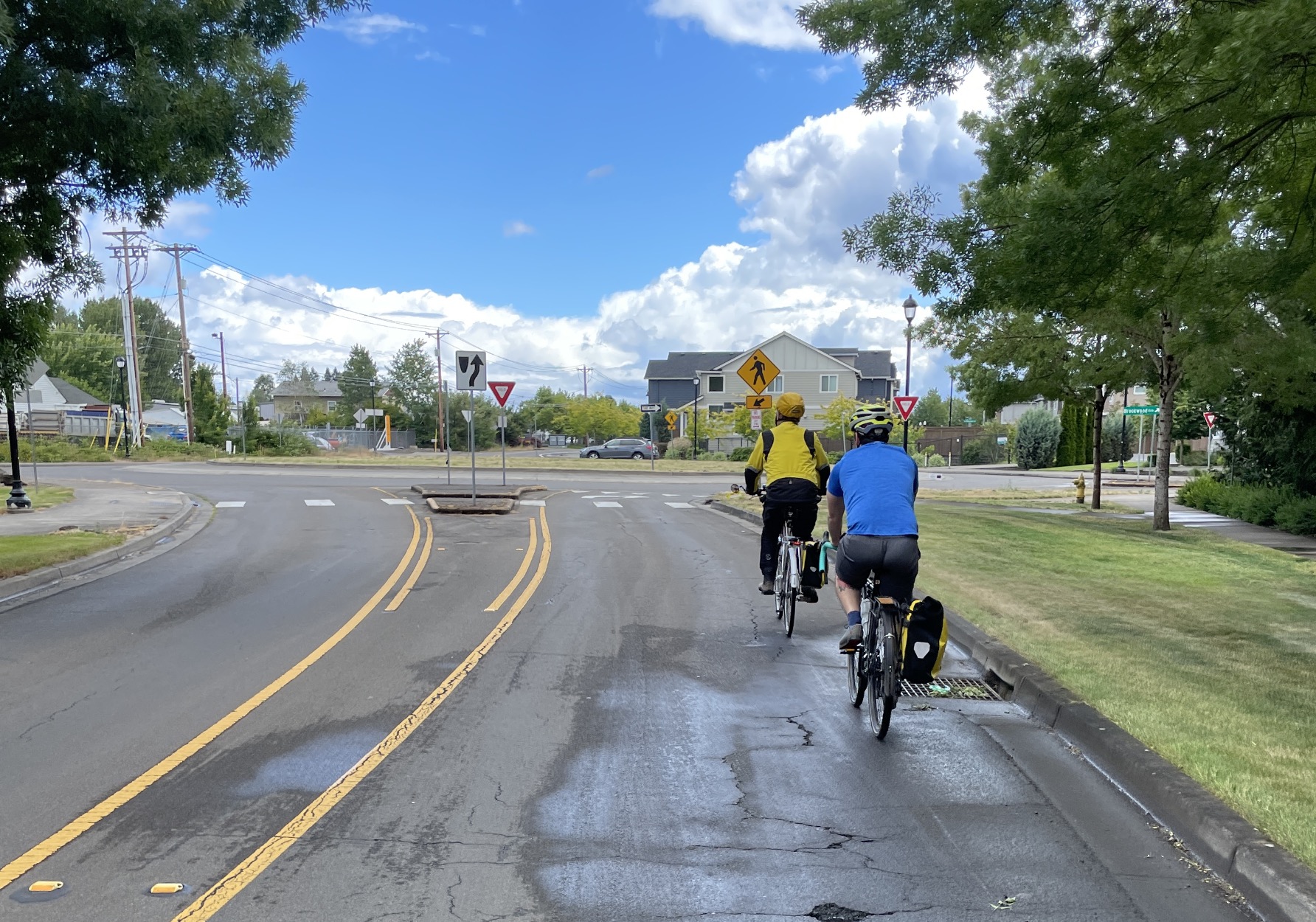
Then I had my absolute shock of the day: At SE 67th Ave, SE Alexander turns into SE Blanton and the Reed’s Crossing neighborhood. And there are cycle tracks. Between SE 67th and SW 209th (and it’s not that far, because the streets renumber between Beaverton and Hillsboro), there are lovely, beautiful, separated cycle tracks. Separated from cars. Separated from the sidewalk. An actual designated place for bikes to be. On both sides of the street.

I wanted to kiss the ground, but that would have been weird. Instead, I just rode, with a big grin.

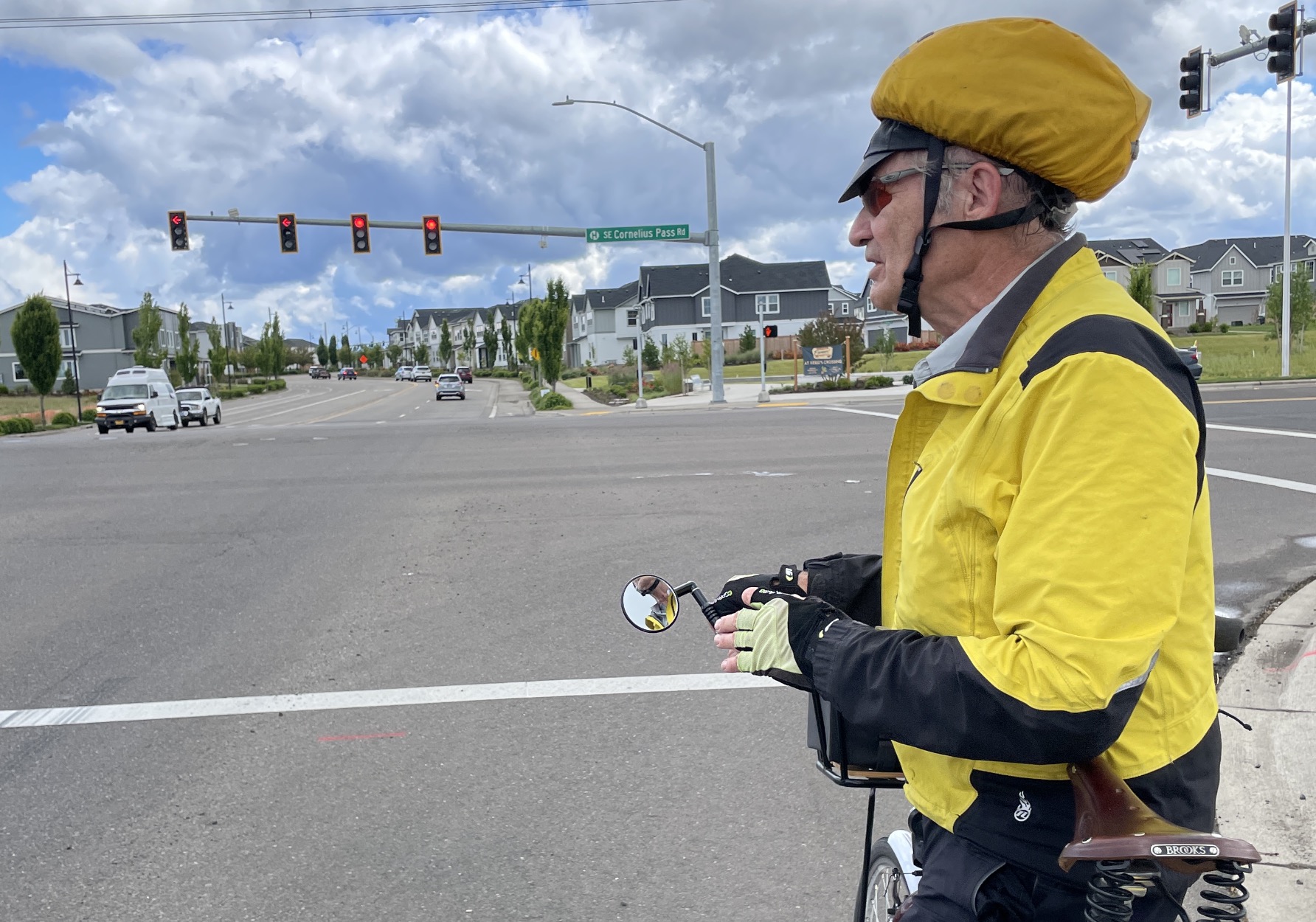
When we crossed Cornelius Pass Road, ride leader John Haide explained how the cycle tracks work at the crossing a major road. Turning bike traffic has a difficult time getting off the cycle tracks and into a left turn to access TV Hwy businesses.

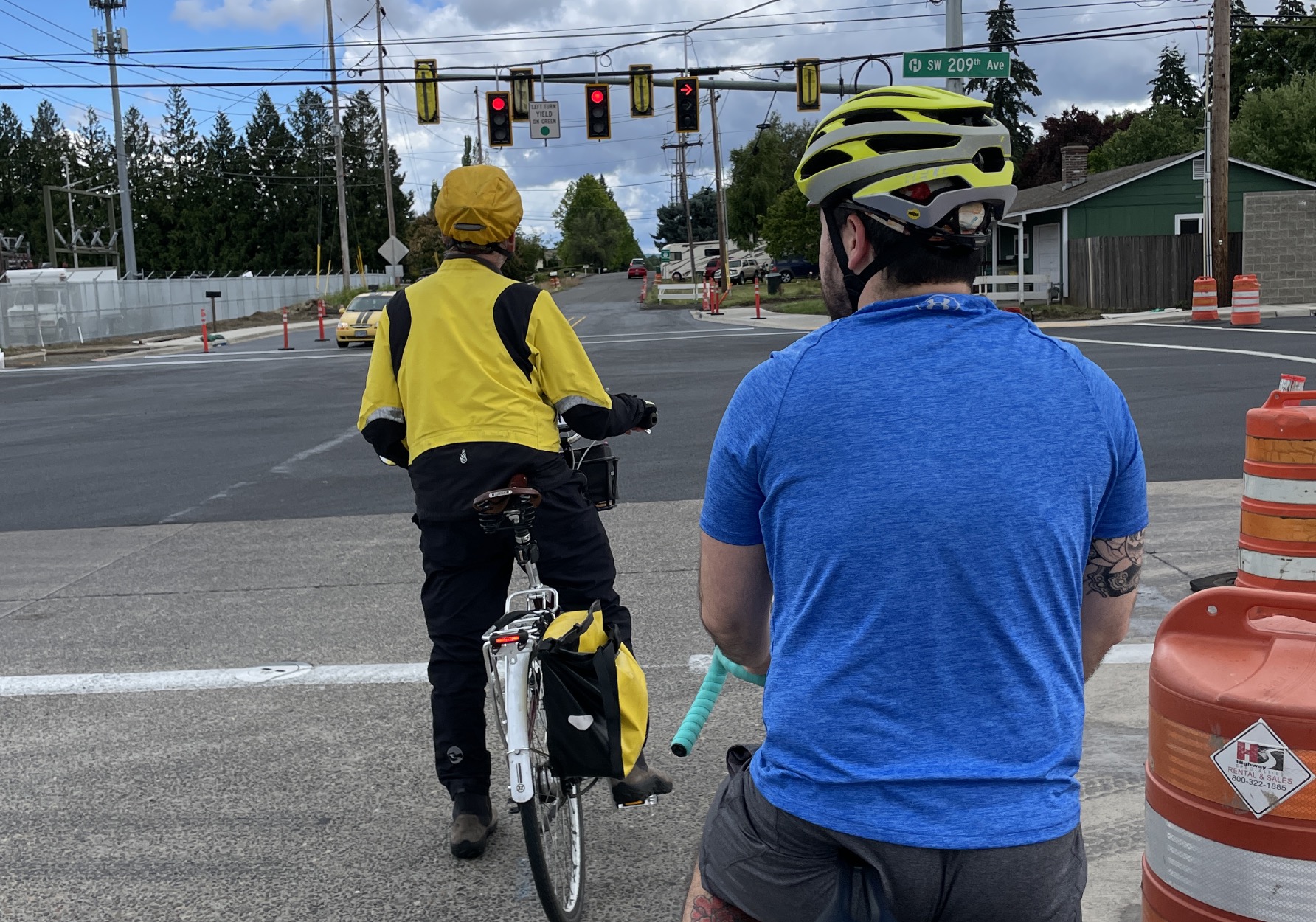
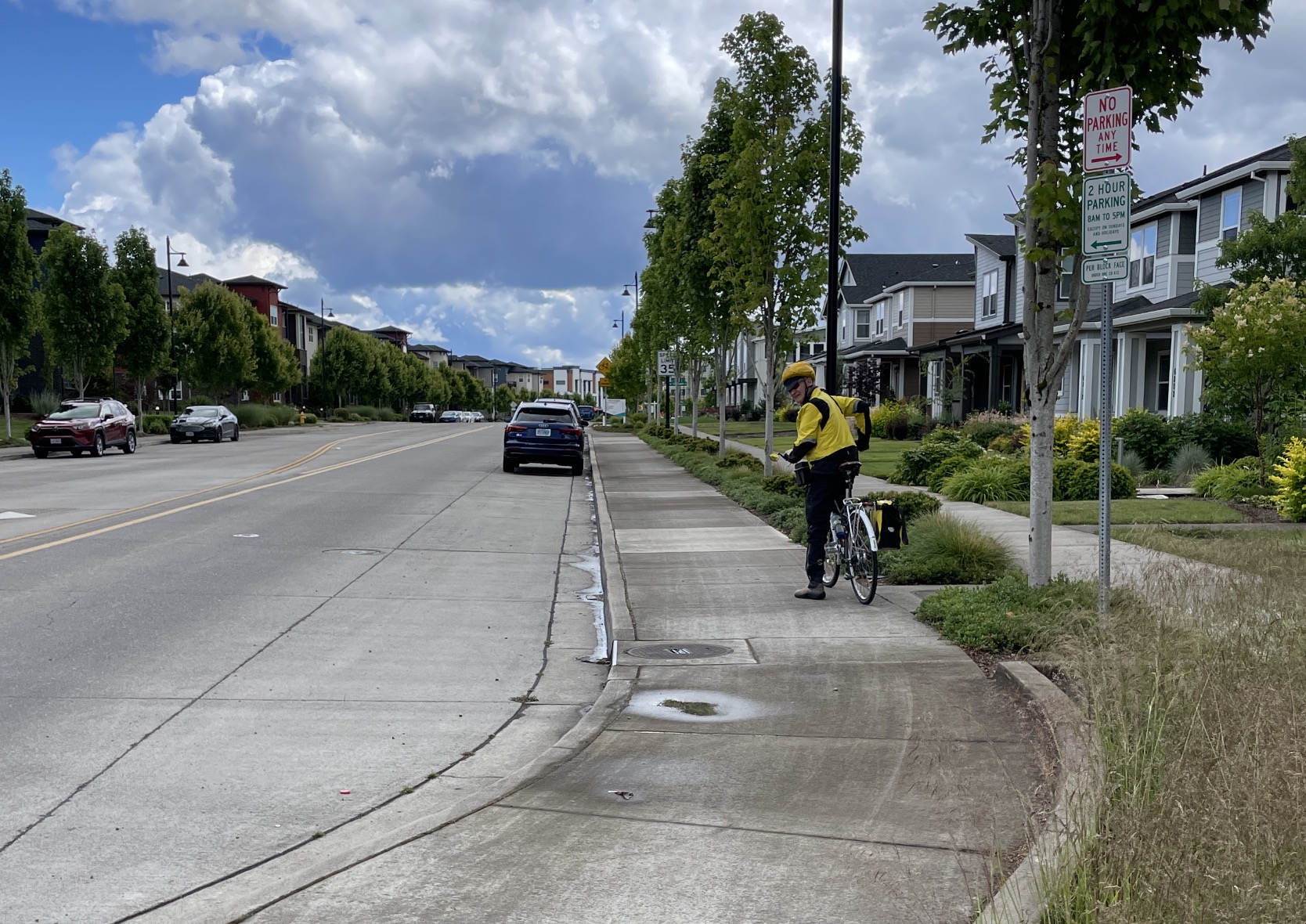
Sadly, all good infrastructure must come to an end (or must it?!). At SW 209th Ave, we crossed out of the new development and the blessed cycle tracks, and back into an area of older houses likely built in the 70s or 80s, with no bike lanes or sidewalks at all.

Blanton Street on the other side of 209th is narrow and has a lot of cars. Sadly for us, cars are using it as an alternative to TV Hwy just like we were.

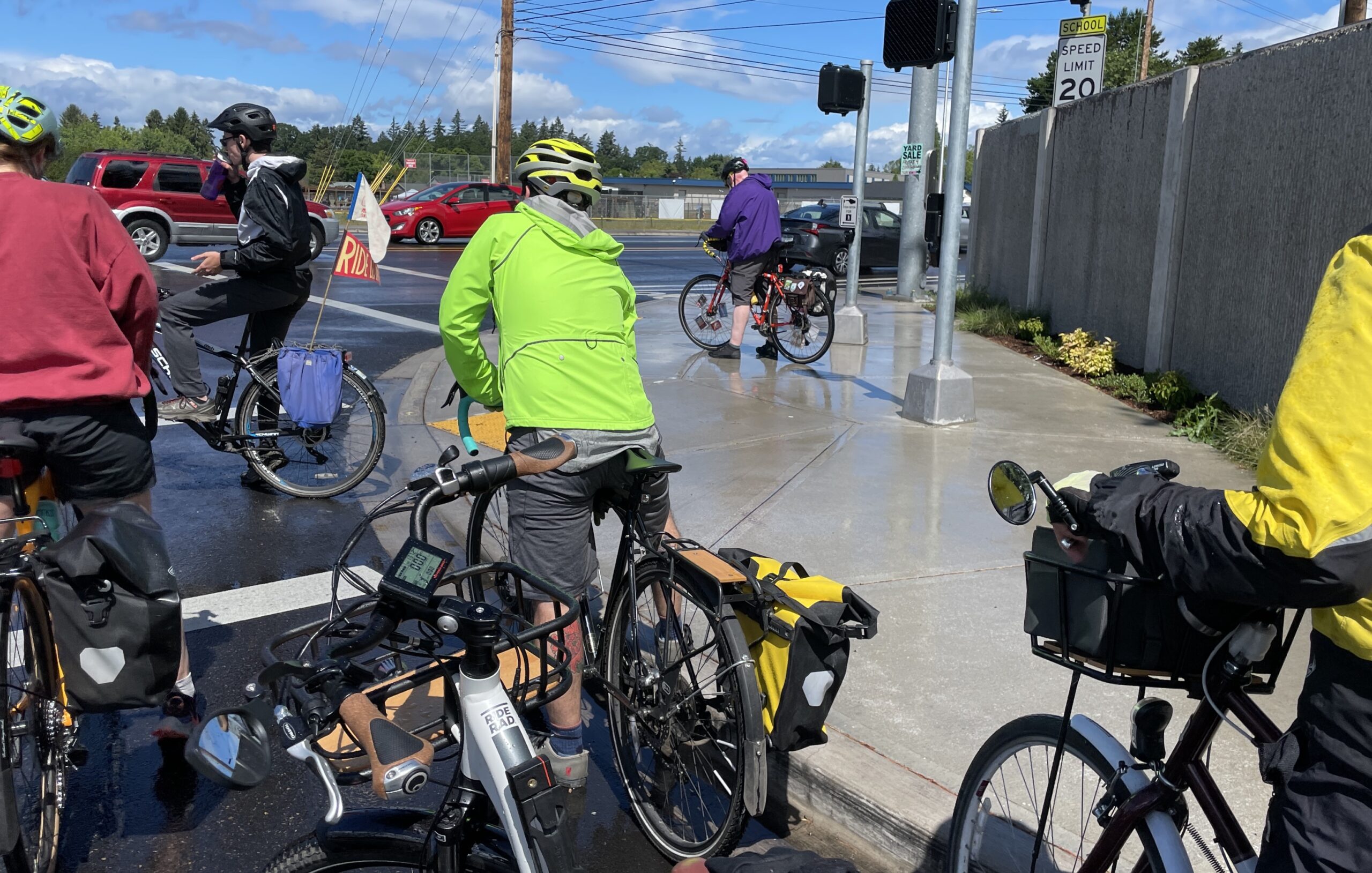
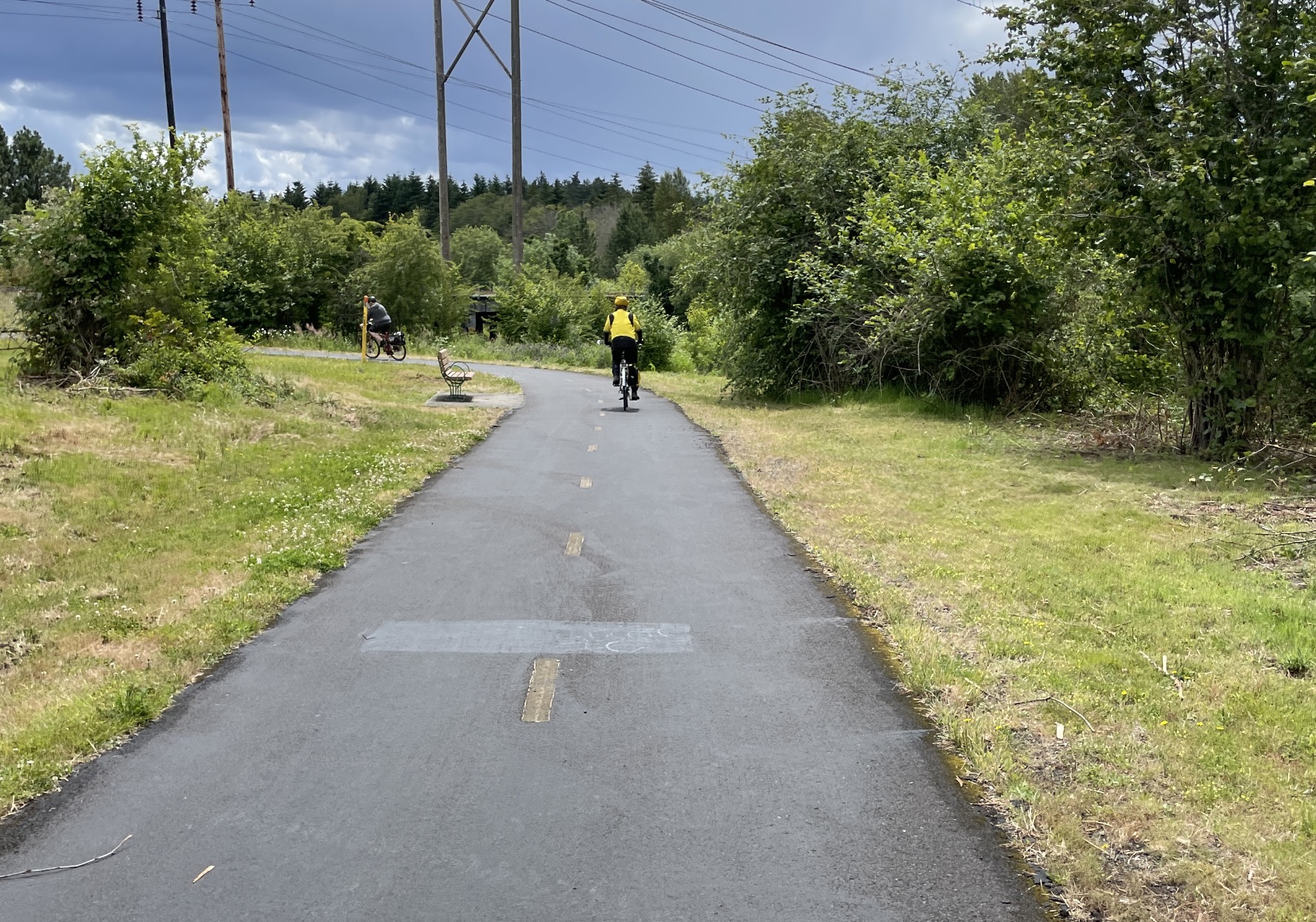
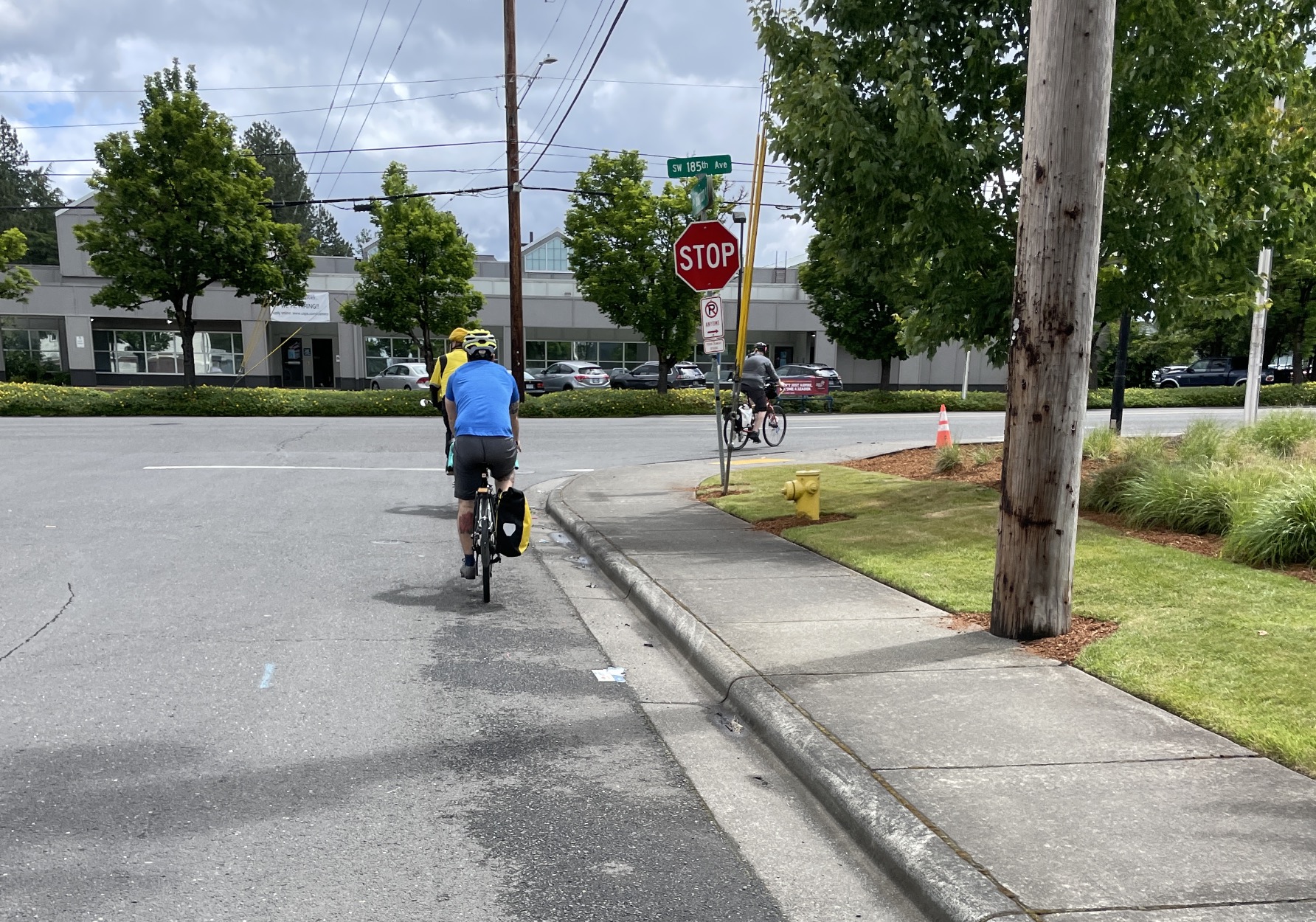
After a hairy no-signal and unaligned crossing of SW 185th, we stayed on Blanton until 160th, where we crossed TV Hwy again, and caught the Westside Trail at 160th and TV Hwy. Whew. Off the roads again.

After the ride, I talked with two riders, Michael Hashizume (third from left in green hi-viz jacket in group photo) and Mick Orlosky (second from right in yellow hat), at our impromptu lunch at the BG Food Cartel in Beaverton, and later by phone with ride leader Tim Wayman (who fixed his bike at home).

Hashizume, who lives and bikes in Beaverton, said this ride felt different from typical Ride Westside outings. “It felt like there was a different attitude with drivers. We got close-passed and honked at. The cycle tracks were great but then they just ended.” Would he ride this route on his own to go to Hillsboro? “No,” he replied. “Hillsboro is pretty much drive-only for me. Biking is pretty hairy.”

Tim Wayman at Bike Happy Hour last night. (Photo: Jonathan Maus/BikePortland)

Orlosky, who also lives and bikes in Beaverton and didn’t start riding until he turned fifty, found the ride pleasant with more utility than scenery. “There were busy roads, but not anything I’m not used to,” he said. When asked about infrastructure, Orlosky added, “I want the infrastructure to improve. I think people can do a lot more than they think they’re capable of. That doesn’t mean we don’t need more infrastructure.”

“I’m practically a senior citizen at this point.,” Orlosky added. “I try to avoid my car as much as possible and do everything I can by bike. I’m not a particularly strong rider, but I coexist with cars.”

If Wayman, our ride leader, could wave a magic infrastructure wand, he said he’d make everything look like the Blanton St. cycle tracks. He laments that his preferred alternatives from TV Hwy still aren’t that great. “This is probably not the place to cut your teeth learning how to be a commuter cyclist,” he acknowledges.

I’m a former suburban soccer mom who only started riding frequently in 2019. My kids are grown, but I still tend to see the world through the lens of kids and parenting. Would I have sent my hypothetical twelve-year-old out to sports practice on those roads? Maybe, in places. Definitely on the cycle tracks. Definitely not on parts of Blanton, Johnson, or River Road where there are no bike lanes and lots of traffic.

Would I use these roads as an alternative to driving if I had to go to Hillsboro? For me, probably not. I’d take my bike on the MAX instead.

What about you? What would it take for you to ride more in Washington County?

Landmark Portland bike shop goes 100% electric with River City E-Bikes

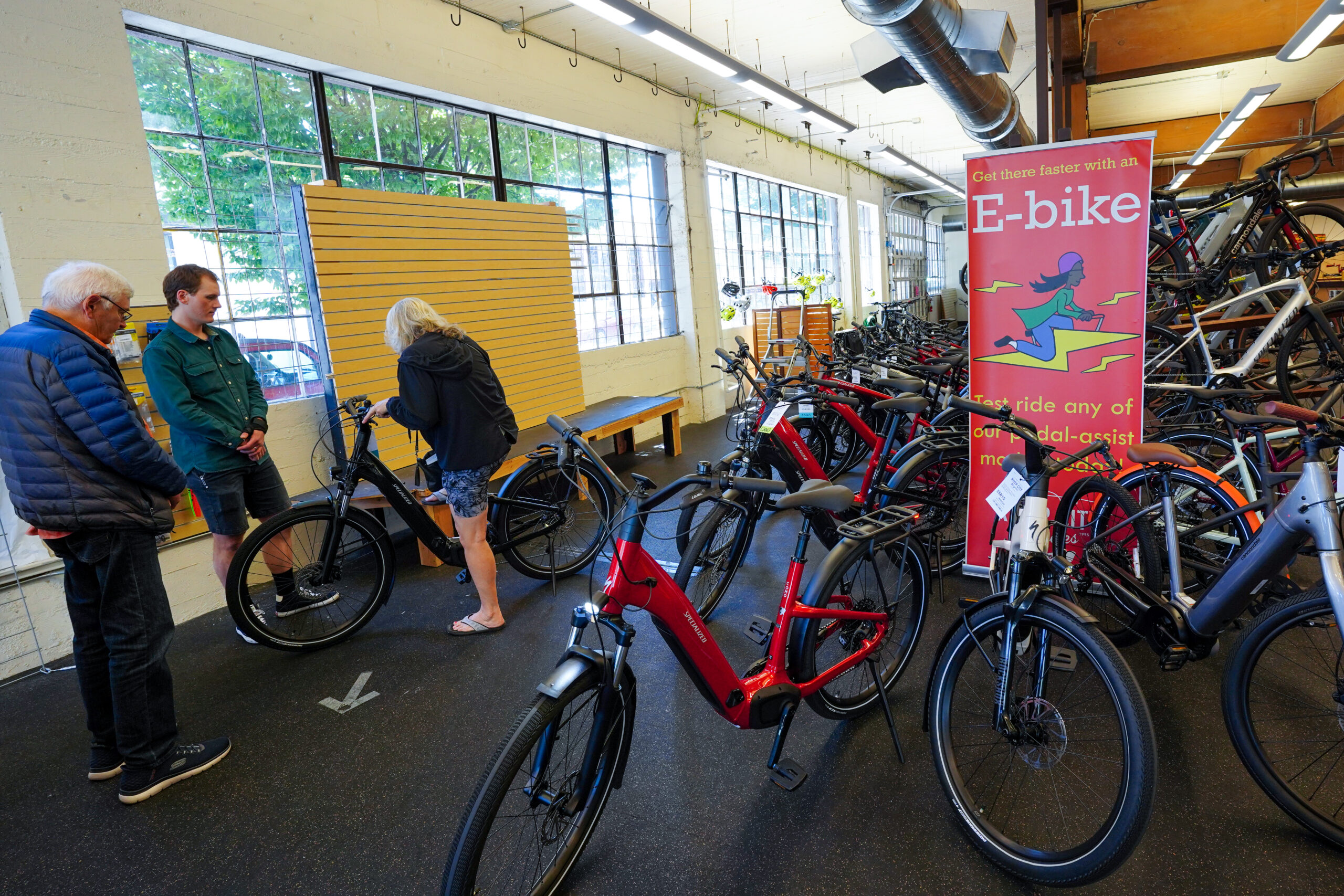
River City’s second location on SE Belmont is now e-bikes only. (Photos: Jonathan Maus/BikePortland)

Note: This story is part of a paid advertising partnership between River City Bicycles and BikePortland.

Next year, River City Bicycles will mark its 30th anniversary. It’s an impressive achievement in a challenging industry that has seen many large independent shops shut down. But River City is going strong. And in recent years they’ve made a significant bet on electric bikes.

You might recall in 2011 when River City opened an outlet store on SE Belmont just two blocks from their original location. For the past seven years, the store had steadily evolved its offerings to be mostly e-bikes. As customer interest grew, it became clear the store’s future should be all electric. This year River City decided to make it official and the sign outside now says “River City E-Bikes”. It’s a major, notable change for Portland’s most iconic bike shop.

River City started selling e-bikes at their flagship store in 2017, but the big spike in demand didn’t happen until a few years later. “Over the last four or five years, we’ve seen demand for e-bikes absolutely skyrocket,” said River City E-Bikes Store Manager Hayes Kenny during my visit Tuesday.

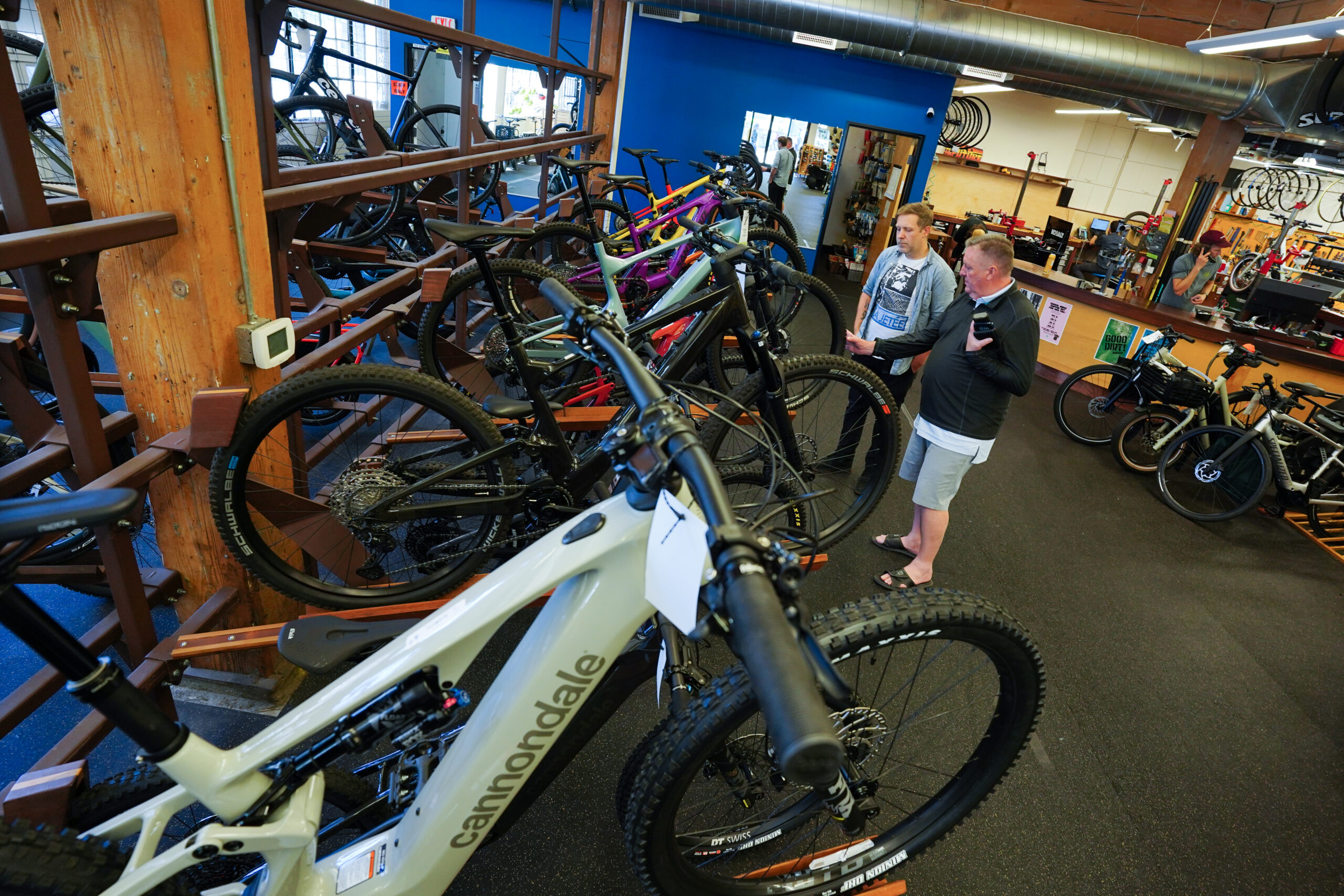
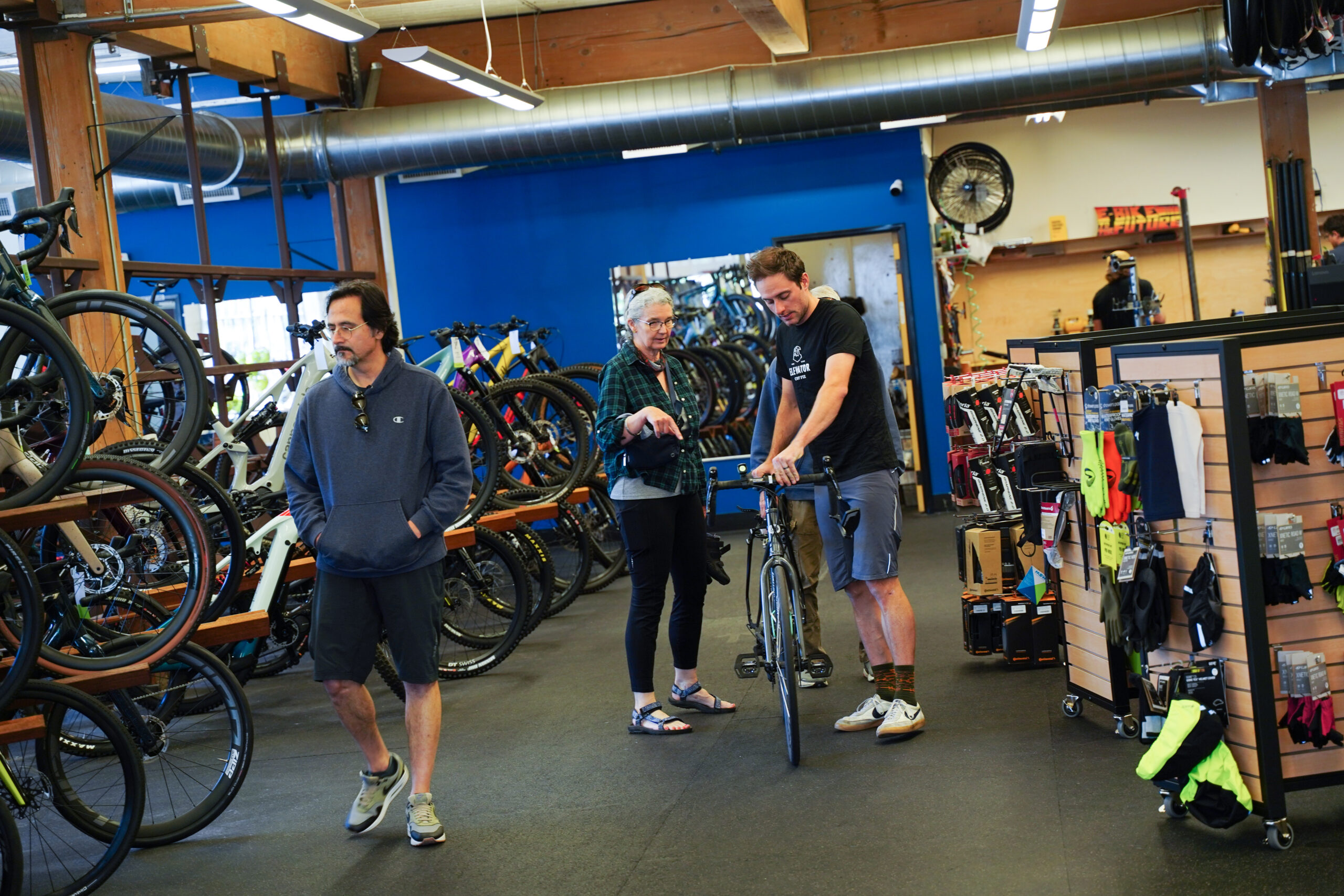
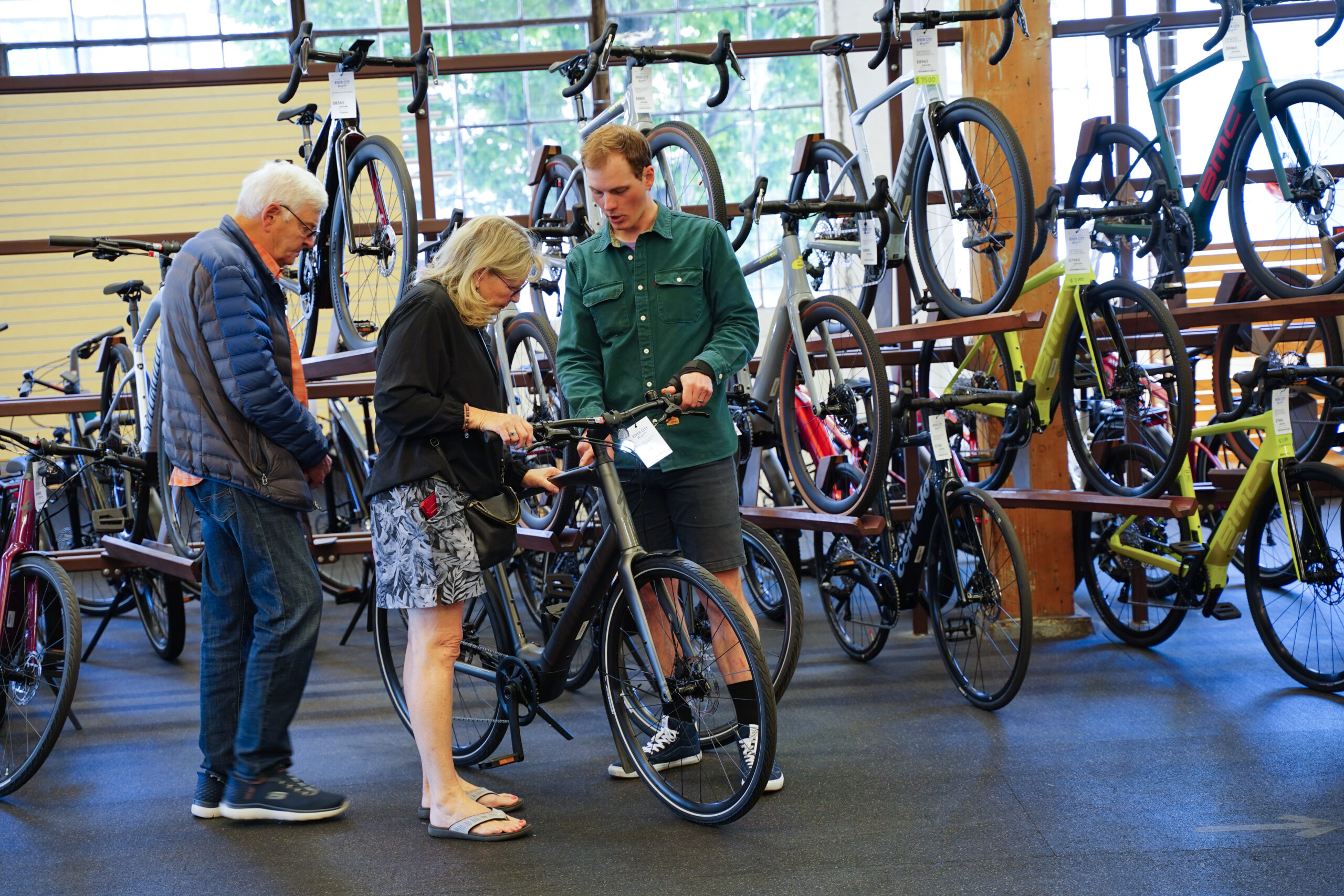
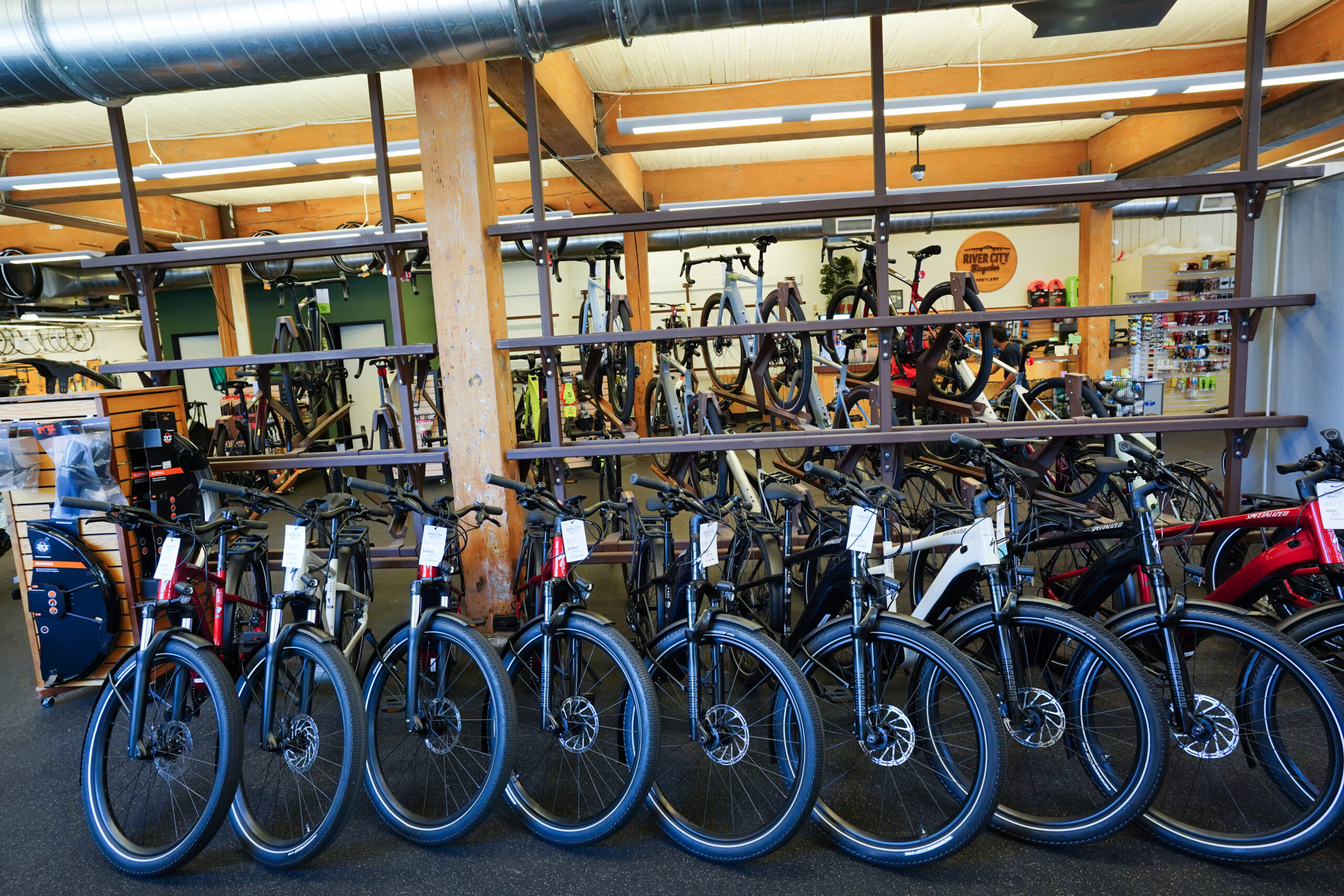
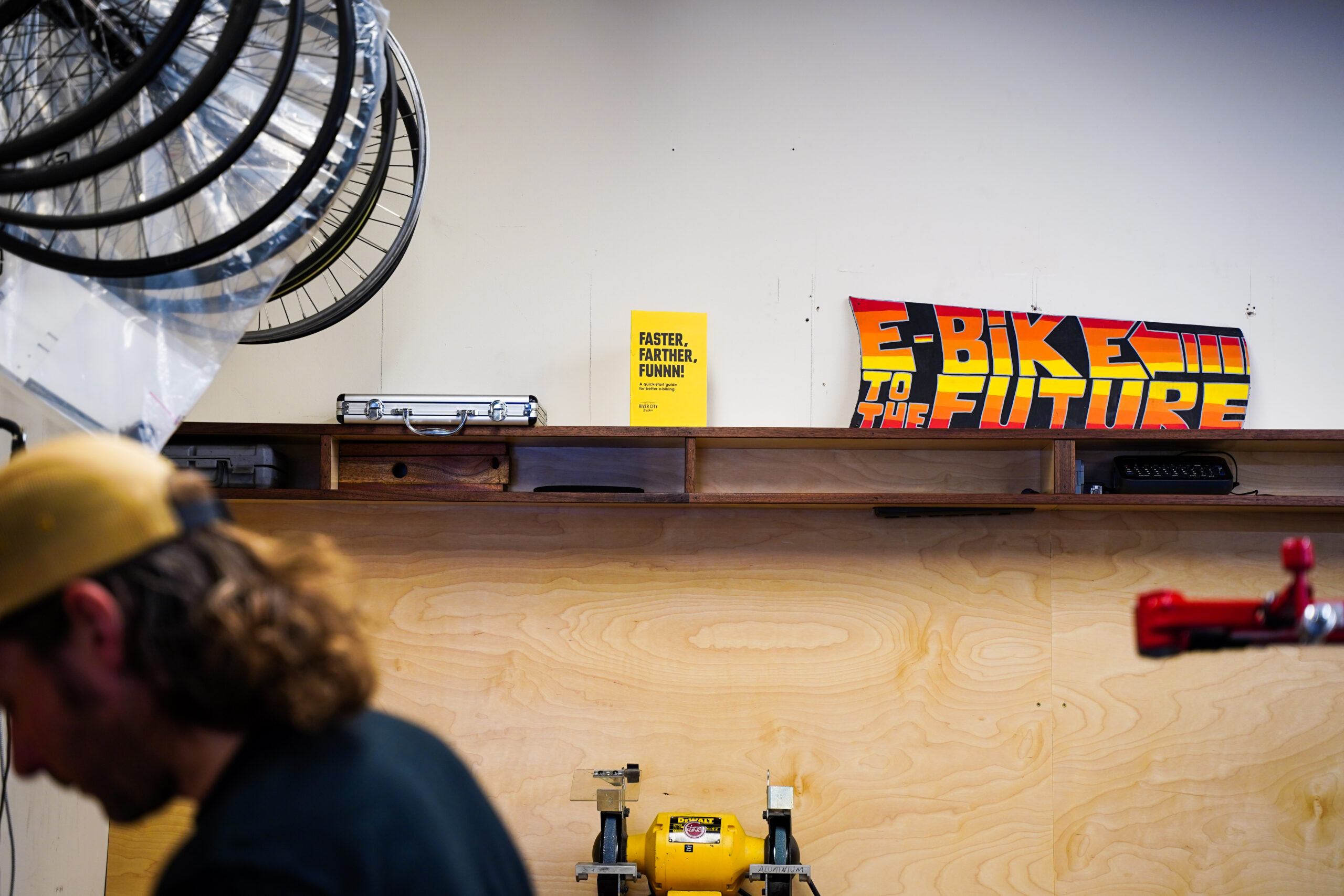
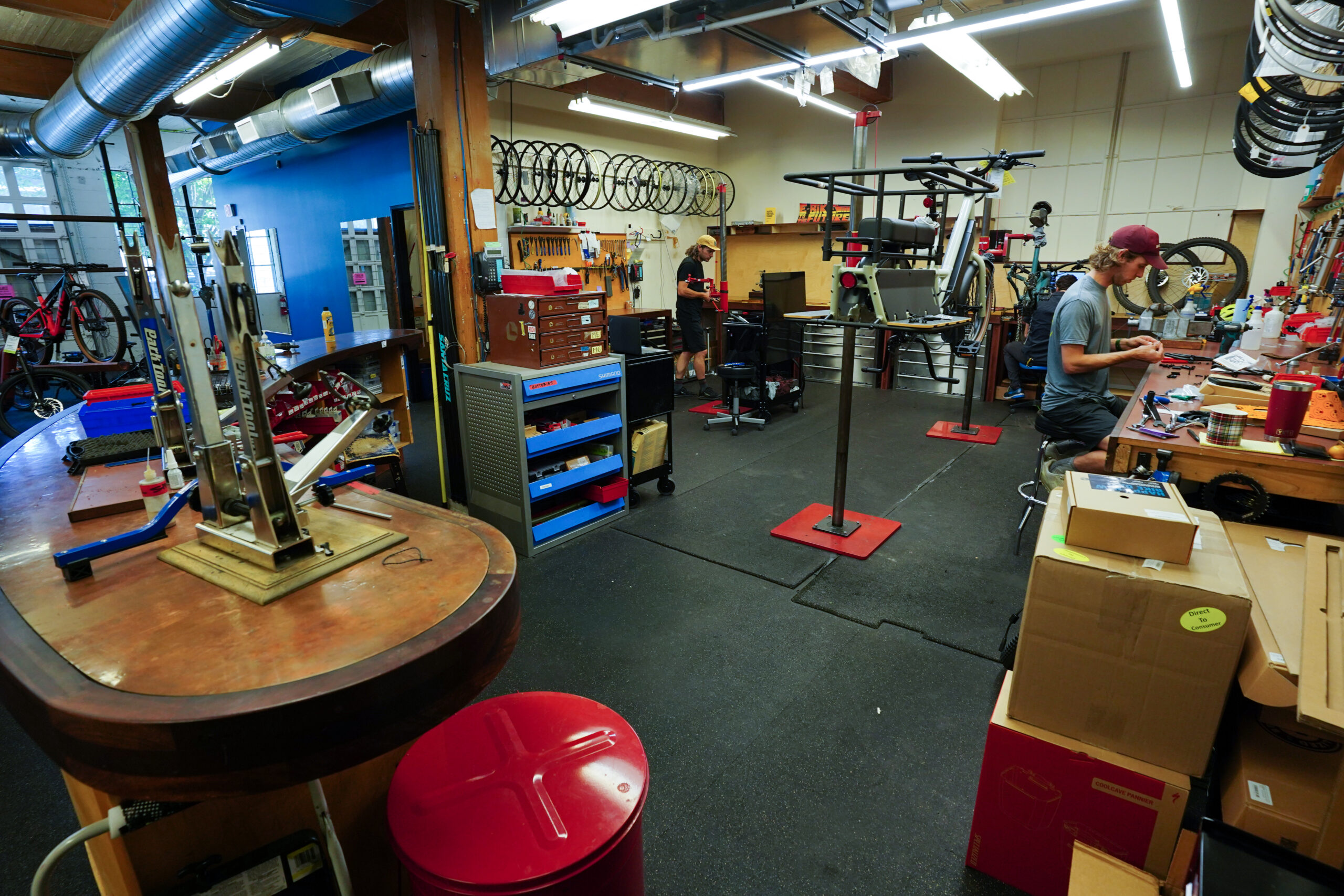
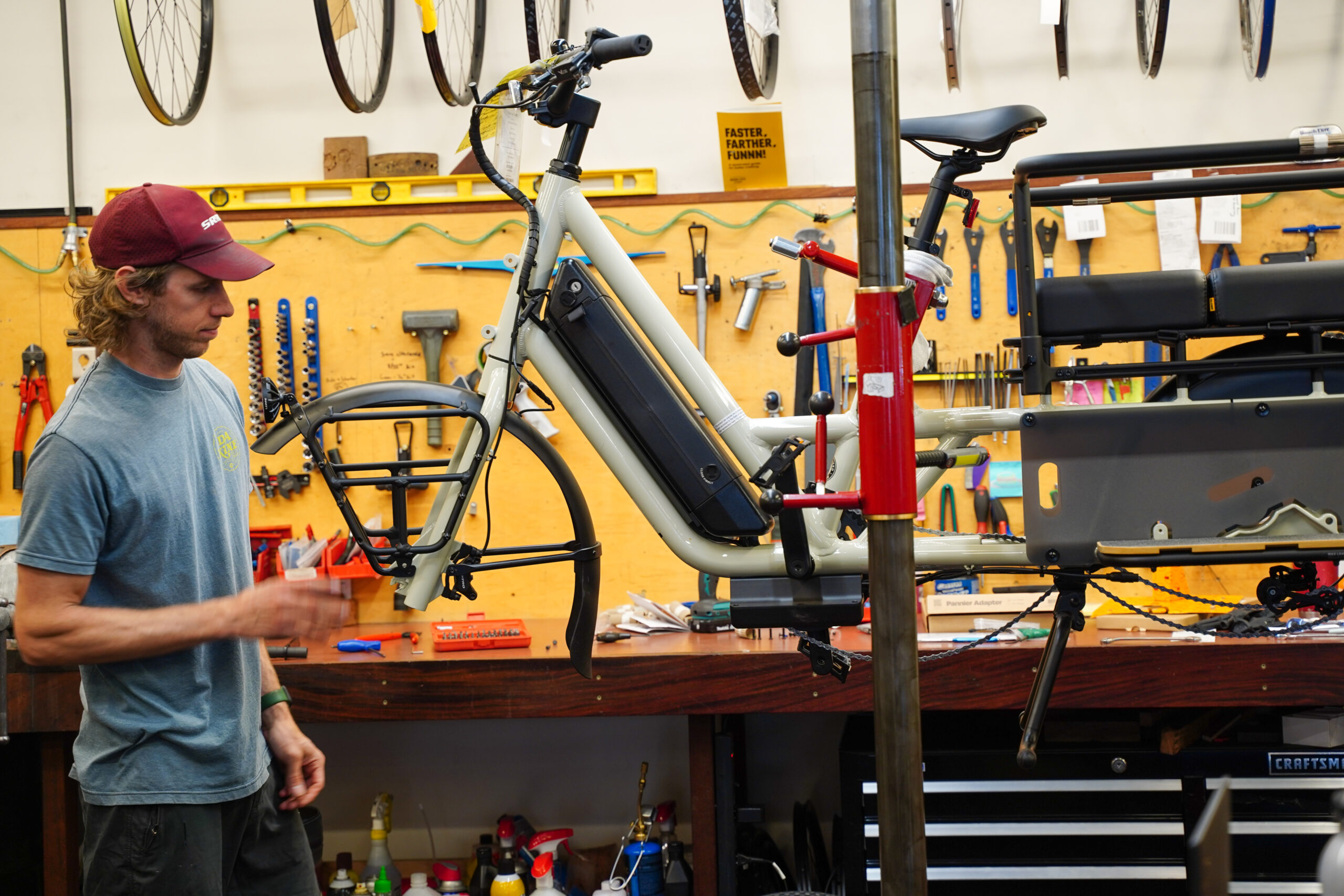
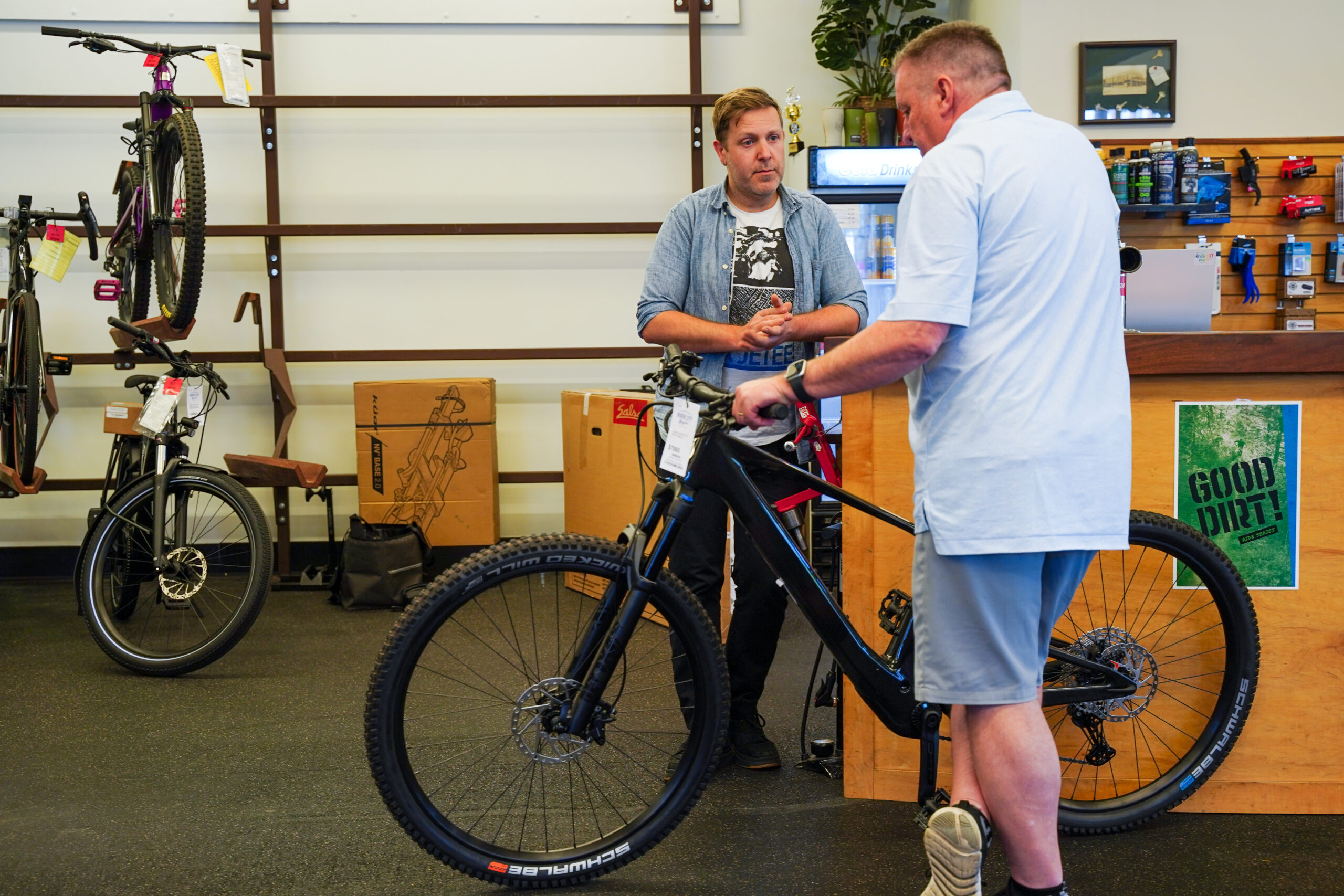
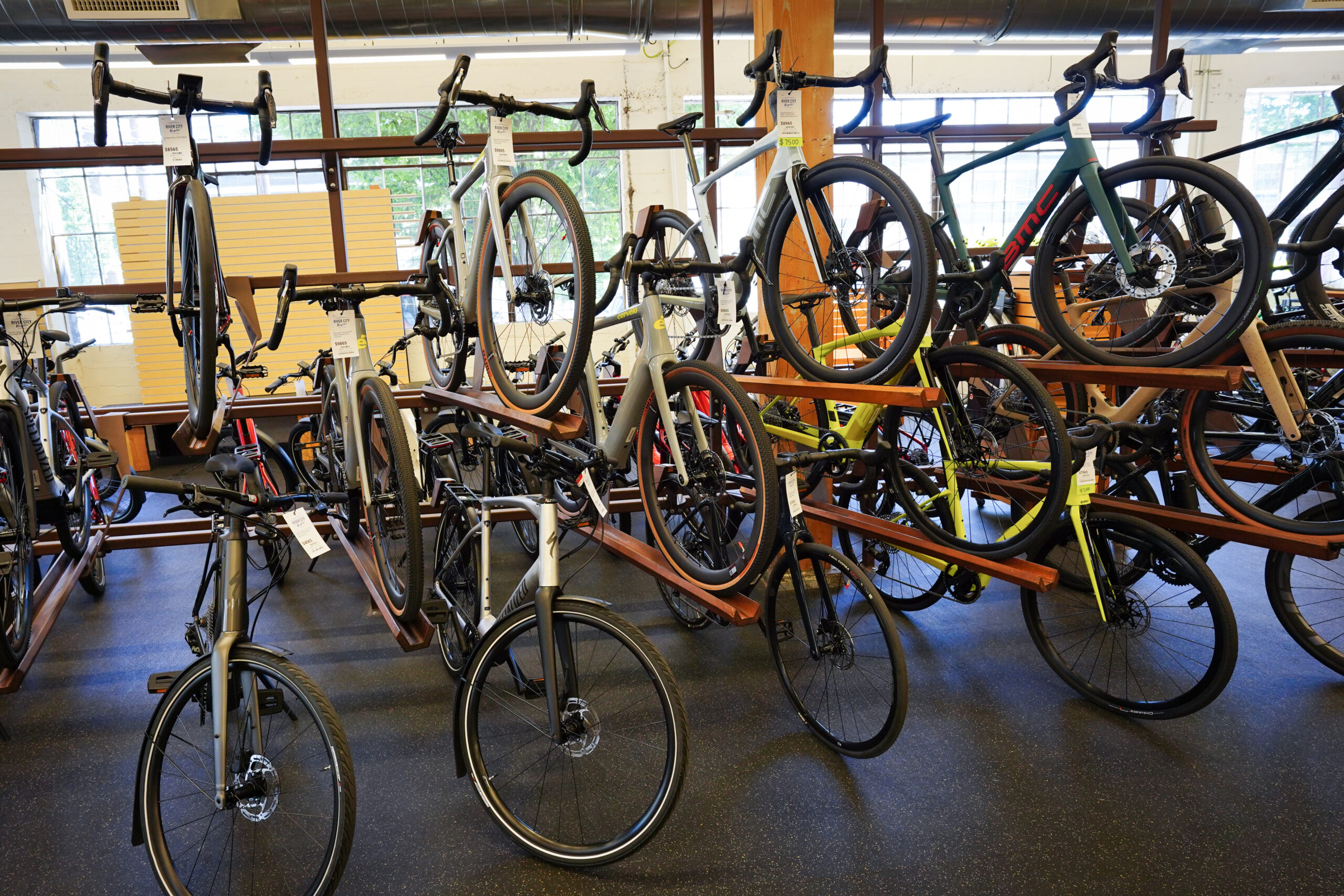
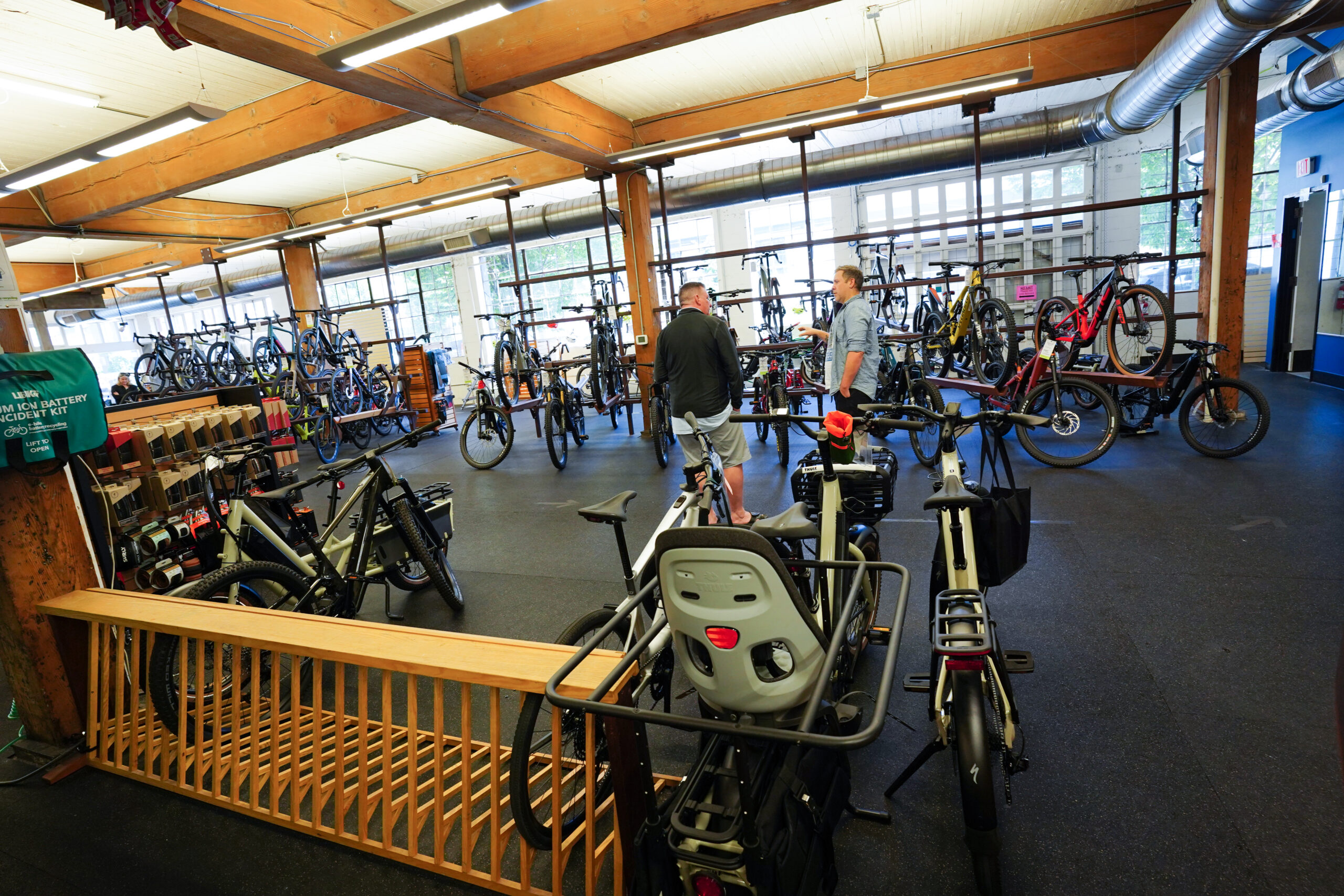
The 4,000 square foot store on the corner of Belmont and 6th is one of the largest e-bike only shops in the region and offers everything from cargo-haulers to svelte road bikes. And while there are plenty of bikes to choose from, they’ve carved out enough room for an indoor test track, a dedicated e-bike service area, and a fitting station to make sure you’re comfy before you ride a new bike home.

The store attracts a variety of customers — some of whom are older and have set aside their old “analog” bikes (Kenny’s term for non-electric bikes) and others who want to carry more stuff, or keep up with a faster partner.

Kenny, who grew up in Eugene and has worked in shops since his first “volunteer bike shop rat” job right out of high school, has done just about every cycling discipline. His current favorite is e-mountain biking. Kenny and all the other shop staff ride and test all the bikes on the showroom floor, and the service staff have years of e-bike-specific training under their belts. He says that’s one reason the shop is successful. When it comes to what bikes to sell, “We’ve developed a really good sense for what’s important and what’s not important,” he said.

And with River City’s long track record in the industry, they’ve tapped existing relationships with top brands like Santa Cruz, Specialized, Cervelo, Scott, Cannondale, and BMC to fill out their selection. It’s a sign of the times that all those brands established themselves before e-bikes hit the market, but today they offer top-end battery-equipped bikes befitting of their premium brands.

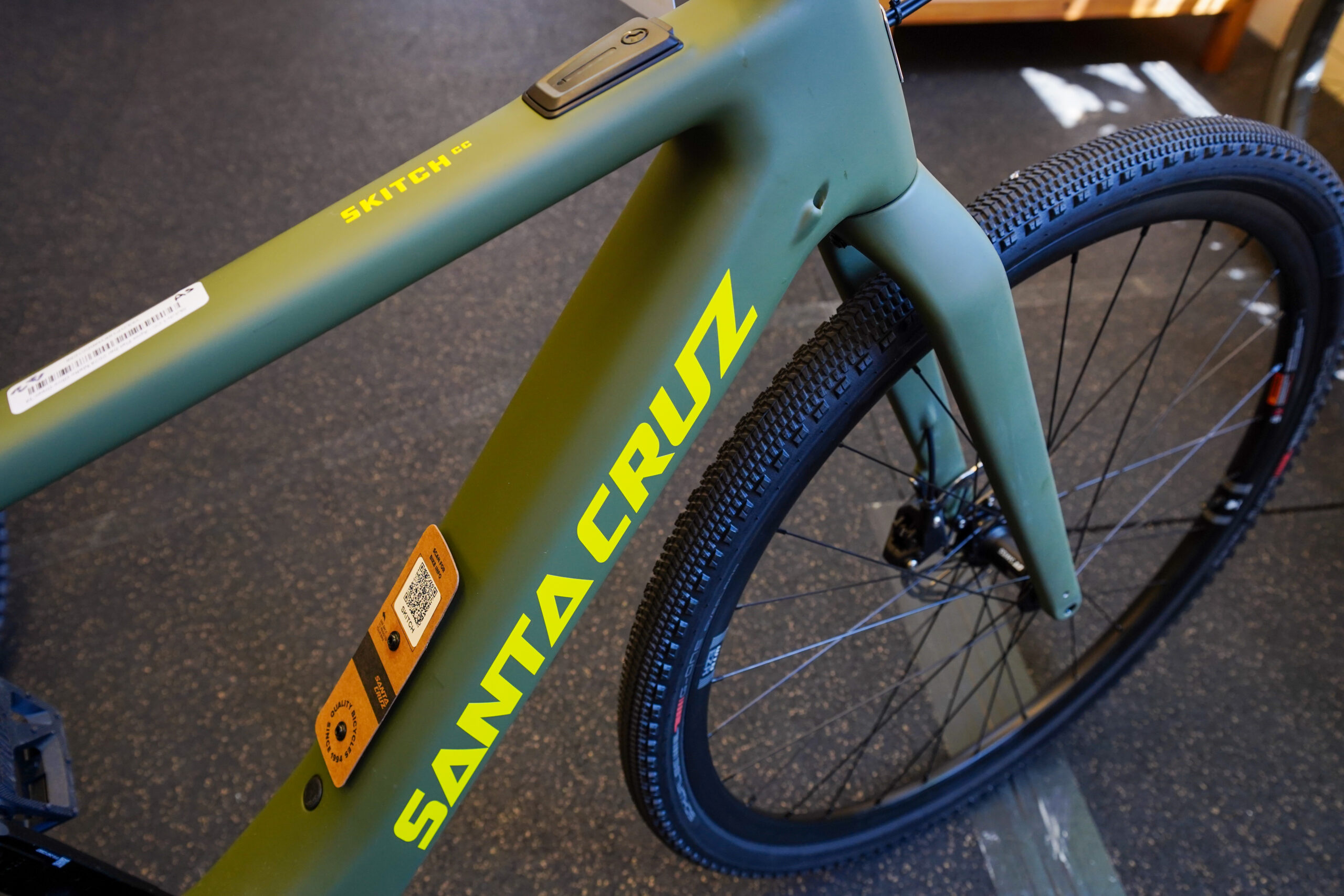
Santa Cruz’s “Skitch” is one such bike. As Kenny effortlessly rolled it off the rack, I had to look closely to even notice the battery and motor. At just 30 pounds, it’s an example of a growing segment of the e-bike market; lightweight bikes that give you more power without the pounds. With a carbon fiber frame, wide tires, flat bar, and massive gear range, this thing would be a perfect Forest Park gravel road shredder.

“It’s a high performance, do-it-all bike — that just happens to have a motor,” is how Kenny described it.

The Skitch’s battery is light enough so that you have to work hard to reach its top speed of 28 mph. “It’s a bit like a tailwind, rather than a fully mechanical assist experience,” Kenny said. At just 30 pounds, you could even switch the motor off (or ride in “Eco” mode) to increase your range or heart rate and it’s still fun to ride.

At 77 pounds, the Specialized Globe Haul cargo bike won’t win any weight weenie competitions; but it can carry about 14 Skitch’s worth of weight. It’s under $3,000, a bargain when you replace your car with it, and it’s got tons of accessorizing options to optimize it for kids, cargo, or both. My favorite thing about the design is the telescoping seatpost and easily adjustable bars so it can fit riders from about five feet to well over six feet tall.
For folks who want an additional layer of security and comfort, the Haul can be equipped with a throttle so you can cruise along at 20 mph without pedaling. “That’s really useful if you have the bike loaded down with cargo and you need to get going from a stoplight,” Kenny said. “Or if you’re in a hilly neighborhood or need to get across town quickly.”

The gamut of bikes mirrors the clientele at River City E-Bikes. It was a buzz of activity when I was in there, and the customers seemed to have lots of questions. Beyond answering them, Kenny says he and his crew encourage folks to try before you buy.

“If you haven’t tried an e-bike yet, especially a modern pedal-assist bike, it might not be exactly the experience you’re expecting it to be,” he said.

While customers are often surprised after a test ride, Kenny said there’s one part of the experience they can count on. “Almost everyone’s coming back from a test ride with a smile on their face when they first get a sense of that motor assistance and how fun it can be. And for some of our customers, it’s unlocking that experience for them for the first time since they were a kid.”

River City E-Bikes

Note: This story is part of a paid advertising partnership between River City Bicycles and BikePortland.

PBOT will partner with Bike Bus PDX on signage project

The bike bus en route to Glencoe Elementary School. (Photo: Jonathan Maus/BikePortland)

The Portland Bureau of Transportation wants to help the local bike bus movement maintain its momentum. The city will use a $50,000 grant from Metro to launch a pilot program to improve bike bus wayfinding and signage on the route and at stops for several schools. Bike buses are group rides to school that meet at one location and then pick students up along the way.

The grant is one of dozens of awards handed out by Metro as part of their Regional Travel Options program. This year’s allocation totaled nearly $9 million with projects funded throughout the region (stay tuned for stories on other interesting projects).

If you’ve been paying attention, this partnership should not come as a surprise. Back in June we reported that not only has PBOT Director Millicent Williams and City Traffic Engineer Wendy Cawley shown up to ride local bike buses, but the city itself is organizing them for its employees. We also talked about the need for route signage with leaders of the Abernethy Bike Bus last month.
According to a project description shared with Metro, PBOT Safe Routes to School program staff will partner with Bike Bus PDX to, “create a wayfinding strategy, criteria, and signage for bike and walk bus routes and stops.” Bike Bus PDX is a coalition of parents and advocates who organize biking and walking school buses at schools citywide. Their website lists 18 active buses.
While advocates have pushed for infrastructure changes to make bike bus routes safer — like more diverters to keep drivers off neighborhood streets — PBOT considers that a more long-term, higher-cost project. In the short-term, they can make the routes more visible so more people can participate.

Here’s more from a scope of work document PBOT shared with BikePortland:

More families and students will bike and walk to school if they feel safe, know which routes to take, and are able to join an organized group. PBOT SRTS staff often hears from established bike and walk bus participants that they continue to join because it is fun, and if something is fun, more people — especially kids — will do it.

The grant funds will be used to establish a working group of local bike bus leaders and PBOT staff. Design and pilot wayfinding prototypes for 3-5 schools (with a priority on Title 1 schools), and install new signage on routes and bike bus stops.

This is an exciting step for bike buses that could formalize and harden the concept, bringing it to more families and building even more momentum by the time schools are back in session in the fall. And don’t get hung up on the paltry $50,000 amount of this grant. The way these things work is that once a grant has been awarded, it can often pave the way for other funds and larger projects down the road.

I can’t wait to see what comes from this! PBOT expects to have the signage and wayfinding prototypes by spring 2025 and signage installed by June 2025. Stay tuned.

Meet Portland bike scene personality, Dumpsta D (video)

I’ve met a lot of interesting people in this community over the past two decades. But I’m always working hard to cover an event or a news story, and I don’t take the time to talk with folks one-on-one, on camera, as much I’d like. As I see more people pass on and pass through our community, I want to capture more stories and personalities from those early years. On that note, I’d like you to meet an old acquaintance of mine, Dumpsta D.

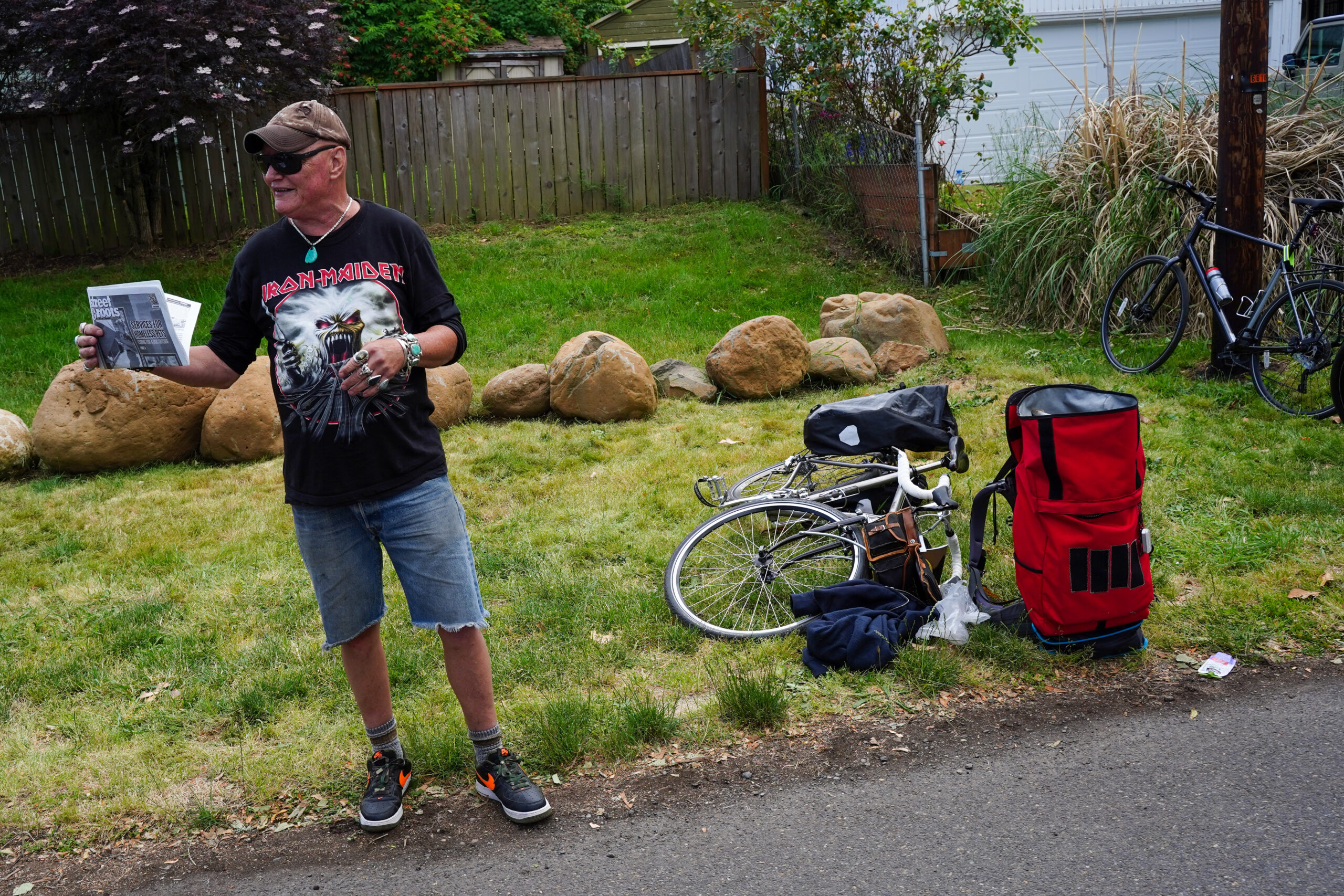
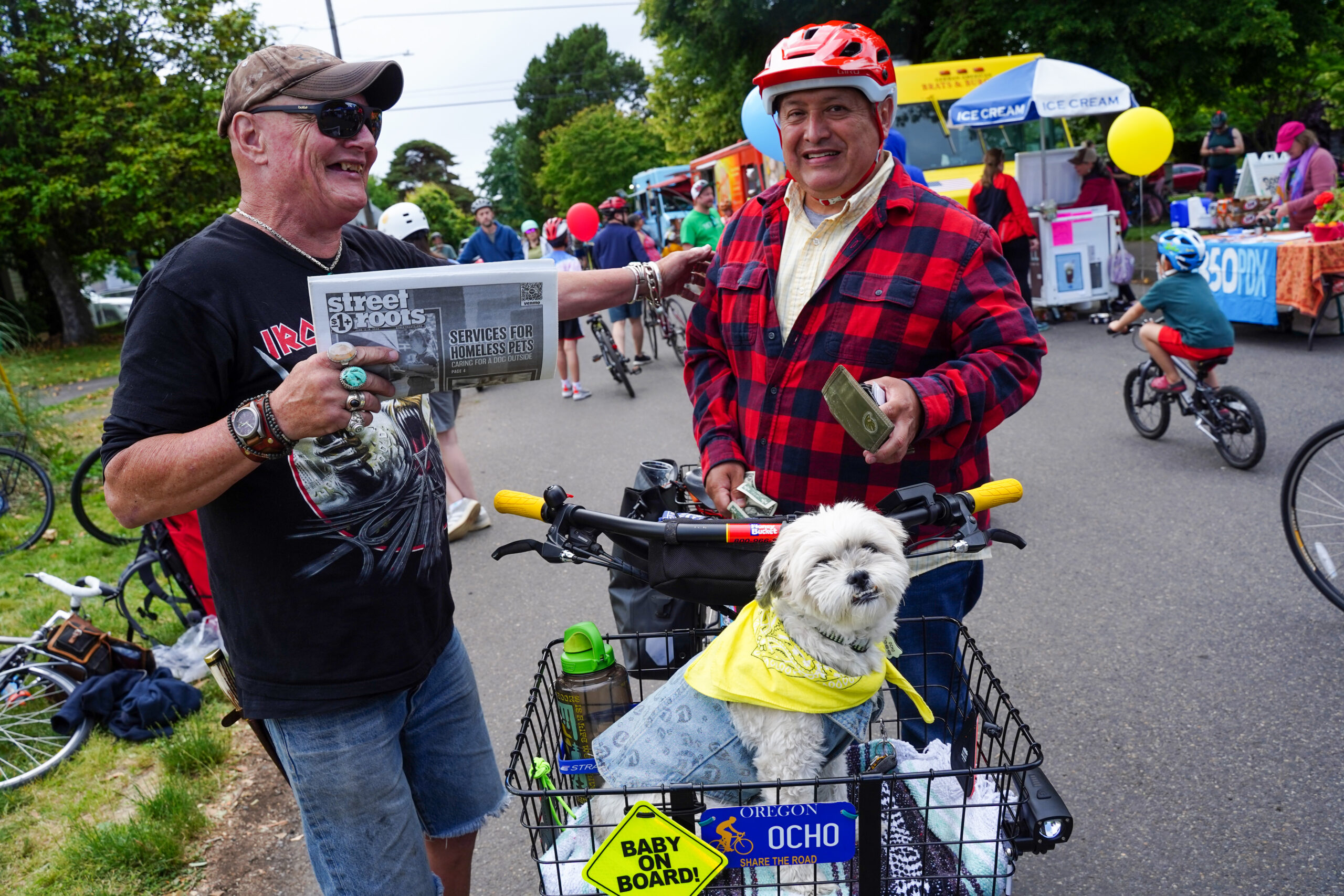
I bumped into him at Sunday Parkways and it was the first time we’d talked for about 15 years or so. Dumpsta is a self-described “technophobe” who doesn’t have a smartphone and isn’t online (“I got no use for any of that shit”), and he doesn’t come out to bike events as much these days. So when I saw him standing there, selling his Street Roots papers, I walked up and said, “hi.” Thankfully he remembered me, and let me film a short interview.

I met Dumpsta in 2004 or so when I first started showing up at Critical Mass rides and other bike events. The first time I mentioned him on BikePortland was 2006 when he rolled up to Breakfast on the Bridges on the Hawthorne Bridge with a patch on his messenger bag that caught my eyes. It said, “Bikers attack cars in this area.” In May of that same year I attended Dumpsta’s bike swap meet in southeast.

The thing I always remembered about Dumpsta were his immaculate vintage bikes. He had all sorts of them, and would build them up himself from parts he found in shop bins, dumpsters (hence his nickname), free piles, garage sales, and so on. He had a late 1980s Colnago road bike that was one of the coolest bikes I’d ever seen (and I spent a long time searching my archives for it, to no avail!) and a strange but cool astroturf bike that always turned heads.

Dumpsta D went on the the KBOO Bike Show in May 2006 and hosts Ayleen Crotty and Sara Stout said he had an, “uncanny knack for finding screaming deals on bike gear.” He’s also a poet and writer whose work has appeared in Street Roots.

It was so fun to see and talk to Dumpsta D. It was almost comforting to me that, after all these years, he’s still finding old bike parts and building up vintage bikes. As you can see in the video, he hasn’t lost his charm, way with words, love of hard rock, or his passion for bikes.