
This guest article is an action alert from Portland bike advocacy organization BikeLoudPDX.org.
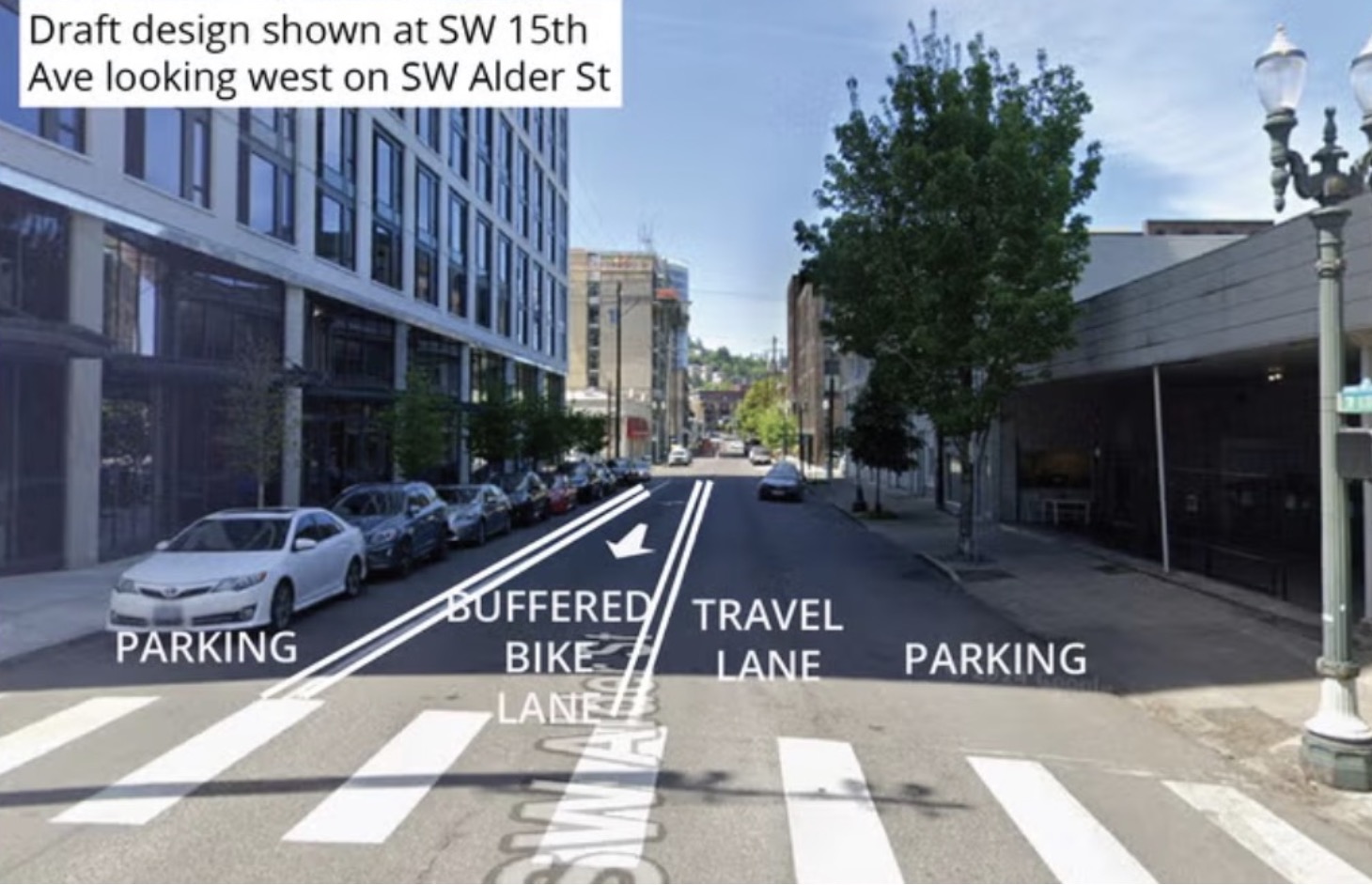
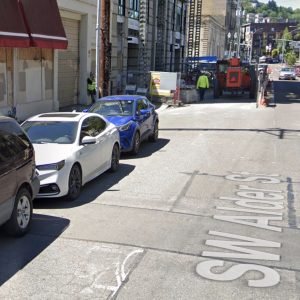
Last week, PBOT announced their intention to abandon a decade-long plan to install a two-way protected bike lane on SW Alder between 14th and 15th after hearing pushback from neighbors about the loss of car parking.
This design was part of the City Council-approved Central City in Motion plan. The two-way bike lane was the missing link to the network, connecting the rest of NW Portland to the Max, Providence Park, and Lincoln High School. But as BikePortland shared earlier this year, tenants at an adjacent residential building expressed concern over a loss of auto parking. That pushback led to a meeting between the tenants and PBOT to discuss alternative designs.
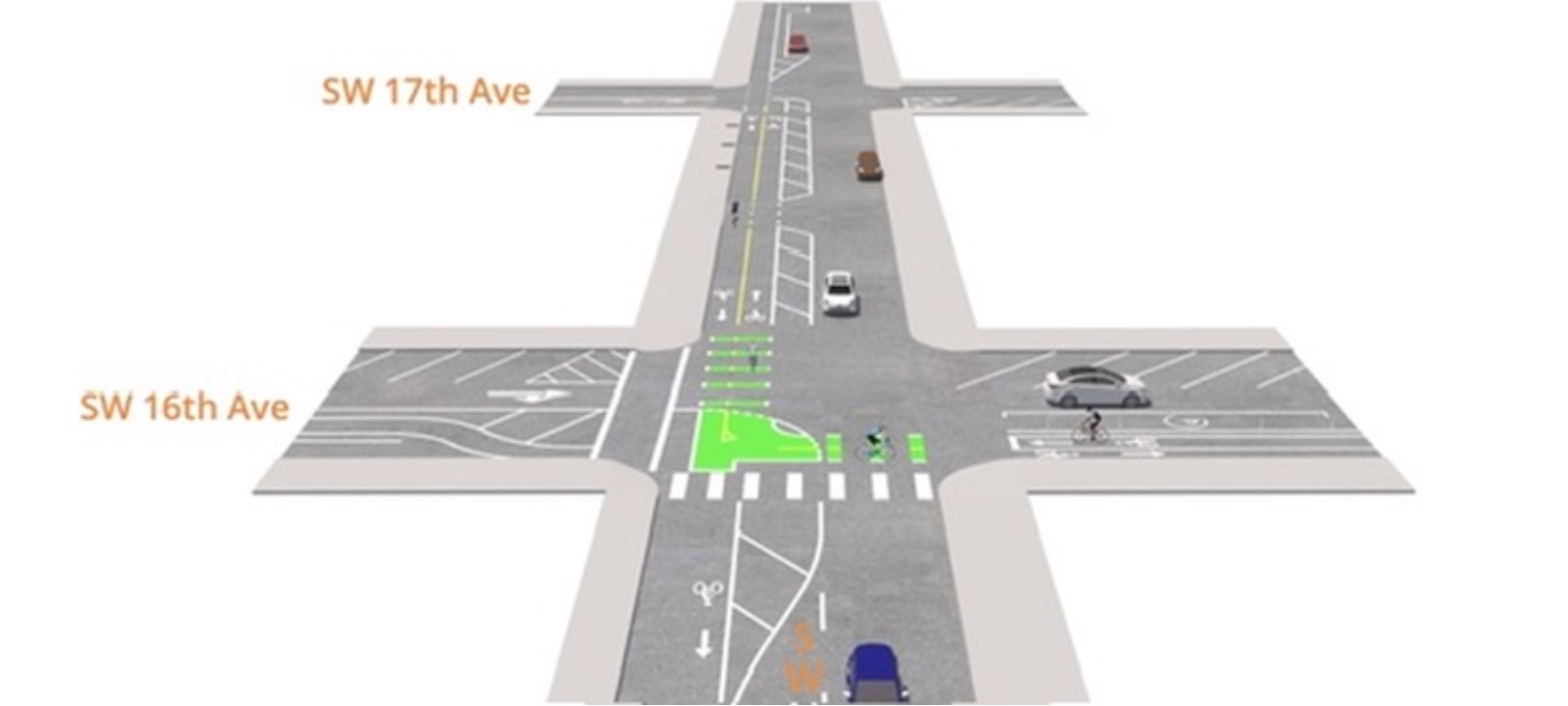
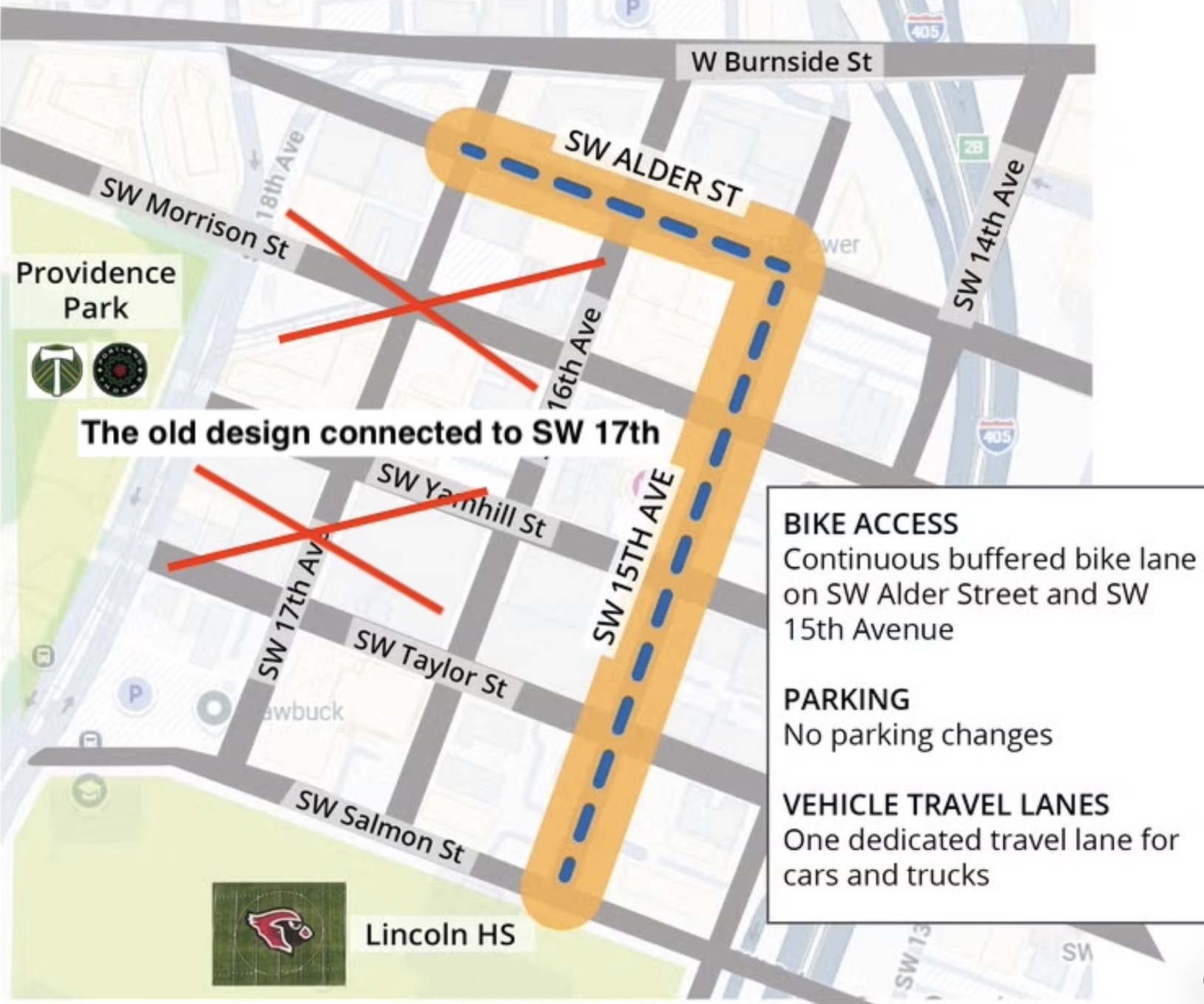
Under the current plan proposed by PBOT, people riding bikes will have to ride two extra blocks to get to these destinations. Instead of riding on a protected two-way bike lane up to SW 17th, you will have to drop down to 15th and then go back up on an unprotected bike lane. Only 42% of people feel safe on the new design, while 93% feel safe on the old one.
On January 22 2026, Mayor Keith Wilson said, “We are and have to be the biggest bike mode city in the nation. Our multimodal focus has got to be at the center of every decision we make.” This is an opportunity for our mayor to show Portland that his words have meaning and for the City Council to demand accountability for the plans that they have passed.
We need you to write to our city council and mayor and ask for an immediate pause on this major route change. Large changes, like this, that impact the usability and route of our bike network should be presented to the Bicycle Advisory Committee before being decided on. Use the blue banner to send an email to the Mayor, D4 City Councilors, PBOT Director, and City Manager.
— Click here to view and send a sample email to city leadership.

Thanks for reading.
BikePortland has served this community with independent community journalism since 2005. We rely on subscriptions from readers like you to survive. Your financial support is vital in keeping this valuable resource alive and well.
Please subscribe today to strengthen and expand our work.
I actually think the change is fine. Sometimes PBOT needs to compromise to win political points. It reduces the cars to one lane. The painted door-zone lane isn’t great, but honestly the two-way paint lane provides exactly the same amount of actual protection. Every bit of the route on either end is either only paint or shared streets. This area is already very bikeable compared to vast swathes of the city (even the central city!) and one block of two way bike lane isn’t going to do much to move the needle one way or the other.
TBH there are much bigger fish to fry. Delaying this project only wastes PBOT’s limited resources that could be better spent improving conditions elsewhere in the city.
It’s also worth considering that the optics on this will boil down to “low-income/disabled/residents” vs. “privileged cyclists” and I think that is harmful for the cause of making Portland more bikeable as a whole.
I guess the optics play out as cyclists vs parking for low income residents. But it’s unfortunate that news stories about this site failed to point out that this building has onsite parking. The residents just wanted additional street parking spaces for visitors and guests. When you look at the actual situation, it’s not as cut and dry as the breathless media coverage made it seem.
As I recall from the story, someone needed nearby parking to attend to her disabled mother with dementia. How do we make reasonable accommodations for people like that?
Being both a bike rider and a person who has a disabled mother with dementia, I kind of see their point.
What special accommodations should we have for cyclists with dementia? I’m getting there myself.
Yes. That is an issue. But I’m sure every resident in the building could come up with a reason for why they need adjacent, free street parking.
Keep in mind, there are 214 units in that building. It’s not physically possible to have enough free curb parking spaces to provide for the needs of all of the residents.
On a 200 foot block face, you’re looking at maybe ten parking spaces. And it’s not like those free public parking spaces are going to be reserved for specific building tenants. In fact, they’re just as likely to be used by people who are trying to get to other nearby buildings.
“It’s not physically possible to have enough free curb parking spaces to provide for the needs of all of the residents.”
This is true, but that doesn’t suggest that the solution is to take away what parking there is. If we want to continue to increase density in the city, we need to figure out how to accommodate those who live there and who have legitimate needs.
One possibility would be to reserve some of the spots as handicapped parking. Another is to simply not accommodate certain people who find themselves temporarily or permanently disabled.
From my experience living in a few apartment buildings with no garages or parking lots, the best solution is a handicap spot (or spots) and 15/30 minute parking on the adjacent block face.
Its called investing in even more robust public transit. If we want more density, we need less cars and we need less parking so we can fit more people.
Have you ever tried taking a disabled Alzheimer’s patient to the doctor using the bus? I haven’t, and I never will. Nor would you, but I truly hope you never have to find out for yourself.
What do folks in New York, New York do when they have to take a disabled person to the doctor? I’d imagine if the caregiver and the patient are both low income they do not travel by their own personal automobile.
Why do we view parking as sacrosanct in the densest portions of Portland when it’s viewed as superfluous in a city like New York? It’s because our public transportation is not robust enough to accommodate the vital travel needs of our most economically vulnerable folks.
So far we (“we” being the city, county, Metro, and state) have proven incapable of doing so. TriMet is making sweeping cuts that will only get worse. One of our most-used and most frequent buses, the FX2, now only runs every 30 minutes after 7PM and barely every hour after that. My neighbor, who works until near midnight downtown and rides the FX2, is considering buying a car because they keep having to wait 30-45 minutes for the bus to show up. FWIW I’m trying to steer them toward a bike as an alternative.
I am a big transit proponent but there is little to no individual or political will in this moment for good transit. The only organizations that could be advocating for better transit (Oregon Walks, BikeLoud, The Street Trust, etc) are too wrapped up in identity politics and make-work jobs for people good at going to zoom meetings to make a difference. Conservatives are actively hostile toward transit, and libs view it only as a service of last resort for the poor and desperate.
Very easily. The building assigns one of the onsite parking spots to the person who needs it to attend her mother. Problem solved. They get an exclusive parking spot, and we get the bike lane.
If the site in question is Tiller Terrace, no; they don’t have on-site parking. They have a garage door but it looks to be only for trash/utility/maintenance access, not somewhere that residents can store their cars.
The website lf the building specifically says it has onsite parking in a garage.
There’s also street parking on two other sides of the building, including in front of the main entrance.
This is why we can’t have nice (functional) things.
Imaginary political points that go on the invisible scorecard that no one cares about.
Comparing to and regressing to the mean of bad infrastructure in East Portland.
The goldilocks catch 22 of incrementalism where “small” changes don’t matter, but large transformative changes are not feasible for “reasons.”
The fallacy of resource allocation and an unrealistic view of how it works.
And, of course, optics. Bicycle infrastructure is either wasted resources for an elitist hobby, oppression of the disabled or a crime magnet, depending on the time of day and the need for sensationalist click-bait.
I hear your comment DW (I really wish people had to use their names) but I disagree with your take.
Is this as important as broadway? No. But having a process to navigate these issues besides the director making a call in private is important.
– If PBOT is going to change course on a bike route I think they need to take that up in some public forum like the bicycle advisory committee.
– The two way allows you to go up to 17th which is the more direct route to the big destinations. People in bike cities bike because biking is the most convenient way to get around.
We need a strong central city bike network if we are going to increase biking and this decision makes it harder to do that.
I wish more people in this city and in the comment section on bikeportland would stand up for biking.
People who generally support cycling love, love, love to criticize or oppose a piece of bike infrastructure that they don’t immediately find appealing because it gives them a sense of being objective or fair minded. In the end, it is neither, it is just more car brain.
Or it just might be that some bike infrastructure isn’t very good, even in a Platinum city like Portland.
You don’t need to be “car brained” to think critically.
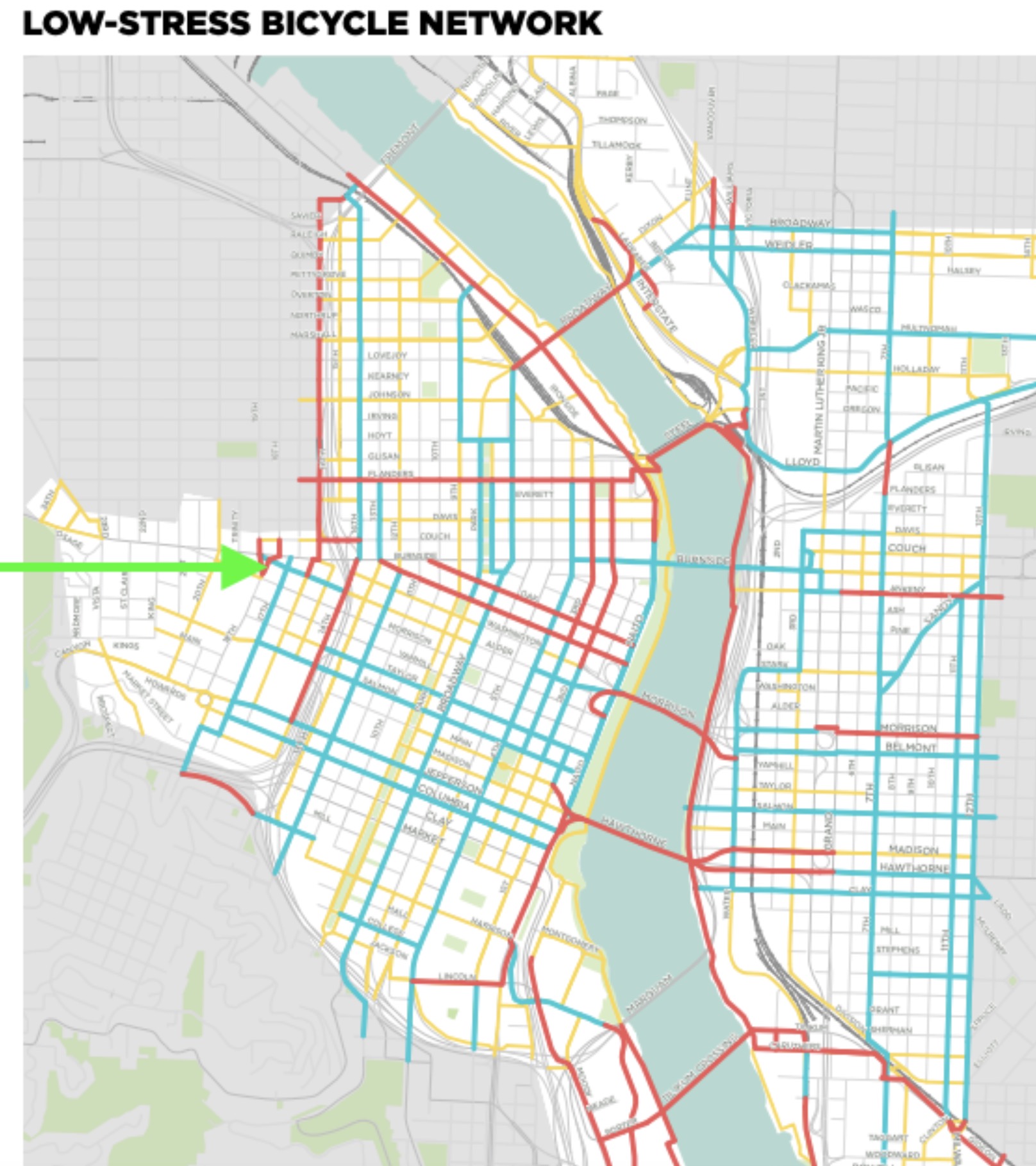
I agree that losing this 2-way bike stretch is not worth the fight. If constructed, I don’t think it will have very much utility. The graphic of PBOT’s low-stress bike network is pretty telling. The “plan” shows a bike route along 17th through Lincoln High School, but in practice, that has not happened. Without a functional N/S route , this 2-way bike plan on Alder doesn’t make much sense. I recommend bike advocate pressure PBOT to update their plan in response to the built conditions at Lincoln HS. It looks to me the SW 14th could potentially be a good street for a 2-way, protected bike IF the City could negotiate closing the off-ramps from I-405 or at least urbanizing them (single lane, join the grid at a 90-degree angle, not a ramp). 14th could be a really sweet connector: If Market was a greenway between vista and 14th and a continuous, protected, 2-way bikeway was built on the east of SW and NW 14th, you cold have a bikeway that connects the river to the hills and stitches together a whole bunch of neighborhoods and bike routes.
There is a really nice path there, but it’s always closed. Understandable to be honest, every public space in this town gets trashed unless it’s obsessively patrolled by expensive private security.
As I understand it, the plan is to have the Jefferson/Columbia couplet have bike lanes. They already put the bike lane on Jefferson and Columbia isn’t bad once you get over the hill. Though it is still riding with traffic and takes a more “strong and confident” type of rider.
Does this project solve an actual problem? Or is it more about lines on a map?
Unsurprisingly disappointing. When will PBoT stop pandering to every squeaky wheel that comes along with new bike infrastructure?
Just continue the 2-way along 16th to Salmon! One small signal mod at Morrison
“We can’t have a protected bike lane because we need to protect car parking for eight people” – PBOT
As long as the car parking is priced appropriately, how about enough to make up for the sacrifice to the cycling network. I’m willing to settle for $20/hr.
Lessons Learned:
1) CoP (and any other city) should physically remove any curb zone parking + install bikeway facilities BEFORE the building gets its occupancy certificate / sells or rents units. No one should be surprised that new residents would fight for keeping this parking in a parking restricted building. This is sadly a ‘self inflicted’ problem the City created for itself and the bike community.
What the staff report DOES say – in the design review materials:
2) The ~15 in garage parking stalls within this building’s garage – some or all of these stalls COULD be set aside for vehicle parking / valet per ADA / mobility needs of residents with medical conditions etc. vs on street parking.
There were no – as far as I can find – expectations that the project would use or retain the curb side parking. Permit 249218 shows a deliberately “parking-minimal” / ‘car-lite’ development approval (15 spaces for ~200+ units) and does not contain any conditions preserving on-street parking or reserving it as substitute supply. Also the lack of street parking / limited parking is likely in rental documents. LU 19-249218 DZM
https://www.nextportland.com/2020/05/18/alta-centric-approved-by-design-commission-images/?utm_source=chatgpt.com