🚨 Please note that BikePortland slows down during this time of year as I have family in town and just need a break! Please don't expect typical volume of news stories and content. I'll be back in regular form after the new year. Thanks. - Jonathan 🙏

Judge says BikeLoud can append Bike Bill lawsuit and refile

Advocates with BikeLoud PDX and their lawyer, Scott Kocher (middle) just after filing the lawsuit back in November. (Photo: Taylor Griggs/BikePortland)

“This is a significant win.”

– BikeLoud PDX

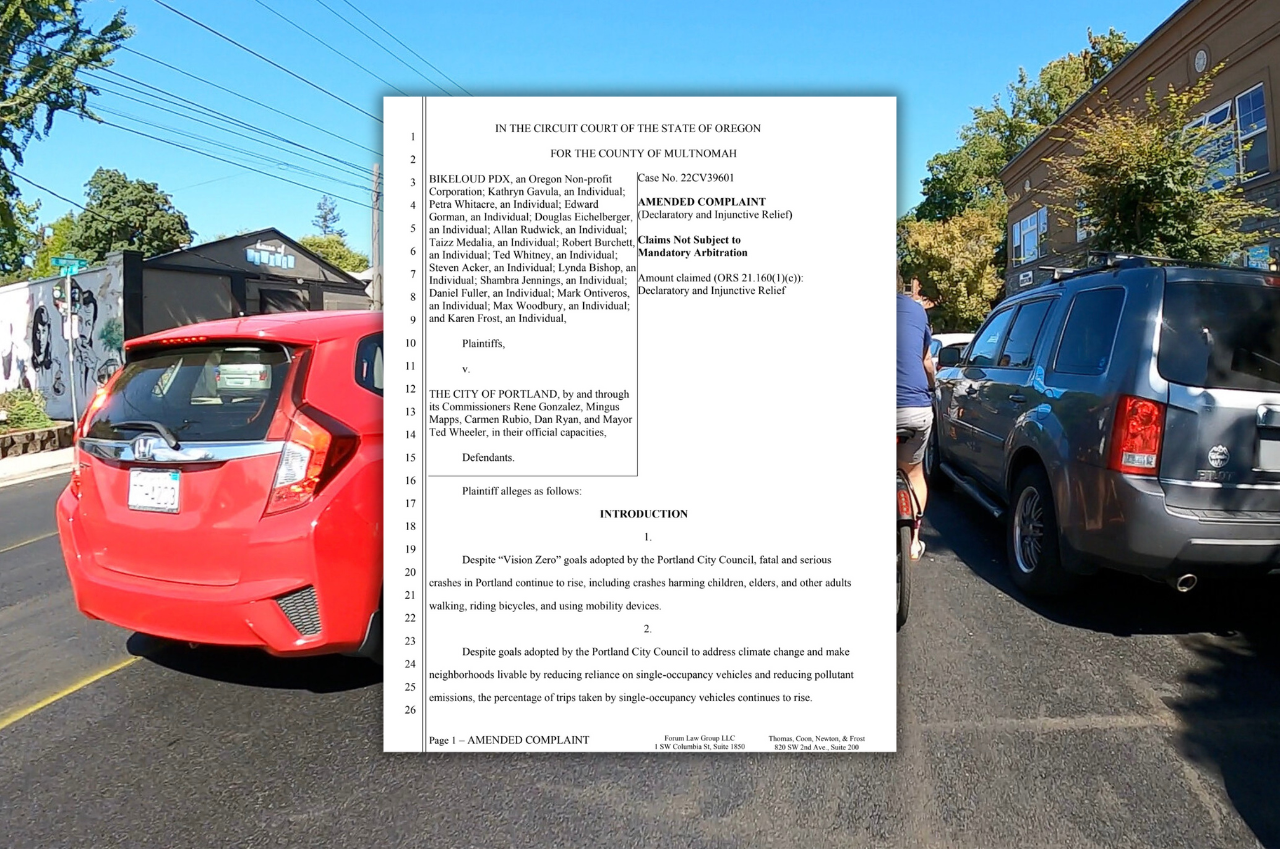
A lawsuit that would force the City of Portland to build bikeways in accordance with the 1971 Oregon Bike Bill was heard in court today. And while the judge granted the City’s motion to dismiss, he also left the door wide open for advocates to refile the suit.

Circuit Court Judge Christopher Ramras heard arguments from lawyers on both sides of the case in a phone conference this morning. Lawyer Jim Coon with Portland-based firm Thomas, Coon, Newton & Frost* made the arguments for BikeLoud PDX, the nonprofit group that filed the suit back in November; and Deputy City Attorney Daniel Simon spoke for the City of Portland.

As we’ve reported, the suit alleges that the City of Portland has failed to meet obligations to build bikeways as outlined in ORS 366.154 (aka “the Bike Bill”). Their complaint has outlined 22 specific projects citywide (see below) where the Portland Bureau of Transportation has completed significant road projects but has not built bike infrastructure along with them.

The City of Portland filed a motion to dismiss the case on two main grounds: that BikeLoud doesn’t have legal standing to bring the lawsuit and that the statute itself is nonjusticiable, meaning that the court should not be put into the position of enforcing the law. The City argued that since the law pertains to the State Highway Bill, the Oregon Department of Transportation is the agency that should enforce it. The City also believes that the Bike Bill does not create a “private right of action” — a legal term that says private citizens can bring a claim to courts to protect their rights under the law.

At the outset of today’s hearing, Judge Ramras implied that he believes the Bike Bill does trigger a private right of action, but he questioned whether or not the plaintiffs (members of BikeLoud PDX) have the required legal standing to force the City’s hand.

Portland City Attorney Dan Simon was first to present his case. “Enforcement of the bill is statutorily given to the State Highway Fund and the plaintiff’s response doesn’t address that,” Simon contended. “It just says that, ‘Well, if ODOT didn’t do their job properly, that that doesn’t excuse the city.’ The problem with that argument is that what the plaintiffs are seeking in this case is essentially that the court become the arbiter of what the bike bill says and how the city implements it.” Simon wanted to make the point that the court should not tell the City of Portland what to do. He went on to explain that the Bike Bill has several exceptions where bikeways are not required to be built. “And so, BikeLoud’s claims are are essentially asking the court to substitute its own judgment for the city’s planners in that regard.”

Simon also argued that BikeLoud is too general of an interest to bring a lawsuit in the first place. Referencing BikeLoud’s own complaint filing, Simon said, “They claim generally that BikeLoud members are unable to safely and efficiently use numerous city streets because they are not complying with the Bike Bill. That is a pretty general and abstract [legal] interest.” Simon’s contention is that BikeLoud members are not distinct from other road users and therefore, “There’s no special injury [legal term for harm] affecting BikeLoud’s members differently than other citizens.”

On those grounds, Simon asked Judge Ramras to dismiss the case “with prejudice” which would mean that the plaintiff could not refile the same claim with the court.

Lawyer Jim Coon then spoke to rebut Simon’s argument.

“There’s no special injury [legal term for harm] affecting BikeLoud’s members differently than other citizens.”

– Daniel Simon, Deputy City Attorney

“We absolutely contest that,” Coon said, referencing Simon’s argument that ODOT has exclusive power to enforce the Bike Bill. “It says nothing about who enforces the bike bill in [ORS] 366,” Coon continued. “It certainly does not, as defendant claims in its brief, expressly grant to the state the power to enforce the bill.” Then Coon pointed out that ODOT themselves must follow the Bike Bill law. “So who enforces the statute against the department transportation?”

Coon also rejected Simon’s argument that the court is powerless to compel the City to act. “The court certainly has the power to say what the law is and then enforce it and tell the City what it needs to do… The idea that this court is going to be managing how the City complies with the Bike Bill has no support,” Coon said. He went on to explain that the City has long partnered with advocacy groups and other people and organizations in deciding how to design and build bike projects. “The court would not be sitting there saying, ‘Okay, we’re going to separate a bike lane here, do a bike box there… We wouldn’t ask the court to do that. The court doesn’t have expertise to do that… The City has the expertise. Our problem is they’ve done nothing at these 22 sites.”

“We certainly have standing to bring [the lawsuit]. If not us, who was going to do it?”

– Jim Coon, Thomas, Coon, Newton & Frost

As for why BikeLoud has a distinct interest as a plaintiff and is not the just a general road user, Coon said, “That’s just not true. We’re not just road users. We’re people on bicycles are out there mixing with traffic every day.” Coon pointed out that around 6% of Portlanders ride bikes on a regular basis as per the U.S. Census. “That is a legally recognized interest, and the Bike Bill says you’re supposed to do this stuff, and we’re saying they haven’t. That’s a question of fact.”

“We certainly have standing to bring [the lawsuit]. If not us, who was going to do it?” he said.

In the end, Judge Ramras granted the City’s motion to dismiss; but did so “without prejudice” which means BikeLoud and their lawyers can refile the same claim after making some changes. In explaining his rationale, Ramras said, “I don’t believe plaintiffs have standing to bring their action for injunctive relief.” The judge based his argument on Foote v. State of Oregon, a 2019 case where the Oregon Supreme Court ruled that the District Attorney and a group of crime victims who brought the suit did not have a “legally recognized” interest. “The law [they wanted to change] affected them no differently than it affected any other citizen,” Judge Ramras explained. “And I believe the same is true here. I think there are plenty of citizens who ride bikes who probably have an interest in having safe biking conditions, but do not belong to BikeLoud.”

Portland Lawyer Scott Kocher, who also represents BikeLoud PDX and is working with Coon on the case, said after today’s decision, “I don’t see this as a loss or a win, it’s really kind of punting the issue.” Kocher said all Ramras has done is to point out a “missing piece” to the case. That is, a plaintiff with a more concrete and particularized harm (legally-speaking). Furthermore, Kocher said he feels that Judge Ramras has jettisoned the City’s main argument that ODOT has exclusive authority to enforce the Bike Bill. “If the Judge agreed with that,” Kocher shared. “He would have dismissed the case with prejudice.” Kocher says they also learned today that the court disagrees with the other part of the City’s argument; that there is no “private right of action” under the Bike Bill.

In a statement released a few minutes ago, BikeLoud said: “Today the trial court directed BikeLoud to resubmit our Bike Bill lawsuit with additional details. We will be working with our attorney to meet the judge’s requirements. BikeLoud believes we will be able to make a compelling case that we have an interest in enforcing the bike bill, as the judge requires. We are pleased that the judge rejected the City’s argument that only ODOT has the ability to enforce the Bike Bill. This is a significant win. The City was hoping the judge would dismiss the lawsuit with prejudice which would not allow us to resubmit.”


(*Thomas, Coon, Newton & Frost is a BikePortland advertiser, but that relationship had no impact on this story.)

ODOT’s $41 million Pacific Hwy project breaks ground in Tigard

Pacific Hwy (99W) in Tigard, looking NE. (Photos: Lisa Caballero/BikePortland)
Scope of ODOT 99W upgrades in Tigard.

The Oregon Department of Transportation (ODOT) broke ground last week on a $41 million project to repave and make active transportation improvements to Pacific Hwy (OR 99W) in Tigard. The project will build new bike lanes and signal detection between SW 65th and 72nd Avenues. Other upgrades include a mile of new sidewalk—with 150 new sidewalk curb ramps—as well as the repair and repaving of three miles of highway, two bridges and changes to a key intersection at SW Main St.

For BikePortland readers who don’t venture this far southwest, 99W changes its name from Barbur Blvd to Pacific Hwy at the Tigard border. The project area is just south of the planned West Portland Town and Washington Square Regional centers. Work is being done at multiple locations simultaneously and will continue through 2024. Most lane closures will take place during the night.

With I-5 and I-217 crossing the road, and the road itself given over to fast food (and big box and car-related retail), the 99W corridor is a challenge to transform to a people-friendly environment. So it is notable that ODOT, Tigard and Portland are all taking up the task. Let’s check in with some other nearby projects, including an update on the Southwest Corridor Light Rail plan.

Urban highways and traffic taming

The City of Tigard appears committed to its vision to be “an equitable community that is walkable, healthy, and accessible for everyone,” and is currently pursuing a couple of complete streets projects to transform the area. One of them is the Greenburg Rd project about which BikePortland previously reported, but the city is also lobbying to take ownership of nearby Hall Blvd from ODOT.

Tigard wants ODOT to improve Hall to a “state of good repair” before receiving jurisdiction—like Portland wanted with the recent 82nd Ave transfer, and its current “state of good repair” negotiations over Powell Blvd.

Tigard’s Mayor Heidi Lueb recently stated in a “Mayor’s corner” bulletin,

Hall Boulevard in Tigard is not safe because it’s been underfunded for many years. Pedestrians and bicyclists face a nearly impossible task of commuting on Hall Boulevard due to sidewalk gaps, missing bike lanes, and a lack of pedestrian crossings. Vehicles traveling on Hall Boulevard in Tigard encounter failing pavement and a myriad of potholes. Everyone traveling on Hall Boulevard will cross deteriorating bridges that were not built to support the level of traffic or variety of road users today.

I spoke with Dave Roth, a Senior Transportation Planner with the City of Tigard, about the Hall Blvd transfer. He told me that it had been “a work in progress for a long time,” and that they “are fortunate to have State Representative Ben Bowman coming in really energized on the orphan highway issue.” Bowman represents House District 25, comprising Tigard, Metzger, and South Beaverton, and has sponsored a bill, HB 2756, to transfer jurisdictional control of SW Hall Blvd from ODOT to Tigard.

Unfortunately, funding is the wildcard with these two projects. The Greenburg Rd complete streets project depends on Washington County MSTIP funding which is currently uncertain, and the Hall transfer involves funds allocated by the Oregon State Legislature.

Riding northbound on Barbur across the Newbury Street bridge.
(Photo: Jonathan Maus/BikePortland)

What about Barbur Blvd?

Moving northeast along OR 99-W, one arrives at Barbur Blvd and Metro’s funding problems.

When Metro’s measure 26-218 was defeated in 2020—and the Southwest Corridor Light Rail (SWCLR) project with it, ODOT, TriMet, and even the Bureau of Environmental Services (BES) could no longer rely on incoming light rail capital to address area deficits.

Although ODOT has regularly made incremental safety improvements to Barbur, at the top of many cyclist’s lists are large capital projects, like replacing or supplementing the road’s two viaduct bridges.

And what I came to learn only after the measure’s defeat was that BES was relying on the SWCLR to build the stormwater facilities needed to make the zoning changes for the West Portland Town Center project:

The failure of the regional bond measure significantly reduced the nearer-term possibility for substantial improvements to the stormwater conveyance system under SW Barbur Boulevard, an ODOT facility. BES and the City rely on the existing stormwater infrastructure for conveyance from the neighborhood to the north, and upslope, of SW Barbur. If the bond measure had passed, the entire ROW would have been reconfigured and rebuilt, including the underground utilities. However, the failure of the bond measure now requires the continued reliance on existing infrastructure, which does not have sufficient capacity to serve the full buildout of the WPTC Plan without improvements.

So the city was depending on light rail funding to upgrade the area’s aging infrastructure. What is badly needed is more storm water capacity, a couple of new bridges, better bus service and street calming, but the way we fund things requires an investment in something new to get that maintenance.

Metro and TriMet completed the SWCLR’s Final Environmental Impact Statement in 2022, and the project therefore remains eligible for federal funding.

And that’s where things stand along the OR 99-W corridor. ODOT is making expensive upgrades to Pacific Highway in Tigard. But both Tigard’s and Portland’s ambitious plans await capital.

See the changes coming to Central Eastside bikeways

SE Ankeny where it crossing Sandy and 11th. (PBOT plan with labels added by BikePortland)

Yesterday I shared an update on several central city projects that we heard about at this month’s PBOT Bicycle Advisory Committee meeting. Today I want to add a bit of detail and clarify what to expect on one of those projects.

In 2017 you might recall (just kidding, you probably won’t) we mentioned how the City of Portland won a $2.8 million federal grant (via Metro) to fund their Central Eastside Access and Circulation Improvements project. The project slipped off our radar in part because it was categorized and funded as a freight project. Why was it considered a freight project? Because one of the big transportation issues in the Central Eastside is how best to mix the intense industrial and freight truck uses in the district with popular bike routes that feed neighborhood greenways. PBOT planners understand that it’s much harder to separate these users with hard infrastructure, and much easier to do it by encouraging bike riders and truck/car drivers to take different routes — specifically routes that keep them separated as much as possible.

So their plan was to improve certain intersections in ways that would entice bike riders to use them more (with enhanced striped crossings and signals) and to make “access management” changes (reducing turning movement options for drivers) to get the desired traffic circulation outcomes.

How it started (2017 graphic from PBOT grant award documents).

When the plan was first conceived in 2017 (above) it included eight new signals and a complete repaving of SE Clay from Water Ave to Grand. Using a mix of local and federal funding the project had an estimated coast of $5.4 million (repaving Clay was a win-win for PBOT because Clay is an important street for both the freight and the bike network). However, due to cost and other issues, the project has been winnowed down to upgrades and new signals at three intersections and it does not appear that the Clay repaving is going forward.

It’s pretty common for PBOT projects to change, especially ones that use federal funds (which have a lot of strings attached) and take several years to materialize. Budgets and plans change all the time; but the community deserves to know why certain elements fall off the table and what we can expect going forward. Here’s what I’ve been able to find out so far…

By the time PBOT made an official webpage for this project in August 2021, the Clay repaving and three of the eight signals included in 2017 — at Ankeny and Martin Luther King Jr. Blvd, SE Washington and MLK, and the Hawthorne Bridge eastbound offramp to MLK — were left off the project scope description.

PBOT says the work on Clay was dependent on tax revenue from the city’s Heavy Vehicle Use Tax (HVUT) but those funds were redirected to another project.

Then in March of this year, PBOT updated the project website to say two more planned signal and intersection changes were also dropped: “Note: Due to dramatic construction and material cost increases, the intersection improvements that were originally planned at SE Grand and Washington and NE 16th and Irving as part of this project have been postponed.” (I assume the Ankeny signal was switched over to the E Burnside bus lane project.) This is a direct result of massive inflation and PBOT says they could not justify paying the 50% cost increase.

As for the signal planned for the Hawthorne Bridge/MLK on-ramp? PBOT says it just doesn’t have funding at the moment. The good news is that PBOT is working with Multnomah County who plans to repave the viaduct and we are likely to see some design changes to the bikeway at this location that will improve safety.

So what exactly is planned for this project now?

As we reported yesterday, three new signals and intersection updates (that include enhanced crossings, ADA curb ramps, bike lanes, and new signage) are coming to: SE Sandy at 11th and Ankeny; and SE Salmon at Grand and MLK. And now (thanks to eagle-eyed reader Joe P!) we have seen the latest designs:

SE Ankeny at 11th/Sandy

(Source: PBOT)

As you can see, this is much more than just a new signal. PBOT will make significant changes to this intersection that include new medians and diverters, new green bike lanes and bike box striping, and changes to driver turning movements. The signal will have a bike-only phase so all other traffic will stop while bicycle riders cross.

SE Salmon at MLK and Grand

(Source: PBOT)

In addition to the new signals to help improve crossing safety, you’ll note that PBOT plans to add some median islands and short bike lane sections to help protect riders from other traffic and to limit driver turning movements.


Hope this helps clarifies what’s going on. For updates check out the PBOT project page. Let me know if you have any questions and I’ll try to get them answered. Construction is scheduled to begin on these three intersections next month and last at least a year.

Funding picture for ODOT’s Rose Quarter freeway expansion looks bleak

I-5 looking southwest between the N Vancouver and N Flint avenue bridges. (Photo: ODOT)

“Given what we all know about our financial picture at this point, I’m not sure how we finance this project.”

– Lee Beyer, Oregon Transportation Commission member

It’s never a great sign for a transportation project when, six years after the legislature came up with a down payment, project leaders still don’t have a plan for how to pay for it.

After being dogged by years of negative headlines, high-profile protests, and shaky support from politicians and key public agencies, the I-5 Rose Quarter project seemed to take yet another step backwards today. The estimated $1.3 billion project seeks to add lanes to I-5 between I-84 and the Fremont Bridge and build a cap over the freeway where it crosses through the Lloyd near Moda Center. At the Oregon Transportation Committee meeting today, the director of ODOT’s Urban Mobility Office (a new department tasked with getting this and other freeway expansions in the Portland region built) Brendan Finn asked commissioners for a big favor: He requested a one-year extension on coming up with a financing plan for the project.

Finn and his team were supposed to present a funding scenario to the OTC by July of this year. But he says he needs more time. According to Finn, there are two man reasons a funding plan has proven elusive: First, the design of the project has changed dramatically since it was first conceived; and second, a recent moratorium on tolls has taken away one of the project’s main revenue sources. Finn didn’t mention at the meeting today that the estimated cost of the project has tripled since it was first endorsed and funded by the legislature.

When ODOT pitched the project to the legislature in 2017, it was all about congestion relief and “fixing the bottleneck.” Rural lawmakers said this section of I-5 was making it harder for their farmers to get goods to market and we heard the usual hue and cry about traffic backups. But once ODOT got into the local politics, they realized that it’s very tough to add driving capacity on a freeway in Portland’s central city — a place filled with politicians and activists who are proud of our freeway fighting legacy and who understand the terrible policy implications of freeway widening. So ODOT tried to shift to making the project about safety. But when called out on that rationale, they could not show a compelling crash and fatality history that would necessitate such an immense cost. Then the project became all about re-invigorating the lower Albina neighborhood (that the original freeway construction wiped out). But smart people realize it’s much easier and cheaper to rebuild lower Albina without expanding the freeway.

When you combine a shaky rationale with an even shakier political footing and what seems like one controversy after another, you get a project that is in a lot of trouble.

The OTC ultimately granted Finn’s request for a delay today, but not without some tough love from the commissioners.

Commissioner Sharon Smith pointed out that, “The longer these projects take, the more they cost and so delay is not always our friend. And especially with escalating costs and impacts it’s just, it’s hard to do because it’s just going to cost us all more later.”

And Commissioner Lee Beyer (a former legislator who spearheaded the 2017 transportation funding package that committed $30 million per year to the project starting in 2022, money which was recently taken away from this project so ODOT could build a wider Abernethy/I-205 Bridge ) said, “It’s obviously been a controversial project.” Beyer says he understands the delays in the funding plan because of how much the project has changed since 2017 (freeway caps were a distant possibility then, but have become the most important — and expensive — part of the project since). “And so the need to develop the funding plan is important and it makes sense to take the time to do that,” he said at the meeting today. Then his next comment really made sit up straight:

“I have to say that given what we all know about our financial picture at this point, I’m not sure how we finance this project. I think it’s going to require some additional legislative action and commitment that we’re going to move forward on this… It’s a challenge financially. And so that’ll be something that I want to make sure from a fiduciary standpoint that we limit our financial exposure while still supporting the project until those finance decisions are made.”

So not only does ODOT have no plan to pay for the project, but the earmark the legislature gave them is being used on a different project, they can no longer count on tolling in the short term, and one of their bosses on the OTC just said he’s not even sure how the numbers will add up.

Meanwhile, while ODOT tries to fundraise for a freeway expansion, the prospects for a separate plan to rebuild the Albina neighborhood over I-5 have never looked better.

In March the nonprofit Albina Vision Trust won an $800,000 “Reconnecting Communities” grant from the Biden administration to jumpstart a planning process with the City of Portland that help solidify their vision. And late last month, Nike founder Phil Knight and his family foundation pledged $400 million to the 1803 Fund, a new group that will spearhead investments in the historically Black neighborhood. The fund will be headed by Rukaiyah Adams, one of the founding board members of Albina Vision Trust.

Funding a project that will make the neighborhood stronger seems to be much more popular than funding one that would do the opposite. Go figure.

State legal office says civil disorder bill would not apply to bicycle corkers

A woman stops traffic with her bicycle during a protest in downtown Portland, July 2020. (Photo: Jonathan Maus/BikePortland)

As we shared last month, a law making its way through the legislative process in Salem has some folks concerned that it could be applied broadly enough to capture a common form of traffic management during large events known as “corking.” In Portland, corking is typically done by bicycle riders because of their ability to move quickly through streets and use their bikes to form a wall in front of cross-traffic in a way that encourages drivers to stop and wait for people in a parade, protest or big group ride to get across an intersection safely.

The chief sponsor of House Bill 2572, Representative Dacia Grayber (D – Tigard), heard this concern from the community and took up the issue directly with the state’s Office of Legislative Counsel. “LC” as it’s known in Salem, is an office of legal experts that writes and edits bill language, researches statutes, advises lawmakers on legal matters, and so on.

Grayber and other supporters of the bill see it as a crucial tool to thwart paramilitary activity from groups or individuals who do things like attack power stations, form gun-toting militias to intimidate others, and so on. To increase its odds of passage, Grayber wants to prove to Oregonians that activities like bicycle corking would not be caught up in the law if the bill passed.

According to the Chief Executive of the Office of Legislative Counsel, Dexter Johnson, corkers have nothing to worry about.

In a letter (PDF) to Rep. Grayber dated April 28th, Johnson writes: “You asked whether the -3 amendments to House Bill 2572 would apply to persons engaging in ‘corking,’ or using bicycles in a coordinated manner to restrict or block traffic during a protest, march or demonstration. The answer is, most likely, no.”

Here’s the salient excerpt from Johnson’s letter:

“In order to be subject to a cause of action under the -3 amendments to HB 2572, a person who engages in corking would need to: (1) act as part of, on behalf of or in furtherance of an objective of, a private paramilitary organization; (2) be armed with a dangerous or deadly weapon; and (3) engage in the specific conduct described in the -3 amendments. The conduct that seems most applicable to corking is when a person “[a]ssumes, exercises or asserts, without legal authorization, the functions, powers or duties of” law enforcement or local government officials, or prevents a person “from engaging in conduct in which the other person has a legal right to engage.” Beginning with the third element described above, it is possible that a court would find that, by blocking traffic, a person engaging in corking is preventing persons from being able to engage in conduct in which they have a legal right to engage (proceeding down the street), or is assuming the function of a law enforcement officer performing traffic control functions. However, a person engaging in corking likely would not satisfy the other two elements and therefore would not be subject to the cause of action…

a group of persons blocking traffic with bicycles is most likely not functioning as a combat, combat support or law enforcement unit. The term “security services” is not defined, but a court seeking to determine the meaning of that term would engage in a structured methodology to discern the intent of the Legislative Assembly that enacted the statute in question.2 Under this methodology, a court looks first to the text and context of the statute, considers proffered legislative history and finally weighs general maxims of statutory construction if there is any remaining uncertainty.”

As to whether a bicycle could be considered a “dangerous weapon,” Johnson says that’s very unlikely:

“… a bicycle is not a deadly weapon, as it is not ‘specifically designed for’ causing death or serious physical injury. A bicycle is also not a dangerous weapon unless the bicycle is ‘used, attempted to be used or threatened to be used’ in a manner that is ‘readily capable of causing death or serious physical injury.’ A court would almost certainly find that when a person is simply standing with a bicycle, blocking traffic, the bicycle is not a dangerous weapon.”

Johnson concludes by saying his office believes corkers would not be subject to the law.

HB 2572 is scheduled for a work session and possible vote today (5/11) at 1:00 pm in the House Committee on Rules.

New traffic signals (and much more!) coming to key bike routes in Central Eastside 

A new signal at SE Ankeny/Sandy/11th will be much appreciated. (Photo: Michael Andersen)

One of the myriad reasons Portland’s bicycle route network suffers in the Central Eastside is because it is bisected by two arterials: Martin Luther King Jr.  and Grand avenues. Both streets are car sewers and getting across them often feels like playing Frogger. At Tuesday night’s meeting of the PBOT Bicycle Advisory Committee, we learned that this stressful link will get a bit better very soon.

PBOT Project Manager Gabe Graff shared that construction will begin this summer to install two new traffic signals on SE Salmon at MLK and Grand. Salmon is an important, east-west neighborhood greenway route, but its lack of signals at the MLK/Grand couplet meant the recommended route took you one block away to SE Taylor. With the new signals, you’ll be able to stay on Salmon the entire way. This is great news because Salmon also makes a direct connection to the Eastbank Esplanade. Graff also pointed out this project was a priority for PBOT because Taylor is a freight route and has bad pavement condition.

This was just one of several Central City in Motion plan project updates Graff shared at the meeting. In related news, he also said construction will finally being this season on the long-awaited signal and diverters on SE Ankeny where it crosses 11th and Sandy. This diagonal intersection has long been the worst part of the Ankeny neighborhood greenway. Having a bike signal to get across it will be a huge relief for the many folks who rely on this route on a regular basis.

It’s now been more than 10 years since we first shared news about the Central City in Motion (CCIM) plan. It took almost six years of planning, fundraising, and process for the plan to get adopted by City Council in 2018 and PBOT has been making steady progress on ever since. PBOT has completed 11 of the 18 top priority projects so far.

At Tuesday’s BAC meeting, Graff said they’ll build six more of them in the coming fiscal year: a new bus lane and improved bike lane on SW Jefferson; a massive new protected bike lane project on SW 4th between Lincoln and Burnside; new crossings on SE 7th at Washington and Stark; changes to the bike and bus lane on the eastbound Hawthorne Bridge viaduct; an extension of the Burnside Bridge bus lane to 12th Ave; and an extension of the W Burnside bus lane from 3rd to 8th.

The SW Jefferson project we reported on last month has broken ground and is currently under construction.

The SW 4th Ave project is finally going to start construction! This project will repave and dramatically reconfigure SW 4th Ave from Lincoln to Burnside, create a new, left-side protected bike lane, a dedicated bus lane, add much safer crossings, new signals, updated streetlights and more.

Here are some plan drawings Graff showed BAC members:

We recently reported on the new bike crossings coming to 7th Ave at Washington and Stark that will be built this summer. At Tuesday night’s meeting someone asked Graff about the much more ambitious plans from nonprofit Depave. That group wants to add greenspace and a pocket park to the 7th/Washington intersection. “Depave has done some good work,” Graff said. “It’s a complicated one. They’ve done some good placemaking work and we’re excited to keep working with them. We haven’t identified the funding to construct that vision yet, so we’ve still got some work to do; but it’s an exciting partnership.”

Graff shared that PBOT is working with Multnomah County to add a floating bus island on the eastbound Hawthorne Bridge viaduct. This will mean bus operators no longer have to swerve over into the bike lane to pick folks up.

The E Burnside project, that comes with a bike signal to help riders connect from Burnside to Ankeny, should be completed by July.

This is all good news and shows solid progress on CCIM from PBOT. Can’t wait to see how these individual improvements impact the quality of the overall network. It’s always said that a bike network is only as good as its weakest point, and several of these projects strengthen weak links.

Learn more about CCIM on PBOT’s website.

Weekend Event Guide: Fat Bike Fest, slough sleuthing, short track racing, and more

Portland’s flowers have been a joy to ride through lately. (Photo: Jonathan Maus/BikePortland)

Welcome to the weekend! Here’s our weekly selection of rides and events worth your time.


This week’s guide is sponsored by the Cannon Beach Fat Bike Festival (May 12th – 14th). This weekend is a perfect time to head to the Oregon Coast and you can make it even better by signing up for three days of fat biking bliss.


Friday, May 12th

Bike Book Author Talk at Powell’s – 7:00 pm (Downtown)
Author Kristen Jokinen (we profiled her back in March) will share her inspiring story of adventure on two wheels as told through her book, Joy Ride. More info here.

Saturday, May 13th

PNW Short Track Cup #1 – All day at Washougal MX Park (Washington)
Get ready to rip on an a one-mile off-road course with enough turns-n-berms to satisfy your inner bicycling beast. More info here.

Cycle the Well Field – 8:45 am at Cascades Parkway (NE)
Learn all about the Columbia Slough watershed straight from the source on this popular annual ride that takes you behind-the-scenes with the Portland Water Bureau and water quality advocates. Advance registration required. More info here.

Tigard Mural Ride – 9:30 am at Tigard Public Library (West Side)
Join Shawne Martinez for a tour of public art in and around Tigard as part of the city’s “Move 4 May” events. (More info here)

Beginner Gravel Clinic – 10:00 to 11:30 am at Cyclepath Bike Shop (NE)
Professional bike coach Julie Browning will lead her informative skills clinic that will help build your confidence in riding unpaved roads and trails. Optional ride follows! More info here.

PSU Farmers Market Ride – 10:00 am Clinton/41st, 10:10 Clinton/26th, 10:30 am East end Tillikum Bridge (SE)
Join a friendly group of folks and get some shopping done at a local outdoor market downtown. Simple, social, fun. More info here.

Saturday Social Ride – 10:00 am at Wilshire Park (NE)
The Portland Bicycling Club will host this intermediate level ride that will cover about 20-30 miles. More info here.

Sunday, May 14th

PNW Short Track Cup #2 – All day at Washougal MX Park (Washington)
Get ready to rip on an a one-mile off-road course with enough turns-n-berms to satisfy your inner bicycling beast. More info here.

Mother’s Day Ride Bridgetown Tour – 9:00 am at Wilshire Park (NE)
Veteran Portland Bicycle Club member Ann Morrow will lead a bridge-centric ride through the central city. Non-mothers welcome! More info here.

Monthly Overlook Ride – 9:30 am at Stacks Coffeehouse (N)
Overlook Neighborhood Association member and BikeLoud PDX Chair Nic Cota will take you on a north Portland pleasure cruise as he points out the good, bad and ugly about bike routes. More info here.

Portland city budget director ‘hopes’ people start driving and parking again

Keep your money. Give us back our streets. (Photo: Jonathan Maus/BikePortland)

Ah, the glory days before Covid and accumulated crises decimated downtown; when drivers filled their tanks and city-owned parking lots with their large, dangerous, toxic vehicles that are inherently incompatible with quality urban life. Don’t you miss those days?! Or maybe you just miss that sweet, sweet money from all that gas and parking revenue.

The Portland Bureau of Transportation sure does. But at least their leaders have the sense to resist the urge to bring it back. Unfortunately the same can’t be said for the director of Portland’s budget office.

Let’s back up a bit…

Last week we shared just how perilous PBOT’s budget situation has become. The agency has just one more year before they reach the end of their line. There will be no more financial reserves to draw from, even deeper cuts, staff layoffs, “dramatic and visible service reductions,” and so on and so forth. Then, as PBOT Commissioner Mingus Mapps puts it, “The cancer which is currently consuming PBOT will start to consume every general fund bureau,” because PBOT will have to borrow from other bureaus just to keep the transportation system on its feet.

Mapps is desperate to find a way out. That’s why, to the surprise of many City Hall watchers, he floated an idea to charge Portlanders about $8 a month for a “transportation utility fee” in hopes of saving his bureau (and his political legacy). The move raised eyebrows because similar revenue-raising efforts by previous PBOT commissioners took months of political alliance-building and public partner-vetting before ever seeing the light of day. The abrupt and audacious move showed that Mapps is willing to throw almost anything at the wall in hopes that something will stick.

Tim Grewe

At a City Council budget work session Tuesday morning we got another chance to see Mapps wrestle with this issue, and it led to a revealing exchange with the director of Portland’s City Budget Office (CBO).

Mapps, Mayor Ted Wheeler, city staff, and the rest of council came together to learn about the Mayor’s proposed budget for fiscal year 2023-2024. The meat of the meeting was a presentation led by CBO Director Tim Grewe. Grewe was appointed to that position in January by Mayor Wheeler and comes with an impressive resume that includes a recent stint at the U.S. Treasury. Grewe’s 30-year career at the City of Portland (which ended in 2006) included service as the City’s first Chief Administrative Officer, its Director of the Office of Finance and Management, and the Director of Financial Planning.

The respect this background demands is why, at one point in his presentation, Mapps turned to Grewe and ask, “Can you kind of summarize and give us a sense of where PBOT is financially and the implications that has for say, the budget moving forward? And if you have any advice for me to actually manage the bureau that I find to be in a series of economic paradoxes?”

Grewe’s answer raised a few eyebrows:

“Yes. We would hope that going into the future, people would be using their cars more and we’d be getting back to levels of gas tax that we’ve had previously, people would be using our parking structures in our parking places like they used to do previously. I’m not confident that that’s going to be the trend that we see. So I think the PBOT is going to continue to have to economize, be efficient, and continue to reduce services unless we can find a funding source that helps them going into the future.”

The context here, which many of you know by now, is that one of the reasons PBOT is in such dire financial health is because the two main funding pots that have historically funded them — parking meter and gas tax revenue — are dwindling fast. The tension isn’t just financial, it’s that these two sources of revenue come from driving cars, which is something all of Portland’s adopted plans for transportation, climate and land-use say we need much less off.

To have the city budget director so misaligned with a key tenet of Portland’s values and goals is troubling. Furthermore, it underscores just how mentally hitched we are to cars that such an astute financial expert thinks driving is good for our long-term budget. Not to mention the fact that no amount of hope will likely bring back the driving glory days Grewe envisions.

Another thing we learned at the budget work session yesterday? Grewe’s hope for more driving looks less likely than ever. According to PBOT Business Services Group Director Jeremy Patton, the bureau expected downtown parking to have recovered to 80% of pre-Covid levels by now. Their budget reflected this, and back in November they expected a $9 million hole in 2024-2025 as a result. But an updated forecast shows parking has not returned. “Parking has been flat and it’s about the same as it was last year and we’re not showing a huge increase moving forward — a very, very slow incline if any,” Patton shared with city council members. “What we’re showing right now is that’s that’s nowhere close [to earlier forecasts] unless we get a lot more parking and a lot more folks coming downtown.”

When adjusted for the new parking forecast, the 2024-2025 gap balloons to $28 million.

PBOT’s hands are tied. It’s politically infeasible to do anything that even hints at encouraging more people drive downtown, and the politics of a major new transportation fee are daunting. In fact, the politics of any new fee right now are daunting.

Complicating the issue is that fact many taxpayers are burned out. So much so that Mayor Wheeler senses an opportunity and now wants voters to know he thinks the collective tax burden is just too damn high. Could Wheeler’s new anti-tax posture mean that PBOT’s 40-cent parking meter increase — the major feather in their budget cap this year — is in peril? PBOT tucked the 40-cent increase into the 20-cent increase they got through council last summer, so it was sort of hidden. That meter increase is a key way PBOT will stay in the black this coming fiscal year. According to PBOT budget documents, if the increase in not approved, they will have to cut their budget an additional 4.5% in 2024-2025 (from a 7.7% cut to an 11.6% cut).

Suffice it to say, PBOT budget talks are getting pretty dark.

At one point in yesterday’s meeting Mapps asked Patton for the straight dope: “How much do I need to shrink the bureau by given the trends we are talking about?”

“We’re looking at 20%.”

Ouch.

And you know it’s serious this time because the tone has shifted from how to raise revenue to how to survive without it.

“Over the course of the next year, we’re going to have to talk about operational changes,” Wheeler said at the meeting yesterday. “We’re going to have to talk about potential shifts in the way we do business… And yes, when it comes to transportation in particular, really restructuring the revenue model.”

Buckle in folks.

Opinion: NW Examiner continues to mislead Portlanders about cycling in Forest Park

At the start of each Portland Bureau of Transportation Bicycle Advisory Committee meeting, members share general updates and concerns. At the meeting last night, one of the members shared how he had just read an article about the Off Road Cycling Master Plan in the NW Examiner and was worried about what he learned. “The article was about the plan to make trails which are now used by hikers, also open to cyclists… It pointed out that when they did a survey in 2017, 80% of the people opposed this plan. It is a very important issue of concern,” the BAC member shared.

The thing is, the article is very misleading. And unfortunately it’s just the latest example of an ongoing smear campaign. I wouldn’t even mention it here if not for it coming up at the BAC meeting last night and my concerns that NW Examiner Publisher Allan Classen’s work continues to muddy the waters of this very important issue.

It’s clear that as new people cycle into local bike advocacy roles, they might not be aware of Classen’s history. Consider this post another attempt to try and set the record straight.

To refresh, Classen has done admirable work keeping his neighborhood newspaper alive and he is capable of good journalism. But with the issue of cycling, he seems to completely disregard ethics in favor of pushing a specific, anti-cyclist narrative. This is the same person who in 2010 called people who ride in Forest Park “bicycle zealots” in an unhinged op-ed that likened cycling to a religion. That was just one of several efforts over the years where he has crossed the line and made his disdain for cycling and the people who do it crystal clear. And he hasn’t limited it to opinion pieces. He’s referred to the local nonprofit NW Trail Alliance as a “militant” group, coordinated with opponents of cycling in the park for a 2013 story that alleged “illegal cycling” in Forest Park and equated tire tracks in the mud to vandalism, and has repeated a false claim that the ecological health of the park and bicycling are at odds with each other (not only is that untrue but the plan makes it clear that any change to cycling access in the park must have a “net ecological benefit”).

Classen’s latest story completely misrepresents the Off Road Cycling Master Plan, which was officially adopted back in March after languishing in “draft” form since 2018.

Classen takes part in revisionist history about the plan and how the plan came together and in so doing he throws the many hard-working advocates and policymakers who created it under the bus. I’m not here to defend the plan or the process it took to create it, but it should be represented with accuracy.

I’m not aware of the survey he refers to where people were overwhelmingly opposed cycling in the park, but I’m not surprised by that number. It would all depend on how the question was asked. It’s easy to understand how people would respond negatively if the question was framed poorly — especially given how Classen and others in opposition to cycling in the park have spent years misrepresenting the issue.

From the article.

The article also calls the adoption of the plan a “back room deal.” That’s a stretch given that there were two full years of committee meetings, open houses, and comment periods. This idea that off-road cycling advocates wield great power and influence at City Hall is a common refrain from Classen. But it’s more projection than anything else given the many well-connected, veteran activists who’ve fought cycling in Forest Park for many years — many of whom just so happen to live adjacent to it. The fact that the plan sat on a shelf gathering dust as a non-binding “draft” for six years and we’ve made almost zero progress for cycling in Forest Park in the last two decades shows you were the power truly lies on this issue.

The largest gripe I have with Classen’s latest is the main falsehood he continues to push: that the plan will convert existing hiking trails into shared trails open to bikes. “They’re coming for Wildwood!” (to paraphrase) is what he and others want you to think. But that is not on the table and the plan explicitly says so. Despite that fact, Classen includes a map graphic (at right) with the caption: “Pink lines denote expansion of bike access to trails now limited to pedestrians.” But there’s nothing in that map or the plan itself that says that. This fear-mongering has been a staple of the attack plan from anti-bike voices around this issue for over a decade now and it’s a huge disservice to our city.

To be clear: What bicycling advocates have always wanted is to simply make it easier and more fun to ride bikes in the park. That could take many forms: existing fire roads could be re-aligned to provide a more fun experience; new trails could be built using responsible, modern trail-building methods (of which many of the existing hiking trails in the park don’t adhere to), and so on. And they want to donate thousands of volunteer hours to preserve it and help it sustain a more diverse base of users.

Regardless of what ultimately happens, I have full faith and confidence in NW Trail Alliance. They would be more than capable stewards in the park. That’s clear given the many productive and successful partnerships they already have with agencies like the Bureau of Land Management, Oregon State Parks, Metro, Portland Parks & Recreation, and others. And unlike NW Examiner, they have a long and successful track record of leading — not misleading — our community.

Hopworks’ new IPA supports NW Trail Alliance

Would you stop and grab it, or nah? (Photo: Hopworks)

A longtime and local bike-friendly business has once again shown their support of our community with release of a new beer. Hopworks has released Trail Time Summer IPA, which they say was inspired by “the thousands of miles of bike trails that wind through the forests and mountains of Oregon and Southwest Washington.”

If just any old brewery released a bike-oriented beer, I wouldn’t put it on the front page. But Hopworks is legit when it comes to Portland’s bike scene. Not only have they been a BikePortland advertiser in the past (hi guys, let’s talk again!), but they’ve sponsored lots of bike racing and other events, and their co-founder Christian Ettinger is a daily rider and racer himself. And it’s not even their first time making a bike-themed beer.

When it comes to this latest effort, Ettinger says, “NWTA builds trails that flow like beer—smooth and refreshing with a lot of hops!” Yes that’s sort of cringey, but we love the enthusiasm! And Ettinger has earned the right for some corny copy because he’s shown up for our community so much since the start of his company 15 years ago. Remember the “Bike Bar” that opened on North Williams Ave in 2011 and became an instant hot spot? That was a Hopworks thing. And who remembers the Hopworksfiets beer bike? Or the Biketobeerfest event? Or the Handmade Bike & Beer Festival? All that stuff happened at Hopworks.

And with their new Trail Time IPA, Hopworks collaborated directly with Northwest Trail Alliance, Portland’s off-road cycling advocacy group. A portion of all 4-pack sales of the new beer will benefit NWTA. You can grab them through August at Hopworks’ locations on SE Powell Blvd (at SE 29th) or Vancouver (17707 SE Mill Plain Blvd).

For NWTA, the money raised will help them boost morale of trail maintenance crews as they keep the over 250 miles of trails they maintain in good shape.

If you’re a beer person and want to know what to expect when you grab a Trail Time, here are the tasting notes:

Trail Time is a crushable, fruit-forward IPA with notes of pineapple, orange zest and papaya. It finishes light and crisp, with a nice, drying bitterness. The hop profile is a balanced blend of Chinook, El Dorado, Centennial, Strata and HBC 638 hops, providing a big, fruity boost. 6.5% ABV/50 IBU.

This new collab builds on a strong legacy of Portland cycling culture and beer. In 2016, Base Camp Brewing wrangled a platoon of cargo bikes for a group ride from their brewery in the Central Eastside to a farm in the Willamette Valley for the “Fresh Hop Century.” We collected bags of hops and then rode home and dumped them directly into the brewing tanks.

If you’re a mountain-biking-beer-lover, or just love good beer that’s good for our community, show up to the Trail Time IPA release party tonight (Wednesday May 10th) from 4:00 to 9:00 pm at Hopworks on Powell. A share of all beer sold at the event will be donated to NWTA.

‘It’s a great day’: Police chief re-instates traffic division after more than two years without one

“We’re in a different time now. I think we’re moving away from some of the thoughts of 2020.

– Chuck Lovell, Chief of Police

What a difference a few years (and shifting political winds) makes. In the parking lot of a building where many arrests and protests took place just a few years ago, Portland Police Chief Chuck Lovell stood in front of a half-dozen officers and two motorcycles to announce a plan beef up enforcement of traffic laws.

It was a show of confidence and positive vibes from the PPB that would have been unheard of in 2020 or 2021.

“I’ve waited just over two years for this day,” Lovell beamed as he looked out at about a dozen reporters who came out to the Penumbra Kelly Building on East Burnside to hear the news. “Starting Thursday the 11th of May, we’ll be bringing back our traffic division… It’s a great day, it’s a day I’ve looked forward to for a long time.”

The new Traffic Division will hit the streets this Thursday with 10 motorcycle officers, two officers in patrol cars, and two sergeants. The officers will be split up into two groups that will cover the city seven days a week from 5pm until 3am. It will mean Portland will have a fully-staffed and dedicated Traffic Division for the first time in 27 months. By comparison, in 2008, before PPB began to reduct Traffic Division staff levels, they had about 35 motorcycle officers and 10 to 12 patrol car officers. Another detail offered today was that the division will be reevaluated every few months and PPB hopes to add officers as trainees become ready for duty.

Asked at the press conference if the current budget proposal from Mayor Ted Wheeler that will allow the PPB to hire 43 more police officers had anything to do with the announcement, Chief Lovell said no.

Lovell dissolved most of the Traffic Division in 2020 in what he called a “reorganization” that put officers back out into general patrol. It happened less than two months after the leader of the Portland Police Association, the union that represents PPB officers, warned that looming budget cuts would spell its demise. Some Portlanders, and at least one former city council member, said the move was a political ploy to show the consequence of reducing the police budget. It happened during a time of very heated emotions at City Hall and on the streets — emotions that have cooled way down. 

When a reporter asked Lovell how he’d respond to folks who have concerns about racial profiling, Lovell said,

“We’re focused on driving behavior, not demographics, or things of that nature. We’re always as an organization looking to reduce disparities… And you know, we’re in a different time now. I think we’re moving away from some of the thoughts of 2020, and it’s more like, ‘Hey, we as a city really need certain things, and we miss certain things that have an impact on our lives when we don’t have them.’ And I think, you know, when we look back on the last couple of years, there’s many things that kind of fall into that category. And I think for a lot of people, traffic would be one of them.”

Today, Lovell said moving officers away from traffic enforcement came as a response to low staffing levels. But he also tamped down the idea that that issue is resolved. “I want to let people know we’re not making this move out of abundance, or an excess of officers,” he said. Moving officers into full-time traffic enforcement duty, he added, would have a negative impact on precincts. The primary reason for the move, he said, is to address a backlog of 97 trainees who need to learn traffic-related skills (like processing DUIs, traffic crashes, and so on) in order to move on in their training. Lovell also cited the upcoming Rose Festival as a reason he thinks now is the right time to make this shift. Traffic control is a big part of Rose Fest activities and PPB will beef up traffic officers even more for the one-month period of parades and other events.

“We’re really glad to see this.”

– Dylan Rivera, PBOT

The sole remaining motorcycle officer dedicated to traffic duties for the past two years has been Sgt. Ty Engstrom, who was the only other person to speak at today’s press conference. “We have speed racing events going on, we have fatal crashes that are setting record numbers each year… hundreds of citizen initiated traffic enforcement requests have gone unanswered. I didn’t have the resources to send officers to go and deal with those neighborhood complaints,” Sgt. Engstrom said.

The focus with the new officers will be DUIs, streets and intersections on the city’s high crash network, and what Engstrom referred to as, “dangerous driving behaviors.”

Two years ago Engstrom was at another press conference where he willingly broadcasted the fact that PPB had little to no traffic enforcement at all. I asked him today whether he thought that had an impact on driving behaviors. “Some of it is people just think they’re not going to get caught,” he acknowledged. “So yeah, absolutely, I think that all played a role. And we’re hoping that with your help, we can get the word out that we’re back. And we’re going to be out there as often as we possibly can.”

Dylan Rivera, a public information officer with the Portland Bureau of Transportation, also attended the press conference (although he was just there to listen and take notes as it appears there wasn’t coordination of the announcement with PBOT). “We’re really glad to see this,” Rivera said when I asked him the role of police in transportation safety. “And we are hopeful that this will help us kind of set a new trend, post-pandemic, of less traffic violence on the streets, less of the sort of lawlessness and dangerous driving people have seen during the pandemic.”

And unlike his predecessor Jo Ann Hardesty, PBOT Commissioner Mingus Mapps welcomes a larger police presence focused on traffic laws. “I am grateful that the traffic division is returning,” Mapps shared in an email to BikePortland today. “I have advocated for this since taking on the Bureau of Transportation. We have had record traffic-related fatalities in the last three years, and I hope this helps the current trend of lowering the rate.”

Governor Kotek just gave all Oregon cities permission to install speed cameras

(Photo: Jonathan Maus/BikePortland)

Traffic cameras can expand statewide in Oregon thanks to a bill signed Monday by Governor Tina Kotek.

Currently just ten cities are permitted to use cameras to enforce speed limits — Albany, Beaverton, Bend, Eugene, Gladstone, Medford, Milwaukie, Oregon City, Portland, and Tigard. House Bill 2095 gives that power to all cities in the state. Beyond just the use of cameras use, the bill also eliminates the limitation on the number of hours per day photo radar can be used at any one location. The bill also gives jurisdictions the authority to set designated speeds on certain types of residential streets at up to 10 miles below the statutory speed (provided it’s not less than 20 mph), instead of doing so in increments of five miles per hour at at time (as current law allows).

HB 2095 builds on years of lobbying by City of Portland officials to expand the use of cameras and to give cities more flexibility in how speed limits are set.

At a February legislative hearing, the bill received support from many city leaders. Beaverton Mayor Lacey Beaty told lawmakers at the Joint Committee on Transportation that cameras have been very helpful in reducing speeds. One stat that jumped out of her testimony was that 75% of the citations were given to drivers who lived outside of Beaverton. “Which tells me that education and awareness is high among our residents, and visitors need to slow the heck down in our neighborhoods.” When it comes to the law that required city transportation engineers to only notch speeds down by five miles per hour at a time, Beaty said, “Cities that want to adjust 10 miles an hour reduction from say 35 to 25 must go through the entire process twice. The two-step process not only adds time and cost to cities looking to improve our own traffic safety; but it makes no sense to community members looking for safer streets.”

One of the chief proponents of HB 2095 was the League of Oregon Cities. Their Legislative Director Jim McCauley said, “All 241 cities should have access to mobile and fixed radar. It’s as simple as that.”

Salem Mayor Chris Hoy said after they installed cameras at three intersections and saw a 51% decrease in red light running and an 87% reduction in traffic crashes (even taking into account increased traffic volume). “Think of what we could do if we could use this tool at more locations,” he shared with legislators in February. “Think of the lives we could save.”

Several concerns were raised about this expansion in camera use. Taylor Steenblock with Mutnomah County said they worry the location of cameras can “be a little bit of a regressive effect.” “Our BIPOC and lower-income communities have been pushed further out into the margins and because they often rely on roads that haven’t had safety improvements and more often rely on [cars], they can be subject to impacts from traffic cameras.”

Joint Committee on Transportation member House Rep. Lew Frederick (D-Portland) voted in support of the bill, but these concerns. “We need to make sure that you’re tracking just how it’s being used, who’s being charged, and how much money is being generated,” he said, citing irresponsible use of the cameras by some Oregon cities in the past.

If cities implement proper oversight and implementation, traffic cameras can be a boon for behavior change and safety on our roads. It will be very interesting to watch how and and if cities across Oregon approach the use of speed cameras.

Learn more about HB 2095 here.