🚨 Please note that BikePortland slows down during this time of year as I have family in town and just need a break! Please don't expect typical volume of news stories and content. I'll be back in regular form after the new year. Thanks. - Jonathan 🙏

Weekend Event Guide: Filmed By Bike, adaptive group ride, Timbers crawl, and more

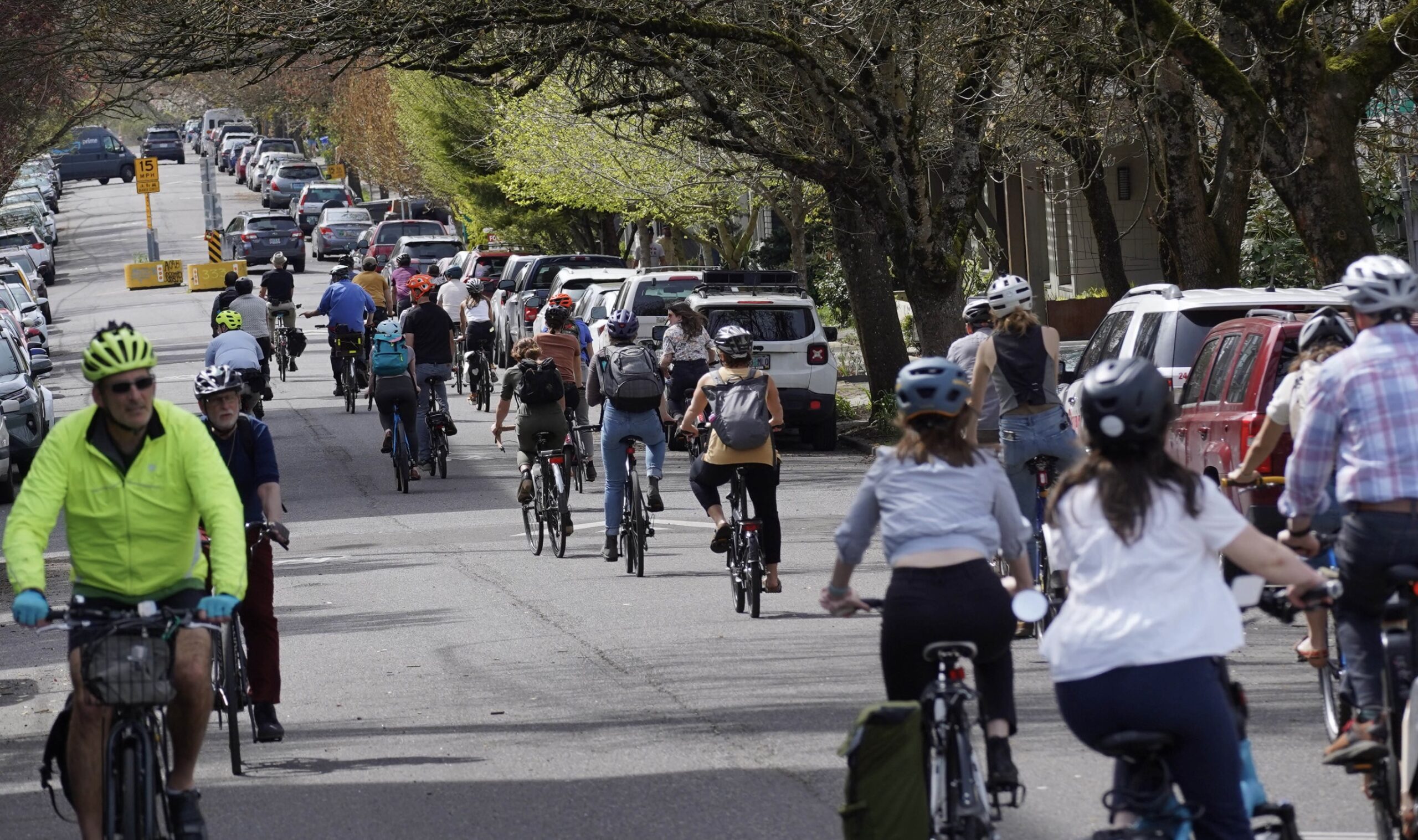
Grab yer buds. Ride some bikes. (Photo: Jonathan Maus/BikePortland)

Welcome to the weekend! Here’s our weekly selection of rides and events worth your time.


This week’s guide is sponsored by Ride the Dirt Wave – Klootchy Creek June 3-4. This new event will introduce you to amazing mountain bike trails relatively close to Portland in the Coast Range. One day for fun riding and one day for racing. Perfect for families too!

Register and learn more here.


Friday, May 19th

Lloyd Bike to Work Day – 10:00 am to 2:00 pm at Hassalo Plaza (NE)
Get pumped (literally) to ride your bike at this traditional gathering sponsored by Go Lloyd. Free repairs, scooter and Biketown demos, coffee, treats, and more. More info here.

Filmed By Bike – 7:00 & 9:00 pm at Hollywood Theater (NE)
It’s here! Portland’s fave film fest. Time to roll out for inspiring bike movies full of beautiful places and people. It’s the perfect excuse to go out and meet friends old and new. More info here

Bike Party and Fundraiser Feat. Machete Mike – 5:00 pm at Irving Park (NE and NW)
Meet at the park and ride to the venue in northwest for a night of music and fun with six bands, including Machete Mike (Royal from the Timberwolves bike recovery crew). They’ll be raising money to get a new bike for friend of the community, Greg Cedarbeard. More info here.

Saturday, May 20th

Cutty Cap Challenge – All day
If you have a Ride With GPS account and love going on bike scavenger hunts, make sure you are linked into this cool event. Starting at 8:00 am, they’ll release (via email) the locations of custom-designed caps and bandanas all over town. More info here.

SW Trails Walk – 9:00 am at Council Crest Park (SW)
Join walking lovers for a 3.2 mile stroll around beautiful Council Crest and Marquam Park. More info here.


Bike With a Buddy Adaptive Bike Ride – 11:00 am at Kerr Bikes on the Esplanade (SE)
Are you or someone you know unable to ride a traditional, two-wheeled bike? Come rent an adaptive bike from Adaptive Biketown and join a fun group ride that ends at a pizza joint. Easy, family-friendly vibes. More info here.

Filmed by Bike Parking Lot Party – 2:00 to 4:30 pm at Cyclepath Bike Shop (NE)
Our friends at Cyclepath will host a banger hanger with all types of fun treats to get you psyched for the festival. Then the Ride with JennaBikes will start here and roll together to the theater for the movies. More info here.

Asprilla Bicycle Club Pub Crawl to Timbers Match – 4:30 pm at Gorges Beer Co. (SE)
Meet at Gorges and then make a stop at Paymaster before rolling into the stadium at 6:30 pm to watch the Timbers v Minnesota United. A perfect Portland night! More info here.

Filmed by Bike Showings – 6:00 and 8:00 pm at Hollywood Theater (NE)
Don’t miss the Bike Love and Adventure movies, and then there’s the after-party that starts at 10:00 if you still haven’t gotten enough. More info here.

Sunday, May 21st

Filmed By Bike – Sunday Funday
A full day of playing on bikes! Starting with Coffee Outside at 10:00 am, there’s also an alleycat and a BIPOC ride before the film showings start. And don’t forget the big closing party. More info here.

BikeLoud PDX SE Chapter Ride – 11:00 am at Piccolo Park (SE)
Head down to Milwaukie to explore their new bikeways with fellow advocates and wonderful bike nerds. You’ll be treated to a very cool and safe route that includes time on the Springwater Corridor and through the Reed College campus. Ends at food cart pods! More info here.

Fireworks over fees at City Council as Mapps fights for funding

Commissioner Mapps at City Council meeting yesterday.

At a Portland City Council meeting Wednesday, Mayor Ted Wheeler tried to freeze planned fee increases from three city infrastructure bureaus. It was all part of an eleventh-hour, anti-tax crusade from Wheeler that caught other city commissioners off-guard and made them scramble to justify parts of their budget they believed were already safe.

Wednesday’s meeting was the final step in the process to approve the City of Portland’s $7.1 billion budget, but it was the first time commissioners debated three amendments from Wheeler that sought to reduce planned fee increases from the Bureau of Environmental Services, Water Bureau, and Portland Bureau of Transportation that would total $18.7 million in revenue. At the meeting, Wheeler and the four other commissioners heard public testimony on the amendments and had heated exchanges about the impacts of the reductions.

“These increases are choking the life out of this community. People are picking up and they’re leaving.”

– Ted Wheeler, mayor

“It just doesn’t pass the smell test to say the reason why people are leaving the city is because of parking meter rates.”

– Mingus Mapps, commissioner

From Wheeler’s perspective, his moves are all about making people like Portland more. He’s worried that too many people are fleeing our city and he thinks the cumulative impact of the many fees and taxes people pay in this region (not just from City of Portland, but from Metro and Multnomah County) are a major reason why. “We want people to stay [in Portland],” Wheeler explained. “And I think people acknowledge that we are at an inflection point in our city. And studies now show that people are choosing not to stay here.” Even though Wheeler has been mayor for six years, he never once in the meeting acknowledged that perhaps there are other reasons people are leaving — like the fact that during his tenure Portland has not made tangible progress on our most pressing crises like homelessness, housing, drugs, guns, traffic safety, and so on.

At one point in the meeting Wheeler likened his attack on these planned fee increases as him taking, “bold action to lead.”

While Wheeler is right that no one likes paying more for things, some of his fellow commissioners — and almost every member of the public who showed up to testify against his plans — feel like this type of populist gesture is the wrong policy at the wrong time.

PBOT Commissioner Mingus Mapps was more animated and engaged at yesterday’s meeting than I’ve ever seen him since he came to office in 2021 — not surprising since he’s commissioner-in-charge of all three bureaus Wheeler wanted to take money from. Mapps arrived at City Hall Wednesday looking at over $18 million in reductions to budgets that had already been crafted. The magnitude of what Wheeler sought at the last minute was an extremely rare move and it was clear that this episode has created distance between he and Mapps.

“We can’t throw our umbrella away in a rainstorm and we can’t afford to throw away a reasonable mechanism to keep the lights on at PBOT… while this larger conversation takes place.”

– Indi Namkoong, Verde

“The [transportation] bureau is on life support, and we are pulling the plug today. I have not seen something like this in an urban setting. Ever. This is a truly remarkable moment,” Mapps said loudly into his microphone as he turned his head and looked at Wheeler. “It just doesn’t pass the smell test to say the reason why people are leaving the city is because of parking meter rates.”

Mapps had strong support from the public testimony.

Michael Andersen, a researcher at Sightline, said parking fees are an excellent tool to raise revenue and encourage outcomes that make Portland a better place to live. He said the best policy would be to simply enact the parking pricing policies Council already passed in 2021 when its Pricing Options for Equitable Mobility plan recommended dynamic parking meter rates where prices are set based on how busy a space is.

Kiel Johnson, a former chair of advocacy group BikeLoud PDX, said, “These cuts will mean more Portlanders are putting their lives on the line each time they go out and use our streets by bike and to many others will decide it’s not worth the risk… Do not defund our roads.”

Chris Smith, a veteran civic activist, budget advisor to two former Portland mayors, and former member of PBOT’s Budget Advisory Committee put it bluntly: “Absent this overdue increase in parking fees, PBOT is basically going out of business. I would urge you not to allow that to happen. [The parking rate increases are] overdue and it’s a good policy for the city.”

Portlander Will Hollingsworth said Wheeler’s amendment, “Reeks of craven politicking and it endangers the ability of the city to carry out its bedrock functions.”

Indi Namkoong, transportation justice coordinator with Verde, said, “We can’t throw our umbrella away in a rainstorm and we can’t afford to throw away a reasonable mechanism to keep the lights on at PBOT… while this larger conversation takes place.”

After the testimony, Wheeler refuted some of what he heard. “This is not a cut. This is holding the line on proposed increases. Others had suggested that without this fee increase PBOT is broken. Yes, it would require some tough choices and trade-offs, but it’s hardly them being broke and it’s certainly not as a result of cuts. People said, ‘Well this this will bring to an end critical projects and making sure our city meets our climate action goals, etc. etc.’ It does not have to. The cuts do not have to come out of those critical projects.”

To reinforce his point, Wheeler peppered staff with questions about just how much of an impact the $8.3 million reduction (which is what PBOT would have to make without the 40-cent meter increase) would have on PBOT’s budget. The reduction would come out of PBOT’s General Transportation Revenue, a vital pot made up of parking fees and gas taxes that funds many popular programs. A PBOT budget staffer said when the $8.3 million is combined with large and consequential cuts PBOT already has to make it would amount to a 35-40% reduction to those programs. 

Wheeler feels there are “substantial other resources” in PBOT’s capital budget that would not be impacted. But what Wheeler didn’t acknowledge is that PBOT can’t spend capital money without the staff to do the engineering, communications, planning, and construction of those projects. To see Wheeler clearly disagree with PBOT staff, the PBOT commissioner, and advocates who shared expert testimony, really made it clear how out-of-step his views about PBOT have become. 

Despite a City of Portland survey that showed higher meter rates have almost no impact on peoples’ decisions to drive and park downtown, Wheeler was steadfast in his belief that it does.

“We are begging people to come to downtown Portland and see that we have improved the situation [his belief is that we need to earn back people’s trust that the city is getting better, before we charge them more]. And studies show that when people come to downtown Portland, they are twice as likely to have a favorable impression of the city than prior to coming to downtown Portland. So it’s really important at this moment in our history, for us not to send mixed signals to say ‘Come to downtown Portland! And oh, by the way, we’re increasing the parking meter rates 40-cents per hour*.”

(*Note that when this 40-cent increase came to council in 2022, Wheeler voted in favor of it.)

“I don’t want people to think I’ve lost my fiscal bearings,” Wheeler continued. “I most certainly have not. But I also see a bigger purpose here. In terms of what we need to do over the course of the next year to rebuild confidence in the city.”

The central tension between Wheeler and Mapps comes to down to how they foresee the impact of these fees on peoples’ experience of our city. Wheeler thinks folks will be so happy to save 80-cents while shopping for two hours downtown and will have such a great time doing so, that it will help spark the revitalization he so desperately wants (and needs, politically). Mapps thinks the additional budget reductions Wheeler is asking of his bureaus will result directly in service cuts that will make their experience even worse.

Here’s how Wheeler puts it:

“… These increases are choking the life out of this community. People are picking up and they’re leaving our community. We have to turn that [around] by encouraging people to see the work we’re doing and believe in the work we’re doing and believe the value they’re getting for their very high tax, fee, and utility rate increases in the city are worth it to them. I believe the programs and the policies that this council has put into place are showing good early results and in a year from now the public will see the outcomes of those results. But in the near term, I’m asking us to hold the line and do everything we can to encourage people to stay here, to come here, to invest here, to bring their employees back to the City of Portland.”

And here’s how Mapps put it:

“What we are doing this afternoon is undermining the quality of services that this city council provides to the people of Portland. We are not advancing our position here. We are shooting ourselves and the people of Portland in the feet… I think it’s completely reasonable for this council to look at lowering the rates that we charge in taxes, and we should bring a critical eye to doing that. At the same time, one of our things that we’re also trying to manage is the quality of services we provide. We can save Portlanders 80-cents per parking trip, which is probably not going to be the thing that keeps you staying in Portland if you’re thinking about moving out, but by foregoing that 80-cents increase in parking meter revenues, we will actually see dramatic and profound and unavoidable reductions in services to the people of Portland. I am deeply skeptical that this is the reason why Portlanders are going to leave the city. However, I do believe one of the reason why Portlanders will be leaving the city in the coming years is our crumbling infrastructure.”

Mapps and Wheeler weren’t the only voices that mattered on Wednesday. Commissioner Rene Gonzalez sided strongly with Mapps and opposed the mayor’s amendment.

“40-cents per hour to park downtown, you know, that’s less than the price difference between a grande and venti at Starbucks… Is that really going to impact behaviors? We concluded maybe not,” Gonzalez said. But Gonzalez did acknowledge Wheeler’s point about the public perception created by the cumulative tax burden. Even so, Gonzalez objected to the lack of process and time he and his staff had to react to Wheeler’s proposals. He also said, “The disproportionate impact on infrastructure is a concern to me. Infrastructure in the city has long been under-supported and under-invested in, and that’s where we’re placing the burdens today.”

In the end, Wheeler’s amendment to roll back the 40-cent parking rate increase failed 1-4. He was the only person who voted for it.

Mapps proposed an amendment to increase the rate by just 20-cents. That passed 4-1 with Wheeler being the sole “no” vote.

The other two fee reductions — for the Water Bureau and for BES — passed by a 3-2 margin with Gonzalez joining Mapps in opposition and commissioners Ryan and Rubio going voting in support with Wheeler.

The one thing everyone agreed on was an amendment from Commissioner Carmen Rubio to freeze all system development charge rates for one year, a move expected to make it cheaper to build new housing.

The Mayor’s proposed budget passed by a vote of 4-1, with Mapps being the sole “no” vote. Mapps said asking Portlanders to pay a few dollars in monthly fees to maintain basic services like sewage processing and street maintenance is worth the money it will save the City in the long run by having functioning public works bureaus.

“My ‘no’ vote is a red flag and a warning to Portlanders. This budget contains some terrible decisions around funding infrastructure, in order to literally save pennies.”

– Mingus Mapps

“My ‘no’ vote is a red flag and a warning to Portlanders. This budget contains some remarkably bad choices, especially around infrastructure bureaus. This is a very sad day for the City of Portland and for people who sit in these chairs in the years to come. We pulled the plug on that life support. This budget contains some terrible decisions around funding infrastructure, in order to literally save pennies.”

Even though Mapps was able to save half the parking fee increase, it still means he lost an additional (and unexpected as of a few days ago) $4.1 million from his budget. He said it will be a challenge going forward to maintain programs like Safe Routes to School and Sunday Parkways. One bit of good news from the meeting was a comment from Commissioner Ryan that made it clear the Portland Parks & Recreation Bureau will likely step in and help with Sunday Parkways funding.

But that will be a tiny bright spot in what is likely to be an upcoming era of unprecedented cuts at PBOT, an agency that has a far more complicated and strained budget than any other. After a decade of cuts and reductions in service and staff, it was really striking to watch a mayor intentionally make it even worse. And with his high-profile skepticism about the need for parking rate increases in general, Wheeler has fed into a narrative PBOT has fought against for a long time and has likely made it more difficult to price transportation fairly in the future.

“If we continue down this route, we are talking about layoffs of more than 100 people, maybe many hundreds of people, in the next couple of years,” Mapps said, as he tried to underscore the severity of the impacts. “I’m not against belt tightening and reimagining how we do our work, but if one of the expectations of the people in Portland is that they pay their taxes and get good services, I can guarantee you, this is going to undermine our ability to provide people with transportation services. We are accelerating the deterioration of PBOT.”

The budget office will now incorporate these changes and Council will make the final vote to adopt the budget in mid-June.

The 23 Portland parks primed for new bike trails and riding areas

Why on earth would we limit this to just one or two parks in our entire system?
(Map: Bureau of Planning & Sustainability. Photos: Jonathan Maus/BikePortland)

There are 154 parks in Portland with about 12,000 acres of land. About one-forth of those acres have something built on them (think golf course, playgrounds, racetrack at PIR, and so on) and the rest (about 70% of the total acreage) is just grass and trees and dirt. According to the newly adopted Off Road Cycling Master Plan, 23 of those parks could easily handle new bike trails or some sort of pump/skills track.

For years now, some folks have felt like we could build more off-road trails in these parks in order to open up more cycling opportunities for Portlanders. Right now there’s a shocking lack of places in this city where you can hop on a bicycle and experience the mental and physical pleasures of navigating a dirt trail. The people who love doing that are mostly forced to hop in their cars and head to riding areas near Mt. Hood, Sandy, Hood River, or (relatively recently) Scappoose. For everyone else, off-road cycling has just never been an option.

Yes, we have dirt to ride in Forest Park, but it’s either extremely boring (flat, wide roads) or extremely difficult for all but expert riders.

The solution, some people say, is to use what we have and build new trails and riding areas inside the existing parks that are within an easy bicycling distance of almost every Portlander. We’ve already had some success with this: the Gateway Green bike park and the small pump tracks at Ventura Park (also east Portland) and in New Columbia neighborhood in St. Johns. On any given day when the sun is out and dirt is dry, you can find all types of smiling people — especially younger ones — riding bikes in these parks.

Why do we have so few places like this? Part of the reason is politics and what I’ve described as Portland’s irrational fear of off-road cycling. But it’s also just due to a lack of planning and advocacy. Before anything happens around here, we need some sort of plan. Then we need people who care about it to stand up and push for it. When it comes to off-road cycling in parks, we now have both parts of that equation primed and ready-to-go.

Now that the Off Road Cycling Master Plan is an official city plan, it’s time to recognize that its authors have singled out 23 existing city parks — in every corner of our city — they think are compatible with unpaved bike riding areas. The list below comes from a map included in the plan where BPS labels parks and other parcels that are ripe for new trails and/or bike parks. Check it out, and get those gears turning for more places to safely ride our bikes without having to drive a car to a trailhead!

North

Pier Park – 85 acres

  • A Master Plan, developed with community involvement, to guide future improvements to the park
  • A medium-sized bicycle park (about 1 acre). Bicycle parks have areas for family recreation and skill building. The bicycle park could be located near the popular skate park.
  • A natural surface loop trail for family-friendly cycling, walking, running and enjoyment of nature. Off-road cycling skill features (like rocks, logs, or skinny bridges) could be added along the sides. Care should be taken to limit potential conflicts with disc golf course.

University Park – 11 acres

  • A small bicycle park (about 5,000 to 10,000 ft²). Bicycle parks have areas for family recreation and skill building. The bicycle park would be located outside the sports fields.
  • A natural surface loop trail for family-friendly cycling, walking and running. Off-road cycling skill features (like rocks, logs, or skinny bridges) could be added along the sides.
  • Building a bicycle park or trail here will require additional planning and community input

Dog Bowl – 25 acres

  • Habitat restoration including native plantings and removal of invasive plants
  • Closure and restoration of existing demand trails.
  • A natural surface trail network for family-friendly cycling, walking, running and enjoyment of nature. This trail network should connect should remain on the upper, flatter portion of the site and protect oak habitat
  • Building a trail here will require additional planning and community input
  • Transfer of property to Portland Parks & Recreation

Farragut Park – 14 acres

  • A small bicycle park (about 5,000 to 10,000 sf). Bicycle parks have areas for family recreation and skill building
  • A natural surface loop trail for family-friendly cycling, walking and running
  • Building a bicycle park or trail here will require additional planning and community input

Northeast

Fernhill Park – 27 acres

  • A natural surface loop trail for family-friendly cycling, walking, running and enjoyment of nature. Off-road cycling skill features (like rocks, logs, or skinny bridges) could be added along the sides. A well-designed loop of approximately 1.5 miles could also provide a better trail for the cross-country running races and training held at the park. Care should be taken to limit potential conflicts with off-leash dog area.
  • A medium-sized bicycle park (about 1 acre). Bicycle parks have areas for family recreation and skill building
  • A Master Plan, developed with community involvement, to guide future improvements to the park. This Master Plan could also consider an east-west paved and lighted trail to improve park access and connections.
  • Building a bicycle park or trail here will require additional planning and community input, including from neighbors, running groups, off leash dog area users, and other park users.

Glenhaven Park – 14 acres

  • A natural surface loop trail for family-friendly cycling, walking, running and enjoyment of nature. Off-road cycling skill features (like rocks, logs, or skinny bridges) could be added along the sides. The loop trail could connect to the proposed trail at Rose City Golf Course and connect to neighborhoods south of NE Tillamook Street.
  • A small bicycle park (about 5,000 to 10,000 ft²). Bicycle parks have areas for family recreation and skill building.
  • Building a bicycle park or trail here will require additional planning and community input.

Rose City Golf Course – 151 acres

  • A natural surface loop trail for family-friendly cycling, walking, running and enjoyment of nature. Off-road cycling skill features (like rocks, logs, or skinny bridges) could be added along the sides. The loop trail could provide safe walking access along NE Tillamook and connect neighborhoods to the south of the golf course to Glenhaven Park. Creating a full loop may require on-street segments. Care should be taken to limit potential conflicts with the golf course.
  • A small bicycle park (about 5,000 to 10,000 ft²). Bicycle parks have areas for family recreation and skill building.
  • Building a bicycle park or trail here will require coordination with the Rose City Golf Course and additional planning and community input.

John Luby Park – 10 acres

  • A natural surface loop trail for family-friendly cycling, walking, running and enjoyment of nature. Off-road cycling skill features (like rocks, logs, or skinny bridges) could be added along the sides. The loop trail could provide safe walking access along NE Tillamook and connect neighborhoods to the south of the golf course to Glenhaven Park. Creating a full loop may require on-street segments. Care should be taken to limit potential conflicts with the golf course.
  • A small bicycle park (about 5,000 to 10,000 ft²). Bicycle parks have areas for family recreation and skill building.
  • Building a bicycle park or trail here will require coordination with the Rose City Golf Course and additional planning and community input.

Southeast

Colonel Summers Park – 6 acres

  • A small bicycle park (about 5,000 – 10,000 ft²). Bicycle parks have areas for family recreation and skill building
  • Building a bicycle park here will require additional planning and community input

Mt Tabor Park – 183 acres

  • Habitat restoration including native plantings and removal of invasive plants
  • Closure and restoration of demand trails.
  • Trail network improvements to make it more sustainable, reduce redundant trail segments, and create a loop for off-road cycling
  • Improved signage to help park users navigate and understand whether trails are open to pedestrians, cyclists, or both

Creston Park – 14 acres

  • A small bicycle park (about 5,000 – 10,000 ft²). Bicycle parks have areas for family recreation and skill building. The bicycle park could replace the closed tennis courts.
  • A natural surface loop trail for family-friendly cycling, walking, running and enjoyment of nature
  • Building a bicycle park or trail here will require additional planning and community input

Brentwood Park – 13 acres

  • A small bicycle park (about 5,000 – 10,000 ft²). Bicycle parks have areas for family recreation and skill building
  • Building a bicycle park here will require additional planning and community input

Gates Park – 11 acres

  • A Master Plan, developed with community involvement, to guide future improvements to the park
  • A large bicycle park (1 to 3 acres). Bicycle parks have areas for family recreation and skill building
  • A natural surface loop trail (about ½ mile) for family-friendly cycling, walking and running. Off-road cycling skill features (like rocks, logs, or skinny bridges) could be added along the sides.

Lynchview Park – 8 acres

  • A small bicycle park (about 5,000 to 10,000 ft²). Bicycle parks have areas for family recreation and skill building
  • A natural surface loop trail for family-friendly cycling, walking and running. Off-road cycling skill features (like rocks, logs, or skinny bridges) could be added along the sides.
  • Possible partnership with the adjacent elementary school
  • Building a bicycle park or trail here will require additional planning and community input
  • This location is an alternate to Parklane Park

Ventura Park – 7 acres

Ventura Park has two pump tracks — one for intermediate riders and a second for young children.

  • Continuing to improve drainage at the pump track
  • Improving and possibly expanding the pump tracks
  • A natural surface loop trail for family-friendly cycling, walking and running. Off-road cycling skill features (like rocks, logs, or skinny bridges) could be added along the sides.

South

River View Natural Area – 146 acres

  • Stream and habitat restoration including native plantings and removal of invasive plants
  • Continued the interim prohibition of off-road cycling until sustainable trails are identified or developed
  • Complete detailed alignment planning and trail design for the natural surface trail loop described in the River View Natural Area Management Plan’s Access and Management Concept as a model of a sustainable and safe shared-use trail.
  • Design trails using best management practices appropriate to the natural area’s topography, environmental assets, and expected level of use by pedestrians and cyclists. See pages 76 – 77 of the Discussion Draft for additional design guidance.
  • If the City cannot identify a sustainable shared-use trail alignment that is consistent with best management practices while meeting site objectives, evaluate alternative approaches and management strategies.
  • Fund and build a well-designed, sustainable trail that will limit potential negative impacts, reduce maintenance costs, and serve recreational users. Ongoing investment in trail maintenance will also be required.
  • Consider opportunities to build other recommended natural surface trails in western Portland either before, or in concert with, River View trail design and construction to help distribute the latent demand for off-road cycling experiences.
  • Develop a maintenance plan for the trail system that identifies unacceptable environmental impacts or safety risks and methods to address these impacts.
  • Monitor trail use, including any safety or environmental risks, through on-site observation and/or community reporting.
  • Use adaptive management strategies (e.g. seasonal closures, trail improvements, education, conditional or permanent rerouting or closure of trails, use restrictions) to address unsustainable conditions or unacceptable impacts.
  • Building a trail here will require additional planning and community input

Loll Wildwood – 2 acres

  • A Management Plan for the entire natural area, developed with community involvement, to guide environmental restoration, stewardship, and recreational access
  • Stream and habitat restoration including native plantings and removal of invasive plants
  • Closure and restoration of existing demand trails
  • Natural surface trails for family-friendly cycling, walking, running and enjoyment of nature. Trails could include and east-west trail on the north side of the creek, a single bridge crossing, and a loop trail on the south side of the creek. The trails would provide a way to experience the natural area and make it easier to walk and bike to destinations in the neighborhood.
  • Building a trail here will require additional planning and community input

Lesser Park – 8 acres

  • Habitat restoration including native plantings and removal of invasive plants
  • Closure and restoration of existing demand trails
  • A natural surface trail network for family-friendly cycling, walking, running and enjoyment of nature. This trail network should connect to natural trails at the Portland Community College – Sylvania Campus.
  • Building a trail here will require additional planning and community input

Southwest

Gabriel Park – 90 acres

  • A Master Plan, developed with community involvement, to guide future improvements to the park
  • Continued natural area enhancements. Gabriel Park’s natural areas have undergone significant environmental restoration and pedestrian trail improvements
  • A medium-sized bicycle park (about 10,000 ft² to ½ acre). Bicycle parks have areas for family recreation and skill building. The bicycle park could be located near the popular skate park and away from natural areas.
  • A shared-use natural surface loop trail (about 1.5 to 3 miles), outside of the core natural area. This trail could be used by nearby residents for family-friendly cycling, walking, running and enjoyment of nature. Off-road cycling skill features (like rocks, logs, or skinny bridges) could be added along the sides.
  • A designated safe pedestrian and cyclist route along SW 45th Avenue, including crossings
  • Improved signage to help park users navigate and understand whether trails are open to pedestrians, cyclists, or both

Hamilton Park – 10 acres

  • A small bicycle park (about 5,000 to 10,000 ft²). Bicycle parks have areas for family recreation and skill building
  • A natural surface loop trail for family-friendly cycling, walking, running and enjoyment of nature
  • Building a bicycle park or trail here will require additional planning and community input

Washington Park – 292 acres

  • Restoration of degraded wildlife habitat through native plantings and removal of invasive plants
  • Closure and restoration of existing demand trails
  • A natural surface off-road cycling trail loop in the area east of Kingston Drive, as envisioned in the Draft Washington Park Master Plan. Trails could include a descending flow trail and an uphill skill trail.
  • Building a trail here will require additional planning and community input

Forest Park (Southern Section) – 1178 acres

  • Continue to implement the Forest Park Natural Resource Management Plan and other adopted plans and strategies for the park
  • Expand and enhance a comprehensive education and outreach program regarding trail rules and etiquette
  • Improve signage for wayfinding and trail use expectations
  • Increase resources and partnerships for restoration, management, enforcement and trail maintenance
  • Monitor impacts of trails and recreation use on vegetation, wildlife and users
  • Practice adaptive management, including trail closures, to address unintended negative impacts. Decommission unsanctioned trails
  • Improve Firelane 1 for better environmental sustainability and to make it a safer and more enjoyable route for cycling, walking, and running, while maintaining emergency access
  • Build a new trail open to off-road cyclists parallel to St. Helen’s Road. This trail should connect Northwest Portland to the proposed Forest Park Nature Center and Firelane 1
  • Build a new trail south of NW 53rd Drive (conditional on completion of Firelane 1 improvements, St. Helen’s trail, improvements to Holman Lane, and assessment of watershed impacts)
  • See pages 61 – 72 of theDiscussion Draft for more information

Forest Park (Central Section) – 1945 acres

  • Continue to implement the Forest Park Natural Resource Management Plan and other adopted plans and strategies for the park
  • Expand and enhance a comprehensive education and outreach program regarding trail rules and etiquette
  • Improve signage for wayfinding and trail use expectations
  • Increase resources and partnerships for restoration, management, enforcement and trail maintenance
  • Monitor impacts of trails and recreation use on vegetation, wildlife and users
  • Practice adaptive management, including trail closures, to address unintended negative impacts. Decommission unsanctioned trails
  • Improve Firelane 1 for better environmental sustainability and to make it a safer and more enjoyable route for cycling, walking, and running, while maintaining emergency access
  • Build a new trail open to off-road cyclists parallel to St. Helen’s Road. This trail should connect Northwest Portland to the proposed Forest Park Nature Center and Firelane 1
  • Build a new trail south of NW 53rd Drive (conditional on completion of Firelane 1 improvements, St. Helen’s trail, improvements to Holman Lane, and assessment of watershed impacts)
  • See pages 61 – 72 of the Discussion Draft for more information

Check out the Off Road Cycling Plan website where you’ll find the map and lots of other helpful info.

PBOT releases three-year update and new map tool for citywide pedestrian plan

Central city showing streets with pedestrian crossing spacing that meet the standard in green; pink are streets with crossings that are too far apart. The white dots are school locations. (City of Portland)

PedPDX, Portland’s Citywide Pedestrian Plan, released it’s three-year status report (PDF) this week and project manager Gena Gastaldi presented highlights to the Portland Bureau of Transportation’s (PBOT) Pedestrian Advisory Committee via Zoom last night.

Like the Bike Plan and Freight Plan, PedPDX structures the city’s modal transportation goals (for walking, in this case) and the strategies for reaching them for the next 20 years.

What has always been impressive about PedPDX from the time it was adopted in 2019 has been its collection and cataloging of pedestrian-related data. For example, it inventoried sidewalk coverage on all of Portland’s major streets—no sidewalks, sidewalk on one side, sidewalk on both sides. That alone is an impressive piece of work and an important resource. They also collected data on crossing deficiencies and gaps.

What Gastaldi was most enthusiastic about last night was the newly-released online sidewalk completeness and crossing gaps maps and the GIS tool for investigating that data. Her enthusiasm was infectious, I’ve spent the last hour banging around with GIS features and am hooked. The tool let’s you overlay important features like schools, transportation stops and community centers. It’s another helpful way to visualize our city.

PedPDX’s other significant effort was to rank Portland’s streets according to their need for improvements. Part of this involved prioritizing sidewalk and crossing improvements across the city. These prioritizations inform the selection and design of the city’s capital projects and pedestrian-related programs and activities, so internally PedPDX is foundational to PBOT’s decision-making processes.

In the past, I’ve publicly criticized the methods used to prioritize streets. And I still think that they are overly-complicated and prone to “mathiness.” But the end result is fine, probably because there is such a strong correlation between PBOT’s equity matrix and Portland’s unsafe streets that any number of approaches would have arrived at a similar ranking.

PedPDX is not a sidewalk-building program, however, so the statistics presented are a total of all construction—public and private—from all revenue sources over the past three years (although there can be up to a nine-month lag between project completion and entry into the map database). The three-year update reported these key performance measures:

Implementation or adoption of new policies and guidelines in the PedPDX Implementation Toolbox:

  • Of the 67 actions described in PedPDX, two are considered complete, 43 are in progress, and 22 have no action to report.

Percentage of the Pedestrian Priority Network with sidewalk gaps / miles of walkway built:

  • From 2019 to 2022, the percentage of the Pedestrian Priority Network with sidewalk gaps (sidewalk on neither or one side) has decreased 3.4%, from 43.1% to 39.8%; Since 2019, about 34 miles of sidewalk have been built in Portland through both capital projects and private development. Additionally, 8.5 miles of our highest priority (tiers 1-3) sidewalk gaps (sidewalk on neither or one side) were made complete by adding sidewalks to both sides of the street.

Percentage of the Pedestrian Priority Network with crossing gaps / number of crossings improved:

  • From 2019 to 2022, the percentage of the Pedestrian Priority Network with crossing gaps has decreased 7.3%, from 79.8% to 72.4%. This decrease does not take into account the 13.4 miles of streets that do not meet transit stop spacing requirements
  • Since 2019, 2,084 crossings have been installed (or restriped to high visibility crosswalks) and 98 deficient crossings have been brought up to city standards.

PedPDX has always been information-rich and the project website continues to deliver in this regard. One can learn a lot about Portland by spending some time exploring this work.

PBOT’s already approved 40-cent parking meter increase in political pressure cooker

Mayor Wheeler has served Portland during an era where our city’s value has dropped precipitously. Now he wants to help fix that by cutting taxes. (Photo: Jonathan Maus/BikePortland)

The bureau that manages Portland’s transportation system has been fighting for more revenue for many years. In late 2012, the funding problems at Portland Bureau of Transportation (PBOT) were so bad that City Council directed PBOT to convene a “financial task force” and develop a report to help aid future decision making. That 11-year old report found that PBOT’s funding model was, “antiquated, unstable and in need of an overhaul.”

Fast forward to 2023. With no major shift in their funding model since those alarm bells rang in 2012, PBOT is at the end of their line. Or, as PBOT Commissioner Mingus Mapps put it at a Council budget work session May 10th, “We are running out of lifeboats and the problem continues to get worse.” Mapps is so desperate he was willing to float the idea of an $8 per household fee to save the transportation bureau — a move that in a different political era could have cost him his job.

Past PBOT commissioners must be shaking their heads. The exact problem they and PBOT leadership have warned about for years — that too much of the agency’s revenue relies on driving and parking cars downtown (both of which go against the city’s stated goals and values) — is coming to fruition much more quickly than expected. PBOT has clung to parking meter fees for years, knowing full well that if they succeeded in getting more people onto buses and bikes, they’d eventually have to let them go. Then Covid came and wiped out downtown car traffic, taking a valuable piece of PBOT’s budget with it. Now there’s a chance the bureau might face devastating cuts to staff, maintenance operations, and popular programs — like Sunday Parkways and Safe Routes to School — even sooner.

Thanks to a 40-cent meter increase approved by City Council in February 2022, PBOT figured they could remain in the black for one more year. But that was before new projections accelerated the parking decline and before Mayor Ted Wheeler went on an anti-tax crusade.

Wheeler held a surprise work session at City Council Friday. It was unexpected because the schedule of the budget process is predictable for a reason. Not only do commissioners hate surprises during budget season, but by the time the Mayor’s proposed budget is released and work sessions take place, all the major reductions are already accounted for. It’s certainly not normal for a Mayor to convene a special work session on his own accord — especially not one whose expressed purpose was to question whether or not proposed rate and fee hikes should happen at all.

“We’re hearing growing concerns that Portland is an increasingly difficult place to live and work due to increased taxes, utility rates, and fees,” Wheeler said at the outset of Friday’s meeting. It was a brutal exercise: city bureau directors and top-level staff had to justify proposed increases and explain what might happen if they don’t go through. To set the mood prior to the meeting, Wheeler proposed a one-year freeze on all new city fees and utility rate increases. City staff knew what they were up against.

PBOT Interim Director Tara Wasiak was there to plead the case that the 40-cent parking meter rate increase would send the agency into oblivion if it wasn’t allowed to move forward.

“The 40-center meter increase makes up for rate increases that should have occurred since 2016 (the last time rates went up) to account for inflation,” Wasiak explained. “If the increased is not approved, we will need to find an additional $8.3 million to cut.” Those cuts would come on top of years of brutal budgets that have winnowed PBOT staff to the bone and left cash reserves nearly empty.

To put the impact of losing the 40-cent increase into perspective, PBOT put together three scenarios that would save them $8.3 million. Each one would require a terrible combination of fewer services, programs and projects. Upon hearing about a scenario to make across-the-board cuts, Mapps asked PBOT Business Services Director the most important question:

“How many people do I have to lay off at PBOT under this scenario?” Mapps asked.

“Probably around 100 FTE,” Patton replied.

PBOTers are used being in a sour mood during budget season, but this move by Wheeler has likely taken things to a whole new level. Not only is it coming very late in the budget process, but the parking rate increase has already been approved by council (Wheeler himself voted for it). Adding to PBOT’s likely frustration is that their research shows people wouldn’t even notice the higher parking price. Based on a March 2023 PBOT survey of people parking downtown, only 4% of people said cost influenced their decision to drive and 82% didn’t even know the price before leaving home. 94% of folks who took the survey said even if they knew the price they’d still choose to park. “This data indicates to us that the price of parking is not influencing people’s decision to drive and park on downtown streets,” Wasiak said Friday.

But despite PBOT’s pleas, politics might trump parking policy.

In the past week as Wheeler has sought attention for wanting to reduce Portlanders’ “collective tax burden,” he’s made the argument that people have historically been willing to pay more to live here. “What we’re hearing is about the value proposition,” Wheeler said Friday. “Portlanders… support a myriad of taxes and fees on themselves provided they feel that they are getting the value in return.”

“And during this challenging time in our city’s history, I think we can all agree with a degree of honesty and self-reflection that people don’t see the same value that perhaps they did.”

Wheeler’s not wrong in that assessment; but he should acknowledge that he’s been mayor since 2017 and the value many people used to see in this city has been winnowed to almost nothing. Now he’s trying to make things better by cutting taxes and asking his fellow commissioners to pay a very steep price, “give the programs that we’ve invested in time to show their worth to the public.”

For his part, Commissioner Mapps made it clear Friday he disagrees with Wheeler. “I think the proposal to freeze utility rates and forego the parking revenue increase are, really, frankly disastrous and unwise.” But Mapps said he would be willing to consider a rate freeze on transportation system development charges (SDCs). That move would result in a $400,000 cut to projects PBOT already has planned in the coming year.

The next step for this discussion comes at City Council’s meeting on Wednesday (5/16). Stay tuned.

City of Portland annual bike counts will include scooter riders for first time ever

Scooter riders in downtown Portland. (Photo: Jonathan Maus/BikePortland)

The Portland Bureau of Transportation has taken a notable step forward in their embrace of micromobility. For the first time since they began annual bike counts in the 1990s, PBOT and their team of volunteers will also tally the number of electric scooters, skateboarders and one-wheelers that roll past the over 300 count locations this summer. Also this year, they plan to make their first attempt at segmenting out the number of electric bikes on our roads.

PBOT has done annual bike counts longer than any other major city in America. Their dataset includes counts from before the year 2000 and has given planners and advocates and invaluable resource to gauge progress and glean insights. This year’s count will likely be scrutinized more than usual. That’s because last year’s count exposed a major cycling decline since 2019 and things in the transportation world have been very topsy-turvy since Covid hit in 2020. “The 2023 counts will be an important measure to see if and how Portlanders are responding to new commutes, new infrastructure, and a new normal,” reads PBOT’s website.

“Without any real data, you just have no voice.”

– Cory Poole, NW Skate Coalition

We’ll also gain a better understanding of the impact these new micromobility vehicles are having on our transportation system. Back in April we shared how e-scooter ridership was very healthy in Portland — even as bike counts dwindled. Are scooters, electric skateboards, and one-wheels luring people off their bikes? Are their enough of these users to demand a greater voice in infrastructure planning and policy decisions?

Cory Poole with Northwest Skate Coalition hopes so. He’s happy PBOT will get more serious about counting more than just bikes. In a phone call today, Poole reminded me that PBOT counted skateboards back in 2014, but that effort wasn’t very robust and it only lasted three years. He thinks having better data about how many people are using scooters and skateboards (he’s even noticed a big uptick in roller skaters), will give these modes a bigger seat at the table. “People are choosing a much wider range of modes to get around, and without data, you can anecdotally say, ‘Oh, I see skateboards all the time, or ‘I see scooters all the time.’ But without data, it’s really hard to put that into any kind of useful narrative, especially if you’re asking the city for money.”

“Without any real data, you just have no voice.”

Right now, Poole says, skateboarders and scooter-riders are not represented on an of PBOT’s three modal advisory committees — which specifically represent the interests of bicycle, pedestrian and freight advocates. “Hopefully, if they can see that a certain percentage of people out there are skating, scooting, and roller-skating around, that there should be some voice voice at the table.”

What would an advocate like Poole do with a stronger voice? He’d push for smoother pavement, smaller expansion joints on bridges, and lane markings that don’t make skateboarders slip.

This new approach from PBOT will also hasten awareness and evolution that “bike lanes” of the future might intentionally welcome more than just bikes. As we shared back in March, there’s been a push from some urban planners to re-frame bike lanes and be more inclusive of a wider range of lightweight vehicles that aren’t ready to mix with car drivers, but are not typically considered as bike lane users.

PBOT signs up and trains dozens of volunteers for their counts each year. They will fan out to over 300 locations citywide and counts will begin June 6th and run through September 28th. Sign up to help and learn more about the counts on PBOT’s website.

Checking in on Bike Happy Hour (and announcing T-Shirt Swap and Share Night!)

I could not be more thrilled about how Bike Happy Hour has taken off since the first one back in early April. Tomorrow it will be week #7 and I’m so thrilled at all the wonderful people and “immaculate vibes” (according to one attendee) each week. My favorite thing is how many brand new faces show up. Folks who don’t know anyone at first, but by the time they leave have a whole new group of pals and a new place where they know they can always come to be heard and seen and appreciated.

Happy Hour has quickly become a community space for bike-minded people. And since it’s been nearly two months I figured it was time for a check-in.

Below is a random list of updates and other things I’ve been thinking about — including the announcement of our first themed night coming 5/24…

My new BikeLoud tee. Unfortunately it’s pretty big for me so I might bring it to swap night.

Next week (5/24) will be our first themed event: It’s Bike T-Shirt Swap & Share Night! If you have a favorite bike-related t-shirt you want to show off, let’s see it! Share the story of where you got that old bike tee and why you’ve kept it all these years. Or maybe you’ve got a pile of them in your closet that you want to trade or give to someone who could use one? Bring and/or wear your tees on 5/24 and we’ll be ready to listen to your stories about them and maybe pass them on to others. So far I’ve got folks from Cyclepath Bike Shop and Biketown who plan to bring some to share. That’s fine too! It’s Happy Hour, we don’t really make rules. Just show up with your shirts and we’ll figure it all out.

Did you know our host Gorges Beer Co. has installed Portland’s first ever electrified bike rack? It’s true! They bought one of those cool racks from Dero that have a standard 120V outlet on each side where you can plug in your e-bike to get a charge while you hang out. Remember to bring your charging cord!

Speaking of bike parking, Gorges (and Ankeny Tap & Table) owner Travis Preece has order a new bike parking corral with 10 staple racks. Look for it to be installed soon!

I’m thrilled that we finally have a big “Bike Happy Hour” banner that folks can see as they roll past on SE Ankeny. Take your photo with it for good karma and to help spread the word.

Someone recently asked about if the event is truly “family friendly.” I’ve said yes because I’ve seen several families show up with little kids and they seemed to have a fun time. But we didn’t have any kid-specific amenities to offer folks that showed up empty-handed. So we’ve fixed that. Expect some coloring books and crayons to keep your kiddos engaged. We’ll add more fun things in the future (let us know if you have requests).

I realize the line for drinks got pretty long last week. The staff at Gorges and Ankeny Tap are amazing people, but they can only do so much and they are not used to such big Wednesday crowds. That should be fixed now because they’ve staffed up and will have at least one additional person behind the counter. Thanks Corey, Una, Tabi, and Kendra!!

Last week we had Nick from Vvolt show up to share a prototype of their latest model. That was very smart! I want folks to know that Bike Happy Hour is a great place to show off new ideas and products. We have quite an interesting brain trust of folks that show up each week. On a similar note, I’ve met a few folks who showed up that are in between jobs and are looking for leads. That’s exactly what Happy Hour is for! Come and network! Find me if you want or need introductions to specific folks. I love connecting people.

Wednesday May 31st is the start of the famous Mt. Tabor Race Series. Racing up in the park starts at 5:20 and the last race starts at 8:00. Mt. Tabor park is just two miles up the road from the Gorges patio and I want to extend a personal invite to all bike racers and their fans to swing by Happy Hour before (remember you can get $2 off coffee drinks at Crema) and/or after your race!


OK that’s it for now. When I started this thing seven weeks ago I was worried about adding another evening “work” event to my calendar each week; but now I look forward to it every time. I’ve met so many new people and I just could not be happier about how it has evolved and grown so quickly. Thank you to all our regulars and everyone who shows up. See you on the patio tomorrow!

Transportation bureau recommends slate of north Portland projects

One of the projects would add a bike lane to this dreadful gap on N Interstate at Rosa Parks.

The Portland Bureau of Transportation has released their recommendations for which neighborhood greenways and bike infrastructure improvements should be prioritized in north Portland. The recommendations were released Friday afternoon and are the culmination of two years of planning and public outreach for the North Portland in Motion plan. We first covered this plan in April 2021 and since then, PBOT project staff have led bike tours of the area, identified a number of projects, collected feedback, convened an advisory group, and more.

Now we’ve got seven solid new neighborhood greenway projects, 10 “corridor improvement” projects, and six public space projects to rally around and push toward completion. Like all of their “In Motion” plans (of which they’ve already completed in the central city, as well as east, southwest, and northwest Portland) there is not funding attached from the outset. The value of these plans is that they give PBOT and publicly vetted, “shovel-ready” list of projects that have a much better chance of actually being built when/if funding becomes available. They also give advocates clear organizing goals and leverage to create awareness and support for specific projects.

Here are the seven Tier 1 neighborhood greenway projects PBOT recommends (click project name for PBOT doc with more info):

  • NG.1 – N Willamette Blvd Neighborhood GreenwayNew neighborhood greenway on N Willamette Blvd and N Reno Ave provides a connection to Cathedral Park and Sitton Elementary. 
  • NG.2 – Upper St Johns Neighborhood Greenway: A bundle of new Neighborhood Greenways in the northern section of St Johns intended to fill major gaps in the network, including investments on N Charleston Ave. Provides a direct connection to George Middle School, James John School, St Johns Library, St Johns Farmers Market, and Downtown St Johns.
  • NG.3 – N Burr Ave / N Buchanan Ave Neighborhood Greenway: A new neighborhood greenway providing a north/south walking and biking connection between N Willamette Blvd and N Columbia Blvd. This route connects a number of important neighborhood destinations including George Middle School, George Park, Roosevelt High School, and businesses on N Lombard St and N Willamette Blvd.
  • NG.4 – Portsmouth & University Park Neighborhood Greenway Loop: A collection of new and upgraded Neighborhood Greenways building out a complete and comprehensive network in the Portsmouth and University Park neighborhoods. This collection of projects improves access to schools (Astor Elementary, Cesar Chavez Elementary) and parks (Columbia Park, Portsmouth Park, McKenna Park). It also provide access to New Columbia, the largest affordable housing development in the State of Oregon.
  • NG.5 – Kenton Neighborhood Greenway Network Expansion: A bundle of new Neighborhood Greenways on N Delaware Ave, N Halleck St, and N Kilpatrick St intended to expand and improve the network in the Kenton Neighborhood.
  • NG.6 – N Delaware Ave Neighborhood Greenway: A new neighborhood greenway on N Delaware Ave providing a calm and comfortable route for people walking and biking between Kenton and Overlook neighborhoods. This neighborhood greenway provides a direct connection to Chief Joseph Elementary and Arbor Lodge Park and fills a major north-south gap in bike network. 
  • NG. 7 – N Ainsworth St Neighborhood Greenway: A new neighborhood greenway on Ainsworth St connecting the greenway and bike lanes on Willamette Blvd with Interstate Avenue. This project would fill a key gap in the biking network between N Rosa Parks Way and Willamette Blvd, and provide direct access to Ockley Green Middle School.

These greenways would double the density of the bike-friendly street network in the northern peninsula of our city and provide key links to important destinations like parks, schools and commercial areas.

Along busier streets, PBOT categorizes the projects as “corridor improvements” where they plan to do things like speed limit reductions, lane reconfigurations, transit access improvements, and so on. Here are the 10 Tier 1 corridor improvement projects they recommend:

  • CI.1 – N Smith St: This project would improve and enhance existing pedestrian crossings at new Neighborhood Greenways, update existing all-way stops and median island crossings with improved crosswalks, and make minor changes to improve the existing buffered bike lanes. This project recommends continued investment in traffic calming to reduce speeds, monitoring, and evaluation. 
  • CI.2 – Cathedral Park Access Improvements: This collection of projects would invest in basic safety investments to improve access for people walking and biking between the waterfront area of Cathedral Park and Downtown St Johns.
  • CI.3 – N Willamette BlvdThis project would implement lower-cost elements of the federally funded Willamette Blvd Active Transportation Corridor scheduled for construction in 2025-2026. These near-term improvements would include new marked crosswalks, improved bus stops, and new buffered bike lanes from N Alma Ave to N Richmond Ave.
  • CI.4 – N Macrum Ave (St Johns): This project would add on-street parking, street trees, and high-quality buffered bike lanes connecting to bike routes on N Fessenden St and N Columbia Way. Additionally, this project would add a new crossings at N Columbia Way and N Fessenden St and include safety improvements at the existing signalized intersection of N Columbia Blvd.
  • CI.5 – N Fessenden St: This project would add additional crossings, make safety improvements to the wide intersection at N Wall Ave, and reconfigure the roadway to provide a protected bike lane connecting St Johns and Portsmouth.
  • CI.6 – N Portsmouth Ave: This project would add traffic calming and speed reader boards to reduce speeds on the corridor. It would also improve existing crossings and add new median island pedestrian crossings to help people get across the street, and upgrade the existing narrow striped bike lane to a buffered and/or protected bike lane.
  • CI.7 – N Willis Blvd: This project would fill in the remaining sidewalks gaps, improve ADA access, improve existing crossings, add new speed bumps, and add additional safe pedestrian crossings. This corridor serves both TriMet Line 4 and Line 35 buses and PBOT will work with TriMet on bus stop improvements at higher ridership locations.
  • CI.8 – N Woolsey Ave: This project would add traffic calming and new crossings to improve safety for people walking and biking and encourage slow, safe vehicles speeds. Though not intended to meet neighborhood greenway standards, these improvements would improve safety and comfort of people biking on this street.
  • CI.9 – N Interstate Ave: This project would leverage an upcoming paving project to improve and extend the bike lane to reduce or close a major gap in the bikeway network. In collaboration with our partners at TriMet and ODOT, this project would also explore ways to improve the safety of people crossing at major intersections, many of which have high volumes of pedestrian activity for people accessing businesses and the MAX stations.
  • CI.10 – N Alberta St: This project redesigns the layout of N Alberta St to provide a separated, comfortable bike lane connection between N Interstate Ave and the N Michigan Ave Neighborhood Greenway. Furthermore, this project would add bike boxes and no-turn-on-red at the signalized intersection at N Interstate Ave to reduce conflicts and improve pedestrian and bike safety.

There is so much to be excited about with many of these projects! Some of them (Ainsworth greenway! N Interstate!) are a long time coming and it’s great to see recognition from PBOT that they need help. In addition to the projects above, PBOT has recommended public space/public plaza projects at the St. Johns Plaza in downtown St. Johns, a mural on N Charleston Ave (in partnership with James Johns Elementary), a mural in Kenton, a plaza in Arbor Lodge Park and a mobility hub at University of Portland.

From here, the official recommendations will be shared in an online open house, then there will be a final public comment period this summer along with some community walks and rides to finalize the list. Then I assume there will be a date for official adoption at Portland City Council this fall.

Thanks to all the advocates and city staff who worked on getting things to this point. Can’t wait to report on many of these coming to fruition in the months and years to come. Let’s go north Portland!

Learn more about all the projects here.

PBOT scales back Skidmore bike lane plans

This past Friday afternoon, while many of you had already started your weekend, the Portland Bureau of Transportation released details on significant changes to their Northeast Skidmore Street Corridor Safety Project.

Instead of a protected bike lane from NE 33rd to 37th on Skidmore adjacent to the north side of Wilshire Park, the revised design will have a protected bike lane for just one and will have sharrows (shared-lane markings) the rest of the way. Here’s what happened…

There are neighborhood greenways on 32nd and 37th avenues; but there was a seven block, east-west gap between the two of them. In July of last year we shared how PBOT wanted to connect these greenways and create a safer bike crossing of the off-set intersection at 33rd (a major neighborhood collector). That project on 33rd led to discussions with people who live in the Beaumont-Wilshire neighborhood about how best to create safe conditions on Skidmore between the new bike lanes on 33rd and the existing neighborhood greenways on 32nd and 37th.

In January we shared PBOT’s initial design concept for Skidmore. It included a two-way, 12-foot wide space for a bike lane between 33rd and 37th. It would be protected with plastic wands and would run curbside right next to Wilshire Park. People would still be able to park on both sides of the street and the existing driving space would be narrowed from 40 to 28-feet to slow people down. PBOT also planned to remove a handful of parking spaces to improve visibility at the intersections.

PBOT knew creating a dedicated bike lane next to a park and making this dramatic of a change to a neighborhood street would require some deft communications. So, in mid-February, they mailed postcards out to 1,000 residents and held a meeting with the Beaumont-Wilshire Neighborhood Association. At that meeting, some folks gave PBOT an earful. “So this is supposed to be a neighborhood park yet you’re talking about reducing parking spaces? That doesn’t sound very neighborhood friendly,” one of them said. Others were worried about parking their cars away from the curb. “You open a door one way and you might hit a car, then open the door the other way, you might hit a bicycle.” (And if you read BikePortland comments, you’ll note that it was more than just neighborhood residents who had quibbles with the design.)

But the PBOT project manager handled the pushback with aplomb and it appeared the project would go on as planned. I hadn’t heard anything about it until Friday afternoon and assumed the design was finalized. I was wrong.

The new design will create a bike lane on Skidmore for just half a block, and there will no longer be a floating parking lane. The driving space on that one block between 33rd and 34th will remain the narrower 28-feet, but will expand to 40 feet east of 34th. PBOT will add a speed bump at 34th “to slow vehicles speeds before the transition from a shared street to the bike lanes.”

PBOT’s rationale for the change was that the shorter bike lane will allow their maintenance crews to get the striping done at the same time they do the repaving work on 33rd, thus ensuring the main thrust of the project — making it safer for bike riders to connect to the new crossing on 33rd — happens sooner rather than later. But PBOT also acknowledged that the pushback played a role (“community members had mixed reactions to the initial design”) and that doing less for a bikeway now could leave open the possibility for more later (“the updated design allows future projects to consider a range of options, including a shared street neighborhood greenway with full traffic calming improvements or a multi-use path along the park. Multiple options remain available for a future capital project”).

Interestingly, several of the “project goals” on the PBOT website have changed along with the new design.

In March, PBOT said the two-way bike path would eliminate conflicts with drivers on Skidmore. That sentence has been removed. They also removed passages about how the narrower road would reduce speeding and improve safety by narrowing the crossing distance for people on foot.

The new design is expected to be constructed sometime this summer.

Locked schoolyards are the bane of biking families

Really?!! (Photo: Shannon Johnson/BikePortland)

Tell me if this is familiar: you load your kids on bikes or into the stroller with plans to go to a nearby school playground, and when you show up (on a Saturday/holiday/after-school hours) it’s padlocked closed, with various signs about not trespassing, and extra chains and security cameras to make the point. We’ve been dealing with these high-security playgrounds in Hillsboro for the last year and it’s a significant issue for families seeking locally accessible free play spaces. 

A key part of family biking is finding a variety of fun, kid-friendly, and free destinations to visit and enjoy. That means looking for parks, nature areas, public libraries, and – I thought – public school playgrounds. School playgrounds provide additional bikeable destinations for us to explore, and expand access to other free things like basketball courts and track and field facilities. In our circumstances, one nearby school playground is both a desired destination and an important “cut-through” for a visit to see our friends, who live along a road we’d rather avoid. The school with the nearest basketball court is only a few blocks away (and the only basketball court nearby) making it a great destination for my oldest kid to visit with his neighborhood buddies.

The problem? The playgrounds are almost always locked.

Unfortunately, this is a common problem in cities around the country, and in some places,  community, equity, outdoor, and climate advocates have taken notice. As the Trust for Public Land points out, over 28 million kids don’t have a park within a 10-minute walk from their home. Opening schoolyards for public access would be a game-changer, putting a free outdoor space within reach for millions of folks who currently don’t have such access. This is especially important for low-income and communities of color, who tend to have fewer parks, smaller parks, and less pedestrian access to parks near their homes. Access to these places without a car is key for children, especially those who might otherwise be left to spend weekends and summers indoors, with nowhere else to play.

He even pointed to the brand-new higher fencing and said, “they used the new bond money to build that.”

As for me, I keep calling my local school district. Over the last year, I’ve argued with school principals and become a semi-frequent caller to the facilities supervisors (who have been very helpful). I’ve been told all of the nefarious things that will happen if they unlock the gates, like graffiti and vandalism. Yet, as I repeatedly point out, the low/medium height chain-link fences around the schoolyards are easy for any able-bodied kid to climb over. (Case in point: when the school playground was still locked, even after multiple phone calls, my nine-year-old son sized it up pretty quick, “Mom, I can climb that for you.” And in about five seconds, he did.) So who are the schools keeping out with their fences? Families with toddlers, folks in wheelchairs, elderly, and those with limited climbing abilities.

At one school, I found a staff member and asked him to unlock the gate for me. He said he’d love to, and that people ask him all the time, but that he has orders from his boss (the principal) to keep it locked up. He even pointed to the brand-new higher fencing and said, “they used the new bond money to build that.” I looked at him incredulously. “They used the new bond money to build fences to keep people from using the playground?” (“Security” he said, and “they built other stuff too.”) Then, to appease me, I was told they usually leave the farthest back gate unlocked, which was confusing, because a facilities supervisor also mentioned this to me, regarding schools with single unlocked gates for those in-the-know (how secure is that?). I’m left wondering if there is some kind of plan to leave a least-noticeable gate unlocked, as if to fulfill some minimum requirement to provide public access to the playground, while hoping no one will actually use it.

Locked gate at Ockley Green Middle School in north Portland. (Photo: Jonathan Maus/BikePortland)

Opening only one gate limits access (especially if it’s not ADA accessible) and it can be a deterrent for children and families who live on the other side of a large school ground (parents may allow their kid to go to the playground if the closest gate is open, making it a short trip). But those same parents may draw a line if their kid has to go solo all the way around to the furthest corner to find an open gate or traverse a more dangerous route to get there. 

As biking and walking advocates look for ways to improve our cities with less reliance on cars, I hope that local schoolyards won’t be overlooked. They can be a vital community resource, providing free and accessible outdoor greenspace. Various nonprofits and grant programs exist (Kaboom , Green Schoolyards America, and even a possible federal Senate Bill: The Living Schoolyards Act of 2022) to help advocates greenify boring, asphalt-covered schoolyards while improving playgrounds. Adding trees to schoolyards can help lower summer temperatures, by providing shade and cooler climate for these spaces, which could then benefit the whole community, providing playspace, outdoor gathering space, exercise opportunities, and the mental health improvements that come from time spent outdoors. There are so many benefits waiting at the local schoolyard! But the first step is getting them unlocked.

Have you experienced this problem? Have you been able to get the schoolyard unlocked for public use?


Read more of Shannon’s columns here.

Comment of the Week: Forest Park, bicycles and good stewardship

Welcome to the Comment of the Week, where we highlight good comments in order to inspire more of them. You can help us choose our next one by replying with “comment of the week” to any comment you think deserves recognition. Please note: These selections are not endorsements.


BikePortland’s opinion post about the NW Examiner’s history of misleading coverage of Forest Park and cycling hewed close to its critique of the Examiner. Jonathan wrote, “I’m not here to defend the [Off Road Cycling Master] plan or the process it took to create it, but it should be represented with accuracy.”

But writerly discipline doesn’t mean that commenters can’t expand a little on the author’s topic. At their best, BikePortland’s commenters use the posts as a jumping off point to new information, further discussion, and personal experience.

And that’s what MaxD’s comment did. It is sandwiched between two other good comments and all three make for interesting reading. They also nicely model the synergy that can arise from a good discussion.

Here’s what MaxD had to say about how cycling trails can be a part of sound forest management:

well said! Some people talk about FP [Forest Park] like it is some backcountry ecological paradise that needs protection. It is a beautiful resource, but recreation can and should be a tool to enhance the ecological health. Tree thinning, ivy and invasive species removal and select planting could be a part of rebuilding and greatly expanding the trail system. There are some nesting areas that should be protected, but that would be a seasonal closure of short trail section likely in the March-July time frame. If we really want to develop the ecosystem, we need a good management plan that incorporates well-designed trails with contiguous open spaces and the ability to seasonally close trail segments along with a planting and maintenance plan. Calling a bunch of dense second-growth Fir with a an Ivy understory a pristine ecological treasure is laughable. Also, Cars and cats do a magnitude more damage to ecosystem health than hikers and bikers, even if they bring their dogs!


Thank you MaxD. You can find MaxD’s comment and the rest of the conversation under the original post.

Monday Roundup: Keeping it simple, social cities, kids in the streets, and more

Welcome to the week. Here are the most notable stories our writers and readers have come across in the past seven days…

This week’s Roundup is brought to you by Gorges Beer Co., who reminds you to swing by Bike Happy Hour every Wednesday from 3-6:00 pm on their patio overlooking the SE Ankeny Rainbow Road plaza (at 28th). Special guests this week will be members of the PBOT Bicycle Advisory Committee!

And now, let the Roundup begin…

Kids are leading the way: Child-centered street safety movements like bike buses, kidical mass and school streets are sweeping across Europe (and the U.S.!) in what is the most hopeful and exciting wave of activism in many years. (The Conversation)

Consume less: With all the excitement around electric cars and buses and trucks, we need to hear transportation officials talk a lot more about consuming less energy overall. (The Intercept)

Hungry for batteries: A national nonprofit has launched a new campaign (with an adorable mascot named “Watts”) that encourage e-bike riders to recycle their batteries. (People for Bikes)

Arrested mobility: Urban planner and author Charles Brown understands the myriad ways we interpret and enforce laws around human movement and how that enforcement is a reflection of a systemic bias against Black, brown and other people of color. (War on Cars Podcast)

Charge those drivers: Great news from New York City where the Federal Highway Administration has just blessed their plan to become the first place in America to institute a congestion pricing plan. Let’s hope the idea spreads! (Curbed)

Influencers: TikTok and Instagram are allowing new voices to reach new audiences and educate folks about urban planning and transportation in exciting new ways. (American Planning Association)

Fewer cops, better streets: While some are celebrating the return of Portland’s Traffic Division, a new report from Los Angeles makes it clear that many traffic safety violations should and could be enforced by non-sworn, trained civilians. (L.A. Times)

Parking on the ‘Air’: When venerable interview Terry Gross of NPR’s Fresh Air sits down to talk with the author of a new book about how parking policy has impacted American life — from the lack of affordable housing to the evolution of the shopping mall — you do not want to miss it. (NPR)

Social cities: Even the U.S. Surgeon General understands that the way we design our public spaces and our transportation infrastructure — and what we choose to do on in our streets — can help reduce the epidemic of loneliness in America. (Planetizen)

Steal this idea: In Quebec, there’s an innovative new traffic signal that only turns green when/if drivers are traveling at the recommended speed. (Streetsblog Mass)

K.I.S.S.: Bikes have gotten increasingly complicated over the years and there seems to be a movement to swing back to the basics via a renewed interest the “right to repair” ethos. (Velo Orange)


Thanks to everyone who shared links this week!