Dana Deardorff. (Images: Portland Velo via Facebook)
Approximate location of collision circled in red.
Friends are remembering a dedicated group ride leader and Portland Velo Cycling Club member who was killed in a collision while cycling in Washington County in November.
According to a statement released today by the Washington County Sheriff’s Office, 78-year-old Dana Deardorff was riding northbound on SW Roy Rogers Road just south of Al’s Garden Center between SW Beef Bend Rd and SW Elsner (about 10 miles southwest of downtown Portland) at around 11:38 am on Monday, November 20th. Police say Deardorff “veered across lanes of travel” and collided with a driver who was going southbound. “[The driver] was unable to stop before they impacted,” the Sheriff’s office wrote.
The driver called 911 and stayed at the scene to perform lifesaving duties. Police say impairment is not considered a factor and an investigation is ongoing.
SW Roy Rogers is a very busy road with a speed limit of 55 mph. It sits directly on the border of the Urban Growth Boundary and sections of it north and south of where this collision occurred have been widened and updated with bicycle facilities recently or are planned for changes soon. The section where I suspect this happened is rural with one lane of travel in each direction. The most recent images on Google show that due to a construction project, the lane configuration is more narrow than usual (can anyone confirm if the image below from this summer is still accurate?).
SouthboundNorthboundSouthbound and northbound views on SW Roy Rogers Rd where the Sheriff’s office told us the collision occurred.
Deardorff lived in Tigard and rode frequently in the area near where he last pedaled. According to his Ride With GPS account, he’s biked over 2,100 miles so far this year and did a 32-mile, nearly three-hour ride around Sherwood just three days before the fatal collision.
Friends remember Deardorff as a supportive ride leader and active member of Portland Velo. He also led a group ride from Lake Oswego for more than 15 years.
Here are just a few of the comments PV members have shared about him on Facebook:
“Like so many of us, Dana taught me how to group ride. He was always patient, kind and encouraging to newbies and enjoyed watching us develop into active Velo members. He took on the 14-16 ride group when we so desperately needed a reliable, consistent leader. He will be missed.”
“My son used to come out and ride with me on Saturday rides. There was one morning when we were just getting back and waiting to turn right onto Evergreen, and I heard Dana whisper to my son, ‘Hey Andrew, want to drop your old man?’ Andrew and I are so sorry to lose Dana.”
“A true friend and cycling buddy. So many rides with him. He was great to ride with in a group or just the two of us. Amazing man and friend. Coincidently, Wednesday is the day in Tucson that the Oregonians do a group ride so we paid tribute to him, wearing PV kits, and did a slow and silent rollout in his honor. Dana, you will be missed.”
Police say anyone who has information or who might have witnessed the crash should contact them at 503-629-0111 and reference case number 50-23-17393.
Our post on the passage of Metro’s Regional Transportation Plan inspired many fine comments, most of them centered on the quote we highlighted from Metro president Lynn Peterson, “When 67% of the people in Clackamas County get up in the morning and have to go to three other counties to work — commutes that are not not easily done by bike or pedestrian or bus or transit or even by auto at this point — then we have some real equity needs within our region.”
Peterson was justifying the need for road expansions. But BikePortland commenters got to the essence of the region’s challenges with a discussion about proximity and travel distance.
Once again, a comment by Todd/Boulanger caught my attention. He makes the point that Metro solutions to the “work, housing, school” destination conundrum seem to emphasize road expansion, over creating better integrated communities.
Here’s what Todd/Boulanger wrote:
I love Lynn’s past work at Lake Oswego and WSDoT, but reading her highlighted quote, I have to wonder if she has now been fully captured by the vehicular status-quo at Metro.
The focus on mobility – to work sites – above all else as a solution to the work, housing, school locations imbalance — I thought that is why we set up MPOs (Metropolitan Planning Organizations) and other planning coordination agencies in the 1960s-1990s. But it seems only the road network is fully coordinated among jurisdictions.
For the long term we need to get back to the future of the EcoCity Standards set out by Richard Register in the 1980s (EcoCity Berkeley) where the metric is planning and designing for ‘Proximity over Mobility,’ not mobility at the cost to proximity.
Is it truly an “equity solution” if our working class families need to devote 1 adult FTE in the household to pay off the monthly car budget (1 car = $894 / 2 cars = $1788 / 3 cars = $2682 per AAA OR 2022), all paid for after taxes, to reach their jobs from cheaper housing? And these car costs rival house rental costs.
I always learn something from your comments, Todd/Boulanger, this time it was EcoCities and the specifics on the cost of a car.
Thank you to everyone who contributed to this thread!
Welcome to the week. Hope you’re enjoying all the rain. Isn’t it magnificent?!
Here are the best stories we’ve come across in the past seven days — from sources you can trust.
Tunnelvision: There’s new momentum for an I-5 tunnel instead of a bridge over the Columbia River thanks to two engineers who’ve built a life-like model of what it would look like. (Clark County Today)
Bike to the future: A French company has invented an e-bike that doesn’t need a battery and stores energy created by operation of the bike in an on-board supercapacitor and all I can think about is Doc and his flux capacitor from Back to the Future. (Euronews)
Our neighbors’ DOT: This article is an excellent breakdown of the tension between transportation leaders, elected officials, and state lawmakers about the future of highway spending in Washington — and it’s very similar to the dynamic we have in Oregon. (The Urbanist)
When selfishness trumps reality: Interesting findings from a AAA member survey reveals that — surprise, surprise! — a large percentage of drivers distort reality to support their behaviors. This information should add urgency for advocates to hammer these points home and for engineers and policymakers to get more aggressively anti-speeding. (Streetsblog USA)
The right to ride: New York’s highest court ruled that a man’s constitutional right to unreasonable search and seizure was violated because a cop stopped them based only on a visual suspicion of carrying a gun. It’s a fascinating case that gets at the heart of how using a bicycle can put people at greater risk of legal exposure. (Streetsblog NYC)
A wolf in sheep’s clothing? Activists say ODOT is intentionally hiding a massive, 10-lane freeway expansion for I-5 through the Rose Quarter. (City Observatory)
London’s quest for clean air (and fewer cars): I almost don’t want to share this out of concern that it will scare local politicians from moving forward with various congestion pricing plans, but I also feel it’s always better to know thine enemy and gird for coming policy debates. (Politico)
The struggle is real: This story about the effort to redesign just one stroad in Los Angeles reveals what is so bad (entrenched car-centric planning) and so good (advocates) in this transportation reform fight. It also introduced me to the term “dad-vocate” which I will immediately adopt and use frequently. (The Guardian)
Check out an e-bike (literally): Portland has great libraries and a bike share system. What if you could go to your local library and check out a pass that would let you try a Biketown e-bike for free? That’s what a library in Santa Barbara, California is doing. (Yale Climate Connections)
Protestors wore red and assembled outside Metro headquarters before the vote. (Photos: Sarah Risser)
At their meeting Thursday, members of Metro Council voted 6-1 to pass the most powerful and influential transportation plan in the region. The 2023 Regional Transportation Plan (RTP) includes over $68 billion in investments on 771 projects across 24 cities and three counties. It also enshrines policies that will have vast influence on how funding and capital project implementation decisions will be made for the next five years.
It’s important to keep in mind that the RTP doesn’t fund specific projects. It is just a “menu, not a funded plan” according to Catherine Ciarlo, Metro’s planning director. Local jurisdictions identify available funding and propose specific projects they’d build if/when the dollars become available. That being said, the 578-page, federally mandated plan sets into motion how cities and local jurisdictions must plan road and mobility networks.
Thursday’s vote updates the 2018 RTP that was set to expire December 6th. That abbreviated timeframe meant Metro Council had no choice but to adopt it lest they wanted to throw the entire region into a chaotic federal funding blackout. That reality was not normal. The vote was supposed to happen months ago, but Metro’s Joint Policy Advisory Committee on Transportation (JPACT) that develops the RTP, saw their agendas “blown apart” (in the words of Metro Councilor Christine Lewis) for several months due to the need to discuss tolling, which set back the timeline.
The foregone conclusion that the RTP would be adopted Thursday didn’t stop dozens of activists from climate group Extinction Rebellion (XR) from airing strong concerns during a pre-meeting protest outside Metro headquarters in northeast Portland.
Metro Council President Lynn Peterson on the Zoom call inside.… and Bike Loud PDX Chair Aaron Kuehn on the outside.
Wearing all red, XR volunteers held signs that read, “If you build roads, cars will come,” “Cut roads, not transit,” and “Better transit, not cars.” They followed up that action with testimony before Council.
“In the midst of a worsening climate emergency, when we must drastically and quickly reduce emissions,” said XR’s Diana Meisenhelter during official testimony, “This is a plan for the past, still car and roadways-centered, instead of what we desperately need for safe and sustainable transportation this critical decade and beyond.” Meisenhelter and several others hammered Metro Council members over the funding allocations in the plan.
“When 67% of the people in Clackamas County get up in the morning and have to go to three other counties to work — commutes that are not not easily done by bike or pedestrian or bus or transit or even by auto at this point — then we have some real equity needs within our region.”
– Lynn Peterson, Metro Council president
Economist and No More Freeways co-founder Joe Cortright questioned how Metro modeled the climate impacts of the RTP’s proposed investments. “The climate analysis is simply greenhouse gaslighting of the public. The RTP is a cover-up for continued auto-dominated transport and transportation policy,” he said.
The funding imbalance concerns were not without merit — especially when you consider that the six desired outcomes of the plan include “vibrant communities,” “clean air and water” and “leadership on climate change.”
Graphics from the adopted plan.
Of the $68 billion in total (near and long-term) funding and projects listed in the new RTP, $19.2 billion (including $6 billion for the Portland-Vancouver I-5 widening project) will go toward “throughways capital,” “roads and bridges capital,” and “freight access” projects, while $2.7 billion go to “transit capital,” and $3.1 billion goes to “walking and biking.” The plan sets aside an estimated $43 billion for operations and maintenance.
But while the majority of public testimony was sharply critical of the plan and urged councilors to reject it, there were notable voices who spoke highly of it.
Indi Namkoong, transportation justice coordinator with nonprofit Verde, served as a community representative on a Metro advisory committee that helped develop the plan. In her testimony she pointed out several “ambitious elements” that she felt are “really worth celebrating.” The leader of land-use nonprofit 1000 Friends of Oregon Brett Morgan also supported the plan, as did The Street Trust Executive Director Sarah Iannarone.
Among the wins these advocates celebrated (as part of the Getting There Together coalition) are groundbreaking new policies that aim to: increase spending transparency at the Oregon Department of Transportation; reform how projects are selected in the next RTP (2028); increase accountability around megaprojects; and a long-awaited update to Metro’s Regional Mobility Policy that finally shifts the main project development metric away from motor vehicle capacity (a.k.a. “level of service”) and toward a broader, people-centered calculation that includes bicycle riders, walkers, and other non-drivers.
When it came time for council members to share their thoughts, they first asked staff to address all the substantive criticisms that were shared during public testimony. Staff appeared to adequately quell councilor concerns by assuring them that anything built as a result of the RTP will still go through many layers of review, that the investments meet state targets for greenhouse gas emissions and other metrics, and that voting “no” would throw the region into disarray given the existing RTP’s expiration in just five days.
Before casting votes, council members acknowledged that the investments and projects aren’t exactly in line with Metro’s stated goals and values; but that the name of the game is progress and compromise.
Councilor Ashton Simpson, who represents District 1 (east), summed up that compromise well before he voted “yes”:
“The support of this plan from East County cities — Fairview, Troutdale, Wood Village, Gresham — was unanimous, because one they need those projects. I know that there are projects in this program that are big, and they’re coming from one entity [ODOT], but underneath all of that there are some really good projects like the Halsey Main Street project that will help support three cities and makes sure pedestrians have access to businesses housing, and other things that make a complete life.”
Councilor Mary Nolan was the sole “no” vote (as she was when Metro voted in support of the Interstate Bridge Replacement Program last year), and they did so with confidence it would pass anyways. Nolan represents District 5 which includes Northwest and North Portland, portions of Southwest and Northeast Portland, plus the city of Maywood Park and part of Washington County. Nolan said the funding allocation in the RTP, “falls way short” of the region’s goals. “If we started this process with clear, authentic commitments to the goals in this document,” they said. “And we took the dollars available and asked ourselves, collectively, ‘How do we use those dollars to best deliver on those goals?’ The list we came up with we look very different than the one that’s before us today.”
For Metro Council President Lynn Peterson, the passage of the RTP is her most significant transportation achievement to date and an opportunity to put the disappointment of the failed 2020 transportation funding bond measure even further behind.
Before her “yes” vote, Peterson made it clear the plan required compromise from people with very different views on transportation. “When people don’t have ownership across this entire region, nothing will happen. And if nothing happens, then we are worse off than we were before. So progress is actually being made. It may not be made at the rate people want, but we need to move forward,” she said.
Peterson spoke on the value of “region-wide agreement,” and projects that will create living-wage jobs. Peterson then left no question about why she believes the road expansion projects in the plan are necessary. “When 67% of the people in Clackamas County get up in the morning and have to go to three other counties to work — commutes that are not not easily done by bike or pedestrian or bus or transit or even by auto at this point,” Peterson said. “Then we have some real equity needs within our region.”
Then, after underscoring the urgency for replacing the I-5 bridge between Portland and Vancouver (another controversial freeway expansion project prioritized in the plan), Peterson said, “I am interested in moving forward. I am not interested holding us in a pattern where we don’t actually achieve any of these objectives.”
And with that, our region’s transportation plan was passed and will be the law of the land effective December 7th.
— Stay tuned for more detailed coverage of what’s in the plan and how it will impact investments in the coming years. Learn more about the 2023 RTP on Metro’s website.
Detail of event flyer showing tunnel model. Aerial view from Columbia River looking north into downtown Vancouver. (Photo: Bob Ortblad)
What if, instead of a new bridge over the Columbia River between Portland and Vancouver, we built a tunnel instead? Ever wondered how exactly that would work? At an open house in Vancouver later today (Friday, 12/1) you can see a real-life model of the idea and learn more about it from the guy who’s been pushing the idea for years.
If you’re a regular BikePortland reader, you have probably heard of the “immersed tunnel” concept for the Interstate Bridge project. We profiled the concept in February 2022 and introduced you to its main advocate, a retired engineer and dedicated transportation activist named Bob Ortblad. Ortblad hasn’t just proposed a tunnel instead of a bridge, he’s been an outspoken critic of the current Interstate Bridge Replacement Program (IBRP) design and the staff who’ve repeatedly dismissed the tunnel.
Ortblad believes a tunnel is better than a bridge for myriad reasons; including safety, land use, and environmental impact — but IBRP leaders have dismissed the design. In posts made to social media, they say the tunnel isn’t feasible because it wouldn’t have off/on-ramps, would cost more than a bridge, and would have “significantly more environmental impacts.” Ortblad strongly disagrees and has accused IBRP staff of “manufacturing consent” for a bridge.
Now, instead of words and illustrations, Ortblad has built a full model that he says disproves the IBRP’s “false assumption” that a tunnel cannot connect to major destinations like Hayden Island, downtown Vancouver, and SR-14.
Here’s the text from a flyer for today’s event:
The Oregon and Washington State Highway Departments (the DOTs) falsely concluded that the tunnel option evaluated during the initial screening of alternatives for the IBR project could not provide connections between I-5, local Downtown Vancouver streets, and SR-14. That led to the rejection of the tunnel alternative in favor of the current proposal – a giant 200-foot wide mega bridge, towering 100 feet above Vancouver’s historic waterfront.
The DOTs continue to lie to the public about the feasibility of the tunnel connections.
The Tunnel Model That Exposes the False Assumption To illuminate reality, a model of the Vancouver tunnel interchanges was constructed. The model makes it clear — the tunnel alternative offers superior connectivity to the mega-bridge option currently under design.
If you’re intrigued by the tunnel concept and want to ask Ortblad about it in person, there’s an open house in Vancouver today from 11:30 am to 2:30 pm in the lobby of Lucky Lager Warehouse (215 W 4th St.).
A rider pedals north on SE 12th just before Salmon. More photos below. (Photos: Jonathan Maus/BikePortland)
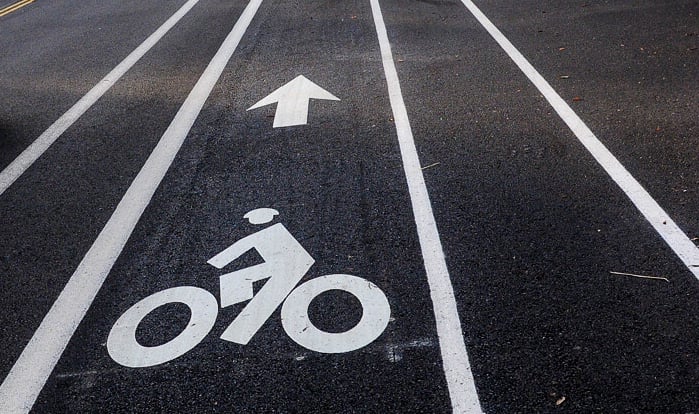
The City of Portland has installed a very helpful new link in the inner southeast bike network. There are now double-buffered bike lanes on SE 12th between Madison and Salmon. The Portland Bureau of Transportation completed striping the new bike lanes in September.
“This new stretch of bike lane connects two important pieces of infrastructure in SE Portland: the Central City in Motion Hawthorne/Madison improvements and the Salmon Neighborhood Greenway,” wrote PBOT in a social media post Wednesday.
The bike lane is unprotected and offers only paint as a separation from other road users; but the “double-buffered” design means that there is space between the one general purpose lane to the left of the bike lane and the door-zone of parked cars on the right. The previous cross-section included two general purpose lanes and two lanes for free car parking. PBOT swapped the eastern general purpose lane for the new bike lane.
View of SE 12th from Hawthorne. Note the plastic wands end at Madison.View up 12th from Madison.Driver in the bike lane.Looking south from Salmon.End of the new bike lane at Salmon (and Good Coffee!).When the new bike lanes end, it’s back to bummer riding.
This a nice connection because 12th handles a lot of bike traffic from the Ladds Addition area (and points south) and the new bike lane connects directly to the popular greenway on SE Salmon. At Salmon, PBOT has previously installed a concrete barricade to tame traffic and the street has a 15 mph “Shared Street” advisory speed limit. It also leads to a nice little coffee place (Good Coffee) on the corner of Salmon and 12th.
Funding for this project came from PBOT’s Multimodal Missing Links program. This is a small and flexible pot of money PBOT uses to build small projects. The total annual budget for Missing Links is about $200,000 (I don’t know the cost of this specific project yet, but will update this post when I find out). (UPDATE: Here’s what PBOT said when I asked how much this project cost: “As with many Missing Links projects, this was too small to have its own line item in PBOT’s budget. This was grouped among 25 quick projects we had a contractor perform for about $300,000. We won’t know the final cost of each of the 25 projects until the invoices come in.”)
I visited this site a few days ago to see how it’s working. The new bike lane starts as a shared bus/bike lane at a Line 70 TriMet bus stop on the northeast corner of 12th and Madison. Similar to the cross-section on North Vancouver Avenue, you feel like a respected road user since the bike lane width is equal to the adjacent car lane.
Unfortunately, the paint-only design and general disrespectful behavior, led some drivers to use the bike lane while I was there. Hopefully that subsides in the future as folks realize it’s a bike lane — and as more bike riders fill the space.
The response to PBOT’s post was mostly good and I’ve heard positive feedback so far. “It makes crossing this street on a bike on Salmon a lot easier – only crossing one lane of traffic is so much better. Now please do 11th as well!” wrote one person. “Now can we get a lane all the way up 12th to get to the Ankeny and north of Burnside lanes?” wrote another.
I second that call to extend this up to the Ankeny greenway. I’ve always been a fan of 12th for its direct connection between Hawthorne and Burnside/Sandy, but I’ll only ride it if I can maintain a 18-22 mph speed given the shared-lane conditions and 25 mph speed limit.
Have you ridden this yet? What has your experience been?
Mangled bike racks and bike didn’t stand a chance against an SUV driver. (Photos sent in by a reader)
The driver of an SUV slammed into an on-street bike parking corral on SE Stark this morning. The collision flattened and/or uprooted six City of Portland-issued staple racks and a bicycle that was locked to one of them.
A reader sent us photos of the aftermath and I just had a quick call with a person named Cole, who happens to be the bike’s owner. She was across the street around 8:00 am this morning and witnessed the driver turn onto Stark from Sandy. “They drove straight into it and took all of the racks out. And my bike is totaled,” Cole said.
Cole said the driver was headed north on Sandy and turned right on Stark. The bike corral is on the southeast corner of the Sandy/Stark intersection right in front of The Slammer Tavern. The location is just two blocks east of the crossing I wrote about yesterday — the one where many drivers are ignoring the law and driving through a gap in a median that’s supposed to be bike-only.
“[The driver] says he didn’t see it,” Cole added, recalling a conversation with the driver, whose vehicle is still parked on Sandy with its bumper on the ground and a very bent wheel. “The whole thing is kinda’ sketchy. I don’t know how you couldn’t see it!” she said.
According to Cole, the SUV didn’t have any license plates. And a call to the police wasn’t fruitful, as she got the impression they didn’t really care about the incident after the officer didn’t even ask for the driver’s name. Cole has the driver’s name and information but isn’t sure what will happen next. “I feel terrible about it,” she said. “There’s really nothing I can do though.”
Drivers hitting on-street bike corrals is unfortunately very common in Portland. There’s one in front of a Mexican food place near my house on North Rosa Parks Way that has been hit and damaged so many times, it was recently removed.
The totaled bike was Cole’s sole form of transportation and she used it to commute from the Alberta area to a job at Ota Tofu (just behind the tavern).
Cole would appreciate help buying a new bike. You can send her money using CashApp to the account $colesodcash. If you don’t have CashApp and would rather Venmo, you can send funds to @bikeportland and I’ll make sure they get to Cole (just include a note to let me know).
The Crown Zellerbach Trail awaits you (if you have enough layers and gear to stay warm!). (Photo: Jonathan Maus/BikePortland)
Welcome to the weekend.
With cold and rain settling in, this week’s guide is a bit sparse. But if you’re hearty enough to brave the conditions (and/or committed enough to your winter base miles training) there are a few options. And if you get bored, I highly recommend a pedal to your local bike shop. They’re ready for your holiday shopping and need your support!
Friday, December 1st
Friday Morning Meander – 10:00 am at St Matthew’s Anglican Church (NE) Join members of the Portland Bicycling Club for this 13-15 mph paced ride through North Portland with stops for coffee and treats. More info here.
Saturday, December 2nd
Charity Bike Sale – 9:00 am to 3:00 pm at 1750 Blankenship Rd (West Linn) Big used bike sale that will benefit nonprofits that give free bikes to kids. More info here.
East Portland Community Forum on I-205 Tolling – 4:00 to 6:00 pm at PCC Southeast (SE) Oregon State Rep Khanh Pham says this forum will be, “a special listening session on tolling the I-205 freeway with legislators and state officials,” that will, “help shape ODOT’s proposals, influence decision-makers, and help me form a strong vision for transportation investments in our community and our state.” The event is hosted by the Oregon Legislature’s Joint Transportation Special Subcommittee on Transportation Planning. More info here.
Sunday, December 3rd
Long Ride to Vernonia – 8:30 am at Haven Coffee (NW) Join the PDX Long Rides group for this adventurous ramble to Scappoose, then into the country via the Crown Z trail (off-road) and loop back home via the Banks-Vernonia path and rural roads of Washington County. Not a beginner ride! More info here.
— Don’t see an event? Please tell us about what’s going on in your neighborhood by filling out our contact form!
The Portland Bureau of Transportation has added a lot of new bike-specific infrastructure to Northeast and Southeast 7th Avenue in the past several months. On Tuesday, I went out to take a closer look at some of it.
Since we last checked-in on the 7th Ave Neighborhood Greenway back in December 2022, PBOT has striped new bike lanes on the five blocks between NE Tillamook and NE Weidler. They’ve also added a few speed bumps south of Tillamook. This is a busy commercial/industrial section of 7th that has long been a troubling gap. The new bike lanes are unprotected, but they come with a generous buffer space that someday (hopefully?!) PBOT will fill with some sort of protective curb or other treatment. They’ve also added green cross-bike markings to reinforce the bikeway through the intersections. It’s notable that PBOT swapped space previously used for free, on-street car storage in order to fit the new bike lanes. More photos below the jump…
Looking south from Tillamook.Looking south from NE Hancock toward Broadway.Looking north from NE Schuyler.Looking north toward NE Hancock.Looking north from NE Weidler.
These are straightforward bike lanes that are a welcome addition to this section of 7th. Hopefully PBOT can prevent people from parking in them and keep the new lanes clear of leaves and gravel through winter.
Moving further south, I spent a while observing the new crossing treatment on SE 7th at Stark. PBOT has installed a center median diverter using yellow plastic curbs and wands. They also left a large channel in the middle wide enough for bi-directional bike lanes to fit through the center. On each side of Stark the sharrows transition to green-colored bike lanes to signal to riders that they should be in the center of the street to cross. There’s also a green cross-bike through the entire intersection.
Looking north across Stark.Looking northwest across Stark.Scofflaw in action.Scofflaw in action.Looking northeast across Stark.Looking south across Stark.Looking northwest.
This design is meant to facilitate cycling traffic, make it easier to cross Stark, slow down drivers by reminding them this is a bikeway, and reduce the amount of cut-through traffic on 7th by forcing drivers to only turn right.
It’s a nice idea; but far too many drivers are making the dangerous and illegal decision to simply drive right through the gap in the center of the median. It’s clearly a bike lane (the color green should tell everyone that) and there are (way too small and low) “Right Turn Only” signs, but none of that stops the majority of car users who disobey the rules and drive on through.
PBOT Communications Director Hannah Schafer told BikePortland they’re aware of these behaviors and are, “working on a few avenues for improvements.” She said the project team had added temporary traffic control devices, “to help reinforce the operational changes.” Schafer might be referring to a traffic cone places in the middle of the gap; but she might not be aware that as of yesterday it was gone and only its base remained.
Schafer also added that PBOT are reaching out to the Portland Police Bureau to see if they can do “spot enforcement to re-affirm the changes.” “This has worked well at other locations when we see compliance issues,” Schafer shared. And a more permanent fix might be possible through a small PBOT project program known as Missing Links.
We’ve seen this pattern play out many times over the years: a new bikeway design is so anemic that many drivers ignore it, then PBOT throws out some cones or makeshift signs, and we hope for a permanent solution. It’s a frustrating dance that erodes confidence in PBOT’s work — and more importantly — leaves bike riders exposed to unnecessary risk. We must do better.
Thankfully, Schafer said PBOT doesn’t plan to wait the typical six months to collect data and see if the changes are (or aren’t) working. Because of the safety concerns, she says the project team has “elevated the timeline for this specific intersection.”
Related to the crossing at Stark is a new crosswalk and bike lane one block south on SE Washington. In order to facilitate westbound bike traffic onto 7th (from 12th and other points east), PBOT has turned the block of SE Washington between 8th and 7th/Sandy into eastbound only for car drivers and added a westbound bike lane. That new bike lane feeds into an enhanced crossing of 7th/Sandy where PBOT has added a green cross-bike and constructed a new center median island out of yellow plastic curbs and wands.
Dumpster used as traffic calming on southwest corner of SE 7th/Sandy/Washington.Looking east at new crossing of NE Sandy.Drivers have already hit and damaged some of the planters.Looking southeast across Sandy/7th.Looking northwest across Sandy/7th from Washington.Looking south onto Sandy from 7th.Looking north you can see new crossing (right) and Stark in the distance (upper left).Looking north on Sandy/7th.Looking east on SE Washington toward 8th.Looking west on SE Washington toward 7th/Sandy.
This intersection of SE Washington, 7th and Sandy is very wide. It also has five openings and a curve, and is at the base of a downhill slope. These elements make it dangerous for all users, especially bike riders who have to navigate onto the greenway from a busy section of 7th Ave en route to the new bridge. As you can see, PBOT and community partners have already reclaimed some of the space by adding cones and planters (even a small dumpster!) to calm traffic. These efforts have reduced driving space and sharpened turns to prevent speeding.
These are all small steps forward as we wait for better designs and protection that will encourage more people to ride and keep safe those who already do. And of course, the ultimate solution at this intersection is the one proposed by Depave that would prevent drivers from using 7th north of Washington and add concrete to separate and physically protect bicycle riders at the corners.
Until then, hopefully all this plastic and paint will do.
Have you ridden 7th lately? What about the Stark crossing? What has your experience been so far?
As we reported a year ago, the Wallet program has become so popular that it has been expanded and taken from a pilot (that launched in 2017) to a permanent program. PBOT manages three types of Wallets, one for low-income residents (“Access for All”), one for Portlanders who just moved to town (“New Movers”), and one for people who live or work in places where parking is regulated by permits. In these “Parking Districts,” individuals can swap a parking permit for a Transportation Wallet that gives them a collection of passes and credits on transit (TriMet), streetcar (Portland Streetcar), bike-share (Biketown), e-scooters (various companies), and car-share that are worth hundreds of dollars.
Reached for comment about the story and future of the program this morning, PBOT Communications Director Hannah Schafer said the mobile app work was an effort to improve the program both for users and staff. “The web-based and mobile app was envisioned as a tool to streamline and automate the delivery of various Transportation Wallet components,” Schafer shared with BikePortland. “Components that staff are doing manually today and will continue to do in the future.”
Schafer said she realizes this story doesn’t look good for PBOT, especially after the situations on SW Broadway and NE 33rd in recent months, but she took issue with my characterization of it on social media this morning. In a post on X (formerly Twitter), I referred to this as yet another “screw-up” by the agency.
“It’s not a ‘screw-up’,” Schafer contended. “It’s cutting our losses from a vendor [Canada-based RideShark] that wasn’t providing the service we wanted… It just wasn’t working with the app and the vendor.”
In a letter sent Monday to committee members who oversee the parking districts, PBOT Active Transportation & Safety Division Manager Renata Tirta wrote, “We could not in good faith deliver our services reliably, timely, or consistently using the software solution this vendor was developing,” and, “By terminating the contract before the App would have been available for public use, we saved the Bureau and the parking districts money and ensured there are no disruptions to our delivery of the Transportation Wallet in the Parking Districts.”
Schafer said the decision actually saved PBOT money because total contract with RideShark was $350,000 (and was terminated at $299,000). Funding for the contract came from the parking districts ($100,000 each) and PBOT paid for the remaining amount with other sources.
PBOT has distributed 8,400 Transportation Wallets to parking district residents and employees since 2017 and they’ve led to a significant decrease in driving and parking. According to PBOT analysis, people with Wallets drive to work less than half as of much as those without (14% and 32%, respectively). And in the Northwest Parking District, people with Wallets walk twice as much as non-Wallet holders for commute trips (24% and 12%, respectively) and take Portland Streetcar 2.5 times as much (12% and 5%, respectively).
While the termination of the app development contract is another blow to PBOT’s already-ailing budget and reputation, Schafer said it will have no impact on their ability to continue the Wallet program — especially the Access for All Wallet which is set to receive $25 million thanks to the Portland Clean Energy Fund.
Riders at the 2016 edition of Bike the Lights at PIR. (Photo: Jonathan Maus/BikePortland)
Grab your lights, warm coats, and all the kiddos for a fun holiday tradition. Tonight (Tuesday, 11/28) is the annual Bike the Lights night at Portland International Raceway. This is the 14th year the folks who put on the Winter Wonderland light show at PIR have welcomed bike riders for a night of their own.
It’s an opportunity to meet friends and roll on the racetrack north of Kenton under thousands of lights — including the big, illuminated tunnel near the finish line. The event also includes a vendor area that has snacks, treats and warm drinks to make the fun last a bit longer. You can do as many laps as you’d like!
Don’t miss our video from 2021 (below) to get a sense of what it’s like.
If you want company getting out there or aren’t sure of the route, join a group ride. There are at least three rides that will lead to Bike the Lights this year:
Meet at Blumenauer Bridge (south entrance, NE 7th and Flanders) at 6:00 pm, ride at 6:30. Ride leader: Tom Howe (@nagitpo on IG). Ride will be slow and social, suitable for all ages. Shift Calendar listing.
Meet at Irving Park (basketball courts) at 6:00 pm, ride no later than 6:45. Ride leader: NakedHearts:PDX/Moorland Moss (IG). Ride will be slow and social. Shift Calendar listing.
Meet at The Mercado (SE 72nd and Foster) at 6:30 pm. Ride leader Foster Night Ride (IG). This is a faster ride aimed at more experienced riders. Shift Calendar listing.
Winter Wonderland’s Bike the Lights is a fundraiser for Sunshine Division, a nonprofit that has provided free food and clothing to families in need for 100 years. Tickets are $15 for adults and $5 for kids 12 and under (2 and under are free). More info at WinterWonderland.com.
Eva Frazier and I are back with another episode of “In The Shed.” This episode was recorded November 22nd (day before Thanksgiving) in the BikePortland Shed a few blocks from Peninsula Park in north Portland.
Thanks to everyone who’s told us how much you like this series! It’s nice to know folks like hearing it as much as we like putting it together. As per usual, Eva and I had a fun, informal chat about a wide range of stuff. In this video we talked about:
How I’m trying to capture video of these episodes so we can share them in a new way (but it didn’t work this week so I’ll try again next time).
How my art history degree helps me remember Portland’s new council districts (finally!).
My recent meeting with a council district 2 candidate.
The most popular tire size sold at Eva’s shop (Clever Cycles).
The ultimate accessory for my Tern work bike.
Our plans for winter warmth at Bike Happy Hour (any sponsors want to help?!).
Latest developments on the BikeLoud PDX v City of Portland lawsuit update (background here).
World Day of Remembrance event (for more, here’s my recap and podcast).
My mixed feelings about memorial events in general.
The failure of Vision Zero, and how to turn the tide.
Trail Blazers’ new minor league basketball team, the Rip City Remix.
Our favorite Thanksgiving side dishes.
What I’m grateful for.
Eva’s Thanksgiving plans.
Thanks for listening! We’d love to hear feedback and please feel free to suggest topics for the next episode. Listen in the player above or wherever you get your podcasts.