The role:
Are you passionate about addressing climate change and doing work that advocates for transportation electrification? We are recruiting for a limited duration climate planner. In this key role, you will develop plans and implement programs to help electrify the transportation system! Apply today to assist us in bringing people to multimodal transportations and reduce the carbon footprint!
This is a limited duration appointment that is expected to end on or before June 30, 2025. Limited duration appointments are benefits eligible and have a designated maximum length of service. This position has the potential to become permanent.
How to Apply
A day in the life:
• Develop work plans to implement climate office work efforts related to improving transportation electrification.
• Lead outreach efforts for studies, plans and policy development.
• Write grants and funding proposals.
• Provide assist to local jurisdictions and partners on grants or funding proposals that strengthen climate action.
• Develop agency plans and policies for electric, zero emissions, shared vehicles and infrastructure in light, medium and heavy-duty applications.
• Develop transportation electrification policies that support climate and equitable outcomes.
• Track progress against overall transportation electrification and climate goals and mandates.
• Develop, manage, oversee and direct projects and planning efforts to implement electrification, greenhouse gas reduction and adaptation activities.
• Create, analyze and implement plans and guidance documents to summarize new laws, directives or policies.
• Write research papers, reports and best practice documents to help improve the work of others.
• Hybrid work options available – work in an office environment with occasional limited state travel required. Will need to work in office at a minimum of 8 times per year.
• To request a copy of the position description, which includes all duties and working conditions, please email ODOTRecruitment@odot.oregon.gov.
The role:
Our Climate Office is hiring a senior transportation electrification analyst! Are you passionate about addressing climate change and doing work that supports transportation electrification? In this key role, you will provide policy recommendations for transportation electrification, oversee community charging grants and lead other electrification efforts. Help us connect people to multimodal transportation and reduce our carbon footprint! Apply today!
A day in the life:
• Develop, manage, track and maintain transportation electrification programs.
• Write grant proposals for zero emission vehicle charging and refueling infrastructure programs.
• Award grants and support execution of agreements and contracts.
• Collaborate across many internal agency groups, utility and private sector stakeholders.
• Lead, plan, study and implement transportation electrification efforts.
• Secure and manage consultation services.
• Manage complex research projects and planning studies.
• Review legislative concepts and draft new legislative and policy concepts that support climate equity.
• Formulate goals, objectives, policies and plans in consultation with various levels of management.
• Partner with internal and external data analysts and perform independent analysis as needed.
• Write communications and reports, and keep website content current.
• Present information internally, to state and federal agencies and the public on emotionally charged topics.
• Hybrid work options available – work in an office environment with occasional limited state travel required. Will need to work in office at a minimum of 8 times per year.
• To request a copy of the position description, which includes all duties and working conditions, please email ODOTRecruitment@odot.oregon.gov.
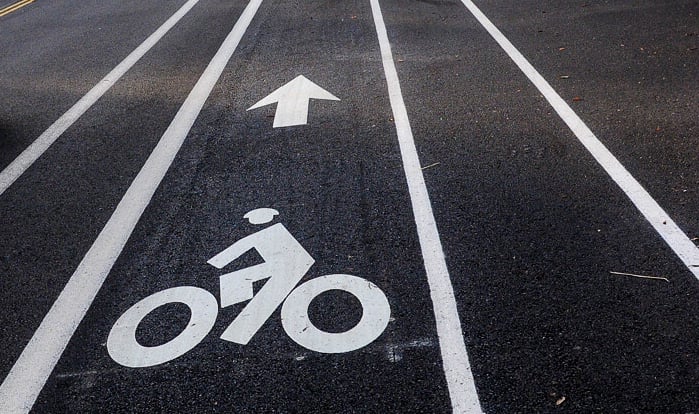
Bike-friendly speed bumps have felt like something of an underdog since they burst onto the scene in 2017. But that would change if Portland’s head bike planner has any say in the matter.
Speed bumps with channels cut through them to ease the way for bicycle riders have elicited a variety of opinions over the years. Some say they make biking more comfortable and attractive, while others find them annoying and worry about costs given other priorities. For the Portland Bureau of Transportation (PBOT), the jury had been out — even after years of use in the field.
Now results are in from a PBOT survey conducted over the summer: “PBOT recommends that bicycle-friendly speed bumps be the preferred speed bump used for neighborhood greenways,” reads a 10-page report authored by PBOT Bicycle Coordinator Roger Geller published Thursday ahead of a meeting of the city’s Bicycle Advisory Committee on Tuesday (March 12th).
Advertisement
Background
The first mention of bike-friendly speed bumps on BikePortland was January 2017 when we got wind that PBOT would test them on the SE Clinton Street neighborhood greenway. Since then, PBOT has rolled them out on 10 greenways citywide: N Kilpatrick, Michigan and Wabash; NE Alameda, Davis and Everett; SE Ankeny, Clinton and Woodward, and SW 60th. When they came to a greenway in my neighborhood, I was eager to sing their praises.
[Above: A new “Bike Bump Map” created by PBOT shows bike-friendly speed bump locations (in green) relative to the city’s emergency vehicle corridors.]
The impetus for giving bike riders a break from bumps comes from the irony that in order to get drivers to slow down to the 20 mph speed limit on streets where bicycling and walking is prioritized, speed bumps are a necessary evil. And I say “evil” because hitting a bump while riding is uncomfortable and inefficient — especially when riding at higher speeds on downhills or near the speed limit (much easier these days thanks to electric bikes). Hitting bumps isn’t just annoying, it can cause damage to your property when cargo is jostled and/or falls out of a rack or bag. (Keep in mind that unlike automobiles, most bikes ridden in the city have very little or not suspension.)
In addition to real-world use, PBOT wanted more direct feedback to make a final decision on whether or not to keep bike-friendly speed bumps alive. So they did a survey last summer. The report that will be discussed at the BAC meeting Tuesday night summarizes what PBOT learned from the 543 people who responded to that survey.
Advertisement
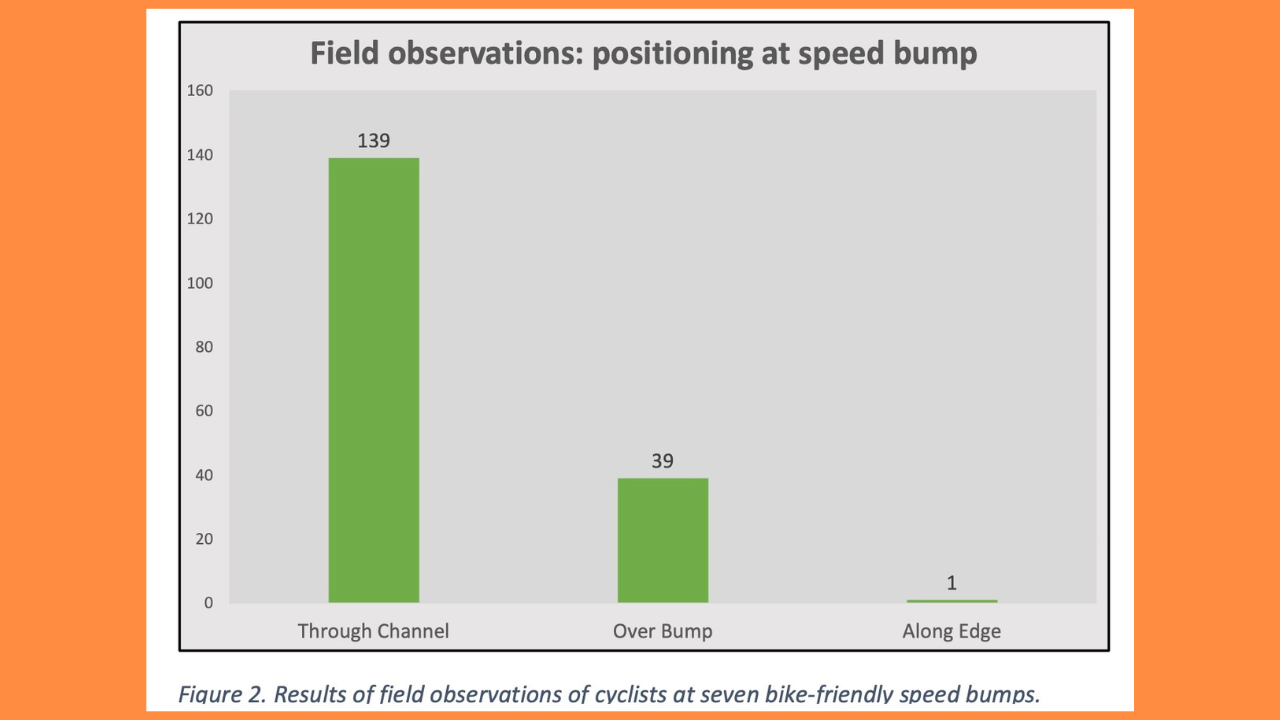
Three charts from the report.
Survey says
PBOT’s survey wanted to find out three things: Do people actually like to bike through the channels? Should sharrow markings line up with the channel? And, what should PBOT do if the bikey bumps cost more?
A whopping 80% of the 543 survey respondents said they prefer riding through the bicycle-friendly bumps (note that PBOT refers to the bumps as speed “cushions”). And since Portland’s adopted bicycle design policies encourage them to build the “highest quality bikeways” possible and to, “maximize comfort and minimize delays” for people bicycling; this finding had major sway in PBOT’s recommendation. “This strong preference for the channels suggests that the channels represent a higher quality design than standard speed bumps. In that sense, their use better support our design policies (“Build the highest quality bikeways”) than do standard speed bumps,” states the report.
65% of respondents liked the idea of the sharrow pavement marking being aligned right at the channel to help orient them through.
When it came to cost, a slight majority of respondents recommended installing the cushions despite a potential 10% premium on cost (survey went out before the 20% premium number was known), 40% said to save money, and 9% had no preference.
Advertisement
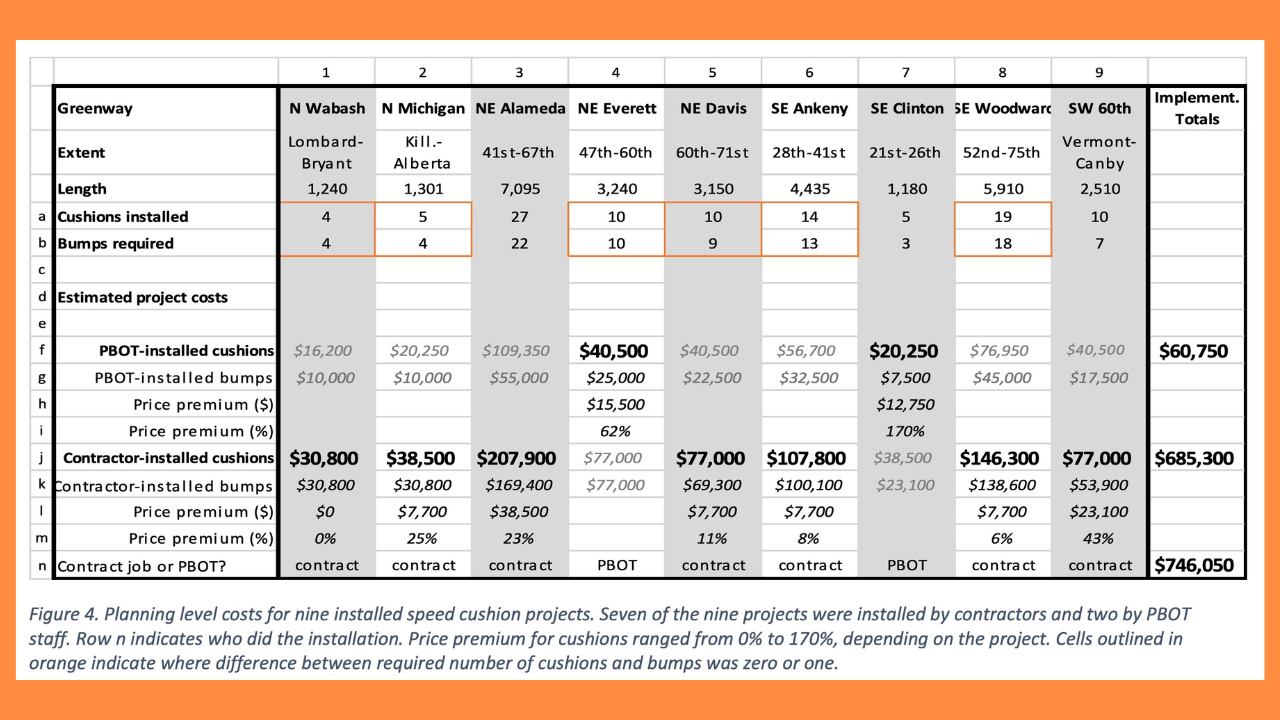
With funding such a major issue at PBOT, the report took a close look at the cost difference between the bike-friendly cushions and traditional bumps. Geller and his team analyzed nine projects and found the bike-friendly version costs 20% more. But when Geller looked deeper into the numbersand had engineers estimate how many regular speed bumps would have been required for the same project, he found there was actually “no or only minimal cost difference.” In the end, Geller says each project should be evaluated independently when/if cost is an issue.
The report also weighs in on a few key concerns about the bumps expressed by some in the community: That drivers use the channels and swerve dangerously while doing so, and that the channels can cause some riders to crash or bobble and/or be a problem for folks with trikes and other unconventional rigs.
Here’s what the report says about drivers using the channels:
Our speed data indicate that even though people may get one wheel in a channel it does not affect speed. However, that doesn’t mean that people don’t try. . However, the observation is that while people driving may deflect toward the channel when there is nobody else on the roadway. When somebody else is on the roadway, people driving stay in their lane.
And here’s what the report says about bike riders crashing in the channels:
Regarding that the cushions can contribute to crashes: there have been no reported crashes on the cushions to date. When initially deployed, PBOT staff attempted to ride erratically through the channels at different speeds and angles of approach to see if the channels created discomfort in riding. They did not.
This report makes it clear that if PBOT’s bike coordinator has his way, the bureau will make bike-friendly bumps the standard going forward.
Stay tuned for input from BAC members after Tuesday night’s meeting and take a look at the full report yourself here. You can also learn more on PBOT’s website.
Few people in Portland know more about our city’s bicycle parking policy than Chris Smith. During my chat with him yesterday he shared a history of the issue and we talked about recent efforts by the City of Portland and State of Oregon to roll back code requirements that encourage more bicycle parking. You can watch our conversation above (along with helpful graphics spliced-in along the way), or find it wherever you get your podcasts.
Smith is the consummate transportation reform activist who’s been involved with numerous efforts and projects over the years. I first knew him as creator of the excellent blog Portland Transport (first mentioned on BikePortland in 2005!) which still serves our community as a repository of KBOO Bike Show episodes. He’s also the inventor of the “Transit Appliance” — a wonderful device that posts transit arrival times and can be found at bus and MAX stations citywide. Smith has also been a candidate for Portland City Council and Metro Council. Smith has fought freeway expansions for nearly two decades and was a major voice against the Columbia River Crossing project and a co-founder of the group No More Freeways. And those are just some of his bona fides!
Advertisement
Smith was pulled into bicycle parking specifically for his expertise in how bikes mix with transit gleaned from his long-time position on the board (and as vice-chair) of Portland Streetcar Inc. (the private nonprofit contracted by the City of Portland to help plan and manage the streetcar). After the City’s Bicycle Plan for 2030 passed in 2010 and ridership skyrocketed, Smith was tapped to help update the code so that the hordes of local riders would have a proper place to park their bikes. BikePortland worked with Smith to host two events (one in 2013 and another in 2018) to garner input on the bike parking code and that effort led to a major update that passed Portland City Council in 2019.
Then Portland lost its bicycling mojo, the housing shortage became a crisis, and the politics shifted. As we reported here in detail over the past year or so, Portland’s vaunted bike parking code was put on the chopping block by Bureau of Planning & Sustainability Commissioner Carmen Rubio as part of a “housing regulatory reform” package. In my conversation with Smith, you’ll hear how and why this all went down, as well as the lessons he’s learned along the way.
We also talk about Oregon Governor Tina Kotek’s big housing bill passed just this week by the Oregon Legislature. One of them, Senate Bill 1537, included a relatively unknown provision that gives cities the ability to adjust their bike parking requirements to spur housing production.
Below are a few highlights from our conversation (which you can also listen to via our podcast in the player below):
Jonathan Maus:
“It also is worth saying that there was some really valid criticism [of our bike parking code]. You and I are working in the policy realm talking about words in a code. But people implementing this stuff down at the design review office or the permit office, they actually have people telling them what they can and can’t build and I think maybe one of the lessons here is this stuff can get pretty complicated and very troublesome. And we had somebody on the board of The Street Trust who was one of the biggest critics of the bike parking requirements. And I think probably had something to do with swaying the adoption at Planning Commission of rolling them back.”
Chris Smith:
“Right. It got really interesting politically for me because I had two groups that I consider myself a member of, the bicycle community and the pro-housing community…I’m a member of Portland Neighbors Welcome and I’m a member of BikeLoud PDX, who said, ‘What? You’re going to take away our parking? Come on!’ So I actually spent some energy trying to make sure those two groups didn’t go at each other’s throats”
Advertisement
Chris Smith:
“The [required bike parking] ratios got tweaked down. So instead of 1.5 and 1.1 [per dwelling unit], they go to 1.0 and 0.7 in the outer pattern areas. And that’s in effect for five years. So it’s not forever. And to my mind, that kind of makes sense in terms of balancing economics.
But the alcove standard [something Smith fought for in the bike parking code update to encourage higher-quality, in-unit bike storage] went away permanently, and I think that’s going to be a problem because if, if half the parking we build is ineffective in-unit parking, the it’s more like we have 0.5 left. Right? The other thing that was taken away was a standard we put in that a small percentage in large buildings had to be larger cargo bike spaces… So for five years [Portland is no longer] requiring building spaces for cargo bikes. And I think we got to have a public policy discussion about where those go.”
Jonathan Maus:
“I think the production of housing absolutely trumps in many ways, the ability to bike to that housing. But I wonder if you have any thoughts about that? Is it a choice between housing production or bike parking, and how can we avoid that going forward?”
Chris Smith:
“I think maybe one lesson I’ve learned is that 2019 package [of bike parking code updates] was kind of a gold-plated package. It was our first shot since the 1990s [to update the code] and we went for it; and we were successful in landing it. And maybe we overreached a little bit and I think we have room to go back and tweak that a little bit with some of the bike room standards and whatnot.
But, maybe we overshot a bit — it’s still the case that our Comprehensive Plan calls for us to have a 25 percent bicycle mode share by 2030. And the fact that we are not getting that mode share has some pretty devastating consequences in terms of traffic congestion in the city. Right? And if we don’t get there, eventually, we have to spend a lot more money on roads that we don’t have.”
Advertisement
Jonathan Maus:
“Do you have any faith there’ll be an opportunity to bring up bike parking [code revisions] sooner than later [the five-year sunset council passed]? Especially with the whole entire council change that’s going to happen in Portland with a bunch of new councilors and maybe more people who could spend some time on the policy side of this?”
Chris Smith:
“I hope. And I’ll be advocating for addressing some of the standards issues before that like the in-unit parking standard and what do we do about cargo bikes question. I’m a little bit dubious that we can revisit the [required bike parking per unit] ratios before the five years just because of the real impact and housing economics. I wish I could believe we’d be out of the housing crisis in five years. Given how many units we’re down compared to where we need to be – I don’t know that. So I’m much more focused on the standards and making sure that what we build is effective.”
And there was one question Smith wanted to make sure I posed to you. Please read it below and share your response so he can accurately represent our needs in his advocacy…
Chris Smith:
“I’m still fascinated by the bike room versus the in-unit question: Who wants to store their bike in their apartment versus in a bike room and why? Because to me, it seems like the vast majority of people, at least cycling for transportation, would want to be in a bike room. If you have a $10,000 racing bike, sure you might want to put that next to your bed. I can understand that. But for folks who are cycling for transportation, what do people really think about that?”
You can watch our full conversation along with helpful graphics by watching the video above, or listen wherever you get your podcasts.
Here are some fun things to do for bike lovers this weekend…
Friday, March 8th
Singing Through the Gorge – 12:00 noon at Ankeny Rainbow Road Plaza (SE) Join Bike Happy Hour regular and musician Steve “Chezz” Cheseborough on a ride to the Gorge to attend the annual retreat of the Portland Folkmusic Society. (More info here)
Art of Foster Ride – 2:00 pm at Portland Mercado (SE) Local filmmaker Amit Zinman is making videos of Portland’s classic loop rides and wants you to help make his scenes more beautiful. This is the first in a series so stay tuned for future versions. (More info here)
Midnight Mystery Ride – 11:45 pm at Apex (SE) Should be a clear and brisk night — perfect for riding to a mystery spot with friends old and new. (More info here)
Saturday, March 9th
Hike to the Willamette River – 9:00 am at Ida B Wells H.S. (SW) Join nonprofit SW Trails for a spirited walk/hike from Hillsdale down to the river where explorations of newly opened trail along the water could be in the cards. (More info here)
Advertisement
Milwaukie to Oregon City Ride – 10:00 am at Milwaukie Station Food Cart Pod Get to know the Trolley Trail on this ride led by WeBike, whose events are for, “Women, trans, and non-binary folks, which includes, but is not limited to: trans men, trans women, cis women, agender, gender queer, gender fluid, gender nonconforming and Two Spirit people. (More info here)
Sunday, March 10th
Overlook Neighborhood Ride – 9:30 am at Stacks Coffeehouse (N) Come together with neighbors to explore the ‘hood of Overlook and its myriad charms and you imbibe and treat yourself to yummy drinks and treats from a great local coffee place. (More info here)
Rocky Point Hill Ride – 10:00 am in North Plains (Wash Co) Get into some punchy climbs as you explore beautiful farm roads above Highway 26 in Washington County with the always organized Portland Bicycle Club. (More info here)
Bikepacking Meet N Greet – 3:00 pm at Lords Luggage (SE) If you have plans to head out into the wilds on your bike this year and want to get your questions about logistics and gear answered by nice folks with loads of experience, roll over to this event. (More info here)
— Don’t see an event? Please tell us about what’s going on in your neighborhood by filling out our contact form, or just email me at maus.jonathan@gmail.com if it’s easier.
A few days ago a reader emailed to share that a person riding a bike shouted at them for running on Southeast Clinton Street. “I was yelled at by a cyclist to run on the sidewalk,” the person (who also rides bikes) shared. “I responded that no, I would not run on the sidewalk because it was a neighborhood greenway.” After this random argument with a stranger, the person got home and took stock: “Was I the a**hole here?” she asked me. “Is it legal to run in the road on a neighborhood greenway?”
I figured it’d be a great question for the Ask BikePortland column. But as I got the post together, I realized I’d actually already answered that exact question in 2012 (there are 17,882 posts on here, so yes, I will often forget what I’ve already written!). But what I didn’t have in 2012 was the ability to make a video and share it on social media. So I made a video instead and shared it on Instagram and TikTok this morning. Watch it below:
So what’s the answer? Turns out Oregon law (ORS 814.070) says if you are a “pedestrian” (or runner) you must use the sidewalk if one is available. And if there’s no sidewalk, you must stay as far to the right “as practicable.” Since SE Clinton has a sidewalk, technically the cyclist in the above situation was right. It’s similar to the mandatory bike lane law some of you might be familiar with — and just like how activists are working to erase that law, I’d love to see an effort to change this one so that pedestrians could have a bit more legal right to be on the road.
After all, sidewalks (similar to bike lanes) are often obstructed and unfit for running, and riding right next to parked cars is stressful and dangerous. Not only that, but as I point out in the video, City of Portland policy is to create greenways so they prioritize not just cyclists, but everyone who isn’t inside a car.
You might hear all this and think, “Who cares what the law says, streets are for people and cyclists should just be nice to each other and chill out!” and I’d agree with you to a certain degree. But keep in mind that if a collision were to happen, what the law actually states is very important. Once a case gets to court, or an insurance adjuster’s desk, or a cop’s report, what it says in the ORS will determine who is at fault and who bears responsibility for any damages.
Got a question? Ask us! If I can’t answer it myself, I know someone who can.
West Linn, a city about 12 miles south of Portland, will be one of the first places in the state where the Oregon Department of Transportation builds a protected intersection. Protected intersections are considered the gold standard of protection for bicycle riders and walkers because they come with raised corner curb islands, physical separation from other road users, better visibility at crossings, and other safety elements.
The Oregon Department of Transportation is in the final design stage of a protected intersection on Willamette Drive (OR 43) at Marylhurst Drive/Lazy River Dr. The $7 million project is part of a larger streetscape project that includes a continuous cycle track and other safety updates on Willamette Drive between Mary S. Young park and the city’s northern limit near Marylhurst University.
Here’s more about the project from a recent ODOT update:
Advertisement
Protected intersection designs are intended to extend the safe environment for bicyclists and pedestrians through use of raised corner islands, forward stop bars for bicyclists, and well defined marked crossings. These defenses make it clear to all users where bicyclists are, provide physical protection in the queuing area, and further increase bicyclist visibility by allowing them early entry into the intersection ahead of right turning vehicles.
Existing conditionsProtected intersection on SE 162nd and Division.
ODOT also says the project will reduce crossing distances and come with updated signal operations to reduce conflicts.
The protected intersection concept made a big splash in local planning and engineering circles when it was proposed by Portland-based planner Nick Falbo in 2014. Falbo was inspired by Dutch examples and he’s largely credited with pushing the concept into the mainstream in America. Falbo went on to work at the Portland Bureau of Transportation and has recently left that job for a private company (he’s based locally still, but the company he works with is based in The Netherlands). You can learn more about the design at Falbo’s website, protectedintersection.com.
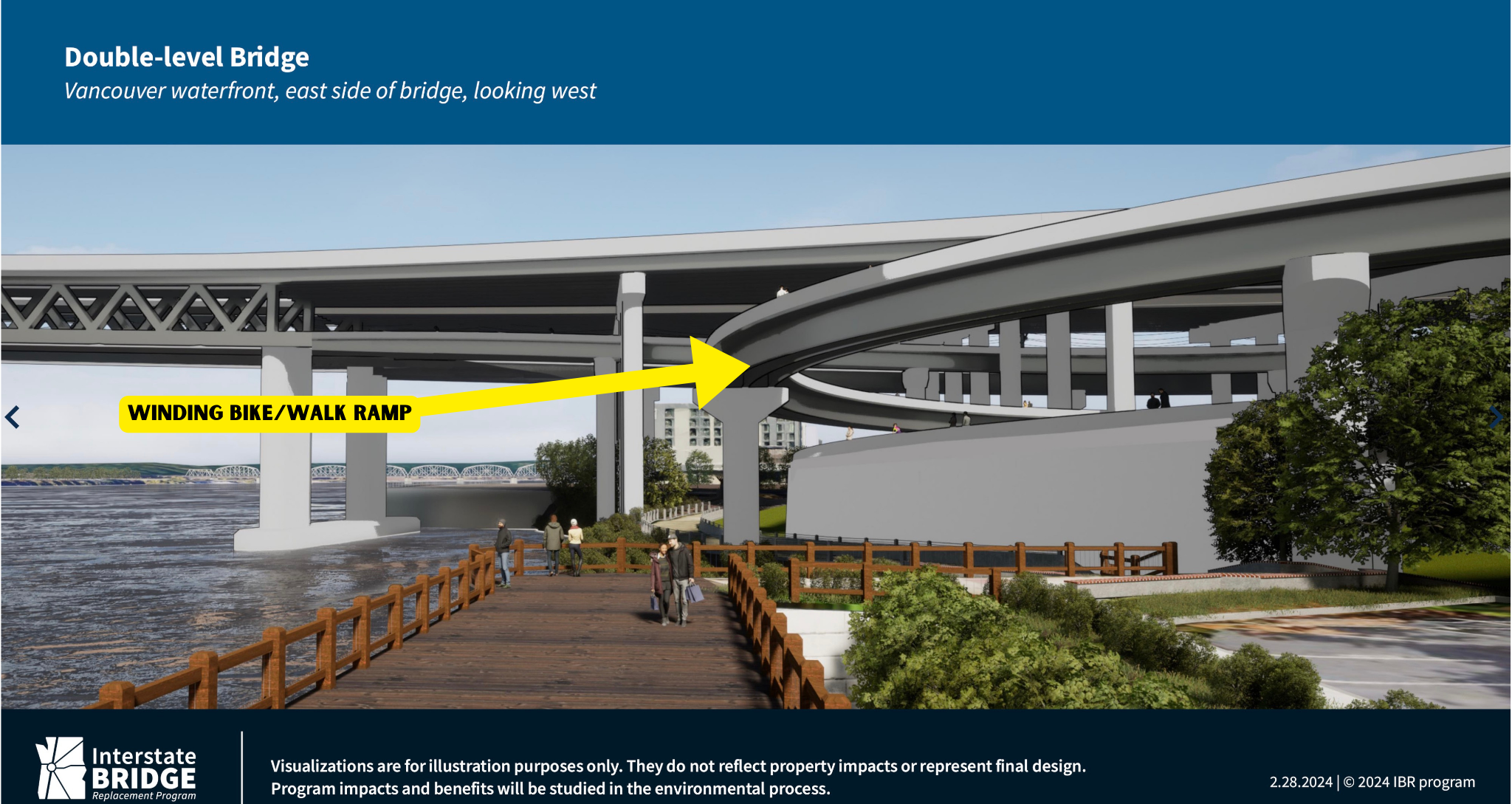
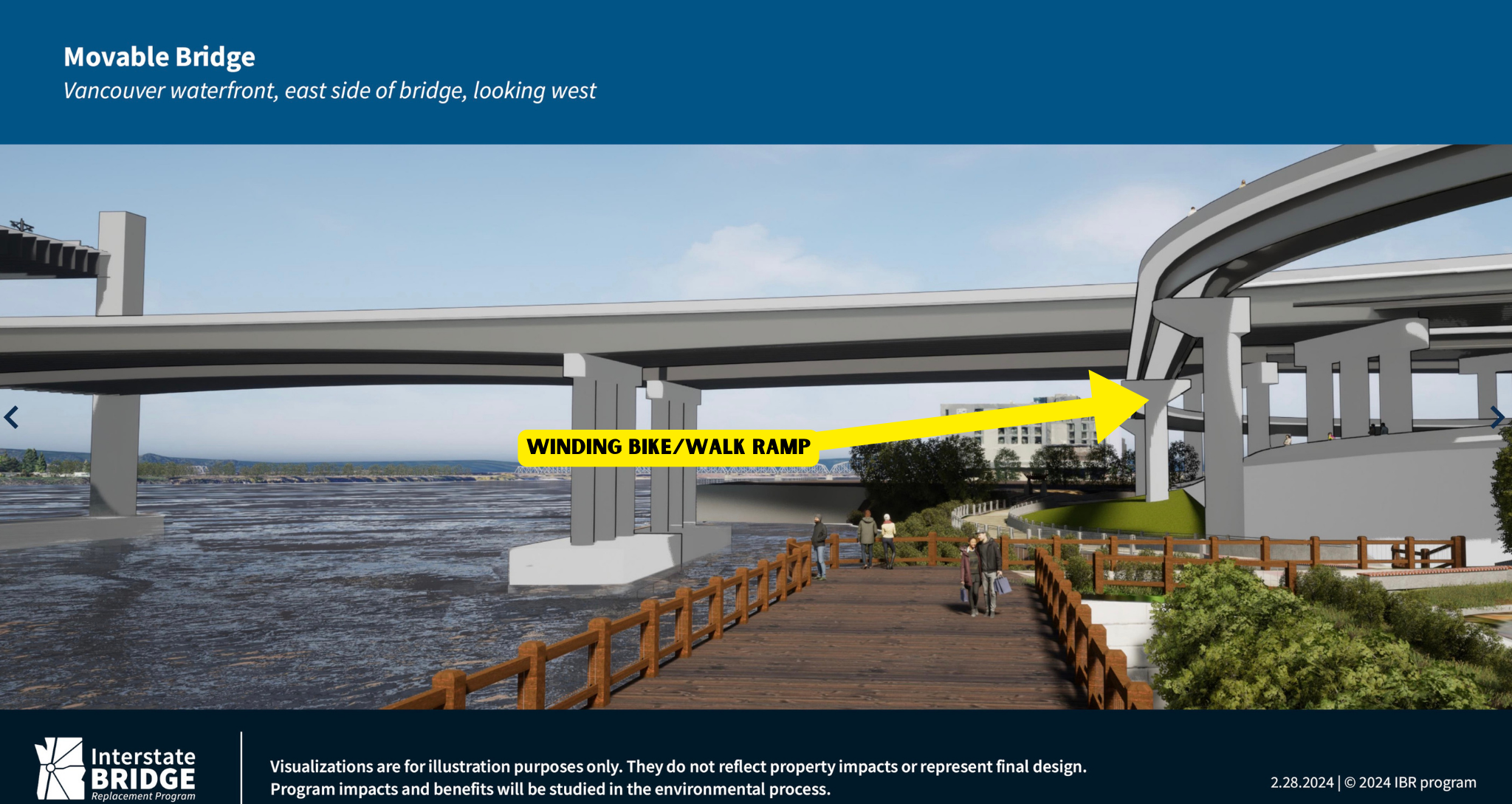
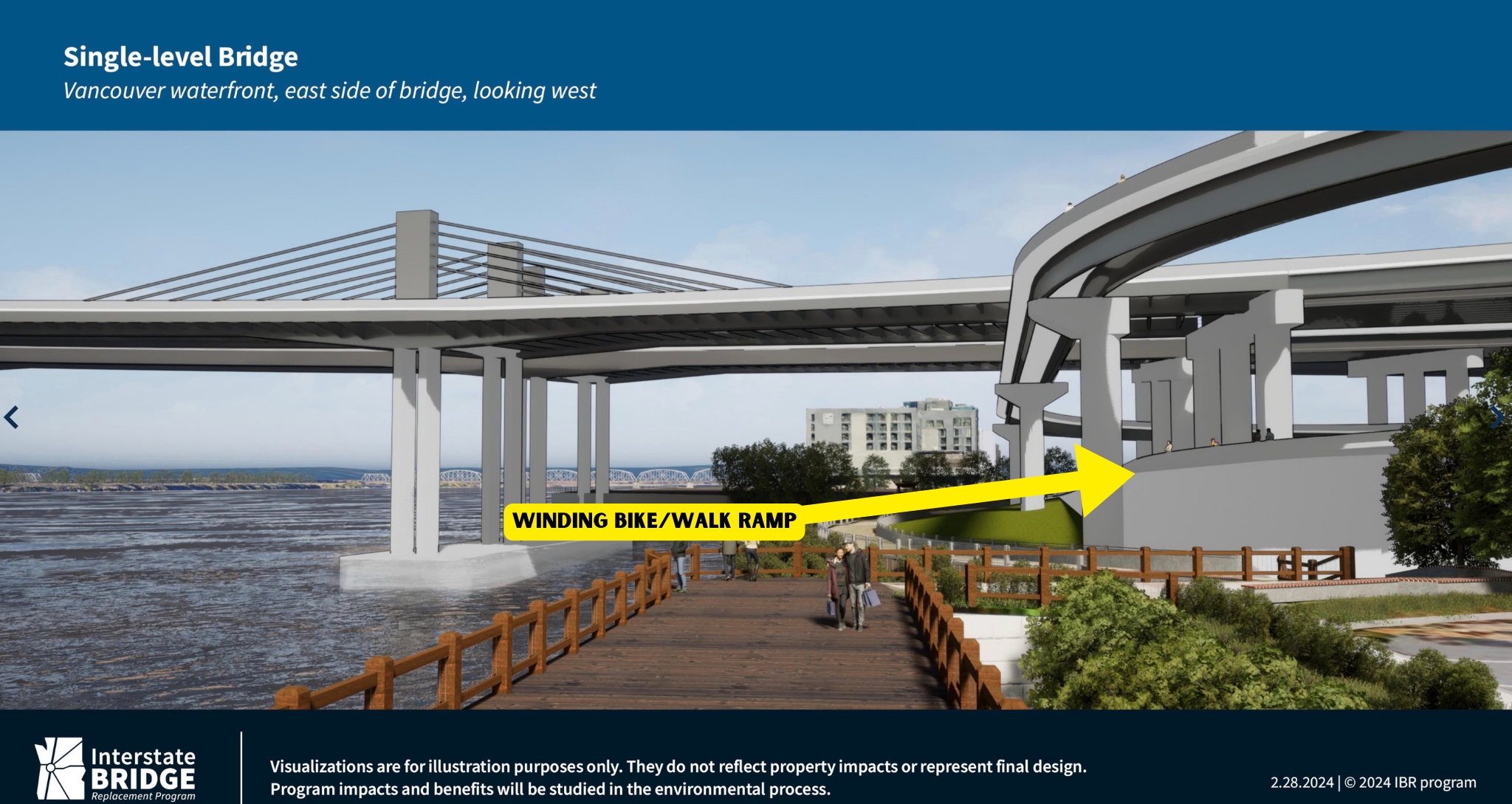
The folks working on a new Interstate Bridge and expansion of I-5 between Portland and Vancouver released new visualizations yesterday, including our best view yet of the potential new bike path.
The new drawings were released at a meeting of the Executive Steering Group, one of several committees formed to garner feedback on the (estimated) $6-7.5 billion Interstate Bridge Replacement Program. The ESG is made up of agency leaders and elected officials from Portland and southwest Washington. ESG members have already adopted a set of desired outcomes for the future bicycle and pedestrian facilities. Among them are that the new bikeway must “feel safe” and be “separated from moving vehicles” and that the path environment is “visible and connected.” They’ve also expressed a desire for bikeways to be “high quality,” “convenient,” and to “connect to important destinations.”
The ESG and IBRP team are currently finalizing their Draft Supplemental Environmental Impact Statement (Draft SEIS), which is due out later this spring.
Advertisement
IBRP Administrator Greg Johnson presented the visualizations at the meeting (where he also said they’re working on new videos that will explain how bicycle riders and walkers will make their way through the corridor). Johnson stressed that the drawings shown yesterday are not final and are, “Not for decision-making or narrowing options.” “These are just to give perspective on the size of the bridge as related to, if you’re standing on the ground on Hayden Island or on the Vancouver Waterfront.”
The IBRP released 12 visuals in total — three for each possible bridge option currently being analyzed in the Draft SEIS: single level, movable span, and double-level.
As he shared the slides, Johnson acknowledged, “This [bridge] is going to be a bigger bridge than currently exists.” “And this will have impacts on Hayden Island, but we think there will also be very positive impacts by reconnecting the island and providing access from Tomahawk Drive from east to west and by making a walkable community on Hayden Island.”
For the visual of the bike path specifically, Johnson said, “We haven’t determined the full width of what what this active transportation pathway would look like.”
See all the drawings below:
Hayden Island West Side
Hayden Island East Side
Vancouver Waterfront West Side
Vancouver Waterfront East Side
Note the spiral bike path in these drawings. The ramp to connect to the bridge for non-drivers will be very long and circuitous because it must reach a height of 116-feet and have a maximum slope of 4.5%.
Advertisement
While it’s interesting to see more details about what the future bridge might look like, I can’t help but wonder why none of the new visualizations offer us a look at any of the seven new interchanges or new frontage roads, or a detailed view of what it will look like to drive on the five miles of wider freeways. The team of PR consultants and agency leaders behind this megaproject, which has $1 billion commitments from Oregon and Washington and recently won a $600 million grant from the US Department of Transportation, have a long record of hiding the true nature and scope of this project. Almost all the IBRP public communications focus on “bridge replacement” when the fact is only about $500 million of the project’s $6 to $7.5 billion estimated cost will be for the bridge.
The less popular and more controversial aspects of this project like the additional freeway lanes and interchange ramps that will incentivize single-occupancy car use, lower the quality-of-life for everyone in the region, and were recently called out as being indicative of a “climate time bomb” by advocacy group Transportation For America, are rarely shown.
In a public comment period at the end of the meeting, persistent IBRP critic and retired infrastructure expert Bob Ortblad had a warning for ESG members. “This group should remember the history of the Embarcadero Freeway and the Alaskan Way Viaduct and how they despoiled their waterfront. Imagine if both of those were build side-by-side, they would equal the width of each of the two IBR bridge approaches on Vancouver and Hayden Island.
If these approaches are built, our children will tear them down.”
Hope everyone’s having a good Tuesday and enjoying a bit of sunshine and dry skies. This is just a quick post to share a thing I’m doing on March 19th with some great folks on an important topic. I’ll be on a three-person “Policy Talks” panel hosted by local nonprofit Portland for All. The title of the panel is, “Creating streets safe in every community.”
Portland for All is an all-volunteer group that is organizing around ideas. Their website says they were, “born out of conversations folks were having with friends and neighbors concerned about the challenges facing our City, and all of the negative rhetoric about this place we call home,” and that they believe, “there is a hopeful, positive, and inclusive future that’s possible for our City.” This is the third event in their Policy Talks series. The first two were about public safety and homelessness.
Joining me on the 19th at this virtual event will be two folks you’ve read about a lot on BikePortland over the years: former Oregon Walks executive director and current Metro Councilor Ashton Simpson, and veteran community advocate and current Portland City Council (D1) candidate Steph Routh. It just so happens I’ve already had both Ashton and Steph on our podcast. I spoke with Ashton in March 2022 during his run for Metro Council and I shared an interview with Steph from Bike Happy Hour back in November.
Advertisement
To give you a sense of the focus of our upcoming panel, here’s the blurb from Portland for All:
Portland is known as a city with great transit, cycling, and walking – yet not every community has safe access to all these choices. Many people across the region do not own a car and rely on transit, biking, and walking to get around. Despite our reputation, our streets have become increasingly unsafe – we’ve seen record traffic deaths in recent years. These changes have occurred under new City Council leadership and as budget deficits have emerged with fewer people commuting to work generating lower gas taxes. In this webinar, we will focus on why traffic deaths have increased, and what steps we need to take to make our city streets safe for everyone.
The questions we’ll grapple with include what we see as the key problem Portland faces in our efforts to stem traffic crashes, how to get at the root of the problem, what it will take to get folks to stop driving so dang much, and how to talk about all this stuff without fighting with folks who see things differently.
It should be a spirited chat and I’m really looking forward to it. You can RSVP here and find info on past Policy Talks here.
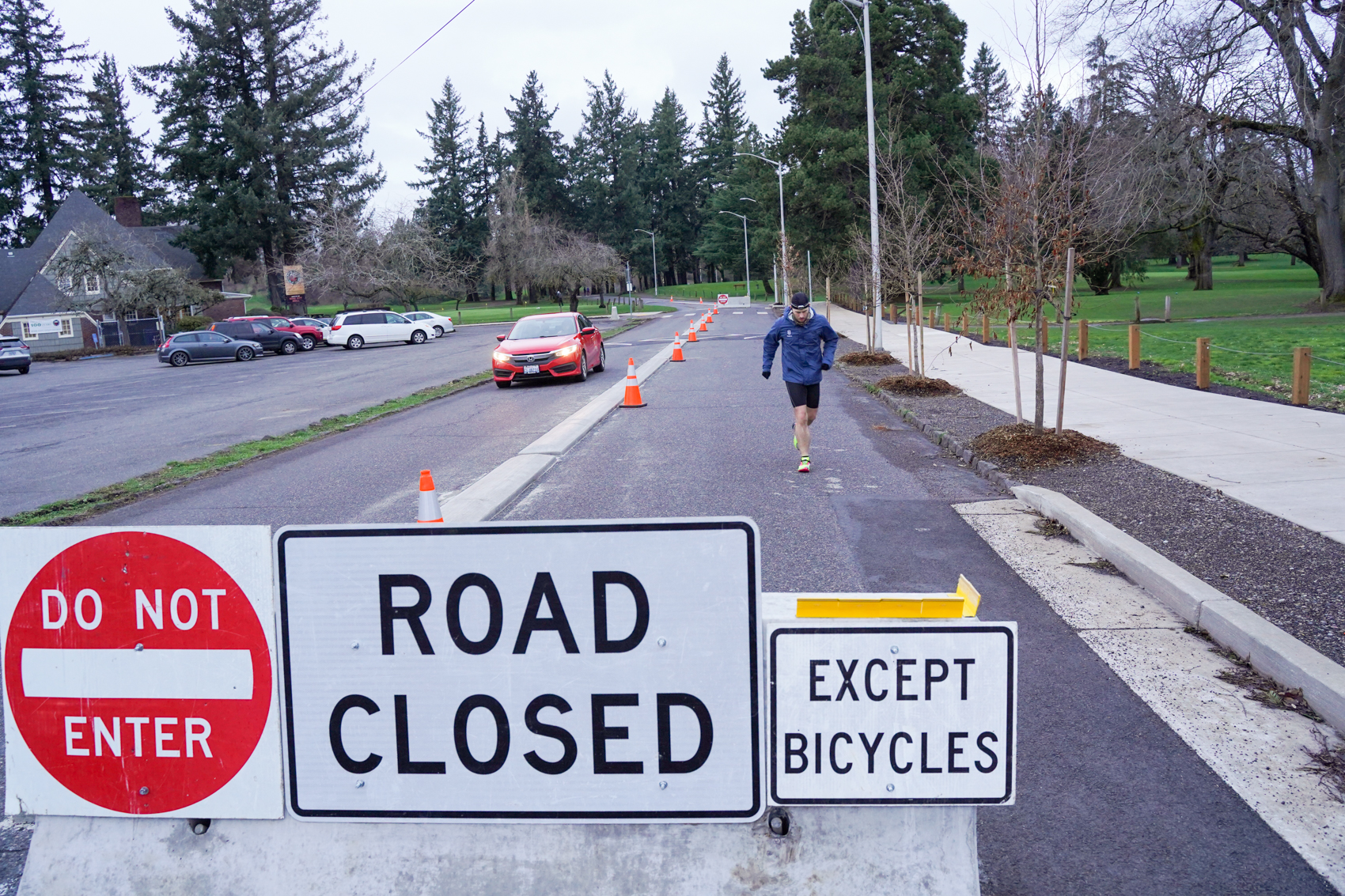
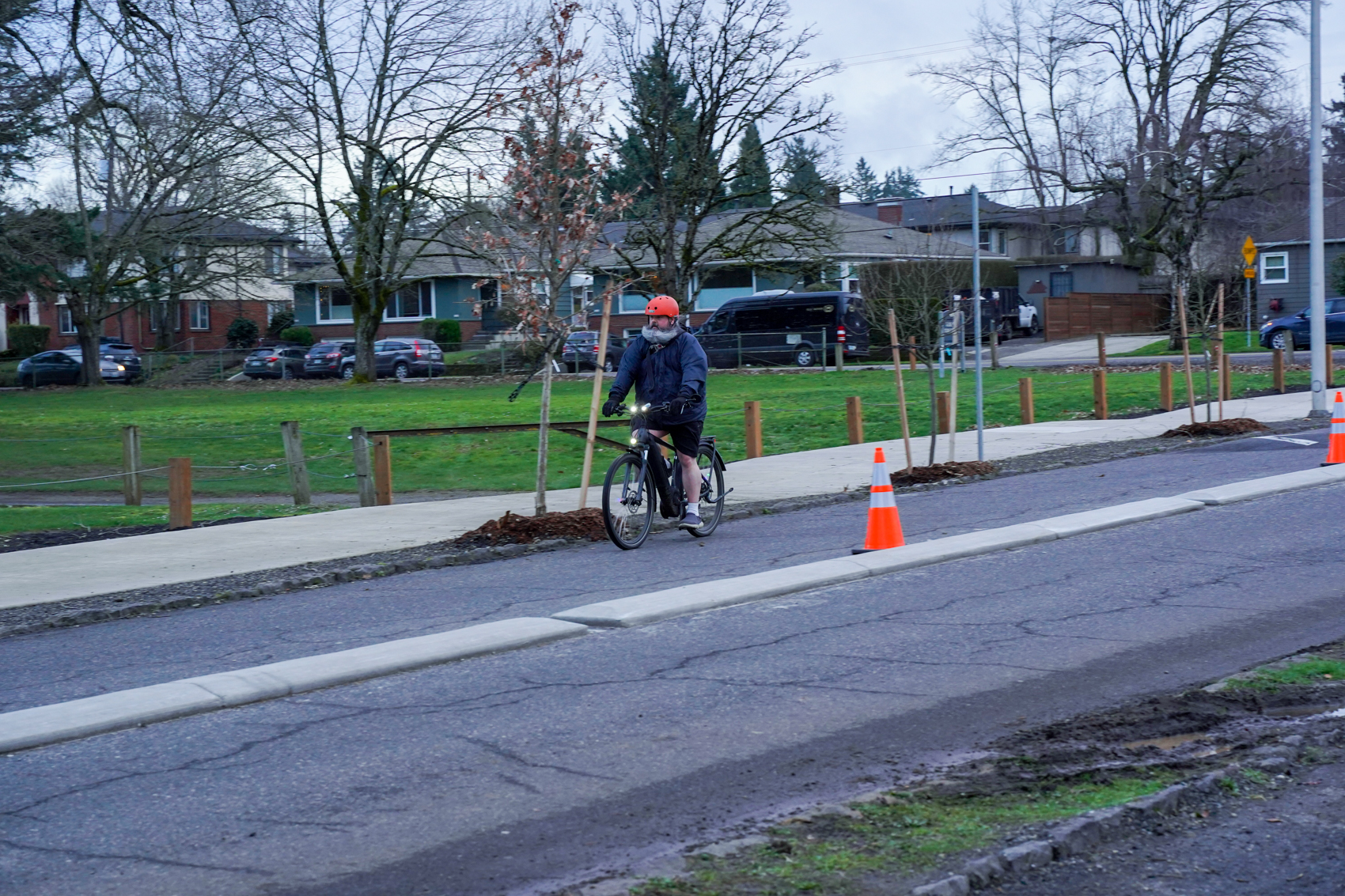
A runner takes advantage of the new path. View is looking north onto NE 72nd Drive from NE Tillamook. (Photos: Jonathan Maus/BikePortland)
PBOT graphic.
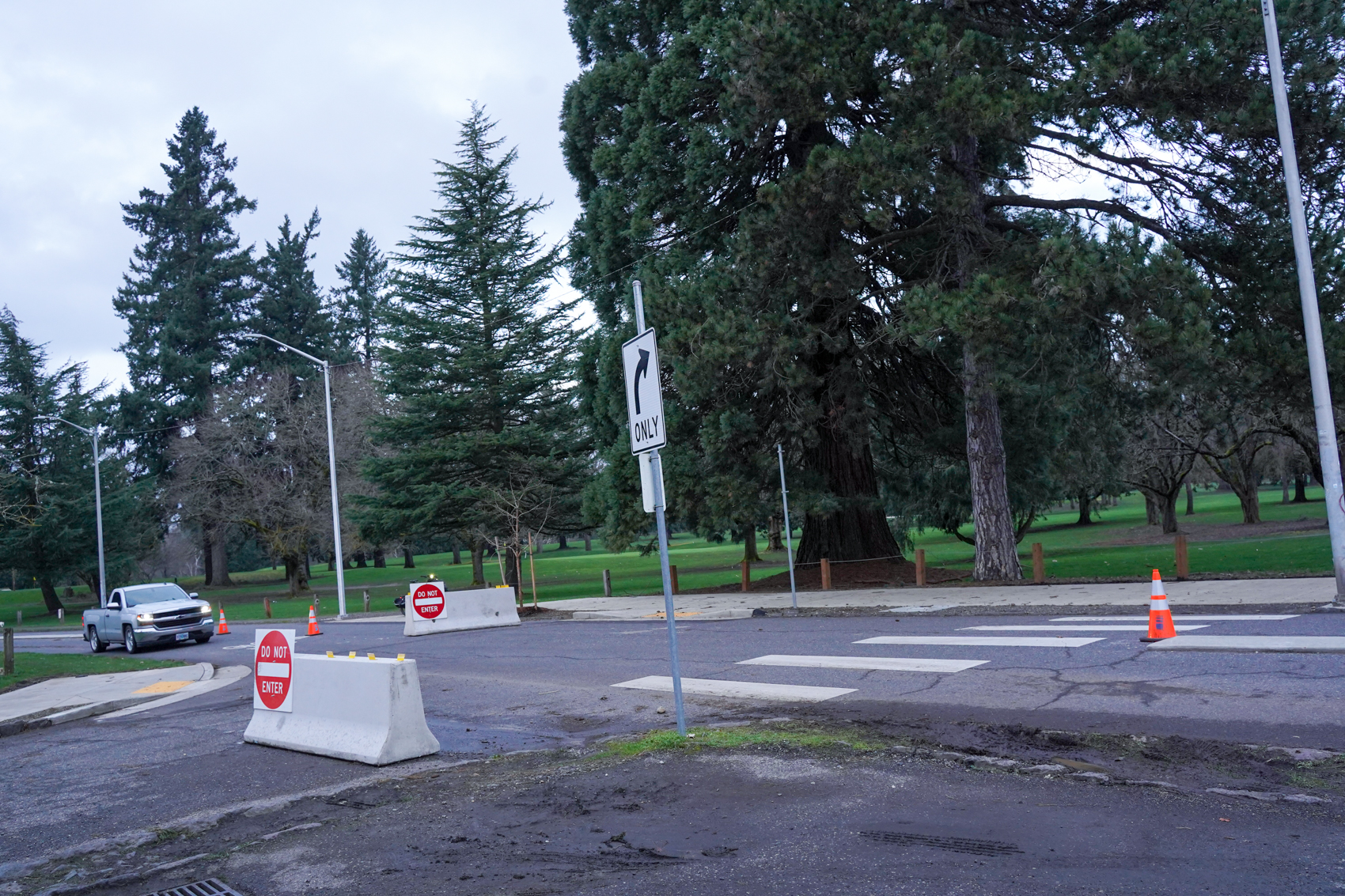
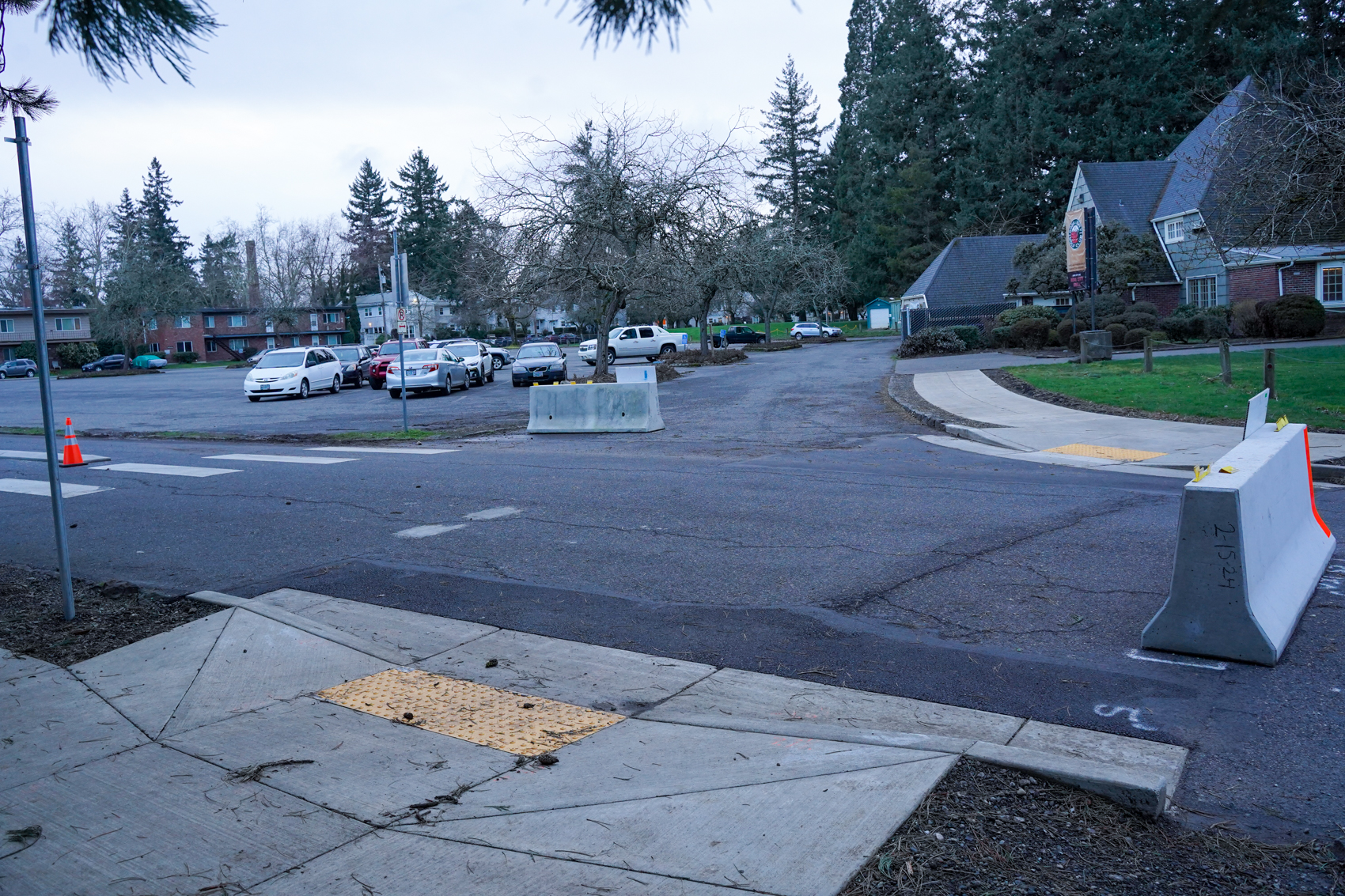
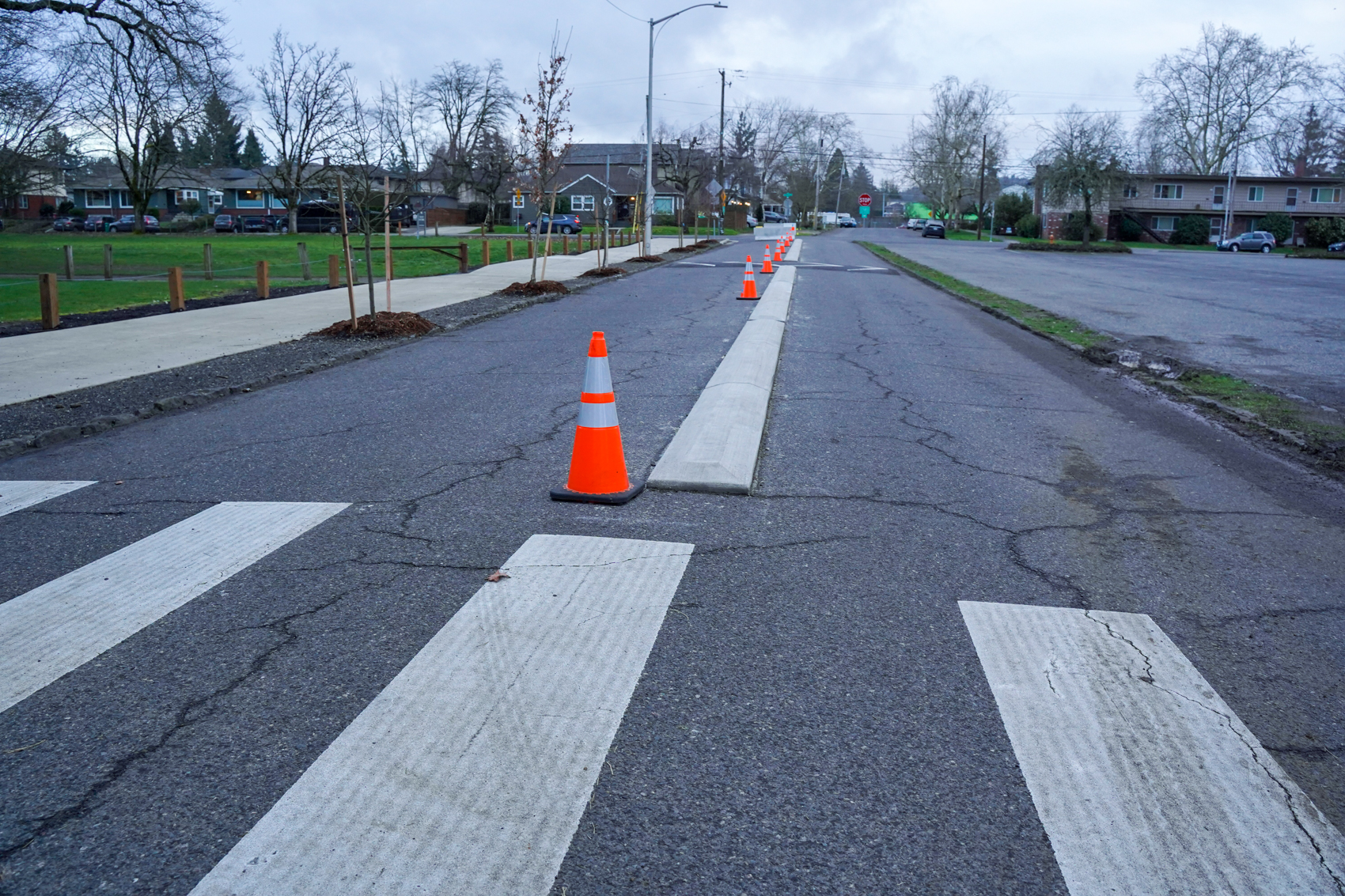
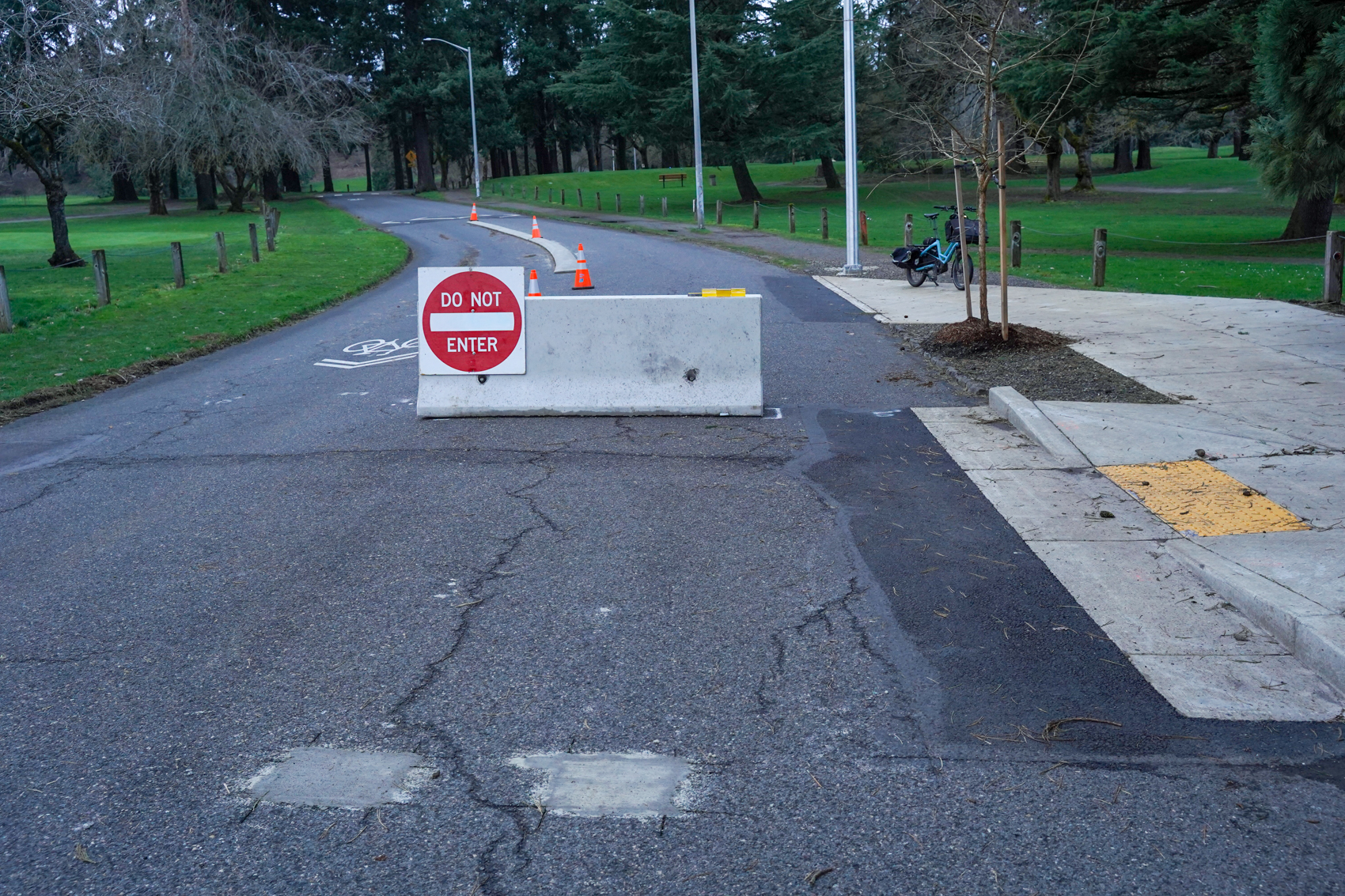
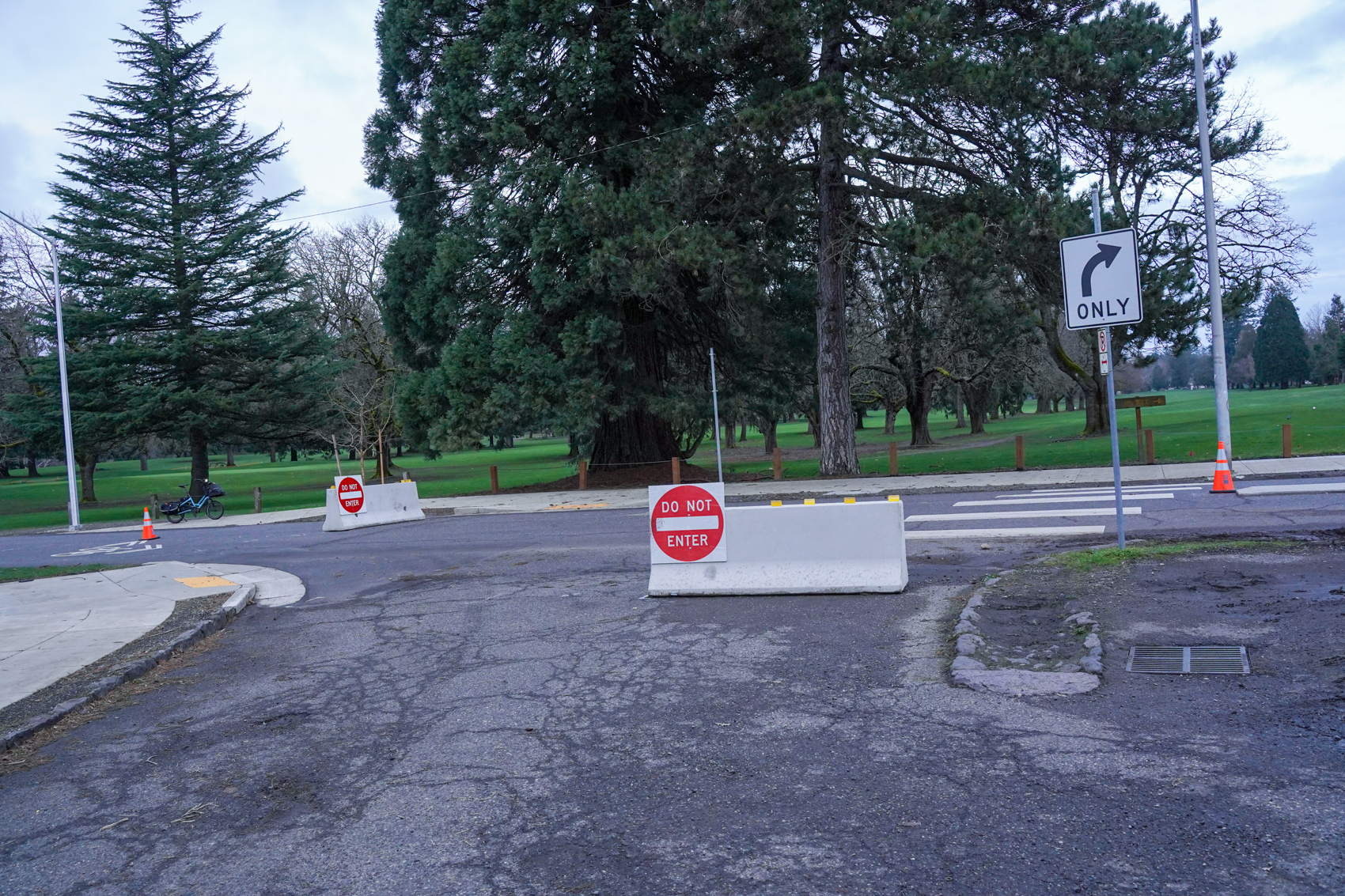
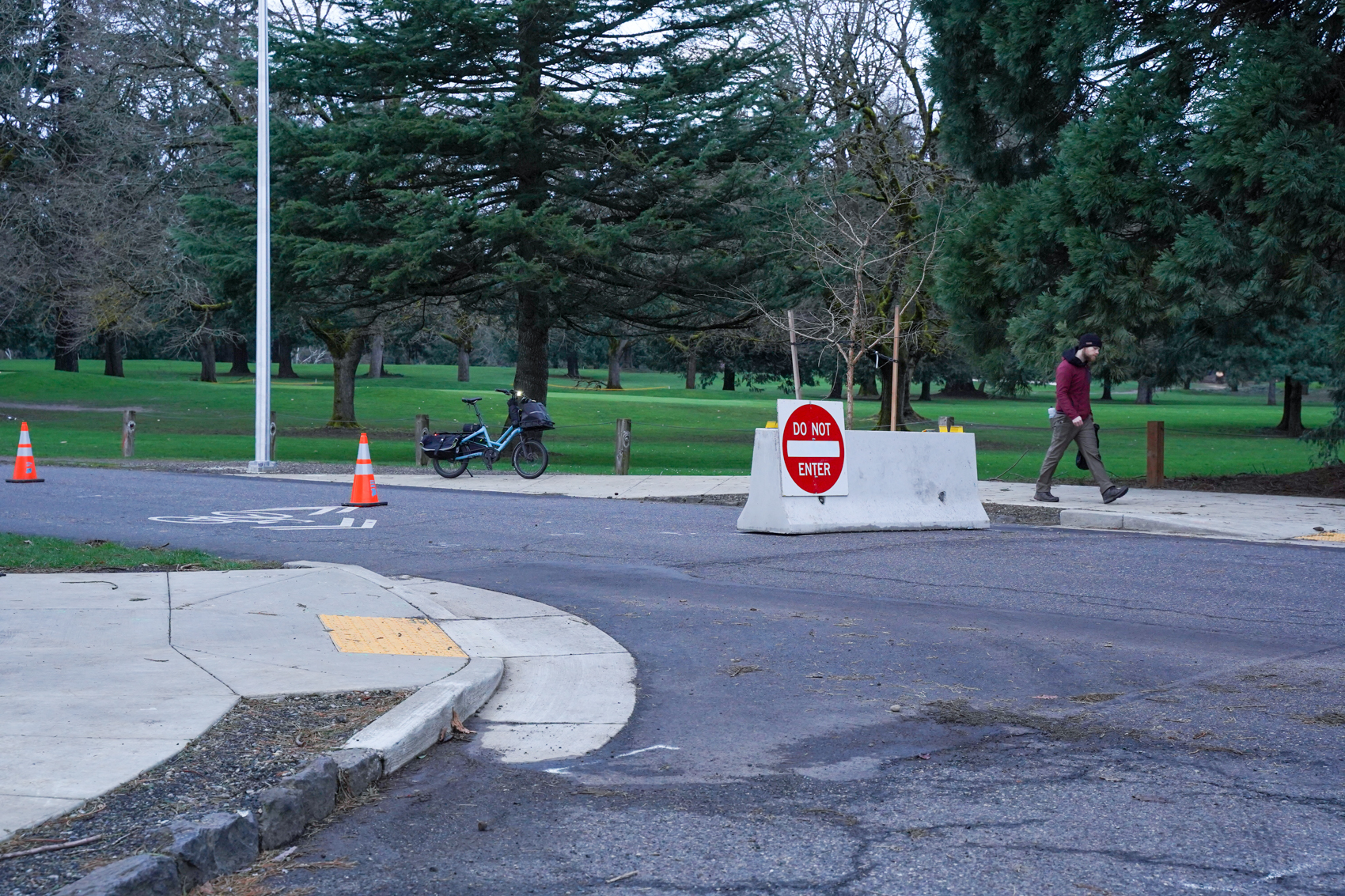
After its first iteration was destroyed by driving advocates, the newly hardened carfree path through Rose City Golf Course (built as a key section of the 70s Neighborhood Greenway project) has survived for a few weeks. Given that it’s now made of concrete poured onto the ground and in the form of multi-ton barriers, it would take a mighty effort to remove it.
I took a closer look at the project yesterday and experienced the anger some folks in the neighborhood feel about the project first-hand.
While I was standing in the golf course parking lot taking video and photos, a full-sized Chevy pickup rumbled toward me (you can see the truck in a photo in the gallery below). I ignored it at first, then a window came down and I heard yelling in my direction. I bent over and peered into the rolled-down passenger-side window to pay attention to what an older mas was saying to me. I felt his anger and hatred immediately — even though we exchanged no small talk. He didn’t ask me any questions or try to understand what I was doing out there. He just went right into tirade-mode: “You have nothing better to do with your time than film people going up this hill?!! You’re a bike Nazi! I bet you got beat up in high school!” It was all so random and strange, yet I understood exactly what was going on (I’m well-aware how our society has become tremendously tribalist and divided). I actually felt bad for the guy. I barely replied. Just looked at him with a shocked face. “I’m just documenting the infrastructure!” I replied. “The infrastructure? Yeah it’s really messing things up for everyone who lives up on the hill! I’m glad you got beat up in high school! You bike Nazi!!”
Advertisement
Looking northeast from golf course parking lot. I didn’t realize it at the time, but inside that truck is the dude who yelled at me.
This man — who’s probably someone’s loving grandpa, friend, and well-loved community member in other circles; yet has nothing but blind hate for a middle-aged stranger in a puffy jacket standing in a parking lot doing his job (note that I didn’t film at all) — then sped away, squealing his back tires and recklessly exiting the parking lot of the Rose City Golf Course.
This is now the city we live in. Where PBOT does a project to establish a safe street that requires drivers to alter their routes and some people get so mad they destroy the infrastructure, scrawl “F*** PBOT” graffiti nearby, and then verbally assault someone they don’t know. Sigh. And no, I didn’t get it on video because it could have escalated the situation and I didn’t want the man to feel antagonized. As it was, if he ever reflects back on that moment, I hope he recalls that I was absolutely shocked at his behavior and that I was calm and nice to him in response.
OK, back to the project…
Advertisement
Looking south toward NE Tillamook. Looking west into golf course parking lot.Looking north toward NE Sacramento.Looking north toward NE Sacramento.Looking south toward NE Tillamook.Looking north. Note two marks where old sign was once installed.Looking east from golf course parking lot. Looking east from parking lot. People drive through this median to go northbound.Rider using the new path.Looking northeast from parking lot.Looking north from Tillamook.
As I shared last month, the new installation includes three Jersey barriers: one to block drivers from exiting the golf course parking lot, and two to block drivers from going north on NE 72nd Drive from NE Tillamook. There are also four long sections of low-profile concrete curbs and two speed bumps. Unfortunately, because it’s still physically and geometrically possible for a driver to fit their car into the northbound lane, many people still drive north (see video below). It’s truly astounding how otherwise upstanding people will choose to blatantly disregard laws meant to protect people just for their convenience. We should never normalize that!
I was only there for a few minutes and saw one driver exit the golf course parking lot through the enter-only lane, then drive north — in the wrong way in the southbound lane (video below). I also talked to a bike rider who said he uses this stretch of 72nd Drive often and says drivers still drive north. I also noticed deep tire tracks in a planted median that separates the parking lot from NE 72nd Drive. It’s clear people are driving northbound from the lot, then crossing over a gap in the concrete curbs as soon as possible. It appears that the Portland Bureau of Transportation will have to install a continuous barrier along the entire easternmost lane of NE 72nd through the golf course if we want to keep drivers out of the carfree path.
This driver is disobeying signage and barricades to drive the wrong way through Rose City Golf Course.
Advertisement
There is also standard and ample signage that makes it clear no turns are allowed onto the northbound lane that the lane is closed to drivers, and so on. But alas, like many other locations throughout Portland, the only way to stop some drivers from breaking the law is to make it geometrically impossible and/or to have a conspicuous law enforcement presence 24/7. It’s pretty sad that so many drivers behave like entitled little toddlers and we have to essentially baby-proof our infrastructure to make sure they don’t hurt themselves or others. Grow up people! Life in a city requires you to defer your selfishness and sense of entitlement to others so that we can all exist safely.
I didn’t want to make this an op-ed, but folks leave me no choice. Back to the project itself…
The good news is that the current design is a huge step above what was there initially. I saw many people out walking and jogging, and it was a dreary, cold, drizzly night. When the sun comes out, this new path will be poppin’! I hope we don’t have to rely on human traffic to reinforce the rules for drivers and that either PBOT returns to make it even more robust and/or these miscreant drivers exchange their pettiness for precaution and find a different way around.
Maybe we should plan some events to activate the new path even more. Let’s set up a temporary mini-golf course in the street!
Have you used this yet by bike, on foot, or in your car? Let us know how it’s working — or not — for you.
The homeless camp on SE Belmont where Bentley was hit. (Jonathan Maus/BikePortland)
A friend of David “Dino” Bentley, the man killed in a violent vehicular rampage on Southeast Belmont Street on February 25th, says the incident was the result of a disagreement between the driver and people who lived at a street encampment. According to a BikePortland commenter who says they once lived at the camp where Bentley was killed, the driver, 22-year-old Shane McKeever, wanted fentanyl and became aggressive when he couldn’t get it.
Someone named Belynda Wagner wrote a comment on our story about the crash Monday night sharing details of what she believes happened in those early hours of Sunday morning prior to McKeever running down Bentley and driving his car into the well-established encampment on SE Belmont between Martin Luther King Jr. Blvd and Grand Ave.
Wagner’s comment is a window into what might have happened that morning, the brutal nature of street life, and Portland’s ongoing struggle to take care of people who live here.
Read her comment below (edited for clarity):
Advertisement
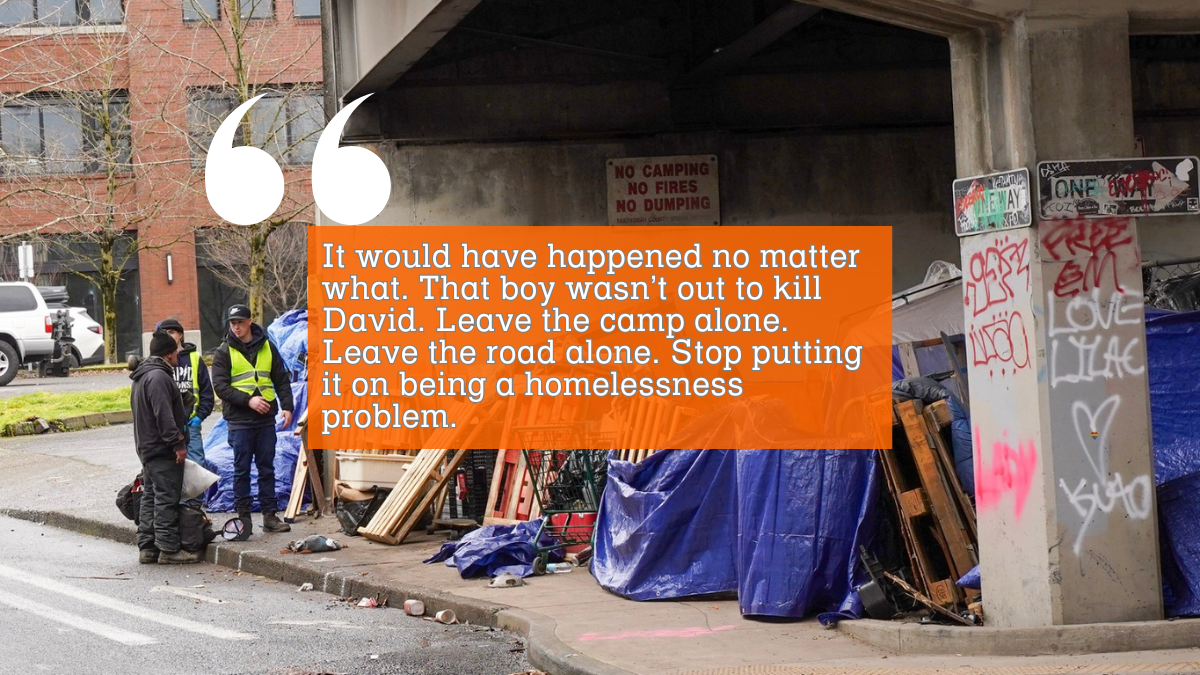
“It would have happened no matter what. That boy wasn’t out to kill David. He was after my son “Grumpy.” The kid [driver] is a psychopath. I myself have camped in the same place. In fact it was me that moved the fence back to make a community dog space that was safe. Or safer… No matter where we go, people take our belongings, shoot at our camps, pick fights with us when they’re drunk or high, burn down our camps and our tents, hook our tents up to the back of pick-up trucks and drag them….you name it. I got hit by a car on the job as a flagger. It ruined my life. I don’t make enough money now to rent a tea cup. Let alone a house or apartment. And I’m native to portland. Born at ohsu in 1980 at 11:59 pm on April the 16. I’ve lived here my whole life.
David (red shirt) in an undated family photo. (Courtesy Let Me Go On / Facebook)
I’ve seen this big city turn into a big city. It used to be just a small town in the middle of no place special. It was once a place you could leave your cars unlocked, your house open, let your kids run free, and it was so safe. I miss Portland as it used to be. Listen folks. You can all sit here and call it a “homeless problem” or whatever. But the truth of the matter is that it’s a mental health problem. Yes the boy [the driver/suspect] was there 10 mins before he got in that stolen car and ran over David. He was there fist-fighting in the street. Hand-to-hand combat with my son [not by blood, Wagner calls herself a “street mom”] . The boy was there trying to score some fentanyl. Wrong camp everyone there told him. ‘We won’t help you kill yourself,’ is what he heard. No one here does that crap nor will anyone here help you acquire it. We are 100% against it. The boy didn’t like that response. He wanted to get verbally disrespectful. He was asked to leave. He refused and pulled a knife on my son. My son responded by grabbing a bigger knife and said ‘Okay, if that’s how you want to play.’ The boy said, ‘no.’ And then threatened to run everyone at the camp over.
At that point David wasn’t even there. The kid left. About 1-2 mins after, the kids walks westbound on Belmont, and David had rolled up on his bike. [David] said both his backpacks and longboard had been stolen, so to keep eyes open. About a minute and-a-half after stopping, David was struck from behind.
That boy needs some serious help. It’s not a dangerous road problem, it’s not a homelessness problem, that little boy is just friggin’ mentally not okay. Not on any level. This is a mentally sick and drug-addicted child. The kid shouldn’t even be in jail. That boy needs the state mental hospital and a straight jacket.. and a whole lot of mommy hugs. That boy was fucked up early on in life. An unfit parent hurt that child and now he sits alone in county jail. Where he will unfortunately not make it out of alive… He’s marked.
The boy still needs mental help. He made a 180-degree turn and went back to run over the other people. Because it was meant to kill my son not my brother. Yes, shots were fired… 5 at the windshield. He wasn’t hit nor did anyone else die. But he did get the picture once those shots were fired. Otherwise I don’t think he would have stopped until he had killed everyone there. Those warning shots stopped that car, and he got out and ran in fear for his life. Those shots stopped 4 more people, innocent people as well, from dying. And all of this was due to that kid wanting a drug no one had or was willing to help him obtain because they do care.
Let’s keep that in mind folks. Not all of us homeless people are bad. Most of us are not. Most of us are just like the rest of the community. Normal. Just normal without enough income to be normal inside. Let’s get this boy some help.
David just rolled up this time at the wrong time. And it all happened so fast in such a short window of time there wasn’t even anyway of knowing that he intended on making good on his threat.
Leave the camp alone. Leave the road alone. Stop putting it on being a homelessness problem.
Face the facts that are in your faces: Decriminalization of drugs was stupid. This is the unfortunate results of idiots in an office not thinking clearly and creating a country-wide disaster. Portland voters are ultimately responsible for this shit in the end. But just continue to turn a blind cheek to the harsh reality and truth. Keep on voting without thinking. Clearly it’s working wonders.”
An obituary for Bentley posted to Facebook yesterday said he, “loved life and lived it vibrantly, leaving a mark on everyone he met,” and that, “he lived his life to the fullest, never losing his unique spirit. His departure has left an empty space in many hearts, and he will be profoundly missed.”
A memorial ride for Bentley will take place on Saturday, March 30th at 1:00. Meet at Tom McCall Waterfront Park. The ride will cross the river and end with a vigil where Bentley last lived and BikeLoud PDX will help his friends and family install a ghost bike.
The one and only Michael Andersen rolled over to The Shed on Friday and I’m excited to share our 50-minute conversation with you.
If things would have gone differently, Michael and I might have been working together here in my backyard. Seven years ago, Michael was BikePortland’s news editor, a position he held from 2013 to 2016. I’m typically pretty humble about what happens around here, but I have no problem saying that Michael and I were kicking ass. We had such a great complement of skills when it came to this weird type of community transportation journalism that we do. It just clicked. I loved working with him and — from the Real Estate Beat column, to his detailed coverage of “low-car life” (a phrase he popularized) and national cycling trends (he was working half-time for national nonprofit People for Bikes) — I loved what we produced together.
Why’d he leave BikePortland? He shared something during our chat Friday about that for the first time. “Because I couldn’t have two children simultaneously,” Michael said. “BikePortland was so all-encompassing that I felt like I couldn’t have done them both of them justice. So, I had to choose my son. Sorry about that.”
I still don’t forgive him, but I’ve learned to move on. Just kidding! And it feels great to know that Michael went on to much bigger things as a major part of Sightline, a well-respected think tank with nearly two dozen staff that research, develop policy, and write articles about stuff like housing, climate change, environmental economics, democracy, transportation, and so on.
All this is to say it was really nice to have Michael over for a chat. We of course talked a lot about housing, the politics of density (although he doesn’t use that word and prefers “proximity”), biking, Portland politics, and much more. Here are a few highlights.
Advertisement
On the co-housing development he lives in today in the Cully neighborhood:
“I think it’s a perfect example of the sort of thing that low-car life makes possible because the whole development wouldn’t have penciled if there had been demand for more than 20 parking spaces for those 23 homes. But as it is, the developer couldn’t actually sell three of the parking spaces because not enough people wanted to buy them.”
On his work at Sightline:
“… We are not trying to get everybody to live closer to each other. What we want as a society, is to let everybody who wants to live closer to each other — and in so doing, cut their energy use in half — should get to do so. We desperately need that to happen, because otherwise our electric bills are going to keep going up, and the world is going to keep being destroyed by pollution and everything else. And it’s not that everybody is ever going to want to live closer to each other. But, to the extent that it is possible to get people to do so, then we should let people do so.
And we have so many rules and laws that make it either illegal or overly expensive to make that choice to live closer to each other. And so my job at Sightline is to try and call attention to that fact and say, ‘This is a really stupid set of rules that are forcing people to live further from each other, to be disconnected from each other socially, to use more energy, use more money than they really need to, or than they really want to.
A lot of environmentalism is getting people to do things they don’t want to do. Whereas, I feel like with bike advocacy and housing advocacy, a lot of it is actually letting people live the way they want to. And so that’s really joyful.”
On the state of the pro-housing movement:
Advertisement
“I think the housing movement is at one of those peaks right now. There’s a lot of attention. There’s more funding than there has been. There’s more narrative energy. And I think there are electeds like Tina Kotek, the [Oregon] governor right now, and even the Portland City Council, who are not a boat rocking crew for the most part, but do have this consensus that something needs to be changed on housing, even if they don’t really know what it is. So right now the challenge is to capitalize on that energy and get as much done while we can.
I’m on the older side of this housing scene, and, and I feel like I need to tell the young people, ‘This is not going to last. We don’t have forever. We need to get stuff done while we can.'”
And asked to bring folks up to speed on where the housing issue is in Portland today, Michael went back 100 years. He shared how racism and classism spurred zoning laws in 1924 that largely created the urban form we have today.
Then, during an exchange about Portland’s cycling rise and fall, Michael noted a poster of the Sprockettes I have on my wall (the Sprockettes were an all-female mini-bike dance team that ruled Portland streets for 15 years between 2004 and 2019) and we came up with the “Sprockettes Test” as a measure of proximity and good urban planning. That is to say, those little bikes weren’t comfortable to ride long distances, so maybe it was Portland’s relatively compact urban form that allowed the Sprockettes to flourish and get around to gigs easily.
Toward the end of our conversation, I asked Michael what he wants BikePortlanders to understand about the housing issue:
“I think most bike people have an intuitive sense of the fact that transportation and housing are really closely associated and you can’t do one without also thinking about the other.
I think the key idea that I’m trying to communicate lately is that we cannot change the status-quo without changing the status-quo — that the source of the cost of housing is all the rules that we put around housing and not all those rules are bad. Some of those rules are good. Like, you should be able to enter a building in a wheelchair without an assistant. But that’s not free. It’s not free to require compliance with the Fair Housing Act. So we all pay for that and maybe that’s fine, but what we need to do is figure out what are the least bad rules to get rid of.
And the top of my list of bad rules are getting rid of the mandate that you’re not allowed to share walls, not allowed to share roofs, not allowed to share kitchens in many cases.
And beyond that, there’s a zillion little rules, but every little additional rule we add, adds a little bit more cost. No one rule is the deal breaker, but they all add up. And so we’ve got to figure out which are the least bad ones, and we’ve got to have an argument about it.”
Michael also shared who he likes for Portland Mayor, and much more. Listen in the player at the top of this post or find our show wherever you get your podcasts.