

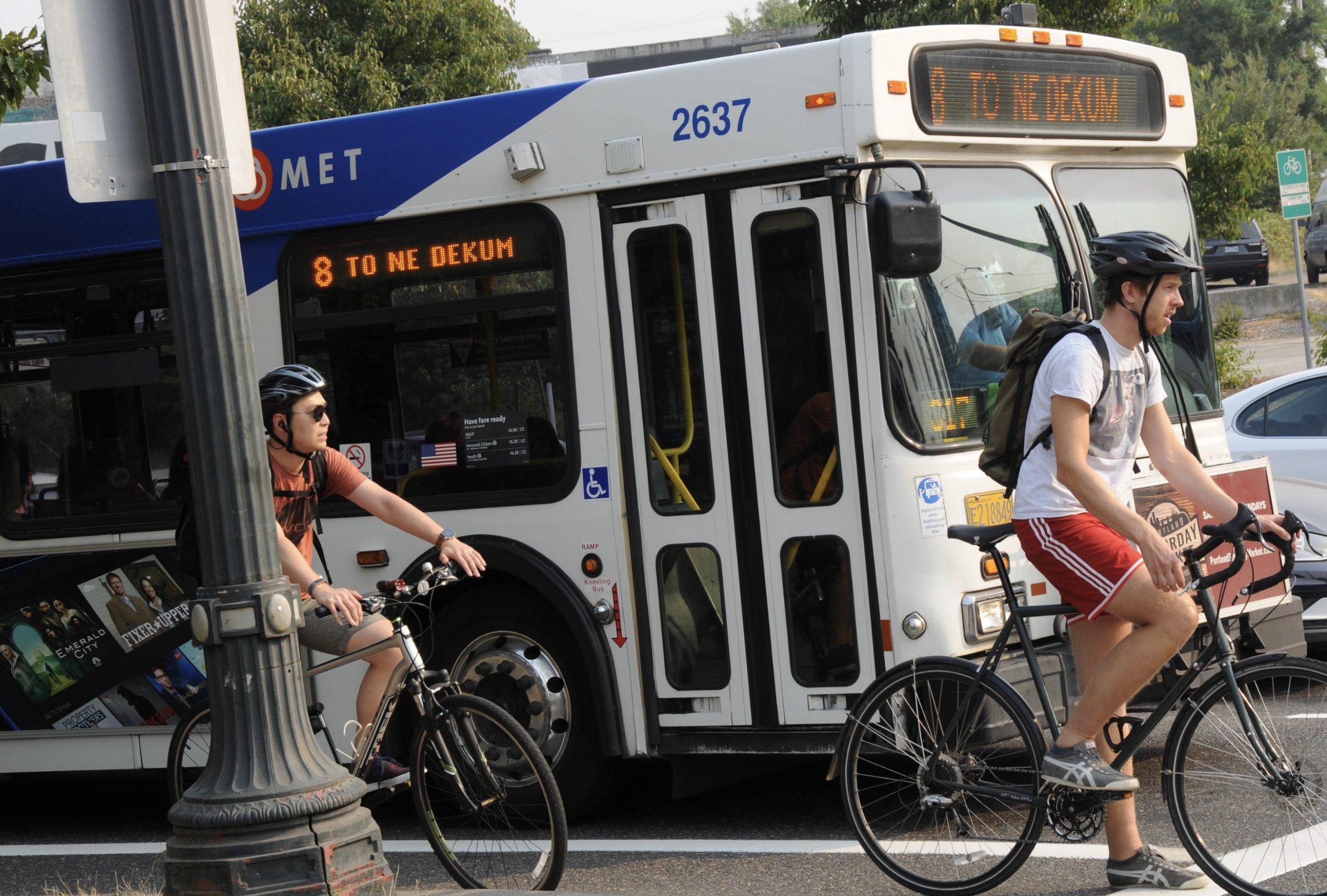
Portland City Council has a difficult decision to make. With $15 million in revenue from the Portland Clean Energy Community Benefits Fund at play, a myriad of ideas on how to spend it have emerged. At this morning’s meeting of the Climate, Resilience, and Land Use Committee, councilors punted on the decision in order to have more time to mull the options over.
As expected, the ‘Bikeable Portland’ plan, received a strong pitch at the meeting today. Testifying on its behalf were former U.S. Congressman Earl Blumenauer, Portland Public Schools Board Member Stephanie Engelsman, and the plan’s architect — veteran Portland Bureau of Transportation Bicycle Coordinator Roger Geller.
Geller framed his proposal as something that would cost $6.3 million over three years for a relatively small targeted area (that could be larger with more funding). “This program centers on two ideas,” Geller explained. “Giving people a reason to bicycle and then opportunities to do so… the program is predicated on the idea that bicycling is a good product, that it’s transformative at both the personal and societal level.”

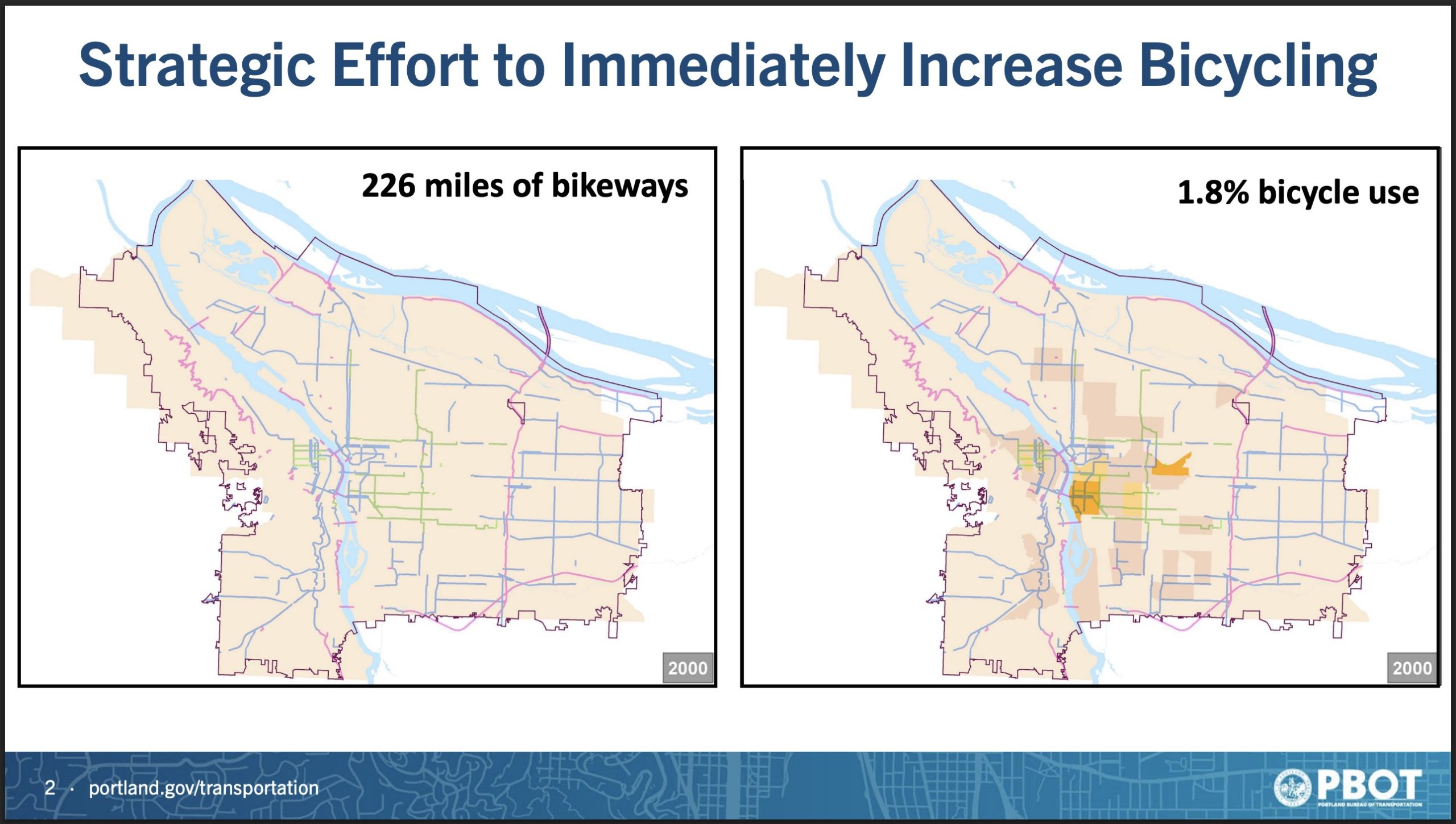
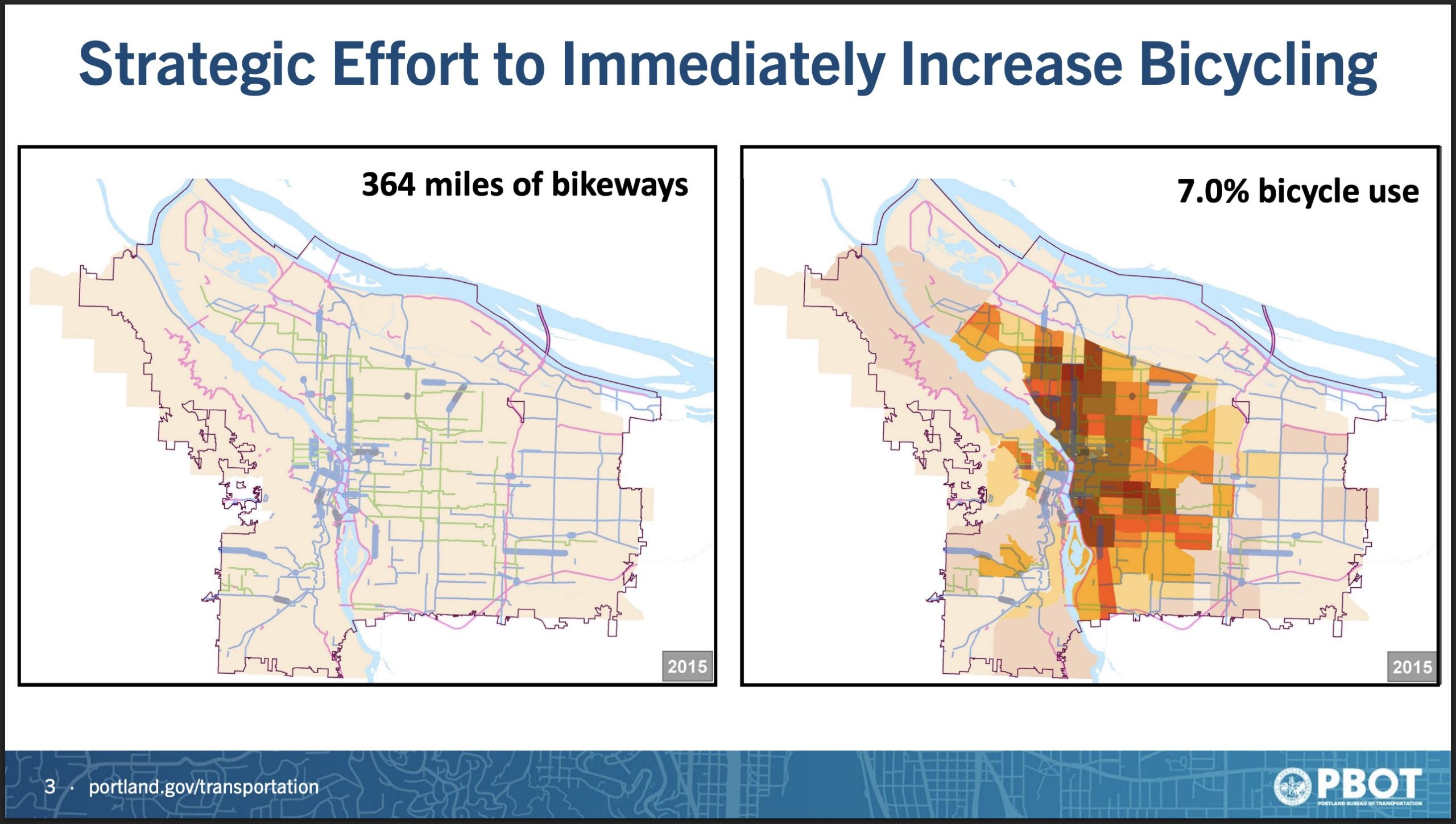
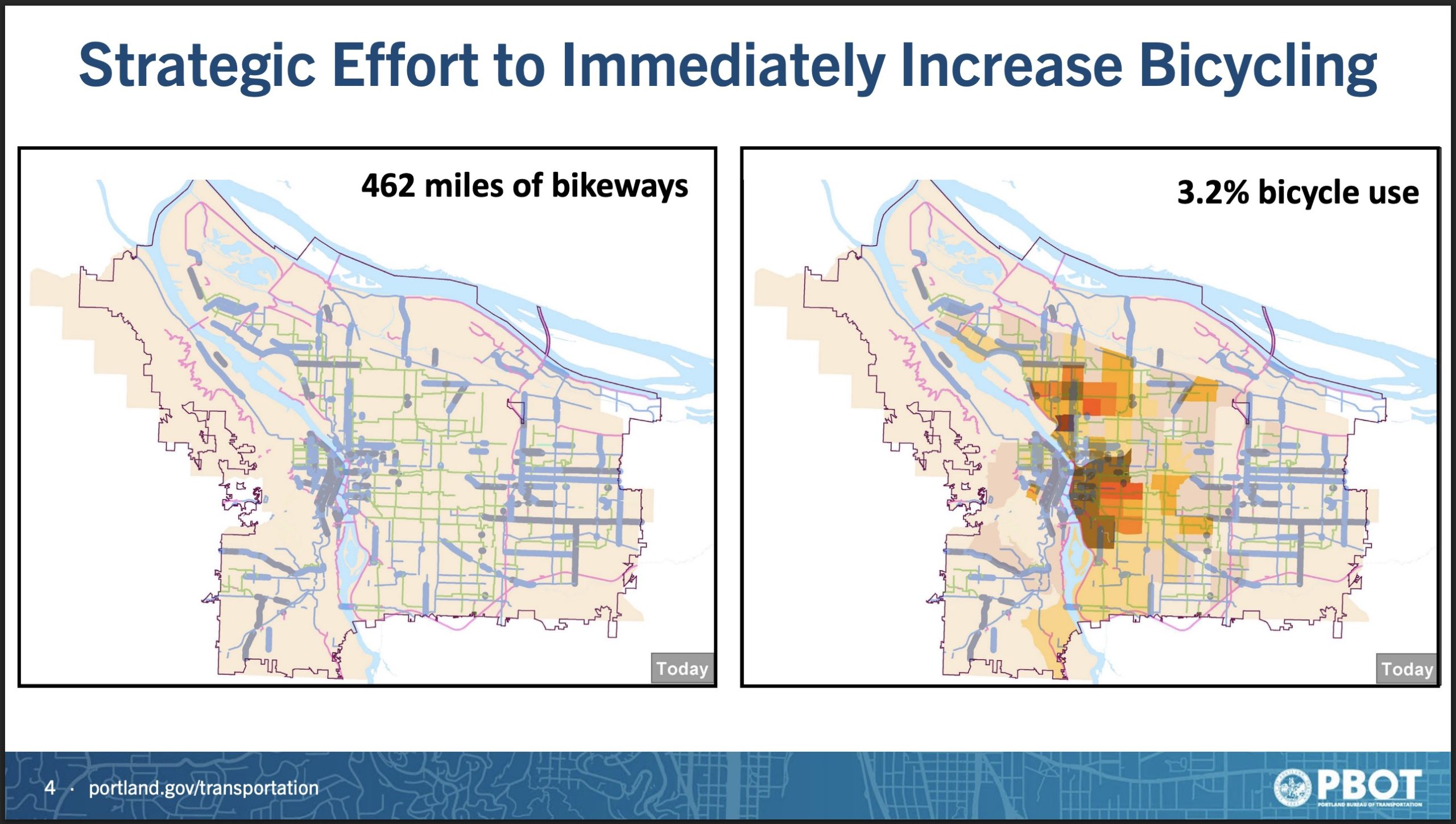
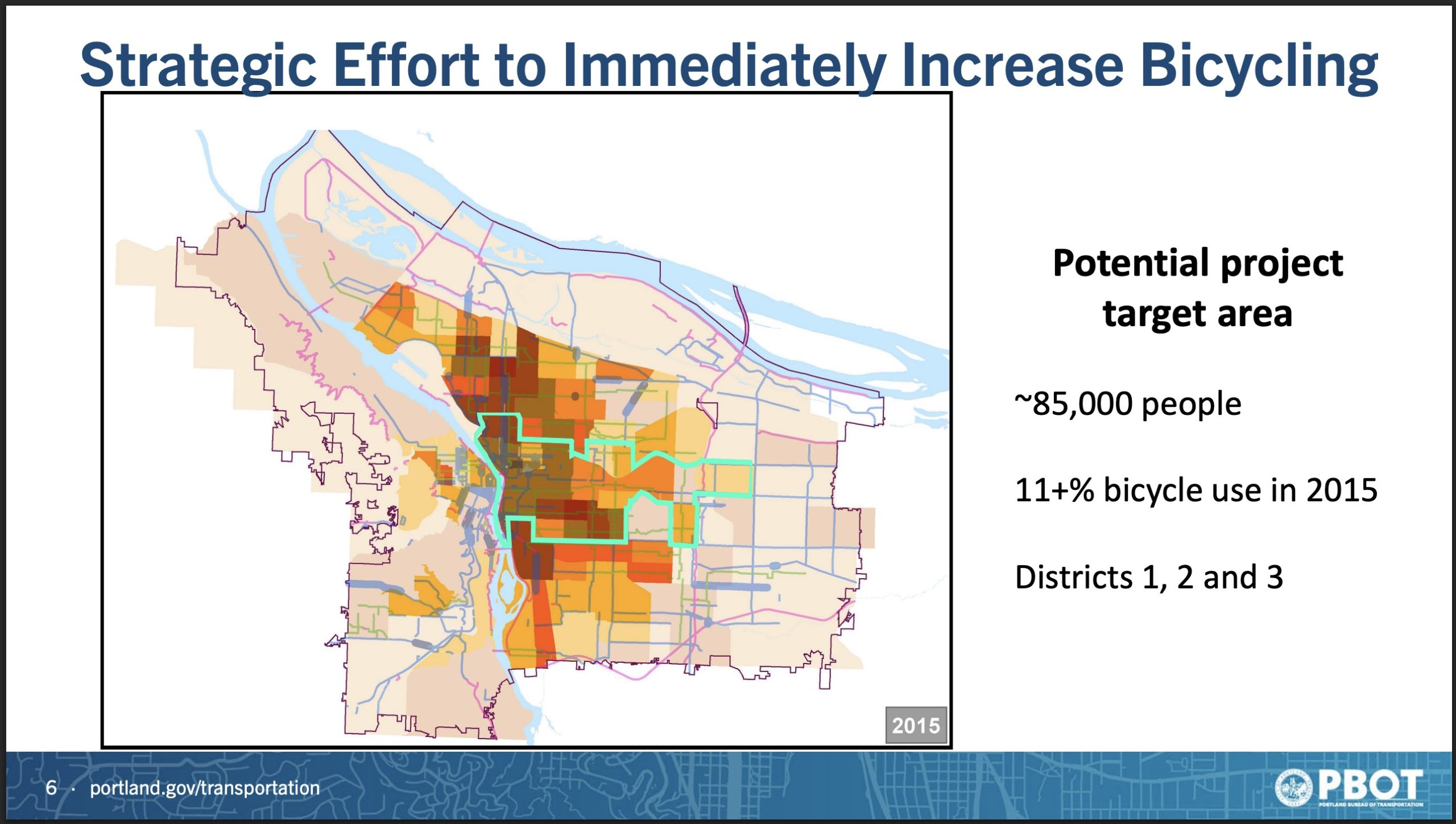
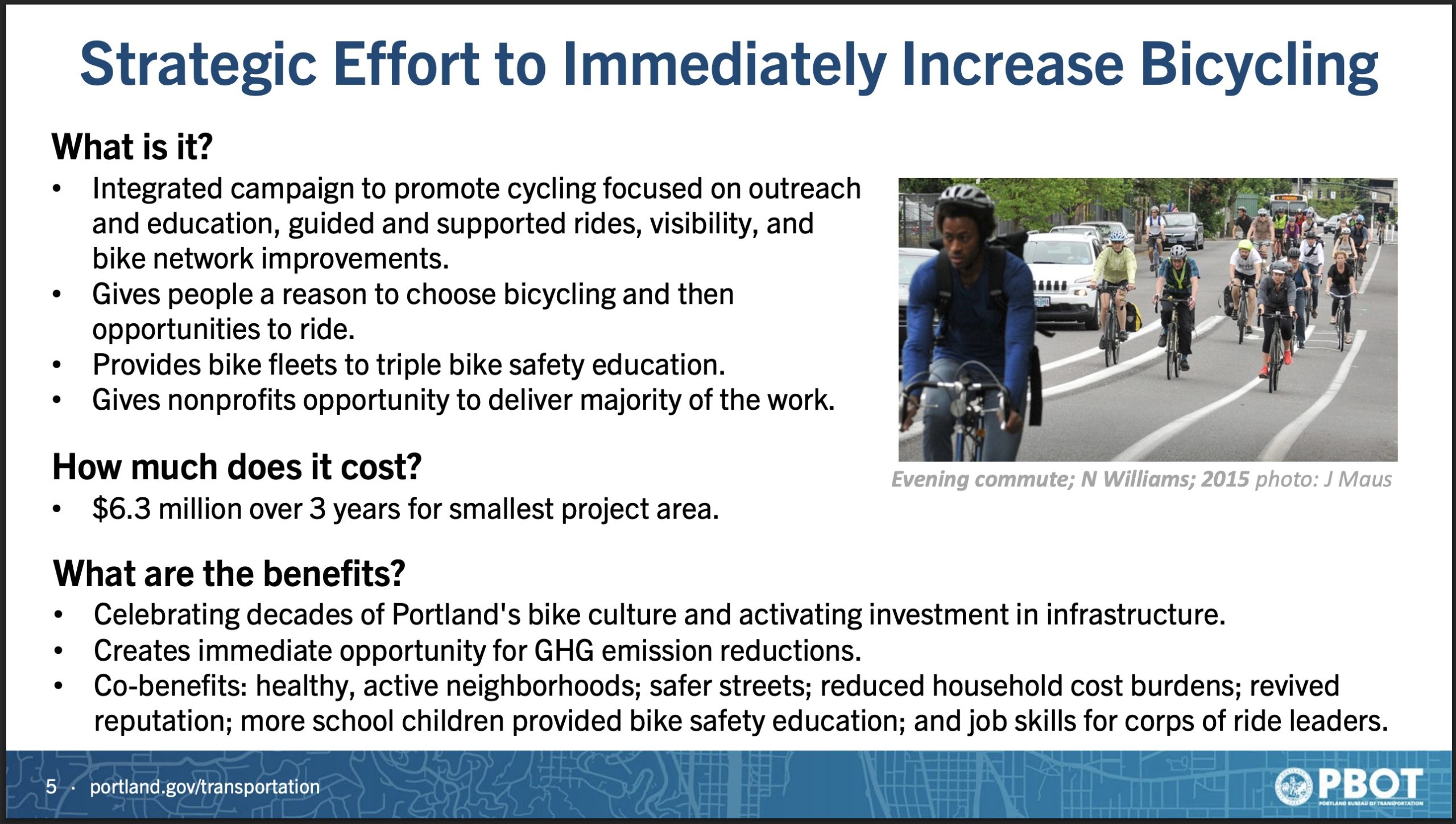
Engelsman, the school board member and an e-cargo biking mom, said she likes the program idea because, “It’s built on a concept of the fantastic bike bus idea that we’ve seen work in schools.” One element of the plan would be to purchase more bikes for school students to use and train P.E. teachers how to teach kids to ride. The plan would also build off the success of volunteer-run bike buses throughout Portland by contracting with an organization that would hire ride leaders who would host daily, regularly scheduled rides. “Bike busses work so well because there are dedicated leaders who understand the routes, who know how to troubleshoot on the way and help make it fun and stress-free to ride downtown.” Engelsman told councilors. She called Geller’s proposal, “A low-cost plan with a potential massive payoff across the city.”
This morning’s meeting was Geller’s first opportunity to explain his idea since it leaked to the community last week. In his testimony and presentation to council (slides above), Geller said that despite all the miles of Portland bikeways that have been built, ridership has gone down. “We’ve invested significantly, and we’re not seeing the results just from building the bikeway network.” That’s why Geller wants to turn to grassroots organizing and marketing, along with a few strategic capital investments in the target area.
Here’s more from Geller on those projects:
“The bikeway network in much of the target area is formed by neighborhood greenways, so we’re looking at improving conditions on those neighborhood greenways, building more diverters and also building bike lanes and improving bike lanes where they don’t exist — especially on a stretch of Burnside that connects inner Portland with East Portland.”
Central to Geller’s thinking is that the existing bike network has more capacity than is being used. “In 2016 the high bike use that we had was based on about 23,000 Portlanders biking daily,” Geller shared with councilors. “Tomorrow, 70,000 Portlanders could decide they wanted to bike, and the system could accommodate them.”
One challenge for Geller is that no one has ever presented a plan like this before, and many Portlanders say the only plan they want to hear about is one that is laser-focused on installing more protected bike lanes. Another challenge for Geller is that there are now many other folks interested in this pot of funding.
As I’ve reported, this funding is in play because the PCEF Committee recommended that, as part of its annual update process, their Climate Investment Plan (CIP) should reallocate $15 million from an electric vehicle purchasing program to a housing program.
But Councilor Steve Novick, who chairs the Climate, Resilience, and Land Use Committee, feels like how that $15 million is spent should be up to debate by council. So now it’s become sort of a feeding frenzy.
At this morning’s meeting Council received pitches from several different groups.
TriMet made a request for about $13 million. They want to put the funding toward restoring Line 19, upgrading MAX to withstand climate change-related impacts, and to invest in hydrogen bus infrastructure. PBOT Director Millicent Williams pitched a $15 million suite of projects including: help with upcoming Portland Streetcar cuts ($4.5 million), a zero emission delivery plan for the James Beard Public Market ($2.8 million), funding for the Broadway Main Street project that Trump killed last summer ($5 – 8 million), and transit passes for all City of Portland employees ($1.5 million). Advocates from the Multnomah County Youth Commission asked for a major expansion of the TriMet youth transit pass program. The leader of the nonprofit Frog Ferry showed up (at the invite of Councilor Sameer Kanal, who’s a fan of the idea) to remind Councilors that it would take $22 million to get their first boat in the river.
And to make the decision even more difficult for council, the housing development manager from nonprofit Self Enhancement Inc — the nonprofit that would have received the additional $15 million as recommended by the PCEF Committee to install heat pumps in low-income housing units — showed up to warn everyone their projects could fail without the funding.
No decision was made today as the committee voted to send the PCEF CIP amendments forward to the full council without the changes to this specific $15 million.
Today we learned not only what other ideas are on the table for funding, but we also got a few hints about where councilors stand on them.
Councilor Candace Avalos was not happy the full CIP amendment was not approved today. She is the only councilor who wants to keep the PCEF Committee recommendation as-is and switch this $15 million from EV subsidies over to home energy retrofits.
One of the reasons Councilor Novick wants to have this debate is because he has long felt like PCEF was short-changing transportation — despite the fact that transportation is the number one source of climate emissions in our city.
Avalos tried to convince folks that that’s not the case. She sees the housing funds as an urgent need that would go toward a shovel-ready project. “This is not a permanent deprioritization of transportation,” she said. “What’s before us today is not a philosophical shift in our climate priorities… this is about timing and readiness and impact, not about abandoning transportation as a climate strategy.”
But Novick pushed back and replied that, “Right now we’re spending 47% of PCEF funds on the second largest source of carbon emissions — buildings — and 24% on the largest — transportation. So the proposal that came from PCEF would increase that imbalance.”
Councilor Angelita Morillo expressed opposition to using the funds to “backfill TriMet.” Morillo (and Avalos, who shares this sentiment) does not think it’s wise for the City of Portland to get into the business of bailing out TriMet. They believe the state legislature needs to step up and do that. “And because we simply don’t have the dollars to do that,” Morillo added.
As for the Bikeable Portland plan, Morillo wasn’t impressed. “I’m not sure that advertising or more political discussion about biking is the barrier. I don’t think people don’t bike because of a lack of advertising, I think that we’re not biking in the city because it doesn’t feel safe, or because we don’t have the physical, hardened infrastructure to keep people who are biking safe. And I struggle to see how the ride-along things are different than PedalPalooza or other things that already exist for free that people can join.”
And Councilor Sameer Kanal also had sharp opposition to some elements of the Bikeable Portland plan, saying, “I strongly oppose the use of money for social media ad campaigns at PBOT to encourage people to bike.” But he likes other aspects of the plan, like the community activations.
Both Kanal and Councilor Dan Ryan expressed they’d like more time to fully digest the options.
No announcement was made today about when this discussion will happen, but it’s like to be at a future meeting of this same committee. And keep in mind that councilors could vote to support an option that includes elements from several different plans. The $15 million is still in play and what it ends up funding is undecided.
CORRECTION, 3:27 pm: This post initially stated that PBOT was seeking funding for transit passes for PBOT employees. The proposal is to fund transit passes for all City of Portland employees (not just transportation staff). I regret the error and any confusion it caused.

Thanks for reading.
BikePortland has served this community with independent community journalism since 2005. We rely on subscriptions from readers like you to survive. Your financial support is vital in keeping this valuable resource alive and well.
Please subscribe today to strengthen and expand our work.
Ah yes, another episode of Portland’s Got Grants. Everyone lines up with a PowerPoint, says the word “climate” three times, and suddenly $15 million falls out of the sky. Bike influencers, ferry dreamers, transit bailouts, social media ads, chuck it all in the esky, mate.
Meanwhile regular folks are at Fred Meyer doing mental maths on eggs and wondering how “bike bus program managers” are gonna help with that. If this is a Clean Energy Community Benefits fund, maybe start with benefits the community can actually feel, or wild idea, give some of the cash back and let people lower their own emissions by not going broke.
At this point PCEF isn’t a climate strategy, it’s a vibes-based slush fund. Pick something, fund it properly, or stop pretending this is anything other than money looking for a justification
Transportation often represents about 20% or more of household expenditures, especially for people doing mental maths (you British?) on eggs. So, more biking = less transportation expenditures.
Mathematic*S* == Math*S*
Only in the USA are people incapable of understanding the metric system or the grammar of plural nouns.
Angus may be British, and Brits say “maths” instead of “math.” Not a big deal.
He’s not British, I think he sounds more like an LLM trained on crocodile Dundee movies or some other caricature of an Australian.
Woosh.
(My entire point is that north ‘murricans should say and write maths just like strayans*, kiwis*, and poms*.)
*slang terms that are considered to be banter or affectionate teasing
Who cares what you think Americans “should” say or do?
Just wait until you hear what we call the 13th element, sweet baked pastries, and large automobiles used for freight transportation.
Language is dynamic, and there is no “wrong” way to speak as long as your meaning is able to be widely understood within your social group. Unless you’d like me to call out your obviously erroneous use of “grammar” in lieu of “stæfcræft,” “incapable” in lieu of “unandgittol,” and “affectionate” in lieu of “éaðmód.” Leave it to the British to not understand that they’re legitimizing the invasion of foreign conquerors by borrowing words and grammatical structures from them. Make English mærsung again!
Great, I look forward to your passionate comments about reforming the OR property tax system to prevent the sort of systemic underfunding that all local governments in OR endure thanks to M5/M50 limits. Or maybe an impassioned defense of a progressive income tax on high earners to fund certain social programs? Or does that not count as “properly funding” since you read a fluff piece in a pro business newspaper doing shoddy analysis on incomplete data that that tax is causing widespread tax flight in Oregon. What does “properly funding” even mean to you?
OR has a bad tax structure, but the answer to the problems that causes isn’t “do nothing until it’s better”, it’s “try to plug the gaps to the extent that is legal while also trying to do broader reform”. PCEF is flawed, but that’s because it made too much money and the city amended how that money could be spent in response. If you’re against that, I’d encourage you to contact your councilors to address that.
Blimey, mate — that’s a hell of a swerve. We went from bike buses to Measure 5 like it’s a late-night Q&A panel.
Not saying tax reform’s not important, but dragging out the whole OR revenue system every time someone questions a $15m grab bag is a bit “yeah nah”. You can think PCEF’s messy and still ask whether this particular spend passes the pub test.
Right now it’s less “plugging gaps” and more “emptying the junk drawer and calling it a toolkit.” Maybe before redesigning the tax code, we figure out if bike hype squads and Insta ads are really the best bang for buck.
Anyway — cheers for the policy TED Talk. I’ll be over here talking about the actual thing on the table, not rewriting the constitution between sips
That one’s as slippery as an eel in an esky full of emus.
You want to talk about sustainability funding government, you sort of need to talk about tax policy.
https://fred.stlouisfed.org/series/QTAXTOTALQTAXCAT3ORNO
In 1994 OR collected just shy of $1B in tax revenue. It took about 11 years for that to cross to $2B in 2015, it took about 9 years to cross to $3B, it took about 4 years to cross to $4B, it took 3 years to cross to $5B, it took 3 MONTHS to cross to $6B, and almost hit $7B in Q2 of last year.
In 1994 OR had a population of 3.082M, so taxes per capita were just under $300. In 2025 OR had a population of 4.27M, and being conservative with taxes collected at $6.5B that is $1,522 per capita. The per capita amount in 1994 adjusted for inflation to 2025 would be $622. So, the state has increased the amount collected per person by 250% over 30 years. You’re asking people to not notice that government services haven’t improved by 250%, I bet many long time residents would argue they’re worse now than the late 90s. Shit, I think people’s heads would explode to know that the state is collecting TWICE the money now than as recently as 2018. The way taxes are apportioned in OR may be broken, but to suggest there isn’t enough money is insane.
I know you don’t believe people are leaving OR, but I literally just signed the contract on a house to be built in Utah last night. I’m no Phil Knight, but I will pick up enough in state income tax savings to cover almost all my wife’s income as a part time social worker and property tax savings will pick up the rest. It is a no brainer.
Great, enjoy a newly built house in Utah. Hopefully the desiccation of the Great Salt Lake doesn’t go too quickly. I personally think moving across the country for tax savings is weird, but that’s just me. I left Oregon because the job market in Portland was awful when I finished grad school, but it was good I’m Seattle.
Anyways, there are structural reasons for the shift in state tax collection since 1994, most notably the shift from all local funding sources to schools from a state disbursement system. Additionally, as federal taxes have fallen (generally) since 1994, it’s natural to expect that the state would feel some impetus to fill in the gaps as they can.
This isn’t to say there aren’t serious issues with Oregon’s tax structure; there are. It’s more to say that a cherry picked number about state tax collections absent the context of other taxes is at best not telling the whole story and at worst is misleading. But taxes being relatively higher than they were in the 1990s is still not evidence that there is sufficient revenue for the state and local governments to cover their costs now. I think there’s plenty of evidence to suggest the government is underfunded – particularly when you consider the escalating use of fees to cover costs.
I’m all for strategic rethinking of what services we fund and why. I’d be happy to allocate ODOT highway funds to transit and pedestrian infrastructure (to the extent that’s allowable for state law). But in education, I think it’s unambiguous that our approach to funding has completely failed. A better system would likely involve shifting taxes from the state back to local governments (along with property tax reform), but I don’t think it would be revenue neutral. Healthcare is another issue where government intervention is just needed for a better system. It may cost more in taxes, but it can be and should be structured to reduce per capita spending on insurance and such.
Enjoy the 4.7 – 8.7% sales tax. And living in Utah.
The skiing sucks there, and there’s no place to go hiking. You’re going to hate it.
You can call various numbers cherry picked, but if people are using them to make real decisions, then they are the whole story.
I obviously don’t know if that’s the case here, but it is more important to consider the numbers people actually use and worry less about whether they are the most accurate at capturing something or the other.
That’s a ridiculous thing to say. People do make decisions with incomplete data, but that doesn’t mean it’s the whole story. It may be the whole story to them, but that’s not an interesting thing to say.
And basically no one looks at state level tax receipts and per capita state taxes as a primary reason to move. It’s at best a post hoc justification after they’ve already decided that their taxes are too high. I just think it’s useful to take a broader view of tax burdens over time, and what those taxes pay for, rather than pointing to a specific (and obviously incomplete) data point.
Funding an insurance industry to meter out health care is like taking a cinder block on a Mt Hood climb. You can surely do it, but it sucks.
Mate, going off over 0.07% of the city budget is madness. Crack open a coldie and consider the billions being hoovered up by the coppers before you crack the shit here.
A few thoughts:
Which I guess all reinforces my continuing belief that PCEF is not a well-matched program to the current city climate of declining revenue and painful cuts in the general budget. A lot of these ideas are hard sells on climate/energy grounds, so better to just spend the money on things the city really needs, which often have positive climate/energy benefits anyway.
I suspect your heat pump is not working right because it should definitely cost less to operate than burning gas if it is any kind of quality modern functioning heat pump.
Not with the way PGE has raised rates in the last few years (thanks, data centers). Even very efficient heat pump systems can cost more to operate than high-efficiency gas furnaces in Portland. It’s unfortunate that we don’t have lower electricity rates here, and we absolutely should, given our proximity to so much hydro power.
Nah, it’s likely a US-manufactured heatpump with capacitors on the fritz (e.g. antiquated 1960s-era technology that the rest of the world abandoned decades ago). Such a backwards anti-technology nation…
Based on numbers I found online, you get about 5k BTU per kwh from a heat pump. My PGE bill shows about $0.21/kwh, so that comes to 23k BTU per dollar.
Again from online numbers, a gas furnace gets about 80k BTU per therm. My NW Nat bill comes to $1.90/therm, so that’s 42k BTU per dollar.
So gas is about half the price.
By the way, I also calculated a rough carbon impact for both. PGE publishes their impact in metric tons carbon per mwh, and it comes to 0.617 lbs/kwh. Again working with whatever numbers I could find to get a ballpark idea, either heating method comes to ~0.0001 lbs carbon per BTU.
Which makes sense when you consider PGE power is 36% natural gas plus 6% coal, which is converted to heat, then to electricity, and sent out in transmission lines, compared to 100% gas at my house going through only one conversion to heat and heating the house on site.
You are correct, km. Gas costs a lot less than electricity and it also heats your house more efficiently. The rotten little lie about electricity right now is that most of it comes from (wait for it) natural gas! So if I use my heat pump, I am paying PGE to convert gas into electricty, when I could instead burn less of the SAME GAS to heat my house more efficiently.
Until most electricity comes from renewal sources, it doesn’t make sense to rely on electricity for heating – and maybe it never will. Right now it makes more sense to heat your house using gas.
The actual funny thing is, if you used the gas at your house to run a generator to power a heat pump (or better, directly run the pumps on gas), that would be far more efficient than burning the gas for heat.
Such a thing doesn’t exist. And besides, the negative consequences of running gas lines everywhere, make gas a bad product that should be banned anyway.
Gas lines are already running everywhere, and they have very few negative consequences. NW Natural does an amazing job of monitoring and preventing leaks.
Anytime you convert one form of energy to another, you lose in the conversion, which is why burning gas to heat your house makes more sense than burning gas to create electricity and then transmit it to your house (more energy is lost in transmission) to run a heat pump.
If your heat pump is powered by wind or solar or some other non-FF source, then it makes sense to run the heat pump.
> Anytime you convert one form of energy to another, you lose in the conversion, which is why burning gas to heat your house makes more sense than burning gas to create electricity and then transmit it to your house (more energy is lost in transmission) to run a heat pump.
No you can’t jump to that conclusion. The actual efficiency of heat pumps matters here. Since they can produce up to 5x the heat energy output vs electric energy in, you have to show that the losses are incredible. Do you actually lose 80% of the energy in electrical generation and transmission? That’s how bad it would have to be for heat pumps to be less efficient than gas. I don’t have those numbers off hand but I don’t think so.
Wikipedia (complain if you like) says (https://en.wikipedia.org/wiki/Combined-cycle_power_plant ) electrical generation is at least 43% to 64%. Transmission losses are real but small enough. They don’t add enough to bring total efficiency down to 20%.
And that’s if all your power came from natural gas.
> If your heat pump is powered by wind or solar or some other non-FF source, then it makes sense to run the heat pump.
A lot of our energy is not in fact fossil fuels based anyway. It is significantly wind, solar, nuclear, and hydro. Looks like over half. https://www.oregon.gov/energy/energy-oregon/Pages/Electricity-Mix-in-Oregon.aspx
It just doesn’t make sense in Oregon to install a single gas furnace again, from an environment POV. Because of perverse pricing, it may be cheaper to burn gas if you don’t care or can’t afford to care, although I haven’t seen a source.
“Looks like over half.”
And increasing.
How much of our electricity comes from coal?
I disconnected NWN from my property. Switched to all electric, running off of renewable energy from Pacific Power, or my solar panels. No regrets.
I installed solar so the GHG impact to heat my home is miniscule and getting smaller every year I pump excess into the grid.. And, BTW, anyone who loans/owns a home (and can afford it) has a profound moral obligation to fully electrify AND install solar. A person who can afford electrification and still heats their home with fracked gas (which may have a worse climate heating impact than coal) is kind of a jerk, ATMO.
If it were up to me, there would be a carbon tax levied on loan/home-owners who refuse to electrify and install solar if possible (community solar and batteries, if not). Another example of how government has a moral obligation to cajole people into making better and more moral choices.
That doesn’t sound right to me. I’d be curious on your calculations. Heat pumps don’t just turn energy into heat, they move heat, so they can be many times more efficient than the upper 90% a gas furnace is. Given that our energy is relatively low emissions, it should be much better to run a heat pump.
But I’d be curious what info you’re looking at.
Unlike you /km/ showed their calculations.
Well, not really. Calculations without a source is as good as worthless. I’m not asking for much, I’m just a little skeptical because of how unbelievable the numbers are, and the likely misunderstanding of what a heat pump does.
Yeah…calculations that mistakenly assumed kWh can be directly converted BTU without taking into account the Coefficient Of Performance. To be honest, I doubt a heatpump with COP of approx 1 even exists.
Very rough calcs and based on the 5k BTU/kwh hour that I looked at – that might be off, it’s hard to get a consistent number. However:
heat pump: 0.617 lbs/kwh (PGE 0.28 metric tons/mwh *2205/1000) / 5000 BTU/kwh = 0.00012 lbs/BTU
furnace: 117 lbs/MMBTU = 0.000117 lbs/BTU
https://portlandgeneral.com/about/who-we-are/sustainability
https://www.pickcomfort.com/carbon-dioxide-emissions-home-furnaces-causes-risks/
Now my heat pump is 10+ years old, so I was taking a relatively low efficiency estimate. As I do more research, it looks like a brand new “COP 4” heat pump is running at about COP 3 in Portland winter temps, which is 10k BTU/kwh, so that makes 0.00006 lbs/BTU.
There is the issue that if the temp is in the 40s when heat pumps are great, I’m actually not using much heat. Most of my heating cost comes from those lows around 32 or below that we get for a few spells per winter, and any advantages are falling apart at that point.
So it would take a bigger analysis to get it nailed down.
https://www.pickhvac.com/heat-pump-efficiency-temperature-cop-curves-smart-cold/
My neighbor converted to a heat pump a few years back, and that thing runs 24/7 when the temps dip into the 30s. I know because I can hear it vibrating through my side door.
He said his electricity bills during the coldest months are very high; with the difference being quite a bit higher than his old gas bill. This is a brand new heat pump heating a larger, older home. So perhaps they didn’t size it properly.
They are intended to run much more continuously, which would especially be true when it’s really cold. They are most efficient at producing a small heat difference, which means instead of cycling on at high temperature and turning off, they just continually output warm air.
I think this would be true even if bigger than needed.
And also, bigger older homes probably lose heat faster. But I can’t say if that’s the problem here.
The following are all units of energy: kwhr, BTU, therm, J, cal. They are approximately 3412, 1, 100000, 0.001, and 3.97 BTUs, respectively. A modern gas furnace will have an efficiency close to 1 (100% — you get almost all of the energy of combustion out as heat). A modern heat pump will have a coefficient of performance (identical to efficiency) of around 2-5 (depends on operating conditions). The value km used above for heat pumps implies a COP of ~1.5 = 5000/3412 BTU/ kwH, which is a low estimate but not absurd. I installed an air source heat pump on my house, and I recommend doing so. But it’s not going to save you a huge amount (or potentially any as some folks claim) on your heating bill. It should be a little cheaper than gas (assuming you need to buy new equipment) unless the price of gas goes down (or electricity costs continue to rise significantly). One reason I like electrification is that I could potentially generate and store the energy on site and tell the utility company to take a hike. But even short of that, hopefully our utilities will get it together to generate our electricity with grid-scale renewables.
The gas supply chain to your house leaks a shit ton of methane – a greenhouse gas 100x more potent than CO2 – and can never be zero emissions. Yes, electricity is currently generated using natural gas but if buildings and cars are electrified then renewables can be plugged in. Why is this hard for people to understand.
I understand the gas supply chain leaks, and that’s certainly a major issue. But to the latter point I would like to keep the calculations to what exists today, not “if our electricity were zero emission even though it’s not.”
Heat pumps are a good technology, but I don’t want public subsidies placing them in low income housing so that people living there have to pay more for heat in the dead of winter than I do, even if it creates marginally lower emissions. If that’s the best use we can find for PCEF, then it’s a failure.
My used Nissan Leaf cost less than an installed heat pump, and almost definitely has reduced my emissions more than using a heat pump would.
I see your point on the cost aspect. I guess my thing is, we should still be electrifying buildings. The transition to electrification is always going to be complicated, in response to the cost problem; I say that PCEF money should also be going for rooftop solar and battery subsidies for low-income people who want to electrify appliances to mitigate the costs. The state should also really be investing in renewables… but in that regard we’re getting absolutely lapped by woke, high-tax states like Texas and Oklahoma.
Again making a claim that heatpumps increase emissions (they don’t) without any real evidence.
“Yes, electricity is currently generated using natural gas but if buildings and cars are electrified then renewables can be plugged in. Why is this hard for people to understand.”
Except that this is not at all how this works. ‘renewables can be plugged in’. Hahaha.
Because of decisions made both here and elsewhere, our demand for electricity per capita continues to grow: electrified transportation, plug loads, the Internet, the profusion of lithium ion batteries for very nearly *everything*, AI, you name it. As it stands the majority of our electricity is generated using fossil fuels. Yes even here in the PNW where we used to have lots of hydropower. Bringing more renewables onto the grid takes time and resources (and fossil fuels). To achieve what you tossed out there, dw, the rate at which we were adding renewables to the grid would have to be faster (ideally a lot faster) than the growth in our total, not just per capita, electricity demand. But that to my knowledge isn’t happening. Moreover I don’t think it is feasible, possible, conceivable that it could happen.
There is a world of difference between some paper and pencil exercise that shows a renewables growth trajectory, and the real world fuel mix fed into the grid.
If you’re suggesting that people just not heat their homes, ok, interesting. But if you’re in reality, where we heat our homes, that energy has to come from somewhere. Does it make more sense to use gas, further entrenching our dependence on a fossil fuel? Or does it make sense to use something that does both: use less total energy, and the energy it uses is even now half renewable?
Like, this is some kind of joke. You aren’t making any sense. People are suggesting “use less energy” and “don’t get that energy from 100% gas” and you’re in here saying “not so fast, use more energy, and it should all come from gas”. What are you thinking?
“you’re in here saying “not so fast, use more energy, and it should all come from gas”. What are you thinking?”
That isn’t even close to what I was saying.
Where do you get this stuff?!
It is hard to have a conversation with someone who isn’t or doesn’t appear to be engaging in good faith.
My argument in the message to which you responded was a critique of the all too common assertion that we *electricity-anything is good because, well, we can just plug renewables in over here*. Without the demonstrated ability to make that happen on a time scale relevant to our climate predicament, or /pick your time scale/, I think we should be far more perspicacious about championing electrifying tasks that did not previously rely on electricity.
Well I don’t know what else you could be saying. We already DO have significant renewables. It’s half! So today, if you plug something in that used to be gas, that’s an improvement.
Especially when the electric version is 2-5x more efficient than the gas version. Meaning even if it’s powered by natural gas sourced electricity, you’re using less gas!
I think you are misguided in bringing up these caveats. The way you’re doing it can only mislead.
This paper seems to roundly contradict your assertion: https://www.aceee.org/sites/default/files/publications/researchreports/a1803.pdf
It takes into account energy sources, and our climate.
It may be the case that gas is cheaper (this paper says it isn’t, but prices have changed), but it’s definitely fewer emissions to use a heat pump in Oregon.
I’m sure there are other analyses out there but I have not ever heard one that says they’re even close. Heat pumps emit less CO2.
Now, you said you have both. Which leads me to think something is out of whack, because the air handler for a ducted system is about the same for a heat pump, so you wouldn’t have both of those. Some use gas for backup I think, so maybe you’re saying you make it run on the backup?
Or maybe you have a separate, inefficient, heat pump heating system?
I’m taking your questions as genuine here, so I’ll answer the best I can.
I believe the house had a gas furnace exclusively when built ~15 years ago. I think the previous owner added a heat pump, which feeds into the furnace so that it can use the same duct system. Why? I don’t know, but I think there was an incentive program, and it does give us central AC, so I’m all for it.
So yes, the intention was to use the heat pump as the main heat and the furnace as backup, and that’s how we used it when we moved in ~5 years ago. But we had a couple times where the electricity use got really high. There may have been issues with the cutoff temp, or something else. But we switched it to using only the gas furnace reluctantly, and found we were paying less. The heat pump still works fine, but PGE rates have only gone up since then so I don’t have much incentive to try to use electricity. Plus, it’s more money to replace the heat pump and it has a shorter life span, so I might as well conserve its use to AC and put off any big replacement bills as long as possible.
My situation has some specificity for sure, but it’s made me skeptical that heat pumps are some panacea. They don’t last that long, they’re inefficient when you need them the most, and both they and the electricity they use are very expensive. If it did break down, I’d probably just get an AC unit to replace it since that would save some money.
You definitely have to tweak the settings for your heat pump to what works for you. The defaults that the installers (3 years ago) left mine with were completely inadequate.
Before we used 100% gas, and now it is just supplemental to fill in when necessary, again based on tweaking my settings.
So, long story, my combined gas and electric bill is around the same as before the heat pump. Even with the price increases, and I keep the temp higher in winter and use a/c more in summer, I’m doing well.
Again, that’s only for my setup, I can’t speak for yours.
LOL!!!!!
Perhaps your heatpump has a COP of ~1 (backward ‘murrican technology) but mine has a COP of 4 so I would multiple BTU/kWh by four — 20k BTU/ kWh.
Sorry, didn’t realize we were in a heat pump measuring contest. I have no idea the particular efficiency of mine, I didn’t buy it. It was there when I bought my house. Just wanted to get a general idea. I don’t see any evidence that there are available heat pumps that will average 20k BTU/kwh over a winter season, but good for you if you bought the Cadillac. I…don’t really care.
You obviously don’t care … but if you did you would google COP and understand the basic mistake you made when calculating the efficiency of heatpumps:
https://en.wikipedia.org/wiki/Coefficient_of_performance
I’ve only briefly looked into this, but COP is just a multiplier on energy to heat efficiency. A kwh is theoretically equivalent to 3412 BTU, and if you’re getting that result from your heat pump that’s COP 1. COP 4 would be 13,648 BTU of heat from one kwh. However, a heat pump’s efficiency is dependent on outdoor temp, and the COP rating is measured at 47F. So if it’s colder than that, you’re getting less efficiency. Additionally, “Over time, even with proper upkeep, heat pumps experience gradual efficiency losses, typically a 2-5% annual drop in performance after 10 years.” (https://www.heatpumppricesreviews.com/heat-pump-life-expectancy/). A >10 year old heat pump running in the morning when it’s 35 degrees out could easily be COP 2 or less.
So I’m not sure what converting the efficiency to COP does for your argument, but I’m also not sure what your argument is other than “I’m better than everyone because I spend more money than most have access to on sustainable building technology.”
No…my argument is that the calculation you originally posted (1kWh = 5k BTU) was very close to the direct conversion of BTU to watts. I don’t think a single heatpump exists that is so inefficient. As someone who gives a crap about electrification, I think it’s important to challenge your pro-fracked-gas FUD.
PS: I guess you do care!
Oh sorry, just to be clear: I care a lot about climate change and carbon emissions. As a parent, I also care a lot about not depleting my bank account while paying for childcare, etc. Sometimes those are opposed, and that sucks. But I bike to work and drive an electric car, so I’m doing what I can.
What I truly don’t care about is how great your setup is. That’s not relevant to the issue of subsidized heat pumps, and it’s not relevant to the issue of making progress on this issue, because most people are going to take the path of least resistance.
And again, as much as you want to talk down to me, I don’t think a COP 1.5 is a bad estimate of what I’m getting from a 10+ year old system when temps drop to freezing, which is when most of my heating occurs. But hey, we can disagree on that without you acting like I’m an idiot if you want, up to you.
My heatpump was the absolute cheapest heatpump I could buy. There was nothing special or great about it. This is what I was trying to communicate.
It’s a terrible estimate. In fact, the only way you could be getting a COP of 1.5 in Portland’s mild winters is if you are conflating heating strip activation with your heatpump OR if your heatpump has a major issue (e.g. the capacitor is fritzed).
I think when people make blanket statements about how ineffective heatpumps are at reducing GHG emissions as you did above (repeatedly) it can lead to poor decisions by neighbors/family/friends. There is so much social bias against heatpump HVACs, EVs, solar, hybrid water heaters, heat pump dryers etc that is delaying electrification and I make no apologies over being annoying about this.
And, BTW, driving an EV charged using Portland’s energy generation may not reduce GHG emissions as much as you believe. PGE and Pacific Power still get the majority of their energy from coal and methane. PGE is 42% (methane+coal) with another ~10% (methane+coal) via grid purchases. Pacific power is really awful with the vast majority of their generation coming from methane+coal. As recent exposes have shown, the PNW region has some of the lowest rates of renewable energy investment in the nation. When it comes to beginning to address the climate crisis, Washington and Oregon really suck.
Why on earth are you being so aggressive and prickish about heat-pumps on a bike/transportation news outlet/blog? This smuggish snarky Portlandia thing–fighting purity contest/battles no one cares about–is played out and dumb. Get a grip and chill the heck out.
Please focus on the purity contests we do care about.
The COP will depend a lot on the temperature difference between the inside and the atmosphere (‘thermal reservoir’). If it’s cold outside, I doubt you are seeing 4. Many heat pumps have a resistive electric heater (COP=1) built in that comes on when conditions are not favorable.
My vapor injection inverter heatpump had a COP of 2 at -30 C. And you’d have to be uninformed to install a resistive electric heater in this climate.
“My vapor injection inverter heatpump had a COP of 2 at -30 C.”
Did you measure that? (Clearly, you didn’t measure it in Portland, as it has not been that cold here since the heat pump was invented.) Or read it off a brochure? I know heat pumps have gotten better at low T, but I’m skeptical of your claim. The resistive heaters are built into the heat pump — it’s not something you install separately.
I’m truly sorry that you got hoodwinked into having a resistance heater installed in your heatpump.
2023 DOE press release:
Midea’s 3-ton model achieved 118% of rated capacity heating output at -15 degrees Fahrenheit – meaning the Midea unit can utilize the heat pump for primary heating, reducing the need for auxiliary heat strips or other heating sources. The Midea system delivered tremendous efficiency at -15 degrees F with a Coefficient of Performance (COP) of 1.92 – surpassing the Energy Star cold climate benchmark of 1.7 COP at 5 degrees F – despite doing it at a temperature 20 degrees below the testing standard.
https://www.prnewswire.com/news-releases/midea-exceeds-performance-benchmarks-in-department-of-energys-cold-climate-heat-pump-technology-challenge-301956324.html
PS: We replaced out antiquated US-built heatpump with a new Midea system recently.
Any newish heat pump will operate in heat pump mode (not resistive) at least into the teens.
And this is Oregon. We’ve had a hand full of freezing days so far this year. For the vast majority of the time, they’re extremely efficient.
The arguments against heat pumps just don’t add up in Oregon. They’re either outdated or misinformed.
“The arguments against heat pumps just don’t add up in Oregon. They’re either outdated or misinformed.”
Several men here in this topic, all hot under the collar, talking down to km. Why?! I understand the physics behind heat pumps but I also think the hype about them is problematic. It doesn’t to me sound like any of you angry, looking-down-your-noses-at-others, men have actually read your gas and electric meters pre and post heater replacement/fuel switching. That is the kind of work that can help resolve these impasses. The rest to me is mostly hot air, industry talking points, boosterist cant. The way heatings systems are actually used by people-in-houses matters. And it matters more than the models the industry or utilities or energy efficiency authorities build and proudly wave at anyone they think might be receptive to their campaigns.
“you’d have to be uninformed to install a resistive electric heater in this climate.”
…except that for several generations that is exactly what folks around here did/were told to do. This is why we, historically, have had a winter peak on our electric grid. Most of the questions related to energy usage and climate are actually far more nuanced, messy, fraught than you folks seem to want to accept.
This is a weird comment.
First, my reply was to Micah. And nobody is being talked down to. I, at least, am simply correcting misinformation.
> except that for several generations that is exactly what folks around here did/were told to do
Which is exactly why you are misinformed! You’re welcome for helping you overcome that deficit in your many decades old knowledge.
The reason anybody cares is that it’s a big deal. Of all the energy use in your house, heating is one of the biggest, and the popular old source of that was natural gas piped to your house. It’s bad stuff, it can never improve, and when you have the unfortunate opportunity to replace a failed furnace, the zero downside, only good option is to replace with a heat pump. This isn’t industry taking points you troll. It’s just the way it is if you would take any time at all to research it instead of trying to make up conflict on a bike blog.
“This isn’t industry taking points you troll. It’s just the way it is if you would take any time at all to research it instead of trying to make up conflict on a bike blog.”
I have no idea why you are so worked up and seem, at least based on your comments here, to be confusing historical heating loads in our bioregion (electrical resistance) with our present moment, where everyone and their uncle is falling over themselves to promote heat pumps like they are going out of style.
Does our grid out here no longer have a winter peak? Could be, I haven’t checked in a while. But we used to, that I know.
And heat pumps are certainly not the only way to solve this. Insulation is always a good starting point. As are lower indoor temps. We, it so happens, heat our house with wood. You are certainly free to heap abuse on me for doing so. In fact I pretty much expect you to.
When you heat your house with wood, you pollute your neighborhood air with particulates and organic compounds.
No one should burn wood within city limits.
I remembered this and purposely avoided giving you **** about it. Now that you’ve proudly posted about it, I feel obligated to point out that wood burning rapidly releases stored carbon (that would normally be gradually released over decades) but also releases particulates that are toxic to your family and neighbors. The last thing Portland needs is more people burning wood for heat.
FWIW, I did not feel talked down to, and I’m a huge advocate of heat pumps. I’m a little surprised by the prevalence of (new) natural gas furnaces in the area. I just think a lot of heat pump evangelists oversell the cost savings, which may not be large or even positive depending on the situation.
Of course you do!
FUD about electrification is a core belief of degrowth aficionados.
Now that you mention it, I strongly suspect that km’s poor heatpump performance has nothing to do with heatpumps and everything to do with the engagement of their resistance heating strip (a COP of 1) to achieve the laughably low COP of 1.46.
It’s darkly comical for you to be blaming heatpumps for the seasonal peak caused by pure electric (resistance) heating (baseboard and furnaces) which is still all too common in the PNW. There are deep heatpump discounts for those who still use electric heating so hopefully pure electric heating will disappear in the next decade or so.
PS: even laughably antiquated US-built heatpumps have a decent COPs (2+) at low temperatures but have limited output and are therefore sometimes installed with heat strips.
“It’s darkly comical for you to be blaming heatpumps for the seasonal peak caused by pure electric (resistance) heating (baseboard and furnaces) which is still all too common in the PNW.”
Thou shalt read more carefully. You and a John V both are so certain of yourselves you are tripping over your verbal contempt. You and I (though for some reason not John V) seem to agree that historically our winter peak was due to electric resistance heating. I’m not blaming that on heat pumps; that would be silly. But to the extent that we are now shifting to a 21st Century phase of electric home heating I can’t rule out a 21st Century winter peak. Do you know otherwise?
I think the vast majority of the winter residential energy use peak is still a result of electric resistance heating. This is all a becoming an incredibly sad moot point in the PNW as the current
mild winterextended fall is a harbinger of our new two season reality (Scorching hot Summers and Fall/Spring).I installed a heat pump recently, and the heat strips seemed to be a requirement. That might have been BS from the installers, I don’t know. But I made sure to disable it in the thermostat settings. We don’t get temperatures low enough to need it.
The resistance heat strips in our system would have been installed in the air handler, not the heatpump. For every system I was considering (Mitsubishi, Fujitsu, Midea) they were optional. The funny thing is that several sales people tried to tell me they were required and I immediately eliminated these companies from consideration. There are unfortunately many HVAC companies that are absurdly biased against heatpump technology and always pitch systems with auxiliary heat.
2 seconds of google for evidence that modern heatpumps should be installed without heating strips:
https://www.pvhvac.com/blog/this-hyper-heat-pump-system-will-slash-your-energy-bills/
Also the heatpump discussed in the link is a Midea heatpump sold by Carrier. Every modern heatpump sold under a USAnian badge is a re-branded Chinese heatpump (Midea or Gree).
“The arguments against heat pumps just don’t add up in Oregon. They’re either outdated or misinformed.”
I totally agree, which is why I installed a heat pump on my house at considerable expense. A mild climate, like Portland enjoys, is a good fit for heat pumps. But, when natural gas is cheap and electricity is expensive, it’s not obvious which heating system will cost less, so ‘it will lower your heating costs’ is not a slam dunk. Natural gas furnaces are naturally simpler (electric resistive heating even more so) than compressor based systems, and, my hunch is that they have longer service lifetimes than current heat pumps. If your current HVAC will last through the performance period of a new heat pump, it would have to be very inefficient to make getting a heat pump now cheaper.
Anyone who loans/owns a home (and is financially able to do so) is morally obligated to install solar generation. This greatly changes the calculus when it comes to heatpump cost.
In any situation in which the building has enough load to consume all the on site solar generation, the installation of PV has no effect on the “calculus” (I assume you mean payback time) of any electric HVAC equipment. I’m a huge booster for rooftop PV (and heat pumps), but I’m not following your logic here.
I can’t believe it! MOTRG was right, Frog Ferry really is lurking in the shadows.
I didn’t realize Kanal was a supporter of them, I’m very glad he did not become Council President on that support alone.
Makes you almost think the Peacocks are only looking out for their friends. . . nah . . . the Peacocks would totally focus on what’s good for most of the citizens of Portland, surely.
Please pass the foie gras . .
/s
Councilor Sameer Kanal – Councilor.Kanal@portlandoregon.gov
Shaniqua Henry-Davis, Senior Communications & Policy Advisor: Shaniqua.Henry-Davis@portlandoregon.gov
Huh?
You can send a message to Kanal and to his policy adviser if you think the Frog Ferry is nuts. Sometimes I comment without reaching out to elected officials. In this case, Sameer Kanal represents my district so I sent him a plain, but polite, email asking him to drop the ferry project.
I say without rancor, irony or ill will that your optimism far exceeds my own.
With honesty and without sarcasm I congratulate you for letting him know how you see things.
If nobody lets him know things he must cruise along with his prior world view and influences, right? In some places ferries are beloved and they make sense. Portland quit having ferries at about the time the second bridge was built.
If biking was safe i.e. if people felt safe doing it, more people would bike. It’s not like the Netherlands has some huge marketing campaign for biking, they just made it safe.
But first there were huge street marches demanding the government improve safety.
If we could muster those here, our government could just make it safe too.
My understanding is that there was a lot of public outreach while they were transitioning from their past, more auto-centric selves.
I might be wrong though. Maybe their government decided to build out the infrastructure without telling anyone what they were doing or why they were doing it.
I don’t think Portland is transitioning from our past, more auto-centric selves, and no amount of PR will change that; it’s throwing good money away. Riding a bike in this town is unpleasant and not safe.
Hi everyone. Please read the story carefully. The plan as proposed by Geller is $6.3 million over three years. Not $15 million. Sorry if my reporting has not made that clear enough.
At least 6.3 million according to an excellent reporter.
“something that would cost $6.3 million over three years for a relatively small targeted area (that could be larger with more funding). “
It sounds like the cost is variable depending on area, which makes sense. I wouldn’t go as far to say cost is set in stone yet other than “at least 6.3”. If it’s a big enough area it will cost more and I’m guessing they aren’t providing a cost per defined area so we know how much “target area A “ is versus “target area A plus X blocks.
That’s still a lot of PCEF money to spend on a plan with no quantitative analysis.
Has ANY PCEF funding project had any sort of metrics they had to meet? I haven’t heard of any.
They also make gas expensive, driving indirect, car taxes high and parking in short supply and expensive. Yes, biking there is safe, but they’ve kinda goosed the choices by making driving relatively undesirable. So, when people are thinking about choosing how to get around, biking becomes pretty attractive.
The Netherlands and other European countries have cities that are very old and very densely built, which makes it easier to convince the public that biking, walking and public transit are more desirable and convenient ways to get around.
Driving in the US is heavily subsidized and has been for generations. In a country where many cities are spread out (and some, like Houston, have no urban density codes at all) and sprawl is common, the landscape is designed to MAKE driving a car the default. The auto and oil industries like it that way, and the kinds of change needed to bring about a different landscape simply won’t happen on a large scale here until we actually run out of fossil fuels.
Didn’t that guy Gil Penalosa tell us back (in 2008?) that to achieve these goals you *have to make driving inconvenient/expensive*? I don’t think that insight has become invalid since then, and since we have not seen fit to do that, well, we’re not making any progress, are we?
PEAK OIL! LoL
The Netherlands also has strict traffic enforcement and stiff penalties for infractions.
Today, on my walk to and from the bus stop, I experienced:
– 3 drivers negligently running stop signs or turning without stopping (that one was in front of a cop)
– 2 drivers whose eyes were fully engrossed in their phones
– 13 (!) drivers whose blew through the RRFB crosswalk, while I was crossing, even though all other lanes were stopped.
Not to mention all my coworkers who downed 3-5 drinks and the drove home after happy hour.
The best marketing campaign to get people to feel safe biking is seeing shithead drivers get punished.
Yet we in Portland continue to elect local politicians that “de emphasize “ enforcement of our laws. Can’t have it both ways.
No.
We have a POH-lees bureau that refused to enforce traffic law in order to blackmail elected officials (and by extension voters*). Perhaps its time to take the blackmailing bastards out of traffic enforcement…
* all residents of Portland should be allowed to vote
The mayor made that decision.
There will never be enough police to “punish” and manage the millions of people driving annually in Portland metro.
Speed and red light cameras work. Word gets around. When someone you know gets a big fat ticket it incentivizes you to get your poop in a group behind the wheel.
How many streets and intersections might we need to put these electricity-dependent devices on?
We should implement the many successful global examples of traffic calming and safety that de-emphasize auto-centricity, not put expensive band-aids on our flawed 20th-century designs.
I think infrastructure should change too, but speed cameras can be deployed relatively quickly and cheaply. Seeing that speed camera on Powell Blvd flash shows all the drivers following the rules that the belligerent ones are being hit with consequences for their behavior.
Our entire society is electricity-dependent. If the power grid was friend within a month our water would be poison and tons of our infrastructure would cease to function.
What’s the yearly electricity cost for a traffic camera?
We should. And that’s like a 50 year plan. Maybe 5 if we took climate change seriously (we aren’t).
So we should start on that. In the mean time we should (should!) be able to put up speed cameras all over the place in strategic locations in like a year if we tried, for very few resources and energy use that rounds to zero.
We should do both. This shouldn’t be in competition with what you suggest.
We could have speed cameras and police on every block of MLK and it would still be a death trap. I’m not trying to just get run over at 30 MPH instead of 40.
It’s cheaper and more effective to decommission lanes and (st)roads all over town, I betcha, than cops and surveillance.
I think the city de-activated traffic cameras because they thought ICE might get ahold of them …
Netherlands has both extensive cycling infrastructure AND a strong culture around cycling that didn’t just happen but was intensively and intentionally created by gov’t programs.
We need to be able to hold two ideas in our heads at the same time.
Why do you say cycling in Holland was created by the government? I am pretty sure it was demanded by the Dutch citizenry.
How is it that Portland has a lot of new miles of protected bikeways yet numbers are way down compared to 2012?
I don’t think this marketing campaign is a wise use of money given the needs of the city and PBOT in general. But, our constant drumbeat that makes it sound scary to ride is counterproductive.
I am NOT saying that things couldn’t be better. I’m just saying that they are way better than they were when we last had high cycling numbers. Back then, people were excited about biking. They were talking about how fun it is, social and environmental benefits, connecting with community. That still happens but is drowned out by messaging around it being scary, dangerous, not fun. As a community, I think it would be very helpful to get back to those messages if we want people to choose to start riding. We don’t need to spend millions of dollars to do that.
It’s hard because, on one hand, yeah riding a bike around Portland rocks and 99% of the time it’s great but the 1% of the time you end up getting stuck riding with fast cars and asshole drivers it really sticks in your mind and it can be hard to process emotionally. Sometimes you just need to vent that frustration. When drivers vent about the sucky parts of driving (there are many things about driving that suck) it’s just kind of normalized because driving is so ingrained in our society. I think that when people let of stream regarding bike safety, especially online, it comes across as “riding a bike is too dangerous” for people on the outside looking in.
So I guess for anyone reading this who hasn’t tried riding a bike in Portland; you should try riding a bike around Portland and see how it is for yourself.
I agree that PBOT’s plan is probably not going to work. In my opinion, they should focus on making sure bikeways are safe and in good repair and let the community get people interested in biking.
We get to choose how we advocate and what messages we use to tell our stories. We don’t need to be negative about riding a bike to get our point across.
I really like the advocacy that the bike bus movement is using. They are showing hundreds of kids enjoying their bikes while talking about how to make things safer.
It’s not a bunch of talk about how we fear for the kids lives and without these improvements someone is going to die. It’s we have a great thing going and want it to be better.
It’s also gaining tons of traction and being effective. It makes the tent bigger and wider and makes wins feel like progress for everyone involved.
There are definitely too many people getting killed on our streets! But for bikes it’s actually relatively low and when you look at the situations involved, it’s very rarely driven by infrastructure. It’s DUII, reckless driving, and so on. In my humble opinions, no infrastructure changes can protect against someone seriously drunk or high on drugs behind the wheel.
This 100%.
It’s interesting though. I never hear cyclists in person talk about how much of a horror show they think our infrastructure is like they do on here. It would be silly. Like, why are you out here riding then?
I think some of this just comes from being among a group of people just trying to compete for what they think is most important, blowing their case out of proportion.
It is important that we continue to build our network. Make things safer. Calm (or block!) car traffic.
It’s also true that it’s very safe and feels good and fun to ride, and you can go almost anywhere you want to in this city by bike. We should spread that word.
I think people feel, maybe rightly, that if they let up on the “it’s a nightmare death trap out there”, the powers that be will dust off their hands, call it a job well done, and stop improving what we have.
We have to find a way to say hey, riding is fun, and safe, but some people don’t feel that way. And some people, too many, still die out there! So go riding, and let’s keep making it better. If we get more people riding, that’s also a bigger, visible constituency to politicians (like drivers are today!).
When I was a little kid in this city we used to ride bikes all the time, singly or in groups. I don’t really see that anymore. And when I was a little older I used to walk from NE 9th and Hancock to Grant HS and back everyday. No big deal. And we didn’t need
to give the schools extra money so PE teachers could teach us how to ride a bike, lol. Different times…
$15 million for bike buses sounds way better than $15 million for marketing. Bike buses are a visible activity that people can see. They also make the riders in them safer. I was leaning against this until I learned the details.
Funding TriMet is a slippery slope. Although restoring service is needed. It is too bad none of our politicians have the combination of courage and long term thinking to fix the broken property tax system.
Property tax is high enough, no other country I’ve lived in (4) does this at these levels. I thought housing was a human right–if you can’t come up with 10k a year you have to move out of your own home?
That sounds crazy to the rest of the world where you are allowed to keep your family home even if you are poor.
Higher property taxes are associated with lower home prices and more economic efficiency. Failing to tax land results in speculation and hoarding. Oregon has far too low of property taxes – not on account of revenue issues (though those are an issue too), but on reducing the price of land issues. You pay either way, but property taxes shift that burden into the future and allow you to leverage future earnings for a home in the present.
For low or fixed income residents, specific targeted policy is a better choice than blanket property tax cuts.
https://www.minneapolisfed.org/article/2024/how-higher-property-taxes-increase-home-affordability
Yes housing is a human right, but that doesn’t mean everyone having a $600k mortgage, which is what gets you those taxes. If housing was affordable, so too would be the taxes.
Nah. Shelter is a human right. Taxpayer funded housing needs to be earned.
15 mill worth of diverters!
Yes! This would make the money go the furthest, IMO. No public outreach, just start getting cars off bikeways. We can’t market biking until it FEELS safer. Removing stop-control from greenways while doing almost nothing to preclude car traffic has unsurprisingly turned them into regular cut-throughs for people who want to drive faster than they they think they could on the arterial 2 blocks over. It is SO frustrating that the City doesn’t even have a goal of getting cars of greenways, nor any policy to move that direction. It’s really dissapointing that PBOT’s bike coordinator doesn’t seem to understand the scope and scale of the safety problems on our existing greenways. I ride every day with my 8 YO son on my bike and I think almost every day about how terrifying the idea of him biking alone is, based on what I see. We need modal filters and we need regular enforcement of traffic laws focused on bikeway intersections.
Amen! “We can’t market bicycling until it feels safer” sums up the biggest impediment to our shared goals.
15,000,000/5,000 = 3000 economy class divertors
Or two Starlux, business class plus, private suite with shower/spa, cocktail bar fancy ones.
The bike plan idea is not $15 million! Never has been. Please folks. Let’s have an informed conversation here. Thanks.
Apologies. I stand corrected. In no way do I want to misrepresent the project or undermine the improvement of our cycling community (hard and soft). The manner in which this project has been presented feels a lot like gaslighting, so satire is one way of dealing with the epic dysfunction.
On the other hand, ignoring the systemic neglect of the cornerstone of high demand connections to downtown (the original definition of “build it and they will come” based on the 2030 plan), and claiming that building things didn’t work, is a specious argument at best.
You are more in tune with the inner gears of the city, so maybe there’s more to this. Some of we readers just see the naked fallacies and scratch our heads. It’s a big elephant to try to ignore, but I’ll give it a shot.
I should have said:
New and improved bike plan idea-
“15 mill worth of diverters! Let’s goooooooo!!!!!!!!”
Jonathan may have nixed comment of the week to our utter chagrin, but can I be the first to proudly inaugurate the one, the only, award-winning, brown noser/apple polisher of the week award? Jonathan? Anyone?
The graphics of Portland’s bike network vs ridership and the notion that “build it and they will come” is dead irks me. Yes there is more bike network than there was in 2015, but that’s glossing over other factors.
1) There’s a giant hole in the network going east-west between about 20th to 80th. Downtown and the Central Eastside have a lot of “bold” bike lanes (protected or buffered). And there has been a tremendous growth of “bold” bike lanes in East Portland. But what about the middle? It’s been completely ignored. If there is no safe and direct way for people to bike east-west through the central part of Portland then people won’t. Same goes for north-south through this area.
2) Rents in the inner Portland neighborhoods have increased tremendously between 2015 and now. It’s possible that many of the folks biking that used to live and work in these inner neighborhoods were priced out to deep SE, East Portland, or Vancouver. Folks who once biked now drive because they live in places hostile to biking.
3) Cars have increased in size between 2000 and now. Auto makers have been pushing the sale of trucks full size SUVs because they can avoid federal tailpipe emission standards easier AND they can make a higher profit. Larger vehicles on the road makes biking very uncomfortable (especially in paint-only bike lanes).
4) Distracted driving has also increased since 2000 (when cells phones didn’t exist in the form they do today). If there’s less confidence from bikers that drivers will pay attention enough to not kill them then people will choose to travel by another mode.
PBOT can only sway the first point. They should build more quality, hardened infrastructure in the areas that are critical missing links in the bike network.
Would it be politically challenging to give 39th or Burnside a road diet and throw some quality, hardened bike lanes on it? Yes. Would that bolster the network so much more than trying to convince people to bike more on a road network that feels tremendously hostile compared to 10 years ago? Also yes.
Even putting some diverters down would do so much more than this advertising campaign would. You can’t advertise your way out of missing links. You can’t advertise your way out of the fact that the road network is so much more hostile today than it was in 2015.
I am sure that ‘build it and they will come’ references building something useful. 20 million on a project no one much needed doesn’t meet that criteria (4th Ave downtown). The heartbreaking irony of that fancy political project opening the same week Rutilo Moreno Jorge died on a road that desperately needs help was not lost to me. My hunch is that Wilson would not be able to have swanky hotel meetings about cleaning up loose ends in the network.
Most of the cost of 4th went toward reconstructing the pavement, not the bike lane.
PBOT, bless their hearts, sees a colored line on the bike map and considers the area served. It’s not so important that routes be continuous, or expeditious, or smooth. And car free? That’s a pipe dream.
Avalos is so toxic for this city. I can’t wait for them to be voted out.
You only need 25% + 1 vote to be elected. And Avalos helped design that messed up system.
And even those votes can be someone’s second, third, or fourth choice.
This is actually how it has always worked. You think Wheeler was the majority of voters first choice? Hell no. He was the second, third or fourth choice, but that gets hidden in first past the post. People vote for their second choice when they’re afraid their first choice has no chance, to keep out some worse alternative.
It’s GOOD that candidates can win with people’s third choice. That meas their first and second choice lost, and their vote wasn’t wasted.
“It’s GOOD that candidates can win with people’s third choice. ”
When you can win with only 25% of the third place votes, it’s less good.
“Normal” RCV has more going for it than our weird system.
Fun fact: Under the Avalos’ designed Portland new ranked-choice system, a City Council member can be elected with just over 25% of the vote.
So 3 out of 4 voters can say “nah,” and the answer is still “congrats, you’re elected.”
This isn’t majority rule. It’s advanced calculus cosplay pretending to be democracy.
Yeah, it’s pretty amazing they couldn’t have done the simple thing, allowed people to vote for 3 people in their districts, and at the end of the night, the top 3 would be elected.
Nope, had to be an overly complex transfer votes around and took what 2 weeks to find out who was elected.
We should definitely put the kibosh on RCV.
> took what 2 weeks to find out who was elected.
It was known on election night.
The simple thing sucks. The simple thing gets bad results that don’t make people happy. It makes people vote strategically instead of for who they want to win.
I could see switching to STAR, but first past the post is a terrible system.
Nonsense. If your vote goes towards one of the winners, which it usually will, you are represented. It is absolutely majority rule.
Three reps are elected in your district. You get to essentially help choose one of them and there is no reason to think you should get to choose more than that any more than you should get a say in another state’s governor. It’s not like your vote has more weight under another voting system. It has less.
And the most popular candidates win.
Calling this “majority rule” is doing a LOT of work.
Yes, my vote technically “touched” a winner — after being laundered through three rounds of transfers like it’s going through TSA. That’s not the same thing as actually wanting that person elected.
When someone can win with ~25% first-choice support and a pile of reluctant backup votes, people aren’t confused — they just don’t love being told “congrats, you’re represented” by a math equation.
You can like STV. Just don’t pretend it’s simple, intuitive, or what most people mean by majority rule.
> That’s not the same thing as actually wanting that person elected.
Now hold on. Why are you, I assume an adult of sound-ish mind, voting for someone you don’t want to be elected?
I feel like this point has been beaten to death and I refuse to believe people don’t actually understand it at this point. You make comments like this to intentionally mislead people to make the system sound nefarious.
Your vote only ever goes (and in fact, almost always goes, which is not true for first part the post) to someone you want elected. If you’re voting for people you don’t want to win, I don’t know what to tell you. That’s a you problem.
“You get to essentially help choose one of them and there is no reason to think you should get to choose more than that any more”
In the old system, we got a say in all of them. That doesn’t feel like my vote mattering less.
So did everyone, so your vote was diluted, it meant less. You didn’t magically get more say in the election. And you probably felt compelled to vote for someone you thought had a chance, otherwise you’d be throwing your vote away. Now you can vote for who you actually want, but still say if they lose catastrophically that your vote goes somewhere else.
I love the work of Candace Avalos and would vote for her if she was in D2
“PBOT Director Millicent Williams pitched a $15 million suite of projects including: help with upcoming Portland Streetcar cuts ($4.5 million).”
What!!! Is this the same Portland Street Streetcar that PBOT wants to extend to Montgomery Park (where a proposed development has collapsed) at a cost of $190-300 million, of which 20-50% would be local dollars? see https://nwexaminer.com/p/streetcar-to-nowhere)
Does it make sense to increase costs when PBOT apparently has a fiscal problem and is proposing cuts to existing operations?
Lol. Not only do they want to extend it, they want to make the new section battery-powered. All because of a few NIMBYs who don’t want to look at overhead wires (in a place where overhead wires for power and comms already exist). After they extend it, the NS line won’t be able to use any of the current fleet, so they’ll have to buy a ton of new vehicles. That would be awesome if the plan was to use the current fleet to run way more frequent service elsewhere, but as we see, they are cutting frequency and hours, making it even less viable. But I guess we’ll have once-hourly battery-powered trams to Montgomery Park!!
I love the streetcar and want to see it improve and succeed but this ain’t it.
PBOT would be better off just building some nice bus stops and pitching in to run the 15 bus more frequently.
It’s not just NIMBYs. A few years ago, I heard the head of the PSC talk about how great it would be to use battery powered streetcars to avoid having to remove parking on NW 23rd.
A huge part of that $300M price tag is just new rolling stock. But as I understand it, it’s still probably cheaper* to do that rather than expand the catenary.
*except for the fact that current stock has significant useful life left, and the new plan will introduce needless operational constraints
PBOT has done a bad job of operating streetcar. It could be mazing. It is too slow. It had better clip right right along at 20mph over the new pavement on the B-way bridge!
PCEF needs to be rolled back, significantly. It’s not doing what it was intended to do – actually lowering carbon emissions with any measurable success. It’s just a slush fund for non-profits and feel good ventures. What we really need are safe and clean streets and parks to claw back the quality of life losses that we’ve all felt over the past 6 years.
Agreed. At this point, it has basically become a middleman inefficiently deciding how huge sums of money would be spent, with much of it going back to bureaus, just not through the regular budget process. Give all the money to the General Fund and let council tell the bureaus how to spend it.
The fact that DSA councilors (Morillo, Kanal, and probably others) don’t understand the proposal and see it just as “advertising” is blinding them to the truly transformative aspect: coaching.
If we want cultural change around cycling, we need coaches, like Coach Balto, who can change behavior. The kids on my street are now so turned onto cycling that they would take the bike bus to school EVERY DAY if they could (but it’s just on Fridays).
Looks like the council is going to flush a great idea down the toilet. Whoever made that comment about “the circular firing squad” was probably clairvoyant.
Hopefully the idea isn’t dead, and it can be tried again. Maybe in the meantime that point can be made more clear. It definitely isn’t an advertising campaign. Nor is it similar to Pedalpalooza.
Thanks for saying that, John V. Here’s an example of a cultural change that a coach could help make:
I love riding my bike to the grocery store and trailering a load of groceries home. But is it easy? No, it isn’t. You need the right equipment, you need to be in shape etc. So it’s not something most people are prepared to do.
But could a coach put together a weekly grocery ride and help people do it successfully? Absolutely. But it’s not gonna happen for most people unless they get some help to figure it out.
A weekly grocery ride could be like the bike bus: people will do it cuz they enjoy doing things with others and making a difference and feeling good about themselves.
How much are they planning to pay these “coaches“ to show Adults how to go to the grocery store on bicycles?
This is Onion material. What a bizarre thing to propose. After the grocery store do they all ride to get ice cream and cookies?
I think you’re kind of missing the point here. It’s possible for many people to reduce their reliance on driving cars to get through day to day life. Not for everyone, but in a city like Portland, especially in the inner Eastside areas proposed in the Bikeable Portland plan, possible to make meaningful change in that direction. A family can go from two cars to one. Some folks can go from one car to none. This is a shift that is achievable and scalable, and aspirational, yes, but when deployed at scale has the potential to gradually affect the economics, and then politics, of energy production and consumption, transportation, housing … I see how the activity is easy to mock but when it’s placed in a context of “here’s how you can permanently reduce your reliance on driving, and maybe even get rid of one of those car that you’re spending more and more to maintain and insure and fuel,” I think the idea is valid and worth considering.
“Feeling good about themselves” seems to be the common denominator in all of this
I think the Bikeable Portland plan has merit, and I actually do think that or something like it can increase ridership. I disagree that there is “a barrier” to riding, I think there are many, and trying to solve just one of them (e.g. safety) won’t be sufficient. Also this plan to me differs very greatly from Pedalpalooza. Most of those rides are party rides, and some people (me included) aren’t that interested in them. I think bike bus is a better comparison. Even though there are other priorities, I wouldn’t, e.g., stop spending any money on the bike buses. That’s ridiculous.
But that said, I think maybe this plan could be fleshed out more. I like the point about shovel ready projects. Even if homes aren’t the biggest source of emissions, they’re low hanging fruit. It’s easy and guaranteed.
This Bikeable Portland plan is a longer term investment in a necessary cultural change which has the potential to be more impactful than the heat pumps, but you might as well do the heat pumps.
Councilor Avalos is right; spend it on heat pumps for poor folks.
Can’t believe the Frog Ferry is still being discussed.
“$22 million to get their first boat in the river.”
Since the 1990s Portland VIPs have always envied Vancouver BC with their green skyscrapers, the skytrain, and their cute little water taxis on False Creek.
Just when you think you’re rid of it, there it is again. They should call it the Herpes Ferry.
Any money given to trimet or SEI will be like throwing dollar bills into a volcano. Building people powered infrastructure will last for generations vs maybe a few years. EVERYONE can use bike infrastructure and it doesn’t keep people dependent on government. Of course then again, bike infrastructure doesn’t fund candidates and it’s hard to divert money when it goes to basic infrastructure.
Trimet is failing because for years they have given themselves spending cancer. SEI exists to suck off tax dollars and never provide an actual marketable product.
Maybe, just maybe someone will do the right thing.
I read this recently, attributed to Alan Moore:
It is so important to reenchant these places that we live in, to actually give back the energies that have been bled out of them. An empowered landscape creates empowered people, and the reverse is also true. A disempowered landscape, stripped of its history, stripped of its meaning, will produce people who are stripped of their history, of their meaning. So yes, if magic is anything, it has to be political.
How much sharrow art can we get for $15m (or $6.3m)? Only half-joking.
Hi All,
This is a good time to contact your city council members and weigh on on whether you think more funding should be allocated toward bicycle infrastructure.
You can point out a few spots where you think it would be helpful!
Squeak wheel gets the grease.
Ted Buehler
Corporate interests will likely be supporting Moda Center renovations.
https://www.oregonlive.com/politics/2026/02/portland-leaders-look-to-citys-cash-rich-climate-fund-to-help-keep-trail-blazers-in-town.html
It’s up to us grassroots volunteer folk to make sure bicycle infrastructure gets support.