

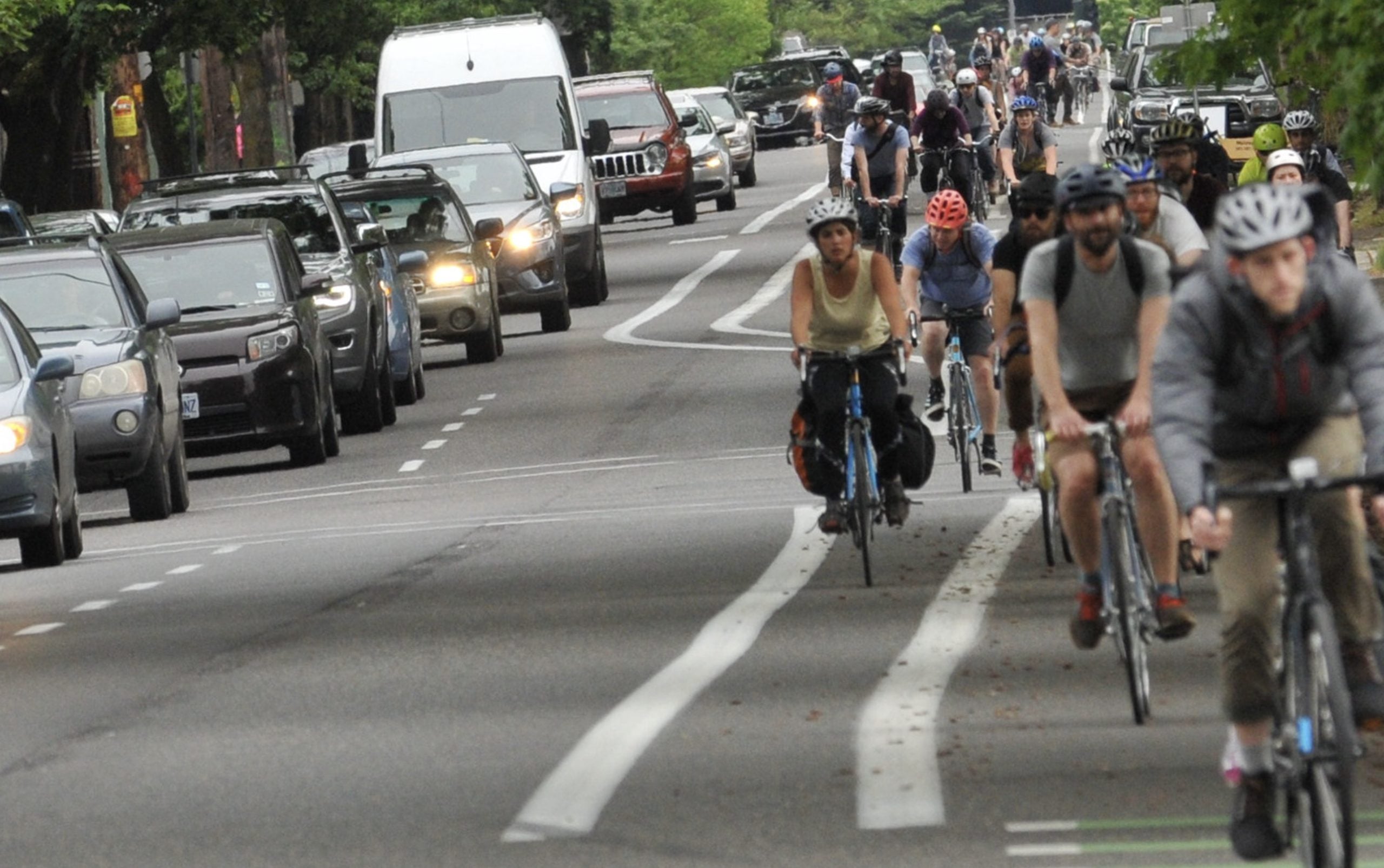
The annual adjustment of the Portland Clean Energy Community Benefits Fund (PCEF) Climate Investment Plan (CIP) has freed up $15 million in climate tax revenue that could be put toward a transportation-related program. On Thursday, the Portland City Council Climate, Resilience, and Land Use Committee will host an in-depth discussion about some of the ideas that have been put forward for how to spend that money.
Right now, the PCEF Committee has recommended switching that chunk of revenue from an electric vehicle subsidy program to a home energy program. But some members of City Council have ideas of their own.
So far it seems the two leading ideas are to put this $15 million toward either transit (to help TriMet stave off service cuts), and/or to make an investment in bicycling. Councilor Mitch Green supports transit funding, and Committee Chair Councilor Steve Novick has made it clear he supports an idea that would boost bicycling.
Last week I reported on a novel cycling promotional concept that Novick has gotten behind. I only shared a snippet of the plan. Today I can share the entire thing.
Dubbed “Bikeable Portland,” this plan is only in a conceptual phase. It’s based off a 2024 memo from Portland Bureau of Transportation (PBOT) Bicycle Coordinator Roger Geller. The new, 5-page document was prepared by PBOT at the request of Councilor Novick who wanted to see a more shovel-ready version of Geller’s plan.
“This project will catalyze
– From Bikeable Portland concept plan
momentum for the next 20 years of biking in Portland by aiming to restore bike ridership
back to pre-pandemic levels.”
The gist is that both Geller and Novick believe Portland’s bike infrastructure network is much better than current ridership implies. They see that ridership plummeted while the network got better (since 2010 (when the Bicycle Plan for 2030 was adopted), PBOT has added 160 miles to the bikeway network). That’s in part why Geller has long held the view (of which he’s convinced Novick of too) that the mantra “build it and they will come” hasn’t really panned out.
Since bike infrastructure has improved at the same time ridership has declined, Novick told me last week, “we should at least consider some non-infrastructure ideas.” That’s how we got to this Bikeable Portland concept.
The idea is to focus on encouraging Portlanders to use what we already have. For example, in its proposed budget, the plurality of funding in the concept plan would go toward paying organizers to offer neighborhood rides. Imagine hundreds of mini Sunday Parkways all over town, each one hoping to light the spark in participants so they’ll keep riding on their own.
According to the concept plan, Bikeable Portland will, “Catalyze momentum for the next 20 years of biking in Portland by aiming to restore bike ridership back to pre-pandemic levels.” Below is more about the goals of the project:
As proposed by PBOT’s bicycle coordinator, the goal of this project would be to ignite and sustain the momentum we once had for making Portland bikeable by leveraging and celebrating our progress in building Portland’s world class bike network. The project’s intent is to get more people to choose to bicycle by focusing on three mutually reinforcing actions:
- Igniting a civic conversation about the ease, desirability and benefits of biking and Portland’s commitment in continuing to advance as a bikeable city.
- Creating consistent opportunities for Portlanders to get support in biking.
- Celebrating over two decades of a strong, vibrant, and inclusive bike culture.
Bike Together
The excerpt I shared last week was from the “Bike Together Program” element of the plan. The idea is for PBOT to contract with an organization who will hire coaches to lead rides. These ride leaders would fan out systematically across each neighborhood and would be responsible for organizing daily bike rides from set locations at set times. Imagine adult bike buses springing up citywide as word spreads between neighbors.
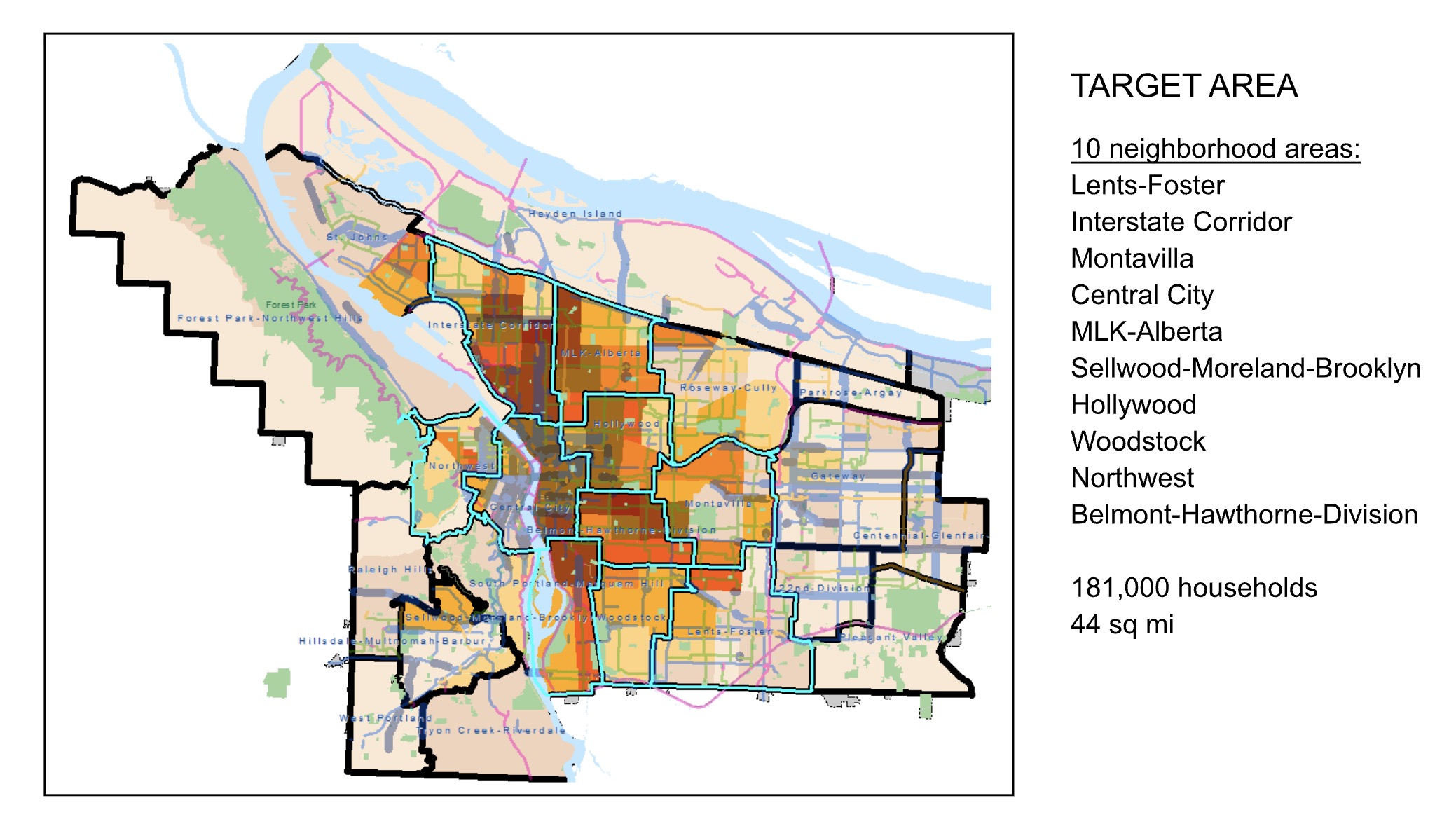
The city believes (and they have a lot of experience doing this type of work), that depending on the budget and scale of the effort, this could reach up to 181,000 Portland households in the target area which the city has defined as: Central City, Interstate Corridor, Lents-Foster, Montavilla, Hollywood, MLK-Alberta, Belmont-Hawthorne-Division, Woodstock and Sellwood-Moreland-Brooklyn.
Spark a Civic Conversation About Bicycling
The proposal would also take steps to spur a more robust, citywide conversation about bicycling. PBOT and its partners would do this in two main ways: using pavement markings and hosting cultural events.
The plan calls for doubling the number of “sharrows” (shared-lane markings) currently being used on Portland’s streets in order to elevate the visibility of the existing network. There would also be another type of special temporary markings installed with an aim to, “encourage people to change behaviors where/ when they can.”
The plan would sponsor, host and encourage events designed to, “Celebrate Portland’s determined history in creating a comprehensive network for bicycling, encouraging use of that network, and supporting the shaping of a culture that invites citywide uptake of bicycling.”
Branding, Storytelling and Evaluation
This element of the project would create a Bikeable Portland website whose main goal would be to, “elevate individual voices from community members and political leaders and give people the opportunity to share what a bikeable city means to them.” This part of the campaign would also include marketing materials like fliers, mailings, and billboards.
As these activities are going on, PBOT would do several, “relatively simple and affordable capital projects” in the target area. PBOT wants to make a few key bikeway upgrades in a way that bolsters their encouragement efforts. Here’s more from the concept plan:
These are projects that can be undertaken to improve conditions for bicycling in the project area and that will enhance other supportive encouragement efforts. The bikeway network in much of the target area is formed by neighborhood greenways. Those greenways include known areas of higher-than-desired traffic volume. Areas like SE 21st between Clinton and Division, SE 16th between Stark and Sandy, SE Ankeny between 3rd and 6th. Similarly, E Burnside between 73rd and 94th are sub-standard bikeways for this critical connection between inner SE / NE and East Portland.
Diverters and improved bike lanes in such identified hot spots will be the focus for this flexible capital funding. This program area can also augment encouragement by providing bicycle access for the specific events and activations called out in this project.
At this very early, conceptual stage, PBOT sees Bikeable Portland as a three-year plan. 2026 would be used for set-up and prep and the full effort would kick off in 2027. That would bring us up to 2030 — the end date for the Bicycle Plan we adopted 20 years ago.
This would be a very novel plan with some very innovative elements. But it wouldn’t be totally foreign to PBOT, an agency with decades of bicycle marketing and promotion under its belt. And it wouldn’t necessarily require the full $15 million that’s being debated right now. Depending on scale, PBOT could launch this for as little as $6 million and then consider expanding later depending on how it works (or doesn’t).
Even if it doesn’t get adopted this time around, it opens up some interesting conversations about how to increase ridership going forward.
I’m curious what you think about it now that it’s a bit more fleshed-out. And keep in mind, Councilor Novick told me he’ll read the comments before Thursday’s meeting.
Thanks for reading.
BikePortland has served this community with independent community journalism since 2005. We rely on subscriptions from readers like you to survive. Your financial support is vital in keeping this valuable resource alive and well.
Please subscribe today to strengthen and expand our work.
I’m a pregnant mom with a toddler who bikes as her primary form of transportation everyday, and I’m sorry to let you know that a marketing plan for getting people back on their bikes isn’t going to work. What will work? Safe, visible, concrete protected bike lanes on main streets (aka, not tucked away on NE Going versus NE Alberta).
Back in Portland Biking’s heyday in 2014-2016, I was biking every day downtown to work. It was cheaper and faster than taking the bus, and it was exhilarating. One of my favorite spots was biking over the Broadway Bridge in darkness watching the sunrise. And, I loved being able to meet up with my partner to bike home from work or bike on the waterfront for an impromptu sunset bike ride (one of my fondest memories was when we got done with work and realized we could have an impromptu dinner at Pine Street Market and get cheap tickets to the symphony that night).
It was way more fun than not, however, I’ll never forget the irony when I first biked to work down SW Broadway and realized there was no “return” way home. What do you mean I couldn’t bike the same route but in reverse? There’s no bike lane to get me home the same way I came? That was my first experience of the irony of disconnected bike ways in Portland (if they aren’t visible, clearly marked, and easy to access as a newcomer, they are as good as nothing), and one of the many ways PBOT made it incredibly challenging to get any where in the city in a sensical manner. Luckily, thanks to the new bike lanes on 4th (and newly improved bike lanes on Broadway), this is no longer an issue, however, sadly I’m no longer commuting downtown.
Now, my commute consists of taking my kid to and from daycare and running errands on my bike. While I could look past many of the issues in 2015 of disconnected bikeways and dangerous choke points for bikes (looking at you North Williams New Seasons driveway!!), with a toddler and being 38 weeks pregnant myself, I can no longer hedge my bets that “everything will be fine” when on my bike. Because of this, I find myself consistently choosing the slower, less direct route for my errands. While it’s nice seeing all the other family bikes on my “new” routes, I wish that I had the same level of access to direct routes to my errands that other folks willing to take a higher level of risk do on theirs.
Riding my ebike is my primary form of transportation, it gets me outside, and I love it. But I don’t love all the sacrifices I have to make to do it, even while sticking primarily to greenways. I was inches away from being hit on the south side of Killingsworth and Minnesota on my way to pick up my kid from daycare (I was wearing a pink rain coat, pink reflective vest, and had just checked my blindspot and since then, I’ve been incredibly cautious at that intersection whether on a bike or on foot. I warn everyone about it as I’ve had more close calls since that evening, and I fear that’ll be where my kid and I are officially taken out head-on by a SUV or pick up.
Back pre-kid, I loved biking up to St Johns on North Willamette on a sunny day as it reminded me of why we live in Portland. It was a nice way to get some fresh air and nature without having to load up the car and leave the city for a perfect view of Mt Hood. The last time I did that ride, I was trying to get to music time at Wonderwood Springs on a Sunday morning toting my toddler on my bike. I was so traumatized by cars wizzing past us (on a Sunday morning!!), I’ve never biked up there since.
All that to say, while I know improvements are coming to Willamette and my risk tolerance is lower than your average bicyclist in Portland, cutesy little greenway signs and white paint on the street aren’t enough for me. I know the risks I’m taking biking while pregnant with my kid, and I know the feeling of hedging my bets that I won’t get hit each day biking to and from my errands.
Marketing plans are great, but they won’t address the real needs that I and other families like mine need. I love bike rides, I love Shift2Bikes, I love bike culture in Portland. None of that has helped me feel safe on some errands on my bike, and I hate that. Feeling connected to community is wonderful, and the biking community in Portland is truly one of a kind, but none of those bike rides have ever helped me get to Costco safely with my kid on Marine Drive as a weekly errand. I’ll keep trucking up the greenways to run my errands while silently cursing the facts that I’m so much slower than if I had direct routes to them, but no marketing plan is going to get more people like me on their bikes. We know the risks and we’re already taking them. We just need safe, protected bike ways that keep us on our bikes so we can run errands just like everyone else on the street safely
Amelia,
Really important perspective. Thanks for sharing it. Totally hear you.
Thanks for pinning that.
JM, why you are letting Amelia (and others) get away with saying that the proposal is just a “marketing plan”?
Marketing is where you send posts on social media or push TV or radio ads, etc, but what Steve is proposing is really BEHAVIORAL MODIFICATION, which is what any effective coaching program provides. A coach could help Amelia realize, for example, that she can feel adequately safe while using Portland’s less-than-ideal cycling infrastructure. And that’s what we need to move the needle on mode share in Portland. Waiting for PBOT to build iron-plated bike lanes in Portland is not going to work – it’s not gonna happen in our lifetimes.
All of the commenters on this site who say “I demand 100% safety at all times or I won’t cycle” are doomed to disappointment. But we can move the needle on getting people to use what we already have.
Fred,
I am not in charge of what people say and folks can say whatever they want as long as it is respectful of others, doesn’t incite violence, is not racist or bigoted in any way, and so on.
I too am concerned that some folks are not seeing this plan for what it is, but that doesn’t mean I will try to diminish their views or prevent them from sharing their perspectives. Regardless of whether I personally agree with her framing of the plan, I thought Amelia’s comment was important and that her perspective is valuable for folks to keep in mind — regardless of their position on this specific plan.
Debates like this can be hard and messy. I’ve learned to embrace the messiness instead of trying to micro-manage it.
“A coach could help Amelia realize, for example, that she can feel adequately safe while using Portland’s less-than-ideal cycling infrastructure.”
This is a bizarre thing to claim. It seems you are saying Amelia just doesn’t understand the conditions enough to trust their own instincts and some random person (we’ll call them a coach because why not) will better understand what they are capable of than Amelia themselves. What a silly person Amelia is, all they have to do is listen to some random person and their concerns will be proven to be groundless.
I am still in boots with split Achilles and can still barely walk let alone cycle so ableism hits harder than Fred probably intended. At the same time, is that scenario essentially what the pro marketing plan people are expecting? “Listen to my coaching and no one will be concerned over street conditions anymore”?
FlowerPower, please don’t take this too personally. My comment is also for everyone on this thread…
I just want to encourage everyone to try and maintain a positive environment for debate on here. Assuming that there are “people” neatly defined by their position on this topic, just sows division and makes everything think everything is zero-sum and either/or.
For example, I really like the Bikeable Portland plan and believe it has merit and should be considered. Whether it is supported by council or not, I love that it has become a serious idea and I respect Geller/PBOT/Novick for all the thought and effort they’ve put into it. That being said, I also think our network needs a lot of work and that folks’ safety concerns and negative reactions to the plan are really important to consider. And I totally understand the political difficulty of coming out with a “marketing plan” in light of how people feel about the quality (or lack thereof) of our network. And yes I’m aware that Geller/Novick/PBOT are highly biased because the quality of the network is their baby!
So it’s an interesting debate and it certainly isn’t an either/or or a binary discussion. We can and should demand both good encouragement/marketing from PBOT and great infrastructure.
Well said Jonathan and it’s great there is a passionate community here online and the real world where having this idea come to fruition with plenty of coaches is actually a possibility.
It’s a good idea and I won’t belabor my views again. I hope all or some form of the idea is able to be implemented and if so just in time for spring. I couldn’t think of a good way to succinctly describe Fred’s (and others) viewpoint on it so used the clunky “pro marketing plan people”. Thanks for working with that and seeing the positive as you somehow manage to do so frequently.
I’m not saying their concerns are groundless. What I am saying is that cycling (like driving or even going outside) is a calculated risk – one which I (and many others) have taken for many years. If you can learn manage these risks, you can do it successfully and safely.
Sounds like you are a cyclist who had a crash that has stopped you from cycling. I’m sorry to hear that and I hope you are back on the bike soon. But b/c you had a bad experience on a bike doesn’t mean everyone else will, and the people Steve’s program would reach are ones who currently do not cycle AT ALL. Many of them think it’s too dangerous WITHOUT having tried it. If you are telling them, Yes – it’s too dangerous so don’t even try it, they will never get started.
The value I see in a program like this is to convince people who don’t currently cycle that it is possible and even fun and maybe even life-changing.
Fair enough and I hear you. I want people to be exposed to the positivity, confidence building and joy that cycling brings as well.
I was a bike commuter for 15 years to downtown from NE. But last year I had a couple of close calls with auto drivers and feel like they are now more dangerous, less caring, faster and more aggressive than ever. So I’ve stopped bike commuting until the infrastructure gets way better. It’s just not worth the risk to me. I don’t know if I’ll ever get back to bike commuting given the city’s pace of significant improvements.
You want the people at city hall spending miney on behavioral modification? You should have read sci-fi as a kid. You sound thick.
What do you think that would look like? Imagine you are my coach and I am at a similar comfort and skill level to Amelia. Walk me through how you would accomplish that.
[Play takes place on N Broadway and Wheeler, during typical commute times.]
John Forester: “Now, you see, the safest way for you to ride is exactly like me, like a car.” [they take the lane]
Person: “Okaaay…”
John Forester: “We all know cars will respect you if you behave predictably and confident, like a beautiful Bruce McCall sedan with aggressive posture, c’mon let’s get aero.”
[Person looks at the 4 foot bike lane adjacent to 3 lanes of fast moving cars. Then glances up at the sidewalk with trees.]
Person: “Maybe we could ride over there?”
John Forester: [Shaking his head] “On the sidewalk!?! That’s the old safetyist cyclist inferiority complex talking. We can’t wait until the network is perfect! We must ride here!”
Person: “Sure, ok.”
John Forester: “See this stupid bike lane over there encourages unsafe riding style, and fear. We’re having fun!”
–just found out I needed a laugh! Forester is only one of my influences among many. Now I know what’s up with the folks dead set against riding a bike on a sidewalk, any sidewalk, ever. If it was just me I’d happily ride in mad traffic but damn I love this bike.
I’ve never read anything by Forester, and I am dead set against riding on the sidewalk because it intimidates and feels threatening to pedestrians (and, secondarily, is usually, but not always, more dangerous for the rider).
Is Forester’s argument steeped in “do unto others”?
Great post! All your examples (New Seasons on Williams, Kworth+Minnesota, Marine Dr. to costco) resonate with me, because I have been in multiple uncomfortable situations in all of them (as a relatively risk tolerant solo cyclist).
Marketing plans are not great but you are! Thanks for riding even with the dangers. As you know, if you understand your route and have physical safety from cars, you can manage everything else. You should run for government.
This is one of the most important comments I’ve heard on bikeportland for a very, very long time. Thank you Amelia! Jonathan, every person biking (including Geller/PBoT) would benefit to hear this perspective much more frequently.
Amazing comment and very valuable perspective, thanks for sharing! I really hope Geller reads and considers this and reconsiders his claims about our bike network being complete. I hope Keith Wilson reads this so it can guide future decisions to improve Portland’s ridership.
This is 100% true. But it’s also true that getting people out of their cars and on bikes with the existing network will make that network safer for everyone.
Both things need to happen, IMO. I don’t think it would be wise to build out infrastructure with also simultaneously trying to increase ridership with the infrastructure we have.
Public transit agencies run advertisements. Cycling should too.
Public transit in pdx also sucks. No advertisement helps ridership
You’re right. We should just hang it all up and let the car companies show us fancy ads of people driving clean SUVs to My Hood with no traffic or risk to themselves or others. They’re the only one selling us the truth.
No we should demand better.
Elect better politicians. The Peacocks are showing their true colors and are likely not going to help people outside of their social causes they put forward.
Current board and management of TriMet have failed us. The unhealthy and fiscally irresponsible focus on trains and only trains has set public transit back in Portland and will be very difficult to recover.
Our state legislators and governor have failed us in not supporting a workable transportation budget.
The list goes on . . .
solutions
Good news! We can do all of those things, and have public outreach about cycling in the city, and work on improving the network all at the same time!
Thanks for sharing! I’d like to lift up you saying that you may have a lower risk tolerance than other cyclists. I think a lot of bikers have a lower risk tolerance and that’s why they’re doing what you’re doing, or sadly not biking at all. This viewpoint is so important for PBOT to hear.
Great post, I agree with it mostly. I’ll just say, the people who this campaign would reach are almost by definition not going to be found on this blog in the comments. They’re not on this site. So by definition, if you have complaints about the bike network, this campaign won’t address them. It’s not for you (I would actually say it still helps you but less directly).
The network needs to continue improving. We don’t need to do just one thing at a time.
Good comment. I had a close call with my two kiddos on the back of my e-bike, it was downtown by that play place. Someone was going extremely fast and almost killed us when we were trying to get through the intersection. It was one of those moments, I looked left then right, there’s a car way down to my right, I have plenty of time to cross, but what I didn’t realize was the car must have been going faster than 50, I was able stopped in time, but it shook me like never before.
It ruined biking for me.
We only ride paths, greenways, and around the neighborhood.
I have 25,000 miles car free in this city from 08-14. The city is fine when you’re young and by yourself. Sucks big time if you have a family.
So much of your comment resonates with me, and it gets harder because your toddler and soon-to-be infant will eventually outgrow the family bike and then what? That time is right around the corner for my family and I am asking myself where I would feel safe letting my young school-age child bike with me on the street, let alone by himself. It sucks to feel torn between what I want for my kids (freedom to move, skills, confidence, better mental and physical health, connection to friends/family/community, etc) and the real risk to my family’s safety on our streets.
Amelia, wishing you strength for birth and a speedy recovery!
When this idea was brought up last week, it made me wonder how migration in/out of the city has affected ridership. For example, if people are moving from areas where cycling infrastructure is very poor, then they will likely never see any alternative to cars when they come here. So getting employers and local businesses on board is essential. How can we get businesses to promote cycling to their locations (whether as an employee or a customer), in a similar way to Trimet passes? The Shift Calendar is great, but I feel it doesn’t open up people’s minds beyond cycling as an occasional recreational activity. If recreational activity is the primary goal, then having some kind of official marketing from the city will go hand in hand with the Shift calendar.
And a lot of folks have no idea the shift calendar exists, or how to look for it! I met a couple two weeks ago who had lived here for five years and had no clue it exists, despite casually cycling and having some interest in cycling more.
Completely agree that whatever campaign exists should heavily leverage the Shift calendar.
QR Code stickers with the text “Ride Calendar @ Shift2Bikes.org” on as many blue staples and LBS doors as we can manage would help. Does shift have stickers?
I think the shift calendar is great, but for new riders and inexperienced riders like me, I’m more likely to join rides that are led by the City or sponsored by the City (I joined the group ride from my neighborhood to downtown Sunday Parkways).
I’d appreciate if more businesses got PBOT to put in staple racks. I’m pretty sure they’ll do it for free if a place asks.
And you lock your bike up to one and up walks someone with a battery powered saw and steals your bike.
Heck, one of the reasons I don’t bike is because, unless I can take it inside, it’s never safe outside. Even then it’s dicey with all the bike room break-ins.
I walk, I transit, I drive. Going to take a lot more than wasting PCEF money on something it was never intended for to get me out on my bike.
Do you comment on walking, transit, and MV websites? Because it seems like you would have ideas about those things.
I think Solar’s comments are valid cuz they are from a person who would like to bike but feels as though s/he can’t.
Maybe I was unfair to Solar. It could be they don’t have a “winter bike” or the equivalent, something with good bones but not flashy, everything bolted on, well used and with stickers on the scrapes and dings. That bike is a good transportation value but it takes a little knowledge or a certain kind of bike shop to get it together. The Bike Farm might be a place to start.
If I’m locking out I take a second U lock or add a chain that costs about a dollar an inch at Wink’s Hardware Museum (admission is free). A long shackle U lock will go through the chain stays, catch the rear wheel, and fit around a sign post or staple rack. A chain can catch the front wheel, the frame, and maybe the other side of a staple rack.
It sucks to be ripped off. I know that there are people out there with battery tools, big bolt cutters, or whatever, people who will prep a bike rack or scout one with plain hex nut fasteners. Fortunately your really organized thieves are rare, and those are the ones that will see my Plain Jane with rust on the frame, 27″ wheels, old Raleigh flip flop hub, $20 brakes, steel bar and vinyl saddle, and keep moving.
I haven’t had a bike stolen yet. My ebike goes inside work with me but everywhere else I lock up with a ulock and a chain. I guess I’ve been lucky, sorry if you’ve had bad experiences.
The slush fund (PCEF) gonna slush…..
I watched a guy with a battery powered grinder take 2 bikes at Beverly Cleary in less than 1 minute from the moment he rolled up to the moment he wheeled away the bikes. It’s way to easy with the staples.
I’m not necessarily opposed to the a bike marketing plan as a concept. With that said, these details are… immensely disappointing.
On a constructive note, something like this needs to target young, relatively new transplants. Myself, and lots of others I know, got onto bikes because it was cheap, associated with Portland’s “brand” (if I didn’t try cycling in bike city USA, where else would I try?), felt like it was something I could take into my own hands to fight climate change and honestly, because it seemed to be what “cool” people did. Not the lycra wearing older folks with expensive bikes, but the young people going to shows, bars or restaurants for a night out with friends. Get someone biking young and they’ll bike for life after getting hooked.
While I’m supportive of some of what’s outlined here (key infrastructure improvements), this reads as deeply ineffective. Sharrows, really? Most drivers don’t see these at all; if I had a nickel for how often I had to point to one on the road while a driver tails me on a greenway (because the lack of stop signs make it a great cut through route!) I’d be rich. Billboards? A website no one will visit (it’s 2026, people stay on the three social apps they use and don’t go to websites, Roger’s age is showing here).
I’m open to being convinced on hyper-local bike buses, but I feel if there’s one thing Portland doesn’t lack, it’s group rides, and a huge diversity of them! The one component of that I do like is a hyper-local ambassador to make connections.
At the end of the day, the best advertising for cycling is busy bike lanes with a diversity of people; by race, gender, size, reason for riding, social scene (metalhead, indie kid, parent, businessperson, etc). It’s what I generally like about a place like Portland, NYC or Minneapolis vs. Colorado (where, in my experience, the lanes are used primarily by sport riders in full sport cycling outfits). Lean into that.
Yes I agree… but this entire conversation is about how do we create that advertisement? We can’t just wish it. I think it makes sense to pay people to go promote biking and make the bike routes more visible. I see this plan as a formalization of some of the organic traits Portland already does relatively well at — and that we used to do extremely well. Think of this like building that brand you mention in your comment. It’s nice when a strong brand just happens organically, but it’s very rare and if we just sit around and wait it’ll never happen again.
I agree; we can’t just wish it. To create that advertisement, I’d argue the best accelerant is dense-housing communities with strong infrastrucure. Despite what PBOT and some of Council claims… we’re just not there. I understand dense housing is out of PBOT’s wheelhouse, but a trip to Vancouver, BC made it really clear to me how much PBOT dropped the ball on building out hard, robust infrastructure and connections during the 2008-2014 bike boom. They failed to build up when momentum was in their favor.
I know my comment came across as quite negative, and I am disappointed by this proposal. Again though, I could be convinced on a marketing campaign, and I see some value in the hyper-local bike ambassadors. But most of this… I just don’t see moving the needle as much as some high-visibility bike infrastructure improvements.
Thanks for the reply Calvin. And totally agree with you that density is the ultimate tool. Which is why I’m so happy that we have such amazing housing and land use activists in Portland — some of the best in the country! We are getting there but will likely never have the density of those amazing bike cities in northern Europe or even Vancouver BC or Montreal for that matter.
We have to believe we can get there; I certainly think we could do what Vancouver BC has done. If we don’t believe we can, then that’s a guarantee that it will never happen!
Appreciate your thoughtful engagement in the comments, Jonathan – as well as the comprehensive, fair reporting!
While I generally approve of increasing density, (we desperately need the housing) the problem is it also increases traffic. In my experience the infrastructure improvements to make riding safe lag decades behind the increased density and increased traffic. I’ve also experienced those density increasing projects making the actual infrastructure worse for cycling. Cornell road is a fantastic example. When I was young there was a huge wide shoulder almost all the way up to where I live for folks slogging uphill. It was still a 45mph arterial but folks felt safe because you had space. Then they added a new development infilling the area and that shoulder disappeared. Now you have to ride at least partially in the lane up most of the steepest part. On a 45mph arterial. There are no alternative routes. That’s why I rarely ever ride now. I don’t want to play chicken with mr gold ferrari and everyone else who’s more concerned about their cell phone than whether they hit someone while they drive. Heck, even the traffic counters they put out aren’t safe, I’ve seen a few of those over the years smashed to bits by careless drivers.
It’s worth noting that I have seen increased ridership in the area, down in the area where they added the bike lanes going up to Cedar Mill Elementary. Those only took 30yrs after Forest Heights was built. If folks feel safe they will ride. When we don’t we won’t. When you have long-time racers with piles of medals saying “It’s not safe”, it’s not. This is not a perception problem.
TBH I think putting bike lanes on Hawthorne during the repaving probably would have been a more effective advertisement that you could bike to stuff there than all this nonsense.
Yes, I wish I would’ve mentioned this in my initial comment and support other commenters making this point. The high-visibility on a street where lots of people gather is key to making it appealing.
> At the end of the day, the best advertising for cycling is busy bike lanes with a diversity of people;
I think this is absolutely true, and it’s one of the reasons I think something like this program has the potential to have more impact than the money spent on it. The whole point is to try changing momentum, so that people see busy bike lanes!
Side note, to the “sharrows?” complaint, would it be better if they didn’t paint them? Seems like that was one very small detail.
Honestly, I’d rather just have them spend whatever they’d spend on 1,000 sharrows on one block of a high-visibility project. If PBOT is dead-set on sharrows, make an event out of them; build a pedestrian/bike plaza for a weekend on a greenway block and during the event, install/paint the one sharrow that could be part of a local neighborhood have a design contest (similar to the school drawings ones).
Agreed Calvin. Sharrows are generally an exercise in minting pennies. “Igniting civic conversation” and “Celebrating biking culture” are just so embarrassingly and depressingly desperate ideas, it’s hard to imagine people are seriously considering them as goals. The only truly redeeming part of this whole hail mary is for people to be shown potential new divertors at 21st and Clinton and between 3rd and 6th on SE Ankeny. If that costs 15 million dollars, I guess make them fancy?
If you put a diverter at 21st & Clinton, how would it work? The problem is traffic volume on 21st (including bus); would you divert that onto Clinton? There isn’t much car traffic on Clinton, so diverting that doesn’t make sense.
What is it you want to see?
PS If you want to get traffic off 21st, the best place for a diverter, given the connectivity of the surrounding streets, would be by People’s.
This is such a weird sentence. How can you at a snapshot of someone’s life (a moment when they are plausibly riding a bike purely for fun), and then make the assumption that they don’t also ride bikes for transportation and socialization?
The most die-hard bike-family life people I know also wear lycra and participate in races.
I wear lycra, and I vote.
I’m not saying these aren’t the same people (although despite having a lot of friends/people in my life that cycle, I don’t know a single one that’s ever worn lycra or has a particularly expensive bike). That’s not to mention that generally, the people wearing lycra skew older than the city’s population as a whole. I’m sure at least some folks wearing lycra also cycle in non-lycra for transportaiton or socialization. For what it’s worth, in reference to my initial comment, there’s some communities I’ve visited that clearly have a high diversity of people cycling, and others (like Colorado), where just about everyone I saw out cycling was wearing lycra or some kind of sport cycling-kit.
What I am saying is that these people aren’t relatable to your average Portlander/non-cyclist. There’s not really anyone that wears lycra out and about for non-cycling purposes. Cycling is a lot more relatable if people see others who look and dress like them; wearing jeans, an outfit for a night out at the bar, a dress, skirt, etc.
What I’m saying is that you might see someone at a bar in jeans who earlier that day was riding bikes for fun. There’s no distinction to be made here.
I don’t avoid playing catch with my friends because people passionate about baseball wear cleats and synthetic pants.
I love the idea but I’m sad that my neighborhood (SW) is left out, as usual. That’s odd cuz it’s also Steve’s neighborhood – I’ve seen him at A-Boy on Barbur (maybe he moved?).
There are bikeable areas of SW that are ready to benefit from this plan (Maplewood comes to mind). How about taking TWO portions from inner SE and giving them to SW? You already have a lot of coverage in that area and it seems wrong that it gets everything while SW gets nothing.
I don’t know his address, but Steve Novick is one of my councilors (District 3) which would imply he no longer lives in SW.
Good to know. Thanks, Michael.
Biking in SW is not ideal for the casual rider because we can’t even get a safe route from Maplewood to the cemetery or Twilliger to access any of the bike infrastructure investments the City has made in the now SW portions. It’s a real bummer.
I agree, but the whole point of the program is to help people realize that they *can* cycle to Fred Meyer, for example, even when conditions are less than ideal. If we all wait for conditions to become ideal, we will never cycle anywhere.
It IS odd if a communication strategy omits a whole quadrant of the city. Is it logical to conclude that where bike infrastructure costs above some threshold level it is politically impossible, so there’s no point cajoling folks out onto the missing bike lanes?
I can’t help thinking about SW Gibbs St. above OHSU where a new development Did Not get adjacent ped or bike facilities because of money and lawsuits and bad precedents and general lameness. You can build a roof and a parking lot but you can’t build sidewalks because they have runoff? A neighborhood street carries cut through car traffic but the bit available to pedestrians is between the traffic lane and a guard rail.
Former BP writer Lisa Caballeros has covered this a lot:
https://bikeportland.org/2023/08/30/opinion-the-missed-opportunity-on-sw-gibbs-378666
It’s a great idea, but not with PCEF money. I’m thrilled the committee wants to keep the money for home energy (which it is supposed to be for) and less thrilled a few of the council want to ignore the committee’s recommendation.
Perhaps Nike can donate the money for what is hope and prayers that anything lasting comes of the n’hood bike buses.
@FlowerPower we get it already; you’re beating that same drum hard. It doesn’t make any difference to you what the PCEF committee or website says, or how much the proposal actually does facilitate use of clean energy, by golly if it’s not paying for solar panels and heat pumps you’re a hard no.
Well… how much does it do to facilitate the use of clean energy? There’s no numbers in the proposal, so it’s really hard to say if it would do anything at all.
Perhaps read Jonathan’s article, Michael? It’s towards the beginning.
“Right now, the PCEF Committee has recommended switching that chunk of revenue from an electric vehicle subsidy program to a home energy program. But some members of City Council have ideas of their own.“
For the record, I would never leave a comment on an article i hadn’t read. Your opinions on the PCEF are clear and consistent. I just happen to disagree with them. I stand by what I said.
Great, then you saw where the PCEF committee wants to spend that 15 million on home energy and some on the council and a lot of posters here want to take/steal/reapportion the money for adult bike buses. Glad we’re all on the same page.
Just so you know exactly where I stand, I think any proposal which is working towards the long game of reducing dependence on fossil fuels should be fair game for at least a consideration of PCEF funding. That includes anything that encourages/promotes/facilitates biking, analog or electric. I also love heat pumps and solar panels, and would be fine if the council decides to go that direction with the 15 million. But I’m glad the discussion will take place.
I too am glad to have discussions and happy everyone can voice their opinions.
I personally hate the idea of PCEF $$ going to improve private property. I’d much prefer the $$ be spent on public programs like cycling coaches to improve mode share.
Remember that the #1 contributor to GHGs is automobile and truck transportation. Reduce it by increasing cycling and you’ll reduce GHGs the most.
That isn’t true. Ineffectually reducing emissions in the biggest sector might have a lower impact than effectively reducing them elsewhere.
It is also far from clear that increasing cycling by realistic amounts will have a significant impact on transportation related emissions, which are themselves declining as we electrify.
It is not impossible that coaching would be an effective way to spend climate change money, but no one has made even the barest bones case that it is.
Yes, it is. And please can you have your AI bot re-write that second sentence so it’s intelligible. Thanks.
It’s interesting that you’re willing to contradict a statement you claim to not understand.
Here’s yet another question. What is that clean home energy program? Will it remove wood burning fireplaces from homes? Because the sheer volume of folks burning stuff in their fireplaces to reduce heating costs these days is just yet another factor that keeps me away from riding. When the weather is dry we get inversion layers that trap that smoke by the ground. I can barely breathe with the sheer volume of asthma attacks I end up with due to the damned fireplace smoke.
I simply do not agree that the “build it” part of “if you build it, they will come” truism is actually true! the bike lane by my house feels very dangerous because people speed on that road, there is no protection except for a few flex posts in some spots (and they get ripped out by cars all the time)! I would rather this money go toward adding modal filters on greenways and protecting bike lanes with STEEL and CONCRETE. I think we need hard and fast physical improvements more than we need cultural events to get more people cycling.
100% agreed. This is what the rose colored lens people do not understand. They just don’t get it.
Trying to explain our real like experiences to them is like talking to a brick wall.
It’s important to have a historical perspective regarding this phrase, because “it” stood for very specific things when it was adopted.
The definition of “build it and they will come” in 2010 per the 2030 Bike plan (pg 67):
1. Form a finer-grained bikeway network
2. Emphasize low-stress bicycle routes
3. Ensure access to common destinations
Recommendations (pg 72)
NE Broadway in 2009, 2025
NE Couch in 2009, 2025
SE Madison in 2009, 2025
SE 7th in 2009, 2025
N Williams in 2009, 2025
N Vancouver in 2009, 2025
SE Clinton (at 21st) in 2009, 2025
SE Ankeny (at 7th) in 2009, 2025
I had a friend who was a high-level college athlete. Whenever someone would say “practice makes perfect” he would correct them with his coach’s truism, “perfect practice makes perfect”. PBOT/Geller has been relying too heavily on “if you build it, they will come”. They should be advocating, “If you build it well and completely according to well developed plans and then maintain it, they will come”. In practice, I would like to see a lot fewer braggy, self congratulatory messages about the miles of bike facility, and a lot more messages about how our bike infra connects to forma network and connects to destinations WITH (importantly) the missing gaps highlighted and acknowledged. Stop bikewashing (hyping up/exaggerating, omitting, misleading) about what we have so we can start having an honest and productive conversation about what we have, what we don’t have, and what we need.
Plenty came even without the infrastructure, so we have solid evidence that perfect infrastructure is not required to build and sustain (for a decade at least) high rates of ridership. We have very little evidence that improving infrastructure would bring those riders back — clearly it wasn’t infrastructure that drove them away, and steady, incremental improvement hasn’t been making incremental improvements in ridership. Quite the opposite.
So, while we pursue the financial and political resources to build the perfect infrastructure, what can we do to recreate the energy that sustained bike riding for a decade with imperfect infrastructure?
If perfect infrastructure has become a requirement, perhaps we can table this conversation and reconvene in 20 years when we’ve been able to make some real strides towards building it.
Good point, 2WheelsGood. I’ll try to be more clear. We don’t have a perfect network- far from it. TO have Geller/PBOT saying things “we built it, they didn’t come” and “bike infrastructure has never been better” is in many ways misleading. If they believe that, then we have a massive, institutional problem. My hope is that they know what they have spending resources on is note smart, strategic and effective and they can be convinced to acknowledge and address network shortcomings. I understand that sometimes you need to or want to hype things up, but this messaging is not helpful. When it comes to safety, PBOT/Geller needs to be honest and forthcoming about shortcomings to let the public know that they know and also they are (hopefully) working on a plan. So we don’t need to wait for the perfect work to be built, but we do need to start talking about what that is.
Agreed.
But what Roger is saying is true; we have built lots of bike infrastructure, it really is better than it ever has been, it hasn’t attracted riders. I don’t think that’s misleading — no one is claiming that we have achieved perfection, or even excellence in our infrastructure. But it has been improving, and continues to improve.
What I think Roger is claiming is that we have better infrastructure now than when we had 8% mode share. That’s not hype, that’s just the fact.
And on that basis I and others (perhaps including Roger) have concluded that better infrastructure is not the missing ingredient in Portland’s bike system. It may well be a missing ingredient to get to 12% mode share, but 5% should be doable with what we have.
Something else is missing that we need to have even have a modest recovery. Maybe we can overcome that mystery something with excellent infrastructure, but it’s going to be decades before we can find out, and we need to find something that will work in the interim — or just give up.
So sure, let’s talk about what the perfect system would look like, but we also need to figure out how to live with the imperfect system we’re stuck with for the foreseeable future.
In the meantime, how do we attract new riders? I don’t know, but I am highly skeptical that coaching will be anything but an expensive flight of fancy, edging out spending that could have some impact on climate change.
We used to have a different demographic of riders. Those riders have largely been displaced through gentrification. The new potential riders require higher standards of safety because they are not dirtbag bike punks — they are young professionals from car-centric home towns.
I don’t see this impacting cycling rates at all, it’s the drivers and the destinations. Downtown is dead, wfh is the norm. All drivers lost empathy for anyone outside of their vehicle sometime around summer 2020
Refer PCEF, the Arts tax, etc. to the voters for repeal and replacement with a consistent, predictable and sustainable funding source.
Determine what it will cost to maintain streets, signs, lights, sweeping, lights, cameras, etc.
Devise a real, consistent and sustainable street fee to fund said maintenance. Make a ten-year maintenance plan and stick to it.
No more slush funds and verbal gymnastics to justify if a project is ‘PCEF-worthy’. Prioritize maintenance over new infrastructure/programs. The city has too many priorities, time to choose what we can afford and what we can aspire to
Omg, yes!
This! Portland needs to get back to the basics: pave the streets, enforce crime, clean up the litter and graffiti. Only once they can provide the bare minimum of civic services should they add more lofty goals.
We have public employees cleaning graffiti already but I actually don’t consider that an essential service. Some graffiti is art while being illegal if you can get your head around that. Sometimes it’s funny or true, like the really sloppy scribble I saw yesterday that said “shrimps is bugs”. I love that.
You say “enforce crime”? How about we enforce grammar?
Agree on enforcing crime. I make sure to commit at least a few petty crimes every day, but not everyone is as conscious and industrious as I am and incentives are needed.
tbh I think this is a misguided use of funds. I think the decline in ridership is mostly because of a work from home related decline in commuters to downtown, combined with much riskier driver behavior. And although individual pieces of bike infrastructure are much better than they used to be, riders are still exposed to dangerous driver behavior in many trips. Even e.g. the new and improved broadway bike lanes are not *that* safe because of drivers right-hooking people, and even in instances where infrastructure improvements improve safety in the sense of “you are not likely to have died or been seriously injured from this low-speed crash,” that improvement doesn’t actually feel safe for riders in practice. I also think the lack of bike lanes on inner SE division, SE hawthorne, alberta, belmont, and basically any other street that has shops, restaurants, and actual destinations on it means that for non-commute trips, riders are necessarily forced to use at least some amount of sub-par infrastructure.
I am deeply skeptical that a marketing campaign will actually paper over those problems, and this feels like a more elaborate version of PBOT’s assertion that they would improve wayfinding on greenways adjacent to hawthorne rather than building actual bike infrastructure on hawthorne.
Obviously PBOT has real budgetary limitations, but I also feel like they waste money on incredibly stupid things, like that little section on 7th & tillamook where inexplicably they expect cyclists to ride on the world’s shortest cyclepath on the sidewalk, which seems like it was quite expensive considering the share of cyclists who just ride right past it. The bike lanes they put on skidmore near wilshire park are another example of this, where those seemed like the took a lot of time and money and encountered a lot of neighborhood resistance, and I think 100% of the benefit comes from the improvements on 33rd itself. TBH I also feel the same way about 72nd through the golf course, which, obviously it has been much nicer since they made it one way, but that was also far from the worst section of the 70s greenway, which is the crossing at Halsey. I think until there is a concentrated focus on improving the worst pain points in the network, and adding infrastructure that goes all the way to the desired destination, ridership is going to continue to be so-so.
On the other hand, I am quite confident that if that same pool of money was used to prevent trimet service cuts, there would be real benefits for transit riders.
Nail on the head RE: commercial streets and lanes near shops, etc. While NE Broadway could have been better, ultimately that’s the type of infrastructure improvement that would be most beneficial. Highly visible improvements at social destinations people want to go.
Agreed. They use funds to update and update and update the same sections of the same roads over and over again. Willamette is a great example. Is it good they have good infrastructure in high use areas like that? Of course. But you’re not going to increase ridership that way. You increase ridership by fixing missing connections and adding even minimum infrastructure to areas that are currently unserved.
Willamette is mentioned as a ‘missing link’ with moderate frequency here, so I think there is some miscommunication. At least, there is not a solid community consensus regarding what the ‘next’ project should be. If such existed, it would help align and organize political pressure on PBOT. As it is, everybody is pissed, but they all want something different.
This is a great insight into what should be the priority, which might lack consensus in the broader community, but has had a specific plan for 25 years. I’ve linked to the 2030 bike plan on another post, which was supposed to continuously inform PBoT on where those missing links are. Those primary missing links were noted on the 2030 bike plan in 2010 and have remained largely stagnant for political reasons. We know exactly where they are and we know the places that have the highest demand, and we had the money for them. Marketing group rides is the “best we can do” form of addressing a long-term lack of political will to address those elephants in the room.
One thing PBoT could do would be to finally just be honest and admit its failure in addressing those priority projects, and simply state the purpose of this group ride plan is to build political will, not necessarily address mode share directly.
Thanks for the comment. It spurred me to take a look at the 2010 document. I was surprised by how good it is. I would love to see an status report for all the projects listed in appendix A. Even more, I would love to hear PBOT staff (Geller or Director Williams or some mid-level worker bee) respond on a case-by-case basis to such a document. You have completely persuaded me (with this comment and several other thoughtful ones that you have made in the last couple of years) that, as you say, missing links “have remained largely stagnant for political reasons,” which was not a view I previously held.
Good to hear. As an aside the TSP and its specific wording concerning street types and when cycling infrastructure is considered has also had a fundamental effect in precluding a lot of the projects in question. The folks working on the 2045 TSP update in Bikeloud are likely keenly aware of this and I encourage you to wonk out with them.
The decline in cycling 1) was occurring before 2020, 2) % WFH has markedly decreased without a proportional return of people to cycling and 3) PBOT’s bike count data showed the same degree of decline during non-peak-commute hours strongly arguing that its cycling in general that has declined.
This comment really resonates with me as a long time rider in this city (since ‘08). While some facilities have been upgraded and represent “better” riding conditions, as a complete system our bike infrastructure is still woefully inadequate. These are some really specific, relevant examples of which there are hundreds more across the city. I will nitpick a little bit just to say that even with safe bike lanes on arterials (like Hawthorne), many people will still choose slower and circuitous greenways for their peace and quiet. To me this means having both types of facilities , well-connected throughout the city, is important to meeting the varying needs and preferences of riders and subsequently attracting more of them.
I am really skeptical of a plan that starts off with gaslighitng us that we we a wonderful, complete network just waiting to be used! That will not be people’s experience, so are setting this up to fail. There are good segments and bad ones, tons of gaps and failed connections. Why not be a bit more honest and transparent: “We’ve made some improvements, but we need support and momentum to make the upgrades and connections to have a functional network across Portland. Come join us to see how good it is now and how great it could be with your participation and support”
This kind of language is NOT helpful: ““Celebrate Portland’s determined history in creating a comprehensive network for bicycling, encouraging use of that network, and supporting the shaping of a culture that invites citywide uptake of bicycling.” Is this saying determined Portlanders have created a comprehensive bike network, or is it saying that is has been determined that a comprehensive network has been built?
Anyway, that is beside the point. I think diverters would be great, additional sharrow markers are OK, too. the website does not seem like a good use of $$, neither does billboards. Mailers, targeted emails, signs at bus stops might be a little effective, but I’m not sure if its worth much. From reading through the comments, others seem to like the idea of a coach leading rides; that might be good but I can’t imagine who would participate in that. I guess I just do not believe that PBOT can fundamentally influence culture to this extent. I think they should focus on infrastructure: control the cars by keeping them off greenways, daylight intersections, start towing delivery vehicles who park in bike lanes or add temp barriers, add no turn on red signs on streets with bike lanes like the new Broadway improvements and use camera, lower speed limits, get rid of the closed crosswalks sings and reopen/paint them for pedestrians.
The first article about this idea used a shot of bikes lined up in a narrow bike lane on n’bound Interstate Ave. I live in North Portland and have commuted on this stretch for 18 years. Pbot has made some improvement, but it still sucks. For some reason the speed limit is still 30 MPH- which is scary on a cold wet night, but it is worse when people routinely drive 40-50 (I drive this road, too, I have checked speeds by following people). All of North Portland gets funneled down Interstate Ave to visit downtown, CEID, SE, SW, NW, yet the route is fraught. There are spots where the 5-foot lane narrow to 2-feet wide. The City added some signs, but cars do not see them or ignore them- there has been no enforcmeent, and they refuse to paint a sharrows at the points where motor vehicles and bikes have to share a lane. My proposal to get more people riding: lower the speed limit to 20 mph with speed cameras, paint a 6-foot wide bike lane with a 1-foot buffer- in places where this will not fit, paint the bike green and add signs: “shared lane, cars to yield to bikes”.
You had me at “gaslighting”.
I think you and I are interpreting the plan differently. As I read about it, it seems the marketing plan isn’t for people who are already intimately familiar with the bicycle network and trying to convince them that it’s as good as it needs to be. It’s for people who don’t know the extent to which the network already exists.
I agree that some folks are not seeing the plan for what it is. From what I can tell, it’s geared toward newbies and folks who have a bike but haven’t really started riding it around town yet. I think asking Geller who this plan is for would be a good idea.
Telling newbies that the network is there and it is complete and wonderful and world class is recipe for disaster, IMO. I agree that we nee to get the word out about cycling, but PBOT/Geller needs to be honest about the many serious shortcomings these newbies will encounter. I even think that is a possible way to recruit: this is what we have, this is what we need, we need you to join other cyclists to show the demand to make these improvements.
I recommend anyone who can ride should ride, on our infrastructure. I don’t go around riding all the time because I love risking my life. I do it because the infrastructure is good enough that I don’t think I actually am risking my life. Not significantly.
Yes it can and obviously should be better. And there are plenty of missing links. But it is very rare that there is anywhere I want to go that doesn’t feel pretty safe to go to. And honestly I think most people on here feel the same way or we have a LOT of adrenaline junkies who live for the thrill of nearly dying every time they go out. I doubt that.
(emphasis mine)
You keep unnecessarily setting up this strawman. You don’t need to.
Diverters. Permanent, durable ones that can’t be easily driven around. This is what we need.
Also, daylight every intersection in the city.
Yes. This is the way.
– More Diverters on bike boulevards.
– More Bike+pedestrian-only paths.
– Plentiful bike parking (we actually do ok at this but could do better)
– Regular and reliable enforcement of bike theft.
That’s it. That’s what it takes. Anything else is noise.
-Street lighting
If I may add also: Law enforcement on the streets, pulling people over for driving infractions like not stopping at stop signs, speeding, using cell phones, aggressive driving behavior. Hefty fines.
I still see no estimates of the numbers of coaches, people who might take up riding, or how much they might contribute to meeting our climate and bicycling goals.
This plan does not seem particularly rigorous, and my criticisms of it last week have not been addressed here.
What should we expect to accomplish with this proposal, and why spend PCEF money on it?
Two questions:
Does the full $15 million have to go into a single program, or can they divide the funds between the bike proposal and the TriMet proposal?
Second, early in the article it says Novick requested a shovel-ready proposal, and then later the proposal is described as “conceptual.” Which is it, exactly? I’m guessing it’s the latter, because it could use some editing and obviously a lot of fleshing out.
I wonder if a more focused marketing campaign would be both less expensive and more precise. I’m not fully persuaded by this proposal, but open to more details, I guess.
Hi Paige,
As far as I know, any adjustment to the PCEF CIP needs to be supported by council, so they can agree to any combination of funding they like.
And yes, the concept plan is definitely just an idea at this point. What I meant is that Geller’s plan came out in late 2024 and this newer plan is more shovel-ready than that one.
Geller had the same proposal in 2012 for around $24 million. I’m glad he found some cost cuts since then.
Jonathan, thank you for responding. Will the council be considering the 5-page proposal when they decide whether to fund it with the PCEF funds? Or will there be something more substantial to consider?
Hi Paige, I just posted the recap from today’s meeting where this was discussed – https://bikeportland.org/2026/01/29/council-punts-on-15-million-pcef-question-as-new-ideas-emerge-399096
Look, I love biking in Portland. But to say, we’ve already built it and they have not come when our miles of protected bikeway pales in comparison to other cities, is deeply flawed. Just citing two examples of the failure to put protected bike lanes in Hawthorne and Broadway /Weidler show the city’s unwillingness to spend money and resources to build high quality options for us bikers on main roads. Let alone the lack of protection in other less resources parts of the city. I live in Inner NE, arguably one of the better neighborhoods for bike way, and it’s still unsafe for me to bike on so many roads.
As a biker worried about being killed in the road, encouraging people of all ages and abilities to bike more when we are sending them out into roads where drivers are killing bikers is unconscionable. The city needs to dramatically increase protected bike ways and off street trails that allow folks from 8-80 to truly feel safe while biking. That is what will begin to shift the number. A marketing campaign is nice, but it feels like a cheap substitute for barriers that ensure I don’t die when a driver decides to text and drive and veer into the bike lane.
Let’s see PBOT build bike ways that they feel safe sending their grandma out on and their children before we say that we’ve built enough.
Hi Liz M. I agree with a lot of your comment. But I just want to point out that no one is saying, “We’ve built enough.” I think what they are saying is that what we have is better than a lot of folks think.. And that it has a lot more potential in terms of ridership.
As another person from NE, if Sandy Blvd is unbuilt, from the Willamette to the Sandy, it’s all talk.
I hear you Jonathan. It just struck me that by saying, the “build it and they will come” hasn’t worked, seems to suggest that pbot believes they have built enough! Definitely a subjective assessment.
There’s always a gap between what the bureaucracy thinks and the people think, and it’s great to see so much conversation about this proposal. I hope Novick and Geller and PBOT really listen to it and take it to heart.
So many of the people NOT riding are not here on Bike Portland, are not at city council meetings, and their views on safety don’t get as much airtime.
COTW
Continuing to repeat that people aren’t understanding the plan isn’t helping. Novick, for one, does seems to be saying we’ve built enough. The starting point for it is saying that “if you build it, they will come” hasn’t worked, and then saying we should spend $15m on spreading awareness to, as you say, show people it’s better than a lot of folks think. Meanwhile, you have a bunch of people commenting who do bike telling you they don’t feel safe. You can support the plan all you want but stop trying to argue that the people who are arguing against it just don’t get it.
Thanks for the feedback.
Right M. The framing of this project is suspect at best. It’s the hiding in plain view problem. A lot of people see a glaring omission, and apparently Geller/Novick/PBoT are either unaware of or unwilling to mention it. To me that gives off a not so small gaslighting and/or oblivious vibe. Geller/Novick needs to say something like:
1) We understand the historical absence of the most basic connections in our network not limited to the most essential projects listed on the 2030 bike plan such as fundamental access to the CEID via the Hawthorne and Broadway bridges.
2) We understand that absence of those safe connections has had fundamental limiting effect on bike mode share.
3) We understand the city has failed for various reasons in building those basic high-demand, high visibility connections.
4) In light of and despite those failures, we would like to promote a project similar to the bike bus (which has been successful in gaining political support for cycling).
5) The purpose of this is to build political support for those basic, missing, high-demand connections, and to communicate the existence of said connections to the broader community interested in cycling.
We already have this – it is called Pedalplooza and includes all sorts of neighborhood rides and builds community. Doesn’t seem like much investment needs to go to build this very successful platform even bigger. The proposal seems redundant and also not a smart use of one-time funding. How about the funding going towards replacing the federal funding that has disappeared for the Burgard Bridge where PBOT was planning to improve the bike/ped infrastructure or other targeted location where failing infrastructure is preventing safe biking access.
Commenting only on the proposal the biggest concern is that excluding roughly half the city from this plan sends the message that it is not safe nor desirable to bike in the neighborhoods that aren’t being targeted.
While SW and East Portland are not going to hit 25% bike mode share anytime soon, given the lack of contiguous and complete infrastructure, doing nothing is telling people something. This doesn’t happen in isolation either as Biketown shares a similar geography to this plan.
We can have a discussion about efficacy and where to focus most of the energy but it feels disingenuous to call this Bikeable Portland when 14 of the 24 neighborhood areas (by my count) which equates to all of District 1 and most of District 4 getting to watch this through their windshield.
I can also see this getting challenged in court as it will likely be seen as targeting the rich whiter part of town and neglecting the poorer BIPOC parts of town. I can also see a 7-5 vote against it by city council.
Not to mention East Portlanders feel like PBOT has been doing all these ‘disruptive’ projects that involve bike infrastructure, at least tangentially, lately. I use and appreciate the new facilities, but I agree with you that they’re sending mixed messages by not at least trying to get people on bikes in SW and East Portland.
No….I and my employer did not fail at creating a safe and comfortable environment for cycling.
No…the collapse of bike mode share is just “vibes” that we will dispel with this cool and oh-so effective marketing campaign.
Repeating what some of the other commenters have said, infrastructure, infrastructure, infrastructure, starting with downtown! Vancouver BC had a similar network of beyond downtown neighborhood greenways but it was only after they built a network of protected bike lanes downtown that they moved the ridership needle. Washington, DC has done the same, there are seven north-south bike routes across downtown (all two-way), 17th St was a direct response to the popularity of 15th St for example. DC has plans for more east-west connections. $15 million could built out several similarly east-west and north-south connections in downtown Portland and provide a lasting impact. Marketing impacts gradually fade away.
If it’s a la carte, I’ll have the midpoint diverters on every greenway segment, with vanilla ice cream and rye whiskey for dessert.
A lot of comments advocating putting funding toward infrastructure instead of marketing. To compare these (quite different) things, we need to know how much of each we could get from the available money. For example, what were the budgets for some recent improvements, like the much maligned SW 4th lanes? Or SW Broadway. I’m sure Jonathan reported them in his excellent coverage, but my memory is poor, and my laziness is great. How many diverters could we get?
A great idea, but one of the issues would be that there are no numbers even suggested for the marketing plan. So we can say how many diverters, miles of protected lanes, how many bollards, gallons of paint or whatever for putting the money into infrastructure. Or we could discuss actual number of homes upgraded if the PCEF committee’s recommendation is listened to and the money goes into home energy improvement, but there is nothing to compare that with the marketing plan.
The marketing plan is literally saying that they will do all this without a goal of how many new riders will be created, how often they will ride, where they will ride or how many ICE (the engine kind) trips will be replaced with cycling.
We are taking a large chunk of money (and yes it is a large chunk) which is a finite resource and tossing it up in the air with our fingers crossed. Since it is also (most likely) our tax money which the corporations have passed on to us, I would rather the PCEF money go into actual results and the marketing plan secure direct corporate donations to fund it.
This is a very good question Micah. I think it gets at the heart of the city/PBoT’s approach, and begs some very important questions:
1) Are full-cement capital projects (e.g., SW 4th) absolutely necessary, or can the city place semi-permanent materials and paint en lieu of them for a multi-phased approach?
2) Where would the most effective projects have the most effect on increasing mode share based on existing cycling patterns/demand?
3) What is the cost of basic paint/rubber bumpers, and what projects have designs ready to build with those materials?
4) Politically, what is the city willing to actually build with semi-permanent materials? Only divertors or something else?
BikeLoudPDX has a Bike Buddy program to help new riders
check out: bikeloudpdx.org/bike-buddy
Group rides are great for people who feel comfortable in that setting, already have a bike and gear, etc. Local governments should support group rides and ride organizers!
Personally speaking, what helped me get from wanting to bike to actually getting on the street was individual mentorship and encouragement + not needing to invest in a bike before knowing if I would/could use it. I think more Bike Buddy type programs, bike vouchers, and separated bike paths would be successful in getting people like me to bike more, or at all.
Stephanie, this is a great perspective! Would a 1-3 month loaner bike be a useful incentive?
Thanks, maxD. I’m not sure about loaners. I think a program like the ebike vouchers covered here recently would be better for individuals (less pressure) and better for the local bike economy. Vouchers wouldn’t necessarily have to be for ebikes.
I wish Biketown was a better option for more people interested in trying out biking… I learned to ride as a young adult on a Divvy bike in Chicago and that bikeshare program was really successful when I lived there (~a decade ago). I remember the pricing was simple, time-based, and the bike stations were EVERYWHERE so Divvy was convenient for a lot of people to use to get around a neighborhood or when combined with bus/train trips. A lot of tourists used them, too.
thanks, great insights!
People have been saying Moreland who leads Mellow Mondays as well as John Russell TNR and also the FNR leaders should be paid by the city for all the bike rides they have lead and all the people they have gotten on bikes for years. I think it’s a great idea. The biking community here has changed my life and made biking so much more fun and appealing to get out even in the cold and rain. I think Portland has the potential to be the biking mecca of North America. The murals and beautiful neighborhoods are amazing on bikes. I meet people visiting from out of state all the time on rides.
The people you named aren’t doing it for money, the work they are doing is at their comfort level and the bureaucracy that would follow that money might well put them off. Gratitude is a good trait. Thank them. Go scout a ride that doesn’t cross any tracks and pick a day to lead it.
As a lot of commenters said, a huge obstacle to using the existing network more is safety, not advertising. I’m afraid to bike with my kid even when it would be easy because it’s unsafe or the safe routes are comically twice as long. Let’s use the money to hire traffic cops and traffic the heck out of cars that run stop signs, turn right without looking, speed through intersections, and rage pass bikes. This would hands down make the city safer for biking (and walking and transit). And if we can force bad drivers off the road, they’ll natually apply pressure to improve our transit and bike network!
I have to agree with what others have stated. There are two major factors that stop me from riding. The first is that locking up my bike somewhere is dicey due to the severity of theft problems. The second is that I simply can’t get to any of the existing infrastructure safely. If I’m already getting in my car to drive to the infrastructure (no public transit near me either) then what’s the point of hassling with the bike?
I’m tired of playing chicken in the west hills with psycho drivers such as Mr gold Ferrari. I’ve already had multiple experiences over the years of drivers intentionally running me off the road in the hills. I’m simply no longer motivated despite loving the sport. It’s become more scary than fun. I look longingly at my medals on the wall dreaming of the days when training rides were a good time. They just aren’t when almost every one in the last several years has involved a crazy driver near my home putting my life in danger.
My family has already suffered through losing one family member to traffic violence, I don’t feel the need to put them through that again. I’m too tired, overworked, and generally burnt out to keep screaming into the darkness begging for the infrastructure to make using anything but my car safe. Yeah, you get into Portland or Beaverton and the infrastructure is decent. God help you anywhere outside that. To be blunt, all of the advocacy orgs have a piece of blame in this too. They all ignore the hills saying it’s not their area, or right at the edges of their area so they don’t care. (Yes I have been told that verbatim) Bike Portland rarely talks about the situation up here either. (There’s some coverage of sw hills, none usually of nw hills) Myself and the people in my area feel fully abandoned by the community when it comes to infrastructure despite the fact that some of us have been heavily involved for decades. If we want to advocate we have to juggle tracking MultCo, WashCo, and PBOT depending on the stretch of road, and that’s just within a quarter mile of my home. I’d love to make sure that the current expansion being done by the French School includes adding desperately needed and long requested sidewalks and bike lanes around the blind corner of Cornell and Miller they now own, but I don’t have it in me to beg three different government agencies to do their jobs and require the bare minimum. I’m too busy staying employed and fighting the so-called healthcare system.
So dear politicians and advocacy orgs, stop pretending you don’t know why people drive. We’ve told you. We’ve told you for decades. You’ve ignored our words. Help us. Give us the missing connections between the halves of the metro we’ve asked for for the last 30+yrs. Or at least pitch in on the labor of advocating. Because I’m done going to meetings, listening to the whining, submitting surveys and petitions and hearing the same old lines over and over and over again just to see nothing ever change. It’s a waste of my time.
Since the previous article, I’ve been wondering if there’s any value to a smartphone app designed to incentivize bike riding with rewards from participating businesses. It should be fairly simple to create an app that tracks bike use by combining pedaling motion with GPS location tracking, and totals miles ridden within Portland city limits (or maybe even a larger geographic area).
Every mile on a bicycle earns the rider one point. The points can be redeemed for rewards from local businesses, like free merchandise or electronic gift cards. I’m guessing there will be merchants willing to donate services as loss leaders to get people into their stores, as well as helping to promote bicycling. As long as the program runs on donated rewards, the cost will mostly be the upfront costs of designing the app.
Would more people try biking to work if they could periodically get free coffee or a $5 bookstore gift card out of their new commuting habit?
I worked at a place that paid folks enough to get about 8 coffees a month to ride to work. I think I was one of about three (in an organization of around 150) to do so regularly. We had lockers and showers as well. That was in my evangelistic days, so I was paying pretty close attention. That was also before bicycling really took off, and I suspect they have more folks riding today.
I certainly enjoyed the incentive, but I doubt it motivated anyone.
It’s excellent news that the city is addressing this issue, but have they determined why ridership is down? They need to diagnose the disease before they implement a treatment, and it feels like they haven’t.
It could be a combination of factors such as cultural/political/economic changes, safety and security issues (real or perceived), and the enormous increase in working from home.
The plan excites me as a bike-lover, but is sure to get pushback from the “just fill the potholes” crowd. And that’s fair — why spend money on these things when our streets (used by bikes too!) are literally crumbling all over the city?
I just realized how much differently I would view this proposal if Geller/Novick specified that any marketing firms that got this free play money 1) had to be local and 2) prove they had at least half their staff commuting by bike. (or rode at all).
As happens all too often, SW is proposed to be left behind. I fully acknowledge it’s appropriate to focus on the neighborhoods with the highest bicycling potential, and SW generally is not one of them. However, there are promising areas and corridors in SW that should be included in this effort. The Terwilliger/Capitol Hwy. bike corridor connecting Multnomah Village, Hillsdale, OHSU/Veterans Hospital, and downtown should be one. Extending farther south on Terwilliger to Burlingame, Lewis & Clark College, and Tryon State Park could be another possibility. The bike facilities connecting these activity and employment centers is generally pretty good, and the bike ridership is the highest in SW between these destinations. Roger and Steve – please reconsider and include specific corridors in SW.
If we could drop in some diverters along with additional sharrows I think I’d be in love.
Getting a few more cars off our bike routes is key
Aggressive cut-through traffic on neighborhood greenways is a massive and increasingly unaddressed problem. A good example of PBOT’s passive acceptance of the arterialization of neighborhood greenways was the millions of dollars spent building an alternative route to the Tillamook NG (instead of spending $50K on Grant Place diverters).
What’s the location of the alternative route? I go through that neighborhood sometimes but can’t place which project you refer to. Thanks.
The construction of a parallel greenway (to Grant Place) that required expensive road resurfacing and the construction of two new traffic signals…all because PBOT was too afraid (or just unwilling) to install a dirt cheap diverter on Grant Place.
https://bikeportland.org/2021/03/09/too-many-cars-on-tillamook-greenway-spur-talk-of-re-route-327590
Oh that. My quick take is, PBOT loses heart at any mention of parking removal. Car storage on public right of way is privileged over human scale transportation.
“That” cost a very large chunk of funding that could have been used to address many more important gaps and choke points. And it was actually PBOT’s prioritization of high levels of SUV traffic on an existing neighborhood greenway (contrary to council ratified policy) that caused them to abandon Grant Place to SUVs. And, yes, Grant Place is an increasingly shitty place to bike but still gets more traffic than the dumb but expensive parallel route (that Sandy intersection is going to get someone killed).
In the article, they said they would include some diverters and sharrows.
I mean, I wish it was half diverters, but they’re there. But it’s been my impression that the lack of diverters is political, not funding related.
I don’t like it.
For starters, bike culture in Portland is alive and well… and organic. I think paying organizers to do something they’re doing out of love right now is more likely to cause infighting, attract grifters, and mess with something that’s arguably already working well.
Secondly, look at the state of the city’s two flagship “bike culture” offerings, Sunday Parkways and BIKETOWN.
Sunday Parkways is no bigger now than it was a decade ago. It avoids the neighborhoods with the most existing bike activity and other cities (even LOS ANGELES) have lapped us. I’d support a proposal to make Sunday Parkways a much more regular event that actually went to every neighborhood at least once a year.
BIKETOWN is a shell of itself — basically a scooter operation at this point. I’d support the city making a commitment that BIKETOWN should be affordable and reliable (as in availability and maintenance) for all Portlanders. I used to ride BIKETOWN multiple times a week, now I use it as transportation of last resort. It costs too much and I was burned too many times not being able to find a bike when I needed it.
The report mentions both of these programs in passing – it’s the 10 year anniversary of BIKETOWN and the 20th of Sunday Parkways. Maybe these folks should introspect about the state of those programs now and work on shoring them up before messing with an already good thing.
But how big is it now? – maybe 1000 people? Or even 10,000 people? To make a dent in mode share, you’d need to increase it by 10X or even 50X. You’ve got about 2.5 million people in the Porland MSA, so you need about 750,000 people using bikes as their reguar mode of transportation to reach 25% mode share. Your “bike culture” isn’t going to touch that.
Nor is “coaching”.
I’m all for more biking but it’s hard to argue against using the funds for the transit shortfall, which–in addition to its primary benefit to poorer people especially–is an important backstop for anyone getting around by bike full-time.
Looks like southwest continues to be ignored by the city.
Thanks to all the commenters here for a great discussion!
I biked to Swan Island for a good twenty years, and as I told a PBOT staff/friend one day, on every single ride at one moment or another I was threatened with bodily harm by someone in a motor vehicle. I was lucky to retire in one piece.
I served on the Tillamook Bikeway CAC in the 90’s and was constantly frustrated by how timid city staff were in designing and signing that route, especially the latter. But I was cheered when I biked it and saw more and more folks do the same. One of best way to slow motor vehicles is to have lots of bikers, but that comes at a cost.
On Swan Island I ran a project that did pretty much what Roger and Steve are talking about, and at one point Daimler Trucks NA was second only to Nike and OHSU in the number of bike commuters. We also got $ for lots of infrastructure improvements…Going Street bridge & sidewalk, the Captain’s Walk, and Waud Bluff Trail. Got to have both.
There is a lot of research around about getting people to try modes other than driving alone, and the cheapest path is simply making people aware that a piece of infrastructure exists…not a silver bullet; necessary but not sufficient.
Heh, wow. I’ll be honest, I didn’t read all of the comments because holy crap, you all turned out.
I’ll add my two cents (is it 5 yet with inflation?) real quick.
Love the idea of sponsored neighborhood rides. There’s plenty of energy in the space, see bike to school busses, and Go Lloyd has been doing a bunch of them as well. The problem is, you can’t compare them to sunday parkways because that closes streets to cars so we feel safe. And, in fact, are. A handful of people riding together is better than solo but isn’t _actually_ more safe from the ever-present threat drivers provide. That said, the more people we get on bikes the better, so this one gets a big thumbs up from me.
I’d love to see something done about the relative condition of our greenways across the city. I’ve long joked that they choose the poorest condition pavement streets for greenways, slap a sharrow on it and call it a day. (looking at you, 41st ave, and egregiously formed speedhump at 36 and clinton). I love riding down harold, even though it’s crazy sketchy because people drive down the middle and tend to run the stop signs, because it’s buttery smooth pavement with cut speed humps. Why can’t even one of our greenways be this good?
I also agree with our pinned comment, we should have more bike-first design in commercial centers. I’m positive biking in and around the Woodstock area would increase if the bike lanes didn’t disappear at either end of the commercial area, for instance.
Also, I think it’s time to redesign our sharrow again. They’ve become too ubiquitous and are just part of the background noise now. Make them unusual so people pay attention to them again.
Oh, one last thing. Stop using highway design code to put words on greenways. We’re going 12 mph, not 70. I’m tired of wondering what a “bus bike” is. 😉
Cheers all, see you out there.
Why did cycling decline? We need an answer before investing scarce city dollars into marketing or infrastructure.
There are a lot of reasons, all of which folks like Geller and myself have spent a lot of time thinking about. https://bikeportland.org/2023/04/05/opinion-my-thoughts-on-the-cycling-decline-and-a-list-of-theories-to-explain-it-372259
Perhaps instead of “thinking about” it PBOT could commission a survey of ex-bike-riders. As I recall they were even discussing this several years ago.
You could just use the list in Jonathan’s 2023 article in it’s entirety or have people pick three in a survey if you weren’t ready to address them all.
Thanks, Jonathan.
Your 2023 post was was very thoughtful and thougth-provoking. I don’t know what the answers are. I just know they aren’t easy.
FWIW, I began bicycling in Portland in the mid-1950s.
Jonathan, celebrating 20 years! You gotta get in on this! 🙂
I like the idea. I now mainly bike NE/SE towing my toddler or running errands. Started biking to high school with friends in 2005-2010, moved out of state and kept riding, doing more and more commuting by bike, learned how to fix up my bike on Youtube and for a time at the Bike Farm. There was someone who had a shop I think out by Woodstock Park that just let me pop my bike on a stand at his shop and do something with a quill stem I jammed. I do think there is a lot to be said for just getting people out riding with friends, gaining confidence, that can lead to lifetime changes. Who knows if the program will be successful long-term but I do think the city can toot its own horn and look back and tell a story about 25 years of bike infrastructure and culture building. I’ve cycled in many (not all) cities across the US and Portland’s is still at the top for me
It was nice to see the photo of a N Williams St. packed with folks on bicycles.
The photo is from ten years ago. And a lot has happened to change the landscape in that time.
Covid.
An increase in remote working and a large number of folks who’d rather keep working from home.
The aging process (I’d bet at least a few of the folks in that photo aren’t biking every day anymore).
A rise in aggressive driving behavior since the lockdown eased up (okay, this last one is more anecdotal than scientific but it’s real, commented on often and shouldn’t be discounted).
A spike in the number of homeless people sleeping on the streets and a sense that biking and bike parking in some places doesn’t feel as safe as it used to.
A population shift as more people retire and fewer young people take their place in the workforce. Not all of those retirees are still riding bikes, and a number of older riders are slower and more vulnerable on the roads.
All of these things need to be taken into consideration during any conversation of promoting bike riding in 2026. Not everyone who gets the message will respond wholeheartedly. If the City wants to get more people back on bikes it needs to take these changes into account, and respond accordingly with safer places to ride, better connections between bike routes, and more effective traffic enforcement.
Based on the map it seems like east Portland and St. John’s would be excluded? That seems like a really unnecessary snub, particularly when this is PCEF funding.
I also don’t understand why we wouldn’t just dump all the money into improving the infrastructure. They can claim “if you build it they will come” hasn’t worked without really entertaining the question of whether they invested enough. Take a look at the infrastructure in cities with high ridership. Our infrastructure is pretty pathetic by comparison. And while a bike lane on Willamette Blvd is great, it doesn’t feel safe when every car is speeding 10 to 15 over and taking sudden turns. Same thing on a lot of the narrow bike streets. Cars use these as cut throughs to avoid traffic and it makes for a lot of sketchy situations.
We’re not going to get anywhere on this issue until our politicians are willing to take on car culture and really change things. Close bike streets to car traffic. Close main areas from car traffic on the weekends. Put up bollards. Some experimentation with these tools would be my suggestion for how to spend the money.
Even better, we can even look right here in Portland to see what infrastructure is required to build some of the highest ridership levels in the country. Just rewind the clock to 2014 or so.
PBOT has said they’d be willing to consider diverters and similar infrastructure where the community at large asks for it. That’s a challenge because it would require projects that have support from more than just bike riders, and our group still tends to fall back on rhetoric that demonizes people who drive cars (even as most of us do it ourselves).
In other words, changing car culture is not just a job for the politicians, it’s something we need to work towards collectively as a community.
No one is recognizing that the demographics have changed since Portland’s bike scene was in its heyday.
Boomer and Gen X cyclists are starting to age out. Some are still riding for fitness, but I am seeing far fewer weekend club riders, shop rides, and small groups of friends out pedaling together. That was commonplace 10-20 years ago. The vast majority no longer engage in commuting or transportation cycling. On a personal note, as I have entered my 60s, I won’t ride on commercial city or suburban streets any longer. The chances of getting hit by distracted or speeding drivers is too great and suffering a major head, spine, or hip injury would absolutely destroy the quality of my remaining life.
Millennials caught the bug in the 90s and 00s but switched to other things (and cars) as the trend declined and their incomes grew. Amelia (fantastic post!) is the very rare person that continued with a bike centered lifestyle after starting a family. Most gave up the daily pedal for recreational riding or just quit altogether once children came along. Kids really do change your life and your perspective. Even more when Big Auto convinces you that a rock solid SUV or minivan is the pinnacle responsible parenting.
Gen Z and the first wave of Gen Alpha never really got into it. They came along after cycling was cool and during the height of “stranger danger” fear mongering. They got shuttled to school, practice, and social events in their parent’s big safe hunk of steel. I used to be shocked at how many of my child’s contemporaries (college age) don’t even know how to ride a bike until I realized that they never had the opportunity because of parental safety concerns. Also, gaming and social media captured their attention. Why? Because the adventure of exploring your neighborhood was forbidden – to many real (or imagined) druggies, traffickers, crazies, and houseless people about. Mom and Dad don’t want you out there!
COVID and work-from-home effectively killed commuting no matter what modes you used. If you choose a personal no car/low car lifestyle, rideshare is an easy and comfortable alternative, especially in wet weather, to cycling. Also, no chance of coming out of that shift, concert, game, or get together to find your property missing.
I have to ask if what Geller and Novick are proposing will even make a difference? Who are we even marketing to? I have a hard time seeing that there will ever be more than a 5-7% mode share under the best of circumstances (true Euro style infrastructure) or the worst economic circumstances ($8.00+ gasoline/$500+ monthly parking).
I feel like a complete re-set is needed and this proposed idea is just an attempt to defend 30 years of PBOT efforts without a fresh and bold vision for the future.
Excellent post. This is the most coherent explanation I’ve heard yet for why mode share peaked when it did, and why.
If this explanation is correct, there isn’t much PBOT can do to bring back cycling’s glory days — it will take a cultural change to recreate the preconditions for building the next generation of cyclists.
I used to bike all over Portland, especially on the Greenway out to Boring and back to NW. Then it turned into not just homeless camps, but homeless camps with dogs. The combination of sadness and trepidation made it much harder to enjoy myself.
I would love continued building of our bicycle infrastructure. I got hit a few years back, even while covered in lights and reflective clothing. That had me give up on an attempt at being 100% car free for a year.
However, i also like the idea of continued support for Trimet or for bike lane cleaning/repair as well.
I agree that the main thing that would get me biking more is more protected bike lanes. However, Greenways/sharrows aren’t bad. I like the part where they’re building diverters. I think a PR campaign could work if it were a public education campaign, targeted at both bikers and drivers, about how sharrows/Greenways are supposed to work.
Add some more signage directing bicyclists to them, as well as reminding drivers these streets aren’t intended for thru traffic, and it’s better still.
We’ve got to hit a “Tipping Point” that encourages riding bicycles as a viable mode of transportation at every touch-point. Let’s kick-start that conversation.
We need secure and visible bike ‘parking’. I (sometimes) ride my bike to my office but keep it inside of my office because I don’t feel safe locking it anywhere else. I ride pedalpalooza rides and hit weekend rides but those usually go from my house back to my house. But my main transportation is my car because it is the use-able default. For too long we’ve built hidden secret ‘bike parking’ for locals only. For example, there’s rumors of some massive bike parking somewhere in Lloyd District. But it is for people who commute and work there. The bike infrastructure needs to be visible – including the bike parking. I regularly see places with what used to be pretty decent bike staples, covered, etc., but its kind of hidden around back (we put the cars out front) and nobody uses those bike staples (because they can’t find them) and now those bike staples are where they put the garbage while one feckless bike rider is trying to lock up to a “no parking” sign on the sidewalk because they can’t find any use-able bike parking. I see this pattern all over town. We have to quit hiding.
PBOT should also quit doing ‘one off’ bike infrastructure that doesn’t connect. While I understand the ‘build what we can right now as part of this project’ – each of those “one off” should have at least some on-going temporary connection. For example, we’ve now got a couple of blocks of “bike lane” on SE 12th between Hawthorne and Salmon. That’s sort of helpful if I’m heading north through Ladd’s addition and want to head eastward up the hill parallel to Hawthorne. But what if I want to keep heading north? 12th is not for bikes. And while I could navigate to 16th or to 7th as a dedicated cyclist and city navigator, my kid certainly can’t ride his bike to soccer practice at Buckman Field (nor do I think many kids who attend Buckman feel they could ride). And what about going back? We didn’t even get the same couple of blocks on 12th’s parallel street 11th – that would get us back going the other direction. Projects need to connect in a way that is visible and understandable.
A lot of our bike lanes get used for Delivery Truck parking. This is a problem all over town – just randomly being forced into the street, or to walk around, etc. But it is intermittent in an on-going regular fashion that means I can’t rely on the bike lane being a bike lane. Parking enforcement won’t respond in time, so it never gets addressed. Instead of neglecting the bike infrastructure for trucks to steal it – PBOT could have an app that empowers bike riders to write parking tickets. Oregon law allows citizen complaint parking tickets, but it really isn’t worth a single individual’s effort to get the DMV registered owner information to mail the ticket. But PBOT could make it possible.
WE also need a “push-pull” of local transportation taxes for businesses. When a business has a number of employees they will need to get to work somehow. The default is driving a motor car. We need to set-up our business transportation taxes so that businesses have a profit motivation to get their employees to use transit or ride bikes.
Sunday parkways used to be a fun atmosphere of being able to get out on a bike – but it never converted into “and here’s a use-able bike network you can use the rest of the time.” PBOT needs to connect – how does it translate to more on going regular riders Mon – Fri ?
It’s not one of the target areas but I really hope the Roseway/Cully area gets some love soon. The bike paths sort of dead end right around 72nd and trying to get further east is a huge pain. I have to bike my kid down Prescott during rush hour every day to get him across 205 to and from school, and its never a pleasant event.
Additionally, I’m hoping part of the discussion is the bike shop infrastructure that supports all the riders. So many of my favorite shops have closed up and between lower ridership, tariffs, and other rising costs I can’t imagine it’s very easy to start a new shop right now even in areas that have nothing.
All that said, I’m very excited for any energy we can generate around biking in Portland. I’ve been cycling as my main for of transportation for well over a decade and seen a lot of changes in Portland and I hope to see many more improvements.
Other cities have made biking a valid thing simply because by making going by car too slow or expensive. Here in the US, car culture is everywhere, kids are already driving and sometimes have their own cars while in high school.
This means that there are basically two things that could improve ridership: mandatory bicycle class in high school and eliminating free parking. Once people get into the habit of driving everywhere at a young age, there’s little you can do to change it. I only went back to biking after 20 years because I lived in a city where car parking was super limited and expensive. My neighbor, hardly the hardcore cyclist, commutes to work downtown because she doesn’t find buses very safe and has a job that doesn’t pay for parking.
Lots of major cities have been closing their city centers to car traffic or simply have super slow car lanes. This makes biking super attractive in places like NYC, Amsterdam and Paris.
If there’s something Portland isn’t lacking in is bike enthusiasm. It has lots of non-profits working to make bike rides happen year around and promote bike culture. Sure, I’d love to pay my rent with the city paying for Bike Stuff PDX, but putting my need to pay rent aside, not sure organizing weekly bike rides will make a dent when I know so many people here who won’t even walk anywhere, unless the weather is ideal, not to mention bike.
Nothing makes bicyclists look more deranged in the eyes of the general public than saying things like “we need to make your life worse so you’ll want to be one of us!” Making ourselves look like zealots is completely counterproductive to the goal of convincing more people to ride.