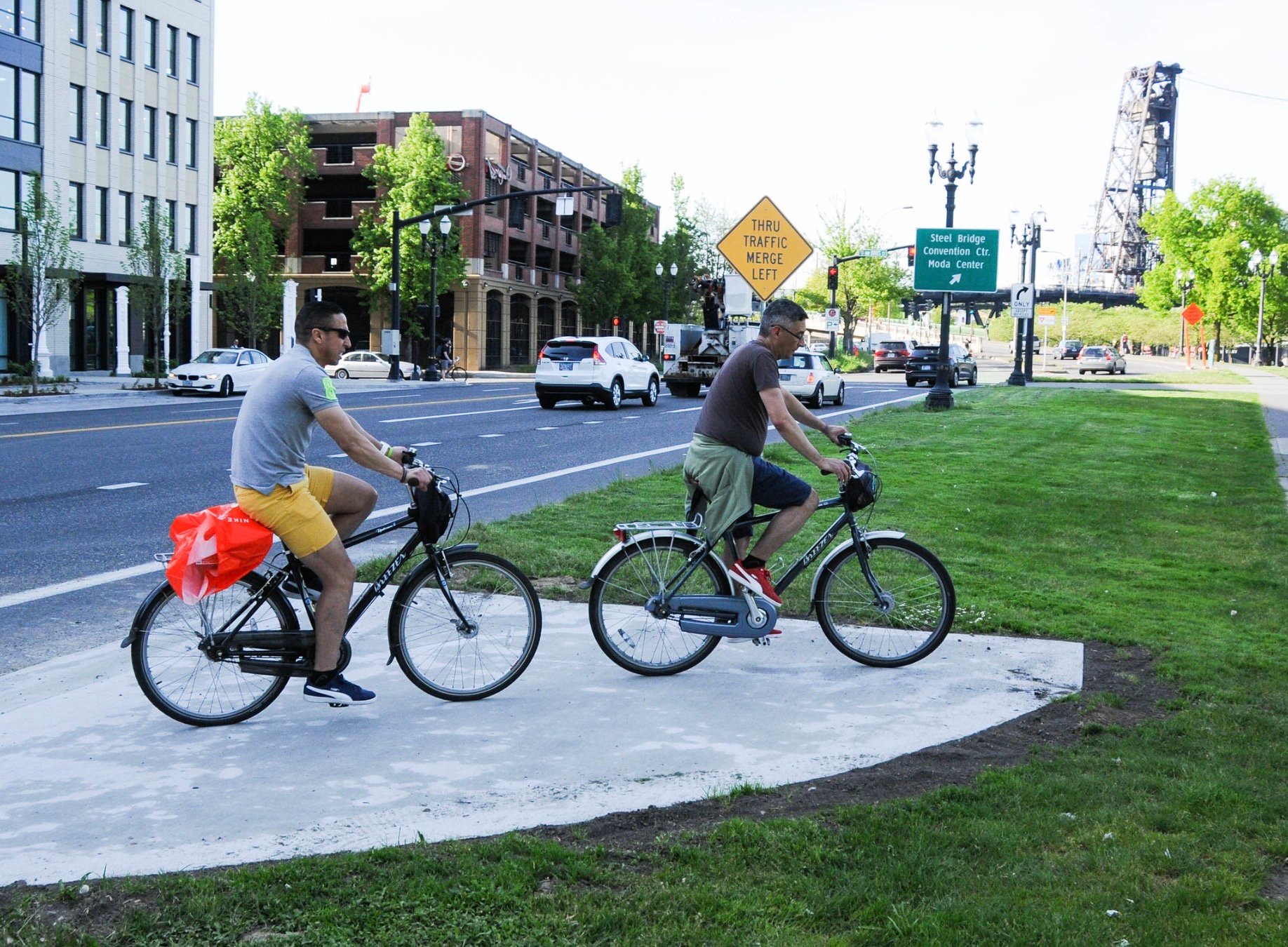
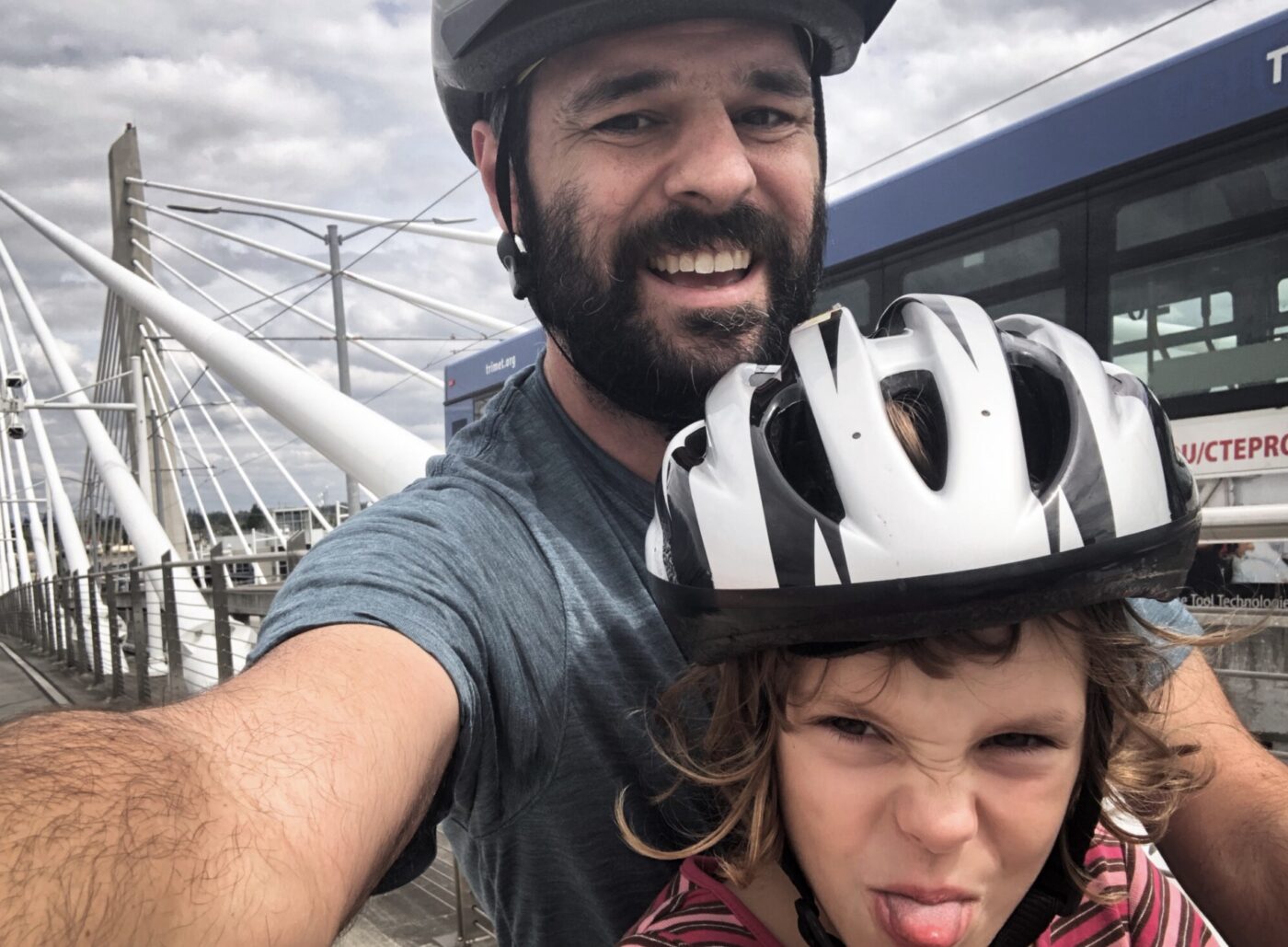
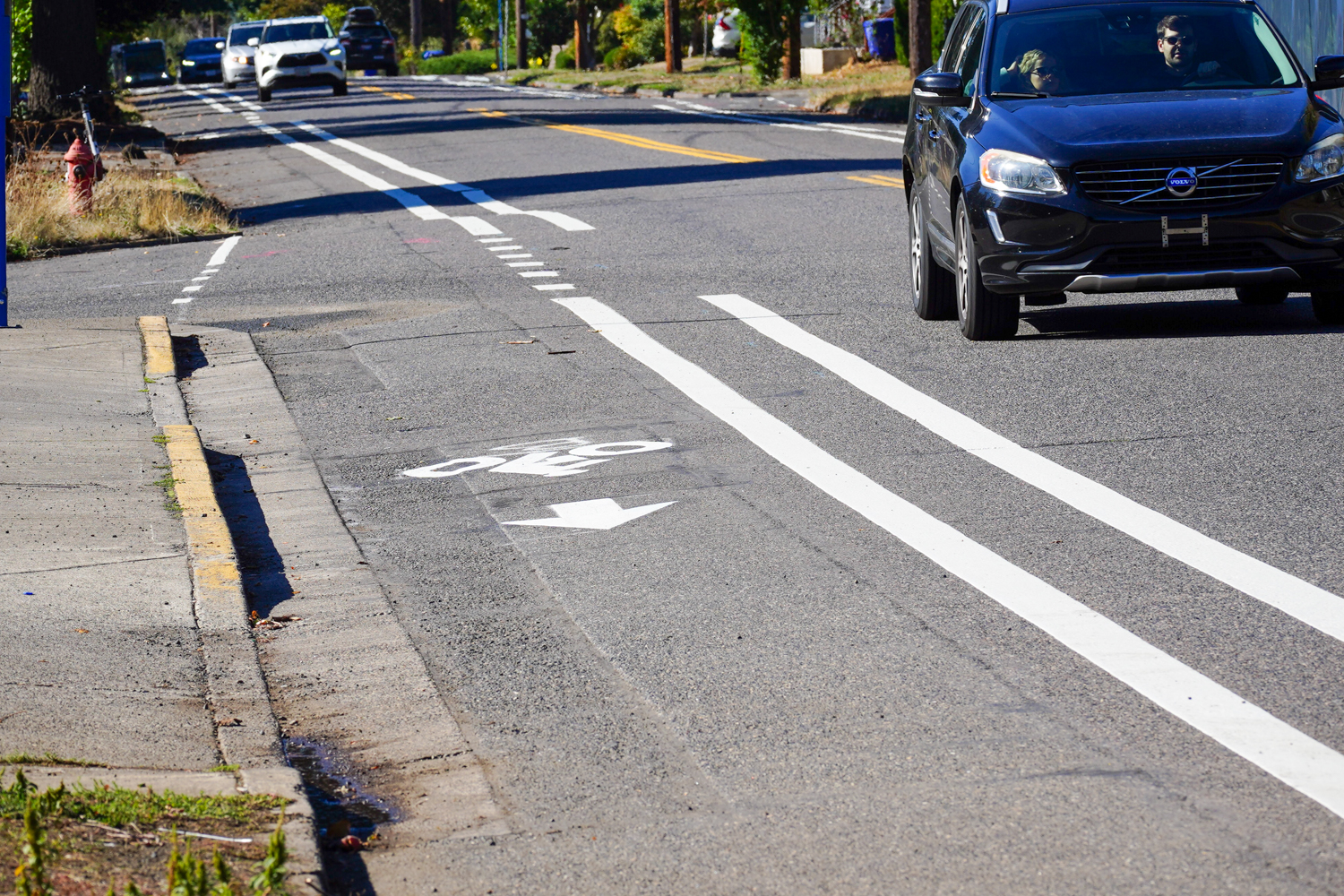
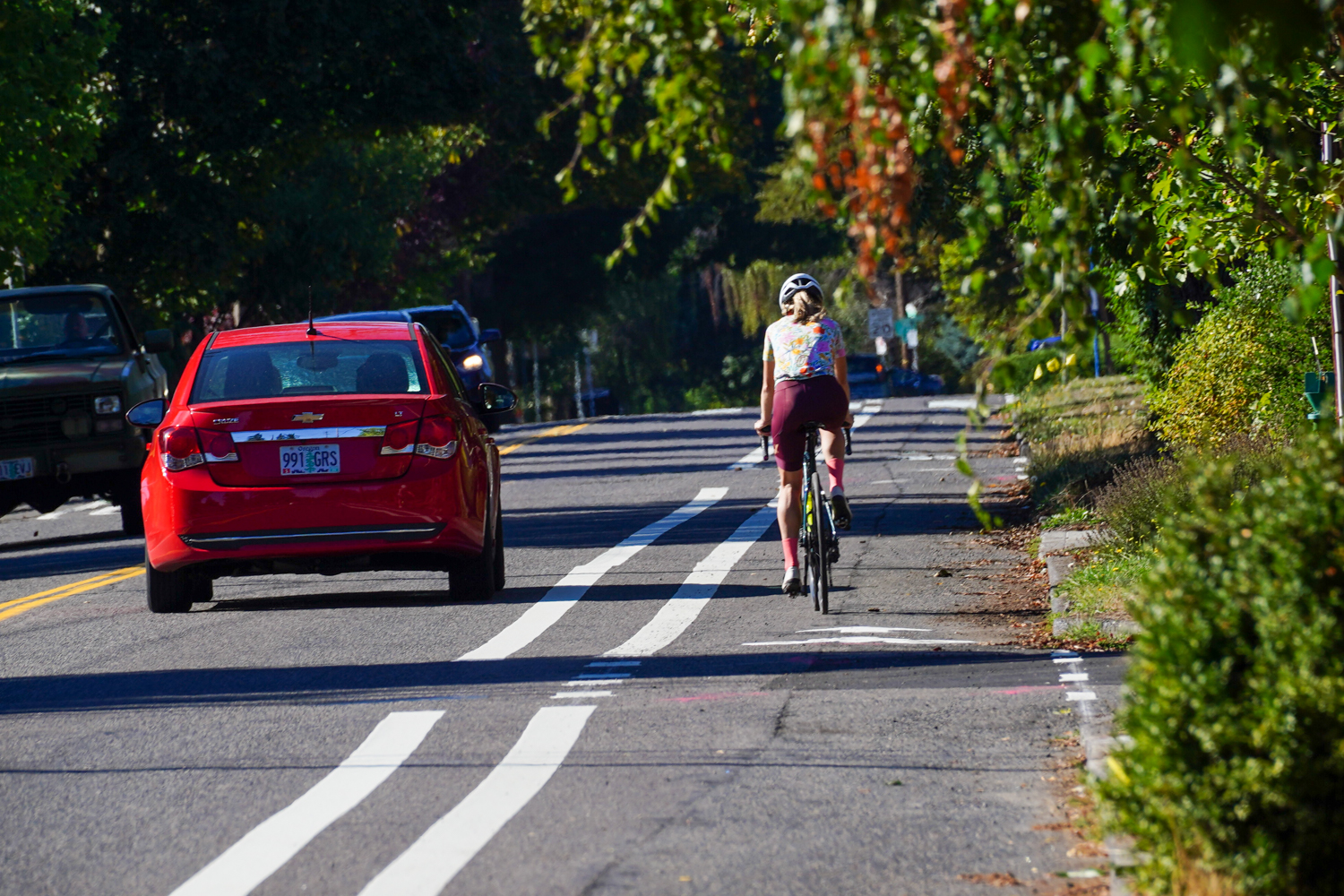
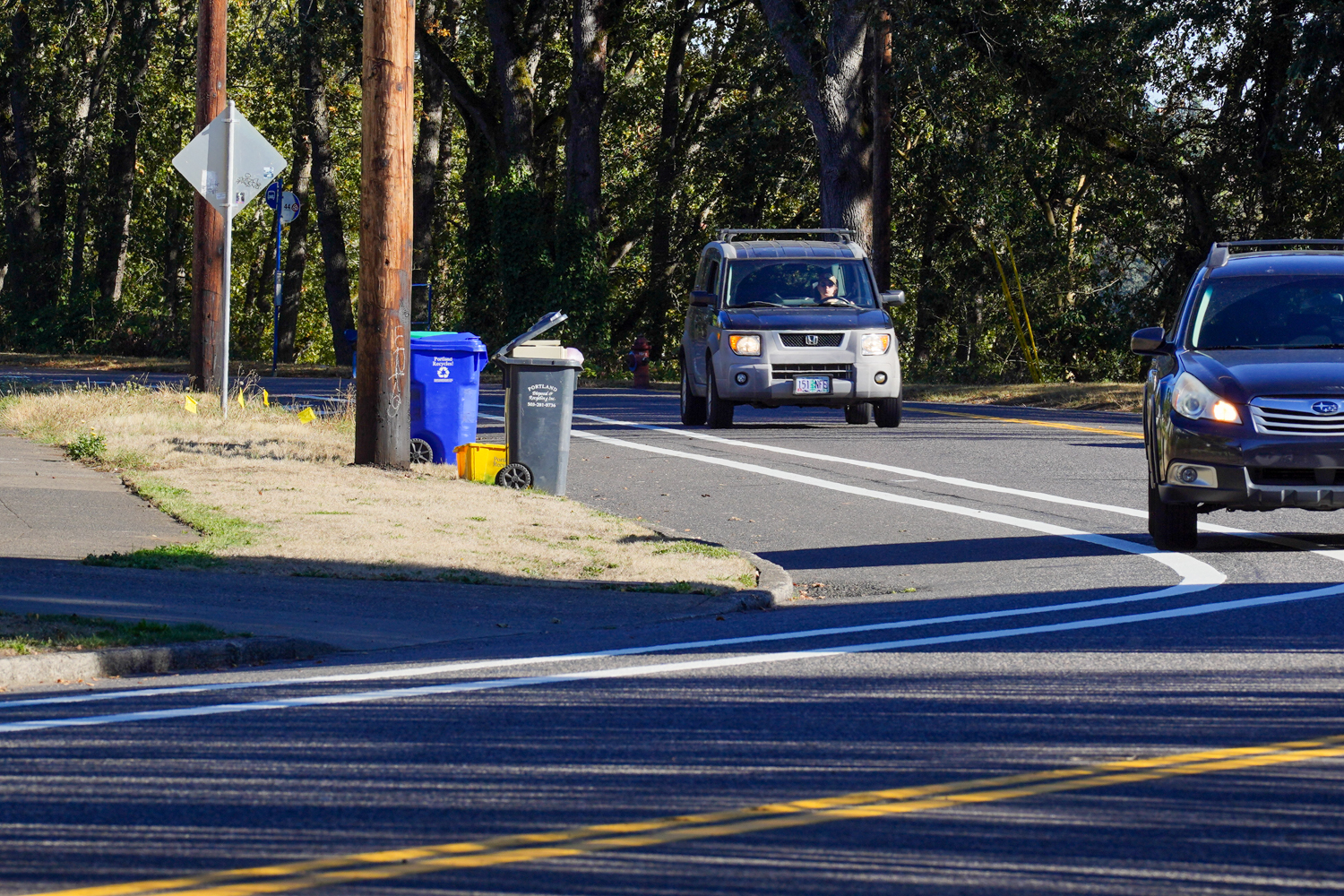
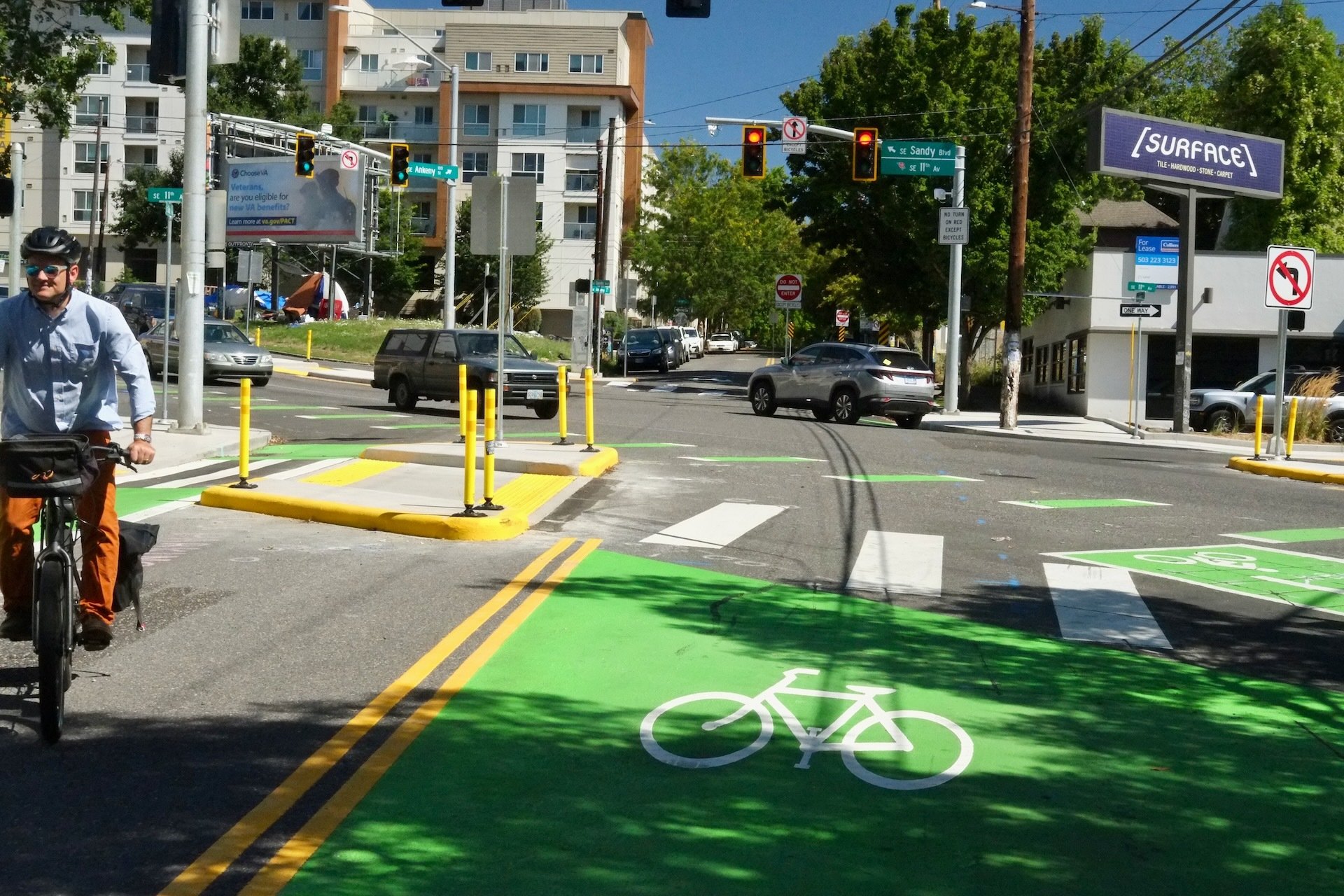
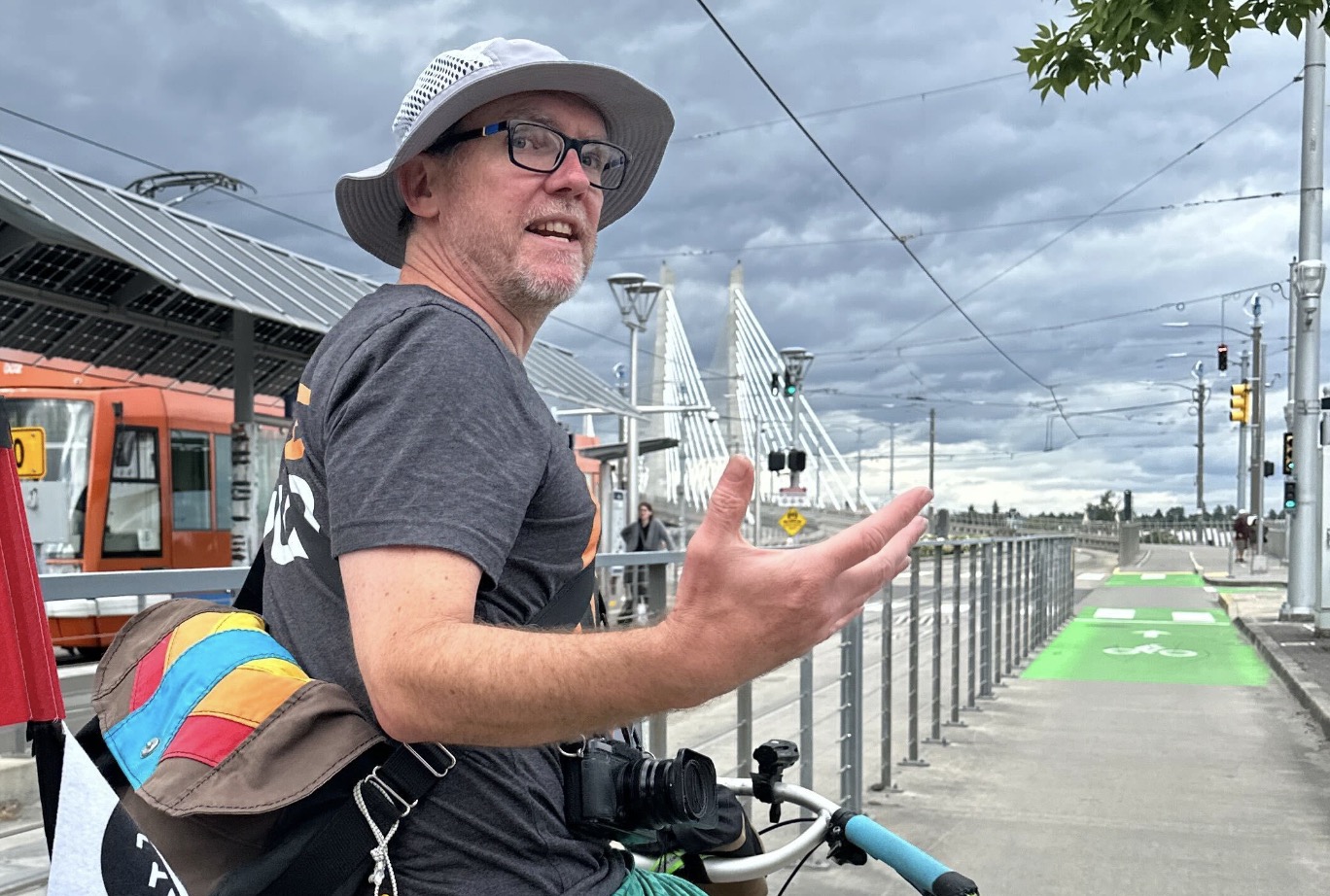
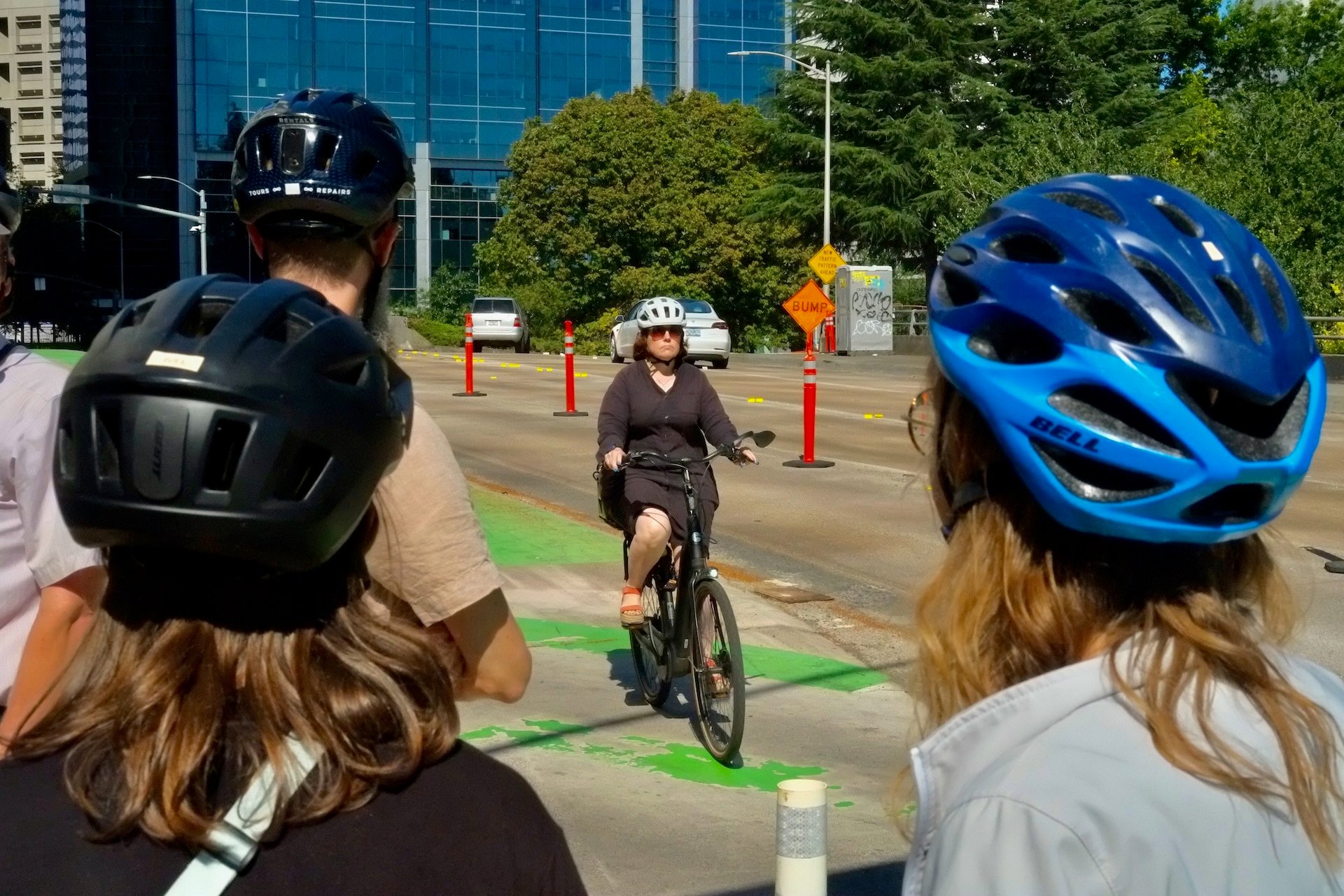
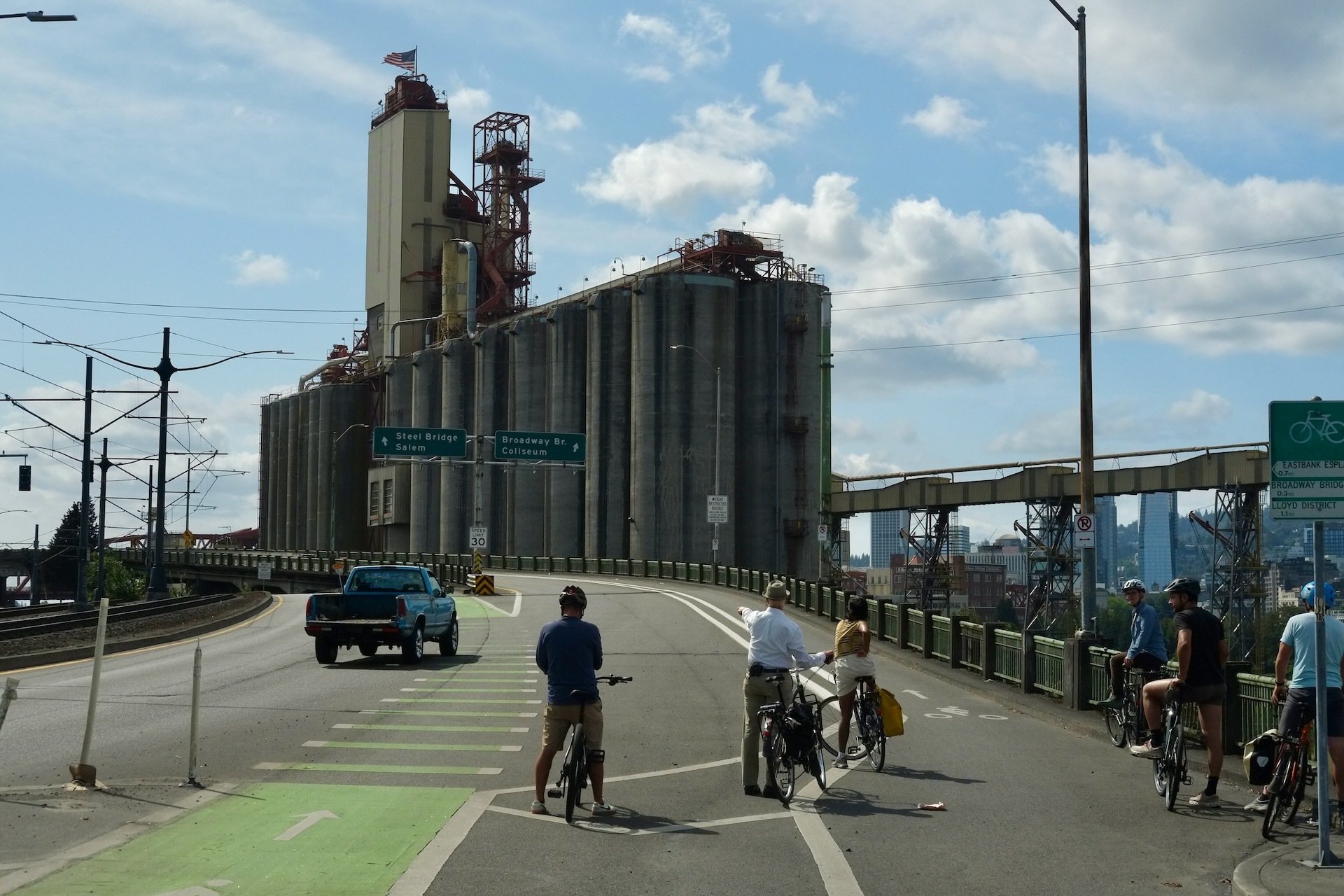
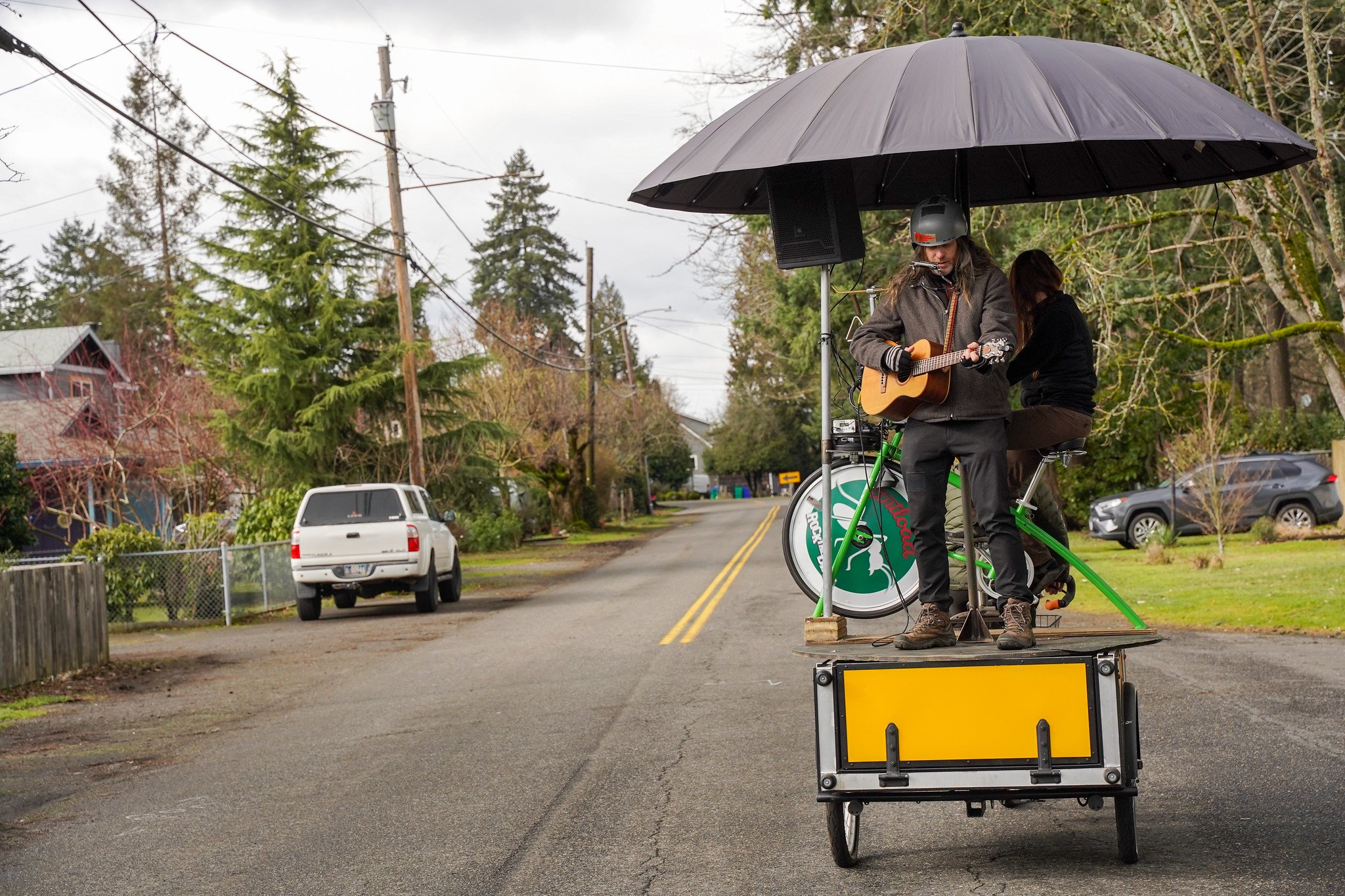
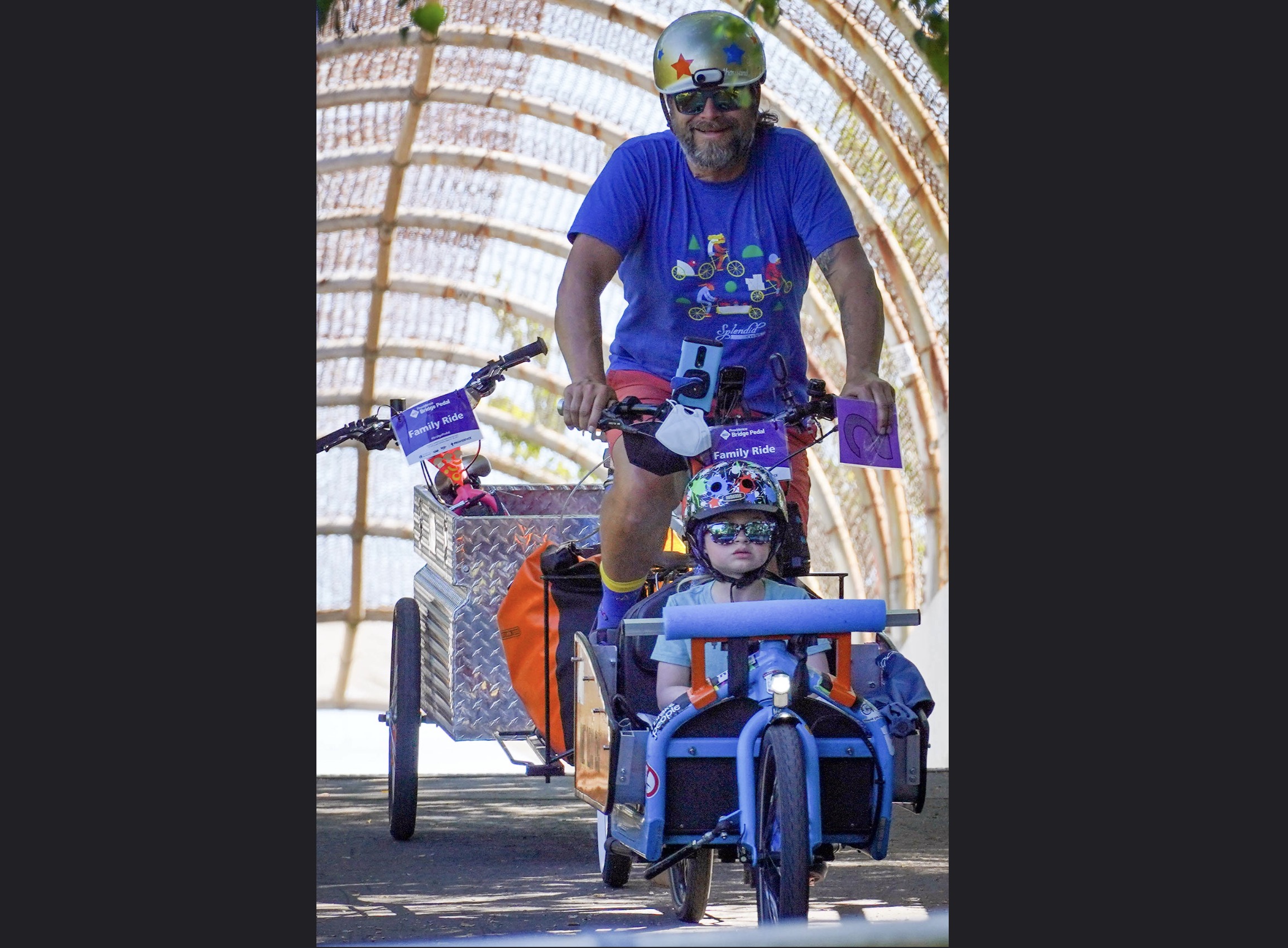
Sometimes you just need a wheel to follow. (Photo: Jonathan Maus/BikePortland)
A $310,000 grant will help local nonprofit BikeLoud PDX scale up their Bike Buddy program.
It’s the largest grant ever for the plucky bike advocacy organization who launched in 2014 to fill a gap in the local cycling ecosystem. Despite a number of successes and growth in their first 10 years, BikeLoud still has no paid staff members. This grant will change that. A portion of the funding will allow them to hire a program manager to coordinate and promote the Bike Buddy program.
BikeLoud won the funding from the Portland Clean Energy Community Benefits Fund (PCEF), a pot of revenue managed by the Bureau of Planning & Sustainability created by a 1% tax on retail sales of large corporations. In addition to funding a program manager, BikeLoud says they’ll establish a mini-grant fund to help low-income participants of the program pay for bike repairs and safety gear.
The Bike Buddy program launched in April 2023. The idea is to match new riders up with more experienced ones in order to help them get more comfortable. Think of it like a cycling mentorship. BikeLoud volunteers refer prospective participants to a page on their website where they fill out an application to help match them with a good buddy.
“The goal of the Bike Buddy program is to create more bicycle trips and replace car trips, thereby reducing greenhouse gas emissions,” reads a BikeLoud statement about the grant award. “Bike Buddy mentors can help new riders find Neighborhood Greenways close to their homes, practice safe street riding skills, and practice how to get to specific destinations in one-on-one mentorship.”
BikeLoud’s central organizing principle is to help Portland reach its adopted goal of 25% cycling mode share by 2030. To do that, BikeLoud leaders realize there must be more resources available for people who want to ride but who aren’t sure how to start — or who might just need a bit more confidence to integrate cycling into their daily lives.
Funding from PCEF will keep BikeLoud’s program running for three years. Learn more on their website.
Suffice it to say, Fucoloro knows a bit about what it takes to create a good urban bike network in a Pacific Northwest city. And after a recent visit to Portland it’s clear he doesn’t think our city is up to snuff.
To be clear, Fucoloro and his young daughter had a wonderful time. A recap of their trip on Fucoloro’s blog shares much of the magic that makes Portland such a cool place: bombing downtown from the Zoo in Washington Park, discovering public art, playing in our parks, and riding bike-friendly bridges across the Willamette River.
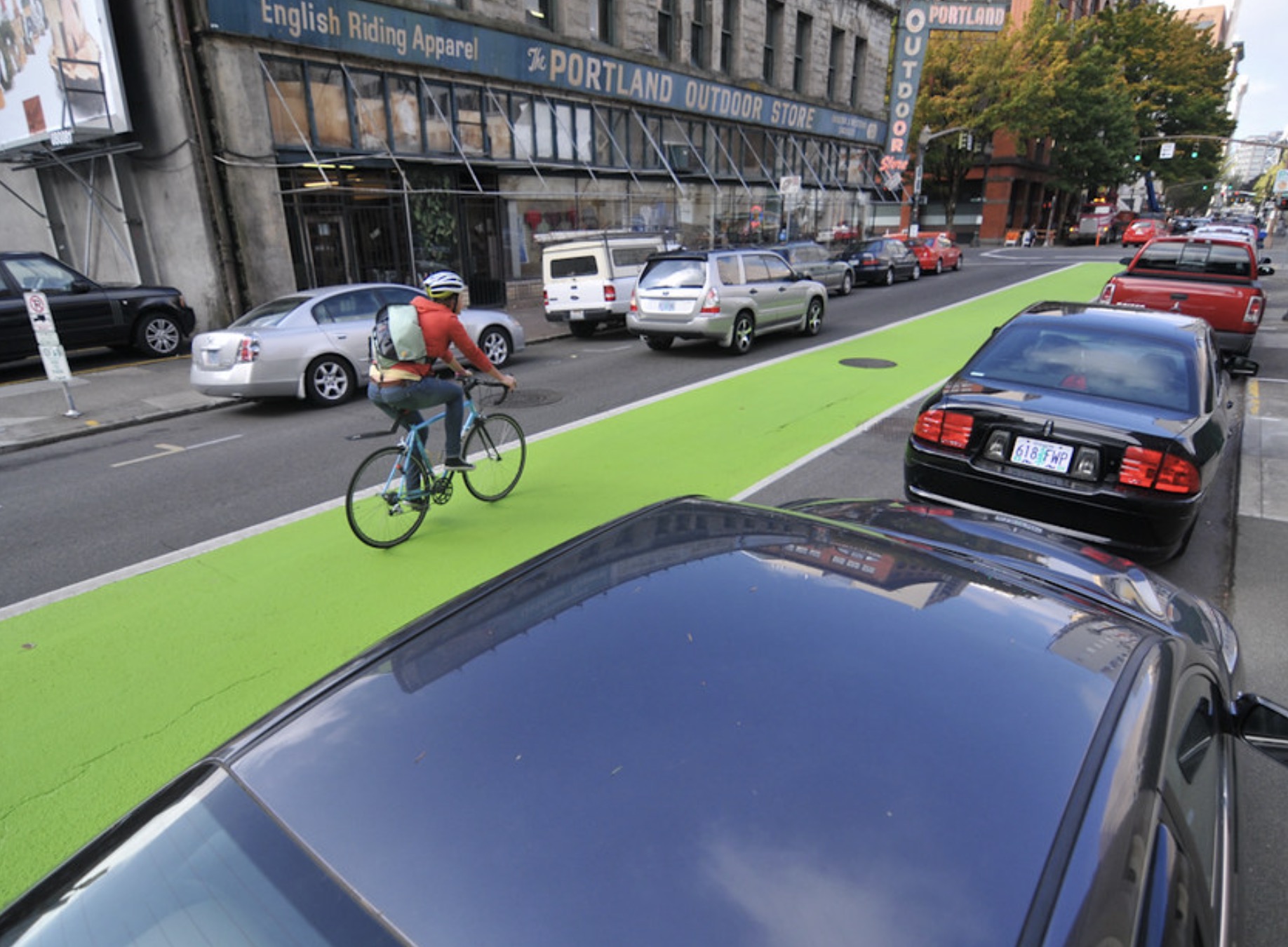
The bikeway on SW Oak is nice, but paint is not protection. (Photo: Jonathan Maus/BikePortland)
But when it came to riding downtown with his soon-to-be first grader, Fucoloro was not impressed. “Where are the downtown protected bike lanes?” he wondered. Since his last visit to Portland seven years ago, Fucoloro wrote that, “I had assumed the city would have built some proper protected bike lanes through the downtown core in those years.” He added that in the past decade, planners and advocates from Seattle were inspired by Portland and used that inspiration to build a network of protected bike lanes through their downtown core. “Has Portland forgotten its own lessons?” he asked.
He gave us kudos for NW Naito’s protected bike lane. But as we all know, one great facility does not a network make. Our wide, green bike lane couplet on SW Harvey Milk and Oak are nice, Fucoloro found, but they have no physical protection and therefore, “there was pretty much always someone parked in the bike lane,” he noted. Even SW Broadway only provides protection in one direction.
“I was surprised by how disconnected it all was, and we ended up biking in mixed traffic or walking the bike on the sidewalk at some point on nearly every trip we took around downtown,” Fucoloro wrote.
A few commenters on our Monday Roundup (where we shared a link to his blog post) agreed.
“I largely agree with Tom’s assessment,” wrote commenter dw. “Where are the protected bike lanes? Every street downtown should have nice, two-way protected bike lanes to make getting around by bike as easy as walking or driving.”
And Anomalee added, “As a working class person who can’t really afford a car, it’s really disheartening and infuriating to see how bad downtown is for biking. I guess it’s just one example of the broader problem we’re up against, a handful of good infrastructure projects here and there but no connected network.”
“The Portland Bureau of Transportation (PBOT) is prepping a $10.2 million list of active transportation projects they hope to get funded through a federal grant. According to sources at PBOT, conversations have already begun to focus all that money on a package of projects that would focus specifically on downtown bike access in the form of protected bike lanes and cycle tracks.
This is a golden opportunity we should not pass up.”
And we didn’t pass it up. A year later advocates jumped on board with a lobbying campaign from The Street Trust (then known as the Bicycle Transportation Alliance). By 2016 PBOT had support from City Council, strong backing from the community, and a bucket of funding filled with $8.4 million to implement what would eventually become known as the Central City in Motion plan. And according to PBOT CCIM Project Manager Gabe Graff, that money was set aside to, “preserve and enhance the pedestrian environment, preserve and enhance the transit access, at the same time we fill in a more comfortable and protected bicycling network.”
In 2016, Graff said downtown Portland was doing fine when it came to transit access, walkability, and driving convenience. “But cyclists coming across the bridges from the east side into downtown Portland feel like the infrastructure is not as intuitive, is not as comfortable,” Graff said.
Eight years ago, Graff shared a similar assessment about bicycling downtown that Fucoloro experienced a few weeks ago.
It’s important to note that around this time there were two approaches to reforming our streets being forged simultaneously by PBOT planning staff: protected bike lanes and dedicated bus lanes. While I always felt Central City in Motion was intended to be bike-centric, it ended up with several priority bus lane projects on its final list. But bus lanes also had a plan of their own, Enhanced Transit Corridors, which was adopted by council in June 2018.
Eudaly and her staff looked at PBOT and saw two plans, both of which were fully baked and ready-to-go: one was bike-centric, the other was bus-centric. They chose buses. Why? Because, in the words of Eudaly’s policy director Jamey Duhamel, “[Transit] was the issue that was most complementary and intersectional with our social, environmental and economic justice issues; and so we really went big and bold for increasing transit service.”
With a pandemic raging, nightly protests following the murder of George Floyd, the emergence of the Black Lives Matter movement, and a stark increase in unsheltered homeless on the streets; it’s easy to understand why building a safe and convenient network of protected bike lanes downtown hasn’t gotten the attention it deserves. But a lack of priority doesn’t explain everything. The CCIM plan itself simply isn’t building the type of protected bike lanes some of us hoped it would because it includes all types of treatments and projects.
Of the eight completed projects listed on PBOT’s website out of the 18 total projects recommended in the plan, just two are protected bike lanes (Better Naito and NW/SW Broadway). CCIM projects include traffic signal timing and upgrades, bus lanes, neighborhood greenways, crossing treatments, paint-only bike lanes, and so on. Those are important things, but each one of them means less focus on a connected network of protected bike lanes. And keep in mind, CCIM was passed just two years after we detailed the myriad reasons PBOT has had trouble building physically protected bikeways in constrained environments like downtown.
But there are reasons for optimism! After the huge success of Better Naito and the rescueof SW Broadway’s protected bike lane from the jaws of PBOT Director Millicent Williams and her former boss Mingus Mapps, PBOT is now working hard on the SW 4th Avenue protected bike lane project. SW 4th was always meant as the northbound couplet of Broadway and it’s addition to the network will create important connections. I hope that project creates urgency for protected bike lanes on W Burnside leading onto the bridge, a project that’s in the plan but remains unbuilt.
We need as many protected lanes for bicycle riders as possible. Because Fucoloro is right. The combination of our huge investment and decades-long focus on the neighborhood bikeway network and our legacy of a strong cycling culture, means a high-quality protected network downtown would be “an instant success.”
“It feels like Portland has done all the hardest parts,” Fucoloro writes. “And then has failed to actualize that previous work by plugging it into a network of routes people can use… Come on, Portland. Stop resisting your city’s bike successes and choose to embrace it instead.”
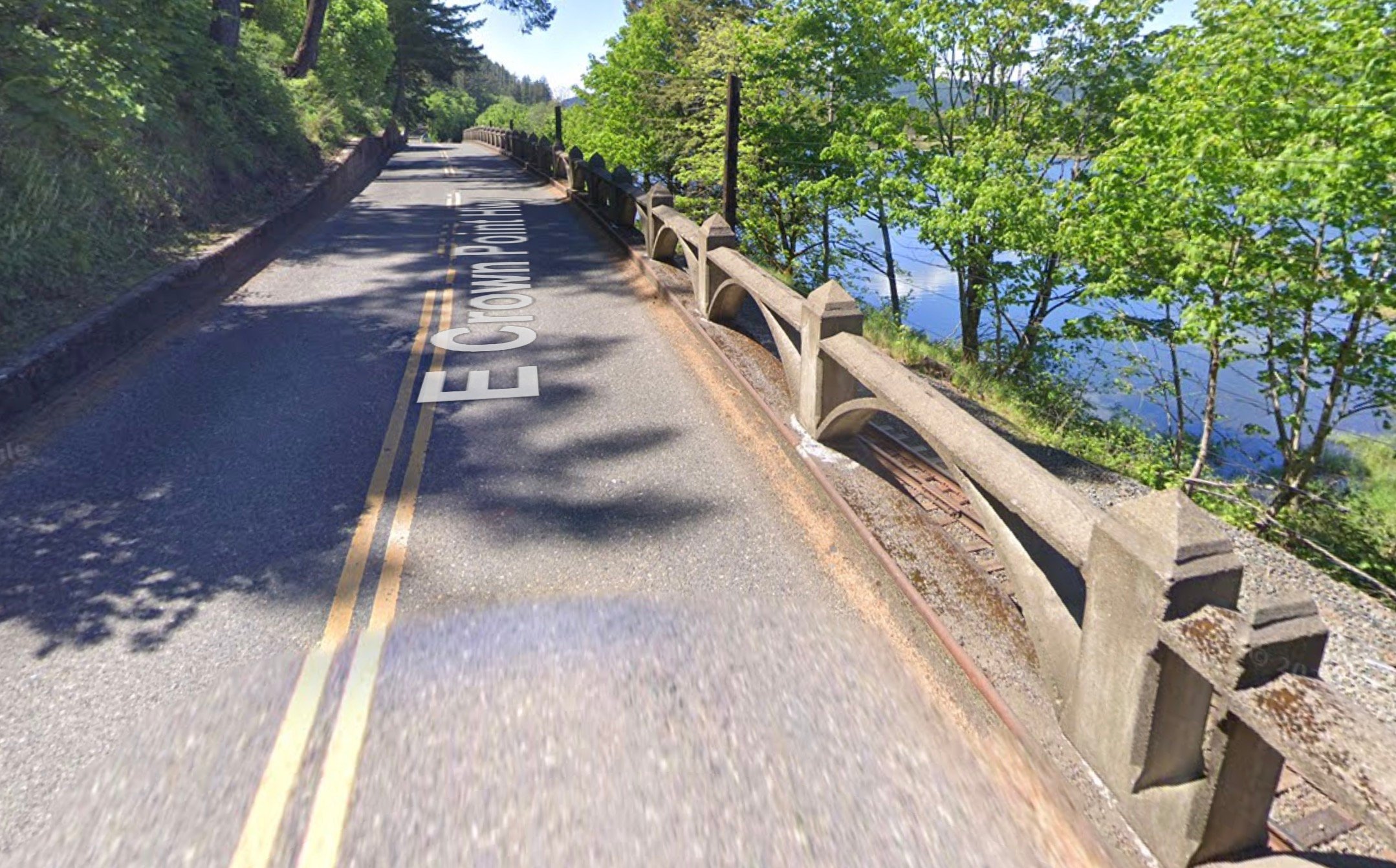
Viaduct west of Multnomah Falls and next to Benson Lake is in need of repairs.
Road construction projects will put a serious crimp in popular bike routes near the Sandy River and Columbia River Gorge for at least the next few months.
Last week Multnomah County announced that the Stark Street Bridge was in need of serious repairs. This bridge over the Sandy River is an important connection between Troutdale and the Historic Columbia River Highway (U.S. 30). About 12 miles south of the more well-known Sandy River Bridge, the Stark Street Bridge is one of very few crossings of the river between I-84 and Sandy (Lusted Rd bridge near Dodge Park being another one).
Multnomah County hasn’t released a firm date for re-opening, but they expect retaining wall repairs and other work to take at least several months.
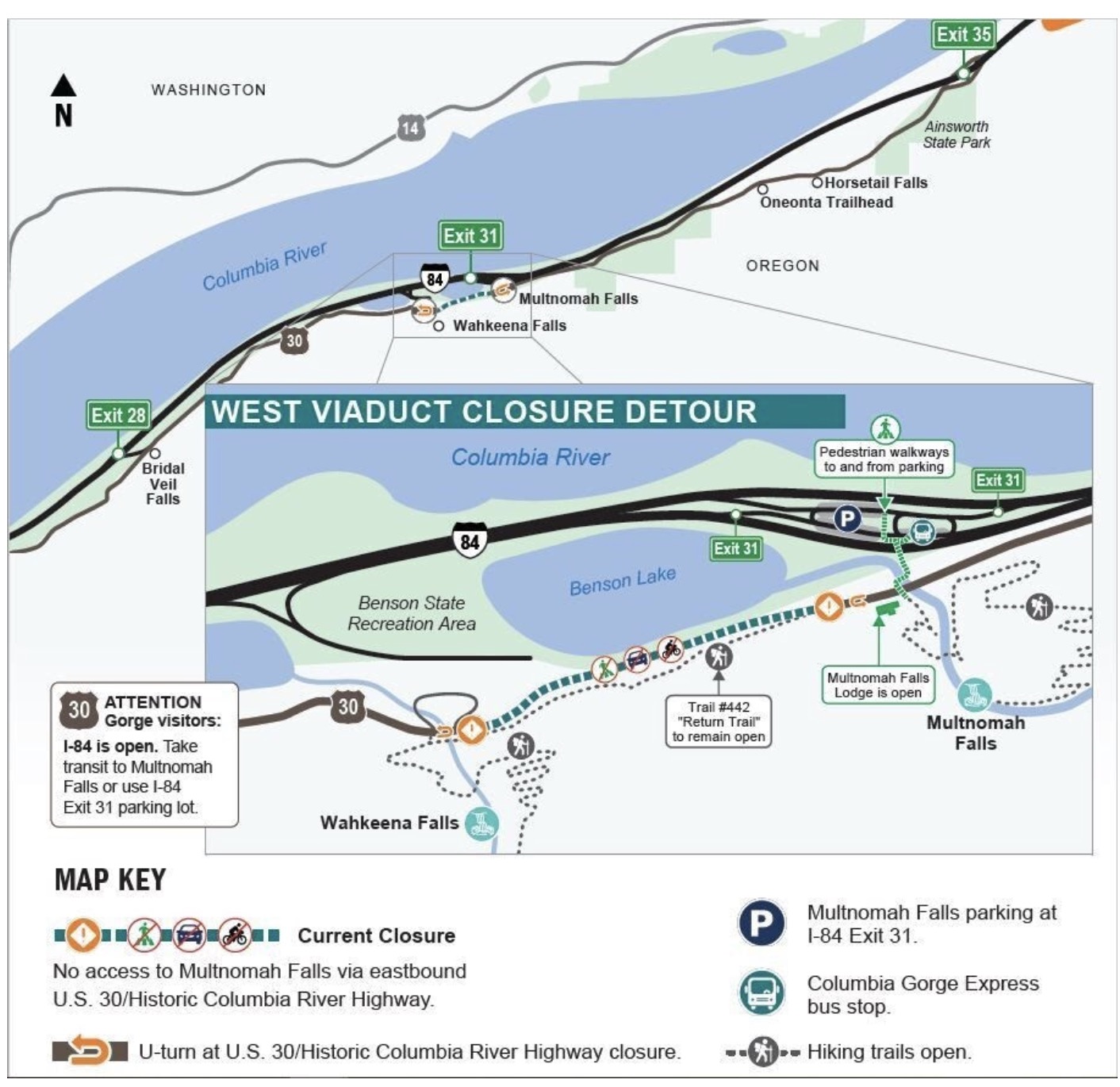
(Source: ODOT)
Further complicating your Gorge cycling adventures in the months ahead is a closure of the Historic Highway west of Multnomah Falls. The Oregon Department of Transportation says they need to close the Historic Highway adjacent to Benson Lake to all users from this coming Tuesday, October 1st until Memorial Day (May 26th) of 2025. The closure is necessary to repair one of the viaducts.
The closure also applies to bicycle users. I followed up with ODOT to confirm. According to ODOT Public Information Officer Ryan McCrary, “There will be no bicycle access due to the nature of the construction on the Historic Columbia River Highway. Although we do not recommend it, I-84 is an alternative route for bicyclists during the closure.”
As one commenter reminded me below, there’s a parallel hiking trail that will remain open. So if you are up for a hike-a-bike, you could take that route for the 1/2 mile or so to get around the closure. Just don’t pedal your bike and you’ll be legal.
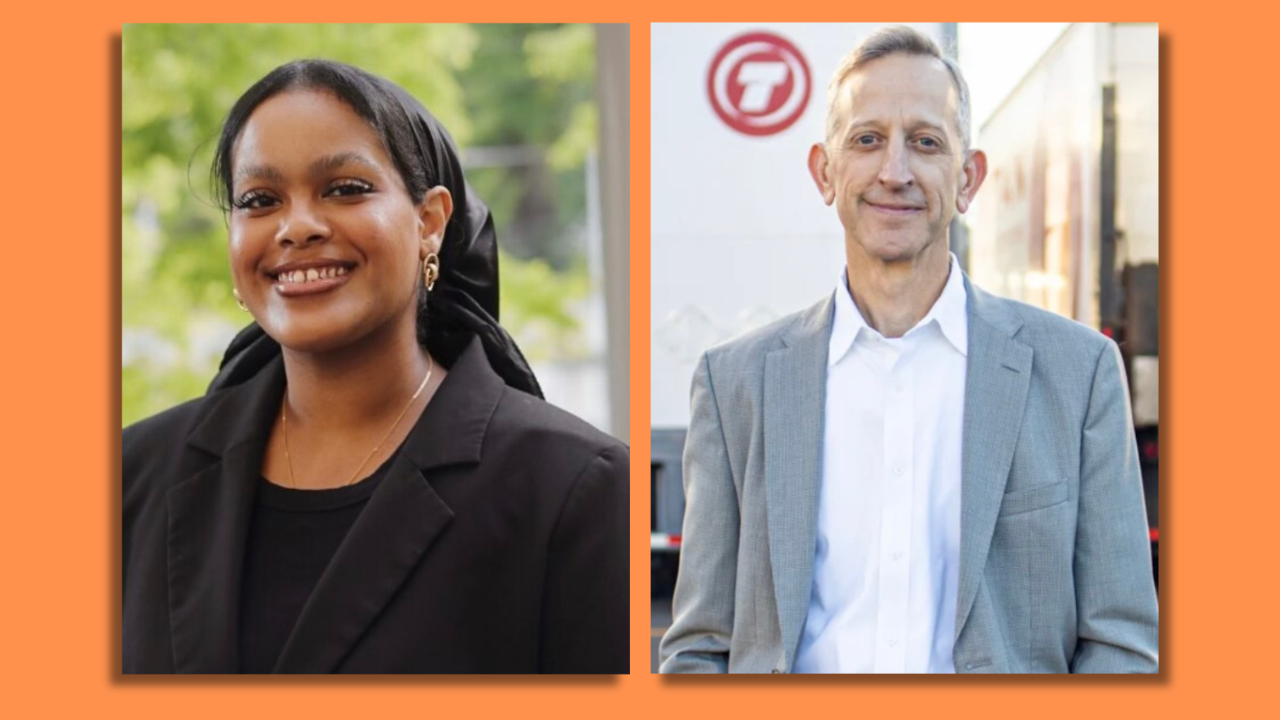
District 3 council candidate Ahlam Osman (left) and mayoral hopeful Keith Wilson. (Photos: Rose City Reform)
Note: Bike Happy Hour begins at 4:00, one hour later than usual, from now on.
Did you hear that? It’s the sound of Portland’s election tightening up.
The big money is starting to roll in, the mayoral race is getting spicy, and candidates are scrambling to stand out from the crowd. With just over a month before our unprecedented election, the tenor of the campaigns has gotten a lot more serious.
Those halcyon days when we’d have candidates just randomly show up at Bike Happy Hour and give stump speeches seem almost quaint now. But that doesn’t mean those days are over! I know it’s been a while (hey, I was gone nearly all last month) I’m very excited to announce that Portland mayoral candidate Keith Wilson and City Council candidate Ahlam Osman will join us this week at Bike Happy Hour.
We’ve hosted Wilson a few times and he’s coming back just as the race heats up. Wilson, a trucking company CEO with a history of showing up for transportation issues in Portland, sees an opportunity to gain ground due to recent fumbles by Carmen Rubio and broad concerns about Rene Gonzalez among many left-leaning Portlanders.
Osman is relatively new to the race for council district 3 (SE). Despite being just 22 years old, Osman stands out as an emerging leader on issues many BikePortlanders care deeply about. She’s a senior at Portland State majoring in community development, has served as a member of the Multnomah County Youth Commission, and has interned with Metro. According to Rose City Reform, Osman’s priorities are, “environmental, climate and economic justice, small business support, equitable civic engagement, and sustainable and people-centered planning and development.”
In testimony at the Joint Committee on Transportation hearing last week, Osman told lawmakers that living near a freeway has had a huge negative impact on her life. “My mother, brother and twin have all developed asthma,” Osman shared. “Living in this environment has shaped my understanding of how transportation and environmental justice and racism intersect… We need bold action to reduce transportation climate impact and the need to drive… by investing in public transit and creating compact, climate friendly neighborhoods, we can reduce vehicles, vehicle miles traveled and emissions.”
Come out Wednesday night to meet Wilson and Osman. Also note that the Boycott Chevron Rolling Protest will begin at Gorges Beer at 6:30, so bring what you need if you plan to do that ride afterwards.
One last thing… Bike Happy Hours are changing due to later opening hours from our hosts Gorges Beer and Ankeny Tap & Table. The event will now run from 4:00 to 6:00 pm (starting one hour later). As per usual, speaking and open mic will begin around 5:00.
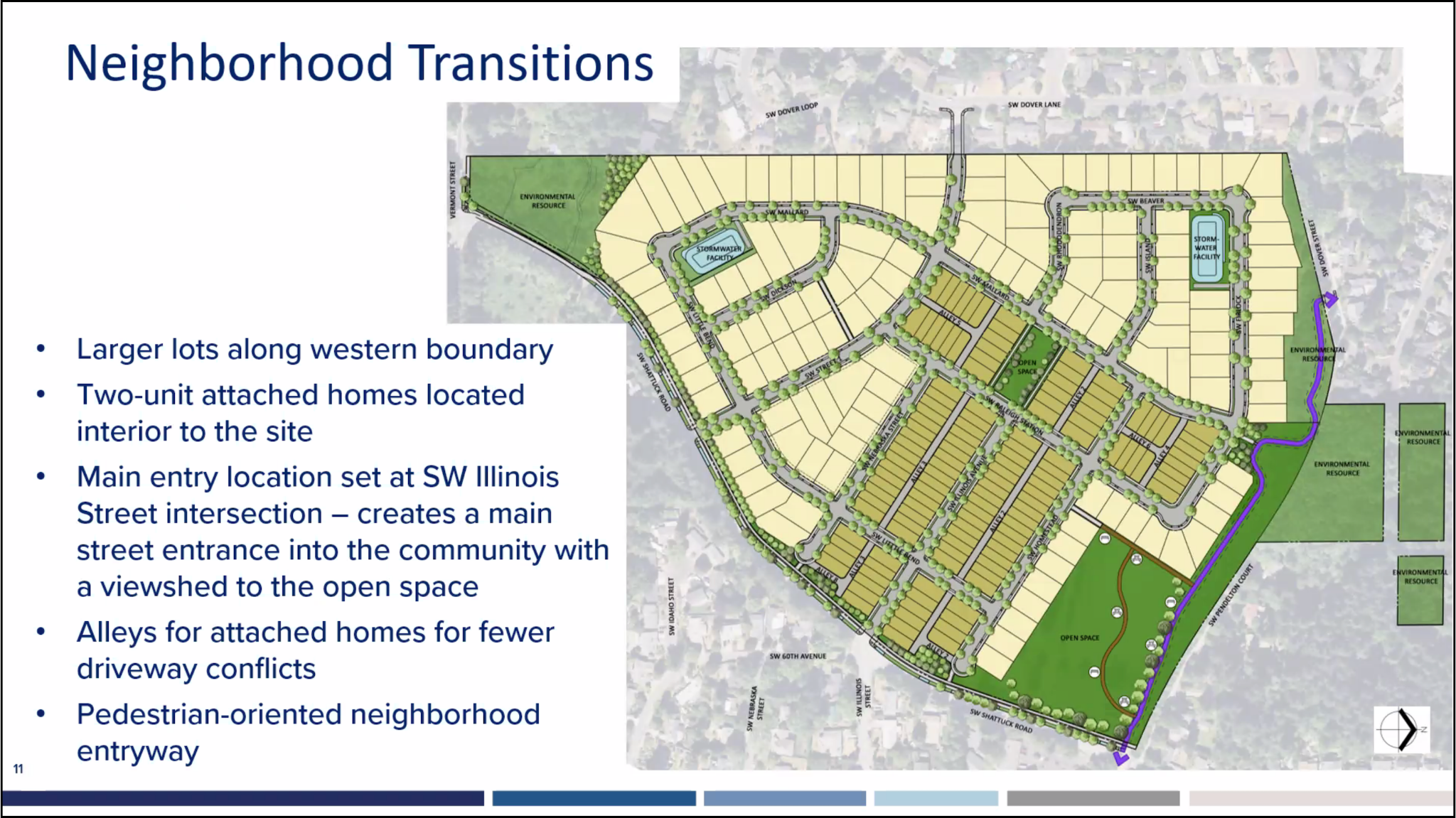
Proposed Raleigh Crest development, North is to the right. (Source: AKS Engineering)
In last Wednesday’s three-hour public hearing on the proposed Raleigh Crest development at Alpenrose, the two most significant words spoken were “nexus” and ”proportional.” Coming from Steven Hultberg, the attorney for Raleigh Crest LLC, they signaled that the developer would be pushing back against the most recent requirements from city staff.
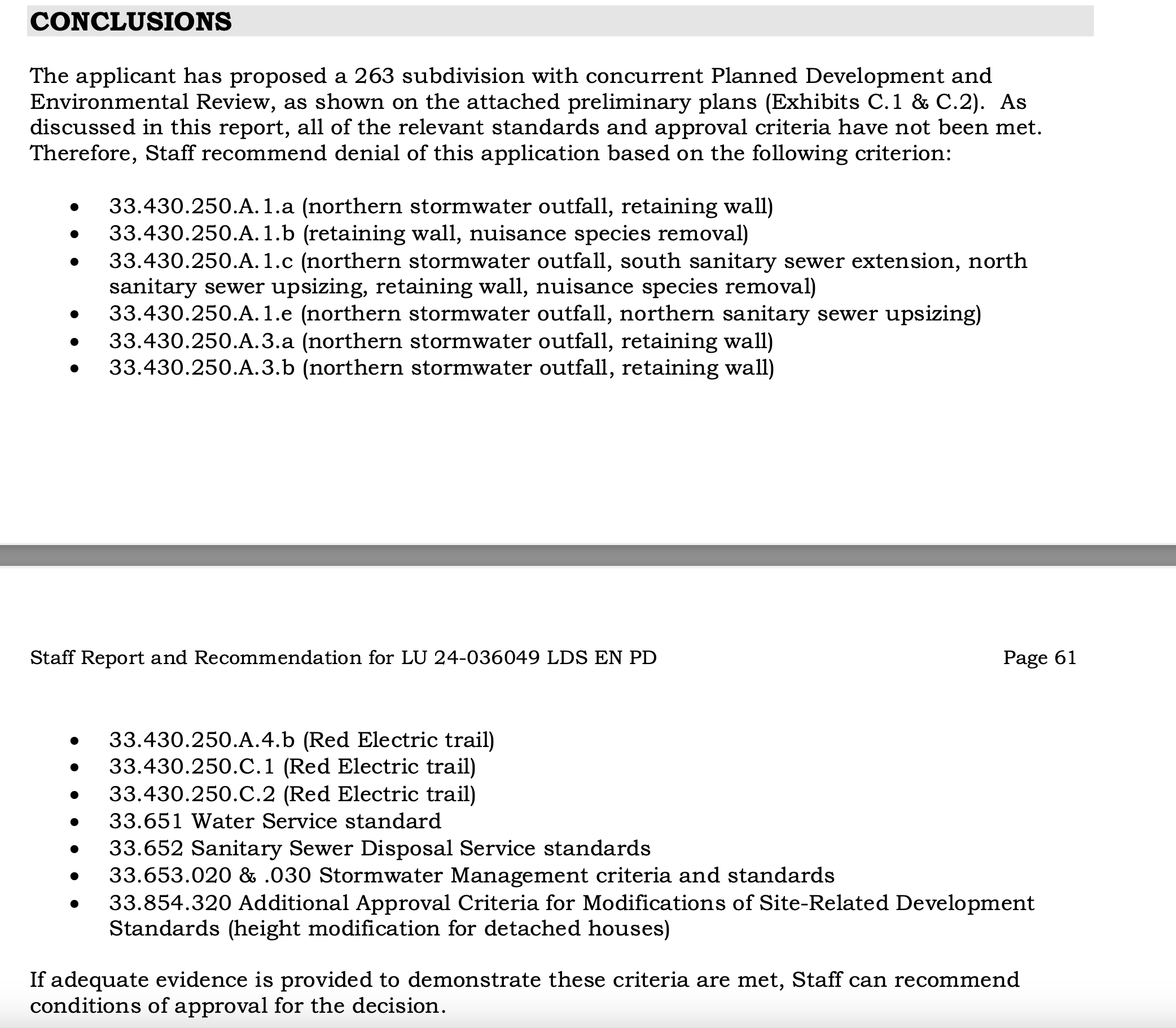
As BikePortland reported last week, city staff had recommended denying the Land Use permit for the proposed 263-unit Raleigh Crest development. In their Staff Report to the Hearings Officer, most of the “relevant standards and criteria” that had not been met pertained to either stormwater or other environmental concerns.
BES: Nexus and Proportionality
The terms “nexus” and “proportionality” refer to key concepts in a body of jurisprudence which limits how much a government can exact from a developer, and which is referred to as Nollan/Dolan, after the Supreme Court decisions in those two cases. By using those terms in his testimony, the mild-mannered Hultberg made it clear that his client had reached the limit of their compliance with certain city requirements, most specifically pertaining to environmental mitigation, and that they could possibly challenge these requests using Nollan/Dolan arguments.
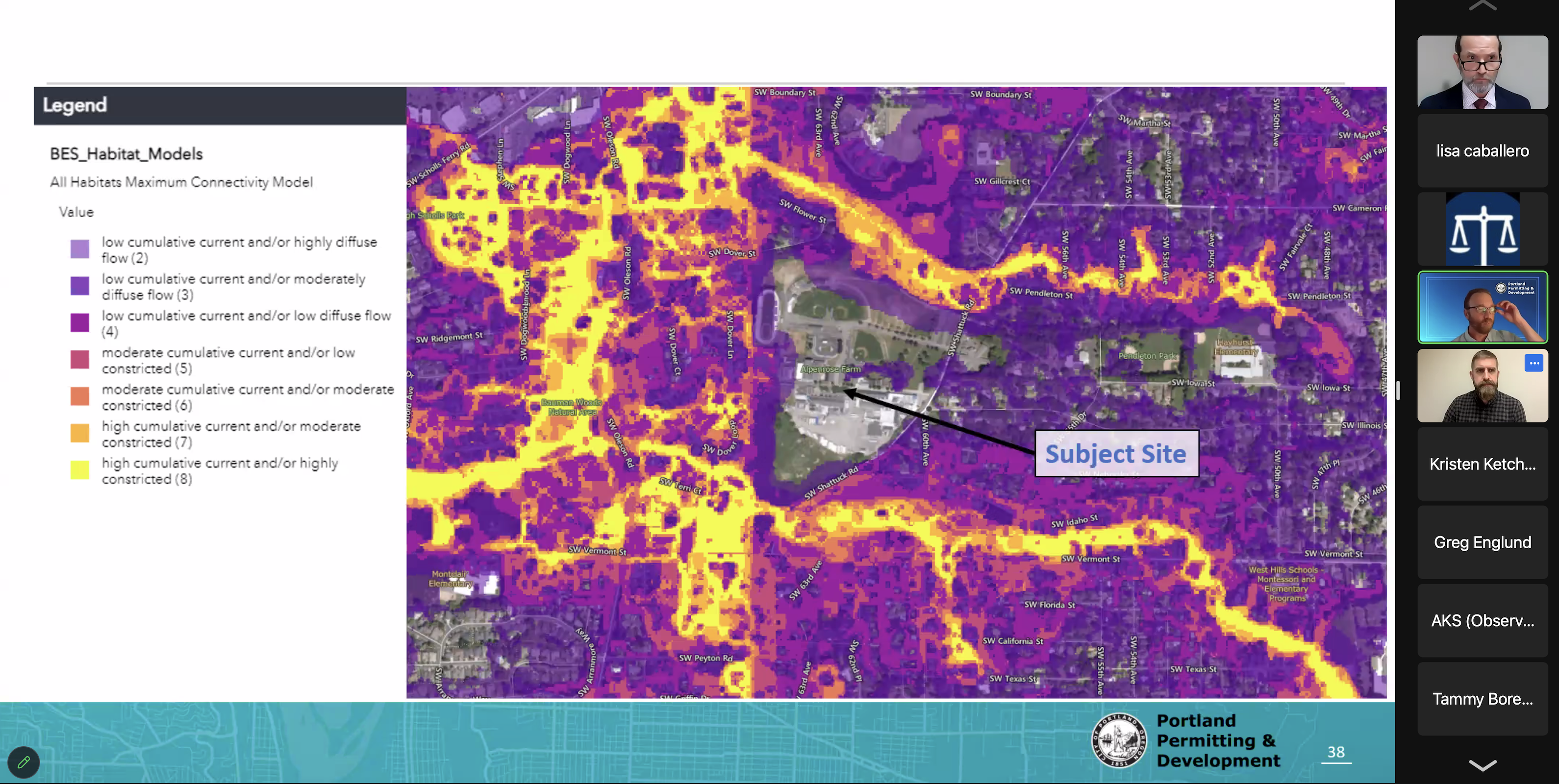
From the Staff Report to the Hearings Officer.BES habitat model, with zoom grid faces to the right. Top to bottom: Hearings Officer David Doughman, Timothy Novak and Sean Williams (Portland Permitting and Development).
Specifically, Hultberg brought up “nexus” with regard to the sensitive wetlands at the property’s southern tip. He argued that there was no connection, or “nexus,” between any possible harm caused by their work in the riparian environmental zone and the mitigation the city was requiring.
At first glance, writing about Nollan/Dolan might seem like a stretch for BikePortland, but really it isn’t. “Dolan” is Dolan v. City of Tigard, a 1994 US Supreme Court decision involving Tigard’s Fanno Creek Trail, a multi-use path (MUP) just downstream from the Alpenrose environmental zones. In fact, a section of the Red Electric Trail which is planned to cross the northern end of the Alpenrose site, will eventually connect with the Fanno Creek Trail. So the Nollan/Dolan cases are very much relevant to this proposed development, and are an invisible-to-the-uninitiated dominating presence in many Portland Land Use decisions.
This is the best summary of Nollan/Dolan I’ve read:
The Court’s decisions in Nollan and Dolan address the potential abuse of the permitting process by setting out a two-part test modeled on the unconstitutional conditions doctrine. First, permit conditions must have an “essential nexus” to the government’s land-use interest, ensuring that the government is acting to further its stated purpose, not leveraging its permitting monopoly to exact private property without paying for it. Second, permit conditions must have “rough proportionality” to the development’s impact on the land-use interest and may not require a landowner to give up (or pay) more than is necessary to mitigate harms resulting from new development.
2023 Syllabus prepared for the US Supreme Court
By using the words “nexus” and “proportional,” Hultberg became a soft-spoken rattler of some significant sabers.
The public’s turn
After the Staff and Developer had presented their cases against and for approving the permit, it was the public’s turn. The first speaker was Marita Ingalsbe, President of the Hayhurst Neighborhood Association and one of the founders of the Friends of Alpenrose advocacy group. She started by saying, “Our top concern is the lack of safe pedestrian and bicycling connectivity,” and she described deficiencies in the general area of the development, including lack of a sidewalk and bike lane between the site’s northern boundary and the Beaverton-Hillsdale Highway, and also the sidewalk gaps and absent bike lane on Vermont St to the south.
Let’s pause there a moment. Those comments were directed to the Portland Bureau of Transportation (PBOT), it’s not the developer’s responsibility to fix the city’s half-a-century neglect of the streets in the broader area.
But Ingalsbe continued on with compelling testimony about many specific problem locations along the Alpenrose frontage which arguably could be the developer’s responsibility to improve or mitigate, if the city would require them to. For brevity, I’m going to highlight just one of those locations, the intersection of Illinois St and Shattuck Rd.
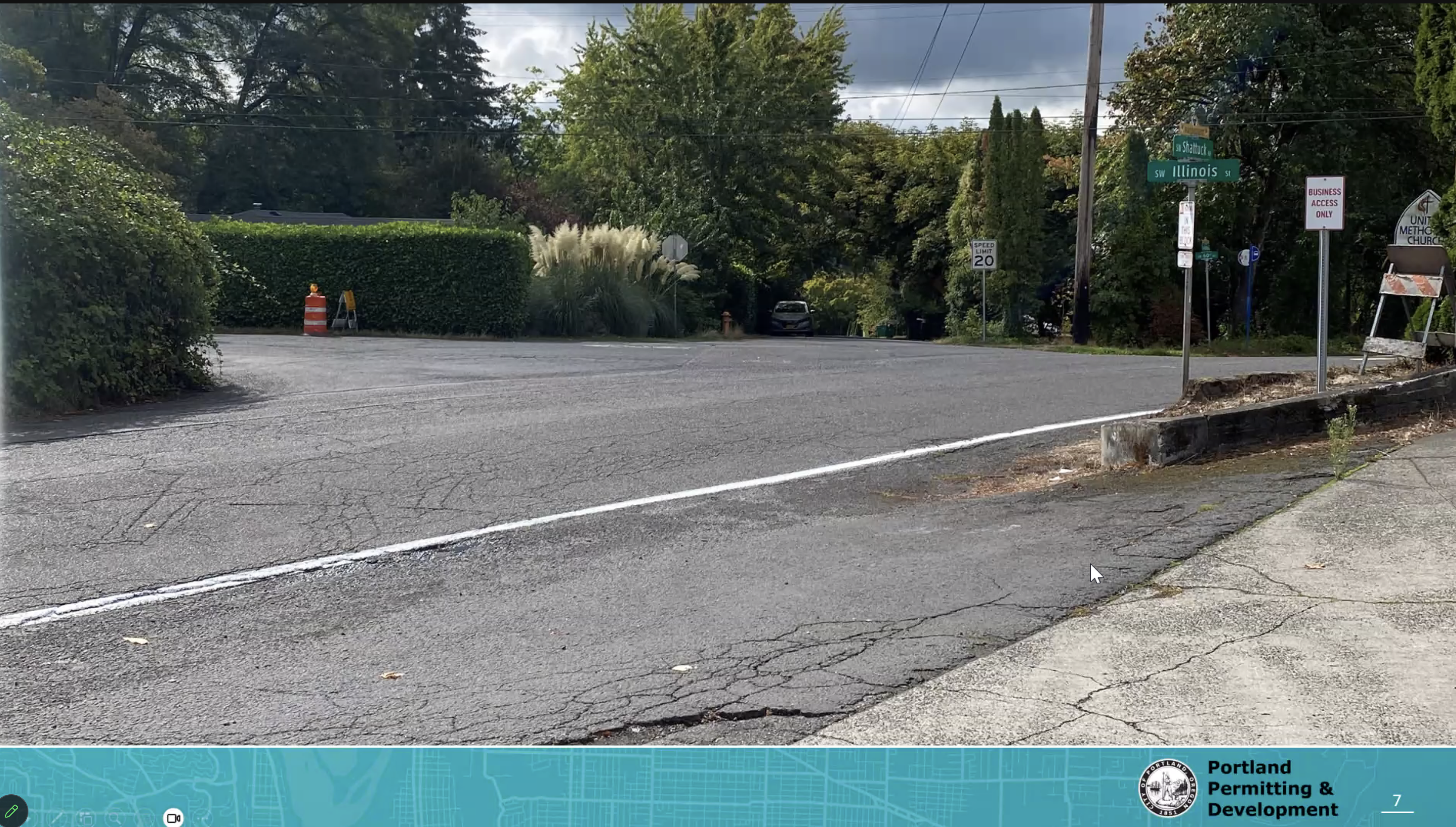
The intersection of SW Illinois St and Shattuck Rd
The intersection of SW Illinois St and Shattuck Rd, looking south-east.
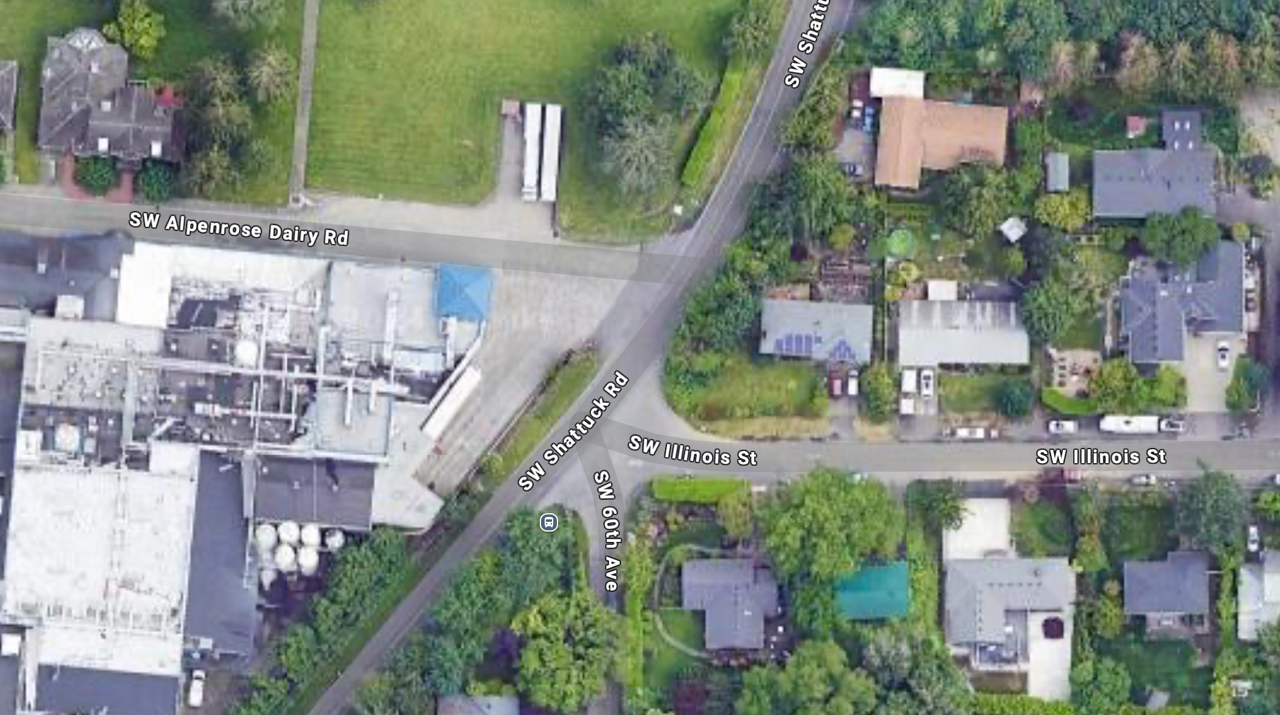
Illinois is southwest Portland’s longest greenway, and it is also Safe Routes to School (SRTS) designated. Currently, the road dead-ends at the Alpenrose Dairy in a “T” with Shattuck. The proposed development will add a new road traversing the development on Shattuck’s west side, and Illinois will become a through street connecting to it.
Inglesbe made a number of suggestions for improving what will become a complicated 5-legged intersection and concluded that, “some better design really needs to happen at this intersection when the new development goes in, we can’t just have a crosswalk.”
Or, as bike advocate Keith Liden wrote in one of his several letters to the city over the summer:
I am disappointed to see that the revised application continues to propose the same deficient pedestrian and bicycle designs as before. My descriptions of these problems and proposed solutions are contained in the attached emails.
(Read this PDF of Liden’s testimony at the hearing. It is an excellent critique of the proposed bicycle and pedestrian system, with suggestions for improving it.)
It was in response to these and other comments from the public that attorney Hultberg used the word “proportional,” but he also expressed a willingness to work with the city on “safety concerns that were addressed by a number of the commenters today,” saying that the developer is “more than happy to continue to discuss” them with the city.
PBOT: where’s transportation?
Irregular intersection of Shattuck, Illinois and 60th is a sea of asphalt with little structure. The proposed Raleigh Crest will add a leg entering into the Alpenrose site.
Given the public’s reasonable requests, and developer’s apparent willingness to discuss them, it is curious that PBOT has been so passive about requiring these public safety improvements, which would appear to meet the Nollan/Dolan nexus and proportionality tests.
Irregular, 5-legged meetings of several roads are pretty common in the southwest, and PBOT has excellent designers who are able arrive at low-cost solutions for making them safer. Readers might be surprised to learn that it is standard in Portland for the “Transportation” section of a Staff Report to be copied straight from the “Traffic Impact Analysis” of the developer’s traffic consultant, with the following paragraph tacked on at the end:
PBOT has reviewed and concurs with the information supplied and the methodology, assumptions and conclusions made by the applicant’s traffic consultant. As noted in the findings, mitigation is necessary for the transportation system to be capable of supporting the proposed development in addition to the existing uses in the area. Subject to the recommended conditions of approval, these criteria are met.
The only “condition of approval” PBOT has required of the Shattuck intersection with Illinois is a crosswalk and “appropriate signage.”
I don’t know where the siloes fall within the PBOT organization, but looking from the outside, it doesn’t appear that the desk tasked with PBOT’s development review has access to PBOT’s street design staff—the people who design capital, SRTS, Vision Zero, bike and other projects. Rather, the development review group (now working under Portland Permitting and Development) seem to limit themselves to approving or disapproving the proposals made by the developer’s traffic engineer. So PBOT’s wealth of experience and values around safety, active transportation and street design goes untapped with private development projects. This might be why the street improvements associated with private development often seem inadequate.
Timeline
The Hearings Officer has kept the record open to new evidence and comments for another 14 days past the hearing date. Following that there will be a rebuttal period until October 23rd. Following the rebuttal, the Hearings Officer has 17 days to deliver his decision about whether to grant a Land Use permit for the proposed Raleigh Crest development, on November 8th.
— Read more BikePortland coverage of the Alpenrose Development, here.
Hello everyone. I would say “happy Monday,” but that would be a lie. My mind and body are full with thoughts of devastation. Devastation to people and the planet — and the devastating reality that the U.S. government is complicit in so much of it. What can BikePortland do? I will keep the fire burning here as always, so that we have a platform to help push important conversations forward. Please reach out to me if you have ideas on how we can best use this platform to bring attention to important global issues.
For now, here’s our weekly roundup of the most notable stories from around the web that I’ve come across and that folks have shared with me in the past seven days…
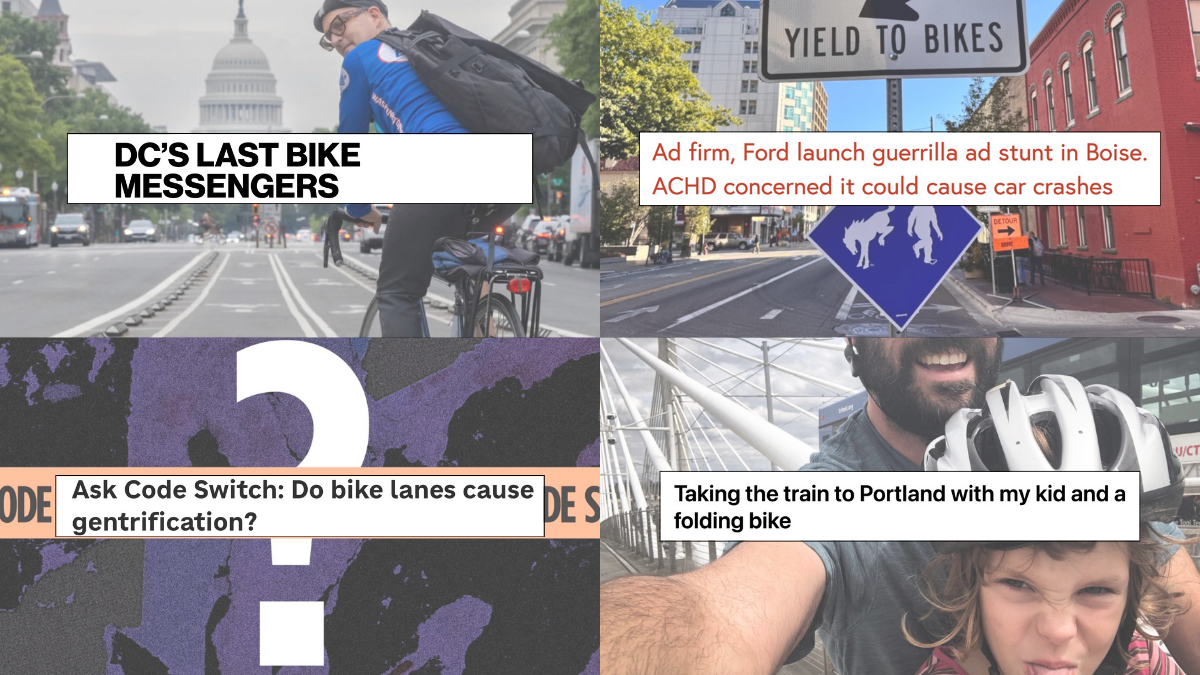
Homage to messengers: An amazing look into the past and present of cycle couriers in Washington D.C. that likely tracks the experience of many major U.S. cities over the past two decades and how deliveries by bike have dwindled. (Washingtonian)
Don’t drive, maybe? Today is the first day of a growing, national, “Week Without Driving” movement. The idea is just what it sounds like: Don’t drive for a week and see what happens. You in? (Week Without Driving)
Bike blogger in Portland: My Seattle compatriot Tom Fucoloro visited Portland recently via train and folding bike and shared thoughts on the quality (or lack thereof) of our network. (Seattle Bike Blog)
Little change on climate goals: In a city where public safety and homelessness dominate politics, it’s not surprising that our climate change “emergency” plan is languishing. Even so, the lack of progress is very concerning. (Portland Mercury)
Irresponsible advertising: Someone at the major ad agency Wieden and Kennedy thought it’d be a good idea to post signs along major streets encouraging people to text. The worst part is the campaign gives one lucky winner a free SUV. The City of Boise was like, “WTH?” (BoiseDev)
It’s complicated: The question of whether or not bike lanes cause gentrification was re-litigated by a national podcast this past week. It’s worth a listen, especially if you weren’t around Portland in 2010-2013 when we went through the N Williams Avenue project saga. (NPR Code Switch)
World Champs: Slovenian superstar cyclist Tadej Pogačar pulled off the very rare Triple Crown and has now won the Giro, the Tour, and the World Championships all in one year! Belgium’s Lotte Kopecky won Worlds on the women’s side. (Bicycling)
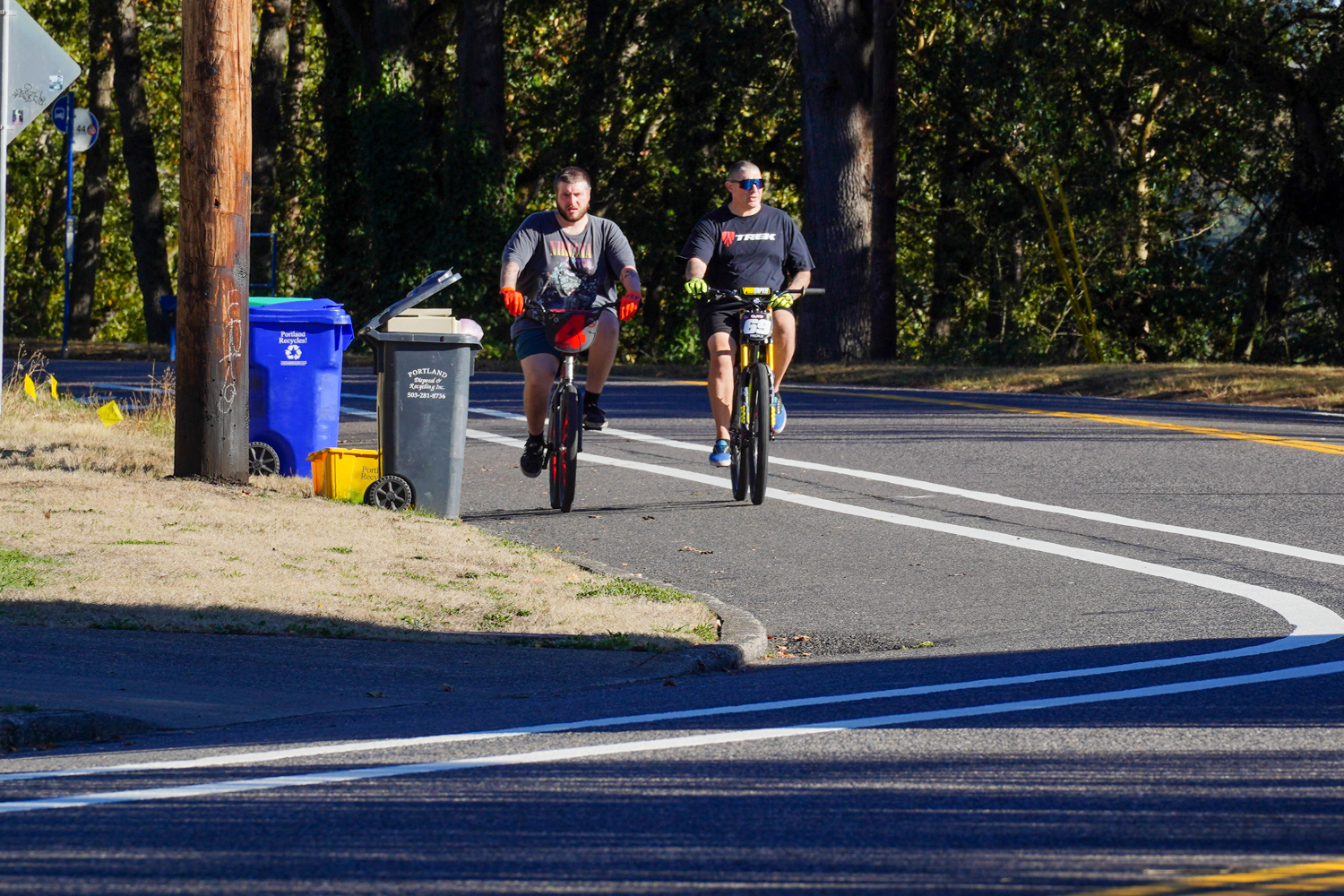
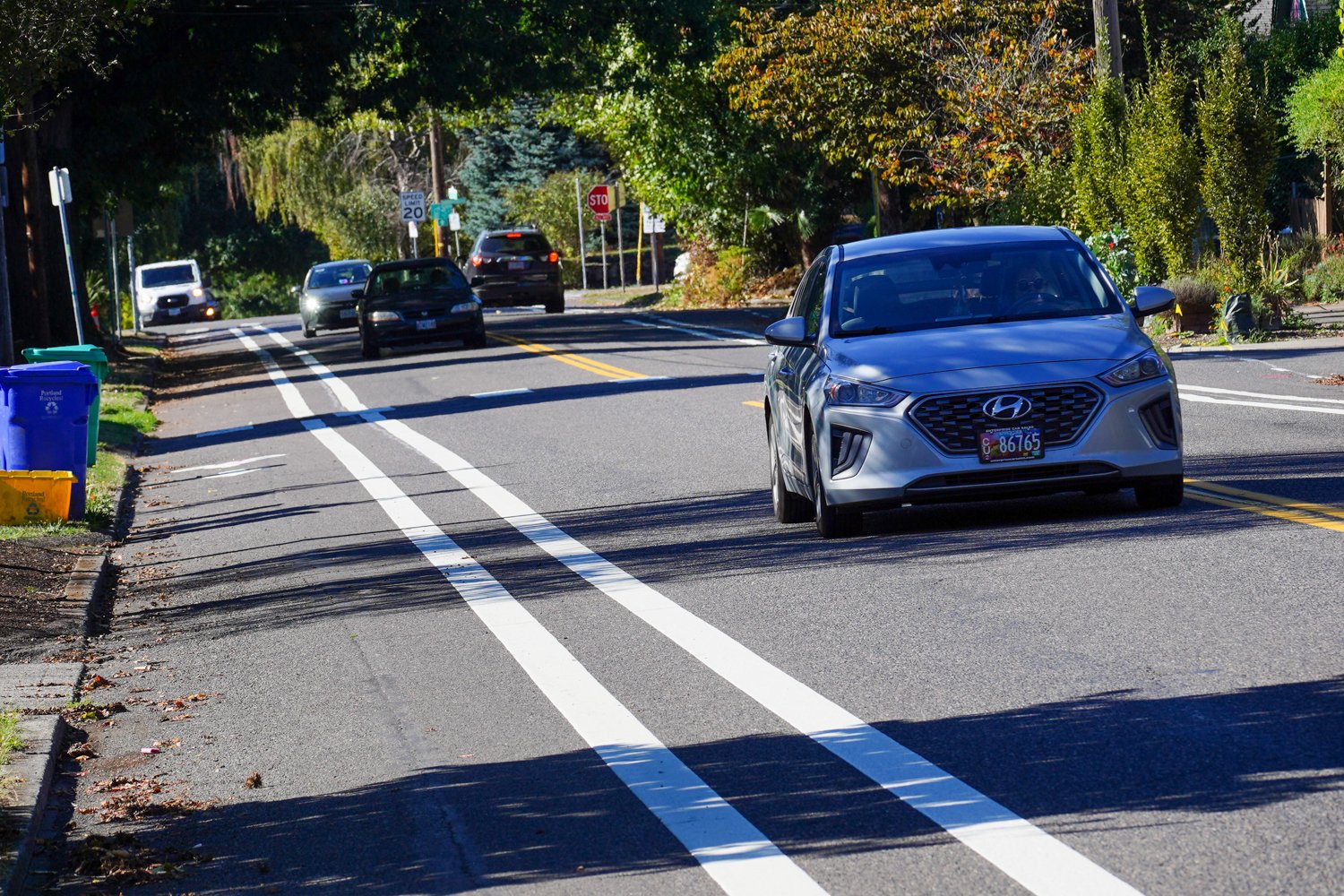
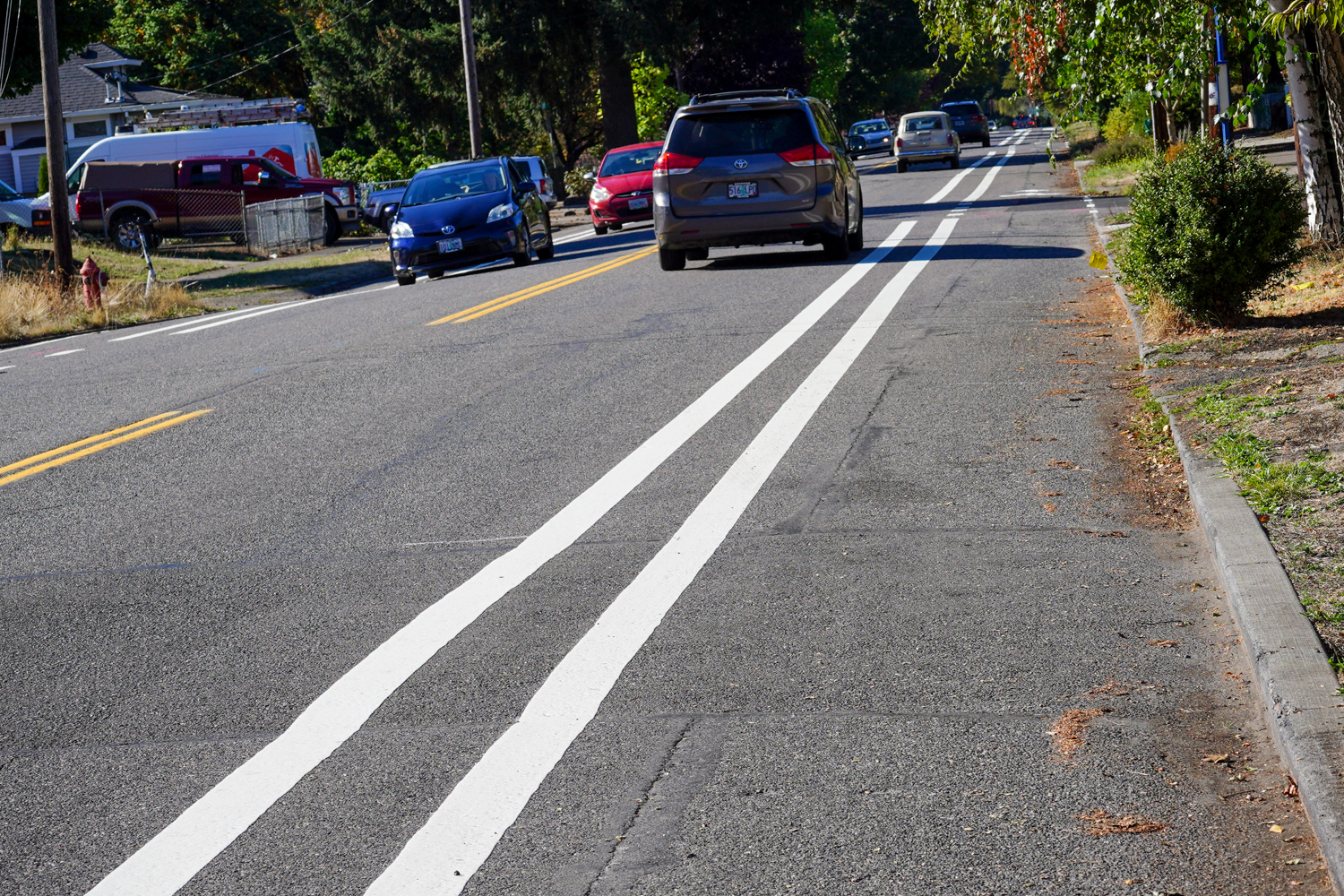
The Portland Bureau of Transportation has completed a crucial connection in the bike network. On Monday of this week they striped bike lanes in both directions of North Willamette Blvd between Alma and Richmond. This half-mile stretch of Willamette didn’t have a bike lane before, despite it being a very important bike route and a key connection to the St. Johns neighborhood.
As you can see in the video above (filmed Thursday, 9/26) the new bike lanes are unprotected and paint-only, but they come with a sizable buffer zone. That buffer zone will be filled in with concrete curbs similar to the ones on North Rosa Parks next year.
In order to gain the space needed for these new bike lanes, PBOT no longer allows on-street car parking. This means door-zones have been eliminated and bike riders have dedicated space that gives them not just greater protection from other road users, but gives them more favorable legal standing in the event of a collision.
When I was out there yesterday, the bike lanes were crowded with riders. With University of Portland, Roosevelt High School, Fred Meyer, and many other destinations along this route, Willamette will likely increase the number of bike trips in future months and years. And that’s to say nothing about its valuable role as a gateway to the St. Johns Bridge, west hills, Sauvie Island, and many other popular bike routes along Highway 30 and beyond.
There’s been some grumbling about people parking in these bike lanes, but I didn’t see that at all while I was out there. PBOT likely has a bit more polishing to do with signage and other small tweaks before this project is 100% complete, so let’s keep an eye on it and make sure folks comply with the new no-parking rule.
John MacArthur of TREC surveys the finishing touches on the SE Ankeny Neighborhood Greenway crossing of Sandy Blvd. (Photos: Aaron Kuehn)
[Publisher’s Note: This is the final part of a three-part series by Portlander Aaron Kuehn (see part one and part two). Aaron is the outgoing chair of BikeLoud PDX, a local bike advocacy nonprofit. He recently completed the bikeway design workshop offered by the Transportation Research and Education Center based at Portland State University.]
The author. (Photo: Maria Sipin)
OK, it’s time for the final push. You’ve already completed your 60% plans backed-up by research and well-established design standards. Let’s start on the final design phase:
Congratulations, you’ve reached the 90% design stage and your bikeway design is almost complete. For this final revision you might want to use mechanical pencils and a straightedge, or a computer to make your design look as precise as possible, and utilize every inch of the roadway.
Let’s pick up where we left off yesterday…
Step 11 – Dutch style
Everybody in bikeway design uses Dutch infrastructure as a standard of excellence. How can you get that Dutch look for your bikeway design? In general “the Dutch design approach focuses on maximizing the efficiency of the transportation system.” Bicycling is seen as the most efficient way to get around for most people, so it is prioritized. Your design should ooze effortless efficiency, like Nick Falbo, who presented the Dutch perspective in our workshop.
Unlike the MUTCD, the Dutch CROW Design Manual for Bicycle Traffic has no Standards. Dutch planners and engineers are entirely responsible for their decisions, and so are Dutch drivers — a cultural difference with geometric consequences, like their 3 inches of curb height separating bikeways from cars, vs our 6 inches. The CROW manual relies instead on five basic design principles:
Bikeway designers learning how to maximize the effortless efficiency of bicycling.
1) Cohesion
Cohesion is about thoughtful network design. Since you are already following “desire lines” for your bikeway, this should be easy. If you run out of space at the edge of your paper, don’t just abruptly end your bikeway there. You see these abrupt endings in suburban bikeways and sidewalks. Continue your design onto another sheet of paper, or connect your bikeway to another facility — cohesively.
2) Directness
The goal of directness is to reduce travel time and guarantee less physical effort, making cycling a competitive transportation alternative. Bike boxes are a good example of directness, ushering bicycle riders to the front of the line.
A good example of in-directness is being forced to use a hilly parallel route that meanders through residential neighborhoods because the straight flat main street is too important to share with bikes. Don’t do that with your design, be direct!
Technical tip: The first two principles, cohesion and directness are often combined in the US as connectivity, which can result in a maze of indirect incohesive connections. Stay firm with your design principles.
3) Safety
Safety is the easiest design principle to achieve. Slow cars down near your bikeway with horizontal or vertical deflection. And instead of closing them, mark crossings and elevate them to sidewalk level.
4) Comfort
Comfort is mostly ignored for US bikeway design, which is why more people don’t bike. Is your bikeway easy for new riders to find and intelligible? Is riding your bikeway more comfortable than driving?
Design your bikeway wide enough for people to ride side by side, and adequately separate it from cars using concrete. Select a smooth and level route with minimal stops or nuisances. Use waymarking to make the bikeway legible and intuitive.
The Dutch are said to use a coffee test to check for bikeway smoothness. Does coffee spill from your open cup while you ride on your bikeway — even on a scooter? Coffee stains on your design will show you are serious about comfort.
5) Attractiveness
Bikeway attractiveness is the most elusive principle to design for. It requires public space investment, maintenance, and a commitment to a quality joyful experience. Quiet residential streets that already benefit from private investment are a shortcut to attractive bikeways.
You will want to show a mature tree canopy shading your design, with dappled light pooling around craftsman homes. Neighborhood Greenways in Portland are a good starting point. Redraw them in your design with smooth pavement, and handsome gateway diverters to filter out confused and impatient cut-through drivers.
Off-street multi-use paths like the Springwater Corridor benefit from their bucolic parallel waterways. More bikeway designs should be lovely off-street paths through wildlife refuges. Multi-use paths that parallel freeways can be cursed by urban ills. But even the grisly sections of the I-205 path can look better under the right light than many of our on-street bikeways that are chronically under-maintained.
Key point: For a successful bikeway that lures people to try riding bikes, and keeps them riding, make your design attractive, comfortable, safe, direct, and cohesive!
Beyond the Netherlands
Despite the continuing excellence of Dutch transportation planning, there are other inspiring bikeway examples to consider from around the world, like Barcelona, Bogotá, and Montreal.
Step 12 – Intersections and junctions
So far our bikeway design hasn’t considered intersections with other streets, because they are hard. But Don’t Give Up at the Intersection! A lot of planners and engineers just dump bicycle riders into the car lanes at intersections in “mixing zones,” and hope they make it back to the bikeway on the other side, but there are better ways.
Instructor Roger Geller (white shirt) points out a prominent conflict zone on N Interstate Ave during a bikeway design field tour.
If your design includes protected bike lanes, you should continue that separation through the intersection with a protected intersection that assigns more discrete spaces for conflicting movements.
You can reduce the number of conflict points by changing the geometry of the intersection, like with a protected intersection, a dedicated intersection, or a roundabout — or you can separate conflicting users by time using traffic signals.
Step 13 – Signal timing, the invisible urbanism
Even more than drivers, bicyclists are concerned with efficiency and speed like Peter Koonce, Portland Signals and Street Lighting Division Manager.
Peter explains the potential for signals in an article about work on the FX2 bus line: “Signal timing and operations can be powerful because they are imperceptible to many travelers, and time affects all users differently. PBOT intended to center its work by looking through the lenses of safety, equity, and the PBOT modal hierarchy. By prioritizing people walking, rolling, and riding transit through signal timing, operations, and Next Generation TSP, the region has invested their resources into a safer corridor for people historically underserved by their government.”
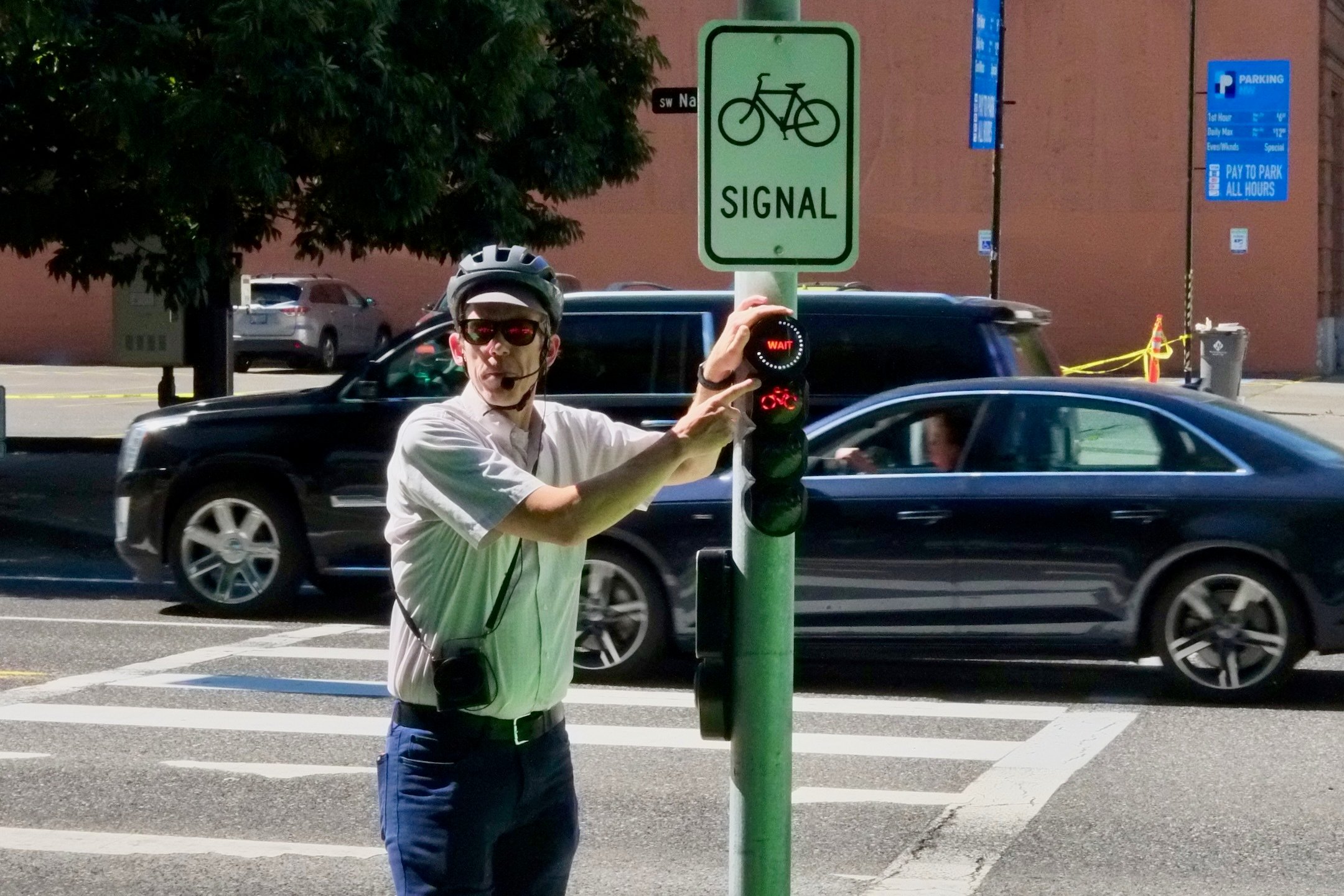
Peter Koonce, unsatisfied with the blue detection confirmation indicator lights, shows a Dutch-style bicycle signal with a countdown timer that he installed as part of FHWA Request To Experiment (RTE) in Portland.
Peter is practicing a dark art of bikeway design — illuminated signal timing. Many bikeway designs don’t exploit the benefits of timing as much as they should. What you can’t do with geometry, you can do with time. You can approximate optimized signal timing in your design by showing green signals for bikes.
Your bikeway design should also show detector loops or devices for bikes at the intersection, and upstream so the signal changes just as riders arrive. Be sure to include the little blue confirmation light to let riders know they are detected — “the Peter Koonce high five to bicyclists!”
Step 14 – Rounded corners
According to the CROW manual, waiting for signals causes 85% of the delay to cyclists in built-up areas. Intersections are also where many crashes happen, and they can be a location where riders feel highly vulnerable. Your bikeway design can function without signal control at all using a roundabout instead. Roundabouts can achieve better safety and efficiency than signalized intersections using geometry alone, and they aren’t as hard to design as you think.
Like other streets, roundabouts work best with a single driving lane for cars, and a separate bikeway, instructor Drusilla Van Hengel told our workshop. Both of these lanes can be simple circles — easy. People walking are deprioritized at roundabouts and are expected to travel out of their way for safe crossings. Maybe your experimental bikeway design can show a more direct path for people walking at roundabouts, and you’ll become a famous traffic engineer!
Step 15 – Presentation
You did it! Now that your bikeway design is all polished up, and having rigorously followed every guide, policy, and best practice available, it’s time to publish. Share your complete bikeway design, partial design, or “concept of a plan” in the comments section to receive constructive criticism from your peers. Maybe elements of your innovative design will end up incorporated into a bikeway built near you!
Thanks for coming along on this design adventure with me. For full class credit, be sure to read parts one and two.
— This series is by Aaron Kuehn, a veteran bike advocate, Bike Happy Hour regular and former chair of BikeLoud who rides a Marin Pine Mountain with hi-viz streamers. Read the full series here.
Dan Kaufman is a Portland gem. And yes I’m biased. I first met Dan back in 2006 or so when he launched PDXK TV, an effort to combine his videography skills with his cycling advocacy. We had grand ambitions of bringing you bike news on YouTube, like this 18-year-old dispatch we filmed together about the opening of the Portland Aerial Tram.
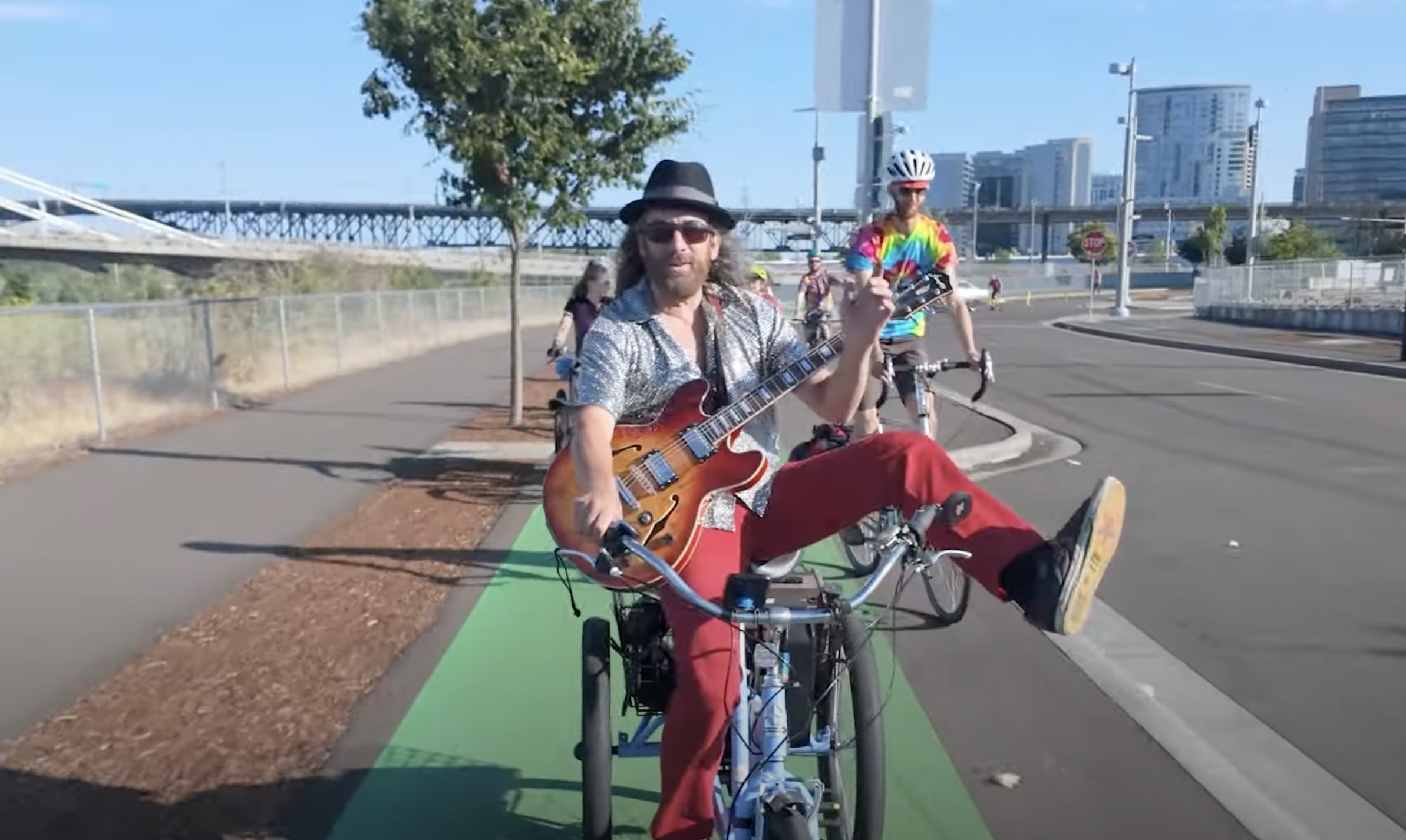
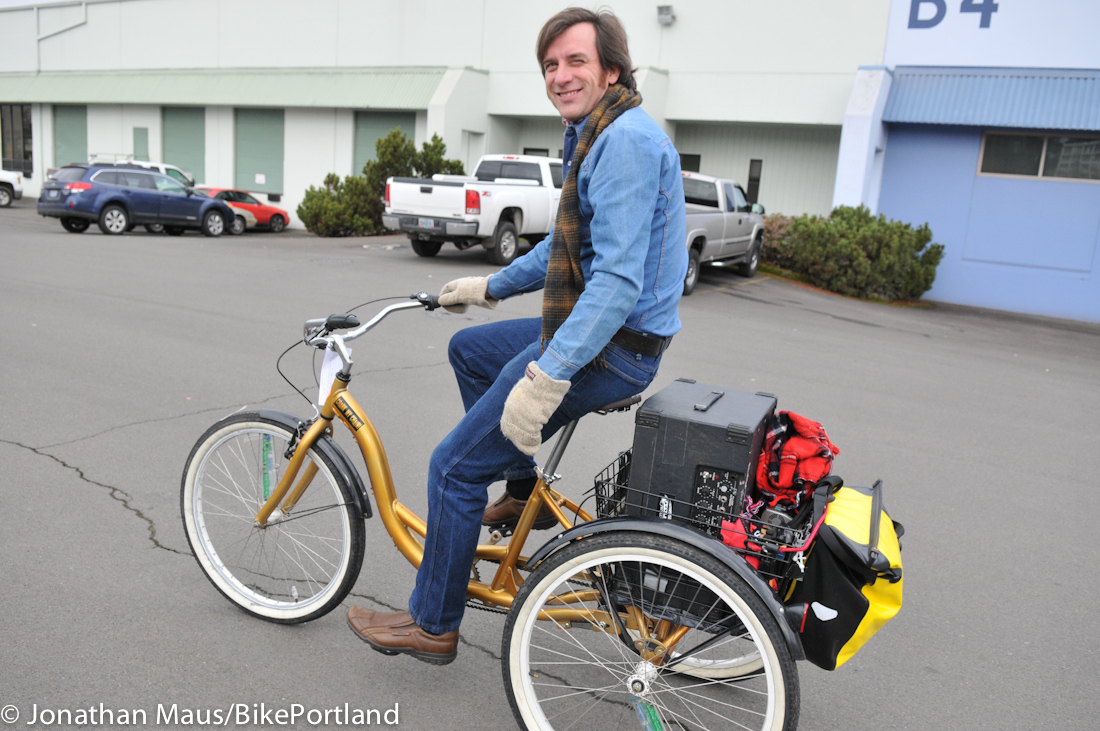
From there, Dan earned local fame by pedaling his Disco Trike and its massive speaker to all manner of cycling events, including the Occupy Portland protests where the trike was infamously confiscated by police only to be set free a week later.
All told, Dan’s music has serenaded our cycling scene for two decades.
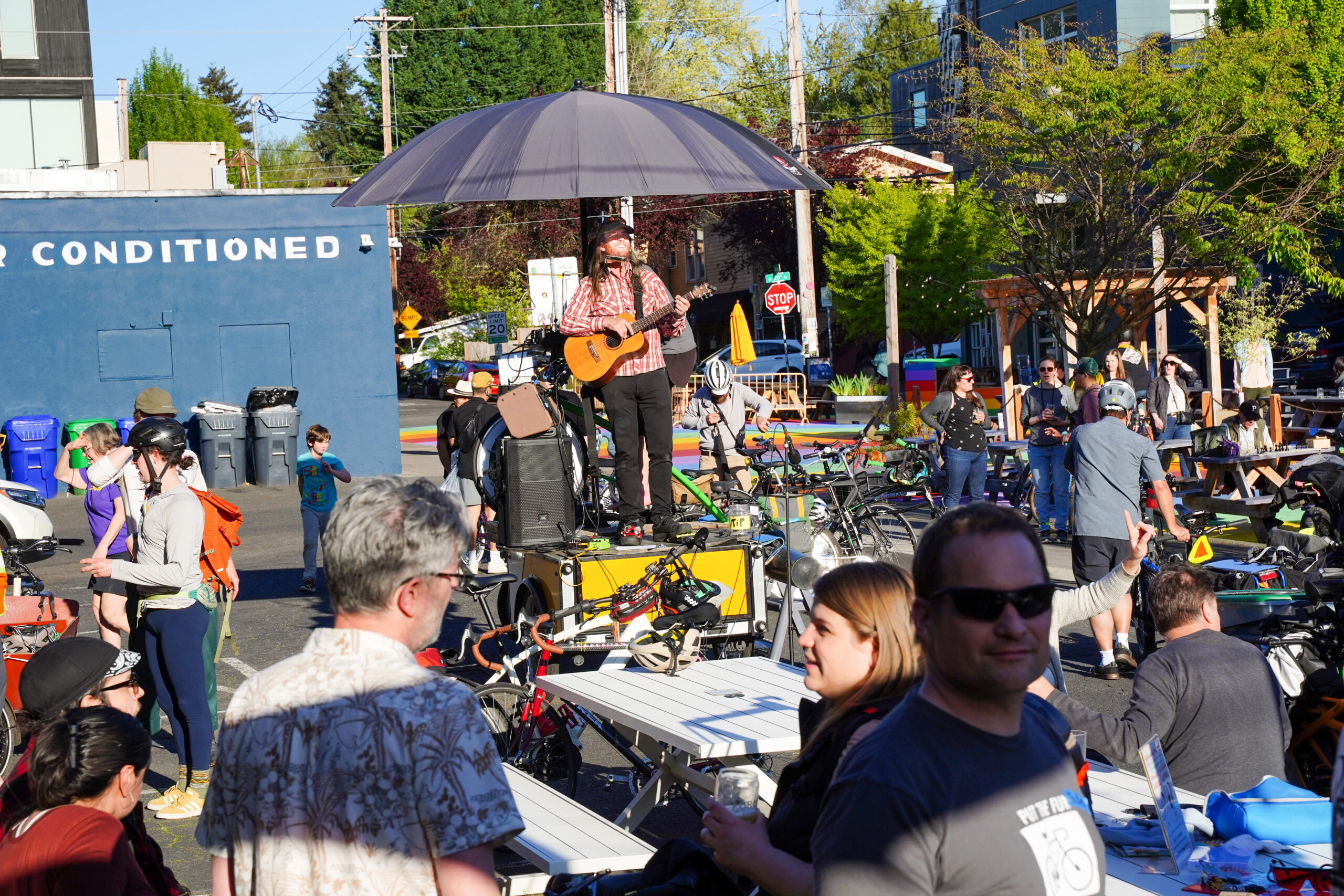
Dan and I have grown and changed along with the city. And through it all, he kept playing music. In recent years he’s focused more on his eponymously named band, and you’re more likely to see him at a gig than a bike ride. Then the Boom Bike came along, and there was Dan again, singing and playing at the nexus of music and environmental activism.
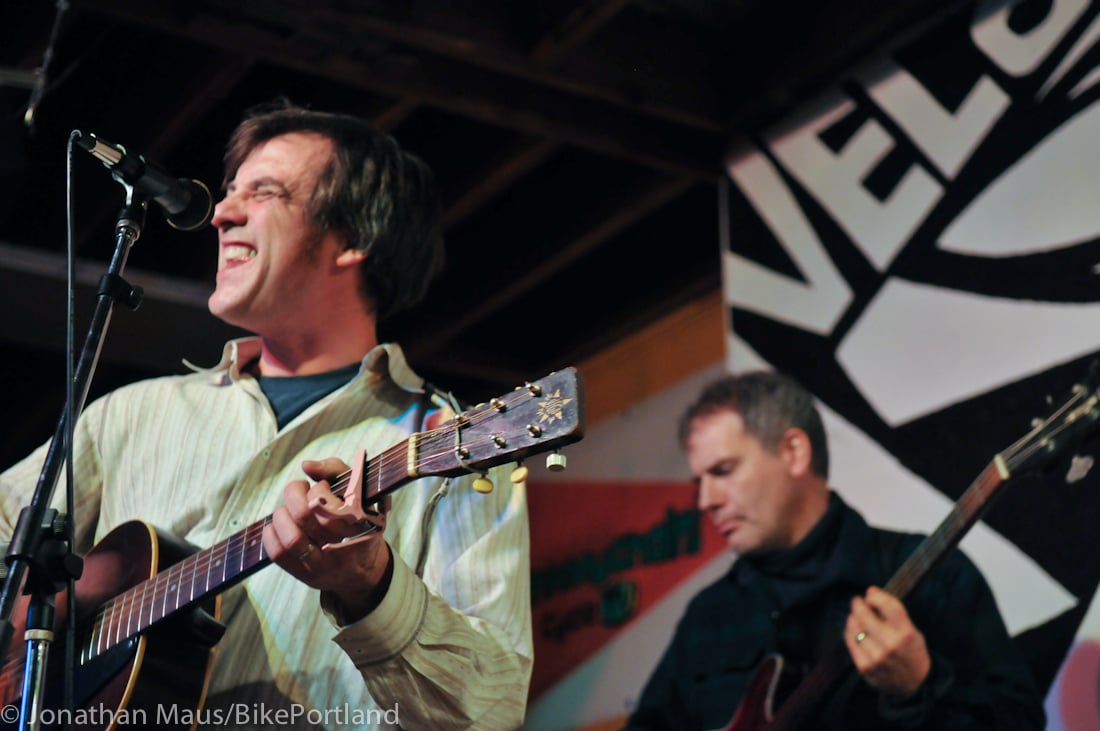
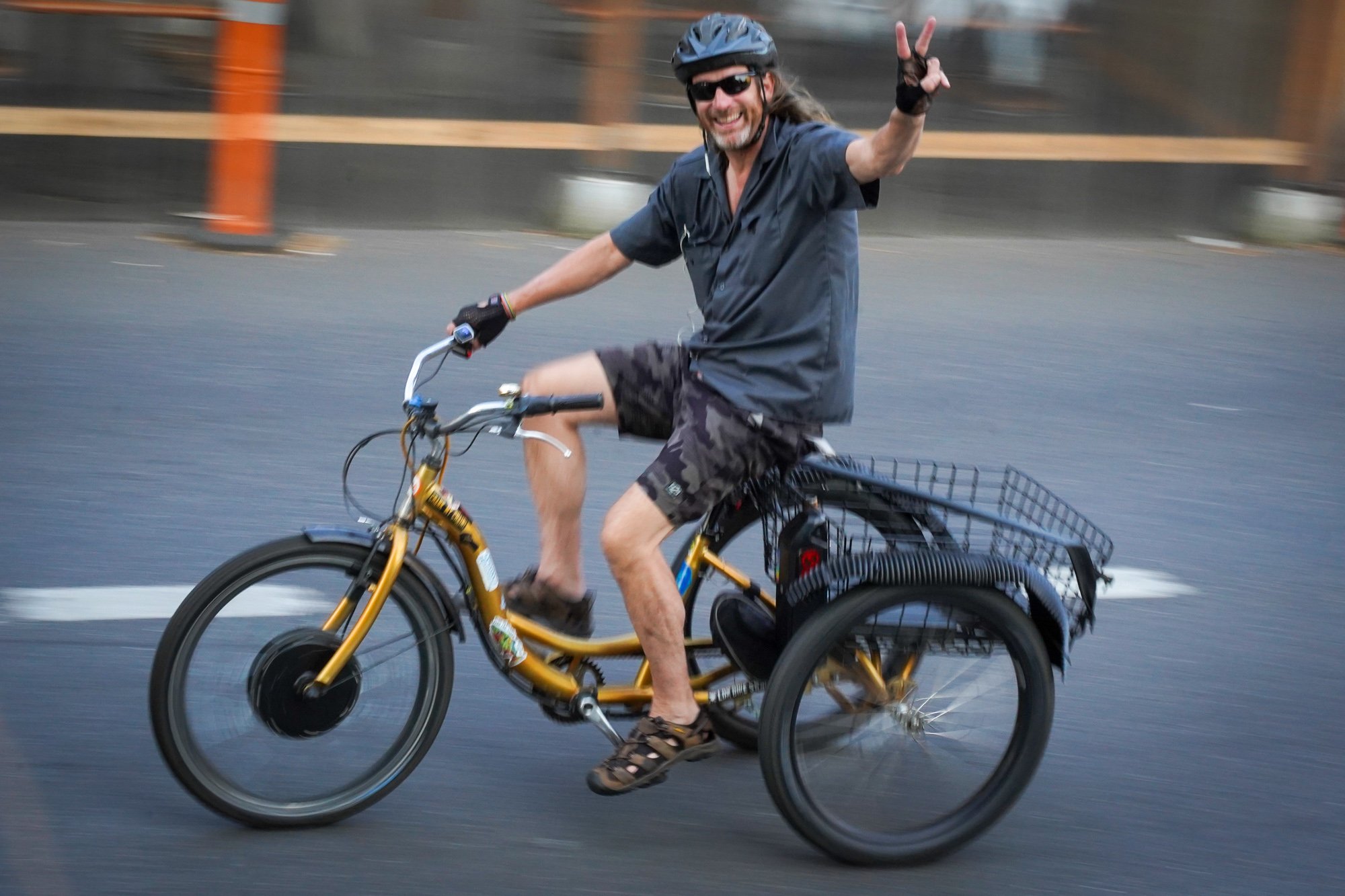
Few look cooler on a trike than Dan!Dan at Velo Cult Bike Shop in 2013. Cruising up N Williams Ave in 2022.Testing the Boom Bike in Cully.Playing at Bike Happy Hour First Birthday Bash in May 2024.(Photos: Jonathan Maus/BikePortland)
When I first heard his song, “Do What I Like” (video above) being belted out from a stage set atop the human-powered Boom Bike earlier this year, it was love at first chord. Beyond the bikey theme and Dan’s joyful singing, the lyrics just seemed to suit him to a tee. When the video for the song came out in August, I knew I wanted to share more about it on BikePortland.
Below is a short Q & A I did with Dan about the song via email:
When did you write “Do What I Like” and what was your inspiration?
DK: In 2003 I was inspired to ride my bike while I was stuck in traffic and I saw this white-bearded guy pedaling through a storm in fisherman’s gear. I thought, if he can do it then I surely can. I was so upset by the second Iraq war that I pulled down an old bike in my garage and started riding in March of 2003. That’s basically the inspiration for the first verse of the song.
DK: I describe my sound as Western, Rock, & Blues with big lyrical and musical influences from Punk and Reggae artists (like the Clash and Bob Marley for examples)
What do you want people to feel when they hear it?
DK: I want people to feel the joy and happiness of riding a bicycle and the freedom you get when you are carfree (even if it’s just sometimes).
Ever play this at non-bike events? I’m curious how people react in those situations.
DK: Yes, I almost always play it at shows. People seem to like songs about bikes. I think it brings the kid out in us for one thing.
What can you tell me about the new video?
DK: Big thank you to Amit Zinman of Bike Stuff PDX who asked me if I had any bikey songs that reflected Portland Bike Fun and Pedalpalooza. He listened to several and chose Do What I Like. I recorded with my band (and Amit on keys) and then mixed and mastered it at Figure8Sound in North Portland. Amit storyboarded the concept and organized a Pedalpalooza ride this summer, which was led by Mike Cobb. A bunch of fun folks showed up and we had a great time filming it in Ladd’s and around both sides of the river downtown.
Anything else you want to share about the song?
DK: I wrote the song a long time ago and play it frequently but doing the recording and video reminded me of why I’ve been such a big promoter of Bike Fun and that I miss some of that energy in myself and even here in Portland though I sense a resurgence (in both). I think when biking is fun and accessible, then we can move away from all the pollution and mayhem cars bring to our world but if you lead with cars/pollution/mayhem you’ll lose a lot of folks right out of the gate. Of course, freedom, joy, and accessibility are good things in and of themselves.
So well said Dan. Thanks for sharing more about your music and life. Keep on rockin’ out there and we’ll see you in the streets.
Check out Dan Kaufman Band on Bandcamp, and scroll down for the “Do What I Like” lyrics below so you can sing along next time you hear it:
I was stuck in my car, you were riding your bike With a two wheel freedom You we’re lookin alright (Dynomite!) So when I get done with this stinking commute Tell you right now what I’m a gonna do Gonna get down the bike And do what I like
Verse 2
Now I’m riding my bike and it feels alright I got them old jeans on and they ain’t feelin’ tight (heck, I might need a belt) I got the sun on my back, the breeze in my hair Feels so good yeah I don’t have a care I’m riding my bike I getta do what I like
Refrain
Used to think to go far you had to have a car and that’s what you are I saw it on TV Even Jan and Dean played it on guitar But the fun is dead and gone And now I’m moving on to a whole ‘nother star I’m really going far and I don’t wan’t a car
Refrain
Verse 3 Now don’t feel bad if I’m a going slow I’ll tell ya right now it’s the only way to go (it’s the only way to fly) You can wave to your friends and they’ll say hello Cars pass by but they don’t really know When you’re riding your bike You getta to do what you like When you’re riding your bike You getta to do what you like When you’re riding your bike You getta to do what you like
Credits Released June 14, 2024 Production, Original Music, Lyrics, Vocals, Guitar & Upright Bass: Dan Kaufman Co-production, Engineering, Percussion, Backup Vocals: Pyata Penedo Ukulele, Backup Vocals: Jen Harrison Organ & Video Production: Amit Zinman Fiddle: Chris Swanson
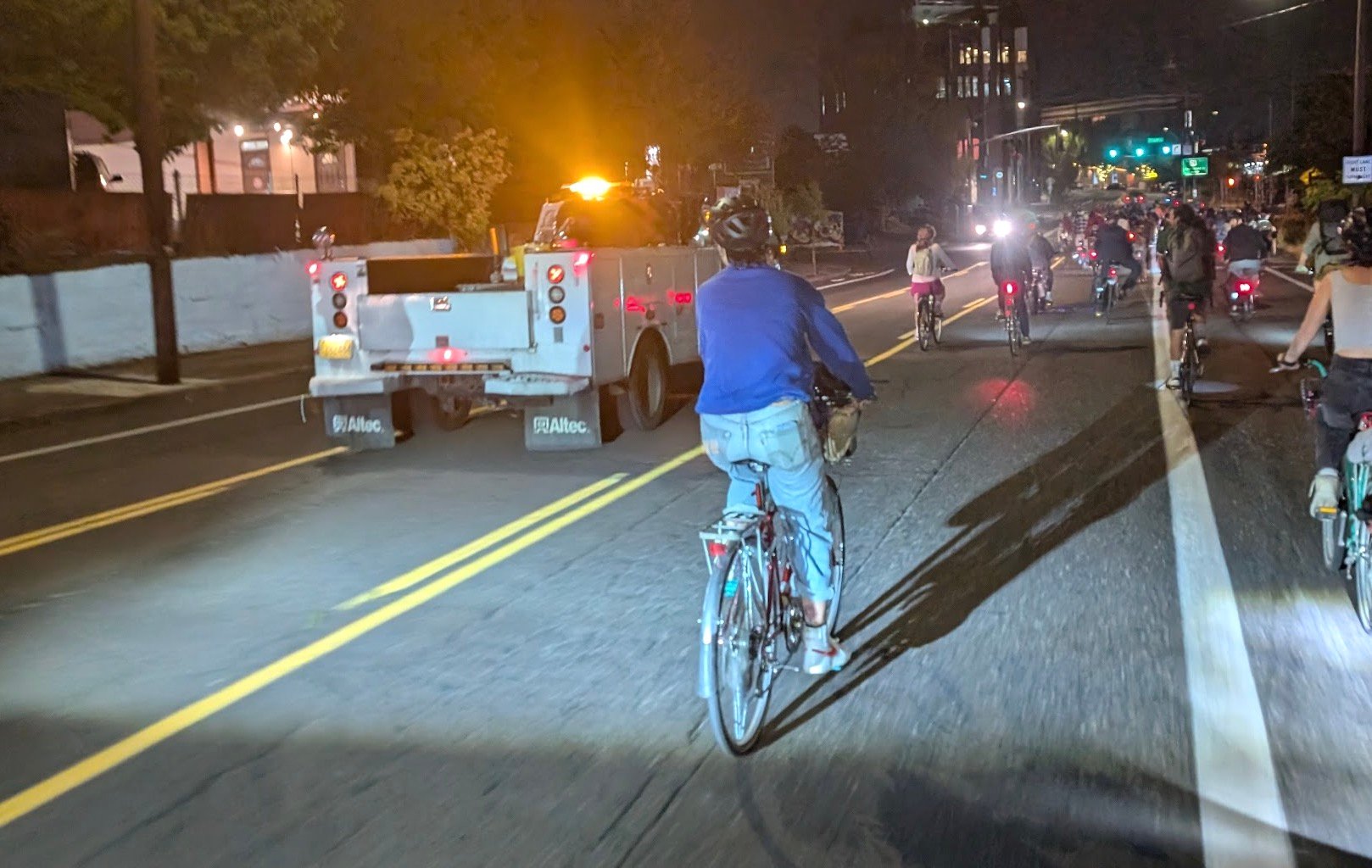
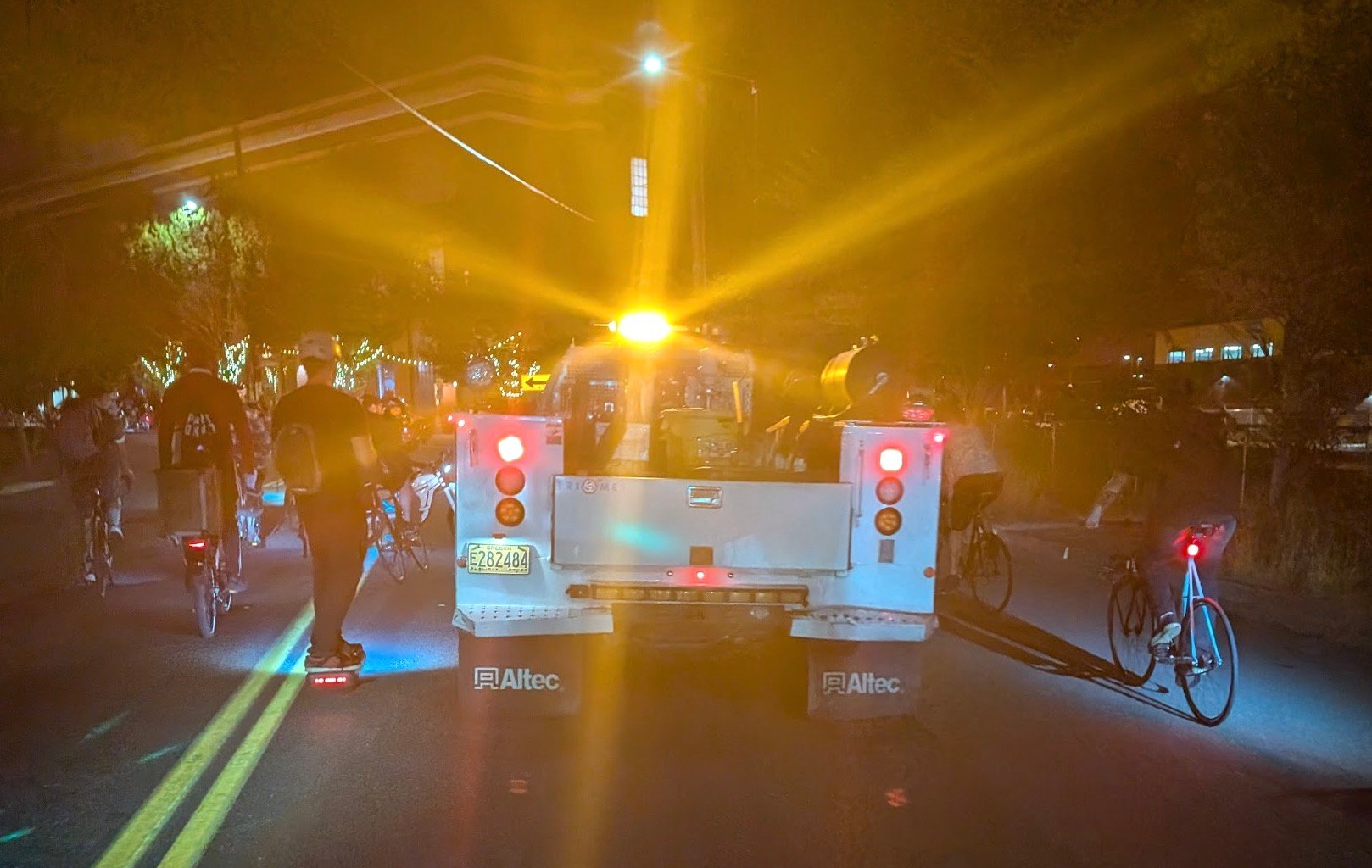
Participants in the Thursday Night Ride on SE 7th Avenue with a TriMet truck driver passing on the left. (Photos: Sent in by a reader)
The driver of a TriMet service truck dangerously passed, became upset, and threatened a large group bike ride with his vehicle last week.
According to several people who were on the weekly Thursday Night Ride on September 19th, it was a severe case of road rage. A person named Phil took photos of the interaction, which happened around 8:30 pm, and sent them to BikePortland.
Here’s how he describes the incident:
A TriMet employee road raged and endangered the lives of a ride tonight. We were cycling down 7th and hooking left onto Division. The road is narrow, we had the lane as the front of the ride was preparing for a left turn (and you can’t fit many cyclists in that pathetic bike lane) — when suddenly a car was honking behind us, hitting the gas and yelling.
This driver went across the entire turn lane, into opposing traffic, in an intersection, during a blind turn (as 7th becomes Division)… Cars were coming the other way, so he moved from opposing traffic to the turn lane. When the center divider approached, he swerved into the group and forced his way in — essentially using the threat of bodily harm to merge in. He was coming in, people had to scatter. We had to box him into that brief divider at 8th so he would stop threatening and endangering our lives.
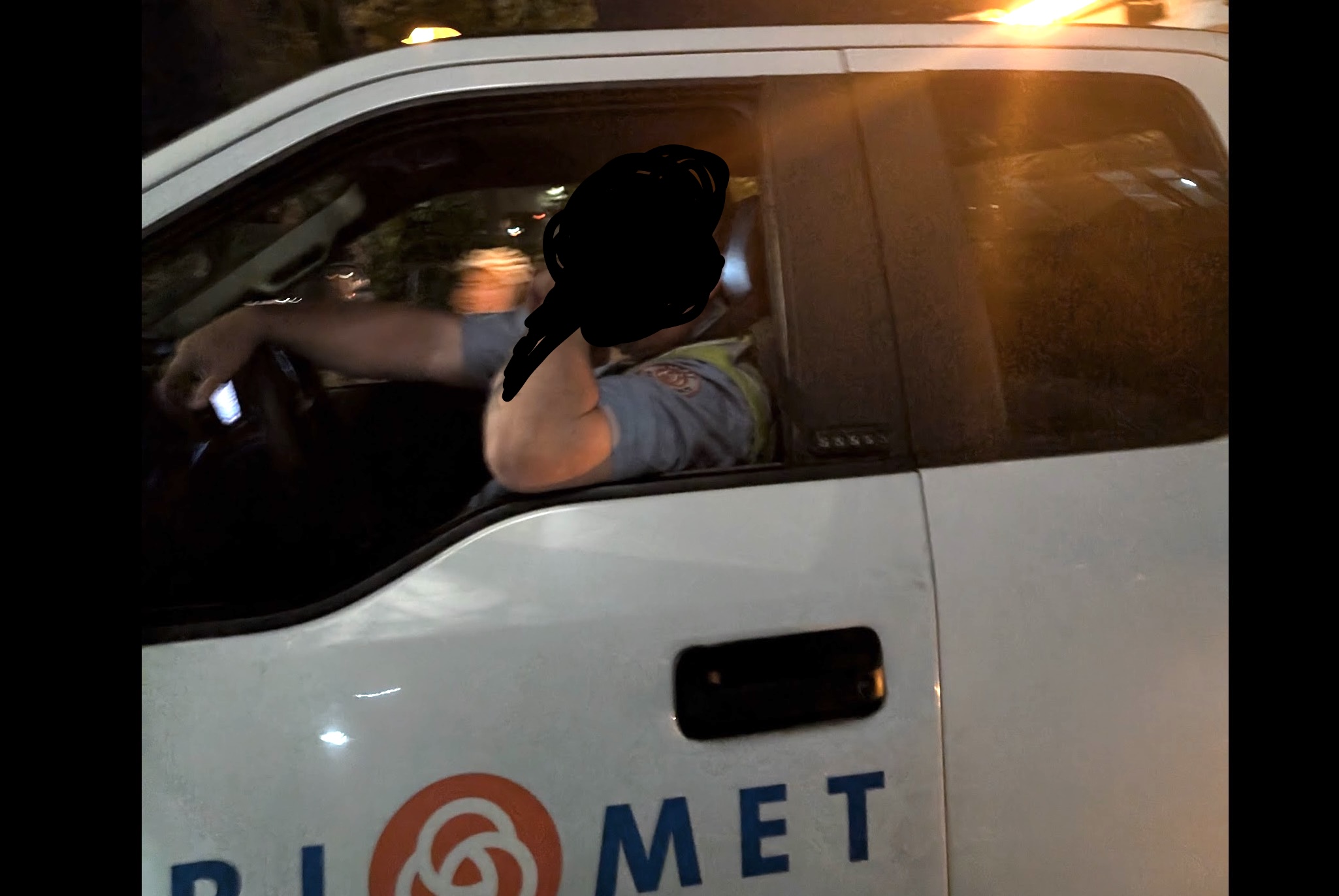
At least one rider spoke to the driver, whose face has been blurred to maintain privacy.The driver allegedly “swerved into the group and forced his way in.”
Phil’s photos clearly show the driver was in his TriMet uniform and driving an official TriMet service truck. Phil also says that he feels the ride was being “well led and well behaved.”
To verify Phil’s story, I reached out to other people who were on the ride. I heard back from four different people who were among the 50 or so in the group. Here’s what they told me:
“Definitely happened. Dude was trying to drive around the ride. Very unsafe. Didn’t seem to care.”
“I would brand it as a typical ‘get out of my way I can’t be slowed down by bikes for a few minutes’ type of interaction. Honked a few times, then tried to go around the huge amount of bikes in the middle suicide lane (as shown in the photo). Some bikes were able to block him and a shouting match occurred between the driver and the cyclists. We all got past and left.”
“I didn’t see the driver trying to hit people, just dumb impatient driver doing dumb impatient driver stuff.”
“He jumped over the curb/lane divider from oncoming traffic back into our lane, speeding ahead of the end of the group and cutting off a bunch of others right after the track crossing (headed south). He ultimately just stopped and starting yelling after turning the flashing lights off. Didn’t appear to be collecting signs or doing anything that late at night, just speeding and trying to insert into the group of bicyclists.”
TriMet Public Information Officer Tyler Graf confirmed to BikePortland Wednesday that the agency received a complaint from Phil that shared these photos and a detailed narrative of what he saw. “The complaint was processed and is currently under investigation,” Graf shared. “Beyond that, we do not comment on personnel matters; however, the photos that were shared will be considered during the investigation.”
Phil will likely continue to follow up with TriMet until the investigation is complete. “No way this guy should be driving or working for our government,” he told BikePortland.
I’ve recently been reflecting on why I started biking with my children, and how we have evolved as a biking family over the last three-and-a-half years. Biking has improved our lives and also prompted us to change our lives, a process that continues as we grow as a family that rides. Today, we bike for many more reasons than when we started. I often think, “the more we bike, the more reasons we discover for doing so!”
As I was mulling over our own family’s biking journey, I asked some other local biking families to share their stories:
“Why do you bike as a family?” and “Have those reasons changed over time?”
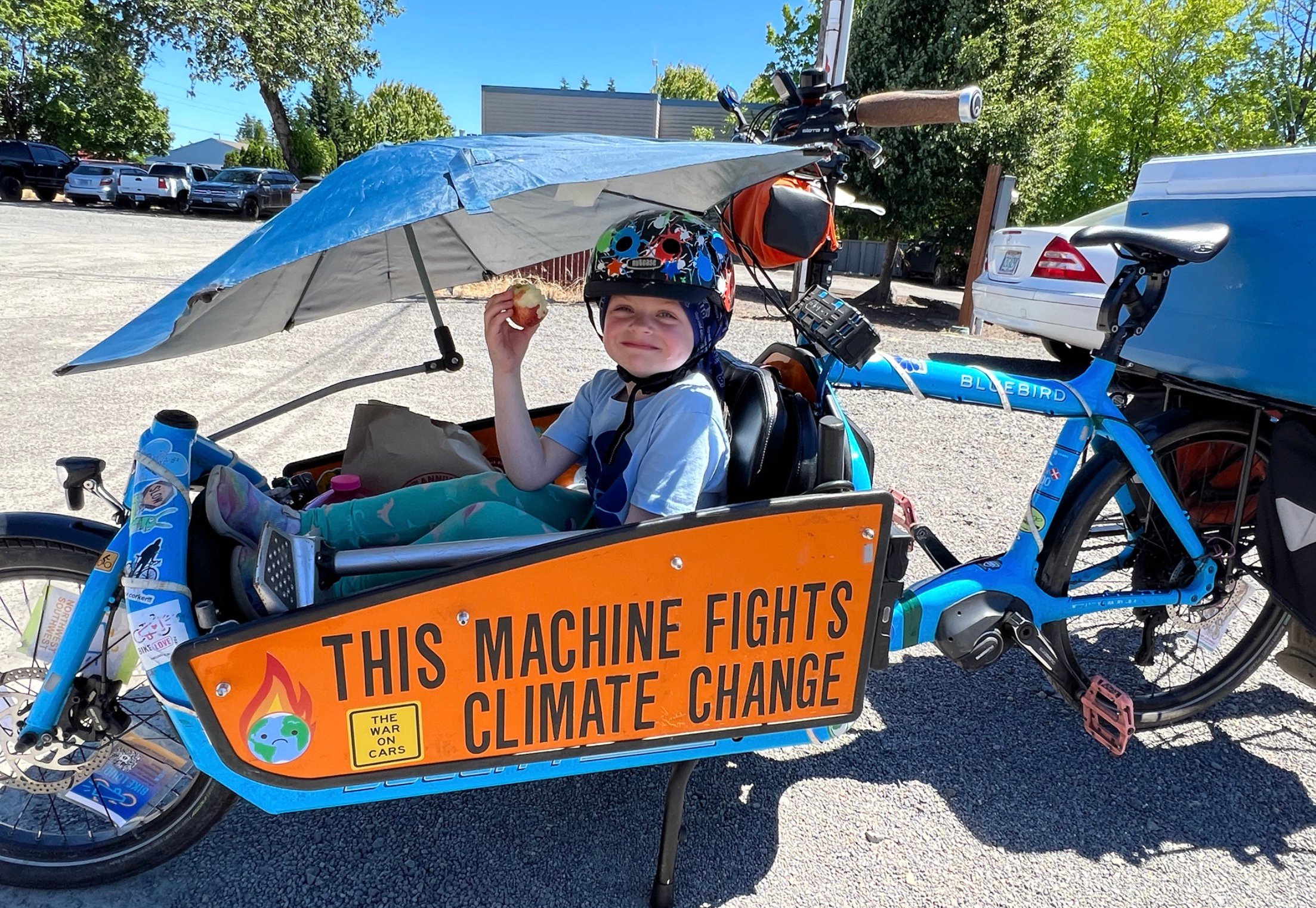
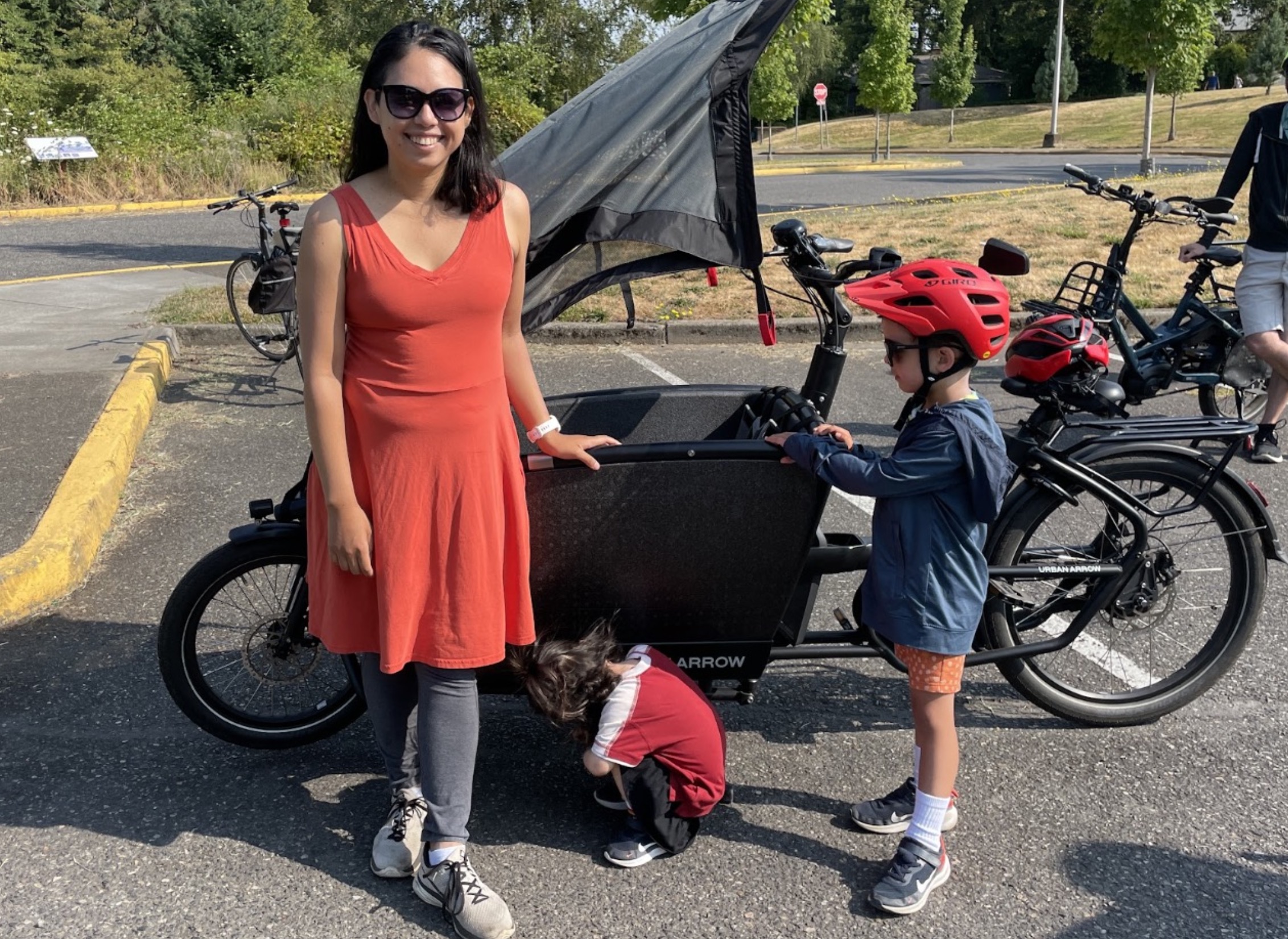
A common thread immediately emerged in the answers I received: Local families who took up biking as their personal contribution to fight against climate change. While this was not the reason I started biking, I found these family bike stories to be edifying, as members of the community explained their personal commitment and major lifestyle changes to fight for a healthier environment for their children and future generations.
I hope you are as encouraged to read their stories as I was. Please feel free to share your own story in the comments, or email me longer answers at shannon4bikportland@gmail.com (If you email me your own family biking story for possible publication, please include a photo of your family biking.)
Rachel Philip
Rachel at a group ride to a farmers market in Beaverton back in August. (Photo: Tina Ricks/BikePortland)
Our original “why” for biking as a family was that we don’t want our kids to live in a climate change hellscape, so we ought to act like part of the solution by riding our bikes rather than driving. One year in, that’s still a big part of the reason (and what gets me on the bike when the weather is particularly crummy or I’m not feeling my best).
But another reason we’ve stayed with it is because we love it. We have a five and two-year old, and they will both complain and sometimes cry when we take the car to school. The quality of time we spend together on our bike ride to school is a lot nicer than it is in the car. We get to see nature, our neighbors’ yards, and count dogs, garbage trucks, and school buses. We know where all the flamingo lawn decorations are. We’ve spotted a rabbit running around free in a particular neighborhood. Lately my kids have taken to screaming with joy on the big downhill part of our ride to daycare. The screams are not joyful in the car.
We don’t want our kids to live in a climate change hellscape, so we ought to act like part of the solution by riding our bikes rather than driving.
Our biking mission statement has been, if we think we can bike to a destination relatively safely, we will. We’re still getting in the car for events in neighboring cities and Costco trips. But, we do skew to more local and “bike friendly” destinations as a family. There are several cool parks that we just don’t visit as much anymore because we aren’t comfortable biking to them. On the flip side, getting the kids loaded up into the bike and going to the parks that are on safer routes feels like much less of a burden than getting into the car, and we go to them much more frequently.
James Schiffer
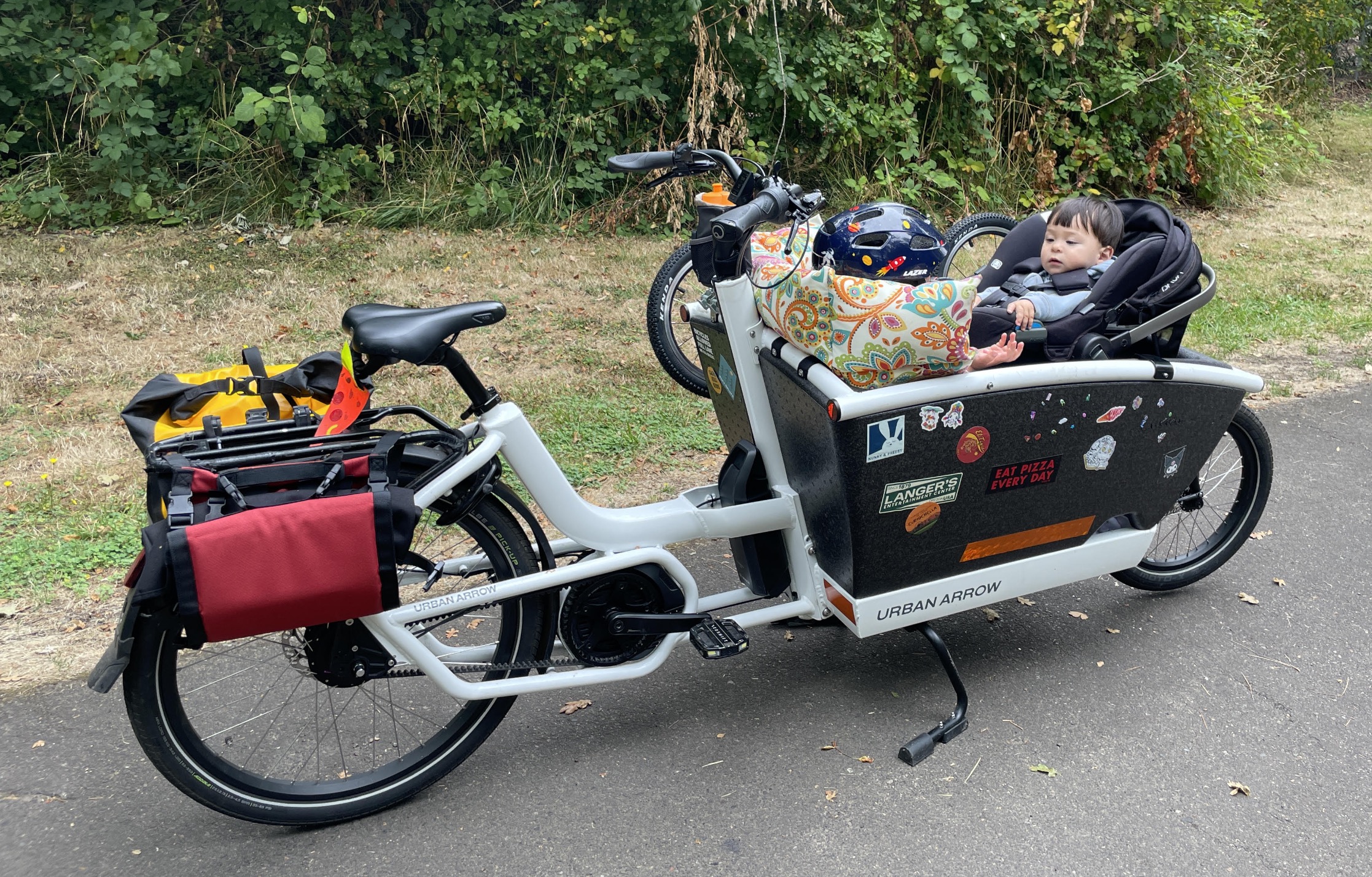
(Photos: James Schiffer)
First and foremost for the memories. It is hard to convey the value of these memories in writing. Don’t get me wrong – we do drive a car around as a family and have memories doing so. But for numerous reasons riding a bike generates amazing memories at a much higher rate than driving a car. I think this is because I am generally more happy / less stressed while riding a bicycle. Maybe for some it is fine, but I find driving around cities and suburbs puts me more on edge and drains an outsized amount of mental energy due to traffic, parking, and risk. I think my kids and certainly my wife pick up on that and it ends up coloring those outings. There are still issues with biking places, but the consequences are so much less and in general it feels more relaxed and fun to me.
The bicycle is a very humble and simple machine that cracks wide open the world around us
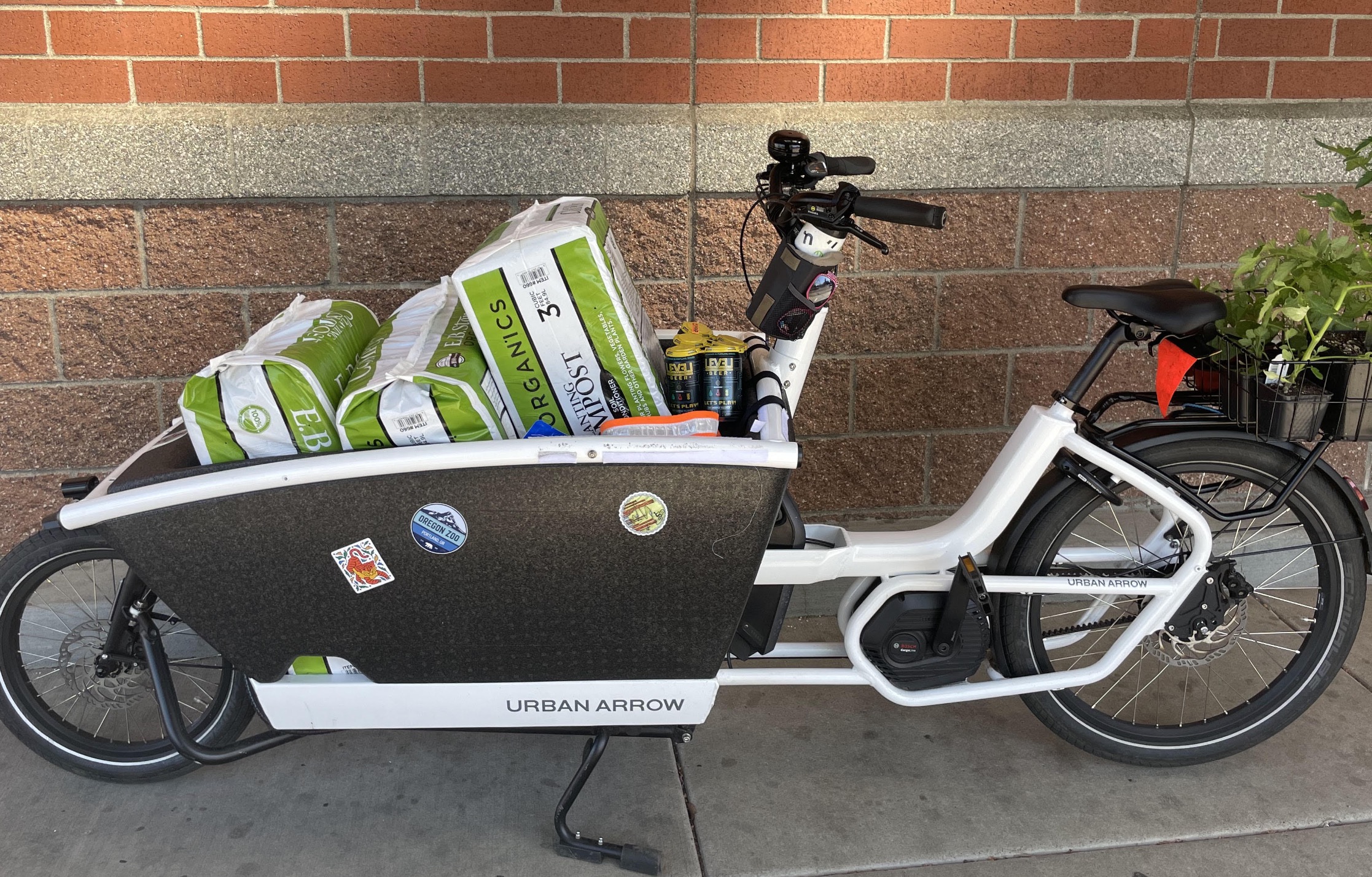
Secondly it is to teach my children practical skills that facilitate a love for life and independence. A sense of direction, assessing risk and reward, problem solving, value of preparation, and most of all that feeling of wind and speed. My 4 year old daughter can lead the way to every single daily or weekly destination near our home on her 16” pedal bike. She plays imagination games or shows me her “tricks” while doing so, grinning from ear to ear. Having a bakfiets that can carry our 1 year old son, her, and her bicycle helps immensely and removes negative experiences. I think it won’t be long before she will be able to outride me if it keeps her interest. The bicycle is a very humble and simple machine that cracks wide open the world around us. Given a sweet potato and a bike, it’s amazing how far one can get. No matter how much or little they choose to engage with it long term, I know they will get a good return on their investment of time and energy.
Thirdly, it’s socially responsible transportation. I had always avoided thinking about the state of the world and humanities future too much just because it was always so depressing. Having children made me face the future and the numerous ethical dilemmas of my actions and lifestyle. I can’t just raise them continuing on with all the same shortsighted behavior and expect them to fix everything when they inherit the earth. It’s amazing the number of looming existential threats that can be helped by simply not driving to places less than 3 miles away: climate change, housing crisis, obesity, depression, etc. Yeah, there is still a lot of other stuff to do – but biking is easy low hanging fruit.
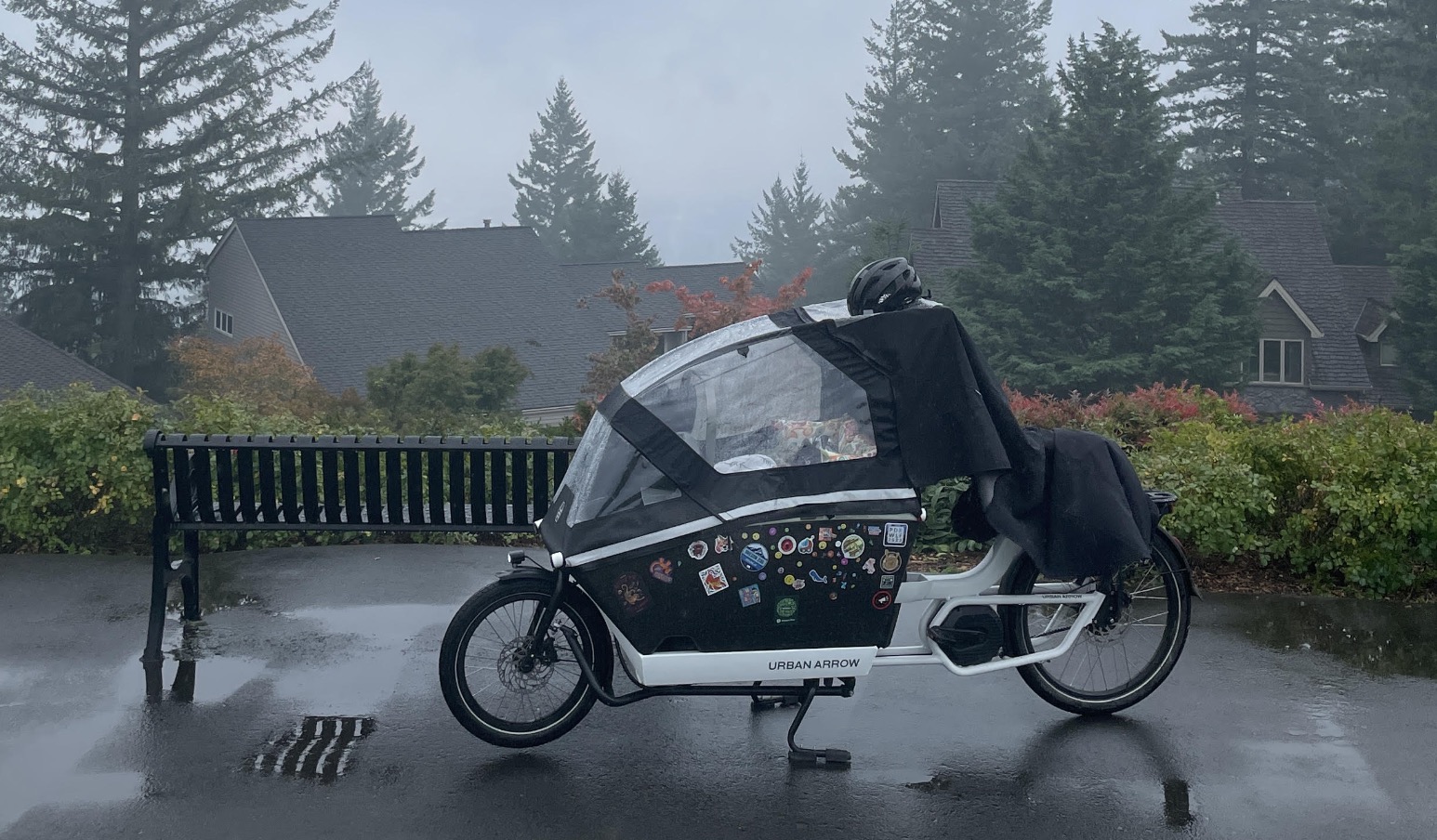
It was initially first and foremost about climate change. As we rode, I realized just how much I cherished those experiences and how much different going out felt. What started as a “Don’t drive to places less than 3 miles away” as a restriction on my lifestyle has evolved into the preferred and default option. Some of that might be how easy the bakfiets make day to day tasks like family grocery or home depot runs. I have especially loved the Urban Arrow rain solution. It can be raining cats and dogs and we will all be comfortable and dry through hour-long rides. Good wet weather solutions turn trips by bike into the best option year round.
Shawne Martinez
The main reason that I am car-free is so that when the effects of climate change are so extreme that they can no longer be ignored by most people, my daughter will know that I did everything in my power to reduce the burden that our choices have created for her and her generation. 40% or Oregon’s greenhouse gas emissions are from the transportation sector. Reducing or eliminating car trips is something that we all can do immediately to reduce the effects of climate change.
I like to say that the first step in my “radicalization” of being car free was just after my daughter was born and I was trying to push a stroller through our neighborhood with no sidewalks or bike lanes. We had to walk and roll in the car lanes everywhere we went which made me realize how dangerous our infrastructure is for people outside of cars.
Once I learned how terrible diesel emissions are (for children in particular) I felt extreme guilt for driving the pickup truck that I had been driving for years as a commuter vehicle.
Once I learned how terrible diesel emissions are (for children in particular) I felt extreme guilt for driving the pickup truck that I had been driving for years as a commuter vehicle.
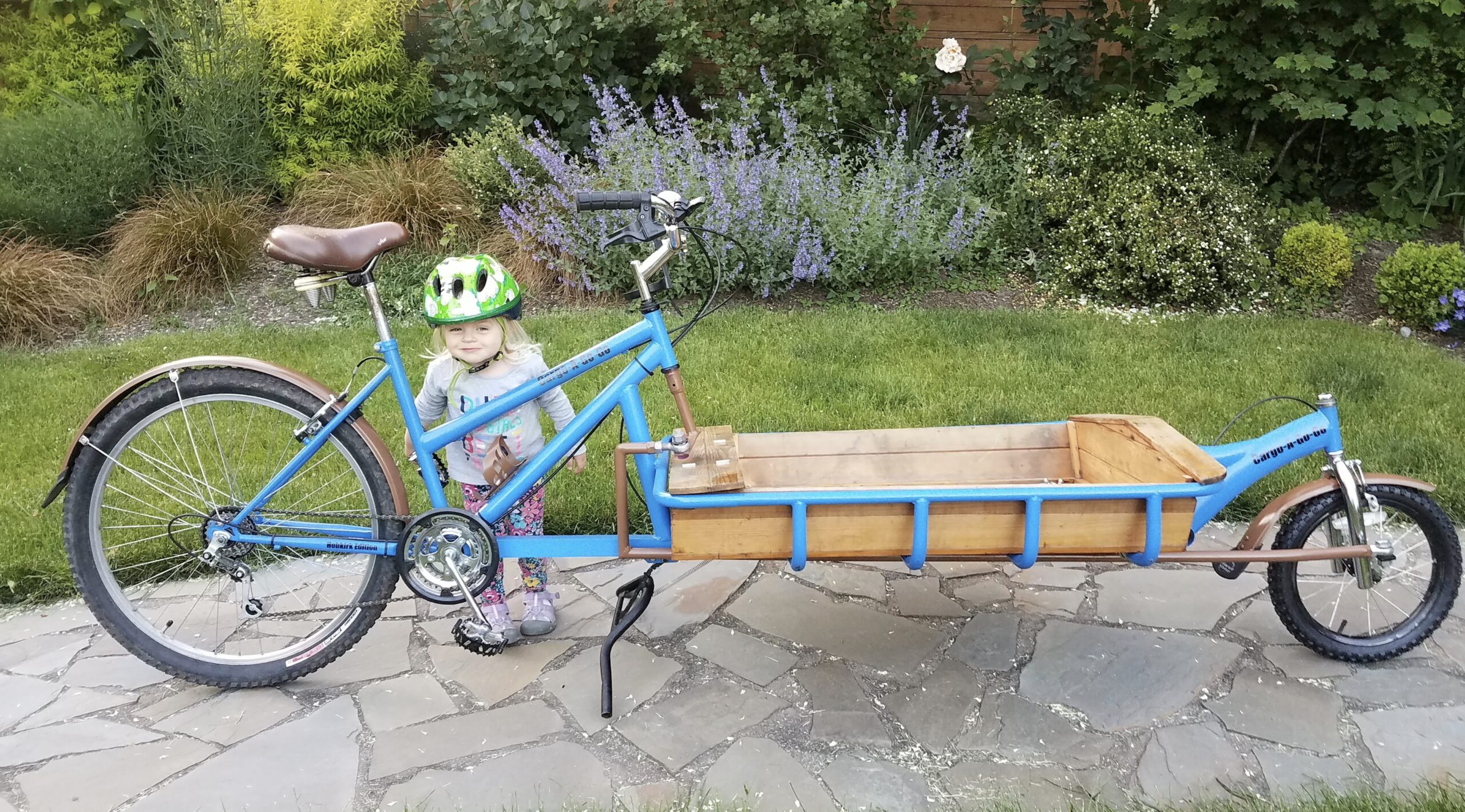
In 2016 I built my own bakfiets cargo bike by welding two bikes together in anticipation of participating in the Disaster Relief Trials in Portland. DRT opened my eyes to the cargo bike scene!
When the kiddo started preschool, I challenged myself to bike 10 miles each way to the Tualatin Hills Nature Center from Tigard. We rode on our homemade cargo bike as much as we could. Driving a big stinky diesel truck to a nature center seemed wrong and I wanted my daughter to have fond memories of biking to school. It turned out to be easier than anticipated so we didn’t drive much at all!
As my kiddo grew she was getting heavier and I was getting older. Climbing the big hills home was getting tough. I decided to go all in and get an electric cargo bike. This purchase proved that I didn’t need a truck (or car) at all. Anything that exceeded the cargo bike’s capacity could be delivered for free or at a small cost. Any excuse that I could think of to not bike was shattered.
Soon after I sold the truck and went completely car-free. We’ve biked over 25,000 miles on cargo bikes and use public transit often. I’ve saved thousands of dollars over the years which can be put towards fun experiences instead of car payments and associated costs. We are happier and healthier without a car!