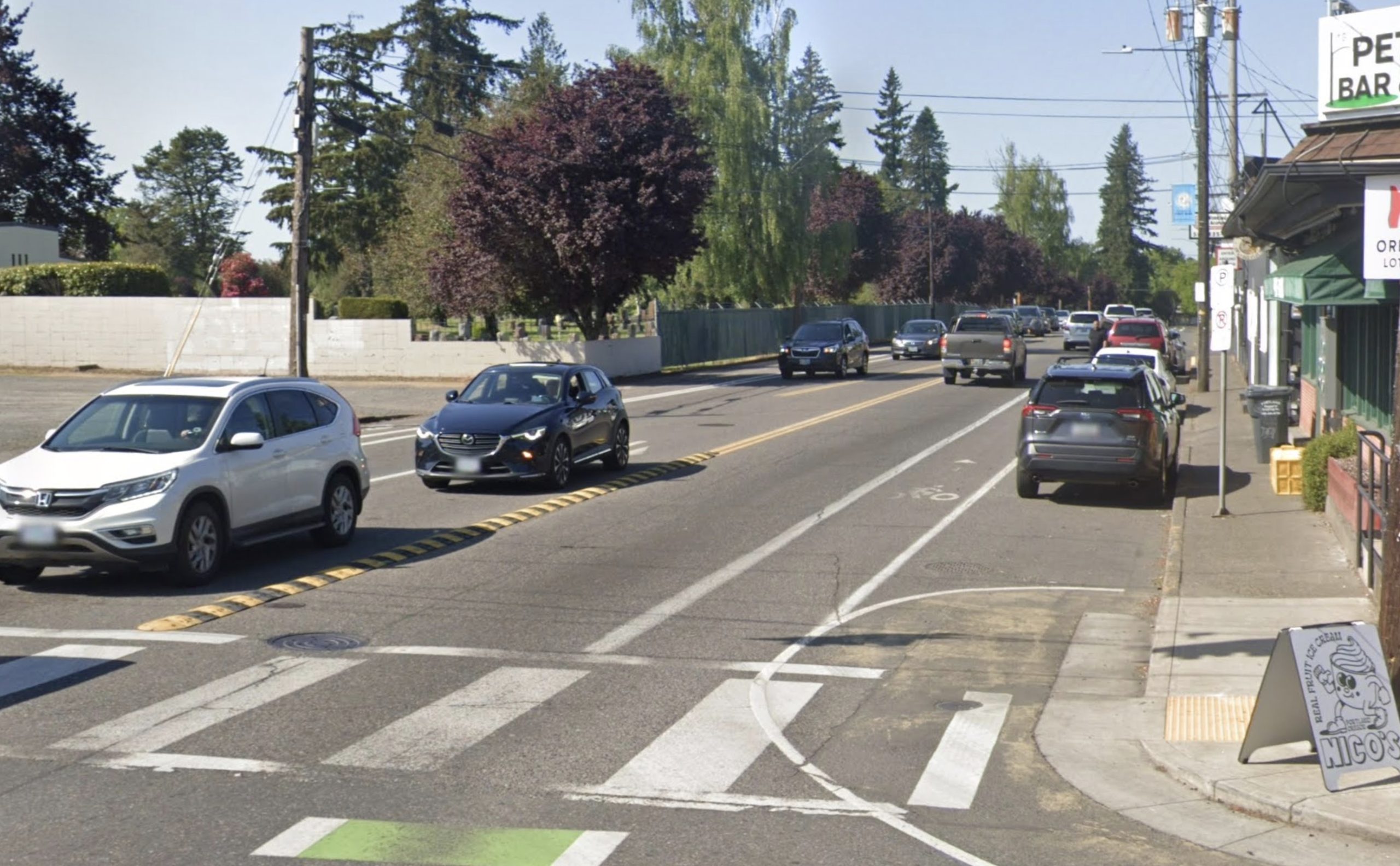
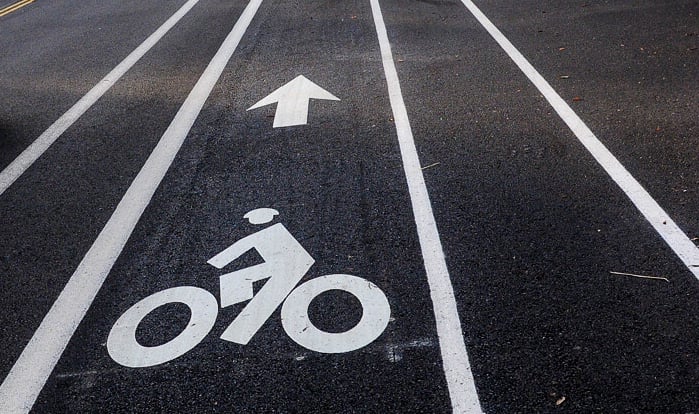
Looking north onto NE 57th from Fremont. PBOT’s design would swap the curbside parking for a wider sidewalk and a sidewalk-level bike lane.
Back in October I shared the news that the Portland Bureau of Transportation had their eyes on a major redesign of Northeast Cully Blvd/57th Ave. Now we have a much better idea what they’d like to do with the $8.5 million investment.
For the 0.6-mile section of Cully/57th between NE Prescott (Albertsons) and Klickitat (a neighborhood greenway), PBOT wants to install; protected bike lanes, some sections of wider sidewalks, ADA curb ramps, crossing upgrades with median islands, better bus stops, and one full signal rebuild. The goal of the project is to slow driving speeds, make it safer and more welcoming for bikers and walkers, and create a more functional transportation facility that neighbors can be proud of.
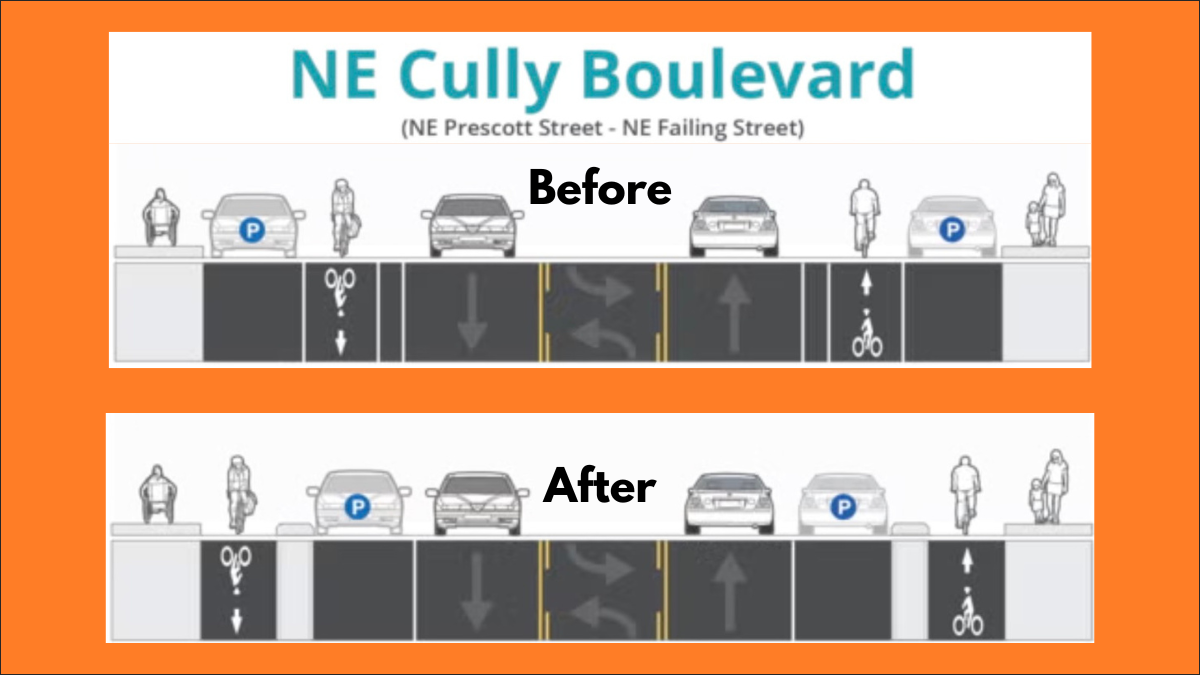
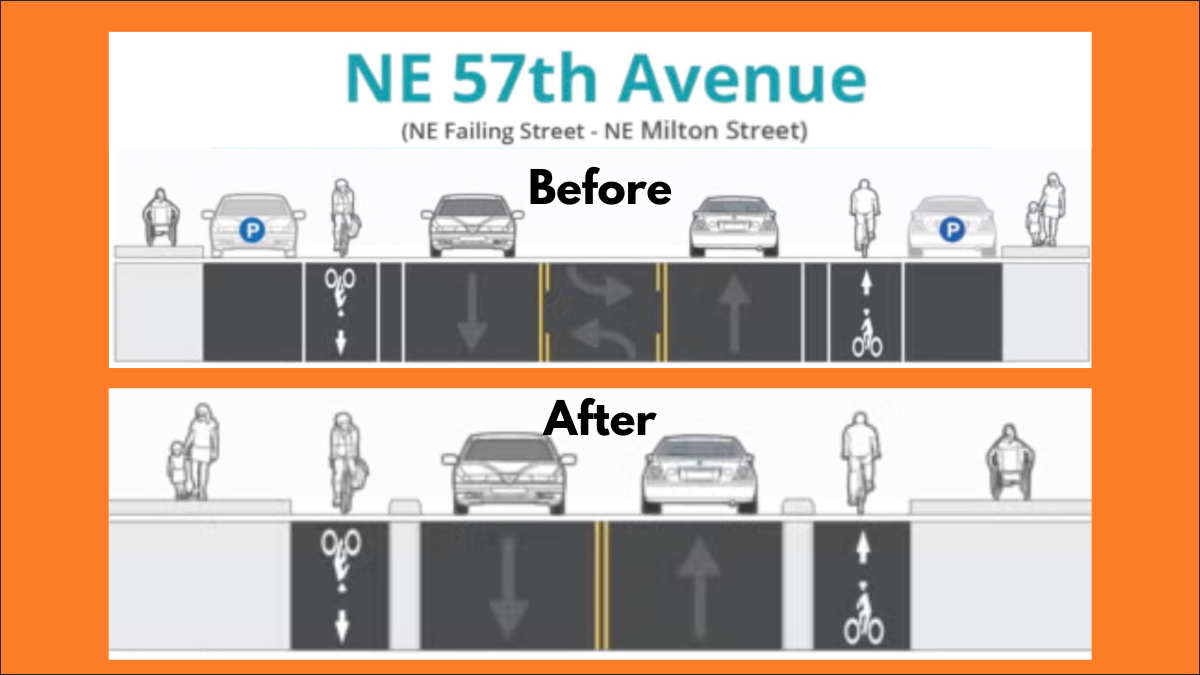
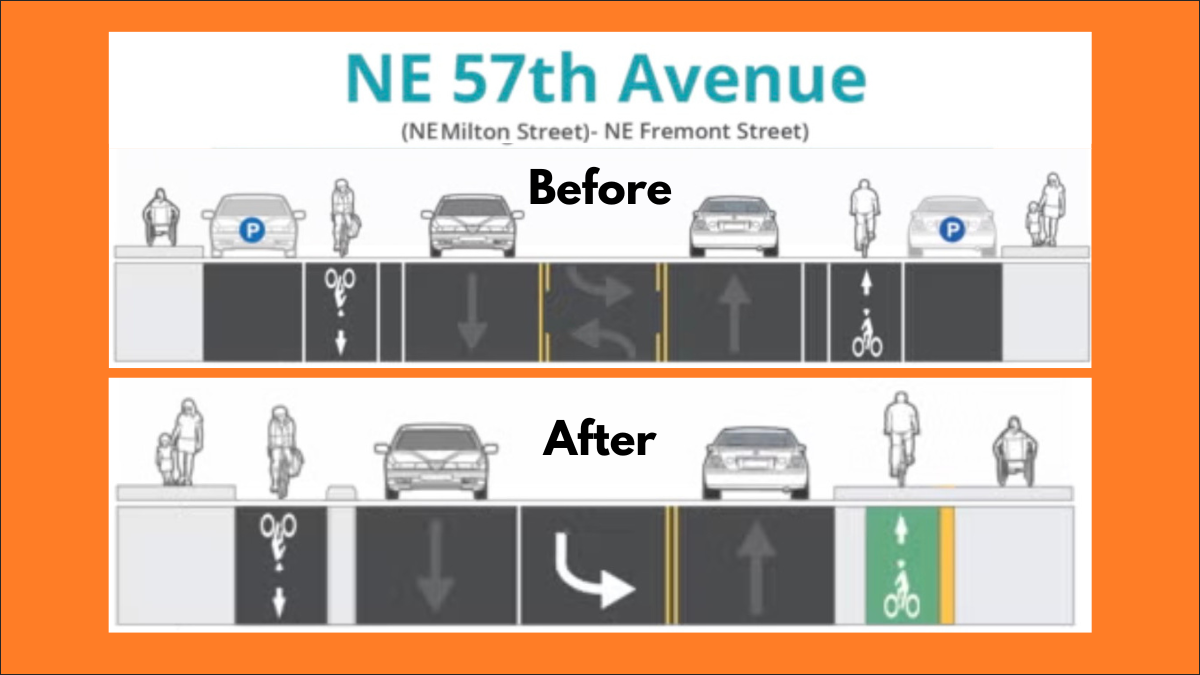
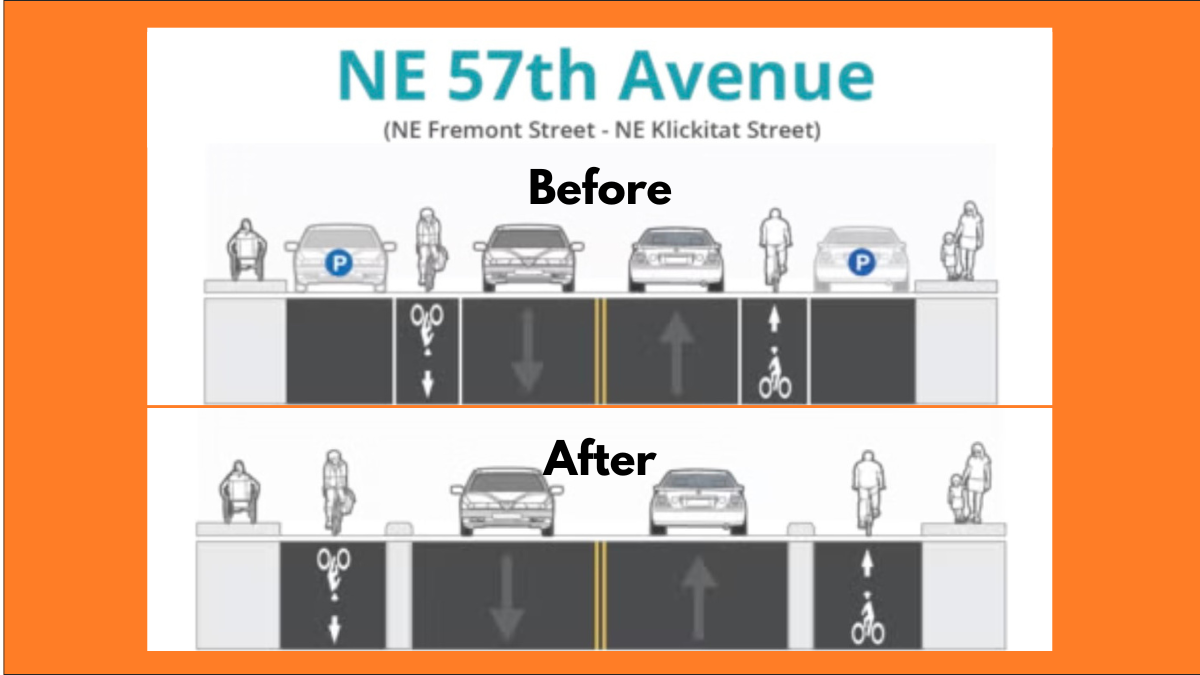
For a better understanding of what could change, check out the before/after graphics below:
Advertisement
Cross-sections by PBOT. Before/after edits by BikePortland.
Today, this stretch of Cully/57th is pretty typical and outdated. It varies in overall, curb-to-curb width, but there’s mostly just painted bike lanes, wide driving lanes without much visual obstruction (like street trees or parked cars, which can help traffic calming). According to PBOT data, more than 75% of all drivers in the project area break the speed limit of 25 mph — and about 14 percent of them are going over 35 mph. Given those behaviors, it’s not a shock that the curved section where the bike lane is “protected” (NE Failing to Fremont), PBOT has had a hard time keeping the plastic wands in the ground because (distracted? careless? speeding? apathetic?) drivers slam into them.
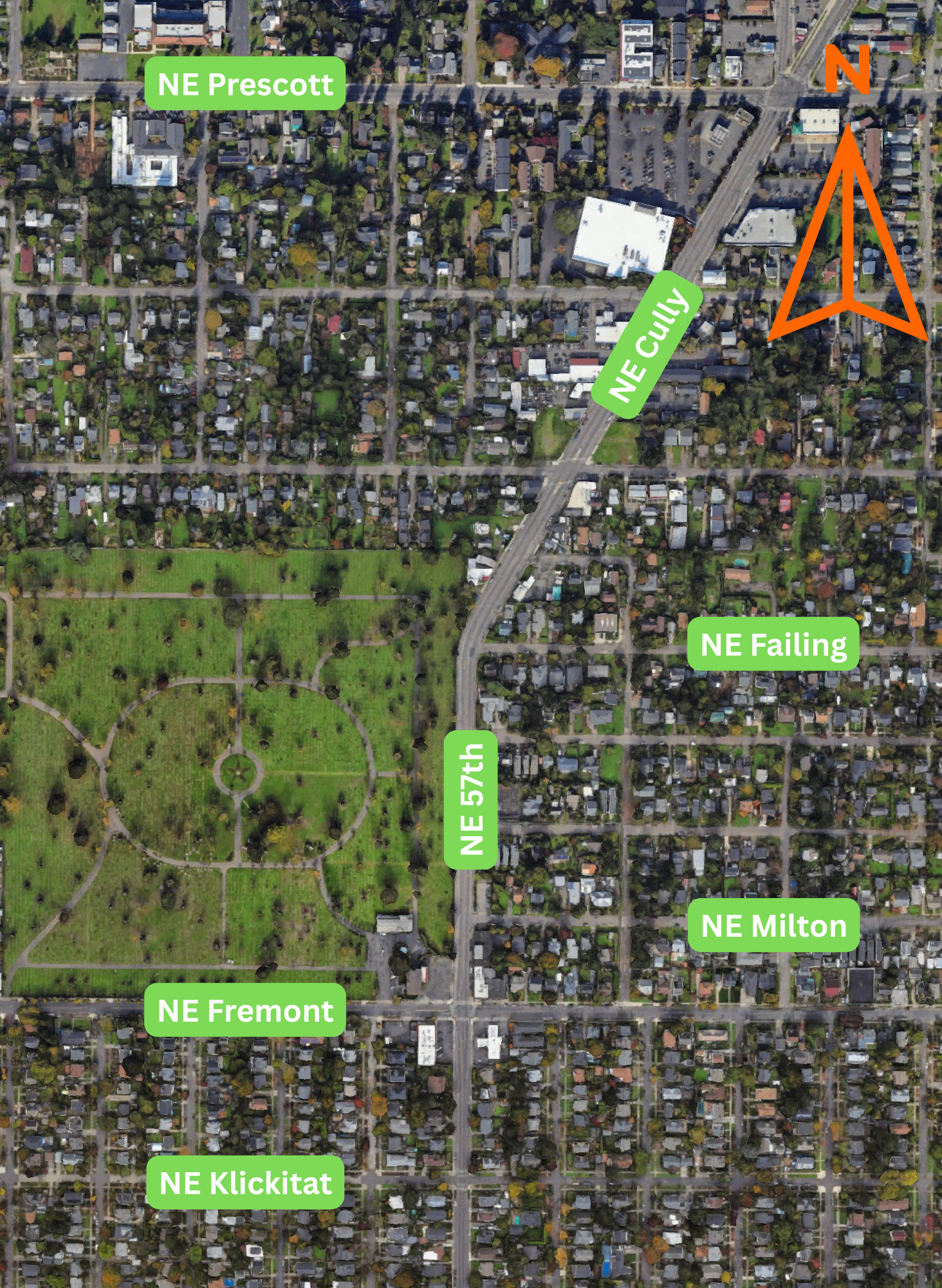
Project area.
Another reason this location is a priority for investment is its crash history. PBOT says there were 114 crashes in the project area between 2014 and 2023 — 87 of which resulted in injuries. 11 of those injuries were serious and one person trying to cross at NE Mason (in 2019) died after being hit by a driver. Of the seven pedestrians injured, PBOT says five were in marked crosswalks when they were hit. At NE 57th and Fremont alone there were 32 documented crashes in that nine-year period.
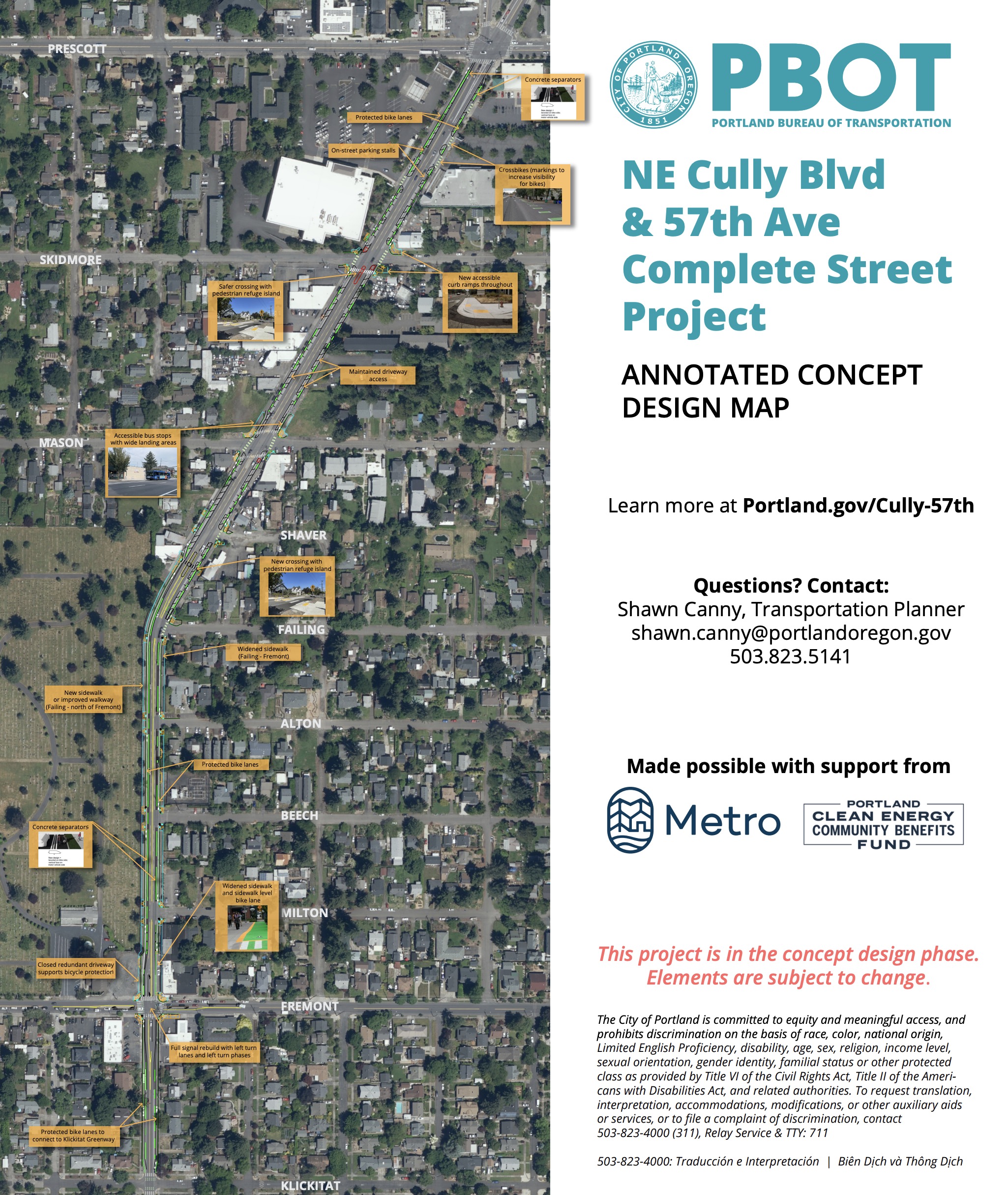
So what is PBOT going to do about it? Here’s a list of the what’s coming (as shared on the project open house website):
Two new enhanced pedestrian crossings in the vicinity of NE Failing and Skidmore streets
Widened sidewalk on the east side of NE 57th Avenue between Failing and Fremont streets
New sidewalk or enhanced walkway on the west side of NE 57th Avenue between Shaver and Fremont streets
Protected bike lanes along most of the corridor between NE Prescott and Klickitat streets
Accessible bus stop improvements at NE Mason Street
New or improved accessible curb-ramps between NE Prescott and Fremont streets
Rebuilt traffic signal at NE Fremont Street, including new left turn pockets on Fremont and dedicated left turn phases for all left turns
Advertisement
As you can see in the before/after graphics, one block of the new protected bike lane — northbound between NE Milton and NE Fremont — will be elevated onto a widened sidewalk. PBOT plans to remove the space currently used for car parking and reallocate it to the wider sidewalk/bikeway.
(Because it’s a federally-funded project and requires an environmental review and more red tape than a locally-funded project) PBOT plans to begin construction of this project in 2027 and it will be completed by 2028. Note that this design is still under review and is not set in stone. Some elements could change before they break ground.
Learn more about the project and the recommended design at the online open house and be sure to take the survey at the end. Below is an annotated map of PBOT’s design.
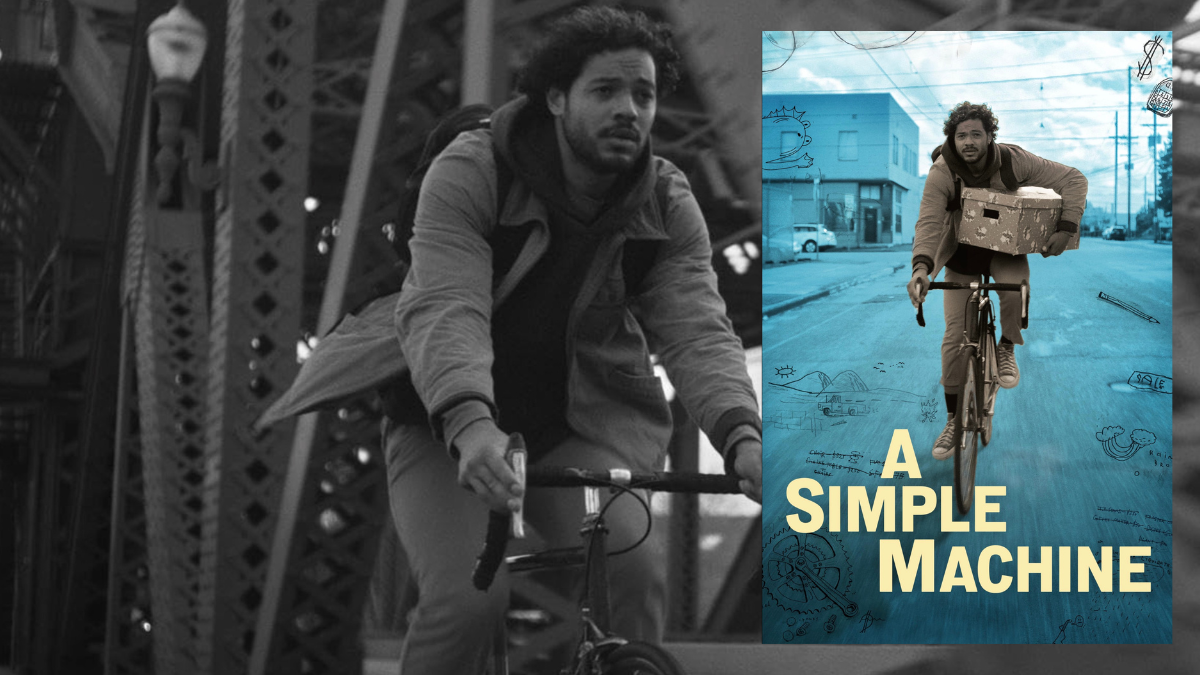
Nick (played by Richard Blackmon) rides across the Broadway Bridge in a still from the movie.
A movie shot in Portland and based on a book by a Portland author will have its hometown premiere next month. What makes this even more exciting is that bicycling plays a starring role.
A Simple Machine is a new film by Mark Alan Hoffman (a good dude! he’s even been by The Shed for a chat!) that’s making it way through the festival circuit and will screen at the Panorama Film Festival in Portland on April 16th at 7:30 pm at Hollywood Theater.
The film is based on a book by Evan P. Schneider, whom you might recall as the writer behind the excellent Boneshaker Almanac series. Schneider’s A Simple Machine, Like a Lever came out in 2011 and was named one of the best books of the year by Willamette Week. I bumped into Schneider when the movie was being filmed back in March 2024. He was one of dozens of local cyclists who met after Bike Happy Hour and rode into the Central Eastside to film one of the scenes. If you were there that night, this is your big moment!
Advertisement
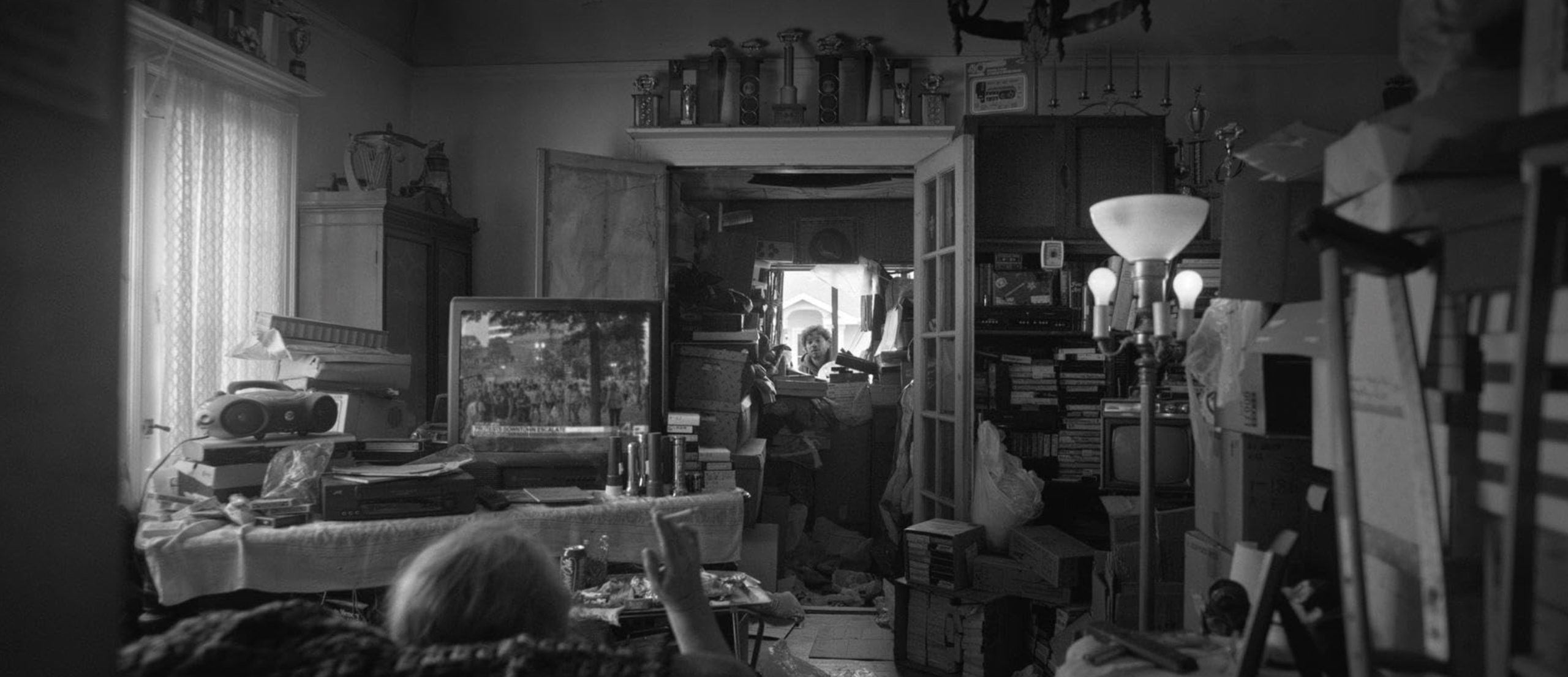
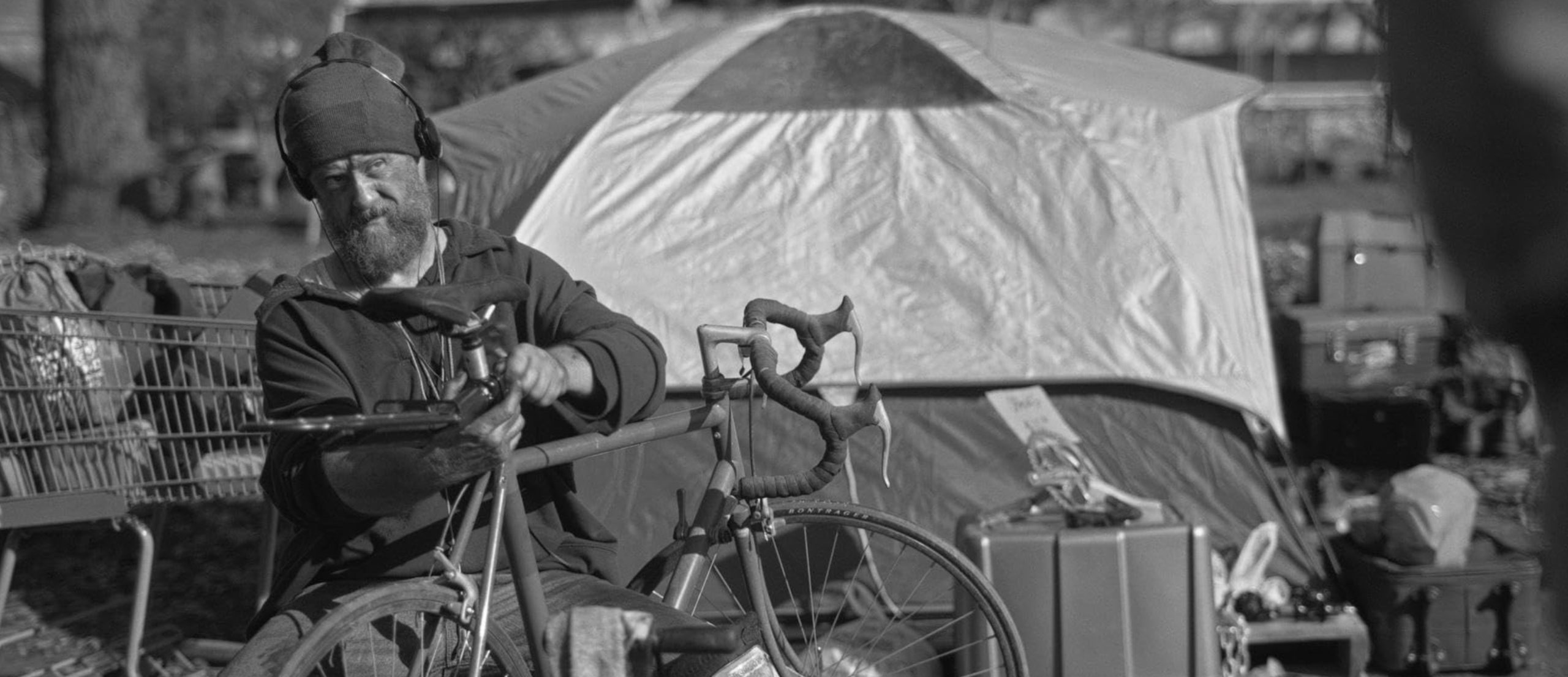
Gabriela Quezada as Marie.Brad Carter as Karl.More stills from the film. Watch trailer below.
I’ve yet to see the film, but the trailer makes it look really interesting and the early buzz is strong (they’ve picked up two awards on the film festival circuit since January). Here’s a handy summary from the film’s website:
In order to get out of debt, Nick [Richard Blackmon] makes a series of radically frugal lifestyle choices without telling his girlfriend-practically-fianceé that he’s fixing up an old bike and going off the grid – a coming of age story about individual freedom, affordability, and the wisdom of simple tech.
And you guessed it, that “simple tech” is largely represented by Nick’s bicycle — a truly simple machine for complicated times. Given the war the U.S. is fighting over oil in the Middle East, the rising cost of living, and a growing sense of disillusionment with politics, the media, and just about everything right now — I couldn’t think of a better moment for this movie to come out.
Since most of the cast and crew are Portlanders themselves, this local screening means a lot. They are planning a bike ride to the theater, an afterparty, and other events. Be sure to follow @asimplemachinefilm on Instagram and/or check the Portland Panorama Film Festival website for updates.
Tickets for the screening just went on sale yesterday, so be sure to grab yours before it’s too late. You can buy them online here. And if you’re as psyched to see a Portland bike movie on the big screen as I am, help keep the buzz going by leaving a review on IMDB or Letterboxd.
Check out the trailer below and I’ll see you on April 16th!
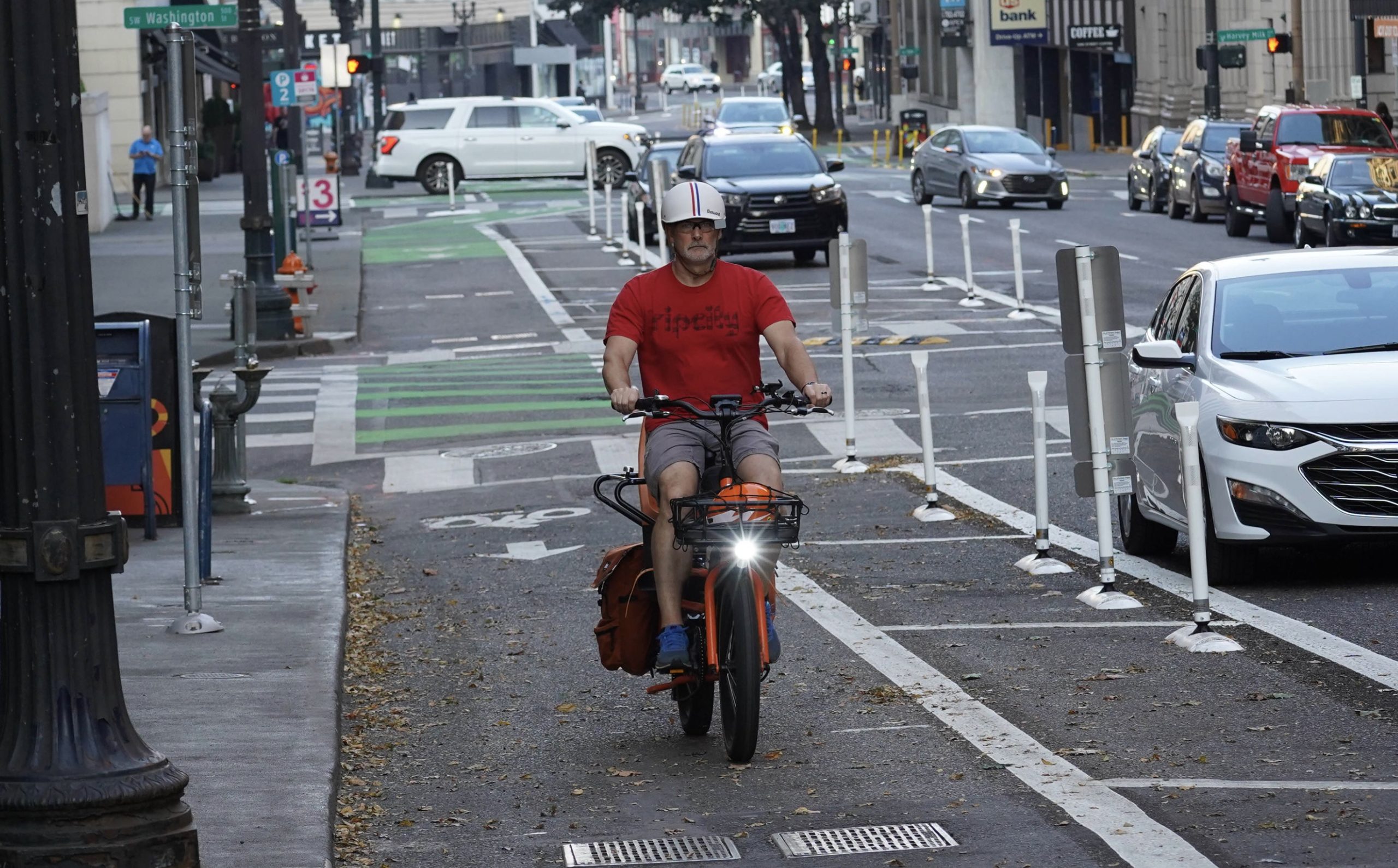
SW Broadway today. PBOT crews plan to remove plastic wands and replace with planters and concrete curbs. See design below. (Photo: Jonathan Maus/BikePortland)
The last three years have been a roller coaster for the bikeway on Broadway that runs through Old Town and Southwest Portland. In September 2023 we learned the city hatched a secret plan to remove the bike lane protection and revert the design to an older version. Three days later, after widespread community outcry, those plans changed and the bike lane was ultimately saved.
In 2024, the Portland Bureau of Transportation completed upgrades to SW Broadway that included better signals and loading platforms. And then yesterday, PBOT announced even more upgrades they say will make Broadway safer to use and to nicer to look at (see design below).
Starting tomorrow, PBOT crews will install dozens of planters and concrete traffic separators (a.k.a. curbs) in the buffer zone between the existing bike lane and car parking spaces. According to a statement from PBOT, “The improvements will reduce ongoing maintenance and improve aesthetics on the highly visible downtown corridor.”
Advertisement
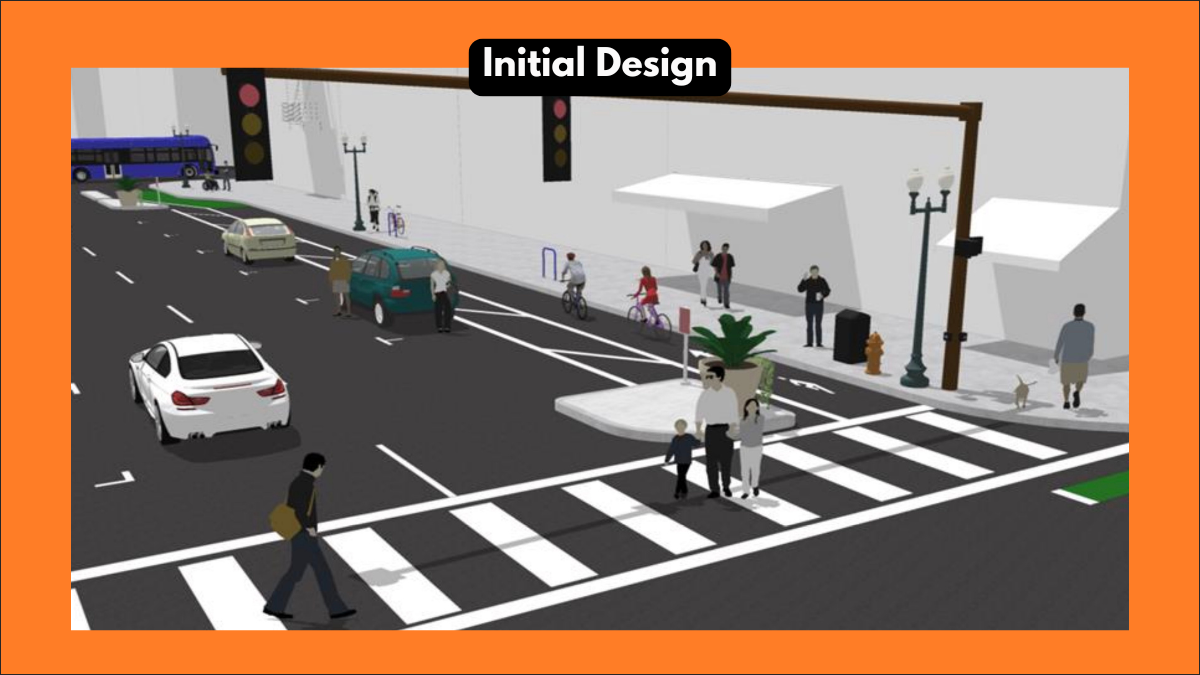
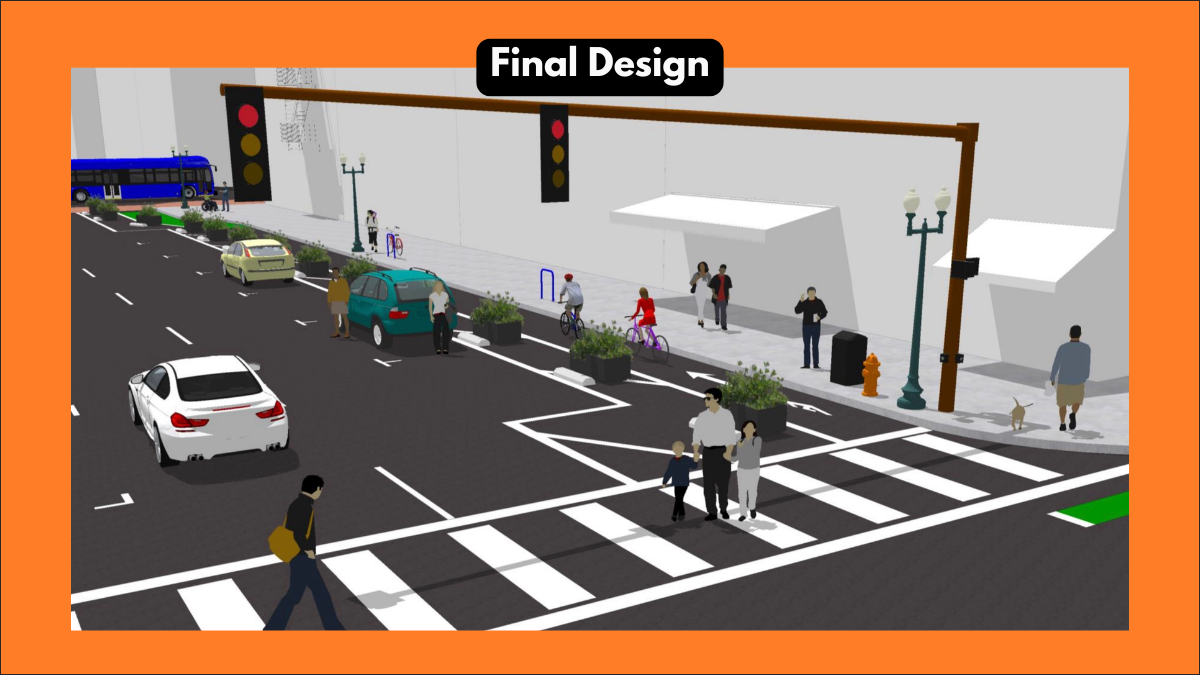
SW Broadway and Alder looking south. Final design on the right. Designs by PBOT.
The first phase of work will will focus on SW Broadway between Oak and Yamhill. PBOT wants to get this section done by mid-May so the street can be part of the 2026 Bloom Tour, an annual event where creative flower displays take over the central city (think of it like the Winter Light Festival, but flowers instead of lights). Later this year, the new planters and curbs will extend north from Burnside to NW Glisan and south from Yamhill to SW Clay.
When PBOT first shared the plans for this project, it looked a bit different (see comparison of initial and final design above). Initially they were going to install one larger median “end cap” at the beginning and end of each block. The end caps would have one planter each and there would be nothing added to the buffer zone along the bike lane — even the existing plastic wands would be removed (likely because they look terrible). The final design cancels the end caps and replaces them with short concrete curbs and planters lining the entire length of the bike lane.
When PBOT brought this project to the Bicycle Advisory Committee last month, one member scoffed at the planters and relatively small curbs, saying drivers hit and push them out of place (the large planters on NE Multnomah are regularly hit and moved around by incompetent, reckless drivers). PBOT staff said their engineers are confident the planters will stay put thanks to input form Maintenance Operations staff who said each one will be installed with a concrete curb right next to it.
Advertisement
I reached out to PBOT to better understand their decision to switch from the larger end caps to the planter/curb design.
PBOT Communications Director Hannah Schafer explained that they opted for the curbs/planters option for a few reasons. First, members of the Central City in Motion Working Group expressed concern that the initial design would have no protection in the buffer zone. PBOT also heard from “stakeholders on the corridor” (which I always hear as “business owners”) that planters would be considered an upgrade from an aesthetic standpoint and that, in general, folks wanted to see more planters in general. Schafer also added that if they had a larger budget for the $550,000 project (which is being paid for with General Transportation Revenue made up of state Highway Fund and local parking , they’d keep the larger concrete end caps and do the planters and curbs.
Other than these changes to the bike lane and a small change in parking availability between NW Glisan and Burnside (which will move from a “No Parking” zone from 6:00 to 9:00 am to all-day parking) this project won’t impact the way the street operates.
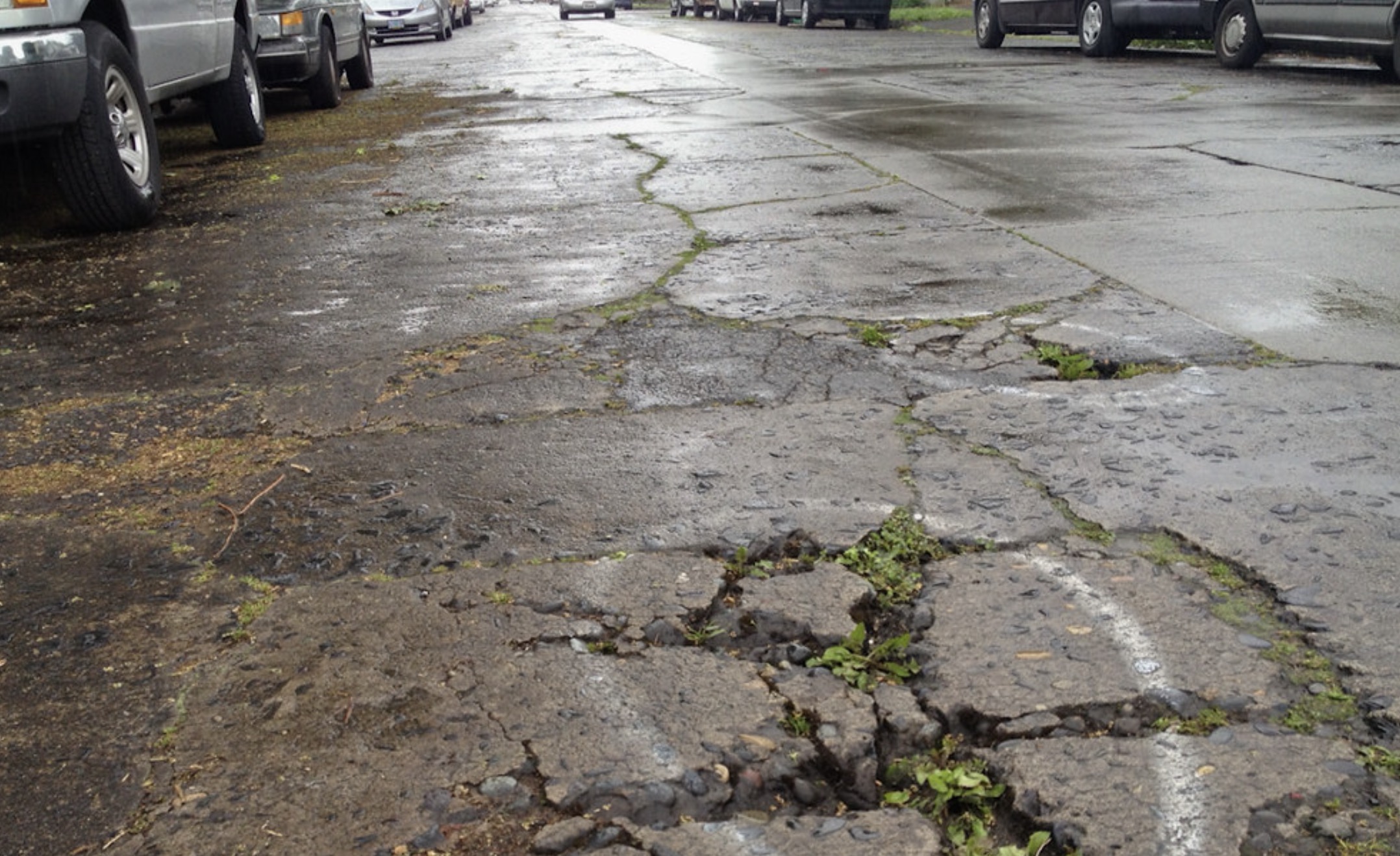
North Michigan Avenue (before a microsurfacing treatment a few years ago) going back to the earth. (Photo: Jonathan Maus/BikePortland)
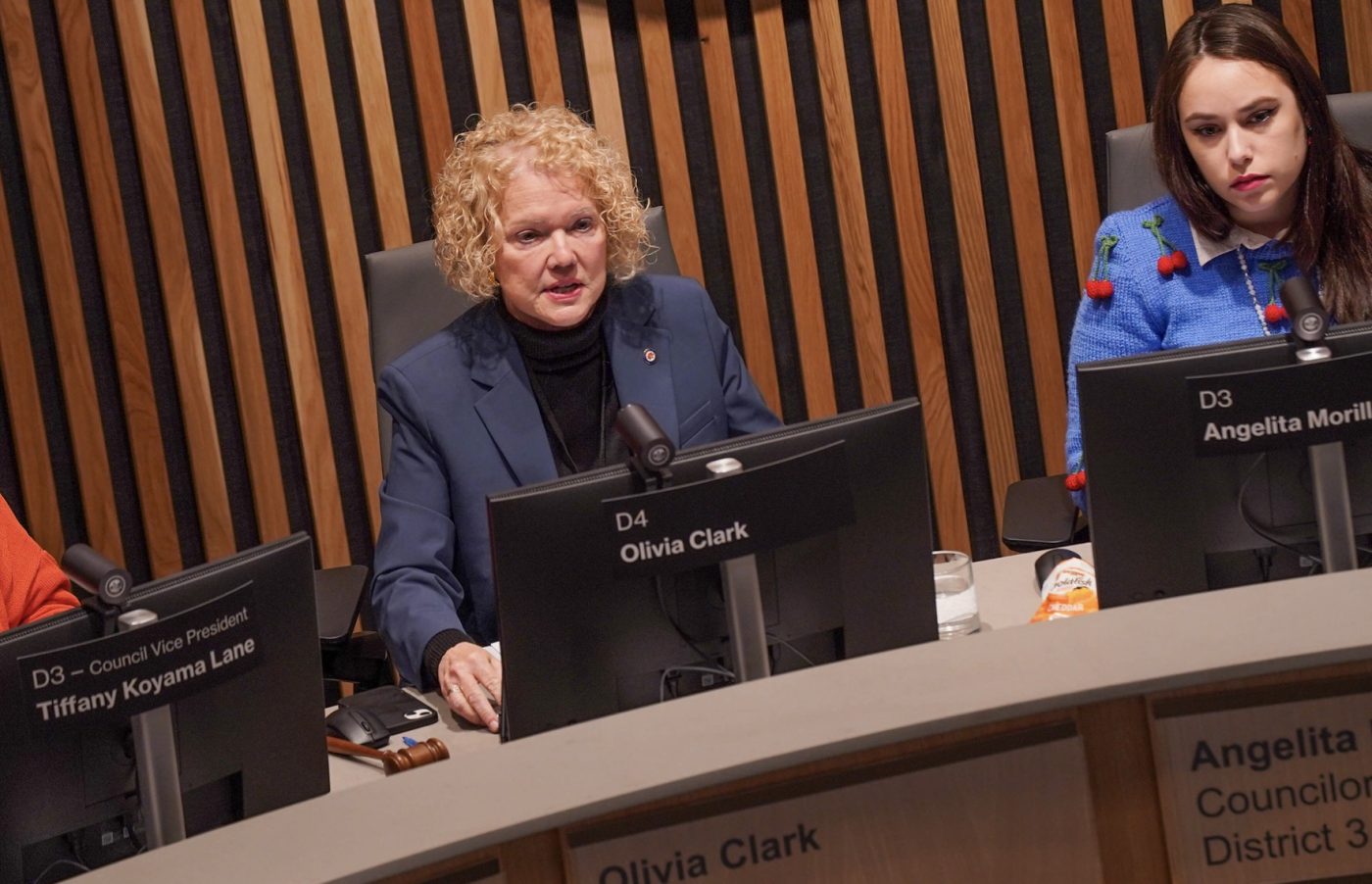
Less than three months after launching a bid to raise more revenue for transportation, Councilor Olivia Clark has heard enough: At a meeting of the Portland City Council Transportation and Infrastructure Committee this morning, Clark said she was so “moved” by the level of support for two new fees that she was ready to put forth a proposal.
“I did not start out at this point, but given all the community feedback,” Clark said, “I’m going to take a risk here, and I’m going to open up with a funding proposal for you to discuss.”
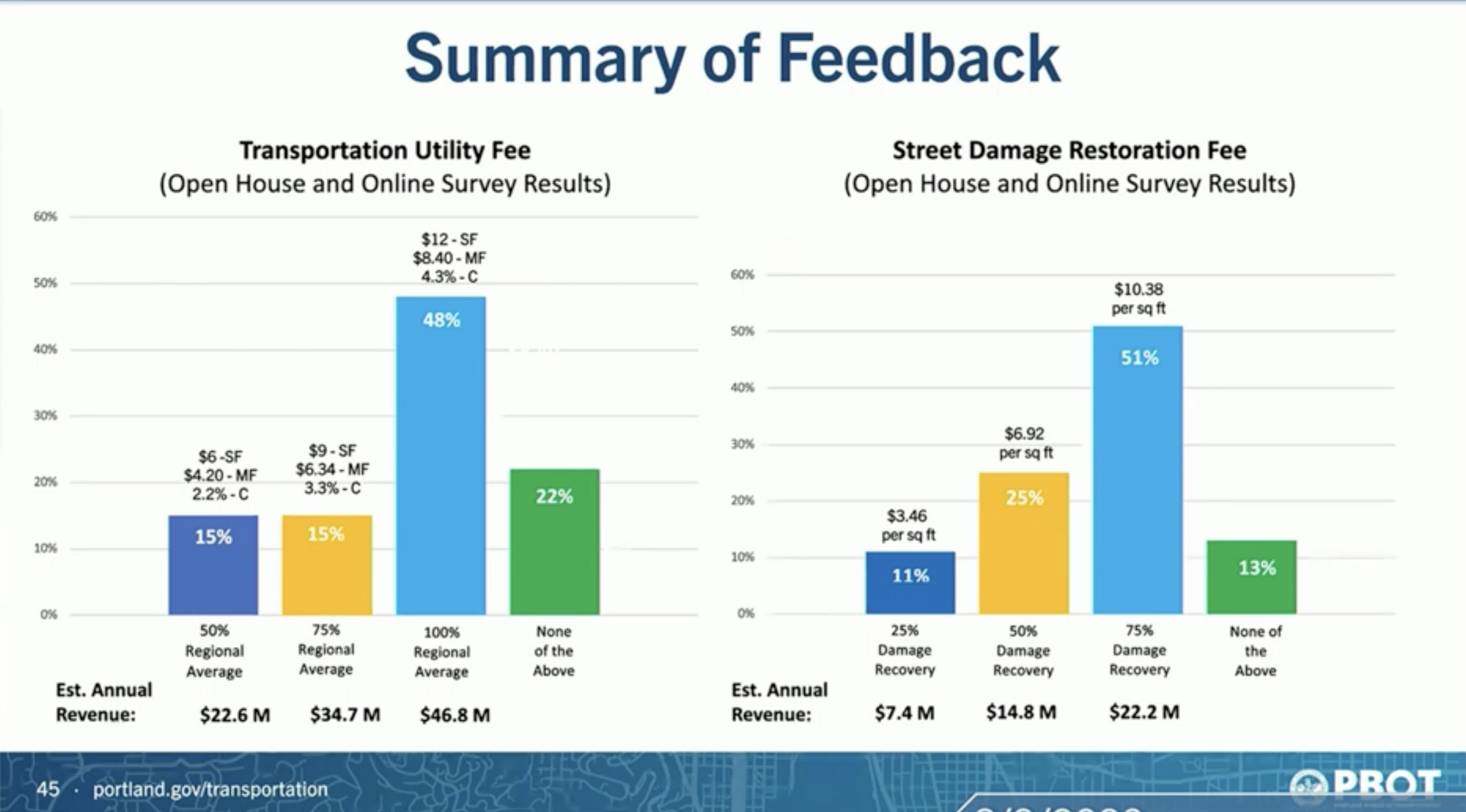
Clark’s confidence came from a presentation by Portland Bureau of Transportation staff that summarized public feedback from four recent open houses and an online survey. Over the past several weeks, PBOT hosted open houses in each district. 254 people attended the in-person events and another 477 completed the online survey. While obviously not a scientific sampling of opinion, Councilor Clark feels like it’s time to move forward.
Advertisement
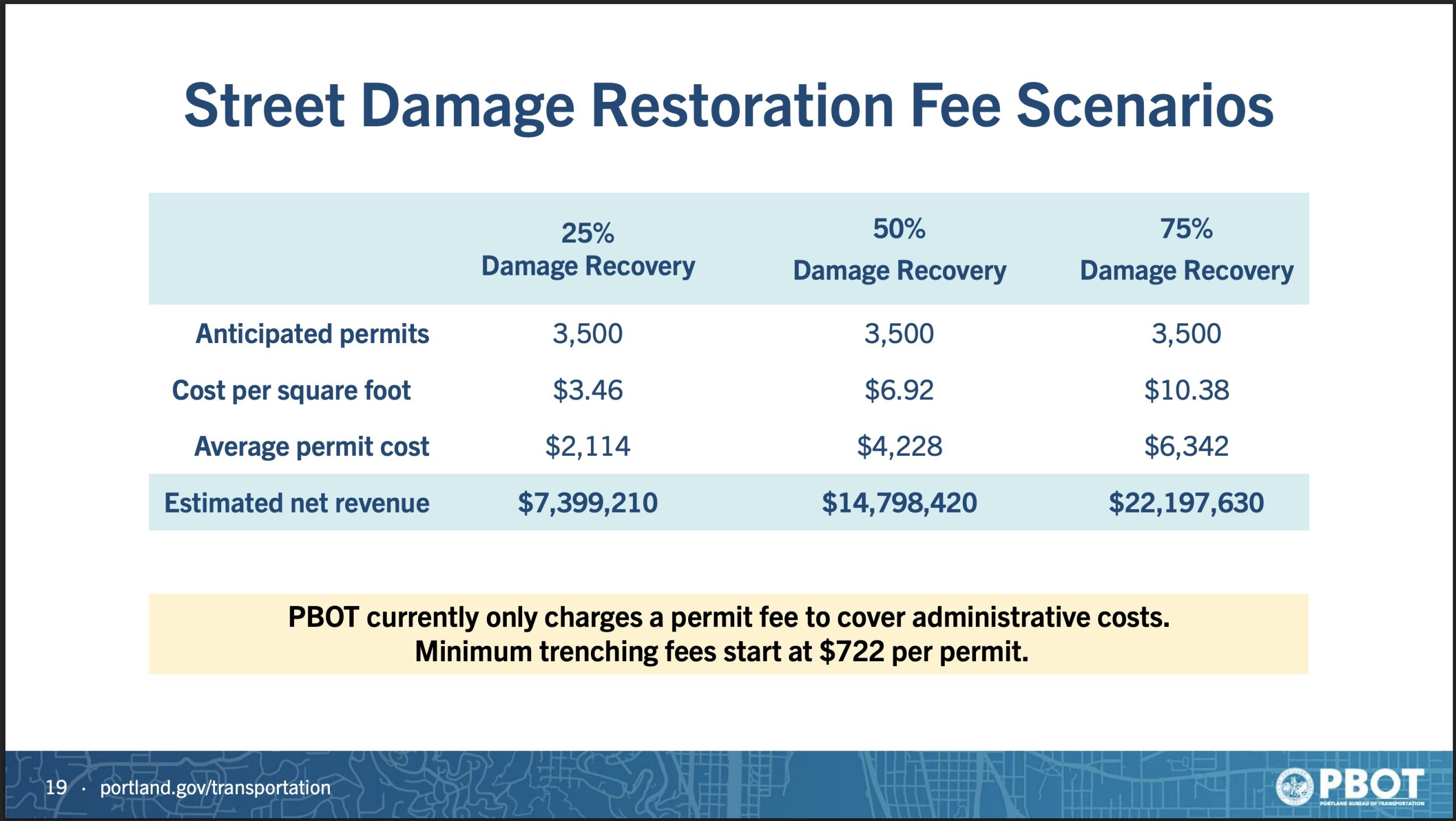
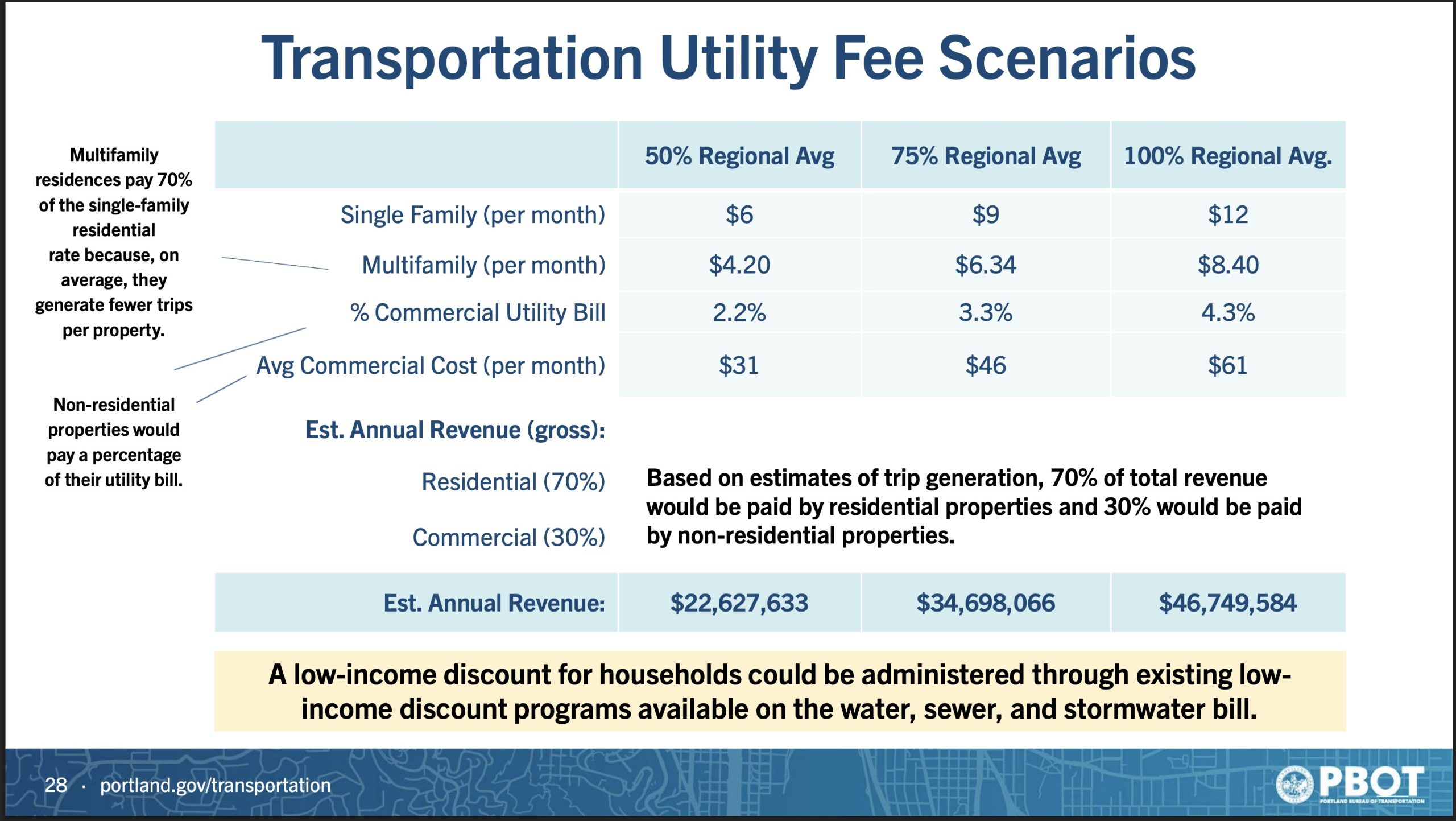
Clark plans to draft legislation that would authorize the City of Portland to pursue a Transportation Utility Fee (TUF) at around $12 per household (or $9.50 per multifamily unit) and a Street Damage Restoration Fee (SDRF) at $10.30 per square foot. The TUF is something 31 other Oregon cities have already implemented. It would be charged on utility bills and would elevate well-maintained streets to the same level as other basic city services like sewer, power, and water. The SDRF would be charged to utility companies and other contractors who dig up streets. The fee would compensate PBOT for damage done to the right-of-way.
Despite the conventional wisdom that voters are reflexively against any new taxes or fees, PBOT’s recent outreach showed that 78% of those who offered feedback support the TUF and 87% support the SDRF. Of those who support the TUF, 48% said it should be the same as the regional average, or about $12. This is significant, because folks were given options to support $6 or $9 per household — yet they still chose $12. (Note: The TUF is technically a fee, not a tax, so it doesn’t need a public vote.)
PBOT says they must fill a $25 million budget in the short-term, but the overall cost to address their maintenance backlog is $6 billion.
Taken together, the TUF and SDRF would raise about $68 million per year and would give PBOT a flexible pot of funds they’d have discretion over. This is a key point given that the vast majority of PBOT’s funding is from sources that are dedicated to specific projects and programs. Add in the $18 million (or so) per year PBOT brings in from the Fixing Our Streets (10 cent local gas tax) program and the bureau would have enough to fill their budget gap and make headway on that maintenance backlog.
Advertisement
There are still a lot of details to hammer out. Clark said she’d likely include language in the ordinance that would mandate a certain amount of funds raised from the TUF be spent on maintenance. But Clark wouldn’t stipulate an end to PBOT’s existing local gas tax, which is an idea floated by Mayor Keith Wilson at the open houses. Councilors Clark, Smith and Angelita Morillo said that gas tax conversation should not be mixed with conversations about new alternatives.
“This is an important moment in Portland history.”
– Olivia Clark, city councilor
At council Monday morning, Clark’s proposal was met with strong approval from the other four members of the committee. Councilor Loretta Smith voiced her support, seeing it as a way to fund her Sidewalk Improvement and Paving Program.
Councilor Mitch Green also said he’s ready to support the proposal. He also said the future of Portland local gas tax could be a moot point if city planners use new revenue to, “Shape the transportation system that gives people options to not drive their car.” Green said the U.S. war in the Middle East could soon lead to lines as gas stations and provide a strong impetus for people to drive less and/or seen other options. “We have an opportunity here,” Green said, “To use that geopolitical crisis as an opportunity for us to lead a city forward that’s not exposed to that kind of energy shock.”
Two other alternative funding sources — a retail delivery fee and a third-party food delivery fee — were considered not quite ready for prime-time and won’t move forward in this proposal.
As leader of this effort, Councilor Clark wants to move forward at relatively breakneck speed. She hopes to have legislation drafted and delivered to the full City Council by next week and continue the conversation at the (newly assembled) Committee of the Whole on April 2nd (which will be the first opportunity for public testimony). If all goes according to plan, the proposal will be in front of full City Council on April 8th, before the city budget process officially begins.
“Let’s move on,” Clark said at the end of this morning’s conversation. “This is an important moment in Portland history.”
Hope your week is off to a great start. Below are the most notable stories that came across my inbox this past week…
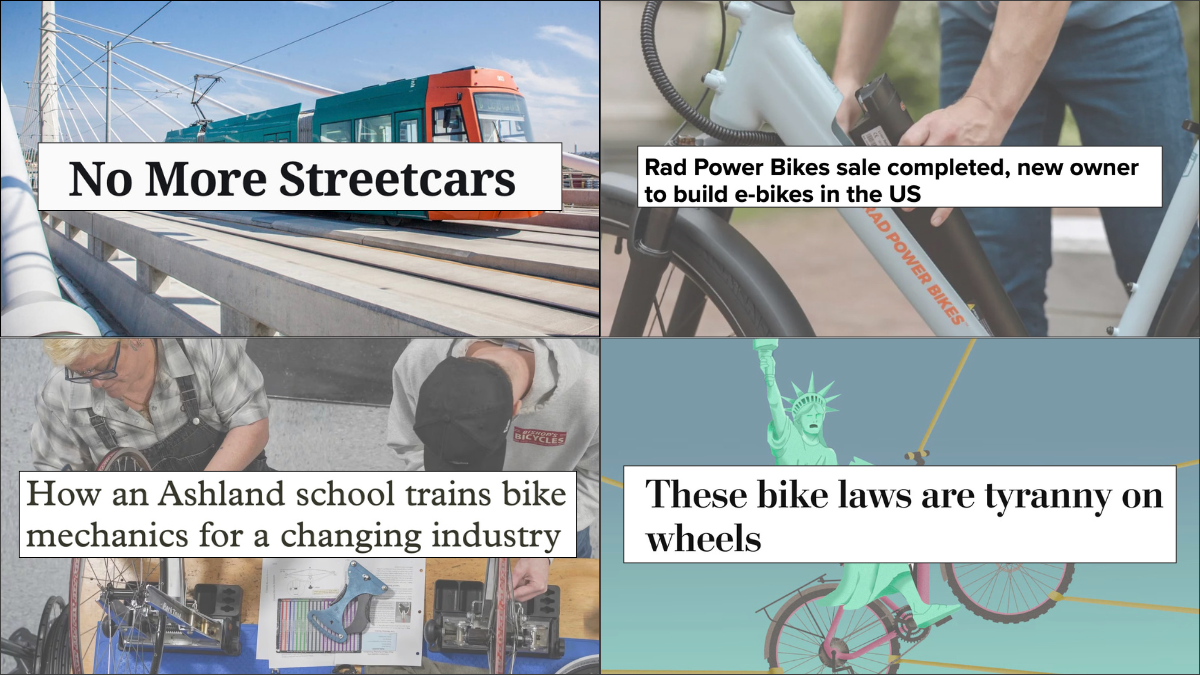
It’s about freedom: This wonderful opinion piece very clearly expresses why poorly crafted anti e-bike laws should be framed as nothing less than tyranny and government overreach that robs people of basic freedoms. (Washington Post Opinion)
Child seats banned on transit: Interesting story from San Francisco where transit agency Caltrain says crowded cars have forced them to crack down on cargo bikes with child seats. The new rules banning them are being vociferously opposed by some riders. (SF Chronicle)
New leader at Metro: In news that many local transportation reformers will not be mad about, Metro President Lynn Peterson could be leaving early. (Willamette Week)
Bike to birth: A Minneapolis lawmaker is making headlines after she hopped into a cargo bike to get the hospital where she gave birth. She credits protected bike lanes for giving her and her husband the confidence to make that choice. (Fox News Minneapolis)
Advertisement
A new alliance: Very effective nonprofit Seattle Neighborhood Greenways has officially rebranded as the Seattle Streets Alliance, a move that shows our friends up north have a healthy advocacy ecosystem we’d do well to emulate. (The Urbanist)
Rad’s next chapter: The company that bought Rad Power Bikes through bankruptcy, Life EV, says it will honor warranties and provide a path to service for existing owners. As for new Rads? They say they’ll open a U.S. assembly plant. (Electrek)
Are we over streetcars? Streetcars were a big part of Portland’s progressive transportation brand back in the Obama era; but times have changed and given the transit budget crisis we face, this transit booster thinks it’s time to question their existence. (Urban PDX)
Wrenching: I still miss having United Bicycle Institute in Portland, but I’m glad to know they’re going strong and finding a new niche in training folks on how to work on all the weird, non-standard parts on today’s high-tech bikes. (Oregon Public Broadcasting)
BikeLink™ is seeking a Field Technician to service and maintain electronic bike lockers in the Portland, OR area. The scope of work includes regularly scheduled service visits and working with technical support and parking enforcement staff at BikeLink™ headquarters.
This is not a full-time job; it is a part-time employment opportunity. The hours will average about 15-20 per month, or 180-240 per year.
Requirements:
– Excellent communication skills–both written and verbal.
– Your own vehicle and basic hand tools, including a cordless drill with a ½” chuck.
– Detail-oriented and well-organized.
– Patient and focused.
– Reliable place to receive packages.
– Flexible schedule in the event of urgent service calls (these are infrequent).
Preferred:
– Love bikes and people who bike.
– Experience interfacing with the public and representing a company.
– IT experience.
– Knowledge of hardware and electrical work.
– Experience using a multimeter.
– Experience using and fixing computers.
– Previous experience as an independent field technician.
Scope of Work:
– Regular coordination with our Seattle-based Service Manager.
– Monitor online problem reports for your region. These reports are typically created by our BikeLink main office and call-center staff.
– Perform regularly scheduled service visits, including troubleshooting, hardware replacement, and software upgrades. You schedule these in advance, during normal West Coast business hours, with at least 48 hours’ notice, so we can ensure staff are available to support you (we can sometimes also accommodate after-hours work). Service visits should be scheduled to optimize travel logistics and daylight working conditions, based on your local knowledge of weather and traffic. We provide detailed service manuals, knowledgeable support staff, and replacement parts.
– Infrequent urgent service calls requiring response within 24 hours.
– Immediate documentation of service performed and problems found using our online problem report and service visit system.
– Coordination with our BikeLink enforcement and engineering staff to troubleshoot and resolve issues.
– Diligent quality control checks at each service visit.
– Feedback to help us improve the system!
About eLock Technologies and BikeLink™
eLock Technologies is a small Berkeley, CA-based company that designs, deploys, and operates bike parking systems. eLock pioneered the electronic on-demand bicycle parking concept over a decade ago with the goal of bridging the “last mile” between transit stations and commuters’ homes. Hundreds of thousands of “last-mile” trips later, the BikeLink™ system is deployed at over 500 locations, serving more than 75,000 cyclists with over 7,500 bike parking spaces nationwide.
For more information, visit: www.bikelink.org
How to Apply
Please send a resume and a description of your experience and why you are a good match. Along with your application, please provide three references.
Send your application to bikelinkjobs@gmail.com with “FIELD TECHNICIAN PORTLAND.” in the subject line.
Job Title: E-Bike Mechanic (Independent Contractor) Location: Mokwheel E-Bikes — Tualatin, OR Employment Type: Independent Contractor Experience Required: 1–3 Years
About the Role We’re looking for a skilled and passionate E-Bike Mechanic to join our team as an independent contractor. This is a fully commission-based position — you earn based on the work you do, with strong earning potential for anyone who’s efficient, quality-focused, and great with customers. You’ll be the go-to expert for diagnosing, repairing, and maintaining a wide range of electric bikes, keeping our customers rolling safely and confidently. This is a hands-on role in a busy retail environment where quality workmanship and great customer communication go hand in hand.
Compensation This is an entirely commission-based independent contractor role: • 50% of every repair billed — your skill and efficiency drive your income • Effective hourly range: $25–$60/hr depending on workload and repair type • $20 per Mokwheel e-bike assembled and sold • The more you do and the better you do it, the more you make
Note: As an independent contractor, you are responsible for your own taxes and are not eligible for employee benefits. A contractor agreement will be provided prior to starting.
Key Responsibilities • Build and assemble new Mokwheel e-bikes to spec before hitting the floor • Diagnose and repair e-bike electrical systems, including motors (hub-drive and mid-drive), batteries, displays, and controllers • Perform mechanical servicing including drivetrain, braking systems, suspension, and wheel builds • Carry out pre-delivery inspections (PDIs) on new e-bikes before customer handover • Communicate with customers to explain faults, repair options, and estimated turnaround times • Maintain an organized, clean, and safe workshop environment • Manage parts ordering and stock levels in collaboration with the shop team • Stay current with new e-bike technology, brands, and firmware updates
Skills & Experience • 1–3 years of experience in bicycle or e-bike mechanics (professional workshop experience preferred) • Solid understanding of e-bike drive systems (e.g. Bosch, Shimano Steps, Brose, Fazua, or similar) • Proficient in standard bicycle repairs across all disciplines • Comfortable using diagnostic software and tools for motor/battery systems • Strong attention to detail and commitment to quality • Good communication skills — able to explain technical issues to non-technical customers • Ability to work efficiently and manage your own workflow
Nice to Have • Brand-specific certifications (e.g. Bosch eBike Systems, Shimano Steps) • Experience with cargo bikes, e-MTBs, or e-cargo delivery vehicles • Previous retail or customer-facing experience
Lawmakers raided a program that funded off-street paths like this one in order to backfill highway operations and maintenance. (Photo: Jonathan Maus/BikePortland)
Senate Bill 1601 will officially pass on the final day of the 2026 legislative session and Oregon transportation advocacy groups are expressing dismay. A statement from Move Oregon Forward, a coalition of 45 nonprofit organizations from across the state, didn’t mice words, saying that lawmakers chose to, “plug a massive funding hole by gutting programs that protect the state’s most vulnerable residents.”
Here’s more from their statement:
The final vote, which takes place as the short session nears its deadline, redirects nearly $50 million away from safety, rail, and transit initiatives. Deep cuts will now hit Safe Routes to School ($17 million) and Oregon Community Paths ($8 million), effectively stripping 60% of the funding used to build sidewalks and crossings for children.
The state’s current budget crisis did not come from school safety programs or community paths. It stems from long-term funding shortfalls and major road project costs that outpaced new revenues. The funding issues come from road projects, yet the 30% of Oregonians who do not drive are the ones being asked to pay the price.
Advertisement
Zachary Lauritzen of Oregon Walks said the bill has “guttted” these key active transportation programs. “The state is failing its duty to remove barriers for kids, seniors, and people with disabilities to move safely around their communities,” he said. And Oregon Trails Coalition Executive Director Steph Noll added that, “It is unconscionable to raid bicycle excise taxes to fill a highway fund hole. By slashing this budget, the state is knowingly making neighborhoods less safe for the very people who funded these programs.”
Noll was referring to lawmakers taking money away from the Oregon Community Paths program — a program partially funded by Oregon’s $15 tax on new bicycles — and spending it on highway operations and maintenance instead. The program has been a crucial source of funding for off-street paths across the region.
On Monday, Move Oregon Forward coalition members sent a letter to Governor Tina Kotek and leading lawmakers, urging them to take a different course. Instead of raiding these popular, vital programs, they offered a different path to save the budget. Their proposal included: internal savings and “smart housekeeping” within ODOT, a reshuffling of state capital project priorities, and reallocating up to $80 million of “idle funding” tied up in megaprojects that lack a feasible funding path. If those didn’t suffice, they told lawmakers to use short-term debt financing tools.
Move Oregon Forward says their suggestions were ignored.
Advertisement
“Our coalition is done waiting,” said Indi Namkoong, Transportation Justice Coordinator at Verde. “Lawmakers cannot continue to collect tax dollars from working families while cutting the very services those dollars fund. This budget is a failure of leadership and a breach of trust. Now that these cuts have passed, we expect our priorities to be served first in the 2027 transportation package.”
Like everyone else in Salem, Namkoong and Move Oregon Forward are already looking ahead to the next legislative session where Democratic party leaders have promised they will once again try to move a large transportation funding package forward.
Dave Guettler in the BikePortland Shed, March 2025. (Photo: Jonathan Maus/BikePortland)
Several days ago I saw a post on the River City Bicycles Instagram account that showed all the employees receiving CPR training. At the time, I didn’t think much of it — other than noting what it says about shop owner Dave Guettler and his commitment to having a well-trained staff. River City is a Portland institution, one of the best bike shops in America, and Dave is its beloved leader.
Then through the grapevine I began to hear about a recent heart attack Dave suffered while on a ride. I figured I’d get the full story soon enough, but then yesterday, a press release from the American Heart Association dropped into my inbox. “It was supposed to be an ordinary Sunday bike ride,” the press release begins. Here’s more about what happened:
“Dave Guettler and Tia Sherry, owners of River City Bicycles, had pedaled nearly 25 miles into Oregon’s scenic Gorge, chatting about lunch plans and soaking in the beauty of quiet country roads lined with towering trees and fields. For two lifelong cyclists, this was bliss.
Then, in an instant, everything changed.
Advertisement
Dave’s bike began to drift left. At first, Tia thought he was pulling over for a break. But then he went off the road into a ditch and somersaulted over a six-foot wire fence, landing in a cow pasture. When Tia finally reached him after clawing her way over the fence, Dave was gray, his lips blue, his eyes rolled back. He wasn’t breathing. He had no pulse.”
Thank god Tia (a former co-director of The Street Trust) was there and was trained in CPR! Dave is out of the hospital and on the road to recovery (it’s his second trip to the ICU from a bike crash since his run-in with a truck driver on NE Sandy back in 2023). And in typical Dave fashion, he set up a training for 75 employees and friends recently at River City Bicycles.
“We want everyone to learn CPR,” Dave told the American Heart Association. “If Tia hadn’t known what to do, I wouldn’t be here.”
Gold Sprints – 7:00 pm at Gigantic Brewing (SE) Team CX Pistols has teamed up with a new team, Superare Racing, for a night of gold sprints. Just imagine a bunch of folks pedaling like crazy on stationary bikes in head-to-head competition. It’s great to race or watch. And this event is a fundraiser for Superare’s hosting of the classic Banana Belt road race at Hagg Lake coming up in April. More info here.
Saturday, March 7th
Springwater Cleanup – 10:00 am at Splendid Cycles (SE) Join volunteers from SOLVE for a cleaning party on bikes along the splendid Springwater along the Willamette River. More info here.
Yarn Crawl – 10:00 am at Close Knit (NE) All Bodies on Bikes has organized what looks to be a fun tour of yarn shops, starting on NE Alberta. Route is about 30 miles. Come get your knit on! More info here.
Civil Unrest Bicycle Club Ride – 1:00 pm at Salmon Street Springs (SW) This ride is open to everyone and will have some great news for folks with disabilities who’ve been looking for an adaptive bike/e-bike. Find Tink at the meet up spot to learn more. More info here.
Advertisement
Sunday, March 8th
Women’s Only Ride with Pas Normal Studios – 9:30 am at Cyclepath (NW) Get ready for a big endurance ride to mark International Women’s Day. More info here.
Overlook Neighborhood Bike Ride – 9:30 am at Stacks Coffeehouse (N) Come meet fellow residents of this wonderful NoPo neighborhood and explore the streets. Expect a short ride that’s family-friendly. If you’re lucky, ride leader Nic will bring his baby boy along! More info here.
— Did I miss your event? Shout it out in the comments blow, let me know by filling out our contact form, or just email me at maus.jonathan@gmail.com.
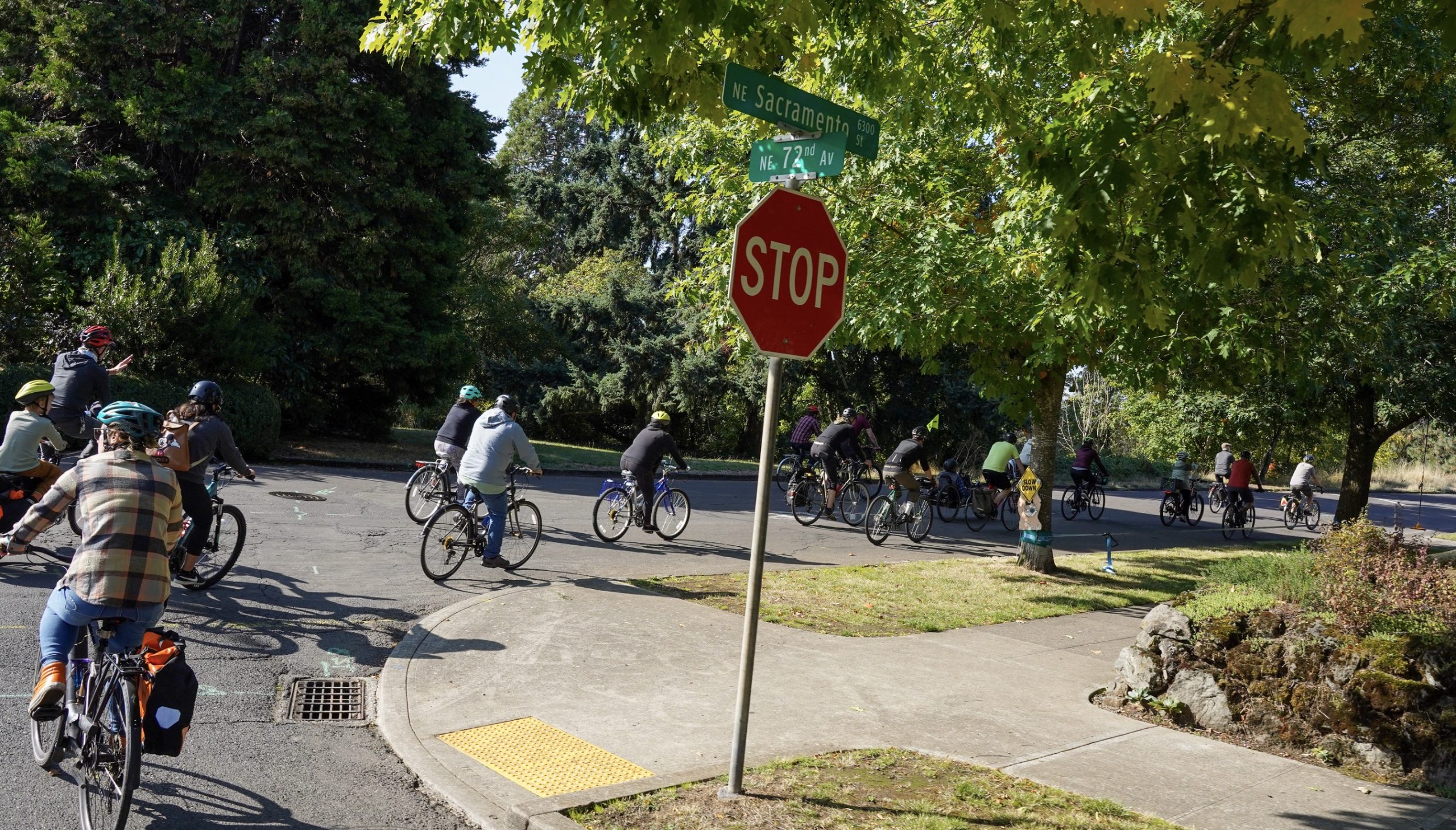
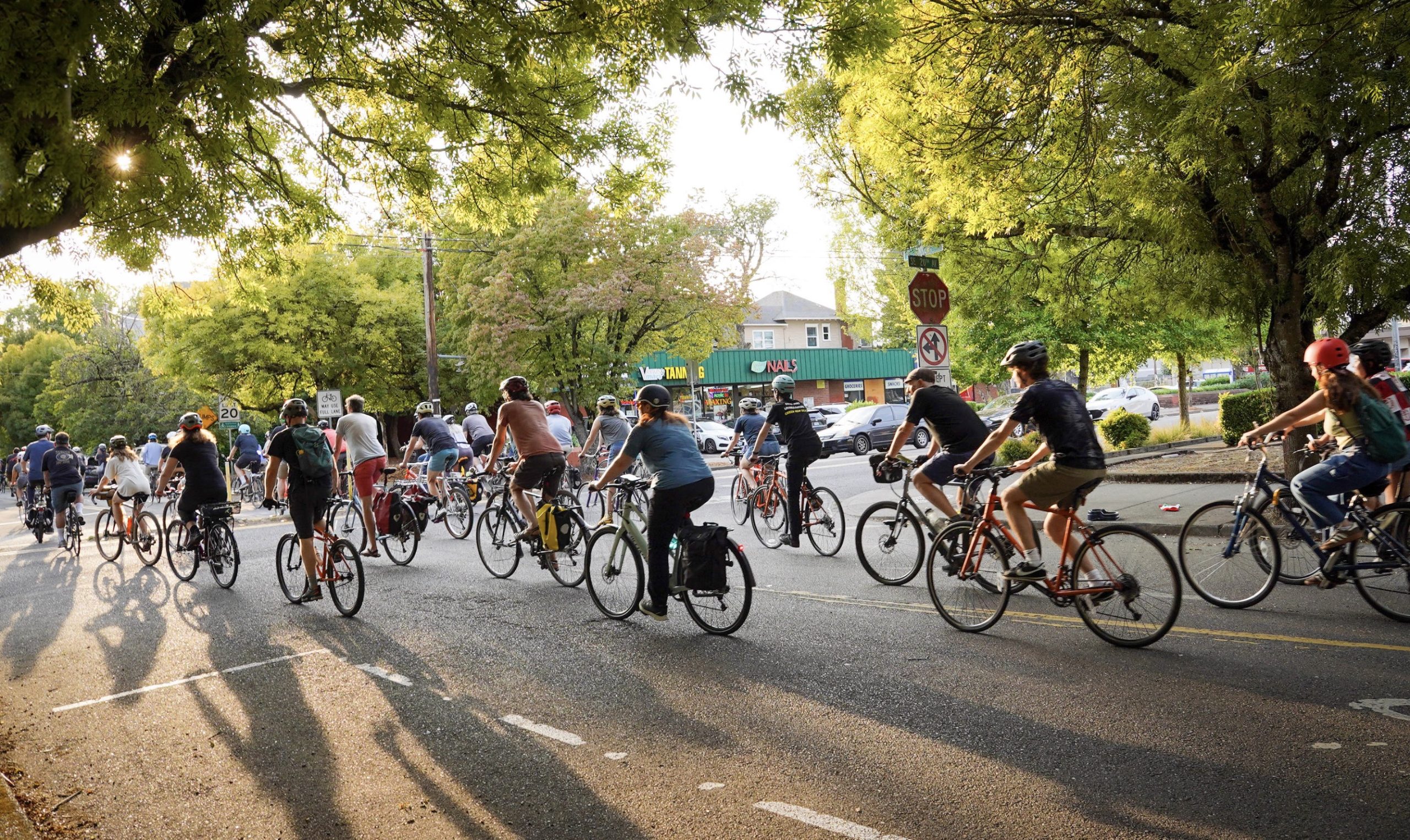
Riders on the Southeast Ankeny neighborhood greenway. (Photos: Jonathan Maus/BikePortland)
Publisher’s note: This essay is from Southeast Portlander, former PPS School Board candidate, and Bike Bus PDX organizer Rob Galanakis. Last we heard about the Bikeable Portland plan it was being considered for funding amid a special allocation from the Portland Clean Energy Fund. It was not chosen for funding, but backers plan to re-apply for PCEF funding at a later date. You can learn more about the plan via a presentation from its creator, City Bicycle Coordinator Roger Geller, at the monthly meeting of the PBOT Bicycle Advisory Committee on Tuesday, March 10th.
City leadership is largely united on a goal: make Portland the most livable city in the United States. And though it doesn’t always feel like it, there is broad agreement on how to get there: more housing, more jobs, more transit.
And more biking.
You and I and endless “beautiful PDFs” already know why getting more people riding is essential. What I’m here to explain is how the Bikeable Portland plan from PBOT does that. The plan seeks to boost ridership by activating people where they are: in their neighborhoods. It would fund ride organizers to go door-to-door, help them get riding (again or for the first time), and invite them on regular rides. There’d be minimal infrastructure built — just enough to stoke the flames being lit by those organizers and to get bicycling back into the headlines.
Advertisement
“My initial response was unapologetically harsh and expletive-filled. But I’ve come to believe, enthusiastically, that the plan provides our best – perhaps only – lever to get more people riding quickly.”
I’ll admit, it took a lot of discussion and consideration for me to come around. My initial response was unapologetically harsh and expletive-filled. But I’ve come to believe, enthusiastically, that the plan provides our best – perhaps only – lever to get more people riding quickly.
Bikeable Portland is focused mostly on the “social infrastructure” of our bike transportation network. If done for the wrong reasons, this is destined to fail, like sharrows on a 40 MPH road. But the plan’s reasoning, rationale, and practicality is sound.
This does mean we have to take a bit of a detour to understand why the plan will work. We’ll put Portland infrastructure and ridership in context, look at the role Bikeable Portland can play, and see why it sets us up for Portland’s next chapter in livability.
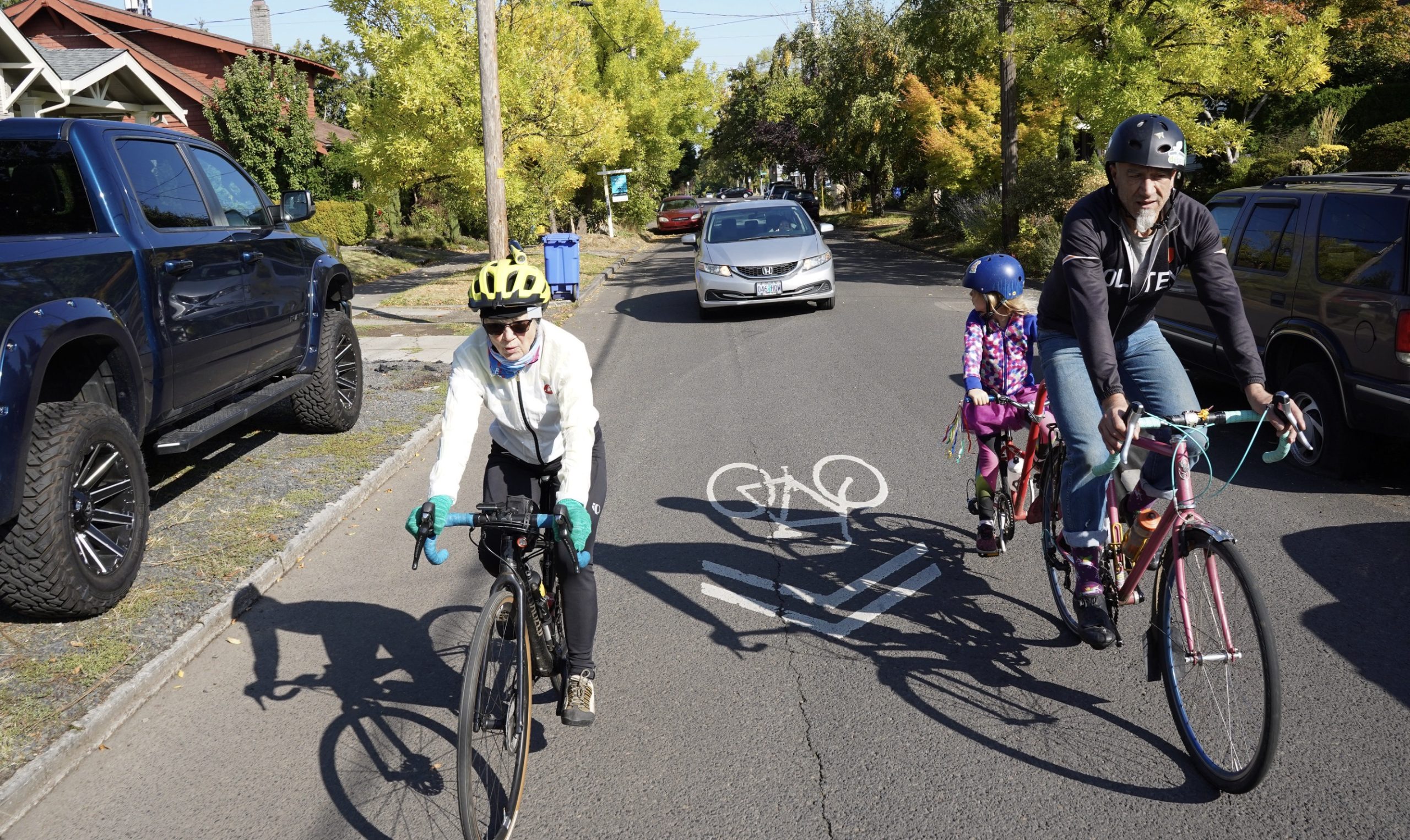
Riders on a neighborhood greenway, with a driver looming behind.
Portland’s Greenway-focused bike network
There are two globally unique aspects of Portland’s bike scene: our culture, and the fact that we created a bikeable city while building little hard infrastructure (off-street paths, Protected Bike Lanes (PBL), and diverters). Instead we lead on neighborhood greenways. We have a much higher proportion of miles of greenways to protected bike lanes than any other city.
Greenways are much easier to create than a protected or off-street network. Find a low traffic street, paint some wayfinding, change some maps, and voilà, you have a new greenway. Add some signals to crossings as funding becomes available.
The problems here are obvious:
Greenways don’t pass through commercial areas, where people want to be.
Greenways wind and detour instead of being direct.
Signal timings are often slow when crossing higher-traffic streets.
Greenways are undiscoverable unless you’ve been educated about them.
These are well-illustrated on our Micoromobility Dashboard, which shows trips counts on commercial corridors like SE Hawthorne similar to parallel greenways. Greenways are simply less practical for unfamiliar riders.
Advertisement
That said, Greenways have some major benefits:
They can be extremely pleasant.
They are extremely safe.
They allow more social, side-by-side riding.
They can be relatively cheap to create and improve.
The problem with “if you build it, they will come,” is that you need to build a network. And right now our protected bike lanes on their own do not form a network. In fact, there are very few places they even intersect. Greenways, because they are undiscoverable, don’t augment our protected network for most people.
Diagnosing the decline of ridership
If we’re going to turn around the decline of biking in Portland, it’s useful to know why it declined in the first place. PBOT’s Bicycle Coordinator Roger Geller has research and diagnosis from last year that is well-sourced and evidence based:
Bicycle ridership, in both absolute numbers and as a percentage of trips (mode share), has declined since peaking in 2014/15. Areas of Southeast and Northeast Portland had well over 20% of commuters riding bikes to work.
Trends on the street in Portland (declining bike mode share, rising overall traffic deaths) largely mirror national trends. These trends pre-date COVID-19. That is, “drivers are acting crazy post-COVID” is both true (and may explain part of the rise in non-cycling traffic deaths), but it obviously cannot explain the decline pre-2020.
Portland has built many miles of protected bike lanes and neighborhood greenways. The physical network is better than in 2014.
Riding a bike in Portland has been, and remains, statistically very safe. Our greenways in particular almost never see fatal crashes. However the comfort of many greenways has likely gone down, given larger vehicle sizes and more car trips.
The Central City, where most of our bike infrastructure and ridership was, has seen significant population turnover, with an influx of residents who chose to drive. This both eliminated people with greenway knowledge, and also put more cars on our greenways, which are often convenient cut-through streets.
Given what we know about greenways, this ridership decline is easy to understand. What can be done about it?
Advertisement
Bikeable Portland is “educating by doing”
Bikeable Portland has been called a “marketing” plan for biking. And in a sense it is: bikes are an incredible product, and Portland has a good network to use them on, but we need to help people learn how to use the product on that network.
That’s really all there is to it: Bikeable Portland is “educating by doing.” Get people onto bikes, help them learn the network to get them where they need to go, give them the information and skills necessary to continue biking. Everything in the plan is designed to get more people onto bikes. The coaches, the wayfinding, the street paintings, the evaluations, everything.
Greenways require minimal hard infrastructure, but because of their inherent limitations, they require more social infrastructure. When we spend money on hardening a buffered bike lane with curbs, we expect more people to use it, because they will feel safer. But greenways also need hardening, but instead of pouring concrete, we’re pouring knowledge, skills, and culture.
There is reason to be confident this will work: this is exactly what the Bike Bus movement in Portland has been doing. At schools with sustained effort and existing infrastructure, bike mode share has grown massively. Similar work has been going on in different communities through various non-profits. Bikeable Portland scales these concepts up to the city level. We can (and will!) debate the tactics of what interventions in the plan are most effective, but it’s pretty clear that an investment in the “social infrastructure” of biking will increase ridership.
Whether that can be sustained is a different story.
Advertisement
A Bikeable Better Portland
How do we make sure the gains from Bikeable Portland are sustained and expanded, and we don’t fall right back into the current baseline?
Ultimately, transportation isn’t that complicated: most people will make the choice that is least expensive for them, where “expense” is some combination of time and money. As a society, we’ve spent a massive amount to subsidize and externalize the cost of driving to make it seem cheaper and faster than alternatives. This has put us all on the road to financial and ecological ruin.
As a City, we have limited ability to change this. Undoing the damage of urban freeways, for example, is far beyond our own resources. It will take decades of effort.
Riding in the future protected bike lane on Sandy Blvd.
But, as a City, we can do a lot more than we’ve been doing. We could have built out a full protected network in the last 10 years. We could have installed dozens of miles of bus lanes. When we decide against putting bike lanes on a commercial street or force buses to sit in traffic, these aren’t financial or practical decisions. These are political decisions.
Getting more people on bikes through Bikeable Portland has a direct impact on City goals, like reducing emissions. But more people on bikes changes the political environment that has resulted in Portland moving backwards on many of its goals. This isn’t necessarily about changing who we elect, but creating the environment where electeds have more confidence in taking a swing on transportation policies that are sure to ruffle feathers before they’re accepted and appreciated.
Or put differently: spending $6-$9 million (there’s no formal ask on the table at this time) on Bikeable Portland makes it more likely we have the political will to spend another $6 million on hard infrastructure. Getting more people on bikes, quickly, will get an infrastructure network built faster than just spending directly.
I don’t know yet where this money will come from. But I do know, and the evidence is clear, that nothing we could spend this amount of money on – no bike lane, no diverter, no bus lane – will go further to advance our City’s transportation goals than implementing Bikeable Portland, to leverage the investments we’ve already made and strong culture we’ve created. If Portland needs to transform from the “City that Plans” to the “City that Does,” if we’re going to be the country’s most livable city, we’re going to need Bikeable Portland.
Part of PBOT’s holistic approach to saving lives. (Photo: PBOT)
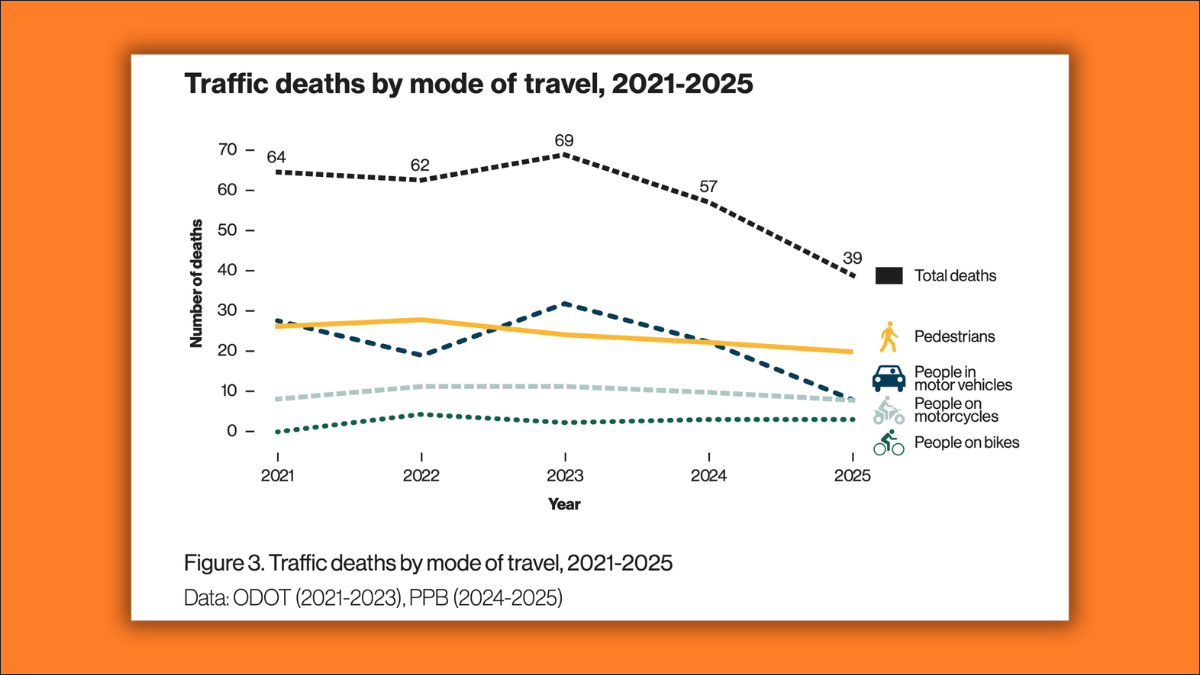
It’s nowhere near time to celebrate, but the City of Portland says after years of struggle they are finally making progress on their Vision Zero safety goal. The transportation bureau released its annual Deadly Traffic Crash Report today, which outlined a second consecutive year of declining deaths and marked what PBOT referred to as, “a decisive return to pre-pandemic levels and a 38% decrease from the average of the previous four years.”
PBOT’s tally of 39* traffic fatalities in 2025 is a steep decline from just two years prior when they recorded 69 deaths. (*Note: There are 10 additional deaths you’ll find in the BikePortland Fatality Tracker that PBOT doesn’t count in their Vision Zero tally because they don’t meet the federal definition of traffic death. See more at end of story.)
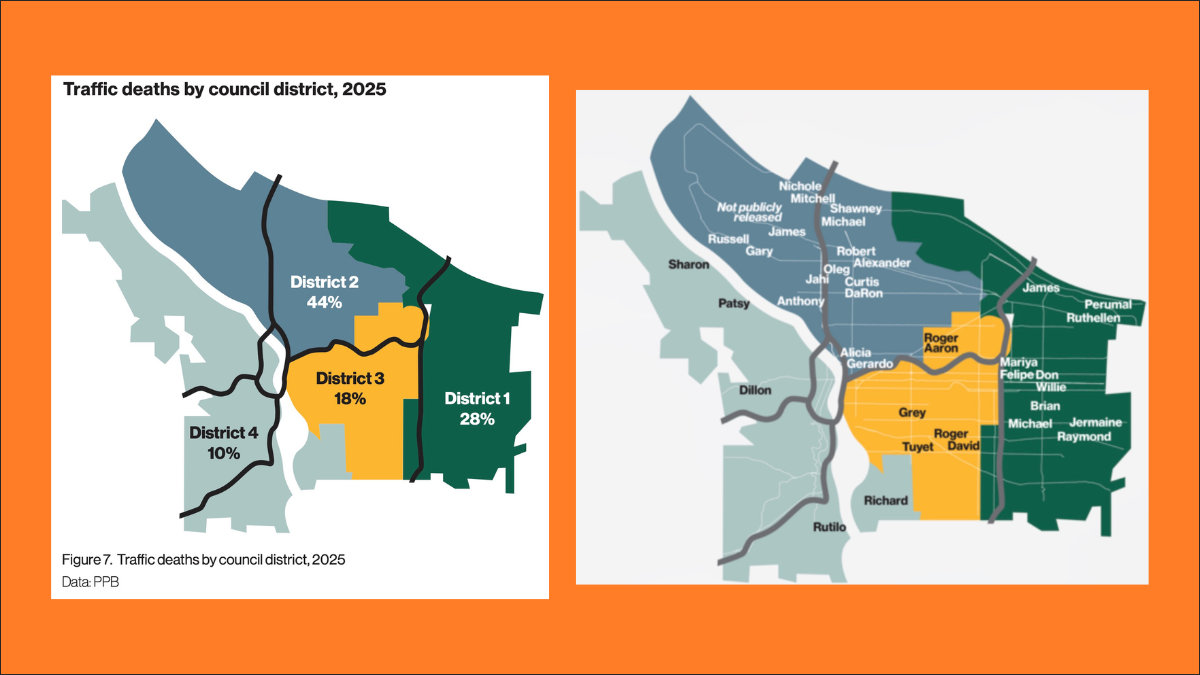
The City reports especially promising figures from East Portland, where road deaths fell by 56% compared to the previous four year average. The 11 fatalities in East Portland was the first time since 2018 that part of our city recorded fewer than 20 deaths.
Another good sign is that fatal hit-and-run crashes are down. Four people died in crashes when the driver failed to stop, that’s the lowest figure since before the pandemic.
Advertisement
In a statement, Portland Mayor Keith Wilson said he’s, “Proud of the lifesaving progress we’ve made.” “I’m grateful for my Council colleagues and City personnel as we align and inspire people and resources across the city to reach the true goal of Vision Zero,” he added.
The downward trend in Portland mimics national trends. And while it’s too early to fully understand why, it’s likely that policies that make road safety a priority, combined with federal funding from the Biden Administration, and a return to pre-Covid behavior standards play a big role.
In Portland, PBOT has maintained a steady and serious focus on their Safe Systems approach to making roads safer. The agency has: reduced speed limits citywide (aiming for 20 or 25 mph on most streets); redoubled automated camera efforts; implemented small but important changes like “no turn on red” and vision clearance at dozens of intersections; and they’ve completed and/or broken ground on major capital projects that reduce driving space while adding safer, more protected spaces for bikers, walkers, and transit users.
Beyond those efforts, PBOT has worked to expand this effort beyond their bureau and they’ve found a political champion for Vision Zero on City Council. Last fall, Councilor Tiffany Koyama Lane passed a resolution that reaffirmed the city’s work.
Advertisement
Graphics from the report.
Much of the lower number last year was a result of fewer fatalities in East Portland. In their report, PBOT said the traffic death rate in East Portland in 2025 was almost on par with the rest of the city — 6.4 per 100,000 residents compared to 6 per 100,000 in the rest of the city. “This reflects a dramatic drop in traffic deaths for East Portland residents compared with prior year, when the rate was three times higher than the rest of the city,” reads the report.
PBOT’s press release about the report was also notable in the prominence of the Portland Police Bureau (I have a hunch this might have resulted from input from Mayor Keith Wilson’s office, since the report itself didn’t talk much about PPB’s role). In years since the murder of George Floyd in 2020, PBOT and other bureaus distanced themselves from enforcement as public sentiment around policing soured (even the PPB said they’d de-emphasize traffic violations in the name of racial justice). The relationship became so strained at one point that the PPB decided to shut down its Traffic Division altogether (it was reinstated two years later). But times have changed. In this morning’s release, PBOT called PPB a “key partner with PBOT in traffic safety.” PBOT also touted the 7,564 citations, 1,396 warnings, and 311 arrests by PPB Traffic Division officers last year. “These efforts reflect the Bureau’s continued commitment to accountability, prevention, and collaborative action in pursuit of safer streets for everyone,” stated the press release.
As to how people died on our streets in 2025, speeding is still the most prominent factor with 41% (16 people) of traffic deaths involving speeding or excessive speeds. To learn more, check out the 2025 Deadly Traffic Crash Report or read more on PBOT’s website.
PBOT adheres to the definition of traffic death published by the National Highway Traffic Safety Administration (NHTSA). This means they do not include people whose death:
Occurs more than 30 days after initial crash
Is the result of a suicide
Is an act of homicide, when a person intentionally crashes into another person
Occurs in a crash not involving a motor vehicle, such as a MAX train and a pedestrian
Is caused by a prior medical event, such as a heart attack or drug overdose
Happens in a crash on private property, such as a parking lot.