

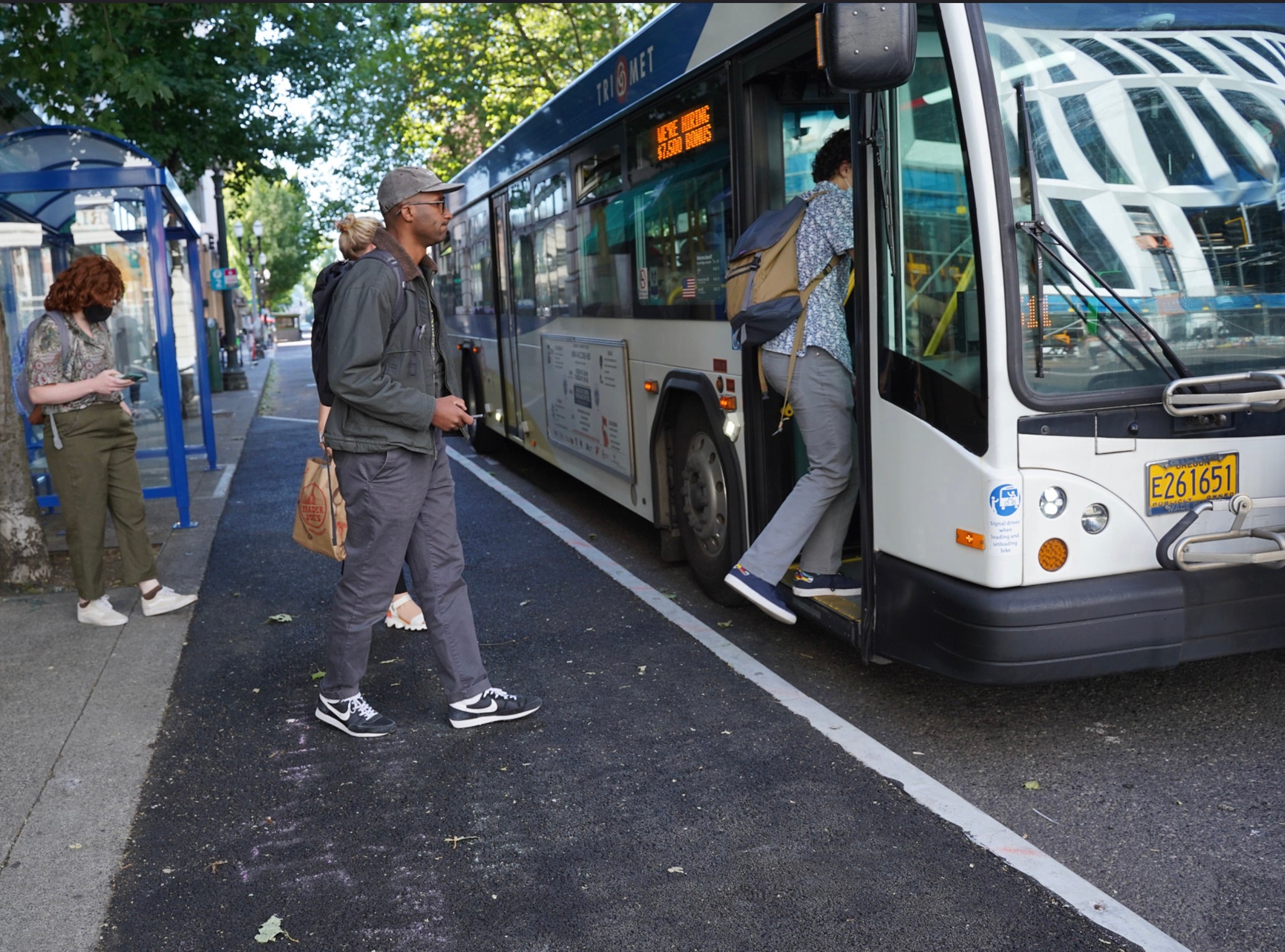
Portland City Councilor Mitch Green is worried our public transit system might be headed for a “doom loop” and he favors tapping into the Portland Clean Energy Community Benefits Fund (PCEF) to prevent it. His comments at a meeting of the Transportation and Infrastructure Committee this morning come just one week after TriMet proposed serious service cuts they say are necessary to grapple with a $300 million budget gap.
“In my view, the biggest threat to our climate goals is backsliding and losing ground on ridership,” Green said. “Which is a potential doom loop for transit.”
Green said making an investment into transit with PCEF dollars is something folks have been whispering about in private City Hall conversations, but now it’s time to bring it into the public. PCEF is a voter-approved fund administered by the City of Portland Bureau of Planning and Sustainability and made up of revenue collected from a 1% tax on the Portland sales of large retailers (companies that sell over $1 billion nationally and $500,000 locally).

Green was just spit-balling at this morning’s meeting, but he is clearly serious about the idea, which he described as, “Potentially approaching the climate investment plan (CIP, the plan that sets PCEF investment strategy) amendment process with a lens towards using some PCEF revenue to support TriMet through some sort of IGA [Inter-governmental Agreement].”
T & I Committee Chair Olivia Clark said she liked Green’s idea and wants to discuss it further at their next meeting.
T & I Committee Vice Chair Angelita Morillo said the topic of using PCEF funds for transit is already on the agenda for a meeting of council’s Climate, Resilience, and Land Use Committee scheduled for this Thursday, January 15th. The PCEF CIP adjustments on that agenda are part of a regular review process to make sure investments are set up for success and are in alignment with program goals. Separate from a larger investment in TriMet via an IGA as Councilor Green proposed, there’s currently a $15 million reduction to the CIP’s Targeted Electric Vehicle Financing Tools program that was slated to be spent instead on the Clean Energy in Regulated Multifamily Affordable Housing program. At least one councilor I talked to about that switch was uncomfortable that the funds were going from a transportation program to a housing program (given that transportation is the largest contributor to greenhouse gas emissions). Given Morillo’s comments today it seems there’s an opportunity here — given the severity of TriMet service cuts that have recently come to light — to keep this $15 million in transportation and put it toward bus service.
If a PCEF deal between Portland and TriMet was struck, it wouldn’t be the first time climate tax dollars funded transit. Back in December 2024, TriMet won $55.5 million from PCEF for their 82nd Avenue Transit project.
At this morning’s meeting, Councilor Morillo said the Climate Committee (which she co-chairs) will, “discuss different options for about $15 million in PCEF dollars that are available.” “Whether or not we should keep using them for housing infrastructure and making that more climate-friendly, or, what if we invested it on the bus? This is an open discussion.”
And since there’s often heartburn among climate advocates and politicians whenever PCEF funds get stretched into new places, Morillo added, “And as a transit user that desperately needs some of the bus lines that are getting cut, we need to balance the need to protect PCEF and its integrity and what it was meant for, and also look at some of these emerging issues given that the federal and state legislature abandoned us on public transit issues.”
That sense of urgency to fund transit is shared by Councilor Green.
“Once people switch away from riding a bus and they decide to get in that car, they’re never going to go back to riding a bus,” he said at the meeting today. “Or if they do, it’ll take pretty herculean effort to do so.”
— Learn more about Thursday’s Climate Committee meeting and view the PCEF CIP ordinance here.
Thanks for reading.
BikePortland has served this community with independent community journalism since 2005. We rely on subscriptions from readers like you to survive. Your financial support is vital in keeping this valuable resource alive and well.
Please subscribe today to strengthen and expand our work.
This is awesome to hear–Portland’s Bus Riders Unite group wrote to Councilor Green last month suggesting this and it’s wonderful to know that others were discussing as well.
This is a perfect use of PCEF funds. Transit service takes cars off the road, and transportation is our region’s largest source of GHG. Many low-income folk and people with disabilities rely on transit to get around, making this supportive of environmental justice.
To answer some of the concerns in other comments:
Transit service is critical to a green transition. Part of that transition is providing alternate modes of transportation to single occupancy vehicles. Transit does not need to be electric for this to be true. There’s plenty of research showing transit’s ability to reduce transportation emissions, etc., e.g. https://www.nationalacademies.org/read/26103/chapter/1It's also important to consider the affect of NOT preventing TriMet cuts, as Councilor Green suggested. Reductions in service would cause the opposite of a green transition, by making transit less attractive, and encouraging some folk who are able to switch to cars. In other words, protecting transit service means protecting the progress we’ve made, and allowing transit service to be cut degrades that progress.Transit frequency is the most important factor in considering whether transit is useful, so TriMet operations is exactly where this funding should be spent at this time, not on infrastructure improvements. Infrastructure improvements do little to help if there’s not enough service to get value from those investments.This funding could be focused on maintaining routes within Portland, but it’s important to remember that Portland residents need to travel outside of Portland. So even if these funds did support routes not wholly contained within the city, they could still be for the benefit of Portlander’s and Portland’s green transition.This is not nearly enough money to fill the TriMet budget gap–but what’s most important is elevating the urgency of that budget gap. Portland purchasing service could induce other regional cities to do the same, and will highlight the failure of state officials last year to protect critical transit service and could spur legislative action.
Thank you Councilors Green, Morillo, and others who are helping protect Portlanders who rely on transit!
“This is a perfect use of PCEF funds.”
Actually, it’s not. If you want to know the perfect use of PCEF funds, read the ballot initiative, where we defined what was appropriate and what was not.
Voters specifically walled off government spending, and dedicated the funds to energy transition projects and related job training.
As worthy as TriMet is, it’s simply does not meet the funding criteria voters established. If we want to use these funds to pay for TriMet operations, then we should make that decision collectively, just as we did to establish the fund in the first place.
PCEF is distributed according to city code, not in direct relation to the ballot measure itself. In 2022, facing a glut of unspent money and a budget shortfall the city amended how funds could be disbursed to more broadly reflect the goals in the city’s climate action plan. If you disagree with that move, you are welcome to pursue legal action against the city or otherwise organize to redefine PCEF disbursements along the narrow lines from the ballot measure. But it is factually incorrect to say that TriMet service is something that cannot (or even should not) be included in PCEF investment based on current city policy.
You are legally correct — my argument would fail in court. City council has the power to change the PCEF program and spend the money as they see fit (as they have).
But it is also a violation of trust to use the program in ways that run counter to what voters chose. Mine is a moral and political argument, not a legalistic one. Terms like “perfect use” (and even “should”) don’t speak to what’s legally possible, they speak to what’s morally compatible with what voters said.
And that wasn’t “give this money to TriMet.”
In some ways sure, but also it’s not like council said “spend this money on anything”. They are still restrained to items outlined in the city’s climate plan. I think most Portlanders are more concerned about climate in the broad sense than they are in the narrow sense of what was specifically outlined in a 2018 ballot measure. You are making a moral argument, and I’m saying that I haven’t seen evidence to suggest this is a distinction folks care about.
Better bus service means less driving which means less greenhouse gas emissions. There’s a clear nexus there, so arguing that it’s not on the 2018 ballot measure feels petty.
“ You are making a moral argument, and I’m saying that I haven’t seen evidence to suggest this is a distinction folks care about.”
You are absolutely right. I haven’t seen any evidence of a moral argument here either and it’s heartbreaking.
It’s not actually petty to want government to function as it says it will.
Don’t forget that PBOT had a funding source in the ULF back in 1988 that was lost piecemeal to other agencies in this same manner. No one cared about the intent then, they just wanted that sweet cash flow to themselves and they took it. I’m sure the arguments made sense then and the people felt just as justified in taking that money away from its original, stated purpose then as they do now.
Apologies, I was to eager to hit the “post” button.
Should have said…..
“You are absolutely right, I haven’t seen any concern over the distinction between morality, intent and legalese either and it’s heartbreaking.”
I certainly am, and I wish the program had been designed to broadly encompass any climate mitigation project that could be shown to be effective on a dollar-per-ton metric.
But it wasn’t. If most people agree with you, and they might, it would be very easy to change the program. It would be an easy an inexpensive ballot measure, like removing some archaic and vaguely offensive language from the city charter, as we do from time to time.
But until we do that, we have an official statement from voters, which carries significantly more weight than your sense of what people really wanted. That statement was about energy transition, and included a prohibition on using the program to backstop government programs.
As to the efficacy of the proposal, I fully accept that some car trips are likely to not happen if we give $15M to TriMet. Will we prevent $15M worth of emissions that way? I highly doubt it, especially as after a year, or less, the money will be gone.
I mean we have an official statement from the voters about a lot of things. That doesn’t make those morally binding forever. If the voters are unhappy with the direction that the city has gone with PCEF, there are methods to address that. Since those haven’t been taken, I think it’s fair to assume people are fine with council’s action.
And I dunno, the moral authority of a yea/nay vote is always a bit hard to pin down. I feel that your narrow interpretation – that expanding the scope of PCEF is misinterpreting what voters signaled they want – is misguided. I think Portlanders want more climate action, not less.
Like a ballot measure? 🙂
Anyway, I’ve learned my lesson. I won’t support a measure like PCEF again, no matter how worthy the cause seems in the beginning.
I think it would be an even larger violation of trust to have not amended the program and left money unspent in the account. The amendment followed the legal political process. Councilors (ostensibly) did what their constituents wanted them to, the same constituents who voted for the PCEF measure in the first place. Ballot measures are not sacrosanct, which is good, because they often come with a slew of drafting issues and changing contexts. As regular citizens, we don’t get the benefit of professional legal advice in drafting, or time in committee to debate the scope and propose amendments, or the privilege of pulling a lawmaker aside in the hallway ten minutes before a vote to express our concerns and ask for a delay while drafting continues. We get a single yes or no vote, and the measure either passes as written or fails. Recognizing all of that, it is right and proper that the appropriate lawmakers have the freedom to re-examine and amend statutory language from time to time when problems occur, problems like having a big pot of money and nothing to spend it on. If you don’t like the decision your councilor made, you’re free to let them know, draft a recall petition, support an opponent in the next election, or even make a run for council yourself. However, the fact that there was no major controversy around the vote and one councilor even retained his seat in the 2022 election points to the fact that the majority of Portland citizens do not feel jilted and betrayed by the council’s decision to tinker with the PCEF governing statutes. I think we mostly just wanted some of the biggest emitters in the city to pay for the privilege of polluting the planet and are happy that the money is going to good mitigation efforts in line with the original spirit of the initiative.
I think transitioning from single occupancy vehicles to a public transportation culture is an appropriate use. More than housing, given the agenda of the initiative, If the argument is any government spending at all is prohibited, that’s one thing. But if it’s between the two, TriMet seems much more aligned to climate concerns.
That’s a perfectly valid opinion, it just differs from what we voted on.
If we want to change how we use the money, let’s vote on it. I might even support such an initiative; it’s the violation of the will of voters I object to, not the funding of TriMet (especially if someone can show that we’d get $15M worth of reduced emissions by writing them a check).
(And yes, all government spending was prohibited by the ballot measure.)
Disagreement over what should be done and could be done based on “what would be done” is not real a debate between either position, but a question of how the would was defined, how far beyond their own noses the people of the time were thinking, and how the information they had defined the scope of their thinking.
Trust doesn’t initially have to be earned, but it is easily lost, at which point earning it back is monumental. Adhering to the initial text in a literal prevents loss of trust. Living out the spirit of the text gains a modicum of trust. Extrapolating the original text to make previously unpredicted moves is the most risky because it will inevitably come with some lost trust followed by the potential for a massive gain in trust, but that chance is astronomical and is more like to destroy all of the foundations of a governed society.
The payoff here just doesn’t seem to meet the odds, I’d ask the voters for permission to expand the black and white.
Mass transit is an energy transition project.
Not a huge surprise that after only a few years that PCEF has become the “go to” slush fund to raid. Might as well cut out the drama at this point and have the entire tax go into the general fund.
At least public transit service is pretty straightforwardly climate investment. Plus, the overhead should be low since TriMet already exists and provides the service. Lots of PCEF issues people have seem to boil down to “this grant money is being spent on nothing”, and it’s hard to argue a bus still going down NE Glisan is nothing.
TriMet service does not help with energy transition or related job training. Maybe helping TriMet buy electric buses at a faster rate than they would otherwise might be something, but just backfilling TriMet’s operating budget is not what we voted for.
Of course, Greene is free to go back to voters and ask if they want to expand the types of programs these dollars are spent on. If voters approve, then sure, go for it.
Yeah I hate to say I agree. When I voted for the tax I was under the impression it would be paying for things like heat pumps, rooftop solar, car chargers, and better insulation. I love the bus and think that TriMet deserves to be funded and provide good service, but if that’s what we want than we need to pass the Portland Fund TriMet and Provide Good Bus Service (PFTMPGBS) tax.
We don’t need a bunch of techno-fixes; we need people out of their cars and on free and fast buses everywhere, all the time.
“war on cars” climate crisis denial is very enjoyable cognitive dissonance.
TriMet is basically already free and because of that can often be very problematic to ride. It’s reputation just keeps getting worse as not being a friendly way to get to work or just around town.
What we really need is better bus service that only paying passengers are allowed on might be a good first step in getting people “out of their cars”.
On the trains and buses, I take now, they are still only about 1/2 of what they were before Covid.
Yep, funding mode shifts from automobiles to transit is a perfectly valid way to use PCEF, in my mind. The thing that I do worry about is Trimet becoming more or less dependent on PCEF funding, hobbling PCEF’s ability to fund other needed mitigation efforts. But I’m 100% on board with an emergency infusion of funds, at least. The hard part comes next where Portland, Trimet, the three counties, various other cities, and the state figure out how to stabilize Trimet and hopefully wean it back off of the PCEF funding. The legislative session is coming up, and a transportation omnibus is back on the table, so my eyes are on what happens in Salem.
Call your representatives and senators!
Legislator Lookup
PS
As long as we’re talking about what is and isn’t a good use of PCEF money, I like to refer Project Drawdown: https://drawdown.org/
Enhancing public transit is right up there as one of the highly recommended projects to invest in. https://drawdown.org/explorer/enhance-public-transit
From your link:
“Buses in the baseline are a mix of diesel and electric. For the purposes of this solution, we assume that all buses serving shifted trips are electric.“
Do you think Trimet is going to be in a better or worse position to transition to an electric fleet when they’re implementing service cuts due to a $300 million operating budget shortfall? Trimet currently has a soft plan to transition to a fully electric fleet by 2040. That’s less likely to happen if the agency enters a ridership death spiral. In any case, shifting people from a personal automobile, even an electric automobile, to a diesel bus is still an incremental improvement in meeting climate emissions goals.
I support using PCEF funds to preserve (and even expand) transit because we need an alternative to the bloody SUV. I also think the climate justice argument is stronger than the “incremental improvements” argument.
We should make the money contingent on the State of Oregon making the Trimet Board an elected body, not appointed by the Governor.
This is a correct and appropriate use of the funds. If we didn’t have a bus service, it would be the exact kind of thing those funds might be used to pay for.
My only concern is if it becomes permanent – if they fill this gap, and then there is no urgency to fill that funding gap. Transit funding is something we allegedly pay for already, but we failed to raise the appropriate taxes to keep paying for it. We need to fix that separately.
Completely agree with you with one caveat. The buses were a great idea for PCEF before the budget collapse became apparent. Now it’s clearly as you said using the PCEF funds only to fill the gap.
How long before the council uses the funds for items that can only be vaguely connected to climate resistance/preparation?
“How long before the council uses the funds for items that can only be vaguely connected to climate resistance/preparation?”
You mean like street sweepers?
Yes. I can just hear the justification now….”Well, the climate deposits dirt and debris so it makes total sense to but street sweepers with PCEF money”
I’m all for safer bike lanes, but at some point there has to be funding barriers. This is pretty much how PBOT lost its revenue source to begin with. It was frittered away “just this once” or “we’ll replace the funding next year”.
Except that robbing one budget strong to drop funds into another is a slippery slope to general fiscal mismanagement. What happens when this becomes the primary solution to ALL the city’s money problems?
Nobody is robbing anything, they’re literally just using the funds for their intended purposes. It isn’t “robbing” to spend money on something.
Actually, if you know what the ballot measure said, and what voters intended, this statement is neither literarily nor figuratively true. Or true in any sense.
Your statement is flat-out wrong, literally.
I like the idea. What could be better for the climate than taking SOVs (and SUVs) off the road? Cars and trucks account for ~45% of GHG emissions, which is the largest contributor. Start by addressing the sector with the greatest impact.
I’d like a PCEF check to buy an electric vehicle.
I would like to see some analysis about just how many SUVs would be taken off the road by PCEF spending its money this way rather than just assuming it will be an effective tactic to reduce GHG emissions.
I’d rather spend the money where it will have the greatest impact, which I highly doubt is TriMet operations.
I like the sentiment, but I don’t see how this takes SOV’s off the road. It will hopefully prevent more SOV’s form being added. Congestion pricing has been shown to take SOV’s off the road and could be used to fund transit.
“I don’t see how this takes SOV’s off the road. It will hopefully prevent more SOV’s form being added. ”
It’s the same thing.
Except, as noted, it’s important to prevent adding vehicles because once people buy and start using a new car, at that point they feel invested. It’s harder to go the other way.
“T & I Committee Chair Olivia Clark said she liked Smith’s idea and wants to discuss it further at their next meeting.” Did you mean Clark liked Green’s idea?
yep. fixed. thanks!
How far will $15 million from the PCEF go toward filling the TriMet budget hole?
About 1/20th based on current projections. But the City would be wise to have their funds only allocatable to city of Portland serving routes. By population, Portland is about 40% of the taxing district (they may account for more or less of that by payroll tax but I don’t know that off hand), so this $15M would account for about 1/6th of the budget hole that would affect Portland*.
*directly anyways. Everyone in the district suffers when cuts happen, since it makes it harder to travel to other places on transit.
If this was a tax that Portlanders could prove they were paying, sure, but it was purposely created to be opaque and not an easily identifiable line item that people pay. Just last week this very blog made it clear that it wasn’t clear if prices were even reflecting the tax, LOL.
That said, I didn’t think Portland would get to the economic tribalism portion of the doom loop so soon, but this will certainly be a period of entertainment.
I haven’t studied exactly how much spending in Portland is attributable to city residents, but it’s fair to assume that most of it is. Maybe excepting Clark County residents who have a financial incentive to go to Portland for tax purposes. But from the city’s perspective it’s their money to spend so they will want to spent it on projects that benefit them. Is that tribalism? Maybe, but so is all municipal government.
The campaign for PCEF was explicitly pitched as not being a sales tax, but a tax borne by the largest “billion dollar” retailers in the city, not borne by Portlanders themselves. A complete misunderstanding of economics, but see Portland Schools. So, it is very fair to assume all of us regionally are paying higher prices as a result, but very much not clear that Portlanders are contributing to this tax at a rate greater than anyone else. That is a feature, not a bug, they won’t even tell you who is paying it and how much, citing taxpayer rights laws. I bet if they let companies opt in to public disclosure on how much they were paying it would be nearly universal.
So, Portland wants to have their cake and eat it too. Works well in good times, a bit harder when things start to go sideways, i.e. Trimet.
1.7M people live within the Trimet service area, and 1.05M of those don’t live within Portland. We know incomes are higher on average (and median) in the areas outside of Portland than within Portland, and we also know that probably 75% of rides on Trimet happen within Portland. We can easily further extrapolate that the incomes of people who use trimet are lower on average as well. So, the city that is completely dependent on the surrounding area for its funding of transit is going to hold the purse strings tight now? The city that destroyed their downtown, that makes development almost impossible, starting a business onerous, now wants me to pay to pretend people still need to go downtown for work. Nah, I’m good, its just municipal government, no hard feelings.
Tax incidence especially for a selective sales tax in a county that borders a more economically powerful state with high sales tax rates isn’t always an easy question to answer.
TriMet is funded on a payroll tax, which is paid by employers regardless of where their employees live. Population and income isn’t a useful way to understand if there’s some kind of Portland subsidy in the structure of TriMet. I tend to think there isn’t, but it’s been a while since I looked at employment trends in the TriMet service area.
I’ve spent too many precious hours of my life responding to you specifically here too. We get it, you hate Portland. I don’t! That’s why I still comment occasionally despite moving to Seattle. I want TriMet to remain functional for the people I know and love in Portland.
Like plenty of others here I am sure, I’ve had the most important moments of my adult life in this city. New houses, new jobs, babies, friendships, etc. I love this city because I remember how great it was, but yeah, I hate the way many people are running it. If being critical of leadership, policies, and new (untested) ideas is akin to hating a place and that makes my opinion less than some pollyanna Johnny come lately, I couldn’t possibly care less.
Yep, per Blumdrew it’s 1/20 … TriMet says it has a $300M budget gap here: https://trimet.org/servicecuts/index.htm
Hmm. I’d rather it be spent on insfrastructure that improves transit, like nicer stops or transit signal priority. I think it would even be a better use of the money to buy TriMet a bunch of electric buses. I understand the want to stop the backslide on service cuts, but what about this time next year? Are we just going use our PCEF slush fund in perpetuity to fund TriMet or is there a plan for a more durable funding source; aka raise the (currently TINY) payroll tax or develop and rent out some of the asphalt currently surrounding light rail stops.
It would be great if TriMet had a low-capital cost plan to improve service across the board while reducing operational costs. Something like a stop consolidation/bus lane/fare payment machine/signal priority plan could do 50% of the good of like a full FX build out for 10% of the cost. But to my knowledge, they don’t.
Stuff like TOD takes a lot more time, and has a harder to guarantee impact on the bottom line. But they do have a TOD team for what it’s worth.
As long as taxes are assessed appropriately, TOD is the answer to making transit work, making cities work, and making a high quality of life sustainable. Requiring a car to live comfortably is just an unnecessary complication that has very little benefit that can’t be largely replicated by transit-friendly land use and good transit.
It’s good that TriMet has a TOD team, but Metro and TriMet need to work together to stop Portland’s sprawl. Especially while the metro still has the vitality to keep adding population, ensuring that we start building up–rather than out–should be among the region’s top priorities.
Well do I have some bad news for you about property taxes in Oregon: they aren’t really doing fair assessments. Incidentally, TriMet’s historical strategy of maximizing utility for large employers downtown can be read as purposeful efforts to improve its own bottom line, as it is largely funded by payroll taxes.
I’m all for transit oriented everything, but I think TOD is best when it’s a long term strategy. Stopping sprawl and ensuring compact neighborhoods requires a lot more than just better TOD.
Electric buses are nice–especially from a rider’s point of view–but they really shouldn’t be the priority. They are quite expensive, don’t provide any inherent service improvement (greater frequency, on-time performance, etc.), seem to be problem-prone (at least if choosing from America’s relatively small pool of vendors), and ultimately do less for the climate than simply getting more people to ride any bus or transit.
Electric buses should be a priority–just not #1. (As an aside, I’m not sure why TriMet hasn’t invested in hybrid buses.)
Electric buses with batteries may be a sort of sentimental favorite but that doesn’t mean they are necessarily the most cost effective way to provide fast and efficient service across the system within the operating life of new buses. A bus running off overhead wires is much lighter, likely cheaper, and way more flexible in operation since it doesn’t have down time for charging.
If a person favors things like electric buses, they might bear in mind that a large trend toward private electric vehicles is in competition for resources with battery electric buses and transport vehicles.
LOL!
US EV sales plummeted in 2025:
https://insideevs.com/news/782405/ev-sales-drop-2025-tax-credit-trump/
US Automakers closed EV and battery plants and took massive multi-billion dollar losses:
https://www.euronews.com/business/2025/12/16/ford-walks-back-ev-ambitions-amid-falling-demand-and-hostile-politics
https://www.reuters.com/business/autos-transportation/gm-take-6-billion-writedown-ev-pullback-2026-01-08/
Sounds good to me, but we should really redirect the endless money supply that we are sending to the county.
And don’t tell me it can’t be done…that thee is some rules against it. Rules, precedents, and laws don’t matter anymore in government.
The right wing would make it happen in a second if they had the majority and if supporting transit aligned with their goals.
Does $15 million really do much? Trimet says they have a $300 million gap
That is just one piece of this process. That’s a potential piece of funding that that specific committee is debating. What counselor Green is talking about would be totally separate and could be more potentially. It’s all early days in discussing this.
It’s very nice and generous for the City of Portland to offer to subsidize transit service in Forest Grove and West Linn, but what happens when the city inevitably removes that subsidy to fund some pet project? Will Trimet be able operate afterwards? And will the other jurisdictions be inclined to match the funding? Or worse yet, reduce even further their share of the funding?
The Federal Transit Administration (FTA) tries its best to make sure that each publicly-subsidized transit system has stable funding, including at the 3-county state-run Trimet, so that federal and state subsidies are most effective. There’s no guarantee that Trimet will accept the offer of extra funding from Portland, or even that they’ll be allowed to.
In Seattle, the transit levy is only allocated to Seattle routes. It would be easy to do this for TriMet.
There is absolutely no way the FTA would prevent TriMet from taking city funds. They want stable funding, but there are urban transit systems that are just part of general fund allocated city transportation departments (Madison, WI baby!). They do not systematically require all funding come from specific, permanent sources.
Ditto what Blumdrew says: Seattle’s Move Seattle levy is only used to increase transit service within city limits.
I support this move using PCEF funds (for improving service within Portland) and I think it should be way more than $15 million. But other commenters are right: This has to be part of a bigger funding strategy to stabilize transit systems–it cannot be a replacement for direly needed state funding or an escape hatch for timid legislators. And I think another big regional (Metro-area) ballot measure (this time for transit only) on the 2026 ballot will have to be part of the solution.
After all, with a growing city and metro population, transit service should be continually expanding–not just remain at current levels.
To amend my comment: A new regional transportation ballot measure should fund transit and pedestrian & bike infrastructure (sidewalk infill, safe routes to school, multi-use paths, buffered lanes, etc.)–but not roads.
We should take our cue from Seattle-area Sound Transit’s massive multiple ballot measures (totaling over $100 billion!!), which were rail/bus/ped/bike only, and approved by a strong majority of voters. That has built the Puget Sound area an entire light rail, commuter rail, and express bus system from scratch in 20 years. People want to see transformative, ambitious improvements from their tax $$–and then they’ll vote yes.
(Yes, Oregon has some limitations that WA doesn’t in terms of funding (no sales tax, property tax compression), but there are ways to raise major revenue to invest in transformative transit/bike/ped improvements and abandon OR’s perpetual austerity mindset.)
Yes and…
“”””
People want to see transformative, ambitious improvements from their tax $$–and then they’ll vote yes.
“”””
This is definitely a good way to show off for votes, but every expansion needs to come with a maintenance plan. We’re here because the baseline operating costs are not being met and pulling a Fed and getting a large sum for “It’s new!” is not going to help. Trimet has enuff decades of operation that they should be able to link the tax rate to a percentage of another cost indicator so that they don’t have to beg for money and the upgrades the system clearly needs need to be budgeted as a pool of cash that can support a smal number of major projects every decade or be tapped for general improvements(platform screen doors, automated brake/signalling systems, technology retrofits, electrification, etc.).
Do we have a sense how big the hole we’re trying to fill is?
$300 million – https://news.trimet.org/2026/01/trimet-service-is-changing-later-this-year-we-are-asking-riders-to-weigh-in-on-our-proposals-now/?_thumbnail_id=20208
Under no circumstances should a tax on Portland residents (who pay the PCEF tax via increased goods prices) be used to fund a Metro function which covers service in more than just Portland. Hard no.
People who live outside the city limits presumably pay the PCEF tax indirectly through purchases they make from retailers that actually pay the PCEF tax. And Portland residents sometimes ride the bus beyond the city limit, thereby benefiting from trimet service there. But I hear you and totally agree.
In Seattle, the transit levy is only allocated to Seattle routes. It would be easy to do this in this circumstance as well.
This is a fun stage of the Portland doom loop, the combination of a shell game and what is essentially tribal economics is hilarious.
It is funny because you believe that Portland passed this tax and then large retailers went and hired someone to make sure that only prices in Portland were raised to cover the cost of this tax and that it surely didn’t increase prices for the state or region as a whole.
Except that, if you look at policing, the public, the local population, and events… Portland werves the surrounding area… we can’t not do so just because of human movement and economics.
If we’re not transiting in some of the workforce and others, then the suburbs will fill our city with their cars, we’ll have to look at other modes of transport to leave the city, and major events will strain automotive infra well beyond anything we currently see.
The cop talking to the driver that hit Viv several weeks ago on NE 7th and Holladay actually said “Portland has weird driving laws” to the driver as if to position himself as an outsider, despite policing our streets. Our city is a hub for the entire area. Everything that happens on Trimet impacts the city in one way or another.
I support this 1000%. I applaud Mitch Green for taking the initiative here and encourage anyone who supports it to testify on Thursday at the committee meeting!
I think for a more permanent and broader solution there needs to be a PCEF like tax at the state level. Part of the reason why Republicans got the upper hand on the transportation bill was that it is a regressive tax.
PCEF is a regressive tax, probably significantly more than a payroll tax.
Yep, all the Winco shoppers pay into it.
There was recently a spirited discussion here debating whether the PCEF tax was effectively regressive. Some said it wasn’t as it only taxed corporations and some said those corporations passed the tax down to consumers who were most likely lower income.
I’d like to see a thorough study of which side is correct before establishing a state wide version of the PCEF tax.
If you can argue that the PCEF tax is regressive, you can argue any tax is regressive. And the anti-tax folks inevitably will.
Aren’t you arguing the tax is passed on to the consumer when you said this above….
“People who live outside the city limits presumably pay the PCEF tax indirectly through purchases they make from retailers that actually pay the PCEF tax.”
To me it seems that you are making the argument that the tax is passed on to the consumer, but I could be misreading your intent.
Well, that’s why I qualified my statement with ‘indirectly’ and ‘actually’. It’s not clear to me that “Does the PCEF tax get passed to the consumer?” is a well posed question without some additional specification of what exactly “pass on” means. My point is that progressive shouldn’t hand wring so much about the progressiveness of proposed taxes and focus more on getting government to raise and effectively use revenue to further the common good. This tax was explicitly aimed only at the biggest of the big corporate overlords. But, somehow, it’s the consensus that this tax is too regressive. If that argument can be made about the PCEF tax, which was specifically designed to only tax big corporations, it can be made about any tax. Or at least any tax collected from corporations that sell stuff.
I’ve been trying to find a study that directly measures this, but to no avail.
As far as a sales tax goes, it’s the least regressive you can get, only taxing the big box goliaths and given how minuscule the tax is I would bet they don’t even both passing it down.
A sales tax covering food at stores where a huge number of low income folks shop is “the least regressive you can get”?
I think we need to recalibrate what those words mean.
I personally think they do pass it down to consumers.I also think the reason there is no study (I couldn’t find one either) on whether it is regressive or not is because it’s already known that it is and no one wants that proof to be used against them when the PCEF is inevitably expanded. After all, it’s being proven in real time that the funds can be used for anything.
Sales taxes are highly regressive – they hit poorer people far harder than rich people. Rich people are far more likely to evade sales taxes altogether by using purchase orders and engaging in business-to-business transactions at cash-and-carry stores and at Costco (for bogus home businesses they happen to have including personal 501c3 foundations and estate trusts), or else make online orders in states that don’t collect other state’s sales taxes (such as Colorado.) Poorer people are far more likely to live in food deserts where the only available food at Dollar stores and similar businesses are processed packaged foods rather than fresh.
It would be interesting to map which district actually pays the most PCEF indirect sales tax – I’m guessing it will be District 1 or 2.
In general, property taxes tend to be the most progressive tax – it hits rich people who own property more than poor people who rent (though rent itself reflect property taxes being paid by the landlord.) Multnomah County did an audit a few years ago and found that residents in District 1 (East Portland) pay far more in taxes per square foot of land and buildings than any other part of Portland.
The regressive nature of sales tax is in reference to who ultimately pays the tax, which for a sales tax is the person buying something. While there are legitimate debates to be had about how much of the PCEF tax specifically gets passed through to consumers, it’s only less regressive than a broad based sales tax if the retailers who don’t qualify provide a significant amount of the shopping that lower income residents do. I haven’t seen any data, but my inkling would be that this isn’t true. Though I’m not sure how PCEF would treat something like Ace Hardware (locally owned franchise). I guess I’d assume they have to pay? But would be happy to be shown otherwise.
On how much of PCEF gets passed on to consumers, I think “most” is fair. But “all” may be too much of an assumption. Large retailers still have to theoretically compete with small retailers on the open market, and that will constrain them from fully passing the tax on.
Since sales taxes are regressive because everyone has to spend a baseline amount of money, the least regressive sales taxes are ones on strictly luxury items. But targeted sales taxes like that on a municipal level are generally bad policy, since they obviously encourage actual tax flight.
There aren’t a lot of scenarios that can play out positively in a state with more 65 year old’s than those under 18, with billions in unfunded pension liabilities and debt, that avoid regressive taxing schemes. Barring any return to moderate fiscal spending, Oregon will not be able to avoid a sales tax, it is just a question of when it will happen and will they be able to convince everyone to do it for some new things, rather than just paying more for the same. There is a finite term to 30% of people paying for the other 70%.
I support this. If the TriMet service cuts go through, that will encourage more cars on the road.
I would condition this on TriMet and PBOT agreeing to put BAT lanes on the full length of 82nd Ave.
I would go a step further and require BAT lanes on all 4-lane arterial stroads in Portland.
BAT lanes (or even better, a new Max line) down Powell is my absolute dream. The southeast area is growing and transit improvements would only speed it up.
FX2 was originally going to be a MAX line that ran down inner Powell and outer Division. For what it’s worth I’d personally love a MAX like down Powell still because I live right off Powell but that probably won’t happen in any of our lifetimes.
Let’s really hope that Max is no longer expanded. It’s been a fiscal nightmare and a leech on TriMet and the taxpayers. To actually help them with their budget they should just cut their losses and close all Max lines and focus on their much better, cheaper, and more flexible bus system.
I ride the Max every day to work, and quite truthfully would much rather ride a bus.
One issue that keeps getting sidestepped in these discussions is who actually pays for these programs and what happens when they leave.
PCEF does not exist in isolation. It stacks on top of a growing pile of poorly designed local taxes that raise the cost of doing business and living in Portland. The people and firms that generate most of the revenue high earners, small business owners, and mobile employers have options. When taxes are opaque, misaligned with results, and continually repurposed beyond what voters were promised, they use those options and leave.
That erosion of the tax base is the real doom loop. As revenue becomes more fragile, City Hall scrambles for available funds like PCEF and stretches them further from their mandate. That drives more distrust, more exits, and even less sustainable funding for the services everyone depends on.
Using PCEF for buses would not fix transit. It would mask the underlying failure while accelerating this cycle. Transit operations need stable, broad based, transparent funding. Climate programs need credibility and discipline. Blurring the two gives us neither.
If we care about long term climate action and public services, we have to stop pretending that endlessly repurposing a narrowly approved tax has no consequences. A city cannot fund progressive goals if it keeps driving away the people paying the bills.
I don’t agree with the notion that Portland is dead if Rich People leave.
*Some people are standing pat in a real estate market that is seriously undervalued. It’s a profit opportunity such as you rarely see.
*Land prices and rents go down slowly, they’re a lagging indicator, but to the extent that they do they make possible enterprises that didn’t pencil out in a real estate boom. A long term lease at a low rent can solidify the finances of a fledging business for years to come, and if a entrepreneur is able to buy their building they can profit from equity and weather future hard times.
*Arts communities have historically thrived in parts of Portland where rents were low.
The only thing people several states away ‘know’ about Portland is that it is just a big pile of burning drugs. I live here, rode up and down in this town through the pandemic and the plywood days and I don’t know that at all. Portland has huge natural advantages. The grit was always here and it is material to the mystique.
COTW.
Nobody is saying “Portland is dead if rich people leave.” That’s a straw man. The argument is that someone has to pay for ongoing services, infrastructure, transit operations, and the very arts communities you’re talking about. Romanticizing disinvestment doesn’t make the math disappear.
Yes, lower rents can help certain artists or startups in the short term—but cities don’t run on vibes, grit, or “mystique.” They run on payroll taxes, business activity, utility users, and stable revenue. When higher earners, employers, and mobile firms leave faster than costs adjust (which they always do), you get structural deficits, service cuts, and deferred maintenance, not some renaissance of equitable urbanism.
Also, the idea that PCEF-style funding can be endlessly stretched without consequence ignores political reality. Voters approved it for a specific purpose. Repurposing it whenever the city hits a wall undermines trust and makes future climate or housing measures less likely to pass.
Low rents can be an opportunity. A shrinking tax base is not. Confusing the two is how cities drift from “gritty” into genuinely dysfunctional.
The City Council should be focusing on making Portland a safer place to walk, bike, and exist and clawing back the quality-of-life problems that have plagued us for the last five years. Only then, maybe residents will feel more comfortable taking transit and we may get more development adjacent to transit that would make it more efficient to use. Then, maybe TriMet wouldn’t have to spend $50 million/year on security & safety personnel and put most of that back in service.
COTW!
Safe for who? White collar criminals? With all due respect to actual victims of crimes (Im aware of every anecdote you can point to because they are so rare, but they are all tragic)… Policy should be based on statistics, and statistically, crime has been low AND dropping every year in recent history except 2020. I only hear 1 type of person talking about “high crime”, it is not in good faith. It comes from the same actors who want us to believe buildings burned down in 2020; none did according to our police and firefighters. False narratives make the jobs of first responders harder, the city needs to start suing people who spread these dangerous lies; to be clear, they are a greater danger to the public than whatever figment of political imagination they are based on. The true intent behind these lies is to sell weapons and security services and further erode our freedoms as a peaceful, innovative, lawful society in favor of one based entirely on slavery and the extermination of intellectualism; for the shared sense of reality and humanity it represents.
Trimet ballooned their security budget so they could go out of their way to cooperate with profiling and kidnapping of innocent taxpayers due to their skin color or spoken language *alone*, as is official policy rubber stamped by well over 60 US senator and affirmed legal (on the stated racial basis) by the Supreme court. This is why every disabled person I know is now boycotting Trimet and coordinating other transport options. Some of us became disabled because we were targeted with violence to suppress our rights, and we wont stand by while Trimet helps destroy the lives, bodies, and American spirit of their customers. They have an obligation to cancel service and warn the public of dangers that could affect their riders… Not provide cover to the same exact proud boys who shot up our city from the back of pickups a few short years ago, pardoned from life sentences and now camped out at our transit centers practically running them. These same federal agents were largely already convicted and jailed for for violence against the city at large, and in case you hadnt heard, they consistently cause a majority of the property damage around here. They murdered and tortured many people I know, I doubt there is anyone in Portland who is not directly affected by these terrorists (as they were officially declared in 2019 by a Republican controlled FBI).
I have always advocated for public transit to the maximum, as a disabled person who cant drive, some of my reasons are obvious. I also will do anything, sacrifice anything, to see our environment protected *in the ways voters determined it should be*. If Trimet wants money, taxpayers fully deserve a seperate conversation about what Trimet’s expenses are. If the city cant spend our money how we asked them to, taxpayers fully deserve a seperate conversation about how to proceed. I will happily support Trimet in the future, as soon as doing so does not equate to providing material support for terrorism, and the Trimet leaders responsible are charged accordingly. Boycotting Trimet has serious long term health implications for me, I already have missed appointments and if I die or become more disabled, its worth it to protect American values.
“the same exact proud boys who shot up our city from the back of pickups a few short years ago, “
Do you mean that one time they shot paintballs from their stupid lifted trucks??
“These same federal agents were largely already convicted and jailed for for violence against the city at large, and in case you hadnt heard, they consistently cause a majority of the property damage around here. They murdered and tortured many people I know”
Like who?? Who’s been murdered and tortured?? Who are the many people you’re talking about?? That’s simply preposterous!
Property damage? What property damage? Tear gas damage? It wasn’t the feds breaking all the windows, pulling statues down and setting the poor elk statue on fire.
“Trimet ballooned their security budget so they could go out of their way to cooperate with profiling and kidnapping of innocent taxpayers due to their skin color or spoken language *alone*,“
Trimet security increased because it is miserable being on MAX with crazies. And security didn’t even increase that much. Are you saying trimet is now helping ICE?? What?!?
Just remember the Utility Tax. Originally it had a “promised” purpose, then the Council raided to fill budget holes in various City bureaus or did projects the Council member wanted.
PCEF will become the same. Our fiscally irresponsible City Councilors might start out with what appears to be a small robbing of the PCEF but just wait until they start taking more and more and more. They won’t stop at just this, but their greed will get the better of them.
Another way to look at it, is that the far right is cheering for the City Council to raid the PCEF for this non-climate change related use. Afterall their orange haired god is very much in denial about climate change. If PCEF is used for things like heat pumps and better insulation (the real original purposes the citizens voted for) then it would be about fighting climate change and against the orange man. But this will just divert the taxes we pay away from fighting climate change.
Just think about Mitch “not an economist” Green and Angelita “let the criminals go free” Morillo are actually doing something the far right would applaud them for! The irony is just too delicious! LOL
COTW
Wasn’t that what the Green Energy Tax I paid while working at Walmart for? Buying clean energy buses? Did the Green Energy tax go to Trimet I thought it partly did already anyway.