

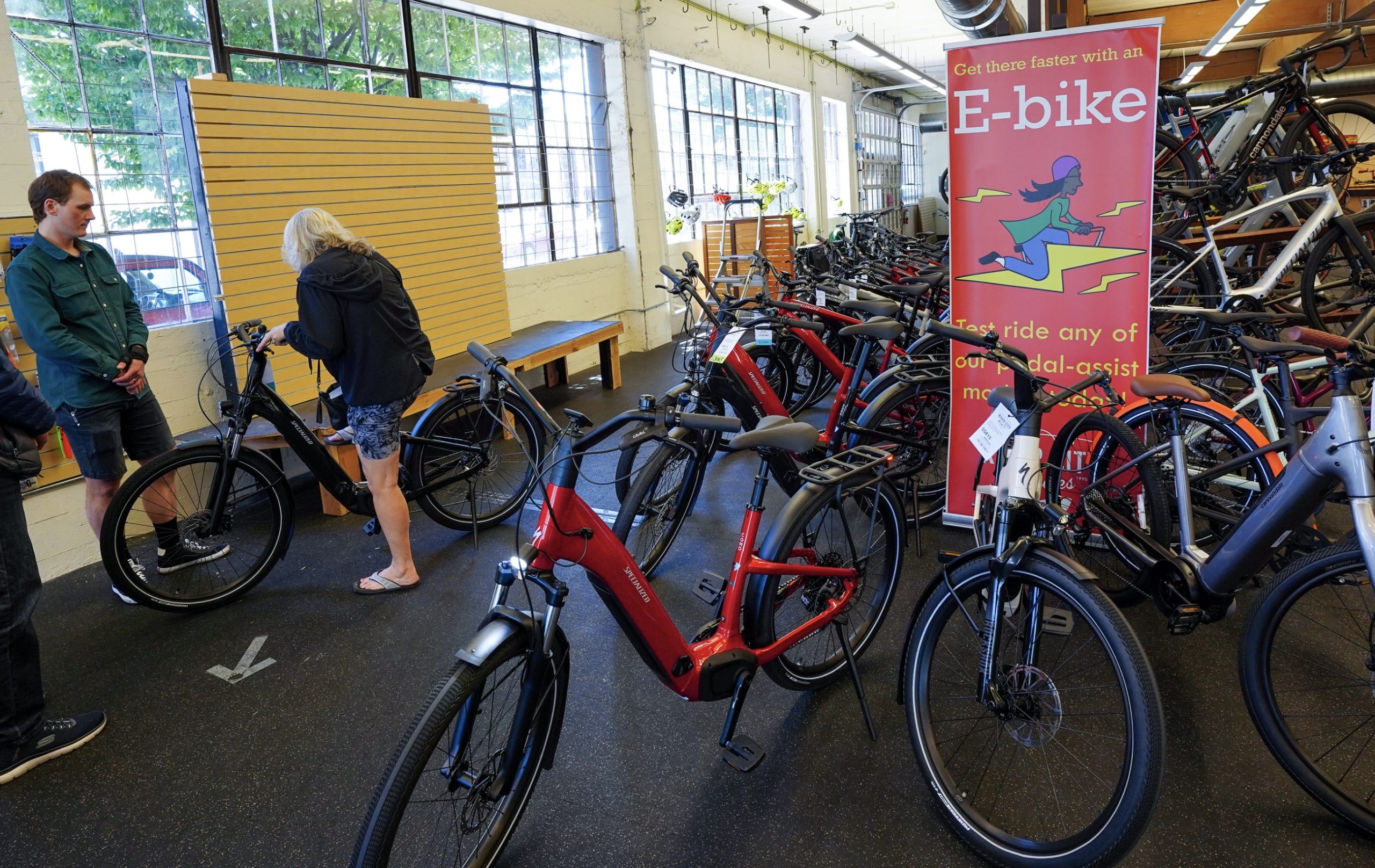
It’s finally here. Three years after we first reported on it and just months after what program officials deemed a successful pilot, the Portland Rides, PCEF E-Bike Rebate Program is set for its full launch two weeks from today.
The program website went live today with information about how to prep for Monday, April 6th. Given that folks can qualify for an instant rebate of up to $1,600 for a standard e-bike or up to $2,350 for a cargo e-bike (plus $300 for accessories), I expect a lot of demand. People with low incomes (at or below 60% of Area Median Income) and those in various frontline communities (whom PCEF defines as, “groups disproportionately impacted by climate change and historically underserved by sustainability programs”) are eligible for rebates. Once deemed eligible, recipients will be chosen at random through an automated process.
Rebates for adaptive e-bikes will be available April 20th.
The program is powered by an investment from the Portland Clean Energy Community Benefits Fund (PCEF) of $20 million over five years and is expected to provide over 6,000 bikes to people in need between now and 2029. Seetha Ream-Rao, PCEF’s Transportation Decarbonization Program manager, said the program will support Portland’s “deeply rooted bike culture,” and will, “make commuting more affordable for low-income households, support healthier communities, improve transportation access and help the city reduce greenhouse gas emissions.”


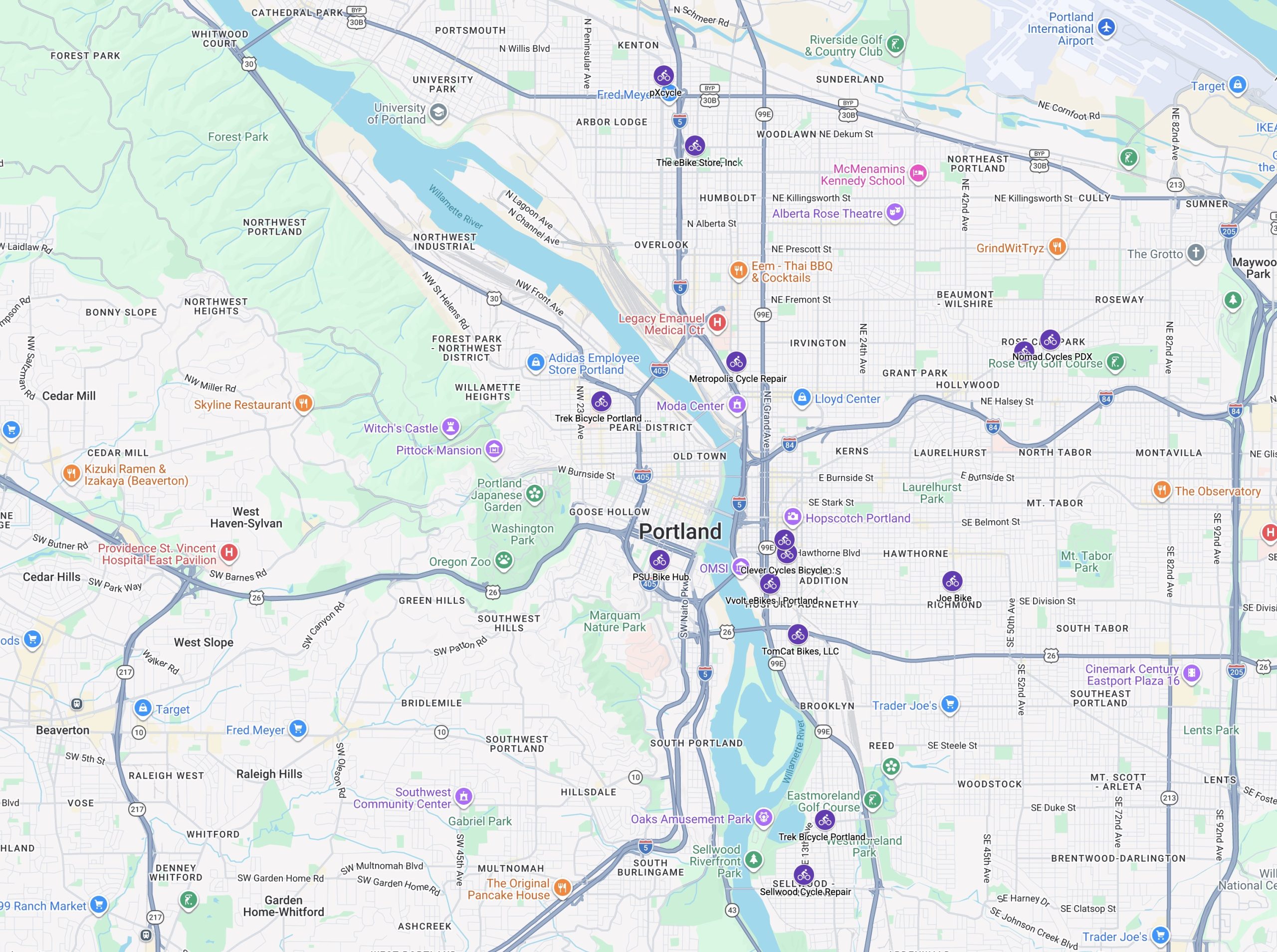
An online application and a basic safety training course (completed online) are required for each interested person. Once they’re confirmed for a rebate, they’ll receive a code that can be used at any one of 14 participating local bike retailers. Participants must choose from a list of around 100 qualified e-bike models. The program offers rebates for Class 1 (20 mph max speed, no throttle) and Class 2 (20 mph max speed, throttle).
Below is the list of 14 shops taking part in the program:
- PSU Bike Hub
- Joe Bike
- Nomad Cycles PDX
- Trek Bicycle Portland Slabtown
- The eBike Store, Inc
- TomCat Bikes, LLC
- Clever Cycles Bicycle & Ebike Store
- Trek Bicycle Portland Hollywood & Outlet
- Trek Bicycle Portland Westmoreland
- A Convenient Cycle
- Sellwood Cycle Repair
- pXcycle
- Metropolis Cycle Repair
- Vvolt eBikes | Portland
Applications for this first round of rebates will be accepted between April 6th and July 24th. To learn more, do a test ride, and submit your application in person, visit the EV Tailgate Party Powered by PCEF Earth Day event at Parkrose Middle School from 12:00 to 3:00 pm on April 11th.
Thanks for reading.
BikePortland has served this community with independent community journalism since 2005. We rely on subscriptions from readers like you to survive. Your financial support is vital in keeping this valuable resource alive and well.
Please subscribe today to strengthen and expand our work.
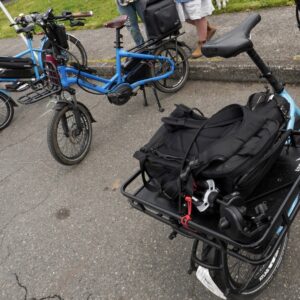
Nice to see some modest ebikes with dropper seat posts in the main picture – I know my own bicycling fun has been forever enhanced with dropper (hydraulic) seat posts – best cycling improvement in the last decade IMO, they allow old hacks like myself to easily mount any bicycle (including all my non-ebikes) at a low seat height, the with the flick of a switch I can pop the seat post to the correct height, then back again when I’m going to dismount or have to stop for a long time at a signal. Sizes are limited but with shims most bikes built after 2000 can have them – 27.2mm usually has an external cable – but the 30.9 and 31.6 sizes you can get either internal routing or else a basic lever under your seat. An absolute marvel.
Sir, this article is about an e-bike rebate program.
Perhaps people applying to the program can see the value in what David is discussing and if selected add that to the criteria they use to select a bike?
It’s an upgrade that can be added to virtually any modern bike.
While we’re changing the subject, let’s talk about TPU tubes!
Anything but discussing the merits of the rebate program, I guess…
No one is stopping you from discussing the rebate. Go ahead and start saying what’s on your mind about the rebate.
The thing about droppers on ebikes, and maybe even more important with the rebate program ebikes, is that for many folks an ebike at least partially replaces a car, and as such is often ridden by more than one person (unlike most analog bikes.) I imagine that’s even more true with cargo ebikes. And a dropper makes it considerably easier for two or more different height people to ride the same machine without having to get a wrench out for every switch.
Yes. And if a bike has a seat that is meant to be sat on (so not e.g., a BMX, downhill MTB), its core function is much improved with a dropper post.
N.B.: That functional improvement does come at a financial and maintenance cost.
Agreed, the dropper seat posts do cost more in general, but they have an additional benefit of acting as low-friction suspension seat posts to deal with minor bumps on rides. However, many of the ebikes being sold in shops (as opposed to those sold online) have other improvements as well that aren’t typically found on regular non-ebike bikes, including those listed by Robert Gardener in this same thread. Stronger chains, more durable wider-range cassettes, stainless steel chainrings, and usually thru-axle wheels often laced with 13-guage and even 12-guage spokes. Front suspension helps to keep the front wheel on the ground even on rough pavement let alone major bumps and potholes – hydraulic shocks work better and are generally lighter – but even the cheaper heavy steel spring shocks work well and require much less maintenance.
Most dropper seat posts, when functioning properly, do not act as a suspension. A few high-end gravel ones have this “feature”, but I don’t view that as common.
Wide range MTB cassettes have been available for a decade at this point and most commuter eBikes don’t seem to use them.
Durable chainrings are typically not stainless steel, which would sacrifice durability while raising the cost. They’re just steel.
However you feel about e-bikes, they are more likely to appear in the showroom with fenders, lights, racks and other useful accessories. Suspension forks seem like a good idea too if they can be maintained.
I’m looking forward to this with excitement and trepidation. Excited at the prospect of more cyclists on the road with me, hopefully replacing car trips with bike trips. A bit anxious about more new bike riders with throttle power buzzing past me in the bike lanes with the same impatience and lack of courtesy as car drivers, but closer. Fingers crossed!
With 6000 bikes rebated over 4 years city-wide, it’s seems unlikely you’re going to notice any difference in the number of bikes around you. Some of those are going to be replacing existing bikes (motorized or not), and others are likely going to be people who were going to get a bike anyway. Not all are going to be ridden every day, or even often. A few might replace car trips, but I’ll bet the most frequent mode replaced will be bus, followed by other bikes.
Very many of the e-bike riders I see are carrying kids to school or day care. The default mode for that trip in Portland is a car. Dogs are also common cargo. Again, the default is a car. I haven’t made a count but it’s not a betting matter. My house is on a greenway, it’s clear enough.
It’s anecdotal but I know people, able bikers, whose commute took an amount of time they didn’t want to commit, or perhaps left them a little sweaty in a workplace with no shower but an expectation of professional demeanor. They might ride a bike occasionally but an e-bike serves to speed trips, meld with car traffic, and keep their cool. The e-bike in such a case displaces car trips.
These are not opinions or vibing, whatever that is. They’re real people that a curious person can go out with a clip board and count on the street, or at a local school. Go to a dog park and watch people leave with their dogs. It’s strictly normal for them to load up in the back of an SUV. If you see a dog on an e-bike that’s a win.
Hopefully the city will collect enough data to know whether enough people transition to walking their dog with motorized bikes rather than their cars to make the investment worthwhile.
I remain skeptical, but would be happy to be proven wrong.
Read the article. It specifically states, the rebate program does not support throttle assisted bikes.
Reread the article. It does include Class 2 bikes.
Ooooooh…and many Class 2 bikes can be easily converted to throttled >28 mph bikes. Cue more ululation from experienced cyclists and cycle advocates about
e-motose-bikes.PS: I could absolutely see experienced cycling advocates developing an anti >20 mph e-bike politic. After all the narcissism of small differences is more ‘murrican than processed cheese product.
An “experienced cycling advocate” tired of second class bike routes might well get an e-bike capable of going 25 mph to travel collector streets because the routes are more direct and they are often better maintained. (They’d be wise to invest in the bonkers daytime running light if they do).
At 25 you can run Sandy Boulevard from Hollywood down to 12th Avenue without catching a red. That’s doable by many bikers without a motor of course. If you have a heavy load or there’s too much friction from the car drivers who expect to go 35 the e-bike is kind of nice.
It’s a sad fact that a portion of the motoring public deeply needs to pass any bike they see ahead in spite of their travel speed. Take the downhill from Mississippi Avenue past the Albina yards if you’d like a sample. Double yellow line, truck entrance, blind corner, they actually don’t care. It gives them extra relish.
Forgot to mention the cargo e-bike rebate and the adaptive e-bike/e-trike rebate for those of us with disabilities.
Hi Christine,
I didn’t forget to mention those. E-cargo bikes are mentioned and the adaptive e-bike element of the program wasn’t named specifically in their announcement so I assume it’s going to launch later. I’ve asked for a clarification about that and will add something to the story when I find out.
Do you know when the first round of announcements for rebate “winners” is expected?
April 27
What are the protections against immediate resale? Also, shouldn’t there be some mileage tracker as well to make sure these are actually being used? Seems like if you’re not riding it at least 1,000 miles per year, the subsidy should be granted to someone else.
I seriously doubt the City would issue rebates and not carefully track the efficacy of the program to ensure it was having the intended effect.
Right?
Good point, I am sure the $600 per bike in program costs includes a healthy sum for a robust auditing process of the program and consequences for people squandering public dollars. There is likely an entire panel of “experts” who have never been enriched by the lack of successful audits for similar programs overseeing the process.
My fears have been quelled.
I’m honestly less concerned with “squandering” and more interested in learning if this program has any impact. If it doesn’t, lesson learned, and let’s do something different.
But if we don’t bother try to learn from our experiments, what’s the point?
There’s always feelings and vibes.
y u h8 urbanism?
This is exciting! Jonathan, was it a clarification from the city that not only low-income participants but also PCEF priority populations are eligible? The website says that eligibility criteria is income <60%AMI
Looks like none of the authorized ebikes is recumbent.
For some odd reason the city standard application website has a map at the bottom that isn’t of Portland or anywhere nearby, but Groningen in the Netherlands.
Clicked the link to see the 100 qualified models and got this message: “Portland Rides Qualified Products List (QPL)
Coming Soon!
“
Interesting! I was able to view it a few days ago. Perhaps they are just making some edits and it’ll be back shortly.
I love this, especially how it supports local bike shops.
I’m curious about the cargo bike rebate. It says up to $2,350 and their program guide explicitly mentions family cargo biking, but I didn’t see a list of which bikes are approved for that purpose. Did I miss it?
In general I’m glad to see the city investing in family biking and hope to see more like this in the future. Wouldn’t it be cool to have a city-backed family bike share program? Could help more people try it out and also not have to worry about storage and maintainance.
I’m curious, is there still the $25 surcharge per new (non-e) bicycle sold surcharge in Portland? You know, the one where the seller is not allowed to pay the surcharge, the one where funds collected go to pay the administration of the surcharge collection and nothing else?