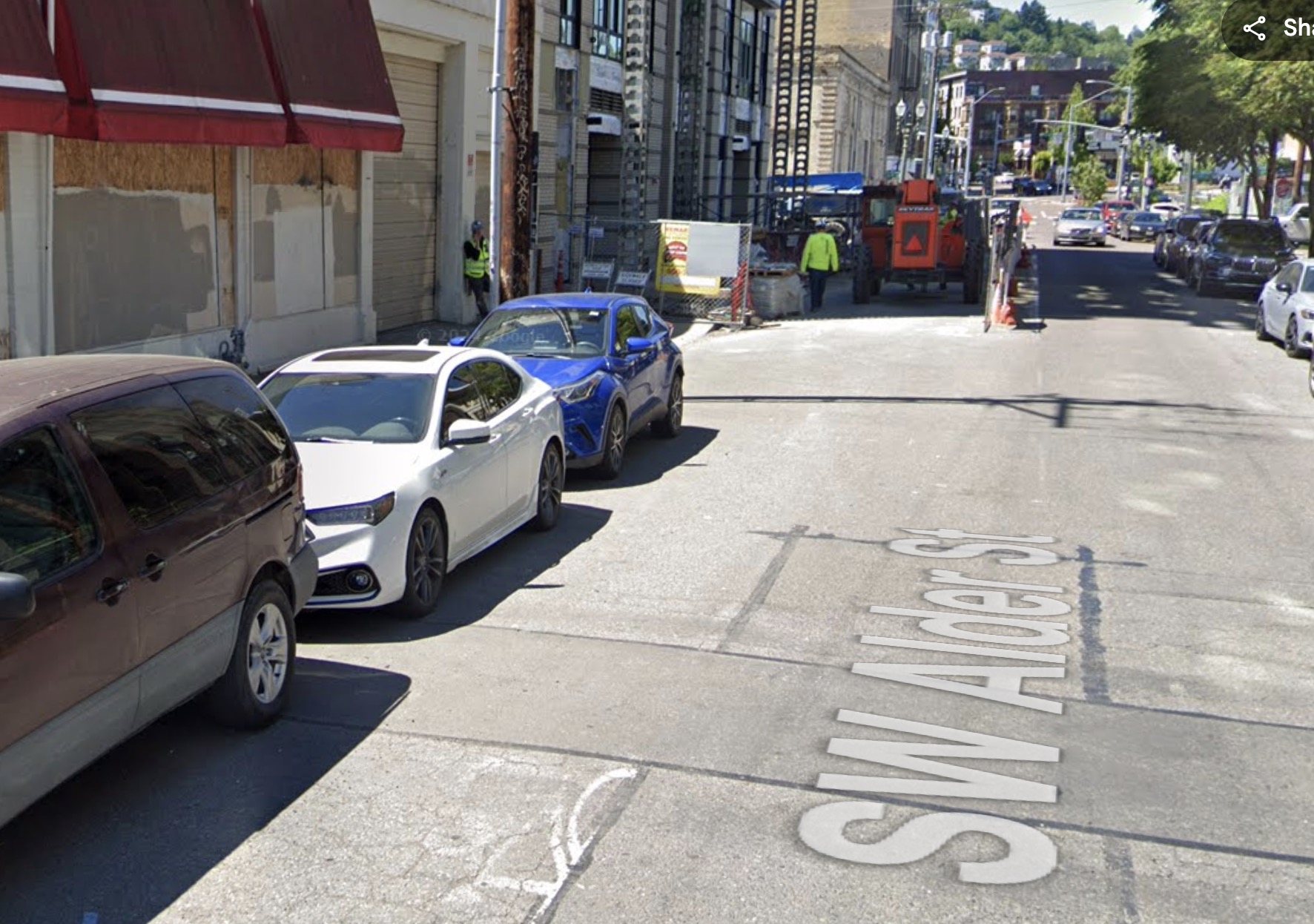
Cars in the parking lane that’s slated for removal (on left) and Tiller Terrace still under construction in May 2024.
The Portland Bureau of Transportation is facing pushback on a planned bike lane project in the Goose Hollow area. According to KOIN News, some residents of the 214-unit Tiller Terrace apartments on the corner of SW Alder and 17th are concerned about how changes planned by PBOT will impact their ability to park cars near the entrance to the building.
Here’s more from a story by KOIN on Tuesday night:
Miriam D’Arco lives in Tiller Terrace, caring for her 92-year old mother who has late-stage Alzheimer’s… She said she relies heavily on the ability to park a car in front of her apartment, in an area that she said is already tough to find parking. “If they’re going to limit parking even more, that’s a problem,” she said.
Later in the story KOIN reported that D’Arco, “said she feels displaced,” by the project and that removing the parking spots is tantamount to denying her access.
Advertisement
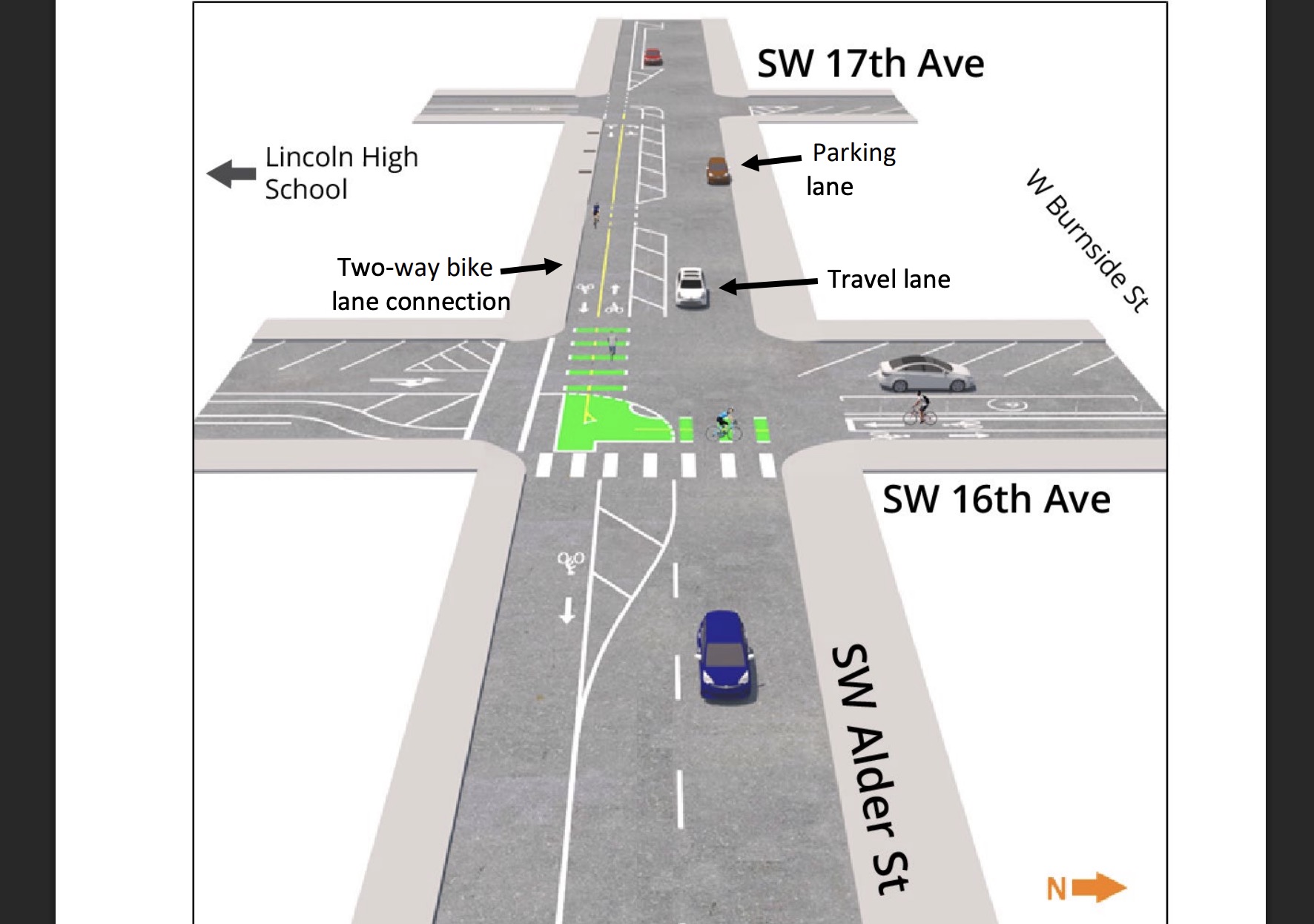
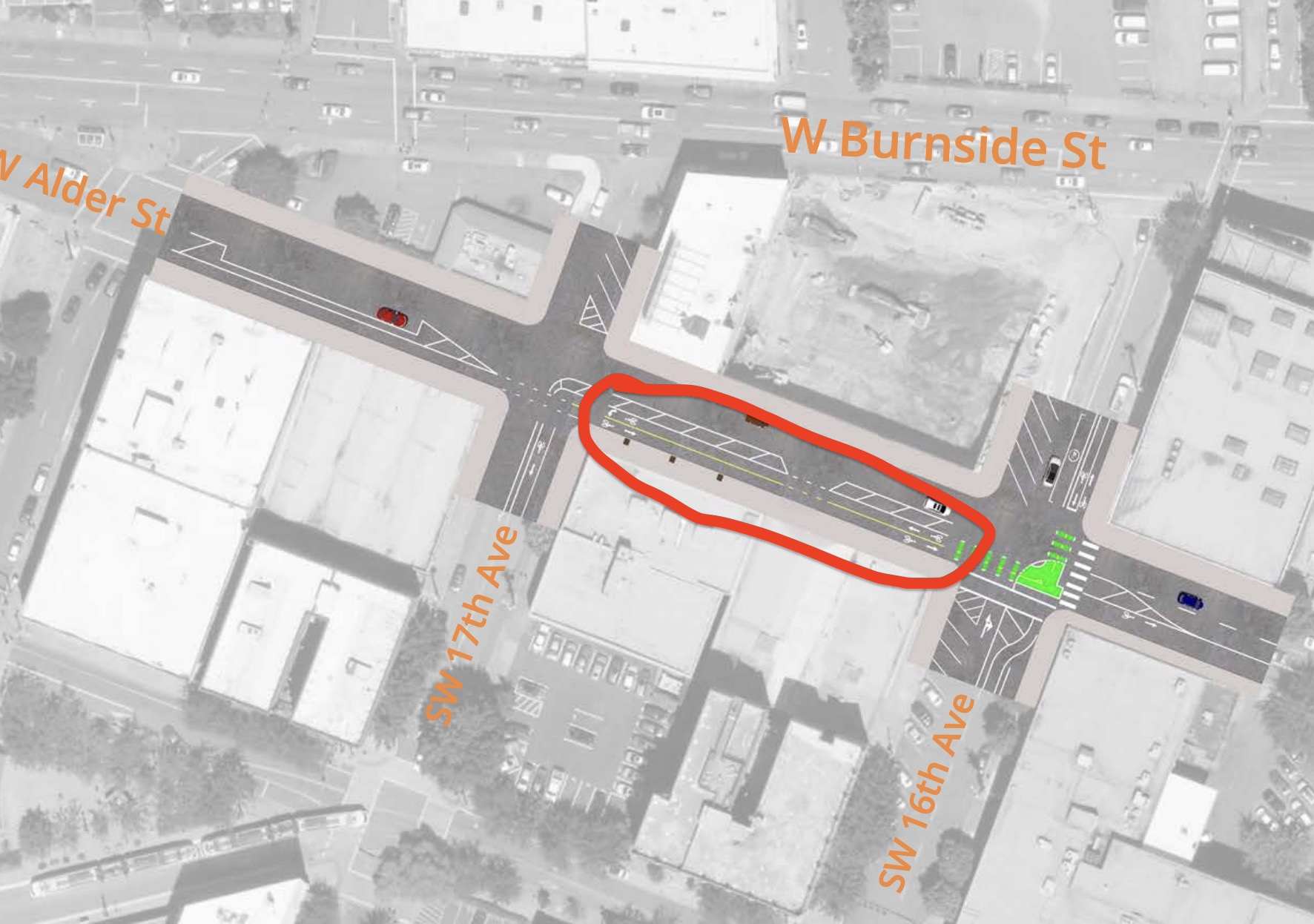
The project has been in the works since 2019. This specific phase was on hold while Tiller Terrace was being built. Sections of the bike lane have already been built and the plans to build them predate the existence of the apartments (the building opened in summer of 2024). PBOT’s plan (see below) is to build a two-way bike lane on the south side of Alder between SW 16th and 17th. It’s the last phase of a neighborhood greenway project that connects Northwest and Southwest and is slated for construction this summer. The two-way bike lane is necessary because the southbound route crosses Burnside on SW 16th, but SW 16th is one-way only at Alder, so the route needs to jog over to 17th to continue south.
To make room for the bike lane, PBOT’s plan is to re-allocate space currently used as free parking for 8-9 private cars. There would still be on-street parking on the north side of the street.
PBOT graphics. Area circled in red (at right) is where parking removal is proposed.
PBOT sent a letter to 2,500 addresses in the immediate area in January 2025 warning them that parking removal on Alder was coming. “This change will require removing parking on one side of SW Alder Street between SW 16th and 17th avenues,” the letter reads.
When asked about the concerns by KOIN reporters, PBOT spokesperson Dylan Rivera acknowledged the shortage of parking in the Goose Hollow area. “That’s why we need to get more people biking and walking, as much as possible. And that’s what a project like this is part of,” he said.
A meeting is scheduled for this evening between PBOT staff and tenants of the building. KOIN said it was organized by Tiller Terrace management. I’ll reach out to PBOT tomorrow and will post updates here.
In a move that has touched off instant ire among transportation reform advocates, the Oregon Legislature moved a controversial funding bill forward this morning. As I shared yesterday, Senate Bill 1601 emerged over the weekend with provisions that would reallocate unobligated funds from within the Oregon Department of Transportation in order to backfill its highway operations and maintenance budget.
The budget balancing bill includes a $17 million reallocation from the Safe Routes to School program and $8 million from the Community Paths program — part of a total of $170 million that would be funneled into ODOT’s highway fund.
Lawmakers passed a stop-gap funding measure with a variety of taxes and fees last session, but that was put on hold when Republicans got it referred to the ballot — a move that created the $288 million hole lawmakers are now trying to fill. In this short session, the game is to find the least objectionable pots of money that can be moved around to fill that hole and keep ODOT’s top priorities — maintenance and operations of highways and interstates — functioning at an acceptable level. And it has to be done in a matter of hours to meet legislative deadlines.
Advertisement
In addition to the reallocations from Safe Routes and Community Paths (a program that’s, ironically, funded in part by revenue from Oregon’s $15 tax on new bicycles), the -3 amendments to SB 1601 include two other changes that have alarmed passenger rail advocates.
The bill takes $20 million from the Transportation Operating Fund (TOF, aka the “lawnmower fund” because it’s bolstered by a tax on non-automobile gas purchases). That raises concerns because TOF is used as a source of matching funds to leverage federal rail grants that go toward Amtrak’s Cascades service. SB 1601 would also reallocate $42 million from the Connect Oregon program which also funds rail projects.
In a hearing and vote on the bill this morning at the Joint Committee On Ways and Means Subcommittee On Capital Construction, lawmakers heard several members of the public share strident opposition.
Richard Sheperd with the Association of Oregon Rail Transit Advocates (AORTA) said the loss of Connect Oregon matching funds is comparable to losing $300 million from the federal government. “The failure for ODOT to manage costs related to their highway expansions and increasing maintenance should not be balanced by eliminating these critical matching funds,” Sheperd said.
Advertisement
Brett Morgan, policy director for Climate Solutions, also urged lawmakers to vote against the bill. “While the cuts proposed and redirects proposed in this budget feel like easy targets, small line items add up to big consequences,” Morgan said. “You might save a little now, but you’re going to end up paying more in the long term, both in crashes, loss of life, pollution and higher household transportation costs.”
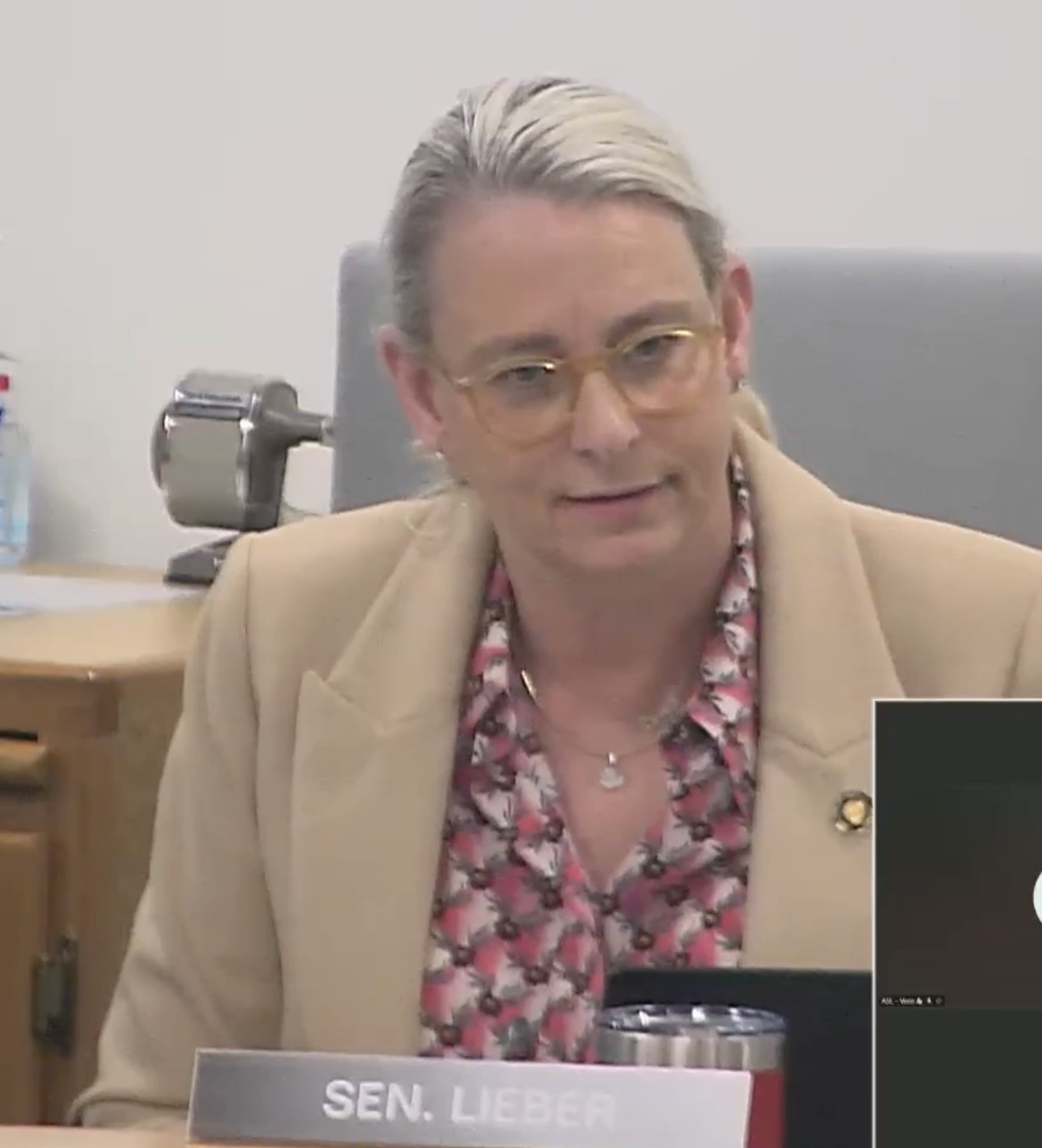
Sen. Kate Lieber at today’s meeting.
Indi Namkoong, the transportation justice coordinator for Portland-based Verde, told lawmakers there were “less harmful” sources of funds lawmakers could have tapped.
After public testimony was closed, Southeast Portland Representative Rob Nosse made a motion to move the bill forward (something folks noticed today, with one person saying, “He should be ashamed of this”). Before the bill passed out of committee, one of the architects of SB 1601, State Senator Kate Lieber (a Democrat who represents Beaverton and Southwest Portland), had some choice words for critics.
Sen. Lieber said the budget moves in the bill are only temporary. She also claimed that, “It actually does not impact service for Amtrak. That was something we were very, very cautious in making sure that it did not do.” While Lieber tried to set the record straight, she also acknowledged the anger in the room. “I’m glad you’re mad. You should be mad. You absolutely should be mad,” she said, speaking directly to people who’d opposed the bill. Lieber than had marching orders for folks who oppose the bill. “I believe those of you who are mad should go out there and you should work to defeat this ballot measure,” she said. (To which an audible “Oh boy” could be heard coming from another member of the committee.)
The bill passed out of the committee with no objections.
Advertisement
For Verde’s Namkoong and others, the hope now is that Lieber — and other lawmakers — can be trusted with claims that these cuts to popular programs are indeed temporary.
“We want to believe this is a one-off, short-term fix to this crisis,” Namkoong said during her testimony. “But when this legislature is promising to prioritize affordability, yet is cutting the services that already deliver it — it is difficult to extend the benefit of the doubt indefinitely. We need to see action.” Namkoong added that if the bill passes, she and other advocates will expect their needs to be met in the 2027 session, where lawmakers are expected to try yet again to pass a comprehensive transportation funding package.
“We ask that you please make this right moving into the future, we can’t be promised IOUs or silver bullets, and we need to restore these programs moving forward as the conversation progresses in 2027.”
Iannarone speaking at an event in September 2023. (Photo: Jonathan Maus/BikePortland)
It’s the end of an era for The Street Trust as the organization announced today that Executive Director Sarah Iannarone stepped down at the end of February. Iannarone has taken a new job in Santa Barbara, California.
The Street Trust is a nonprofit advocacy group founded in 1992 as the Bicycle Transportation Alliance. In 2016, the group changed their name to The Street Trust with a promise to expand their mission beyond bicycling into walking and transit. Iannarone was named interim executive director in January 2021, fresh off of her campaign for Portland mayor in 2020.
In a statement released this morning, Iannarone wrote: “I am deeply proud of what we’ve accomplished together. Serving this community has been an extraordinary honor. The Street Trust is stronger, more focused, and more influential than ever.”
Advertisement
Lindsay Huber
Iannarone posted on Bluesky this morning that she’s the new executive director of MOVE Santa Barbara County, a group with a similar mission to The Street Trust. In a press release about her new position, Iannarone said her role with MOVE is to, “broaden our community support, and mobilize more people around a shared vision of safe, accessible, and affordable transportation for everyone who lives, works, and visits here.”
TST’s former Deputy Director Linsday Huber has been named interim executive director effective March 1. Huber has been with the organization since 2017. “I’m honored to step into this role,” Huber said. “The Street Trust’s mission is as urgent and important as ever. We have a strong team, trusted partners, and a clear strategic focus heading into the next legislative cycle.”
According to TST Board Director Thomas Ngo, there are not current plans to search for a new executive director. “The Board… will evaluate long-term needs at the appropriate time,” reads the statement.
Another sunny Monday… In February! Can you believe some cherry blossoms are already in bloom? Wild times we are living in.
Below are the most notable stories that came across my inbox this past week…
Foot traffic: Very exciting development in counting pedestrians from MIT shows the value of getting counting right and how science can help make cities better. (Fast Company)
Micromobility report: The State of Massachusetts assembled a special commission to study micromobility and their final report is a very thoughtful and thorough document that I hope some Oregon advocates can copy from. (Massachusetts DOT)
Gas prices: Because of the Trump War Against Iran we could be at the precipice of another gas price shock that sends people into bike shops and bus stops. (Associated Press)
Advertisement
Calling names: Noted bicycling superstar Hans “No Way” Rey has an idea for combatting the proliferation of anti e-bike laws sweeping the country: He think we should label anything that’s not a Class 1 (20 mph max, no throttle) as an “e-moped.” (Bicycle Retailer)
Florida, man: Looks like really good e-bike policy from Florida. Seriously. Instead of the boneheaded idea of regulating bike types, a new bill making its way through their statehouse would legislate behavior. Specifically it would create a 10 mph e-bike speed limit on paths and only when passing others. (Electrek)
Transforming lives: A wonderful profile of a 67-year old woman with osteoporosis from the UK who received an e-bike through a government program and credits the vehicle for changing her life for the better. (Oxford Mail)
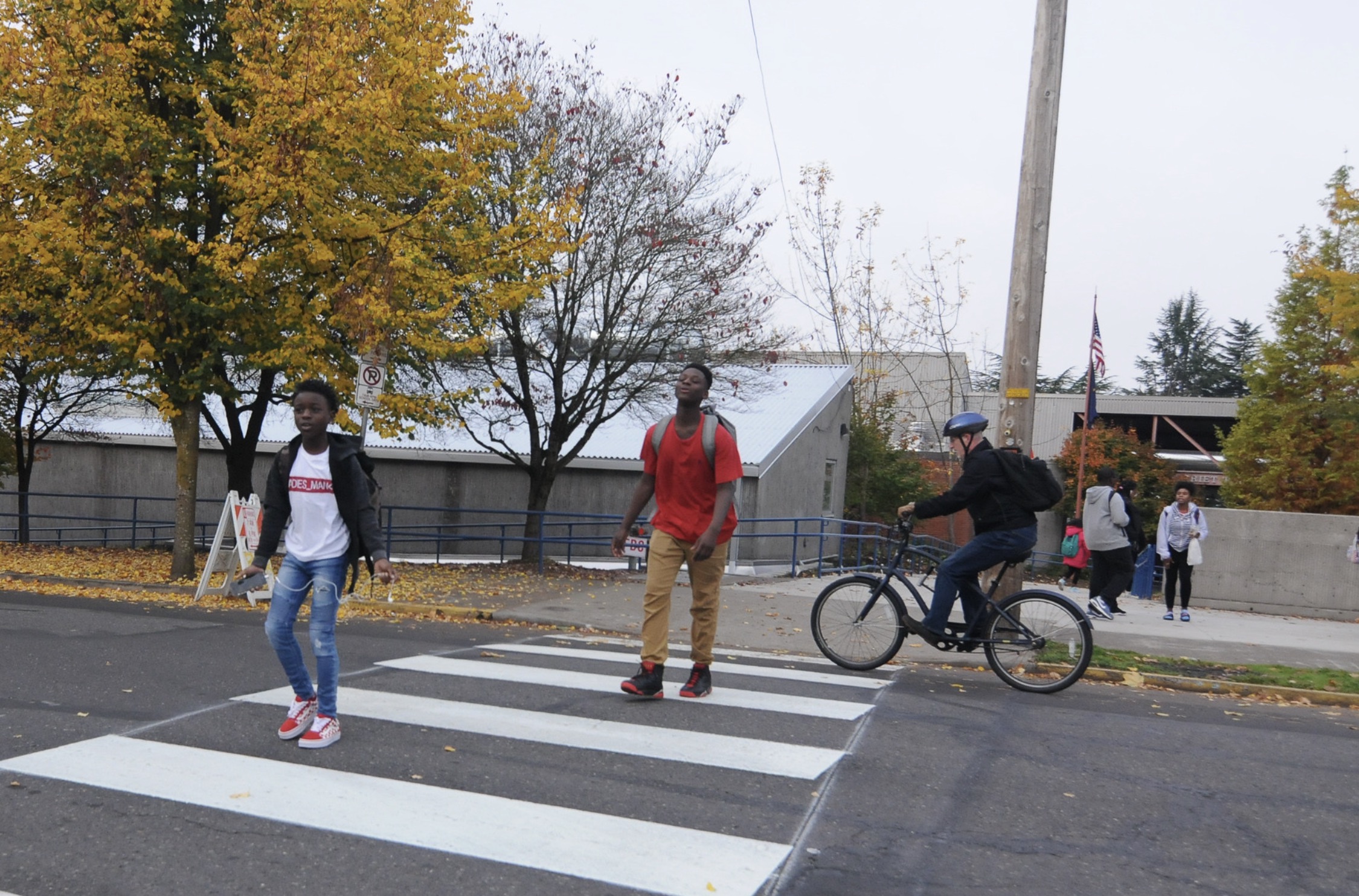
Students use a new crosswalk in front of Harriet Tubman Middle School in North Portland. (Photo: Jonathan Maus/BikePortland)
The rumors BikePortland reported on back in January have unfortunately turned out to be true. In the final week of the session, the Oregon Legislature is considering a cut to Safe Routes to School funding in order to balance their budget and save the Oregon Department of Transportation from mass layoffs.
In addition to a $17 million which could be redirected from the Safe Routes to School program, the bill proposes to axe $8 million from the Community Paths program. These funds are not currently obligated to any projects or grants and it would only be a one-time re-allocation. The thinking among Democratic lawmakers is that these and other budget balancing steps are necessary to buy time until a full transportation package could be considered in 2027.
$5 million from the student driver training program
$6 million from Oregon Highway 58 enhancements and expansions that have since wound down due to environmental issues and lack of local support
$8 million from the Community Paths program for building and maintaining multi-use public paths
$17 million from Safe Routes to Schools grant program
$20 million from the Transportation Operating Fund, or the “lawnmower” fund, which is funded by non-road gas tax funds
$35 million in dedicated revenue for bridge projects, seismic improvements, preservation of highways, culvert projects and safety projects
$42 million from the Connect Oregon program, which provides grants for marine, aviation and rail projects
$85 million of federal funds that can be tied to projects that don’t need a match from the State Highway Fund, freeing up those local dollars
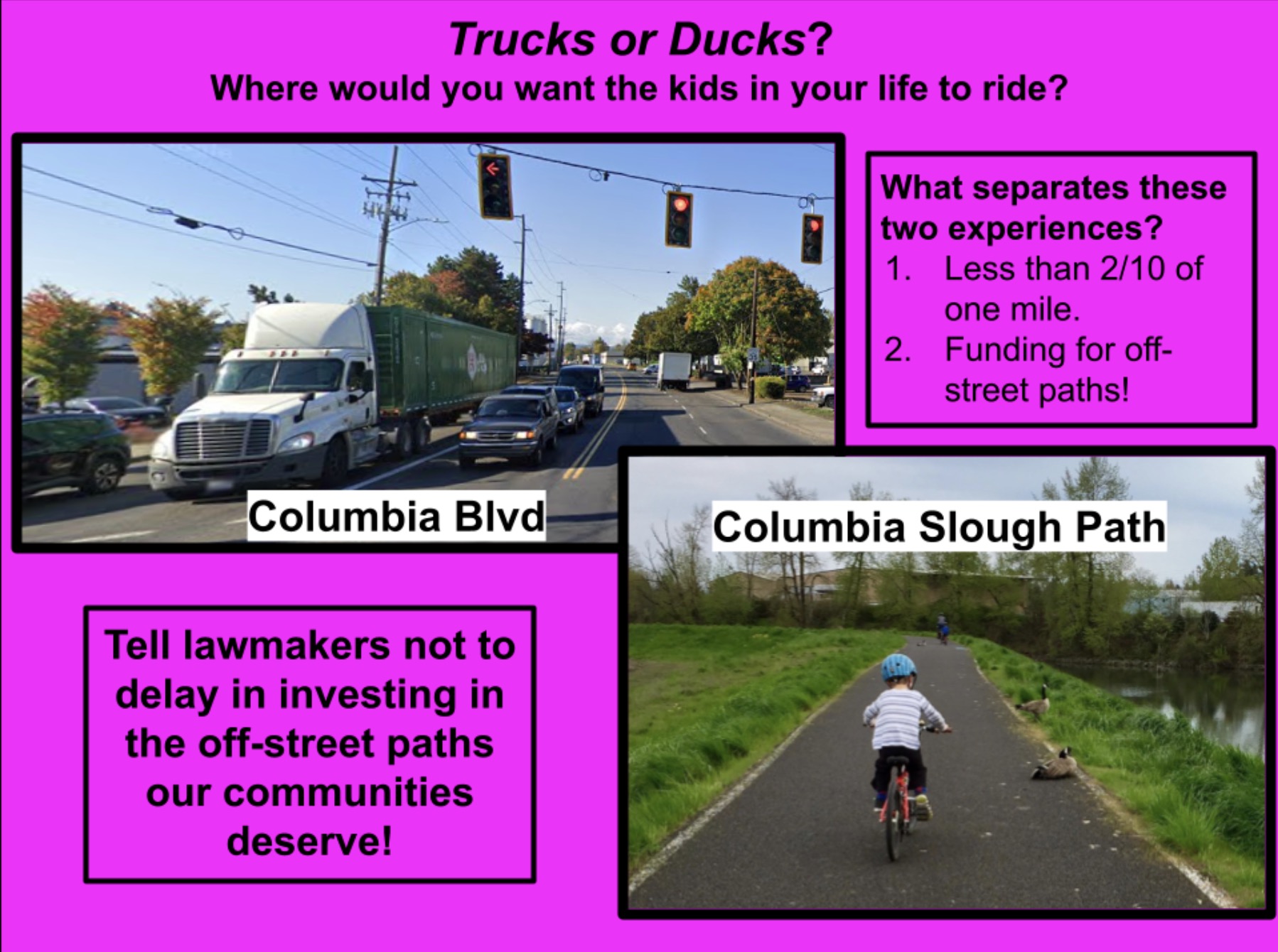
The nonprofit Oregon Trails Coalition has issued an action alert, urging its supporters to fight the proposed cuts to Safe Routes and Community Paths. “The proposal cuts funding from the only state sources of funding for multi-use paths in order to backfill highway maintenance needs, including redirecting funds from our state’s tax on bicycles from off-street paths to highway maintenance,” reads a statement issued by the group a few minutes ago.
Graphic from Oregon Trails Coalition action alert.
McGinnis eyeing his next victim. (Photo: Multnomah County District Attorney)
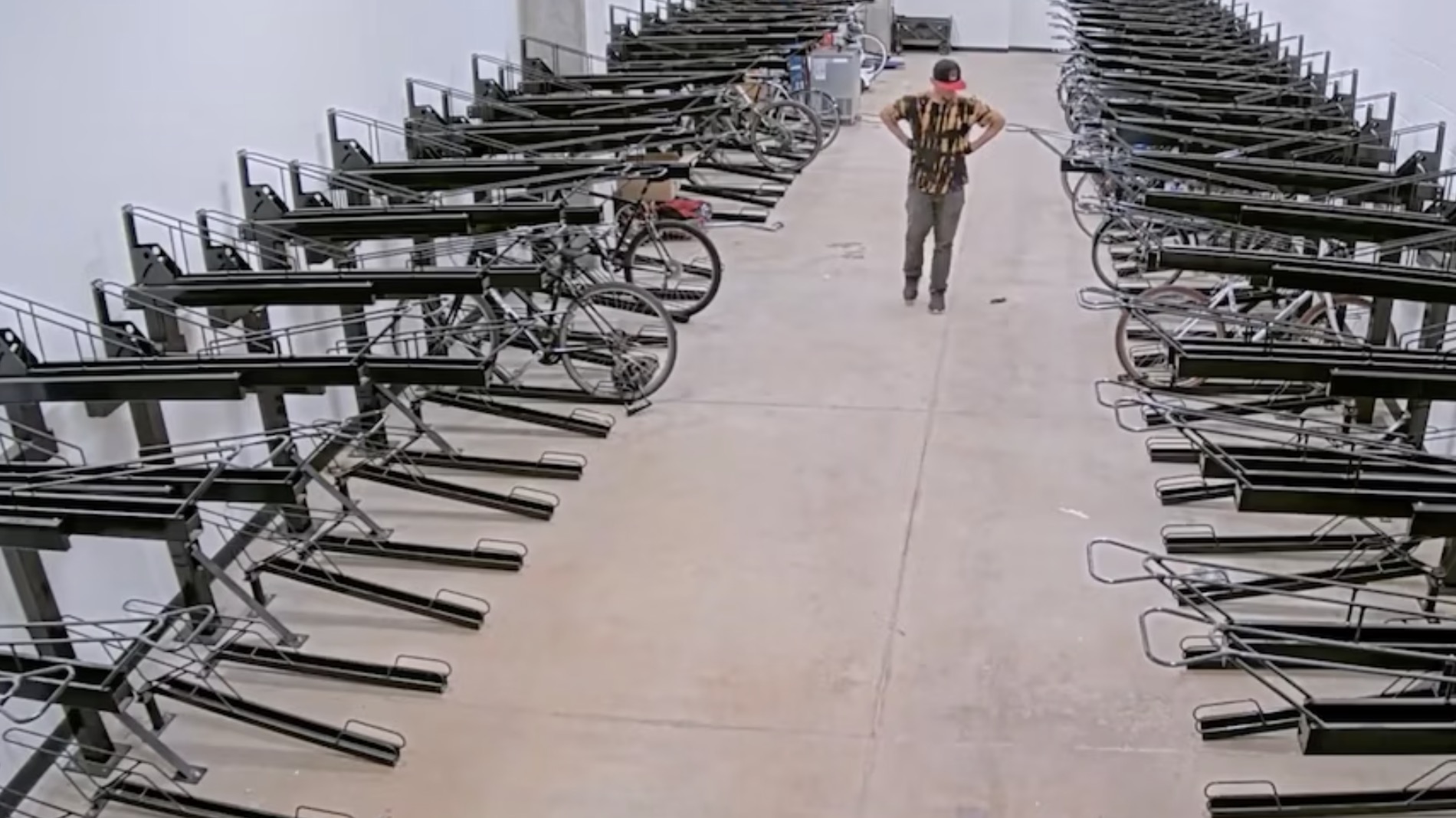
A man who broke into bicycle storage rooms of Portland apartment buildings 11 times in a four-month theft spree was sentenced to 50 months in prison. In a Multnomah County courtroom today, Christopher McGinnis pled guilty to six counts of Burglary in the First Degree and two counts of Theft in the First Degree.
In addition to the four years and two months of prison, McGinnis will be subject to three years of post-prison supervision.
“Portland is a world-class biking city and the Burglary Task Force intends to keep it that way. People who break into buildings to steal bicycles will be prosecuted and held accountable to the fullest extent of the law.”
Advertisement
According to the Multnomah County District Attorney’s office, of the prosecutors in the case had this to say after today’s sentencing:
According to the Portland Police Bureau, McGinnis used a crow bar to pry open the doors to bike rooms at apartment buildings. He targeted bicycles at three specific buildings and hit them a combined total of 11 times between June 2025 and September 2025. The buildings he broke into includel; The Frankie Apartments and Memoir Buckman in Southeast, and The Cosmopolitan in Northwest. McGinnis was arrested on September 19th, 2025.
Bike storage facilities in apartment buildings have a very notorious record of security. Some bike theft prevention experts say to avoid them entirely given how easily they can be compromised.
NOTE, March 2nd, 9:06 am : The MCDA released an incorrect date for the start of McGinnis’ crimes. It was June 2025, not June 2005 as they originally shared and as I initially posted here. Sorry for the confusion.
Crazy that a quick search of my photo archives turned up several dozen shots of them. (Photos: Jonathan Maus/BikePortland)
I’ve been really into my feelings lately. For a lot of reasons, I’ve been thinking a lot about the last 20 years of BikePortland and what the hell comes next. I’m not ready to talk more about all that yet, but one thing I’ve been doing as part of this emotional ride I’m on is to look back at the 28,320 front page stories in the archives.
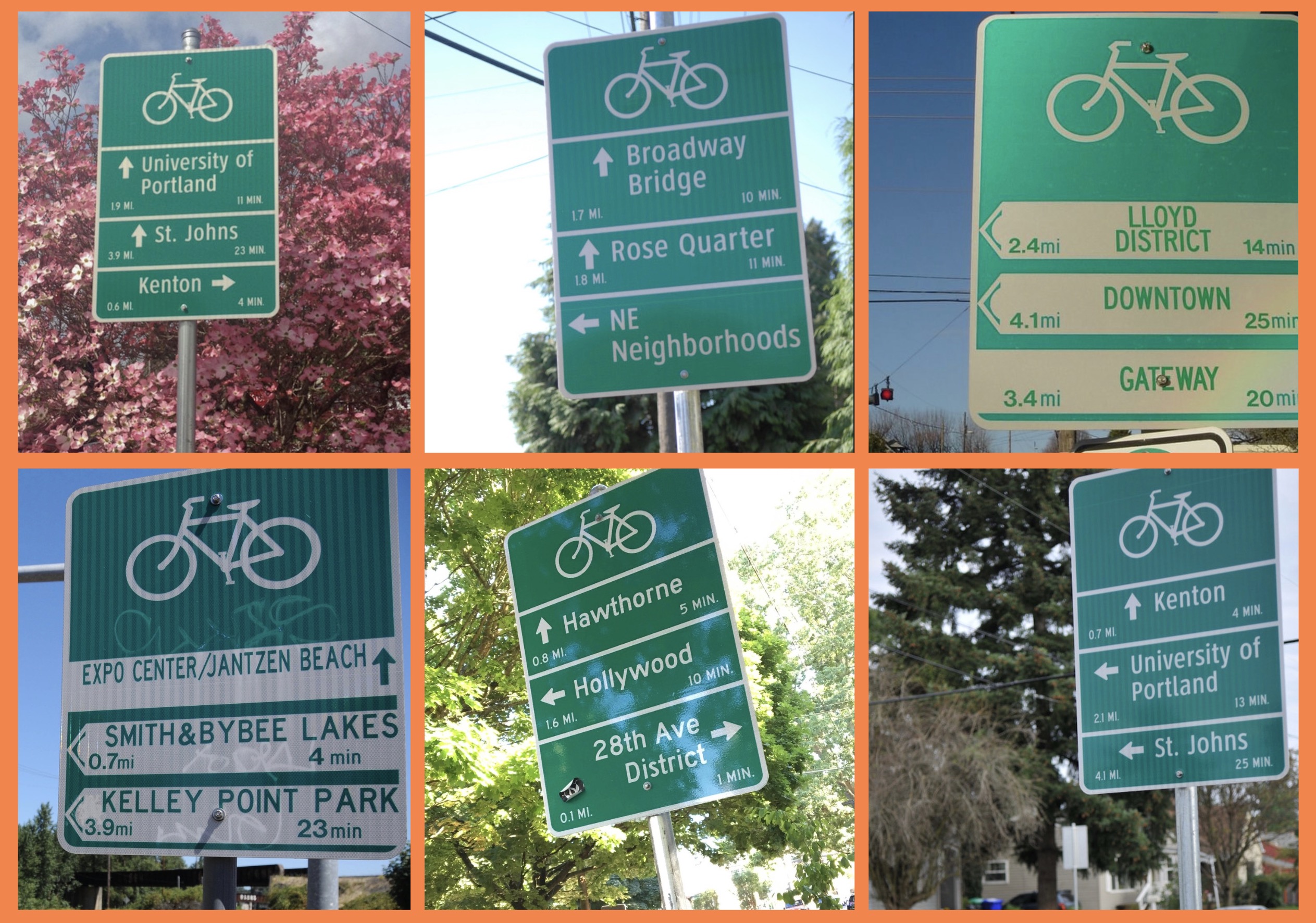
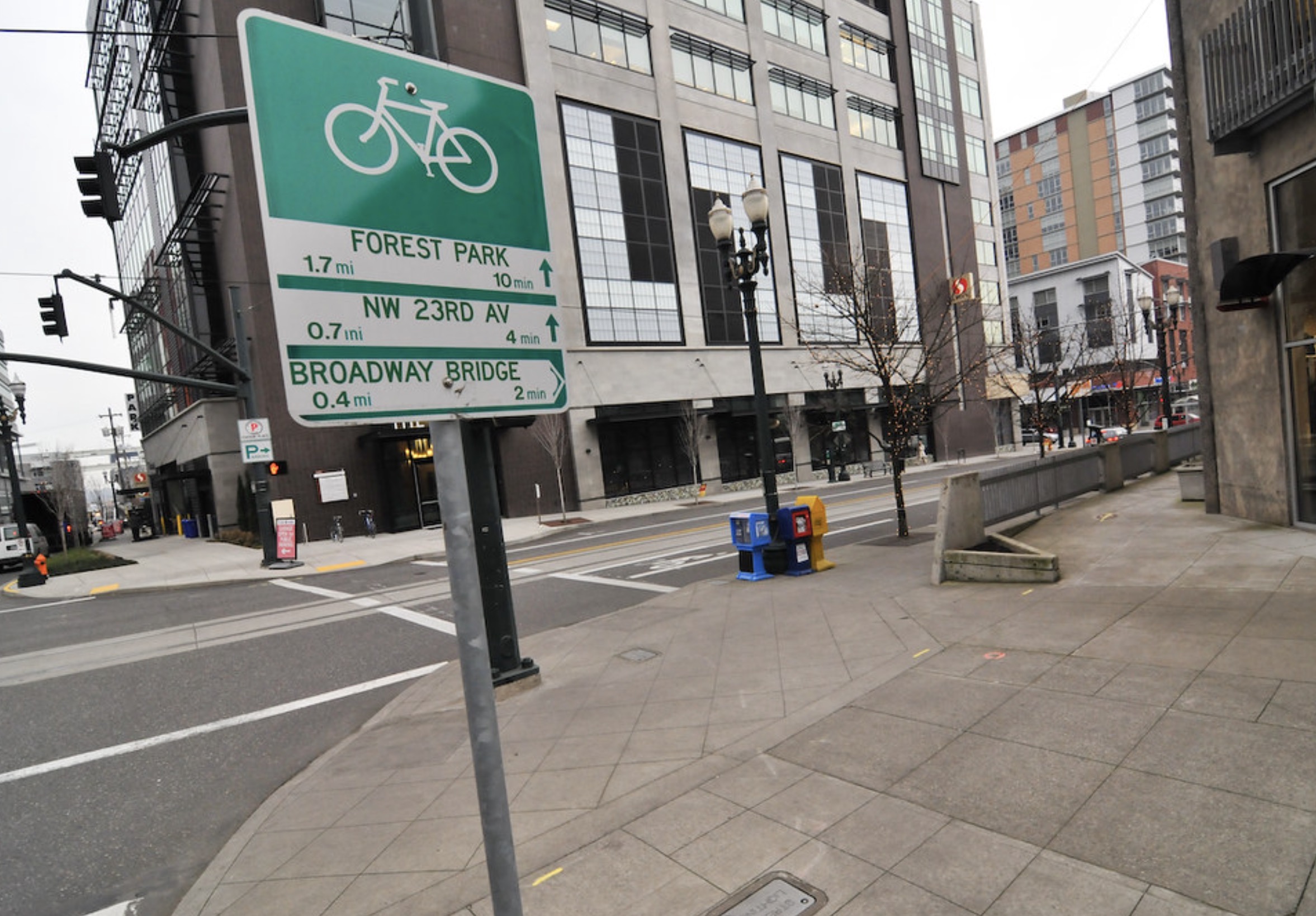
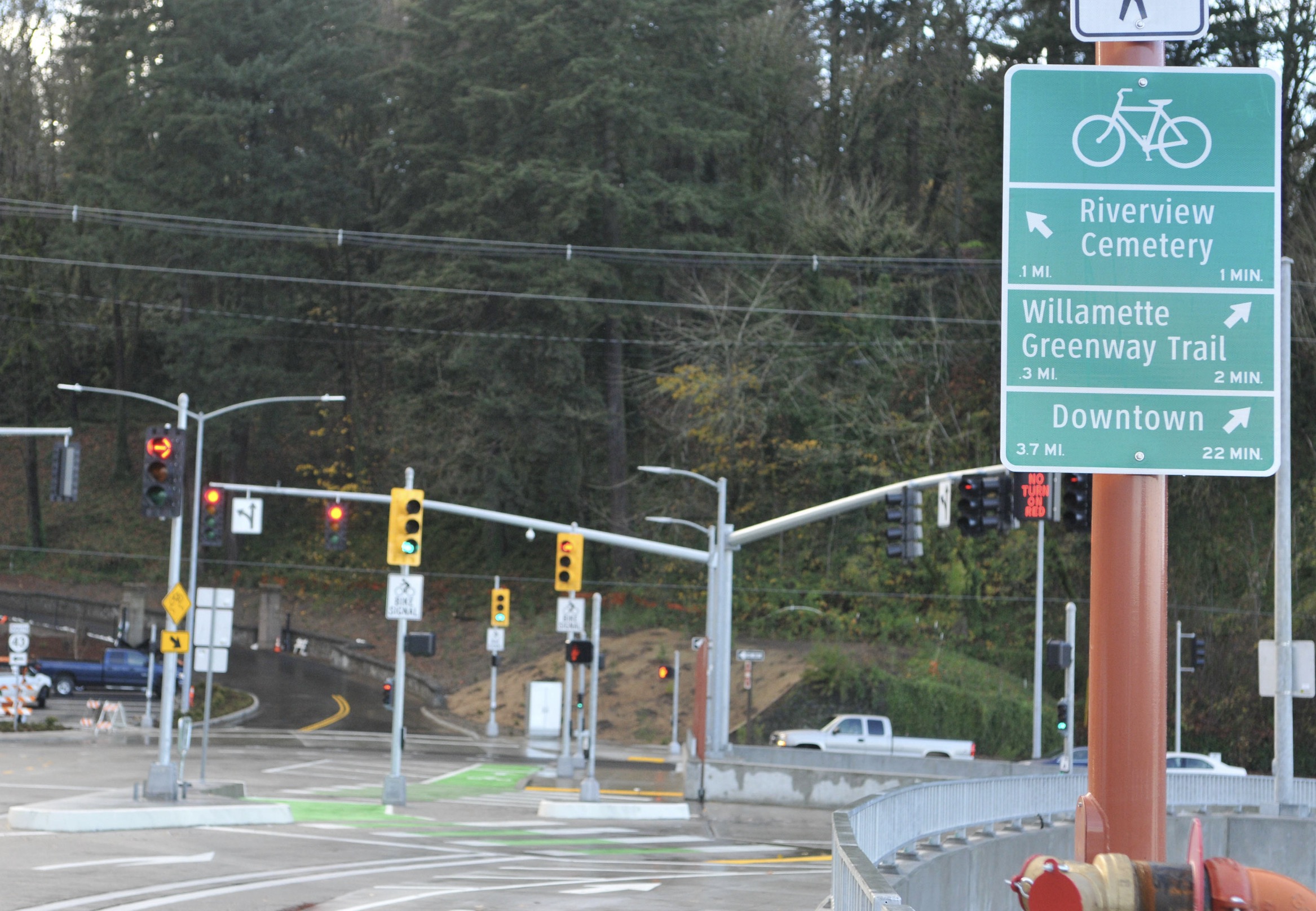
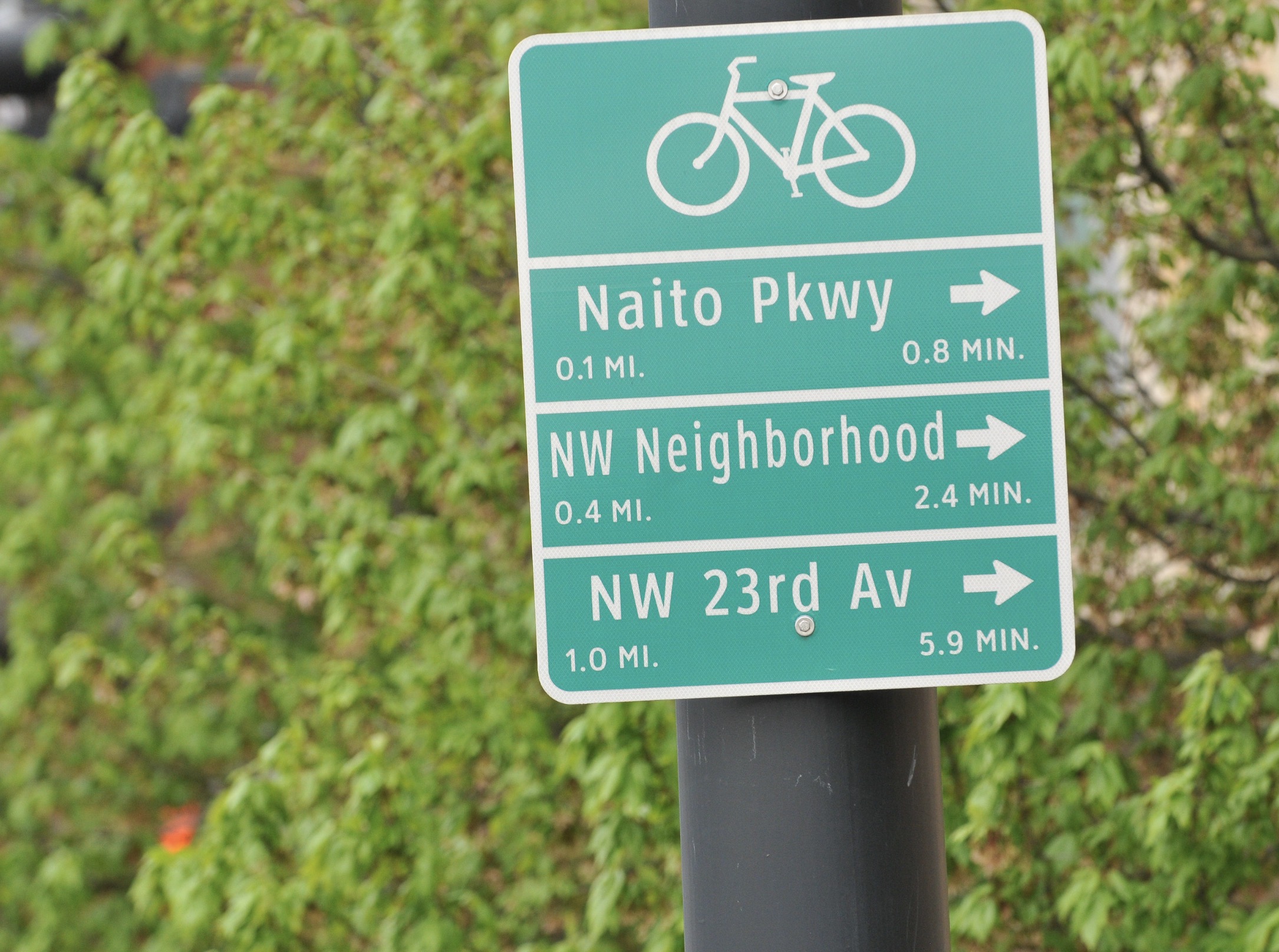
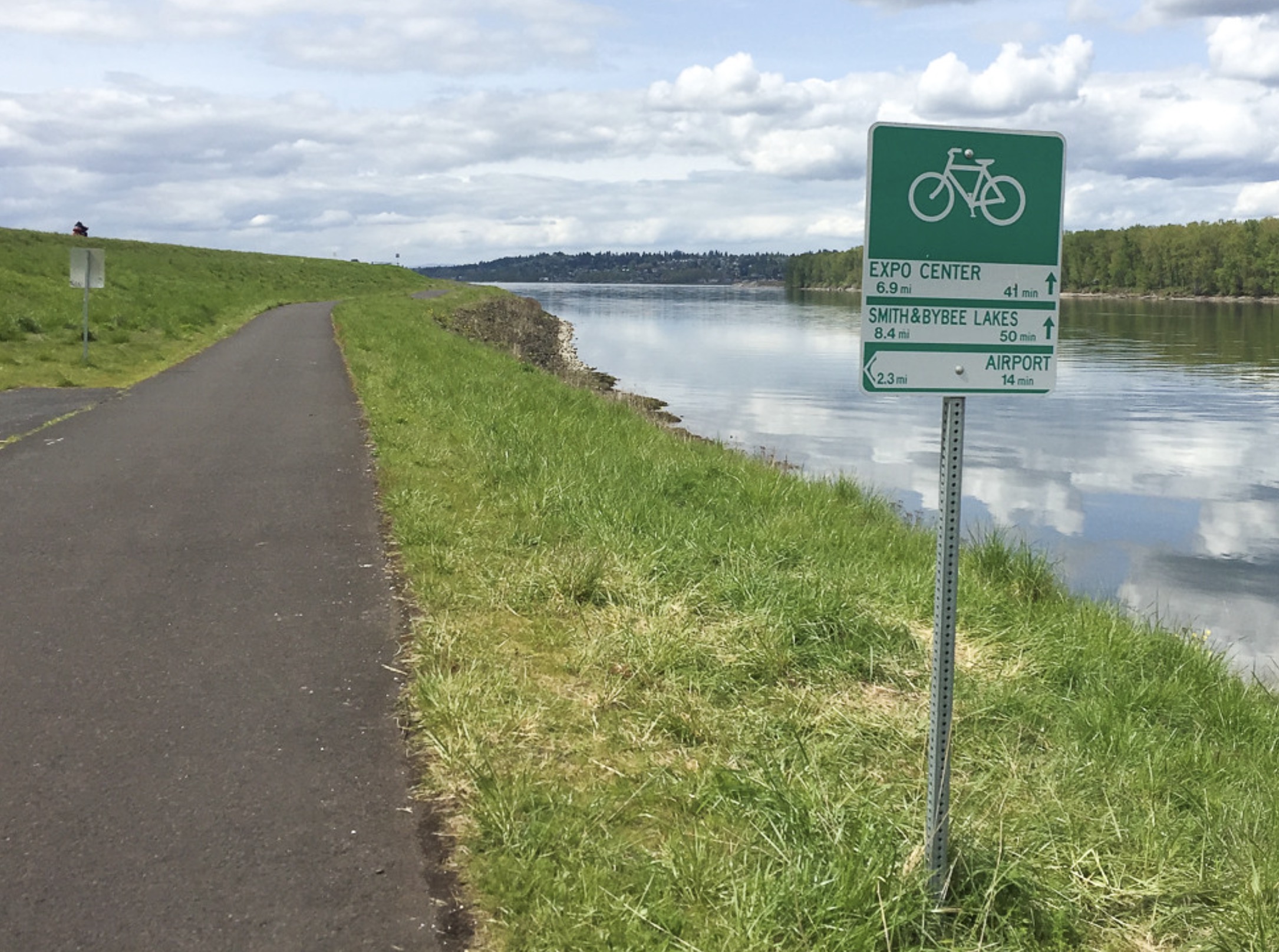
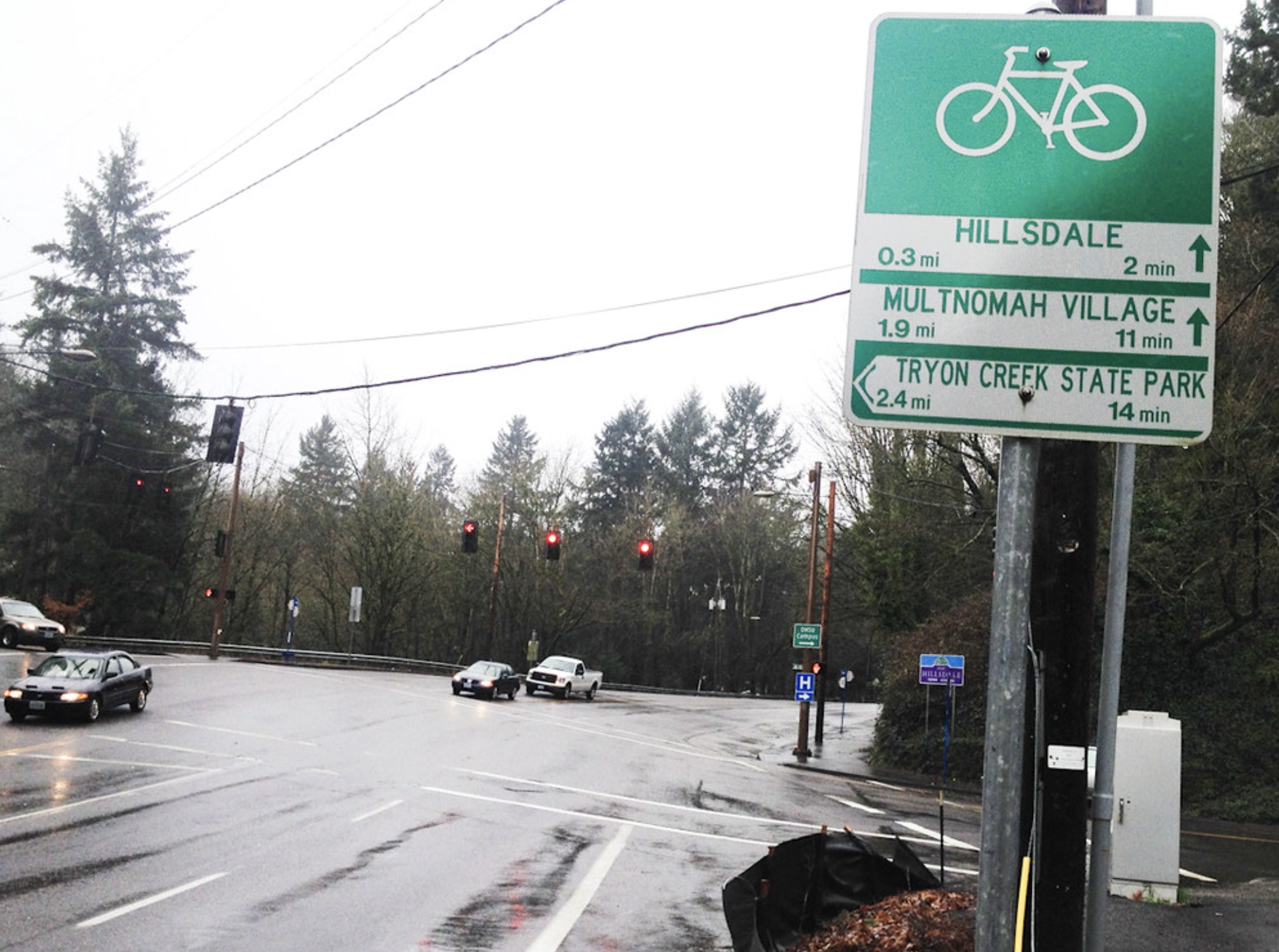
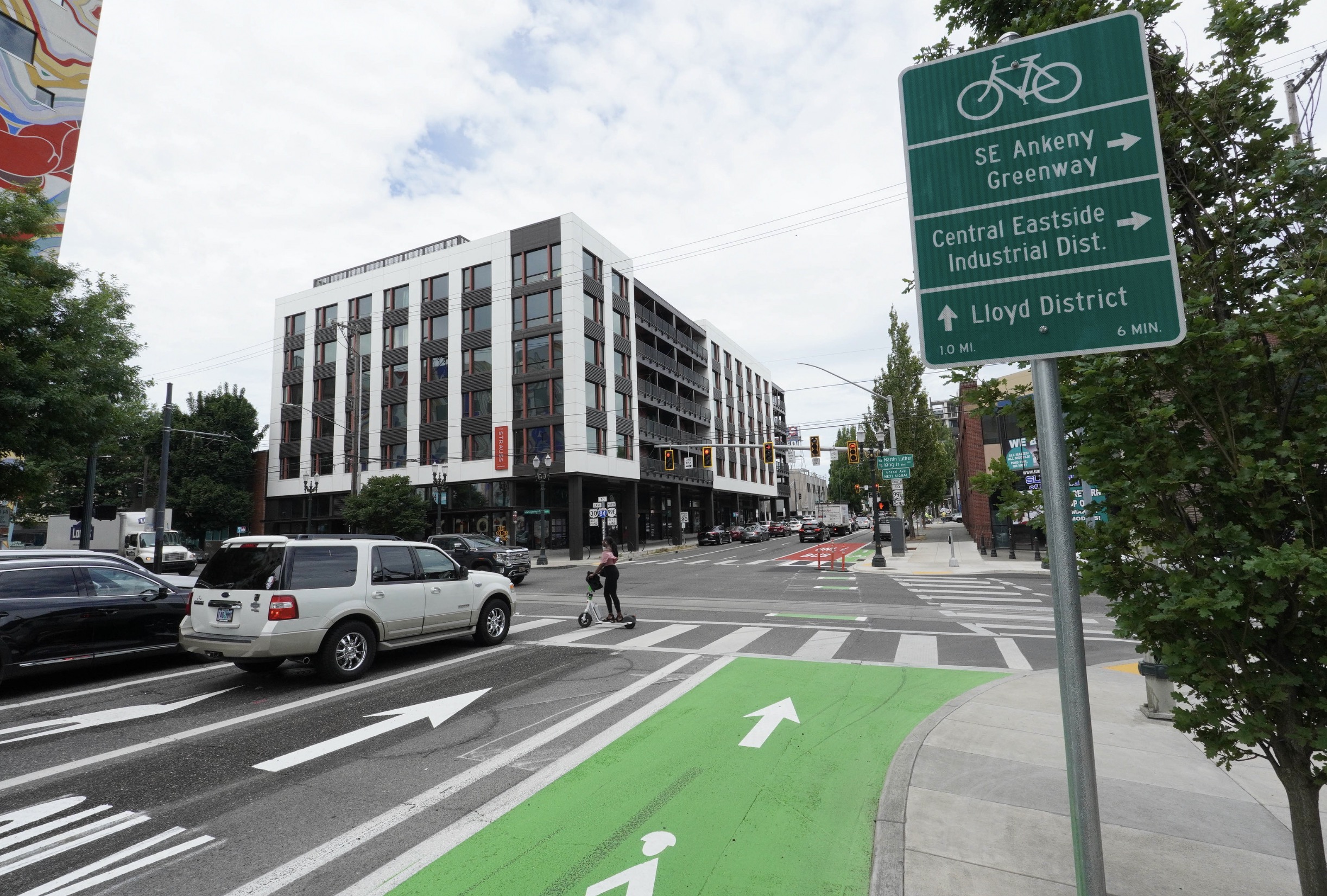
I don’t have a plan for a series of history posts or anything, so I’ll probably just share interesting things I come across. Like when I searched back on this week in 2006 I stumbled on a story I did about Portland’s bikeway network signs.
Advertisement
In February 2006, these green signs that give mileage and timing information about key destinations were a big deal. As per usual back then, Portland’s transportation bureau was a national leader in doing cool stuff for cyclists. Our guy with his hands on the bars back then, Roger Geller (who remains PBOT’s bike coordinator to this day), was big into pavement markings and network signage. His little, round bike markings with arrows were an early innovation that sprung up before we started putting shared-lane markings (called “sharrows”) on the ground.
Geller and PBOT were building America’s best residential bikeway network and they wanted to make the routes as legible as possible. It’s still a work in progress (today Geller laments that this amazing feature of our city’s cycling infrastructure is hidden from most Portlanders), but the combination of thousands of sharrows and these green bikeway network signs are — in my opinion — one of the best things about biking here.
Beyond the sheer utility of knowing where you are, where you can go, and how long it will take to get there (based on a bicycling speed of 11-12 mph), what I like about these signs is the respect they give to cycling. I’m big on respect. If a government demonstrates through its infrastructure that your mode of travel is respected enough to deserve cool innovations and bonus features, that says a lot about where you live. It sends a signal that bicycling is expected and honored.
Today when I see these signs it feels like I’m in the right place. A sense of being at home in the city. And when I’m on one of these routes, I know that Geller and his team at PBOT have done more than put up a sign. There’s a very good chance they’ve added safer crossings, a 20 mph speed limit, speed bumps, and maybe even some diverters to keep car volumes down.
You ever notice these signs. Do you use them? What do you think about them?
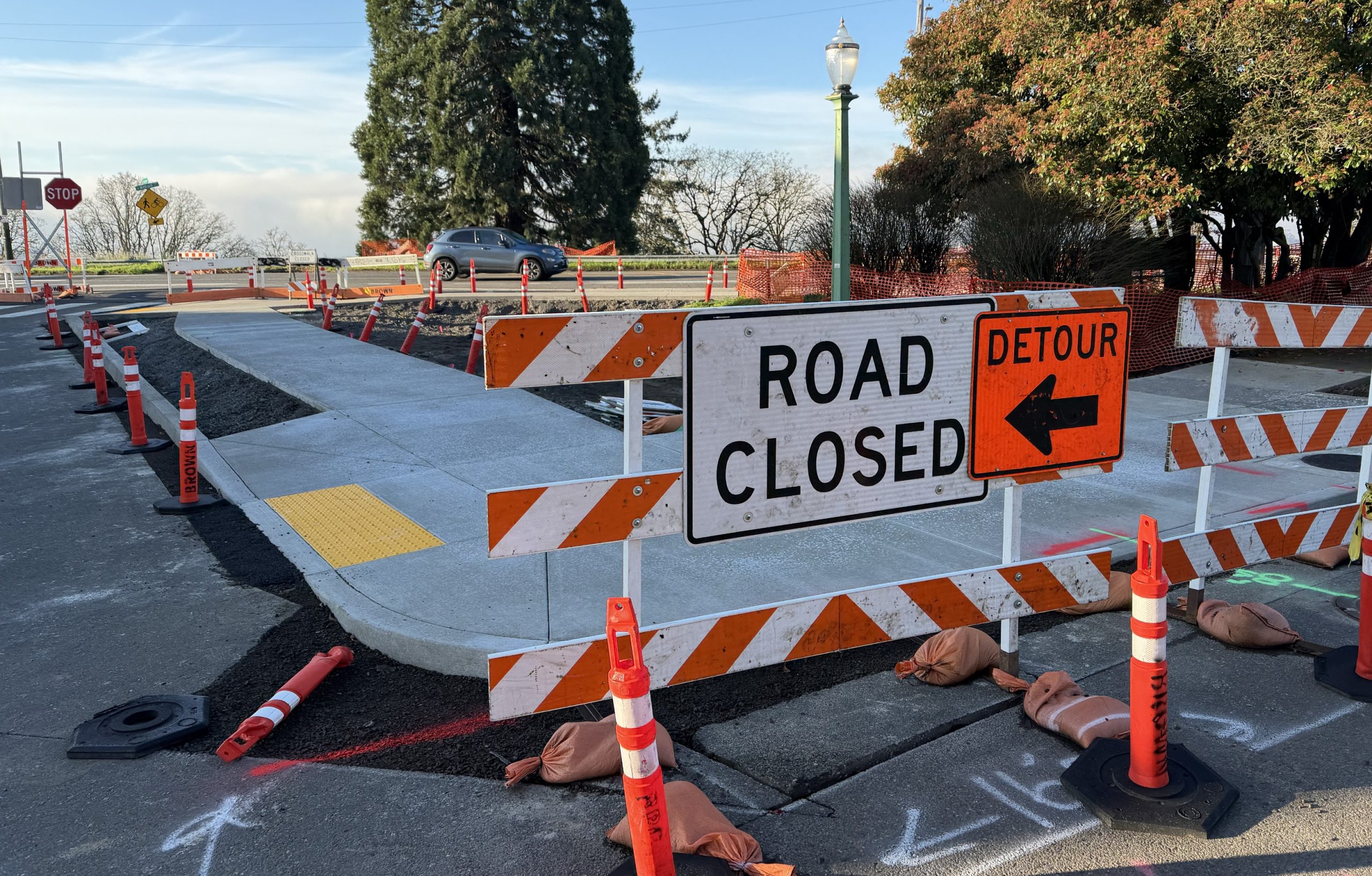
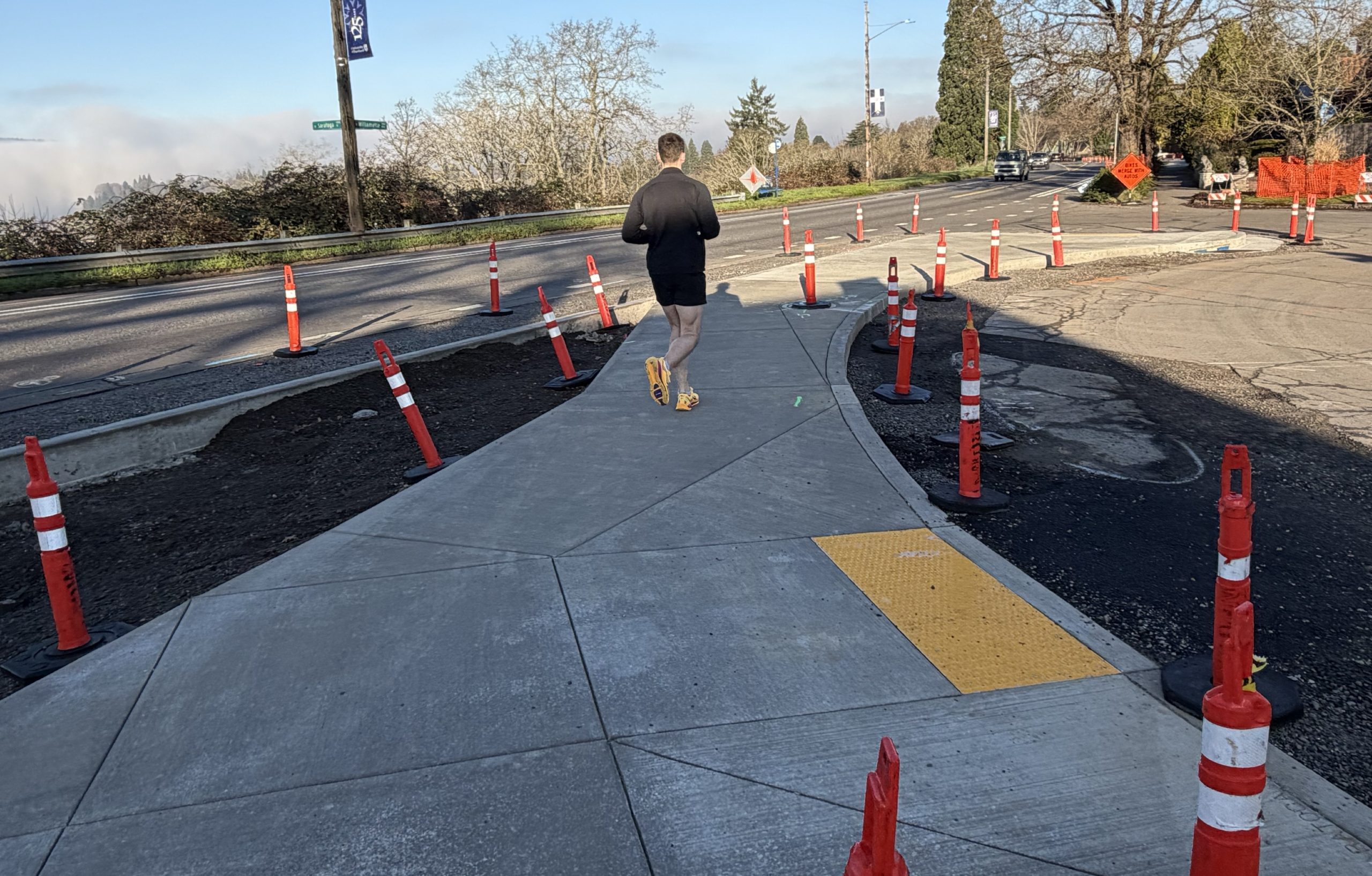
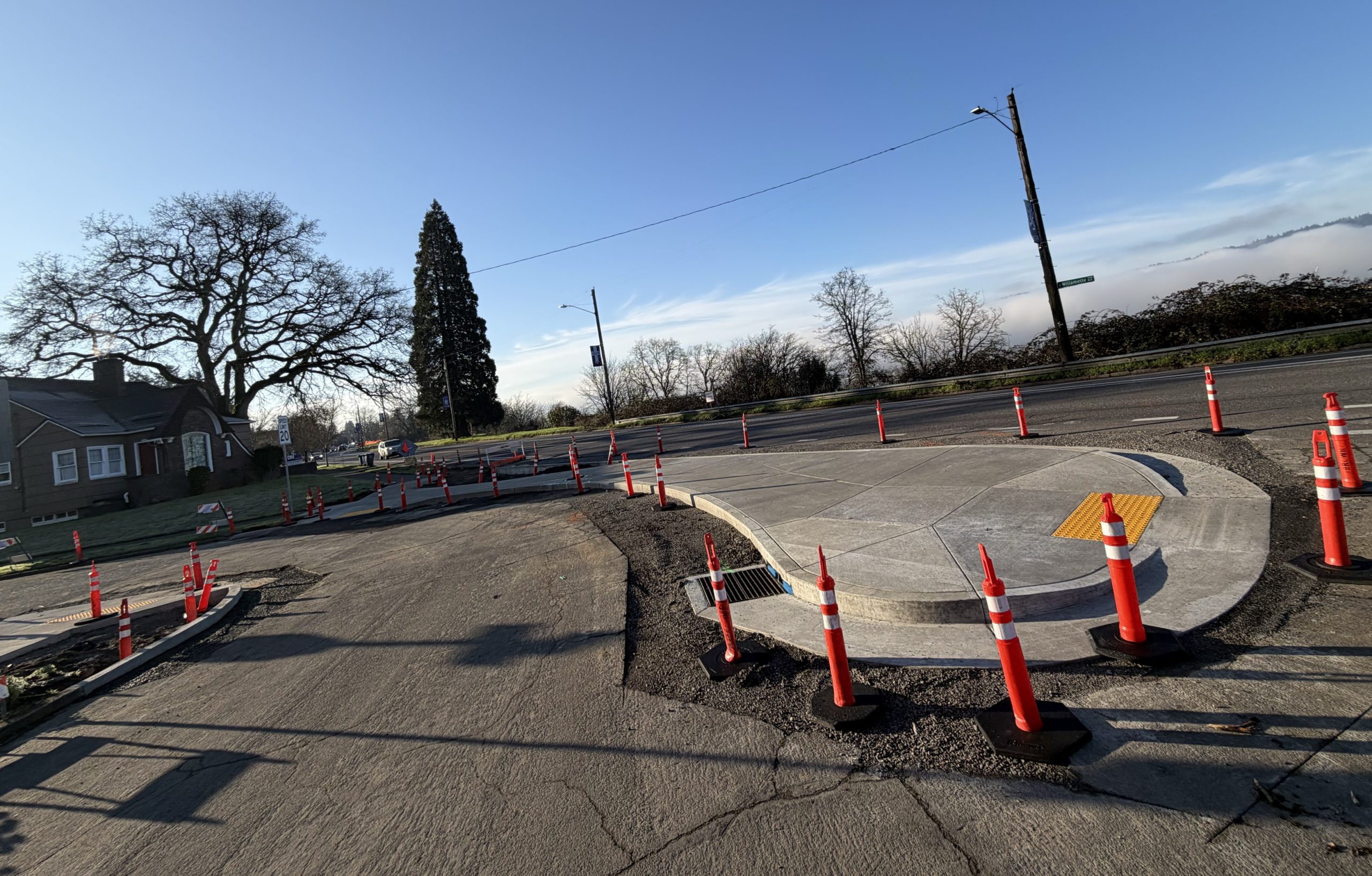
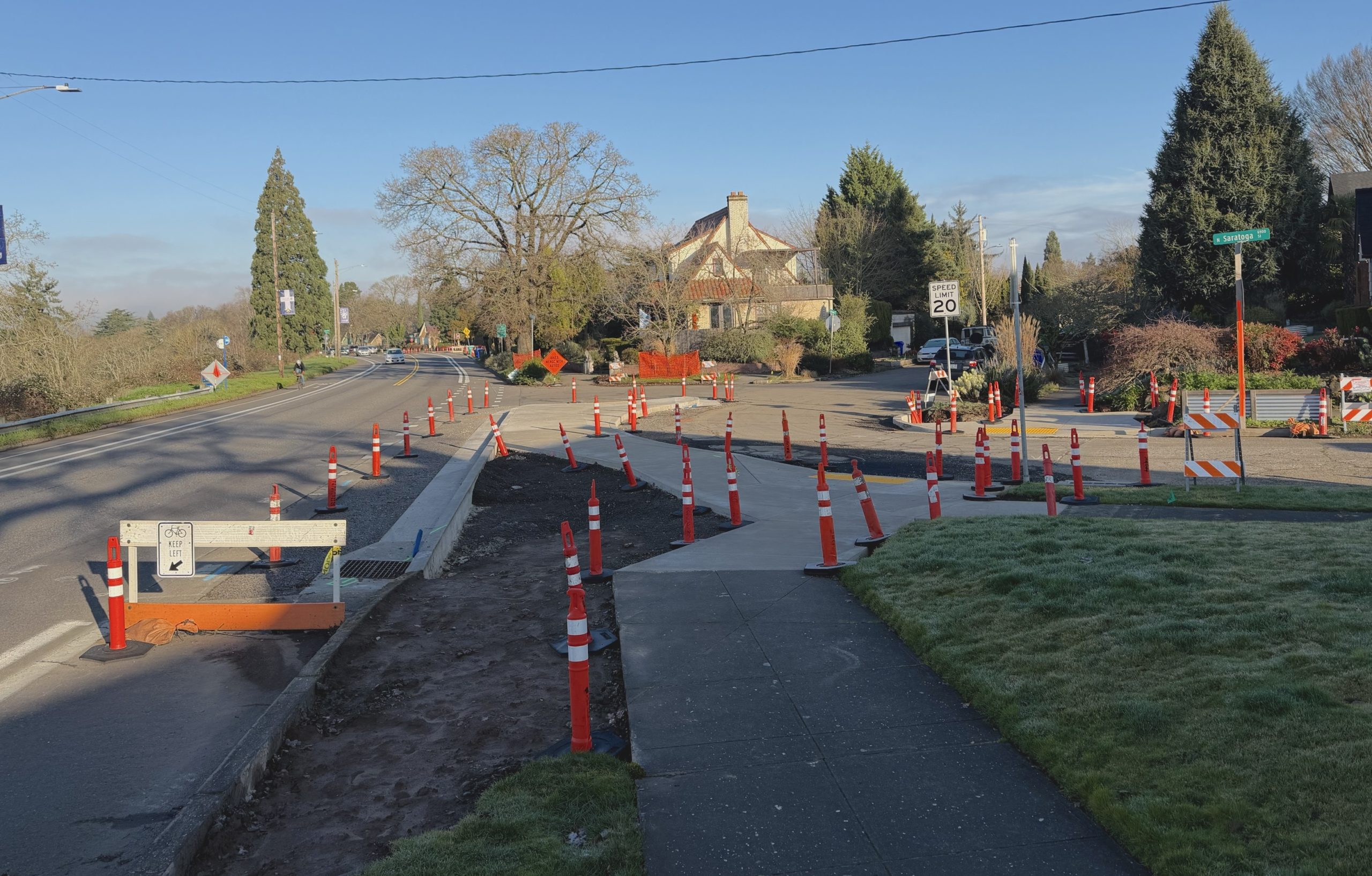
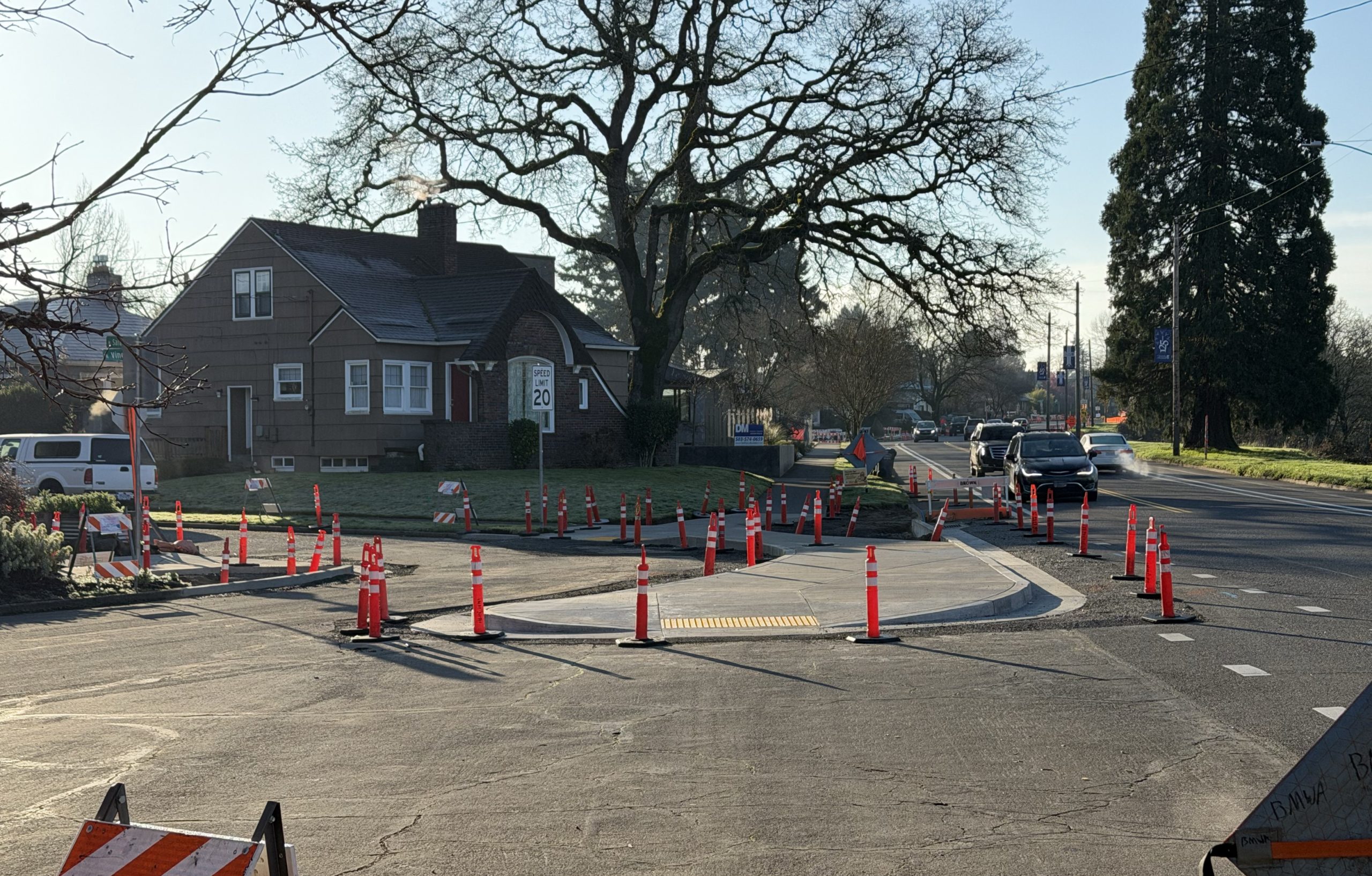
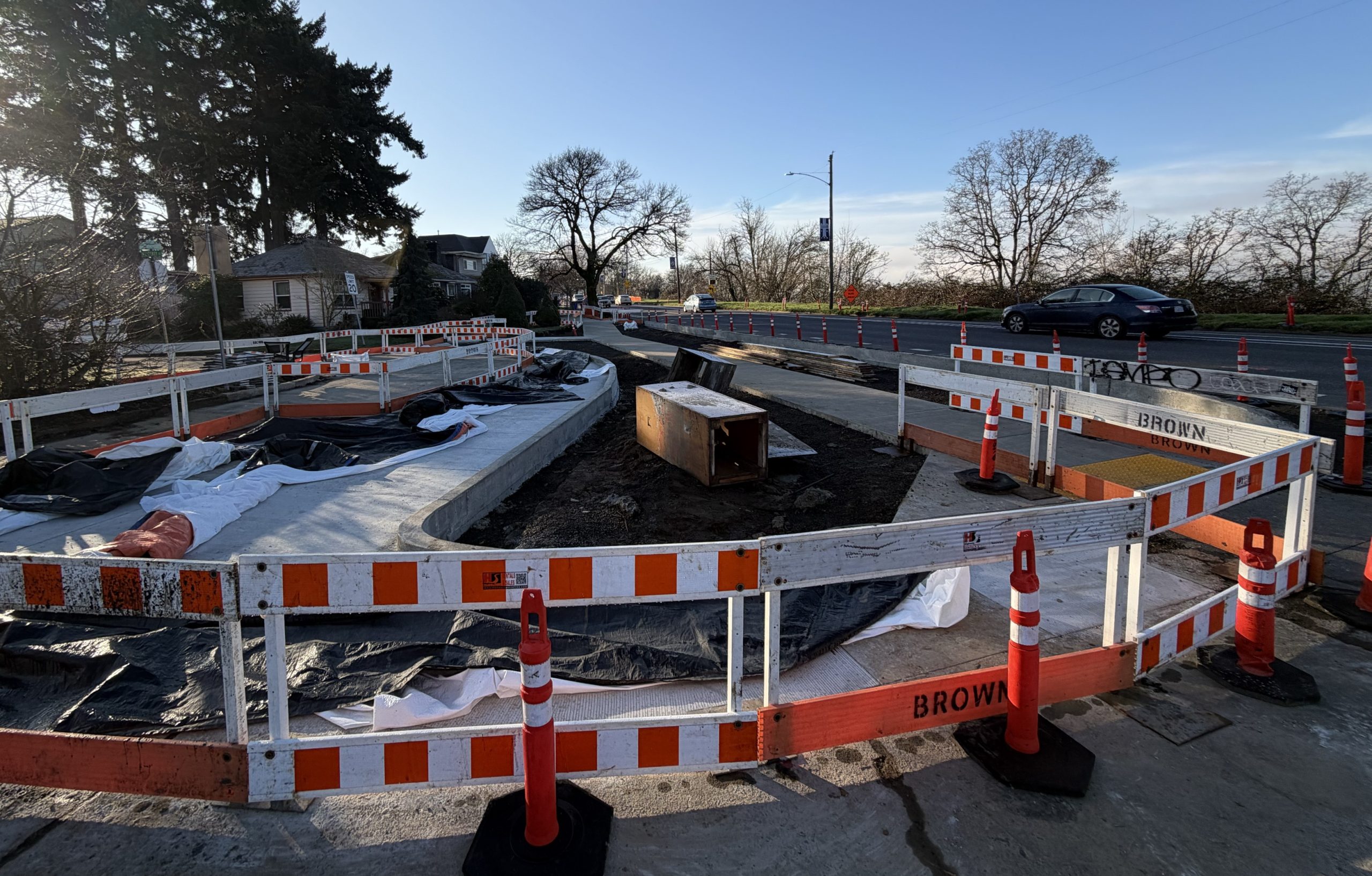
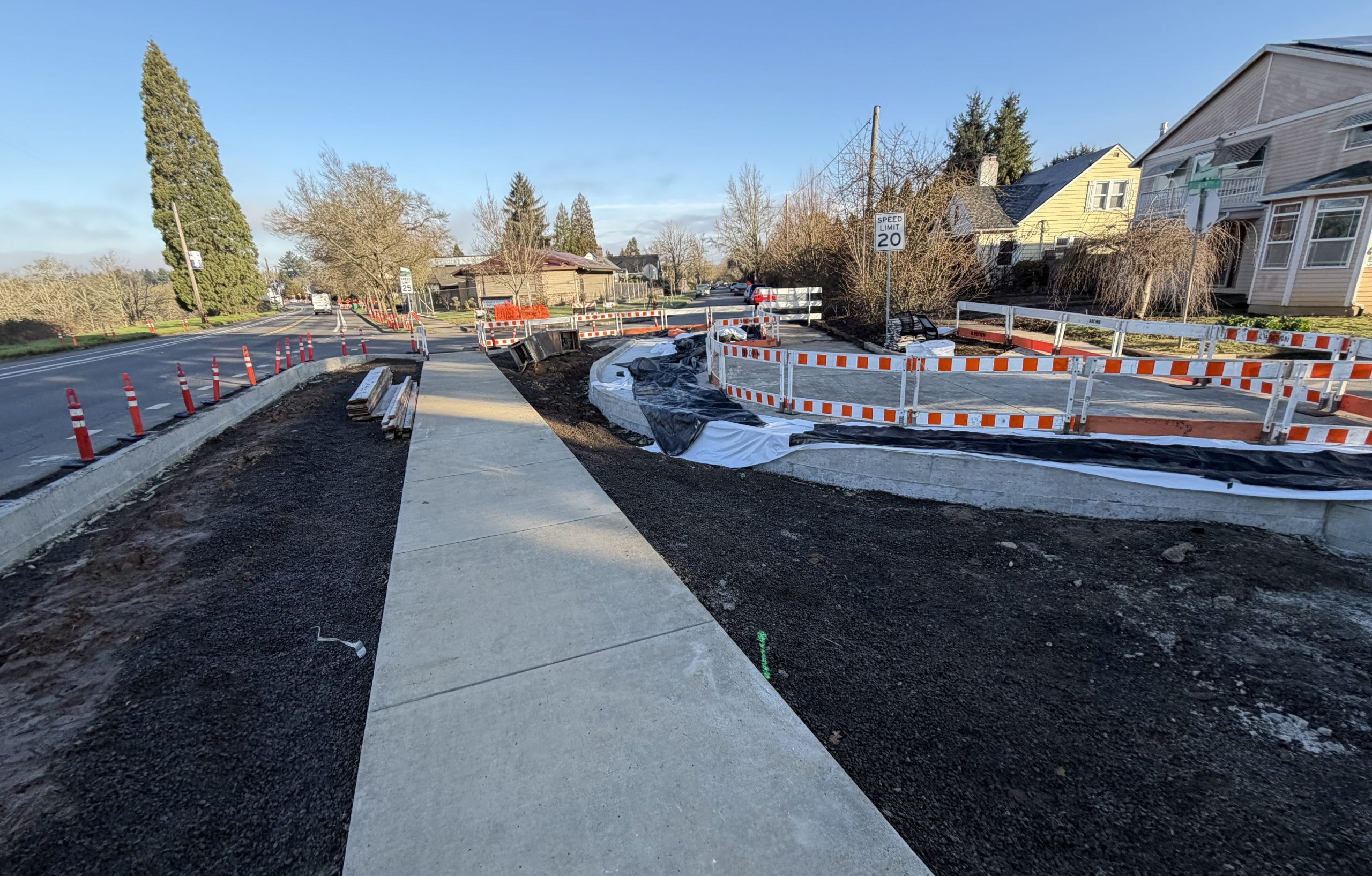
The bright-colored sidewalk that extends into the N Saratoga/Vincent intersection is all new! I call it a pedestrian peninsula. (Photos: Jonathan Maus/BikePortland)
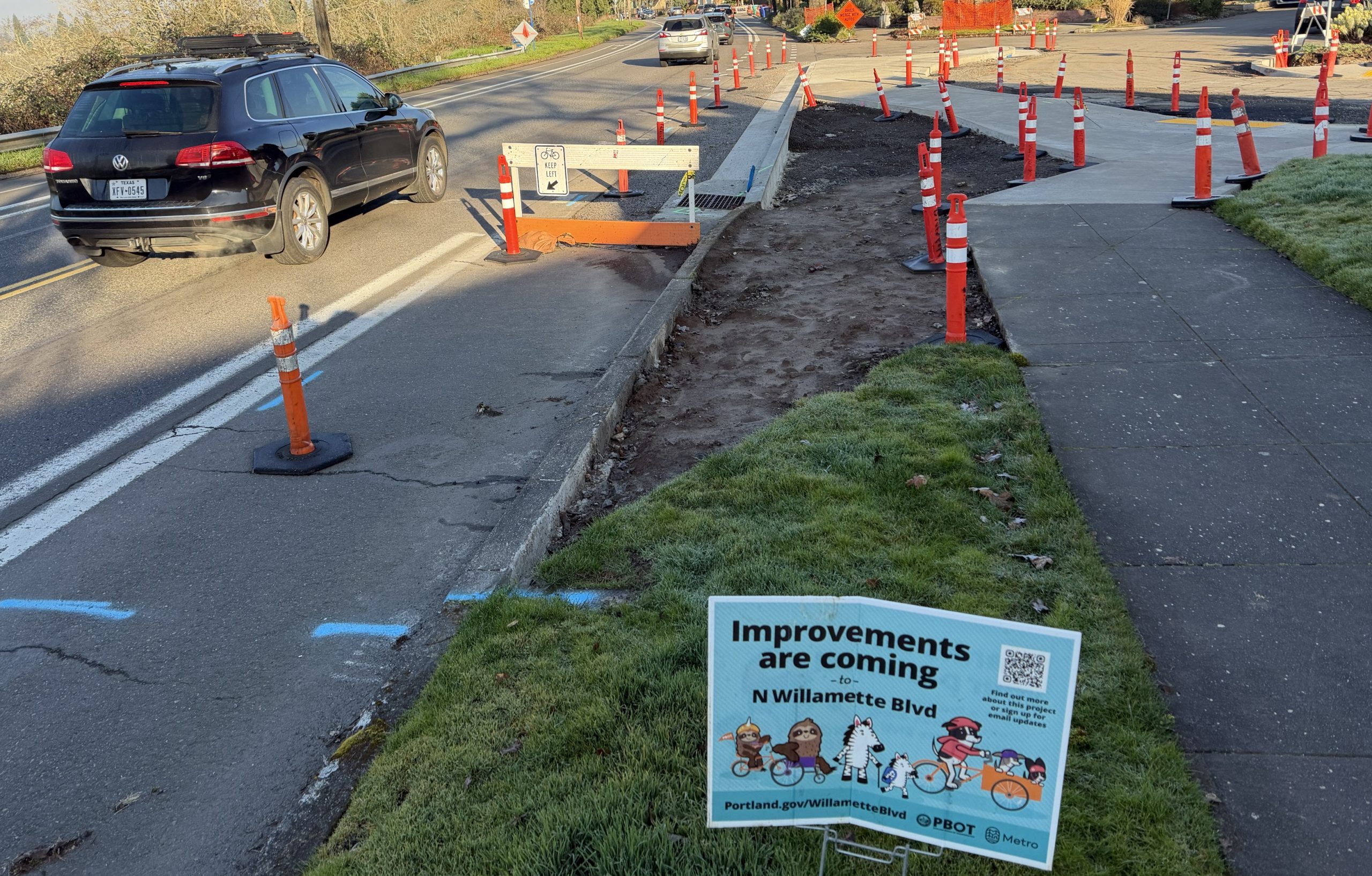
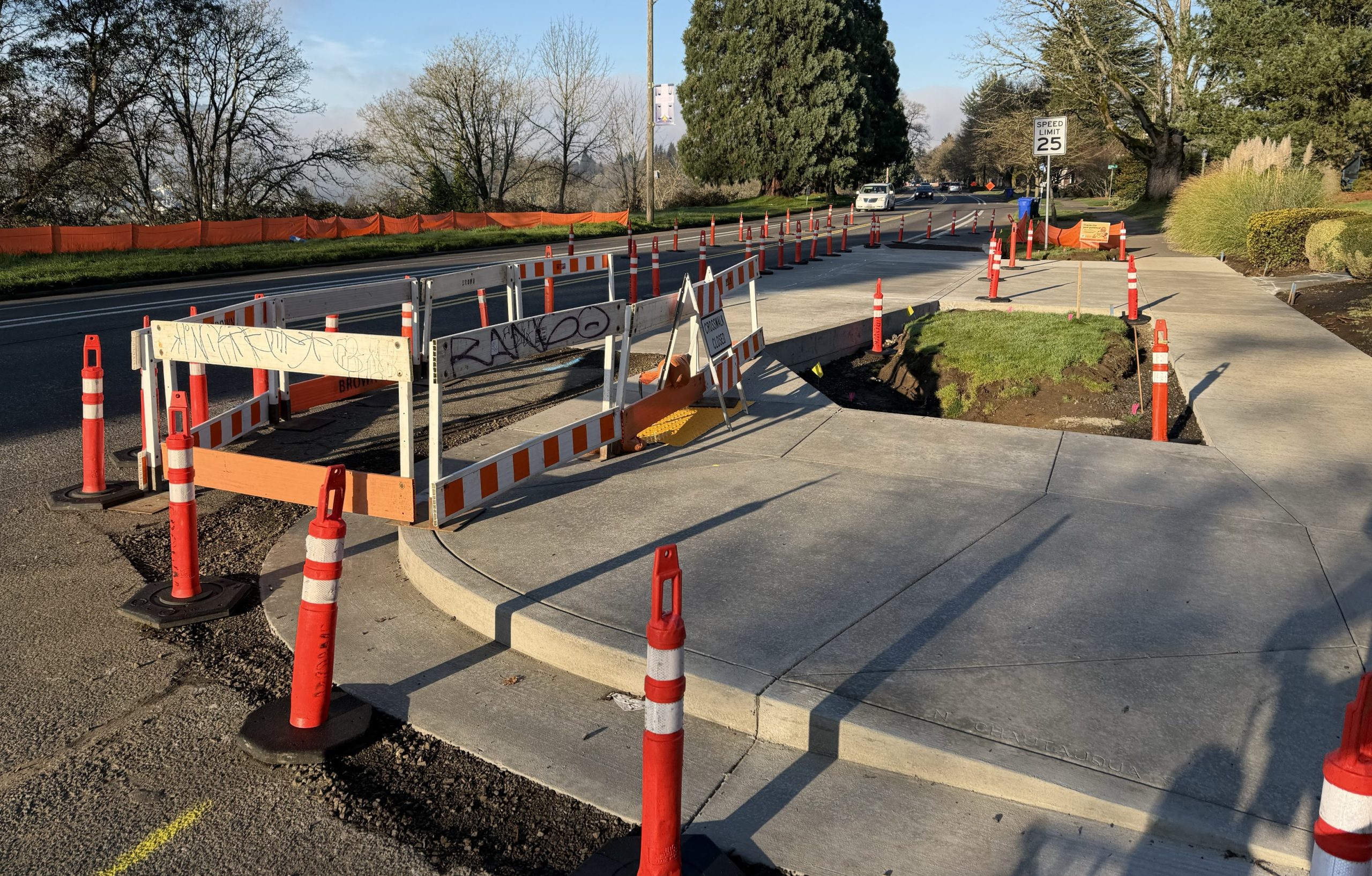
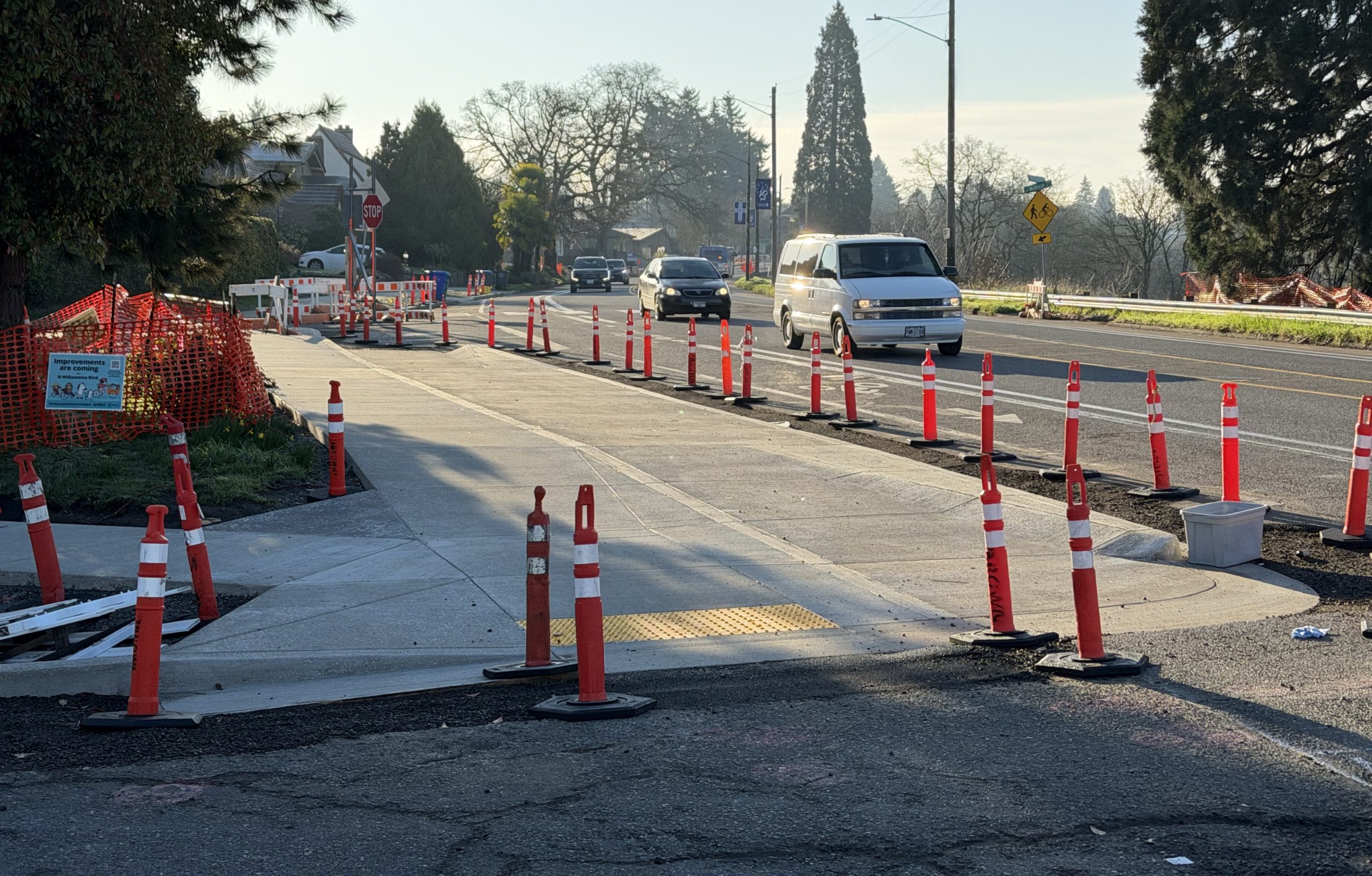
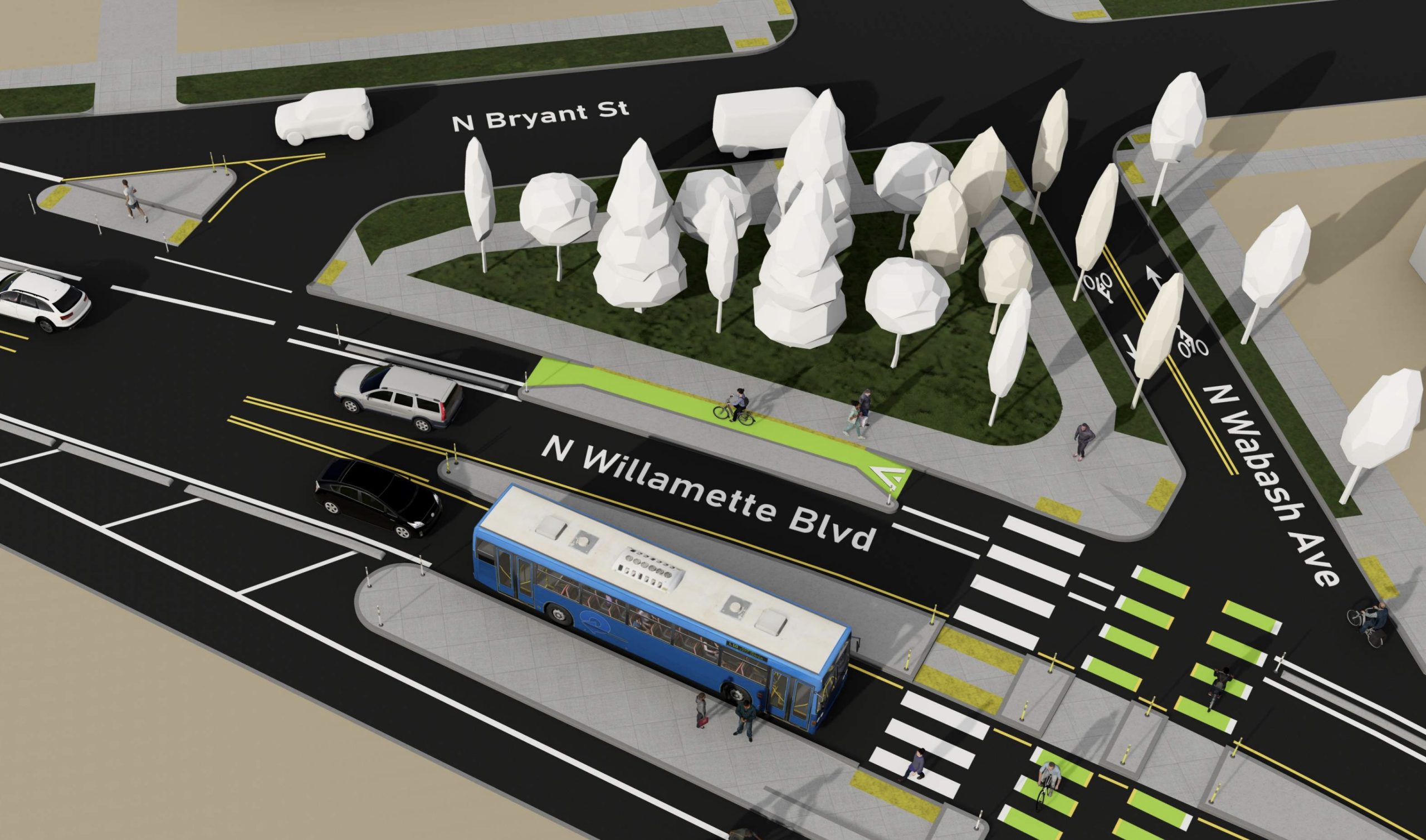
The City of Portland has made major progress on what will soon become Portland’s longest protected bikeway. Once construction is completed on the North Willamette Blvd Active Transportation Corridor project this coming fall, the concrete curb-protected bike lanes on North Willamette Boulevard will connect to existing ones on N Rosa Parks Way for a five mile corridor that connects the Woodlawn and St. Johns neighborhoods with a (relatively) safe bikeway.
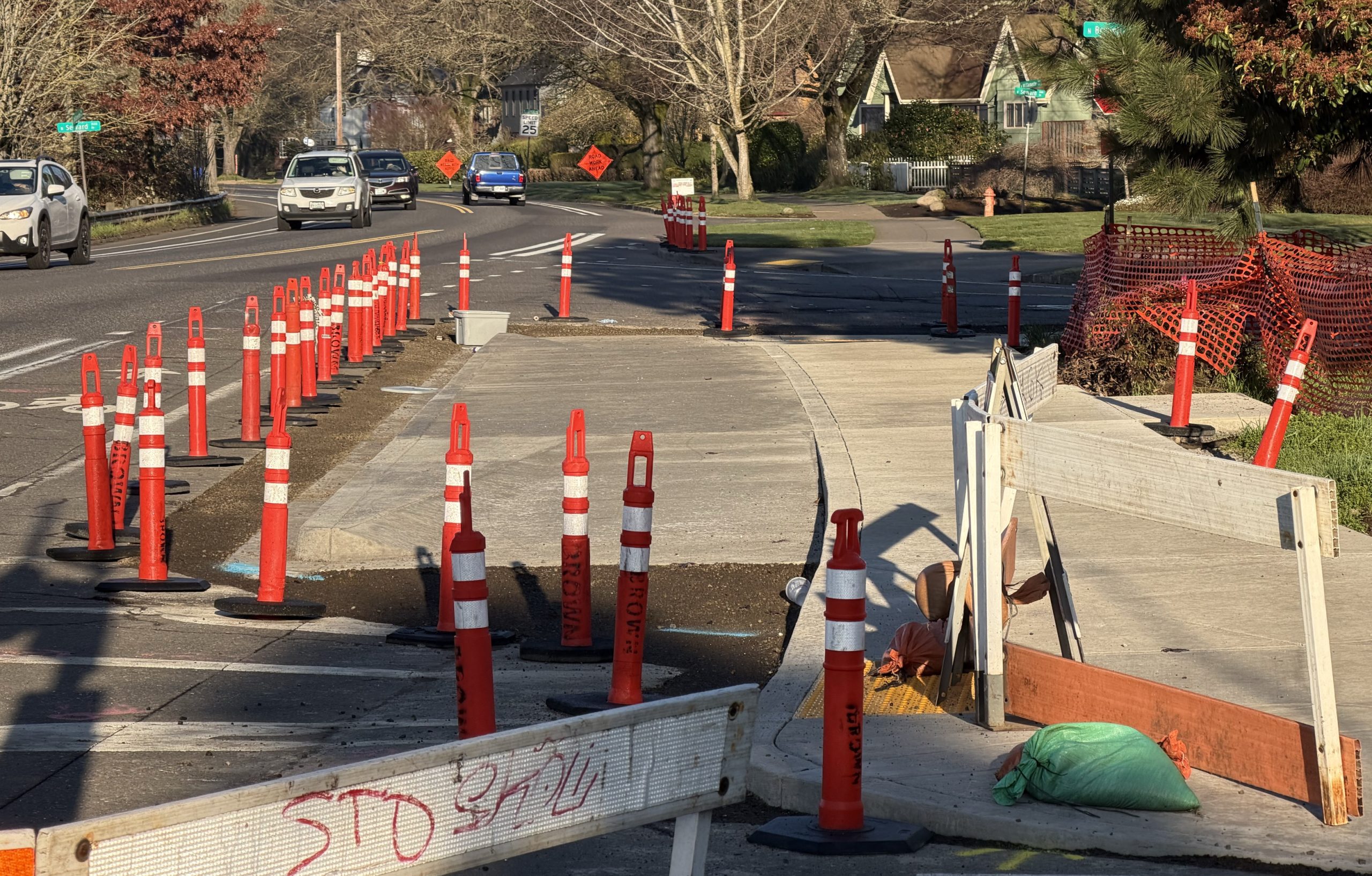
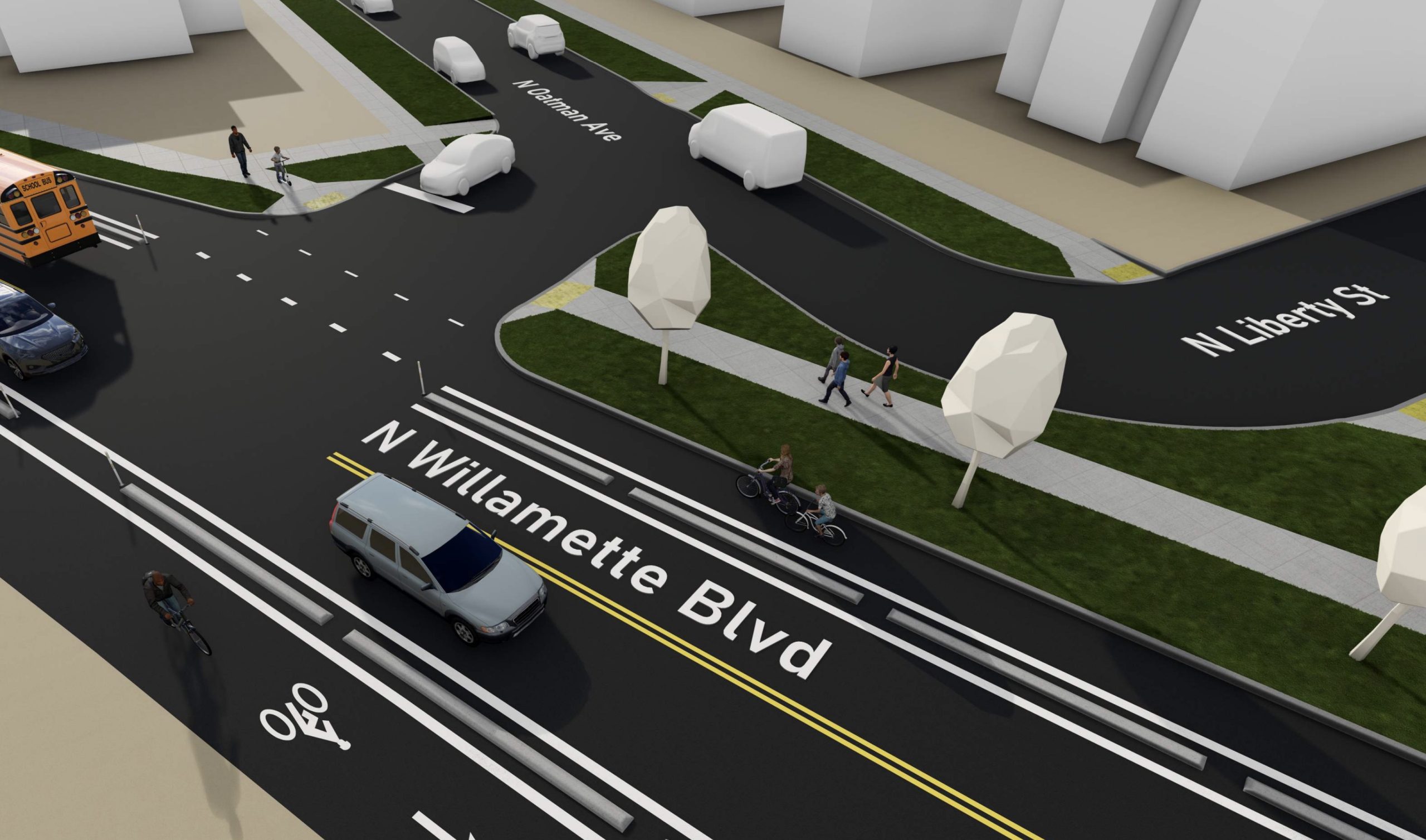
Since I live in this area and travel Willamette almost every day, I’ve watched with excitement as the Portland Bureau of Transportation (PBOT) has embarked on key pieces of the project as they prep for the major repaving work this summer. Before the pavement is poured, all the new intersection changes must be finished. And with this project there are some major intersection changes! I’ve covered the entire project in the past, but today I’ll just share photos from four intersections that have already been transformed: N Chautauqua, N Wabash/Bryant, N Vincent/Saratoga, and N Liberty/Oatman.
Advertisement
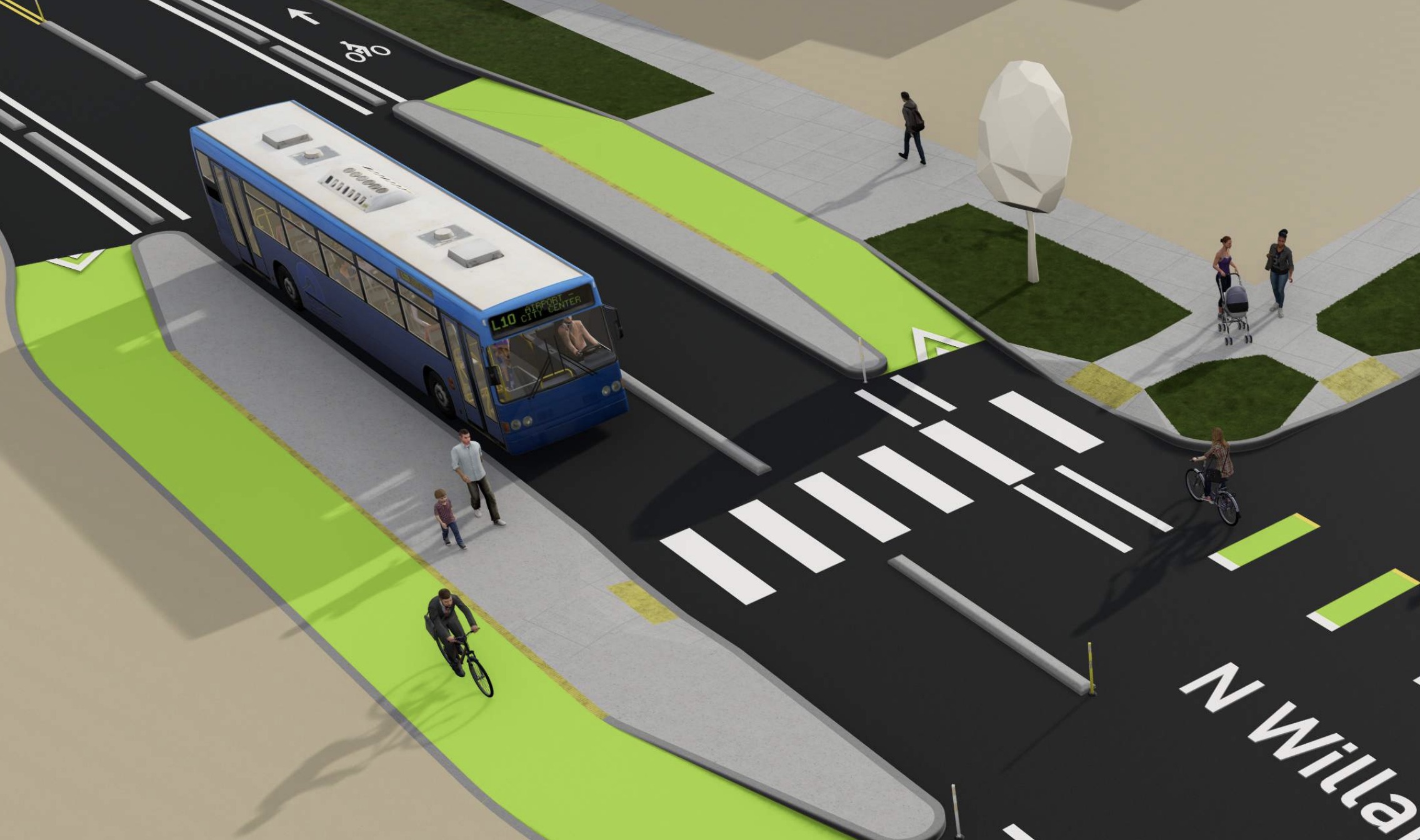
Sidewalk-level bike lane will go behind future bus stop at N Chautauqua.
N Chautauqua
This is one of the locations where there will new bus stop islands will float between the bike lanes and general travel lanes. You can see one of the new bike paths through the island already built.
Looking south at N Willamette from N Bryant.Corner of N Wabash and N Bryant looking southwest toward Willamette.Looking northwest at new sidewalk-level bike lane from N Wabash toward N Bryant with Willamette Blvd on the left.
N Wabash/Bryant
A similar bus stop design will be built here, and much of the new sidewalk and bikeway work has been done. Eventually the last section of N Wabash where it enters Willamette will be bike only!
Looking northwest.Looking south toward Willamette Blvd from N Vincent.Looking northwest on Willamette Blvd toward N Saratoga/Vincent.Looking southeast from N Vincent with Willamette Blvd on the right.
N Vincent/Saratoga
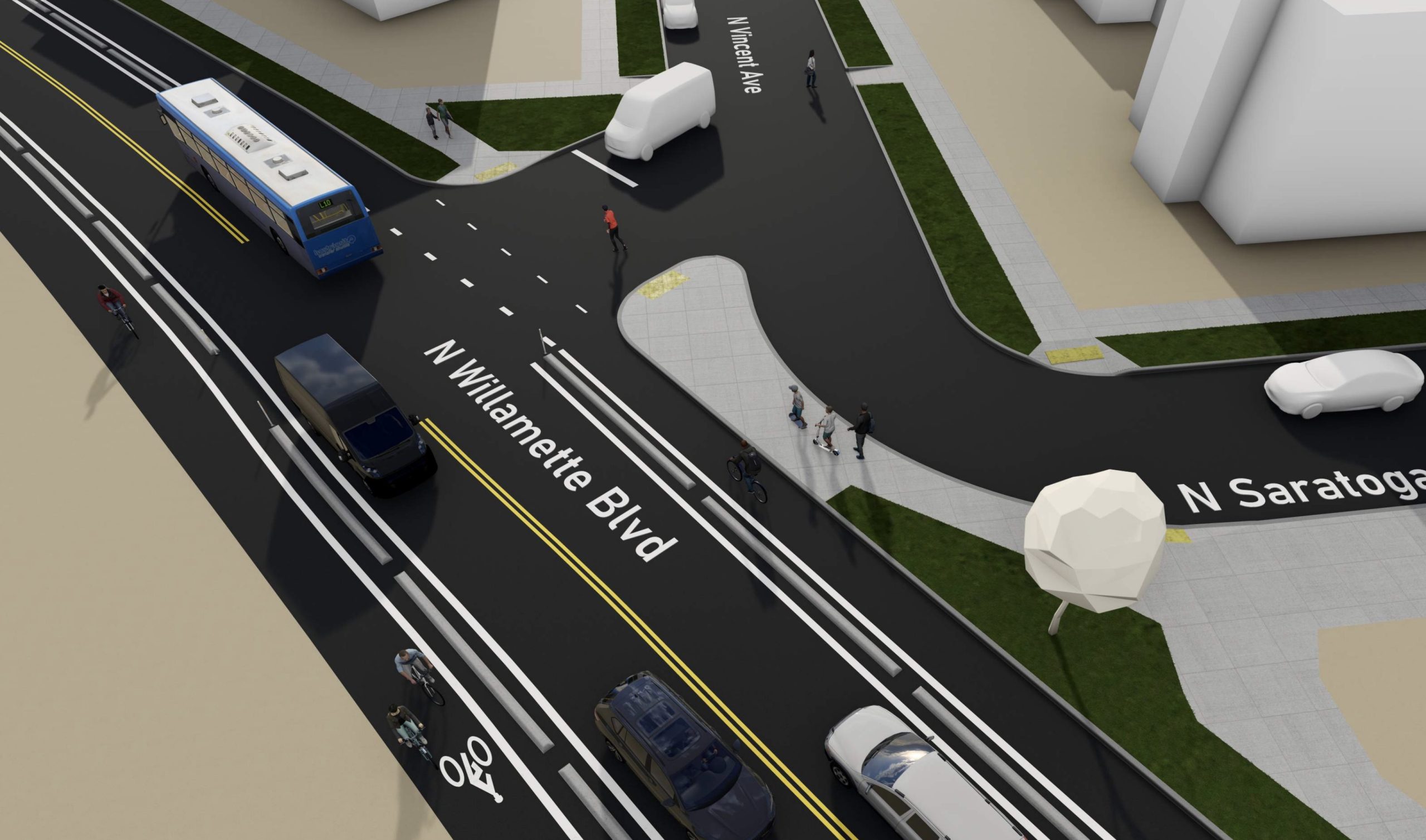
These next two are situations where PBOT is narrowing down very very wide intersections. At this location, PBOT has extended the sidewalks where Willamette and Saratoga meet way out into the intersection in order to provide a safety peninsula for walkers and rollers. This neckdown will force drivers to slow down and it will vastly improve safety of the adjacent neighborhood.
Looking south toward Willamette Blvd.Looking northwest with N Liberty to the right.
N Liberty/Oatman
Another pedestrian safety peninsula thanks to an extremely generous curb extension. I cannot wait to see people hanging out here.
About Rep. Nelson
Some of you might be wondering how things are going with concerns aired by Oregon House Representative Travis Nelson. His concerns are based on how it might create diversion onto other streets and how some folks in the neighborhood might have not been properly notified about it.
According to his office, Rep. Nelson met with PBOT staff last week to learn more about the public outreach process and traffic analysis. An aide tells BikePortland that Nelson is, “still waiting on additional information and data regarding diversion modeling.”
Nelson shared his concerns in a constituent newsletter last Friday. Here’s an excerpt:
“I want to be clear that there is a lot in this project that I think is beneficial to the community. My biggest concern is related to how diversion from Woolsey will impact narrow residential side streets in University Park and Arbor Lodge. PBOT will be providing me with more data on diversion modeling which may help ease these concerns. We also discussed ways the bureau can better engage with the Black community which has faced a long history of exclusion from the process. It’s important we continue the work of repairing harm and rebuilding trust. PBOT has made commitments to better engage with the Black community in the future.”
I’ll continue to follow up with Nelson and will be watching his next newsletter in case he shares any updates. For now, have fun watching PBOT’s progress and please use extra caution in work zones when you are using N Willamette.
Need a job? Want a better job? Just looking for a change? You are in the right place. Don’t miss these recent job announcements. (Remember, you can always stay abreast of jobs as soon as they get listed by signing up for our Job Listings email.)
NOTE: Yes, I know some of these are older than a week. I just haven’t changed the name of the post. I keep listings open until the company tells me the position has been filled. As always, be sure to contact the lister to make sure the job is still available!
These are paid listings. And they work! BikePortland has helped hundreds of people find great jobs and great staff members. If you’d like to post a job on the Portland region’s most popular bike and transportation news platform, you can purchase a listing online for just $100. Learn more at our Job Listings page.
A section of Beaverton-Hillsdale Hwy that PBOT has already upgraded to concrete curbs. A plan for similar treatments faces neighborhood opposition from an unlikely source. (Photo: Jonathan Maus/BikePortland)
In cities where bicycling has grown rapidly, local governments have streamlined the installation of curb-protected bike lanes. They treat them as standard transportation infrastructure, not as optional amenities. Portland already has the policies in place to do the same. If we want to become the best bike city in North America, we must follow the policies we’ve adopted instead of second-guessing them every time a project moves forward.
Portland’s Transportation System Plan classifies every street in the city. Engineers and planners have determined what type of infrastructure belongs on each classification. Those policies were vetted through multiple layers of review and formally adopted by our elected officials. We have clear design standards for transit, freight, automobiles, pedestrians, and bicycles. Bicycle infrastructure should be treated no differently than any other mode — and it should be applied consistently across the city.
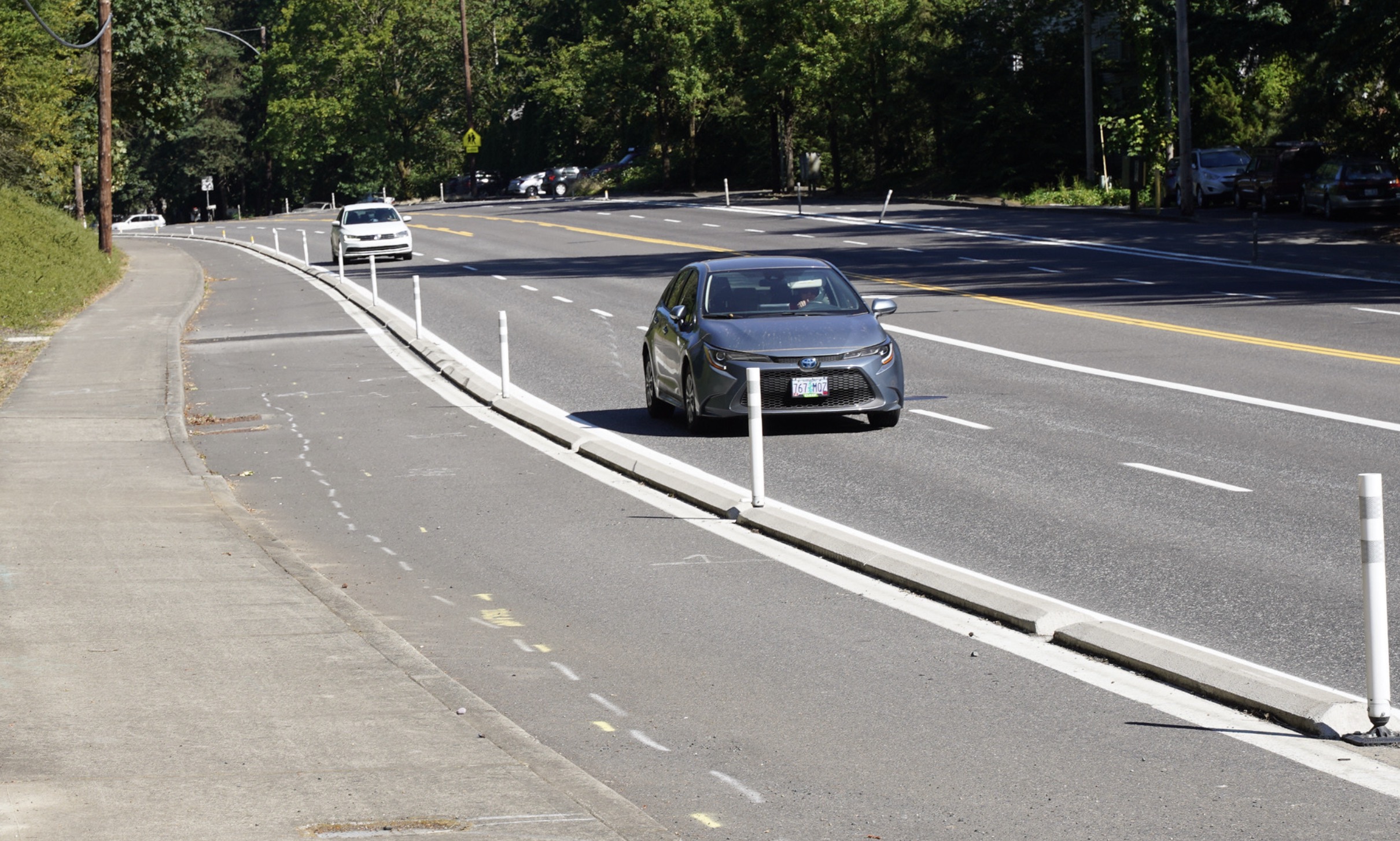
Our policies call for protected bike lanes on Southwest Capitol Highway, SW Bertha, and Beaverton-Hillsdale Hwy. The opportunity to build them is in front of us, and we should take it.
Advertisement
The recent effort to oppose protected bike lanes amounts to a rejection of this adopted framework — but only for bike infrastructure. It suggests that the Portland Bureau of Transportation (PBOT) must secure a vague and undefined “community support” threshold before installing protected bike lanes. We do not apply that standard to other forms of infrastructure. PBOT has installed hundreds of ADA curb ramps across the city. If each ramp required broad community approval, we would have only a fraction of them. We recognize ADA access as essential infrastructure. Protected bike lanes should be treated the same way.
There are times when PBOT gets things wrong. Public oversight matters. When Commissioner Mapps attempted to remove the Broadway protected bike lanes — despite their consistency with city policy — the community spoke up and stopped it. The claim at the time was that there wasn’t sufficient “community support.” But policy already provided the direction. Those lanes should have been installed a decade earlier.
Community engagement is important. The city should communicate clearly, gather feedback, and make reasonable adjustments when warranted. But we do not require a popularity contest to install water lines, traffic signals, or sewer upgrades. Protected bike lanes are basic safety infrastructure.
Everyone has opinions about where lanes should go or how they should be designed — curb height, parking removal, materials. Those are fair implementation questions. But at some point we must trust our adopted plans and our professional staff to execute them.
If every bike project is subjected to repeated demands for undefined “community support,” we will continue to spend disproportionate time and resources debating whether to build rather than actually building. Portland cannot afford that delay.
We have the policy. We have the standards. We have the opportunity. Now we need to follow through — and build the protected bike lanes our city has already committed to.
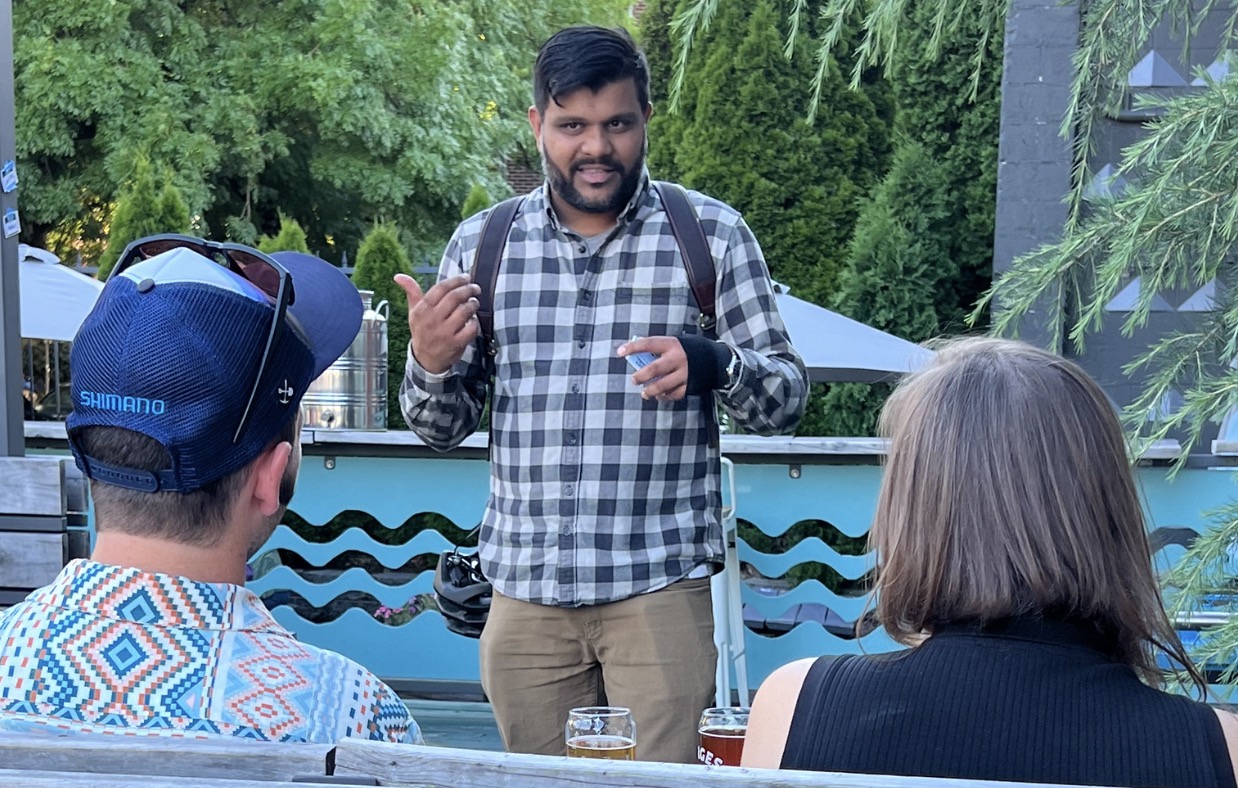
Councilor (then candidate) Sameer Kanal, with bike helmet tied to his backpack, at Bike Happy Hour in July 2024. (Photo: Jonathan Maus/BikePortland)
There’s been an important shift in how policy is made in Portland City Hall. Last week, council voted in a new committee structure that come with significant changes — including a new member of the committee that oversees the Portland Bureau of Transportation.
Portland is just one year into a brand new form of government, so when they adopted the committee structure last January, it was their first time doing so. The idea is that committees can get deeper in the weeds on topic areas and hash out policy details before final votes at the full, 12-member council. It’s been a good system in many ways, but almost immediately there was grumbling about how many committees were stood up (eight), and the fact that some of them lacked representation from all four council districts.
The new structure reduces the number of committees from eight to five, aligns them more closely with existing service areas, and comes with changes to membership. Most of the stuff BikePortland cares about was in the (now defunct) Transportation and Infrastructure Committee. That committee no longer exists and PBOT-related issues will now be discussed at the Public Works Committee. (The other four committees are; Housing and Permitting, City Life, Community and Public Safety and a Committee of the Whole.)
Advertisement
Another key change is that District 2 (North and Northeast Portland) is now represented on the committee (the old T & I Committee didn’t have any councilor from D2). The councilor who will represent D2 on the committee is Sameer Kanal (he takes the place of Councilor Angelita Morillo). This is good news for folks who know Kanal. He’s a thoughtful leader who’s shown himself to be interested in transportation issues, is a policy wonk who cares about the details, and is a good listener. He’s come to Bike Happy Hour several times and I’ve watched him spend hours talking to folks about a wide variety of issues.
Kanal will be joined on the committee by Chair Olivia Clark from D4, Vice Chair Loretta Smith from D1, Tiffany Koyama Lane from D3, and Mitch Green from D4. (Learn more about all the new committees and rosters here.)
In addition to transportation matters, the new Public Works Committee will also take on issues related to the Water Bureau, Bureau of Environmental Services, Parks programs, and Fleet and Facilities.
Speaking at the Council meeting this morning, Kanal said he’s grateful for being named to the committee.
Councilor Kanal also wasted no time playing his new role. During a discussion about a crossing and sidewalk project on NE Martin Luther King Jr. Blvd, Kanal spoke up about other things going on in the nearby area.
“The Boise neighborhood has been bringing up, with some of the other neighborhood associations as well, improvements to crosswalks on Northeast Seventh, Irving, and Skidmore.” Then Kanal added, “I think there’s a lot of work that’s been done on planning, but not necessarily on implementation and I’m looking forward to collaborating with folks in the administration who I know share the desire to implement all of those types of improvements as well.”
Kanal also made a point to mention that he wants to hear more from PBOT about projects in his district.
If you live, ride, or work in D2, you’ve finally got a strong rep for your area! It’s my district too, so I’ll be sure to invite Councilor Kanal on a ride soon.
Stay tuned for more details, agendas and schedules for the new committee.