

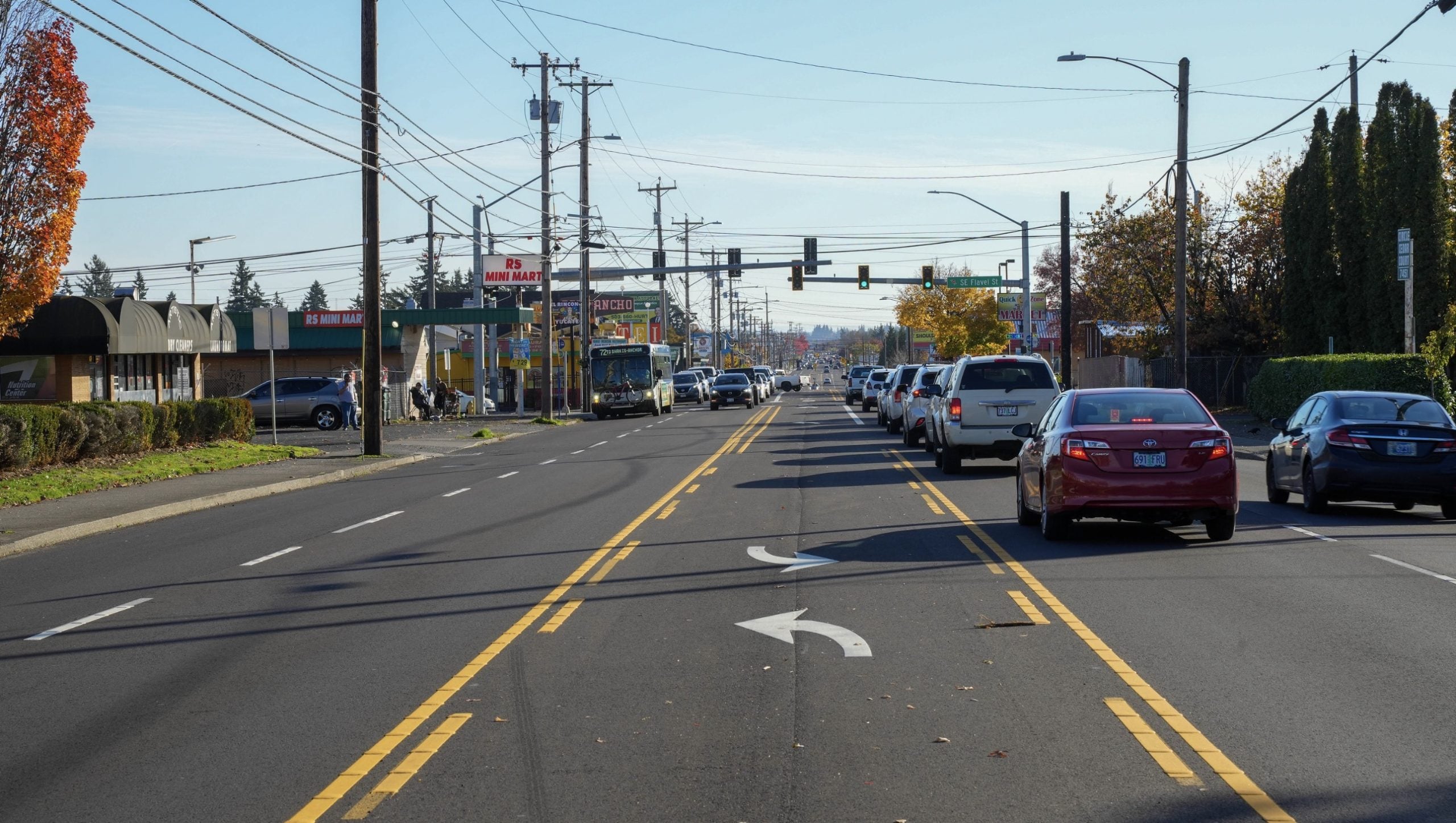
The debate over bus lanes on 82nd Avenue evolved considerably at the meeting of TriMet’s Policy and Budget Committee last Friday.
Before that meeting, a coalition of business owners strongly opposed plans for new “business access and transit” (BAT) lanes and leaders of several key advocacy groups were pushing TriMet to adopt the “More BAT” design option that would build semi-dedicated bus lanes on nearly the entire project corridor between Clackamas and Northeast Portland.
But as the project timeline inches forward and tension builds like the crowd inside a Line 72 bus during rush hour, a compromise now feels inevitable. The agenda for Friday’s meeting was to discuss the contentious bus lane issue one last time before members make a recommendation at their meeting next month.
TriMet GM Sam Desue starting things off with an unexpected twist: He read from a letter signed by a surprising alliance of advocacy groups.

“My own recommendation would be to pull BAT lanes away from Powell. There are a lot of problems that get generated around there.”
– Chris Ford, ODOT
“We all want this project to create a transit-rich corridor,” the letter read. “We believe it is possible to deliver BAT lanes while ensuring that the people and businesses who make 82nd Avenue special can continue to thrive.” What made the letter surprising is that it was co-signed by Oregon Walks, APANO (Asian Pacific American Network of Oregon), Unite Oregon, Verde and the Portland Metro Chamber. Yes, the same Portland Metro Chamber whose members threatened lawsuits over the bus lanes just a few months ago was now collaborating with groups whose members strongly support better transit on 82nd Avenue. What brought them together? A shared demand that TriMet completes a third-party economic impact study on how the BAT lanes will effect businesses.
But getting business owners to look past their transit fears was just one hurdle the BAT lanes faced. The other, even more serious challenge for the project, is getting it approved by the Oregon Department of Transportation (ODOT). As the pre-eminent road authority, ODOT has veto power over any project that crosses and/or impacts one of its roads. In the case of the 82nd Avenue Transit Project, the plans impact ODOT’s Powell Blvd (Highway 26), NE Lombard (Highway 30 Bypass), and access to Interstate 205.
At issue are traffic models used by ODOT that assume folks who currently drive cars on 82nd Ave would use other roads if a bus lane existed. In ODOT’s world, car traffic is a constant and diversion from a major arterial like 82nd could cause congestion on state-owned facilities. And while to you and I congestion just means a trip takes a bit longer, to ODOT it’s a five-alarm fire.
“I know there are a lot of different safety issues on this corridor, including vulnerable users and transit riders,” said ODOT Region 1 Policy and Development Manager Chris Ford at the meeting Friday. “But the thing that we also wanted to consider was if there would be diversion to off-ramps from I-205 where you would get rear-end collisions which tend to be serious and fatal.”
According to TriMet’s analysis, about 15-25% of the peak-hour car traffic on 82nd would be diverted onto other roads (depending on the extent of BAT lanes installed). Prior to Friday’s meeting, ODOT ran a detailed analysis on how those additional car users might impact their facilities.
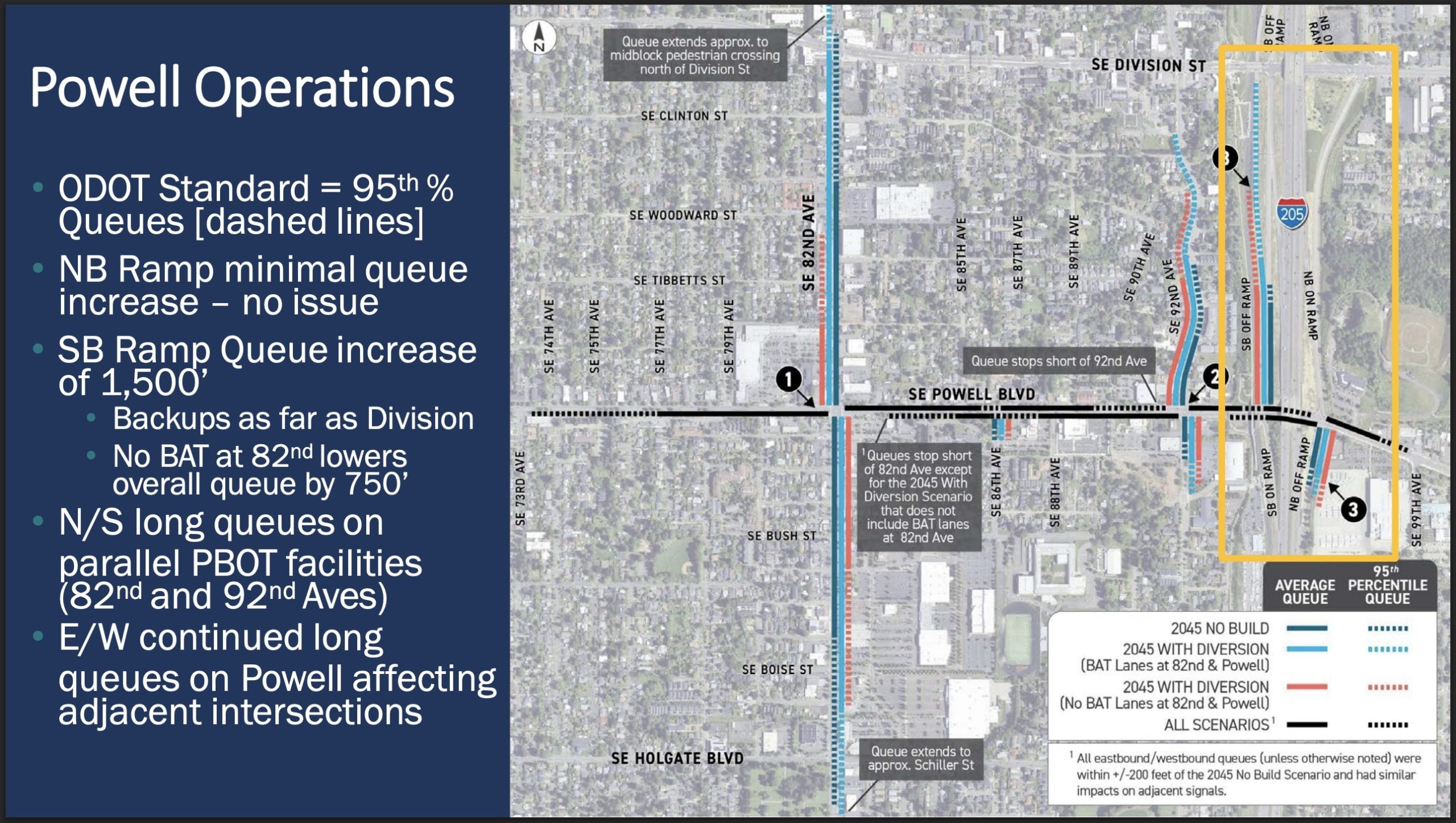
ODOT’s biggest concern is along Powell Blvd at 82nd and 92nd avenues (see above). If BAT lanes are installed at 82nd and Powell, Ford said car drivers would queue up all the way north to SE Division and south to SE Holgate. And the entire section of Powell between 82nd and I-205 would be a clogged-up mess. He laid out three mitigation options: drop the BAT lanes at this intersection altogether, widen 82nd Avenue to handle more car traffic and create a new bus turn lane, or roll the dice and see if ODOT would grant TriMet and the City of Portland a “design exception” which is essentially a get-out-of-jail-free card for traffic engineers.
While options were presented, it was clear that only one is likely to be politically and practically feasible. Widening 82nd would add costs and time to the project, as well as making it even more dangerous to cross. And the design exception process (managed by ODOT) would take at least 6-8 months to complete and thus could jeopardize the project timeline (an all-important consideration given that it’s federally funded and the feds do not mess around with timelines).
So that leaves just one option: drop the BAT lane.
“ODOT’s preference would be no BAT lanes [at 82nd and Powell],” Ford shared with committee members. “My own recommendation would be to pull BAT lanes away from Powell. There are a lot of problems that get generated around there.” Then Ford added as a note of caution, “If the project wanted to move forward with pursuing a design exception that you know ahead of time what your ‘Plan B’ would be.”
Throughout the meeting there was an evident tension from TriMet project staff. They know BAT lanes deliver more of what the community wants out of this project, but they also don’t want to do anything that jeopardizes the project from being completed on time and on budget.
82nd Avenue Transit Project Manager Jesse Stemmler summed it up like this: “Our aim as a project is to deliver the most BAT lanes possible while addressing the risk, the challenges, and those concerns that we’ve heard.” Asked about impacts of dropping BAT lanes, Stemmler estimated that bus riders would lose about 30-40 seconds in travel time savings if BAT lanes were dropped at Powell. (Stemmler also wanted to make it clear on Friday that the base project — even without BAT lanes — will be a massive improvement for transit on 82nd Avenue.)
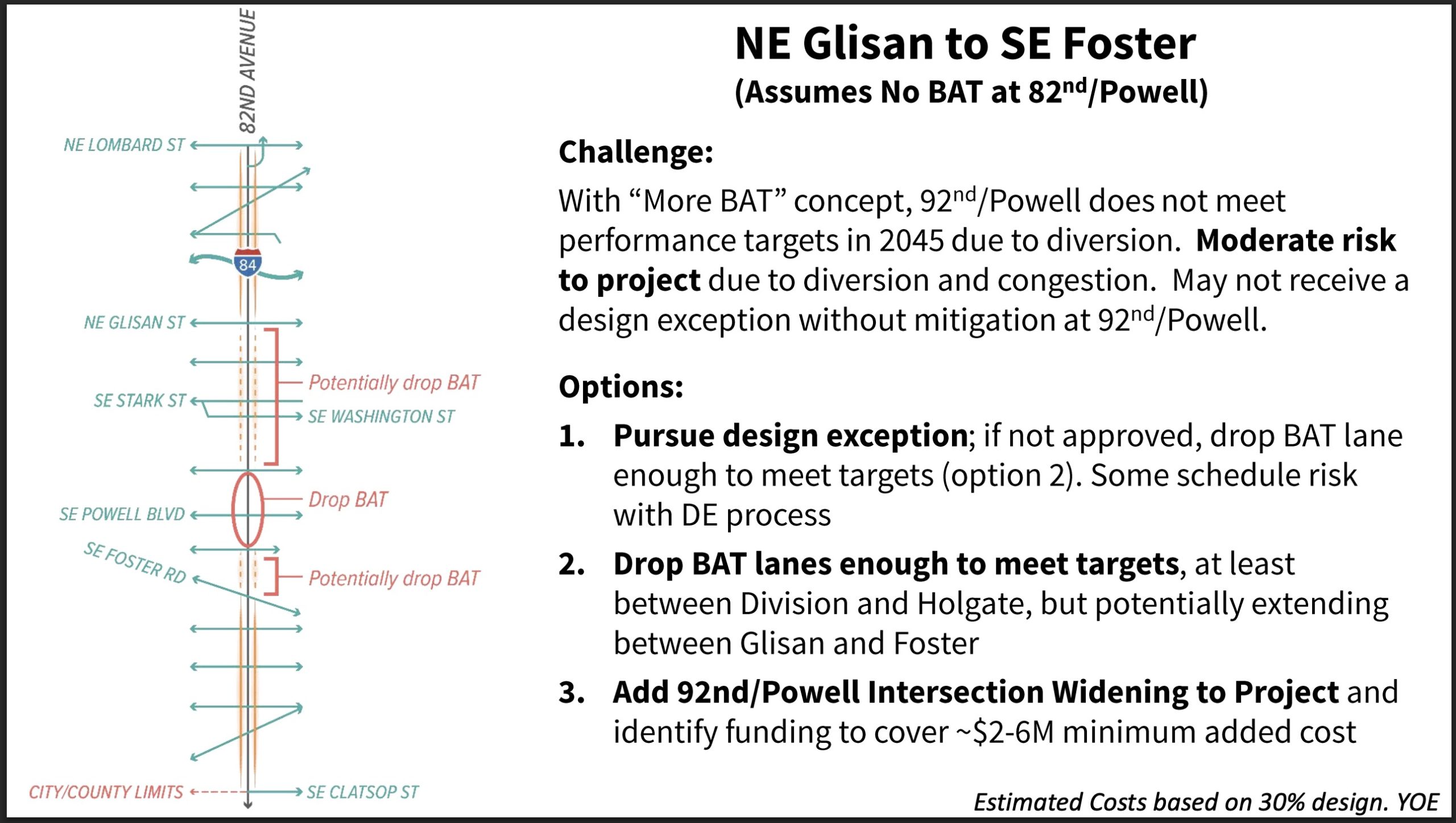
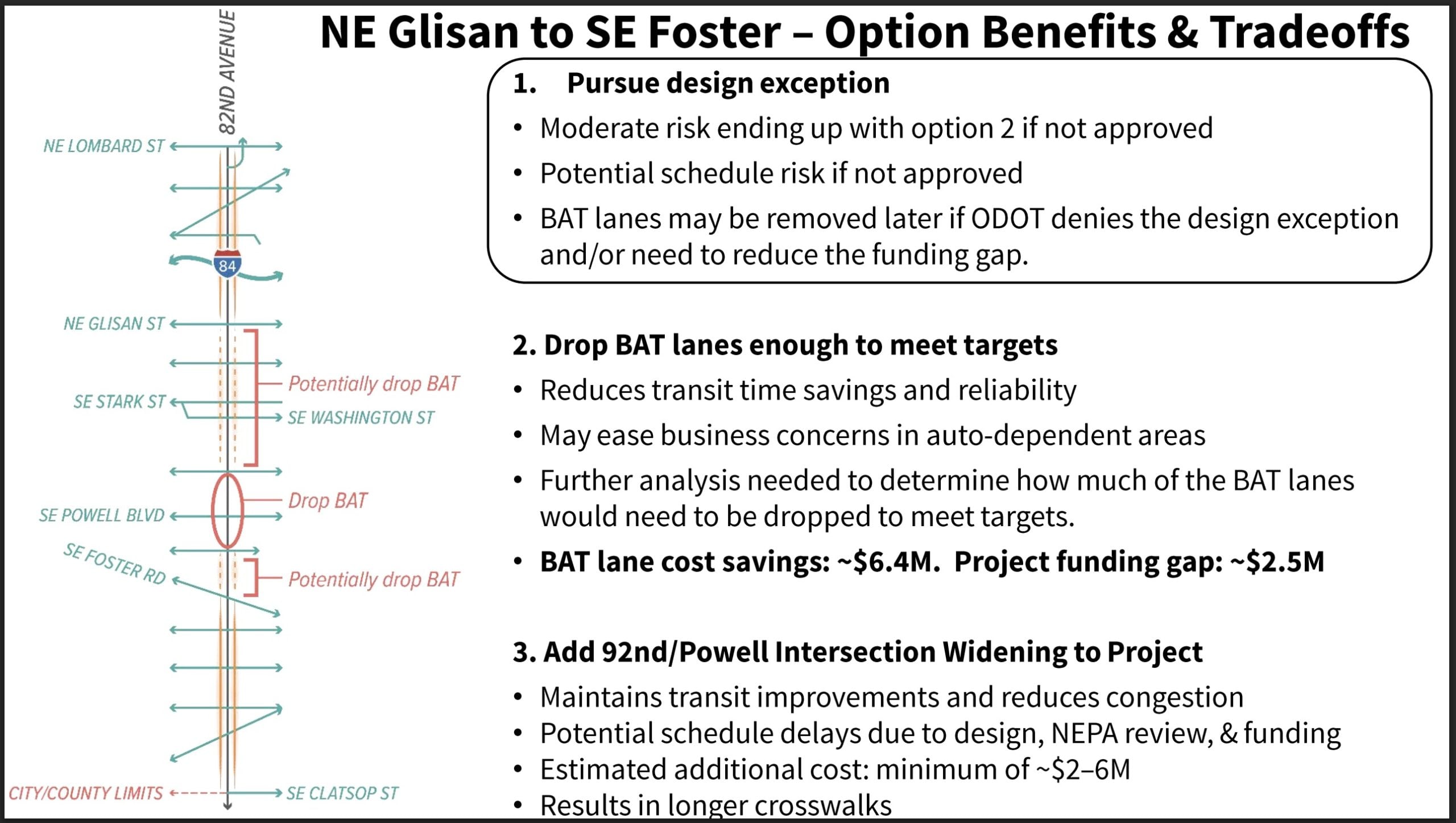
Stemmler explained that the staff recommendation he’ll present at next month’s Policy and Budget Committee meeting will be to drop the BAT lanes at Powell Blvd, pursue a design exception at 92nd (where ODOT said they can live with the impacts to I-205 ramps) and commit to a slight widening of 82nd at Stark and Washington (to accommodate side-by-side left turn lanes). Stemmler also said they’ll recommend pursuing another design exception for two other section between NE Glisan and Foster (see slides below) and would consider dropping BAT lanes north and south of Powell if that exception doesn’t get approved by ODOT.
While momentum favors dropping BAT lanes at one (or more) location(s), not all officials around this project are ready to throw in the towel. At one point, committee member and Metro Councilor Christine Lewis made it clear she doesn’t want TriMet to give up on full BAT lanes, but the response from project staff sent a powerful message.
“I’m wondering if there’s an opportunity to continue to do research and planning on [BAT lanes on] 82nd and Powell… I would like to study BAT lanes here at this intersection in particular because it is such a prominent and and difficult intersection,” Lewis commented.
To which TriMet Interim Director of Major Projects Michael Kiser responded, “More study of Powell is pursuing a design exception which is over a six-month process. Within the next few months we are going to start our risk and readiness review with FTA. If they [Federal Transit Administration] see that there’s uncertainty in scope/schedule/budget and decisions amongst partners, that’s a red flag for them.”
Lewis and her fellow Metro Councilor Duncan Hwang still seem willing to go to bat for BAT lanes. “I’d love for the project team to continue to study full BAT the entire length,” Hwang said Friday. “I think we’re in a place of, how do we study the whole thing while still being able to make cuts strategically if we have to, but not closing doors [on BAT lanes] now.”
For her part, Portland Bureau of Transportation Director (and Policy and Budget Committee member) Millicent Williams seems more willing to compromise than Lewis or Hwang. “The City of Portland will be happy to support as much BAT as is possible,” Williams said. “She prefers a “Goldilocks” option of “more than some [BAT], but less than more [BAT]”.
A few months ago this debate was about “Some BAT” (just three miles of BAT lanes with the busy, central portion of 82nd BAT-free) or “More BAT” (BAT lanes along the entire project corridor). On Friday the front lines shifted slightly in a BAT-ward direction; but the debate is far from over.
The Policy and Budget Committee will make a recommendation at their next meeting February 13th.


Thanks for reading.
BikePortland has served this community with independent community journalism since 2005. We rely on subscriptions from readers like you to survive. Your financial support is vital in keeping this valuable resource alive and well.
Please subscribe today to strengthen and expand our work.
It sounds to me that in spite of the jurisdictional transfer, 82nd Ave is still effectively an ODOT facility.
Not to me. The article is rather clear that
What do you think veto power means? Also with the vague definition of what impacts their roads they could basically claim that for any project. 82nd is an ODOT facility that they don’t have to pay for if they can veto anything that happens on it. Please explain how that’s not true?
Maybe I’m wrong, but my understanding is
Meaning, ODOT can’t “veto anything that happens on [82nd]” and their concerns are limited to the parts of the 82nd Avenue Transit Project that impact their jurisdiction, which does not make
I’m all for More BAT, but I kinda like how the bureaucrats, representing different constituencies (Portland, the Metro area, and Oregon), need to compromise to meet said constituents’ perceived competing needs.
Normally I’d agree with you, but on another nearby ODOT facility (US 26, outer Powell Boulevard, from I-205/99th to 174th) ODOT is doing exactly what the old pre-pandemic PBOT wants them to do (and against ODOT’s traditional instincts), rebuilding the old highway not as a 5-lane “complete stroad” to match inner Powell or what is in Gresham, but instead a 3-lane “main street” with one traffic lane in each direction, a suicide center turn lane, new sidewalks, barrier-protected bike lanes, and frequent pedestrian crossings, all at $32 million/mile, before ODOT turns it over to the city. This is what the local community wanted in 2012 and apparently still wants, most of the local businesses (minus an RV business) all wanted, and especially the residents. So wouldn’t you say that this very strange ODOT who is rebuilding this outer Powell to the locally preferred option seems to be a completely different branch than the conservative ODOT that is being such a pain on 82nd?
“Suicide lane” terminology applies to middle turn lanes on undivided 5-lane roads, not 3-lane roads. The design for the rebuild of outer Powell into a 3-lane road fails to meet that criteria. Here’s a definition of “suicide lane” from the North Carolina Department of Transportation:
https://connect.ncdot.gov/projects/Roadway/Lists/Definitions/DispForm.aspx?ID=31
What might be the explanation for what seems to you to be ODOT’s different approaches?
Yes it does. In addition to the impact on Powell ODOT said it could impact 205. Last I checked 205 parallels the length of 82nd in the city. Again the veto power is worded vaguely enough that ODOT could claim any project in the city impacts their infrastructure. What’s the limitation on that?
I think you’re giving way too much leash to ODOTs reasonableness when it comes to them interfering with city road safety projects. Perhaps you’re not familiar with the decades of them limiting, canceling and delaying such projects. Jonathan has covered a number of them over the years I suggest you check them out.
Maybe, but do they? It’d be great if Portland had more autonomy, but Oregon has to balance the needs of its entire population. Sticking to just the 82nd Avenue Transit Project, it seems ODOT is picking the specific points on 82nd that they think will directly impact their jurisdiction, no?
I presume ODOT, like other bureaucracies, is filled with workers who have little or no room to choose subjective measures like community members’ ideas of “reasonableness” or, to use David Hampsten’s term above, “instincts,” to make decisions but, rather, must follow the bureaucracy’s codes legislated by others.
This is a good turn of events. If I’m reading the tea leaves, we are looking at more than “some BAT” and very close to “more BAT”. I think the only reason we are in this position is the advocacy of neighborhood activists. Kudos! It also seems like TriMet was working behind the scenes to get the Metro Chamber on board, which is an impressive outcome.
Such a great point. We need ODOT to adopt a fungible approach to design, in which different behaviors come from different designs. These behaviors might evolve over time.
When, for example, PBOT added the rose lanes in Hillsdale, there were back-ups during school-dismissal hours. But the back-ups have eased over time, as drivers have learned how to mitigate them. Some – dare we speculate – may have even changed from driving alone to taking the bus or carpooling – or maybe even cycling or walking. On some level we might ask whether ODOT’s provision of such abundant driving space has induced demand to an unsustainable degree.
The solution is pretty obvious. Put in the BAT lanes and see what happens over a year.
Let’s see if Chris “I’m really saying that a fender bender is going to kill someone” Ford is correct and people (who don’t already take 205, which is already faster than 82nd) will sit in a line waiting to get on to 205.
Trash logic from ODOT as usual.
Every criticism against the “more BAT option” is just explaining why that is the best option. We want to divert traffic to other roads, especially 205. The point is to make 82nd a less busy, neighborhood street instead of a stroad. It’s insanity and totally demoralizing. Hopefully this project ends well enough that it’s a start to the real transformation this area needs.
And the fact that ODOT is even comparing rear endings to a pedestrian getting leveled by a truck or SUV is just absurd in its face. Everyone opposing this project has shown themselves to be absolutely awful from the start. There isn’t even an assumption of good faith left for them given how the pushback has been handled.
An agency with a strong bias for Single Occupant Vehicles has effective jurisdiction over transit development and infrastructure.
It would be great if there was some concerted pressure from the city and from metro to point out that actually ODOT sucks, and they should not actually get as much influence in transportation decisions within the city of Portland as they have. Like, certainly their financial modeling is quite poor so I would be curious if there has been any effort to validate their traffic modeling as well?
Traffic modeling by highway departments–including ODOT–is atrocious. Their incentive structure rewards building more and bigger highways, so we get the results we get. I don’t have the source handy, but here’s what I recall reading when the most recent attempt at an Interstate Bridge replacement got underway a couple years ago: During the previous attempt at a new crossting (2015ish), the traffic projections ODOT provided for the crossing in 2025 were *much* higher than they turned out to be. The default assumption is that every new resident of a region will be driving alone for 10,000 miles/year or whatever.
Ray Delahanty/CityNerd has a good overview video on how traffic modeling are just generally done poorly and ultimately end up being used as permission slips for building more capacity for cars: https://youtu.be/NgJ998KHBpc . One of the examples that he uses in the video is Metro’s modeling.
The traffic models are indeed bogus: https://t4america.org/2023/06/29/the-traffic-forecast-used-to-justify-your-road-widening-is-bogus/. Holding car traffic levels constant in the model is not how it works in real life. I can also see in the diagrams that the queuing they are concerned about on the off-ramps doesn’t backup onto the main highway part of 205, so the safety impact is really over-stated and fairly easily mitigated with some flashing signs for folks to slow down on the off-ramps. If the governor appoints a change agent to the ODOT director position that Strickler is transitioning out of, there’d be an opportunity to have a state DOT partner that is up-to-date on modern transportation science. We could then come back to complete the BAT lanes past Powell Blvd along with many other things.
” said ODOT Region 1 Policy and Development Manager Chris Ford at the meeting Friday. “But the thing that we also wanted to consider was if there would be diversion to off-ramps from I-205 where you would get rear-end collisions which tend to be serious and fatal.”
Did anyone press him on this? It is a bald faced lie and I suspect it’s intentional. Rear end collisions have a disproportionately low fatality rate, and under congested conditions it’s going to be even lower. I can’t tell if these people are bad at their jobs (managing right of way, safety) or good at their jobs (lying to public, enriching contractors).
This is basic physics. When you’re facing the same way (rear end), your velocities are subtracted from each other, instead of added to each other (head-on). T-bone crashes are also dangerous due to how close you are to the impact point. Sideswipes, less so.
https://injuryfacts.nsc.org/motor-vehicle/overview/type-of-crash/
ODOT is bad at traffic safety because it nearly never actually prioritizes teaching its staff and the public about it, or investing in road design fixes that send the right signals and reduce speeds and dangers.
We have a higher-than-average death per capita rate compared to other states. Our legislators need to hold ODOT accountable for saying safety is their top priority yet not delivering it or providing sufficient resources for it.
Just center the bus lanes and have timed lights for drivers. Have lights dedicated to center lane busses. Basically interstate Avenue, but with dedicated bus lanes instead of max lines. Why shouldn’t bus lanes operate and function just like max lines as in same function. You do this and stratle these with bike lanes. Why? Because the center lane can cross over side streets closing them to crossover forcing to main streets allowing for longer distances without service interuptions.
I see no problem with building BAT lanes along the entire corridor EXCEPT a few busy intersections, if that’s what it takes to get the project going. We can get by with 97% BAT lane coverage instead of 100% for now.
There will be opportunities to fill in the gaps in the future.
Ok hmm, seems to me that these “bat lanes” are so that trimet can have its very own lane all to themselves, ridiculous! What was the estimate Millions Per Mile cost? So that a few would be less convenienced during rush hour traffick, save a few minutes, good lord this sounds more like a luxury not a necessity! Which would be nice and all if maybe our roads were safe to drive on first! Maybe if Portland’s, all of Portland’s roads were not pothole ridden,unsafe to travel,then I could see doing up 82nd but let’s look at the Whole picture,and take care of the roads everyone is forced to drive on first,get all roads in proper condition,and then go for the luxeries..
Hi. You’re new here. Welcome!
Just so you know, BAT lanes are not just for buses. Car drivers can use them to turn and access businesses.
And bikes/small motorized vehicles will (probably) be allowed to use them.
Statement still stands! Go over and see vancouvers new bat lanes,over 80% of the time there are no busses on it, yet cars get stuck in one lane like cattle,fearing to use the unused bat lane!
I’m curious about your numbers. 80% of the two hours a day that cars are stuck there are no busses? You can’t mean that cars are stuck over 14 hours a day? Whatever the numbers, how stuck are the cars? Why do the drivers choose to continue using such a congested facility?
I imagine it galls some drivers not to be allowed to use the sidewalk when there are no pedestrians. I think the point is to make way for other modes of traffic alongside the multi-ton four wheeled motor vehicles predominantly occupied by only the driver.
Remember when ODOT widened I-205 with “auxiliary lanes”?
“The $30 million project will repave and widen portions of I-205 between Johnson Creek Boulevard near Happy Valley and the Glenn Jackson Bridge. Those interchanges have some of the highest crash rates in Oregon because of the short merge distances, according to the Oregon Department of Transportation. Agency officials predict the auxiliary lanes will cut down on crashes by as much as 30 percent.”
https://www.oregonlive.com/politics/2017/08/oregon_fast_tracks_30_million.html
Funny, that’s basically the same stretch of 82nd that we’re talking about. These lanes were designed to “go from one on-ramp directly to the next to help drivers avoid merging onto the freeway, only to exit soon after.”
It’s almost as if they were acknowledging that ever-more people were using I-205 as an alternative to 82nd, and that they needed to add capacity for that, and make it safer, and easier!
The concerns about rear-end collisions at Powell are fairly unwarranted, as that southbound “off ramp” is so long. You can drive from SE Washington St, all the way to Powell in the right-most “auxiliary lane” and never have to merge in or out of 205 traffic. That is a 1.5 MILE long auxiliary lane, with the “off ramps” adding on to it. The distance from the beginning of the additional “off-ramp lane” on 205 to Powell is .9 mile, and to Division is .4 mile. ODOT’s gonna ODOT and just build road/lane/ramps everywhere, and as such there is a ton of capacity in these existing long lanes they built. Southbound 205, where they show the greatest backup, is not some scenario where a bunch of cars back up on some short off ramp and suddenly there are vehicles stopped in a lane of travel on the interstate. If anything, that is a possibility northbound 205 at Powell with the .25 mile long off ramp that turns into three turning lanes, but it’s not shown as having a great change on the ODOT diagram.
This is what I call the classic “vanilla-ization” of projects.
You compromise the design to appease everyone and you end up with a project that is loved by no-one.
BINGO!!!
And the problem with that “vanilla-ization”, as several speakers at the meeting pointed out, is that we will have spent a LOT of money and time and still not realize the complete benefits this project should bring.
Regular community members are willing to accept some costs for visible tangible benefits, but increasing costs for vanilla is a raw deal.
I think this is the core of the transportation funding problem at the state level also: compromised projects delivering lukewarm results.
There are projections that twice as many people will be riding this already-delayed bus as 82nd Ave transforms, but the folks most loudly calling for compromise now are the TriMet project directors themselves!
The City is willing to fill funding gaps, Metro is calling for complete lanes, the business community has found the light, and ODOT claims they are not dictating decisions.
To be clear, ODOTs outdated models (which do not consider benefits to transit, biking, or walking at all) show only a minor uptick in car traffic at the busiest intersection at peak hour — in 2045! The same models show that neither Powell, nor 82nd Ave will meet ODOT’s performance criteria in their imaginary 2045, with or without the project. The project details make almost no difference to ODOT. The ODOT rep also stated very clearly that they could not predict if a design exception would be granted or not.
Only TriMet staff are stubbornly calling for reduced BAT lanes at this point, despite the transit benefits. Vanilla might be the only flavor they know. This brings me back to JT Flowers earlier recommendations for the project, as a TriMet board member: that TriMet should learn to “play to win,” rather than always playing not to lose.
The BRT (Bus Rapid Transit) to JAB (Just a Bus) pipeline is inevitable.
This has never been a BRT project.
We all know what the activist community wants, but I’d love to know what the community of people who live in the area wants, or the community of people who interact with the intersection regularly via any mode wants.
I live in the area and filled out the survey just like many of my neighbors. That’s why the result was overwhelmingly in favor of More BAT.
Internet surveys aren’t worth the paper they’re printed on.
There were also local and online public meetings allowing comments and residents also showed up there to voice overwhelming support for More BAT. If there are residents that oppose More BAT they seem to not oppose it enough to fill out an online survey, click a few links, or head down the block to say anything about it.
As a *relative* newcomer to Portland politics, I am starting to understand why every infrastructure project ends up being wonky and essentially unfinished. (*cough* 4th ave bike lane)
Why even add BRT lanes at all if they don’t want the RT of Bs?
The real solution here is to close the off-ramp from 205. Problem solved.
Maybe you should talk to actual ODOT folks about the info you’re posting. Several statements made here are inaccurate. The DE was already decided to not be needed back at the end of December of last year due to V/C ratio policy ODOT adopted regarding I-205 in the metro area. Design Exceptions (DEs) are meant to deal with possible liability issues and document differences in project decisions from various ODOT and national design standards to understand in the future why projects decided to deviate from standards. DEs do not take 6-8 months to process if they have been vetted and documented properly prior to submittal. V/C ratios discussed in the HDM often do not apply to many urban areas since most urban areas have various specialized traffic plans that correlate to situations like tourism, built out environment, accepted urban congestion, etc. There does need to be a measurable metric when considering additional development and access with regards to traffic & ODOT coordinates with local jurisdictions, developers, and engineers to both keep the traveling public safe and moving on the most heavily traveled roadways in the state.