
Monday Roundup: E-bikes at war, individual responsibility, Helsinki’s triumph, and more

Hi friends. Welcome to the week.

Here are the most notable stories that came across my desk in the past seven days…

Thrust into advocacy: Many riders get into gravel cycling to avoid drivers; but the author of this piece experienced something tragic while bicycling with a friend and says it has made him want to change the system. (Bike Gear Database)

Look in the mirror: It always feels good when an idea I’ve been beating on my desk about for a while gets carried into a national op-ed by a credible source. This 25-year automotive industry journalist believes we can save thousands of lives by simply taking more responsibility for how we drive and improving our driver education system. (The Washington Post)

E-bikes in war: A Ukrainian drone carried an e-bike and dropped it to a soldier who was stranded on a battlefield. The injured soldier rode the bike to safety. (The Telegraph)

Bathroom lobby: I’m still waiting for someone in Portland to become the champion of public restrooms. Until then, let’s educate ourselves on good public restroom policy. (Yes this is an urbanism issue!) (Greater Greater Washington)

Hell-yes-sinki: This Finnish city experienced a full year without any road traffic deaths and its transportation engineers credit reduced speed limits, better road designs, a good transit network, and more. (YLE)

E-bikes FTW: A new study from Germany found that, “43.1% of electric bicycle trips and 63.2% of electric bicycle mileage would have been undertaken using a car if no e-bike had been available.” (International Journal of Sustainable Transportation)

Tour de France Femmes: Pauline Ferrand-Prévot won the women’s Tour de France in a year that saw big crowds and more interest in the event than ever. Ferrand-Prévot has also re-ignited a passion for cycling in France. (The Guardian)

De minimis victory: Bicycle industry leaders are hailing a move by President Donald Trump that removed the $800 import threshold that allows Americans to bring in packages under that amount duty-free. It’s thought unsafe e-bike batteries and accessories and other products give overseas goods an unfair advantage and create safety hazards. (Bicycle Retailer)


Thanks to everyone who sent in links this week. The Monday Roundup is a community effort, so please feel free to send us any great stories you come across.

Police to PBOT: Remove traffic diverters in the name of public safety

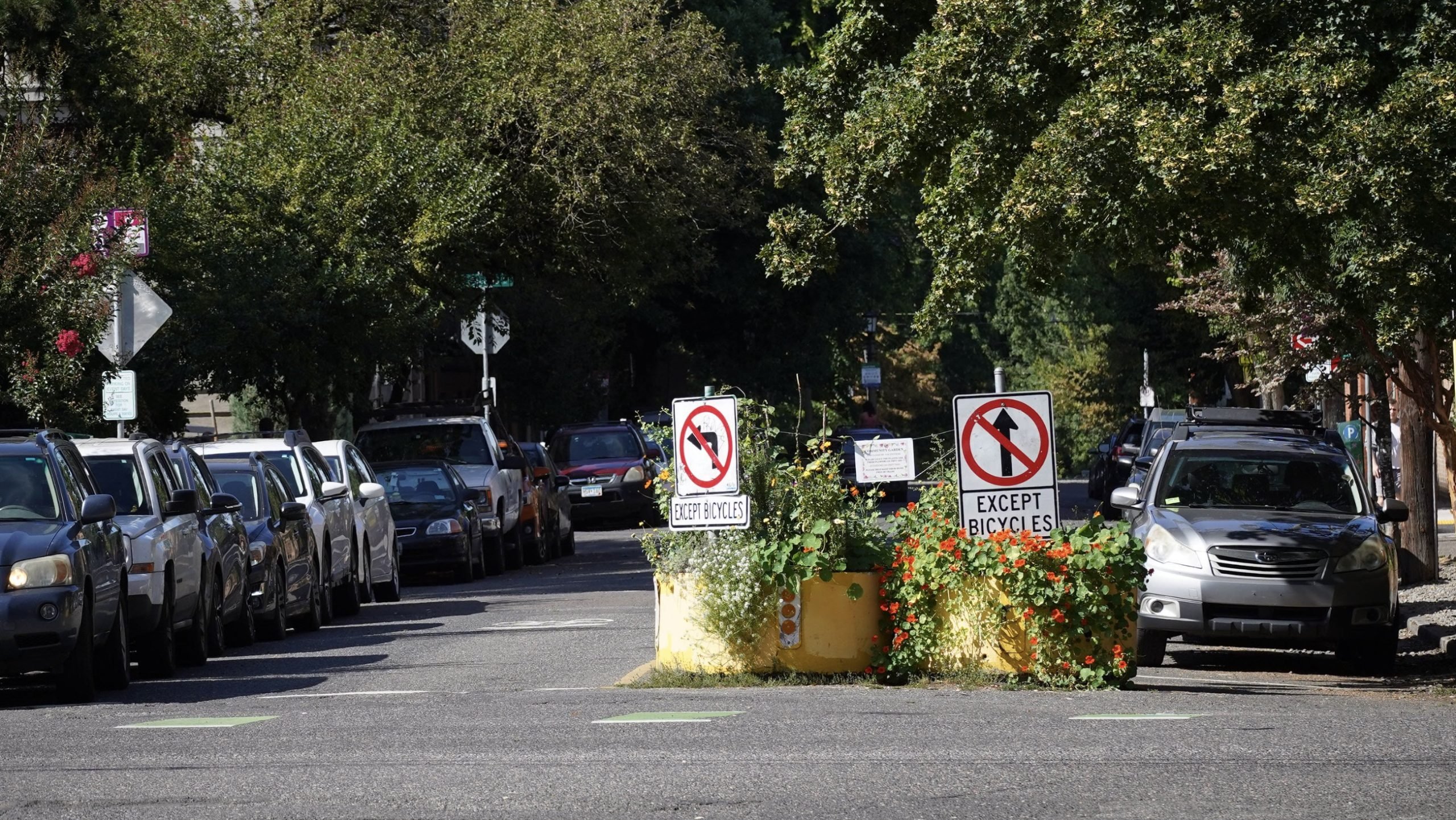
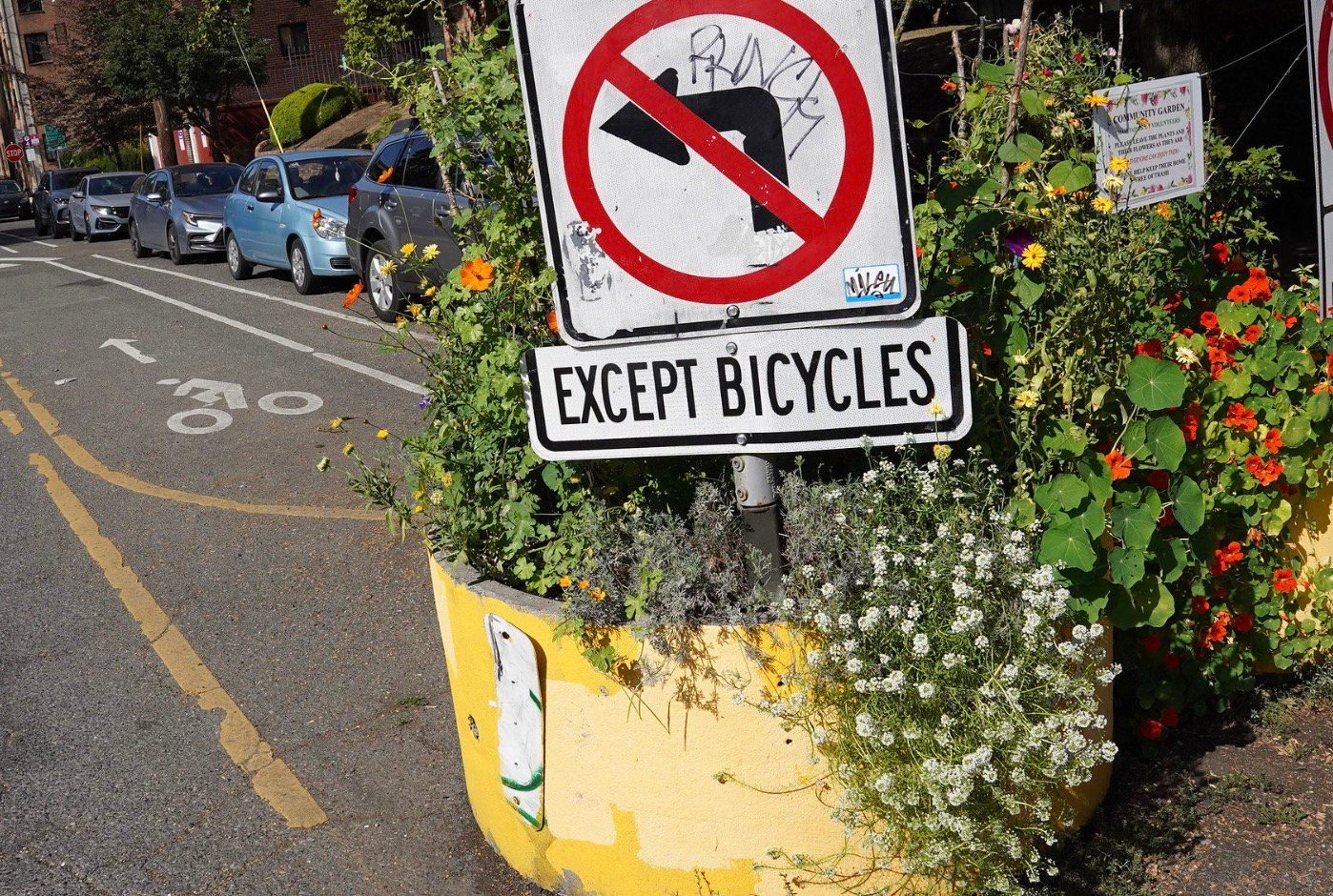
This traffic diverter on NW Johnson at 15th is among three the PPB says have got to go. (Photo: Jonathan Maus/BikePortland)

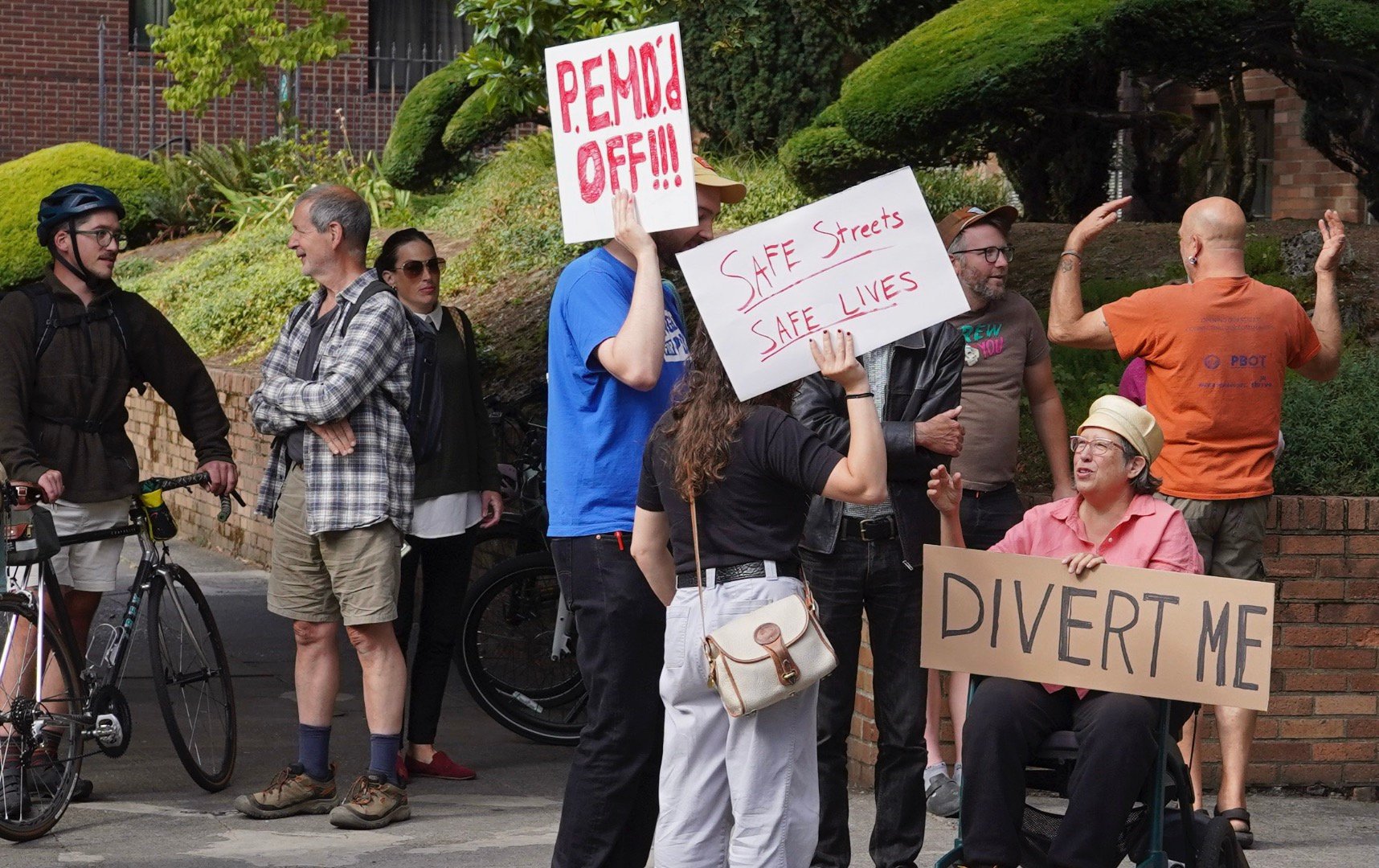
A City agency with the backing of the Portland Police Bureau has directed the Portland Bureau of Transportation to remove three traffic diverters in northwest Portland because they say the large concrete barricades and one-way streets — installed by PBOT to improve safety and calm traffic — hinder the preferred routes of police patrols. So far, at least one city council member opposes the move.

Skyler Brocker-Knapp is director of Portland Solutions, a city bureau formed in 2024 to address homelessness and related “livability challenges.” In an email today to District 4 city council members and copied to Portland Police Bureau Sgt. Ty Engstrom, Portland Bureau of Transportation Director Millicent Williams, and Deputy City Administrator of Public Works Priya Dhanapal, Brocker-Knapp wrote that diverters on NW 20th and Everett, NW 14th and Johnson, and NW 15th and Johnson must be removed.

“These locations… have been particularly problematic in terms of chronic nuisance behavior (drug dealing, vandalism, etc.),” Brocker-Knapp wrote. Apparently, staffers at the Public Environment Management Office (PEMO) have been working for three years to make this move. All the diverters (also known as “modal filters”) named in the email create one-way streets for auto users, since behind them the street becomes a bike-only lane. They were installed as part of PBOT neighborhood greenway projects and vetted through months of public outreach with a goal to calm traffic and reduce traffic deaths and injuries to the most vulnerable road users.

But if Brocker-Knapp’s email is the final word (I have not confirmed a date for removal) they’ll be torn out and replaced with sharrow markings.

The diverters in the northeast corner of NW 20th and Everett have been the target of neighborhood ire for a while now. An article in the NW Examiner last month asked rhetorically, “Do they make us safer, or just get in the way?” Article author Allan Classen wrote that the barriers, “prevent many neighborhood Fred Meyer shoppers from driving directly home.” Classen explained that drivers headed north or west on 20th from the Fred Meyer parking garage (on NW 20th Pl.) must travel three blocks east to 18th Ave before heading to their destination. 85% of the 156 people who voted in a poll posted on the Examiner’s website said they wanted the diverter removed.

From the PPB perspective, the diverters and one-way streets force them out of their way when traveling between Fred Meyer and Couch Park two blocks north. Couch Park has recently made headlines because local residents have complained that it’s a hive of open drug use and crime. Back in May the PPB conducted a focused enforcement mission around the park that resulted in three arrests, drug and gun seizures, and 12 people being transported to deflection centers. Also in May, District 4 City Councilor Eric Zimmerman made public his intention to have the diverters removed.

Fred Meyer and Couch Park circled. The green “x” marks location of diverter at NW 20th and Everett. (Graphic: BikePortland)

According to Brocker-Knapp, restoring the streets to two-way auto traffic will allow police to “better navigate” the area. The plan is for PBOT to replace the diverter with all-way stop sign configuration. (“People biking may also use the Flanders Greenway one block to the north,” the email states.)

Over on NW Johnson, PEMO is directing PBOT to remove diverters and restore two-way traffic at NW 14th and NW 15th to, “allow for easier movement for Portland Police through the area.” A spokesperson for PEMO told me in a phone conversation today that they’ve also had reports from bike riders who fear for their safety while using the underpass.

A request for PBOT comment was redirected to PEMO. In their email, Brocker-Knapp said they’ve already worked with PBOT to, “develop a solution for traffic redirection at these locations,” and staff from all involved agencies have conducted site walks with the city traffic engineer.

District 4 City Councilor Mitch Green opposes the projects. In a reply to Brocker-Knapp’s email, Green wrote, “I don’t support this at all and I’m curious to understand what the justification for this is, what problem it solves, and what consideration has been given to the new problems it creates.”

“At a time when vehicle-based pedestrian fatalities are up, it’s hard for me to see how this improves public safety.”

The PBOT Bicycle Advisory Committee has not been involved with these discussions. I’ve learned that it will be on the agenda of their August 12th meeting and a representative from PEMO and the Mayor’s Office have been invited to attend.

I’ve reached out to PPB Traffic Division Sgt. Ty Engstrom for comment. I’ve also asked PEMO how the PPB’s public safety concerns were weighed against the public safety concerns that resulted in the installation of the diverters to begin with. I’ll update this post as I learn more.

Recap and Photo Gallery: The Good, The Bad, and The Ugly ride

Rolling down SW 3rd Avenue. (Photos: Jonathan Maus/BikePortland)

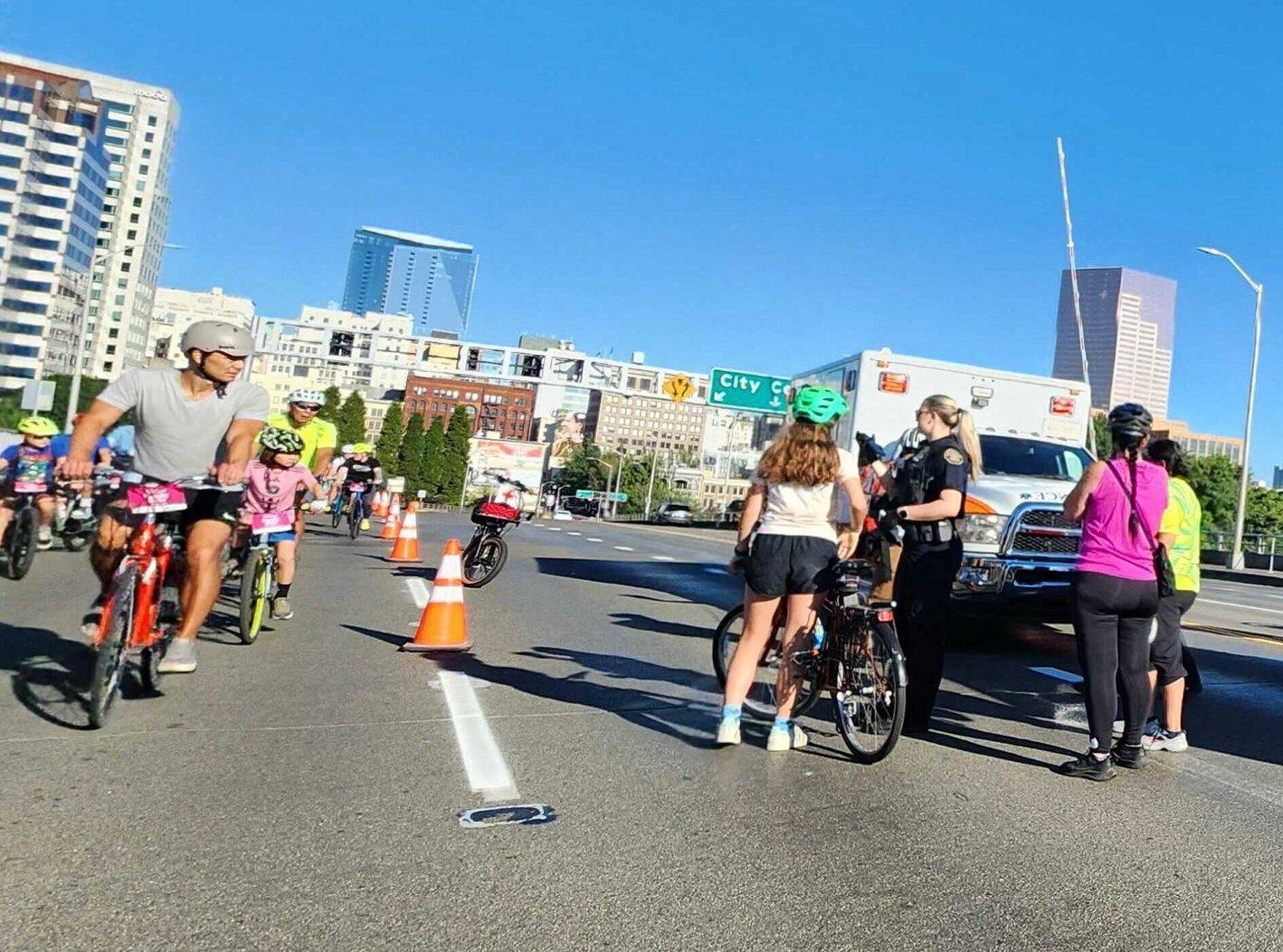
I’d been itching to get out and cover a local ride (as my dang knees continue to rehab from surgeries in April and June), so last night I checked out The Good, The Bad, and The Ugly Ride. It was a transportation nerd’s paradise that started at the monthly Urbanist Happy Hour hosted by Strong Towns PDX at a familiar location on the SE Ankeny Rainbow Road Plaza (where Bike Happy Hour meets every Wedesday).

It was a big turnout! Maybe 150 people or so? And judging from all the smiles in these photos, a lot of folks had a great time riding city streets and getting to know friends old and new. The ride was organized by several groups: the aforementioned Strong Towns, Bike Loud PDX, Sunrise Movement, Community Cycling Center, and Depave. Add in the fact that Urbanist Happy Hour welcomes folks from rail advocacy groups like AORTA (Association of Oregon Rail and Transit Advocates) and Parking Reform Network — and you get quite a diverse group of city lovers and transportation reform advocates.

“We’ve got public transit nerds social and climate justice advocates. We have people who care about zoning and housing and bikes and infrastructure all coming together. ‘Cause it’s gonna’ take all of us and our relationships to really change this city. There’s more of us than there are of them, and we can really go and get things done!” said Harper (Andrea) Haverkamp, one of the event leaders.

Haverkamp is a bright star in local organizing circles. She’s not only the self-described Mayor of Portland, but also an active volunteer with Strong Towns, the Transportation and Land Use Committee chair for Kerns Neighborhood Association, a member of the PBOT 2045 Transportation System Plan Community Advisory Committee, and holds a PhD in environmental engineering from Oregon State University.

Another young leader pushing for change is Jacob Apenes with Sunrise PDX. “We’re here, fighting for the end of the era of the fossil fuels,” he said to the crowd prior to the ride. “We’re fighting for pretty big things… We wanna build a city that’s actually multimodal, so people can get around in the mode they choose — safely and effectively at any stage of their life.”

Apenes, Haverkamp, and many others at this ride are proponents of tactical urbanism, where volunteers install inexpensive street interventions like crosswalks, transit benches and traffic calming devices (Strong Towns and PBOT are currently in negotiations about the group’s many DIY-painted crosswalks throughout the city). And it just so happens that the idea has political support in City Hall. One if its biggest champions in Councilor Mitch Green, who was also in attendance.

“We’ve got this giant fiscal gap in our budget and we’re going to be fiscally constrained for a long period of time. That sucks,” Green said in a short speech in the plaza prior to the ride. “But it’s also an opportunity to change the way our city thinks… We’ve got this army of volunteers that wants to do tactical urbanism to make our communities safer and to flourish. So I’m gonna be a champion for that, for you guys. So just tell me what you need and we’ll help you get it done.”

It was the latest sign that Green has embraced Portland’s trove of urban planners, environmental justice activists, and transportation reformers. “This fills up my cup,” Green said about why he chose to spend four hours hanging out in the streets after his work day in City Hall. “I like to be with cyclists. I like to be with activists who are trying to create safer spaces for us to exist. I also like to be with urbanists who are trying to imagine ways that we can all come together accelerate the rate at which we can build the city we deserve. I feel all that here.”

After all the remarks and community-building and conversations in Rainbow Road Plaza, it was time to get on our bikes. The ride made several stops and we heard short remarks from speakers at each one. The stops included: SE 7th and Sandy where we learned about Depave’s Green Plaza project; SW Ash between 3rd and 4th where we heard about the SW 4th Avenue project; the Blumenauer Bridge; Sandy Blvd, and perhaps others but I turned off when my knee got uncomfortably stiff.

Beyond the project talk, I feel like the most important part of the ride were all the conversations along the way. The large group took the entire westbound side of the Burnside Bridge, rolling into downtown on a perfect Portland summer evening. As I pedaled next to Councilor Green I asked what he thought about the moment. “I see nothing but opportunity,” he said. “The future looks pretty bright.”

What are your three big wishes for Portland’s transportation system?

(Photo: Jonathan Maus/BikePortland)

[Publisher’s note: Hi everyone. I’m back after being out of town since Friday. Sorry for the lack of posts! – Jonathan]

The City of Portland has launched an update to their Transportation System Plan. Known as “the TSP,” this plan is the bedrock of policies and projects that move our local transportation system forward. It reflects our city’s values and goals and it provides a roadmap for the next 20 years of decisions about how to manage our roads and paths.

But how does the Portland Bureau of Transportation even know what our values and goals are? We have to tell them.

PBOT has just released a new survey to garner feedback from individuals and organizations. Instead of fixating solely on what’s wrong with transportation in Portland, they want to hear what works for you. Here’s more from PBOT:

“We invite you to start by thinking about some of the best times you’ve had getting around Portland or related to our transportation system. Then consider what that positive experience might mean about what you deeply value. Finally, consider what it makes you wish for the future of Portland’s transportation system.”

The TSP’s 30 Citizen Advisory Committee members already did this exercise, but the plan isn’t there’s alone. To make it a Portland TSP for the people, we need more folks like you to share your experiences and wishes. PBOT staff will then take all the input from CAC members, mix it with input from the greater public, and then craft a draft vision and set of goals that will eventually be adopted into the 2045 TSP.

To help guide your input, PBOT offers these three tips:

  • Think high-level. If you tell us a project you want to see prioritized, we may need to infer the reason why you want to see it. We aren’t asking about specific projects in this survey, we’re asking about the impact you want to see our cumulative efforts having on the transportation system. 
  • Tell us what you want to see, not what you don’t want to see. If you tell us what you don’t want to see, we’ll need to infer what the opposite is/your intentionality. Don’t make us have to guess, just tell us what you want. 
  • Think “why” to get to the heart. Why do you want to make this wish for the transportation system? Feel free to mention your why or make your wish clearer by starting with your why. Try to be brief and clear so we can most easily code and summarize collective results.

Now with that in your head, go spend 5-10 minutes with the online survey. You have until October 1st to get your answers in.

2045 Transportation System Plan Update project website

Transportation Commission says state can move forward with I-5 Rose Quarter project

View looking northeast at Broadway and Vancouver over I-5 from the Leftbank Building. (Photo: Jonathan Maus/BikePortland)

The Oregon Transportation Commission has given the I-5 Rose Quarter project a lifeline. The five member, governor-appointed body faced a stark decision at their meeting this morning: proceed with the project, or pause and reassess. They chose to approve funding for a project while warning that there’s no more funding for the project.

Because of a series of significant setbacks around funding, lawsuits, and a staffing exodus in recent weeks, the Oregon Department of Transportation came to the OTC to make sure it was prudent for them to continue. A package of preliminary construction projects estimated to cost $75 million (of which $30 million comes from a federal grant already in the books) known as Phase 1A (see below) has been set to break ground on August 25th. But given the dire funding picture sharpened at the end of June when lawmakers failed to pass funding for the project, it became unclear if that groundbreaking should move forward.

While OTC commissioners expressed grave concerns about the funding picture for this $2 billion megaproject that aims to expand I-5 between I-405 and I-84, build caps over the freeway and invest in surface street safety improvements — they all voted to proceed.

The meeting began with a slew of public commenters that encouraged OTC to pause the project. The mood in the room swung when community and advocacy leaders that represent the Black community came up to the mic — all of whom strongly favored moving forward with the project in the name of economic development for the people who had their homes destroyed when I-5 was initially built.

“We have the opportunity to marry restorative justice wit restorative economics and restorative development. So we would ask that we look at this moment to begin to put shovels into the ground,” said James Posey, the leader of Portland Chapter of the National Association for the Advancement of Colored People (NAACP).

Nate McCoy, executive director of National Association of Minority Contractors added that, “ODOT is in a place to really bring forward some opportunities in gentrified communities in northeast Portland by building I-5… Please, please, please, help us bring this project across the finish line.”

And arguably the most influential voice throughout debates around this project, Albina Vision Trust Director of Government Affairs JT Flowers, said, “I did not come here today to litigate with White environmentalists who have absolutely no connection to our people, our pain, or our collective struggle for progress… the reconnection of a community can and will not happen if we continue kicking the can down the road.” Flowers’ comment came after several advocates spoke in opposition to the project and recommended a pause.

Flowers’ powerful speech illustrated an important element in the debate around the project: The main organized opposition to the project (anti-freeway advocates and environmental justice nonprofit leaders) is almost all White. The most important supporting voice (Albina Vision Trust, racial justice and Albina community leaders, construction company owners, etc.) is almost all Black.

Prior to the vote, OTC Commissioner Lee Beyer asked ODOT Deputy Director of Finance Travis Brouwer what would happen after the OTC approves Phase 1A. ODOT would have $137.5 million in the bank to spend on the project after Phase 1A. Brouwer replied to Beyer that, “We have not gotten to the point where we can tell you what we could do with $137 million in terms of construction, or whether there are viable options for moving forward.”

There would need to be a design and re-scoping process to figure out what parts of the $2 billion project could be built with $137.5 million. At that point in the meeting, ODOT Urban Mobility Office Director Tiffani Penson interjected to clarify that, “$137 million is not enough money to start building the [I-5 freeway] cap… It’s to improve some safety things like ramps and some things like that that need to happen, but we will definitely need more money to start Phase 1.”

Phase 1A is a preliminary package of work that will make stormwater improvements (required by an EPA harbor settlement), and bridge preservation and seismic resiliency work near the I-5 and I-405 interchange, and signage for the highway cover safety and construction. The contractor who won the bid for the Phase 1A work has already hired workers and is ready to go. ODOT listed that contract as one of the risks of not moving forward.

Toward the end of the conversation, Deputy Director of I-5 Rose Quarter Project Monica Blanchard OTC Commissioner Alicia Chapman shared a powerful comment about what she feels is at stake with the decision:

“The cost of not [moving forward is that we] will be sued for being out of compliance for our harbor agreement. Will be sued by all the contractors that have incurred $4 million in bonds and hired all these people that could have been working on other jobs, that have been standing by waiting for this to happen because it’s supposed to go to construction in a couple weeks… There’s a cost to trust, and this is a cost that we’re passing on to every future project. So if we reneg on Phase 1A, how much does that really cost us? I don’t think we can even calculate that. So it’s not a it’s not a feasible option.”

Loud claps erupted in the room after Chapman’s comment.

In the end, the OTC voted 5-0 to continue with the project and they once again chose to the can down the road when it comes to the larger — still unanswered — questions about how or if the project will ever find funding necessary for completion.

“I really feel strongly that we need to to move forward with Phase 1A,” said OTC Chair Julie Brown. “With that said, everyone in this room needs to understand that beyond that, there is no money… We are not saying that we are going to move forward with a complete Rose Quarter.”

CORRECTION, 8/4: The original version of this story attributed a quote made by OTC Commissioner Alicia Chapman to Deputy Director of I-5 Rose Quarter Project Monica Blanchard. Sorry for that error. I regret any confusion it caused.

Weekend Event Guide: Sunday Parkways, Naked Ride, immigrant solidarity, and more

2010 East Portland Sunday Parkways. (Photo: Jonathan Maus/BikePortland)

Hi everyone. Hope you’ve had a good week. I’m leaving early Friday morning for a few days to celebrate my 25th wedding anniversary (I know, right?!!!), so I’ll be away from my desk and won’t be working as usual until Thursday morning.

Here are my picks for the weekend.

Saturday, July 26th

Ride Around Clark County – All day in Vancouver (WA)
It’s time for the 41st annual running of the RACC, a bucket-list ride if there ever was one. There are four routes from 18 to 100+ miles. More info here.

Indigenous Peoples Ride – 10:00 am at Cathedral Park (N)
“An exciting bike ride that celebrates the Indigenous Peoples from around the globe who have made their home right here in Portland.” More info here.

The Red Ride – 3:45 pm at Lone Fir Cemetery (SE)
Not to be outdone by the famous Teal Ride, now there’s a ride for everyone who wants to bask in the glory of the color red. More info here.

Portland World Naked Bike Ride – 8:30 pm at Grant Park (NE)
This is it folks! The biggest naked ride of the year. Whether you come to protest Big Oil or to just revel in the beauty of flesh-filled city streets, you don’t want to miss this quintessential Portland experience. More info here.

Sunday, July 20th

Bike Lane Sweeper Ride – 10:30 am at SW Nebraska & Terwilliger (SW)
Join nonprofit BikeLoud PDX for a ride with their very cool Bike Lane Sweeper machine as you learn about the ups-and-downs of DIY bike lane maintenance. There’s also a northeast version of this ride happening at the same time. More info here.

East Portland Sunday Parkways – 11:00 am to 4:00 pm in Southwest (E)
Enjoy carfree streets on a fun route that connects parks and fun activities from vendors with live music and other cool diversions. It’s Portland at its finest. More info here.

Immigrant Solidarity Ride – 2:00 pm at Colonel Summers Park (SE)
Join to show strength and resolve in the face of deportations and rising hate across the country. Ride is family-friendly and will raise funds for nonprofits that help families with immigrant rights and legal services. More info here.

Ride to Opera in the Park – 4:30 pm at Peninsula Park Rose Garden (N)
Cycling and opera in a park — what could be better on a Sunday afternoon in Portland? This will be a fun-loving loop that will start and end where the opera will perform. More info here.


— Did I miss your event? Please let me know by filling out our contact form, or just email me at maus.jonathan@gmail.com.

TriMet: Service cuts will start in November

(Photo: Jonathan Maus/BikePortland)

TriMet says a lack of funding will lead to a reduction of service starting in November of this year.

“More cuts are being planned for March 2026 and after, with at least a 10% overall cut to service expected by August 2027,” the agency said in a statement today.

TriMet blamed their decision on the recent failure of the Oregon Legislature to pass a transportation funding package. One version of House Bill 2025 would have pumped $250 million into transit statewide in the coming years. TriMet’s approved 2026 budget includes $83.7 million in funding from the Statewide Transportation Improvement Fund (STIF), a revenue source with a very uncertain future*. (*See update at end of story.)

TriMet also blamed years of budget reductions and, “staggering cost increases in almost everything related to running the transit system, including labor, vehicles, facilities, contractors, equipment and software.”

The cuts announced today are being made to stave off more severe service cuts down the road, TriMet said, as they look to close a $300 million gap between their annual expenses and revenues.

The first cuts beginning in November will reduce frequencies on some lines. Then entire bus lines will be eliminated. If TriMet doesn’t find more revenue by fall 2027, further cuts will be coming.

A new TriMet webpage says starting November 30th, they’ll reduce some frequent service lines during evenings and mornings, cut nighttime service on the FX-2 Division line, and trim service on up to eight other lines.

TriMet will then propose further cuts starting in March 2026. Those cuts haven’t been made and the agency will ask for public feedback on how best to make them. Current proposals include:

  • Eliminating some low ridership bus lines
  • Eliminating evening service on lower ridership bus lines
  • Changing routes on some bus lines to increase efficiency
  • Reducing the MAX Green Line route. Green Line trains would only serve stations between Clackamas Town Center and Gateway Transit Center. Riders would need to transfer to other trains at Gateway Transit Center.

In total, if new funding is not found, TriMet says the system faces about an 18% overall reduction in MAX service — the largest light rail cut in TriMet history — and an 8% reduction in bus service — the third largest cut since 1986.

Oregon Governor Tina Kotek will reconvene the legislature for a special session next month in order to pass transportation funding. Details of the plan aren’t out yet, but there’s a chance TriMet could see new revenue.

Without it, Portland faces a significant transit service reduction.

In a post on social media Tuesday, Portland-based transit consultant Jarrett Walker predicted cuts like this are likely in cities across America. He said the best way to navigate these difficult times is for agencies to be clear and transparent with riders about how the cuts will impact them. “It’s understandable not to want to think about it,” Walker wrote, “But that has to be done now… To really motivate support, we must be very specific about consequences, and also name who has the power.”

With details about cuts coming to light and the legislature prepping for another session, transit riders and their advocates should have all the ammunition necessary for the coming battle.


UPDATE, 1:44 pm: TriMet has issued a clarification, saying that these cuts are needed even if the state legislature passes a proposed doubling of the payroll tax to fund transit. TriMet said they are planning for increased revenue through an upcoming fare increase and from state funding. “If those two actions do not happen, or do not equate to $48 million in increased revenue, we will need to make $48 million in additional spending/service cuts in fall 2027,” the agency said.

Pause or proceed? Commission weighs future of I-5 Rose Quarter project

I-5 looking north just past the Moda Center. (Photo: ODOT)

After years of dangling by a thread, the I-5 Rose Quarter project faces a moment of truth.

The Oregon Department of Transportation (ODOT) project has lost several major battles in the past few weeks. It faced a setback in a lawsuit from a coalition of advocacy groups, it has lost vital federal and state funding, and two of the project’s most senior leaders have decided to walk away from it.

Now the Oregon Transportation Commission (OTC), the Governor-appointed board that oversees ODOT, will call the question at its meeting Thursday: Should ODOT keep driving this car down the road even as the wheels come off? Or is it time to pull over and reconsider if the trip is even worth taking? Agenda item F at tomorrow’s OTC meeting poses a stark decision for the body’s five members: “proceed as planned” or “pause to evaluate next steps.”

To prep for this important meeting, I’ve gathered some context on the lawsuit, the funding situation, the staff exodus, and the OTC’s decision below…

The lawsuit

ODOT officials were due in court Monday July 14th to defend a lawsuit filed by a coalition of advocacy groups led by No More Freeways. Their complaint alleges that ODOT’s I-5 Rose Quarter Project is incompatible with the City of Portland’s Comprehensive Plan and the Regional Transportation Plan because of its intention to expand a freeway, its failure to consider tolling, and its violation of environmental standards.

ODOT initially maintained that the project was compatible with those plans and the plaintiffs were ready to argue their case in court. But just 11 days before the trial was set to begin, ODOT officials changed their mind and formally withdrew their finding of compatibility.

“We think one of two things happened,” No More Freeways co-founder and and lawsuit plaintiff Chris Smith told BikePortland. “They realized we had some strong points and are going to attempt to rewrite the findings [which Smith doesn’t think will be successful], or they simply were not ready for trial and this is just a delay tactic.”

The trial is now scheduled for January.

The funding

One day after ODOT’s legal retreat, they learned Trump’s budget bill wiped $412.5 million of expected project grant funding off their books when it eliminated the Reconnecting Communities and Neighborhoods grant program and rescinded all unobligated funding. This was a massive blow to ODOT and the project’s already-grim funding prospects.

With the Oregon Legislature seen as ODOT’s last hope for good news, the demise of the transportation funding package at the end of June was another major blow. Keep in mind, this terrible funding news is not new for this project. For the past three years, OTC members have expressed deep skepticism about this project’s financial prospects.

In 2022, former OTC Chair Bob Van Brocklin said, “I don’t think this bridge gets built without being tolled… if we don’t have tolling… I don’t think we don’t have the resources to build the Rose Quarter project.” Then two years later, Governor Tina Kotek paused tolling.

At that same 2022 OTC meeting former OTC Commissioner Sharon Smith wondered aloud, “Is the Rose Quarter really where our state wants to spend the money?”

Then in 2023, OTC Commissioner Lee Beyer said, “Given what we all know about our financial picture at this point, I’m not sure how we finance this project.”

And in May 2024, OTC Chair Julie Brown admitted that, “From a business sense, it doesn’t make sense that you commit to something when you don’t know where you’re going to find the funding.” And Commissioner Jeff Baker added, “We’re in a pickle, because we’re spending more than we expected to spend, and we’ve probably got a real credibility problem around the state.” At that same meeting, even ODOT Director Kris Strickler acknowledged the project’s extreme funding challenge, saying that without broad partnerships and a state funding package, “I don’t see big projects like this going forward.”

And all that was before Trump’s assault on grant funding and the state legislative debacle.

The exodus

ODOT leaders establish their careers around major projects like the I-5 Rose Quarter. For young, up-and-coming managers, being assigned a leadership role on such a high-profile project is a dream come true, a chance to burnish a resume and build a legacy. So when two of ODOT’s rising stars opt to jump ship, it must be seen as a harbinger of demise.

ODOT Urban Mobility Office Director Brendan Finn left the agency back in November. His decision came a year after he walked out of an emotional project advisory committee meeting and came just months after Kotek put a pause on tolling.

I-5 Rose Quarter Project Director Megan Channell was named “Woman of the Year” by a professional development group for her leadership on this project earlier this year. At the awards gala, Channell would have announced that the project she dutifully led for six years was set to begin construction this summer.

But instead of celebrating the biggest moment of her career, Channell resigned before a single shovel hit the ground.

The decision

OTC members were skeptical about this project’s future before its latest funding setbacks, legal losses, and leadership exodus. At their emergency meeting Thursday, they’ll decide if the State of Oregon should continue to invest in a $2.0 billion project when a mere $303 million is available to spend.

Even if they decide to proceed, the immediate conversation about cost and scope reduction will not be pleasant. They’ve made commitments to their Historic Albina Advisory Board that are politically impossible to break, and the only elements of the project with broad public support in Portland have nothing to do with adding new lanes to I-5.

According to Thursday’s meeting documents, the pause option would allow ODOT and the OTC to, “Re-evaluate the project and determine if there is an opportunity to redesign the project in a way that reduces the cost, while still meeting the transportation safety, connectivity and growth needs of our state.”

That doesn’t sound fun either, especially since any major change in the project is likely to trigger another National Environmental Policy Act (NEPA) analysis and extend the timeline even further. And without expected maintenance that would have been completed with the project, ODOT would be on the hook for even costlier upkeep down the road.

Like I said in May 2024, the OTC faces no good options when it comes to resolving the problems with I-5 Rose Quarter. It’s almost as if these expansive (and expensive) freeway megaprojects are inherently flawed and we should start looking for different types of solutions in the future.

That’s what anti-freeway activists want. No More Freeways has launched a campaign aimed at asking the OTC to pause the project. “With ODOT poised to consider layoffs of hundreds of state employees and an enormous backlogged of deferred basic highway maintenance and street safety projects unfunded,” NMF’s website states, “the Oregon Transportation Commission must prioritize using our limited existing funding to preserve our existing transportation system…”

If you were an OTC member, what would you do?

Housing construction fee waiver comes at a cost for transportation infrastructure

Road users on N Vancouver Ave roll past a new apartment complex. (Photo: Jonathan Maus/BikePortland)

Last week Portland City Council voted unanimously to give developers a three-year reprieve from paying system development charges (SDCs) on residential housing projects. SDCs are fees paid to city bureaus to help pay for infrastructure that supports new developments.

While councilors agreed the fee waiver would help boost badly needed construction of more residential units (Portland produced just 818 market rate units in 2024, the lowest total in 10 years), it’s worth noting that the move represents yet another loss of funding for the Portland Bureau of Transportation (PBOT). The three-year SDC moratorium is estimated to cost the City of Portland about $63 million total.

According to a presentation from the Office of Community and Economic Development shared with City Council, the move will cost PBOT $10 million. This comes on top of a narrowly averted budget crisis, continued uncertainty with federal funding that has put $197 million in project grants in limbo, and an $11 million gap from the state due to the failure of HB 2025.

While 10 councilors (two were absent) voted to support the fee waiver ordinance with hopes it would boost production of 2,500 additional housing units (on top of estimated 2,500 for a total of 5,000), some expressed reservations.

“I’m worried about how much infrastructure funding where we can afford to lose,” said Councilor Candace Avalos, who represents east Portland.

Council President Elana Pirtle Guiney said, “I don’t take lightly the fact that we’re foregoing tens of millions of dollars of revenue for public infrastructure at a time when we have so many infrastructure needs. But I also know that right now, with the tools in our toolbox, this is the single most impactful thing that we can do this year to support housing development.”

The loudest and most eloquent supporter of the SDC waiver is District 4 Councilor Mitch Green. He told members of the PBOT’s Pedestrian Advisory Committee last week that he simply doesn’t like SDCs.

“Because however well-intentioned they are,” Green explained, “They only work when there’s development occurring and they are a marginal cost of development.” Green feels it’s already relatively expensive to develop land in Portland due to our labor and land-use laws, so anything that increases the cost of production just leads to less housing being built. “And if you get less of it, you don’t get as much of a resource for your infrastructure development, which means that latest development, or that last part of the city to come into the boundaries of the city just doesn’t get it, and then you have to compete for a small pool of money relative to the scale of the problem.”

Green sees infrastructure as a “collective problem” and a “public good that spans the whole city,” whereas SDCs only accrue in parts of the city lucky enough to see development. “The unintended consequence of it is you have a situation where neighborhoods have been brought into the city and just haven’t seen any infrastructure development on any meaningful time scale… if you have a family that moves to Hayhurst (in southwest), for instance, their kids are going to grow up and move away before they’re going to get a sidewalk to school. And that’s because we don’t have enough money in the bank for SDCs.”

Key to Green’s outlook on SDCs is that more housing units equals more taxpayers who can ultimately pay into a future PBOT funding pot. Green would rather see a more stable funding source for PBOT and he mentioned several times the city’s current effort to find one.

The ordinance that passed yesterday has set a goal of 5,000 housing units in the next three years. Expect City Council to monitor progress toward that goal and discuss the future of SDCs when — or if — it’s reached.

Kotek calls special session, pushes back layoffs (UPDATED)

(Photo: Jonathan Maus/BikePortland)

Oregon Governor Tina Kotek has called a special session of the legislature to pass transportation funding legislation. In a statement released today, Kotek said the session will begin August 29th and lawmakers will work, “to pay for basic road maintenance and operations at ODOT, as well as address funding needs for local governments and transit districts.”

Along with the special session announcement, ODOT Director Kris Strickler told members of an employee union today that the effective date for layoffs has been pushed from July 31st to September 15th. Strickler received a letter from Governor Kotek on Monday stating that she’d been assured by legislative leaders that they’d fund the extension. “The commitment from legislative leaders to provide resources for this postponement should be taken for what it is,” Kotek wrote to Strickler. “A thin, timebound safety net to make sure that additional costs generated through the delay will not lead to deeper cuts in the second wave of reductions.”

The employment extension increases pressure on lawmakers to pass a funding package. In an email to staff sent today by Director Strickler, he wrote, “I’m heartened to see that a safety net has been proposed,” but added that, “a postponement will require the agency to incur additional costs for which we don’t have funds to cover.”

Today’s news means pending layoffs are halted and ODOT can maintain operation of 12 maintenance facilities that were prepping for closure.

The Governor gave only a few hints at what the new funding package will include. Rumors have swirled that it would be a basic six-cent gas tax increase aimed at staving off job cuts at ODOT and giving cities and counties a minimum handout from the State Highway Fund. But Kotek seems to have crafted a package that goes beyond that. The statement from her office released today says, “Her goal is to forestall immediate impacts to transit service through increasing the amount of funding available to the Statewide Transportation Improvement Fund (STIF).”

In addition to what sounds like an increase to the payroll tax that funds the STIF, the statement also said Kotek wants the package to include, “provisions related to ratepayer fairness, funding reliability, and agency accountability.”

Given how the regular session ended, it will be interesting to see how Kotek and Democratic leaders pull this off. The one thing that’s changed since sine die is the ratcheting-up of pressure on lawmakers from voters in their districts to save ODOT jobs and preserve basic road safety.

Whether that’s enough to overcome a deeply polarized legislature remains to be seen.


UPDATE, 7/23 at 1:00 pm: Various outlets are reporting that Governor Kotek has unveiled more details about the package she and legislative leaders will try to pass in the special session. According to The Oregonian:

Kotek is proposing that lawmakers raise the state’s 40 cents per gallon gas tax by 6 cents, increase car registration fees by $42, hike title fees by $139, implement a new $30 fee for electric vehicle users and double the state’s 0.1% payroll tax for transit.

The funding plan would provide just enough money to allow the state transportation agency to pay its bills and help local governments and public transit providers maintain their current service levels, Kotek said. Its proposed tax and fee hikes are lower than those included in comprehensive funding plans that Democrats proposed during the five-month session that would have boosted transportation services statewide.

The proposal also calls for more frequent audits and increased legislative oversight of the state transportation agency…

Monday Roundup: Protected intersections, fast e-scooters, and more

Hi friends (and everyone else).

Here are the most notable stories that came across my desk in the past seven days…

Been saying this for years: “While many people consider electric bicycles just another form of recreation, they’ve proven to be potent transportation alternatives after natural disasters worldwide.” (Electrek)

BikeTrailerTown: Montreal’s bike share system now offers trailers along with e-bikes, which greatly expands the utility of the vehicles and gives Portland another goal to shoot for. (Montreal Gazette)

Protection at intersections: This is a great deep-dive into the Dutch-style protected intersections and their potential here in the United States. These make so much sense and should be seen as a requisite complement to protected lanes. (Bloomberg)

Driver violence: A man accelerated his car into a crowd of people waiting outside a club in Los Angeles in what appeared to be an intentional act of violence. (NPR)

Faster e-scooters: I love that there’s a company pushing the boundaries of speed with electric scooters. We let automakers flaunt speed all the time and we too often look down on the same when it comes to micromobility vehicles. I’d love to see more fast scooters on the streets. And l et’s make more—and much wider—low-impact travel lanes to accomodate them. (Wired)

Taking up space: An entire block in Manhattan is being used to park electric delivery bikes, in what appears to be an unsanctioned parking lot for the vehicles that even has overnight security. “It’s not any more of an eyesore to me than a car is,” said one local resident. (NY Post)

All white men and no bikes: US DOT Sec. Sean Duffy appointed 12 new members of the US DOT Advisory Board and every one of them is a white man and none appear to be from bicycle-related businesses or advocacy orgs. Duffy says the group will return our country to the “Golden Age of transportation.” LOL. (US DOT Press Release)

Good news about e-cars: A new study shows that electric cars create much less brake dust (and just a bit more tire wear particles) than gas-powered cars, removing one of the central critiques of e-car skeptics. (Electrek)


Thanks to everyone who sent in links this week. The Monday Roundup is a community effort, so please feel free to send us any great stories you come across.

Local shop launches mutual aid program to help keep riders on the road

It started with this trailer and could become so much more. (Photo: Clever Cycles)

Local bike shop Clever Cycles has launched an interesting new customer service program based around mutual aid and an intriguing cargo trailer that looks like something from the Oregon Trail video game.

Shop co-owner Dean Mullin tells BikePortland the initial idea for “Clever Cares” was to help customers who couldn’t bring their bikes in for service. Since they first open their doors in 2007 as Portland’s original importer of Dutch cargo bikes and helped spark a national bike industry revolution, Clever Cycles has always stood for bikes as transportation. So when their customers’ bikes break down, it often means a household’s main form of mobility is gone. Clever Cares aims to make sure folks can still get to work, the doctor, the store, and so on — even if they can’t make it to the shop for repairs.

In order to make house calls and pick up what are often heavy and cumbersome bicycles without using a car or truck, the shop imported a trailer from Carla Cargo in Germany. Mullin added flair to the trailer with a cover and old-timey lettering. Combined with the wooden side panels, the trailer now looks like a classic covered wagon.

“Once the trailer was ready,” Mullin says, “it felt like it deserved a bigger purpose.”

That bigger purpose has expanded into a community support program aided by a volunteer network.

Mullin has expanded the program to not just offer free bicycle pickup and delivery, but also essential repairs to Portlanders who can’t make it into the shop for financial, physical, or logistical reasons.

And there’s another twist: This new service is funded through customer donations. “Clever Cares is made possible by a simple idea,” reads Clever’s website. “when one person buys a bike or gets theirs serviced, they can help someone else ride, too.”

During the checkout process, Clever Cycles customers are invited to pay it forward by adding a small donation—$5, $10, $25, or more—to support others who need help. (Mullin is exploring nonprofit options so donations can be tax deductible.) Then the shop matches donations in labor credit 1:1 up to a monthly cap.

Another part of the program is that customers can volunteer to drive the trailer and make bike deliveries:

“We’re building a network of volunteers to help us transport bikes to and from our shop using our covered wagon trailer—or your own cargo bike, trailer, or vehicle. No experience necessary—just a willingness to help someone keep rolling… your time can make a tangible difference in someone’s day-to-day life. It’s simple, direct, and incredibly appreciated.”

Mullin says, “The response so far has been amazing.” “Dozens of people have already signed up to be notified when we launch pickups and deliveries… And the City of Portland saw the trailer at Sunday Parkways and reached out to us about using them for maintenance work.”

“I never played Oregon Trail growing up, but the design somehow came together easily,” Mullin added. “Perhaps I missed my calling in covered wagon design.”


To find out more and learn how you can help make Clever Cares another bright spot in our amazing community, check out the official website.

CORRECTION, 7/22 at 8:58 am: This post originally said that Dean Mullin is the owner of Clever Cycles. That is incorrect. Dean is co-owner with Rae Mullin. I regret the error.