

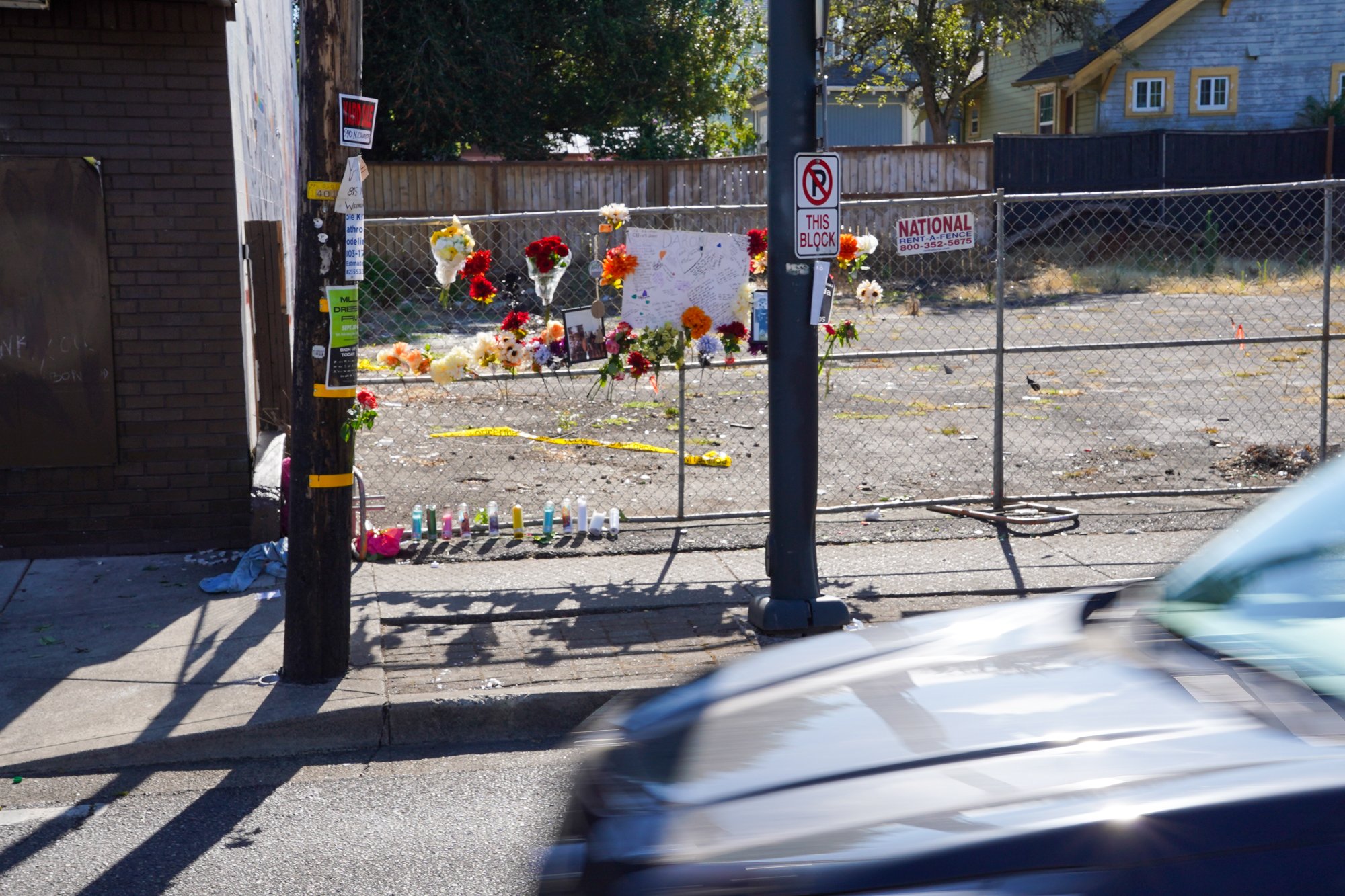
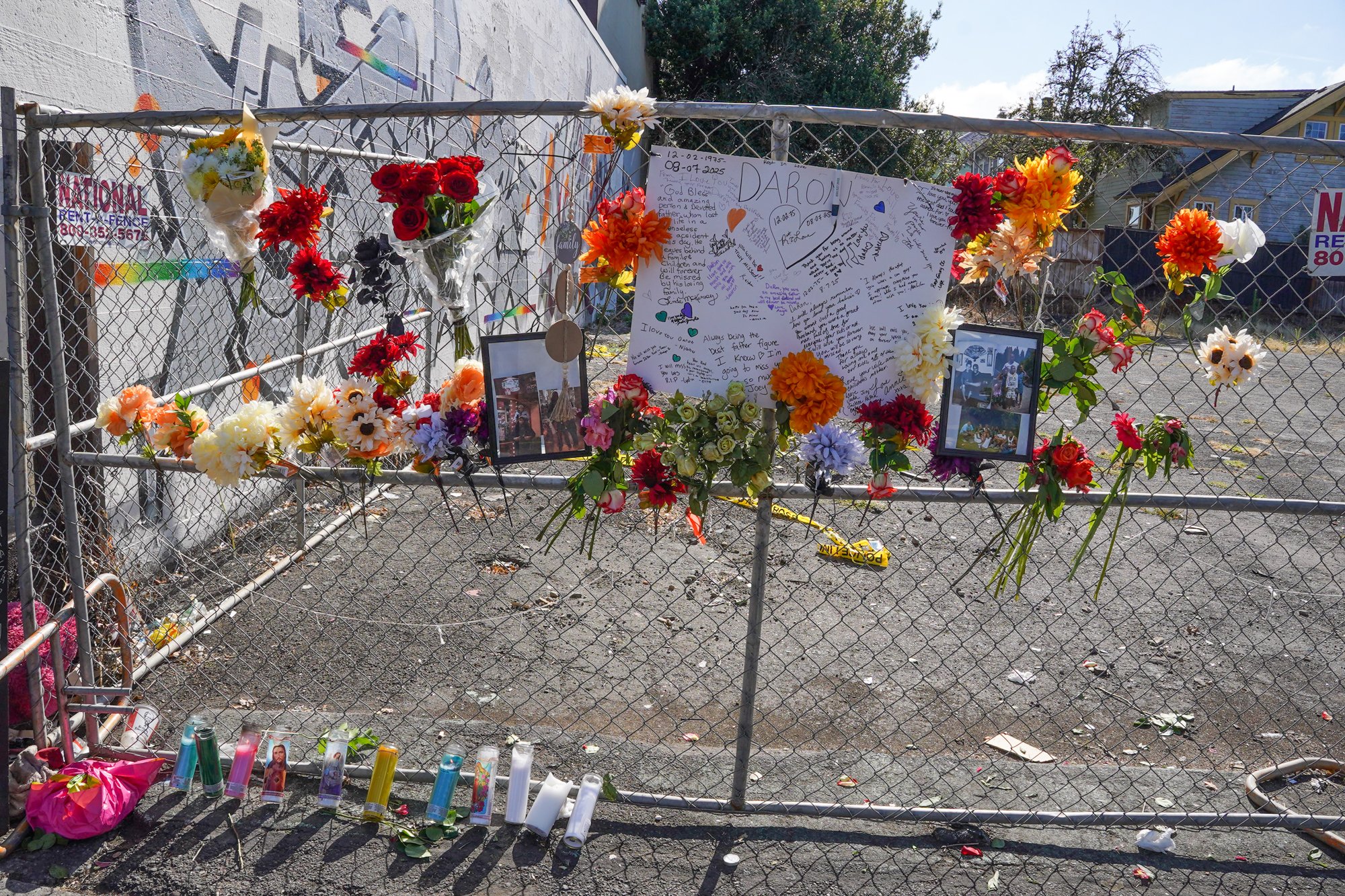
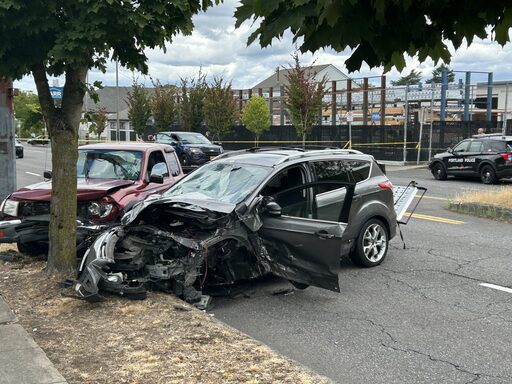
Around noon on Thursday, a person driving a Ford Escape SUV failed to control their car, then drove it up a curb and onto a sidewalk where two people were standing. The driver struck both people and nearly hit a child who were gathered next to a bus stop. One of them — 49-year-old DaRon Craig, whose family and friends have left candles, flowers, and written messages at a makeshift memorial — died at the scene. The other person is in the hospital with life-threatening injuries.
In a press statement at the scene Portland Police Bureau Sgt. Kevin Allen said, “The officers that responded described it as an absolutely chaotic scene where people were traumatized.” Harrowing witness accounts shared in The Oregonian say the driver was going at least 70 mph.
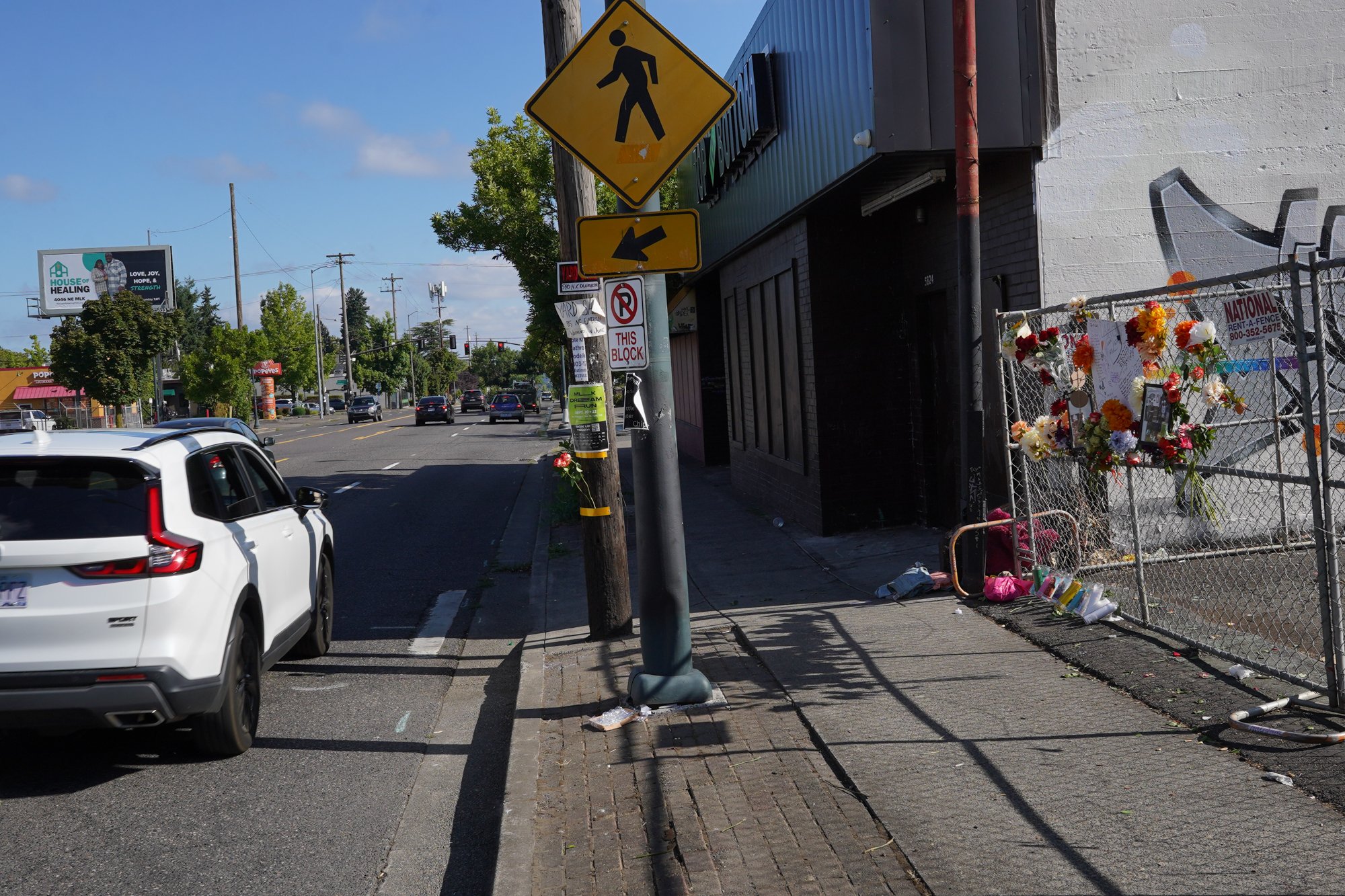
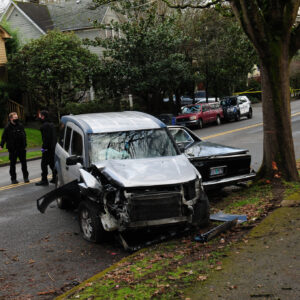
According to the PPB, the driver of the Ford was going northbound on Northeast Martin Luther King Jr. Blvd. After driving onto the sidewalk somewhere between NE Jessup and NE Jarrett, they continued north toward the busy intersection with NE Ainsworth which has a Safeway, Starbucks and Walgreens. At Ainsworth the driver hit another person who was in their car waiting to turn left. The driver then jumped the median island just north of Ainsworth and struck two other drivers head-on before finally bringing their Ford Escape to rest.
In total, the driver who caused this mid-day rampage hit six people.
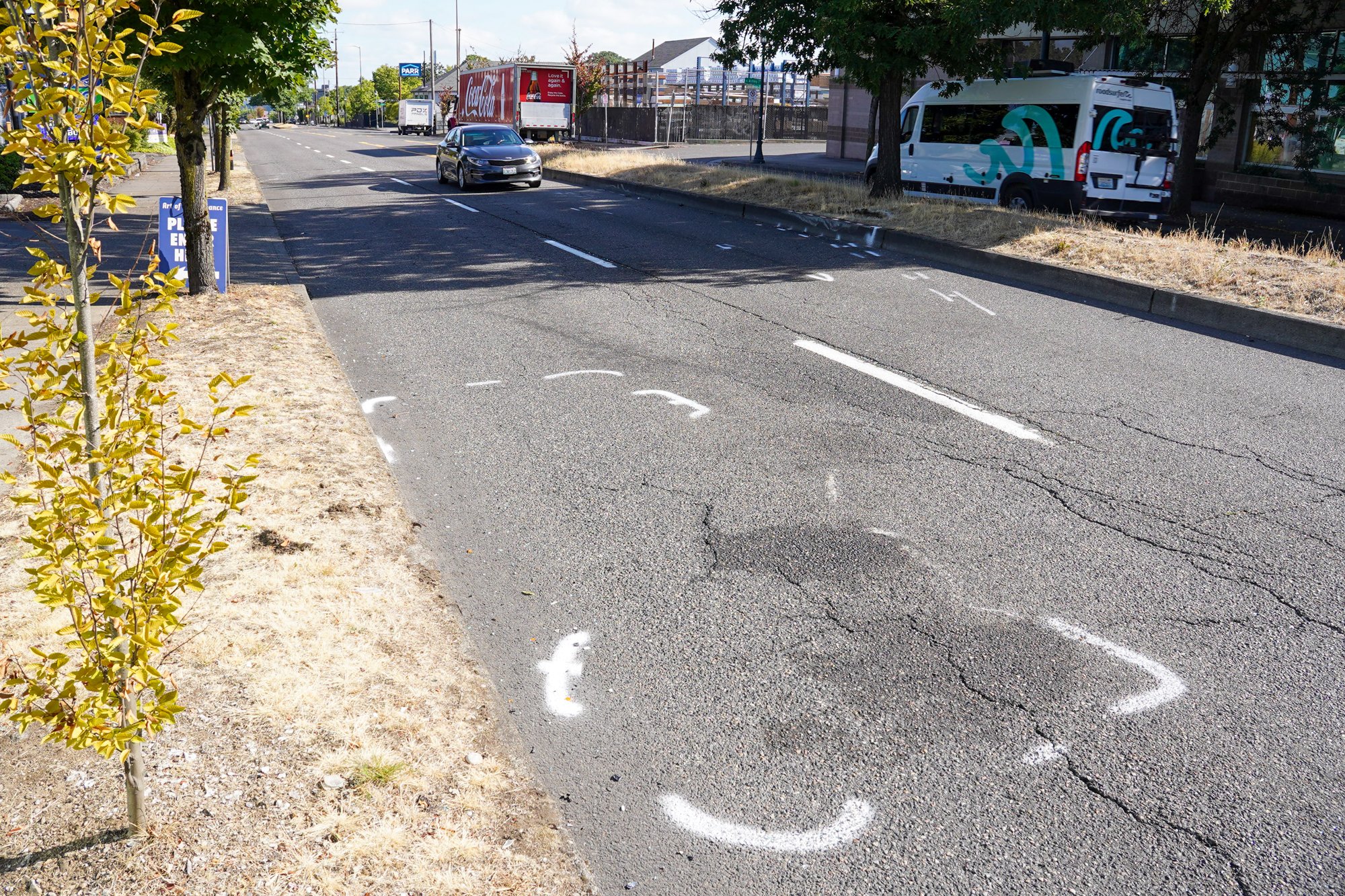
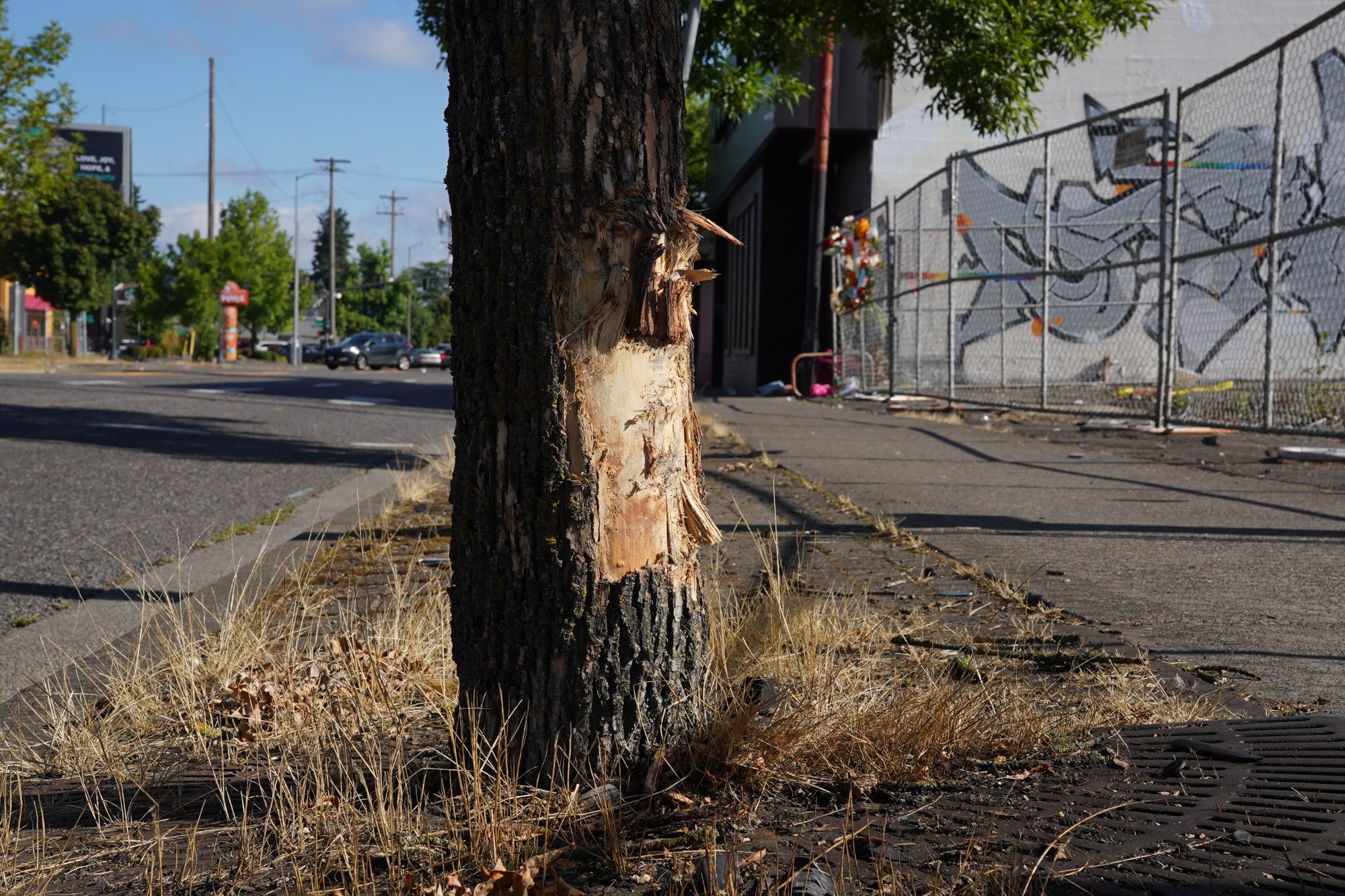
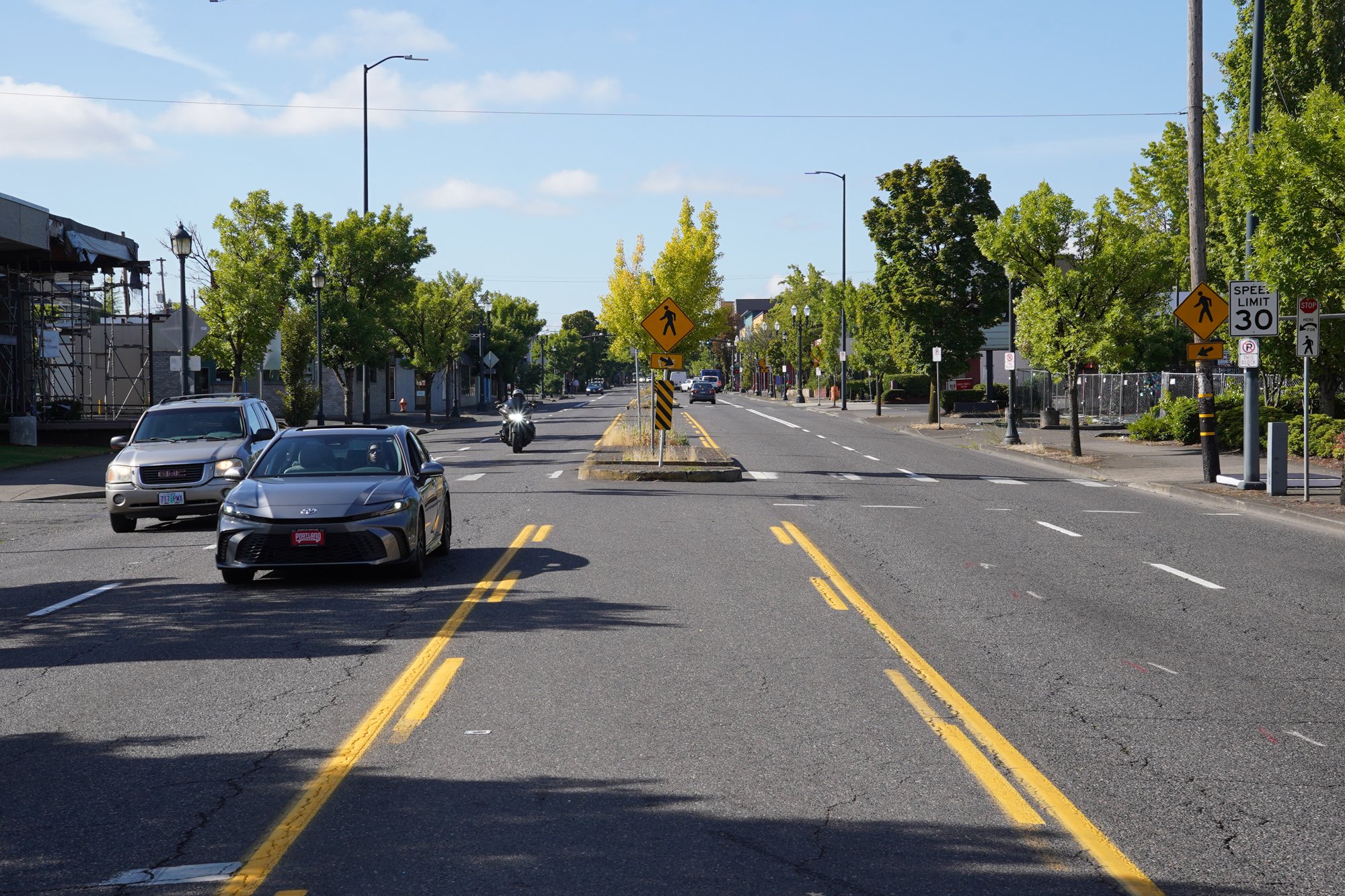
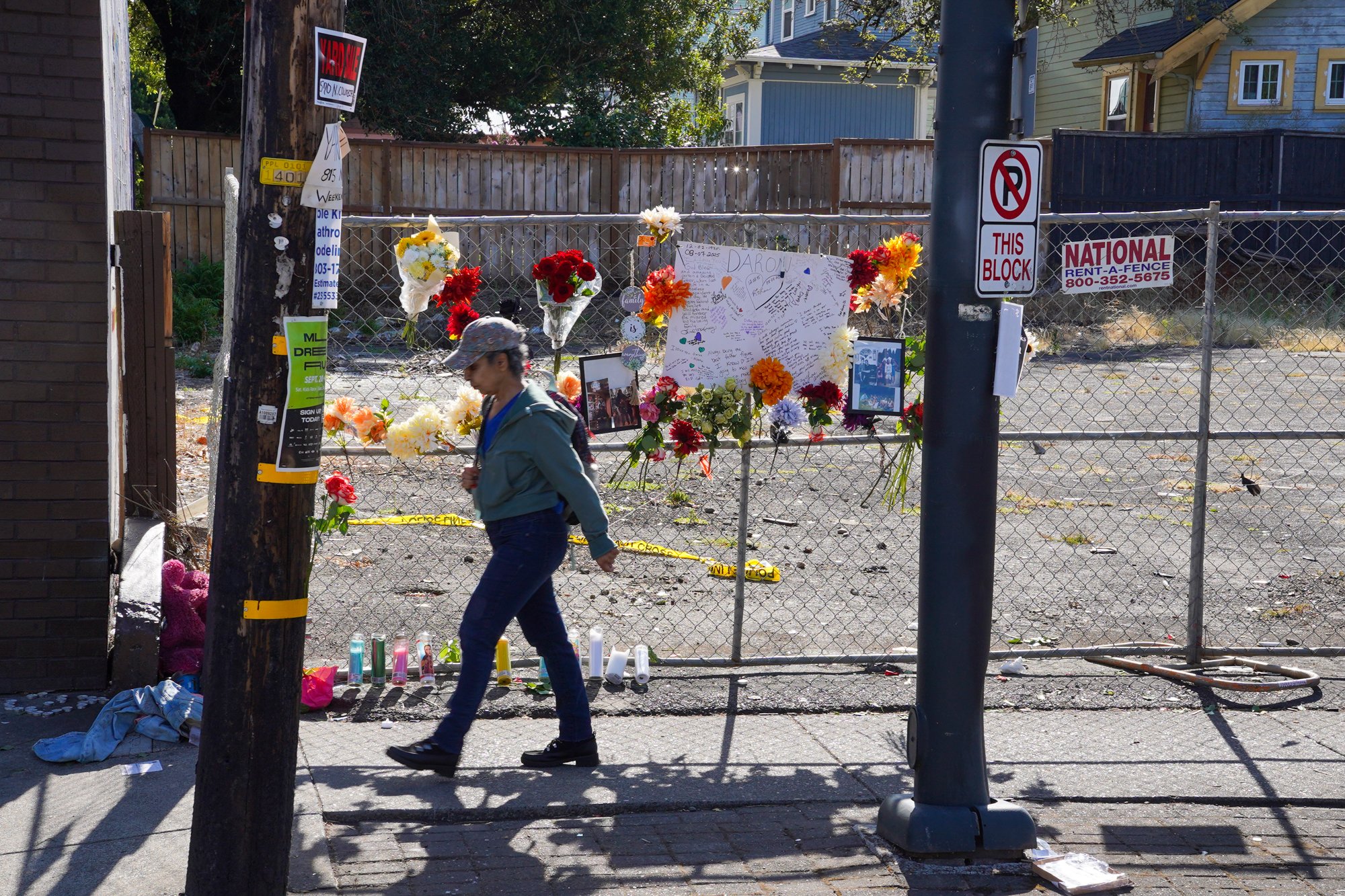
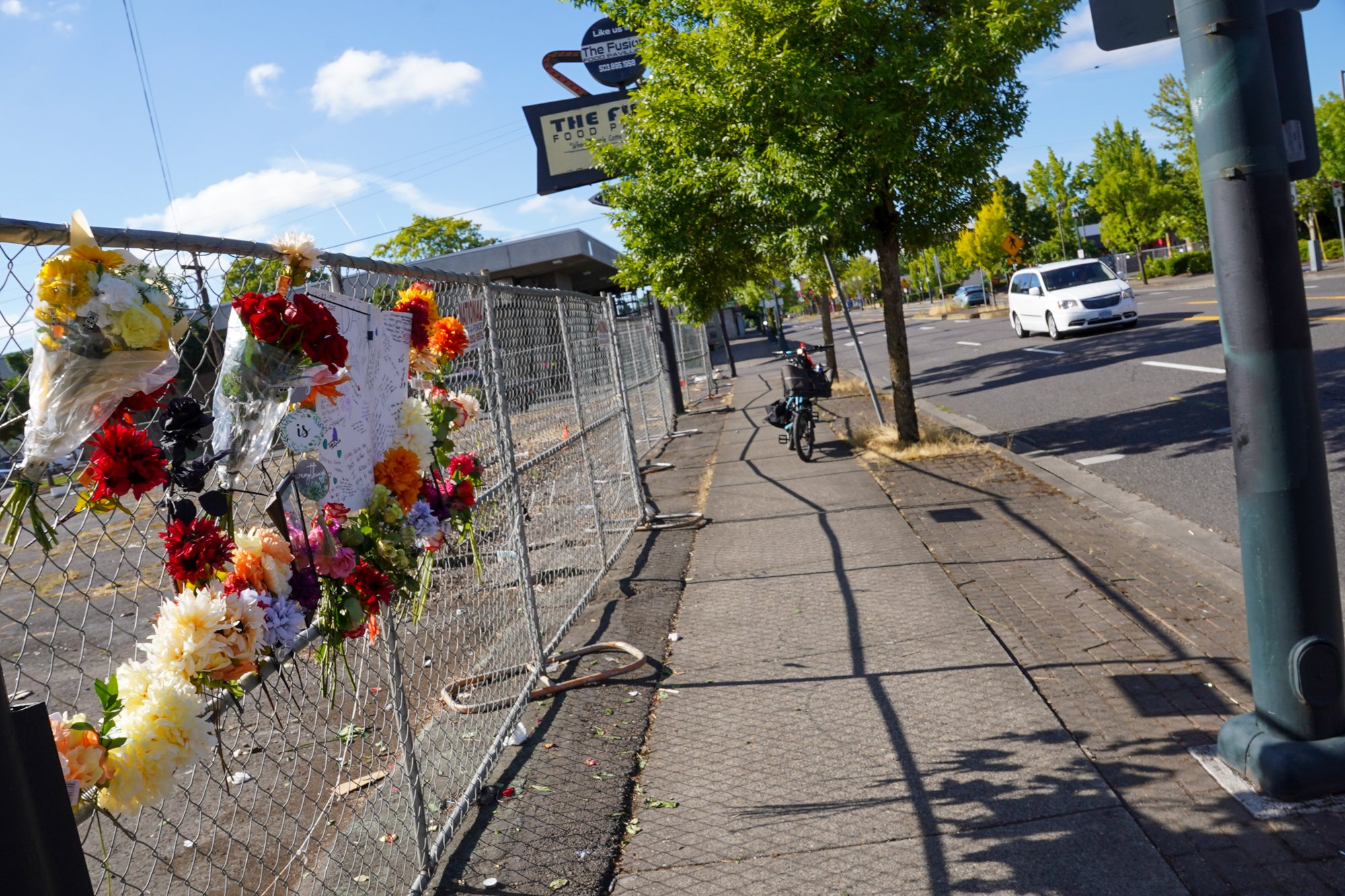
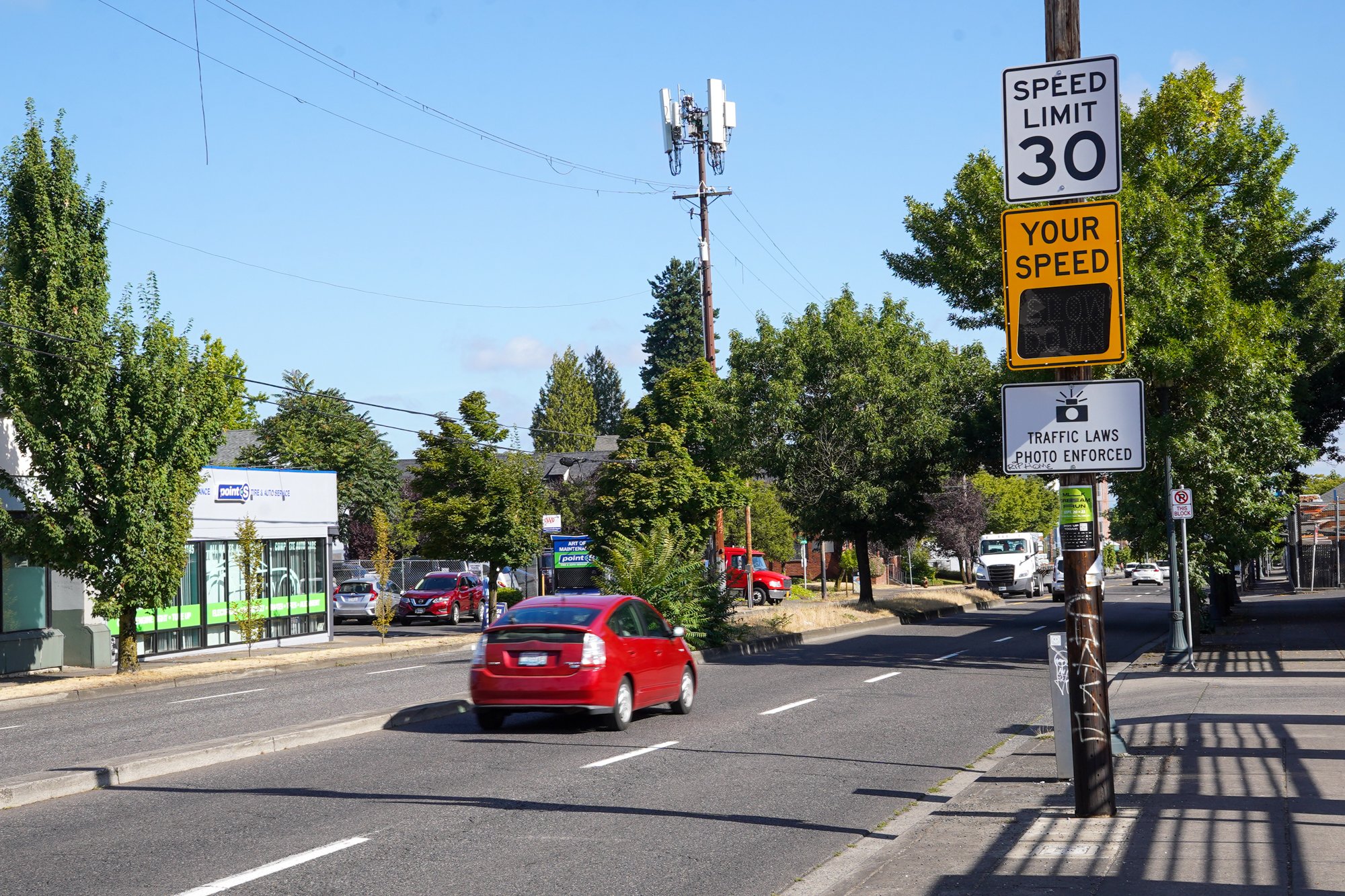
The PPB says they don’t believe the violent collisions were intentional. In a statement, police said the Ford Escape driver had two prosthetic legs, “but it’s unclear if that was a factor in the crashes.”
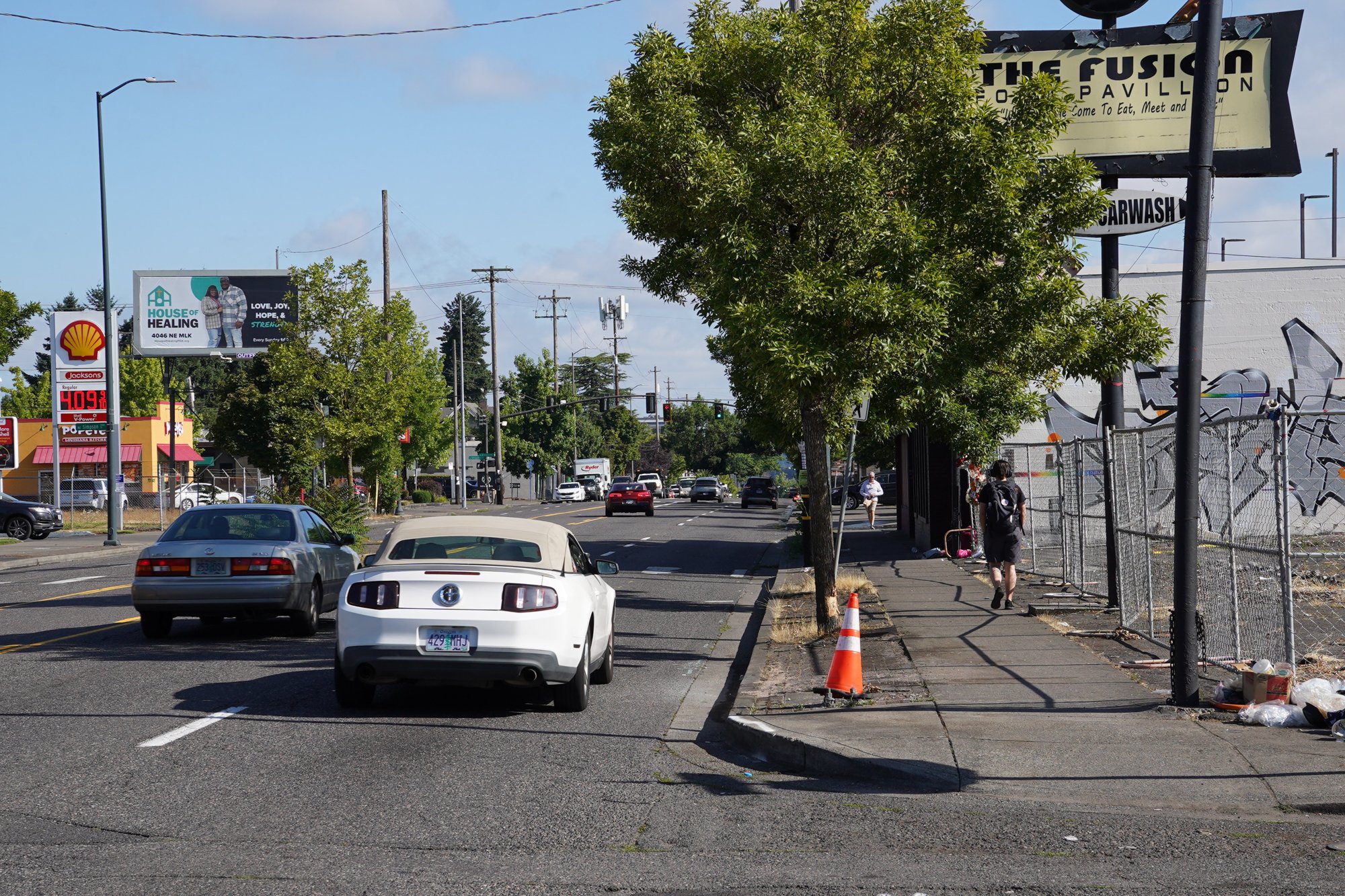
This stretch of Martin Luther King Jr. Blvd straddles the King, Woodlawn, Vernon, and Piedmont neighborhoods. It’s a city-owned former state highway (99E) and has five general travel lanes and no shoulder. The speed limit is 30 mph. PBOT used to have an automated enforcement camera installed right where the driver came to rest on Thursday, but it was recently removed as part of a vendor changeover.
With many popular food and business destinations, as well as a busy bus line, these blocks are always full of people walking and rolling. There are crosswalks and median island to try and calm traffic, but with nearly the entire road space dedicated to driving and a 30 mph speed limit, conditions at this location are stressful and dangerous.
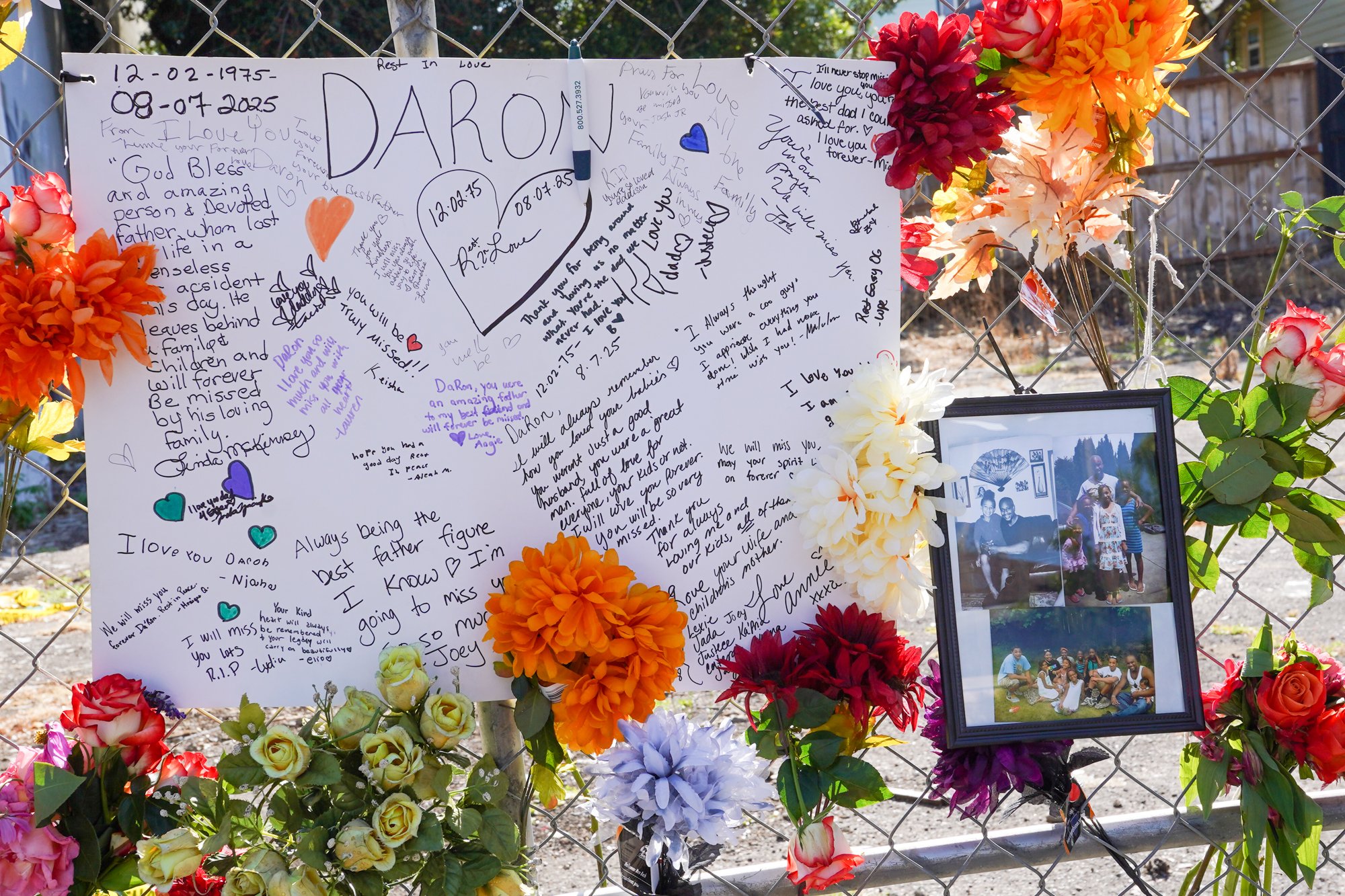
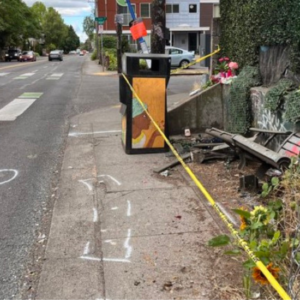
My post office is just a few blocks from here and I regularly bike on this exact sidewalk. I like biking on the sidewalk here because it’s a lot more interesting than taking side streets. I felt sick today as I stood at Craig’s memorial, stared at his family photos, and read the dozens of messages from people who knew him.
“Always being the best father figure I know. I’m going to miss you so much,” read one of them. “You weren’t just a good husband, you were a great man,” read another.
Many lives were changed in just a few minutes. And unfortunately, on a street like Martin Luther King Jr., it could happen again — at any time. The way that street is designed, there’s simply no room for error. We continue to expect Portlanders to live and thrive outside of cars while making them exist in places where they can so easily be killed.
Craig is the 20th person to be killed on Portland streets so far this year.

Thanks for reading.
BikePortland has served this community with independent community journalism since 2005. We rely on subscriptions from readers like you to survive. Your financial support is vital in keeping this valuable resource alive and well.
Please subscribe today to strengthen and expand our work.
Rest in power DaRon. He was born, raised, schooled, lived N/NE Portland. May community wrap his family in support and care ❤️
Whether the incident was intentional or not, this only goes to show that we need to have hardened protections in place for vulnerable users of roads and sidewalks vs. the removal of such deterents. Condolences for all of those affected in this latest trajedy.
Thinking about the design, this section is still a “complete street” by most definitions – it has curbs, sidewalks, gutters, a center median in most sections, it even has live telephone poles growing in the sidewalk – it also has way too many curb cuts and ramps. It sounds like the driver was medically impaired, so I’m not sure to what extent different infrastructure would have actually prevented some sort of crash from taking place, but no doubt the crash would have been far less serious if traffic was moving at an average speed of 20-25 mph rather than 30-40 mph.
Given that this section of 99E now belongs to the city, will PBOT restripe the lanes to a narrower width? Will they lower the posted speed limit? Maybe give MLK a road diet like they are now discussing for 122nd, certain sections one-lane, others 2-lane?
I don’t think the lanes can be made any narrower than they currently are. It already feels like a squeeze to drive my (standard sized economy car) on MLK. I’m amazed by the trimet drivers that navigate the 6 — nerves of steel. TBH, I would prefer a single lane where cars are allowed and can comfortably fit with a nice, wide bike lane in each direction. But that’s for sure a “white bicycle bully” fantasy. I will say driving MLK is terrifying for me when I do drive my car down it with hard-to-spot pedestrians all over the place. While this tragic event appears to be unusual, I’m not surprised to see vehicle-related injuries and fatalities on MLK — as Jonathan has eloquently reported, there are a lot of fast moving vehicles close to unprotected humans.
And David is correct, too, that MLK checks a lot of ‘complete street’ boxes, including a median separating northbound and southbound traffic in many places. But it’s still a total car sewer and scary as hell.
When I drive on MLK I drive slow, then it isn’t scary. Many people pass me by, and I just keep rolling along. As someone who has been driving in Portland since 1990 when I got my permit, I just naturally started driving this way in Portland unless it was on divided highways, as it seemed safest to me–I do not like getting involved in accidents.
Why can’t everyone be like me?: alone,bitter, hating New Portland, and driving slow, walking across town, biking and taking the MAX?
Sounds like we’re pretty similar! (Well, I’m partnered, so I guess the analogy has limits.) Definitely bitter, though.
Judging from the photos and assuming the red compact car is 7-feet wide, I’d say the left lane is around 11 feet wide and the right-hand gutter lane is 12-13 feet wide (a 24-foot curb-to-curb lane is very common nationally). If both lanes were reduced to 10 feet wide, the recommended width for 30 mph streets here in NC, that would leave a 3 to 4-foot gutter lane with a white edge line on the right side of the right lane, not wide enough for a legal bike lane, but narrow enough to considerably slow most traffic down to the posted speed limit. If the city timed the intersection signals to 25 mph, traffic would likely slow even further.
There was a redesign along much of NE MLK in the 90s to make it less of a highway and more of a main street. It went a long way, but MLK started out so bad that the improvements weren’t nearly enough, as you point out.
We are still suffering the consequences of previous planning (actually not that long ago–I think the median was put in in the 70s) that gave ZERO value to the people living and working along MLK and catered 100% to commuter and freight through-traffic. The median and other things done towards that end helped destroy the viability of MLK as a community business location.
MLK was a highway, if I’m not mistaken. The highway to Seattle, so it was a throughway from the get go, like 82nd, Powell, etc.
It was called various names until renamed Union after 1891 when a lot of other streets were re-named, until it was renamed MLK in the 1980s or 1990s. It was originally a “main street” couplet with Grand for the previous independent city of East Portland, which got annexed into Portland in 1926. “Interstate” in north-central Portland, where the Yellow MAX line is, is the old highway to Seattle.
Yes, it was (and is). But decades ago, it was also a thriving commercial street serving the neighborhoods along it. I think that’s pretty typical–lots of streets that were THE highways for moving traffic also worked as main commercial streets for the neighborhoods they went through decades ago.
The median installation (along with other changes) that catered to through-traffic at the expense of everything else) was a final blow (not the only one) to the street as a main street. And that was long after I-5 had already been built to also serve N/S through traffic. The negative impacts to N/NE Portland were ignored.
The contrast between this and the diverter situation in NW is more than a little cringe.
Over in NW, we have diverters that keep people safe from traffic likely to be removed, and the mayor’s office even going so far as to make a statement in support of that. The reason cited is nebulous public safety concerns.
But on MLK we have one dead, four injured, more involved…and I haven’t heard a word from the mayor’s office about it. Or any other elected official. It is, yet again, being treated as just one of those things, ya know? Thoughts and prayers.
Again inserting yourself and the predominantly white bicycle bullies into MY community’s tragedy.
Shameless
So no one should ever blink an eye when someone with a different skin color from their own dies from a preventable cause? That rule is new to me and I hope you’ll excuse me if I don’t follow it.
The only shameless behavior is that of our politicians, who continue to support the dangerous road conditions that ruin and take lives every single day. These “bicycle bullies” are the ones fighting to keep the most vulnerable and marginalized members of our city safe. It is an unfathomable tragedy that an innocent person can lose their life for a completely preventable reason, yet people will read about this and still be opposed to improving traffic and pedestrian safety.
No, Shawan – it’s OUR community’s tragedy. It affects all of us.
Bro what the fuck?? A driver KILLED someone and you want to tone police the “white bicycle bullies”? Where’s your outrage for the driver who committed an actual act of violence against black people?
Yeah it’s pretty bleak in here. The replies to you, whitesplaining who we are and what we are? Only in Portland I guess
Is this satire?
Shawan, what’s shameless is this weird form of racism that seems to completely consume you, and an extreme lack of critical thinking of why this would be an important story for people of all backgrounds who are interested in safe streets. That is nothing to say about your obvious and I assume potentially dangerous hatred of people in the community who ride bikes. And btw we live here too, it’s not just “your” community, whatever the f@ck you think that means
Ministerial note: MLK from Powell to Lombard was transferred to city ownership sometime in the 1990s, but it remains signed as 99E.
We all know MLK is a horrible speedway in the afternoon, as drivers try to shave a few seconds off their commutes. Needs a complete calming treatment.
Ugh thanks I keep forgetting that. Edited that sentence slightly to reflect this.
The PPB statement really made my blood boil. It basically says, “Yes, the driver caused incredible carnage but we’re not sure it’s his fault since he has two prosthetic legs.” And then it adds “We don’t know – and the DA doesn’t know – whether any laws were broken in this case.”
So you can fail to control a two-ton vehicle (curb weight: 3,247 lb), kill someone, grievously injure someone else, AND destroy property WITHOUT breaking any laws? – just b/c you were driving a motor vehicle when you did it??
If someone had walked down the street with a baseball bat and did the same things, he would be in detention now, charged with an array of crimes. But do the same damage in your car? Then you deserve our thoughts and prayers, I guess.
Also, does anyone but me think that if you have zero working legs, you maybe shouldn’t be driving at all? The PPB statement says the vehicle was modified for wheelchair use but doesn’t specify that it was adapted for driving by hand. Our standards for licensing drivers seem way too lax – there are hundreds and thousands of family members in the US suffering after loved ones were killed by drivers who were not fit to drive (elderly, vision impaired, and in this case physically impaired).
Yes, Fred … Because our society fails to recognize that multi-ton vehicles that can be propelled at high speeds are inherently dangerous. It’s mind boggling,
Society does recognize motor vehicles are dangerous. It also recognizes there is a categorical difference between someone accidentally killing another person and intentionally beating them to death with a baseball bat.
You may not think that intention matters, but the law does.
Now driving 70 on MLK sounds like recklessness to me unless that speed was part of losing control of the vehicle.
And failing to prioritize livable neighborhoods where all residents regardless of age and ability can complete their activities of daily living IN their own neighborhoods, without needing to resort to personally owning and rolling around on tons of steel and glass, exacts a deadly price on all of us
ummm why would you assume that about someone with prosthetic legs? They could work just fine for all we know. Not really cool to speculate that someone shouldn’t drive or isn’t able to use their legs just because they’re prosthetic.
C’mon, Jonathan – I know you want to stand up for the underdog, but driving a two-ton, 200-HP vehicle is an awesome responsibility that requires top-notch physical skills. I suppose you are going to argue next that ten-year-olds should be allowed to drive, or 90-year-olds with limited vision and hearing.
You should update your story: PPB just released the following statement:
https://www.portland.gov/police/news/2025/8/7/update-2-pedestrian-killed-king-neighborhood-crash-identified
That means you’ve got two prosthetic legs entirely responsible for controling acceleration and braking. Want to bet that one leg got stuck on the gas pedal and couldn’t be dislodged?
I know you don’t think that “anything goes” should be the rule of the road, but it sounds like that’s what you’re arguing here. Ask the grieving families if someone with this level of disability should be driving a two-ton vehicle.
Fred,
Please stop speculating about my beliefs and jumping to false conclusions about me. Save your hypotheticals for other internet debates because I won’t waste time with them here.
I’m not an expert in prosthetic legs, and I don’t know if they are incompatible with driving safely. That’s why I won’t speculate either way and I don’t think you should either. For folks with disabilities, it’s really uncool to assume they have limbs that “don’t work” and that they can’t perform basic tasks like driving. That’s my point.
Basic task? That went well. No one wants to begrudge anyone’s right to live an independent life and pursue happiness but come on man. Sometimes we just need to use common sense. This platform encourages people with 2 functioning legs to stop driving vehicles. This is an opportunity to stress the importance of taking advantage of the robust ada compliant transit system this city has to offer. This “folk” should take the bus next time.
“Want to bet that one leg got stuck on the gas pedal and couldn’t be dislodged?” Didn’t he come to a stop, and then re-accelerate?
People with flesh legs get into accidents all the time. Many of them are also co.pletely sober. Whats your excuse for them? For all we know this driver has been driving for years with their prosthetic legs without incidence.
Hand controls exist and cars can safely be driven at or below the speed limit with them. Having prosthetic limbs is not the reason they were driving 2x the speed limit and caused this level of carnage.
Regardless of disability and intention, at the absolute minimum this person’s license should be revoked for life.
That’s discrimination against one of our most vulnerable neighbors.
It’ll be interesting to see what’s said AFTER the investigation.
It could be the police will say the disability-related things were not relevant (say this happened because the driver was drunk, had a heart attack, or did it intentionally).
It could be they WERE a factor (driver couldn’t control vehicle due to their disability, or because the vehicle modifications didn’t mitigate the disability). The police could then say what you said–driver shouldn’t have been driving because their disability made them unable to control the car. Or they could say the opposite: “Not the driver’s fault–their disability made them unable to control their car”.
You’re definitely right (as I read what you’re saying) that you can’t treat all medical or health conditions the same–getting into a car knowing you have a condition that you need to mitigate if you want to drive is entirely different than having an unpredictable seizure or heart attack.
Making negligence the level of criminal intent for driving crimes as Lois/Fred suggest would radically undermine the American transport sector which as usual, they ignore in favor of preaching.
For example, one would need to carry insurance not only for liability if you cause an accident, but also for attorney fees and lost work due to time in jail for the resulting criminal charge. It would require huge investments in jail and court capacity as literally millions of criminal charges would be added to an overburdened system.
Off hand I’d guess 70 percent or more Americans live in a house that requires a car to timely go to work, visit friends, and buy things.
If you suddenly make it financially impractical to drive due to all these new liabilities (like losing your income for being in jail or a 30k lawyer fee) where are people supposed to live?
Some people in Portland need to take a trip to the EXURBS of London, Manchester, Paris, South of France, Oslo and see how people are getting around. These provincial and subtly racist Portlanders who drone on about increasingly irrelevant Europe won’t even think about how people in India or Indonesia are getting around. Hint: its motorized vehicles.
“Undermine the American transport sector”?? Sign me up! I thought that’s what we’re all doing on BP – undermining the status quo by riding a bike and thereby spurning the usual “American transport sector.”
And “subtly racist”? That’s rich. How is it racist to suggest that a driver should have two working arms and legs UNLESS the two-ton motor vehicle he is driving has been specially modified, which this vehicle was NOT?
I know this crash was particularly upsetting to you Jonathan. I’ve posted (on Twitter, when I was on Twitter…) and written in other places so many times that we need a true, more accurate, accounting of the cost to society when a life is lost in road traffic. The loss of life in and of itself is unimaginable: all that the person still had to give and experience, the relationships abruptly severed, I could go on. But there are many other costs. Close family and friends will grieve indefinitely and when a loss is sudden and violent – as road fatalities always are – the grief held by family and friends so often quickly becomes complicated and can be debilitating. But there are yet other costs. The community reels and often individuals who may not have ever met the victim are traumatized, because a human traveling in a way that they also travel has just been suddenly and violently killed. Our transportation system inflicts so many costs
^^Our transportation system inflicts trauma – physical, mental, emotional – on so many of its users, whether they are direct victims of a crash or not.
Wait for the final PPB report to say that the driver did nothing wrong, or at least it wasn’t intentional, which means it must have been the fault of the sidewalk for swerving and jumping out into the vehicle’s path. Furthermore, according to the report, the pedestrians were not wearing appropriate clothing, which contributed to their invisibility and exacerbated their injuries.
Come on, PPB, prove me wrong. Assign the blame to the driver!
“it wasn’t intentional, which means it must have been the fault of the sidewalk”
Something can be both unintentional and someone’s fault; there is absolutely no conflict there.
RIP DaRon Craig. Hope the other victims make it.
MLK Blvd has a real speeding problem. I’ve been inside a business when a car jumped a curb and drove into the building. Luckily no one was injured that night.
Agree with this. The Dekum intersection is definitely going to have a terrible crash at some point
If this tragedy makes you sad, concerned, fearful, frustrated, etc., consider sharing your feelings with your city council members, the city manager, PBOT director, and/or PPB Chief.
Ted Buehler
When is enough going to be enough with the city council and PBOT? How many tragedies must occur before the city makes it official policy to always prioritize safety over speed and throughput? It shouldn’t be possible to accelerate to 70mph on a surface street like MLK. Put this incident at a different time/location and there could have been dozens dead.
As long as vehicles are capable of accelerating to dangerous speeds we will have fatalities like this. This is on NHtSA and the American Auto Industry who is almost always left out of safe street’s conversations and never held accountable.
I’d argue lack of enforcement is the bigger issue.
Safer cities still have vehicles that can go fast
Citation needed
Are you being sarcastic?
The same cars are available in every city in the States. Therefore, any city that is safer, such as having less vehicle deaths and/or vehicle accidents would by extension also have fast vehicles like Portland.
What kind of citation are you looking for?
The assumption above is that speeds are largely immaterial to safety. MOTRG as per usual makes empty assertions without any evidence.
The “common sense” kind of no-nonsense, and ultimately substance-less assumption often held in the US is that a lack of enforcement leads to road deaths, whereas VZ has been successful in other cities via a holistic safe systems approach, which always includes slower speeds among other things like street redesign (e.g., lane width reduction), and traffic camera fines tied to income. Here is Helsinki as an example.
Provide evidence that “safer cities” maintain high vehicle speeds. I’ll definitely read that research.
That’s not at all what they said. They didn’t say safer cities are safe because of high vehicle speed. They said safer cities than Portland ALSO have cars that can go fast. Therefore enforcement of speeding cars will make Portland safer BY LOWERING SPEEDS. That is a legitimate opinion. I know you two clash often, but please read the post again without preconceived bias against MOTRG.
Also, when are you going to get tired of linking to rich, euro countries that don’t really share any characteristics with Portland other than skin color. It’s really not a good look.
Exactly, MOTRG please provide evidence to support this. Where are there places that have fast car speeds and also tend to be safer than Portland?
It’s that the cars themselves can go fast, like what MOTRG and Sarah originally were discussing. Sarah suggests cars should be mechanically or electronically limited in speed. MOTRG countered that enforcement of speed limits would be more immediately successful. They both agree that high speeds are bad.
I have no idea why you think either of them should need to provide a citation for statements that are so clear.
Eawriste, you need to reread the original post. He said vehicles that “can go fast.”
You changed that to “have fast car speeds.” Two different things.
One person getting pulled over and ticketed doesnt get other people to slow down. If you want people to drive slowly, you must design the streets in a way that makes driving fast difficult and uncomfortable.
And its weirs to call the Euro nations rich while we live in the richest nation in the world. Maybe instead of spending so much money on policing thay doesnt work, we cut the PPB budget and put that towards making the streets safer.
“One person getting pulled over and ticketed doesn’t get other people to slow down.”
Nonsense.
I have not seen a PPB traffic stop in years, but seeing a trooper or sheriff sitting along the highway definitely causes motorists to slow down. You can see the brake lights come on when drivers see the cop.
I saw a presentation at a traffic engineering conference some years ago where they quantified the speed reduction in construction zones due to the presence of a marked patrol car. If I can find it, I will provide a link.
As I have claimed on this site many times, there is very little traffic enforcement in Portland so it is no surprise traffic crashes and fatalities are high.
Thanks J_R. I would love to see that research if you can find it. The research on the effect of manned traffic enforcement on preventing crashes, in general, suggests the evidence is mixed at best.
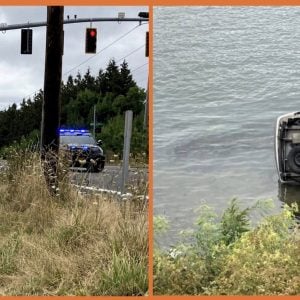
There are obvious examples where manned police enforcement is necessary. The recent tragic loss of life in this article as well as the hit and run on the Morrison Bridge are just two examples. But just as a police officer is not the best tool for someone having a mental health crisis, or non-emergency situation requiring social support, different scenarios require different traffic enforcement methods.
Unfortunately, most people simply assume more manned police equals an overall behavioral change (e.g., decrease in crashes, increase in road safety). There is simply no evidence (example 1, 2) that is the case. That’s because traffic crashes have complex causes (e.g., road design, vehicle height/weight, lack of driver training etc), and behavioral change requires consistent, variable ratio schedules, e.g., people expect a consequence nearly every time they speed.
There is an abundance of evidence on the consistent effectiveness of automated traffic enforcement, which average around 20-25% reduction in crashes depending on the site. A marked patrol car might get people to slow down often, but a traffic camera will consistently do the same for much less cost. And that helps police focus on the things they can be good at.
Prevention via speed reduction, road narrowing, separating modes etc. should be the priority, but again for the enforcement gong bangers out there (Angus and the like), manned enforcement is necessary for specific situations, but much less effective for others.
Some of the safest cities make it incredinly difficult to drive fast. We dont need enforcement, we need good road engineering that slows people down.
We need both.