Emotions ran high and so did the comment count. As the mayor’s race grows increasingly contentious, I’m expecting the BikePortland comments sections to reflect that and to become pretty turbulent places. It’s probably inevitable that some of that froth blows back onto BikePortland itself.
Deep into the thread of the Street Trust/Carmen Rubio story, after readers had exhausted all that could be said about traffic tickets, some turned to the subject of bias in reporting. I wrangle with that topic nearly every day, and I imagine Jonathan does too.
After some back and forth between Jonathan, myself and several commenters, Phillip Barron took up the theme and did right by it in a few thoughtful paragraphs.
Here’s what he wrote:
Advertisement
The idea that journalism is not objective is really not all that controversial. Neither is the idea that bloggers can be journalists. But nor does that mean that newspapers are worthless or that any blogger is a journalist. I have no problem with Fox Vanilla’s thought above or with classifying BikePortland as journalism. It seems pretty obvious that Jonathan and Lisa are journalists; they report on what they (and an ever changing team of writers) deem newsworthy for the bike-interested readers of Portland.
A good wikipedia page cites its sources, which if you were curious, you could follow and see if you accept those references. Or, perhaps, you will accept references to what you seem to think is the standard bearer in journalism, the NYTimes.
The NYTimes seems not to have a problem with either admitting that journalism is produced with bias (1) or with acknowledging that blogs are organs of journalism.(2)
Instead of thinking of these terms in binaries (either one is biased or one is not; either one is a journalist or one is not), I find it more useful to focus on where bias takes place. In journalism, bias affects everything from what a journalist thinks is newsworthy, what an editor thinks deserves front-page coverage, which articles a layout editor decides deserve photographs, which op-eds a publisher chooses to print, how much rope an editor will allow an investigative journalist when the IJ is looking into a scandal involving the newspaper’s owner (I’m looking at you, Washington Post) and so on. Bias affects photographers in how they frame a shot and, as Errol Morris (while writing for the NY Times) notes, what they leave out. (3) We all become much better readers of journalism the more we are actively aware of these biases.
Thank you for taking the time to write that, Phillip. You can read Phillip Barron’s comment, and the rest of the back and forth, under the original post.
Bicycle Mechanic Educator (Walk N Roll Program Representative)
Company / Organization
Intercity Transit
Job Description
Intercity Transit’s Walk N Roll education program improves transportation access, increases independence, and inspires a healthy lifestyle through activities that encourage Thurston County residents to walk, bike, roll and ride public transit for transportation. We are currently recruiting a Bicycle Mechanic Educator to serve as a Walk N Roll Program Representative. They will oversee the operations of the Walk N Roll educational bike shop, provide bike mechanic education and oversee the repair and maintenance of bicycles that support Walk N Roll’s bike education programs. They will also serve as Intercity Transit’s Employee Transportation Coordinator.
If you have:
• Ability to lead and educate others.
• Ability to create a welcoming community space for people of all races, ages, genders, abilities, and backgrounds.
• Basic skills in bicycle mechanics.
• Proven ability to manage competing priorities effectively and work independently.
• High level of personal accountability for the quality, safety, and impact of your work.
• Proven ability to work in a collaborative environment and complete projects within a team.
Then this position is for you!
Intercity Transit is looking for a Walk N Roll Program Representative to oversee all operations and programs related to the Walk N Roll educational bike shop. They will be responsible for implementing bicycle mechanics education, programs, classes, and related activities. We are looking for someone to expand our bike shop education programs while creating an inclusive community space. The Walk N Roll Program Representative will also serve as Intercity Transit’s Employee Transportation Coordinator overseeing the agencies Commute Trip Reduction program.
It’s an exciting time to join IT!
Build a career you enjoy, in an agency that is a nationally recognized urban transit system with diverse services and strong community support. Intercity Transit provides fixed route transit, ADA paratransit and vanpool services in Washington state’s capitol city of Olympia in addition to the neighboring communities of Lacey, Tumwater, and Yelm. This is an exciting time with great opportunities, and we invite you to join us in our mission to provide and promote transportation choices that support an accessible, sustainable, livable, healthy and prosperous community.
As a Walk N Roll Program Representative, you will:
• Oversee the day-to-day operations of the Walk N Roll educational bike shop. Responsible for creating and maintaining a safe, organized, and inclusive educational space. Monitor inventory and order bicycle parts and tools.
• Implement and maintain systems for the retrieval, storage, inventory, and repair of donated and fleet bikes. Ensure program bikes are properly repaired and in safe riding condition.
• Coordinate, promote and implement bike shop educational activities, events, and classes.
• Handle the waste stream for unsalvageable bikes and bike parts.
• Source, recruit, train, and track bike shop volunteers.
• Develop curriculum and provide bike mechanic and maintenance instruction and training to youth and adults.
• Provide technical oversight for bicycle repair to volunteers, community members and youth.
• Coordinate and implement a community bike and wheelchair maintenance and repair program.
• Coordinate bike distribution and repair clinics for adults in need.
• Support other bike, pedestrian, and transit education, activities, outreach, events, and classes.
• Collaborate with other Walk N Roll staff and volunteers, Bicycle Community Challenge Representative, and marketing staff.
• Serve as Intercity Transit’s Employee Transportation Coordinator overseeing the Commute Trip Reduction Program (CTR). Facilitate committee meetings; prepare agendas, minutes, and supporting documents. Track data, create reports, attend networking sessions, and send communications to Intercity Transit employees about the CTR program.
• Supports other Walk N Roll and marketing and communication activities. Provides administrative support to the WNR program.
• Performs other duties of a similar nature or level.
Are you the one we are looking for?
• Associates degree or a specialized certificate training in education, bicycle mechanics, bicycle riding safety, or another related field OR an equivalent combination of education and experience sufficient to successfully perform the essential duties of the job.
• Experience with leading adult and/or youth education.
• Experience leading, coordinating, or recruiting volunteers is desired.
• Ability to get a Washington State driver’s license by the date of hire and be willing to submit to a criminal background investigation, the results of which must meet the agency’s hiring criteria.
• Safe, legal, and competent bicycling skills.
• Ability to work with people of all ages, races, genders, abilities, and backgrounds.
• Willing to learn how to safely operate program van and trailer.
• Computers, basic desktop publishing, database and/or spreadsheet design; modern office procedures, methods, and equipment.
• Ability to work Tuesday-Saturday schedule with consistent evening hours.
What’s in it for you?
• Receive a competitive salary of $30.47 – $41.17 an hour in addition to annual general wage/cost of living adjustments typically received in January and step increases in July (if not at top of salary range).
• Comprehensive medical, dental, and vision coverage for employees and eligible dependents.
• PERS Retirement Plans (through Washington State Public Employee’s Retirement System) along with voluntary deferred compensation plans (401k and 457) with employer match up to 6.2%.
• 12 to 25 vacation days per year depending upon date of eligibility and length of service.
• 12 days of sick leave per year depending upon date of eligibility.
• Up to 48 hours of floating holiday time.
• Paid Bereavement leave for qualifying family members.
How to Apply
Ready to jump on board?
We would love for you to apply! Please submit a complete electronic application online at www.intercitytransit.com/employment. Your application package must include a letter of interest and resume that clearly explains how you meet the qualifications of the position. Be advised, we will not consider incomplete applications. Intercity Transit’s preferred method of communication is via email, so an accurate and active email address is essential.
Completed applications must be received by 5:00pm on Sunday, October 13, 2024.
Intercity Transit is proud to be an equal employment opportunity employer and strives to provide a culturally diverse workforce. Intercity Transit does not discriminate in employment or service on the basis of race, creed, color, origin, age, sex, religion, marital status, sexual orientation, veteran status, or disability.
We also take pride in being a drug free workplace. Note that Intercity Transit is subject to requirements of the Federal Drug-Free Workplace Act and FR Part 40 & Part 655, which prohibits the use of marijuana at any time while employed by Intercity Transit.
Hello everyone. Happy Monday. I’m really excited for the week! Lots of cool stories to work on and to share from our writer Lisa Caballero, family biking columnist Shannon Johnson, and a special guest contributor Aaron Kuehn of BikeLoud PDX.
This week’s Monday Roundup is sponsored by The E-Bike Store, your source for excellent electric bikes. Come visit their north Portland showroom right across the street from Peninsula Park.
Here are the most notable news items our community came across in the past seven days…
Bike share price cap: I like any policy that treats bike share more like public transit, so it was neat to see this new bill introduce in New York City that would cap the price of a bike share ride to be no higher than the cost of a subway or bus ticket. (Streetsblog NYC)
Dangerous drivers: When drivers slam into a convenience store or building it becomes a meme. But the same epidemic of terrible, irresponsible driving can also lead to much more serious things like this natural gas pipeline fire in Houston that was caused by an errant SUV driver who struck a valve. (NBC)
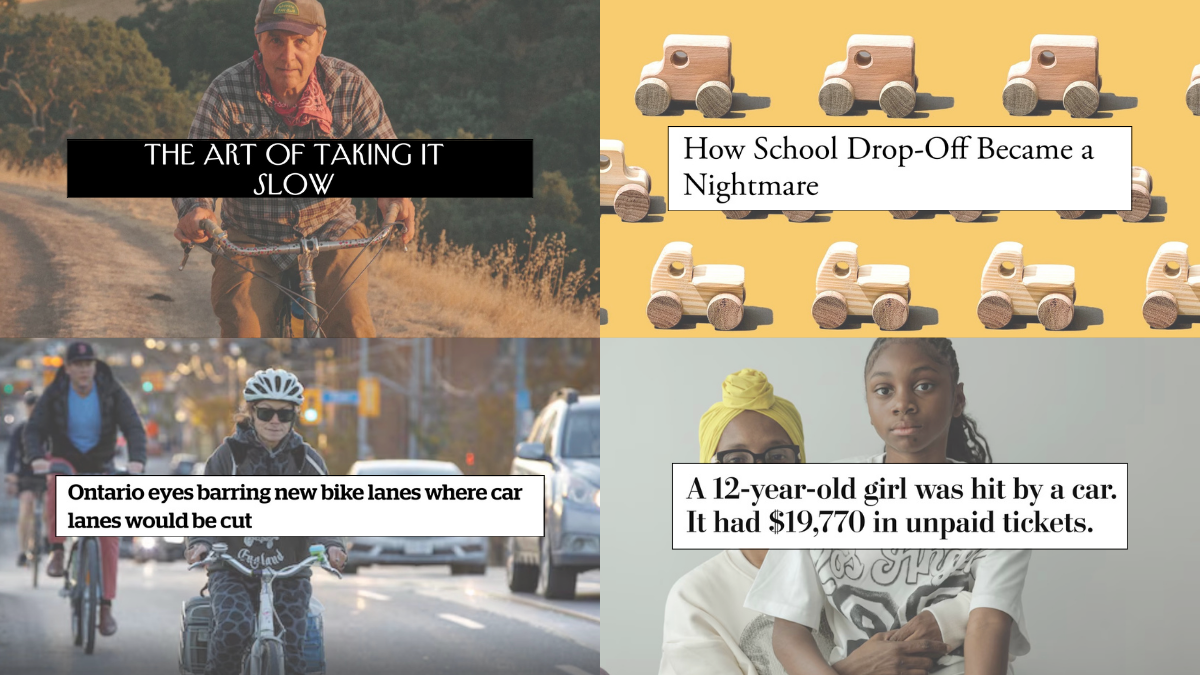
School drop-off lines: A venerable outlet delves into the reasons behind nightmarish school drop-off lines and makes a solid mention of Portland’s bike bus efforts, including a link to this here website! (The Atlantic)
The Rivendell Way: I have long admired how Grant Petersen runs his bike company, so reading this wonderful, in-depth profile about this guy who has always stood out from the crowd for the right reasons, was a joy. (The New Yorker)
Advertisement
Delivery logistics: I put the role of cargo bikes making last-mile deliveries squarely into the “we don’t talk about this enough” category when it comes to making our city more humane and climate-friendly. (EuroNews)
Toll of tickets: There’s a lot that’s shocking about this article that describes some of the similar issues we’ve faced here in Portland with the Rubio revelations, but what really gets me is how the irresponsible headline contributes to the problem. (Washington Post)
Bike Angels: I don’t hear about anyone Portland doing this with Biketown as much as I used to, but it appears as though the citizen bike share rebalancing hustle is alive and well in New York City. (NY Times)
Canadians and cars: Transportation is very political in Ontario, Canada as Premier Doug Ford seems to be making a bid for votes by saying he’ll make bike lanes harder to build and speed up car-centric road projects. (CBC)
Justice for traffic violence: Imagine a third-party evidence-sharing tool that would allow road users to upload content of illegal behaviors to be reviewed by the authorities for possible enforcement action. That’s what’s in the works in Scotland. (Road.cc)
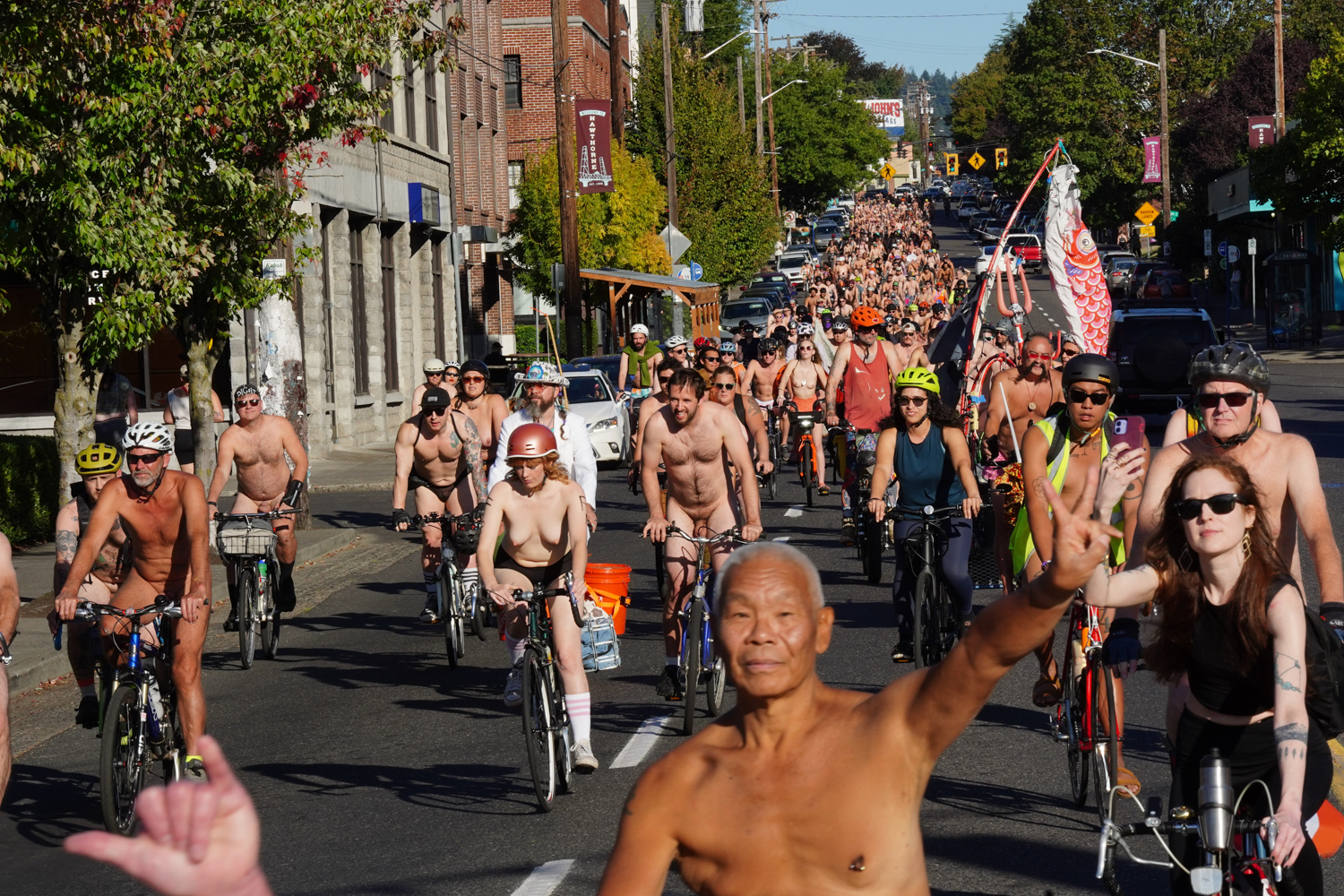
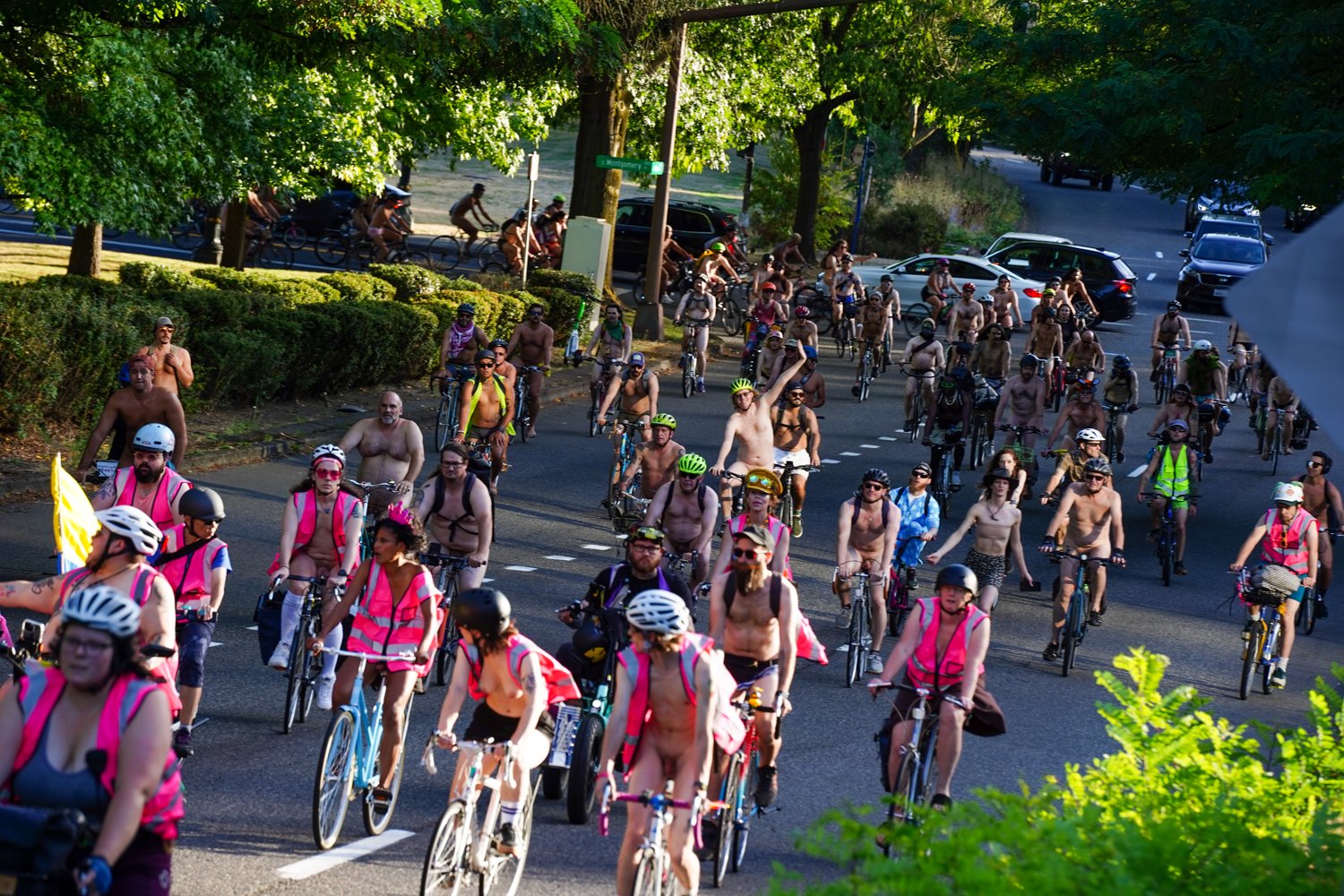
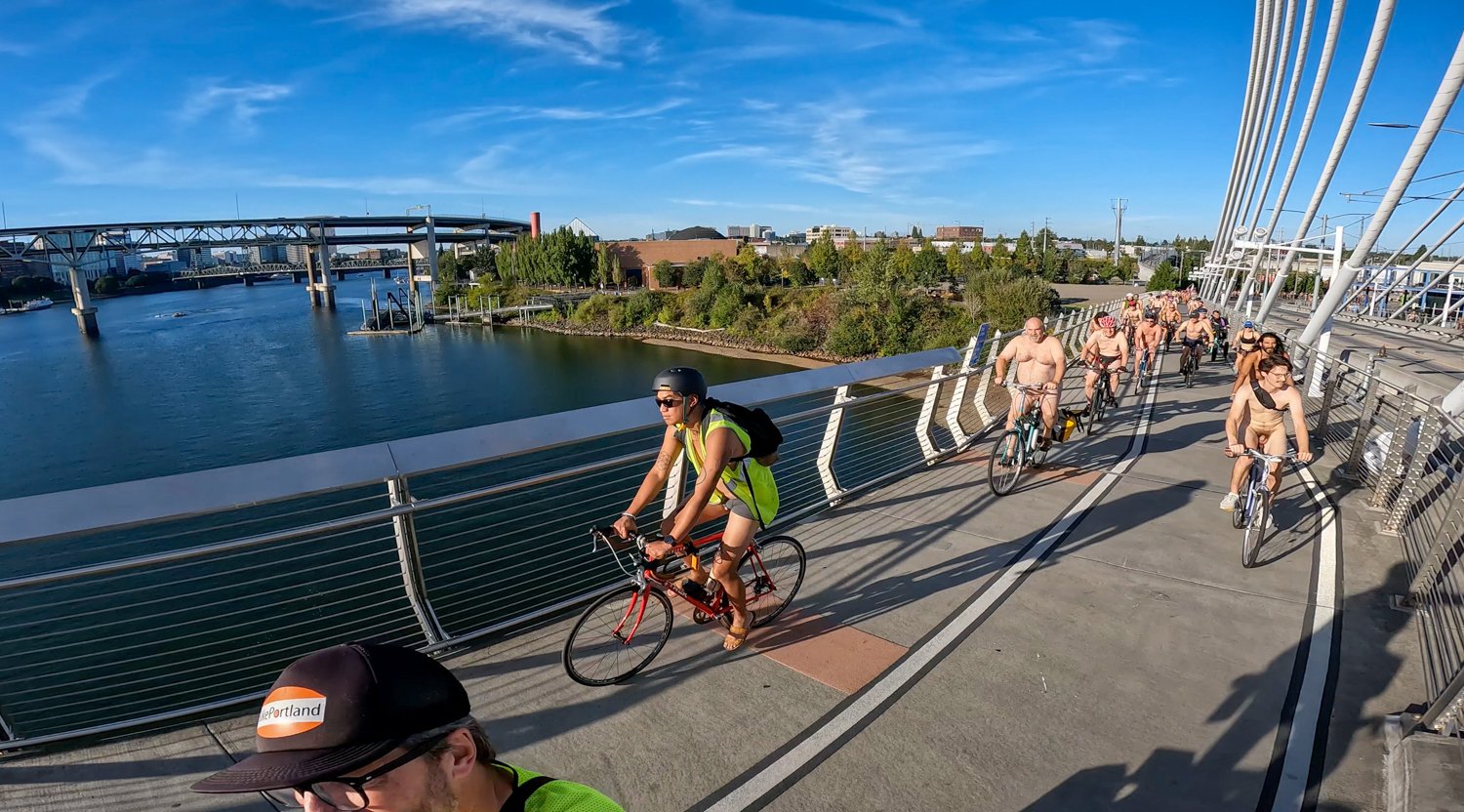
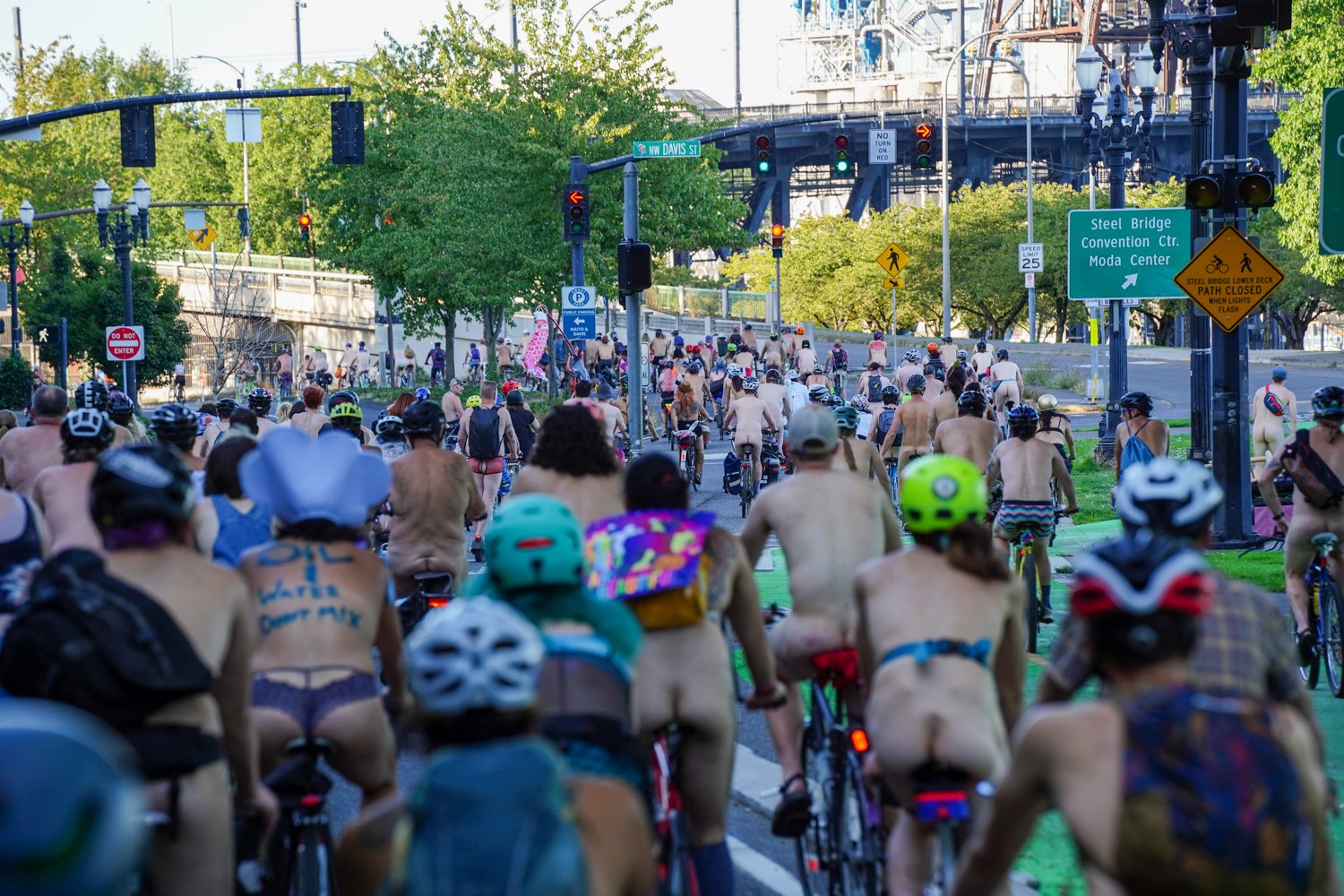
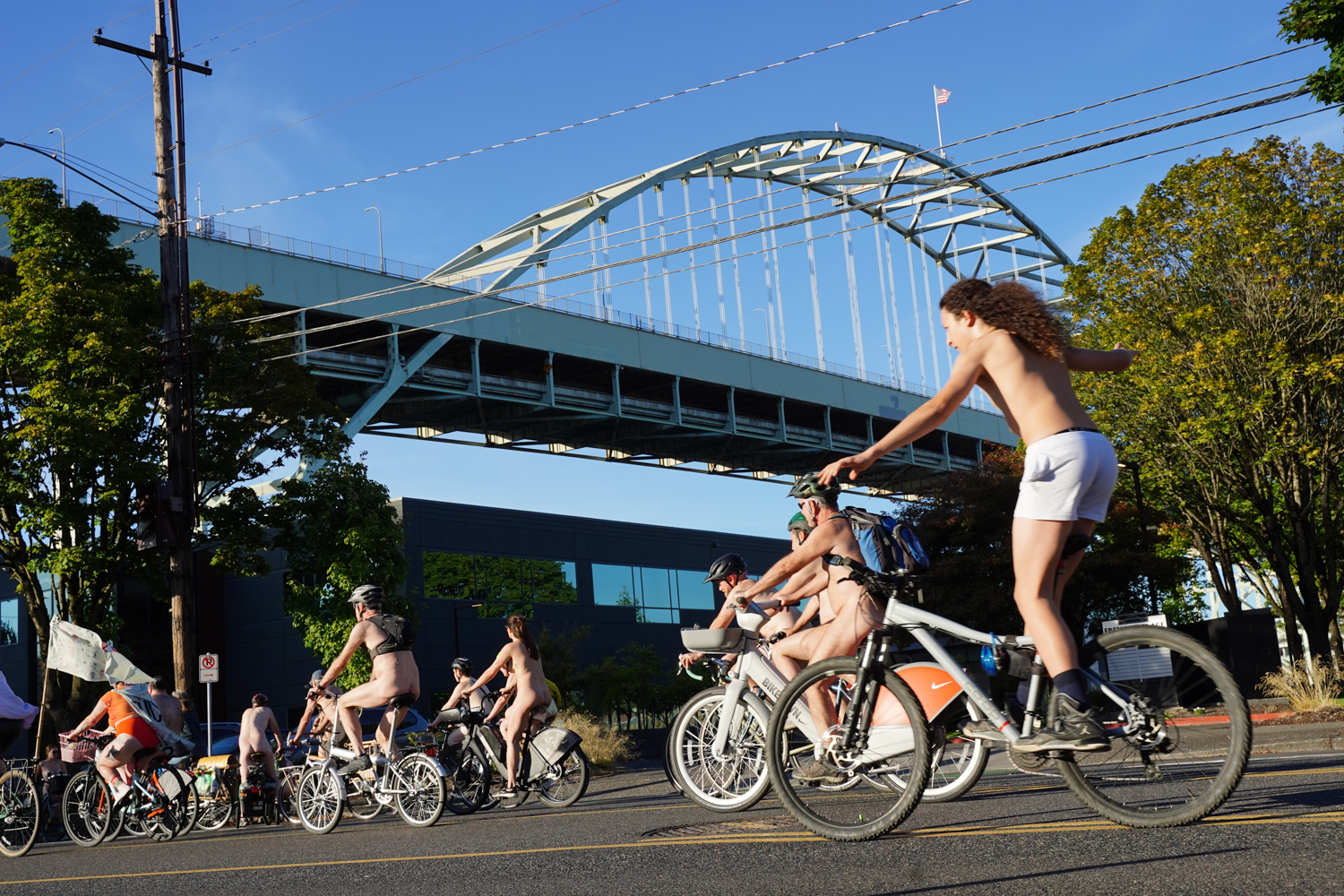
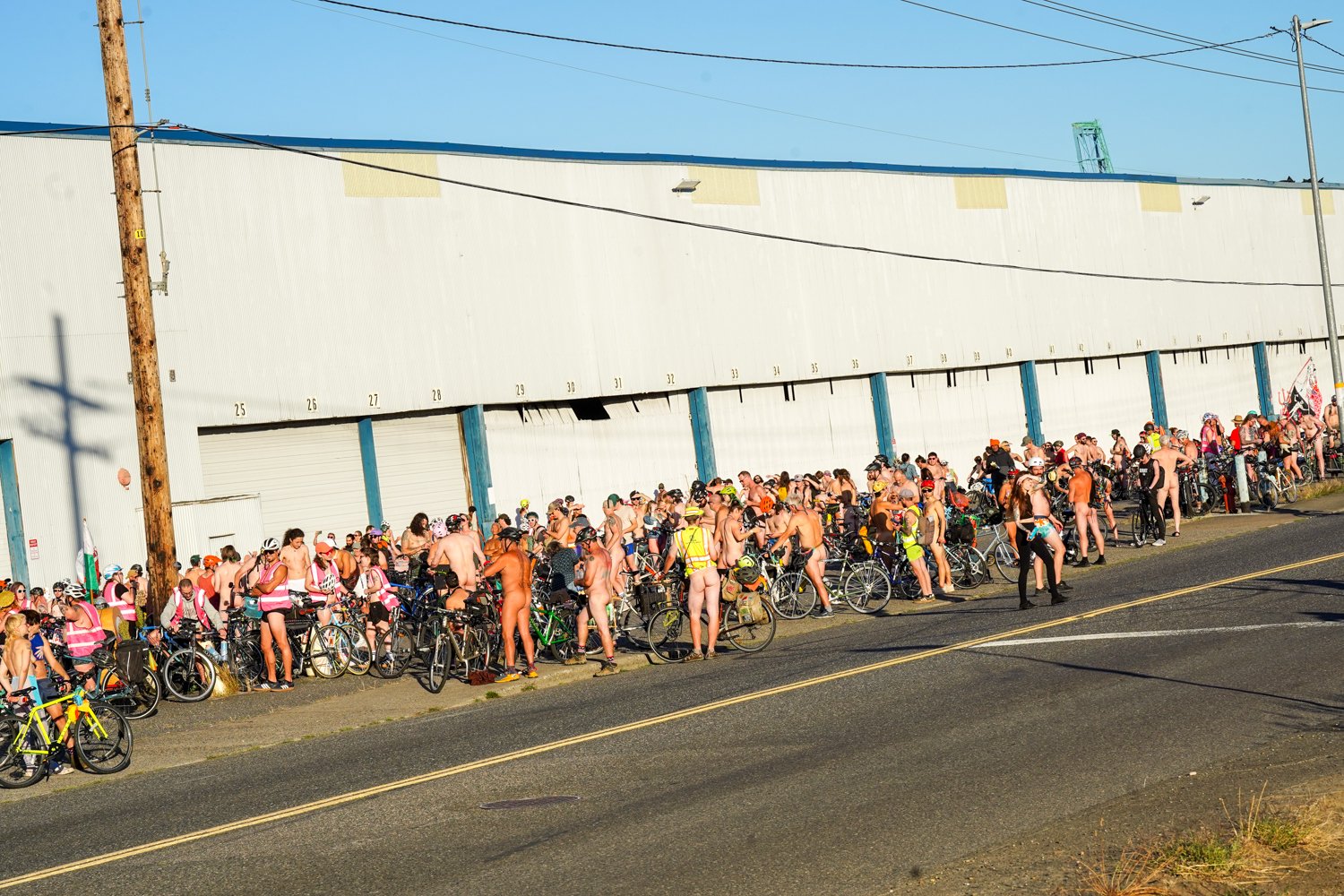
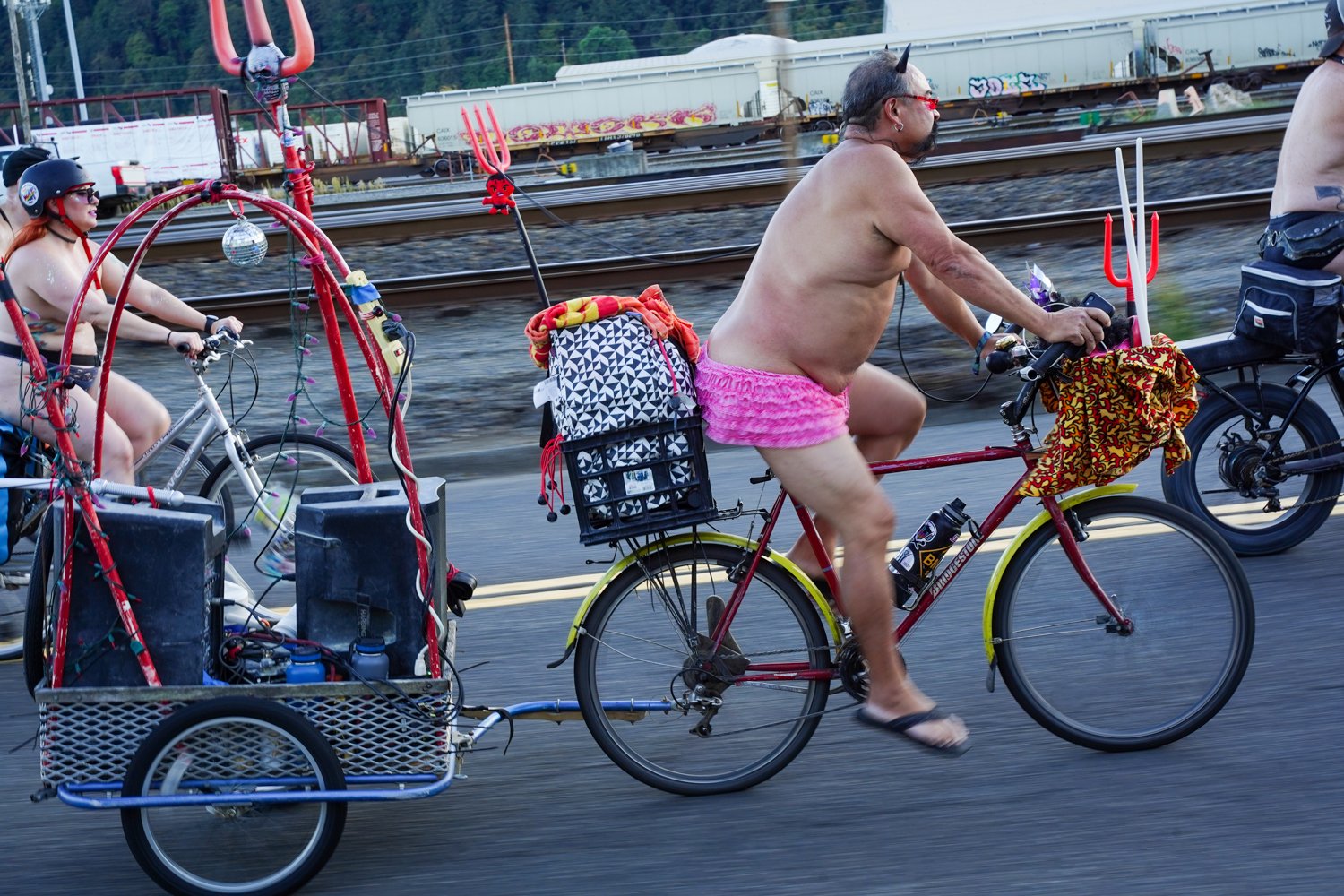
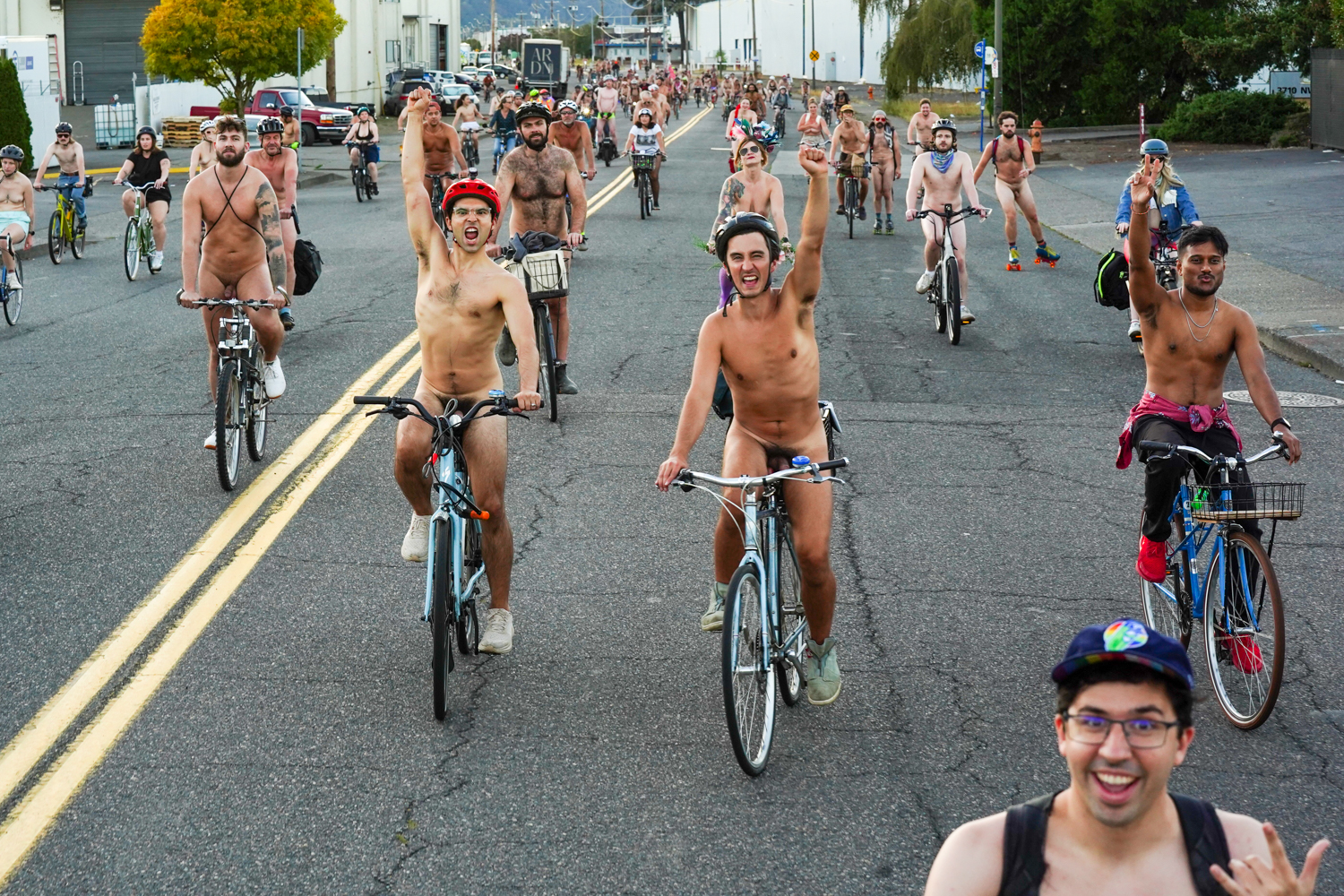
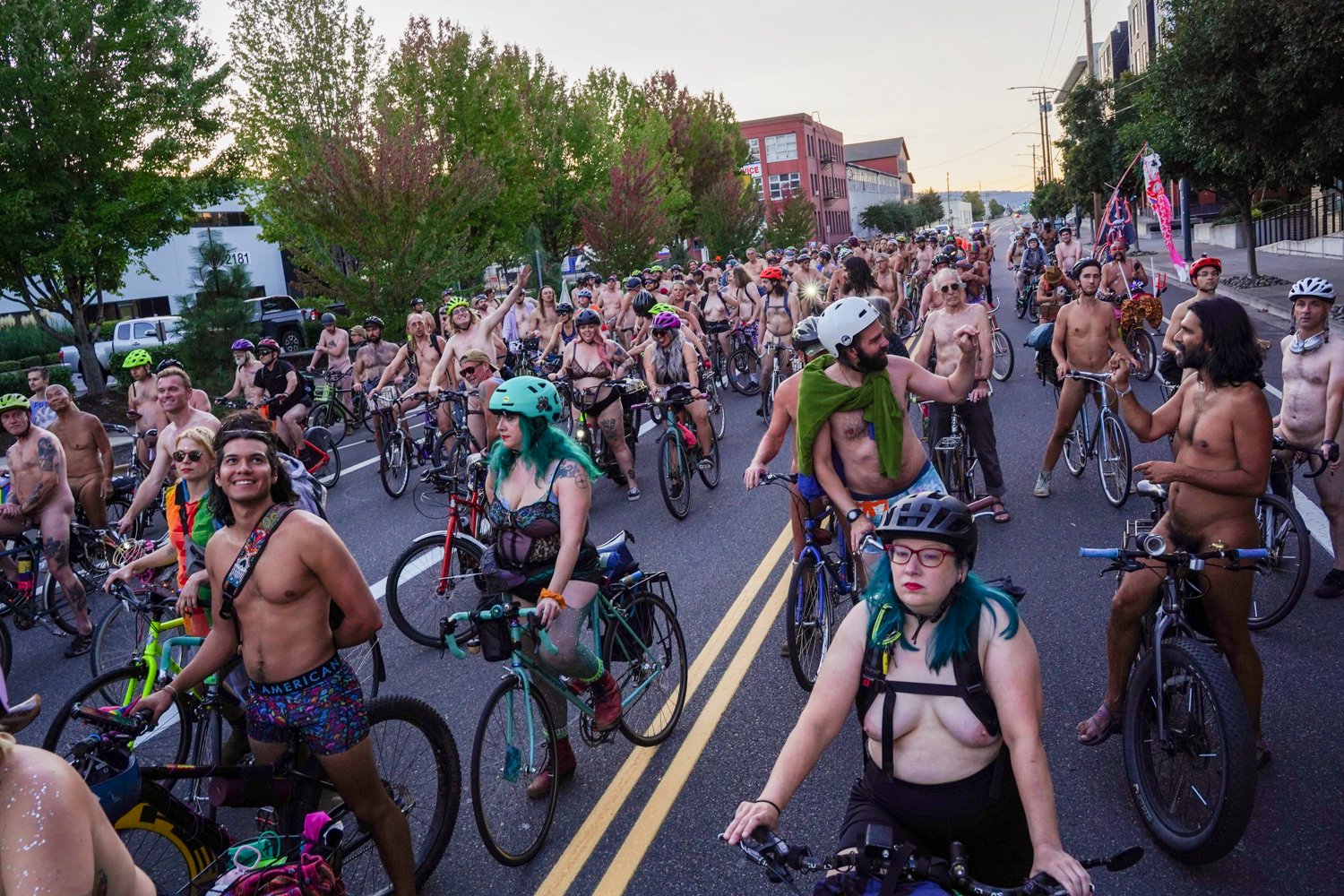
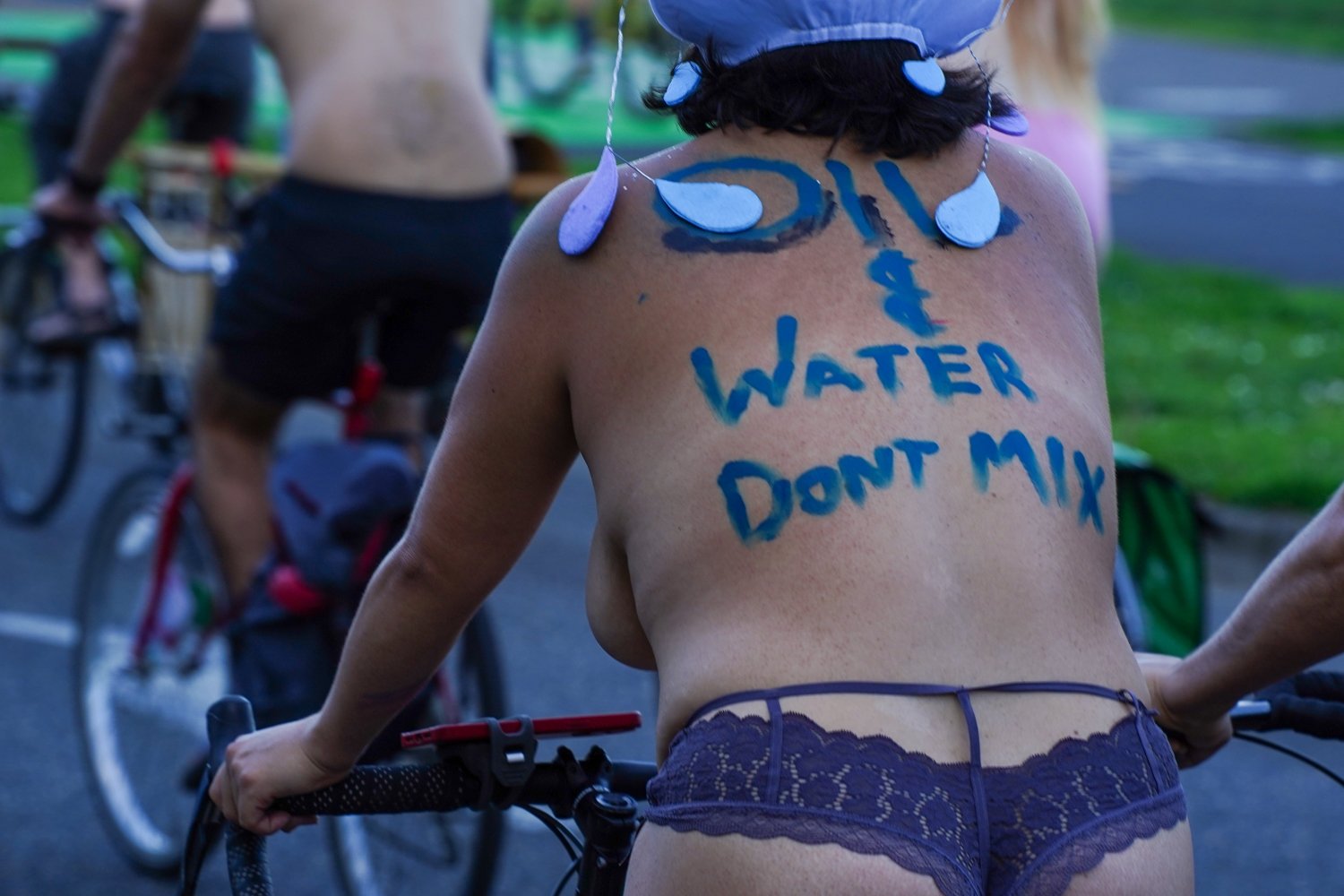
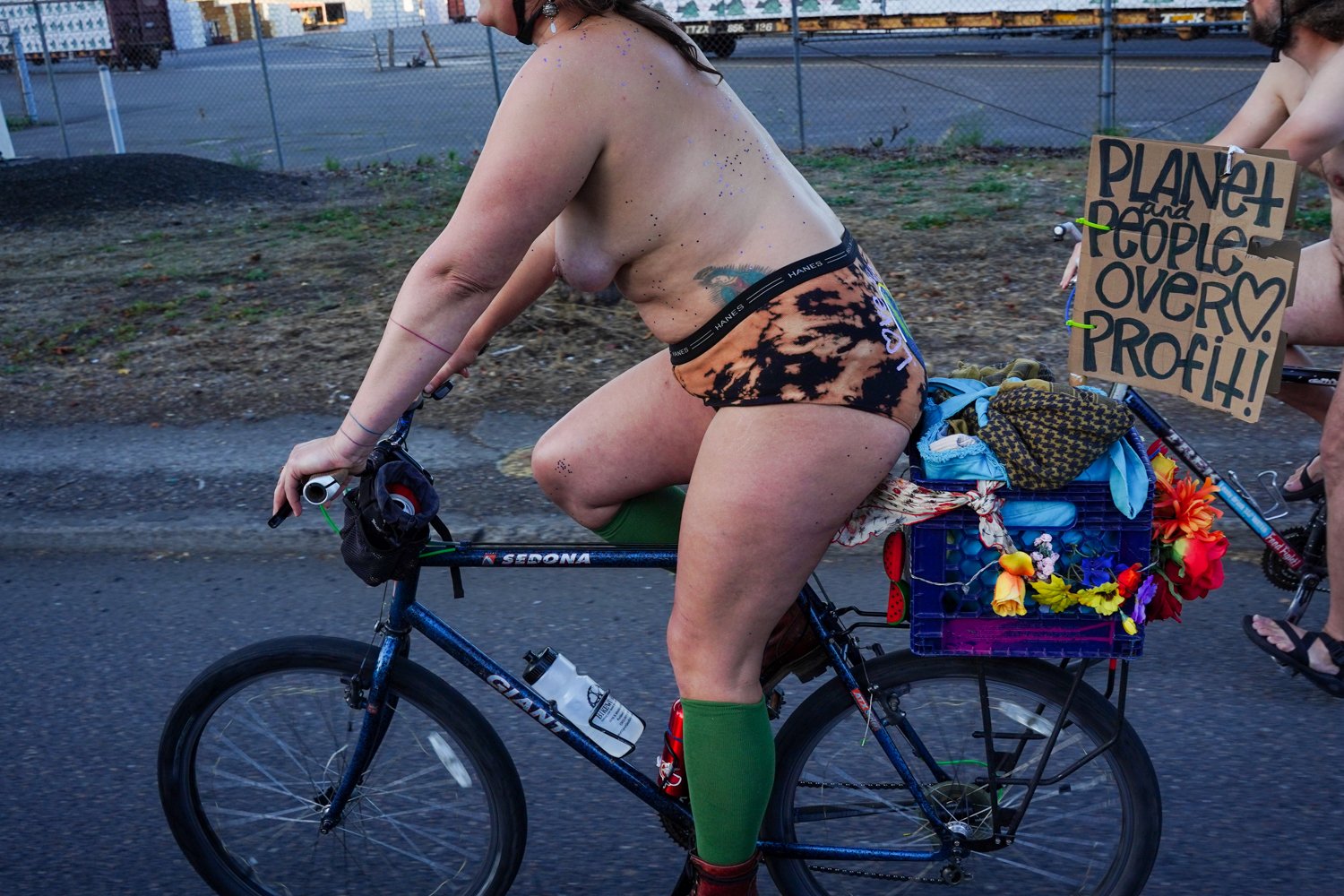
Hundreds of people joined the World Naked Bike Ride Saturday afternoon in a flesh-filled spectacle that marked the 20th year Portlanders have come together for this mass protest and celebration.
World Naked Bike Ride is a global event launched in Spain in 2003. It has roots as a protest against oil dependency and has morphed and grown into a larger movement that encompasses many goals and ideas. Portland has held a version of the ride annually since 2004 (large rides were not organized in 2020 or 2021 due to the Covid pandemic).
This year a new crew of leaders branched off from the group that had been leading the ride since its inception. Compared to previous editions, Saturday’s ride was much smaller and the general vibe as I observed the crowd at the meet-up spot at Colonel Summers Park in southeast was different than years past. There was less partying. It felt more like a gathering than a festival. I didn’t see anyone consuming alcohol. And the usual legions of novice riders who seem to dust off their bikes just for WNBR, mostly stayed home last night.
Advertisement
[Story continues below photo gallery.]
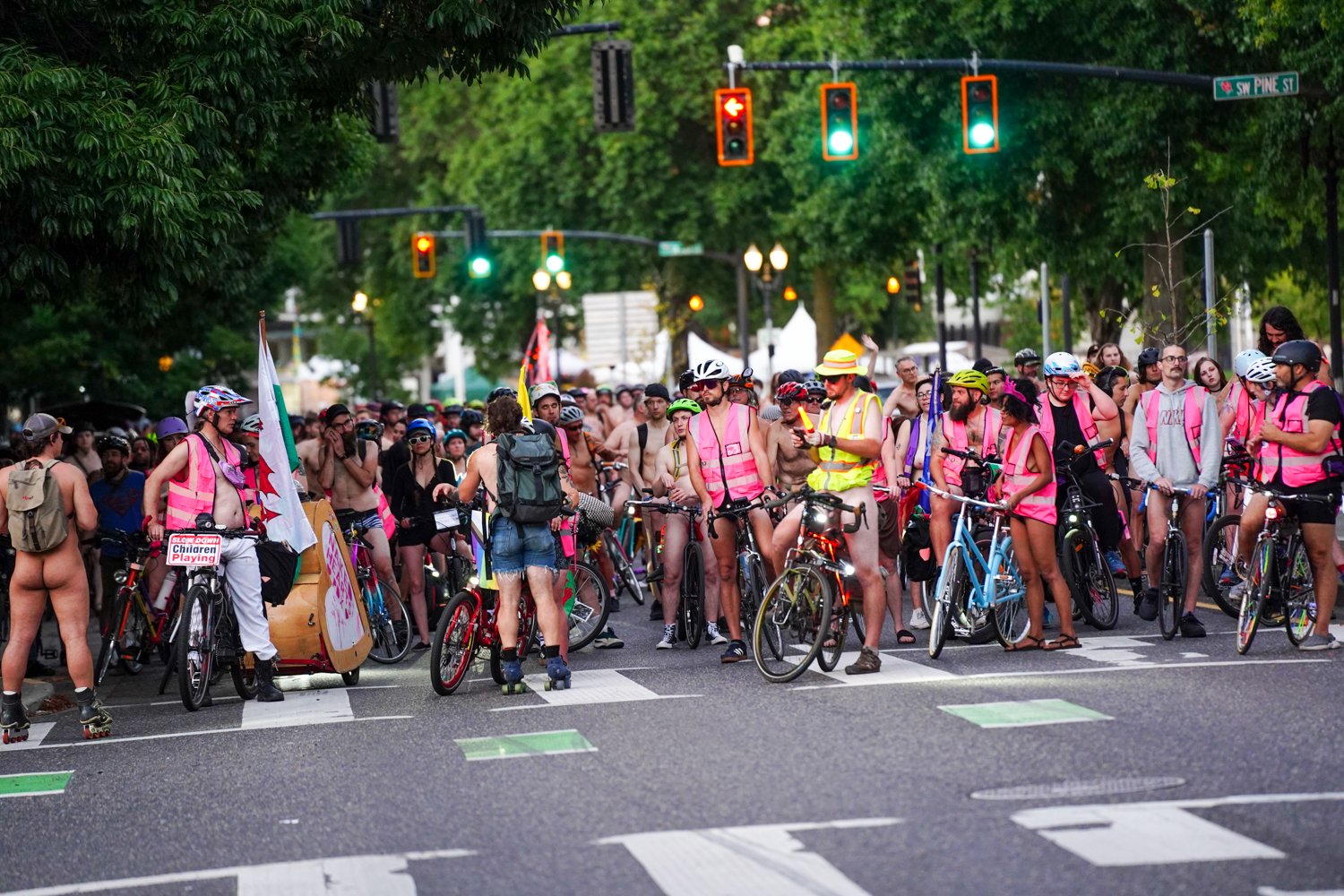
At the meet-up spot in Colonel Summers Park, pink vests of volunteers and naked bodies dotted the grassy field as mobile sound systems filled the air with music.
On the park’s pavement next to the tennis courts, a place that has hosted so many bike cultural moments over the years, I met someone named Jasmine wearing underwear and roller skates. She was first inspired to join big group rides after randomly coming across the Opera Ride on her way home from work one day. “I was like, these people look like they’re having a lot of fun,” she said. “So I grabbed my bike and joined them.”
Bill Chin, who I once referred to Pedalpalooza’s iron man for his prolific ride attendance, was also there. The 64-year old said he’s done several naked rides. “I think it’s interesting. It’s fun to be free,” he said, as he stood wearing nothing but shoes. For Bill, the ride is, “all about protest and visibility, body positivity and inclusion.” “I’m an older person, but I fit in just fine with everyone else,” he shared.
That sense of inclusion is important to the organizers of the ride. One of them, Moorland Moss of Nakedhearts:PDX, took to the mic before the ride began. “It’s a huge deal that you decided to come out,” they said to the crowd. “No matter what the reason, you’ve chosen to come out and be naked and vulnerable with strangers. You are all welcome here.”
“I hope that during the ride you can feel a sense of belonging to Portland, America and the year 2024,” Moss continued. “It is increasingly difficult for a lot of us to feel that way… Your body speaks the truth, and we need to stop letting our politicians and all these things lie to us. We need to start listening to us, and I hope you can feel a sense of belonging to yourself, because that’s where the truth lies.”
Moss then shared messages about consent, respect, and safety before handing the mic to three speakers.
Advertisement
Hearing about activism and important issues in speeches before the ride was another big shift from previous years. It underscored a key goal of this year’s naked ride leaders: to make the protest aspect — which had been largely absent from the ride for years — much more prominent.
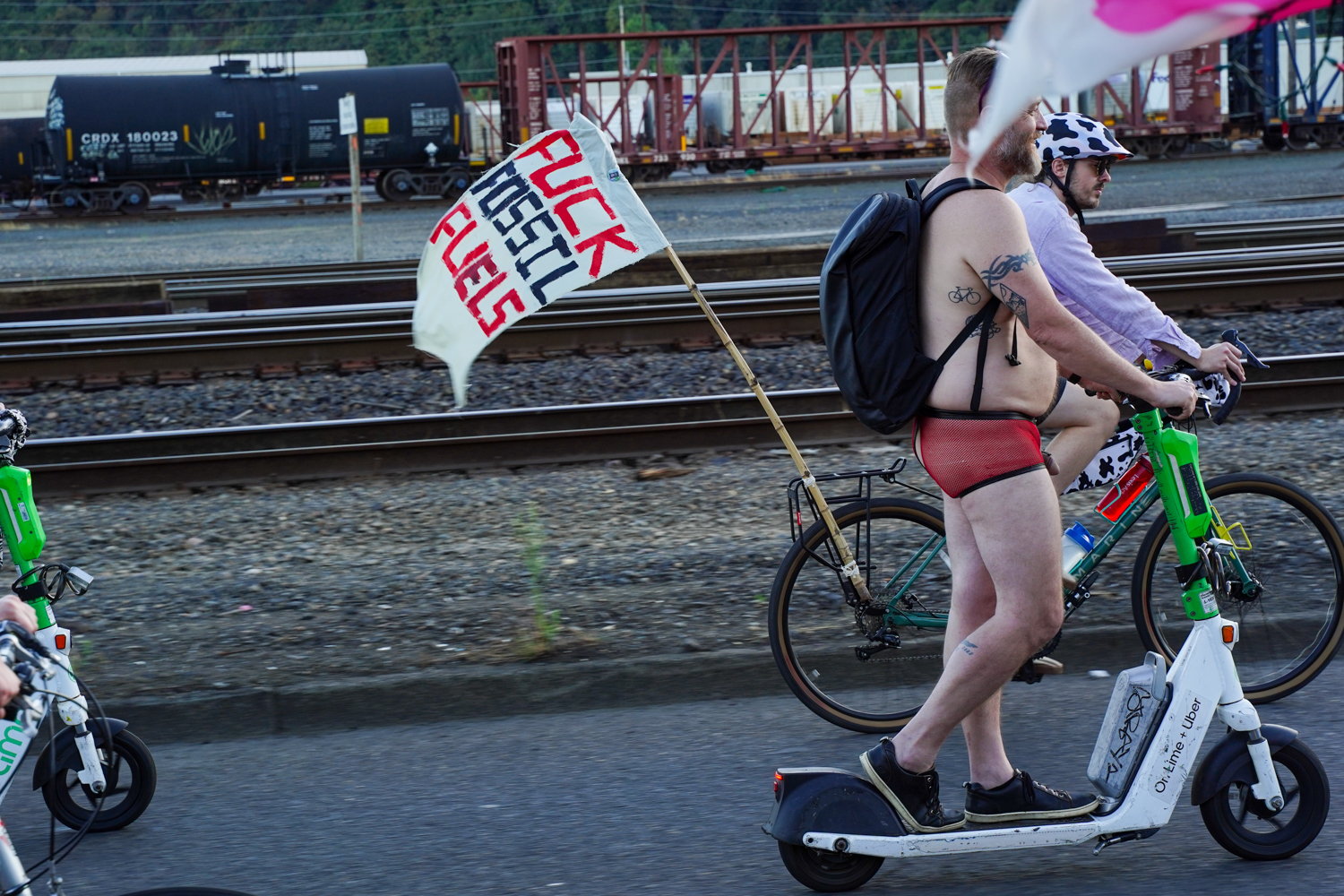
The first speaker (who didn’t give a name and I forgot to ask) urged the crowd to get engaged with the fight to prevent climate change. “I want to encourage everyone to expand their thinking outward on a more global scale, because our struggles against climate change and fossil fuels here in Oregon, are connected to what’s happening all over the world right now,” she said.
Specifically, she pointed to the global week of protests against Chevron that begins Sunday. The event is organized by the Boycott, Divest, Sanction (BDS) movement that works to negatively impact corporations that are benefiting from what she calls the “Illegal occupation and apartheid and genocide in Palestine.” The speaker said Palestinian sovereignty is a threat to Chevron’s off-shore drilling operations and that all the bombs Israel has dropped in Gaza, “Have contributed more to climate change in the past year than anything else going on.” “That’s something we should all be yelling about today and every day.”
Advertisement
Next up was a woman named Alyssa who shared a poem from “those who are harmed or negatively affected by objectification and sexualization.” “Society and relationships can sometimes either treat us like an expendable commodity or a footnote, while they impose, objectify and sensationalize projected idealism,” she shared. “AKA, it sucks facing life with all this patriarchal bullshit and relentless sexual and societal harassment.”
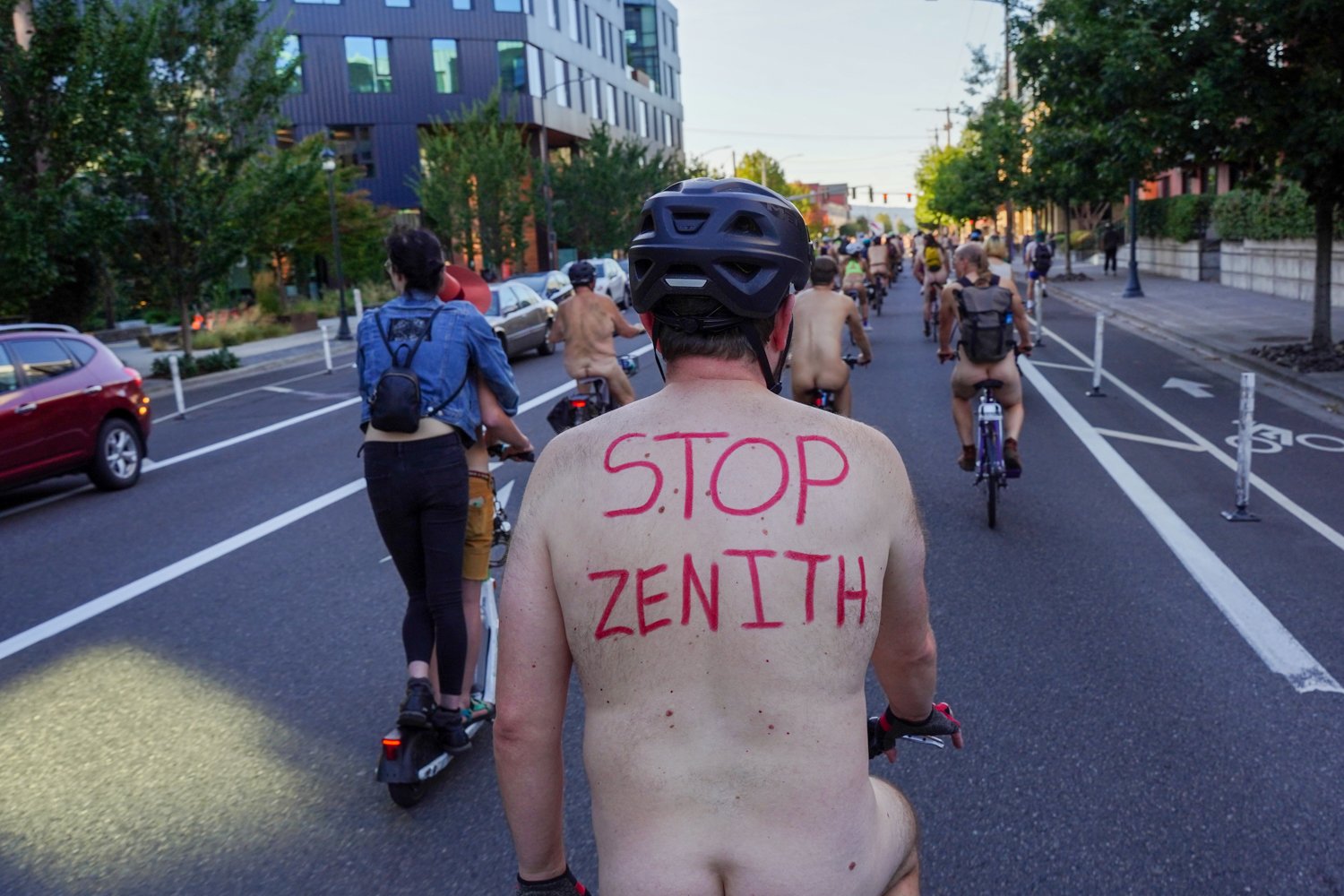
Then Dineen O’Rourke took the mic. O’Rourke works with the nonprofit 350 PDX and leads their campaign against Zenith Energy. She told the story of how the company came to Portland seven years ago and, “sneakily” bought a facility in northwest Portland to transport and store crude oil and tar sands oil from North Dakota and northern Canada. “Once that happened, we saw quadruple the amount of oil trains coming into this region,” she shared. Despite this, O’Rourke blamed Portland city council members for being “bought out” by Zenith and betraying Portlanders. “It’s despicable,” she said, as she reminded folks to prepare for an upcoming comment period and public hearings by the Oregon Department of Environmental Quality.
Then it was time to ride!
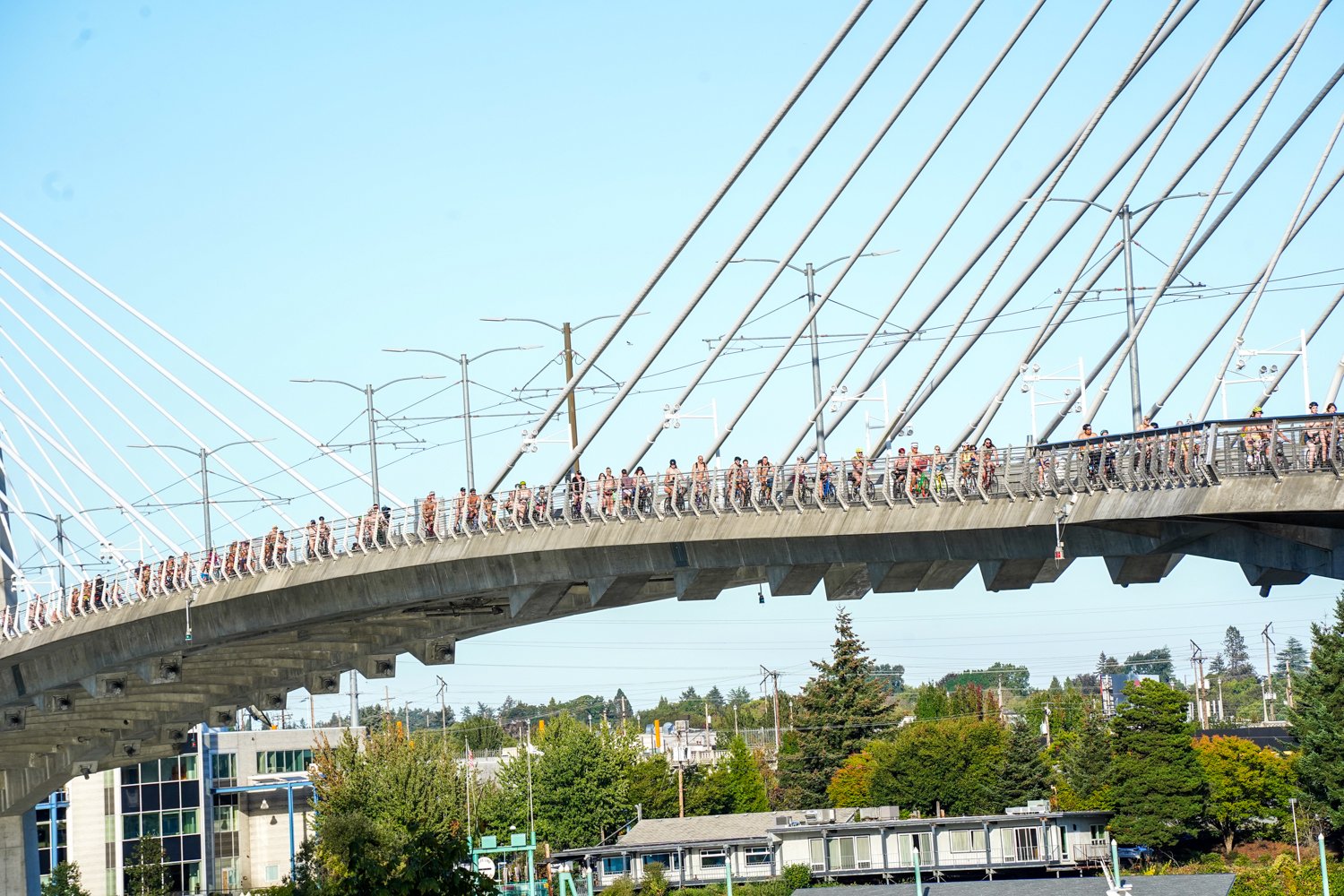
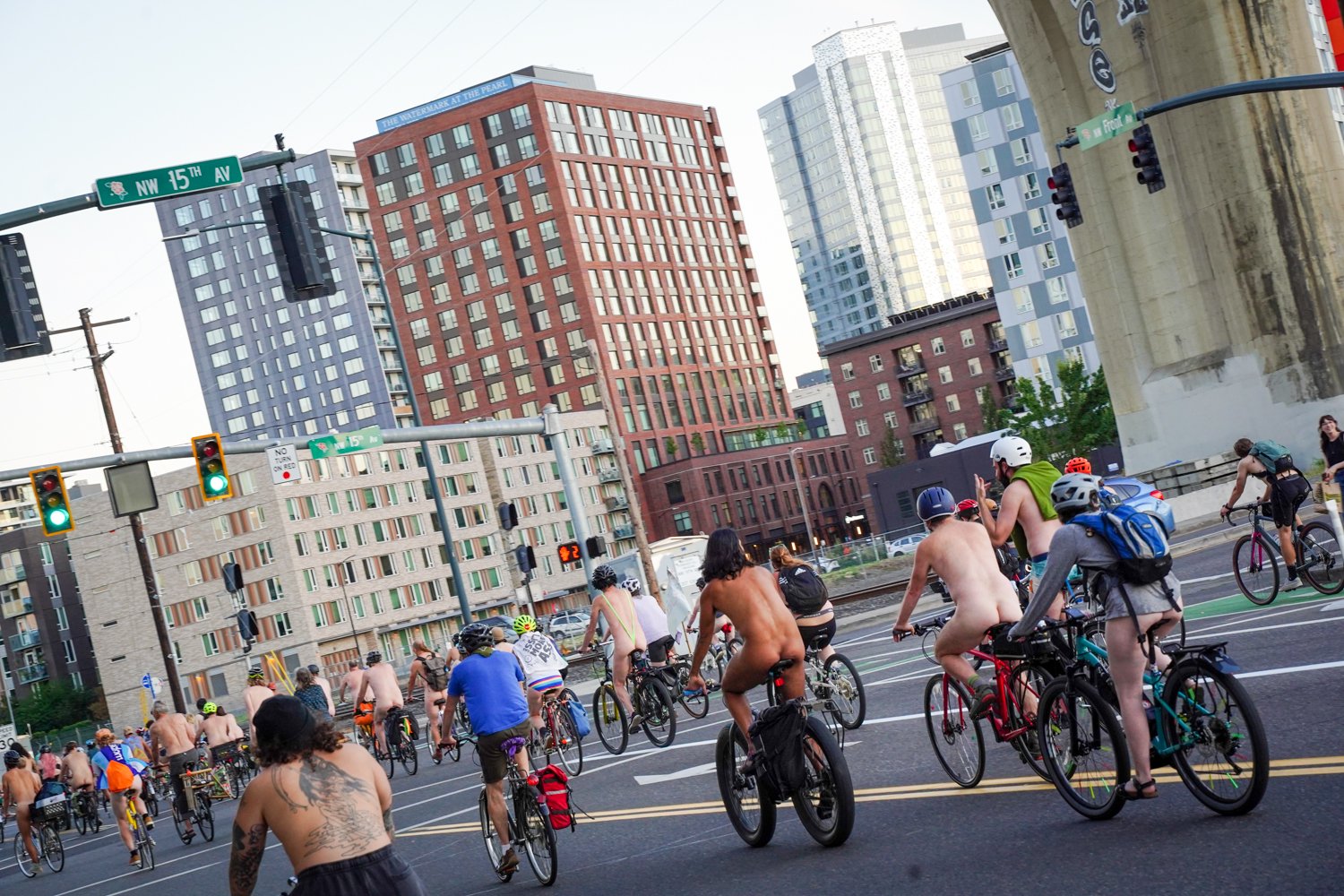
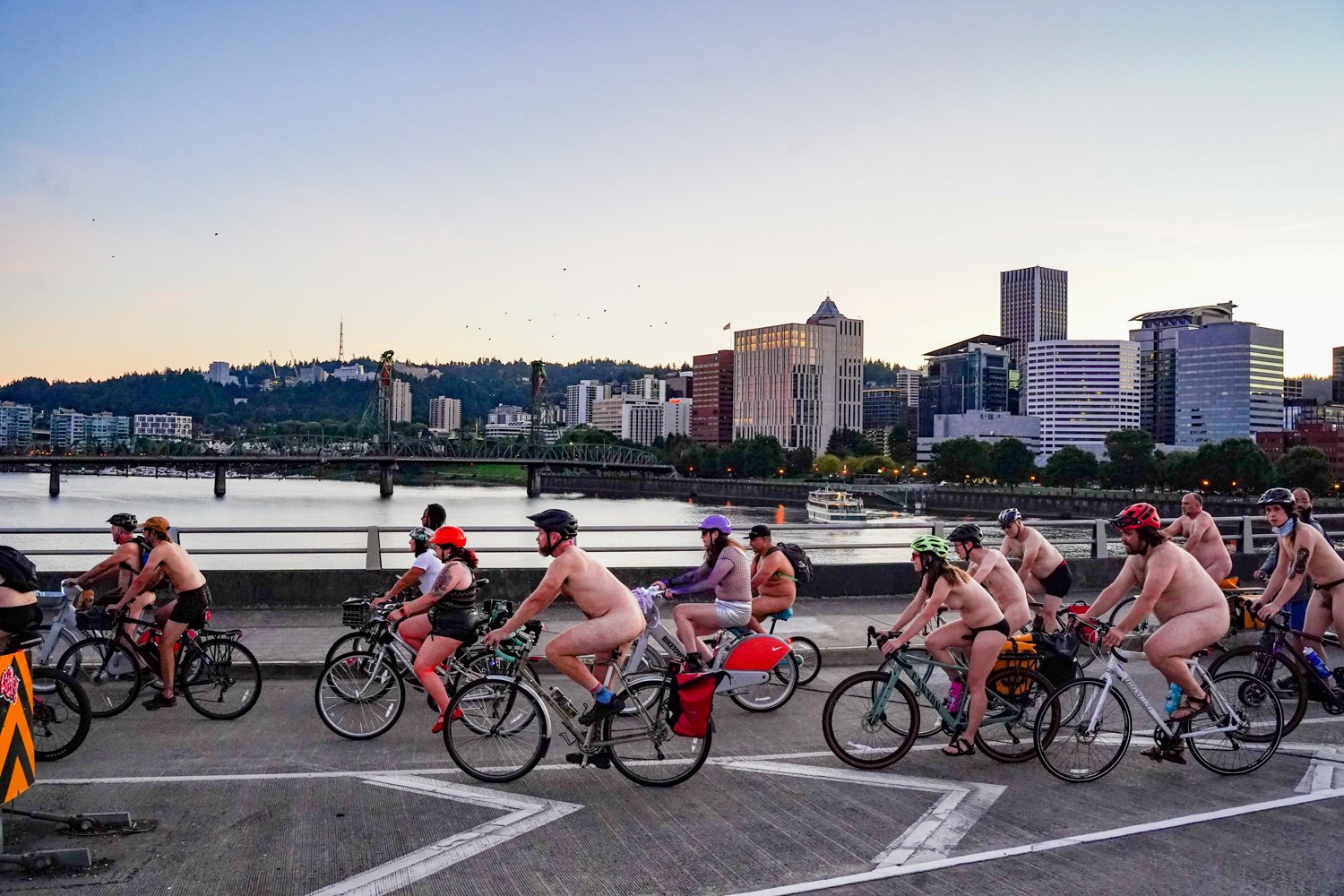
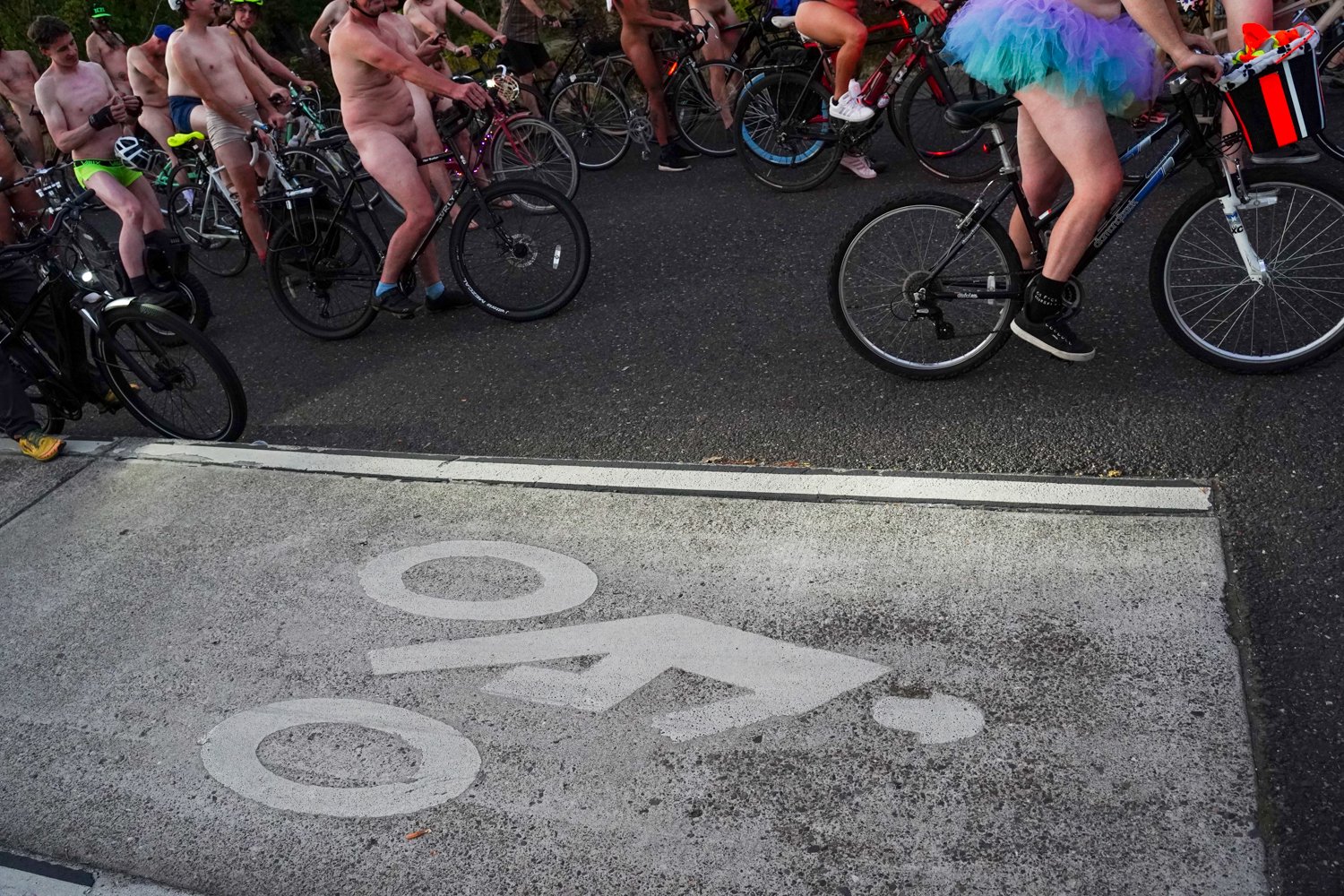
The group massed onto SE 20th and headed toward the wide, wonderful downhill of SE Hawthorne Blvd toward the Willamette River. The bodies flowed and spirits rose as legs powered bikes, boards, and skates. We rolled onto SE 7th southbound as spectators began to spill out of businesses to watch the sea of skin cycle by. Then it was on to the Tilikum Bridge and Naito Parkway.
Advertisement
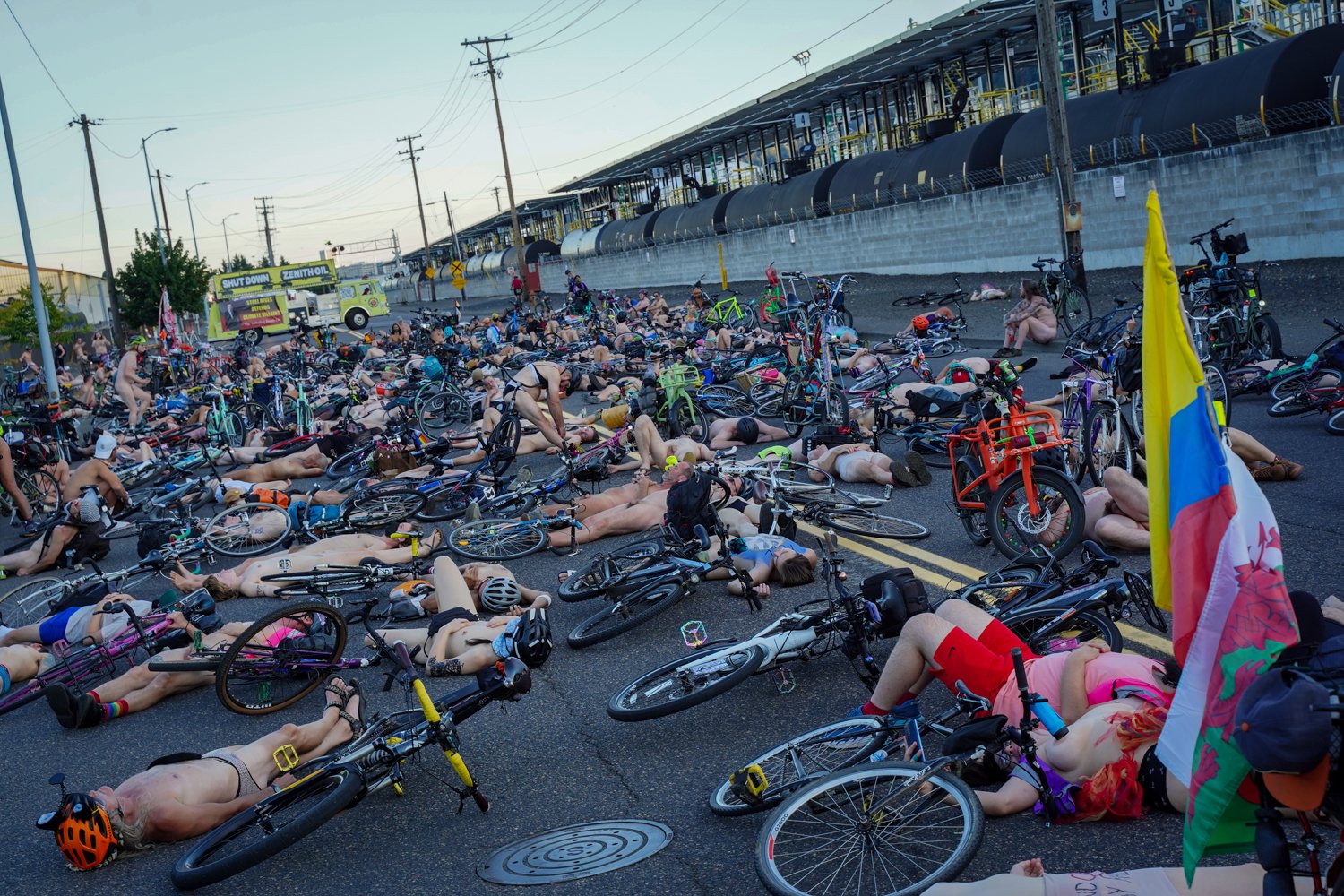
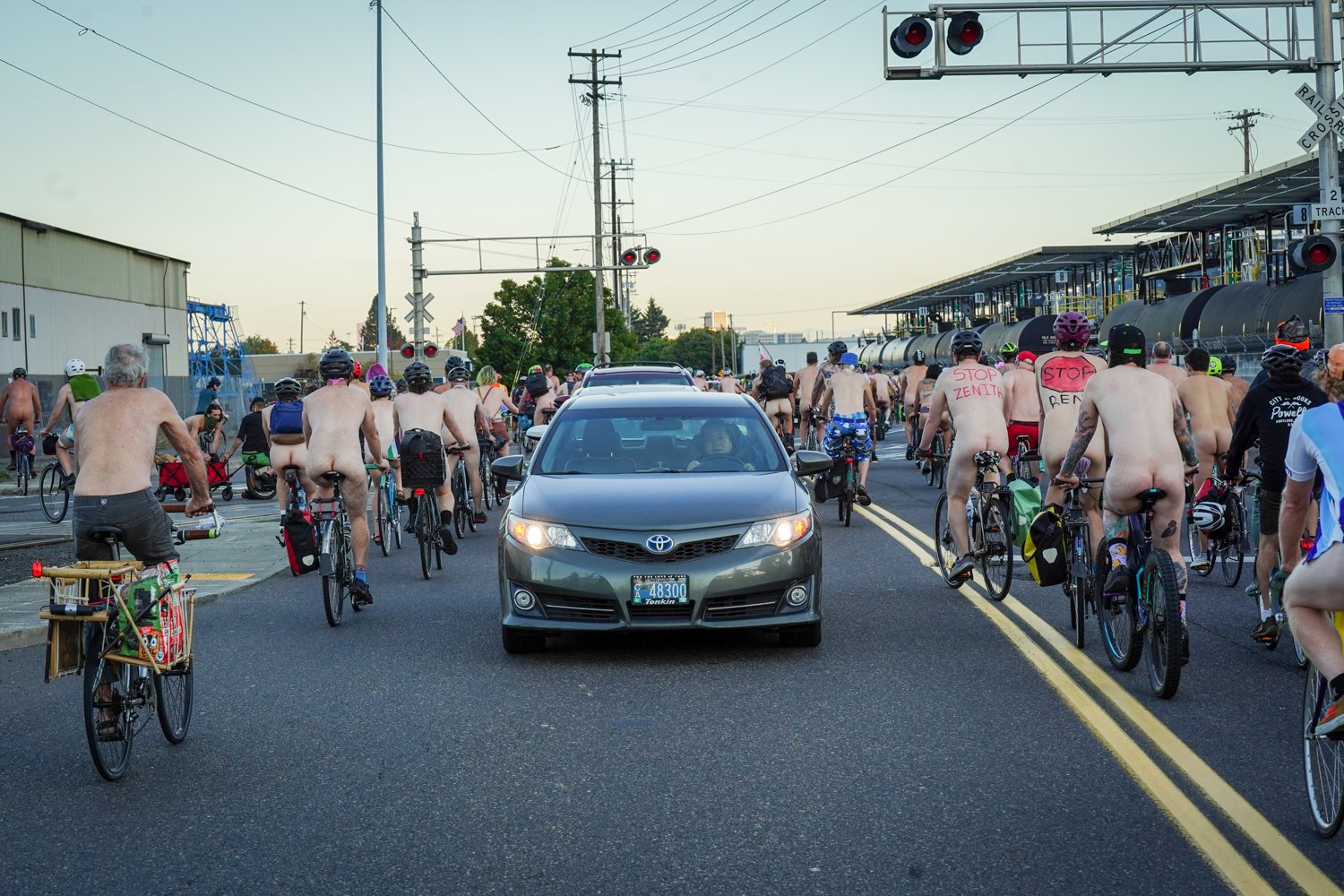
We rode miles north on Naito until it turns into Front Ave. Our destination was the Zenith Energy Terminal — the facility O’Rourke warned us all about.
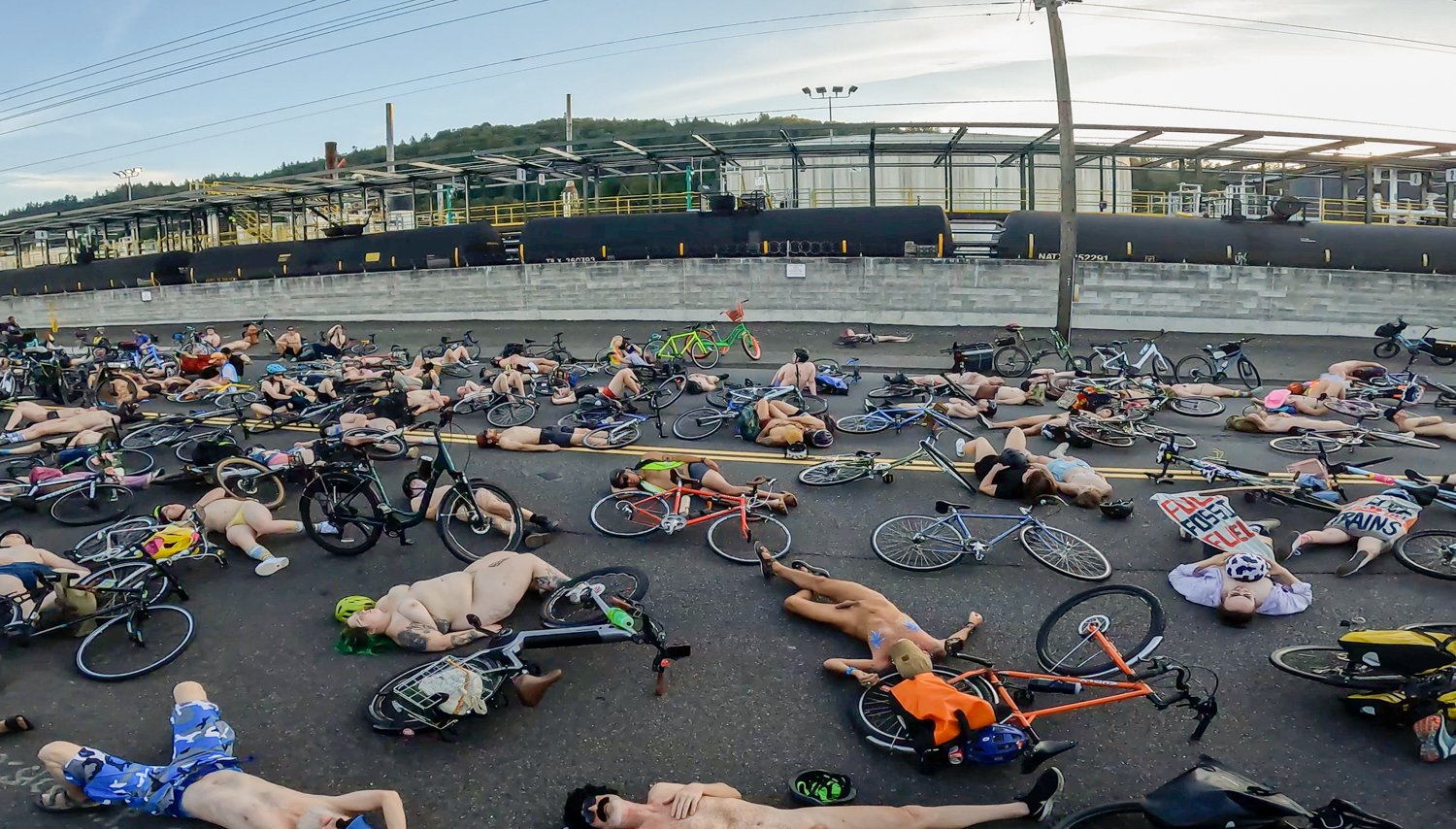
“We can’t take 4 ounces of hand sanitizer on a plane,” Moss said as the group neared the location of a planned die-in protest. “But they [Zenith] can bring millions of gallons of chemicals into our city.”
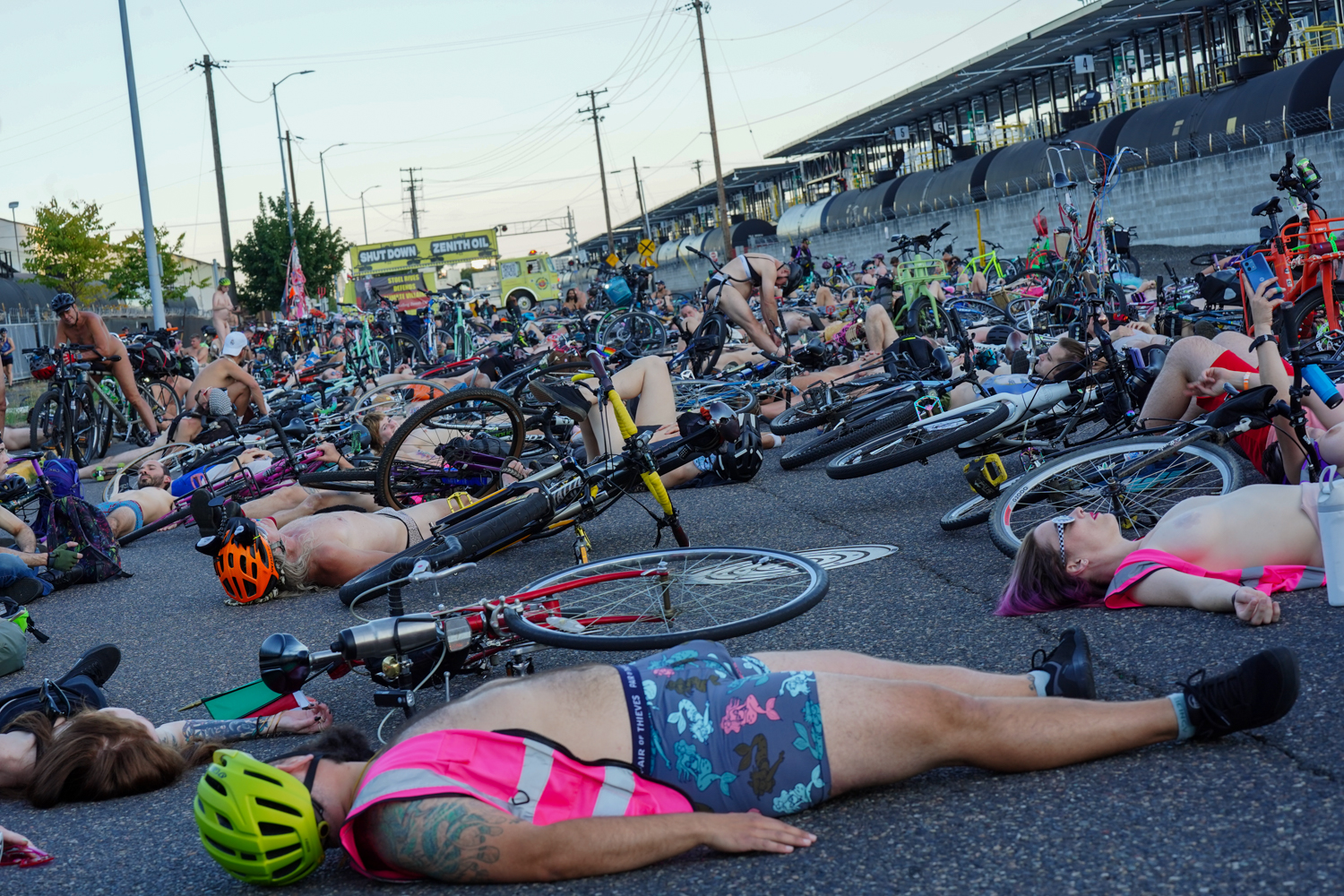
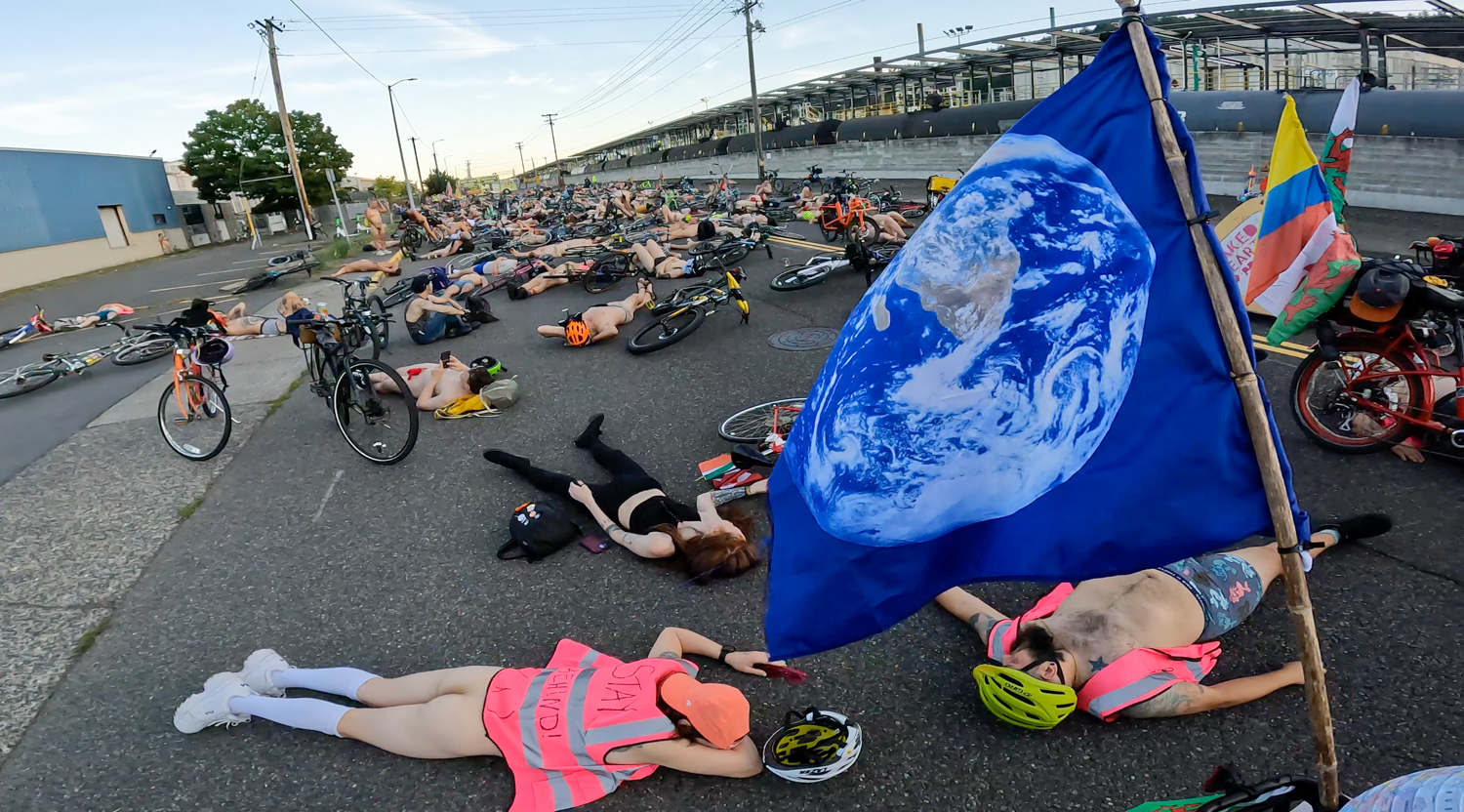
Once the group arrived on the street adjacent to Zenith’s massive oil storage containers and train cars, everyone laid down on the pavement. The music stopped. Skin pressed onto pavement as a planet earth flag waved silently in the breeze.
As the sun set, the ride continued back into downtown Portland. The group rolled over the Morrison bridge into the central eastside and ultimately to the Eastbank Esplanade where dancing, live music, and a rising full moon marked the end of the the ride.
So good to be back the the Shed. Eva and I were up to old tricks with a wide-ranging chat about everything from riding bikes naked to Portland’s new WNBA team. Here’s a list of most of the stuff we touched on that I jotted down while I edited this episode:
Thanks for listening! And we appreciate all the paid subscribers and BP advertisers that continue to make this podcast — and all the things BikePortland does! — possible. Please become a paying supporter today at BikePortland.org/support.
“Reducing transparency will make it harder to gain support for the types of changes that will be necessary.”
– David Stein, former committee member
The Portland Bureau of Transportation will no longer have a dedicated advisory committee to watchdog and help flesh out its budget. It’s a step the City of Portland is taking as a cost-cutting and efficiency measure as it leans into the new form of government that will begin January 1, 2025.
But those dynamics are precisely why two former members of the PBOT Bureau Budget Advisory Committee (BBAC) we’ve spoken to are not happy about the decision.
On September 16th, bureau Director Millicent Williams sent an email to people who follow the work of the PBOT BBAC and its members, stating, “I am writing to let you know that PBOT will be dissolving the committee and we will not reconvene this September… The city budget process will be different moving forward, among many other changes,” Williams explains in the email.
Williams also mentioned “severe fiscal constraints,” “staff capacity constraints” and a, “need to continue to seek efficiencies” as reasons for her decision.
Advertisement
The BBAC costs the city money because it has a PBOT staff liaison and there’s also time and resources involved in prepping and holding the frequent meetings. Williams pointed to an August 5th memo from Mayor Ted Wheeler that laid out another grim financial outlook for the city budget in the upcoming 2024-2025 fiscal year.
Wheeler’s memo said bureau budget advisory committees are no longer required, but he left the option of dissolving them up to individual bureau directors.
Williams opted to get rid of the BBAC, an active committee that had 17 members representing different modes, labor unions, and interested citizens. She said, “this decision was not made lightly” but that she looks forward to the city’s “new engagement structure” once the transition is complete.
One former member of the PBOT BBAC, David Stein, said he thinks Williams made the wrong decision. “It was surprising to hear that the committee was being dissolved. In light of the Mayor’s unusual warning just last month about the dire prospects for the coming fiscal year, this would also seem to be an unnecessary risk,” Stein shared in an email to BikePortland.
Advertisement
Stein said since the two other bureaus in the Public Works service area — Environmental Services and Water — haven’t dissolved their budget committees, “now puts PBOT at a distinct disadvantage.”
Without assurance about what the new engagement process will look like, Stein feels that the change in government — which includes an expansion of city council members from five to 12 and an entire new wing of government under the city administrator’s office — makes the need of the PBOT BBAC more important than ever and “add uncertainty” to the process.
“None of the structural problems with PBOT’s funding were solved last year and reducing transparency will make it harder to gain support for the types of changes that will be necessary if the bureau, and Public Works more broadly, is going to provide the services that people expect,” Stein said.
Advertisement
But beyond Wheeler’s blessing, Williams has the City’s transition team to lean on. A report released this month from the Government Transition Advisory Committee titled, Recommendations to City Leaders of the New Government included 17 specific recommendations.
One of them was to, “dissolve bureau-specific budget advisory committees.” Their recommendation seems to be based, not on whether or not the committees are valuable and necessary, but because feedback from members and staff, “Consistently found the committees ineffective due to lack of training, information, time to do their work, and authority.”
That tracked with one former PBOT BBAC committee member who asked to remain anonymous so they could speak freely about the committee. “It’s unfortunate… But on the other hand, PBOT did seem to just treat the committee as obligatory rather than a place to truly get advice or ideas. So in the end I guess we’re all just getting our time back.”
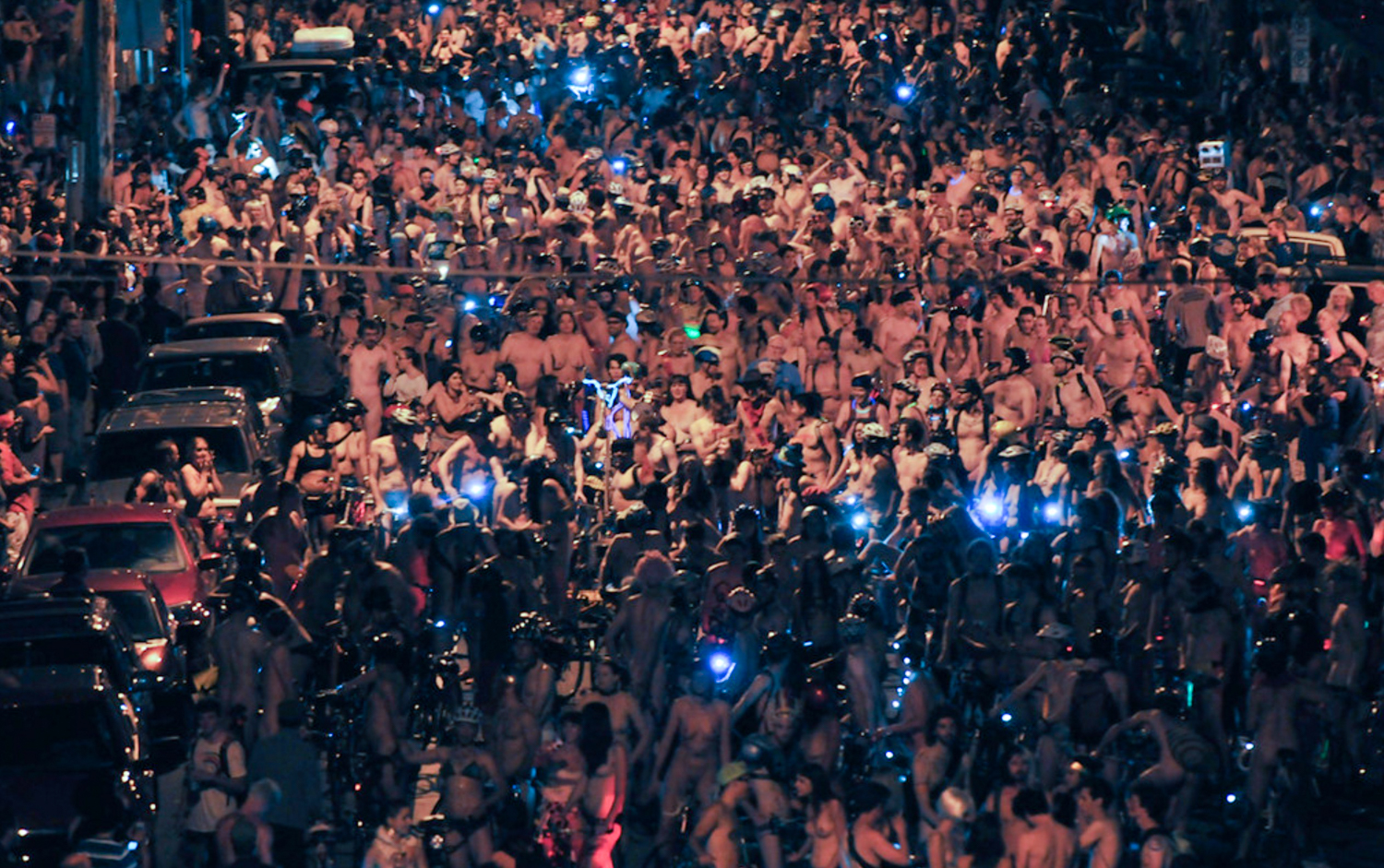
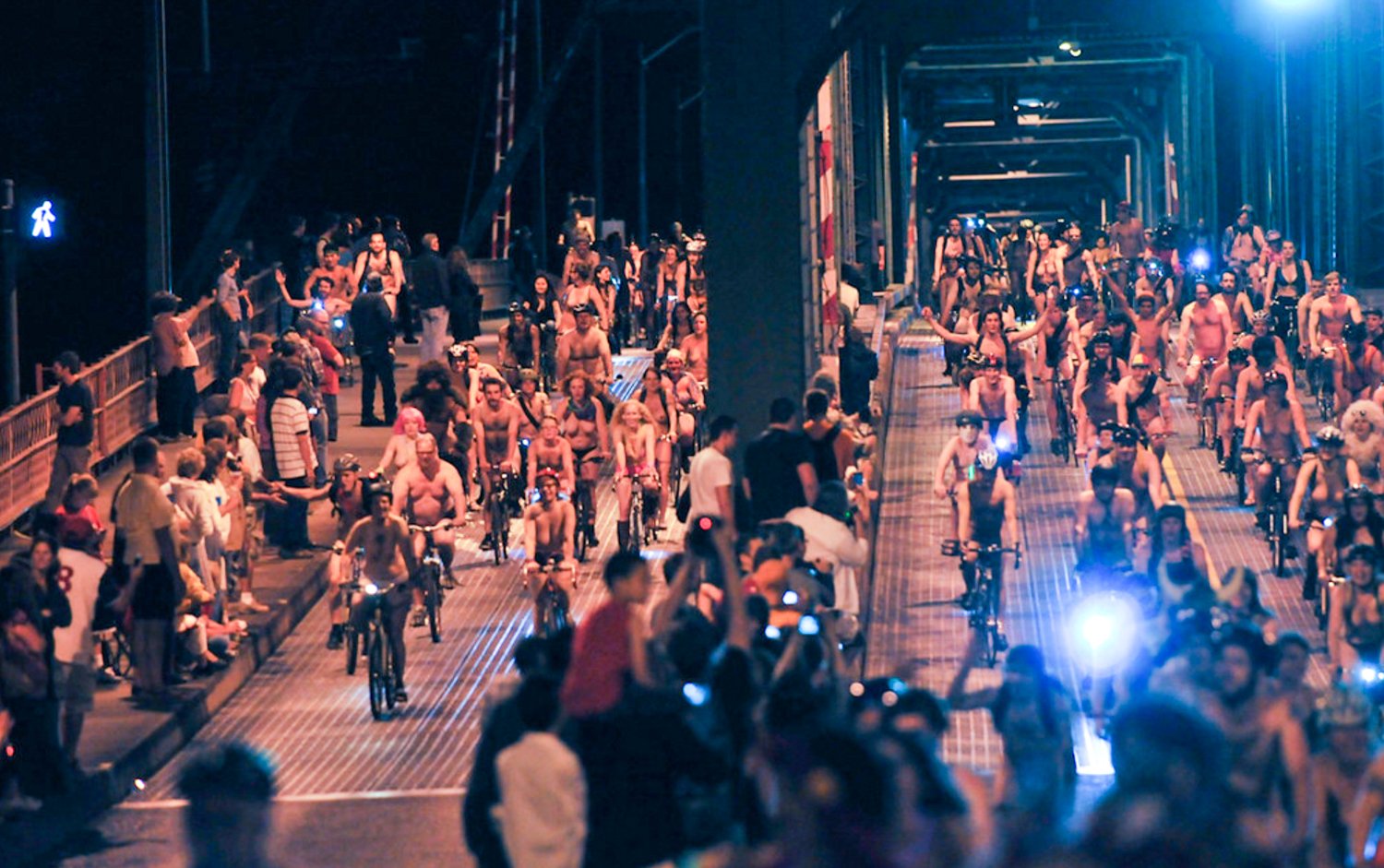
So much flesh in this shot from the Hawthorne Viaduct looking onto SE Water Ave in 2012. (Photos: Jonathan Maus/BikePortland)
Drama about who’s leading Saturday’s big naked bike ride aside, one thing we can all agree on is that riding bikes naked in a mass of other people is an amazing, unforgettable experience. And did you even realize that this year is the 20th anniversary of Portland’s version of the World Naked Bike Ride?
When I first came to town, WNBR was one of most intriguing events I would cover. I watched it go from about 170 riders at my first one in 2005, to the 10,000 or so riders in 2014. The ride started as a grassroots, DIY celebration of the human body and resistance to car culture and Big Oil, then eventually transcended our little community to become a Portland institution. It ended up at a scale and with a cultural footprint I doubt those initial ride leaders could have ever dreamed of.
And just like with our bodies, events like this go through growing pains. There’s the exuberance and innocence of the early years when we think we are invincible, and then reality and responsibility creeps in as the years fly by. But unlike our bodies, community organizing always renews itself and — hopefully — always gets better.
While I’m sad about how our community is momentarily split over how we manage these inevitable changes, and the way some folks are treating each other is a huge disappointment, I’m excited and optimistic at all the energy and passion there is for the important tradition of riding bikes naked through our streets (!) en masse.
On that note, and in honor of the 20th anniversary of Portland’s World Naked Bike Ride, I went through my archives to pull out my 20 favorite images from Portland’s World Naked Bike Ride (read the captions for more information on each one):
(*By the way, I’ll be out there recording audio interviews for an upcoming episode of our podcast, so flag me down if you’d like to share on the mic!)
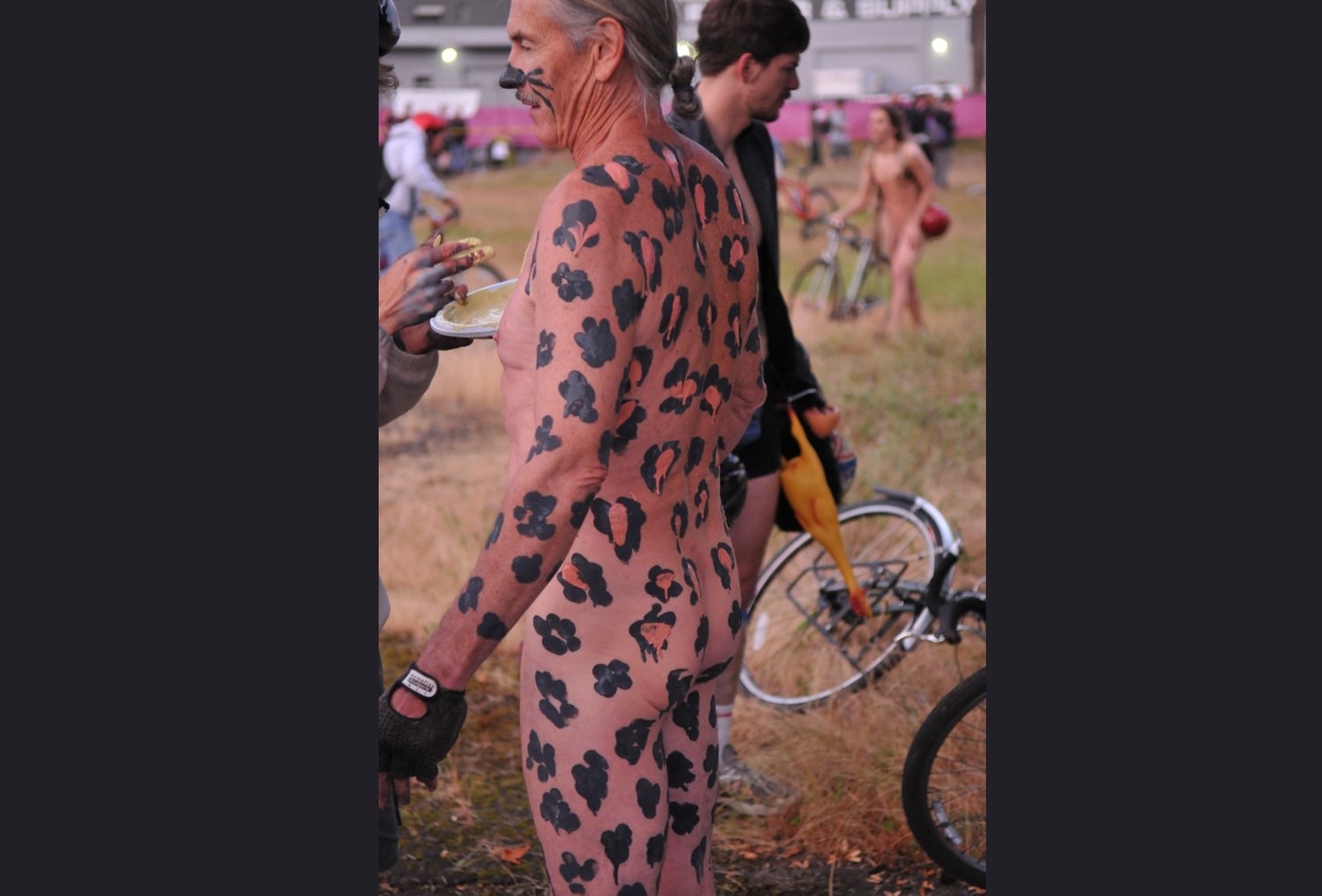
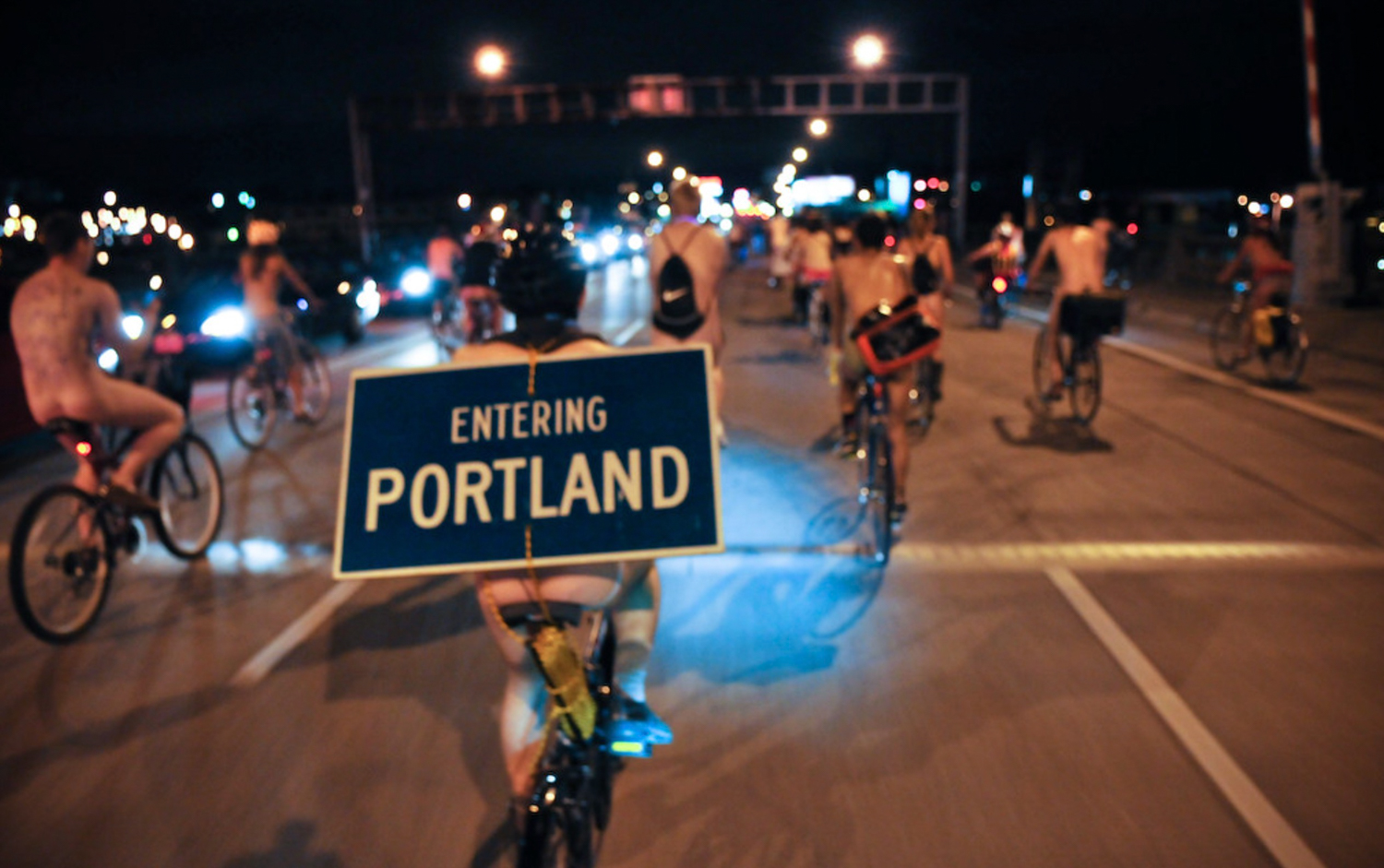
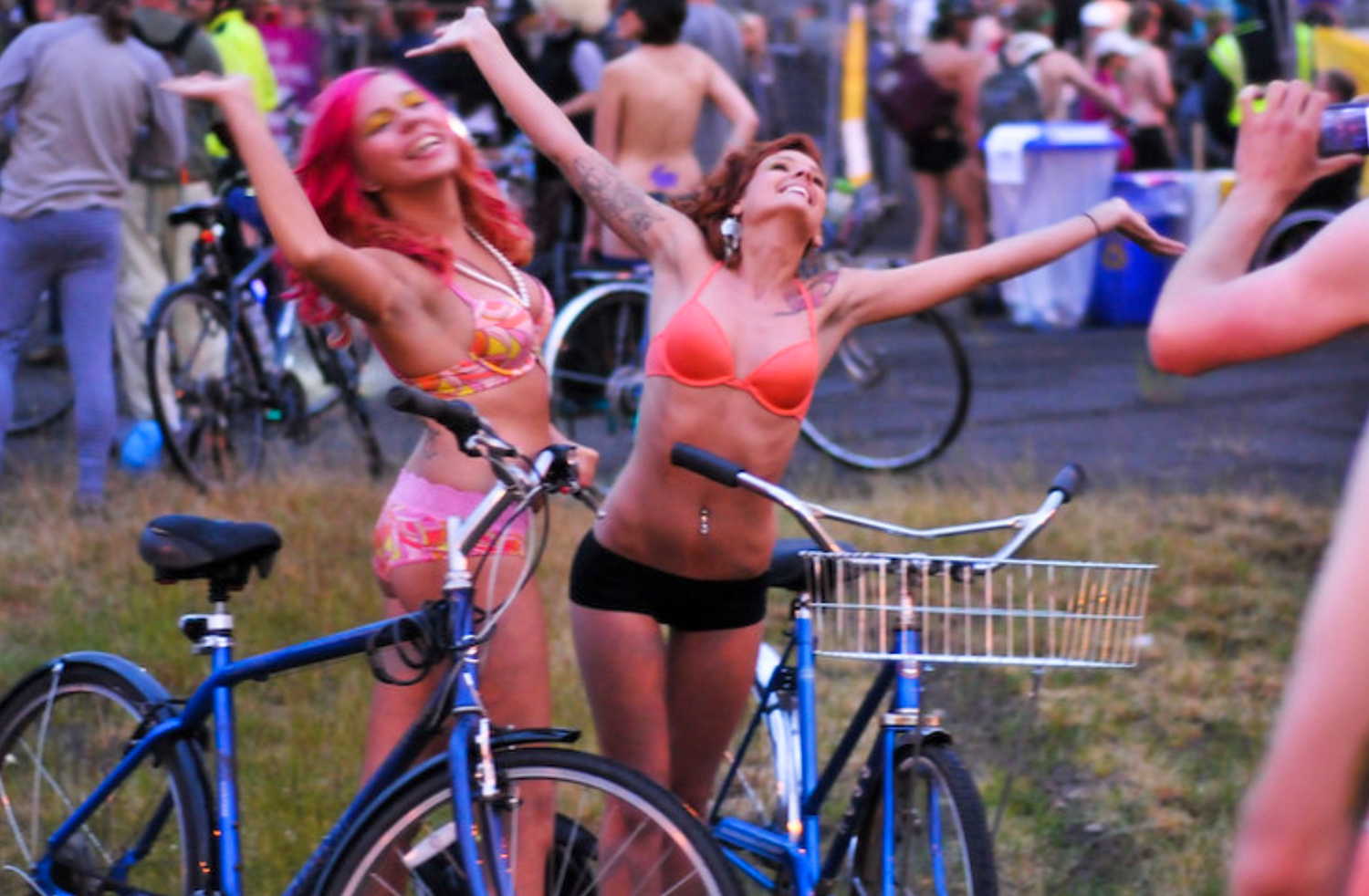
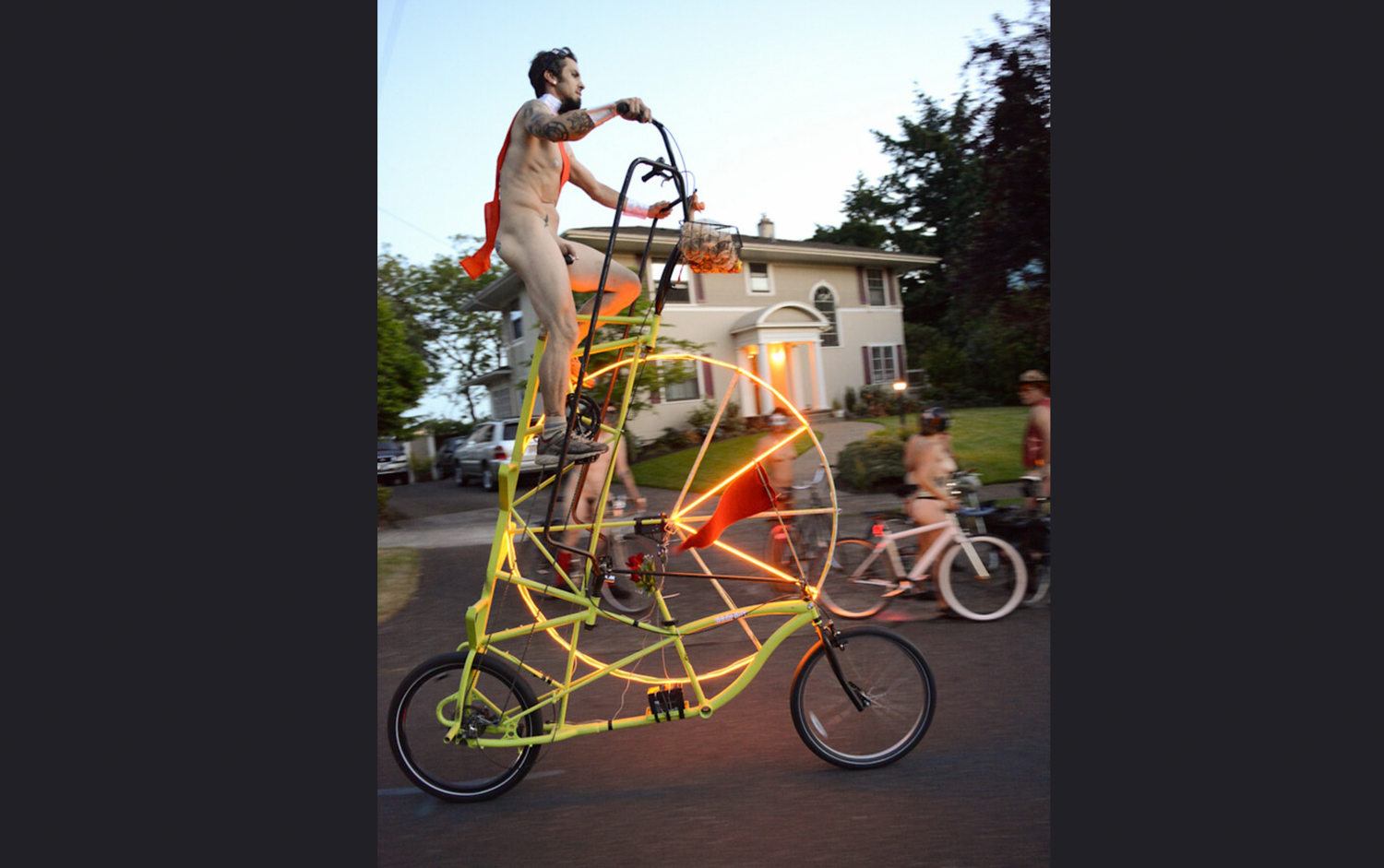
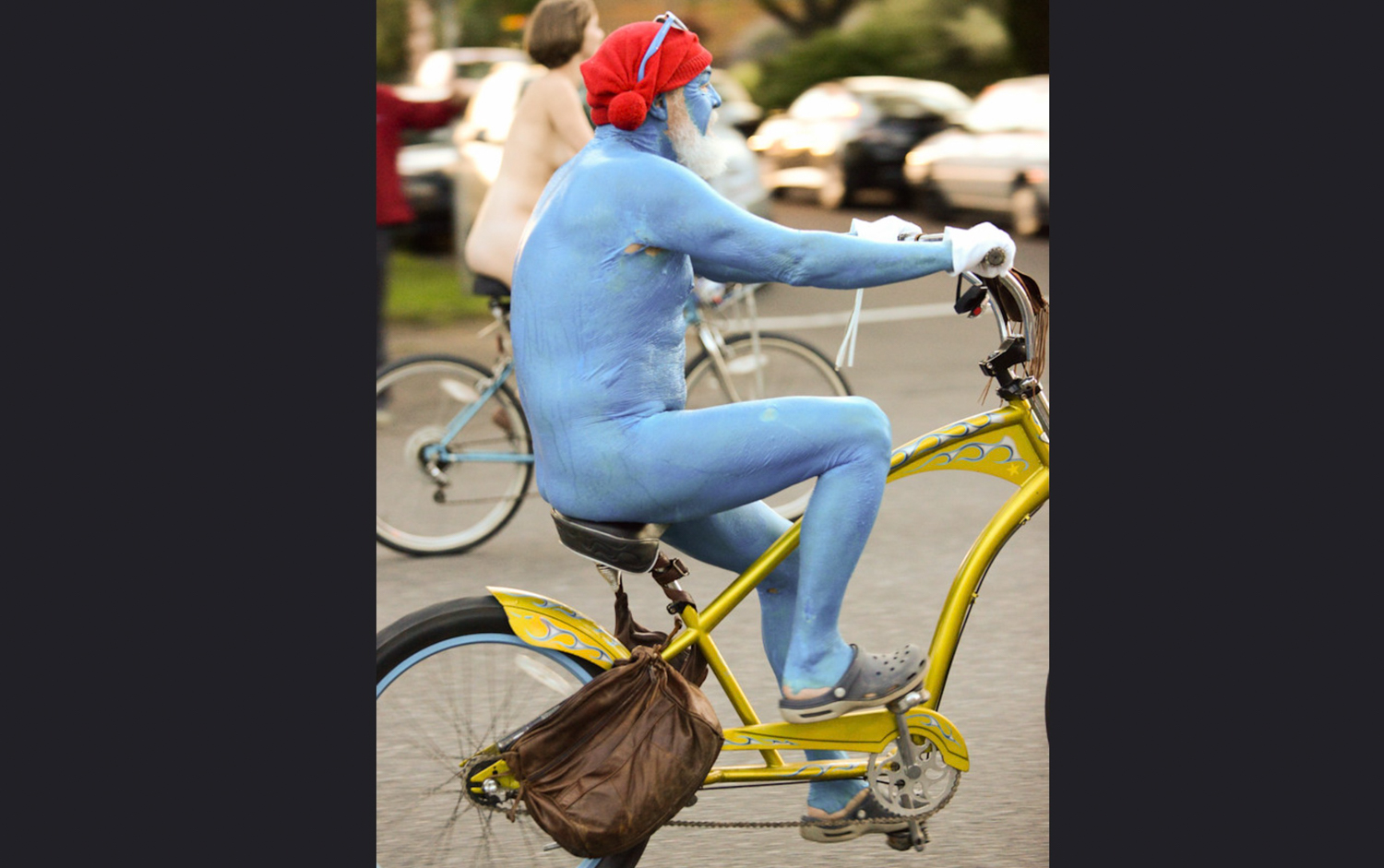
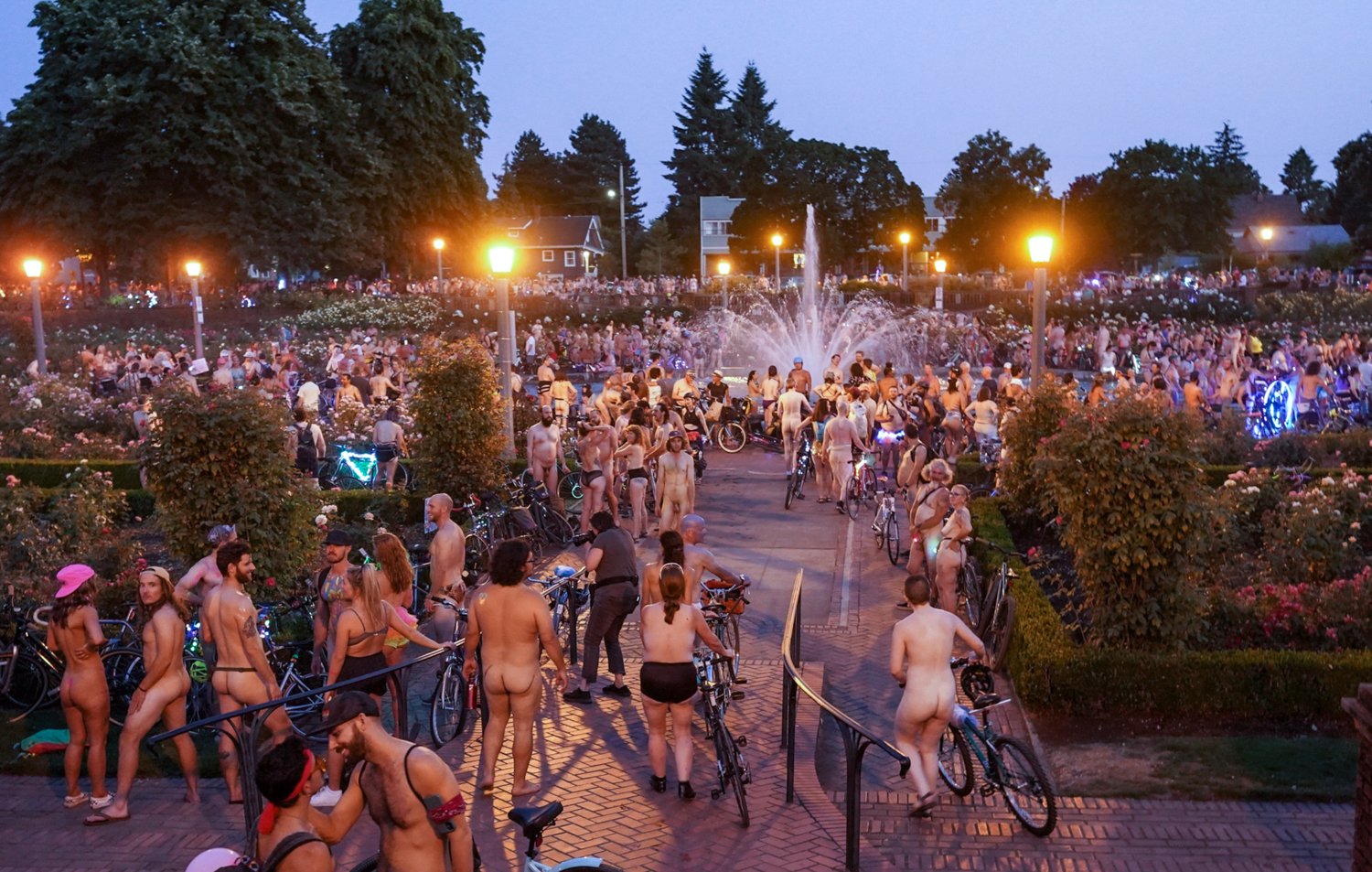
(2005) I am always a sucker for clever signs, especially when they’re painted on a body and the theme is anti Big Oil.(2007) This means so much. The posture of the rider (who I’m certain is our beloved friend Rabbitt Fox who left us in 2022) is joyous and he’s inspired two people in cars to remove their tops.(2009) America is so backwards and repressed when it comes to human bodies and sexuality. So I find this sign very fun(ny). (2009) This image is good and bad in some ways. I love the story it tells of how we used to go downtown during party-filled Fleet Week. But I hate that there was so much random, often nonconsensual, but slapping. (2009) Downtown bars would spill out as the ride came by and many people would be so taken by the sight, they’d get naked too!(2011) The joy in the faces of these young people is what the ride is all about.(2011) Best body art I have ever seen. (2011) Devil guy on a tall unicycle was definitely a vibe.(2011) The love/hate “Portlandia” show had just finished its first season and folks were proud of what WNBR said about our city. (2011) Sheer exuberance.(2012) The most flesh in any photo I’ve ever taken. I was standing on Hawthorne Bridge Viaduct looking north on Water Ave. Can still remember how excited and out of breath I was running up those stairs to get this shot.(2012) Filling both sides of the Hawthorne was so cool. This was the year I started in underwear (because I’m often mixing in crowds of clothed people), but everyone was yelling “Jonathan, get naked!” so I relented.(2014) I regrettably don’t recall this person’s name but they were an amazing freak bike maker.(2014) Probably my all-time fave. There’s just a lot going on here with these spectators who I’m not sure if they were lost or just enjoying a night at the park.(2014) IYKYK that feeling.(2014) I feel like this moment is a core memory for this lucky soul flying down N Mississippi hill on a perfect summer night.(2014) Flying the flag at the end spot under I-5/Fremont Bridge.(2014) Massive commitment level on this blue Smurf dude’s body paint. Well done sir.(2022) This was a special night. Peninsula Park Rose Garden is my favorite place in Portland. It’s just a few blocks from my house, it’s where I walk my dog and have spent countless hours with my family over the years.(2022) This crew just had the right attitude. When you have a friend in town without a bike, just get naked and hop into the pedicab with a disco ball.
Have fun out there! And don’t forget, I’ll be out there Saturday recording audio interviews for an upcoming episode of our podcast, so flag me down if you’d like to share on the mic.
Commissioner Mingus Mapps and PBOT Director Millicent Williams enjoying Sunday Parkways Southwest last year. (Photo: Jonathan Maus/BikePortland)
There’s been a major vibe shift out there. The summer sun is gone and we’ve moved squarely into something else. In many ways it’s the most beautiful time of year (but I say that all the time to do with that what you will).
Whatever the weather, we have an absolutely packed weekend. There’s just too much good stuff to choose from. Hopefully, this guide is some help in sorting it all out. Below are my picks for the best things to do by bike this weekend..
District 2 City Council Candidate Walk – 10:00 to 11:30 am at Peninsula Park (N) Oregon Walks will lead this excellent opportunity to meet and greet candidates from D2. Expect guided discussions about pedestrian-related issues and infrastructure in north Portland. More info here.
Bike Milwaukie Historical Ride – 10:00 am at Spring Park Natural Area Come learn about historic sites in Milwaukie (cool city just south of Portland) with folks who live there. This will be a chill, six-mile ride with a lemonade stop in the middle. More info here.
End of Summer Bike Swap – 11:00 am to 2:00 pm at Baerlic Brewing (SE) This will be good as I’ve heard all the vendor spots are full and there’s a waiting list. Get there and find great deals on used parts and bikes, then enjoy a drink at Baerlic for all your hard shopping work. More info here.
World Naked Bike Ride – 3:30 pm at Colonel Summers Park (SE) The big one is back! Yes there’s been a bit of shuffling among leadership of the ride, but from what I can tell enthusiasm remains very high and we can expect a huge turnout and a refocus of this ride as a protest against Big Oil, the Zenith Oil Terminal project, and a celebration of beautiful naked bodies of all types! More info here.
The Street Trust Alice Awards – 5:00 pm at Oregon Zoo (SW) Annual fundraising gala for one of Oregon’s largest transportation advocacy organizations. U.S. Congressman Earl Blumenauer will be the guest of honor and will receive a lifetime achievement award. More info here.
Sunday, September 22nd
Portland Zine Symposium Ride – 10:30 am at Irving Park (NE) Zines are to books like fixies are to fat tire e-bikes — they’re just simpler and less full of themselves and often a lot more fun. Not to mention lighter! This ride will gather zinesters for a group ride to this annual symposium that takes place at Portland State. More info here.
Sunday Parkways: Southwest Portland – 11:00 am to 4:00 pm (SW) Our last, city-sanctioned open street event of the year — and it coincides with World Carfree Day! As if this event could get any more perfect. Roll over to southwest and enjoy the beauty of community, vendors, music, lots of activities, great food, and much more. More info here.
Fresh Hop Beer Bop – 4:00 pm at Stormbreaker Brewing (N) It’s fresh hop season and everyone knows that beers go well with bikes. Add the bounty of local fresh hops and you’ve got a sublime Sunday cycling activity. More info here.
— Did I miss your event? Please let me know by filling out our contact form, or just email me at maus.jonathan@gmail.com.
PPB officers using bikes during a protest in 2011. (Photo: Jonathan Maus/BikePortland)
Members of the Portland Police Bureau Central Bike Squad will soon be rolling around on sweet new rigs. That’s because the agency is poised to spend $500,000 on new patrol bikes.
According to the City of Portland’s procurement services office, the funds will be spread out over five years and will go toward the purchase of 15-30 bicycles per year. There are currently eight officers and two sergeants on the PPB’s Central Bike Squad who regularly use bikes on patrol. According to PPB Public Information Manager Mike Benner, in addition to the Central Bike Squad, a few North Precinct officers ride bikes occasionally and as staffing allows.
A company named Volcanic Bikes won the contract. Volcanic was based in Skamania, Washington before moving to Omaha, Nebraska in 2022. The specialize in police bikes and are well-reputed across the law enforcement industry. The International Police Mountain Bike Association, a nonprofit that trains bike-mounted officers, reviewed a Volcanic Bike and said, “The toughest patrol bike on earth.”
Advertisement
Volcanic Bike models as shown on their website.
A document posted online by the City of Portland Procurement Services office touts Volcanic’s lifetime warranty and special frame features that add strength needed to carry an officer’s gear: “The chain stay and seat stay yokes are machined from solid alloy bar stock, which is far superior in strength to other processes.” Large tires on 29-inch wheels are also a selling point for their “better traction, angle of attack, and the ability to ride over obstacles, such as curbs.”
According to a Procurement services staffer, an initial purchase of 88 bikes costing $2,447 will be made. “After initial purchase we plan to buy 15-30 bikes per year, over 5 years, to meet Bureau demands and cycle out old bicycles,” the staff person shared via email.
And the money won’t go to a local builder or bike shop because it was awarded as a “sole source procurement” without a competitive bidding process. Oregon law allows sole source contracts when, after completing market research it’s determined that “only one known capable source of the needed product” is available. This purchase fit that definition, said the city’s procurement office in response to questions from BikePortland.
Advertisement
Benner says the bikes can be used bureau-wide and will also be available to the Rapid Response Team for use in working large events and protests. The new contract will also allow the bureau to replace some of their current bikes that Benner says are over ten years old. They also plan to have a fleet of bikes for training purposes and for use during the hiring process.
Asked whether the new contract means we’ll see an increase in full-time bike squad members, Benner said, “Chief [Day] Chief is incredibly proud of the work conducted by the current Bike Squad. If resources allow, he’d consider expansion in the future.”
While it’s a lot of money for bicycles, $100,000 (the per year expenditure which will happen for five years for a total of $500,000) represents just .03% of the PPB’s $295 million annual budget.
Carmen Rubio at a mayoral debate on September 12th. (Photo: Jonathan Maus/BikePortland)
After revelations in the media about a long record of parking tickets and an incident in a parking lot Friday where City Commissioner Carmen Rubio hit another car and then walked away from the scene, The Street Trust Action Fund has decided to rescind their mayoral endorsement.
After the first story about Rubio’s parking infractions hit the news last week, TST Action Fund expressed disappointment about the news, but stood firm in their support, saying, “We believe Carmen Rubio remains the best candidate to deliver on the transportation safety issues that matter most to our community.” But now they have changed their tune.
Here’s the statement just released by The Street Trust:
Advertisement
As The Street Trust Action Fund expressed earlier this week, we were disappointed to learn of Carmen Rubio’s traffic infractions and upset that she failed to disclose those past infractions to us during the endorsement process. However, we were willing to forgive past mistakes in service of a candidate seeking to make change in how the city approaches traffic safety and investments in a complete, multimodal system that serves all street users.
As Oregon’s only complete streets and transportation safety Action Fund, we cannot say that we will endorse candidates to hold them accountable and then not do so; for this reason, in light of allegations that last week Rubio damaged a parked car and walked away, we are withholding further support of her campaign until we see real change. We still believe her positions are the best in the race, but her driving has become a distraction – one which flies in the face of our values.
We hope that Carmen Rubio – and everyone running for Portland mayor this November – remains committed to prioritizing full funding for street safety and implementing critical active transportation and safety measures. Moving forward this election cycle, The Street Trust Action Fund’s focus will be on our statewide, regional, and city council champions for our mission.
Advertisement
This decision will likely dampen spirits at The Street Trust’s annual Alice Awards fundraising event set for Saturday evening, where Rubio was set to be celebrated along with the Action Fund’s other endorsees. And it leaves our largest transportation advocacy group without a horse in the mayor’s race.
I’ve heard from many folks that they’d like to see mayoral candidate and trucking company CEO Keith Wilson considered. However, according to Wilson, he was never notified about TST Action Fund’s endorsement process. Wilson tells BikePortland he was very interested in receiving their endorsement and regrets not being part of it. In response to this claim, The Street Trust (and TST Action Fund) Executive Director Sarah Iannarone sent BikePortland a screenshot of an email sent to Wilson inviting him to participate. I’m still working to gain clarity on this and will share more when I can.
Focusing back on Rubio, this is just another part of a very challenging two weeks where she’s seen her campaign for Portland’s highest office crumble just as the race heats up.
“I don’t define people by their failings, and I hope that people don’t define me by mine.”
– Carmen Rubio
As I sat down for my interview on Wednesday with City Commissioner and mayoral candidate Carmen Rubio to talk about her shocking number of parking tickets, the latest story about her troubling record as a driver popped up on my screen.
According to The Oregonian, this past Friday Rubio hit another car with her small Nissan SUV as she pulled into a parking space. Rubio then got out of her car, glanced at the cars, and walked away. The incident was caught on video cameras installed on the car she hit (a Tesla). And despite relatively significant damage that’s clearly visible in photos shared with The Oregonian by the victim, Rubio didn’t leave a note and continued on her day.
Rubio addressed that incident and expressed deep regret for her record of parking tickets. “These are things that are mistakes in my life. And they also are things that I’ve learned from and I’ve paid dearly for,” Rubio shared in our 20-minute interview. “It was wrong, and that’s not how how I am operating right now.”
Advertisement
About the recent incident in the parking lot, Rubio said she didn’t think she did any damage to the other car. “I parked my car, I felt the bump, I got outside, I looked, I did not see anything,” Rubio explained. “I went into my appointment and I came back out and I had a note and I immediately called, I immediately texted, and we engaged from there.”
“I did not leave a scene. I did not. Had I known, I would have done something more, but I did not see it,” she continued. “I took accountability. I called right away, and I definitely exchanged information, and was right away trying to resolve this and take responsibility if it was something that I did.”
“I did not leave a scene. I did not. Had I known, I would have done something more, but I did not see it.”
On the issue of her long record of parking tickets, the vast majority of them were given to Rubio between 2010 and 2015 while she was executive director of the nonprofit Latino Network, whose offices were located at the Leftbank Building in the Lloyd District (where N Broadway and Weidler split). In addition to saying parking spaces around that location were known to be “heavily patrolled” and it was common for workers and visitors to receive them, Rubio said that time in her life was particularly challenging.
“During that time I was really focused on making sure that no matter what tough times I was experiencing in my family side — and I’m going to keep it at that — the priority for me was the organization and the work,” Rubio shared. “And I let my personal responsibilities on that side get put off. And that was wrong, and I regret that.”
Advertisement
“At that time I just made the bad choice to prioritize my work responsibilities, to the exclusion of my time that it would take to go and deal with that [the meters] immediately.”
Rubio also wanted to clarify that she received 90 tickets since 2006, not the 150 that has been reported by BikePortland and other outlets. Of those, she says she paid 50 of them, and that 20 of those were ticketed again the same day because she overstayed the parking meter.
Asked why she felt like she didn’t have to pay to park, Rubio said, “I always knew I was going to have to pay for them. At that time I just made the bad choice to prioritize my work responsibilities, to the exclusion of my time that it would take to go and deal with that [the meters] immediately.”
Rubio said back in those days when Latino Network was growing quickly, she lost focus on other responsibilities, including parking her car legally. “I now have done so much personal work and have learned about work-life balance, and I have these skills about how you need to take care of yourself first so that you can do this other stuff even more effectively. And so I learned those hard lessons.”
Advertisement
When asked if it was a financial problem that led to her lack of settling these tickets in a timely manner, Rubio referred to how this was a time in her life that was, “really tough” and she was experiencing private matters that strained her ability to take care of this issue.
“And I think that for most women,” she continued, “and anyone who provides or cares for family members when they’re going through rough patches probably knows the various kinds of things that are hard that I’m referring to. So there were other costs associated with that as well. I’m gonna leave it at that, because that involves other people, and that is not my story to tell.”
It’s only been in her past few years in her role as a city commissioner, Rubio said, that she’s made the connection between something as ostensibly harmless as a parking ticket or an expired registration tag, with the erosion of norms and lawless culture among many Portland drivers that has a real impact on public safety.
Advertisement
“I’m human and I made mistakes, and I’m taking accountability for them.”
“I did not make that connection so directly until… this role,” Rubio said. “I absolutely do in terms about the social contract we all have to uphold and and are being responsible to the system… it does have a connection to that sense of, you need to be responsible, and it is interconnected in a way that didn’t crystallize for me until this job.”
“I’m not perfect, that’s not something that I’ve ever professed to be. I’m human and I made mistakes, and I’m taking accountability for them. I took accountability years ago, and I’m taking accountability now.”
With her campaign for mayor on the ropes, Rubio hopes her past accomplishments at Latino Network and track record on City Council overshadow her mistakes.
“I don’t define people by their failings, and I hope that people don’t define me by mine,” she said.
“And hopefully balance their perspective with the good I’ve accomplished. I also believe in a world in which people can run and win elected office without being perfect. But everyone has a right to their own opinion will cast their vote accordingly, and that’s their right.”
Listen to the full interview in the player above or on YouTube. It should also be on our podcast feed by the end of today.
Riders at the 2022 World Naked Bike Ride on the Blumenauer Bridge over I-84. (Photos: Jonathan Maus/BikePortland)
“There is concern this [ride] might provide confusion.”
– Adam Zucker, Umbrella board president
Back in June, organizers of Portland’s version of the World Naked Bike Ride decided to take the year off. Making this massive event safe and enjoyable is a major undertaking, and the leadership team behind the ride didn’t feel like they had the personnel to pull it off in 2024. So the decision was made to retrench, put out a call for volunteers and leaders, and bring it back better in 2025.
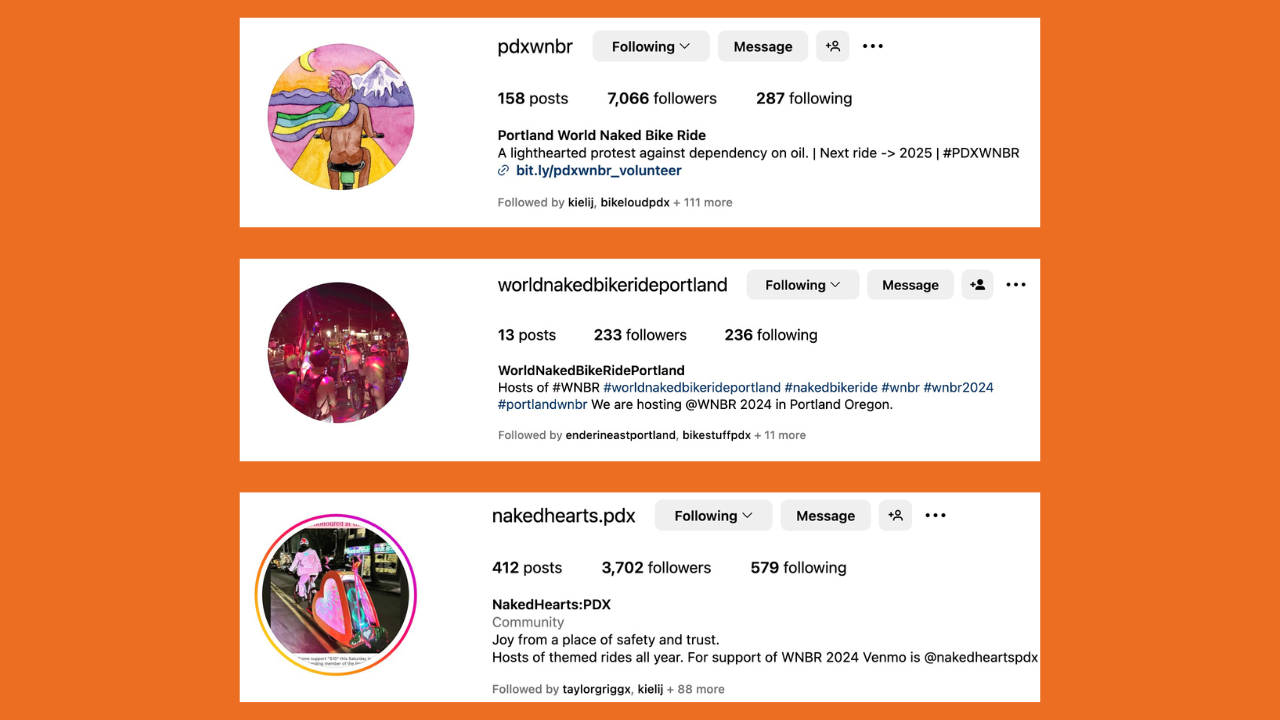
Then a few weeks later, on July 9th, Nakedhearts:PDX posted a surprise announcement on Instagram: “The World Naked Bike Ride Portland is on. We have a constitutional right to gather and protest and we are doing just that.”
The post seemed odd since I had recently spoken directly with Meghan Sinnott, one of the lead organizers of many previous WNBR rides (and the person who runs Bike Summer/Pedalpalooza), about how it was cancelled this year.
I soon learned that World Naked Bike Ride Portland (WNBR PDX) is completely separate from the traditional Portland World Naked Bike Ride (PDX WNBR), even though the names are nearly identical. Not only that, but the person who initially spearheaded the ride planned for this Saturday, Moorland Moss of Nakedhearts:PDX, was explicitly urged to not organize a ride that might confuse some in the community who aren’t aware of the split between the two groups.
Advertisement
Instagram post of Saturday’s ride, which is unaffiliated with the WNBR that has happened in Portland since 2004.
The original PDX WNBR, the one that’s happened in Portland since 2004, is an official project of Umbrella, a 501c3 nonprofit that provides financial and legal support to a host of cool things in our community — from the naked ride to Shift (host of the Bike Summer calendar), Breakfast on the Bridges, The Ladd’s 500, and so on. As the legal entity (a.k.a. fiscal sponsor) behind PDX WNBR, they are concerned people will assume the upstart WNBR PDX is their event. The legal concerns are amplified because the organizers of this year’s ride — the one unrelated to Umbrella and the traditional naked ride — are asking for financial donations.
Put another way, if something goes awry with the WNBR PDX — is a real possibility given the inherent complexities of an immense naked protest event with thousands of people that takes place on public streets — PDX WNBR could be negatively impacted. At the least, the creation of a ride with a very similar name, with similar plans and goals, in the same community, seems in poor taste — especially since the leader of it was explicitly asked to clearly differentiate their ride from the original one.
On June 12th, Umbrella Board President Adam Zucker sent an email to Moss of Nakedhearts. The message was sent by request of Sinnott, an Umbrella board member, and the PDX WNBR leadership team.
Here’s an excerpt from that email:
Advertisement
“WNBR requests that other rides refrain from using ‘world naked bike ride,’ ‘WNBR,’ or similar to describe or promote their Bike Summer, aka Pedalpalooza ride. This is in order to avoid confusion for participants that may mistakenly think a similarly named ride is associated with WNBR, Umbrella Project, or otherwise connected to Umbrella’s, 501c3, nonprofit status.”
Umbrella and organizers of the original PDX WNBR have no problem with another naked ride happening in Portland (there are dozens of them every year that are unrelated to PDX WNBR), they just want Moss to take their concerns seriously.
As of this morning, there’s nothing on the @worldnakedbikerideportland or @nakedhearts.pdx Instagram profiles (above) that makes it clear the 2024 naked ride is unrelated to the original ride, and someone would have to read to the final line of an official press release sent out yesterday to learn, “This ride is unaffiliated with PDX WNBR, Pedalpalooza or Umbrella.”
During a phone call Tuesday, I asked Zucker if Umbrella remains concerned about how the upstart naked ride is being promoted. “There is concern. Yes. There is concern this [ride] might provide confusion.”
Advertisement
In their press release, organizers of the newly launched WNBR PDX say their event, which will start this Saturday (September 21st) at Colonel Summers Park at 3:30 pm, “Celebrates 20 years of joyful protest and body positivity.” The ride will host opposition to the Zenith Oil project and participants will stage a die-in to symbolize, “the devastating impacts of oil dependency on the environment and communities.”
The ride was initially organized by Moss, the person behind Nakedearts:PDX. Since late 2022, Moss has created a large and loyal following as a ride leader. Moss — often in an all-white pantsuit or colorful, mis-matched tights — has led hundreds of group rides under the Nakedhearts moniker while pulling the ubiquitous, heart-shaped mobile sound system named “Gertrude” behind them in a bike trailer. Moss is revered by many in our community for their dedication and creativity. Just three days ago, friends of Moss hosted a Nakedhearts:PDX Appreciation Potluck Picnic & Ride. “Moorland has managed to create an inclusive space where people from all walks of life feel welcome and connected. So many of us would have never imagined having these sort of spaces and friendships,” the description read. “Moorland is a beacon of positivity and brings us all together through these shared adventures.”
Advertisement
Because of this track record, Moss was welcomed onto the PDX WNBR planning team in 2023 and was named official ride leader. Moss was poised to lead the ride again in 2024, but as time passed, the PDX WNBR leadership team grew uncomfortable with Moss’s plans for the ride and their organizational style. When it became clear some members of the leadership team wouldn’t return in 2024 if Moss was involved (or if he didn’t agree to bring on additional volunteers, which apparently was a sticking point), the decision was made to cancel the ride.
Asked for their perspective on all this, Moss said they’re not the leader of the 2024 ride and deferred my questions to other ride leaders they’re working with. When I said my questions are directed at them personally, Moss declined to comment.
When asked if they were honoring concerns about confusion expressed by Umbrella, 2024 World Naked Bike Ride Press Liaison Máximo Castro said via email this morning, “We are not affiliated with PDXWNBR, Pedalpalooza or Umbrella and we clarify any confusion of that when asked. Our website and social media page also state that as well.” “WNBR is not owned by any one person or entity… it is a movement that belongs to everyone,” he continued. “Here in the Portland area, our World Naked Bike Rides have gone through many ride leaders and groups at the helm.”
The World Naked Bike Ride is definitely a global movement. And Portland’s bike community thrives because of people who take initiative and organize big, awesome, fun things. We can all agree on that. So for now, Portland has two World Naked Bike Rides. One on hold for a year, the other marching full steam ahead.