

I’ve been really into my feelings lately. For a lot of reasons, I’ve been thinking a lot about the last 20 years of BikePortland and what the hell comes next. I’m not ready to talk more about all that yet, but one thing I’ve been doing as part of this emotional ride I’m on is to look back at the 28,320 front page stories in the archives.
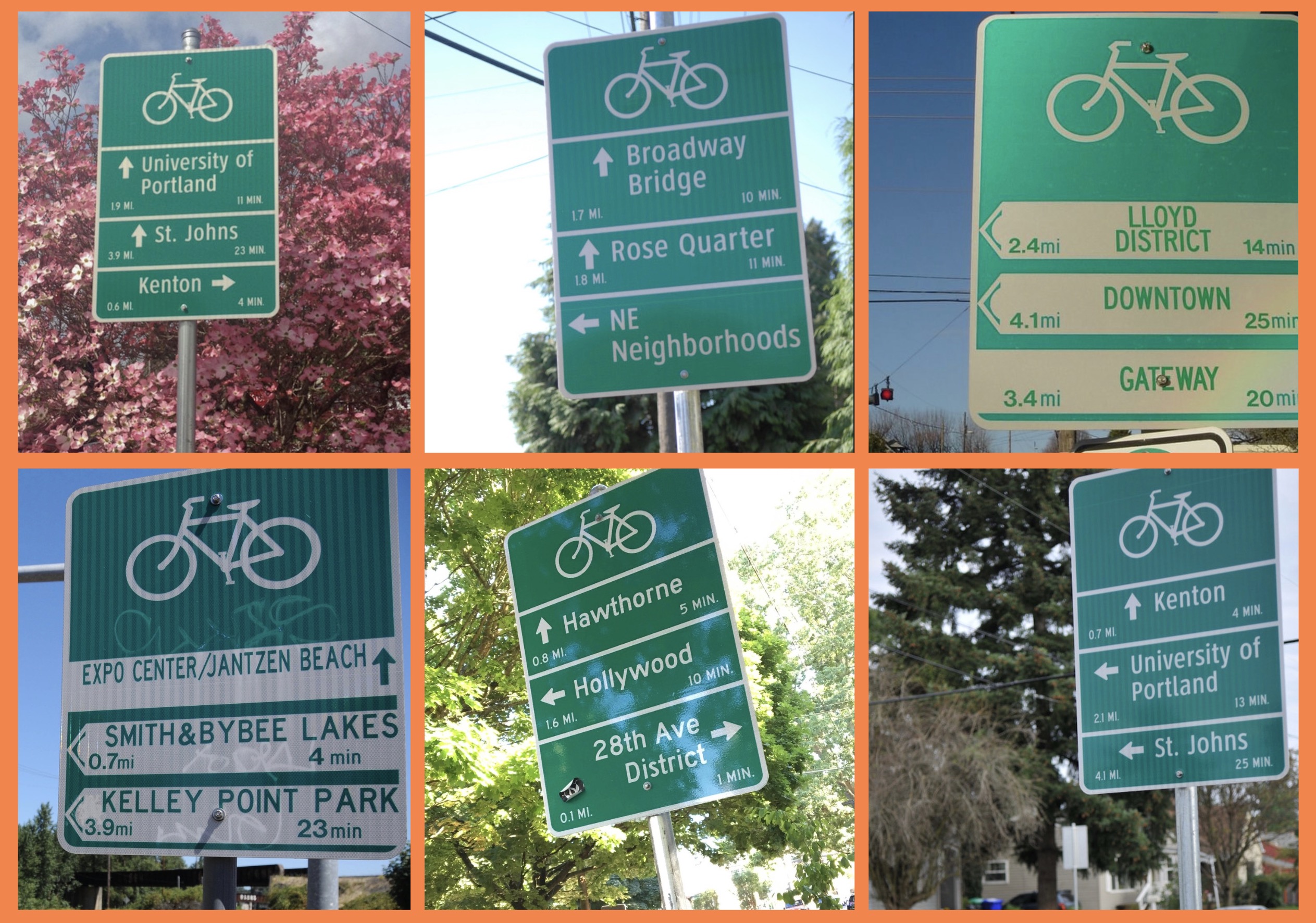
I don’t have a plan for a series of history posts or anything, so I’ll probably just share interesting things I come across. Like when I searched back on this week in 2006 I stumbled on a story I did about Portland’s bikeway network signs.
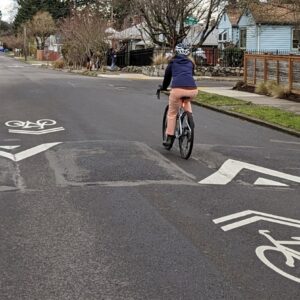
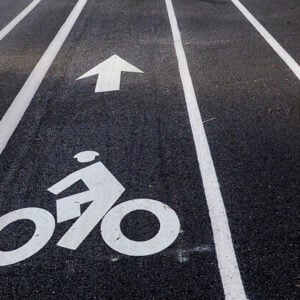
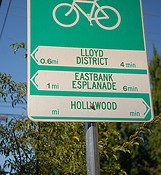
In February 2006, these green signs that give mileage and timing information about key destinations were a big deal. As per usual back then, Portland’s transportation bureau was a national leader in doing cool stuff for cyclists. Our guy with his hands on the bars back then, Roger Geller (who remains PBOT’s bike coordinator to this day), was big into pavement markings and network signage. His little, round bike markings with arrows were an early innovation that sprung up before we started putting shared-lane markings (called “sharrows”) on the ground.
The signs emerged from a federal grant PBOT was awarded in August 2005.
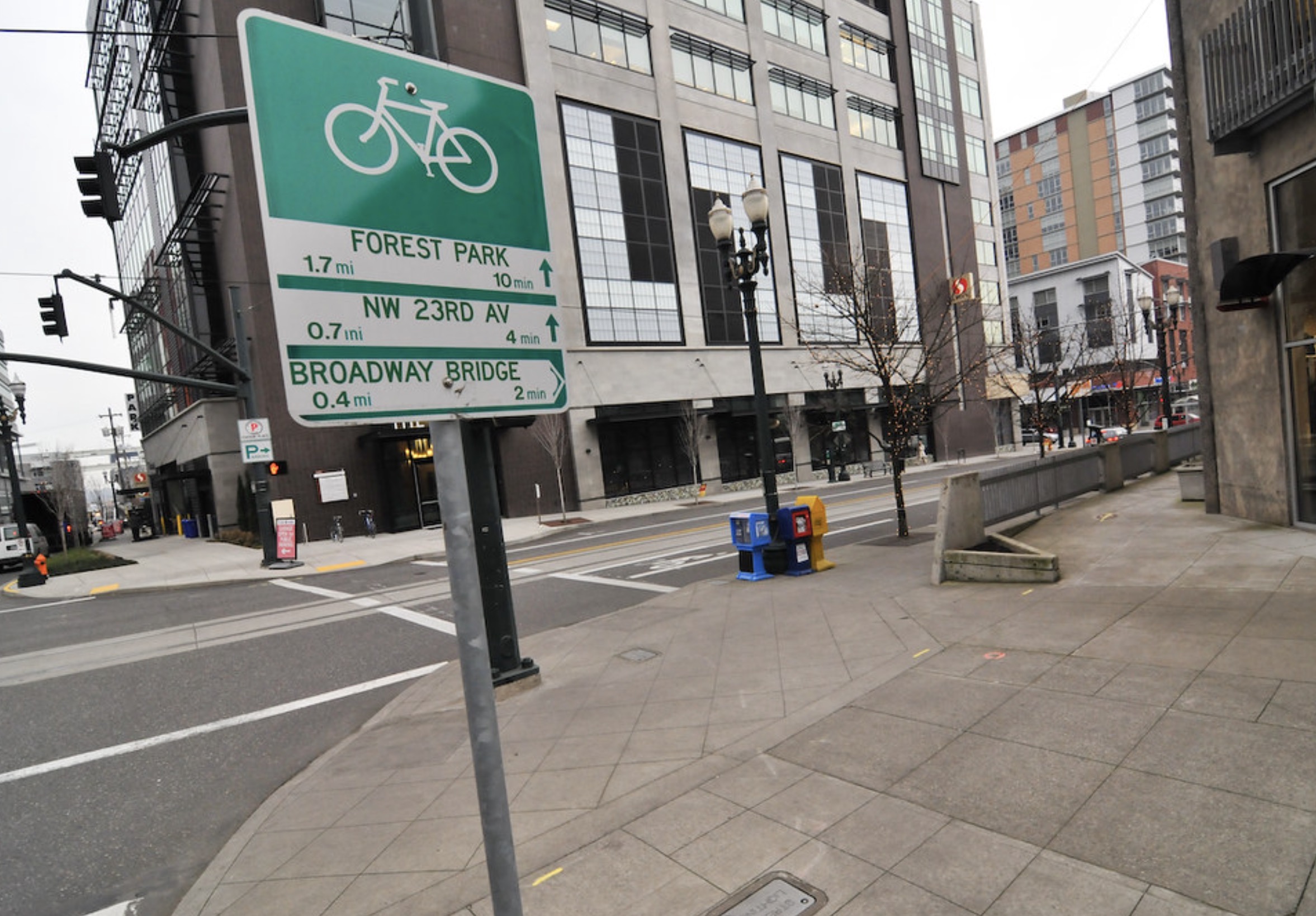
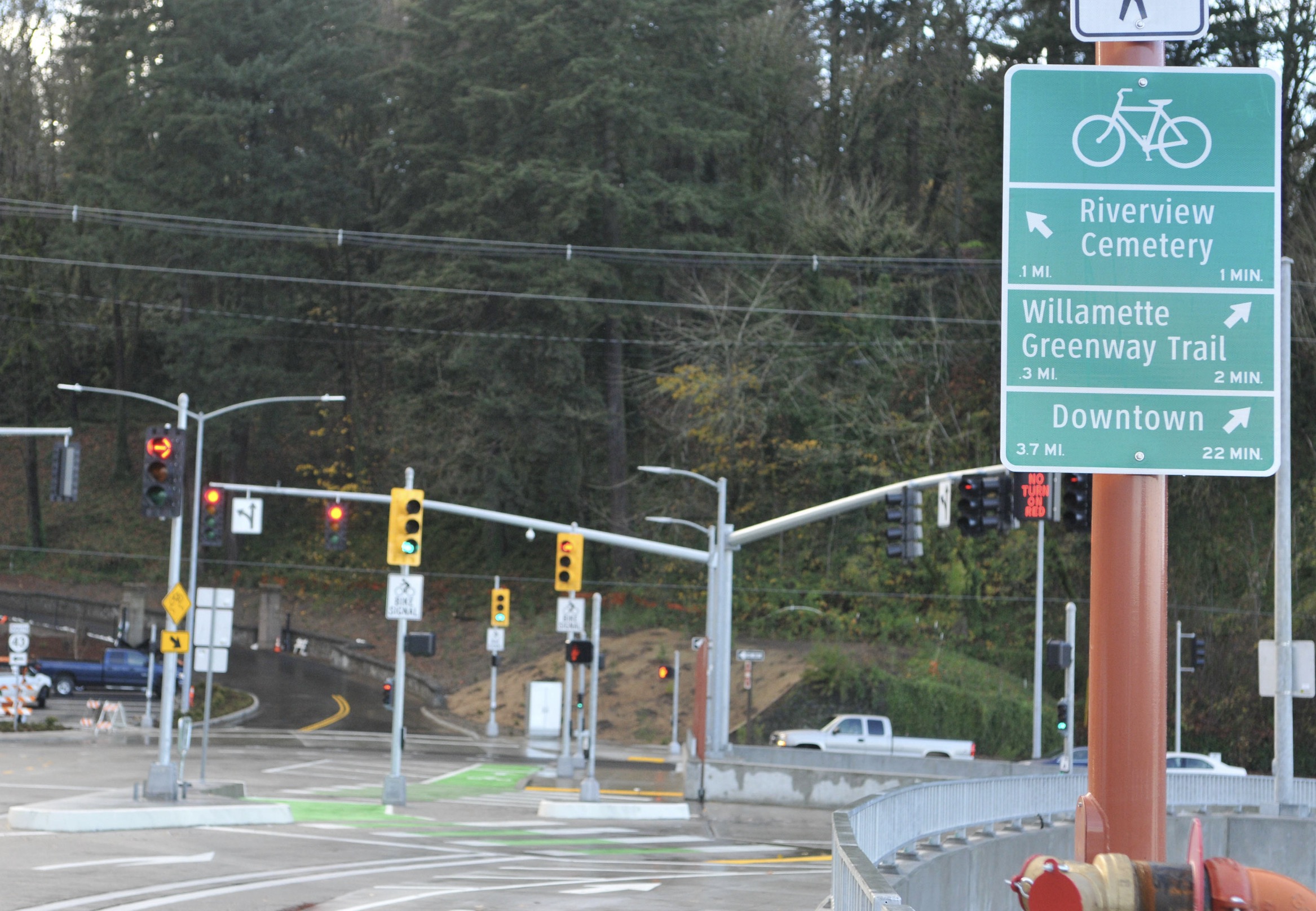
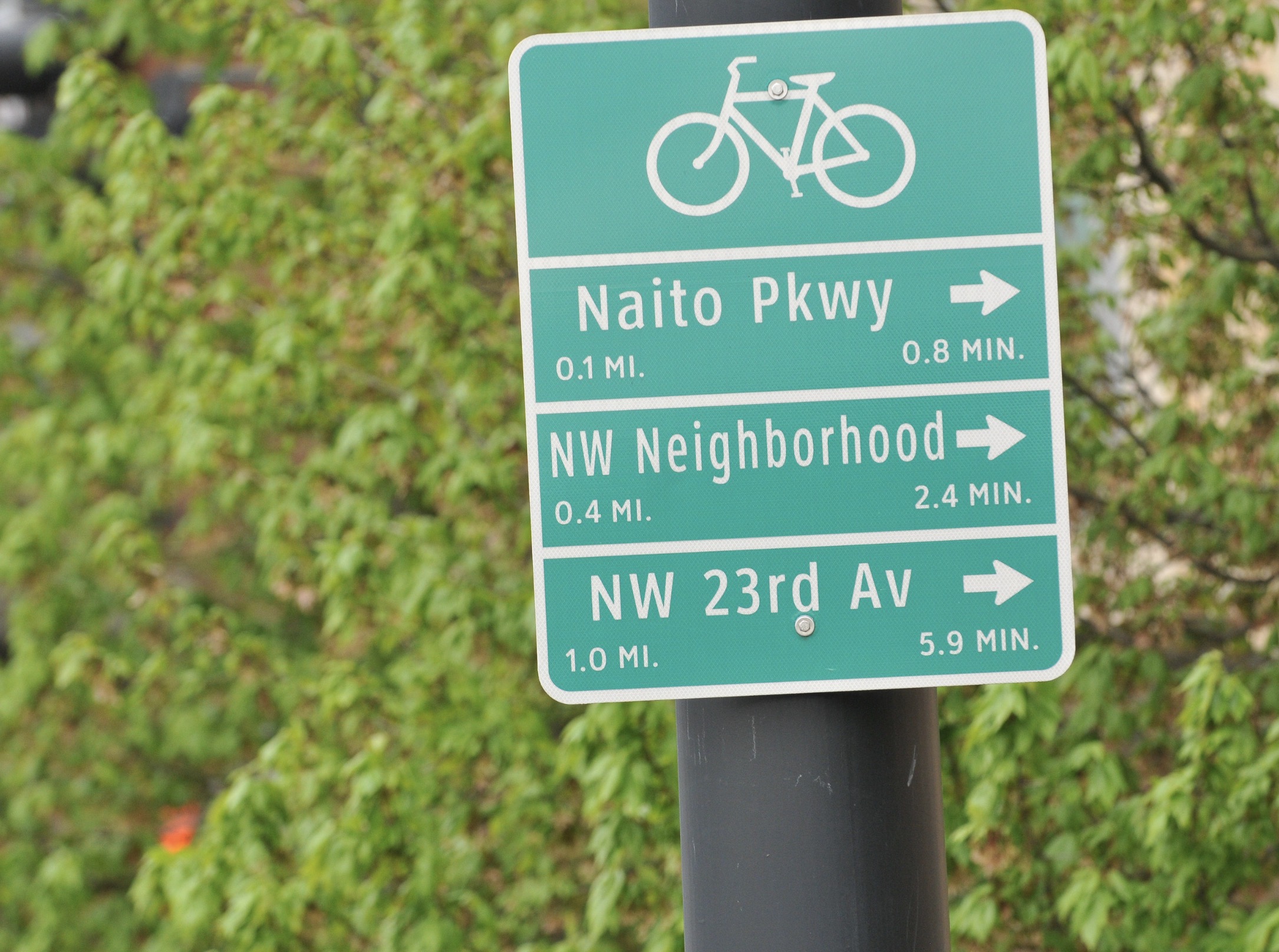
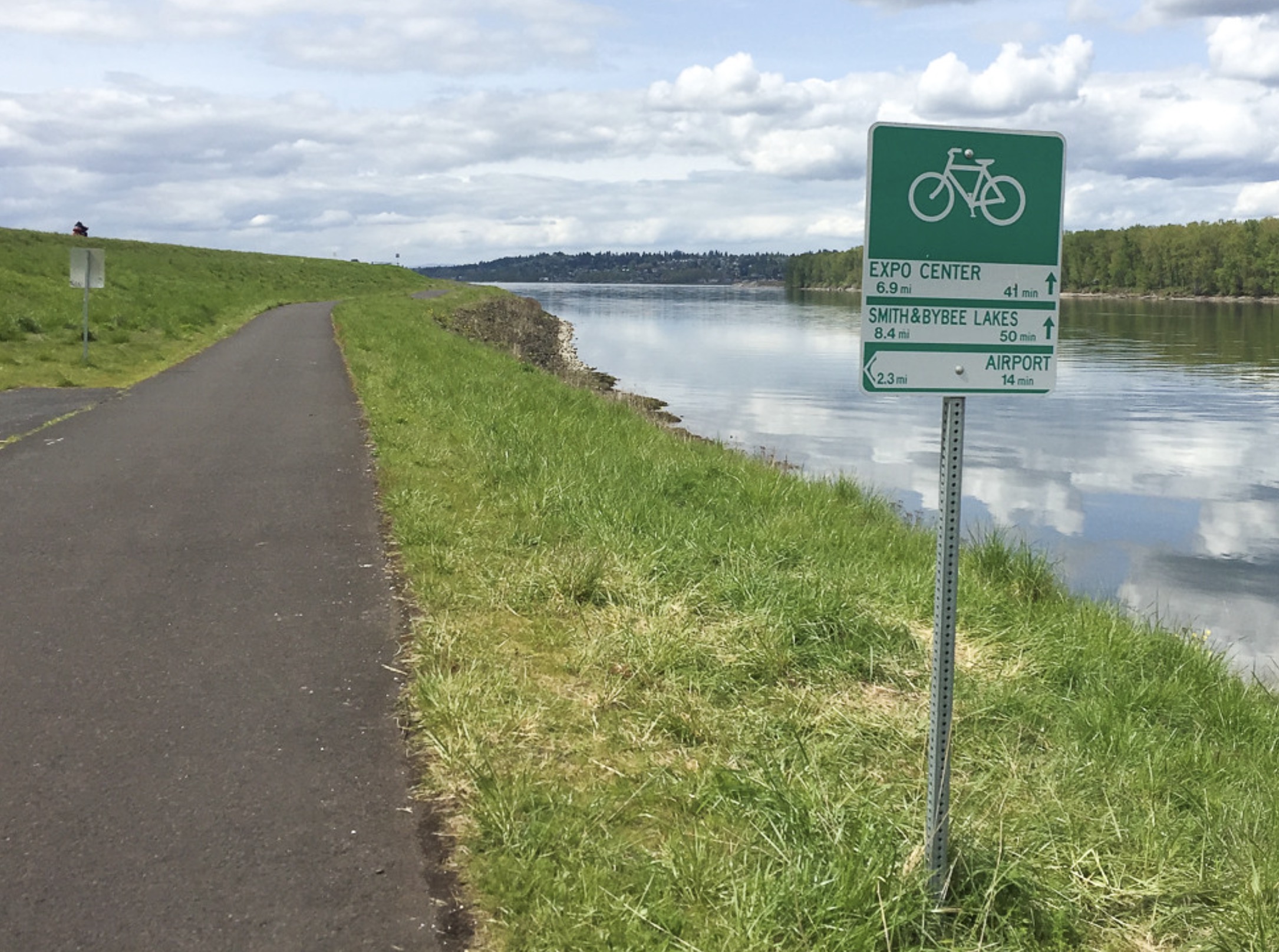
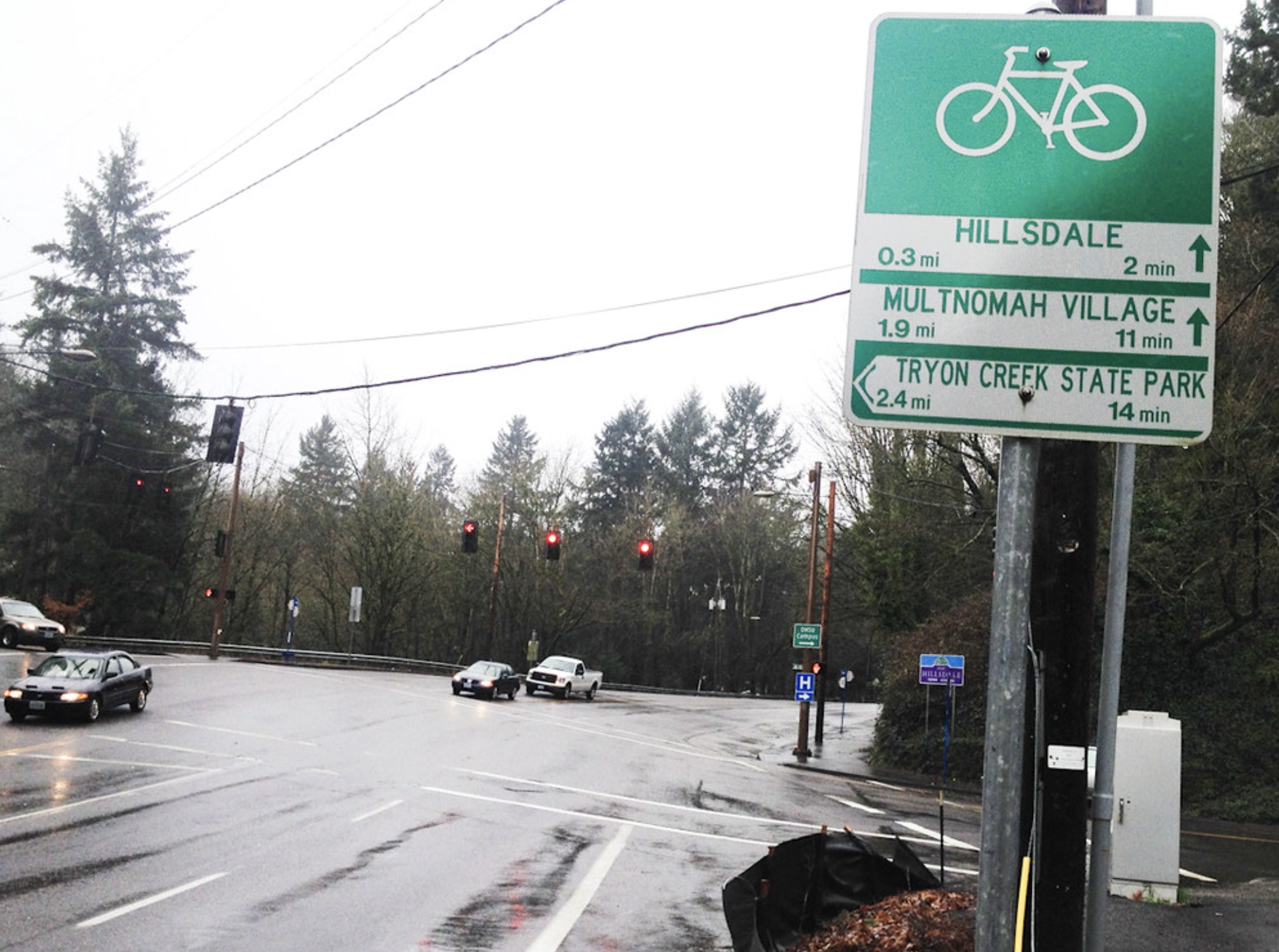
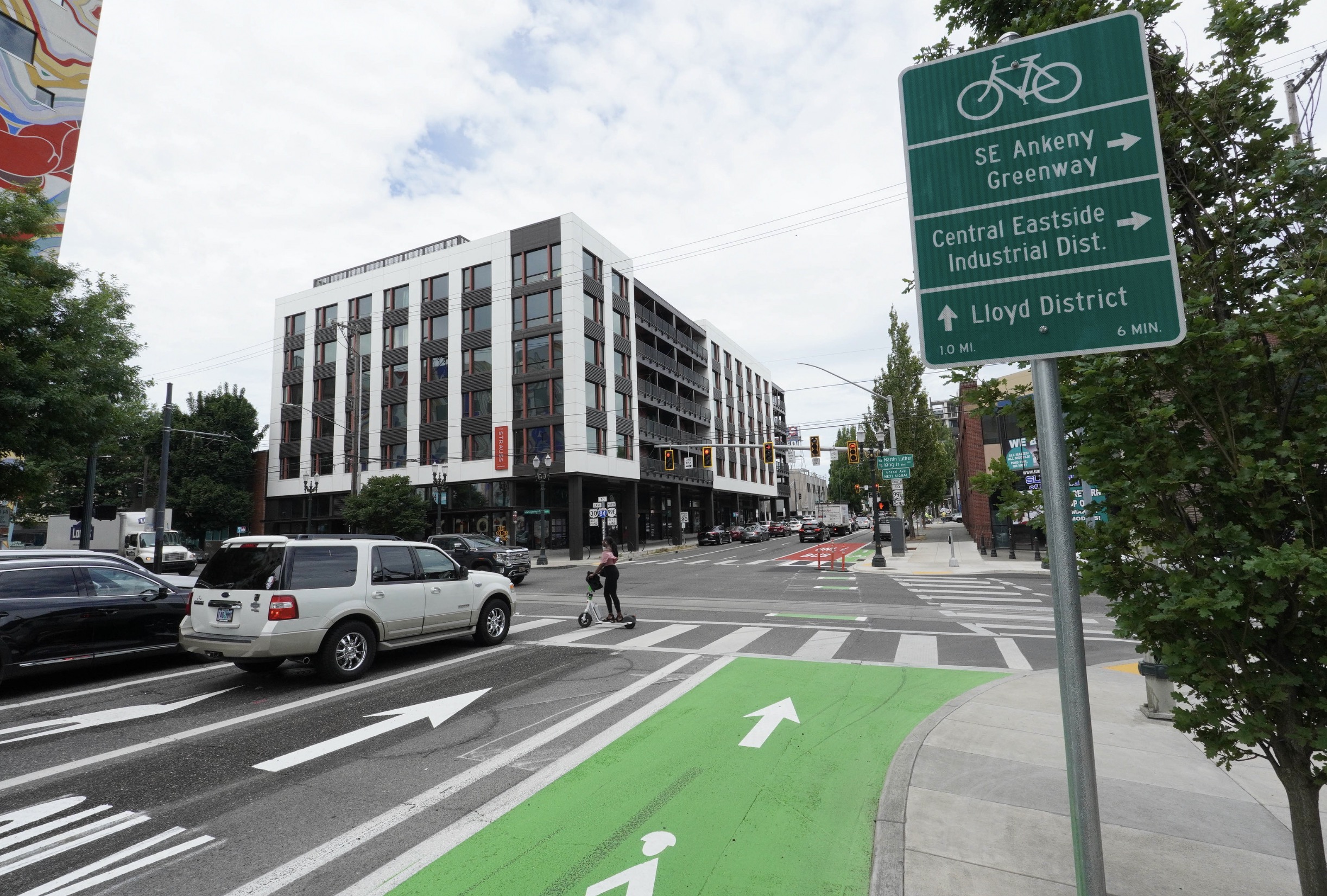
Geller and PBOT were building America’s best residential bikeway network and they wanted to make the routes as legible as possible. It’s still a work in progress (today Geller laments that this amazing feature of our city’s cycling infrastructure is hidden from most Portlanders), but the combination of thousands of sharrows and these green bikeway network signs are — in my opinion — one of the best things about biking here.
Beyond the sheer utility of knowing where you are, where you can go, and how long it will take to get there (based on a bicycling speed of 11-12 mph), what I like about these signs is the respect they give to cycling. I’m big on respect. If a government demonstrates through its infrastructure that your mode of travel is respected enough to deserve cool innovations and bonus features, that says a lot about where you live. It sends a signal that bicycling is expected and honored.
Today when I see these signs it feels like I’m in the right place. A sense of being at home in the city. And when I’m on one of these routes, I know that Geller and his team at PBOT have done more than put up a sign. There’s a very good chance they’ve added safer crossings, a 20 mph speed limit, speed bumps, and maybe even some diverters to keep car volumes down.
You ever notice these signs. Do you use them? What do you think about them?

Thanks for reading.
BikePortland has served this community with independent community journalism since 2005. We rely on subscriptions from readers like you to survive. Your financial support is vital in keeping this valuable resource alive and well.
Please subscribe today to strengthen and expand our work.
As someone that was a transportation engineering consultant at the time of the new signs 20 years ago, it was inspiring to learn about the concepts the City had proposed. What perhaps was more amazing was that there was a blog by someone devoted to following the details of cycling infrastructure in Portland and beyond. These details mattered and are important to use practically to communicate to folks that cycling is a reasonable option.
As someone that has also watched the Federal Highway Administration say specifically in the Manual on Uniform Traffic Control Devices (MUTCD) that other agencies couldn’t use travel times on signs because they were not accurate or reliable makes me think that someone is simply missing the point. The MUTCD continues to say “Travel times should not be used on Bicycle Destination signs” in Chapter 9D.01 for those of you playing MUTCD BINGO at home.
All this to say, cheers to Roger Geller, whose daily efforts continue to make Portland better and unique from peer cities. He deftly argues with logic and insights that provides leadership nationally in many ways. As you’re reflecting on 20 years, I hope you’ll appreciate your own impact and those of folks like Roger Geller who are always advocating within their communities, even when it’s not visible. If we had more people riding and using their voice, it would result in more agencies using engineering judgement to provide insights that may be useful to travelers.
We at the Bicycle Advisory Committee in Beaverton have been working to bring similar wayfinding to our city. A lot of the work has been done, but it has stalled in engineering, and finding the money to pay for the signs may be a hold-up. One thing I like about the Portland signs is the time estimate, but as we went through iterations of designs for the signs here, everyone seems to have agreed that it is not very inclusive of different riding styles, and design guidelines for wayfinding from the usual agencies have all said not to have the time estimate going forward. I get it and ultimately agree from an accessibility standpoint.
Yet I think it helps me feel more connected to my destination. Telling me something is 5 miles away can feel far, but if you tell me that’s just 30 minutes, it feels much more doable. I can’t really explain why, but it is something I will miss if and when the ‘Tron ever gets our wayfinding.
It’s sad that we can no longer have some common expectations about how long it takes to bike somewhere. Why can’t you list a range? – like “5 – 10 minutes”?
The arguments about ableism no longer resonate in a world of e-bikes. Should people who ride e-bikes feel slighted if the estimated times are longer than e-bikes would normally take? The idea that we can do nothing for anyone unless we do everything for everyone seems a bit blinkered.
That’s a real shame, because I think these kinds of signs are one of the bests ‘bang-for-your-buck’ investments that can be made to a transportation network. I hope Portland puts these kind of signs all over the place. Why not?
Hope ya’ll can get the city to use sharrows for wayfinding too like PBOT does.
Hi Mick. I’m not sure if your wayfinding system will include signage for pedestrians and walkers, but I’ve found signs like these helpful over the years. The one downside, at least for bicyclists, is the small font.
I like the signs. But I think they are sometimes located too far before an intersection. When I get to a bikeway intersection, I want to know which way to go (because many of our bikeways are meandering and confusing). I look up to try to find a sign to help me, and I see none. So I guess which way to go, often wrongly. All the while, there was a wayfinding sign half a block back that I never even saw, because I wasn’t looking for directions until I got to an intersection.
Paul,
I agree that the placement is not ideal. Also, the font size is too small. These are often installed on greenways and they are poorly lit and impossible to read on a dark, rainy night. I think PBOT could take some inspiration from traffic engineering principals and consider font sizes intended to be read from a grater distance and at higher speeds would be a big improvement. I would say these signs are scaled to pedestrians who would get very close and read at a 2-3 mph speed. Bike riders are typically 10′-20′ away and moving 10-15 mph
yes the font size for distance/time is minescule, which is one of the reasons I never liked including “time’ (pro tip: multiply distance by 5, it’s not a complex algorithm). Getting rid of “time” would allow you to boost the size of “distance”.
Good points and remember that the principal is not your pal, but principles will always guide you.
yikes! thanks.
I make it a point to ask people if they know what greenways are. Friends, family, random people. Almost no one I talk to other than people who are into biking and urbanism know what they are.
Yesterday I was talking to a lady at a coffee shop. She commented on how loud this motorcyle was and how that shouldn’t be allowed, and how the street needs road bumps because cars go too fast. I asked her if she knew about greenways, and she didn’t.
Sharrows and our current network signage are a good start, but I think I agree with Geller in his viewpoint that our “product” is pretty good and has a lot of latent value that needs “marketing” to capture. I suspect that if it were common knowledge that greenways exist and that you could use something like http://portlandbikemap.com/ to view them on a map, our bike mode share would increase by a fair amount.
To have more success with this marketing, I feel like we need something more ambitious. I think about how in the Netherlands they use pavers for local streets across the country. That consistent standard makes it easy for people to understand “oh, this street is different from the streets lined with asphalt; it serves a different function”. Pavers in Portland on all of our greenways actually sounds like a great idea, but for something more realistic, maybe just a continuous green stripe would do the trick.
A continuous green stripe feels to me like it would be enough to actually stand out to people. They’d wonder why all of these streets have continuous green stripes. It’d generate buzz and news coverage. People would talk about it. Some would love it, some would hate it, but I sense that most people would at least _understand_ what it is. That it signifies a greenway, which is a street that is intended to be calm and prioritize cyclists. Maybe then people would understand that we have this network of greenways and be inclined to bike more often.
This continuous green stripe idea seems politically realistic to me. It’s not inconveniencing drivers too much, and it seems like it’d be relatively inexpensive.
“Greenway” is a technical term. As people if they know what bike routes are and you’ll get a more positive response. Everyone know what a bike lane is. I never use the term “greenway” outside of Bike Portland.
Hm, interesting. Thanks for proposing this.
I’m trying to think back now to what people’s responses are once I explain what a greenway is, and I don’t have a great recollection. I think they tend to recall seeing individual components like modal filters and sharrows, but I don’t get the sense that they put two and two together and recognize that that there these bike routes (greenways) exist that combine modal filters, sharrows, traffic calming, speed limits, etc. I’ll be sure to check in on this with people moving forward though.
This data is all anecdotal of course and intended to satisfy my curiosity. It does seem worthwhile to do a real survey with proper randomization and stuff. Maybe those surveys have been done.
In other towns they are called “bicycle boulevards” and it makes a lot more sense for everyone. The definition is in the name, and the road markings are a lot more clear and in your face…it’s evident to anyone paying the slightest attention that they are on a bike priority street. My guess is that the people that came up with “greenways” were trying to not make car drivers feel left out, or some other weird sell imposed equity thing. Just another reason why Portland’s greenways suck
They were initially called “bicycle boulevards”. The name was changed to “greenways” when PBOT realized that joggers, pedestrians, etc. were using them as well and including these routes in their maps/route guides. The change had nothing to do with cars.
Nice retcon, Ted.
They were changed to Neighborhood Greenways because the mayor’s office and PBOT were reluctant to advocate for and dedicate funding towards *Bike* Boulevards during the height of the Adams admin bikelash.
https://bikeportland.org/2011/04/13/an-interview-with-portland-mayor-sam-adams-2-51294
It’s not a “retcon” because that was the actual rationale given by PBOT for the change at the time. I have no problem if you take issue with PBOT’s decision, but “retcon” does not apply in this instance.
Here’s an article from a year earlier- feel free to peruse the comments to see how people felt about the change at the time
https://bikeportland.org/2010/04/14/for-pbot-neighborhood-greenways-is-more-than-just-a-new-name-31983
Which part of that article supports this claim? It talks about the bikelash in Toronto and NYC, but not Portland. I also didn’t see any mention of the naming of the greenways.
Perhaps you meant to link to a different article?
It’s not a “retcon” because that was the actual rationale given by PBOT for the change at the time. I have no problem if you take issue with PBOT’s decision, but “retcon” does not apply in this instance.
Here’s an article from a year earlier- feel free to peruse the comments to see how people felt about the change at the time:
https://bikeportland.org/2010/04/14/for-pbot-neighborhood-greenways-is-more-than-just-a-new-name-31983
Not my recollection at all. They became “neighborhood greenways” because people were also walking, running, skating, etc down them.
100% unambiguously a good thing.
If the history of the name of neighborhood greenways affects your experience as you ride on them, you might want to consider why that is.
In addition, I feel like the “greenway” term is useful for other reasons, too. The use of green to designate bicycle facilities is fairly standardized in the US (other countries use different colors, of course). When I check Google maps and select the bicycle route layer (or Portland’s own Bicycle Network Map), I am immediately greeted with a grid of green routes. For many folks who use these services to navigate, the association becomes embedded over time (regardless of mode).
I don’t associate the term “greenway” with car-centric planning norms any more than I associate separated bicycle infrastructure with “reducing visibility” of cyclists.
Here in Greensboro what they call a “greenway” is a paved bike path that runs along a stream or old railroad right-of-way; the streets with sharrows are called “bikeways”; anything with a painted bike lane be it simple, buffered, or with candlesticks/plungers is a “bike lane”. (We even have a 1950s residential street named Greenway.) However, if you visit Charlotte or Raleigh, they have their own terminology – really, there’s hardly any national, regional, or even local consistency with our bike infrastructure terminology.
RE loud motorcycles, it’s a common saying among bikers that “loud pipes save lives”. Those of us who use multiple forms of 2 wheeled transportation would much rather offend someones ears for 10 seconds than be dead forever because some giant truck “just didn’t know they were there”.
I’ll be sure to remember this when I get woken up at 3am by someone whose motorcycle is audible from my bedroom for nearly a full minute.
When I first moved to Portland, many years ago, I noticed the signs during my first rides around the city and they made me feel like I belonged here on my bike – moreso than any other place I had ever lived.
I’m still glad to be biking around Portland, but cycling here no longer feels special to me in the way it did during those first heady months here. It all feels a little drab somehow. I just know, in the back of my mind, that cars and trucks still have priority here and I had better keep out of their way, or else.
What is the longest distance/time listed on one of those signs? I always get a kick out of the “Boston, MA 3365 Miles” sign where Rt 20 begins in Newport. What is our Portland bikeway network equivalent?
I wanted to see if the Boston end of US 20 had a similar sign to Newport OR but I can’t find one on Google Street View, but it does have a very nice barrier- and parking-protected bike lane on it for at least part of the way.
Apparently it’s at Kenmore Square. In 2016 Oregon and Boston put up the signs to celebrate America’s longest road.
https://maps.app.goo.gl/mgviEDcLF59CkubK8
Years into knowing this town, longer than anywhere else I’ve lived, I don’t find them personally useful but the nudge that “hey, it’s not that far by bike” is nice.
Then again, we’re trying to limit or eliminate auto traffic where most of these are posted.
I love these signs so much:) Frequently when I’m out riding and have bonus time I will play the “follow a different bike route” game and follow these signs in a direction that’s unfamiliar to me to see where I end up. I’ve learned a lot about the city this way, and even after 25 years of biking here I still always find new things that lead me to places I didn’t know.
I also love the idea that you can hook into a network that is built specifically for you and your biking friends and then reasonably and and safely find your way with it. When I bike in other cities I always wonder how the heck I’m supposed to know where the safe-for-biking roads are (or how to cross major thoroughfares) without something like this.
I use them as a general reference, and I use the time specification as a goal to beat. 🙂 They are nice though, especially if you’re newer to the city.
You know the other thing we didn’t have in 2006? Bike detection loops. I love those things, and think they should be used more frequently. And all of them should have the blue verification light. I’m much less likely to skip a red if I know it knows I’m there.
The bikeway signs were a great innovation in Portland, especially listing time to destination. Even as an everyday rider exploring the city, I found things that my mental map told me were inaccessible, but really only 9 minutes away. What a treat.