🚨 Please note that BikePortland slows down during this time of year as I have family in town and just need a break! Please don't expect typical volume of news stories and content. I'll be back in regular form after the new year. Thanks. - Jonathan 🙏

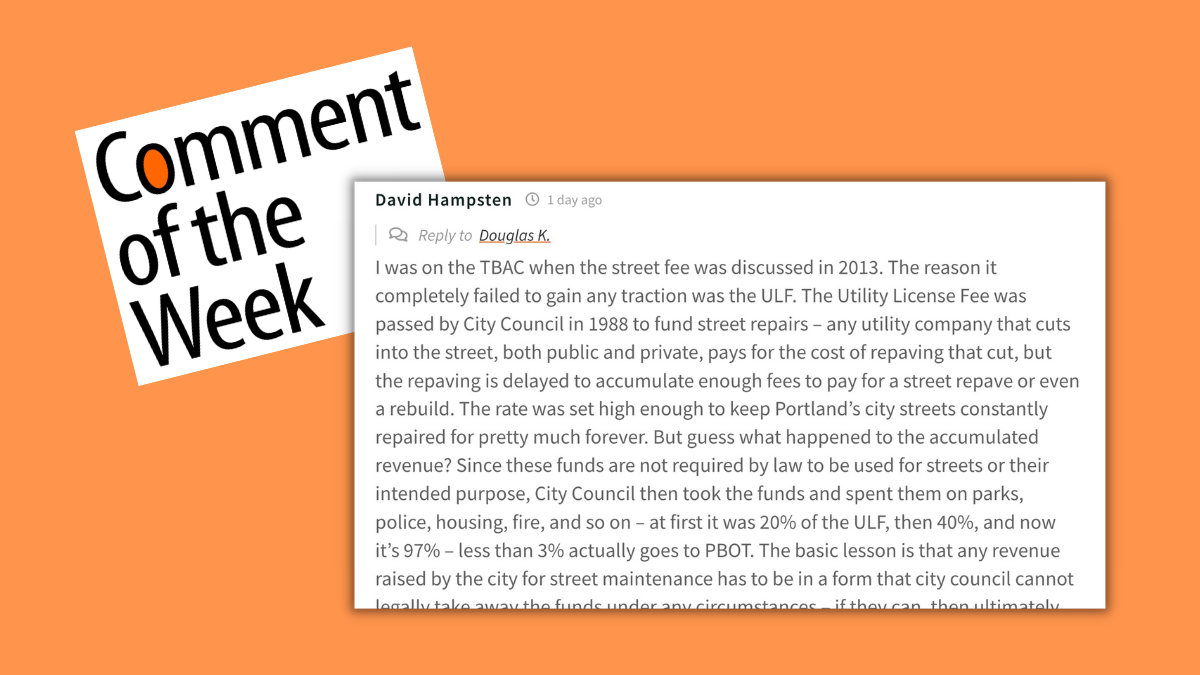
Comment of the Week: SW Gibbs and commenting about comments

Welcome to the Comment of the Week, where we highlight good comments in order to inspire more of them. You can help us choose our next one by replying with “comment of the week” to any comment you think deserves recognition. Please note: These selections are not endorsements.


Given that it delved into policy, last week’s story about the struggle to get a sidewalk built on SW Gibbs Street (Traffic impact studies: shouldn’t pedestrians and cyclists count?), got a surprising number of comments. Many readers weighed in with relevant insights.

But only one commenter went “meta.” qqq read the story, in part, as a response to long-running debates in the BikePortland comments section. What a good reader! And who’s to say what the author was thinking.

Here’s what qqq wrote:

Besides the great reporting uncovering the craziness of this particular situation, I love this for touching on so many things that have come up in other articles:

–the disjointedness of City government — while some of PBOT is busy on biking and walking projects, another arm is reviewing projects under the premise that biking and walking are irrelevant to transportation

–there’ve been lots of “neighborhood associations are all NIMBYs” comments, but here’s one that brought up an issue with PBOT reviews whose correction will help the whole city

–one roadblock to testifying or commenting about issues is the “leave it to experts” stance, but here’s an example of a neighbor having obvious technical knowledge that allows them to identify a problem with PBOT reviews that all of PBOT has apparently been unaware of or unable or unwilling to fix

–the way City processes are set up so it’s easy for bad things (PBOT’s approval of no sidewalks) to slip through unless it — almost by chance — gets noticed by a neighbor or someone outside the review process who knows how to object

This line from the article really sums it up well:

“It is difficult to understand why the fate of transportation infrastructure near this economic engine depends on conversations between a PBOT middle-manager and a neighborhood volunteer.”


Thank you qqq! You can find qqq’s comment, and many other informative comments too, under the original post.

Monday Roundup: London’s triumph, deadly snow, battery ban, and more

Welcome to the week.

Here are the most notable stories our writers and readers have come across in the past seven days…

London did it: Latest counts show that London has achieved Portland’s goal with 27% of all trips being made by bike on a typical day — more people on bikes than cars in their city center! (Forbes)

Inside the ‘gain cave’: For some riders — like this guy who has put 55,000 miles on his trainer — indoor cycling isn’t an alternative, it’s just what they’ d rather do. (Cycling Weekly)

Truth about self-driving cars: A comprehensive look at the fables and facts around automated vehicle technology proves that the field is still nothing more than a automaker-fueled fantasy that should be marginalized instead of mainstreamed. (Bicycling)

Snow in the bike lane: Residents of Reno are questioning that city’s snow plowing policies after a bike rider was hit and killed trying to avoid a wall of the white stuff. (This is Reno)

Doggie doping: An Olympic mountain biker was dinged by the UCI for using drugs — but it turns out it was just medicine for her dog. (AP)

On-street dining: New Yorkers are grappling with the future of their “dining shacks” that sprung to life in parking spaces during the pandemic as city leaders seek to cut them back to seasonal structures. (Slate)

Freeway fighting update: Portland’s No More Freeways is one of the groups involved in this roundup of what anti-freeway groups need to scale up their fights. (Streetsblog USA)

Better batteries: The bike industry is watching New York City’s new law that would allow only UL-tested e-bike batteries to be sold. It’s an effort to thwart fire concerns from cheap batteries. (Bicycle Retailer & Industry News)

Citizen enforcement: New York City is looking to do something similar to Oregon with a new law that would give anyone the ability to initiate a traffic citation, and it’s going through a few compromises as it approaches a council vote. (Streetsblog NYC)


Thanks to everyone who shared links this week.

Cycle Portland re-opens in former Old Town Starbucks

Ever since Velo Cult closed, there hasn’t really been a spot like that that’s kind of what we want to do.”

– James Kelly, co-owner

Cycle Portland has been a local staple for rental bikes and tours since 2007. Now, almost three years after shop ownership changed hands, Cycle Portland has moved just around the corner from its former location on NW 2nd into a new, more spacious Old Town spot — and the owners have exciting plans for how they’re going to utilize it.

The new shop is on the corner of NW 3rd and Davis in a space that formerly housed a Starbucks. It’s bright and airy inside, with plenty of room for a large assortment of rental bikes and a service shop in the back. Co-owners James, Kurt, and Renee — who bought the shop from founder Evan Ross in 2020 — have done a great job of making the place their own, but there’s still a cafe feel to the space giving it a unique, inviting atmosphere.

This is exactly what the owners want. At a grand reopening party in February, co-owner James Kelly told me he hopes the shop can become more than just a bike rental facility — he wants it to be an event space where people come to watch bike races or just to socialize while getting their bike tuned up.

“Ideally, people can come watch the Tour de France, or we would just host cool bike-related events,” Kelly said. “Ever since Velo Cult closed, there hasn’t really been a spot like that. We won’t be able to take up everything they did, but that’s kind of what we want to do.”

Much of the work Cycle Portland does revolves around bike tours and rentals for people visiting from out of town. They have a variety of bikes for people to rent and have come up with multiple different tour routes to showcase our city by bike. It’s a big responsibility to guide someone’s first time biking in Portland, and Cycle Portland offers a much more personal approach to bike rental than you could get from just downloading the Biketown app and taking off by yourself.

“We envision a future where our city is the most sustainable destination to live or visit in the country.  We believe one of the most positive impacts a visitor can have in our region is choosing the bicycle over a car while here,” Cycle Portland’s website says. “Local businesses and residents will be thankful to see visitors choosing to cycle as part of their trip.”

It was clear from the energy at the re-opening party that Cycle Portland means a lot to people. The shop was buzzing with longtime friends and current and former staff who oohed and ahhed at the roomier facilities and chatted excitedly about future opportunities as shop dog Baikal roamed the floor.

Be sure to check out the new location — even if you don’t need to rent a bike or get yours serviced, you can partake in a glass of wine or draft beer and browse the wall of funky socks or just sit and chat. I’d love to see this spot become a watering hole for tourists and locals alike to share stories and tricks of the trade, so I’m very eager to see what’s next to come for Cycle Portland.

Job: Senior Software Engineer – Rust, Mapping, & More – Ride with GPS

Buffered Bike Lane with a bike symbol and arrow pointing forward

Title

Senior Software Engineer – Rust, Mapping, & More

Company / Organization

Ride with GPS

Job Description

We are the world’s largest library of bike routes, and we enable cyclists to go on better rides, more often. We have a website and mobile apps that allow riders to discover the best riding in their area, and get turn by turn navigation using either their phone or bike computer of their choosing. Come join us in taking Ride with GPS to the next level! We are a mature, bootstrapped, profitable company of > 30 employees, and are looking for another senior level mapping engineer to help us continue to grow and build new products.


Maps, routing (finding optimal paths between two points), and elevations are critical technologies to Ride with GPS, and represent a distinct area of development for us. We both maintain forks of existing open source Open Street Map related technologies, as well as custom mapping solutions of our own design. Come work on the team that is responsible for the core technologies powering our route planners and search! We work with lots of interesting data, and we make pragmatic decisions about developing custom solutions vs extending existing technologies. This is a low overhead, highly independent small team.

Qualified candidates have extensive experience writing performant code in low level languages. Rust experience highly preferred.

See a more comprehensive job listing here: https://ridewithgps.com/careers/mapping_engineer


How to Apply

Email careers@ridewithgps.com with your resume, your portfolio, and a cover letter that includes an overview of any work relevant to the position. If you have a personal connection to bikes, the outdoors, or mapping tech in general, we’d love to hear about it. We don’t require everyone to be a cyclist, but we have found having distributed product knowledge on the whole team lets us do more with less, and have more fun doing it.


Albina Vision Trust secures federal ‘Reconnecting Communities’ grant

The Reconnecting Communities Pilot Program (RCPP) was established in President Biden’s Infrastructure Investments and Jobs Act back in 2021, and Portlanders have had their eyes on it from the start. This program acknowledges the damage some transportation infrastructure — especially freeway projects like I-5 in Portland — has created in communities due to displacement and other negative impacts, and it sets aside $1 billion in federal funds over five years to help make things right.

One of the first beneficiaries of this program will be Portland’s own Albina Vision Trust (AVT), who were recently awarded an $800,000 RCPP planning grant. AVT launched their project (on a bike ride!) in 2017 and has since become a major player in conversations about the Rose Quarter. In June 2021 they inked their first of what is likely to be many real estate development deals.

AVT applied for this grant last fall in partnership with the Portland Bureau of Transportation, and will use it to make initial plans for what the Rose Quarter and Lower Albina areas will look like when/if the Oregon Department of Transportation adds a highway cover to I-5 in the district. ODOT also tapped the RCPP for a very substantial grant of $100 million to construct the I-5 highway covers as part of their Rose Quarter freeway project. But ODOT’s application was denied funding in this cycle.

Other than the starkly different amounts of money requested, AVT/PBOT and ODOT’s applications may seem similar because they both deal with capping I-5 at the Rose Quarter. But while ODOT’s proposal to add covers to I-5 is wrapped up in their highly-controversial freeway expansion plan, the $800,000 in federal funds allocated to AVT and PBOT are not necessarily contingent on a freeway expansion.

Albina neighborhood advocates with AVT have signed onto ODOT’s Rose Quarter plan because they know it may be their best bet to negotiate capping the freeway to reconnect the neighborhood that was so negatively affected by the construction of I-5 in the 1960s. ODOT, meanwhile, knows that including these expensive freeway covers in the I-5 expansion project is the only way they get any federal funding for the plan. But so far, ODOT has been having a difficult time securing that funding even with the Albina neighborhood restoration as part of their pitch.

From the time the RCPP was first announced, some transportation advocates have been concerned that state DOTs would apply for RCPP money under the guise of restorative justice for neighborhoods harmed by infrastructure projects and then use the funding for freeway expansions. A blog post from transportation nonprofit America Walks calls ODOT out for this specifically, saying the proposed cap over I-5 at the Rose Quarter “has the potential to be a positive investment for Portland’s historically Black Albina neighborhood” but the USDOT should deny their application because it “comes attached to an expansion of the highway that will increase environmental and economic damage along the corridor.”

“We’re calling on USDOT to reject proposals like these, as they fail to align with the goals of the Reconnecting Communities program. Proposals like these leave in place the structures that cause damage — or even worse, expand them,” the post continues. “For that reason, they address neither environmental justice nor equitable development and result in either a negligible increase in community connectivity or a net decrease, in the case of proposals that bundle highway expansions into the project.”

Perhaps the U.S. Department of Transportation heard these concerns in their first round of RCPP funding — or maybe they just didn’t want to give ODOT more than half of the $185 million they have allocated for the program in its first year.

There’s still a lot up in the air about this project. It’s unclear how AVT and PBOT might be able to work independently of ODOT to make plans for a future Albina neighborhood that isn’t disconnected by I-5, and there will be more opportunities in the future for ODOT to apply for RCPP funding. But for now, critics of the Rose Quarter expansion project are calling this a win.

Traffic impact studies: shouldn’t pedestrians and cyclists count?

This section of SW Gibbs Street lacks sidewalks or bike lanes. Looking west toward construction of new apartment building. (Photo: Lisa Caballero/BikePortland)

The rules Portland uses to determine transportation impacts of new development currently do not take into consideration pedestrian and bicycle trips. That needs to change says Ed Fischer, president of the Homestead Neighborhood Association, who recently called on the Director of the Portland Bureau of Transportation (PBOT) to review best practices for Transportation Impact Studies.

Fischer’s request is part of the Homestead neighborhood’s response to a new five-story, 43-unit apartment building which is currently being constructed on SW Gibbs Street, near the Oregon Health Sciences University (OHSU) on Marquam Hill. As BikePortland has reported, the city will not allow the developer to pour a cement sidewalk on the building’s Gibbs Street frontage.

The construction is well underway, but the developer wants to increase the number of units from 27 to 43. This modification triggered a new round of permitting, including a modified application review by the Hearings Officer (HO). (Presentation of the completed application to a Hearings Officer is the final step in the permitting process for large developments.)

This second HO hearing gave the neighborhood association another opportunity to call-out the limited frontage improvements. In this second review, however, they took the further step of offering pointed criticism of what the city accepts as a Transportation Impact Study.

And the Hearings Officer agreed with them:

Since the law does not require it, the Hearings Officer cannot direct the expenditure of public funds to this project under the facts of this case. In this case, whether to modify the rules to include analysis of pedestrian and bicycle trips and whether to direct PBOT resources to prioritize a fix of the unsafe shoulder is within the sole province of the legislative and executive branch of the City (City Council and the PBOT Director). The Hearing Officer’s non- binding recommendation to PBOT is to use their executive and legislative powers to fully fund the projects identified in the PBOT emails with Mr. Fischer.

In other words, the HO’s hands are tied because he doesn’t have authority to require action from the city. But he thinks the city should do something about the unsafe shoulder new residents will be walking on, and also update city traffic analysis rules which are blind to pedestrians and cyclists.

Portlanders who follow trends in active transportation might be taken aback to see how outdated the city’s administrative rule guiding traffic studies is.

The rule, TRN-10.27 – Traffic Capacity Analysis for Land Use Review Cases, describes minimum levels of service for vehicles at intersections that have either signals or stop signs, but it does not mention anything about people walking or biking.

The purpose of the rule is to determine if the local transportation system is capable of supporting the additional trips generated by new occupancy, but its car-centric bias is glaringly out-of-step with government policies, including city and state decisions in recent years to end parking mandates.

That active transportation omission makes it impossible to analyze transportation impacts in a location like Marquam Hill, where the city began capping and regulating parking twenty years ago. As a consequence of that city policy, OHSU has only enough parking for one in every three employees. This has successfully resulted in many employees and students traveling to the Hill via public transportation, or by biking and walking.

The red truck marks the site of the new 43-unit development under construction. (Photo: Lisa Caballero/BikePortland, 2022)

And it has spurred “walk-to-work” development throughout the area, especially on Gibbs Street. But Gibbs does not have continuous sidewalk coverage, and sidewalks are completely missing near the new development.

Nevertheless, PBOT’s Development Review office determined that

… based on the evidence included in the record, the applicant has demonstrated to PBOT’s satisfaction that the transportation system is capable of supporting the proposed use in addition to the existing uses in the area.

This did not sit well with Fischer, himself a retired transportation engineer, who told BikePortland “the city is trying to make walkable neighborhoods.”

To further that goal, he suggested the following five changes to the traffic study administrative rule and the way PBOT reviews traffic studies:

  • Require trip generation estimates to include pedestrian and bicycle traffic. (These volumes could affect typical mitigation measures beyond just sidewalks, including crosswalk warrants, signal warrants, bicycle signal warrants, etc.),
  • Require PBOT reviewers to visit the proposed site on the ground and to examine, first-hand, facilities and access issues within a reasonable area of interest around the site, looking at likely destinations to and from the proposed development site,
  • Require documentation of actual traffic volume and speeds, not make assumptions based on posted speed,
  • Require review of recent, planned or proposed system improvements within a reasonable impact area around project site, and
  • Require (within the TIS) consideration of the use of System Development Charges to address local needs.

It is difficult to understand why the fate of transportation infrastructure near this economic engine depends on conversations between a PBOT middle-manager and a neighborhood volunteer.

Fischer said that the Homestead Neighborhood Association does not plan to appeal the Hearings Officer decision to city council, but that they are “keeping the momentum up to see if we can get the city to follow through on some of our recommendations.”

“Keeping the momentum up” has involved ongoing conversation with PBOT’s Development Review office about the neighborhood’s new, watered-down goal of prohibiting on-street parking on the road’s shoulder and increasing shoulder width downhill from the new apartments, the direct route to OHSU. (See photo at top.)

Their ultimate goal is a two-block long cement sidewalk, but the city told them that it would come with a price tag of $1.6 million, due to water pipes having to be relocated to avoid being under the sidewalk.

OHSU is the city’s largest employer. In 2021 its researchers brought in over $405 million in federal grants to the Portland area. It is planning a $650 million hospital expansion. Alongside this growth, private developers are filling in Gibbs Street with dense walk-to-work residential projects.

It is difficult to understand why the fate of transportation infrastructure near this economic engine depends on conversations between a PBOT middle-manager and a neighborhood volunteer.

If the city is really committed to its visions of supporting walking, biking and the densification which allows for better public transit, it should follow the Hearings Officer’s recommendation to use its “executive and legislative” powers to build the pedestrian and bicycle infrastructure needed to provide safe passage for OHSU employees, students and neighbors. Infrastructure conversations need to rise a few pay grades.

Reader shares story of ‘bandits hunting cyclists’ on Williams Ave

North Williams Ave at night. (Photo: Jonathan Maus/BikePortland)

“Had to jump off my bike and take cover in some bushes on one of their attacks.”

Two weeks ago we received a troubling text from a reader who said they’d been attacked by drivers multiple times while riding up North Williams Avenue late at night. The person wanted more people to know in case the suspects have done similar things to other people. (It also reminded me of a road rage incident we reported in December of last year that happened just a block over on North Vancouver.)

The reader (who wants to remain anonymous) owns a bar and rides their bike home after closing. In the past few months they say they’ve been attacked twice and sprayed with a pellet gun while riding up the street. “Both times the car would circle [back] and shoot at me,” they wrote.

The first time was a few month ago and it happened while they were biking north on Williams just past Skidmore. They say someone driving a Toyota Camry four-door hit them and another rider and made two more passes before the riders were able to elude the car north of the Killingsworth intersection (which is one-way only).

They decided to reach out after their second attack because it was so much worse than the first one. They were attacked three times by the same driver (in a Chevy Tahoe SUV), starting on NE 7th and Tillamook, then on Tillamook between MLK and Williams, and then again while riding north on Williams.

Here’s how it went down:

“I was literally being hunted by a Chevy Tahoe that was full of people yelling ‘We’re going to kill you m’fer!!’ Seriously was scared for my life. Had to jump off my bike and take cover in some bushes on one of their attacks and then take invasive [sic] maneuvers and alter my route home to escape.”

The bike rider says the vehicle didn’t have a license plate, but they still reported the incident to the Portland Police non-emergency line. We followed up with PPB and they confirmed the report.

If this type of thing has happened to you, please make sure to call it into the police so we have some record and data to track how often it happens. For the rider who shared their story with us, we’re just happy they were not seriously injured.

“I just think other late night cyclists need to know and be prepared,” they shared. “North Williams now has bandits hunting cyclists late at night!”

Portland’s snow plows and protected bike lanes

We’ve been tracking how the City of Portland maintains bike lanes during and after winter weather events for many years now. Our recent snowstorm has revealed yet another wrinkle on this issue that deserves a closer look.

At many locations around the city, we’ve noticed walls of snow placed across protected bike lanes. The shape of the wall and the placement of them caught our eyes. It’s clear that they were left by Portland Bureau of Transportation plow operators who were running plows along the curb, then swung their vehicles out into the street as a plastic post or curb of a protected bike lane approached. As they make that swing, the remaining snow in their plow slides off and is left right at the entrance to the bike lane.

Given all the bike lane maintenance problems with have in this city, it’s a bummer to see this happening. The good news is that we know what’s causing it and hopefully PBOT plow operators can adjust their technique to prevent it. We are also happy to report that upon sharing these photos on Twitter yesterday, PBOT replied to us:

Our crews have begun picking up these types of snow piles as well as gravel in bike lanes by addressing reports as they come it. Please help them out by submitting reports via pdxreporter.org with specific locations.

(You can also call the maintenance dispatch hotline at 503-823-1700 or pdxroads@portlandoregon.gov to report these issues.)

It’s nice that PBOT is able to respond to these requests, but we really need to get a more comprehensive and efficient solution. We’ve had protected bike lanes for many years now and it’s unfortunate that PBOT still doesn’t seem to have a protocol for keeping them clean and maintained without relying on conscientious people to report problem spots (not to mention that complain-driven systems like this are inherently inequitable and many people will simply never do it).

This isn’t a new problem and there are solutions to snow removal on protected bike lanes used in other cities that PBOT could adopt and use here.

Will you be calling in any locations (or have you already)? How do the bike lanes look in your neck of the woods?

Downtown Portland’s O’Bryant Square poised for demolition, rebirth

The derelict O’Bryant Square as it is today. (Photo: Taylor Griggs/BikePortland)

It might be hard to believe now, but downtown Portland’s O’Bryant Square was seen as a feat of urban design when it was built in the early 1970s. The currently-defunct plaza, which was constructed with a fountain and an underground parking garage, even won a national design award from the U.S. Department of Housing and Urban Development in 1976.

But that was the high point for the plaza, which has been on a downward spiral ever since. Now, thanks in part to an ambitious vision from the nonprofit Portland Parks Foundation, O’Bryant Square may soon get a second life. It might even be as cool as some of the plazas I saw on my recent trip to The Netherlands. Before that happens however, the demolition crews have to come in.

O’Bryant Square has been closed since 2018 due to structural issues with the underground parking garage and the city spent years trying to decide what to do about it. They finally made a firm decision at the end of last year to demolish the parking structure and fill it with dirt to bring it to surface level: the first phase in O’Bryant Square’s new life.

A slide from a PPF presentation about the O’Bryant Square initiative. (Source: PPF)

The demolition process is set to begin this summer, and will cost $4.5 million. The project is under the purview of both the Portland Bureau of Transportation and Parks & Recreation bureau (PP&R) and will be funded through parking revenue and parks bureau fees. But neither PBOT nor PP&R have the funding to implement a long-term strategy for what the park will look like. That’s where the Portland Parks Foundation (PPF) comes in.

O’Bryant Square is located on a small lot at the corner of Southwest Park Avenue and Southwest Harvey Milk Street, in close proximity to several organizations that provide resources for people experiencing mental health and addiction crises, including Multnomah County’s Behavioral Health Resource Center. People who utilize these services have long frequented this park, earning it the rather mean-spirited nickname “Paranoid Park.”

But the neighborhood is changing: later this year, Portland’s Ritz-Carlton will open just catty-corner from the plaza, bringing other new developments with it. PPF Executive Director Randy Gragg said he thinks the diverse conglomeration of people who mingle near O’Bryant Square will create a unique opportunity to create a new public space that works for everybody.

“This is a really fascinating and complicated space to try to create programming for, because everybody has to be in the public space,” Gragg told BikePortland. “Basically what we’re assembling is a community vision for what could happen in the square the day the fences come down.”

PPF is putting together an initiative called “Back to Square One: Rethinking O’Bryant Square”: a collaborative effort between the foundation, Portland State University’s Center for Public Interest Design, Harvard University’s Loeb Fellows and PP&R to brainstorm about what this space should look like — and theorize about the value of public spaces like this in general.

Public plazas and parks have been a very hot topic recently, branching out beyond the traditional urbanist discourse sphere. Here in Portland, this discussion has been multifaceted and sometimes contentious. Carfree spaces popped up all over the city during the pandemic to encourage people to get outside safely, and former PBOT Commissioner Jo Ann Hardesty boosted carfree plazas as an effective way to prevent gun violence. But others are fearful of these spaces being overtaken by drug paraphernalia and camps, which has led to stagnated planning efforts.

However, the benefits of these public spaces are clear — it’s just a question of how the city will go about developing and maintaining more of them. What unfolds at O’Bryant Square over the next few months will be a good case study in hot-button urban planning issues and could inform future plans.

PPF will host two events next week where the public can help come up with ideas for what they want to see in the future O’Bryant Square: an open house from 8:00 am to 7:30 pm on March 8th, and a public forum from 10:00 am to 5:00 pm on March 11th, both at 820 SW Washington St. These will be opportunities to hear from urban planning experts and imagine the best future for downtown Portland. PPF has also created a survey asking for input about what people want to see at O’Bryant, which you can find here.

“There’s a potluck element to it,” Gragg said. “We’re thinking of O’Bryant as a table, and we’re inviting people to bring their best dishes.”

You can find out more about PPF’s initiative at their website.

Job: Tour Guide/Shop Staff – Cycle Portland Bike Tours and Rentals

Buffered Bike Lane with a bike symbol and arrow pointing forward

Job Title

Tour Guide/Shop Staff

Company / Organization

Cycle Portland Bike Tours and Rentals

Job Description

Founded in 2007, Cycle Portland is a cornerstone bike shop, now located in the beautiful Historic Merchant Hotel, three blocks from the popular Waterfront Park. Managed by a young family of entrepreneurs with a shared vision, our mission is to support and inspire visiting and local cyclists alike through guided bike tours, affordable well-maintained bike rentals, and high-quality repairs.

We are hiring likeminded staff with a passion for all things bikes and an interest in showcasing Portland’s history and unique progressive bike culture with visitors. As part of our small team, you’ll have the opportunity to advise travelers about your favorite local attractions and hotspots, fit folks on rental bikes, help plan their route, lead guests around town as part of our easy-going cycling excursions, and lend a hand to our full-service bike shop.

While primarily focused on tour guiding, this position will encompass guiding up to two tours per day (2-5 hours of outdoor time, rain or shine) on our Foodie, Brewery, or City bike excursions. Back at the shop you’ll help guide clients through our bike rental process, answer questions about the products and services we offer, and help keep the shop running smoothly. You’ll also be provided with resources to help you dive deeper into the history of our city in both past, present, and future as we work to keep our tours engaging, fun, and informative.

Part-Time position and Full-Time position available.
Seasonal with the possibility of staying on year-round.
Semi-flexible scheduling; 20-35 hours/week preferred.
Preference will go to those with weekend availability.
Shop hours are Daily 10am-6pm

Compensation:

$15-17/hr starting DOE (plus gratuities and incentive-based compensation)
Free occasional use of rentals
45% Discounts on quality bike products and shop services.
1 week – paid vacation (accrued)
1 week – paid sick leave (accrued)

Requirements:

• Must be 21+ years of age.
• Must obtain a First Aid/CPR certification within 30 days of hire
• Must be a confident cyclist and know or be willing to learn how to repair a flat tire
• Ability to lift bicycles and other objects up to 50 pounds on a regular basis, however reasonable accommodations can be made for qualified applicants
• Must be LGBTQ friendly. We encourage POC, Trans, Non-Binary, Gender-Non-Conforming, Women, and Marginalized Groups to apply

Knowledge and skill in the following areas is preferred (but not required), and represents core strengths as part of this position:

• Genuine desire to work with and listen to the public both as a tour guide, and as part of our shop staff to meet client where they’re at with their needs
• Excellent public speaking skills, comfortable working with and projecting to audiences of up to 12 individuals at a time
• Strong verbal and written communication skills
• Curiosity! We love learning about Portland, and it’s up to us to be informed as our city and region evolve
• Self-motivated and comfortable asking for support when needed
• Experience in the performance arts, previous bike shops, bike mechanical knowledge, and tour guiding while not required, is a plus

Thanks for your interest in working for us!

How to Apply

As part of your resume, please include two current references and a brief paragraph about why you’d be a good fit for this position, as well as your weekday/weekend availabilities.

Email your resume, references, and paragraph of intent to pdxbikeshop@gmail.com with “Tour Guide Applicant” as the subject line.

For more information about Cycle Portland, check out our website portlandbicycletours.com or visit our Facebook or Instagram page! We look forward to hearing from you~

Devin Bailly’s wild ride on Highway 26 during the snowstorm

“All my other options felt worse.”

Portlander Devin Bailly is no stranger to epic rides. So it’s a bit ironic that perhaps his most daring ride ever happened on his commute home from work.

We’ve covered Bailly’s cycling exploits before.

He’s the mastermind behind the challenging hill climbing series PDX Classics – Chasing Lions, which includes the original Ronde PDX among four other difficult, climbing-centric routes where just finishing earns bragging rights. His Strava account reveals that Bailly is often more of an extreme ride artist than merely another strong rider. When I hear about his adventures, my first reaction is not “Wow!” but rather, “OMG why?!”

On the evening of February 22nd, when we got walloped with the biggest snowstorm in 80 years, Bailly found himself with limited options for his bike ride home. Bailly works at Nike in Beaverton and lives in northwest Portland. His usual route through the west hills (using SW Barnes, Burnside, and Hewett) were non-starters because without any traffic or plowing, the snow made them impassable.

“Highway 26 was my best option,” Bailly shared with me yesterday. “All my other options felt worse.”

And in case you’re wondering, it’s 100% legal to ride a bicycle on this stretch of Hwy 26. Oregon Administrative Rule 734-020-0045 lists only seven sections of freeways where cycling is prohibited. (Footnote: In 2006 an ODOT staffer tried to ban bicycles on this and other Portland-area freeways in the name of “safety” and was forced to shelve the idea after BikePortland posts revealed she lacked rationale or evidence to do so.)

Adding to the challenge was that Bailly was on his road bike with fenders and 32mm slicks (narrow tires without knobby tires for traction). “I was going to take my gravel bike with knobby tires but all the forecasts predicted rain, not snow,” he recalled.

Adding to the epic-ness of this short but fraught jaunt on Highway 26 was the fact that it was immortalized on Twitter by KATU News Photographer Mike Warner:

https://twitter.com/MikeKATU/status/1628597059090808833

Of course the KATU guy assumed Bailly was someone whose truck got stuck. Because seriously, what type of person would actually choose to do that? Devin Bailly would.

“What seemed like a clear choice for me was understandably viewed as idiotic from a motorist with a different perspective,” Bailly said. “Worked out great though.”

Draft design shows trees, medians and more coming to 82nd Avenue

(Source: PBOT)

The City of Portland has released its first draft of changes they want to make to 82nd Avenue after the former state highway became their property last spring.

With $55 million in American Rescue Plan Act (ARPA) funds, the Portland Bureau of Transportation has begun design of key elements of their Critical Fixes: Major Maintenance Project on a 2.5 mile stretch of 82nd. The project will focus on “near-term critical safety and maintenance repairs” on two separate sections: from NE Fremont to NE Schuyler, and from SE Mill to SE Foster.

82nd will look a lot different once this project is completed. The draft calls for planting a lot of trees in concrete medians in the middle of 82nd Avenue.

PBOT laid out five goals for the project in a statement yesterday:

  • Provide safe and comfortable places for people to cross 82nd Avenue by installing pedestrian signals, bike signals (at neighborhood greenways), and median islands 
  • Reduce the risk of serious injuries and fatalities for all people traveling by installing median islands in areas with a high crash history 
  • Mitigate the impact of extreme heat events by planting trees where possible
  • Improve accessibility by installing ADA curb ramps for people using mobility devices, wheelchairs, and strollers 
  • Address maintenance needs through repaving, signal reconstruction, and updated street markings 

As you can see in these images, PBOT does not show any bike or bus-only lanes — those will be considered in separate projects. Instead, this project is about helping people cross 82nd and taking initial steps to tame car drivers. While new types of uses aren’t yet on the table, PBOT does show a lot of small lane striping and operational changes (a.k.a. “access management”) for drivers at key intersections. At 82nd and NE Siskiyou, for instance, PBOT plans to remove right turn lanes on Siskiyou to “improve safety.”

Perhaps the most substantive piece of this draft concept are the median islands. PBOT has over 30 of them planned. These concrete islands will not only create shorter crossing distances for walkers, bike riders, and other users, they will also calm drivers by narrowing lanes, removing the center lane altogether, and limiting the types of turning movements people can make.

Some form of the word “restrict” in relation to driver turning movements, is used 19 times in the draft concept document.

SE 82nd near Harrison with PCC campus in the background, where a new concrete median with street trees is planned.

In one segment of the project, PBOT will install a nearly continuous median from SE Holgate all the way to just north of Powell. There will be a new center median outside Portland Community College between Division and Harrison that will include numerous street trees (dots on the concept map do not equal trees — PBOT says it’s too early to know exact number).

The focus on trees isn’t just for their traffic calming or aesthetic impacts. As we covered over the summer, the lack of shade in east Portland directly contributes to “heat island” effects and as hot summers become more common due to climate change, PBOT wants to construct cooler streets.

New and upgraded signals are another big-ticket item in this project. Those will also allow PBOT to facilitate safer crossings and more efficient traffic flow.

PBOT has also released a project survey targeted toward business owners along 82nd. One aspect of this project with the highest potential for pushback is how planned median islands impact the ability of drivers to access driveways along the street. Given all the bad headlines about this issue on the recently completed Division Transit Project, PBOT wants to get ahead of the issue on 82nd. An online open house is also in the works for mid-April.

One thing to keep in mind with this project is that PBOT already has many plans and years of public feedback for how to improve 82nd Avenue. So they are not starting from square one and we should expect the public outreach process to reflect that. It’s also early in their effort to turn 82nd into a thriving main street — this being just the first of many phases to come.

Design of the project has begun and will continue this year and PBOT expects to break ground in 2024. The changes should be completed by the end of 2026. Check out the full draft concept here (PDF).