Wheeler on the Tilikum Bridge during Sunday Parkways in 2015. (Photo: Jonathan Maus/BikePortland)
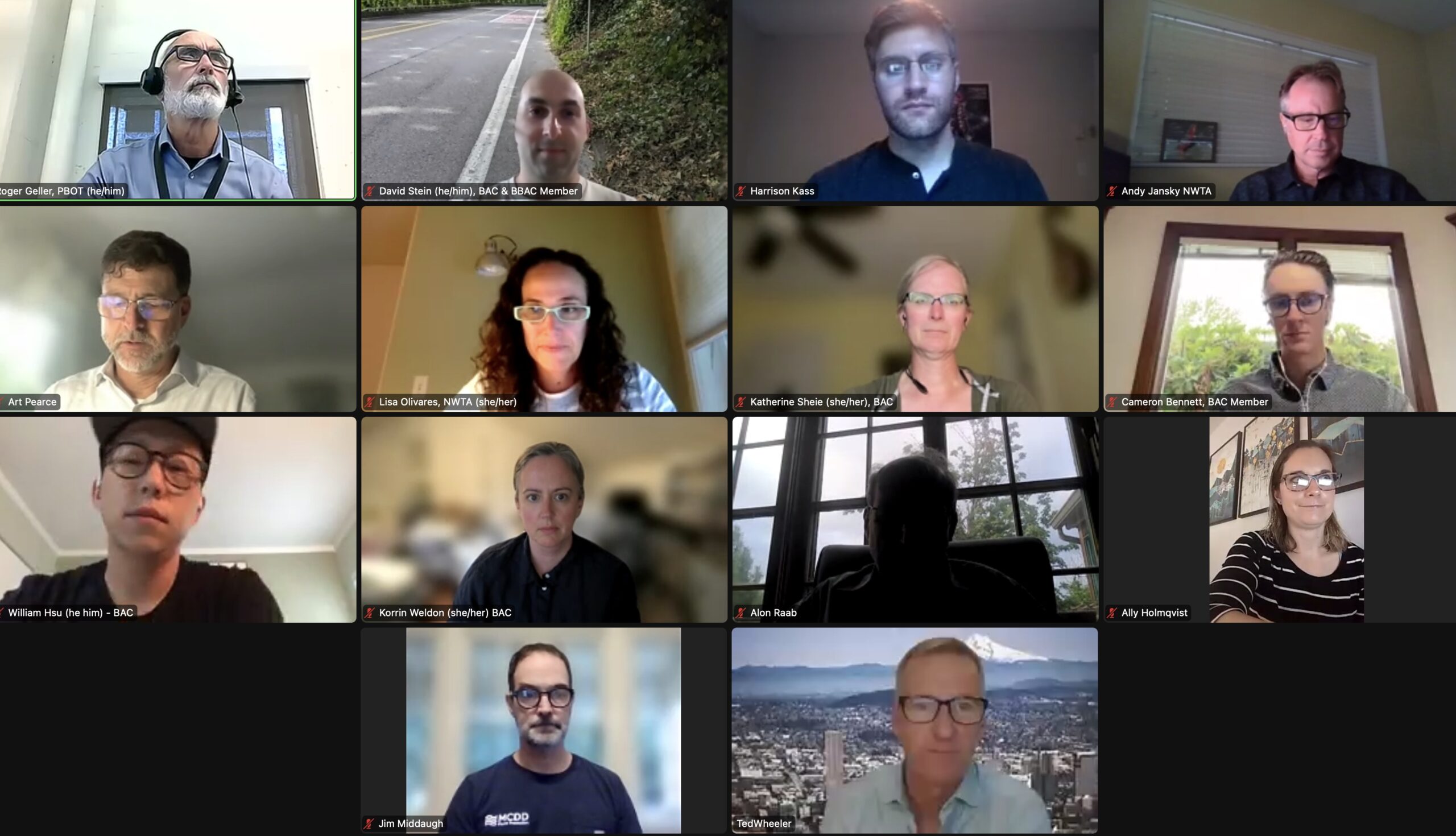
Portland Mayor Ted Wheeler spent about an hour Tuesday night at the monthly meeting of the city’s Bicycle Advisory Committee. For someone who’s political brand is almost never associated with cycling (or transportation more broadly, for that matter), he came off as by far the most bike-centric person on the current Portland city council.
Can he be a useful ally to bike advocates in his final 15 months in office? Comments he made Tuesday night make that seem like a very good possibility.
In Portland’s form of government, where a specific member of council is assigned to the transportation bureau, it might seem odd for the Mayor — who does not have it in his portfolio — to pop into the BAC meeting. Why was he there? Because he was making good on a promise after being invited to attend back in May by a former chair of the committee, David Stein.
“Separated and protected bike lanes, from my perspective, are the gold standard. We know that in cities, when they invest in those, ridership increases.”
– Ted Wheeler, Portland mayor
Advertisement
Bicycle Advisory Committee meeting Tuesday. Wheeler is on lower right.
Stein was at last night’s meeting and was one of several people to ask Mayor Wheeler questions. What we heard during the conversation was someone who clearly understands the value and necessity of making bicycling better in Portland, and someone whose perspective has been shaped by first hand experience. Taken altogether, he’s the strongest cycling spokesperson on council by a long shot.
“I support separated bike lanes. And I know they work. There’s no question in my mind,” Wheeler said at one point, in comments spurred by recent testimony from bike advocates at city council pushing for more protected bike lanes. And then Wheeler continued, sharing a story of a bike ride he took to the coast:
“I’ll give you an example: I ride my bike on Highway 30 and I’ve ridden it all the way to the coast and then south and it’s nothing short of terrifying. You can’t see behind you because you don’t know when somebody’s going to reach for their cell phone or do something else as they’re speeding past you at 65 miles an hour… So, separated and protected bike lanes, from my perspective, are the gold standard. We know that in cities, when they invest in those, ridership increases.”
Then Wheeler shared about a ride he did using the bike share system in Vancouver, British Columbia last month. He rode on Vancouver’s carfree, waterfront path around False Creek and Granville Island. “It was very easy, very convenient, and very safe. I was just so impressed with the separated bike lanes and plenty of secure parking areas. What was most notable about it was how heavily used it was by people from all walks of life.”
Advertisement
“If we are serious about getting people out of their automobiles and onto bicycles, it just has to be a good value proposition.”
“If we are serious about getting people out of their automobiles and onto bicycles,” he continued, sounding more like a bike advocate than an elected official. “It has to be worthwhile for people… You’re not going to be able to browbeat people, so it just has to be a good value proposition.”
On the note of enticing people onto bikes, Wheeler said he also experienced a carfree zone near a beach and popular park in Vancouver where there was a free bike valet and food carts. “So it’s not just a means of transportation, it’s actually an economic development tool, and it’s also a community engagement and gathering tool, and I was really impressed with that. I’d like us to do more of that.”
“So can I get your promise that you’ll propose something like that to the council?” one of the BAC members asked.
“I will defer to the commissioner who’s in charge of PBOT [Portland Bureau of Transportation] and if he proposes it I’ll work with him on it,” Wheeler replied, apologizing for Portland’s current form of government (which will change for good next year so transportation will be the purview of the entire council, not just one commissioner).
While Wheeler can’t spearhead cycling initiatives, he can bring attention to it in other ways (remember former Mayor Tom Potter rode his bike in Critical Mass) and the mayor has broad influence on the city budget. And with PBOT’s budget problems being very high-profile this year, there’s no doubt Wheeler can be a helpful ally to PBOT Commissioner Mingus Mapps. In the coming weeks, Mapps will lay out his ideas for how to stabilize PBOT’s finances as they stare down harrowing cuts to their (already slashed) discretionary budget. One big part of the negotiations will be PBOT asking for a larger piece of the city’s General Fund — a highly competitive pot of money which currently accounts for less than 2% of PBOT’s entire budget, an absurdly low amount given the importance of providing mobility services to the entire city.
Advertisement
It appears Wheeler might already have Mapps’ back when that request comes. At Tuesday night’s BAC meeting, Wheeler said, “We need to figure out what the new funding mechanism is for PBOT… We’re working on a couple of strategies right now that I hope to highlight during this upcoming budget process on at least a temporary boost to PBOT so they can continue the work they do now.”
And then came the hint that Wheeler might support Mapps’ General Fund ask: “I think we need to take a good hard look at the resources we already have in our city budget, and in some of our partnership budgets, and ask, ‘Is there more we can be doing collaboratively to keep PBOT making the kinds of investments that they’re making?'”
Bike advocates had a lot to feel good about after the BAC meeting. But while it’s clear Wheeler supports their needs and issues, he also made it clear cycling will not be one of his top priorities in his final 15 months in office.
“There are 150 issues that people would like me to address on any given day and I’m going to be focused on homelessness, public safety, and the economic recovery of our city,” Wheeler said, “The good news is I have four other extremely qualified commissioners who can work with me to help lead in these other areas.”
Now it’s up to advocates to do everything they can to lobby Wheeler while he’s still around. The fact that he won’t run for re-election makes it more likely he’ll stick his neck out for cycling.
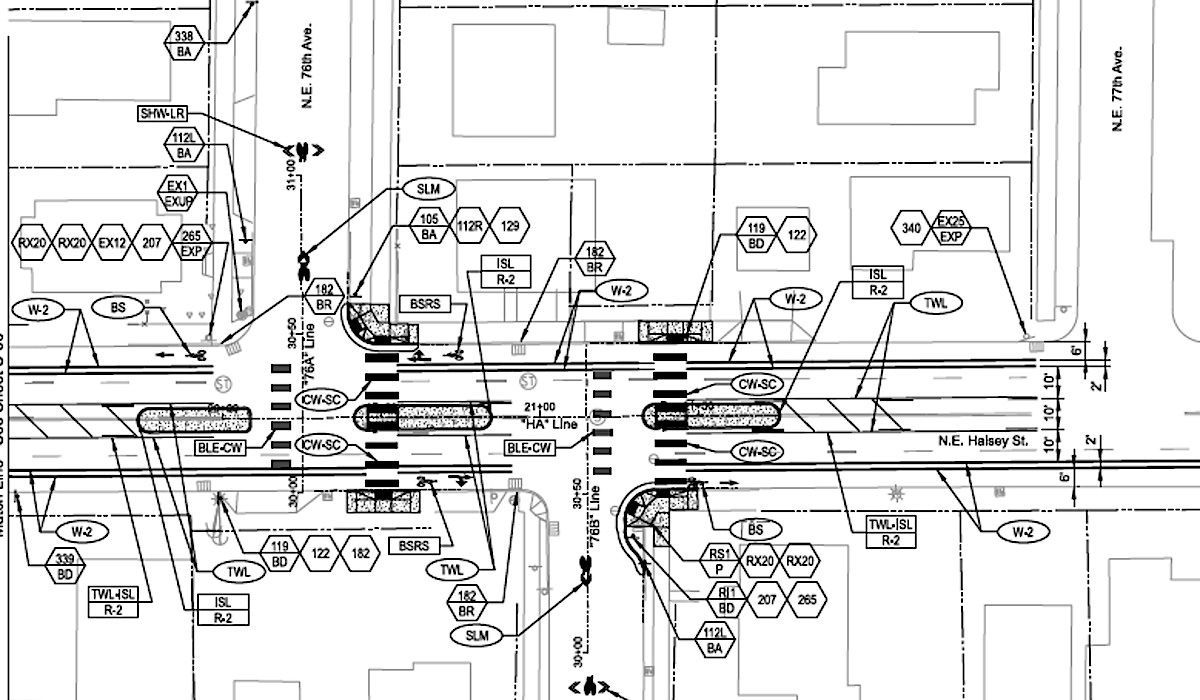
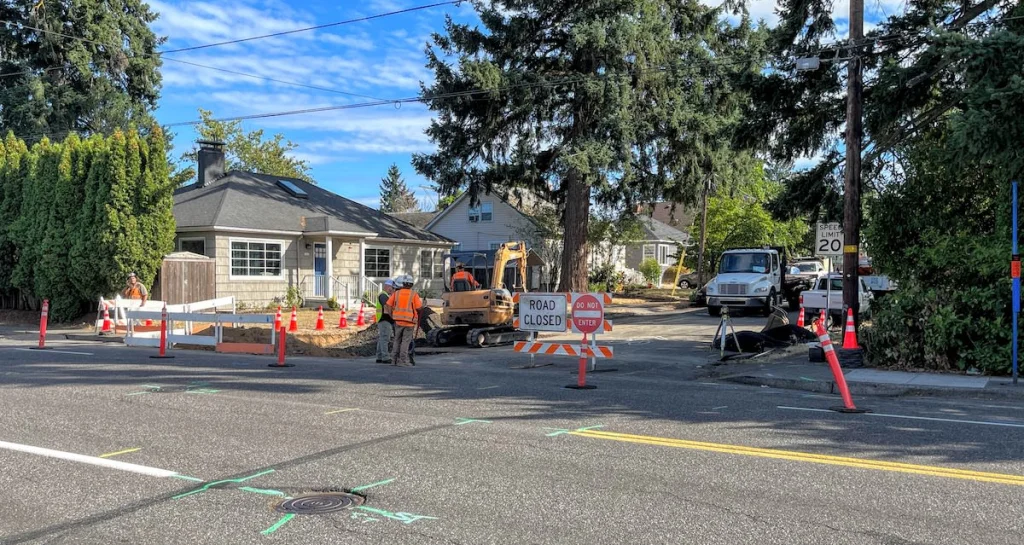
Last week, road crews began work on NE Halsey Street at 76th Avenue (map), reducing driving lanes to make room for two pedestrian refuge islands and buffered bike lanes. This intersection improvement work supports the 70s Neighborhood Greenway project, providing a safe north-south connector for people walking or rolling to their destination. NE Halsey’s lane reconfiguration will extend several blocks east and west from this crossing, creating one travel lane in each direction with a center turn lane.
NE Halsey is one of the city-identified high crash corridors, making an enhanced intersection necessary at this new greenway crossing. NE 76th Avenue shifts 90 feet off-center at NE Halsey Street, creating two “T” intersections. Consequentially, engineers needed to construct extra in-road elements to protect multimodal cross traffic while allowing vehicle left turns. The new center turn lanes on NE Halsey will have two pedestrian refuge islands aligned with the east crossing of NE 76th Avenue and a short raised median to the west protecting a green striped bike crossing. Crews will reconstruct two corners featuring Americans with Disabilities Act (ADA) compliant ramps that align with mid-block curb ramps across NE Halsey Street. The SE corner of NE 76th Avenue and Halsey Street will also feature a westward curb extension, shortening the crossing distance and placing waiting pedestrians at the outer edge of the parking lane for greater visibility.
See PBOT engineering plans below:
Advertisement
PBOT plansCrews at work. (Photo: Jacob Loeb/Montavilla News)
The NE Halsey Street lane reconfiguration will extend from NE 70th to NE 80th Avenues and support other Portland Bureau of Transportation (PBOT) safety improvements planned for this busy street. Reducing the four vehicle travel lanes to two adds road width for painted bike lanes to protect cyclists and a center turn lane for added protection. “This three-lane configuration is a proven safety improvement that national studies and local experience show results in safer travel for everyone,” explained PBOT representative Dylan Rivera. As they approach this ten-block segment of NE Halsey Street, signage along the corridor will notify people that a traffic pattern change is coming up.
PBOT expects the project on NE Halsey Street to conclude later this year, with striping and signage added by the end of December 2023. During the next few months, crews will need to close some streets and crossings as well as reduce travel lanes. Cyclists and pedestrians should use caution around NE 76th Avenue and potentially find alternate routes. TriMet has temporarily closed bus stops serving the 77 line (Stop IDs 2453 & 2452) at NE 76th Avenue in both directions. Riders who use those boarding locations should plan for additional travel time to the next stop through September 17th for eastbound service and September 27th for westbound service.
The collision that sent a person on a bike flying into the air continues to reverberate through Portland transportation advocacy circles. While the video and details of the crash were removed from BikePortland by request of the victim (I have reached out to the victim’s friend to ask if they’d reconsider and have yet to hear back), many who saw it feel compelled to act.
Yesterday I reported on a new, anonymous group of tactical urbanists who placed unsanctioned concrete blocks at the juncture of that collision where Northeast 20th and 21st merge. Now another one of Portland’s independent activists has a plan for changes in this area.
Remember Xavier Stickler? He’s the young Portland State University architecture and urban planning student who had the vision to create a plaza on SW Oak between Burnside and 10th. He also showed amazing dedication and persistence to actually make the dream a reality and now that small block across from Powells Books — that used to be a slip lane for car users — is a popular place to sit and eat and enjoy downtown vibes.
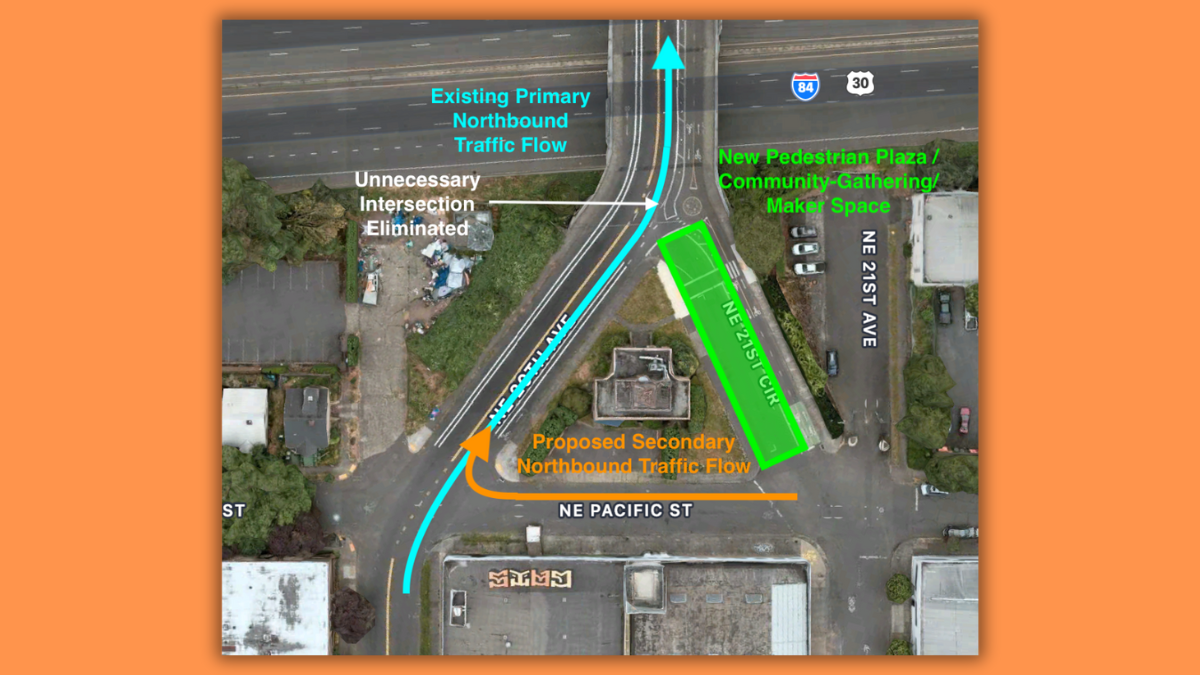
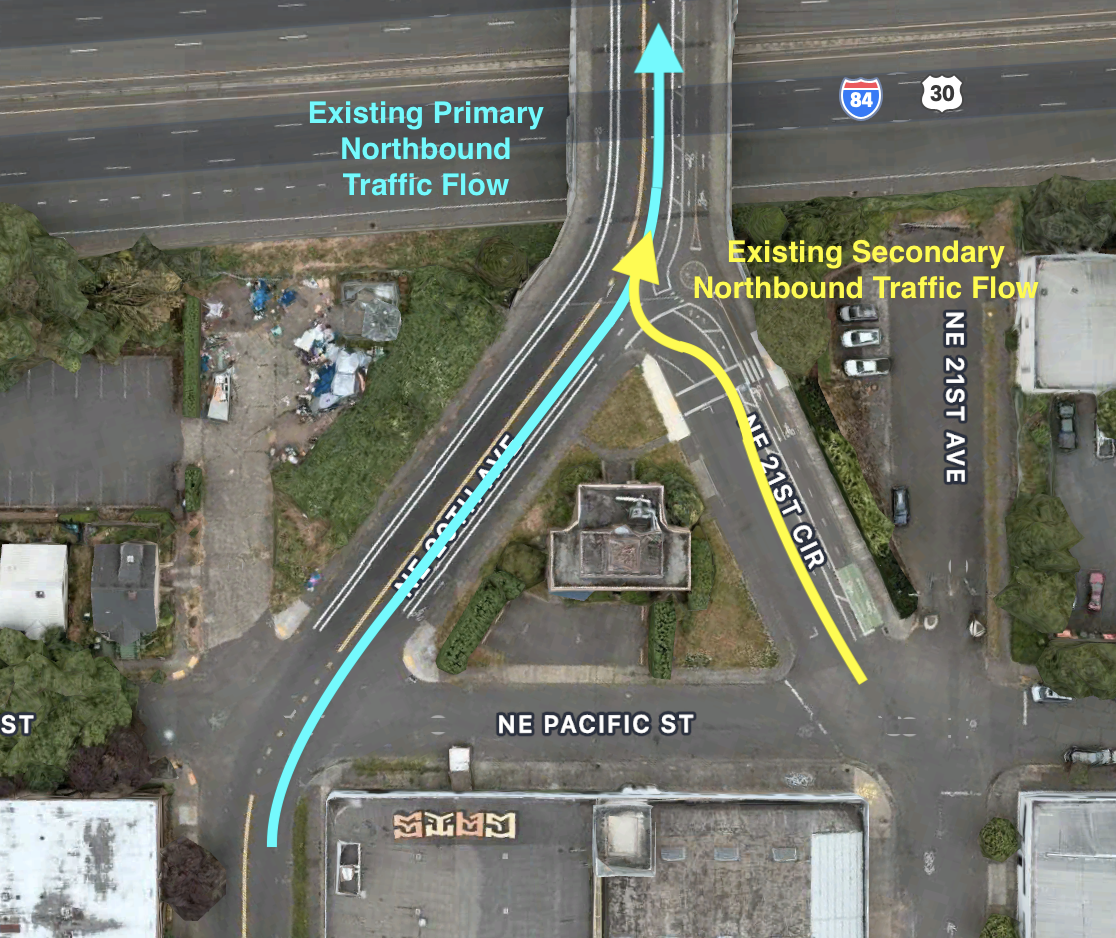
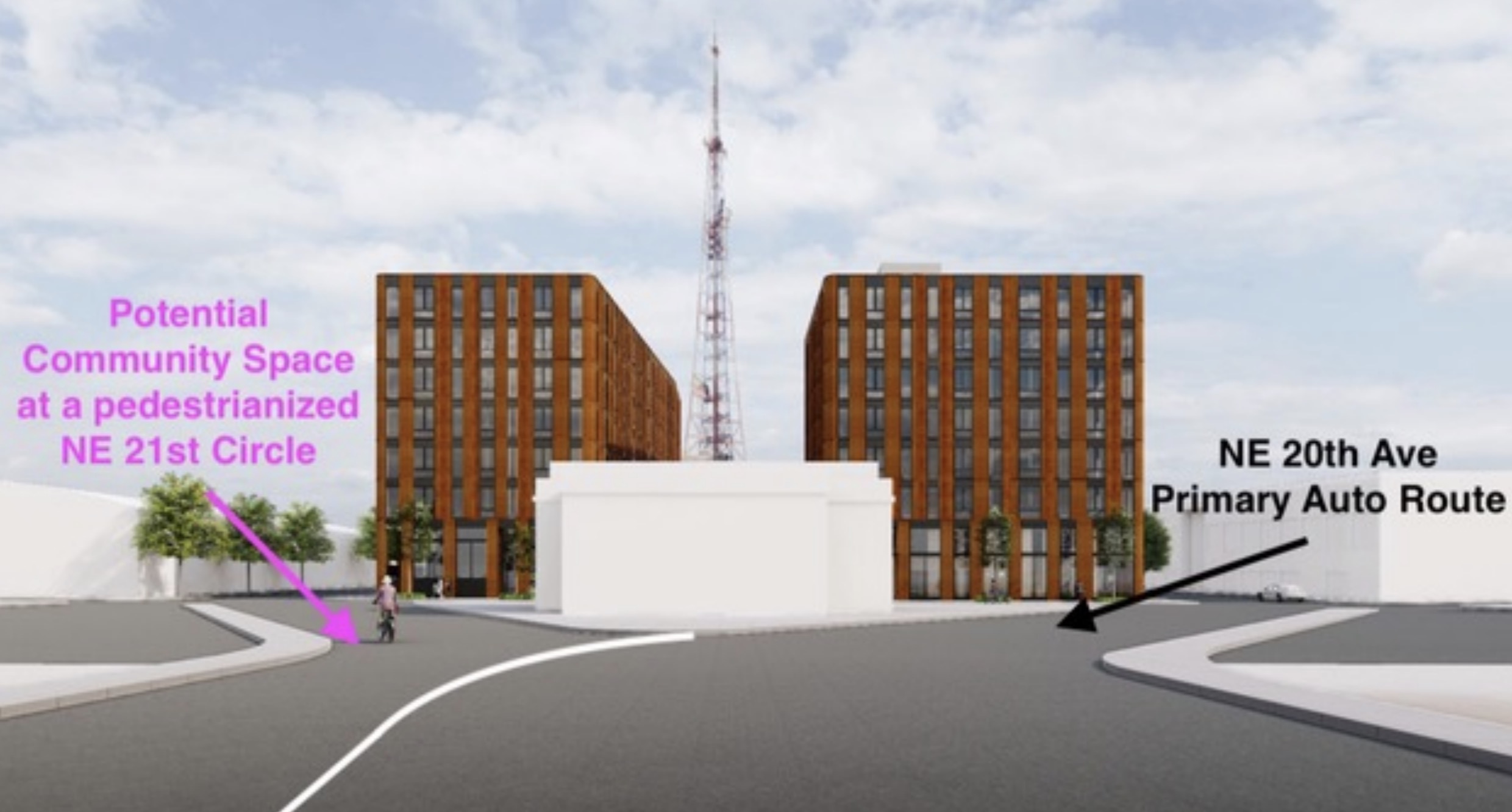
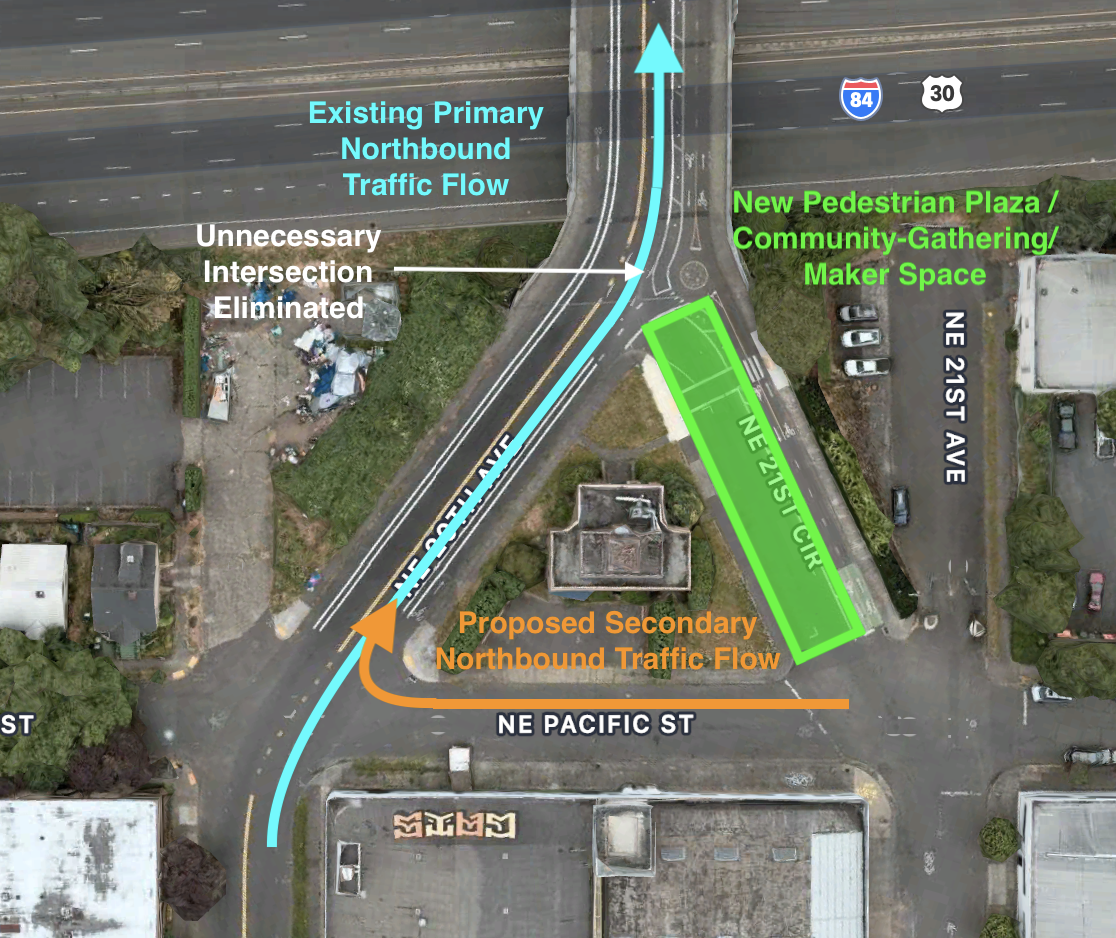
When Stickler saw that bike rider get hit last week, he saw another opportunity to create a more people-centered intersection. Stickler’s proposal is to make the short block of NE 21st Circle between Pacific Street and 20th/21st Avenue carfree and turn it into a public plaza when the block gets redeveloped.
Advertisement
Existing conditions.Proposal
“I cannot say this would’ve prevented that wreck, but the roadway simply shouldn’t be there. It’s a bad intersection.” Stickler wrote to BikePortland in an email with a one-pager of his proposal.
His idea is simple: Prohibit car users from driving on NE 21st Circle and turn it into a pedestrian-only plaza.
Here’s more from the one-pager Stickler has sent around to PBOT staff, advocacy group BikeLoud PDX, and the Kerns Neighborhood Association:
“Following a viral wreck between a car that careened into the cycle track of the NE 21st Viaduct above I-84 and a person riding a bike, community members have found themselves questioning how to prevent a similar tragedy. One aspect of the solution should include the permanent pedestrianization of NE 21st Circle. It is 20th Ave that functions as the extension of the 21st viaduct. NE 21st Circle instead carries a bi-directional cycle track and only 1 lane of northbound vehicle traffic, creating an unnecessary intersection in front of the historic Fire Alarm Telegraph building. The vestigial roadway remains open to traffic despite not serving a clear purpose in the overall traffic flow of the area. Vehicles attempting to travel north could just as easily turn west onto NE Pacific and then north onto 20th with only a few seconds added to their trip. This intersection adds extraneous space dedicated to vehicles and a confusing ancillary intersection, compromising the safety of all users and mode shares. NE 21st Circle should be outright removed from the automotive infrastructure grid.”
Instead of an unneeded lane for drivers, Sticker sees a plaza that could have food carts, host community gatherings, display public art, and more. It makes even more sense, he says, given the imminent redevelopment of the adjacent Sunshine Dairy block that will soon be redeveloped with 200+ units of housing.
So far he hasn’t heard anything official from PBOT or anyone else about the proposal. We’ll keep you posted.
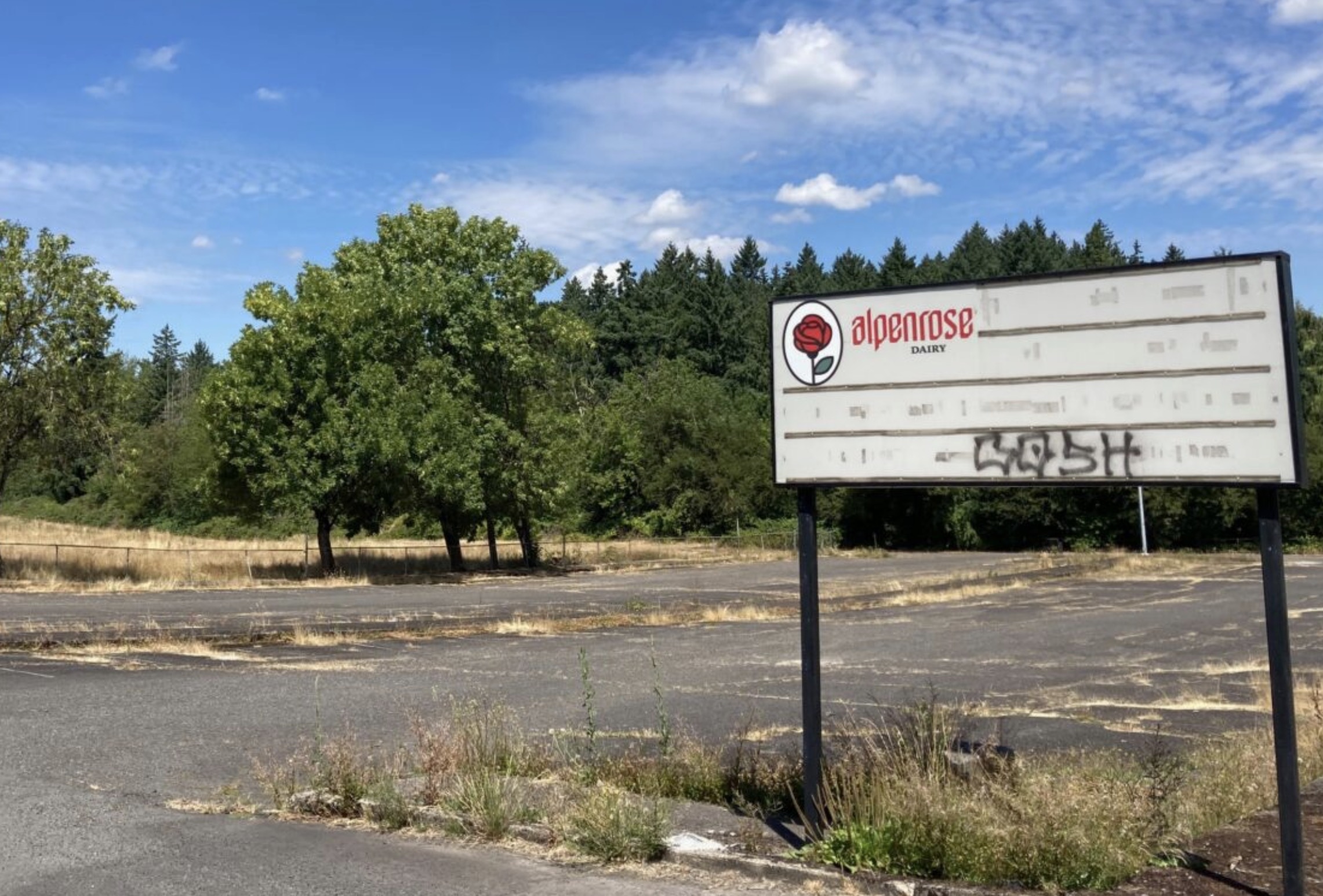
The Alpenrose Dairy property looking west from SW Shattuck Road. (Photo: Lisa Caballero/BikePortland)
Zoom grid from Monday’s meeting of the Hayhurst Neighborhood Association.
The Hayhurst Neighborhood Association (HNA) hosted Portland’s Planning & Development Manager, Kurt Kruger, for an information session Monday night about the possible residential development of the 51-acre Alpenrose Dairy site in SW Portland. The hybrid zoom/in-person meeting was attended by about 20 people who were mainly concerned about the large development’s effect on area transportation.
As we’ve been reporting, the upcoming development could spur significant improvements to nearby streets, or the additional traffic could just make things worse.
Kruger began by pointing out that Portland has not had a development of this size in “easily over a decade” and this is the first big development to come forward since the “Middle Housing” zoning changes which allow multiple units on a parcel.
He kept his presentation informal, and welcomed questions throughout. This worked well because the attendees were quite knowledgeable and the meeting moved along at a high level of understanding. They brought up all the issues associated with a development this size and asked about traffic impacts on all the site’s frontages, as well as intersections in the larger area.
I’ll focus on SW Shattuck Road, partly to whittle down the complexity of an enormous development, but also because Shattuck illustrates one of the core difficulties with building active transportation facilities in southwest Portland.
Advertisement
“What would have been a couple hundred-unit subdivision is now a couple hundred units with a big asterisk attached to it. Is this two hundred homes, or two hundred five-plexes? How do we plan for that? So this is a big test for the city.”
– Kurt Kruger, City of Portland Planning & Development Manager
Shattuck improvements?
Early in the conversation, questioners homed in on improvements to Shattuck Rd, which is one of the streets the dairy fronts, and which, by code, the developer is required to bring up to city standards. Here’s one exchange:
Question: What does “fixing Shattuck” look like?
Kruger: Almost every street is planned to have a typical sidewalk, planting strip, street trees, street lights, fire hydrants. In addition some streets are planned to have separated or widened bike facilities. Shattuck is one of those roadways where we would want to have a bike facility.
In a perfect world, we would be widening Shattuck on their side of the road, putting in a bike facility, put in a curb, collect the stormwater, and put in a planting strip, street trees, street lighting. And then a separated sidewalk. That’s the standard.
There is a big “but.” Southwest is different. And it is not always easy to get the standard City of Portland—what works on the eastside—here on the westside. And so this is often where we get into an interim conversation with applicants to right-size the improvement to fit the environmental conditions that we have here.
So if we’re working around big trees, steep hillsides, retaining walls—it’s possible we could be looking at a mixed-use path. So a widened, shared bike/pedestrian improvement on one side of Shattuck, versus that standard curb-separated sidewalk and bicycle facility.
So I don’t have any answers, but those are the iterations we would go through.
Advertisement
What didn’t get said
Requiring the standard frontage improvements along most of Shattuck is not possible because it lacks a formal stormwater conveyance system. Water from the road eventually makes its way into Fanno Creek. Without a stormwater treatment facility (like the rain gardens off of SW Capitol Hwy) the creek can’t handle the increased stormwater run-off from bike and pedestrian improvements.
What I was listening for, but didn’t hear, was that the Bureau of Environmental Services (BES) would be providing stormwater facilities along Shattuck Rd. It doesn’t appear that will be happening, and without BES stepping in PBOT’s frontage requirements will be limited to what can be done under the existing conditions along the road. This typically means, as Kruger suggested, a widened road or shoulder, usually without a curb, similar to what was built on SW Gibbs Street.
As Kruger later explained, his “interim conversation” is the Public Works Alternative Review, in which permitting bureaus determine what will be required of the developer. The public will want to keep an eye on what the PWAR requires, will a multi-use path be protected, or somehow separated from the road?
Advertisement
The problem
Portland builds its sidewalks and bike lanes piecemeal, one frontage at a time. In areas of town which are already built out, and which have already resolved their stormwater issues, this doesn’t matter so much.
The problem for the southwest is that you can’t build an entire stormwater system property by property—pipes need to connect. Lacking formal stormwater conveyance, the region densifies without making progress on its sidewalk and bike networks, and this perpetuates the area’s dependence on cars. This poses a particular hazard for residents in subsidized housing for whom owning a car may be a financial burden.
In the over half a century since the City of Portland annexed southwest, it has never come to terms with the area’s inadequate infrastructure. And even today the city doesn’t seem to have any intention of resolving the issue. So southwest muddles along with a drains-to-streams stormwater system appropriate for an early-20th century agrarian economy, even as the city tries to solve a 21st-century housing crisis.
A possible solution
Kruger, perhaps because of his role, spent the bulk of the meeting talking about the developer, and what the city would possibly require of them. Toward the end of the evening, however, one questioner tried to shift the focus, “What would the city feel its responsibility is, separate from the applicant?” Kruger might not have understood the point of that question, as he pivoted back to discussing the “safety for all modes” language in code, and what the city could require of the developer. His quick shift back to the applicant’s obligations is in itself telling.
“Would the city support going to our congressional delegation to elevate this project, because that is what it is going to take. What is your political sense of that?” asked another attendee.
“I am reluctant to say too much right now because we are truly trying to come to grips with PBOT’s fiscal cliff,” Kruger replied. He also mentioned that the southwest does not compete well with other areas of the city for capital projects because the stormwater issues and terrain make building in the southwest expensive compared to flatter neighborhoods on the eastside. The city can get more bang for its buck in other parts of town.
He concluded, “I can’t touch the federal delegation and congressional dollars, it’s just not my bailiwick, and I would be really over my skiis inappropriately if I were to take a guess at that.”
As someone working within the bureaucracy, that is probably the prudent answer. But our city government is on the cusp of becoming more representative, and $100 to 200 million in state or federal money could provide the stormwater facilities needed to put in place the spine of pedestrian and bike networks in southwest.
Portland’s new permitting group
Two weeks ago, the city council unanimously approved consolidating the permitting process into one entity. This is a big deal, and is the first action to come out of last winter’s permitting survey of development stakeholders (the one that reported bike parking being seen as burdensome). The new entity will have a director who will have authority to “resolve conflicts, make decisions regarding development review and permitting services to the community, and personnel decisions.”
Last January, Kurt Kruger began working in a newly created position overseeing staff from four of the seven city permitting bureaus—Water, Urban Forestry, Transportation and Environmental Services. Prior to that, he was the manager of PBOT’s Development Review section. He seems well-positioned to ascend into the directorship of the consolidated permitting group that city council just created.
(Photos on left and middle from social media posts. Mapps photo on right by Jonathan Maus/BikePortland)
A majority of Portland city council attended Sunday Parkways last weekend. That might not seem like a big deal, but when you realize that the Parkways program is on the budget chopping block, it takes on a bit more significance.
Commissioners Mingus Mapps, Rene Gonzalez, and Mayor Ted Wheeler all ventured over to the hills of southwest Portland to take part in the last Parkways of the year. Mapps was there as part of his role as commissioner-in-charge of the Portland Bureau of Transportation (PBOT), but the other two seemed to show up simply because it was a nice excuse to enjoy a perfect Portland day with their family. Yes, both Gonzalez and Wheeler rode to the event with their kids.
Gonzalez posted a video riding (15 miles there and back) to the event with his young sons and then shared a photo of he and PBOT Director Millicent Williams at the event. And Wheeler posted a photo on social media of his stop at a sno-cone truck, then said at a meeting last night he did the event with his daughter.
Advertisement
For Sunday Parkways boosters, having these elected officials show up could not have come at a better time. Despite being almost universally beloved citywide, the Parkways program has had to fight for its funding several times since it began in 2008. Believe it or not the City of Portland had to crowdfund to keep the program going in 2009, 2010, and in 2012. And on several occasions, the program has been passed over for budget help because it was not seen as a “core service.”
In 2010, the City Budget Office recommended against funding for Sunday Parkways. And in 2012, former Commissioner Dan Saltzman opposed a contract between PBOT and the company that runs the event and the program was ultimately scaled back as a result.
With this year’s budget negotiations set to heat up amid the most daunting financial reality the agency has ever faced, it’s conventional wisdom that Sunday Parkways could be cut as PBOT addresses a mandate to slash about 30% — or $32 million — from their discretionary budget. A PBOT budget survey released last month included an ominous question that asked people to rank the importance of “community events like Sunday Parkways.”
While Parkways has several major sponsors, my best guess is that the City of Portland is on the hook for about $80-$100,000 per event. While it traditionally had five events per year, PBOT hosted just three events this year.
When Gonzalez, Wheeler, and Mapps sit down in City Council chambers for a PBOT budget work session on September 26th, they’ll be eager to share how they rode in Sunday Parkways. Whether that translates into an eagerness to fund it, remains to be seen.
These are paid listings. And they work! We’ve helped hundreds of people find great jobs and great staff members. If you’d like to post a job on the Portland region’s most popular bike and transportation news platform, you can purchase a listing online for just $100. Learn more at our Job Listings page.
ORGANIZATIONAL OVERVIEW
For nearly 30 years, we have been a nonprofit organization on a mission to broaden access to bicycling and its benefits. Our vision is to continue building a vibrant community where people of all backgrounds use bicycles to stay healthy and connected. We believe that all Portlanders should have the opportunity to experience the joy, freedom and health benefits of bicycling. In addition to delivering dynamic programs that benefit underserved communities, we operate a retail shop, offer classes to our community, and we operate a membership DIY workspace where members can work on their bikes.
Here at the CCC we value and support one another through the work we do and are committed to working collaboratively to meet our goals. We are proud that people of color, women, neuro-divergent, gender non-conforming and LGBTQIA+ folks choose to work at our organization. Having a diverse team is a priority for us, and we encourage people from varied and diverse backgrounds to join our lively, talented team.
JOB SUMMARY
The Education Manager orchestrates the successful delivery of our bike safety education programming through offsite summer Bike Camps, after-school Bike Clubs, and various other projects to improve safe access to schools through active transportation. The Education Manager will: Organize and revise curriculum; recruit, hire, support and manage instructor staff; oversee budgets and track program outcomes data for their programs; assist with equipment procurement; and generally ensure that youth programs are being effectively delivered. Successful candidates will have classroom or outdoor education teaching experience, staff supervision experience, strong organization skills, have a passion for bicycles, and enjoy working as part of a team.
The Education Manager directly supervises 2-3 instructors who work year-round at an average of 32 hours per week.
ESSENTIAL FUNCTIONS
Please note that the percentage indicators below represent an estimate of how much time each week will be spent fulfilling these functions. In terms of importance, all areas are valued equally.
Hire and Support Staff (40%)
– Work in tandem with the STEM Education Manager to recruit, hire, and manage skilled instructor staff to implement our youth-centered, school-based programs. Each Program Manager is responsible for managing and supporting 1-3 instructional staff at a given time
– Share an equal division of staff supervision duties with Programs Leadership Team
– Conduct regular check-ins and site visits with staff working at elementary and middle school Bike Club, Bike Camp, and Safe Routes to School (SRTS) program sites to ensure they are supported, concerns are addressed, and opportunities for growth are provided
– Lead annual and periodic evaluations for all elementary and middle school Bike Club, Bike Camp, and SRTS program instructors
– Involves occasionally filling in as an instructor as needed
Administration & Other (40%)
– Work in tandem with the STEM Education Manager to lead program administration for school-based Youth Programs including development of staffing schedules, delivery of supplies, and coordination with community partners
– Lead efforts to develop and maintain elementary and middle school program manuals, lesson plans, curricula, and learning materials with a focus on culturally responsive practices, equity, and student-centered learning
– Collaborate with the Shop Leadership Team around supply procurement and transportation logistics to ensure adequate program materials are available and accessible for Youth Program needs at all times
Tracking and Reporting (20%)
– Collect, track and share accurate Bike Club, Bike Camp, and SRTS program outcomes data (participants, demographics, etc.) in a timely manner, in accordance with deadlines.
– Collaborate with the Programs Director and Development team to prepare proposals and reports for government, foundation, and corporate funders
– Work with Programs Director and Finance Director to create an annual budget for elementary and middle school Bike Club, Bike Camp, and SRTS programs
QUALIFICATIONS & CHARACTERISTICS
Required
– 2-3 years of classroom-based or outdoor education instruction experience, including a technical understanding of pedagogy and strong group management skills
– Strong project and time management skills; includes proficiency in Google Suite and Sharepoint
– Experience supervising, training, and supporting staff
– A base-line knowledge and passion for bicycle safety and bicycle commuting
– Professional or lived experience organizing and working with low-income communities of color and/or immigrant/refugee communities
– Ability to maintain composure and effectively collaborate with others during high stress situations
– Capacity to work independently and deliver on objectives with minimal prompting
– A demonstrated commitment to equity and social justice
– Driver’s license required
– Criminal background check required
Preferred
– Experience as a Title I school classroom teacher or administrator
– Experience with creating budgets, tracking spending, and analyzing progress against goals
– Ability to communicate in Spanish
– Experience with grant writing and reporting processes
– Working knowledge of evaluation methods and systems including but not limited to logic models, theories of change, quantitative and qualitative methods, and program assessment
– Proficiency in Canva, Adobe, Lightspeed, Salesforce
REPORTS TO: Programs Director
STATUS: Full-time
UNION/NON UNION: Non-Union
LOCATION: Portland, OR
SALARY: $50,000 – $53,000
BENEFITS: Medical, Dental, Vision, and 401k
Don’t meet every single requirement? Studies have shown that women and people of color are less likely to apply to jobs unless they meet every single qualification. At Community Cycling Center, we value having a team with varied strengths, skill sets, and areas of expertise. We encourage you to apply even if your professional experience doesn’t match every qualification listed above. You may be exactly who we are looking for!
How to Apply
Send your resume and cover letter to jobs@communitycyclingcenter.org with the subject line “Education Manager”. We will ask for two to three references from candidates who make it to the second round of interviews.
We are unable to sponsor or take over sponsorship of an employment Visa at this time.
NON-DISCRIMINATION POLICY
The Community Cycling Center is an equal opportunity employer. We will not and shall not discriminate on the basis of race, religion, sex, age, national origin, gender identity, sexual orientation, citizenship, veteran status, marital status, sensory disabilities, physical disabilities, mental disabilities and/or any other bases protected by state and federal law. We take proactive measures to ensure against discrimination in hiring, compensation, promotions, and termination of staff, selection of volunteers (including board members) and vendors, and provision of services. We are committed to providing an inclusive and welcoming environment for all members of our staff, customers, clients, volunteers (including board members), subcontractors, vendors, and other members of our community.
How to Apply
Send your resume and cover letter to jobs@communitycyclingcenter.org with the subject line “Education Manager”. We will ask for two to three references from candidates who make it to the second round of interviews.
Unprotected bike lanes on N Vancouver Ave. (Photos: Jonathan Maus/BikePortland)
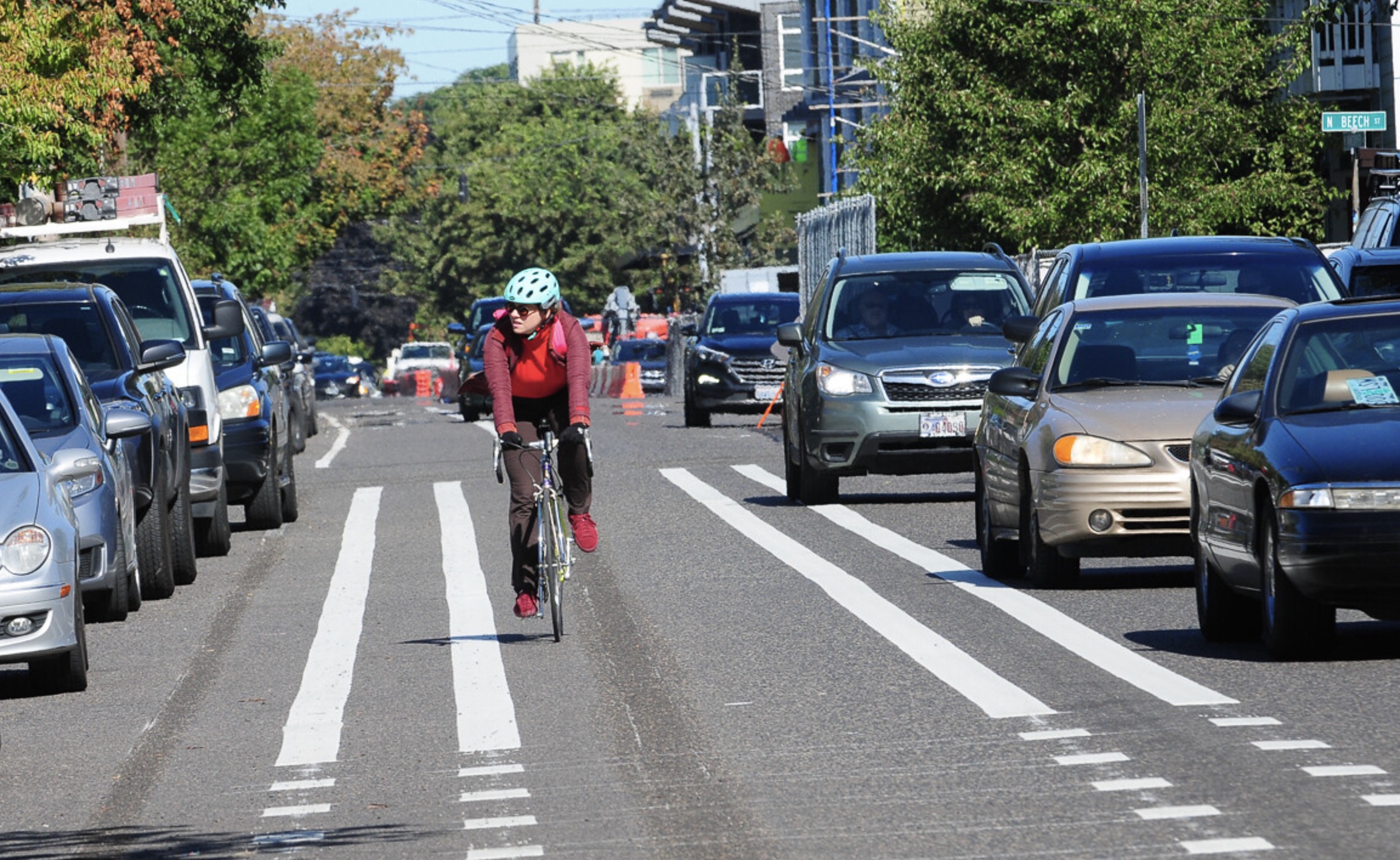
Many Portlanders are frustrated that the vast majority of bike lanes in our city lack a key safety feature: physical protection from drivers and their cars. Video of a recent collision on Northeast 21st Avenue was viewed by tens of thousands of people before it was taken down at the victim’s request. It showed a driver veer into the bike lane and strike a rider, sending them high into the air and flipping their body head-over-heels multiple times before landing on the sidewalk.
Those who saw the video witnessed the horrific consequences of relying only on paint and flexible plastic posts to separate bicycle riders from other road users. And despite potential for more injuries and deaths, the perception of danger that keeps the vast majority of Portlanders from riding bikes will persist until they see more serious separation from drivers.
We’ve made progress in the past 15 years, but not nearly enough to keep up with growing threats. As street culture has eroded to its lowest point ever and more people drive distracted and without respect for others, the need for hardened, physically-protected bike lanes has reached a fever pitch.
Serious pressure is mounting on the Portland Bureau of Transportation (PBOT) to beef up bike lanes just as their budget is in its worst condition ever and its commissioner-in-charge is mounting a campaign for mayor.
Something’s got to give.
Advertisement
Bike lanes on North Rosa Parks, PBOT’s first-ever bike lane protected by a concrete curb.
A brief history of protected bike lanes in Portland
We first discussed protected bike lanes in 2007. The Portland Bureau of Transportation has experimented with them since 2008, and the first major one was built on Southwest Broadway in 2009. Almost from the start of when protected bike lanes became popular in the U.S., Portland had trouble building them. We used to hear that these new, more politically-fraught bike lane designs required strong support from the “bike community.” City Hall staff would hear bike advocates arguing over whether protection was even necessary (due to a “vehicular cycling” philosophy from riders who don’t like being boxed-in) and it gave them cold feet.
But like most new ideas, once Portland built a few of them and the sky didn’t fall, they became more-or-less a standard treatment. In 2011 we shared several projects that illustrated PBOT’s commitment to separating bike users from car users. Back then I hoped/expected that the debate was over and we’d start building every new bike lane with protection from the get-go.
In 2015, former PBOT Director Leah Treat wrote a memo to all staff that stated,
“Make protected bicycle lanes the preferred design on roadways where separation is called for. I am asking for this design standard for retrofits of existing roadways as well as to new construction. I want protected bikeways to be considered on every project where some type of separation is desired.”
We should have been on our way. But despite garnering national headlines for this new “policy” (which was never a policy, just an aspirational memo), it didn’t really turn out like we’d hoped. New projects were built without physical separation and we never saw a large campaign to retrofit old bike lanes with new protection.
Advertisement
Frustrated by the lack of progress, in 2016 BikePortland laid out all the reasons PBOT had for why they couldn’t do more. In a 75-page technical memo, PBOT Bike Planner Roger Geller summarized the top four challenges the city faced in building protected bike lanes: fire truck access issues; stormwater/runoff requirements; auto parking space buffer zone, and truck and bus turning radius requirements. (Recall the flex-post debacle on the NW Lovejoy ramp in 2012 and you’ll begin to see how space constraints influence PBOT’s decisions to keep bike lanes unprotected.)
Another reason was the lack of an official, internal engineering design guidebook for how to build protected bike lanes. PBOT didn’t have one of those until 2018 (and it wasn’t released publicly until 2021).
But the presence of excuses didn’t remove the need for protection.
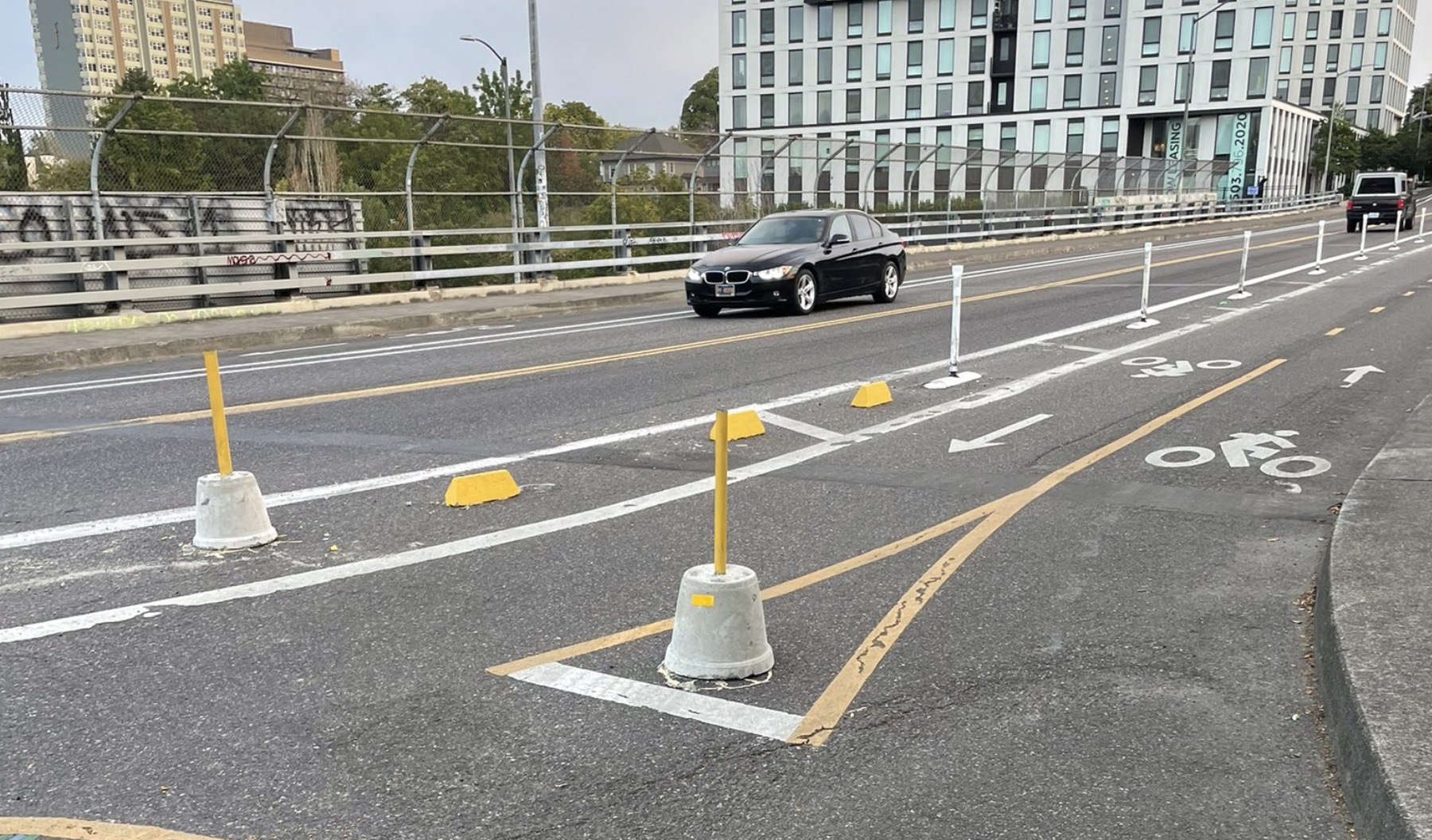
12 years after Portland first started talking seriously about protection, PBOT installed their first concrete curb separated bike lanes (on North Rosa Parks Way in 2019). Now the treatment is all but standard on PBOT projects and they’ve even retrofitted a few existing, paint-only lanes with some level of protection like flex-posts, plastic “tuff-curbs”, large concrete planters, and so on.
But there are still miles of dangerous, unprotected bike lanes in Portland.
Advertisement
Unsanctioned concrete curbs and blocks on NE 21st that were later removed by PBOT. (Photo: Block Ops)
Advocates push for protection
“The bike lanes on this section of NE 21st are separated from head-on traffic only by plastic delineator wands,” the board of nonprofit BikeLoud PDX wrote in a letter to the PBOT director and safety staff this morning. “These plastic flex-posts are everywhere in Portland. Look for them the next time you cross a bridge — battered by drivers, and often missing where they’re most needed.”
BikeLoud is demanding that PBOT install metal bollards or some type of physical protection not just on 21st Ave, but on any street where two-way or contra-flow bike lanes expose cyclists to head-on traffic. They also want PBOT to closely track where plastic flex-posts are frequently replaced and upgrade them with physical barriers. The letter also calls for physical protection to be used on all new bike lane projects.
The 21st Ave collision has also inspired a new group of tactical urbanists dubbed Block Ops PDX who have taken matters into their own hands with a mantra on their social media profile that reads, “Infrastructure by people for people.” On September 6th, they installed several concrete blocks in the buffer of the bike lane where the person was struck. Within hours, the group said on their X account, “another reckless driver struck one of the bollards.”
Advertisement
A few days later, PBOT crews removed the unsanctioned traffic features. “This attempt resulted in concrete blocks in the bike lanes and cost the bureau time and labor to remove and fix, taking away resources from other safety work that was planned this weekend,” PBOT wrote in an X post. They said the concrete blocks created a safety hazard and urged people to not make any further unauthorized changes to streets.
So far it appears Block Ops will continue their work. “We’ll strike again soon,” they posted this morning.
(UPDATE, 2:37 pm: PBOT Public Information Officer Dylan Rivera reached out via email to say, “Our engineers have conducted a site visit on NE 21st and are developing plans, but it’s too early to provide more details than that at this time. Safe to say that yes, this is on our radar and we are looking into it.)
PBOT: “We’d love to be able to provide more protection, but…”
All this pressure on PBOT and its Commissioner Mingus Mapps (who was forced to call a press conference after a record 13 people were kill in traffic crashes in July) comes at a time when the agency is fighting for its financial life. With inflation spiking material and construction prices, dwindling resources from a lack of parking and gas tax revenue, an unexpected demand for homelessness-related expenses, and a city budget that all but ices transportation out of the General Fund, it’s desperate times for PBOT.
PBOT Communications Director Hannah Schafer told BikePortland Monday that, “We’d love to go out and harden a lot of those bikeways where we have only plastic delineators, but we don’t have the money. We are looking at a $32 million cut, which is a third of our discretionary funding.”
Schafer contends that cost is the main issue, and that lack of roadway space is another, yet far less pressing, one. It was easy to hear the emotions and concern about the budget in Schafer’s voice. “There’s a lot of feelings of frustration that we can’t do the work that we know we need and want to do… We don’t like not being able to do what we know we need to do to make our city and our transportation system function.”
“Some of the way we talk about it and the way that BikeLoud talks about it might sound a little different,” Schafer continued. “But I really don’t think we’re that far apart.”
Advertisement
Funding to retrofit existing bike lanes with protection would come from PBOT’s General Transportation Revenue (GTR), a discretionary pot that has allowed their Quick Build program to flourish for years. That program funds small capital projects (usually under $500,000) and many of the bike lane projects you see around your neighborhood. And it’s GTR that’s on the chopping block as PBOT girds for very uncomfortable budget negotiations later this month.
“Until we find a way to right-size, the General Transportation Revenue and find more stable funding, we will never have the money to go out and do that (Quick Build type of) work,” Schafer said. If the funding problems aren’t ironed out, PBOT will only do projects that can be funded through larger, project-specific grants (like ones for the N Willamette, Better Naito, NE 47th, and 122nd Ave projects). “So in parts of town where we’re not doing that big project, they’re going to feel less and less served,” Schafer explained.
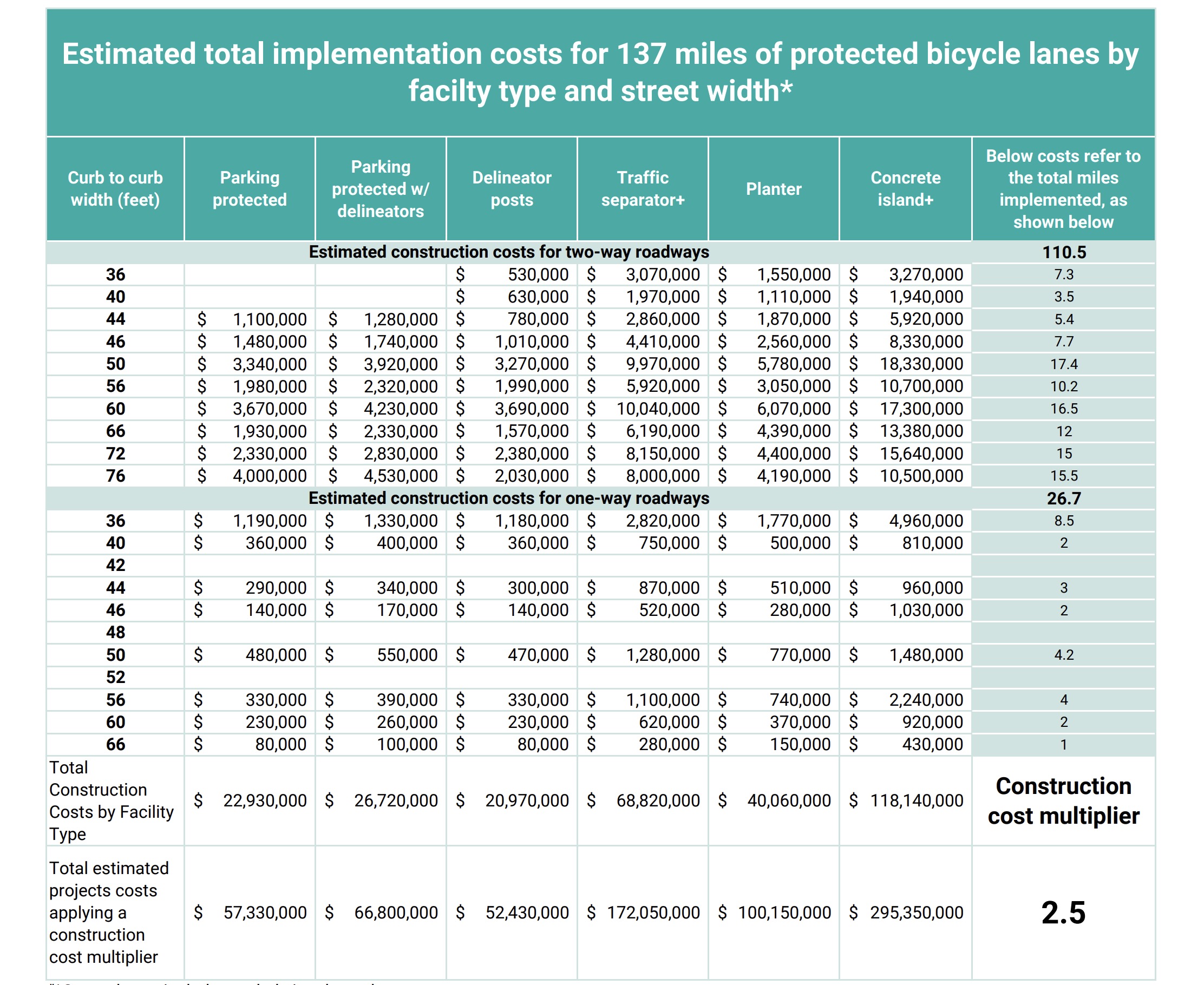
Detail of cost estimates from 2018 Protected Bicycle Lane Planning and Design Guide (PBOT)
Doing more with less
Since PBOT is low on cash, the natural next question is: How much money do they need?
In their 2018 Protected Bicycle Lane Planning and Design Guide (above), PBOT laid out detailed cost estimates for all the different levels of protection — from flex-posts, all the way up to concrete islands. The cost estimates in that guide are woefully outdated due to skyrocketing inflation on construction materials (which PBOT has told me has gone up 50% in less than three years), but the relative cost differences are still valid.
In general, on a per-mile basis, a bike lane with a full concrete median island costs PBOT about six times what it costs for them to use flex-posts. In 2018 dollars their report said it would cost $295 million to build 137 miles of concrete island protected bike lanes (not including traffic signal work) and just $52 million for flex-posts (an online inflation calculator says those figures are $355 million and $62 million in 2023). A traffic separator (some type of shorter, plastic curb) would be about half as expensive as a concrete island and three times the cost of flex-posts.
If PBOT’s budget gets hammered as much as some people fear, we’re not likely to see any retrofitting of existing bike lanes and we’ll only get new protected bike lanes as large, grant-funded projects get built. But if the budget can be stabilized, there’s a chance more protection can climb up the list of funding priorities.
Whatever the future holds, if advocates want more protected bike lanes, they’d be wise to think about two approaches: attach their pitches to PBOT’s Vision Zero Work Plan (which will have an update published later this year), and find opportunities to phase it in.
A good example of the phased-in approach is PBOT’s work on Beaverton-Hillsdale Highway. It started out as a five-lane road with paint-only, five-foot bike lanes. Then in 2013 they re-striped two miles of the road with a buffer at a cost of about $20,000. Five years later they returned again and added a concrete median (see photo). It took 10 years, but it happened.
“When we don’t have funding, we create the space and then upgrade as funding becomes available,” PBOT Public Information Officer Dylan Rivera told me via email this week. That might work well for PBOT, but increasingly, Portlanders might not be willing to wait that long for the basic service of safe travel.
Another advocacy avenue might be PBOT’s Vision Zero Plan. Despite it being battered by critics amid record deaths, the plan remains the city’s guiding document when it comes to safety-related transportation funding. At least that’s how Schafer sees it. “Vision Zero will continue to be the way that we guide our safety improvements. Using a Safe Systems approach with Vision Zero as the goal, will continue to be the way that we direct our work.”
If PBOT doesn’t figure out how to protect more bike lanes soon, the only zero they’ll reach is the number of people willing to risk cycling on Portland streets.
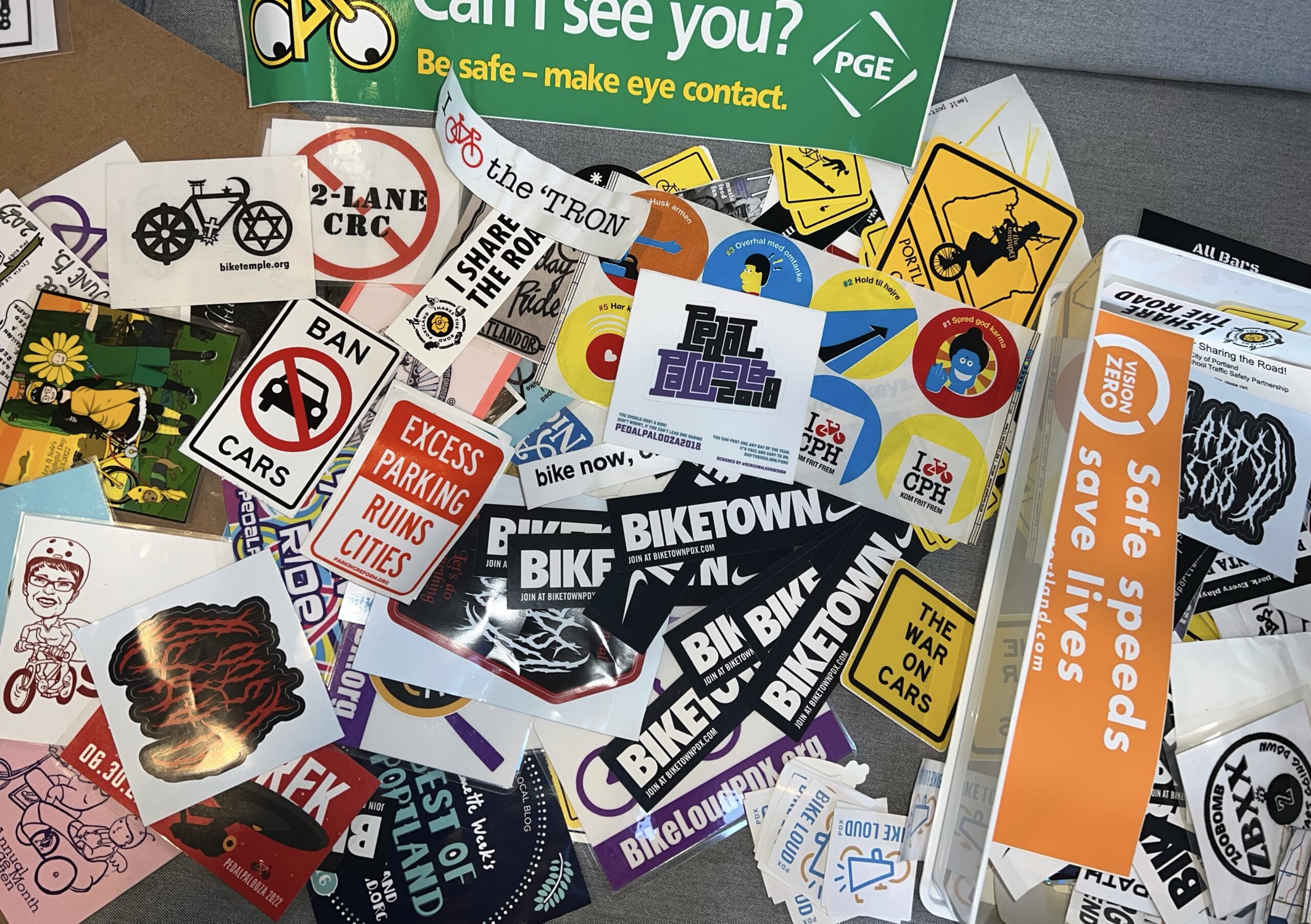
Stickers and spoke cards are bike culture currency, and given Portland’s amazing bike scene, it should come as no surprise that the creative and fun people behind ours are experts at making and distributing them.
Let’s bask in these graphical gifts and spread printed propaganda far and wide: The theme for Bike Happy Hour (tomorrow, Wednesday 9/13) is stickers and spoke cards! Have stickers to share? Bring ’em! New to town and need some stickers? Grab ’em! Want to impress us with your amazing collection of rare items? Show ’em! We’ll swap and talk and share memories of great rides, cool clubs, and fun ideas.
And in keeping with the theme, I’ll have more of those fun panda stickers to mark off your attendance so you can move ever-closer to a free drink at one of our three participating watering holes — Gorges Beer Co, Ankeny Tap & Table, and Crema.
Also this week, a team of urban planners hired by PBOT will be hanging out with us to hear your feedback on the city’s Street Plaza Program. When Gorges Beer Co. owner Travis Preece first approached me about working together, one of his main priorities was to establish the plaza as a popular community gathering space — let’s make sure PBOT knows that we value these carfree blocks!
And don’t forget, all this month we’ll have live music in the Rainbow Road plaza. See my little video recap below of last week’s Happy Hour for a taste of what to expect:
Advertisement
Can’t wait to see everyone, and all your neat stickers and spoke cards!
Bike Happy Hour #25 – 9/13 Every Wednesday, All Year Long 3:00 to 6:00 pm at Gorges Beer Co patio (SE Ankeny & 27th) $2 off drinks at Gorges, Ankeny Tap, and Crema (non-alcoholic and coffee too!)
I picked something qqq wrote as “Comment of the Week,” partly because qqq did my job for me with a nice summary of an informed discussion buried in the avalanche of comments to Jonathan’s Division Street median post.
The discussion hangs under Allan’s comment which qqq has nominated as “comment of the week.” I link to the other comments that qqq mentions, but want to add that maxD also had good insights.
This kind of discussion is what keeps BikePortland readers checking the comments. The participating commenters support active transportation, and their decades-long familiarity with PBOT projects combined with current thinking about urban planning give their conversation depth.
… the Division project (and the comments) is generally polarized between people who dislike the median (mostly for being anti-business) and those who support it (mostly for safety).
In comes Allan, who from past comments strongly supports biking and walking, and understands transportation issues. He describes something that’s obvious—once he points it out—that the Division project adds a median similar to what was added to MLK around 1980, yet large sections of the MLK median were removed because it was seen as anti-business. He points out that that makes it more likely the concerns are valid that the Division median is anti-business.
His comment shows a possible way to move the discussion into something more productive than each side digging in.
He’s not saying (as I read it) that the median is certainly bad, he’s saying that the MLK median experience calls it into question. People who oppose the median deserve thoughtful answers of why the median makes sense on Division.
My view after reading his comment is that PBOT missed an opportunity to support Division businesses. But the reason isn’t that it catered too much to biking and walking advocates. It’s that (like Max S said) PBOT focused on making it work for commuters and through traffic at the expense of enhancing it as a community main street. PBOT might have had reasons for that, but (like Foot Patrol said) PBOT needs to be honest about that. That could diffuse the businesses-versus-bikes standoff that’s arisen, and maybe reduce future standoffs.
Finally, Allen knew about the MLK median history by doing tons of historical research (that he’s written about as I recall) to inform his understanding, which I really appreciate.
Thank you again qqq and the other participants of this thoughtful conversation! You can read what qqq wrote under the original post.
Multnomah Village was buzzing! (Photo: Jonathan Maus/BikePortland)
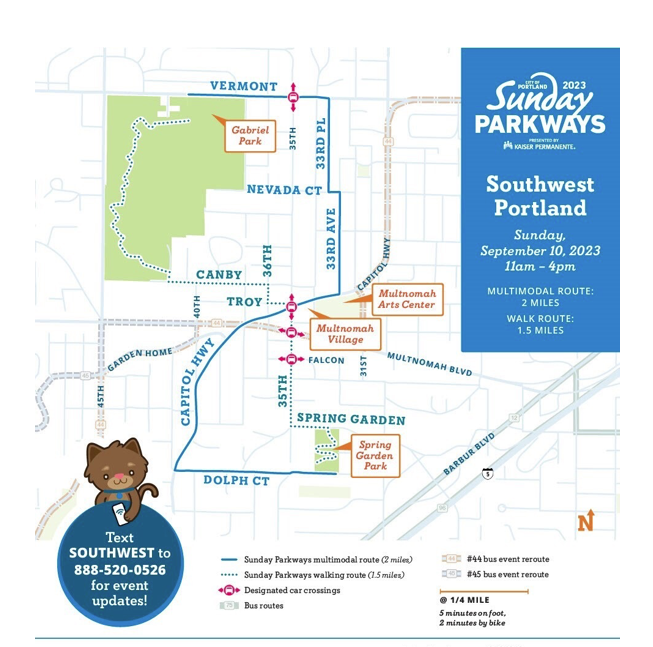
Route map
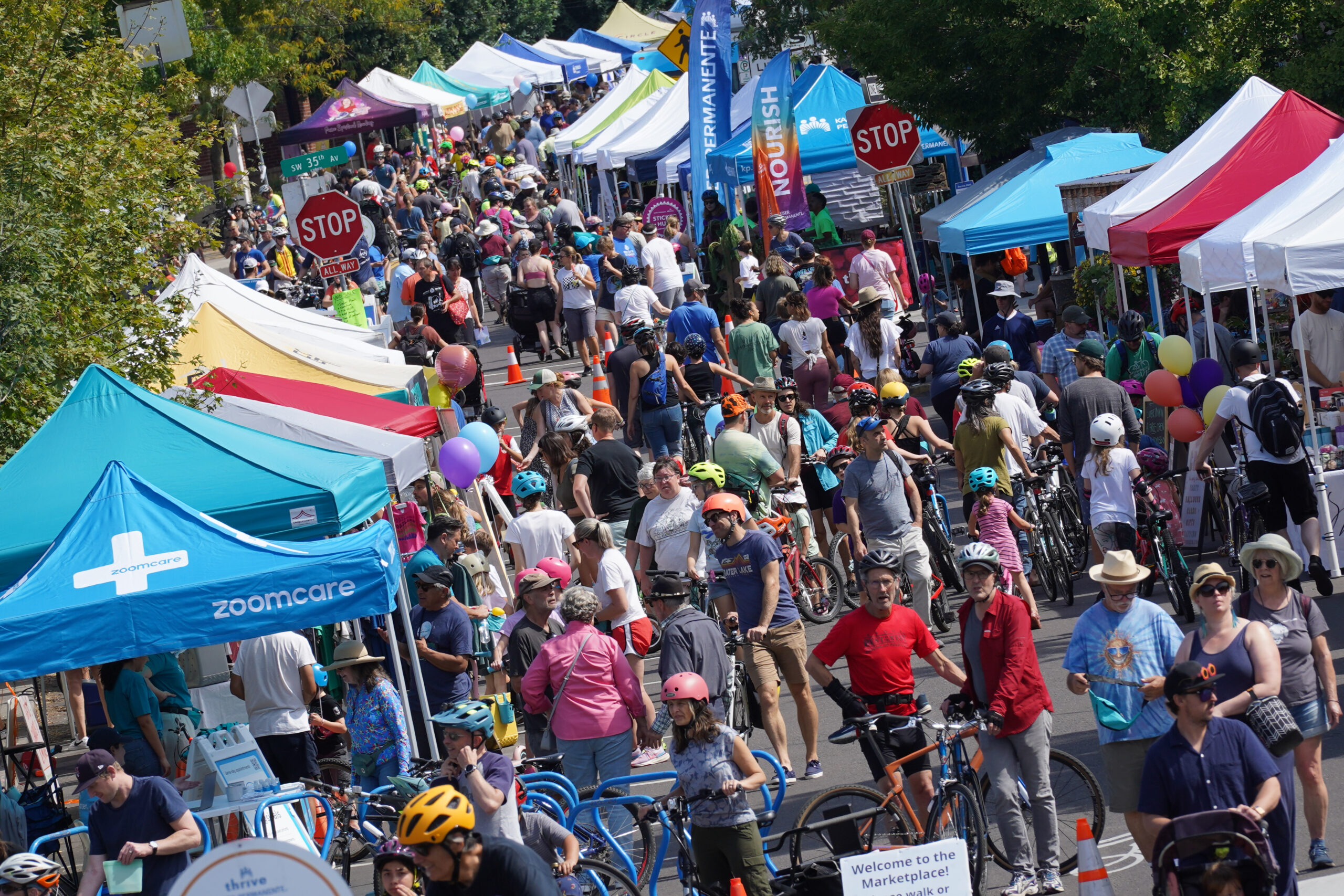
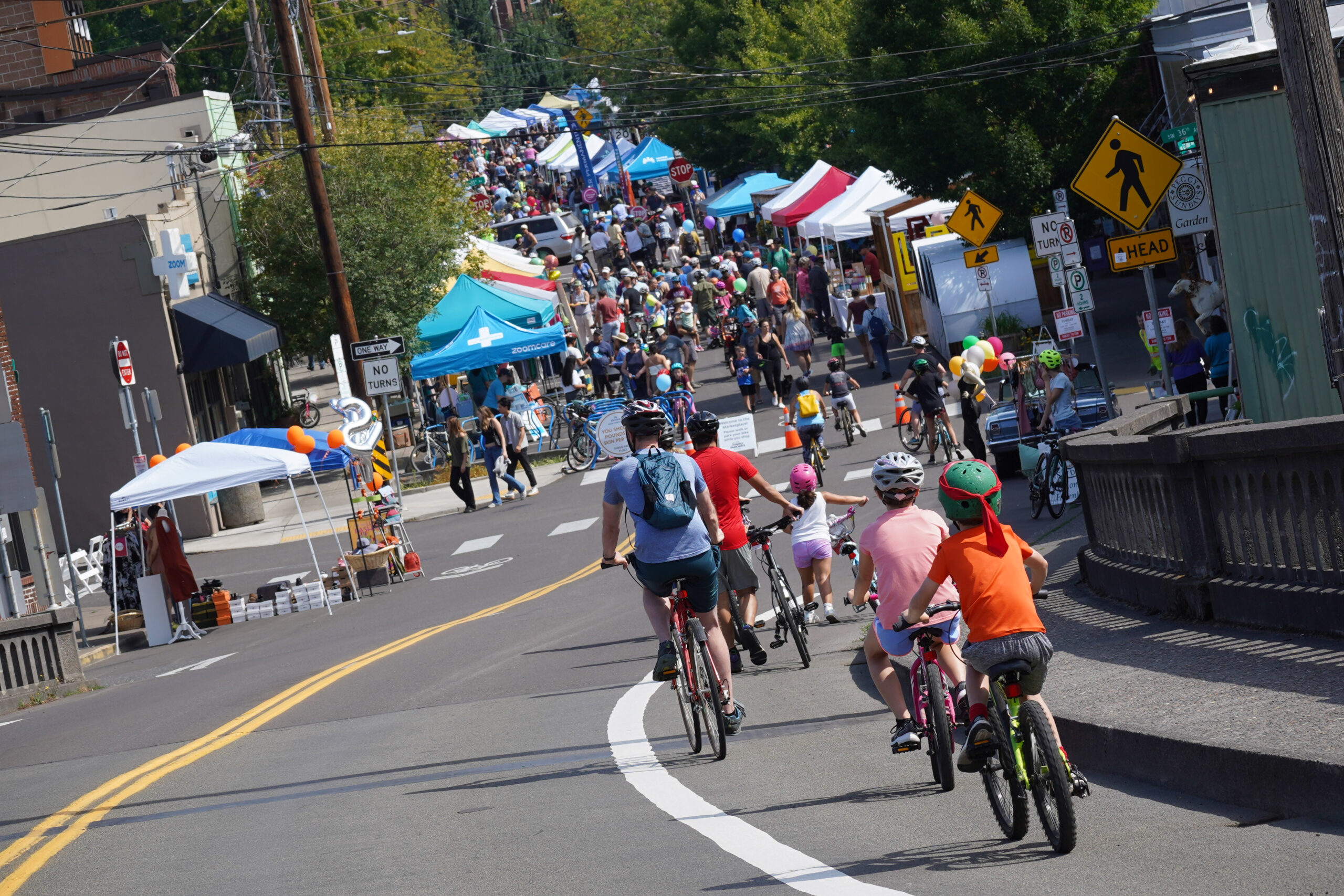
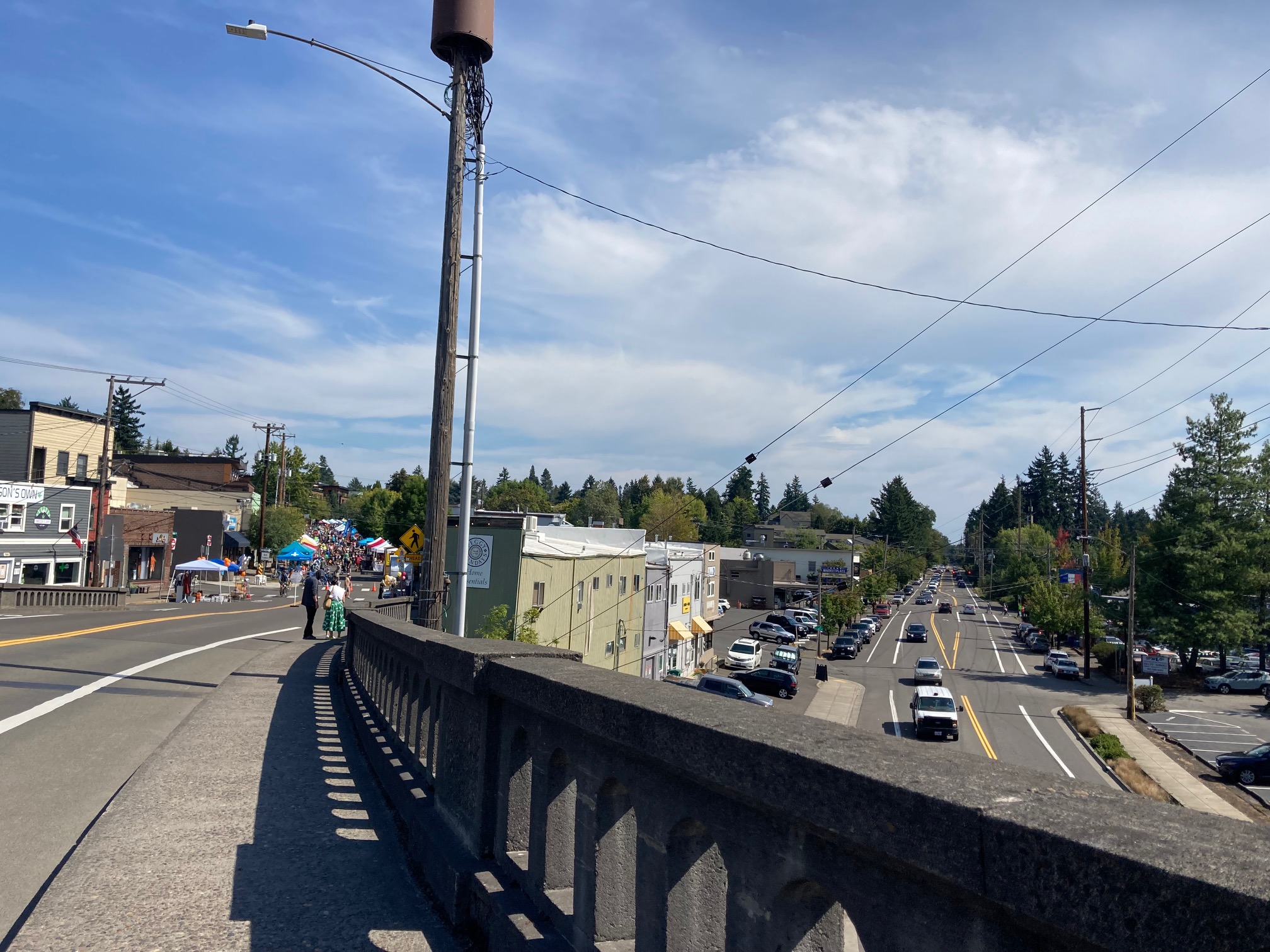
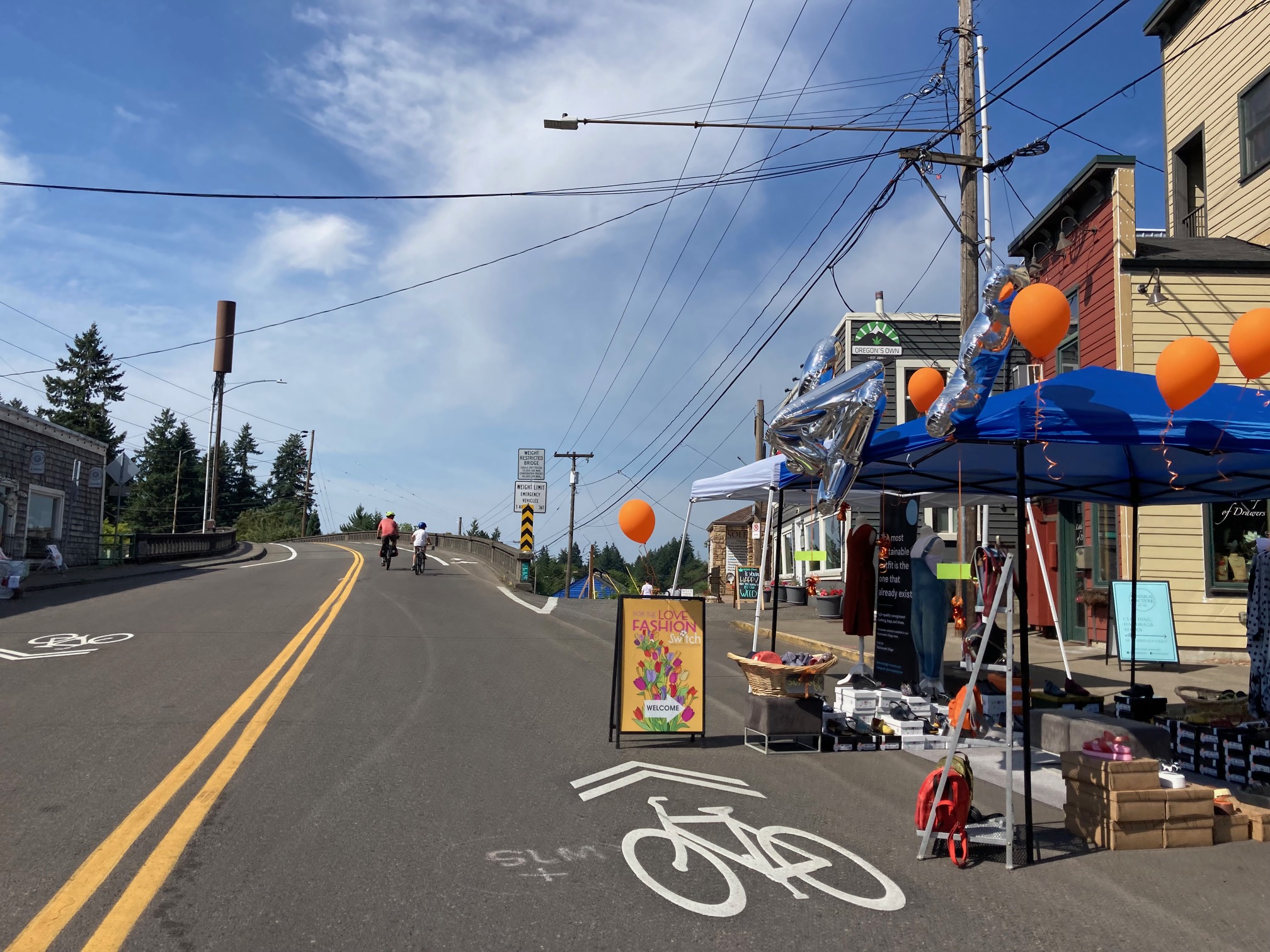
Southwest Portland welcomed Sunday Parkways yesterday in a festive event that was a perfect farewell to summer. The route was a two-mile stretch of streets, partially connected by a walking path (the first time a walking trail has been included) between Gabriel Park to the north and Spring Garden Park to the south. And in between? Capitol Highway, of course.
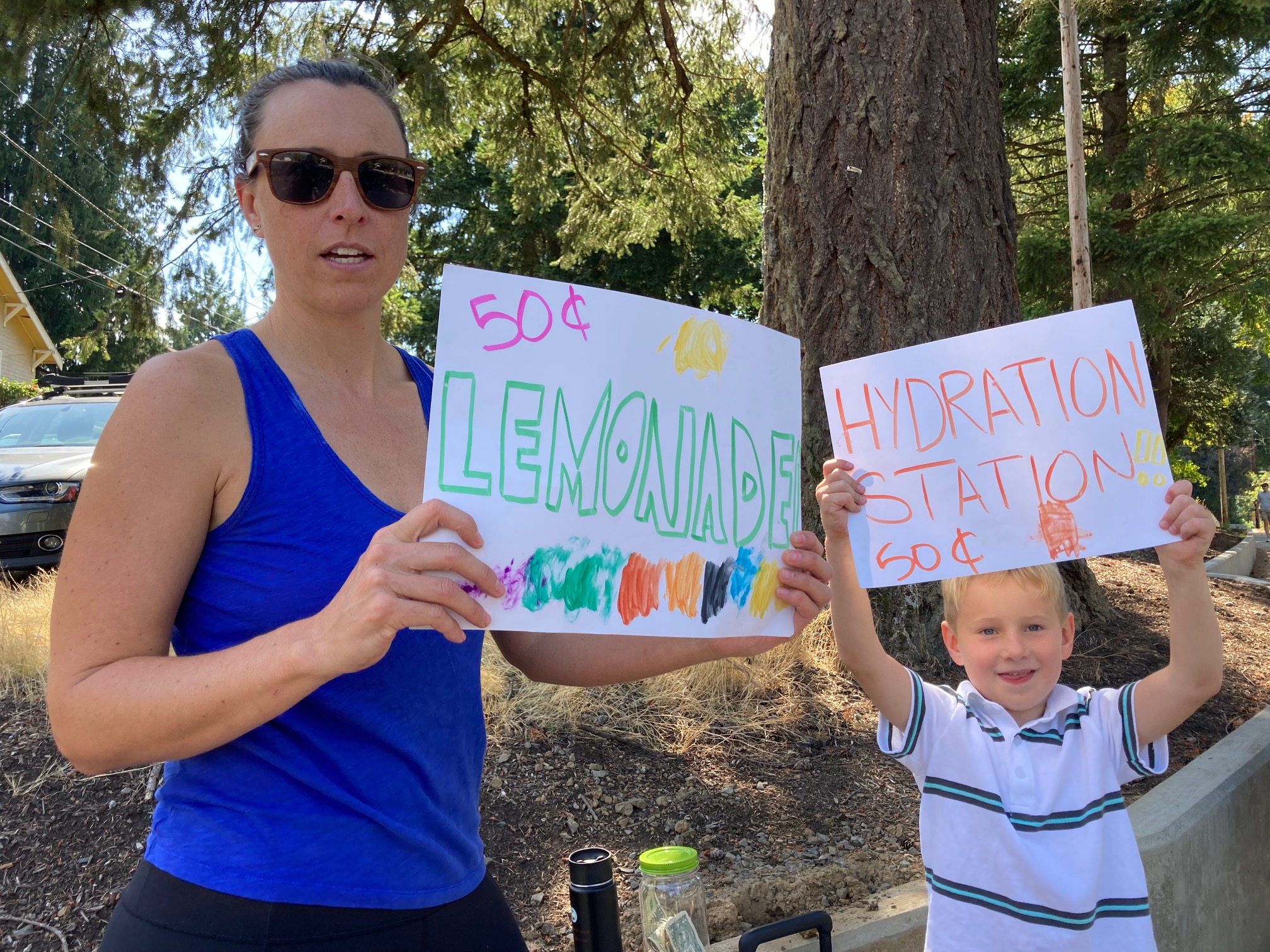
The Multnomah neighborhood cannot celebrate its newly redesigned Capitol Highway enough. Some neighbors sold lemonade, a trio of men played the music from the Nutcracker Suite from their front porch (on saxophones!) and hundreds of people hit the streets on all manner of wheels. Folks were really happy.
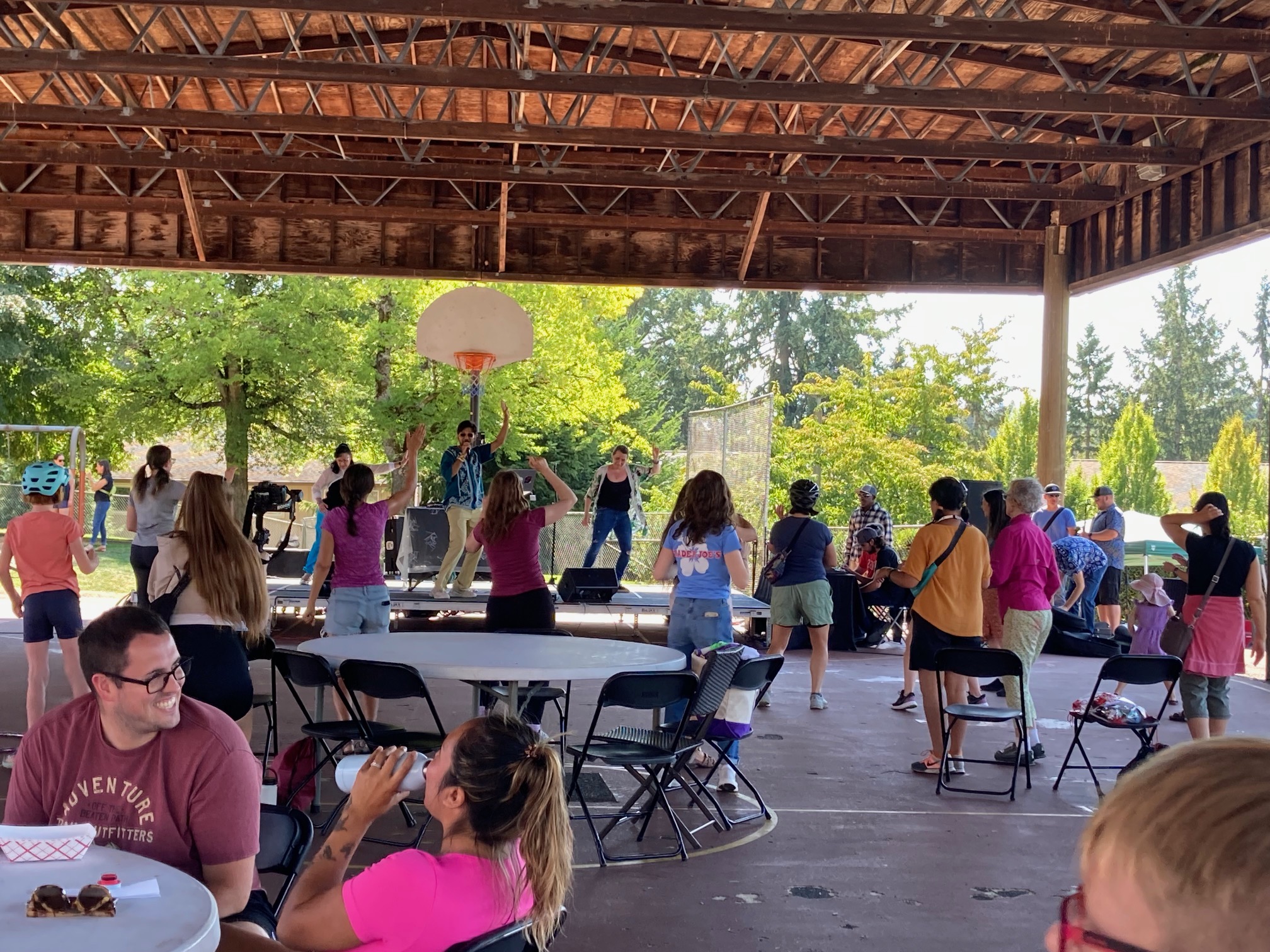
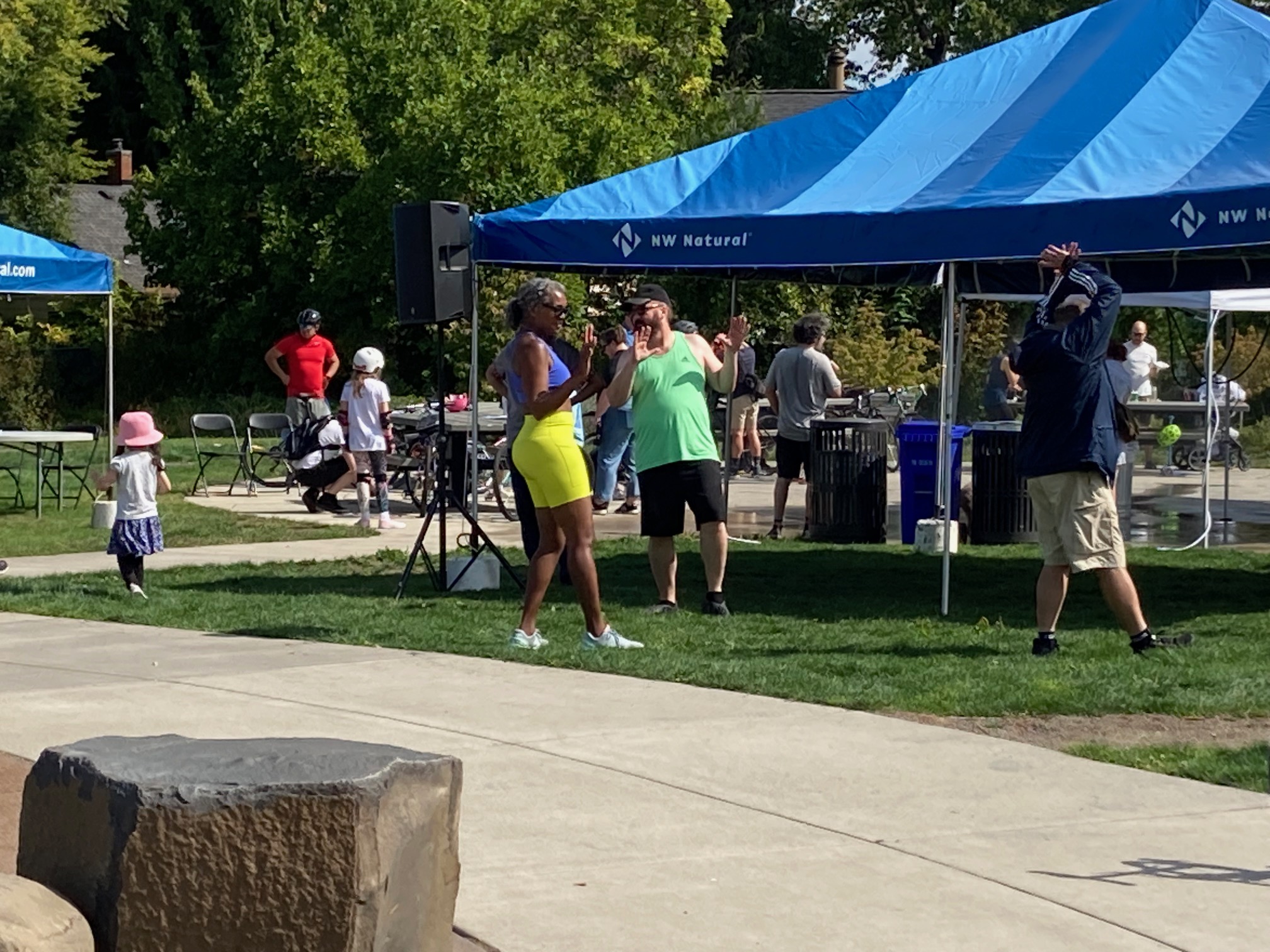
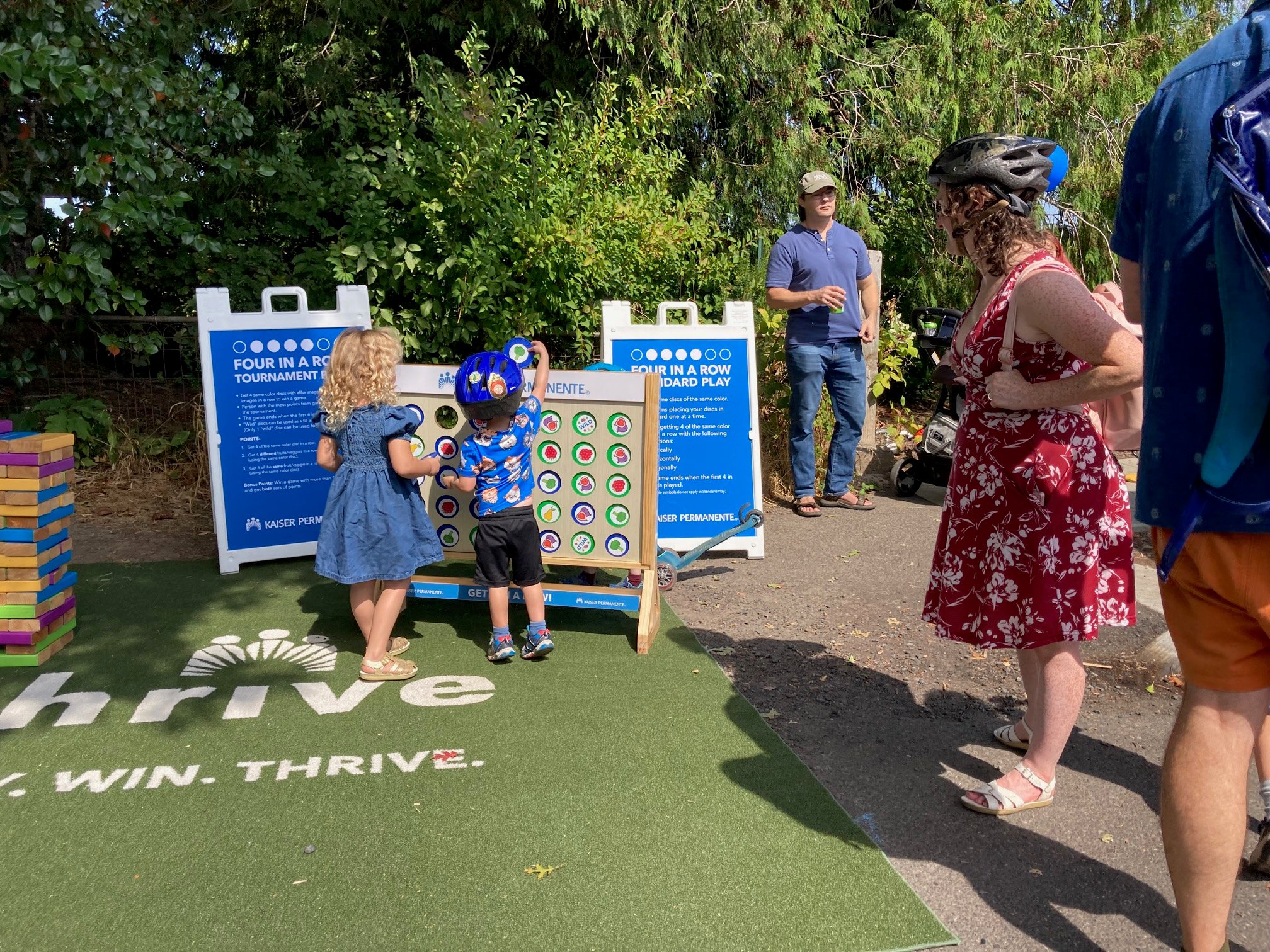
As has been the case for many years now, the event was sponsored by Kaiser Permanente and hosted by PBOT, who organized the first one in 2008. The entertainment lineup PBOT pulled together included live music at Gabriel Park and Multnomah Village. Not to be outdone, Portland Parks & Rec had Zumba happening at Spring Garden Park. Everywhere you pedaled or walked there was some sort of activity going on. The streets really come alive during these events and southwest Portlanders — who have fewer bike lanes and sidewalks than any other part of the city — were eager to take back their streets.
Advertisement
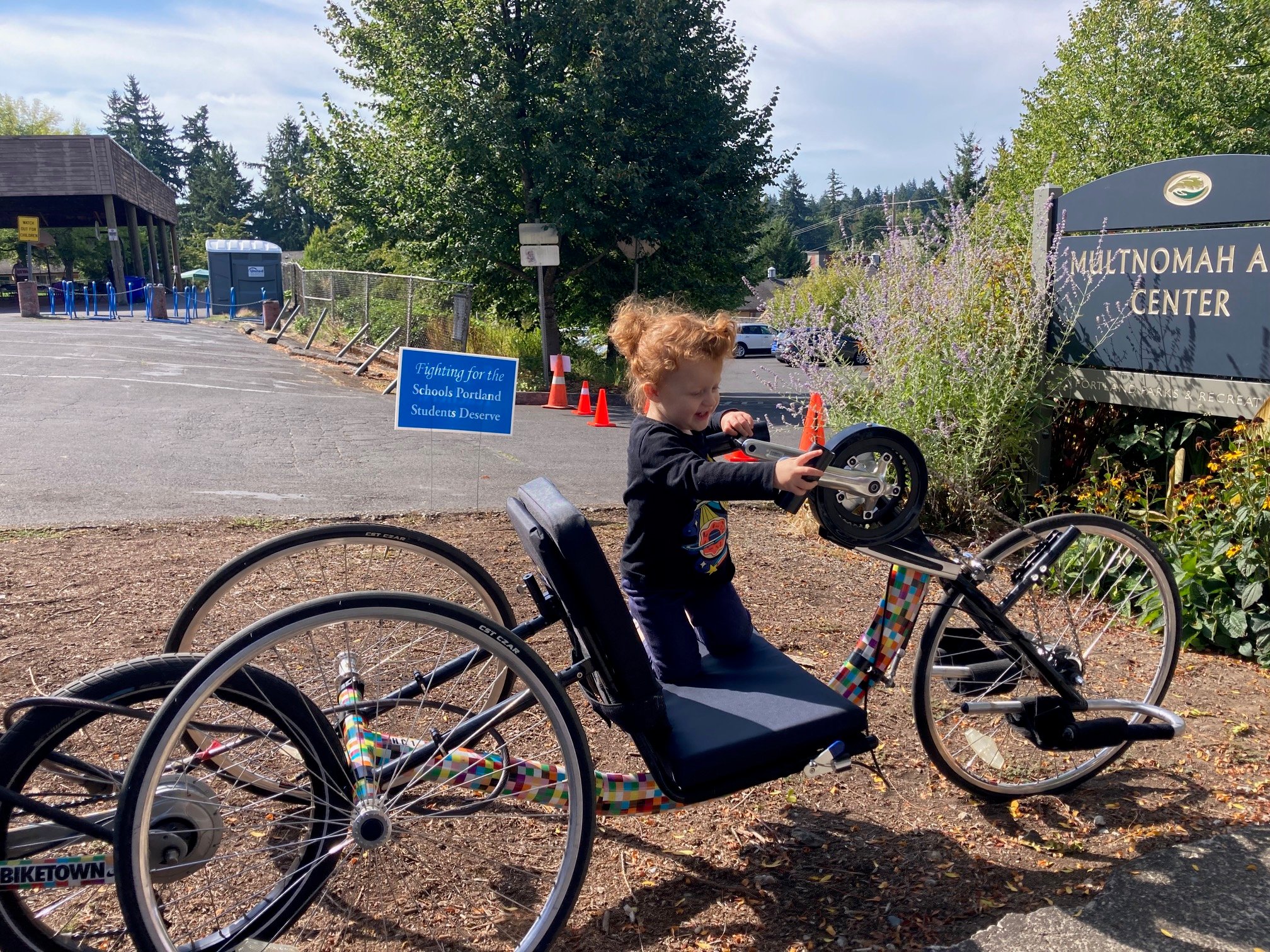
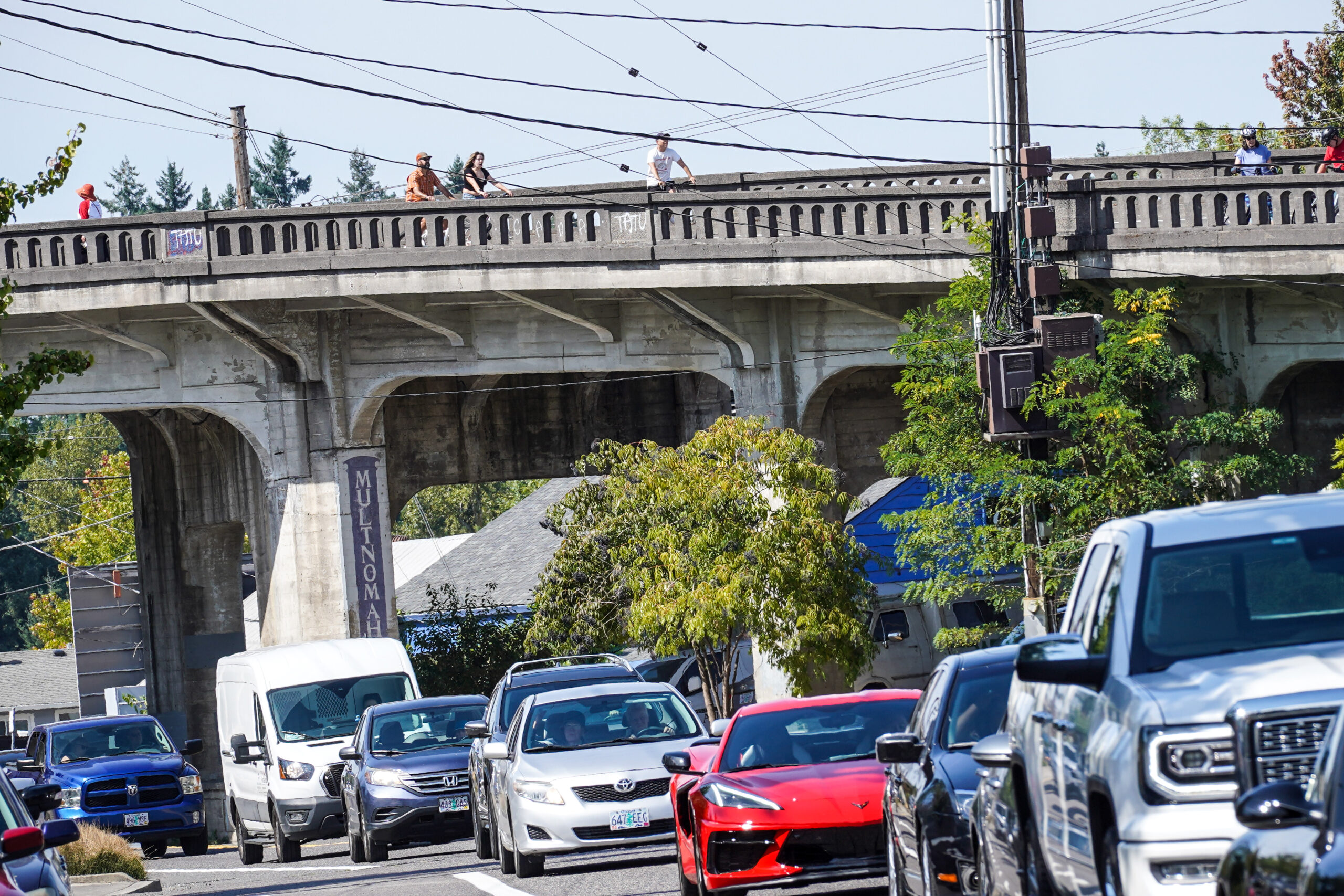
Dancing at Multnomah Arts Center.Zumba at Spring Garden ParkLeft of balustrade, people enjoying Sunday Parkways in Multnomah Village; right of balustrade, cars on Multnomah Blvd. Into the wild blue yonder! Man and boy leave excitement of Multnomah Village for the newly improved section of Capitol Highway.Quenched my thirst!Tchaikovsky on sax is unique!Trying out an adaptive bike from Kerr Bike and Adaptive Biketown.(Photos: Lisa Caballero/BikePortland)
It’s been nearly a decade since a Sunday Parkway has taken place in southwest, so there was considerable pent-up energy for this one. Sunday Parkways in the southwest have had a shorter route than in flatter parts of the city because of the need for a route that minimizes elevation changes. But the distance was fine, the crowd turned out, and there were tons of kids.
Advertisement
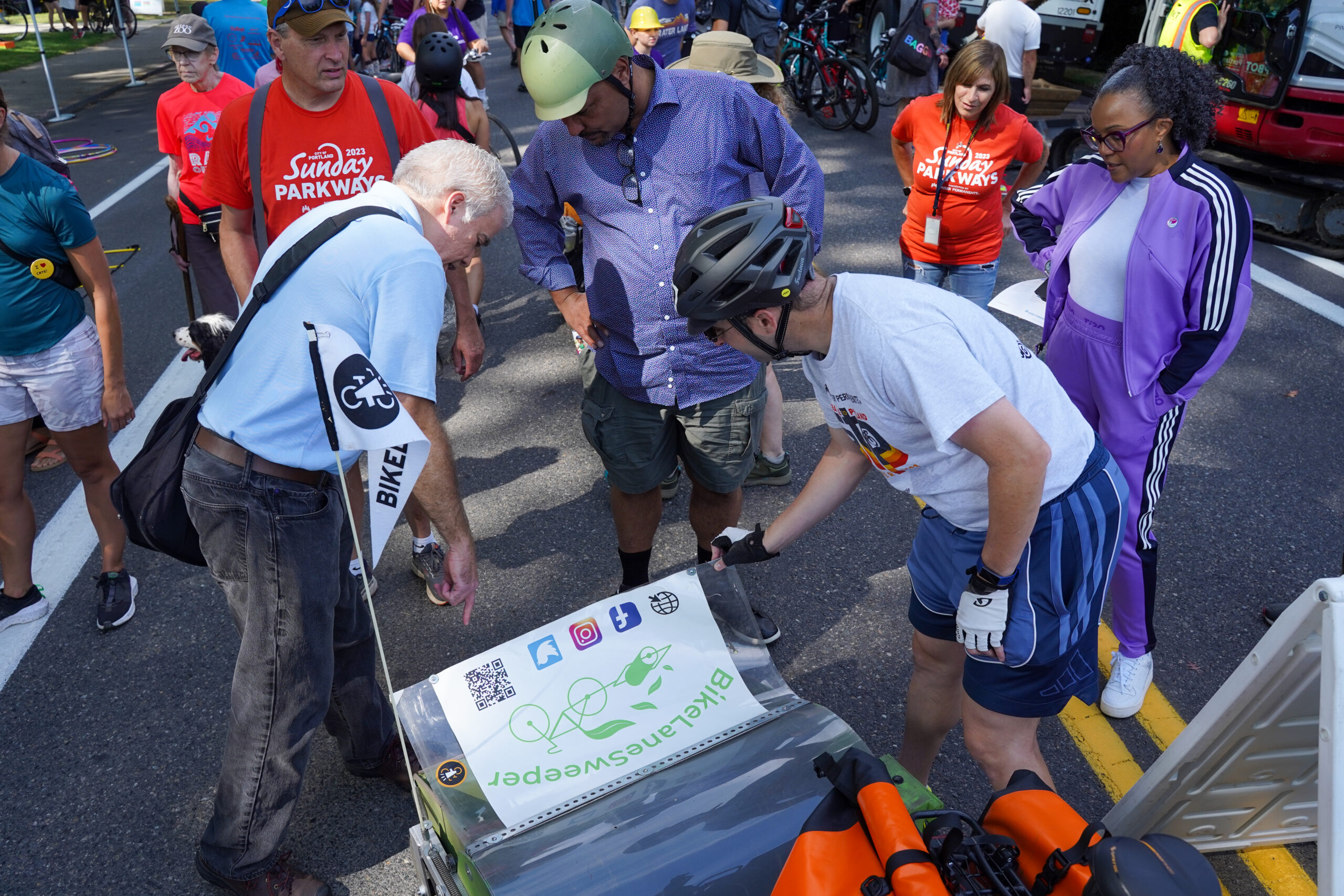
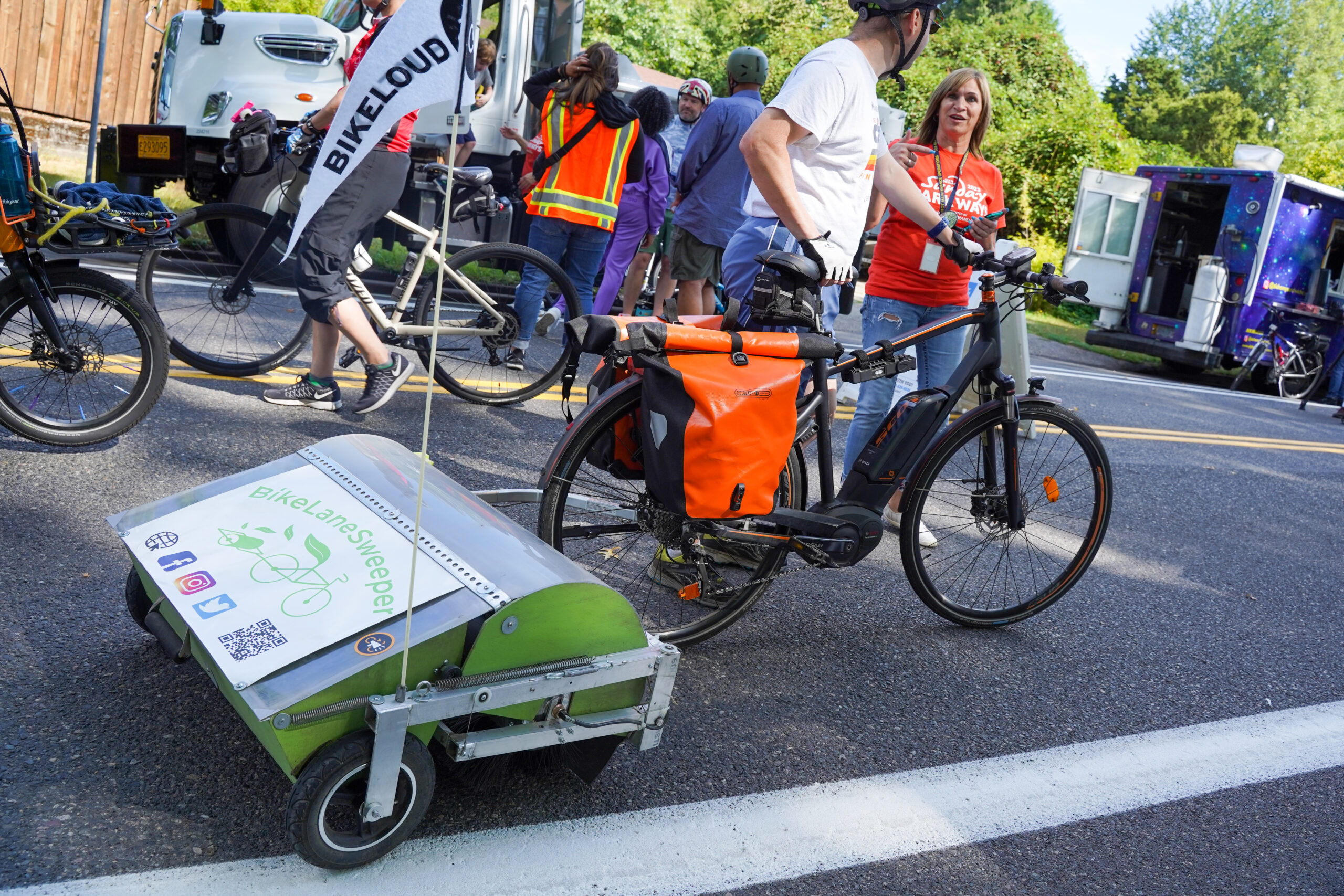
Checking out the Bike Lane Sweeper.PBOT Policy, Planning & Projects Group Director Art Pearce and PBOT Director Millicent Williams.Commissioner Mingus MappsNew PBOT fleet vehicle (yes, it’s very similar to the BikePortland company vehicle!)David Stein and the Bike Lane SweeperCars backed up on Multnomah while people pedal on carfree SW Capitol Highway.(Photos: Jonathan Maus/BikePortland)
Newly hired PBOT Director Millicent Williams and her boss, City Commissioner (and mayoral candidate) Mingus Mapps, added themselves to the crowds. They began their day at Gabriel Park by walking the marketplace and hob-nobbing with passersby. One of them was dedicated Portland cycling advocate David Stein, who just happened to be cycling by. Stein is one of the locals testing out the California-made Bike Lane Sweeper and both Williams and Mapps seemed very interested in it as he ran through its features and answered their questions.
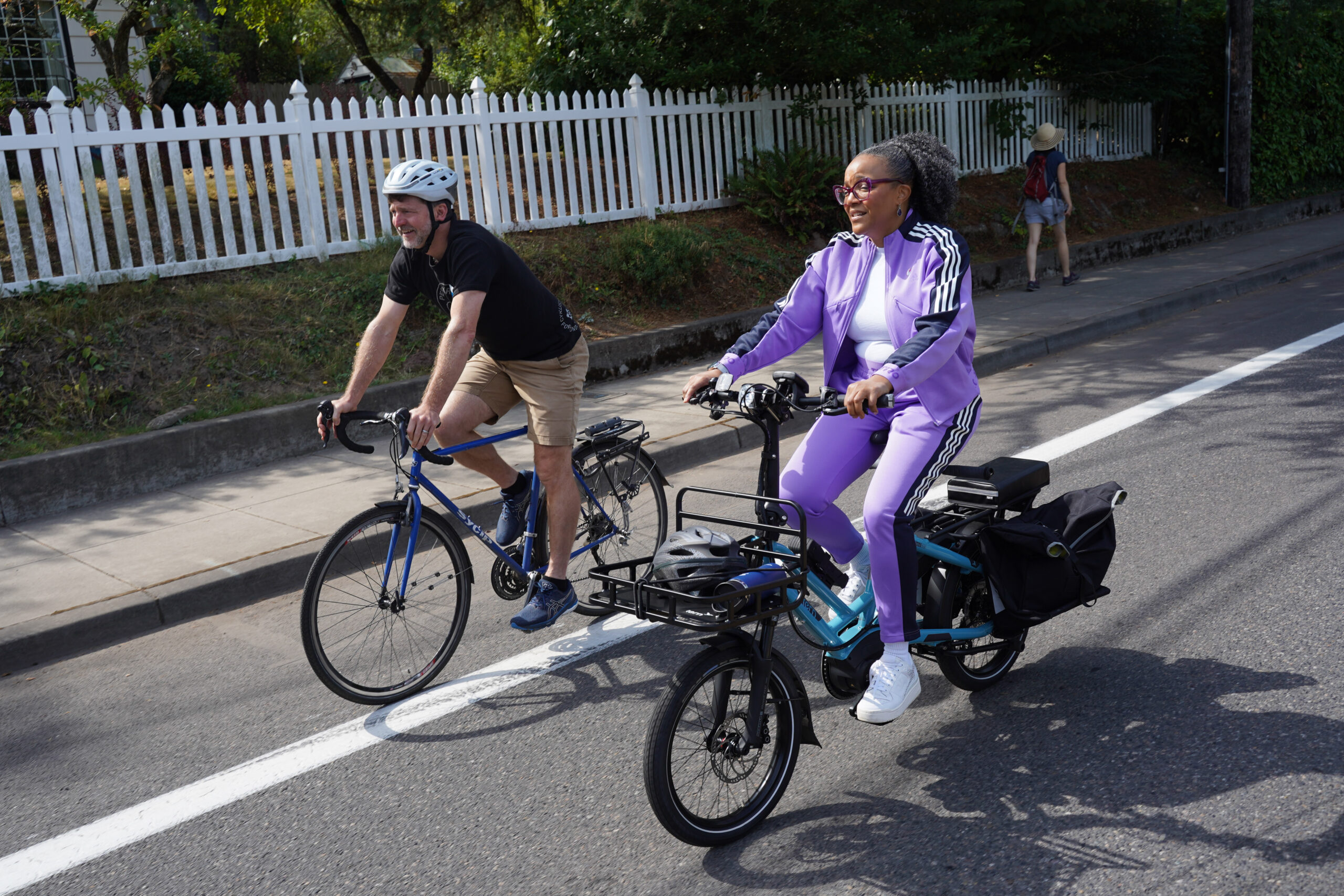
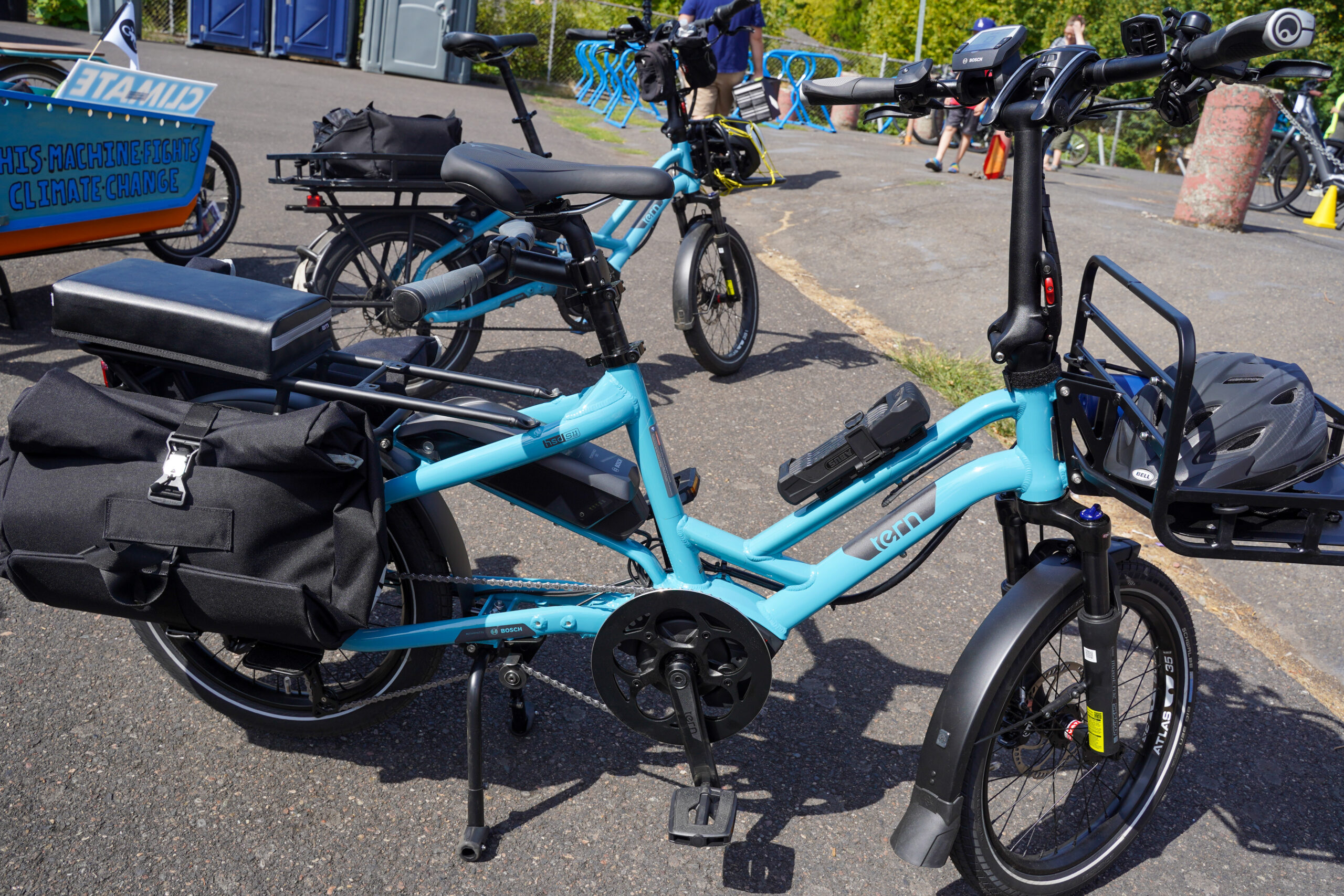
Director Williams and Commissioner Mapps then hopped on bikes for a short jaunt to Multnomah Village. Williams was on a blue “HSD” e-bike sold by Tern Bicycles. Its a new addition to PBOT’s vehicle fleet, so it’s available for any employee to use. And Mapps was on a Specialized “Haul” e-bike, another cargo-centric model.
Given the unprecedentedly poor state of the PBOT budget, it’s notable that the two most powerful people at the agency showed up at Sunday Parkways. Many folks feel like this program is likely on the chopping block when budget proposals get hammered out later this month. In brief remarks, Williams mentioned the “hard” conversations that lie ahead. We’ll be watching closely as both of these leaders reveal how they plan to dig PBOT out of their funding hole. The fact that they attended together tells us they are fans of Sunday Parkways and that they have a solid working relationship — both of which are good signs if you want these events to continue next year.
PBOT Director Williams and Commissioner Mapps goofing around in a PBOT maintenance truck.
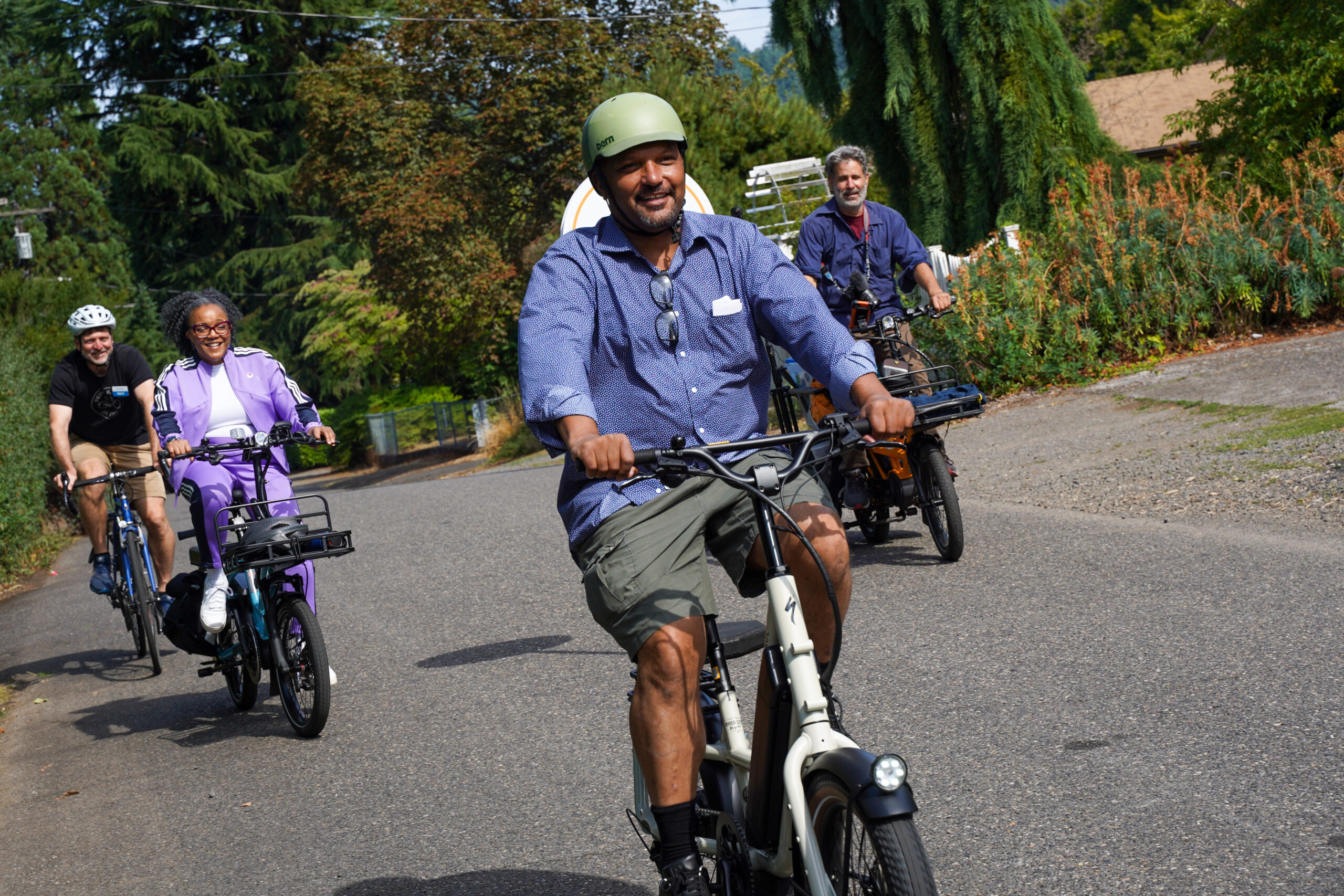
And Mapps wasn’t the only member of Portland City Council who biked at the event. Mayor Ted Wheeler also took advantage of the open street to have some fun on a perfect Portland Sunday…
Let’s have a good week, shall we? Before we go too deep into it, here are the stories you should read from the sources you can trust…
By the way, have you ever checked out our friends at The eBike Store? They have a great selection of e-bikes and have been serving Portland since 2008. Stop by N Albina and Rosa Parks Way (across the street from Peninsula Park) and get great service, find that accessory you need, or test ride a bike today!
Here’s this week’s roundup…
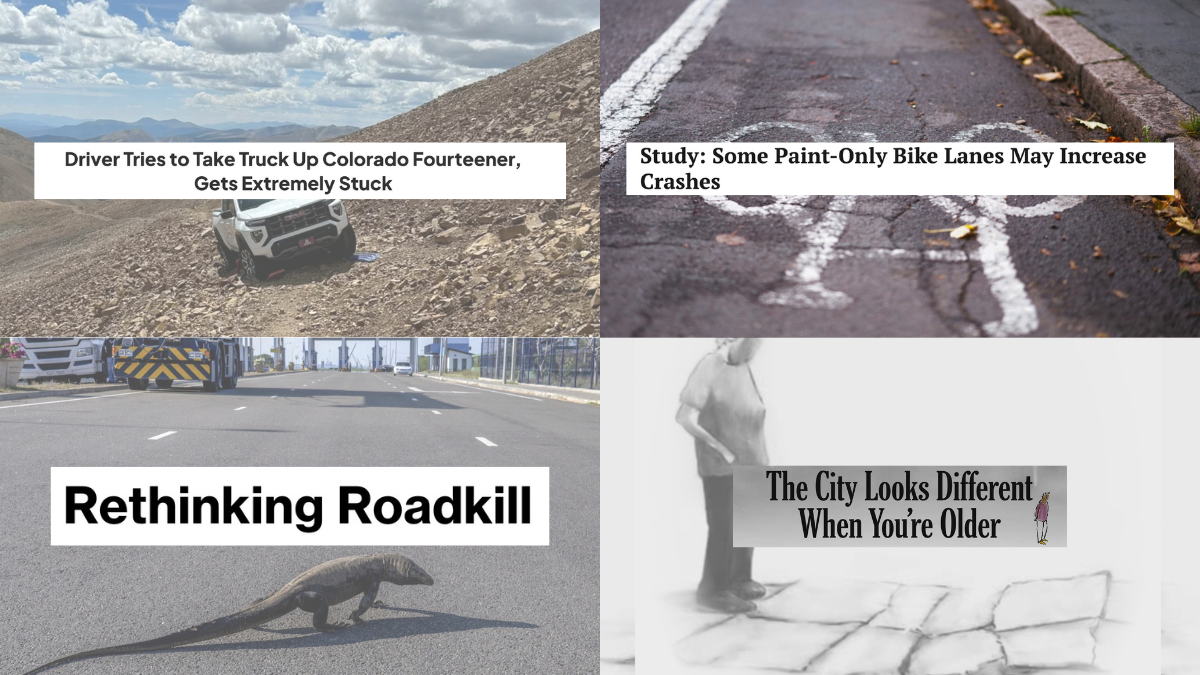
Paint ain’t great: A study from Atlanta and published in a transport and health journal found that in some cases, the presence of paint-only bike lanes actually increased the rate of crashes. The results are intriguing, but read the details of the study for some interesting explanations of the findings. (Streetsblog USA)
Fatal crash in Salem: A DEA agent has been charged in the death of a Salem woman and her family is frustrated by how slowly the investigation is moving. (KPTV)
It’s a not a commercial, dude: The driver of a truck must have watched too many commercials because he tried to scale a mountain on a hiking trail — just like they show in the ads! — but he got very stuck. (Backpacker)
New book alert: City Limits, a forthcoming book by journalist Megan Kimble that will be released next spring, delves into “how our ever-expanding urban highways accelerated inequality and fractured communities” and calls for a new, more sustainable path forward. (Penguin Random House)
Advertisement
Urban planning and growing older: When folks fight for more transit, safer streets, and fewer drivers on the road, they’re also helping ensure that older people can age wherever they want without being scared away by inaccessible streets. (New York Times)
Terrible traffic violence: The family of a Portland teen who was intentionally run down by the driver of a car in the Cully neighborhood late last month held a rally to demand justice. (KPTV)
Here come the Chinese cars: A quirk in the market has created massive demand for China’s cheap, gas-powered automobiles. So much so, Chinese workers are feverishly building huge ships that can carry 5,000 cars at a time to Europe and beyond. (NY Times)
Drugs and transit: A study from University of Washington set off a firestorm of headlines last week because it found harmless, trace amounts of some drugs in the air and on surfaces of some TriMet vehicles. (KGW)
The cost of cars: If you care about creating a world with less driving, don’t miss this excellent interview with the author of a new book about roadkill and the impacts of cars and roads on wildlife. (Bloomberg)