Welcome to the week. Here are the most notable news items our community has come across in the past seven days…
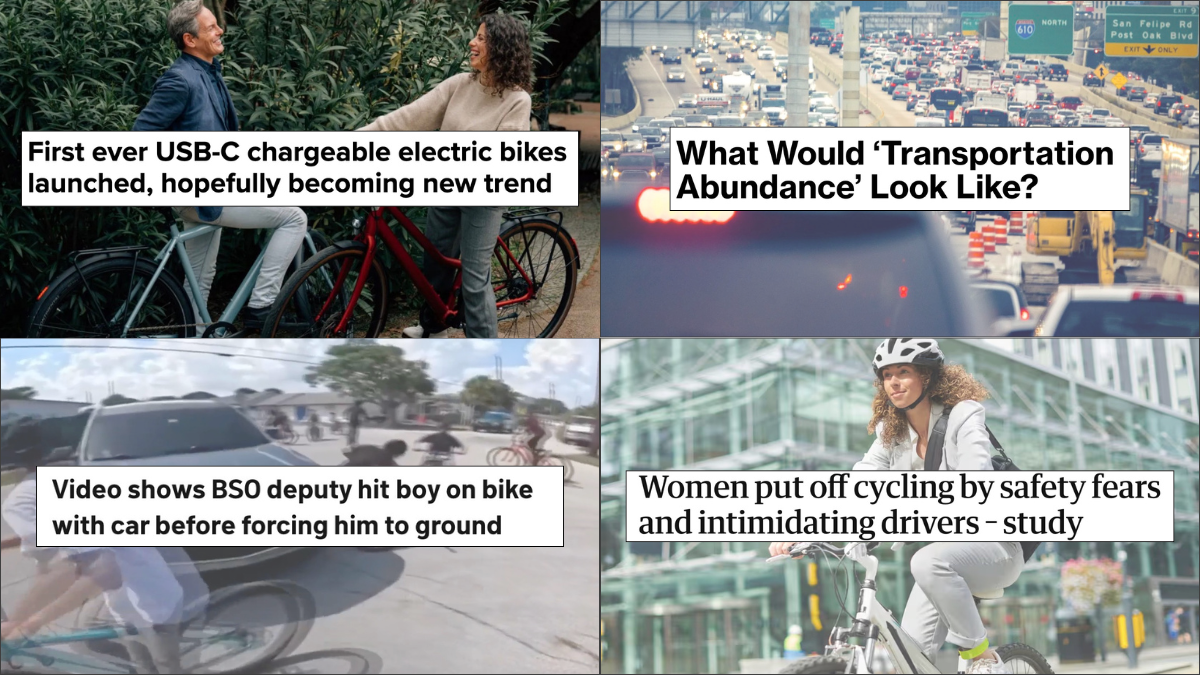
Stunning finish: With three of four men in the winning break from the same team, what happened at the Dwars door Vlaanderen race was unbelievable. (Cycling Weekly)
Police chases kill innocent people: A large investigation by a media organization found that the majority of people killed as a result of police chases are innocent bystanders. (SF Chronicle)
USB-C?!: Imagine charging your new e-bike with the same cable you use to charge your headlight. That’s the promise of Ampler Bikes, a company that allows riders to charge with a USB-C cable. (Electrek)
An abundance of caution: We’ve already seen how the “abundance mindset” has influenced local elected officials who are eager to build the I-5 Rose Quarter project. That’s the type of thinking that David Zipper cautions against in his piece of how abundance principles apply to transportation. (Bloomberg)
Love (riding with) yourself: I appreciate this reflection on riding alone (versus ride with a group) because I share many of the same feelings. Or to put it in modern parlance, I feel seen. (Cycling Weekly)
Tern and tariffs: There’s massive uncertainty around what impact Trump’s tariffs will have on the bike industry, but this story about bike maker Tern and a possible $1 million tariff payment illustrates the chaos they’ve already caused. (Bicycle Retailer)
Overpolicing: A Florida man working as a police officer rammed his patrol car into a boy who was riding his bike in the street. The police agency said the boys were an organized group doing unsafe stunts on public roads. (NBC South Florida)
What women want: A British study found that women are more likely then men to ride less (or not ride at all) because of fears that drivers will treat them poorly. (Guardian)
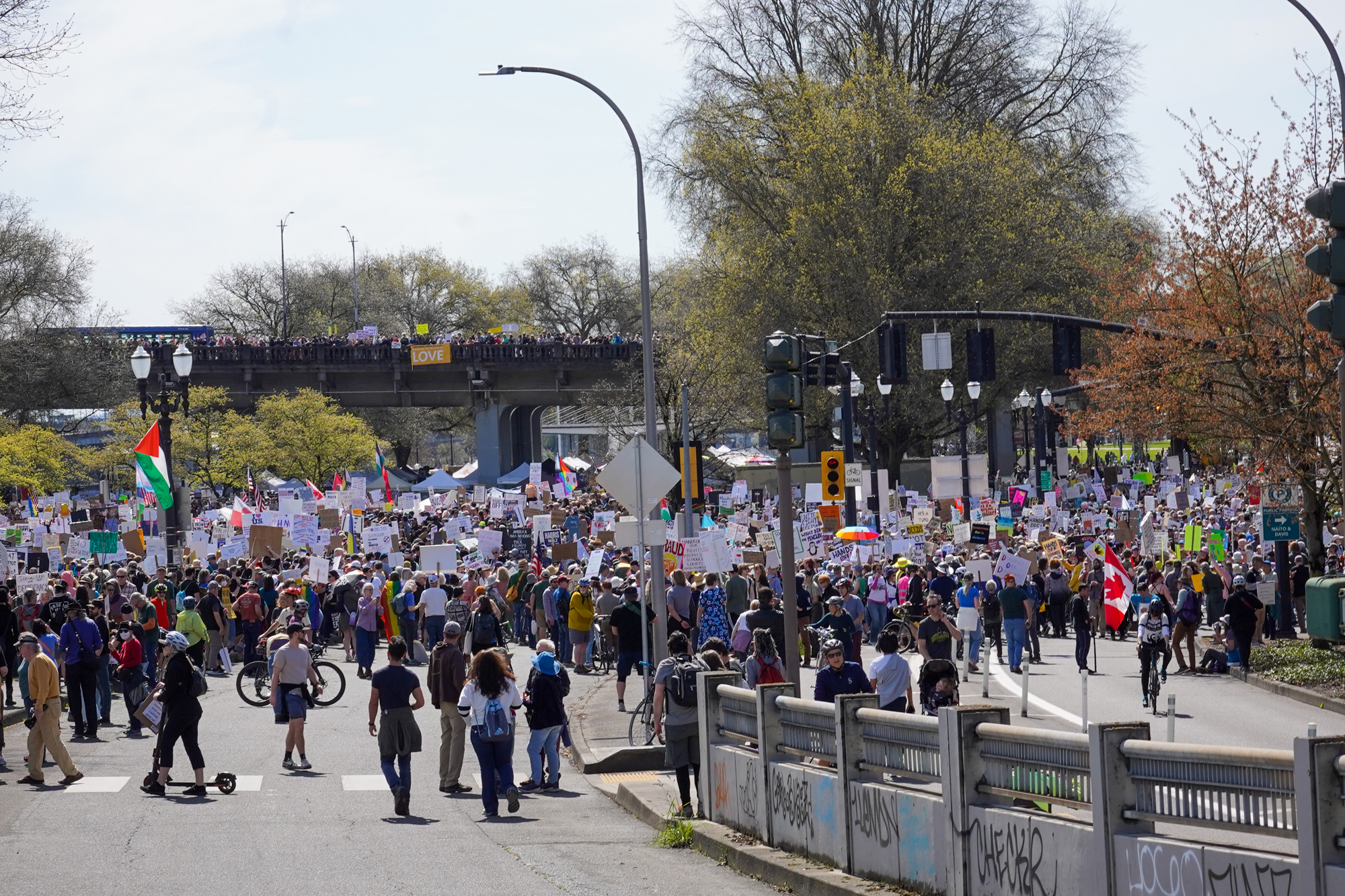
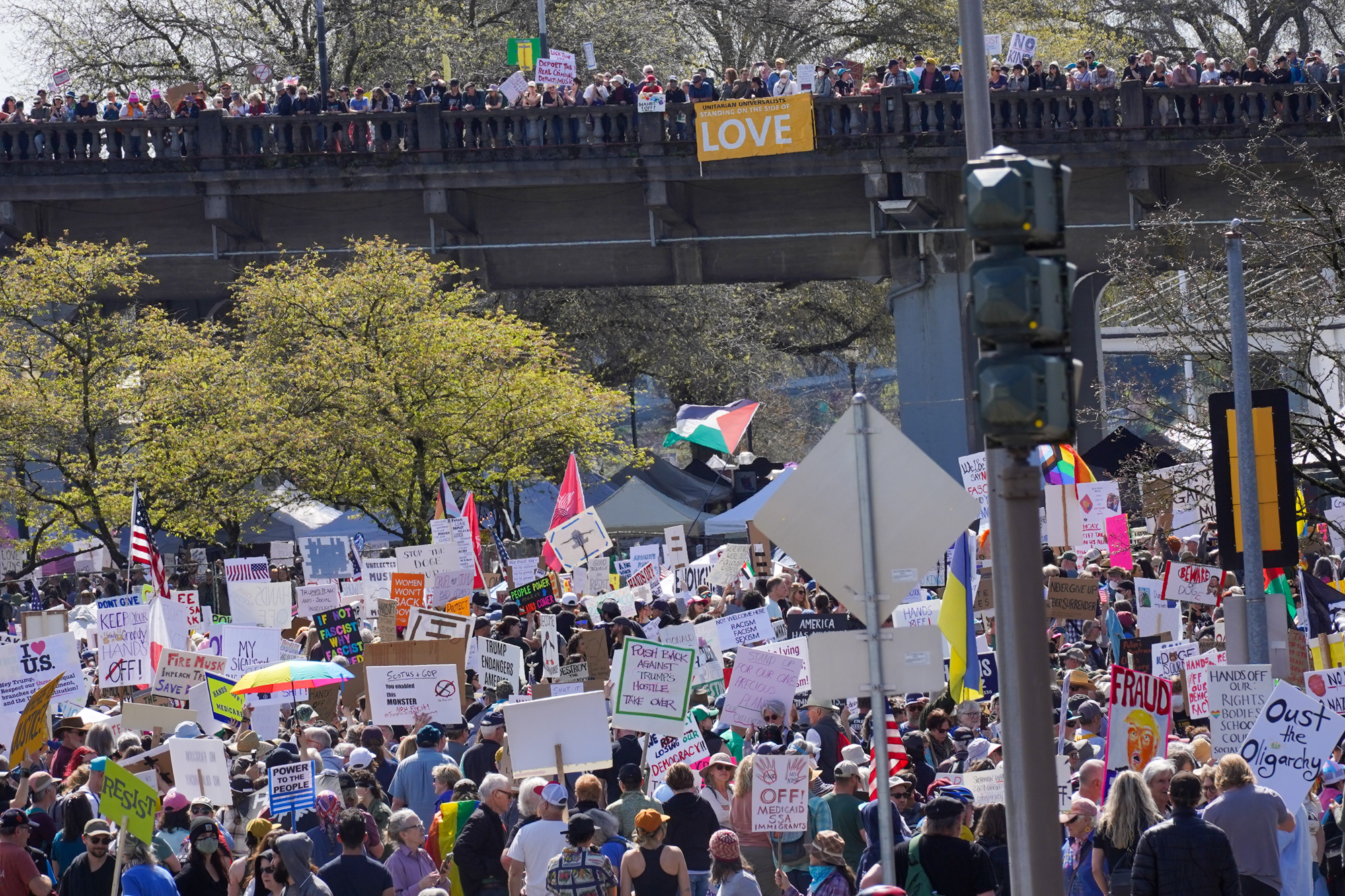
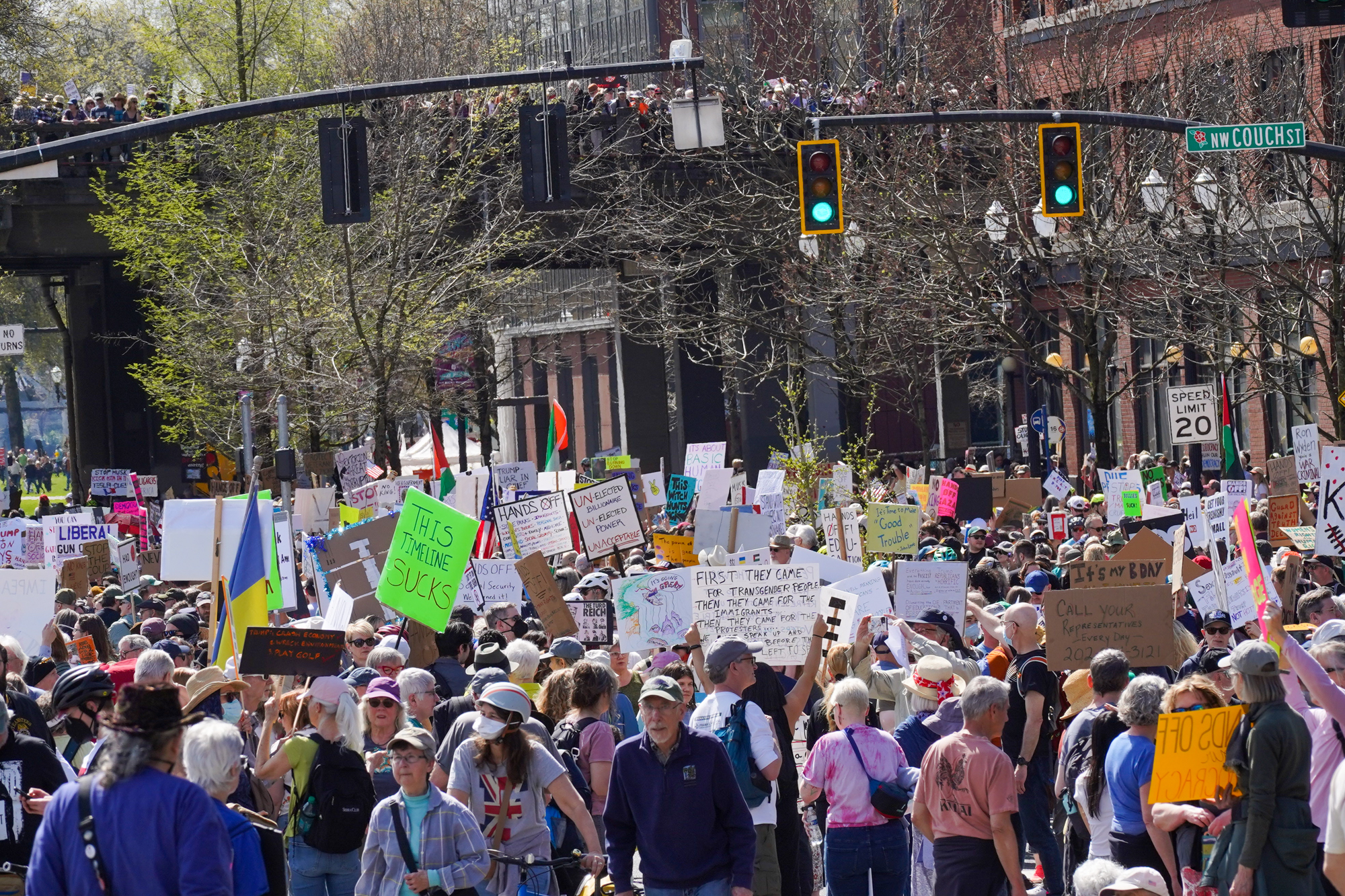
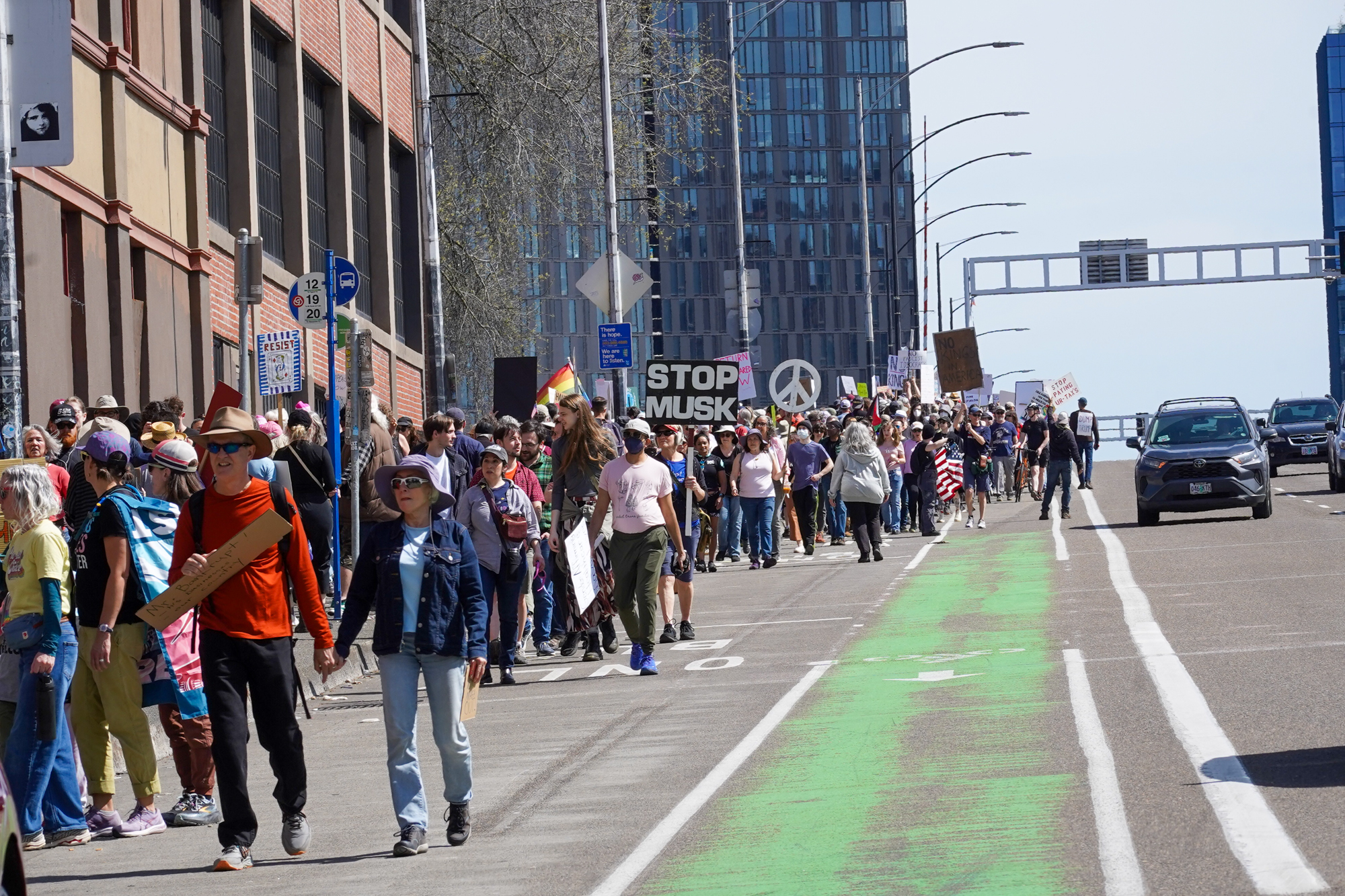
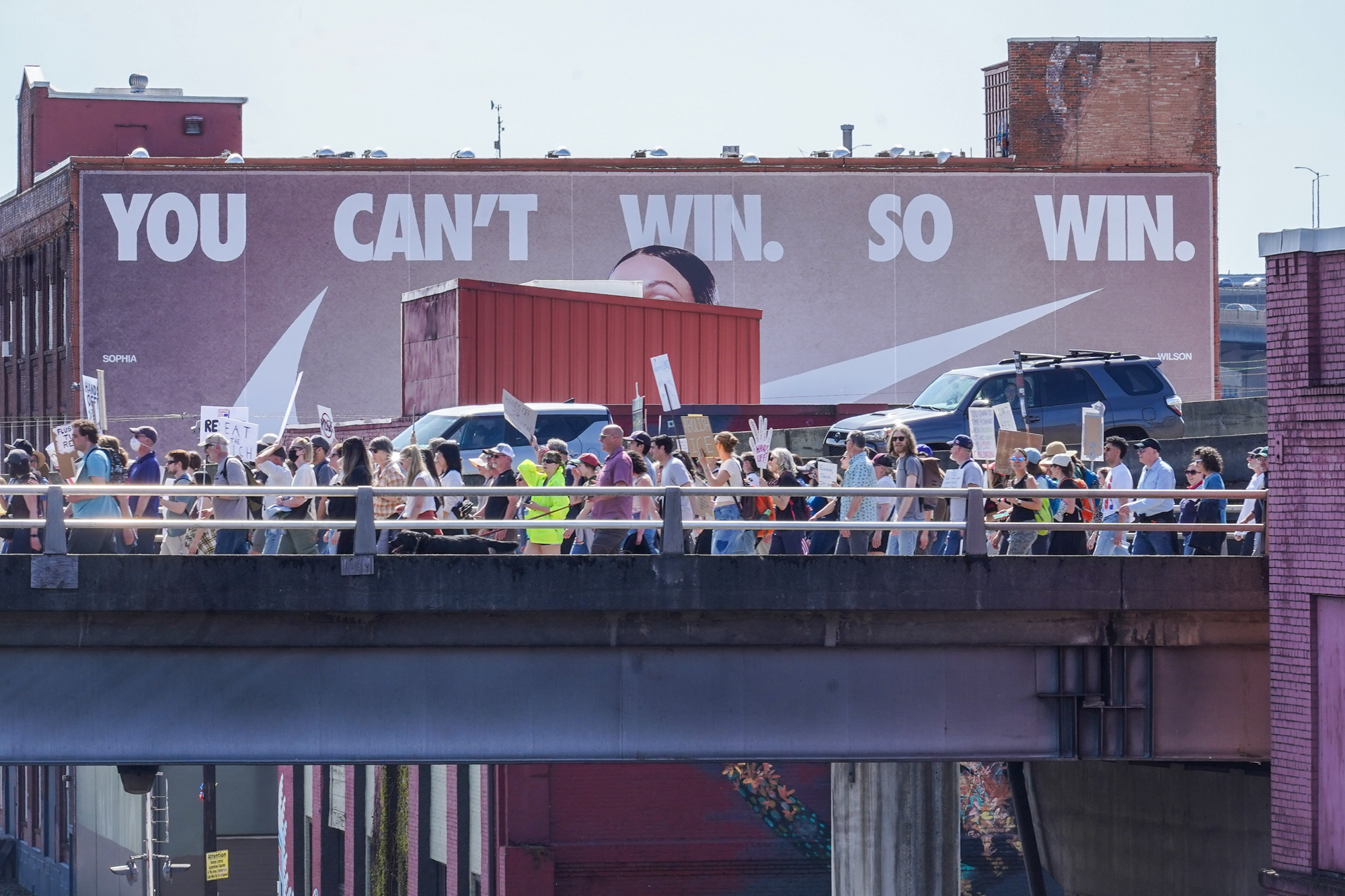
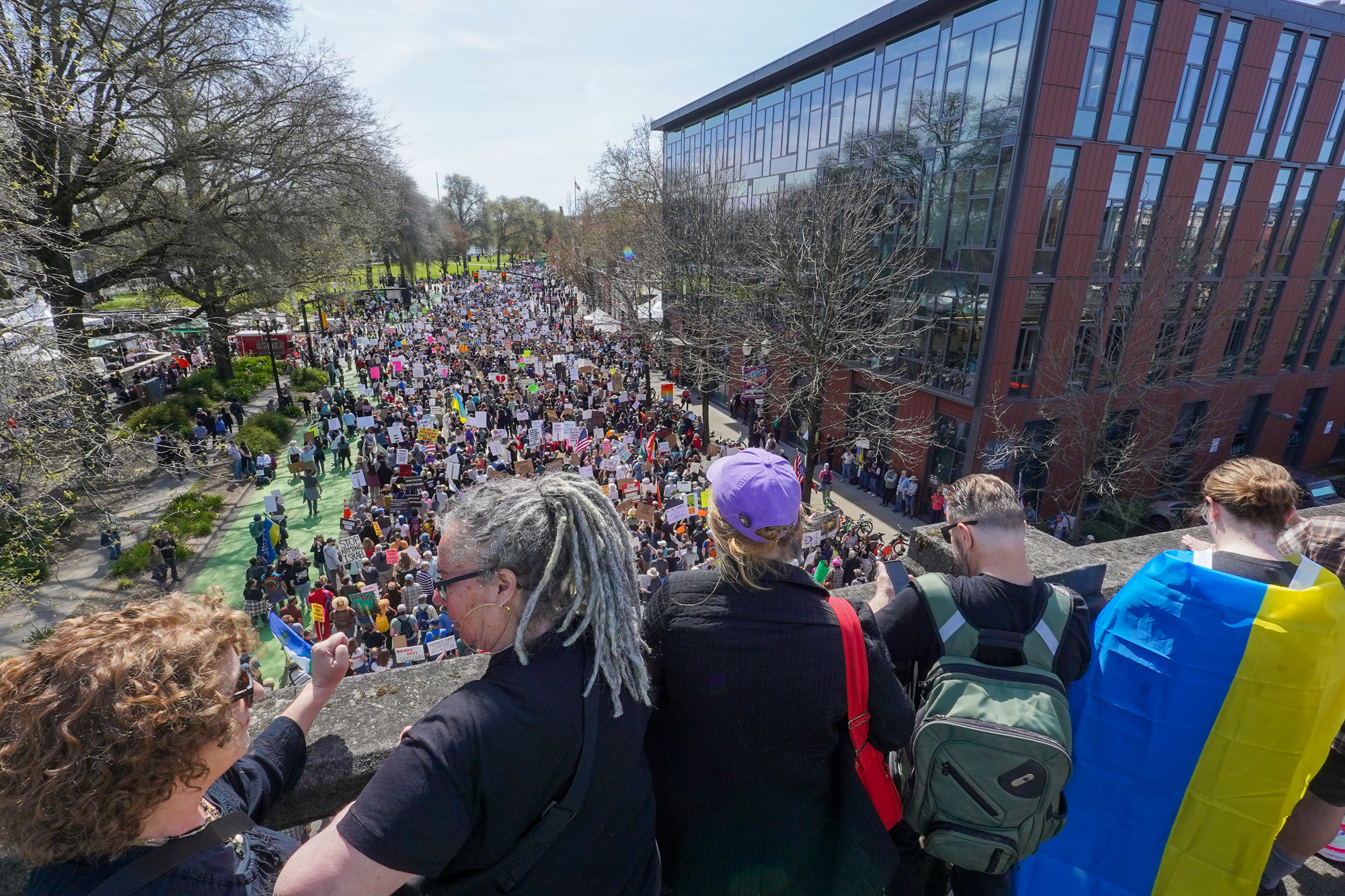
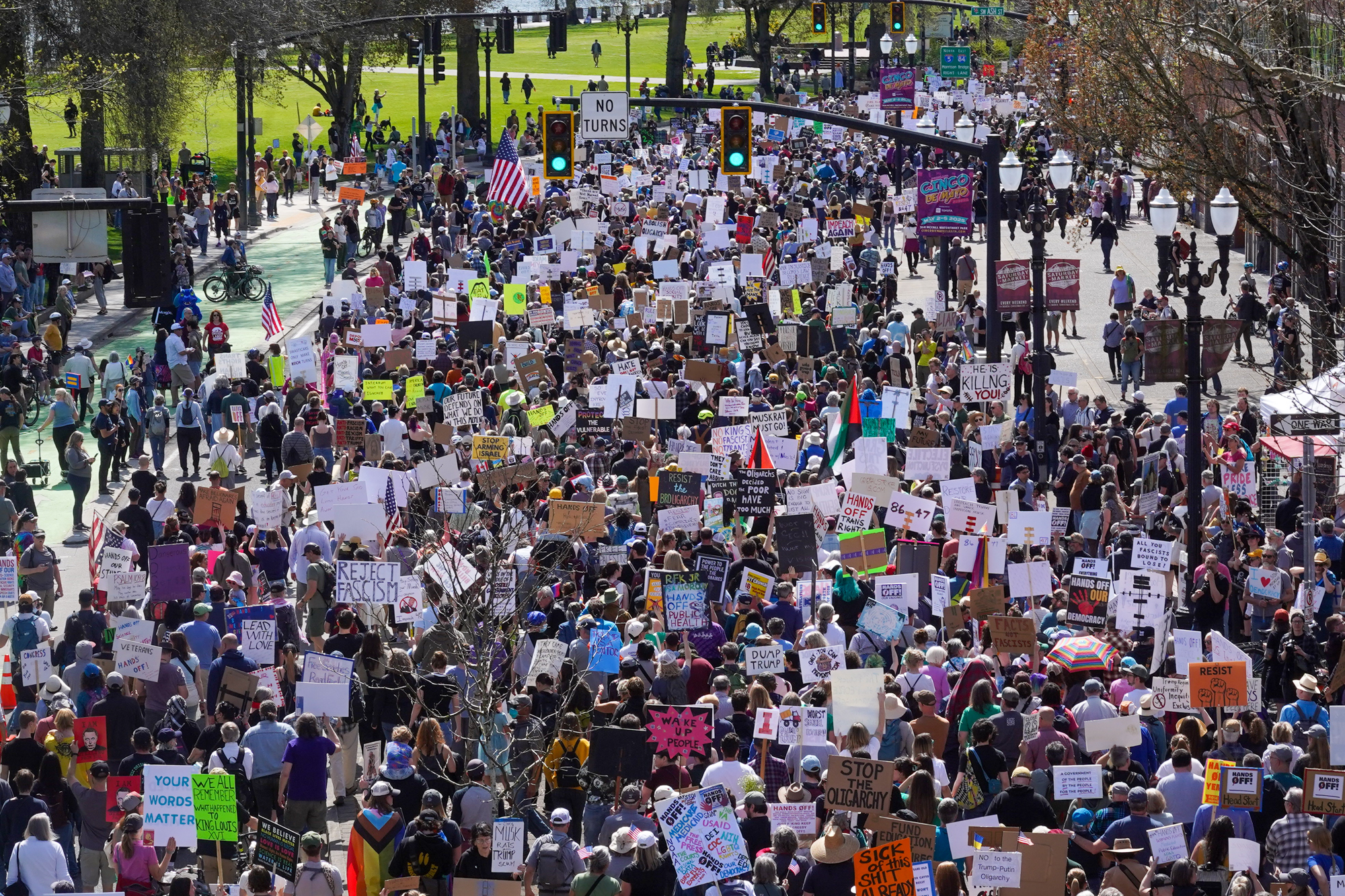
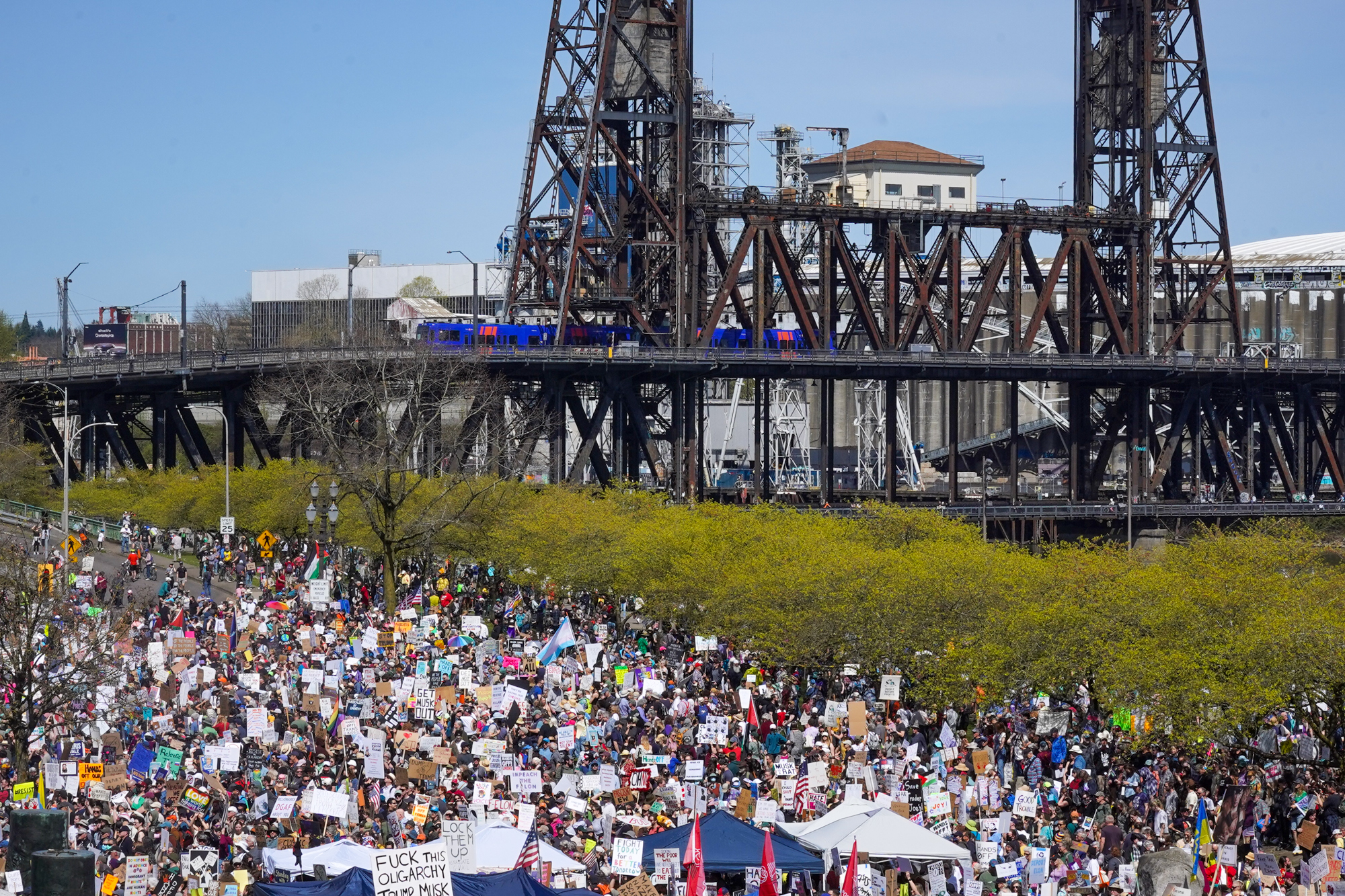
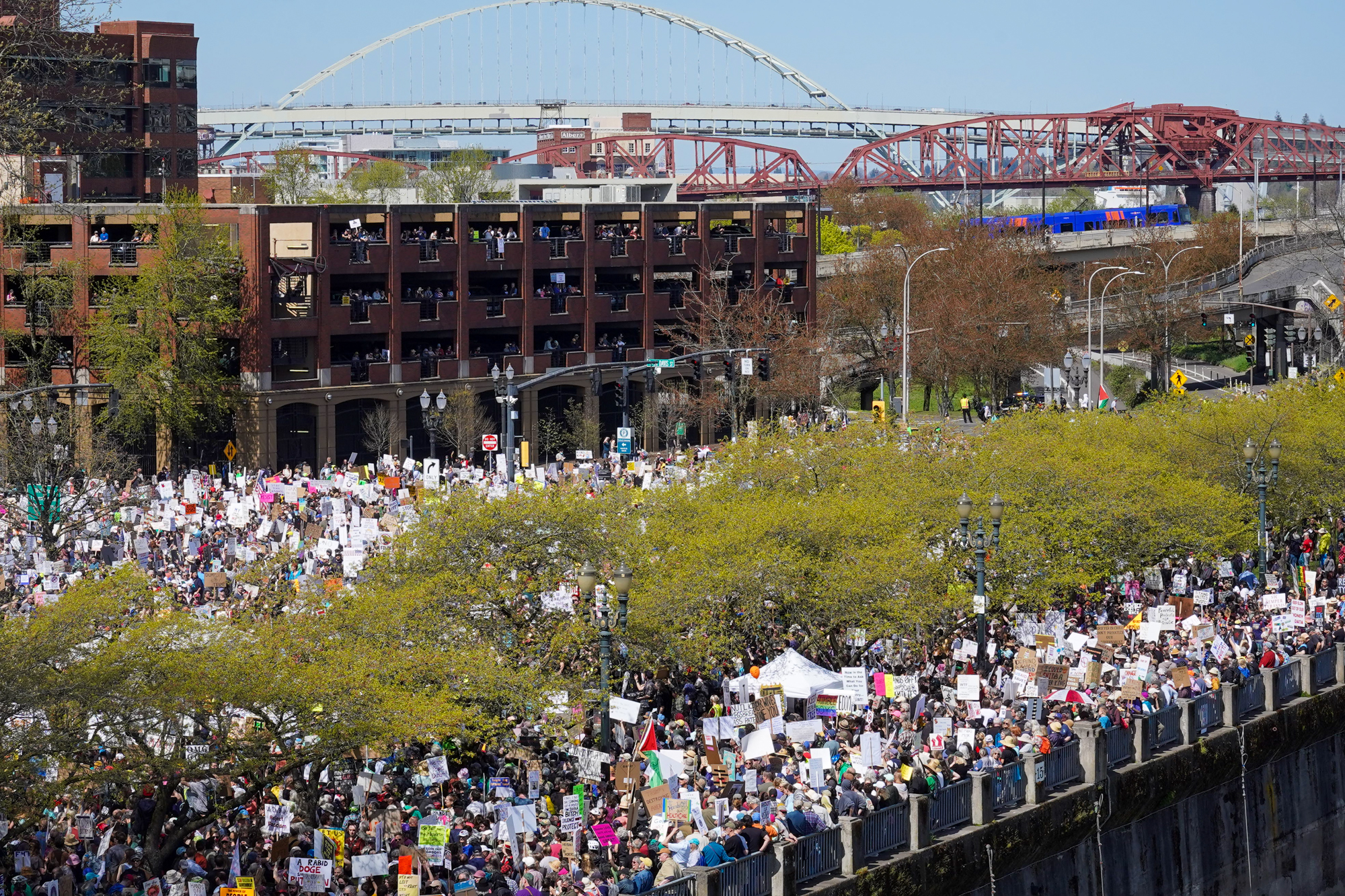
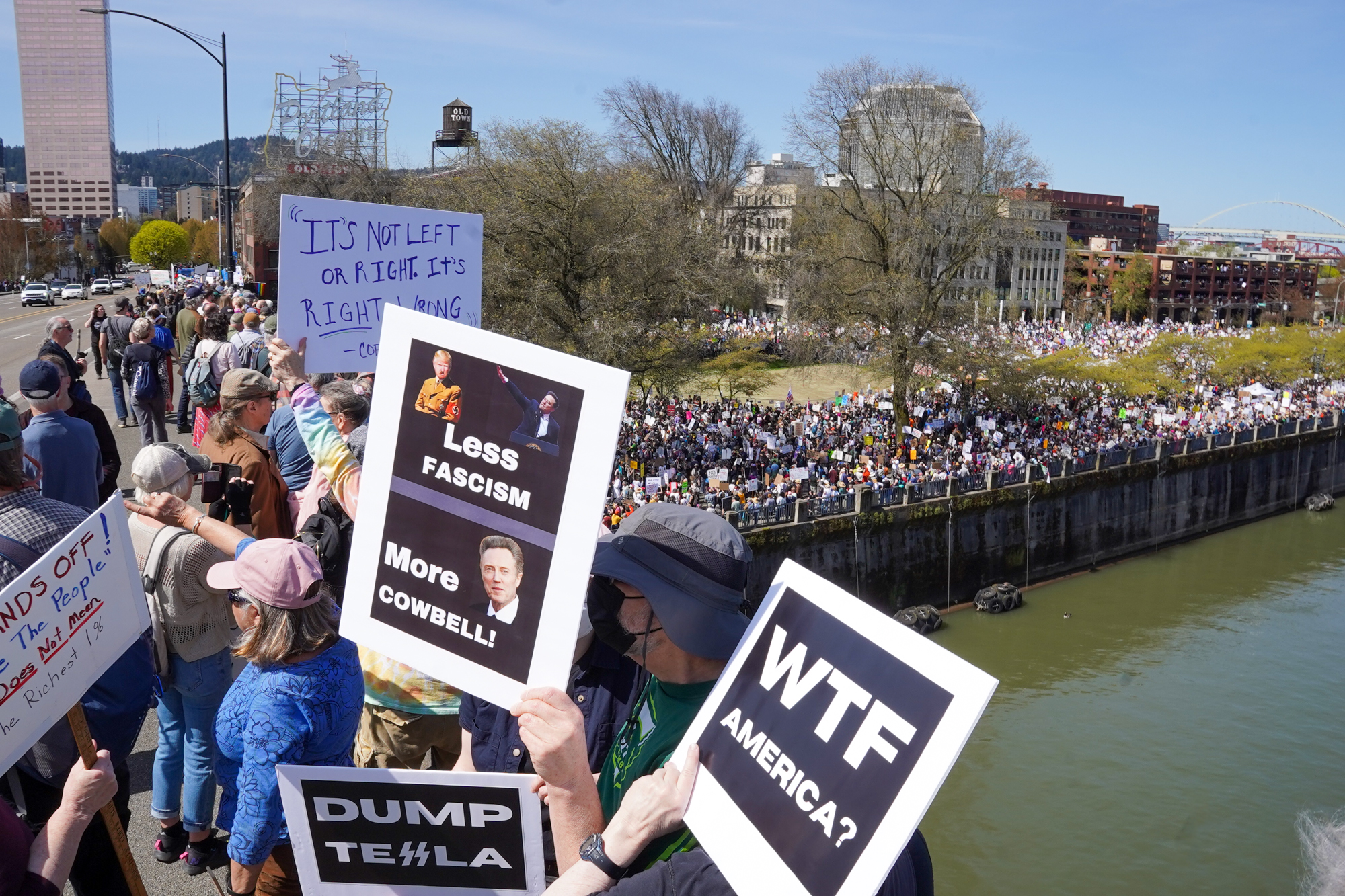
View looking north from Morrison Bridge on Naito Parkway. (Photos: Jonathan Maus/BikePortland)
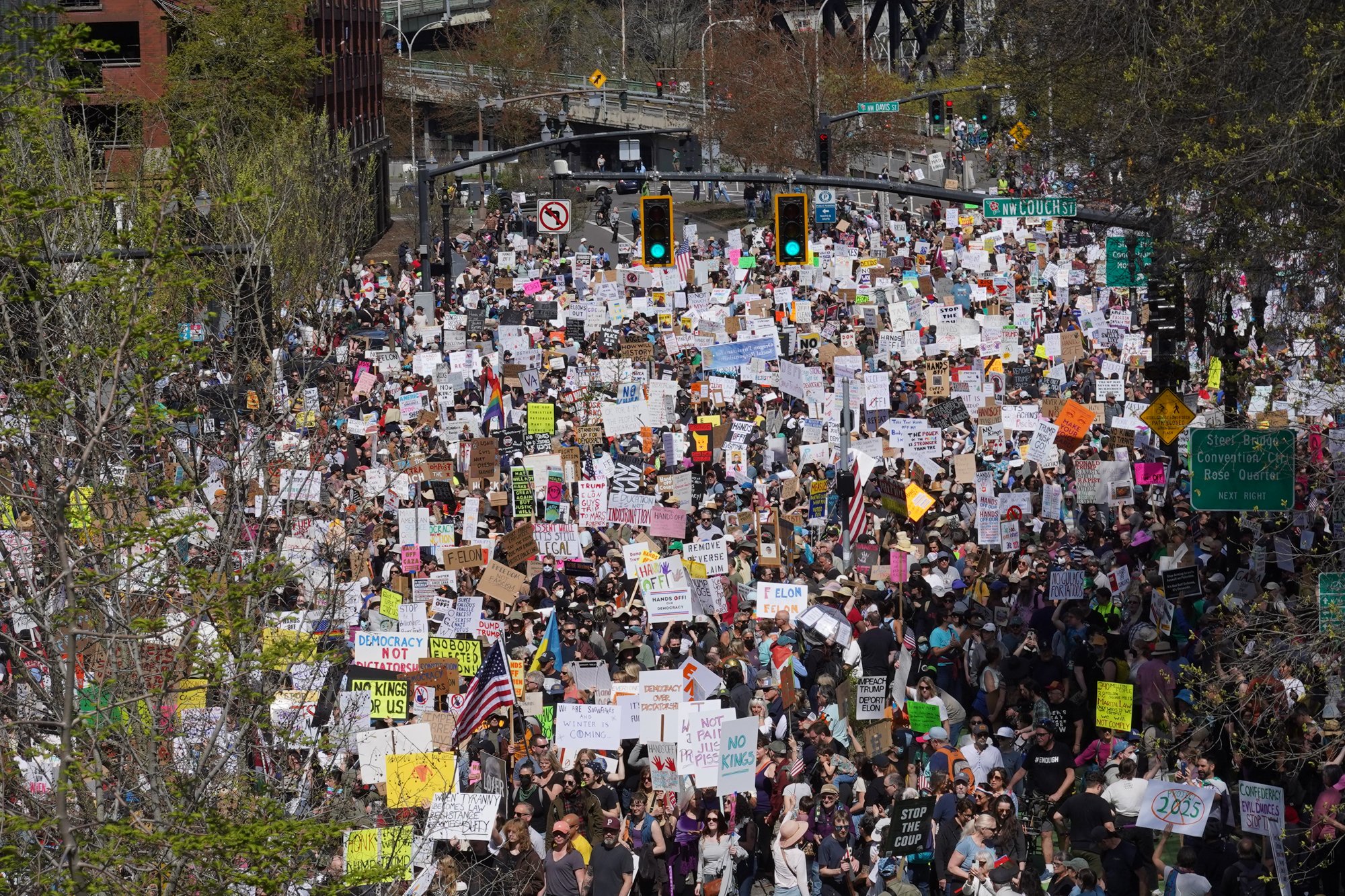
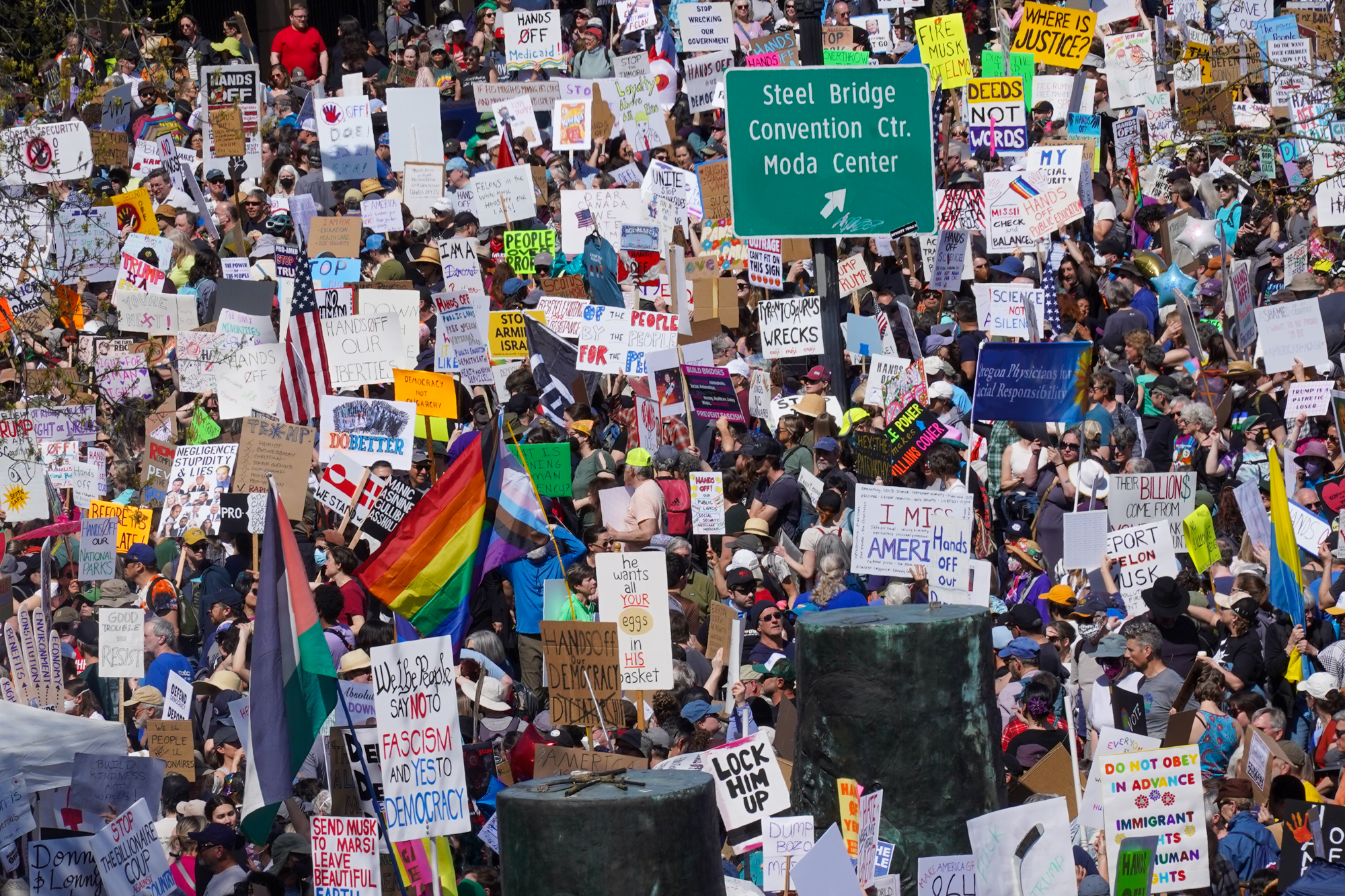
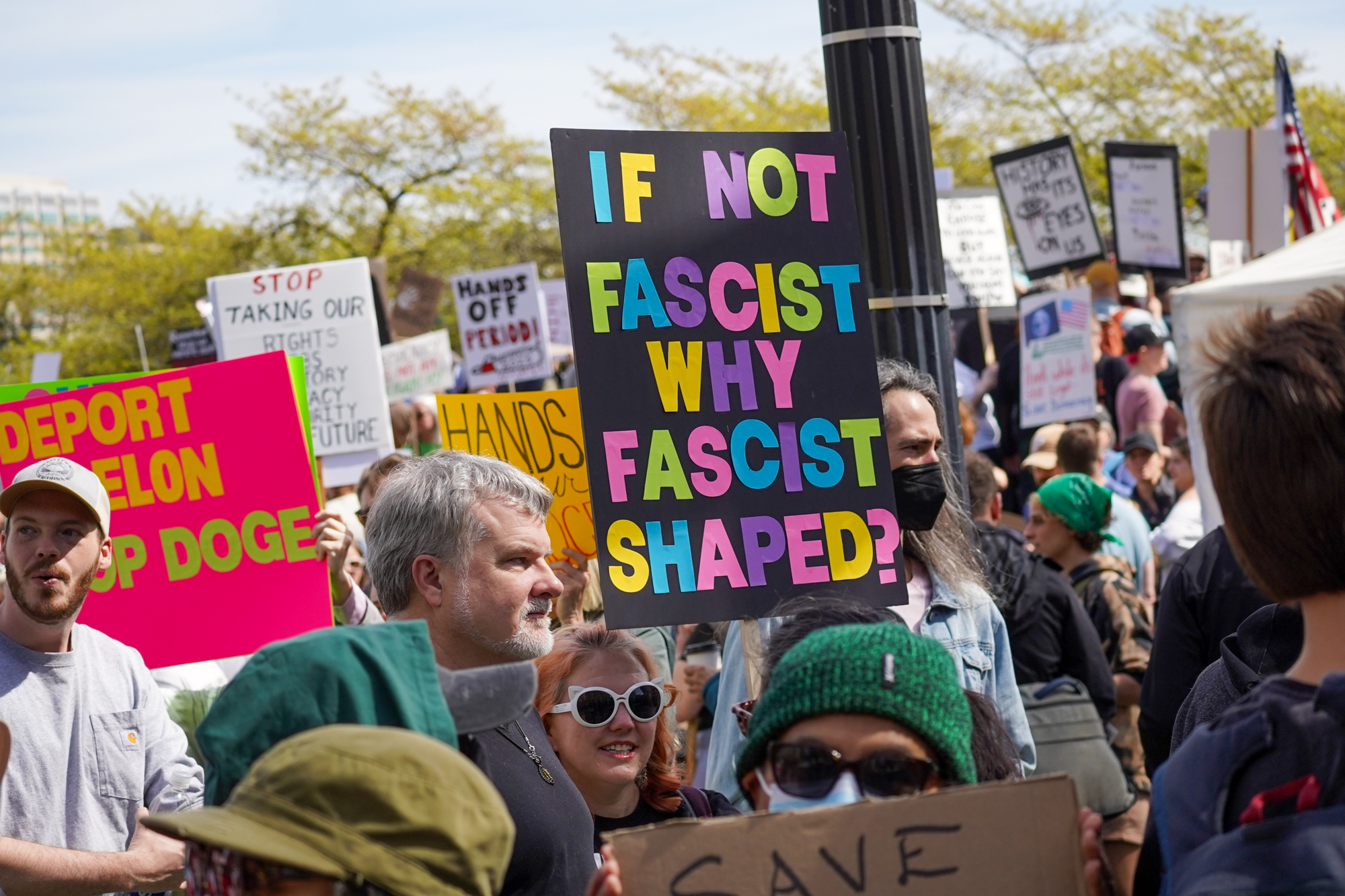
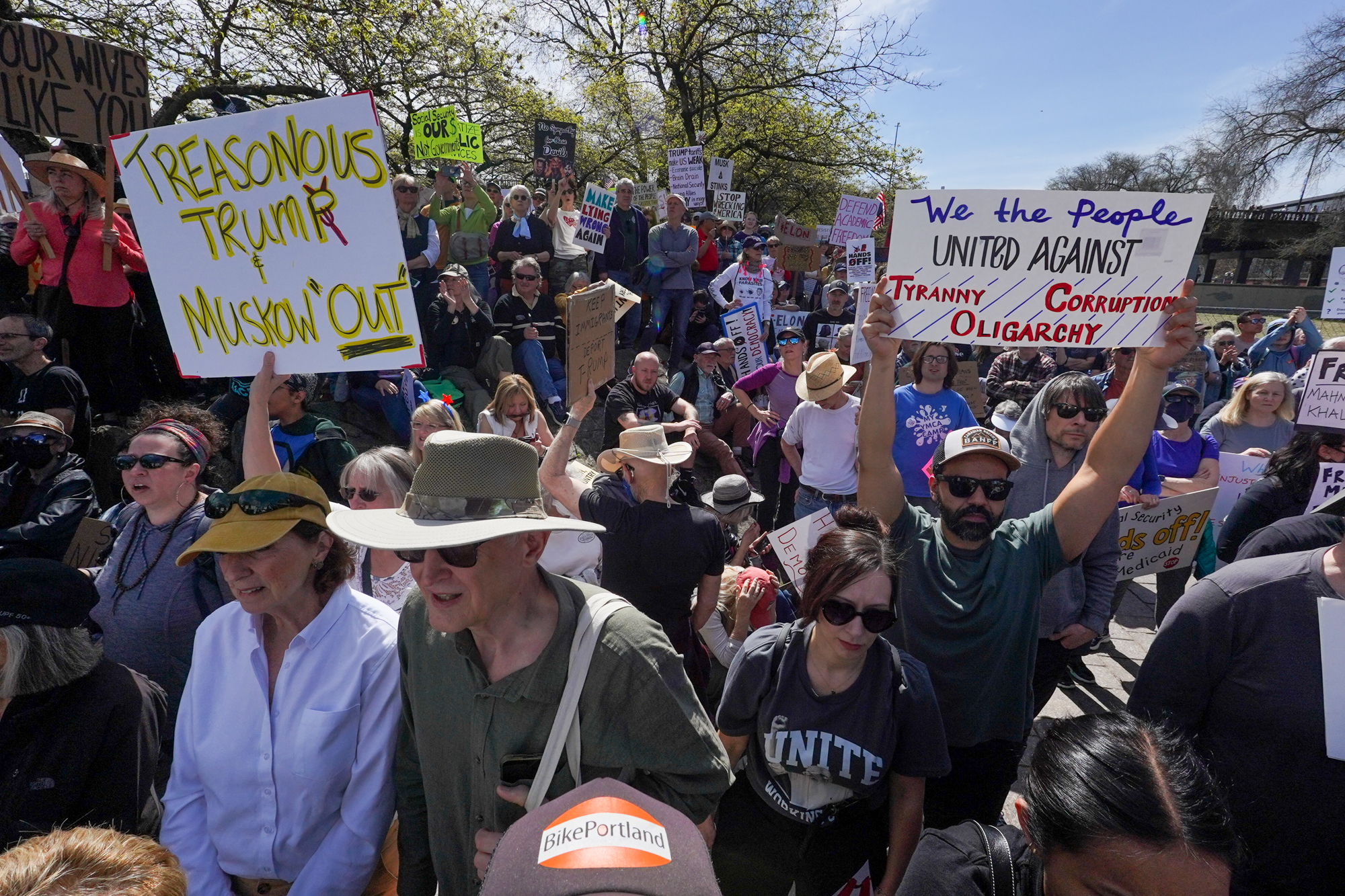
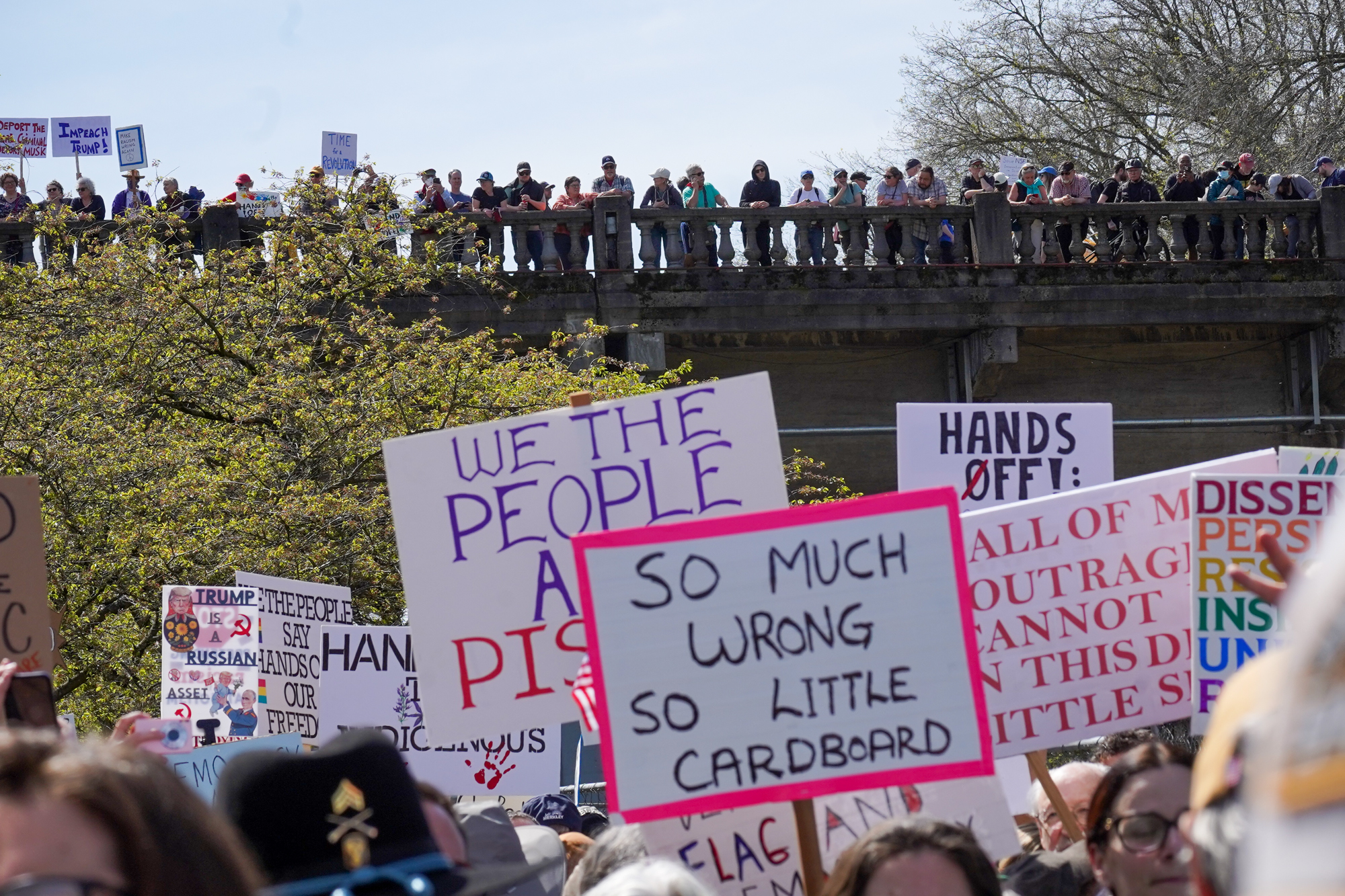
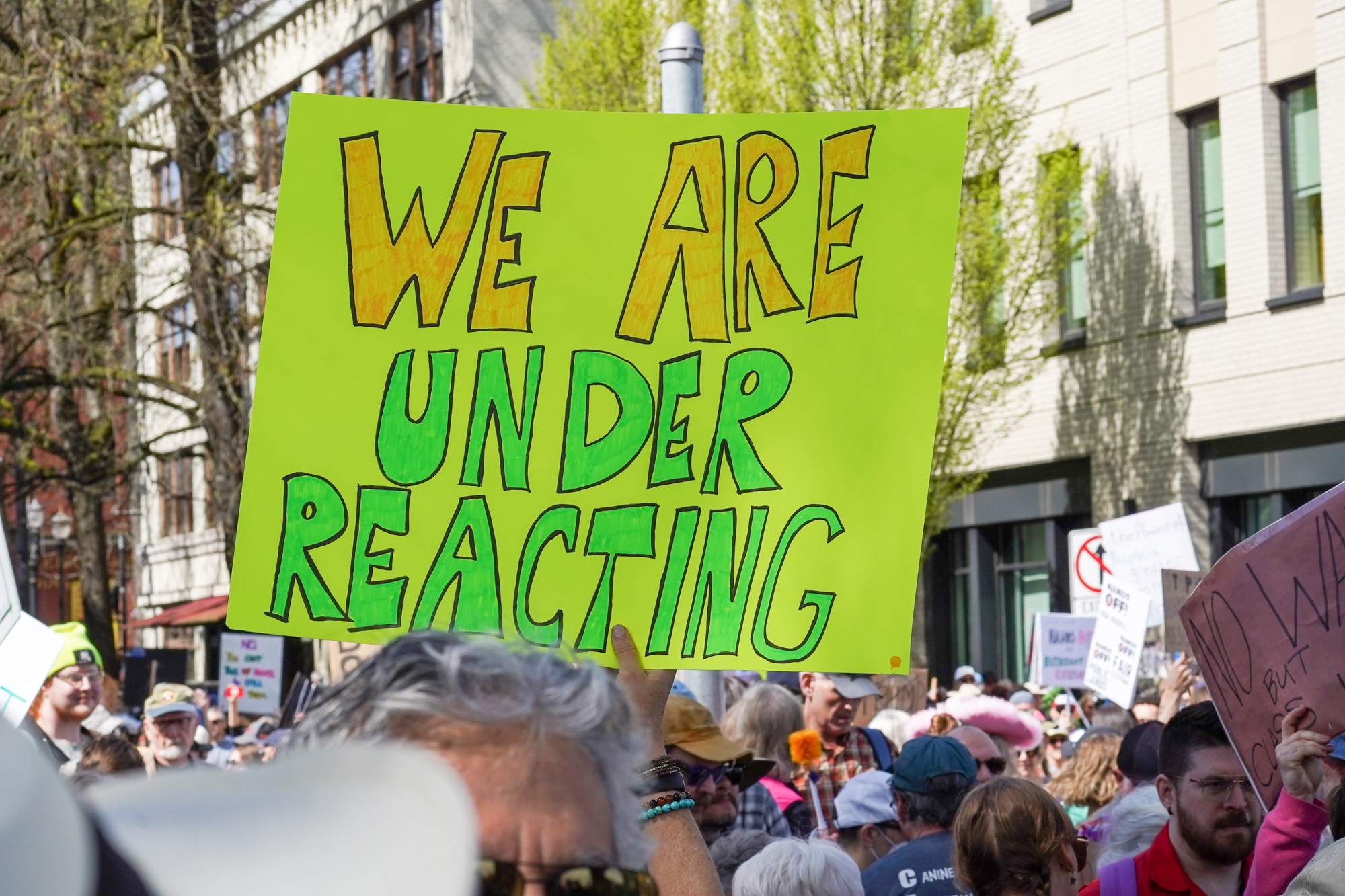
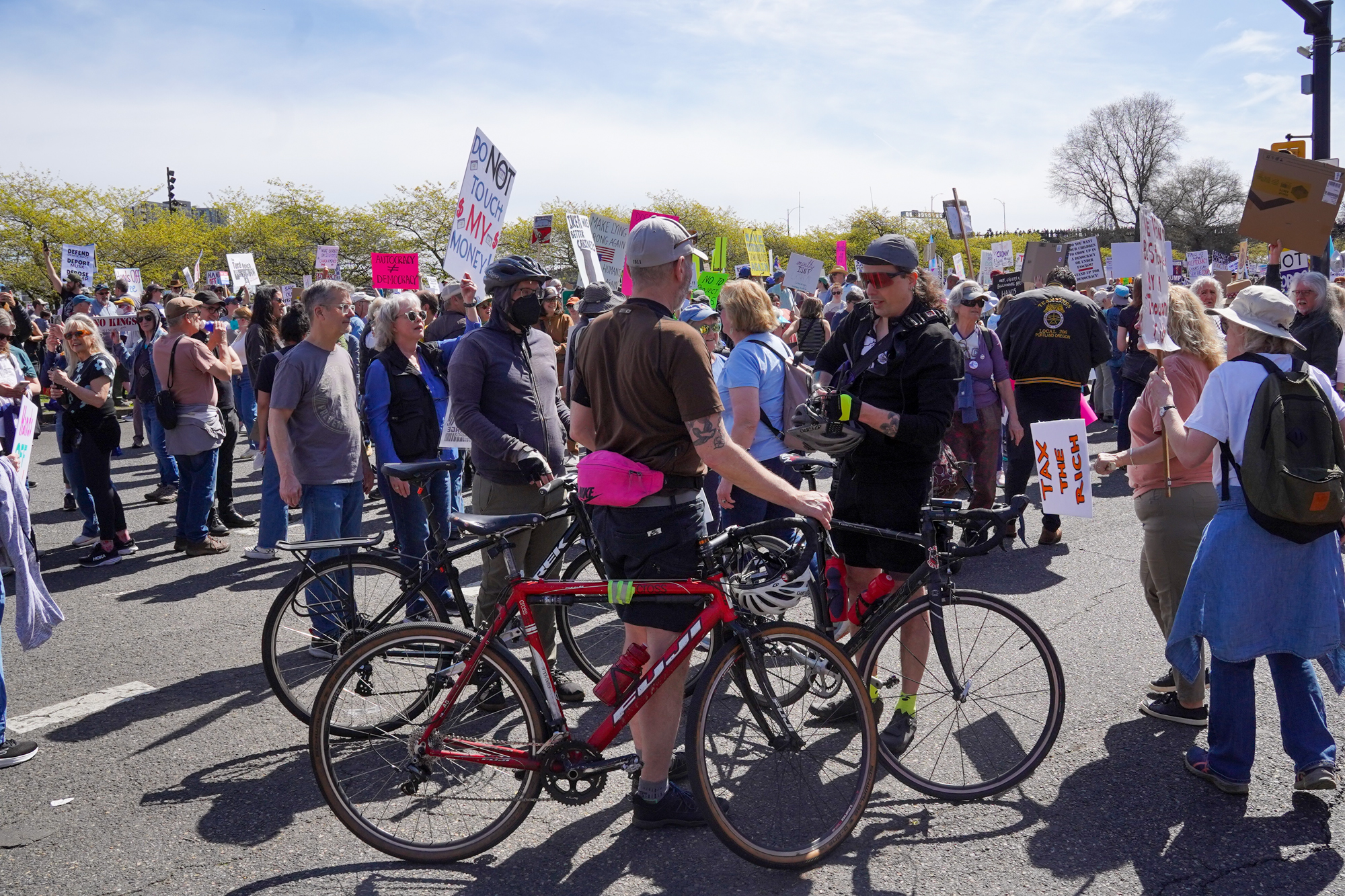
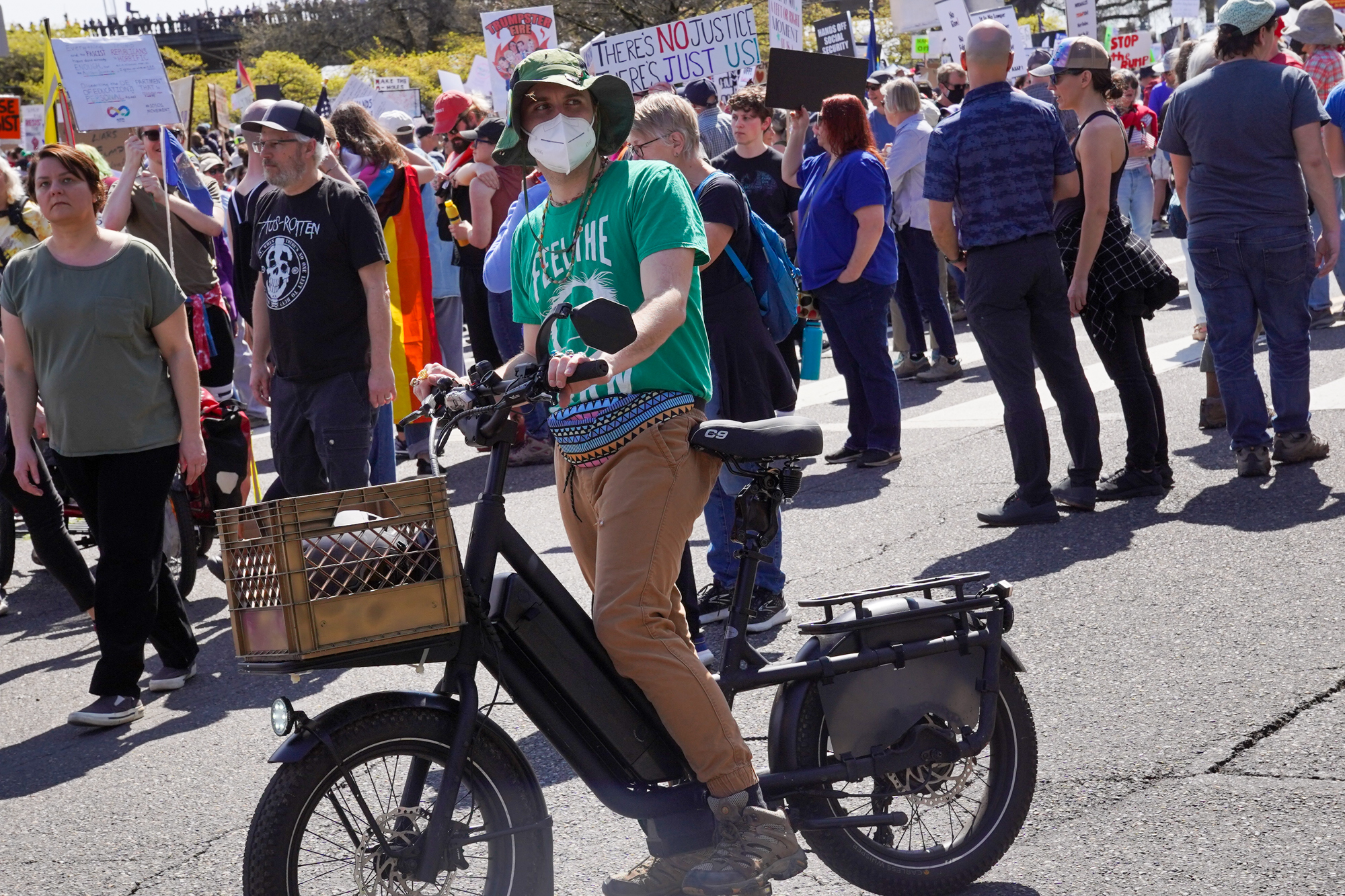
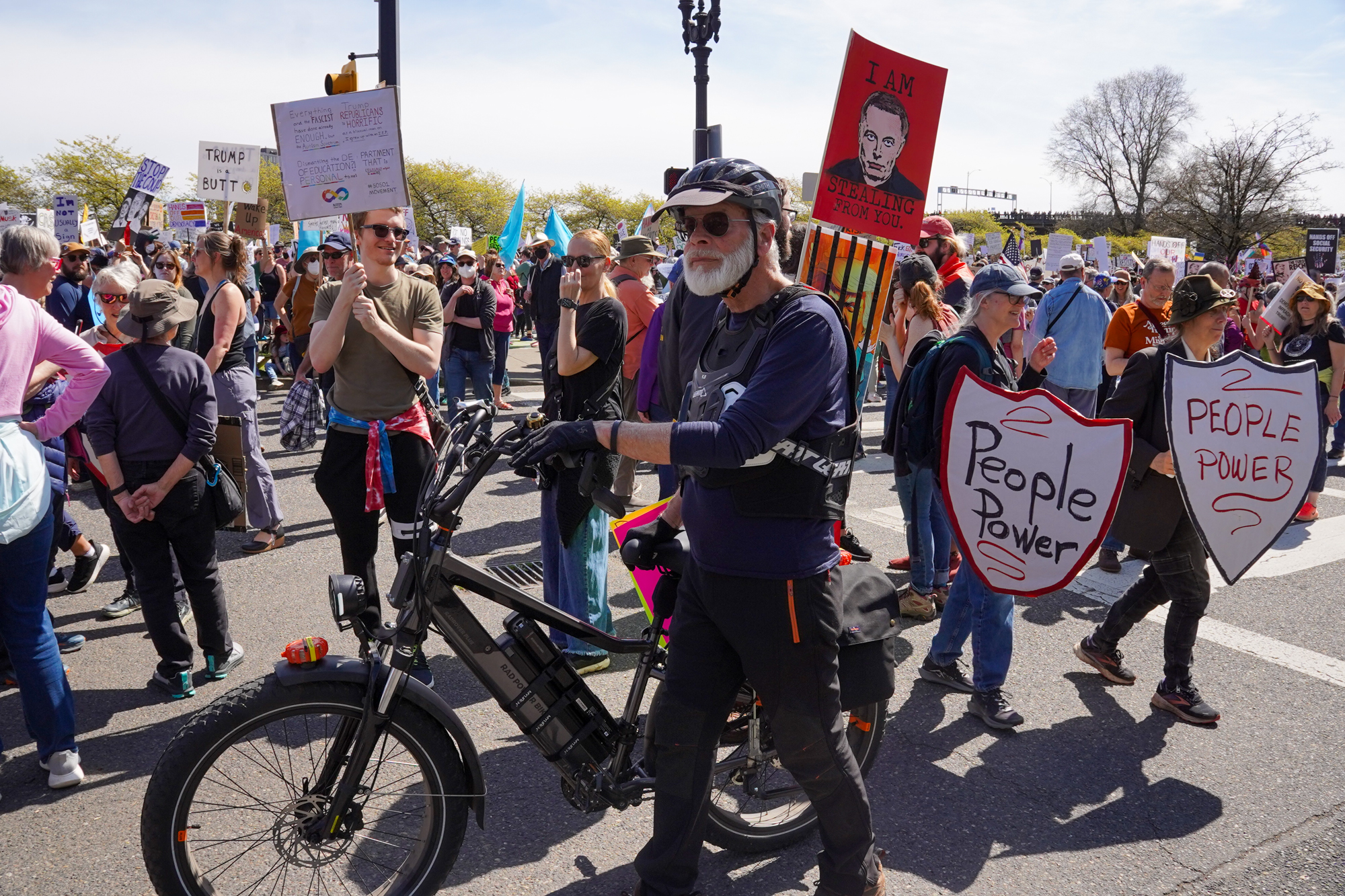
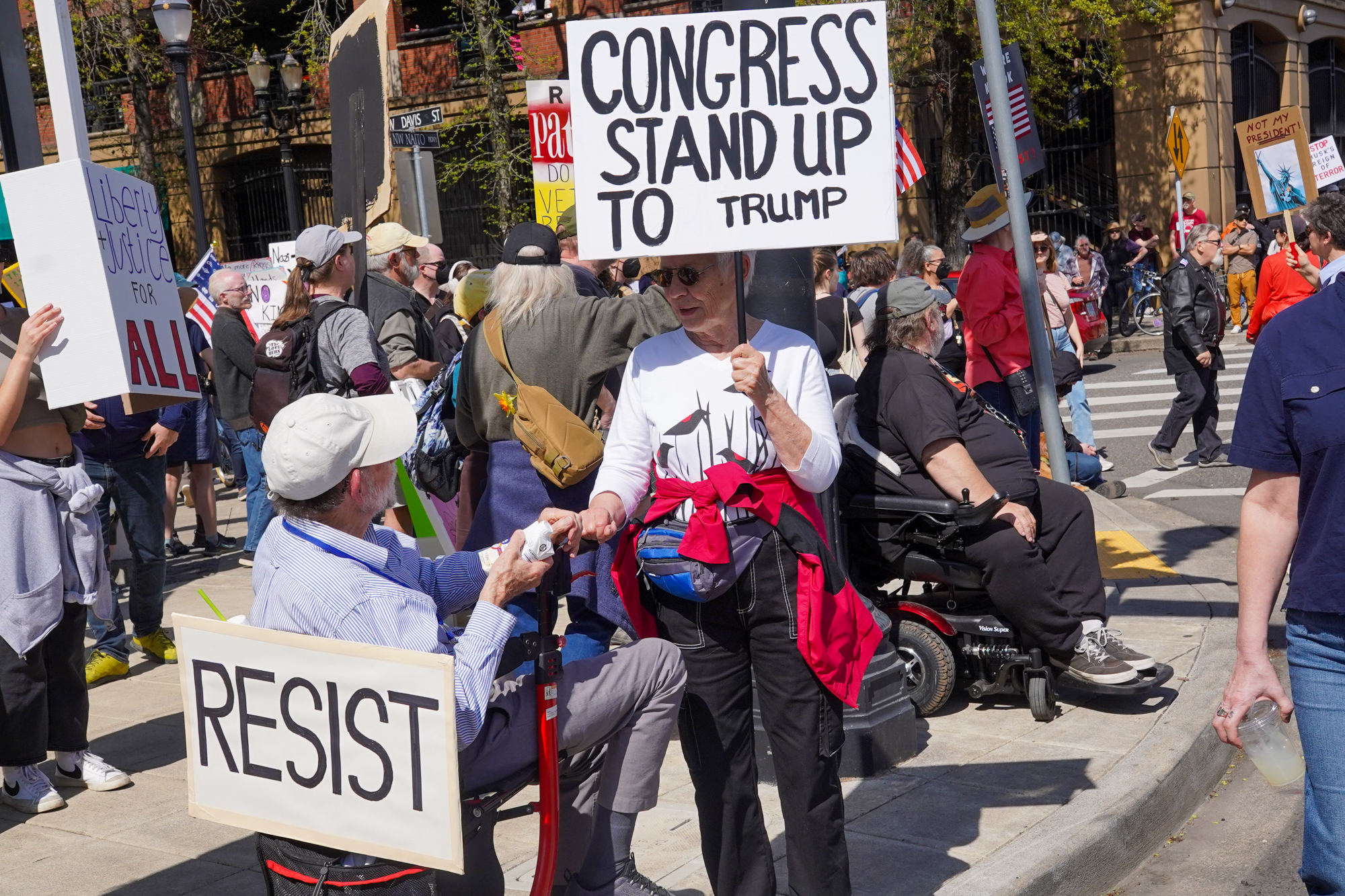
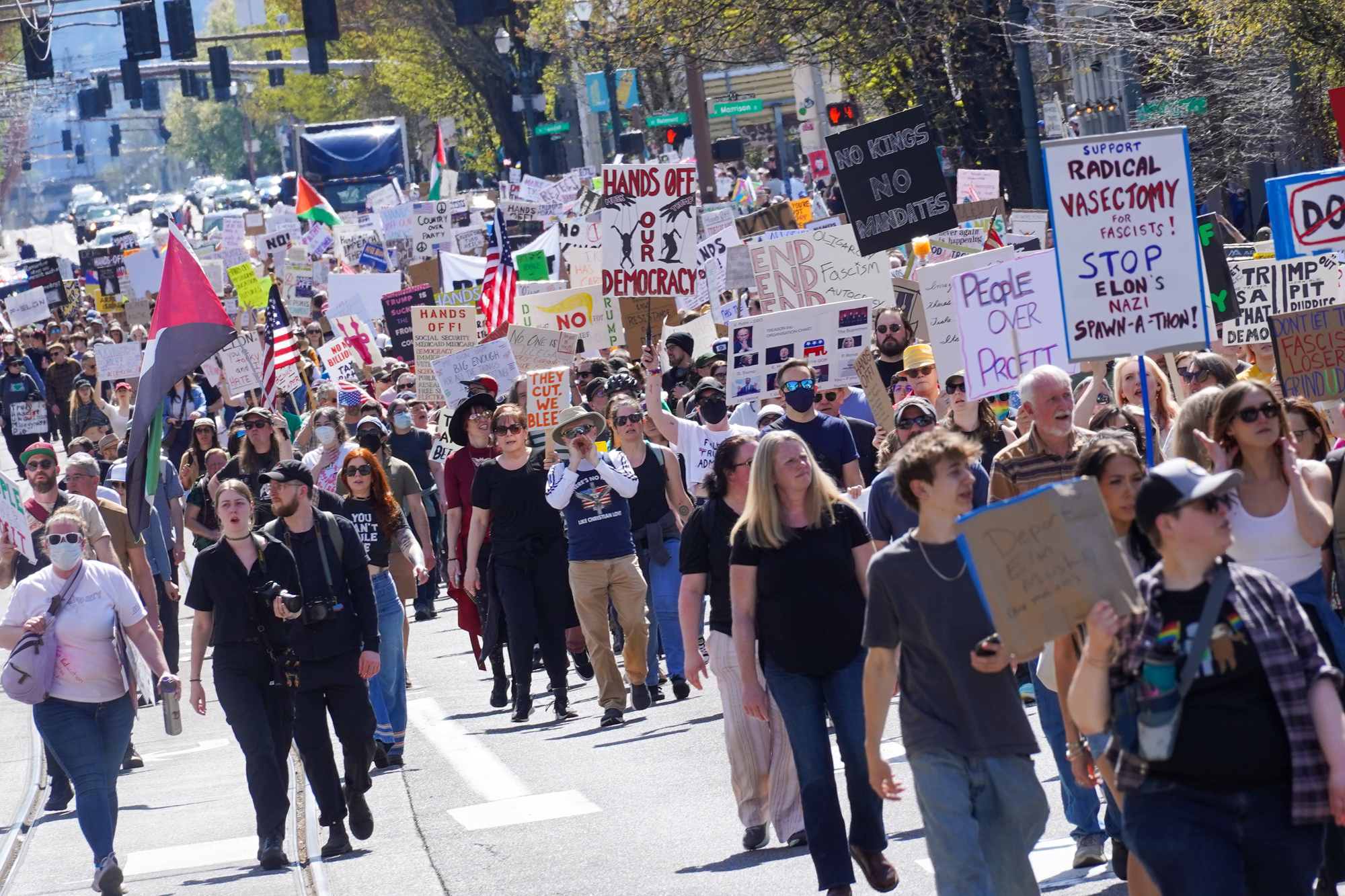
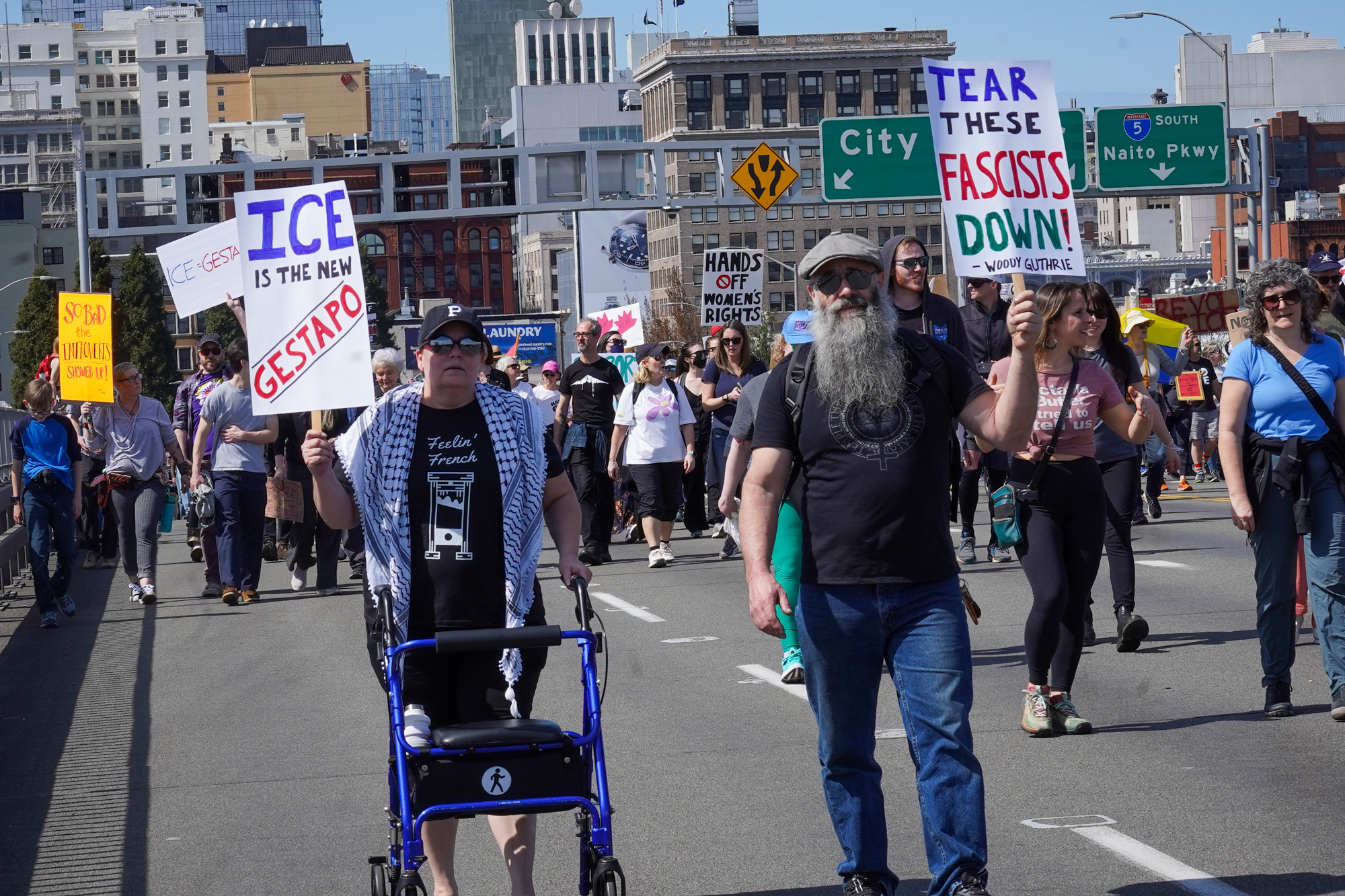
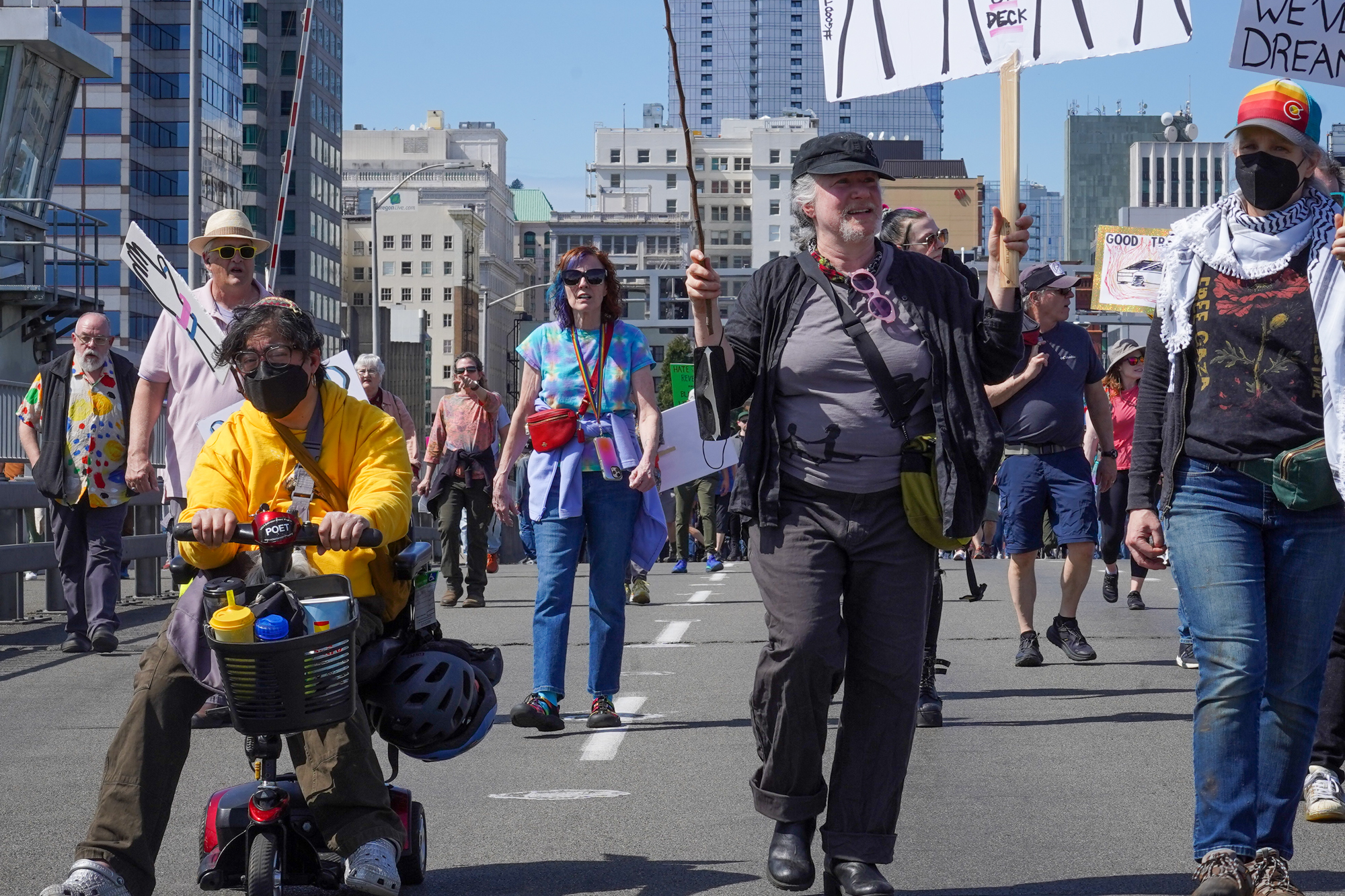
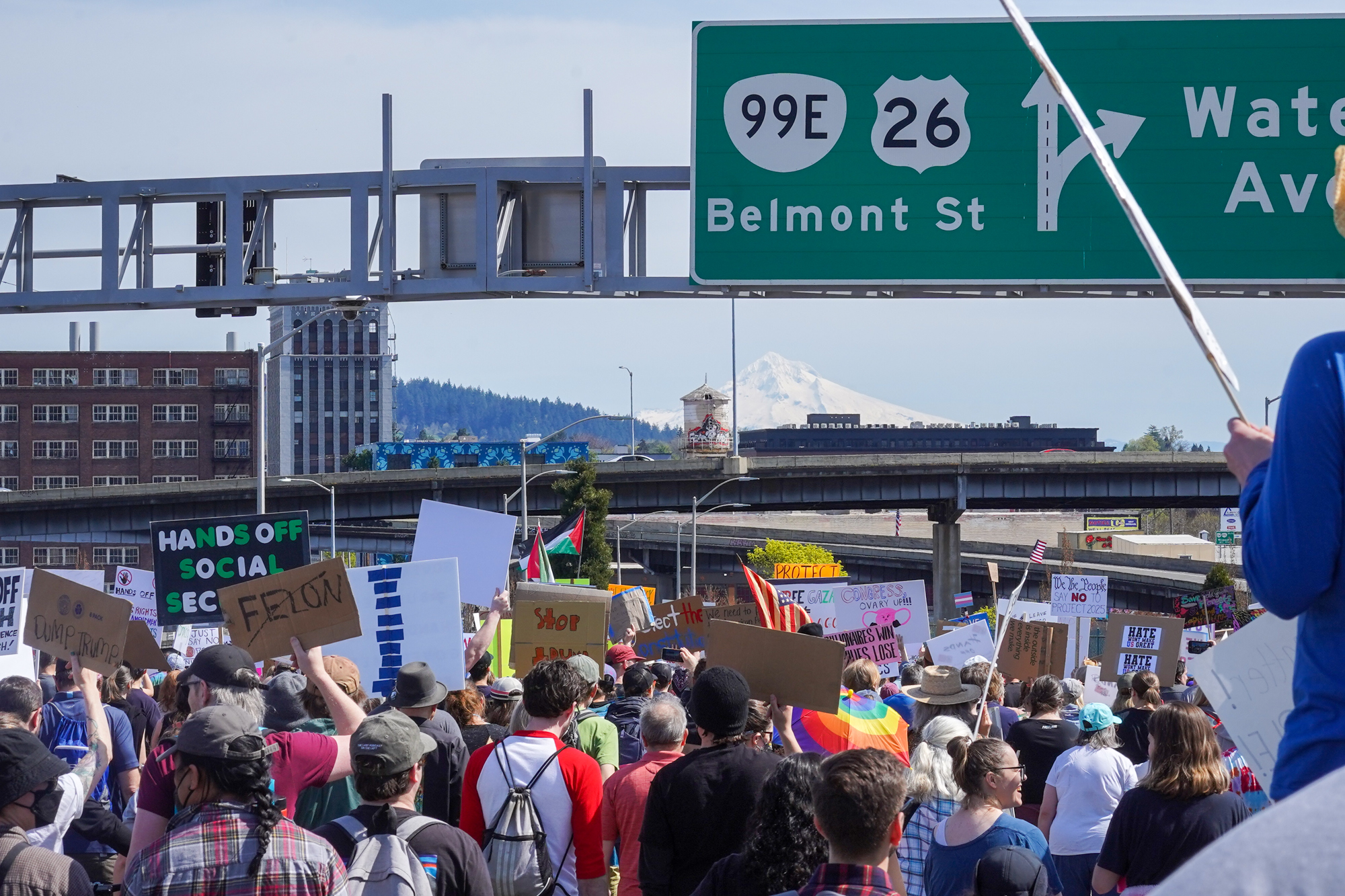
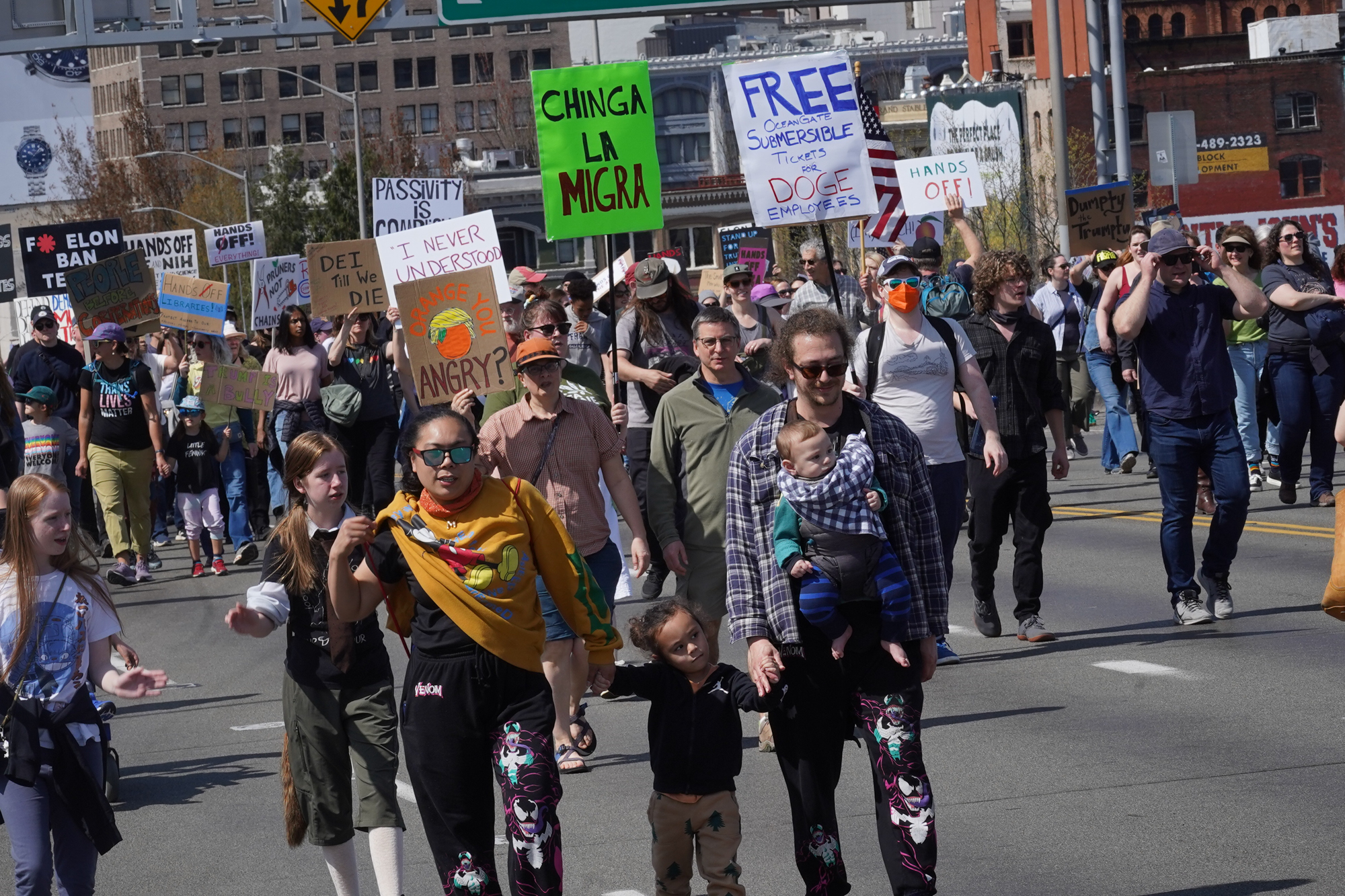
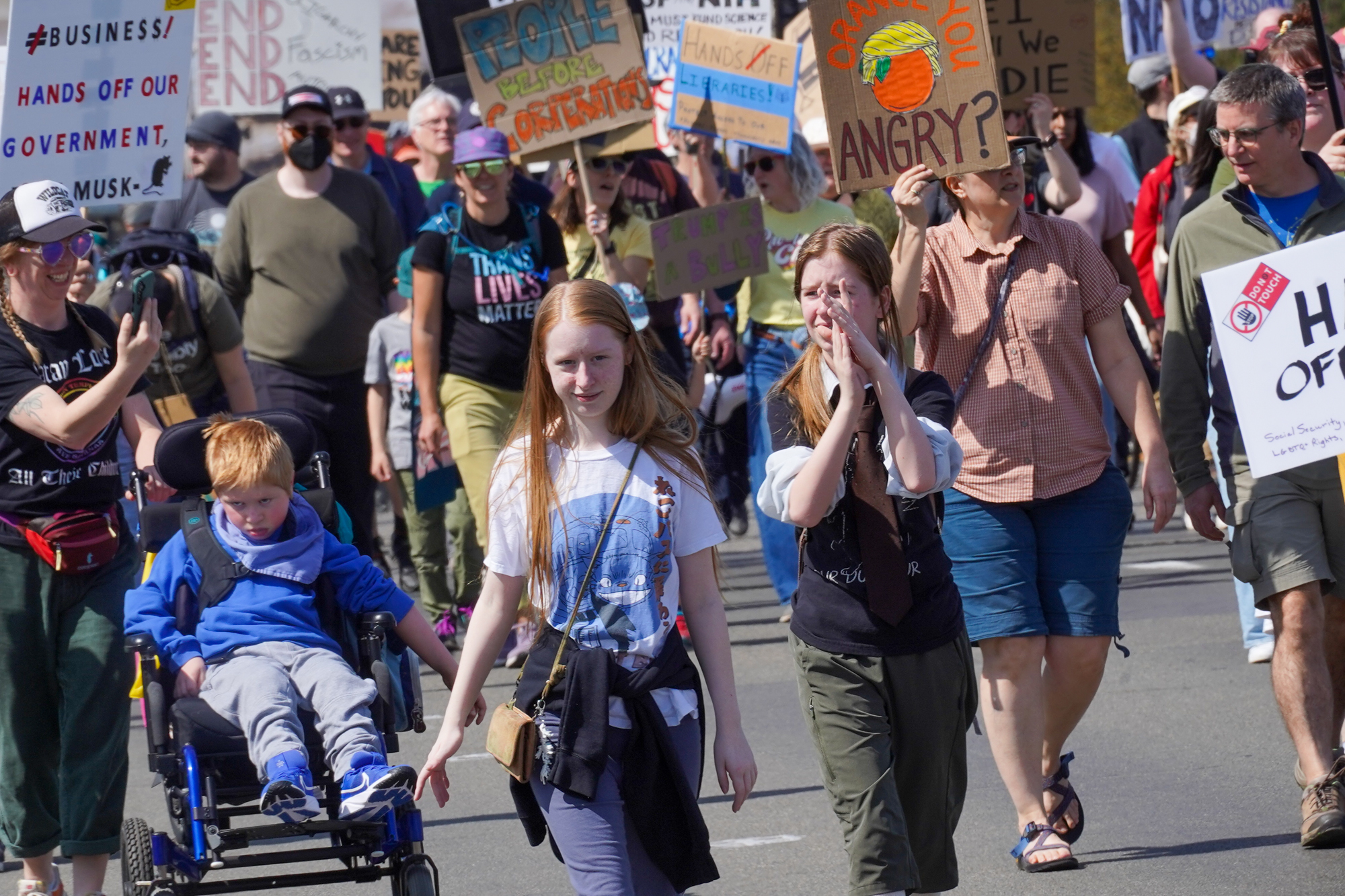
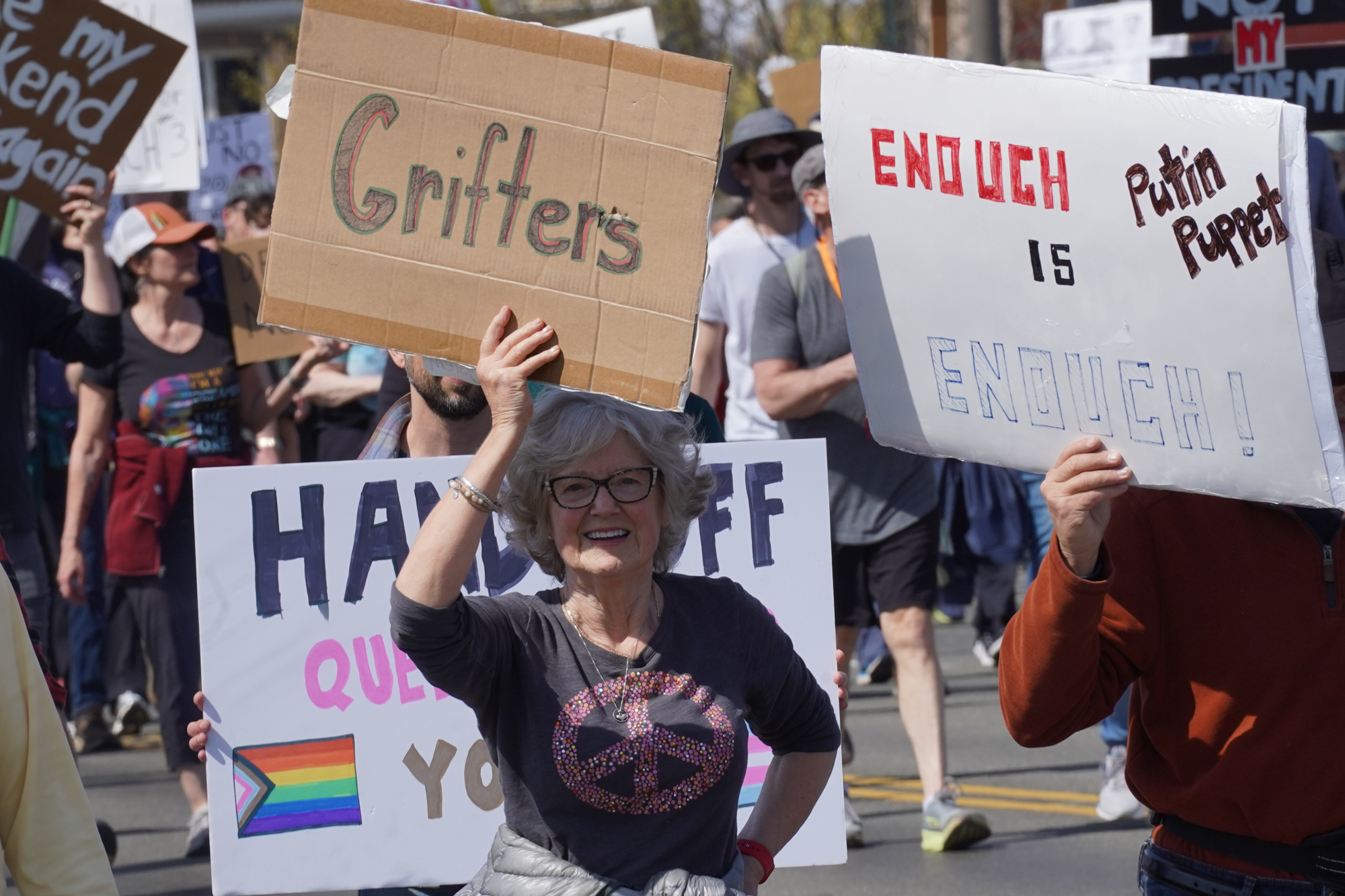
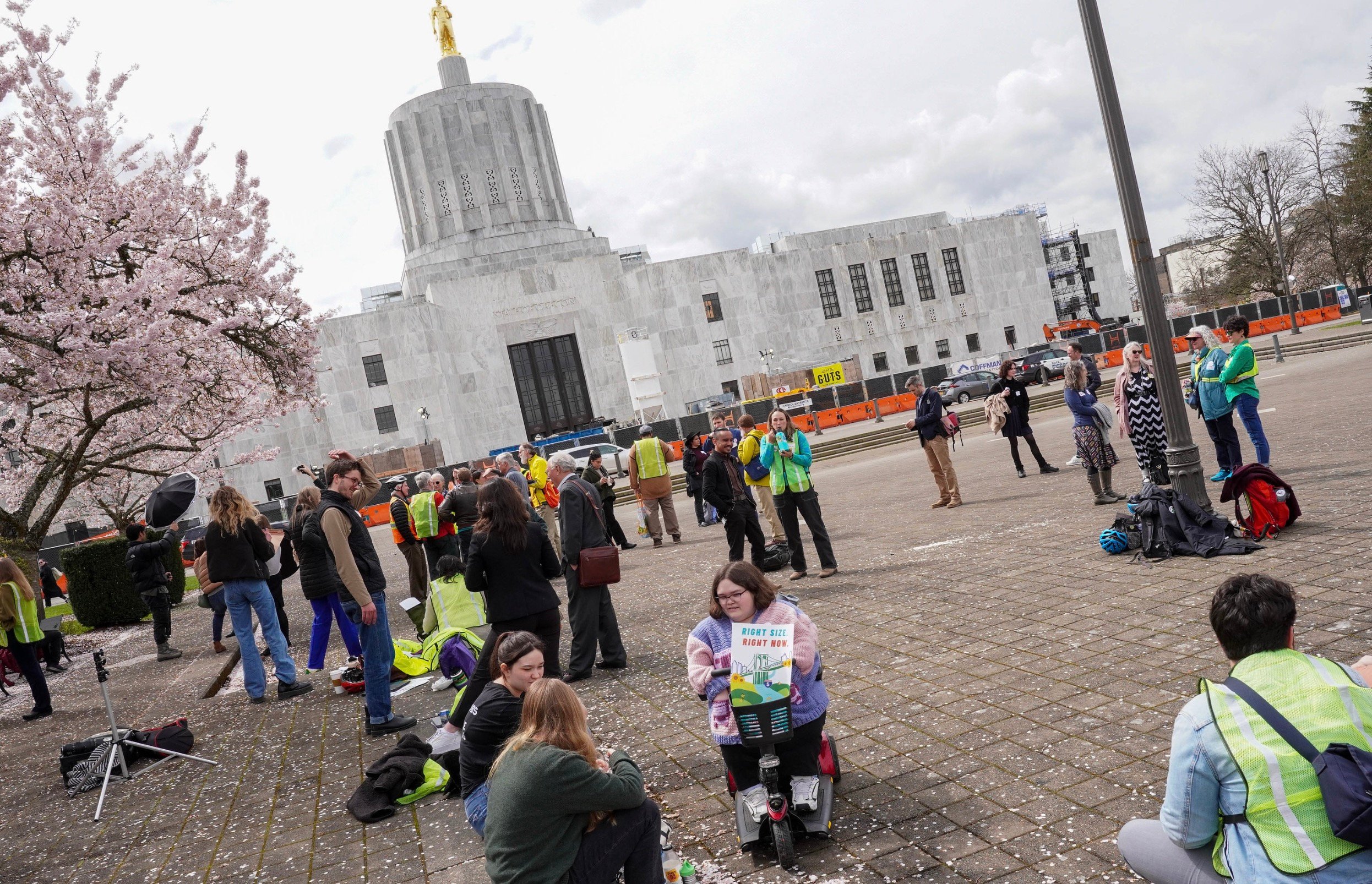
Thousands of people took park in the Hands Off rally and march today. I don’t have time to share thoughts, but wanted to get my full gallery here on the front page as soon as possible.
Just realized we are both wearing cardigans. Hahaha!
We’re back! Yes we missed a few weeks but we’re back and better than ever (if I do say so myself). This was such a fun conversation. We touched on all types of stuff — from the politics of the I-5 Rose Quarter project, to Eva’s new “Saturdays in May” ride series coming next month. Be sure to listen so you’re not the only one in your friend circle to not know what’s going on.
But first, here’s my cool new Metropolis Cycles tie-dye t-shirt! Thanks Brad!
And here’s a partial list of stuff we talked about and handy-dandy links to follow along with:
Thoughts on the I-5 Rose Quarter vote at Metro Council and why I’m disappointed in Lynn Peterson and Duncan Hwang. And the bad optics of white urbanists opposing the project while Black Portlanders support it.
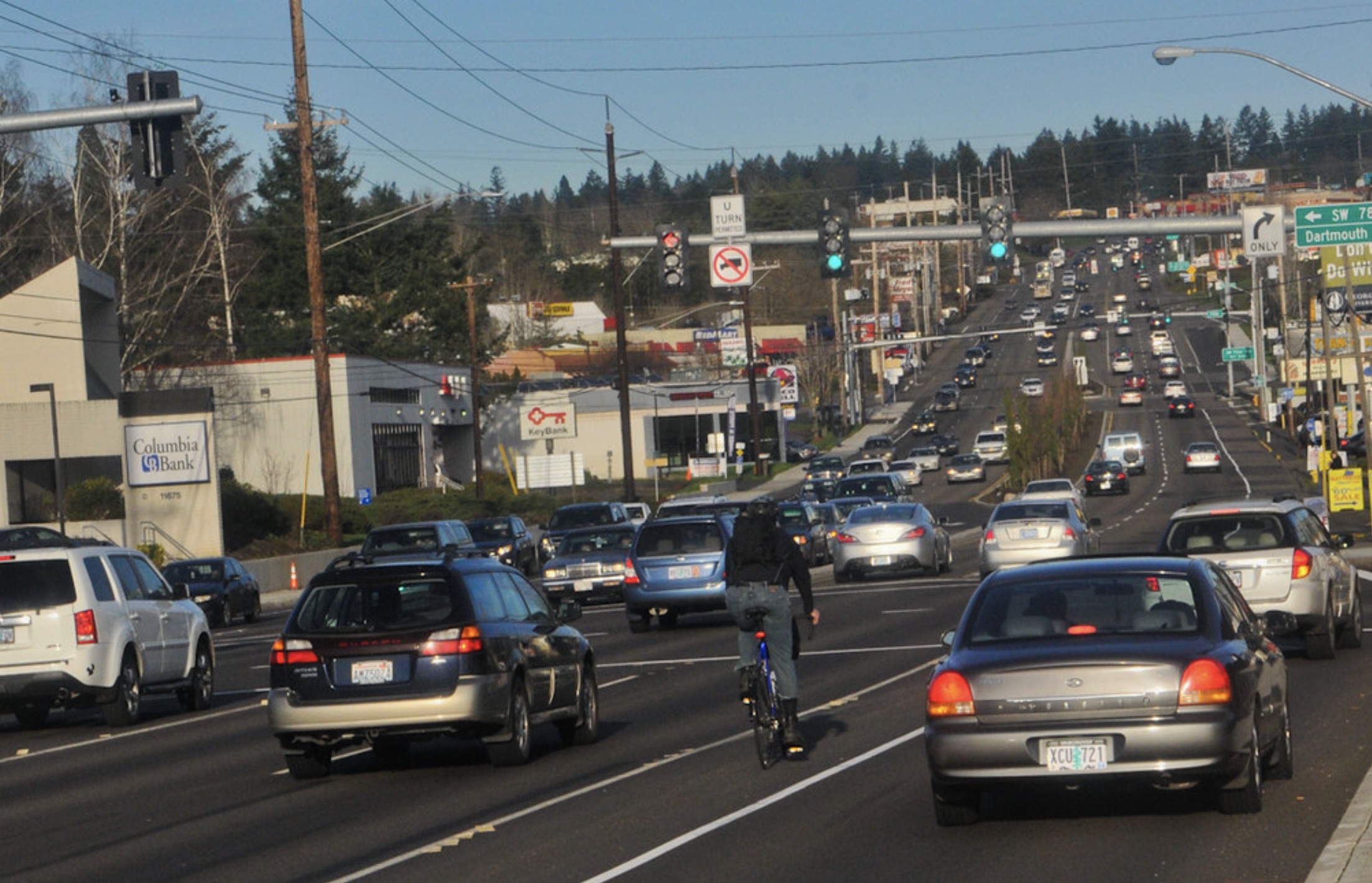
A view of SW Barbur Blvd. (Photo: Jonathan Maus/BikePortland)
The co-chairs of the Oregon Legislature’s Joint Committee on Transportation have released a “starting point” for negotiations around a major transportation funding bill. The Oregon Transportation Reinvestment Package (TRIP) seeks to raise about $1.9 billion per biennium (every two years) from a combination of increases to existing fees and taxes and a few new ones. Among them is a 63% increase to Oregon’s bicycle excise tax.
The Oregon Department of Transportation (ODOT) says the “structural revenue issues” they face — a drop in gas tax revenue, high inflation, and restrictions on available funding — have become so severe that they are $354 million short in their current budget. Without new funding this legislative session they’d have to fire nearly 1,000 employees and ODOT says the impacts to Oregon’s roads and people who use them would be “devastating.” Oregon last overhauled its transportation revenue programs in 2017, when lawmakers sought $5.3 billion in revenue over 10 years.
To avoid further cuts, ODOT and its oversight body, the Oregon Transportation Commission have spent two years building their case and garnering feedback from experts and road users. Last summer they organized a statewide tour of town hall-style listening sessions to hear and see first-hand what Oregonians want and need. All that discussion and feedback has brought us to this “starting point.”
Where the money will come from
Of the $2.2 billion funding total, the TRIP proposal (full text here) would raise $1.5 billion (note that all numbers in this story are per biennium, which means every two years, because that’s how ODOT budgets) through increases to the fuels tax and various vehicle registration fees. It seeks to raise the existing, 40-cents per gallon fuel tax to 60-cents per gallon. The 20-cent increase would begin with an eight cent increase in 2026 and would be staggered in four cent increments every two years through 2032. The TRIP also seeks to index the fuels tax to inflation, “to ensure future solvency of the revenue stream.”
The motor vehicle registration fee (currently starts at $126) would go up by $66 dollars and the cost of a title ($101) would go up $90. The weight-mile tax, paid by freight haulers and based on a percentage of the weight of their truck, would increase by 16.9%.
The TRIP also seeks to increase the existing Vehicle Privilege Tax (currently 0.5% of vehicle price) by 0.3% (for a total tax of 0.8%) and invest the funds into the Connect Oregon program that funds rail, aviation, and marine projects. (Revenue estimates are $44.8 million per biennium.)
The most significant new source of revenue in the package is what lawmakers are calling a “one-time system use fee” that would raise an estimated $486 million be levied on all vehicles at the time of purchase and be based on 1% of the sale price.
A new “tire pollution tax” would place a 3% increase on car and truck tire purchases (they say “vehicle tires” but “vehicle” can sometimes apply to bicycles and in this case they aren’t taxing bicycle tires) and is estimated to raise $50 million.
Another new revenue stream proposed in the package is a mandatory Road Usage Charge (RUC), also known as a pay-per-mile system. This would be a phased-in mandate that would apply to all existing electric cars in July 2026 and all new e-cars in 2027. It would hit plug-in hybrids in July 2028 and all new vehicles with 30 mile-per-gallon or greater in July 2029. Vehicle owners could enroll with the RUC program — which is already in place and known as OreGo — or pay a flat annual fee. (To learn more about this program, listen to a recent interview with ODOT’s finance director on Oregon Public Broadcasting.)
To fund transit, the TRIP would increase the payroll tax that funds ODOT’s Statewide Transportation Improvement Fund (STIF) from its current rate of 0.1% to 0.18%. This 0.08% would raise about $268.6 million. This increase is much lower than some lawmakers and transit advocates have asked for. In a letter sent March 28th to Oregon Senate and House leadership and members of the Joint Committee on Transportation, ten lawmakers asked for a 0.5% increase.
And last but not least, the TRIP proposes a 63% increase to the Bicycle Excise Tax. That $15 tax, which applies to new bicycles that sell for $200 or more, went into effect in 2018. Lawmakers want to add $9.50 per bike for a total new bike tax of $24.50 in order to raise about $1 million in revenue that would go directly toward ODOT’s Community Paths Program. Back in December I reported that some lawmakers felt it was a mistake to rush into the bike tax in 2017 and would seek to take a more nuanced approach this time around. So far, that’s not the case, and advocates have work to do on this front.
Where the money will go
As for how the funds will be distributed, about 90% of the newly proposed revenue would go into the State Highway Fund and be dedicated to maintenance and operations of the existing system.
Of the $1.9 billion the package raises from the fuel tax and vehicle registration fee increases, $1.7 billion of that will be distributed via the traditional “50/30/20” State Highway Fund formula that sends 50% of revenue to the state (about $850 million), 30% to counties (about $510 million) and 20% (about $340 million) to cities.
$250 million of the new one-time system use fee will be set-aside and spent on finishing highway expansion projects identified but not yet completed in the 2017 package (known as House Bill (HB) 2017. This is the “unfinished business” lawmakers have been talking about and includes megaprojects like the I-5 Rose Quarter, the Abernethy Bridge project, and so on. One source referred to this as a ” freeway project slush fund.”
While the TRIP dedicates $125 million per year to highway expansion projects, it makes no such promise for ODOT’s complete streets or Safe Routes to Schools programs. The package mentions those programs but does not specify any funding amount for them.
When it comes to passenger rail, the package would send $17 million to maintain Amtrak service levels. Half of the tire pollution tax revenue (about $25 million) will go to rail operations. The tire tax will also fund wildlife crossings and salmon restoration efforts to, “negate the harmful impacts of pollution runoff into Oregon waterways.”
Advocates with Move Oregon Forward (a coalition of climate, transportation safety, and environmental justice nonprofits) applauded the framework released today, saying it “provides a solid foundation.” Executive Director of The Street Trust Sarah Iannarone said, “We deeply appreciate the mentions of key safety programs.” Cassie Wilson, the transportation policy manager at 1000 Friends of Oregon, was a bit more pointed. “The money must match the mission,” Wilson said, referring to transit funding. “Now is the time to double down on popular but underfunded programs that benefit all Oregonians now and in the long term.”
With these proposals finally out in the open, the debates can start in earnest. This is just an opening salvo and it’s widely understood that what ends up being passed will be very different that what we have now. What parts change and how much they change depends on who’s able to influence lawmakers the most and bend the politics in their favor.
Stay tuned for more coverage and analysis. Read the text of the proposal here.
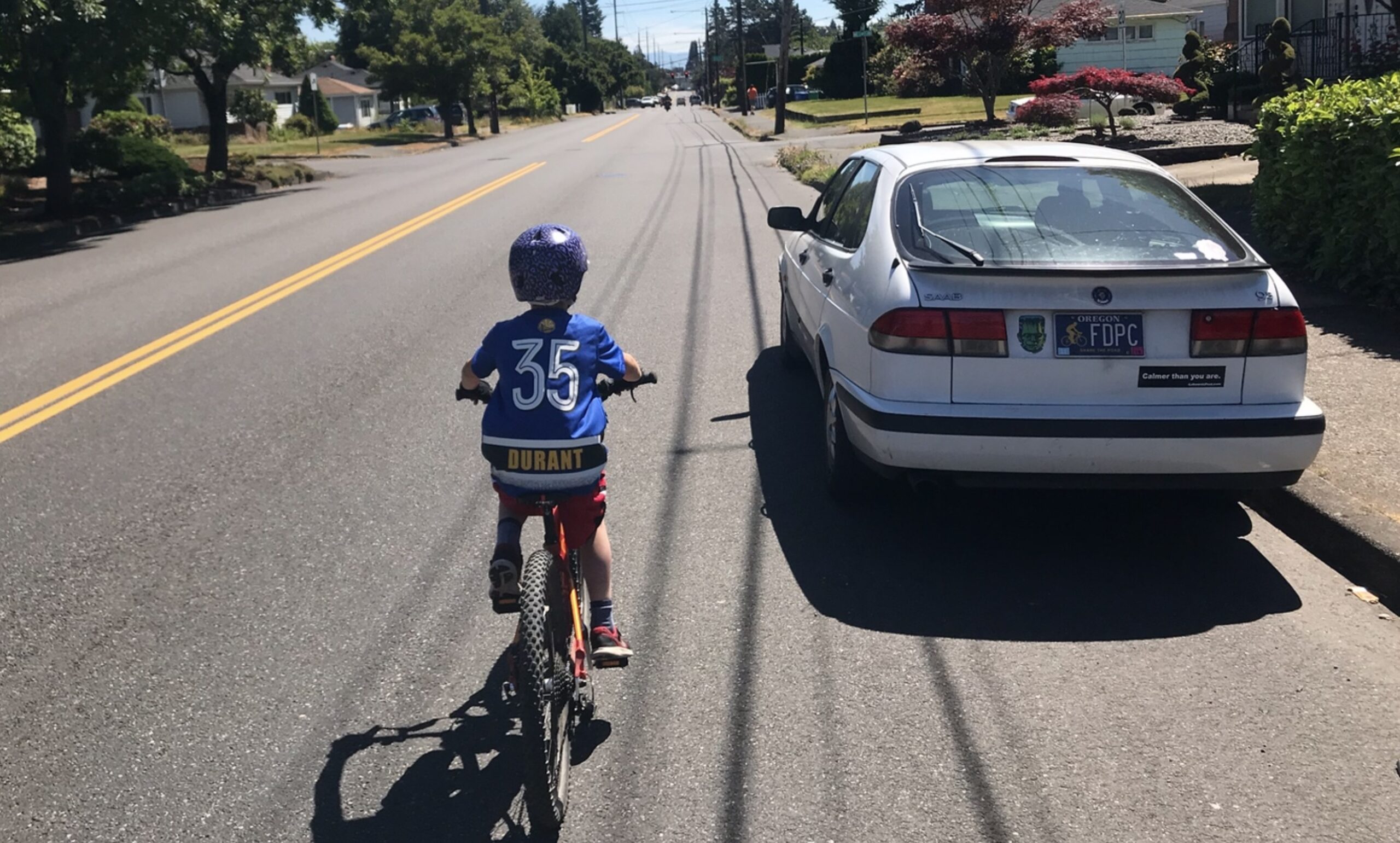
My son riding on NE Prescott where PBOT has finally proposed swapping that damn parking lane with a bike lane. (Photo: Jonathan Maus/BikePortland)
Metro has opened up the public comment period for a project funding process that could result in some very exciting new additions to the region’s bicycling network — including finally striping a bike lane on Northeast Prescott Street to help it connect to the I-205 path. But if you want these projects to become a reality, you’ve got to comment!
There’s $42 million in federal funding up for grabs through Metro’s regional flexible funding “Step 2” allocation. The process identifies a list of projects to be built over a three-year period and covers federal fiscal years 2028 through 2030. Agencies across the Portland region have submitted 24 applications for projects worth a total of $140 million. With less than one-third of that amount available, and with local budgets very tight, there’s steep competition for the funding.
The City of Portland has submitted six project applications and seeks $36 million to pay for them. The projects include:
a host of traffic signal upgrades on outer NE Halsey (from 82nd Ave to 148th) and SE Foster (82nd to SE Jenne Rd);
new signalized crossings and lighting to NE Martin Luther King Jr Blvd between NE Hancock and Lombard;
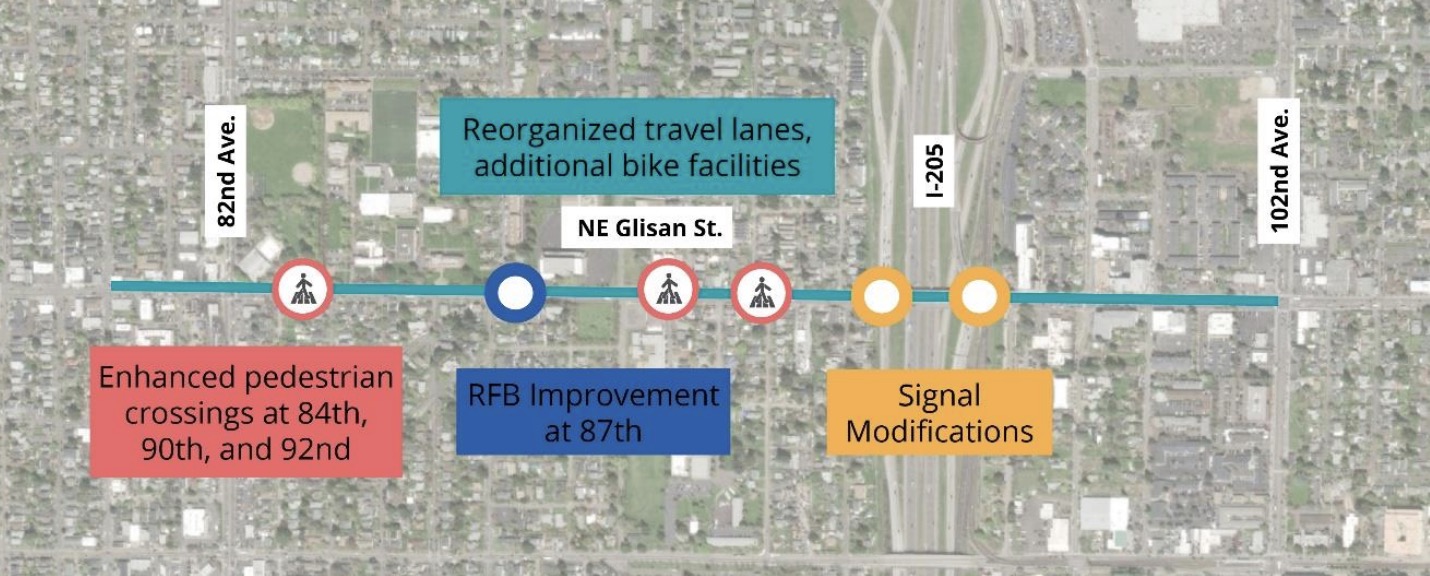
a road diet, new bike lanes, safer crossings and signal upgrades on NE Glisan from NE 82nd to 102nd Ave;
a new crossing of W Burnside and Park, along with a shared bike/bus lane on W Burnside from Park Ave to 3rd to connect to the Burnside Bridge (and bike lane on 3rd);
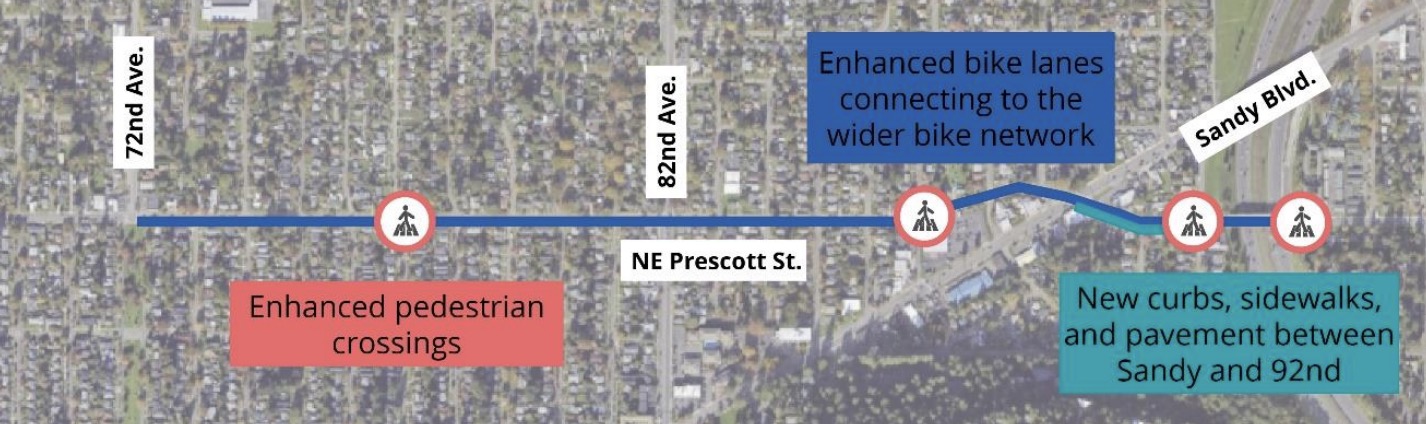
new bike lanes, crossings and other safety updates to NE Prescott St. between 72nd and the I-205 path; and
a new segment of the Red Electric Trail running parallel to SW Beaverton-Hillsdale Hwy, from SW Shattuck Rd (east of Alpenrose Dairy parcel) to SW Fairvale Ct.
NE Glisan project graphics (PBOT).
PBOT Project Manager Zef Wagner presented the projects at a meeting of the Portland Freight Committee today.
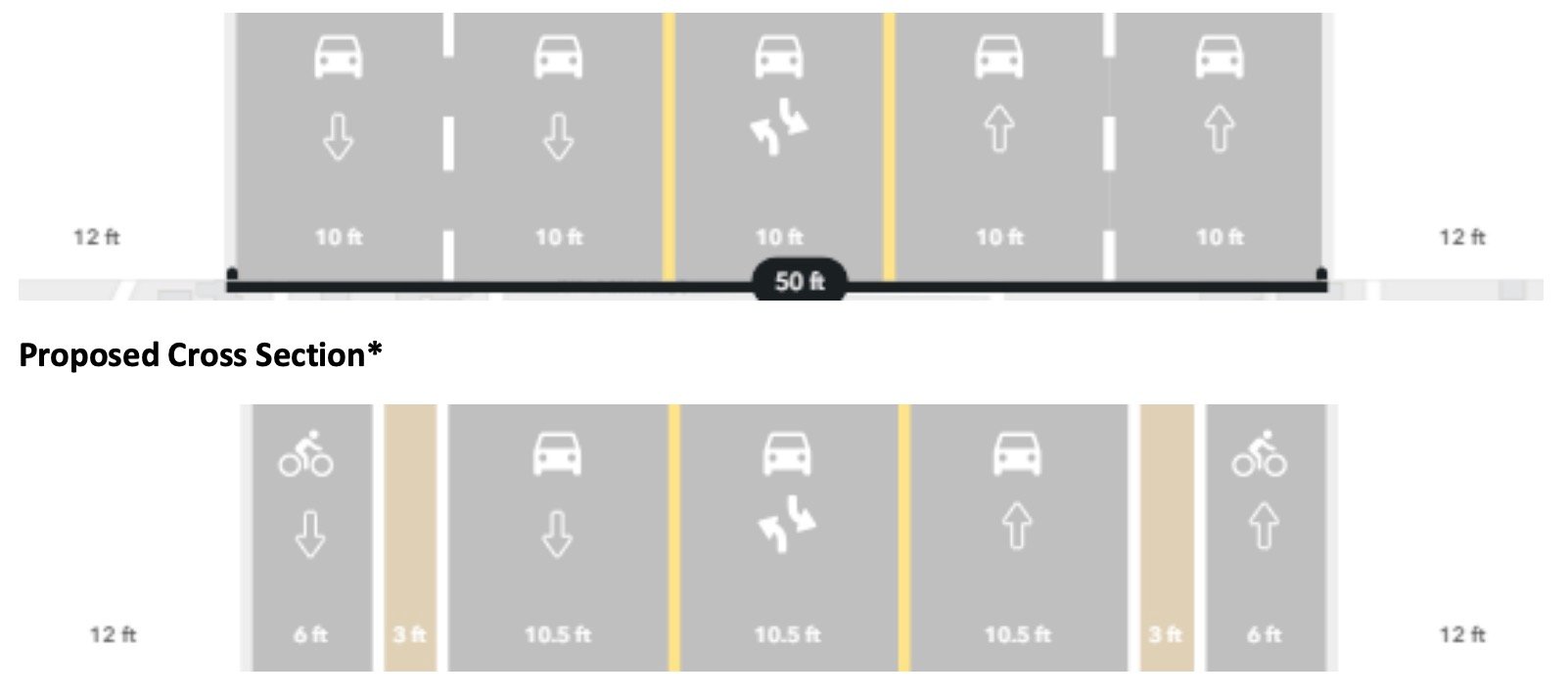
Wagner said the $8.4 million NE Glisan project is part of PBOT’s strategy to improve bikeways parallel to 82nd Avenue, since a major investment in that major street will not include bike facilities. PBOT’s plan is to reduce the space for car users on Glisan St. by 37% because Wagner said their analysis shows the design offers more capacity than what’s being used. PBOT wants to redesign the 50-foot cross-section from five general travel lanes to three general travel lanes and two, nine-foot wide “separated” bike lanes (unclear if they’ll be protected with concrete, plastic wands, just paint, or what). The project will also improve crossings at 84th, 87th, 90th, and 92nd — including signals upgrades at I-205 to make it easier to cross the freeway.
By reducing the number of driving lanes on Glisan, PBOT hopes to address what they call a crash hot spot. “There have been very high speeds and road departure crashes,” Wagner said at the meeting, “and people have even crashed into the playground at Montavilla Park so there’s been a lot of concerns.”
The Glisan project earned a top ranking in a Metro project scoring process, “So I think it’s looking pretty good [to win funding],” Wagner said.
NE Prescott project graphics (PBOT).
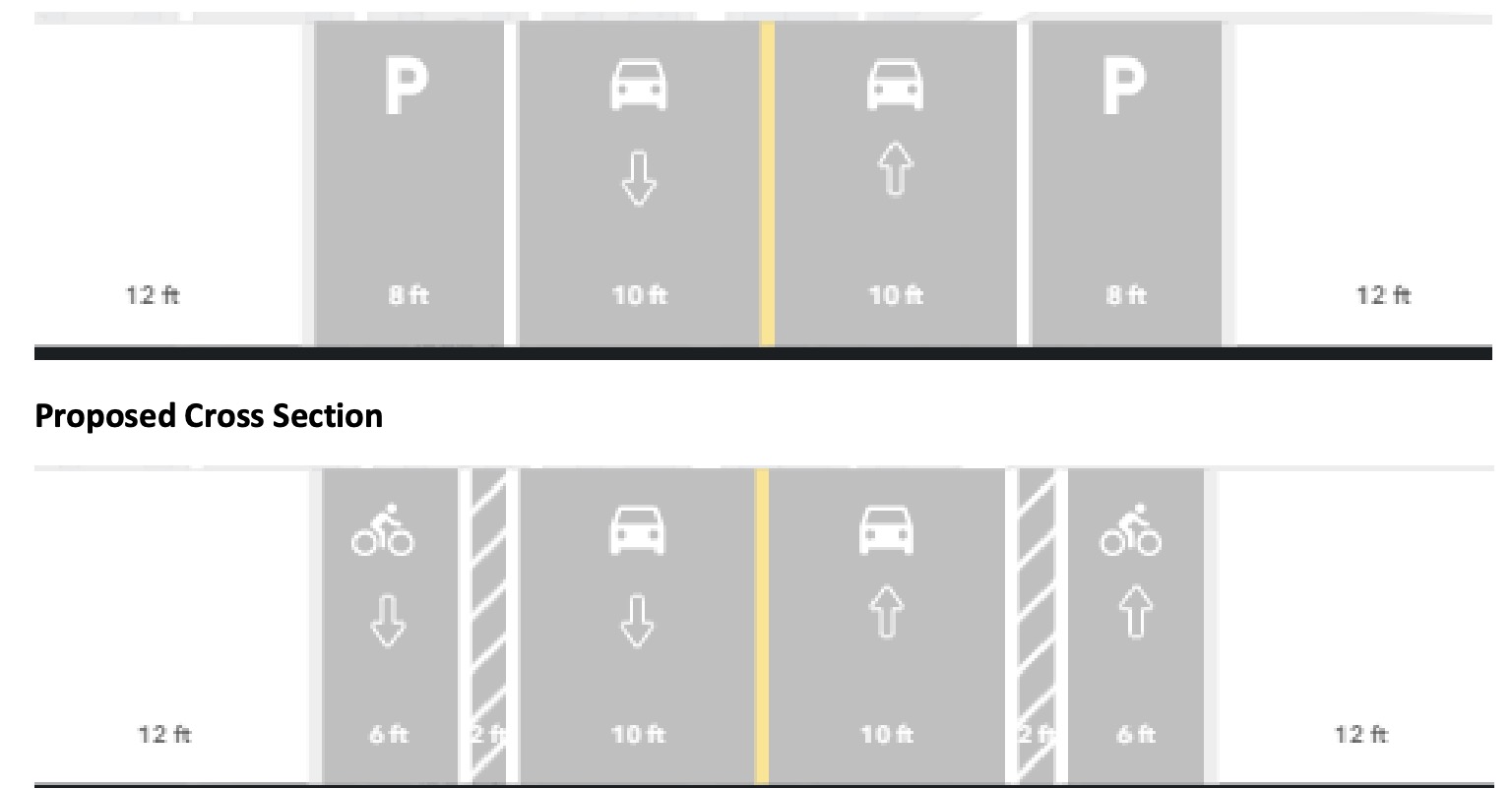
Another notable project on the list that scored well is one that would invest $8.6 million into NE Prescott Street to add bike lanes and other updates. I’m very excited about this one because I ride Prescott often to reach the I-205 path en route to Gateway Green (and elsewhere). PBOT wants to swap two, eight-food wide on-street parking lanes for buffered bike lanes. Wagner said this is a very important project for connectivity in the area. “There’s really no east-west connection across I-205 for biking and walking and it’s hard for people to get to the I-205 path,” he told freight committee members.
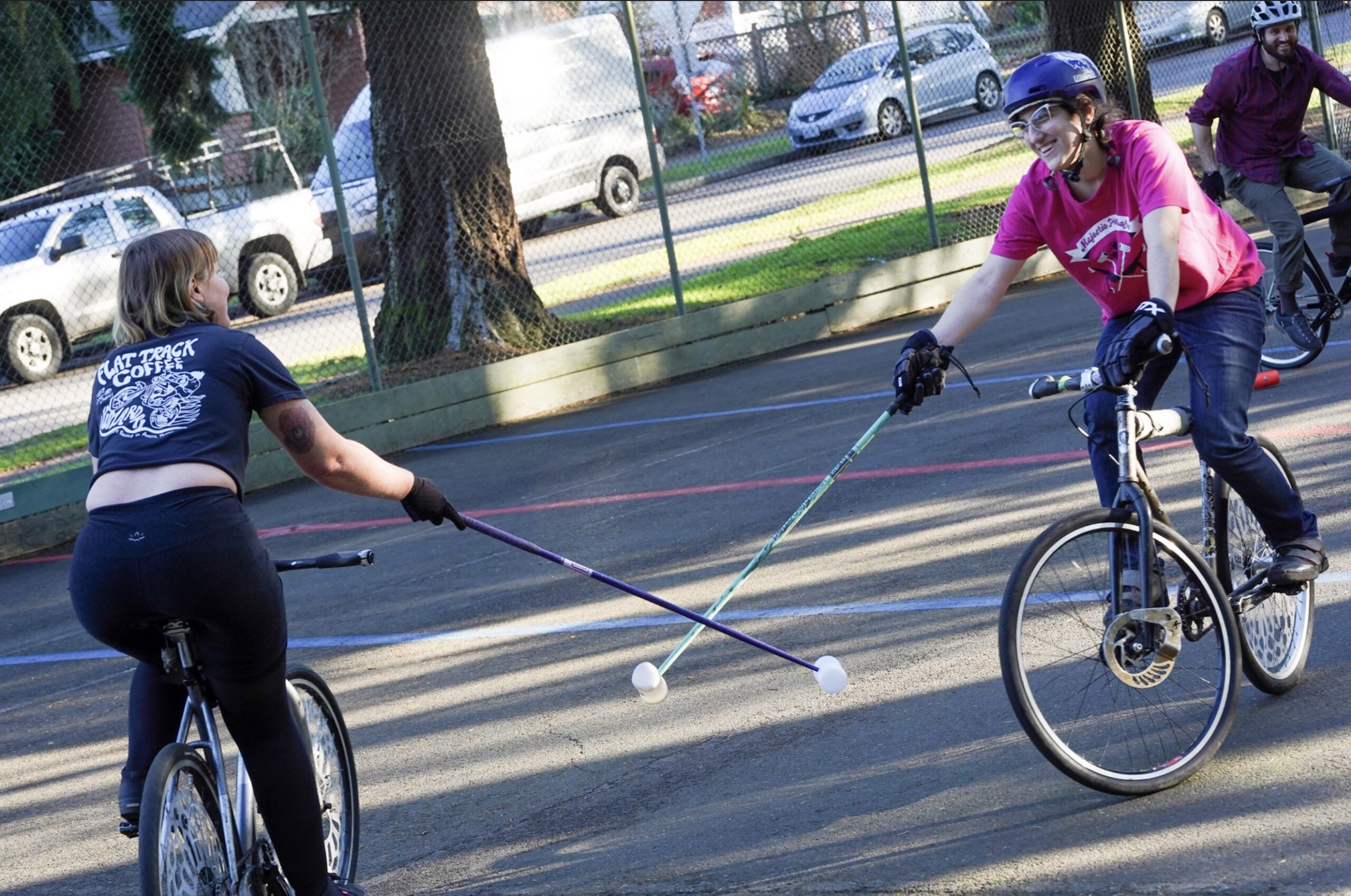
Alberta Park is the place to be this weekend as bike polo takes over the courts. (Photo: Jonathan Maus/BikePortland)
Hope you’re doing well and have avoided the wild downpours these last few days (or if you love rain, I hope you’ve gotten soaked). Below are some suggestions for weekend fun…
Friday, April 4th
Bike Bus Park Crawl – 1:00 pm at Creston Park Leaders of bike buses at Creston and Woodstock elementary schools welcome everyone to this short loop ride between their schools. Route ends at Creston School where they’re having a biking and walking fair. Should be great for families with kids. More info here.
Saturday, April 5th
Rose City Royal Rumble – All day Saturday and Sunday at Alberta Park (NE) Major bike polo competition returns to Portland with this 60-team tourney that will be fun for players and spectators alike. Bike polo is played on pavement and teams of three use mallets and a plastic puck to score points. It’s really cool! More info here.
Ride to ‘Hands Off’ Rally – 11:30 am at Colonel Summers Park (SE) Join the Revolutionary Bicycle Club for a group ride to a big protest and rally against facism that will take place in Waterfront Park. More info here.
Ugliest Ride of the Year – 12:00 noon at Kenilworth Park (SE) Someone named Banana Martinez is not taking the lack of the annual Worst Day of the Year Ride this year sitting down. They want to get together in silly costumes and ride, so come out and join them if you’ve got a hankerin’ for dressin’ up! More info here.
Star Trek First Contact Day Ride – 6:00 pm at Kenilworth Park (SE) From the organizer: “April 5 is Star Trek’s high holy First Contact Day, when aliens first greet us. Celebrated by making new friends with beings radically different from yourself.” Sounds like a perfect excuse for a bike ride! More info here.
Sunday, April 6th
Cycle Sundays – 10:00 am at Portland Opera/Tilikum (SE) The Cycle Homies are meeting up for what should be a chill, 10-15 mile loop at a “coffee cruise” pace. More info here.
Reach the Beach Training Ride – 10:00 am at Sellwood Park (SE) If you need to log some miles and want folks to ride with, consider joining Cary Fisher from Portland Bicycling Club on this group jaunt that will roll south into rural Clackamas County. Expect nearly 70 miles on the pavement! More info here.
Know Your Greenways – 11:30 am at Mt. Tabor Park (SE) Join Tom Howe for the latest ride in his series that will familiarize you with new bike infrastructure and routes. This ride will focus on the 60s Greenway. More info here.
— Did I miss your event? Please let me know by filling out our contact form, or just email me at maus.jonathan@gmail.com.
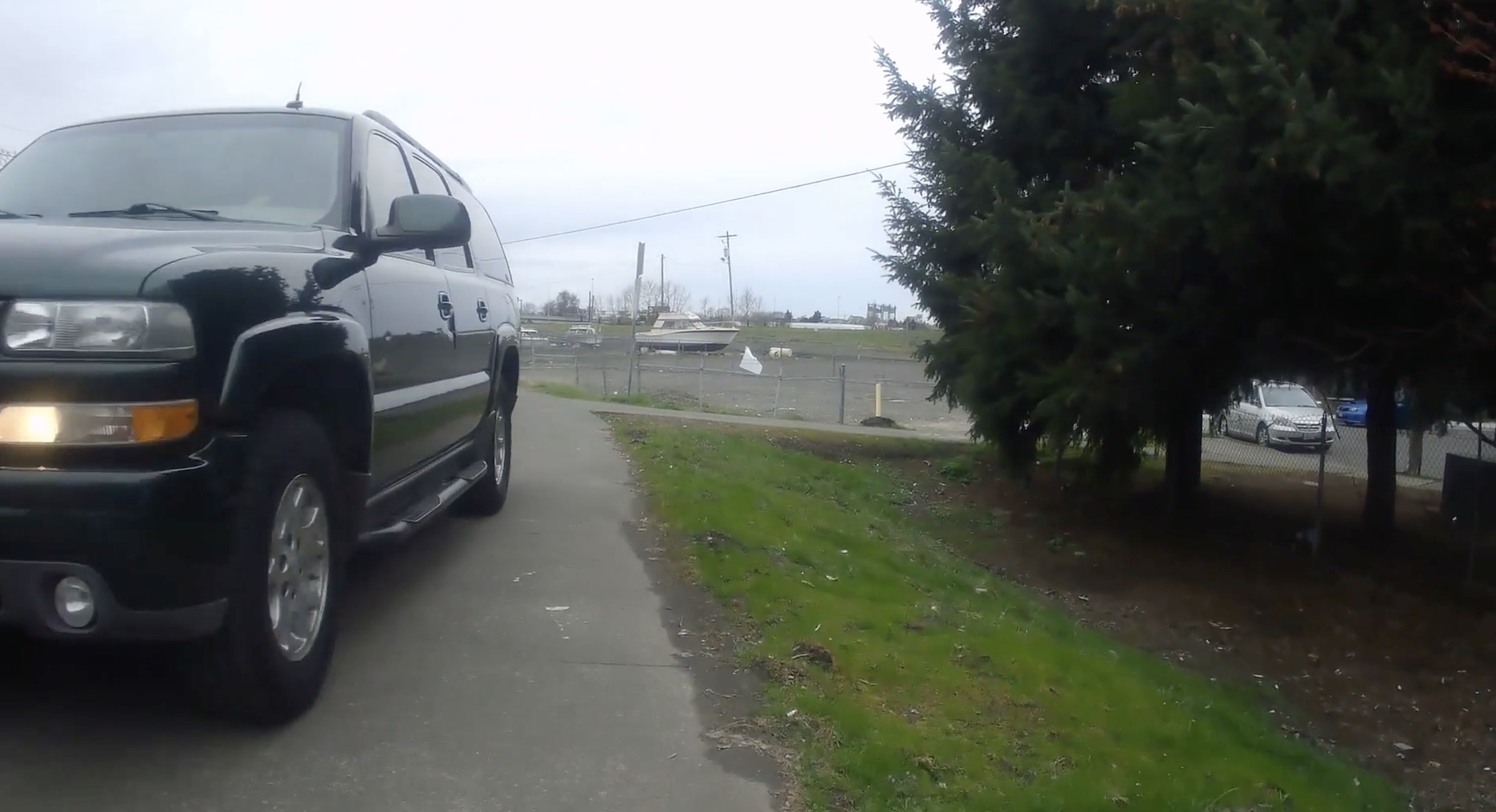
Still from on-bike video camera. (Photo: Reader Joe R.)
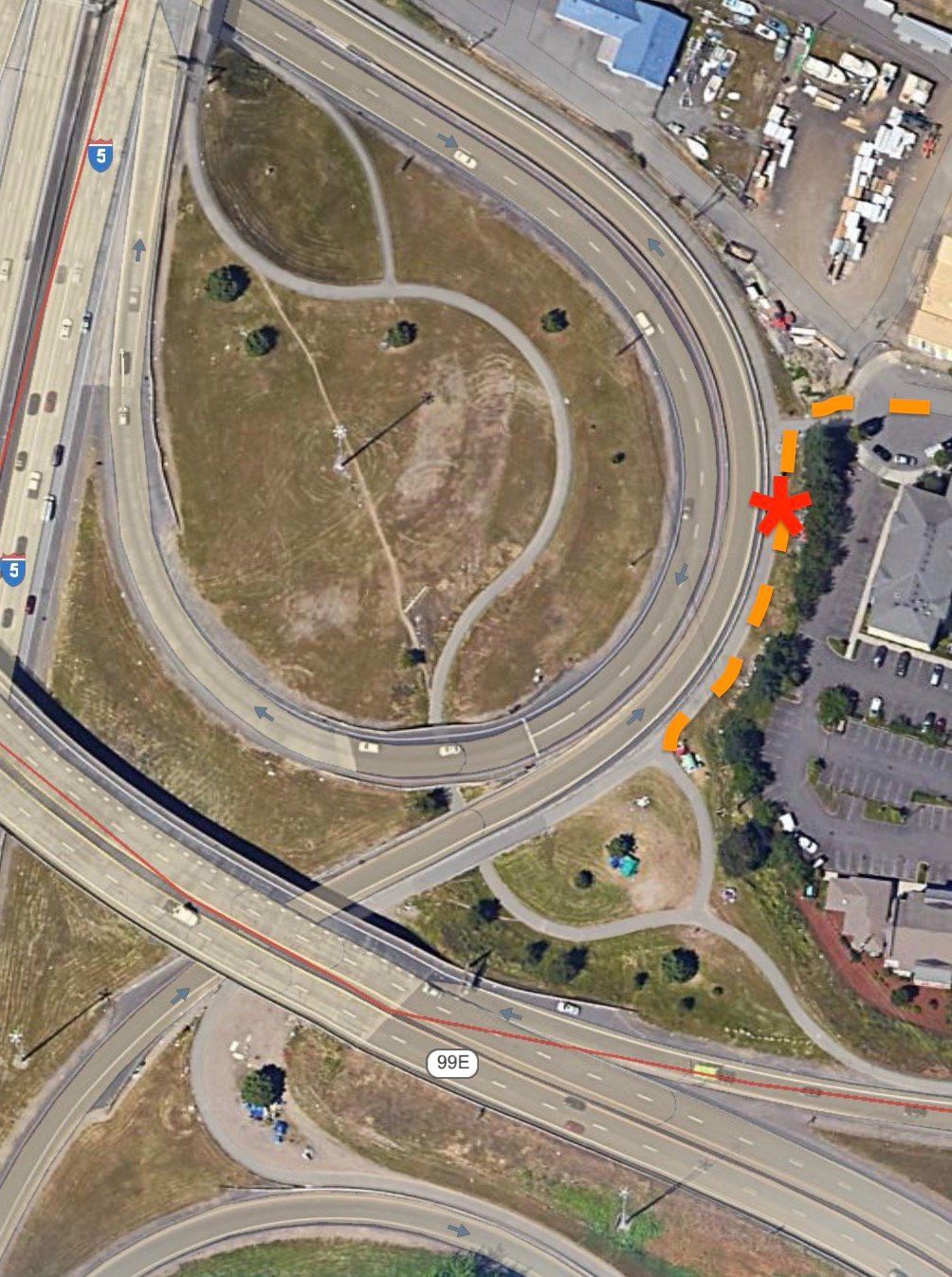
Red star marks spot where the SUV passed Joe. Orange line is how the driver entered the path.
The Portland area has a bigproblem with people driving cars where they’re not supposed to. On March 19th, BikePortland reader Joe R. faced that reality head-on when someone driving a large SUV entered a bike path he was riding on and nearly forced him off the pavement.
It happened just after four o’clock as Joe was heading northbound on the bike path located in between I-5 bridge on-ramps and the Residence Inn hotel just north of N Marine Drive. “I was enjoying my ride and began to accelerate when I saw the large black vehicle pulling onto the path,” Joe shared in an email with BikePortland. The driver turned onto the path at the culdesac of N Anchor Way.
Back in July, Joe read an article on BikePortland about this exact location. In that article, I reported that the Oregon Department of Transportation has been aware of “ongoing issues with bollards being stolen or ran over” as far back as spring 2023. Despite this acknowledgment of the problem however, a representative from Ask ODOT said, “Staff is exploring options for better bollards or a fix to the problem and do not have plans to reinstall them at this time.”
It appears ODOT has done nothing to improve the situation. In fact, when I shared a video about Joe’s run-in with a driver, several folks said they routinely see people driving on the path at and around this same location. “I see it a lot,” said one person in an Instagram comment. “Same has happened to me there… it nearly took me out,” said someone else.
Thankfully, Joe was riding carefully and managed to stay safe. “I realized there was nowhere for me to go except off the path if I didn’t want to be killed,” he recalled.
After the close call, Joe pedaled over to the opening in the path the driver used. He saw no bollards or other preventative measures in place. Joe frustrated and he sees this problem as another example of the “destruction of Portland” that “horrible leadership” has let go for far too long.
Hopefully the actions taken by ODOT on the I-205 path several miles away will be expanded the entire path network. ODOT, Portland Parks, and PBOT need a coordinated strategy to defend and protect these spaces. Until then, we cannot let this type of driving behavior become normalized. These drivers — and other illegal activities like blocking the path with tents and other personal belongings, dumping trash, starting small fires, and unsafe behaviors — endanger individuals and also send a chill through the entire region that results in many folks giving up on using them altogether.
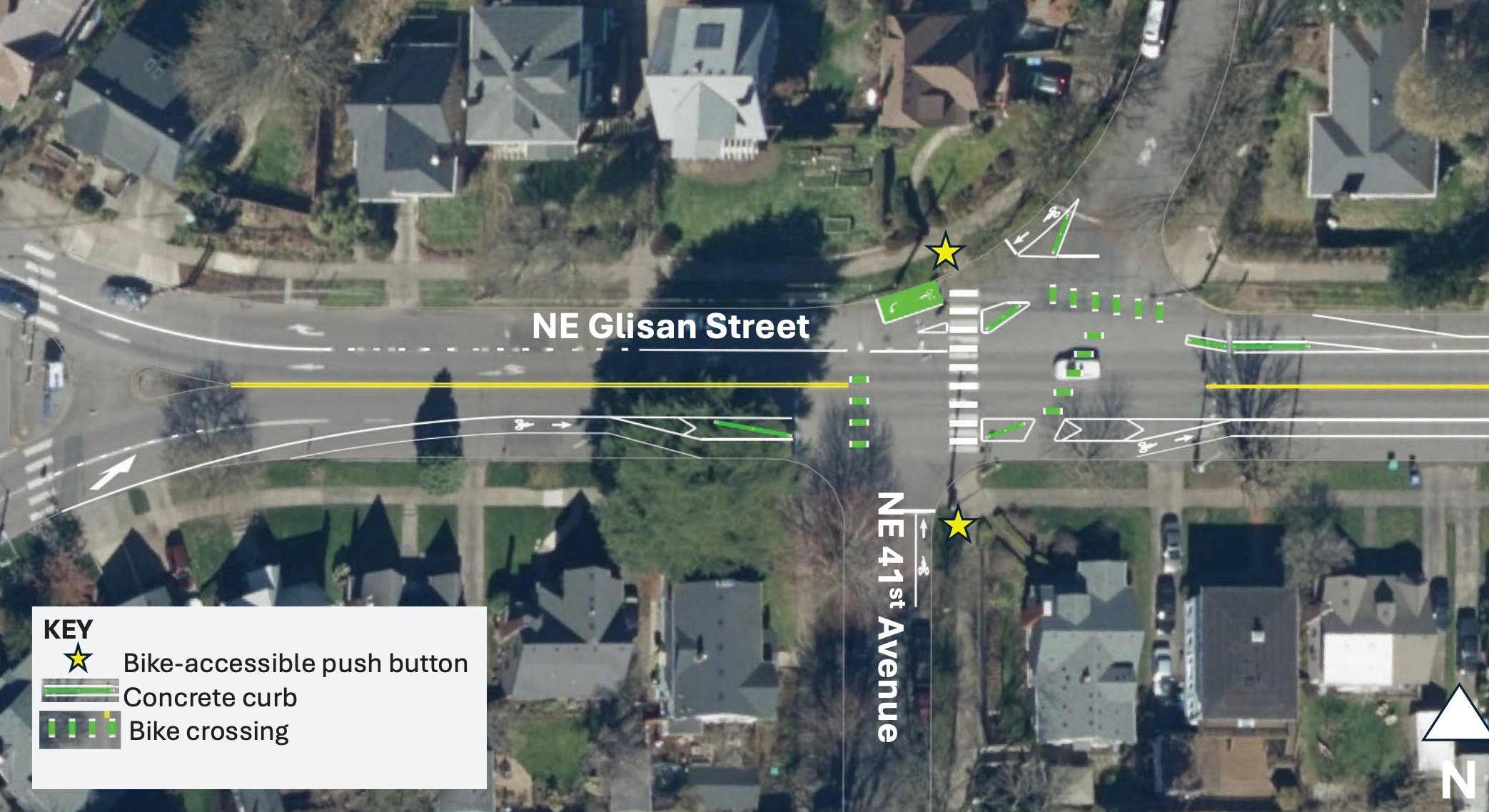
The Portland Bureau of Transportation plans to make significant changes to a northeast Portland intersection where a 12-year old was struck and injured by the driver of a car.
Back in November 2023, two 6th graders at Laurelhurst School were crossing NE Glisan at 41st when the driver of a car sped through the intersection and hit one of them. The driver was going well over the speed limit (25 mph) and didn’t stop to see what happened (I don’t know if they were ever caught). The 12-year-old suffered a broken bone in their leg and various bruises and scrapes.
Now PBOT is ready to spend $150,000 on a project that aims to calm traffic and make crossing NE Glisan safer. PBOT’s planned changes will shorten the crossing distance, add a push button-activated bike traffic signal, stripe new bike lanes with some concrete curbs for protection (the bike lanes will connect to existing one east of 41st), and reducing driving space. PBOT says the new design will “increase driver awareness of the crossing.” On the project website, PBOT says people driving on Coe Circle, “may not expect people walking and biking to be crossing at this intersection.”
This intersection is just one short block east of Coe Circle and it’s currently 65-feet to cross from one side to the other. NE 41st is a neighborhood greenway route and is classified as a Major City Bikeway in Portland’s Transportation System Plan. This crossing is just 0.4 miles south of the bike/ped bridge over I-84 that connects the Laurelhurst neighborhood to the Hollywood Transit Center at 42nd Ave.
In addition to the changes listed above, PBOT will also remove 127 feet of on-street parking on the south side of Glisan and 71 feet of on-street parking on the north side. Car parking will also be removed on both sides of 41st north of Glisan. The new signal will complement the existing HAWK (high-intensity activated crosswalk beacon) signal PBOT installed just four blocks south on NE 41st and Burnside in 2006.
Final design should be complete this month and PBOT expects to build the project this summer. The funding comes from the Fixing Our Streets program.
Scene from a transportation advocacy lobby day in Salem in 2023. (Photo: Jonathan Maus/BikePortland)
I hope you’re ready, because April will be a huge month for transportation policy in Oregon.
Any day now, lawmakers in Salem are expected to reveal the long-awaited transportation funding and policy bill (or at least a broad stroke outline). And on April 17th, transportation reformers from around the state will meet in Salem for Move Oregon Forward’s Advocacy Day. Then just one week later, on April 23rd through 25th, The Street Trust will host their annual Oregon Active Transportation Summit (OATS).
The funding bill should be very interesting. We’ll finally get to see the mix of funding sources the legislature believes to be ready for prime time. When it comes to new money, my money is on some type of e-commerce delivery fee, more bonding authority for ODOT, new fees on electric vehicles (including e-bikes), tying the gas tax to inflation, another toll pilot program, and maybe a mandate for some road users to join the OreGo pay-per-mile system. I’ve heard rumblings that lawmakers want to tweak the traditional 50/30/20 State Highway Fund (40 cents from every gallon of gas) formula where 50% goes to ODOT, 30% goes to counties, and 20% goes to cities; but that might be too political to stomach given the other heavy lifts the bill will face.
In a post today, The Street Trust said, “Whatever quilt lawmakers patch together to cover ODOT’s needs, it cannot leave our communities, transit agencies, or active transportation users out in the cold.”
I’m not sure what we’ll see in the bill and I’m eager to see what gets placed on the table.
To get plugged in, I would highly recommend signing up for the Advocacy Day. I attended in 2023 and it was really cool. You’ll meet other advocates, get some training on how to speak with lawmakers, then you’ll visit offices in the capitol to share your opinions. It’s democracy in action and with all the stuff going on in D.C. these days, it will feel really good to exercise that muscle.
OATS is sure to be a solid event. This year it will be held at the Hilton DoubleTree across from Holladay Park in the Lloyd. Expect the typical slate of keynote speakers, smart presenters, workshops, networking across many fields, and fun social events.
So gear up, stay tuned, and read those articles you’ve had bookmarked to make sure you’re up to speed on the latest news. It’s going to be an eventful month!
And if you need to decompress, the annual Ladds 500 is April 12th.
P.s. I’m getting a total knee replacement surgery on April 11th (and then another one on June 13th!), so I’ll be slowing down a bit. I’ll work as I can, but will probably miss a bunch of stuff too. We’ll see how recovery goes. Wish me luck.
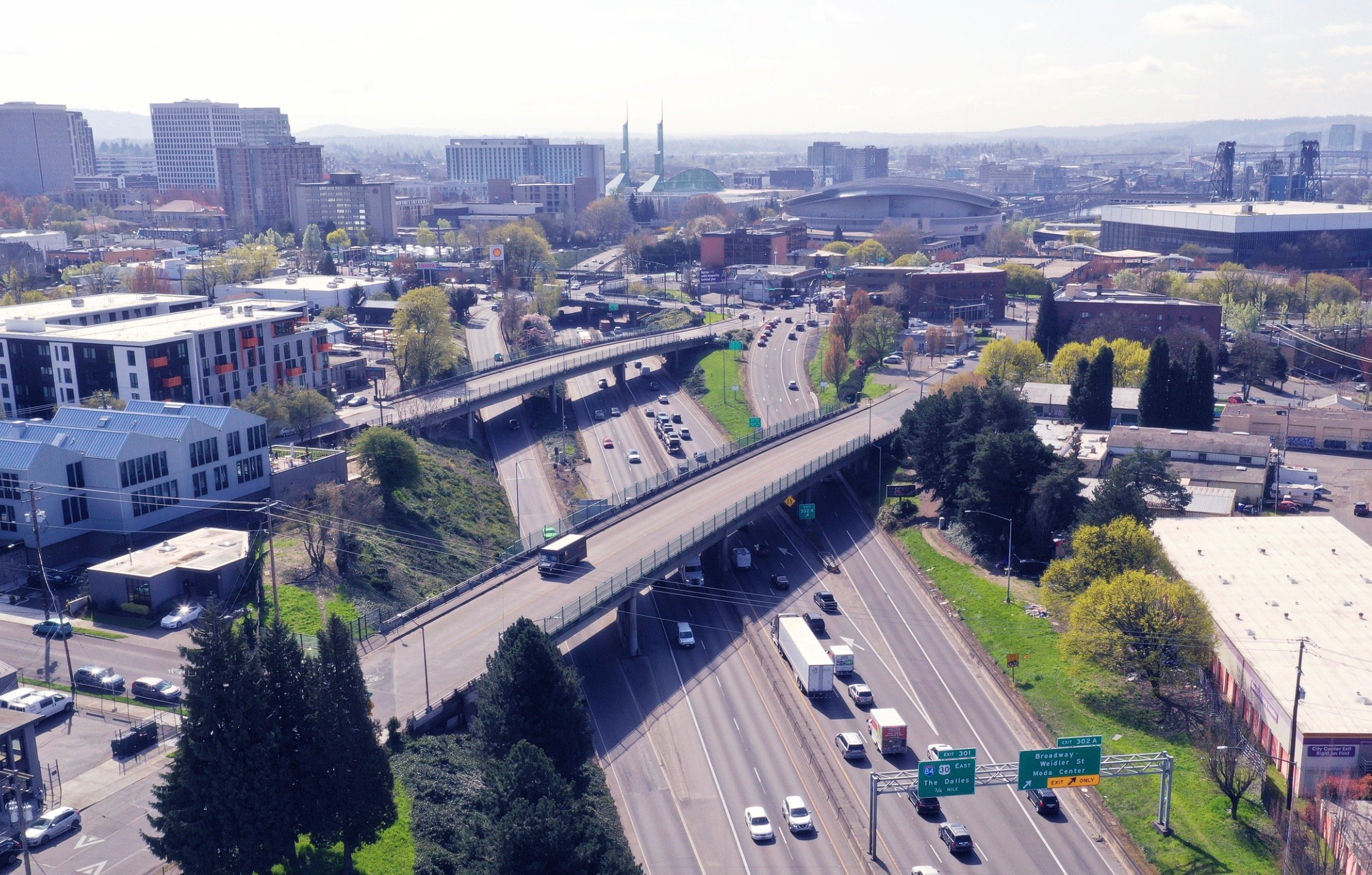
View looking south at project area. (Photo: Oregon Department of Transportation)
Metro Council just voted to give the Oregon Department of Transportation $250 million for the I-5 Rose Quarter project. The vote was a significant step that makes key funds available to ODOT so they can move forward with preliminary construction work this summer.
The vote comes just days after Metro Council members heard strong support for the project from leaders of Albina Vision Trust, a nonprofit working to re-establish the Black community displaced by construction of the freeway in the 1960s, and the owner of Raimore Construction, a minority owned and operated company that will receive contracts to build the project.
In addition to adding lanes to I-5 in a bid to reduce crashes and congestion, the project includes a cover over the freeway that will come with significant changes to the surface streets with a goal to improve bicycling and re-stitch neighborhoods together. The project has been nearly 15 years in the making and has changed considerably since ODOT first shared design proposals. Even with the addition of buildable freeway covers (which happened only through strong advocacy by Albina Vision Trust), folks who oppose the project don’t trust ODOT. They say it’s a wolf in sheep’s clothing and that ODOT is hiding a larger, 10-lane freeway plan. Many opponents want congestion pricing in place prior to any work to widening the freeway, a policy that Metro’s Regional Transportation Plan already endorses.
“Any normal DOT engineer would have proposed nine lanes in each direction at this spot to balance out lanes… This is a tweak”
– Lynn Peterson, Metro Council president
Beyond those concerns, the total unraveling of ODOT’s budget for the project has become an even greater concern of many project skeptics. If the Trump administration continues to freeze around $400 million of an already-promised grant, the budget deficit could balloon to $1.4 billion. Critics say by allowing ODOT to move forward, the state will be on the hook to fully fund the project — siphoning funds from other needs in the process.
At their meeting this morning, Metro council passed the $250 million funding resolution 5-1 with one abstention. ODOT says they now have $863 million lined up for the project, enough to build major elements of the new freeway lanes and about 30% of the highway cover.
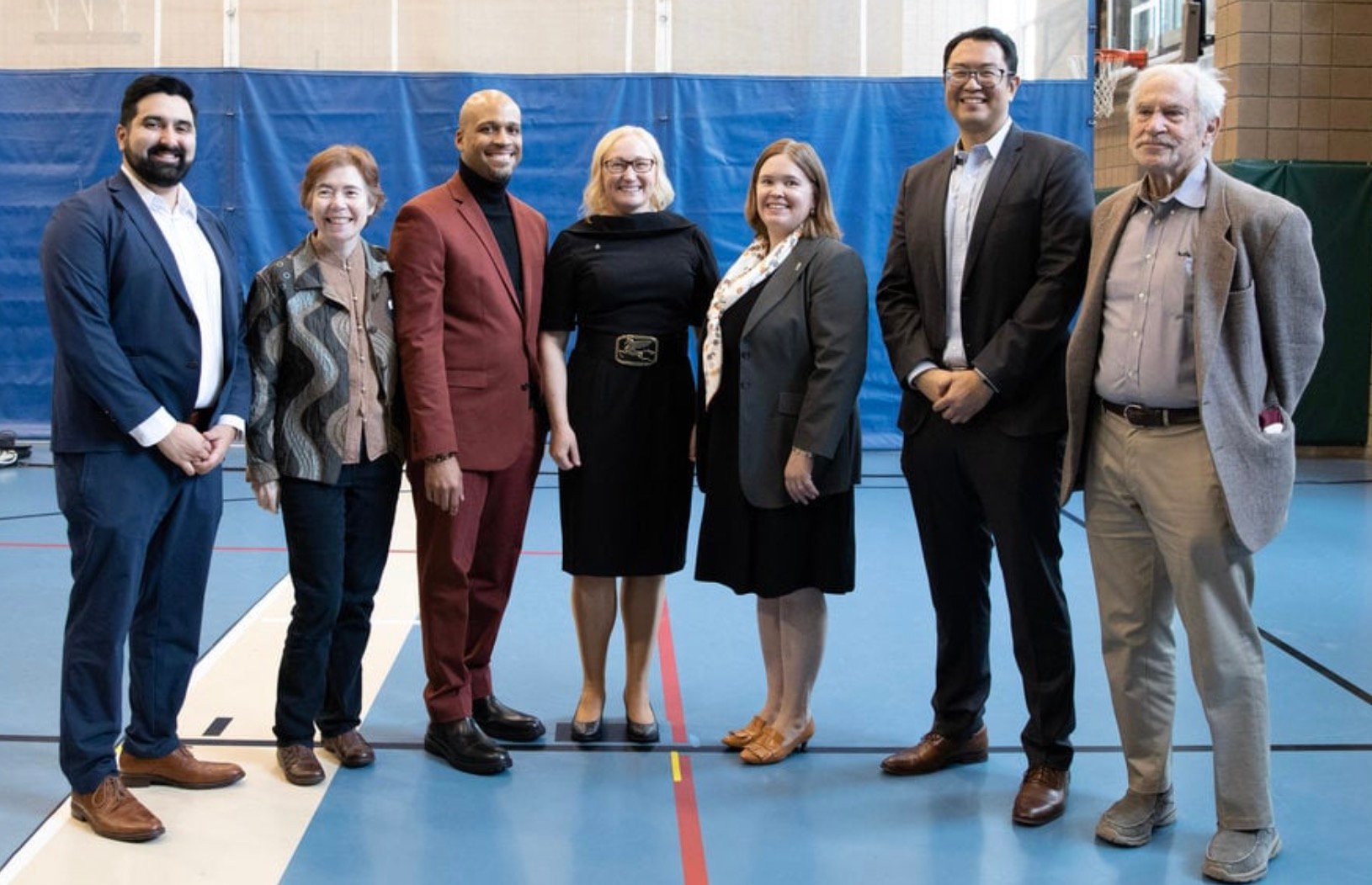
Metro Council members. L to R: Juan Carlos Gonzalez, Mary Nolan, Ashton Simpson, Lynn Peterson, Christine Lewis, Duncan Hwang, Gerritt Rosenthal.
“This isn’t just about moving cars, it’s about rebuilding the community that was torn down,” said Metro Councilor Ashton Simpson when he introduced the resolution. “This project represents a significant economic opportunity. It will create thousands of good paying jobs” and “provide contracting opportunities for Black-owned businesses and Black contractors.” The project, Simpson said, will, “Restore the economic vitality that was stolen decades ago.”
“If we are serious about racial and economic equity,” Simpson, who is Black, continued: “Then we must hold ourselves accountable to the voices of impacted communities, and they have spoken clearly in support of this project.”
Councilor Christine Lewis said her “yes” vote should be seen as a sign that Metro can seen as a partner in progress with ODOT. “If we are going to move forward as a partner, working on big things for the state, this is the exact moment when we have to move forward.”
The idea that the time had simply come to do something, anything, to show progress on this project, also rang true for Councilor Gerritt Rosenthal. He expressed misgivings with the project, saying he doesn’t think it will reduce congestion, but that, “It’s necessary to move forward.”
Councilor Juan Gonzalez, who has taken principled stands against freeway expansions in the past, also voted yes this morning. “The action before us is to help program the largest restorative justice project in America. That’s a big deal right now,” he said. Gonzalez sounded proud of how Metro helped “mold” the project from just another freeway expansion into something he thinks, “will achieve so many of our goals across the board.” And similar to councilors Lewis and Rosenthal, Gonzalez said his support is also based on the belief that, “It’s important to send a message to Salem and D.C. that this region can and will build big, beautiful things.”
Councilor Duncan Hwang couldn’t get himself to vote “yes” or “no,” so he abstained. He said he is “deeply supportive” of all the jobs for Black business owners and the reconnection of this historic Albina community; but he also has serious reservations about ODOT’s fiscal irresponsibility. Hwang said he couldn’t live with the double-standard of taking other agencies to task for spending money they don’t have, then turn around and support ODOT doing the same.
Mary Nolan was the only Metro Council member to vote against the resolution. She said, “I find a deep irony that this project intends to repair past harms to the Black community that was caused by highway construction, and the solution is more highway construction. I don’t think that will work as a reparation.” Nolan echoed Hwang when she added that, “I won’t join a chorus that lectures other governments about how to be fiscally responsible — how not to bust their budgets — and then turn around and do exactly the same thing with this project.”
Metro Council President Lynn Peterson is the strongest supporter of them all. She referred to ODOT’s plans for the freeway as a mere “tweak” and said our region should be grateful ODOT isn’t going even bigger. “Any normal DOT engineer would have proposed nine lanes in each direction at this spot to balance out lanes.” “This is a tweak” Peterson continued, “It’s a tweak to give us another option in the future, to be able to reduce fender-benters, increase the safety, be able to mitigate congestion in the future, but also be able to do things with the community in hand that they want, and this cap is part of it. And slowing down at this point would indicate to the state that we are not interested in the cap at all.”
Peterson then addressed concerns with ODOT’s budget:
“There is no money that will be budgeted until there is money in hand. I want to be very clear about that. This is not something that we’re giving permission to the state to go out and sign a contract that they can’t actually commit to. That’s what happened in other situations. That’s why we called them out. This is allowing the project to move forward into the next step. So if no money is in hand, we can expressly move forward as quickly as possible.”
To Peterson, the freeway expansion plans — which call for one new “auxiliary lane” in each direction between I-84 to the south and I-405 to the north — coupled with the cap and surface street elements of the project are a “balanced approach”:
“… That balanced approach is being able to see a little bit of work for the future of the interstate system and our economy, as well as a maximum benefit to the community it goes through. That is what I call an amazing amount of balance. And it was not easy to get to, because it is not the way we normally do business. So I would just try to recognize that we are no longer in the ’70s. We are not fighting that fight. That fight is over. The fight that we have now is to make sure that every project that we invest in, that we spend our time in, has a balanced approach that allows everybody to benefit, not just one part of our community.”
In a statement after the meeting, No More Freeways, a nonprofit group that has organized community opposition and has filed several lawsuits against the project, said, “ODOT will do anything, say anything, promise anything, to get the project started because they know we’ll have to pay whatever it takes to finish it. This is cynical and wrong.”
ODOT says this funding from Metro, coupled with the (still very uncertain) $450 million federal grant and other funds already dedicated to the project, will allow them to get started on the project this summer and begin construction of the freeway expansion and cap in 2027.
Bike Mechanic – Part-Time (15 Hours/Week) – $25/Hour
Company / Organization
E-Bike Multnomah Falls
Job Description
E-Bike Multnomah Falls is looking for a skilled bike mechanic to maintain our fleet of Rad Power Bikes. This part-time position offers flexible scheduling (approximately 15 hours per week), allowing you to choose your own workdays and hours. Our shop is located in the heart of the great outdoors in the Columbia River Gorge by Multnomah Falls. It’s exit 35 on I84 so about 35 miles from Portland.
Responsibilities:
Inspect, test, and maintain eBikes on a weekly basis.
Complete a maintenance log for each bike.
Order and manage bike parts inventory.
Requirements:
Strong experience with Rad Power Bikes.
Ability to independently diagnose and repair eBikes.
Reliable and detail-oriented with good record-keeping skills.
If you’re passionate about eBikes and looking for a flexible part-time role, we’d love to hear from you!
How to Apply
Please reach out to us over email at ebikemultnomahfalls@gmail.com or by phone at 541 705 2438
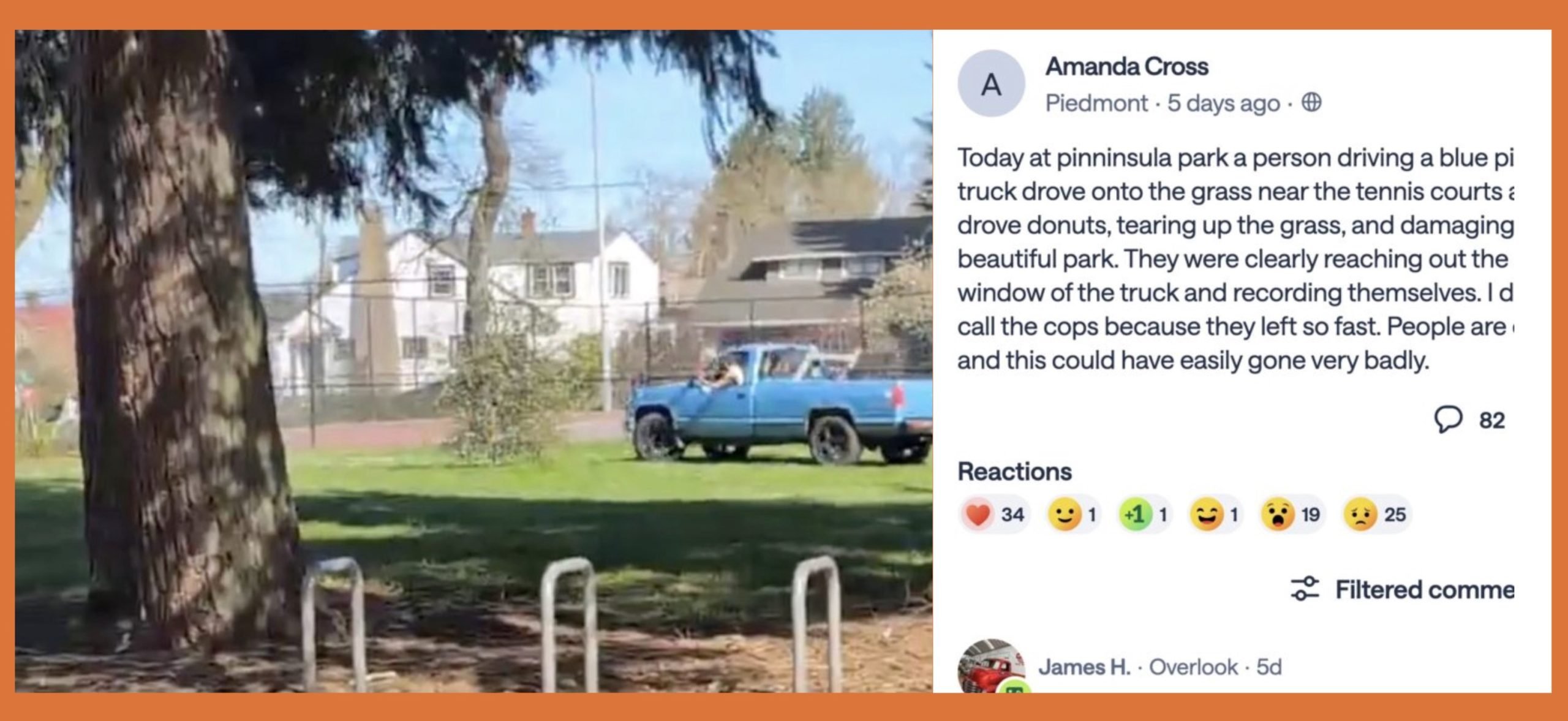
The driver and their blue pickup truck were captured in a video by a bystander while doing donuts in Peninsula Park last week.
A man is driving recklessly through north and northeast Portland and recording it for anyone to see.
In dozens of videos posted to the keepingitlittlike06 account on Instagram, a man who goes by “Mr. 06” can be seen driving a pick-up truck with his legs while hanging out of the drivers’ side window and filming himself with his phone. In other videos, he can be seen doing donuts in public parks. Many people are worried that his highly distracted and dangerous behaviors while operating a motor vehicle could lead to an innocent person being injured or killed.
Last week someone captured video of a driver in a pickup truck driving on the grass at Peninsula Park. In the video posted to Nextdoor on Wednesday, someone driving a light blue truck can be seen spinning out the rear tires in the grass near the tennis courts in the northeastern corner of the popular neighborhood park. The video also shows the driver’s arms outside the vehicle filming with their phone as they drive. A video posted to the @keepingitlittlike06 Instagram page shortly after proves it’s the same driver seen in the Nextdoor video.
There are numerous reports of this same person wreaking havoc with his driving throughout many Portland neighborhoods. “I called the cops on this guy swerving on 28th the other day,” someone shared with BikePortland via a direct message on Instagram after I shared one of the videos. The person said Mr. 06 was also driving down the bike lanes on Naito Parkway and on sidewalks. “Bikers and pedestrians (and frankly other motorists) should watch out for him,” they wrote.
Someone shared one of his videos to the r/Portland Reddit thread Friday and there are nearly 700 comments that share concerns and tips on what to do about it. Most people think the police won’t act until something terrible happens. One person who messaged BikePortland on Instagram Friday said they sent one of Mr. 06’s videos to the Instagram account of the Portland Police Bureau Bike Squad. The person who manages the PPB account replied: “Thanks for the tip, we’ll check it out.”
This type of driving is very dangerous and needs to be taken seriously. If you see this light blue pickup out and about, please be careful.