
New planning model tested as riders tackle SE 7th and Sandy

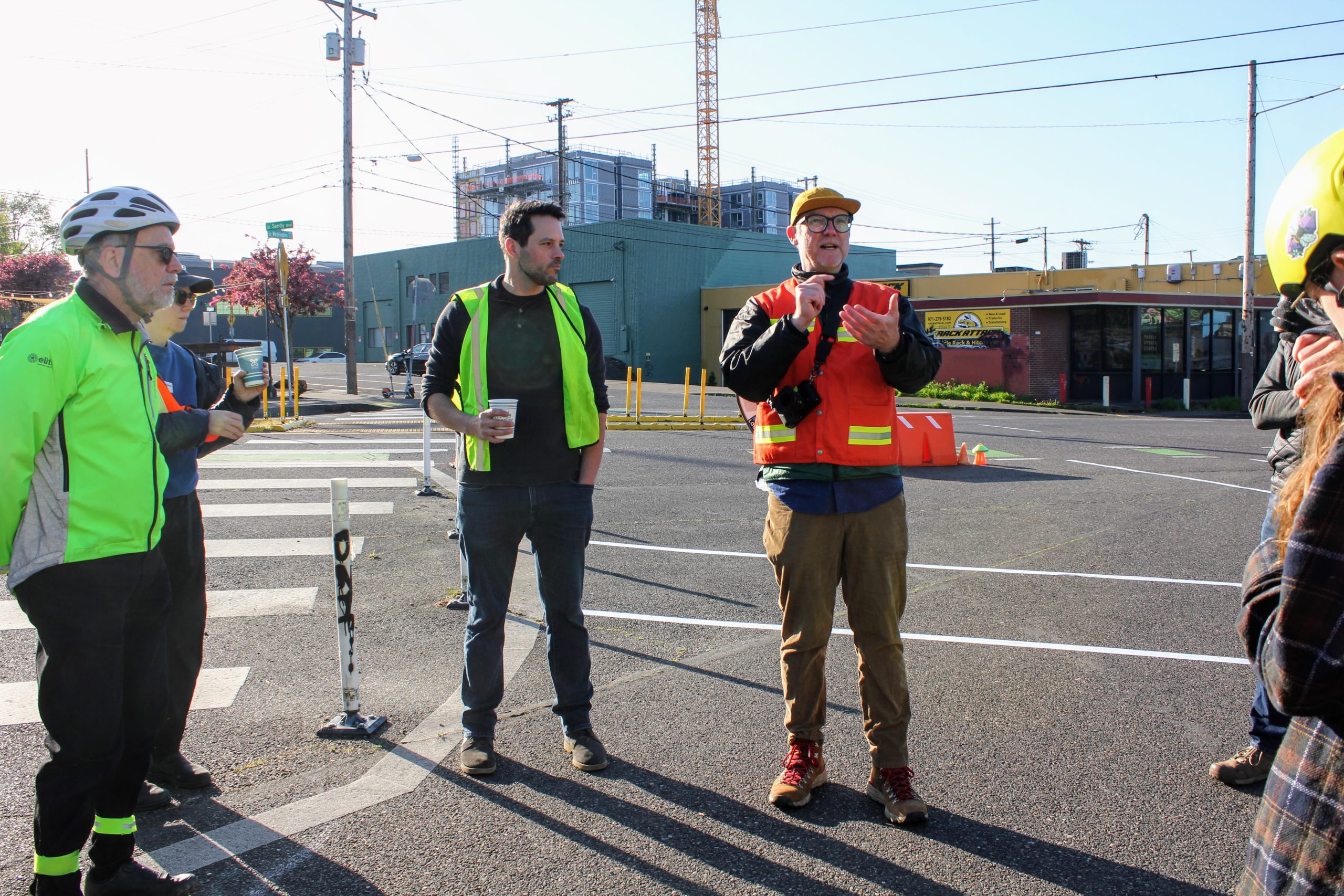
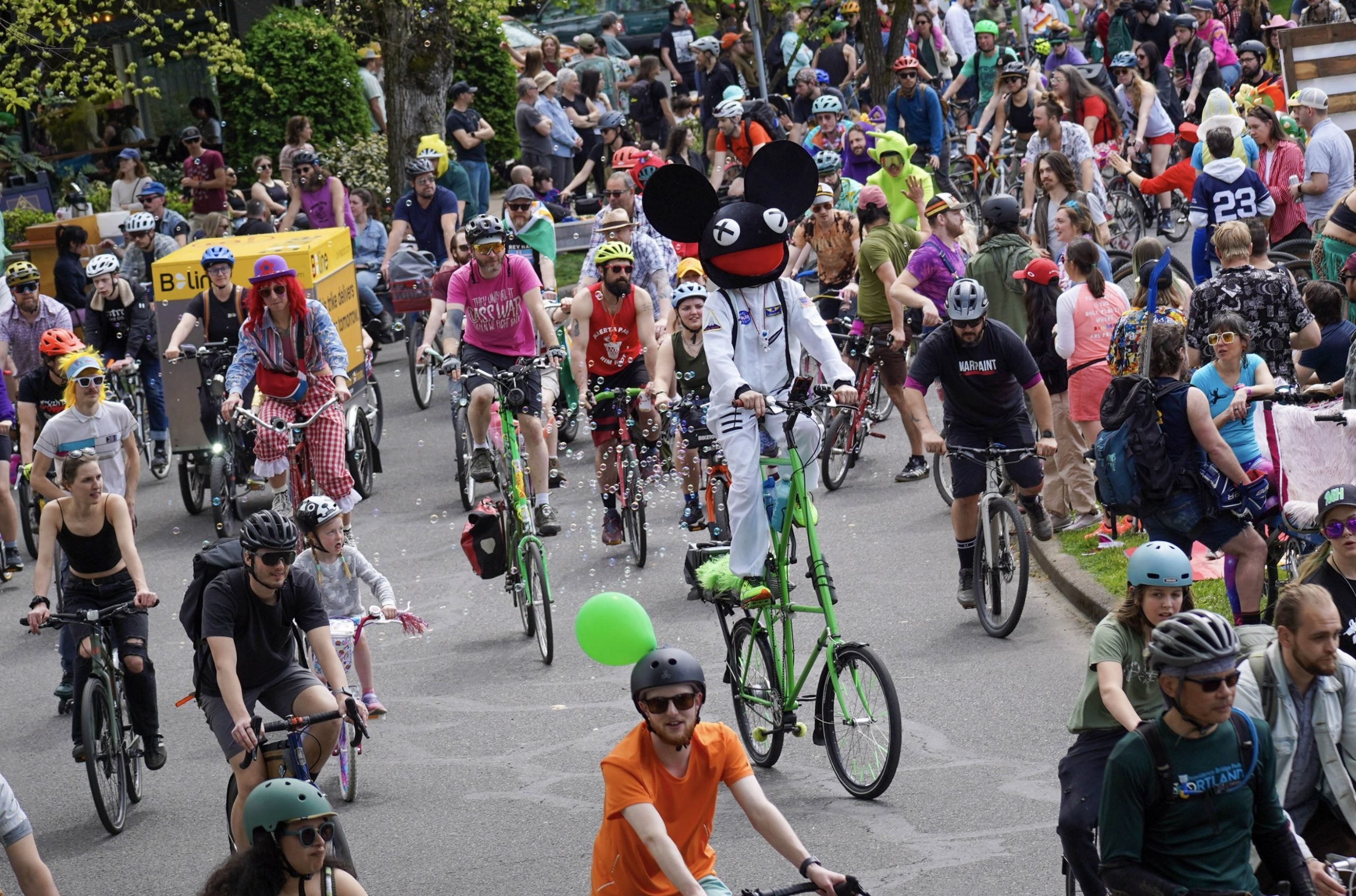
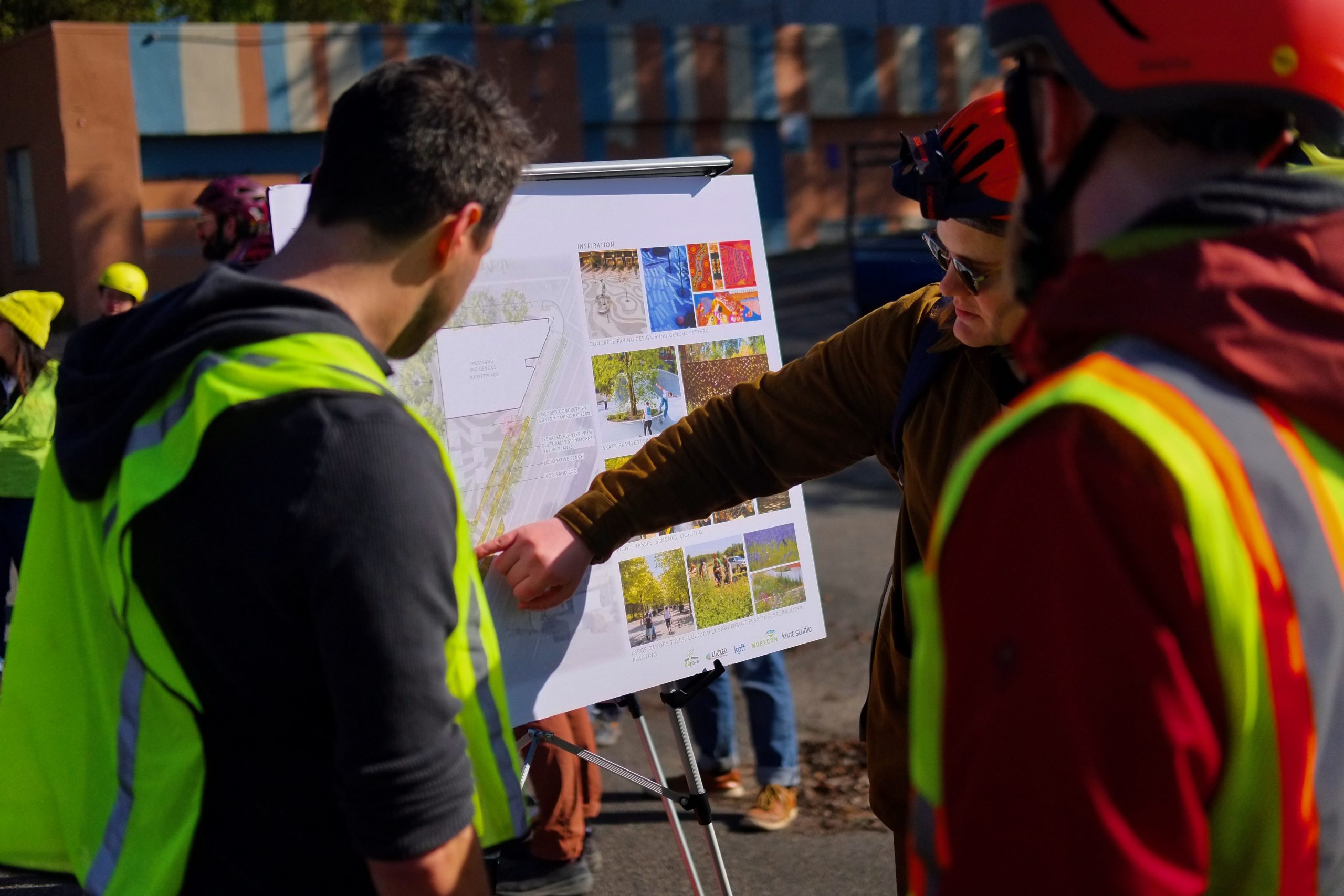
Riders gathered for a live-action planning exercise on SE 7th and Sandy Sunday morning. (Photo: Aaron Kuehn)

Publisher’s Note: This is a guest post by Aaron Kuehn. Aaron is a former chair of BikeLoud PDX, is passionate about wayfinding, and wrote a series of articles for BikePortland on bikeway design.

Early Sunday morning, as the springtime sun warmed the asphalt, a group of nearly 20 curious Portlanders, planners, and advocates gathered in hi-viz vests to roll up their sleeves—and then roll through a notoriously treacherous intersection at SE 7th and Sandy.

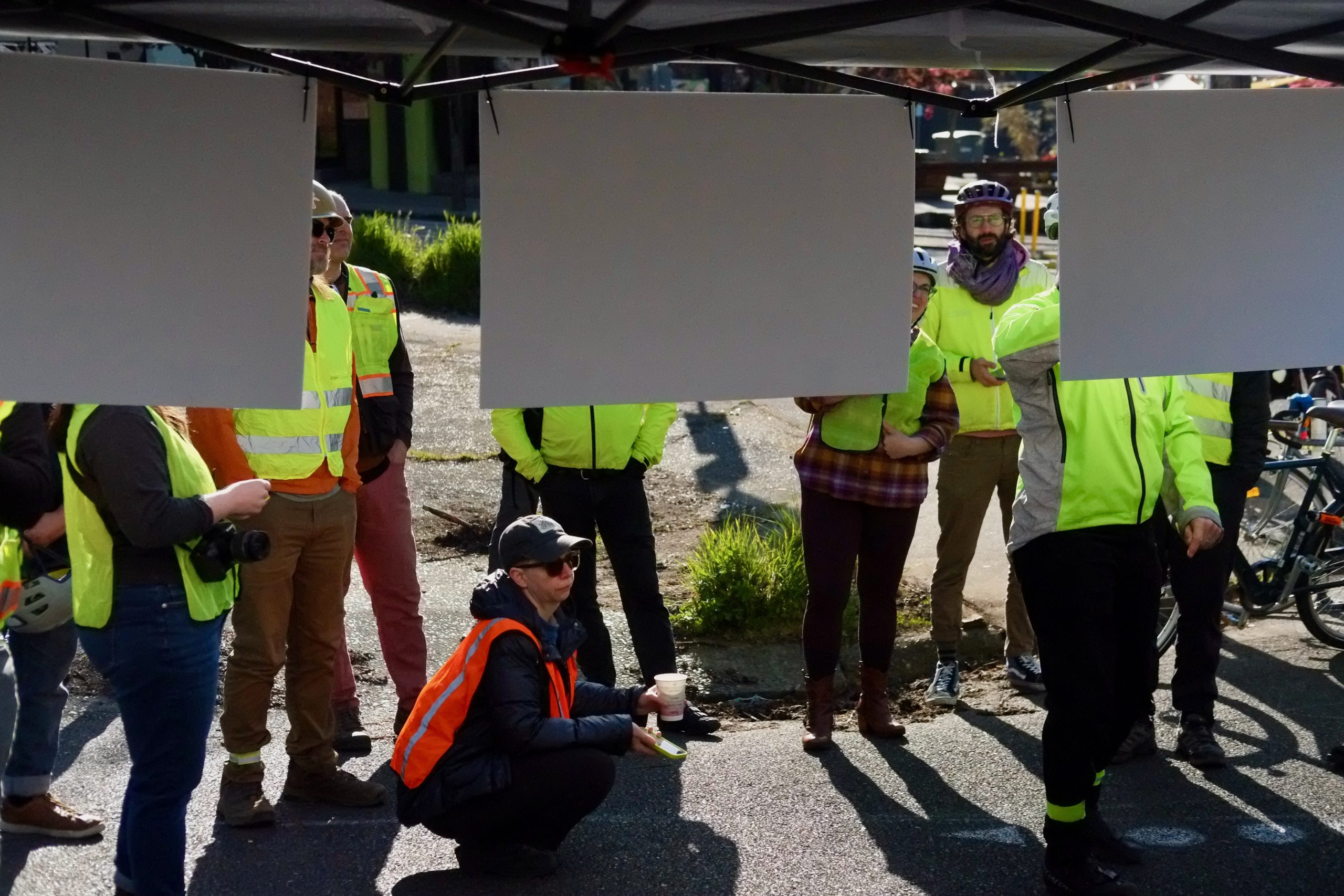
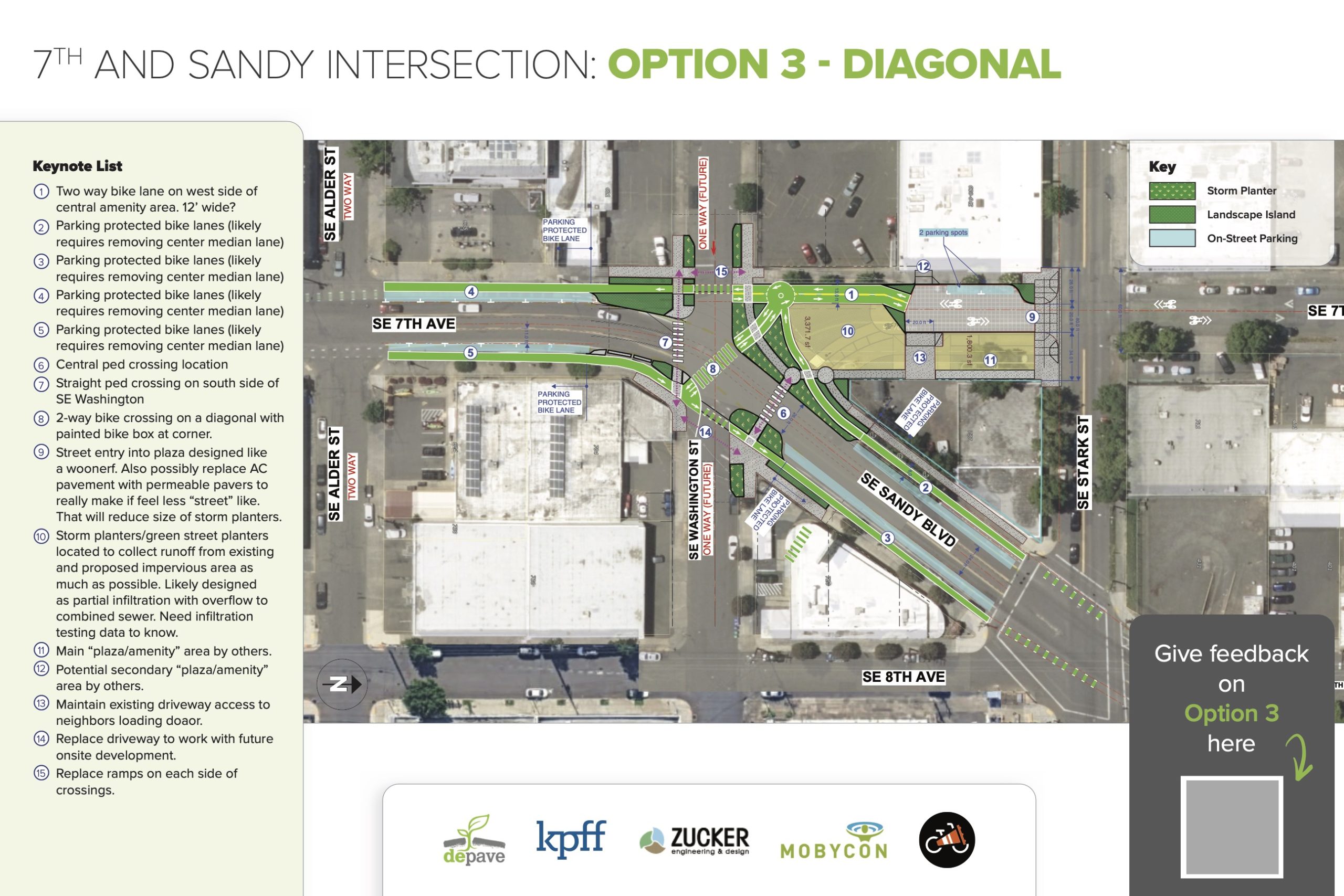
The event, listed on the Shift calendar as the Street Plaza Test Ride, was no ordinary community feedback session. Instead of just viewing plans on a board, participants took part in a live-action, hands-on “planning by doing” process: sketching new lanes, medians, and turn boxes with tape and cones, then test-riding different configurations to feel what worked best. The goal? Refine bikeway design options for a challenging five-way intersection that’s both a pivotal link in the 7th Ave Neighborhood Greenway and part of an evolving public plaza.

This area has long been a sore spot for people on bikes. In a 2023 BikePortland article, Taylor Griggs described SE 7th and Sandy as a “sketchy intersection,” where crossing Sandy northbound means darting across multiple lanes of fast-moving car traffic with limited visibility. “It’s one of the most complicated maneuvers I regularly make,” she wrote. “I dread the experience every single time.”
Over the past few years, ongoing efforts have aimed to reimagine this space—not just for safety, but for public life. Depave’s 2022 block party previewed the potential of a people-centric plaza, and more recently, a BikePortland video in 2024 highlighted last summer’s creative reuse of space—and lingering concerns from riders about the safety and comfort of the temporary bikeway winding through it.

Sunday’s test-ride event built on all of that, bringing a new level of focus and nuance to the conversation. It was led by a unique collaboration: the nonprofit Depave, now in its fourth year of iteration on the plaza; Adam Zucker, an engineer who previously developed a landscaped plaza nearby; Mobycon, a Dutch firm known for high-quality bikeway planning; engineering consultants KPFF; and BikeLoud, the grassroots advocacy group that helped organize and facilitate the ride.

Importantly, the most recent design options were drafted by KPFF and Mobycon, and the on-the-ground feedback session was led by me on behalf of BikeLoud. After completing a heatmap-style study showing that people on bikes mostly use the shortest path to cross the site, biking this stretch myself multiple times per week, and seeking the next breakthrough in community-focused planning and design, I felt it was important that this exercise be driven by action-oriented planning: an underutilized method that trades static renderings for real-world testing, especially when the stakes are high and the space is complex.

And this site is very complex. It’s not just the five-way geometry, but the steep grade, the blind turn, the vehicle speeds, and the mix of travel modes that make this a crucial test case. It’s also a space in transition—from redundant roadway to public plaza—meaning that transportation and placemaking need to coexist, not compete. For other plazas in Portland and future segments of the Green Loop, this type of engagement could be a model.

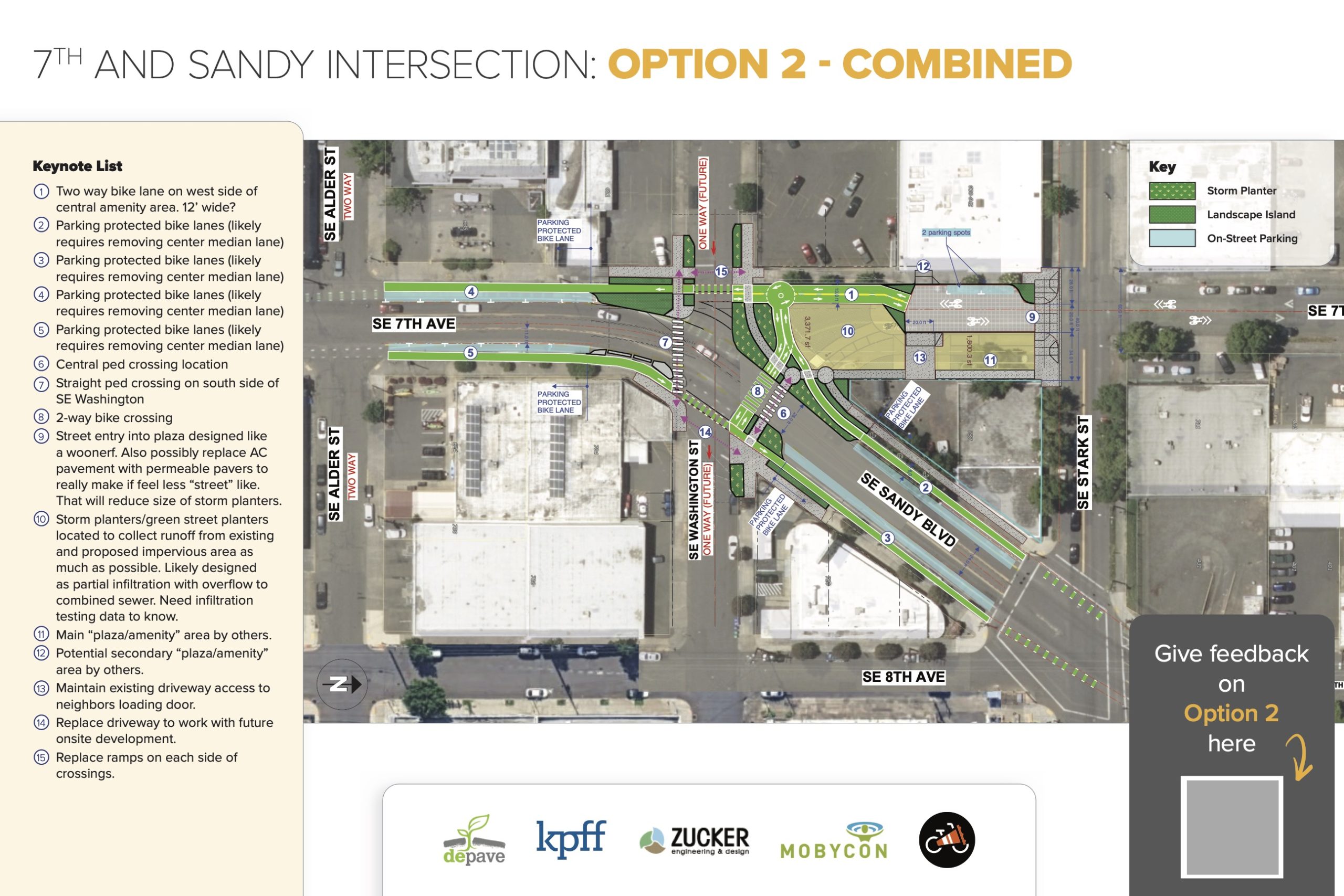
The conversations on the pavement were practical and cooperative. Volunteers debated the best turn angles for visibility and lane placements. Some emphasized the need for more direct routes for vehicular cycling; others focused on how to make the Sandy crossing intuitive and reassuring for all users. Everyone brought a valuable lens: riders who use the intersection daily, planners steeped in Dutch cycling infrastructure—even freight operators like B-Line Urban Delivery are invested in the bikeway and the plaza’s success.

The design team is reviewing the feedback collected that day and will use those observations to shape the next temporary buildout of the plaza, scheduled to open August 9 through September 19. Hopefully, Depave will secure the additional funding needed to finally build the plaza using permanent materials—and by that time, the design will have been thoroughly tested through all these trials.

Yes, action-oriented planning can take more time and resources than traditional methods—but it also surfaces better ideas. When people test out designs in real life, they give more useful feedback. They notice things you can’t see on paper. They revise. And they come away with a sense of shared ownership. There were some regrets expressed that this design approach wasn’t used at other complex junctions in the bike network—but also hope that it might be going forward.

As we packed up cones, barriers, and rolls of four-inch white duct tape at the end of the day, there was a feeling that something important had happened—not just for this intersection, but for how we approach street transformations more broadly. We didn’t just talk about best practices. We created them as we pedaled. Together.

Want to help shape future designs at SE 7th and Sandy or other locations? Keep an eye out for upcoming test rides and plaza events. And if you have thoughts about this intersection or ideas for balancing bike access with public space, add your comments below.
Job: Experienced Mechanic Needed – Joe Bike

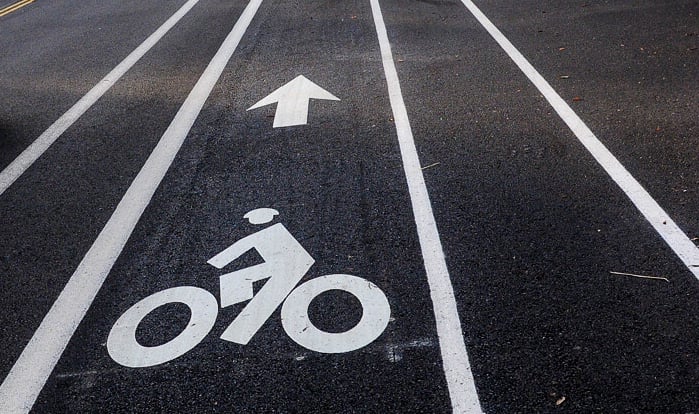
Buffered Bike Lane with a bike symbol and arrow pointing forward

Job Title

Experienced Mechanics Needed

Company / Organization

Joe Bike

Job Description

Are you interested in joining our well-rounded crew of talented and diversely-skilled mechanics? At Joe Bike, we pride ourselves on providing excellent service and communication with every customer. We like making personal connections and finding solutions to meet customer needs and budgets. Our team also knows how to have fun and enjoys collaborating on projects. We offer competitive wages based on experience, paid time off, health benefits, and a retirement plan.

How to Apply

If this sounds like you, please send an email to info@joe-bike.com with your resume and answer the following questions to help us get to know you:

1. What are your best mechanical strengths when working with bikes, and what areas are you less confident in?

2. Our bike shop is a busy and dynamic environment. How would you prioritize your time when deciding between working on bikes, helping customers with test rides and product selections, and working on cleaning, organizing, and completing side projects around the store?

3. What is your ideal bike shop environment and why?

Monday Roundup: Cargo e-bike buying guide, bike lane lawsuit, Tokyo, and more

Hi again everyone! I know it’s Tuesday, but I wasn’t feeling up to working yesterday. I had my total knee replacement surgery Friday and after a really great first day, I had two hard days of pain and pill fog. I’m feeling better today so, fingers-crossed, I should make only forward progress from here on out. And I’m eager to get back into the work groove!

Here are the most notable stories that came across my desk in the past week…

U.S. bike production: A company that makes bicycles in Santa Barbara, California is surging just as Trump’s tariffs cause cold feet throughout the bike industry. (Bicycle Retailer)

Bentonville’s bicycling: Turns out when billionaire heirs of the Walmart fortune are passionate about something and they treat one city like a petri dish to see how much of it they can grow, amazing things happen. (Also, isn’t this really old news? Portland lost two companies to Bentonville in 2019 and 2020 respectively.) (NY Times)

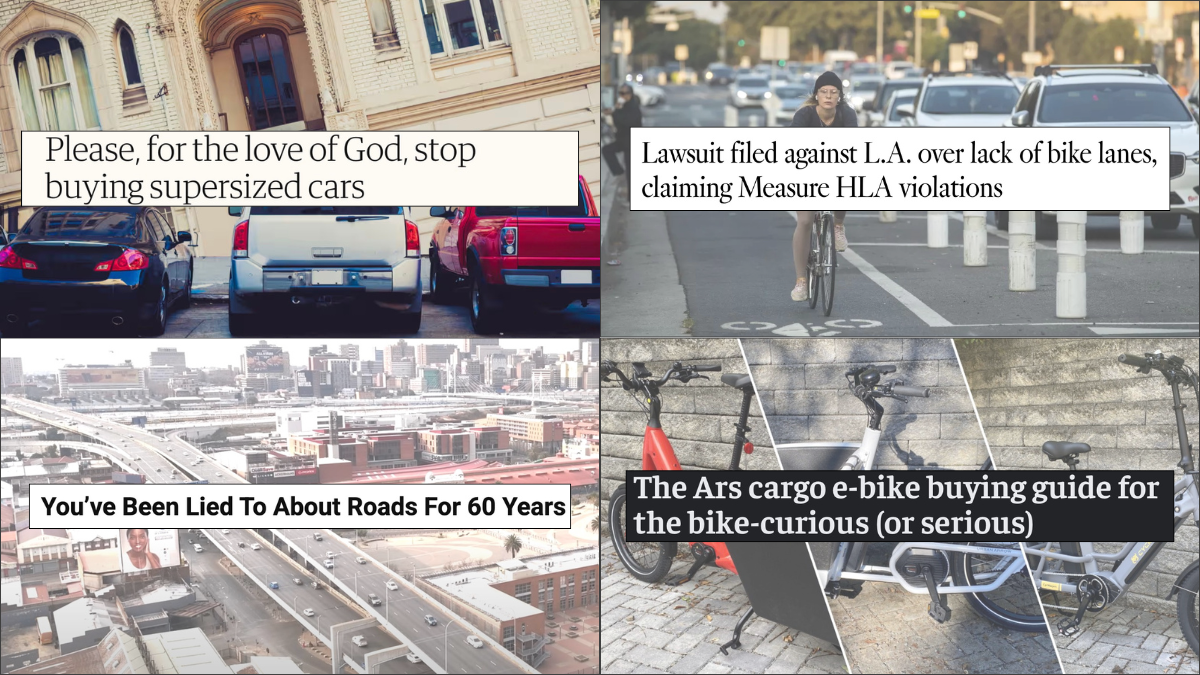
Bike lane lawsuit: In a case with parallels to BikeLoud’s lawsuit against the City of Portland, a safe streets advocate in Los Angeles is suing that city for what he says is a failure to build promised bike lanes. (LA Times)

Houston, we have a problem: It’s bad enough the City of Houston tore out protective elements of an important bike lane, but then they added salt to the wound by saying they’d replace it with sharrows. (KHOU)

Tokyo > Boston: An American professor and his family who’ve lived several years in Tokyo are able to be carfree thanks to the Japanese city’s focus on transit and its strong regulations and pricing mechanisms on car use. (WGBH)

Cargo bike buying guide: This is a very solid overview of the most popular cargo e-bikes and what you should think about when you’re thinking about them. (Ars Technica)

Stop the madness: A columnist implores everyone to “stop the car-brained insanity” of buying oversized SUVs and trucks and hopes that the Trump tariffs might put smaller cars in a more favorable light. (The Guardian)

Speed governor progress: Washington is the latest state to pass a bill that requires reckless, speeding drivers to install a speed governor device in their car as part of their probationary period following conviction. (The Urbanist)

Video of the Week: Everyone was buzzing about this excellent video that breaks down why expanding roads and freeways is a terrible decision and how it leads to so many negative outcomes — yet despite the science that backs up those views, we continue to do it. (Global Cycling Network)


Thanks to everyone who sent in links this week. The Monday Roundup is a community effort, so please feel free to send us any great stories you come across.

Why I stopped riding, and how I’ll start again

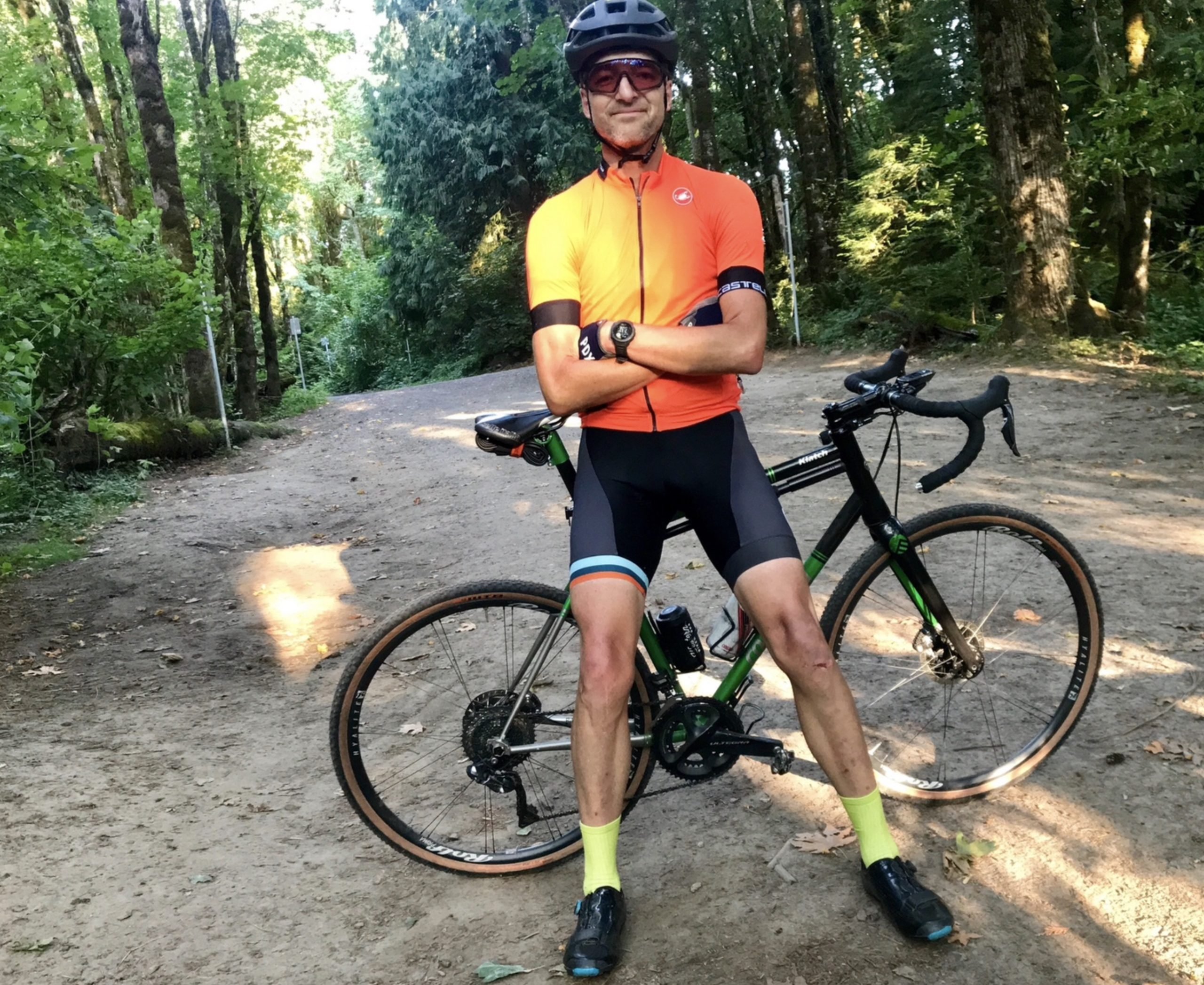
In Forest Park, July 2019. (Self portrait)

On October 4th, 2020 I crested an eight-mile climb, high above the village of Spitzenberg on a dirt road in a rural part of Columbia County about 10 miles northwest of downtown Scappoose when I stopped and had an epiphany. I was 30 miles from home at that point and was just about to descend even deeper into the woods and logging roads between Highway 30 and Highway 47. With the “bullshit miles” behind me, the ride was just getting good.

But something didn’t feel right. A bump on the inside of my right knee had become too obvious for me to ignore. So I aborted my route and headed home. I had two hours to think about what was happening and I’d been down this road before (literally and figuratively). I knew I’d reached a point of no return. ‘Here we go again,’ I thought.

30 years prior to that ride, when I was 16, I tore the ACL ligament in my left knee in a junior varsity basketball game. I remember going to launch off the gym floor and looking straight down at my thigh while my foot was way off to the outside. That injury cost me an entire year of high school basketball. I spent a year rehabbing. Then just a few games into my final varsity season, I tore my other ACL. I knew I’d reached a point of no return. ‘Here we go again,’ I thought.

Not being able to play varsity basketball was a huge disappointment in my life (I’m still not over it!). But cycling helped steer me out of my funk. When I found competitive cycling in college, I didn’t even care about basketball anymore. I just wanted to be the fastest guy in town. I rode and trained and raced hard for years. Then I buckled down to graduate, got married, had kids, moved to Portland, started a blog.

I started racing again in 2011, doing Short Track at PIR and cyclocross races whenever I could. I raced most years between then and 2019, but I mostly loved big, solo rides. The more climbing, the better. And if it wasn’t hard it wasn’t fun.

I didn’t realize it at the time, but I was wearing out my knees. Those two ACL replacements and three other knee surgeries 25+ years ago meant I’d been gnashing bone-to-bone all those miles all those years. I remember in 2000 or so, one of my knee doctors told me after an exam, “You should probably not ride out of the saddle anymore.”

I obviously didn’t take that advice. Partly because I was young and arrogant and felt like my body could do anything. But also because climbing out of the saddle was my favorite part of cycling. And isn’t cycling supposed to be good for your knees?!

In hindsight, and in light of what happened at the top of that climb in 2020, I should have chilled out a bit. When most people say, “Cycling is good for your knees,” they’re not necessarily talking about a 100 mile ride with 8,600 feet of climbing.

It’s been nearly five years since I put on the spandex and did a real big ride. It was strange at first to just quit cold turkey. But I love all the extra time I have. Getting away from serious cycling has allowed me to find new perspectives, new parts of my life, and to rediscover old ones I’d sacrificed at the altar of training rides. That’s the upside.

The downside is my health and fitness have suffered. I don’t get much exercise riding around town for work. As my concerns about my knees worsened, I began riding electric bikes almost exclusively, something I’ve done for a few years now. I could feel the spiral setting in: avoid the pain, don’t exercise, get older, feel worse, avoid the pain, don’t exercise, get older, feel worse, and so on.

In 2022 I saw a knee doctor. He basically said there was nothing he could do. I was too young for a knee replacement and I didn’t have a severe injury requiring surgery. Just manage the pain and wear a big brace if I need stability, he said. I didn’t like that diagnosis, but I was too exasperated with it all to do anything about it. I’d given up until a few months ago at Bike Happy Hour I overheard someone (hi Scott!) talking about their knee surgery. It went great, they said, and they were back to riding hard and feeling good. I got the name of his doctor and grabbed an appointment.

After some imaging and an evaluation, this new doctor said I was a great candidate for total joint replacement surgery. We scheduled both knee replacements at that first visit. I go in for the first one tomorrow.

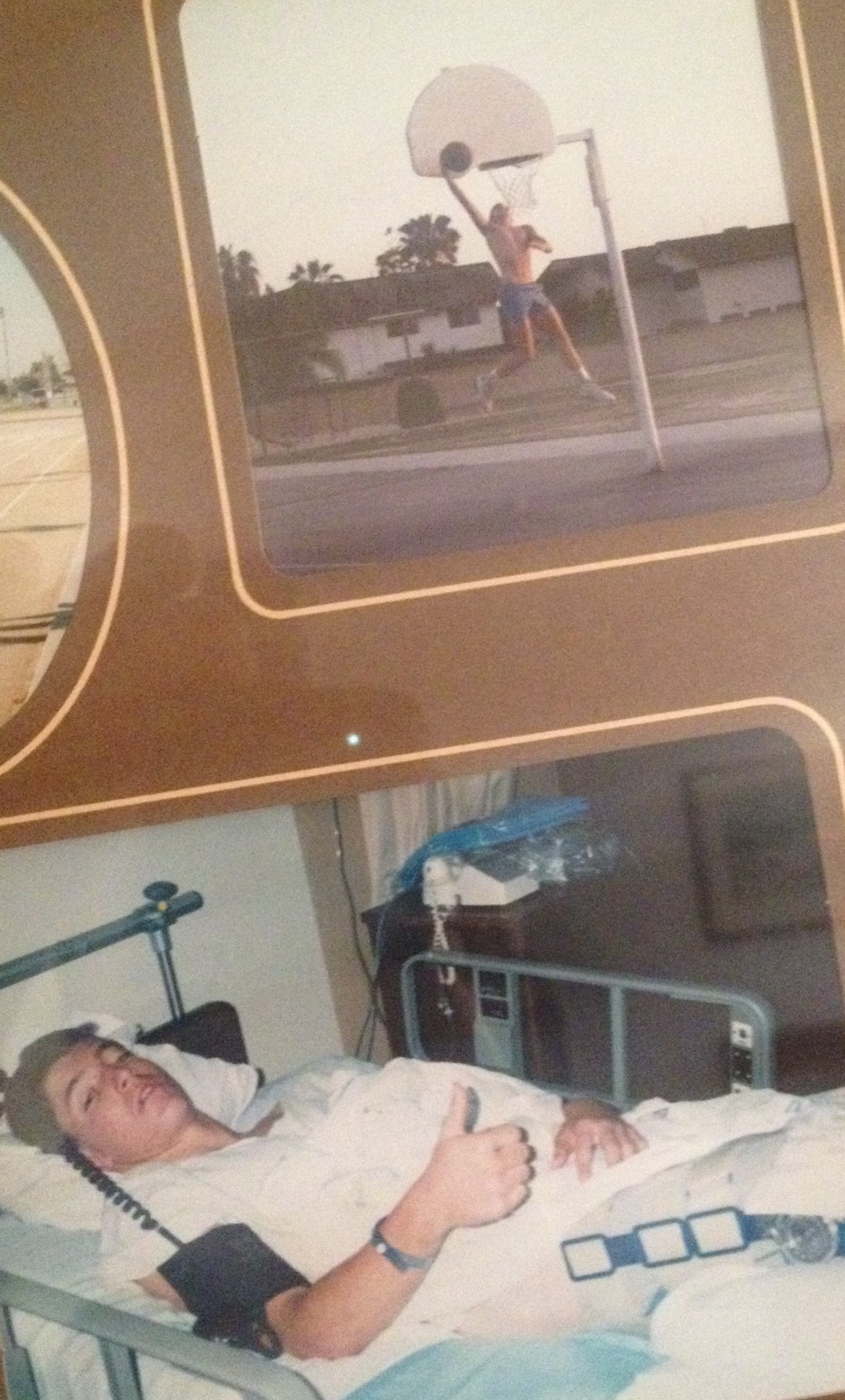
Photos of me dunking on a nine-foot rim when in 1990 when I was 15. And after my first surgery in 1991.

35 years after my first knee surgery, I’m choosing to go through it again. Twice. It sucks to be missing a bunch of bike events this spring and summer, and it will not be good for my business, but I’m tired of having “bad knees.” If all goes according to plan, they’ll be good again (after some hard days and lots of physical therapy), for the first time since I was a teenager.

Maybe I’ll trying dunking again. Just kidding! I just want to ride bikes and not think about how my knees will feel the next day.

So things will be slow around here for the next week or so as I recover. Hopefully I’ll be back out on the streets in May. Then I go back under the knife in mid-June for my other knee. A shitty summer for an amazing (hopefully) rest of my life. I’ll take it!

A bike shop owner’s view on tariffs and market uncertainty

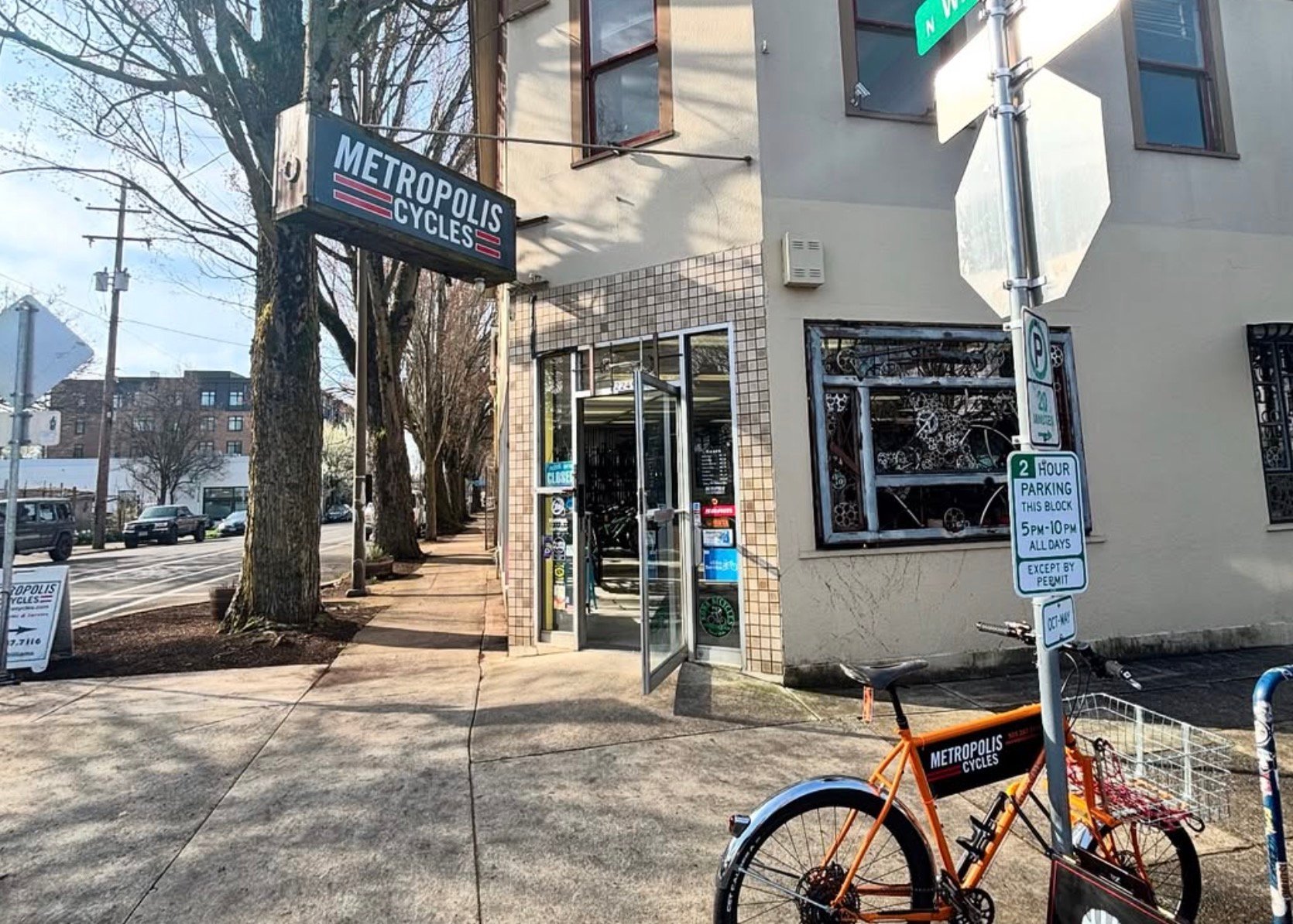
Metropolis Cycles on N Williams and N Page. (Photo: Metropolis Cycles)

Yesterday I shared how Trump’s tariff policies are impacting a Portland-based bike company that imports its apparel and bicycles from China and other markets overseas. But what about local bike shops? For that perspective I called Brad Parker, owner of Metropolis Cycles on North Williams Avenue.

Here’s a slightly edited version of our conversation:

How has all the Trump tariff news impacted your business so far?

“So far, we’ve noticed distributors and manufacturers are telling us prices will increase. For instance, we just got an email a few weeks ago from the company that owns the Blackburn tools and racks, telling us that there is going to be a price increase at the beginning of this month. And our QBP [Quality Bicycle Products, a major distributor] rep did tell us that steel is going to go up.

One of the main things in the bike industry that is steel and important is chains and cassettes. So we have already just started [preparing for Trump uncertainty]. I went into my sales history and tried to do estimates of how many chains we sold last year, and we’re trying to purchase those now for the entire year to help us survive. So those are the main things that we have done so far to get us through these price increases that are coming.”

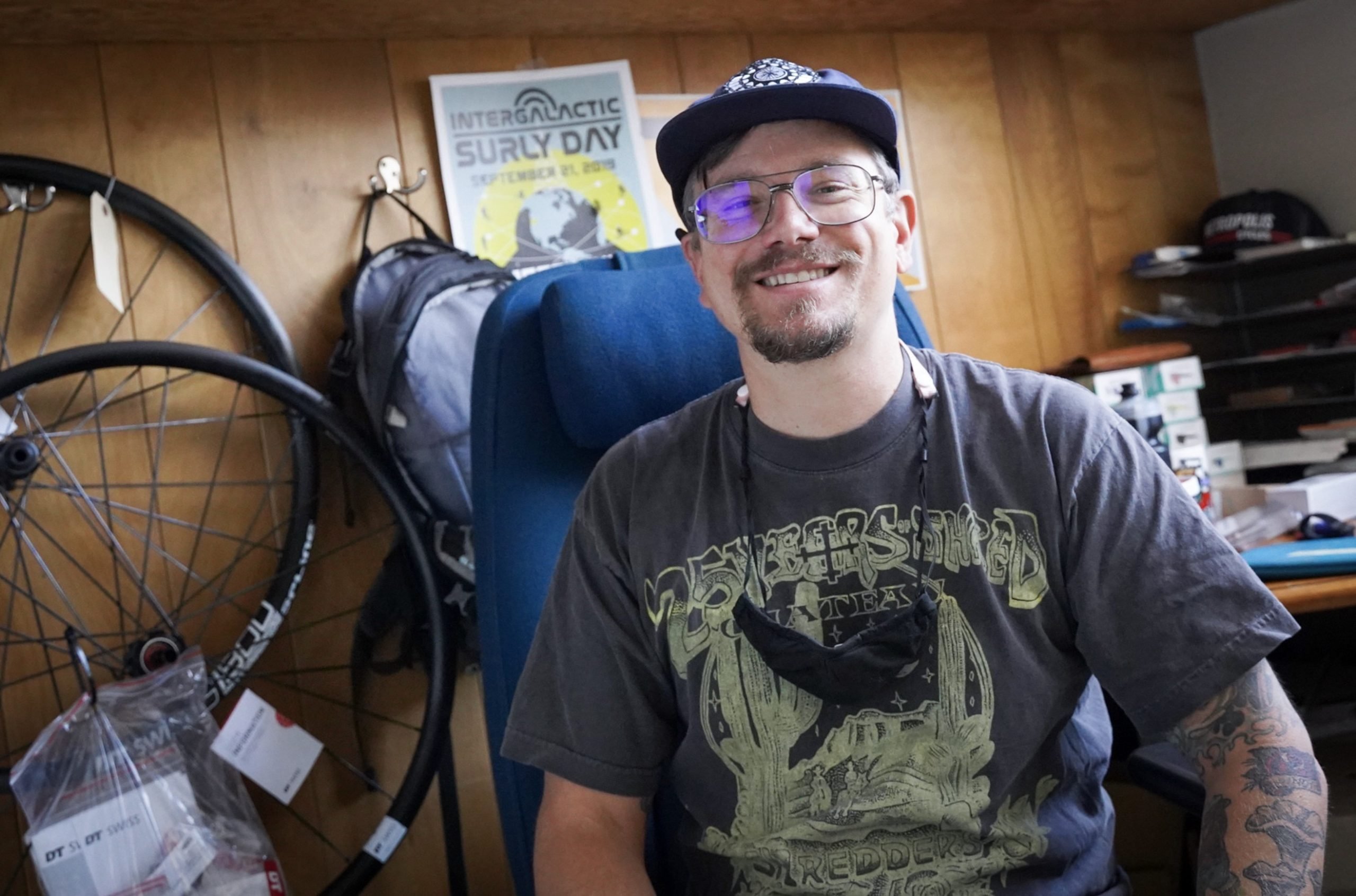
Shop owner Brad Parker. (Photo: Jonathan Maus/BikePortland)

Have you seen any reaction from customers yet? Are people panic-buying bikes or anything like that?

“That’s a good question. It’s been a really weird year for us so far with bike sales. Right after the election and right after the inauguration, we sold a lot of bikes. It was almost like, for a lot of people, when they get depressed with stuff, they’ll go and they’ll buy something to make them feel better. And then February and March, we sold almost no bikes. It was really weird.”

So people aren’t coming in asking for used bikes? Or wanting to buy before tariffs kick in?

“We had a few customers purchase e-bikes in January who were like, ‘Hey, I want to get these before tariffs start hitting.’ I think we sold three bikes like that and we usually sell one e-bike every three months, so it’s kind of weird to sell three in January.”

You don’t seem very distressed. Are you worried that high prices and uncertainty will send a chill through costumers and they’ll stop coming through the door? How would higher prices impact your business?

“I don’t know about saying I’m not distressed. This keeps me up quite a bit every night, but it is what it is. It’s something that I personally can’t control.

We do a lot of tune-ups and service, and, you know, that’s where we’re going to have to increase our prices. We don’t really make too much money, so that means we have to push the price onto the consumer. The margins in the bike industry have shrunk significantly in the last 10 years. Either bike shops go out of business, or they have to push those costs onto the consumer. Will that affect how many people are coming in the door? Absolutely.

The other thing too is when things get more expensive, people go to bikes. When gas has gone up, or it’s hard to get a car, we’ve noticed a little bit of uptick of people pulling that bike out of the garage and relying on that more. We’re hopefully going to get a little bit of that to help us with the people that are maybe not biking because they can’t afford that new chain.

I’m pre-buying a year’s worth of chains and I’m going to keep that inventory up. So if I sell a chain right now, and I look and that price was still the old price, I’m going to keep ordering that. So when those tariffs do happen. I’m not going to, like, increase the price of my chain to be a dick. You know? I’m doing this to help my customers out. And when those chains run out and I have to buy expensive ones, that’s when I’m going to start increasing my prices.”

You’ve said you’re ordering more chains. But isn’t cash-flow a concern?

“The thing that’s hard is, you know, this is spring. This is when I have to pay all my manufacturers for all these bikes that I’ve bought. A lot of bikes come out in the fall, and manufacturers know that bike shops need to save their money to get through the winter. And so they’ll be like, ‘You got to pay us in the spring,’ and that’s right now. So I don’t have a lot of discretionary income. And the other thing too is the amount of new bikes we have in our bike shop is about twice as much as we had last year at this time. And it’s because we’ve been talking about these tariffs for a bit. And as soon as Trump got elected, I pre-booked up all these bikes. So I have to pay for them now. Ideally I would buy pallets of cassettes and pallets of other items. So would other bike shops. But they can’t, because they’re in the same boat I am in with owing all this other stuff like taxes, workers comp bill, all that stuff is due in April, you know?”

Anything else you want to share about all this?

“The whole bike industry is kind of like in this, ‘What do we do? We’re just gonna’ have to figure it out as we go,’ moment and that’s kind of where we’re at as well. We don’t know what’s gonna’ happen or what these costs are going to be. Everything’s gone up in price since I’ve been owner of the bike shop. One of the rear racks we used to sell was $45 and within five years, it’s now $75 for the same exact rack.

You know, you’ve just got to do what you’ve got to do. You got to get up in the morning and just see what’s happening that day.”

Weekend Event Guide: Ladds 500, tres Roubaix, Gold Sprints and more

Scene from Ladds 500 last year. Should be even bigger and zanier this time! (Photo: Jonathan Maus/BikePortland)

Portland is so back! This is one of the best event and ride lineups I’ve shared since last summer. You are going to have such a great weekend! The only downside is that I’ll be on a couch the entire time, nursing my knee after total joint replacement surgery which I’m having tomorrow. Please have fun for me and be sure to tag @BikePortland in your photos and videos!

Friday, April 11th

Backyard Blam Gold Sprints – 6:00 to 9:00 pm at Chris King Precision Components (NW)
Start it off with happy hour at Simworks at 3:00 and then head upstairs to the CK Cafe where the sprint machines will be locked and loaded for a battle of the ages. Who has the fastest sprint? It’s a “party with a purpose” that will raise funds for Jake Tong who’s devoted a lot to our community and needs help with some medical expenses. More info here.

Saturday, April 12th

The Ladds 500 – 10:00 am to 6:00 pm at Ladd Circle Park (SE)
The Big Day is here! Ride laps around the park among thousands of wonderful people and hang out in the park as you watch the whirling mass of happy humanity take part in this “stupid” Portland ritual. More info here.

Marine Drive Path Cleanup – 10:45 am at I-205 path near Home Depot (NE)
If Ladds 500 isn’t your thing, roll out to a SOLVE-sponsored cleanup and help pick up litter from the path. All bikes welcome, but if you have cargo bike, organizer Mark will be even more excited to see you. More info here.

Sunday, April 13th

Street Plaza Test Ride – 8:00 am at SE 7th and Sandy (SE)
Remember the Depave project that brought a plaza to the awkward intersection of SE 7th/Sandy/Washington? They want to make sure bicycle traffic flows smoothly through when it returns this summer and advocate Aaron Kuehn has organized a bike test drive event to test various designs. More info here.

Abernethy Bike Fair & Grounds Party – 9:00 am at Abernethy Elementary (SE)
School PTA is organizing a fun, family-friendly bike fair where there will be a raffle and free bike fits and tune-ups. You can also help build cool stuff on the playground. More info here.

Cyclepath Roubaix – 9:30 am at Cyclepath Bike Shop (NE)
Watch the spring classic Paris Roubaix at the shop and then head out for a 38-mile loop to Skyline and back. More info here.

Slabtown Roubaix – 10:00 am at Trek Portland Slabtown (NW)
Show up to the shop at 9:30 for waffles and coffee and then head out for an 18-mile riverfront loop in honor of Roubaix Day. More info here.

A Sunday in Helles – 10:30 am at Sellwood Cycle Repair (SE)
The fine folks from CX Pistols Cycling Team, Gigantic Brewing, Sellwood Cycle and Endurance PT have put together an entire day of Roubaix aura. Start with coffee at the shop, then roll out for a 27-mile loop that ends at the brewery to watch Paris-Roubaix on the big screen with a big pint. More info here.

Bikepacking Meet & Greet – 11:00 am at Abernethy Elementary (SE)
Join fellow bikepacking fans for a session of knowledge sharing and inspiration as you have a few snacks and socialize. A perfect place to start planning those summer adventures. More info here.


— Did I miss your event? Please let me know by filling out our contact form, or just email me at maus.jonathan@gmail.com.

City outlines plan to bolster bike buses with signage and infrastructure upgrades

PBOT is hitching their wagon to bike buses. Who can blame them? (Photo: Jonathan Maus/BikePortland)

The bike bus movement has been a decidedly grassroots phenomenon. Moms and dads have stepped up to organize rides at local schools and families have shown up to ride together. But as the trend matures and looks to expand beyond early adopters and reach its true potential, it needs a stronger foundation that must include help from local government to keep roads safe and welcoming for everyone.

“We’re saying, ‘Bring it on!’ Let’s figure out how to do this even better. We really welcome the partnership with bike bus advocates.”

– Kristin Hull, PBOT Planning and Project Delivery Group Manager

At a meeting of its Bicycle Advisory Committee last night, the City of Portland made it clear they are “all aboard” when it comes to the bike bus. Staff from the Portland Bureau of Transportation outlined three active projects worth about $650,000 that they’re working on to make bike bus routes safer.

“We’re saying, ‘Bring it on!’ Let’s figure out how to do this even better. We really welcome the partnership with bike bus advocates,” said Portland Bureau of Transportation Planning and Project Delivery Group Manager Kristin Hull.

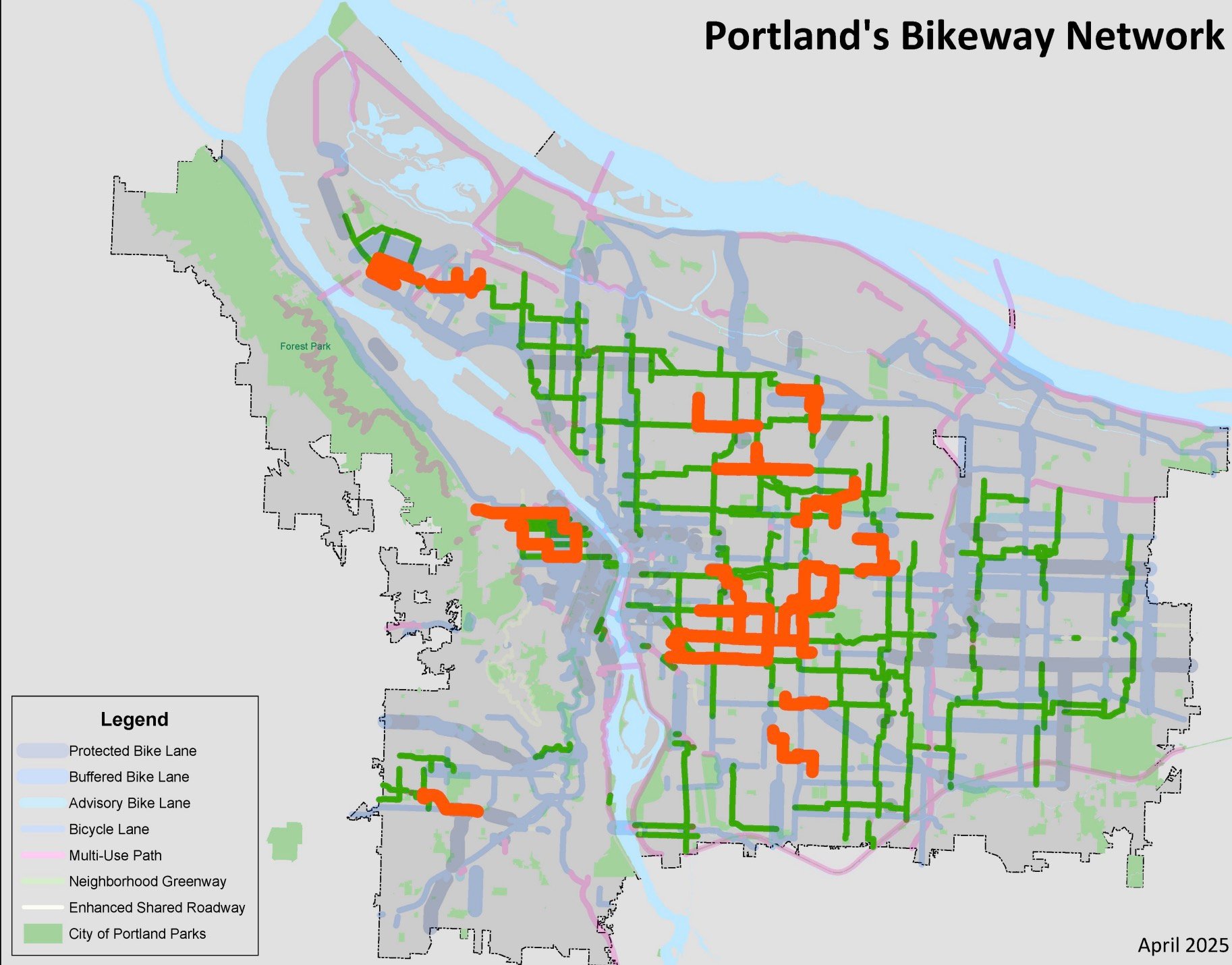
Hull attended the meeting along with PBOT Traffic Safety Section Manager Dana Dickman. Their presentation was a direct response to Bike Bus PDX, a coalition of advocates who launched a pressure campaign directed on Portland City Council back in February. Their Bike Bus Friendly Neighborhood Greenway Resolution calls on PBOT to lower the average daily auto traffic volume threshold (from 2,000 cars per day to 500 cars per day) on 25 neighborhood greenway routes where active bike buses exist prior to the start of the 2025-2026 school year.

PBOT map showing bike network with neighborhood greenways in green and existing bike bus routes in orange.

While PBOT strongly supports the concept, they revealed last night that they’ll only have funding to work on four corridors by next year. To help soften the blow of that reality, Dickman and PBOT Bicycle Coordinator Roger Geller outlined three active projects they’re working on to improve bike bus conditions: a $50,000 Metro grant for wayfinding and signage on bike bus routes, $100,000 from the General Fund for intersection safety improvements, and $500,000 from Fixing Our Streets program for improvements to neighborhood greenways used by bike buses.

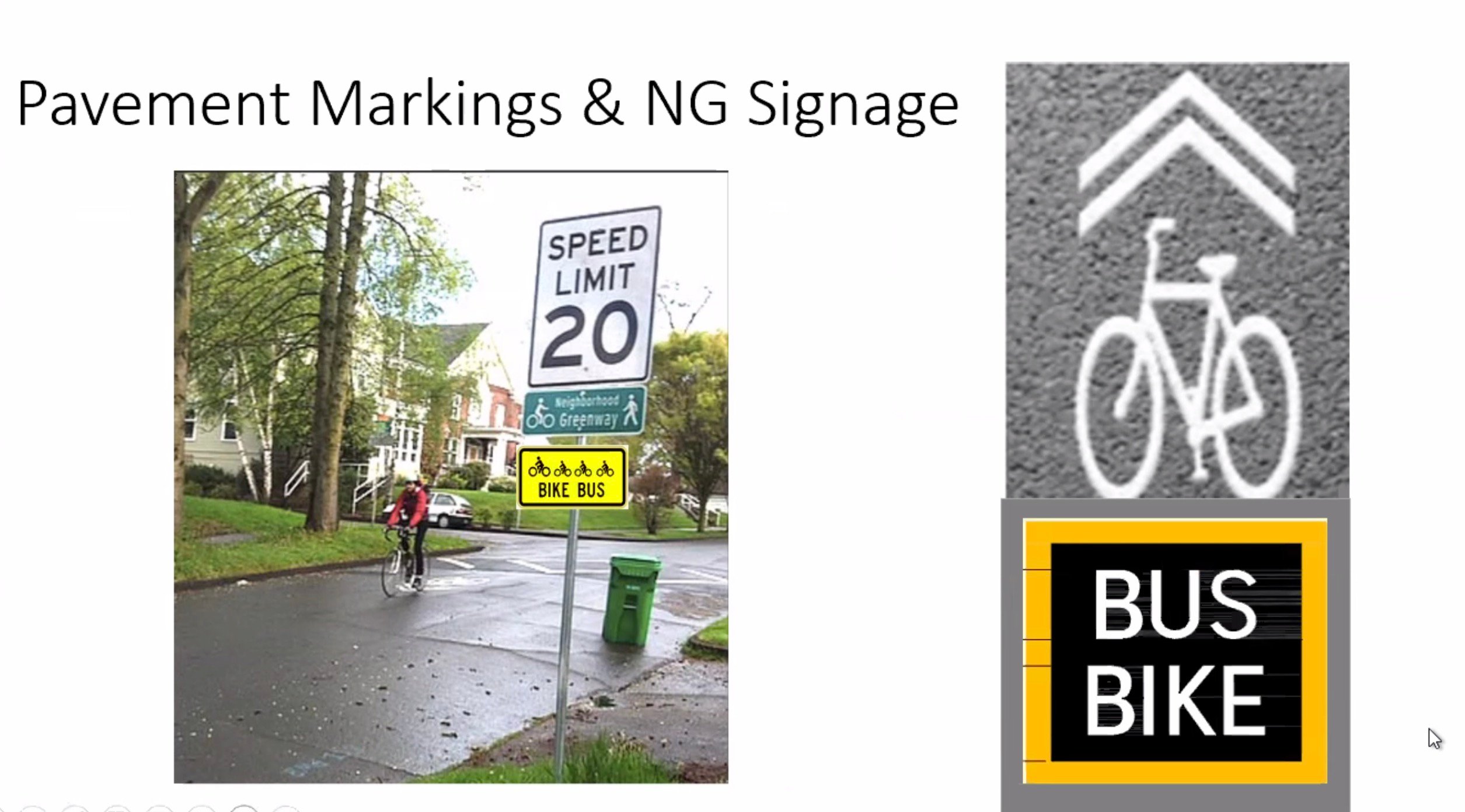
The signage project is funded by Metro’s Regional Travel Options program. It will stoke bike buses at 10-11 schools by paying bike bus leaders and installing new signs and markings on the routes. The new signage is aimed both at drivers and bike riders. PBOT hopes people will drive more safely when they’re on a bike bus route, and they want people who participate in the bike bus to know where it’s safe to ride even beyond the school day. Bike bus leaders have heard from families that kids love riding and want to do it more often, but they face more dangers outside the safety of the group and aren’t sure where they should ride.

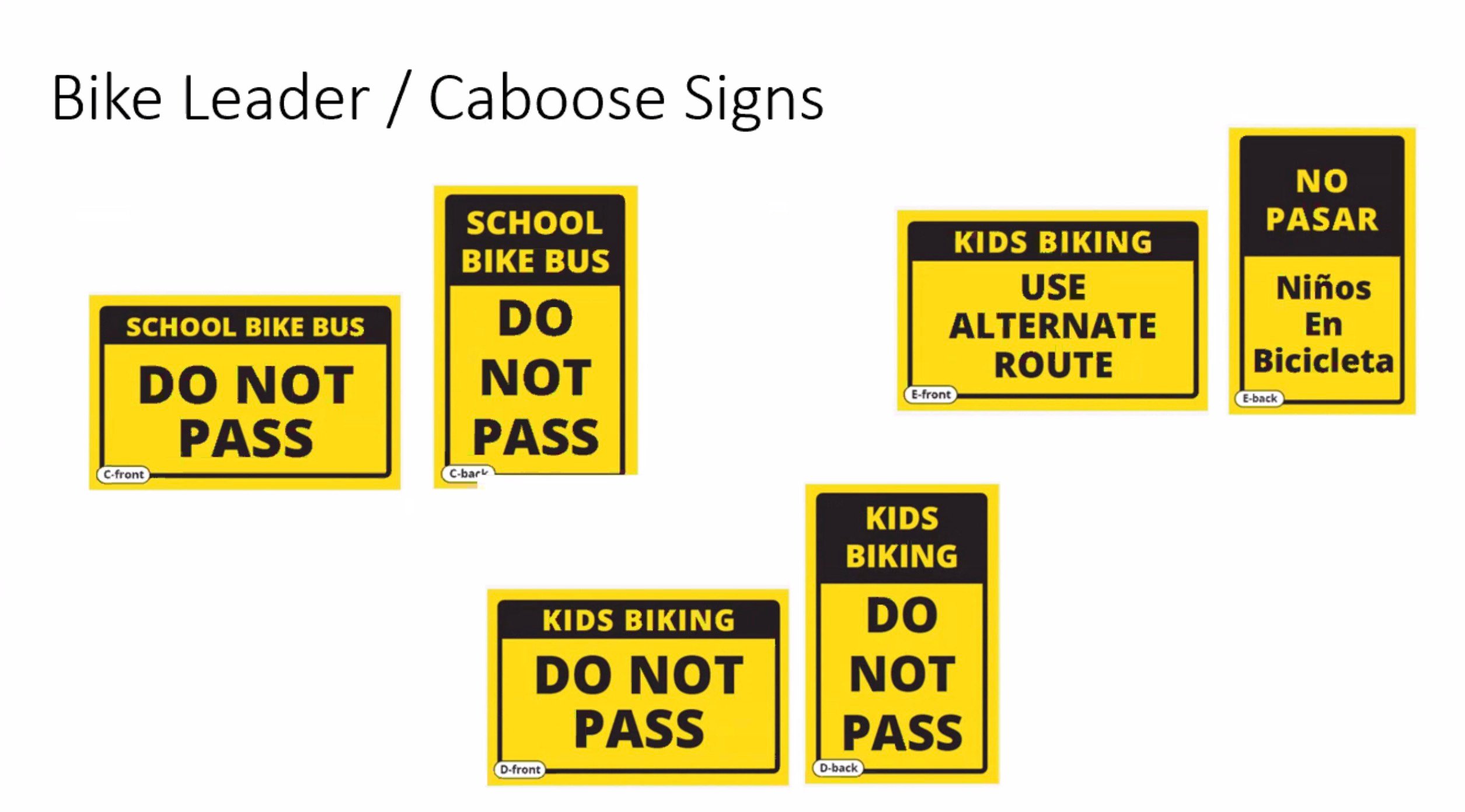
PBOT has developed lawn signs, rider signs (on existing street signs), “caboose signs” to be warn by bike bike bus leaders, and pavement markings that should start showing up sometime this summer. A pilot project to gauge impacts of the signs will begin this fall. Bike bus leaders will be paid $500-$750 to participate in the pilot and will be required to take surveys and stay in close communication with school communities and PBOT staff.

The $100,000 from the general fund will target intersection updates where bike bus routes cross busy streets. Any funds left over from that work will go toward daylighting intersections. PBOT says they’re looking at two intersections: SE 34th and Hawthorne and SE 34th and Division.

The biggest project will spend $500,000 to implement modal filters and other forms of traffic diversion on four (possibly five) bike bus routes along neighborhood greenways. PBOT says they’ll spend $100,000 this year developing the projects and doing any necessary public outreach and the remainder of the funds will go toward construction.

Geller said PBOT planning and engineering staff have already ridden with seven bike buses to observe conditions and receive feedback. “We’re hearing there are too many cars, side-street incursions, people not stopping at stop signs, poor motorist behavior, difficult intersections and chaotic conditions near schools where greenways overlap with parent drop-off.”

Since this project will include diverters and other infrastructure elements designed to constrain driving access, Geller told BAC members he believes they must help build community support to avoid driver backlash. “Some of the things [we want to build] are likely to be controversial in the community, particularly diversion,” he said. “So we really want to work to expand our constituency for these improvements and develop champions for identified projects.” Geller wants the BAC and local bike bus advocates to organize weekly bike rides at the schools to curry favor and spread awareness.

Geller says it will take a groundswell of community support to shake loose enough funding to treat all bike bus routes throughout the city. “We’re going to need more funding and decision makers are going to need to decide that they want to provide more funding, and that comes from political support,” Geller said. He warned against moving too quick with changes and said, “We cannot shove things in peoples’ neighborhoods,” because, “That kind of thing comes back to bite us and we don’t want to be one-and-done which threatens the long-term vision.”

“I just want to thank the bike bus advocates for creating this space for us to even have this conversation. Thank you. What an opportunity we have to seize their hard work to make a difference for what we want to do.”

– Jim Middaugh, Bicycle Advisory Committee chair

BAC Vice-Chair Joe Perez said the group should push back on PBOT and recommend treating more than four greenways by next year. But Chair Jim Middaugh urged support for PBOT’s proposal. Middaugh said given PBOT’s dire budget situation, the BAC should embrace the city’s support, even if it’s not as robust as activists are calling for. “That combination of external [Bike Bus PDX] and internal [PBOT] alignment is a really strong foundation for long-term gains,” he said. A majority of the BAC seemed to agree and will now work on a letter of recommendation for city council so PBOT can take their work to the next step.

In the end, this is a classic example of how community activism can speed up progress from PBOT. After all, we are all pushing for the same thing.

“All these kids that are out there biking are all future adult cyclists in Portland, and that’s really what we want,” Geller said. And BAC Chair Middaugh added: “I just want to thank the bike bus advocates for creating this space for us to even have this conversation. Thank you. What an opportunity we have to seize their hard work to make a difference for what we want to do.”

PBOT will choose at least one school from each council district. The schools have yet to be chosen. Expect a public engagement process to begin later this summer and work on the bike bus greenway improvements should begin in 2026.

Local bike company faces Trump tariff challenges head on

Showers Pass and Vvolt headquarters on SE 6th Avenue. (Photo: Showers Pass/Vvolt)

As President Donald Trump’s tariffs continue to run roughshod over the economy, one local company has gone into survival mode to weather the storm. Kyle Ranson, CEO of southeast Portland-based apparel company Showers Pass and founder of electric bike brand Vvolt says he may be forced to close as the weight of tariffs suffocate his business.

“Obviously we’re going to hold as long as we can. But basically it’s a complete holding pattern,” Ranson shared with BikePortland this morning. As just one example of the existential crisis his business faces, Ranson said he’s got a shipment worth $1 million waiting at a port in China that would cost him about $1.2 million just to clear customs. When I first reached out to Ranson, he lamented that the shipment would cost him $680,000 in tariffs. But that cost doubled overnight as the trade war has escalated. (Typical customs duty on a $1 million shipment would be around $20,000.)

“It’s preposterous. It’s impossible,” an exasperated Ranson shared.

Kyle Ranson in 2021. (Photo: Jonathan Maus/BikePortland)

Ranson said small and medium-sized business like his do not have the free cash flow needed to pay those kind of costs. “We’re all operating tight already. We’re managing every dollar. There are no businesses in the small to medium size range that will have the cash-flow to pay these tariffs. It’s just… it’s just impossible. I mean, literally, on our on our e-bike business, we’re now talking about 154% tariffs.” Ranson also works with a factory in Vietnam, where tariffs have jumped to 46%. This is all such a shock to the system because last year at this time there were zero import duties on e-bikes.

According to a well-sourced article published yesterday by Heatmap, the bicycle industry is one of the most import-dependent industries in the U.S. Bike industry experts are forecasting a very grim future for many companies like Showers Pass and Vvolt if things continue on this trajectory.

For now, Ranson has told shippers to hold his cargo. That means his plan is to sell existing inventory as long as he can, but he’s still got payroll and other fixed costs bearing down on him (including, somewhat ironically, payments on a federal SBA loan). Two months ago Ranson shifted employees to a four-day work week. He’s also frozen salaries and shelved plans to hire more staff. Despite difficult conditions, Vvolt and Showers Pass employees are just as committed to survival as Ranson is. “They’ve said, ‘We’re all in. Let’s figure this out,’ and that is so heartening. It makes me realize why I’m doing this in this first place.”

“What we’re not doing is giving up,” a resolute Ranson said this morning. “We’re looking under every rock, we’re scrambling, and we’re watching out for doors to open.”

But the clock is ticking without any new products coming in. It’s like a “ticking time bomb,” Ranson says.

Sales of Showers Pass products dipped significantly last week, due to what Ranson thinks is a general “paralysis” in the market. Even his largest customers like REI have reduced orders. Now it’s a matter of belt-tightening and playing the waiting game.

As for whether or not Trump’s tariff policy will encourage Ranson to bring Vvolt bicycle production to America, that’s a sore subject. Since Vvolt launched in 2021, Ranson said the vision was always to do assembly in the U.S.; but he’s received no government support to make that happen. And now with tariff costs, it’s impossible since none of the components on the bicycles are made in the U.S.

“If you want us to do this final assembly, which we believe is viable and can be done, you’ve got to give us a duty break on bringing in the components,” Ranson said.

With so much uncertainty, Ranson says it’s hard to even know how to react. For now, the plan is to sell through existing inventory and hope that provides enough cash flow to survive. There are no plans to raise prices on current inventory, and Ranson says if customers are feeling sympathetic, the best thing they can do is make a purchase. “Show us some love, because the only thing that’s going to keep us going is selling what we’ve got.”

“We’re going to keep the doors open until the government figures out what the hell they’re going to do. But if we start running out of product and we don’t have the cash for payroll and everything else. That’s when, you know, it’s lights out.”


ShowersPass.com
Vvolt.com

Portland Senator a lone voice against highway widening

Highway 20 east of Philomath.

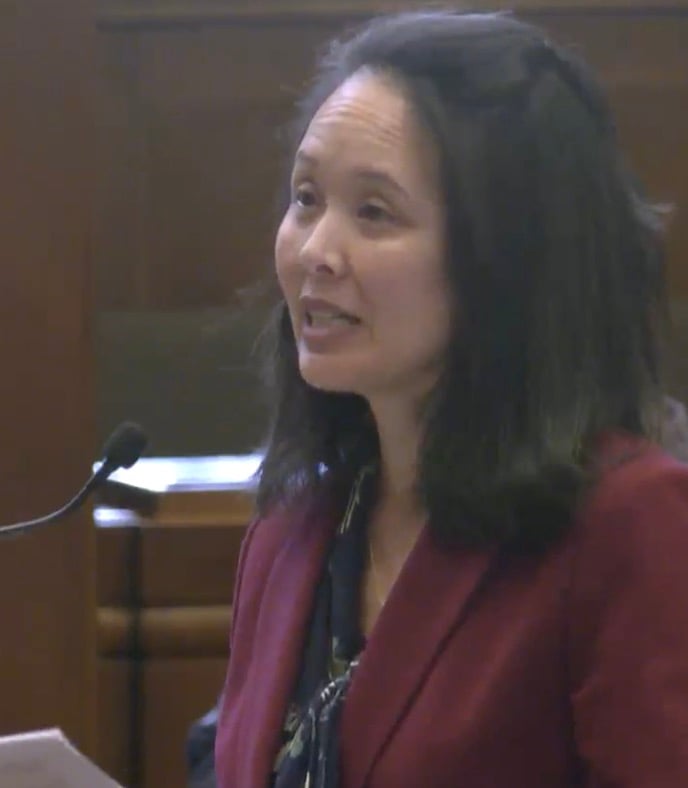
Oregon Senator Khanh Pham has planted a flag this legislative session on the idea that repairing and maintaining existing highways is more important than expanding them or building new ones.

On Monday, Senator Pham, a Democrat who represents outer southeast and northeast Portland, was the sole “no” vote on a bill that originally sought to give the Oregon Department of Transportation a blank check to widen a highway. And earlier that morning Pham gave a speech on the Senate floor about the need for more street safety funding.

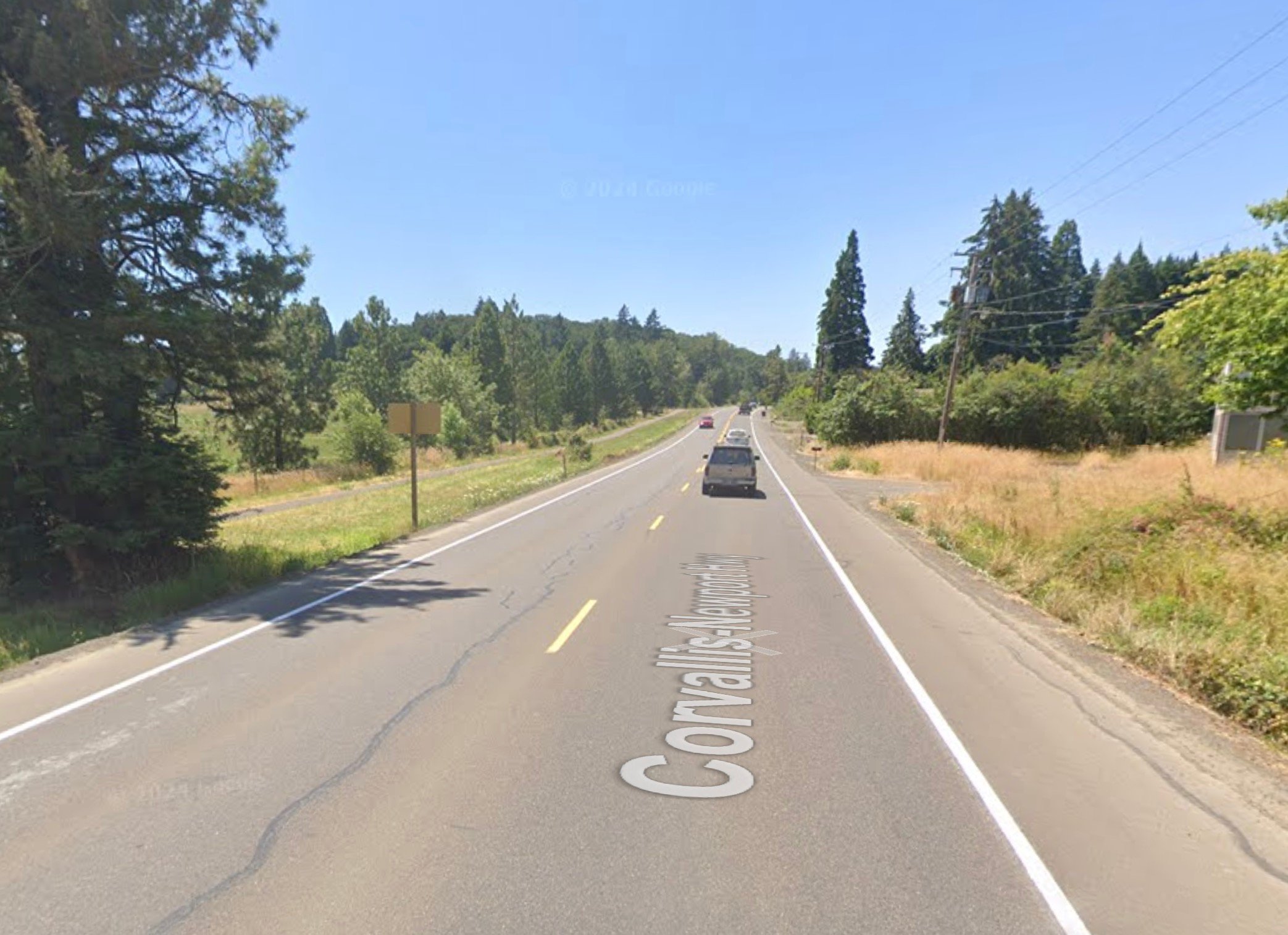
Senate Bill 564 was proposed by Senator Dick Anderson, a Republican who represents a coastal district between Salem and Eugene. The bill called on ODOT to, “widen and increase the capacity of motor vehicle travel” on a three mile stretch of Highway 20 between Corvallis and Philomath. The bill called for funding through the General Fund, but left the specific amount blank.

In a public hearing for the bill on February 11th, Sen. Anderson, the Mayor of Philomath, and a local county commissioner, all spoke in support. They said folks who live in Philomath have complained to them about bumper-to-bumper traffic when they try to drive to jobs and events in Corvallis (home to Oregon State University). They talked about how “easing congestion” would improve safety and allow more growth and economic development. 

Philomath Mayor Christopher McMorran said, “We are not trying to cause any environmental damage. We are trying to find all solutions we can to get folks to work, to get folks to school, to make sure that highway is working for residents.”

The bill was ultimately amended to remove the project appropriation and make it just a “study bill.” Legislative staff estimates the study, which would give lawmakers, “recommendations for increasing the capacity of motor vehicle travel,” would cost about $300,000.

The Joint Committee on Transportation voted on the bill Monday evening. It passed 10-1, with Sen. Pham the only person voting against it.

Rep. Pham on Senate Floor Monday morning.

“I am worried about advancing legislation that’s calling out specific highway widening projects for study,” Pham said in comments before casting her vote, “As opposed to taking a total systems approach looking at our entire transportation system… I just worry about the precedent it sets as we’re gearing up for the 2025 package, especially with so many of the projects with cost overruns that we’re navigating, I think we really need to be focusing on maintaining our existing system.”

Those comments lined up with a speech Pham gave on the Senate Floor that same morning. “Community members are angry, and they have a right to be. This was preventable,” Pham shared as she recounted the death of Roger Lee, who was killed by a driver as he walked across SE Powell Blvd on March 9th. “Many legacy highways currently owned by the Oregon Department of Transportation were designed for cars, but are, of course, used by all modes and are more deadly for all road users, particularly people walking and biking.” “Our state highways are old and outdated and unsafe and suffering from disinvestment,” she continued. “As we discuss how best to use our limited state transportation funds, we need to prioritize investments that make our current system safer, like fully funding our Great Streets program, Safe Routes to School and supporting jurisdictional transfer of some of these roads — whether it’s a logging truck on Highway 30 near Clatskanie, or middle-schooler trying to bike to school across SE Powell Blvd, we must make Oregon streets safer for everyone.”

Pham is also gaining support from across the aisle. Senator Suzanne Weber, a Republican who represents coastal Tillamook County, also spoke on the Senate Floor Monday about the need to, “Address the dire safety situation facing our transportation infrastructure.”

TriMet wants to know if they should go bigger for transit on 82nd

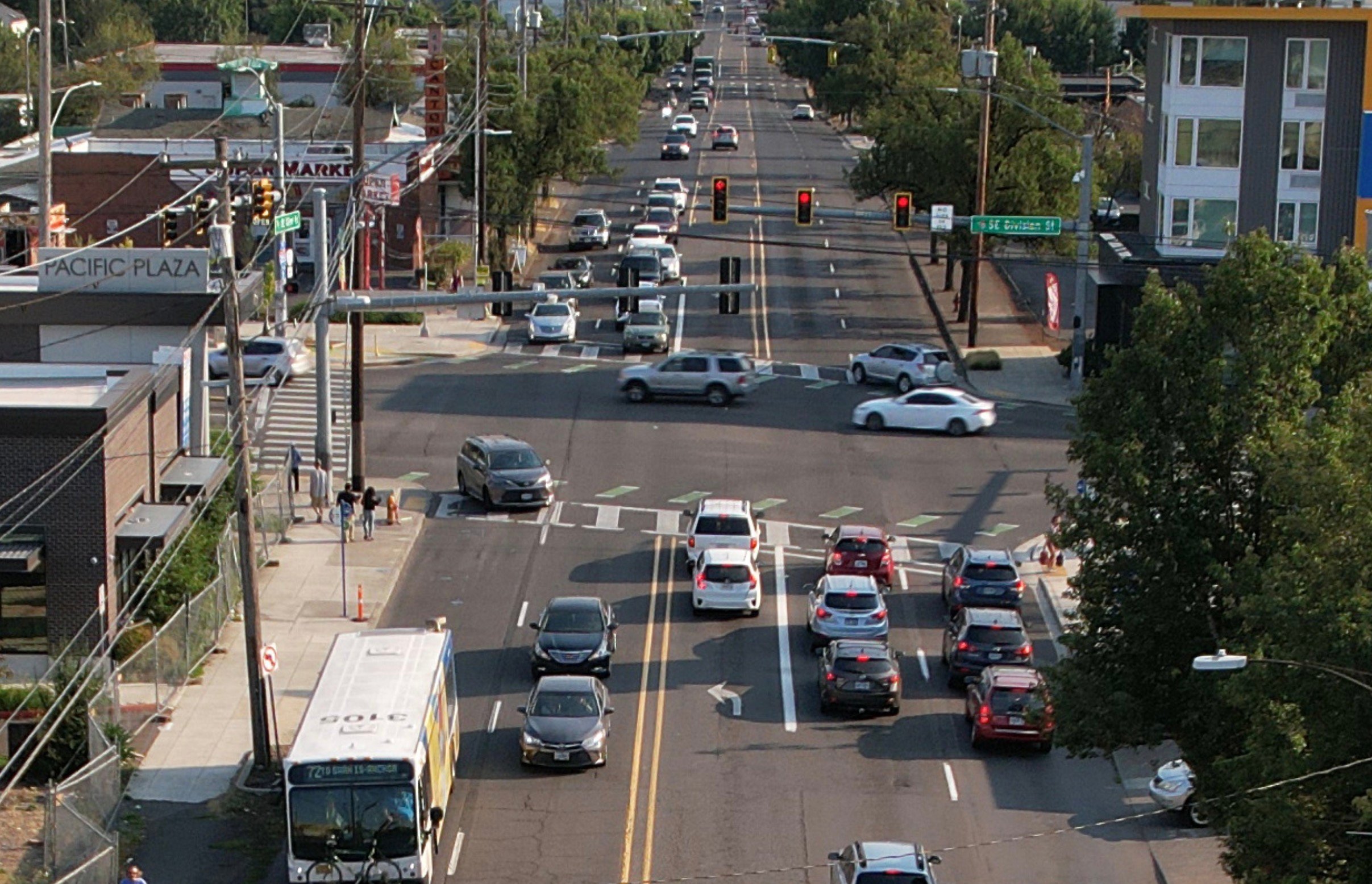
Aerial view of SE 82nd Avenue at Division. (Photo: TriMet)

Because TriMet and the City of Portland won’t do more to prevent people from driving cars on 82nd Avenue in the future, a $320 million transit upgrade might not be enough to significantly improve bus service.

TriMet 82nd Avenue Transit Project will bring their high-capacity FX bus service to 10 miles of 82nd Avenue between Clackamas Town Center and northeast Portland. To speed up service on the busiest bus corridor in the state, they’ll consolidate stops, improve stations, make safer pedestrian connections, update signals, and more. But even with these investments, “It may be harder for buses to stay on schedule as traffic congestion grows in the future,” TriMet says.

That’s largely because project leaders feel they must maintain ample access for car drivers, instead of devoting more space to more efficient lanes for buses and bikes. Since bicycle access on 82nd has already been ruled out, and the political support does not appear to exist for reducing automobile access, TriMet is now exploring additional investments they say will be needed to keep buses moving.

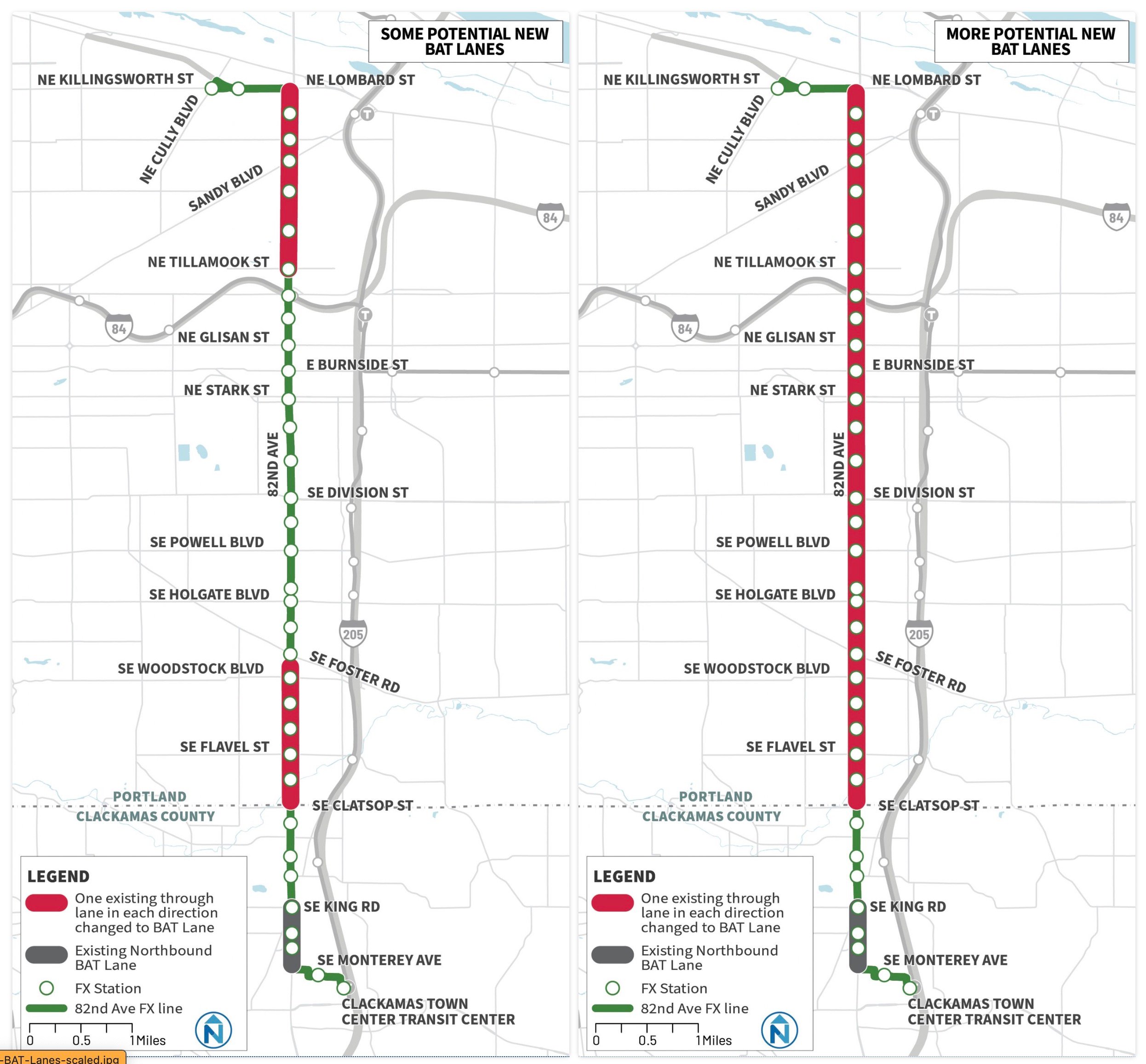
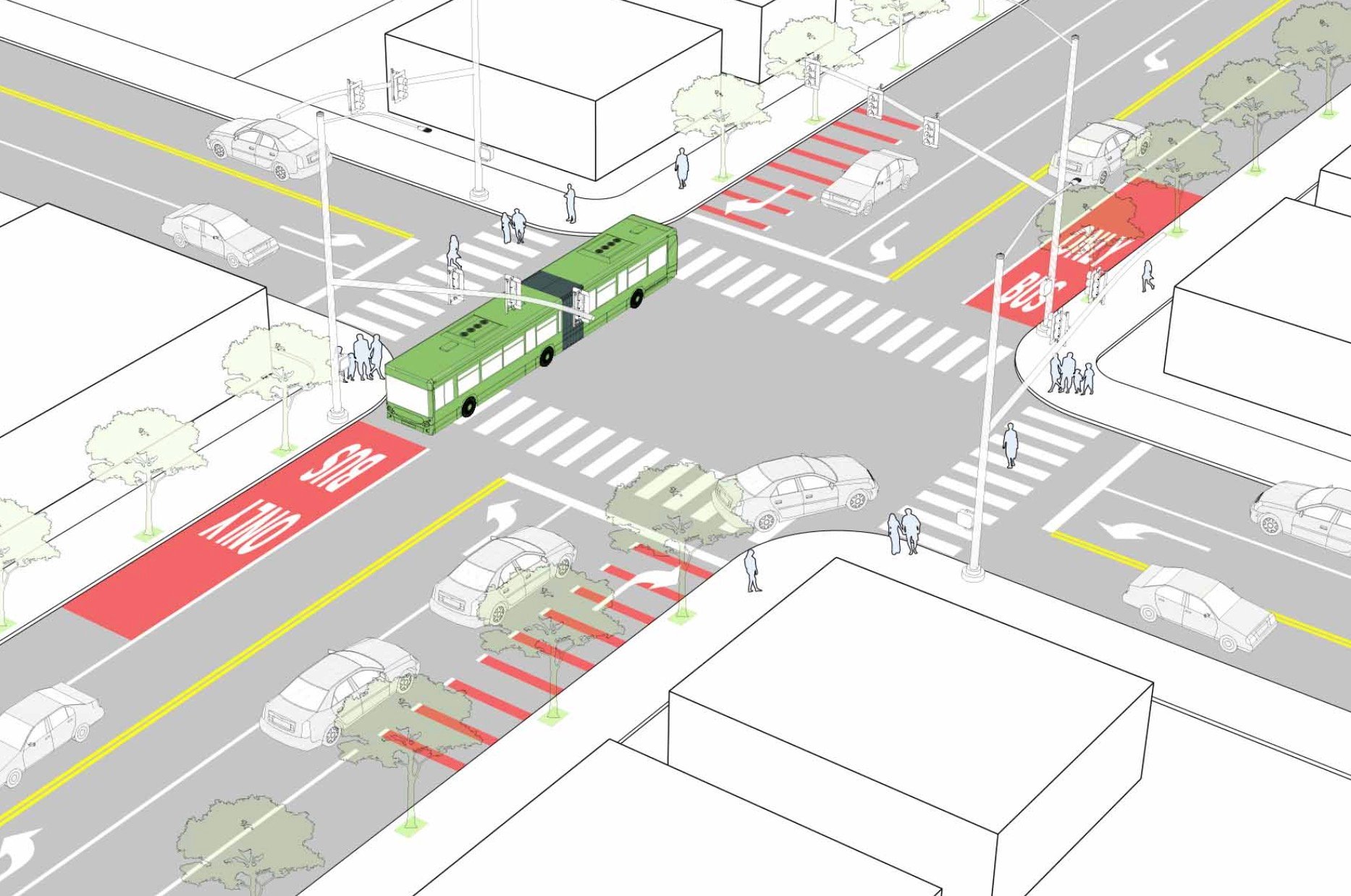
The “Some BAT Lanes” and “More BAT Lanes” concepts.

TriMet released an online open house today that asks the public to weigh in on three options under consideration:

  • Option One – “Some BAT Lanes”: Three miles of new transit-priority, a.k.a. “business access to transit” BAT lanes (see graphic below), in each direction.
  • Option Two – “More BAT Lanes”: Seven miles of BAT lanes in each direction.
  • Option Three – Intersection Widening: Widening 82nd Ave at three intersections — Powell, Holgate, and Foster — to make room for more transit lanes. (Note that the widening is being considered because they aren’t willing to reduce driving lanes beyond what’s already proposed.)
Business Access to Transit (BAT) lanes design. (Source: PBOT)

TriMet hasn’t revealed pricing for each option, but Option One would be the cheapest. Option Two, More BAT Lanes, would be at least twice the cost of Option One. And the intersection widening proposal would cost four times as much as Option One.

TriMet says these new options “could exceed project funding” and will require more study and analysis before moving forward.

Take the short survey online and/or visit an in-person open house scheduled for Wednesday, April 23rd from 4-6:30 pm at PCC Southeast.

Avalos: Public safety and police accountability needs more transportation voices

Portland City Councilor Candace Avalos at Midland Library. April 4th, 2025. (Photo: Jonathan Maus/BikePortland)

Portland City Councilor Candace Avalos says a new City of Portland governing body with strong police oversight needs representation from transportation advocates. And with applications to serve on the Community Board for Police Accountability due before April 15th, Councilor Avalos believes now is a golden opportunity to make sure Portland’s definition of public safety includes safe streets.

On Friday I sat down with Avalos in a conference room in Midland Library to talk about policing and transportation. Avalos, who represents an area east of I-205 including Lents in southeast and the Portland Airport, is a first time member of city council, but she’s no stranger to local politics. She was chair of the Citizen Review Committee, where she served for six years and became a well-known advocate for police accountability.

The impetus for our conversation was the CBPA, a new, high-profile venue for oversight of the Portland Police Bureau. The 21-member governing body will have its own budget, will hire its own investigators, and will issue binding decisions regarding police practices, policies, and directives with a primary focus on community concerns.

It’s crucial that this new CBPA have at least one member who understands how transportation issues relate to public safety and policing. It’s my hope my interview with Councilor Avalos encourages someone in our audience to apply for one of the positions.

Listen to our conversation in the player above or wherever you get your podcasts. You can also read an edited version of the interview below.

How do you connect the dots between transportation and policing?

“When we think about policing and public safety, we tend to limit it to things like crime or gun violence and things like that. But as we know, in east Portland in particular, which has 28 out of 30 high crash corridors, transportation safety is a huge part of public safety.

As we’re making decisions about improving [transportation] it needs to include the fact that many of our communities are dying needlessly on the streets and are being hit by cars. And in east Portland, it’s particularly harsh.”

How do you feel about using automated cameras to enforce traffic laws?

“I am open to the discussion. I think that it’s definitely in a tool that we should explore… In general, about traffic cameras, I feel that they have good intentions. I worry about where we decide to put them, and how that affects certain populations.

[On the campaign trail] I heard a lot from east Portlanders that they felt that the streets were just kind of reckless, that people were driving very quickly. I had a lot of complaints when I was knocking on doors about people driving quickly through the neighborhoods too, not just on the main streets. And so, yeah, I feel like I’m open to [speed cameras] and concerned about what the impacts might be disproportionately on a community that you know is already facing so much hardship.”

How would you characterize the current relationship between police and the community?

“The temperatures are down, and I think in all areas it’s less politically-charged that it was, for sure. That definitely doesn’t mean that people aren’t paying attention, but I think the energy is a lot less…

I think that just having a leader [new (since the George Floyd protests) Police Chief Bob Day] that has earned the trust of many different aspects, I think has really shifted the dynamic.

I really do like Chief Day. I think he’s personable, I think he’s reasonable. When I have discussions with him, I see him really trying to come to a decision that is fair. And I think that has shifted the relationship, for sure…

I think right now, the police union sees their relationship with the city is, like, tenuous, right? Because they don’t necessarily have all of the more overt champions that they have tended to have on the council in the past.

… I wouldn’t say we’re in a positive place, but I would say a neutral place, with community.”

Why should transportation reform advocates and people who care about street safety, be paying attention to the Community Body for Police Accountability?

“I think it’s important for people to engage in this new process because we have created a really robust, really unique in the country, type of board, as far as the powers that we gave it.”

How is the CBPA more powerful than what came before?

“That old system has a lot of flaws. I think the main flaw there was the lack of true teeth in that process and everything really was just deference to police… It’s a system that does not have any true accountability because everything was so deferential to police in the first place. So that is the biggest change in this new police board, is that the people on the board actually have a lot more control. The standard of evidence is different.

… So I’m hoping that this new board, with its new teeth, will be able to usher in a new awareness about what we should expect from our police, and what does it mean to hold them accountable?”

What element of the CBPA are you most excited about?

“I’m excited that this board will actually have teeth… We wrote it in [to the bylaws] that the city has to respond to recommendations… We specifically did that so that when community does come and say, ‘Hey, we’re having these issues with these, you know, these police chases [for example], and it’s affecting the streets in this way,’ they’re going to have to respond by charter. So that’s really exciting to me, that the charter really instituted strong protections for the people’s voice in the process.”

With protest season ramping up, how confident are you that the Portland Police have learned lessons from past years and will change how they respond?

“I am very concerned, and I want to see police’s response to the fact that traffic, traffic attacks, car attacks, are on the rise. I was just having dinner with a friend who’s not plugged into politics, and she brought up to me how scared she was that this is the new norm — that protesters on the streets are getting run over…

I think that is a really important transportation justice issue, because I see that is an important place for police to intervene, in my opinion, protecting people’s rights to protest and ensuring that they’re not going to have somebody try to violently attack them with a car. So I would, I would like to see them increase their strategy for how to protect people.”

What can transportation advocates do to get street safety on the radar of the police in a bigger way?

“I think helping us reshape the narrative, like using these advocates to tell these stories and show how they fit into a larger public safety concern. I think that could be a really good place for advocates to start, because it’s not just police not making that connection. It’s also the city and it’s also the average Portlander. So how do we elevate that issue and show its relevance to public safety?”

Do you think now is a good time for transportation advocates to put police accountability on their radar and get involved with this?

“I do. I really think it’s important that transportation advocates elevate the dangers that we face just navigating our streets as non-car users, and that that needs to be again, part of the strategy for how to protect people so that they can move free the freely around the city.

It’s not about protecting them just from gun violence or crime or theft. It’s also to make sure that they can get from A-to-B safely. And that does depend on enforcement. It’s an enforcement thing, it’s a culture thing, it’s an infrastructure thing; but I think transportation advocates should use this opportunity to elevate that so that then the leaders can continue to make it part of our culture and decision making when we’re talking about public safety and when it comes to budget and enforcement and policing.”


Applications for the CBPA are being accepted through April 14th. Apply online here. Read more about the CBPA in the Portland Mercury.

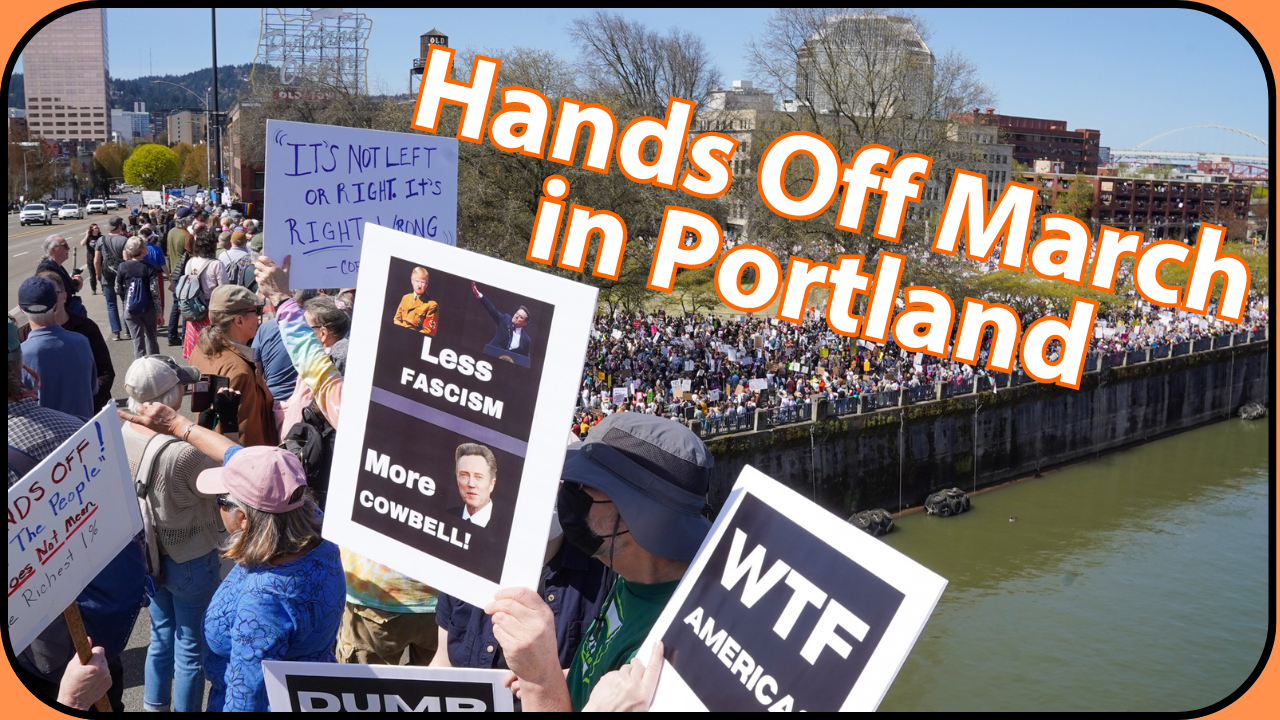
‘Hands Off’ march video and perspective of a volunteer corker

If you saw my photo gallery from Saturday’s “Hands Off” rally and protest and you want a different perspective on the event, check out this video. It’s short and features scenes of the crowd and the march, and is mostly accompanied by audio and video from the speech by Portland City Councilor Angelita Morillo.

*And I need to remind everyone that being featured in a photo or video on BikePortland doesn’t not equal an endorsement. For some reason, a lot of people assume everything I share is politically-motivated or reflective of my personal beliefs and biases — but that is not necessarily the case! I am here to document what I see and pass it along to the community. Obviously everything is biased on some way because I am a human, but it’s exhausting and unfair that some folks are so eager to jump on everything I post as being a sign that I believe x, y, or z.*

As for the event itself, it was really chill. The crowd I saw was peaceful and seemed very excited to finally be able to express their views about what’s going on in our country. There was a huge turnout of bicycle corkers to help protect participants on the road. I didn’t see any sketchy interactions. In fact, at one point I stood next to a few Portland Police Bureau bike cops on the Morrison Bridge for several minutes. In the short time I was there, probably a dozen marchers walked over to the cops and said “Thank you!”. I think that speaks very broadly to what type of event this was and what type of folks were there.

I don’t know if organizers received a permit or not, but it felt well-organized and orderly from what I saw.

Rob Galanakis was one of the volunteer corkers, and he wrote an email to Portland City Council members sharing his view of the event. That email is below:

Hello Chief Day, Mayor Wilson, and Community and Public Safety Committee Members,

My name is Rob Galanakis. I am a District 3 resident. I am the Glencoe PTA President, Mt Tabor NA Board Member, PYSA coach, Bike Bus PDX organizer, and candidate for PPS board.

I have “corked” (kept marchers safe from motor vehicles) at dozens of marches and bike rides in Portland over the last 4 years, as I did yesterday at the Hands Off protest march. I want to make clear I am/was not a march or corker leader; just a volunteer. And I’m writing you entirely in a personal capacity.

I want to commend PPB for its behavior at the march yesterday, especially the Bike Squad. Police assistance with corking was viewed with skepticism initially, and there was significant antagonism towards police, based on years of hostile or apathetic interactions. However, your Bike Squad was not discouraged, and continued to show a genuine intent to collaborate. I never sensed arrogance or frustration in the dozen or more interactions I had with officers.

The key moment came when PPB adjusted when the marchers’ planned to proceed on the Morrison Bridge to Grand Ave, rather than the Esplanade. This required closing down the I-5 ramp onto Morrison (stranding drivers), and Grand, and Burnside westbound. The police worked to keep everyone safe and the march, which was far, far too large to use the Esplanade, was able to adjust its route without incident.

Corking a dynamic march is different from normal police traffic control. All along the route, officers never interfered with me when I was doing my job. I saw Bike Squad officers take direction from corkers and a TriMet supervisor. There was an aspect of humility and collaboration I did not expect.

There was some sore behavior from non-Bike Squad officers, but for the most part, PPB and the Bike Squad helped pull off a safe event. Trust won’t come after one protest, and there are many other concerns with police behavior including towards the councilors on this email, but I do feel it is worth calling out successes when they happen.

Thank you,
Rob Galanakis