

Portland Police say someone was hit by a car driver and killed while walking in the Richmond Neighborhood this morning.
According to the police statement, it happened around 5:30 am at the intersection of SE Cesar Chavez and SE Harrison. Here’s more from the statement: “When they arrived, they found a crash involving a vehicle and a pedestrian. Portland Fire & Rescue confirmed that the pedestrian died at the scene. The involved driver remained at the scene.”
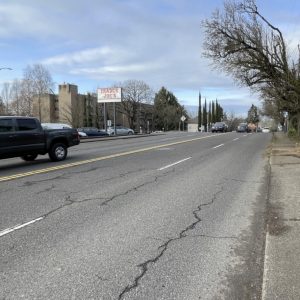
SE Harrison is just one block north of a popular neighborhood greenway bike route on SE Lincoln. Calle Cesar Chavez is a high-volume arterial with a 30 mph speed limit, four general travel lanes and a notorious history of fatal crashes. Back in January, another car user hit and killed Tuyet Nguyen as she walked near Cesar Chavez and SE Cora — a location with a very similar profile as this morning’s fatal. One week after Nguyen’s death, a driver was given a citation for failing to stop for a pedestrian a mile north of SE Harrison near Laurelhurst Park. In 2023, a driver struck and killed Jeanie Diaz as she waited at a bus stop at Cesar Chavez and SE Belmont. And in 2021, Austin Boyd was killed by a driver as he walked near Chavez and SE Clinton.
The Portland Bureau of Transportation has said they are working on a project that would update Cesar Chavez with a safer lane configuration between Powell and Holgate. At a Richmond Neighborhood Association meeting following the tragic death of Jeanie Diaz, PBOT Traffic Engineer Wendy Cawley told attendees PBOT would consider striping Cesar Chavez with fewer lanes for driving. While a PBOT spokesperson told BikePortland back in February that a project page was imminent, I don’t see that page published yet and I’m not aware of any updates.
Police haven’t released details of this morning’s fatal crash. I’ll share more once I learn more. This is the 37th fatal traffic crash in Portland so far this year, and the 14th that involved a pedestrian.
UPDATE, 11:28 at 2:05 pm: Police have identified the victim as 87-year-old Grey Wolfe of Portland.


Thanks for reading.
BikePortland has served this community with independent community journalism since 2005. We rely on subscriptions from readers like you to survive. Your financial support is vital in keeping this valuable resource alive and well.
Please subscribe today to strengthen and expand our work.
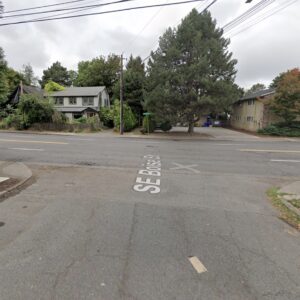
This is my neighborhood. Sometimes while walking I’ll forget that the crosswalk is on Lincoln and not Harrison and wind up at this exact spot with the choice to 1. cross the street with no crosswalk, 2. walk along these narrow sidewalks to the crosswalk (this feels nearly as risky as crossing!), or 3. go all the way around
Even if it somehow weren’t dangerous, the sidewalks are so narrow and hard up on the streets that, in weather like this, a pedestrian will get soaked from the waist down by speeding cars splashing puddle water on them!
This street is my Exhibit Number 1 for evidence that the term “car sewer” isn’t an exaggeration.
There’s a clearly marked crosswalk at Lincoln and Chavez. It has lights and everything. It’s dangerous to cross anywhere else. I live in this neighborhood as well. I don’t know why someone would be crossing in the dark on a busy road where there’s not a marked crosswalk. It’s sad that someone’s dead.
“I don’t know why someone would be crossing in the dark”
I do it frequently on my late night sojurns, but I make darn sure it’s safe to cross before I do. But then I’m happy to admit I value convenience as well as safety. Just as most people in the real world do.
Good point. Driving a car is also all about comfort and convenience.
“comfort and convenience”
I’m many cases it is. And in others, driving is the only reasonable way to make the trip at all.
I simply do not understand why Chávez gets a pass as a deadly-by-design four-lane inner city thoroughfare with the tiniest sidewalks ever. It’s never been a state highway that the city couldn’t touch. Glisan to Powell (and probably more, but that’s the part I really know) should be on the list for a serious road diet.
Can someone explain this to me? I mean, yeah, car culture blah-blah-blah, but specific to Portland transportation planning, why does this particular street get no love?
I suspect it has to do with there are a lot of people who use the street to travel N-S, and there aren’t any good alternatives, so reducing its capacity is likely to cause problems.
Yeah. I moved out of that neighborhood three years ago and it’s a hassle to go anywhere to the north: between Grand and 82nd, nothing goes through!
20th is a good alternative. The 11th/12th couplet works, though there is the train to the south and some shenanigans around Sandy, Burnside, and Lloyd center.
I lived near 42nd and Boise and I regularly needed to go to 38th and Belmont; 20th would have made little sense.
The same is true of the N/S bike trips I occasionally took: the network was not “designed”, much less designed for n/s travel, so it required lots of east/west travel, no matter if my destination was directly north.
Sure. Sullivan’s Gulch/Banfield Expressway pose significant obstacles to N/S travel in that area, as does Powell. But there are other alternatives to the west and east. 33rd, 47th, 53rd, and 60th all cross the freeway. And there is a ped/bike bridge between Cesar Chavez and 42nd. Cesar Chavez is the most obvious and direct route for many car trips. But it is not the only option. If it went down to a three lane cross section to promote safety, it wouldn’t cripple the transportation network in that neighborhood.
“Hassle” is relative. It’s true that there isn’t a fast and direct N/S route for cars from SE to Fremont and north.
I’m fine with that.
We should be done with even thinking that making driving convenient is a worthwhile goal.
I could have been more clear: it’s not that I wished 39th were a highway! It would have been fine if the traffic were merely predictable, even if the throughput were the same.
It’s an aggravating road because, at any moment, either a vehicle turning left or right will suddenly block half of the volume of through traffic. Drivers try to game it out so that they’re not stuck, bumper-to-bumper, while the traffic in the other lane moves forward unimpeded.
If there’s a bus in the right lane, drivers switch to the left lane. Then, if another driver ahead tries to take a left off the road and has to wait in the left lane for a few minutes (for oncoming traffic), drivers will try to switch back to the right lane. They might do this really quickly!
It was a hassle because I was constantly getting passed by more aggressive drivers, and that whole vibe is just terrible!
I do not know the circumstances of these fatal crashes. Maybe it’s all just drivers driving fast down the road when it’s empty. But I do wonder about the safety effects of this kind of traffic, in which aggressive lane changes and sudden changes in speed will generally net a person a faster travel time. That’s a terrible incentive structure.
I’d like to see a road diet here: a single lane each direction, a “suicide lane” in the middle, and slip lanes for buses, etc. We could make wider sidewalks and maybe bike lanes! Maybe getting turning and stopping vehicles out of the through travel lanes will slow overall speeds down *while* lowering the aggravation and aggression.
“I’d like to see a road diet here”
The best you could do is one lane with center left turn lane, three lanes all together. Anyone who turns right would block everybody behind them. A bus stopping would block everybody behind it. The road would very likely be safer, and would have a lower, perhaps much lower throughput. I have a hard time imagining sufficient political support to make that happen.
I also wonder about the terms of PBOT’s settlement with BikeLoud. It would require PBOT to “follow the law”, but I am not sure whose interpretation. Some claim the law requires bike lanes to be added anytime a street is repaved, others say only when it is completely rebuilt. If the repaving view holds, that would be a problem for reconfiguring 39th, as it would be very very difficult to add bike lanes and retain any kind of a functioning arterial. PBOT might conclude it’s better to do nothing in that case.
I wonder what the breakdown of trips is for Cesar Chavez. As in, how many people are driving the length of it vs. using it to connect to other arterials. I only ask because it might be worth it to have some traffic on other N-S streets. I expect that would be one result of a road diet, which I support. It would probably mean slightly more car traffic on my SE N-S street but I’ll take that tradeoff, personally, for the greater good.
The nearest traffic count is a couple blocks south between Grant Court and Sherman Street, from June 4th-6th (Wed-Fri) of 2025:
North-bound 10,570 with 3,721 in the AM and 6,849 in the PM
South-bound 11,078 with 3,430 in the AM and 7,648 in the PM
Given PBOT’s record, the volumes above, the strong and vocal local opposition to cut-through traffic on other streets, and also given that most of inner SE/NE Portland’s wider streets tend to be east-west rather than north-south, I’d say the chances of a 3-lane road diet on 39CC are nil.
If I was a transportation advocate in that part of town, what I’d push is for more 4-way signals at least every quarter mile per Metro guidelines, and preferably every block or two – allow for the traffic volumes but force drivers to slow down – and time the signals to 5 mph below the posted speed limit.
ODOT does sometimes fund local city street projects in Portland – they’ve funded projects on 39th before – so when the Columbia Bridge finally gets cancelled I’d suggest you badger your local state representatives to fund a bunch of signals along 39th as a “road safety project”.
Yes, signals to slow traffic would help. And camera enforcement of those signals (and of every signal in the city) would increase compliance and/or revenue. Easy enough if the City cared about human life.
But it’s disheartening that the default assumption in many comments on this piece is that reducing the number of motor vehicles on one street will mean increasing them on other streets. The point is we need to reduce motor vehicle use. Consider this passage from a piece Jonathan shared in this week’s Monday Roundup about Hammersmith Bridge in London:
When the bridge closed, about 25,000 vehicles crossed it daily and TfL predicted a severe economic impact.
Six years later, 9,000 of those journeys have vanished – not diverted to other crossings, but simply evaporated. Yet the local economy has adapted, air quality has improved, and overall traffic congestion has lessened.
This counterintuitive outcome begs the question: are we actually solving the right problem?
The “obvious” £250m solution may be addressing the wrong issue. The best solution may cost far less, involve no cars, and turn paralysis into opportunity.
We don’t need fewer motor vehicles on Cesar E Chavez Boulevard. We need fewer motor vehicles. Other cities have done this (Copenhagen! Barcelona!) and everyone benefits. EVEN THE PEOPLE WHO THOUGHT THEY HAD TO DRIVE EVERYWHERE. They save money, live healthier, and breathe cleaner air because public transit and walking and bicycling are net positives, and private motor vehicles are not.
Right, and Gand/Ghent in Belgium has an example what to do, to create a series of superblocks with limited and controlled passages in between zones, not necessarily what is in Bosnia for the ethnic cleansing enclaves, Israel’s control of Palestinian territories, and the superblocks of East Portland, but something along those lines. And if you had a dictator like Mr. T who happened to be progressive and a bike rider to boot, you might pull it off in a few years…
However, we live in a supposed democracy, and alas we have to live with the reality of numerous decades of public meetings, open houses, government junkets to Amsterdam and Vienna, several elections, and lots of false starts, not to mention a pile of roadkill fatalities, before you get to your utopia.
So in the meanwhile, at least for the next two decades, what’s your plan of action?
Death on Chavez is the most serious of problems, but I know what you’re saying.
In other words, city officials don’t consider killings a problem. But traffic delays, now that’s a problem!
No. I am pretty sure everyone considers people dying on the streets to be a problem.
Well, yes and no. I am sure everyone values lives, but some professions value some lives more than others.
There are more motorists who vote than cyclists – now that the council members are not in charge of PBOT, hopefully the urge to get votes by facilitating cars is fading.
And transpo engineers will say the road is perfectly safe… for motorists. Thus no action needed.
Hopefully this death moves past whatever statistical threshold AASHTO requires before the road officially isn’t ‘safe’ and can be prioritized.
“And transpo engineers will say the road is perfectly safe… for motorists. Thus no action needed.”
No, they won’t say that. I know a lot of transportation engineers, both personally and professionally, I have never heard a single one say that a single time. Not once. There are a lot of other people here who know transportation engineers, and I’m going to guess that they have not heard that either.
Safety is not a binary, and, unlike the kind of suggestions activists like to make in blog forums (shut down the streets! Spikes on steering wheels!), improvements are often complex, requiring trade-offs that have costs themselves. Safety, while important, is not the only consideration. It’s certainly not the only — or even primary — consideration in your life, or the lives of anyone here.
You are right, however, in noting that PBOT is now more insulated from City Council. Whether that improves the situation or not depends a lot on what the mayor’s deputy’s deputy tells them to do. So, kind of like before, except things are much more opaque and your voice matters less.
“No, they won’t say that. I know a lot of transportation engineers, both personally and professionally, I have never heard a single one say that a single time.”
I think you are missing the point. This isn’t about individual sentiments, but about institutional bias. All those nice people you know make up an institution that as a whole keeps taking actions or reifying inaction that results in these untenable, dangerous, biased situations. I’m sure there are all sorts of thoughtful people who work at ODOT, but if you look at the impact of ODOT’s priorities, how they spend money, what their spokespeople say, it is a far cry from the quote above.
Focusing on how nice the people who work there are misses the point, is a distraction.
No, I understood the point. What you want is a rebalancing of competing priorities. That’s fine, that happens all the time, but it’s a political process.
You can’t solve a political problem with a technical solution.
This is missing the point. ODOT follows the direction of the legislature and governor (they provide the money, appoint the leadership, and provide oversight).
If you want change, sway your government officials or replace them. Or, hell, become one yourself.
“ODOT follows the direction of the legislature and governor (they provide the money, appoint the leadership, and provide oversight).”
wspob used to write this here all the time. On its face this sounds so reasonable, and yet it does not take account of how institutions and bureaucracies in particular develop their own culture, their own momentum, priorities, expertise, internal juggernaut.
And we haven’t even mentioned money and how big money corrupts all of this, makes a mockery of your this-is-how-democracy-works-kid shtick.
It may be that the legislature and governor abdicate their responsibility in favor of ODOT, but that doesn’t change the fact that they hold all the levers of power — they make laws, set budgets, and have complete control constitutionally. The failure to use their power is on them, but it could also be true that ODOT is doing exactly what the legislature and governor want.
Regardless, the rebalancing of priorities is a political problem that requires a political solution.
“Reifying inaction” is a beautiful phrase! – my BP phrase of the week.
Ok, but I have. Many roads in SW where pedestrians and cyclists are constantly at risk (or can’t use it at all due to risk); we’re often told “the crash data shows no issue exists” and no action will be taken. They’ve said this even where we’ve brought dangerous situations for motorists to their attention. ‘Drivers going posted limits have plenty of sight lines to avoid conflict’ or some such. Of course, almost no-one is going the posted limit, so the sight lines are no longer adequate…
BTW, that is one reason why all of us should havor our neighborhood associations and community groups badgering PBOT to place traffic counters on streets where we feel speeding is the big hazard to bikes/peds; make PBOT gather the data needed to get action. It’s gotten results in SW, to PBOT’s credit.
What the engineer is saying is that that there are finite resources, and that the data doesn’t support making your problem a priority over other problems in other neighborhoods. Everyone claims they want a data driven process until the data doesn’t show what they hope it will.
Ok, you don’t like crash statistics. If you want to create a prioritized list of potential safety fixes across the city, what data would you use?
Data that gives equal weight to pedestrians and cyclists. They are an afterthought in most analyses in Portland. My ability to quickly and SAFELY get from point A to point B should have just as much weight as that of a car – period. Uusing bodies on the pavement to decide something isn’t safe and needs work is shutting the barn door after horse bolted. It may just be anecdata, but number of user complaints should be a starting point… and the investigation should not be done from a solely automobile POV.
Some stuff is admittedly hard to fix because you needt ‘data’ on a negative ; one of my favorite stories is the road closed due to a slide, and PBOT’s answer on why they were not installing ped facilities during repair, as required by law: “no one walks here; too dangerous.”
Beyond the farce of that answer, I pointed out the 10 or 12 people walking down the car-free street, because they could do so safely.
Maybe we should close some streets and do ped counts? 🙂
I do know numerous people complain to the city about ped/car conflicts on that street, which feels like it is a least a signal, if not data.
Crash statistics may not accurately measure pedestrians bumping into one another, but it does collect data on the most significant events.
Using complaints rather than hard data makes the process of prioritizing street safety a political one, which advantages neighborhoods like yours and mine that are better able to organize and get our issues addressed, while leaving more significant safety problems in less politically active neighborhoods unaddressed.
So sure, that works well for me, but it is not how we should run the city.
(And if PBOT is not following the law, someone needs to sue their ass… which BikeLoud did successfully.)
“Safety, while important, is not the only consideration.” Welcome to America! Because actually, this statement is not a universal truth. It’s a product of culture that has been deeply broken since the start.
Safety isn’t your only consideration — why should it be PBOT’s?
You’re able to balance your safety and convenience in crossing Calle Cesar Chavez. I can do a similar calculation to cross major streets in my neighborhood. We don’t yet know how this crash happened but we do that Grey Wolfe was 87. I’m going to say that this is not what we want for people who are 87. What do you say?
What do I say?
I say the crash was terrible. I feel bad for everyone involved.
What more is there to say?
“Crash statistics may not accurately measure pedestrians bumping into one another…”
That’s a thing you said, is it sarcasm? When a person walking bumps into another, the remedy is “I’m sorry, please excuse me!”. Words fail when an old person, or any person, has been run down. My feeling is that your comments are normalizing that.
Yes. I was making light of the claim that crash data does not “give equal weight to pedestrians and cyclists”.
Maybe it doesn’t, but in the absence of a practical alternative, I still believe prioritizing safety based on crash data rather than politics is the more reasonable approach. If you can offer a better one, I’d love to hear it.
I firmly believe that an intersection where people are getting killed should be prioritized over one that merely feels dangerous. Ideally we’d fix both, but resource constraints are a real thing, unfortunately.
But you have to work with the “broken” culture to make small improvements. If you were trying to help a relative or friend who was struggling would constantly calling them “broken” help matters?
I hear English people here in Goa say that England is broken almost every day. Many of them say they are headed for civil war. Sound familiar? Indian people say India is broken constantly. Germans say Germany is broken.
Indeed Europe is struggling, groaning under the weight of inequality, low wages and racism. The resulting taxes/debt are killing their economies. Portland lefties can’t point to it as a sustainable model anymore
But they haven’t got the memo yet. By your metric the entire world is broken.
There are very few continuous north-south streets in southeast. It’s a very valuable thoroughfare and it’s such a waste that’s all it’s space is given entirely to cars:/
I’ve found good biking routes both north and south. I’m glad people have 39th so they’re not driving on those.
I was driving my friend and he was flabbergasted that I went Powell -> 26 -> Division -> 30 -> Stark -> 28 instead of Chavez. Even more so when I explained that most bike routes around the city are like that lol.
Please don’t drive on our primary bike streets!
None of those are bike streets, they’re collector streets. 28th – 29th then 30th north of Stark is the greenway.
I was not saying I drove on bike routes, but rather relating the experience of driving a convoluted route vs. bike routes being convoluted a lot more of the time.
Though if we want people not to drive on bike streets, diverters are the way : )
Designated greenways and good streets to ride on are not really the same thing, even if they happily overlap at times. 30th north of Division is an excellent bike route (it avoids a lot of hills that the greenway inexplicably climbs, and the crossing at Division seems faster), and 28th north of Stark is the most rational way to go for most purposes.
I would honestly rather have you drive on the greenway than on the best bike streets.
I tend to prefer 34th above all when biking.
Would you support the installation of diverters on those streets to keep me from driving on them? As long as there’s no diversion I am free to drive whatever route I want. At any rate, I thought you like riding with lots of cars?
You’re right — 34th is better.
I would support diverters anywhere (within reason) the surrounding community wants them. Get the neighbors on board, and I’m on board.
39th Street, as it was known, used to be narrower, and the sidewalks wider (I’m attaching an archival photo, hope it comes through). But the city long ago decided moving automobiles was more important than preserving human life, so it was widened decades ago.
I will now say AGAIN that the intersection where a motorist killed Jeannie Diaz has only been made MORE dangerous by PBOT since her death, as was brought terrifyingly home to me yet again when I was crossing there earlier today. So PBOT can stop talking about all its plans and start doing something to protect human life.
Honestly, if a government agency overseeing schools had this many people being killed inside its school buildings, no one would stand for it. But a government agency overseeing streets can let us all be picked off one by one, while they talk about possibly restriping the car-centric pavement, or put up a few plastic wands.
HAPPY THANKSGIVING, Millicent Williams. I just had to call someone and tell them a person their household loved and relied on is dead, because PBOT refuses to make our city safe for people.
I drive 39th all the time, but never to go fast, always to keep myself out of the neighborhoods. I’d be happy to drive slower and stop a few more times if it means that I can use 39th safely on my bike or foot, not just in my car.
“Portland Police say someone was hit by a car driver and killed while walking in the Richmond Neighborhood this morning.”
You mean a car driver hit and killed someone, right?
Maybe that was from social media? The PPB’s statement on the city site is actually relatively well-written. It excludes the passive voice, misleading wording like “The driver cooperated,” “Accident,” etc.
Whoever wrote that statement at the PPB definitely included the passive voice.
“A pedestrian has died … the pedestrian died at the scene”
Thanks. I stand corrected.
Longtime writer/editor here. For the record, neither part of that quote is in the passive voice.
“Pedestrian” is the subject in both, and “died” the verb. “Has died” is present perfect tense; “died” is simple past tense.
“Someone was hit by a car driver” is JM’s own formulation. He’s trying to make a direct connection between actor and acted-upon to infer cause, which is noble but factually incorrect.
In every case where a person dies or is injured in a collision with a car, the car itself kills the person outside the car; the person inside the car is just fine – protected by the steel cage and often insulated from direct responsibility (“I didn’t do it – the car did it”). JM is trying to say, “You were driving the car when it happened so you are responsible on some basic level” – which is true but there are often complicating factors, like when a drunk person walks in front of a moving car.
JM is correct that society whitewashes the deaths of people outside of cars, but we won’t change that situation by writing inaccurately about it.
I think 99% of people would recognize that “someone was hit by a car driver”, in the context of a pedestrian dying in a collision with a car, does not literally mean the driver came into direct contact with the pedestrian. I think 99% of people would recognize the statement instead implies that the car killed the pedestrian in part due to the driver’s action/inaction. I think you pointing out the obvious is far less helpful than JM pushing for driver agency with his language.
We must decenter the car. Prioritizing private automobile throughput is killing us. Restripe the road NOW!
This is really sad and my heart goes out to the victim’s loved ones.
For some reason, Google Maps is really obsessed with routing cyclists and pedestrians onto Harrison instead of Lincoln, where the crossing is. I wish that could get changed. Does PBOT have any way to get in touch with the people that work on mapping apps?
You can report incorrect data to google directly by right clicking the area and selecting Add or fix a road. About three months ago I noticed google had flagged this intersection and the one at 30th as not through streets for cyclists and reported them. They only corrected the one at 30th for some reason. I’m constantly battling with google over various diverters and their directions but usually that’s only when they’re new.
The diverter at Chavez is one of the oldest in the city so it’s weird it suddenly got changed to a non through street for cyclists. I suspect it’s some sort of reporting option drivers can do on the fly and it gets blanket applied to all vehicle types. If you have a minute please report it maybe if enough of us do it they’ll fix it.
I also reported the 30th diverter issue on Google Maps. Seems that you have to really put in an effort to pick the option that allows you to explain in detail why it’s wrong rather than just adding/deleting option. Maybe kicks it to a real person to review that way or something. I’ve had many proposed corrections rejected until I started going about it that way.
I’ve used that before but it doesn’t seem to make a difference. I submitted tons of reports about SE Steele East of Reed College – it shows a bike lane on maps but I found out the hard way there isn’t one when I got to vehicular cycle uphill in the dark and the rain lmao.
Ya you really have to put in detail and even link things as evidence to bump it up to a real person. I’ve got a number of them changed over the years linking their own street view and even some Bike Portland articles.
Equally. I am very sorry to have this be the news of the day. I crossed MLK a few minutes ago, it happened to be a time that there were no cars for blocks but sometimes there are a lot and you can see that many drivers are completely unaware of pedestrians or anything else outside their fenders. SE Cesar Chavez may well be worse than NE MLK.
There’s an illusion that the cost of the next car trip is just a buck or two for gas but sometimes it is so much more. If the city had to put $10 million in a fund after every fatal crash, would we operate any differently?
It’s good to honor citizens with their names on public places. I respectfully submit that we rename S. Bancroft St. for Cesar Chavez and call the former SE 39 Ave. the Street of Lost Dreams, or maybe Purgatory Road.
This is really sad, and my condolences go out to the victim’s family and friends.
Totally agree about the Google Maps issue — fixing that routing makes perfect sense. But PBOT getting through to anyone at a mapping company? You’re more likely to hear them chime in on Gaza and their latest “equity”
initiative than to get a simple map tweak pushed through. You’ll probably have better luck just filing the correction yourself. It’s Portland, you know
I contacted the city about flagging a ‘shortcut’ giggle maps showed people, which was actually longer, and caused traffic and traffic/pedestrian issues, and extreme difficulty for larger vehicles turning. The PBOT staffer’s response was a flat “the streets are for all users.”
There’s another where cars routinely plow one into another in wintry conditions because giggle steers them down a steep icy road with no room to turn back. Another dismissal of concerns by PBOT.
Not even a removal from giggle truck routes, which has led to some comic relief, at least.
Sad. Ironically that was your point–the streets are for all users, and the issue you were reporting was interfering with their functioning safely and well for all users. Too bad they were dismissive. It ‘s frustrating how inconsistent PBOT is with its responses. It seems to just depend on who you get answering you.
I remember seeing Chavez on the list of prospects for a Rose Lane back in the day (2019) – seems like as good a time as any to reopen that conversation. A dedicated bus lane for the 75 north of Holgate would be great.
I wonder if PBOT is still doing an analysis at these crash locations and putting up signs about the fatality? Their page on it hasn’t been updated since 2024 so probably not.
I would welcome more signage around this location warning drivers to be careful. Almost every week I see drivers fly through the light at Lincoln not even entering the intersection before the crosswalk signal has turned all so they can sit at the red light at Hawthorne instead.
Speed cameras. Speed cameras. Speed cameras. All up and down Chavez. Punish the drivers who can’t regulate their tiny little tempers well enough to drive the speed limit.
I don’t disagree, but in this case a road diet from 4 to 3 with ped medians like the city completed on Foster would make speeding extremely difficult. PBoT can use the remaining lane for higher capacity bus stops with signal priority or to expand the sidewalk. Even with speed cameras a 4 lane road like this is asking to kill people because of frequent lane changing due to left turns. It’s a design that predictably kills people every year.
What you wrote may be true in the middle of the day, but at 5:30 AM, you can pretty much drive as fast as you like with very little lane changing. 4, 3, or even two lanes… It’s all the same.
That won’t help outside of commuting hours. I live very close to 39th, and people are doing twice the speed limit consistently at night.
I mean, I hear you Chris I, it’s going to take speed reduction, cameras and a road diet (and more). But the slowing effect on a place like Foster Rd (which has no cameras) can’t be understated.
When NYC first installed cameras they were only within a certain distance from schools and only during the day time. That meant the DOT had data for how many were speeding during the night, but didn’t send summonses. It was a crazy amount, and once the cameras were switched to 24 hours, it had the same almost immediate effect of slowing traffic.
So you’re definitely right that speeding during the night has to involve cameras. But even with the daytime off peak traffic on 39th, 3 lanes would dramatically change the aggressive/hostile atmosphere of that road.
I think one way might be to look into “geographic fencing” which could be built into a new car’s technology. They do this to keep drones out of airports, the drone shits down when it gets too close to a plane, think Air Force Once but really any jet. Anyway it could see where a car is on a road / map and limit it to 30 or 40mph so still some speding but nothing crazy like 55. My electric quad already does this for school zones unless you install the different firmware. Cheers, Dave
Only in that AI video Trump shared.
This is a dangerous intersection, when I loan my e-quadracycle to my great granddaughter I ask her to please stay off stroads like this. My advice is to cross on 39th which is just a block away.
Jonathan, I wish you would stop approving this troll’s comments.
Hi Matt,
Did you mean to post this to another’s comment? I am a cyclist like you, I think, only may be a little older. 2 wheels not so good anymore so I use 4. Hope to share the roads with you soon.
Dave
I have just heard from a family member of the pedestrian who was killed. It is a heartbreak, as vehicular violence is always a heartbreak. And the life ended was a life that touched many others, and so the loss will reverberate across many communities. (I will check about whether the family is comfortable having the identity shared publicly.)
You forgot Mark Angeles, killed on his bike at Chavez & Gladstone.
I often find myself walking along and across 39th in the middle of the night. Traffic volumes are low and speeds are high. I think speeds at that hour would likely be similar if 39th were narrowed to one lane with, for example, bike lanes or bus lanes, as is the case on 26th, and I don’t think crossing would be any easier unless crossing islands were added, which would not be possible with a bus lane.
The easiest way to make the street safer to cross would be to add rapid-flash beacons like they did on Powell. Those work amazingly well.
I agree 100%. They work well on 82nd Ave too.
Most (not all) drivers do seem to stop. If there was enforcement and consequences we could improve compliance even more. Of course enforcement is still a dirty word for too many in Portland.
Legally, RRFBs or any other crossing that only includes a big crayon to try and distract drivers from their TikTok slop are then same as unmarked crosswalks. So if the cops are gonna be doing enforcement of RRFBs they need to do enforcement of drivers not yielding at unmarked crosswalks as well. At that point, why not just leave all the crosswalks unmarked and simply run enough enforcement that drivers are brought into compliance?
The lights actually work. Isn’t that the most important thing?
I’d be down with that. Unfortunately as long as we have the DSA Peacocks and DSA adjacent in charge, that level of enforcement won’t happen in Portland. It’s racist, ableist, sexist, etc.
Then there are cops who don’t even know what an unmarked crosswalk is! I was lectured by a cop for crossing NW Broadway at Davis, who leaned out to tell me “That’s not a crosswalk”. I told him it was, and left a message for his supervisor.
Yep, 39th has been a crap show. You would think a street that cuts right though liberaltopia would be useful to all….
The longer the City keeps putting off the installation of barrier protected bike lanes on the main streets used in Portland, the more people are going to die.
The City has the knowledge and ability, but the politicians, especially the peacocks, don’t want to do it.
Peacocks need to remember, that the longer they focus on international relations, which they have absolutely no power to change, the more people are going to die due to their inaction.
Remember that the next time DSA backed candidates go up for election.
The barriers look nice for traditional bikes but mine (quadracycle) is too wide to fit. I am hoping that in the future we can cut down traditional car lanes by 50% and maybe give the other 50% to sustainable alternative vehicles.
How wide is your wheelbase?
I am reminded every time I ride along Ankeny towards the crossing w/ Cesar Chavez hof how dangerous this crossing is. It’s actually the WORST part of my commute (other than the dangerous crossing of NE 57 & Klickitat) to town. Right by Laurelhurst Park, it’s amazing there is no signalized crossing here. Cars are literally speeding at 50mph to avoid the stoplights right beside a massive public park with walking trails and a greenway crossing and there is no signal. It’s maddening.
I found the biggest challenge with crossing at Ankeny to be the fact that northbound traffic has gaps because there’s a signal at Stark, but pretty much continuous because of the roundabout at Glisan. I think it would be a great place for an RRFB crossing with buttons in a bike-friendly spot.
Damn that is sad. 39th is a miserable street for everyone.
Remarkable that PPB used objective language (“remained at the scene”) and did not add their usual subjective language (“is cooperating with police”).
But just a day later – in the news release about the death of a ped on I-5 at SW Corbett (erroneously labeled as I-405) – PPB reverted to their usual “cooperating” language to describe the behavior of a motorist.
I suppose it’s too much to hope for consistency from PPB.
Ugh, yeah agreed Fred, it’s frustrating. I feel like this is such an easy fix (and potential win) for PPB. Can we just make a mad lib and fill in the blanks? Run it through Chatgpt or something and ask to remove the passive voice. This sort of thing only takes a minute.
What’s wrong with saying the driver is cooperating? At least the reader then knows it wasn’t a “hit and run”. Seems like a pertinent fact for police to include.
Declaring “cooperation” is subjective.
If you don’t ostensibly disobey the police, but you answer questions dishonestly or don’t volunteer that you were speeding and looking at your phone, that could still be described as “cooperating”–even though you’re not actually helping the police serve justice.
The police don’t necessarily know it’s a fact that the driver was cooperating. They do know the “driver remained at the scene” and that they “were interviewed by police”, so those could be reported as facts.
It could be that further investigation does show the driver was diligently cooperating, or it could show that the driver who said they were driving the speed limit and paying attention when the victim suddenly swerved into their path was actually driving twice the speed limit and texting when they veered out of their lane and hit the victim.
Exactly qqq. Police must report salient observable facts, and operationalize their language. They can observe a driver present, i.e. “Remained at scene.” They can perform an interview, i.e., “Police asked questions,” or that they observe a person is “Answering questions.” They cannot observe “cooperation.” They can intuit someone’s attempt or willingness to be helpful, but that is always subjective, as Matt said above.
Imagine if the police reported an injured pedestrian was “cooperating” while being carried to an ambulance. It would sound weird, like they’re guilty of something right? Our culture already prescribes a common scenario onto crashes, starting with the loaded word “accident,” and various reporting by police can assist in clarifying facts or in obfuscating them.
PPB statements are totally unprofessional and in need of reform. I’ve been beating this drum for many years, but I have not been successful at getting them to care enough about it to change. I believe a template system is necessary in order to remove subjective statements and provide the public with basic information. I could make more noise about this and perhaps I will soon.
Related: Among the things I don’t like about their statements is when they say something to the effect of: “No fines or citations have been issued to the driver.” That is another way they add sympathy to the driver when it’s totally unnecessary. The fact is police almost never issue fines or citations at the scene of a crash because they haven’t done a full investigation and doing so might influence a future decision by the DA. So why add that line to an initial crash statement? /rant.
Yes. Another way of looking at it–imagine if the police said, “The driver was held at the scene for interrogation” maybe even adding “…Interrogated about his claims about what he purported to allegedly have taken place, including specific questions about his speed and his denial that he was texting at the time”.
Even without the “allegedly” and “purported”, that would cast the driver in a poor light. Yet everything I wrote could be true, and known by the police to be true, while their typical “the driver cooperated” is impossible to know is true when the police assert that.
Or, imagine a defendant (for anything) testified in court about what they were on trial for. Their own attorney might say, “Thank you for being so cooperative in telling us what happened” because the attorney would know that could help color the jury’s view in their favor.
But nobody else would say that the defendant was “cooperating” because they’d know not to assume that their answers were true, or accurately described the real situation.
PPB is not inconsistent. The police press release says the driver “was fully cooperative…”
https://www.portland.gov/police/news/2025/11/26/traffic-alert-one-deceased-richmond-neighborhood-crash
The objective language here likely comes from JM, not PPB.
I’ve seen a TV news interview with a PPB crash team sergeant who used the word “crash” and avoided the “cooperating” language. There is some difference of opinion within the department.
And another tragic traffic related death. Why oh why was someone walking on I-405 at 130 in the morning? My condolences to the family of friends of the deceased and I hope the driver can rebound quickly from the trauma of the terrible event.
https://www.kptv.com/2025/11/28/man-hit-killed-by-car-while-walking-i-405-sw-portland/
The article doesn’t state if the person walking was on the shoulder or in the traffic lane.
so for all we know, the person’s car had run out off gas and they were walking along the shoulder to the nearest gas station. Then, at the late hour, someone fell asleep and veered onto the shoulder and into them.
Sure, that is one theory. Hopefully PPB will release more information so we can learn more of why people die on our roads.
Paul, Do you know if they do drug and alcohol testing on the deceased? A criminal record check on the deceased appears to show a history of convictions for meth possession and DUI conviction.
https://www.portland.gov/police/news/2025/11/28/update-pedestrian-killed-interstate-405-identified
https://webportal.courts.oregon.gov/portal/