

Welcome to December!
The beginning of a new month is a good time to check the BikePortland Advocacy Calendar. Make sure to bookmark it and check back because I am always finding new events to list. If you forgot, I use this calendar for all the wonky government and advocacy meetings that you don’t see listed on the Shift Calendar (or anywhere else!).
Now let’s get you caught up on the most notable stories I came across in the past seven days. Thanks to everyone who suggested links this week.
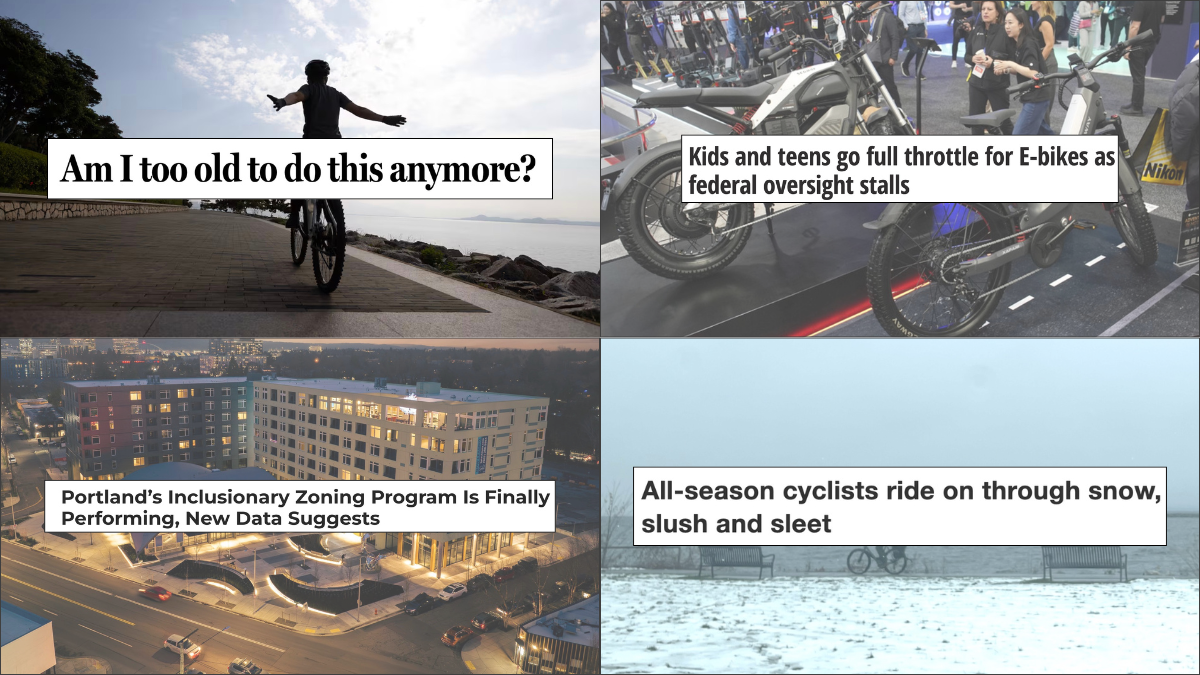
Moral panic: About a dozen of you sent me this unfortunate article that fails to provide a clear distinction between illegal and dangerous e-motos and e-bikes while using a tragic crash to pull readers in. It’s just the latest article that carelessly blurs the line between e-motos and e-bikes and will likely result in bad laws and policies that hurt kids, scare parents, and tilt scales even further toward a car-based society. (NY Times Magazine 🔒)
E-bike/e-moto regulation: On a similar note to the item above, this piece offers a good summary of where e-bike and e-moto regulations are across the U.S. (Daily Kos)
More housing = better cycling: Turns out that ideas like inclusionary zoning actually work when they are funded like they should be. Portland’s program is finally bearing fruit after a boosted budget enticed developers to build bigger. (Sightline)
Concern trolling: Republicans in the U.S. Senate claim advanced safety features in cars should not be mandated and they cite affordability as the reason. Wonder if it has anything to do with the automobile lobby? (Wall St. Journal 🔒)
Group ride guide: Looking for comprehensive information about how to lead and participate in a quality group bike ride? Look no further that this Seattleite’s blog. (Jeremy Cole Blog)
Bike bus cover story: A local independent weekly takes a deep dive into the work of Sam “Coach” Balto and ponders the staying-power of the bike bus movement he helped spark. (Willamette Week)
How we ride: New research on bicycle trips goes beyond the work commute and takes into account how bicycle riders react to everyday journeys like running errands with multiple destinations. (Tech Xplore)
Bike for your brain: A study showed that, “even just 12 weeks of cycling can sharpen your brain, improve your focus, and enhance how well you manage distractions and control impulses.” (The Manual)
Keep riding: A wonderful opinion piece from an older woman who shares what it’s like when people assume she can’t do things (like ride with no hands) and why doing them makes her feel so good. (Boston Globe 🔒)
Keep riding, part two: As it gets colder here in Portland, remember that there’s no reason to stop riding just because it’s winter. This article from a place where snow is common offers good advice and inspiration. (Vermont Biz)
Thanks to everyone who sent in links this week. The Monday Roundup is a community effort, so please feel free to send us any great stories you come across.
Thanks for reading.
BikePortland has served this community with independent community journalism since 2005. We rely on subscriptions from readers like you to survive. Your financial support is vital in keeping this valuable resource alive and well.
Please subscribe today to strengthen and expand our work.
I thought the NYT article was a good read, and a not-terrible primer on the issue. My problem was that, while the author sort of explained some distinctions between “e-bike” and “e-moto,” they seemed to be using the terms interchangeably at times. Also, the photographs were not labeled in a way as to preserve that distinction.
I saw a young man on an electric dirt bike (e-moto) on the Hawthorne bridge bike/ped path yesterday. That always gets me angry: I worry that justifiable backlash to anti-social behavior on paths and roads, combined with the fuzzy understanding of “e-bikes” in the public and press, will result in overreaction and over regulation.
My e-bike (link below) allows me to commute to downtown Portland from a house my wife and I purchased in Milwaukie. I’m not able to spend an hour and a half commuting on my bike every workday, and this bike allows me to forgo a car trip *and* live in a home that I can afford to purchase!
“Simply be rich enough to afford a house in inner Portland” is not an effective solution to the linked problems of housing affordability and the environmental effects of transportation. Neither is “simply have legs of steel and lots of time to kill.”
https://www.tomsprobike.com/bikes/electric-bikes/specialized-turbo-vado-sl-40-city-e-bike-in-limestoneblack-reflective__4714?currency=USD&chosenAttribute=93922-5005&gad_source=1&gad_campaignid=21750250529&gbraid=0AAAAA-NRm4yMoFABJNKLsjXBK4tMJmRyI
Exactly. And for a journalist and from an outlet with that much credibility behind it, we deserved something much more clear. IMO, the biggest problem with this entire conversation is the muddling between “e-bike” and “e-moto” and this article was extremely sloppy in using those terms! So frustrating.
Making things even more complicated, there is no visual difference between an “e-bike” and an “e-moto”. The only way to tell which is which is to test their capabilities, or, perhaps, inspect the firmware and/or connected phone app.
Yes and no. The ones that look like motorcycles are clearly e-motos. Also, this is why it’s very important to have journalists clearly differentiate the two.
https://super73.com/products/super73-mzft
E-bike or e-moto?
That sure looks like a motorcycle to me, but it’s a class 2 e-bike. Unless the owner has changed the software settings, then who knows?
I could provide dozens and dozens more examples. You simply cannot tell with a physical or visual inspection.
Yeah you can always find an exception and I am fully aware not all cases are cut and dry. My point is that we can cut out a lot of the confusion by calling the big burly ones that look like mopeds e-motos. I would rather default to e-moto if I’m not sure than to default to e-bike. When it doubt, consider it an e-moto and then try to verify.
What I’m talking about are people that play loosey-goosey with “e-bike” when the bikes are clearly motos. Even if it’s a Class 2 from Super73, I’d call it an e-moto because that company has a reputation for encouraging engine mods that make the bikes e-motos.
The example I provided is not “an exception”; its a very common design. “E-moto” is not a look, but a capability.
Regardless of what the law states, I do not regard these vehicles — or any other with a throttle button — to be bicycles. I guess we are both gatekeeping, but we just draw the line in different places. You make an aesthetic judgement, I make one based on attributes. My distinction at least has the advantage of being definable, and thus (theoretically) actionable.
That gives us three distinct definitions of e-moto: 1) Has throttle; 2) Looks like a motorcycle; 3) Has the general shape of a bike, but falls outside the 3 legally recognized classes of e-bikes.
yes I never said e-moto is a look.
And I’m not gatekeeping anything. I’m fine with folks riding e-motos. Go for it! All I’m doing is trying to say we need to do better in talking about these and folks need to stop calling what are clearly e-motos, e-bikes. And obviously it’s not always easy to make that distinction, which is why we must be as careful as possible when writing and talking about them. And I maintain my critique of the article is right is valid in the sense that the author and editors have only muddied the water further because they don’t care about this issue enough to understand how important this distinction is.
“we can cut out a lot of the confusion by calling the big burly ones that look like mopeds e-motos.”
“The ones that look like motorcycles are clearly e-motos.”
And you are gatekeeping by telling people who ride a bike that looks, in your opinion, like a moped that they’re not riding a bike, but an e-moto. You are defining who is a bike rider and who is not. Isn’t that textbook gatekeeping?
And that’s fine — I think everyone here agrees we need some definitional boundaries between what is a bike and what is a motorcycle. As you said, that distinction is important… unless we just want to define everything in terms of behavior. Any vehicle on a bike trail so long as it is going slower than 28mph?
Let’s debate where to put the gates, but let’s not deny that we’re gatekeeping, or that doing so is critical to the future of bicycling.
I agree with you Jonathan. I also think this starts with us- as bike advocates, we need to be really, really clear about the distinction. I’ve been in bike advocacy for decades and I don’t know if I’ve ever heard the term “emoto” used in our circles. It’s usually class 1/2/3 etc, which as the article points out was a regulatory system bike advocates lobbied for. The difference between classes is nuance lost on almost everyone, and one that has been actively exploited by emoto makers.
There also seems to be counter reaction to the whole “ebikes are not bikes” reaction, where some advocates want to count everything as a “bike”. This is further muddied by well-meaning advocates who want to protect accessibility (not everyone can “bike”), affordability (throttle kits are cheaper and easier to install than pedal assist bikes), avoid laws that would disproportionately impact delivery workers etc etc. While these are all valid concerns, the cost of not being clear is becoming more apparent every day.
Yes people who work as bike advocates also need to be careful. I don’t like how some of those California advocates responded – at least in the article. The idea that we should just look the other way because “all bikes are bikes” is a very immature way to act. We must embrace that this is a big problem and we have to draw a line when it comes to e-motos and faster motors — both of which should absolutely not be treated like bicycles.
And I know a lot of folks in our circles who don’t like the 1/2/3 class system. Including me. I think we should have laws that regulate behaviors and speeds and leave it at that. Any attempt to focus on vehicle type will be instantly outdated and outsmarted by the market. I also think we should look at how cars are regulated and demand nothing less for bicycles.
I totally agree. You can see how a group more representative of non-bicyclists sees the issue by reading some of the NYTimes comments.
These vehicles do not help the cause of bicycling.
Regarding the class system…
Something I’ve thought a lot about when considering how best to address safety and regulations- be that in road design, enforcement, or towards ebikes- that may not be something everyone is aware of is the Hierarchy of Controls. OSHA has a better primer than what I could type here:
https://www.osha.gov/sites/default/files/Hierarchy_of_Controls_02.01.23_form_508_2.pdf
It’s worth sending a letter to the editor of the NYT, they can help counter the B.S.
Yes, I was going to suggest people write the editor of the NYT (letters@nytimes.com):
To be considered for publication, letters should:
I usually refer to “pedal assist” bikes, to distinguish them from “throttle” bikes, so that people understand the distinction rather than defaulting to “e-bike,” as this article often does. E-bikes blurs the difference and making all e-bikes seem equally risky for users, especially younger users.
When I wrote a letter to the editor, I try to cc the author of the article, so they will get the feedback even if the letter isn’t printed. In this case, that’s hard to do because the author is a freelancer. Here’s the bio on the article: By David Darlington
David Darlington is a lifelong cyclist who has received a National Magazine Award for public interest for a previous article on traffic laws and bike safety.
Interestingly, last time Darlington wrote a piece for the NYT, it was on a totally different issue, and did not mention his own bicycling. But I guess here he wanted to show he was an insider?? (I found some bicycle-related publications by him for other outlets but they were more than a decade old, although perhaps there are more recent pieces I didn’t find in my cursory search.)
How much time does your work commute take on your e-bike? Is it a substantial times savings? I’m not trying to set up a gotcha or argument, just curious on the time savings versus standard bicycle.
Definitely agree that “being rich enough” is not the solution to housing affordability or climate mitigation!!
I can’t speak for Charley, but my workplace recently moved, so suddenly what used to be a quick 15 minute ride, now takes me from NE Portland all the way to Tualatin.
On my regular commuter (a somewhat weighty gravel bike with slick tires, plus rack and fenders) the ride typically takes 1:30, plus 10 minutes waiting at lights (this applies to all the options).
On my race bike, I typically did it in 1:15 riding time. Fairly quick, but limited to summer, because it can’t have fenders, and the tires are limited to 25mm on this frame.
I have since bought a class 3 ebike, which takes me right around 1:00 riding time to get there.
The biggest difference, aside from the time savings, is that it doesn’t leave me exhausted after slogging over the Western hills the way the regular bikes did. This was especially a problem for me on the way home, after a tiring day at work and before having dinner. The ebike solves all of that for me, while still giving me fresh air and exercise.
Thanks, Peter.
It sounds like it’s really been a time improvement and more importantly for me is the amount of energy left after getting home. I’m glad you touched on that. I have vertical tears in both Achilles so I’ve been hobbling around in the dreaded boots for 6 weeks now with permission to work from home while recovering. I haven’t appreciated the aspects of an e-bike until recently and I appreciate your story. I don’t really care about the minutiae of what is or is not a class 1 or 2 or 3, just the idea of having some extra oomph (if things start hurting too much or soft muscles get tired too soon after I’m able to ride again) is very appealing.
Perhaps expanding the stable with a sport touring/rando bike, which would be essentially as fast as your road bike, but with wide tires, fenders and carrying-shit capacity, would help. Even if you continued to use an e-bike much of the time. That way you wouldn’t be limited to slow-and-steady vs fast but often impractical.
Great question! I wondered about this before buying the e-bike.
I basically commute from the King Safeway in Milwaukie to the Portland Art Museum.
I take 43rd north to Johnson Creek Boulevard, stay on it as it becomes Tacoma, and then take SE Milwaukie Blvd all the way to Powell. I take a left onto Powell, then wind through the industrial streets to the Eastbank Esplanade. I cross the river on the Hawthorne Bridge and ride Main up to the Park Blocks. That takes me about 26 minutes.
I’ve never ridden that route on my regular bike, because I’m not capable of riding that bike (a sweet Kona Sutra) fast enough on SE Milwaukie to feel safe taking the lane. The e-bike allows a pretty vehicular style of riding that suits this road.
So on my regular bike, not only would riding the exact same route be slower, but because I don’t feel comfortable taking that route on this bike, I’d actually be forced into riding other routes that take longer. They are less direct (SE Olsen to SE 29th to the Springwater Corridor), have terrible pavement (SE 19th, SE 17th in Sellwood), go through many extra red lights (SE 17th by the Trimet barns), or all three!
I only tried riding the regular bike to work a few times, and timed the Springwater route at 42+ minutes.
Over a typical week of commuting (4x by bike), that’d be a difference of a few extra hours spent going to work and back. I don’t use cycling for exercise, per se, so there’s no benefit from the extra exercise volume created riding in traffic, waiting at extra stop lights, sweating through my work clothes, etc.
That’s my calculus, and it’s fine of someone else comes to a different conclusion about their own commute! I think there is dignity in this individual freedom to choose. There was a program named “Transportation Alternatives”; the name implied that the government should create a transportation system in which people have the power to make choices for themselves about how they get around, and especially alternatives to the automobile. That’s what an e-bike gives me.
An aside: if it’s illegal to ride an e-bike on a MUP (such as the Eastbank Esplanade, or the bike/pedestrian deck on the Hawthorne or Tillikum Bridge), then I’d be legally forced to take the car lane on either the Ross Island or the Hawthorne. Seriously: think about how $hitty that would be for someone pedaling a bike.
This is a reason I worry about over-regulation! It’s not that I’m worried about police stings targeting someone riding a hybrid commuting bike (with a small electric-assist motor) across the bridge, but that in the event of any kind of crash while on the bridge, my auto insurance could easily deny any claim because I’d have been obviously breaking a law.
(The) Old Spokes Home! – hilarious and clever. (VT article)
REGARDING THE SIGHTLINE ARTICLE ON INCLUSIONARY ZONING:
Sightline’s piece reads a bit like watching someone celebrate because their bike finally rolls… after they bolted on an e-assist the size of a car battery. Sure, developers stopped wobbling away from 20-unit projects once the city quintupled the tax breaks — but calling that “IZ finally performing” skips some big hills. Overall housing production is still in the gutter, the condo side is basically a flat tyre, and those tax abatements aren’t exactly free.
Permits are just turning the cranks, not the same as actually getting up the climb. A little less spin would make the ride penned by Mr Andersen feel a lot more honest.
E-bike advocates spent just as long blurring the lines themselves. To (occasionally) paraphrase, “so-and-so needs such-and-such,” “whatever it takes to get more people riding,” and “there’s no potential for abuse” were talking points minted by an industry motivated to increase the average sale price of a product.
There was also the whataboutism: many more people are killed by cars. By the same logic our kids would still have toxic-but-prettier crayons and flammable-but-comfortable pajamas
The industry that made this bed was outmaneuvered by competitors who beat them to the end game, and now they have to sleep in it. I wonder what they are wearing.