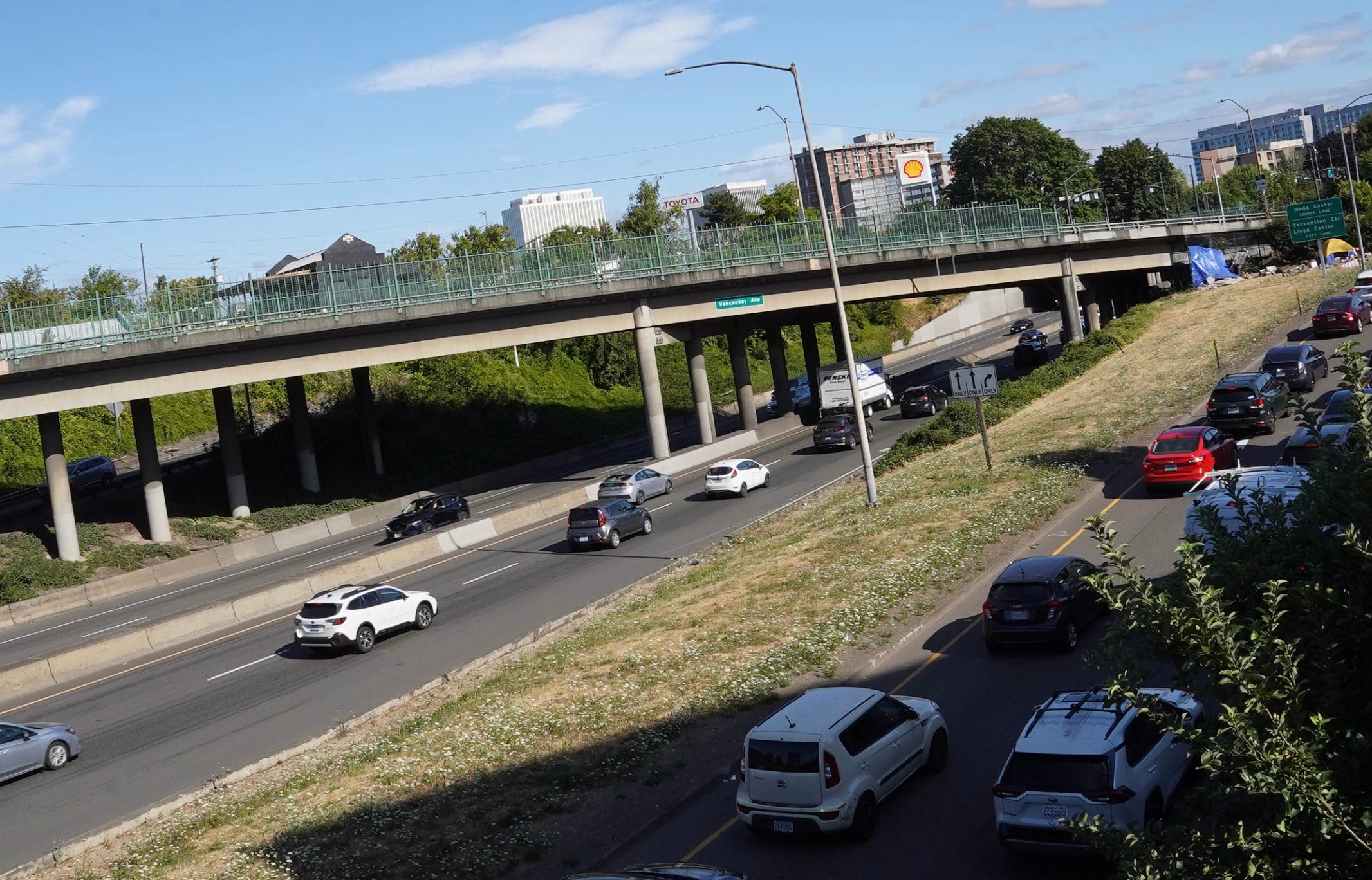
The sense of safety and protection from drivers Portlanders usually associate with the annual Bridge Pedal ride was shattered this morning when a truck driver struck and injured a bicycle rider on the Morrison Bridge.
According to the police, just before 8:30 am this morning, driver of a four-door Toyota Tundra, “struck the bicyclist from behind, knocking him to the road. The driver of the pickup pulled alongside the driver, stopped briefly, then fled.”
BikePortland reader Shawne Martinez rolled by just after first responders arrived and shared the photos below…
Below is the full crash statement from the Portland Police Bureau:
“A hit-and-run driver is being sought after he struck and injured a bicyclist on the Morrison Bridge this morning. The bicyclist was believed to be on his way to the Providence Bridge Pedal event when the crash happened.
Portland Police officers from Central Precinct and the Traffic Division were in the area of the Bridge Pedal event when they were alerted to a crash involving a vehicle and a bicyclist midspan on the Morrison Bridge. They responded and found the adult male bicyclist with serious injuries. He was transported by ambulance to the hospital. His injuries are not believed to be life-threatening.
Officers learned that the suspect driver left the scene, and several officers from both Central Precinct and the Traffic Division searched the area for the suspect vehicle, but were unsuccessful in finding him.
Preliminary investigation suggests the adult male bicyclist was westbound on the Morrison Bridge in the left (center) westbound lane. At the time, the westbound lanes were open to all traffic (eastbound was closed for the Bridge Pedal). The suspect driver struck the bicyclist from behind, knocking him to the road. The driver of the pickup pulled alongside the driver, stopped briefly, then fled.
According to his family member, the bicyclist was on his way to the Bridge Pedal, but was not participating at the time of the crash.
The suspect vehicle is pictured. It is believed to be a white Toyota Tundra pickup 4-door crewcab, with black wheels, a black (or possibly missing) left side gas cap, and no license plates. It was described as “dirty” and had objects in the truck bed. The truck had and may have damage to the front grille. The driver is described as possibly a “middle aged” white or Hispanic man, described as “taller” and bald. This image is altered to obscure the bicyclist in the interest of the privacy of the victim.
If anyone has information about this vehicle, is a witness, or has evidence related to this crash, please e-mail crimetips@police.portlandoregon.gov attn: Central Precinct and reference case number 25-215805.”
Of you have more information about this collision, please contact me.
UPDATE, 4:01 pm: A reader has sent me the video below that shows the collision. Trigger Warning: Video contains footage of person getting hit by a truck driver and being thrown to the ground.
Since I’ve been covering this diverter thing so closely, I figured I might as well keep holding the thread until the very end. That means I have an update on the story that I will share now instead of waiting for Monday morning.
Friday night just after 8:30 pm I received an email from Deputy City Administrator of Public Works Priya Dhanapal (Public Works is the service area that includes the Portland Bureau of Transportation, so Dhanapal is essentially the boss of PBOT). Here’s the text of that email:
“There are no plans to remove the diverters this weekend. The City is coordinating logistics to determine the timing of removal and updates will be provided as they are available.”
My first reaction to this was a text to Connor Lennon, who had been occupying the diverter intersection at NW 20th and Everett since Thursday morning. I wanted to let Connor know he could go home and get some rest because there was no longer an imminent threat of diverter removal.
The City of Portland said the diverters would be removed last week. So for folks who don’t like that plan, this is a win. It shows how an informed community cannot be run over by people in power. But the fight to reach a better solution that addresses concerns the diverters have raised at the Portland Solutions office and Portland Police Bureau, is not over.
The email from Dhanapal validated a tip I received Thursday night about a pause. It makes sense to me and it’s the outcome I’ve predicted for a few days. Why? Because the political optics around this decision to remove the diverters has been bad from the start. To be clear, anyone associated with the removals as initially planned would suffer a very negative political consequence. That’s just my opinion, but it’s one formed by a tremendous amount of perspective and experience based on years of working on this issue in this community. From the moment I heard about this plan it did not smell right, and the evasiveness I’ve experienced from the City of Portland (Portland Solutions and Mayor’s office specifically) in trying to gain more clarity about it has only cemented my views.
A pause is what has always made the most sense — especially because there will be three meetings coming next week where city councilors, city administrators, and Mayor Wilson will have an opportunity to speak to each other publicly and on the record about this issue.
If I was betting on this, I’d say that on Monday we’ll receive some sort of written memo from DCA Dhanapal and/or the Mayor’s Office that lays out their argument for removing the diverters. Either that, or they’ll lay out a new plan in partnership with PBOT for a brief public outreach process to help better inform their goals and to steer the politics in a more positive direction. We’ll see what happens.
Thanks for following along with all this. I highly recommend doing some background reading if you’re not up to speed on this story. See all my posts about it here. Enjoy your weekend!
UPDATE 11:19 am: In related news, the Friends of Couch Park President Kara Colley has issued a letter to her organization saying she supports the diverters. This is notable because Portland Solutions, the Portland Police Bureau, and Mayor Wilson’s office have said that crime at Couch Park is a key part of their rationale for removing the diverters. Colley has been outspoken about crime and open drug use in the park, but she believes the diverters are a good thing for her neighborhood.
Below are excerpts from Colley’s “From the President’s Desk” note sent to members this morning:
“I think calmer, slower car traffic makes our neighborhood safer and more livable… I want to be clear that I support the Portland Police Bureau and the Central Precinct Bike Patrol… I know that there is frequent shoplifting and other crime right outside the Stadium Fred Meyer. I just don’t think that removing the diverters will reduce crime. All diverters must pass police/fire regulations before they are installed, and police can drive around the diverters when necessary.
I heard an interesting idea from a neighbor: The city could leave the diverters in place and remove one parking space and allocate that space to emergency vehicles only. I am in a “yes, and” moment here. I want the PPB to keep our neighborhood safe and I want the traffic diverters to slow down traffic on NW 20th.”
A group of diverter supporters at a rally Thursday night. (Photo: Jonathan Maus/BikePortland)
Two more Portland City Council members have shared opposition to a plan from Mayor Keith Wilson’s office to remove traffic diverters on neighborhood greenways in northwest. (UPDATE: And a third, Councilor Steve Novick, also appears to oppose the removal plan. See his comment below).
Meanwhile, Wilson is showing no sign of halting the plans.
District 2 Councilor Sameer Kanal and District 3 Councilor (and Council Vice President) Tiffany Koyama Lane have both used social media to explain their views. They join District 4 Councilor Mitch Green and District 3 Councilor Angelita Morillo in opposition to the plan.
“I briefly toured the NW 20th and Everett area yesterday, and I am confused as to the justification for removing these diverters,” Councilor Kanal wrote in a post on Bluesky this morning. “If anything, the SUV I saw drive around the planter and use the bike lane as a car lane makes me think the whole road could be closed to cars, not just one direction.” Kanal went on to encourage city administrators to attend the August 12th meeting of the City’s Bicycle Advisory Committee before making any changes on the ground.
Councilor Koyama Lane, who’s been a champion of the City’s Vision Zero traffic safety effort, shared a long and thoughtful comment on an Instagram Live recording Thursday (notably, she used her personal account, not her City of Portland account) where she questioned the City’s lack of transparency and public outreach. “Why are we removing these safety interventions without really explaining publicly what the rationale is?… I’m concerned that I wasn’t looped-in and I believe that even the [Portland Bureau of Transportation] Vision Zero team has not been included and looped-in on this. That’s pretty concerning,” Koyama Lane said. “A public process is deserved.”
Since Koyama Lane’s video didn’t make it clear if she supported or opposed the removal of the diverters, I asked her in a comment, to which she replied: “I do not want the diverters removed. In order to put my support behind this, I would need to see more information, accessible data, and engagement of community activists and groups.”
Meanwhile, Mayor Keith Wilson still plans to move forward with the removals. In a statement shared with local media yesterday, he said he’s heard enough complaints from business owners and residents to warrant the changes. Wilson bases his decision on what he describes as, “escalating drug dealing, narcotic use and sales, reports of assaults on pedestrians and cyclists, and obstacles for emergency responders in this corridor.”
Wilson says PBOT traffic engineers and the Portland Police Bureau Traffic Safety Division, “worked together to develop a plan that recommends repositioning diverters, adding intersection signage, daylighting intersections and restoring two-way vehicular traffic while preserving safe bike and pedestrian access.”
That sounds interesting, but no outside the City has seen that plan. PBOT tells BikePortland their traffic engineers were asked to design options that allow police access while still addressing traffic safety concerns. Perhaps it’s possible. I guess we’ll have to just trust the Mayor and his public safety partners.
I’ve tried to learn more and get further clarity on this story; but today I learned that a series of follow-up questions I sent to the Portland Solutions office on Wednesday morning will not be answered. After waiting nearly two days and hearing from a Portland Solutions spokesperson that they’d spent time working on responses, this morning I was told to forward my questions to the Mayor’s office. The mayor’s office has since told me, “We’ll hold off on responding to additional questions for now.”
As for when/if the removals and changes to the intersections might occur, no one has shared a specific date or time. Thursday evening I heard the plans had been paused, but I have not been able to confirm that information.
I’ve got requests out to other councilors and will update this post as I hear back.
UPDATE, 2:10 pm: D3 Councilor Steve Novick appears to also oppose the removal. In his comment shared below he says he wants to learn more at an upcoming council committee meeting this Thursday:
“I understand there are public safety arguments for removing the diverters. At the same time, we need to very cautious about reversing progress we’ve made toward safer streets and meeting our climate goals. At Thursday’s Climate, Resilience, and Land Use Committee meeting, I want to hear that we’ve fully evaluated the trade-offs. I want to know if PBOT can quantify the positive impacts these diverters have had on ridership and transit safety, and the negative impacts of removing them. This is a decision that deserves thorough analysis, public transparency, and meaningful community input.”
A memorial for DaRon Craig has sprung up on NE Martin Luther King Jr. Blvd and NE Jarrett. (Photos: Jonathan Maus/BikePortland)
Around noon on Thursday, a person driving a Ford Escape SUV failed to control their car, then drove it up a curb and onto a sidewalk where two people were standing. The driver struck both people and nearly hit a child who were gathered next to a bus stop. One of them — 49-year-old DaRon Craig, whose family and friends have left candles, flowers, and written messages at a makeshift memorial — died at the scene. The other person is in the hospital with life-threatening injuries.
In a press statement at the scene Portland Police Bureau Sgt. Kevin Allen said, “The officers that responded described it as an absolutely chaotic scene where people were traumatized.” Harrowing witness accounts shared in The Oregonian say the driver was going at least 70 mph.
According to the PPB, the driver of the Ford was going northbound on Northeast Martin Luther King Jr. Blvd. After driving onto the sidewalk somewhere between NE Jessup and NE Jarrett, they continued north toward the busy intersection with NE Ainsworth which has a Safeway, Starbucks and Walgreens. At Ainsworth the driver hit another person who was in their car waiting to turn left. The driver then jumped the median island just north of Ainsworth and struck two other drivers head-on before finally bringing their Ford Escape to rest.
In total, the driver who caused this mid-day rampage hit six people.
Police outlines north of Ainsworth where the rampage ended.Looking north on NE MLK at Jarrett.Memorial in the background.Looking north on MLK and NE Jarrett.Memorial to DaRon CraigMemorial to DaRon CraigLooking south on NE MLK Jr Blvd where the driver hopped onto a sidewalk.Looking south from the memorial.Looking northwest at NE MLK Jr. Blvd and Ainsworth. The driver hopped this median.
The PPB says they don’t believe the violent collisions were intentional. In a statement, police said the Ford Escape driver had two prosthetic legs, “but it’s unclear if that was a factor in the crashes.”
This stretch of Martin Luther King Jr. Blvd straddles the King, Woodlawn, Vernon, and Piedmont neighborhoods. It’s a city-owned former state highway (99E) and has five general travel lanes and no shoulder. The speed limit is 30 mph. PBOT used to have an automated enforcement camera installed right where the driver came to rest on Thursday, but it was recently removed as part of a vendor changeover.
With many popular food and business destinations, as well as a busy bus line, these blocks are always full of people walking and rolling. There are crosswalks and median island to try and calm traffic, but with nearly the entire road space dedicated to driving and a 30 mph speed limit, conditions at this location are stressful and dangerous.
(Photo: Portland Police)
My post office is just a few blocks from here and I regularly bike on this exact sidewalk. I like biking on the sidewalk here because it’s a lot more interesting than taking side streets. I felt sick today as I stood at Craig’s memorial, stared at his family photos, and read the dozens of messages from people who knew him.
“Always being the best father figure I know. I’m going to miss you so much,” read one of them. “You weren’t just a good husband, you were a great man,” read another.
Many lives were changed in just a few minutes. And unfortunately, on a street like Martin Luther King Jr., it could happen again — at any time. The way that street is designed, there’s simply no room for error. We continue to expect Portlanders to live and thrive outside of cars while making them exist in places where they can so easily be killed.
Craig is the 20th person to be killed on Portland streets so far this year.
There’s nothing quite like a good crit. This shot is from the 2021 Red R Criterium which happens again on Saturday. (Photo: Jonathan Maus/BikePortland)
Hi everyone. Hope you’ve had a good week and are ready for some sunny cycling the next few days. Be sure to see BikePortland’s tips for biking in the heat when you head out.
Here are my picks for the weekend…
Saturday, August 9th
Red R Criterium – All day on Swan Island (N) Last weekend to catch some fast and exciting crit racing where competitors zoom around a short course and compete to win laps and a big sprint at the finish. More info here.
Art in the Bike Lane Ride – 2:00 pm at Oregon Park (NE) You know those whimsical bike lane characters you see sometimes? Join this ride and be treated to a tour of the best ones from a person who is passionate about Portland’s amazing thermoplastic street art. More info here.
World Naked Bike Ride – 5:30 pm at Colonel Summers Park (SE) This is the more activist-oriented ride that’s now in its second year. Organizers say they’ll head back to Zenith Oil in industrial northwest for a die-in. I did this ride last year and you can read my story and watch the video to get a better feel for what to expect. More info here.
Prince Purple Rain Ride – 7:30 pm at Oregon Park (NE) A chill, easy ride full of Prince music and people who love it. Wear your finest purple duds for added fun. More info here.
Sunday, August 10th
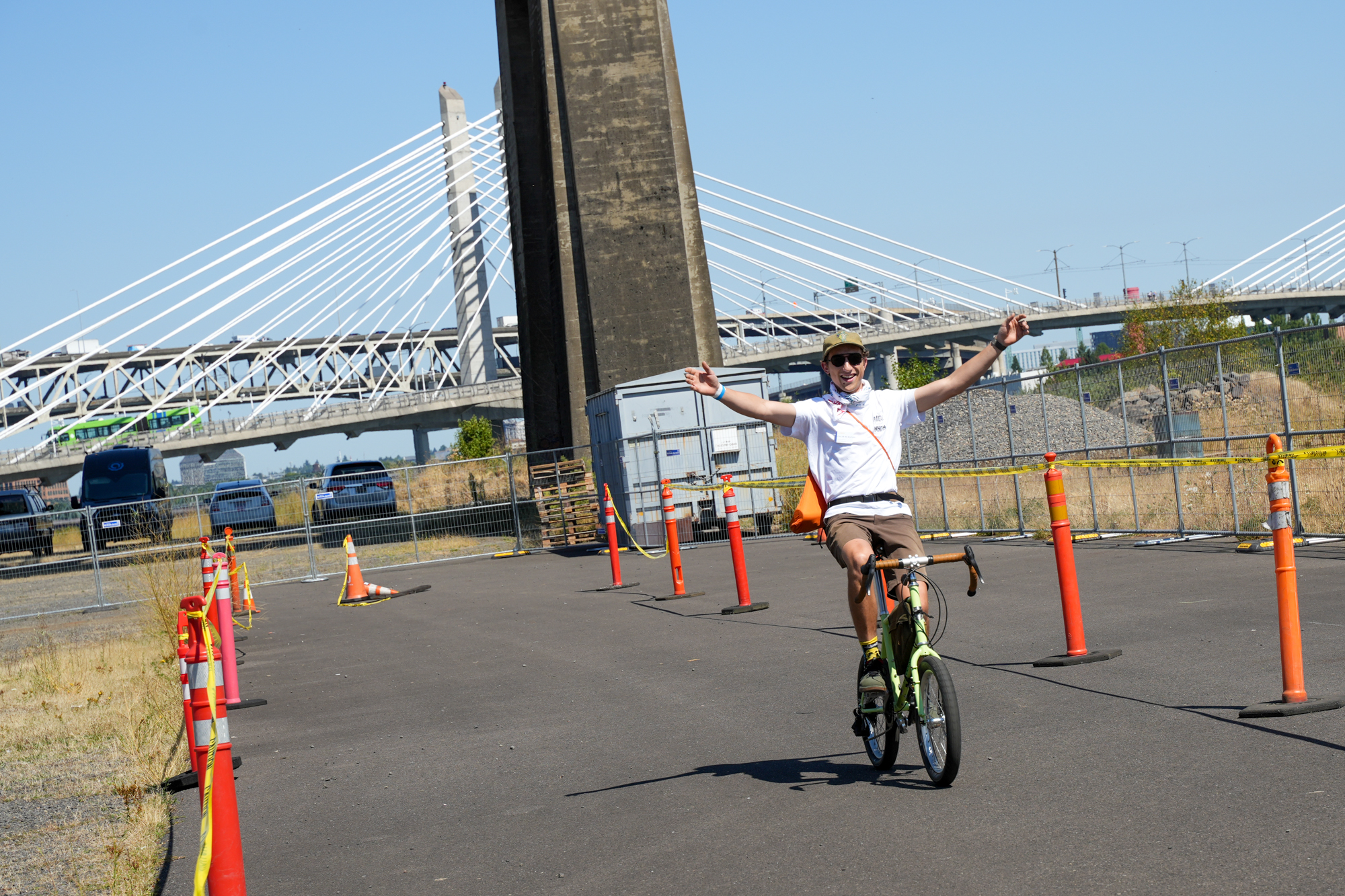
Bridge Pedal – All Day in the Central City It’s time for the annual Bridge Pedal, which offers a six-bridge route (no more 10-bridge?!) where you can see the city from new vantage points on carfree streets. Bring the kiddos for the Kids Pedal! More info here.
Trusty Switchblade Kermesse – All day at Liepold Farms in Boring, Oregon Come out and race your gravel/cross bike on a rippin’ dirt course on a farm just outside Portland. “Kermesse” is a Dutch word that is used when a bike race coincides with a town festival, so bring the whole fam’ to the farm and soak up all the summer vibes. More info here.
Cargopalooza – 9:00 am at Splendid Cycles (SE) A social ride for cargo bike lovers. Expect a ride to Sellwood via the Springwater Corridor to explore the Goodwill bins and make sure you tell them you don’t need a bag because you can just throw all your finds into your cargo bin! More info here.
Bike Bus to the Thorns Game – 11:30 at The Athletic (N) Join the wonderful Jenna Bikes for a group ride to the soccer match at Providence Park. Meet’s at The Athletic, who’s co-owner recently suffered terrible injuries in a collision with a driver and the business can use community support while she recovers. More info here.
— Did I miss your event? Please let me know by filling out our contact form, or just email me at maus.jonathan@gmail.com.
Don’t miss my video from Thursday’s rally where concerned Portlanders gathered in the street at the intersection of NW Everett and 20th to defend a traffic diverter.
A City of Portland office that’s overseen by Mayor Keith Wilson has threatened to remove this and another diverter nearby sometime this week. Stay tuned for more coverage later today.
A supporter of the diverter slated for removal on NW Johnson at 15th. (Photo: Courtesy BikeLoud)
Portlanders who do not want to see traffic diverters currently installed on neighborhood greenways in northwest removed plan to occupy an intersection to prevent their removal. A rally is planned at one of the locations today at 4:00 pm.
As I’ve reportedsinceFriday, an opaque government program that was created by former Mayor Ted Wheeler to address homelessness and related livability issues wants to remove traffic diverters at NW 20th and Everett and NW Johnson and 15th. They say the diverters get in the way of police patrols and that the absence of car drivers leads to an unsafe environment and increase in “nuisance behaviors.”
In the past 24 hours, we’ve seen an organized response to prevent the removal plan. Local advocacy groups including: Bike Bus PDX, Strong Towns, Bike Loud PDX, and Families for Safe Streets have all sent statements to Mayor Keith Wilson urging him to reject the plan or at least pause it until other solutions can be explored.
Signs from supporters of the diverters.
This morning I’ve confirmed that Public Environment Management Office (PEMO) Director Anne Hill will attend the August 12th Portland Bureau of Transportation Bicycle Advisory Committee meeting. According to the BAC agenda, Hill will, “present the agency’s reasons for the removal.” It might be an even more strained discussion if the diverters are already removed before the meeting begins. The most current information I’ve heard from Portland Solutions (the office PEMO lives under in the city’s organizational chart) is that the removals are set for sometime this week.
So far I am not aware of any public notice about the removal plan and the only public process that went into making the decision happened at a series of meetings that are invite-only and not easily accessed by the public. (PEMO’s Problem Solver meetings seem to violate several Oregon public meeting laws.)
Since my previous story yesterday, some concerned Portlanders who emailed Mayor Wilson and Portland Solutions Director Skyler Brocker-Knapp have received responses.
A staffer at Mayor Wilson’s office is sending this canned reply to everyone who contacts them:
“The City of Portland has implemented these temporary adjustments in response to serious public safety concerns brought forward by residents, local businesses, and public safety partners. These concerns include increased narcotic use and sales, reported instances of assault and harassment toward pedestrians and cyclists, and challenges faced by emergency responders navigating the area.
The decision to assess and modify traffic flow in this corridor is an operational one, made in close coordination between multiple city bureaus. A City of Portland engineering team is overseeing the design and implementation with safety and access as top priorities. In these two blocks, diverters are being re-positioned to allow for two-way vehicle traffic, while allowing for bike travel.”
And Portland Solutions Director Skyler Brocker-Knapp replied to one BikePortland reader with this message:
“This decision was based on more than two years of community feedback, as this area is used as a corridor for chronic nuisance behavior. We worked on every other tool and solution before reaching this point with PBOT’s engineer and PPB’s traffic team. They determined the four way stop solution at Everett and the modification to Johnson. The bike lanes will be maintained in both locations. In the future, if the nuisance behavior is curbed, due to all of the other mitigating measures also taking place, I think the locations should be revisited and diverters could be returned.”
While the removals could happen at any time, questions remain about how the decision was made and what the community can expect going forward.
Below are the questions I asked Portland Solutions Wednesday morning.
Since this issue is on the 8/12 agenda of the PBOT Bicycle Advisory Committee meeting, why not wait until after that meeting to schedule the changes?
The 8/1 email from Director Brocker-Knapp referred to diverters at NW 14th and Johnson. Was that a misstatement? Did you mean 15th? Or is 14th also being removed/changed? If so, why?
Does PBOT support these changes? You say they were asked to identify solutions, which sounds more like an order to me. So I’m curious: How should I characterize PBOT’s position on this?
When you say Portland Solutions added these concerns to the PBOT “tracker,” are you referring to their TrackIT system?
What type of public notification of these changes has happened thus far/or will happen before changes are made?
Why did plan on NW Johnson change from a sharrow marking (which is what was described on 8/1 email from Director Brocker-Knapp) to maintaining the bike lane (as per this 8/5 email)?
Will these changes be temporary? If so, what will the metrics for success/failure be?
Where did these community concerns about Johnson come from? Is there a way for me to verify that? Can you provide meeting minutes or PBOT TrackIT case numbers?
So to be clear, based on your answer to my previous question, there was no public process to make this decision. Is that correct?
I have not yet received responses to these questions. I will post them here when/if I do.
I’m hearing folks will gather at the two locations today to erect signs of support and attempt to prevent PBOT crews from removing the diverters. Stay tuned.
UPDATE, 12:34 pm: A rally is planned for 4:30 pm today at NW Everett and 20th. It’s being hosted by Strong Towns PDX, Bike Bus PDX, Families for Safe Streets and Bike Loud PDX.
View of I-5 and Moda Center from N Flint Ave. (Photo: Jonathan Maus/BikePortland)
After getting a green light from the Oregon Transportation Commission last month to go forward with a plan to widen I-5 at the Rose Quarter, the Oregon Department of Transportation is moving forward with an initial construction phase of the project. I’ve heard a ribbon cutting ceremony to mark the groundbreaking of this multi-billion dollar megaproject could happen as soon as a week or two.
But lawyers representing a nonprofit that has filed a lawsuit to stop the project have a message for ODOT: Not so fast.
As I shared in a story July 23rd, ODOT officials recently suffered a setback in the lawsuit when, just days before a trial was to begin, the agency formally withdrew documents that were meant to show the project was compatible with Portland’s Comprehensive Plan. The trial has been rescheduled to January. No More Freeways expected ODOT to re-submit documents to convince the court their plan was compatible, but a 30-day window to do that expired over the weekend.
According to No More Freeways lawyer Karl Anuta, this means ODOT no longer has a “formal demonstration of compatibility,” so they are not authorized to do a groundbreaking.
In a letter from Anuta’s office to ODOT dated August 5th, Anuta writes:
“… the existing City of Portland Comprehensive Plan authorizes a Rose Quarter project, but not the same Rose Quarter project that ODOT is now proposing to build. The current proposal is simply not consistent with the one that the City expressly adopted as a Facilities Plan into the City Comprehensive Plan. There were significant changes in the location and function of key features of the project, which ODOT made before it approved the current Rose Quarter project that is specified… That requires that changes be made to the City Comprehensive Plan before the currently proposed Rose Quarter project can be found to be consistent with that Plan. Those changes have yet to be made.
Thus, ODOT cannot lawfully proceed with construction. For that reason alone, any “groundbreaking” or “initiation of Phase 1A” should be postponed or canceled. However, in addition to the illegality or moving forward when there is a lack of mandatory Findings, as a policy matter ODOT should not proceed with this project until the agency can establish that funding is actually available.”
I have not yet reached out to ODOT for comment, but this is just the latest snag in the project. Whether or not they announce a groundbreaking event remains to be seen. Stay tuned.
Diverters in the northeast corner of NW 20th at Everett, which Portland Police say inhibit patrols of the area. (Photo: Jonathan Maus/BikePortland)
Portland Solutions, the City office that’s driving an effort to remove two traffic diverters in northwest, says the changes to Northwest 20th and NW Johnson streets are going to happen this week. This means, if their plan comes to fruition, two neighborhood greenways developed through the Northwest In Motion Plan will lose key traffic calming infrastructure and it will be done without any public notice or transparent decision-making process.
One of the diverters, on NW 20th Avenue at Everett, is just one block south of the route taken by the Chapman Elementary School bike bus.
Safety concerns like that one are just one reason advocates have ramped up campaigns to fight the diverter removals. In the past few hours, urban advocacy group Strong Towns PDX has issued a statement opposing the plan and is spreading an email template in hopes of pressuring city leaders. Bike Loud PDX has also launched a campaign that encourages Portland Solutions to pause their plan until the issue can be vetted through at the city’s Bicycle Advisory Committee later this month. Bike Bus PDX has sent a letter signed by the leaders of nine local bike buses to Mayor Keith Wilson urging him to pause the plan. And Families for Safe Streets, a nonprofit made up of survivors of traffic crashes, has issued a statement saying traffic diverters have a positive impact on public safety.
In this story, I’ll share more reactions from City Councilors, update you on the latest plans, and share a few other important things I’ve learned.
Timing of the removal
When I first learned about this plan on Friday (through an internal email that was forwarded to me by City Councilor Mitch Green), it was unclear when the diverters would be removed. On Tuesday I reported that a Portland Solutions spokesperson said “We’re in the early stages of this… I still think that there’s time for engagement.” Now that’s changed. The confirmation that the work will happen this week came from Portland Solutions on Tuesday afternoon along with answers to other questions I asked that sought to gain a better understanding of why and how their decision was made.
(Their answers didn’t address all my questions, so I’ve emailed a set of follow-ups that I’m still waiting to hear back on. I requested a phone interview, but was told I could only email questions. I also asked for a name I could attribute their answers to — like perhaps Portland Solutions Director Skyler Brocker-Knapp — but I was told to use only “Portland Solutions” because the answers are being crafted by committee.)
How the streets would change
In an internal email announcing the plan Friday, Portland Solutions Director Skyler Brocker-Knapp told city councilors, transportation bureau officials, and city administrators that the diverters and one-way streets they create for drivers would be returned to two-way auto traffic in order to facilitate easier vehicle patrols by the Portland Police Bureau and to improve the general safety of the streets. The current plan is to replace the northbound bike lane on NW 20th with a sharrow marking and add stop signs to NW Everett (so the intersection will become a four-way stop). On NW Johnson at 15th, their plan initially called for removal of the diverter and bike lane and the addition of a sharrow marking. They now say they will remove on-street parking spots which gives them space to retain the bike lane. (I’ve asked what spurred this change and haven’t heard back yet.)
Portland Solutions also shared that the changes could be, “potentially temporary.” “The City will be keeping a close eye on traffic safety and public safety to determine if there should be additional changes or a reversion of the traffic patterns,” read their email to BikePortland. As far as I know, this possibility of a temporary change is new and only came about because of my coverage of this. I’ve asked for a confirmation/clarification on that and what the metrics for success/failure would be and have yet to hear back.
Impetus behind the decision
NW 20th and Everett Portland Solutions (through the Public Environment Management Office, or PEMO) says they asked PBOT to identify how two-way traffic could be restored on NW 20th (between Everett and Flanders) to, “allow police vehicles the ability to navigate north from Burnside to Glisan.” They say the issue came up in regular meetings with PBOT and that PBOT officials walked the block with Portland Police Bureau representatives, “to confirm the scope of the change.”
Today I spoke to someone who lives near this intersection. Dave Smith (not his real name, he requested anonymity) is active in neighborhood issues and attended several of the Problem Solver meetings hosted by PEMO where these diverters were discussed. Smith, who doesn’t own a car and walks everywhere, told me he’s torn on the issue. He’s heard directly from police officers about how much crime-related activity happens on NW 20th between Burnside (Fred Meyer) and Glisan (Couch Park) and he’s seen the 311 and 911 call log overlays of the area. “This particular zone has massive amounts of drug dealing and the highest amount of calls,” he shared, “and the diverter really limits their ability to patrol and respond to things.”
“I’ve seen it in real-time where criminals are running down the street and the cops are having to drive around the block as the person cuts through [the diverter at 20th and Everett],” Smith said. “I love that little median; but I’m also in favor of having way less crime and confrontations and hazards all near my house.”
I sensed a real frustration in Smith’s voice. “I don’t know what the right answer is,” he said at one point. What he would prefer is more of a compromise solution where the diverter barricades are adjusted so that emergency vehicles and police can more easily get through; but individual drivers could not. He’d also support a change to the parking permit program that would only allow residents to park on the street, but he says PBOT has shot that idea down several times.
NW Johnson and 15th When asked to clarify the rationale for the changes at this location, Portland Solutions said:
“The block is currently unlit and incredibly dark during both day and night. When cars do park on the block, community members and police have seen increased narcotic sales as well as nuisances/public safety impacts to pedestrians and cyclists. Community members in the area as well as [Portland Police Bureau] PPB have indicated it is usually unsafe to walk on either sidewalk. PEMO/ Portland Solutions asked PBOT to identify how to return two-way traffic to this block. PBOT followed up and validated that the parking could be removed to preserve the bike lane with the two-way traffic. PEMO is working with PGE, ODOT, and PBOT to add lighting to the block.”
The public process (or lack thereof)
I asked Portland Solutions if there was a public process or any public meetings where this problem/plan was discussed. They didn’t answer that question directly and instead wrote: “These changes are operational decisions based on discussions between Portland Solutions, Portland Police Bureau, and the Portland Bureau of Transportation.”
Who supports and opposes this?
I asked Portland Solutions to clarify whether or not PBOT supports the changes and have yet to hear back (PBOT won’t respond to my questions and has deferred everything to Portland Solutions). Their initial response said they asked PBOT how/if they could restore two-way auto traffic to these streets. To me that sounded like an order or a mandate. It’s not the same as them coming to PBOT and saying, “We have a problem with how this street works. What would you recommend we do about it?” I hope to hear more from Portland Solutions about this.
When it comes to City Council members, I’ve got a few updates to share.
So far we know District 4 Councilor Mitch Green (who’s also one of five members of the Transportation and Infrastructure Committee) is strongly opposed. He’s working on hosting a public meeting to air concerns and share information. As for the other two D4 councilors, both Olivia Clark and Eric Zimmerman support the diverter removal.
I knew Zimmerman was in support of it because he mentioned it publicly in May. He’s also a strong supporter of the PPB in general. When I asked yesterday to confirm his views on the plan, he reiterated support for the removal, but also said biking and walking safety is a top priority. Here’s Zimmerman’s full comment:
“I want to be clear: the decision to remove the diverters at NW 20th and Everett is a direct response to ongoing public safety concerns raised by the community and brought to my attention by Portland Solutions. This change reflects input from neighbors at the Problem Solver meetings and coordination with Portland Police, PEMO, and PBOT.
Removing the diverters will improve emergency response access, while bicycle access will remain. If these city agencies think this change is important, and new sharrow markings are added to ensure all users understand the shared use of the street — I support them.
Keeping our neighborhoods safe and accessible, particularly for cyclists and pedestrians, is a top priority of mine.”
T & I Committee Chair Clark said, “I support this change primarily so our first responders can better navigate vehicles through the neighborhood during public safety emergencies.”
So far just one other councilor has responded to my request for comment. T & I Committee Vice Chair Angelita Morillo told BikePortland this morning that she was not notified of the plan, “even as Vice Chair of the Transportation & Infrastructure Committee.”
“I am firmly against the removal of this traffic calming infrastructure,” Morillo added, “especially at a time when the Portland Bureau of Transportation is facing immense budget constraints. It is a waste of money and resources to undo the hard work and community outreach that went into installing these diverters. This does not live up to our Vision Zero values.”
What about Mayor Keith Wilson? Portland Solutions reports directly to the mayor’s office, but I’ve been told by his Chief of Staff Taylor Zajonc, “I believe we’re going to decline to weigh in on this one.”
Portland Solutions in the city org chart.
One last tidbit
A local activist reached out to me last night with an interesting footnote to Portland Solution’s decision to remove the diverters. In 2022, when former Mayor Ted Wheeler issued the emergency declaration that formed what would become the Portland Solutions office, the language of the declaration included this language:
The City’s Public Environment Management Office (PEMO) … shall serve as the Mayor’s designee under this Emergency Declaration… In addition to other priority tasks, the Mayor’s designee will undertake to:
Ensure preventative measures are in place such as activating public spaces with positive means such as food carts, planters, more positive barriers, or reconfiguration of the public space.
Median diverters — especially ones that have become a community garden — are a proven tool to activate public spaces. And cars do the opposite. Portlanders have spent years trying to reconfigure public space away from being car-centric and toward being human-centric. This plan from PEMO would reverse some of that work and goes against the very declaration that created it.
I still have questions out to Portland Solutions and other city leaders and will continue to follow this story. Stay tuned.
UPDATE, 8/7: A few readers have passed along responses they’ve received from two key players in this story, Mayor Wilson and Portland Solutions Director Brocker-Knapp.
Here’s the response Mayor Wilson’s office is sending out:
“Hello ____,
Thank you for taking the time to share your concerns regarding the recent temporary traffic changes in the NW Portland area, specifically near NW 20th Avenue & NW Everett and NW 15th Avenue & NW Johnson. We appreciate your engagement and your commitment to Portland’s livability, safety, and multimodal transportation network.
The City of Portland has implemented these temporary adjustments in response to serious public safety concerns brought forward by residents, local businesses, and public safety partners. These concerns include increased narcotic use and sales, reported instances of assault and harassment toward pedestrians and cyclists, and challenges faced by emergency responders navigating the area.
The decision to assess and modify traffic flow in this corridor is an operational one, made in close coordination between multiple city bureaus. A City of Portland engineering team is overseeing the design and implementation with safety and access as top priorities. In these two blocks, diverters are being re-positioned to allow for two-way vehicle traffic, while allowing for bike travel.
Neighborhood notifications about these changes are currently being finalized and are expected to begin mailing and distribution as soon as today. The City will monitor and evaluate the temporary measures.
Thank you again for reaching out. Your voice is vital in helping shape a safer and more responsive city.
Faisal Osman (He/Him) Constituent Relations Coordinator Office of Mayor Keith Wilson”
And here’s a response some received from Brocker-Knapp:
Hi _____,
This decision was based on more than two years of community feedback, as this area is used as a corridor for chronic nuisance behavior. We worked on every other tool and solution before reaching this point with PBOT’s engineer and PPB’s traffic team. They determined the four way stop solution at Everett and the modification to Johnson. The bike lanes will be maintained in both locations. In the future, if the nuisance behavior is curbed, due to all of the other mitigating measures also taking place, I think the locations should be revisited and diverters could be returned.
We do this every week! (Photos: Jonathan Maus/BikePortland)
Can’t wait to see you at Bike Happy Hour this week. We’ll gather at our usual spot in the Rainbow Road Plaza on SE Ankeny for food, drinks, community, and conversations. (Be sure to read the end of this post for a special announcement about open mic.)
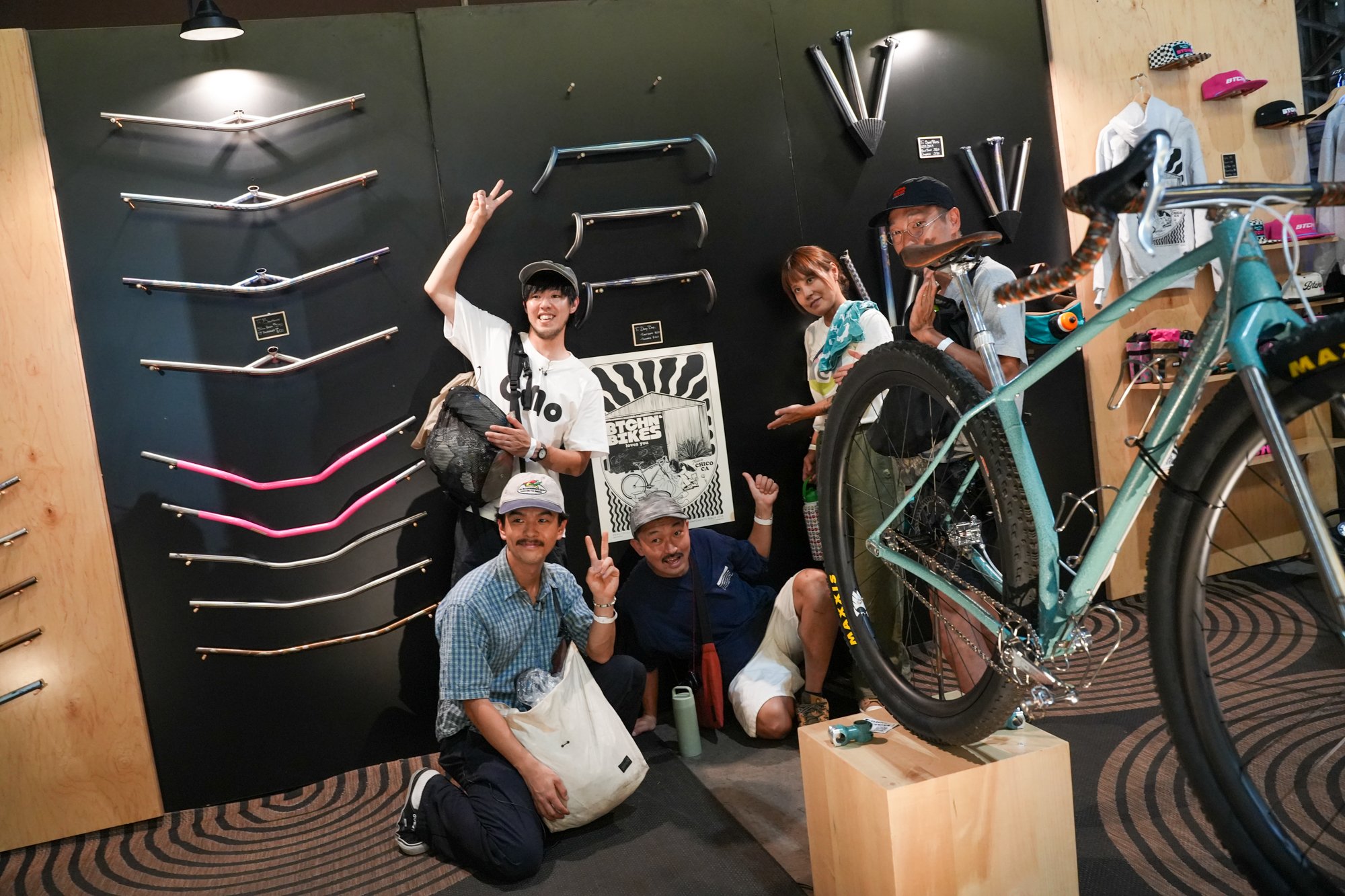
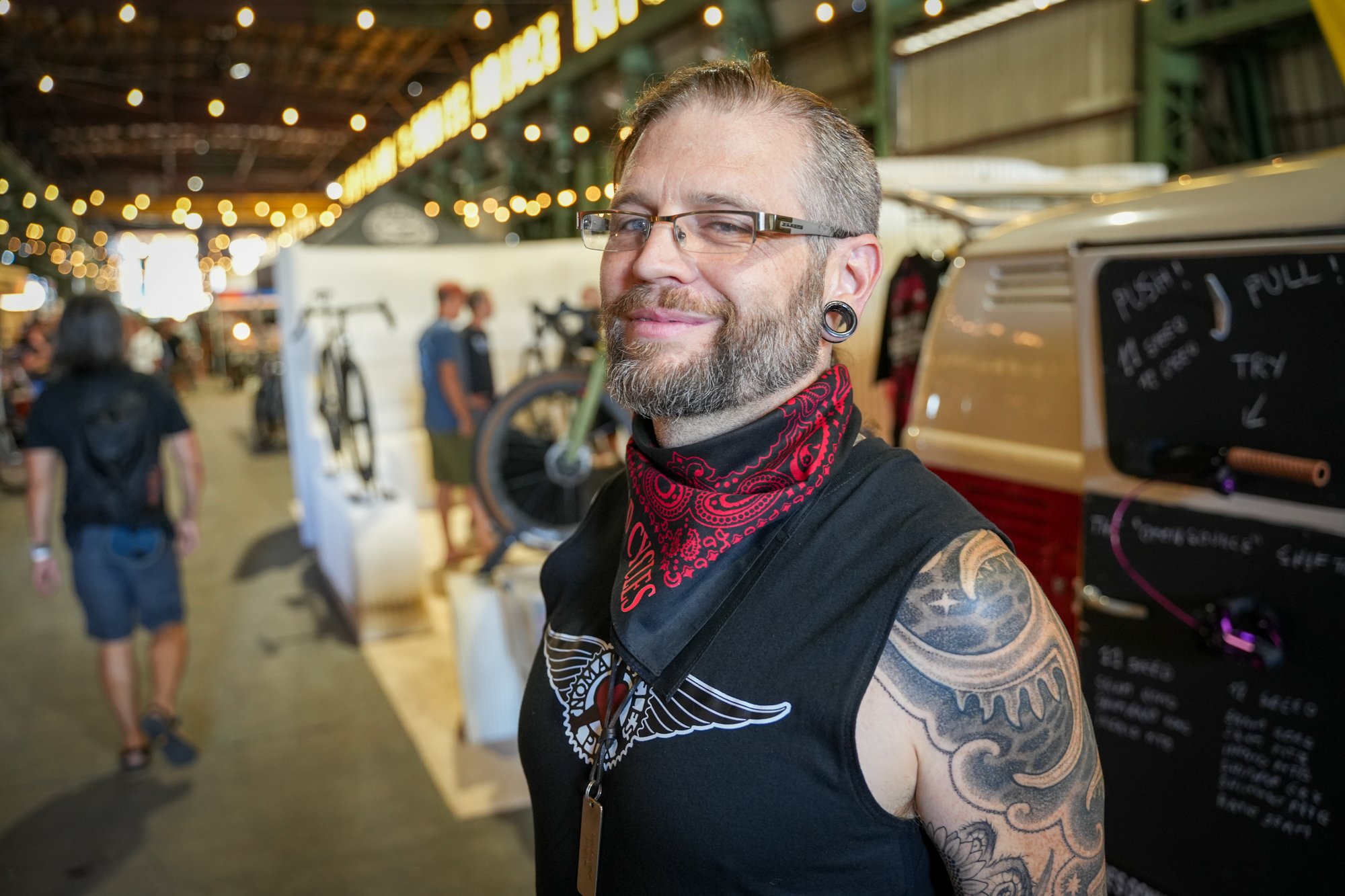
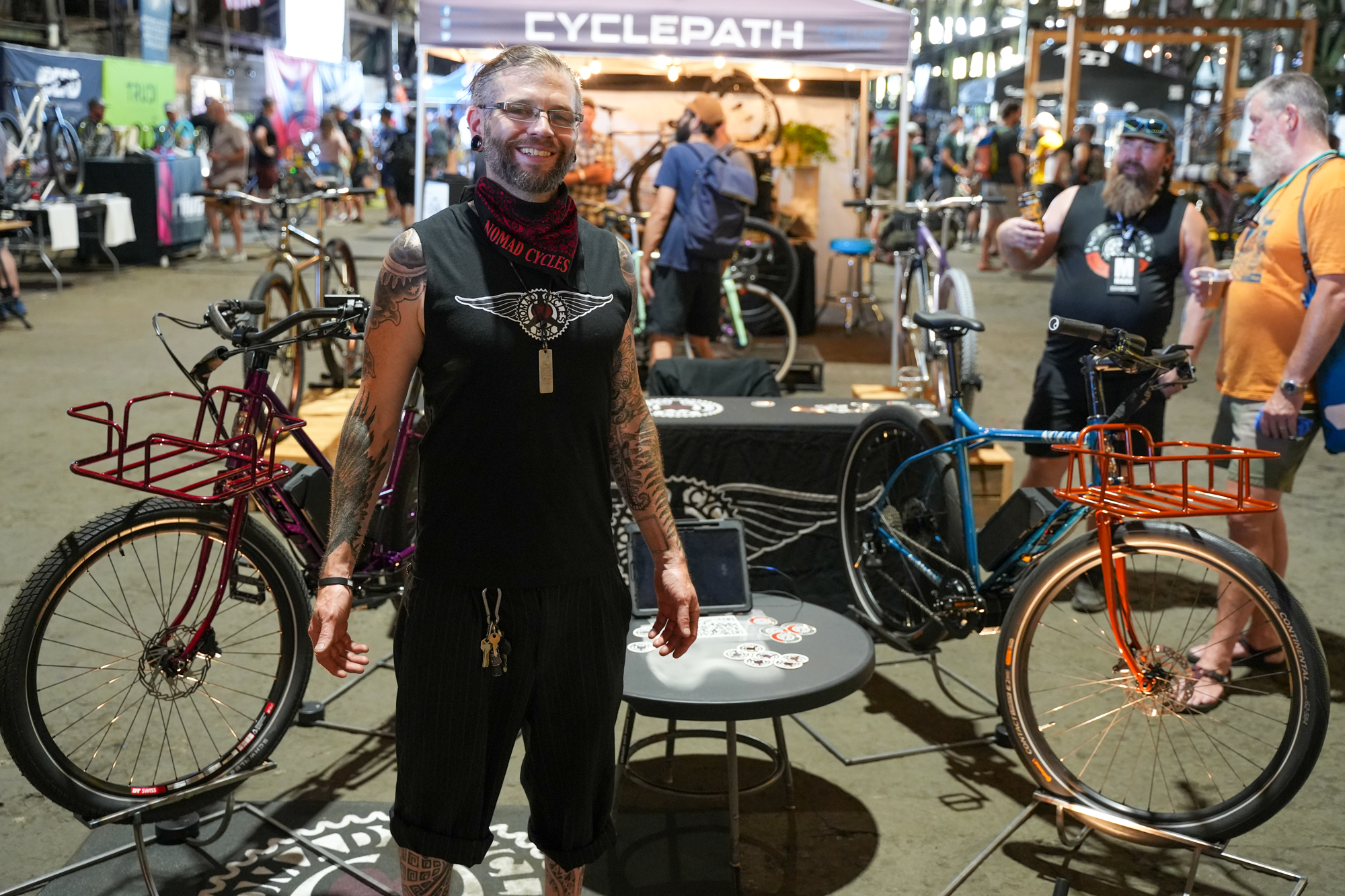
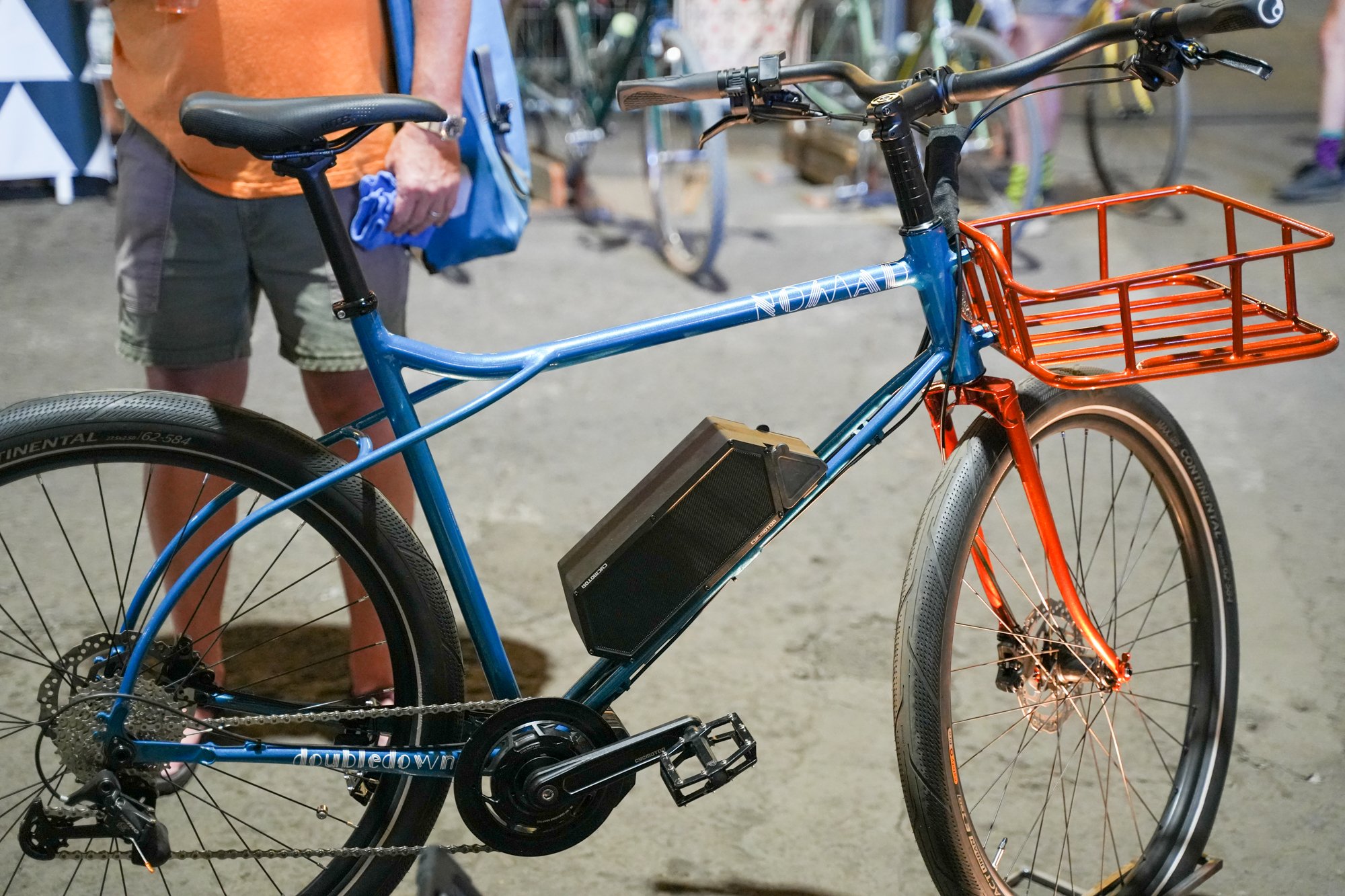
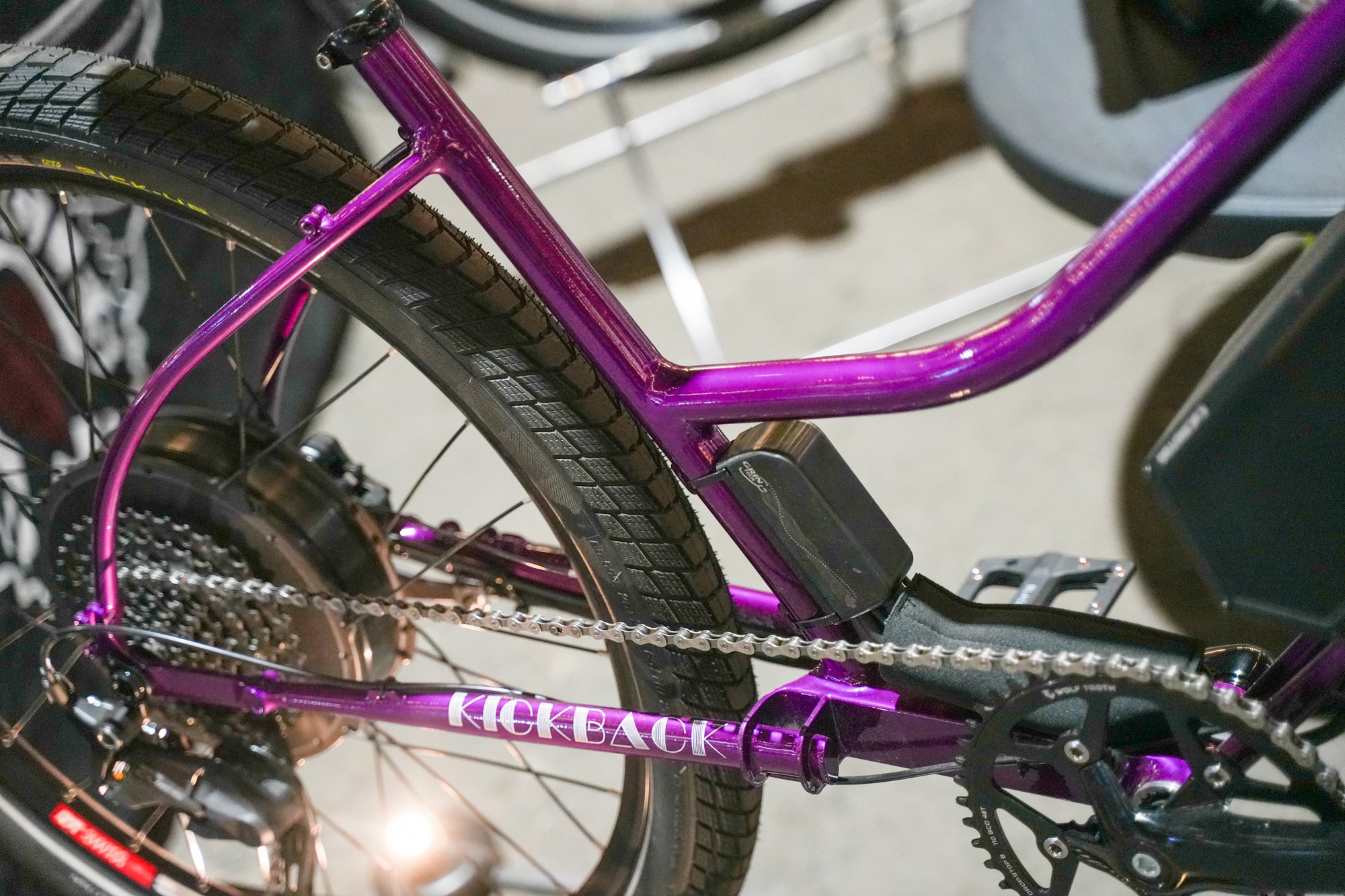
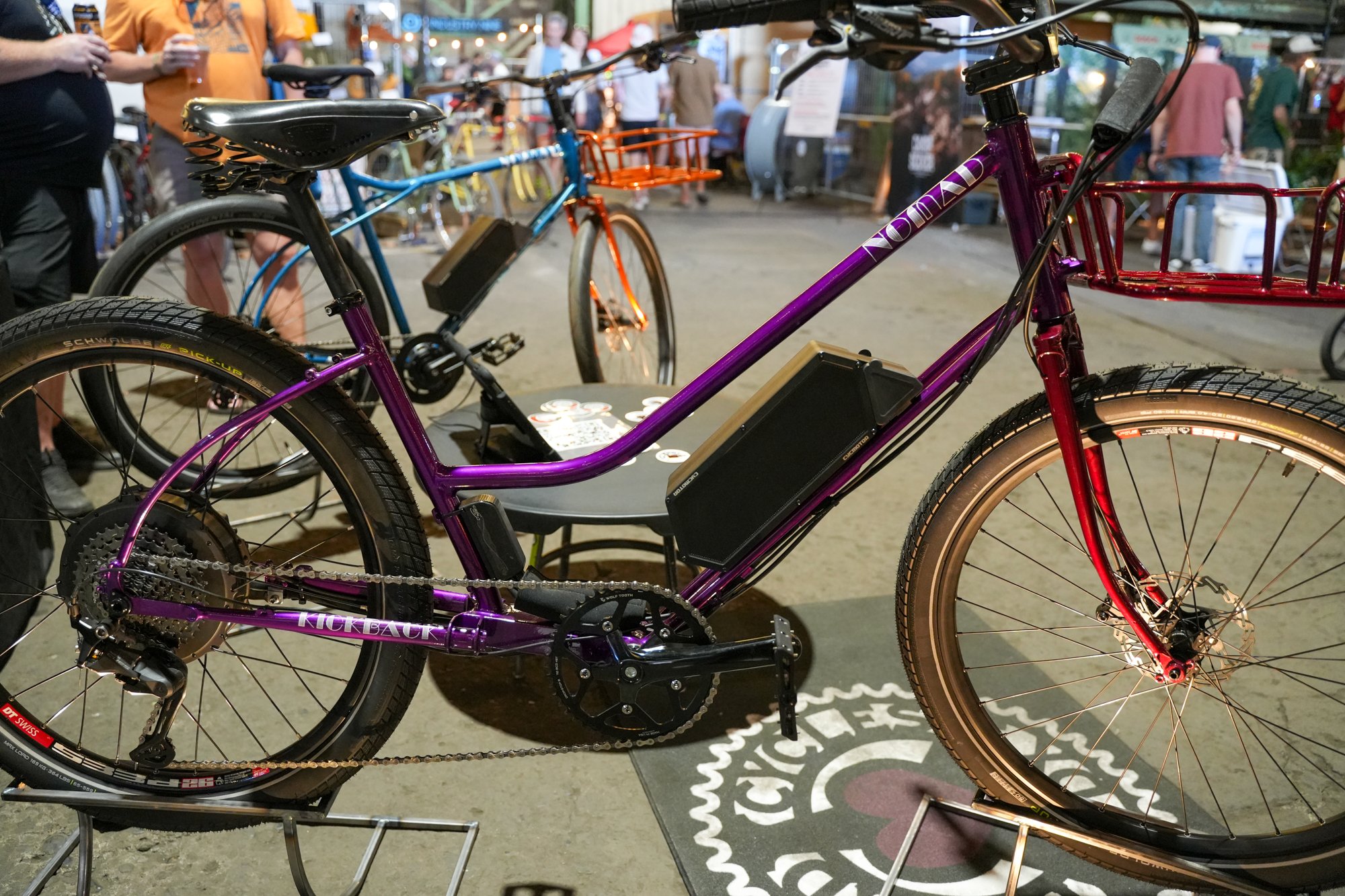
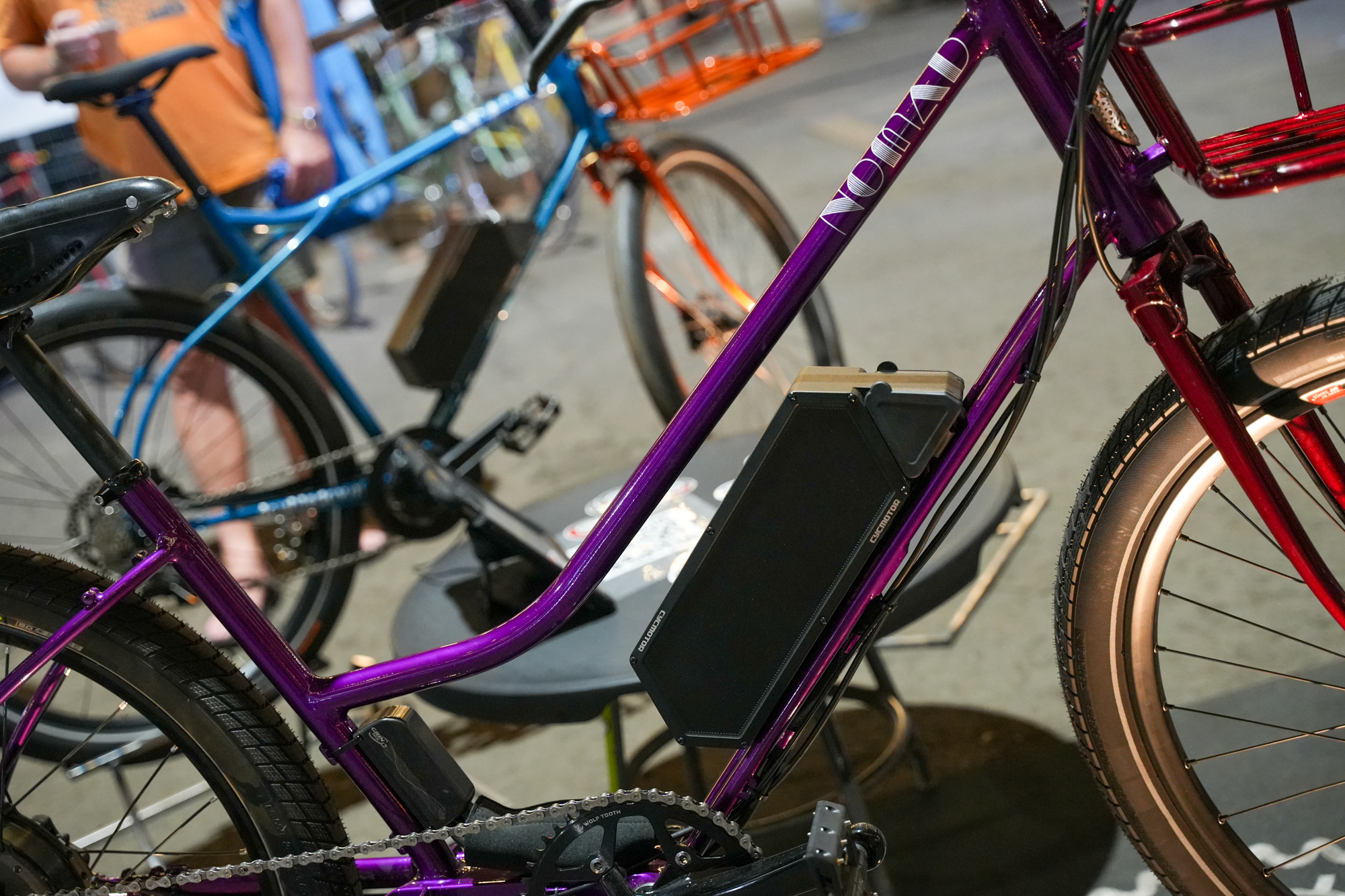
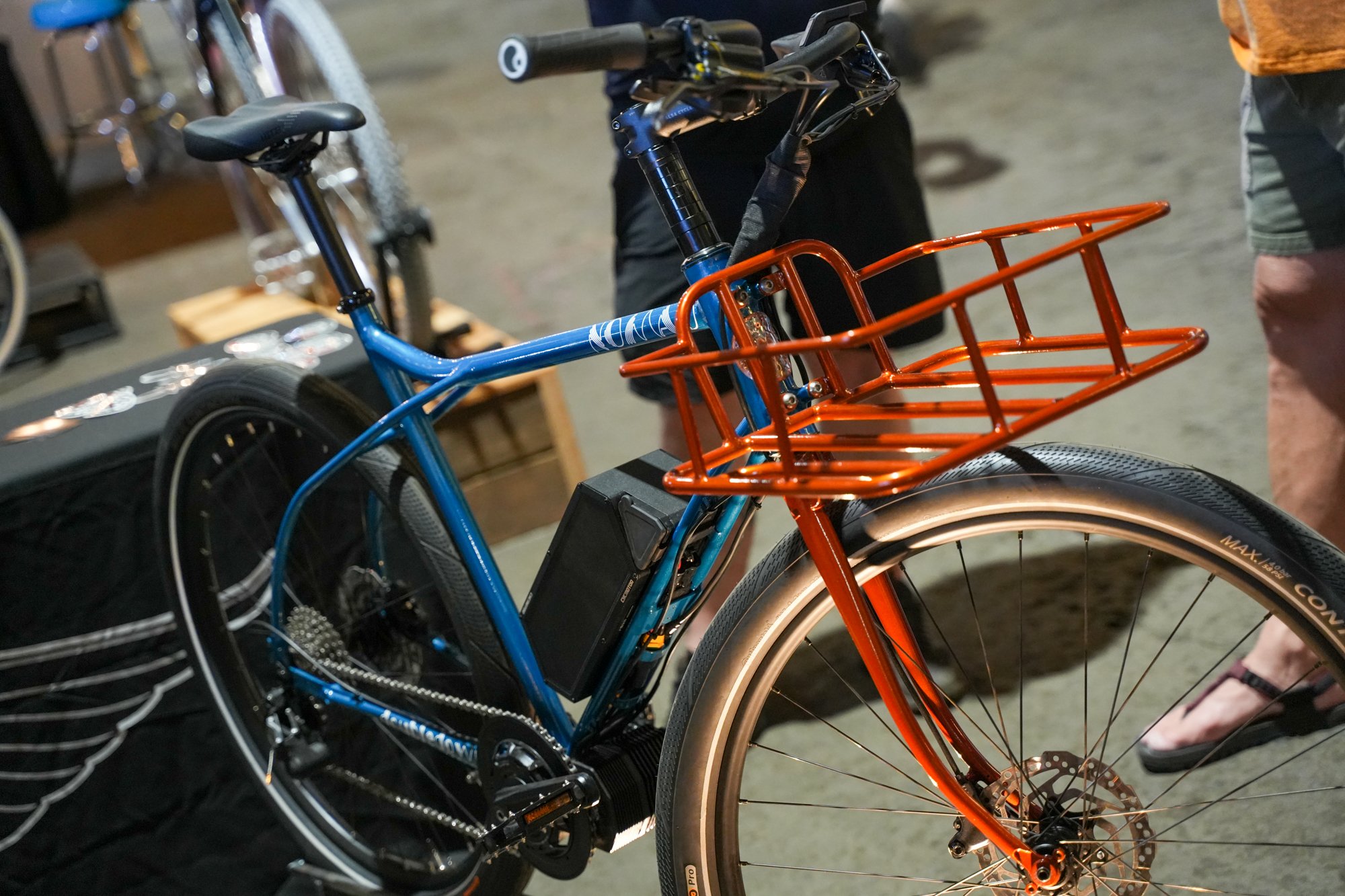
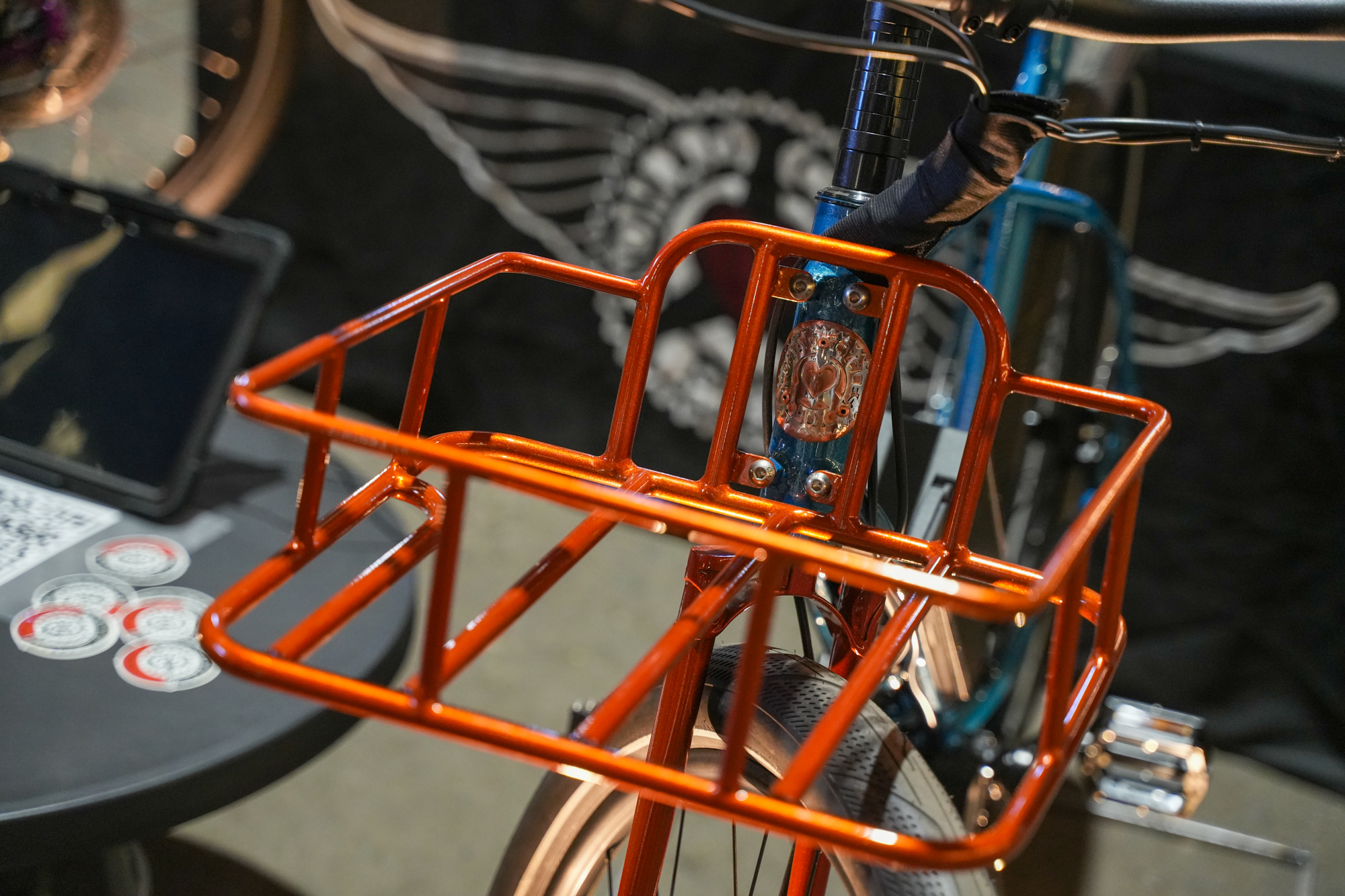
Our special guest this week is the crew from Nomad Cycles. This Portland-based bike brand has revolutionized electric-assisted mobility and their latest project is nothing short of amazing: They are building their very own e-bike from the ground up. And you can see it for yourself if you join us Wednesday.
You might recall my story and video about Nomad last month. Their new “DoubleDown” model is built right in their shop on Northeast Sandy Blvd. But wait, there’s more! They’ve finished a second model with a more relaxed geometry they’re calling the “Kickback.” Brad, Tim Tim, and Nando will bring both models, as well as a bunch of cool parts for you to play with, to Bike Happy Hour tomorrow.
Brad and Tim Tim from Nomad.
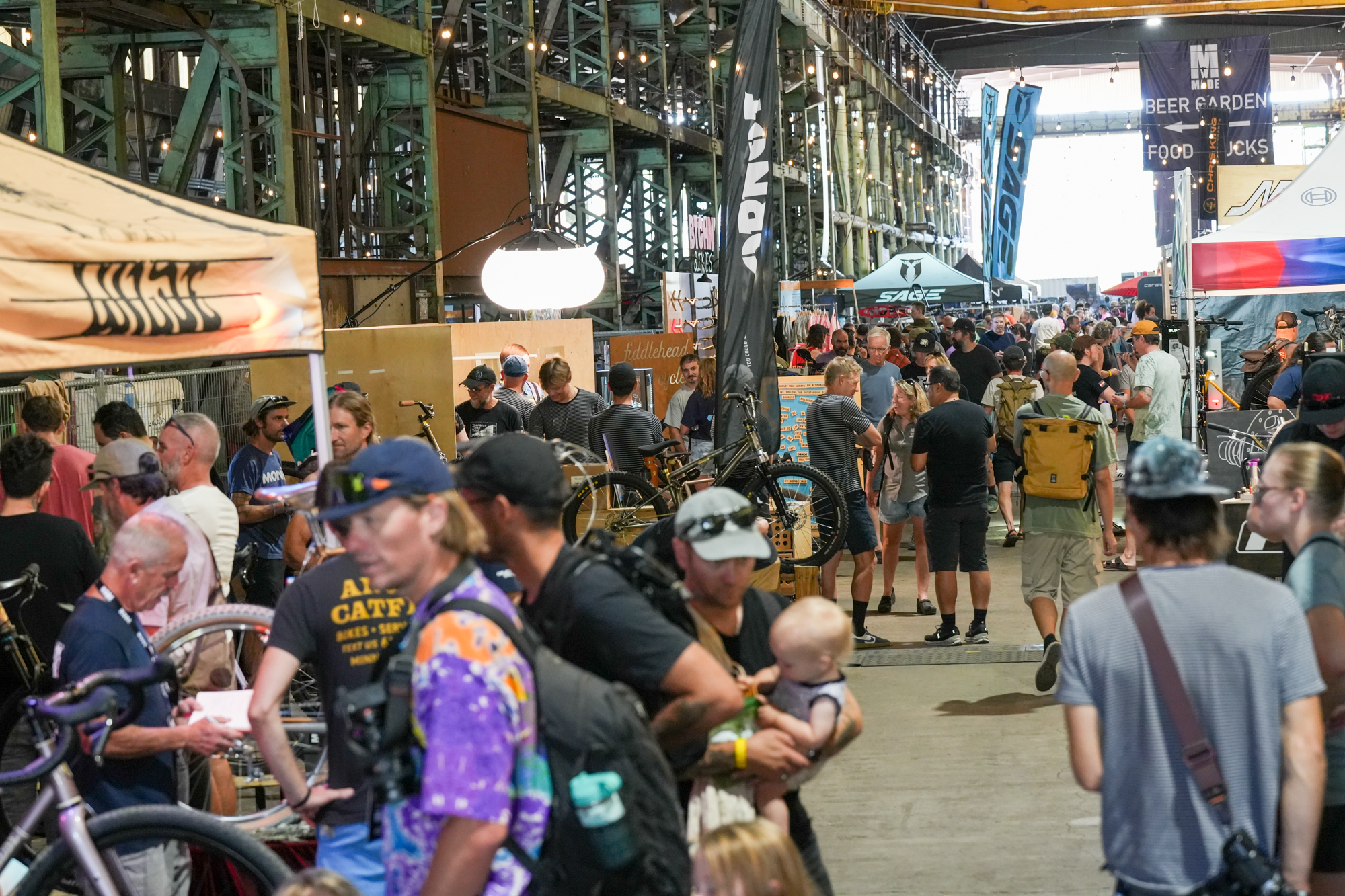
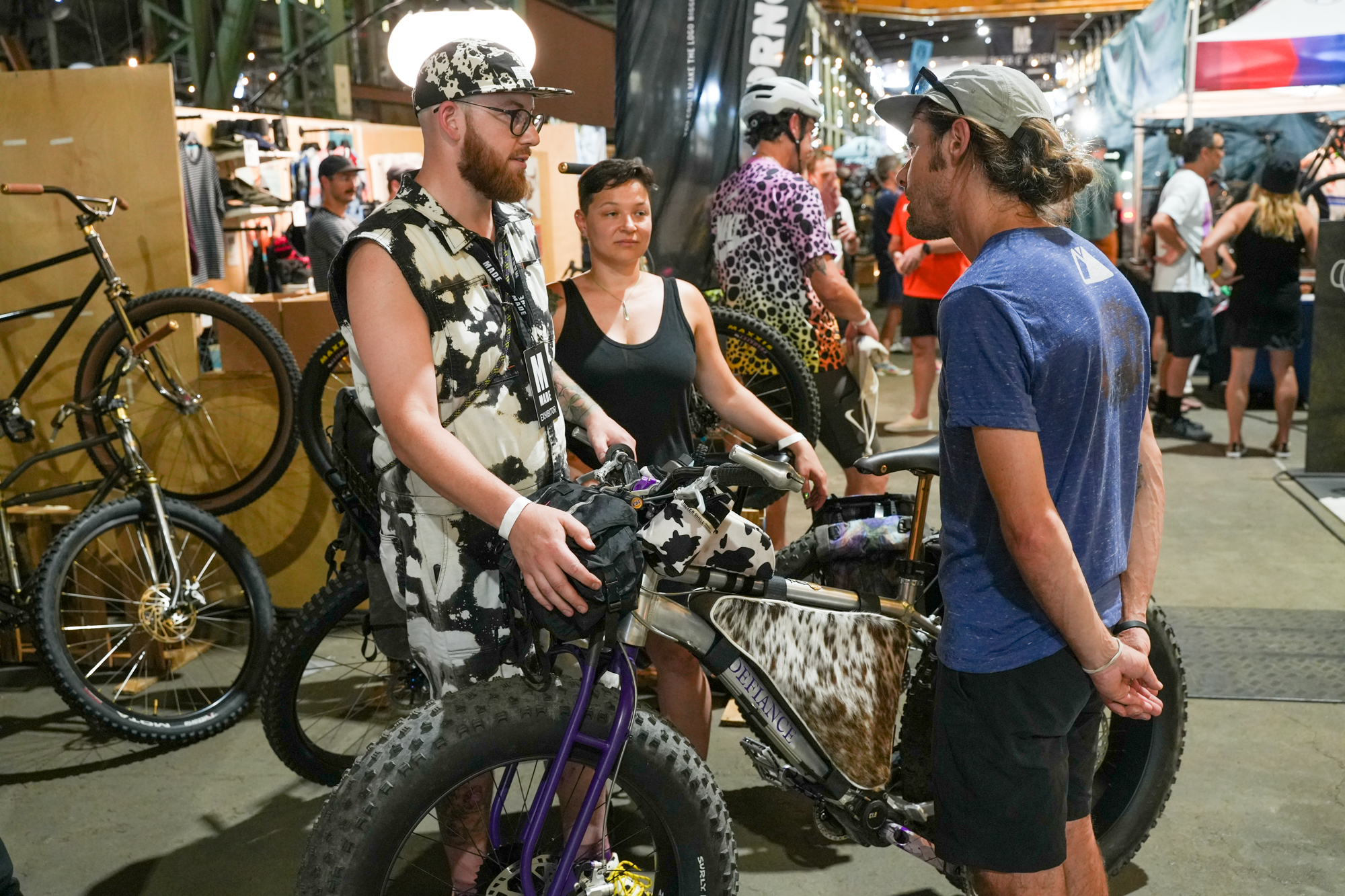
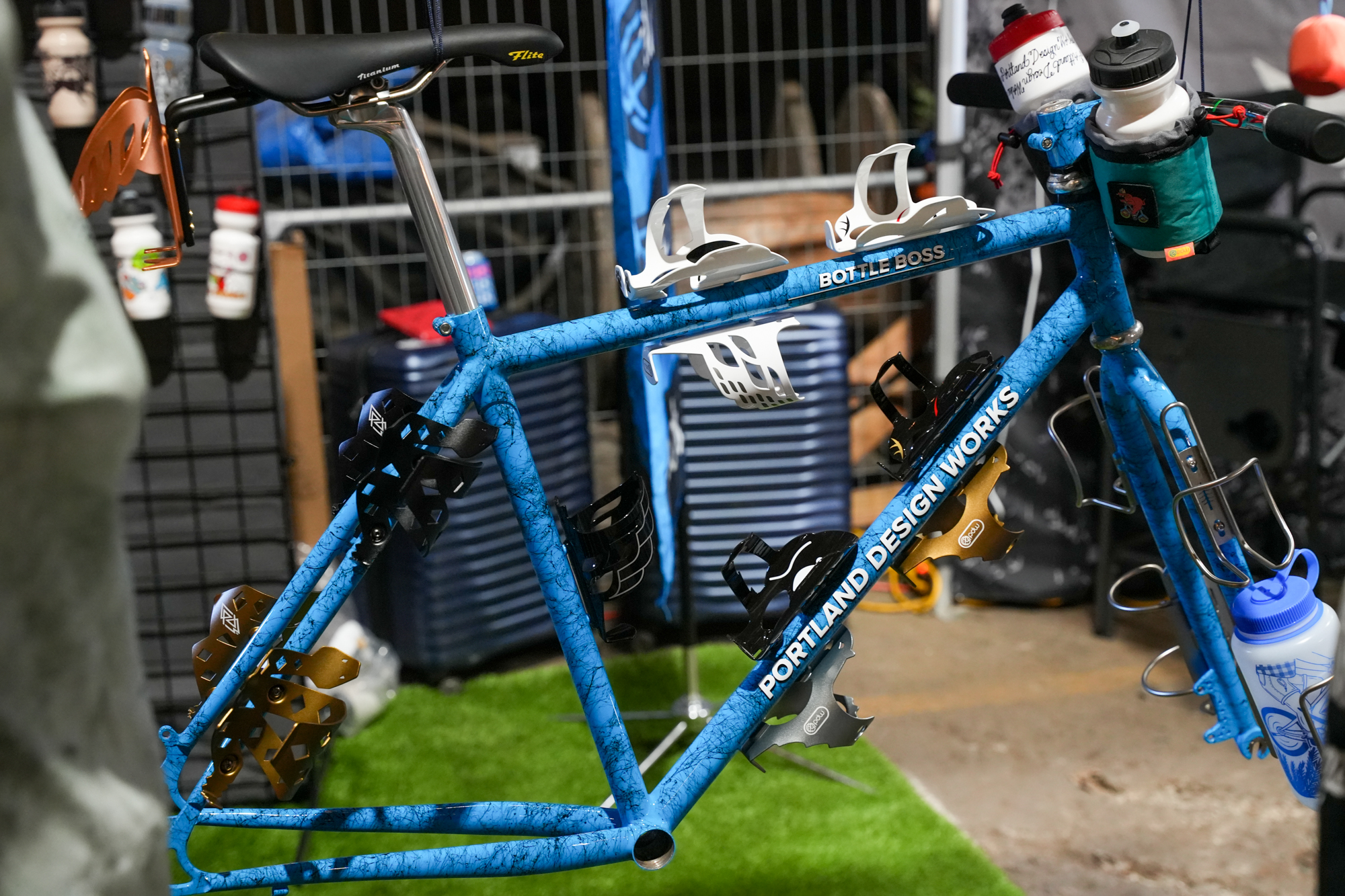
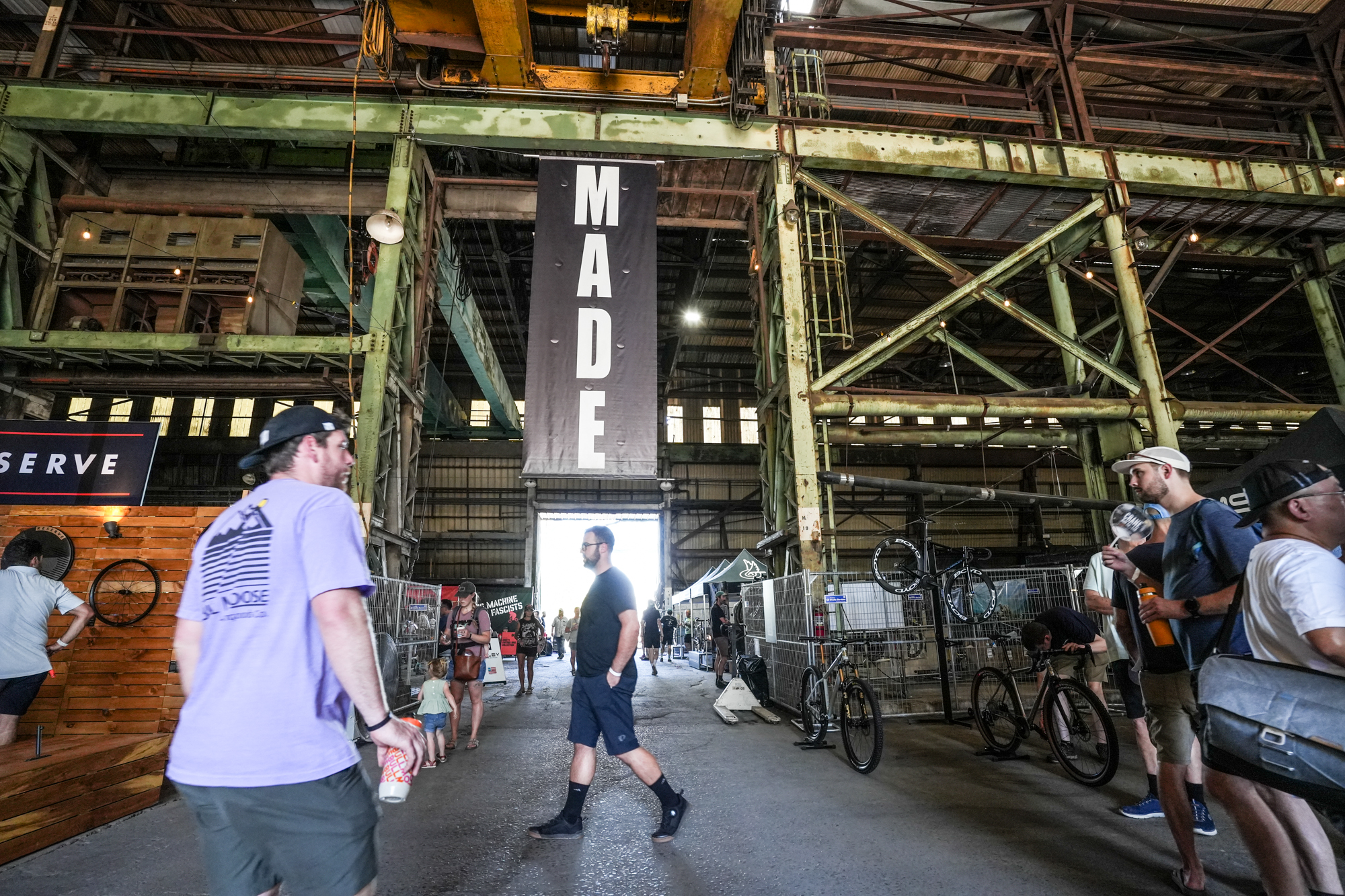
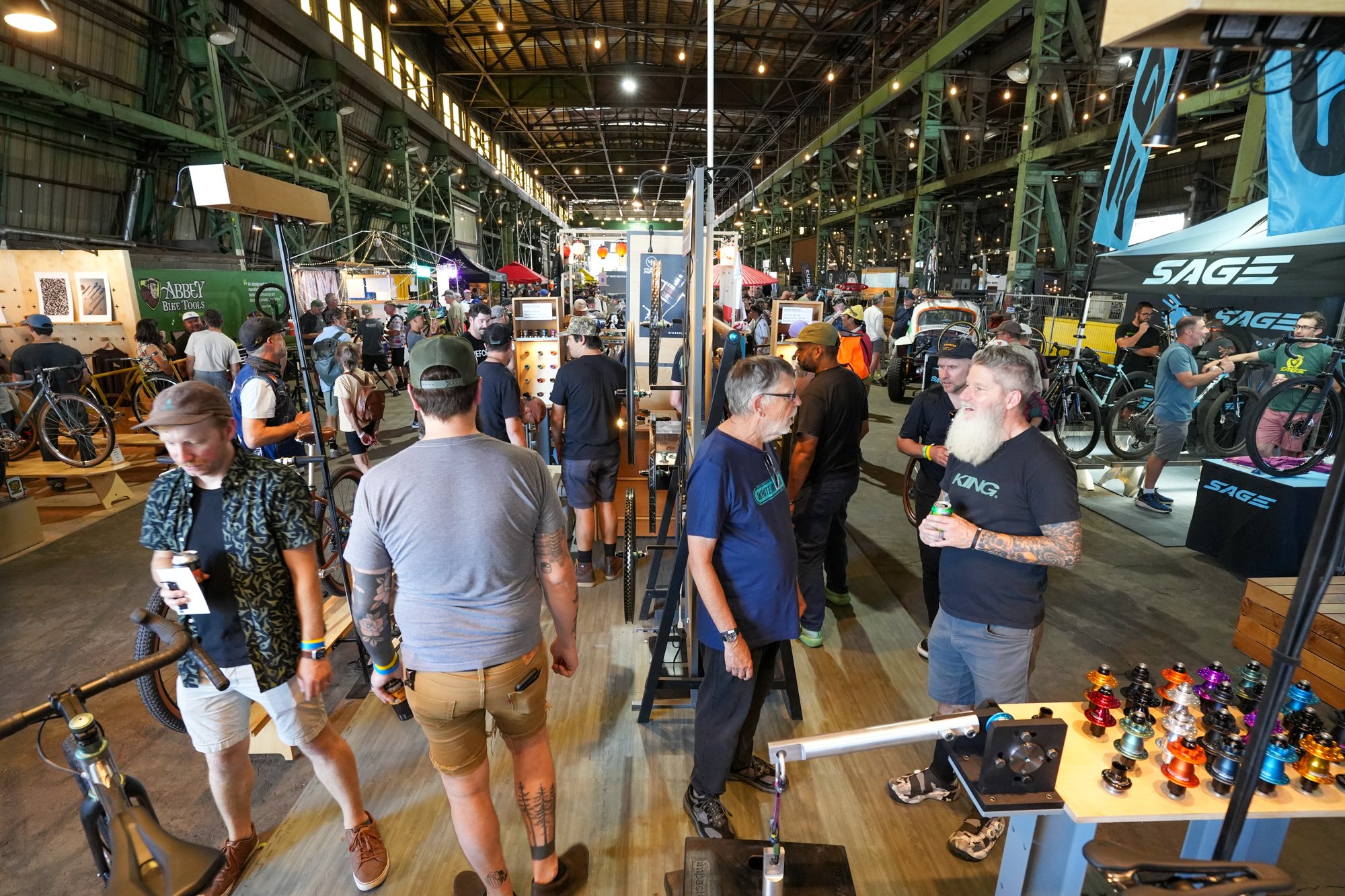
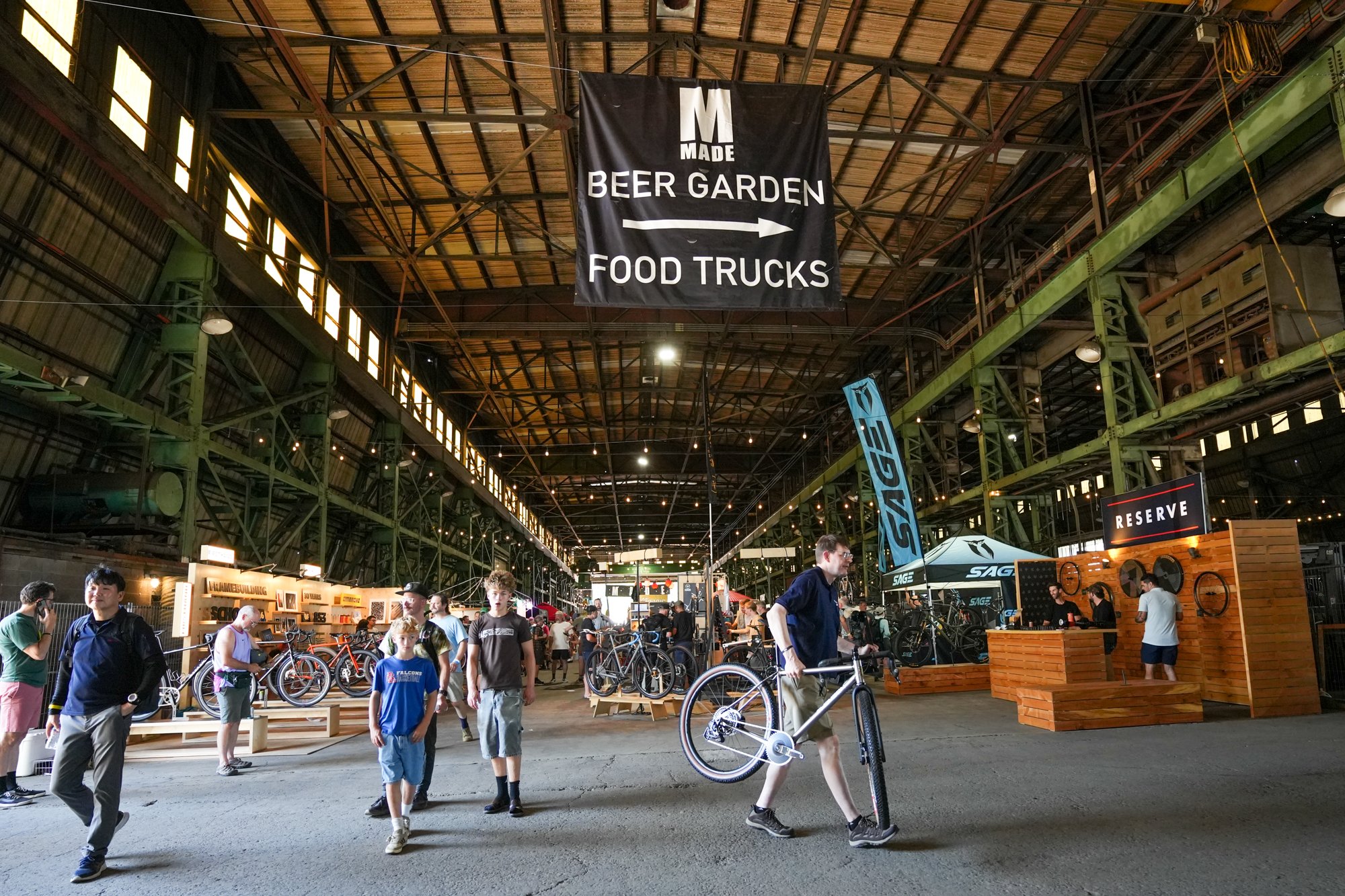
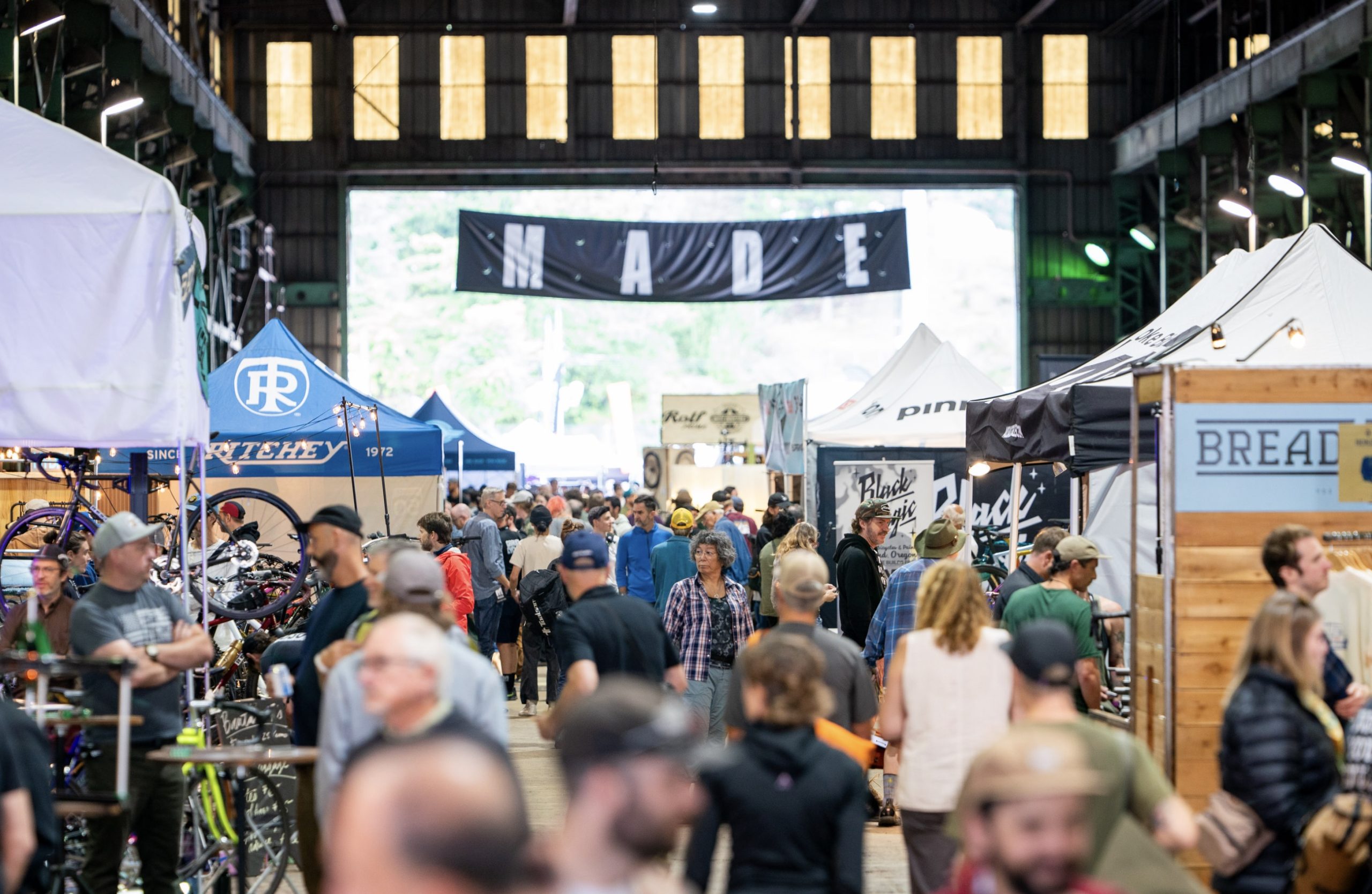
We’re so lucky in Portland to have many talented bicycle fabricators (later this month you’ll have a chance to see dozens of them up close and personal when bike makers from around the world gather in Portland for the annual MADE Bike Show August 22-24th). Come meet the Nomad crew and hang out in the street with us tomorrow (Weds 8/6, 3:00 to 6:00 pm).
As always, Bike Happy Hour is open to everyone. If you have something to share, step up to the mic at 5:30. You can pitch a story you’d like to see on BikePortland, share an event you’re putting on, recite a poem, make a political speech, share your dreams and hopes, whatever you want! I’m going to bring my video recorder and will be posting some of the open mics to BikePortland social media. So if you’re looking to spread a message to a broader audience, don’t miss open mic!
This diverter on NW 20th at Everett is one of three targeted for removal. (Photos: Jonathan Maus/BikePortland)
A plan to remove traffic diverters on two neighborhood greenways in northwest Portland that has been developed largely behind closed doors, appears to be moving forward. Or does it? So far there’s a lack of clarity about why they’re targeted for removal and when it might happen.
The locations in question are NW 20th and Everett and NW Johnson at 14th and 15th. In all three locations, the Portland Bureau of Transportation has installed concrete barricades that prevent car users from turning onto a street, while allowing bicycle riders through (that’s why they are also known as “modal filters,” because they filter out car traffic).
As I reported Friday, the leader of Portland Solutions, a city program created in 2024 and overseen by the Mayor’s office to address homelessness and livability issues that, emailed District 4 City Councilors and other city leaders to inform them that these diverters would be removed. “We are working diligently with [PBOT] Director [Millicent] Williams to ensure these changes occur quickly for the benefits of all community members in NW,” the email from Portland Solutions Program Director Skyler Brocker-Knapp read. The only rationale for this decision provided in the email was to make it easier for Portland Police Bureau (PPB) officers to navigate the streets because the locations of these diverters, “have been particularly problematic in terms of chronic nuisance behavior (drug dealing, vandalism, etc.).” “These were public safety requests and we appreciate partnering with PBOT on these efforts,” Brocker-Knapp wrote.
These diverters are part of a citywide strategy to reduce driving, encourage bicycling, and calm traffic. They are part of a network of neighborhood greenway streets that allow bicycle users to navigate the city in a lower-stress environment and the locations in question were vetted and recommended through a formal process known as the Northwest in Motion plan, which was adopted by City Council in 2020.
That’s why I’m curious to understand more about how the PPB and Portland Solutions are able to mandate their removal with little to no public input. So far, I haven’t heard satisfactory answers to my questions and I remain very concerned not just about the impacts of removing these diverters, but about the precedent we would set by doing so.
The official rationale given by Director Brocker-Knapp was that the PPB needs to more easily navigate these streets so they could address crime hotspots (the diverters create one-way streets for drivers). But since my story published on Friday, I’ve heard other reasons behind the desire to remove them.
A Portland Solutions spokesperson shared with me in a phone call that the removal was, “An ask that came from PPB and PEMO [Public Environment Management Office, another program under the Portland Solutions banner] based over several months of conversations with the community.” I emphasized “community” because that’s an additional rationale not offered in Brocker-Knapp’s email and it speaks to reasons for the removal that go beyond making PPB patrols easier. Those “conversations” referenced by the Portland Solutions spokesperson likely happened at twice-monthly meetings of PEMO’s Problem Solver Network, which the city describes as, “an initiative to address community public realm issues across the city.”
The same spokesperson went on to tell me that their office heard about bicycle riders who are were afraid of using NW Johnson between 15th (where the diverter is) and 16th because of general safety concerns. According to them, the combination of a dark underpass and lack of auto users (due to the diverter), equates to a lack of “eyes on the street” and increases cyclists’ sense of danger. From what I’ve learned working on this story, some of the people behind this diverter removal plan believe having more drivers on these streets will increase visibility and make the streets safer. That line of thinking is not supported in any city planning document and goes against the City’s adopted principles of Vision Zero.
To better understand the issues surrounding these diverters, I visited NW Johnson and NW 20th over the weekend.
NW Johnson and 14thNW Johnson and 14thNW Johnson and 14thNW Johnson and 15thNW Johnson and 15thNW Johnson and 15thDiverters on NW Johnson.
NW Johnson between 14th (the old REI) and 15th was very quiet. There were more bicycle riders than car drivers using the street in the 15 minutes I was there. And all the bicycle riders used the bike lane adjacent to the diverters. There’s just one diverter at 15th, which means there’s ample space on the street for a police officer to drive through in either direction. I also noted how these diverters are part of a strategic, alternating series of one-ways designed specifically to reduce car trips. Prosper Portland’s Broadway Corridor Plan says the neighborhood greenway is a key part of the development’s goal to minimize car traffic on NW Johnson when it is extended through the site to connect to Union Station. “Neighborhood greenways should be developed on NW Johnson Street,” the plan reads, “with volume and speed management features that limit the amount of auto traffic using the street.”
If these diverters on Johnson are removed, it would defeat the purpose of the neighborhood greenway — which is by definition supposed to remain under a specific threshold of cars per day (1,000 cars per day is the target).
Diverter at NW 20th and Everett.
Over on NW 20th at Everett (just one block from where U.S. Congresswoman Suzanne Bonamici was hit by a car driver while walking in a crosswalk in 2023), I found a bustling streetscape adjacent to multi-story apartment buildings and Fred Meyer store. That part of the Nob Hill neighborhood is dense and the intersection of 20th and Everett had a constant flow of drivers, walkers, bicycle riders, scooter users, folks in mobility devices, and so on. The two concrete barriers the create the diverter in the northeast corner of the intersection help calm the intersection by eliminating one option for drivers. Since 2022, this greenway on 20th has been an important north-south street in the bike network that connects to other greenways on Flanders, Johnson, and so on.
I also noticed that if the city removes this diverter, they’ll also be removing the community garden that has sprung up inside them. The two large concrete barrels are filled with soil, plants, and flowers that spill over the sides and onto the street. “Please leave the plants and their flowers as they are so everyone can enjoy them,” reads a sign hanging by a string between to “Except Bicycles” signs.
There would be a significant impact to road conditions in northwest if these diverters are removed. For that reason alone, I’m surprised at how this plan to remove them has emerged largely outside public view. The Problem Solver Network meetings where issues were apparently first raised are not easy to access by the public. Their website doesn’t list dates or times and there are no meeting minutes or agendas to review.
If, as Portland Solutions maintains, these diverter removals have been discussed for several months/years, that means there’s been plenty of time to notify the public and seek feedback to make sure it’s a sound decision. When the removal was announced last week, there hadn’t been any outreach to the City’s Bicycle Advisory Committee, a body that exists to help advise on this exact type of issue.
I’ve got questions out to Portland Solutions and others to learn more about the rationale behind this decision and to find out whether or not the removal is imminent. And I’m not the only one.
“Keeping the diverters intact is the outcome Councilor [Mitch] Green is working toward and at a minimum wants to get a comprehensive understanding from officials responsible why removing these diverters is justified,” Green’s Chief of Staff Maria Sipin shared with me today. “Our office is concerned that this could initiate more removals if the public and City Council aren’t informed.”
I’m still waiting for more clarity. But at this moment I’ve heard mixed signals about how imminent the removals are. I’ve heard the order to remove them is final and that City Administrator Michael Jordan is moving forward with it right away. And the email from Brocker-Knapp used the word “quickly”. But Portland Solutions shared with me Friday that, “We’re in the early stages of this,” and that, “I still think that there’s time for engagement.”
A local urbanism advocacy group that supports the diverters is meeting tonight to talk about the issue and leaders from Portland Solutions are expected to attend the PBOT Bicycle Advisory Committee on August 12th. Let’s hope they remain on the street until at least that meeting so we can better understand the argument against them.
This issue is not just important from a traffic safety and planning perspective, it’s a test of how public engagement works (or doesn’t) in Portland’s new form of government. So far there’s been a major lack of transparency around how the decision was made. In the past, anyone concerned about this could contact the commissioner in charge of PBOT. But now we have city administrators who oversee PBOT and they’re not set up for easy public contact. The page on the City’s website that lists City Administrator Michael Jordan and Deputy City Administrator of Public Works Priya Dhanapal, for instance, doesn’t even have individual contact information.
If you care about this issue and want to make your feelings known, use this form to contact city leaders (in addition to leaving a comment here so city leaders can read it).
I expect to hear more from Portland Solutions and others in the coming days and will continue to monitor this issue closely. Stay tuned.
The scene outside Kerr Bikes on the Esplanade at an Adaptive Biketown ride in 2022. (Photo: Jonathan Maus/BikePortland)
The City of Portland program that offers free adaptive bicycle rentals could look a lot different next year.
Since it launched in 2017, the Portland Bureau of Transportation’s Adaptive Biketown program has partnered with Kerr Bikes as its vendor and physical location right on the Eastbank Esplanade near OMSI. That contract end at the end of September and the City says they’ll seek a new vendor.
Adaptive Biketown was the nation’s first-of-its-kind program that offered free rentals of a variety of recumbents, hand-cycles, four-wheelers, trikes, and other types of bicycles that can be ridden by people who don’t want to use the standard, two-wheel variety offered in the Biketown bike share system. Today it’s seen as a big success, but the program came into existence by accident.
In 2016, just as PBOT was finally going to launch the Nike-sponsored Biketown system, activists starting wondering how folks with disabilities would participate. A BikePortland story asked the question: Is Biketown bike share for all? Or only the able-bodied?. Following a broad community dialogue about the need for adaptive bikes, PBOT swung into action by hosting an adaptive bike clinic and shortly thereafter found support to launch a pilot Adaptive Biketown program.
In its first year of operation (2017) PBOT reported year 59 total rentals to 27 unique participants. In 2024, the program had 443 rentals. Each year PBOT has added to the bike fleet and has continued to host encouragement events to make people aware of the resource. Now the program has secured funding from the Portland Clean Energy Community Benefits Fund to maintain its operations until at least 2028.
Kerr Bikes is run by Albertina Kerr, a nonprofit that empowers people with intellectual and developmental disabilities. They say they’ll donate all bikes and equipment to the next operator of the system. PBOT will open a Request for Proposals (RFP) later this year with hopes of starting the 2026 season with a new operator. If you are interested or know of organizations who might be a good fit for this opportunity, email sharedmicromobility@portlandoregon.gov to make sure you receive the RFP notice.