It has been wonderful to see BikePortland commenters refer to the Office of Community & Civic Life’s new neighborhood profiles. We reported on them a couple of weeks ago in our Portland Engagement Project post, and I’ve noticed some of you referring to stats from the profiles in your comments. That’s great!
Shortly after we wrote that article, the Office of Community and Civic Life issued a press release with much of the same information.
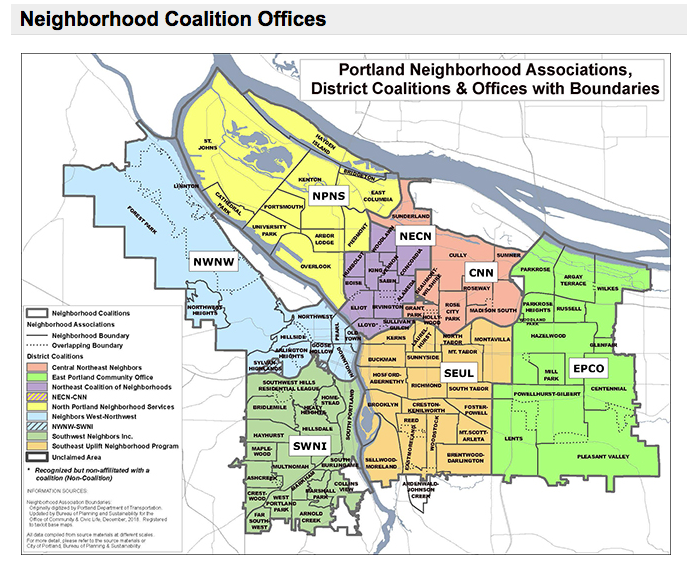
With one exception. The press release offered a preview of their new Neighborhood Association and District map (at top).
A comparison with the old map shows a small boundary change—the northern-most SW neighborhood association, SWHRL, joined the Northwest coalition. And the new map has substituted icons for coalition names.
Editor: The last several paragraphs of this story have been edited out per the comment below from the Office of Community and Civic Life. (10:23 AM 2/14/2023)
Critical Fixes projects brings urgent safety improvements and maintenance repairs to 82nd Avenue.
(Jan. 30, 2023) – The Portland Bureau of Transportation (PBOT) began its multi-year effort to bring urgent safety and maintenance repairs to 82nd Avenue with the installation of new speed reader boards and traffic signal controllers on the 7-mile corridor. These initial investments come just six months after the ownership of the corridor transferred from the Oregon Department of Transportation (ODOT) to PBOT and are informed by a decade of community planning and advocacy.
The speed reader boards alert drivers to “Slow Down” while providing real-time feedback on how fast they’re driving. PBOT deployed one speed reader sign north and south of McDaniel High School, just as people are approaching the school.
More safety improvements are expected as PBOT begins its work on the Critical Fixes: Signal Timing Improvements Project. The installation of new traffic signal controllers replaces the 20-year-old “brains of the intersections.” The newly-installed signals provide a major upgrade and bring PBOT’s signal technology up to modern standards. The new Advanced Transportation Controllers allow PBOT to interconnect its signal timing adjustments and high-speed fiber optic communications. With this technology in place, PBOT will make efforts to reduce opportunities for drivers to speed through multiple signals. Additionally, PBOT will remotely monitor performance in real-time and shorten overall wait time for all people traveling Tat traffic signals. B-roll video of PBOT crews installing the Advanced Transportation Controllers is available to news media upon request.
In total, PBOT expects this technology to be installed at 18 intersections on 82nd Avenue, with the majority of the installations occurring later this week.
This new equipment will enable PBOT to implement pedestrian head start signals at several locations throughout the corridor. A pedestrian head start is a signal timing strategy that improves the safety and visibility of pedestrians by giving pedestrians a walk signal several seconds before vehicles are given a green light.
As part of 82nd Avenue Critical Fixes, PBOT will improve safety for those moving along and across the corridor. Over the next several years, PBOT and ODOT will add a total of 17 new or upgraded crossings of 82nd Avenue to improve safety and fill many of the existing crossing gaps. As these 17 new crossings are installed, PBOT will update its traffic signal system to prioritize safety for all road users. Visit the Critical Fixes website for a full list of planned crossing and traffic signal locations.
PBOT’s safety improvements to 82nd Avenue come after years of community engagement. Watch the video below, and hear from McDaniel High students on how necessary critical safety improvements are to the corridor.
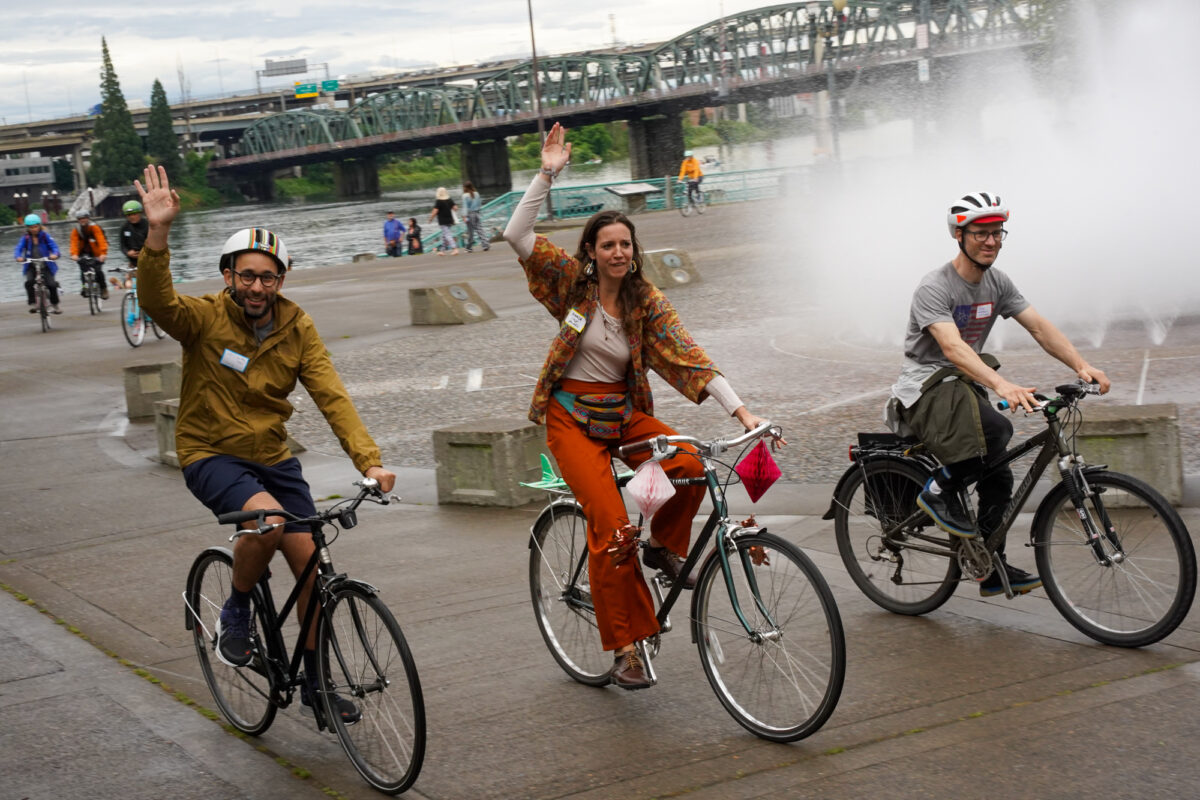
Shift helps get the word out about events like last summer’s “New to Portland” ride, plugging new people into Portland’s bike scene. (Photo: Jonathan Maus/BikePortland)
“[Shift] doesn’t run itself, even though it might seem like it does.”
– Josh Hetrick, Shift volunteer
Shift is one of the mainstays of Portland’s bike scene. These days the non-profit is best known for their ride calendar, but there’s a lot more going on behind the scenes. Their tagline says it best — Shift is “bringing people together for bike fun.” At a volunteer meet-up last week, leaders of the group said they need more help to keep the fun going.
Shift was founded after the first ‘Bike Summer’ in 2002 and has been a focal point of free, social “bike fun” rides ever since.
So, what is Shift? After Bike Summer moved onto other cities, Shift volunteers got together and kept the fun rolling. They created what eventually became known as Pedalpalooza, which celebrated its 20th anniversary last year (and has since spun off from Shift). Shift is also the force behind Breakfast on the Bridges, the monthly events where kind folks show up to give away free coffee and donuts to whoever rolls by. In addition to their ride calendar and events, Shift also hosts an email list where people can communicate about bike issues in Portland. The Shift List was the communications channel back in days before BikePortland and social media, but it has quieted down a lot in recent years.
Advertisement
Shift calendar
“Shift preceded social media, and it’ll be here after social media is gone,” said Emee Pumarega, a board member, at Wednesday night’s volunteer recruitment event. (This message is especially comforting as Twitter’s functionality seems to change by the hour.)
When a tool runs as seamlessly as the Shift calendar does, you might not realize that it requires upkeep and some human grunt work to keep it going. Right now, the non-profit has three board members, and they only have a couple other regular volunteers who chip in to help with social media and tech maintenance.
“It doesn’t run itself, even though it might seem like it does,” board member Josh Hetrick said.
Keeping Shift in order — and the gears of Portland’s bike scene greased up and turning — is a lot of work for just five people.
“It would be nice to have more people involved, to spread around the mental load,” Pumarega said. “And we could use a sustained PR push to let people know [what Shift is].”
Advertisement
Mostly, Pumarega said, Shift just serves as the “community underneath” the fun bike events and rides going on in Portland. They promote rides both on their website and on social media. Going forward, the current board members have plans to create initiatives like ride leader education and a grant program to help fund ride and event materials. They also want to add more functions to their calendar, like a search feature to sift through the hundreds of rides going on during Pedalpalooza.
In order to make these things happen, board member Logan Vickery said he wants to see the board expand to at least five people. He also wants to hand off his current position as the finance director and grow their social media team so they can do more ride promotion throughout the year.
But you don’t have to be on the board to help out at Shift. “You can create the volunteer job that you want to have,” Pumarega said. This could mean answering emails, helping lead ride workshops, doing tech fixes, tabling at the farmer’s market — or whatever you can think of.
Whether you’re a more casual bike fun participant or you’re a Pedalpalooza veteran, Shift has likely helped you have fun on your bike. Let’s show them some love in return by stepping up to volunteer and keep it going for years to come. Email board@shift2bikes.org to find out how you can get involved.
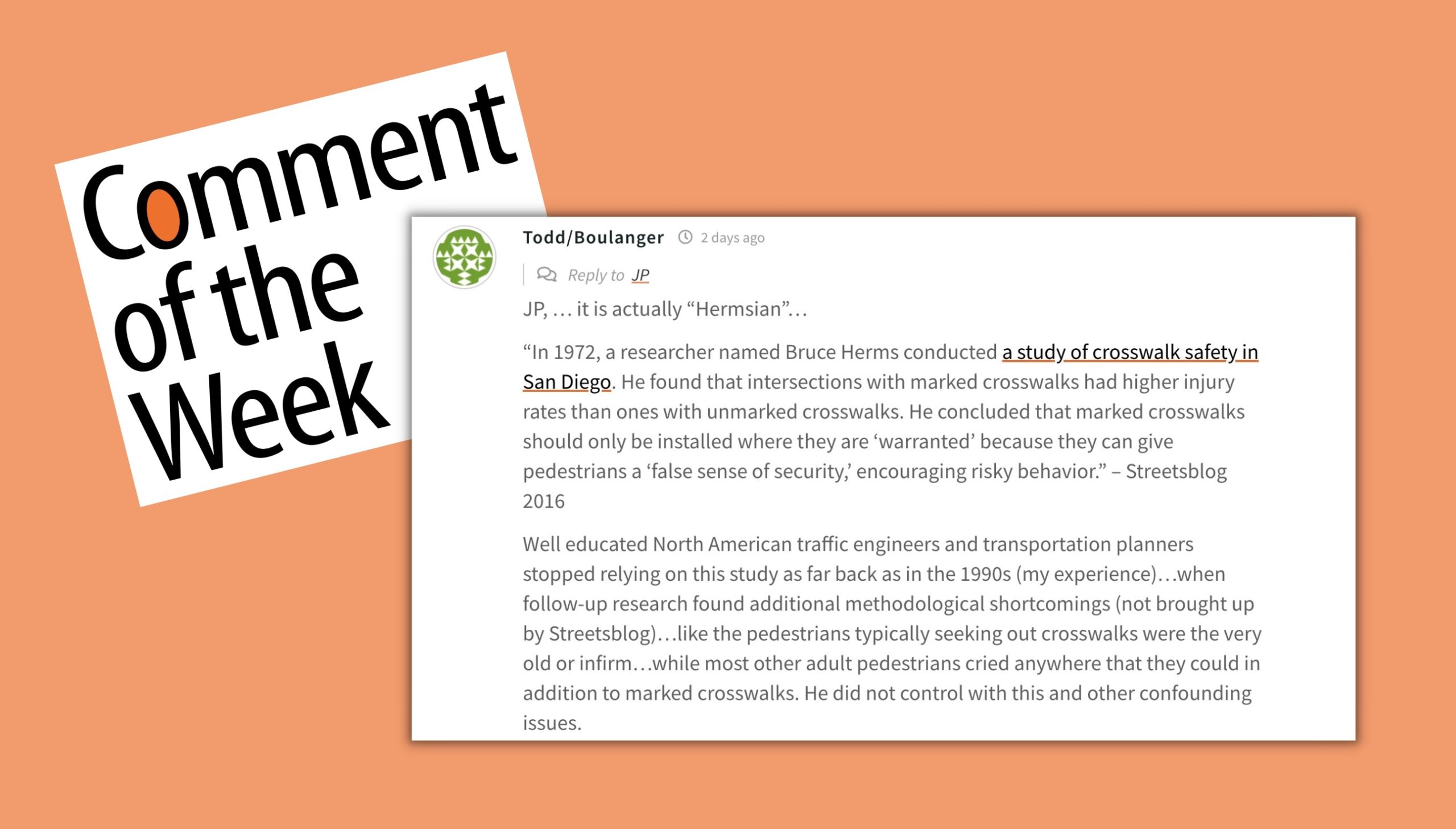
Welcome to the Comment of the Week, where we highlight good comments in order to inspire more of them. You can help us choose our next one by replying with “comment of the week” to any comment you think deserves recognition.Please note: These selections are not endorsements.
But first lets talk about nominating comments to be a “Comment of the Week.” Do it! It is really helpful to us to have those suggestions. Here’s how I work: I keep an open file of what I think are good comments as the week proceeds. But if I push a comment through from the phone, I might forget to put it on my list. That’s what happened here.
Luckily, someone nominated Todd/Boulanger’s excellent comment to be “Comment of the Week,” and it has lived to see another day. Thank you.
This comment is a good example of an informative comment from a pro. We get a fair number of those, and it’s part of why people read the BikePortland comment section: Because you learn stuff.
In this example, Todd/Boulanger helps us understand where the idea of a “false sense of security” originated. He writes in reply to another commenter, “JP,” who labelled the ODOT decision “Orwellian.”
Here’s what Todd/Boulanger wrote:
Advertisement
JP, … it is actually “Hermsian”…
“In 1972, a researcher named Bruce Herms conducted a study of crosswalk safety in San Diego. He found that intersections with marked crosswalks had higher injury rates than ones with unmarked crosswalks. He concluded that marked crosswalks should only be installed where they are ‘warranted’ because they can give pedestrians a ‘false sense of security,’ encouraging risky behavior.” – Streetsblog 2016
Well educated North American traffic engineers and transportation planners stopped relying on this study as far back as in the 1990s (my experience)…when follow-up research found additional methodological shortcomings (not brought up by Streetsblog)…like the pedestrians typically seeking out crosswalks were the very old or infirm…while most other adult pedestrians crossed anywhere that they could in addition to marked crosswalks. He did not control for this and other confounding issues.
“Since the Herms study, other studies have refuted his conclusions, including work produced by the FHWA. Nevertheless, the influence of his research from [50] years ago persists. As backward as it seems, engineers still refuse to install crosswalks on the grounds that it would harm pedestrian safety.” – Streetsblog 2016
Thank you , Todd/Boulanger! And thank you for the links. You can find Todd’s comment, and the 106 other things people had to say, under the original post.
Here are the most notable stories our writers and readers have come across in the past seven days…
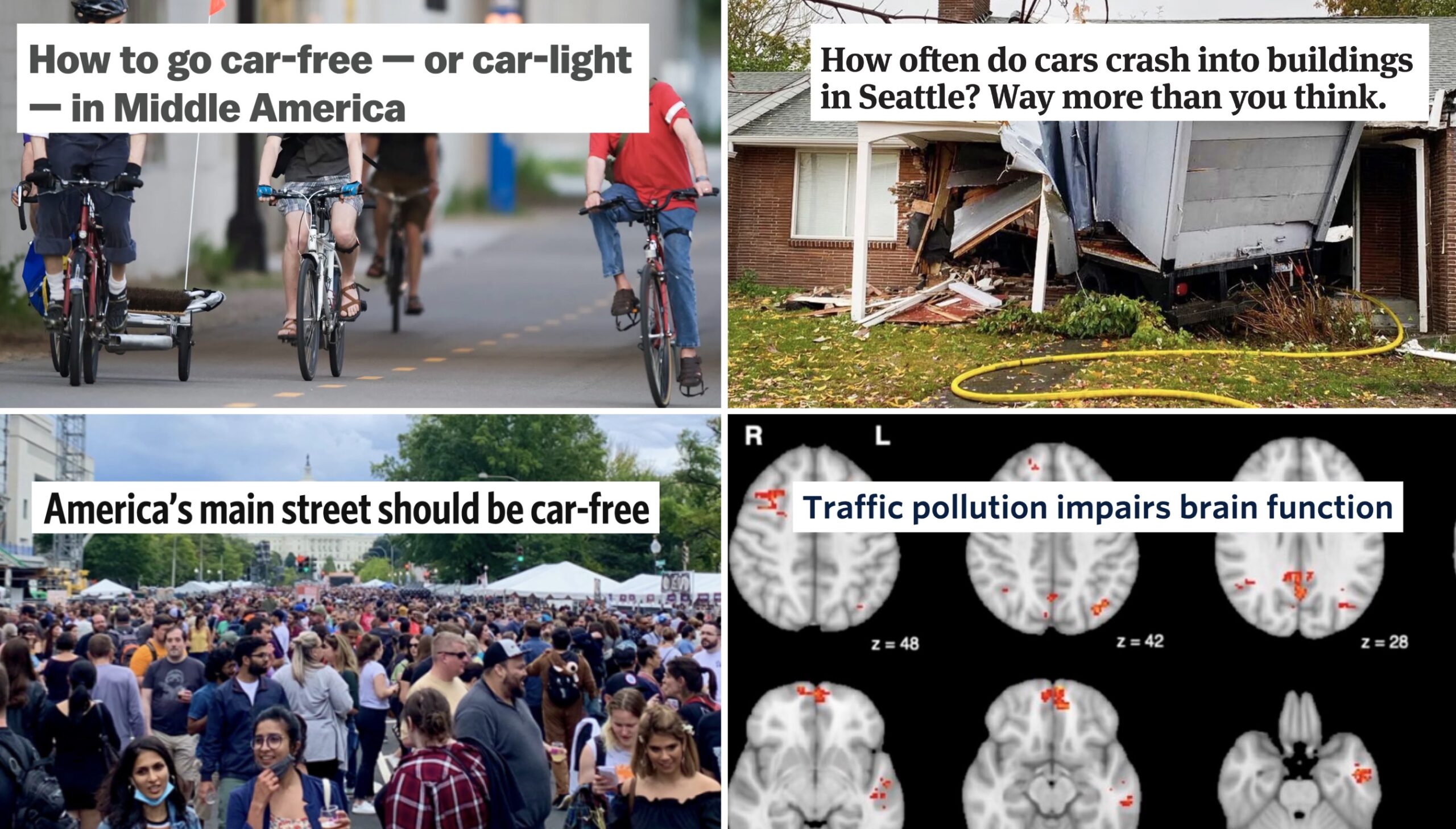
Recipe for low-car life: Driving less is imperative for our survival as a species and this article from Angie Schmitt is a wonderful summation of how to do it — no matter where live. (Vox)
USA’s (carfree) main street: It was cool when Pennsylvania Ave in Washington D.C. got it’s own, center-running bike lane. It would be much cooler if it went completely carfree. (Greater Greater Washington)
Cars as appliances: The auto industry has found a new way to integrate their products into peoples’ lives: As a power generator. Ugh. (Washington Post)
Vision Zero for buildings: Too many drivers are running into homes and businesses. A review of fire department records in Seattle showed that it happened once ever 3 and 1/2 days in 2022. (Seattle Times)
Advertisement
Toxic traffic: A new study shows that even relatively low levels of exposure to traffic pollution can have a negative impact on your brain and its author say, “if you’re walking or biking down a busy street, consider diverting to a less busy route.” (University of British Columbia)
Dubai’s green ‘Loop’: This city in the United Arab Emirates wants to build a 60-mile long, fully-enclosed biking and walking highway to reach a goal of 80% bike/walk mode share by 2040. Your move, Portland! (Arabian Business)
A Major documentary: “Whirlwind” is the name of an in-progress documentary that will finally tell the story of famed Black bicycle racer Major Taylor — if its creators can raise enough money to finish it. (Cycling Weekly)
Commute benefits: Researchers found that many people who’ve moved to remote work miss their car commutes because of the liminal space it provided between work and home. (The Conversation)
(Fre)e-bikes: This program that used grant funding to give free e-bikes to residents of the Wilmington neighborhood in Los Angeles is likely going to be a blueprint we see all over America in the coming months and years. (LAist)
About those freight train delays: In another good episode of KGW’s ‘Driving Me Crazy,’ they take a closer look at the annoying delays caused by freight trains in inner southeast and what might possibly be done about it. (KGW)
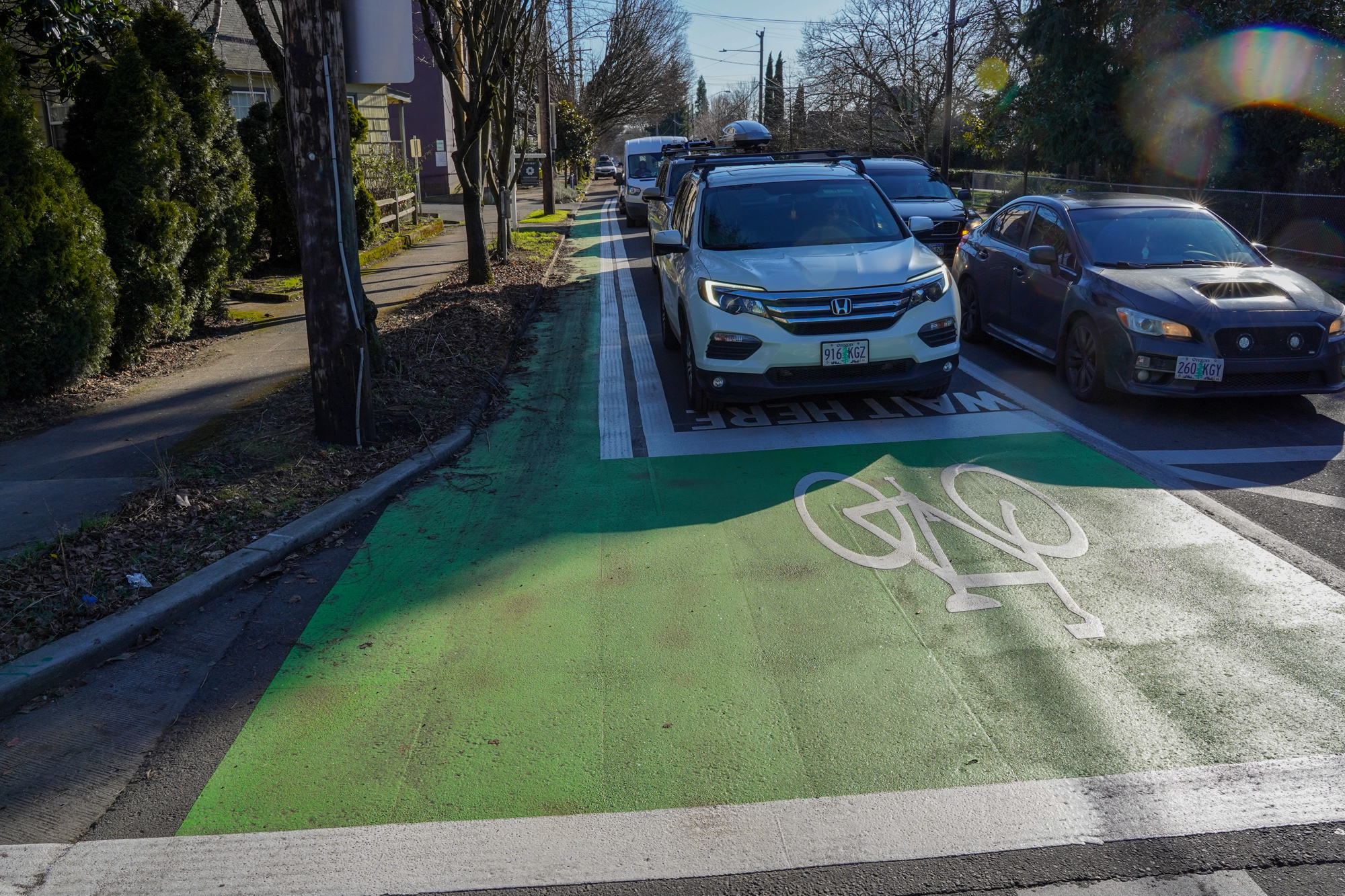
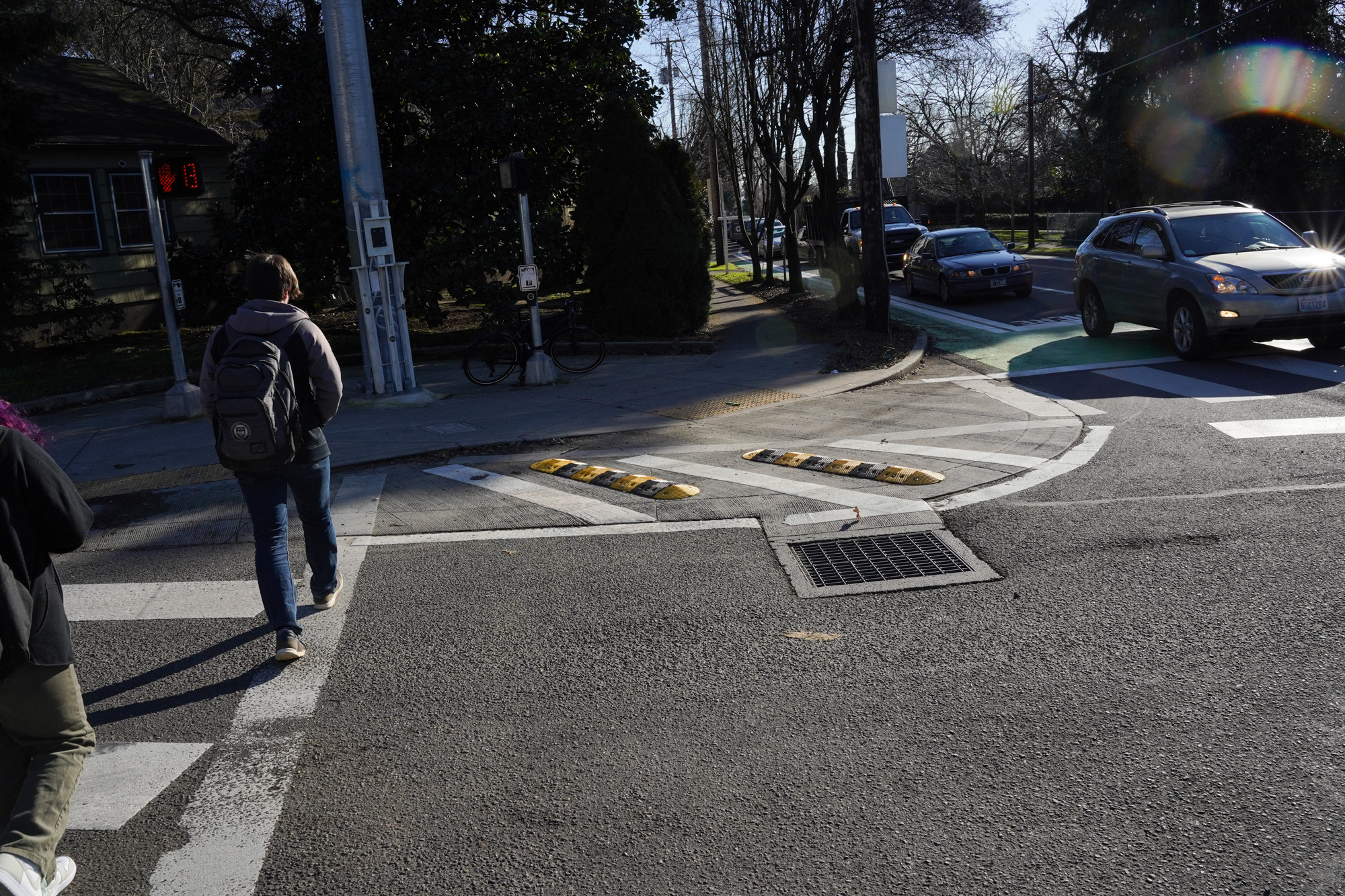
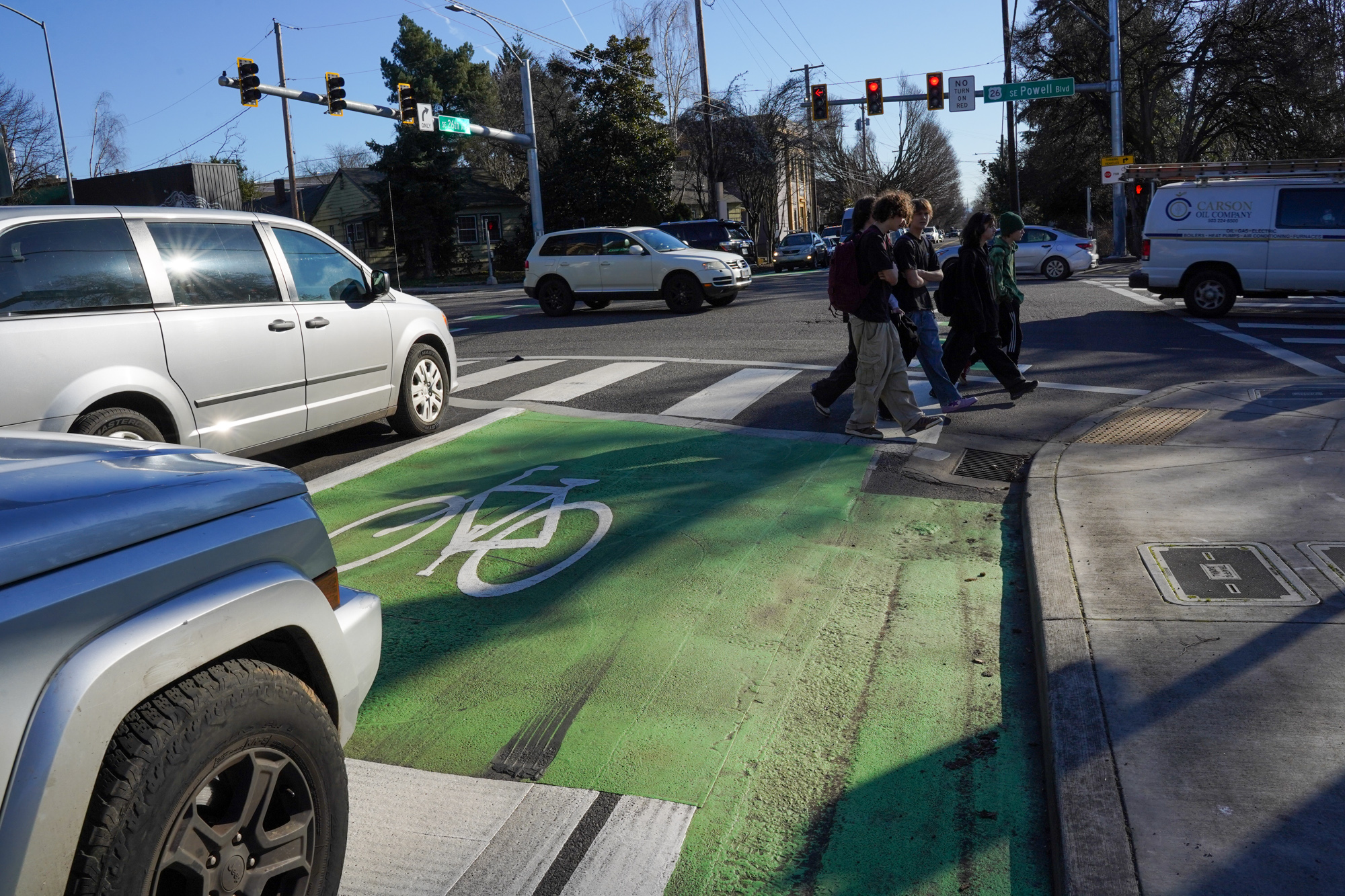
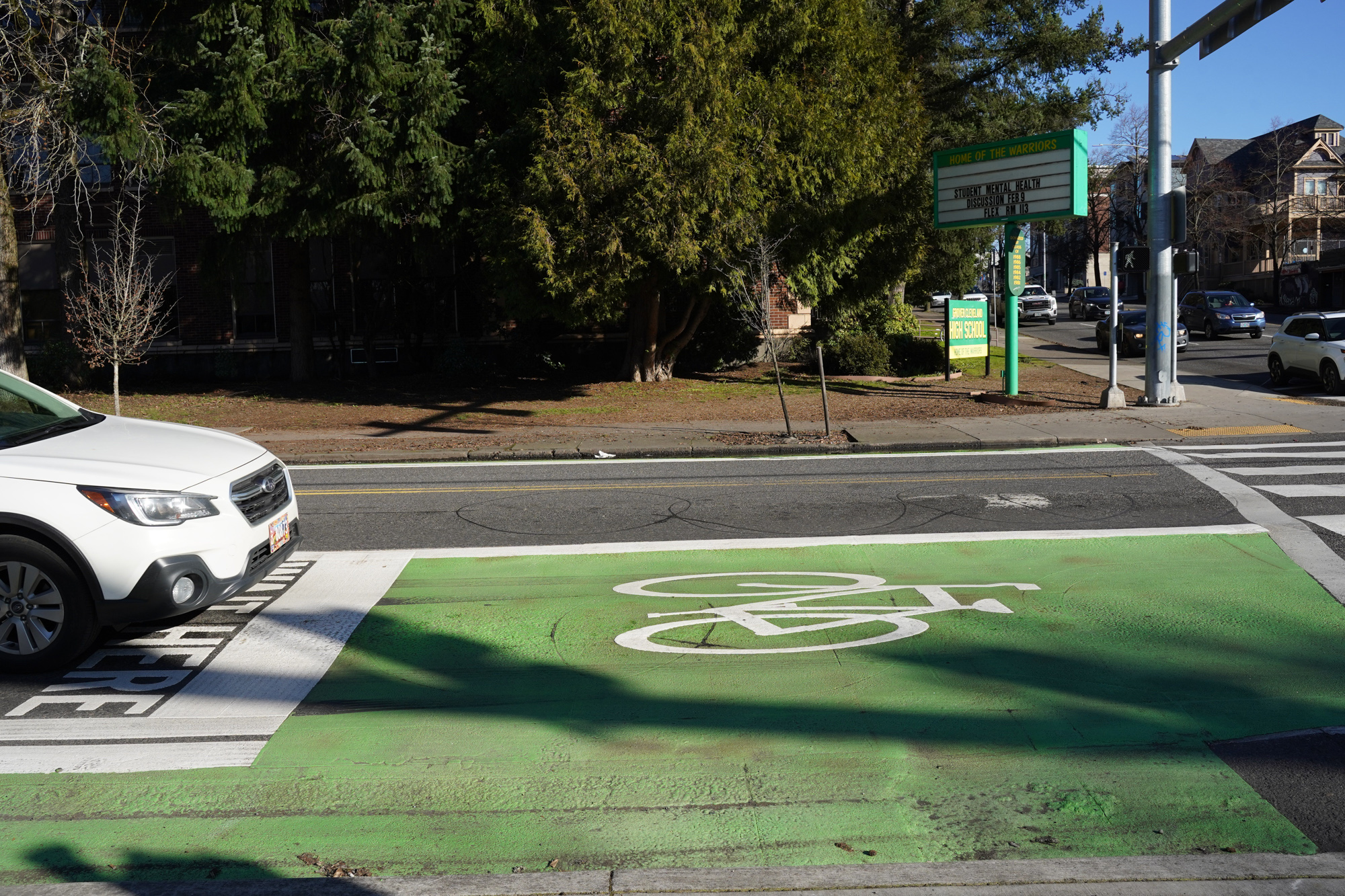
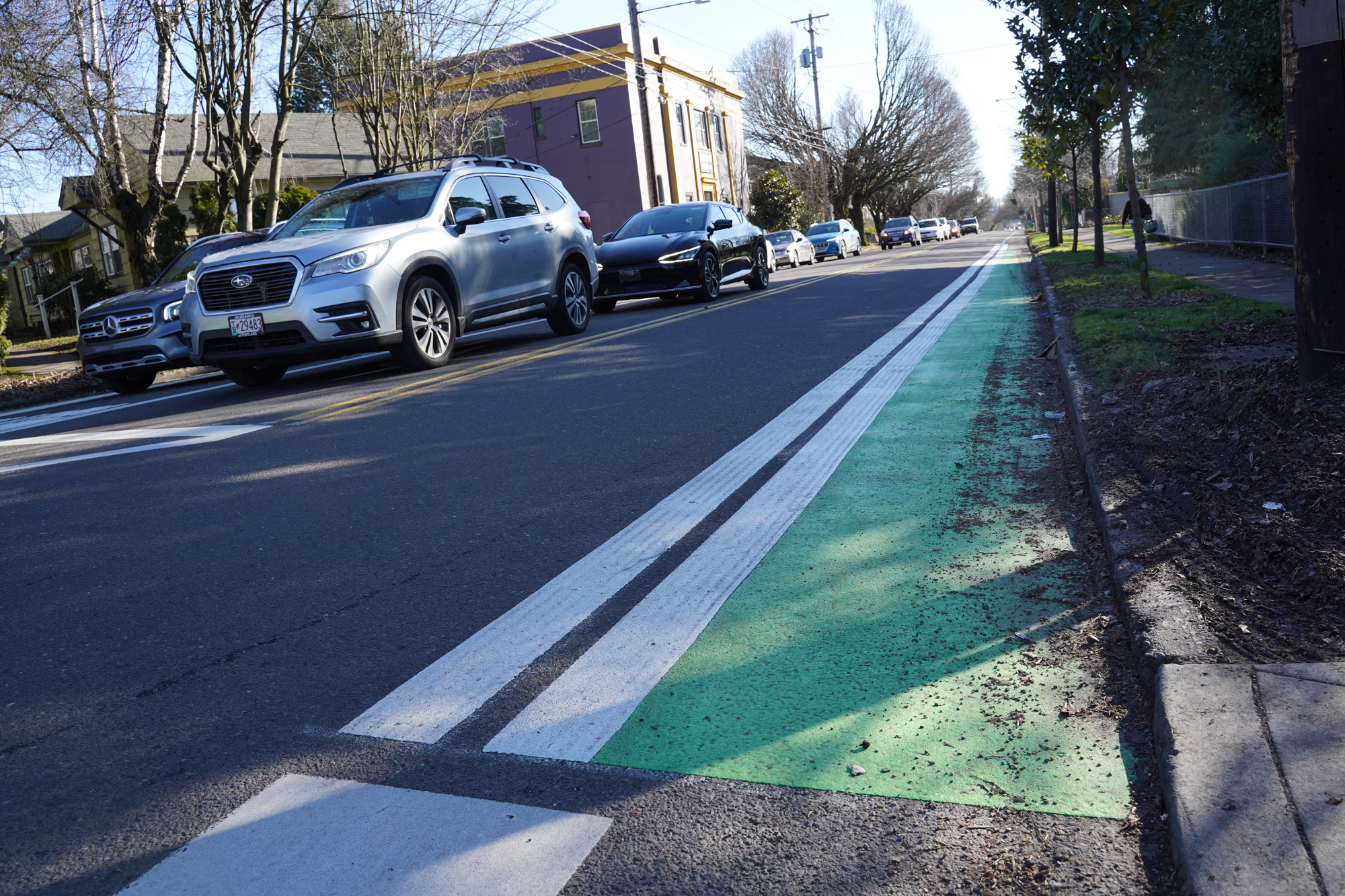
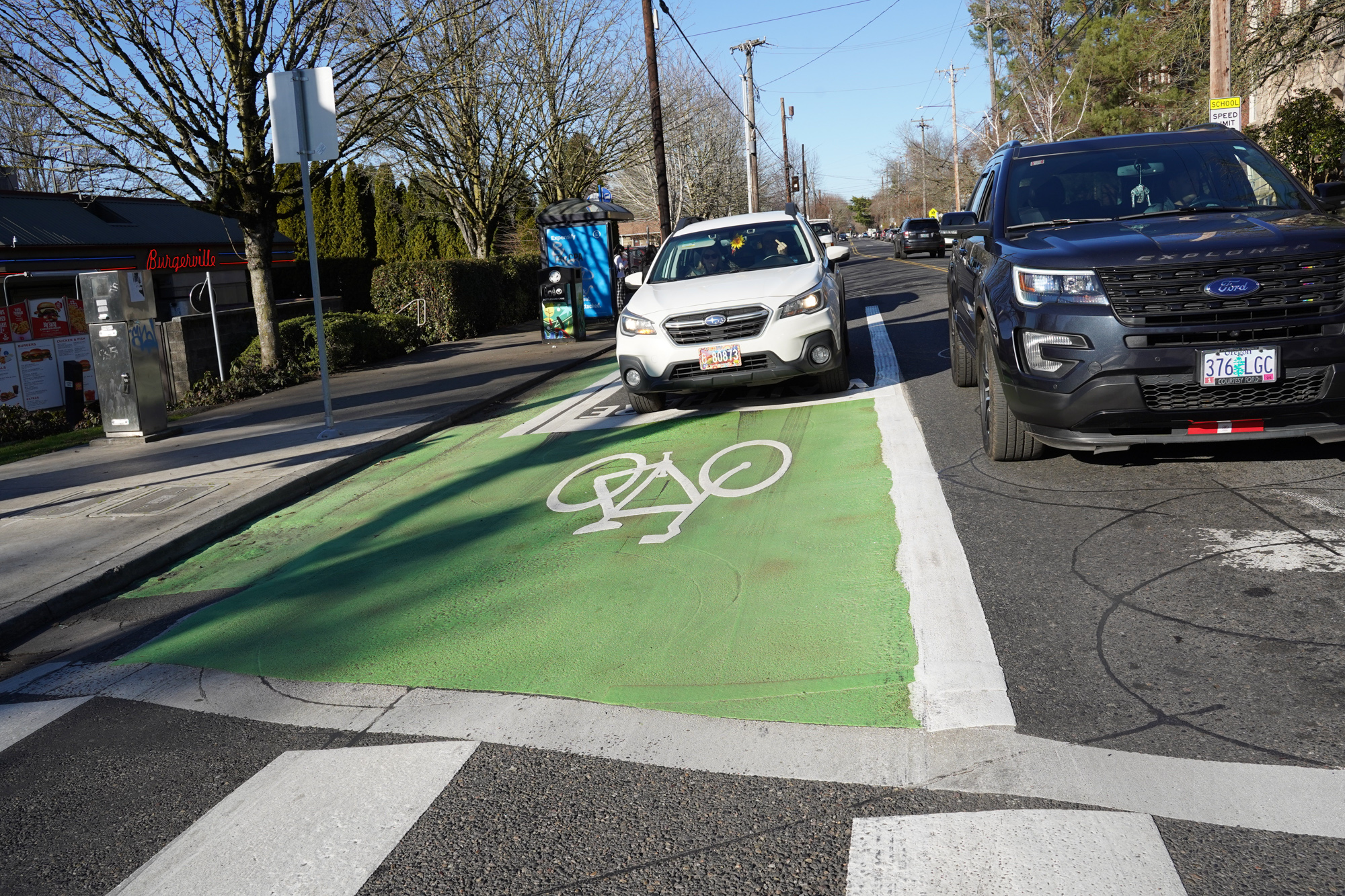
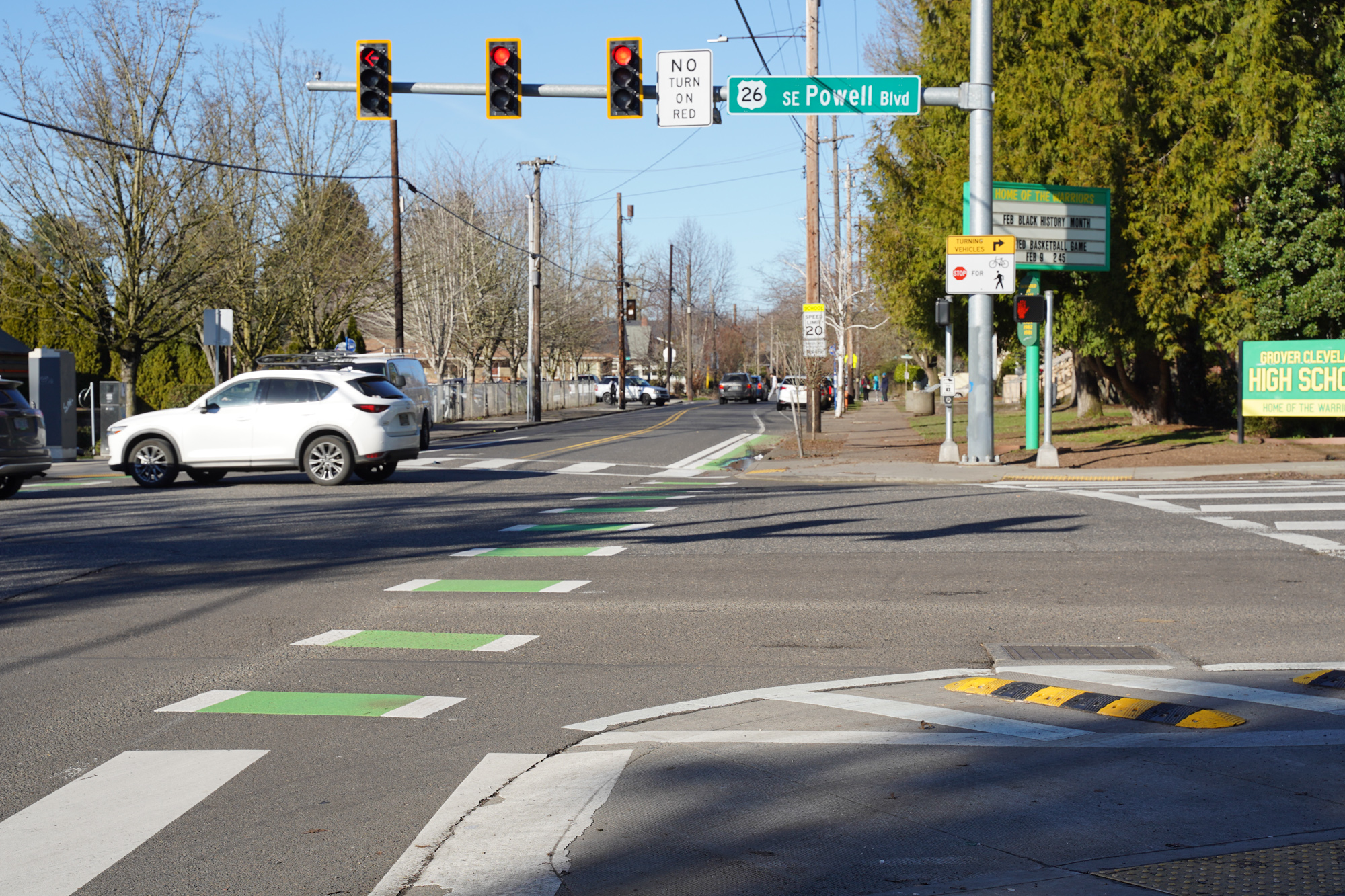
The new bike box installed in the same corner where Sarah Pliner was hit and killed back in October. Vegetation on the left has also been cut back to improve visibility. (Photos: Jonathan Maus/BikePortland)
When the Oregon Department of Transportation strong-armed the City of Portland to remove the bike lanes and bike boxes on Southeast 26th Avenue and Powell Boulevard in 2018, we knew it would make the crossing less safe. But ODOT persisted. In a twisted plan to encourage people to not bike on 26th (lest they get hit and make ODOT look bad) the agency removed infrastructure that was meant to protect them.
Looking back, that plan was both twisted and tragic.
That’s because on October 4th of last year, Sarah Pliner was riding her bike to work and somehow came into contact with a large trailer pulled by the driver of a semi-truck who was making a right turn from 26th onto Powell. The collision killed Pliner and her body came to rest just yards from where ODOT removed the bike box.
Now the Portland Bureau of Transportation has re-installed the bike boxes. One of them is in the exact spot where, just four months ago Oregon Walks leader (now Metro Councilor) Ashton Simpson stood in the southeast corner of the intersection with a sign that read, “Human Bike Box.” He was part of a large protest that helped force the hand of PBOT and ODOT to step up and do the right thing.
It’s nice to see this infrastructure come back. But I won’t celebrate, because it cost us the life of Sarah Pliner.
Advertisement
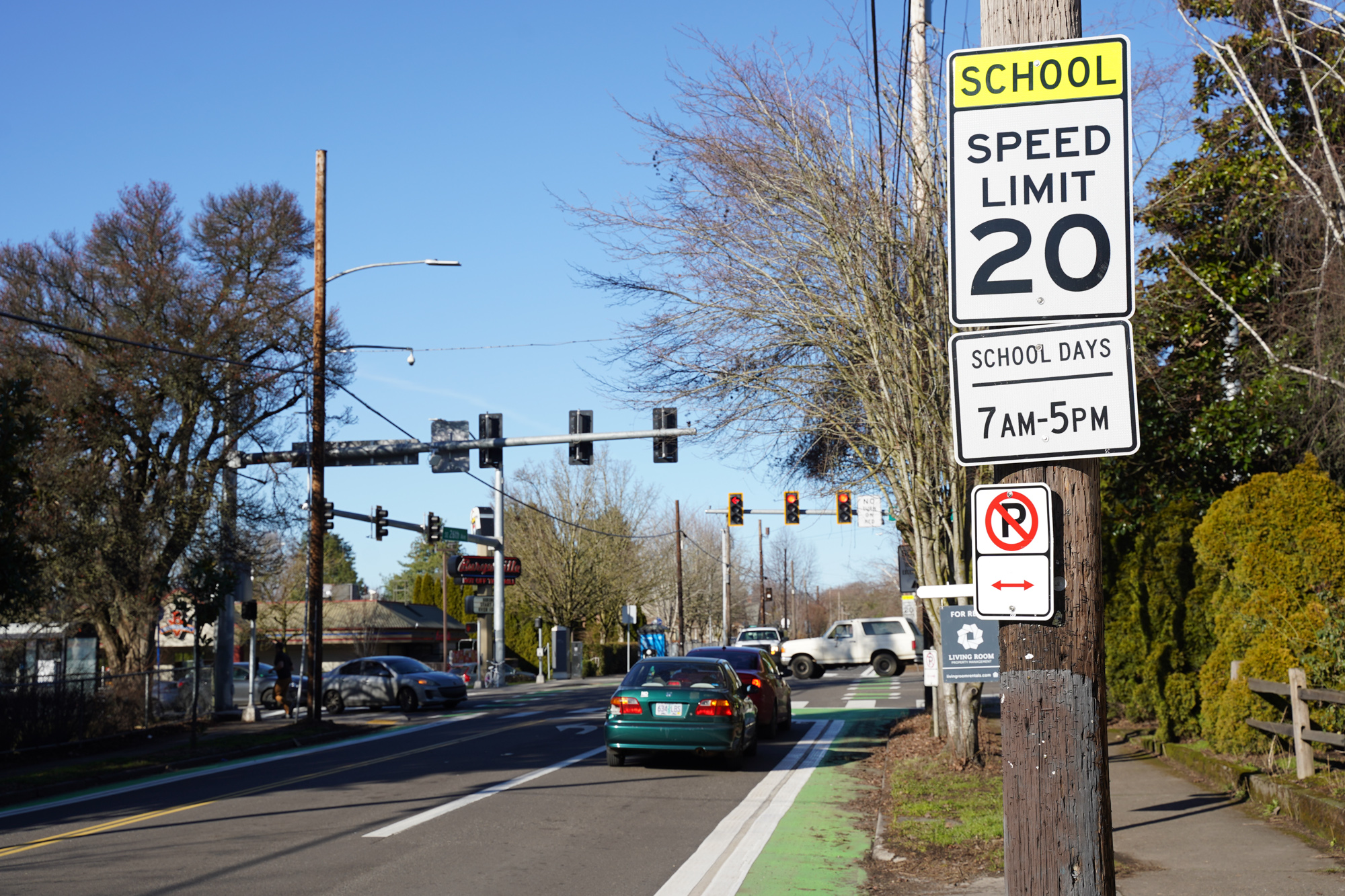
Where Sarah was hit.Southeast corner northbound.Northwest cornerNorthbound adjacent to the high school.Looking south from northwest corner.Looking east from northwest corner.Looking northeast toward Cleveland High School.Southbound 26th AveLooking north at southbound 26th Ave.Southbound 26th Ave at Powell.Northbound on 26th at Powell.Northbound on 26th before Powell.
When I visited the intersection yesterday to take a closer look, I had that sick feeling in my stomach. That mix of anger and frustration I’ve had so manytimes over the years as we sit back and wait for the city and state to get serious about reining in the inherent danger of streets filled with people driving cars and trucks in a way that endangers us every single day.
It’s the same feeling I had in July 2008 when I rolled up to West Burnside and 14th — the intersection I’ll always know as the place where Tracey Sparling was run over and killed by the driver of a large truck who — just like in Sarah’s case — was making a right turn. At that time, bike boxes were new, but the threat of right-hooks wasn’t.
When I heard about the installation of a bike box where Tracey died, I called her aunt. “It makes me physically ill to consider that such a simple fix would have definitely prevented the right hook that killed my niece,” she told me. When I got home and worked on my story, all I could think of was why Tracey had to die before we took that simple step. It was a bittersweet bike box. I even made a video about it (below).
Advertisement
The re-born bike boxes at 26th and Powell occupy a similar place in my head. When ODOT, PBOT, and The Street Trust agreed to remove them, we knew people would still ride through that intersection. We knew it would more dangerous. But they were removed anyway.
I’m glad they’re back. They seem to work very well. Combined with the head-start on the walk signal (a.k.a. leading pedestrian interval, which I was happy to see a bike rider use, even though Oregon law hasn’t caught up to this behavior yet), the new curbs in the southeast corner where Sarah was killed, the lower speed limits and school zone signage, it feels like drivers have calmed down a bit.
We haven’t done nearly enough to tame traffic on Powell Blvd, but adding back green bike lanes and bike boxes in both directions is a good step forward — or should I say a step sideways since we’ve merely added back what we had before.
Would they have saved Sarah’s life? We will never know. What we will always know, is that that it took her death to get them back.
What do we want to see in the next leader of the Portland Bureau of Transportation?
Why is this hire so important for the agency?
What were previous PBOT directors like and why does that matter?
These are some of the questions my co-host Kiel Johnson and I had on the latest episode of our podcast.
Advertisement
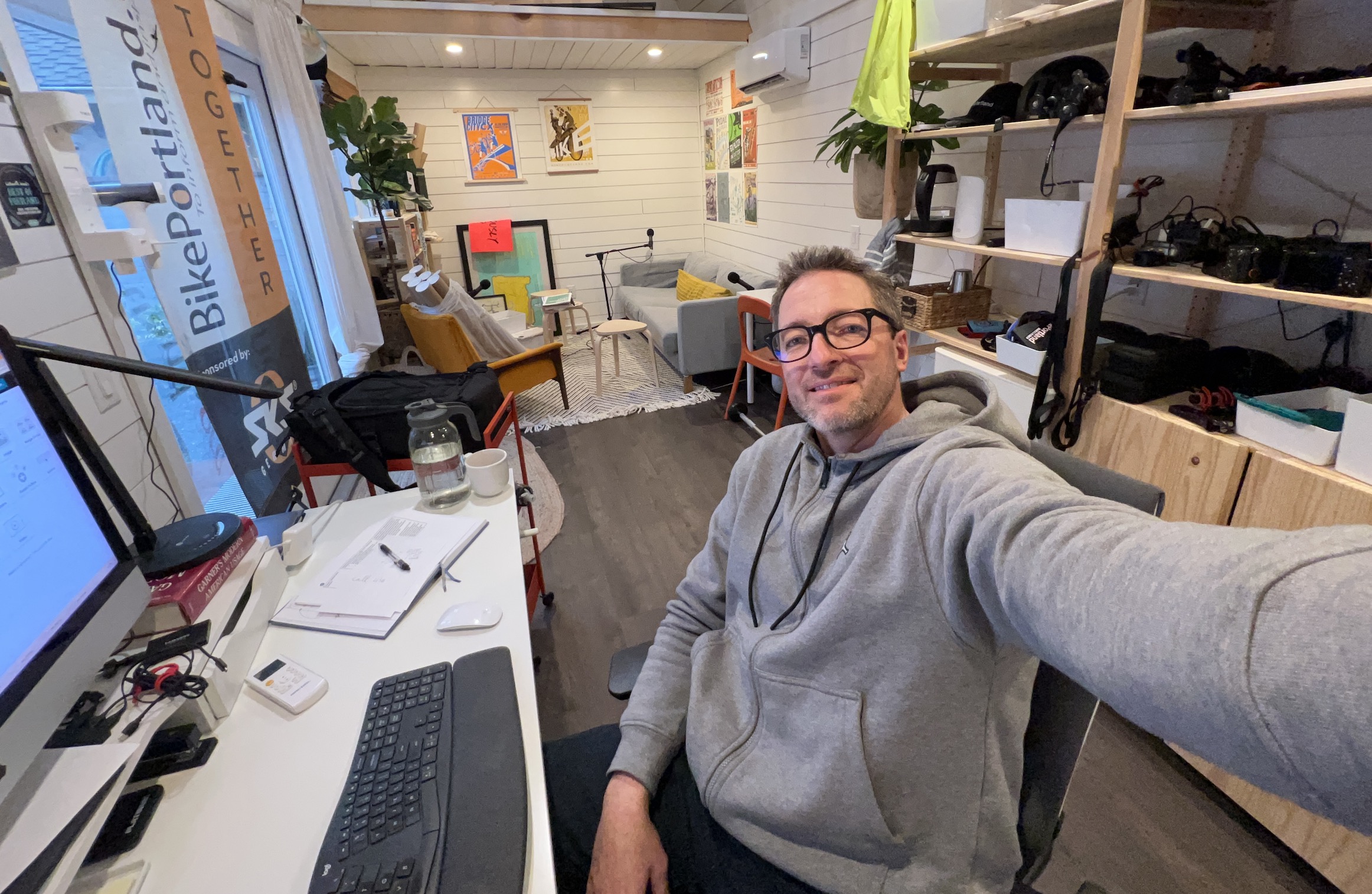
Last week, Kiel messaged me and said, “What are your thoughts on the PBOT director position?” I get messages like that all the time from local transportation activists and insiders. Typically we end up having a good conversation on the phone or on the side of an event. But since I’ve had a more audio-oriented mindset with BikePortland, I’ve wanted to share these conversations with you. So I invited Kiel over to the Shed and we recorded it.
This episode is different than we’ve had in the past. It’s more of an informal chat. It’s really just two old friends talking about something they both care about a lot. Hope you enjoy eavesdropping! And if you have thoughts about what you’d like to see in the next PBOT director, let’s hear them. We hope candidates for the job — and maybe even the folks that will make the hire! — will read this post and listen to this episode.
Find this episode on Apple Podcasts or wherever you listen.
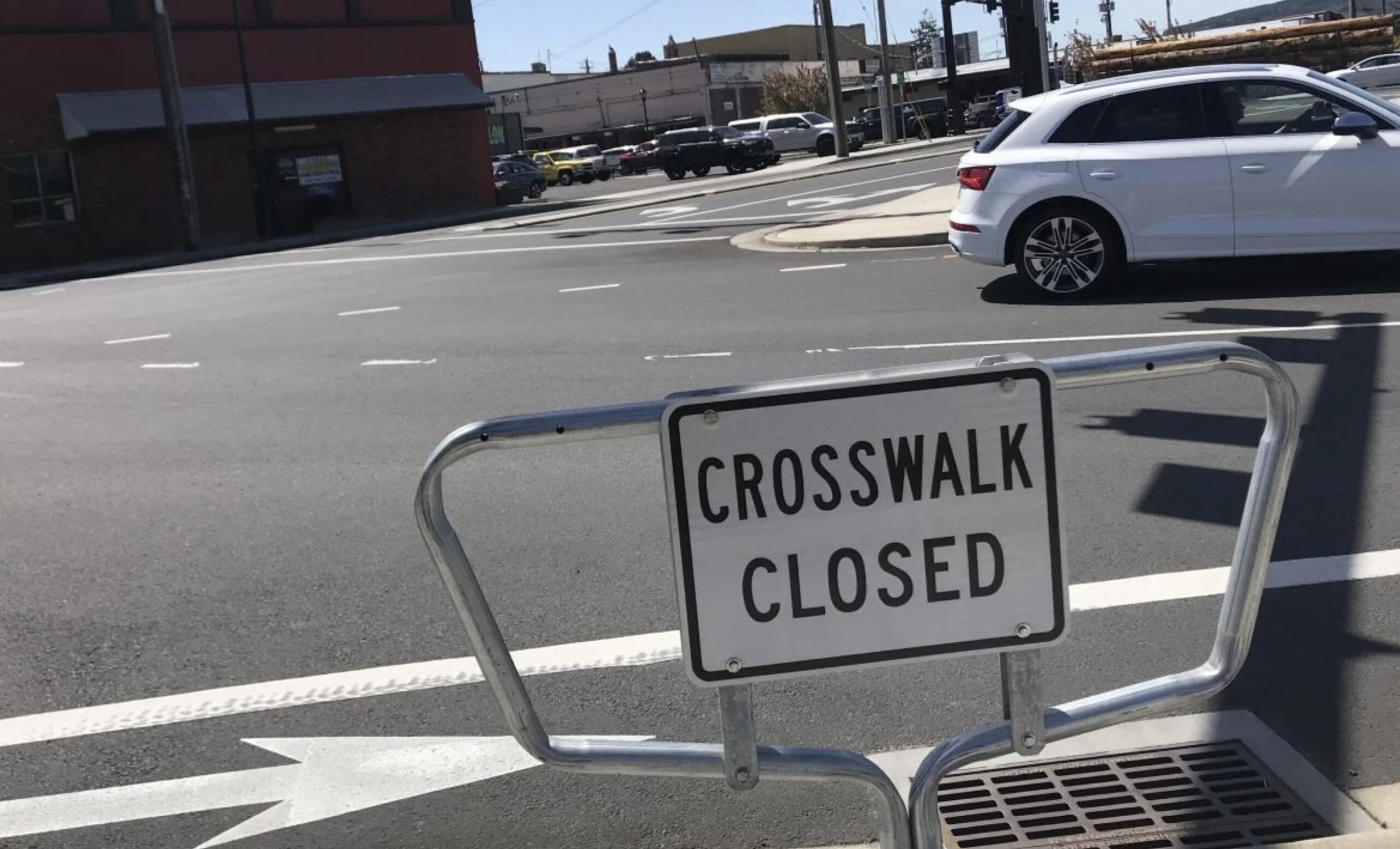
Get used to these signs. (Photo: Jonathan Maus/BikePortland)
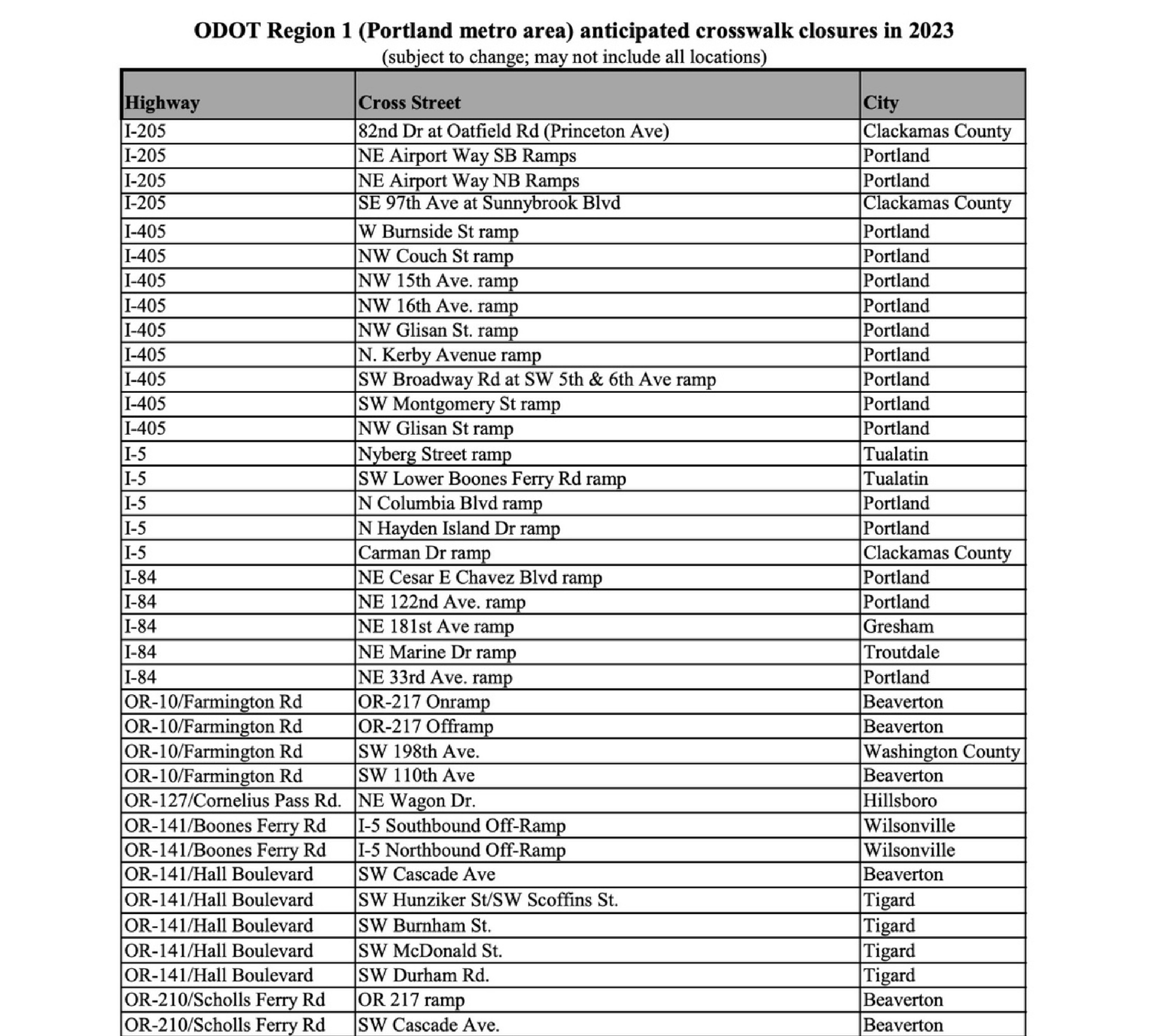
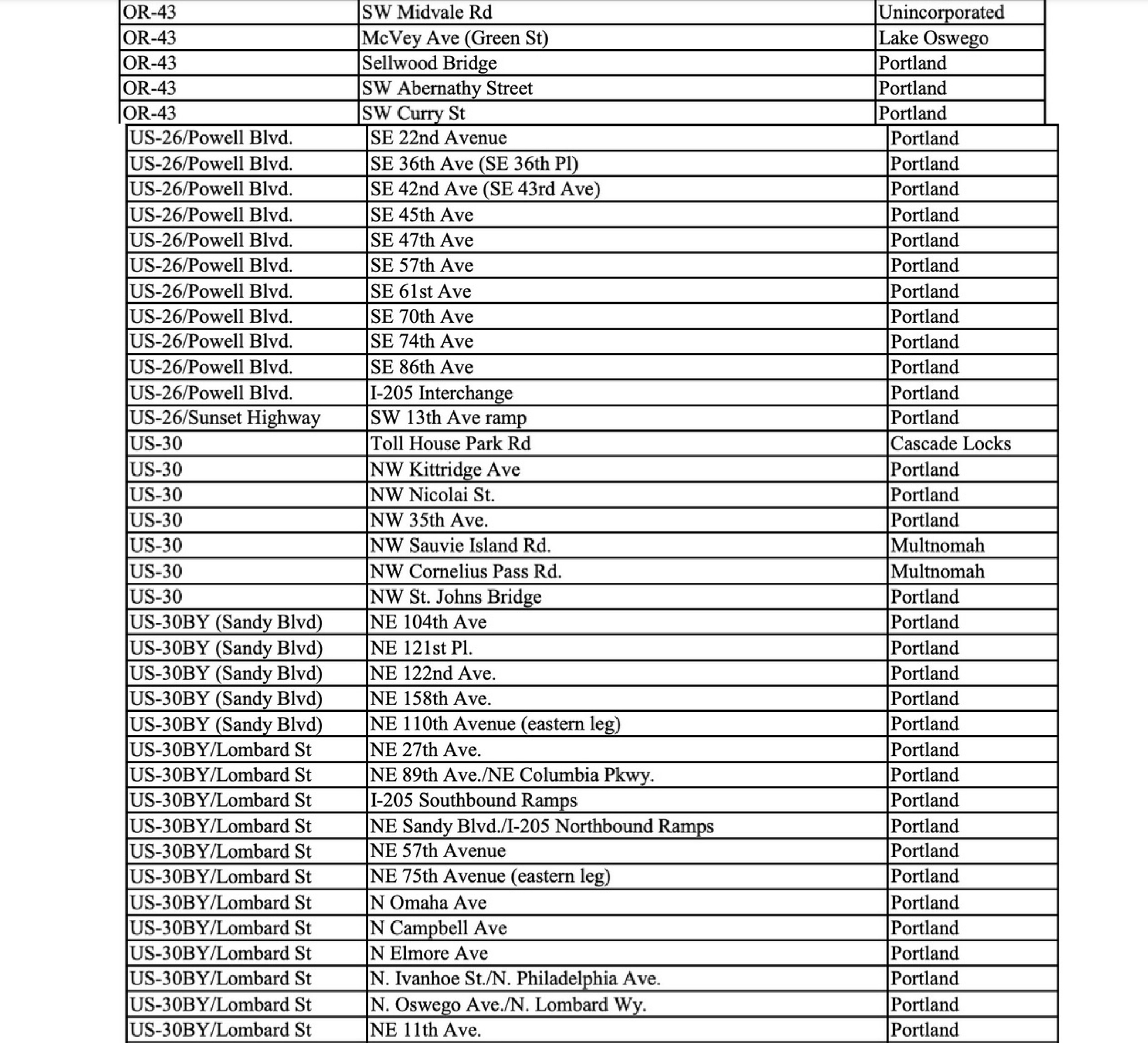
The Oregon Department of Transportation has just released a list of crosswalks they plan to close in our region this year. There are 181 crossings on the list — 53 of them are in Portland. ODOT plans to close 16 crosswalks on Southeast Powell Blvd between SE 8th and I-205, including closures at: 8th, 11th, Milwaukie, 13th, 20th, 22nd, 36th, 42nd, 45th, 47th, 57th, 61st, 70th, 74th, and 86th.
In an email with the innocuous subject line “ADA Program and Safe Crossings on U.S. 26 (SE Powell Boulevard)” the agency says they plan to erect “Crosswalk Closed” signs like the one above at these locations in the name of safety. ODOT also frames these closures as part of an ongoing project to comply with an ADA lawsuit the agency settled with a disability rights group in 2016. “Bringing curb ramps up to accessibility standards and closing unsafe and inaccessible crosswalks are tools we use to meet these obligations,” reads the email.
Here’s more from ODOT:
Advertisement
In Oregon, every intersection is a crosswalk unless marked otherwise. This means that if a crosswalk is open, it should meet our safety and accessibility standards… We evaluated crosswalks statewide and found that a number of them do not provide equal safety to all users for a variety of reasons. These reasons may include crosswalks ending at or in close proximity to a driveway, a median island or landscaping in the crosswalk path, or traffic signals that do not have pedestrian signals and push buttons. In these cases, the crosswalks are closed… This ensures that people are guided to use an alternate, nearby, safer and open crosswalk.
“Crosswalk Closed” signs have been proliferating in Portland and statewide for several years now. In 2019 we reported on a major uptick in them from the Portland Bureau of Transportation. Despite concerns from readers about how these closures make walking less respected and convenient, PBOT said they only do it as a last resort.
We went further into the story two months later when we heard ODOT was just ramping up their closure effort. At that time, ODOT was closing crosswalks without any standardized process to make the decisions. And there was zero public input. The decisions were in the hands of just two ODOT engineers. In 2019, ODOT State Traffic Roadway Engineer Mike Kimlinger told members of the Oregon Bicycle and Pedestrian Advisory Committee (OBPAC) that they were closing only two per month.
Given that ODOT plans to close 181 crosswalks in Region 1 alone this year, the pace has clearly skyrocketed.
See the full list of closure locations below…
Advertisement
(Source: ODOT)
These closures come after a record number of pedestrians were killed on Portland roads last year — with many of those tragedies happening on ODOT-owned highways.
The closures also remove the legal protection for people trying to cross the street. People can still legally cross the street where a “Crosswalk Closed” sign is posted, but they are no longer afforded any right-of-way privileges. If the person was hit, they would be much more likely be held at fault for impeding traffic or failing to yield.
That’s just one reason these closures are cause for concern.
One legal expert we spoke to in 2019, Portland lawyer Ray Thomas, said, “It’s almost like they’re making us trespassers on our own crosswalk.”
I have asked ODOT if the decision-making process around these closures has been formalized since 2019 and if there’s any way the public can offer feedback. I’ll update this story when I hear back.
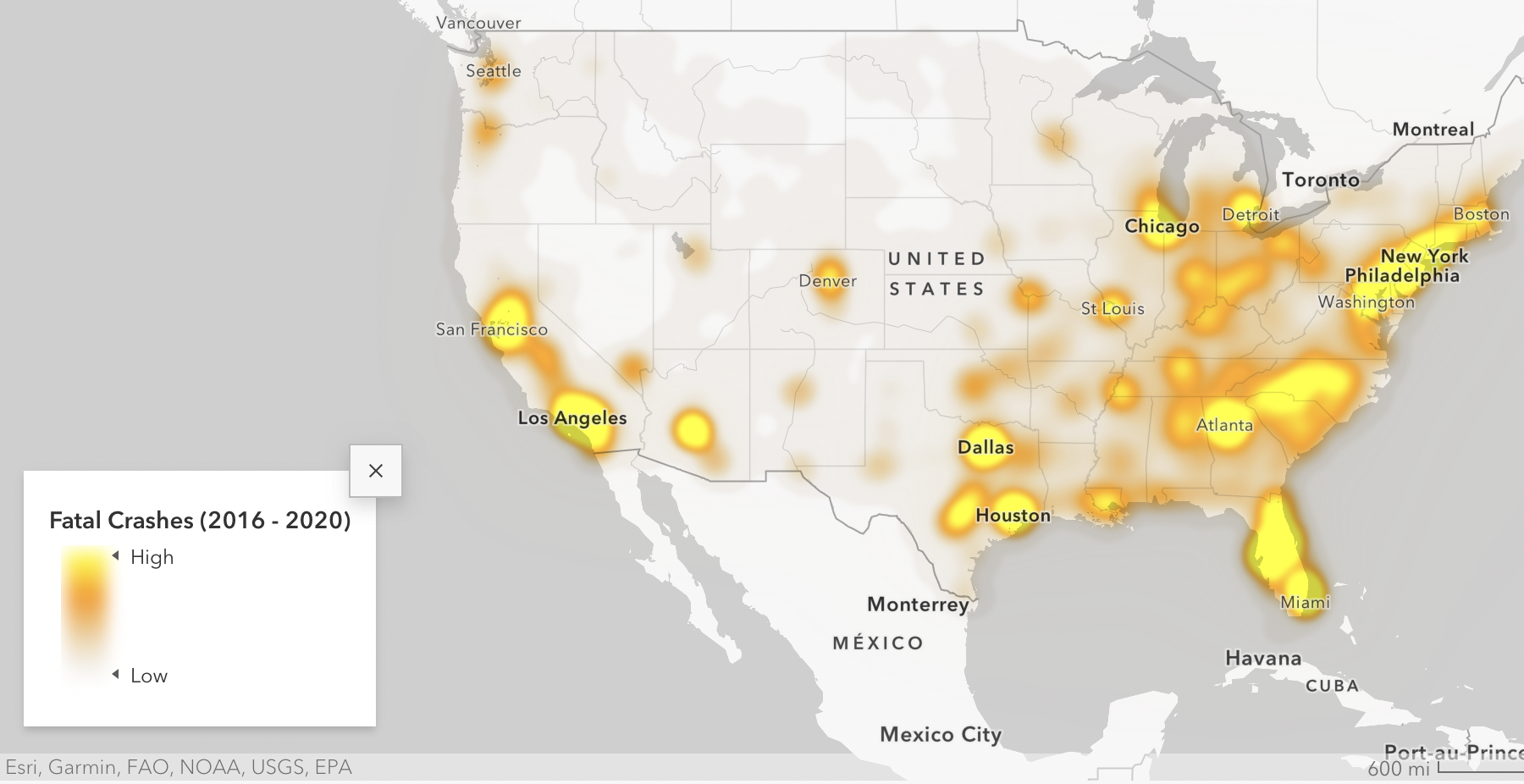
The USDOT’s national heat map of fatal traffic crashes from 2016-2020. (Sources: USDOT)
Last week, the U.S. Department of Transportation announced $800 million in roadway safety grants nationwide, including more than $22 million for Portland-area projects. But it will take more than funding and a plan to achieve the goal of zero roadway fatalities nationwide. First we have to see where we currently stand and admit there’s a problem.
A new set of interactive visualization tools just released by the USDOT show just how dire America’s traffic safety crisis is. These visualizations use a national dataset of all fatal motor vehicle crashes from the National Highway Traffic Safety Administration (NHTSA) to “illustrate the significant impact of motor vehicle deaths in our communities.” These maps provide an illuminating look at traffic violence statistics nationwide, giving insight on the different factors that contribute to fatal crashes and where they’re most and least prominent.
Advertisement
How does Portland compare?
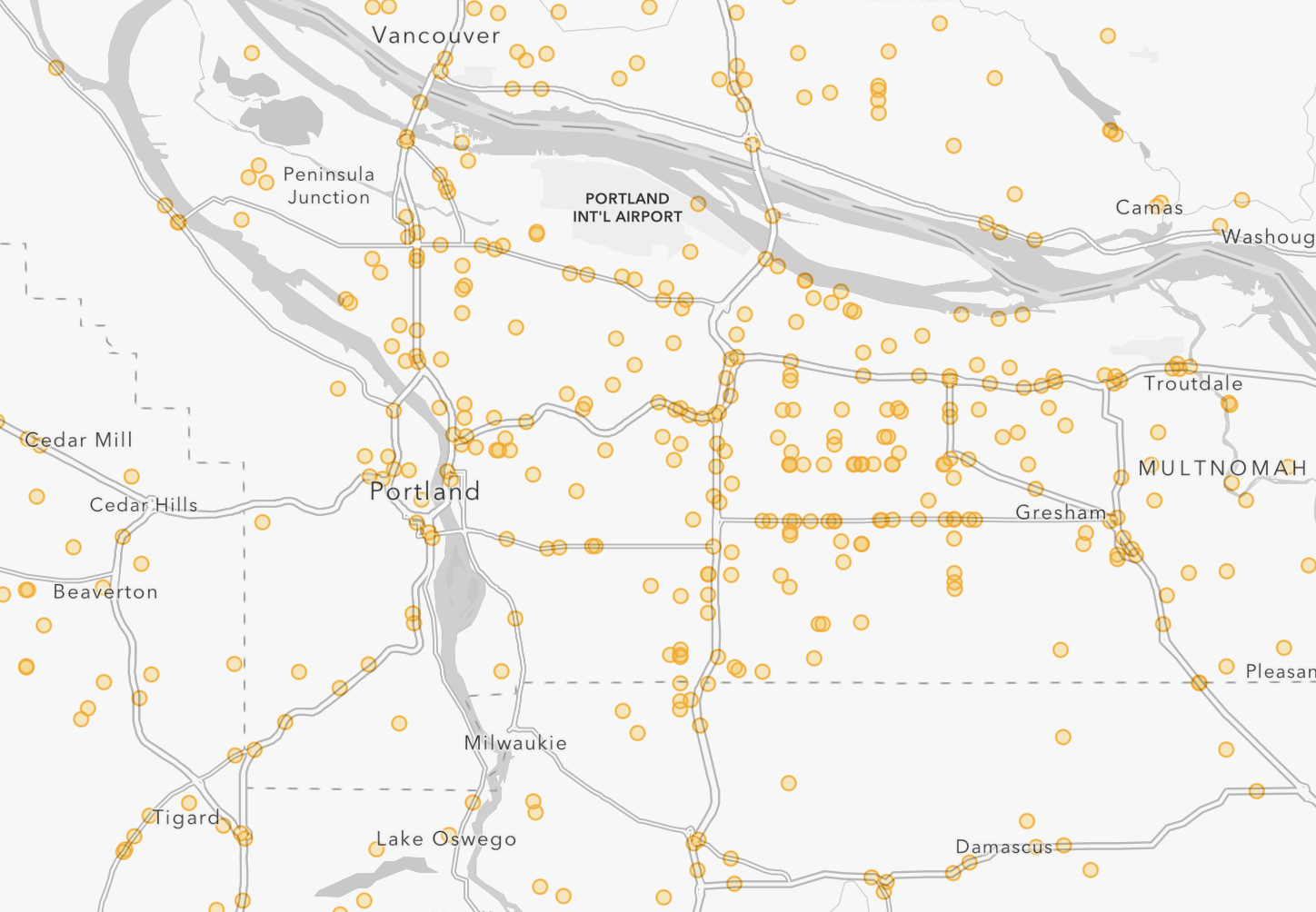
A closer view of the heat map.
Looking at the first visualization, which shows traffic death hotspots across the U.S., Portland might seem like it’s in pretty good shape compared to other places in the country. While central and southern California, Florida and the mid-Atlantic coasts are covered in blobs of bright yellow to indicate a very high rate of fatal crashes, the Portland region is more of a burnt orange. The number of fatalities in Multnomah County from 2016-2020 was 5.3 times higher than the national average — but Los Angeles County experienced 63.4 times the national traffic crash deaths in that time.
However, it’s difficult to compare a county’s fatality rate against the “national average county,” because a lot of counties in the U.S. are in very rural areas. Los Angeles County has more than twelve times the population as Multnomah County, so it follows they’d have a much higher number of crash deaths. This is where another visualization, which looks at per capita crash rates, comes in handy.
Crash rates per capita by county. Blue represents high population and comparatively low crash fatality rates, white represents low population and low fatalities, yellow represents low population and high fatality rates and red represents high population and high fatalities.
Per capita, Kern County north of Los Angeles makes a better comparison against Multnomah County. About 100,000 more people reside in Kern County than Multnomah, but the fatality rate there is 18.57 per 100,000. In Multnomah County, it’s 7.68. The median for all counties nationally is 17.98, which points to a really dire situation particularly for rural areas.
The fact that the Portland area is doing better when compared to some other places is more of an indictment against them than a credit to us. From 2016-2020, 313 people died due in car crashes in Multnomah County, and the crisis has only been trending upwards in recent years. Our region is depicted on the less dire end of the spectrum nationally, which shows just how bad the problem is nationwide.
Inequitable impacts
The USDOT’s visualization of crash rates in historically Disadvantaged Communities.
The tool also depicts an “equity-focused analysis of the unequal distribution of roadway fatalities at the neighborhood level,” visualizing how many crashes take place in historically Disadvantaged Communities (DACs). DACs are defined by the USDOT through their Justice40 initiative, which aims to tackle transportation inequity. In order to fit the title of Historically Disadvantaged Community on the map, a neighborhood has to meet at least four of the following criteria:
Transportation access disadvantage identifies communities and places that spend more, and take longer, to get where they need to go.
Health disadvantage identifies communities based on variables associated with adverse health outcomes, disability, as well as environmental exposures.
Environmental disadvantage identifies communities with disproportionately high levels of certain air pollutants and high potential presence of lead-based paint in housing units.
Economic disadvantage identifies areas and populations with high poverty, low wealth, lack of local jobs, low homeownership, low educational attainment, and high inequality.
Resilience disadvantage identifies communities vulnerable to hazards caused by climate change.
Equity disadvantage identifies communities with a with a high percentile of persons (age 5+) who speak English “less than well.”
As transportation equity advocates know, people who live in DACs are more likely to be victims of traffic violence. When you zoom in on the map and look at where vehicular fatalities happen the most in Portland, they are located in the lowest-income parts of the city, predominantly in east and north Portland.
According to the data, nearly half (43%) of the communities in the top 20% of roadway fatalities nationwide belong meet the DAC criteria. 26% of all fatal crashes in DACs result in pedestrian deaths. (It’s unclear how the national data accounts for people biking or rolling.)
The Portland Bureau of Transportation’s annual fatality reports demonstrate this as well. But looking at the national data is helpful for putting together larger trends over time and place.
Advertisement
Is there any progress?
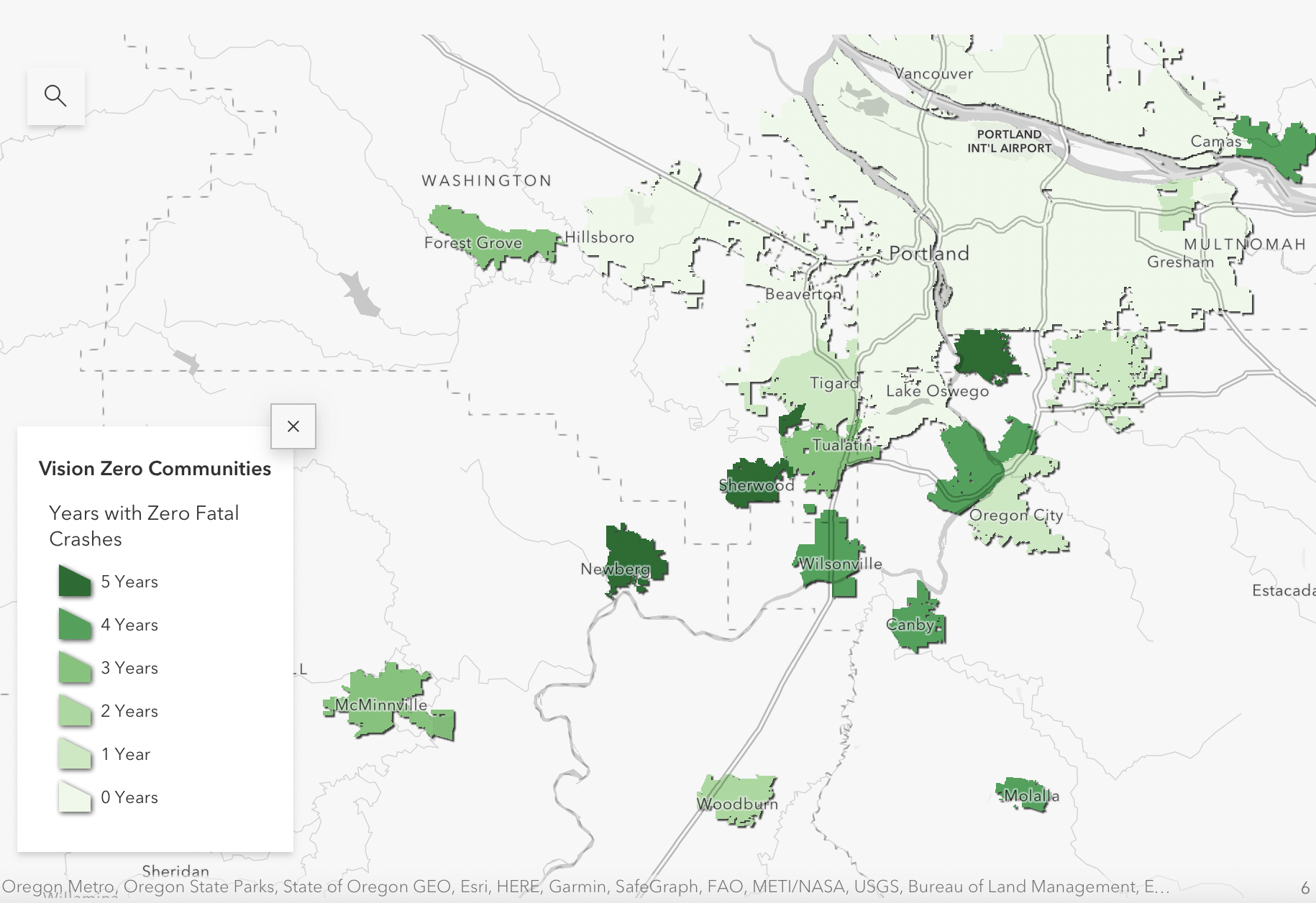
Vision Zero communities in the Portland area.
According to this data, there are some places in the Portland area that are doing well. Sherwood, Milwaukie and Newberg are all Vision Zero cities on the map, with no fatal crashes from 2016-2020. Wilsonville and West Linn are both in the top 25 small cities for low fatality rates, having reported one fatality each during those five years.
But as Kea Wilson points out in a Streetsblog article about this new tool, the cities that the DOT heralds as Vision Zero-achievers haven’t necessarily gotten there on purpose. Some, like Hoboken, New Jersey, have a dedicated Vision Zero strategy that guides their infrastructure development. Others haven’t put in quite so much work. Without more context, this data shouldn’t necessarily be used to indicate the best cities to emulate for meeting Vision Zero.
“Many are exclusive, minuscule suburbs that simply shunt faster vehicle traffic onto arterial roads outside their borders, effectively endangering residents every time they enter or leave,” Wilson writes.
While there are some glimmers of hope on the map, the overall takeaway from this data is bleak. Nationally and locally, the problem is getting worse by the year. The only good news depicted in this data set is that we have a national transportation department willing to look at the problem honestly enough to create these impactful visualizations.
You can find the full set of visualizations at the NRSS website.
A new 43-unit apartment building sits adjacent to an unfunded SW In Motion project that would build a sidewalk connection to Portland’s largest employer, Oregon Health Science University. (Photos: Lisa Caballero/BikePortland)
Plan cover
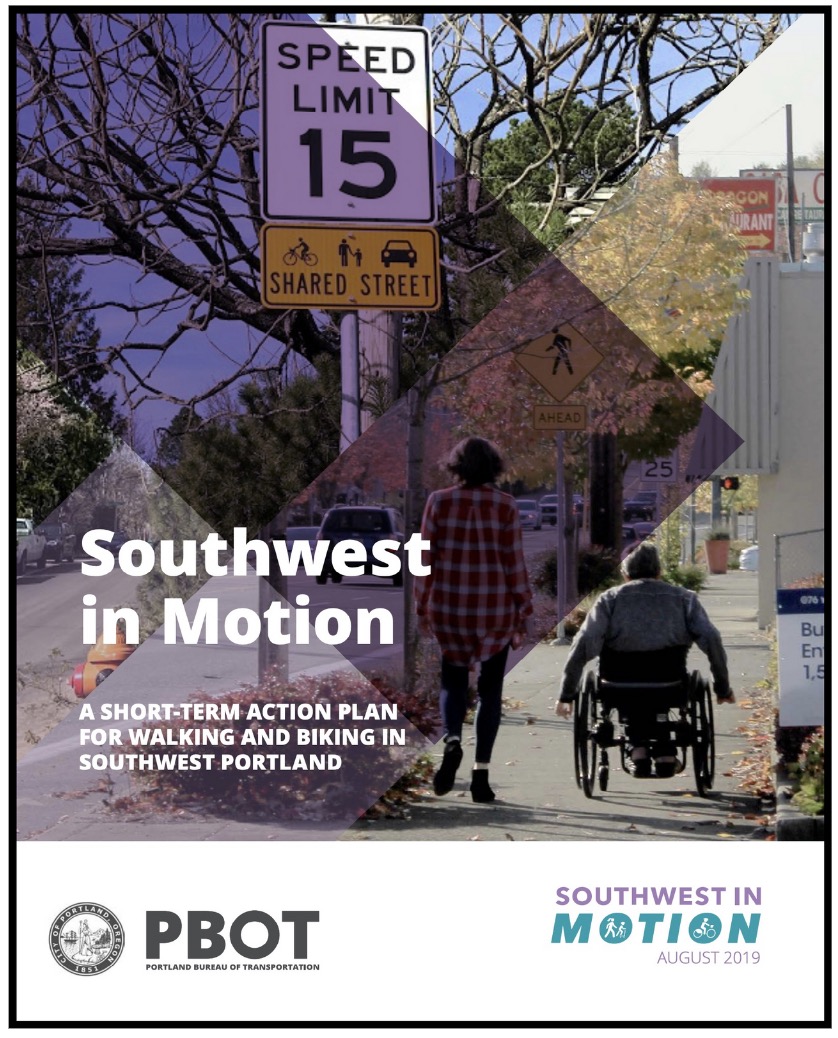
Implementation of the Southwest in Motion (SWIM) plan is flagging according to area transportation advocates. In a letter (PDF) sent yesterday to the Portland Bureau of Transportation (PBOT), former members of the SWIM Stakeholders Advisory Committee (SAC) laid out their concerns about the quality of the plan’s roll-out.
Co-signers include the current and past chair of PBOT’s Bicycle Advisory Committee (BAC).
The letter comes on the heels of PBOT Bicycle Coordinator Roger Geller’s recent update on bike network progress to the BAC. Geller presented a table which showed the southwest region of Portland lagging behind the rest of the city in the percentage of its planned bikeway network that has been built.
Correspondence between the advocates and PBOT began over a year ago, and yesterday’s letter is organized as a synopsis of those communications. It begins by recapping the group’s original concerns:
Advertisement
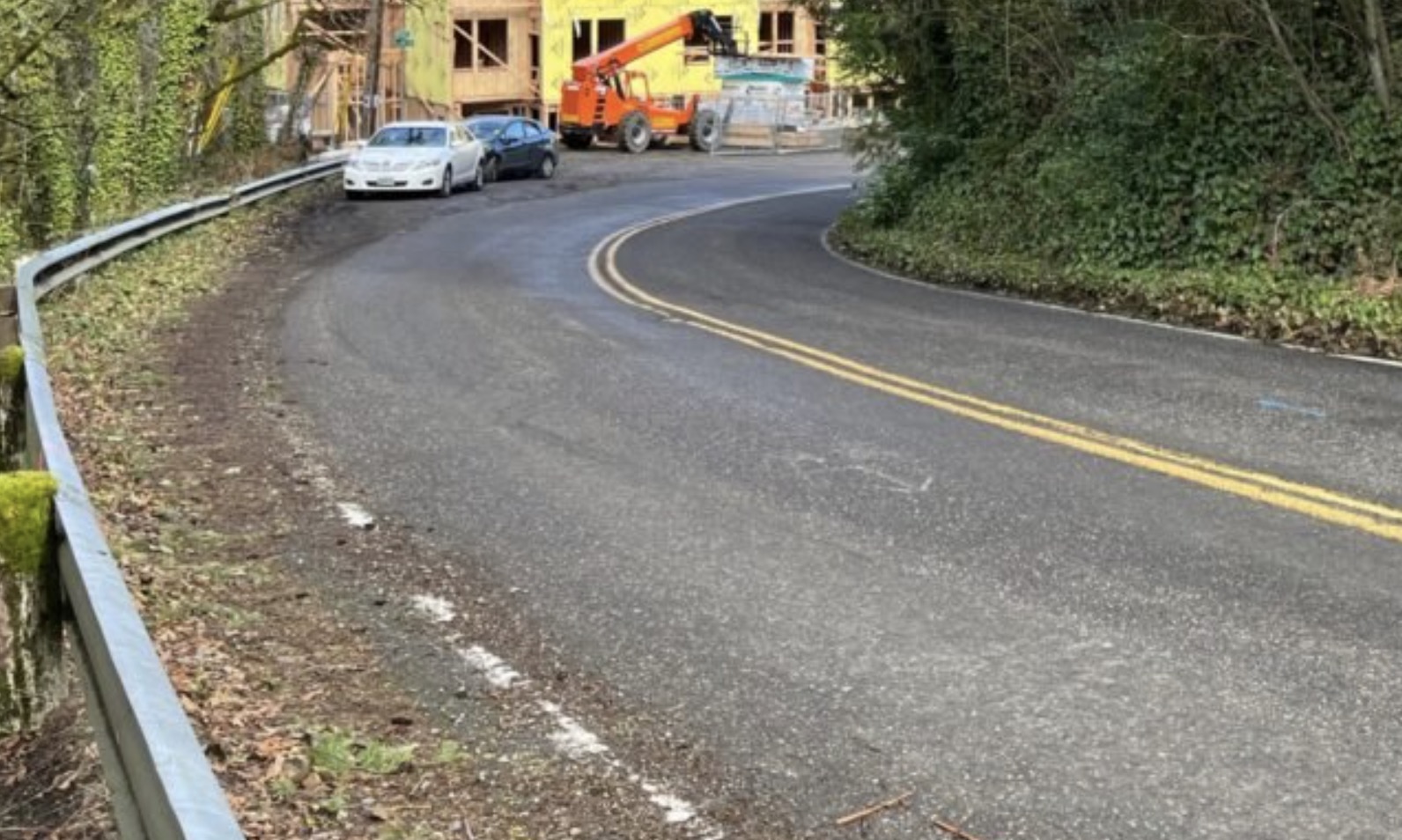
SW Marquam Hill Rd, just uphill from Gibbs, is slated for a safer shoulder, but the project has no funding.
While it acknowledges that PBOT has “partially addressed” some of these issues, the letter makes the case that the bureau still has “a considerable way to go.”
The lack of the 2-year progress report called for in the plan;
Deficient and outdated information on the SWIM website;
Slow progress made on project delivery relative to other In Motion plans; and
Perhaps most important – having virtually no knowledge or involvement in project prioritization, selection, or design until they are announced.
Portland has adopted four “In Motion” plans over the past decade, beginning with East Portland in Motion (EPIM) in 2012, and followed by Central City (CCIM) in 2018, SWIM in December 2019, and Northwest (NWIM) in 2020. Most recently, North Portland in Motion got underway at the end of 2021.
A characteristic of all “In Motion” plans is that they are grounded in public participation. Project lists are the product of dialogue with advisory committees, and have been vetted through open houses, focus groups, meetings with stakeholders—the full Portland engagement process.
But there does not appear to be a uniform process for reporting out or overseeing project status — or budgeting — and this makes it difficult to account for progress, or commitment from the city. The advocates sum up this concern in their letter’s first of four action items:
Advertisement
Complete the progress report described in the SWIM plan including:
Status report of projects completed.
Projects for 2022-2023 that are budgeted/under construction, in design, and under consideration.
An annually updated summary of the funds available for SWIM projects for the coming fiscal year including the anticipated funding sources.
Summary of any anticipated issues regarding funding, staffing, etc. and how PBOT will try to resolve them.
Comment: The SWIM website was updated for the completed projects. It also lists projects that are called “active”, but this includes a wide range from, projects that are under construction to ones that appear to only be in the staff discussion stage. The listings offer minimal project descriptions and no information about the schedule, project manager contact information, estimated budget and funding source(s), or upcoming community involvement opportunities and summary of past public comments. It also does not list potential future projects under consideration or a funding outlook. What has been completed so far is a good start, but important information is lacking, and the public continues to remain mainly in the dark.
Advertisement
While recognizing that the areas of town with “In Motion” plans differ greatly, each with varying scope and needs, a cursory review of their websites shows that:
Each plan follows a unique implementation approach (Central City in Motion has an ongoing Working Group which meets regularly to review project status and design);
The city’s financial commitment to each differs by orders of magnitude (The EPIM 2021 10th Anniversary Status Report states that “PBOT and our agency partners now have allocated nearly $320 million to East Portland in Motion (EPIM) project implementation and related projects.” In contrast, a SWIM update notes that $500K will be available for “QuickBuild” projects which are expected to be constructed by 2024.
Some plans offer more detailed timelines and implementation information. (NWIM describes an implementation strategy which includes project evaluations and ”tweaks and changes.”)
I reached out to Bicycle Advisory Committee Chair Ally Holmqvist, a co-signer of the letter, to learn why she and the BAC supported the SWIM requests. She brought up the BAC’s southwest ride last August,
I didn’t want to stand next to, let alone ride through, “the crossroads” and I felt uncomfortable using many of the bike lanes we rode on where the topography can provide challenge enough for riders. I was heartened to see the work done on SW Capitol Highway, but it is clear there is still more work to do and that all of those who devoted their time and effort to SWIM deserve an update on the next steps.
The letter is addressed to PBOT SWIM Project Manager Nick Falbo, and closes with a request for a closer partnership between PBOT and the community:
The plan states “Continued community advocacy for projects will be instrumental to the success of this plan.” This can only happen through a community – PBOT partnership. We invite you to have an open discussion with interested SW residents about how to best establish an on-going partnership that is effective and efficient for the city and SW residents.
Falbo responded briefly yesterday upon receiving the letter via email: “We appreciate the feedback and I will discuss with our capital delivery division in charge of project design and construction processes,” he wrote. “More to come.”
Today the Oregon Legislature will host a public hearing on House Bill 2605 — the Protect Journalism Act. At first glance, it has nothing to do with bicycles or transportation. But if you consider that it could be a vital source of funding for BikePortland — which I’d argue is the largest and most influential cycling and transportation news outlet in the state — you’ll understand why this is on our front page.
Sponsored by House Rep. Khanh Pham, the bill aims to improve the financial health of businesses like BikePortland throughout the state by creating new funding opportunities to support journalists and the news outlets they work for. The way it was initially introduced it would allow Oregonians to make a financial contribution to a news outlet and receive a tax credit (Similar to Oregon’s existing political tax credit). The bill also seeks to kickstart a new grant program to offer immediate financial aid to fund local news — especially in rural parts of Oregon where news deserts are increasingly common.
I’ve heard that the bill has been amended since being introduced. The new plan is to drop the tax credit and instead seek the legislature’s permission to establish a statewide task force of journalism experts that will meet and come up with an better solution to this problem. That solution will then be pitched in a bill next session. (The grant program part of the bill will remain this session.)
I was so happy to see this bill introduced! It was like someone finally saw me and my struggle to make the business side of BikePortland work.
Below is the testimony I submitted this morning:
Advertisement
Dear Committee members,
Thank you for taking time to consider the Protect Journalism Act (HB 2605). I strongly support this bill for two main reasons: I’m an Oregonian who believes that a well-informed public is essential to a strong democracy, and because I’m the owner of a small news business who knows all too well how hard it is to survive in today’s media business.
I launched BikePortland in 2005 — 18 years ago — because I saw a gap in our community that needed to be filled. There was no central, trusted source of information where all the different groups, people, policymakers and organizations could come together, learn from one another, build a stronger community, and learn about important news that could impact their lives.
Nearly 20 years in, I’ve won journalism awards, awards from advocacy groups, a special commendation from a member of the United State Congress, and have been the subject of numerous magazine and newspaper stories. I’ve built a platform that reaches hundreds of thousands of people every month. Our work has influenced countless policies, projects, and people.
But I don’t consider BikePortland a success. Why? Because, despite broad support from our community, and many years of hard work, we are still not financially sustainable. If we don’t raise revenue significantly by the middle of this year, we have to face some very hard decisions.
The news business is unforgiving, and it’s not a meritocracy. It doesn’t care about the quality of your work or the impact it has on the community. It only cares about clicks. I believe in focusing on what’s vital, not viral. I have felt the urge to favor clicks over quality — to give people a piece of candy instead of a well-rounded meal — because that’s often where the money is. But doing that leads to a race to the bottom and it’s not what is best for our community or for Oregon.
As a for-profit corporation, we don’t pursue grant funding and we can’t offer tax deductions for donations. That makes our funding challenge even more difficult, and it makes us even more reliant on the whims of advertisers, and the financial support of individual Oregonians.
The legislature has already created the political tax credit to encourage more people to support and get engaged in electoral politics. We should have funded journalism first! After all, more funding for political parties without the news outlets and journalists to hold them accountable in this age of divisive, win-at-all-costs, misinformation campaigns — puts Oregon’s democracy in peril.
The local news business has never been a downhill ride in the park, and these days it’s like trying to pedal a bicycle through a sandy desert without water. HB 2605 would be an oasis.
Please support this bill. Let’s rebuild the foundation of local news.
Thank you for the opportunity to testify.
– Jonathan Maus
HB 2605 will be heard in the House Committee on Rules at 1:00 pm today (2/9). If you believe local media outlets like BikePortland are worth fighting for, I strongly encourage you to support this bill. You can still submit written testimony, and you can connect with Rep. Pham’s office if you’d like to learn more or get involved.