

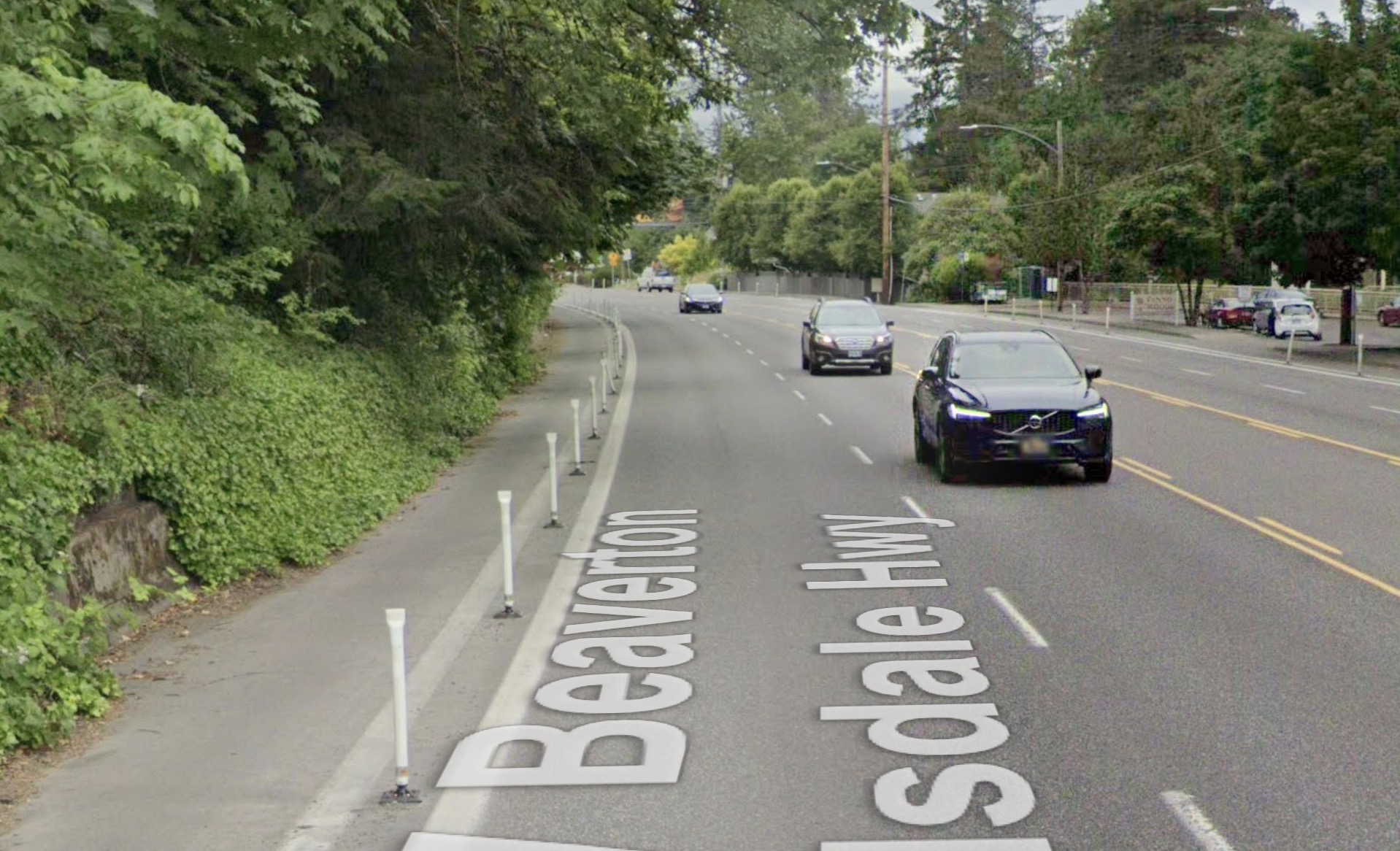
Most Portland neighborhoods would jump at the chance to upgrade their bike lanes. But the coalition that represents 32 neighborhoods in District 4 is different. At their meeting Wednesday night, the District 4 Coalition (D4C) plans to finalize a letter to Portland Bureau of Transportation Director Millicent Williams that outlines their opposition to $760,000 of planned bike lane projects in Southwest Portland.
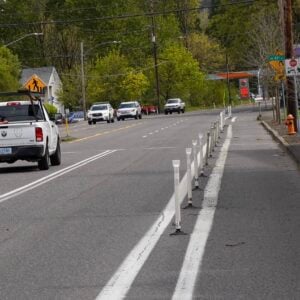
These projects are part of the bike lane hardening effort I reported on in August 2024. With marching orders from a city traffic engineer directive, PBOT is going through a list of protected bike lanes citywide that were initially built with just paint and/or plastic wands and replacing them with concrete curbs. The idea is permanent curbs offer a more pleasing aesthetic, provide a stronger safety benefit, and will require less maintenance (the wands are frequently uprooted). PBOT is also responding to some bike advocates who see paint and plastic as a poor substitute for more robust materials.
In a draft version of the letter about the projects in Southwest, D4C Land Use and Transportation Co-Chair Nicole Zimmerman (who’s also a candidate for City Council District 3) says they oppose planned hardening projects at three locations: Beaverton-Hillsdale Highway between SW 39th and SW 65th, SW Capitol Hwy between SW Valona and Stephenson, and Bertha Blvd between Vermont and 13th (see map below).
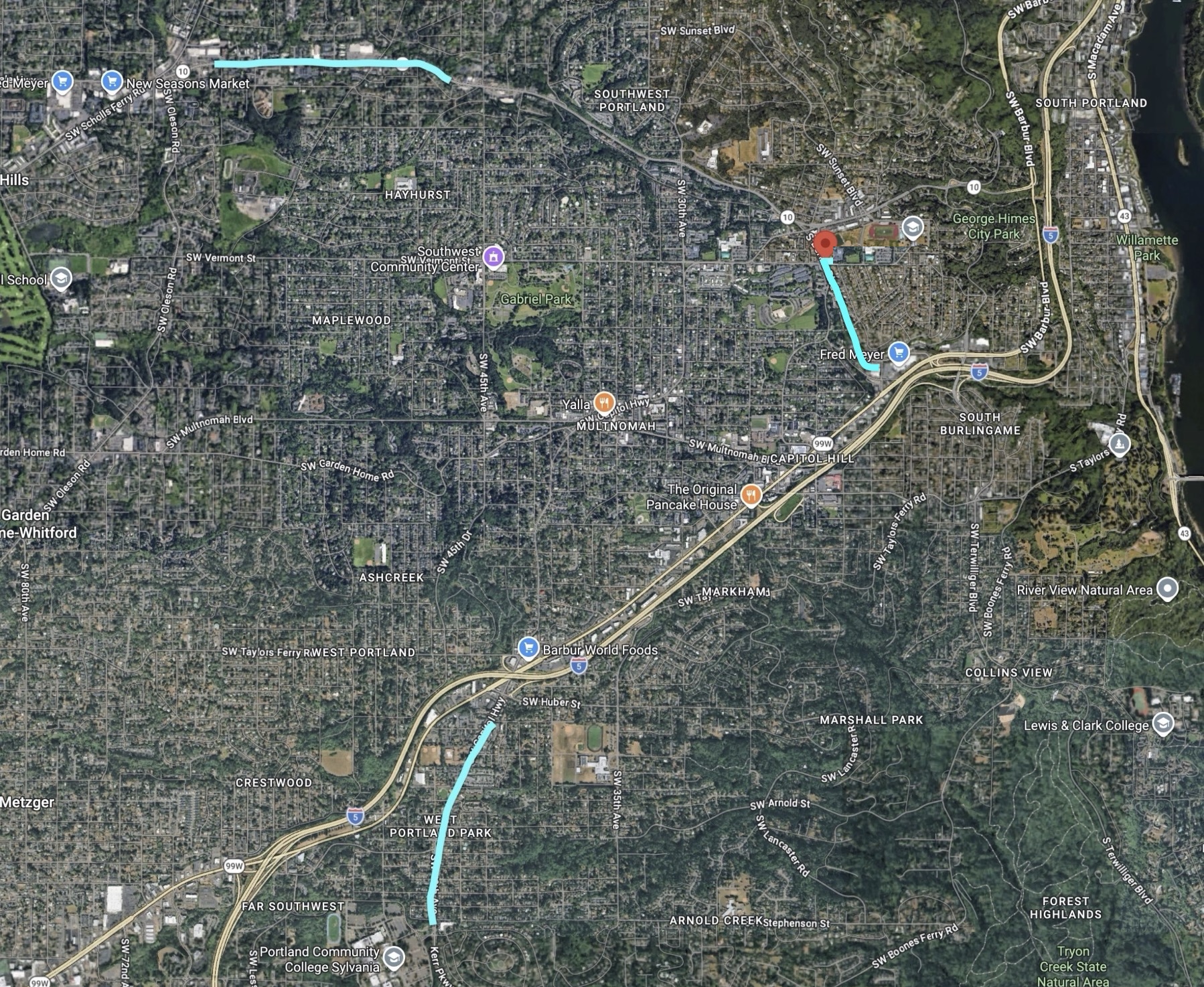
Below is an excerpt from the letter that lays out the reasons for their objections (emphasis theirs):
- No practical value. B-H Hwy., the proposed segment of Capitol Hwy., and Bertha Blvd. are among the lowest performing bike routes in all of SW Portland. This can be attributed largely to their lack of connectivity with the fractured bike network in SW. Any cyclist using these facilities must be confident riding on busy streets in the travel lane to reach and leave these bike lane segments. Providing an A+ bike facility on these isolated sections will not entice more cyclists to use them. Progress must be measured not by the miles of protected bike lanes but by the number of people traveling by bike.
- This is not maintenance. Converting them into physically separated facilities is an improvement project – not simple maintenance. If maintenance is an issue, the wands could simply be removed or just not replaced. If removed, there would continue to be very good, painted buffered bike lanes, which could again be swept with conventional equipment. Reliance on the small bike lane sweeper has resulted in infrequent sweeping and B-H and Capitol Hwys. are typically plagued by gravel, glass, leaves, and weeds.
- Chronically inadequate funding. Funding for capital projects to enhance pedestrian and bicycle safety is severely constrained. For perspective, D4 can expect about $2.3 million from FOS3 for the next 4 years. Other pots of funding are available, but the cost of the B-H Highway project will make it among the most expensive projects proposed in D4 and SW over the next four years.
- Higher priority needs and lack of community support. Given all the high-priority network and safety improvements, many of which have languished for decades, PBOT should not spend $490,000 on this project followed by the Capitol Hwy. project totaling around $757,000 and an undetermined amount for Bertha Blvd. when the bike lane hardening lacks community support and The BH Hwy. and Capitol Hwy. projects are not identified in the TSP or SWIM. Until bike routes are completed and not disjointed, it is premature to spend scared funds for first-class facilities on random segments.
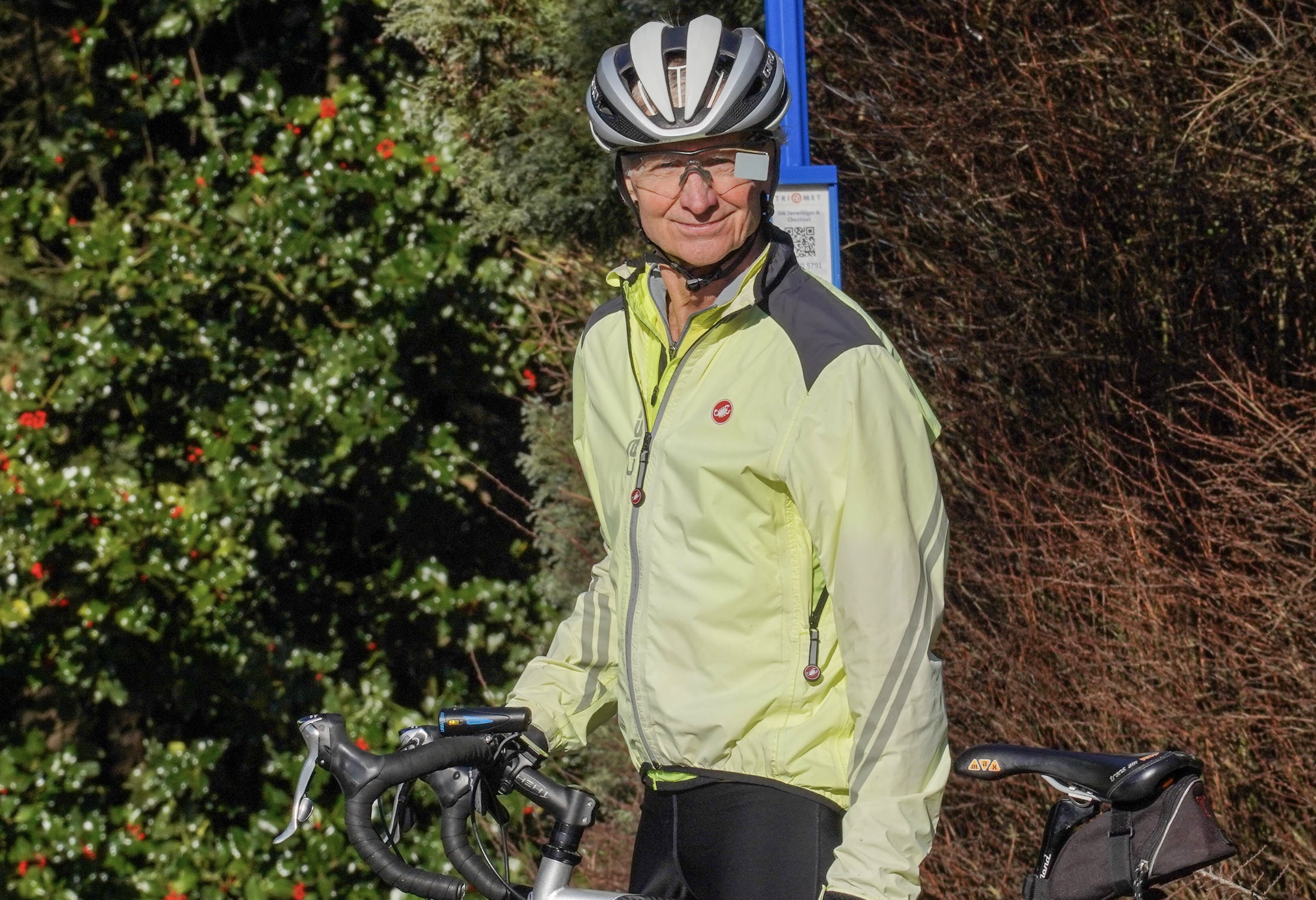
If this sounds familiar, it’s because BikePortland reported on a Southwest-based cycling advocate who shared many of these same concerns back in fall of 2024. I reached out to that person, former PBOT Bicycle Advisory Committee member and veteran bike advocate Keith Liden, and he confirmed he was the inspiration for the D4C position. “Yes, my fingerprints are all over it,” Liden shared with me via email last week.
“We feel it makes no sense to spend scarce dollars to ‘gold plate’ isolated sections on routes with serious gaps,” Liden said. “Hardening these bike lanes will do nothing to attract less confident/inexperienced riders, while the current users will still be fine with painted buffers.” Liden wants PBOT to offer a more complete route before spending money to improve isolated sections.
Kiel Johnson with nonprofit BikeLoud PDX disagrees with Liden and has sent a message of his own to PBOT, urging them to move forward. In an email sent Thursday, February 19th, Johnson wrote that Beaverton-Hillsdale Highway currently feels like a freeway due to its design, and changes are needed to attract more riders. “Paint and plastic wands are not protection,” Johnson wrote. “Physical barriers—concrete curbs, continuous raised protection, and median refuge islands—would reduce conflict points, prevent encroachment into bike space, and narrow the effective roadway in a way that calms traffic without eliminating access.”
The D4C coalition wants PBOT to allow them to help review and evaluate the projects to find, “an acceptable approach for improving and maintaining these facilities at reduced cost and to redirect the remaining funds to improvements that support more pressing priorities in District 4 and identified in our adopted plans.” Liden and others in Southwest feel PBOT’s project selections are too “top-down” and they want a more collaborative process to determine future bikeway investments.
Learn more about PBOT’s bike lane upgrades on their website.
The D4C Land Use and Transportation Committee meets tomorrow (Weds., 2/25) from 6:30 to 8:30 pm via Zoom.
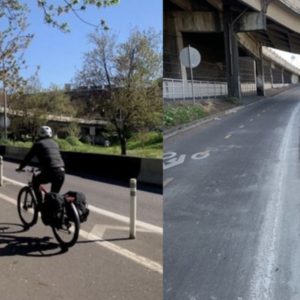

Thanks for reading.
BikePortland has served this community with independent community journalism since 2005. We rely on subscriptions from readers like you to survive. Your financial support is vital in keeping this valuable resource alive and well.
Please subscribe today to strengthen and expand our work.
I had the opportunity to meet the director of transportation for Victoria BC this past year. In 8 years, Victoria has doubled its biking by putting protected curb bike lanes (like these) everywhere. Their bike mode share is 13% and growing.
Today, the protected lanes are so common that they send out a notice and 3 months later, sometimes remove all car parking and put in the protected lanes. Their protected lanes extend out to the less dense parts, like in SW. They didn’t start with a complete network, but they took every opportunity to put in protected bike lanes, and piece by piece they have added up.
I hope the bike community can stand together in supporting PBOT in installing protected bike lanes here. If we can, we will get protected bike lanes everywhere faster. If the SW neighborhood associations, who also opposed BAT lanes, win from my experience, it will set a precedent that will slow down protected bike lanes everywhere.
I don’t think Jonathans headline image really shows how uncomfortable parts of BH Hwy are without any physical delimitation. Take a look at this one section on streetview (sure, half the problem is the lack of maintenance and the vegetation taking over half the bike lane) but you can see how many drivers drive over the bike lane paint because of just how faded is. I am pretty confident rider as one has to be in SW, but this is a part of BH Hwy is a section I avoid.
And to the people that say BH Hwy doesn’t go anywhere, it goes to Hillsdale! Yeah some of the connections in Hillsdale can be better, but having a few mile long protected bike lane the into one of the largest town centers in SW on the road that has gentle elevation changes is a pretty big win.
Daniel,
I appreciate your perspective and the view you provided, but curb protection would not improve that condition of that bike lane, it would just make it very difficult to leave the bike lane when you encounter blackberries and/or a giant mound of mud. I think the criticism of PBOT is that they extend the temporary protections to develop a better network and maintain what they have better before spending money on concrete curbs. I appreciate that perspective, but I am not sure if PBOT can do that or will. I suspect they will install concrete curbs or nothing at all, in which case the concrete curbs seem preferred. That said, I think the advocates in SW are doing a very valuable service: pushing PBOT to develop a better comprehensive plan to build a complete, functional network rather than focusing on segments in isolation
I have been riding this section of BHH maybe 50x/yr. for as long as there has been a bike lane.. It is harrowing. I’m fairly certain When first built it was about 2 ft wider but one winter storm(s) many years ago the hillside moved and appears to continue to narrow the lane. It has never been corrected and needs a retaining wall…
Exactly Kiel. I’m so glad you met with them. It’s important to note that, just like Portland, Victoria, BC had stagnated for years without building separated connections between downtown and outer neighborhoods. Here is the Urbanity video showing that change.
It’s odd because we have numerous other examples overseas, but when it happens to our neighbor in BC it’s somehow different? Note Victoria also used prefab concrete separators on the Tillicum and Shelbourne bike lanes showing the build first, upgrade later process works. I feel like eventually, maybe, at some point the lightbulb will blink on for Portland, and we’ll start making a similar concerted effort. Because it’s really not that complicated: Separate and connect the space where most people need to go.
I mean there is an important quality difference in the curb-protected lanes in Victoria, which is that they actually present a meaningful impediment to vehicles driving into the bike lanes. I think that detail actually matters quite a bit, particularly in this specific location, because it is such a high-speed road that it feels especially unsafe.
Disjointed bikeway systems plague most US cities – it’s a very rare US city that has a coordinated system of connected bikeway facilities, let alone high-quality ones. And the trash, grit, glass, and other crap in the bike lanes does render most facilities so bad that many of us will choose to bike in the traffic lane instead. So yeah, I see their point.
Totally agree, but the way you get to a network is by building pieces wherever you can. No system was built all at once. Put in protected bike lanes here and it makes it 500% easier to build the missing pieces.
100% yes and the crux of the whole argument. I know a lot of people love to plan and to feel involved in a planning process, but this is just one of those times where PBOT needs to be congratulated for building protected infrastructure, even if it’s not optimal. Hopefully this will affirm for them that we want protected infrastructure whenever/wherever they can build it. PBOT is spending money on us, it’s great if not perfect and if the plan is blocked the money will likely go away and no bike infrastructure will be built.
Kiel, that is partly true. For the last 8-10 years, PBOT has focused largely on “low-hanging fruit” type of projects. They subscribed whole-heartedly to this theory of building what is convenient. Even on projects that had the potential to be transformative for the bike network, they stopped short or avoided controversial connections to avoid perceptions of taking away too much parking or space for driving. I agree that you need to build what you can, when and where you can, but eventually, you NEED to address all of the missing pieces. In this case, SW is mostly missing pieces, so I think begging PBOT to extend rather than develop is reasonable.
It is counterintuitive, but asking them to extend and develop may be more feasible than extend rather than develop.
Thanks for your great coverage, as always, Jonathan. I can think of no greater need for the local cycling advocacy community than to form consensus around infrastructure priorities. From my perspective, PBOT does try to faithfully serve us (bicyclists) as an important user group, but it’s a task far beyond their capability. This is partly because PBOT seems ineffective and clumsy, but, even if they were really firing on all cylinders, it’s not clear they could deliver services that we would be happy with because we don’t even agree among ourselves about what is needed. At all. My perspective is largely in line with what you have described of Liden’s and D4C’s positions, but I am more than happy to advocate for different priorities if there is a strong community consensus that those priorities are important.
In response to similar comment I made on a different article, eawriste pointed me to a ~decade old plan for bicycle improvements produced by the city (it’s title involved 2030, and I can locate the link if desired). It was really a great document, and I’m dismayed that this political discussion (fight?) is occurring with no reference to this or any other (extensive, existing) planning documents and need inventories. We as a community should use that document (or something better) to develop a robust set of projects to badger PBOT about when they try to do something jacked. If we let PBOT drive things like they have been, we are going to get unsatisfying results.
How often do you ride on BHH between Hillsdale and Raleigh Hills?
I can remember riding this section of BHH twice.
The 2030 Bike Plan? That was ground up and used for PCEF-funded insulation in the Moda Center years ago.
🙂
I thought it would be arcane and useless,but I was surprised at how much obvious utility it had. As I said in the previous comment thread, I would love to get some perspective from PBOT staff on how things have gone since its publication. But, relevant to this discussion, it had prioritized lists. My plea to my community is to have our discussions/disputes around that document proactively, instead of waiting until a project has some momentum (or is actually built).
It’s too bad the report had such unrealistic goals that it seems all policymakers simply put it out of their minds.
I’m all about proactive engagement with the community (the cycling community in this case), but, as we see here so often, people would prefer to cling to some pretty daffy ideas rather than engage in the art of the possible.
Magical thinking often deters constructive engagement.
IIRC, much of the content of the 2030 bike plan was a list of infrastructure improvements that can easily be winnowed to meet whatever level of pessimism would win your buy-in or match contemporary budget constraints. But it remains a good source of candidate projects. We should develop a consensus list, in priority order, of the majority of the projects in that doc that have not been constructed. The BAC should have an idea of what the community wants and needs instead of debating it in real time. Waiting until PBOT is ready to put a shovel in the ground and then arguing about if it’s a good idea or not is not a good way to go regardless of your tolerance for magical thinking. I guess it’s better than waiting until the project is built, and then complaining about it like on SW 4th.
I feel like there must be a dozen of those lists kicking around. I mean I agree with you, but neither PBOT nor the bike community is particularly good at making one list to rule them all and sticking with it for years on end.
Everyone wants to prioritize their hot new idea.
I felt the same; my opinion was shifted by the suggestion that we just needed to get PBOT to follow their own plan. I was surprised by how sensible this strategy seemed upon cursory perusal of the 2030 plan. I’m not holding that the list has to be undisputed, static, or inviolable. Just a reasonable list backed up by reasonable commitment and consensus is what I’m after.
FWIW it may be beneficial for Portland to adopt something akin to the streets plan passed by the council in NYC about 5 years ago. This is a legally-binding document with a built-in funding mechanism, and measurable reqs. While the former mayor there did much to prevent it’s implementation, it was still very difficult even for him to block the sheer combined bureaucratic/advocacy weight behind that document. It is also something the current mayor can simply point to and say, “go for it.” Portland city council would do well to bind specific priority projects to the current effort of finding a permanent funding source in a similar manner.
To be clear I’m not saying we need more planning documents. We need funding and legally-binding requirements so politicians can point to street projects as a given, not an option if enough advocates yell loud enough.
I would love to see more effective planning documents! Great idea
It seems like the government has done a lot of planning and considerably less building. I think a coordinated message from a broad coalition could really drive PBOT to get more done.
Maybe, but I’m leery of creating even more rules and process.
The Bicycle Master Plan 2030 was so badly done for East Portland that EPIM was the first thing done after the plan came out, then SWIM, then the other various In-Motion plans, which is another way of saying the Bicycle Master Plan 2030 was an utter failure even within PBOT.
Thanks for comment, David. Do you care to expand on what made the In-Motion plans superior?
Micah, the BMP 2030 came out just after the city completed a several-year visioning process in which residents overwhelmingly said that the poorer parts of the city should get the better infrastructure first and most densely (not just East Portland but also Cully, NoPo, B-D, and so on.) And what did the BMP 2030 present? It put the densest portion of the bike network into the richest part of the city, good connectivity every quarter-mile, whereas in the poorer parts of the city it was every half-mile. So when several people from East Portland testified to city council in 2010 about it, City Council then approved the BMP 2030 on condition that PBOT create a separate 5-year action plan to bring Portland east of 82nd up to the same standards as the rest of the city first (not just East Portland but also some parts of Cully/Madison South east of 82nd), which by 2012 became the EPIM. There was also $8 million set aside for SW sidewalks even before SWIM was started (SW Multnomah Blvd among others).
When PBOT inevitably tried to delay many of the infill sidewalk projects “to leverage additional funds”, mayor Sam Adams several times had to step in and force PBOT staff to carry out projects sooner rather than 10-15 years later, like within 2 years, and quite a few were implemented in 2012-14 in both EP and SW, and many more became “shovel-ready” for pre-2016 Obama-era economic stimulus funding. Altogether East Portland got about $400 million in various street, transit, sidewalk, and bike projects after 2010, IMO primarily because, rather ironically, that the BMP 2030 was so obviously biased and done so badly wrong – the EPIM is what you might call a “left-handed complement” to PBOT’s BMP 2030 by the City Council and Mayor Sam Adams in 2010.
And so yeah, there is a legacy for the BMP 2030, but it’s not what you might think.
there’s always been a tension at PBOT between making biking great/greater where people already do it like the central city and inner eastside (to serve their trips, to protect them, to reach even higher levels of mode share to prove what’s possible), versus to make biking great in places where few people ride. In a scarcity funding environment, I think that’s a healthy tension and can see both sides.
Thanks very much for the history lesson.
It is time to let PBOT drive things in my opinion. When the community second-guesses the work of PBOT it makes things take longer and are harder to do. We have a chance to protect some important streets. The money and plans are there for this win. These segments will be safer. Why would we not want to do that?
When PBOT drives things, they have a history of making terrible decisions. They developed the north end of the Blumenauer Bridge in isolation (during covid) without much (any?) community input, and look what we got: the bridge is aligned with NWE 7th, but bike traffic is routed in a convoluted S-curve down the sidewalk to some narrow concrete chutes and bike-specific lights. I could give you a dozen other examples- PBOT has lost a lot of planning expertise, design expertise, and construction expertise over the last 10-15 years. I would be nervous about relying on them to make solid decisions without some public input.
The “public” has plenty of opportunities to provide input with these designs. However, the “public” should also be able to display relevant knowledge (or at the very least, be willing to learn) if they expect their input to interface with procedures (many of which are requirements, not luxuries).
Also, given the number of turning conflicts at the north bridgehead of the Blumenauer Bridge, I’m not sure if there was any solution for that intersection that didn’t involve a bicycle/pedestrian signal priority phase. Seems like a weird example to bring up, imo.
Providing specific examples of “good” planning/design/construction expertise from 15+ years ago in addition to the “poor” examples from today would help to clarify the actual elements that you think are lacking.
for your consideration
I can think of several reasons why this design would not pass muster, but the lane jog near the Irving intersection is a big issue here. The presence of multiple garage portals is likely why bi-directional auto access on 7th Ave was preserved. The only benefit is the slightly more direct path, but it’s very slight- the arrangement as built only requires ~10-30 more feet of travel as opposed to this example, which also introduces some funky sightlines/grades at the bridgehead. This treatment would still require a bike only phase as well.
This also doesn’t really address my point. What examples from 10-15+ years ago demonstrate measurably better planning/design/construction expertise? The infrastructure from this time frame (Holladay St, 12th Ave Viaduct restripe, etc.) is generally serviceable, but also doesn’t strike me as particularly better in execution than more recent projects.
There already is a lane jog near Irving. This concept keeps all the traffic patterns that were included but simplifies bike movements. In fact, there are probably a dozen alternatives that could be developed to actually prioritize bikes and peds at this single intersection. If you can’t recognize the ridiculousness of spending $19 million to build a bike and ped bridge then build the intersection at the north end to fully prioritize cars with dedicate right and let turning lanes, etc, then this conversation is over for me.
I commuted on Beaverton Hillsdale Hwy for 5+ years, taking it all the way from Hillsdale to downtown Beaverton, often at night.
I agree with Keith wholeheartedly. Until and unless there is a plan for that buffered, curbed bike lane to connect to SOMETHING once it reaches the Washington County line at Six Corners, it’s pointless to build up the infrastructure between SW 39th and SW 65th when the bike lane disappears entirely two blocks west.
There is literally no connector to anything else westbound at that point. Cyclists are dumped into 40mph traffic (marked 35mph, but lets be honest, no one drives 35) without warning or recourse.
Want to head south on Oleson? Have fun crossing two lanes of car traffic to reach the turn lane that routinely backs up with drivers who are trying to turn onto Scholls Ferry one light further down the road.
I also take issue with Kiel’s assertion that it’s like a freeway in it’s current state. That’s just hyperbolic nonsense that’s insulting to those of us who remember what riding on BHH used to be like before the concrete curbs and wands were installed. Is it ideal? Hell no. But it’s far, far more welcoming that it was before. And it would be even more welcoming for riders if PBOT was better at keeping the lanes clear of debris.
All that said, I do disagree with Keith about Bertha Blvd between Vermont and 13th. Adding better infrastructure around schools should be a priority.
That intersection is such a mess. The YouTube channel “Streetcraft” made a short video imagining it as roundabouts with much more humane ped/bike connectivity.
That looks like a dream! I want to go to there!
Then try taking the side streets in Raleigh Hills to get to SW 5th Street. Problem solved for the immediate term.
Yep, that’s a go-to.
BHH is one of the most dangerous corridors in the city. Why would we not make it safer when we have the chance to?
Portland improving BHH to the county line won’t do a whit to make it easier to go any further west. I fail to see what throwing more $$$ at that corridor will do to make it a useful bike east-west bike corridor on the west city of the city. Until Washington County decides to do anything with BHH heading west from there, it’s gonna basically dead-end at Six Corners.
If PBOT was to actually fix the intersection of Garden Home and Multnomah and extend the raised and separated bike/pedestrian infrastructure that runs from Barbur to 35th all the way through Multnomah Village to Garden Home, an existing route that connects to other trails, greenways, and existing infrastructure heading west would be made safer. I personally think it would make much more sense for the city to focus on fixing the gaps in that route, that’s all.
If we ever have money to burn and can go nuts on projects, I’d love to see raised and separated lanes in both directions on BHH going all the way to downtown Beaverton!
“Until and unless there is a plan for that buffered, curbed bike lane to connect to SOMETHING”
This same argument can be used to deny building any bike infrastructure out that way.
I’m not saying we shouldn’t build infrastructure – I’m saying we already have built up the infrastructure on BHH and it’s still a miserable experience and an incomplete connector. We should be focusing on closing existing gaps and maximizing how the limited $$$ PBOT has are used to provide the greatest benefit. I just don’t see how the work on BHH accomplishes that. Especially when there are other routes with smaller gaps that could be hardened and improved.
I can’t believe I’m saying this, but this is a case where signage might actually improve things. I used to commute by bike from Aloha out to Alpenrose so ended up having to approach the connection conundrum from the opposite direction.
What I found was some nice paths west of there. But you have to know where to look. There’s nothing intuitive about it from either direction.
Yes, in a perfect world we’d get real high quality bike infrastructure on the main road. But that’s not going to happen any time soon. So in the meantime maybe we could get someone to pitch in a few dollars for some signs to direct cyclists to the connections.
Signage would be incredibly helpful. Because you’re right, there are cut throughs and neighborhood streets you can take to continue west, but they’re not easy to find unless you know where to look.
I’d love for the whole region to use sharrows for wayfinding the way PBOT does. You might disagree with me, and I often do ride streets that aren’t officially bike routes, but for winding routes in parts of town I’m unfamiliar with, it’s nice to get the affirmation I’m on the right track. I took a long ride from Tabor to Hillsboro a few weeks ago and had to keep checking my phone maps once I got over the hills because the route was just so idiosyncratic.
I’m sure that getting all the municipalities to agree on doing that would be near impossible though.
Yeah tbh those bike lanes are not good at all and I do not think concrete curbs will actually solve the problems of “drivers are not looking for cyclists at all” and “the bike lanes abruptly end on a highway”. In theory they would be the most direct route to visit family in Beaverton but in practice I would go miles out of my way to avoid them and that would still be the case if their “protection” was upgraded.
Can I also just say, it annoys me a great deal when PBOT pretends that curbs that are explicitly designed so that emergency vehicles can drive over them are “protection” when i fact what I would like is protection from a drunk driver or similar driving into the bicycle lane. I was recently in Victoria BC and their protected lanes had quite tall curbs protecting them that would ruin a car’s undercarriage, which seemed much more genuinely protective than PBOT gaslighting us by calling a bike lane “protected” when it at best protects us from people parking in the bike lane quite as often. Also as far as I can tell Victoria BC’s emergency services were in fact able to carry about their business successfully, which makes me wonder if there is any attempt to validate PPB or the fire department’s concerns about emergency responses time by any sort of objective measure, beyond the fact that people who are car-brained don’t like it.
” … PBOT pretends that curbs that are explicitly designed so that emergency vehicles can drive over them are “protection” when i fact what I would like is protection from a drunk driver or similar driving into the bicycle lane. …”
I have to agree here – if anything, the shape of the curbs would more likely launch an errant vehicle at speed, let alone stop it.
There must be some research / testing done on these somewhere??
There are a lot of different options available to PBOT now. It’s not just jersey barriers or flexiposts. To be fair BH is an outlier for most Portland streets, with 35mph and more of a rural highway vibe, so I see how the concrete separators might not cut it for a lot of people. There are so many long lasting options from rubber curbs, all the way up to extruded and precast concrete curbs.
To Kyle’s point above, some countries explicitly build separated bike lanes with the purpose of allowing emergency vehicle access. Imagine a protected bike lane on Williams/Vancouver where people on bikes can actually ride without frequent interaction with cars, and in emergencies those streets have almost no delay for ambulances.
Victoria BCs network is the gold standard in North America right now. They have doubled their bike commute rate with their protected curbs. We need to start building them and learn how to do them. We should not be giving up an opportunity to do so here.
In the 1990s and 2000s, Portland doubled mode share then doubled it again, with nary a protected curb anywhere. And it’s not like drivers were any better then… In some ways they were far worse.
There were way less drivers on the roads in the 90s and 2000s
tbh I think “curb ‘protected’ lanes exist” is too narrow of a standard for evaluating whether this is a worthwhile improvement, in the sense that:
I think it is just objectively stupid to spend so much money on infrastructure that gives the pretence of protection without the reality of safety, in a context where it will be years or decades before safe infrastructure is built for any of the (very dangerous!) connections to and from this stretch of road, in an area of the city that has some of the very worst infrastructure for pedestrians and cyclists, where that same pot of money could fund infrastructure that will actually be used in the short term. For this to be worth it for me:
I see two fundamental flaws with Liden and D4Cs reasoning.
The first is that this project exists in some kind
of binary PBOT planning & funding scheme: if this project goes through, they seem to be assuming, then obviously the through-connections needed for cyclists in district 4 won’t get done. That’s cutting off your nose to spite your face.
The second is that hardening bicycle infrastructure is all about promoting cycling. It’s not; it’s also – and sometimes primarily – about changing the built environment in a way that calms car traffic and saves lives. I don’t see D4C acknowledging this benefit at all. “Lack of community support “ is shorthand for “this will piss off some drivers.”
PBOT: Let’s spend a million dollars on another small disconnected stretch of world class bike lane.
PBOT: We have built world class bike lanes and they have not come.
PBOT: The only explanation for this is a lack of knowledge or bad vibes. We need a multimillion dollar PR campaign!!!
PS: “scared” funds is a very accurate depiction of the way this city funds bike infrastructure.
This is a fantastic case study on the development of Portland’s network. It touches on a lot of functions and dysfunctions in the process. I rarely find myself agreeing with nearly everyone involved. In this case (if I’m to take everyone at face value) we have laudatory efforts everywhere:
1) A DOT with a directive by engineers to use temporary materials to increase access to separated space to all ages and abilities
2) A city district (D4C) in coordination with a bike advocate who is asking to prioritize a practical network that does not require “confident riding on busy streets,” and places in the city where demand for cycling is greatest.
3) A bike advocacy group leader (BikeLoud) who understands the importance of physical separation AND the prioritization of infra for all ages and abilities.
All of these people/organizations have the interest of the community in mind, and all want cycling to be accessible to more people. It’s a rare moment. The big issue here is that, as PBOT’s engineers are so readily aware, the resistance of stakeholders and politicians to directly address the above issues is the primary impediment to any project.
Prioritization of high demand connections:
Keith has a valid point. Hardening BH isn’t likely to move the needle soon based on the demand, but it’s checking the box for hardening infrastructure. We need to look at where the most people bike, and concentrate there. That means connections to downtown in inner N and the CEID. This is a top down problem where the director, mayor and council members are all looking at an empty chair for one person to direct PBOT to prioritize nearly all of the high demand connections ignored in the 2030 plan. The low-hanging fruit tree is bare.
Transition to use of semi-permanent materials for daylighting/separation that don’t require a lot of maintenance:
PBOT might disagree but they rarely use effective semi-permanent “hardened” materials (e.g., rocks), particularly at the outset of project construction (e.g., NE Broadway). Kiel is absolutely right. Separation via plastic wands is generally worthless (and largely ephemeral). This is improving (as evidenced by their praiseworthy hardening effort), but it’s not there yet. PBOT has secured funding for the planning of inner Broadway. PBOT could focus on that design and separate the space with semi permanent materials. This isn’t just an institutional bias against “gutter bike lanes.” This is largely a director/priorities problem. PBOT can develop projects in large part without pouring concrete. It’s just not a priority to PBOT leadership or the mayor.
This prioritization effort needs to come from advocates and councilors:
PBOT is fighting an uphill battle on a shoestring budget, with engineers often the scapegoats, often for crap priorities. Without a well funded, coordinated, single-goal-oriented, and savvy advocacy group to carrot and stick involved parties, it’s going to remain status quo. Many cities know how to increase the number of people on bikes when Portland is still debating what we need. It should not be a mystery.
There is nothing PBOT can do with $760,000 that will positively impact bike mode share in Portland. They simply do not have the power to reshape culture to make riding popular again.
Not creating better bike infrastructure on BH; not placing rocks in the road; not hiring coaches; not buying signs with annoying and juvenile double entenders.
PBOT’s best bet might be to put the money into weather control, or maybe hill reduction, or at least into projects that normal people will use. At the very least, give Keith and others with experience riding in SW a more meaningful voice.
The people I know who don’t bike and want to, avoid it because they’re afraid of getting hit by a car. PBOT can address that issue by installing curbs where appropriate. That is what successful cities do. Amsterdam does it. So does Seattle. We can too.
I feel so much more at ease when I ride in those cities. I wish I could feel that way here in Portland.
But I agree with the point in the article that installing the curbs on a disconnected section of highway isn’t where PBOT should spend their limited budget.
Clearly something has changed, because just a decade ago, people were riding on worse infrastructure in much larger numbers than they are today. When it rains, there’s barely a cyclist on the street, and even in good weather I often have the (greatly improved) Hawthorne Bridge, Better Naito, and even Clinton to myself.
The decline was well underway before covid had its impact on driving, and, objectively, Portland is still an excellent and safe place to ride. Probably moreso than ever.
I’ve ridden in Amsterdam and Seattle, and they’re great (except 4th through downtown Seattle, which is a slow sucky mess), but I also feel quite at ease riding right here in Portland, and the people I know who want to ride do too.
That said, once on BH was enough.
What’s changed isn’t the striping on the pavement — it’s the overall civic environment around it.
A decade ago, Portland felt orderly and functional. Today, even with improved infrastructure, riders are navigating blocked paths from unsanctioned camping, debris in bike lanes, open drug use, and far less visible enforcement of basic laws. That affects perceived safety and comfort — especially for casual riders, families, and older folks.
You can have a better Hawthorne Bridge and still lose ridership if the experience getting to and from it feels unpredictable or unpleasant.
Cycling culture doesn’t depend only on infrastructure. It depends on livability — clean streets, clear right-of-way, consistent norms, and a sense that public spaces are maintained. Cities like Amsterdam and Victoria BC aren’t successful just because of bike lanes; they pair infrastructure with high public order and maintenance.
Portland’s decline in ridership started before COVID, yes — but that coincides with growing disorder, camping expansion, trash accumulation, and policy shifts toward de-emphasis of enforcement. Those factors matter. They change who feels comfortable riding.
Portland may still be “objectively safe” statistically, but cycling is driven by perception and comfort as much as crash data. If everyday riders don’t feel good about being out there, they won’t be.
Infrastructure improved. The civic conditions around it deteriorated. That’s the difference
“A decade ago, Portland felt orderly and functional”
Portland’s cycling decline was well underway in 2016.
All these things you listed have far less of an impact on cycling than say, people staring at their cell phones while they drive.
Open drug use and tents, regardless of how problematic they might be, are fairly limited in geographic scope. Distracted and dangerous drivers are ubiquitous, however.
Keith and I can both be right in theory, but in practicectice putting in the protected bike lanes is going to make Portland a safer place to ride a bike faster, in my opinion.
As I understand it, this is being done under ‘maimtenance.’ It is unclear if these monies can be diverted to construct unfunded SWIM projects, which almost all SW advocates want to see finished… or better yet, made into something besides half-assed “share the road” paint projects. If the funds can NOT be moved, then I would think getting the hardening done is the proper move here – that money and opportunity might never come again.
IF the monies are movable to other projects that help complete routes for peds and bikes, I would agree this is a luxury.
Some pushback on this appears to be from area residents who disliked the bus lanes as well.
100% – there is no alternative proposal. The question isn’t even protected bike lanes here vs there. It is here or maybe something else.
To me, since resources are finite, an argument for spending the money to harden the bike lanes in question must argue for why the money is better spent here than elsewhere. Not in an “enumerate through every single alternative and do a thorough analysis of the ROI of each”, but in a more practical sense. I’m not clear on what that argument is though, from PBOT, BikeLoud or others. I’m also not clear if others agree on the more meta question of whether a “real” argument needs to argue for why resources are better spent here than elsewhere.
I think the ‘here rather than elsewhere’ considerations are hiding just under the surface of this debate. I’m sure bike advocates in SW feel like they have gotten shorted in the past compared to other parts of the city (N, E, downtown), probably feel like this could be the last investment the city makes in SW, and don’t want to see it wasted on a nice but unconnected bit of protected bike lane. I’m sure many of the regular commenters that live in SW can express this much better.
Thanks for the thoughts Micah. Here’s how I’m thinking about it.
Sometimes picking the option with the highest ROI is more important than other times. Making up an example, in scenario 1, suppose bike investment A has a ROI of +100, B is +75 and C is +90, the numbers run close enough where it isn’t too big a deal. But imagine instead that in scenario 2, A is +1000, B is +5 and C is +70. Exploring your options is more important in scenario 2.
It sounds like you’re saying that SW residents feel like they’re in something closer to scenario 2 and that other regions with more resources and better existing infrastructure are closer to scenario 1. There’s two places where I might disagree (I’m unclear on what others think):
1) I basically see everything about bike infrastructure investment in Portland as closer to scenario 2. There’s big differences in ROI.
2) Even if differences are small, I think a “real” argument a) should include an argument that the differences are in fact small, and b) should aim to pick the option with the highest ROI anyway.
Thanks for this comment. I think it’s an important thing to hash out. I struggle with your quantitative framework because I think the value of bike infrastructure is subjective and difficult to quantify (in what units would one report the numbers in your examples? how are they measured?). I hope good bike paths grow on the westside, because I like to bike there sometimes, but that’s not my primary concern. I’m reluctant to oppose projects in ‘other’ neighborhoods, because I want the residents of those neighborhoods to show up for the rest of town. What I think is worth avoiding is factionalizing the city and arguing about which neighborhood should get the improvements. Yes, I realize that cat is already somewhat out of the bag. I think one thing that can help is to have a positive vision for where the investment would go. Where would you send these funds if you had control of the budget?
I hear ya about the quantitative stuff. Where I’m coming with it is just to illustrate the point that ROIs differ. That point still stands if you use more qualitative descriptions like “A has a big ROI but the ROI of B is kinda small” or “ROIs run close in this scenario but not in this other scenario”.
And what you’re saying about there being a sort of cohesiveness benefit when everyone supports each other makes sense. I’m not sure that that benefit outweighs the costs and stuff, but I do think that it is a valid consideration.
I don’t really feel qualified to speak on where the funds would be better spent. It’s the sort of thing that researchers and professionals at places like TREC hopefully have a decent idea based on whatever empirical data and theoretical models. I think it’s fun to think about but when we’re being serious and really trying to do what’s best for the city, IMHO we need to be leaning on experts as much as possible.
A grim analogy, but talking about where I think the funds would be better spent almost feels to me like someone I care about needs surgery and I attempt to think about where to make the incisions even though I’m not a doctor. I can make educated guesses if I needed to but when there are real lives at stake it’s not the right time for that.
“Where I’m coming with it is just to illustrate the point that ROIs differ.”
The concept of ROI (I assume this is an initialism for ‘return on investment’) assumes an objective (i.e. measurable) value of the infrastructure. I would suggest that there is no such thing, because the benefit of bike lanes is subjective. Different reasonable commentators will disagree about how good a given streetscape is. That’s why it’s important for the collective to develop priorities that have broad support. The 2030 plan (and the subsequent in motion plans) are formalized, communal lists. Let’s start the conversation there.
Yeah I’m referring to “return on investment”.
I see what you’re saying now about having an issue with the concept. I agree that the returns aren’t objective or knowable/tractable. How many deaths and injuries will the hardening prevent? How much extra joy will it bring to riders? How much will it increase ridership? In the short term? Long term? These are all questions that are tough to answer.
But perhaps where I differ is that I think that we should still do our best to estimate, while keeping in mind that the estimates are imperfect and we can’t be too confident in them.
This is very much where my head is at, as someone who used to live in southwest. Considering most of our major streets lack any sort of shoulder or safe place to walk/bike, I’d much rather see this money go to actually connecting major gaps rather than modifying one of the few pieces of decent infrastructure we already have. Liden hits the nail on the head when they say that nobody is ever using these bike lanes because they connect to nothing useful. Let’s make those connections first.
“Making” those connections would require a different funding source.
Frankly, I have no issue if Liden is willing to let system upgrade monies go to other quadrants.
This is perhaps a bit cynical, but my guess is that for this bike lane hardening project, PBOT is taking a pretty “all or nothing” approach. Instead of thinking about whether the hardening makes sense for a specific situation, they’ve just decided to do it everywhere.
I suspect that the “all or nothing” approach is unwise. I’m not sure though. Maybe it would be impractical for a large(ish?) organization like PBOT to make decisions on a more case-by-case basis.
“I want my bike network to be built all at once!”
Sounds like the perfect being the enemy of the good.
I am sure that for every infrastructure project, there is probably one that is arguably better, that is not being done. Get out of the way, and when this is complete, come back and say “We have this protected infrastructure in place, now it needs to connect to something, better!”
I also wouldn’t be surprised if they stop this project from moving forward, the money doesn’t go to bike infra, but would instead be redirected to repairing a remote road in the SW hills that serves 5 mansions.
That’s what I don’t understand either. I might be missing it, but where does the assumption come from that if the projects are halted the money would be held for other bike projects? I agree with you, it seems more likely that someone would shrug and add the funds somewhere else as soon as possible.
A little good infrastructure built is better than no infrastructure built at all and much better than the funds building auto infrastructure.
I disagree; unused bike facilities burn political will and sour regular people on the idea of building bike infrastructure at all.
I used to worry about this too, and it is probably case by case, but bike lane hatred is so common and cliche, I don’t know if it packs the same punch as it once did in Portland. I also think regular people do not notice bike lanes as much as they used to because they are more ubiquitous. The benefit of more permanent-appearing bike infrastructure may actually lead to greater acceptance of the inevitability of biking as a prominent mode of transportation.
Jonathan, any chance you could a map showing where these projects are located?
Yes I can. Added to story.
amazing! Thank you!
I’d really like a little path from SW Capitol HW to SW 48th, right north of I-5. Taking the lane uphill on SW Taylors Ferry sucks for everybody.
One of my comments from the 2024 thread on this, and why ‘maintenance’ is the money source (and why this is being done before other, ‘more-sensible’ spots):
Fantastic point cct. This is what is stated in the hardening memo. It is certainly a constant budget drain, and a largely unnecessary one. My hope is that PBOT will move away from using tubular markers for physical separation purposes. They are fine as a visual marker, but are not effective as barriers. I would rather see semi-permanent materials such as planters, rocks (such as those the parks dept uses so much to prevent urban camping), or recycled rubber/composite. Remember the lonely planters on Multnomah placed more than a decade ago? Still there waiting for the new Lloyd.
Or perhaps PBOT could use durable and inexpensive separation to create a bike network without the ineffective expense of pouring half a kilometer of disconnected curb.
PBOT already uses these (“armadillos”). Their efficacy is no different than concrete curbs, and they require more maintenance as well.
Guess how the public responded (on this site, as well as in meetings/causal conversation) to their implementation?
The 0.5 kilometer of world class curb vs 10 km of dillos is the ineffective part.
I misread that as ‘dildos’ and thought
1) that’s a lot of them
and
2) would be very Portland.
Why stop the value engineering train there?
Why 10 km of “dillos” when we could have 100 km of painted lanes?
If we could actually trade 0.5 km of isolated, curb-protected bike lane for 100 km of 5′-6′ wide painted bike lanes that were continuous and connected to each other, we would be crazy to not take that trade.
Which is is to say, the best protection in the world has very little value if it cannot be accessed safely
I agree with D4C and Keith on this issue, and I say this as someone who has lived in SW Portland and commuted by bike to my office (also in SW) for 35+ years. I am very comfortable riding on roads and near traffic (not that I necessarily like it), but even I go out of my way to avoid cycling Beaverton-Hillsdale Highway. This is just a nasty road, and I don’t even particularly enjoy driving on it. Even with concrete-protected bike lanes, few but the hardiest and most determined cyclists will use this route. And while I would certainly enjoy the added safety and comfort during my rides along this urban highway, I think our ped and cycling dollars are better spent elsewhere.
We have a chance to put in protected bike lanes here. It took 10 years to get protected bike lanes on Broadway and we still don’t have the complete corridor. We can have protected bike lanes here very soon. Or if PBOT follows Keith’s wishes we can have nothing and a city that needs to get neighborhood support whenever they want to put in a protected bike lane. This is going to dramatically slow down how many protected bike lanes go in.
It is kind of quaint that these folks think they can just shift that money over to some other bike projects when what is much more likely to occur is that this will be used as a reason to just siphon that money up and it will end up getting spent on something like widening a freeway. Delaying it even a year will put it into a death spiral where instead of building PBOT will assign a project manager who each year will update the slide saying that inflation means they can’t afford it anymore so part of the project will be cut and then by the next year when the “review” is complete inflation again etc etc. This is what has happened along 72nd between killingsworth and sandy where the initial cut was to the path through the park blocks because some dog owners objected and every year we are told that the project no longer has the funding for what was designed so they carve off a little and make the project slight worse but nearly a decade later nothing has been built. Personally I am pro building any bike infrastructure that is approved immediately, the only way you get from what we have to a connected network is to start actually building something rather than piddling all the money away planning something that will never be built.
100%
It’s
kind of quaintcynical that so-called advocates are carrying water for PBOT’s anti-bike-network inflexibility.Who do these bureacrats serve, Bjorn?
I’m waiting for private sector alternatives to step up
PBOT bureaucrats are not petty tyrants.
They can be instructed how to dedicate revenue and what type of projects should be prioritized by elected officials and, even, by significant groups of engaged voters.
It always amazes me how Urbanists™ laud European infrastructure but never ask themselves how Parisian/Danish/Dutch bureaucrats (who were accustomed to doing the same old cage-centric thing) were convinced to try something different.
Correct, they are not petty tyrants. This makes it all the more confusing when the public/advocates approach the planning and funding process with that assumption.
The PBOT bureaucrats can be “instructed” to dedicate revenue within the limits of that source’s appropriation requirements.
It always amazes me how Urbanists™ (and neighborhood associations, concerned citizens™, et al.) seem to get confused by the difference between dedicated capital and maintenance funding sources. The outcome of re-appropriating the funds from this project won’t be a “completed and not disjointed” network in the SW hills like D4C claims to desire- it will just go to maintenance projects elsewhere.
Thank you! Correct, with one caveat: your last paragraph is something I keep trying to get people to realize: funds may not be movable. However, once in a while, PBOT gets creative and figures out a way to stick portions of a project cost in some funding bucket that wasn’t really meant for that.
In this case, PBOT is using rhe maintenance budget to harden the route becasue it IS a maintenance issue, and hardening of ALL routes is the eventual goal. They could’ve allocated those funds elsewhere, but saw an opportunity to do two tasks at once.
That approach can’t build out a citywide system – as you point out, that needs a funding source.
Ah yes…the ‘Fix our Streets’ funding that was supposed to be split 50-50 between maintenance and safety. I guess you missed the two scathing audits highlighting PBOT’s failure to document “safety” spending. So much for those supposedly immutable spending categories.
https://www.oregonlive.com/commuting/2021/09/portland-auditor-says-transportation-bureau-failed-to-closely-track-gas-tax-spending.html
Thanks to you, I read them! Another reason to ask where this funding is coming from; it might be Fixing… cash, and maybe they are splitting the fund under Column A and Column B. Wins all around! LOL
Hi Bjorn: You’ve shared a very dark view of CoP budgeting and funding, which you may know to be valid based on your experience. But I can’t say if it’s valid since I have no experience with Portland city gov’t, though I have worked for the Federal gov’t and well remember times where we had “use it or lose it” funding that we had to spend on short notice. Maybe this is one of those times.
I have more than a scintilla of sympathy for Keith’s position in this case b/c I feel as though PBOT almost always goes for easy quick-fixes that allow them to claim they are making progress w/o making much actual progress in building out the bike network. What I would like to see PBOT do is create a plan to close all of the gaps and put costs on each gap-closing project. Then maybe PBOT could save up to do a few of these more expensive – but more impactful – projects, rather than spending over and over to complete smaller projects that have little impact.
I don’t think that building “hardened” lanes is going to get people who are not currently cycling to start cycling, but there are other issues to plan for, such planning for an e-bike boom, which could happen soon.
They sorta did that – various TSPs and In Motions. Perhaps not all the gaps, but broad strokes. A street not far from me was designated a bikeway 20 years ago or more, with a cost estimate of 1.4 million. It’s actually a street that sharrows would work fine on, rather than the separated bike lane proposed, but even finding funding for that is low likelihood. Like the Sidewalk Infill Project, many of these plans may need to be funded by a bond.
“which could happen soon”
I think it’s already upon us.
The real story here is Capitol Hwy south of Barbur and the mile of Bertha (which is drawn wrong on your highlighted map) which is the only flat route between the Hillsdale town center / affordable housing and Barbur Blvd / Fred Meyer. Granted, the cross-section would still be designed mostly to make cars feel important and would stop at 13th.
I’ll trade any hardware they were going to put on the narrow lanes off the west end of BHH there for bus lanes that go all the way into Beaverton (on ODOT’s section.)
Note, 9:08 pm: This map graphic has been corrected. Sorry for any confusion.
My town makes bike lanes not for bikers, but instead for condominium salespeople. The resultant effect is Throttling commerce with disjointed non-functional pathways at the expense of right and left turn lanes which induce designer traffic jams..
I bike in SW Portland every day and I don’t need to ride in a “hardened” lane to feel safe. But the wanded lanes on upper SW Capitol Hwy, between Barbur and PCC, need some kind of hardening to keep drivers from parking in them. The lanes are so wide and so accessible to cars and trucks that it’s not surprising drivers just drive into them and park. Even very large trucks park there (see attached photo from Aug 25th, 2025).
Seems like that would’ve been an open and shut ticket/tow situation, if we had a police force that actually enforced traffic and parking laws…
Or effective physical separation, which typically makes this physically impossible or much less practical.
If it makes you feel any better, drivers still park in the curb-protected bike lanes on outer Division that I use every day. Sometimes not even a few feet from the entrance to a huge parking lot.
It doesn’t make me feel better, but thank you for mentioning it.
How much does the frequency of these incidents vary between the different forms of infra., though?
I can think of any number of unpleasant scenarios that can feasibly occur in public settings. The possibility of these occurring doesn’t prevent me from interacting with them.
Totally anecdotal; but it does seem that the curb-protected lanes have only the most clueless or asshole drivers parking in them. Division does have lots of gaps in the protection; some at intersections so that McSUVs can make the u-turn, some for driveways, and some seemingly at random.
There was a huge problem with people parking in the lane in front of the asian markets on 84th, but PBOT has since put in curbs and now the problem is gone. Another place is curb-protected but juuuust wide enough get a car in, so people were always parking there. After a late night close call I reached out the owner of the business asking them to direct customers to their parking lot instead of the bike lane, and they were very amenable and helpful. They put signs up all over asking people not to park in the bike lane and put up a clearer sign showing the entrance to their parking lot. Haven’t had a problem in that spot since.
There remain lots of spots – particularly in front of a few auto shops – where parked cars will often block the bike lane and sidewalks. I’ve just been kind of putting up with that. Even if I tattled to the city, I doubt they’d have the resources to meaningfully deal with it and if they did, it would become a whole thing about the city putting out a minority-owned small business for the benefit of a few rich cyclists (heavy sarcasm there). I hope some day a solution can be found, like sharing parking with adjacent businesses that aren’t open during the auto shops’ hours, but I’m not holding my breath.
Most of the bike infrastructure in our city wasn’t built as a complete system from day one. The good parts of the infrastructure we use today were first built badly and incomplete and then overtime upgrades and better connections were made. I remember when Broadway was much worse, I’ve been a witness to crashes that resulted in people leaving in ambulances. Overtime, and yes, piecemeal, it has gotten better. If we stand in the way of progress because it isn’t “complete”, we will get nothing done.
I’m positive that PBOTs long range plans are not to upgrade this section and then do nothing else in SW for a decade. But if this project doesn’t get built, that might be closer to the truth…
“No practical value.”
That is a crazy statement. There is tons of practical value to upgrading this bike lane. It connects to Terwilliger which is world famous for how awesome it is to bike, it is the main way through the SW Hills, and is already used by people right now even though it’s frankly awful. If we add concrete curbs throughout the volume of people biking here will increase.
And then in the future the BH Highway is ripe for creating wide raised protected bike lanes, rapid transit down the middle, and reducing the lanes down in each direction while converting the mostly empty parking lots into much needed housing.
And as for it not connecting to anything, plans to put in a bike lane on Scholl’s Ferry were approved a long, long time ago. Alas, somehow this country never has money for anything useful to its people but that’s another topic