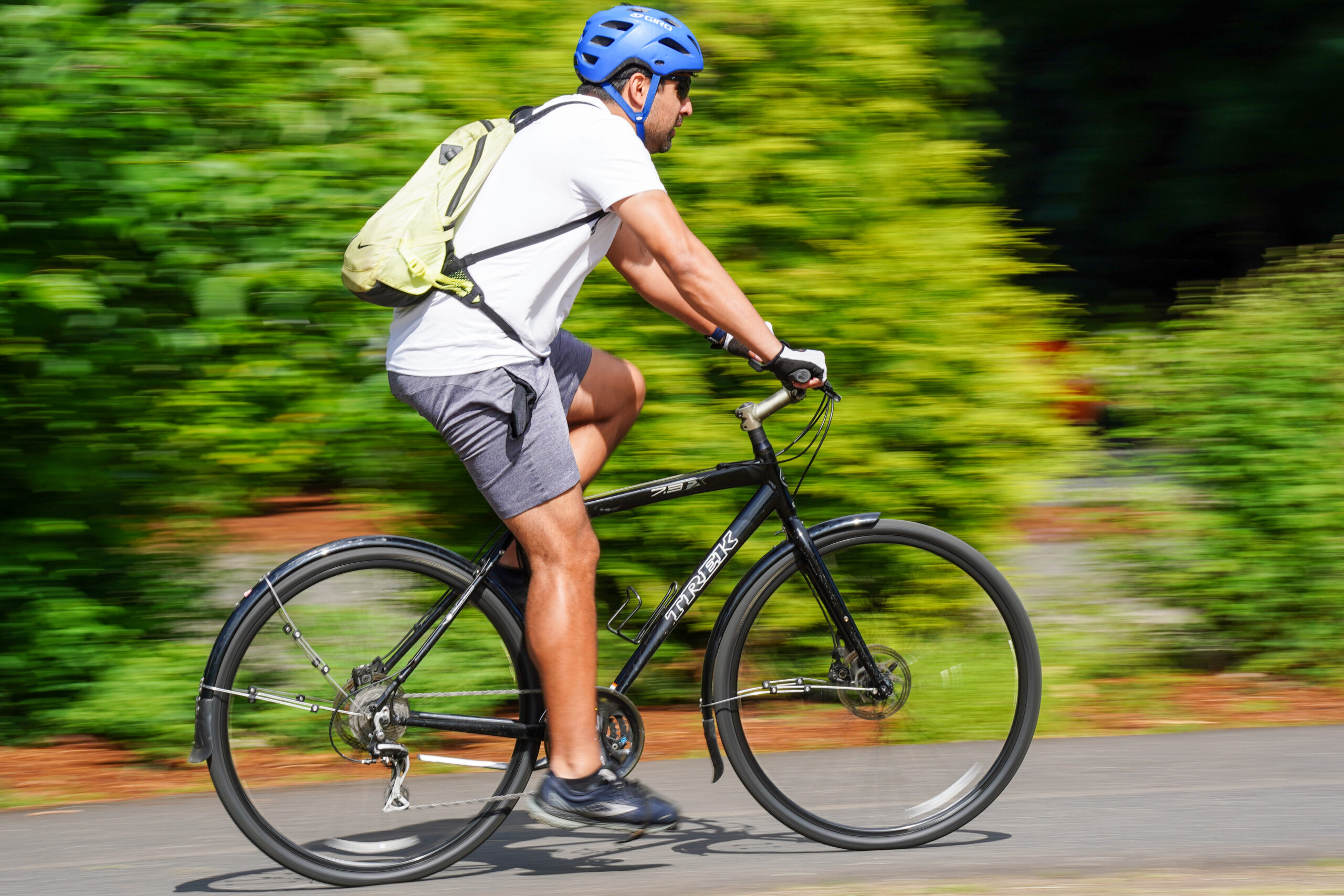
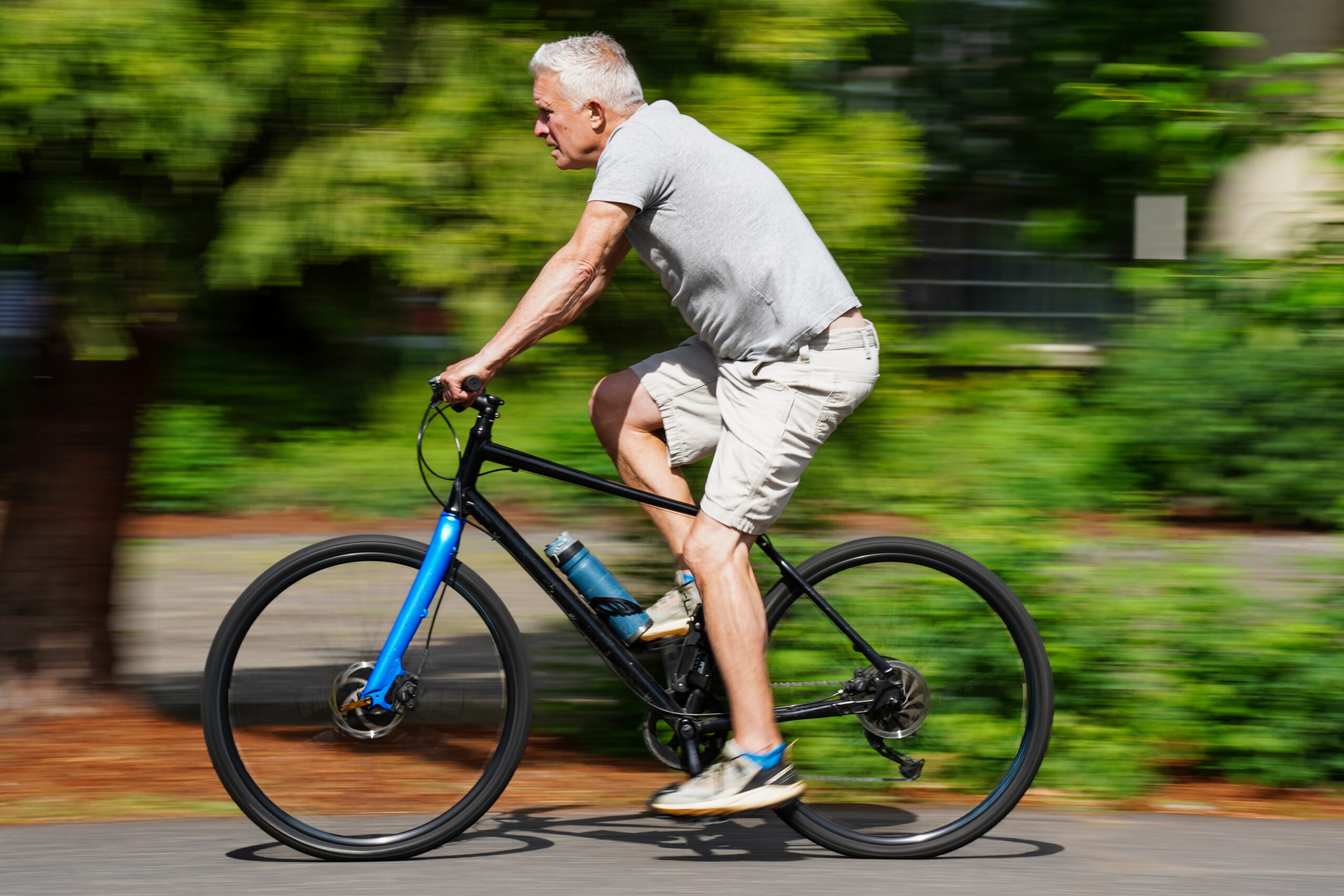
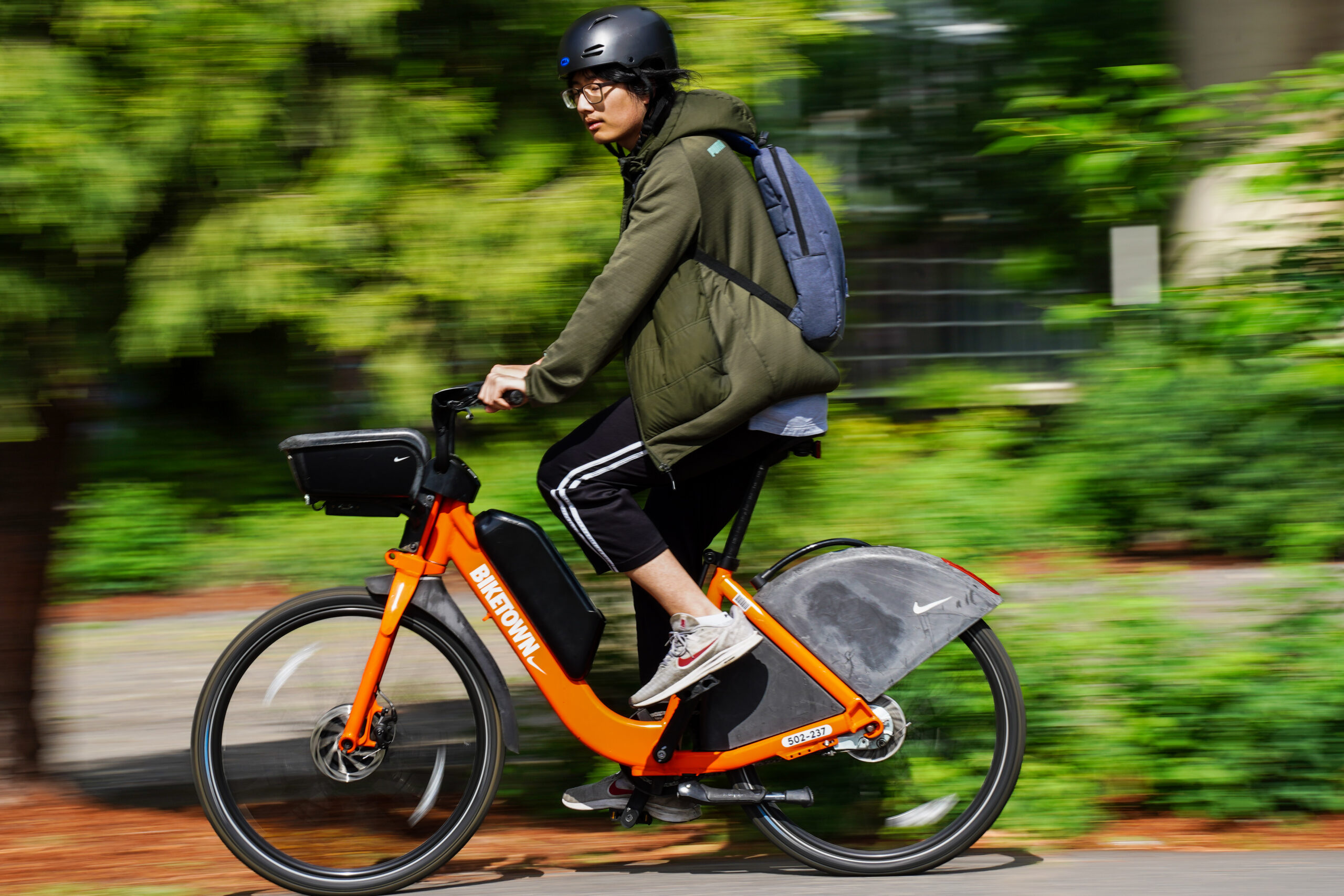
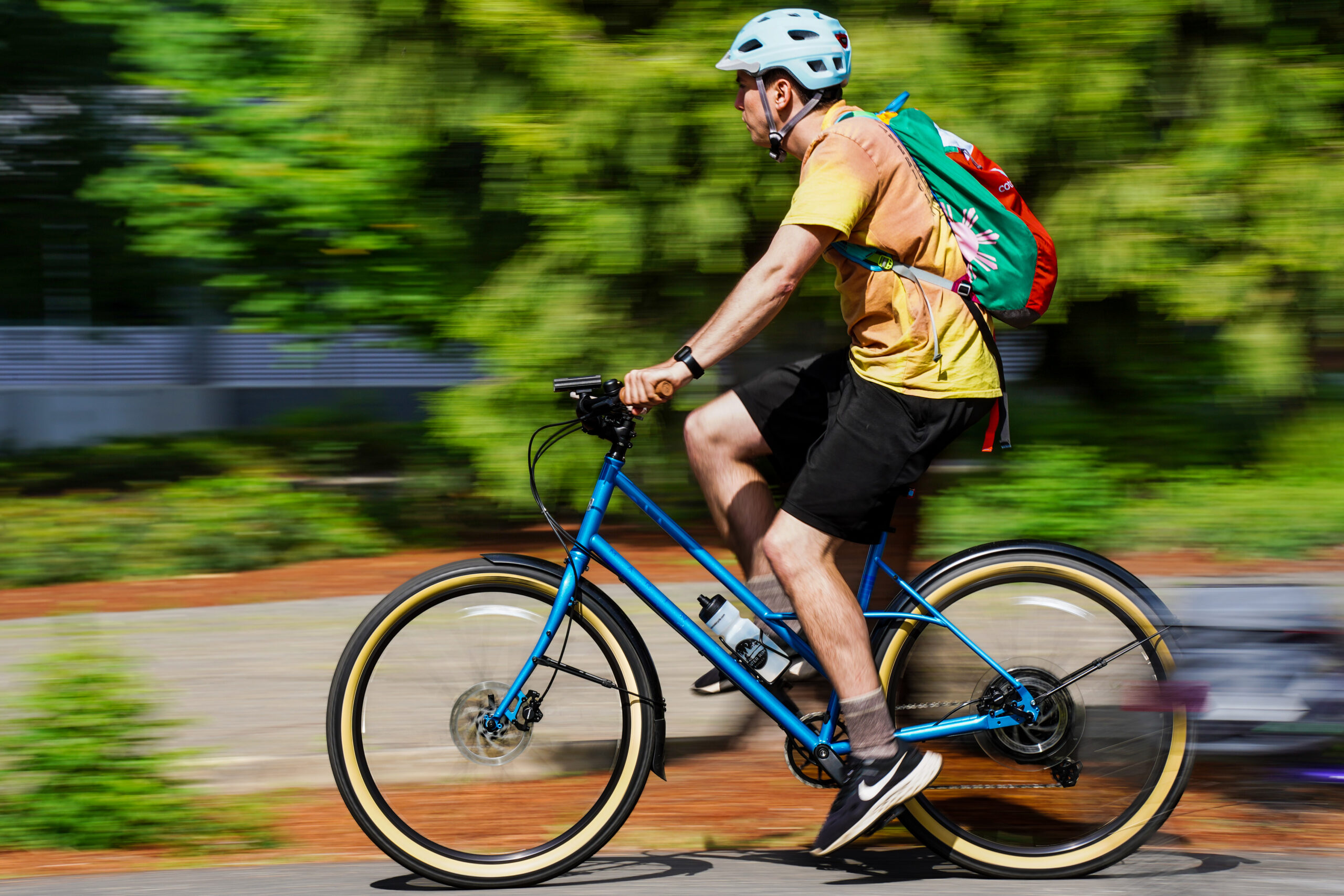
Sun, fun, it’s all happening! (Photo: Jonathan Maus/BikePortland)
Who’s ready for the weekend? Well sorry there’s still one more day. But seriously, Saturday is the Big Day when the 2024 Bike Summer will launch with the annual Kickoff Ride. If you’re on iOS, I highly recommend grabbing the Bike Fun App to plan your rides for the next three months. Here on the Weekend Guide, I’ll share the classics and a few rides that look interesting of the full Bike Summer calendar. And of course there is always stuff happening that’s not a part of Bike Summer.
So here is our guide to the best rides this weekend…
But first, a big “Thank you!” to this week’s Event Guide sponsor, the Gorge Ride on June 15th. This ride is such a gem and I can’t recommend it enough. Organized by nice folks with your experience and the health of the Gorge at heart. Learn more and register here.
Friday, May 31st
Anatomy of a Soundsystem – 5:00 pm at Woodstock Park (SE) If you’re like me, you are fascinated by mobile sound systems. The way some folks are able to mount speakers and thump tunes while they ride is so impressive. Well, my guy Andrew has the wildest set-up in Portland and he’s ready to share all his tips and tricks with you! More info here.
Saturday, June 1st
Sunrise Coffee – 5:15 am at Mt. Tabor Park (SE) Get a jump on Bike Summer by joining the “coffee outside” fans for this early morning peak at the rising sun from Portland’s fave volcano. More info here.
Breakfast on the Bluffs – 9:00 am at Skidmore Bluffs (N) If sunrise is too early, roll over the bluffs to get your community coffee and treats. Bring something to share — whether that’s breakfast treats or your Bike Summer ride flyers. And Grilled By Bike will be at the same location, so expect a big party! More info here.
Terri Sue Webb Naked Ride – 11:00 am at Coe Circle (SE) 9th annual ride will keep the legacy of body freedom activist Terri Sue Webb alive and nude. Get some practice in for the World Naked Bike Ride. More info here.
Bike Summer Kickoff Ride – 3:00 to 5:00 pm at North Park Blocks (NW) Come early to enjoy a DJ, dancing, merch booths, and more! There will be cool people to meet and all types of fun unexpected surprises. And at 5:00, we ride! More info here.
Bad Bitches Bike / Cowboy Carter Ride – 8:00 pm at Laurelhurst Park (SE) This look like the after-party to the Kickoff Ride, with time in between to put on your red carpet finest and toast the start of Bike Summer in high fashion, or just high fun, or both. More info here.
Sunday, June 2nd
Cycle Cats Vancouver Loop – 10:00 am at Vera Katz Esplanade (SE) Ride with a great group of folks on a moderately paced ride (but no-drop!) up to Vancouver and back. Perfect chance to learn the route if you’ve never done it. More info here.
Belmont Goats Ride – 10:00 am at Parkrose/Sumner Transit Center (NE) Join an experienced ride leader from Portland Bicycling Club on a 25-mile route at 13-15 mph that will include a bakery stop on the Columbia River and goat petting! More info here.
Slut Pedal – 2:00 pm at Irving Park (NE) “Ride”This ride is centered around BIPOC and Queer S*x Worker, but ALL local dancers, S*x Workers, performers, sluts, and whores are welcome for this fun, community oriented ride and party event.” More info here.
— Did I miss your event? Please let me know by filling out our contact form, or just email me at maus.jonathan@gmail.com.
Howell at a protest organized by OPAL Bus Riders Unite in 2010. (Photo: Michael Andersen)
Jim Howell embodied the visionary courage, tireless idealism, and civic activism that helped put Portland on the map as one of America’s most hopeful cities in the 20th century. He died Sunday, May 26th at the age of 90.
In September 1969, Howell and two friends founded an ad hoc group called Riverfront for People. Howell was an architect at the time and nurtured a side interest in civic organizing. As his firm worked with the City of Portland and the Model Cities program to help design Portland parks (including Woodlawn Park and the picnic shelter at Mt. Tabor Park that was unfortunately destroyed by a tree back in January), his interest in transportation planning — and specifically transit — grew. Just five years after he watched the I-5 freeway obliterate access to the east side of the Willamette River, and with the federally-funded freeway industrial complex hell-bent become an all-powerful influence on Portland’s urban form, a report by City Club of Portland caught Howell’s attention.
The 1969 report warned that if the downtown waterfront gives into an, “overemphasis on economy of traffic movement and disregard of other values, it will be little used and will contribute nothing to the central city’s vitality.”
The west side’s waterfront was already besmirched by Harbor Drive, a four-lane freeway completed in 1942. According to writer Tim DuRoche, When ODOT proposed widening it in 1968, Howell and his architect friend Bob Belcher read the City Club report and (at the prodding of Bob’s partner and civic activist Allison Belcher) decided to take its warnings to heart.
From The Oregonian, August 20, 1969. Courtesy Allison and Bob Belcher via Metroscape.
On August 19th, 1969 Howell and the Belchers organized a protest picnic on a grassy median adjacent to Harbor Drive’s freeway lanes. Around 400 people (including 150 children) showed up.
Historians recognize that protest as a seminal moment in Portland’s proud history of transportation reform activism. Ultimately, Harbor Drive was removed, and the successful picnic gave Portlanders their first taste of how civic power could be harnessed to alter the politics of transportation plans. And it sparked Howell’s lifelong passion for activism.
It’s quirk of history that Howell’s formative, freeway-fighting picnic happened in 1969 — because that’s the same year Senate Bill 10 (precursor to Oregon’s landmark SB 100) enshrined land-use planning requirements into state law, the Mt. Hood Freeway was approved, and the transit agency TriMet was created.
Doug Allen came to Portland in 1968 to attend Reed College. Hoping to land a writing gig and take up the transportation beat at upstart newspaper Willamette Week, Allen walked into the office of the paper’s founder Ron Buel (who’d go on to work with Allen and Howell as a major player in transportation activism) and asked for an assignment. “He said, go talk to this Jim Howell guy, he’s an architect promoting a grid system for busses.” Allen recalled in an interview with BikePortland.
“So I went up to his office and Jim showed me all the maps he’d made showing how the system ought to work.”
At a transportation policy debate with former Metro Councilor Rex Burkholder at PSU in 2012.Talking to Michael Andersen at a BikePortland Wonk Night in southeast in 2016.(Photos: Jonathan Maus/BikePortland)
Allen (now Vice President of Association of Oregon Rail and Transit Advocates) and Howell became fast friends and fellow rabble-rousers. In 1975 they formed “Citizens for Better Transit” with another activist, Ray Polani. One year later the trio served together on the Banfield Citizens Advisory Committee, which looked at alternative ways to spend funds set aside for the Mount Hood Freeway. Howell also helped organize Sensible Transportation Options for People (STOP) a group that helped kill the Mt. Hood Freeway project — another huge milestone in Howell’s early activism.
With defeats of Harbor Drive and the Mt. Hood Freeway, and political leadership that favored land use and air quality considerations ahead of freeway megaprojects and auto driving throughput, Howell and his cohort had the wind at their backs. And instead of fighting against something, they wanted to fight for something. That’s when Howell’s attention turned to designing a more effective transit system.
“At some point, around 1977 or so, we had this discussion and said, ‘We’re not accomplishing all that much from the outside, we really need to get on the inside,'” Allen shared. “So Jim applied for a job at TriMet and was hired as a planner.”
Mike Kyte, the TriMet manager who hired Howell, remembered him as a champion for a grid transit network structure for Portland’s bus system. “Though what emerged wasn’t totally what he proposed, his ideas certainly influenced us as we revamped the region’s bus routes.” Kyte also credited Howell (and influential former TriMet planner Tom Matoff) for creating TriMet’s successful timed transfer system that opened up transit for suburban riders in Washington County. It worked so well, Kyte recalled, that he used it to replan San Diego’s bus system years later.
Several people I heard from for this article noted that Howell’s urging for TriMet to not follow the typical hub-and-spoke system model — and instead create a grid network with transfers to allow multi-destinational trips — was some of his most important work.
Allen said Howell understood that, “You shouldn’t just feed everything to downtown,” and that TriMet should create a network that emulates what you can do with the highway system, “Where people can go anywhere they want and where you don’t have to live on a particular road to be able to go to some other place that’s on that same road.”
Noted transit consultant and author Jarrett Walker was an intern at TriMet when these ideas were first introduced and Allen says Walker, “Picked up the whole concept and really ran with it.”
One source who worked with Howell at TriMet remembered him as a, “Funny, upbeat, true original,” who was, “definitely under-appreciated” for his contributions to the transit agency.
Another admirable aspect of Howell’s approach was his willingness work with younger activists — whether that meant marching with them at a protest, talking to a young reporter, or showing up to one of our Wonk Nights.
One early morning in 2018 I cycled to a protest against the I-5 Rose Quarter project on the N Flint Avenue bridge and there was Howell and his friend Ron Buel passing around petitions. Howell also worked closely with nonprofit OPAL Environmental Justice Oregon and their Bus Riders Unite program. Former OPAL Executive Director Joseph Santos-Lyons recalled that Howell volunteered to help organize transit-dependent high school students. “Jim was one of the elders who thoughtfully and kindly shared his wisdom from a generation of advocacy and helped OPAL become a leading voice for transportation justice.”
Former BikePortland reporter Michael Andersen (now a senior researcher at Sightline) recalled seeing Howell at the first ever Bus Riders Unite protest against a TriMet fare hike proposal: “I think when you’re young, you tend to see age as a big dividing line in the political world. It’s just a little unusual to see an older person involved in efforts to change the way things are, unless they have some very personal stake in the matter. But there Jim was the first time I remember meeting him, a seventy-something wearing a green OPAL t-shirt tucked neatly into his pants, marching in a circle outside City Hall with folks who were mostly decades younger and several shades browner.”
Abby Griffith, a transit activist and community organizer with OPAL, told BikePortland Howell had not missed a monthly Bus Riders Unite (BRU) meeting since she joined the organization in October 2022. “My favorite memory of Jim is his advocacy for making the Hollywood Transit Center accessible to everyone,” Griffith shared. Howell was the BRU spokesperson for the Hollywood HUB Plan, which, in a 2023 letter to TriMet on BRU’s behalf he said, “Will seriously degrade the safety of transit riders transferring between MAX and buses as well the bus riders who will be in the new housing.” Then in typical Howell fashion, that statement was followed by a list of 10 bulleted items with specific requests for changes.
Portland Mercury Reporter Taylor Griggs first met Howell as a new writer for BikePortland without much experience on local transportation issues. “But even though I was young, inexperienced, and naive, Jim took me seriously and would call me from time to time with story ideas or things he wanted to talk about.”
Allen thinks the “craziest idea” Howell ever had was one he actually made a reality: a bus line between Portland and Tillamook on the Oregon Coast. “Jim came to me and said, ‘You know, we oughta’ run a bus line out there. We can use our principles and make it work’. Doesn’t that sound like a stupid thing to do?” Allen recalled. But eventually Howell convinced him.
Despite Greyhound and other operators losing money on the service and all but giving up on the route, Howell and Allen founded Citizens Better Transit Inc. (that name sound familiar?) and launched the “Beach Bus” in 1984. Allen said they added a second round trip and extended service up the coast to Seaside. “We basically doubled the amount of service Greyhound provided and we had four times the ridership they had,” Allen said. And six years later it was successful enough to sell back to Greyhound.
It didn’t matter if Howell was an agency staffer, an organizer, an agitator, or an entrepreneur — he was always a change-agent motivated by a passion for better transit and a better city. He used many of the same tools and strategies of other activists, but managed to combine them into an inside-outside approach that led to lasting changes that influence how we all move around and a legacy that will be studied by future generations.
Howell’s resume and longevity are a testament to his selfless, apolitical approach. He never sought personal credit and considered himself a technocrat. “He was ingenious and full of energy,” Allen recalled. “And he was active in these fights right up until the end.”
Thankfully Howell’s end isn’t the end of his ideas. The example set by Howell, and his willingness to share knowledge with younger generations, means his fight for a better city lives on in all of us.
The Rock Creek Composite MTB team practices skills at Butternut Creek Park in Hillsboro. (Photos: Shannon Johnson/BikePortland)
Out of the blue, I received an email invitation for my son to join a mountain bike club in our area.
“It’s a good place for bike crazy kids,” the team director, Hiram Conley, told me.
Would he be interested? Absolutely!
The organization is the National Interscholastic Cycling Association (NICA), a nonprofit that “develops interscholastic mountain biking programs for student-athletes across the United States.” The co-ed teams are for kids in 6th-12th grade and offer athletes the opportunity to compete in mountain bike races. Kids can also join the team without racing, just to have a fun group cycling experience. There are no try-outs and everyone is included and welcome at all levels (provided there are enough volunteer coaches to support the athletes). There are weekly practices and lots of weekend rides, which provide a great opportunity to develop new skills and new friendships. Refreshingly, it seems like NICA’s emphasis is on having fun, getting kids outside, and helping them grow to be strong and confident.
The author, just before dropping into the pump track.
I was immediately interested, because I have been wanting to find a way to get started on mountain biking, with the hope of developing another fun hobby for our family. With our current love of urban biking, and all my energetic and adventurous kiddos, mountain biking seems like a natural fit. I even bought myself a mountain bike last summer, but never managed to try it out.
“Can parents come too?” I asked. Yes! On this team, parents are encouraged to come along for the rides and teams may be looking for more volunteer coaches and assistant coaches. No experience necessary – NICA will provide training.
Conley, who coaches the Rock Creek Composite team, invited me to their first pre-season practice at Butternut Creek Park in Hillsboro. The park has a little gem of a BMX course that I didn’t even know existed. Unfortunately, my almost-6th-grade son was sick, so I ventured out to the practice on my own, hoping to learn a few first-time mountain bike skills, and get a feel for the community and team experience.
Coach Hiram led a few drills and games, and I nervously followed along, feeling all the awkwardness of navigating new athletic skills in a grown-up, perpetually postpartum mom-body (which is even more awkward than being in middle school). Despite my total lack of natural ability, I was welcomed and encouraged. My big victory was trying out the “pump track,” which I navigated quite un-gracefully (see video below). Turns out that trying something new at almost-40 is a victory I will relish. That said, my favorite part of the beautiful evening was just seeing a group of kids having fun, outside, goofing around on bikes. And I had so much fun, I wish I could join the team myself.
If your kids are interested in joining, now is the time! In Oregon, practices start in the summer and the season runs through the fall. Go to the Oregon Interscholastic Cycling League website to find the closest team to you. There are teams in Portland, Lake Oswego, Beaverton/Hillsboro, Tigard, and beyond. Our family hasn’t decided if a team commitment is right for us this year, but with many bike-crazy kids, and many summers ahead of us, I expect we’ll become team members soon enough. In the meantime, my sons are eager for me to take them to the pump track (where they will immediately surpass me), and to nearby Chehalem Ridge, so we can test ourselves on new bike adventures. Maybe we’ll see you out there!
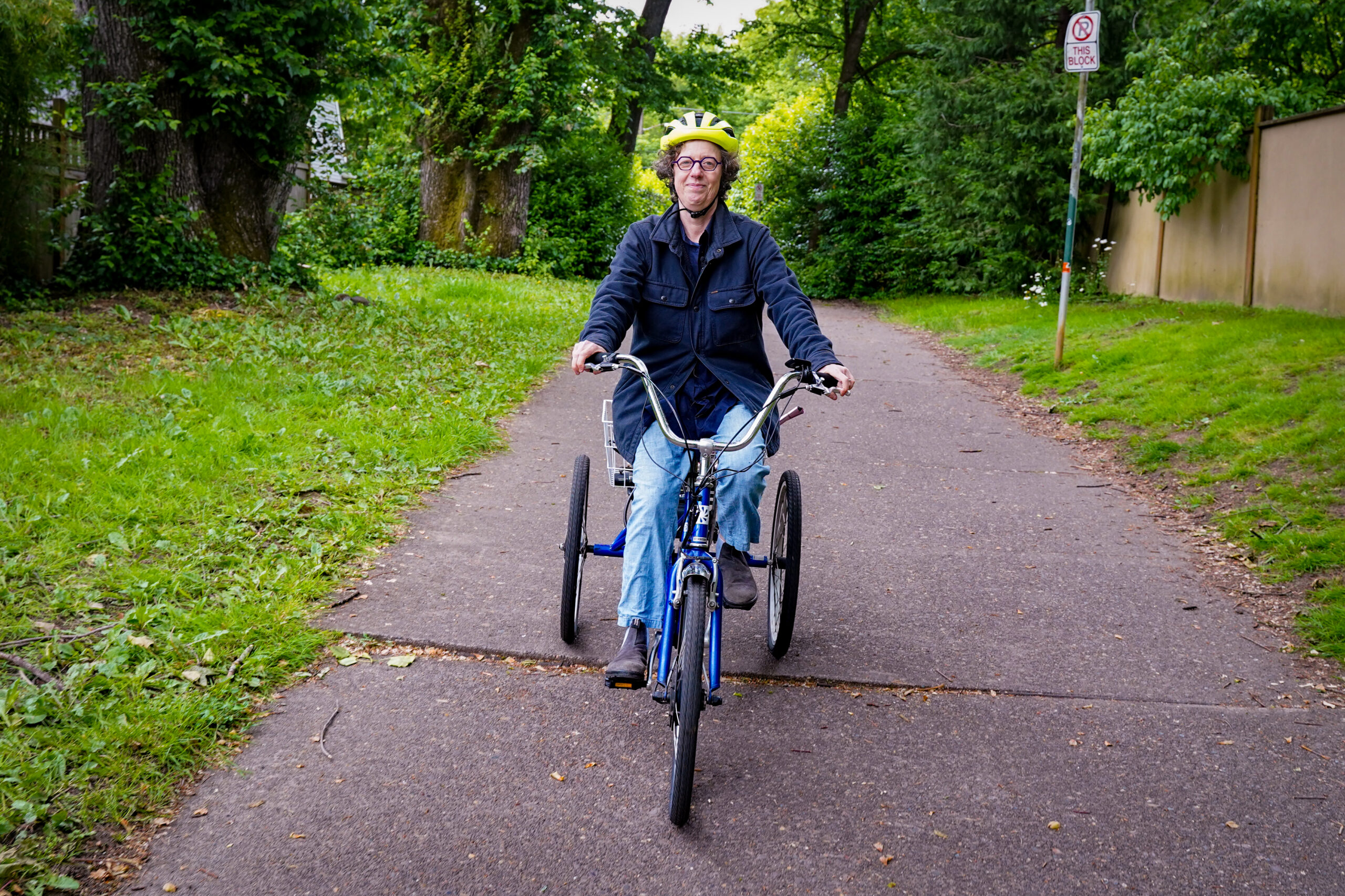
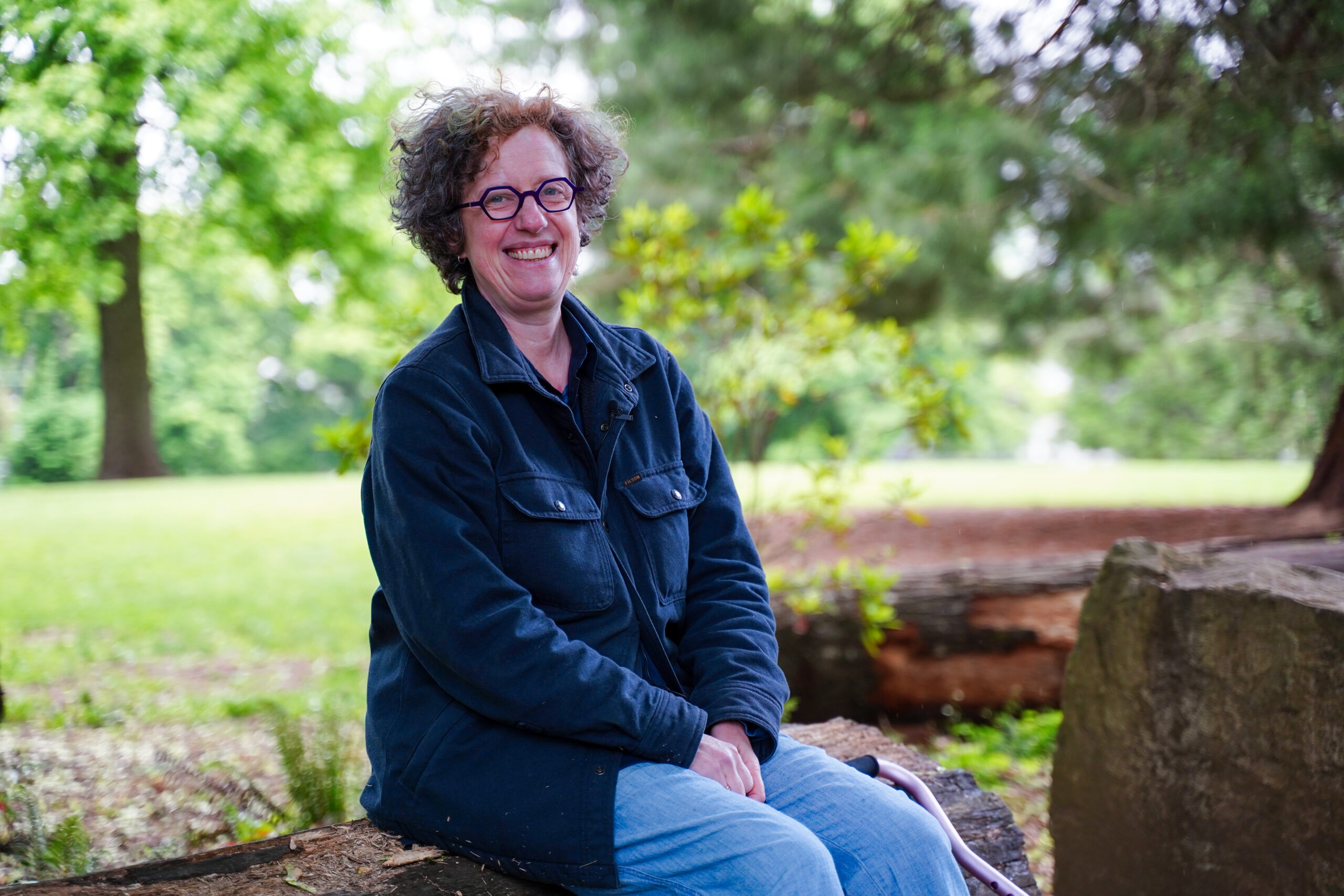
Marnie Glickman thinks she has the recipe for progressive political success in Portland. Glickman is a leading candidate for City Council District 2 (North/Northeast) and I met up with her Tuesday for a bike ride and an interview.
Glickman has lived in Portland off-and-on since 1992 when she paid $175 a month for rent on SE 28th and Steele and biked all over. Now 53, and after three decades working in politics and organizing, Glickman is ready to commit to her favorite city. After meeting at her home in the Sabin neighborhood, Glickman wanted to show me a community garden she sits on the board of, and then we rolled over to Irving Park where we sat on two large logs and talked under towering trees while rain fell overhead.
Listen to the episode above or wherever you get your podcasts. I’ve also pasted a few excerpts below…
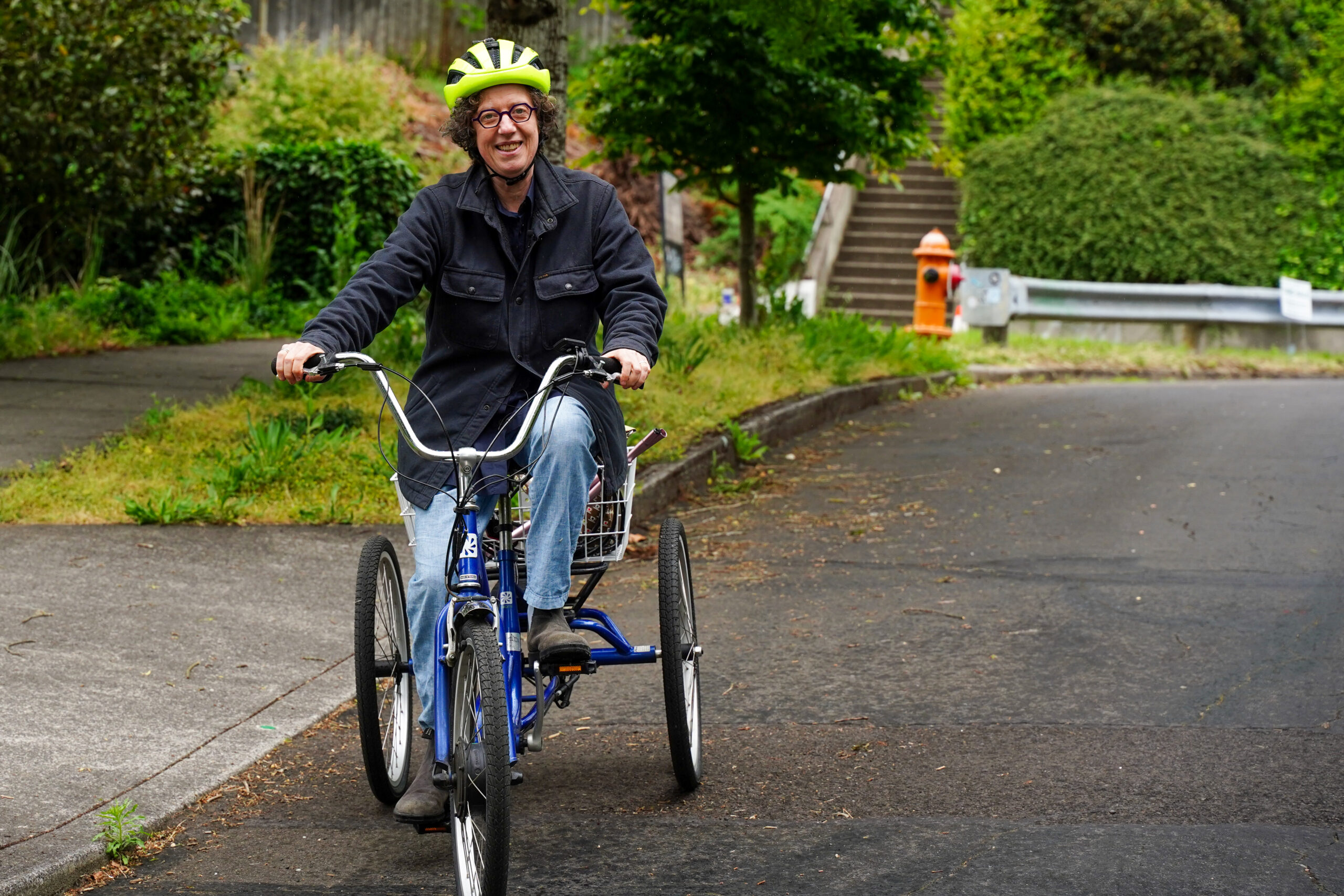
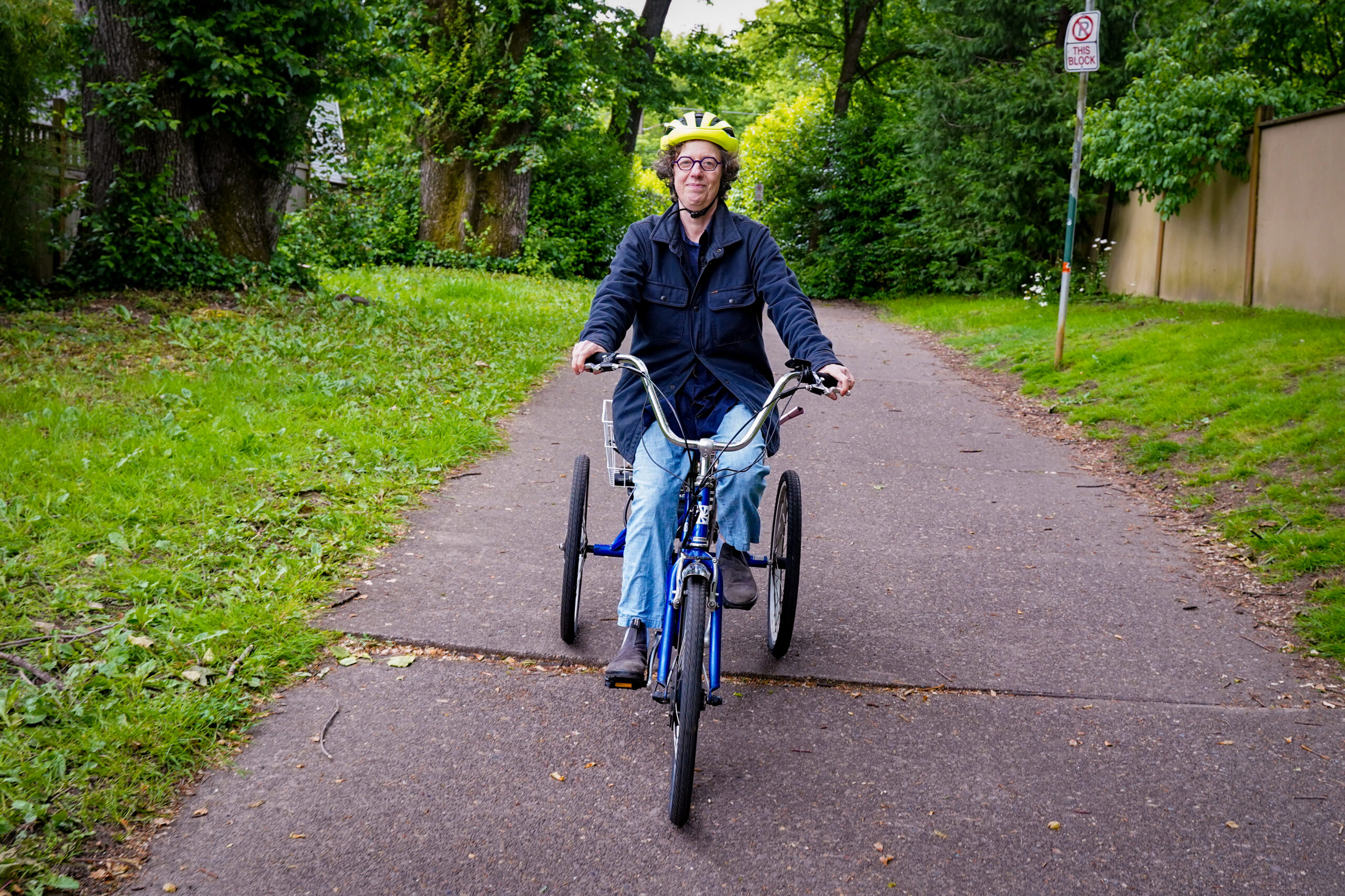
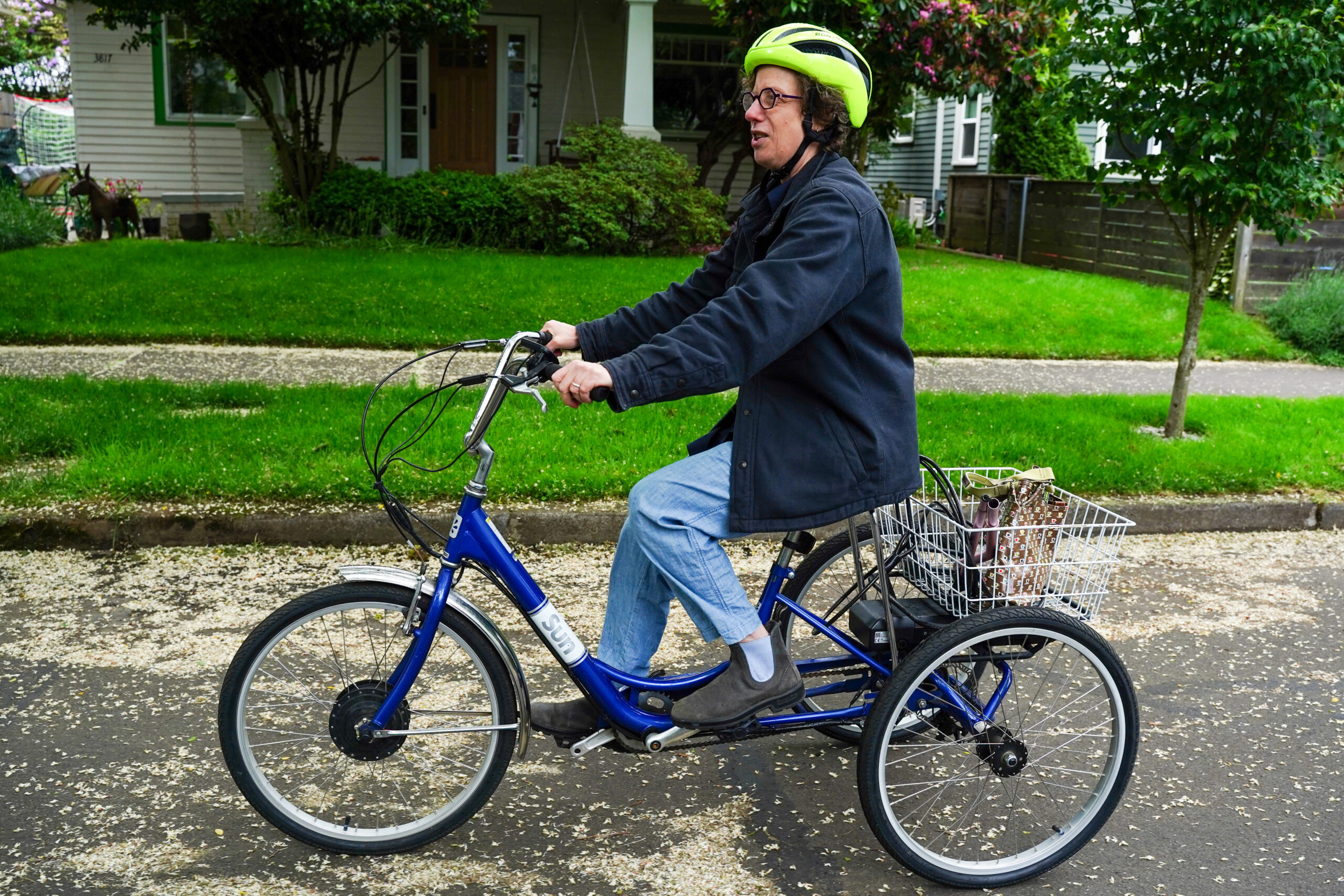
Under a tree in Irving Park.Glickman started riding a trike a few weeks ago following an MS diagnosis.Glickman showing me the Sabin Community Garden that she sits on the board of.
You might be surprised at Glickman’s high showing in small donor contributions thus far because she doesn’t have a major public profile here in Portland. But when you look into her background, it’s clear why she’s bubbled up to the top: Glickman has been in politics and organizing around public interest issues for three decades. She’s worked for several members of Congress and other high-profile elected officials, she co-authored the 2010 Green New Deal, is a former co-chair of the national Green Party and was finance director for Ralph Nader’s 2000 presidential campaign, and served a four-year term as a school board trustee while living in California.
That last job gave Glickman was she described in our interview as the most important thing she’s done in her career so far — leading a campaign to drop the name “Dixie” from a local school district. That fight put her in headlines and helped gird her for Portland politics.
We talked about that and much more in our interview, which you can listen to in the player above or wherever you get your podcasts.
Below is an edited version of some of our exchanges:
You’ve spent decades behind the scenes, why run now?
I decided to run for Portland City Council in district two because we need experienced progressive leadership and City Hall leadership that’s rooted in community, grounded and good government and powered by real progressive values. I know what it’s like to manage a multimillion dollar, complicated public budget. I know what it’s like to be a progressive elected official, and needing to work with others to get stuff done. I also bring some governing skills from having been a graduate of Lewis and Clark Law School. So I know how to make laws and read laws. I think that’s pretty important right now.
Why did you take on the fight to change the name of a school district when the issue had simmered for decades without any progress?
The district was named after the Confederacy during the Civil War. And I decided it was time for us to pick a name that reflected the community’s values. Every time I drove by the “Dixie” sign, I thought about Auschwitz. I’m driving home and there’s a sign that says “Welcome to Dixie.” And that’s a place where people were murdere during slavery. And I knew living there, people were really afraid to admit it to themselves. When Michael Brown was murdered in Ferguson, I was managing a political performance art choir, and working on the Monsanto issues [Glickman organized a successful effort to ban the use of Roundup weed killer in New York State in 2021]. And we went to Ferguson, and sang at the side of Michael Brown’s murder. And so when I flew back and drove by that Dixie sign again, after being in Ferguson, I thought, you know, there is no time for me to make excuses anymore for not doing my part.
How do you respond to people who might look at you, as a progressive candidate and say, ‘We need to get more to the center here, because we got these problems, and progressives haven’t fixed them yet.’?
That’s really important question. Portlanders deserve elected officials who are accountable, transparent, and responsive. Leaders can do that on the left and the right and the center. I’m running in part because we haven’t had that for a while from many or most of our elected officials.
You say you want to “achieve practical results, while never compromising deeply held progressive values.” What was your take on the 2022 lawsuit filed against the City of Portland by Portlanders who said people camping on the sidewalks was a violation of their ADA rights?
As a person with a disability, when I read about that lawsuit, I thought it was disappointing that we couldn’t solve the problems before getting to litigation. Litigation is expensive and should be the last ditch effort to solve real problems. I thought it was a sign of dysfunction in the government that we got to that point.
Do you think it’s possible for Portland to reach 25% bicycle mode share by 2030?
It depends on how the election turns out. I think optimistically we can have a majority of people, seven people elected maybe more who want to make that happen. I would be one of those seven.
Any ideas on how we can do it?
I’ve met a District 2 resident who shared a policy idea that I think is important, which is, figuring out ways to discourage people from driving and using their cars because it’s something we haven’t tried very much of. And I think it would help us by providing more free transit options for kids.
I’m not prepared right now to give you one specific project. I am the kind of person where I need to bring people together to figure this out. I’m not going into this race with a set of the 10 policies I want to make happen. Because what we need first is good government. We need teamwork. We need to figure out how the new government is going to work.
Given what’s happening in Gaza, do you think it is time the City of Portland — or even you, as a person running for council — be stronger in condemning it and calling it genocide?
Well, I’m not going to tell people what words to use. I can tell you what words I use. It is wrong to kill children and civilians en masse with taxpayer-funded weapons from the US and Israeli weapons. It is wrong, it is a global crisis. And so personally, I am having more desire to talk about it. And yeah, it’s really sad. It’s really sad. I would also say we need people in office who are willing to share their personal values and bring people along. And I think most Portlanders believe in peace and most Portlanders don’t think children should be murdered.
I hear what you said about not wanting to tell people the word they should use to describe it. But by not [calling it a genocide], as a person who’s a leader, are you worried that some people may not understand the severity of what’s happening? This is a genocide. And it needs to be named as such. And if we don’t call it that, are we doing enough to stop it?
I’m a lawyer. And so when I think of a legal term, like genocide, I think, ‘Oh do I remember the actual legal definition of genocide?’ So I’m just telling you where I’m coming from. Do I believe in the International Criminal Court? Yes. Do I think countries should arrest [Israeli Prime Minister Benjamin] Netanyahu? Yes.
I was raised Jewish, so I feel a responsibility as a Jewish voter for peace to talk about it. And I’m willing to lose votes for it. That’s what happened in Dixie. We elect leaders to make hard decisions, even if they only help a minority of the people. And so that applies to many issues facing the city. And my [political] independence is relevant because, as we know, money still drives politics here in Portland. And we need people to stand up — in spite of money, in spite of fear — and focus on what’s really important to me, that’s what being a leader is. So I decided to run because I know how hard it is to make big things happen to make real change. And I love Portland so much that I’m ready to do it again.
There are a lot of candidates in this race, why should someone choose you?
I have real progressive governing experience and governing skills. I am a grassroots, people-powered candidate and a grassroots people-powered leader. And as the campaign goes on, I will be knocking on doors with everyone and persuading people with my positions on issues — and not just my cool trike.
Listen to the full episode in the player above or wherever you get your podcasts.
When Bike Summer (a.k.a. Pedalpalooza) officially begins this Saturday we’ll be showered with so many ride options it can feel overwhelming. There are 22 rides on opening day alone and by the time the calendar is set there could be nearly 900 rides from June through August!
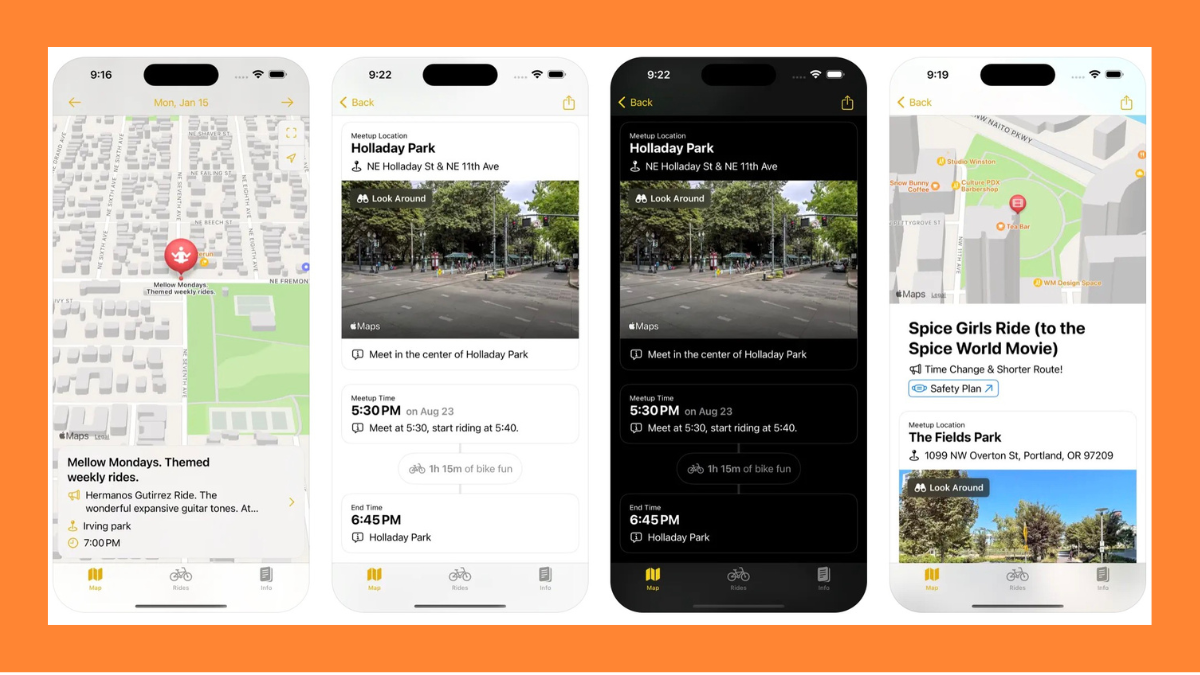
If FOMO dampens your fun, you need to download the new Bike Fun app. This app, which is currently only for iOS with an Android version due next year, puts the entire Bike Summer calendar in your hands. It pulls all ride details from the official Shift calendar and packs very useful features into an intuitive and easy-to-use interface.
You can view rides in map or list form, navigate one date at a time, bookmark a ride and set a reminder, and save rides to a bookmark page. Just find a ride near you, tap it, and see all the details. Tap the “Info” tab and get helpful new rider tips, find community resources, and even view rides by meet-up location. The app is free and has no ads or tracking.
How did we get so lucky? The person behind this splendid sorcery is Aaron Corsi, a new Portland resident who moved here in early 2023 from Cincinnati. I caught up with him recently to learn more about him and his wonderful app.
Aaron, his dog and the “cargo bike of his dreams.” (Photo: Aaron’s Instagram)
“We were looking for a more progressive city and one of our top priorities was to be able to sell one of the cars and use transit or bikes for the vast majority of transportation,” Aaron shared with BikePortland via email. “Portland ended up being the winner because of its reputation as a ‘cycling city,’ close proximity to nature, and the relatively low cost of living compared to other bike/transit friendly cities.”
Aaron is a great example of someone who moves here for the culture, then adds to it. And he’s a BikePortland fan!
“I found BikePortland when I was researching cities and it was actually a big selling point for me to see that there were enough people who care about good bike infrastructure and safe streets to keep a website like BikePortland going for so many years, including the comments section that so often has very thoughtful discussions. I wasn’t really sure what to expect when it came to the bike infrastructure but I knew it was going to be a big part of how I would get around, so one of the first things I did after moving here was look up articles about new installations on BP and ride there to see what it was like, slowly building up confidence and going further and further from my house.”
Aaron said he knew Portland had a bike cycling community but he didn’t know exactly what that meant beyond a lot of people biking around. Fresh to town he says he rolled over to Splendid Cycles to buy the “cargo bike of my dreams” with the money from selling his car and that’s where he first learned about Pedalpalooza and the Shift website. His first ride was the weekly PSU Farmer’s Market Ride. “It was so warm and welcoming, the perfect way to dip my toes into the group ride culture,” he recalled. Once he did his first Thursday Night Ride and last year’s Bike Summer kickoff, he was hooked. “Something about huge groups roaming through the city with all of that positive energy is just magical,” he said.
When it comes to the Bike Fun app, it was a natural extension of Aaron’s skillset as a veteran iOS app developer. “When I was looking to start a new project my partner suggested that I should make an app ‘for that website you check all the time,’ and here we are!” he shared. Aaron got most of the coding done this past winter when a major ice storm trapped him indoors.
Now that Bike Summer season is upon us, Aaron hopes his app will get more people out in the streets. And he’s not done with it yet: Cool features in the works include integration with routing app RideWithGPS, GPS recording to save in your ride journal, and badges for achievements and ride milestones.
Our community is so lucky to have Shift, Bike Summer, and amazing people like Aaron.
Find the app at BikeFun.Bike or search “bike fun” in the App store.
Aaron shared these notable features you might miss:
– No matter which device it’s running on, the ride data is stored offline so users can still look up all the details about a ride even if they don’t have a data connection. Ride data for a given day is updated every time a user views that day’s rides in the app.
– Under “Info” -> “Popular Meetup Locations” you can find rides for the next 100 days organized according to meetup locations.
– On the “Saved” tab, once a saved ride has started you can log your attendance and write a ride journal if you’d like.
– There is a full-featured version of the app for Apple Watch that does everything the other versions do including saving rides offline.
– The app is designed to respect user’s privacy. Saved rides, attendance records, ride journals, etc. are all stored privately on the user’s device and are synced to their other devices using iCloud if they’re signed into that. There are no ads in the app and there’s no analytics, tracking, or data collection of any kind.
– The app works on iPhone, iPad, Apple Watch, and Macs with Apple chips. There’s no Android version yet but I have started on it, it probably won’t be done until next year’s Bike Summer.
Just a few of the tees from last year’s T-shirt Night.
Hope you can join us on the Gorges Beer Co patio tomorrow because we’ve got a very special night planned. A fun theme and two special guests.
Here’s what’s up:
First, remember to wear a bike-themed tee and/or bring extras to swap and share. T-shirt night is a chance to reach into the back of your dresser drawer and unearth that vintage tee that holds fun memories of yesteryear. Or maybe you got a cool new tee recently? How many of the Nia Musiba 2024 Bike Summer tees will we see? Or maybe you work at a local bike shop, nonprofit org, or bike company and have some old designs you want to clear out? Bring ’em!
And second, there’s a ride from the City of Portland building downtown for everyone who wants to volunteer for this year’s annual bike counts. If you haven’t heard, PBOT wants you to join the volunteer crews that will count riders this summer. It’s a really cool gig. The guy who runs the bike count program, PBOT Transportation Planner Sean Doyle, will hold a training Wednesday at 3:30 pm at the Portland Building (1120 SW 5th Ave, Room 100). After the training (around 4:15 or so) Sean will lead a ride with the new recruits to Bike Happy Hour! If you show up around 5:00, Sean will get on the mic to share more about the counts. You’ll be able to sign up and learn more about this cool volunteer opportunity.
Also at open mic we’ll have local transportation activist Chris Smith in the house! Smith is a very respected local voice for reform and has been at the forefront of everything form bike parking policy to holding DOTs accountable for megaprojects. Smith will lead a conversation about the upcoming 2025 legislative session where lawmakers will create a multi-billion package of spending on projects and programs. Everyone in our space is talking about this, so don’t be left out. Come to the patio and learn what’s up, how you can be engaged, and what to expect once the session heats up next year.
Come for the t-shirts, the bike count info, or the latest scuttlebutt on the 2025 package. Or just come to hang out and have fun! Either way, I can’t wait to see you there.
Just a few of the people riding on the Esplanade yesterday. (Photos: Jonathan Maus/BikePortland)
Yesterday was one of those days where it felt like everyone was out on their bikes. The weather, the day off, is was glorious!
I went out to check on a few things downtown (including the newly finished loading platforms on SW Broadway) and on my way home I spent time observing the Eastbank Esplanade. I find busy bike traffic days very life-affirming and they help restore my optimism for Portland. And yesterday was no exception. Despite the doom-and-gloom and last week’s terrible incident on the nearby Springwater Corridor, the path just south of the Hawthorne bridge was teeming with riders, walkers, and rollers of all types.
Here are some of the folks who passed by my lens.
1
2
3
4
5
6
7
8
9
10
11
12
13
14
15
16
17
18
19
20
21
22
23
24
25
26
27
28
So many different types of people and bikes out for a spin. Isn’t it beautiful?! For more People on Bikes galleries, see the archives.
Walton working the crowd at a 2019 bike ride. (Photos: Jonathan Maus/BikePortland)
Bill Walton passed away on Monday after a battle with cancer. He was 71 years old.
Walton was one of the NBA’s greatest ever players and the leader of the Portland Trail Blazers during their 1977 championship season. His collegiate career at UCLA under coach John Wooden is a thing of legend and if not for his knee injuries, the 6-foot 11-inch, quintessential “big man” would have reached even greater heights.
Walton’s free-wheeling and full embrace of life made him perfect for Portland. The fact that he loved bicycling was icing on the cake.
In 2010 the Trail Blazers asked him to record a message for our Bike to Blazers event and he waxed poetically (as he often did whether you were talking to him privately or during his memorable broadcasting gigs) on what it was like to ride to Memorial Coliseum from his home near Northwest 23rd Street.
Rolling down Broadway.
“There is no greater moment than when you’re on the road and you’re coming to the temple, the mecca, the shrine,” Walton began. “I would come on my bike down from Northwest Portland and our fans knew when I was coming so they would get out on the streets and they would be cheering and yelling, “Here we go Blazers!”
Walton said he’d ride east on NW Everett to the Steel Bridge and then roll right into the parking lot where a valet would take his bike. “I live to ride, I ride to live,” continued his promo. “You should too. Get on that bike and come on down. We’re here to play, how about you?”
A year or so after that, Walton called me. He wanted to do a big ride. I assumed he meant some sort of charity or promotional ride; but no. He just wanted to get out on some open roads. I passed him along to Jeff Bernards, a friend who worked at a bike touring company and was the biggest Blazer fan I’ve known. They did a big ride in the Gorge, and afterwards Walton rode out to the Oregon Coast because he wanted more miles.
“He can hardly walk, but he can ride like crazy,” Bernards recalled.
The next time Walton and his bright lycra showed up in my life was in 2019. The City of Portland planned a Sunday Parkways for downtown and partnered with Walton and the Blazers for a pre-ride as part of the team’s 50th anniversary season festivities. Over 40 years after Walton brought us our only NBA title, a huge crowd gathered to meet him outside the Coliseum. And the “Big Redhead” did not disappoint.
In a red Blazers bike jersey, rainbow biking shorts, bike gloves and Nike tennis shoes, Walton lit up the crowd. He signed autographs, posed for photos, and before hopping on his Grateful Dead-themed custom carbon bike he grabbed a mic and was in his element as the crowd encircled him.
“When you get confused, ride your bike and listen to the music play,” he boomed, in a mash-up of Grateful Dead lyrics and his own spin on the moment. “The first days are the hardest days, don’t worry about it no. What I want to know is, can you ride your bike? Are you kind? And will you come with us? Here we go!”
Rest in peace Bill! And thanks for being such a champion for cycling and for our city.
I think I found a perfect comment. Twenty-six other people liked it too, not to mention it received a COTW nomination. It’s short, sweet, and even manages to have some narrative structure. Here’s DW’s take from the day after the election:
I was feeling some dread over seeing the results of the vote on this particular issue. That was unfounded, and I think a result of just reading too many dumb comments on Reddit and Willamette Week.
Some coworkers and I were talking about the results of the election this morning. When the topic of the gas tax came up, I was low-key prepared to go on the defensive. Despite all of them exclusively driving to get around, they voted for it. Every one of them shared some project the city did that they liked – a new crosswalk in their neighborhood, speed bumps on their street, or a repaving project. One even said they like when the city stripes bike lanes because it makes people go slower. Keep in mind, these are people who never ride bikes and only walk occasionally for recreation.
I think the lesson for me here is that I need to get off the internet and talk to people in real life more.
Yep, DW might be on to something there.
In case folks missed the election followup, these results didn’t come in on some sliver of a low-turn out. No, at 36% Multnomah County had a strong showing for a primary election, especially given that it didn’t benefit from the boost of competitive presidential or gubernatorial races. I’ll go out on a limb, maybe all the talk about charter reform over the past couple of years, and the large numbers of candidates running for city council in the fall, has given voters a bit more awareness of elections.
Thank you for your comment, DW, and also thank you to everyone who has shared their election thoughts over the past few weeks. You can read DW’s comment in context of what everyone else said under the original post.
This week’s Roundup is sponsored by Gorge Pedal on June 15th. Discover the Gorge and the Historic Columbia River Highway in style on this annual ride organizers call “one of the happiest rides in Oregon.” Tickets and info here.
Welcome to the week! Hope you enjoyed Memorial Day and found time to remember the people who sacrificed their lives for our country. Here are the most interesting stories our community has come across in the past seven days…
Don’t ask: When it comes to parking reform, you might want to think twice about getting advice from a traffic engineer. (Strong Towns)
The fountain of youth: A new study found that older people who bicycled regularly were over 20% less likely to have knee pain or osteoarthritis, proving once again that riding is a wonder drug. (NPR)
Your brain on bikes: On a related note to the item above, 23-year-old Connie Hayes is a bike racer with dyslexia, dyspraxia and autism who says cycling is a “lifeline”. (BBC)
Work(out) from home: How many of you would jump at the chance to use a desk that allowed you to use pedal-power to generate electricity needed to run your work-from-home setup? Check out the PedalPC. (The Guardian)
Record ride attempt: Ultra-distance cyclist Lael Wilcox has embarked on an attempt to circumnavigate the world in world record time. She expects to ride 18,000 miles in 110 days for an average of about 170 miles per day. (Velo)
Speed governors: A step forward in speed reduction that would be baked-into cars by way of a visual and audible signal when someone drives over the limit has been passed by the California Senate. (SF Gate)
Safety disconnect The post has since been deleted, but Texas police officers shared a photo of themselves on social media next to a ridiculously oversized truck patrol vehicle as part of a seat belt safety campaign. It was an example of how many in the “public safety” field still don’t see these vehicles as inherently unsafe. (Fast Company)
E-car safety risks: Researchers have found that EV cars are much more likely to hit people on the street than gas-powered cars. It might be because of how quiet the cars are, the demographics of the drivers, and swift acceleration. (The Guardian)
Bikes and Blumenauer: Portland’s bike-loving U.S. Congressman Earl Blumenauer has always been optimistic about the future of bicycling in America and says once he leaves office he’ll have more time to do something about it. (Streetsblog USA)
Parking informants: There’s a growing cadre of San Francisco residents who are sick and tired of some drivers who think they can park wherever they want without consequence. It’s one way to fight back against the scourge of Big Auto in our lives. (San Francisco Standard)
Big investment: Portland-based Ride With GPS landed a $3 million infusion to help it grow, marking the company’s first-ever outside investment. (MSN)
Another notch in the growing enthusiasm around this year’s Bike Summer (a.k.a. Pedalpalooza) festival happened in southeast Portland last night. Fans of the three-month-long cycling smorgasbord rolled into a parking lot off Southeast Belmont and 34th for the first ever Bike Summer Merch Pick-up Party.
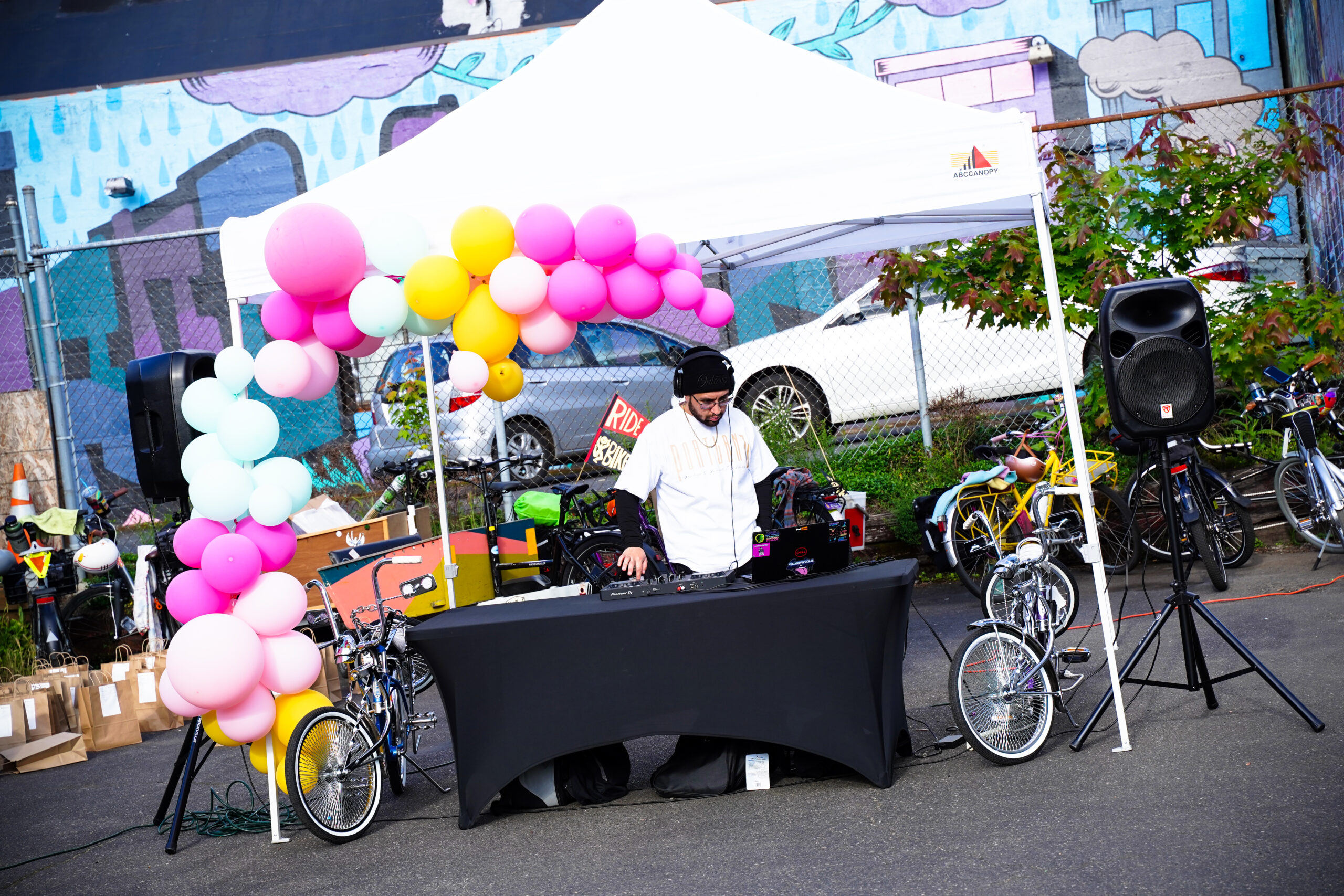
DJ Ninety6Vino set the mood with chill tunes while flanked by colorful balloons, vendors shared their art, and lots of great folks got together with a shared eagerness to adorn themselves and their bike with Bike Summer pennants and shirts.
The event was held in the parking lot outside Rendered.co, the screen printing company responsible for Bike Summer’s posters and other items. They were helping folks print their own free, custom-designed bandannas. Also on hand was Nia Musiba, the 2024 Bike Summer Artist and a bunch of other cool people.
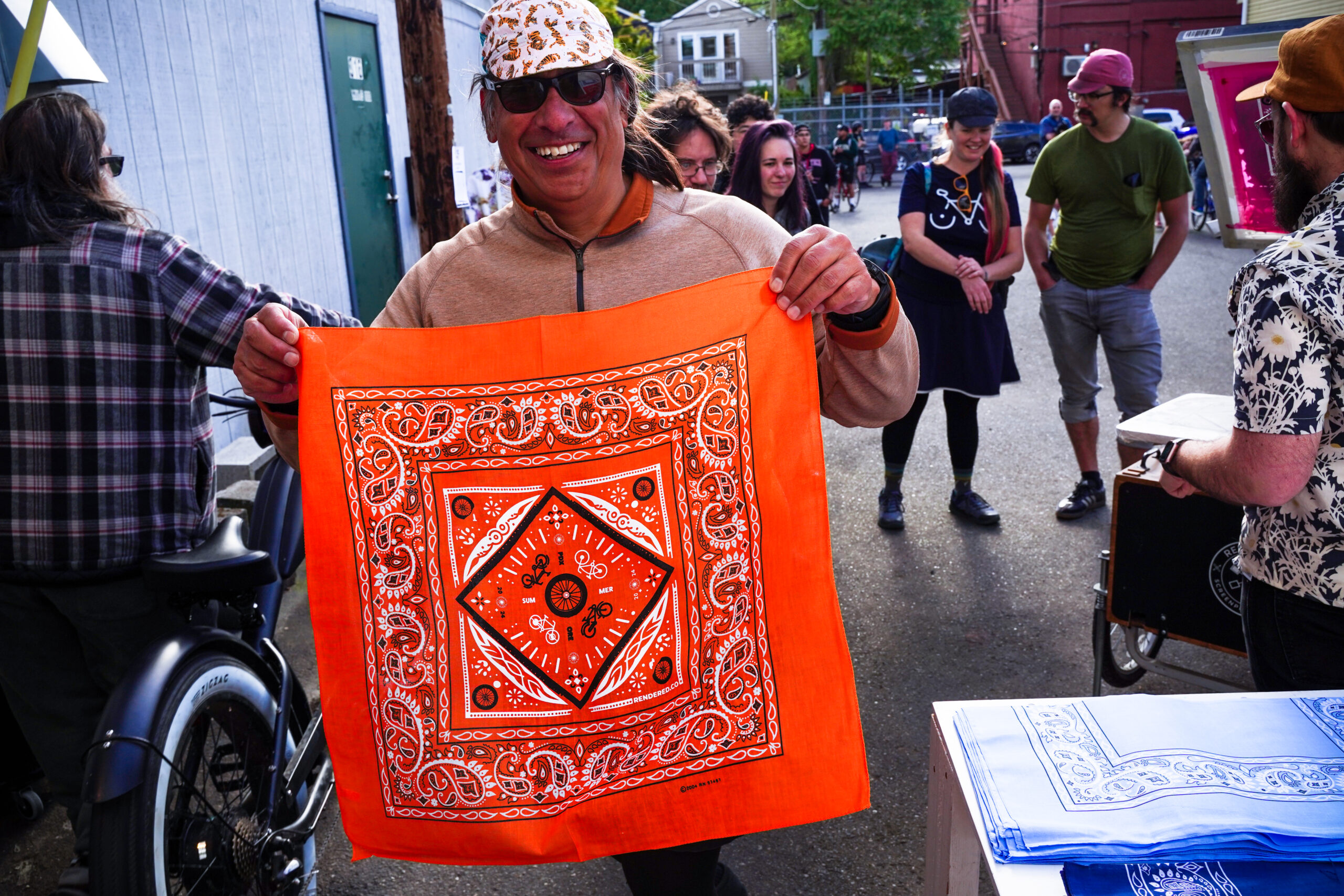
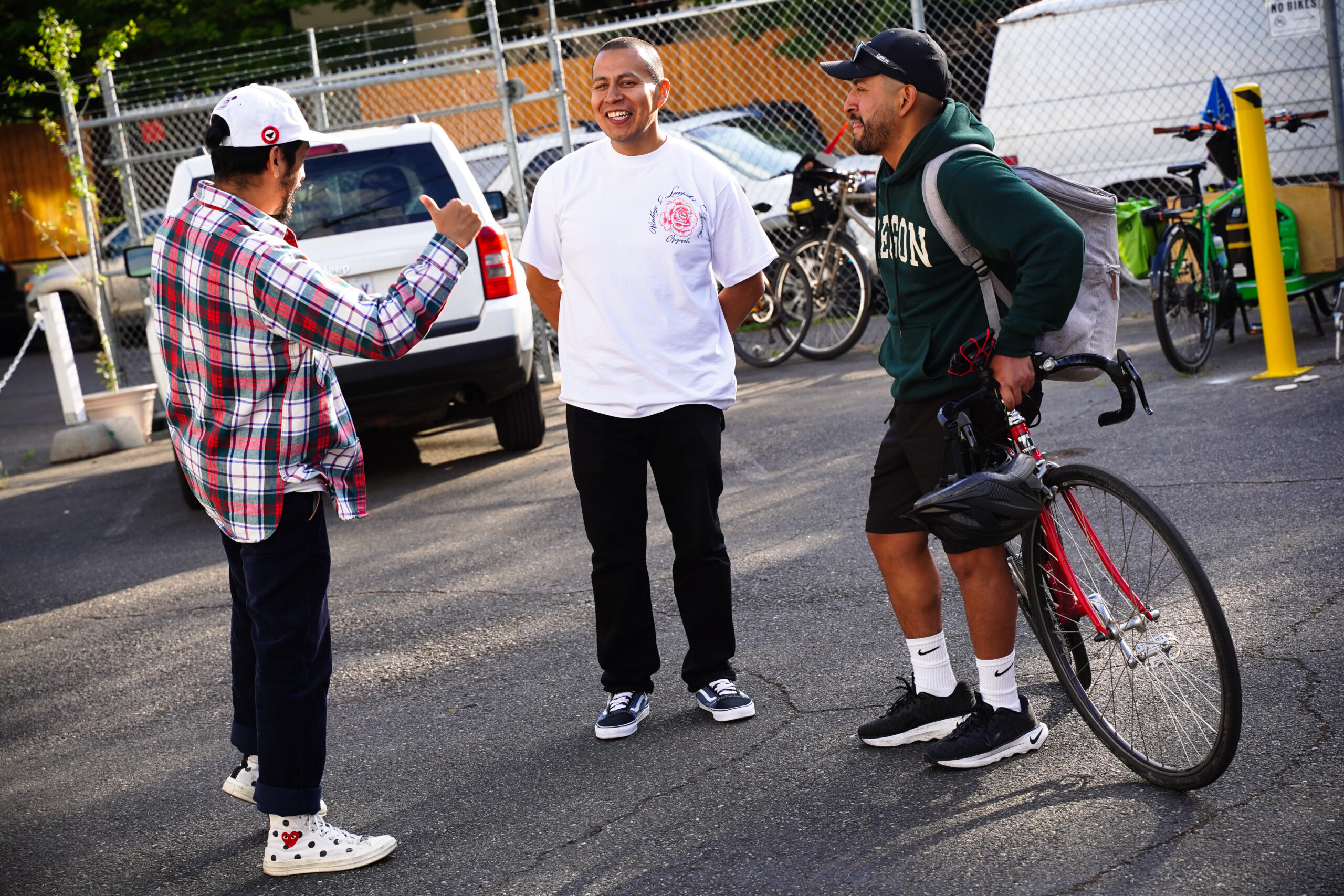
Armando Luna, the “Bike Fun Mayor of Portland” shows off his free bandanna!Vin on the turntables.Christian, Ernesto, and Esteban.
I chatted with Musiba, Bike Summer Director Meghan Sinnott, and several ride leaders and Bike Summer superfans in the video above. Watch it here or over on Instagram.
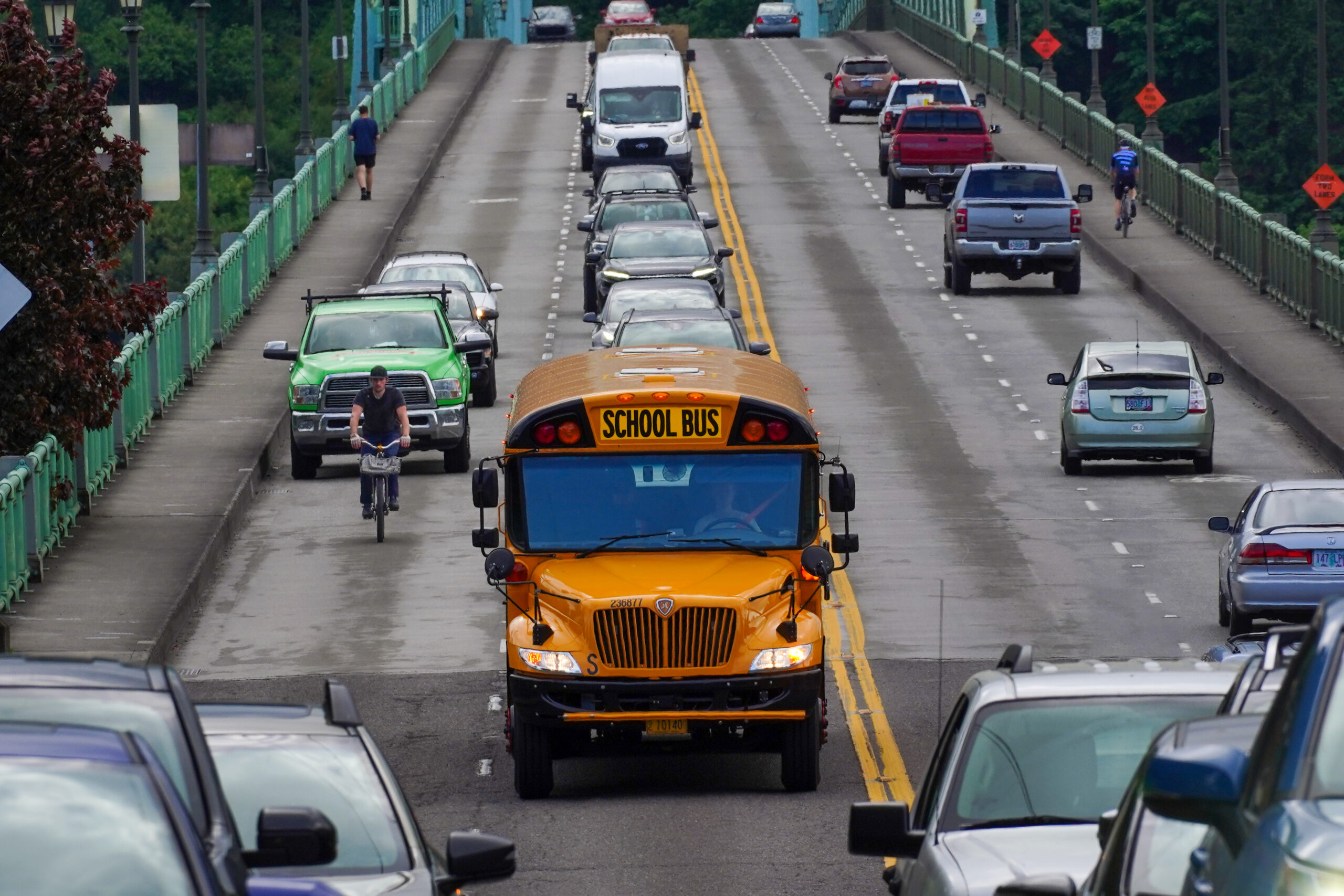
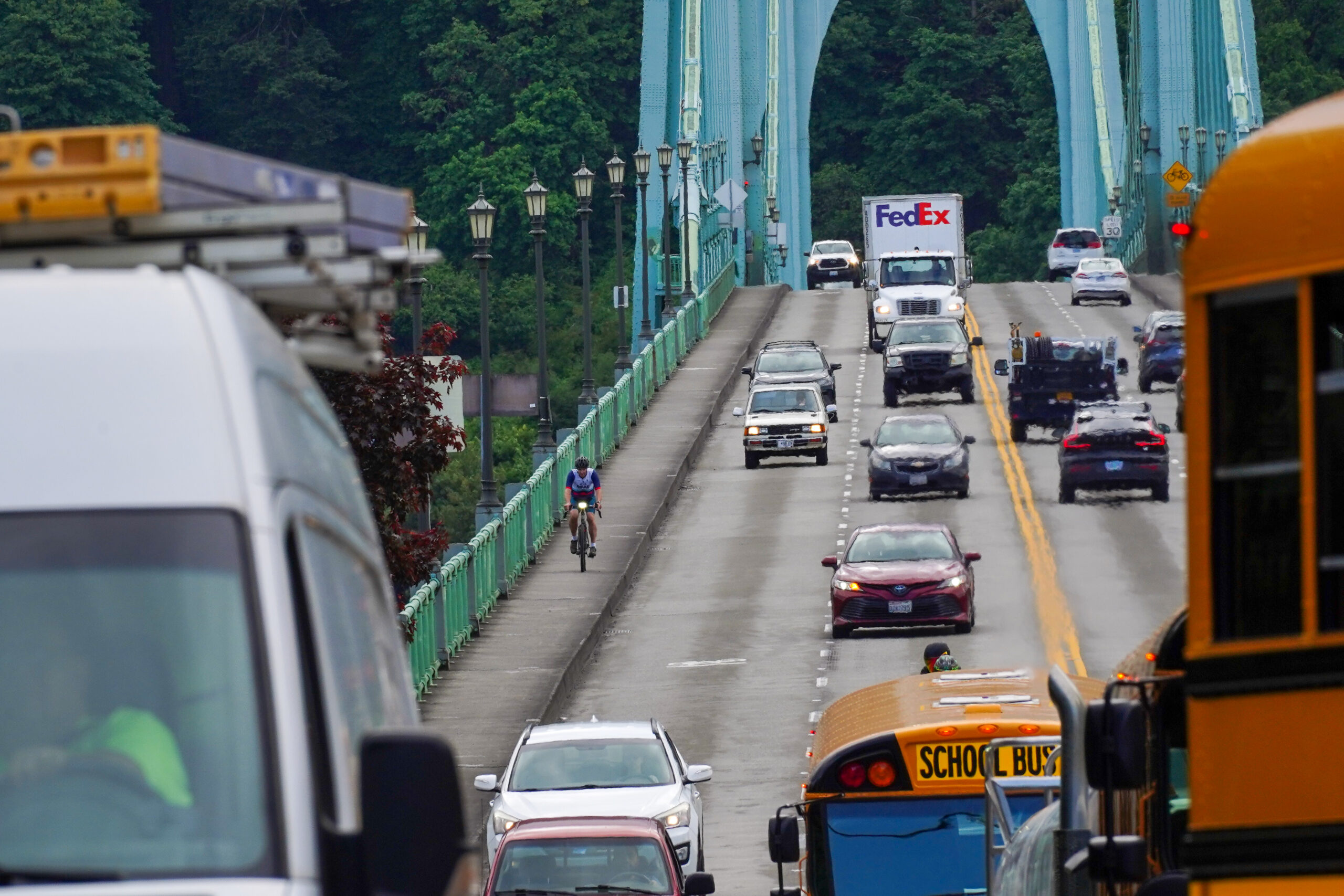
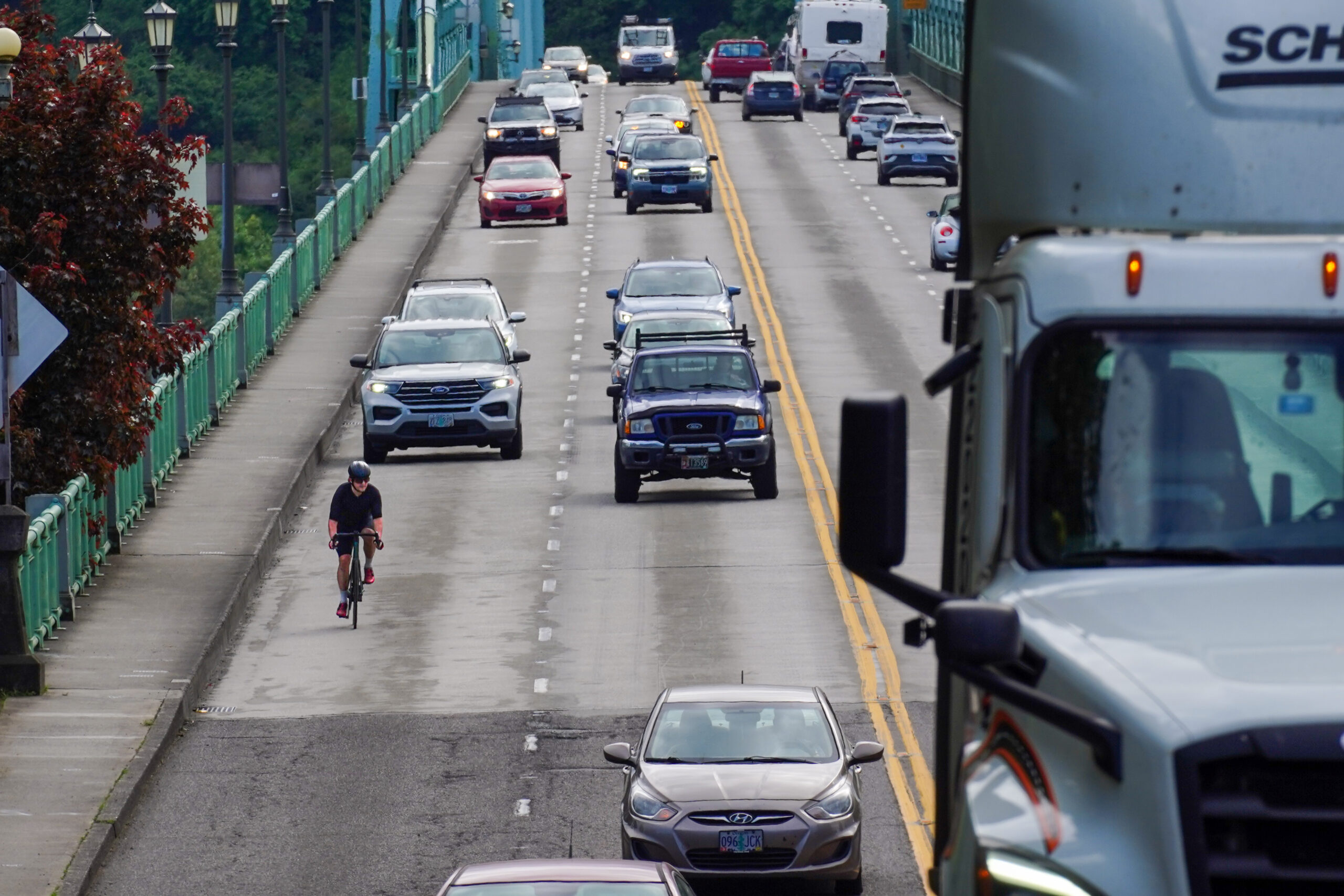
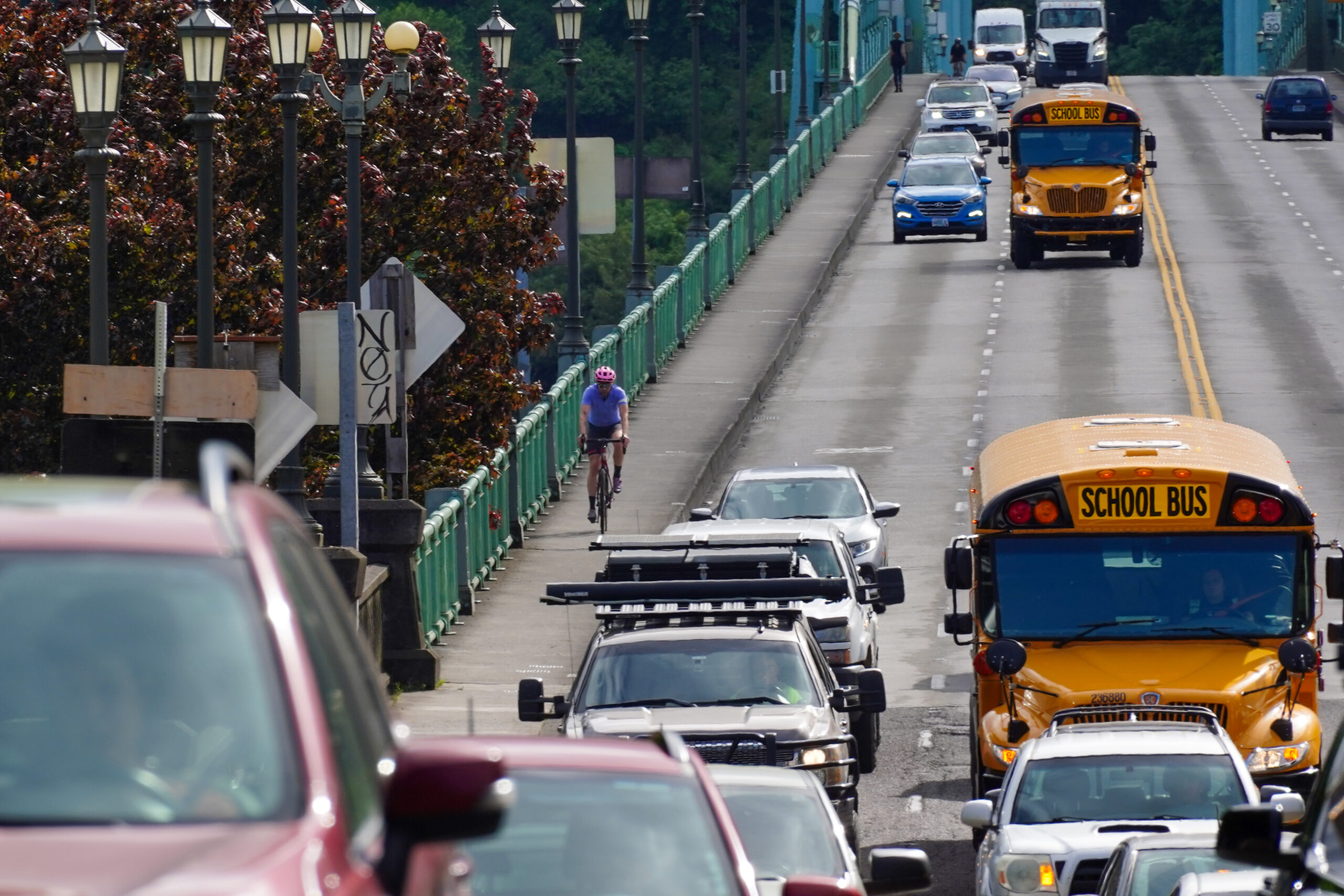
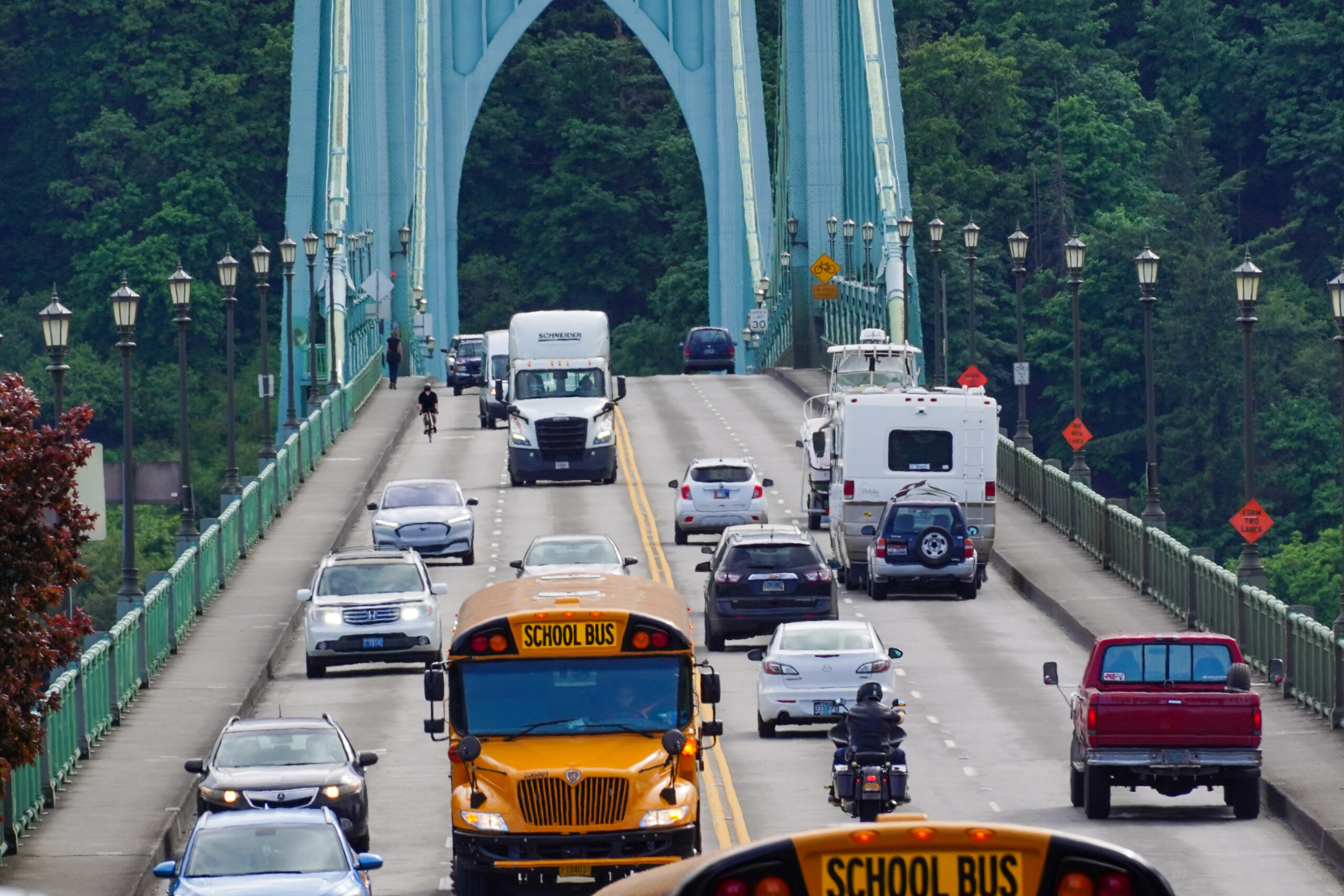
Traffic on the St. Johns Bridge. View is looking east toward Forest Park. Note that the sidewalk width of five feet does not meet standards for a “shared-use” facility, which means bicycle riders have less legal standing to use it. (Photos: Jonathan Maus/BikePortland)
The St. Johns Bridge should have bike lanes. And it could have, if advocates nearly two decades ago chose to sue the Oregon Department of Transportation when the state agency completed a major renovation and failed to seize a golden opportunity to provide adequate bicycling access.
I recently spent time observing traffic on the bridge and came away even more shocked at how unacceptably inaccessible the bridge is for everyone not inside a car or truck. When I first shared images from that day over on Instagram, the response reminded me how many people share my concerns for what this bridge is like today, and my dreams for what it could become in the future.
Before I share some of those responses, let’s recall our history…
Four lanes for drivers in 1931. Four lanes for drivers in 2024. Maybe time for an update? (Library of Congress)
In 2003, ODOT began a major rehabilitation project. They spent $38 million to replace and repave the deck, repaint the towers, upgrade the lights and so on. But before ODOT re-striped the lanes with the same four lane, 40-foot wide cross-section the bridge had when it opened in 1931, they considered an alternative plan. ODOT put together an advisory committee (that included representatives from a bike advocacy group, TriMet, freight business owners, and so on) and commissioned a report from an engineering firm to analyze options and inform the decision.
In 2003, David Evans & Associates published that report. And guess what? They determined there would be, “No capacity constraints or operational flaws on the bridge that would prohibit the implementation of any of the striping options.” Central to this finding was that all roads that lead onto the bridge have just one lane in each direction and are controlled by traffic signals. Their analysis showed that while travel time across the bridge would increase (exact amount I’m not sure of), traffic would only slow and there would be no congestion on the deck.
But despite that study, despite clear concerns about safety and demands for bike lanes that bubbled up during the City of Portland’s 2004 St. Johns/Lombard Plan, and despite grumblings from the nonprofit Bicycle Transportation Alliance (now The Street Trust) and other bike advocates, ODOT caved to pressure from freight advocates and re-striped the deck exactly as it had been for the previous 74 years.
Families headed home from Forest Park and a multi-day ride in Washington County, negotiate the lane.(Photos: Jonathan Maus)
ODOT’s final decision on the striping plan came just one month after I started BikePortland, and I haven’t done the research to fully understand what happened. But I do know how it made me feel. My first post on the subject on May 12th, 2005 was published a few days after I heard the news and you can sense my anger from the get-go.
The Street Trust also objected to ODOT’s decision, saying in an op-ed published to their website that, “Under pressure from special interests, ODOT simply ignored the facts at hand. The result, if it is allowed to go forward, is a bridge that will continue to be unsafe for the quarter of the area’s residents who cannot drive.”
Portlanders tried to object. Letters were written to the Oregon Transportation Commission, there was even a naked bike ride protest, but ODOT ignored it all. They claimed a minor widening of the existing sidewalk and larger alcoves were “bike safety improvements,” but the truth was then — and remains today — that the sidewalk is not even technically wide enough for bicycle riders to share with walkers and riding a bike on the bridge is a harrowing experience.
ODOT installed sharrows seven years later. While I appreciate having my legal right to the road reinforced, those tiny patches of paint don’t do much for my blood pressure when drivers are bearing down on me at 35-plus mph.
Scene from the Mitch York Memorial and Protest Ride on November 3, 2016. Ghost bike for Mitch York. (Photos: Jonathan Maus)
Garrett’s contrition validated for me why many of us felt The Street Trust should have sued ODOT for failure to comply with the Oregon Bicycle Bill that requires the agency to build adequate bike facilities whenever a road is reconstructed. I never learned exactly why they didn’t file that lawsuit, but I recall hearing there was some concern they might lose on a technicality and the precedent would end up weakening the Bike Bill in the future.
I can’t change the past, but I’ll never forget ODOT’s role in making us so unsafe on this bridge that I love and hate with equal passion.
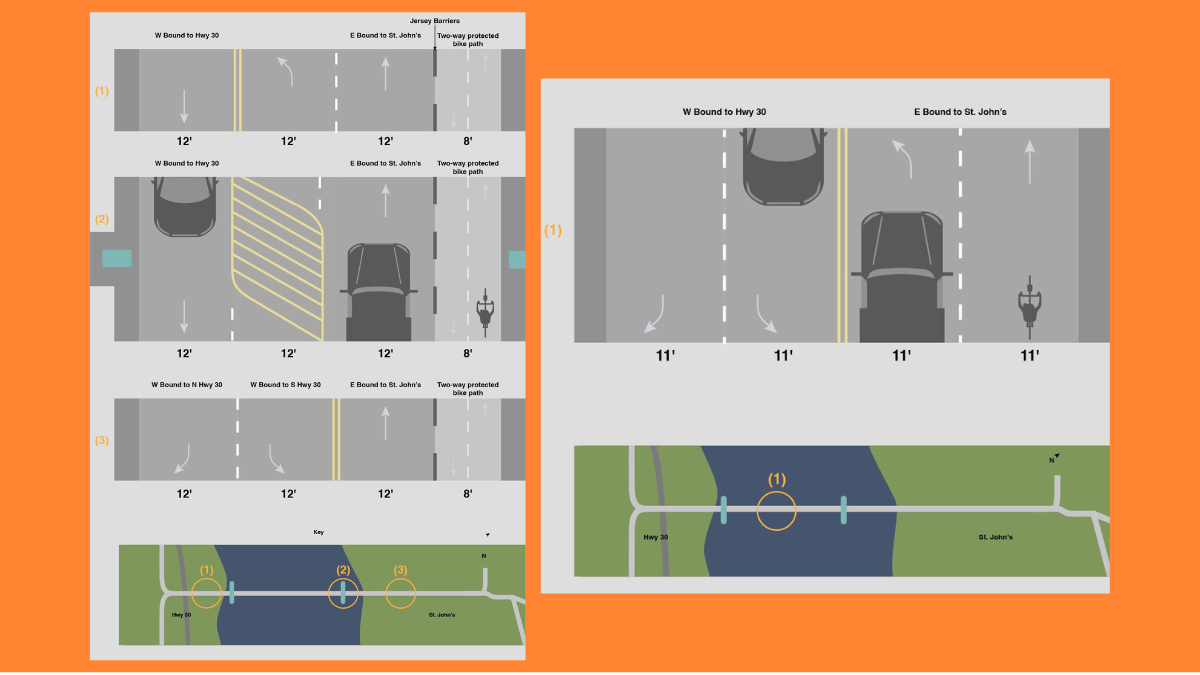
Cross-section concepts by Ben Guernsey. (@benguernsey)
“Even with good skills and being comfortable at speed in traffic,” wrote Portlander Ira Ryan in an Instgram comment. “I still feel like each trip over the bridge could be my last… It only takes one glance at a phone by a driver to kill a human on a bike. Terrifying.”
Another commenter who walks across the bridge four times per week said, “I have long wished for a protected bike/ped lane on each side… I wait for a truck mirror to hit my head.”
One reader, Ben Guernsey, even created a conceptual design of how he’d change the lane configuration to be safer for everyone.
While I think Ben’s idea should be given serious consideration, the ultimate solution is to get freight traffic off the bridge entirely. These large, loud, fume-laden trucks should have a bridge of their own so they aren’t routed through downtown St. Johns and dense residential areas. And that’s exactly what is recommended in ODOT’s Westside Multimodal Improvements Study that wrapped up late last year.
Whatever steps we take next can’t come soon enough. As these photos show, there’s clear demand by non-drivers to use our beautiful, iconic bridge without fearing for their lives, shouting to hear companions over the traffic noise, or breathing toxic exhaust. Surely we can re-imagine this bridge before the its centennial celebration in 2031.