

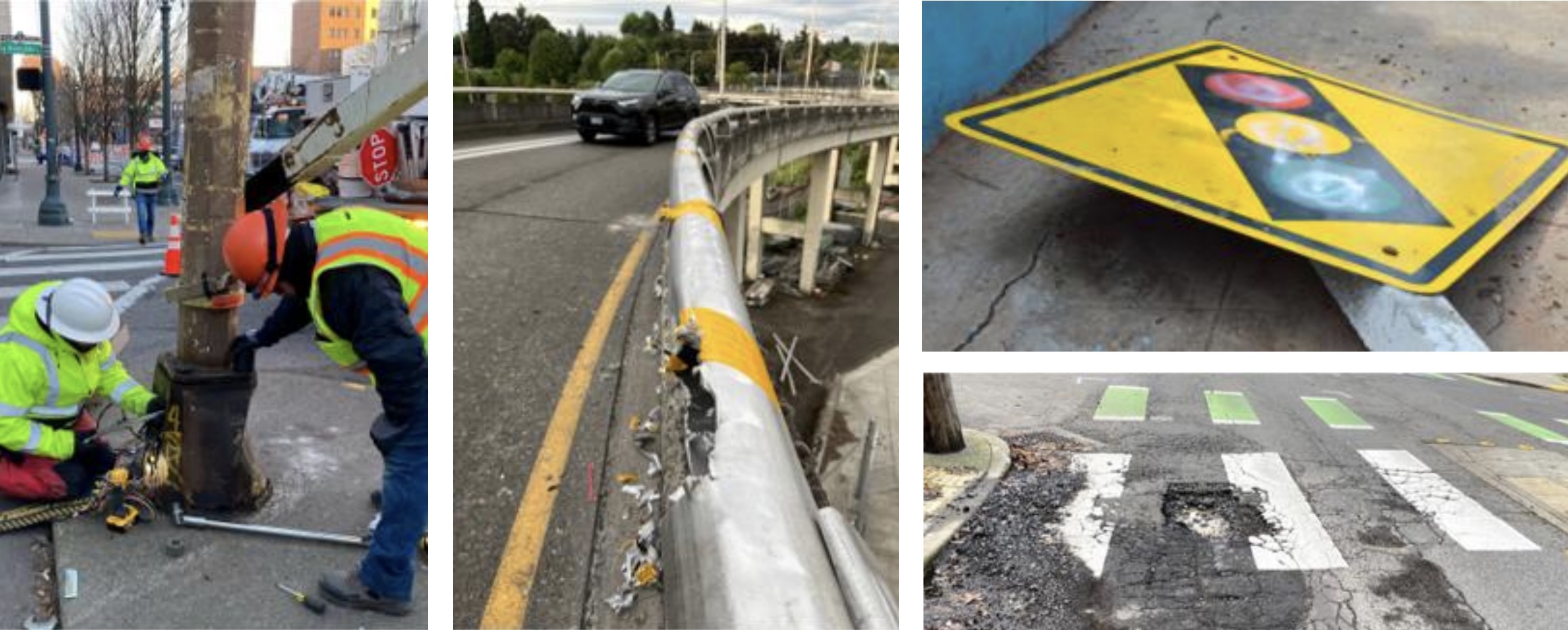
Looking to stem a financial crisis that’s been years in the making, the Portland City Council will host an important debate at meetings tomorrow (Wednesday, 4/15) that, if ultimately supported, would result in a significant increase to their annual revenue. On the agenda of the Committee of the Whole is an ordinance to adopt a transportation utility fee (TUF) and the regular City Council meeting will consider a resolution to adopt a street damage restoration fee (SDRF). If both fees were passed as currently proposed, they’d generate an estimated $69 million a year in new revenue.
To put that number into perspective, $69 million is about 40% of PBOT’s annual General Transportation Revenue. GTR is important because it’s discretionary — meaning the money is not obligated to specific projects or grant sources and PBOT can spend it however they see fit. This new funding would be very significant to PBOT given that just over 70% of its current budget is restricted.
The background
The TUF, which would be an additional line-item on Portlanders’ utility bills, could bring in about $47 million a year. The City’s current plan is to charge a flat rate of $12 per household, and $8.40 for folks who live in multifamily dwellings (a low-income discount program would also be created). The commercial rate would be 4.3% of the business owner’s utility bill. The SDRF would be charged to agencies and contractors who cut open city-owned streets to perform projects (these could be public agencies or private companies). In the past, PBOT would foot the bill to repair damaged pavement. The current plan is to add a $10.38 per square-foot charge to all “street opening permits” to account for the damages. The city estimates that would bring in about $22 million per year in new revenue.

Funds from the SDRF would be spent on damage done by the permit holder and the rest would go toward administration of the program. 75% of funds raised by the TUF would be spent on general maintenance and street preservation, including “those that support the City’s Vision Zero goals.”
Council members have already voiced strong support for both of these fees and there doesn’t appear to be strong, organized opposition to either of them (so far Councilor Dan Ryan is the only member to lodge a “no” vote). The only questions that remain appear to be how the fees might be tweaked around the edges.
The amendments
Given that the TUF ordinance language says how “no less than 75%” of the revenue must be spent, there’s likely to be spirited debate on Council about how to spend the remaining 25%. We already have two proposed amendments related to that issue.
District 3 Councilor Tiffany Koyama Lane wants the ordinance to state that no less than 25% of the revenue must be spent on, “activities that move us closer to our Vision Zero goals.” Koyama Lane’s amendment would also explicitly prohibit the money from being spent on “major roadway expansion.” She also wants to add language that would call out the Sidewalk Improvement and Paving Program (SIPP) as one of the eligible expenditures. SIPP was passed by Council in May 2025 as an unfunded mandate to build sidewalks in Districts 1 and 4.
This amendment makes sense for Koyama Lane, given that she’s positioned herself as Council’s Vision Zero champion. But keep in mind, the ordinance as written would already fund Vision Zero-related activities. The language says that at least 75% of the revenue must include, “maintenance activities that help the City achieve Vision Zero goals,” which includes, “bicycle and pedestrian facility maintenance.”
District 2 Councilor Sameer Kanal wants to strengthen the City’s commitment to a low-income discount. His amendment would force city leaders to work with the Public Works Service Area (of which PBOT is a part of) to provide a report on how to implement a TUF discount program and deliver to City Council before the end of this year.
District 4 Councilor Eric Zimmerman wants to make sure the TUF provides revenue directly to the SIPP program. Zimmerman’s amendment would add SIPP to Vision Zero as one of the investment areas that some of the maintenance projects align with when PBOT is considering how to spend the 75%. When it comes to the remaining 25%, Zimmerman wants the ordinance to dedicated half of it (12.5%) to the SIPP and the remaining half to go to Vision Zero.
District 4 Councilor Mitch Green has put forward a legislative concept — not an official amendment. Green’s proposal would create a two-part rate structure for the TUF: a fixed charge of $3 per billed account on the lot per month, plus a variable fee of $0.10 per 100 square-feet of utilized zoned land usage for each billable account per month. At the April 2nd meeting of the Committee of the Whole (where the TUF was last discussed), Green said he believes his idea would, “Align better with cost-causation principles” and that it, “sends a price signal to use our land more efficiently.” Green added that the proposal would also incentivize land owners to create more units within existing land, thus discouraging sprawl.
Note that Green’s proposal — which he referred to as, “quite elegant” and “really smart” — is not an amendment. That’s because he understands the urgency of the moment and wants the current proposal to pass as-is. At that April 2nd meeting he successfully passed an amendment that would allow Council to change the design of the fee (not the amount) at a later date. He wants his proposal to be carried forward in future discussions in hopes that after the existing fee passes, he can convince a majority of his colleagues to adopt his idea.
The politics
These new fees have more than enough support on City Council to pass. There will be some discussion tomorrow about relatively minor details of how the money is spent, but I don’t see a lot of disagreement among councilors. The TUF will be discussed in committee at 2:00 pm tomorrow and the SDRF resolution will be in front of full City Council at their 6:00 pm meeting later that same day.
If these fees pass, they’d go into effect January 1, 2027 and Council would have an opportunity to make adjustment every two years beginning in 2029.

Thanks for reading.
BikePortland has served this community with independent community journalism since 2005. We rely on subscriptions from readers like you to survive. Your financial support is vital in keeping this valuable resource alive and well.
Please subscribe today to strengthen and expand our work.
The most inequitable thing would be to keep our streets unfunded. Pass the TUF!
But they are funded. PBOT and our city just really spends our money poorly. And now they are coming back for seconds.
What do you think PBOT should cut, or how do you think they should spend maintenance money differently?
They could go back to 2017 staffing levels, which would eliminate 150 FTEs. There is no reason the number of PBOT staff needs to increase by 20% when the city has lost 20,000 people in the last 10 years. If they did this, there would be an additional $18M to $23M per year in savings. If they did this there would be far greater support for these fee structures, because it would show the city is actually making choices that households are forced to make everyday.
Why does PBOT need to cut something? We have an $8B budget in this city. Theres plenty of waste to find and eliminate. It seems most people agree that the non-profit industrial complex in Portland is a huge waste. Lets start there.
No new infrastructure. Reduce repair backlog on critical repairs.
Cut “nice to haves” which is anything unrelated to infrastructure (Equity, Climate, Sunday Parkways, Safe Routes to School, etc).
Go after money sitting on the street: ticket cars parked in the wrong direction, unregistered cars, and enhanced traffic enforcement.
It’s not just PBOT, we should be looking at the ENTIRE spending of the city of Portland. There’s lots of fat.
Why isn’t all of it going to maintenance? Does the council need another slush fund to put towards pet projects while our infrastructure deteriorates? The 70% of PBOTs budget that is restricted is more than enough for their pet projects. They can propose capital projects that have dedicated funding if they want something built in their neighborhood.
As it stands the estimated $69 million isn’t even close to enough to bring all of our infrastructure up to an acceptable quality. In 2015 that number was $100 million a year over 10 years or a billion dollars. The last time they provided an estimate that included improving unimproved streets and sidewalks that number was $400 million a year over 10 years or four billion dollars.
Green’s proposal is confusing and if I understand it correctly it would add an additional $5 to a standard 5k lot with a single family home like is common in Montavilla. To match their flat fee of $12 the average lot to unit ratio would need to be 9,000 SQFT. That seems kind of big. My basic googling suggests the average is 5,300 SQFT. Does he have some math that makes it come out to the same amount?
I imagine the reason it isn’t all going to maintenance, is because there still needs to be new infrastructure built. Like sidewalks through much of SW and parts of SE, for example.
That’s what capital projects are for which is again 70% of their budget. They don’t need to steal more money from maintenance to have a 25% slush fund for capital projects. Especially when the maintenance deficit is so high. I can’t remember exactly but without the unimproved streets and sidewalks their backlog is still like $3 billion or $300 million a year. That’s more than 400% of this funding.
That’s kind of true, but the reason behind that reason is that a lot of money is obligated to be spent on improvement projects because those are agency matching funds required for certain grant funding. E.g. if USDOT is giving Portland $1 million to put a sidewalk in on 122nd, PBOT needs to show their commitment and buy in by putting up their own $500,000. If that $500,000 is later reallocated, then the grant goes away and any grant money already spent has to be paid back. Combine that with a lot of improvement projects being opportunistic on things that were at the end of their service life anyway, and it really makes a lot of sense to go build those new bells and whistles, even if that means you can’t clear as many gutters and fill as many potholes. Otherwise, you’d have to fill even more potholes, never mind the crushed culvert that needs constant cleaning, the signal box that keeps tripping, and the bridge that failed inspection so now has to be shut down entirely.
In short, asset management is hard, and no matter what the wonks at PBOT do, they’re going to draw political flak from council and the public for making decisions and recommendations that may not be immediately obvious as counterintuitively necessary.
This is Portland! We chase dreams over pragmatism.
Haha! We’ll probably see a lot of that money earmarked for something like a PNW Indie Musicians Memorial Traffic Calming Circle and Fountain located somewhere on the eastside. It will be purported to save at least one vulnerable roadway user per year (Vision Zero!) while being a landmark that will draw tourist spending. A token amount of funding will be kicked in from the arts tax pool (Quit whining! We’re using it to beautify Portland!) and city officials will laud this as a major turning point in Portland’s revitalization.
Taggers will deface it within five days of the ribbon cutting and bike riders will still crash on wet leaves, debris, and gravel left in bike lanes because PBOT cut funds to periodically sweep those.
So every time utility rates are increased, business owners get a tax increase. That doesn’t sound business friendly.
Of course not, these people don’t know the first thing about running a business.
I’m opposed to restrictions on how this money can be spent. Too many bespoke taxes already going unspent with too many restrictions, which is partly why we have to keep dipping into the tax base. If we don’t like how the money is being spent, vote out the councilors who are screwing it up.
Wrong – the problem is that unrestricted funds always end up going to political interests, think ribbon-cutting opportunities and pet projects, rather than basic maintenance. Development fees are restricted for capital projects, grants are project specific, and then there is no money left for filling the potholes, fixing broken lights, and updating signs and markings, etc…
If that happens, we can impose another utility fee to fund street repair.
We’ve been down this road before; utility companies are paying a fee to repair streets, except it’s all been siphoned off into other things.
The reason we have such a backlog on maintenance is because there weren’t restrictions on other maintenance funds that the city has raided for decades. Restrictions for utility fees are very good. Just look at the malarkey the council tried to pull with the Water Bureau funds.
“ The City’s current plan is to charge a flat rate of $12 per household”
That’s per month, every month, from now until who knows.
I think why there isn’t any organized resistance to this, is because most people aren’t even aware that their utility bills are about to go up another $12 a month.
It’s really only being talked about it in transportation circles as a fee to fund pbot. But really this is a new tax on people who have already endured steady increases in utility costs. And we have no vote on this like we normally do with new taxes, because they are calling it a fee.
It’s maddening actually.
Counterpoint: motorists have been benefitting from unsustainable and unfunded subsidies for decades and are now mad that the chickens have finally come home to roost.
motorists meaning almost every household in the city–those awful people, glad I’m not one of THEM!
I, too, am a motorist. The fact that most people in the city are does not negate the fact that the development and financial model of the transportation system is unsustainable. It’s like being made that you’re getting bills from your credit card company because you’ve started carrying a balance month-to-month but then doing nothing to curb your spending relative to your income. Eventually you’re going to max out that card and have a real hard time when the money spigot is turned off.
If anything, the fact that almost everyone in the city owns and operates an automobile means that the TUF is a relatively equitable way to get more revenue for PBOT. It falls far short in the sense that it doesn’t do anything to get people to shift to more sustainable behavior, nor does it do anything at all about suburbanites driving into the city, but politics is ultimately an art of the pragmatic, not the idealistic.
About 7% of households in Portland don’t own a car. Many more do own cars but rarely drive. What number would that have to be in order for you to accept that cars and car infrastructure are subsidized? 10%? 20%?
You can just say that you don’t like bikes and buses next time.
I haven’t driven for over 3 weeks, but I’ve benefitted from having a working road system every day since then, and I didn’t pay for it. Those paying gas tax and freight fees have been subsidizing me.
Thank you!
Yesterday I filled my car’s gas tank for the first time since the war with Iran. I thought the $70 price hurt, but I kept in mind that fuel has been so cheap all my life since much of its sources’ impact on environment, labor, and society have all remained outside the accounting for its price. After that, I could stomach the cost.
Michael’s point stands no matter how upstanding anybody who has benefited from artificially low costs may be. We humans get upset when more accurate pricing shocks us out of that to which we’ve been accustomed. And IMO, his point is more an indictment of corporate USA than of individual motorists.
Transportation network is used by non-motorists, as well as public service providers.
My (low-income) Tri-met pass is $28/month.
Yep, the Curley Effect now rules Portland. Death by a thousand cuts as they say.
https://ericfruits.substack.com/p/where-are-all-the-normies/comments
$144 per year?
yeah it’s totally gross
I’ve been low-income my whole life, and $144/year doesn’t seem like that much money, really.
The rest of what? Not clear how much is for admin.
I don’t think they are saying exactly how the split would happen. I’m sure they will cover all admin costs. But I haven’t seen an admin cost estimate. Good question.
It’s a lot, mostly. Hire new analysts, and a raise for the team. Based on SOP.
Posting this for inquisitive people who want to see another perspective before jumping on the Portland progressive bandwagon that more taxes automatically fix everything.
Portland is pushing two new transportation fees—a monthly Transportation Utility Fee (TUF) and a Street Damage Restoration Fee (SDRF)—without sending them to voters. Together, they’d raise about $68 million a year.
(This is a summary of Eric Fruits’ article—I’ll drop a link so you can read the full piece.)
No one disputes PBOT has a funding problem. The real issue is whether these fees are fair, well-designed, and legally sound—and whether the city has earned enough trust to impose them without a vote.
The TUF would add about $12/month to household utility bills and charge businesses based on water usage. That’s easy to collect, but the connection between water use and road wear is weak. The more that link breaks down, the more this starts looking like a tax rather than a true fee—which typically requires voter approval.
The SDRF, which charges for street trenching, makes more sense in theory. But the city hasn’t clearly shown how it calculated the cost of damage, and much of the burden would ultimately fall back on residents through higher utility bills anyway. There are also open legal questions about whether these charges comply with Portland’s city charter.
There’s also a trust issue. Portland already passed a gas tax for road maintenance, yet the backlog has continued to grow. Some of that money has gone to projects unrelated to basic maintenance, raising questions about accountability.
If these proposals are truly fair and necessary, the city should be willing to take them to voters rather than fast-tracking them through council.
ERIC FRUITS RE: TUF
That’s funny. The City just gave $300,000,000 to help a billionaire from Texas (subsidizing Blazers) and yet now there will be a $12/month tax to fill a budget hole of $69,000,000?
Hmm. Seems like bull.
Check your source on that. Far’s I can tell, the city hasn’t given anything to the Blazers yet.
Oh but it’s not a tax, it’s a “fee”. Doesn’t that make you feel better? Such BS from the “city that doesn’t care”.
I think you’re thinking of the State of Oregon’s gross profligate spending on unnecessarily fixing up the Rose Garden, no?
https://www.oregonlive.com/sports/2026/03/oregon-lawmakers-approve-plans-for-365-million-contribution-to-moda-center-renovations.html
I’d like to see at least 80% of the new funding spent on maintenance as long as there’s a backlog, although I would expand the definition of “maintenance” to include paving gravel streets. As for the rest, it should be available for safety improvements, which should fall within the “Vision Zero goals” that Councilor Koyama Lane was talking about, and could also include sidewalks on streets busy enough to need them for safety. (I live on a cross-street without sidewalks and walk it all the time, but we don’t really need sidewalks there because traffic is so light.)
I’m also in favor of putting the TUF to a public vote. I know it’s not legally required, but I think the city should do it anyway. Add it to the May ballot if there’s time.
At $68milli/year, it’ll take like 90 years to build back the maintenance backlog. This fee should be higher. It should also be indexed to CPI.
If you actually believe PBOT and their ridiculous assertion that it would cost $6 Billion (I think that’s the latest figure) to do the maintenance in Portland. One has to wonder if they are paving with gold flaked asphalt.
Anyway, $68 million would easily pay for crews to go out and cover all 2,100 miles of Portland streets and fill in potholes in a year. That would be maintenance at its most basic for our streets but PBOT refuses.
You also have to realize it’s a classic tactic of transportation bureaus and parks departments around the country to purposely let the assets they are responsible for to not be maintained so that when they come with their hands out foolish people will believe them and vote in more taxes for them. Of course, they’ll find other uses for those taxes and the cycle will repeat.
Consider sending support to city council if you support this resolution.
https://www.portland.gov/council-clerk/testimony-registration?doc_id=59674
Lots of opposition in the written comments thus far.
https://www.portland.gov/council/documents/ordinance/establish-new-transportation-utility-fee-1-2/testimony?page=2
Ted Buehler
Doesn’t really matter at this point—this council could probably slap a “fee” label on gravity and call it a day. Citizen input? Optional side quest, apparently. If it quacks like a tax and empties your wallet like a tax, maybe let people vote on it—but hey, why break the streak now? The Portland doom loop isn’t just accelerating, it’s got cruise control and a tailwind.
Shouting out this guest editorial that can address a lot of comments – how the TUF could be improved, or fixed after this version passes
https://bikeportland.org/2026/03/30/guest-opinion-heres-how-to-fix-portlands-regressive-transportation-utility-fee-399764