

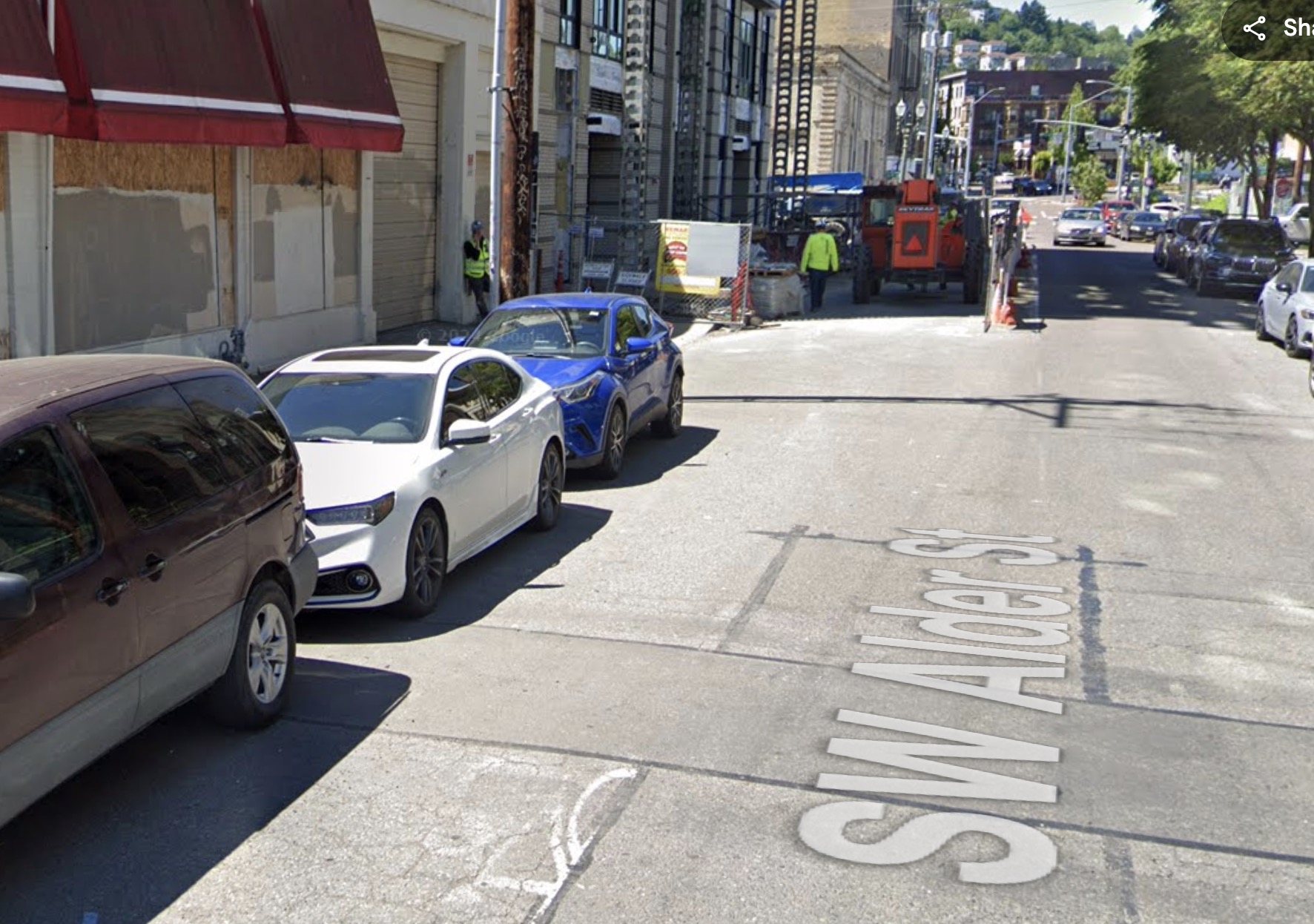
The Portland Bureau of Transportation is facing pushback on a planned bike lane project in the Goose Hollow area. According to KOIN News, some residents of the 214-unit Tiller Terrace apartments on the corner of SW Alder and 17th are concerned about how changes planned by PBOT will impact their ability to park cars near the entrance to the building.
Here’s more from a story by KOIN on Tuesday night:
Miriam D’Arco lives in Tiller Terrace, caring for her 92-year old mother who has late-stage Alzheimer’s… She said she relies heavily on the ability to park a car in front of her apartment, in an area that she said is already tough to find parking. “If they’re going to limit parking even more, that’s a problem,” she said.
Later in the story KOIN reported that D’Arco, “said she feels displaced,” by the project and that removing the parking spots is tantamount to denying her access.

The project has been in the works since 2019. This specific phase was on hold while Tiller Terrace was being built. Sections of the bike lane have already been built and the plans to build them predate the existence of the apartments (the building opened in summer of 2024). PBOT’s plan (see below) is to build a two-way bike lane on the south side of Alder between SW 16th and 17th. It’s the last phase of a neighborhood greenway project that connects Northwest and Southwest and is slated for construction this summer. The two-way bike lane is necessary because the southbound route crosses Burnside on SW 16th, but SW 16th is one-way only at Alder, so the route needs to jog over to 17th to continue south.
To make room for the bike lane, PBOT’s plan is to re-allocate space currently used as free parking for 8-9 private cars. There would still be on-street parking on the north side of the street.
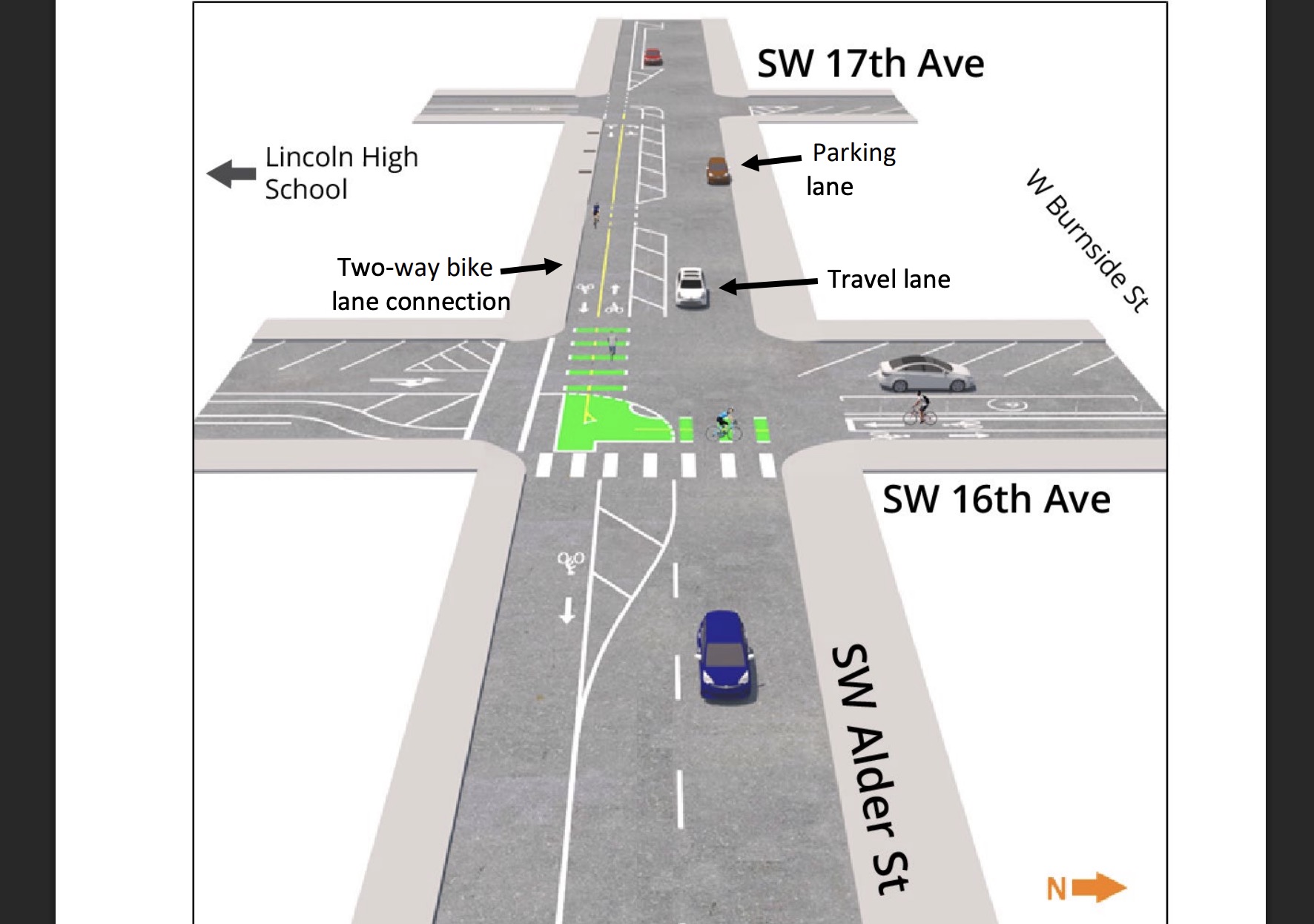
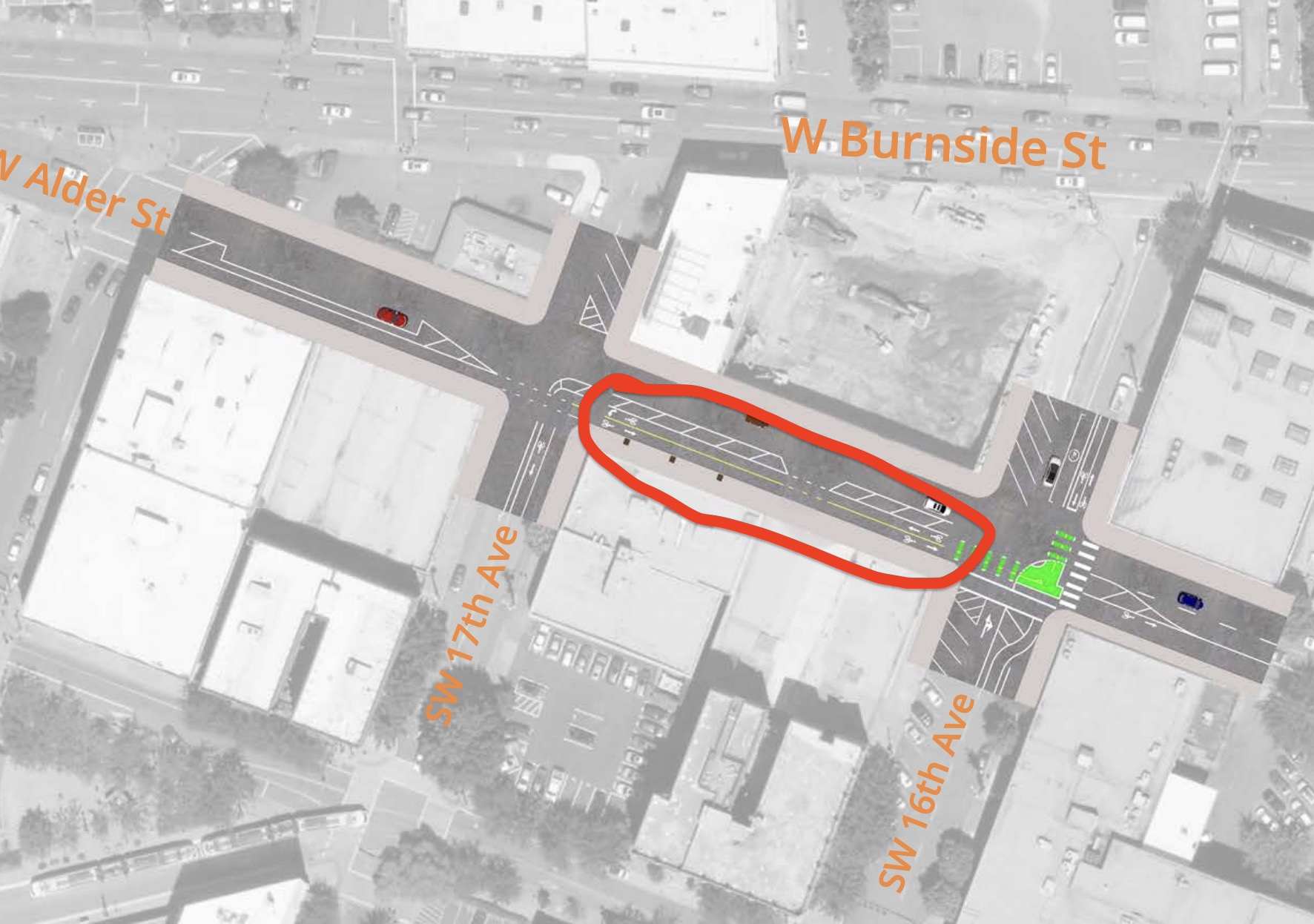
PBOT sent a letter to 2,500 addresses in the immediate area in January 2025 warning them that parking removal on Alder was coming. “This change will require removing parking on one side of SW Alder Street between SW 16th and 17th avenues,” the letter reads.
When asked about the concerns by KOIN reporters, PBOT spokesperson Dylan Rivera acknowledged the shortage of parking in the Goose Hollow area. “That’s why we need to get more people biking and walking, as much as possible. And that’s what a project like this is part of,” he said.
A meeting is scheduled for this evening between PBOT staff and tenants of the building. KOIN said it was organized by Tiller Terrace management. I’ll reach out to PBOT tomorrow and will post updates here.



Thanks for reading.
BikePortland has served this community with independent community journalism since 2005. We rely on subscriptions from readers like you to survive. Your financial support is vital in keeping this valuable resource alive and well.
Please subscribe today to strengthen and expand our work.
I’m having a hard tome figuring out what PBOT is trying to connect here. It sems like a lot of work to connect across Burnside on a 2-way bike path that ends a block later, at Couch. I don’t see a lot of value for the southbound travel from 16th being able to head west on Alder. It looks like it would only connect to 17th to continue south, and that is only a few blocks long. Would it be simpler to extend the 2-way on 16th to Morrison? What am I missing?
I’d guess connecting from Providence Park & the 18th/19th bike lanes and the 2 way bike lanes on 16th?
Are there southbound bike lanes on 18th or 19th? There’s a little 1-block lane on 19th that dead-ends, I can’t see any value in connecting to that from the east. I support removing parking for bike infra, but this does seem very well planned. I think one-way on Alder is sufficient. If anything, extend the 2-way on 16th from Burnside to Salmon. All these short, disjointed, one-off segments of bike infrastructure are super annoying.
It also looks like they could replace the giant painted buffer with a 6″ wide curb and keep the on-street parking.
mD, same thought – what is the 2 way bike lane for one block about? I can’t untangle the logic from the schematic, but seems like it’s intended to allow you to go from the southbound counterflow bike lane on 16th, west on Alder for a block, then continue south on 17th,,?
Yeah, it does seem a bit odd, but I think it makes sense given what’s going on if you look at the bike map and the Transportation System Plan. First, the status quo according to the interactive bike map is that Alder has an eastbound one-way door zone bike lane between 13th and 19th Avenues, but no immediately obvious westbound pair. Immediately to the south, there’s an east/west street pair that’s marked as a “shared roadway,” but in my experience those shared roadways are often dodgy and inconsistent with how comfortable they are to ride in. I’ve never ridden there myself, so I’ll leave it to the locals to say how good it is there, but I do see that the MAX runs along those streets, so it’s certainly not ideal. The next best option is probably Couch, but it’s on the other side of Burnside and runs at a different angle than Alder.
Shifting over to the system plan, it turns out Alder is actually supposed to be a “major bikeway.” Here’s the plan’s description for how major bikeways should be improved:
The city’s plan is to make Alder the link between Broadway and Providence Park and the south end of the 18th/19th bikeway pair. The current situation is a far cry from that, with car a parking-and-plastic-separated, buffered bike lane from 18th to 17th, a door zone bike lane from 17th to 13th, and nothing at all the rest of the way to Broadway. It appears to me that the reason that this doesn’t appear to be linking anything is because it’s actually just the first or second step in building out Alder to be the premier bikeway the city wants it to be. It’s a major shift in land use, so it’s understandable why the people benefitting from the status quo are miffed about it. But from my eyes, it looks like a great future addition to the network.
Right, the reason for connecting Couch and 16th infra to the existing cycletrack on 16th, and Alder (btwn 16th and 17th), is the planned route on 17th, which you can see on the CCIM map (pg 12) and on project 6 (pg 30). PBOT is likely waiting for the TT and Byline apts to be completed before they build the 17th route. There is some question whether cyclists will be routed through the HS since it shows this on the map, but there’s a gate.
I would be amazed if Lincoln would allow a bike lane across their campus. Maybe during some limited hours some day, but I doubt it would ever be the permanent route needed to serve as a transportation route. I wonder why they chose 17th? They already have a bike crossing and 2-way cycle path on 16th- I think they should extend that. The CCIM labels SW 14th between Burnside and Jefferson as existing and funded low-stress bike network(!!)
The only other options are SW 14th, which isn’t mentioned in the CCIM, and is adjacent to high speed traffic, and 18th which has limited ROW due to the MAX.
Technically it does on the map, but it’s not in any of the project pages AFAIK. Pg 64 map doesn’t show SW 14th, so I’m guessing it’s not being considered.
I have been looking through the TSP and the CCIM. It is clear that PBOT was counting on SW 16th or SW 17th for bike connectivity. Looking closer at 14th, I think that street has a ton of potential to be strong n-s corridor from Vista (via Market) to Front. If we could close the Salmon exit from 405 and reduce the Everett exit to a single lane, I think there could be a 2-way MUP on the east side of 14th from SW Clay to NW Front.
The 2-way MUP on Alder doesn’t make mush sense without a way to travel south
I would call it a win if PBOT connects the HS via 17th even if there isn’t public access. Nextportland states that the original idea of the plaza was to allow public access during non school hours, based off the attached summary memo during the design process, but that was a long time ago. It’s possible the gates will remain closed after hours.
Thanks Michael, I appreciate your analysis and I agree that it explains this. I remain skeptical of the value of westbound bike travel on Alder.
Alder west of 405 is VERY different than Alder East of 405. I could see having a bike couplet on Alder/Washington east of 405, but there is already a good bike couplet on Oak/Harvey Milk. It seems like they are contorting themselves to avoid adding bike lanes to Burnside and converting Burnside to 3-lanes(driving).
From Broadway, I head west on Jefferson or Flanders. I think 14th and 18th would be the key streets for bike traffic, but 18th is a heavy lift now. 14th is possible. In fact, if they got rid of the Salmon Ramp form 405, 14th could be good for bikes and we could patch a despicable gap in the sidewalks that should connect NW Academy, Lincoln HS and a lot of Cultural institutions (PAM, Historical Society, etc). 17th makes sense expect for the reality of an urban high school campus- I doubt that could feasibly be opened. The TST shows 16th as a bike route right across the Lincoln football field!. It also shows SW Salmon as a Major Walkway https://maps.app.goo.gl/mtgd3u2462pfmoe77
The TST also shows Salmon and Taylor as e-w City Bikeways and 14th and 18 and n-s City Bikeways.. Think extending the 2-way MUP on 16th from NW Couch to SW Salmon might be as good as are going to get.
If Alder is “different” enough to preclude bicycle infrastructure due to existing conditions, then W Burnside is completely off limits by the same traffic pattern justifications.
Not true. Burnside would provide incredible connectivity. Removing a driving lane would diminish the barrier that Burnside is now and improve biking, walking and businesses. Alder is great for an eastbound lane, but not very useful westbound.
I’m not so sure. Most of the origins/destinations for cyclists traveling west in that area are north of Burnside, so Couch/Flanders/Johnson already serve the trips of most westbound travelers- most of the main routes from the NE connect to those greenways as well. Coming from the S/SE is trickier- most folks either take the Jefferson/Columbia couplet to 18th, or (more likely) the subpar Harvey Milk/Oak couplet (which dumps you onto 10th heading WB). Alder would hit a sweet spot for these travel patterns, with better waterfront connections to boot.
I think a lot of people underestimate the grade on W Burnside as well- any bike facilities would be much more of a slog compared to the tiered ascent of the greenways to the north or south. Burnside’s greatest strength is as a transit corridor. Better crossings and traffic calming via diversion/physical barriers would do a lot more to improve the connectivity along the corridor. Bike access in transit lanes (ala NE Couch) could always be used to help with any necessary connections in the direct vicinity.
Random fun fact- Burnside west of 15th/16th-ish was once an extension of Washington St, and the N/S dividing line for addresses used to follow Ash St (rather than Burnside) before the renumbering in the early 1930s.
Subpar? I think Milk/Oak is one of the best facilities in downtown! It’s definitely my preferred route from SE to NW and back.
Agree.
They’re (currently) my preferred streets for that general route too, but mostly from necessity, not actual usability. The sightlines at intersections between 10th & Broadway are really awkward when you’re descending on Harvey Milk (though the new plaza on Park Ave helped reduce cross traffic conflicts somewhat).
The western termini are pretty messy, too, and both require some funky lane changes or queue jumps that aren’t very well defined. A bike box at 13th/Burnside would be the biggest improvement, and fairly quick/cheap. 10th/Oak is a little trickier, and would probably involve converting the right turn lane and some of the parking on 10th.
For me, the biggest issue with that couplet is that it ends much too soon- any trip (for either direction) past I-405 requires a jog on one of the Aves to a street that crosses the freeway, which eats into the time/distance savings the streets south of Burnside provide (at least when compared with other options, like connecting to Couch from Naito). Alder has it’s own share of issues, but it really does shave a lot of time off of trips between SE/NW.
That being said, Yamhill/Morrison (despite no bike-specific infrastructure) might be the best of the bunch, for a number of reasons…
SW Alder makes a lot of sense as a bikeway from a geographic standpoint- due to the diagonal skew, it’s among the shortest possible paths for E/W travel through the Westside.
SW Oak and Stark are parallel, but terminate before they reach 14th Ave/I-405, and therefore depend upon less direct connections for any travel between Naito and the Northwest District.
Very sad to see people fighting the revitalization of central and downtown Portland.
Why not ask the people who live there if they see this project as revitalizing, or what would make their lives better. As is often the case, those who want the “revitalizing” are those who live elsewhere.
If we want to attract more people to the central city, we should be doing things that make living there easier and more attractive.
So you agree.
I agree with a lot of things, and probably a lot of them are things you also agree with.
Whether I agree with the thing you are thinking of depends on what it is.
Why are the people who live there now the best to ask? This sort of infrastructure is supposed to be around for awhile, serving people in the now and the future. I agree that living in the present is great, but planning for the future needs to take more into account than the now.
“Why are the people who live there now the best to ask?”
Because it is their home.
I’m not claiming they should make the decision, but I do believe they should be part of the conversation. Is there really no way to make this area safe for bicyclists while maintaining the parking? Is it dangerous today?
We’re talking about paint on the ground, not some sort of immutable infrastructure that cannot be changed. In fact, I suspect all on-street parking could be up for negotiation if the future plays out as I think it will.
The plan for the bike lanes were in place well before the building was constructed and residents moved in. If the bike lane was going to be an issue for some of the residents, they ought to have picked another place to live. Their lack of due diligence is not the city’s problem.
Fair point, A Grant, but I doubt the leasing agent disclosed the planned bike lane
This might be the crux of the issue
As far as “they ought to have picked another place to live”, the building is an affordable housing building serving people at or under 60% AMI. Their choices of residences may be limited.
Disagree; the people living downtown ARE revitalizing it. They’re probably spending more of their money and time downtown than any of us. They have a right to have opinions about the street they live on.
More people need to live downtown to make it work. There is not enough room for people who live in a dense downtown area to have parking directly in front of their building.
I guess if you describe the pro-parking people that way, you could describe the pro-bike-lane people as people fighting against the needs of elderly and disabled people.
Creating an environment that is safe to walk and not car dependent is pro-elderly. Transportation for disabled people can be incorporated into a populated area without providing a prime parking space for each person.
I don’t dispute that. That doesn’t mean what I wrote isn’t true.
And where on earth did you get the idea that anybody–me, the people in the article, or anyone else–has ever said anything remotely hinting at a need for “providing a prime parking space for each person”?
If that’s what you believe people are saying, then it’s understandable you’d say they’re fighting revitalization. But they’re not saying that.
The news story is typical of almost every story about car infrastructure and parking ever reported; uncritically highlighting a very unique situation about transportation access to justify a car dominant system that broadly constrains transportation access for everyone.
I agree with that about news stories. That’s not what I criticized.
The woman being interviewed had legitimate concerns, and it seems likely they can be addressed without altering the proposed bike lane design.
Her concerns were removal of the ADA space in front of the building, and having there be no nearby parking when residents need visitors to come aid them. Converting existing parking spaces on the same block to short term, and converting a standard space in the parking garage to an ADA space, is one potential way her concerns could be solved.
I completely agree. It is a bummer that the story was framed as a distraught woman vs PBOT and their evil bike lanes.
Yes, those reports are so tiresome. Imagine if the reporter had continued by asking the owner on camera, “Why can’t you convert one of your garage spaces to a second ADA space, and a couple more to 45-minute-limit spaces? It seems like that would solve your tenants’ needs without disturbing the bike lane plans.” That would have been a much more informative (and worthwhile to watch) report. It might even encourage the owner to do it.
“you could describe the pro-bike-lane people as people fighting against the needs of elderly and disabled people.”
In some cases, they undoubtedly are.
You could be right.
i wasn’t impressed with PBOT’s Rivera’s response in regard to needs of elderly and disabled people. I don’t know if Rivera said more than what appears on the news clip, but what appeared seemed dismissive. The reported specifically mentioned losing the accessible space, and he responded with nothing about it beyond “We know there will be impacts” before saying “that’s why we need to get more people biking and walking” which aren’t options for some people.
Hey qqq. As a default I tend to be more open to hearing any difficulties that impact people with disabilities, but in this case I think you might be overstating the problem. There are two full rows of parking opposite the building (on 17th and Alder respectively). That means (if she hasn’t already decided to rent a space in the garage), an extra ~50 feet of walking. As a result in this specific case I was incredibly proud of Rivera’s response (and hope to see this same reaction when appropriate in the future). This is a non-issue, conflated by a sensationalist news report using one person’s story as the excuse for populist outrage.
I don’t think I’m overstating the problem. I’m saying the concerns about removing an ADA space, and having no spaces available for visitors to park in when they need to come aid residents are legitimate issues, and people should not demonize her or others who have those concerns.
You’re right about the nearby spaces–I wrote a comment saying almost exactly the same thing in reply to idlebytes below, and another about the garage parking.
I DID like what Rivera DID say, about supporting people biking and walking to remove demand for driving and parking. What I didn’t like was (at least in what was filmed) that he didn’t say anything about the ADA space being a legitimate concern, that had some good possibilities for resolution. That’s what made it sound dismissive to me, especially when the reporter mentioned the ADA space specifically.
If Rivera had said PBOT had potential solutions for the ADA and short-term spaces, that could have totally shot down the news story’s tiresome angle of “Look how PBOT is taking parking away again and wrecking people’s lives”.
I also didn’t like Rivera saying what he said about PBOT wanting to support people biking and walking, then seeing the plan didn’t include marked crosswalks at 6 of the 8 closest crossings. (That one’s a criticism of the design, not Rivera.)
I LIKE the bike lane, and haven’t made any comments saying it should be compromised. And luckily I don’t think that keeping it uncompromised means not being able to address some legitimate concerns of the residents.
“luckily I don’t think that keeping it uncompromised means not being able to address some legitimate concerns of the residents”
I was going to just thumbs up this comment, but I think you are making an important point. It would be far better for everyone if PBOT would help find a larger solution rather than ignoring the legitimate issues faced by residents.
I also think there may be win-win solutions, and I hope people will come out of their corners and help find them.
I have a disability that prevents me from driving. I mainly rely on my bike (with the occasional TriMet) to get around.
I think it is important to advocate for the “disabled and need a car” segment of the population but I wish we don’t erase the needs of “disabled and can’t/shouldn’t have a car” folks too.
I didn’t think we should erase the needs of anyone.
Car-owners’ sense of entitlement knows no bounds.
I’m curious if there’s any reserved (“handicap”) parking? Is that a thing for on-street parking?
If not, could it be?
Should the city just implement a parking permit system in central city?
If she needs a handicap space in front of the building she can have PBOT reserve one. Otherwise it sounds like she prefers the convenience of being able to park in front when the spaces aren’t already taken up.
Isn’t the issue that there won’t be any parking in front of the building, so even if she needs an accessible space, there won’t be one to reserve?
However, on PBOT’s drawing’s, there are on-street parking spaces shown on SW 16th on the apartment building’s block. It seems like an accessible space or spaces could be provided there, which are still fairly close to the building entrance and don’t require crossing a street. It seems that would solve the accessible space issue.
Other spaces nearby could have a full-time 15- or 30-minute limit, which could help address what she mentioned about people needing to park nearby to respond to residents needing immediate help from family.
SW 16th and 17th are on hills is the argument
I see looking at google that that’s true, so it’s a valid argument. After I wrote that comment, I saw Jeremy B’s comment below that the building has a parking garage. I looked at the plans, and that’s true. It’s got 16 spaces, including 1 ADA space. Probably just one because ADA spaces are based on how many parking spaces are provided, not residents. It should be easy for the building to convert another space to an ADA space, if the existing one is often full.
That would solve the ADA space issue entirely, and even be a better space (indoors and next to the elevators) than the current outdoor space.
The slopes do mean those streets can’t accommodate standard ADA-compliant spaces, but they could still accommodate short-term spaces so they’re more likely to be available when a resident needs a visitor to assist them if they have an urgent need for that (one of the issues mentioned in the news story).
There are plenty of street parking spots nearby that could be reserved. Also the building has a parking garage. I’m sure that could be used for someone who needs a dedicated parking spot.
The building has a parking garage? Pretty disingenuous, but hardly unsurprising, that they failed to include that information in the news story.
If the city wants to reduce on-site parking, they should expect more pushback when they want to take away the on-street parking that people in low parking buildings consequently depend on.
People, even low income people, have cars, and they need to park them somewhere.
This should surprise no one.
Nothing stopping developers from putting in on-site parking though.
4WheelsGood, then?
You’ve probably figured out by now that while I drive around Portland less than almost any other car owner here, I do not hate cars or car drivers. I like bikes, but I simply do not care how other people choose to get around.
So yes, sometimes 4 wheels are fine if that’s what works for you. Who am I to judge?
Notwithstanding the unverifiable humblebrag that you drive less around Portland than almost any other car owner here, the insouciance of declaring “I simply do not care how other people choose to get around,” when clearly bemoaning a future loss of on-street parking suggests that you do desperately care how people choose to get around, and where they get to park when they get there.
As Goose Hollow is the third most dense Portland neighborhood (2020 data), no visitor or resident should be caught off-guard if they can’t snag a parking space directly in front of any particular location.
The builders of the Tiller Terrace built in this dense Portland neighborhood with the intent of highlighting the compact urban fabric of the neighborhood. The Tiller Terrace website highlights the location “directly across from the Providence Park Max Station” and extolls the Bike, Walk, and Transit Scores. Per their website, “Your new home in Goose Hollow provides easy access to Downtown, the Pearl District, and the NW District. With plenty of shopping, dining, and entertainment options within walking and biking distance, Tiller Terrace is truly in the heart of the city”
No one should be surprised that if in the heart of a major city a single block of parking on one side of a street must be removed so that an infrastructure path in our inter-connected network of transportation options can be realized. And the folks who live in Tiller Terrace should be less surprised than most, given that this infrastructure project predates the construction of the building.
Tiller Terrace has 214 apartments, and while “even low income people, have cars, and they need to park them somewhere,” the removal of 9 public parking spots constitutes 4.2% of the 214 apartments (if every apartment has one car). So, it sounds like Tiller needed to get working on that underground parking even before these spots were removed.
You’ve misunderstood. I don’t really care about parking per se; I will likely never park there or even drive past the building. I’m bemoaning the outright lack of empathy folks here have for their fellow city residents, and their desire to pick at the lives of others in ways I find quite unsavory.
I keep asking that someone explain the reasons why this location is dangerous for bicyclists, and thus requires infrastructure incompatible with parking. Perhaps you can do that?
I’m bemoaning the outright lack of empathy folks here have for their fellow city residents, too.
I keep asking that someone explain the reasons why this decision is detrimental for individuals who “require” disability access for non-designated spaces, and thus require infrastructure incompatible with bicycle lanes (which are frequently used by people with disabilities as well). Perhaps you can do that?
The reason the spot is dangerous for cyclists is because on Alder you start out in a bike lane protected by parked cars and then the lane abruptly ends and you are thrown into traffic. I personally have almost been hit by car drivers who swerve right into the right lane when it opens up in front of the building and are not looking for bikes coming from the bike lane that have the right of way in that right lane.
Hope this helps you understand why this spot is dangerous for cyclists.
COTW
Of course there’s no blame on the property management company for not disclosing to incoming tenants that the on street parking is going away.
If I were to move downtown it would be because of how walkable/bikeable/transitable it is. I wonder why someone who could feel being displaced if their public parking spot was removed would move to an area with such poor parking. I don’t know all the mechanisms of the cost of this unit/building etc. On one hand I can’t help but feel this is car-brained mentality. On the other, I wonder if there’s more to the story/situation than this article paints.
It is subsidized housing so most people there probably didn’t really choose to live there; that’s just where they were able to get in.
I wish I could get subsidized housing in Goose Hollow. That’s a bougie neighborhood I can’t afford. I promise I wouldn’t complain about lack of parking. :).
I have always wondered why there was a gap in the “bike lane” at 17th and Alder and now I know why.
Personally, that two way portion looks horrible, especially since its not going to have any barriers from traffic but whatever. We need to be removing parking space from downtown and screw this car-brained person for moving to such a bikeable/walkable area and wanting it to stay more care centric.
Some empathy goes a long way here. How do you transport your infirm mother around town?
Show some empathy for the dangerous conditions the current infrastructure creates for cyclists in that spot.
They do not habe a guaranteed spot in front of the building today. If a spot is not available, then they have to park further away.
What’s dangerous about the existing dedicated bike lane and how will a two-way cycle track address those concerns?
To be clear, bikes currently have a dedicated travel lane. This isn’t some gutter striping that’s being upgraded.
Only for eastbound travel, though. It’s also functionally a wider parking zone, not a “dedicated” lane.
Paul, have you ever ridden your bike there? You go from a bike lane protected by cars to being dumped right into traffic. I have almost been hit there mutliple times by drivers who merge into the right lane as soon as it opens up while not looking for bikes coming from the protected bike lane where bikes can be hidden behind parled cars and hard to see.
I have, though generally at odd hours, so all of my experiences have been chill (hence me asking what’s wrong with the current configuration).
When my mother was still alive, I went to her Memory Care residence and parked in the parking lot. I went in and got her with her walker and walked out to the car. Got her in the passenger seat and folded her walker and put it in the back.
Parking was not available at the front door so we did have to walk maybe 100′.
What prevents these residents from doing the same, walking that is?
I’m sorry for your loss. Your mother had attendents to check in on her I imagine. It sounds like the alzheimers patient has only her daughter and might not be as ambulatory as your mother. Playing the game of “I did it, why can’t they?” is a losing one. Obviously the building needs disabled parking available just as the street needs a safe lane/path for cyclists. PBOT should be able to incorporate both.
Cool. Does this woman use a walker? Surely you can understand the difference between dedicated parking at a care facility and on-street parking at a residence.
Elder care isn’t easy. If you had been taking full care of your mother at the time, is it so hard to imagine how little stresses might amplify and add up?
Yes. Screw them and their needs.
I had no idea that people who currently do not have a need for a handi-cap space is someone who needs parking directly.in front lf thr building.
And what about the need for saftey for people on bike? On Alder at 17th, it goes from bike lane, to being put into traffic for a block, then back to a bike lane. Thats dangerous to have cyclicts move into traffic for a block.
If they care more about their convienence than they do other pepples saftey, then yes, screw their want, because being able to park directly in front of a building is not a need and never has been. They are not guaranteed parking in front of the building today which means they already have to park away from the building most of the time.
This is anout convienence for them, not a need.
Wanting an ADA-accessible space close to a building entrance is not car-brained (and providing one is not car-centric). That’s especially so in a building that may have a high proportion of elderly and/or disabled people in it, and even more so in regard to people who move downtown and don’t drive themselves. “Screw them” is a harsh, callous response.
Agreed! I think extending the bike lane on Alder is important, but I don’t see much value in developing a 2-way path in this location. Maybe keep the parking, complete the bike lane and extend the 2-way bike lane on 16th to Salmon?
If you’d like to launch a study to reanalyze one-way couplets in city center, you can be my guest
Or keep the bike lane as proposed, and alter existing parking spaces on that block and in the garage to address the ADA and parking-space availability. I’m not saying the one proposed is better than your suggestion, just saying parking issued could be addressed while still having the bike lanes as proposed.
PBOT may have limited ability to convince the landlord to change their parking policies. Perhaps that tiny amount of on-site parking is needed by other residents who are equally in need, or perhaps it is simply contracted to people who got there first or can afford to pay more.
The point I first made here still stands — this is the sort of conflict we should expect more of as more buildings are built with minimal on-site parking while we remove on-street parking for various reasons. Maybe this is what the authors of low parking policies had in mind, or maybe it’s an unintended consequence.
I don’t know, but it is causing distress and conflict, and, I think, saps public sympathy for bicyclists.
But tenants generally do (or at least have access to the information or channels to affect those decisions). If they don’t have the ability to navigate this, then that responsibility falls on their caretakers or trusted advisors.
Do you know this to be the case? How should this affect PBOT’s project delivery schedule?
In theory, anything can. The choices that led to this are what create the distinction.
Thr building has a parking garage with an ADA space.
You might not know this since you don’t own a car, but parking spaces in apartment buildings generally are not free. In my limited experience, they are quite expensive. I do not know how that shakes out in subsidized housing.
Or maybe you do know that *and* you know how much the space costs *and* enough about this woman’s financial situation to determine whether she can afford the space, which would be impressive
The gap is compounded by the constant illegal lane changes by everyone trying to head South on 15th even though the block in question has solid white lines between lanes.
I am sensitive to the woman who needs to drive in order to take care of her aging mother. I think that calling it “displacement” is a little hyperbolic though. Good on the building management for setting up a meeting between the tenants and PBOT. I hope that some useful dialogue can happen.
My wonder is this; could the two-way bike lane be narrowed just a little bit so that the buffer space could be converted to parking to create a parking-protected lane? I think that given the low volume of bicycle traffic (really traffic in general downtown) taking a foot or so from the two-way bike lane wouldn’t really make much of a material difference for cyclists. They could put concrete drums at the corners to prevent people from parking too far up and restricting visibility. Or perhaps they could remove a travel lane from 15th – 16th in order to add a parking-protected bike lane? Seems a little silly to
For anyone who lives in the area that is reading this, please understand that this is an important and useful connection for cyclists. Life is all about compromises and sometimes that means a couple parking spots being repurposed.
It seems like they could accommodate one disability parking spot in the buffer.
Of course they could, how about around the corner on 16th? Several of those spots could be turned into disabled parking only.
Or they could just use the ADA space in the parking garage this building has, or request they add a second ADA space in the garage. Problem solved.
Weird how the Koin article ommitted this information.
I address this in another response to a similar comment that you’ve made.
In addition to empathy, you might want to consider that there are things that you don’t know that you don’t know.
The new alignment has parking across the street from Tiller Terrace on Alder. There is also parking across the street from TT on 17th. One of those spaces can be changed to accommodate disability parking, delivery, and temporary parking for movers. No space, particularly in the center of the city, particularly adjacent to mass transit, should have overnight street car storage. This is a story using an exception regarding disability to give credence to the populist view that everyone should have free access to store private property on public property regardless of where. In reality those separated bike lanes are also disability lanes.
Looking at Streetview, this site was a parking lot before this building was constructed next to a rail stop and other transit. [For a deeper look: Would need to check what parking replacement the developer / development agreement required or reduced. Can anyone post the link?]
Given that the bike project was postponed for the building construction – it would have been akamai (smart) for the CoP to have made sure that the developer communicated that this curbside parking was only temporary. At a minimum, place signage on the street that this parking was “temporary”.
Oh. My. God.
The audacity.
The sheer, breathtaking audacity of demandin’ that public space — paid for by everyone — be permanently reserved for the private storage of your personal fossil-fuel machine.
Eight parking spaces. Eight. And we’re carryin’ on like civilisation’s circlin’ the drain.
We plan bike infrastructure for years. We send the notices. We build housing in a dense, central neighbourhood. And then — gasp — the city suggests usin’ a strip of asphalt to move actual human beings instead of storin’ two tonnes of metal.
And somehow this is oppression?
It’s honestly wild how quick “I’d prefer to park right out the front of me building” turns into “Me rights are bein’ trampled.”
Parking is not a constitutional guarantee, mate.
And let’s talk about the loudest voices in the room — the ones insistin’ they need that exact curb spot for their car, as though the universe itself will unravel if they have to walk half a block. Not the folks with genuine accessibility needs — that’s a different conversation entirely. I mean the fully capable adults who’ve decided mild inconvenience is a moral injustice. These people already have subsidized housing with taxpayers paying all or a large portion of their rent and now they want the taxpayers to subsidize their parking place for their steel cages as well. Let’s supersize the dole with parking spots too. Huh?
If your entire worldview collapses because you can’t store your private vehicle precisely where you’d prefer, it might not be the curb that needs redesigning. It might be the attitude.
The curb doesn’t belong to whichever SUV bags it first. It’s public space. Public. As in shared. As in adaptable. As in sometimes it serves somethin’ more useful than long-term car storage.
But nah. We must defend the sacred ritual of circlin’ the block. Protect the divine right to burn petrol on trips that are perfectly bikeable, walkable, or an easy bus ride away. Because askin’ adults (yes even poor ones with cars)) in a city to adjust their transport habits is apparently cruelty now.
And the expectation! That dense urban livin’ should magically come with suburban parking convenience. That the city must bend, halt safety upgrades, and freeze progress so nobody experiences the unbearable hardship of walkin’ an extra 200 feet.
Imagine the horror. A bit of movement. Fresh air. A slightly elevated heart rate. Tragic stuff.
If we’re fair dinkum about climate, safety, and streets that actually function, then yeah — we should absolutely reallocate more curb space. More bike lanes. More bus lanes. Wider footpaths. Fewer free storage zones for private vehicles.
Cities aren’t climate-controlled garages with apartments bolted on.
The real audacity isn’t buildin’ bike lanes.
It’s demandin’ everyone else subsidise
your parking spot — and chuckin’ a tantrum when the answer’s no.
Definitely not the take I expected you to prompt chatGPt to spit out for you on this one, Angus. Surprised you aren’t siding with the tenants.
Yeah, Angus threw me for a loop there, too!
And no references to a platypus or shrimp on the barbie. I hope Angus wasn’t hacked!
“… and that’s why this failed liberal hellhole needs twice as many police that are paid twice as much.”
There, I fixed it.
“… and that’s why this bloody failed liberal hellhole needs double the coppers, and the poor buggers need to be paid twice as much, too.”
“…except them bloody parking mozzies wouldn’t arc up if we hadn’t gone and voted in a mob of Liberals who are about three stubbies short of a slab and twice as useless as a busted Esky on a creek float.”
I’m they would have added this originally if it hadn’t been time for smoko.
…that are paid twice as much and are the main reason we are broke and can’t have nice things.
Honestly, this feels like a non-story. “Car Dependent Tenants Whine.”
Get over yourself already.
Put the bike lane through, as planned, and ignore the hyperbolic nimbys.
What about emergency response times for the whambulence?
lmao this is possibly my favorite comment that I have ever seen on bikeportland
I see an Onion article brewing.
You probably work from home and/or take your EV (with your own personal charging station) right? Not so easy for those living in subsidized housing just trying to make ends meet and getting to a job or doing essential errands. Yet you’re calling them whiners and NIMBY’s. Sorry but that’s not such a good look Michael.
I call them whiners and NIMBY’s amd car-brained.
Im a bike courier downtown and I live in poverty and don’t own a car. How can I do it without a car while being poor and just trying to make ends meet?
Not a great look to think those that dont like car-brained NIMBYs crying about the loss ig single digit parking spaces are all privliged people.
Sounds like you have your health, are young and aren’t taking care of anyone especially like an elderly person who needs constant care. You calling them whiners for struggling with a responsibility you can’t comprehend reveals more about you than you think.
What kind of losers take care of their infirm relatives?
Right?!? Far better to keep focusing on one’s self and throwing shade at the idea of responsibility!
Are you suggesting that the elderly and disabled can’t whine, too?
Ted, what in the world is up with you. You’ve been jumping into comments all over this thread. How is this proect affecting you personally that has caused you to be so upset?
I didn’t know that there was a commenter-enforced limit on replies for this platform.
Feel free to notify some of the other commenters about your newfound policy. If you want to understand the “personal” elements that caused me to be “upset”, feel free to reference my prior comments.
Your comments focus on not caring about the plight of an elderly invalid and her caregiver.
No one here is actually saying the project shouldn’t go forward.
Some people here are saying that some empathy should be expressed for the caregiver and her mother.
Some people here are saying they don’t care about the situation she’s in or it’s her own fault for not being able to figure out all the social programs that can help.
Again, I don’t use that route, do you? I don’t use any route at the moment.
Why is it so important to you to prove that that route is desperately needed when no is saying to stop the project?
They don’t focus on that at all- they focus on the utility of the project, and the fact that many elderly or disabled people are fully capable of navigating and understanding public processes. Empathy for the situation does not negate the fact that the friction for this project arose from the neglect to inform and advocate for certain individuals. There are a few parties that could share that blame.
Many support the project, but I wouldn’t go so far as to say that “no one” objects to it.
“Many support the project, but I wouldn’t go so far as to say that “no one” objects to it.”
Fair enough, I might have missed someone here saying to cancel the project or in some other way object to it. Can you cite the posts you found that object?
My response about my life was in response to Jose saying the OP must we privliged and wealthy and have an EV, and was not in comparison to the person the article is about. Does that make sense?
And the building had a garage with an ADA space already, so yes, they are whiners. And if they cant use that, and no spot is available in front of the building, they already have to park somewhere else. They are losing nothing by this bike lane that fixes a dangerous spot of cyclists being put in.
Health and youth are an amazing privelige. The caretaker and her mother do not have that kind of privelige.
Wealth and belongings standards change from culture to culture even within a defined geographic area.
And again, no one on this post is actually against the project, they are some that are against the demonstrated callousness and inumanity of some of the posters.
Funny, do they not have the ability to walk (or wheelchair, whatever) a few blocks to a parking spot that is available?
They have to have parking at their front door to find a job or do errands? Sorry, don’t buy it.
Maybe they don’t have the ability. Especially if you can’t tell them to “wait here” while you get a car since they’ll start to wander off and fall because they’re infirm. Maybe the caretaker can’t push a wheelchair “a few blocks” that aren’t perfectly flat.
It’s really not funny.
I work all over the city as a substitute teacher, and on South Waterfront as a bike mechanic, and commute by analog bike for all my work.
They’re still whiners for expecting front door parking downtown, regardless of their “need.” Honestly, claiming they feel “displaced” because now they have to cross the street to get to their parked car? Equating losing a parking space to homelessness (for a project that serves the greater public good) is a classic privileged nimby sound bite, and I don’t care how you think my comment makes me look.
They don’t “expect” it, they have it, and PBOT is taking it away. That doesn’t change the basic facts of the situation, but it might perhaps help you empathize with their perspective a bit more. But probably not.
Do you really teach children?
A person disagrees with you about a bicycle lane and you question his capacity to be around children?
Wow.
No — my comment was based on what appears to me to be a lack of human empathy.
I could care less about his opinion about a bike lane.
That’s interesting. This article concerned a bike lane, not your personal interpretation of empathy
I was commenting on a comment where the author called people who had a different opinion about the bike lane whiners and privileged NIMBYs (despite living in low income housing) and suggested the person in the article was exaggerating a situation I know to be a terrible one.
Most of us are able to disagree politely, but there are a few here — you probably know who they are — who chronically resort to insults and schoolyard taunts when they feel challenged. I would not want people like that modeling behavior for my children.
My ability to empathize with someone caring for a parent suffering from Alzheimer’s is entirely intact.
That doesn’t mean I think the bike lane shouldn’t go in because of it.
I’m a good teacher and absolutely not dependent upon your approval of my stance on this issue.
I should hope not!
I’m not sure what the intent of your statement was then, TBH (as an impartial reader).
Watts intent is to comment as many times as he can on every article here.
Who knows why?
Its probably time for a new time out for him on this forum after his comment about children.
I had a feeling it was our electrical friend…
Or they could just use the parking garage attached to the building
“Located directly across from the Providence Park MAX station, Tiller Terrace…offers 214 apartment homes in a variety of floor plans, including studio, one-bedroom, and two-bedroom layouts, and lofts are available in select homes.”
So there is the potential here for 214+ cars if EVERYONE in the building has one. But, of course, lots of people don’t, and that’s why they chose to live in a building and location like this that is walkable and served by transit. 8-9 spots isn’t much when there are 100+ cars that need to park. What percentage of on-street parking do they really “lose”, even though it was never theirs to begin with? The streets belong to everyone, and a bike lane seems like a better use of space than private vehicle storage.
I hope PBOT holds firm to their plans to make downtown more accessible and safe for everyone traveling — not just those in a car.
Replacing parking is actually extremely good for safety for everyone and mobility for people who can’t drive! But squawking about parking is just one of the phases of every improvement we fight for
Why is this parking singled out for being fareless? I can’t believe that the parking is actually that scarce if the city is giving it away.
We should try to have some compassion since people who live in subsidized housing often get in where they can and don’t really have much choice about what’s available to them at the time they need it. Maybe the lady would rather live in Beaverton but it wasn’t an option.
Ultimately though the lady needs to be mature enough to adapt and figure out how to make it work for her while PBoT should continue as planned. I don’t have much confidence unfortunately and give it about 50/50 they’ll crumple like they did on 33rd.
Stop making this so complicated!!! Every street in that neighborhood has a different way of solving bicycle traffic which then changes on the next block! My god! Both cyclists and drivers not intimately familiar with the area will have no idea where to go or where to expect other road users. Bikes on the left side of the street. Right side of the street. Two-way bike lanes! One-way bike lanes! It’s F’n insane!!!
So much of driving and cycling is based on well-established norms. When you throw them out, things just get more confusing and more dangerous for everyone. When I see novel bike facilities that often rely on an overabundance of green paint and signage to make things “safe” I always say, “Have a motorist drive this at night. Then have them drive this at night IN THE RAIN!!” So much of driving at night, especially in the rain, is done practically blind making that green paint just about useless and drivers operate based on normative expectation. Safe night time operation of both bicycles and cars is greatly aided by following those 125 years of established rules and norms. When designing bike amenities everything should be done so bicyclists get amenities that make them feel safe but are also grounded in these long-established norms so that both drivers and bicyclists are where both parties expect to be.
Anyway, as you can imagine I’m not a big fan of two-way bike lanes on one side of a street (there are exceptions), but maybe just run the two-way down 16th Street and traffic calm 17th some more like it is the block south of Morrison where it is already a shared use street. This way you eliminate the need for a bike lane on all of 17th and free up all that curb space for parking. Alder can be a parking protected one-way bike lane like it is just to the west but a conventional bike lane would likely work just fine as is planned east of 16th.
Finally, I’ll admit that I’m not from Portland (I follow because I work in the profession), but how bad is the traffic stress on these narrow streets? All the streetview images seem to show quite a bit of traffic calming and very modest traffic volumes. Could some additional traffic calming, with sharrows and/or conventional bike lanes with painted buffers, also get the job done for 95% of cyclists??
Even a former City Counselor that I didn’t like said it well when she said that she could drive a few blocks and have 3 different speed limits. The crazy amount of different bike lane configurations is insane too.
Someone at PBOT once told me the so called traffic engineers are laws unto themselves. They each design, of course within legal regs, their own way and don’t come together to make things consistent.
Yes, PBOT in their inconsistency are doing a very poor job.
Two way cycle tracks work just fine, I’m not sure why they stress you so hard. The universal standard is if there is a bike lane, then expect bikes to be there. It’s pretty simple and not complicated.
It’s crazy how the city builds these giant low income apartments with zero parking acting like because they’re poor they won’t have cars and will be good little progressives and only bike and use public transit. This isn’t reality. Look at the massive $151 million 12 story monstrosity going up in Hollywood neighborhood. You can bet they will all be parking in Trader Joe’s across the street and the 24 hour fitness lot next door. Good luck to neighboring businesses…it’s gonna be a mess.
https://www.portland.gov/phb/construction/hollywoodhub
The slogan is “Housing is a human right!” not “Parking is a human right!”.
Disabled tenants living in decrepit rat- and feces-infested home-forward buildings should just bike their $12,000 cargo bike to the nearest New Seasons, right?
Right???
All of Goose Hollow should be metered.
All of *Portland should be metered.
Mired: PBOT mainlining even more of that meter revenue juice to further cement their parking addiction.
Tired: Dynamic (AI) parking market abundance will fix our congestion! Well off disabled people can drive as much as they want!
Wired: We should REMOVE all on street parking in Goose Hollow except for ample spaces (especially spaces for transportation services) for community members who have difficulty with active transportation.
Is the site being discussed home to a “decrepit rat- and feces-infested home-forward building”?
Shouldn’t a building in a dense, walkable area that is next to multiple transit options not need parking? Or is your argument that every building everywhere should always include parking?
“is your argument that every building everywhere should always include parking?”
Buildings where residents have cars should have a place where those cars can be stored, in part to avoid conflicts like this. If you want to build without parking, rent to people without cars.
Well hopefully Trader Joes and 24-Hour Fitness (or any business) will tow anyone illegally parking in their lots.
The buidling has a parking garage…
It definitely does not. Are you a Trump fan?….I’ve noticed.misinformation seems to come from you on a consistent basis.
One thing that jumped out at me in PBOT’s design drawings is that PBOT didn’t bother to include marked crosswalks at either corner (16th and 17th) of the Tiller Terrace block for crossing SW Alder.
For that matter, they don’t even show them on 3 of the 4 crossings of 16th and 17th along Alder.
PBOT’s Rivera, in the news clip, said PBOT wants to encourage walking. So why cheap out on marked crosswalks?
Obviously, when PBOT is removing parking in front of the building, PBOT is telling people they can park nearby if they need to park. “But we’re not going to bother giving you a painted crosswalk to get to or from there!” is PBOT’s message, according to the drawings (not that those crosswalks shouldn’t be marked whether or not parking is being altered).
If PBOT IS planning marked crosswalks, then PBOT needs to not treat them so cavalierly that they don’t bother showing them–especially on a project intended to support non-motorized vehicle transportation.
Also, if PBOT is sincerely interested in accessibility (as they should be) they should show where the nearest accessible spaces will be, given that they’re removing one right in front of a building with people who use it.
PBOT has had SIX YEARS to figure out accessible parking and street crossings after all.
PBOT hates painting crosswalks. The Division re-do includes tons of spots that are legally crosswalks, have curb-cuts, and signs indicating so, but they didn’t take the small extra step of painting them. I see people use them fairly frequently but drivers often don’t yield. Sucks that drivers can’t be more competent and understand the law, but until we get better enforcement at least we can draw on the road with the big crayon to help them out.
Cities absolutely should rebalance street space and build safer bike infrastructure. But the reflexive “just get on a bike” response to residents worried about losing parking sounds glib. If you’re caring for a 92 year old parent with late stage Alzheimer’s, juggling medical appointments and groceries, the calculus looks different.
There’s also a class dynamic worth acknowledging. Many of the loudest voices saying parking shouldn’t matter are relatively comfortable professionals who can work from home, live near amenities, may have EV charging in their driveway, and generally enjoy good health and flexible employment .That perspective isn’t necessarily wrong, but it is definitely self centered.
The long term goal of reducing car dependence is sound. But if the transition is experienced by lower income residents, caregivers, or people with mobility constraints as a sudden loss of access rather than an expansion of options, transportation progressives should probably pause and be a bit more introspective before dismissing those concerns out of hand.
It sucks, but none of us own the street in front of our houses, despite what some of my neighbors think!
Put the bike lanes in as they will serve way more people with a modicum of safety than the few parking places they take up.
If that means those that used to park there have to park further away, then so be it. If they have to walk further from their car with their groceries, then so sad. If they have to walk (or push their wheelchair) with their 92-year-old parent then it can be done.
People, despite what they may think, aren’t entitled an easy life. And with ANYONE, I repeat, with ANYONE, who is unhappy about their living situation they have alternatives.
Your voice of privilege is really getting strident. Not everyone can afford or is able to get into a memory care home. Some people have hard times and the city hasn’t made aging or getting elderly care very pleasant. Yes, bikes are important as are the safety of cyclists, but until our society invests in whole of life care some caveats are going to pop up.
Oregon funds (for now, lol) some of the most generous Medicaid based assisted living, memory care and skilled nursing rates in the entire country. Since memory care is being discussed, you can find the rates here: https://www.oregon.gov/odhs/providers-partners/seniors-disabilities/Documents/rate-schedule.pdf
The state will cover $6300 per month and the resident covers $773 per month, which is typically covered by social security income. $7,000 per month is about what memory care costs in about all but the nicest facilities in the city, so it would be very adequate care in a home-like setting for someone in need.
This woman in the article is 100% making a choice to care for her mother, a virtuous choice no doubt, but to argue there are not options available is not accurate. There are not many care facilities in downtown proper, but there are a number within 5 miles that absolutely have vacancy and there are also likely subsidized apartments nearby with parking lots too, sounds like everyone would be happier here with that scenario.
Not a single comment is suggesting that residents ”just get on a bike.” And it is the “transportation progressives” that are being introspective rather than indulging in a car commercial mentality. US transportation systems are cruel for the elderly, children and those with disabilities. Current car-centric designs contribute to millions of Americans developing dementia and immobility. PBOT is trying to create a better more accessible environment for the many, many people that need to live close to the services they need. Despite the fairytale that is pumped into every American brain from the moment of conception, everyone can’t have everything all at once. It may feel personally satisfying to shed tears for people that don’t have personal on street parking, but to do that ignores the fundamental problem that has trapped millions of people in a similar tragedy that the news is not going to use to entertain you.
Are you asserting that there is no arrangement that could safely accommodate both bikes and parking on this block?
Are you asserting that there is? Feel free to post a graphic to illustrate where the parking could be included.
I’m making no assertions, but I did look at the segment on StreetView, and the place looked pretty tame. It looks like there’s parking on the preceding and following blocks of Alder.
Many of the arguments I’ve read here seem to be an outgrowth of “war on cars” rather than a reasoned argument about why parking needs to be removed to make way for cyclists.
I would happily ride on this segment even when it’s just a single narrow lane, as it appears to be in SV. It doesn’t appear to be even the slightest bit dangerous.
What am I missing?
I don’t think SD was “asserting” that there were zero possible arrangements. They just stated that “everyone can’t have everything all at once”, which is quite true, especially when individuals neglect to pursue procedures that would help maintain their wants/needs.
Here’s one aspect of this project that is a marked improvement over the current street layout: it maintains the continuity of existing 2-way cycle infrastructure. A frequent complaint from drivers (and cyclists alike) is the frustration of inconsistent treatments and traffic patterns. This treatment (which was slated in conjunction with the building anyway) helps maintain navigational cohesion for the greenway route through this area. This also brings into question if infrastructure should only be implemented under the guise of safety improvements. Should the “displacement” claims of the tenant be examined using the same scrutiny?
Plenty of segments can appear “tame” from a cursory glance at google maps. You mentioned you “drive around Portland less than almost any other car owner here”, so I assume it wouldn’t be much of an issue to check out this area by bicycle. Try navigating this segment without navigation aids, at different times, and report back. Jonathan might even be kind enough to post your account as a guest opinion.
Many of your comments seem to rest on defending the “status quo” as a natural outgrowth of organic desires/community needs. That’s fine, but it also leads to a tendency to neglect how needs/responsibilities OUTSIDE of those spheres interact.
Your point about danger being not the only reason for making bike improvements is well taken, but “continuity” does not seem to be a factor here, given that the bike lanes on either side of this block are uni-directional toward the river. This would be one block of bi-directional bike lane sandwiched between, a treatment I generally dislike.
Continuity is absolutely an aspect that this project addresses. Under the current arrangement, southbound cyclists on 16th Ave are forced to turn left when they reach Alder in order to jog over to 15th Ave. 15th, in turn, dead-ends at Salmon, forcing southbound cyclists to double back to either the Lincoln HS path/17th, or 18th Ave.
With the site as-is, cyclists encounter no fewer than three different forms of infrastructure (2-way lane, 1-way parking lane extension, mixed traffic). On top of that, any SB traffic requires a detour away from the general corridor. This treatment allows cyclists to access a more direct and consistent route.
A bonus from this arrangement is that it makes extending a 2-way protected lane on Alder beyond a one block stretch much more feasible. Alder would have many advantages as a bike route, as mentioned in other comments.
One thing that seems missing is empathy for all the folks that live on the other side of 405, are not eligible for a neighborhood permit, and have to either dodge the three-wheeled car or pay for a spot in a commercial parking lot if they want to maintain a private vehicle near their home. Free on-street parking in the central city is an unreasonable expectation, and preserving the few spots that exist is not a reasonable rationale to derail transportation improvement plans.
I think it is telling that the only other resident from the building interviewed for the TV piece was ambivalent about trading the parking for bike lanes. They couldn’t even find another bike-lane opponent in the building in front of which all the ‘lost’ parking sits. If I was convinced that strong opposition to losing the street parking was widespread among the residents, I would give it a lot more weight than what appears to be a sensationalized account from the TV news.
I’m curious – does PBOT send notices to 2,500 nearby residents every time it removes 8 bike parking spots?
Haha. To be fair, this was a more significant change than just the parking… but it totally hear you about this.
I’m getting the vibe that this new form of govt might be a little more insulated from every #parkinglash, #bikegate, or #carsplain. I don’t recall PBOT responding in this matter-of-fact way, particularly after a big TV-news crap like this.
This should be the response almost every time. Finally, PBOT doesn’t have a council member who gets a call every time someone “loses their parking spot.”
The publicly-owned Right of Way should be utilized to benefit the most people possible. I have no sympathy for vehicle owners who believe they are entitled to free usage of public property to store their private property. Free street parking should be eliminated city-wide.
I guarantee this bike lane will benefit way more than 8-9 individuals on a daily basis. BUILD IT
Do you really believe this? And do you see this formula as an avenue to increasing the amount of bike infrastructure in the city
What type of benefits are being discussed?
Yes
That’s fine, but it’s not a recipe for more bicycle infrastructure, which only benefits a small number of us (except for a few examples where it gets us “out of the way”).
Maybe the caretaker would happily pay a fee for a disabled parking spot? Do you know if they would or not. I don’t believe paid parking was even on the table.
Will more people bike here with the new lanes than already do?
Maybe they would. Considering they haven’t applied for a disabled parking permit or other changes to parking policy that would benefit them, there’s no way of knowing that.
There are 214 units in this building. With that many people there is no way to provide on street parking for everyone that wants to park for free directly in front of the building. Removing 8 spots for the benefit of the community’s safety in a situation where easy curb side parking should never be expected seems like a non issue (yes I have a disabled family member in an subsidized living facility, no there aren’t free car spots in front of the building for anyone that’s wants them). This hardly sounds like displacement.
Can you flesh out the safety argument a bit? I’ve only seen this area on Google, and rarely ride there. What’s the nature of the danger?
You’re not wrong. Eight parking spots is not a lot. If your disabled parent really is having a bad day and you don’t have a close parking space than eight isn’t enough. The bike plan was in place. The tenants probably didn’t know about it. They’re living downtown in a desirable location. Their financial reality precludes a lot of choice that they are living downtown. Its a mess.
The annoying part is the ableists on the site sounding like a combination of Hegseth and Bush 2 talking tough about how other people need to sacrifice for the greater good which happens to be the good in which they agree with and that the cagers can just hop on a bike and trundle off into the sunset. Granted those MAX stations are some of the best in the city, but too far away is too far away.
With any luck PBOT can incorporate some of the concerns while still providing a safe space for a declining bike population.
Max is only useful if it goes where and when you need it to go.
Agree 100%. When it’s discussed that people in the building have access to public transportation right outside I see in the comments that not a whole lot of commenters have a real understanding of being disabled, or old, or confused. Getting on the MAX and then facing multiple transfers or walking a long distance basically precludes the MAX as a viable transport.
Since the City/County still refuses to plan out a realistic public transportation grid (let alone fund it) and appears to be bitterly opposed to robot and human point to point hired transportation than WTF???? To me it sounds like the building inhabitants are being told to figure it out which is doable for most, but not with the the ableist attitudes being demonstrated here and most definitely not for all the inhabitants.
Wait until you see what happens when those factors interact with motor vehicles.
Sounds like those are issues that should be addressed, then. Trimet capital projects are under the purview of Metro and federal assistance, not the city or county alone. P2P hired transport services are already accessible. They also cause a host of issues (plenty of which negatively impact folks with disabilities).
Residents will have to “figure it out” until they either gain access to support structures, or completely shift the project delivery structure for every infrastructure project. Neither of those options remove the responsibility of individuals (or caretakers) to advocate for accommodations.
I know firsthand how much stress medical and disability related issues can put upon daily tasks. I also don’t expect agencies or systems to unequivocally bend over backwards to accommodate these issues, either.
Maxevery mode is only useful if it goes where and when you need it to go.FTFY
Most other modes (walking, bike riding, and driving) do exactly this, and are often quite useful.
Most other modes have externalities that need to interventions in order to prevent negative impacts on different modes. These interventions are often quite useful, too.
Apologies for the typo on my part:
“Most other modes have externalities that need to *accomodate interventions…”
I mean I’m unambiguously in favor of this bike lane but FFS can these dudes show any less empathy for someone who is clearly struggling with being a caregiver for a severely disabled and terminally ill person?
This thread is almost a perfect caricature of why I absolutely can’t stand the Portland bike advocacy scene.
Oh I have plenty of sympathy as I’ve had to take care of an elder in the past, but doesn’t mean they should be able to stop a project for their own individual needs.
It sucks, but to have a very small minority claim that they’ll be adversely affected when in fact there are options for them that don’t include reserving a space 10′ from their front door on a street that is travelled by many, would cause every project in Portland to be cancelled because I bet every single one of them would have a least 1 person that would be adversely affected.
No one is promised easy access to their front door. There are lots of people in Portland who do not have parking within 10′ of their front door and yet they somehow figure out how to manage.
I don’t doubt with a little effort they could as well. Plenty of parking that could be turned into disabled parking just around the corner and would not be that far to go, either by walking, using a walker, or using a wheelchair.
I do think that “taking care of a 92 year old with late stage alzheimers” is basically the most sympathetic possible case for the need for nearby parking. But that also seems like a situation where 1) probably that’s not a person who is going to be able to live at home for that much longer anyway and 2) obviously in reality they would just illegally park in the bike lane for pick-up/drop off and there would be literally no negative consequences for this because of the total lack of parking enforcement in Portland.
But sure, why don’t we preserve car parking in the part of the city where it’s the easiest to live without a car.
Where did these people park during construction?
People do not have any rights to store personal property on public streets.
What if I put a refrigerator on the curb? is that ok? how about a boat?
Where do you live that you don’t see these things?
Does that make it OK?
The construction was the building they currently live in lmao
Jesus christ these comments. When the average Joe says that they think the bike community is full of entitled spoiled brats, this is exactly why. Do better and have some actual empathy; you are hurting your cause with your callousness.
I’m ambivalent on the issue myself since I can see both sides of the argument. But those of you saying things like “whambulance” or or “whiny” come across as entitled jerks who nobody would ever want to engage with and simply turn people against your argument.
I wouldn’t say this comment section represents the bike community at large. I’d say the guy they interviewed in the video who lives there and cycles is probably a better representation.
Sounds like you want empathy for some people and disregard for others. People complain about driving, parking and traffic all of the time. Most of the time it fits the colloquial definition of whining. The average Joe would agree. hashtag-blessed
Not at all what I took away from the comment.
It’s simple. When people point out disingenuous, bad faith arguments that are frequently made to sabotage transportation safety projects, the commenter says they are “entitled spoiled brats” that are responsible for the perception of the “bike community” writ large. In other words, the reflexive anti-bike lane position can only be criticized with careful, respectful language.
On the other hand, it is fine to use whatever derogatory term you like, when shaming and describing people who critique the hyperbole and lies that come from proponents of car dominance. And it is fine to blow up a very small percentage of comments as an encapsulation of the entire discourse.
To be fair, I think the commenter has no awareness of context.
Your comment makes me mad, and I was trying to sit with that before responding. I think it’s because so many projects that would benefit people outside of cars go through a lengthy approval process then last minute get changed to something lesser because someone complains. Then either the project doesn’t get built or a subpar version does and bike riders still get labeled as entitled brats who are waging a war on cars even though 9 times out of 10 cars win.
I think you articulate here a certainly a reasonable argument and my comment is not directed at this sort of argument.
Well here’s your time (or any of the show sympathy croud) to step up and show the people in the building that bikers aren’t entitled to safe bike lanes.
Put a flyer on their door and say something like
“Need help with transporting someone to a doctor’s appointment, grocery shopping, or other, then call me at xxx-xxx-xxxx.”
Be a part of the solution if you are so upset at many of our whiny comments and want to show bicyclists in a positive light.
I’ve already done my time helping others, so I’ll step aside and let you and the others step up and offer a helping hand. Wonder how many of you pro-sympathy folks will step up to the challenge?
“Put a flyer on their door and say something like
“Need help with transporting someone to a doctor’s appointment, grocery shopping, or other, then call me at xxx-xxx-xxxx.””
Hey, just a random question, but what’s your phone number?
I’d like to focus some focus on the building owner.
I don’t know how the building’s parking garage spaces are being allocated or managed, but it seems like the two main issues the woman interviewed mentioned–losing the ADA space in front of the building, and residents fearing that people driving to help them in an urgent situation won’t have parking nearby–could both be entirely solved by the owner within the parking garage.
The garage has 15 standard spaces and one ADA space. Only one ADA space is required for that many parking spaces, but there’s no maximum. Abd there’s no parking space minimum–none are required.
If the owner converted another standard space or two to ADA parking and a couple spaces to 1/2 hr. or 1 hr. max., that might solve both issues.
And really, in a 200+ unit building likely filled with many elderly and/or disabled people, providing only one ADA space when more could be provided seems like poor design.
As with bike parking, designers and owners often seem to view minimum ADA requirements as maximums.
This is where the focus should be and, if we had any expectations of local media, what the story should have included. Removing parking minimums is a key factor in creating affordable housing. When you remove parking minimums, the transportation that residents use has to have a smaller footprint. Having affordable housing with a small transportation footprint is perfect for a downtown/ central area, and is absolutely required for Portland to transition to an economy that is based on people living downtown rather than commuting downtown. The suburban commuters are not coming back to recreate the downtown office economic bubble.
The bike lanes that PBOT is installing are part of making this all work for people of different abilities. Small-footprint protected transportation space is for people 8 to 80 years old. It is for the people who can’t afford the tens of thousands of dollars every year to have a car.
This is the hypocrisy of people who wail and moan about the loss of parking. They have an insatiable appetite for situations where someone has to change their transportation habits. But, every other day of the year, they are oblivious and couldn’t care less about people who don’t have access to safe transportation. The woman in the story deserves sympathy, but more importantly she deserves affordable housing. She deserves to live in an area where she has access to essential services and can travel safely without a car, if necessary. And she also deserves the help she needs to make her current situation work, which is certainly possible with keeping the plan for bike lanes. All of her neighbors deserve this too.
What she doesn’t need is the performative tears of rage-opportunists that are two SUVs deep in the throes of car-addiction.
No one here has expressed any sympathy for car-brained parking-entitled ********. The fact that we don’t have the bare minimum infrastructure for those who are not capable of riding bicycles or driving was the entire point of many critical comments here. Disability rights and active transportation advocacy should never be in opposition.
This is the way.
(The idea that all parking is bad, is not.)
“No one here has expressed any sympathy for car-brained parking-entitled ********.”
I haven’t read all of the comments, but I believe you. The KOIN coverage is framed this way, as is typical of most media.
“As with bike parking, designers and owners often seem to view minimum ADA requirements as maximums”
Great post!
It’s unfortunate that more reporting time isn’t focused on this aspect rather than clickbait anti-cyclist drama. One would think in a civilized society the reporter would segue from the desperate situation the caretaker is in to reporting on why there are few parking places for her and others who legitimately need them and how she has slipped through the social net as PS discusses in their excellent post. Instead of pivoting to these points that would raise awareness of elder health care, ADA accessibility and the future of how Downtown will share finite land space and resources amongst all users the reporter stuck to blaming a bike lane and by extension cyclists.
The fact that there are comments on this post questioning the adding of bike lanes tells me car centric thinking is really spreading.
Who’s questioning adding the lanes? Which posts specifically?
Are these people questioning the bike lane in the same room with us?
More seriously, I just scanned through this entire thread and did not find anyone seirously questioning the necessity of this bike lane. I did find multiple people questioning whether a caregiver of a terminally ill and disabled family member should be described as an entitled car-brained whiner.
Fascinating. I feel for all involved.