

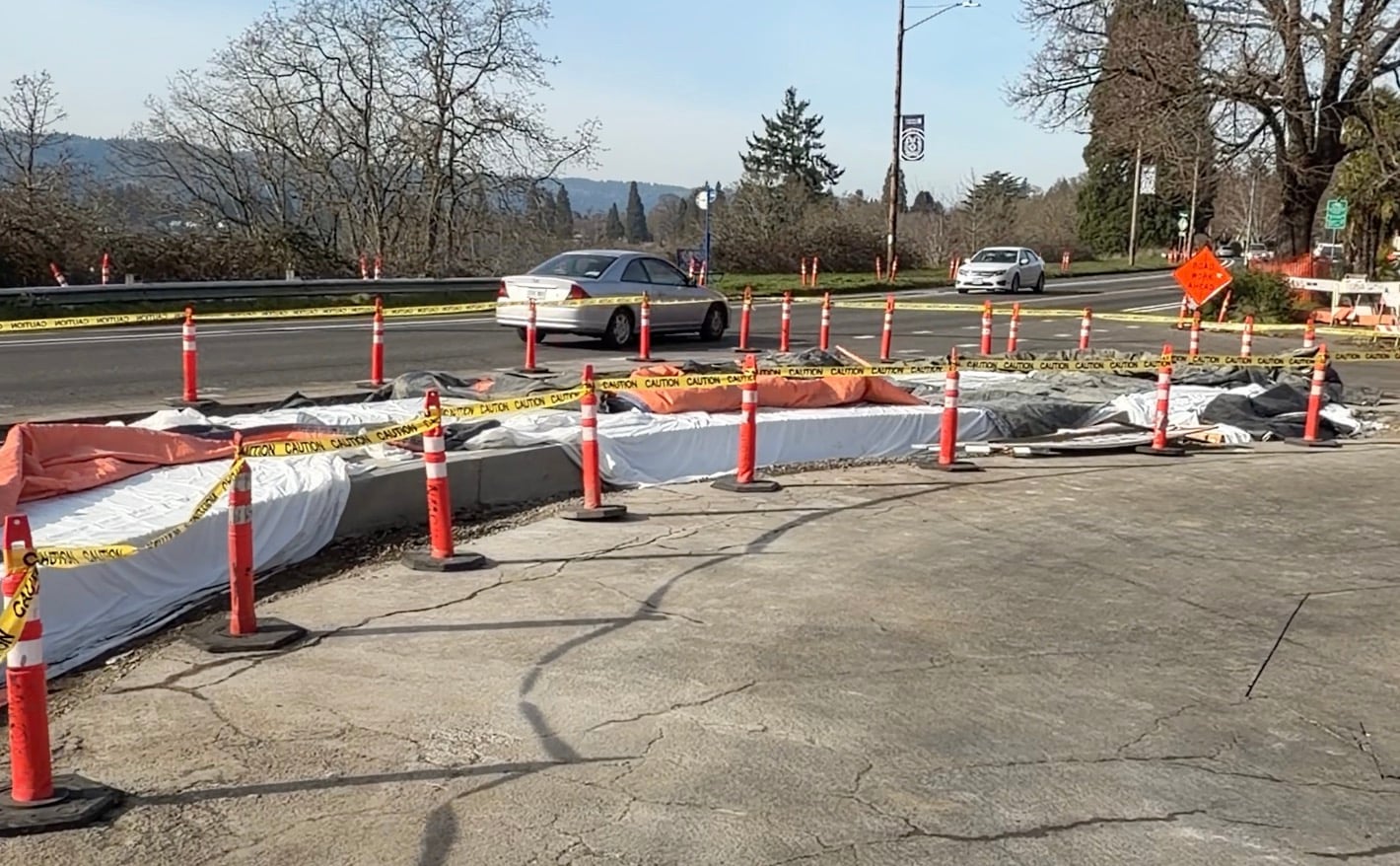
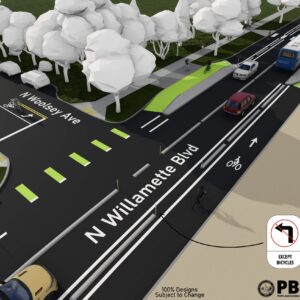
The start of construction on the North Willamette Boulevard Active Transportation Corridor project is a joyous occasion for many folks who’ve waited years for major safety upgrades. On a personal level, I’m beyond excited for the transformation of a busy bicycling corridor I’ve biked and driven on thousands of times in the past 20 years.
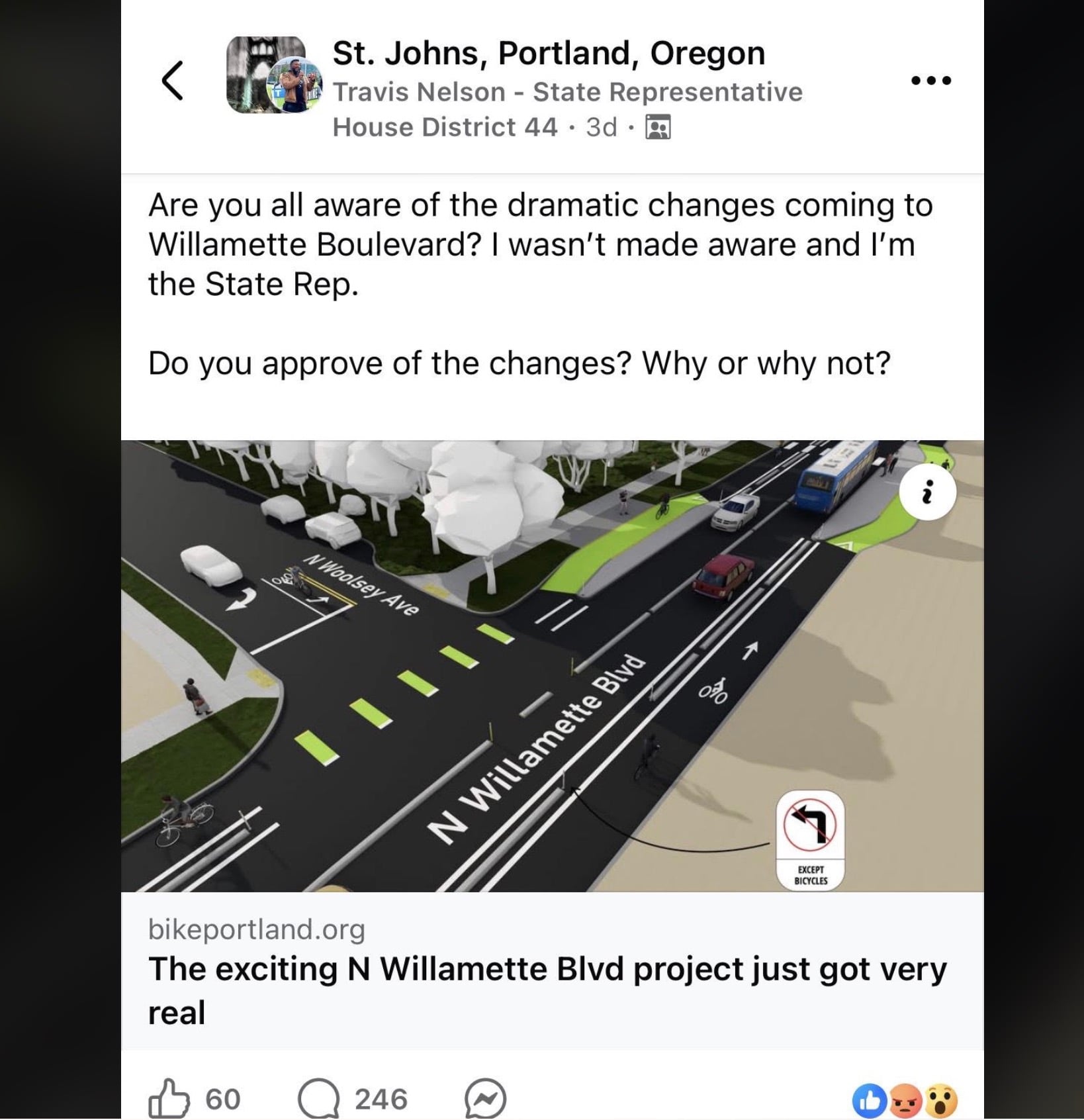
That’s why I was surprised and disappointed to see a Facebook post* last week from Oregon House Representative Travis Nelson (*note that the original post is in a private group, so that link goes to a different, public post with a different comment thread). In what I’ve almost come to expect once a high-profile, bike-related project breaks ground, Rep. Nelson posted: “Are you all aware of the dramatic changes coming to Willamette Boulevard? I wasn’t made aware and I’m the State Rep. Do you approve of the changes? Why or why not?” (The post then linked to a BikePortland story from January 2025.)
Rep Nelson — a Democrat, Registered Nurse and grandson of Louisiana sharecroppers — was first elected to represent North and Northeast Portland in 2022, seemed to be making a classic anti-bike move: shield opposition to a project by complaining about the integrity of the process. But there’s more to Nelson’s concerns than he first revealed.

“DEI matters. I’ve reached out to 2 of the peninsula’s Black Churches… They knew nothing about the project.”
– Rep. Travis Nelson
Right on cue, Nelson’s post (see it below) triggered several pointed responses. He gave some folks an opportunity to post nasty things like: “They need to get the f out of the way bikes and joggers running in the middle of the f street,” “Always fcking up traffic in this city for bicycles,” “Absolutely over the catering to bikers,” and “Make them pay for bike license.”
The more thoughtful (and readable) posts came from people who support the project and didn’t appreciate Nelson’s framing. “Super disappointed to see you posting this,” said one person who added that they’ve lived on Willamette Blvd for 34 years and have, “watched crashes in front of our house over and over again.” This resident — who posted several photos of collisions and skid marks on their lawn — worried that Nelson’s post would, “empower those who want to continue the status quo so they can simply speed on my street.”
Another person commented: “This is really irresponsible for an elected official to post. Just because you missed something doesn’t mean it wasn’t well communicated.”
My feelers went up not just because I know how posts like Nelson’s often rile up the anti-bike base, but because I’ve seen this particular movie many times. The Portland Bureau of Transportation (PBOT) has a history of being relatively far along on a project like this (one that makes major street design changes that benefit non-drivers) — only to have a notable person or group stand up and say they were left in the dark. It can be a powerful tactic depending on who stands up. When the person is Black and claims the group who wasn’t included in the outreach were BIPOC Portlanders — PBOT will often change course. On North Williams Avenue, PBOT restarted the outreach process after some Black residents said the outreach process was racist. On NE 7th Avenue, a similar thing happened when Black residents spoke out and PBOT ultimately gave up on a groundbreaking greenway project design many folks were very excited about. On NE 33rd, PBOT took the extraordinary step of removing a bike lane that had just been installed.
In the case of N Willamette Blvd, Nelson told commenters on Facebook that the intention of his post was to simply start a conversation. “I posted here not to express judgment, but because I wanted to know if I was the only one who missed the memo. Based on feedback l’ve received, I’m far from being alone.”
In an exchange with Rep. Nelson on Bluesky yesterday, he explained to me that his concerns about the process are, “rooted in equity and inclusion.” “When I ran for this seat in 2022, I ran in part because of George Floyd’s murder. DEI matters,” he wrote. “I’ve reached out to 2 of the peninsula’s Black Churches near Lombard [an arterial several blocks away]. They knew nothing about the project.”
In other replies, Nelson clarified that he wanted to know how PBOT used a racial equity lens to ensure that non-English speakers were properly notified about the project. A public involvement summary on the project website reveal it went through a robust public process with over 30 public meetings since 2021. Nelson says he reviewed that information and still wants to know more about what role racial equity played. He says he’s reached out to PBOT to share his concerns.
Beyond PBOT’s outreach process, I asked Nelson if he had critiques about any other element of the project. “I’m concerned that traffic will be diverted to narrow side streets where some turns are limited,” he replied. Nelson was referring to new turn restrictions coming to some intersections.
“Do you think some traffic diversion and turn restrictions are an acceptable trade-off for the benefits of the project?” I asked him.
“It’s critical to me that the process be right,” Nelson replied. “There is a lot of generational racial trauma in N & NE. Vanport, redlining, urban renewal & the demolition for I-5 have had a long lasting impact. I don’t want people who feel like their voices haven’t been heard to be steamrolled by another project.”
This $6 million project (a mix of federal and local funds) is already under construction and should be finished by September of this year. Given the public process PBOT has done, it would be highly unusual for them to make major changes to the design. But like I said, everything can change when racism becomes part of the conversation. Hopefully PBOT has done their homework and can navigate this situation.
To be clear, while Rep. Nelson has concerns about the process, he supports the changes. “I’m 95% good with the project,” he shared on Bluesky Monday. “We absolutely need safer streets.”
I’ve reached out to PBOT for comment and will update this post when I hear back.


Thanks for reading.
BikePortland has served this community with independent community journalism since 2005. We rely on subscriptions from readers like you to survive. Your financial support is vital in keeping this valuable resource alive and well.
Please subscribe today to strengthen and expand our work.
As his constituent, I would urge Rep. Nelson to think twice about making these “open ended” remarks that invite such strong disparagement for a group of his constituents, especially since this project will actually provide better facilities for the joggers and bikers who are apparently so annoying to drivers. (Didn’t realize that joggers also caused such a strong response!) Considering he’s a member of the Working Families party, he should be thrilled by the bus stop treatments coming with this construction. I think he’s also voted in favor of “protecting workers from climate change,” and this type of multi-modal project is so clearly a climate justice-friendly project. Inviting drivers to complain bout bicyclists and joggers is such a car-brain move. I expected better of someone who’s clearly a smart guy and holds as much power as he does.
On a larger point, why does the notification process matter so much if the project results are ok and ultimately beneficial to everyone? Is it that construction is disruptive to churches specifically? Are their parking lots going to be blocked off for some length of time, or will their regular meetings be interrupted by construction noise? If that’s the case, it would be more appropriate for the churches to coordinate with PBOT to mitigate the disruption to any services. I can see how Rep. Nelson could be useful in that coordination. Otherwise this is just throwing his power around and complaining about the perennial nuisance of construction projects and meddling in a project that’s already broken ground. Everyone gets annoyed with construction. Instead of blaming our neighbors for it, we should be bonding over how annoying it is and then celebrating when it’s done and we each get our own lanes to use.
If he wants to complain about unexpected and nuisance construction, I would love to chat with him about some ADA curb cuts at Vancouver/Williams and N Killingsworth that were so shoddily done the first time that a second crew had to come through recently and smooth them out. I got stopped by flaggers twice on my bike on my way to work (with no notice!), and then spent the better part of a week navigating around the Williams/Killingsworth intersection which got closed completely on the north side. What a nuisance! But at least now the curb cuts are smoother.
The churches he is talking about aren’t close to the project’s impacts by his own admission in the article. So there aren’t any construction related or access issues for those churches. It sounds like he’s saying that two black churches on a different street were not aware of a project on Willamette.
Well said, as usual, Paige. I, too, am Nelson’s constituent, and your words express my feelings aptly.
In February of 2023, I reached out to Representative Travis Nelson about my concerns that the Interstate Bridge Replacement project was giving too much consideration to car drivers, including a repeated anecdote of someone who needs to take (drive) their kid across that bridge to school everyday. The main theme of my message was that we need to stop subsidizing car travel and start helping people who use alternatives. Rep Nelson’s response was encouraging, especially the following:
“I am all in favor of decreasing our dependence on individual car driving as well. I love getting out and walking around in the district, and I know that definitely helps me feel more connected to my community. This legislative session, I have held several meetings with TriMet and City of Portland about expanding access and options for pedestrian and bicycle traffic, and for mass transit. TriMet is currently working with the legislature on a funding request to expand their services in the North and Northeast Portland area over the next two years, as well as providing new Max line cars. City of Portland officials shared with me their plans for the installation of more bicycle traffic lanes and stoplight cameras to help reduce speeding. I’ve heard from countless bicyclists that reducing cars speeding by makes them feel safer on the road and more likely to commute via bicycle, so I’m pleased that City of Portland is working on this issue.”
I got the feeling from this exchange that Travis was on board with the plans for North Portland, the Willamette Blvd project being in early design phases at that time.
I’m excited by the project. Nearly everyone I encounter walking or riding on Willamette Blvd, and a vast majority of the households on the boulevard, have expressed support.
Drivers who are passing through at speeds greater than 35 mph may have missed the signs that have announced “Improvements are coming to Willamette Blvd” for the past two years. People who live over half a mile away and don’t read the North Peninsula Review may not know. What would be an equitable process? How can or should PBOT include folks who ignore signage, including but not limited to speed limit signs? There is a big flashing sign up now asking drivers to “use extreme caution” in the construction area. To many drivers in this 25MPH section this appears to mean “slow down to 35mph”, confirmed by the speed detector just west of the intersection of Willamette and Rosa Parks Blvd.
This is a PBOT project, and it’s in District 2. I’d like to hear from the district 2 councilors regarding their take (Sameer Kanal, Elana Pirtle-Guiney, and Dan Ryan.) I’d especially like to hear from Kanal, as a member of the progressive caucus and a person of color, about whether he has concerns about proper outreach and DEI.
Does DEI also extend to our LGBTQ+ neighbors? After all, as some big-brained commenters pointed out riding bikes is gay.
Just FYI Rep Nelson is the first openly LGBTQ+ man of color and the first openly LGBTQ+ African American to ever serve in the Oregon Legislature.
Ok, point taken. At any rate it seems the “bikes are gay” comments have been deleted so there’s that I guess.
You’d think as a healthcare professional he would understand the value of making a street safer in order to preserve life and limb even if it means a little inconvenience to drivers. For him to describe it as a “drastic change” is disingenuous. For the average car driver the experience will not materially change in any significant way.
Oh ****, not this equity means bike lanes are bad bullshit again.
Bikes are simultaneously only for brokies without a car and only practical for rich gentrifiers. I wish people would drop all the identity politics and just say “I don’t like bikes”
well, the last quote from Rep. Nelson is encouraging.
It is always interesting in these contexts when the destructive legacy of racist planning processes gets invoked, just because, you know, there is a very real difference between running a freeway through a neighborhood and building some daggone bike lanes in terms of the actual consequences of the project. And it is just such a car-brained thing to compare mild inconveniences to drivers as a result of a safety-improvement project to demolishing black neighborhoods.
Walter Sobchak: Those rich fucks! This whole fucking thing… I did not watch my buddies die face down in the muck so that this fucking strumpet…
The Dude: I don’t see any connection to Vietnam, Walter.
Walter Sobchak: Well, there isn’t a literal connection, Dude.
The Dude: Walter, face it, there isn’t any connection.
The Dude abides.
When you don’t have logical points, fall back to aggrievement buzzwords.
Sadly, we give way too much weight to them at time.
Ok. I’ll bite.
I live on a busy street. I don’t love the fact that it’s a busy street. When traffic is really going (9 am – 7 pm) and my neighbor is in their yard, we have to stand pretty much right next to each other *and* project our voices to have a conservation.
Why does the “harm” of moving e.g., 10 more cars per hour in front of someone else’s house outweigh the benefit of potential moving e.g., 10 fewer cars per hour in front of my house?
Are there any risks that church goers will no longer be able to attend services? Does PBOT normally run projects by religious groups for Divine Approval? Do these churches really need to be kept in the loop, like special engagement somehow? This isn’t a secret project.
Here’s a history of the projects public outreach. This is weak bullshit to bring up Vanport and I-5 and how these church attendees don’t want to be “steamrolled”. This is a public safety project that will benefit everyone that uses Willamette, this isn’t an attack on anyone. GODDAMNIT.
Like many others here, I think Rep Nelson’s baity post is unhelpful, arouses the worst online anti-bike trolls, and stifles rather than invites meaningful discourse. It’s a well-worn pattern that pits cyclists against people and communities who have been and continue to be harmed by racist and classist automobile infrastructure.
And…Black churches are an important place to do outreach. While Portland has a reputation of being un-churched, it’s my understanding Black churches are a core community hub—not just for worship, but for organizing, social support, and sharing information. I remember once hearing announcements about health when I visited a church in N Portland on a Sunday morning, which I believe were a regular part of Sunday worship.
So knock Rep Nelson’s style and getting caught up in anti-bike rhetoric. But cycling advocates and PBOT should learn important lessons of where to do good community engagement.
Wait: You’re saying that PBOT should now be using churches to do community engagement? So if you happen to be an atheist, you get left out?
And what about separation of church and state? It doesn’t seem appropriate for the gov’t to favor churches in any way.
Do the members of the church, including the pastor, even live in the neighborhood?
If they do live there, what did they do with the flyer they would have received about the project? Throw it away like most people (I’m one of those types)?
Does the church have a newsletter they pass out on Sunday? (the last church I went to 30+ years ago did) Did it include information on local city projects going on?
What proactive actions does the church take to find out what’s going on in the neighborhood they represent?
Does the neighborhood association for that part of town have a newsletter? Mine does and they list out the various City/County/State projects going on in my neighborhood.
Can part of the lack of knowledge also be put on the church and its members? PBOT cannot in any way force people to pay attention to the projects they do.
Maybe it’s really not about DEI afterall, and just human nature as most of us (I’m way guilty of it) just don’t pay attention to the flyers we get in the mail. I know I recycle mine about as fast I as I pull them out of my mailbox.
Be careful who you vote for mate…..if you want this to change.
Thanks for the sage advice. I’ve been voting since 1994 and I wish I had you around sooner.
This is so maddening! Rep Nelson, what is the reasonable radius we should be doing? Leaflets from planes over greater Oregon and SW Washington? Should ODOT reach out to all the synagogues in the greater Portland area just in case they don’t want to be called antisemitic? Unfounded complaints like this make reasonable people roll their eyes and harm future endeavors.
I live in a city (Greensboro NC pop 300,000) where African-Americans and African immigrants (which groups the census lumps together) are a plurality followed by non-Latinx whites, and 6 out of 9 city councilors are African-Americans, who regularly DEMAND that any useful bicycle infrastructure be put in the predominantly African-American districts before they are put in the predominantly white districts – our city has been earnestly trying for decades (so far unsuccessfully) to gentrify certain African-American sections of town with bike facilities, farmer’s markets, trendy housing, recreation centers, express bus, etc. So I find it incredibly ironic when an African-American elected official in any overwhelmingly white jurisdiction, particularly outside of the Deep South, starts to object to bike facilities or any other progressive infrastructure.
That makes sense, but unfortunately in Portland, there has been a narrative going back to the Williams Ave bike lane project, that bike lanes are racist, they are the cause of housing cost increases, that cycling is just for white elites, and bike lanes are the reason that black folks were displaced.
There is a whole generation of pro-car anti-bike black leadership in Portland that were brought up on this toxic narrative over the last two decades. A major proponent of this talking point, was promoted heavily in the early 2010s by the current director of PBOT.
Yep – I had similar thoughts when I saw Nelson’s objections. A good chunk of well-meaning white liberals in Portland are automatically triggered whenever a Black person in power brings up racist wrongs. It’s a big power move that Black leaders pull out with some regularity in Portland. I must say I’m really disappointed that Nelson did it here. He is burning up a lot of goodwill in the process.
Yeah, we hear the same narrative out here, except the census says that a majority of our local cyclists who commute to work are actually African-American, but most are either students at our two public universities or homeless adults trying to bike to industrial jobs along narrow unlit stroads in parts of the city without public transit – in other words, groups of people who often don’t vote. I hear similar complaints from bike advocates in Durham, Raleigh, and Charlotte of the utter cluelessness that their elected officials, including African-American elected officials, have about how many and who their local bicyclist community actually are.
Our elected officials don’t care about cyclists as people or as constituents, instead they care about having modern bicycle facilities to increase the prestige of their communities, which in turn sells more homes (an amazing number of elected officials are directly or indirectly connected to the realty industry, including many African-Americans) and increases their chances for re-election.
If you ever want to make huge progress on bike, walk, and transit advocacy, enlist the help of your incredibly friendly rich type-A realtor industry. Yeah, they don’t really care about safety or mode split or saving the planet, it’s just not their thing, they only care about selling homes to rich buyers, but they do care about having good-quality bicycle, walking, and transit connections in order to sell those homes to rich buyers – they want what you want, but for other reasons – and they are very well-connected to your local VIPs, politicians, and rich people.
It would be interesting to see how elected officials’ rhetoric changed if participation in leadership came with an enforced requirement to use mass transit, biking and/or walking for transport to the majority of their official functions.
In Charlotte NC there was a huge transformation in the mid-2010s during the Black-Lives-Matter movement when several younger African-Americans were suddenly elected to their city council (replacing several old people) who apparently are regular users of public transit and/or bicycled – not only was the city’s public transit improved including streetcar and light rail, but the new bicycle infrastructure there is really transformational, well-designed, well-located, cohesive, and connected – and well-funded through the same kind of bonds that were normally used to fund stroads. Even the bike lanes that pass by the NASCAR Hall of Fame are excellent. It’s not perfect, there’s still some critical gaps, but it’s far better than it used to be. On the flip side, there’s been a steady increase of homelessness in Charlotte caused by 25 years of massive rental increases ever since Bank of America got taken over by NationsBank and moved their headquarters from SF to Charlotte (with a lot of California Bay-Area employees).
Sounds like a good strategy, since nothing, absolutely nothing in Portland is as important as people being able to make money from land.
I’ll add that this is probably one of the few ways black “leadership” can feel empowered – by causing a fuss about things.
ANd this being Portland, we will allow small groups of people to derail things that benefit larger groups of people because of “equity”.
David,
Most Latinos don’t like Latinx. Just sayin.
75% of Latinos who have heard of the term Latinx say it should not be used to describe the Hispanic or Latino population, up from 65% saying the same in 2019.
https://www.pewresearch.org/race-and-ethnicity/2024/09/12/latinx-awareness-has-doubled-among-u-s-hispanics-since-2019-but-only-4-percent-use-it/?utm_source=chatgpt.com
Fascinating to me that this is how people find information now. (unfortunately, most major search engines and pretty much roulette wheels too, so I guess I should get used to it)
I totally agree. As a Latino, it seems like Latinix is being forced on us, even though by well intentioned folks. It’s ironic, weird, colonizing and patronizing all at the same time.
The City of Portland does put resources into communication across language barriers. I get a fair number of messages from the Parks department and it’s routine to see links for eight or ten languages.
I am personally in full support of this project as someone who cycles through that area weekly to get from SE to St Johns. However, it does seem like a huge oversight for PBOT to not have reached out to these community groups especially when they already had to restart the listening process from not listening to the Black community well. I hope that this can be a learning opportunity for PBOT and that this project will have community support.
Matt, methinks thou dost protest too much. Why does one segment of the community get special consideration beyond the public-involvement processes we have all agreed to? I regularly miss out on opportunities to have my say just cuz I’m kinda busy in my own little world (4th-Ave project is a good example). But I don’t get to say, “Hey! Stop the project! I wasn’t paying attention!” I know the big difference here is that the Black population in NoPo was abused horribly in the past, but that doesn’t mean everything has to stop when someone objects.
And yet they do, so not taking that reality into account when doing your outreach is a bit of an own-goal.
Would an Oregon State Representative be routinely notified about a street project in their district? The outreach seems to be based on nearby addresses and probably neighborhood associations. A person who doesn’t see Bike Portland, tosses out their second class mail, and skips the NA might not know about a project until they see the flaggers.
I live in the neighborhood and got lots of mailers about it by PBOT
The churches aren’t located near the project. Plenty of outreach was done in the impacted area.
My only real complaint is that the money could’ve been used to finish more last-mile connections, which is what I see as the biggest failure of our current network. For example, connecting the end or some part of the Willamette route better into downtown St. John’s, Lombard toward pier park, the N. terminal road gap, or possibly repaving the path the connects PIR to N. Portland road (it’s currently passable if you’re a gravel enthusiast). Not to say Willamette couldn’t use improvements in places either, but it did have recent upgrades as already (why not do it right the first, or even second time?). To me it looks less like a failure to consider DEI than a failure to prioritize project funding wisely.
FWIW… The recent upgrades on Willamette were phase one of this very project.
I regularly ride the PIR trail, have done so for years and I don’t even know what a gravel bike is. Like many other users I see frequently, I use it for watching egrets, great blue herons and the resident breeding pair of bald eagles rather than transportation. There is already a problem with increasing use by speeding motorcycles. Re-paving it will just make it another micro-mobility freeway like the path from OMSI to the Sellwood Bridge
Ah yes, the Portland veto: just whisper “equity process” three times and the bike lane disappears, mate.
We’ve seen this episode before. Project goes through years of outreach, open houses, design tweaks, federal funding lined up… then suddenly it’s Schrödinger’s Bike Lane: simultaneously 95% supported and somehow an existential threat to racial justice.
Of course equity matters. Deeply. But if every safety upgrade can be frozen at the eleventh hour because someone important “missed the memo,” we’re not doing equity, we’re doing paralysis. Meanwhile the crashes keep happening right on schedule.
At some point we’ve got to decide: are we building safer streets, or are we just building new ways to stall them?
Maybe it’s just time to move past DEI. It feels like the national moment for it has passed, and a lot of Americans have moved on or grown skeptical. More importantly, it’s increasingly being used as a way to stall or kill projects that would deliver real, tangible improvements. Centering every decision around racial justice rhetoric might have been well-intentioned, but in practice it often just freezes progress. At some point, we need to focus on outcomes and move forward.
No, it’s not. Real wrongs happened and continue to happen, and we should aknowledge them and do better. The US as a country has never fully acknowledged our history of racial discrimination, resulting in a huge movement today that elects fascists to public office.
***Portion of comment deleted for insulting someone else’s comment. – Jonathan***
I simply noted that the comment from “Jose” sounded as though it was written by ChatGPT. Look at the artificial phrasing. Seems fair to point out when your site is getting spammed by chatbots.
Yeah I just don’t like when commenters assume that other folks are using AI or are “bots” or “trolls.” Just don’t do that. If you think someone is spamming the site with fake or inappropriate comments, feel free to email me maus.jonathan@gmail Thanks.
Don’t worry, all my comments are without assistance of AI. I’m quite capable of spewing my thoughts on my own in a forum without worrying that the self appointed AI-police to come after me just because my comment doesn’t mirror their own.
“Maybe it’s just time to move past DEI. It feels like the national moment for it has passed, and a lot of Americans have moved on or grown skeptical.”
That would be white men, mostly.
You are so right. There’s a person at my work who said that it infuriated them that DEI had been taken over and changed from its original intent by a bunch of pearl clutching white saviors who think they are yet again saving minorities with their guilt complexes. They also mentioned how did these same pearl clutchers think that replacing one form of racism with another form was the best way to end racism.
They are quite capable thank you very much in getting their own jobs and success on their own, they don’t need or want companies checking the DEI box to hire them.
I’m impressed by how little response he got to his clickbait post. 5 reactions and 23 comments from 16 people. Tempest in a teapot.
Like I tried to clarify in the post, the link I shared in the story is not the only place it was posted. The original location of the post is a private FB group that the mods haven’t let me join yet. On that post there are hundreds of comments… so it definitely got noticed.
Ahhh! Sorry to miss that. Totally appreciate your awesome attention to detail.
“I’m 95% good with the project,” (but casually stir the pot with issues & concerns that have 100% cancelled, and removed, previous projects.) What IS the agenda/goal here?!
MontyP, I’ll say it plainly: this looks like a strategic race based power move by Travis Nelson. In Portland, framing something as a racial equity failure has derailed projects before. He knows that.
If he’s 95% supportive, raising this now — after years of outreach and with construction underway — isn’t harmless. It’s using equity language as leverage. That kind of politics undermines trust and makes it harder to actually deliver safer streets.
Is it possible that State Rep. Nelson is suggesting that local Portland bike advocates need to reach out to the local traditionally African-American churches and church leaders and work to develop a long-term relationship and alliance for needed improvements? That it might be to the benefit of everyone if they did? If, as several people say, PBOT is so scared of the racism card, maybe if some influential members of the local African-American churches and church leaders could be convinced of the relative benefits of good-quality bicycle and pedestrian infrastructure by Portland advocates, what do you think might be an overall benefit of such an alliance?
Traffic is the itch that mediocre office holders can’t resist scratching.
Being stuck, sitting in a car, is frustrating. Any chance to complain about traffic, or better yet, blame it on an othered group, is red meat for a facebook or nextdoor mob.
Like scratching a real itch too much, it makes the itch worse and causes bleeding and scars. Nelson’s previous attack on Trimet and now going after bike lanes shows a level of pettiness and irresponsibility that does not belong in government.
The response here has reminded me of the fact that some (many?) white cycling fans are whiny jerks who would rather impugn a state rep who is supportive than consider that PBOT’s outreach to black community members may have once again been lacking.
The public outreach for this project has been extensive. They had 30 public meetings about this project.
The churches in question arent close to the project.
Seems that the public outreach was more than substantive and people who werent paying attention decided to complain when they found out about the project years after public outreach started.
Just lost my vote.
I’ll almost always fess up to being a whiny jerk but I think it’s valid to have beef with Nelson’s, “hey I’m just asking questions here” sort of approach to a project that has been public since 2021 and about the impacts on churches that are not even in the impact zone. He is either totally out of the loop about the project or was trying to lob a bit of a bomb for some reason. Neither is ok (one is worse but I’m not sure which) considering he’s been elected to represent the area the project is in.
Linking again, scroll to “public involvement summary“.
I did not see much evidence of outreach to black community groups in that list. Perhaps some of the vague “meeting[s] with adjacent neighbors” were in this category but I really doubt it. There quite a few meetings with neighborhood associations and active transportation interest groups, however.
Ok, so black community members are *not* present in other areas or places of contact besides specifically black community groups, that’s your take here. That’s spicy! There were 30+ meetings over several years about this project. If someone missed the memo, I don’t know, that sucks, but too bad? You think PBOT needs to reach out to very specific demographics, I don’t agree here. These churches aren’t on Willamette, I’m not sure why the congregants needed special treatment.
Black people have been historically underrepresented at neighborhood association meetings and in cycling activist groups so, yes, I think it’s important for PBOT to reach out to other community groups to address this kind of historical and continuing bias in outreach. It’s kind of sad that you find this controversial (spicy). Given how cycling activists/urbanists tend to self-recruit and show up en-masse at these events (and on surveys) it’s even more important to gather input that better reflects of the community as a whole, if you think that outreach is important.
And, for the record, I unambiguously support this project while also acknowledging that it’s quite possible that PBOT failed to be inclusive and equitable in its outreach.
Here’s a thought, since PBOT only sends out the information, has the meetings, etc. and can’t force people to come. How about people have an interest in their community take personal responsibility to find out what is going on? I know, the personal responsibility thing everyone hates.
For myself, through my work and my local neighborhood association, I learn all that I need to know about the projects that affect me.
So what’s stopping others from finding their source of information for things they are interested in? Why is the assumption that everything has to be handed out on a silver platter to every possible group around the city?
Personal responsibility . . . oy vey!!
Organizations with a long and despicable history of racial bias and exclusion — according to reports commissioned by the City of Portland:
https://www.portland.gov/sites/default/files/2020-03/29385.pdf
Okay, which ones? Groups should PBOT have outreached to about a pedestrian/bike traffic calming project on N Willamette.
Are you suggesting that PBOT should codify a quota of Black people or groups that it should talk to, regardless of how relevant or interested they are in?
Sure, its quite possible, but what evidence is there that they did? Two people at two churches a couple of miles away were unaware? How can PBOT actually operationalize the level of “outreach” that would be required here (as if any level of outreach would ever make anti-safety folks happy).
Can you articulate what point of view is missing here? Most people don’t know anything about most infrastructure projects. Thats just reality because most people don’t care.
So what makes you think a problem even exists here?
Isn’t it obvious? PBOT should reach out to the people that will pop up at the last minute and say “PBOT did not reach out to me.”
They should also reach out to out to the people who didn’t know that PBOT did not reach out to them until someone tracks them down and asks “did PBOT reach out you?”
I’m suggesting that outreach that focuses on neighborhood associations (and adjacent homeowning neighbors) is racist and classist as f***.
Maybe the fact that PBOT has done this, again, and again, and again.
Moving past race for a moment, I often think Portland does too much outreach. I’m willing to be proven wrong here if someone can clearly articulate why I’m mistaken. When I’ve traveled with Mrs. PTB to other cities, domestic and international, we see absolutely incredible bike infrastructure and public transit. I say to my wife, “hey, do you think the agency responsible for creating and implementing this stuff had 100 neighborhood meetings to accurately capture everyone’s feelings?” I suspect not because there are haters everywhere and when every hater gets a voice it really feels like active transportation and public transit get the shit end of the stick. Would you agree that happens here in Portland? We see it here all the time on BP, a project draft is shared, looks pretty great, then “community shareholders” bitch and moan and it gets watered down so badly it sometimes feels pointless to even move forward with the project. If we really want to reduce SOV use and VMT and get people out on bikes or walking and bussing we need to stop asking people how much they hate the idea of that. But given the news about Trump and the EPA today what the fuck does any of this matter? Shit is wrecked and I’m feeling crushed by the world today, again.
Last time, the churches aren’t even on Willamette, they get no special say here and PBOT need not go out of their way to alert them to the changes coming to the street they are not located on.
I found his comment darkly humorous in the worst way. “I don’t want people who feel like their voices haven’t been heard to be steamrolled by another project.”
Yes, Heaven forbid people get “steamrolled” by safety. He is presumably just fine with people being steamrolled by Dodge Rams as God intended. No need to get involved in that case.
I think an important piece of context with a project like this is that the outreach should always be based on the level of impact. Who is impacted and how much are they impacted? The fact is, the only real impacts of this project are:
For the on-street parking, the impacts are localized, so I would only expect there would be outreach to the adjacent property owners, and that was definitely done. There were even a couple households where residents had disability parking placards, so the impact would have been higher, and PBOT accommodated them by creating new parking cut-outs in the planting strip next to the sidewalk. Not something they had to do, but a nice way to address more of a significant impact.
For the turn restrictions, I suppose there’s a mild impact to the surrounding streets, but these are pretty low-volume streets and there is such a good network of streets that any diversion would be spread out quite a bit. PBOT did years of outreach to the surrounding neighborhoods about that, and predictably nobody seems to have been that worried about it until now.
The third impact is the one that affects the most people, anybody who drives on Willamette Blvd, but it’s arguably not a “real” impact since it just creates a safe, slow and steady driving environment on a street where people shouldn’t be speeding down it anyway. There’s still only a couple signals or stop signs all the way from Rosa Parks to St Johns, so it’ll still be a convenient driving route even if it’s slower.
Given all the benefits of the project, and how limited the impacts are, it makes sense that PBOT would not have done outreach to neighborhoods that are not directly along the alignment, or gone to every single church in North Portland including ones on Lombard St (a state highway that is always going to be the main driving route in the area!), etc. That would have been overkill. It sounds like they did an appropriate amount of outreach over many years, but didn’t overdo it. We’re not talking about a major road diet, taking a four lane road down to two lanes or anything like that. This is a two lane road that will still be a two lane road, but with less parking, wider and protected bike lanes, better bus stops, and more crossings. So what’s the big deal, exactly?
COTW
Sorry, this makes too much sense. I want to hear about how people don’t go to church anymore because bike lanes.
Bike lanes are the reason why people can’t say Merry Christmas anymore!
For those who don’t bicycle, still the vast majority even in Portland Oregon, painted bike lanes are not for bicyclists, nor have they ever been – a bit of paint or thermoplastic offers absolutely no protection whatsoever to any person about to be hit by a car (or another cyclist.) If a jurisdiction was actually concerned about bicycle user safety they would put in barrier-protected bike lanes and intersections.
However, the actual purposes of a painted bike lane are:
The lanes in this project are barrier-protected.
Yeah, definitely need the input of a church before we can move ahead with public investment projects.
Disappointed that it sounds like Nelson is getting ready to double down. A few hours ago on the public fb post:
Poster:
“No absolutely not. The double sided bus stop right at the corner of North Willamette and Chautauqua is already causing accidents and it’s not even fully installed yet.  I spoke to the project manager but he was not interested in my concerns… as a resident on Willamette is very disappointing.“
Nelson:
“***** please shoot me an email with your contact info. Rep.travisnelson@oregonlegislature.gov“
Oooof. Thanks for sharing this.
“There is a lot of generational racial trauma in N & NE. Vanport, redlining, urban renewal & the demolition for I-5 have had a long lasting impact. I don’t want people who feel like their voices haven’t been heard to be steamrolled by another project.”
Comparing the construction of i5 (that leveled and irreparably divided multiple neighborhoods) and redlining (intentional and systemic racism) to a protected bike path is a blatant false equivalency.
I like most of the coming changes but don’t think every street needs speed bumps as our solution to speeding. That definitely puts faster cars on side streets that ultimately defeats the initial purpose.I drive this route at least twice a day.
Sudden project delays due to this kind of NIMBY complaint cost a lot of time, effort, and money.
So PBOT puts a lot of time, effort, and money into outreach: 30 public meetings, beginning five years before shovels hit dirt. And all for what?
It’s all so tiresome and frustrating.
I don’t envy PBOT.
On one hand, people on this site comment that PBOT builds so slowly and hesitantly because it does not care about cyclists, and on the other, PBOT finds itself obligated to sink time, money, and effort into outreach that NIMBY’s will somehow miss and complain about after the fact anyway.
Can you imagine how much cheaper it would be to protect cyclists and pedestrians if our civic decision making processes did not elevate and empower the complaints of people who hate change and don’t pay attention until their commute is defiled by construction?
The public process veto is a subsidy for the status quo. That’s true in the cases of replacing old dirty energy with clean renewable energy, replacing empty lots with family housing, and replacing dangerous streets with safer streets.
We are strangling ourselves.
Rep. Nelson apparently has a stack of mail a mile high he hasn’t looked at. My home gets some kind of update on this project quarterly, maybe twice a year, but either way I’ve been getting mail on this for years now.
(also Rep. Nelson you can sign up for email updates on the PBOT site I believe.)