

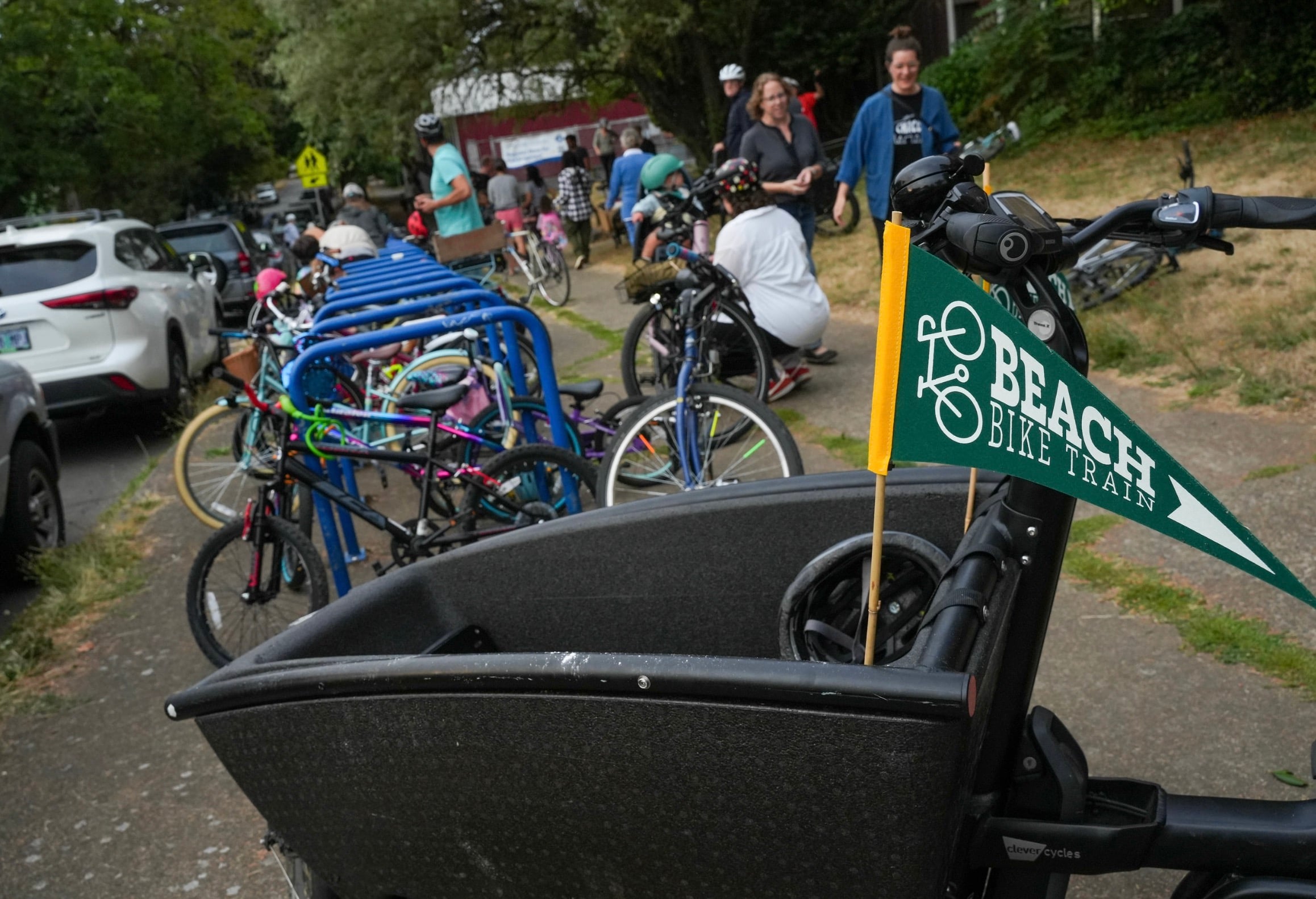
Advocates are scrambling to save a beloved state program that makes it safer and easier for Oregon kids to walk and bike school. They say Oregon Governor Tina Kotek’s plan to redirect all existing state transportation funding to operations and maintenance has crossed a line and now threatens dedicated funding for the Safe Routes to School program.
“We thought Safe Routes to School was safe,” said Oregon Walks Executive Director Zachary Lauritzen in a message to other advocates today. “But in the last 24 hours have heard it is now being considered.”
Kotek surprised everyone when she came out with her “repeal, redirect, regroup” plan earlier this month. The “redirect” was a call for lawmakers to redirect as much funding from House Bill 2017 (the previous transportation funding package) as possible to basic operations and maintenance. With hundreds of millions dedicated to highway expansion projects and other grant programs, some insiders assumed that Safe Routes to School would be held harmless. But the program, which has received $10 million per between 2018 and 2022 and $15 million per year since 2023, is now in jeopardy.

“Just recently we heard that SRTS funding is one of the potential programs to be reallocated, which means it would be defunded for at least two years,” Laurtizen wrote today in a message to bike advocates. He shared a sample letter and encouraged everyone in the community to send it to their state reps in order to boost the chorus of voices that stand behind Safe Routes to School.
Here’s an excerpt from Lauritzen’s sign-on letter:
“Dear State Leaders:
We urge you to prioritize Safe Routes to School (SRTS) funding by first reallocating funds from large infrastructure projects that have experienced significant cost and timeline overruns… The safety of our children must remain a core priority… We appreciate the complexity of the choices before you and do not underestimate how challenging this moment is. As tradeoffs are considered, please prioritize and protect the incremental but meaningful gains Oregon has made in safely moving kids and families to and from school. Safe Routes to School is a critical part of that progress and should remain a protected investment.”
Oregon has built one of the most successful and robust Safe Routes to School programs in the country. It would be a shame to lose ground now.
The legislative session begins February 2nd and will last 35 days.

Thanks for reading.
BikePortland has served this community with independent community journalism since 2005. We rely on subscriptions from readers like you to survive. Your financial support is vital in keeping this valuable resource alive and well.
Please subscribe today to strengthen and expand our work.
We’re going to get the Republican transportation plan whether we like it or not
Dems will make sure of it!
Well the republican version wasn’t based in reality since it didn’t fill even half of the budget gap. I guess they were wrong about the all powerful bicycle lobby controlling ODOT and siphoning away all the money for potholes and freeway expansion.
I can’t say I’m surprised. I was told by PBOT staff during a neighborhood meeting back in November that our neighborhood SRtS troupe had been begging for more protection on the greenway but that they simply did not have the money to do it.
We treat SRTS like it is “something nice to have” or “a little quirky fun thing,” but in reality it is about fundamental access to public spaces and the freedom to move safely in this world. It is a program that allows young humans to develop in a healthy, enriched manner. The cost of the program is less than one percent of its value.
I think it is safe to say that if I hadn’t walked to school from an early age I would more likely to default to car transportation for everything.
What does the annual $10-15 million pay for? – signs? Route leaders? Sounds like it’s not to build infrastructure.
It’s all early and just conceptual at this point. My hope is to just start a discussion about this approach. I’ll share the full plan today or Monday.
The $15 million per year pays for the SRTS construction program. You can find more info here under that heading to see what construction programs it funds: https://oregonsaferoutes.org/funding/
On the chopping block is the infrastructure program. These are the dollars that the state matches cities/counties 1:1 to build things like multiuse paths to schools, enhanced crossings, sidewalk gap filling, etc, around schools. They fund lots of small projects across the state. These are also the projects that are almost always on time and on budget b/c they are small and fairly quick. Little map here on ODOT’s site where you can click and see the construction projects that have been funded, how much they are for, and what year. Have to dig a little deeper to get details on each project.
I’m honestly curious, what does that $15m/year buy? The day to day is volunteer led as far as I knew, do they use those funds to put in diverters and flip stop signs and install calming along designated school routes?
Maybe ODOT could claw back some of the money they spent marketing the Rose Quarter project:
https://bikeportland.org/2024/09/05/willamette-week-exposes-pr-expenses-behind-i-5-rose-quarter-project-389337
Even if they don’t take it away from the SR2S fund itself, do keep in mind that every time ODOT or any jurisdiction takes out revenue (muni) bonds to pay for infrastructure, ultimately it’s your kids and grandkids who are footing the bill since the bonds are paid usually over a 30-year period through deficit-financing.
I’m having a hard time swallowing the idea that Safe Routes to School is a “beloved success,” at least as it’s been implemented on the ground in Portland.
My elementary school kids—and plenty of other kids—were repeatedly put in danger by drivers blowing through a stop sign on their walk to our local school. This wasn’t theoretical. It was ongoing, predictable, and visible. I reported it to Safe Routes to School staff, PPB, PPS and PBOT. The response? Nothing. No enforcement, no traffic calming, no follow-up. Zilch.
What we seem to have now is a program heavy on signage, plans, and feel-good language, but allergic to the one thing that actually changes behavior: enforcement. Any suggestion of enforcement gets waved away as inequitable or problematic, so instead kids are left to navigate dangerous streets while adults congratulate themselves on intentions.
If lawmakers are looking at this program and asking hard questions, maybe that’s not entirely unreasonable. Before scrambling to “save” funding, we should also be honest about outcomes. Safety isn’t performative. If Safe Routes to School can’t—or won’t—address known, repeated violations that put kids at risk, then something is fundamentally broken.
Protecting kids should mean measurable safety improvements, not just virtue signaling and press releases.
While your concern for your children is natural and laudable, Safe Routes to Schools is a construction project, not a motor vehicle enforcement program.
In Portland the SRS project is explained and mapped at https://www.portland.gov/transportation/walking-biking-transit-safety/safe-routes/srts-infrastructure-plan. If you want to add projects to that, the way is your PTA, neighborhood association, and city commissioner. SRS is primarily stop signs and crosswalks. It might include speed bumps, generally a different PBOT fund.
Traffic enforcement is the Portland Police Bureau. They would be lobbied by the same PTA, neighborhood association, and city commissioner.
The classic parents with hand held radar and photographing speeding cars might be a tactic.
The most advanced tactic is to lobby PBOT to lower surrounding street speed limits which deprioritizes them for cut-through traffic in the GPS route planning apps. It may or may not be effective.
The other advanced tactic is to be one of the 25 students in https://www.portland.gov/transportation/walking-biking-transit-safety/traffic-transport-class. It is great for in-person networking within PBOT.
!00% agree with this! When my daughter was in elementary school we walked or biked every day. I was very excited when PBOT designated part of our route as a greenway and added a stop signal a problematic crossing. It only lasted a couple of weeks- a few neighbors complained about having to stop so PBOT reversed course. Just think about that: engineers reviewed the all of this repeatedly and agreed the stop sign was acceptable for drivers and necessary for the safety of people walking and driving. Some neighbors said said they didn’t want to stop, others neighbors said the stop sign was welcome and useful and somehow PBOT’s decision was to support the convenience of drivers. It is an understatement to this a pattern, it is a hard and fast rule at PBOT to favor driving over safety
This is your beef about enforcement, wrapped in some stuff.
Can ODOT spend money on enforcement?
It’s not performative to build some infrastructure or even put a sign below the STOP sign that shows kids crossing or says “Cross Traffic Does Not Stop”. I see those signs, other people must.
The Subaru that has my name on it may be running around Portland right now, piloted by some normie who is sloppy about crosswalks but will of course be contrite and cooperative later, too late for the person they hit. I’d be happy for that person to see an extra $15 million worth of yellow signs around schools or on greenways.
I’m sorry you didn’t get any change out of PPB. This an issue for Mayor Keith Wilson, 503-823-4120, option 5. He hires and fires the Chief of Police. Don’t let them send you to 823 SAFE, that is a slow boat to nowhere (I’m still waiting for a call back about my stop sign runners on NE Rodney).
City Councilor info is at:
https://www.portland.gov/council/council-contact-list
I guess they prefer emails over phone calls.
The 1 year ODOT budget is $3.065 billion per year. The shortfall is $121 million a year.
There is no reason to cut SR2S.
You could reduce services to the rural areas that vote against funding. This is especially applicable because most of the fuel tax is collected in the urban areas to subsidize the rural areas.
You can reduce DMV hours and work toward more online services. You could look at engineering and project management – if you build less, fewer are needed. You could zero out overtime and zero out travel. You could look at using consultants if there is not enough work for full time staff. You could immediately enforce a minimum number of employees per supervisor. Since many people have maps on their phones, you could eliminate the roving sign trucks.
It would be a good idea to be explicit about the savings from delaying specific capital and expense projects and the amounts in suspense accounts for each specific project. Does stopping capital projects for a year save significantly when they are bonded for 10-30 years. Is SR2S capitalized or expensed?
What is important in the bill passed is more detailed legislative oversight of ODOT.
Searching the ODOT website, I was unable to find a monthly fuel tax collections number by county, or a monthly ODOT expenses per county, divided into DMV, maintenance, capital construction, or other expense categories.
About 1/3 of ODOT funding is federal. Trump has threatened to withhold federal funding to states not aligned to his policies February 1. I know Wyden is focused on that.
If someone can find that fuel tax number, I thank you. I have only found it for select fuel stations, not the tax collected in each of our 36 counties. The weight-mile tax is a separate more geographically complex equation.
Interesting.
The last time I looked at the Oregon state budget the breakdown was 4% for ODOT and 19% for Administration. I’d like to get more or better things out of ODOT but that seems like a lot of admin. The whole budget could use a second look.
A good topic for Bike Portland is to study whether SRS supports private schools, or only Portland Public Schools.