

It’s official: Oregon lawmakers are pondering the sacrifice of program that makes streets safer for kids to walk and bike to school in order to keep our transportation system above water. A program that builds bike paths with revenue from the $15 tax on new bikes is also on the chopping block, as is the payroll tax that funds public transit statewide. It’s all part of a desperate scramble to fill a $242 million budget hole at the Oregon Department of Transportation that remains unfilled due to legislators’ inability to pass a robust transportation funding package last session and the uncertainty created by a referendum that — if approved by voters — would kill the band-aid measure that did pass.
ODOT has spent years warning these same lawmakers about the fiscal cliff caused by dwindling gas tax revenues and political choices that have tied Oregon to expensive highway projects without a sustainable way to pay for them. And with public opposition to new taxes at an all-time high, lawmakers have put themselves into a very bad position. The talk in the halls of Salem has shifted from which projects to fund to which programs to cut and which positions to keep.
Lawmakers hosted an informational session about the ODOT “budget rebalance” Tuesday at the Joint Committee On Ways and Means Subcommittee On Transportation and Economic Development. At that meeting, they heard a presentation from Interim ODOT Director Lisa Sumption (who’s been on the job just four weeks) and Finance and Budget Division Administrator Daniel Porter about the dreadful choices the agency faces in light of this crisis.

To keep DMVs and maintenance shops open and avoid the ODOT doomsday scenario of bare bones operations that would put road workers and road users at imminent risk, the legislature can either identify new revenue and/or slash funding already dedicated to existing programs. Sumption and Porter shared three tiers of cuts (below) and laid out programs where funds could be redirected to operations and maintenance as a short-term solution.
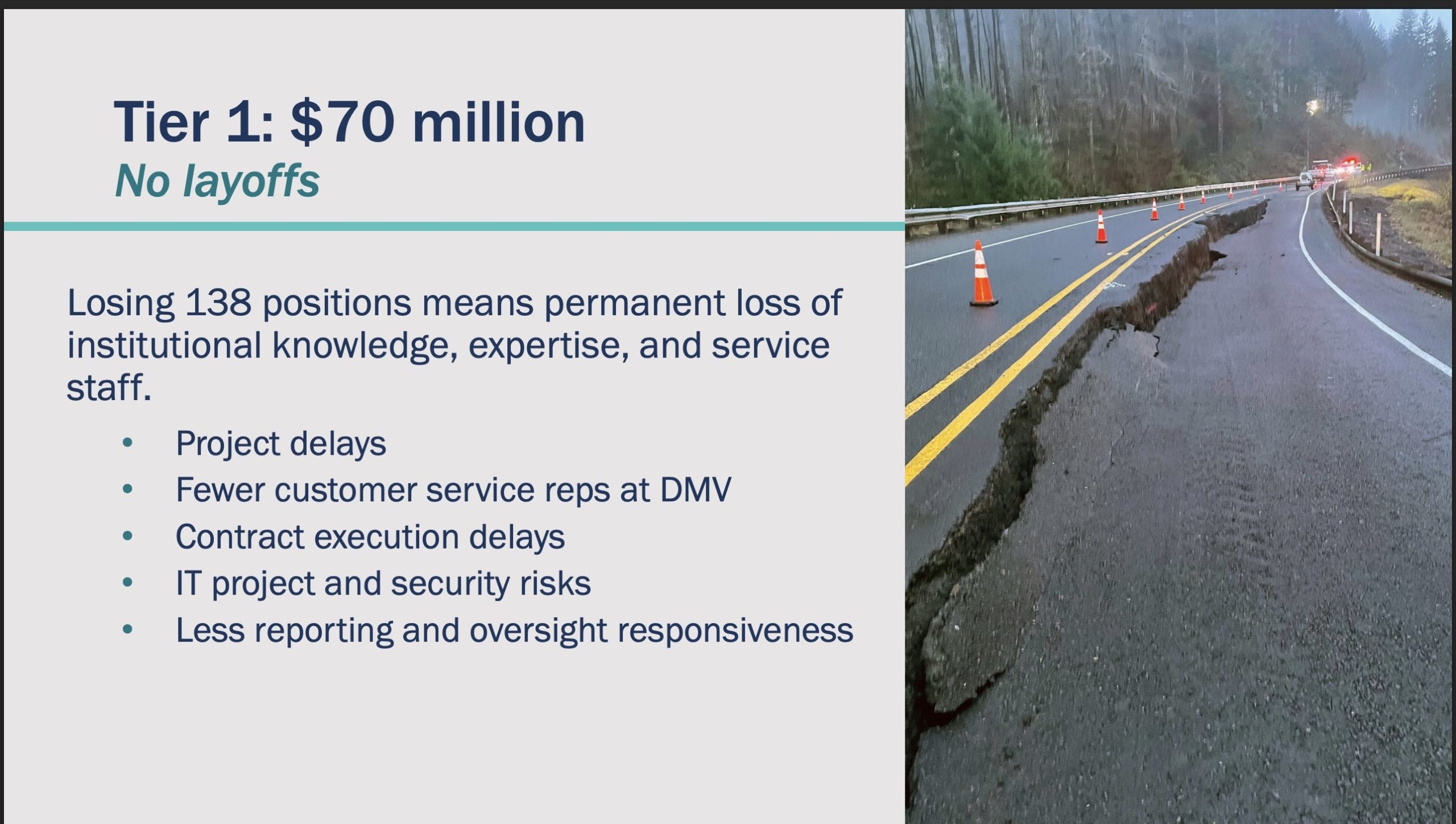
The first tier would avoid the worst case scenario. It counts on the legislature to identify some new revenue and it would allow ODOT to avoid layoffs while still requiring them to cut $70 million and maintain 138 vacant positions.
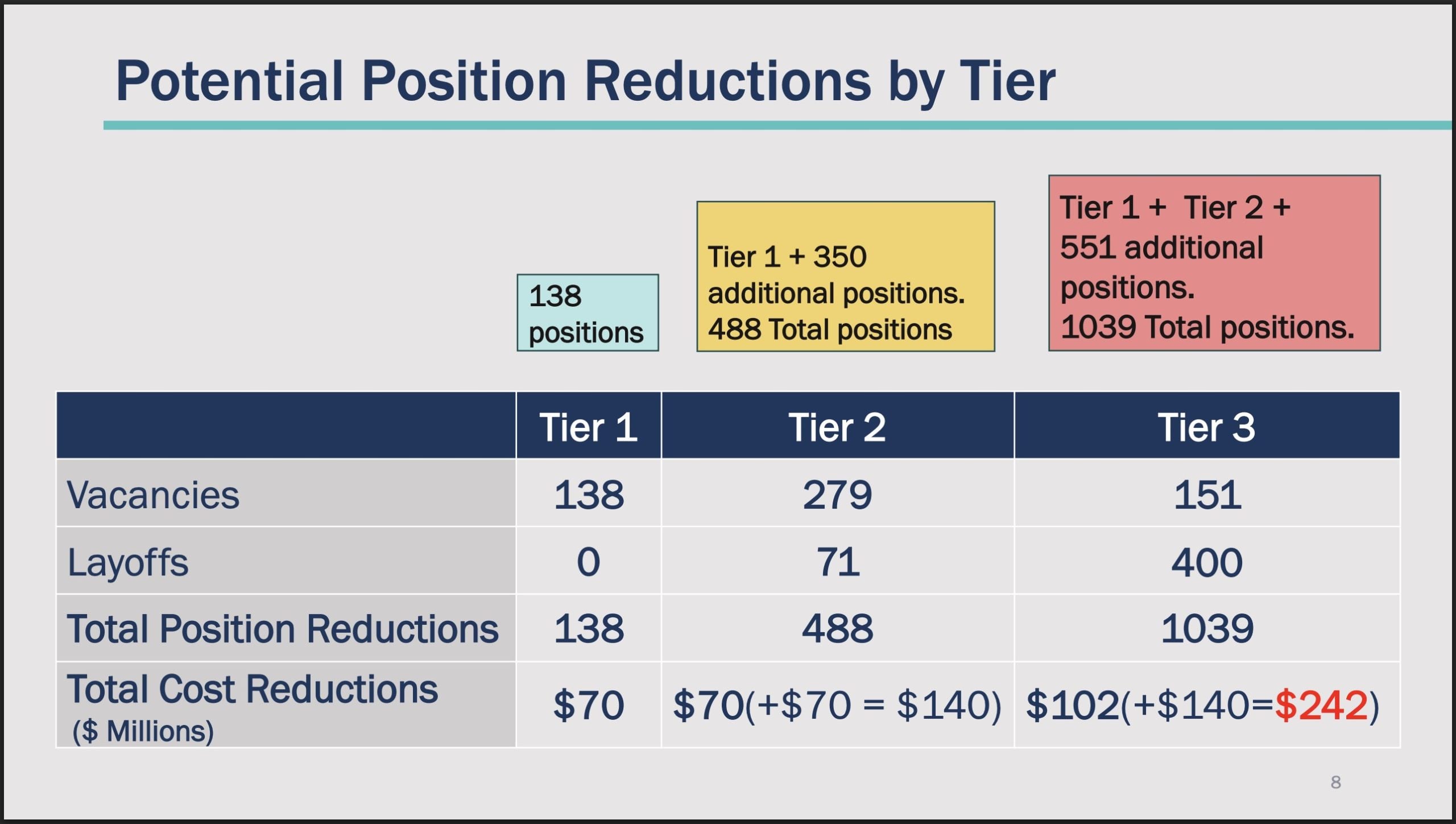
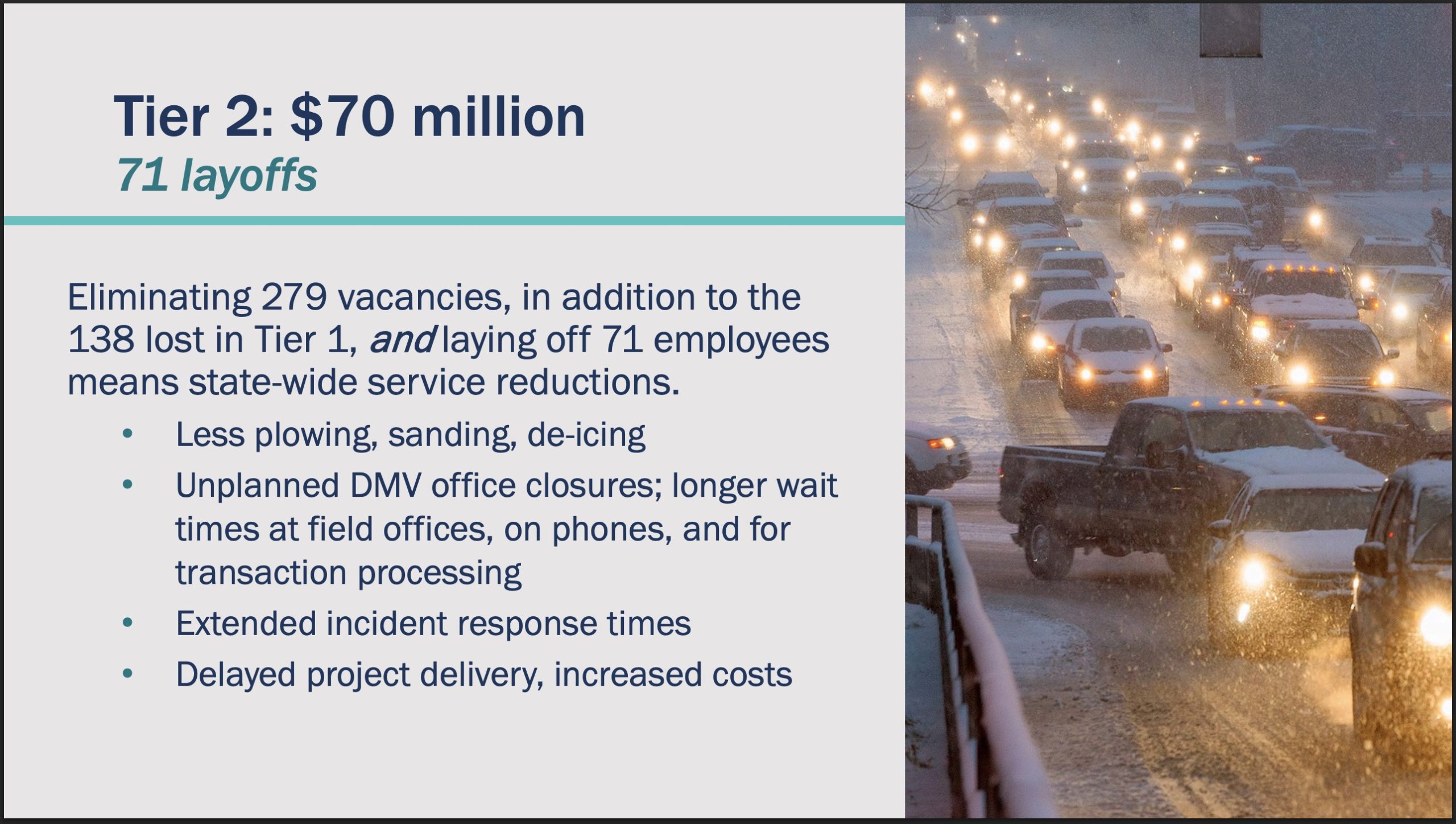
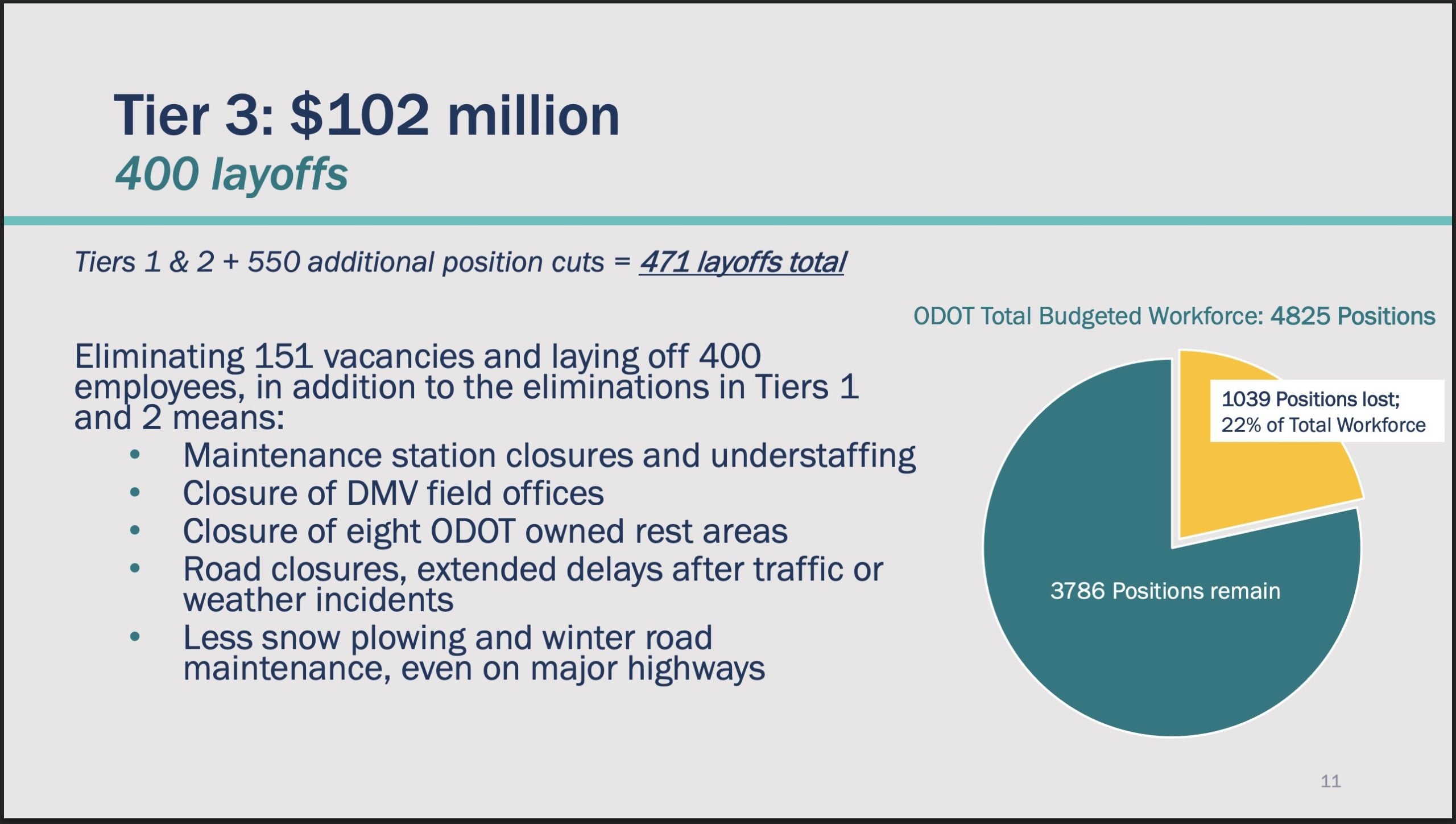
The second tier would add another $70 million in cuts for a total of $140 million. It would require 279 vacant positions and 71 layoffs. (Vacancies are positions that are held just not filled, while layoffs remove the position from the agency completely.)
If no additional revenue is identified, ODOT would move to tier three and layoff 400 people. This option would reduce the total number of staff positions by 1,039 (about 20% of the total workforce) to save $242 million. This level of cuts would, “Have serious impacts to Oregonians as we move throughout the state,” Sumption warned.
The redirection of funds from throughout the bureau is another avenue lawmakers are considering. As I reported last month, Governor Tina Kotek has said everything is on the table, except transit. In documents shared with this committee, ODOT has shared which programs would provide the biggest budget impact. Keep in mind that only unobligated funds are being considered. If a project is already funded or a contract has already been signed, it would still move forward.
Lawmakers could choose to redirect $84 million currently programmed for bridge seismic repairs and/or $85 million major highway projects named in House Bill 2017. The statewide payroll tax that pays for transit is also up for consideration, as is a pot of funding created by the “vehicle privilege tax” created in 2017 that’s paid by car dealerships. Other sources that could be redirected include programs funded through a gas tax on non-highway equipment and vehicles (like lawnmowers). This program funds bike paths and other bike-related projects across the state.
Another possible source of funds that will likely get a lot of attention is the Safe Routes to School program. ODOT currently puts $15 million per year into that fund to make streets around schools safer for walking and biking. Its inclusion in a presentation slide at Tuesday’s meeting makes it a very real possibility that lawmakers will opt to pause all Safe Routes to Schools grants for the coming two years in order to plug this hole in the budget. ODOT says the Safe Routes account currently has $27 million of unobligated funds that could be redirected.
Both redirection of funding and staffing reductions will be difficult choices for legislators. Is it more difficult than passing new taxes and fees? That’s the big question. The disconnect on funding from so many of our legislators (almost all of them Republican) that we can operate a transportation system without charging people a fair price to use it is really coming into focus during this short session.
At one point during Tuesday’s meeting, committee chair and House Rep. David Gomberg asked a DMV employee who came to testify what her experiences have been with customers. “There’s a lot of confusion,” the eight year DMV veteran shared. The rest of her response really stuck with me and helps illustrate why we are at this precipice:
“I understand Oregonians don’t want to increase taxes. At the same time, they’ll tell us that we’re doing an amazing job and that they can’t believe that they were able to be helped with such friendly faces. So it’s a tale of two different things from the same person. I literally had a person both ask me if they could work for us because we’re so amazing, while also saying that they love that they don’t have to pay any higher registration fees and that they were signing the [no gas tax] referendum.”
The short session is in full swing. I’m tracking several bills with major implications for ODOT’s future. See them here and stay tuned for more coverage.
Thanks for reading.
BikePortland has served this community with independent community journalism since 2005. We rely on subscriptions from readers like you to survive. Your financial support is vital in keeping this valuable resource alive and well.
Please subscribe today to strengthen and expand our work.
I personally think that lawmakers should make the cuts as painful as possible so that people will realize that in fact, you cannot just have a functional transportation system for free
People will blame ODOT for blackmailing the public, the way some folks blame the police for the mayor’s similarly motivated cuts to traffic enforcement.
I am having a hard time getting a read on what the situation really is. Remember when Kotek said the layoffs would begin Monday?
The difference here is that the policing budget never really got cut and actually increased. Their traffic enforcement didn’t reflect that.
Portland City Council literally voted to cut about $15 million from the Portland Police Bureau in 2020 — but sure, ‘never really got cut.’
Here’s the vote and breakdown if you anyone else needs a refresher:
https://en.wikipedia.org/wiki/George_Floyd_protests_in_Portland,_Oregon
and $75million city wide – but let’s leave that out. Let’s leave out it was still the 3rd highest budget the PPB has ever had. Let’s convenienlty leave out that in a 10 year period from 2015 to 2024 their budget increased by 60%.
Those don’t work well with you’re narrative, so I see why you leave them out.
What I read Alex saying is there’s no long-term cut.
Saying $15 million doesn’t really provide scale or context. The 2025-26 budget is $316 million. The 2015-16 budget was $190 million. So yes, there was a one-time symbolic cut of less 7% ($240 to $225m), after which it rebounded to record levels.
So there’s never been a significant defunding of the police.
The police were partially “defunded” (which was clear from the political rhetoric that accompanied the cuts), and that funding was later restored.
The impact of that on recruitment and morale has lasted much longer than the cuts themselves.
The thing is, it’s a lose-lose situation. Raising taxes is not possible because “they should just be more efficient with the money we already pay”. Making cuts means the service degrades and they still can’t raise taxes because “they aren’t doing a good job now, raising taxes means they’ll just waste more money.”
That “pain” that you speak of is going to be felt most by our most vulnerable folks – kids who will never get the sidewalk or path to get to school, elderly people that rely on rural transit, and people who can’t afford to replace a wheel, shock, or tire when it gets busted on unfixed pavement.
I mean, I do think ODOT should be more efficient with the money they are given in the sense that they should not set hundreds of millions of dollars on fire for freeway expansions.
But it is also inarguably the case that drivers do not actually want to bear the costs of the infrastructure that they use, which is why there is such consistent opposition to gas taxes. At the state level, there should be a serious effort to get individual drivers to realize that actually driving is by far the most expensive transportation method in terms of the infrastructure and maintenance necessary to support it, and I think genuinely that is going to require severe service cuts. Like, if DMVs close and ODOT stops ploughing roads in rural Oregon, people will start to get the message that actually all of this stuff is not free and it does in fact cost money.
I’m also not that sympathetic to the argument that “cuts are going to disproportionately impact rural transit or routes to school” just because literally their first course of action is to cut that funding to pay for maintenance that benefits drivers, and the amount of transportation spending that isn’t dedicated to cars is a pittance anyway.
I agree with everything you say except when government entities like Portland find $106 MILLION dollar’s they “forgot about”, there is a real problem that needs to be addressed.
I have lost all confidence in local and state leaders.
$106 million is 1.2% of the budget. It’s not a huge difference. Would you rather they came up a little over, or a Billion short like ODOT?
You want a republican governor? Because that’s how you get a republican governor. It’s exactly what the GOP wants. They do this all the time create a crisis and then blame democrats for it even though the democrats kept telling everyone over and over this is the end result.
The democratic party literally created this crisis by first failing to pass a transportation bill despite a super-majority. The democrats then added insult to laughable incompetence by hastily cobbling together an utter piece of shit bill that they are refusing to back. I often wonder whether this self-sabotage is intentional.
If local democrats didn’t have the republicans as the boogeyman, they’d have to invent them.
The republicans are worse than mere boogeymen — they are the “leopard that will eat your face and really enjoy it party”. And this makes the democrats repeated failure even more pathetic.
Oregon has had only Democrat governors for decades. And look at the state we’re in. Last or almost last in everything. Unaffordable for many. And tax dollars that just seem to vaporize. But it’s always about pointing the finger at the other guys instead of looking the mirror. Good luck with that.
Another way of saying this is despite Oregon Democrats doing a terrible job for decades Republicans have only managed to offer even worse alternatives.
Progressives and Evangelicals have about the same level of ability when it comes to self-reflection.
So called conservatives are having a great run when it comes to self-reflection, yes?
Well, a moderate one might be fine. “More of the same” doesn’t exactly seem to be successful.
If they want people to care about the budget, cutting safe routes to schools is definitely not the way to move the needle.
Every government agency has programs that they know are important, but the programs are probably not fully appreciated by the majority of people. SRTS is one of those programs. ODOT should go directly to the heart of the matter; cut the high profile projects in the districts of republicans that sabotaged ODOT funding.
What a great idea – use the MAGA playbook against its supporters.
How did they sabotage ODOT funding? The republicans had a different outlook for a bill, the two parties did not negotiate and then the democrats ran out of time playing power games with each other.
Also, are there any high profile projects going on in the hinterlands where the R’s are represented?
“How did they sabotage ODOT funding?”
There is a credibility cost to making comments that demonstrate a lack of comprehension.
If you can’t or won’t understand how the body politic works your odds of changing it to your liking are very low. Knowledge is power.
Which projects would those be?
https://gis.odot.state.or.us/tpt/projects?type=Modernization
Ah yes, the good ol, “the beatings will continue until morale improves”. I wonder if there are any socialists who have tried that in the past to great results?
Beatings: Healthcare for all, social and market housing for all, childcare for all, sustainable low-car cities, free universities and technical college, strong labor rights, tenant rights, guaranteed basic income etc.
And painful cuts would require some analysis of where the losses are and which investments provide actual value, which might lead to better project management.
242 million sounds kind of close to how much money they have wasted planning the CRC… I wonder how much of this budget hole could be filled by simply ending all freeway widening projects immediately.
This would be a good time to email your Representative and Senator and let them know that you support maintenance and safe routes to school over freeway expansions.
Remember folks, in Germany, the state (through gas taxes and related fees) raises 3x (three times!) the amount of money they need to build and operate their world class transportation systems. The other two thirds get plowed into other useful things like education.
This is why we can’t have nice things.
Even though Oregon was first to invent the gas tax, we aren’t smart enough apparently to raise it, and raise it, and raise it again, until we start making some inroads (pun intended) into this nonsense.
Germany is a country. Oregon is not. There is a strain of local politics that keeps forgetting we live in a large very capitalist country and do not in fact live on an island.
Germany certainly is a country – but not an island. I’m not sure I follow your point. You can be sure if Portland or Oregon got its act together and charted a new course toward raising substantial funds from a real and steadily increasing gas tax, adjacent municipalities, states, whatever would very quickly catch on and emulate our approach, especially if it was serious and raised serious money. We here in this country for some reason only ever seem able to understand/conceptualize the tax (bad), and not the seriously awesome benefits we could have from the money so raised (good).
This has been proposed by active transportation and environmental groups and roundly dismissed by Democratic leadership. “Why?” you ask?
Because labor unions who benefit from building those projects write fat checks and knock a lot of doors. Because consulting companies write fat checks. Because the freeway and bridge industrial complex writes fat checks.
Dems in Oregon talk a big game about environmental concerns but those entities WALK the bigger game with money. And that money carries water.
So wait, now my bike (skin in the game) tax has to go to subsidize drivers even more than I already do? I can’t say I’m surprised. I’m not mad, I’m disappointed.
Jonathan,
Why are you blaming Republicans when Democrats have a supermajority and the governor’s office? If you’ve got all the votes, you’ve got all the responsibility. When 250,000+ Oregonians — including plenty of independents and Democrats — sign on to say “no thanks” to a tax hike, maybe it’s not the minority party. Maybe it’s voters asking for spending discipline before another reach into their wallets.
It is pretty obvious why republicans are primarily to blame. The fact that you don’t understand why this is the case reflects poorly on your understanding. Maybe it’s a lack of information, a lack of reasoning, or the most likely, a disingenuous, bad faith attempt to push a narrow political framing of this situation.
It’s probably the Democrats fault that things are so screwed up in Washington DC. After all, they’ve got more power there than Republicans do here in Oregon.
As long as the enemy has even an iota of ability to influence the course of events, of course it’s their fault when things go wrong.
If I came home and my toddler had smeared poop on the wall, I would hold the baby sitter responsible. But, ultimately, it was the toddler that did it.
I would look for a better babysitter. I would not put the poop-smearing toddler in charge.
Nah, here’s a more realistic babysitter analogy……
If the babysitter has had full control of the house for years and the walls are a mess, at some point it’s not about who used to live there — it’s about who’s been in charge the whole time.
In that analogy the democrats are babysitting destroy-it-all to own the libs MAGA fascists (babies).
If freeway widening and bridge replacement/even more freeway and interchange widening are the poop smeared on the wall then it is the democrats in Salem who keep voting for and funding and smearing it on the wall. We (the voting public) are the babysitters allowing this to happen. Primaries are coming up soon, remember the votes of the incumbents and plan your primary votes accordingly.
The republicans don’t want money going to Portland workers and contractors. The mega projects are Democratic led.
You may think this a clever retort, but it is actually because of Democrats that we don’t currently live in a Republican hell hole.
“Of course Republicans are to blame– just look at them!”
Not a very compelling argument.
Anyone who has followed transportation funding is aware that the republicans have run a purely oppositional campaign without offering legitimate solutions. Sorry, this is new information for you.
Oh SD… bless your heart.
So instead of answering the actual point — you know, the one about a Democratic supermajority + governor = governing responsibility — you went with, “You’re ignorant, irrational, or evil.” That’s not an argument. That’s a personality test you failed.
If it’s “pretty obvious,” then by all means, explain it. Use your words. Show your work. Because from where the rest of us are sitting, when one party holds the House, Senate, and governor’s office in Oregon, that’s not a mystery novel. That’s ownership.
And when 250,000+ Oregonians sign a referendum saying, “Maybe stop spending like a teenager with dad’s credit card,” that’s not a Republican conspiracy. That’s voters — including Democrats and independents — saying enough is enough.
You can call me uninformed, unreasonable, or “disingenuous” all you want. But if your entire rebuttal is an ad hominem attack instead of addressing the math of who’s in charge, it kinda suggests you don’t have a counterargument — just a thesaurus of insults.
So I’ll ask again, slowly:
If Democrats have the votes, the gavels, and the governor… who exactly is steering the ship?
And if the ship’s taking on water, maybe yelling “bad faith!” at the guy pointing to the hole isn’t a repair strategy.
It is a waste of my time to spell things out for you and the others that pop up to repeat the same tiresome political comments, ad nauseam.
You mean spending discipline like the million$ already wasted on megaprojects? Remember that Repubs want those projects.
So do the Ds. We wouldn’t be saddled with a failed MAX system if it hadn’t been for the D’s friends in the construction, development, and legal industries.
Don’t worry, drivers will totally start using the MAX once we saddle 82nd with enough congestion.
I seriously don’t think that republicans want to spend billions of dollars in true blue areas in the state where vast amounts of money would go to mainly union and other dem supporting contractors.
Also, look at who is actually voting for these mega projects. It’s not just the republicans. Since early 2000’s it’s been mostly blue or all blue in Salem and all this pro auto BS that we’re getting is all because of Salem democrats. Granted the republicans aren’t saying “no” so they’re not blameless at all, but they didn’t originate this nonsense.
“We want to build big and expensive new infrastructure projects for Portland, and so be able to do less for our constituents” said no Oregon Republican ever.
Oregon Republicans have complete oppositional solidarity, have no clue how to actually govern, and act in bad faith. Imagine (just imagine!!!) if Republicans acted in good faith to close budget gaps by auditing and closing up the inefficiencies. But they don’t do this, because even though they *say* they stand for this, what they really stand for is a desire to let the public sector burn down so private enterprise takes over everything. You hate taxes now? Just imagine what it would be like with the Republican wet dream of private companies running the roads and transportation system. These taxes will seem so quaint once the goal is squeezing every ounce of profit out of you.
Is it too much to ask that there is an opposition party that acts in good faith?
Imagining what the republicans would actually do if they were in power is all we have. It’s not going to happen as long as MAGA or it’s memory exists.
Imagine instead what it would be like if the democrats were responsible stewards of the environment and didn’t throw all our money into car centric mega projects. Also imagine if they were able to tailor legislation to cut down on pollution caused by ICE vehicles, data farms and AI centers while hardening our electric grid and weaning is off coal powered electricity.
Yes, just imagine.
They’d probably axe a lot of feel good programs and just focus on pavement.
John, mate — you’re swinging at ghosts.
In Oregon, Democrats hold the House, the Senate, and the Governor’s office. That’s a governing trifecta. If they want audits, cuts, reforms — they have the votes to do it.
You say Republicans act in bad faith. Maybe. But how does that stop the majority from governing effectively?
Opposition parties don’t pass budgets. Majorities do.
You can’t claim Republicans are powerless obstructionists and simultaneously blame them for systemic failure. If the ship’s being steered by Democrats, it’s fair to ask why it’s taking on water.
That’s not sabotage. That’s accountability
Angus,
the Democrats in Oregon are not anywhere close to being a unified group. They are wildly diverse and are forced to negotiate and compromise to attempt to get things done. I am not a fan of most of the democratic party but I vastly prefer it to the republican party. But you you can’t believe that the “Democrats” have total control- just because that is their party affiliation, they do think or vote as a bloc.
Just barely enough votes if they all agree is by no means “all the votes”. To make matters worse, they waste time trying to work with Republicans.
Having a bare supermajority still means that to do anything they have to be in perfect agreement.
Or, I don’t know, maybe they need to peel off a few Republican votes if they can’t agree among themselves. Yes, I realize it’s heresy to suggest working with the enemy, but building coalitions with people you disagree with is how government works almost everywhere. Lots of other people seems to make it work.
Are we so special that we can’t?
We did! Dems worked with Rep Javadi and Rep Mannix, and others, and then they got spooked by the Republican primary voters and… fled. Javadi to the Dems, and Mannix to the anti-transportation fix platform.
If “building coalitions” results in the goals of said “coalition(s)” falling to the wayside, then I’m not sure if the “building” aspect is worth the effort. We can’t have waste, can we?
Then Democrats will have to go it alone. Which also seems to have resulted in all the goals falling to the wayside.
Maybe it’s time to find some goals that can be achieved.
I’m a bit confused – in the first paragraph you say that the payroll tax that funds transit might be on the chopping block, but later mention that Kotek had said that everything except for transit is in on the table for cuts?
Sorry if it wasn’t clear. Kotek has said transit is not on the chopping block. But it’s politics and nothing is certain. Also, its inclusion in this presentation means that transit funding is at least up for discussion.
Kotek has said all kinds of thing through the budget process and her ability to stick to principal or even the same idea seems in doubt. Tolling anyone?
How skewed have our priorities become when ODOT has to cut a measly $27M so they can spend $2.2 billion to widen a mile of I-5 in North Portland? And that project is just the tip of the iceberg (Columbia River bridge is up next!). ODOT’s penchant for megaprojects is coming home to roost.
ODOT revenue is not dwindling.
In 2024 revenue from motor fuel taxes, vehicle registration taxes, driver license fees, business license fees, and investment income reached record levels. Total ODOT revenue increased by 30 percent between 2018 and 2024.
It’s not a revenue problem; it’s a spending problem.
Since 2001, the legislature has forced ODOT to spend most new gas tax money on construction projects while ignoring highway maintenance, as part of by the Oregon Transportation Investment Act bond program (OTIA),. Thus, while gas tax revenue has increased, the amount going to operations has decreased.
The legislature also voted to sell nearly $4 billion in bonds backed by future gas tax revenues. As a result, ODOT paid $358 million in debt service last year, consuming 55% of its gas tax income. In 2007 debt service was only $70 million.
To paraphrase Warren Buffett, debt service is the tapeworm eating ODOT’s gas tax money.
One thing the legislature could do would be to refinance ODOT’s bond debt with lottery dollars, beginning with a large tranche now and more over time. It’s not a total solution, but it would help.
Inflation (CPI) has increased 31% since 2018 and the price of construction materials and labor have outpaced PPI and CPI respectively.
It’s bizarro world for sure when you are making the same point about ODOT that others make about the PPB budget increasing. Technically, both have, but as you point out neither actually have.
It’s almost like they’re entirely separate agencies, addressing entirely different sectors, with entirely different capital requirements. Or something…
Came here to say this, thanks for pointing it out already. I immediately dismiss those who use real dollars instead of inflation adjusted, especially folks who are smart, like John, and know better.
I know that this blog leans towards the right-wing but I wonder whether those who are upvoting know that John Charles is the climate crisis denier CEO of a notorious libertarian climate-denialist think tank:
https://archive.ph/o1l8o
https://www.desmog.com/cascade-policy-institute/
Oof, thank for pointing that out NotARealAmerican.
Great
Greater!
This is the greatest, SD!
Thank you for this clarity. Your analysis is right on.
Increase the gas tax.
Salem doesn’t want to increase it or make an effort to explain why it’s a good thing.
Keep the gas tax. And implement a mileage tax. The more petroleum you burn, the more you pay. The more miles you drive (including EVs) the more you pay. The heavier your vehicle, the more you pay.
Serious question: How much is Oregon’s ballot initiative system to blame for this (and other funding) problem(s)? I’m a lifelong Oregonian, and am generally glad we have a high level of grassroots citizen participation in the lawmaking process, but it’s also true that collecting signatures from people who don’t want to pay taxes must be ridiculously easy, and has hamstrung legislators many times. On the other hand, none of us wants a system where there’s no checks on the ability of the legislature to write a blank check for every state agency that needs money.
To my mind, what we (still) need is a vehicle mileage fee, weighted to vehicle weight. And tolls. And legislators who are willing to pass actual legislation mandating unpopular (but fair) revenue-raising legislation without constantly checking to see how it’s polling. But of course the initiative process makes that impossible, because as soon as a vehicle mileage fee or tolling is implemented, it will be referred to voters and struck down.
I think this is the key point. At the federal level, when Biden was president, progressives loved to talk about how antidemocratic the filibuster was, but have been surprisingly silent since Trump got elected and it’s the only thing standing between him and the ability to pass any law he dreams up.
Giving citizens an emergency brake is critical, even if it means we sometimes have to respect what they want.
It’s worth noting that getting the signatures for a referendum is difficult and expensive, and using that avenue to repeal unpopular legislation is rare. It’s not like this mechanism is the reason Oregon Democrats can’t get stuff done.
AOC and Bernie Sanders want to end the filibuster. They are progressives and not silent at all.
Our own Oregon senators want to end the filibuster in most all circumstances.
Posting misinformation is pretty lame. Maybe you are just biased or misinformed.
You tell me.
Have they been out there beating the drum for it over the past year? If they are still pushing for it while it would enable Trump, and if Sanders is voting to break filibusters, then good for them; it shows principles.
If not, it reeks of opportunism.
Funny my observation is:
Seems like we’ve gotten partially into this mess because of people making Portland one of the highest taxed places in the country.
Any grass roots effort to reverse that burden is very welcome.
Lmao Portland is only among the most taxed places in the country if you take a very liberal definition of “among the”. It’s like 10th to 15th of cities that are the largest in their respective state.
Only” 10th to 15th, hey? That’s a bit rich.
When you stack up Oregon’s top rate with the Multnomah County Preschool tax and the Metro housing tax, Portland is basically sitting just behind New York City in combined income taxes. That’s not “among the” — that’s silver medal territory.
And unlike NYC, Portland’s top brackets kick in at incomes that aren’t exactly billionaire yacht money. More like “doing alright but still shopping at Costco” money.
So yeah, you can call it a “very liberal definition” if you like… but if you’re paying it, it feels less like a technicality and more like getting clipped behind the ears every April.
But sure, mate — totally middle of the pack.
Wow, I wonder if there are more taxes than income taxes which contribute to overall tax burden! Portland has low property taxes (relative to property value) and no sales taxes. Of course income tax is high.
Here’s a study from the DC Office of Revenue Analysis that you can review at your leisure: https://ora-cfo.dc.gov/sites/default/files/dc/sites/ora-cfo/publication/attachments/2022%2051City%20Study_Final.pdf
It’s almost like you guys are still talking past each other about tax rates. Rastes for who? Visible taxes or total burden? Details matter on this conversation, and sweeping generalizations are not helpful.
In the top 15 Cities in America for tax burden, and there are 20,000 incorporated cities in this country, and 27 cities larger than us. It’s laughable that anyone would consider us “middle of the pack”. We are leading the charge.
So you’re saying direct democracy in the form of people voting on legislation that affects them is bad? It’s a bit of a throwback position. Next you’ll be saying that it’s a mistake we elect our own two senators.
I dislike a lot of what comes out of the initiative process and I agree that it can be easily abused. At the same time, it’s actual democracy and that has to be respected.
We have a representative democracy. The founders of our country recognized that a true direct democracy is mob rule, and designed the government accordingly.
Interesting that you think the initiative process is on par with mob rule, but as you said below this is a comment section.
Personally I think some direct democracy for specified legislation is fine as long as it undergoes some form of judicial review. Can’t be banning left handed people from voting simply because they are left handed after all.
I mentioned electing senators for a reason as that used to be something too difficult and important to trust to the common citizen. Now it’s been changed so the mob has direct control over who our senators are.
I’m glad we have a theoretical opportunity to rule ourselves through initiatives, especially with the demonstrated incompetence of the people we keep electing to rule us. How neat would a national initiative process be when led by the people??
I don’t think the initiative process = mob rule. I think it’s generally a good thing, except sometimes it works against what (in my mind) is the public good, like actually asking drivers to pay the true amount that transportation costs. The Republicans whose knee jerk reaction to an admittedly bad transportation bill, was to mobilize repeal signatures, should have simply titled their initiative the “Are you in favor of growing money on trees to pay for transportation?” bill, because that’s what their apparent (non) funding philosophy is, and that looks like about as deep as they’re willing to go to solve the problem.
True democracy – as opposed to representative democracy – is where voting-eligible citizens vote on every law (no elected legislators paid to do that job) and that was what I meant by mob rule.
Like everything in the real world, we need a balance of different aporoaches. Representative democracy leavened with a bit of direct democracy with the addition of some things that are fundamentally undemocratic (such as lifetime appointment judges).
What we have is a pragmatic, ideological mess, that generally functions well enough to solve an inherently impossible problem. The most important (and frustrating) thing is that different parts of the system can check one another, and we can apply corrections over time.
The democratic party were very much interested in a mileage fee…..for EVs.
This fee along with the existing EV registration surcharge would have made EVs far more expensive to drive than a gas-guzzling cluncker SUV. I think this was part of the democratic party’s climate strategy, or something.
Another part is spending PCEF money spiffing up the Moda Center for the Trail Blazers.
Hopefully that WW article comes up for later discussion. It’s the logical progression of the degradation of standards for PCEF grants. Put a single solar panel on the roof of the Moda Center and it’s all good. Why should billionaires pay for their own investments??
Yeah, who needs a Pro team and an arena that employs 4500 people and brings about 650 million dollars a year to the local economy.
Screw the billionaire who bought the team, let him move it to another city that WILL provide a nice arena. We will show him!!
Check your citation. It’s more like 60 people day to day with some more coming in for event days. Not in the thousands!!
I agree with you even though you’re attempting sarcasm. I don’t believe in corporate or billionaire welfare. Let some other city pay far too much money for a “nice arena” instead of spending on it it’s own citizens. It’s ridiculous we would pay a fortune in upfront costs just so a few people can go watch a “pro” team in person.
https://www.bizjournals.com/portland/news/2025/05/30/trail-blazers-economic-impact.html
It’s fine to hate corporate welfare but it’s just simple economics to keep a Pro sports team in town.
$365 million to renovate the Moda center that results in $650 million per year added to the local economy.
The Blazer players themselves pay about $20 Million a year in taxes!
The new owner can take the team up the road 180 miles, Seattle will find a way to make that happen and Portland can be a small time place to live.
The Moda center has a lot more events than Basketball and the arena is 30 years old. The city wanted to take it over and Buildings, like roads, need maintenance and upgrades.
But Portland can stay a small town if that makes you and others happy.
It’s no more seemly than cities bidding for Amazon distribution centers.
The only difference is you like one billionaire, but not another.
If not playing “Who Wants To Bribe A Billionaire” means losing the Trail Blazers, I’d happily show him. To the door.
It’s not bribing a Billionaire unless you are a complete simpleton.
The city owns the Moda center, it is the oldest arena in the modern sports world.
The city can do nothing, let the team leave the city which they will if they don’t have a modern arena. Then the city is stuck with an old arena, loses Millions of dollars every year and loses thousands of jobs.
*** Moderator: deleted last two sentences, name-calling. ***
“The city owns the Moda center”
right… did you forget that in your math?
Stadia as far as I’ve understood basically never work out financially for the cities they are in. They are massive subsidies to the sports teams.
https://www.architecturalrecord.com/articles/16986-stadium-complex-the-true-cost-of-sports-megadevelopments?fbclid=IwY2xjawP-AlJleHRuA2FlbQIxMABicmlkETJaZlUxY05xUm5pV1VpZlRNc3J0YwZhcHBfaWQQMjIyMDM5MTc4ODIwMDg5MgABHodf6A1wd_dyuTR80q_QX-XjOFxXyRoxxsQ1vJJFf6eraDfLoEiyCDEXtk5A_aem_wYygdxGhTPhifNvrvCKKKg
What math are you talking about?
The city is not building a massive new stadium like the ones in the article you posted.
It owns a 30 year old building that needs updating.
Are you opposed to maintaining building and properties you own?
The city can spend $300 million now to get a return of 600 million a year for 20 years.
Even Portlands socialists are in favor of keeping the team here.
They care about the hundreds of small vendors and small business that depends on having events they can make a living on 45 or so times Every year.
You don’t, fair enough.
Think of all the jobs that Amazon warehouse will bring. Why should we let Shelbyville have it all?
I get it. You like the Trail Blazers. You’d be bummed to see them go. And what’s a little more corporate welfare in the scheme of things? If Seattle will do it, why shouldn’t we? And we have all that PCEF money, just sitting in an account because we completed the transition to clean energy well ahead of schedule.
I don’t go to any games, I barely watch them.
They are a huge economic force in this small city and If you don’t give a shit about peoples jobs and the local economy, fine.
Every person in office in the city and state from both parties think it’s very important that the city keeps an NBA franchise.
Your opinion is noted.
The city owns a 30 year old building, it does not belong to the guy who bought the team.
“Every person in office in the city and state from both parties think it’s very important that the city keeps an NBA franchise.”
It is hard to know what to make of comments like yours, BB. You don’t appear to be interested in what I would consider a conversation, where we each listen to what folks are saying, make an argument, muster evidence, engage with what the others are saying, etc. You are clearly not interested in hearing/learning of the possibility that the people who tell you that sports franchises and stadia are a boon to the city that subsidizes them might be wrong, are in fact wrong.
The article I linked to above makes this abundantly clear. The fact that boosterist players want you to think otherwise is par for the course but that doesn’t make it so.
What I stated was entirely true. Both Oregon Senators, all of of Oregons congressman, every top Republican official, all of the city council and the Mayor are in support of keeping the team in Portland.
Its hard to convince people who don’t bother to read the news.
This city is in hard times, the loss of the team would be devastating but the chorus here that wants Portland to keep failing keeps yapping.
You all should just move.
If you truly think that the Portland Trailblazer franchise which has been part of the cities culture and economy for almost 60 years is a “boondoggle”, I question any comments you make on any subject.
Here is where I think a little more introspection and a little less shouting would work well. You have said a lot of boosterist things here in these comments regarding sports franchises. How they are such a boon to the community, $600 million, 6000 jobs, etc. To my knowledge none of that is reasonable, or prudent to assume.
However you seem to be pivoting to keep the team vs. let the team go. This as I understand it may involve a very different set of calculations, comparisons than the boosterist cant you started with.
I don’t know anything specific, but maybe we would lose $XX million per year if the team went and only lose $YY million if it stayed. I am in no position to judge these two scenarios. All I’ve been saying here in these comments is that your claims of vast wealth streaming into our local economy due to the team doesn’t square with what the research I know of has found for basically all similar situations around the country.
“It doesn’t square with the research”
You do know the team has been in Portland for 65 years.
There is just a little bit of evidence of what they bring to the economy.
This is not a new team we are bringing in, do you know what the topic is?
Its not made up numbers, the Moda center has payrolls and tax records, etc.
It’s hard to know if you are even aware we already have a team!
You do realize that the team and the arena have been here for decades.
The economic impact is documented with years of tax statements, business records, etc.
Its kind of embarrassing to repeat this.
Made up nonsense to defend using taxpayer money to prop up a Trump-licking billionaire’s dumb sports club.
https://www.portland.gov/council/documents/ordinance/passed/191858
I am sure this is all made up.
I’m honestly embarrassed for whoever wrote that fawning nonsense. Exaggerated needs or mostly fanciful wishes, it doesn’t really matter. Local government running to support billionaires again. This from the actual council that’s lost $106 million so far that we know of? Yeah, I’m sure their business acumen and numbers are rock solid (heavy sarcasm).
So they are lying about the $600 million a year and the thousands of jobs that will be lost?
Give me your citations about how much the economic loss of an NBA franchise would be to the city of Portland.
Did you read the linked article above? It doesn’t sound like it.
You mean the ONE article you found talking about new Billion dollar stadiums as if it was the same as remodeling an old existing building?
Are all you right wingers against all government spending or just this one?
Should Portland have enterprise zones with tax breaks for business like they do all over the city?
Are you all against the new James Beard market paid for with taxpayer money?
Shouldn’t the Wealthy restaurant owners build their own space?
Why do taxpayers build any infrastructure? Why isn’t all our roads, sidewalks, parks etc., built by Private capitalist companies?
What a crappy world you want us all to live in…..
“You mean the ONE article you found talking about new Billion dollar stadiums as if it was the same as remodeling an old existing building?”
Show me an article that argues otherwise. Research has been showing this for decades. You are or appear to be just shouting.
“Are all you right wingers against all government spending or just this one?”
You funny. Opposing public millions being wasted on sports boondoggles makes me a right winger?!
I was hoping you’d see that you’d been referred to as a “right winger”.
What always stands out to me in calculations about how much money pro sports teams bring into an economy is that they almost invariably assume that if people weren’t spending their money on team-related things, they wouldn’t be spending it at all.
The reality is people will still be spending much of that money on other things, with a similar impact on the economy. The same goes for the money people in taxes that go to stadiums, etc. That money isn’t going to sit in their mattresses if it’s not spent subsidizing pro sports teams.
You totally make sense. It’s amazing that both our Senators, all our congressman, our mayor and the city council don’t understand that. It’s incredibly easy to replace 4000 jobs overnight. Also no one needs to go to concerts or things like that either. Why government subsidizes the Oregon symphony to the tune of millions a year is beyond comprehension. Who needs the Symphony? Don’t get me started about all the taxpayer money lost funding libraries that more than half the public never uses.. what a waste.
Oregon state parks lose Millions of dollars every year, why the hell are we subsidizing Camping? People can find other things to do.
You need to be in charge of economic development, You are wasting your wisdom on this forum.
You are still getting yourself worked up. Try listening to some of the distinctions folks here are making in response to your comments.
“Are all you right wingers”
It’s funny to hear you trot out your one insult when you’re the one advocating for the government subsidies for billionaires.
It just doesn’t work in this context.
The voice of reason opposes every voice of reason in the entire business and government sector in the state of Oregon on this issue.
That was a great read. Thanks for posting it!
In case it’s too long, I thought this was a good takeaway from it……
“Stadium proponents, including both team owners and government officials, have argued since the 1980s (when many U.S. cities faced fiscal crises) that economic revenue generated will “spill over” into the surrounding community. However, decades of research have consistently found that public investment in stadiums far exceeds returns for local communities.”
It lists specific examples as well for the numbers people amongst us.
“7. The combined economic impact of Rose Quarter events is estimated at over $600 million in annual economic output each year, supporting nearly 6,000 jobs with a majority of this output linked directly to Portland Trail Blazers games.“
From your source. When they use a word like “estimated” it means they don’t know because aside from actual ticket sales to the events there’s no real way to guesstimate how much extra benefits these events bring in. It’s a bit like the Frog Ferry in that if the numbers penciled out they wouldn’t need public funds
Also, it doesn’t say it creates or sustains 6000 jobs. It “supports” them. That means those jobs are not dependent on the events and would still exist if there were no events.
You are reading the report as you want it to be read, not how it’s actually written.
It’s fine if you like going to the Moda center, just don’t think it’s an economic lynchpin of the town.
Seattle seemed to survive the SuperSonics leaving just fine. We can too.
LOL, my source was the city of Portland numbers, I am sure they are all fake.
People who compare Seattle to Portland must never have gone to Seattle. It’s the most bogus comparison you can make, like comparing Portland to Eugene…
They are both in the NW, the comparison ends there.…
Seattle is an awesome city in large part because it has HUGE government/Private business development.
Both of their big stadiums were built in large part with taxpayer money.
“LOL, my source was the city of Portland numbers, I am sure they are all fake.“
Well, according to BB local government isn’t to be trusted.
“I agree with everything you say except when government entities like Portland find $106 MILLION dollar’s they “forgot about”, there is a real problem that needs to be addressed.
I have lost all confidence in local and state leaders.”
Which is it? City knows best or can’t be trusted? The numbers quoted in that official city document were admitted guesses. They don’t know, but they sure want to keep the team. I don’t trust a Council who wants to spend hundreds of millions to prop up a billionaire who could afford the upgrades out of his petty cash.
Too bad the Council can’t be that fervent about safe human transportation.
The Council didn’t lose it.
I was quoting BB , hence the quotation marks around the words that BB said in an earlier post on this thread.
If the Council didn’t lose it, what do you think happened to that found $106 million? Was it lost? Was it hidden?
Personally I believe the previous iteration of the council lost it and since the new council refuses to do a complete forensic audit we have no idea what other pots of money are stashed about.
Council is planning an audit. I was at the meeting when they discussed it. For the record, they’re plenty pissed about it. And hopeful that having a new City Administrator will help ensure this doesn’t happen again.
That unspent money should be returned.
“Expensive” can be measured many ways.
Everyone who drives a petroleum-fueled vehicle is requiring me and every other person to “pay” for that in health care costs, climate damage, etc.
Fueling a gasoline powered car vs charging an EV generally cost $1000+ more/year, plus the maintenance costs of an EV are usually lower, so there’s that.
In order to get people to switch from gas-powered to EV, it made sense (maybe still does?) to offer financial incentives like rebates. But at some point, when/if EVs are the established “car” those incentives won’t be necessary.
And I believe everyone should pay a mileage fee (gas and EV) AND there should also continue to be a gas tax.
The multiple layered fees for EVs proposed by dems would have taxed driving an EV more than we tax driving an ICE SUV. It’s incredible to me that you think this is great. I think EVs have been so effectively propagandized against in the USA that it will be a very long time before the USA gives up its oil-distillate-burning SUVs. Then again, as the largest oil producer in the world it’s not unexpected that yanquis have a vested interest in not wanting to electrify their bloody cars.
You do realize that EV sales in the USA decreased in 2025, right?
Yes.
Project 25 and the pro-petrol oligarchy have created a huge setback to EV adoption.
But I think the long game still favors EVs.
In the long run, many will be dead.
Ah, Michael.
Sounds like he’s ready to swap “No Kings” for “Some Kings, if They Pass My Taxes.”
He loves grassroots democracy… until it blocks the policies he wants. That’s not a flaw in the system — that is democracy.
You can’t grumble when voters veto mileage fees and tolls and still claim to believe in “No Kings.”
Go back and read my comment.
And yes I can grumble. And ask honest questions. This is a comment section. I was commenting.
Michael, I read your comment.
Of course you can grumble and ask questions — that’s the point of a comment section.
But here’s the thing: you’re being hypocritical. You say you support grassroots democracy, but then you argue that the initiative process, which gives voters the power to block legislation, is a problem when it stops policies you like. That’s not supporting democracy — that’s wanting it to work only when it suits you.
If you can grumble, others can push back. That’s how democracy works.
It’s not binary. I support grassroots democracy. And sometimes the initiative process is a problem. Both are true. I thought I made that clear.
Michael, nobody is saying you can’t criticize the system. Of course you can. That’s democracy.
But if you believe in grassroots power, you have to accept it even when working people vote against a policy you like. You don’t get to champion “power to the people” and then call the people the problem when they use it.
Michae, do your values trust ordinary voters (not just the elite college educated) and not override them when they don’t align with your views? Organize. Persuade. Build majority support. That’s the work.
Democracy isn’t just valid when it delivers the outcome we prefer.
The initiative to repeal the transportation bill was initiated by the Republican legislators who opposed the bill that passed. Does that still qualify as “grassroots” simply by virtue of being a ballot initiative? Honest question.
The initiative system has loads of flaws, for sure. The check on shitty legislators should be to vote the bums out, not micromanage what they do/don’t do. Unfortunately, our system FULLY supports incumbents even when they do horrible jobs bc polling shows people like THEIR legislator, just not THE Legislature.
I don’t know how we’re supposed to trust Oregonians to pass complicated laws with loads of consequence if they aren’t paying enough attention to vote out these ineffectual politicians, present Dems included.
I am certain it will be too late by the time the super-majority realizes it, but the only path forward here is a 1% state sales tax or you risk embedding a constituency of around 250k people who are willing to put to referendum every single tax increase from here to eternity.
Show that you understand that everyone should contribute and the bottom 30% of Oregonians have net negative tax bills due to transfer payments and they should pay in something. A 1% sales tax would generate around $1.1B per year in revenue and solve a lot of problems.
I’d love to think some version of fiscal mindfulness could be attached to this windfall, but I have no faith in these bureaucrats who work 6 months every two years or whatever it is. They can’t manage their slush funds, I can’t imagine they will navigate the mine field of austerity very well, so the only solution is to give them more money from their constituents.
You’re spot on — the idea of everyone having some skin in the game is crucial, especially when you look at how many people are leaving Oregon for Washington. Washington has no income tax, but a sales tax, and it’s attracting a lot of people for that very reason.
It’s a clear reminder that if people don’t feel like they’re contributing in some way — even if it’s through a sales tax — they’re not going to buy into the system. Oregon’s tax structure is pushing people and business out, while Washington’s simpler system seems to be pulling them in. Maybe it’s time to rethink how we balance fairness and revenue generation, especially when other states are offering a model that’s allowing them not to falter like Oregon.
https://www.wweek.com/news/state/2026/02/12/oregons-economy-has-lagged-for-decades-some-blame-a-shrinking-workforce-and-too-much-red-tape/
For now, LOL
Hardly.
The politicians would divert it to their own pet projects or social justice causes and would NOT help most of the citizens out at all.
Folks, if you have opinions about this, be sure to share them with your state senator and representative.
https://www.oregonlegislature.gov/pages/mobile.aspx
Best,
Ted Buehler
Great
* 30% vacancy in office space down town,
* 8k jobs lost last year alone.
* Rent still going up.
* Food cost still going up.
* Power bill something like 50% raised in last few years.
* Water bill still going up.
* Every time prop tax goes up they just pass it on to the renters.
* $9M of unspent art tax.
* Even people on food stamps are required to pay art tax.
* $100M of unspent housing money for homeless.
* A city counsel that will spend N days fighting over who is the leader.
* A city counsel that will spend N days pointing the blame at the homeless.
* Corporate landlords send racist messages directly to the city counsel in direct view of everyone
* Traffic deaths at some of the worst all time high.
* Literally no traffic enforcement aside from cameras in a time where flock cameras are used to target citizens
* Living in a state where the largest group of registered voters are Non Affiliated with no representation because the state is Closed primaries of corporatists vs oligarchy
* EV cars registrations are 2x what gas cars pay.
* Stupid bike tax is just a punishment for cyclists from republicans.
* Ladd circle gets repaved I feel like yearly and East of 82nd largely still does not have sidewalks.
I feel like this list can just keep going on and on and on.
Ah yes, the legendary Oregon Republican Empire — all three of them hiding in a bike lane somewhere plotting the $15 bicycle fee.
Democrats have the supermajority, the governor’s office, and control of the legislature. If the bike tax survives year after year, it’s not because a secret GOP shadow council is overpowering Salem. It’s because the people in charge decided it wasn’t important enough to fix.
When one party runs the house, they also own the plumbing. You don’t get to blame the neighbor for the leak
It’s a bit like blaming the dingo for stealing your baby.
Ah, the usual American demand: “Please give me more (roads, services, retirement income, medical benefits, parks, etc. etc.) — but don’t make me pay for it!”
$242 million is less than what was spent on planning for the Columbia River Crossing which was then deemed unusable when they rebooted the same project as the Interstate Bridge Replacement.
Taxpayers spent $250 million on paperwork which couldn’t be used less than ten years later.
ODOT is horribly irresponsible with budgets and should not be trusted when they cry wolf.
So when BikePortland echos words like “doomsday” and “imminent risk”, I’m disappointed.
I agree ODOT can do better with their budgets. But I think the response to that is to organize and influence ODOT to be better. What is your remedy?
ODOT is doing and behaving precisely as its leadership expects it to.
Governor Kotek just appointed a new ODOT director and appoints the OTC that oversees the department. I would think it’s clear the Governor’s office sets the tone and mission of ODOT so trying to influence ODOT itself is a waste of time and resources as all the die-ins and protests have shown.
Influence the Governor and other Representatives through the upcoming primary races this May.
Sorry if I wasn’t clear. But I didn’t necessarily mean to influence ODOT directly, but to do things that will ultimately influence ODOT. This ain’t my first rodeo!! I’ve been an ODOT critic for 20 years and am well aware of how they make decisions and who pulls their strings.
“… the same time, they’ll tell us [at the DMV] that we’re doing an amazing job and that they can’t believe that they were able to be helped with such friendly faces.”
The Oregon DMV I know is the one where I get attitude for asking why I have to pay more to renew an ID than a driver’s license I don’t need, walk-in wait times stretch into hours, and appointments within a two-office radius are unavailable. It’s also the DMV that trails the nation on implementing requirements like REAL ID, and even after nearly half of all states offer digital ID, we don’t even bother to ask.
This is indeed “a tale of two different things.”