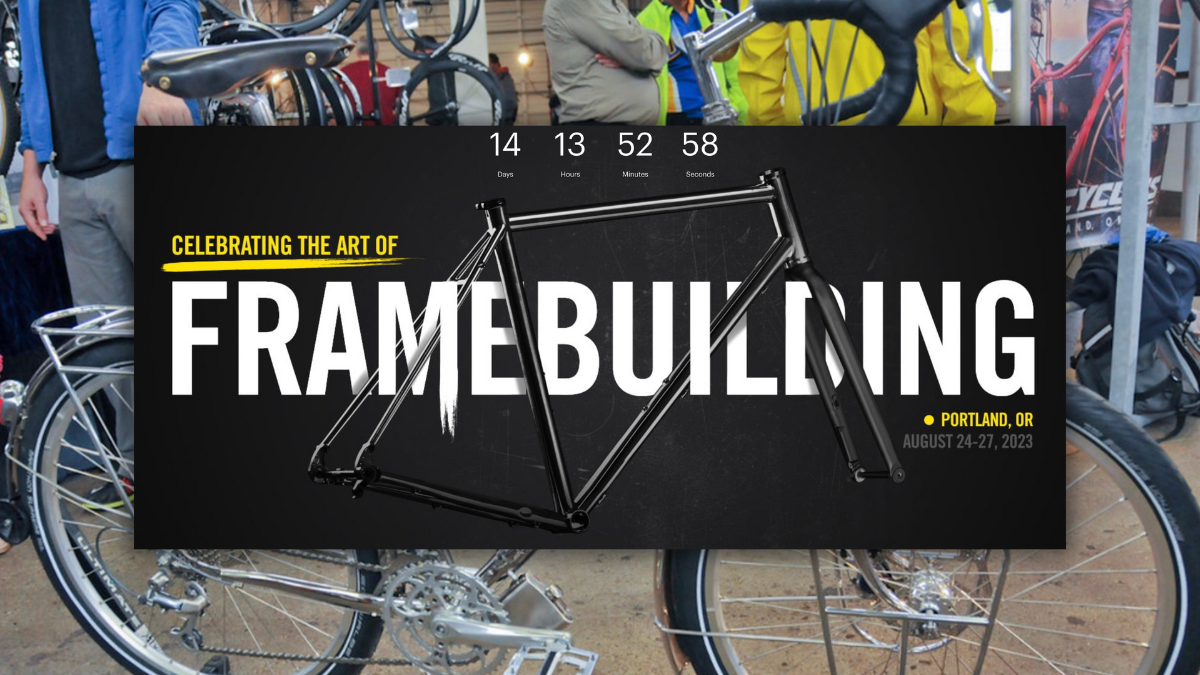
We’re just about two weeks away from the inaugural MADE Bike Show when Portland will become the center of the framebuilding universe. Over 200 custom bicycle builders from around the globe will descend on Zidell Yards in the South Waterfront for four days from August 24 – 27.
(In tandem with MADE, we’re hosting a special edition of Bike Happy Hour next week (8/16). More details below.)
This event will cement Portland’s reputation as a place that appreciates handmade bicycles and the people who build them. Whether you’re in the market for a new bike, custom bike curious, a lover of quality, handmade products — or if you just love bikes and bike people — you don’t want to miss this event!
The Zidell Yards warehouse and outdoor beer garden on the Willamette riverfront will be a perfect setting to take it all in. Even organizer Billy Sinkford (who you might recall from our chat on the BP Podcast back in June) has pulled out all the stops to make this show something Portland can be proud up. In addition to all the great bikes and people, here are some pro tips about the event:
Advertisement
Use code BIKEPORTLAND (yes, all caps) to get 15% off your ticket.
Volunteer at the event and get a t-shirt and one day free admission.
Biketown rental discount with all ticket purchases and a pop-up Biketown station right near the entrance.
Free valet bike parking from Go By Bike!
Big after-party is Saturday night on the riverfront where you can hang with builders, win great prizes, and take part in a raffle for a Fairdale bike that will benefit a local nonprofit.
And this coming Wednesday’s Bike Happy Hour is a special “Show & Tell” edition. Bring your custom/freak/personalized/special-to-you bike and show it off! Billy will be there to answer questions and raffle off MADE Bike Show swag (including free tickets to lucky winners). We will also take portraits of you and your bike to share with the world on social media. And last but best — a few local framebuilders will be in attendance. As Bike Happy Hour regulars say, “See you next week!”
Check out MADE.bike for all the info and don’t forget to use the BIKEPORTLAND promo code for 15% off your tickets.
We are the world’s largest library of bike routes, and we enable cyclists to go on better rides, more often. We have a website and mobile apps that allow people to discover the best riding in their area, and get turn by turn navigation using either our mobile apps or the bike computer of their choosing. Come join us in taking Ride with GPS to the next level!
– Linux Systems Engineer: https://ridewithgps.com/careers/systems_engineer – Work the full deployment stack, from hardware to containers. We are looking for an experienced engineer practiced in the deployment of Linux based machines and services on top of them. We run on a rack of machines that we own, co-located in the Pittock, and we deploy services both directly on Linux as well as via containers. This is part SRE, part DevOps, part classic SysAdmin, with the occasional networking issue. We need someone who is within driving distance of our rack in Portland and who has experience working in a datacenter. While the majority of the job is in the deployment of services on those machines not managing the machines themselves, we need someone with datacenter experience to help repair and expand as needed. Are you a jack of all trades, comfortable occasionally working with hardware, while being highly proficient in Linux and container based deployments? Maybe you are light on modern container orchestration but are highly capable and interested in learning? We’d love to talk to you!
How to Apply
Send resume + cover letter to careers@ridewithgps.com with an optional brief paragraph about your relationship to cycling or the outdoors. Riding bikes is absolutely not required, but we do find it helps!
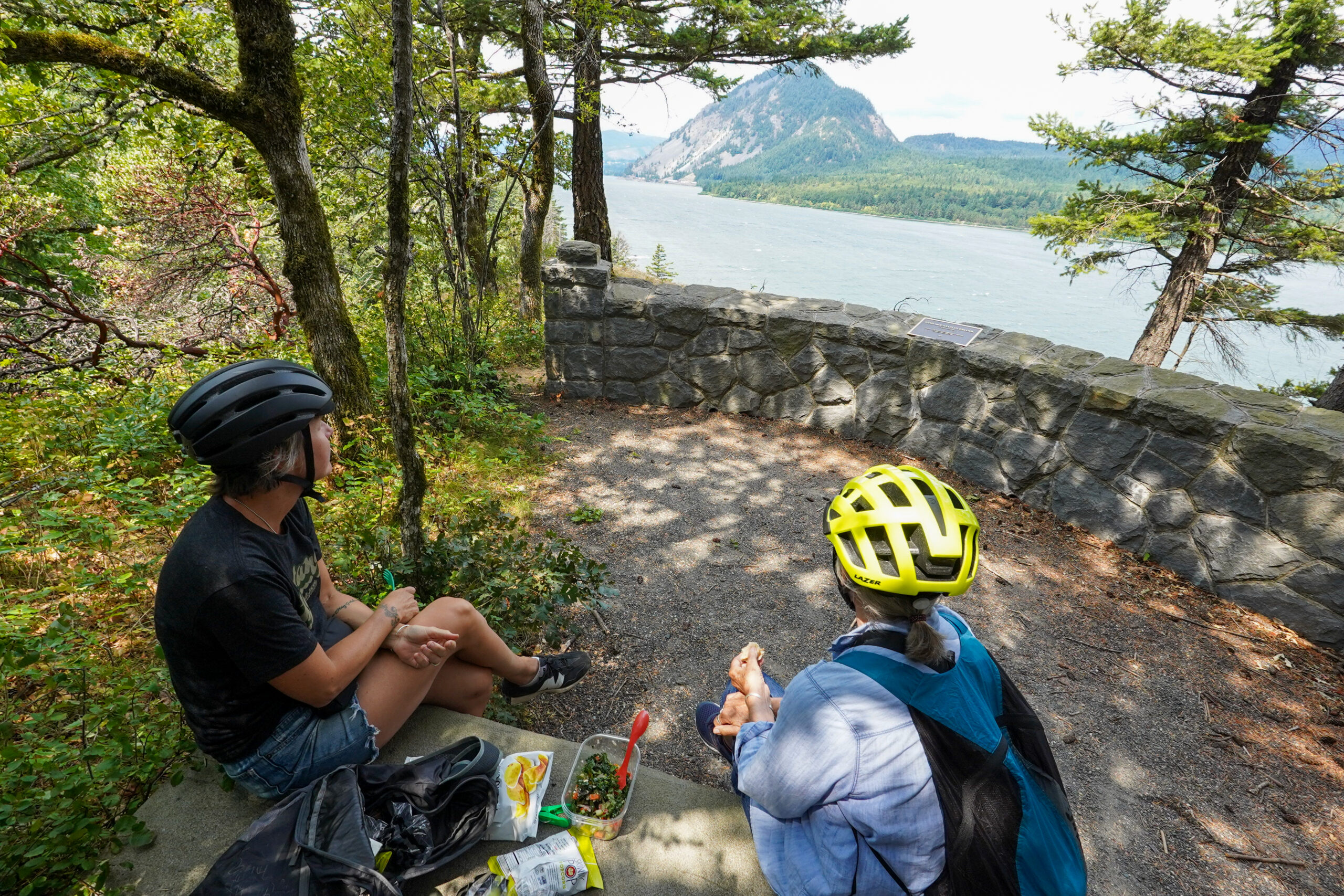
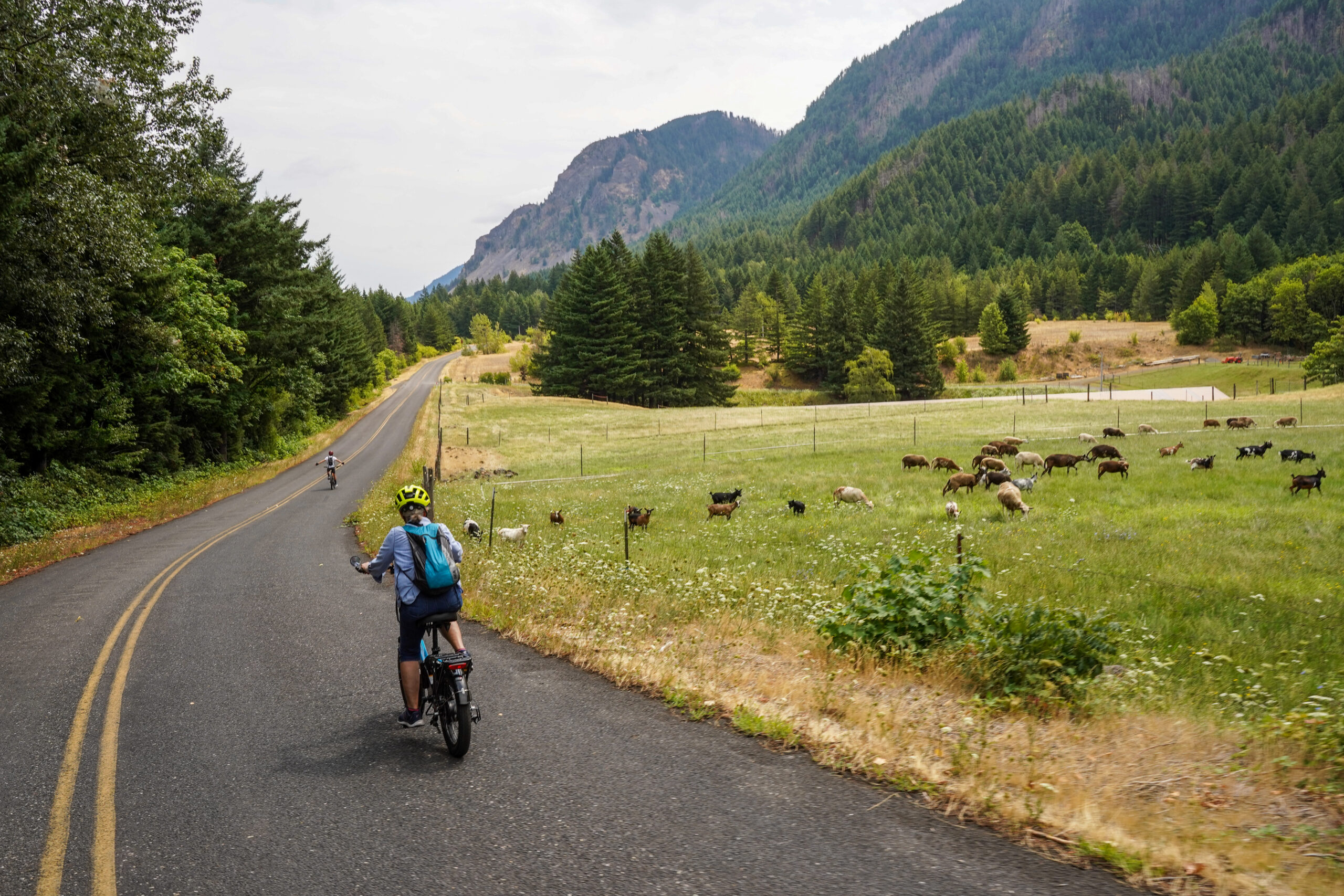
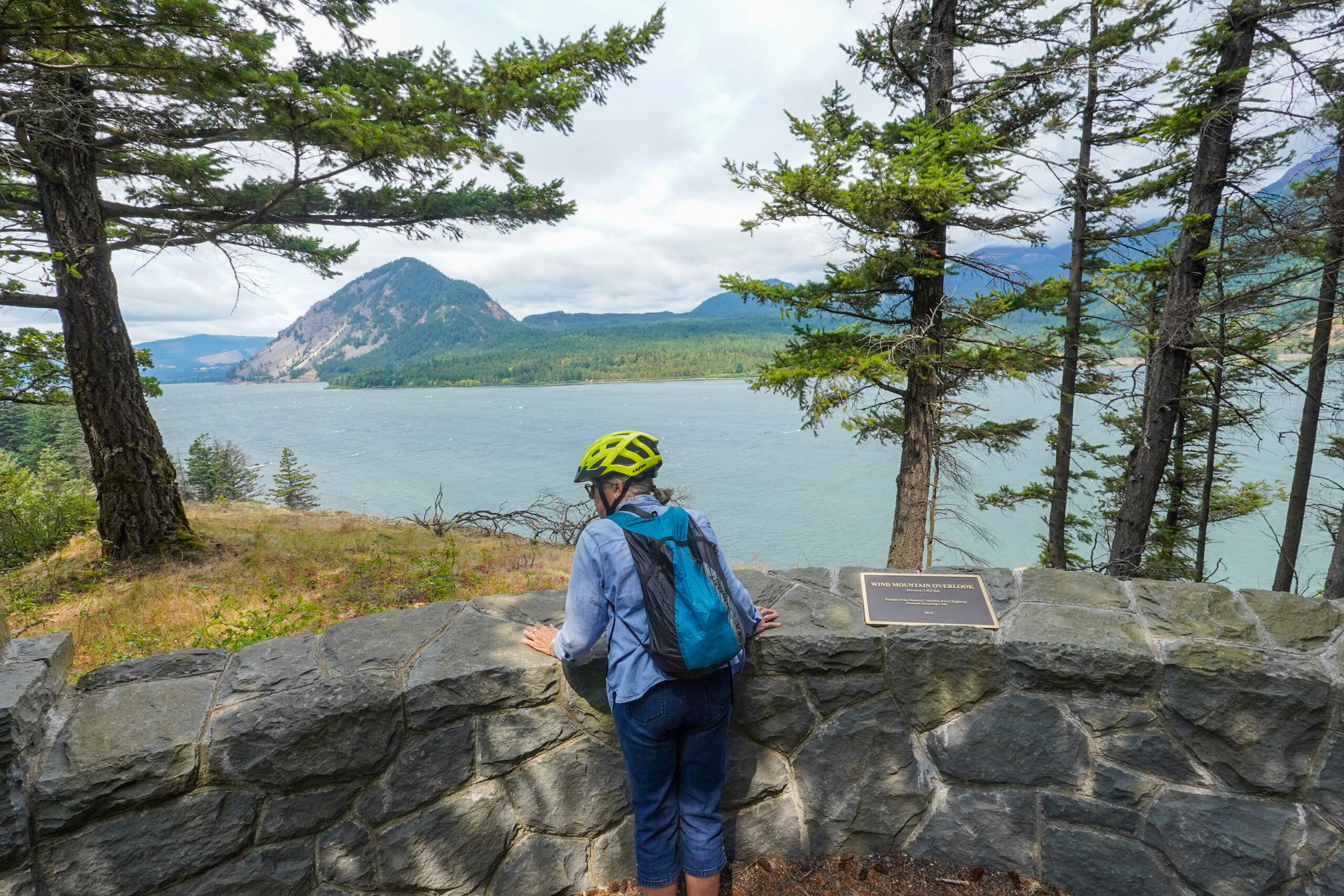
Stopped for a snack at Wind Mountain Overlook. (Photos: Jonathan Maus/BikePortland)
There are many reasons I’m a true believer when it comes to bicycling in the Columbia River Gorge. Since I was first introduced to the vision of a bike route parallel to I-84 from Troutdale to The Dalles way back in 2007, I’ve watched what was first a dream get very close to reality.
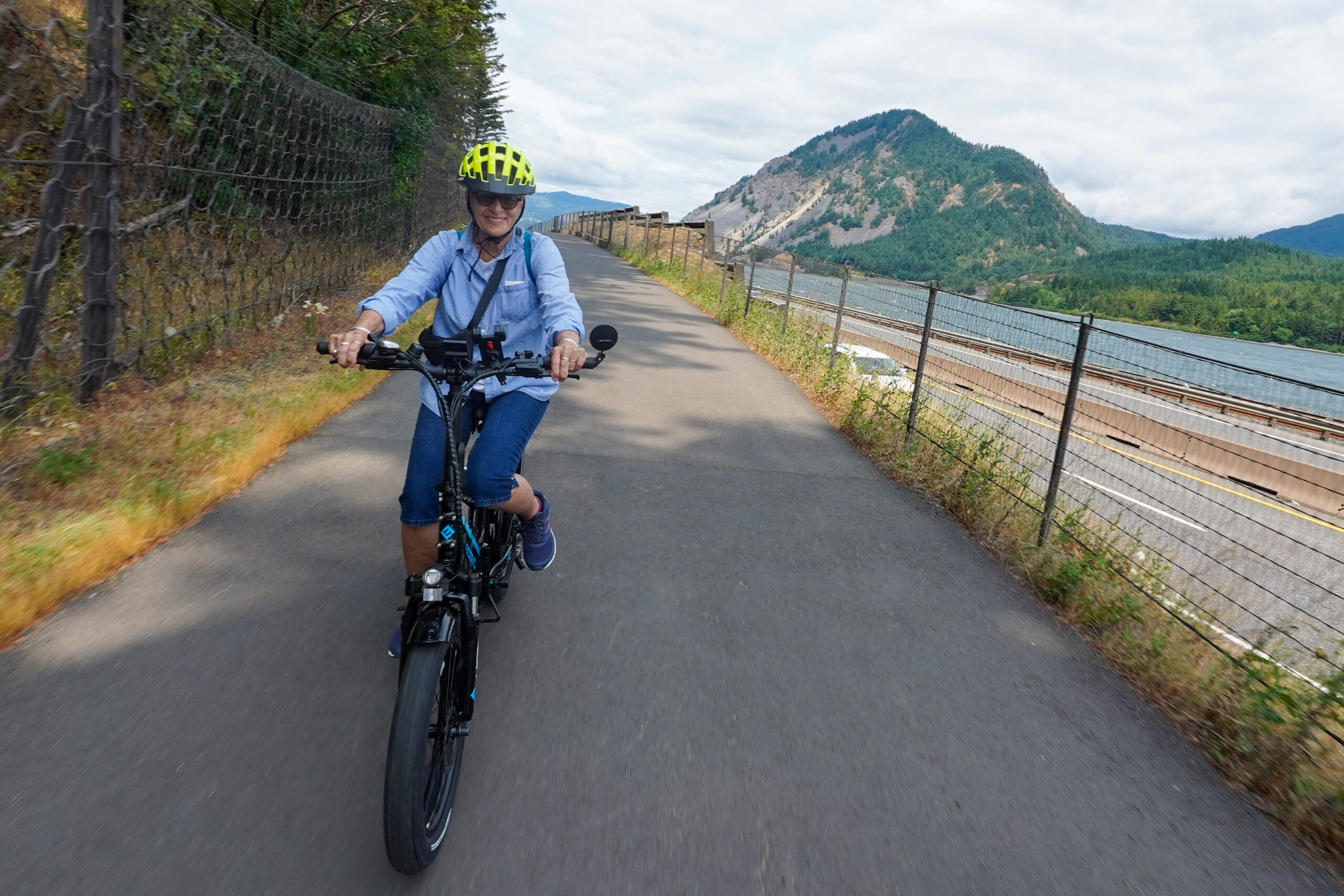
Today, almost the entire route is ready to ride and businesses are sprouting up to help more people enjoy it. One of them is Bike the Gorge, a new e-bike rental service in Cascade Locks. Last Sunday I reserved a bike from them for my mom (who just turned 74) so we could enjoy a family day on the Historic Columbia River Highway State Trail (HCRH).
Advertisement
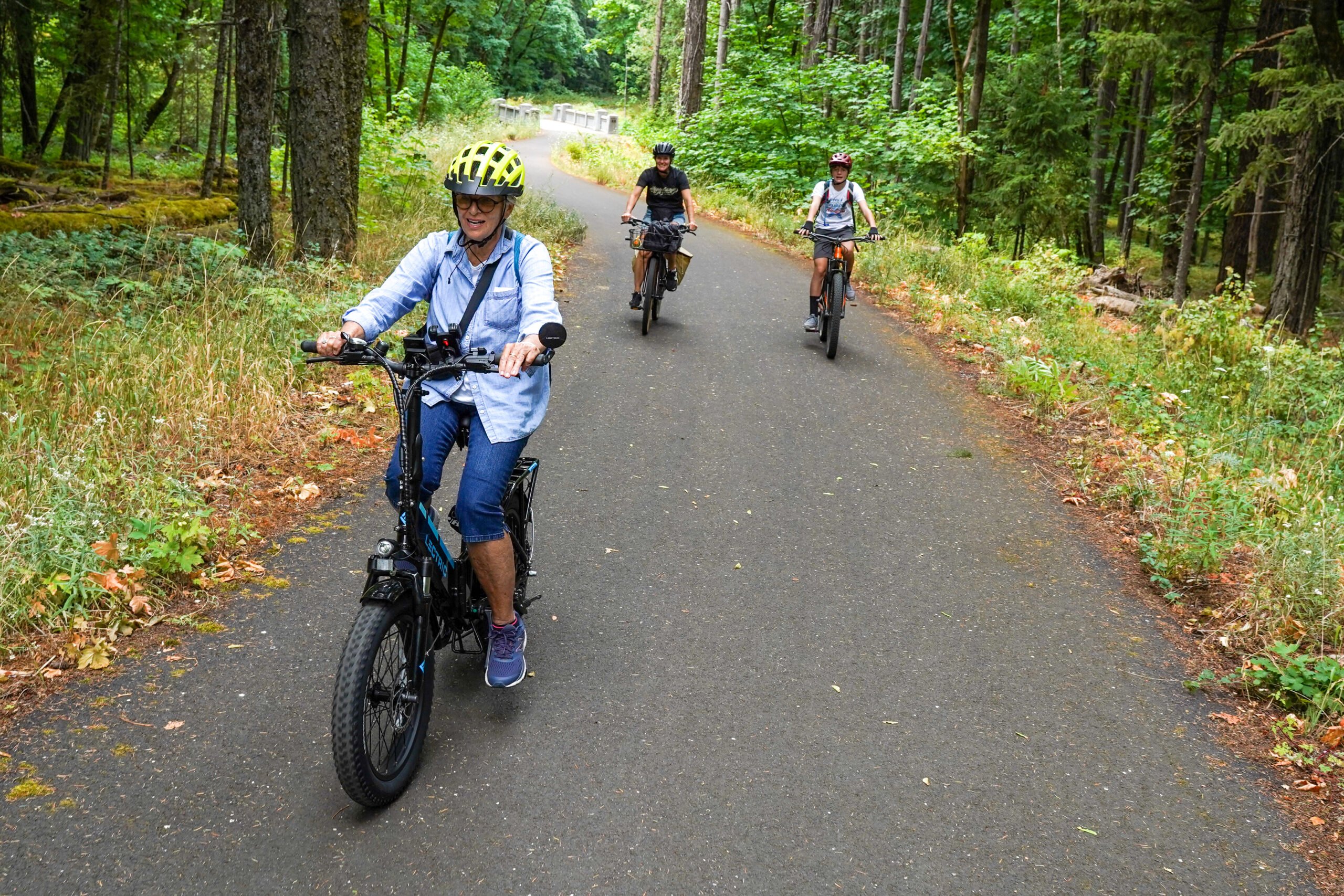
(Photos: Jonathan Maus/BikePortland)(Photos: Jonathan Maus/BikePortland)
I love Cascade Locks for its proximity to Portland (only 50 miles or so east, I even biked there for a meeting once!), it’s amazing riverfront park, fun local businesses (including the main location of our Bike Happy Hour partner Gorges Beer Co!), and of course, access to amazing bike rides.
On Sunday, after my mom got a quick lesson on her new e-bike from Bike the Gorge owner (and BikePortland subscriber!) Ben DeJarnette, we set off east to start our journey on the trail.
It would have been much easier to start at Wyeth Trailhead, but I thought we’d just ride to the start from where we parked the car in Cascade Locks. I had never ridden between Cascade Locks and Wyeth and I figured it’d be easy and beautiful. It was the latter, but certainly not the former! Turns out Wyeth Road has a massive climb (about 500 feet elevation in 1.5 miles) on it that I didn’t account for. I was lucky my family didn’t mutiny.
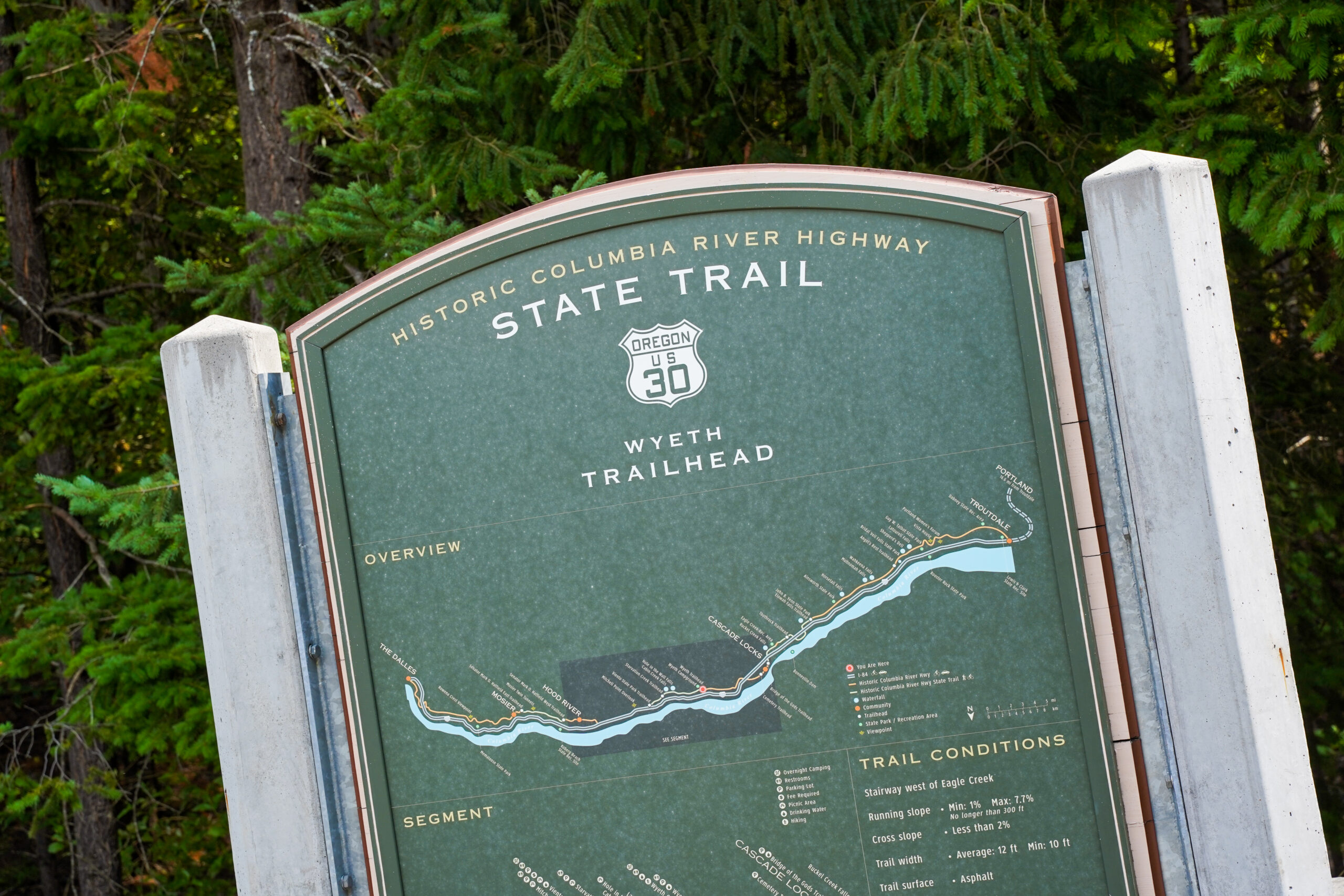
Warmed up from the climb, we got to Wyeth where the carfree section starts and would take us five miles to Viento State Park (that’s where the carfree section ends currently, but if you ride it after September 9th, ODOT will have opened another two mile section east of Viento!).
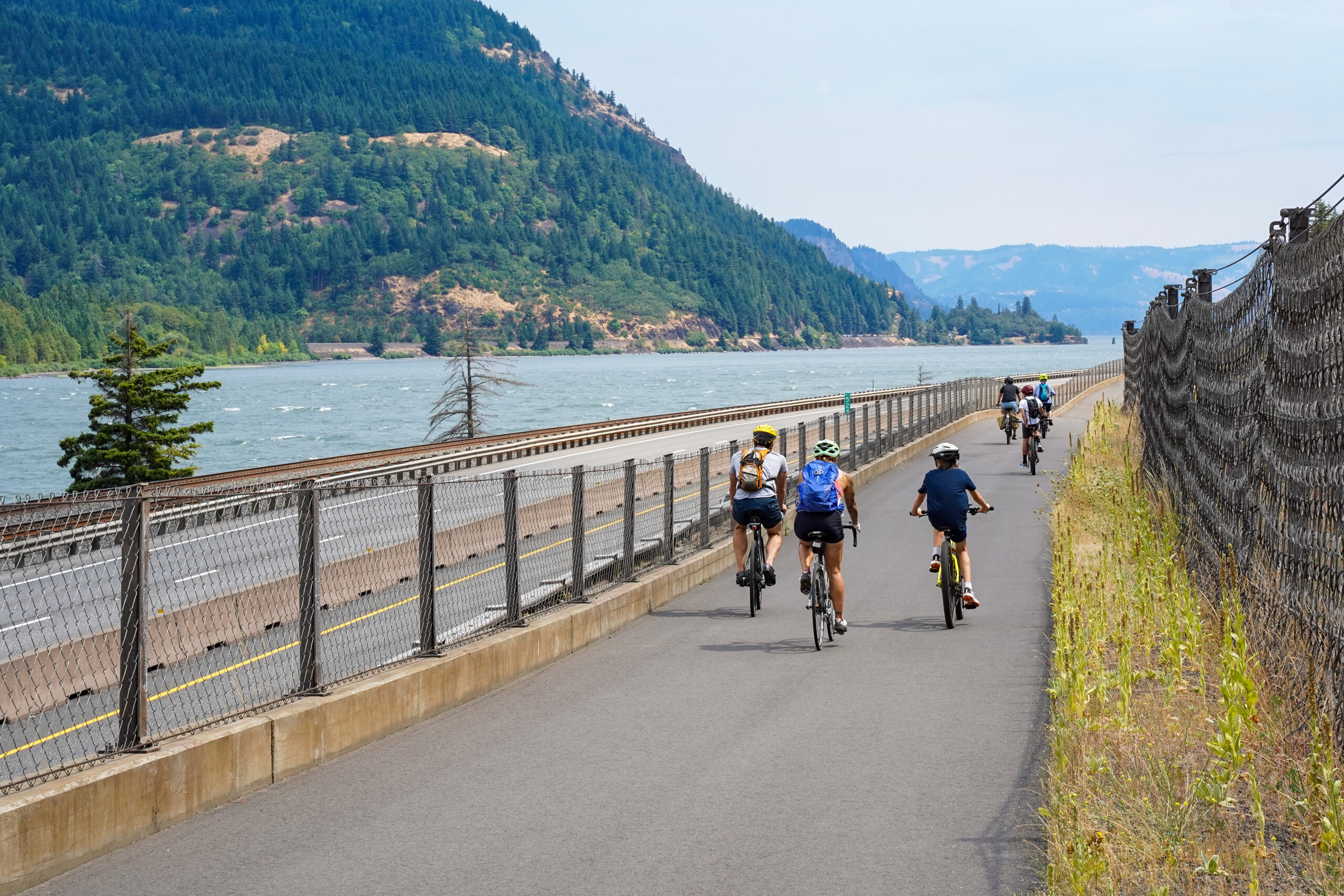
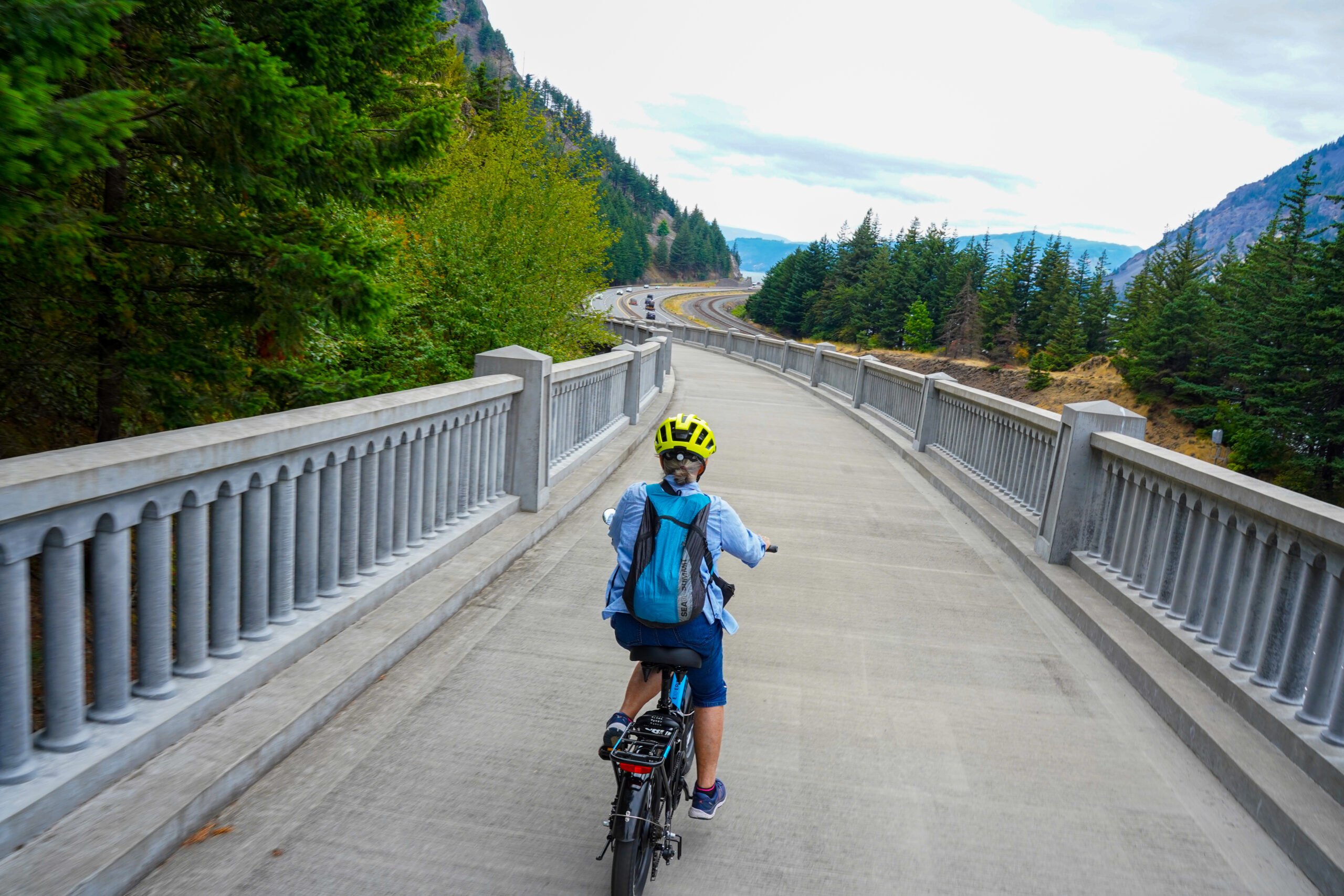
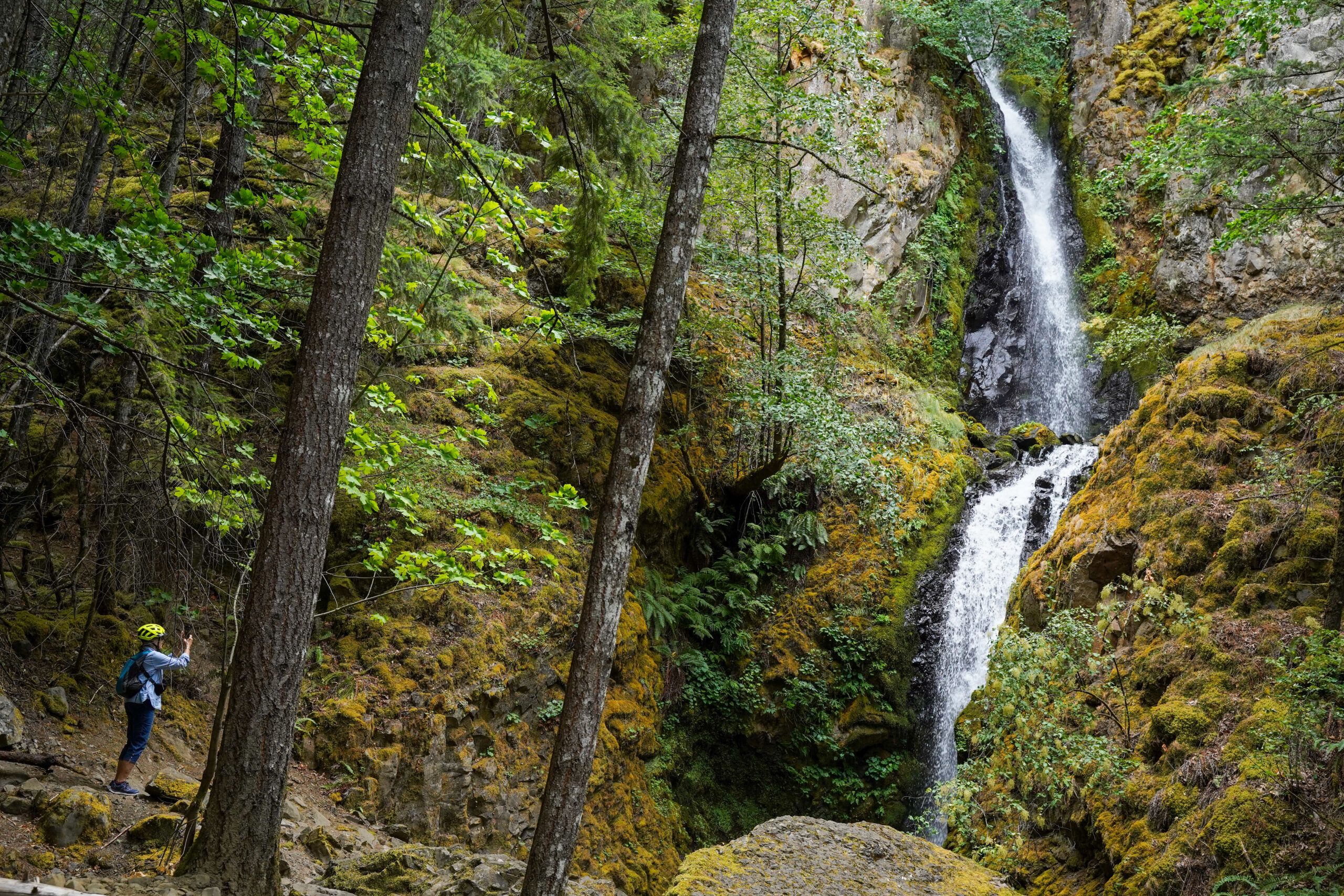
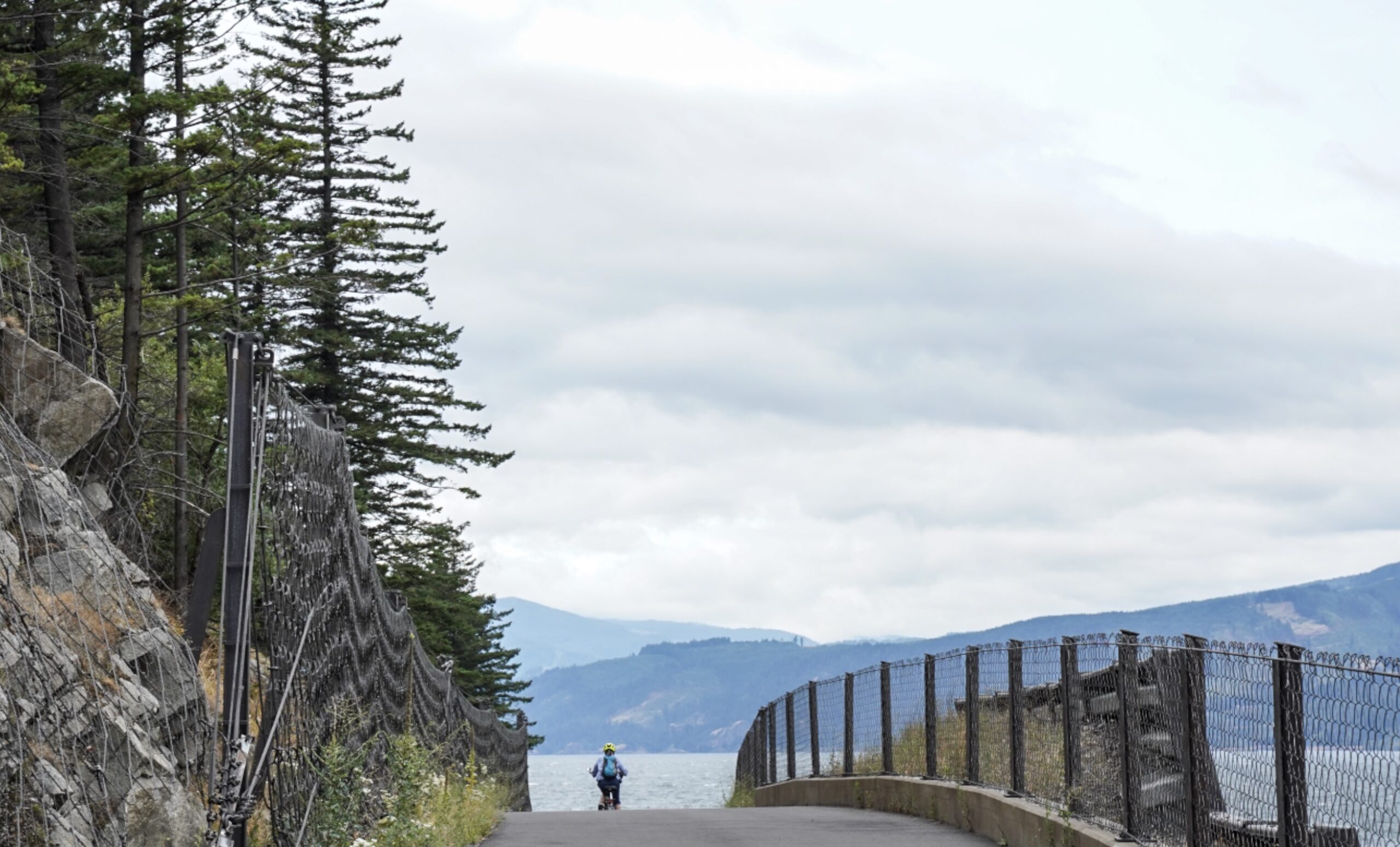
This is such a beautiful section of the HCRH (it really needs a nickname). My favorite part is where the path reaches into the sky, high above I-84, as it hugs the Gorge hillside on perfectly smooth pavement as the Columbia River expands all around you. Another fun spot is Wind Mountain Overlook, a great spot for a snack that’s accessible via a dirt trail about 2.5 miles east of Wyeth Trailhead.
And of course there are several waterfalls to gawk and cool off at if that’s your thing.
As the miles wore on and we faced stiff headwinds on our way back, my mom had really gotten a hang of her e-bike. She just smiled and zoomed around with a big grin on her face as I struggled to keep up. Eventually I just let her go, so she was free to float on the famous Gorge wind and feel that magic of cycling that’s been a part of her life for so long.
Ride free mama, ride free!
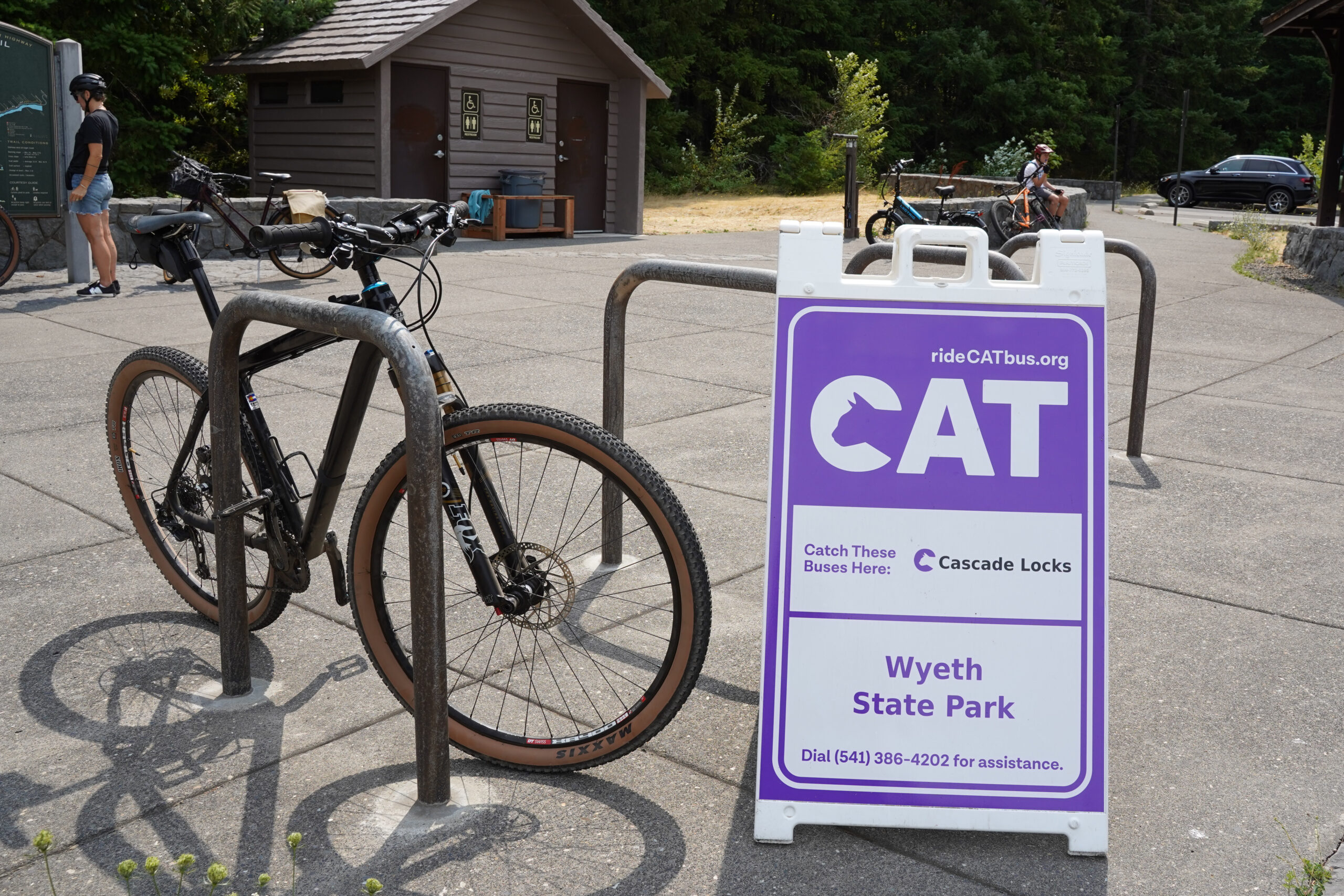
If you’ve never experienced the HCRH State Trail, get out there before summer is over. And with e-bike rentals and great trailheads full of amenities like water, bathrooms, bike tools, and so on, you can take any type of rider and rest assured they’ll have a great time. My mom sure did!
Thanks to Bike the Gorge for the rental, all the advocates and elected officials who’ve helped make this project happen, and to ODOT for showing us that you are capable of building world-class cycling infrastructure when you want to.
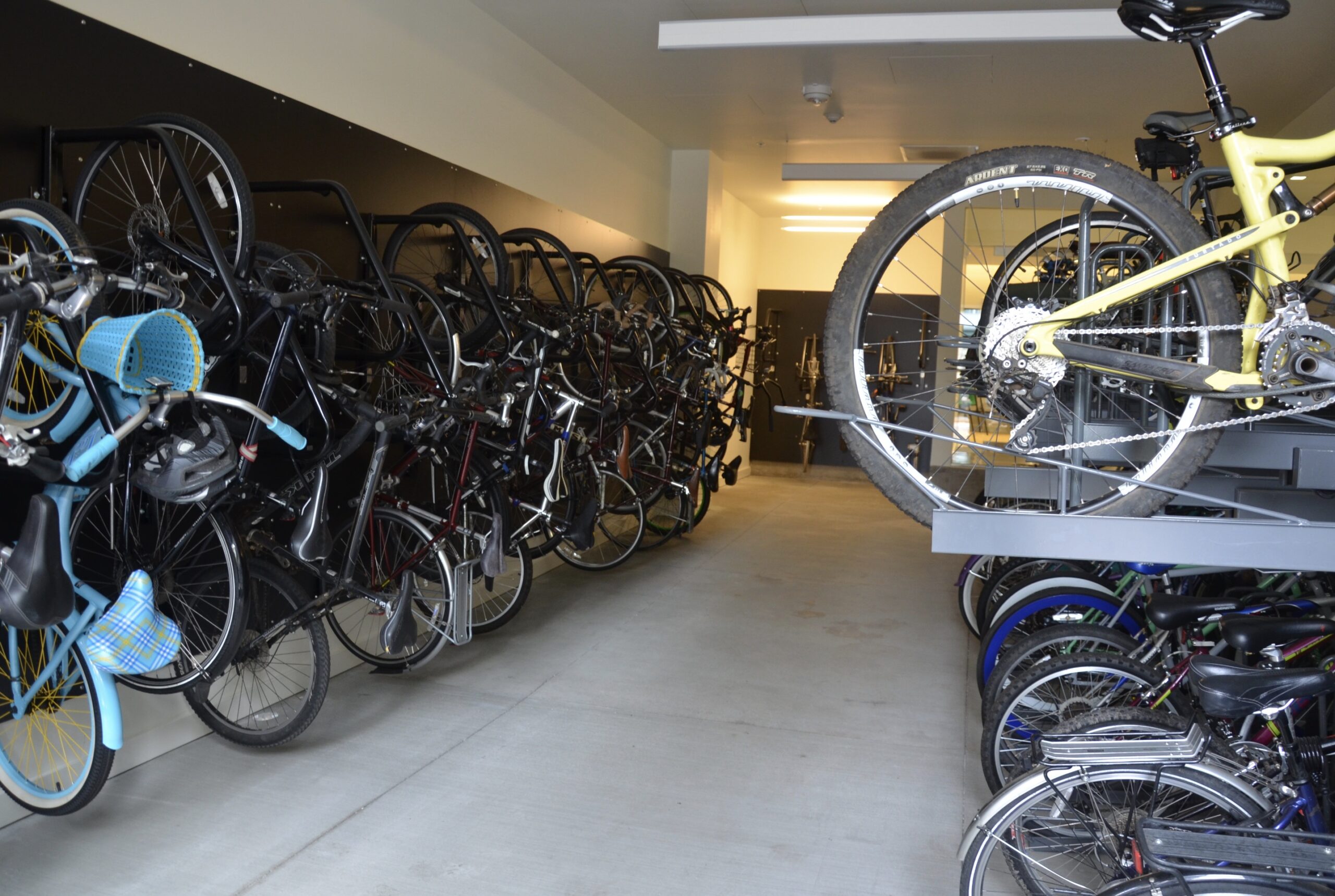
Bikes park in an apartment in the Lloyd in 2015. (Photo: Michael Andersen/BikePortland)
Publisher’s note:Four years ago, Portland completed a major recommendation of the Bicycle Master Plan by adopting robust standards for bicycle parking in new construction. Now, amidst concern about housing production, the City is considering rolling back major pieces of it. Chris Smith, a transportation advocate, former planning commissioner, and one of the architects of the current bike parking code, believes the debate around housing production versus bike parking is a false choice.
Chris Smith in 2022. (Photo: Jonathan Maus/BikePortland)
“Parking is a fertility drug for cars” is a common refrain among advocates who are part of movement sweeping the nation (and already law in Oregon) to eliminate automobile parking minimums. I’m convinced the same is true for cycling.
An adequate amount of convenient bike parking is a fertility drug for cycling, which is why I helped shepherd a package of amendments to Portland’s bike parking code through the Planning and Sustainability Commission in 2019. These amendments increased the amount of required parking for multi-family housing slightly, but mostly made sure that the parking was actually useful and convenient.
Is it hypocritical to support minimums for one type of parking while opposing minimums for another? I don’t believe so, and the reason is simple: driving has many negative externalities (fatal collisions, air pollution, noise, greenhouse gases, congestion, etc…) while cycling has many positive ones (improved air quality, promotion of physical health, more efficient use of road space, much less expensive vehicles, opportunity for personal interactions, etc…). All of our regional and city plans recognize this by calling for less driving (in the form of miles traveled per capita) and more cycling.
Advertisement
The promotion of cycling requires several elements: safe and convenient infrastructure, adequate parking, access to bicycles, as well as encouragement programs. Looking at the two infrastructure requirements — safe infrastructure and parking — they develop on different timelines. We can build a protected bike lane and it gets used tomorrow, but the person using that lane will need to rely on parking at their home that was built some time ago. That’s why it makes sense to require new construction to provide parking for the level of cycling that we expect not today — but 10, 25 or 50 years from now.
Yes that means today we see half-full bike rooms, and I understand why to some folks that looks like wasted money. To me it looks like an investment in a more sustainable future.
Our Housing Emergency: Can we blame bike parking?
We have a serious shortfall of housing production in Portland and City Council’s attention has lately turned to the cost of building new housing with an eye toward adjusting or rolling back things like System Development Charges, our Inclusionary Housing Policy and bike parking.
BAE Urban Economics, a consulting firm retained by the City to study the issue, recently presented an analysis that bike parking accounts for 3-6% of multi-family building costs, and that bike parking was adding $11,000 per dwelling unit.
That range of costs has two bases. The first is the actual cost of construction of the bike room space, which is probably the lower range. The higher number is based on opportunity cost, i.e., the rent that could be earned if the bike room space was put to use as living units. I find these calculations suspect and we have yet to see a detailed report that includes all the assumptions for these numbers. Here’s why I’m skeptical:
Advertisement
While the report works from the basis of a 1.5 bike parking spaces per unit standard, our code actually allows half of all bike parking to be placed in living units (more on this later), which means the bike room space ratio could be as low as 0.75.
There is no loss of revenue with in-unit bike parking, a tenant is actively paying rent for the space.
Bike rooms are often windowless spaces that could never be used as living units.
The ratio in outer pattern areas of the city is actually 1.1
Our zoning code exempts bike rooms from the limits on overall building size (FAR – floor area ratio), so bike room space is not necessarily in competition with living units Some architects indicate that other limits like height may put the uses back in competition.
In the presentation, the consultant refers to bike rooms on the ground floor or basement, but our code allows bike rooms on any floor accessible by elevator. Indeed, there is anecdotal evidence that smaller bike rooms on upper floors are more popular, perhaps because of greater perceived security.
On the whole, in the absence of a lot more detail, the $11,000 number seems very pessimistic to me.
Years to make progress, trashed in an instant?
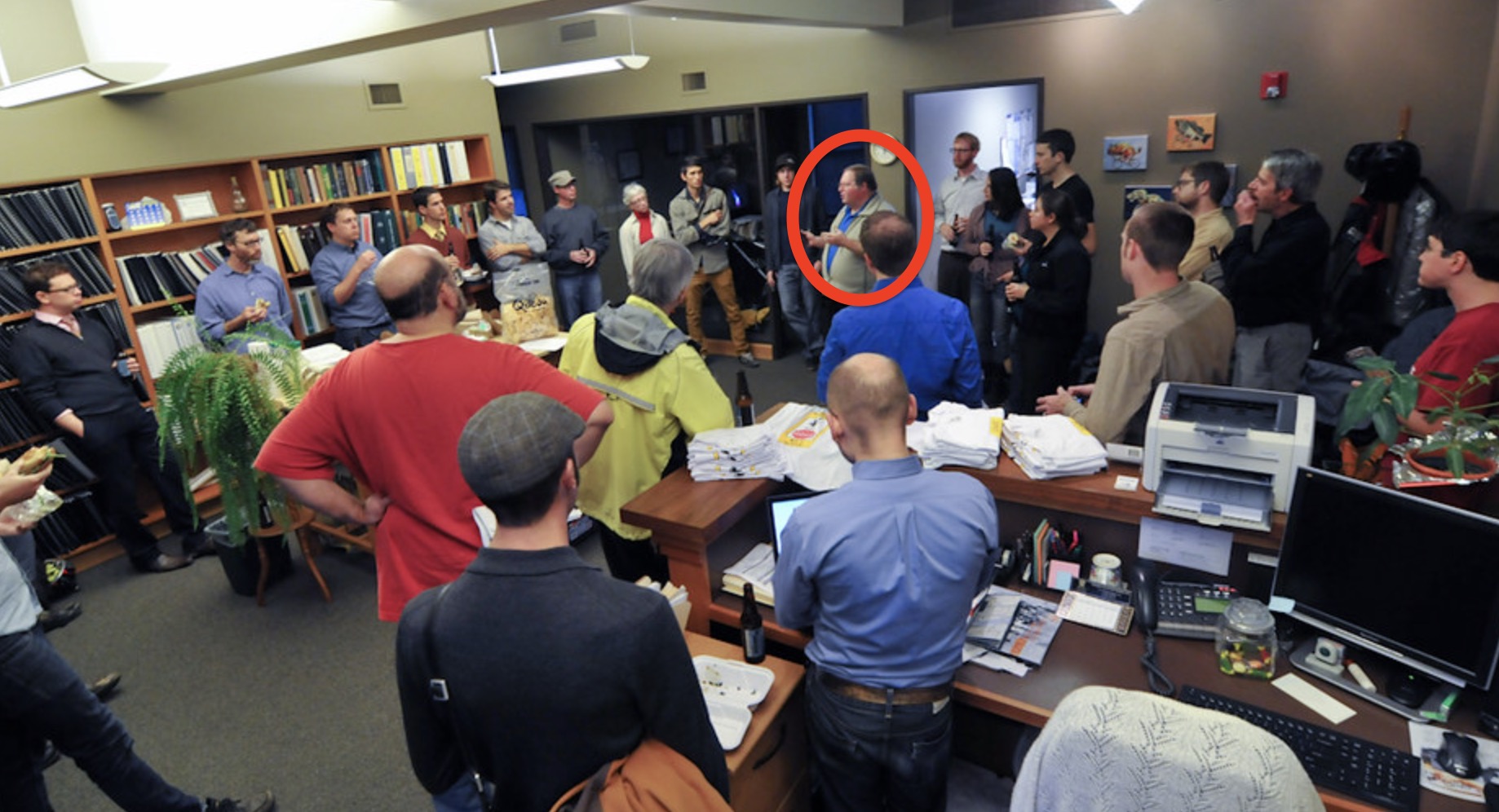
Chris Smith (circled) led a BikePortland Wonk Night event focused on the bike parking code in 2013. (Photo: Jonathan Maus/BikePortland)
We spent almost five years creating the 2019 amendments, including a robust commenting session at a BikePortland Wonk Night event in 2013 and a full stakeholder process managed by PBOT, followed by a public input discussion draft in the Planning Bureau, then hearings at Planning Commission and City Council. By contrast, these proposed changes would go directly to Planning Commission in September, then fast-tracked to City Council for adoption.
The unsaid part: auto parking still dominates
I’m told by folks involved in the process that the “prototype” financials used in the analysis include an assumed 0.5 car parking ratio, even though none is required by the City. It may still be required by lenders or the developer may perceive that the market demands it. But since structured auto parking can cost up to $50,000 per space, that means construction costs could include $25,000 per unit, far exceeding the $11,000 unit cost for bike parking.
I have a hard time being too concerned about the impact of bike parking when we appear to be just fine with twice as much in auto parking costs.
Advertisement
Are we worrying about the wrong opportunity costs?
Bikes are an affordability tool. A household that can avoid having a car (or a second car) can save over $10,000 per year in vehicle operating costs. But absent a secure bike parking space, that savings opportunity is lost.
There’s also a public sector opportunity cost. If we don’t hit our bicycle mode share goals, in the future we will need to build more expensive auto infrastructure to accommodate growth in trips that aren’t served by cycling as the more affordable infrastructure option.
What should Council do?
I have two recommendations:
Convene a workgroup to examine the in-unit bike parking standards. In 2019 we preserved this option in the name of affordability, but added standards to make sure we didn’t get bike hooks above beds and other unusable implementations, as we had previously seen without standards. But we’ve gotten feedback that the 2019 in-unit standards are difficult to design to and also difficult to plan check (a process builders must go through to get a permit). Since they were added at the end of the 2019 process, it would be worthwhile to have stakeholders and code experts look at streamlining these in a way that ensures the usability of the parking created while making them easier to implement.
IfCouncil can get realisticcost impacts of bike parking and determines that this is truly a barrier to building housing, they could consider a temporary roll-back of the bike parking ratio to no less than 1.0 spaces/unit. Any such rollback should have an explicit sunset date. A future Council should have to take formal action to extend such a reduction. If Council decides to take this step, they should do so clearly understanding that they are sacrificing future bicycle mode share to do it.
What Council should notdo is eliminate the standards created in 2019 that make sure bike room parking is actually usable by a range of users with different abilities and for bikes of many different types.
We’ve spent more than a century fertilizing driving with a variety of incentives, including costly minimum parking mandates. We’re slowly unwinding those. But as we do so, it’s still more than appropriate that we put some investment into fertilizing more biking!
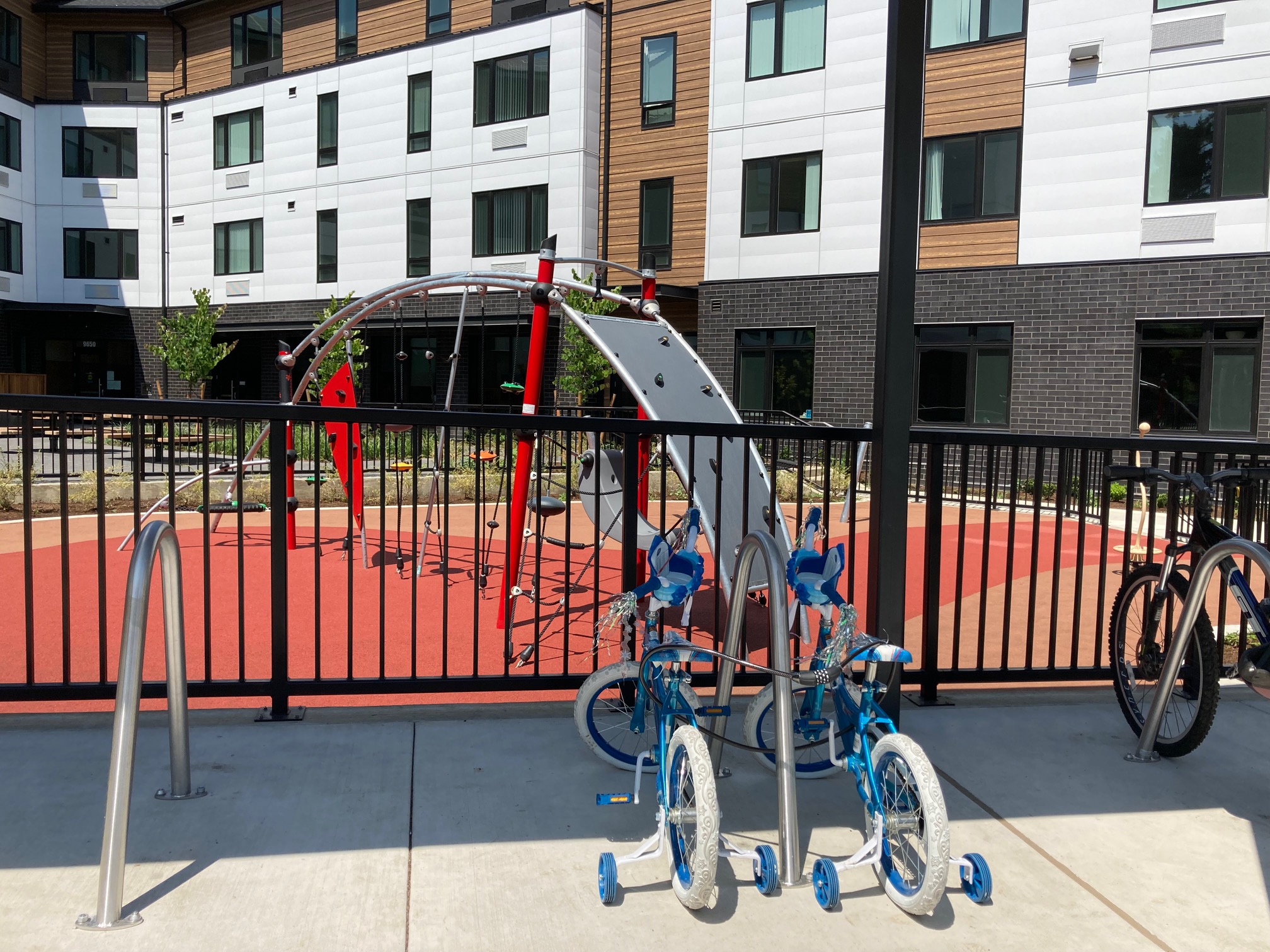
Playground in Terrace Glen apartments on SW Greenburg Rd, in Tigard. (Photos: Lisa Caballero/BikePortland)
The push to encourage residential building is not very tightly joined to the moral imperative of making our region a safe place to get around on foot, bike — or while waiting for a bus. Our governments offer financial incentives to build the buildings, but you are too often on your own once you leave the property.
What good is new housing if it’s too dangerous to leave in anything other than a car — the most expensive transportation option available?
I was reminded of how transportation funding is a weak link in our system when I filled out my Portland Bureau of Transportation budget and revenue survey. It read like a push poll. Money is short, there isn’t anything you want to cut, and PBOT is mostly funded with gas taxes and parking fees — the survey made sure you didn’t leave without understanding those things.
But transportation in the region as a whole is in the midst of a funding reckoning, not just in Portland. Stepping away from Portland politics might make the big picture easier to see, and that’s where Tigard and Washington County come in.
Advertisement
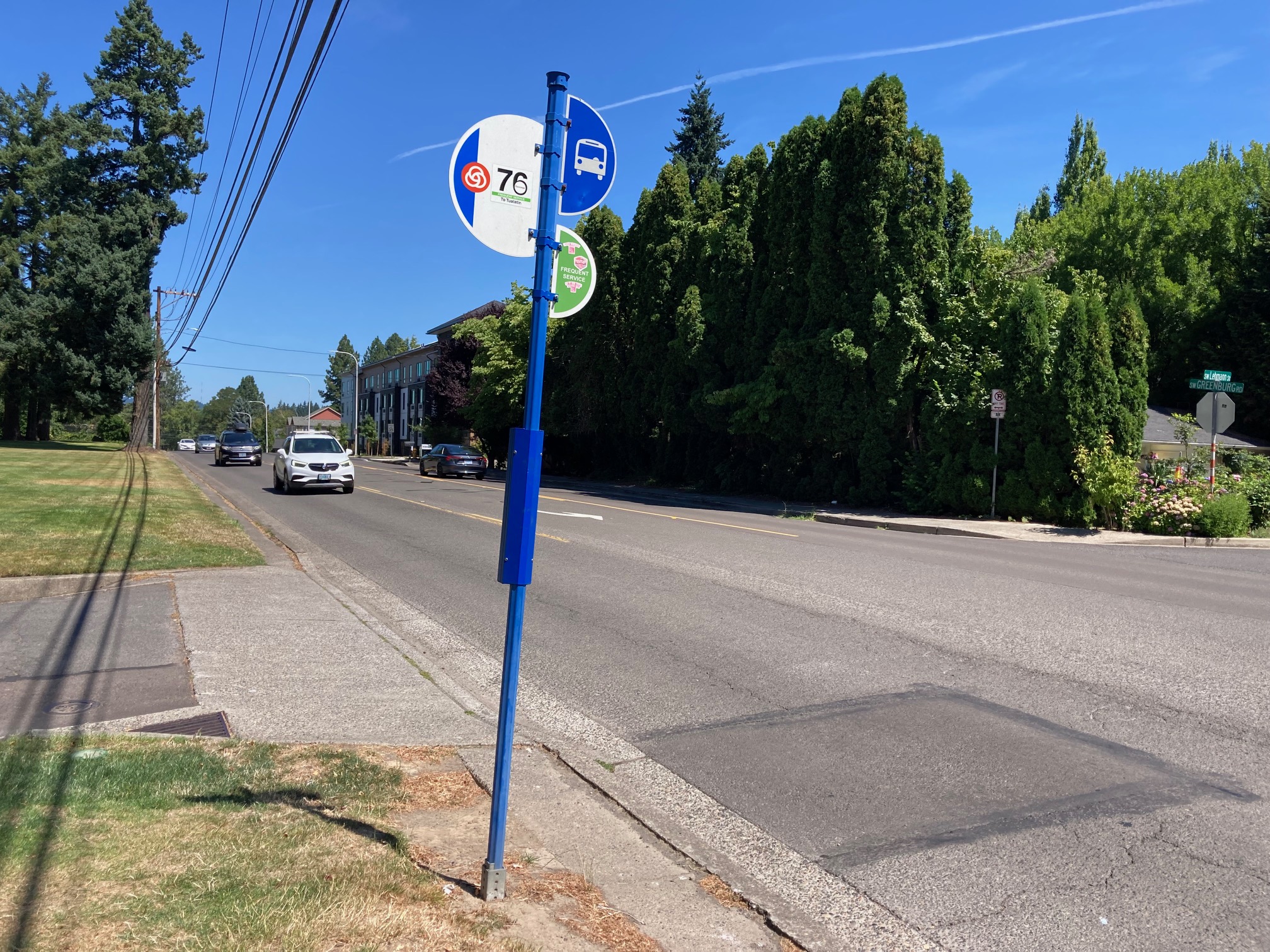
Bus stop on SW Greenburg Rd, with the Terrace Glen apartments in background. Looking north, from SW Lehman St.
Source: City of Tigard
Earlier this year, BikePortland reported that Washington County had decided to close its budget gap with general fund money historically reserved for transportation. The loss of MSTIP (Major Streets Transportation Improvement Program) funding immediately jeopardized the 25 large capital projects which area transportation agencies had submitted for the current funding cycle, and even imperiled shovel-ready projects which had already been approved in previous cycles.
Tigard’s planned Complete Street overhaul of SW Greenburg Rd was one of those affected projects. Greenburg runs just east of Washington Square Mall and borders the western edge of the Metzger neighborhood, whose residents would be vulnerable to displacement with gentrification. Greenburg doesn’t have bike lanes or continuous sidewalks, it is difficult to cross, and the volume and speed of car traffic make it an autocentric barrier dividing Metzger from the mall. The Complete Street project would have transformed the road with crossings, protected bike lanes and continuous sidewalks.
Greenburg also happens to be the site of a newly completed Metro-supported subsidized housing development. Officials cut the ribbon on Terrace Glen just last month. It has 144 affordable apartments and boasts that it is adjacent to,
retail, grocery, rapid public transit and entertainment … Retail amenities include Washington Square Mall with its entertainment and recreation hub, directly across the street from the site. TriMet stops across the street provide direct access to Beaverton Transit Center and other destinations.
Here’s the thing though, you can’t safely cross Greenburg from Terrace Glen to reach all that retail and public transit. And the bus stop mentioned in the quote above (and pictured in photo above) doesn’t have a sidewalk anywhere near it and is only a couple of feet, and one shallow curb, away from a stroad with a posted speed of 35 mph.
Advertisement
So the affordable housing got built, but with the Tigard’s Greenburg complete street project on indefinite hold, it is unfortunately not safe to leave Terrace Glen except by car.
The total development cost of Terrace Glen was $51.2 million, $17.5 million came from the Metro Affordable Housing Bond. And here’s what caught my eye, Terrace Glen also received a half a million dollars in TOD funds (Transit-Oriented Development) which are specifically targeted to “stimulate private sector investment” and “increase opportunities for people live, work and shop in neighborhoods with easy access to high-quality transit.” Without the Greenburg Complete Street improvements, however, Terrace Glen does not have “easy access” to transit, it is just another apartment building on an unsafe road. Albeit one that is affordable.
TOD money is a carrot to get developers to build affordable housing in transit-rich and walkable areas, but it is not meant for actually building anything. Half a million seems like a puny carrot for a $51.2 million project, but it would pay for a crosswalk and flashing beacon.
But there is not a bad guy here, and I’m not pointing a finger. This disconnect between development and transportation infrastructure is the result of piecemeal and inadequate transportation funding. Executing everything according to plan with Terrace Glen would have required glitchless coordination between Metro, the City of Tigard, Washington County and the developer — and more money for transportation. We need to do better and get both the housing and the transportation pieces right.
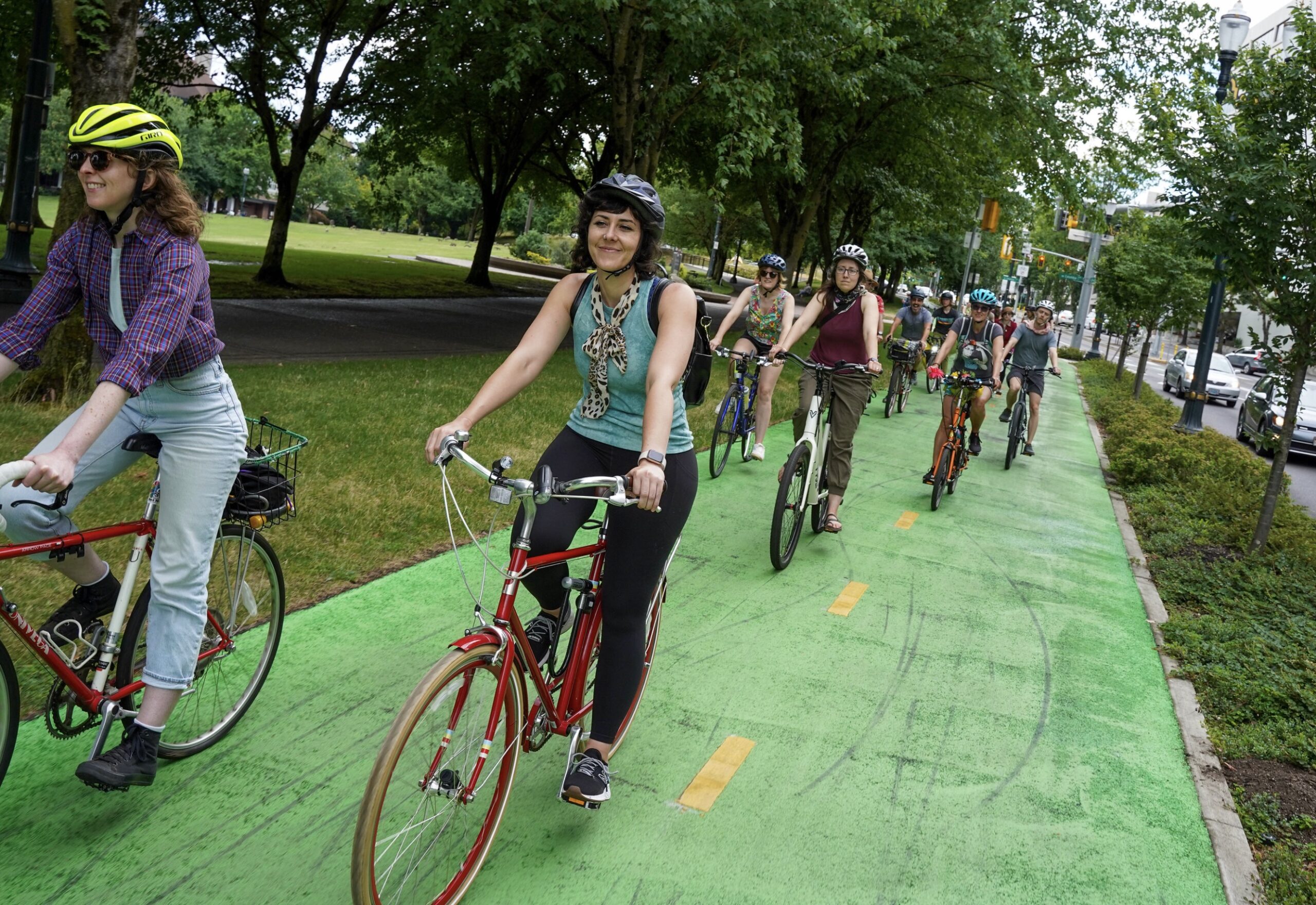
Cyclists smiling on the bike path through Waterfront Park on Saturday, August 7th. (Photo: Jonathan Maus/BikePortland)
It should not be news to anyone by now that the Portland Bureau of Transportation is in its worst budget crisis ever. Because funding politics always took precedent over sound funding policy, the bureau has been on a strict spending diet for decades. And as the transportation system has grown and taxes and fees kept up, PBOT is now so hungry for cash they have to go beyond carving the fat and might be forced to remove entire appendages.
As they map out a plan to dig out of the gaping pothole they’ve fallen into, they want to know what Portlanders want prioritized going forward. In other words, which parts of PBOT should they keep and which parts can they afford to cleave off.
PBOT has released a new survey that everyone needs to take. “Your feedback will be added to other input informing the development of budget and revenue strategies during this time of constrained resources,” reads the intro to the survey.
Advertisement
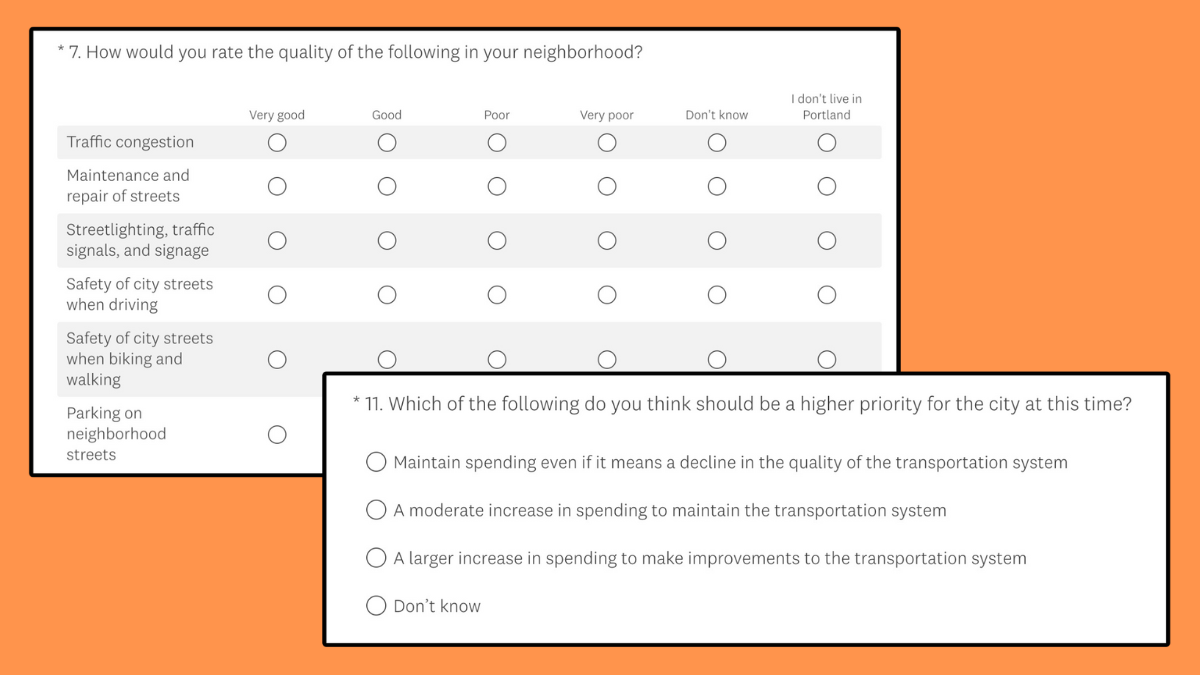
Questions from the survey.
When you take it, you’ll get to rate how well PBOT is doing their job. Fun, right? And there’s also an open question that asks, “What is most important transportation issue you’d like PBOT to address?” You’ll also get to rate the quality of bike lanes citywide and in your neighborhood.
But that’s the fun stuff. The meat of the survey is where they focus-group some messaging and then ask survey-takers to prioritize which services should stay and which should be cut.
It’s sad to see PBOT is considering reducing spending on things like Sunday Parkways, biking and walking projects, and traffic safety education in schools (among other things); but these are very lean times and without a major infusion from a new revenue source, something’s gotta’ give.
Please don’t waste this opportunity to share your input. Take the survey before Monday, August 14th.
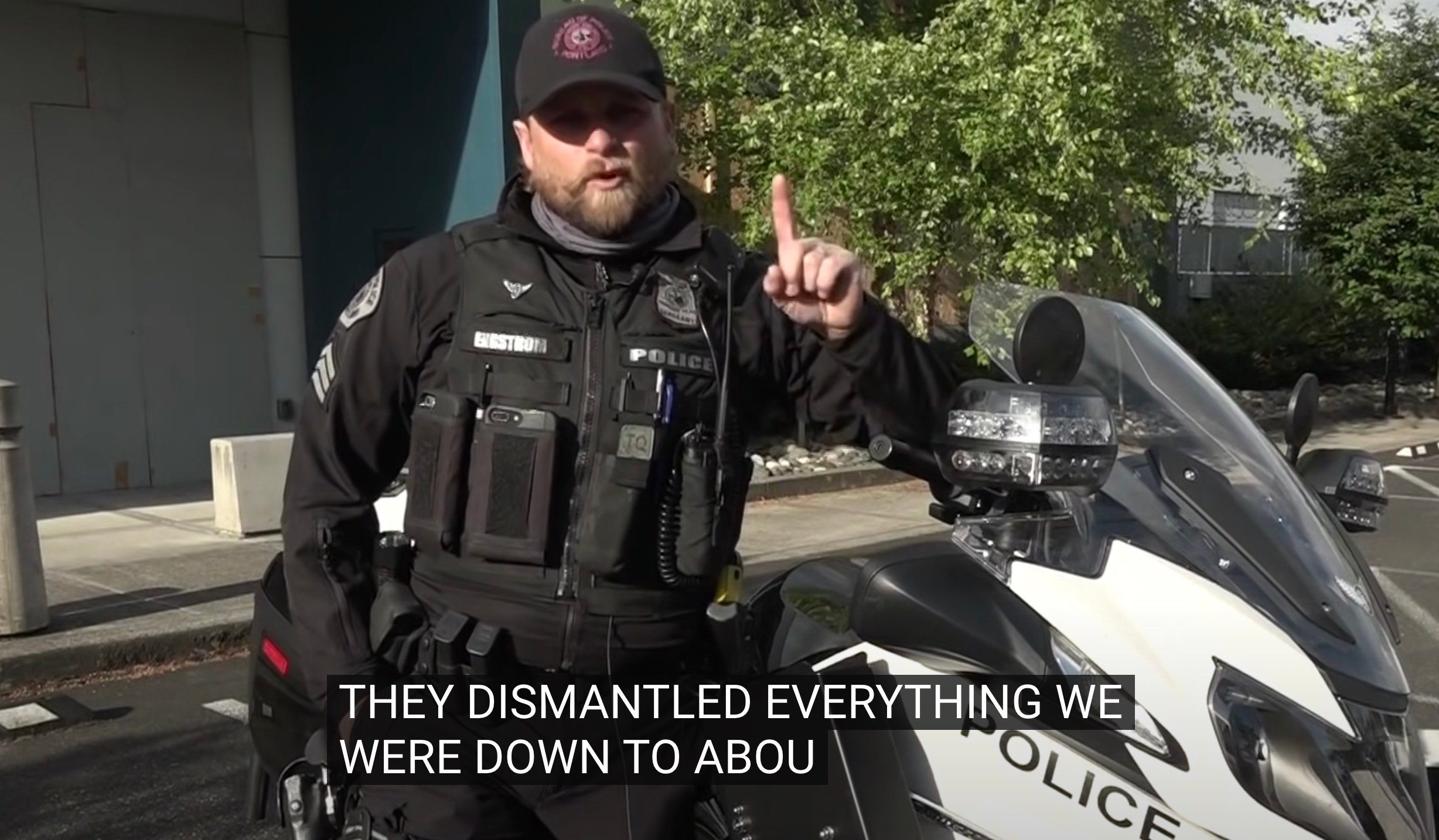
PPB Sgt. Ty Engstrom telling KGW news in 2021 that he is the “one” traffic enforcement officer in the entire city.
Something the Portland Police Bureau did in 2021 has bothered me ever since. At a press conference yesterday I was able to confirm my concerns about what happened with the officer directly involved.
On November 30th, 2021 a veteran member of the PPB’s Traffic Division, Sergeant Ty Engstrom, told the media that there was just one traffic enforcement officer to cover the entire city. The press conference organized by the PPB was ostensibly about a tragic rise in traffic deaths, but Sgt. Engstrom was also there to cement a narrative: He wanted Portlanders to link “defund police” with “traffic deaths” in order to receive more city funding.
His decision to place political goals of the bureau ahead of public safety led to the widespread perception that Portland had very little, to no traffic enforcement. I mentioned this briefly in my recap of yesterday’s press conference and didn’t plan to write a separate story about it until my tweet about an exchange I had with Sgt. Engstrom yesterday was widely shared. So now I want to share more context to help clarify what happened and why I think it’s important.
Advertisement
In addition to lawlessness and deaths on our streets and protests over policing and race, the context of that November 2021 press conference included a very contentious relationship between the PPB and former City Commissioner Jo Ann Hardesty. Hardesty wanted to “rethink police accountability” and at one point she filed a lawsuit against them.
In June 2020, Hardesty helped pushed through a $15 million PPB budget cut, and sought to cut even more later that year. The PPB (and the union that represents officers) responded by first warning, and then following-through (in December 2020), on a reorganization plan that pulled all but one officer — Sgt. Engstrom — out of the Traffic Division. Chief Chuck Lovell said he made the move because he was under-staffed and needed officers on general patrol.
While the PPB and others framed the move as a response to the “defund police” movement, Hardesty countered that it was solely Chief Lovell’s decision and that all officers could still enforce traffic laws if they wanted to.
That next summer, the PPB began to willingly tell the media that the Traffic Division had been “dismantled” and that Sgt. Engstrom was Portland’s sole traffic enforcement officer. In July 2021, Sgt. Engstrom told KGW that, “We’re down to one motorcycle, full-time.” That was down from 19 motorcycles on the Traffic Division, “before they dismantled everything,” he said.
The PPB doubled-down on that messaging a few months later and called a press conference on November 30th to lay it out clearly.
Advertisement
The bureau tapped Sgt. Engstrom to lead the event. After describing the terrible number of traffic deaths that year, Engstrom said, “It’s hard to ignore the fact that we have a record-setting number of fatalities and we have very, very low numbers of police officers patrolling our streets.”
“Beginning in 2021, staffing levels were so low they had to dismantle almost the entire Traffic Division,” he continued. “So I am the only full-time unit in the entire Portland Police Bureau… They do not have enough people to help them out to patrol your streets safely.”
When I first heard that I was shocked. Why on earth would someone sworn to public safety willingly broadcast that there’s no one enforcing traffic laws? Amid a spate of deaths and rampant speeding and dangerous driving, why would the PPB want drivers to know they can do whatever they want and likely not face any consequences? It seemed incredibly irresponsible.
“Portland is down to one full-time traffic officer as speeding tickets plummet,” said one local headline after the press conference.
Advertisement
As dangerous driving and deaths continued, I didn’t forget that press conference. In a December 2022 op-ed (written after yet another spike in traffic deaths), I called it “part of an ongoing campaign to set a narrative that results in PPB getting more funding and more officers,” and I warned the community that, “true or not, it is based on a political goal, not a safety goal.”
Ultimately the PPB received more funding, and in May 2023, they re-launched the Traffic Division. At the press conference where they made that announcement, I asked Sgt. Engstrom if he thought his press conference in 2021 had an impact on driving behaviors. “Some of it is, people just think they’re not going to get caught,” he acknowledged. “So yeah, absolutely, I think that all played a role.”
I didn’t plan to ask him about it again at Monday morning’s press conference. But when I asked him to name one concrete thing the PPB will do differently in the short-term to make streets safer and he said, “what we’re doing right now… is trying to be as visible as possible… to just try and make ourselves look bigger than perhaps we really are,” it struck me as the exact opposite tactic they deployed in 2021.
“So you’re puffing out a little bit, saying ‘Hey there’s a lot of us’ in order to make people afraid?” I said to Sgt. Engstrom, “Which is, you know, the opposite of what you did at that press conference when you said ‘There’s no traffic officers out there.’ That’s a very different thing.”
Then Engstrom interjected:
“We needed to create a stir to get some change, to get them [city council] to fund us back up. And I mean, that’s the honest truth. I know, that could make things more dangerous. I don’t know. But at the same time, we needed some change.”
The audio clip of our exchange is below:
Advertisement
The PPB made a decision to tell Portlanders and the media that no one was enforcing traffic laws (also during that time they would routinely tell people who called with concerns about speeding and other issues that they couldn’t address them because the Traffic Division had been “entirely defunded”). They also seemed to know that there was a risk it could lead to more dangerous driving. And they did it anyways. More than once.
Sgt. Engstrom’s comments spread through our community like wildfire. It was one of the rare government communications campaigns that actually worked. Unfortunately, what is good for PPB politics is not necessarily good for Portland.
Last month 13 people died in traffic crashes. 16 of the last 20 deaths involved someone committing a crime (either DUI and/or speeding).
If the PPB feels that fewer officers lead to more crashes and deaths, why would make that fact the main part of their traffic safety messaging? Now we know.
Scenes from last week. (Photos: Jonathan Maus/BikePortland)
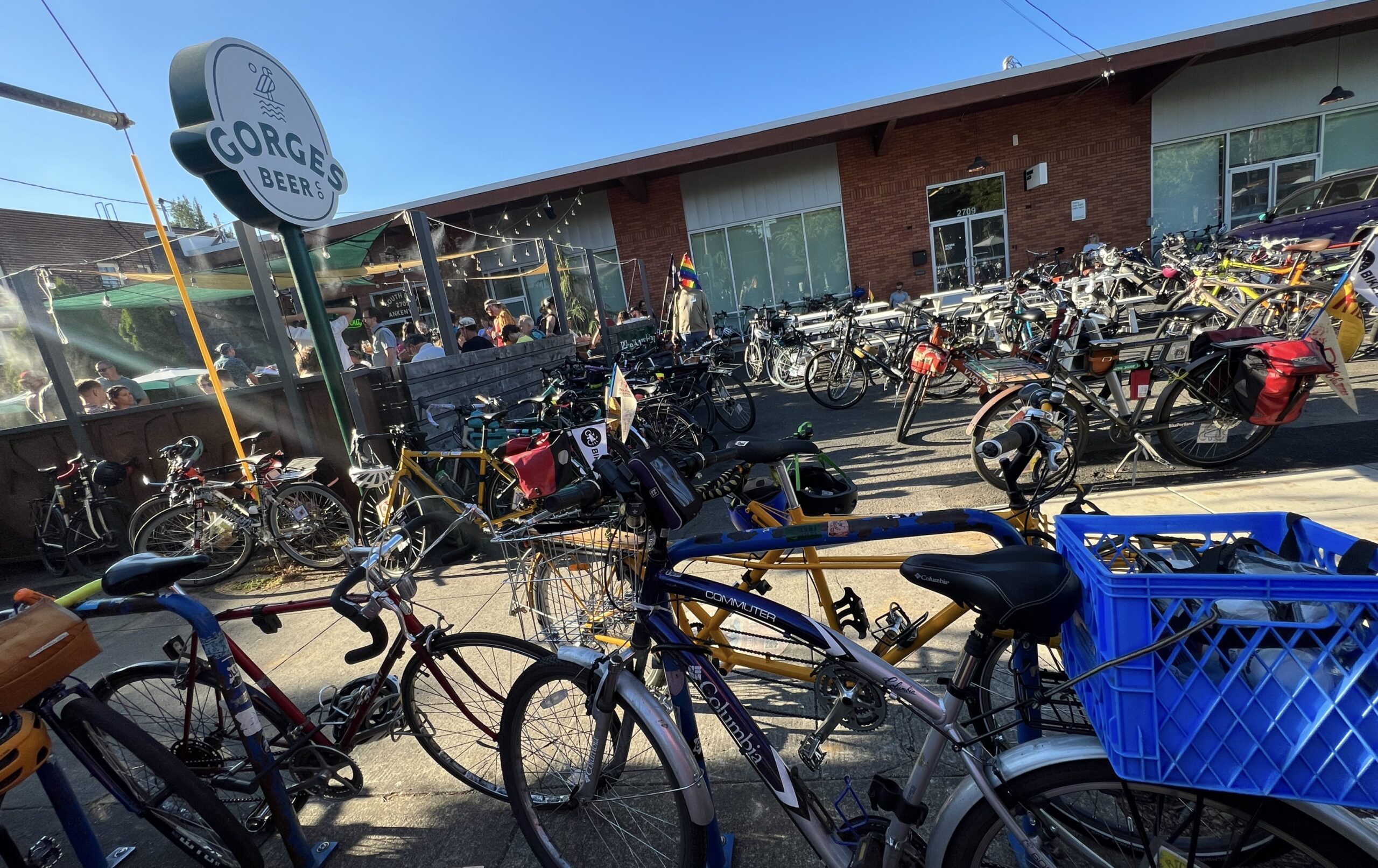
It’s Bike Happy Hour eve and we can’t wait to see all your beautiful faces tomorrow (Wednesday, 8/9) from 3-6:00 pm on the Gorges Beer Co patio. The weather should be perfect — and my mom and aunt will be joining us, so that’ll be weird!
In the past few days I’ve come across two things that have reminded me of why this event exists: an essay in The Atlantic by former presidential candidate Hillary Clinton, and a billboard I saw in southeast Portland.
As you might have seen in the Monday Roundup, Clinton’s piece is titled, “The Weaponization of Loneliness.” In it, she lays out the negative impacts of “social disconnection.” Here’s an excerpt:
“According to the surgeon general, when people are disconnected from friends, family, and communities, their lifetime risk of heart disease, dementia, depression, and stroke skyrockets. Shockingly, prolonged loneliness is as bad, or worse, for our health as being obese or smoking up to 15 cigarettes a day. Researchers also say that loneliness can generate anger, resentment, and even paranoia. It diminishes civic engagement and social cohesion, and increases political polarization and animosity. Unless we address this crisis, Murthy warned, ‘we will continue to splinter and divide until we can no longer stand as a community or a country.'”
So while you might think Bike Happy Hour is just a great excuse to have fun, it’s also about making our city and its people healthier. Bringing people from diverse backgrounds together has always been my favorite thing about BikePortland. When people meet and talk in a welcoming and fertile environment, magical things happen to their health and happiness.
Advertisement
I’m also a big believer in listening to andactually hearing what other people say — especially people who are different from me. Even if I’m not persuaded to share their beliefs, I eagerly add them to my pool of perspectives. I think that’s why I especially love meeting new people at Happy Hour.
That’s also why my eyes were drawn to something I saw during the Murder, She Rode ride on Saturday. As we biked eastbound on the Hawthorne viaduct I looked up and saw the billboard in the photo above. It said, “The other person might be right. Listening. Pass it on.”
I believe that very strongly. It’s why I welcome people with opposing (often even anti-bicycling) views to comment here and it’s why I like to chat with people who disagree with me or have a different point-of-view. I see a lot of echo chamber preservation going on in Portland, where anything that doesn’t toe the party line is feared and thrown-away, right away. I prefer to welcome the “other person” in and at least hear them out. Sometimes they’re right. Sometimes they’re not. You never know until you listen.
So come to Bike Happy Hour tomorrow! We’ll be there, listening and fighting loneliness.
Bike Happy Hour – Everyone Welcome, Every Wednesday, All Year Long – 3:00 – 6:00 pm (or so) – $2 off all drinks at Gorges Beer Co., Ankeny Tap & Table, Crema Coffee – All-ages and Family Friendly – Questions or Concerns: Jonathan Maus, 503-706-8804, @bikeportland on Social Media
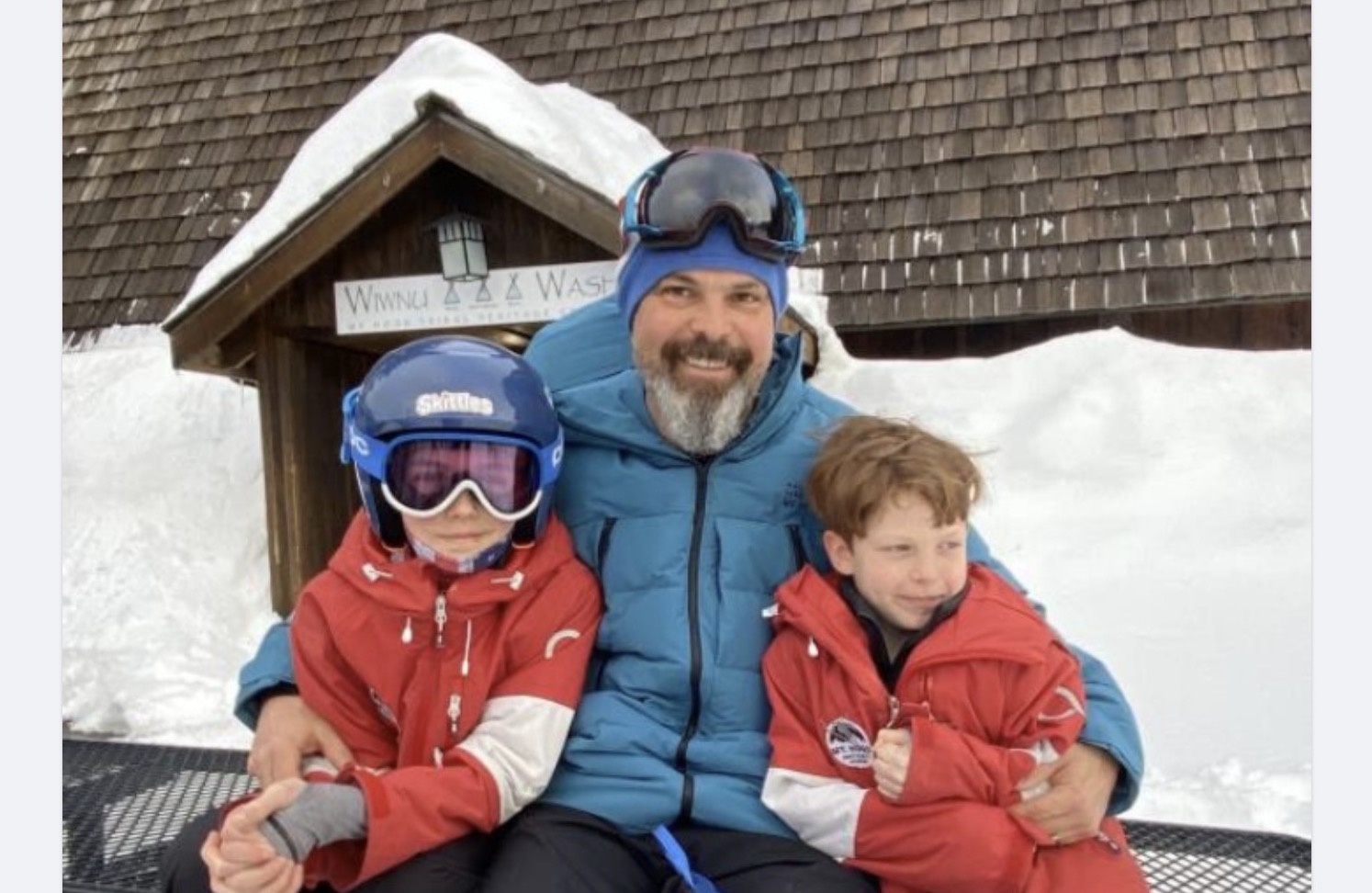
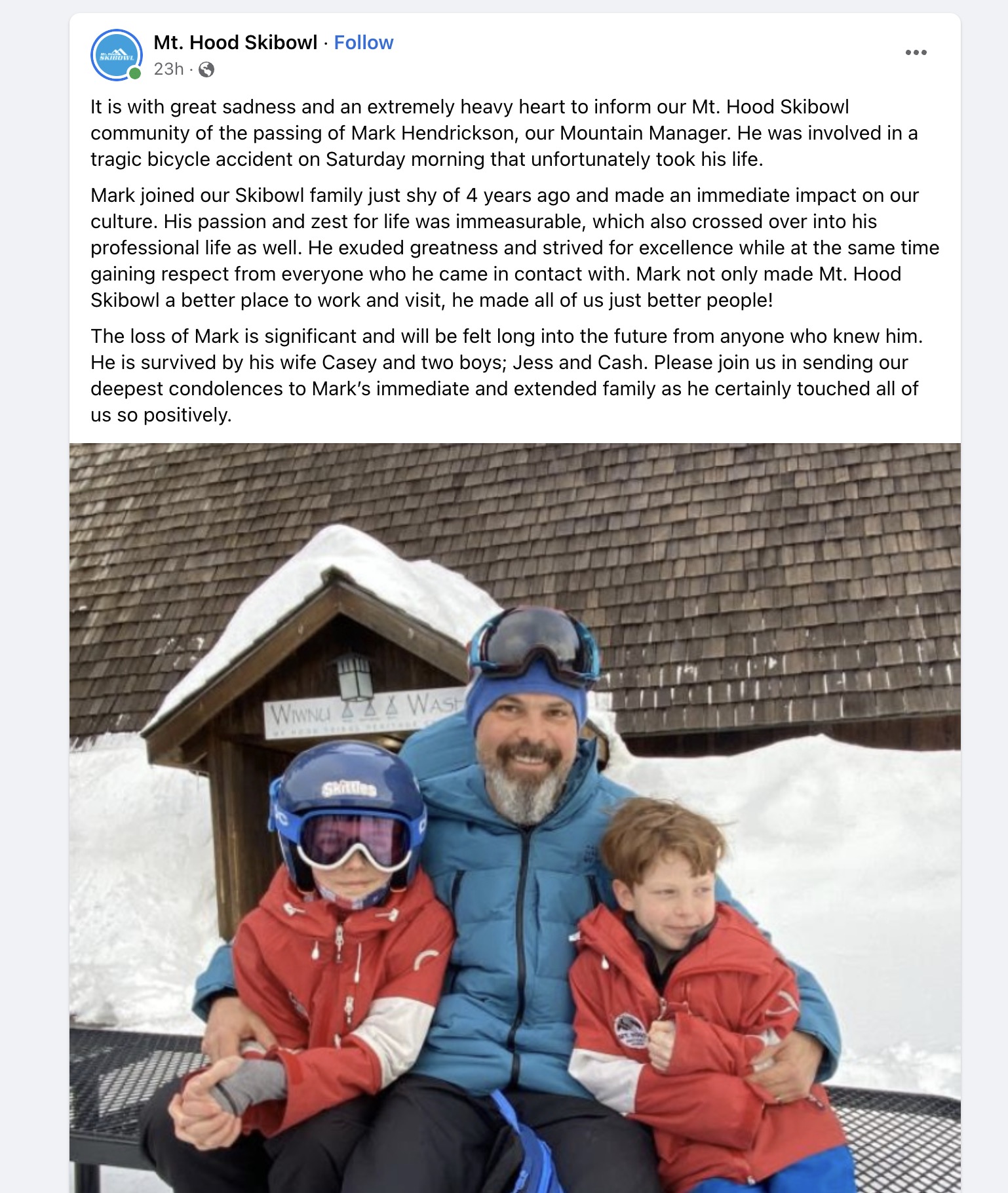
Mark Hendrickson, manager of Mt. Hood Skibowl, was killed by the driver of a car while riding his bicycle down Timberline Highway. According to Oregon State Police, it happened Saturday morning just before 8:00 am and less than one-half mile from Timberline Lodge.
Here’s more from the OSP statement (trigger warning, details of a traffic crash):
“The preliminary investigation indicated a bicycle, operated by Mark Sorrenson Hendrickson (48) of Government Camp, was attempting to travel south from Timberline Lodge on SR-173. A white Hyundai Tucson, operated by Emilio Trampus [sic] (71) of Salem, was traveling north on SR-173 and failed to yield the right of way when he turned left at West Leg Rd, across the bicyclist’s lane. The bicyclist collided with the vehicle, was ejected from his bicycle, and became unresponsive in the roadway.”
Advertisement
The driver’s last name is Trampuz (not Trampus) and he and Hendrickson were both well-known to many people in the Mt. Hood community.
Here’s what Mt. Hood Skibowl posted about Hendrickson on Facebook:
“Mark joined our Skibowl family just shy of 4 years ago and made an immediate impact on our culture. His passion and zest for life was immeasurable, which also crossed over into his professional life as well. He exuded greatness and strived for excellence while at the same time gaining respect from everyone who he came in contact with. Mark not only made Mt. Hood Skibowl a better place to work and visit, he made all of us just better people!
The loss of Mark is significant and will be felt long into the future from anyone who knew him. He is survived by his wife Casey and two boys; Jess and Cash. Please join us in sending our deepest condolences to Mark’s immediate and extended family as he certainly touched all of us so positively.”
Trampuz is an “avid outdoorsman” according to one source and an active member of the Mt. High Snowsports Club. According to the club’s website, Trampuz was leading a bike ride on Saturday when the collision with Hendrickson occurred. (UPDATE: A source says Trampuz was not leading that ride but was doing something else on the mountain that day. Read more below). The group ride was from Timberline Lodge down to Trillium Lake via West Leg Rd.
The collision happened in the middle of a sweeping hairpin turn on Timberline Hwy where it connects with West Leg Rd.
This is such a tragic and senseless loss of life. Our hearts go out to everyone involved.
UPDATE, 8/8 at 3:00 pm: A source who was up on the mountain Saturday morning emailed BikePortland to tell us Trampuz was volunteering to mark ski routes at the time of the collision. The person who contacted me said this is what happened:
When Emilio turned left on the West Leg Road around 7:06 am on August 5, he did not see anything approaching him. On a gloomy morning (it subsequently rained), with a bike rider all in black and no headlight coming at high speed, Emilio should be realized not to be completely at fault. He made it almost across to the West Leg Road when he heard a bang and stopped. Mark had hit the passenger rear quarter panel of his car.
A protestor holds up a sign as others shout at a press conference outside Portland City Hall this morning. (Photos: Jonathan Maus/BikePortland)
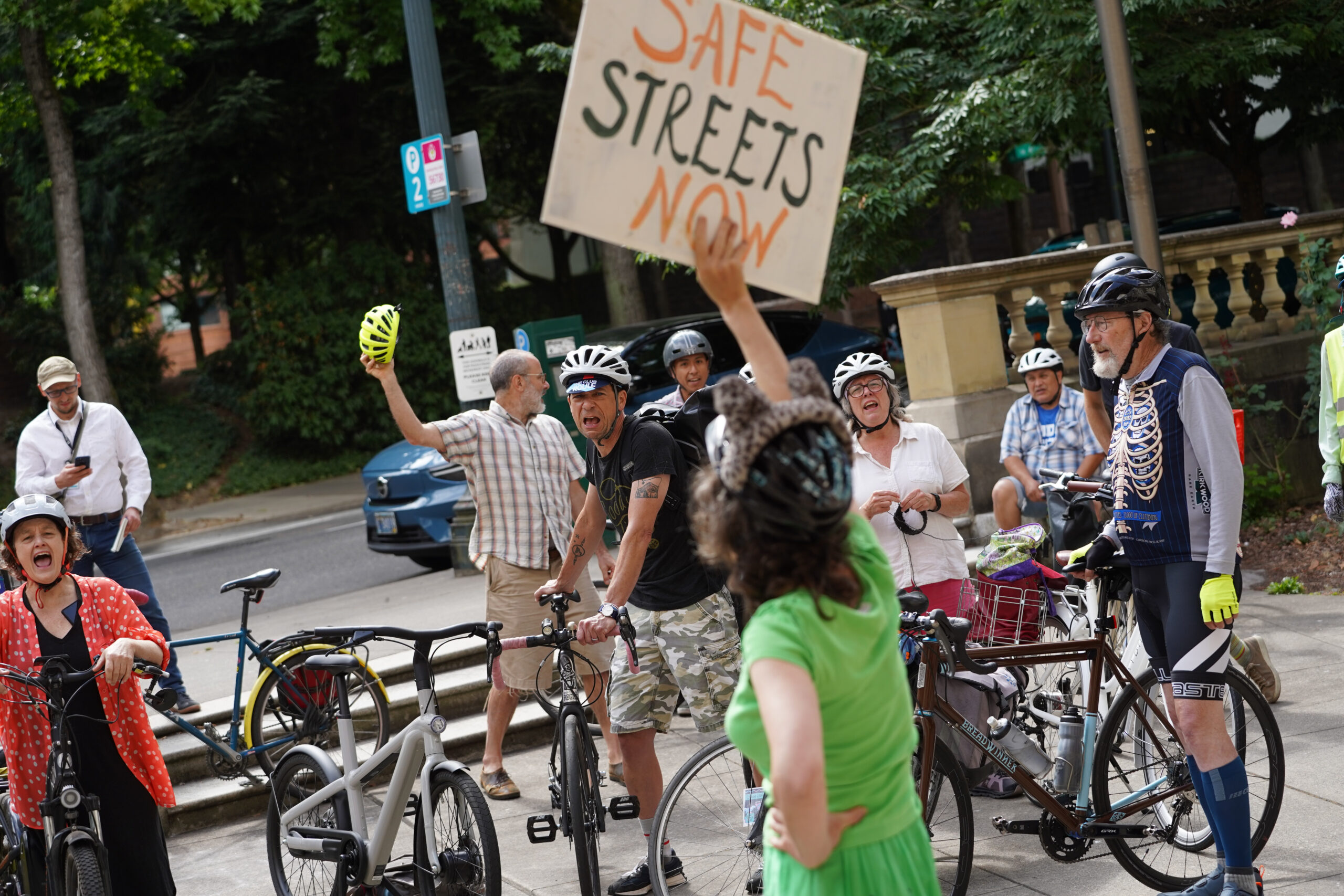
Anger and frustration about Portland deadly roadways — and a feeling that local officials have not done enough in response to it — has been simmering (and at times boiling over) for months. At a press conference Monday morning at City Hall, that anger revealed itself in the voices and actions of several protestors who shouted over scheduled speakers.
As Portland Bureau of Transportation Commissioner (and mayoral candidate) Mingus Mapps came to the mic (after being introduced by his new PBOT Director Millicent Williams, who assured the crowd she is, “firmly committed to Vision Zero”), protestors forced him to recognize their presence by walking in front of him holding signs.
“Say their names! Say their names! Say their names!” yelled Betsy Reese and about a dozen other protestors, as Mapps stood at the mic ready to speak to a row of media cameras.
“Sure, actually,” replied Mapps, calmly.
Advertisement
Lois LeveenBetsy ReeseCommissioner Mingus Mapps.The Street Trust Director Sarah IannaronePPB Sgt. Ty Engstrom.A protestor plays dead while Commissioner Mapps speaks.
(Audio clip above is Commissioner Mapps speaking with protestors shouting.)
After he finished reading victims’ names, he said the reason he called everyone together was to, “Remind the people of Portland about a dire threat to public safety.” “Portlanders need to know that our city is in the midst of an epidemic of traffic fatalities… 43 people have been killed in traffic accidents,” he said.
“Crash not accident! Crash not accident!” someone in the crowd responded (saying “accident,” which implies that nothing can be done to avoid them, has been a no-no for many years and it was a very unfortunate mistake for Mapps to make). And Lois Leveen, the activist who led a group ride to the event from the Belmont Library (across the street from where Jeanie Diaz was killed July 12th), shouted, “Motorists killed 43 people! Motorists killed 43 people. Say it!” It was the first of several outbursts from Leveen, who wanted Mapps to use stronger words against drivers.
As the commissioner continued, saying that Portland could cut the number of road deaths in half if they’d just slow down and not drive impaired, Leveen and others were clearly unsatisfied and continued to yell at him.
“I hear you rage. I hear your frustration. And I share it.” Mapps said.
At one point, PBOT Director Williams walked down from the steps of City Hall where she stood behind Mapps and other speakers and she engaged Leveen in a face-to-face conversation (see photo below). It was a preview of what was to come; but it didn’t smooth tensions.
Advertisement
PBOT Director Millicent Williams
Frustration by some in the crowd spiked even higher when Portland Police Bureau Sgt. Ty Engstrom spoke. He’s been in the PPB’s Traffic Division for 10 years and said, “Traffic is my passion.” Engstrom spent much of his time talking about how hard it is for him and his officers to see the consequences of traffic crashes. “It weighs on all of us to see that carnage; to see the families devastated. I have lost track of how many times I’ve had to go tell a parent that their child will not be coming home. I’ve had to leave crash scenes and call my wife to decompress a little bit afterwards because I’m thinking about my six kids that I have that are out on the roadways…”
Then Engstrom did something that made several people very upset: he both-sides’d it.
(Audio clip below is some of Engstrom’s remarks.)
Engstrom said one main reason for the reason spate of deadly crashes is a change in culture where he says, “People feel entitled on our roadways. All motorists, all pedestrians, all bicyclists — it seems like we’ve forgotten how to use the roadways together safely and to share them.”
“No. Don’t do that. Don’t do that!” a man in the crowd immediately erupted. (After the event I heard a woman approach Sgt. Engstrom to say, “You really offended me when you said that. I had to turn my back and walk away after you said that. It was offensive.”).
Engstrom (who spent a long time listening to criticism and feedback after the event and was very open to changing how he frames these issues) pressed on, saying, “You are right. There are motorists out there driving in a way that kills people. Absolutely. But there are also people that are on bikes or pedestrians that need to be also more careful with what they’re doing. So it is a shared responsibility and a culture change that needs to happen.”
After three elected officials and one public health expert had spoken, there was still no clear plan of action on the table. People are dying every week. What will City Hall do about it? How will they change an approach that clearly isn’t working? What new ideas are being considered for implementation?
Unfortunately we heard nothing on those fronts at the press conference. One man who showed up on a bike was so frustrated at the remarks he left early and could be heard shouting, “This is horseshit!”
Advertisement
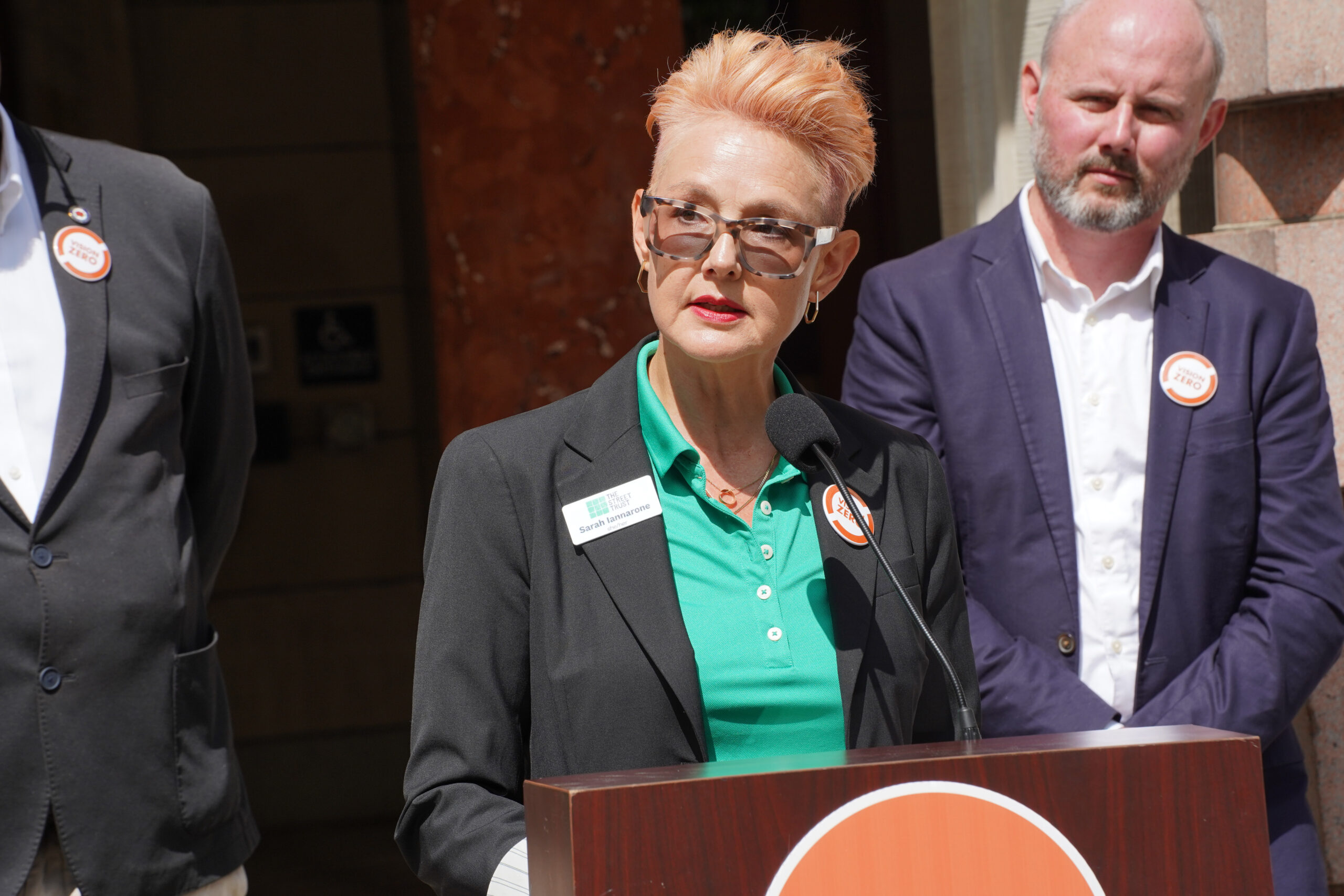
The strongest official remarks came from The Street Trust Executive Director Sarah Iannarone. In a notable shift from previous eras, The Street Trust (formerly the Bicycle Transportation Alliance) leader was standing alongside power — instead of in the crowd protesting. This is part of a strategic shift at the nonprofit that has been many years in the making but has been hastened by Iannarone’s leadership.
After thanking the Oregon Department of Transportation for funding Street Trust research project about how homeless people are impacted by “traffic violence” (a term only she and Chair Pederson used), Iannarone said, “This public health epidemic is preventable, but only with timely attention and action from the government at every level.”
Iannarone called for a “transformation of our system” and urged a harm reduction model of street design that expects people to make bad choices. She cited an expert who says, “If you make streets safer for drunk people, you make them safer for everyone.”
“Building streets which take into consideration that people do make mistakes, makes us all better off in the long run,” she continued. Iannarone said Oregon should follow Utah’s lead and lower the blood alcohol concentration level that triggers a DUI from 0.8% to 0.5%.
As for speeding drivers? Iannarone riffed off PBOT’s recent, bird-themed anti-speeding campaign. “‘Slowing the flock down’ makes for cute signage; but we need a serious, statewide public health campaign to raise awareness about the dangers of impaired and high-speed driving,” she said, to rousing applause.
Iannarone called for collaboration and urged people to join The Street Trust. She was the only speaker to receive strong applause from the activists. But again, there was no plan offered.
I was struck that even after all the talk of a “dire threat to public safety,” “crisis” and “epidemic,” not one speaker shared a clear plan of action on how to respond.
I asked PPB Sgt. Engstrom about this in a one-on-one after the formal remarks were over.
Advertisement
“As you heard today, people are really scared and frustrated. As a leader at Traffic Division, what happens now?,” I asked him. “How are people going to feel safe tomorrow? Next week? What are you doing differently at PPB to make people safer in the short-term?”
“That’s extremely hard… that’s a hard answer,” Engstrom replied. “All I can say is what we’re doing right now, by having Traffic Division back, is trying to be as visible as possible.” He explained that they’re having officers blanket one area to make an impression rather than sending one unit out at a time. He also mentioned more use of social media to “just try and make ourselves look bigger than perhaps we really are.”
As much as I appreciate Sgt. Engstrom’s work and concern about the issue, his response to that specific question was not reassuring. I also found it ironic that now he’s trying to make PPB look bigger, when his strategy in 2021 was to make them look smaller.
I asked him again about his press conference two years ago when he broadcast to everyone that the PPB wasn’t able to enforce traffic laws. And he finally admitted that it wasn’t a good idea. And that it was a political move. “We needed to create a stir to get some change to get them [city council] to fund us back up,” he said. “I mean that’s the honest truth. I know that could make things more dangerous. I don’t know. But at the same time, we needed some change.”
Advertisement
I also talked with Commissioner Mapps one-on-one and asked him a similar question. He rattled off all the what he and PBOT are doing. But none of it was really new and none of it will move the needle fast enough to save lives in the short-term.
“What is happening from your office or from PBOT that reflects the severity of the threat?” I asked.
Mapps then leaned back into his main focus of this event and asked me rhetorically: “How do we bring this culture change?” He said they plan to be more consistent with educational events like the one today and he wants to hold them more regularly. “The one piece I am dissatisfied with, where I don’t think we’re trying hard enough, is the culture change piece.”
I failed to ask Mapps to define what he means by “culture change”; but since he said he’s made it a focus in large part by reading my stuff on BikePortland, I’m confident assuming it’s something like this: The City of Portland needs to encourage people to make better decisions when they operate vehicles. The culture on our streets is dysfunctional and it’s time for an intervention.
Culture change can be difficult for timid government officials, like the ones we tend to have here in Portland. It can be hastened by radically different street designs, following through with novel policy approaches, and by quality communications and marketing — none of which PBOT or Commissioner Mapps’ office has shown to be great at yet.
While I wasn’t impressed with most of the speeches today (outside of Iannarone’s), I was heartened by one aspect of the event itself. It brought some people together to talk and hear new perspectives. While the protestors were not representative of Portlanders on the whole (to say the least), they were at least able to have quality conversations with PBOT, PPB, and City Hall officials.
Those conversations were worth something; but I’m afraid that one hopeful highlight from today won’t be nearly enough to make our streets feel safer any time soon.
This isn’t the comment I initially chose for this week. But when you find that a comment you didn’t choose keeps distracting you, it tells you it’s time to reassess before you get any more committed.
What kept pulling me to eawriste’s comment was that it was forward-looking, action-oriented, hopeful—and it linked to a great video. Watch the video about Telegraph Ave in Oakland from StreetsblogSF’s Roger Rudick. It lifted my spirits.
The message to get inspired and do something seemed like a nice lead-in to today’s press conference at City Hall addressing our deadliest traffic month in thirty years.
Here’s what eawriste wrote:
Advertisement
Here’s Telegraph Ave in Oakland after many years of debate, hiccups, confusion, complaining business owners, advocacy (by business owners), and many interim designs. Sure, the last part is the part that gets the news/attention (capital project that costs a lot), but the project started with planters and the decision to make the street safe. If you want this death spiral to change, shoe gazing/bellyaching is not the answer: email BikeLoud, ask Mapps, the mayor and our new PBOT director to redesign a specific street with planters and whatever they can. We have the means, we just don’t have the will yet.
Thank you eawriste! You can read this comment and all the others under the original post.
For nearly 30 years, we have been a nonprofit organization on a mission to broaden access to bicycling and its benefits. Our vision is to continue building a vibrant community where people of all backgrounds use bicycles to stay healthy and connected. We believe that all Portlanders—regardless of income or background—should have the opportunity to experience the joy, freedom and health benefits of bicycling. This is the motivation behind everything we do.
The Shop Department of the Community Cycling Center consists of a DIY Workspace and retail storefront, regular salvage sales, and occasional pop-ups and events. This department is a revenue stream to provide funding for community programs.
This position operates out of our retail storefront at our membership based workspace in NE Portland. Here at the CCC we value and support one another through the work we do and are committed to working collaboratively to meet our goals. We acknowledge and value diversity and its many intersections. We are proud that people of color, women, neuro-divergent, gender non-conforming and LGBTQIA+ folks choose to work at our organization. We encourage more people from varied and diverse backgrounds to join our lively, talented team.
GENERAL POSITION SUMMARY
The Membership Coordinator is responsible for placing orders for new inventory, overseeing the receipt and processing of new and used inventory, storage of inventory, transportation of inventory between CCC locations, posting and of inventory on online platforms for sale, and managing timely shipping for goods leaving the organization. They supervise mechanics who perform teardowns and direct what components to save to be processed as used inventory. Working under the direction of the Shop Leadership Team, they will cultivate the delivery of consistent quality, help meet sales goals and support staff working in their department. Experience in a high-volume shop environment, clear communication skills, and proven effectiveness in supporting staff are crucial to the success of this position. Seasonally, shop staff will need to provide retail support at pop-ups and events. Staff in all positions at the shop will also be responsible for providing support to the Programs department as needed. This may include working mechanic shifts at one of our free service events or locations, providing ride support at events, or assisting at a learn to ride event.
RESPONSIBILITIES
Member relations (40%)
● Be the main point of contact for member engagement with the organization
● Work with Development to prepare regular communications with members
● Work out of the retail store at the Alberta location to sell memberships to customers and be available to support member needs
● Create and maintain effective and creative ways to recruit new members
● Looks for opportunities to cultivate long term memberships
● Plan community events to keep members engaged
● Market classes to members to encourage continued education
Retail (40%)
● Work with management and the Processing Coordinator to create displays to showcase products in innovative and efficient ways
● Work with the Processing Coordinator to analyze sales trends to determine adequate stocking levels and product selection for the Alberta store
● Work in the retail store on Alberta to sell new and used parts, accessories, to customers and members
● Work with the inventory team to place orders with vendors to fill special orders for members and customers and restock the retail space
Strategic Planning and Process Evaluation (10%)
● Collaborate with other senior staff to maintain and improve shop systems and facilities
● Work with the Shop Leadership Team to evaluate opportunities, trends and feedback
Other Responsibilities (10%)
● Help advance the mission of the Community Cycling Center across all departments
● Contribute to the standard work environment – answer phones, maintain a safe, clean & organized workspace
● Collaborate with other senior staff to train and support less-experienced mechanics, including youth interns and apprentices
● Other duties as assigned
REQUIRED SKILLS AND QUALIFICATIONS
● 5+ years customer service experience
● Strong interpersonal communication skills
● 2+ years of professional bike shop retail experience
● Strong organizational skills including the ability to manage multiple assignments simultaneously
● Ability to meet project deadlines and account for detailed objectives
● Experience and success in creating inclusive work environments where people from diverse backgrounds feel safe and welcome
● Ability to lift, bend, squat, climb and more—this is a physically demanding job but reasonable accommodations can be made
● Ability to work nights and weekends
PREFERRED SKILLS AND QUALIFICATIONS
● Attention to detail and a methodical approach to accomplishing tasks
● Experience with workflow improvement methods
● Experience in a high-volume shop
● Experience planning and executing social events
● Valid driver’s license
● Experience with Lightspeed POS, Excel, Microsoft Office Suite, Adobe
● Proficiency in Spanish
REPORTS TO: Shop Director
UNION/NON UNION: Union – ILWU Local 5
HOURS: Full Time (40 hours)
COMPENSATION: $22
TERM: Permanent
SCHEDULE: 5 day week, workdays may vary, hours may fluctuate, will work nights BENEFITS: Health, dental and vision, 401k, 144 hrs of PTO at FT + 69 hrs of sick time
NON-DISCRIMINATION POLICY
The Community Cycling Center is an equal opportunity employer. We will not and shall not discriminate on the basis of race, religion, sex, age, national origin, gender identity, sexual orientation, citizenship, veteran status, marital status, sensory disabilities, physical disabilities, mental disabilities and/or any other bases protected by state and federal law. We take proactive measures to ensure against discrimination in hiring, compensation, promotions, and termination of staff, selection of volunteers (including board members) and vendors, and provision of services. We are committed to providing an inclusive and welcoming environment for all members of our staff, customers, clients, volunteers (including board members), subcontractors, vendors, and other members of our community.
How to Apply
HOW TO APPLY: Send your resume, cover letter, and (3) references to Jobs@CommunityCyclingCenter.org using “Membership Coordinator” as the subject line. No phone calls, please.