

“This isn’t a smaller project. It’s the same bloated mega-project, just sliced into pieces so the full commitment is harder to see.”
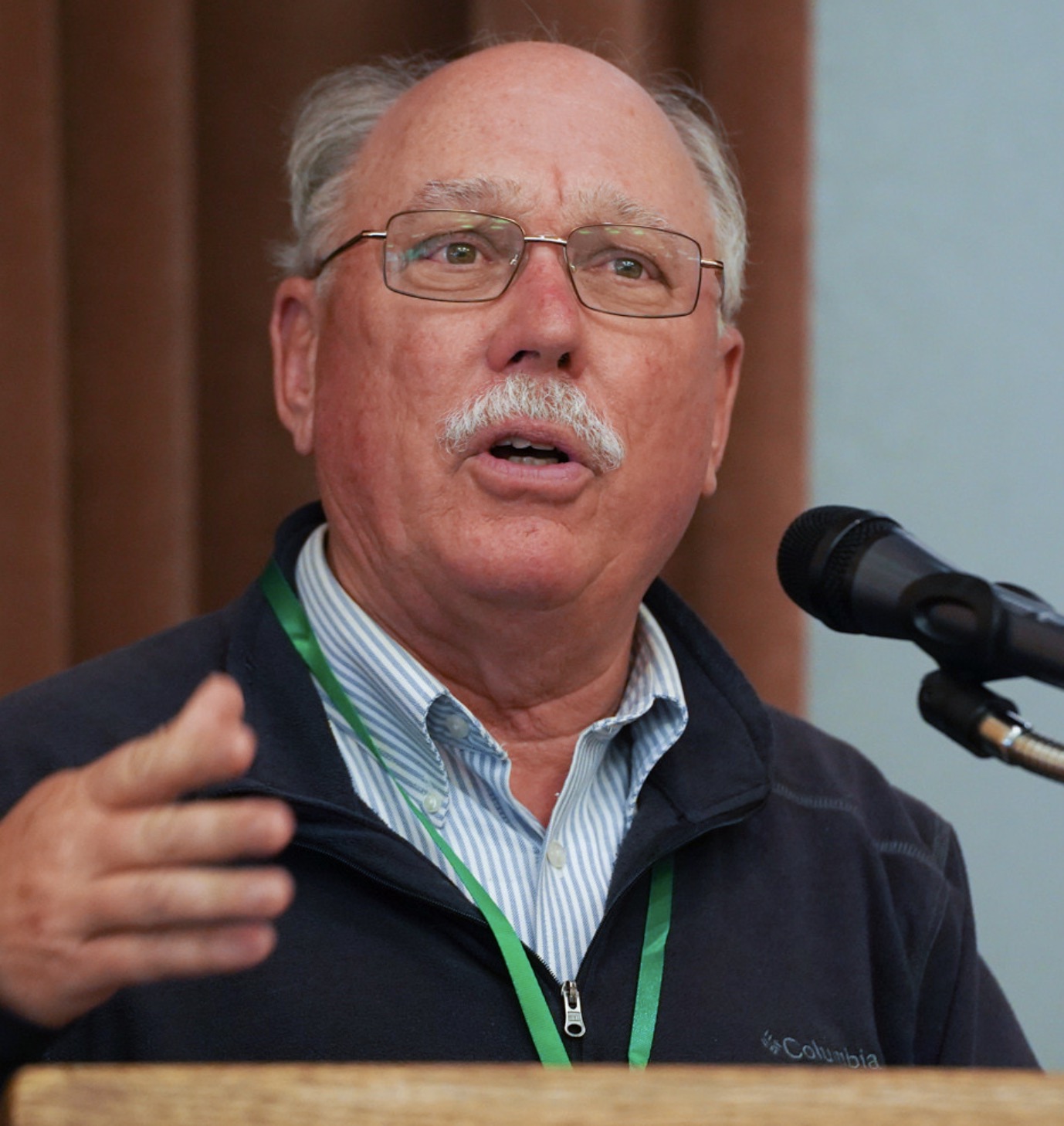
This guest opinion was written by urban economist and City Observatory publisher, Joe Cortright (in photo above).
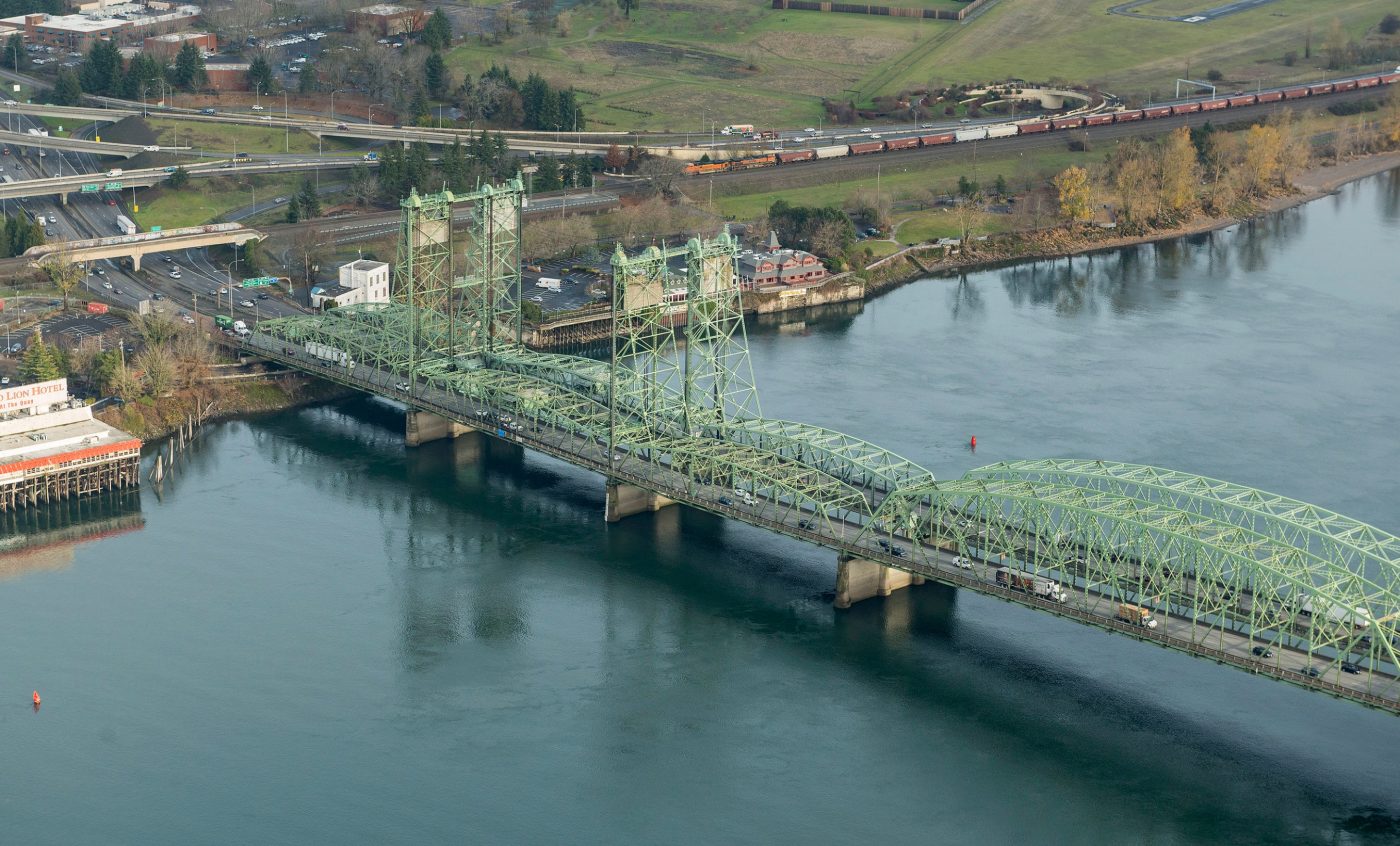
The Interstate Bridge Replacement Program (IBR) has finally released the cost estimates it’s been promising for more than two years — and the numbers confirm what we’ve been saying since January: this project has more than doubled in cost, from $6 billion to as much as $15.2 billion.
The spin merchants who work for the IBR have packaged the increase as much smaller, claiming that they’re going to just build the “core elements” of the project. That’s led some in the media — including, unfortunately, BikePortland — to report the project is being “right-sized.”
That’s simply not true: IBR is stretching out the project (through the 2040s), but has actually said nothing about giving up on the whole boondoggle, including widening five miles of freeway and building seven intersections. And the way they’ve designed the project, once you start, we’ll have no option to say “no” later on.
This is the oldest trick in the megaproject playbook — the Robert Moses strategy: get a shovel in the ground, then dare anyone to stop you.
Moving ahead with this so-called “Phase I” will mean that the IBR becomes the region’s top priority for transportation spending for the next two decades and will have first call on every available dollar. Just as the Iran War shows how tragic and costly car dependence is, the region will squander its scarce capital building one last monument to the highway lobby, exactly as the climate crisis hits with full force.
But the real story isn’t just the price tag. It’s the timeline. Portland and Vancouver are being asked to sign up for two full decades of construction, debt, and disruption — with no exit ramp.

The “Phase I” fiction
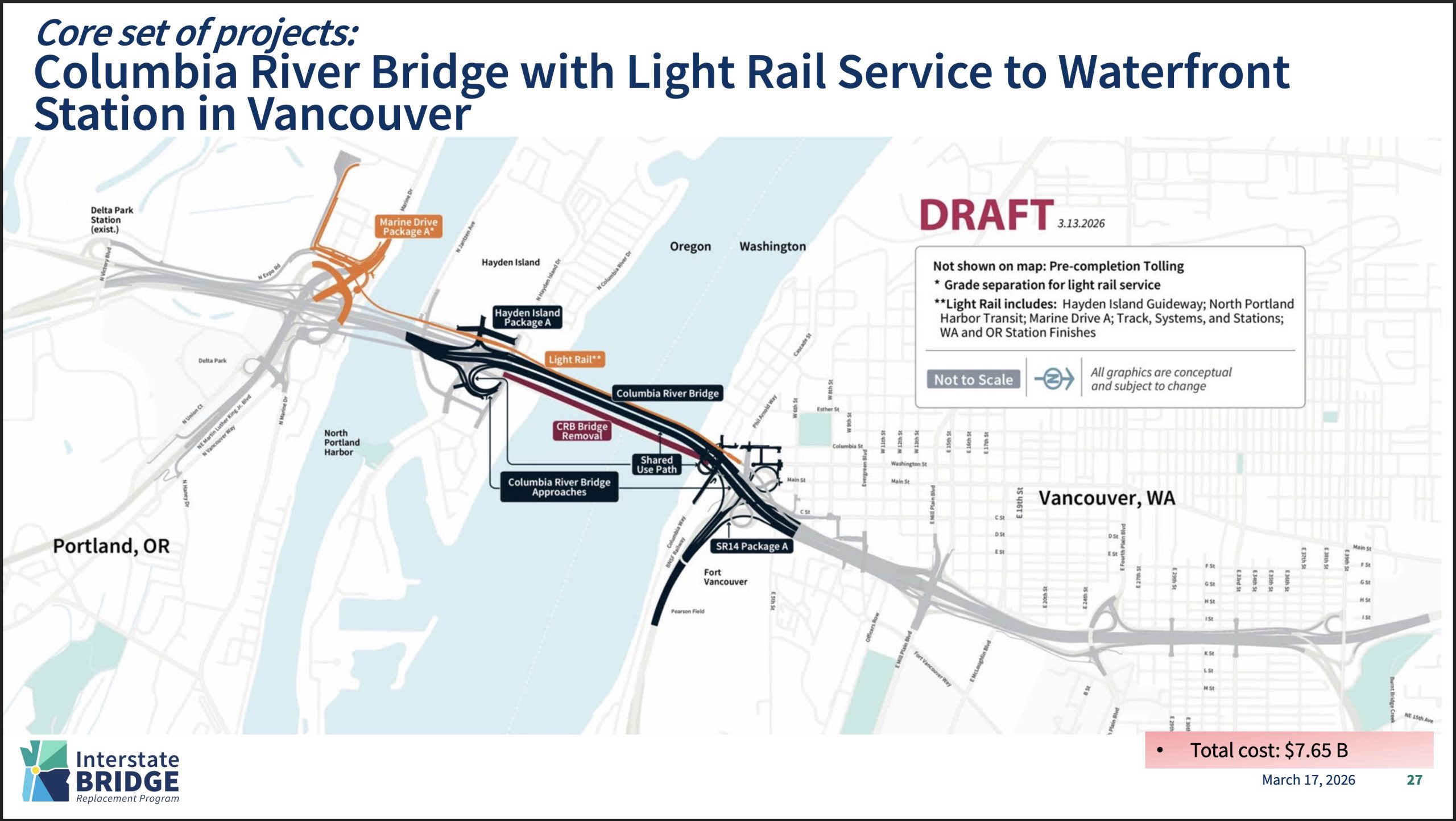
No one should be fooled by IBR’s talk of a scaled-back “Phase I” costing $7.5 billion (see above). This isn’t a smaller project. It’s the same bloated mega-project, just sliced into pieces so the full commitment is harder to see. The 115’ vertical clearance of the bridge, by design, forces them to raise up the freeway and the interchanges.
Once you build a new high-level bridge, you are locked in — physically and financially — to rebuilding every approach, every interchange, every elevated freeway on both sides of the river. ODOT and WSDOT designed it that way deliberately. This is the oldest trick in the megaproject playbook — the Robert Moses strategy: get a shovel in the ground, then dare anyone to stop you. Once construction starts, the politics of a half-built bridge make it nearly impossible to say no to the next funding request, no matter how large.
A project that grows, never shrinks
And notice that the IBR’s cost estimate is now vastly higher than what they assured us in 2022 was the “highest” possible cost, something they said had less than a 10 percent chance of happening. And this project is no anomaly: the other highway megaprojects in the region (the I-205 Abernethy Bridge and the I-5 Rose Quarter project) have tripled and quadrupled in price (respectively) to more than $800 million and more than $2 billion. Does anyone believe that once ground is broken the cost won’t continue to rise?
And already the new estimate of the “core” portions of the project leaves things out. There’s no money in the budget for the $488 million cost of removing the two existing bridges. There will be more surprises. There always are.
You can’t trust these people
What makes anyone think that you can believe these cost estimates? Keep in mind, IBR has delayed releasing these numbers for more than two years, and deliberately waited to release them until after both the Oregon and Washington Legislatures had adjourned — even though the stated reason for these estimates was to have new numbers in time for the 2026 sessions. Greg Johnson, the former project director, instructed staff to keep the draft and final estimates secret.
Moreover, it’s pretty clear we can’t trust the IBR team. The project’s own consultants — who have collected $273 million over five years to design “basically the same project” as the failed Columbia River Crossing that came before it — now put the cost at $13.5 to $15.2 billion, up from $6 billion just three years ago. IBR wants to blame inflation, but its own estimates attribute only about $1 billion of that $9 billion increase to higher prices. The rest is scope, complexity, and the compounding costs of delay. The fastest-growing line item in the IBR budget isn’t steel or concrete — it’s staff and consultants, whose costs have grown 400% and are projected to reach $1.2 billion over the 20-year construction period. Already more than 20 years in the making, the IBR promises to be a “forever” project for these consultants.
Twenty years of financial exposure
The IBR plans to break ground in 2028 with less than a third of the project’s total funding identified. The gap isn’t $2.5 billion — it’s $10 billion or more. That’s a decade-plus of lobbying, appropriations battles, and cost overruns still ahead, stretching well into the 2040s. Notice that Washington Governor Bob Ferguson exclaimed “We’re going to build the damn bridge,” but said nothing about how it would be paid for. That’s because it’s not his problem; but it will be a problem for future taxpayers and future governors.
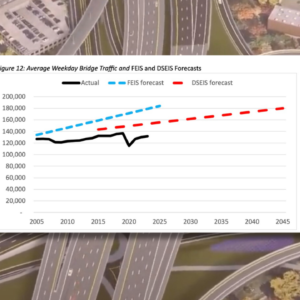
One thing is certain: tolls of $3 or more per trip will begin hitting I-5 commuters as early as 2027 — not after the new bridge opens, but years before. Those tolls will drive traffic off I-5 and onto I-205, gridlocking an already strained crossing, while the region waits years for the new bridge to open. And tolls will depress traffic levels on the I-5 bridges — already lower than they were twenty years ago — permanently below 100,000 vehicles per day, meaning that we’ll have spent billions for added highway capacity that will be half-used.
The real question
Oregon and Washington are being asked to commit — right now, today — to a project that won’t be finished until the 2040s, at a cost that has already doubled and shows no signs of stabilizing, The state transportation departments sponsoring this project have repeatedly failed to estimate its costs accurately, kept those estimates secret from the very legislatures funding it, and have yet to produce a credible financing plan.
At a moment when gas prices are surging, state transportation budgets can’t keep up with basic maintenance, and climate commitments demand we reduce car dependence — not subsidize its expansion — committing two decades and $15 billion to this project deserves far more scrutiny than it’s getting.
The IBR hasn’t been right-sized. It’s just found a way to make the full commitment harder to see.
Thanks for reading.
BikePortland has served this community with independent community journalism since 2005. We rely on subscriptions from readers like you to survive. Your financial support is vital in keeping this valuable resource alive and well.
Please subscribe today to strengthen and expand our work.
It would be nice if the IBR team also provided a roadway profile(s) to better understand how the “phased” work will dovetail into the existing roadway grades.
I imagine they’ll do that before too long. I mean, this announcement just happened and I think everyone is still catching up and trying to figure out what it means in terms of specific designs.
I would be interested to see that as well, because I’m not sure if I agree with this argument:
It certainly seems plausible to me that even with the high-level bridge, the new construction can tie into the existing grade of the freeway at the south end of Hayden Island on the Portland side and at around 6th St on the Vancouver side.
I don’t doubt that there will still be lobbying for the miles of freeway expansion beyond those points, but I don’t immediately see that it’s necessary to tie into the new bridge.
What? If I-5 at its current grade doesn’t tie into the new bridge, how will cars and trucks use it?
Some adjustments can be made without rebuilding every single interchange within 5 miles. Getting a road up 115 feet at a reasonable 2% grade takes less than a mile
A new higher bridge obviously has to meet the existing grade of I5 somewhere, and the the diagram above implies that it would be where the black colored road (new) meets the grey colored road (existing). On the Vancouver side, that appears to be shortly after southbound exit 1A. That’s right where the grade currently starts to drop; what I imagine is intended is for the roadway to instead start rising at this point. Instead of going under the ramp to SR14, I5 would go over it.
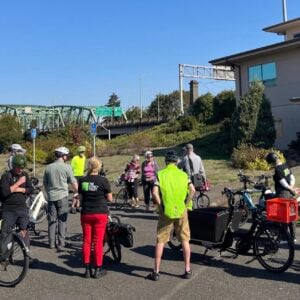
The render immediately reminded me of this bridge.
While I have a lot of respect for Joe Cortright, and appreciate all his tireless work on this topic over the years, I feel like he is falling into the common fallacy of being unable to see anything as good news, and is making a lot of assumptions at this point. There’s no reason to think this phased approach “locks us in” to anything in the future. Sure, that might be what some at ODOT and WashDOT are hoping, and yes that was a common tactic of Robert Moses. But that tactic has failed more than it has worked, especially in the last 50 years or so since the end of the Moses era. The Fremont Bride and ramps were a “phased” approach to a new Prescott Freeway, and that never happened. The ramps to nowhere at the east end of the Marquam Bridge didn’t make the Mt Hood Freeway inevitable.
This kind of phased approach is a double-edged sword. It can make the larger project seem more inevitable, but it can also be a convenient way to show progress to satisfy political constituencies, but with the full knowledge that the full project is unlikely to ever happen once the core problem is addressed. I think they’re trying to find a way to do something without having to do everything, and it’s unlikely the rest of the interchange work will even happen.
This is a great way of looking at the project pragmatically Marvin. Clearly, ODOT would like to phase projects insofar as it creates the ostensible preconditions for further development of I-5. It is absolutely true that hiring consultants to evaluate a project that they themselves benefit from creates the appearance of these preconditions. It seems equally possible that this core project, while still bloated itself, may also be and end itself.
I also find Joe’s relentless work invaluable, and have the utmost respect for his efforts toward making this a pragmatic and financially-frugal project. AND it also appears that this “core” bridge (while still extremely bloated) might be one of the many better case scenarios, given the financial and political outlook. Do I want a 4 lane, 116′ tall behemoth over a 2-3 lane bridge at current I-5 height or tunnel? Not particularly. But geographically constraining the core project is certainly a leap in the right direction when this project has remained impractical, distorted and unchanged for decades.
Skepticism of ODOT is justified. It is richly deserved. When they pegged the Rose Quarter mess at $450,000, I said round it up, but couldn’t imagine that the number would increase by over 300%. Really?
Thank you, Joe. Portland is lucky to have you.
Most definitely we are lucky to have Joe’s exceptional journalism. It is unfortunate that his voice of reason is up against a giant self-serving bureaucracy willing to spend many million dollars on consultants whose job it is to sell their 30-year old poorly conceived design concept.
There’s an easy solution to Joe’s argument that traffic will divert to I-205 to avoid I-5 tolls on the existing Interstate Bridge… you end up tolling both the I-5 and I-205 bridges at the same (or relatively same) rate. Some might even call that congestion pricing which many on BP have called for. Obviously there are some political hurdles that would have to be overcome for that to happen. Both legislatures would need to authorize I-205 tolling and Governor Kotek would need to lift her executive order suspending the Oregon tolling program (IBR was exempt from her suspension in her executive order).
Oregon passed HB3991 in 2025 that removed mandatory tolls from I-205. It seems like it would be a big step to go back and pass a bill that added tolls back in.
Doesn’t this get nixed due to the referendum (that will likely pass)?
The section of HB3991 removing mandatory tolling of I-5 and I-205 was not referred by petitioners, so it has already gone into effect and the referendum vote will not change that one way or another.
We need roadway pricing and we need it now. There’s ample evidence that will be the most cost-effective way to manage congestion and bottlenecks – the old model is fundamentally broken. What are the odds her new commission will recommend this practical solution?!
SR 51 in Phoenix, AZ was built with at grade, signalized intersections until the state found the money to build the freeway as intended.
State Route 51 (Piestewa Freeway) in Phoenix was originally built as a parkway with at-grade intersections, which were later replaced to transform the roadway into a full freeway.
In the past there have been suggestions of doing the opposite – replacing the existing freeways with wide tree-lined Parisian boulevards and adding roundabouts and rotaries where there are now interchanges, freeing up land for parks and new buildings – and slowing traffic in the process.
Joe,
Solid points about costs and timelines on the Interstate Bridge Replacement Program — definitely worth the scrutiny you raise.
But wow, the tone goes from analysis to “megaproject supervillain origin story” pretty fast
Also, downplaying inflation in construction over the past few years is… a bold choice. Good critique overall, just could use about 20% less drama and 30% more nuance
Maybe we should have built it years ago and ignore the very small minority of loud voices that made for big press.
I got an idea, we should just give up on the bridge, demolition it and make everyone go to the I-205 bridge to get over the river. Wonder how long it would take a final decision for a replacement to be done then once the complete gridlock of transportation over the Columbia happens?
Well, 20% and 30% are fine numbers. If ODOT came in at 30% over, seems like Nirvana. If a person’s bathroom remodel came on at 30% over, some would be screaming.
“If a person’s bathroom remodel came on at 30% over, some would be screaming.”
Tell us you’ve never done a home remodel without telling us you’ve never done a home remodel.
If a home remodel is budgeted at 45K, would you stomach 200K? That’s what we’re talking about. That kind of increase for a homeowner eats up their equity. There are people who would scream about an extra twelve thousand dollars, perhaps because they don’t have it and wouldn’t have committed to the project at that price.
If ODOT had come out on day one talking about $2 billion with nine zeros for the Rose Quarter Boondoggle, would we be having this exchange?
For the State of Oregon, ODOT is willing to eat up our bonding capacity for 20 years, or more, on one dubious project. That’s a thing they won’t say, that our budget for the interest payments on freeway widening is going to eat our budget for things like rural buses and bridge repairs and kids walking to school out past 2050.
“If a home remodel is budgeted at 45K, would you stomach 200K? That’s what we’re talking about.”
Sorry, my bad. From reading your previous post I thought we were talking about a 30% overrun.
I don’t support this project even at the original price, but faulty and immature arguments and false accusations do not help. They just make opponents appear shrill and uninformed, when what we really need is a coherent and reasonable sounding argument that can persuade lawmakers of all political stripes to find a different way forward.
Why does ODOT think we need to go so big? Why are they wrong? Why would a smaller project serve Oregon better? And if the answer involves bicycling, or even Max, it’s not going to work politically.
I knew it! I credit myself for seeing thru this ruse when I read JM’s original article yesterday, which followed Gov. Ferguson’s line (“We’re just gonna build the bridge”).
Another thing that amazes me about this project is how the Coast Guard basically allowed the entire Columbia-Snake River system, which extends into Canada (!), to be closed to larger vessels, east of the bridge, FOREVER. If Joe has any insight into how that happened, I’d love to hear it. I wouldn’t be surprised if there were some backhanders, which will be discovered one day.
They have already negotiated a pay-off of $140 million right out in the open!
It’s not a shady back-handed deal, it was an out-in-the-open negotiated settlement where they paid the very few remaining businesses that needed the higher clearance to close or relocate. That’s just the normal way these things work, and it doesn’t seem weird to me.
The river past the Interstate Bridge has never been able to anything larger than the tugs with barges and the Cruise Ships that go all the way to Lewiston Idaho. The Columbia River Channel is at least 43 feet from the mouth to Portland. This allows large cargo ships to service Portland. The depth of the channel is maintained by the US Army Corp of Engineers. East of the bridge the channel is maintained to a depth of 17 feet.
https://www.nwp.usace.army.mil/Locations/Columbia-River/Vancouver-to-The-Dalles/
So the current vessels going upriver from the bridge will not be stopped by the new bridge.
This was my understanding Jim. I’m not aware of any larger ports upstream of Vancouver that frequently require a higher clearance than the current wheat/barley barges. There are some port ideas developing in Woodland, Kalama and Portland/Vancouver, but I’m not sure if there is demand for more upriver if the bridge were built at 116′, and if the ACC could ever keep the channel at the recommended 27′.
I don’t want to be too optimistic/pessimistic, but there’s $5500 million in funding for an $8000 million bridge (that could be a $15500 million bridge). The Oregon legislature just raided $20 million from safe routes to school to fund an ODOT funding shortfall of $300 million after their plan to fund ODOT for $2000 million a year fell apart last summer. Meanwhile, events in the middle east including blocking the straits of Hormuz and bombarding oil refineries and gas fields has sent oil prices up 40% and promises significant global inflation in the years to come. Also, according to the talking heads, Oregon’s tax base/job creators are moving across the river to rural Washington (or maybe Florida) because taxes in Portland are too high. How is this bridge going to get built?
It’s not going to get build. It’s just a bunch of lawyers and studies grifting money. You can’t build anything with institutionalized rackateering operations like this running.
Give me all the data publicly available and I can use Claude to create a perfect plan that covers everything for under 5 mil not 1.25 billion. Absolutely laughable with today’s technology. They are criminals
If you think Claude can do civil engineering, THAT is laughable.
As I (and many others) have been saying for literally decades (!!!) now … we need to kill this project, bury it for good, and start over from scratch.
Over the years, there have been multiple versions of the “common sense alternative” that offer a good place to start.
Joe, what’s your plan?
How about replace the existing bridge with a seismically sound version that serves the same ramps? That’s always been an option.
I’m still waiting for the two states to take an honest look at an immersive tunnel- an alternative that might cost substantially less and is being used around the world with great success.
What wasn’t honest about their analysis that concluded it wouldn’t work?
What was not honest was the fact that they totally lied about the tunnel option’s ability to connect to critical local streets in Downtown Vancouver and Hayden Island. When they evaluated the tunnel, they erroneously assumed that no ramps from surface streets could be connected to the tunnel. With that assumption, they then assumed costly frontage roads would be needed from the point where the tunnel surfaced several thousand feet inland from the banks of the river back to the downtown streets and SR-14. Those frontage roads were not only necessary (if you can ramp down from a high bridge, you can ramp up from a tunnel), but they made the tunnel option impractical, which is why they made the false assumption. Hard to believe they got away with it but they did.
Thanks Robert. AFAIK there were other potential complications including a lack of an MUP, encroachment on archeological sites in the Fort Vancouver area, environmental, as well as some of the connectivity issues you describe. If I remember correctly some projections and connections to SR-14 also necessitated using the current bridges to meet SOV demand. So yeah, a lot of that was garbage data in-> garbage out.
But on the ramps issue I think you may have a really good point. For reference of what extreme ramps exist (not to propose this as preferential), look to the Weehawken, NJ (Lincoln) Tunnel ramps. For options on tunnel types, we can look to the Fraser Tunnel currently under construction in Vancouver B.C., or an Immersed Tube Tunnel, which would be an ideal solution for the IBR. As for cycling, the Fraser Tunnel will have an underwater MUP, presumably within the maintenance tunnel between the two highway sections.
“Lie” is a strong word in this context, and “totally lied” is even more so.
I’m not qualified and don’t have enough data to agree or disagree with your allegation, but I interpret this to mean that you have seen the engineering data and are qualified to interpret it, and that you have reason to think ODOT knows a tunnel would be feasible within the parameters of the project and that they issued a false report saying it wasn’t.
While I am well aware that official sometimes lie, and sometimes conspire, I’m generally skeptical about claims of conspiracy in situations this where there is no clear motive.
Sure, building a bridge is fun, but so is a tunnel.
For the record, I would prefer a tunnel to an ugly bridge, but mostly don’t care, so I’m not some bridge apologist.
There are different types of lies. In social sciences, a person can select a data set that aligns with their preconceptions, groom it using accepted statistical methods, and fit a curve that goes where they want it to. No direct lies, just estimates. Concoctions? Pick a word that you like.
Lie means an intent to deceive.
If you looked at the same data they did and came to a different conclusion, how about “professional disagreement”?
Does that fit the facts? In my own life, if a professional in my field tells my my preferred solution won’t work, even if I disagree with them, my response would be to understand why, not to publicly call them a liar.
Why did they withhold reports prepared for government from the government at a time when important discussions were going on. Not lying? Seriously failing to be forthright?
Did these documents describe how a tunnel could in fact connect to critical local streets in Downtown Vancouver and Hayden Island, contrary to what they were saying elsewhere?
If not, what bearing does it have on the accusation of ODOT “totally lying” about that?
We’re talking about the feasibility of a tunnel here; If you want to say that someone at ODOT lied about something else, we can talk about that elsewhere, and if you substantiate your claim, I might well agree with you.
Tear down the living room and mama will be forced to pay for the new addition. You’ll have your very own I-70 through the mountains of Colorado with never ending construction and debt. Like a big dig with zero national support. It will be fine. Fine.
At least I-70 connects to a outdoor paradise and stimulates a $30B tourism industry, this will just connect to Vantucky.
Sure. Then they have to tweak this and that never satisfied and always constructing.
Instead of a mega bridge project. How about a tunnel that adds 4 lanes for cars, a lane for bikes and a light rail max track. Keep the existing bridge. This has got to be way cheaper and solves all the goals.
It’s difficult to watch our local and state government (feds in their own special category) being so deceptive while grossly mismanaging precious funding. We manufacture plan after plan with noble goals and intentions about reducing traffic/GHG, boosting transit/walking/bicycling mode share, and improving safety/livability. But then our state allocates most of its transportation funding to promote the opposite – more traffic/GHG, reduced active transportation mode share, etc. The cost of this project will consume much of any potential active transportation improvement and safety project funding for decades.
What is deceptive about building the project in phases?
Its the “just get the shovel in the ground”, start demolishing, and then require more funding for the next phases, otherwise you have a half demolished bridge.
Not sure if it’s necessarily deceptive or just Machiavellian, but is definitely an intentional and tested strategy
There is nothing that can be done that will get Joe Cortright’s support, nor should he be given any power to prevent the building of infrastructure. Any member of “No New Freeways” clearly will never agree to a new freeways.
We are letting one guy hold back progress and needed development.
He’s a primary reason we still don’t have a bridge and why the costs have gone up through delays.
What a ridiculous take. Right wing nut jobs from Washington are why we don’t have the CRC.
I wish Joe Cortright had that kind of power. If he did, a much smarter and substantially less expensive version of this project would have been completed years ago.
Really taking the self-parody to a new level, here. There have been alternatives endorsed by NMF reported on by BP for years.
It’s not his $17,000,000,000. Very cheap talk from motrg.
This would be an excellent opportunity for Kotek and others to call their bluff, take this talking point of a limited project and codify it as part of a commitment to fiscal responsibility for ODOT.
I don’t understand what you mean. It’s no bluff.
Kotek wants to spend 15 billion on that bridge as her Democratic predecessors did. Granted, her predecessors only wanted to sped up to 7 billion, but they all wanted to spend all they could.
The bridge is going to be built and it will saddle generations of Oregonians to a 15 billion plus interest plus inflation payment plan.
This one really is going to be for the children’s children as they will still be paying the bonds down.
ODOT is in financial trouble so the living wage jobs are on the line, the work done by people who plow snow and maintain bridges and mow the median strip. Those jobs are at risk so the pocket we pick is the one that pays for stuff like trains and buses and yeah, kids on bikes. No cuts at all for the folks who botched a highway to the coast to the tune of $250,000,000, who bring in freeway projects that are not just hundreds of millions over, but multiples of the budget over the figure they first sold to the legislature.
I’ve blown an estimate before but it was for an amount of money that I could personally make up, if not from my pocket then by doing some of the extra work on my own time. We talk about “skin in the game” a lot, it’s an awful phrase and should be avoided in my opinion. It also is something that the higher pay grades at ODOT have none of.
Why not just put the same tunnel like in the big dig? Float it over, sink it, pump out the water and done?
Do you have an example of a tunnel being constructed in this way? I don’t know of any.
I think Mark is referring to an Immersed Tube Tunnel, such as is currently under construction in Vancouver, B.C. AFAIK some of the companies working on the Fraser Tunnel are also currently using the same tech to work on the Fehman Belt in Denmark. It’s generally a lot cheaper and quicker to build than typical tunnel boring.