

The local transportation world is buzzing about the news uncovered by Joe Cortright and first published in the Willamette Week yesterday that the Interstate Bridge Replacement project’s estimated cost has doubled to about $13 billion. Not only that, but this new number was so politically toxic among project staff they intentionally hid it from lawmakers at a meeting last month.
I interviewed Cortright this morning to get his take on what it all means for the project. Watch the full interview in the player above or on the BikePortland YouTube channel.

Thanks for reading.
BikePortland has served this community with independent community journalism since 2005. We rely on subscriptions from readers like you to survive. Your financial support is vital in keeping this valuable resource alive and well.
Please subscribe today to strengthen and expand our work.
Thanks Joe and Jonathan! Nice to hear proof that’s it’s been a grift for the consultants/planners all along.
Way past time to start over with either a simple bridge with safe bike/pedestrian facilities (with cars sadly) only or start a fund to provide maintenance into perpetuity for the bridge that exists.
Depressing to hear the steel costs have actually gone down and concrete is roughly static while seemingly these are skyrocketing and justifying the increased costs.
Is the Rose Quarter similarly corrupt?
This does not instill confidence that ODOT can be trusted to provide any realistic budget information to Salem. Who knows how much ODOT needs to stay afloat?
Where does the buck stop??
My answer to your question – Is the Rose Quarter similarly corrupt” – is “NO”. The Rose Quarter project appears to be more corrupt than the IBRP.
The first iteration of the I-5 bridge replacement was 1993-1998 when Portland voters rejected the N/S MAX proposal and ended further planning. Then came 9 years of CRC 2004-2013 and now the IBRP 4 more years of mostly waste; 18 years wasted in 3 phases.
ODOT was most to blame for the N/S MAX extension because their preferred alignment was the westside embankment of I-5 (high impact, high cost, low productivity). Other agencies were to blame for other segments of the N/S MAX had unacceptable flaws through downtown, crossing the Willamette River, through SE Portland and Milwaukie.
All these route flaws were corrected in the Interstate Yellow Line, the Green line and Orange Lines.
The question to answer is WHY did the agencies propose inexcusably faulty light rail routes. Answer: Portland Business Alliance pulled strings to end MAX expansion plans. The PBA (rebranded Portland Metro Chamber) pulled the same stunt (inexcusably bad engineering) with the SW Corridor MAX to Tigard/Tualatin 2016-2020.
The most powerful members of the PBA are car-related: finance, insurance, sales, services, marketing, construction of roads, freeways, parking lots etc plus car-dependent housing (both low-density suburban and high-density urban centers. Add the Portland Development Commission (PDC) members as cohorts that build car-dependent housing in their game plan.
As for the IBRP (pronounced “I burp”) project as proposed is corrupt as hell. It looks to me like these agencies are placing lucrative development concerns ahead of public health and safety.
What an absurd project this has become. Just completely mismanaged. Your question towards the end of the interview is something I’ve been wondering for a long time now. Why can’t we just consider a seismic retrofit of the existing bridge? Ultimately the safety and structural integrity of the bridge is the most important thing. No one (that I know) asked for a massive freeway widening project that is masquerading as a bridge replacement project. Even if a seismic retrofit of the existing bridge is complex and expensive, it would surely be way more affordable than this current abomination.
There is disagreement on the viability of a retrofit of the existing bridges. Because they are built in the river on relatively shallow footers and have massive counterweights above the lift span, it would be extremely difficult to retrofit these for a Cascadia Subduction earthquake.
I’m of the opinion that ODOT/WSDOT should have plans ready to replace the bridges if and when they collapse in an earthquake. We have I-205, so it’s not like there aren’t options.
The downstream railroad bridge, however, has no alternative between Wishram, 100 miles away, and the Pacific Ocean. That is the main trunk line for the west coast. If we are really concerned about preparedness as a region, that bridge should be the focus.
Not to mention that part of upgrading the railroad bridge could be moving where the opening is which would eliminate the need for many of the i5 bridge lifts.
Please redirect this money to our public transportation system.
So what is the current cost estimate to bring old Bessie (the 1914 interstate bridges) up to current earthquake standards, rebuilding the foundations, etc?
What sucks is that we can’t trust the project team with questions like this… so who will run the estimate.
Kotek needs to clean house and get new leadership in place or we’re doomed to keep repeating these (very unsurprising to most astute observers) mistakes.
Yes, all ODOT management who had ANY part to play in either of these bridge project boondoggles needs to be getting into a different line of work at this point! We need to get some adults in the room to stop wasting our tax dollars on giveaways to consultants and contractors who are bad at math! Retrofit what is existing to make it safe, and start spending money on better transit and active transportation projects!
Is this a question you could ask the other side about? That is, Clark County and WaDOT? Half of each bridge is in their jurisdiction…
The existing bridges are fine. A few lifts per year aren’t a big deal, and the railroad bridge down stream is older than both bridges. If we really cared about economic impact in a large earthquake scenario, we should be working with BNSF to build a rail bridge that would survive the big one. If this bridge is severed, the next closest crossing is 100 miles away in Wishram.
Definitely, and adding other modes to the BNSF br for local access, would allow for flexibility and redundancy in the case of another bridge failure.
That’s an interesting thought, having the RR bridge which is both very important in its own right and perhaps simpler to renew be the one that supports alternative transportation modes. There are a couple of issues with that:
The existing bridge is owned by a private company and we can guess, at a high probability, that they don’t want us on the bridge outside of a train.
And also, we might like that bridge to support electrified trains and/or high speed rail within its operating life. The RR company may or may not want to play along.
The push-pull between government and private interests is going to be interesting. When the railroads were first built there were huge innovations in government, industry and finance that very literally changed the country. People talked about empire very freely, and we are still living with that, those of us that survived.
In the meantime, how much has been spent on the project? Is this turning out to be the exact same project as the CRC? How much was the Francis Scott Key bridge collapse rebuild?
From wikipedia: “Six weeks after the collapse, officials at the Maryland Department of Transportation announced plans to replace the bridge by October 2028 at an estimated cost of $1.7 billion to $1.9 billion.[3] The cost will be borne by the federal government under a December 2024 bill signed by President Joe Biden.[4][5] On November 17, 2025, Maryland officials announced that the projected cost had more than doubled, to an estimated $4.3 billion to $5.2 billion, and that the anticipated opening date had been delayed two years to late 2030.[6]”
https://en.wikipedia.org/wiki/Francis_Scott_Key_Bridge_replacement
Absolute clown shoes that we’ve spent as much as we have, in the time that we have, to deliver what we have. Maybe we can contract Maryland DOT to build our new bridge. The only real lesson is I’m in the wrong line of work.
Maryland has limits on the amount of profit a company can make from a tax payer funded project.
Oregon has no such limit.
I’ll let you figure out why Oregon’s projects are so much more expensive.
Say more about this. What is the name of the law? I would love to have some version of that law passed here In Oregon.
“Social media posts that get 9 likes” – This line had me legit laughing!
I will once again present my simple solution: toll the I5 bridge and raise the toll until traffic matches the bridge’s capacity. Probably need to toll the 205 bridge too. Then we can see if a new bridge can pay for itself.
This x 1000.
I’m going to suggest that the capacity of the I5 bridge is not the limiting factor. If there were two miles of unperturbed lane without on ramps to the south of the bridge then traffic on the bridge would never drop below 45 mph.
If you drive across the I5 bridge at rush hour you can observe the speed increase as you approach the lift span, people make their lane change if they want to exit on Highway 14, and traffic is moving at least 45 mph off the bridge.
Three lanes are enough.
It is unfortunate that the IBRP folks had simply followed Joe Cortright’s lead on giving the public the facts instead of sales pitches. I totally agree with Joe in that Bike Portland is a huge asset for the community. Cortright’s City Observatory is also a huge asset. Thank you both.
This is one of those “Pay no attention to the man behind the curtain” moments that has gone on for years. It really shows how ODOT has had no real accountability. Looks as bad for the people tasked with overseeing ODOT as it does ODOT. The ORleg joint transportation committee among many others has been asleep at the wheel. Not to mention the many ODOT boosters like Lew Frederick, etc. There needs to be a radical restructuring of ODOT, but I’m afraid no one in Oregon knows how to handle this.
Should have built it 10 years ago.
That’s the best time to have built everything; also the best time to have planted a tree *shrug*
Assuming that’s true that it should have been built 10 years ago, does that mean we missed our chance and shouldn’t build it now? Or we should build it now because it will be astronomically more expensive if we wait longer? Or something else?
One can argue that since costs routinely rise more than initial estimates, we shouldn’t build anything ever again. Including bike infrastructure.
But I’d say change the scope of the project to address rising costs.
Thanks for the excellent interview with Joe Cortwright. As an employee of a large engineering/planning firm during the first round of CRC (I was not personally involved with it), I remember how pleased management was to have a bunch of people from our office billing 40+ hours per week to the project for years. What a cash cow! Joe’s comment is spot on about the consultants having no incentive to get the job done if they can get one contract extension after another. The foxes have certainly been guarding the hen house.
I think you would enjoy the book “The Big Con: How the Consulting Industry Weakens our Businesses, Infantilizes our Governments and Warps our Economies”. It explains a lot about what is wrong with the IBRP. One thing Joe mentioned in his interview that was of particular value – that the problems with the project reflect weaknesses in both state governments. Joe has done considerable “fact-based” reporting on ODOT. ODOT clearly needs reform. That reform has to come from the state government, and it has to address the consultants who are very much a part of the problem.
The “abundance bro” in me is pissed that we can’t build shit. The “urbanist” in me is kinda glad this bloated boondoggle of a highway expansion has cratered again.
I don’t know which part of me is more correct, but I do know that none of this reflects well on Washington or Oregon.
So much money down the drain already.
I feel exactly the same way. We *should* be able to execute large projects somewhat effectively. Nothing we (humans) have ever built will last forever. We will need to replace this bridge at some point. It really sucks that this is how it’s playing out.
So true! If the generation that built all our big infrastructure was around today, they’d be flabbergasted at our utter inability to get anything done
Should it be illegal for ODOT to mislead lawmakers?
Does ODOT have a history of hurting Portland communities for the benefit of suburban motorists?
Should Oregon voters who keep electing the same state legislators and expect different results have their names struck off of voting eligibility lists?
Should Oregon state legislators who in turn keep funding ODOT and expect different results be deemed ineligible to run again?
Should governors and political parties that keep pushing for increased speed limits and freeway boondoggles be removed from office?
So you moved to NC cuz all of those things are possible there? C’mon, David – politics has limits, everywhere. If the Repub party weren’t so crazy in Oregon, centrists like me would vote for them.
Compared to NC, both ODOT and the Oregon Republican Party are liberal progressive institutions that y’all ought to be proud of!
We are so progressive that we have a 2% statewide sales tax on food that is dedicated just to freeway expansion. Not kidding, unfortunately.
Yes and yes.
Yes, the cost is absurd and the process is clearly broken. Hiding numbers from lawmakers should be disqualifying, and the consultant-driven bloat deserves real accountability. But pretending we don’t need a new bridge at all is magical thinking. The existing spans are seismically fragile, functionally obsolete, and a single point of failure for the entire region. If we keep saying “no bridge” instead of “build the right bridge,” the most likely outcome isn’t savings—it’s collapse, emergency closures, or a rushed rebuild under crisis conditions that will make $13 billion look cheap. Process failure doesn’t negate physical reality.
In the video, as I saw it, the “no bridge” option isn’t discussed. Joe talks about other options on the table (tunnels, seismic retrofits, a bridge with a lift, upgrades to the railroad bridge, etc). At no point is “status quo into perpetuity” considered an option.
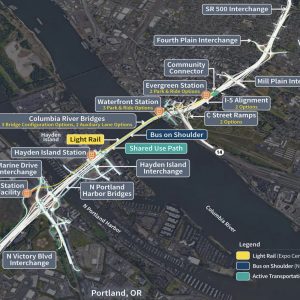
I do think this comment highlights how insidious the branding of this project has been. IBR (“Interstate Bridge Replace”) is a misnomer. It’s more a complete redesign of 5 (or 7?) miles of Interstate 5, which would happen to include a bridge as a part of that very broad scope of work.
You can’t fully decouple the alignment and design of I-5 from the bridge replacement, but the scope of “Interstate Bridge Replacement” does not *have* to include resigning so much of the interstate.
If they trimmed the scope of work down to the bridge, this number would go way down and could happen on a much shorter timeline.
(This is all more clearly discussed in the video, btw TJ)
If ODOT was focused on a safe functional bridge instead of acquiring and distributing the largest amount of money possible, it is likely that we would have or be on track for a bridge. Instead, we have wasted a tremendous amount of time and money with nothing to show for it. The opposition to CRC/ IBR has always proposed crossing options that address safety and functionality. See Just Crossing Alliance or No More Freeways.
I mean this video by Spencer Boomhower describing a better and cheaper alternative is almost 15 years old now: https://vimeo.com/22915646
Sure, we have hundreds of seismically threatened bridges. But the existing spans are totally functional, and there are other ways to get across the river – this isn’t a single point of failure for the entire region. Indeed, more folks use the I-205 bridges than the I-5 bridges today. There’s are several other crossings of the Columbia as well.
So, yes, I support updating this bridge or building a new one, but it’s not magical thinking that the big one may not hit for hundreds of years. Or it may happen before this comment is posted. Seismic risk is difficult to prioritize. Should it be these bridges? Or some buildings? Or other bridges? Or something else?
Generally agree. Re probability: The prediction of a subduction zone earthquake is fairly reliable. Based on the USGS turbidite core samples we know the exact year and approximate magnitude of every quake for 10k years. Hundreds of years would be an outlier in the timeline. There is near certainty it will occur within 100 years.
Do we all owe Joe Cortright a debt of thanks or what? He could be out playing golf and instead he’s pouring over spreadsheets to find out what’s really going on.
Also I loved it that he brought up in the immersed-tube tunnel. So many other maritime cities have tunnels under rivers and harbors. Why not Portland / Vancouver?
We can mostly thank Kotek for canceling tolling (pandering to SUV-brained voters) and our fascist dictator for canceling funding to punish “woke” states.
It’s certainly not an old idea. ODOT simply didn’t consider the tunnel option. Imagine how quiet the Vancouver waterfront and Fort Vancouver would be in comparison.
In fact, they did:
https://www.interstatebridge.org/media/4adjs1jy/ibr-itt-overview-v2_remediated.pdf
https://www.interstatebridge.org/media/zcqf2kdh/itt_exec-summary_remediated.pdf
After last year’s “final nail in the coffin” for the Rose Quarter expansion it is hard to believe that anyone is saying “never.”
We’ve let one man hold up progress for too long.
Well JM is a player, for sure, but is it fair to put it all on him?
Known fabulist and occasional liar Joe Cortright continues to chase his white whale. Here’s the reality.
But what’s the alternative? Another 10 years and another $10 billion. The problem isn’t going away until the bridge falls into the river. So Joe can chase his white whale for the rest of his days, but the real losers are the rest of us who have to continue to endure this until the contracts are finally signed.
Can you please cite specific examples of Joe Cortright presenting false or misleading information? I have yet to run across any.
Never is a strong word without any evidence.
Indeed you can. As it was done in Vancouver BC and dozens of other cities.
Except they have rejected the height consistently since June 2022 for the proposed project. ODOT has not studied a drawbridge because they assumed the Coast Guard would change their minds.
This does not refer to the various modes (e.g., bikes, rail) and related purposes included in the project. It refers to the >20 freeway projects (cost >10 billion) that are largely unrelated to the bridge (cost ~2 billion).
1) One alternative would be just a simple bridge. That would cost around 2 billion (in comparison with the (12-17 billion the current project costs).
2) Another alternative would be a tunnel, with repurposing the old bridges.
These are both reasonable, cost-effective solutions that focus on the actual need: allowing different modes to cross the river.