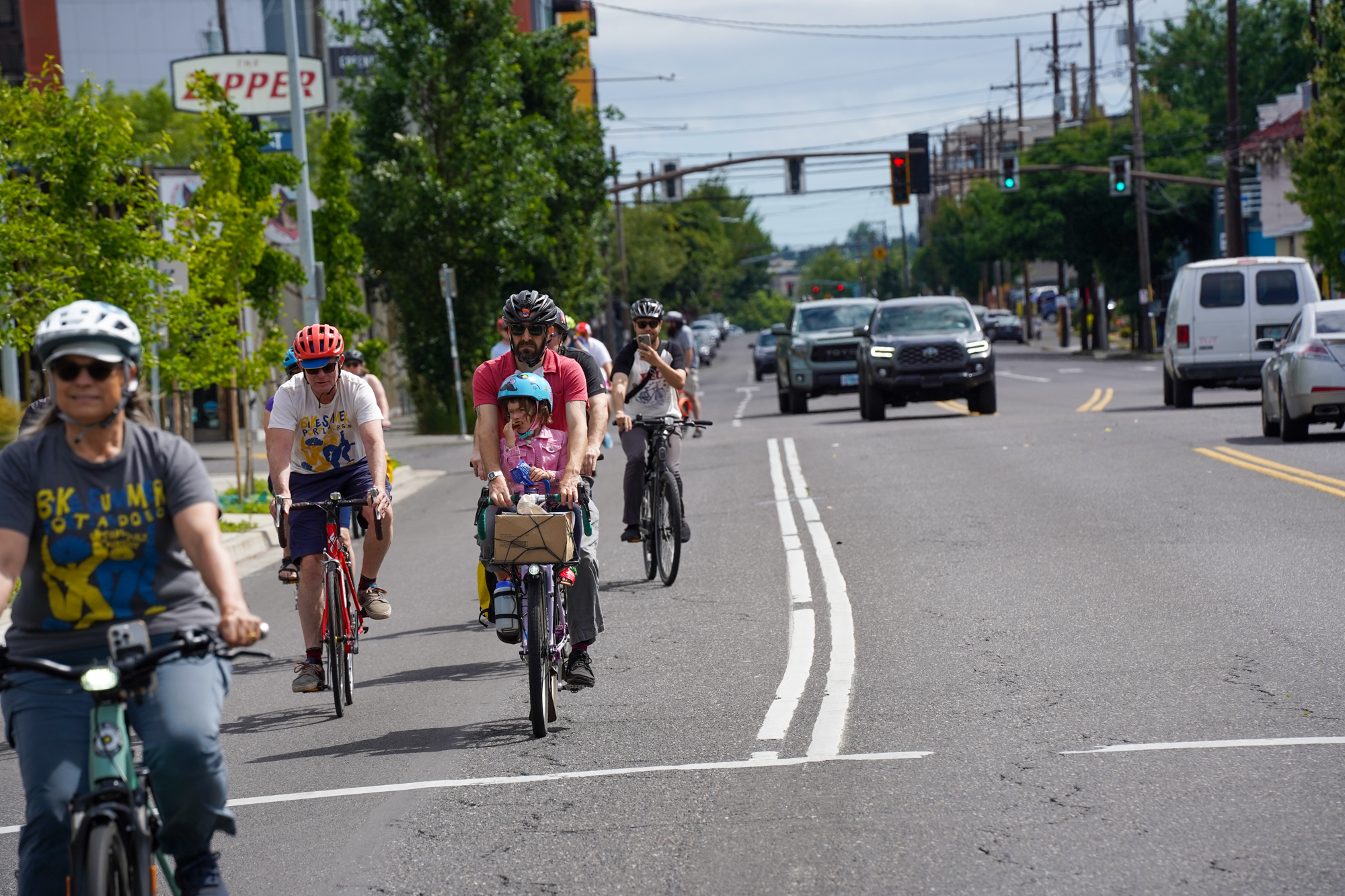
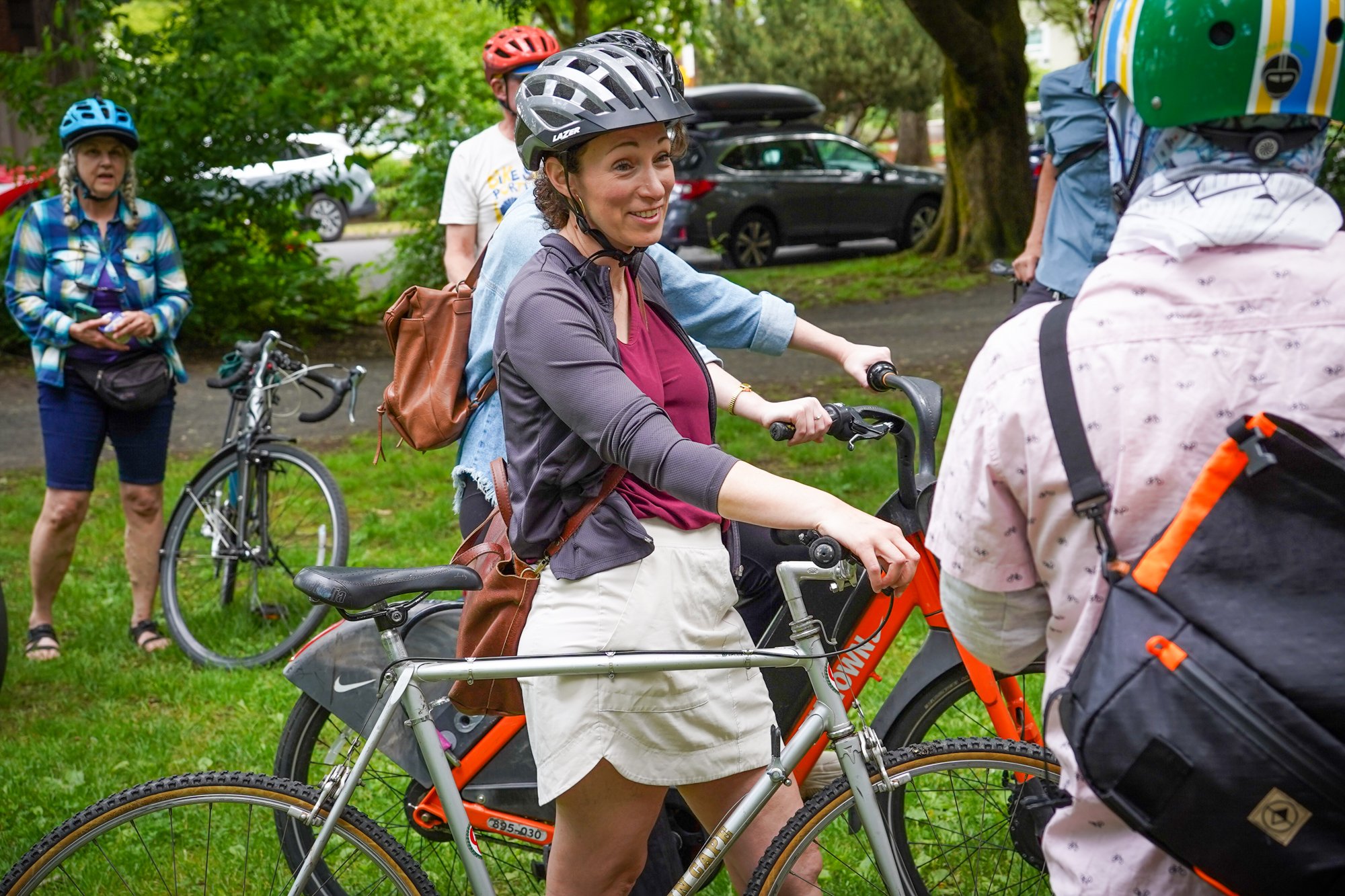
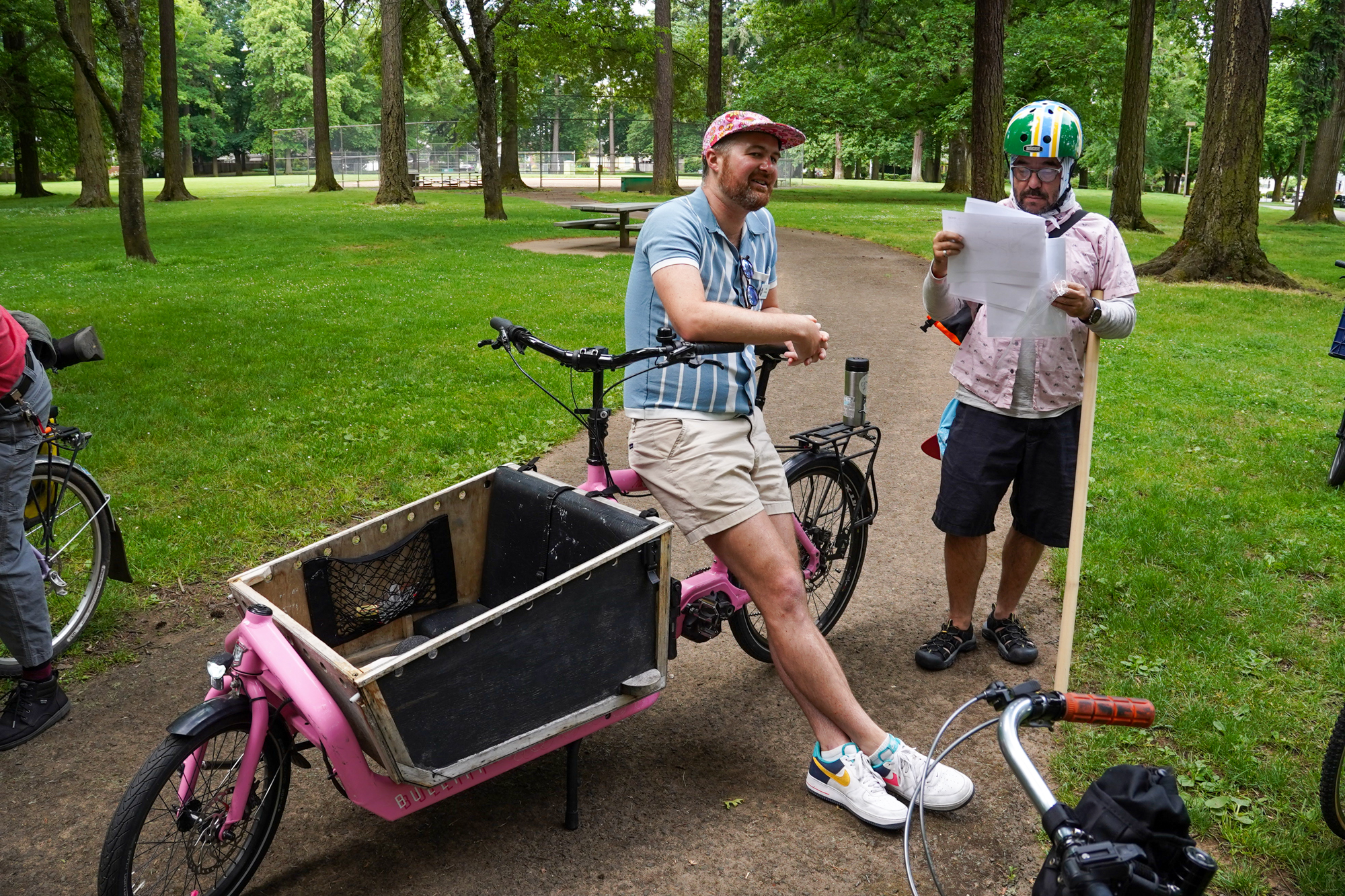
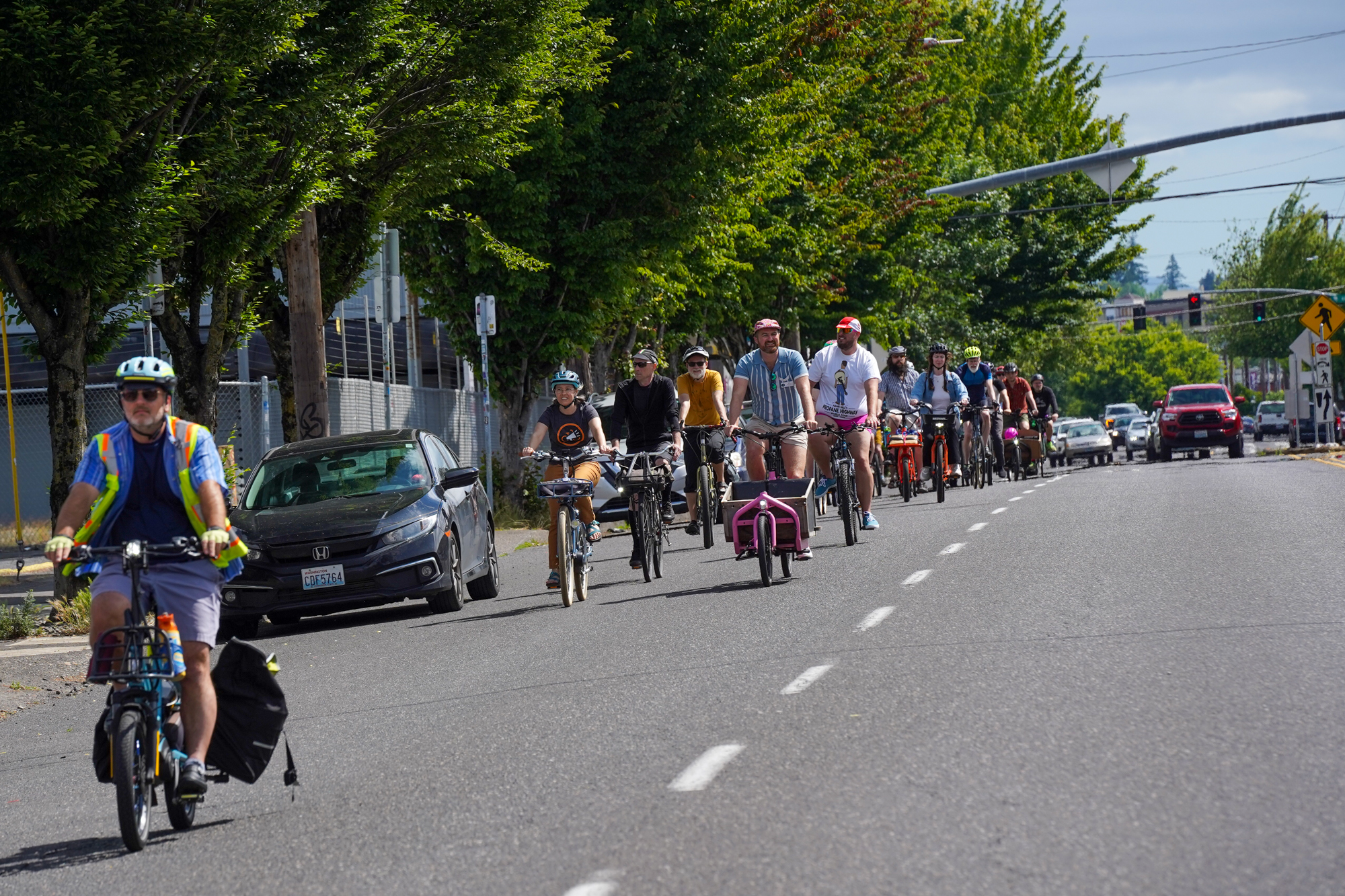
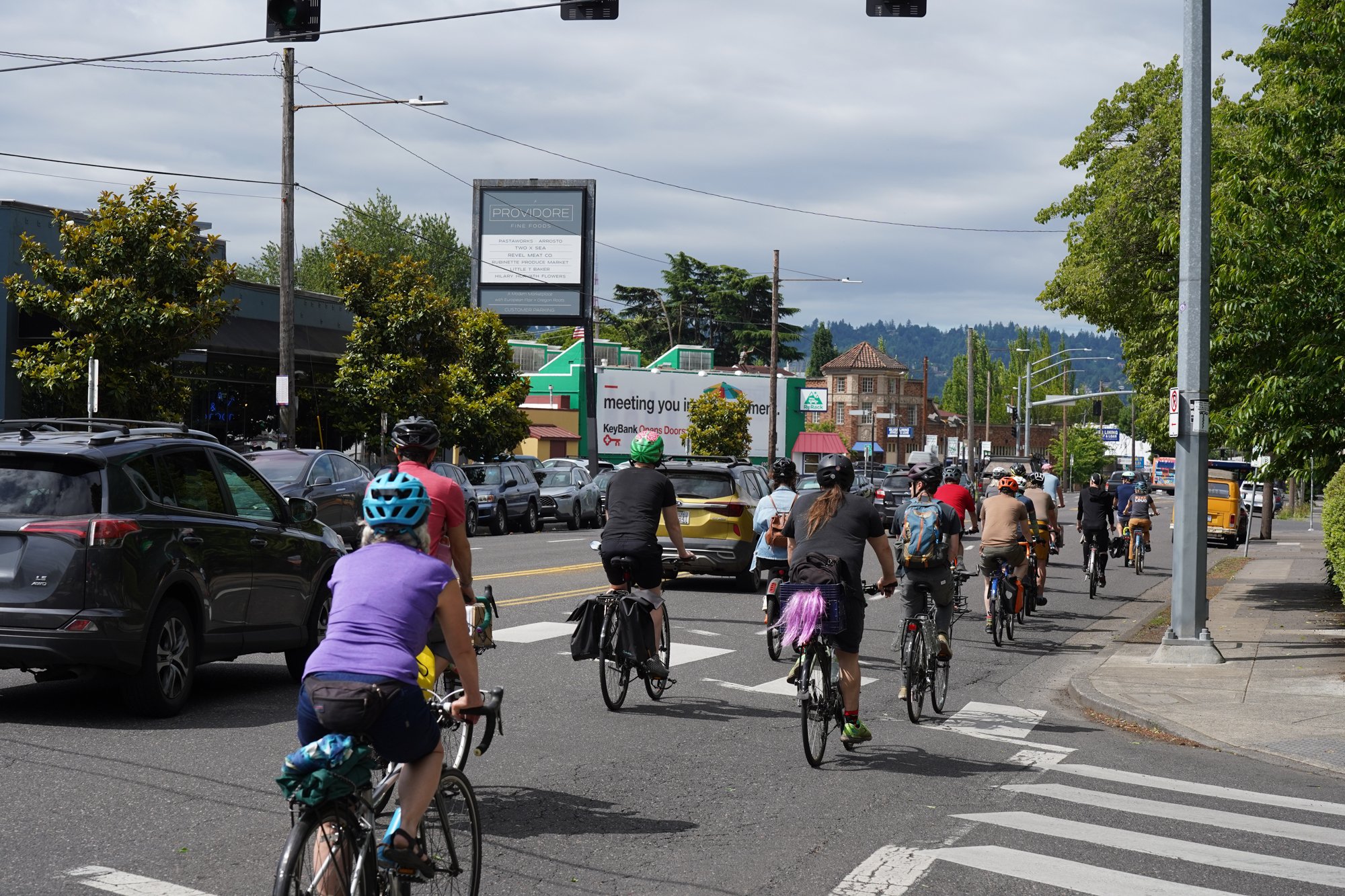
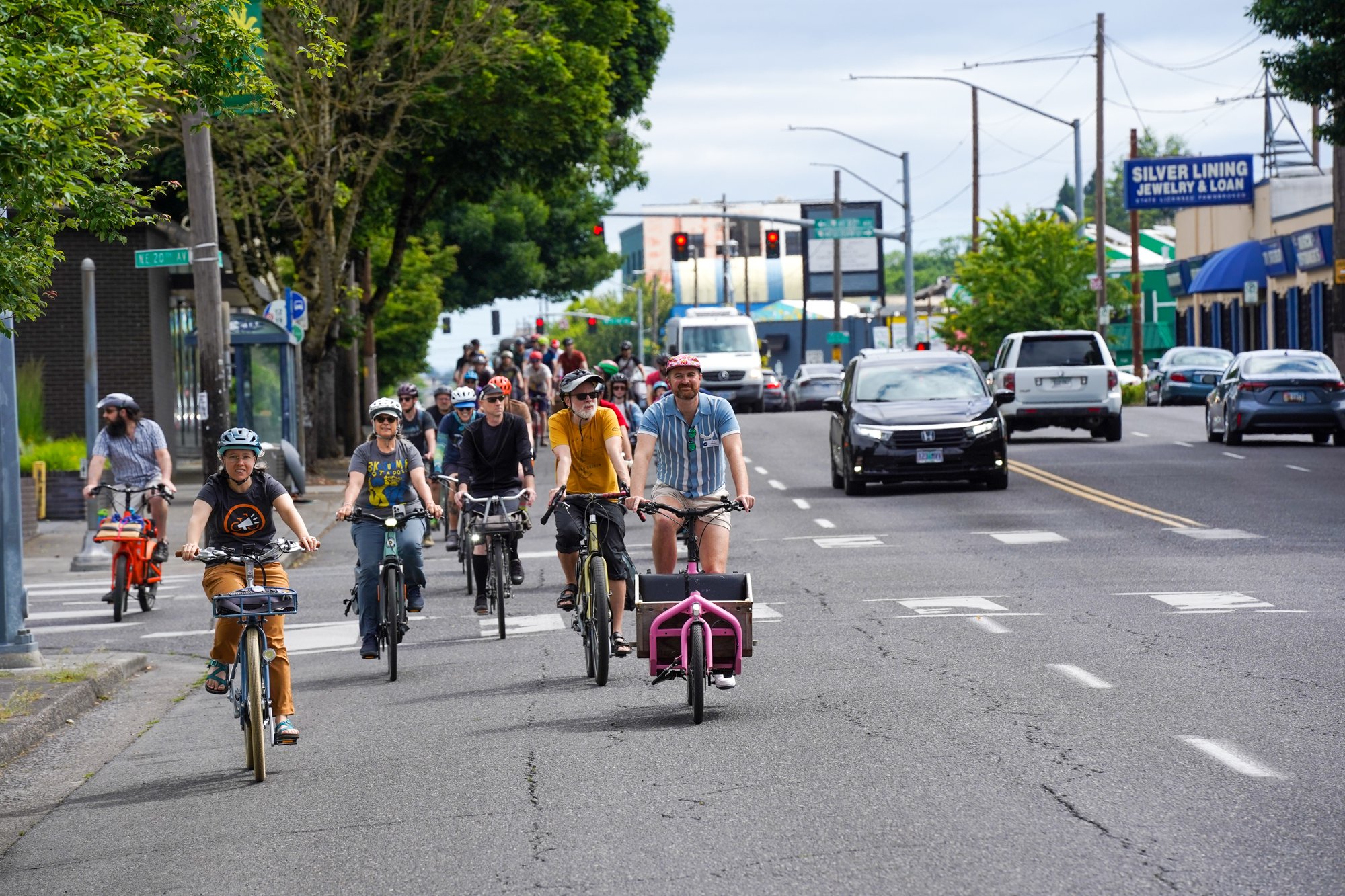
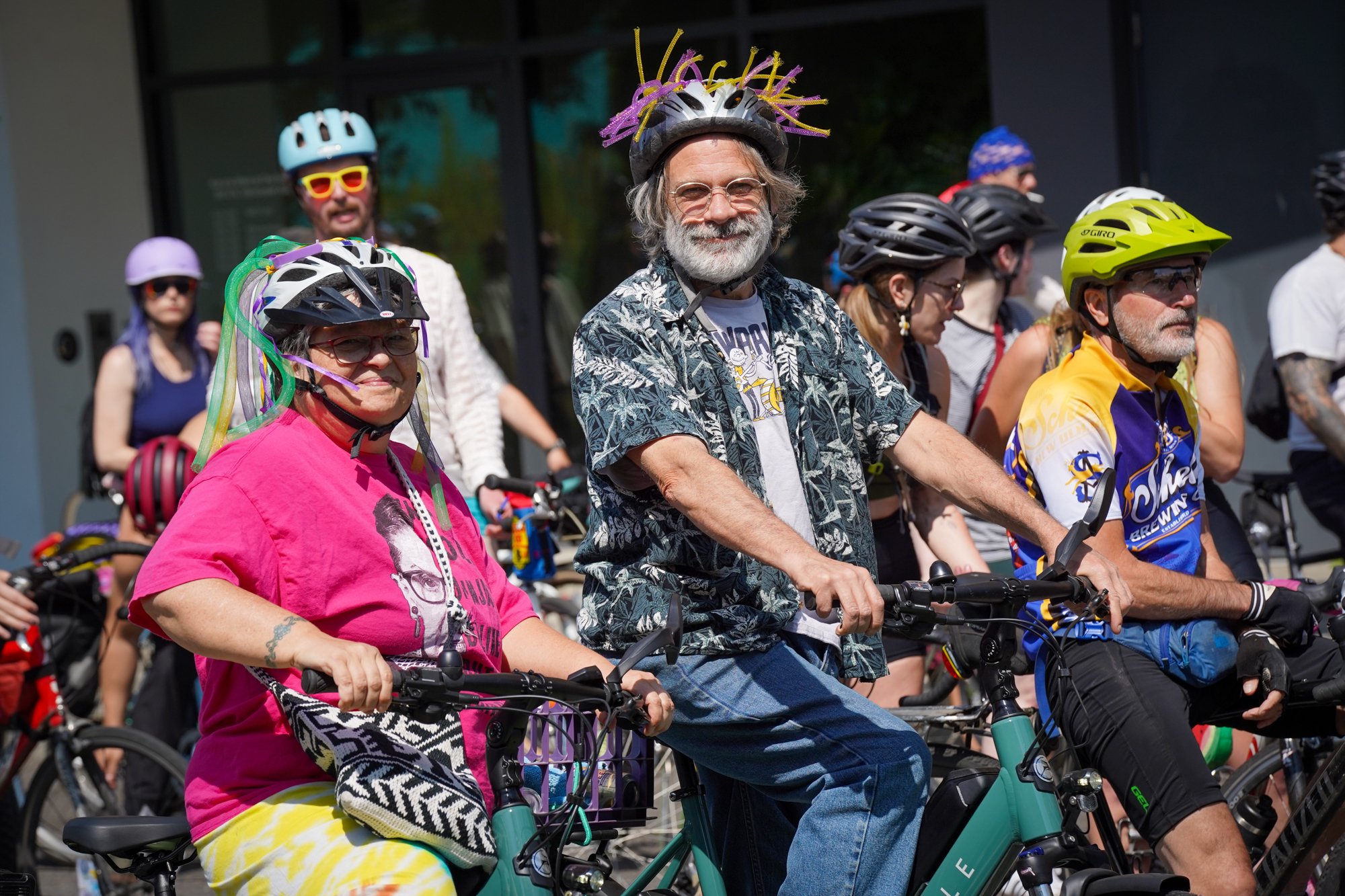
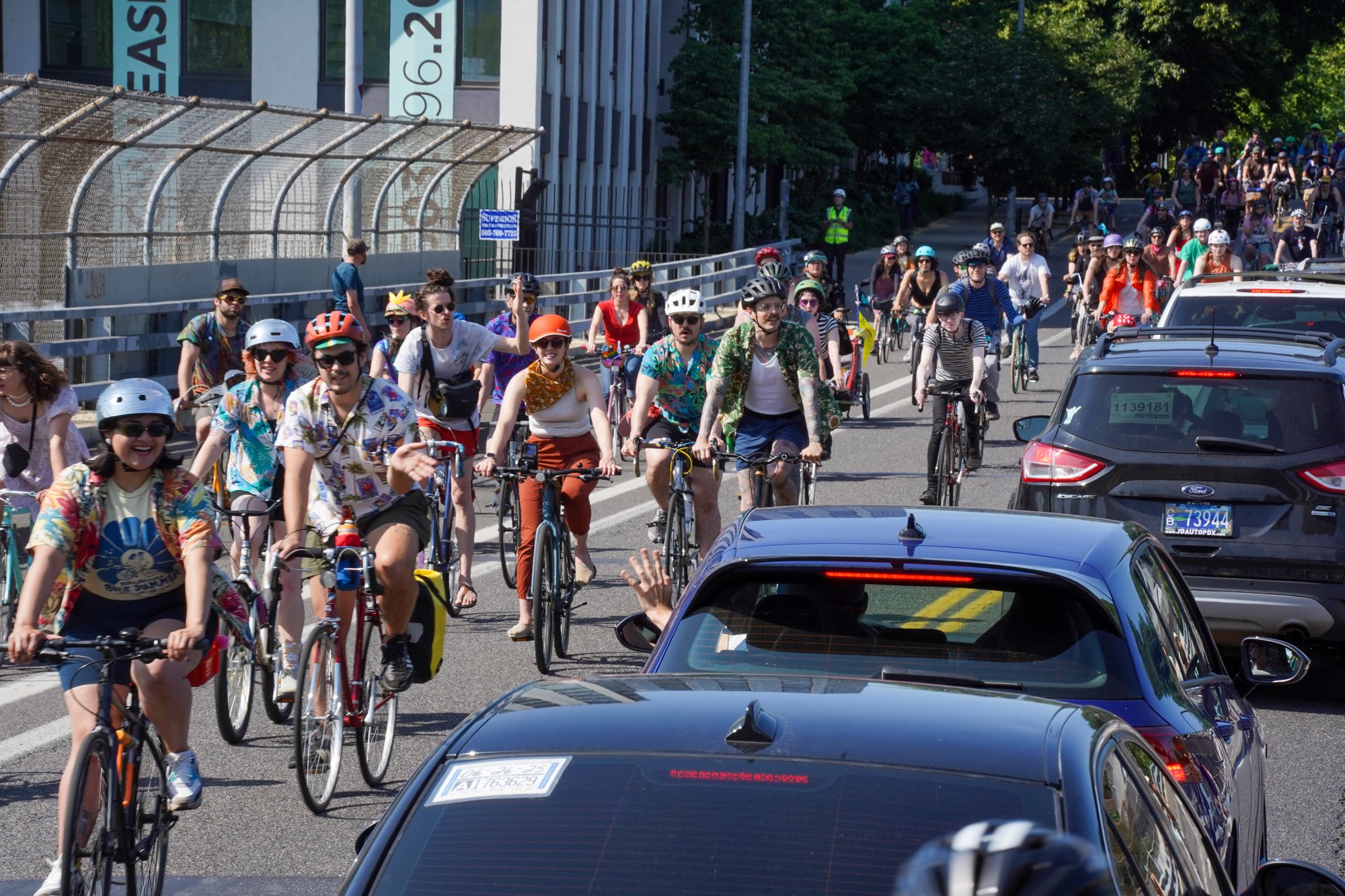
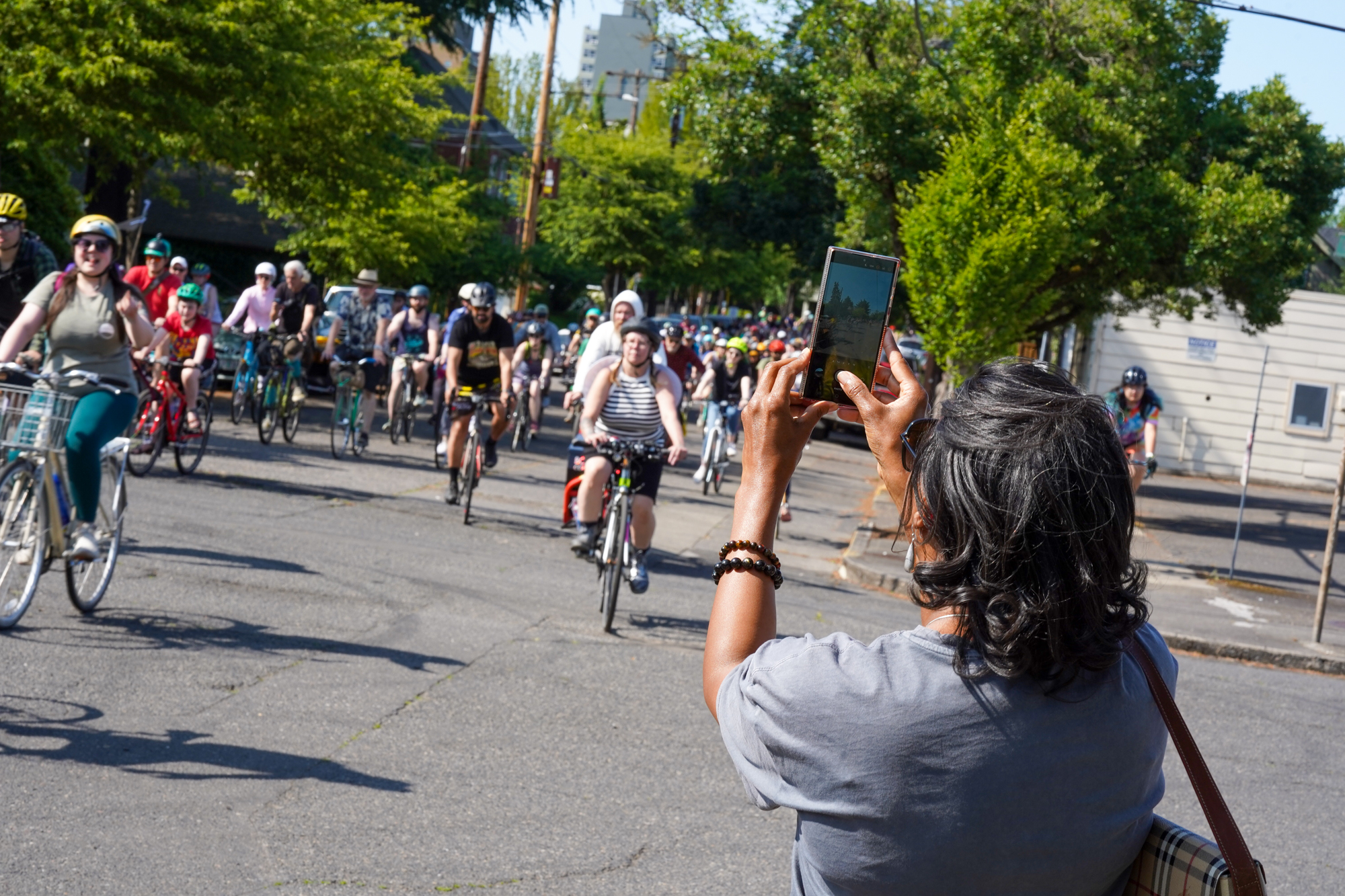
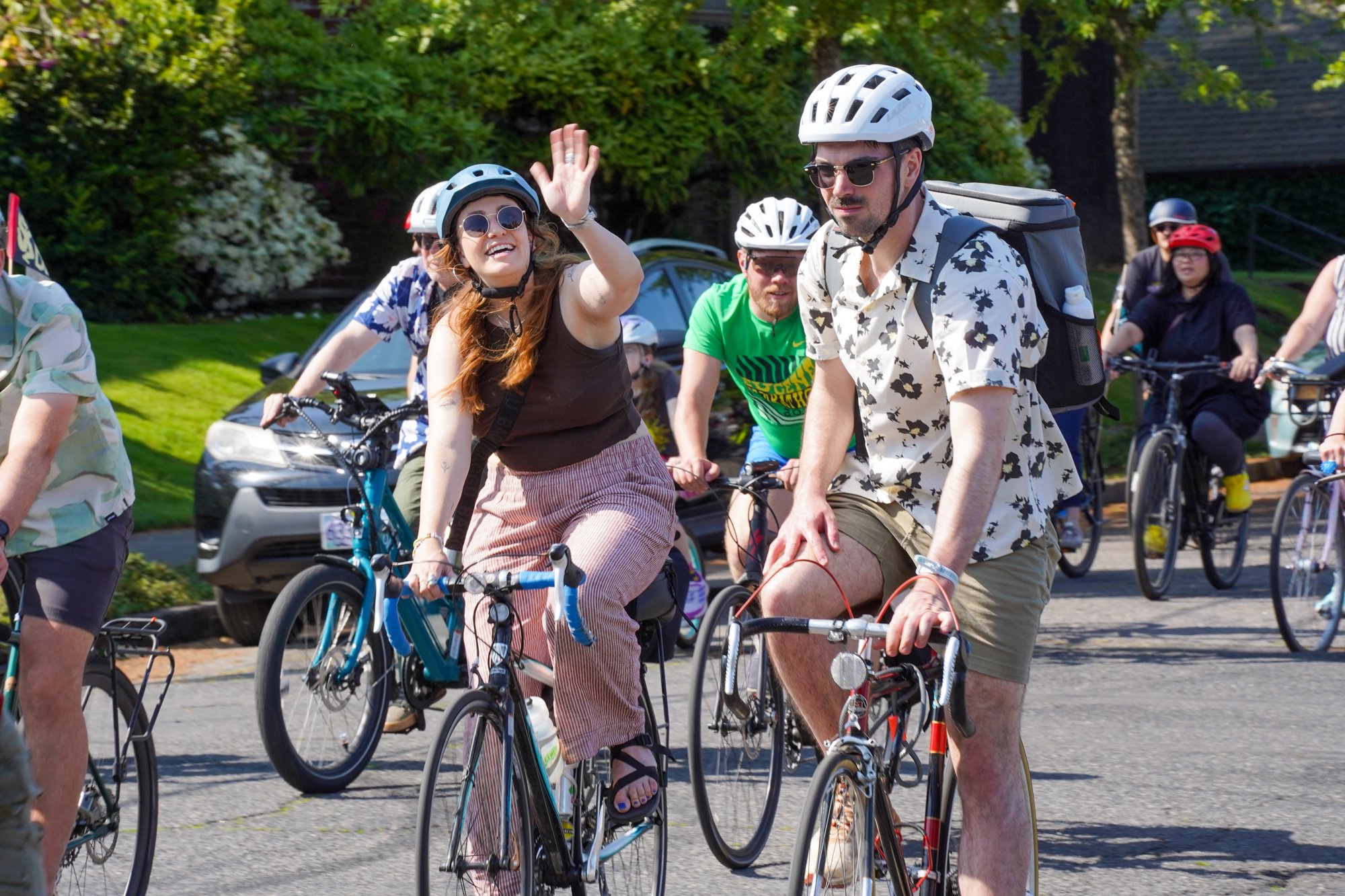
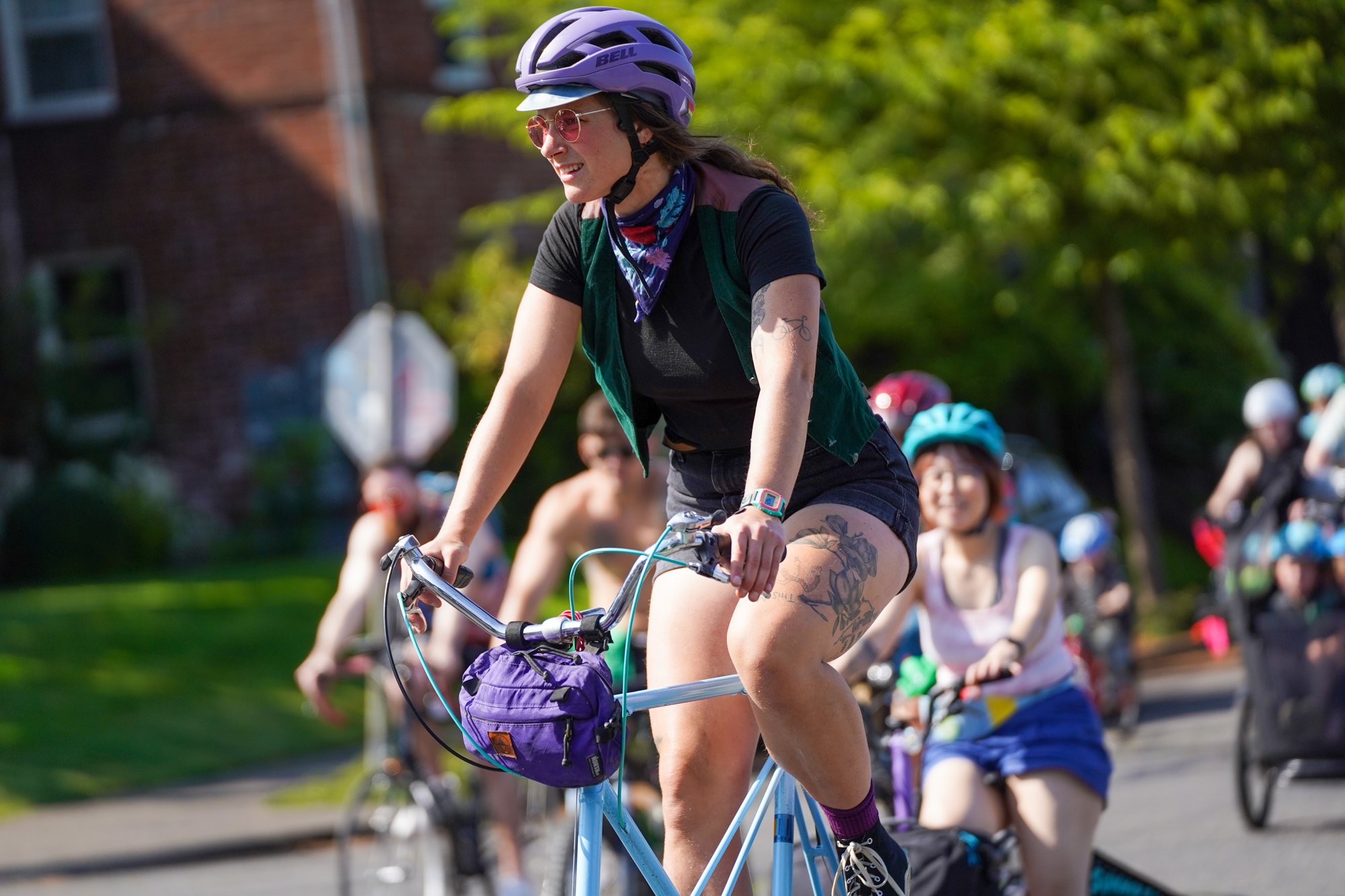
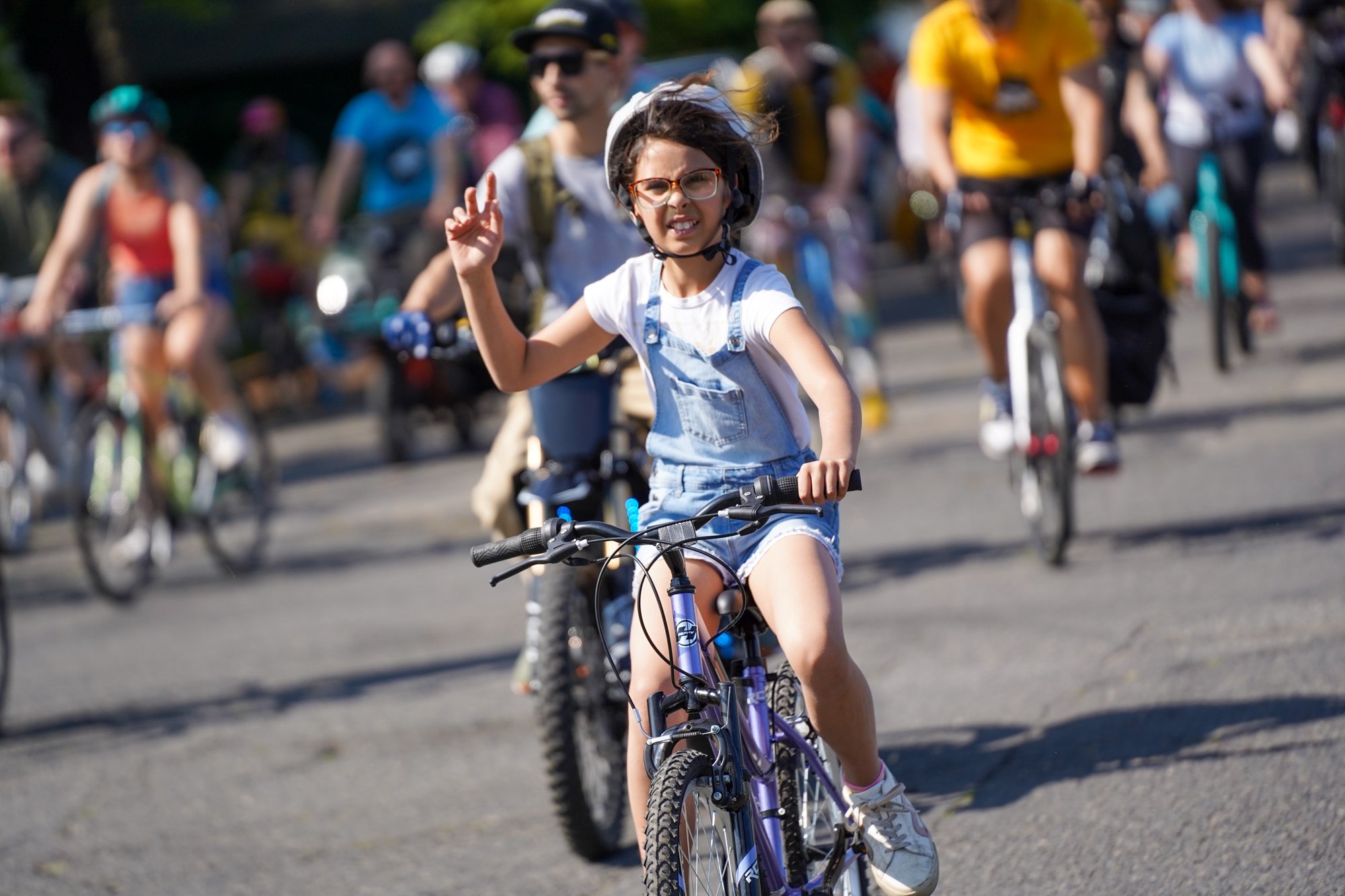
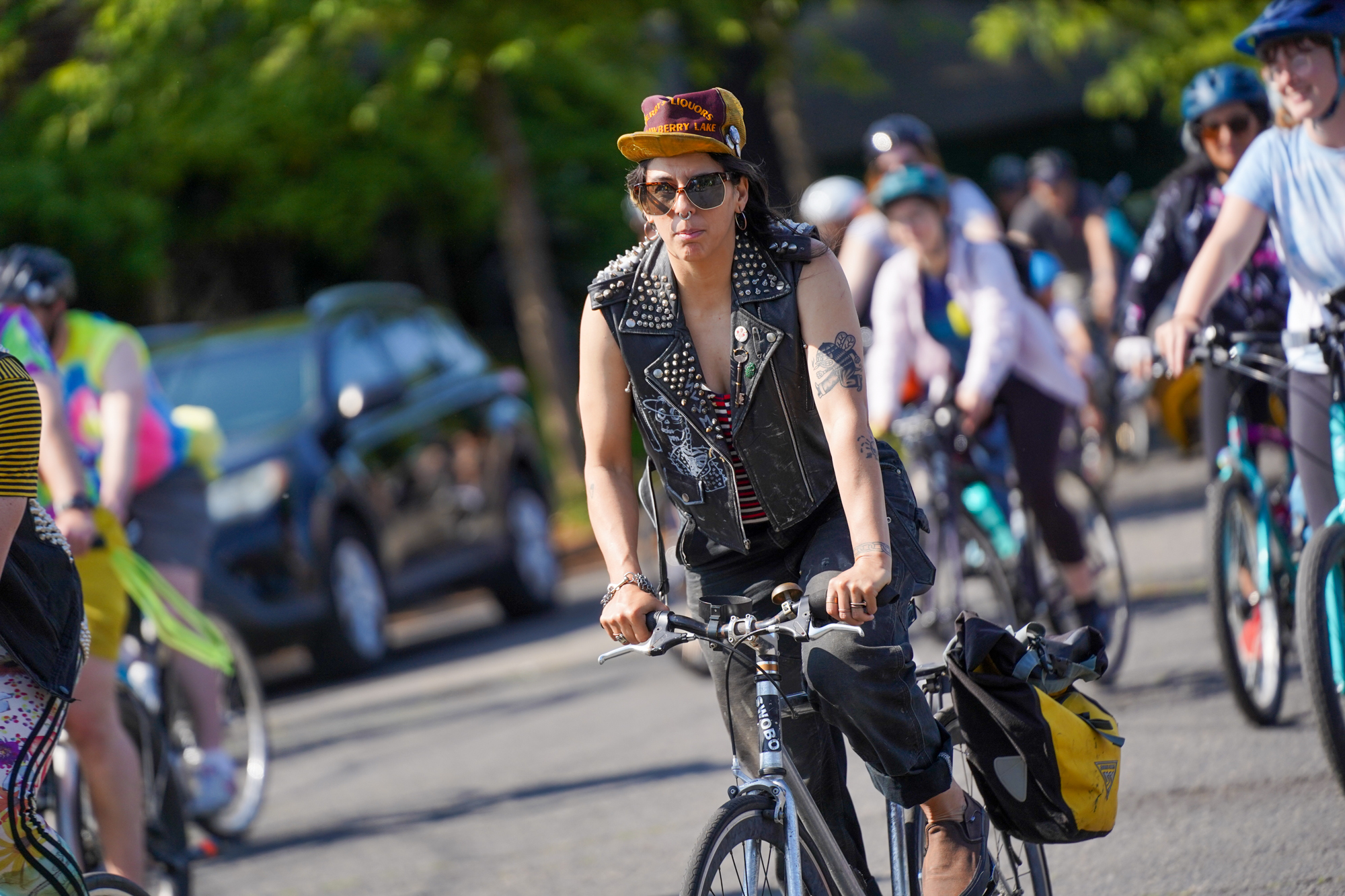
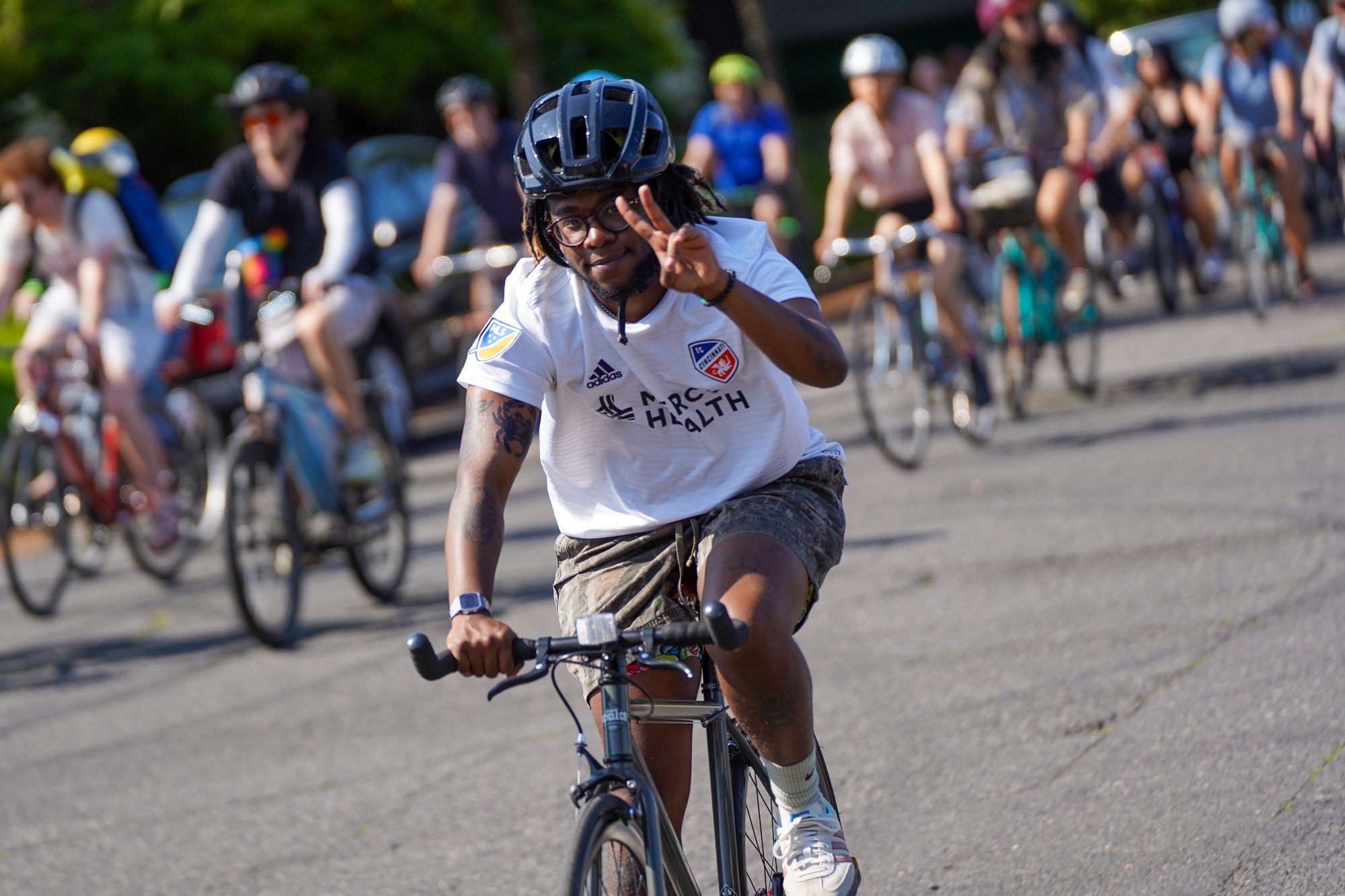
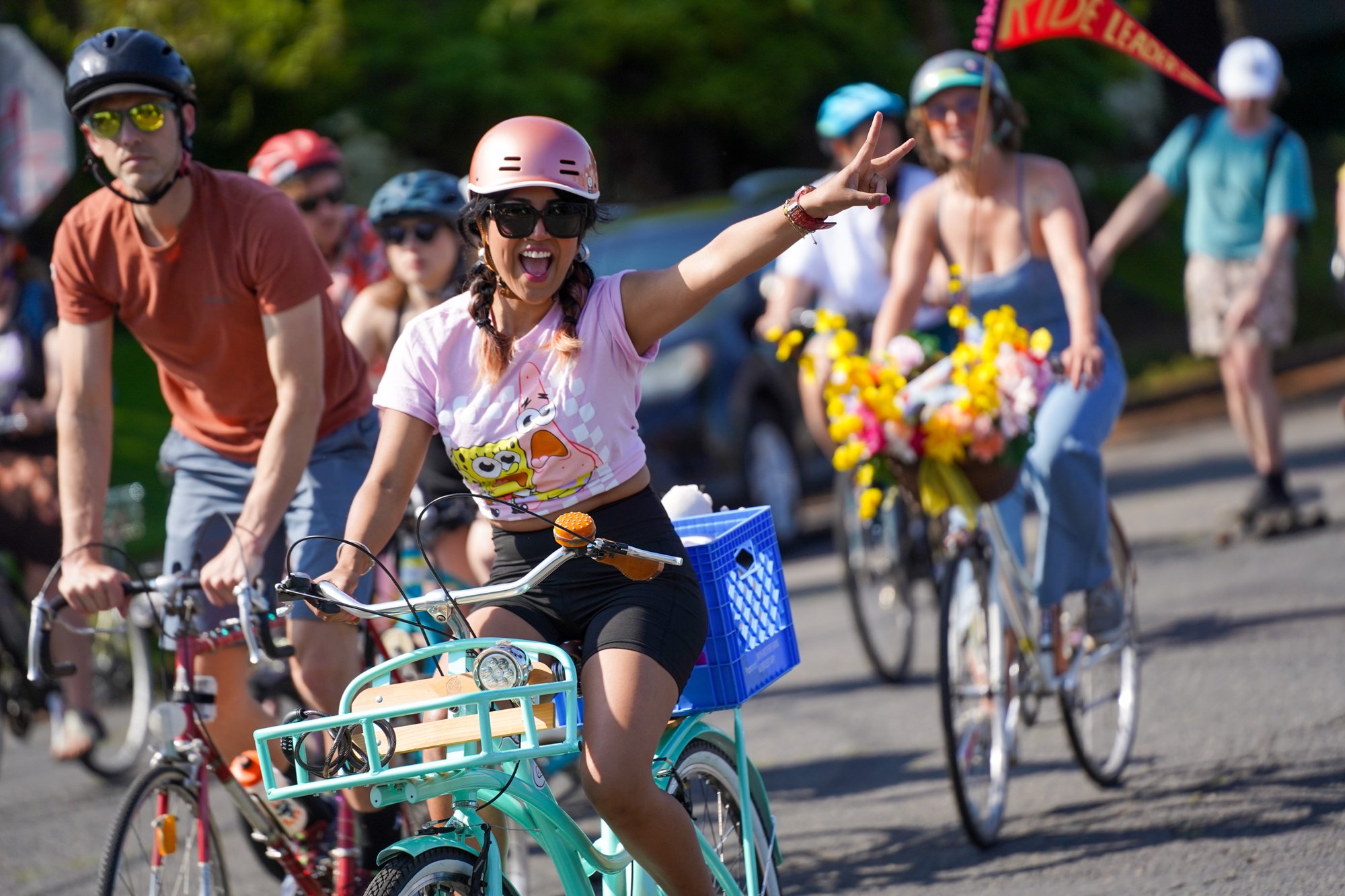
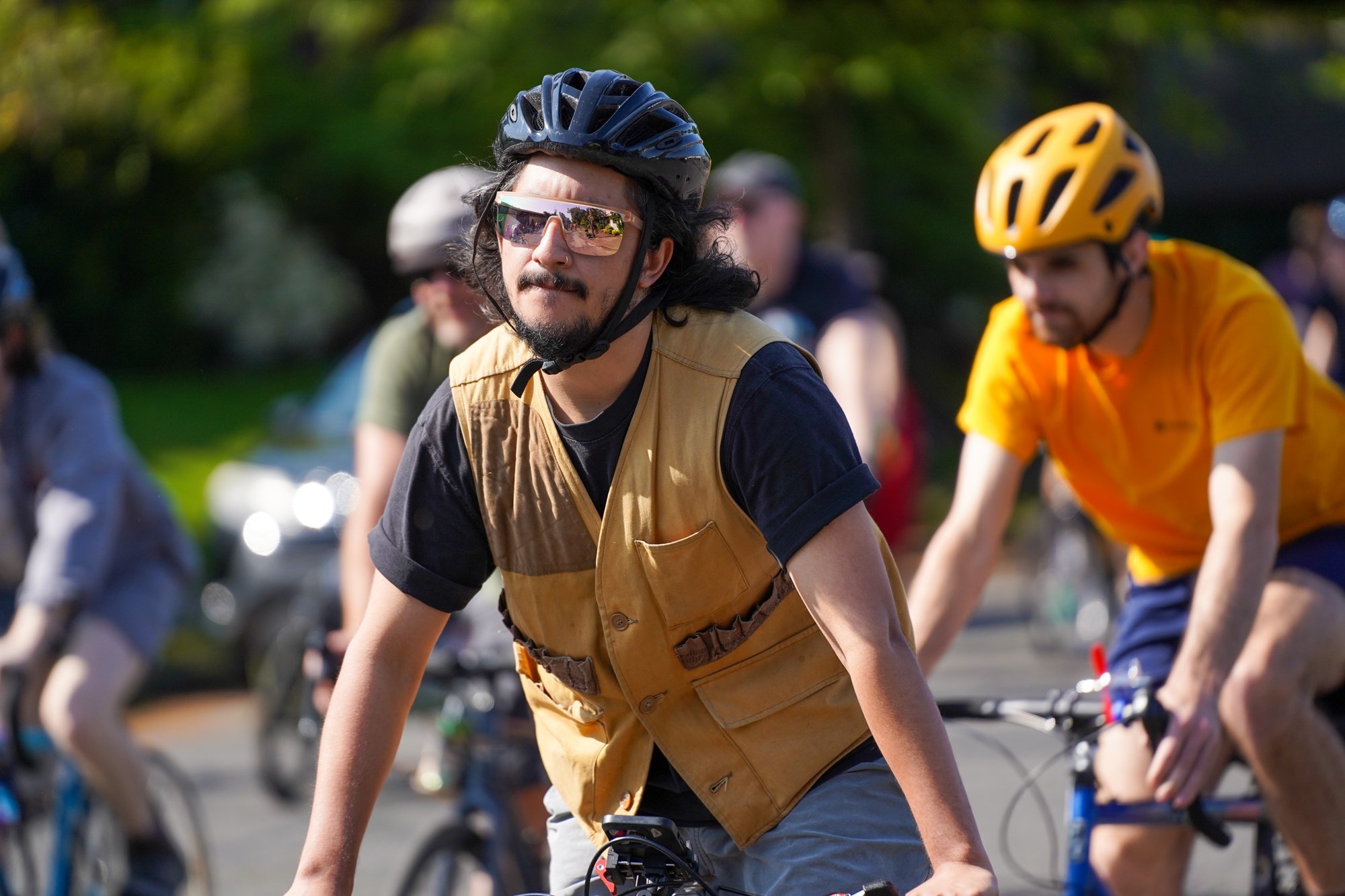
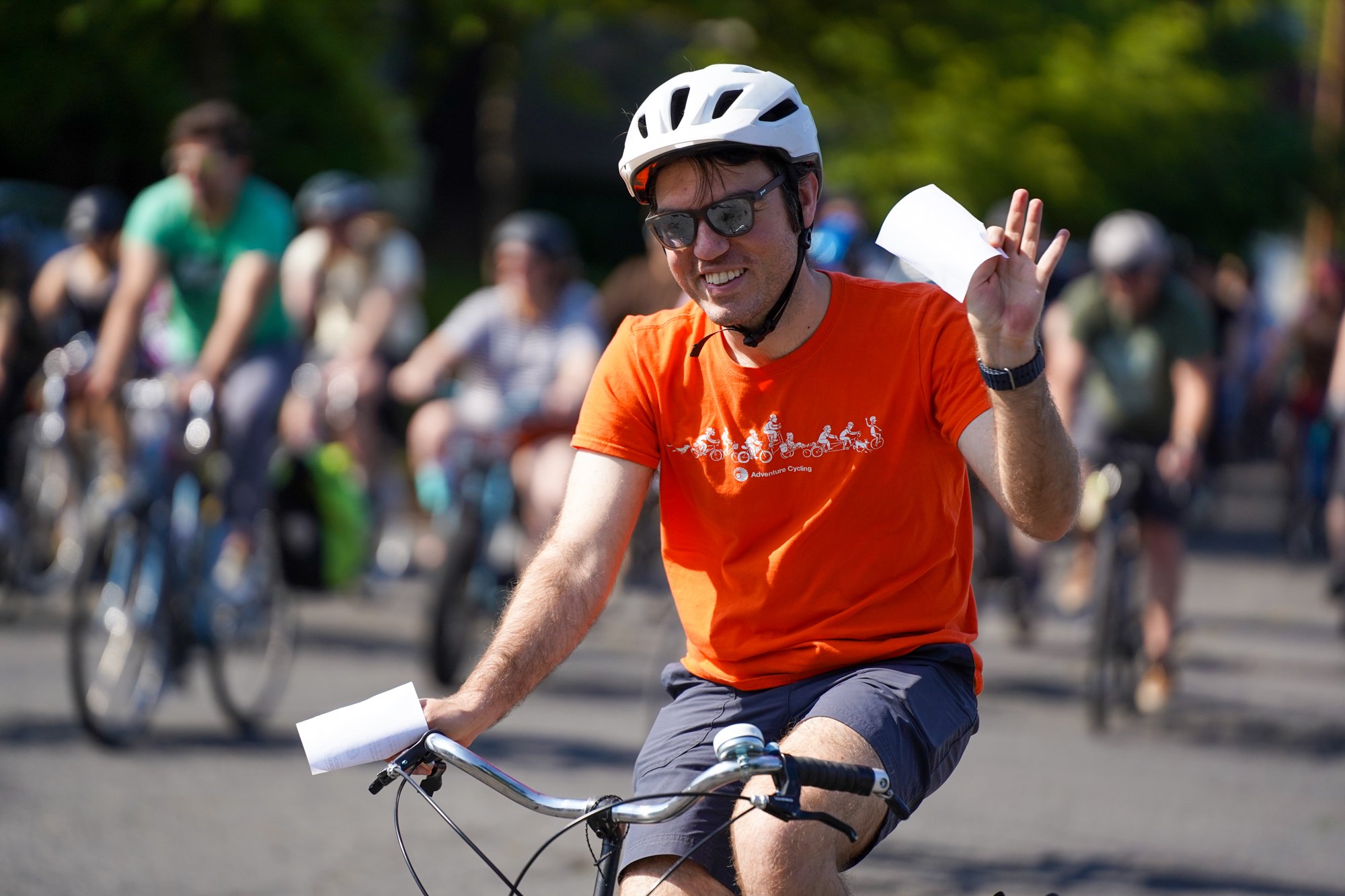
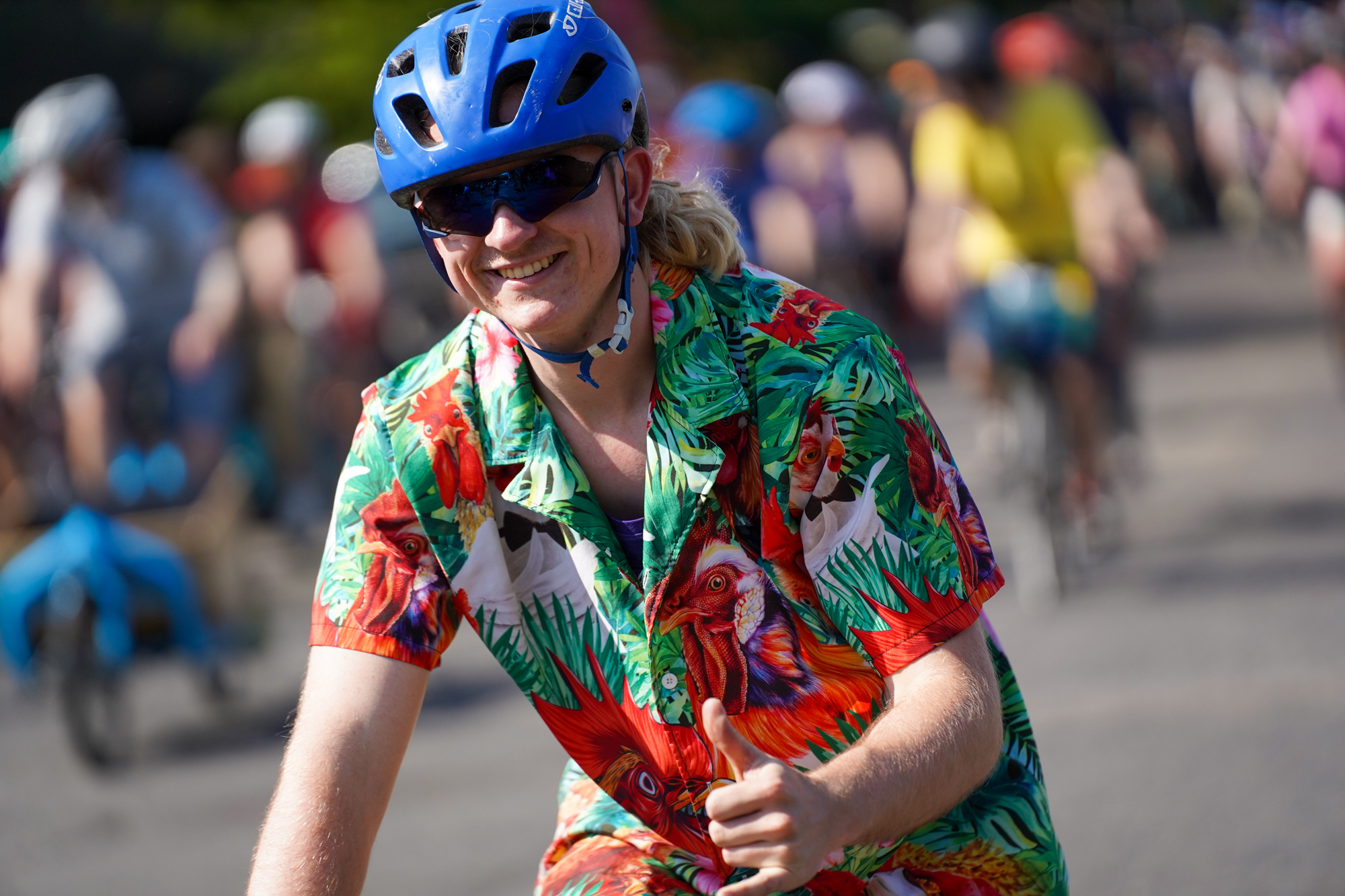
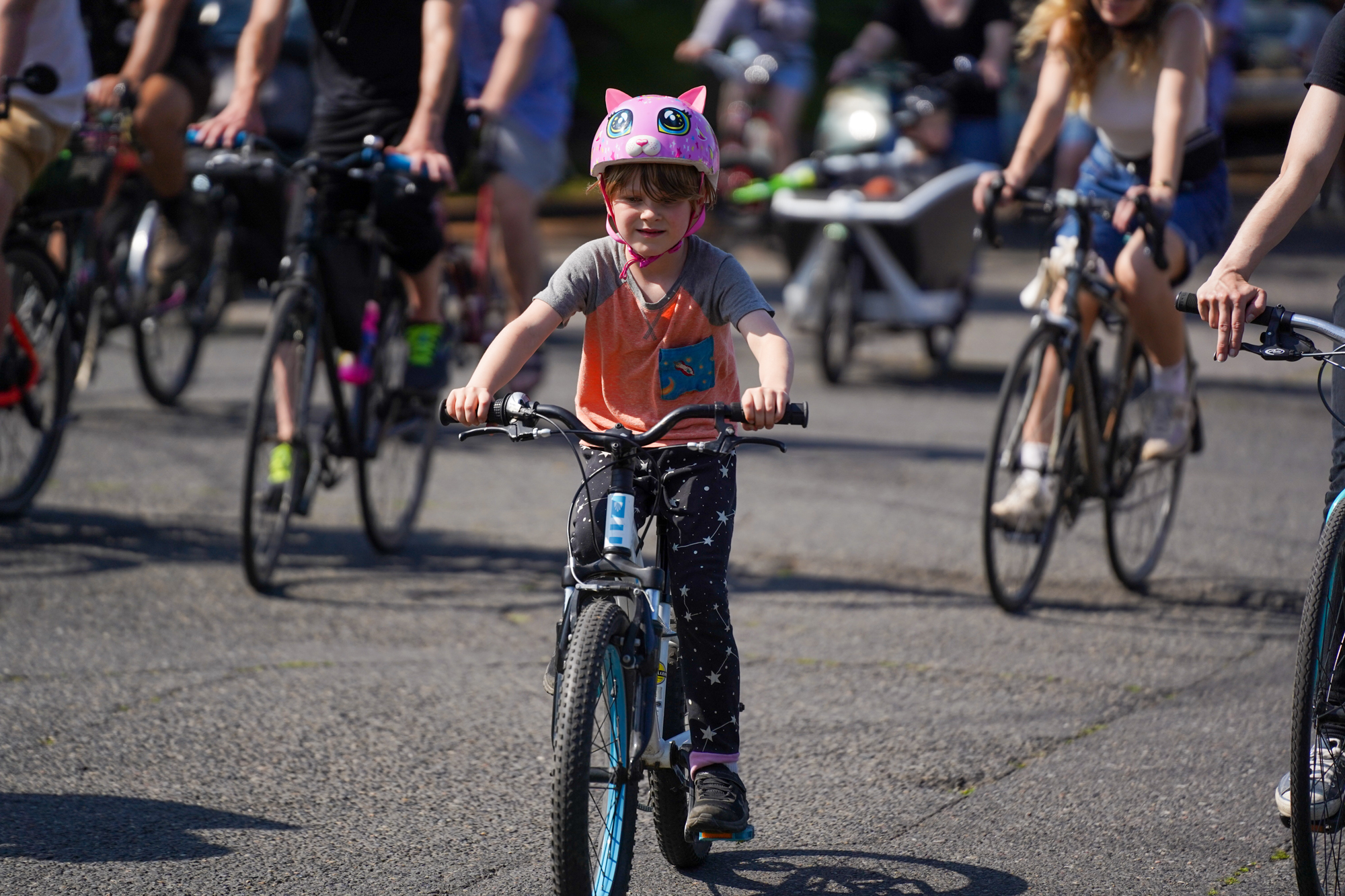
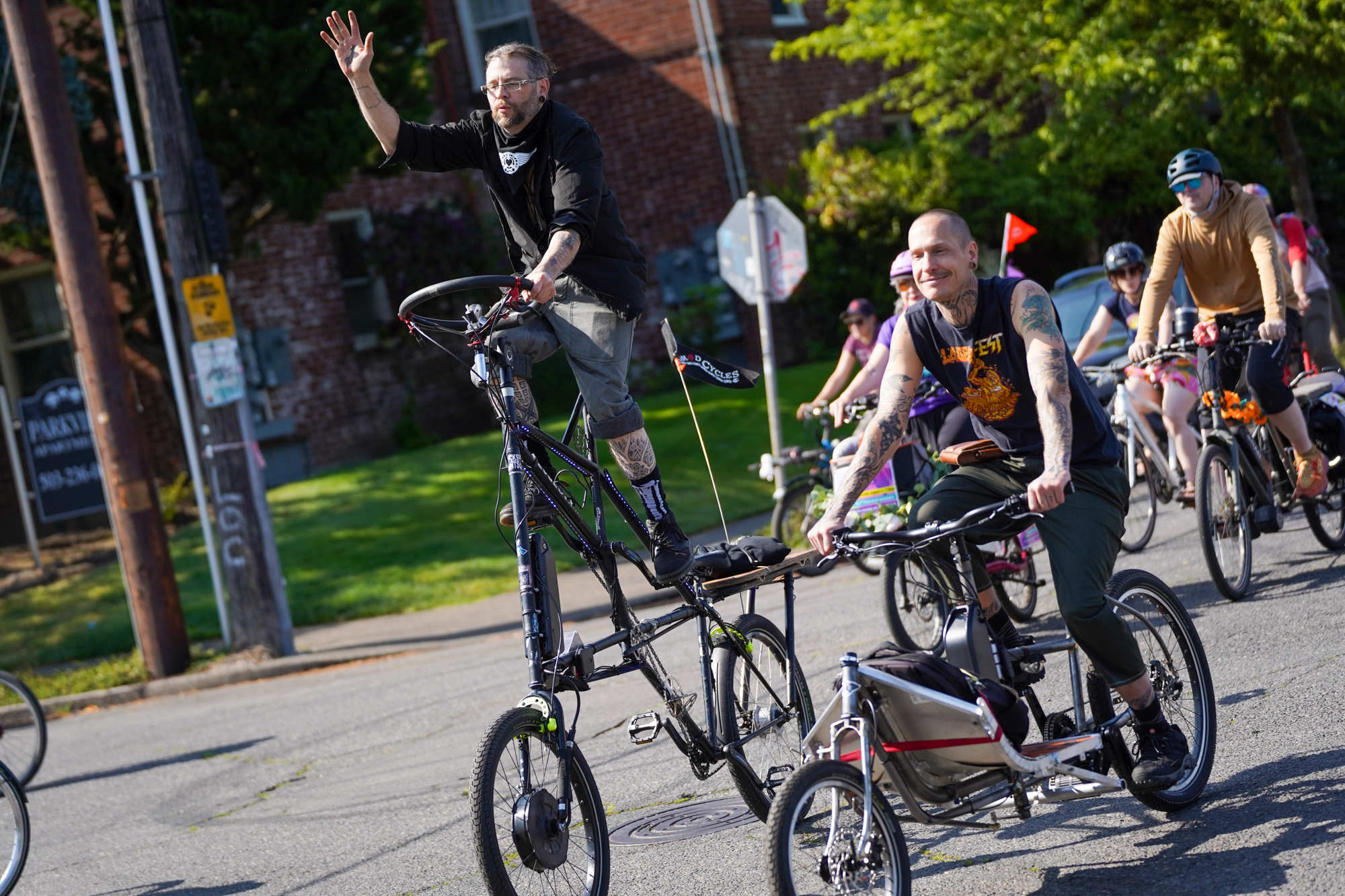
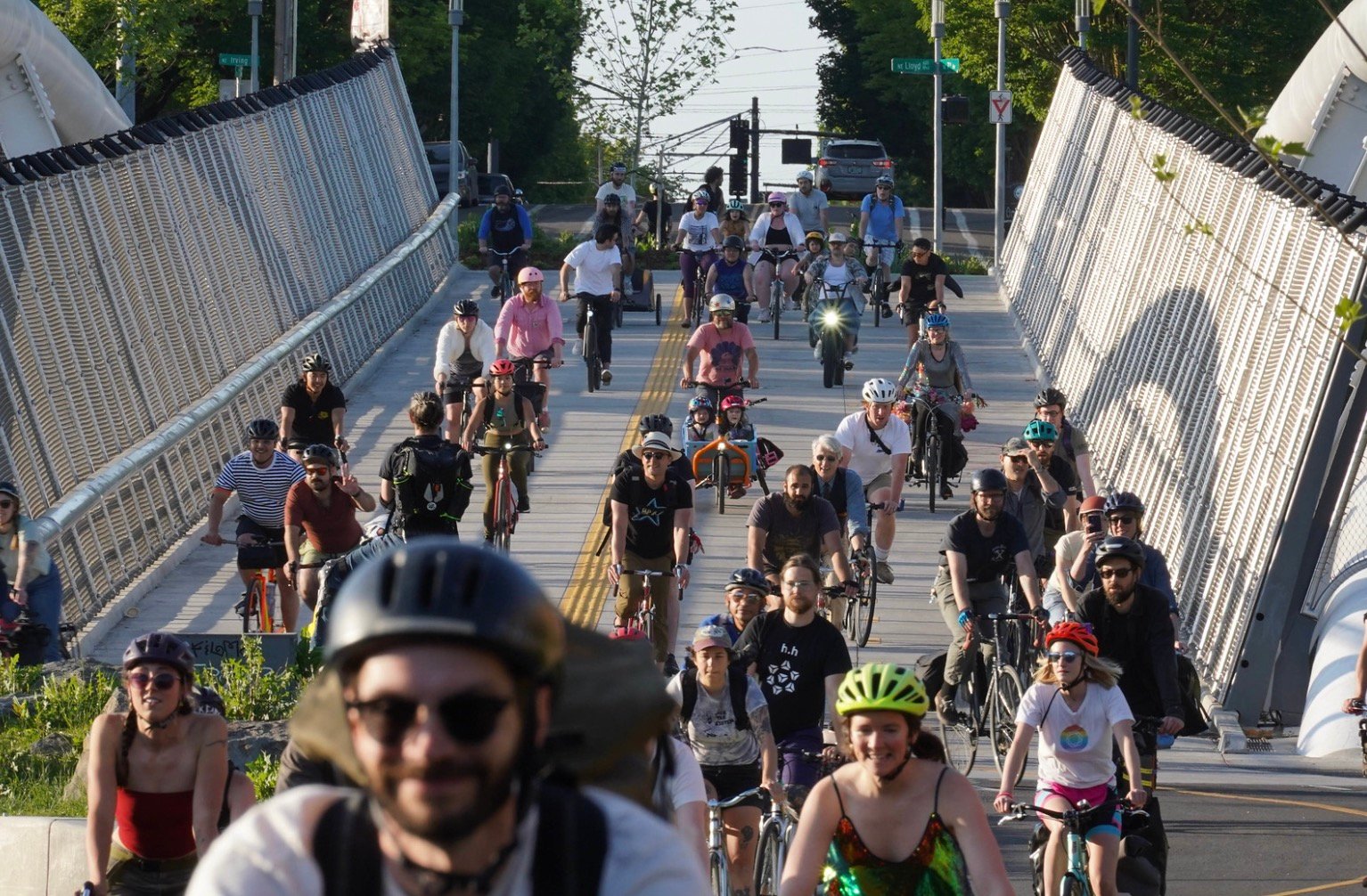
We’re back on SE Ankeny! (Photo: Jonathan Maus/BikePortland)
It’s our first Bike Happy Hour of Bike Summer, and it’s going to be a fun one!
Along with the usual great food, drinks, and merriment, we’ll have a special musical guest and I’ll sit down with a local lawyer to talk about a few pressing issues regarding electric bikes.
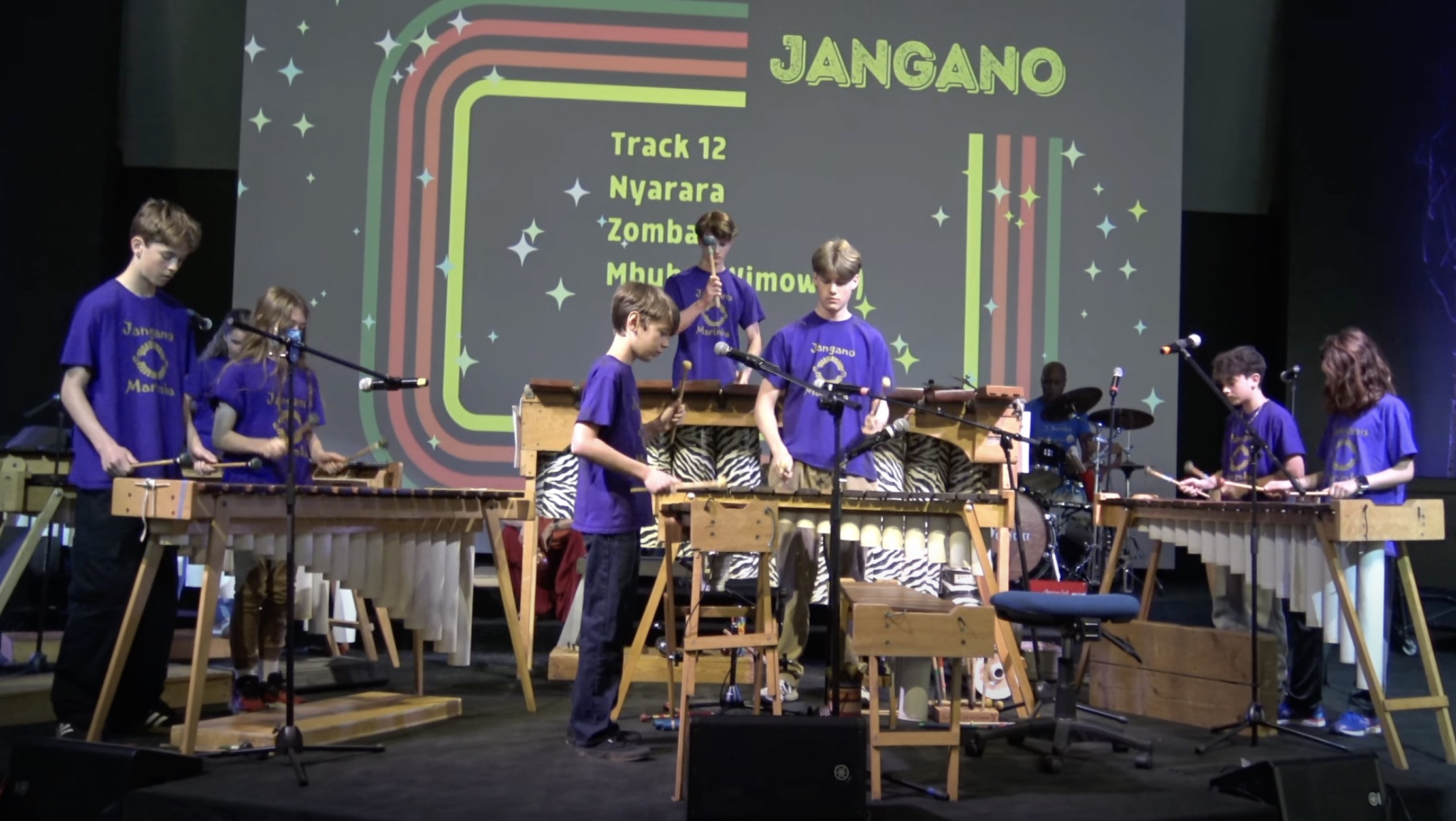
First up, we’ll be joined by Jangano, a youth marimba band that specializes in the music of Zimbabwe and South Africa. The band consists of eight local middle and high schoolers. They’ll set up on the redwood stage in the public plaza right next to Gorges Beer Co. Please come between 4:30 and 5:30 to see them play! For a taste of what to expect, see this recent performance on YouTube.
And then after announcements and open mic around 5:30 or so, I’ll chat with Chris Thomas, a bike law expert from Portland-based Thomas, Coon, Newton & Frost. Thomas’ firm wrote the book on Oregon e-bike laws and he’ll share what type of cases he’s seen and what you should know if you ride an e-bike. I’ll open it up for Q & A as time permits, so bring your bike law questions!
Hope you can join us. The weather should be spectacular. See you on Wednesday (6/4) in the Rainbow Road plaza outside Gorges Beer Co from 3:00 to 6:00 pm (at least).
[Video and photos (see gallery below) by Jonathan Maus/BikePortland]
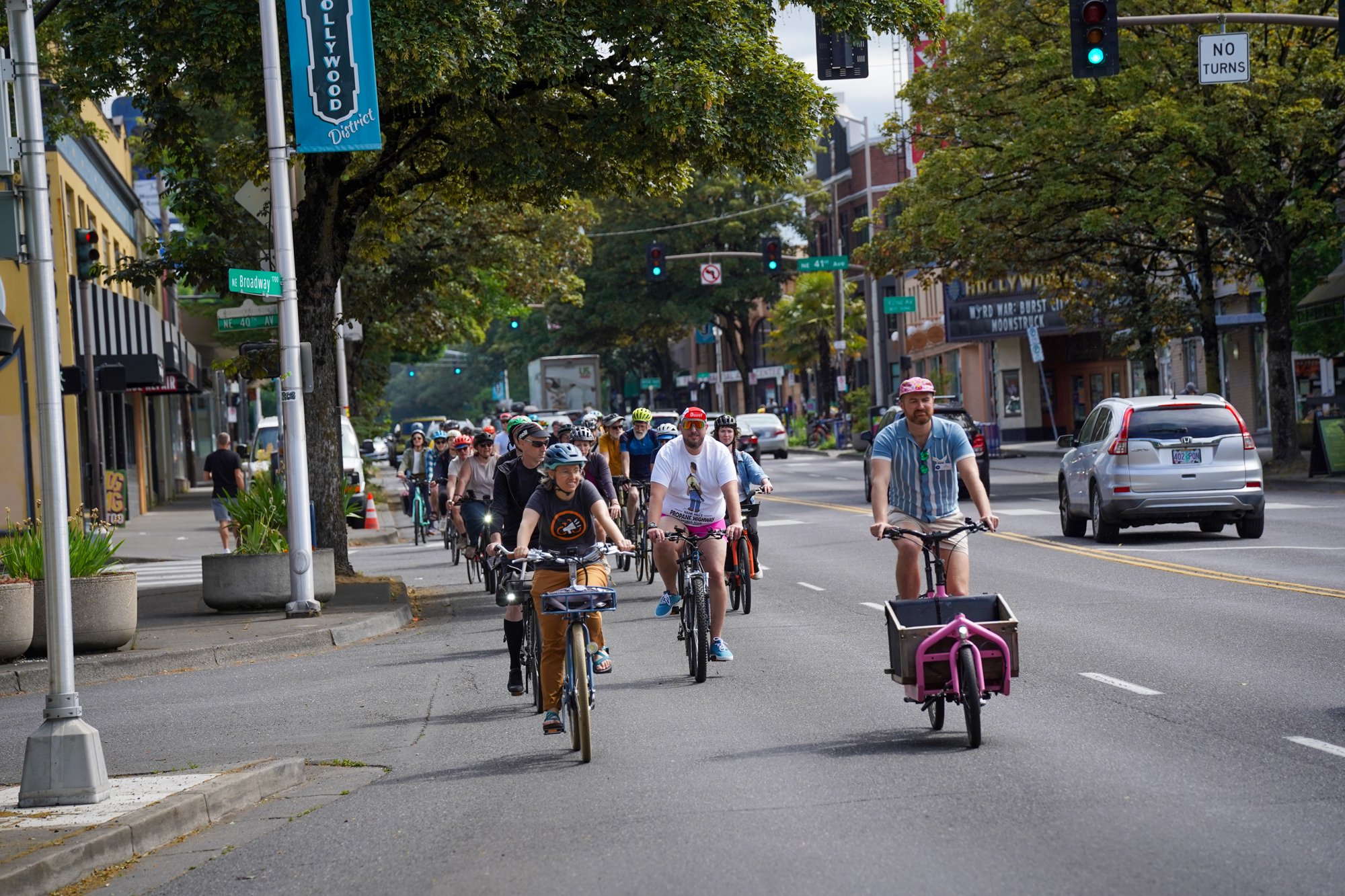
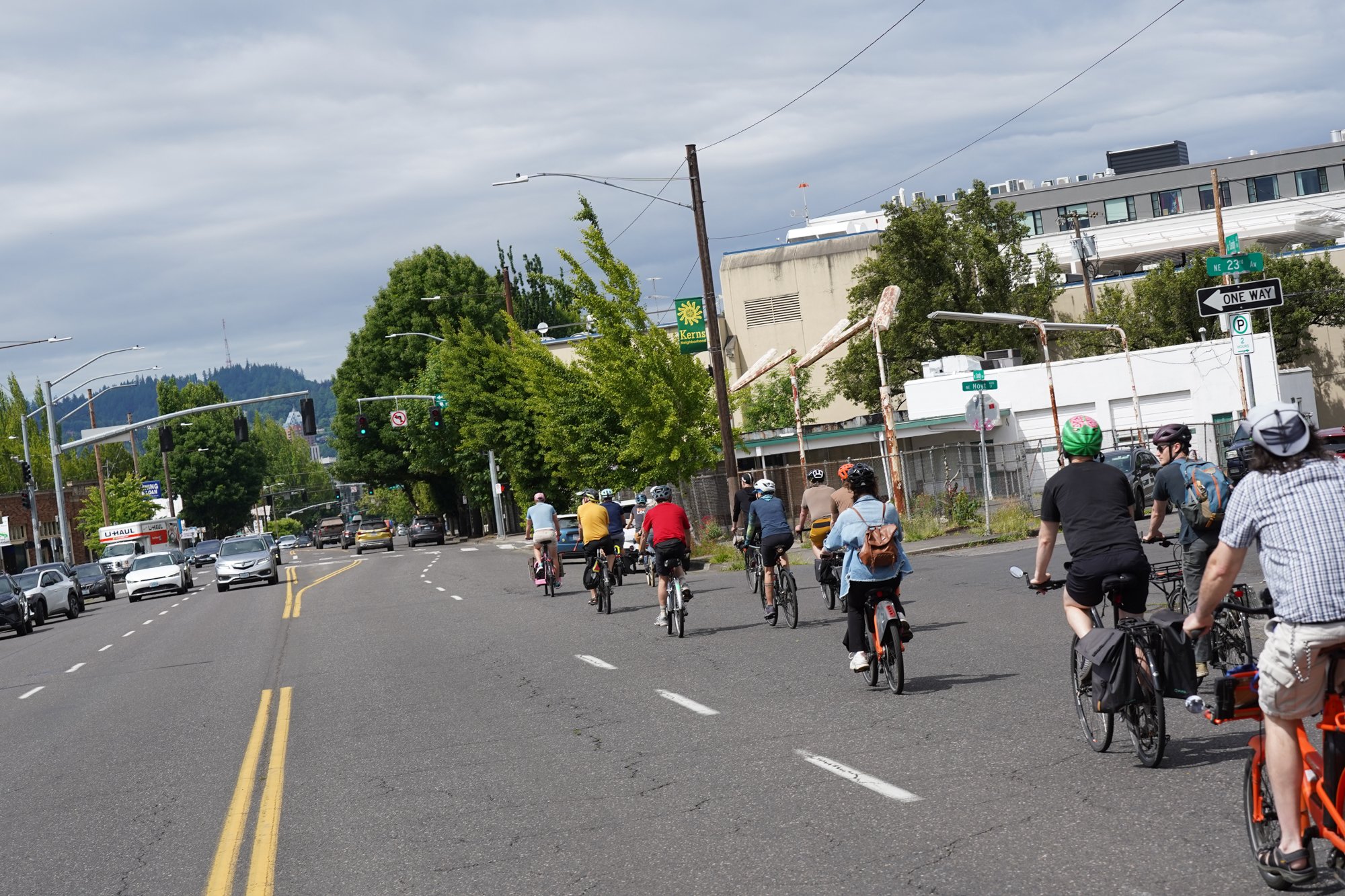
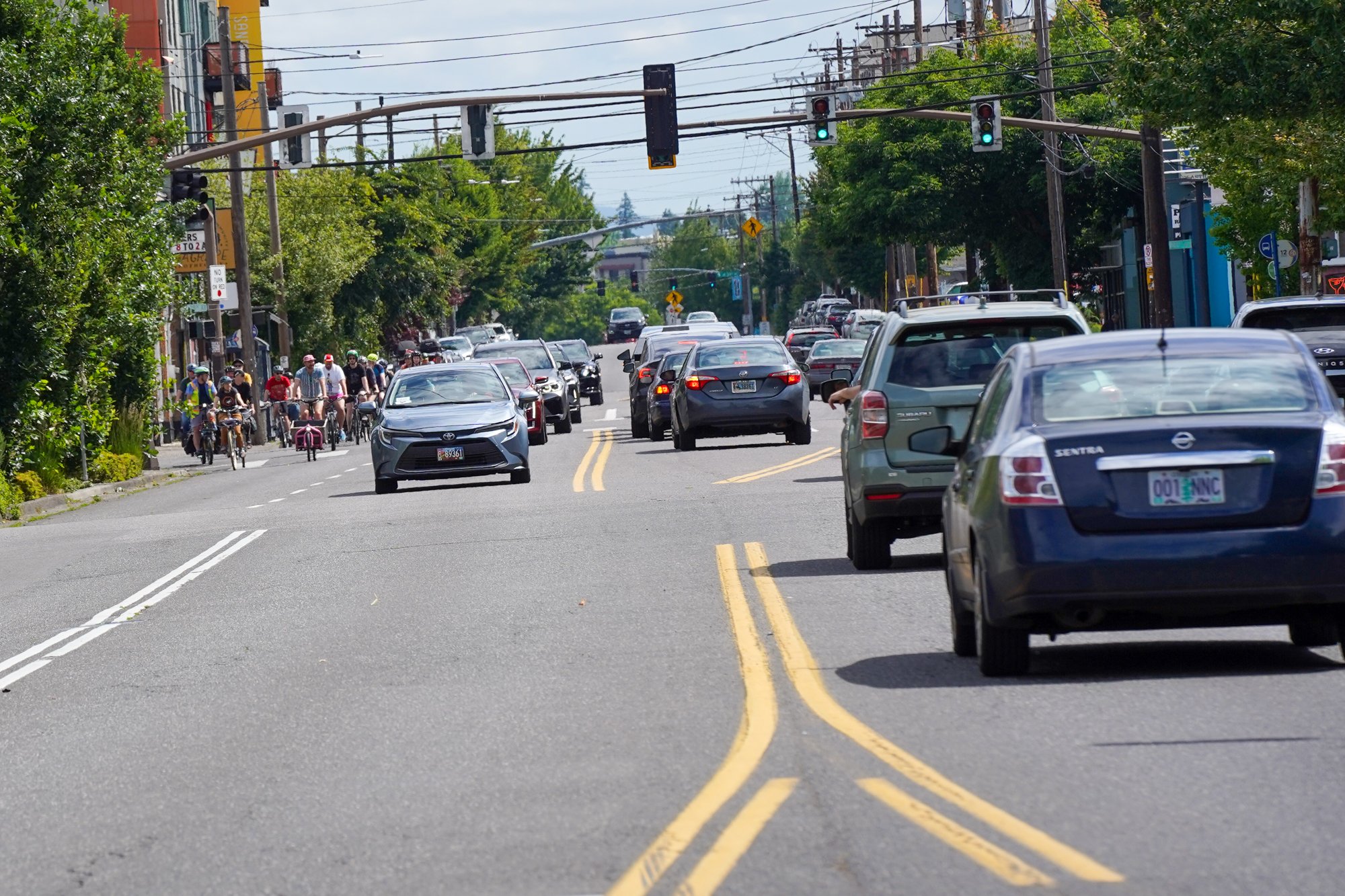
We talk a lot about safety when it comes to making cycling more attractive than driving. But convenience is probably a larger factor. That’s why so many Portlanders are intrigued by the possibility of updating Sandy Boulevard with bicycle facilities. After riding Sandy Boulevard this past Saturday, Portland City Council President Elana Pirtle-Guiney just might be among them.
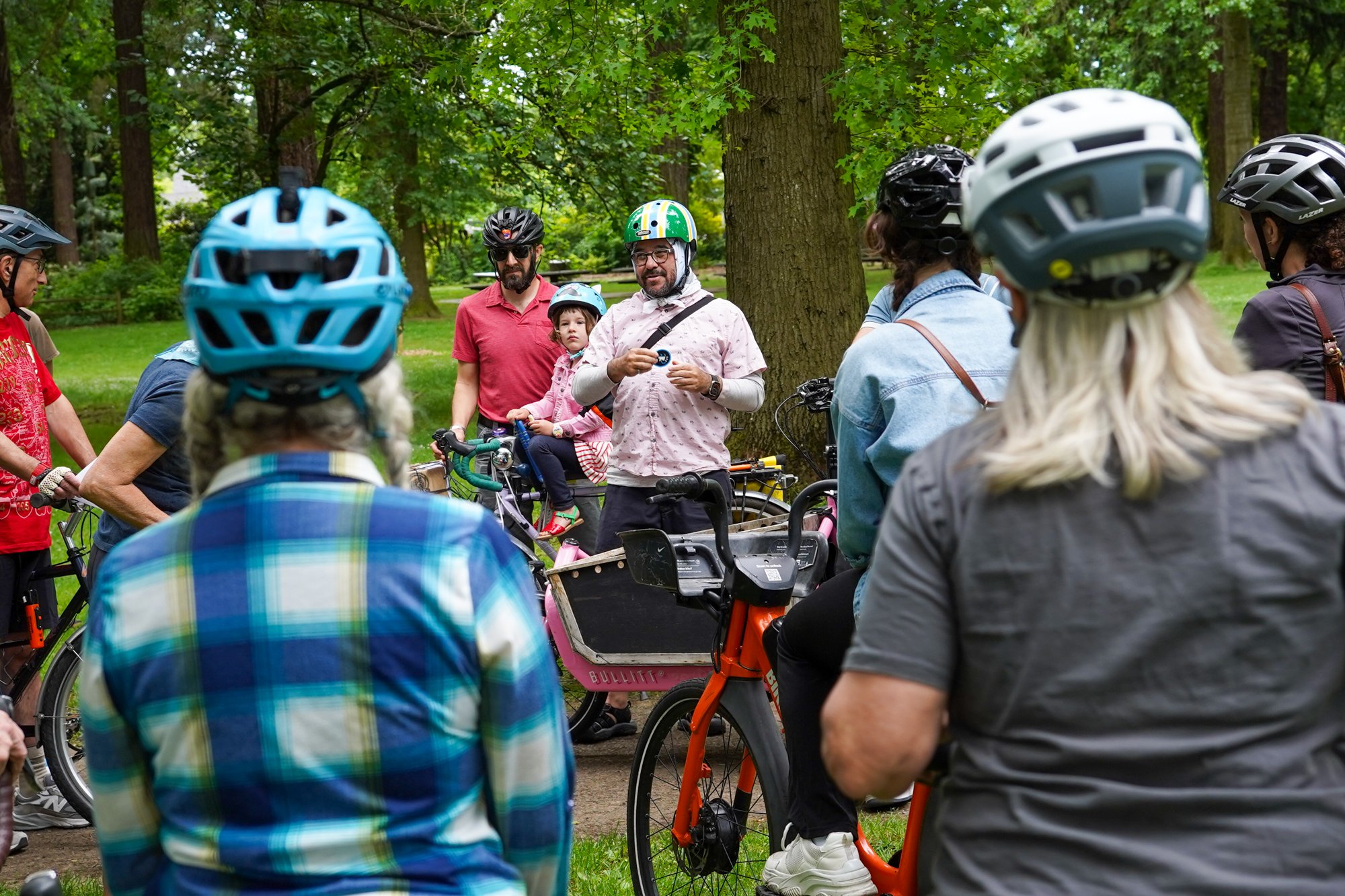
Pedaling a vintage cyclocross bike made for her mother in the 1970s, Pirtle-Guiney showed up at Wilshire Park with a few dozen other folks for a ride organized by BikeLoud PDX. “I figured if I wanted to really understand the questions that are going to come up around biking on Sandy over the next two to three years, I ought to join this ride and see it for myself,” the council president said in her introduction to the group. “I think it’s really important for me to see what it looks like.”
BikeLoud has led a relatively quiet, behind the scenes campaign for bike facilities on Sandy since at least 2019. That’s when they pushed the City of Portland to upgrade Sandy’s official street classification in the Transportation System Plan from “City Bikeway” to “Major City Bikeway.” That means whenever a city agency does a project on Sandy, they must hold cycling in the highest regard and make sure plans encourage people to do it. The rub is, Sandy is a “Major” street for every mode (pedestrians, transit, freight, cars, and emergency response vehicles), so whatever the future holds, it will favor whoever gets organized and does their homework.
Councilor Pirtle-Guiney at Wilshire Park before the ride.BikeLoud’s Kiel Johnson (seated) and Joe Perez.Joe Perez addressing the crowd at Wilshire Park.Councilor Pirtle-Guiney (right).Councilor Pirtle-Guiney.
At Wilshire Park Saturday morning, the crowd of bicycle riders included folks of all ages. There was a babe in arms, retired folks, and everything in between. One by one, people introduced themselves and shared how much they enjoy cycling in Portland and how much better it would be if they could ride on Sandy without feeling.
One woman I met said she’d love to explore the shops along Sandy and that, “You’d learn [the street] better if you were on a bike, going slower.” Jade and Xavier, a young couple who I talked to after the ride, said they’d never bike it outside of a large group. “But if there were bike lanes, we definitely would.” They live in Kerns and love visiting the Hollywood District. “It would be great to just bike up Sandy, but we have to do this weird, roundabout way.” They were blown away at how easily they could get to the Hollywood Theater from their house via Sandy Blvd.
One of the ride organizers, Joe Perez with BikeLoud PDX said, “Portland is a really beautiful place to ride a bike. I moved here to ride a bike. I love living here, and I’m staying here. I’m fighting for more bike lanes, so this is why we’re riding on Sandy today.”
The City of Portland also sees a different future for Sandy. With major recent residential development, the road is growing into its “Main Street Civic Corridor” label in the city’s Comprehensive Plan. In 2020, the Portland Bureau of Transportation applied for a state grant that would have paid for a Sandy Boulevard Civic Corridor Plan. That plan (which I never heard about, so I assume it didn’t get funded), would have taken a close look at dedicated rapid transit on Sandy as well as the, “potential for bicycle facilities along the corridor.”
What makes Sandy such a jewel in the future bicycle network is its diagonal path. Another BikeLoud PDX leader at Saturday’s ride, Kiel Johnson, said it’s important because it offers unparalleled convenience and access between the central city and neighborhood destinations. Johnson, who lives in the Cully neighborhood said, “Right now, if I want to go downtown, I have to go down N Going and then take Vancouver-Williams. Sandy literally saves me 15 minutes.”
Johnson points to a 2016 Metro evaluation that found Sandy had a “high level of demand for bicycle trips and the potential to increase bicycle travel if improved.” And in 2024, a group of Portland State University Masters of Urban Planning students published a report that recommended bike lanes.
(Source: PBOT)
Adding to the inertia to take a serious look at a bikeway on Sandy is a spreadsheet shared at a 2022 meeting of the PBOT Bicycle Advisory Committee. The document lists all the projects on PBOT’s five-year paving list and the opportunity for upgrading bicycle facilities when the restriping is completed. A project slated to begin in 2026 that will repave Sandy between 14th to 27th is accompanied by a note that reads:
Volumes [of car traffic] are lower in this section of Sandy Blvd. Opportunity to add enhanced bike lanes through travel lane reallocation, but need to consider safety as well as impacts to transit and other modes. Needs extensive planning and project development. Consider extending west to 12th/Couch and east to 28th Ave to connect to rest of bike network.
And Council President Pirtle-Guiney must have gotten the memo. And/or she is sufficiently intrigued by BikeLoud’s vision that she devoted her Saturday morning to learning more about it.
As we waited at the signal on NE 12th, I asked Pirtle-Guiney how she felt riding on Sandy. “It was less scary than I thought,” she remarked. Would she consider doing it on her own, without the safety of a group, if there was a protected bike lane on it? The savvy politician didn’t directly answer (as if knowing a “yes” would be construed as her supporting a bike lane). “I still want to learn more,” she said. “I’m very open to what the future of Sandy is.”
At the end spot, I asked the councilor if anything changed in her mind after the ride. “That outside lane feels a lot wider than I expected it to,” she said, her mind perhaps already mulling future debates about potential cross-sections. “I think it would be interesting to try it without a group and just see how it feels,” she continued.
“If you ever want to ride to City Hall together one morning, just let me know,” I replied.
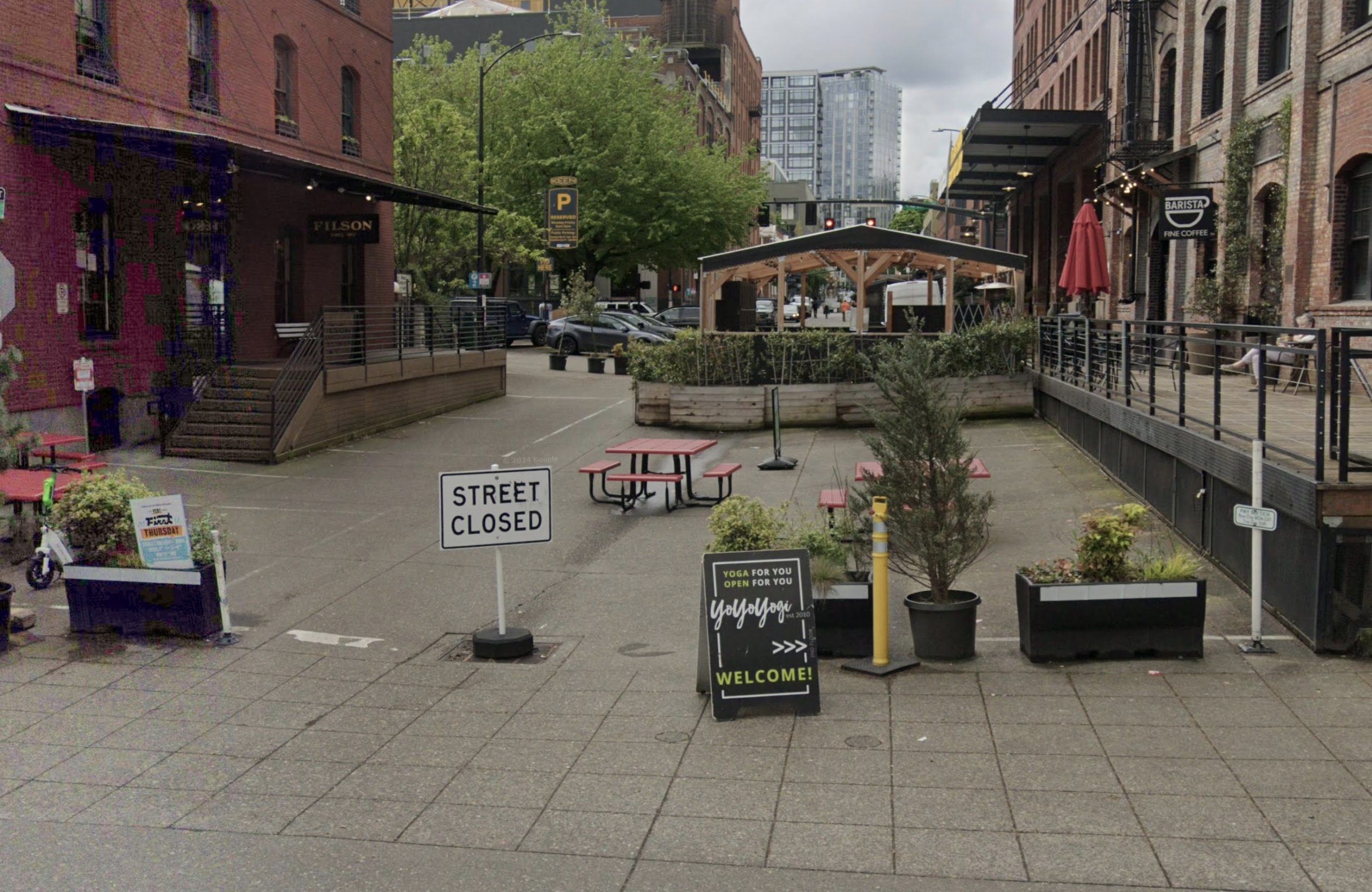
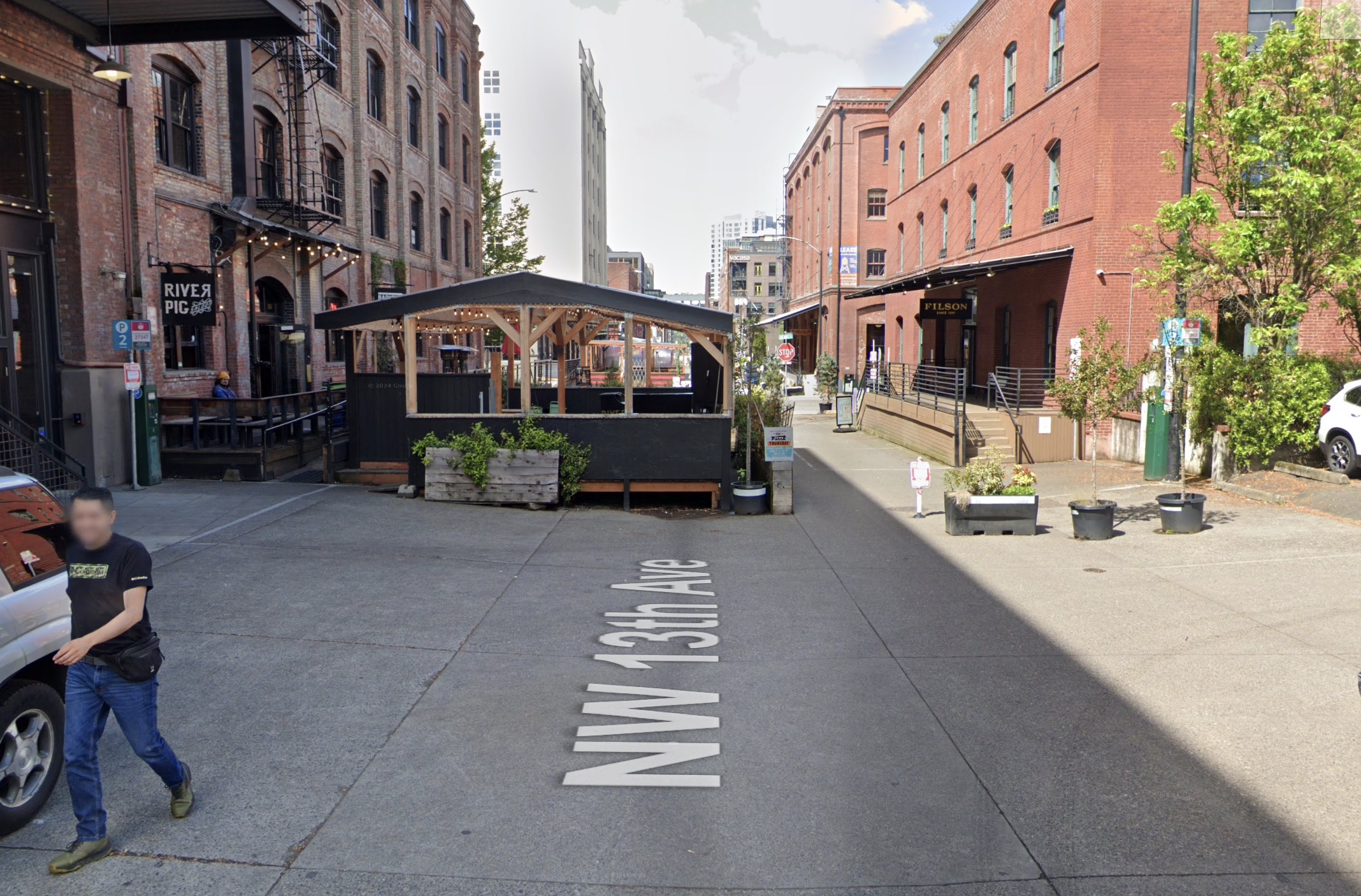
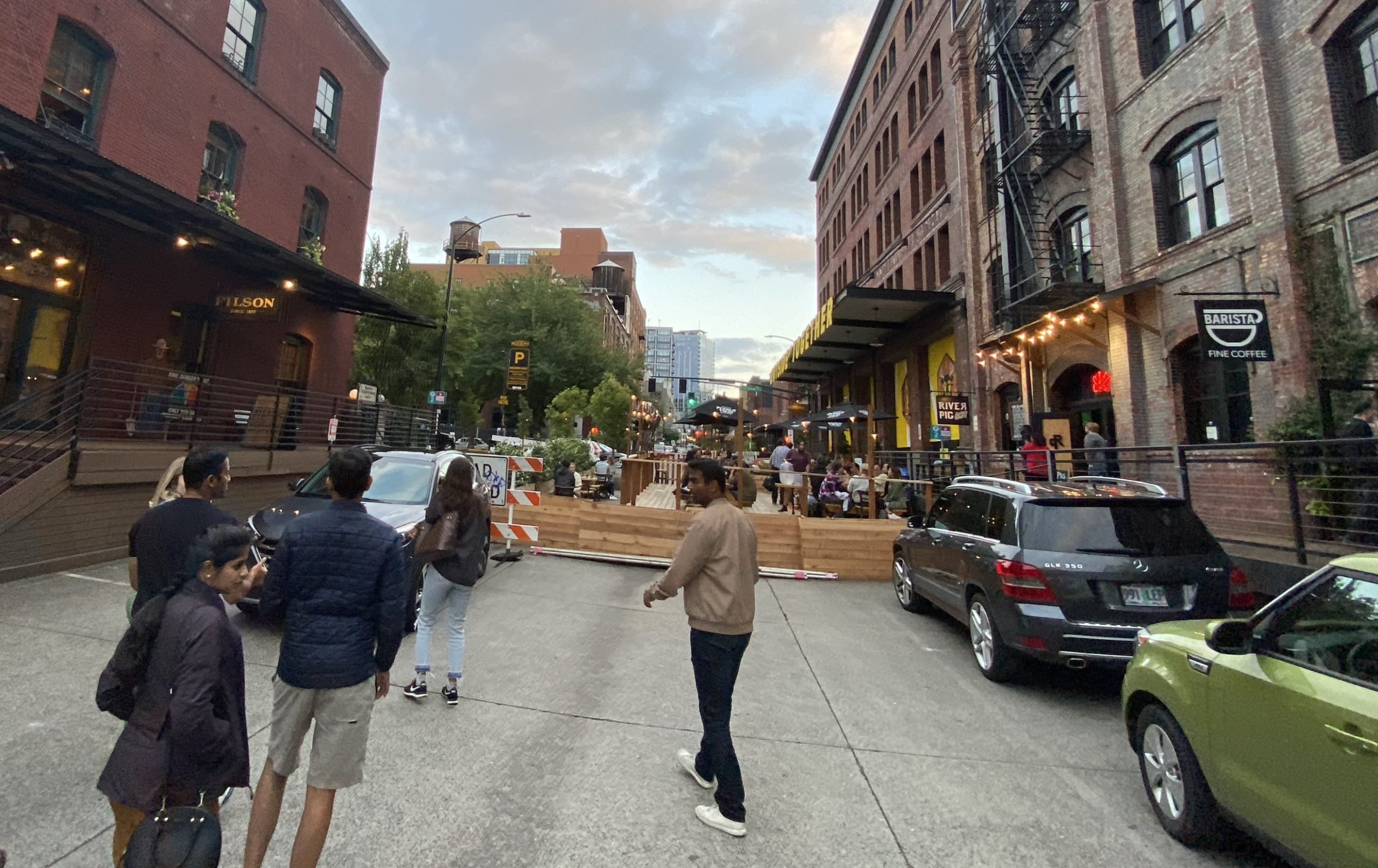
NE 13th between Hoyt and Glisan in May 2024. Patio structure belongs to River Pig Saloon. (Photo: Google Streetview)
Portland’s street plaza program continues to see uneven progress. On the same day we saw exciting progress on the new carfree plaza coming to Southeast 37th and Hawthorne, the Portland Bureau of Transportation announced they will pull the plug on their plaza on Northwest 13th Avenue.
In a rare public statement where PBOT’s frustration seeped through the text, the agency shared yesterday they will reluctantly give up the existing carfree plaza on three of the four blocks of NW 13th between NW Everett and Irving. “Due to three businesses’ lack of compliance with design guidance and numerous site challenges, PBOT has determined that these spaces have not succeeded as Public Street Plazas,” the city wrote, citing, “Ongoing problems and community complaints with operations, over privatization of the right-of-way, and low public satisfaction were,” as reasons for the decision.
Those four blocks were turned into a public plaza with outdoor dining and a driving ban in the summer of 2020, as PBOT grappled with the spread of Covid-19 and restaurants jumped at the chance to expand seating into the open air. Now PBOT will restore two-way driving access between NW Flanders and Irving, and focus on making the block between Everett and Flanders into a fully pedestrianized space.
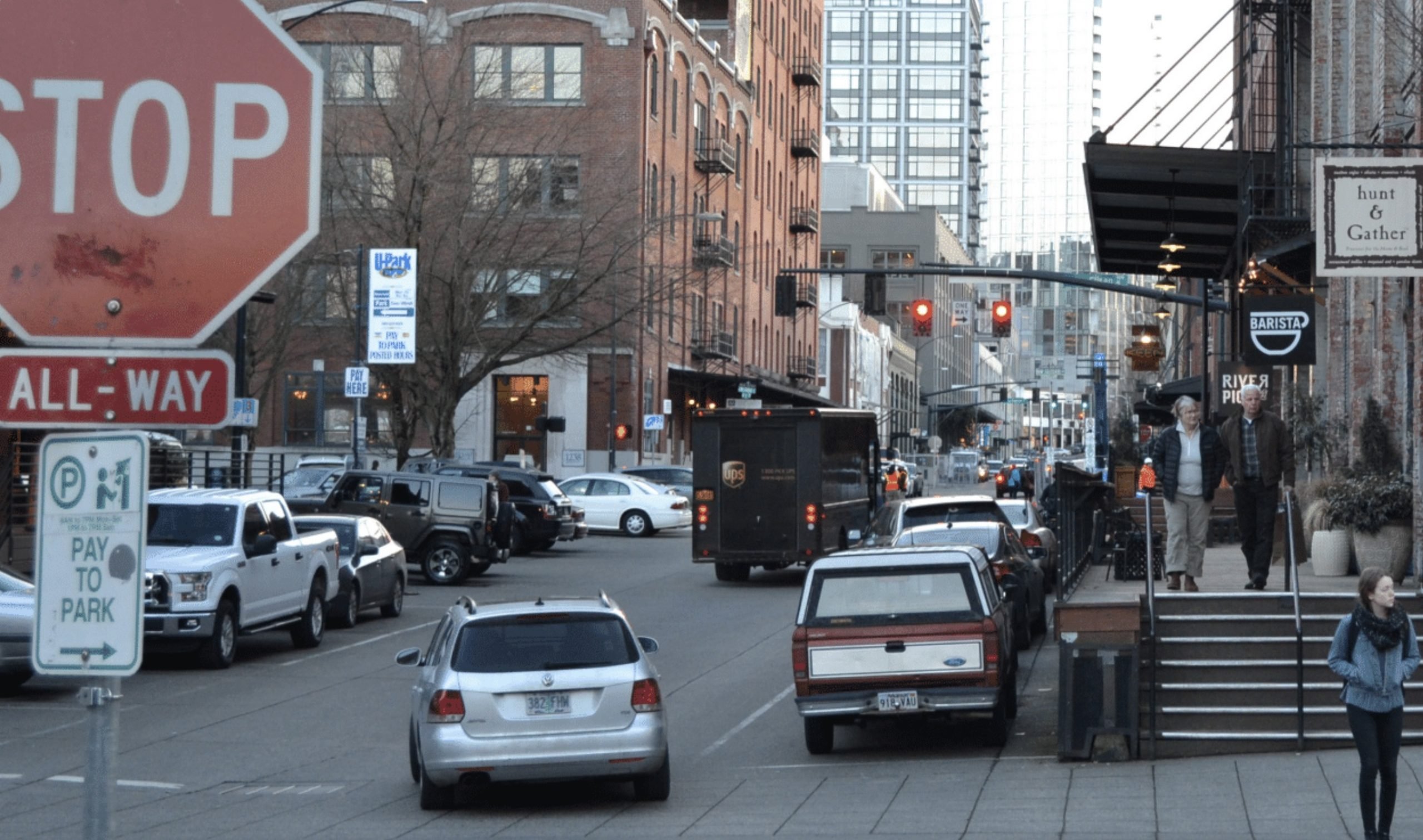
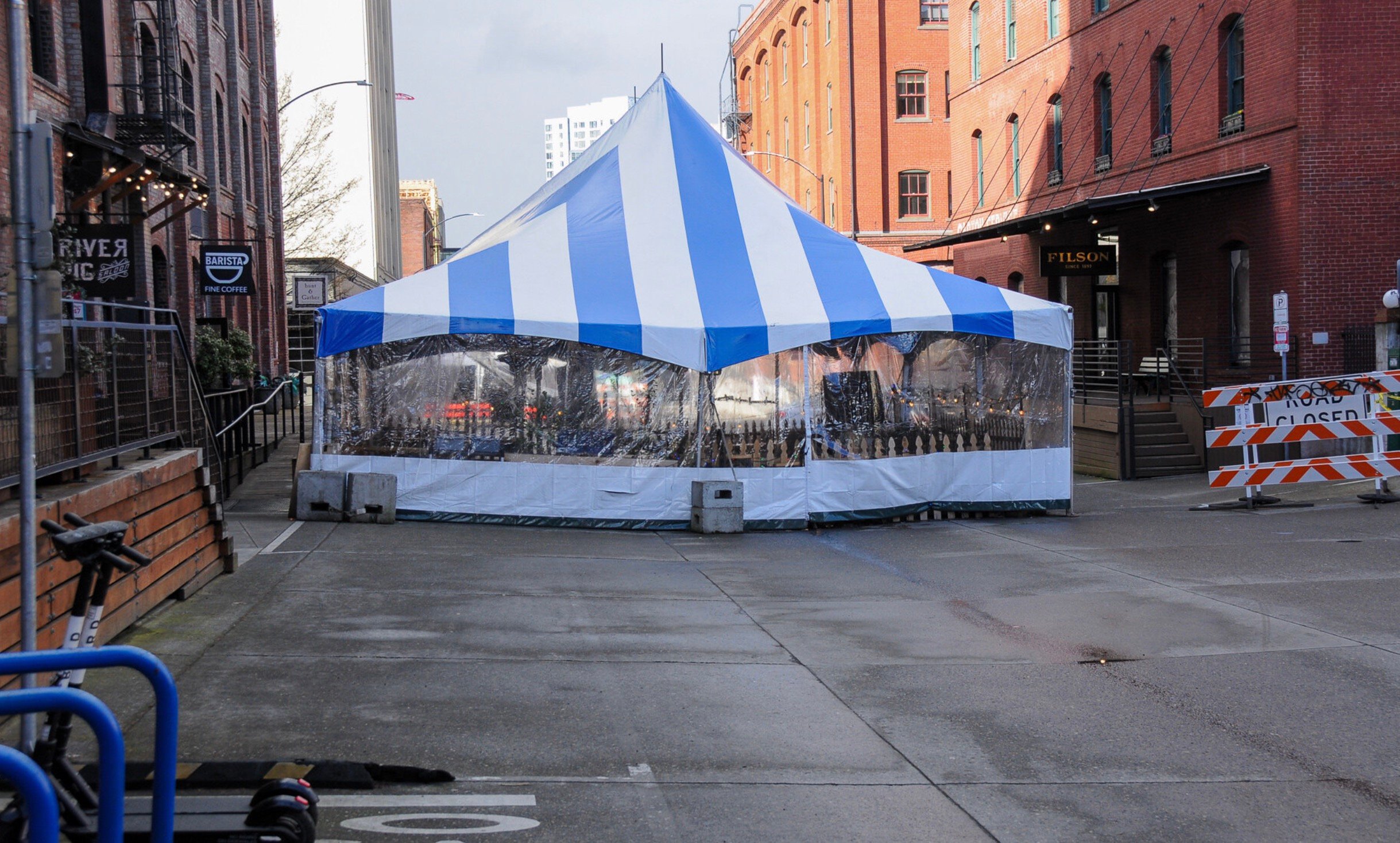
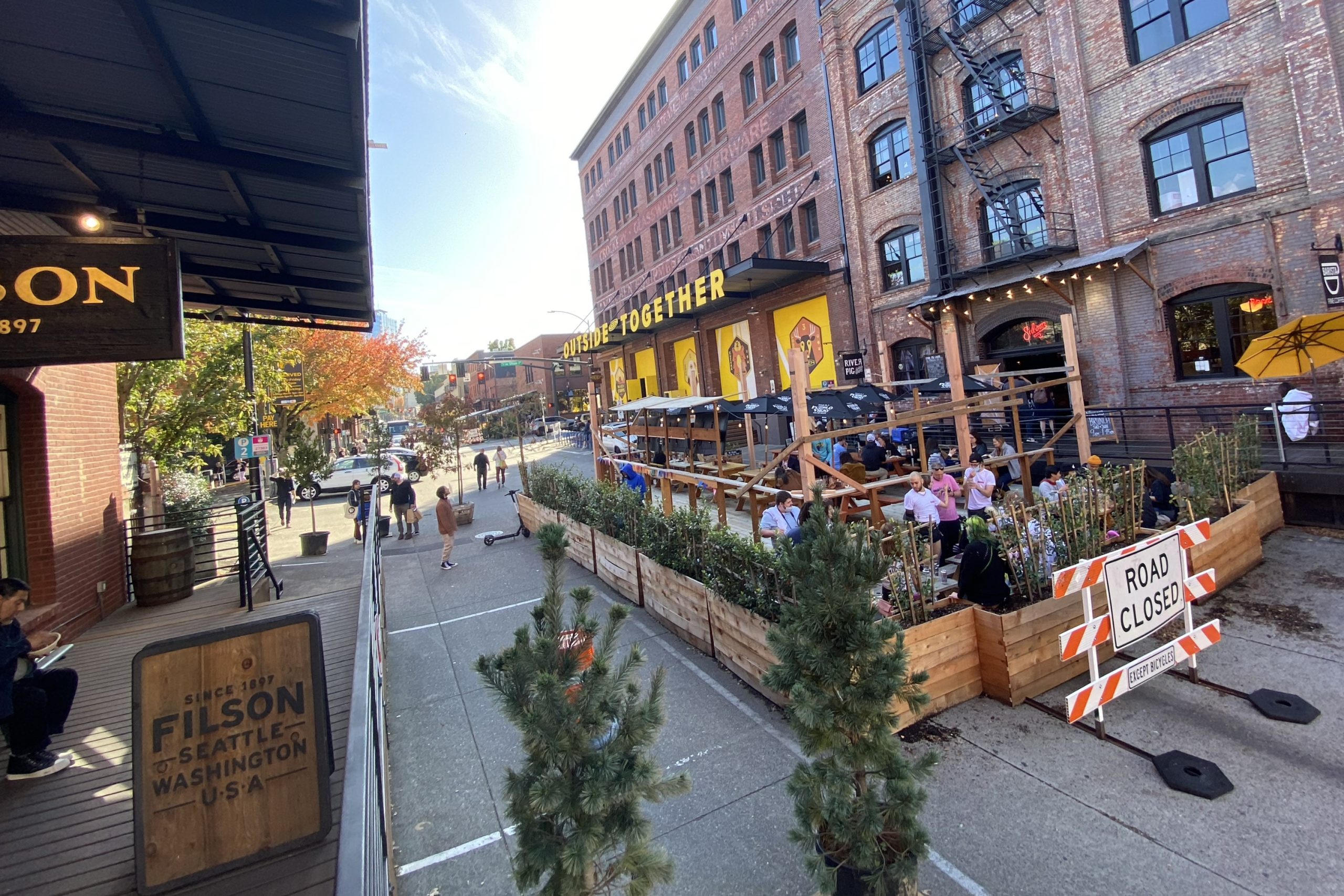
The scene on NW 13th between Glisan and Hoyt in 2017 — and soon-to-be in 2025. (Photo: Rethink Streets)
This loss of carfree space downtown is a major blow to Portlanders who dream of a city that caters to people and not their cars. NW 13th — home to the monthly First Thursday street festival — has long been eyed for its possible as a pedestrian-only corridor. In 2017, the Pearl District Neighborhood Association and Portland State University teamed up with Rethink Streets to publish an action plan for NW 13th that aimed to, “Refocus the street around the pedestrian, placing all other modes as secondary to the experience and comfort of those walking on the street.”
Ironically, PBOT themselves wanted to maintain this multi-block plaza, saying in their statement they have “regrets” about its removal. But it appears PBOT couldn’t find a policy or political path to save it.
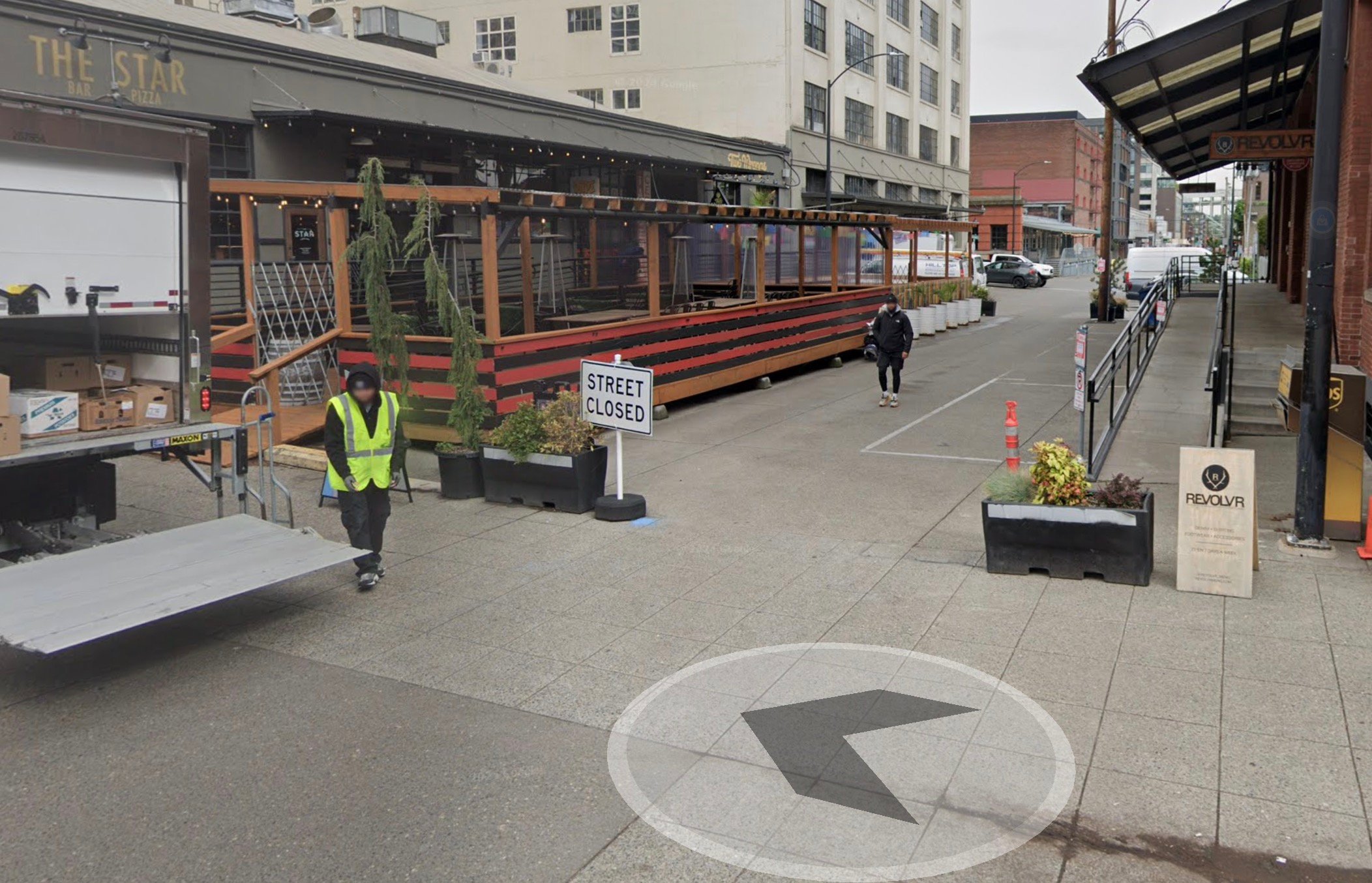
PBOT says the seating and patio structures installed by River Pig, Papi Chulo’s and The Star, do not comply with the city’s plaza requirements. The structures were too large and walled-off to the public, instead of being open and welcoming to all. PBOT says they gave the businesses ample notice to dismantle or change the structures, but even after four deadline extensions to make it happen, the businesses took no action. “The unwillingness of these businesses to do anything to change their installations to address community concerns forced us to take steps towards enforcement,” PBOT Public Information Officer Dylan Rivera shared with BikePortland today.
With no compliance from business owners PBOT plans to fine the businesses $500 per day until the structures are removed. They will then re-open the three blocks to parking and driving for the first time since 2020.
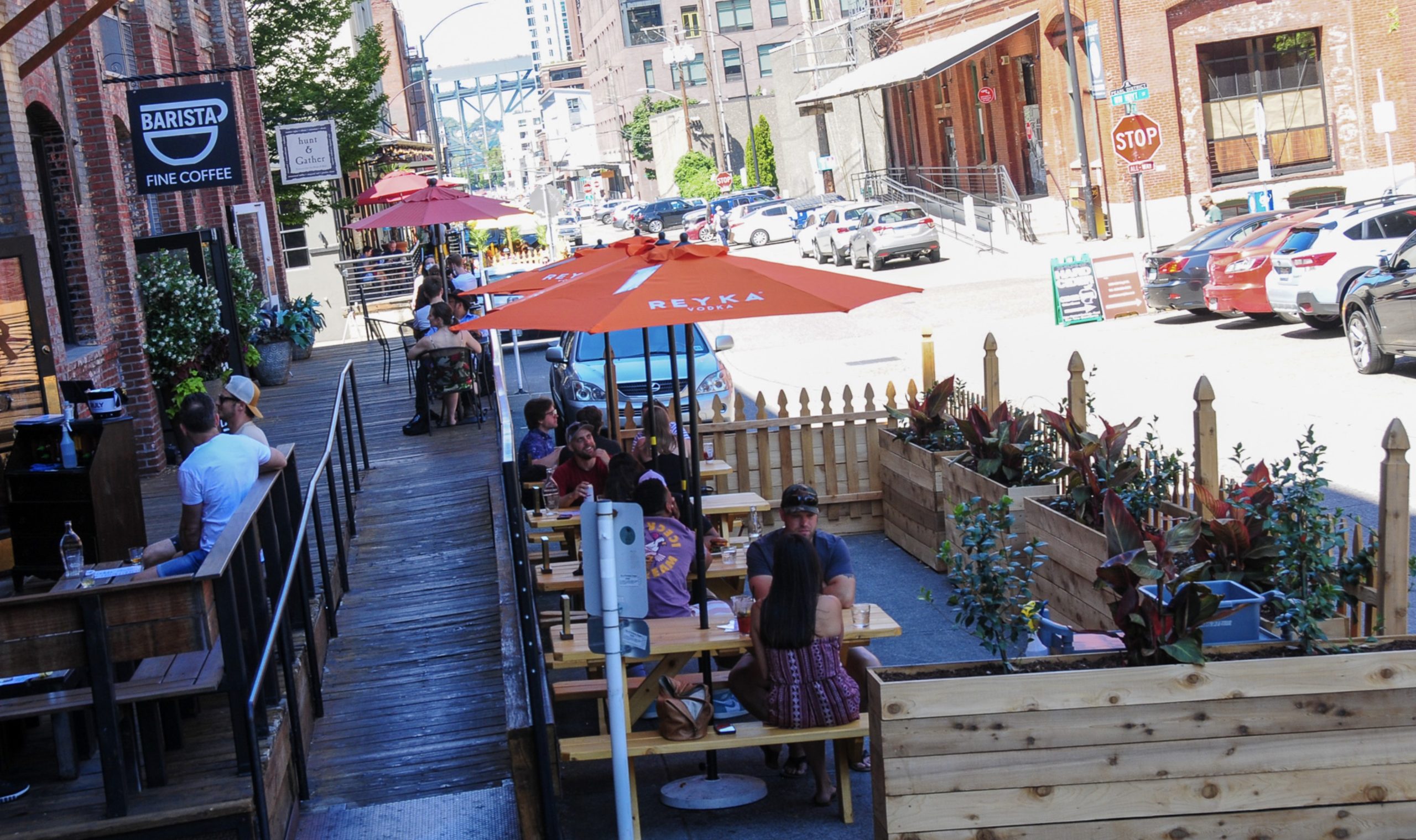
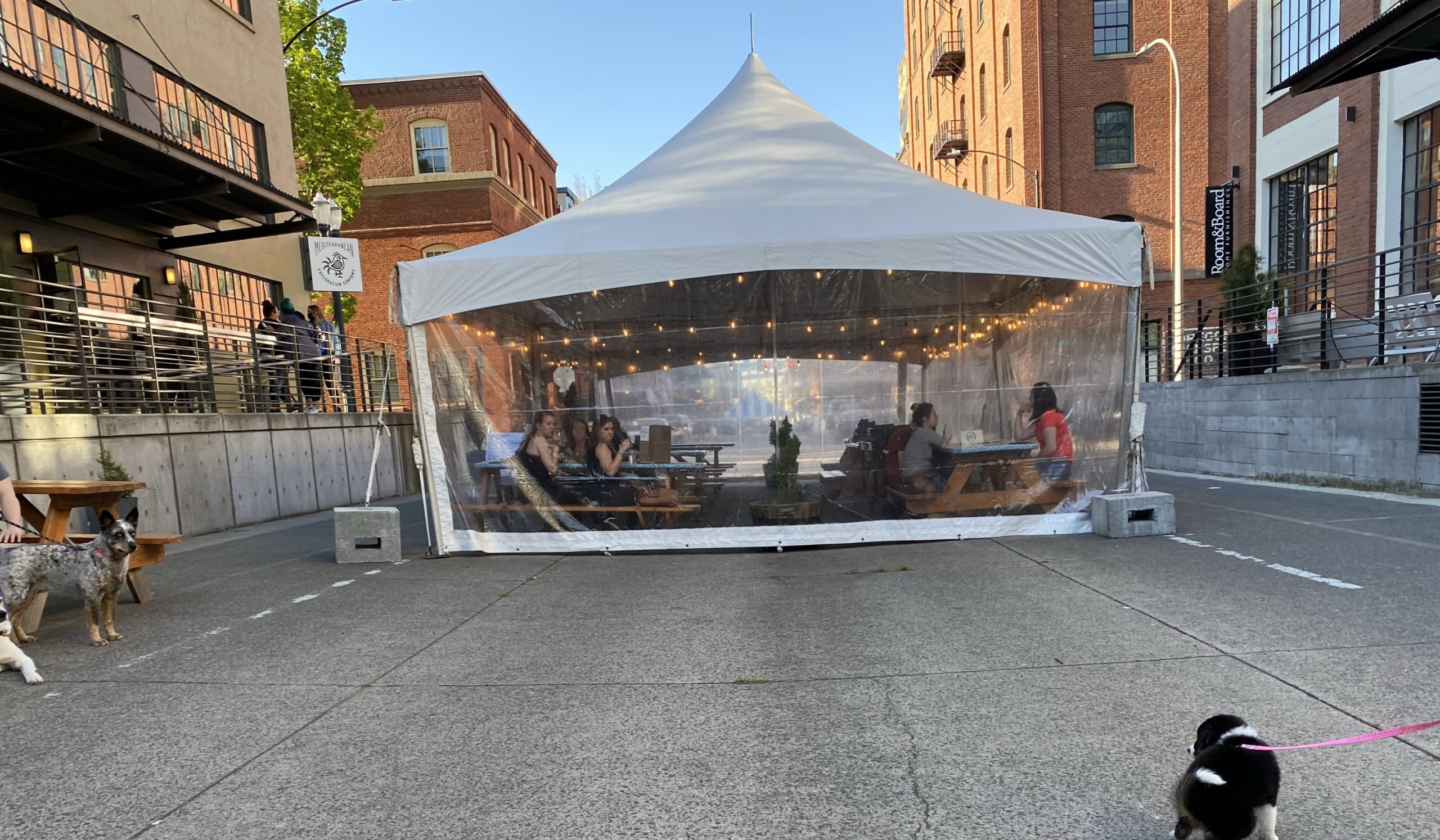
The Star/Papi Chulo’s patio between NW Hoyt and Irving. (Photo: May 2024 Google Streetview)River Pig Saloon patio. (Photo: May 2024 Google Streetview)River Pig’s patio in 2021. (Photo: Jonathan Maus/BikePortland)River Pig Saloon patio in 2021. (Photo: Jonathan Maus/BikePortland)River Pig Saloon patio in 2020. (Photo: Jonathan Maus/BikePortland)Mediterranean Exploration Company patio in 2021. (Photo: Jonathan Maus/BikePortland)River Pig Saloon patio in 2021. (Photo: Jonathan Maus/BikePortland)
PBOT appears to have made every effort to make this plaza work. “PBOT did not take the decision to remove the NW 13th car-free blocks lightly; in fact we have been trying to avoid this situation for the past year and a half,” Rivera said.
The city has spent about two years meeting with the Pearl District Neighborhood Association (PDNA) and business owners to address issues of access, cleanliness, and safety. Despite these efforts however, the city cited a public survey they administered last year where they heard “dissatisfaction” from over 400 respondents including, “strong opposition to large private outdoor dining structures dominating public plaza space, concerns about late night noise, negative behaviors, and, at times, violence, in the plaza, as well as issues with illegal parking, blocking of emergency lanes, and lack of visibility for pedestrians.”
And sadly, while PBOT said an overwhelming majority of survey respondents liked the idea of a public street plaza, they didn’t like the implementation on 13th. In their statement yesterday, PBOT included a litany of public comments that expressed opposition and concerns about the structures. Most people said the dining structures were simply too large, and instead of contributing to a public plaza, they felt more like expansions of the restaurants onto a public street.
“Outdoor dining should not be so big and closed off from plazas. Should be open and flexible like European styles as in Paris or Barcelona,” one person wrote. “The structures as they exist are imposing and make me feel unwanted as a pedestrian. It’s like I’m walking into their business area, not like they are spilling out into a public’s space.” (This tension between private businesses using public right-of-way has been a sticking point since one of Portland’s first permanent plazas was built on SW Ankeny in 2011.)
There was also strong pushback from some adjacent, non-restaurant business owners as well.
A February 2024 story in The NW Examiner reported on a tension between restaurants, who welcomed using public right-of-way for their private business; and non-dining businesses, who felt the plazas encouraged unwelcome public behavior and the lack of parking and driving access turned away customers. The president of the Irving Street Lofts homeowner’s association told the Examiner that he supports the plaza, but not its, “late-night patrons who congregate in the vicinity until and after the last bar closes at 2:00 am,” who he said are, “driven by a dining experience or alcohol and playing music and partying.” And Debbie Thomas, who owns Debbie Thomas Real Estate on NW 13th, said she was never told about the plaza and never asked for it.
Issues about the plaza appear in meeting minutes of the PDNA as far back as August 2023, when a PBOT plaza program staffer attended a meeting to share an update on “improvements to NW 13th Ave.” A March 2024 meeting referenced “several meetings relating to nuisance issues affecting Irving Street Lofts and the overall impacts of closures and restaurant encroachments on the street.” “Discussions will continue on how to best accommodate pedestrian and vehicular traffic on 13th,” the meeting minutes read. Then in November 2024, the PDNA was warned that the structures would be coming down and that a stakeholder process would begin to “reimagine the future of 13th.”
PBOT has long maintained that carfree street plazas exist only with support from adjacent business owners. In this case, it appears the nearby businesses either failed to believe in the potential of a carfree plaza, were frustrated that PBOT hadn’t figured out how to make it work better, and/or just felt like auto parking and better driving access is more important to their bottom line. Without business support, and with so many complaints from street users and neighbors, PBOT came to this unfortunate decision.
PBOT currently manages 16 street plazas and 575 permitted outdoor dining installations citywide. Just one month ago, PBOT faced the possibility of shuttering their entire street plaza program due to a lack of funding, but Mayor Keith Wilson’s proposed budget kept it alive.
As this situation on NW 13th illustrates, funding isn’t the only constraint when it comes to building world-class carfree spaces in Portland. Like other major shifts in the status quo, it will take that magical mix of political leadership, public support and neighborhood-level organizing that seems to have escaped us in the Pearl District — putting the long-envisioned dream of a 13th Ave promenade further out of reach.
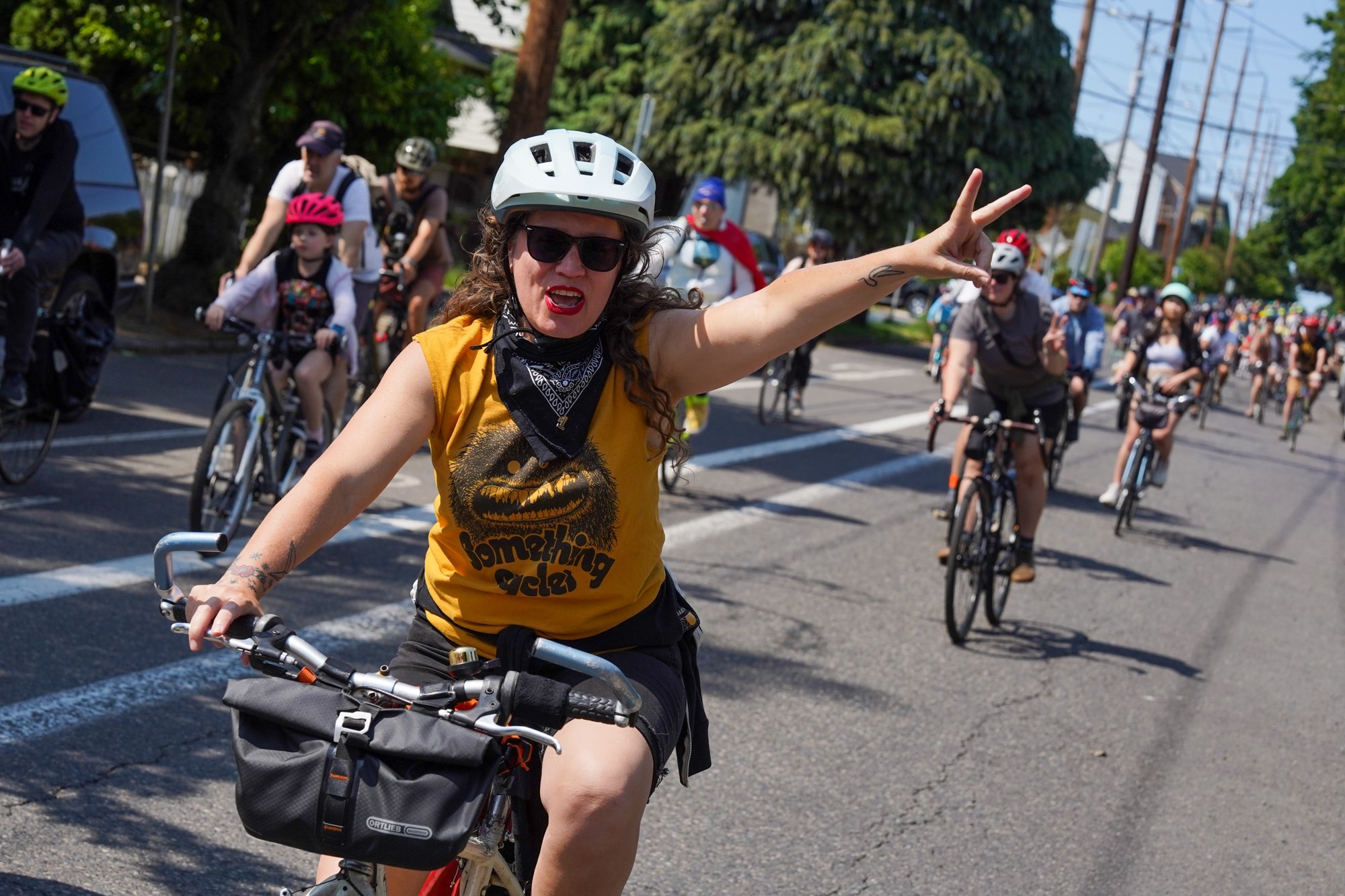
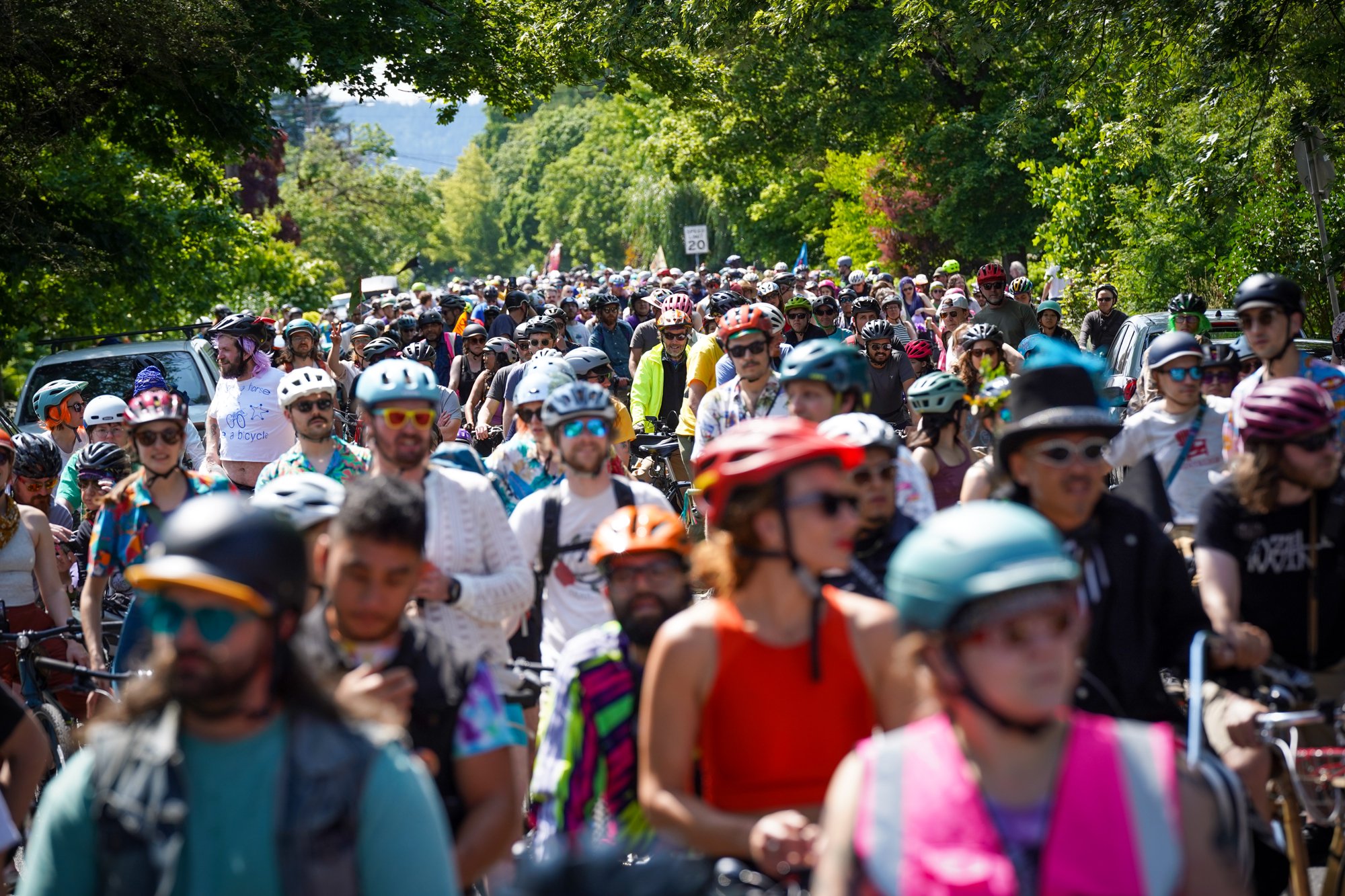
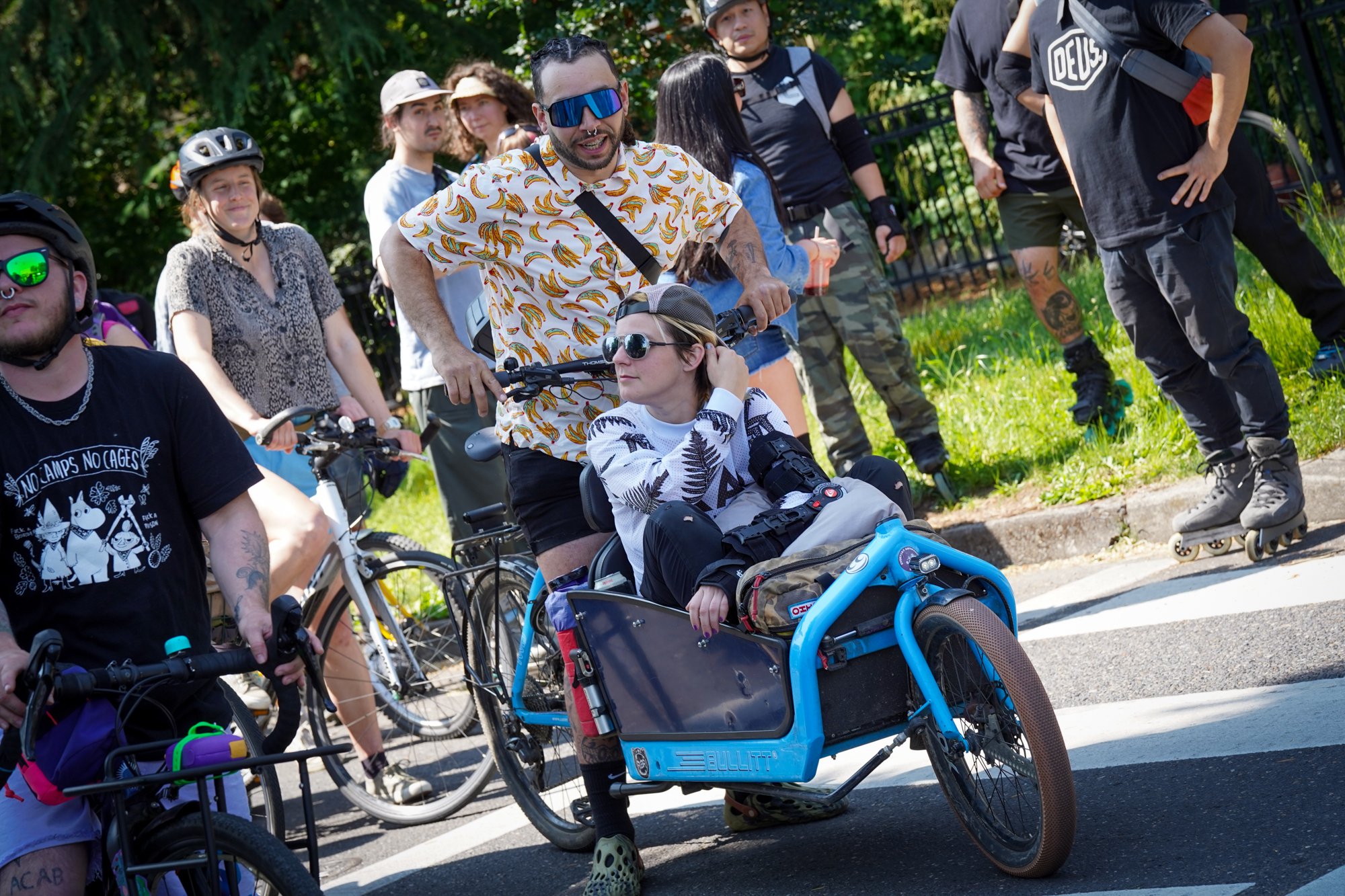
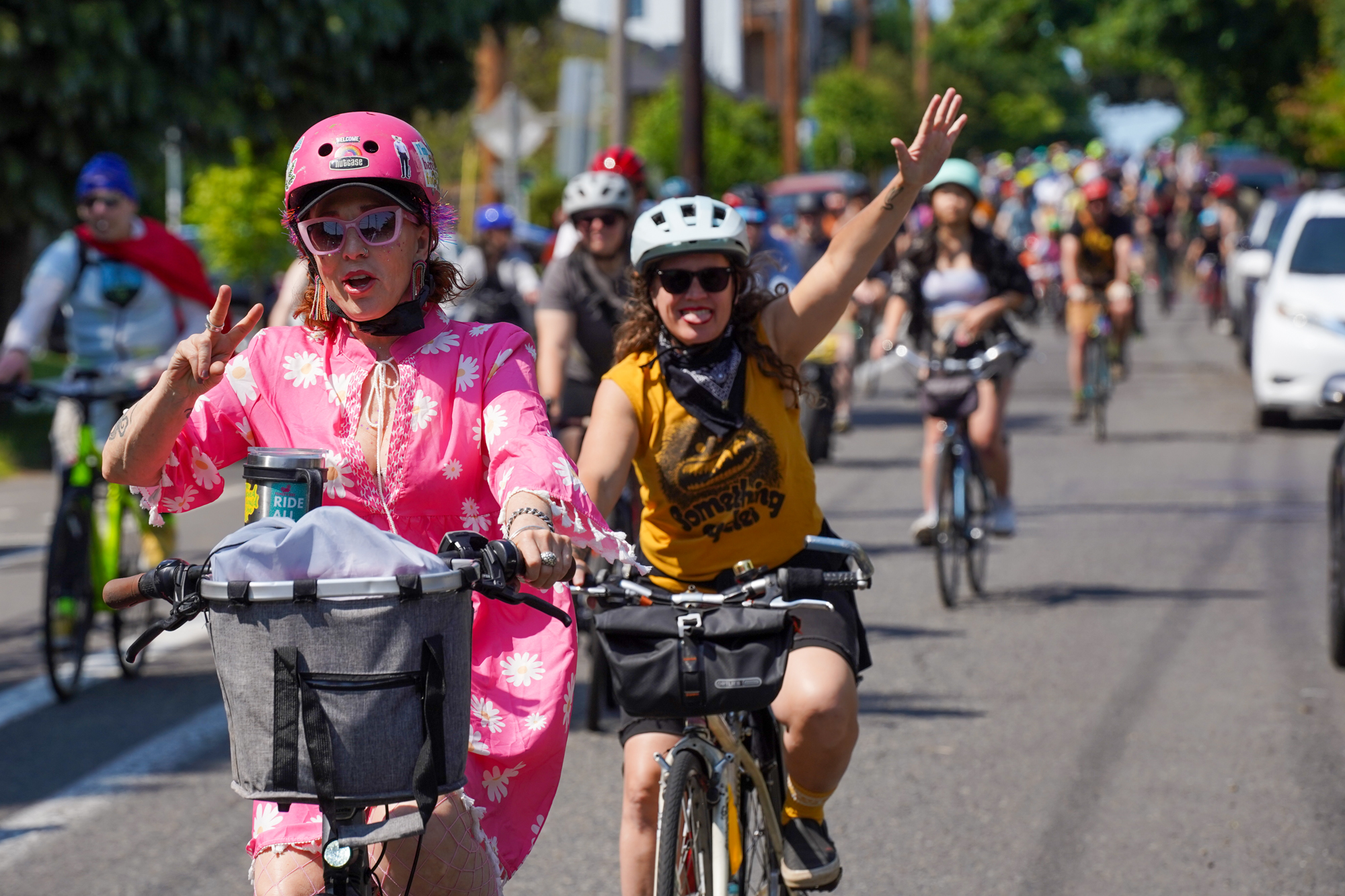
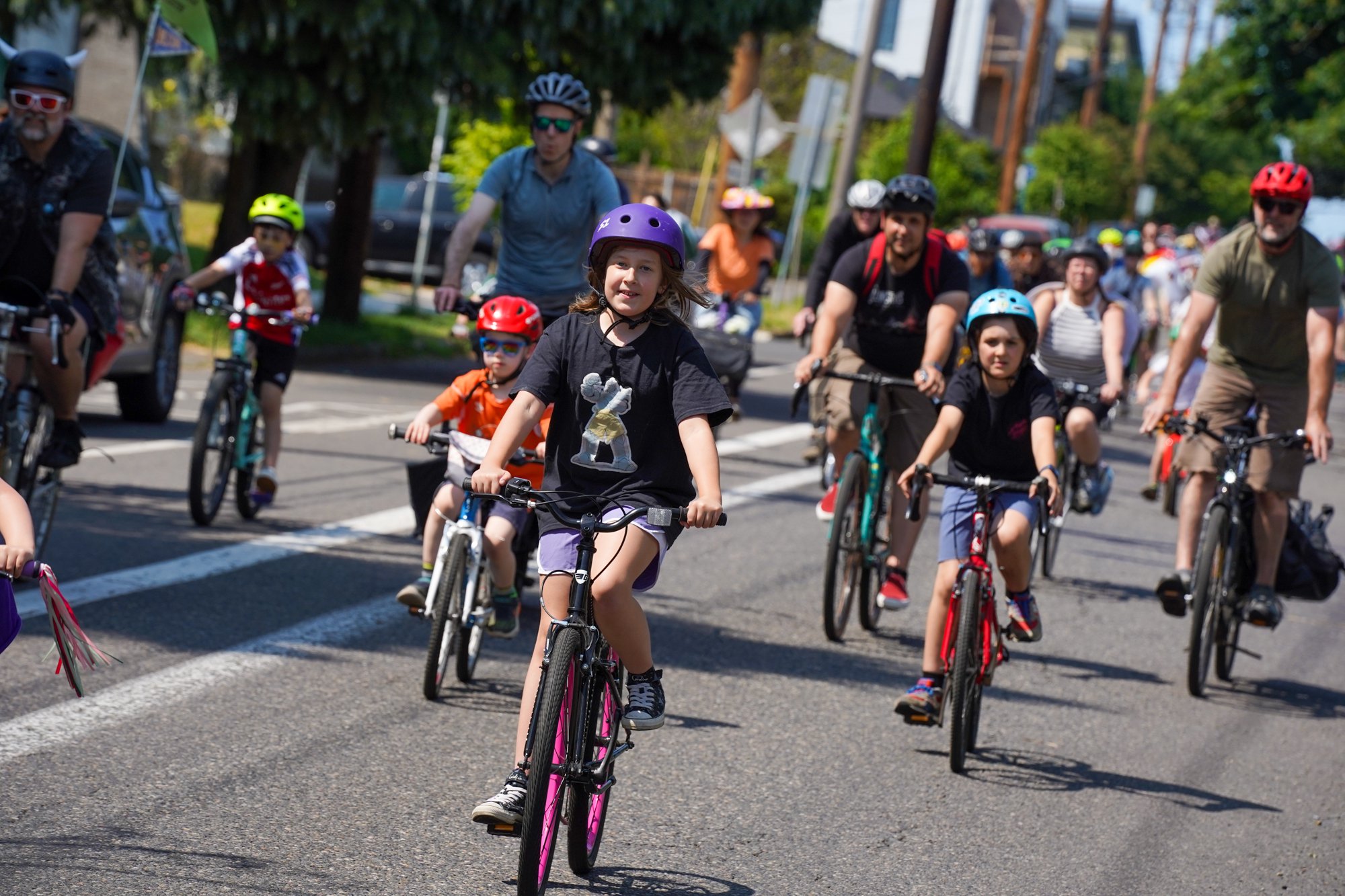
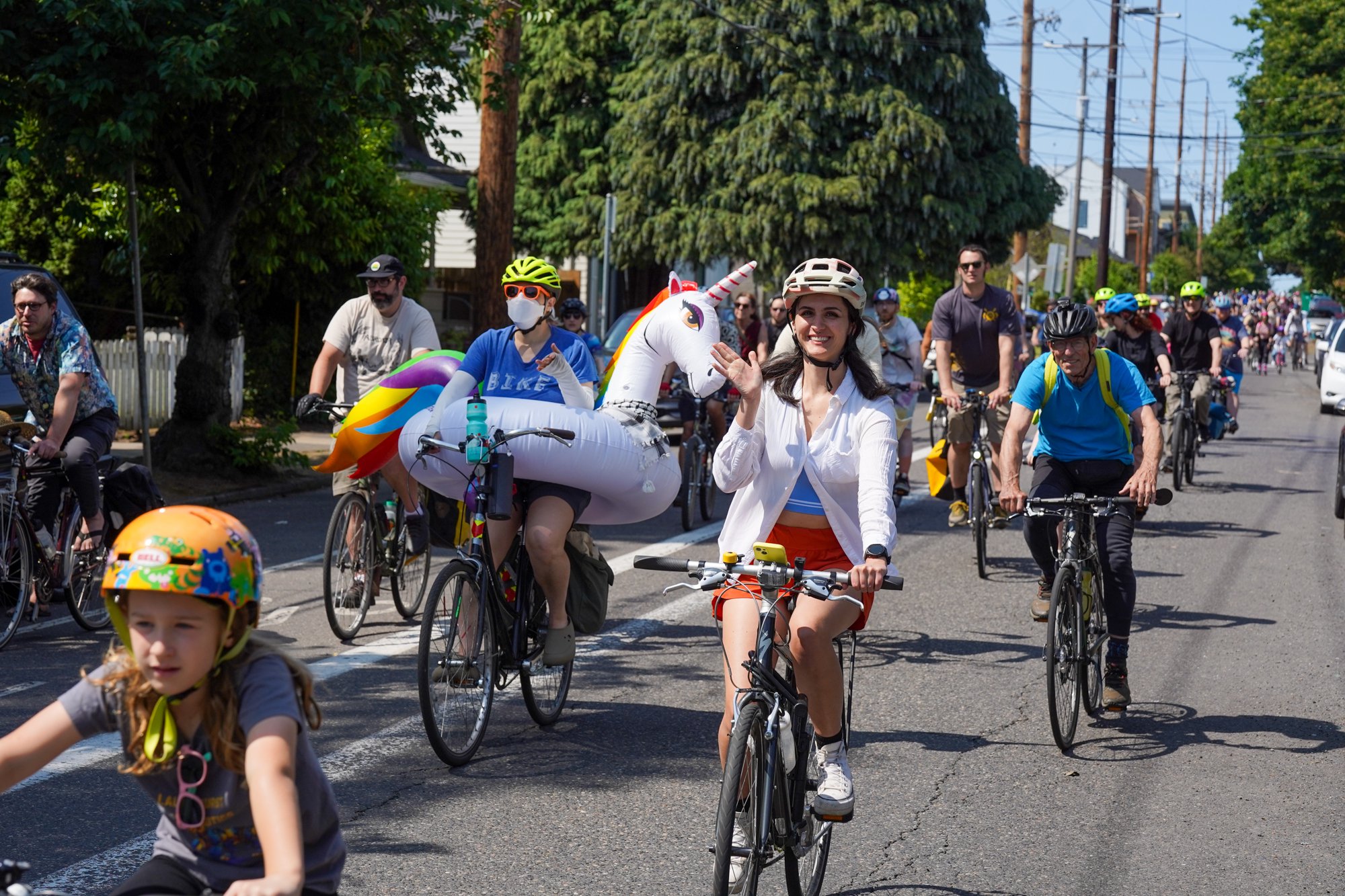
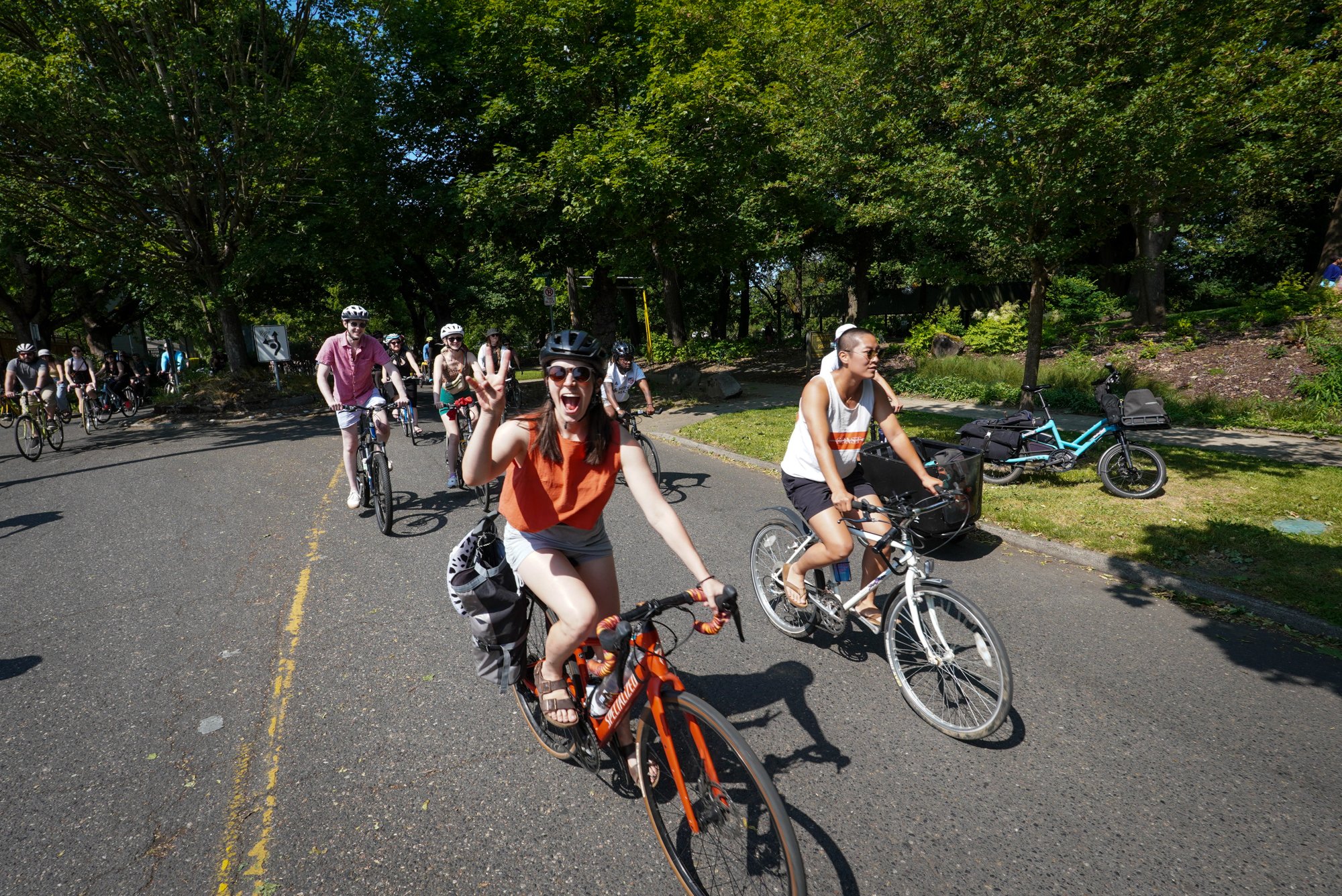
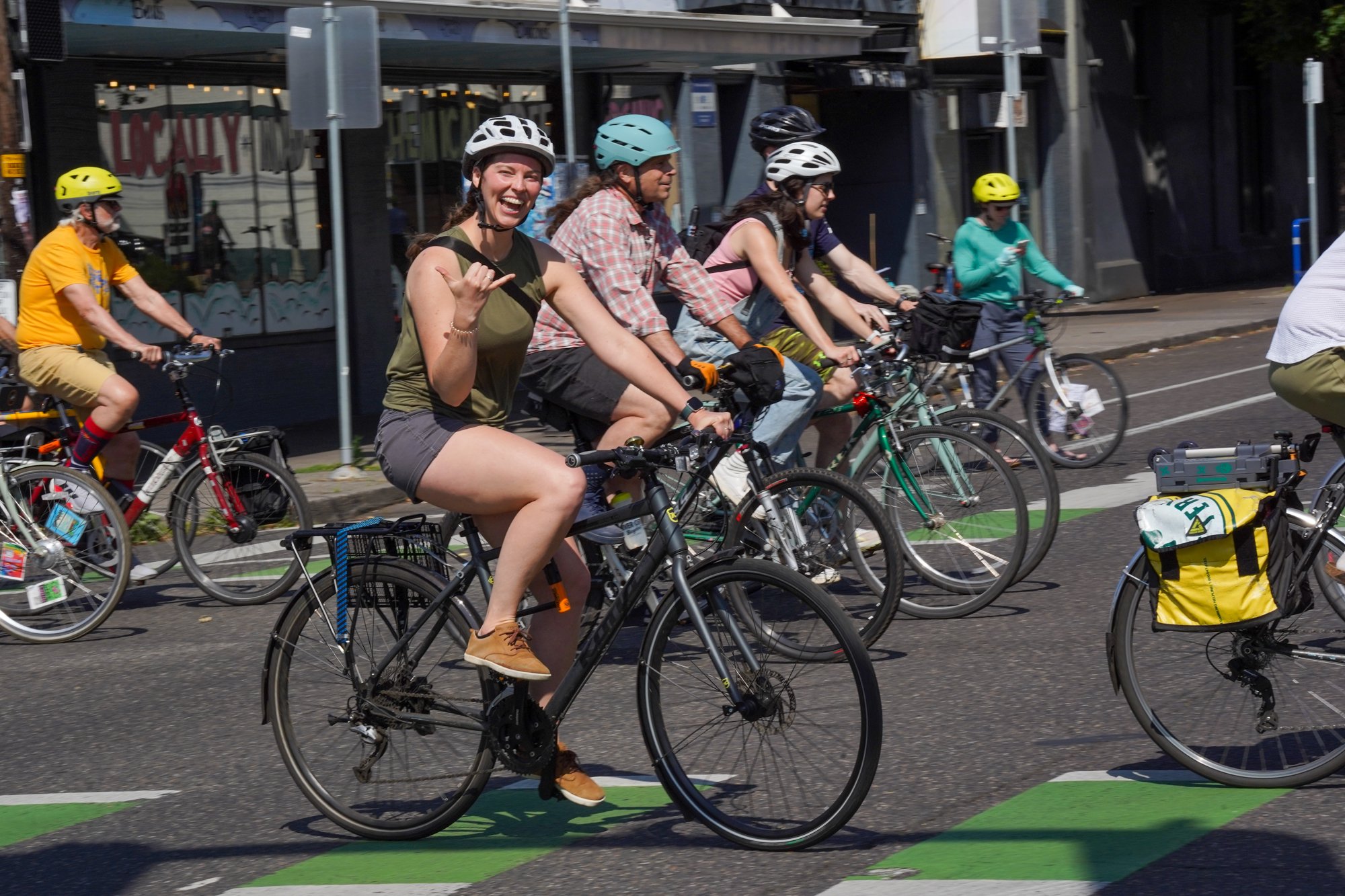
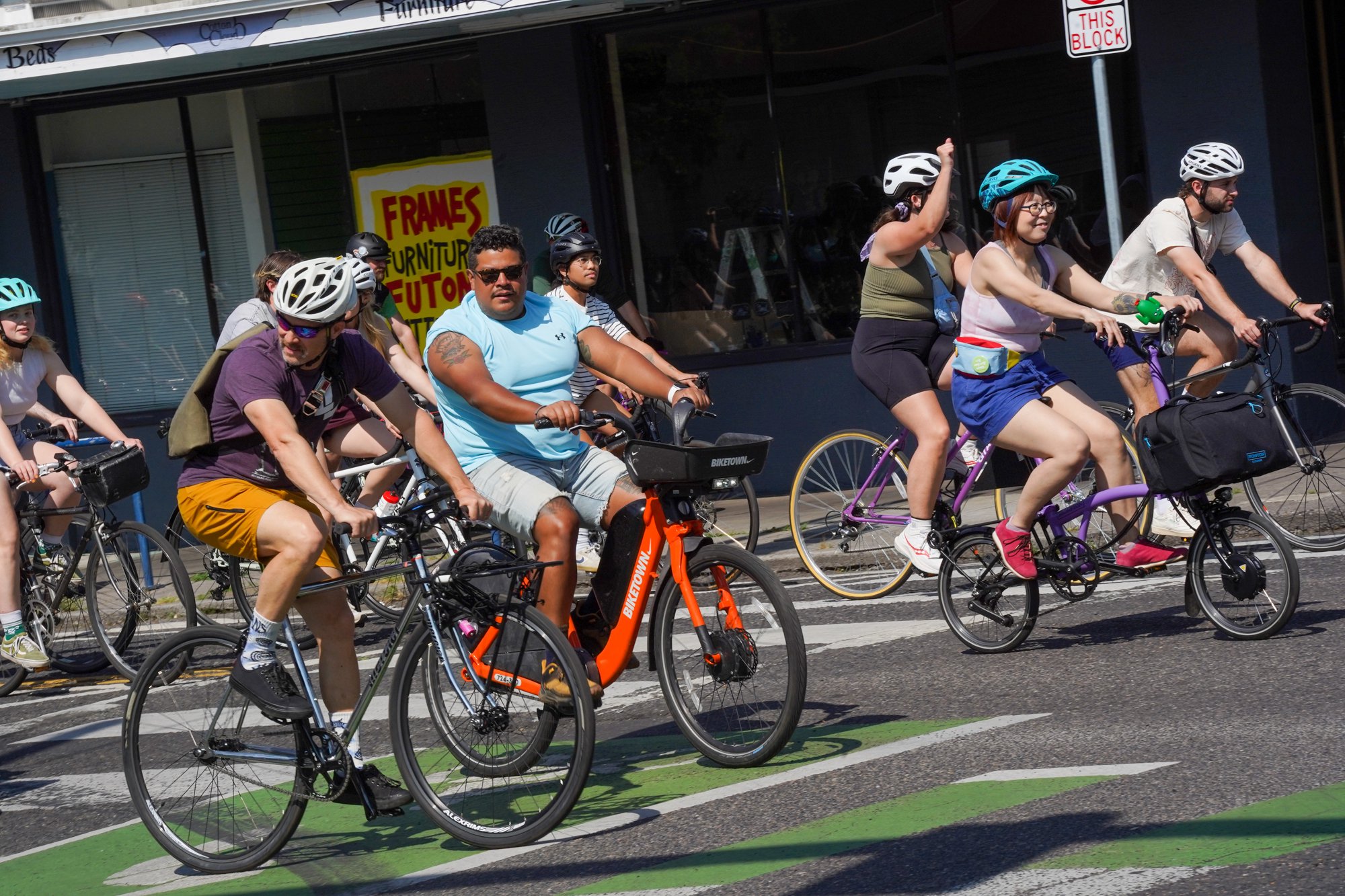
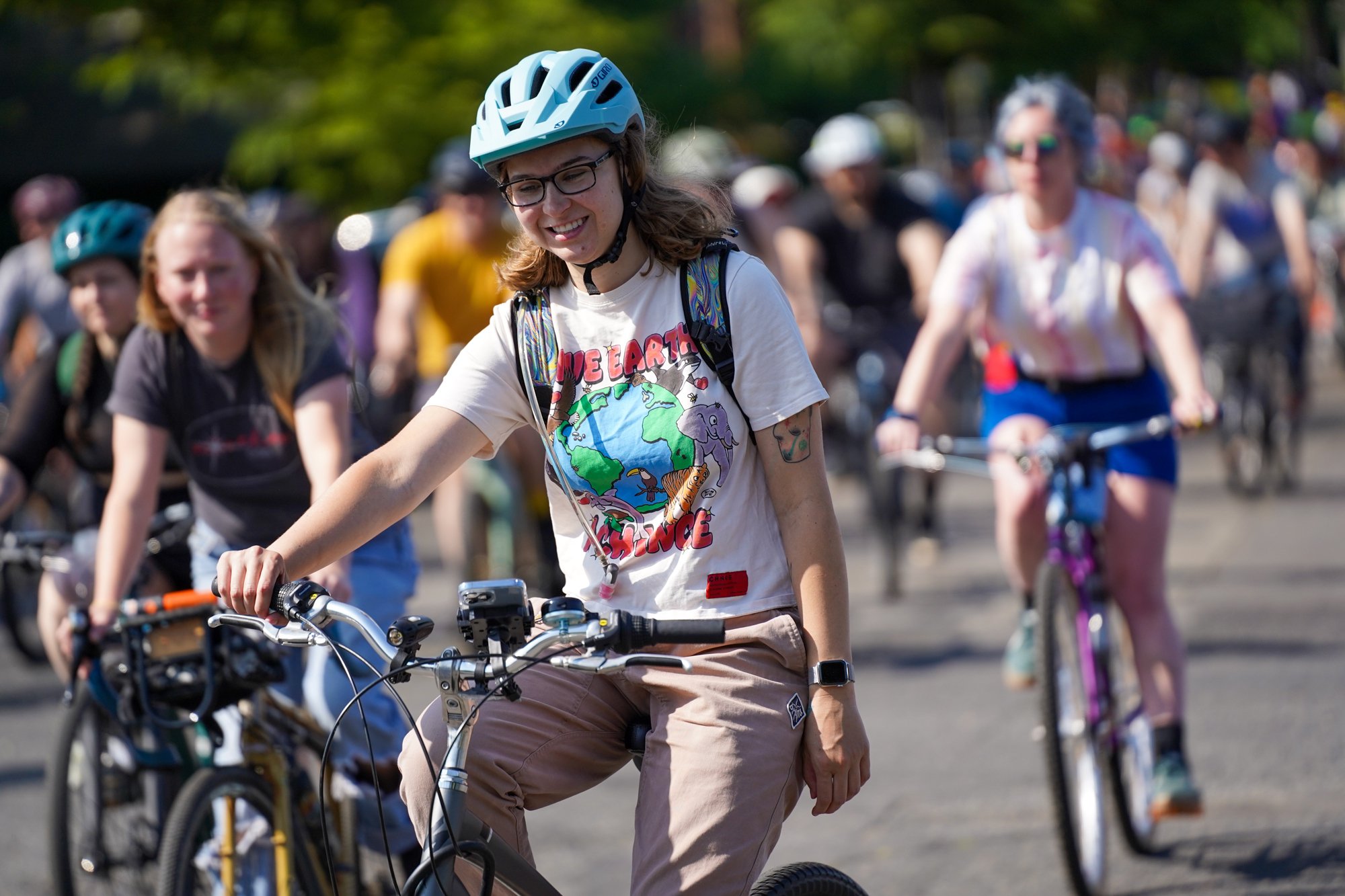
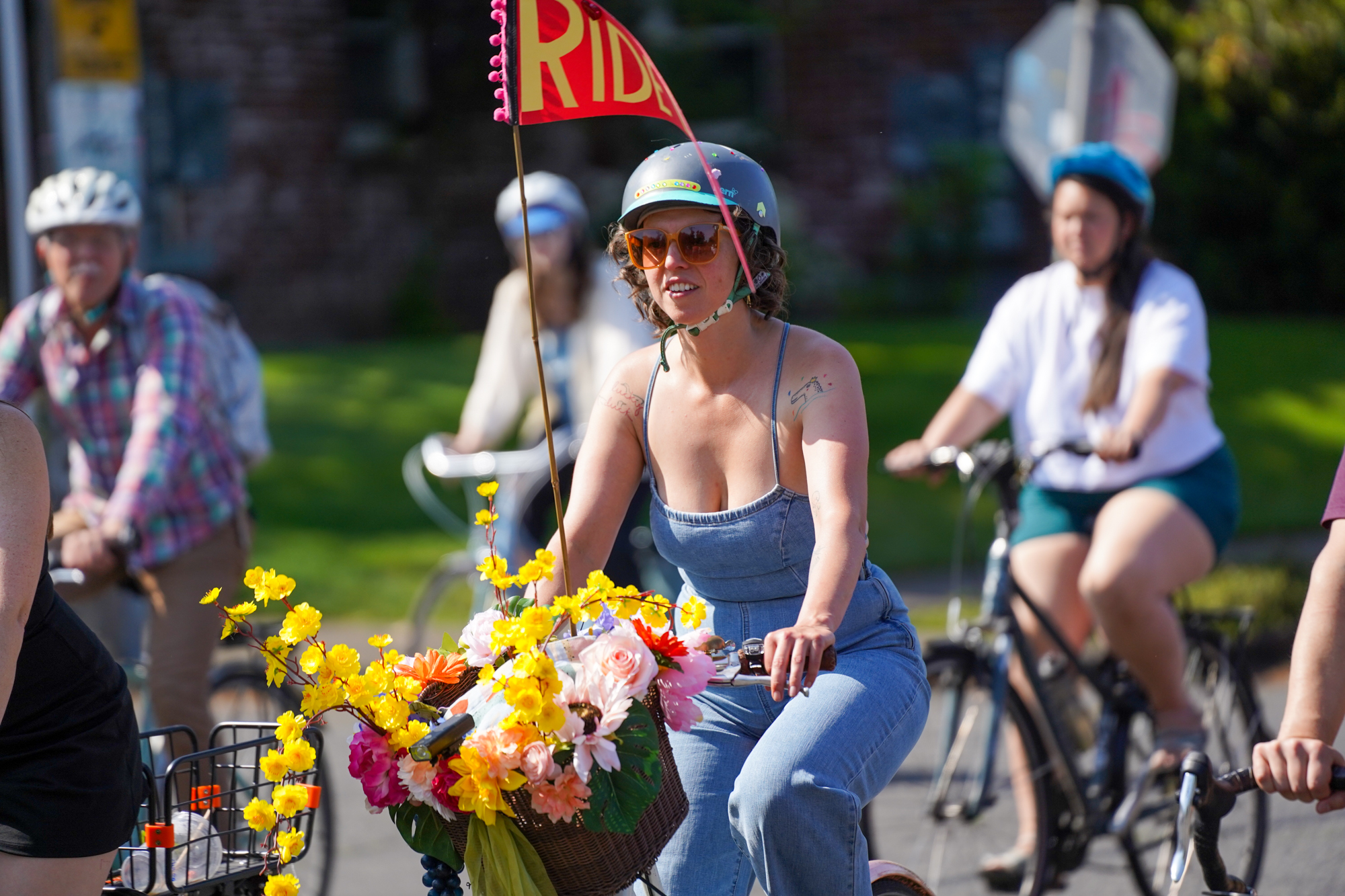
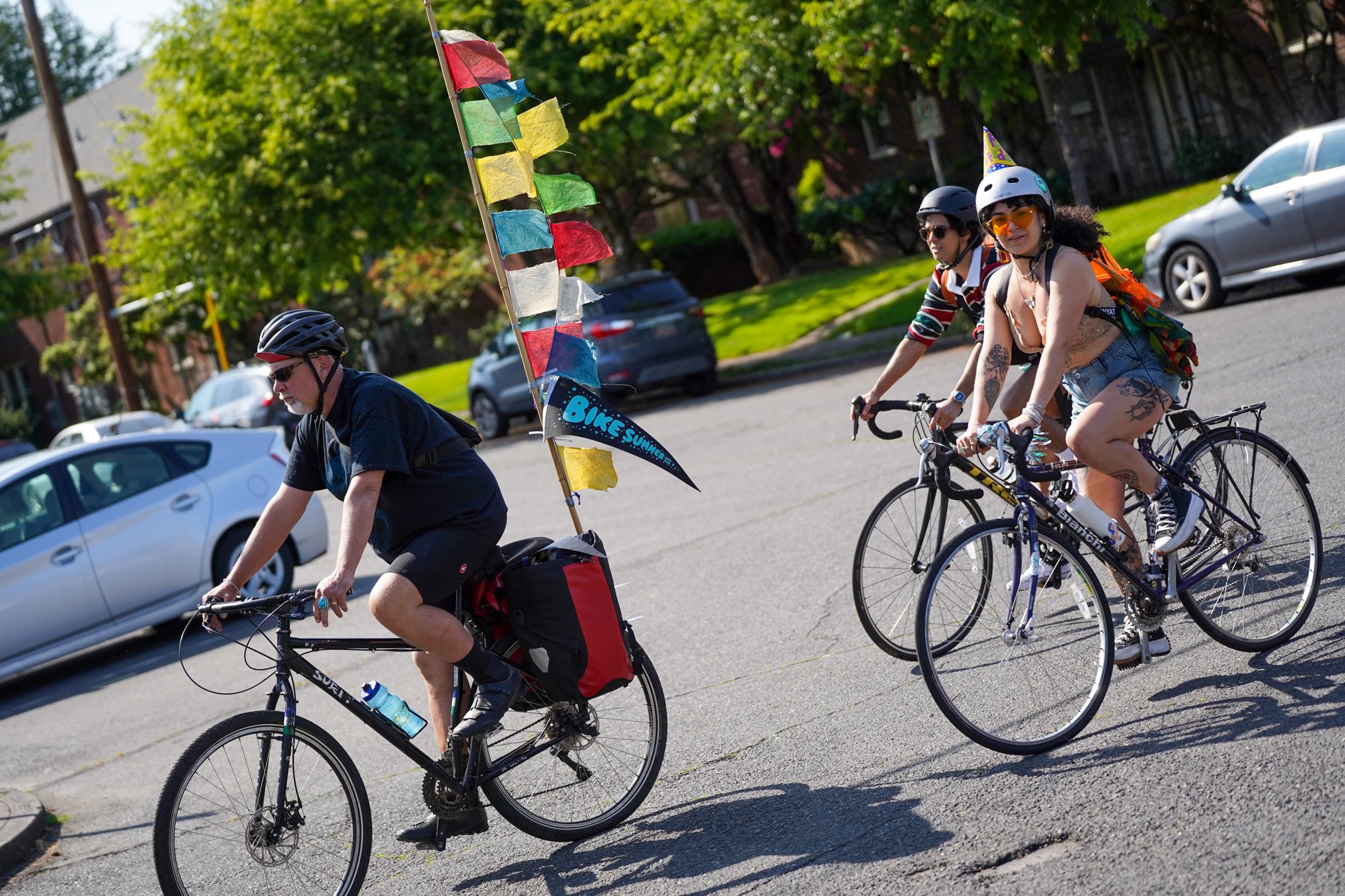
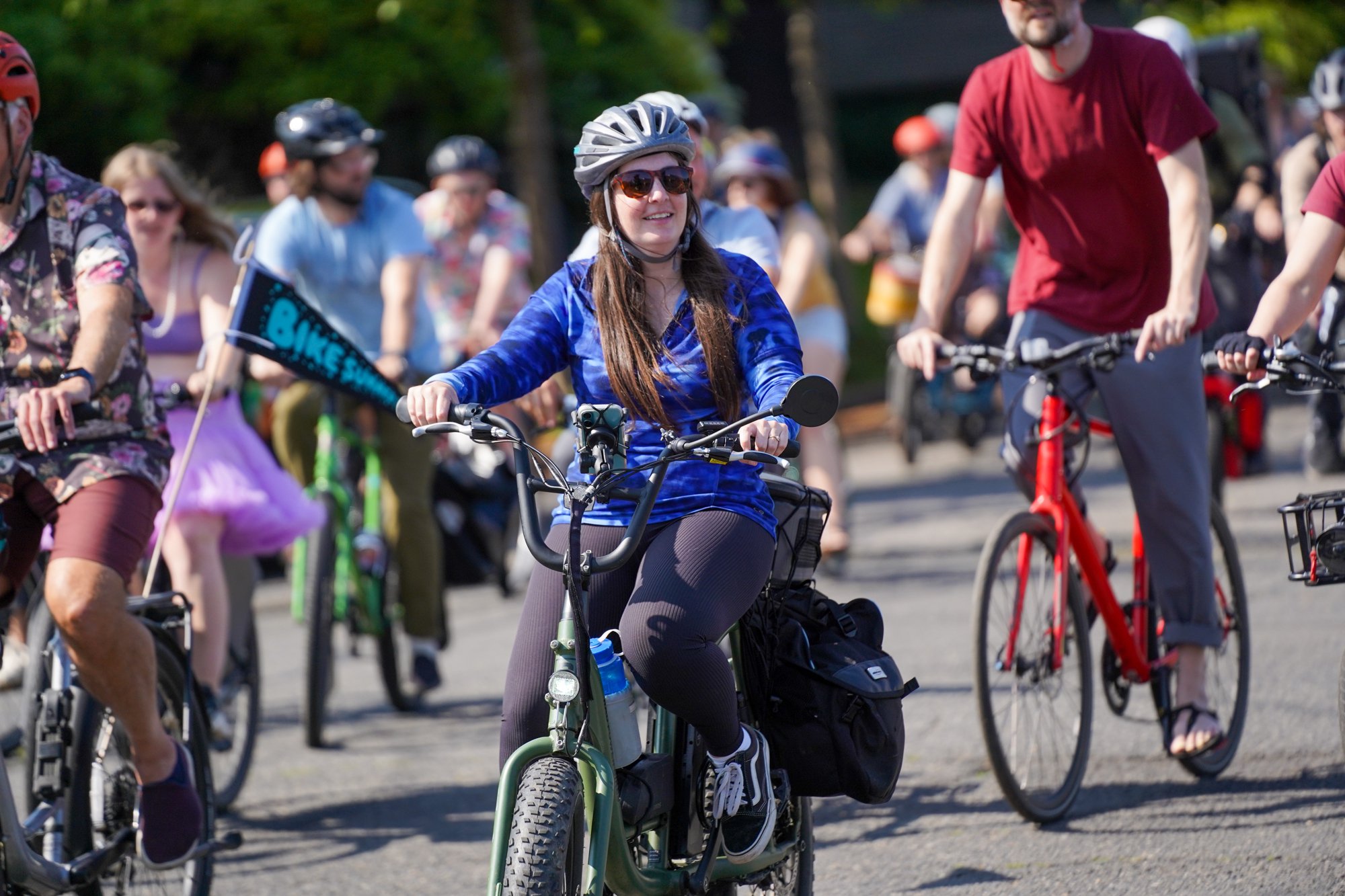
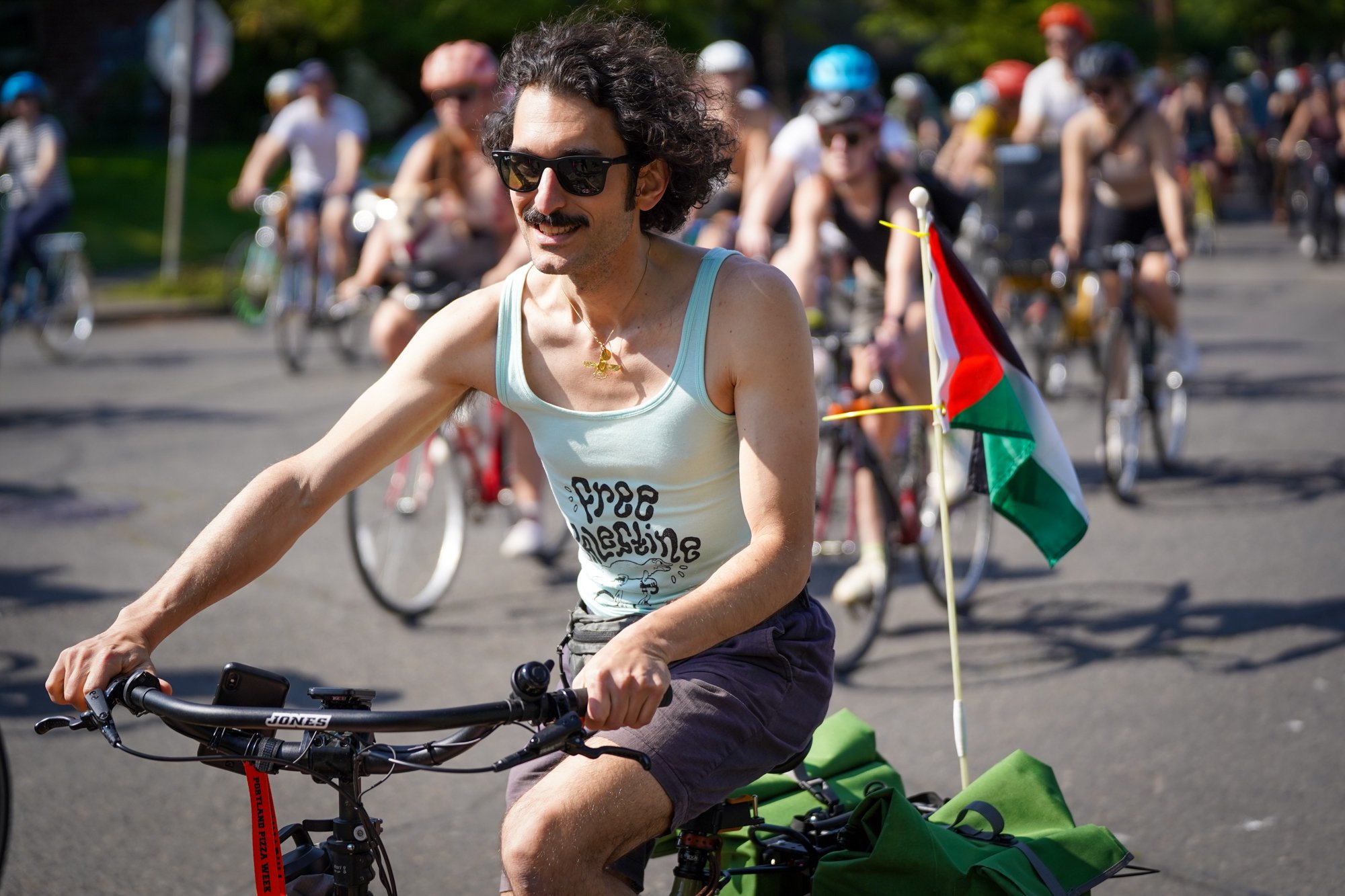
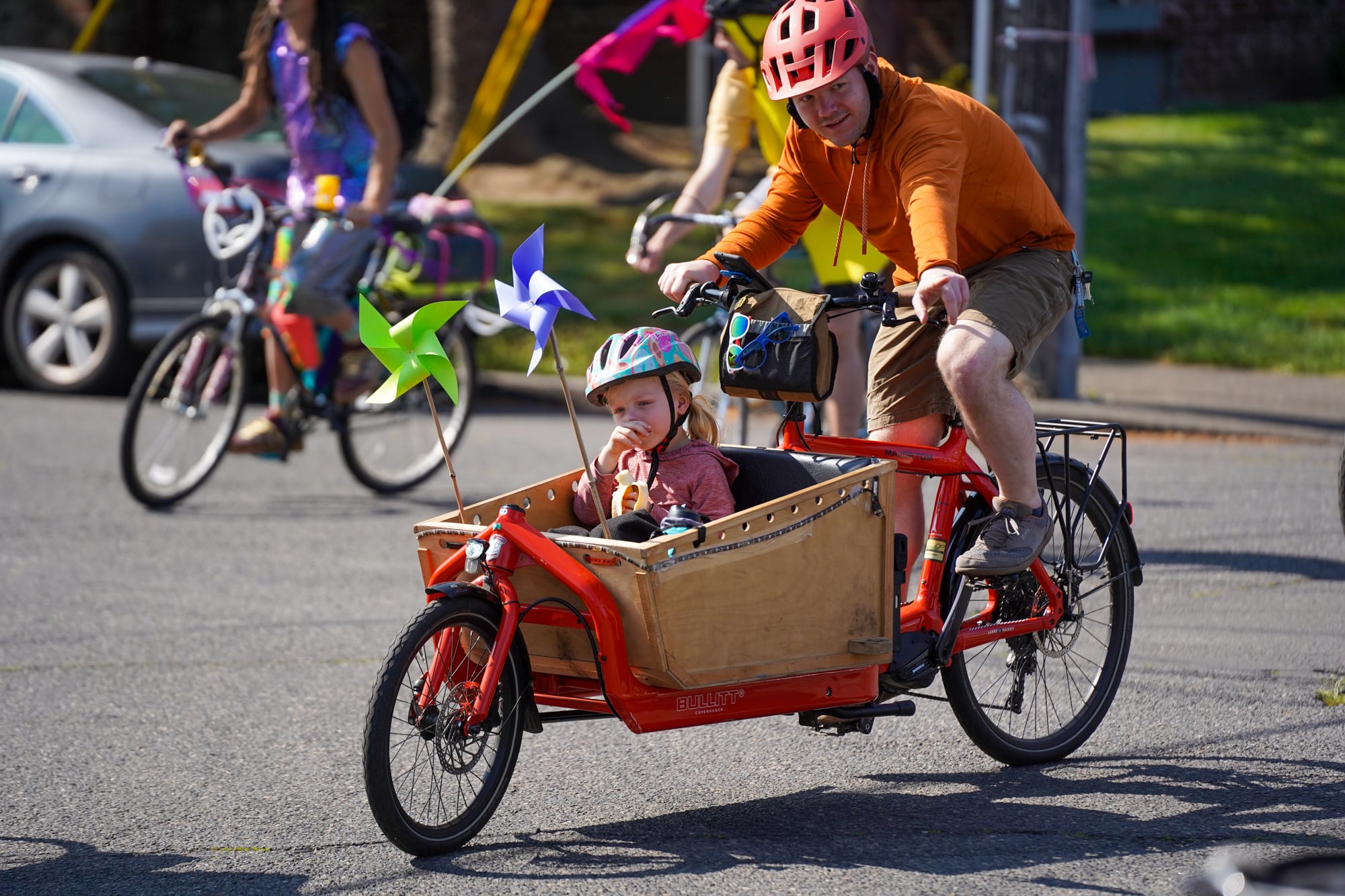
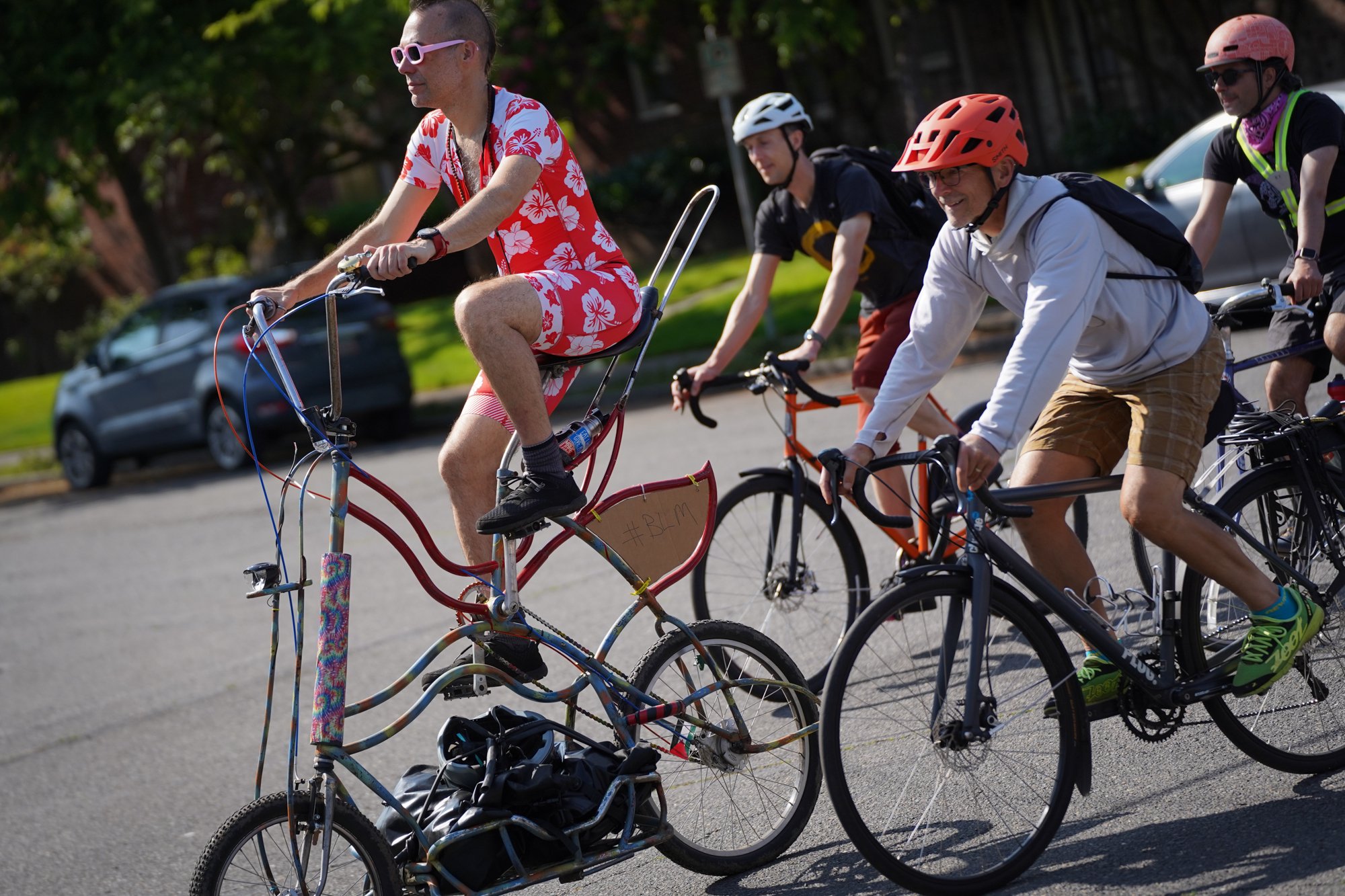
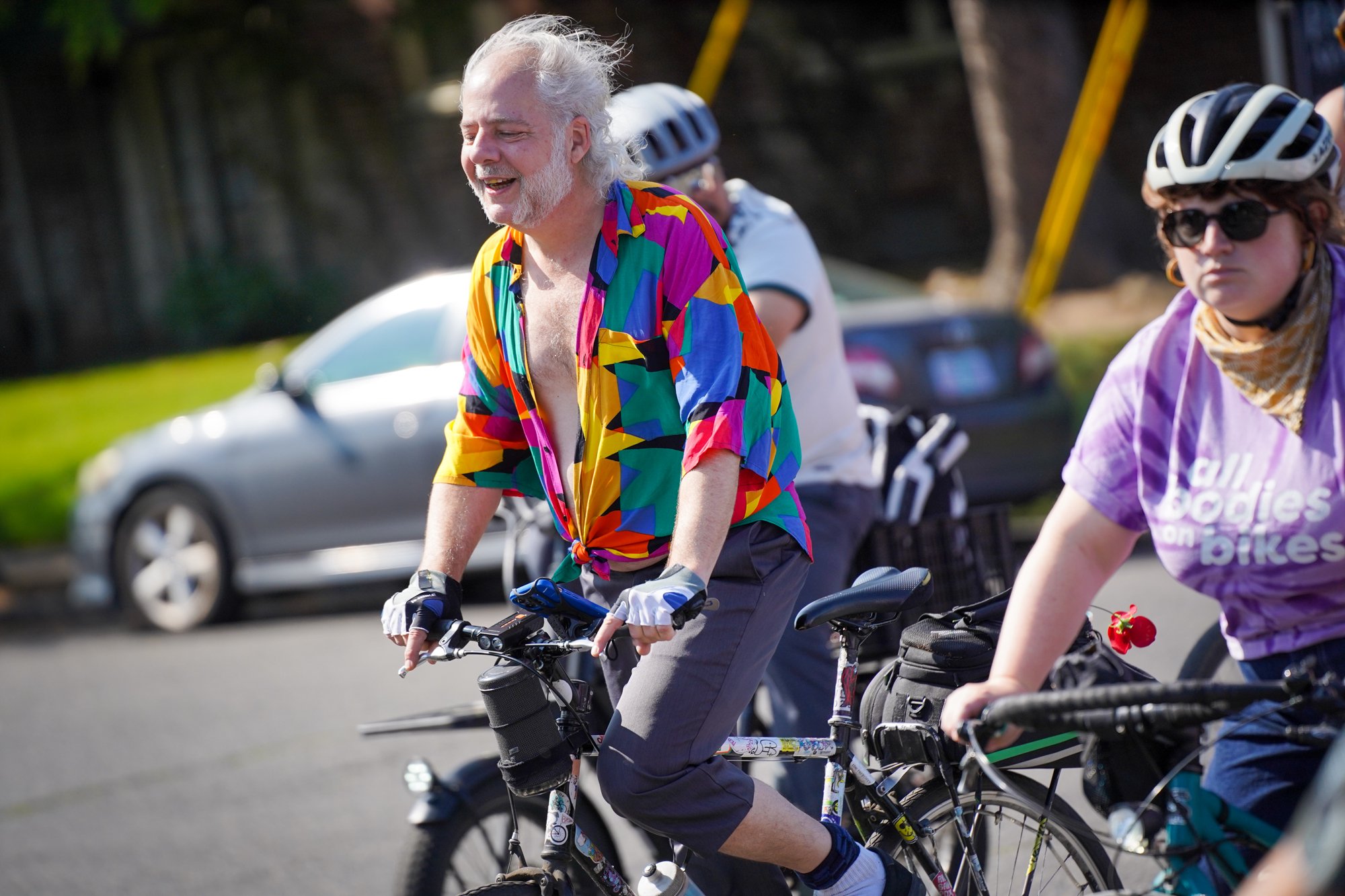
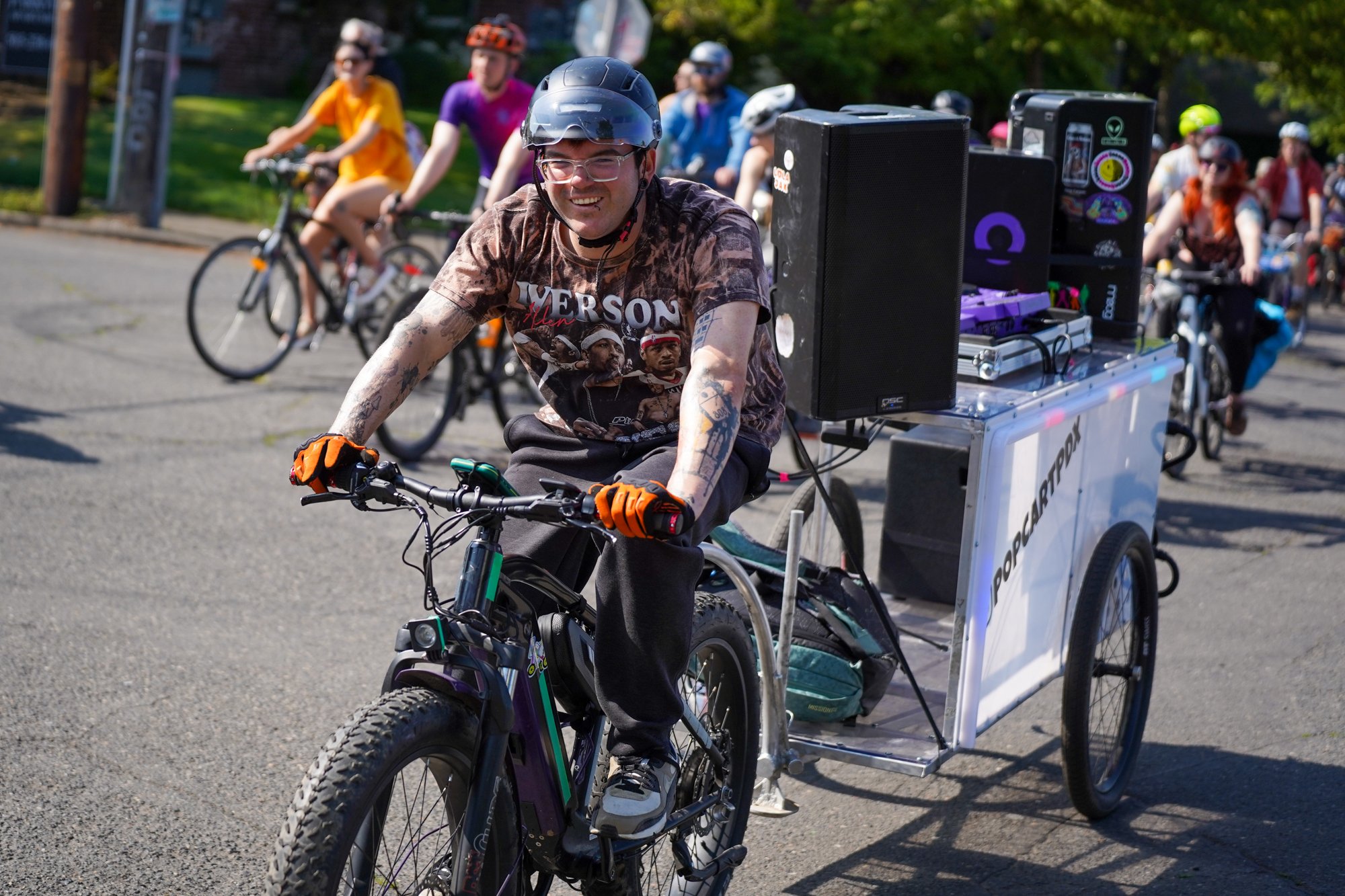
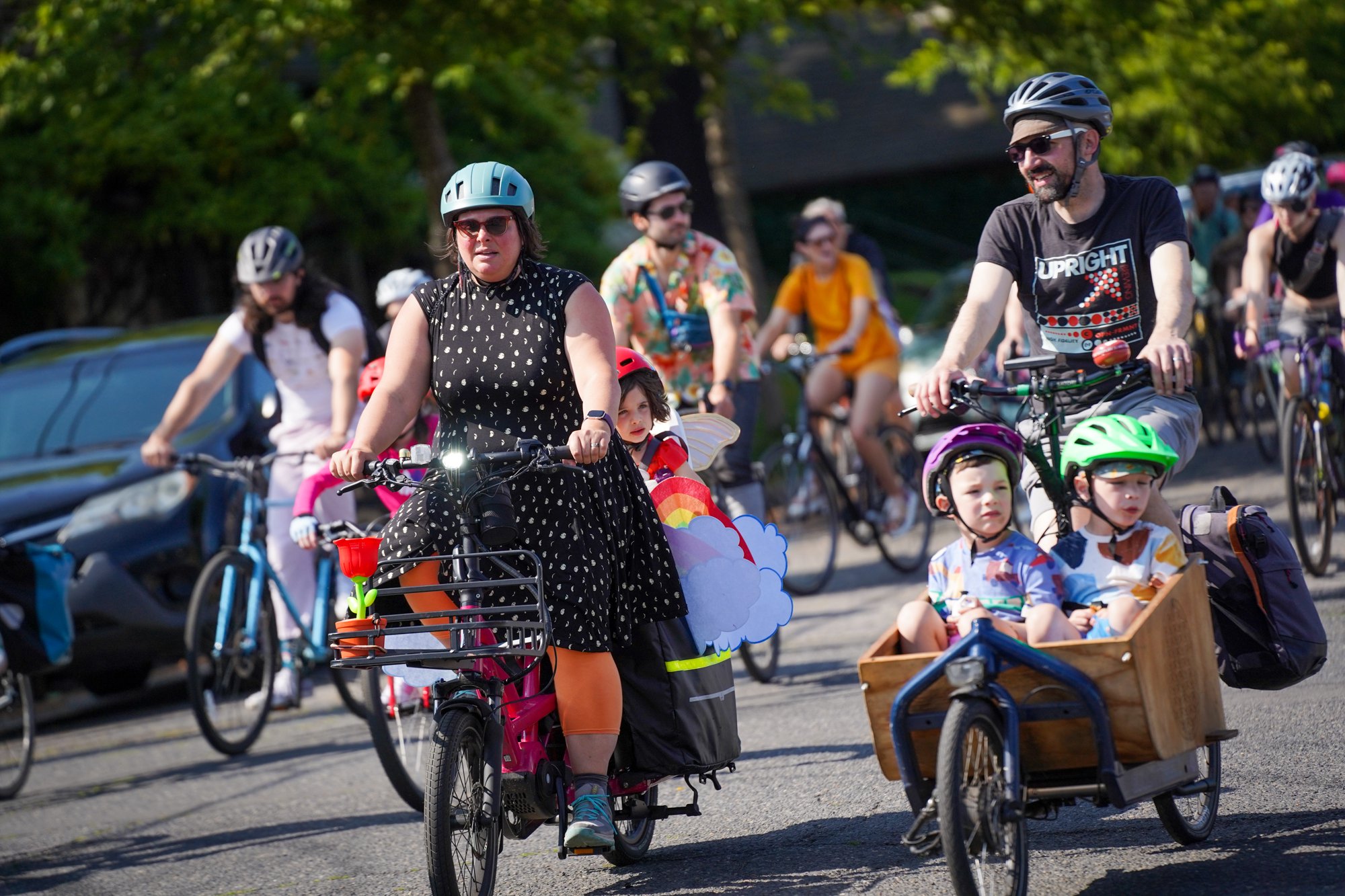
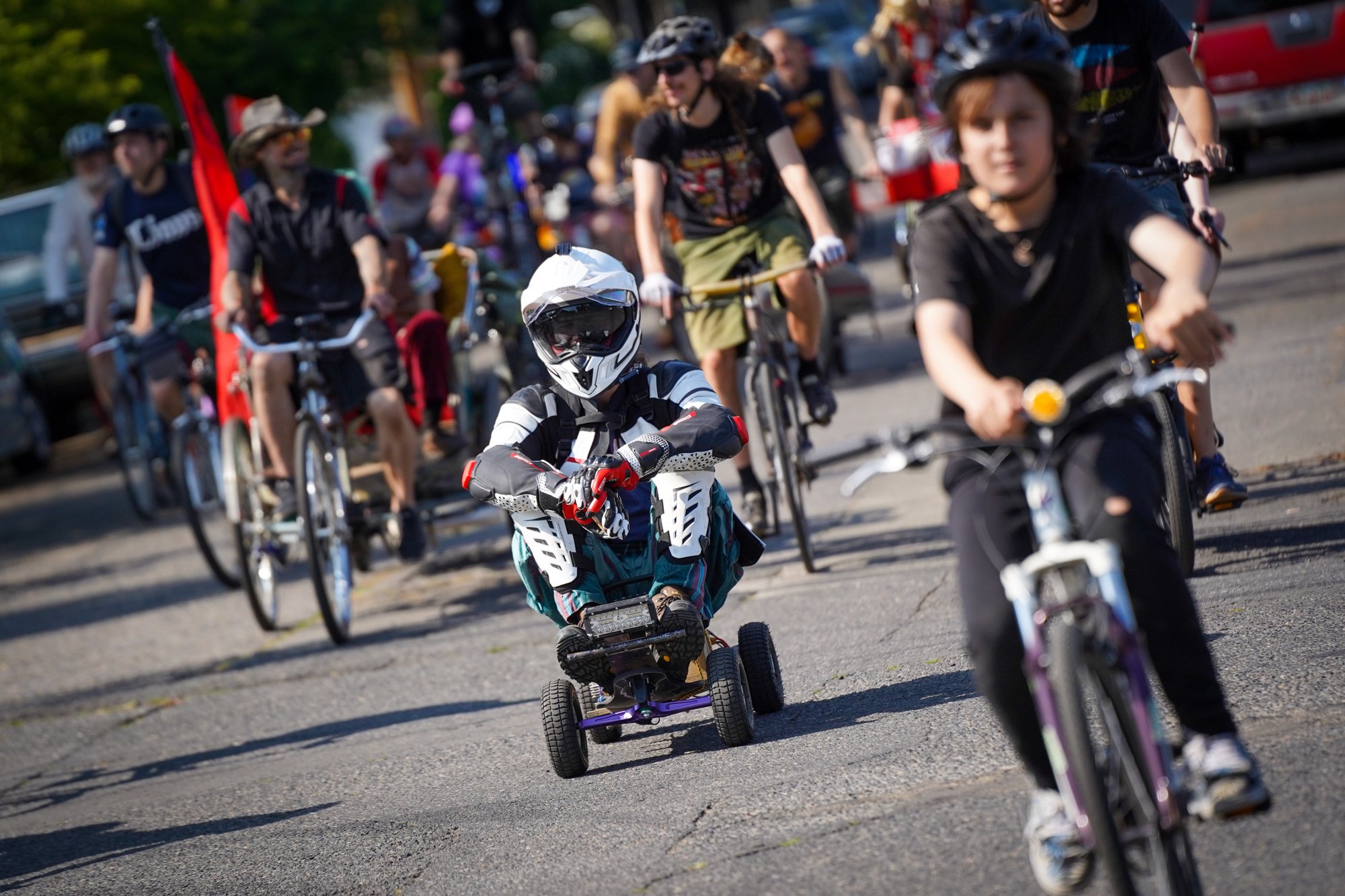
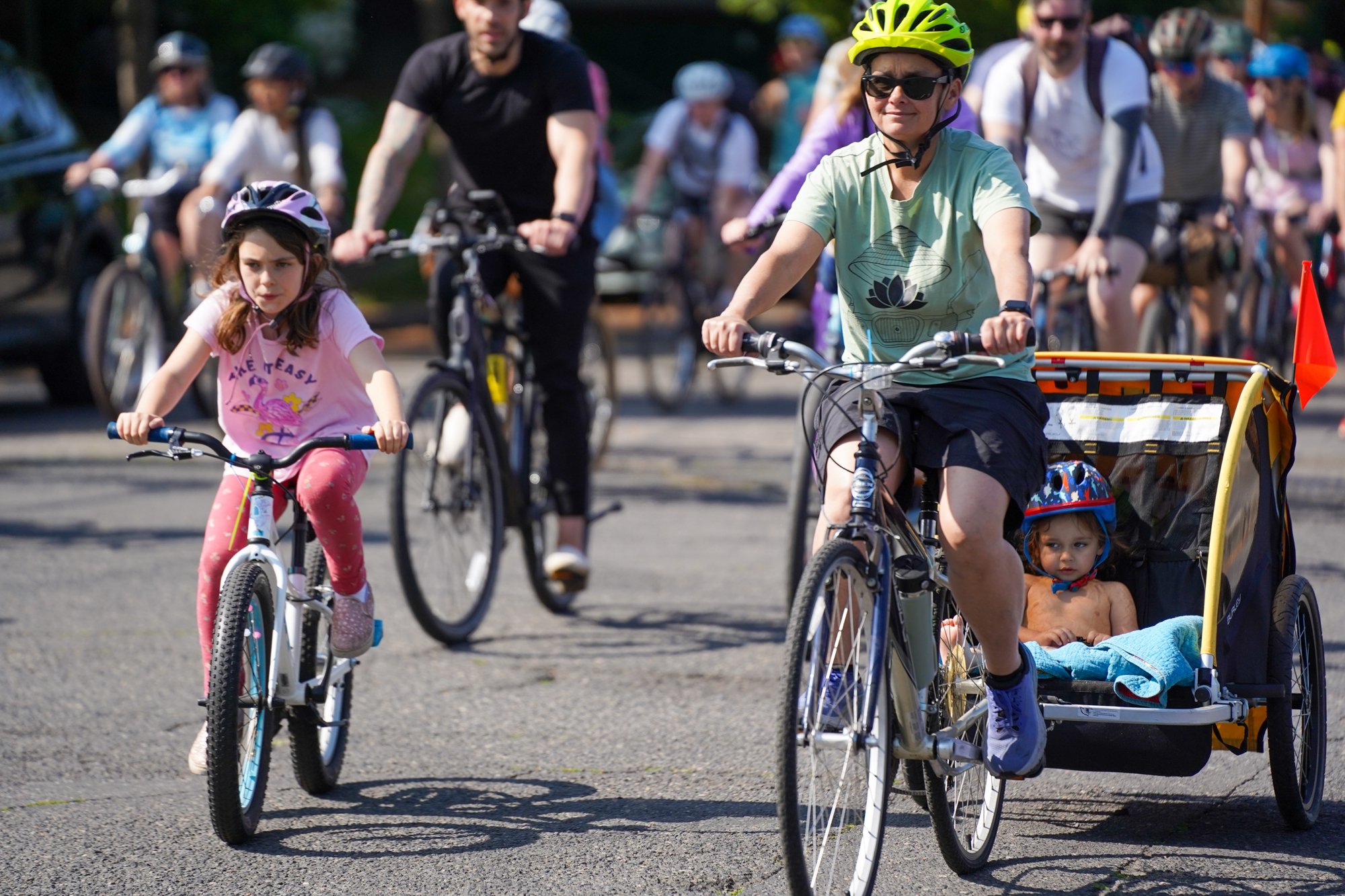
Sunday’s Bike Summer Kickoff Ride was memorable no matter what draws you to Portland’s bike scene. The event, which began with a pre-party just above a full-blooming rose garden at Peninsula Park in north Portland, had it all — and then some.
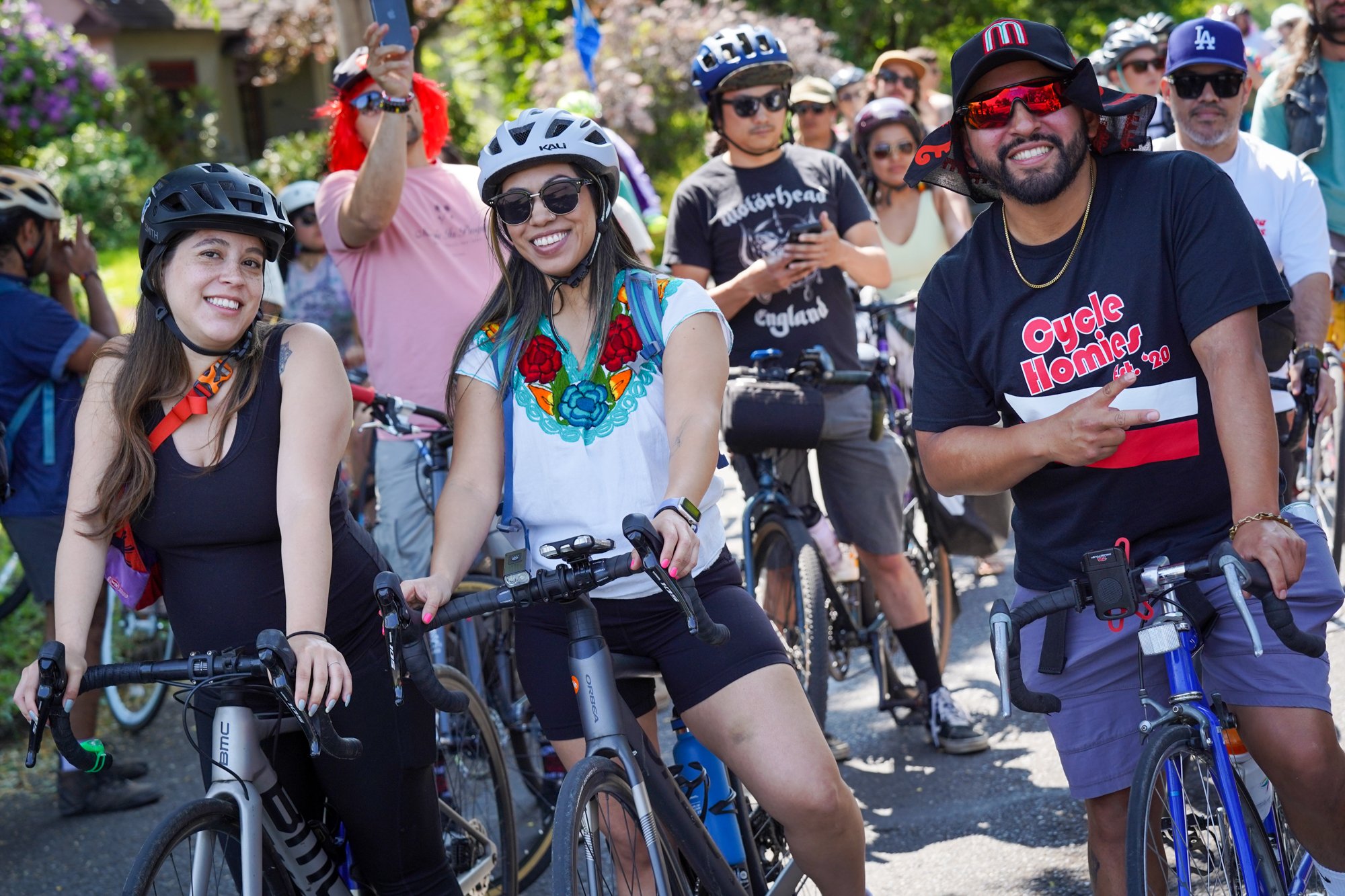
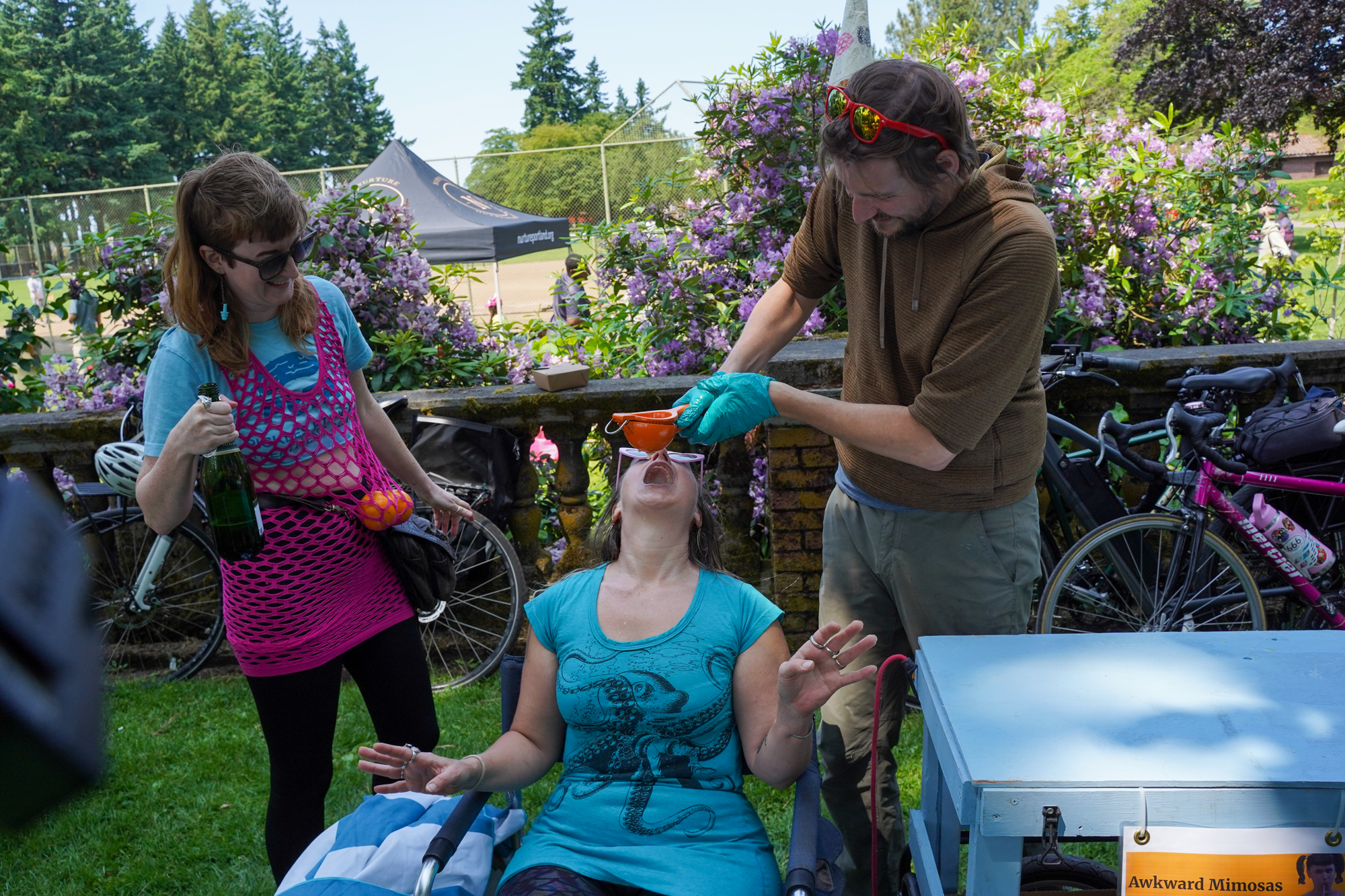
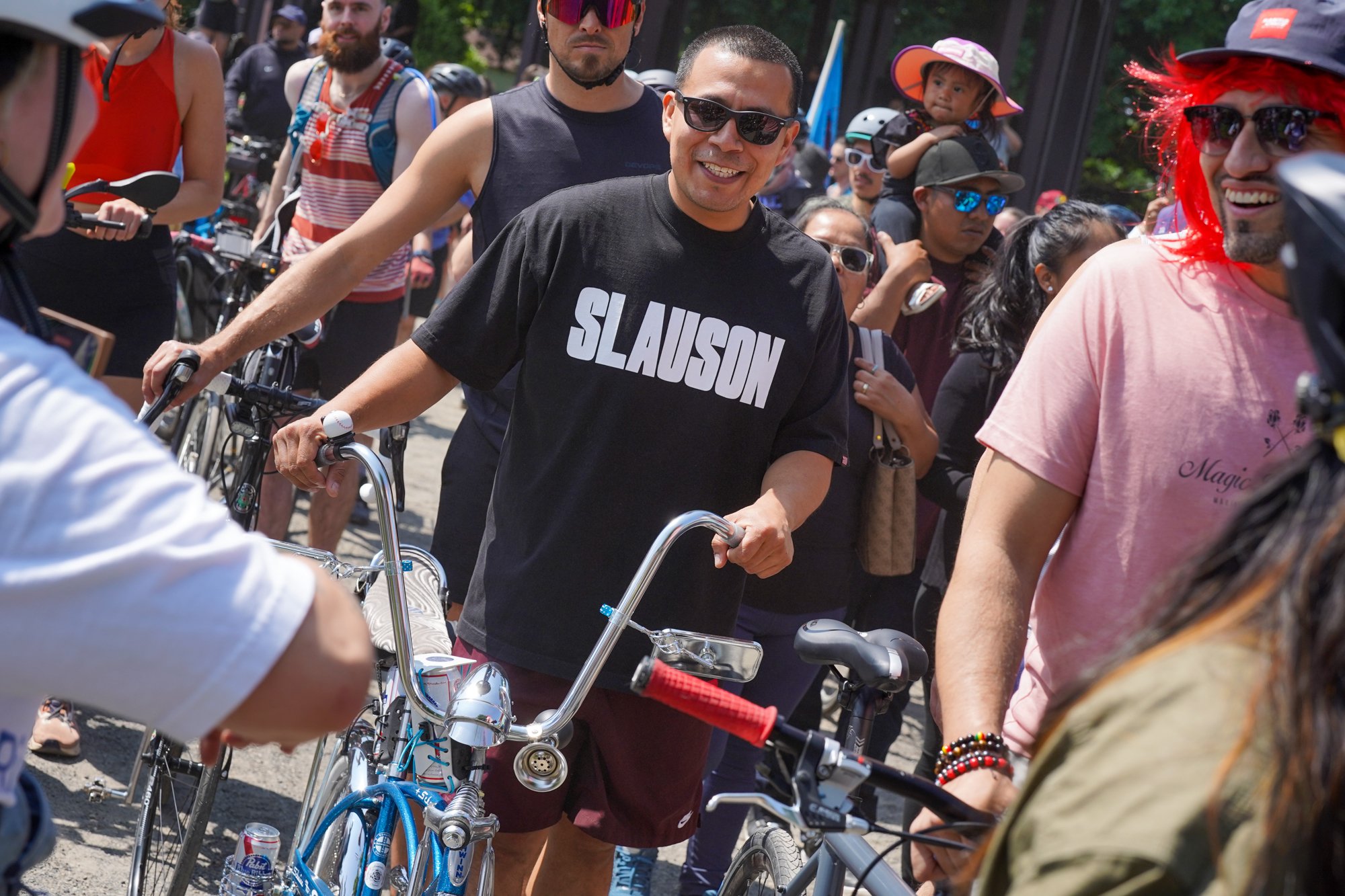
People gathered two hours before the 3:00 pm rollout time for a festival of cycling and community that has become an important part of the annual Bike Summer tradition. Folks were selling all types of interesting things, promoting their rides, or just soaking in the moment. There were vegan ice cream treats being sold from a tricycle, “awkward mimosas” for anyone daring enough to tilt their head back and try them, free bike repair, Bike Summer merchandise to buy, and more.
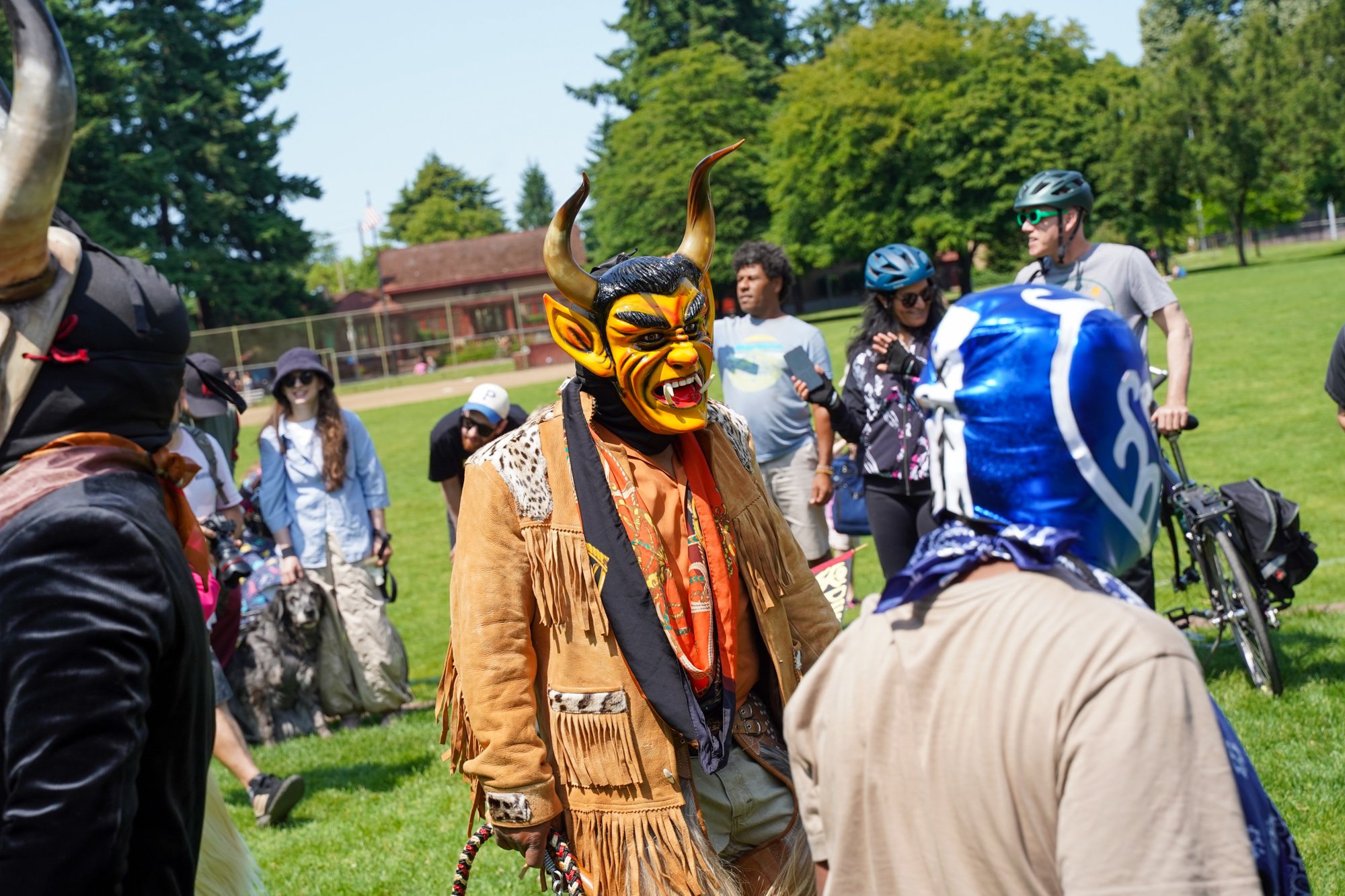
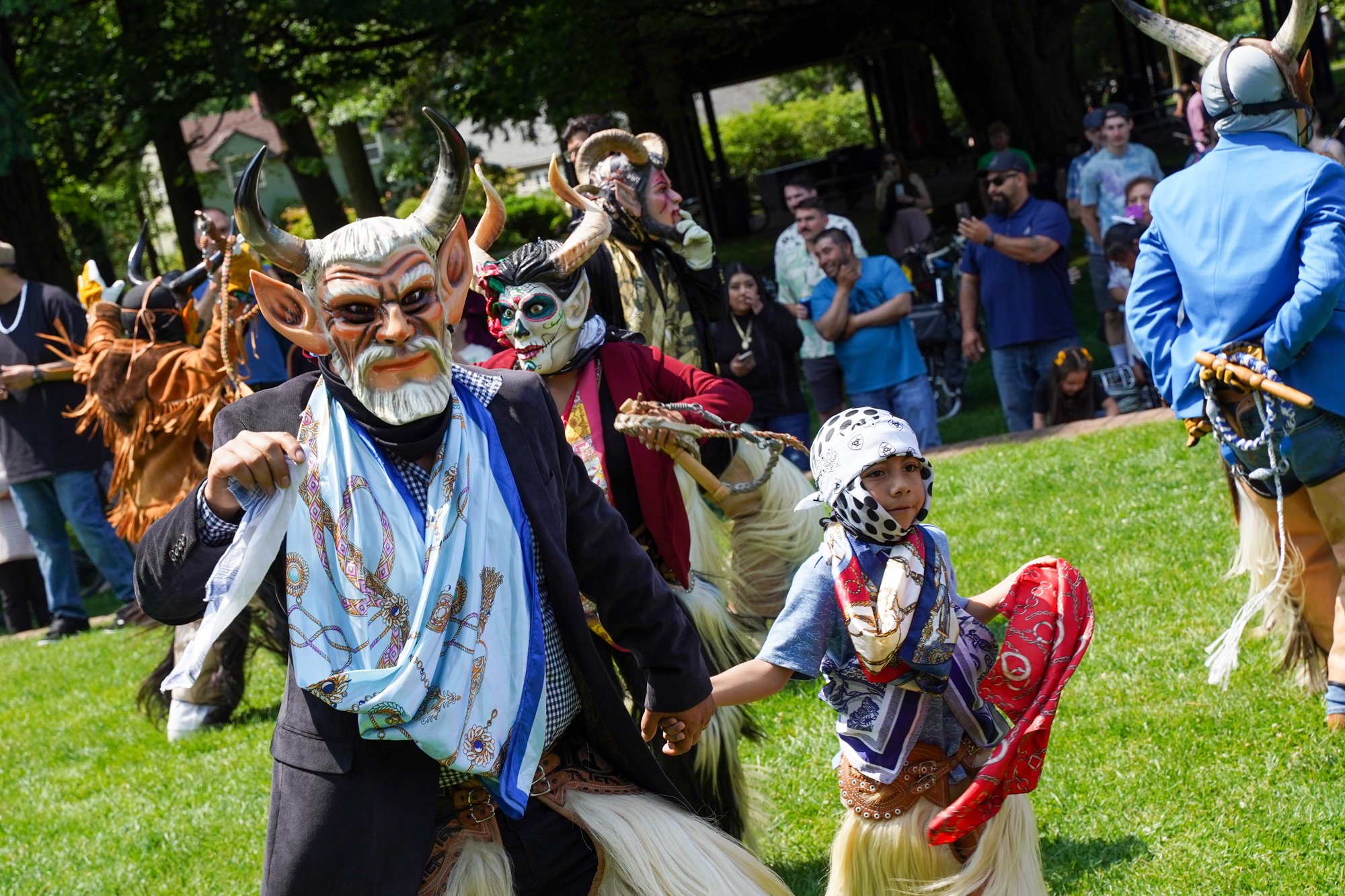
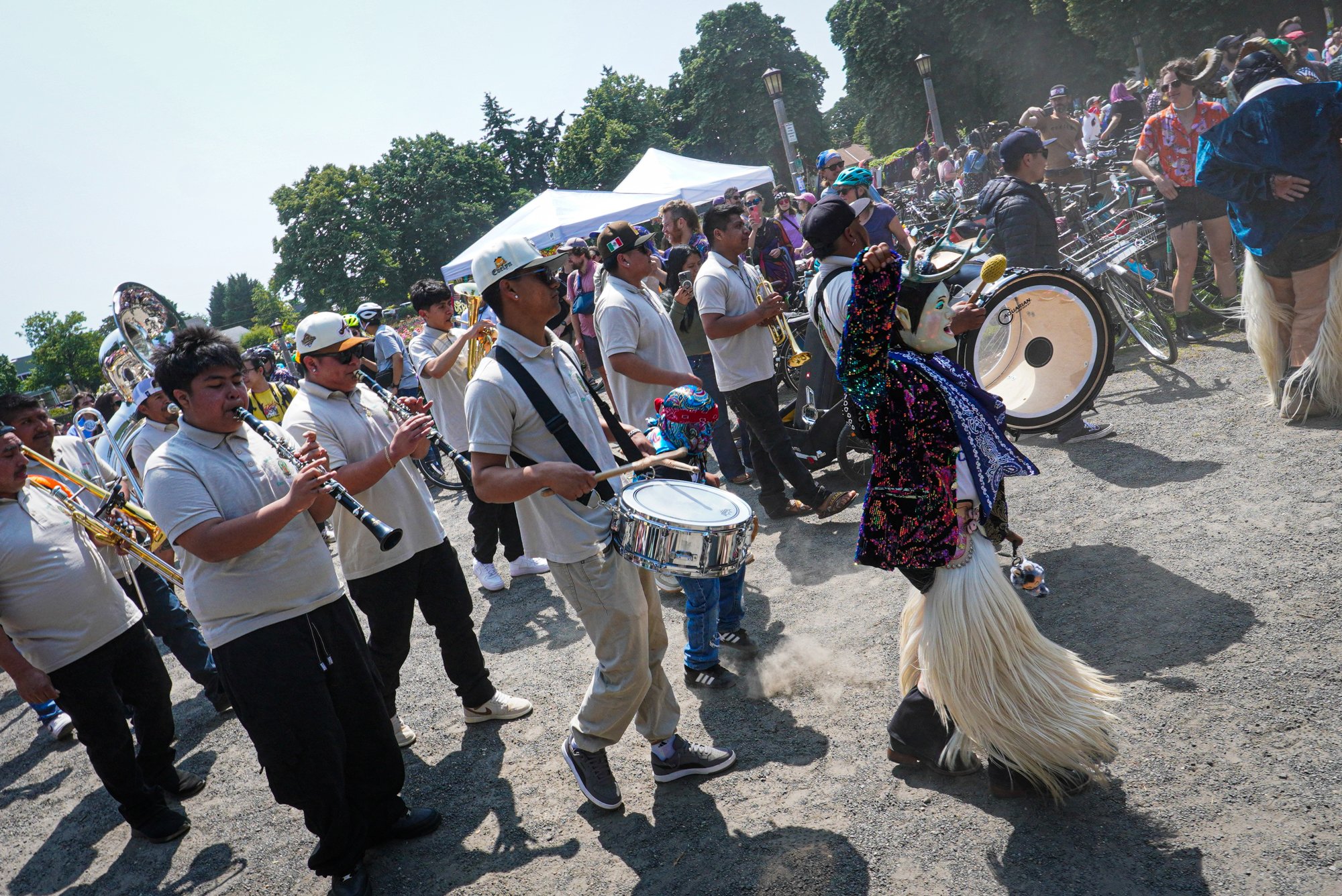
Just as I was talking to folks and getting my lay of the land, I heard Mexican music in the distance. At first I assumed it was for someone’s quinceanera or wedding (common thing to photograph at the rose garden on a beautiful weekend), then as dozens of dancers and musicians stomped through the cycling crowd, I realized it must be the work of the ride organizers: Cycle Homies.
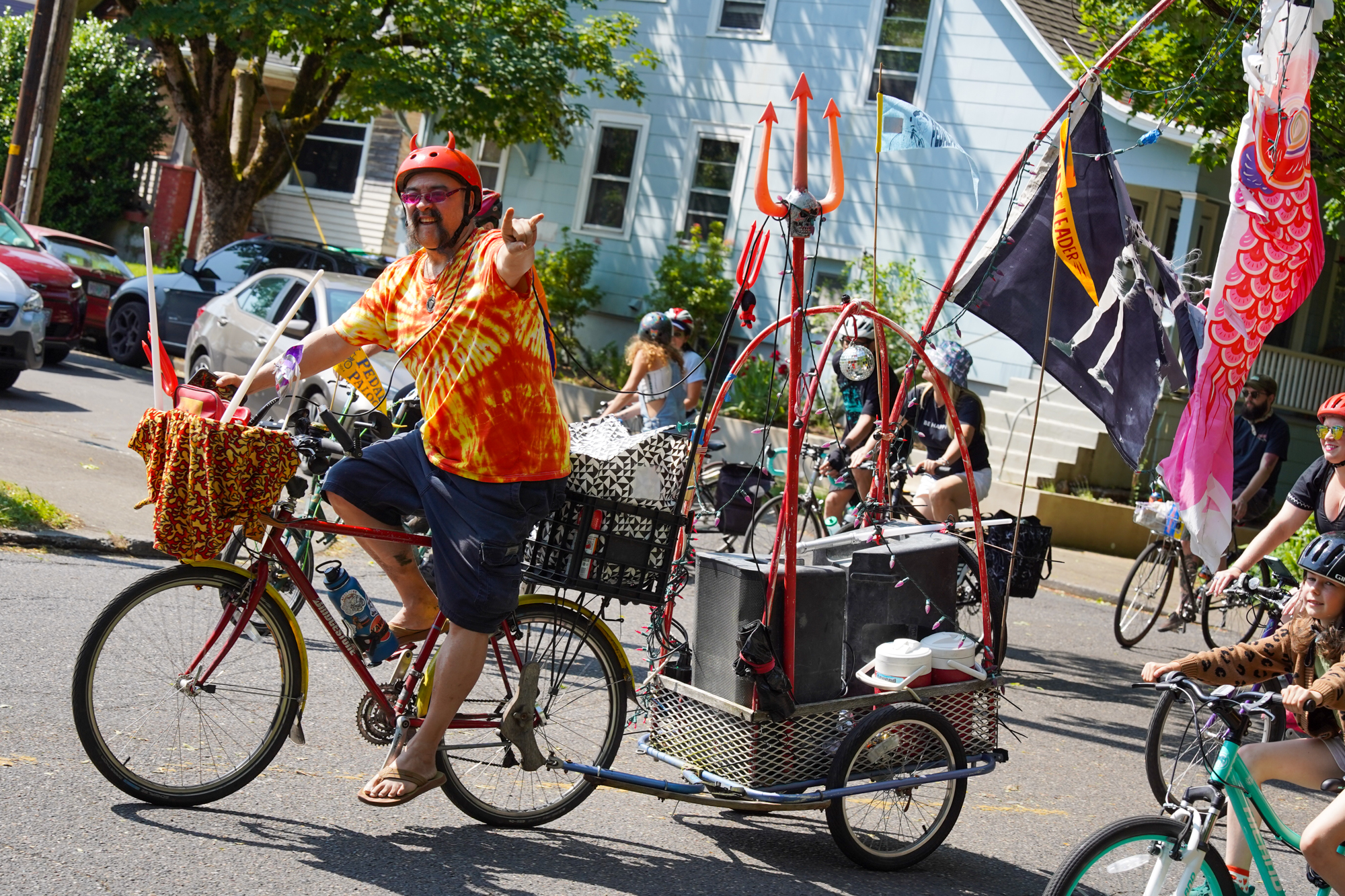
The dancers wore costumes that featured devil-like features and long, winding horns. They stomped and pulsed to rhythms provided by powerful brass and percussion players. The group was Banda Herencia de Oaxaca from the Mixteca region, and one of the leaders of Cycle Homies, Esteban, said they were dancing a traditional “dance of the devil” while accompanied by chilena music. Esteban said the performance was a “cultural expression celebrated through a blend of catholicism and indigenous traditions.”
Everyone seemed to love the music and dancing and there was a long ovation when they finished. Suffice it to say, Cycle Homies took full advantage of the stage they were given as leaders of this big ride. And that was by design.
“The bike culture in Portland is beautiful,” Esteban shared in a short interview with BikePortland, “but I feel like there’s not a whole lot of representation as far as people of color leading rides or organizing rides. That was kind of my whole intention and goal when we first started this thing. I just wanted to see more people of color on bikes.”
For Lillian, a Bike Summer veteran who attended her first one in 2006 and has never missed it since, she’s drawn to the odd and quirky rides. Dressed in an old-timey, lavender outfit that included a hat woven with lace and flowers, puffy shoulders, and a corset-drawn dress, she described herself as the “merch wench” — otherwise known as someone who volunteered to sell Bike Summer merchandise.
“It’s the most magical time of the year,” Lillian shared, as she described her intention to dress up in pasta for the Pasta Ride. “I’m very excited about it.”
I bumped into Aaron and noticed “Bike – A – Sketch” scrawled on the front of his bike. At his Bike-A-Sketch ride on June 30th, Aaron said people will get together, but, “Instead of drawing a bicycle, they will bicycle a drawing.” Using a GPS tracker, riders will set out on different routes and draw lines, “On the canvas that is the city.” This type of creative interpretation of “bike ride” is what makes Bike Summer so interesting and fun.
The next person I bumped into was Geoff. He’s traveled all over the world as a photojournalist who covers society and culture. “This has got to be one of the most authentic gatherings of people,” Geoff exclaimed. “And it seems to be getting better and better every year. I just love it — people of all ages, shapes and sizes. I mean, Jonathan, it doesn’t get any better than this!”
Then it was time to ride.
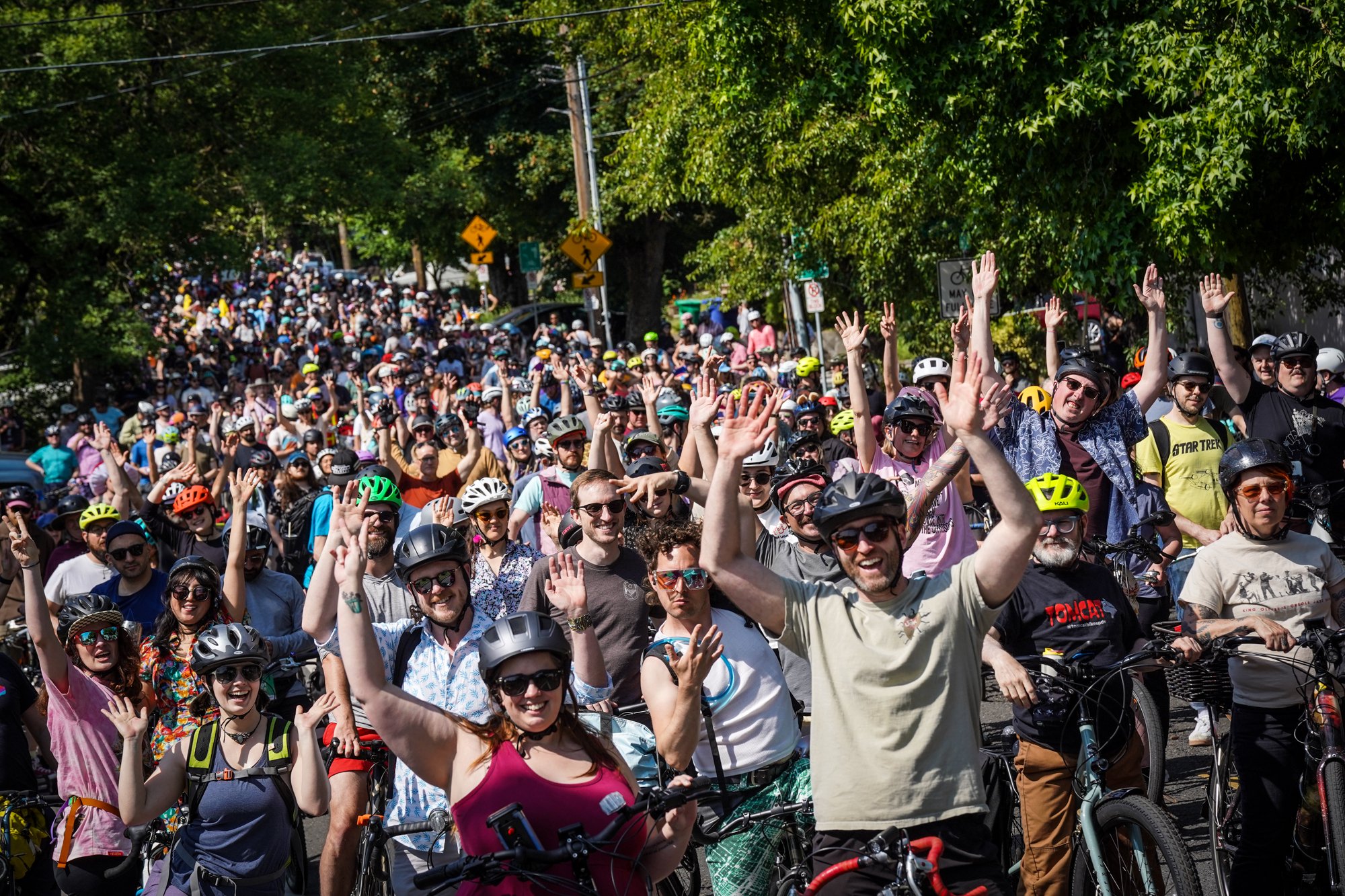
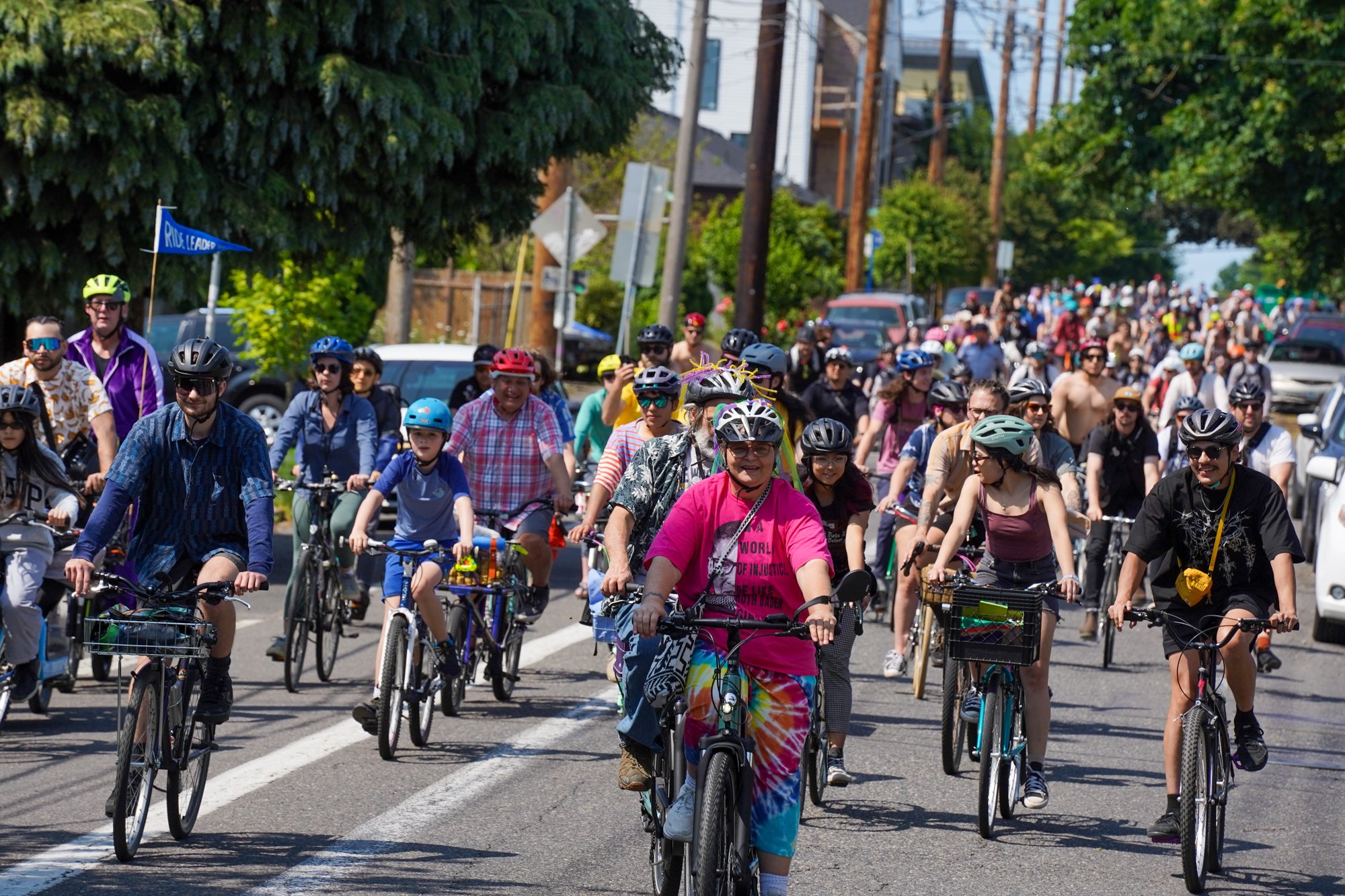
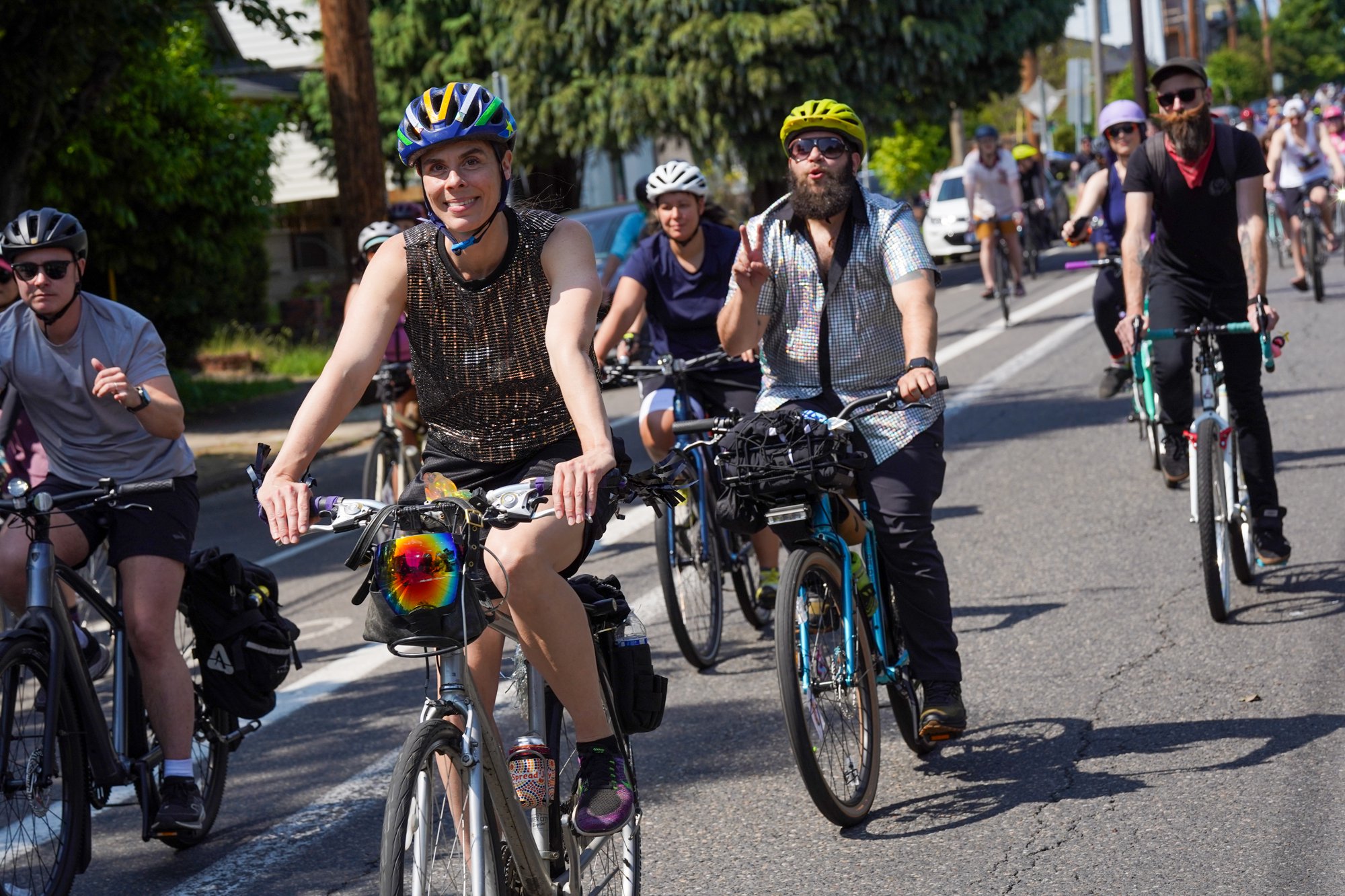
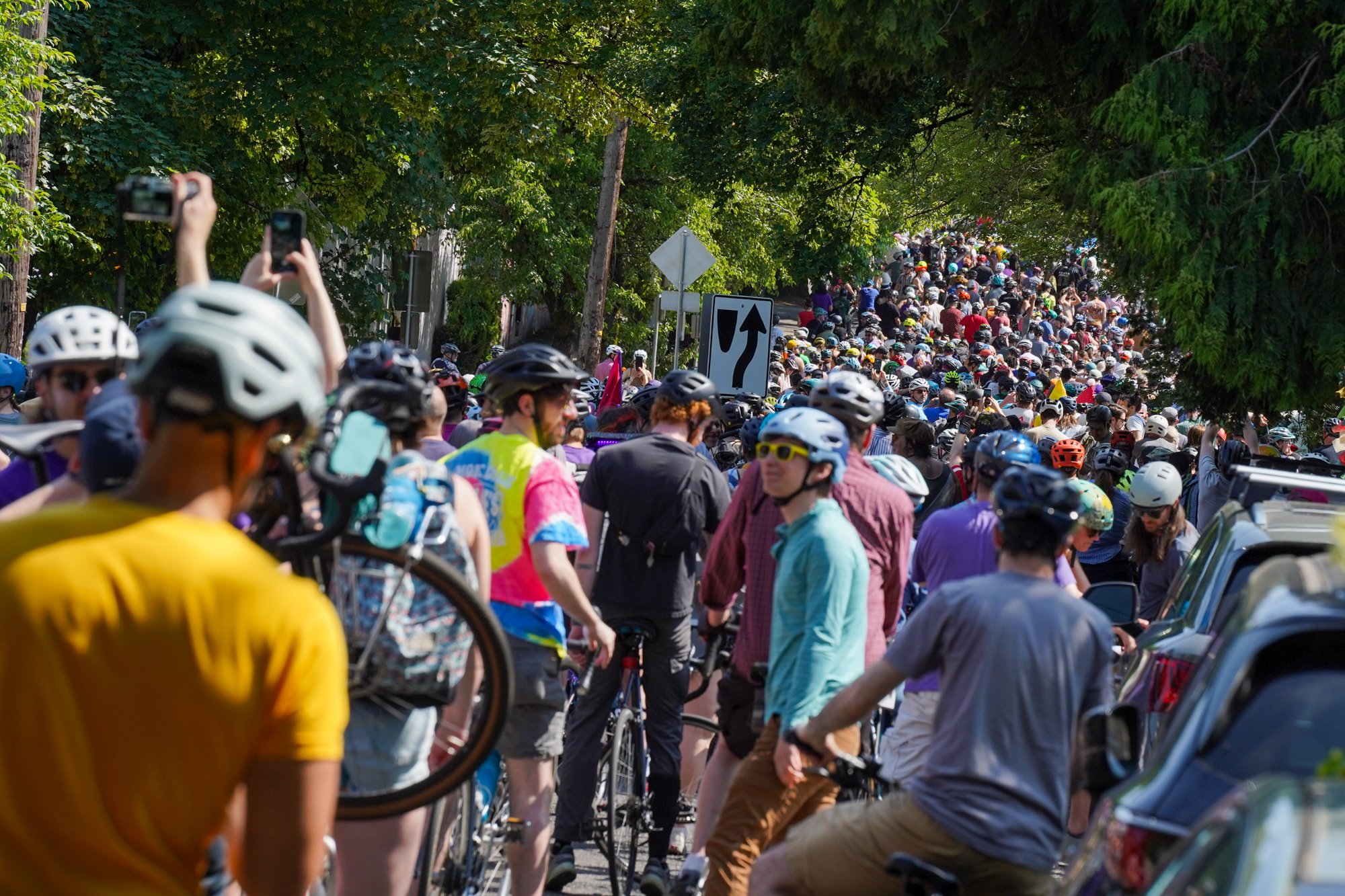
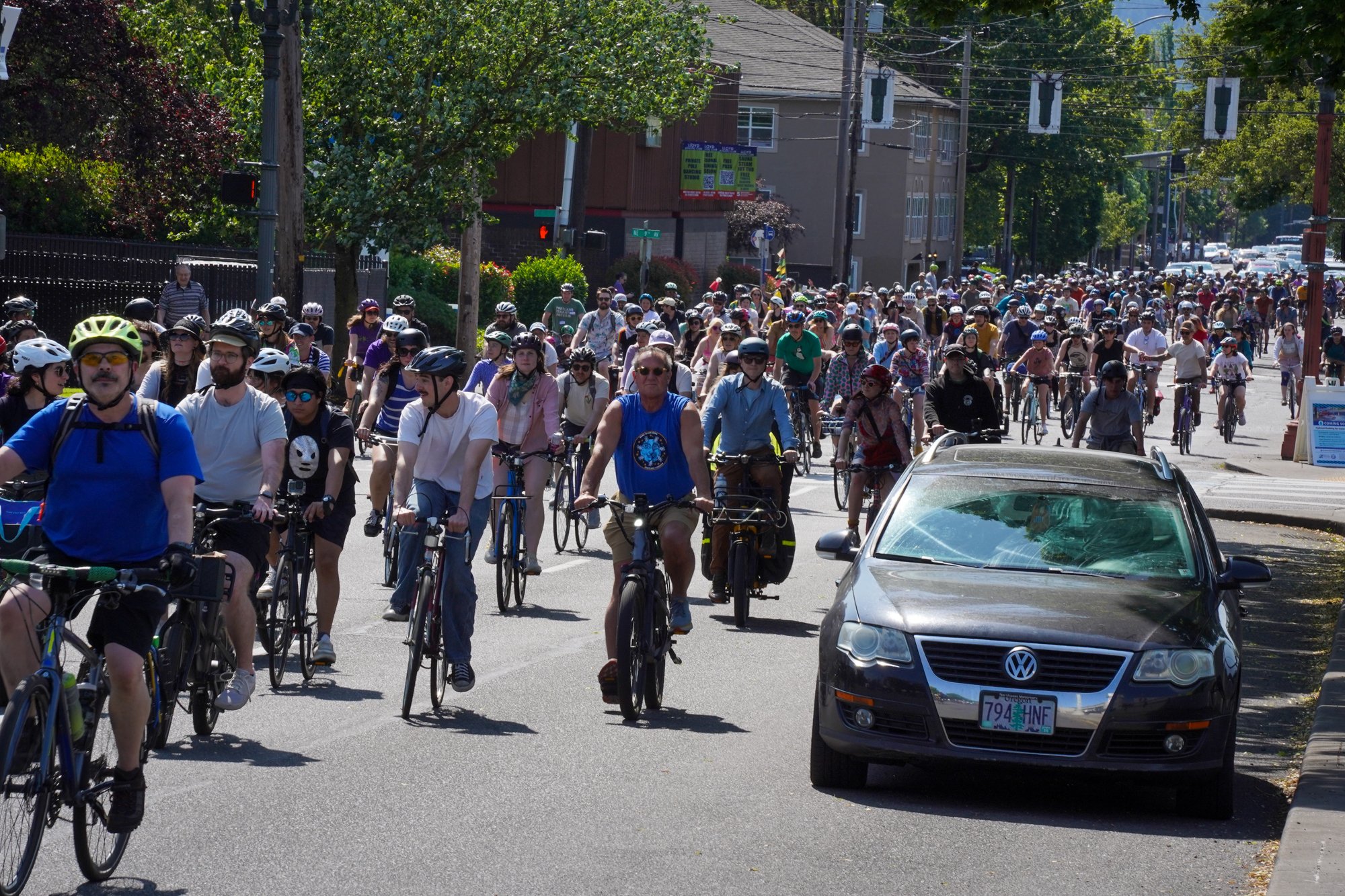
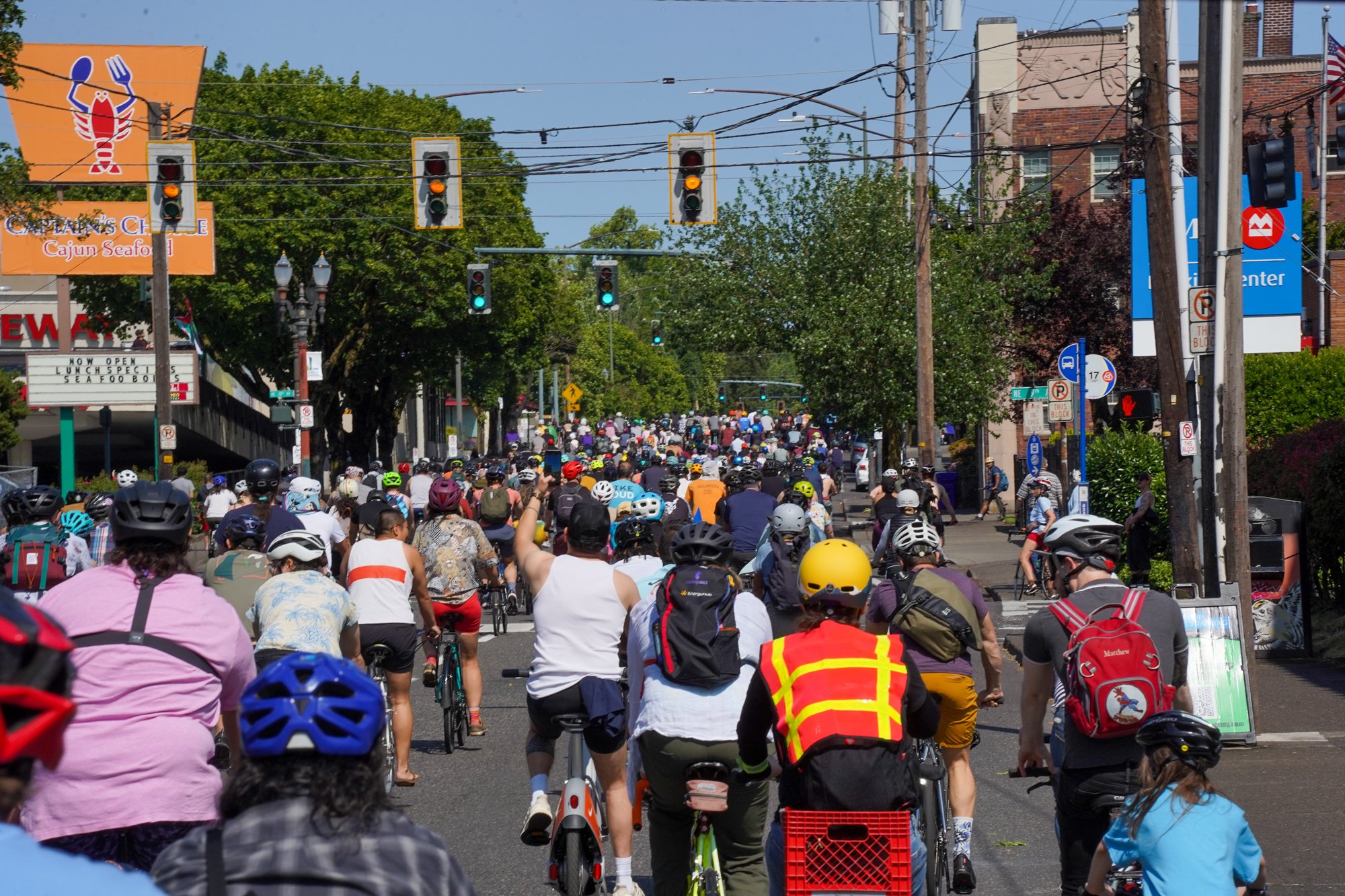
We filled at least a half-dozen full city blocks thick with cyclists. Several thousand people pedaled together from Peninsula Park to Colonel Summers Park in southeast Portland. As riders stretched as far as my eyes could see, and that sweet, familiar cacophony of music, bike bells, and proclamations of “Happy Bike Summer!” rang through the air — there was no mistaking summer is finally here and it’s time to ride bikes together.
— Bike Summer was first held in Portland in 2002. The following year it was called Mini Bike Summer, before changing its name to Pedalpalooza from 2005 to 2023. Organizers are now transitioning the name back to Bike Summer.Find a ride and browse the full Bike Summer calendar here. Don’t miss the full photo gallery.
Welcome to what will be a great week. I just have a feeling. Hope you enjoyed the nice weekend. Before I share videos of Council President Pirtle-Guiney riding on Sandy Blvd and the Bike Summer Kickoff Ride, let’s eat our vegetables and get caught up with the news from last week.
Here are the most notable stories that came across my desk in the past seven days…
Build it and they will come: We must push beyond paint-only bikeways if we want to increase cycling, says a major new research paper that used 6 years of longitudinal data in 28 US cities that found: “Protected bicycle lane mileage installed was significantly associated with bicycle commuter increases 52.5% stronger than standard bicycle lane mileage and 281.2% stronger than shared-lane marking mileage.” (Nature)
No more excuses: Every politician who supports projects that will increase VMT must be asked how they square that decision with the fact that global temperature rises in the next five years are likely to lead to crop failures and wide swaths of our planet baking in extreme heat. (Financial Times)
Carfree living, but do it in the Italian Alps: An Italian couple shocked their friends and family when they moved to a home in a rural, mountainous neighborhood and decided to forego a car and use two cargo bikes as their vehicles. (The Guardian)
Vehicular assault and social unraveling: As much as the topic pains me to think about, I’m glad that a major media outlet is treating it as more than just a one-off phenomenon and giving what they call the rise in “vehicle ramming” incidents the serious thought it deserves. (Washington Post)
E-bike power debate: Interesting new paper from a German e-bike industry association that is pushing to define e-bikes in a way that prevents them from becoming e-motorcycles, and how some folks feel that limitation could stifle key parts of the sector. (Bike Radar)
Why DOTs are broke: This must-read on the Highway Trust Fund should be required reading for every single elected official who thinks drivers already pay there fair share. (T4 America)
Way-no: Robo-taxi company Waymo is surging across the country and they’re very likely to make a bid for Portland. If they do, they’ll face a lot of scrutiny and skepticism from advocates and politicians — starting with this here media outlet! These things feel like just the latest tech-bro “fix” that’s riddled with downsides, the largest one being an increase in VMT. Bring it on, Waymo! (Wall Street Journal)
Less regulation: In a case watched closely by freeway fighters and other transportation reformers, the Supreme Court ruled to weaken the National Environmental Policy Act, or NEPA, in an attempt to make infrastructure megaprojects easier to get over the finish line. (NPR)
Sensible cars: Contrary to popular opinion, I am not anti-car. I’m against car overuse and abuse. Take these wonderfully small and affordable “mibot” e-cars from Japan, which would probably not be terrible to share the road with. (EVXL)
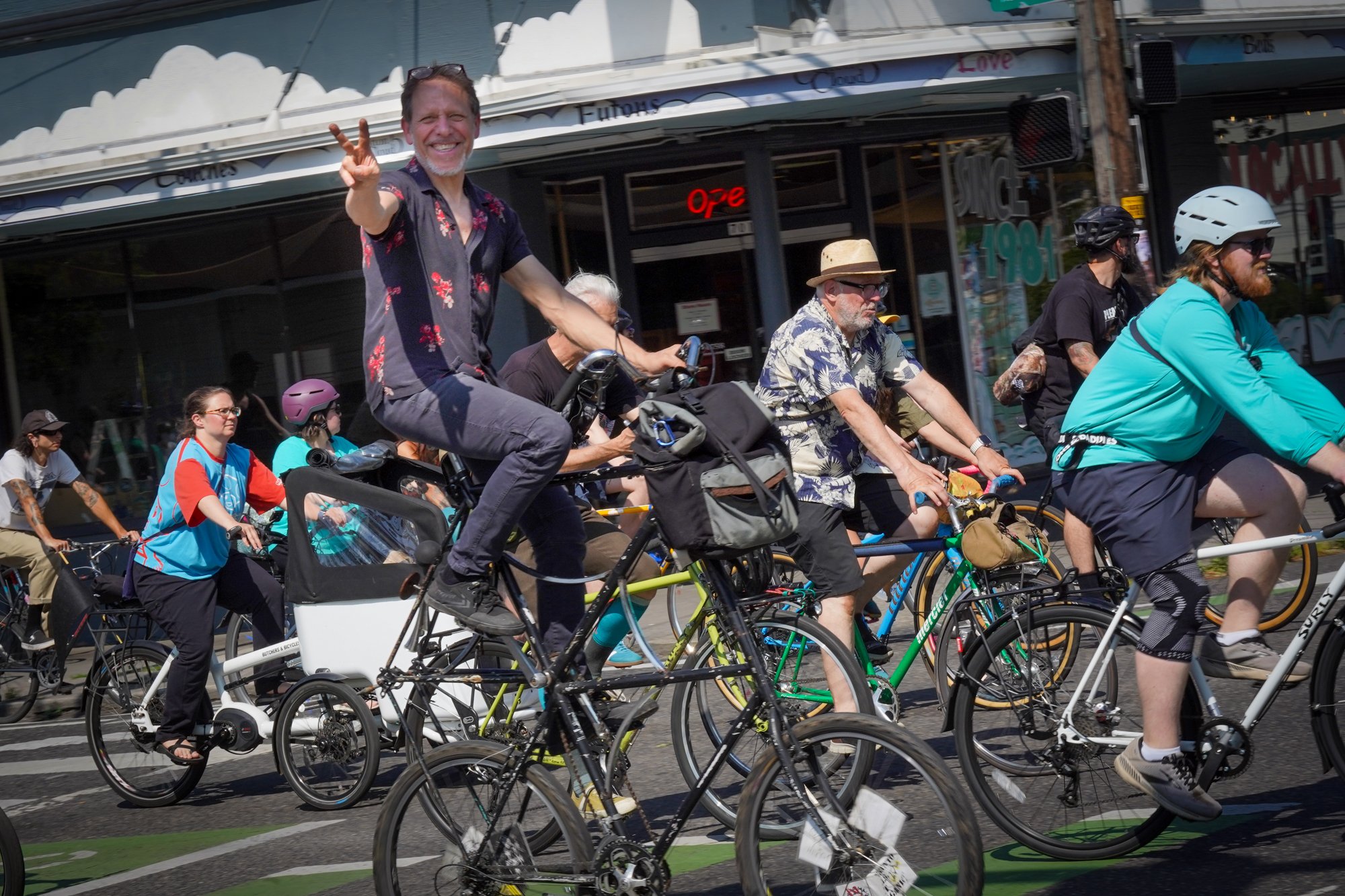
What an amazing way to launch Bike Summer 2025! Thousands met up at Peninsula Park in north Portland for the 23rd annual event that includes three months of free, fun bike rides.
I’ll have a recap video and more thoughts Monday, but here’s the photo gallery. Sorry couldn’t snap everyone! Y’all looked amazing out there. Big thanks to Pedalpalooza organizers and Cycle Homies and all the volunteers who made this day so memorable!
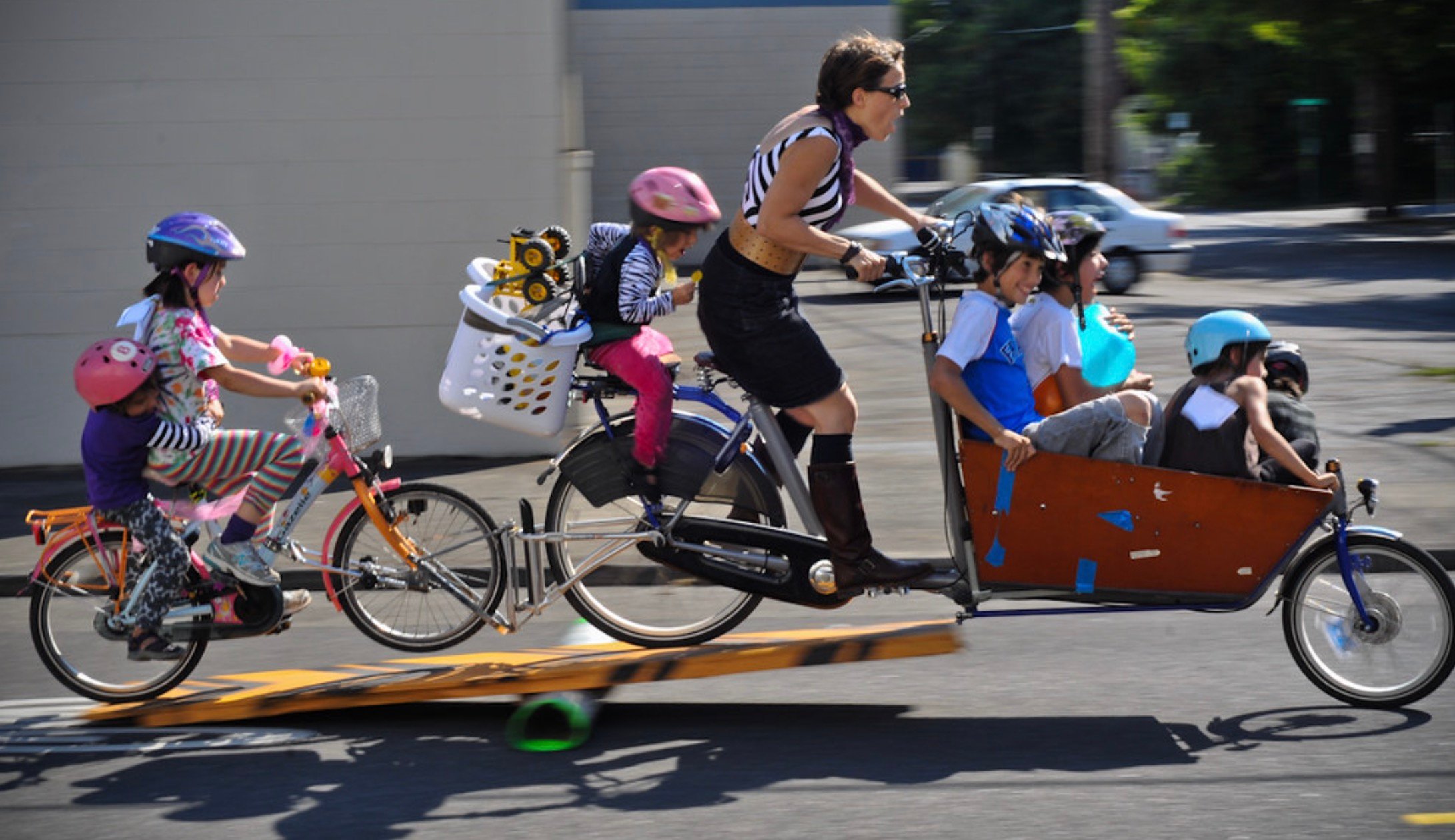
No surprise my 2012 story on a carfree mom with 6 kids spurred a lot of conversation. (Photo: Jonathan Maus/BikePortland)
Had a few things on my mind about comments so figured it was time to check in.
It’s been different without the great Lisa Caballero around. Not only did she do some great writing and reporting for BikePortland, she also spent a lot of time reading, moderating, and writing comments. She would also encourage folks to make “Comment of the Week” nominations and then she’d choose one and write it up on Monday mornings. Lisa understood that to me, it’s not about the quantity of comments we get, but the quality.
Without Lisa’s help, all that comment work has fallen to me. I’m alone these days when it comes to editorial work. I’ve actually scaled back in general and am transitioning to more of an intentional “just a guy with blog” type of outlet. But that’s a topic for a different day.
Back to the comment section. I still read each one that comes in and they all get held back until I manually approve them. But I don’t take as much time to consider each one like Lisa did. And I’m sorry but I haven’t been able to do a Comment of the Week on Mondays. I still want to add that to my weekly rhythm however, so please keep nominating (by replying with “comment of the week” or “cotw”).
Generally, folks have been well-behaved and we have very few mean, troll-ish folks (and when they do pop up, I just delete them and move on). That’s a testament to our community and moderation work over the years. That being said, I always appreciate folks giving me a heads up about comments they feel are inappropriate. Remember, being solo means I have no proofreader, no editor, no second set of eyes to run things by! Just like those of you who point out typos and other mistakes, BikePortland a community endeavor and I value — and need — your help on stuff like this.
This week in particular was very busy in the comment section. So far we’ve had about 450 comments total since Monday. One reader saw how that guest article by Missy LeDoux racked up nearly 300 comments and wondered what our all-time high comment record was. I took a look and it was fun to see the list.
Below are the top 10 most commented articles in BikePortland history (since April 2005) along with their date of publication and total comment count:
Quite the gamut of topics, huh? I love how it reflects the broad array of things I’ve published here. We’ve got tragedies, a fun profile of a carfree mom (that went viral before that really existed), some old-fashioned activism, the emergence of the homelessness crisis in Portland, some police stuff — and I’m so glad one of Michael Andersen’s housing stories made the cut!
I could tell a story about each one. All the emotions and wild bits of detail that surround them. What’s cool is if you go back and browse those comment sections, you can feel some of that emotion without even hearing it from me. That’s the magic of a good comment section! It’s a capsule of our community’s emotions, stories and insights. I cherish all 574,408 of them.
If you don’t typically comment for some reason, I’d love to know why. If there’s anything I can do to encourage you, please let me know. And if you do comment frequently, please remember it’s a privilege, not a right. Treat other commenters as if you were talking to them in person, give the benefit of the doubt and keep an open mind.
Every comment is a contribution to this community, which is something I feel is more important than ever as some of the conversations have splintered off into social media. I like those comment sections too, but it just doesn’t feel like home.
Thanks for being part of BikePortland. I appreciate your comments.
Need a job? Want a better job? Just looking for a change? You are in the right place. Don’t miss these recent job announcements. (Remember, you can always stay abreast of jobs as soon as they get listed by signing up for our Job Listings email.)
These are paid listings. And they work! We’ve helped hundreds of people find great jobs and great staff members. If you’d like to post a job on the Portland region’s most popular bike and transportation news platform, you can purchase a listing online for just $100. Learn more at our Job Listings page.
Portlander Chris Ho was cycling on Northeast Marine Drive this week when the driver of a large freight truck passed him very closely. Chris shared the video online and it has spurred conversation and confusion about Oregon passing laws and road user choices. I want to elevate the incident because this is an important issue that deserves clarity and understanding.
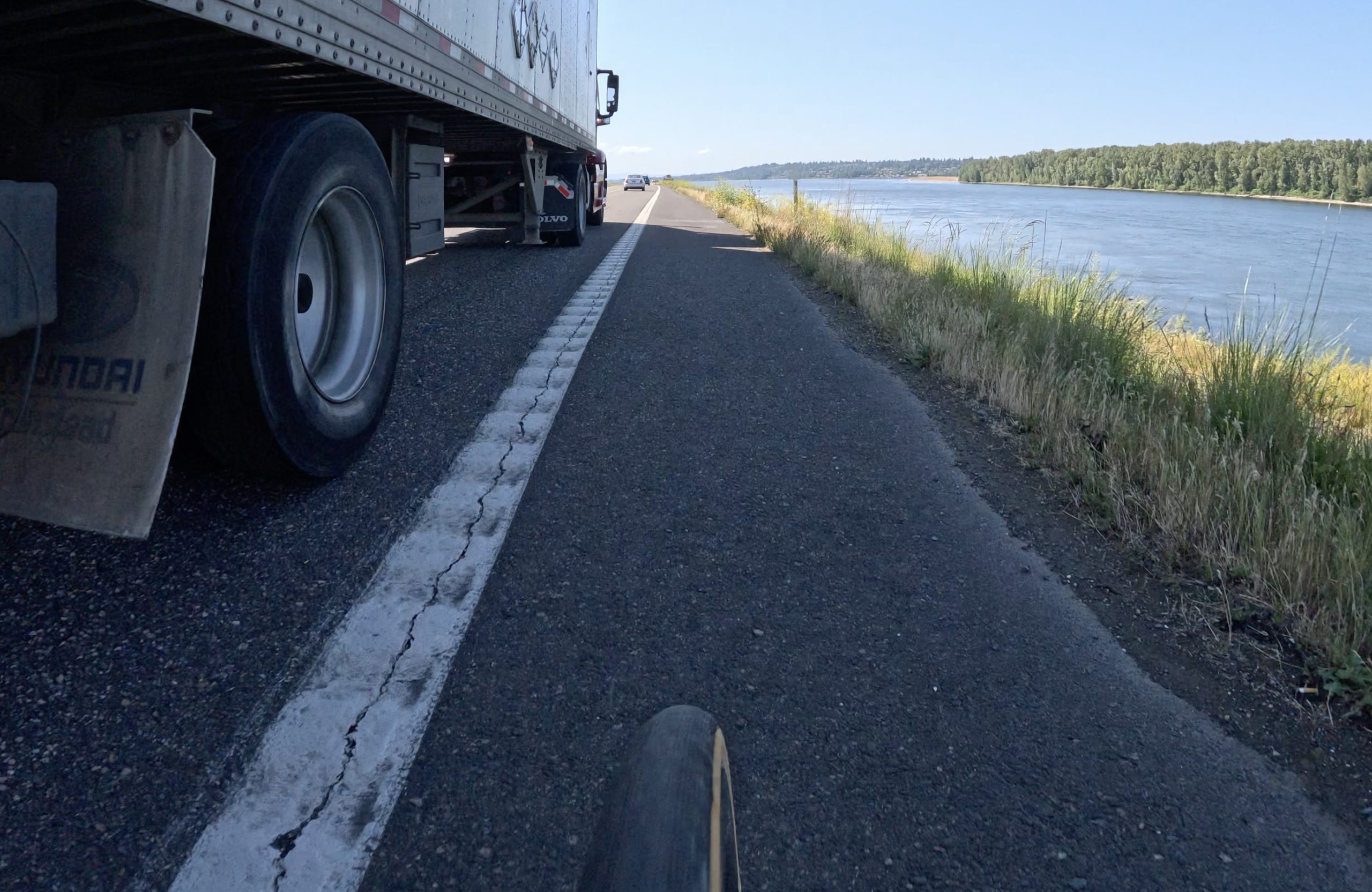
Chris is an experienced bicycle rider. He’s a veteran volunteer in local bicycle advocacy circles, a regular at Bike Happy Hour, a collector of road bikes, and a participant at local races. On Wednesday around 4:00 pm he was cycling westbound on Northeast Marine Drive about 1.5 miles west of I-205 and adjacent to Portland Airport runways. There are two route options for bicycle riders at this location: there’s a dedicated, off-street path along the Columbia River and a shoulder on the main road. Chris was (obviously) riding on the shoulder.
As Chris pedaled on a clear and sunny day, the truck driver whizzed past, just inches away from his body and bicycle. The pass was so close it created air suction effect that threw off Chris’s trajectory, and pulled his bicycle even closer to the big rig. (This is a well-known effect that has led to many fatal bicycle crashes over the years — even if police reports often fail to take it into account and instead blame the bicycle rider for “falling into” the truck operator’s path.) “This was a very close call, and super scary!” Chris shared in a post on his Instagram. Chris’s video captured the truck driver’s license plate number and he’s considering pursuing charges.
When I shared Chris’s video on BikePortland’s social media, I heard two main responses that stood out to me: some folks didn’t think the truck driver did anything wrong, and others wondered why Chris was even on the road in the first place (and not the path).
First let’s talk about the pass itself. Chris was in a legal cycling position, riding on what’s technically known as a shoulder bikeway. It’s not a “bicycle lane” as defined in Oregon law. The way we can tell the difference is by the width of the white stripe and the absence of bicycle lane markings and signage. (The distinction between a shoulder and a bike lane matters because different laws apply in each situation.)
The speed limit in this location is 40 mph and it’s a “no passing” zone. Given all those conditions, the truck driver clearly made an illegal pass. Oregon Revised Statute 811.065 states that motor vehicle operators must pass bicycle riders at a “safe distance” which is defined as a distance that is, “sufficient to prevent contact with the person operating the bicycle if the person were to fall into the driver’s lane of traffic.” Based on Chris’s video, that provision of the law was broken. The passing law was expanded in 2023 to require that drivers slow to at least five miles under the posted speed limit and to clarify that they can move over across a double yellow line in order to complete the safe pass.
After the law went into effect in 2024, the Oregon Department of Transportation made a PSA video that includes an example of a pass that closely resembles this situation.
For folks who think Chris should have been cycling on the adjacent path, keep in mind that not all bicycle riders are the same and people are allowed to choose where they ride. And in this case, not only was it entirely legal for Chris to be on the shoulder (which is classified as a “City Bikeway” in our Transportation System Plan), but the path option isn’t as attractive as you might think. This part of Marine Drive has a reputation for people pitching tents along the path. Public safety concerns get exacerbated here because the path is far below the street, which means it lacks visibility. Many riders also don’t like taking the path because it requires them to criss-cross Marine Drive at several locations and they feel these crossings are more hazardous that just riding on the shoulder. For fast, road cyclists, off-street paths can also be less desirable because they often have uneven surfaces, bumps and cracks that make for an unpleasant ride.
Dangerous and illegal passes like this are way too common. They are a symptom of our dysfunctional road user culture and illustrate the blatant disregard for human life far too many people have when they get behind the wheel of a motor vehicle.
I hope this post helps add context to this dangerous incident. And I’m very glad that Chris was not injured or worse.
For anyone who drives on Marine Drive, please slow down and pass bicycle riders with the utmost caution. And remember, “This isn’t some sort of video game!” as Chris shared on Instagram Thursday. “I could have very easily died today.”
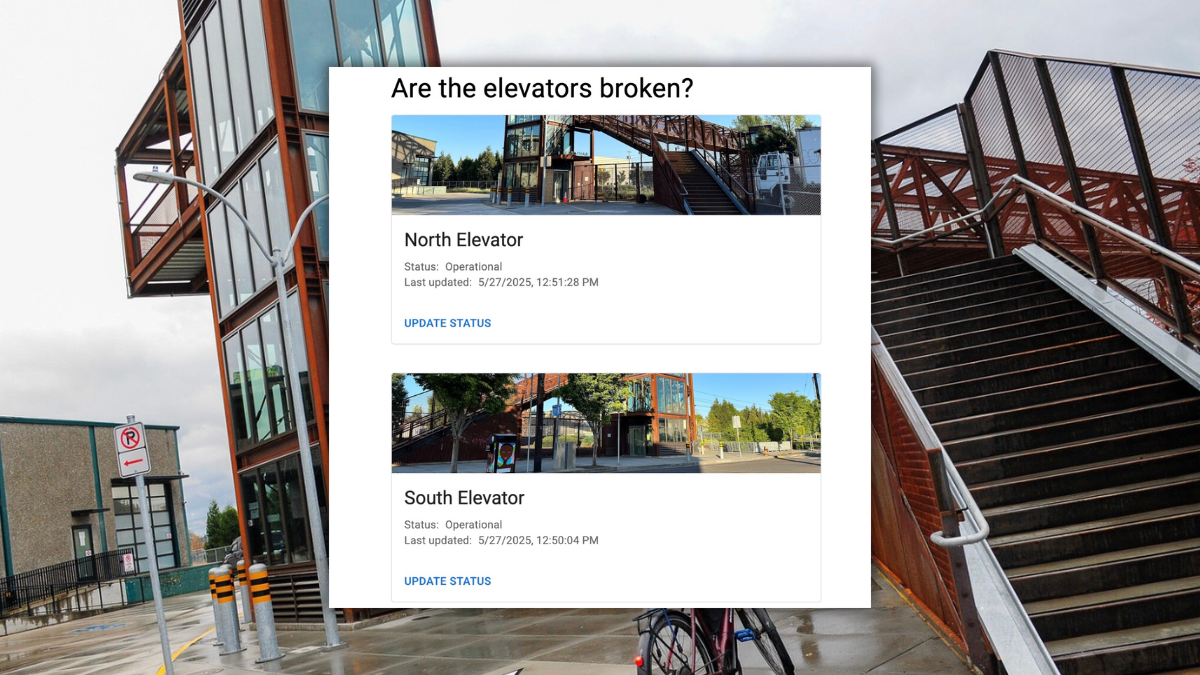
Inset: Screengrab from AreTheElevatorsBroken. com. (Photo: Jonathan Maus/BikePortland)
To say the Portland Bureau of Transportation has had a hard time keeping the elevators open at the Bob Stacey Overcrossing would be a massive understatement. The overcrossing plays a vital role in the bike network. It connects safe bikeways and is a bridge over light and heavy rail tracks in an area criss-crossed by large arterials. Unfortunately, since it opened in 2020 it seems like its elevators are closed more often than not. Vandalism and mechanical failures are to blame.
A new website doesn’t do anything to keep them open, but at least it gives riders an early warning to optimize and plan their detour.
AreTheElevatorsBroken.com is the work of Xavier Salazar, a software engineer who lives in the Brooklyn neighborhood. Brooklyn is a great place to live, but one of its downsides is how it’s hemmed in by Highway 99E to the west and south, the Brooklyn rail yard to the east, and SE Powell (Highway 26) to the north, there are already limited route options for bicycle riders.
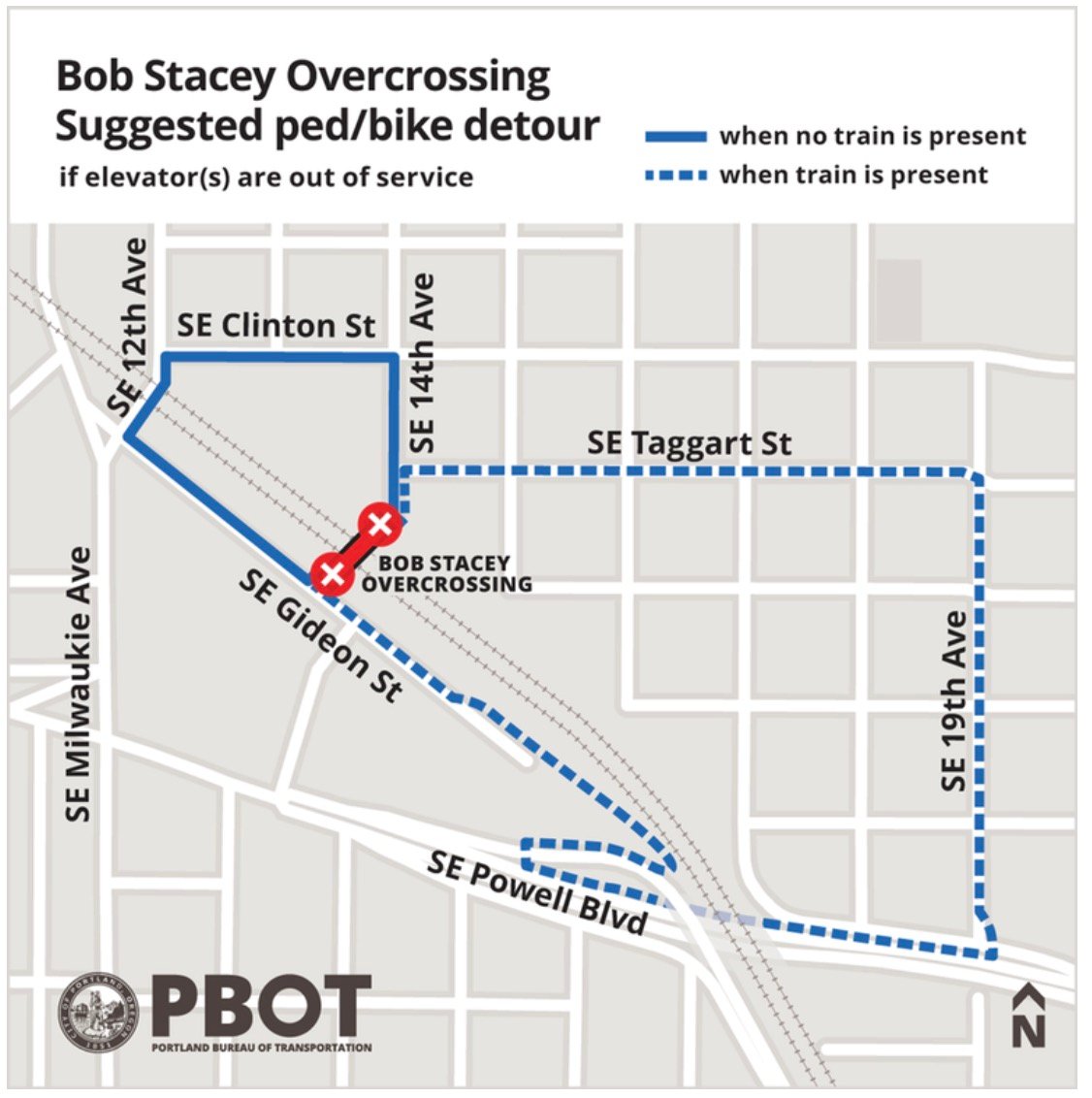
The detours illustrate how important these elevators are.
Salazar, who gets around almost exclusively by bike, says when he’s headed north, freight trains routinely block his routes (a well-known and infamous problem that has spurred its own DIY responses). Because of the aforementioned infrastructure challenges, even PBOT’s recommended detour around the blocked rail tracks and/or in the event of Stacey Overcrossing elevator closures, requires riders to go nearly one mile out of their way. And that’s if the Powell underpass isn’t blocked by street campers. If it is, the detour is even longer. (And yes, there are stairs, but not everyone can lug their bicycles up and then down them.)
Salazar knows a few options, but they are all long and cumbersome.
“Ultimately, I’d rather just avoid the on-the-fly gymnastics to find an open route because I don’t know if the elevators are working until I show up to them,” he shared with BikePortland today. “It’s much simpler to just choose to get on the waterfront or take the Rhine-Lafeyette bridge from the get-go to avoid even biking to the pedestrian crossing I can’t use.”
So Salazar created his website to offer useful status updates on the elevators. It’s based largely in the spirit of IsATrainBlocking11th.com (which itself is currently out of order) and he sees it as more useful than PBOT’s website, which Salazar says has been too unreliable in the past (“It’s only as up-to-date as someone from the bureau knows/cares quickly enough to update it.”)
“If I know where I want to go, it’s so much less stressful to just check the site before I leave and formulate a route based on that.”
What if you forget to check the website, or don’t even know it exists? Salazar has placed two small QR code stickers near the buttons on both elevators that, when scanned, allow folks to update the status immediately to warn others.
Salazar says the ideas is, “If you’ve got a bike full of groceries, or a kid in tow, it’s a bit more straightforward to make the judgement call to rely on the elevators if you can see it was just updated yesterday and someone said they’re both working.”
The more people that know about this site, the more updates it will receive and the more reliable the information will be for everyone. So check out AreTheElevatorsBroken.com and pass it along to your friends.
Bike Summer, coming right atcha’. (Photo: Jonathan Maus/BikePortland)
You’ve toiled through another Portland winter and now it’s time to shed those layers and embrace the warmth of Bike Summer. The big Kickoff Ride happens at Peninsula Park on Sunday. See you out there! I’ll have my bright neon green vest on and will be looking for folks to talk to for a podcast episode. So don’t be shy (or if you are, that’s fine too! No pressure).
Below are my selections for the best rides for the coming weekend…
Saturday, May 31st
Cycle the Well Field – 8:45 am at Aloft Cascade Station (NE) An educational foray that will help you understand the value and mechanics of our local watershed, led by experts and staff from Columbia Watershed Council and Portland Water Bureau. More info here.
Westside Critical Mass Party Ride – 9:00 am at Cascade Bikes (Beaverton) Be a part of west side bike activism history as a mass protest ride hosted by Ride Westside looks to raise the profile of cycling in Washington County and build a stronger community of riders. Don’t miss my story back in March for background. More info here.
Saturdays in May Sandy Blvd Takeover Edition – 10:00 am at Wilshire Park (NE) Nonprofit BikeLoud PDX will lead a route through northeast with a focus on assessing the quality (or lack thereof) of bicycle infrastructure — with a climactic cruise down Sandy Blvd to cap things off. More info here.
The Stripey Ride – 3:00 pm at Rainbow Road Plaza (SE) Stripes rule! If you agree with that, put on your fave striped shirt and roll out for this fun ride that will meet on a striped road, visit stripey locations, and have a stripey good time. Loaner striped shirts available. More info here.
Sunday, June 1st (First Day of Bike Summer!)
Breakfast on the Bluffs – 9:00 am at Skidmore Bluffs (N) Start Bike Summer off right with a community gathering on the bluffs where all types of wonderful morning drinks and snacks will be had. Bring something to share and connect with your Bike Summer besties. More info here.
Bike Summer Kickoff Ride – 3:00 pm at Peninsula Park (N) This is it folks! Be sure to show up plenty early (event opens at 1:00 pm) to soak up all the fun. There will be DJs, a bike wash fundraiser, Bike Summer merch for sale, bike maintenance help, lots of wonderful people to meet, and much more. Route is an easy, family-friendly cruise down to Colonel Summers Park (SE Belmont and 20th) where there will be food carts and great hangs. More info here.
Larch Mountain Ride – 9:00 am from Lewis & Clark State Rec Site (Gorge) I think Larch is the most challenging major climb in the area. This is a nice opportunity to tackle it with a group led by an experience Portland Bicycling Club leader. Expect 50 miles and 14 of it uphill! More info here.
— Did I miss your event? Please let me know by filling out our contact form, or just email me at maus.jonathan@gmail.com.
Riding bikes is fun. But if you ride a lot, it’s easy to get stuck in a rut. Sometimes you need something — like a goal or a game — to awaken your cycling spirit. For Portland-based Ride With GPS, the Cutty Cap Challenge is exactly that.
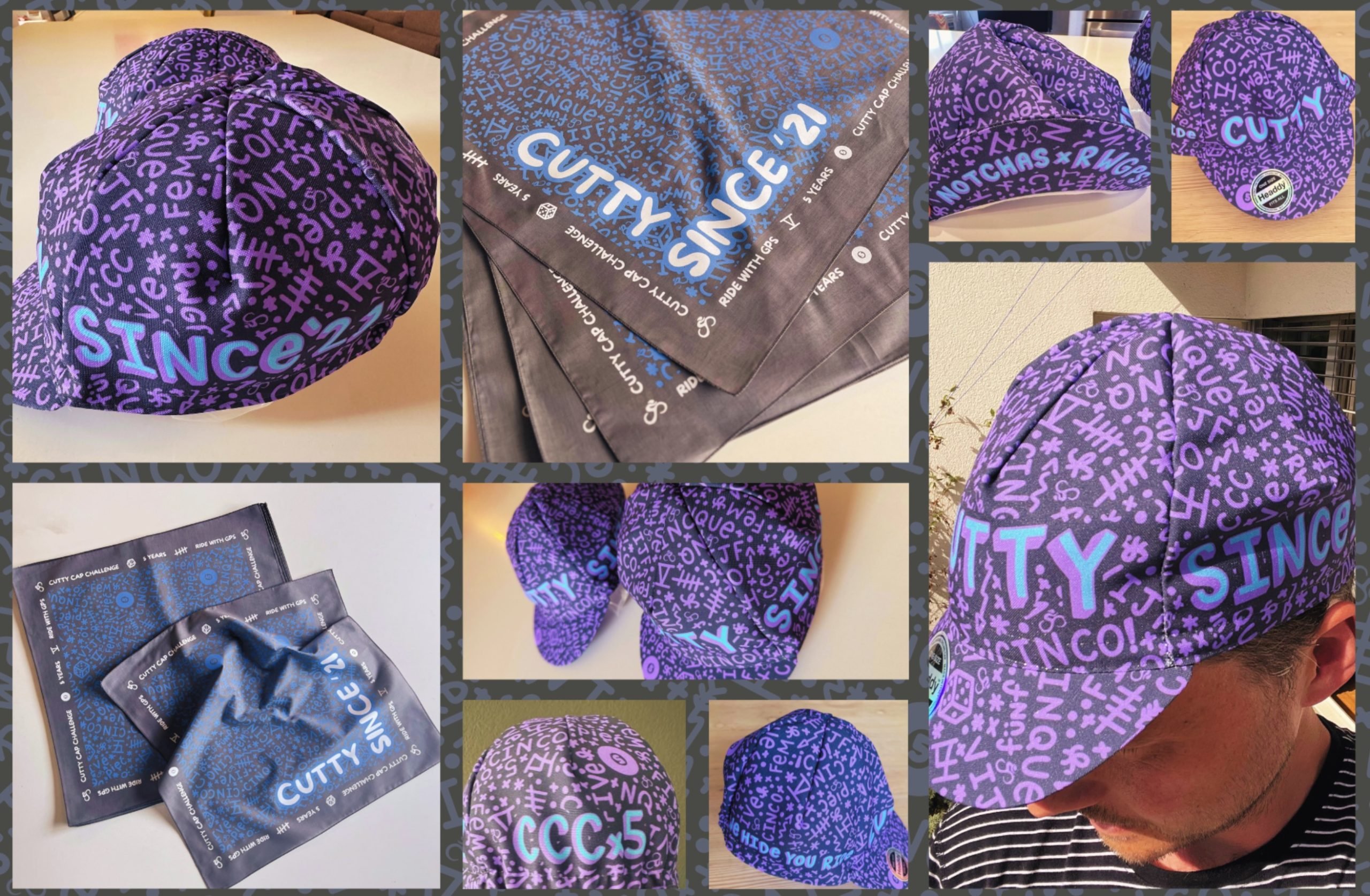
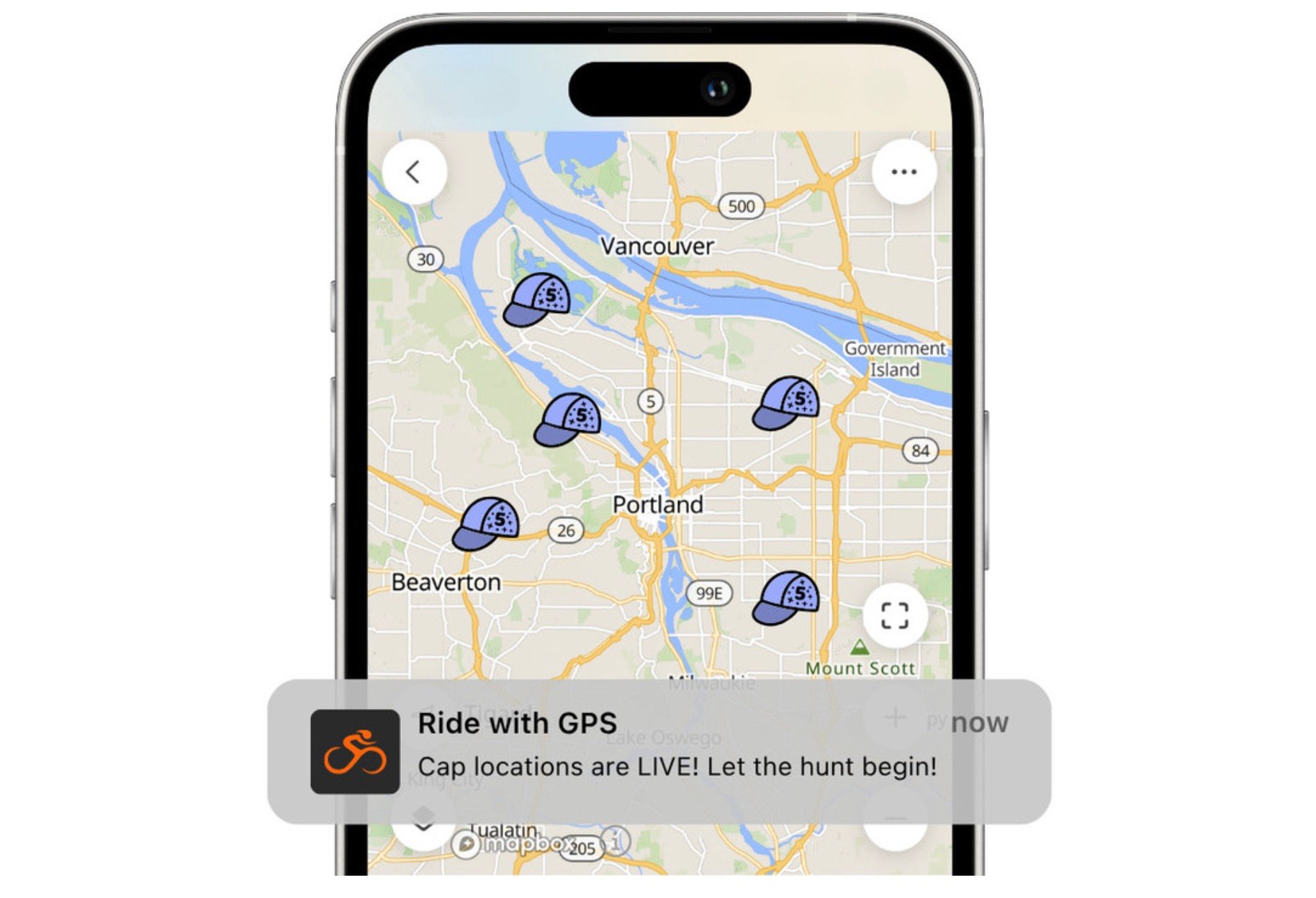
Now in its fifth year, the event has been reimagined as a live-action game that will be played by adventure seekers in 55 cities across the globe. It started in 2021 as a relatively traditional scavenger hunt. Ride With GPS (RWGPS), a company known for its popular route sharing and route making app, hid cycling caps in random locations and encouraged customers to go find them. The next year they added prizes, then expanded it to cities beyond Portland, and now it’s become a hotly anticipated start to the summer riding season.
“Cutty” is a term used to describe a route that’s a bit hidden or off the beaten path. Think of a cool spot you ride that isn’t well known, or that is borderline trespassing or sketchy for some reason. That’s cutty. There are a lot of beloved cutty routes in Portland, and this scavenger hunt is meant to encourage more folks to use them.
Screenshot of RWGPS app.
RWGPS Marketing Director and creator of the Challenge, Kevin Prentice, says the goal is, “To get people out riding in their city, and hopefully to a location or multiple locations they have never ridden. A new park, a new viewpoint, new trail, new business, solo or with friends, and have fun doing it.”
The challenge kicks off at 8:00 am sharp local time in 55 different cities around the world — from Sydney to Santiago, Osaka to Oslo. That’s when the location of at least 10 custom designed cycling caps will go live (additional cap locations will be announced after the first batch goes live). The locations are revealed in the RWGPS mobile app and participants compete by seeing who can find the most caps and bandanas (with a very cool design by artist and bike adventurer, Chas Christiansen aka @notchas on Instagram). Points accrue with each cap located. If you find it first, it’s yours and you get the bragging rights. But you can also score if it’s already been claimed. Players get bonus points by uploading photos and completing various missions that are broadcast throughout the day.
For Portland players, RWGPS has set up special prize giveaways with The Athletic. But to win them, you’ll need to unravel the hiding skills of Ron Lewis, one of the guys behind riding group Our Mother The Mountain, who Prentice describes as, “the unequivocal leader when it comes to both cutty locations and their descriptions.” “His locations will be off the beaten path, sometimes hidden in a drain pipe, not just a tree but a particular tree branch that resembles something, or maybe the cap is in a somewhat popular spot but his clues to find them are often riddles that also include song lyrics. Plus, nobody knows the city and it’s cutty locations better than he does.”
So if you like a good bike scavenger hunt and want a really fun excuse to explore the city — all while competing against other riders for points in a real-time digital game — download the app and check out the Cutty Cap Challenge website for more information.