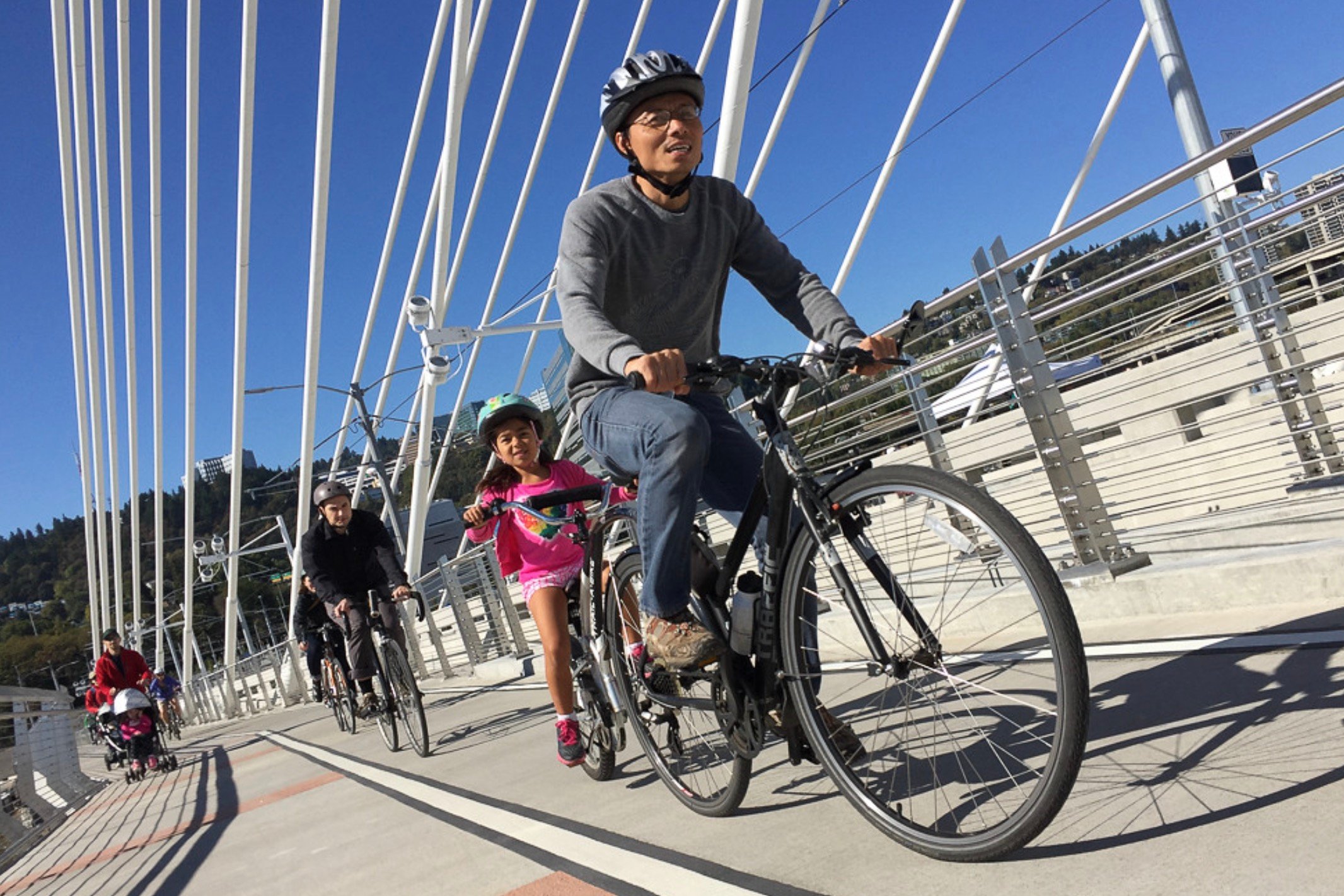
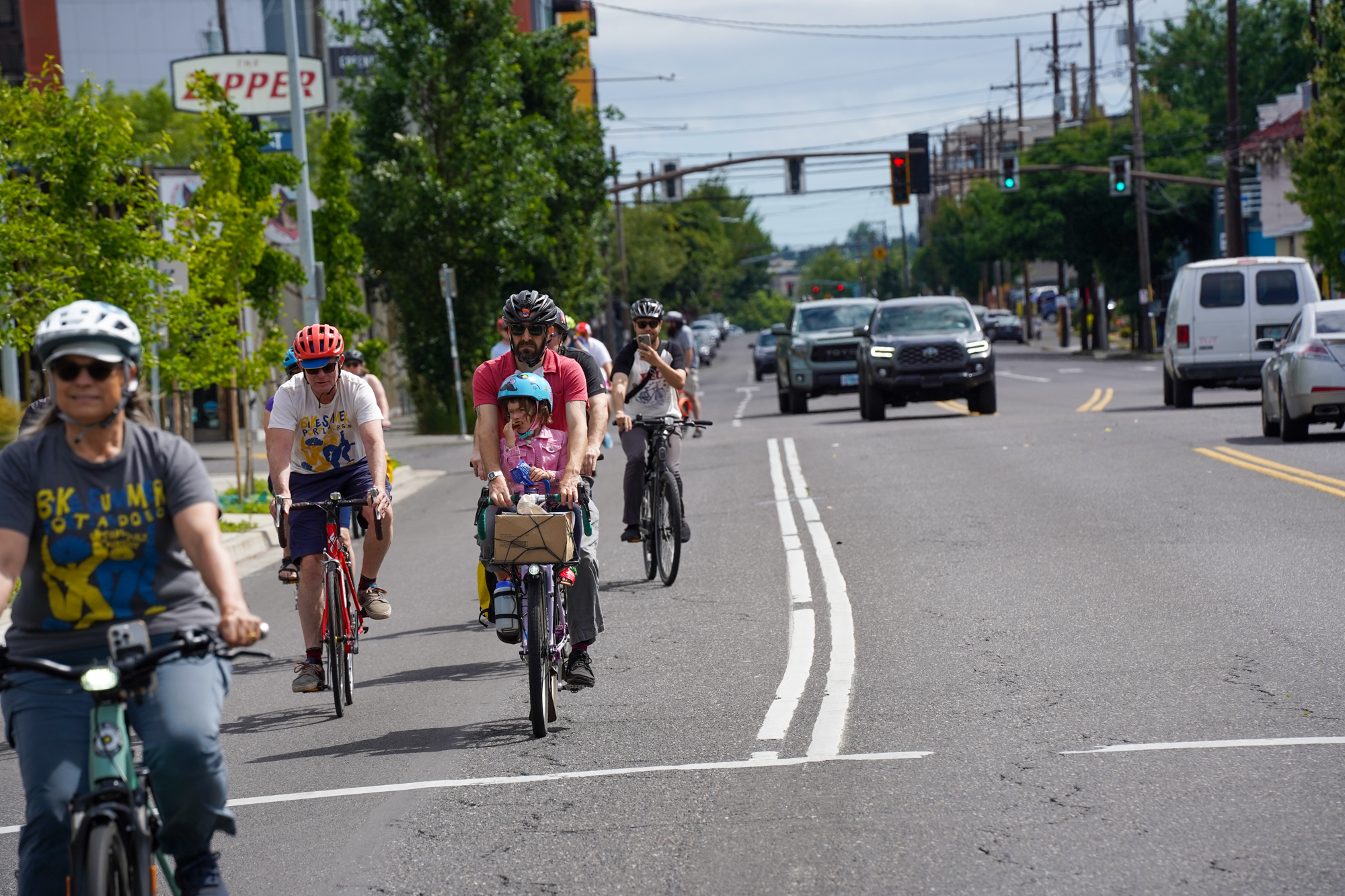
Riders on the Tilikum Crossing. (Photo: Jonathan Maus/BikePortland)
TriMet has begun their biennial (every other year) inspection of the Tilikum Crossing and the work comes with detours for bicycle riders.
The path needs to be closed so a contractor hired by TriMet can inspect the bridge cables. The Oregon Department of Transportation will take the opportunity to do its own inspections at the same time.
The biking and walking path on the bridge will be closed on alternating sides for the remainder of June. TriMet says the closures will be in effect from 8:00 am to 4:00 pm during weekdays. One side of the path will remain accessible at all times.
If you use the bridge during these closures, TriMet urges you to not ride against the direction of traffic. They recommend either using the nearby Hawthorne Bridge or walking your bike on the bridge.
TriMet expects this inspection work to be completed by June 27th.
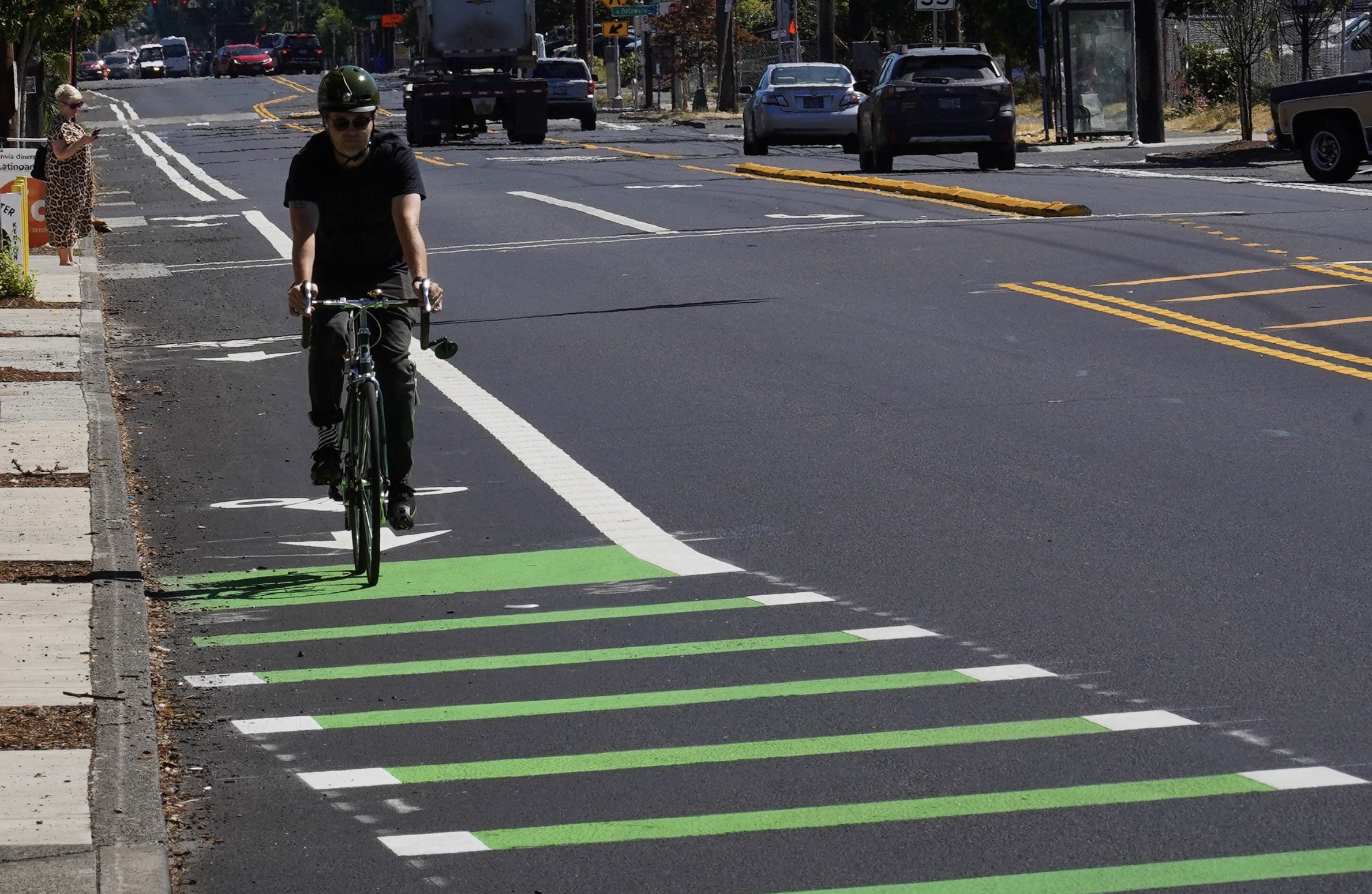
A program that funds updates to ODOT’s urban highways like N Lombard (Hwy 30) is up for major funding boost. (Photo: Jonathan Maus/BikePortland)
The Oregon Legislature finally released the transportation bill this morning and it only took about two hours for the rhetorical sparks to start flying.
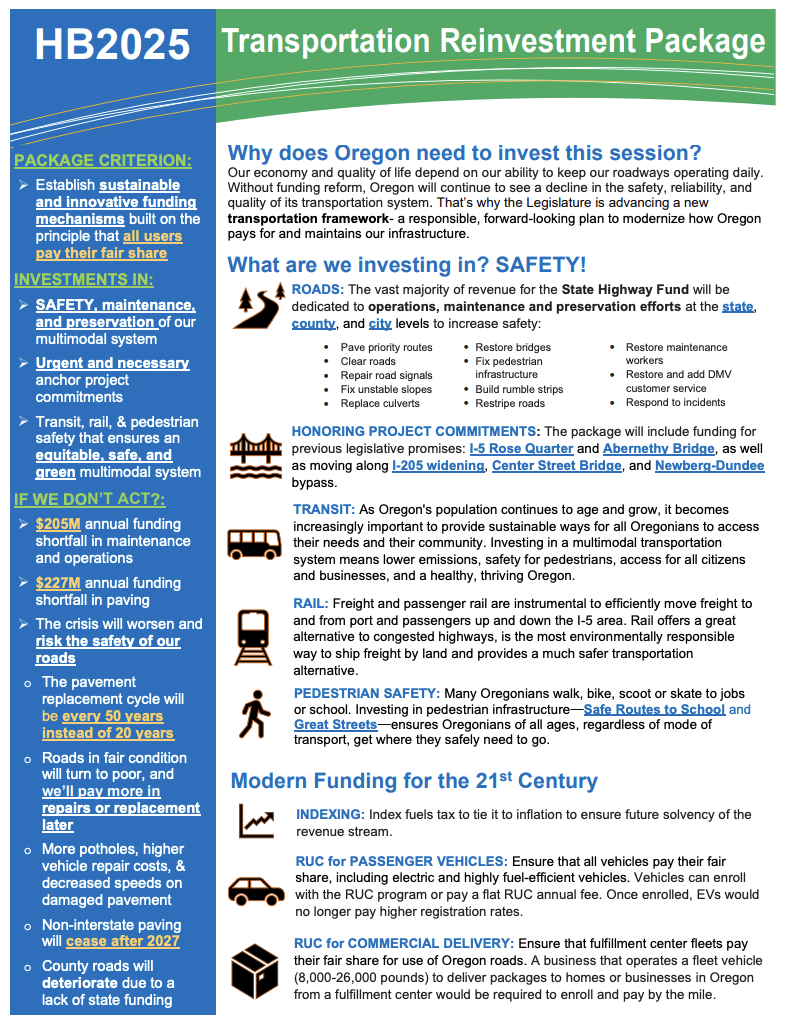
House Bill 2025, also known as the Transportation Reinvestment Package (TRIP) was made public around 8:00 am and the Joint Committee on Transportation Reinvestment held a meeting about it at 10:00 am. That’s where several Republican members voted no on a procedural motion that became a proxy for their opposition.
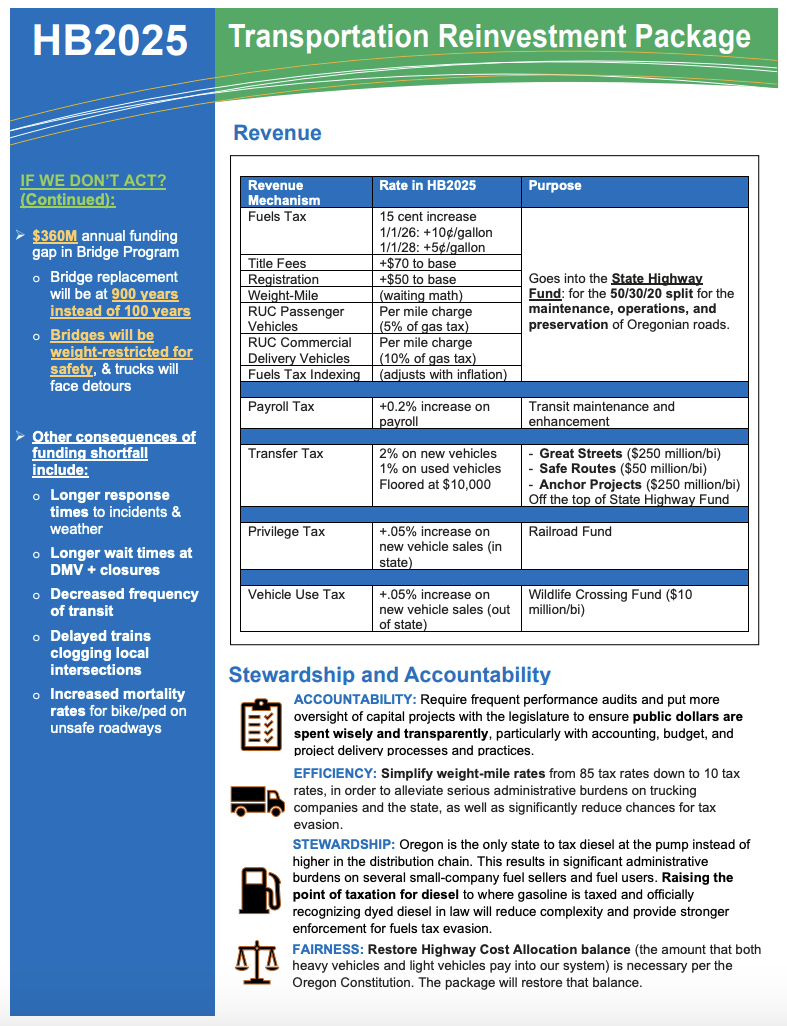
The 102-page bill would raise well over $2 billion (exact total expected to be released Thursday) with a bevy of increases in taxes and fees. New revenue would fund major highway projects, as well as public transit, cycling, and pedestrian needs. To help the Oregon Department of Transportation (ODOT) win back some of the public trust they’ve squandered over the years, the bill calls for biannual performance audits, and a once-per-year audit of major capital projects.
Bills are tricky to read and I’m still deciphering all the details, but scroll down to learn the basics and get a sense of what lawmakers and advocates are thinking about it…
Advertisement
Where the money comes from
On the revenue side, the bill would raise the payroll tax that currently funds public transit via the Statewide Transportation Improvement Fund (STIF). Currently set at 0.1%, HB 2025 would raise that to 0.3% in a staggered increase between now and 2030. This is a significant increase from the 0.18% Democrats first proposed back in April, but it’s short of the 0.5% figure a progressive wing of the party proposed last week.
HB 2025 would also raise the gas tax a bit more than Democrats first hinted at in their “starting point” framework back in April. The bill seeks to raise Oregon’s current 40 cent per-gallon gas tax to 50 cents per gallon in 2026 and 2027. They’d add another 5 cents in 2028 to make it 55 cents per gallon. And then in 2029, the OTC would index the gas tax to inflation.
Another big source of new revenue would be increases to various vehicle fees and taxes. The registration fee for a new car would go from $43 to $113. The cost to take a driver’s skill test at the DMV would go from $45 to $111. The cost of a new license plate would nearly triple — from $12 to $33. There are over two dozen increases to vehicle-related fees.
The initial framework for this bill included a major increase to the bicycle tax; but that appears to have been dropped. HB 2025 will maintain the existing $15 tax on new bicycles.
New cars will be subject to a 2% “transfer tax” based on retail price and used cars will be levied a 1% tax.
Other provisions in the bill include: a new, $20 per vehicle permit fee for corporate delivery fleets; a revision of the weight-mile tax system, and a new, mandatory road usage fee for electric vehicle owners starting July 1, 2026.
Advertisement
Where the money will go
Using revenue raised by user fees and taxes, the bill would set aside $125 million per year into a new “Anchor Project Account” — a set of projects the state committed to in 2017 but has yet to complete. This account would spend first on the I-5 Rose Quarter project, and then the Abernethy Bridge project. The bill would then give the OTC the power to prioritize order of spending on three other named “anchor projects”: I-205 widening, Newberg-Dundee Bypass freeway project, and the Highway 22/Center Street Bridge project in Salem.
After that money is spent, the remaining funds will be distributed in the traditional 50/30/20 formula with ODOT getting 50%, counties sharing 30% and cities getting 20%.
HB 2025 would use money raised from the transfer taxes to bolster spending on orphan highway updates, safer streets near schools, and wildlife collision mitigation.
Advertisement
The bill would fund ODOT’s Great Streets program to the tune of $125 million per year. Transportation safety advocates will be very excited about this provision. Great Streets is a pot of funding that seeks to tame the state’s legacy “orphan highways” that run through many Oregon towns and cities and retrofit them with safer crossings, bike facilities, road diets, and so on. This $125 million would be a major increase to the program’s budget, which has had just $122 million in total funding in the last three years. And to think it wasn’t even mentioned in the framework proposal back in April!
$25 million per year would be set aside for the state’s Safe Routes to Schools Program. This is another big relief for transportation advocates, because the previous framework left this program out. It’s also $10 million more per year than HB 2017 allocated to Safe Routes.
The final set-aside from this revenue is $5 million per year for what lawmakers are calling the Wildlife-Vehicle Collision Reduction Fund.
One small but important thing
In what appears to be a bold move from forces that have been pushing against narrow lane widths for years, HB 2025 seeks to make it ironclad law statewide that all vehicle lanes on identified freight routes must be at least 12 feet wide. This has been a controversial issue for a while, as bicycle and pedestrian planners often clashed with other engineering staff and freight advocates over the need for 12-foot lanes. There was a committee set up to look into this through ODOT’s Mobility Advisory Committee, but I don’t think they reached a clear conclusion. It’s unclear who exactly snuck this in, but ODOT internal staff have been generally supportive of narrower lanes, so it might have been an outside freight advocate or lobbyist. More to come on this.
Advertisement
Reactions from advocates and lawmakers
Senate Bruce Starr, arguably the leading Republican when it comes to transportation given his long career in Salem and involvement on the topic for many years, claimed the bill failed to take non-Democratic views into consideration. Starr was one of a few Republicans who worked with Democrats in recent months to negotiate the bill; but those talks broke down. Starr championed a cap-and-trade plan that would have sent millions to highway megaprojects. The idea was panned and is no longer part of the bill.
And Starr’s Republican colleagues didn’t help his dream of bipartisanship when they floated a proposal last week that was dead on arrival in a statehouse with a Democratic majority.
Today Sen. Starr called HB 2025 a, “partisan tax increase” and said he was “disappointed” with the final product. He also threatened a referral to voters if it passed when he said, “At the end of the day, it’s Oregonians who we all serve, and who very well may have the last last look at this.”
Advertisement
JCT Co Vice-chair and House Representative Shelly Boshart-Davis, who’s been working with Republican party leaders to cut all “non-essential” ODOT spending on public transit and cycling infrastructure, said HB 2025 was, “Born in the basement and in secret.” She’s voting no before even having time to read the bill.
On the other hand, Democratic Senator Khanh Pham said from what she’s read so far, HB 2025, “Appears to be moving in a direction that acknowledges the voices that we heard from across the state,” referring to a series of public town halls she attended with other members of the JCT to garner feedback on transportation needs.
And House Rep. Mark Gamba, the Democrats leading transportation policy advocate who crafted the SMART Framework released last week, also seemed pleased with the bill. “I think this is moving us in the right direction,” he said at this morning’s meeting. “I think it also begins to bend the curve a little bit on safety and keeping people alive, and I think it is incumbent on us as a state to behave responsibly and begin to invest in solutions to those problems. And I think this bill does that.”
Move Oregon Forward, a coalition of transportation and environmental nonprofits, had mixed reviews of the bill. In a statement released this afternoon, they lauded some of the bill’s investments, but then added, “More is needed to modernize and electrify our transportation system, trails have been left out of the bill, and there remains a large gap in accountability.”
What happens next
There’s another JCT meeting tonight at 5:00 pm, then there are three public hearings planned this week, starting Tuesday at 5:00 pm. There are less than three weeks left in the session, so expect a flurry of activity until the end of the month.
Hope you’ve handled the heat ok, or managed to avoid it. Remember, whenever you need tips or information about something like how to ride in heat, just search, “tips for biking in the heat” (or whatever the topic) then add “bikeportland” and you’ll find all our coverage. In this case, I’ve made a page with some great basic hot riding tips, and then you can browse all the BP archives and comment threads on the topic.
*Advertisement* Before we get to this week’s links, don’t forget that June 21st is the annual Gorge Ride. This is a gorgeous, out-and-back route with full support that gives you the opportunity to soak in amazing views and paths with lots of other fine folks on bikes. This year, organizers have arranged discounts at local establishments — including cafes, ice cream joints, and even the oldest book store in Oregon. Don’t miss this ride!
And with that, here are the most notable stories that came across my desk in the past seven days…
CPSC and MAHA: The Trump Administration wants to reduce staff at the Consumer Product Safety Commission — you know, that entity that makes sure helmets and bikes are safe — and put it under the control of Health & Human Services Sec. Robert Kennedy. (Bicycle Retailer)
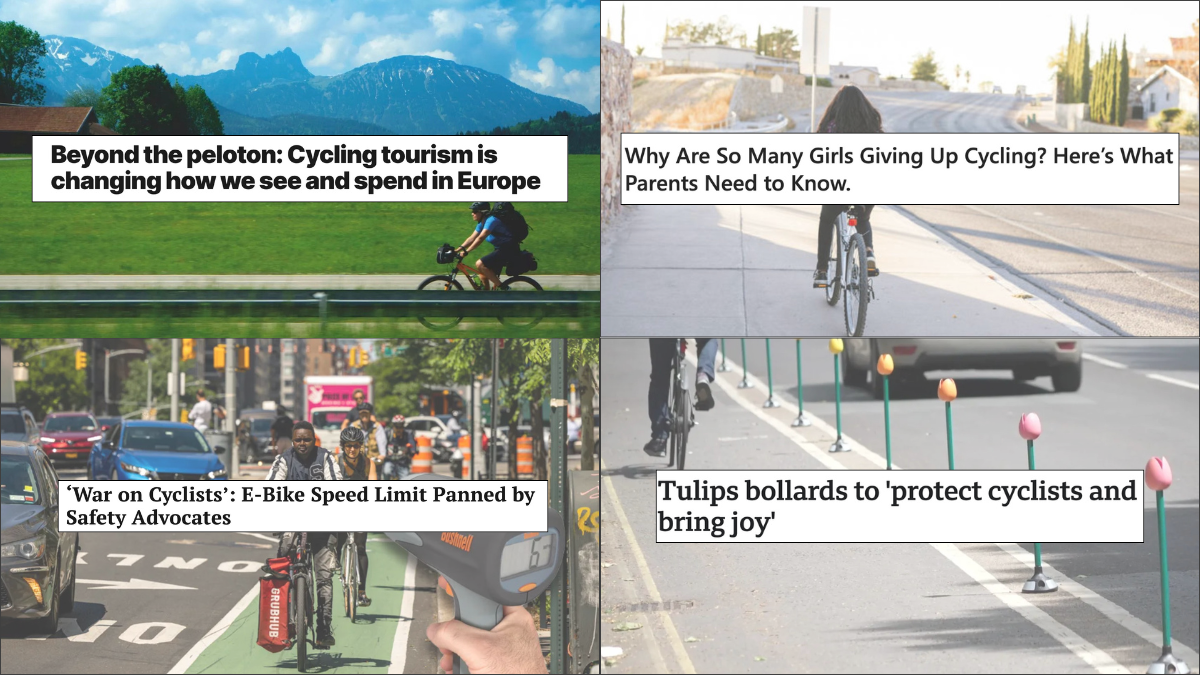
Europe’s bike tourism payoff: Because Europe has invested in cycling routes, they are seeing a massive increase in cycle tourism and the once-niche activity leads to $171 billion in annual economic benefit. (Euronews)
Girls on bikes: It’s worth understanding why young girls tend to give up cycling at a much higher rate than boys — and then doing something to counter the trend. One bit of advice: Let them ride whatever and however they want! (MSN via Bicycling)
Driving and living: The way to a better future is in first understanding — and then organizing around — the relationship between housing and driving. Even subtle differences in housing development can equate to significantly lower VMT per person. (Slate)
Silly NYC mayor: NYC Mayor Eric Adams’ latest terrible decision is to impose a 15 mph speed limit on electric bikes. Hard to know where to begin with what a bad policy idea that is. (Streetsblog NYC)
Advertisement
Tactical urbanist charged: I know there are some Portlanders who will be interested to know that a Virginia man was charged by authorities with vandalism for drawing a DIY, unsanctioned crosswalk. (The Guardian)
One man’s entertainment: A Seattle man who revved and sped his Dodge Charger all over the city just to impress followers on Instagram is standing trial. His defense is, essentially, that it’s no big deal because he’s just having some fun for his fans. (Seattle Times)
Floral flex posts: Those plastic bollards too ugly for ya’? How about, instead of taking them out you make them pretty like this town in England did when they turned theirs into tulips. (BBC)
Transit priority, clarified: Portlander Jarrett Walker’s latest opinion column in a Canadian news outlet clearly communicates the problem with cars blocking buses and why transit priority infrastructure is such an important win for cities. (Globe and Mail)
Video of the Week: A classic, American, mainstream media view of cycling in this profile of an ultra-distance commuter:
This is all some House and Senate Republicans see when they hear “transportation system.” (Photo: Jonathan Maus/BikePortland)
Republican party leaders in the Oregon Legislature have released a transportation bill that would severely limit and/or eliminate spending on rail, transit, and bicycling infrastructure and direct more revenue to the State Highway Fund. In some cases, their bill, filed as LC 4934 and expected to get its first reading on Monday, would take revenue sources currently dedicated to rail, transit, bicycle and walking-specific projects and redirect them to the State Highway Fund.
The bill would also repeal ORS 366.514, also known as the Oregon Bicycle Bill, a landmark piece of legislation passed by a Republican in 1971 that requires the transportation department to dedicate at least 1% of major road project budgets to bicycling and walking infrastructure.
The legislation is championed by House Republican Leader Christine Drazan, Senate Republican Leader Daniel Bonham and Joint Committee on Transportation Reinvestment Vice-Chair Shelly Boshart Davis. The 83-page bill is the formal follow-up to a framework released last month and it comes just days before the official, bipartisan transportation bill is expected to be released.
Advertisement
Saying their effort will “rebuild trust in ODOT” and “cut non-essential programs,” these Republicans want their bill to draw a stark contrast to the bevy of new fees and taxes that will be in the main bill that will seek to raise well over $2 billion in new revenue for a projects and programs.
Drazan, Bonham, and Davis took a fine-toothed comb through existing transportation funding policy and sought to redirect every funding source they could find to the State Highway Fund. Monies that currently flow to transit service, bike paths and rail projects, would be instead go toward highways. Oregon’s custom license plates (ike the ‘Share the Road’ plate) currently share a portion of proceeds with the nonprofits Cycle Oregon and The Street Trust. Republicans would take that away and give it to the State Highway Fund.
Their bill also seeks to raid the bike path funding created by revenue from the $15 bicycle excise tax and give that to the highway fund as well. Nothing is safe from their attempt to encourage more of the most expensive, least efficient form of transportation under the guise of fiscal responsibility.
In a statement released Thursday, Republicans boast that their bill would redirect $134 million from “non-essential functions” that include: climate mitigation efforts, off-street biking and walking paths, ODOT’s Bicycle and Pedestrian Program, passenger rail service investments, EV subsidies, and more.
Advertisement
Their proposal would also eliminate ODOT’s Emerging Small Business Program, that, “serves to help Oregon’s small business community overcome barriers to participation in the state’s multi-billion dollar public contracting process,” and redirect its funding to — yes, you guessed it — the state highway fund!
Once they’ve added all this funding to the State Highway Fund, the Republican plan is to create a new Office of Major Projects to oversee any highway project with a budget over $99 million. This office would be overseen by an advisory committee made up of lawmakers and nine other people appointed by the governor from the typical players that make up the existing highway industrial complex. The advisory committee would exclude people who represent bicycling, walking, transit, or rail interests.
It’s very unlikely that any of these provisions will make it into the final transportation bill, but at least these Republicans have put their cards on the table and it’s clear to all Oregonians where they stand.
A work session on the main transportation bill will take place at the Joint Committee on Transportation Reinvestment on Monday morning at 10:00 am.
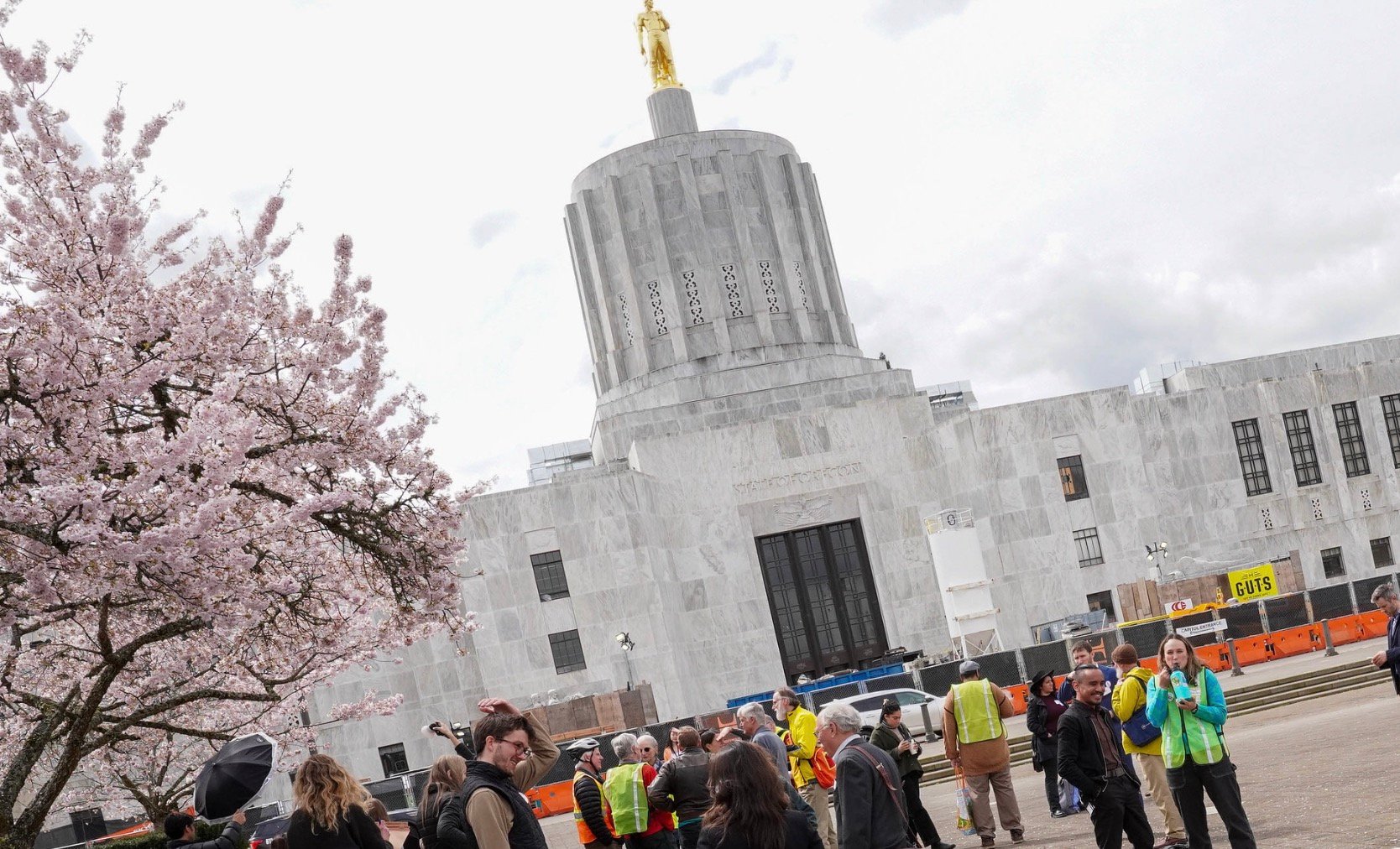
Capitol Building. (Photo: Jonathan Maus/BikePortland)
The stage has been set and now it’s time for the drama to begin.
We’ve seen the concepts and frameworks of transportation funding legislation and now all signs point to lawmakers in Salem finally revealing their long-awaited bill: A reliable source says House Bill 2025 (which I’ve been refreshing for days now!) will come out on Monday and will be followed by several public hearings.
When it comes out Monday, that will leave just 21 days until the official end of session and just 12 days from June 18th, when legislators have signaled their intent to adjourn.
We’ve heard rumors that the bill is imminent for weeks now. Why do I trust what I’m hearing now? A major sign came when Oregon Trucking Association President and CEO Jana Jarvis said confidently at a meeting of the Portland Freight Advisory Committee Thursday morning that the bill would drop Monday. Jarvis is perhaps the most influential, well-connected, and active transportation lobbyist in the state of Oregon. She not only leads the OTA, she’s chair of the City of Portland’s Freight Advisory Committee (PFAC).
Advertisement
While Jarvis seemed sure a bill would come out Monday, she was cool on its prospects of actually passing. “My optimistic forecast is it’s 50-50 right now, and that’s optimistic,” she said when the topic came up at the PFAC meeting. Jarvis then said, “I know the negotiations blew up this week, so I just don’t know where we’re going to go from here.”
Jarvis’ comments poke holes in theories about the delay in the bill’s arrival. Some have said Democratic party leaders (who enjoy a slim super-majority) are taking their time to get everyone on board, and that once it’s out it should easily move through committee votes and onto the Senate and House floors. If the negotiations are still “blowing up” this late in the game, that suggests we are in for a bumpy week.
Here are a few thoughts on the upcoming debates and what I see as major sticking points for the bill:
Portland’s $11 million
I’ve reported how the City of Portland budget process thus far has been relatively kind to the Portland Bureau of Transportation. Facing doomsday scenarios, Mayor Keith Wilson showed strong support for PBOT by saving them from deep cuts and layoffs, while City Council has done much of the same. But PBOT’s balanced budget is relying on an $11 million injection from the State Highway Trust Fund. If a bill is not passed with the requisite gas tax increase, PBOT will be $11 million short on their budget starting July 1st — less than one month from today.
That $11 million is supposed to buoy PBOT’s General Transportation Revenue (GTR), a crucial discretionary funding source. While it might not seem like a lot of money, $11 million is about 8% of the bureau’s total GTR.
“This is a big deal,” said PBOT Resources Manager Mark Lear at the PFAC meeting. And PBOT Director Millicent Williams added that, “If that [funding] does not happen, there would be cuts that we would still need to identify, be they personnel and or programmatic cuts.” Williams said if this state funding doesn’t come through, PBOT will lay off 40 to 50 people and cut some programs.
Advertisement
Who pays and how much
I am not privy to the negotiations around the bill, but I have a strong hunch one of the major disagreements is how to spread around the necessary tax increases among various types of vehicles and road users. Jarvis hinted at the tense conversations Thursday as she made a point she always makes at every meeting I see her at: That truck and heavy vehicle operators pay too much relative to other road users. Her organization, OTA, actually sued ODOT over this issue last year. At issue is something known as the Highway Cost Allocation Study, which I reported on shortly after that lawsuit was filed.
With ODOT claiming poverty and needing to increase fees and taxes everywhere, this issue looms over the debates. I thought it was interesting that Jarvis brought it up yesterday right after she mentioned that negotiations over the bill “blew up.”
“I think it’s been well understood now that commercial vehicles in Oregon pay substantially more than anybody. We have been the most expensive state in the nation for a very, very long time…,” Jarvis said. “So trying to address all of that in the context of this package has been difficult. If we were overpaying and ODOT was flush with money, it would be a much easier conversation to have. So it’s not my fault that things blew up this week.”
Right, left, center
As is typical of all major political initiatives these days, leaders have to find a balance between the right, left, and center. While that’s always difficult, at least with Oregon’s transportation debate, we know where each side stands. So far we’ve had conceptual plans and frameworks released from all three sides. A group of Republicans wants no new taxes and prefers a DOGE-like approach; a group of Democrats want to substantially increases taxes and fees to fully fund transit, bicycling, safety, and maintenance needs statewide; and Democratic party leaders (working with a few Republicans) are trying to walk a line in the middle with a mix of meager revenue increases and highway mega-project set-asides.
Of these three approaches, the Democratic push for the SMART Framework seems to have the most political potential. It doesn’t have Republican support (and it doesn’t need it to pass), it has notable sponsors from both chambers — several of whom are veterans of transportation policy are likely to be able to whip votes from colleagues if necessary.
Advertisement
An elephant named IBR
When it comes to the largest transportation project in the entire state of Oregon, Lawmakers in Salem are putting their heads in the sand. The Interstate Bridge Replacement Program (IBRP) didn’t even merit a mention in the framework released by Democratic party leaders. As detailed by eagle-eyed advocate and economist Joe Cortright in a post on City Observatory this week, IBRP staff seem to be stalling a forthcoming revised cost estimate that will reflect a massive cost overrun.
What will lawmakers do when this is brought up during negotiations of the bill next week? Why would Oregonians fight for a transportation spending package that doesn’t even include such a massive, high-profile project? What will Washington lawmakers think when they see no commitment from our side of the river? With so little time for hiccups, party leaders are probably hoping no one notices the IBRP is left unfunded in their plans.
Tick, tock. Tick, tock.
Time is the final sticking point worth keeping in mind. In basketball coaching, I tell my players to “Be quick, but don’t hurry.” That means they need to play with urgency, but not so fast they lose control and get sloppy.” Legislators will need to do the same thing starting next week. If they drop the ball, it will be a very costly turnover.
If you want to get engaged as an advocate around this crucial piece of legislation, be sure to follow Move Oregon Forward and The Street Trust, as well as stay tuned right here for more news and coverage.
UPDATE, 5:20 pm: House Rep. and Joint Committee on Transportation Reinvestment Co-Chair Susan McLain just published a newsletter that contains more information on HB 2025. Check it out online. I’ll have more on Monday. Below is an infographic in her newsletter:
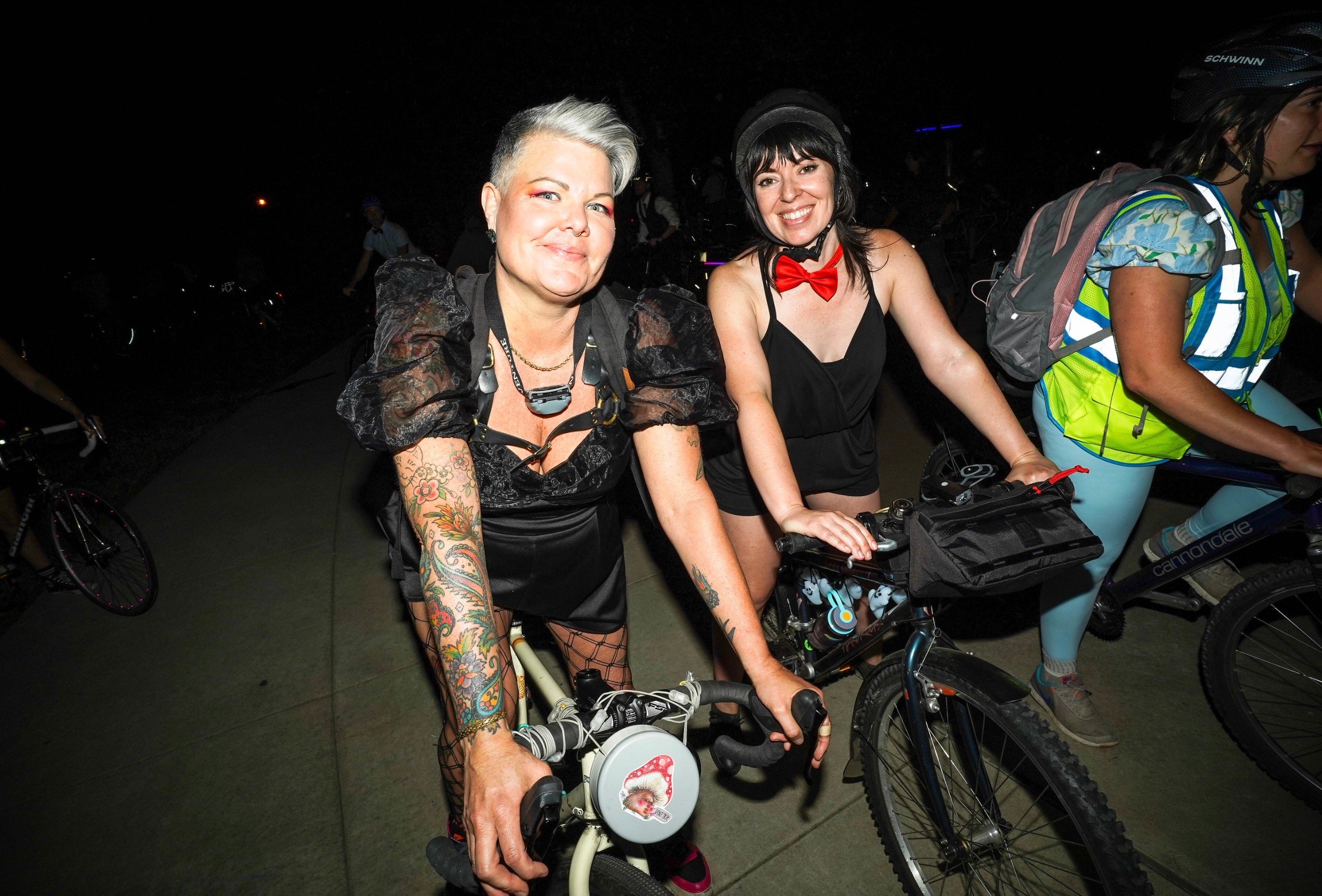
Grab a date for the Bike Prom on Saturday night. (Photo: Jonathan Maus/BikePortland)
It’s heating up out there. Whether you like to eat, drink, dance, part, learn or just goof around — this weekend offers a host of options to satisfy your appetite for free bike fun.
Below are my selections for the best rides this weekend…
Saturday, June 7th
Ride to Grand Floral Parade – 9:15 am at Ladds Circle Park (SE) Join a self-described parade lover and get ready to soak up Portland’s traditional annual procession of roses, Rosarians and other cool floats and fun. More info here.
Tropical Fruit Ride – 10:30 am at Brentwood City Park (SE) Bring $5 and pool funds together with other riders to purchase a bounty of colorful, juicy fruits and then play fruit-themed games at a park. Route ends at a spot that serves chè, a Vietnamese iced dessert drink. More info here.
Architecture Tour: Gems of the Eastside – 12:00 noon at Sewallcrest Park (SE) A 12-mile route with 8-10 stops where you’ll learn fun, historical, and quirky facts about notable buildings along the way. Check the ride Insta for a little taste. More info here.
Rise Up and Ride!: 2:00 pm at Salmon Street Springs (SW) Join fellow revolutionaries on a ride to Laurelhurst Park for the big “Gays Eating The Rich in the Park” event. More info here.
Dead Baby Bike Prom: 9:00 pm at Colonel Summers Park (SE) Traditional prom ride hosted by the friendly Dead Babies. Find a date or bring a date, dress to kill, and be ready to party like you did (or didn’t) in high school. More info here.
Advertisement
Sunday, June 8th
West Hills Climbathon – 10:00 am at QFC in Bethany Get ready to feel the burn as you ascend into the west hills and tackle some of Portland’s signature climbs including McNamee, Newberry and more. Expect 35 mile route with over 4,000 feet of climbing. More info here.
High-Five Ride – 10:00 am at Waterfront Park near Oregon Maritime Museum (SW) Spread joy to all passersby with this friendly and fun ritual. Practice your high-five-while-cycling skills in the park before you leave. A very short and sweet ride if you are pressed for time. More info here.
Summer Soft Serve Ride – 12:00 pm at Salmon Street Springs (SW) After high-fiving, roll back across the river and get ready to cool down with some sweet frozen soft serve. Ride leaders have scoped out a spot with excellent soft serve that you’ll ride to. More info here.
Pupusa Ride – 2:00 pm at Ladd’s Addition (SE) Cycle to score Salvadorian treats at Bichos and Salvi PDX. More info here.
Singles Bike Ride – 5:00 pm at Peninsula Park (N) Put down your phone and meet someone IRL. “Have low expectations” say ride organizers, who’ve planned a chill route that will end at the beautiful and romantic Skidmore Bluffs. More info here.
Cargopalooza – 6:00 pm at Mt. Hood Brewing (SE) Cargo bike lovers unite! And by “cargo bikes” they mean any type of bike, because “all bikes are cargo bikes.” Seriously though, this ride is led by a legit cargo bike fiend and the plan is to socialize, show off your rig, and learn how others set up their bikes for maximum hauling capacity. More info here.
— Did I miss your event? Please let me know by filling out our contact form, or just email me at maus.jonathan@gmail.com.
Imagine you’re riding your bike on a path like the Springwater Corridor and a police officer flags you down and asks to borrow your bike for a chase. That’s what happened to two people on Sunday morning on the Burnt Bridge Creek Trail in Vancouver, Washington.
According to body cam footage posted to social media by the Vancouver Police Department Wednesday, officers spotted someone they say had several outstanding warrants. In the video, you first see an officer approach the suspect. The suspect was initially on a bike, but immediately threw it down in favor of running away.
The officer then gave chase on foot. When he saw someone on a bike coming toward him, the officer demanded to use his bike. At first he asked, “Can I use your bike?,” which was quickly followed by “Let me use your bike.” The bike rider obliged, saying, “Be careful,” as he relinquished his beloved bike to the officer. It took a few seconds for the officer to figure out how to operate the bike, but once he did, the video shows him reaching a top speed of 18 mph.
Advertisement
The suspect ultimately tired out, gave up, and was arrested.
“When it comes to catching bad guys, sometimes you’ve gotta improvise,” VPD posted on social media. “With eyes still on this suspect (who had several warrants) and no time to waste, Officers Rich and Copley made quick tactical decisions to commandeer bicycles (thanks to two helpful citizens).”
The body cam shows that the e-bike was likely a Lectric XP 3.0. It has a motor that puts out 1000W of power (the legal maximum for e-bikes is 750W), a throttle, and a maximum speed of 28 mph. Ironically, those specs make the bike illegal for use on paved paths like the Burnt Bridge Creek Trail. I guess the officer was more interested in catching a suspect than ticketing someone who looked to be riding their e-bike safely.
Would you give up your bike if a cop demanded it for use in a chase?This story made me wonder about the law and whether you’d be required to comply with their request. It looks like the law varies from state to state, but in general, the answer is no. Police usually cannot force you to give up your vehicle for use in a chase. I think there are exceptions in the case of imminent danger or public harm, but if someone knows for sure, I’d love to hear more in the comments.
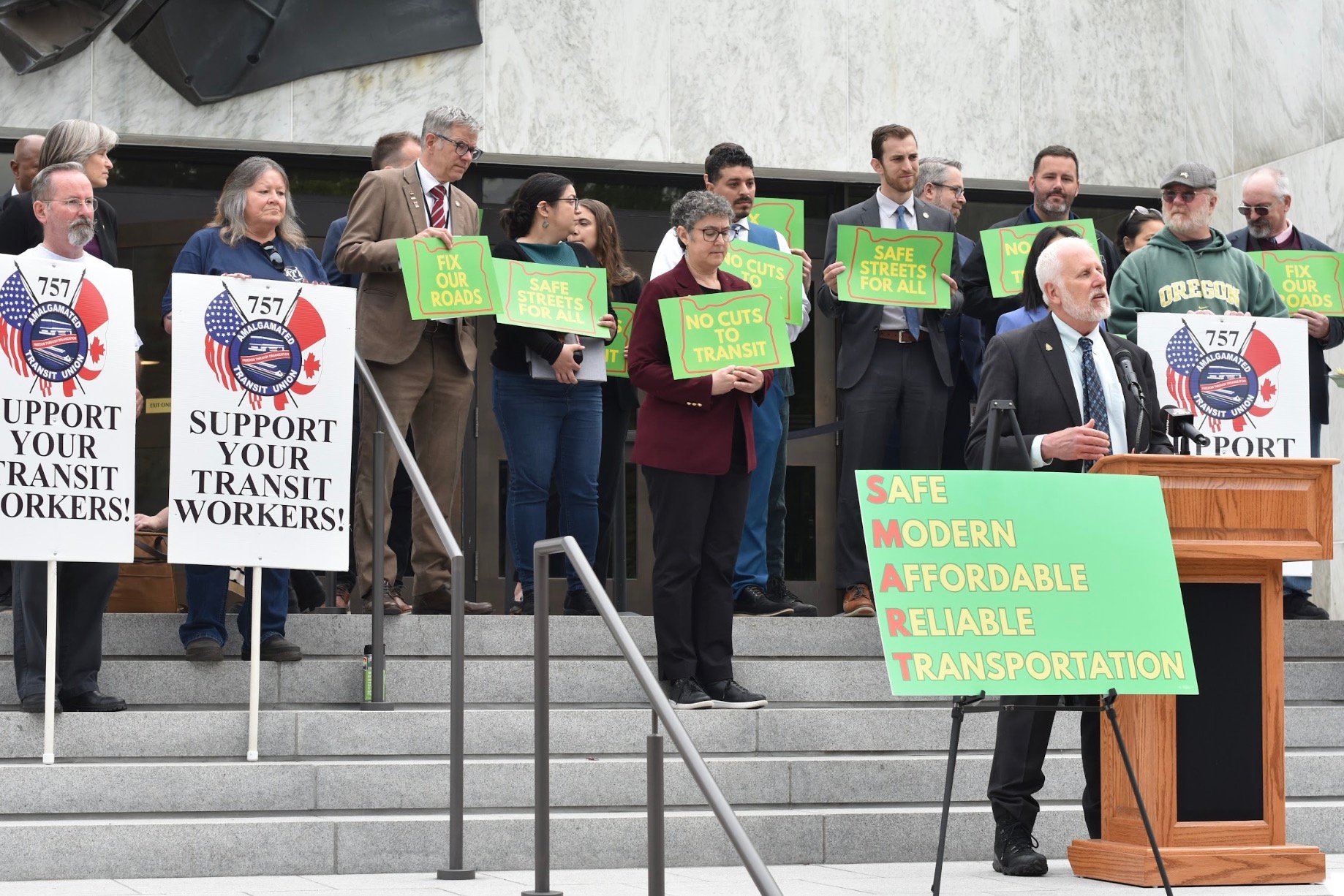
Rep. Mark Gamba speaking on the Capitol steps in Salem this morning. (Photo: Sen. Khanh Pham’s Office)
Where is the state transportation package?
With just three full weeks left in the legislative session, panic is setting in among advocacy groups and lawmakers alike as Democratic party leaders continue to negotiate behind closed doors on a long-awaited transportation funding package.
Instead of sitting on their hands, a notable group of Democrats — including Portland Senator Khanh Pham and Joint Committee on Transportation Co-Chair Chris Gorsek — attended a press conference on the Capitol steps in Salem this morning to unveil their vision for the package. It includes $665 million more than the $1.9 billion investment framework released by party leaders back in April.
This new proposal is from a group of Democrats that are decidedly more progressive than party leaders when it comes to transportation policy. Their vision, which they call the SMART (Safe, Modern, Affordable & Accountable, Reliable Transportation) Framework is based on a memo sent back in April to members of the Joint Committee on Transportation by House Representative Mark Gamba, a Democrat who represents Milwaukie.
Advertisement
Gamba and Pham are members of the Joint Committee on Transportation Reinvestment, a new version of the Joint Committee on Transportation (JCT) formed to oversee the new bill. They are both freeway expansion skeptics and have been solid voices for major transportation reform for years. Joining them in support of the SMART Framework are: Senators Gorsek, Floyd Prozanski, Lisa Reynolds, Courtney Neron Misslin, Jeff Golden, and Kathleen Taylor; and Representatives Rob Nosse, Thuy Tran, Willy Chotzen, Travis Nelson, Farrah Chaichi, Sarah Finger McDonald, Tom Andersen, and Lisa Fragala.
Their SMART Framework looks to raise about $2.5 billion and marks a very strong contrast to the austere proposal shared by a conservative wing of Republicans in early May. Pham, Gamba, and the proposal’s other supporters say the time is now for Oregon to increase funding for transit and ensure robust services statewide — while also making streets safer around schools, investing in ODOT’s urban highways that continue to plague cities with their unsafe designs, and invest more in bikeways, rail, and electric vehicle rebates for bikes and cars.
Joining lawmakers at this morning’s event were representatives from AARP, a school board, a transit worker’s union, and a transit agency.
Democrats enjoy a slim supermajority in Salem, but are reportedly working with a select group of Republicans to hammer out a bill. When they released an update on their package late last month, some transportation and environmental advocacy groups panned the plan’s provisions — which include a cap-and-trade scheme that would fund freeway expansions — as “cap and pave.”
Compared to the Joint Committee’s framework released in April, the SMART Framework includes: a higher gas tax increase; a 2% sales tax on new car purchases and 1% on used cars, instead of a 1% user fee (with sales taxes not being tied to the Highway Trust Fund, thus allowing lawmakers more flexibility in how the revenue could be spent); and a larger increase to the payroll tax that funds transit which would result in no cuts in service. Another difference from the JCT’s framework is something I hinted at back in April: a different approach to the bike tax. Democratic party leaders want to increase Oregon’s existing bike tax from $15 to $24.50; the SMART Framework would instead establish a new, Bicycle Privilege Tax of 0.8%. This progressive approach would replace the regressive, flat-fee structure of the current tax.
Advertisement
These revenue sources would allow the SMART Framework to raise $39 million more per biennium for off-highway bike and walking paths than the JCT’s initial framework, fund Gamba’s $6 million e-bike rebate plan, and more.
The provisions in SMART respond to the type of investments advocacy groups have called for in order to focus more of ODOT’s spending on safe streets, maintenance, and non-driving modes; instead of the traditional focus on freeway and highway megaprojects.
“The SMART Framework is accountable to the Oregonians who have spoken up by preventing cuts to transit service, fully funding our Safe Routes program to get kids to school safely, and by providing the resources necessary for cities and counties across the state to fix their local streets,” said Sen. Pham in a statement.
And Rep. Gamba added that now is not a time for transportation austerity. “We have underfunded our transportation system for decades now, and that continuing to do that will result in bridge closures and highway deaths,” he said. “Kicking the can further down the road will make it even that much more painful to recover. We have an opportunity to do the responsible thing and make our streets safer in the process.”
Whether or not Democratic party leaders heed this advice is hard to tell. But once they do release a bill, they won’t have much time to haggle over it and there are bound to be compromises to get something passed before the end of session on June 29th.
Download the SMART Framework one-pager for more details:
We’re back on SE Ankeny! (Photo: Jonathan Maus/BikePortland)
It’s our first Bike Happy Hour of Bike Summer, and it’s going to be a fun one!
Along with the usual great food, drinks, and merriment, we’ll have a special musical guest and I’ll sit down with a local lawyer to talk about a few pressing issues regarding electric bikes.
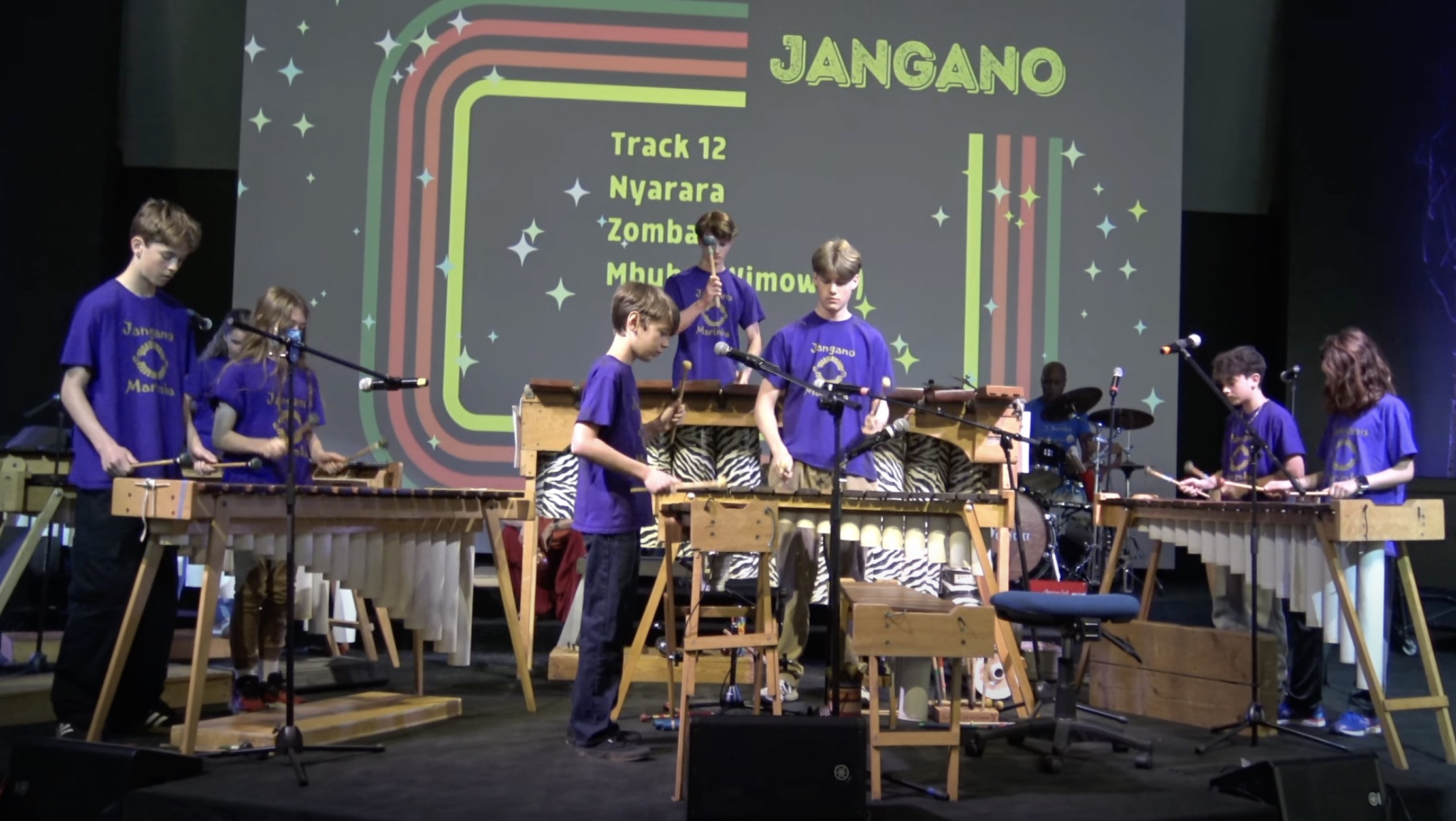
First up, we’ll be joined by Jangano, a youth marimba band that specializes in the music of Zimbabwe and South Africa. The band consists of eight local middle and high schoolers. They’ll set up on the redwood stage in the public plaza right next to Gorges Beer Co. Please come between 4:30 and 5:30 to see them play! For a taste of what to expect, see this recent performance on YouTube.
And then after announcements and open mic around 5:30 or so, I’ll chat with Chris Thomas, a bike law expert from Portland-based Thomas, Coon, Newton & Frost. Thomas’ firm wrote the book on Oregon e-bike laws and he’ll share what type of cases he’s seen and what you should know if you ride an e-bike. I’ll open it up for Q & A as time permits, so bring your bike law questions!
Hope you can join us. The weather should be spectacular. See you on Wednesday (6/4) in the Rainbow Road plaza outside Gorges Beer Co from 3:00 to 6:00 pm (at least).
[Video and photos (see gallery below) by Jonathan Maus/BikePortland]
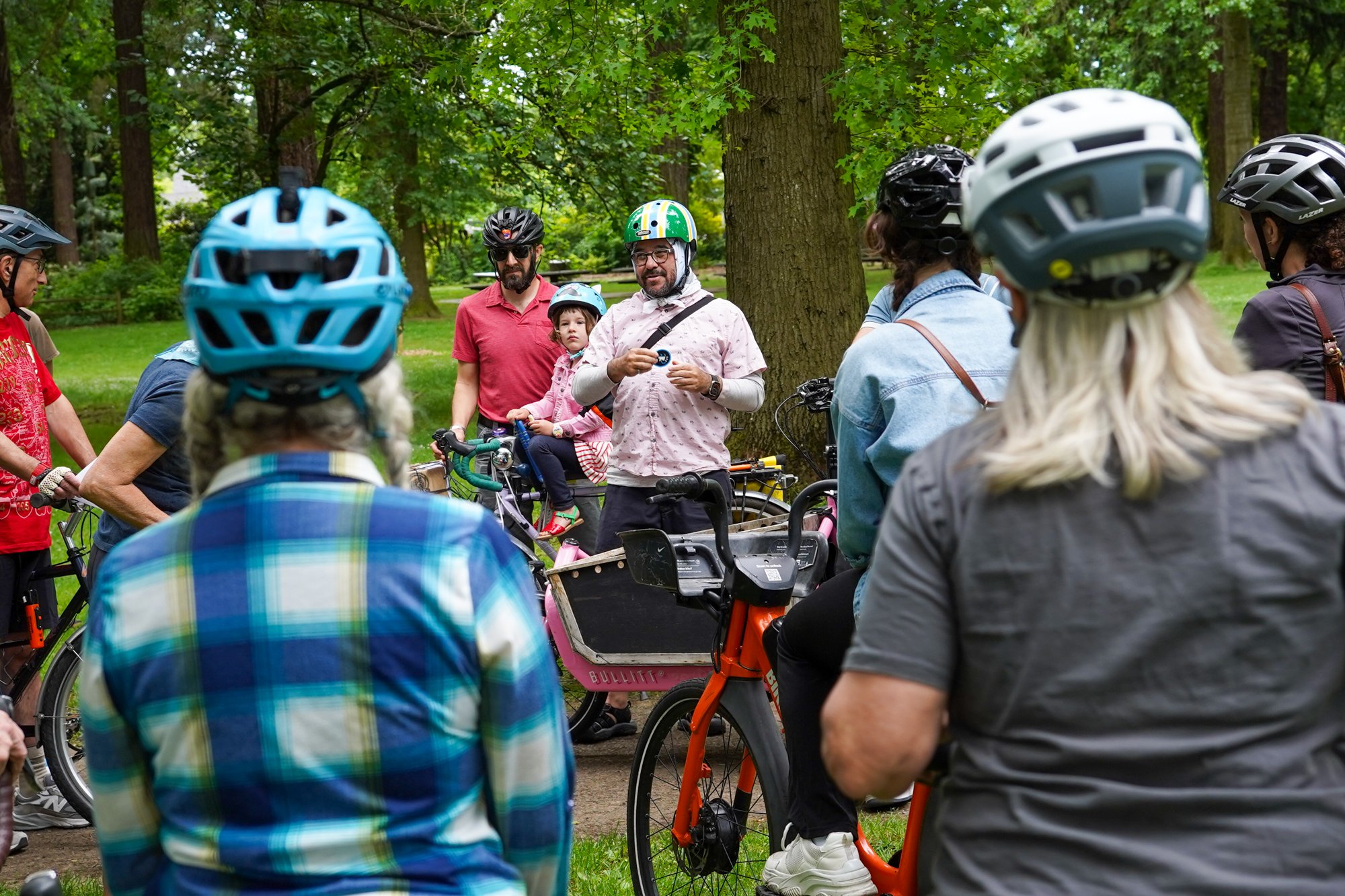
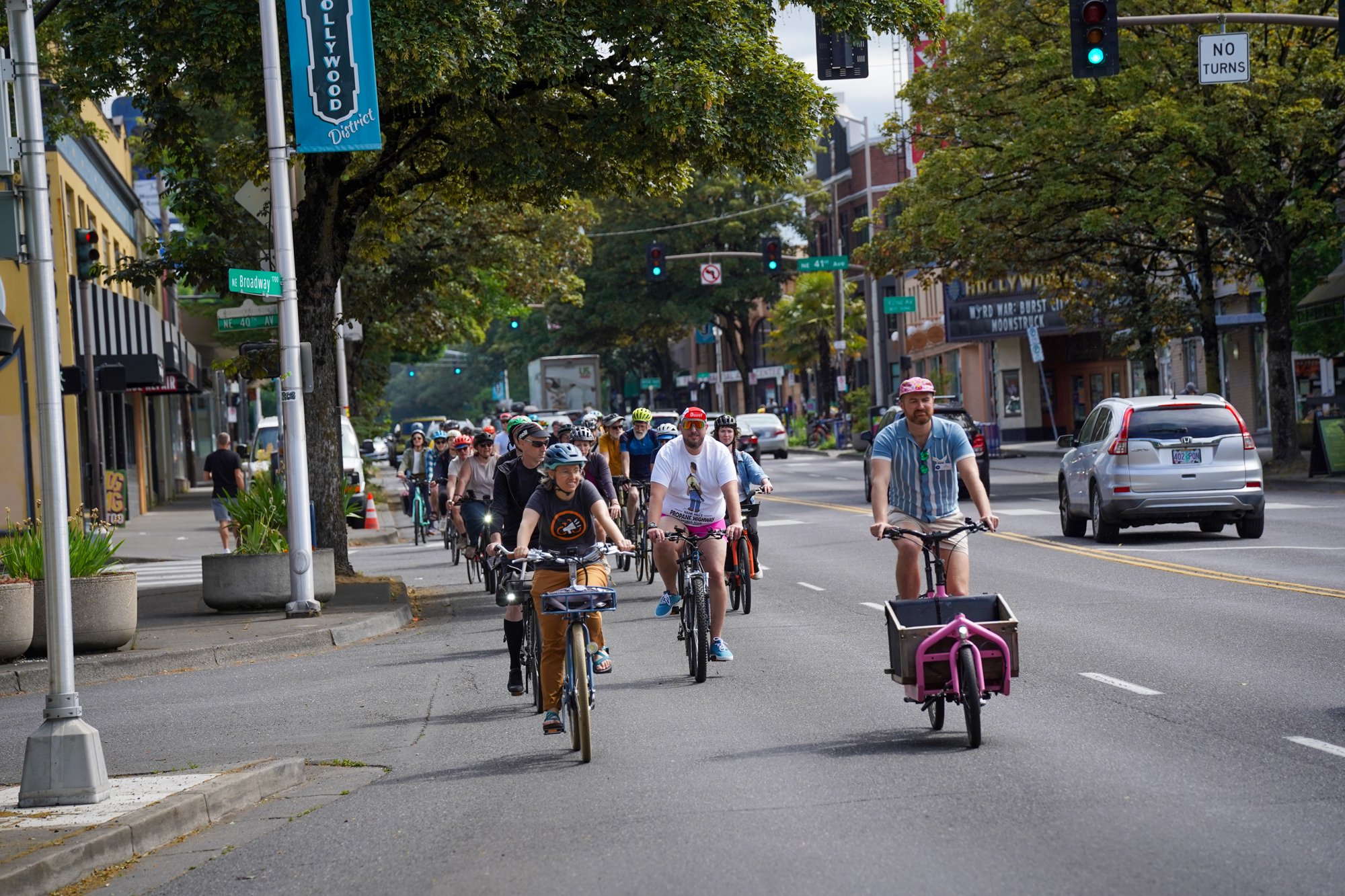
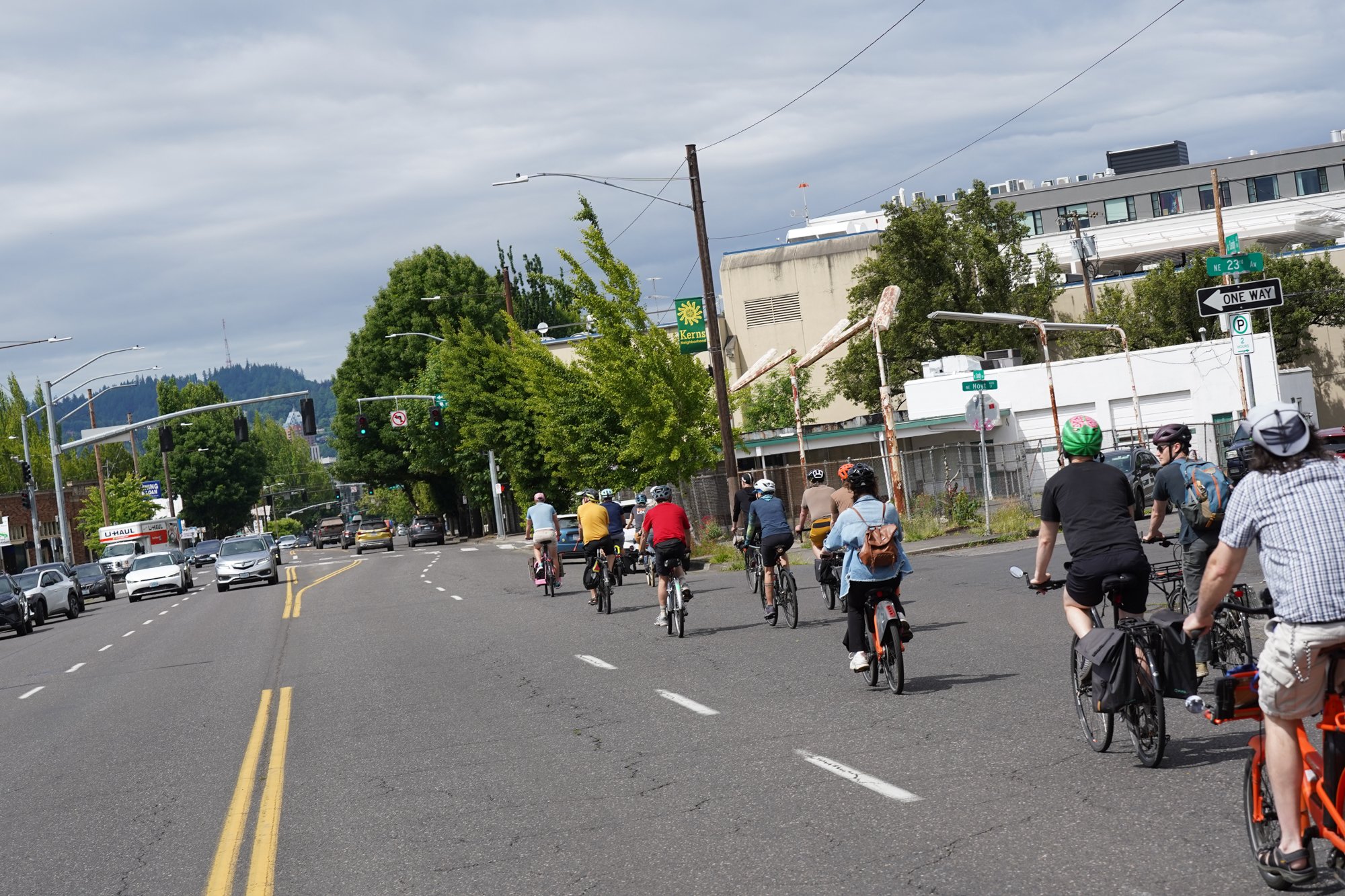
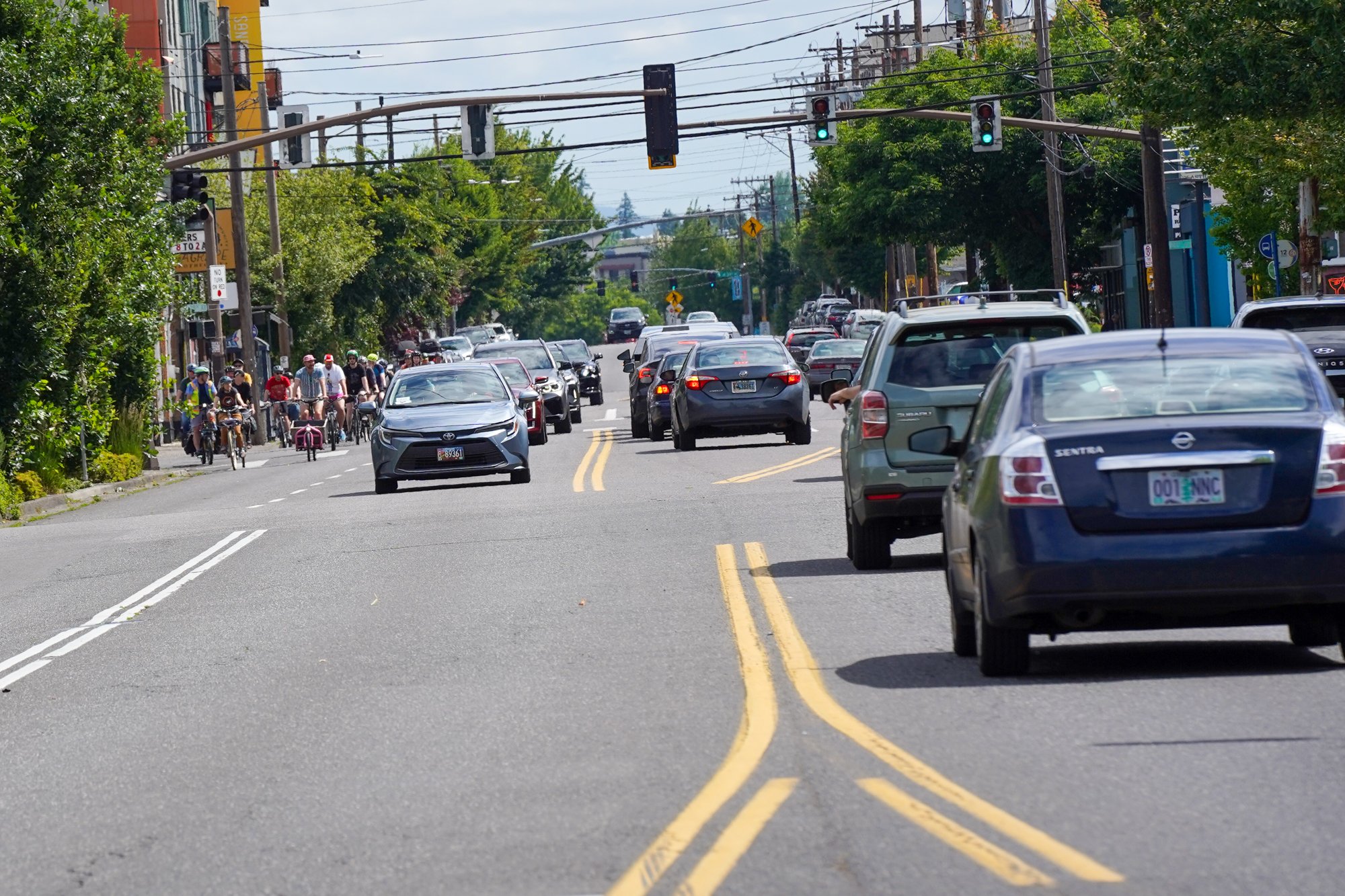
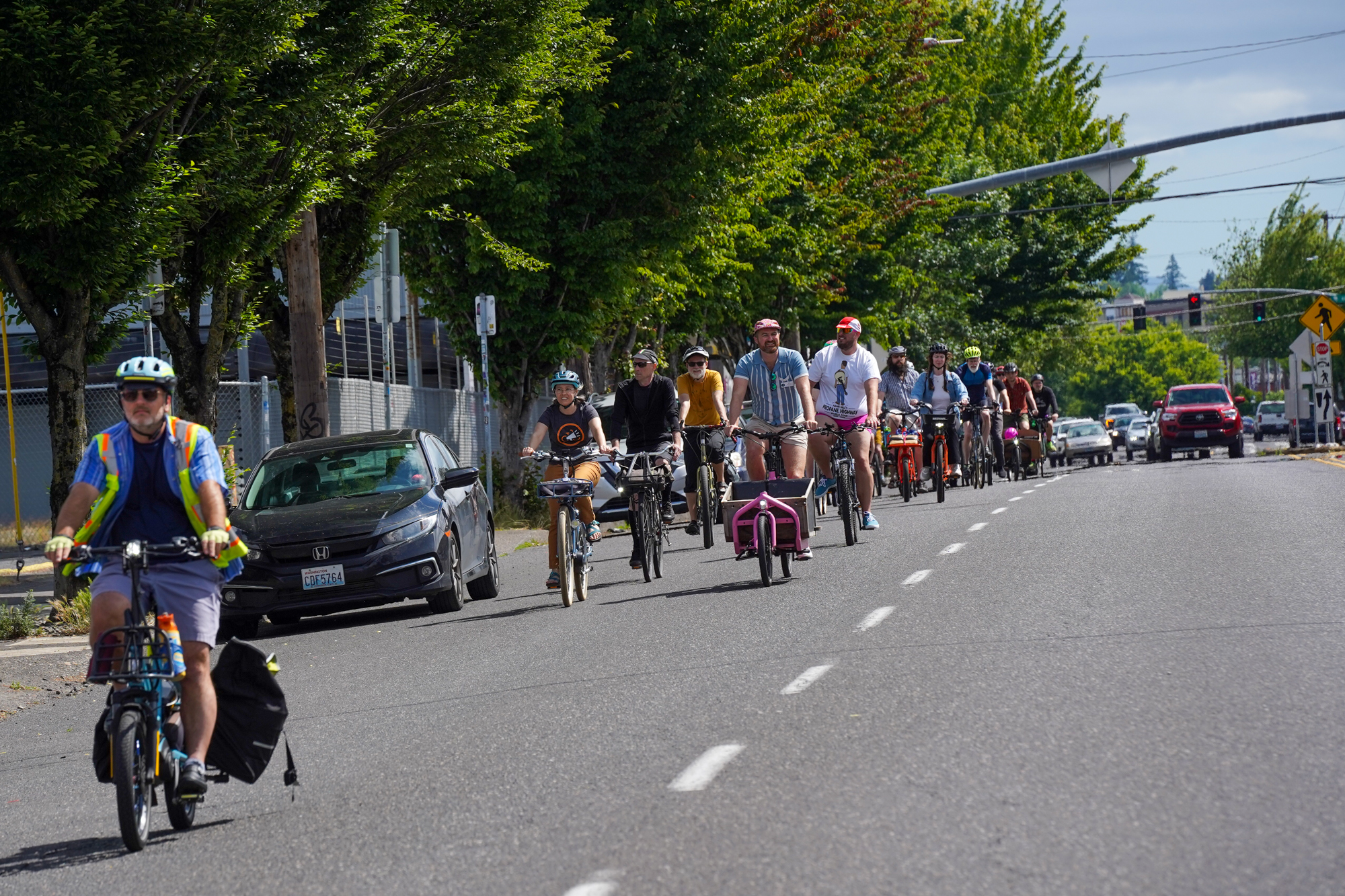
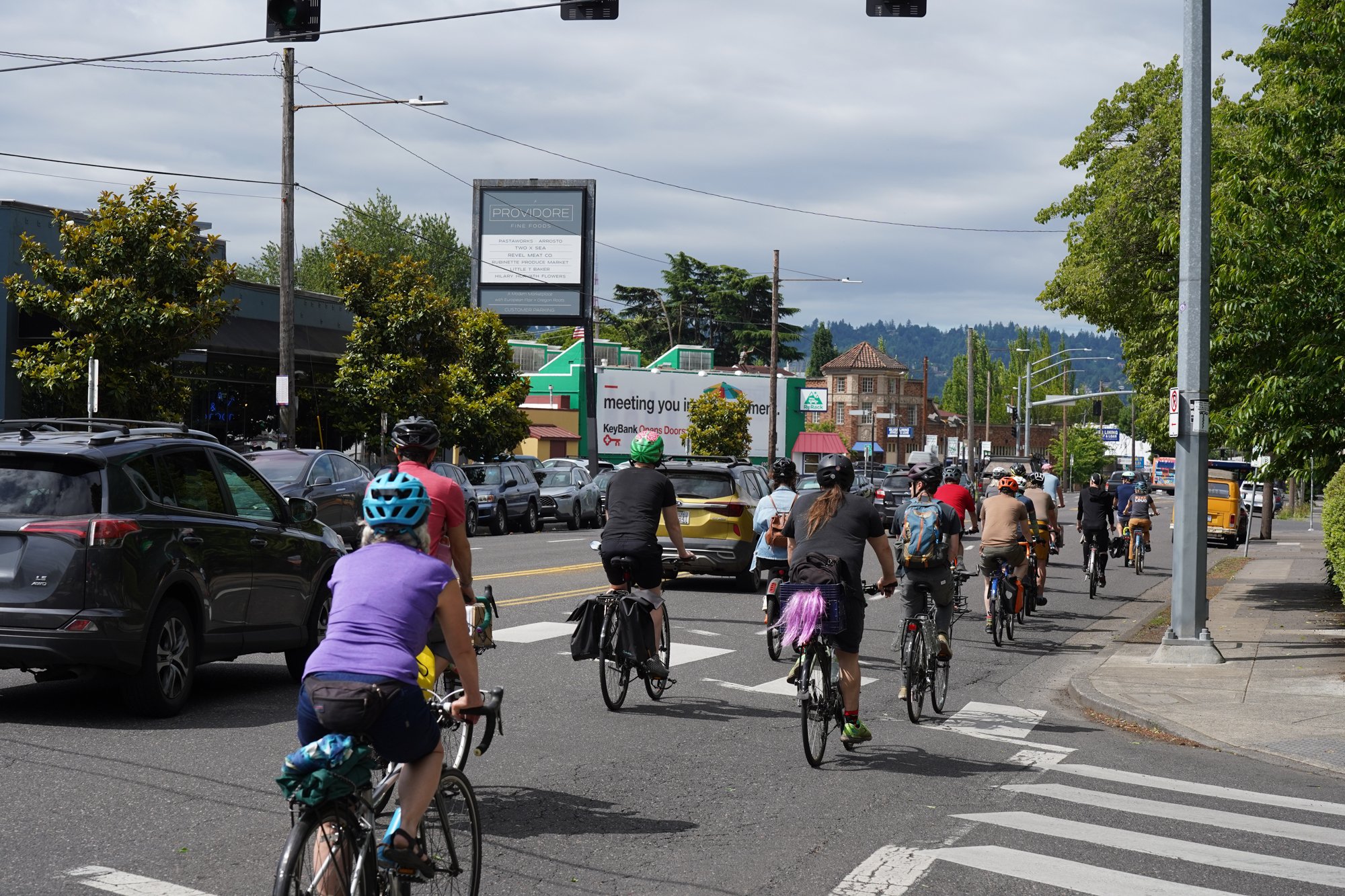
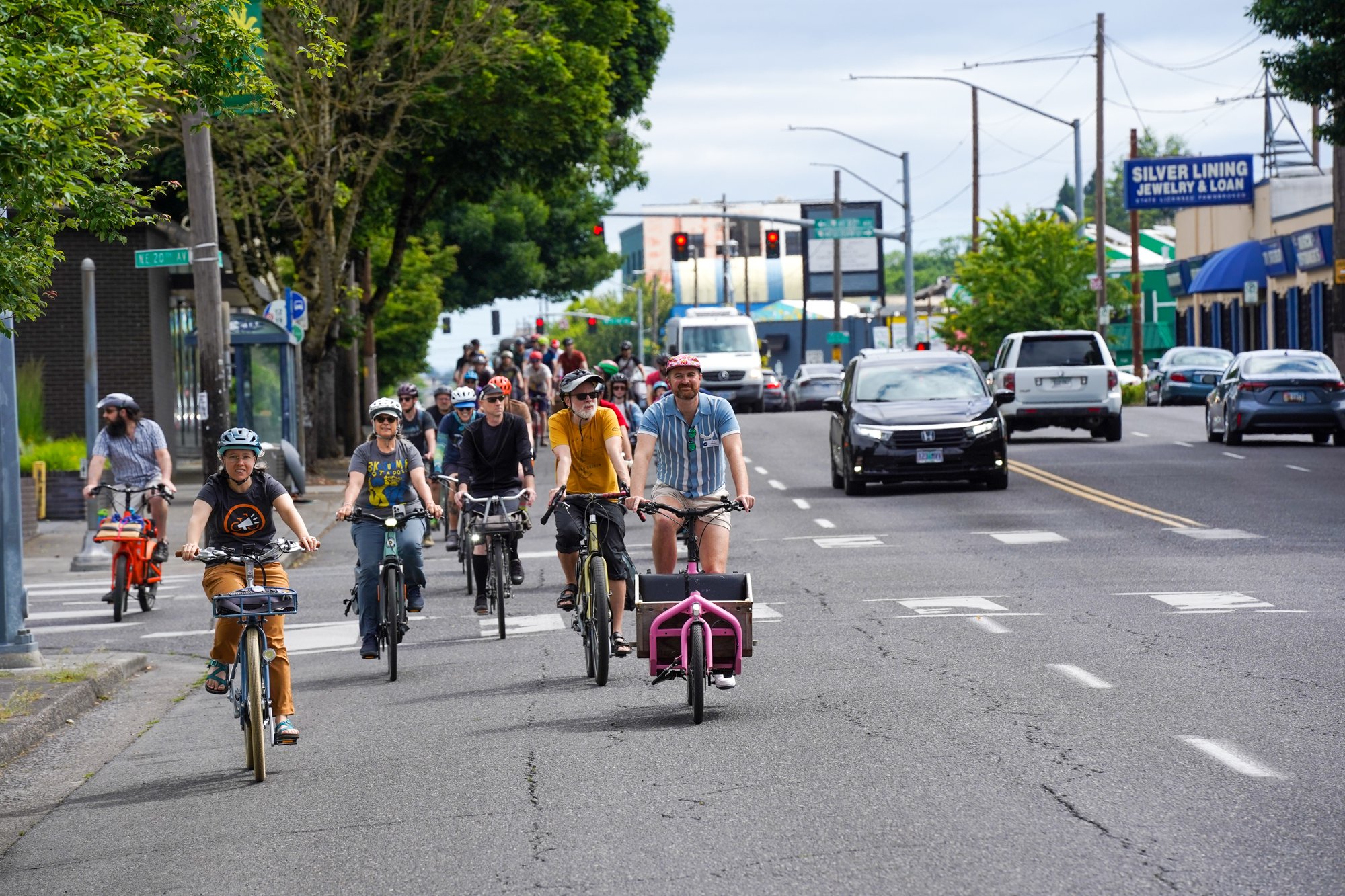
We talk a lot about safety when it comes to making cycling more attractive than driving. But convenience is probably a larger factor. That’s why so many Portlanders are intrigued by the possibility of updating Sandy Boulevard with bicycle facilities. After riding Sandy Boulevard this past Saturday, Portland City Council President Elana Pirtle-Guiney just might be among them.
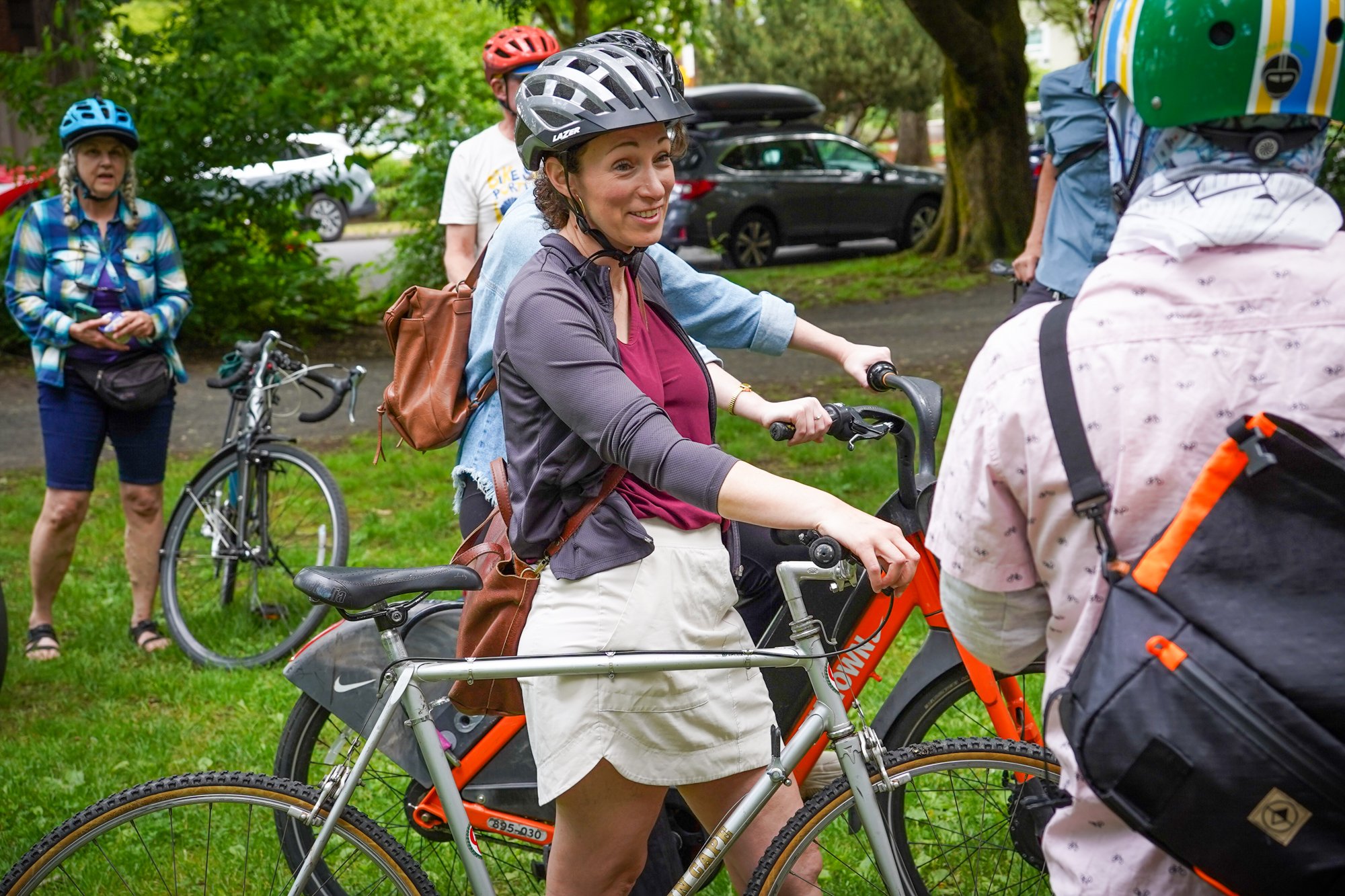
Pedaling a vintage cyclocross bike made for her mother in the 1970s, Pirtle-Guiney showed up at Wilshire Park with a few dozen other folks for a ride organized by BikeLoud PDX. “I figured if I wanted to really understand the questions that are going to come up around biking on Sandy over the next two to three years, I ought to join this ride and see it for myself,” the council president said in her introduction to the group. “I think it’s really important for me to see what it looks like.”
BikeLoud has led a relatively quiet, behind the scenes campaign for bike facilities on Sandy since at least 2019. That’s when they pushed the City of Portland to upgrade Sandy’s official street classification in the Transportation System Plan from “City Bikeway” to “Major City Bikeway.” That means whenever a city agency does a project on Sandy, they must hold cycling in the highest regard and make sure plans encourage people to do it. The rub is, Sandy is a “Major” street for every mode (pedestrians, transit, freight, cars, and emergency response vehicles), so whatever the future holds, it will favor whoever gets organized and does their homework.
Advertisement
Councilor Pirtle-Guiney at Wilshire Park before the ride.BikeLoud’s Kiel Johnson (seated) and Joe Perez.Joe Perez addressing the crowd at Wilshire Park.Councilor Pirtle-Guiney (right).Councilor Pirtle-Guiney.
At Wilshire Park Saturday morning, the crowd of bicycle riders included folks of all ages. There was a babe in arms, retired folks, and everything in between. One by one, people introduced themselves and shared how much they enjoy cycling in Portland and how much better it would be if they could ride on Sandy without feeling.
One woman I met said she’d love to explore the shops along Sandy and that, “You’d learn [the street] better if you were on a bike, going slower.” Jade and Xavier, a young couple who I talked to after the ride, said they’d never bike it outside of a large group. “But if there were bike lanes, we definitely would.” They live in Kerns and love visiting the Hollywood District. “It would be great to just bike up Sandy, but we have to do this weird, roundabout way.” They were blown away at how easily they could get to the Hollywood Theater from their house via Sandy Blvd.
One of the ride organizers, Joe Perez with BikeLoud PDX said, “Portland is a really beautiful place to ride a bike. I moved here to ride a bike. I love living here, and I’m staying here. I’m fighting for more bike lanes, so this is why we’re riding on Sandy today.”
Advertisement
The City of Portland also sees a different future for Sandy. With major recent residential development, the road is growing into its “Main Street Civic Corridor” label in the city’s Comprehensive Plan. In 2020, the Portland Bureau of Transportation applied for a state grant that would have paid for a Sandy Boulevard Civic Corridor Plan. That plan (which I never heard about, so I assume it didn’t get funded), would have taken a close look at dedicated rapid transit on Sandy as well as the, “potential for bicycle facilities along the corridor.”
What makes Sandy such a jewel in the future bicycle network is its diagonal path. Another BikeLoud PDX leader at Saturday’s ride, Kiel Johnson, said it’s important because it offers unparalleled convenience and access between the central city and neighborhood destinations. Johnson, who lives in the Cully neighborhood said, “Right now, if I want to go downtown, I have to go down N Going and then take Vancouver-Williams. Sandy literally saves me 15 minutes.”
Johnson points to a 2016 Metro evaluation that found Sandy had a “high level of demand for bicycle trips and the potential to increase bicycle travel if improved.” And in 2024, a group of Portland State University Masters of Urban Planning students published a report that recommended bike lanes.
(Source: PBOT)
Adding to the inertia to take a serious look at a bikeway on Sandy is a spreadsheet shared at a 2022 meeting of the PBOT Bicycle Advisory Committee. The document lists all the projects on PBOT’s five-year paving list and the opportunity for upgrading bicycle facilities when the restriping is completed. A project slated to begin in 2026 that will repave Sandy between 14th to 27th is accompanied by a note that reads:
Volumes [of car traffic] are lower in this section of Sandy Blvd. Opportunity to add enhanced bike lanes through travel lane reallocation, but need to consider safety as well as impacts to transit and other modes. Needs extensive planning and project development. Consider extending west to 12th/Couch and east to 28th Ave to connect to rest of bike network.
And Council President Pirtle-Guiney must have gotten the memo. And/or she is sufficiently intrigued by BikeLoud’s vision that she devoted her Saturday morning to learning more about it.
Advertisement
As we waited at the signal on NE 12th, I asked Pirtle-Guiney how she felt riding on Sandy. “It was less scary than I thought,” she remarked. Would she consider doing it on her own, without the safety of a group, if there was a protected bike lane on it? The savvy politician didn’t directly answer (as if knowing a “yes” would be construed as her supporting a bike lane). “I still want to learn more,” she said. “I’m very open to what the future of Sandy is.”
At the end spot, I asked the councilor if anything changed in her mind after the ride. “That outside lane feels a lot wider than I expected it to,” she said, her mind perhaps already mulling future debates about potential cross-sections. “I think it would be interesting to try it without a group and just see how it feels,” she continued.
“If you ever want to ride to City Hall together one morning, just let me know,” I replied.
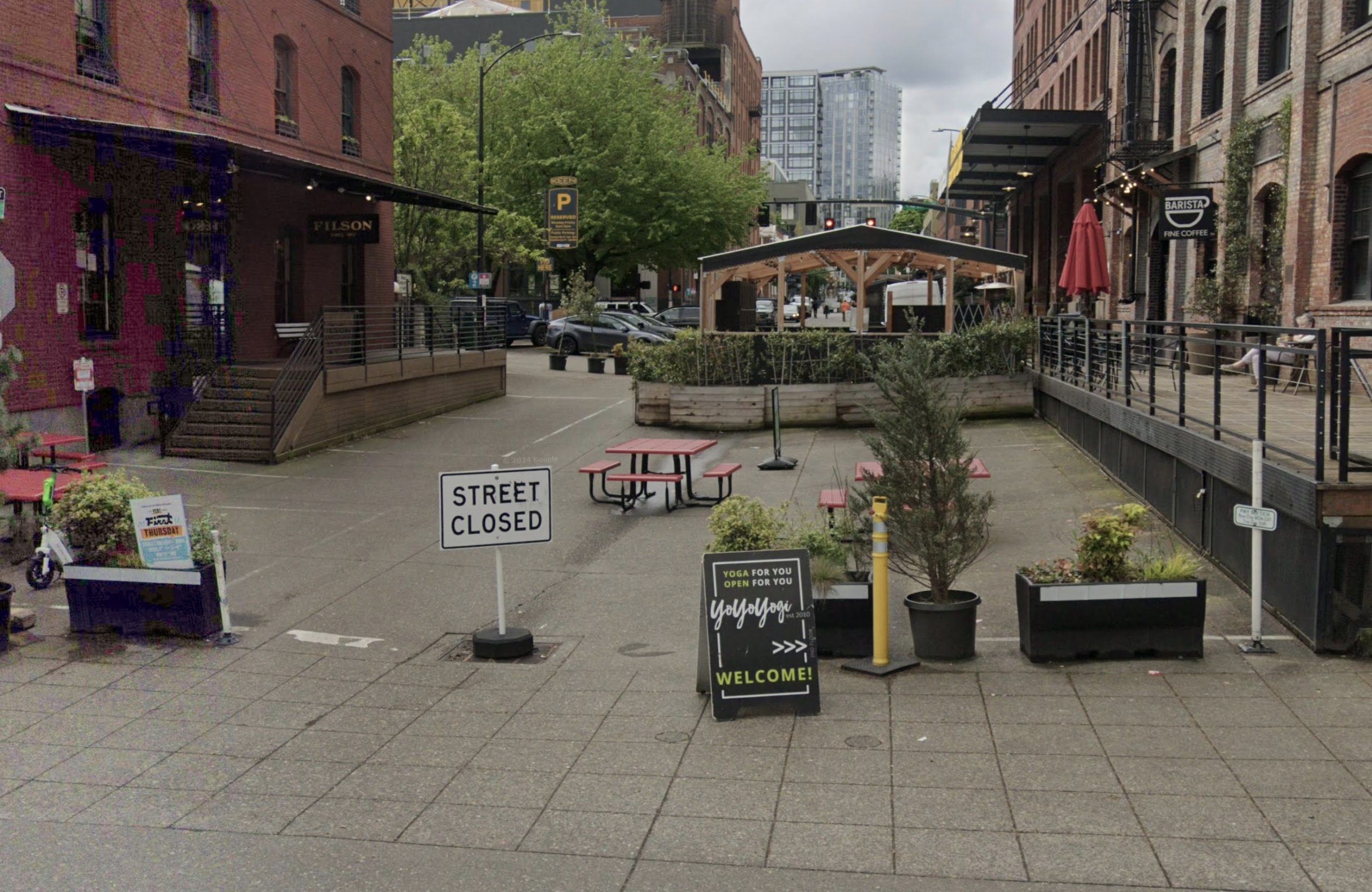
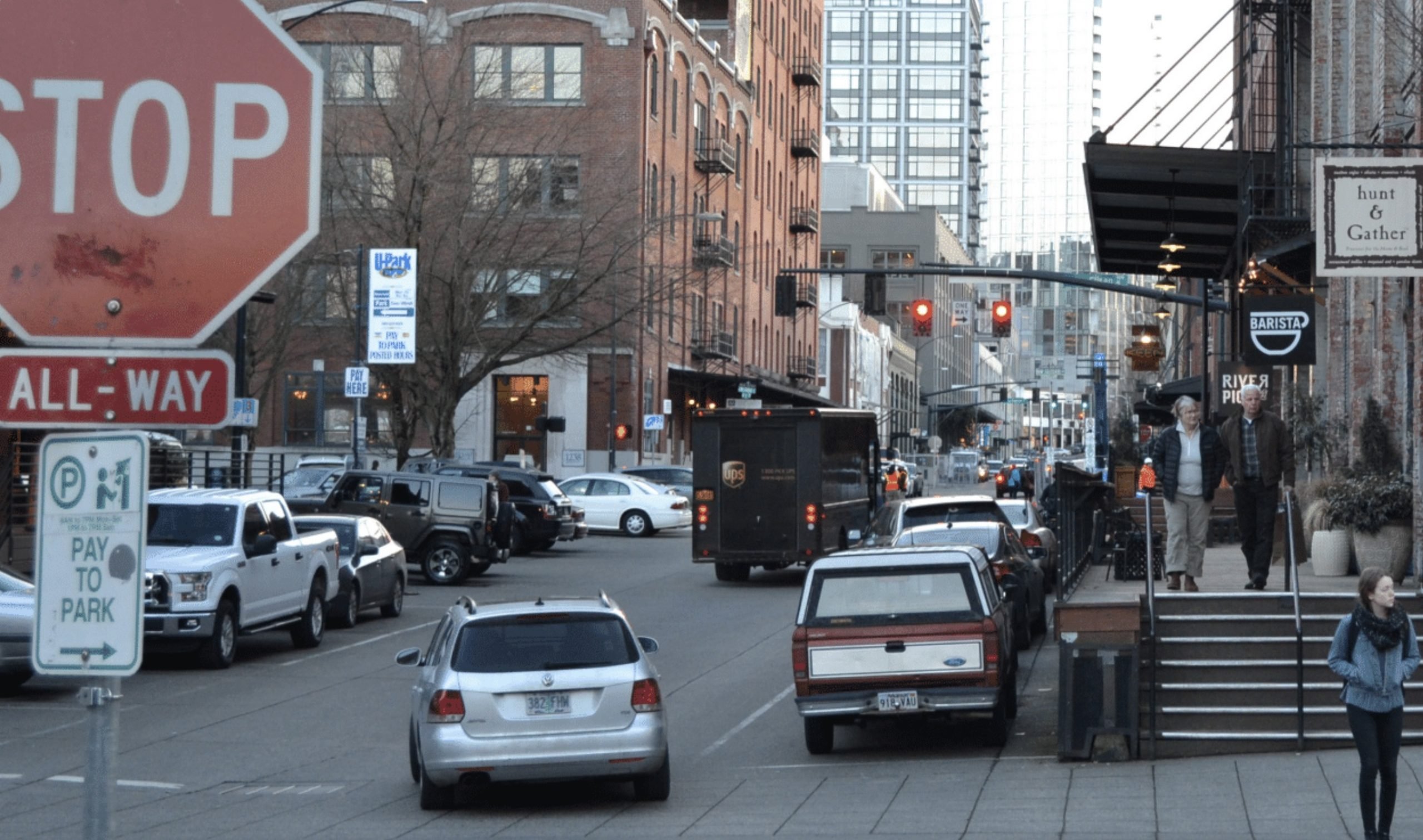
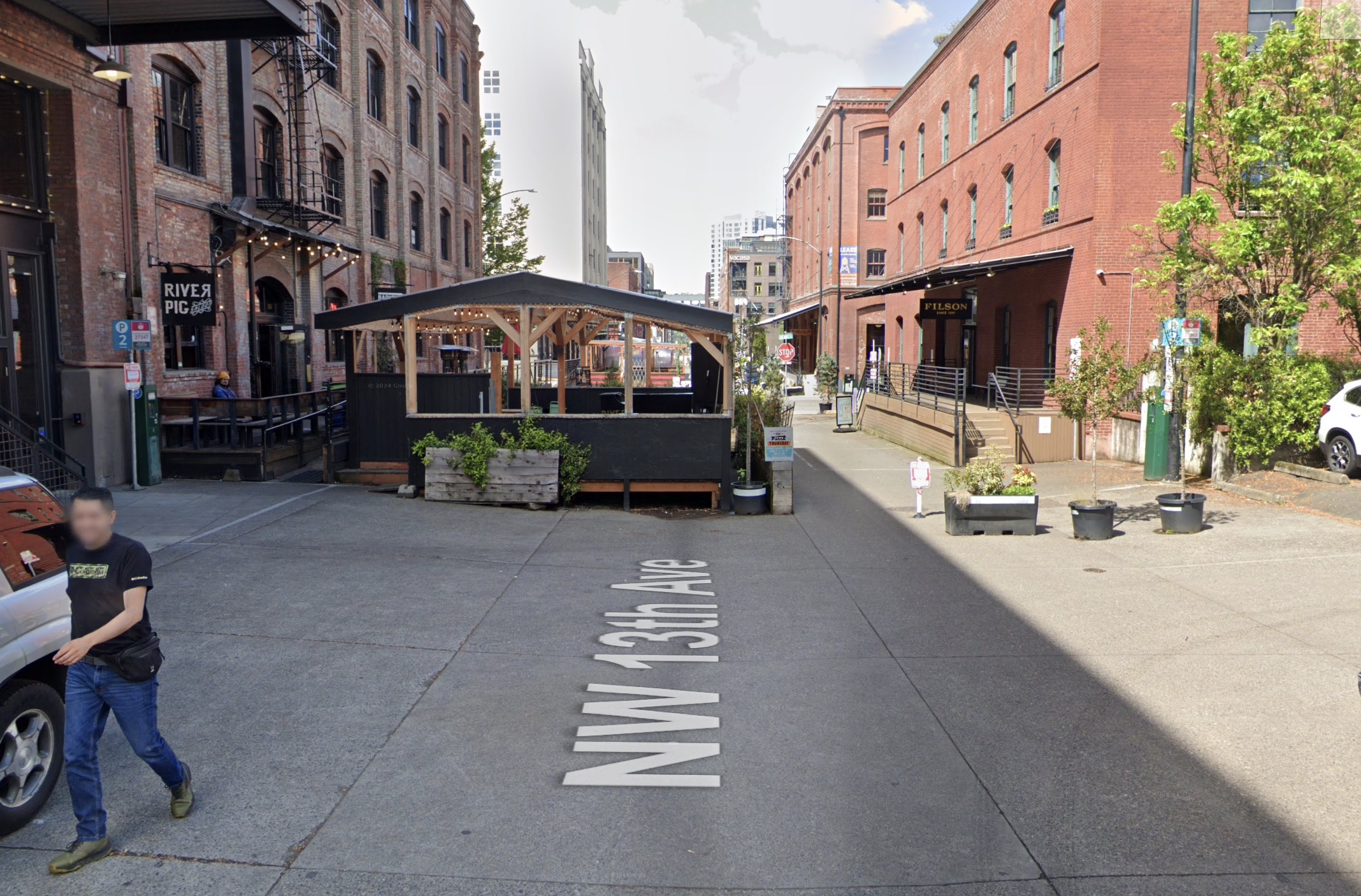
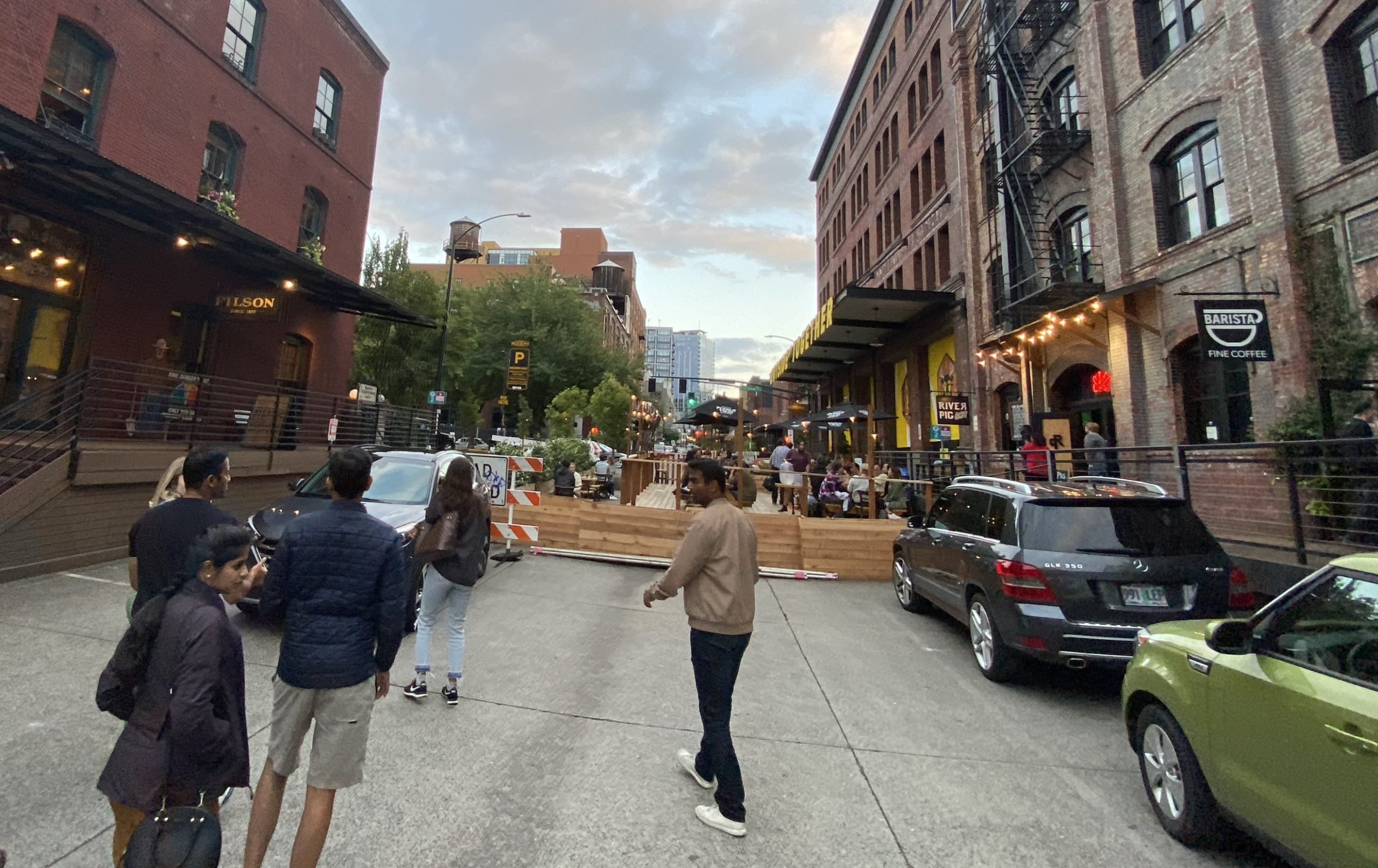
NE 13th between Hoyt and Glisan in May 2024. Patio structure belongs to River Pig Saloon. (Photo: Google Streetview)
Portland’s street plaza program continues to see uneven progress. On the same day we saw exciting progress on the new carfree plaza coming to Southeast 37th and Hawthorne, the Portland Bureau of Transportation announced they will pull the plug on their plaza on Northwest 13th Avenue.
In a rare public statement where PBOT’s frustration seeped through the text, the agency shared yesterday they will reluctantly give up the existing carfree plaza on three of the four blocks of NW 13th between NW Everett and Irving. “Due to three businesses’ lack of compliance with design guidance and numerous site challenges, PBOT has determined that these spaces have not succeeded as Public Street Plazas,” the city wrote, citing, “Ongoing problems and community complaints with operations, over privatization of the right-of-way, and low public satisfaction were,” as reasons for the decision.
Those four blocks were turned into a public plaza with outdoor dining and a driving ban in the summer of 2020, as PBOT grappled with the spread of Covid-19 and restaurants jumped at the chance to expand seating into the open air. Now PBOT will restore two-way driving access between NW Flanders and Irving, and focus on making the block between Everett and Flanders into a fully pedestrianized space.
Advertisement
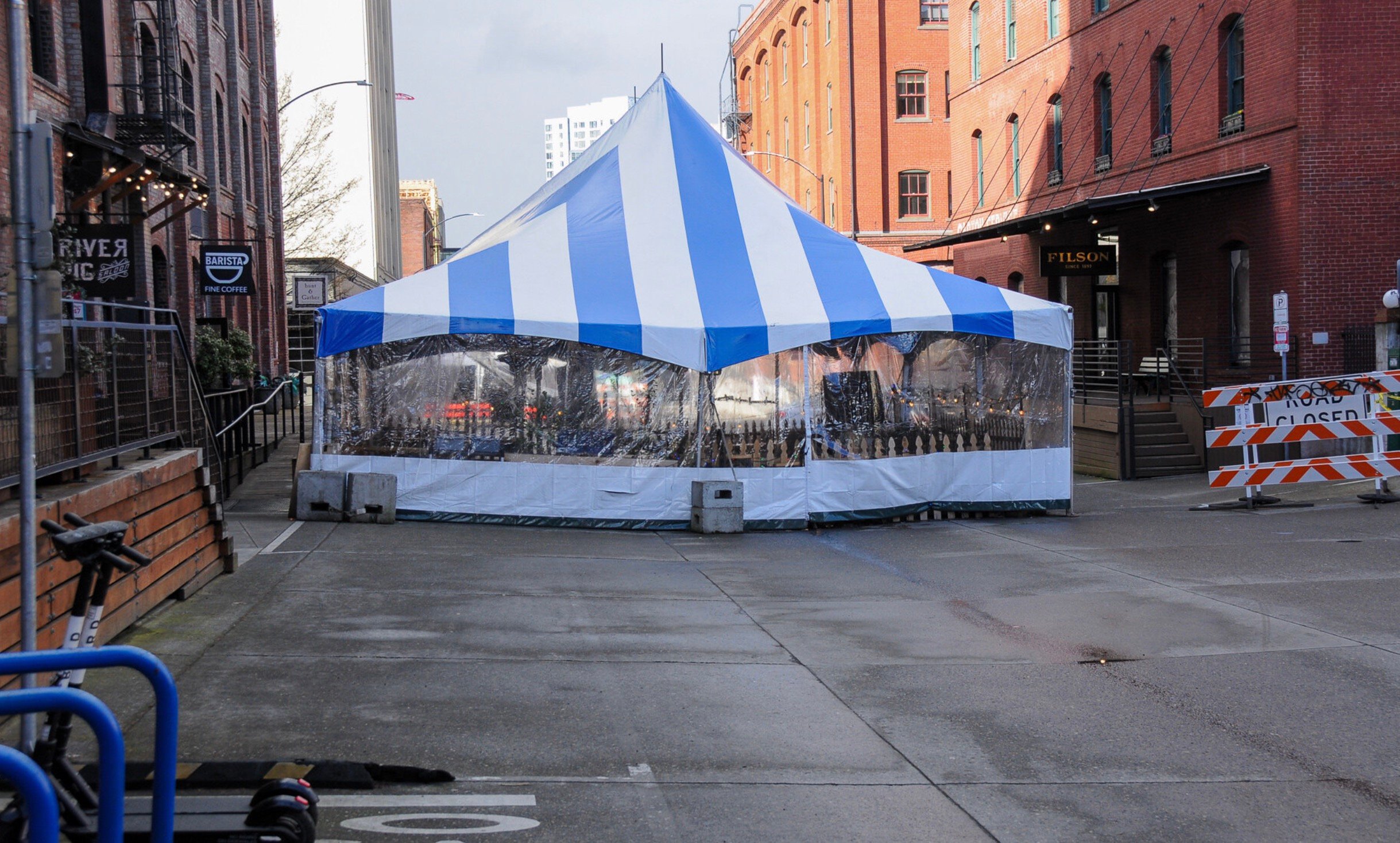
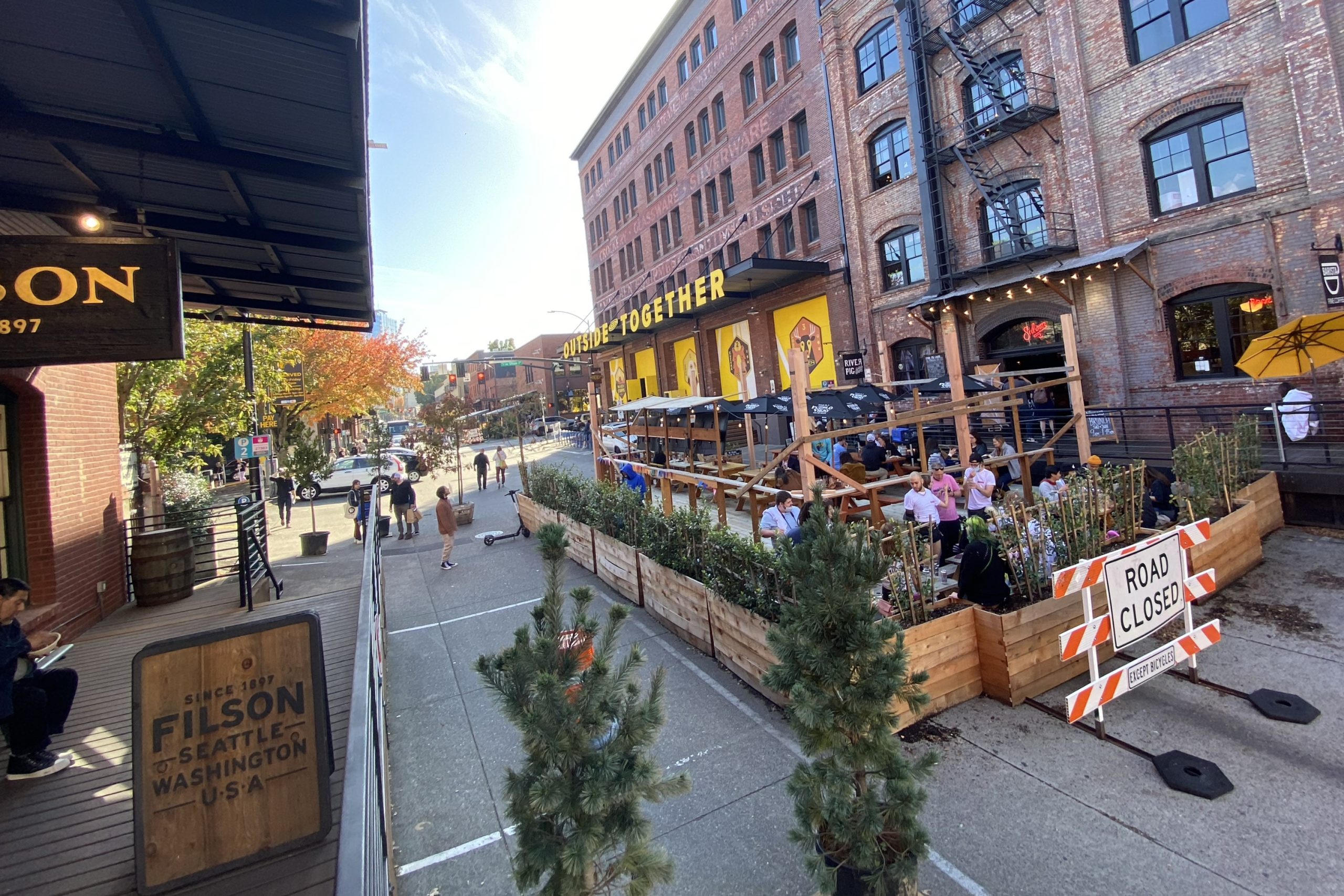
The scene on NW 13th between Glisan and Hoyt in 2017 — and soon-to-be in 2025. (Photo: Rethink Streets)
This loss of carfree space downtown is a major blow to Portlanders who dream of a city that caters to people and not their cars. NW 13th — home to the monthly First Thursday street festival — has long been eyed for its possible as a pedestrian-only corridor. In 2017, the Pearl District Neighborhood Association and Portland State University teamed up with Rethink Streets to publish an action plan for NW 13th that aimed to, “Refocus the street around the pedestrian, placing all other modes as secondary to the experience and comfort of those walking on the street.”
Ironically, PBOT themselves wanted to maintain this multi-block plaza, saying in their statement they have “regrets” about its removal. But it appears PBOT couldn’t find a policy or political path to save it.
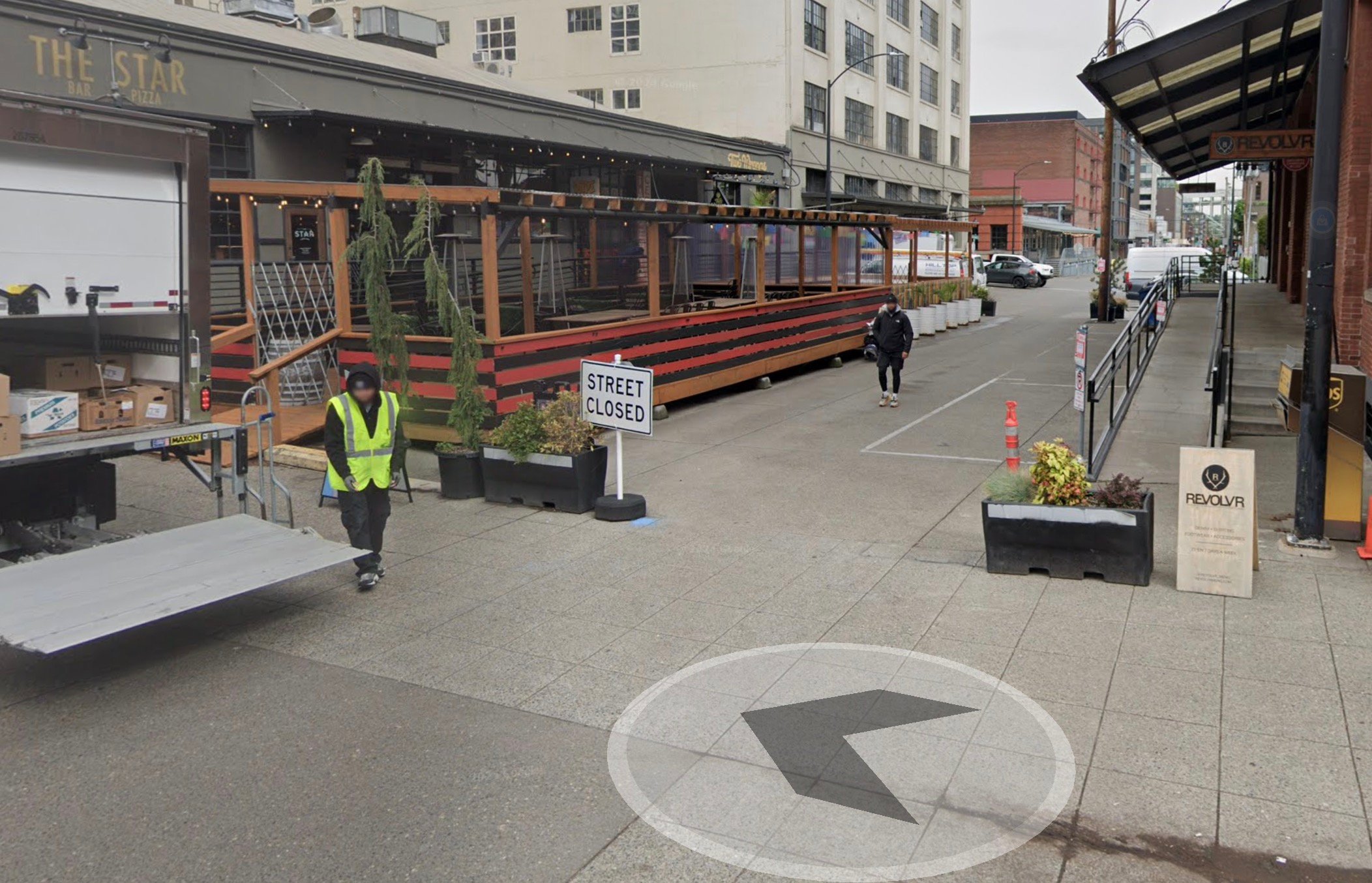
PBOT says the seating and patio structures installed by River Pig, Papi Chulo’s and The Star, do not comply with the city’s plaza requirements. The structures were too large and walled-off to the public, instead of being open and welcoming to all. PBOT says they gave the businesses ample notice to dismantle or change the structures, but even after four deadline extensions to make it happen, the businesses took no action. “The unwillingness of these businesses to do anything to change their installations to address community concerns forced us to take steps towards enforcement,” PBOT Public Information Officer Dylan Rivera shared with BikePortland today.
With no compliance from business owners PBOT plans to fine the businesses $500 per day until the structures are removed. They will then re-open the three blocks to parking and driving for the first time since 2020.
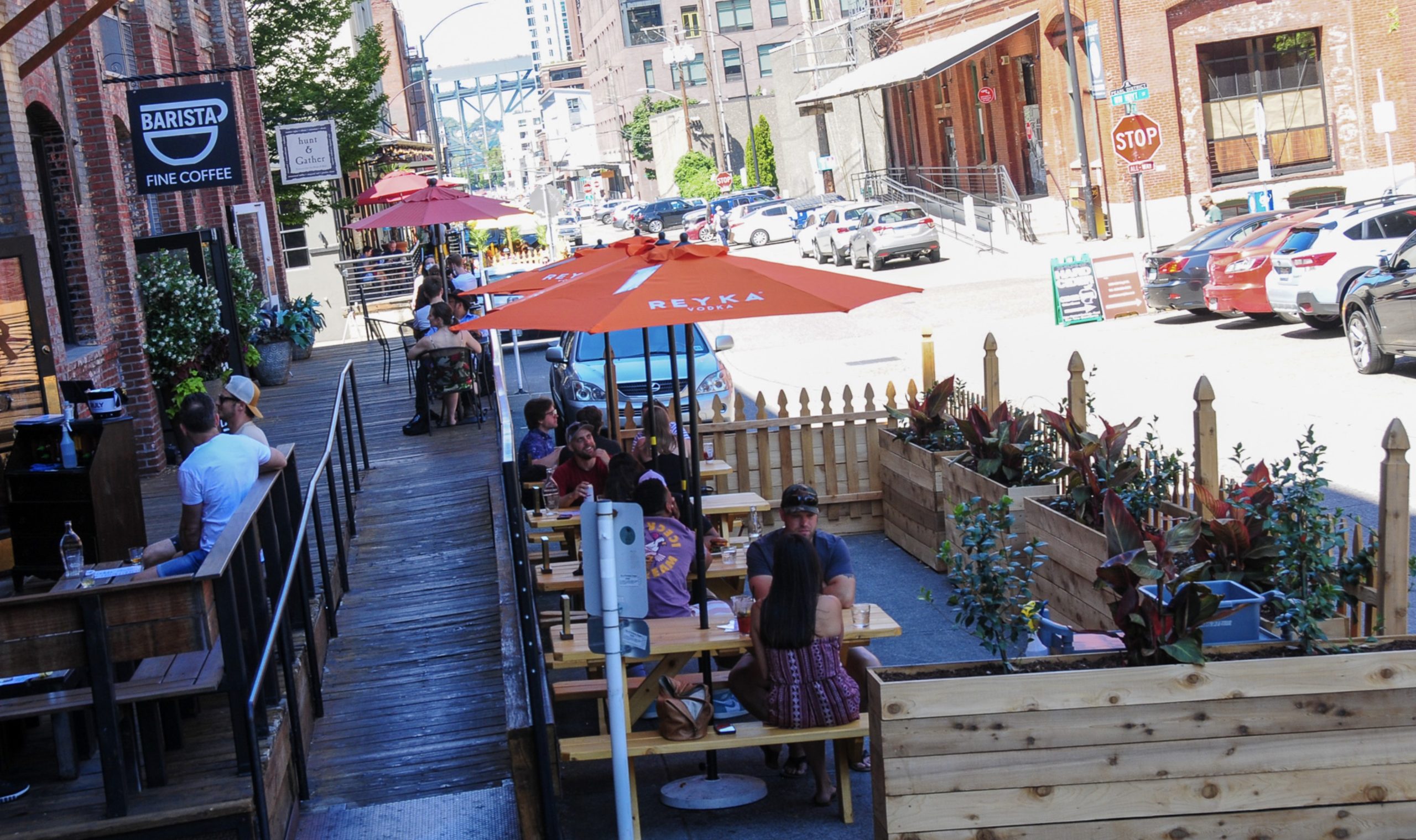
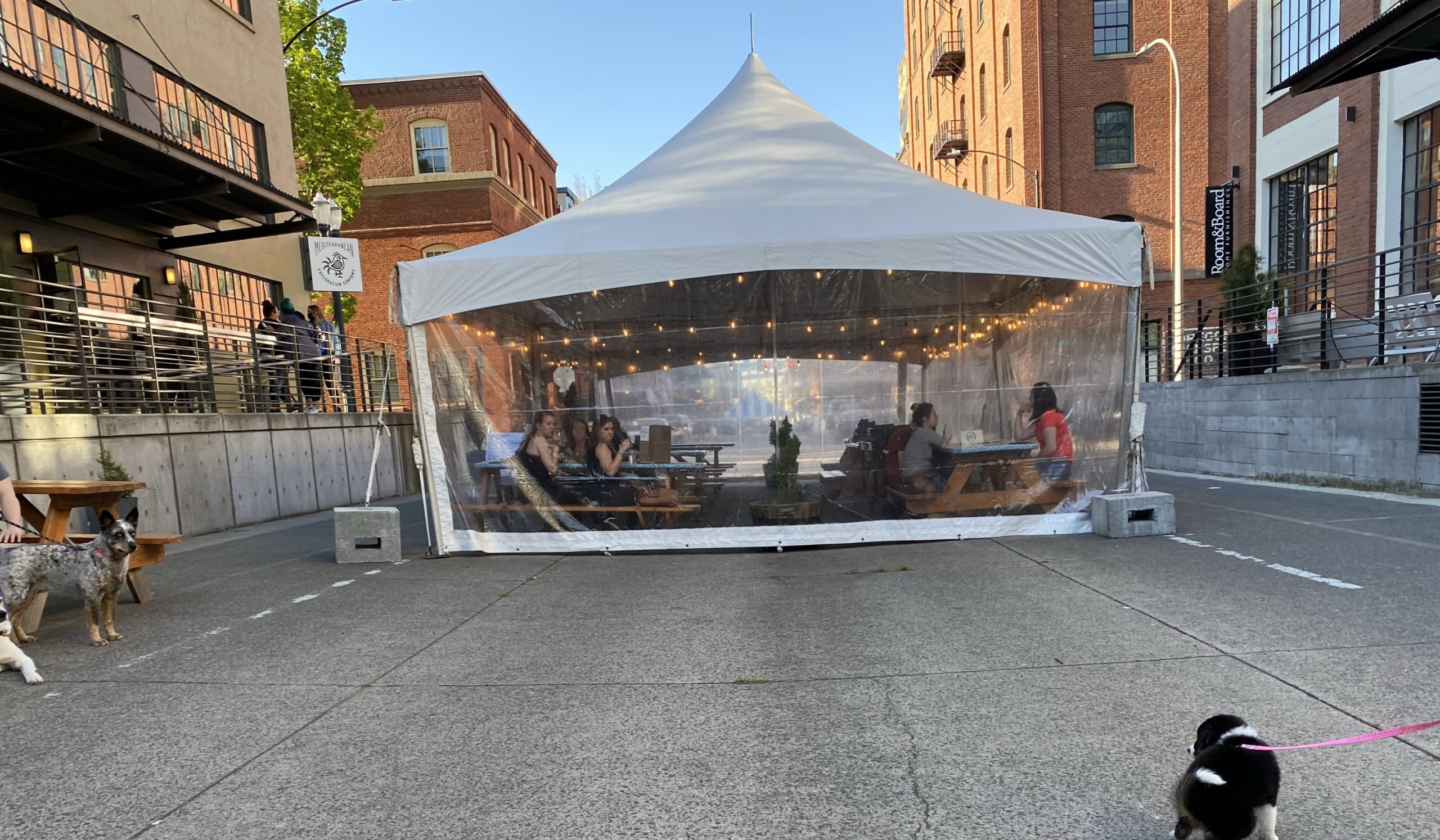
The Star/Papi Chulo’s patio between NW Hoyt and Irving. (Photo: May 2024 Google Streetview)River Pig Saloon patio. (Photo: May 2024 Google Streetview)River Pig’s patio in 2021. (Photo: Jonathan Maus/BikePortland)River Pig Saloon patio in 2021. (Photo: Jonathan Maus/BikePortland)River Pig Saloon patio in 2020. (Photo: Jonathan Maus/BikePortland)Mediterranean Exploration Company patio in 2021. (Photo: Jonathan Maus/BikePortland)River Pig Saloon patio in 2021. (Photo: Jonathan Maus/BikePortland)
Advertisement
PBOT appears to have made every effort to make this plaza work. “PBOT did not take the decision to remove the NW 13th car-free blocks lightly; in fact we have been trying to avoid this situation for the past year and a half,” Rivera said.
The city has spent about two years meeting with the Pearl District Neighborhood Association (PDNA) and business owners to address issues of access, cleanliness, and safety. Despite these efforts however, the city cited a public survey they administered last year where they heard “dissatisfaction” from over 400 respondents including, “strong opposition to large private outdoor dining structures dominating public plaza space, concerns about late night noise, negative behaviors, and, at times, violence, in the plaza, as well as issues with illegal parking, blocking of emergency lanes, and lack of visibility for pedestrians.”
And sadly, while PBOT said an overwhelming majority of survey respondents liked the idea of a public street plaza, they didn’t like the implementation on 13th. In their statement yesterday, PBOT included a litany of public comments that expressed opposition and concerns about the structures. Most people said the dining structures were simply too large, and instead of contributing to a public plaza, they felt more like expansions of the restaurants onto a public street.
Advertisement
“Outdoor dining should not be so big and closed off from plazas. Should be open and flexible like European styles as in Paris or Barcelona,” one person wrote. “The structures as they exist are imposing and make me feel unwanted as a pedestrian. It’s like I’m walking into their business area, not like they are spilling out into a public’s space.” (This tension between private businesses using public right-of-way has been a sticking point since one of Portland’s first permanent plazas was built on SW Ankeny in 2011.)
There was also strong pushback from some adjacent, non-restaurant business owners as well.
A February 2024 story in The NW Examiner reported on a tension between restaurants, who welcomed using public right-of-way for their private business; and non-dining businesses, who felt the plazas encouraged unwelcome public behavior and the lack of parking and driving access turned away customers. The president of the Irving Street Lofts homeowner’s association told the Examiner that he supports the plaza, but not its, “late-night patrons who congregate in the vicinity until and after the last bar closes at 2:00 am,” who he said are, “driven by a dining experience or alcohol and playing music and partying.” And Debbie Thomas, who owns Debbie Thomas Real Estate on NW 13th, said she was never told about the plaza and never asked for it.
Issues about the plaza appear in meeting minutes of the PDNA as far back as August 2023, when a PBOT plaza program staffer attended a meeting to share an update on “improvements to NW 13th Ave.” A March 2024 meeting referenced “several meetings relating to nuisance issues affecting Irving Street Lofts and the overall impacts of closures and restaurant encroachments on the street.” “Discussions will continue on how to best accommodate pedestrian and vehicular traffic on 13th,” the meeting minutes read. Then in November 2024, the PDNA was warned that the structures would be coming down and that a stakeholder process would begin to “reimagine the future of 13th.”
Advertisement
PBOT has long maintained that carfree street plazas exist only with support from adjacent business owners. In this case, it appears the nearby businesses either failed to believe in the potential of a carfree plaza, were frustrated that PBOT hadn’t figured out how to make it work better, and/or just felt like auto parking and better driving access is more important to their bottom line. Without business support, and with so many complaints from street users and neighbors, PBOT came to this unfortunate decision.
PBOT currently manages 16 street plazas and 575 permitted outdoor dining installations citywide. Just one month ago, PBOT faced the possibility of shuttering their entire street plaza program due to a lack of funding, but Mayor Keith Wilson’s proposed budget kept it alive.
As this situation on NW 13th illustrates, funding isn’t the only constraint when it comes to building world-class carfree spaces in Portland. Like other major shifts in the status quo, it will take that magical mix of political leadership, public support and neighborhood-level organizing that seems to have escaped us in the Pearl District — putting the long-envisioned dream of a 13th Ave promenade further out of reach.
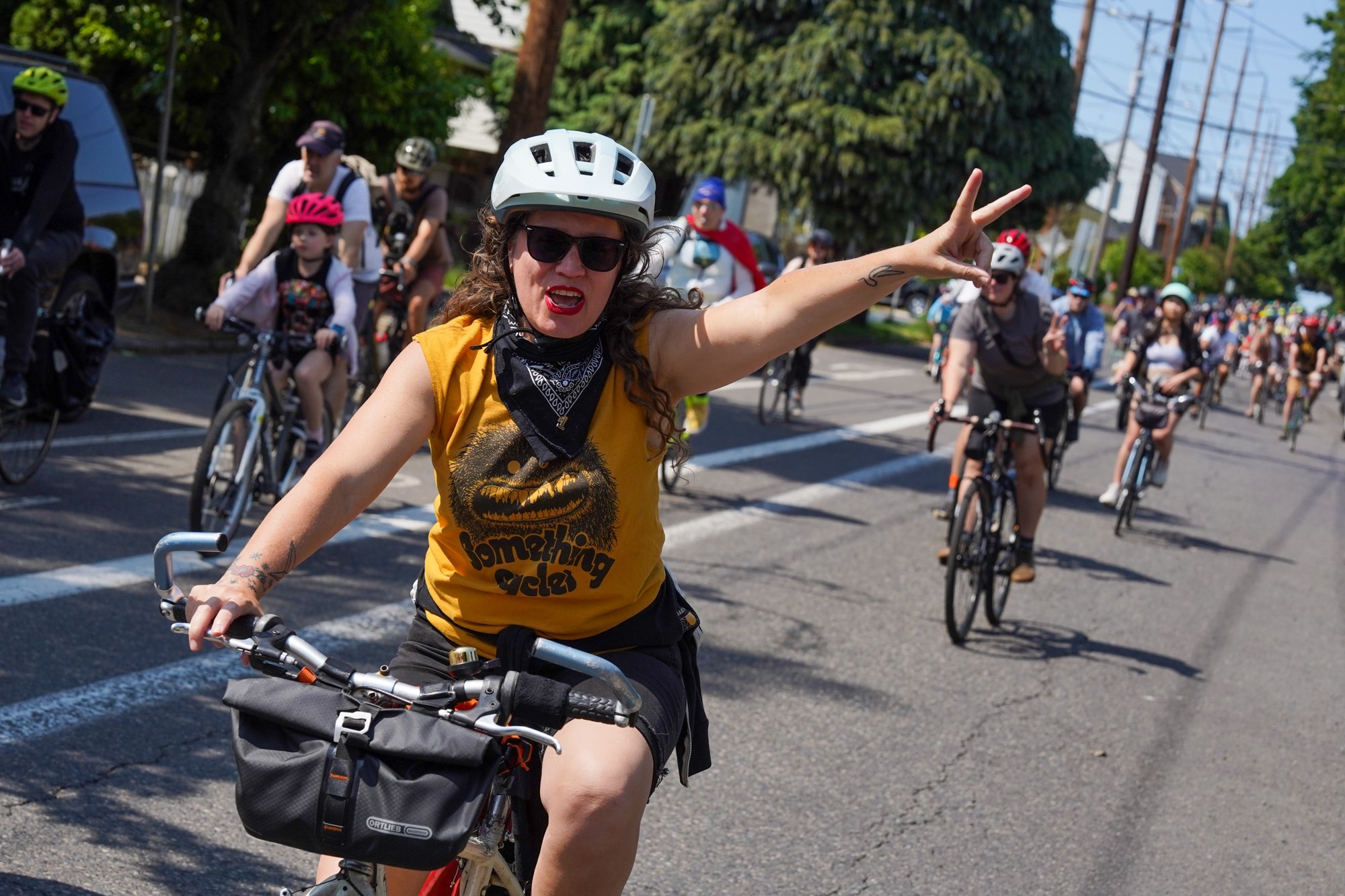
Sunday’s Bike Summer Kickoff Ride was memorable no matter what draws you to Portland’s bike scene. The event, which began with a pre-party just above a full-blooming rose garden at Peninsula Park in north Portland, had it all — and then some.
People gathered two hours before the 3:00 pm rollout time for a festival of cycling and community that has become an important part of the annual Bike Summer tradition. Folks were selling all types of interesting things, promoting their rides, or just soaking in the moment. There were vegan ice cream treats being sold from a tricycle, “awkward mimosas” for anyone daring enough to tilt their head back and try them, free bike repair, Bike Summer merchandise to buy, and more.
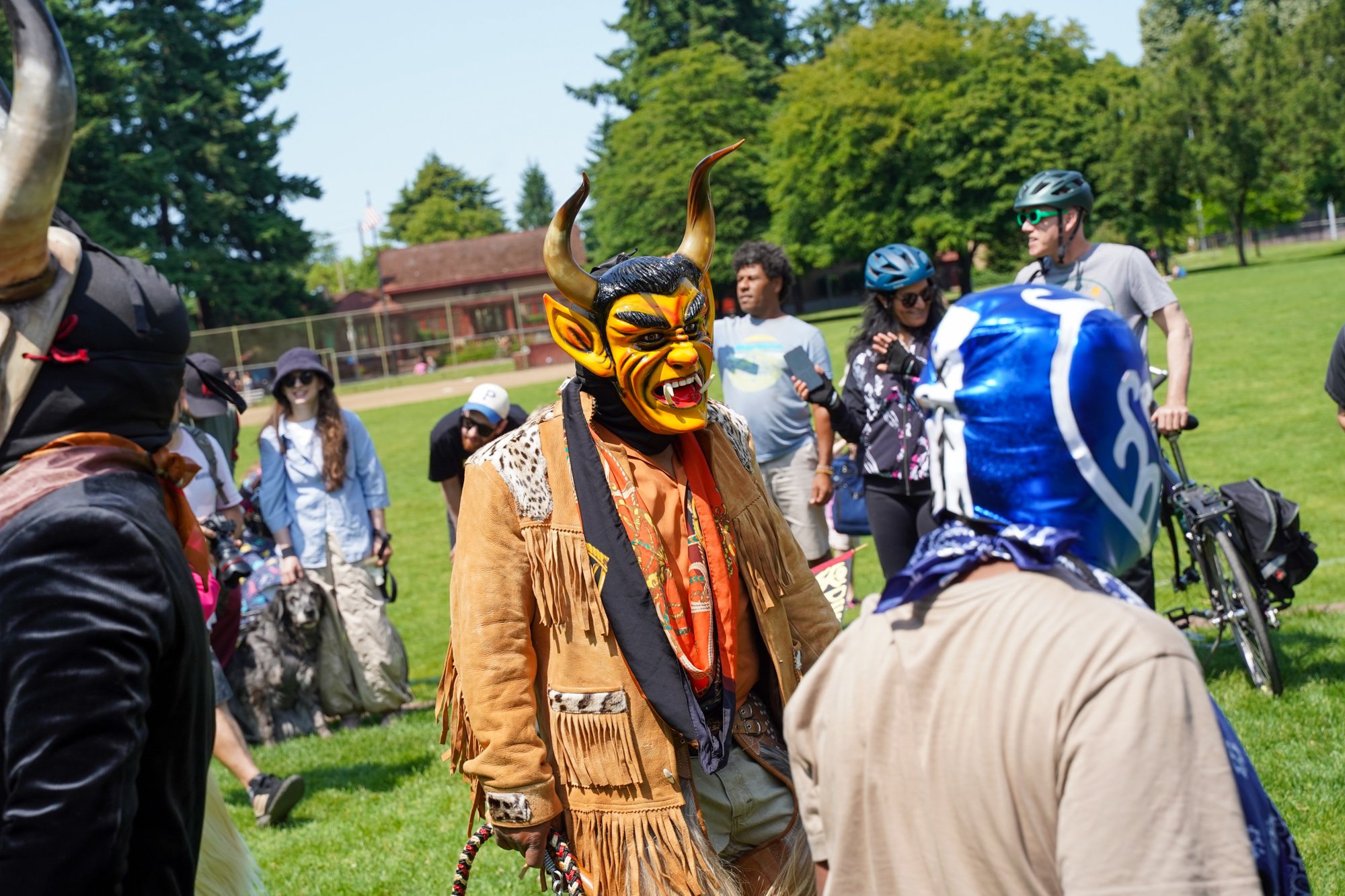
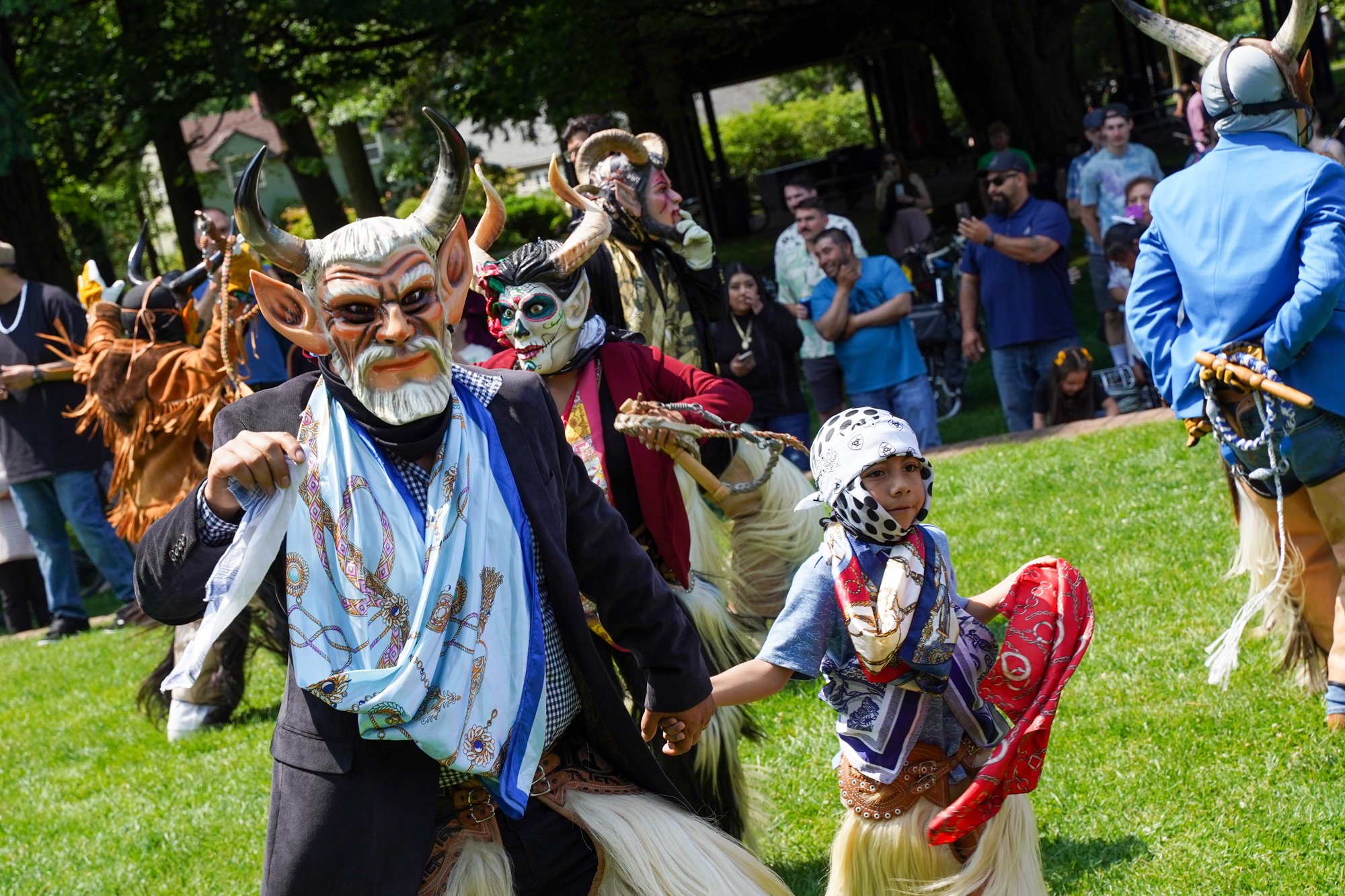
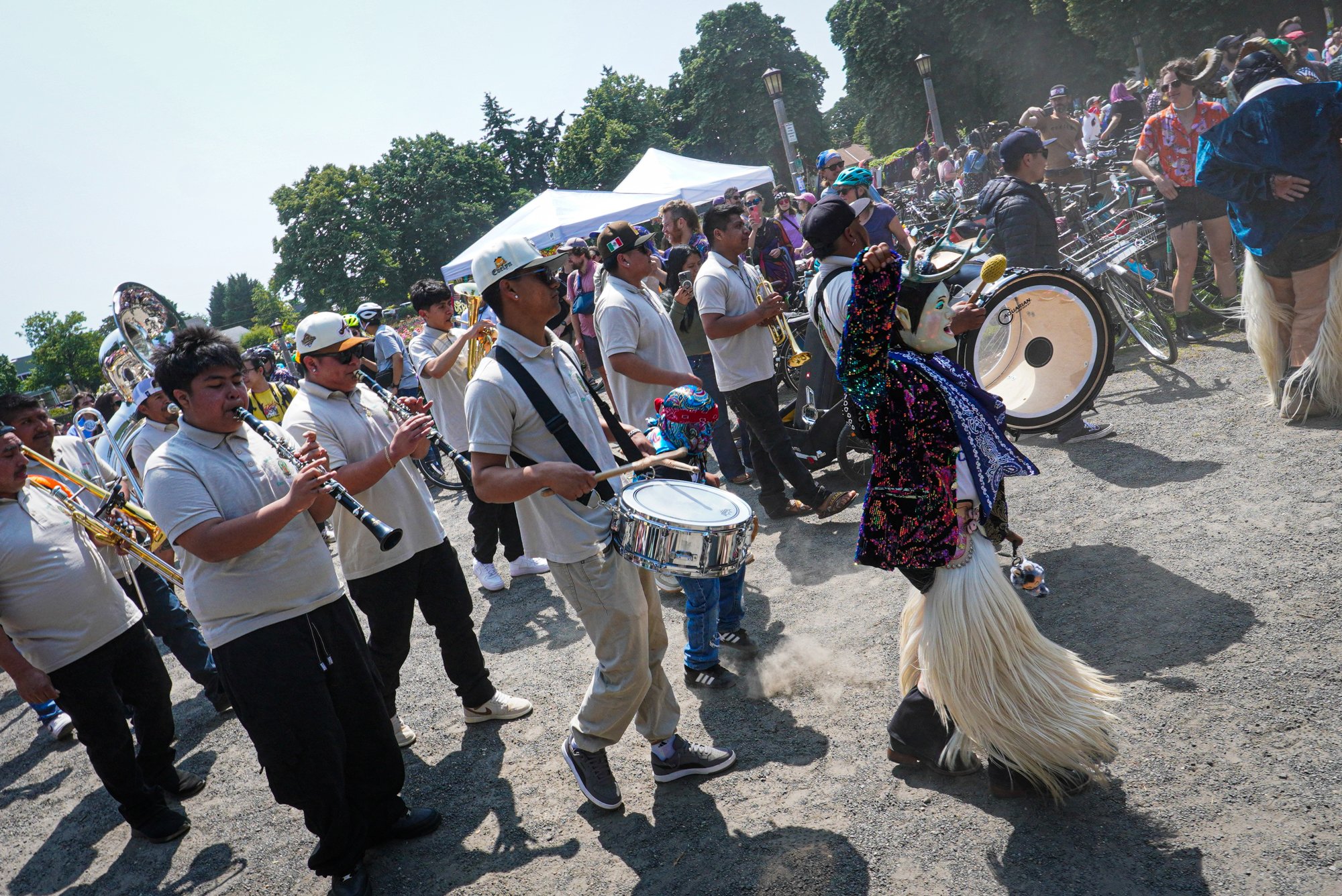
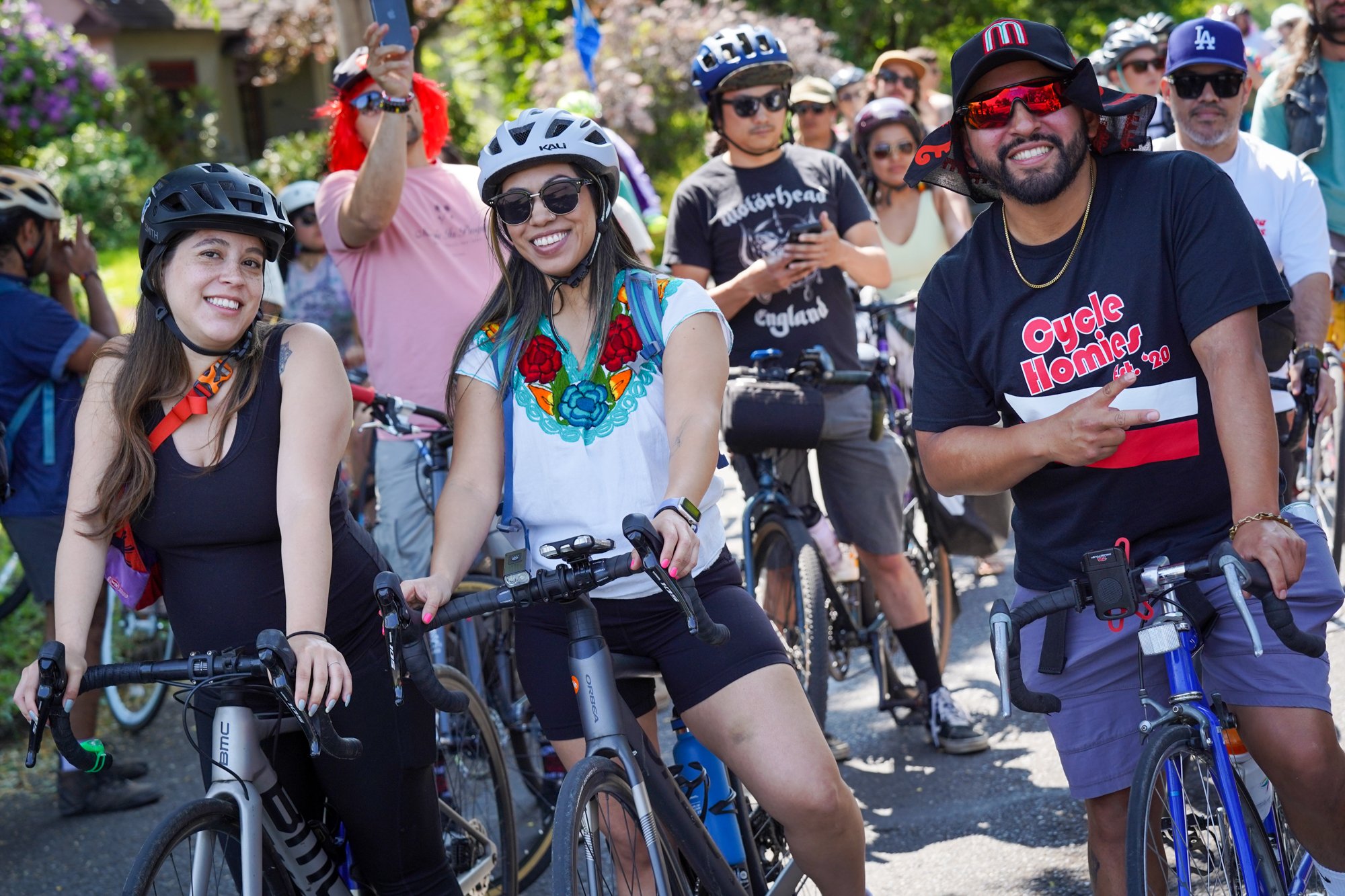
Just as I was talking to folks and getting my lay of the land, I heard Mexican music in the distance. At first I assumed it was for someone’s quinceanera or wedding (common thing to photograph at the rose garden on a beautiful weekend), then as dozens of dancers and musicians stomped through the cycling crowd, I realized it must be the work of the ride organizers: Cycle Homies.
Advertisement
The dancers wore costumes that featured devil-like features and long, winding horns. They stomped and pulsed to rhythms provided by powerful brass and percussion players. The group was Banda Herencia de Oaxaca from the Mixteca region, and one of the leaders of Cycle Homies, Esteban, said they were dancing a traditional “dance of the devil” while accompanied by chilena music. Esteban said the performance was a “cultural expression celebrated through a blend of catholicism and indigenous traditions.”
Everyone seemed to love the music and dancing and there was a long ovation when they finished. Suffice it to say, Cycle Homies took full advantage of the stage they were given as leaders of this big ride. And that was by design.
“The bike culture in Portland is beautiful,” Esteban shared in a short interview with BikePortland, “but I feel like there’s not a whole lot of representation as far as people of color leading rides or organizing rides. That was kind of my whole intention and goal when we first started this thing. I just wanted to see more people of color on bikes.”
Advertisement
For Lillian, a Bike Summer veteran who attended her first one in 2006 and has never missed it since, she’s drawn to the odd and quirky rides. Dressed in an old-timey, lavender outfit that included a hat woven with lace and flowers, puffy shoulders, and a corset-drawn dress, she described herself as the “merch wench” — otherwise known as someone who volunteered to sell Bike Summer merchandise.
“It’s the most magical time of the year,” Lillian shared, as she described her intention to dress up in pasta for the Pasta Ride. “I’m very excited about it.”
I bumped into Aaron and noticed “Bike – A – Sketch” scrawled on the front of his bike. At his Bike-A-Sketch ride on June 30th, Aaron said people will get together, but, “Instead of drawing a bicycle, they will bicycle a drawing.” Using a GPS tracker, riders will set out on different routes and draw lines, “On the canvas that is the city.” This type of creative interpretation of “bike ride” is what makes Bike Summer so interesting and fun.
The next person I bumped into was Geoff. He’s traveled all over the world as a photojournalist who covers society and culture. “This has got to be one of the most authentic gatherings of people,” Geoff exclaimed. “And it seems to be getting better and better every year. I just love it — people of all ages, shapes and sizes. I mean, Jonathan, it doesn’t get any better than this!”
Then it was time to ride.
We filled at least a half-dozen full city blocks thick with cyclists. Several thousand people pedaled together from Peninsula Park to Colonel Summers Park in southeast Portland. As riders stretched as far as my eyes could see, and that sweet, familiar cacophony of music, bike bells, and proclamations of “Happy Bike Summer!” rang through the air — there was no mistaking summer is finally here and it’s time to ride bikes together.
— Bike Summer was first held in Portland in 2002. The following year it was called Mini Bike Summer, before changing its name to Pedalpalooza from 2005 to 2023. Organizers are now transitioning the name back to Bike Summer.Find a ride and browse the full Bike Summer calendar here. Don’t miss the full photo gallery.