

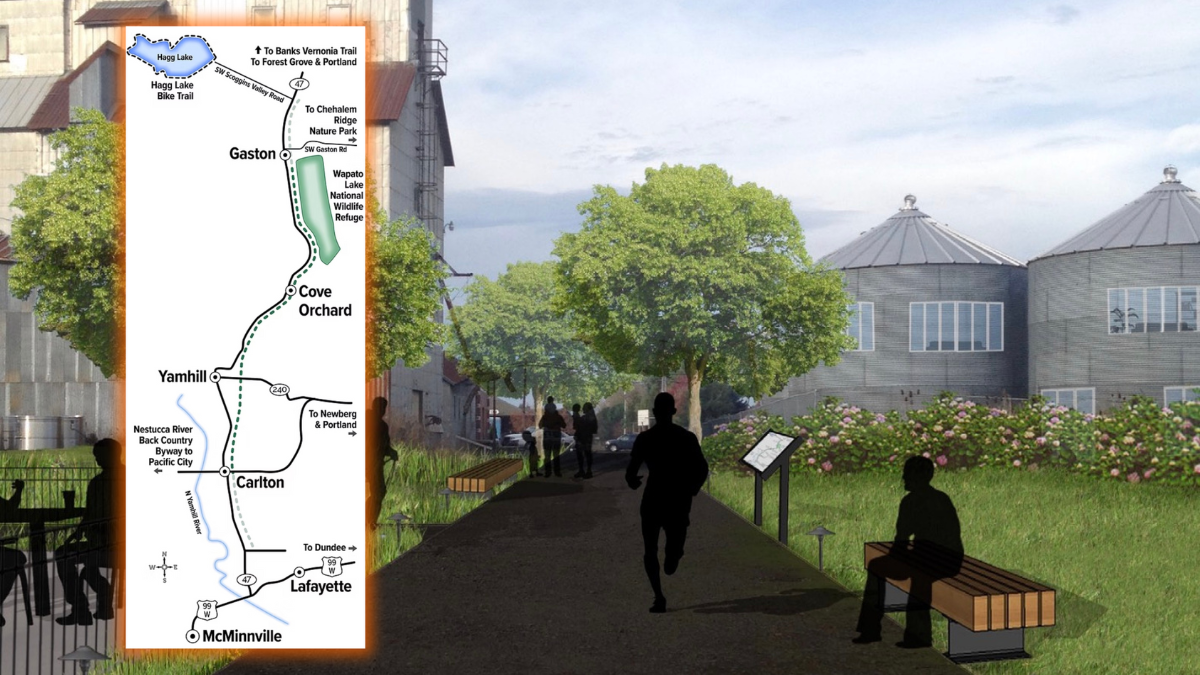
The Yamhelas Westsider Trail is back in the news. The last time I checked in on this project that would build a new 17-mile rail-trail in Yamhill County between McMinnville and Forest Grove, it was mired in controversy.
Advocates for the path ultimately lost that round in 2021 when it “became a target of far-right extremism” and anti-trail County Commissioners voted to repeal the project’s land use application. The project largely sat on the shelf until late October of this year. That’s when Mary Starrett, one of the commissioners who led the previous opposition effort, partnered with one of the other two commissioners to support a draft ordinance that would strip the project from the county’s transportation system plan. The move came as a surprise to trail supporters.
If the trail project is stripped from the TSP, it would essentially move the idea back to square one.
Commissioner Starrett has said she’s against the trail because it goes against property rights of rural farmers and that building a public trail along former rail lines would violate Oregon land use law (it doesn’t, and the permit has stood up to Land Use Board of Appeals scrutiny). She’s backed by groups like the Oregon Family Farm Association, who’ve published a website that details their grievances. Many farmers in the county use the abandoned rail right-of-way to graze livestock and are not keen to see bicycle riders and joggers using the land between their farms.
Friends of Yamhelas Westsider Trail, a nonprofit who sees the trail as a vital link for walkers and rollers that would complement other rail-trails in the region, has responded quickly and is rallying members and supporters to fight the move.
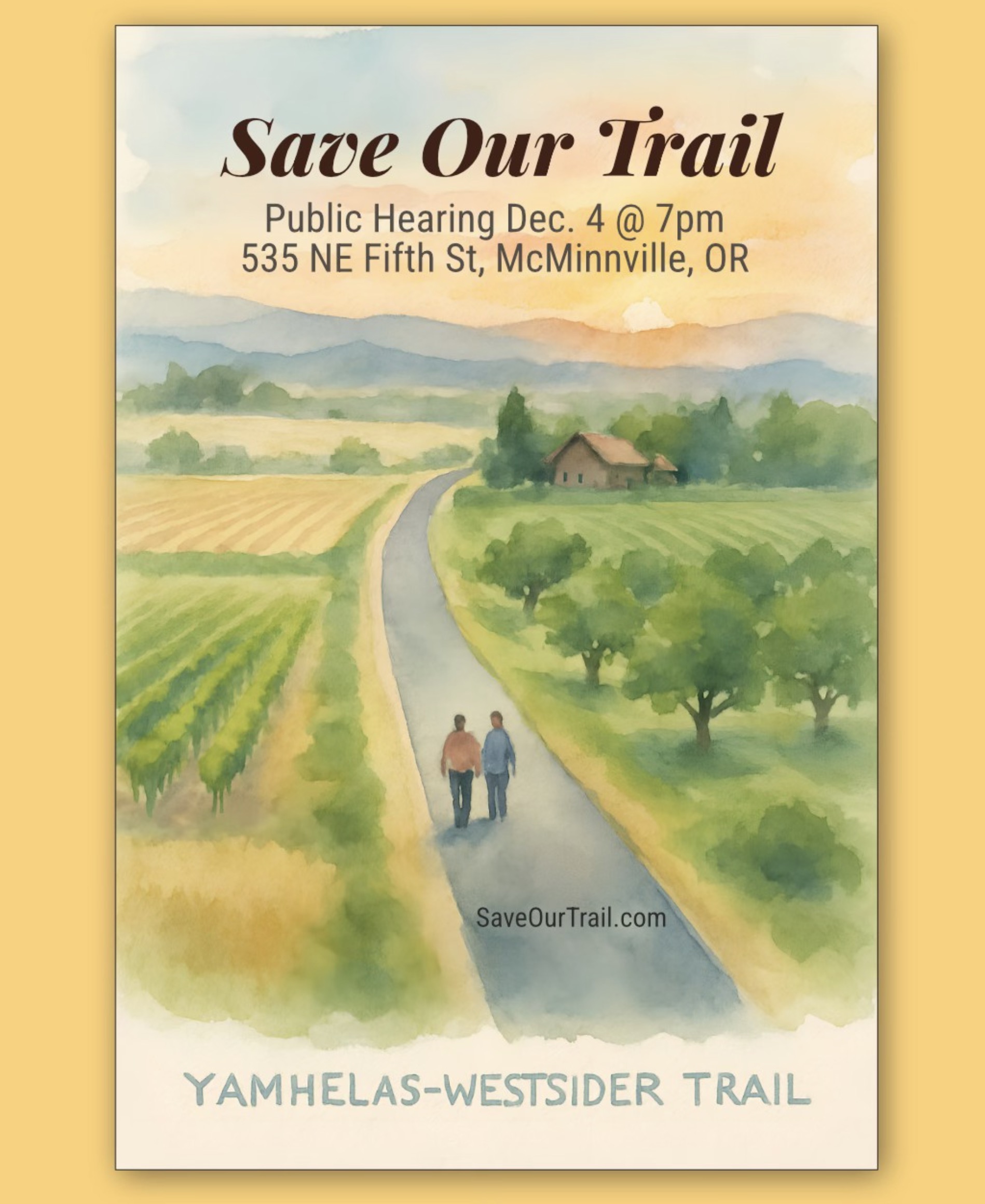
“Now is the time to act. Let’s make our voices heard in support of Rails To Trails. Share your opinion with the Planning Committee. Make plans to present testimony at public hearings on the issue,” reads an email from the group. “Now is the time to make sure the Yamhill County Board of Commissioners does not kill the Yamhelas Westsider Trail once and for all.”
That draft ordinance will be heard by the Yamhill County Planning Commission tonight at 7:00 pm in McMinnville. Noah Jester with Friends of Yamhelas Westsider Trail hopes to pack the meeting with pro-trail advocates and save it from the dustbin.
“With family in McMinnville and having lived both there and in Newberg, having grown up in western Washington County, and having repeatedly ridden similar trails in different parts of the Northwest and especially along this stretch, I know the potential for this trail project firsthand,” Jester shared with BikePortland. He also sees it as a way to smooth over Oregon’s urban/rural divide by encouraging more people to access public spaces together — instead of just zooming by each other on highways.
After being heard at Planning Commission, the issue will return to the Board of Commissioners for a final vote. Learn more at SaveOurTrail.com.

Thanks for reading.
BikePortland has served this community with independent community journalism since 2005. We rely on subscriptions from readers like you to survive. Your financial support is vital in keeping this valuable resource alive and well.
Please subscribe today to strengthen and expand our work.
Most of us unfamiliar with the project will likely conclude that this trail is an obviously good thing. What arguments are opponents making?
Yeah I shd have included that in the article. I’m away from my desk now but will add more about the opposition to it soon.
Also, you mention “Jester” but don’t introduce them in the article.
ugh. Yes. It’s Noah Jester, with Friends of Yamhelas Westsider Trail. Thanks.
Thanks for adding more context and information about the opposition. Unfortunately I read through their website and I still have no idea why they are opposed to the trail, but it is clear they feel the county has not communicated with them well.
It’s unfortunate if the county did not reach out early and often to neighboring farmers, ideally finding a way to bring them into the process. There can’t be that many of them.
I didn’t see anything on their website that makes me think there is a real case against this trail; it just sounds like people are upset.
Seems like a clear case of rural politicians using the urban/rural divide and the trail as a tool in the culture wars. To them the trail is something of no value and that would only fill with Portlanders doing crimes. It’s absurd and any politician unable to counter this isn’t worth a salt.
Based on what I’ve read, this doesn’t strike me as an us vs. them situation stirred up for partisan gain; it feels more like the farmers felt disrespected and ignored, and are lashing out.
Maybe some have legitimate concerns, like the loss of grazing access along the ROW (whether legal or not), or fear they may not be able to spray herbicide or whatever. Concrete concerns can be worked through, but it’s much easier to deal with lack of respect early on in the process.
I think the approach of “fuck ’em, we’re building this trail” is unlikely to be the most productive in the long term (which I hope includes more trails like this). I’m not saying you’re advocating for that, but what I think this situation calls for is some empathy and a good dose of skilled mediation as Jose suggested.
that’s what I find bad faith about opposition like this. They created the narrative that the project is being rammed through, when the reality (as is almost ALWAYS the case) is that there was a formal process that has played out over many years but that folks who oppose the project just want to use “they are rushing this” as a way to oppose the project because just saying, “We don’t want to share the land with anyone other than our friends and cows” doesn’t hold up to public or political scrutiny.
So my point is… No one has ever said, “Fuck em, we’re building this trail.”
Whenever I see conflicts like this, it makes me think there was a failure early on to build the relationships and trust that could avoid them. I understand that some folks are simply intransigent, but I believe that most people are ultimately reasonable and will reciprocate respect and fair dealing.
Well that is why you and I often disagree on here. I’m sorry to say that the time of thinking most people are reasonable and willing to be fair has long passed!! Were you around for the Malheur Wildlife Refuge takeover, or Jan 6th, or when the OR Republicans left the state to avoid voting on legislation, or when Trump turned into a fascist or when OR Republicans screwed our state out of a transportation package just to win seats in the capitol???!
Some folks in power don’t give a shit about anything other than winning more of it.
Statements like are exactly the kind of thing I’d expect to come out of Trump’s mouth. They will not help us build a better future. We need to figure out how to live together, and assuming the worst about people who are different than you will not help us get there.
On this, we completely agree. But then I don’t consider people drawn to politics for the wrong reasons to be “most people”.
dude, I’m just being a realist.
And hastily typed comments on here are never nuanced enough for you to divine my full beliefs. Obviously I give folks benefit of the doubt and I’ll talk and work with anyone! But that doesn’t mean I won’t call it out when folks deserve it.
Jonathan, I get that you’re calling it realism, but sometimes your ‘realist mode’ lands closer to ‘seasoned woke doomsayer with a Wi-Fi connection.’ It’s like you’ve already written off half the county as lost souls wandering the Culture War Plains.
A tiny shift from ‘apocalyptic narrator’ to ‘trail-building diplomat’ might keep everyone’s blood pressure in the bike-friendly zone and help us actually get a trail built. Now that’s some realism. 🙂
Jonathan: I heard this on a podcast this morning, and it both resonated with me and made me think of this conversation. It’s not an attempt to rebut anything you’ve said, but it does capture pretty well my reaction to what you wrote above, that tends to surface whenever we are talking about issues involving rural people. The speaker is Ezra Klein:
I’ve been very critical over this year of the turn to what I think of as “deplorables” politics. I think that was a very, very dangerous turn in Democratic politics, and it needs to be something that the next iteration of the Democratic Party really purges from its system. Because creating a sense of community, even over big disagreement, with tens of millions of this country’s inhabitants and residents, is going to be a very important part of being an effective political party — but also just making this a politically livable place.
https://www.nytimes.com/2025/12/05/opinion/ezra-klein-podcast-ask-me-anything.html
The most outrageous critics of the Democratic Party that I know also put EK himself in that basket. I’d say the other party that needs to purge itself is the one that twisted the ACA into a subsidy for insurance companies, wants to outsource the safety net to Wall Street, has started the next depression, and continues to back kleptocracy to the hilt. There are other outrages but even the Oregonian covers those.
The Republican party, to the extent it still is a Republican party, definitely needs to purge itself of extremists and whackos.
No argument there.
I’m a longtime supporter of multi-use trails and a donor to Rails-to-Trails. But here’s the thing: the moment pro-trail folks start calling the opposition “absurd,” everyone just retreats to their corners like it’s the final round of a very polite Oregon boxing match.
The farmers’ concerns are real. They’re not cartoon villains plotting to keep Portlanders from biking past their hay bales. They just want to protect their land, their livelihood, and probably avoid becoming the next unwilling guest star in someone’s gravel-ride Instagram reel.
If we want the trail built, we’ve got to bring them into the process—not tell them their objections are absurd and expect them to say “oh wow, great point,” and hop on board.
yeah I shouldn’t use that word. I think it’s possible the farmers have valid points. But what I find absurd is that the remedy they see is not to work within the system, but to completely destroy the project. That’s what’s absurd to me. That it’s so obvious this is a political thing and IMO the opposition is not concerned in having a good faith discussion and rather just wants to trail to go away.
Jonathan, this is exactly when you lean in — not like ‘charging the barricades’ lean in, but the friendly, ‘hey let’s fix this before everyone loses their minds’ kind. You’ve got the fire… just add a little hot yoga flexibility.
The HCN article points out that some farmers claim that the trail would require them change their operations (mainly spraying) on their land adjacent to the path.
No idea if that’s an actual concern, but it seems plausible.
That HCN article was paid for by the pro trail supporters. I believe her name is Leah Suttle(sp). She will write any article for money. So it is highly biased and if I remember only printed information that was given to her by a pro trail county commissioner, so please look at both sides of the story, not just her view. I used to follow the articles written by HCN until I did some research on this trail issue. I am actually researching why the OCRR supposedly, according to Yamhill County, purchased a 60 foot strip of land in the county of Yamhill when the government at the time gave them millions of acres in the 1860’s. The deeds that I have read indicate that the ROW was just that, a ROW over deeded property and was never owned by fee simple as the county claims. Even the railroad says they do not have title to the land they sold to Yamhill county with a quit claim deed. I think the county may have been ripped off. A court will need to look at it. If you look at maps prior to about 2020 railroad ownership does not show up on the dozens of maps that I have looked at.
Weird to point out that the HCN article is a hit-piece when my main take away is that farmers are concerned that their operations would be significantly impacted by the trail.
The High Country News article linked in the second paragraph is very good (as are most things HCN), though a bit long
I sincerely hope this doesn’t go back to square 1. This trail would be an incredible connection to the Nestucca Access Road. I rarely go to these small towns because I don’t want to drive there. I hope they find a way to embrace bicycle tourism ala Independence.
Yeah Emma, the Nestucca and Trask are really the only low-traffic “official” routes to the coast (until the Salmonberry gets built) so it would be a huge boon for touring as well as an economic powerhouse for Carlton, Gaston etc.
This is a missing link to the ride from Portland to the Oregon Coast. (And especially Washington County to the coast).
MAX to Hillsboro, ride to Forest Grove on rural roads, then south on this trail through the Gaston Gap from the Tualatin Valley to the northern Willamette Valley (flat route from valley to valley), then the Nestucca River Road to the coast.
Since the Salmonberry Trail is still 50 years out, we should lend our support to the cause!
I became a member of the trail group. And signed the petition.
Ted Buehler
(Also, this would make a nice route from the Portland Metro Area to the Willamette Valley proper.
The West Hills/Tualatin Mountains, combined with the same geologic feature to the west of the Willamette River (plateau south of Oregon City) make a formidable barrier to accessing the Willamette Valley from Metro Portland.
The Gaston Gap (or whatever it is actually called) is the only flat route into the Willamette Valley other than the Willamette Narrows south of Oregon City, which has Highway 99E on one side of the river and no roads on the other side.
If you’ve never looked at a relief map of the complex set of hills/mountains that separate the Willamette Valley from the Tualatin Valley and the unnamed valley that Portland sits in, it’s a pretty interesting situation. With no particularly good, or fast, or straight bicycle connections.
Here is a good shaded relief map of our region
https://caltopo.com/map.html#ll=45.37,-122.80106&z=10&b=r
The valley that this abandoned railroad line doesn’t have a single name for the length of the valley. It’s called the “Wapato Lake Bed” in the north and the “Chehalem Valley” in the south. But it’s one continuous valley.
https://caltopo.com/map.html#ll=45.38802,-123.0891&z=13&b=t
Interestingly, looking more carefully at the USGS topo map, there is a “wye” of flat valleys. The main north-south valley “Wapato Lake Bed” on the USGS topo map) is what I refer to as the “Gaston Gap”. And it goes south and southeast to McMinnville, but a branch goes southwest to Yamhill and Carlton.
I’ve only bicycled into it once, many years ago. Just the northern end, then turned around and went back to Hillsboro.
Ted Buehler
If the Yamhelas Westsider Trail is going to survive this latest round of politics, focusing on shared values and perhaps bringing in outside help would help it succeed. A lot of the tension seems to come from farmers feeling unheard or worried about trespassing, livestock issues, and property rights. Those are real concerns. Honestly, they can all be worked through with things like fencing, buffers, and clear agreements.
One idea: bring in a neutral group that’s used to solving these exact kinds of fights. Trust for Public Land or Rails-to-Trails Conservancy have tons of experience working with rural landowners and skeptical county leadership. They can help mediate, explain the legal side, and design solutions that make farmers part of the process instead of feeling like targets.
It might also help to start small — maybe a short pilot segment — so people can actually see the benefits instead of imagining the worst.
If trail supporters can shift the conversation from “political battle” to “let’s build something healthy and safe that works for everyone,” and perhaps bring in some outside expertise, there’s hope. Good luck to Friends of Yamhelas Westsider Trail!!
One of the biggest problems in rural America today is the land-use rule that makes all farmland private property. Farmers pay reduced taxes on their farmland, yet no one else can access the land, ever, for any reason. Of course there are good reasons to keep people off farmland (destroying crops etc), but many other countries strike a sensible balance between public access and private property rights. England and Wales, for example, have thousands of miles of footpaths that follow designated rights-of-way; Scotland has a “right to roam” law that allows people to walk anywhere, with certain limitations (protecting crops, water sources etc).
Only in Murcca do we have such an absolutist view of private property, reflected in this case in Yamhill County where farmers don’t want walkers and cyclists using a stretch of property that they themselves have never been able to use. They never had it but now they want all of it.
Maybe I’m getting old and cynical, but I’m starting to think that if parts of rural America are too blinkered to see the ways that a bike-ped path would benefit them, then we should leave them to suffer their fate. Let’s take our spending and investment to other rural areas that have paths.
“….then we should leave them to suffer their fate.”
The fate of growing our food that we eat to live? What fate are you talking about as you do your best to create divides between groups of people?
What other rural areas have paths that will lead to the coast? I’m genuinely curious.
As an aside I’m all for the trail and I fully support cyclists contributing to economies.
The fate of being left out of the process, if they are too antisocial to participate in it.
Definitely Fred. While bikepacking this is a huge problem. Most of the land is unused (particularly in Oregon), but technically private or “owned” by logging companies (e.g., BLM). Generally, loggers are indifferent about people biking passing through their rented land, but it’s this absolutist view concerning private property that favors primarily CEOs and not the general public.
There is a policy in Sweden (i.e., Allemansräten) that allows anyone to use private property for camping, mushroom picking, etc. There is a general consensus that allowing people to explore nature respectfully, regardless of who technically owns it, is a really great way of sharing the land.
Once the public and businesses are exposed to the clear economic benefit of trails (e.g., GAP), without all the culture wars garbage narratives, it’s generally a long but positive battle until the trail is built.
Not sure how many CEOs own land abutting the trail. Is that a general rant or specific to the trail?
The key word being respectful of course. This isn’t the mythical rich, homogeneous euro polite and contented paradise that has no bearing to our history here whatsoever. It doesn’t take too many episodes of finding used toilet paper, other biohazard products and general trash for land owners to want the pollution / land sharing to come to an end.
With any luck proponents of the trail can hold their disdain of the locals in check long enough to work with them to get the trail accomplished.
I’m confused. Public access to BLM and State Forest land, for example, is largely restricted/used by resource extraction companies (aka large corporations). You are often legally required to have a permit to pass through those sections, which are limited to a handful every year, regardless of whether they are actively logging or even present. Here is a map of those specific BLM areas near the proposed trail.
Our land use policy is at the center of this debate. The idea of allowing public use of private land is not just a “homogeneous euro polite and contented paradise” phenomenon. It is used in many forms across the globe in Scotland, Ecuador, New Zealand etc.
I have good friends who grew up and live near the proposed trail and are disillusioned by the silly narrative their dumdum commissioner is pushing. There is no disdain for locals. The locals want the trail.
Look at your map again because I don’t see any BLM/state forest land that is anywhere near the trail.
I’m still not clear why you are talking about CEOs and logging in relation to this trail. I’ll ask again, are there any CEOs holding land abutting the trail? With your contacts there you’d probably know.
I would distinguish the BLM (an office of the Department of the Interior, part of the federal government) from the state (Tillamook State Forest) and, especially, private land owners. The last can further be divided into timber companies (or financial companies that have ‘invested’ in our forests). The BLM manages a lot of the eastern half of the state, but I think the northern parts of the Coast Range are private land and state forest. I would separate private land into timber and ‘regular’ components. I assume this trail is mostly along and through non-timber private land. Although the occupants of such land have been called ‘farmers’ in these comments, I’m not sure how much actual agricultural production is happening there, but I’m not at all surprised they are opposed to a bike path through their land. When I lived in Forest Grove (1990’s) I frequently rode on Weyerhaeuser logging roads without problem (I’m not sure if this was legal/condoned or not, but it was pretty lonely out there, so there wasn’t any conflict). I would never have considered trying to bike through somebody’s property. They would expect me to respect their property rights in the same way I expect the homeless people who live in my neighbohood not to camp in my back yard. I really hope the trail gets built, but I think land use disputes like this are a really difficult nut to crack. Further, I think the idea that the locals could be brought around to support bike paths is unlikely, unfortunately. At some level “fuck ’em, we’re building this trail” and no trail are the only possible options. Managing the intensity of the opposition is a question of political tactics.
Edit to correct: I was wrong that there are not significant BLM lands in Western Oregon. You can see them by activating the “Public Lands” layer on Ted Beuhler’s awesome map. I stand by the rest of the comment.
“At some level “fuck ’em, we’re building this trail” and no trail are the only possible options.”
I agree support seems unlikely, but do you think there might be room for a “we still don’t like it but you’ve addressed our most pressing concerns, so we can live with it” possibility?
Portland managed that with the Clinton Triangle homeless shelter, something the surrounding neighbors were pretty strongly opposed to, and it seems likely that the issues there would be more challenging than those raised by a bike trail.
Of course I would love an outcome in which minor modifications to the trail that did not significantly degrade its usefulness resulted in grudging but sincere acceptance of the project by the Yamhill county commission and/or the membership of the Oregon Family Farm Association. I’m very skeptical that such a possibility exists, but, if it does, realizing it will require the opposition to accept the legitimacy of the political aspirations of the trail’s proponents. I think a focus on process or policy specifics (does the bridge require a land use permit?) obscures deeper, cultural disputes that cannot be resolved by compromise. I don’t believe opposition to the trail is motivated by specific problems that the trail presents to farming practices, although I would love to hear an explication of this argument that is more detailed than a parade float sign. Oregon republicans have shown that they will violate norms of decorum, civility, and fairness to avoid allowing democratic political priorities to prevail. I think what is desperately needed is a functional way to settle political questions like this in a way that is not humiliating for the losing side.
It’s possible this just boils down to “Republicans are bad”, but I suspect there’s more there than that. I don’t feel I have enough information about the project history of reasons for the opposition to know, but as I said earlier, my general disposition is to see the best in people, and I am slower to jump to partisan explanations than some.
I hope the trail gets built, and I hope it can be done in a way that doesn’t poison the well for similar projects in the future.
I’m suggesting that the well is already poisoned. I’m not highly knowledgeable about this project, but it fits a pattern evident at all levels of government. It’s not that republicans are “bad”, it’s that there is insufficient shared vision to find a compromise that is tolerable to everyone. I think it does everybody in the debate a disservice to ignore this reality. I think the conservatives’ instinct that the stakes are high is on the money in a way that progressive activists and liberal politicians fail to sufficiently appreciate. We are constantly being surprised by the virility of opposition, because our proposals are reasonable and temperate (seriously, who doesn’t want a nice path through their community?). The republican/rural rejection is not so much of specific policies as of the whole framework. So absolutely, the process by which projects are brought to fruition needs to be legally unassailable (in terms of comment periods, permits, etc.), and compromise to make projects work better for locals are welcome. We should expect and require honesty, competence, and professionalism from our officials, regardless of ideological alignment. But that will not be enough.
Actual, substantive dialogue about how to coexist and share a participatory government in a diverse society is desperately needed. Your example of the Clinton Triangle shelter is a good example that I will ruminate on.
Conservatives ride bikes too, so why is a bike path a liberal or progressive thing? Why does it have any particular political valence at all? How did the well get poisoned?
Good questions! I would ask them of the activists and politicians that oppose trails like this. I have my own hypotheses that are likely too elaborate to make a good BP comment (and might be better presented over a beer at BHH). In short, bike paths code as progressive for a variety of cultural reasons. In conservative thought this interacts with an increasing sense that progressive norms and frameworks have changed American society in detrimental ways (more brown people and queers, less conviction that European domination of North America was the keystone of the divine plan for humanity). In the American West, property and gun rights seem especially salient to these discontents, and any project that appears to abridge them is suspect. Besides my practical desire to have paths to take my bike on, I’m motivated to support the building of bike paths by mirror image value-based considerations. I just feel like they are a lot more effective at achieving their political aims.
It probably doesn’t help if people who want trails blanket label the existence of farmers’ concerns as absurd on their face. 🙂
I also want trails, but I’m willing to consider there may be legitimate issues to talk out.
Gosh who said their concerns were absurd?
Micah, below. “The idea that you can’t farm next to a bike path is absurd on its face.”
I did, indeed, say that the complaints pushed by the Oregon Family Farm Association are ‘absurd’. This may be an exaggeration, but I maintain that the claimed effects of the planned path on agricultural operations are a pretextual vehicle to challenge the construction of the path in public opinion, in government process, and, perhaps, in court proceedings. I imagine the people doing it feel they are just playing by the same dirty rules that have been used against them. NEPA and ESA significantly proscribe what you can do on your own land. It probaby rubs you the wrong way that ODOT or the county can say you have to let bikepackers use your land to ride from Portland to the coast.
There have been a number of lawsuits nationally between organic farmers and their conventional farming neighbors, as well as lawsuits from residents of tracts of farmland turned into housing that still abut active farmland, that involve pesticide application, odor, noise, etc. It may be that these lawsuits have made the farming community wary.
I can’t say whether any concerns in this case are a pretext or are legitimate, only that trail planners could have anticipated these objections and should have taken early steps to head them off, perhaps going beyond the legally required minimum public process.
And it is quite possible this is exactly what they did.
Look, all I’m calling for is an attempt to mediate rather than bulldoze (yes, on both sides). I don’t understand why this doesn’t have unanimous agreement (other than the usual and unhelpful “those people are unreasonable”).
In this case, compromises don’t even seem that far away.
Just like how trails in state parks are periodically closed due to forestry operations (i.e., this has been happening at Stub Stewart a lot lately), it seems like a path such as this one could be periodically closed for agricultural operations.
Being turned away at a trailhead is disappointing. But I know I’d prefer to be turned away at a trailhead instead of being sprayed with chemicals or fertilizer. And if that’s really the blocker to getting the opposition on board, this should be an easy win.
But if the tactics of Lemon Gulch’s opposition and the opposition to off-road cycling here in town taught me anything, some folks have made viscerally opposing bicycle access part of their personal identity.
Bingo.
I’m for mediating rather than bulldozing, and that requires an honest assessment of the situation. I don’t know if these particular objections are legit, but I’m confident there would be some objections no matter what. I’m skeptical there are reasonable compromises that would mollify the opposition. The source of my skepticism is my own relationship to this project. I know almost nothing about it (I would not know of the project if not for BP reporting), yet I’m confident that I support the project. Imagine you are a Carlton local that wants to convince me that this path is a terrible idea. What arguments would you offer? I doubt they would sway me. I think it’s arrogant for me to presume that I could sway the Carlton local.
The problem with ‘third-way’ centrism is that it fails to account for serious differences in metaphysical views. Land use disputes seem petty, but they resonate with important parts of our livelihoods and identities, so they stir deep passions. I would certainly welcome frank and respectful dialogue with conservatives. I would love to be able to horse-trade our way to a more productive future for Oregon.
It sounds as if you and I want the same outcome, and the same means to that end. We are worried about the same things (for example, fallout that endangers future projects or phases).
And we agree that you, a Portlander, would have a hard time selling this project to a skeptical local. But another Carlton local might be able to. Part of the trick to effective mediation is finding people that both sides can trust.
Someone else posted a link to a survey showing many locals support this project, so finding someone with local credibility might not be impossible.
You never know until you try.
Please look at this map.
Reddit – ?width=1080&crop=smart&auto=webp&s=0584de376bd1ab5a34f26767363dc5ac28639c02
You will see Oregon like most the western states is mostly owned by the federal government (53%) not private owners. Now they do lease some land to Logger’s, Miners and Ranchers it is large amount.
Exactly my point. When land is leased, it becomes restricted use, effectively making it private property for years, with the only legal recourse to purchase a recreation permit, which are extremely difficult to obtain. This forces most recreation users (even hikers) to either 1) enter the land illegally, or 2) refrain from entering vast areas of public land. That is exactly the problem.
Does it? WeyCo owns its land, AFAICT. I’ve been on plenty of USFS trails were grazing leases were active. No restrictions. Just signs alerting you to the fact that cattle are present.
Fred, I admire the passion — it’s like you mainlined a BBC documentary on the Right to Roam and then slammed a double espresso. But I think we may be overshooting the mark a bit here.
This trail isn’t even going through anyone’s fields; it just runs next to private property. No one’s storming the barley like it’s the Bastille. The farmers aren’t guarding the perimeter with pitchforks — they’re mostly just nervous about change, liability, and the eternal Oregon fear that “Portlanders will come here and do… things.”
A little reassurance, a little communication, and maybe a fence or two will go a long way. We don’t need to declare rural America hopeless and leave them to “suffer their fate.” That’s how supervillains talk right before the dramatic orchestral swell.
Most of these folks aren’t blinkered — they’re just people who haven’t yet been convinced that a trail full of cyclists in neon jerseys is really worth the hassle. And fair enough. Bring them in early, hear them out, address the real (and fixable!) concerns, and it’s amazing how reasonable things can get.
Let’s save the cultural doomsday talk for Comment Section Olympics. Out here, a calm conversation and a buffer strip usually do the trick.
It’s fine to bring them in early and listen to their concerns, but it’s a problem that they believe they are entitled to vetoes in the first place.
What are the “real, fixable concerns”? The only argument I’ve seen is that the trail would affect farming practices, which is obviously a technicality that path opponents deem grounds to kibosh the project. The idea that you can’t farm next to a bike path is absurb on its face.
Is it?
What if I want to spray pesticide on the part of my field that is adjacent to the path. Will I get sued if someone bikes through a cloud of something noxious that drifted over the path? Will I get complaints if I spray pig manure on my field? (Few things have driven me so quickly to the point of acute nausea as getting a good whiff of aerosolized pig crap; cow dung is pretty bad too.) My life has suddenly become harder and more complicated.
That could apply to all sorts of treatments. I’m not an expert, but I understand the law often recognizes (and allows for) the reality that pesticides drift. I have no idea how those laws intersect with recreational bicyclists riding past.
It doesn’t sound absurd to me.
The farmers oppose this because they like to graze livestock on land they don’t own??? Maybe someone needs to be charging them a market-rate grazing fee.
Maybe they’re paying one; maybe they have a mutually beneficial arrangement with the landowner to keep weeds down, like the Belmont Goats. Maybe the landowner gave permission, or simply doesn’t care.
It’s not my land, so it’s not my concern (nor yours), but I wouldn’t automatically conclude the farmers are doing something bad.
The former Southern Pacific Westside Branch that is the existing right-of-way for the Yamhelas Westsider Trail dates back to at least 1870, it was the route of the SP Red Electric trains approx. 1917-1929, and freight trains till it was abandoned around 1985 and rails were pulled up.
Adjacent land owners have had 40 years of use of the right-of-way with probably little to no restrictions.
You can imagine that having a trail would interfere with them freely crossing the right-of-way and need to maintain fences that might no be necessary today.
The land owners will be losing the privacy that they have long enjoyed.
Change(building the trail) would create uncertainly that they haven’t had to face over the last 40+ years.
This is a classic NIMBY mentality. The right-of-way is publicly owned by Yamhill County so this is political gamesmanship about future investment in the trail vs. leaving it as-is or hoping Yamhill County will abandoned the right-of-way and ownership might revert to adjacent land plots that it was originally taken from.
You could take 2 minutes to look up who Mary Starrett is, and what her politics are before you do your usual bothsiderism. Also maybe look up what the Oregon family farm group is all about before you decide that they represent farmers.
Therefore the adjoining farmers are inappropriately grazing? I’m not following your reasoning here — we are talking about grazing fees.
Actually, scratch that. What we were talking about is the presumption that rural people are always doing something wrong.
You mean this group? If they’re on FB you’ll have to translate for those of us who avoid that like the plague.
https://oregonfamilyfarm.com/news/
What are they all about?
Maybe instead of innuendo you let us all know what you’ve found?
You can do a google search, I wont waste time with MAGA people.
They are just a right wing Oregon GOP mouthpiece.
They worked hand in hand to sink any transportation bill.
They are just Trumpers and Starrett was Trump before Trump.
This is just rural oregon GOP politics, no regular farmer or vineyard in this area is part of this.
Starrett is a a complete wingnut.
She represents you that’s for sure.
Honestly, your eagerness to slur me and seemingly everyone here with MAGA is concerning as it demonstrates an inability to recognize reality and an inability to socially interact with people. I hope all is well with you and whoever lives with you.
This happens all the time. Especially with forest service and BLM land. See the Lemon Gulch project’s cancellation for a recent Oregon example. Some concerns were related to cattle grazing on national forest.
https://www.bicycling.com/news/a43773348/plans-for-massive-mountain-bike-trail-system-were-popular-why-was-it-nixed/
https://thetruthaboutthetrail.com/#:~:text=The%20public%20records%20show%20that,marginalize%20Yamhill%20County's%20generational%20farmers.