Gen 2.0 bikes in 2020. (Photo: Jonathan Maus/BikePortland)
Employees of Shift Transit, the company that operates Portland’s Biketown bike share system say they were given an order to chop 400 bikes in half with a table saw and throw them away.
The allegation was shared with BikePortland anonymously because the workers say they’ve been threatened with legal action if they speak out.
Lyft, the company behind Biketown, hired Shift Transit in March 2023 to operate the bike share system. Shift Transit refers to themselves as a “leader in bike share services” and manages 60,000 bicycles, scooters and other vehicles in 10 cities across America.
11 days ago a Shift Transit employee messaged BikePortland on Instagram with a troubling allegation. The employee said one worker was told to “throw away 400 bikes that could be donated or at the very least recycled for aluminum.” The worker allegedly chopped the bikes in half with a table saw and left them in a pile — even after telling their boss they felt doing so made them uncomfortable and went against their code of ethics.
“[The worker] was told they don’t have a choice,” our tipster said.
The Portland Bureau of Transportation hasn’t responded to a request for comment and I’ve so far been unable to contact Shift Transit’s Biketown general manager.
Asked to respond to the allegation, Lyft shared this statement:
“The local operations team recently decommissioned some damaged and unusable bikes. The team ensured that usable parts were salvaged for reuse, and parts that could not be reused were recycled where possible, while some parts had to be scrapped.”
That statement differs from the allegations from the Shift Transit employee (who also said they’re currently involved in a labor dispute with the company over unrelated issues).
“It’s pretty shitty they’re just throwing the bikes away, unwilling to recycle,” the employee shared. “Basically, it’s PBOT money getting wasted and all the workers are pissed about it.”
It’s unclear why bikes were decommissioned or destroyed. They could have outdated hardware or other issues that Lyft has deemed would be more expensive to fix than repair. It might also have something to do with what appears to be a new version of Biketown bikes that are about to hit the streets. Today on the BikeLoud PDX Slack channel I came across a graphic of what appears to be a new Biketown model that’s significantly different than the second generation models we have now. The photo shows a grey bike that’s known as Lyft’s “Cosmo” version currently used in New York City.
North Park Blocks is the place to be on Saturday! (Photo: Jonathan Maus/BikePortland)
I hope everyone is having fun on all the great rides going on. Remember it’s Bike Summer season so you’ll want to check the official calendar and/or grab the Bike Fun App (iPhones only) for all the ride options!
Here are my picks for the best things to do by bike this weekend.
Saturday, August 17th
Pedal Around Portland – 8:00 am at multiple locations A citywide ride hosted by multiple Trek Bicycle Store locations throughout Portland. Expect fun rest stops, cool prizes, and the feel-good vibes of knowing your registration fee supports nonprofits that give bikes to kids in need. More info here.
Portland Criterium – 12:00 to 8:00 pm on North Park Blocks (Downtown) You watched cycling on the Olympics, now experience similar vibes in our own backyard! This “crit” will be fast and thrilling for racers and spectators alike. Organizers have made this a true community event with a fun ride that starts at 4:30 pm (where you can bike the carfree course), block party, food and drink vendors, and more. More info here.
Monkey Puzzle Tree Ride – 10:00 am at Peninsula Park (N) I’ve been fascinated by these ancient trees since doing a similar ride to this years ago. Get out and discover 11 amazing monkey puzzles and learn about their history in the area as you bike around north and northeast. More info here.Ride has been cancelled.
Bike Milwaukie Shop Local Ride – 10:00 am at Spoke and Word Books (Milwaukie) A great opportunity to discover this cool city just south of Portland. Let local cyclists show you their fave spots and support local businesses in the process. More info here.
LA F.A.R.T. V – 9:00 pm at Ladd Circle Park (SE) It’s the much-anticipated Ladd’s Fastest Alley Race Time Trial and if you love underground, unsanctioned, slightly risky riding this is an event for you. Or just come out and hang and have fun with some truly wonderful and fun people. More info here.
Sunday, August 18th
French Prairie Loop – 9:30 am at Champoeg State Park (St. Paul) Join two experienced ride leaders from Portland Bicycling Club on this 32-mile ride in the Willamette Valley. You’ll see gorgeous vistas and enjoy quiet rural roads. Expect a 13-15 mph pace. More info here.
Election Countdown Ride – 10:00 am at Portland City Hall (SW) Join BikeLoud and AARP for this educational ride that will help you get ready for our new government structure. They’ll talk in front of City Hall about the changes, then lead you on a ride on neighborhood greenways through each district. More info here.
Cascadia Triple Crown Bike Polo Championships – 1:00 pm at Alberta Park (NE) If you’ve been curious about bike polo, this is your chance to see it played by the best in the region. This all weekend event is the first stop in the triple crown and the winning team will be the Champions of Oregon. More info here.
Tandem Ride – 2:00 pm at Ladd’s Circle (SE) Tandems are so cool and fun, and riding in a group of tandems takes things to another level! Organizer says they’ll have some “partner challenges” along the way. More info here.
— Did I miss your event? Please let me know by filling out our contact form, or just email me at maus.jonathan@gmail.com.
This segment of NW Naito between Davis and Hoyt will be one of the first two location to have posts replaced with concrete curbs. (Photo: Jonathan Maus/BikePortland)
“This is something a lot of folks have been asking for.”
— Roger Geller, PBOT
The City of Portland’s transportation bureau is on a mission to improve the quality of existing protected bike lanes. At the monthly meeting of the Portland Bureau of Transportation Bicycle Advisory Committee Tuesday night, City Bicycle Coordinator Roger Geller said he estimates that every mile of protected bike lane currently built with just paint and plastic posts will be “hardened” with concrete within the next five years.
PBOT has promised for years to make its paint and plastic-only protected bike lanes more robust and permanent, but this is the first time we’ve seen and heard of real policy and funding devoted to it.
“This is something a lot of folks have been asking for,” Geller said at last night’s meeting.
Geller (Photo: Jonathan Maus/BikePortland)
But despite Geller’s comment and a clear chorus from the community that plastic and paint should never be considered “protection,” official documents he shared last night say the two reasons for the projects are maintenance costs and aesthetic concerns.
“Our crews are having to go out and replace the delineator posts frequently. And, you know, there’s much better things that they could be doing with their time,” Geller said. And like I’ve been saying for many years, having a bunch of battered wands littering lanes reeks of government waste and incompetence and shows our city doesn’t take cycling seriously.
“We borrow much from the Dutch — builders of the world’s best bikeways and bikeway networks. They have five considerations for bikeways: safety, comfort, directness, network cohesion and attractiveness. We have generally fallen short on attractiveness and have received deserved criticism as a result. While delineator posts are affordable and allow quick implementation, they are criticized as Portland not putting its best foot forward, especially in commercial districts.”
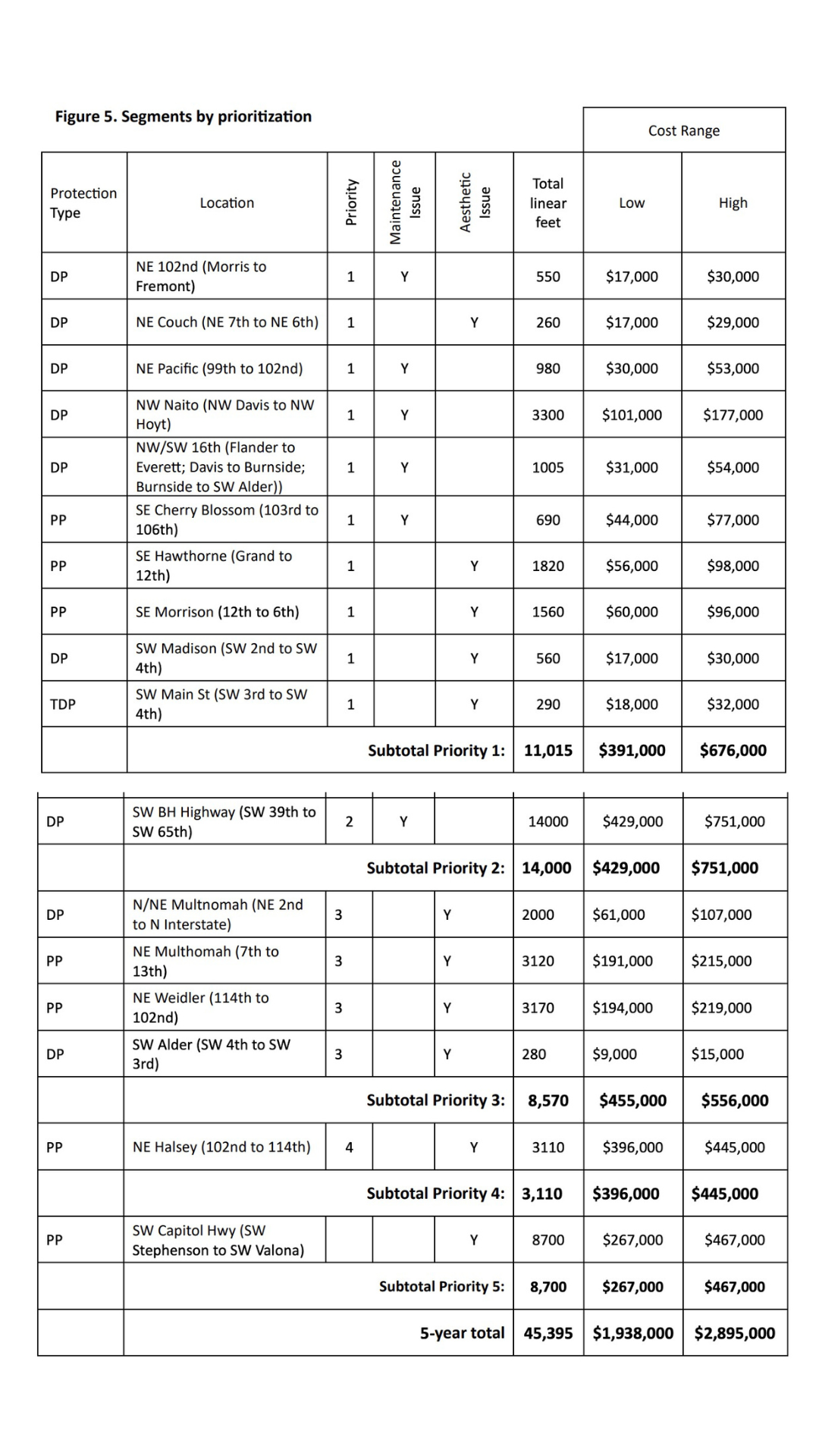
Geller’s comments last night prove PBOT is finally ready to build more serious cycling infrastructure. He says the bureau will put about $500,000 per year to the effort to harden its 20.5 lane miles of protected bike lanes with concrete curbs*. PBOT says the cost range is likely to be between $5 and $8 million for all 20.5 miles. (See full list of projects below.)
(*Note this initiative will not replace the plastic posts used on the Burnside Bridge or on SE Stark Street because those are in line for separately funded projects — the County’s Earthquake Ready Burnside Bridge project and PBOT’s Outer SE Stark project. And the 28th and 21st Avenue overcrossings of I-84 will also remain plastic posts and curbs because of PBOT’s policy to only glue down materials on bridge structures, “so as to not puncture the skin and allow water to penetrate to the super structure” (according to the PBOT memo).)
PBOT map showing prioritized phases.
PBOT completed an audit to prioritize where to focus. They came up with 8.6 miles of bike lanes that will be hardened in the next five years at a total cost of between $1.9 and $2.9 million. These segments were chosen because they’ve been flagged for maintenance and/or aesthetic problems and they don’t require any additional public process to move forward with. The first two projects slated to begin this year will be NE Pacific between 99th and 102nd and NW Naito between Davis and Hoyt. The remaining 12 miles (which includes NW and SW Broadway and NE Glisan) need more process and funding. At this point in time, those and other segments are slated to be completed 3-5 years beyond the first 5-years currently planned.
Geller was resolute during his presentation Tuesday night, but also made it clear this is a new process for PBOT and they will likely refine the approach as they go along (a lot of the cost and timing has to do with the type of equipment contractors have and whether the work is done by PBOT or private crews). “Hopefully within five years or sooner, depending on the availability of funding,” Geller said. “We’ll be able to convert all of our bike lanes that are just delineator posts into some level of concrete.”
Bicycle Advisory Committee Vice-chair (and noted cycling advocate with BikeLoud PDX) Joe Perez said 20-plus miles of hardened bike lanes over fine years, “Would be amazing to see happen.” “It seems like this is an inexpensive solution to get us to 25% of trips by bicycle by 2030. Kudos. Keep it up,” Perez added.
Below is a list of the projects, estimated costs, and the year they’re expected to be completed:
PBOT Director Millicent Williams on a Lime a sit-down e-scooter at a press conference on July 29th. (Screenshot from PBOT video)
The City of Portland has doubled down on their shared electric scooter program. At a press conference last Thursday, just steps from the Better Naito protected bike and scooter lanes, Portland Bureau of Transportation (PBOT) officials and their partners announced multiyear contracts with Lyft and Lime to expand the scooter fleet and upgrade the program to permanent status.
“Today we celebrate a new, permanent era of micromobility,” said Hayden Harvey, government relations director for Lime, who spoke at the event.
PBOT Director Millicent Williams also spoke at the press conference. She touted the public-private partnership and said it will, “make e-scooters more accessible to Portlanders, while also showing cities across the nation that sustainable transportation can be good business.”
PBOT Director Williams.Parked Lime vehicles.Scooters use existing Biketown stations. (Screenshots from PBOT video)
Lime and Lyft are well-known quantities to PBOT. Lime has had electric bikes and scooters on Portland streets since 2018 and was named one of the five e-scooter providers when the pilot first began early that same year. And Lyft is the company behind Portland’s Biketown bike share system, which launched eight years ago. Lime’s deep experience in the micromobility space and the tight integration of the Lyft scooters with the existing Biketown software (you can now get bikes and scooters on the same app) and infrastructure (scooters use same stations as bikes) give PBOT a very strong foundation for success.
Another change with this batch of e-scooters is that each one of them comes with a cable lock. This feature is more about the right-of-way than security, since one of the biggest PR problems for e-scooters is how they often clutter the right-of-way and cause accessibility issues. By requiring scooters to be locked after each trip, PBOT increases the likelihood that riders will attach them to racks or sign poles at the periphery of sidewalks — leaving more room for pedestrians.
PBOT hopes its new “Ride it. Park it. Lock it!” marketing campaign drives the message home. At one point at Thursday’s press conference, The Street Trust Executive Director Sarah Iannarone led the crowd in a chant of the new slogan.
But PBOT might be trading one PR problem for another. With a scooter fleet expected to reach 3,500 between the two companies, many of them will be locked to bike parking spaces. One BikePortland reader emailed us to say, “I like that scooters will be less likely to block the sidewalk, but I don’t like the idea of sharing limited bike parking spots with them.”
PBOT will have to keep up parking and other infrastructure demands to handle these scooters, and given the popularity of the vehicles, they should have the confidence and political capital to do so. At the press conference, Director Williams was happy to share ridership data that shows scooters have cemented their place in Portland’s mobility mix. After rides dwindled during the pandemic, people took 1.1 million trips in 2023, slightly more than 2019.
Lime’s seated scooter. (Photos: Lime)
Some of those riders might opt for Lime’s new seated scooters, which Director Williams test rode at the press conference. Based on the same chassis as a regular scooter, the sit-down version has a sturdy seat and rear bucket to increase its comfort and utility. A spokesperson for Lime told BikePortland they plan to start with 25-50 seated scooters “and scale up from there.” Seated scooters have been a priority for PBOT since at least 2019.
Whether sitting or standing, these scooters give Portlanders another viable way to get around without having to drive a car. And for folks who can’t afford the unlock and per-minute fees, both Lime and Lyft offer low-income access options. And Suma, a Portland nonprofit that works to bridge the digital divide, has an app where folks who qualify can receive free 30 minute rides.
“Transportation is a vital service that people depend on,” said Suma Vendor Manager Momoko Saunders. “Micromobility has the opportunity to fill a large gap left by our car-centric transportation system.”
Trying a bakfiets-style Trek e-bike in Portland recently. (Photos: Shannon Johnson/BikePortland)
There’s something magical about riding a bike. The feel of riding two wheels in alignment, leaning into turns, rolling along easily with simple effort, and coasting down hills such that it feels like flying. Once a person gets the hang of balancing on two wheels, they remember it forever, hence the expression, “it’s just like riding a bike.”
Many people are surprised to learn that front box cargo bikes (also known as “bakfiets” Dutch for “box bike”) feel nearly the same as riding any regular two-wheeled bike. From an untried glance, a front-box cargo bike appears unwieldy: one of the questions I get most often is “how do you ride that without tipping over?” Yet it’s the same question that could be asked of any two-wheeled bike, and the answer is also the same. I call it “bike magic.” Those two wheels in alignment just work.
Indeed, the feel of two wheels is the thing I miss most when riding my lovely three-wheeled cargo trike. A trike does not feel like riding a bike, and no one says, “it’s just like riding a trike” — because your body probably doesn’t remember what that feels like. In fact, I found it rather unnerving when I first test rode my cargo trike, because it didn’t feel like a bike.
In this post I’ll share differences between three and two-wheeled cargo bikes and why I prefer the latter.
The most noticeable handling difference for a trike vs bike is that the trike does not respond to leaning one’s body. If I am making a turn on my cargo trike, I can’t lean my body to make that turn, as I would on a two-wheeled bicycle. For my particular trike, the entire front box does the steering, so when I make a right turn, I turn the entire front box. In order to make that turn comfortably on a trike, I have to slow down significantly and I have a very wide turning radius. In situations where I am right-turning into a driveway, especially if the pavement is uneven or if I am crossing over a curb with a tiny lip on it, I usually need to swing left in order to turn right: this is because I want to hit that driveway or curb lip with both front tires at the same time. If one trike tire hits an uneven pavement section, or even a steep inclined driveway, the front box tilts very uncomfortably, as one wheel is up and the other down. (This tilt can even be annoying in “gutter bike lanes” where the bike lane is painted onto the tilted edge of roadway. On a trike, you can’t compensate by tilting your body. The right tire is a bit lower than the left, so you feel the tilted position whenever you aren’t on a flat plane.) This feels perilous in situations where I am riding on a busier roadway with lots of cars and faster speeds.
On a bike, I could easily pull off the right side of the road onto the sidewalk or into a driveway. On the trike, I need to slow way down (far below the pace of the car traffic) and swing out to the left–perhaps outside of the bike lane–in order to make a safe and stable right turn. If I don’t slow down enough, or make the turn wide enough, I am at risk of tipping over–which I did recently when trying to access a business on a busy road where I didn’t feel comfortable slowing down with a car on my tail, nor swinging left to widen my right turn, as I feared the car might pass me on the left. I was a bit shaken as I caught the tipping box and managed to wrestle it back into position, a tip over I would not have faced on my two-wheeled cargo bike.
Other trike downsides: It’s harder to avoid debris or bumps (like broken glass or potholes) because there are three wheels on three different lines. You might avoid a small obstacle with one front tire, only to hit it with the back tire. Also, my children find riding in the trike box to be much bumpier than the box on a two wheeled bike, likely because of the two front box tires hitting two sets of bumps.
Now, that’s not to say I don’t recommend a cargo trike. I still love mine, and as I wrote last week, the trike has its own set of advantages. But it takes some time to get used to a trike’s steering and handling. (Keep in mind different cargo trikes can have different steering systems, and each style will handle differently. At least one company makes cargo trikes with rear-wheel steering, and I am eager to see what that feels like.) Due to this different handling, I find that I ride my trike slower than other e-bike riders, who can zip around turns. Even without an e-assist, a two-wheeled cargo bike might beat an e-trike for speed. I recently took my kids out to test ride some front box cargo bikes, and without any pedal assist, my kids all thought the two-wheeled bikes were faster than our e-trike. (My toddler said, “too fast!”–which made me feel pretty good, pedaling kids without a motor.)
So if you want to keep pace with other e-bike friends, if you want an e-assist cargo bike that can go at faster speeds, and pull quickly around turns and into driveways and businesses, you are likely to prefer a two-wheeled cargo bike.
To recap…
A two-wheeled cargo bike is a better choice if:
You love the feel of a two-wheeled bike and want to keep that flying feeling
You want to ride at faster speeds and longer distances (This hasn’t applied to me, as I am limited by the speed/pace of my independent kid riders.)
You plan to ride frequently in higher car traffic (I feel safer with the speed and maneuverability of a two-wheeled bike.)
If the feel of a two-wheeled bike is something you already love, and if you plan to ride your cargo steed at faster speeds, for longer distances and in higher-traffic settings, I would definitely recommend a two-wheeled cargo bike over a trike. It “feels like riding a bike” and you will love it, just as much as when you first learned to pedal without training wheels.
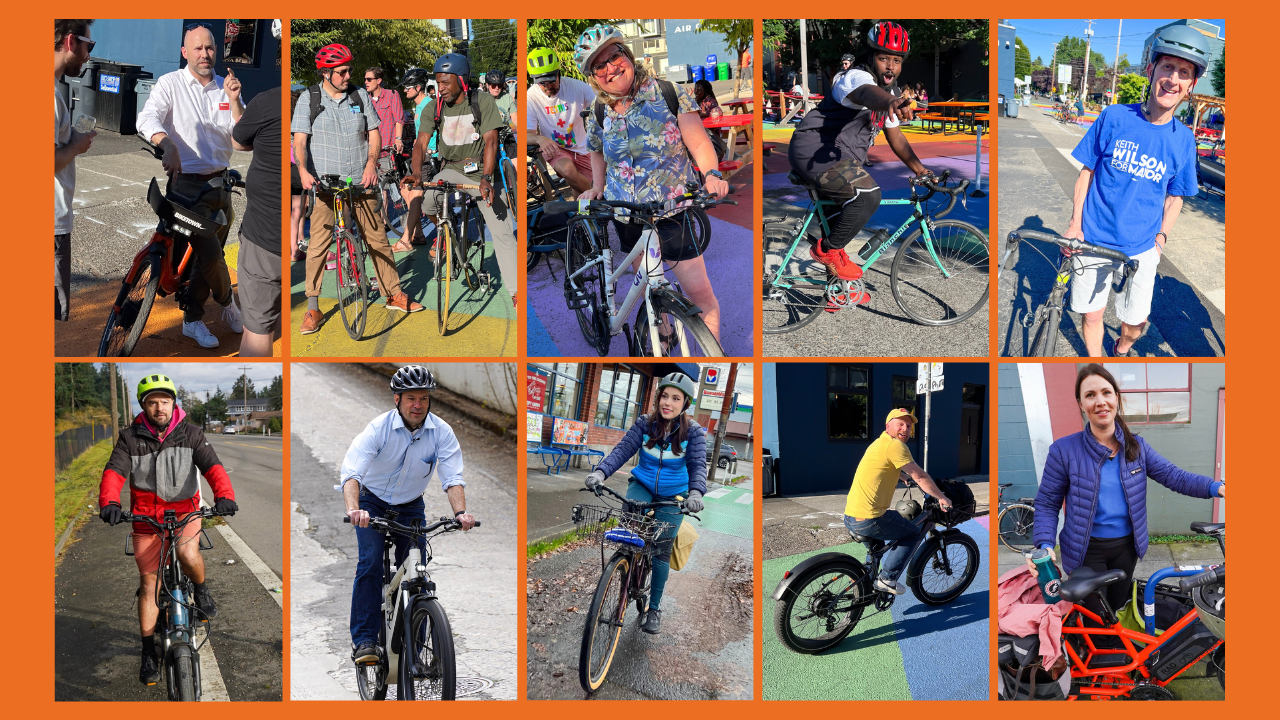
Just some of the candidates I’ve spotted campaigning on bikes. Top L to R: Eric Zimmerman, Jesse Cornett, John Toran, Debbie Kitchin, Durrell Kinsey Bey, Keith Wilson. Bottom L to R: Timur Ender, Chad Lykins, Angelita Morillo, Mitch Green, Mariah Hudson. (Photos: Jonathan Maus/BikePortland)
Local bike advocacy nonprofit BikeLoud PDX asked all City of Portland candidates* to answer eight questions gleaned from their members. The fourth question, “Do you ride a bike regularly? What kind of bike? How often? Where do you ride, and for what purpose?” was answered by 43 city council candidates and two mayoral candidates.
I’ve gone through the submissions and pulled out a short quote from each candidate. These very abbreviated answers below are based on what I personally found to be the most interesting/notable/newsworthy parts of their responses. For the full answers, visit BikeLoud’s website. I’ve also shared photos of each candidate in the order their responses were shared (if you’re on mobile, be sure to hit the arrow and scroll through the images.) The photos were taken from the Rose City Reform candidate tracker.
Read edited responses from all 45 candidates below:
City Council District 1
Timur EnderSonja MckenzieSteph RouthDavid LinnCandace AvalosAll candidate photos are in order of answers below and taken from the excellent new Rose City Reform website. (If reading on mobile, please click the arrow on the right to view candidate gallery.)
Timur Ender
I am 34 years old and have been car free my entire life except for 2 years in high school when I first got a license. I ride an Aventon Abound e-bike which has the capacity to carry 2 kids… I have put over 3,000 miles on it since I got it in February 2023.
Sonja Mckenzie
I do not bike on a regular basis. My last time I rode on an electric bike on a scenic trail on vacation and loved it!
Steph Routh
I ride a bike almost daily for errand-running, commuting, exercising, and just-for-meeting-friends purposes… My primary bike is a Surly Long Haul Trucker named George, and she has over 65,000 miles on her.
David Linn
I grew up along 82nd Avenue and always had a TriMet bus pass and still use it for anything I don’t walk to… I ride my brothers bike at community events and to promote school “bike buses.”
Candace Avalos
Yes, I ride my e-bike but not regularly due to many factors… It is definitely my intention to increase my bike riding and I will use my personal experiences to advocate for infrastructure that would help people like me choose biking, public transportation, and walking more often.
I am a recreational rider and a fair-weather rider… I ride a Colin Cape bike that my mom had customized in the 70s…
Christopher Olson
Yes. I ride a Vvolt Alpha [e-bike] almost every day…
Nat West
Yes, nearly every day. My daily driver is a Radwagon 4 electric cargo bike…I regularly ride a Surly Cross-Check single speed set up as a commuter, and sometimes for fun…
Michelle DePass
I grew up in “urban” cities, Portland, Guadalajara, and Washington DC, with a Dutch step-mom. Biking was in our DNA… I am not an everyday rider. I have two bikes, an 8 speed electric Gazelle, and a non-electric step through Dutchie 8 speed… because I trip chain, and have been a sole provider, I haven’t found biking efficient for my life.
Debbie Kitchin
I am a fair weather biker. I ride mostly in nice weather in spring, summer and fall. I don’t currently commute as I work from home full time… When I did work outside of my home, I rode to work once or twice a week during the summer months…
Mariah Hudson
I’m a daily four season bike commuter with a 9 mile round trip to OHSU. My trusty Radwagon has over 5,000 miles on her and ports me, kids (when they were smaller) and all sorts of groceries, goods and occasionally a kayak…
Jonathan Tasini
Yes. I have a hybrid Trek. I primarily ride for recreation-exercise and traverse far and wide; I have regular routes through the district, out to St. Johns and then a loop along the Columbia…wherever the mood takes me.
Mike Marshall
Except in the winter I use Biketown bikes 2-3 times a week to commute to work, run errands or go for a bike ride.
Laura Streib
I have started riding a bike again on a more regular basis because my youngest is very excited about riding his bike to school and the bike bus that is gaining momentum in the St Johns neighborhood. My bike is a 10-speed bike and K2 brand…
Will Mespelt
I ride a purefix single speed bike. It’s lightweight and gets the job done… My current bike rides are neighborhood routes and I take my kids in the bike trailer as a fun activity and are not commuter focused.
Marnie Glickman
Yes, I trike nearly every day. I have an electric Sol trike that I purchased after the encouragement of Portland’s tricyclists and cyclists with disabilities. (Thank you!) I commit to doing 25% of my transit by trike, including cycling to work in City Hall should voters elect me.
My whole family does! I tend to ride my razor scooter to and from work the majority of the time.
Rex Burkholder
Every day, multiple times. Work, shop, play. Mostly a Trek Soho commuter bike or my bike friday unless I’m climbing, then a 1990s Specialized Randonneur.
Theo Hathaway Saner
As I get older, I find myself riding less frequently, but I always dedicate a day in the spring to tuning up the family bikes and getting them ready for the season. I have a Trek road bike…
Daniel Gilk
Yes, I ride my Tern HSD cargo e-bike almost every day for all of my day-to-day errands… our household is approximately 80% car-free.
Angelita Morillo
After a long time being intimidated by biking in Portland, I purchased my first bike earlier this year and have been really enjoying using it to bike around town! I use it primarily to get from place to place when transit or walking does not meet my needs.
Jonathan Walker
My wife and I use an electric bike (Blix) and an e-scooter to run errands and make trips within a three-mile radius of our house. I also have a mountain bike. Our main use of them is to take our boys, ages 3 and 6, to school and preschool…
Matthew Thomas Anderson
From 2013 to 2018 I bike commuted every day from my home in Sumner to the Conway offices in the 23rd District… I ride an 18 Speed Trek Aluminum frame I bought new in 2006.
Daniel DeMelo
Currently I don’t own a car, so I ride daily to most destinations that aren’t downtown… I also have a backseat, so I’ll often bring my partner along for rides. And, of course, I ride for fun at year-round events like TNR and Pedalpalooza — come say hi!
Philippe Knab
Yes, I bike to work in Vancouver, WA once a week, I have a Surly Longhaul Trucker and Surly Steam roller…
Sandeep Bali
No. I have a stationary bike at home which I ride daily for the purpose of keeping fit and healthy. Until reckless drivers are held accountable it’s a scary thought for me to go all out and ride my bike.
Jesse Cornett
I have long had a 1995 Trek 951. I have bike commuted during my lifetime several times… I also greatly enjoy putting on music (at a reasonable volume) and just wandering around on my bike on a sunny Portland evening.
Chris Flanary
I have not biked since I was a kid… I did buy a bicycle from a friend recently, and am looking to use it for quick trips around the neighborhood.
Luke Zak
I used to ride a bike quite regularly… Now that I don’t own my own, I bike less often and typically default to walking or taking public transit when my car is not needed.
Council – District 4
Mike DiNapoliOlivia ClarkBen HuffordChad LykinsSarah SilkieMichael TrimbleEli ArnoldAndra VltavínEric ZimmermanLisa FreemanBob WeinsteinMitch Green
Mike DiNapoli
…I use Biketown bikes from time to time and electric scooters to run personal errands in town. As it stands my small business requires a vehicle… and I’m dependent still on my truck.
Olivia Clark
I have a road bike and gravel bike… My biking is mostly recreational. I stay on bike paths, preferably no cars. I have done a lot of long distanced biking and subscribe to “Adventure Cycling”.
Ben Hufford
I commuted on bicycle and foot including biking my kids to day care and school for over a decade. Living on hilly terrain, I currently ride a daily beater and I have an e-bike for trips over the hill to downtown.
Chad Lykins
I began bike commuting 17 years ago when I took my first-born to daycare on a used Fuji Roubaix with a Burley bike trailer. I also did several triathlons (on a used Cervelo with an aluminum frame) and the occasional long-distance cycling event (Seattle to Portland and Tour de Blast, both on a Giant TCR bought on clearance at River City Bikes)…
Sarah Strawberry Silkie
I recently started riding an electric bike… I’m excited to report that using the e-bike has allowed me to start commuting by bike on a regular basis again. I ride downtown over the hills from southwest Portland a couple times a week now…
Michael Trimble
I am an avid cyclist. Last year I biked slightly over 8,000 miles on my adaptive bike…
Eli Arnold
I ride four or more days per week. I ride either my Trek road bike or my Aventon e-bike downtown from Sellwood to go to work. I ride a Marin mountain bike at work.
Andra Vltavín
Mostly, I ride my bike to power my bike generator, which I use to power some of the equipment in the fiber mill co-op that I help to run.
Eric Zimmerman
Not often and when I do, it’s for quick trips, using a rental. I walk much more often than ride.
Lisa Freeman
… I upgraded from a beloved secondhand bike (my first commuter bike) to a new Masi Vincere road bike that I bought in 2018 when I lived in SE Portland and didn’t own a car… My campaign manager used to race bikes at PIR and Tabor…
Bob Weinstein
No… I have a Peloton [indoor stationary bike] now!
Mitch Green
I ride a RadPower eBike regularly with fat tires for added comfort and armor on the bumpiest surfaces. I ride about 3 days per week for commuting or errands…
Mayor
Liv OsthusDurrell Javon Kinsey BeyKeith WilsonCarmen Rubio
Liv Østhus
As a single mom with split custody and two jobs across town, a bike would not be possible for me for commuting. I wish it was. I very much enjoy riding my bike for pleasure. I’m not sure the make or model of my bike. It is old but it works.
Durrell Javon Kinsey Bey
I do not ride regularly. I have a Bianchi Road Bike. I seasonally ride my bike. I sometimes ride in my neighborhood, I ride for exercise and sightseeing.
Keith Wilson
Yes, I ride at least once per week… I have two road bikes: My primary is a carbon Trek Emonda SL6, and my trusted classic Trek Lemond Alpe d’ Huez that I gave to my son but often still ride…
Carmen Rubio
Today I am a rare/casual rider. My current bike is a Liv Alight casual/commuter bike… Sadly, I tore my ACL and meniscus during a skiing accident in 2020 and haven’t ridden very much since my knee surgery. However, I do plan to purchase an E-bike to hopefully get my skills and strength back up to ride this summer.
See full answers here. BikeLoud will post more responses in the weeks to come. Stay tuned for question #5 and see more 2024 election coverage here.
*BikeLoud sent the questionnaire to all candidates that had filed a letter of intent as of May 27th.
If all goes according to plan, Oregon could add another State Scenic Bikeway to its collection later this year. Advocates and staff from Oregon Parks & Recreation Department hosted a public meeting July 29th to discuss the Aufderheide Scenic Bikeway, a route that would stretch 60 miles between Highway 58 in Oakridge to Highway 126 in McKenzie River.
Oregon’s Scenic Bikeway program began in 2009 as a collaboration between the Oregon Department of Transportation, Travel Oregon, and Cycle Oregon (a nonprofit that provided seed funding). By 2019, when advocates and policymakers celebrated the 10th anniversary of the program at the capitol in Salem, there were 17 routes that had earned the official “Bikeway” designation.
The Aufderheide route would be the 18th and the first since 2017. Also since 2017, the program has been something of a “hot potato” (according to a State Parks staffer) as it seeks a stable home within the state bureaucracy. In 2022, Cycle Oregon stepped up to play a larger management role.
Connor Nolan, the destination development manager for Travel Lane County is the chief proponent of the Aufderheide route. At the recent meeting, he said the designation would help the regional economy and further market itself as a cycling hotbed. “The synergy of having this bikeway really leverages our area as a travel destination and is really important to us and our communities,” Nolan shared.
While the designations are a nice feather in the cap for tourism officials, they don’t come with any infrastructure upgrades. Scenic Bikeway come only with signage and marketing. Asked by a meeting attendee why the routes aren’t made safer with physical changes like protected bike lanes or other hardscape changes, Jenna Marmon with Oregon Parks and Recreation said she’s familiar with that critique.
“I feel more people would ride and spend money if they felt safer,” the meeting attendee shared in a chat window of the online meeting.
“This is one of the primary things we’re hearing right now,” Marmon replied. “This is definitely something we’re thinking about, but as far as funding being available as part of the program, no unfortunately, the program doesn’t fund infrastructure improvements.” Marmon said her team is open to partnering with other agencies and seeking grant funding, “But the program itself, well, we don’t have a lot of money,” she added.
Despite these efforts to officially recognize Aufderheide Drive (also known as Forest Service Road 19), the road sells itself. It’s already a National Scenic Byway and a Scenic Waterway because of its natural beauty as it winds along the North Fork of the Willamette River through old-growth forests and meadows. The route also passes five campgrounds and 25 trailheads, making it a perfect gateway to explorations.
While it seems like a natural fit to become a scenic bikeway; cycling advocates, business interests, and tourism officials have worked since 2013 to get the official stamp of approval. The sticking point has been the road itself. US Forest Service officials said wildfire and related landslide issues were too risky and they didn’t support the designation. USFS has spent $8 million on road improvements since 2016 and with the area more recovered from recent fires, it’s all systems go.
From here, advocates will polish their plan and seek route sign-off from the Oregon Recreation Trail Advisory Committee. Then they’ll present the route to the state parks commission in September. If it’s approved there, it will officially launch in May 2025.
Gateway Green bike park with I-205 path on the right. (Photo: Jonathan Maus/BikePortland)
“The defendant said the victim placed a bike in front of his house.”
– Multnomah County court documents
I hate to say it but I have more bad news to report about dangerous behaviors on our local bike paths. Over the weekend we had another breach of the Springwater Corridor and someone was rushed to the hospital after being attacked while riding on the I-205 path in Gateway Green bike park.
On Saturday, the Portland Police Bureau got a call around 11:30 am that someone had been assaulted on the path near Gateway Green, an off-road cycling park in east Portland. When they arrived they found an adult male with a “serious cut” on his arm and were told it happened while the victim was bicycling with his children in or near the park (I’m still unsure of the exact location). Witnesses said the suspect, who lived in a tent nearby, went southbound on the I-205 bike path (which is adjacent to the park). Upon giving chase they discovered a large, 18-inch machete and ultimately found and arrested 37-year-old Victor Peterson. Peterson has been charged with Unlawful Use of a Weapon and Assault II (felony).
The victim was treated at a local hospital for his wounds.
According to court documents, Peterson admitted to a PPB officer that he attacked the victim with his machete. “The defendant stated that he swung at the victim because he believed the victim was approaching his tent aggressively” and “placed a bike in front of his house,” reads the probable cause affidavit.
Here’s more from the probably cause affidavit (trigger warning: homophobic slur):
“As [the victim] was riding past Peterson’s tent, Peterson began yelling at him and called him a ‘faggot’ at one point. [The victim] noticed there were other children who were riding their bikes in the direction of Peterson’s tent so he circled back to ensure that the children were safe as they went past. When [the victim] came close to Peterson’s tent the second time, Peterson attacked him with a machete without provocation…
Peterson stated [the victim] approached him aggressively so Peterson hit him with his [machete]… Peterson said it took Peterson cutting his arm to get him away. Peterson stated he believed the person was going to get a gun so he packed up his belongings and left.”
Police were not able to say where exactly the altercation happened or share any other details about what might have transpired prior to the assault.
Subaru parked on trail adjacent to Springwater Corridor path. (Photo sent in by reader)
About 24 hours after this machete incident on the I-205 path, the driver of a grey Subaru Forester smashed through the fence that separates the railroad tracks from the Springwater Corridor near the Ross Island Bridge. According to several witnesses who contacted BikePortland, the damaged fence spilled onto the path and the driver nearly hit several runners and bike riders. The driver “seemed very agitated” and went south from Ross Island Bridge, “driving very fast and forcing bikers and runners to flee to the side,” said one witness. The driver then parked the car in the grassy trail area just south of Ross Island Bridge and “wandered down to the river.”
This incident took place just several hours after thousands of people were on the path for the annual Bridge Pedal bike ride.
One witness who contacted BikePortland said the incident was, “beyond dangerous and unbelievable.” We’re lucky that no one was killed. Also, “it was shocking to see amazing indifference by many [path users] after the guy smashed onto the trail then got out in wild haze. We’re now numb to such things in broad daylight sadly.”
Portland Parks & Recreation, the agency that owns and maintains the Springwater, is aware of the issue and BikePortland has sent them a photo of the car and its license plate number.
These unsettling incidents come on the heels of several others in what appears to be an epidemic of reckless, lawless behavior on our local off-street paths. In May, a drunk driver sped onto the Springwater at its northern entrance and drove the entire length to Sellwood Riverfront Park, hitting one bicycle rider and scaring many others before getting caught up on a bollard.
What’s happening here seems to be a normalization of very dangerous and illegal behavior that likely won’t get better as long as local officials remain silent and path infrastructure makes it possible.
NOTE, 6:47 pm: The victim’s name has been removed from this post by request due to safety fears.
Pamela and Mark checking out a 1974, Portland-made Strawberry at last year’s event. (Photos: Jonathan Maus/BikePortland)
Do you love your bike? Want to show it off and tell the world why it’s so awesome? Bring it to our 2nd Annual Bike Happy Hour Show & Shine that’s set for this Wednesday from 3:00 to 6:00 pm at Southeast Ankeny Rainbow Road (SE 27th & Ankeny) We’ve teamed up with the upcoming MADE Bike Show once again to showcase all the beautiful bikes that call Portland home.
When MADE returns to Portland August 23-25, more than 60 bike builders and hundreds of exhibitors will convene in South Waterfront for three days of events, displays, rides, and more. We always have cool bikes at Bike Happy Hour and the founder/creator of MADE — Billy Sinkford of Echos Communications — is a friend of BikePortland, so we are excited to help build excitement for this celebration of bicycles and the craft of framebuilding.
The Show & Shine is an informal bike show where everyone, and every type of bike, is welcome. You don’t need a custom or high-end bike. There is no entry fee or booths or anything like that. Just show up, drop your kickstand (or find a spot to lean to) and tell us about your bike. Last year we had several Portland-based bike builders come out and we hope to have a few back again this year. Someone from MADE will give out free tickets and a bit of swag to the big event.
I’ve also missed the last two Bike Happy Hours (BHHs) because I’ve been out of town (for a family event) and I’ll miss the next three for another family trip — so I am really looking forward to seeing all of your beautiful faces and cool bikes.
See you Wednesday.
2nd Annual Bike Happy Hour Show & Shine Wednesday, August 14th 3-6 pm Gorges Beer Co patio and parking lot (SE Ankeny & 27th)
Hello everyone. I’m back in the Shed after some time off for a family trip. Sorry things have been quiet around here. I appreciate your patience and understanding. (Remember, this is one of two trips I need to take this month. I leave again August 21 and will be gone through September 3rd.) Can’t wait to see you at Bike Happy Hour this week, where we’ll have a “Show & Shine” bike show… so dust off your rig and show it off!
Here are the most notable items we came across in the past week or so…
Calls for concrete: “Vision Zero will never be achieved and our streets will never be safe if we continue to allow the city to pretend paint and plastic are protection.” (Streetsblog SF)
Cargo bikes > vans: A wonderful byproduct of London’s bike boom is how the cycling enthusiasm has spread to business owners who are re-thinking last-mile transport. (Haringey Community Press)
How to stop sideshows and street takeovers: A reporter in San Francisco says adding traffic calming infrastructure to intersections would help prevent dangerous “sideshows” — the same idea I shared on BikePortland in 2022. Maybe it’s worth a shot, PBOT? (SF Standard)
Aufderheide Scenic Bikeway: One of Oregon’s most stunning roads could become an official State Scenic Bikeway route as the 60-mile Aufderheide Drive between McKenzie River and Oakridge is up for consideration. (OPB)
Reconnecting communities: A deep dive into the Biden Admin’s grant program that seeks to repair neighborhoods destroyed by freeways outlines risks that could prevent the well-intentioned funds from reaching their potential. (E & E News/Politico)
Amish and e-bikes: Sales of electric bikes have spiked in Amish communities in Ohio, where many folks prefer them to the horse and buggy. (Forbes)
The White Line: An important look at the advocacy response to the death of Magnus White, a 17-year-old star student and bike racer who was killed while cycling in Boulder, Colorado. (Streetsblog USA)
Shock the world: In an Olympics full of amazing moments, watching the Alaskan-born Kristen Faulkner sneak into the breakaway and then cooly attack the world’s best cyclists en route to solo gold in the women’s road race in Paris was something I won’t soon forget! (BBC Sport)
What about Walz?: The Democrat’s candidate for Vice President, Tim Walz, has a strong record of supporting progressive transportation initiatives. (Streetsblog USA)
Sometimes leading a short ride is a great way build a bike community and get people excited about riding. On Saturday July 27, Beaverton resident Rachel Philip in Beaverton did just that. To encourage her neighbors and friends to use bicycles for more for short trips, she organized a ride from Highland Park Middle School to the Beaverton Farmers Market in Central Beaverton – a ride of about two miles.
For several years, Portland’s Hami Ramani has organized community bike rides every Saturday morning to the Portland Farmers Market at the South Park Blocks on the Portland State University campus. But that’s a long way by bike from Washington County and folks would have to ride and/or hop on MAX light rail to participate.
Now, with inspiration from Ramani, Beaverton has a market ride of their own!
Rachel PhilipRyan, Kathleen and Reese (babe) Simpson.Steiner and Angela Neidig(Photos: Tina Ricks/BikePortland)
“I feel like people might not want to go ride for an hour or so. But it’s easy to get from the Highland neighborhood to Central Beaverton,” Philip, the ride organizer, said when I met up with her at Saturday’s inaugural ride. Philip wanted to lead a short ride to show neighbors how to get around by bike for short trips, and to encourage biking for everyday life.
Philip has an Urban Arrow cargo bike that she uses most weekdays to take her children to preschool. “It’s either a really expensive bike, or it’s a really cheap car,” she said with a smile. Her family made the decision to buy a cargo bike instead of a second car about a year ago and her daily ride to preschool takes her from her home in central Beaverton through the Highland neighborhood, where there are a lot of low-stress streets and shade.
Route
Neighbors Ryan and Kathleen Simpson and their daughter Reese arrived by bike, Burley trailer, and on foot (Kathleen is a runner who doesn’t have a bike yet). Ryan works at home, but he rides his daughter Reese to her daycare every morning and evening. “It’s a great way to start the day and end the day,” Ryan said. He’s an active road cyclist, but also interested in family biking and making cycling a part of everyday life.
Steinar and Angela Neidig also arrived with their family, ready to ride to the market. They moved to Beaverton from Portland in the last few years, and used to ride frequently in Portland. “We did all the rides in Portland,” Angela said. “But we’re still getting used to riding out here.”
The route took us on a ramble through mostly quiet neighborhood streets, some bike paths through a park, a few crossings of major roads, and to the farmers market. We stopped in front of Beaverton Library as our final destination, only because the bike parking shed at the market was overflowing. A good problem to have.
Philip has advice for others in Beaverton, Hillsboro, or Washington County who want to start a community bike ride: “Pick a place where people are excited to go.” For her, the obvious choice was the farmers market because, “everyone loves the market.” In addition, the Beaverton Farmers Market organizers are trying to encourage no-car transport to cut down on parking hassles in the neighborhood. The market even promoted this ride (and the rest in the series) in their newsletter. She suggested other events like neighborhood concerts or gatherings that are happening throughout the summer. She scouted out the route ahead of time, planning where a large group could ride together without getting separated, and where they could cross major streets safely. Philip also recruited a few volunteers from Ride Westside to do corking and sweeping.
Philip took care of all these details so that the ride was as smooth as possible. “Getting people to consider leaving the car behind means showing them how easy it can be to do,” she said.
There are three more rides in this series, all beginning at Highland Park Middle School (7000 SW Wilson Avenue in Beaverton) and ending at Beaverton Farmers Market. The rides are on August 10, August 31, and September 14, meeting at 9:45 a.m. Follow Ride Westside on Instagram for updates and more information.
Hi everyone. Hope your summer is going well. Just a quick note to share that I’ll be out of town for the next 10 days or so. That means things will look a bit different here on the blog and our social channels. I should have time to edit a few guest articles and post a few random things on social. And I might be able to respond to major breaking stories if warranted, but I’m not going to promise much beyond what I’ve already got in the hopper.
I will also not be at Bike Happy Hour tonight or the following week (Wednesday 8/7), so make sure to see Carey Booth if you need a name tag or stickers or anything else. I’ll be back at Bike Happy Hour on August 14th and back in the Shed on August 12th.
Note that this is a family trip (my mom’s 75th birthday down in southern California!), not a work trip, so my focus will be on family and taking a break from the daily grind of BikePortland. Please be patient and alter your expectations. I’ve got another trip coming later in August but I’ll share more on that when I get back from this first one.