Sign on the door of Citybikes on SE Ankeny near 20th. (Photo: @ZackPizzaBikes on Instagram)
After 38 years, the end of the line has come for Citybikes. At least for now. The shop will close this Friday (September 13th) while the remaining owners decide what to do next.
Rumors have swirled about the organization’s demise for years and BikePortland confirmed its fate today with one of its last remaining owners. After a reader shared a sign that recently popped up on the front door of the shop on Southeast Ankeny Street, I emailed Bob Kamzelski (who also owns Bantam Bicycle Works) to find out what was going on.
“Citybikes will be ceasing retail and repair operations on the 13th of this month,” Kamzelski wrote. “After 15 years of declining sales, and taking more than $120k in losses over the last three years, it has become obvious that the business is not sustainable and we have made the decision to stop operating while we figure out what to do next.”
The shop and worker-owned cooperative was an institution during Portland’s heyday as a cycling mecca. There were once two locations on Ankeny (at SE 20th and SE 8th), but the “Annex” on 8th closed in 2016 amid a decline in business. At its peak, Citybikes had 25 worker-owners. Last I heard there were just four (three in addition to Kamzelski).
A former worker-owner, Brian Lacy (who, coincidentally, founded the Community Cycling Center), was spearheading an attempt regain control of the organization from Kamzelski and others. At the time Lacy told BikePortland, “We’re going to rebuild Citybikes. We don’t want it to die.” But reached today via email about the pending closure, Lacy said he knows nothing about it.
And while Kamzelski said he plans to close the doors while they figure out what to do next, his comments to BikePortland in 2022 don’t make it sound like the shop will ever reopen.
“It’s not a viable business anymore,” Kamzelski told us two years ago. “It’s been a very successful run and I’ve been here for a third of it. I just think it’s time to move on. Other shops are closing. It’s a very hard time to run a bike shop.”
Are you interested in joining our well-rounded crew of talented and diversely-skilled mechanics? At Joe Bike, we pride ourselves on providing excellent service and communication with every customer. We like making personal connections and finding solutions to meet customer needs and budgets. Our team also knows how to have fun and enjoys collaborating on projects. We offer competitive wages based on experience, paid time off, health benefits, and a retirement plan.
How to Apply
If this sounds like you, please send an email to info@joe-bike.com with your resume and answer the following questions to help us get to know you:
1. What are your best mechanical strengths when working with bikes, and what areas are you less confident in?
2. Our bike shop is a busy and dynamic environment. How would you prioritize your time when deciding between working on bikes, helping customers with test rides and product selections, and working on cleaning, organizing, and completing side projects around the store?
3. What is your ideal bike shop environment and why?
Sukho Viboolsittiseri in October 2021. (Photo: Jonathan Maus/BikePortland)
Many Portlanders have heavy hearts today as news spreads about the passing of Sukho Viboolsittiseri. Sukho was well-loved in our community and known by many as one of the co-founders of BikePOC PNW, a group that fosters community among people of color who love to ride bikes together.
On May 27th, 2023, Sukho was biking southeast of Portland in the Damascus area when he was involved in a collision with a truck driver. As BikePortland reported at that time, his injuries were serious. But cycling was a very important part of Sukho’s life and he worked hard to get back in the saddle. He made excellent progress. Unfortunately in October he suffered a heart-related setback while on a ride up to Pittock Mansion that put him back in the hospital.
Sukho was 50 years old. He leaves behind his wife Melanie Latthitham and their two children.
Below are just some of the remembrances of Sukho being shared by our community:
Tonight, hundreds of riders will join a memorial lap for Sukho at the weekly Portland Trophy Cup races out at Portland International Raceway (PIR). The lap will be ridden before the 6:35 race.
The video below is a short conversation I had with Sukho on October 4th, 2021 at The Street Trust Alice Awards. Minutes earlier Sukho was on stage with a big group of friends to accept an award for BikePOC PNW.
Sign at SE Ivon and 4th spotted over the weekend. (Photo: Jonathan Maus/BikePortland)
Revelations in the media this week that two Portland city commissioners have shown blatant disregard for traffic laws and the consequences for breaking them, make it much easier to understand why our roads often feel like lawless wastelands and road safety issues are not a high priority at City Hall.
The Willamette Week reported Monday that starting in 1998, city commissioner and mayoral candidate Rene Gonzalez, “racked up seven speeding tickets in Oregon (one was dismissed); twice had his driving license suspended (in 1998 and 2003); and was cited four times for failure to display current registration on his vehicle.” In 2014 Gonzalez was cited for not having a valid ticket on a MAX train. On several occasions, Gonzalez wrote letters to the court making excuses for his actions and asking for relief from consequences.
Also yesterday, The Oregonian shared that another mayoral candidate and commissioner, Carmen Rubio, “racked up more than 150 parking and traffic violations over the last two decades, failing to pay most of them for months or sometimes years.”
Taken by themselves, these stories would be troubling and disappointing. When combined with the daily lawlessness we see on our streets, they are something even worse. Below is just a sample of the dangerous, reckless driving I’ve heard about in the past few days…
Two days prior to that, on Friday September 6th, the Portland Police Bureau responded to a crash on SE Division Street. Someone who was walking had life-threatening injuries after being hit by a driver at SE 158th. Then about twenty minutes later another call came about another collision a few blocks away: Another pedestrian was seriously injured by a driver.
None of this is normal. In fact, it’s madness.
The dysfunctional driving culture that currently rules our roadways is more powerful and dangerous than the infrastructure we might build to prevent it. Until we are willing to create carfree zones and truly safe streets where driving is prohibited and/or severely constrained, our only hope is to improve culture and find leaders who can model better behaviors.
Maybe Mingus Mapps, another sitting city commissioner who wants to be mayor, is the guy?
At a press conference following a rise in traffic deaths held in front of City Hall one year ago Mapps said he wanted to, “bring about culture change” on our roads. But not only did Mapps never do anything substantive to follow-up that statement, we learned one month later during the Broadway Bike Lane Scandal he presided over that he also has a trust deficit on transportation issues.
Maybe that’s why Mapps’ campaign has seized on the negative press for Gonzalez and Rubio with an email just sent out to his supporters. “I don’t have a single traffic citation,” Mapps writes in the email. “As a Black man, I don’t get to flout the rules… If I had over 150 violations in recent years, not only would I not be on the City Council today, I would be in jail.”
If it takes an election campaign to prioritize the importance of responsible vehicle use and clean up traffic culture, I’m all for it. Portland is desperate for civilized streets. To get them we need serious, trustworthy leaders who want to make our roads better for everyone as much as they want to gain power for themselves.
Westbound bike lane gap in December 2015. (Photo: Jonathan Maus/BikePortland)
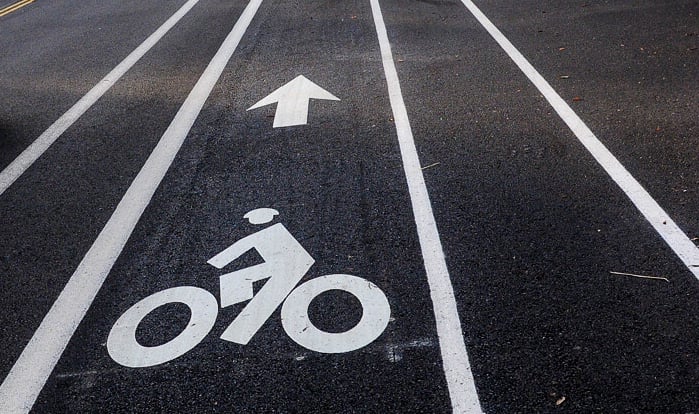
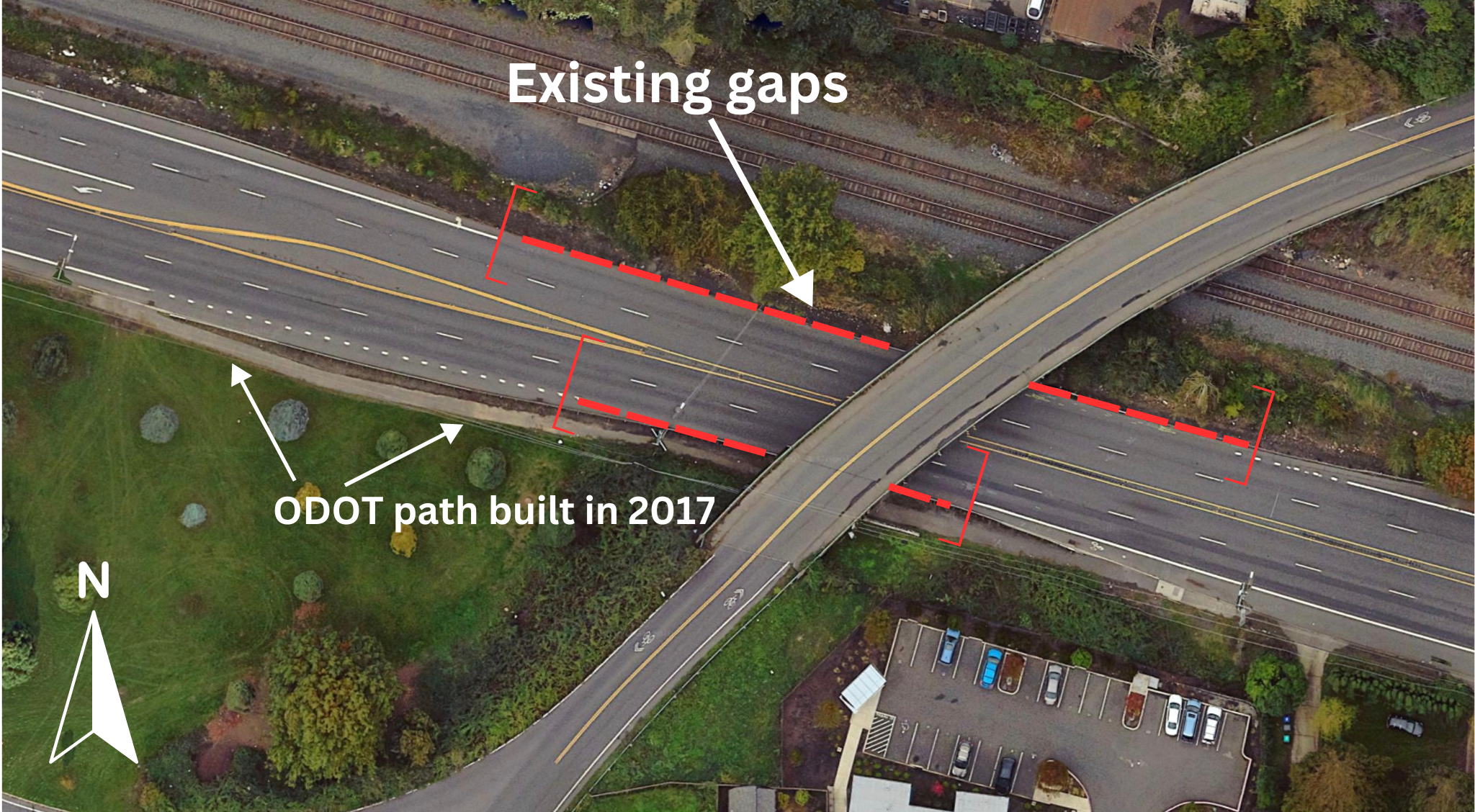
When Martin Greenough was hit and killed by a car driver as he rode on Northeast Lombard Street the night of December 12th 2015, he was very likely unaware of a dangerous gap in the bike lane where the busy highway rumbles under NE 42nd Avenue. Friends told BikePortland he had just moved to town and was still experimenting with his route to work.
Now, nearly a decade after Greenough’s death, the City of Portland and Oregon Department of Transportation are ready to close that gap for good. BikePortland shared this news in 2021 (after local traffic safety activist and lawyer Scott Kocher told us about it) and the agreement between the city and state was finalized last year.
A Portland Bureau of Transportation project manager told members of the city’s freight committee at their monthly meeting last week that they’ve received funding from ODOT (who owns and manages Lombard since it’s also Highway 30) to widen the road and build a continuous bike lane in both directions. The PBOT staffer referred to this as a “vital safety improvement.”
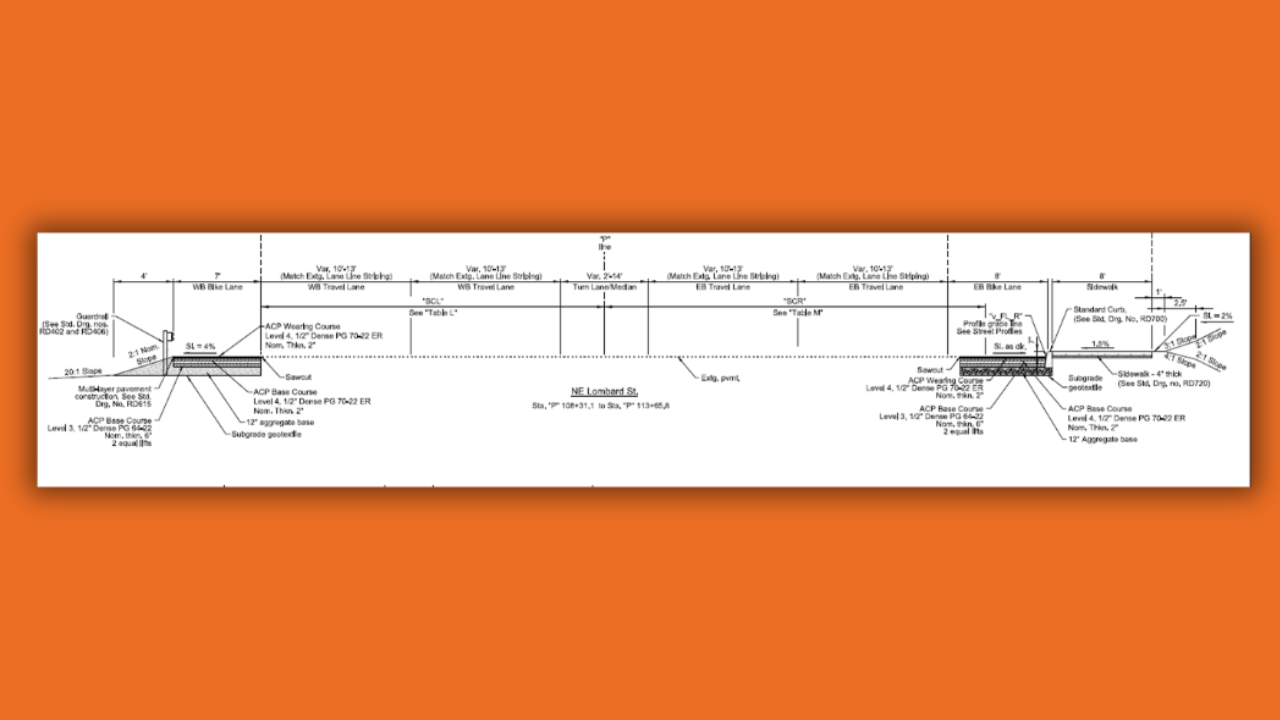
New schematic of future cross-section showing Source: PBOT
PBOT Public Information Officer Dylan Rivera has confirmed they will stripe a seven-foot wide bike lane in the westbound direction and an eight-foot bike lane eastbound. Rivera says ODOT gave PBOT $587,000 to build the new bike lanes. The lanes will have a paint-only buffer stripe. The schematic plans shared by Rivera (above) also show an eight-foot sidewalk on the south side (eastbound) of the street. I assume this will take the place of the existing bike path, but I still need to confirm that.
The Greenough tragedy pressured the City of Portland to edit their official bike map to reflect the dangerous gap. Once the new bike lanes are in place, they’ll have another change to make to the map. Whether an unprotected bike lane on an urban highway with a 45 mph speed limit merits removal of “caution” markings will be up to PBOT.
Community Cycling Center staff and supporters at the unveiling of a billboard on SE Sandy in 2022. (Photo: Jonathan Maus/BikePortland)
The Community Cycling Center, an institution in Portland’s nonprofit advocacy scene since it was founded on Northeast Alberta Street in 1994, is in a financial tailspin and its leader says they’ll be forced to close for good unless the community donates $115,000 in the next three weeks.
An email to members and supporters sent Saturday relayed the news: “The Community Cycling Center has been grappling with an escalating financial challenge over the past five years,” reads the email. “This issue has now reached a critical point, and without swift, decisive action and the support of our community, we face the very real possibility of shutting down by October 1st.”
They’ve launched a “Save the Community Cycling Center” fundraising campaign and say they must raise at least $349,000 by January 1st, 2025 to stay afloat.
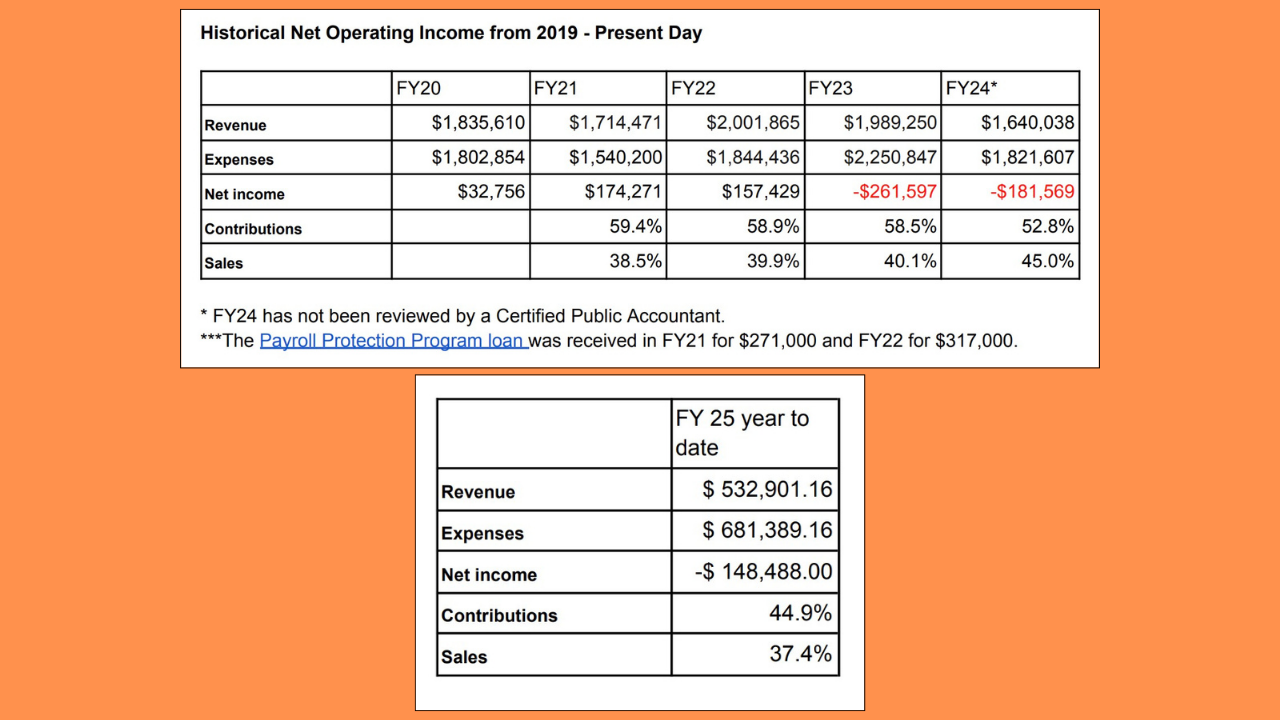
Financial figures released by the CCC today.
The CCC celebrated its 30th anniversary at the end of July with a carnival at Alberta Park. That same month they hired a new executive director, Ruben Alvarado — their sixth leader in less than five years. That high turnover is one of several reasons cited in a document released by the organization today. I have an interview scheduled with Alvarado in a few hours to learn more. (I’ll share our conversation in a separate post.)
In an email to BikePortland over the weekend, Alvarado said,
“When I assumed the role of executive director in July, I was hopeful that our organization was on a path toward growth and innovation. Unfortunately, I quickly learned that the financial challenges accumulated over the past 4 years following the pandemic were far more severe than anticipated. Despite implementing immediate cost-saving measures, emphasizing transparency, and strengthening our community relationships, we find ourselves at a crossroads where the possibility of closing our doors is becoming a harsh reality.”
One recent budget bright spot for the CCC is over $700,000 in grants they’ve won since 2022 thanks to two separate awards from the Portland Clean Energy Fund (PCEF). In 2022 the CCC won nearly $500,000 for a three-year grant that would fund 900 bikes and, “14,000 hours of staff time and provide stipends and logistical support to Black and Latinx community leaders so they can engage in transportation-related system improvement discussions.”
And just last week the organization won another PCEF grant for $443,000 over two years to, “increase access to cycling infrastructure and promote sustainable transportation in underserved communities.” (In documents shared at city council this week, PCEF said their financial vetting process invovles, “examining the past three years of financial documents and relevant narrative responses in the application to assess the organization’s financial health and governance.”)
But in a statement today, the CCC says this grant funding requires up-front reimbursements and costs the organization cannot afford because revenue from their programs and donors has dwindled in recent years.
The CCC says their financial challenges began in 2020 at the onset of the pandemic. Adding to that are the issues of frequent executive director turnover, high administrative costs, and “challenges within our bike shop due to industry changes.”
In a document that provides an overview of reasons their financial crisis, the CCC says their “top heavy” org chart had too many leadership positions that could have been done by lower-paid workers. They also say keeping employees on year-round and providing them benefits and annual cost of living increases contributed to these high administrative costs. In April 2023, the CCC’s bike shop became the first in Portland to form a worker’s union.
In July 2023 we reported that the CCC closed their retail shop because it wasn’t creating enough revenue. In its place they offered just a few select parts and accessories and launched a new model that allows paid members the ability to work on their own bikes. “While this new model has potential,” the CCC shared in a statement. “It has not yet replaced the revenue lost from bike sales.”
One number that jumps out in recent financial records is the 14 percentage point drop in contributions from 2021 through this year. That shows fewer people are donating to the CCC and combined with the loss of income from the bike shop, further complicates their financial outlook.
All of these factors paint a bleak picture. The CCC says if they don’t meet four funding goals by January 1st, 2025 (including $115,000 by October 1st), “we will have to shut down our beloved organization.”
For more on this story see the CCC website and stay tuned later today when I share an interview with Alvarado.
See video below for interview recorded this morning with CCC Executive Director Ruben Alvarado (also available on our podcast feed):
This week’s Comment of the Week was in response to a nudge from one reader for BikePortland to do a “deeper dive” into the motivations of the principal players involved in the Oregon Department of Transportation’s I-5 Rose Quarter freeway expansion project. It was written in response to BikePortland’s recap of a Willamette Week piece exposing ODOT’s expensive efforts to bring the community on board.
Jonathan demurred to the nudge, but another reader, ITOTS, wasn’t buying it. What followed was a powerhouse of a comment, framed as a suggestion to Jonathan for how to write the story. (Maybe ITOTS should write a book, Rose Quarter Confidential, or something.)
The different players and their motivations aren’t hard to see; their alignments and interactions flow quite naturally therefrom:
ODOT wants to build something to address recurring congestion resulting from a combination of a geometric deficiency and too many cars.
Many of the HAAB [Historic Albina Advisory Board] members (representative of much of the Black “old guard”, including Sen. Lew Frederick) want to pursue “restorative justice” through construction jobs and training for their community members.
AVT [Albina Vision Trust] wants to convene community members and articulate/realize a vision of “restorative justice” via Pearl District-style redevelopment that creates wealth-building opportunities for its community members through new housing, leveraging a receptive public sector to more easily get access to developable land.
NMF/Sunrise [No More Freeways] doesn’t want more cars and their attendant greenhouse gases and air/noise pollution in the central city.
The City of Portland wants to be seen as a good agency partner to ODOT while maintaining some of its street cred among climate, equity, and active transportation advocates.
The state government wants to see its priorities (the rose quarter) acted upon while still being seen as supportive of racial justice.
USDOT wants to be seen as (financially) supporting Democratic priorities such as restitution for past harms especially those perpetrated in part by the federal government and especially priorities for demographics they are hemorrhaging support from (Black men).
Rip City Management is afraid of changes that may affect the Blazer’s relationship with Portland.
Phil Knight wants to purchase the Blazers.
Portland Public Schools needs a new/renovated headquarters.
These dispositions have been pretty stable over the life of this project.
Taking these orientations and winding back the clock to 2017, it wouldn’t be impossible to predict the major shifts in the saga:
ODOT allying itself with a contingent of the Black community that wanted construction jobs – as a shield against climate and livability protests (Holt was part of the glue for this increasingly unhappy marriage);
AVT calling their bluff and advocating for expanded caps to provide land for their emerging vision;
PBOT’s public (but not behind the scenes) rejection of the project following climate/livability protests and AVT’s pulling of support when ODOT didn’t budge;
Governor Brown swooping in to bring AVT and PBOT back to the project by requiring ODOT to include expanded caps;
an influx of money from Knight to bolster AVT’s vision for the district;
Rip City Management drawing out the design process;
ODOT sending the $450M Rose Quarter money to the I-205 project;
the agreement between PPS & AVT to acquire the Prophet site;
a now-flush AVT winning ODOT a federal grant for cap $$$ (exactly replacing the $450M ODOT reallocated) followed by AVT becoming agnostic about the highway project.
It is very nice to be back in Portland after being gone three out of the four weeks in August. Spending that time with family was very important to me and I appreciate your patience and understanding. Not let’s get back into the rhythm of BikePortland with our weekly roundup of the best news stories and other items we came across in the past seven days…
This weeks’ roundup is brought to you by The e-Bike Store, where you can find a great deal on a quality bike at their end of summer sale.
Now let’s get into it…
Distracted cycling: I became much less interested in this story about the rise of distracted cycling when I realized the source of the new report is a car-related research firm. But still. (Forbes)
Too expensive: Highway expansion megaprojects have always been expensive, but with factors like inflation and the rising cost of land, new research shows the costs of new roads now far exceeds the benefits. (Bloomberg)
Go ahead and roll: Now we have research to help prove what many of us have understood for years: “stops as yields” or “Idaho stops” do not lead to unsafe and risky riding behaviors. (OPB)
The death toll: A summary of 2023 fatalities illustrates the sad truth that drivers are killing each other for purely selfish — and totally preventable — reasons. (USA Today)
E-bikes and national parks: The National Park Service says local park superintendents will continue to have authority to manage the use of e-bikes and there won’t be a federal law that regulates their use on NPS properties. (Bicycle Retailer & Industry News)
MADE show recap: Regrettably there was no BikePortland coverage of the big MADE bike show this year, so check out this recap from Portlander Josh Ross with a nod to “old Portland bike cutlure” in the lede. (Velo)
Portland’s parking reformer gets his due: Congrats to Portland’s very own Tony Jordan of the Parking Reform Network for being named to the Grist 50. (Grist)
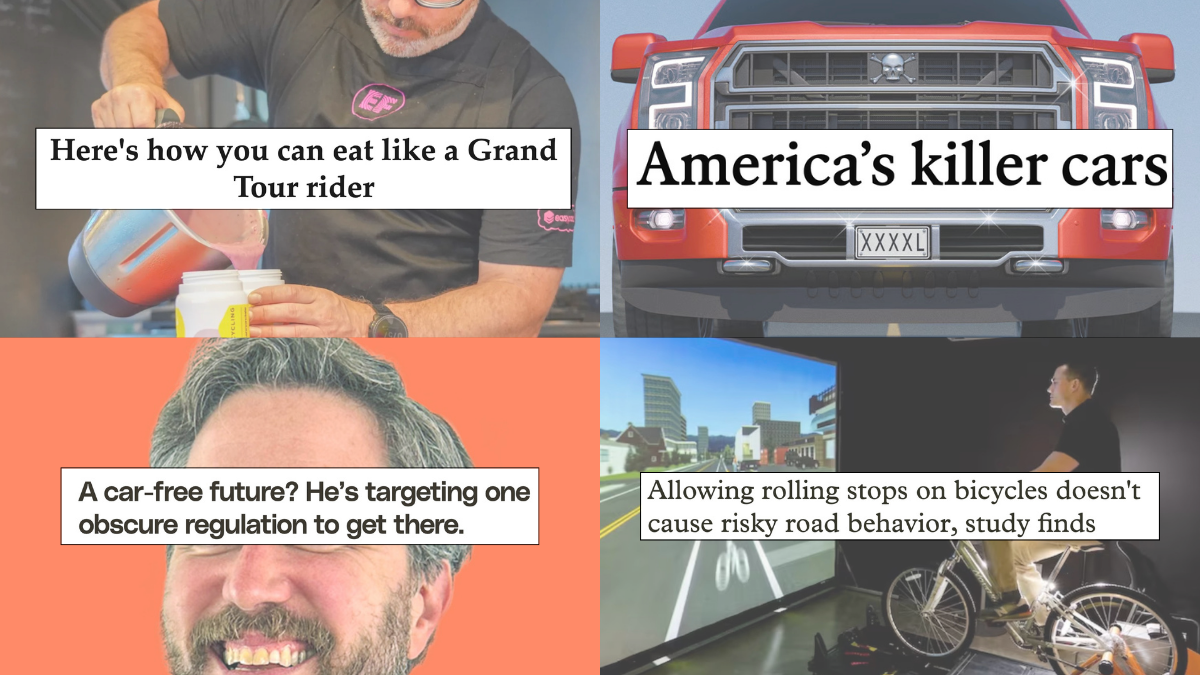
Global audience for “killer cars”: One of the most widely read and respect news outlets in the world has made America’s large car problem its cover story, bringing much-needed attention to this dysfunctional part of our traffic culture. (The Economist)
Cheap gas: In part because we (the USA) are pumping a lot more of our own oil these days, gas prices are falling. That’s bad news for VMT numbers, but good news for drivers and Democrats. (CNN)
Bike bus how-to: Wirecutter, a venerable testing and review site, offers a step-by-step guide to starting a bike bus. (NY Times)
Cycling fuel: Ever wondered how riders eat at the Tour de France, the Vuelta, or other major race? Get the inside scoop from the “performance chef” of a World Tour team. (Cycling Weekly)
Try as I might, I kept failing. At least I thought I did. (Photos: Shannon Johnson/BikePortland)
Every summer, I have such idyllic bike dreams. We’ll have picturesque picnics and bike to get ice cream and play in the fountains. And we certainly will do that – or at least we’ll try. But we’ll also get hot, sticky, wet, and sunburned, and come home sweaty and worn, with somebody – or everybody –crying about something.
Let’s not pretend that every outing is a dream come true in the land of happily-ever-after. The reality is that we live in the land of bike tires that perpetually need more air, kickstands that get stuck, and chains that fall off. Or even on a very bad day: a pannier that works its way into the bike tire.
On that note we’ve recently had some, ahem, character-building experiences.
My summer goal this year was to do some “park and ride adventures,” where we’d drive the kids out to enjoy great rides on carfree paths, venturing beyond our usual haunts and familiar neighborhood routes. And though I don’t love the driving part, I wanted my children to have the experience of exploring new places by bike, especially with the fun and freedom of carfree paths.
So here’s how it went…
Bike Adventure #1: Covered Bridges Scenic Bikeway, Cottage Grove OR
For our first big bike adventure, I had grand plans to try out the Covered Bridges Scenic Bikeway during our annual summer camping trip to Cottage Grove, OR. Attempting to be responsible, I began filling all the bike tires before we left. As I was filling the last set of tires on my own bike, the front tube popped–the night before our camping trip. Of course, it was the only tire for which I lacked a replacement tube; it was too late to visit my local bike shop for help, and we were supposed to be leaving first thing the next morning. I nearly gave up right there in the driveway. But I took a deep breath instead. Of course, there would be a bike shop at our destination, so I reasoned this could be an opportunity to visit the local bike hub in a new town and maybe learn a few local tips while my tube got replaced. This busted tube could be part of the adventure, not the end of the adventure, right?
At times like this, I try to remember my fondness for bike-around-the-world travel stories. I often wish I could be exploring the world on a bicycle myself. So when my tire pops in the driveway with five kids watching, I try to imagine myself changing a tire in a remote mountain village. Perhaps I will someday.
Our current family bike travels look significantly more modest, but I can approach them with the same determination I would need on a world bike tour. We can’t let one popped tube end our trip! And besides, there was a lovely bike shop where we were going: Rainy Peak Cycles in Cottage Grove, OR. The mechanic at Rainy Peak agreed to replace my bike tube on the spot while the kids and I explored the downtown antique shops. I even got the sort of tip I was hoping for, as I admired the mechanic’s hat and apron. He told me I can purchase such bespoke bike-specific hand-made-in-Oregon items for myself from Randy Jo Fabrications. Now, I’m putting these caps on our back-to-school wishlist!
No more training wheels!Let’s hear it for bike shop heroes!
Unfortunately, cool caps aside, the tire fix was unable to solve the series of problems that awaited us. We arrived too late at camp to go for an evening bike ride. Then we learned that the nearby access road to the bike path was closed. Then we postponed our bike ride to our last morning, because my kids wanted to stay at camp to play with their friends. Then two of my children came down with a bad case of pink eye, looked miserable, and wanted to go home without riding. I briefly considered dragging them all out for the ride anyway, but I could tell it was a bad idea.
Recognizing defeat, I surrendered to going home. After pumping all the tires and lugging all the bikes and gear across Oregon to go camping and biking, we didn’t even manage to ride the bike path I had intended. It felt like a failure of ridiculous proportion. “Maybe next year”… if I ever try this again.
Bike Adventure #2: Car-Free Bike Trail at Champoeg State Park, Newberg OR
For our next attempt at a summer bike adventure, we decided to try a car-free bike path closer to home, at Champoeg State Park. This time we made it to our destination, got everybody on bikes, and rolled out. Two of my kids crashed in the first five minutes, but otherwise our beautiful ride seemed blissful – until we were about a mile out. At that point, the chain fell off my five-year-old’s little bike. We pulled over and I wrestled it back on. However, the chain, which had never fallen off before, was hopelessly loose and proceeded to fall off every twenty seconds thereafter. We had to turn around, and very slowly make our way back, replacing the fallen-off chain about thirty times on the return trip. Passerby bikers attempted to help, but we didn’t have a multi-tool or bike tool set with us (another lesson: take tools on bike adventures–and learn how to use them!) Very slowly, we we hobbled back from summer bike adventure #2 – which was in my mind, another defeat.
Bike Adventure #3: Multi-Modal Bike-MAX-Bike trip to Westside Bike Happy Hour, Beaverton OR
Not ready to give up, I pushed on with plans for yet another family bike outing. For our next trip, I decided to take my four younger kids on a multi-modal trip to Westside Bike Happy Hour (bike+MAX+bike), because I have always dreamed of multi-modal travel and making it to Bike Happy Hour with our bikes and without having to drive; but that attempt also failed.
First of all, it was rainy, and three of our bikes needed new lights, which meant a lot of searching for lights, batteries and a screwdriver and getting all the new lights in place – it took almost an extra hour to get all those lights on all the lightless bikes! I was tired before we even started riding. Then, after we finally made it on the MAX with all our bikes (a complicated choreography with four young children), I was unable to wrestle the bikes onto the hooks myself. I needed an uncomfortable amount of help from a friendly stranger to hang the bikes, and then the handicapped seating (where my kids sat near me and the bikes) was needed by multiple other riders, and I began to worry that the train was getting too crowded to accommodate us (especially with my Mama-bike and its kid seats taking up extra space and all of us generally just being in everyone’s way.) So, I nervously got us all off the MAX after a few stops, then tried to redeem our outing by purchasing dinner at a hamburger joint (which should have been a rare treat) – but all of my kids rejected the fancy burgers and “spicy” fries, which was a significant disappointment for them and for my wallet.
Making matters worse, I was a nervous wreck about the MAX ride home, especially since I had been unable to hang our bikes on the hooks by myself (making it harder: I was baby-wearing my toddler, so he wouldn’t run off while we were boarding the train). Coaching multiple young children with their bikes and my bike on and off the MAX really stressed me out. I was worried about my kids crashing into other passengers in their hurry to try to load the bikes on the train. I was worried about a kid tripping or getting separated from me. We did pinch some fingers and scrape some legs (our own), and I still have bruises from my bike crashing onto my leg during the un-hooking process.
We made it home, but I felt tense, exhausted, and defeated. I had been dreaming about multi-modal family trips for years, and thought we were going to make our first Bike Happy Hour on our bikes – and we didn’t even arrive. Another bike adventure flop!
View from the kids’ perspective
So if you haven’t heard from me for a few weeks, it’s because I have felt like all of our big summer biking attempts have been a disaster, and I’m more than a little discouraged and even embarrassed. It hasn’t been the sort of blissful, Instagram-worthy summer I expected. But as I reflected, and tried to decide if we’ll try any more “adventures,” I asked my children about our “failed trips.” And this is what I heard:
“It was so much fun!”
“I loved it! It was my favorite.”
“I can’t wait to go again next year!”
“The chain falling off was a bummer, but we got to pick blackberries, so it was still pretty good.”
“I love riding the train!”
“When will I be old enough to ride the MAX by myself [with my bike]? That’s going to be so much fun!”
I may have been stressed, frustrated, tired, and even depressed after our “failed” bike outings, but my kids had a blast (except for those hamburgers). They tolerated the chain-fall-off fiasco with acceptance and positivity, and enjoyed the outing in spite of it. On our camping trip, we didn’t get to ride the carfree trail, but my kids were thrilled to have their bikes at the campground, where I allowed them the freedom to bike around on their own, which was the height of joy for my younger boys (who aren’t allowed independent biking at home, on our urban streets). And it was at the camp that my five-year-old learned to bike without training wheels, which was the happiest moment of his summer. He didn’t even know we “missed out” on a planned trail ride. He thought riding in endless independent loops around the campground was the most fun he could possibly have. As for the MAX ride, my kids enjoyed that too, and began pining for the day when they would be old enough to explore the world by bike and transit all on their own.
What I realize is:
Biking builds perseverance and a taste for challenging adventures. I see this in my kids, and I need to learn from their grit and positive attitudes.
My kids didn’t have the expectation of accomplishing a certain biking objective–they were just happy to be on bikes. Therefore, they didn’t see any failures. They enjoyed whatever our trips ended up becoming.
My kids are remembering the best things, and even the mishaps turn into tales of adventure for them. For them, this is a summer of happy biking memories–and summer isn’t over yet!
Which means, we have more bike adventures to try.
I hope you had a happy bike summer, full of adventure and fun. But if your bike summer has felt a bit wobbly, or if you have suffered any family bike failures, I hope you find the determination of a five-year-old learning to ride without training wheels: get back on the bike, and love every flying minute of it.
That’s exactly what we are going to do. Keep going, and enjoy the rides to come.
If you have had a favorite family bike adventure this summer, or have a recommendation for our next family “park & ride” outing, please leave a message in the comments. Happy riding!
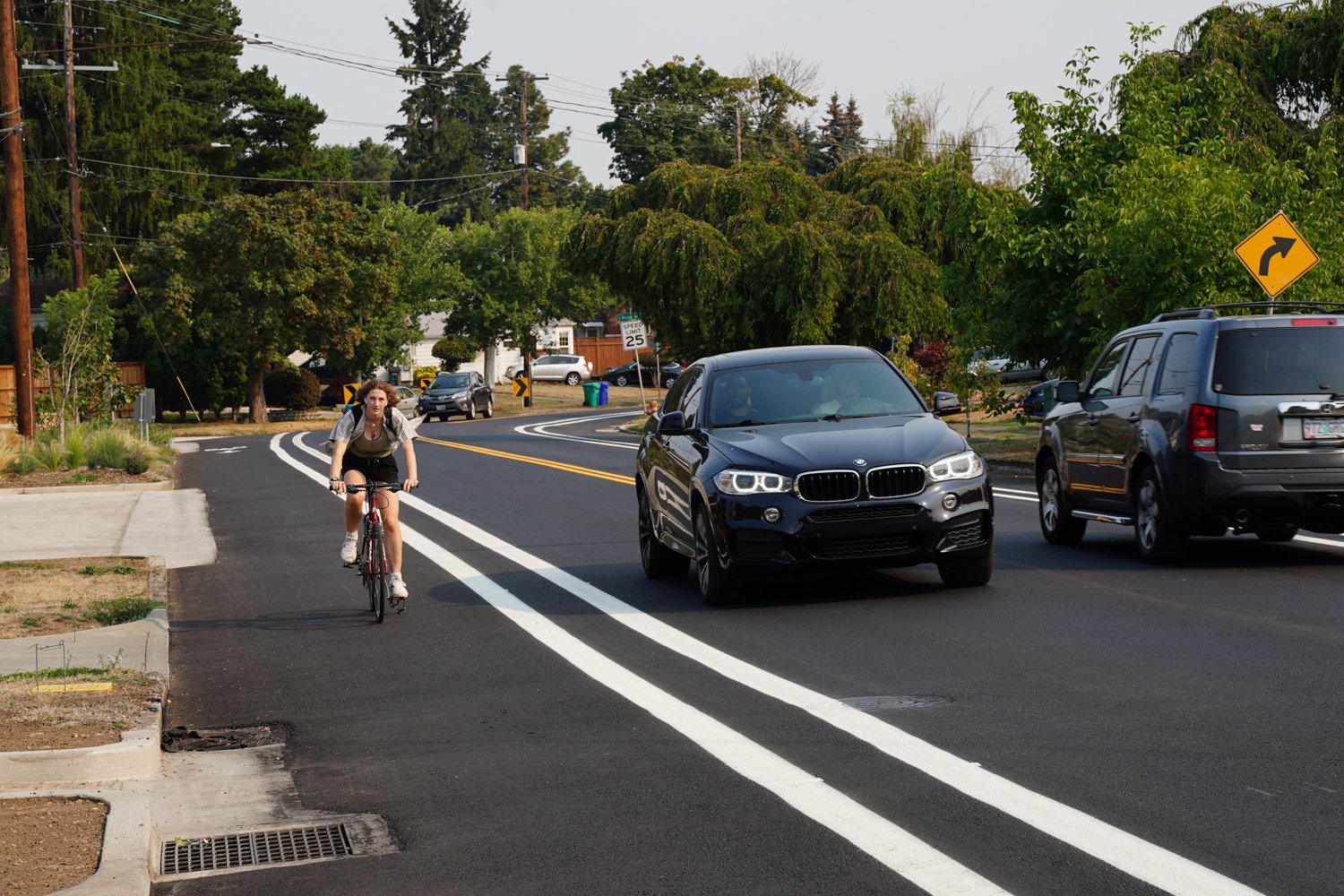
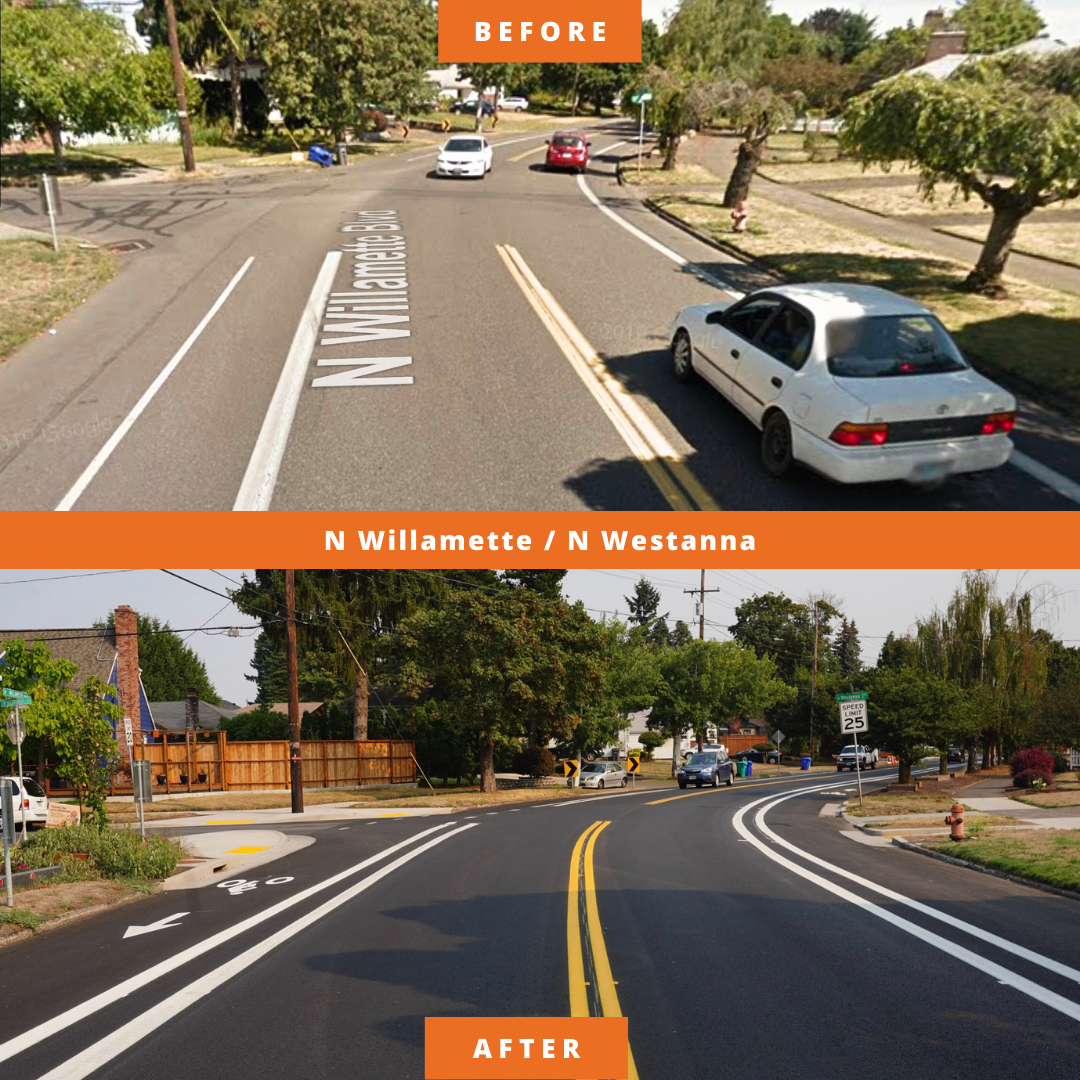
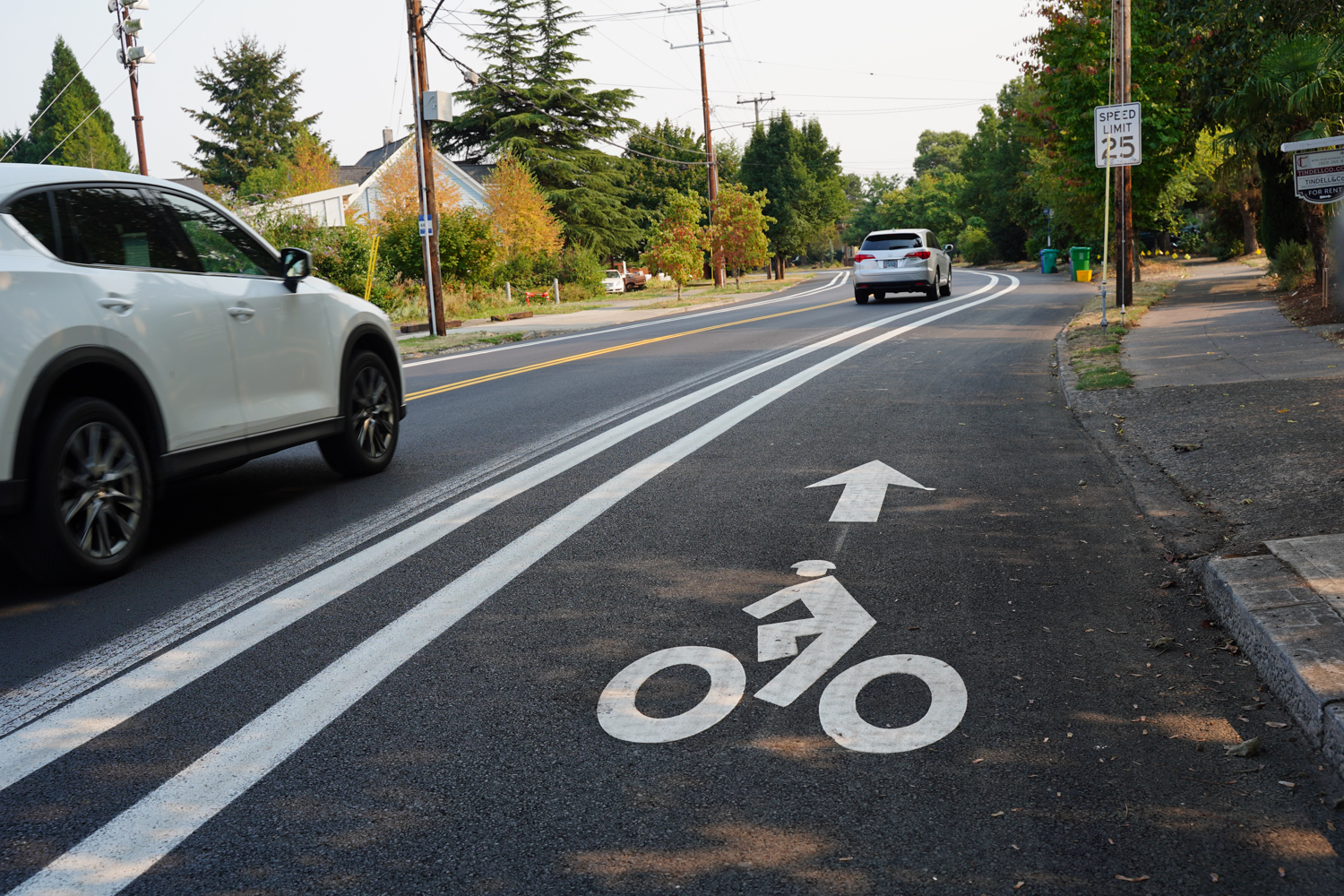
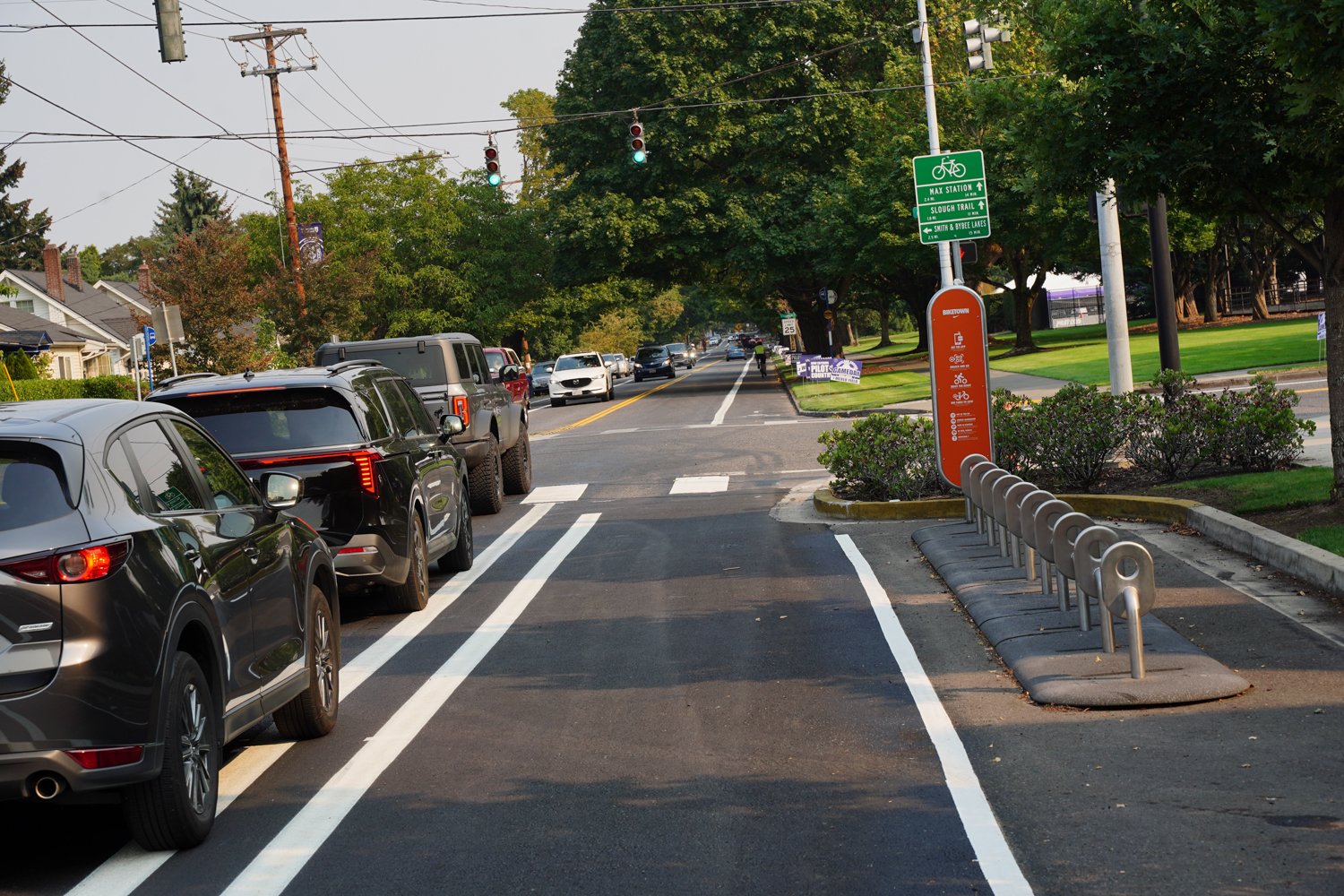
Looking south on N Willamette and Westanna. Note the much wider bike lane on the right and new, curbside lane on the left.
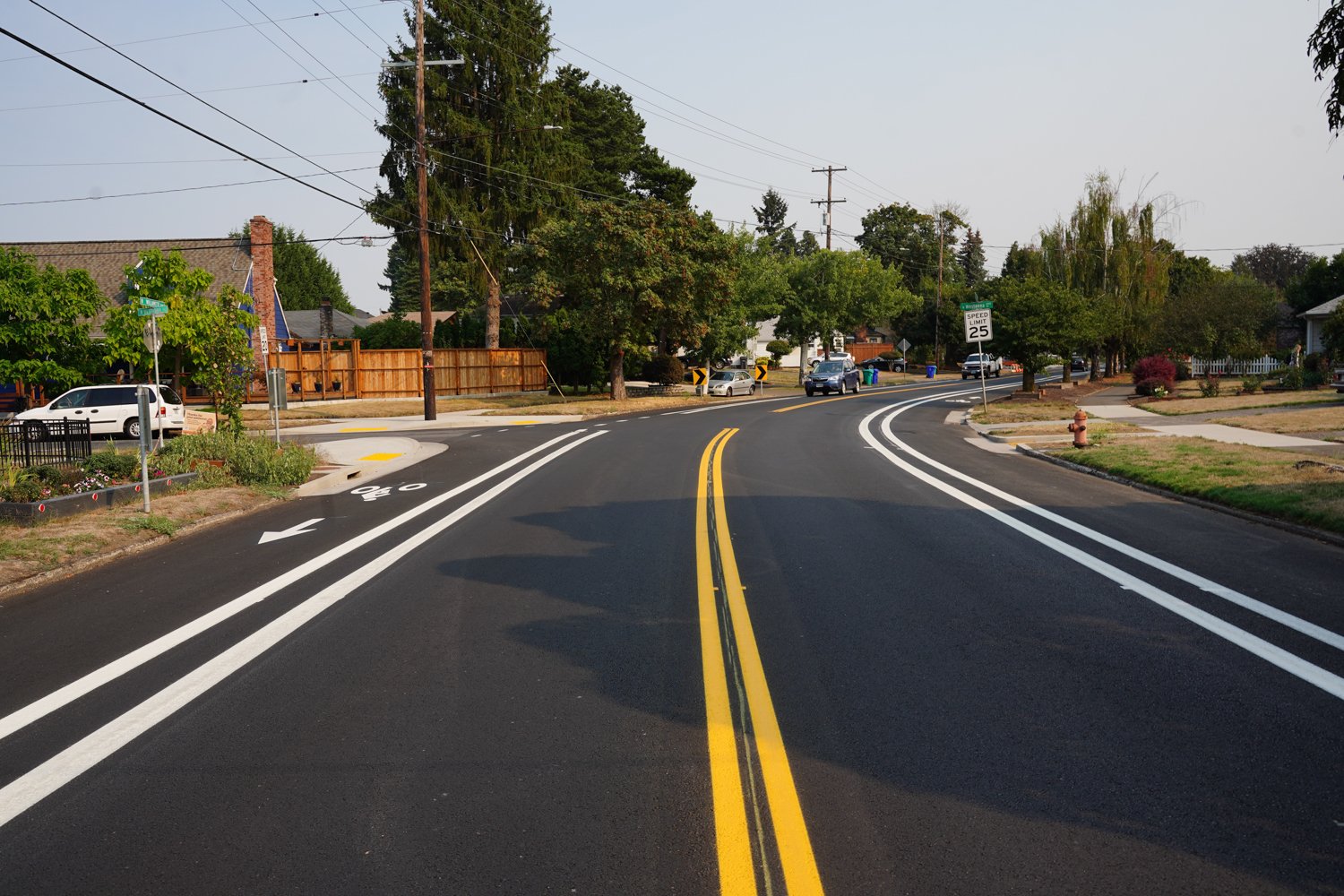
Last month the Portland Bureau of Transportation took a step forward on their plan to transform North Willamette Boulevard into a high-quality cycling street. As I shared in an Instagram video back in July, PBOT seized the opportunity of a repaving project on the street to make a significant upgrade to the bike lane striping on a 0.7-mile section between University of Portland and the entrance to the Peninsular Crossing Trail at the railroad cut.
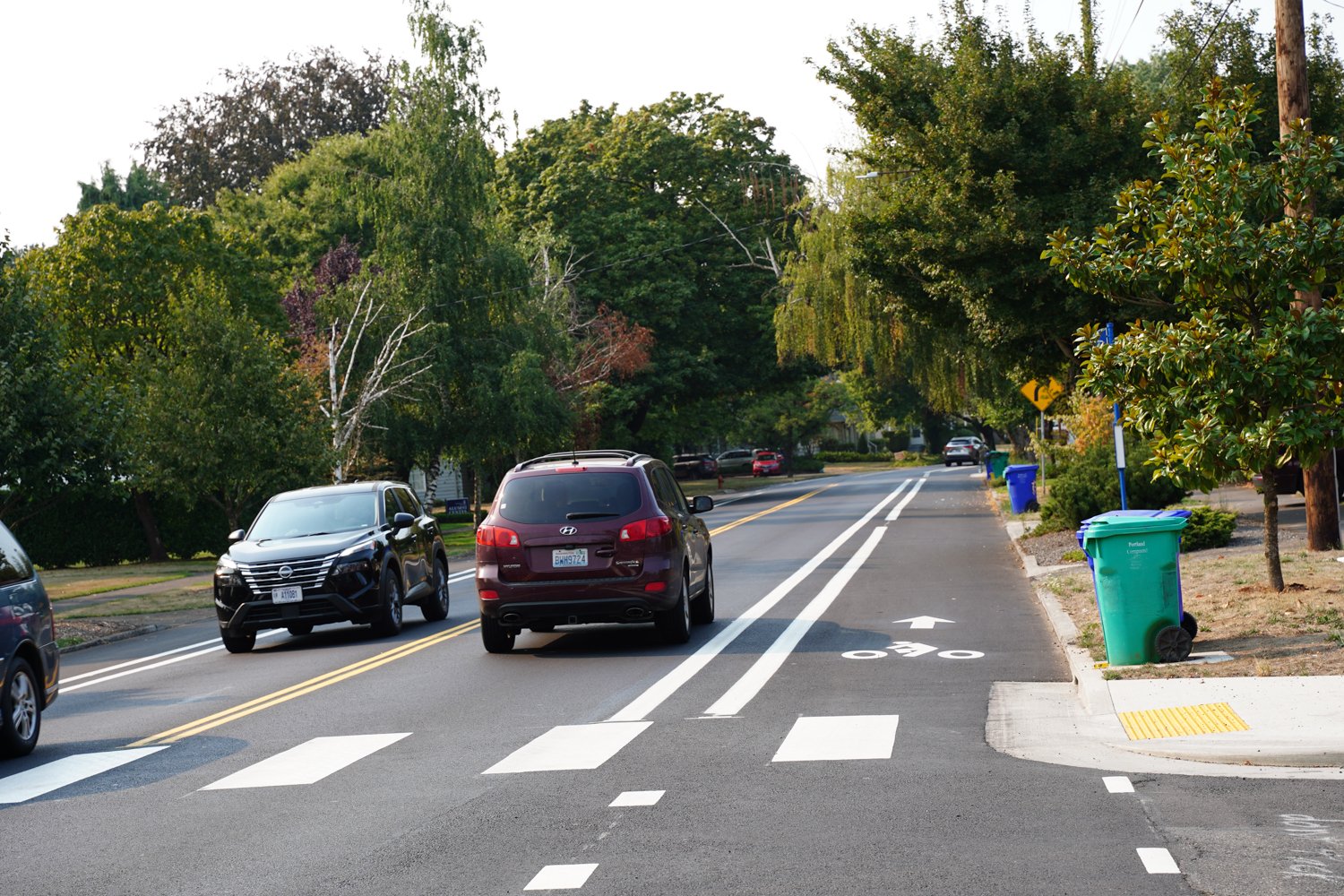
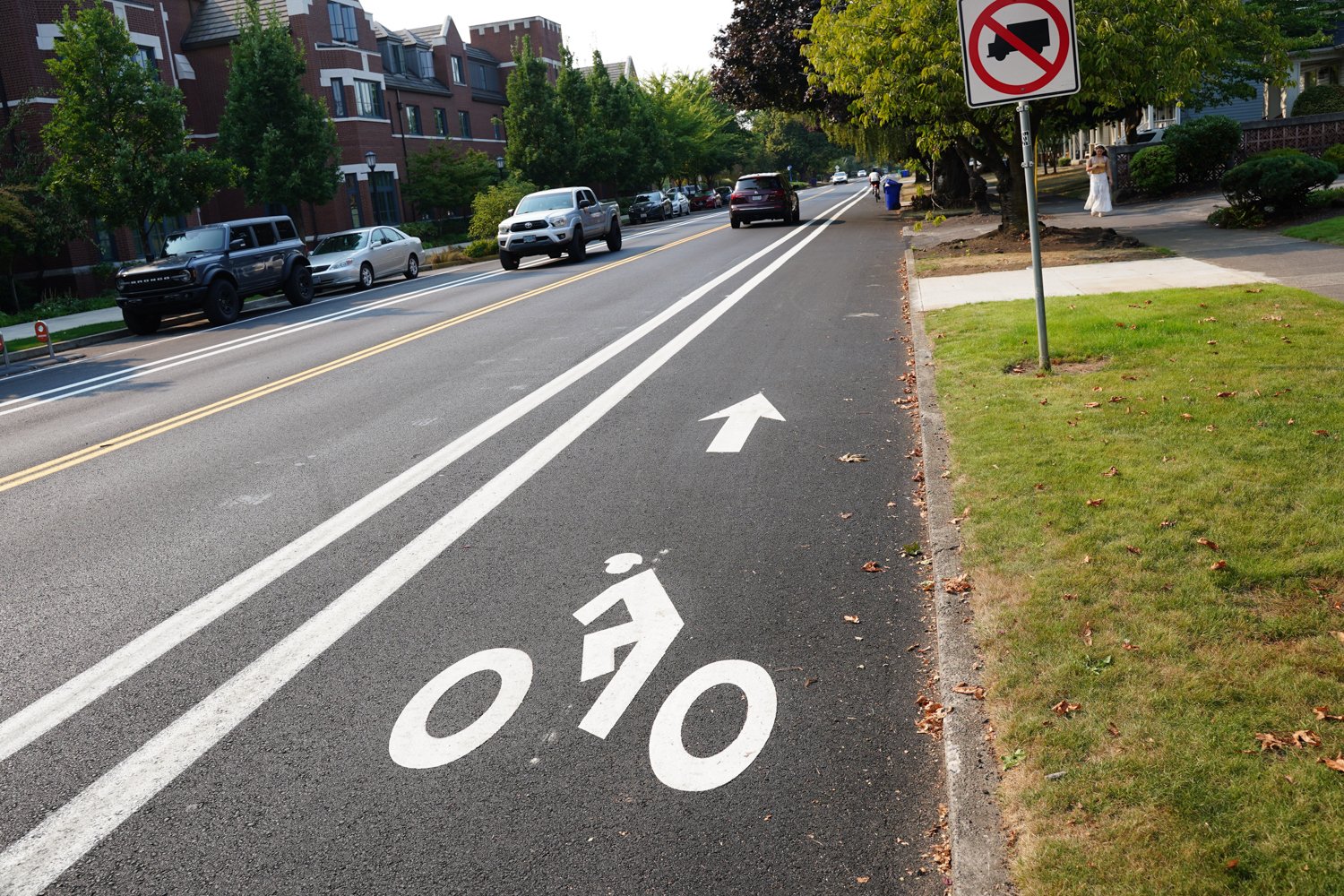
PBOT has removed on-street parking on both sides of the street between N Portsmouth and N Carey in order to widen and add a buffer zone to the bike lanes in both directions. This was done in advance of the full build-out of their North Willamette Boulevard Active Transportation Corridor project which is set for construction in 2025. In addition to the nice new pavement and wider bike lanes, PBOT has upgraded the curb ramps to ADA standards and added a few other improvements.
Below are some photos of the new bike lanes…
I love when we widen bike lanes in one spot because it shows how narrow the old design is. This is southbound at Portsmouth.
When I was away on vacation, I saw a Reddit post that shared frustration about drivers who had parked their cars in the newly striped bike lanes. I rode the section yesterday around 4:00 pm and no one was parked in them. Keep in mind that whenever PBOT makes changes like this, we almost always see a lot of folks disregard the new lanes and park in them. This is very frustrating (and sometimes dangerous), but experience tells us that eventually drivers figure things out and it gets better. (You can report illegally parked cars via the city’s PDX Reporter tool or the police non-emergency line.)
With school back in session, the timing of these newly-widened lanes could not have been better. While I was out there yesterday I saw several folks on bikes who I suspected to be University of Portland students. In terms of how these bike lanes work; they’re just very straightforward, curbside buffered bike lanes so there’s nothing surprising to report.
Another cool thing PBOT has added is a new curb extension with a bicycle slip lane and a median crossing at N Macrum that narrows the wide intersection and reduces stress for all users.
The new curb extension and bike slip lane at N Macrum. (Sorry didn’t get a wide shot. These are taken from a video I’m putting together for social media.)
Please note that this treatment is just an interim and PBOT plans to harden these lanes with concrete curbs when the full project is completed. Have you ridden these new bike lanes? Did you see folks parking in them? What was your experience?
Biking for the first time is easier with a “buddy.” That’s why BikeLoud PDX was awarded over $300,000 for their “Bike Buddy” program. (Photo: Jonathan Maus/BikePortland)
Walking school buses, a bike buddy program, and more e-bikes for people with low incomes. Those are just some of the $12.3 million in transportation-related projects that have been recommended for funding by the Portland Clean Energy Fund (PCEF) in their latest round of community grants.
PCEF is a tax on big corporations that was passed by voters in 2018 that will invest $750 million over the next five years in community-led projects aimed at helping Portlanders mitigate the impacts of a changing climate. The program is run by the Portland Bureau of Planning and Sustainability and overseen by a citizen advisory committee.
According to a report, PCEF received 230 applications and chose only 71 of them for funding. This round of grants will award a total of $91.9 million to area nonprofits. We watched this funding process closely because it was the first time PCEF included a “Transportation Decarbonization” category in their list of eligible projects. PCEF plans to fund this category to the tune of $35 million over five years.
The transportation-related grant award recommendations include 14 grants valued at just over $12 million, and you’ll recognize several of the winners. Below is a list of the projects that caught my eyes:
The Street Trust – Ride 2 Own E-Bikes for Portlanders Living on Low Incomes – $148,972 over one year
This project aims to provide affordable, sustainable transportation options to low-income residents of Southeast Portland. Key milestones include community outreach to identify eligible participants, procurement and distribution of e-bikes, and conducting safety and maintenance workshops. The project aspires to increase mobility, reduce transportation costs, and promote environmental sustainability among underserved communities. By the project’s end, 25 low-income Portlanders will have received e-bikes, improving their access to employment, education, and essential services. This initiative not only addresses transportation equity but also contributes to reducing carbon emissions in Portland.
Suma – Clean Mobility and Disability Accommodation on the Suma platform – $2,146,094 over three years
This project aims to enhance accessible transportation and expands clean mobility options for individuals with disabilities. Key milestones include researching mobility challenges, integrating new features, and launching pilot programs. These programs will offer Lime e-scooters, BIKETOWN e-bikes, pilot e-bike sales, and shared electric vehicles for affordable housing communities. The project also focuses on expanding clean mobility discounts and options for adults with disabilities. Collaborating with local governments and organizations is crucial, leading to enhanced uptake of clean mobility solutions. Goals include increasing accessibility and satisfaction for disabled individuals, expanding clean mobility options, and boosting app user enrollment, setting a standard for inclusive urban mobility solutions.
Oregon Walks – Walking School Bus Program – $964,970 over three years
This project aims to increase the safety and health of students in underserved communities by organizing supervised walking groups to school. Key milestones include the recruitment and training of volunteer walk leaders, establishing walking routes, and conducting outreach to schools and families. Major goals are to reduce traffic congestion around schools, improve student attendance, and promote physical activity among children. This program will create a sustainable model of safe, active transportation for students, fostering community engagement and environmental stewardship.
BikeLoud PDX – Bike Buddy Program – $310,683 over three years
This project aims to increase bicycle usage among underrepresented communities in Portland through a structured mentorship initiative. Key milestones include recruiting and training volunteer mentors, pairing them with mentees, and conducting a series of educational workshops and group rides. The program will also track participant progress and feedback to measure impact. Major goals are to improve participants’ cycling skills and confidence, enhance community engagement, and promote active transportation. By fostering supportive relationships and providing practical cycling knowledge, the project seeks to’create lasting changes in transportation habits and community health. Program beneficiaries include new bikers in Portland as well low-income riders who will benefit from bike repairs and purchasing safety equipment.
Forth Mobility – Community Electric Mobility for Portland – $2,221,229 over five years
This project aims to reduce greenhouse gas emissions and transportation costs for underserved communities by improving access to electric mobility solutions. Key goals include installing 20 EV charging stations at affordable housing sites, assisting 15 community partners in electrifying their transportation operations, lending electric bikes to 12 partners, and other achievable targets. Major milestones include developing a database of 100 potential locations for electric mobility technologies, helping partners apply for $2 million in additional funding, conducting needs assessments with 20 organizations, lending electric vehicles and bikes to community partners, installing charging stations, and hosting EV and e-bike trial events. This comprehensive, community-driven approach seeks to build long-term capacity and promote sustainable electric mobility in Portland.
Latino Network – Public Transit and Cycling Outreach – $1,342,939 over five years
This project aims to enhance public transit accessibility and usage as well as biking as a form of transit. Key milestones include conducting community workshops, distributing bilingual educational materials, provide 500 bikes with safety and repair kits, public transit fare assistance, and collaborating with local transit authorities. The project seeks to educate community members on transit benefits, promote ecofriendly transportation options, and improve transit services through community feedback. Major goals are to increase transit ridership, reduce transportation costs for Latino families, and foster a sustainable, community-driven transit culture.
Community Cycling Center – Increasing Access to Bicycle Safety Programming for Priority Communities by Improving Core Transportation Operations – $443,388 over two years
This project aims to increase access to cycling infrastructure and promote sustainable transportation in underserved communities. Key milestones include establishing new cycling education programs including youth programs such as after-school bike clubs and summer camps, developing a community bike hub, and creating partnerships with local organizations to support cycling initiatives. Major goals include increasing the number of active cyclists in the community, improving cycling safety, and reducing transportation-related carbon emissions. This project will engage community members through workshops and events, fostering a culture of active transportation and environmental stewardship. Through these efforts, the Community Cycling Center seeks to enhance community health, provide economic benefits, and contribute to environmental sustainability.
The other projects recommended for funding in this transportation category will help organizations purchase electric cars, vans, and trucks. One notable project that was declined for funding was Depave’s $2.5 million SE 7th and Sandy Green Complete Street. That effort to re-imagine a busy southeast Portland intersection will have to find a different way to fund its $3.5 million price tag.
PCEF says the estimated lifetime reduction in GHG emissions for the 14 transportation projects is roughly 5,646 metric tons CO2e and they estimate the projects will shift 1,658,007 vehicle miles to clean transportation options.
Grant winners were vetted with reference checks and a financial review that examined the past three years of the nonprofit’s financial documents.
These Community Responsive Grant recommendations had their first reading at City Council Thursday and will likely be adopted by city commissioners at their meeting on Wednesday, September 11th.
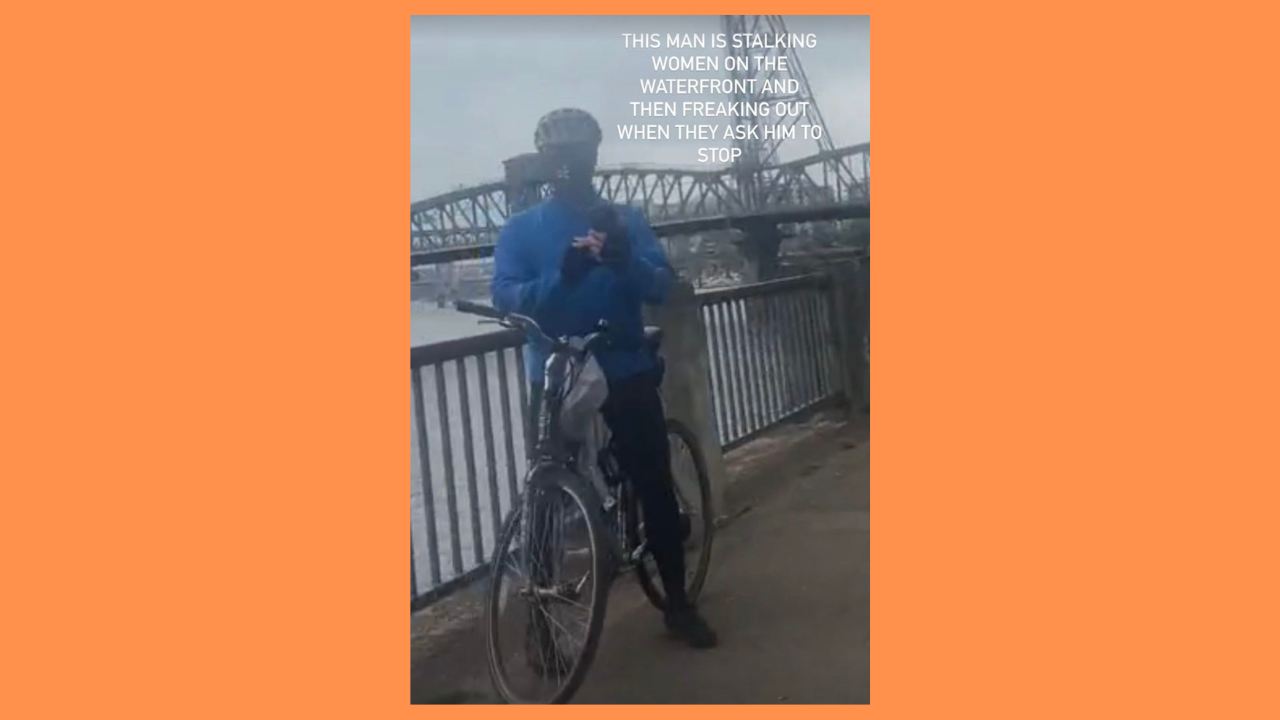
Screenshot of man accused of stalking runner on Waterfront Park path. (via @johnannabanana on TikTok)
Last month I covered a series of disturbing incidents on the Springwater Corridor and other local carfree paths. Today I’ve heard of two more things you should know about if you use those facilities.
On Monday, a person who posts on TikTok as johnannabanana shared a video describing a scary encounter with a man on a bike. The person says a guy riding a bike followed her while she was running along the Willamette River on the Waterfront Park path near the Hawthorne Bridge. In the video, johnannabanana says the man was clearly watching her run and taking video of her and then verbally assaulted her when she called him out.
Comments from other women on the TikTok post share similar experiences.
And yesterday, the Portland Police Bureau issued a statement saying they are looking for another cyclist who they say exposed himself to a female runner on the Springwater Corridor. It happened around 10:30 am Wednesday (9/4) in the area of SE Johnson Creek Blvd and SE Brookside Dr. Here’s more from the PPB:
The woman told officers she was jogging when a man on a bicycle passed her and jumped into the bushes further up the trail. According to the woman, as she approached the area, the man emerged from the bushes naked and with his hand on his genitals and he tried grabbing her. The woman managed to get away from the man and run for help.