
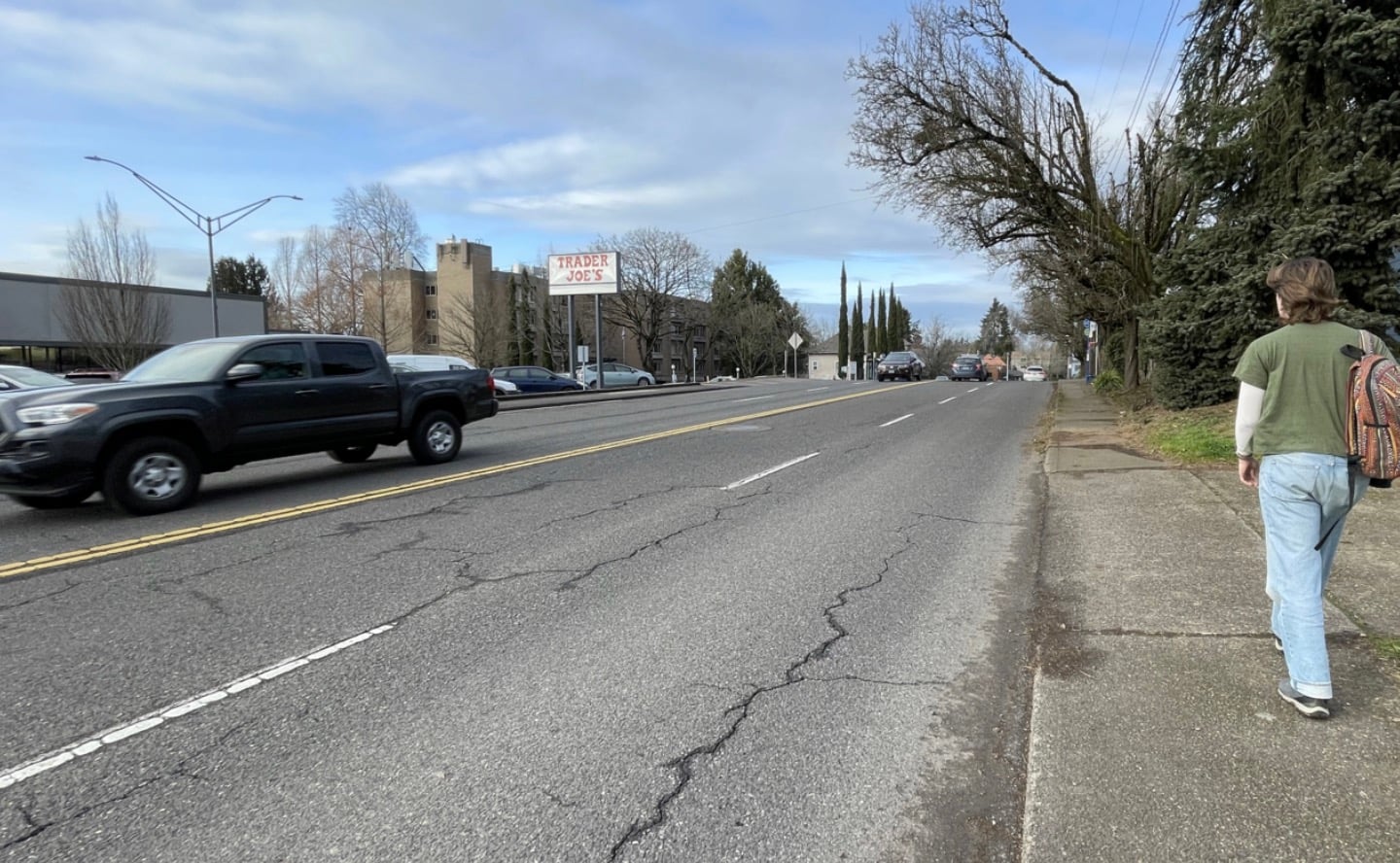
After years of fatal collisions and a steady drumbeat of bad news, the Portland Bureau of Transportation is turning the tide on Cesar E Chavez Boulevard. Last Tuesday, Mayor Keith Wilson announced that the latest budget bill passed by the U.S. House of Representatives included a $250,000 earmark for the notoriously unsafe road.
“This stretch of Chavez Boulevard is one of the most dangerous thoroughfares in Portland,” Wilson said in a statement. “This project will save lives – lives of pedestrians, bus riders, cyclists, and drivers.”
The funding was requested by Congresswoman Maxine Dexter (who replaced longtime transportation champion Earl Blumenauer in 2025) and supported by senators Ron Wyden and Jeff Merkley. It will be invested in a one-mile stretch of Cesar Chavez between SE Powell and Woodstock where PBOT will put it toward lane restriping, street lighting, traffic signal upgrades, new crossings, wider sidewalks, and more.
$250,000 won’t go very far; but this isn’t the only iron PBOT has in the fire when it comes to Cesar Chavez. As I reported last month, PBOT already has $2.2 million set aside from a state grant for the section between SE Lafayette (just south of Powell) to SE Schiller. Since that previous story, PBOT has launched a project website, online open house, and public feedback survey.
As we expected, PBOT is proposing a major road diet on Chavez that would take the profile from its current configuration of four standard lanes (two in each direction) and no shoulder, to two lanes with an additional lane for left turns (aka “left turn pockets”) at select intersections. With the space gained from this reconfiguration, PBOT will add curbside parking for automobile users.
South of Holgate, PBOT wants to build a three-lane cross-section that would include one standard lane in each direction, a center turn lane, and on-street parking wherever possible.
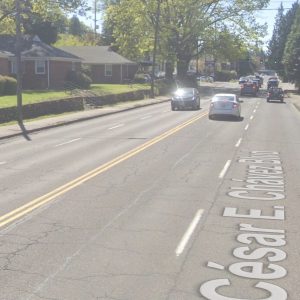
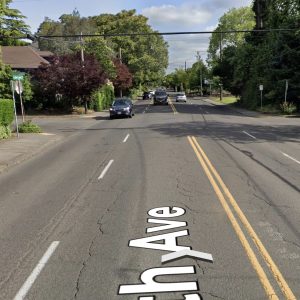
Below are current views of Cesar Chavez and SE Francis (left) and SE Schiller (right) next to the PBOT proposal:
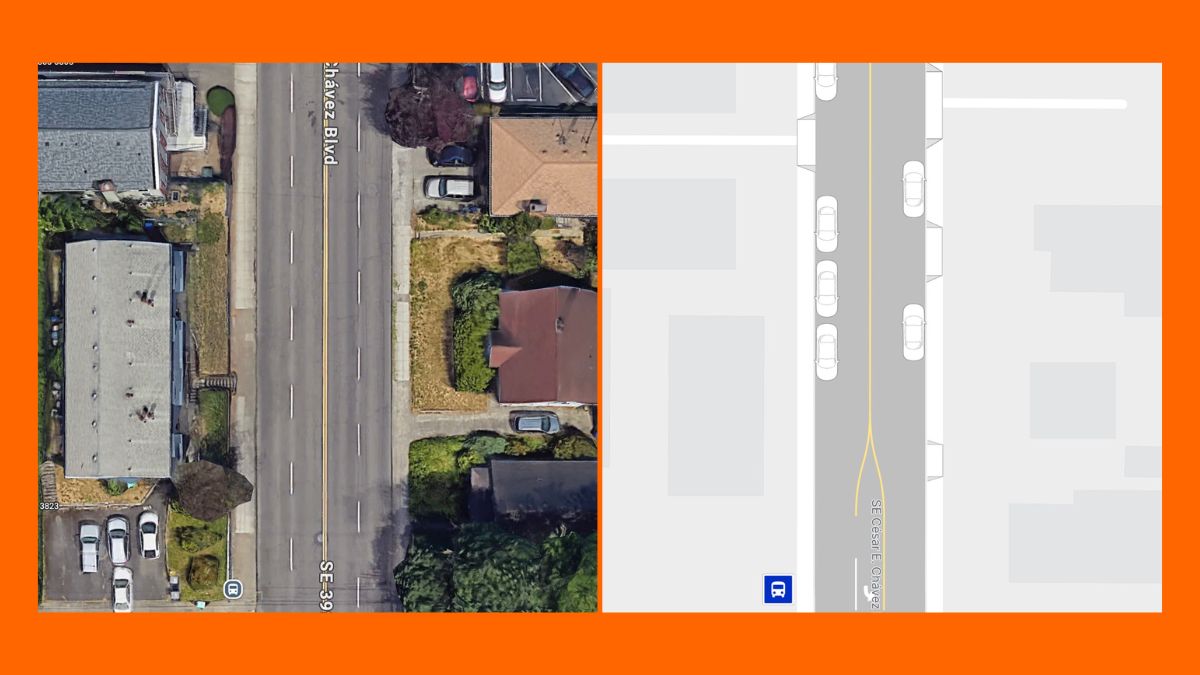
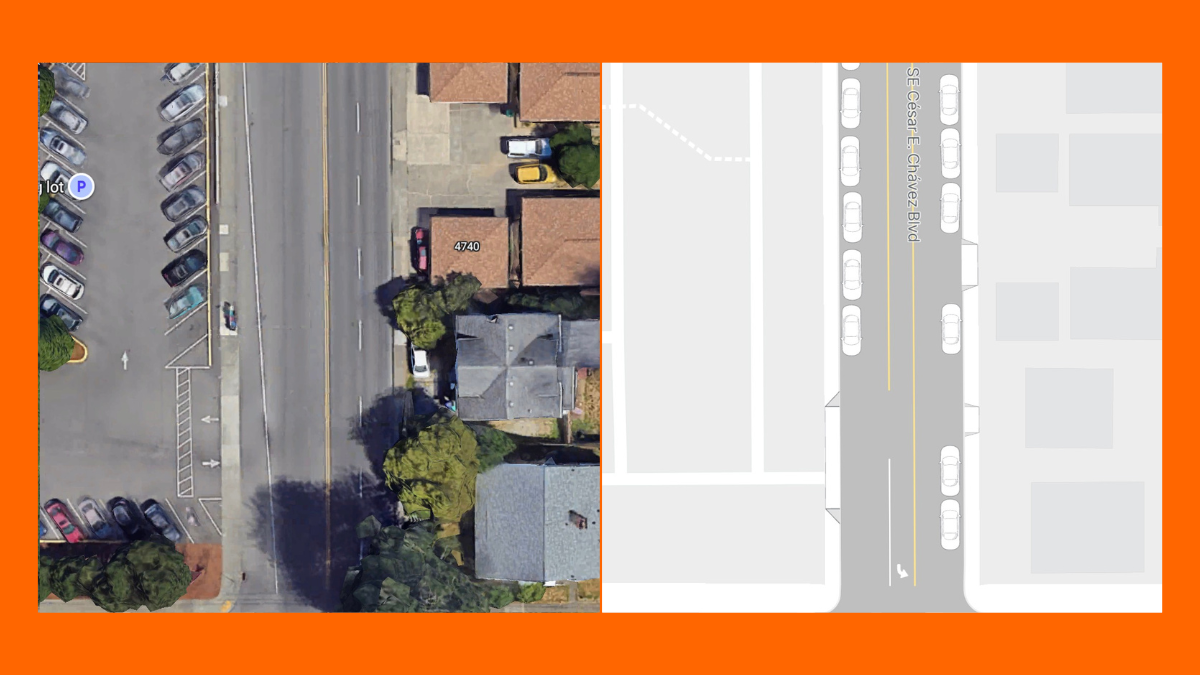
If you’re curious about why PBOT would add car parking given that none of our plans call for encouraging car use, consider that its accepted dogma that the presence of parked cars (and the humans who enter and exit them) in the curb lane has a calming effect on drivers. Put another way, on-street parking will lead to slower speeds — which is something PBOT is very interested in on a street where about half the drivers go over the 30 mph speed limit. And of course, adding parking to a street is also a way to make a road diet more politically palatable.
PBOT is also confident in their proposal because their traffic analysis shows this section of Chavez has excess capacity. “The most traffic volume in this section is southbound during the evening peak hour with 720 vehicles,” PBOT writes on the project website. “This volume is substantially lower than many of Portland’s four-lane streets.” PBOT’s analysis showed this project area has similar traffic volume to NE 33rd near Grant High School, which has just one travel lane in each direction.
Some critics might latch onto the fact that PBOT foresees a 30-60 second increase in travel times once the project is complete. But in light of the safety benefits on such a historically dangerous corridor, anyone who takes that position will have a tough row to hoe.
Some local bike advocates think there’s enough space for bike lanes instead, but it doesn’t seem like that will become a major campaign. There’s a good grid of neighborhood streets nearby, and this project on Chavez could help spur talks of a parallel greenway route that is more welcoming and pleasant. Another reason there’s not likely to be a debate about bike lanes on this section of Chavez is because it’s not a commercial main street (like SE Hawthorne or Sandy) full of interesting places bike riders want to go.
North of Powell might be another conversation. PBOT says they’re launching a study to plan for the future of that section of Cesar Chavez that will, “explore opportunities to improve safety for everyone traveling on this stretch of the corridor.”
For now the focus is south of Powell. PBOT says they plan to build this project in 2028.
If you care about Cesar Chavez Boulevard in Southeast Portland, check out the online open house and be sure to take the project survey. It’s open through March 23rd.
Thanks for reading.
BikePortland has served this community with independent community journalism since 2005. We rely on subscriptions from readers like you to survive. Your financial support is vital in keeping this valuable resource alive and well.
Please subscribe today to strengthen and expand our work.
Aren’t you always lamenting the lack of N-S bike routes through Portland? Continuous bike lanes on both sides of Chavez would be a terrific route – though a nice climb in the northern section.
Yep it’d be really cool to have high quality protected bike lanes on Chavez! Who’s going to ask for them?
SE 42nd is a lovely place to walk, run, run/walk the dog, and walk/bike to Woodstock businesses. When 39th (it was still 39th!) was repaved south of Powell, volumes did increase on 42nd. And, after, traffic went back to 39th. Can we get diverters, etc, to keep 42nd as a truly calm, low-stress bike/walk street?!?!?
Anne, great idea. I think the portion of 42nd from Holgate to Powell needs help – narrow 4.5 foot bike lanes and quite a bit of traffic, parking on one side. Parking removal = wider bike lanes? Or, perhaps a better approach, traffic diversion?
It feels weird to “honor” a historic figure by naming one of the grossest, deadliest streets in the city after them. Can we go back to calling it 39th?
Cue the Chris Rock bit about MLK Boulevards around the country.
Some of the bike lanes on SE 42nd are truly subpar and dangerous.
There are very few of those on the westside of Portland outside of the inner city.
With an empty middle lane, it seems like cars will feel safe to drive even faster in each travel lane. PBOT has a modal pyramid they are supposed to prioritize, with walking biking and transit above driving. Why does that not apply here?
I’m sure it’s a fiscal reason but it’s still pretty crazy they’d be adding a middle lane here when they’re actively closing them on 82nd and closed most of outer Division’s.
Originally, I read this and was confused. But it is certainly a fair point in the interim while the medians are in the “unfunded” phase (weren’t the medians the entire point???). While the wide unencumbered space alone tends to increase driving speed, that may be mitigated somewhat by the number of cars. On the other hand, having seen center lanes being used as passing lanes prior to the advent of medians (e.g., Foster Rd), it seems slightly reckless for PBOT to implement a road diet without any medians.
Design for what is, not for what you hope.
“Design for what is, not for what you hope.”
Amen to that!
Actually, I think the research shows that it slows speeds because the dude/dudette in a hurry can’t pass the sane person driving the speed limit. The 3 lane cross section also offers the opportunity to add pedestrian median refuges, so you can cross one lane of traffic at a time.
Plus the Bike Law says you should prioritize bike infrastructure when redesigning street, seems like both 39th and 82nd are breaking this law.
Are you sure?
The law says:
Repaving/restriping has not historically been construed to be construction, reconstruction, or relocation.
https://oregon.public.law/statutes/ors_366.514
This looks like a lack of political will to put in bike infrastructure. Did anyone ask for more on street parking? The nearby 40s greenway wanders all over the place. When we could enhance bike access why not do it?
A few parking spaces can stop a bike lane forever.
I’m all for calming Chavez but it’s worth noting it’s one of PBOT’s lowest ranked high crash streets and has none of the 30 high crash intersections along it.
But it does go right through the Portland activism locus of power. Sadly I find this, like activist transport policy, half-baked.
This is a great point idlebytes. The 4 to 3 conversion is a pretty solid safety improvement based on a lot of evidence. It’s also less likely PBOT will hear people who drive lamenting the loss of a lane, particularly because the ADT is relatively low on this section. It’s also likely this is a toe in the water towards addressing the bigger problem not too many counselors (in an election year) and PBOT are willing to directly tackle: a 4 to 3 North of Powell where ADT and deaths/injuries are much higher.
I would note that this data only appears to cover 2017-2021, and is missing at least 3 recent pedestrian deaths on Chavez (https://bikeportland.org/2025/11/26/se-cesar-chavez-claims-another-victim-398329). It may not be the most deadly street in the city, but the relatively high number of recent, high profile fatalities are likely driving the urgency here.
That data is old. We all know (and you can look up the articles here) that 39th has had much more than one death.
We also should be looking at deaths per mile. 39th is shorter than nearly all of the other streets listed. It also is relatively low hanging fruit, as it is fully controlled by the city.
I’ve brought this issue up in the past. Chavez is dangerous and deadly and deserving of improvements, but it doesn’t see anywhere close to the fatality numbers of Portland’s worst roads. I ruffled some feathers about this last year. All streets should be safe. Some streets are in closer proximity to where advocates live and bike. Every safety improvement is important and should be celebrated but still….if we cared equally about all fatalities we probably wouldn’t be focusing disproportionately on Chavez.
You are just looking at raw fatality numbers using a somewhat arbitrary measurement of street by name only.
We should be looking at fatalities per mile traveled for cars, or by pedestrian or bike trip for vulnerable users. During the COVID shutdown, we saw a huge increase in single vehicle, racing type crashes, which is going to favor streets more on the fringes. As several people have noted here, there has been an uptick in pedestrian deaths in denser areas lately. We need updated statistics with this broken down to better target the areas where vulnerable users are being killed.
I thought the plan was supposed to be to increase pedestrian safety along the corridor.
It looks like things like crosswalks, protected crossings, ADA ramps, are all listed as ‘unfunded’. SE Cora (where the pedestrian died) is listed as unfunded. Yep.
39th needs to change, but this plan seems half-baked. No pedestrian crossings, one bump-out, nothing for bikers, cars crammed in where they shouldn’t. The Trader Joe’s parking lot is getting a row of parked cars added in front of it for gods sake.
This plan feels like it violates PBOT’s own policy, but hell they have a lot of stupid policies that don’t make sense. (No daylighting 4-way intersections in neighborhoods still baffles me)
Makes sense those items would be unfunded. $250k barely builds a few crosswalks, maybe one or two half-signals. Hopefully the funds for the rest of the design are found eventually but PBOT is strapped for cash at the moment.
$250,000 from the federal government. That’s like me making a 79 cent contribution. 🙂
Adding more car parking is really the worst. The only real way to get people to not use cars in cities around the world has been to remove car routes and on street parking and make general car traffic slow. If you’ve got car parking everywhere, people will keep using cars even for very short trips. Why not make sidewalk wider or put in a rose lane?
Or move the curb toward the center and put a row of street trees on each side so walking would feel a bit safer, (and cooler).
Jonathan, is there any indication yet of whether or not the parking spaces will be separated by a painted line? Or is the design in too early of a phase for that level of detail?
I don’t like the continuous curbside parking PBOT is proposing. Find some additional funds to replace car parking at the ends and, as possible, at mid-point of blocks with tree plantings. Or at least show this as an aspirational ‘phase 2’ for this street. This solution would trade 3 parking spaces along each block for street trees and it can include sidewalk bump outs at the block ends to shorten pedestrian crossings across Chavez at intersections. A much safer and more comfortable street for pedestrians.