

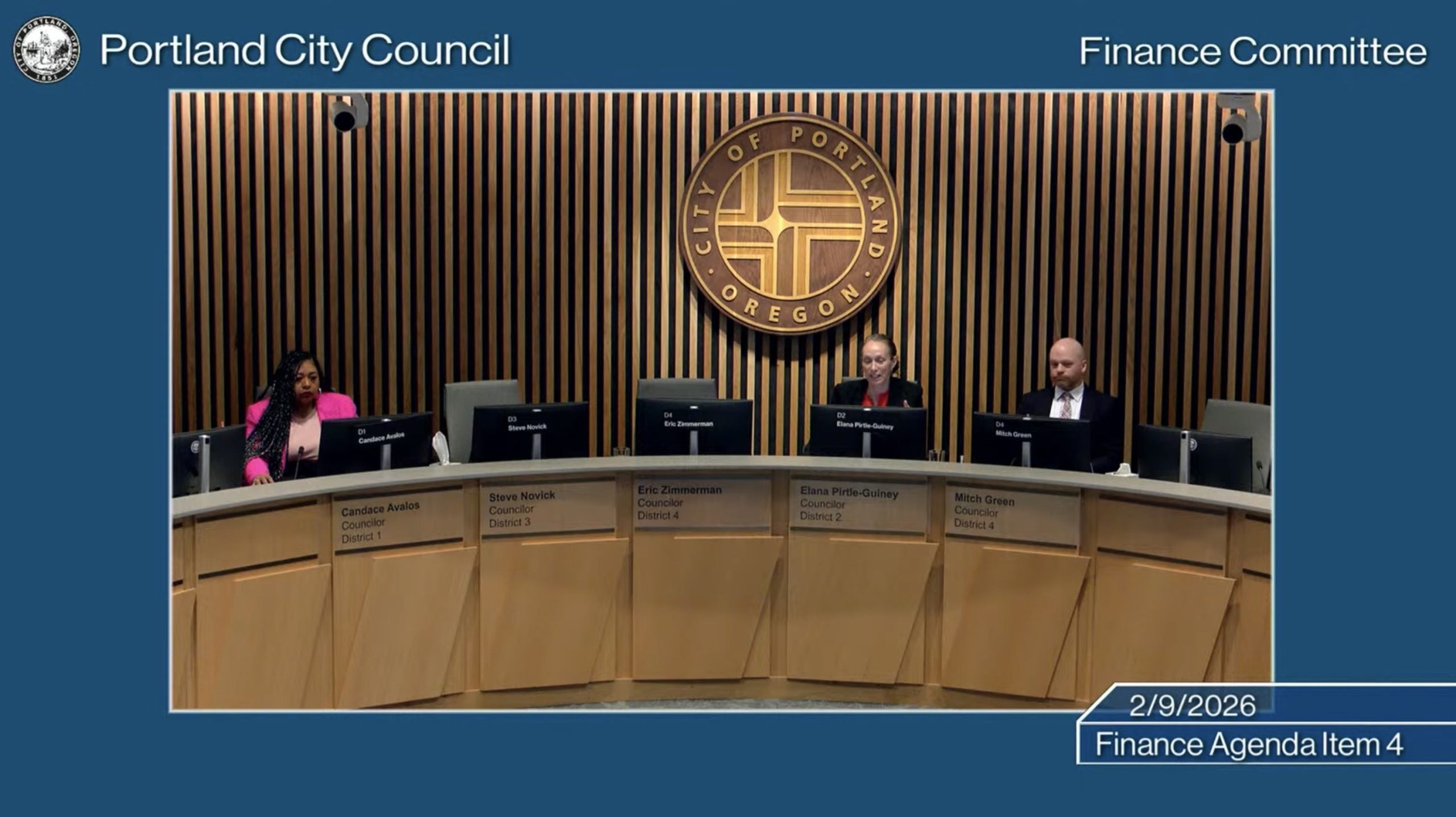
What was supposed to be a straightforward, procedural exercise at a Portland City Council meeting Monday turned into something more like a tense congressional hearing when a transportation bureau staffer was unexpectedly grilled by several councilors.
The questioning — led by District 4 Council Eric Zimmerman — appeared to have caused the Portland Bureau of Transportation staffer to break down in tears. At several moments, the woman (who I’ve chosen to not name) became upset and spoke through sobs was unable maintain composure while no one in the room came to her aid.
The staffer was on the agenda of the Council Finance Committee to present an ordinance that would give PBOT authority to obtain property rights needed to move forward with the NE MLK Jr Blvd Safety and Access to Transit Project. This $5 million project has been in the works since 2022 and is funded through a mix of federal and local sources. It will lead to installation of new crossing treatments with pedestrian-activated signals at several intersections along with ADA curb ramps and sidewalk upgrades.

Since this is the Finance Committee and not the Transportation Committee and the ordinance is about right-of-way procurement, I doubt the PBOT staffer — a capital projects manager with eight years of experience at the bureau — expected to be grilled about the project’s scope and its relationship to unrelated programs and policies. But Councilor Zimmerman saw this as an opportunity to criticize PBOT and grind an axe about a program he wants the agency to pay more attention to.
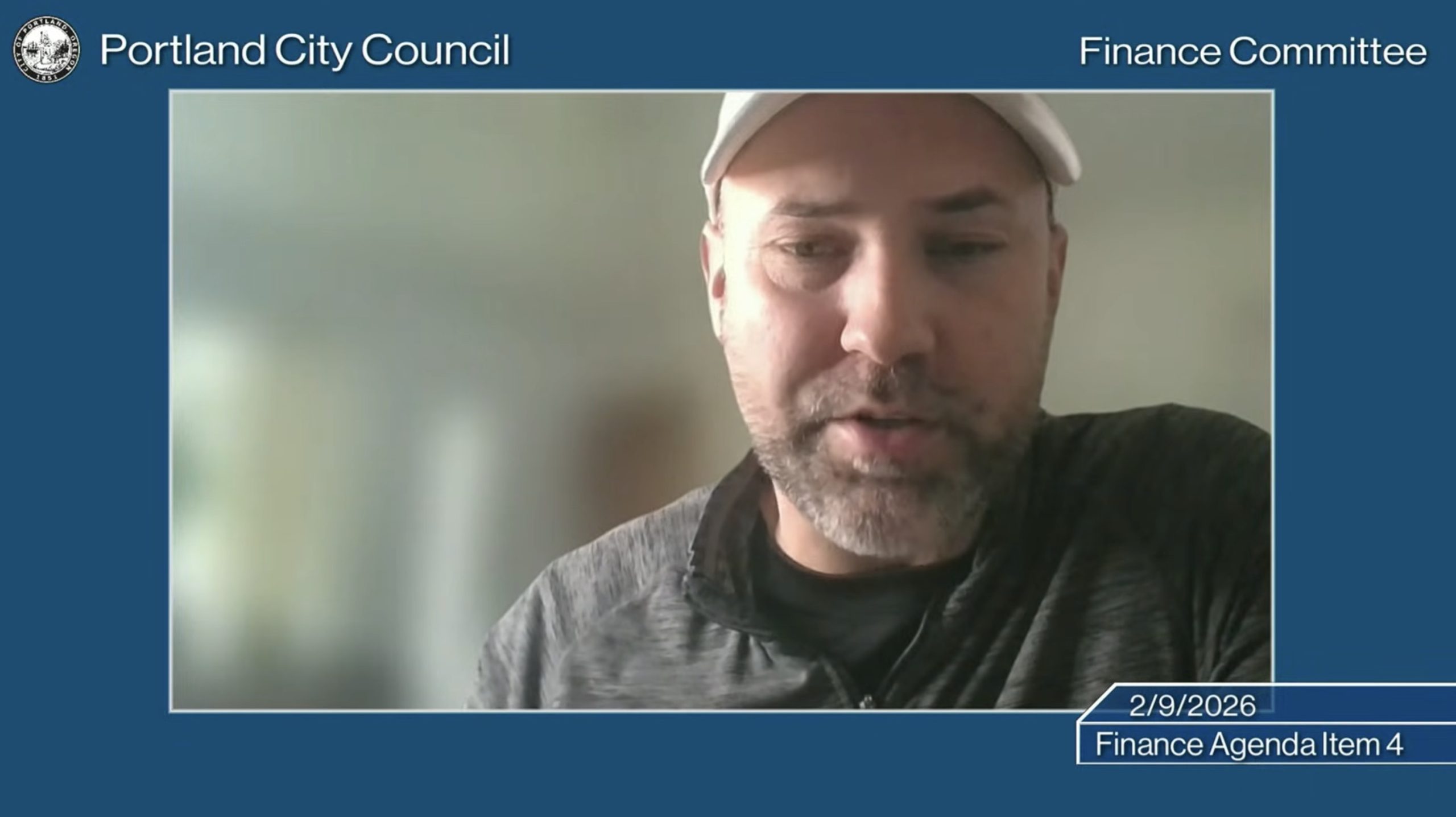
During his questioning, Zimmerman took several jabs at PBOT that were beyond the pay grade of the staffer he was speaking to. He wanted to know why PBOT was spending so much of this project’s budget on sidewalk and ramp repairs when (according to his opinion) the crosswalks are the most important safety feature. Zimmerman made it clear he might not approve the ordinance because, because in his view, PBOT was building “Taj Mahal” sidewalks on MLK where they already exist when some areas of his district (Southwest, West, and Sellwood) have no sidewalks at all.
“We are once again going to invest in bumping [the sidewalk] out and making it look like we did Fourth Avenue [a reference to the recently completed SW 4th Avenue project],” Zimmerman shared with the PBOT staffer. “I’ve seen no work by PBOT with respect to the SIPP program that was about where projects can exist that don’t have a sidewalk.”
Zimmerman was a co-sponsor of the Sidewalk Improvement and Paving Program, or SIPP, that passed council last year. The idea with SIPP is to create a nest egg of funds through debt financing, then identify places in the districts 1 and 4 where new sidewalks should be built. But for reasons unknown to me at this point (likely related to a budget crisis at PBOT), the program hasn’t gotten off the ground yet.
Zimmerman is clearly annoyed by the lack of progress with SIPP and he used this unrelated project ordinance — and the unsuspecting PBOT staffer — as a platform to drive his points home. “I don’t feel like SIPP has landed with PBOT yet, and I’d like to get a sense before I authorize this, because from Finance, we only have a couple of widgets to be able to exercise some influence here.”
The PBOT staffer pointed out that the MLK project comes from a federal grant awarded in 2022, but Zimmerman continued to press her about why the city is paying for new sidewalks when the crosswalks are the more important element.
“I’m not understanding the sidewalk part here,” Zimmerman said.
“When we install a signal, a signal pole, or rectangular rapid flashing beacon, we’re also required to update the ADA ramps,” the staffer replied.
“Who requires it? Because our ADA staff have presented to us some discrepancies in terms of how PBOT interprets that and what’s actually required, versus our own standard. Because I’ll remind you, SIPP is about places where there’s literally just gravel or mud, so we have no ADA standards. So I’m trying to understand how this makes common sense.”
Zimmerman kept alluding to conversations he had with PBOT Director Millicent Williams that ADA curb ramp work could be done, “in a small fashion versus in a large fashion.” “Which seems to be the PBOT way these days — we can’t do anything in a more smaller sense.” he added.
“It’s in my interest and the whole team’s interest to deliver this project as affordably as possible,” the staffer replied. “If there was a way to get out to sort of cost cut in that space, I would be doing it.”
Then Zimmerman replied,
“I am challenged by that, given my conversation with the director of PBOT, and given the situation that happened with the ADA ramp program and the replacement of certain staff members because of the, I’ll just say, approach that was used… I am looking for a way to get any acknowledgement that PBOT recognizes that they are able to make improvements without always completely tearing down and replacing, and I can’t seem to get that indication.”
Zimmerman then wondered if the MLK project was taking money from other projects he feels are more important. “I am supportive of these crosswalks,” he continued. “I’m just not sure that I have full faith and credit to the PBOT way of implementing the crosswalks… And that this is coming directly from my conversations with with the director looking at some programs in my own district, and saying, ‘Yeah, that didn’t have to be that big.'”
The councilor appeared to be somewhat self-aware, saying repeatedly that he understands Finance Committee might not be the proper venue for this exchange, but said, “I only get a few stabs at transportation-related things, being on Finance.”
Zimmerman wasn’t the only councilor with input. Committee Chair Elana Pirtle-Guiney invited North Portland resident Keith Edwards to testify. Edwards, a Black man, told the committee that he and his neighbors want more crosswalks on MLK. He implied that PBOT hasn’t been racially equitable in past crossing investments when he said, “The traffic signal recently installed on N Going Street is not predominantly used by citizens that look like me.” (N Going is a major bike route and neighborhood greenway used by many bicycle riders.) Pirtle-Guiney echoed his testimony and urged the PBOT staffer to expand the scope of the project. “We’re only making upgrades to five intersections. And I’ve heard loud and clear from Keith Edwards and from others in my district, that there’s about 20 intersections on MLK that need some work,” Pirtle-Guiney said.
Councilor Steve Novick then asked one of those questions that he knew the answer to, but just wanted the staffer to get on the record. He asked whether PBOT did outreach beyond one business association mentioned in the presentation, “And can you tells us why you felt that they were reasonable representatives of people in the community?” I think the staffer heard that question as a criticism and it was at this moment that she appeared to finally break and give into her emotions (video here).
“We’ve done a lot of outreach through the planning phase of this project,” the staffer said.
It was hard to watch as no one mentioned the condition of the staffer or took time to apologize or check in with her. Councilor Pirtle-Guiney eventually acknowledged the situation by telling the staffer they could take a minute recess if needed.
When it came time for Councilor Mitch Green to speak, he said he regretted mentioning the SIPP program earlier in the meeting, “Because I think my colleague got focused on the SIPP aspect of this and not the thing that you’re actually presenting.”
“I apologize on behalf of this committee if your if your motives were impugned today… that’s really unfair.”
– Mitch Green, councilor
“I apologize on behalf of this committee if your if your motives were impugned today,” Green continued. “I think that’s really unfair, and we just need to keep it focused on the thing that’s being presented.”
Zimmerman couldn’t let that go. “I’m not sure why we’re talking about motives being impugned here,” he responded. “Those are fair questions. There’s certainly no impugning of the project here.”
But Zimmerman’s tone and comments said otherwise. And Councilor Green wasn’t the only person who felt that way.
I heard from several readers who were concerned about how the PBOT staffer was treated. One of them shared with me in an email that,
“I thought the exchange was pretty appalling and I’m disappointed that Councilor Pirtle-Guiney didn’t intervene at all. Zimmerman’s line of questioning wasn’t really germane to the topic at hand, and given the power imbalances, was really a discussion more suitable with PBOT Director Williams. And it came off as hypocritical, given he voted against an oversight resolution last week based on concerns that it would create a culture of fear if bureau staff got grilled by councilors in a public setting.”
It was difficult to watch this exchange. I feel bad for the PBOT staffer and I’m sure it’s sent a chill through the bureau.
Beyond the choices Councilor Zimmerman made, this incident might have something to do with the new form of government where councilors no longer have direct control of specific bureaus. This means there’s no buffer between elected officials and agency staff. In years past, the commissioner-in-charge of PBOT would have taken the brunt of Zimmerman’s questions. This new power dynamic isn’t inherently bad, but as the saying goes, “With great power comes great responsibility.”
— Watch video of the committee meeting on YouTube. This link takes you to the beginning of Zimmerman’s questions.

Thanks for reading.
BikePortland has served this community with independent community journalism since 2005. We rely on subscriptions from readers like you to survive. Your financial support is vital in keeping this valuable resource alive and well.
Please subscribe today to strengthen and expand our work.
What a bully
And we wonder why PBOT is afraid to ever do anything bold or visionary? I was hoping having a city administrator would insulate the bureaus from this kind of politicization of minutia, but evidently we are back to the same old meddlesome bullshit.
Yes I think that’s why this hit me so hard. For these councilors to not understand how low morale is at PBOT right now and perhaps it’s not the best time to brow-beat an innocent staffer just for your own politics was really unfortunate.
Asking questions about a project you are working on for the city is Brow beating? She is I assume, a pretty well paid staffer doing her job For the city of Portland. The councilor was doing his job.
What a snowflake,
You sound ridiculous.
If I were asking someone questions in a public meeting and they started being visibly upset and unable to respond well on account of crying, I would maybe take say “let’s take 5”. You can ask probing questions to get information about spending priorities without being an asshole, and why would a capital projects manager even have the answers to the question at hand?
If you have questions about budget priorities, that’s something for the director, not a staffer.
He was not an asshole, you obviously never watched it.
He was not even questioning her when she broke down,
It is incredibly condescending to make excuses for a person who has been a project manager for 8 years.
I don’t know what brought it on but if you watched you know it was not questioning.
You comment on her without even watching it.
I think if you’re asking someone questions as a city councilor and it results in them crying, you have a responsibility as person to take a break, let them collect themselves, and apologize if something you said implied something upsetting. This is both kinder, and more practical, since the goal is ostensibly to learn about how decisions are made at PBOT, not browbeat a staffer or show how correct you are.
Maybe his questions were incidental to why the staffer broke down. Either way, the socially respectable thing to do is to check in and be kind.
Is it more condescending to “make excuses for a project manager” or to insist that their public shaming at the hands of the Portland City Council had nothing to do with them being upset? My entire point is that the city councilors should have reacted better to the situation as it happened, rather than continuing as if nothing is going on
“There’s no crying in project management”.
Tom Hanks
Did you watch it?
doubt it. who wants to watch a Portland city council meeting where they argue about the stupidest things. Its so deflating that the smart, effective politicians all seem to be in Hillsboro or Seattle.
I try to pretend I’m from a magical fantasy land instead of Portland. Pot helps.
Call a dedicated meeting about SIPP, Zimmerman.
PBOT staffer: You get a great salary, can’t get fired, and based on my experience with others in city government, aren’t overburdened with work on a daily basis–I’m not crying for you.
My job I got screamed at all the time.
I’m sure that would be news to all the people that have worked for the City in the past that have been fired. Or been part of a reduction in force.
I know people that work for the City and they are constantly afraid that the City Council will slash their bureau’s budget and be shown the door. Often times the people that go are the ones management want to get rid of.
Of course, this isn’t just City employees that this happens to. In the private sector we are all 1 paycheck away from being let go.
Zimmerman didn’t ask about the project, he asked about PBOT policy with the veneer of asking about the project. He’s talking about random conversations he may or may not have had with someone who is not only not the person testifying, but not even there as far as I can tell. How would the project manager be able to speak to a conversation Zimmerman can’t even articulately relate of, that he may have had with Williams at some unspecified point?
I’m not sure what line of work, if any, you are in BB, but project managers are not SMEs on anything but project management. If Zimmerman is confused or doesn’t understand why something is required, the best person to ask would be someone in policy at PBOT, not someone who is prepared to talk about right-of-way procurement.
If we are going to give the most grace to Zimmerman possible, he is just completely confused as to why he is there and what is being talked about, which is on him because none of the other councilors seemed to have the same confusion. If that’s the case, Zimmerman should apologize for showing up unprepared.
I don’t think Zimmerman was unprepared. As he said, he has few opportunities to advocate with PBOT on behalf of his constituents, so he wanted to take that opportunity to do it – not that he did it in the most tactful way. He’s a newbie elected so let’s allow him to learn from his mistakes and move on.
He was actually just grandstanding, not looking for answers, just making a show at this person’s expense. Asking irrelevant questions.
This was tame in comparison to some private sector corporate meetings that I have witnessed in my time. This was a straightforward questioning. It veered a bit. There was some grandstanding. This was not an ambush or “gotcha!” event for the cameras.
Internal morale at PBOT should not be a concern in this setting. Historically, you have had a soft spot for these “advocrats” (as you have labeled them) and you look upon them as fellow travelers. That’s understandable. By all means, do a piece on why PBOT staffers are struggling and the causes of that unhappiness. It’s not fair to vilify these councilors for probing how taxpayer dollars are being spent.
Also, we don’t know what is happening in the staffer’s personal life (nor is it any of our business) and it is entirely possible that the emotions coming out had little or nothing to do with this meeting.
What is Bold or visionary about this particular project.
Tell us what I am missing?
You’re missing the whole point. NOTHING is particularly bold or visionary about this project. In fact this was a presentation about a non-controversial, procedural issue on a non-controversial small project.
The point is that if this is the reception PBOT gets for presenting that type of project, why would PBOT want to expose itself to potentially far greater criticism by attempting to present a bold, visionary project?
What point did I miss? Did you watch it or just read the BP version.
Anyone who watched it saw a completely normal meeting as several people who DID watch it have commented.
The PBOT staffer was unprofessional, it was embarrassing.
Those were not hard questions.
Would you prefer PBOT be totally unaccountable?
The point you missed is what I wrote starting with, “The point is…”
This “professionalism” is and has always been utter BS propounded only by people who have never had a public-facing job. There’s unprofessional—and then there’s just being harassed because the other party isn’t being held to the same standard, and knows it.
If her behavior was so unprofessional, that emphasizes even more that the only thing to do ought to have been to pause and let her collect herself. How well can you discern the words and intentions of people crying? It’s just hounding at that point.
I haven’t seen the video, so I can’t speak to this particular situation, but pushing people when they’re clearly feeling vulnerable is just not constructive, almost ever.
Critical thinking or reading skills? They never claimed this was visionary, but you probably know that already. The implication is that it would be difficult to be visionary or bold if this is how they treat even minor policy issues.
Thank you for keeping an eye on these things Jonathan. I am so disappointed in that man.
Did you watch the session? What did he do wrong?
He was repeatedly refusing to hear a professional with expertise, instead citing his own ADA vibes, and it’s the end of winter in Portland.
I’m never not crying in that situation.
I watched the session on YouTube and thought Zimmerman was his usual polite, measured and thoughtful self. His questions were insightful. It’s fair game to want a deeper understanding of how PBOT decides how elaborate a given project should be. Does every ADA ramp need to be the Cadillac version? What’s the trade-off? Could PBOT have done more crossings if it had chosen to do fewer sidewalk bulb-outs?
And yeah, what is happening with the Sidewalk Improvement and Pavement Program (SIPP)?
As far as the staffer crying, there wasn’t any bullying or grilling going on by anybody. I’ve been questioned more pointedly by city commissioners during testimony as a member of the public. I was surprised that the staffer got choked up over pretty low-key questions.
(Oh, and remember, this is an election year for D4, so expect a bunch of politicized reactions to this. The DSA is feeling threatened by Eli Arnold’s re-entering the D4 race, so this will be a tight three-way between Zimmerman, Arnold and Green–the gloves have already come off. But watch the video yourself, pretty soft-spoken and no fireworks.)
Hi Lisa!
This is weird because we already exchanged so many texts about this story (I shared it with her before posting), but I want folks to know that you and I disagree about this.
The delivery isn’t the issue to me. Someone can be polite and measured, but I am more interested in what they are saying and the context they are saying it in. And I agree some of his points are definitely fair game, but again context matters. I don’t think this ordinance and this staffer and this meeting were the right place to ask these questions. And let’s not get it twisted, he was throwing out some pretty anti-PBOT messaging with the “Taj Mahal” and “common sense” and throwing in that part about how some PBOT staffers had been fired around this issue (of course a staffer — at an agency that is laying people off and facing job cuts — will hear that a certain way).
I also don’t think it’s our place to judge the staffer’s tolerance. The fact is she was clearly disturbed by the cascade of questions and allegations and criticisms is what matters. And the fact that they didn’t see her emotional state and catch themselves and/or apologize, or just opt to take the conversation out of the public eye was disturbing to me.
As for the SIPP. Yeah let’s talk about why that’s stalled. But what does Zimmerman think he’ll get out of a capital projects manager? He’s frustrated that SIPP isn’t moving faster. It says a lot about him that he took out that frustration on this PBOT staffer in this context and never once self-corrected. Instead when Green apologized for him, he just defended himself. Not great.
I also can see how you’d be biased looking at this conversation as a very very strong advocate for more sidewalks in District 4 and I think you are much more sympathetic to Zimmerman than I am as a result of that.
That’s the thing, JM, I didn’t hear anything like an allegation or criticism coming from anyone. BTW, I’m more than sympathetic to Zimmerman, I support him. As far as judging the staffer’s tolerance, Jonathan, come on, part of the job is being able to testify to council. The crying was bizarre.
I think you are misinterpreting the ADA question. Portland’s design parameters go beyond the Federal requirements. I don’t know exactly what Zimmerman was alluding to, but PBOT builds some really elaborate ramps, maybe that is being reconsidered. I didn’t hear a threat in the question.
I think Zimmerman had an interesting line of questioning: what are the trade-offs? how elaborate do projects need to be? can we bring more streets to an acceptably safe level if we do fewer showcase projects? It’s the type of thing that gets discussed all the time in BP comments sections, and I’m glad D4 has a representative who turns a critical eye to return on investment.
What specs constitute the “Cadillac version” for curb cuts, in your view? From a review of the project documents, the costliest segments of the project are the areas that require signalization. If the presence of bulb-outs (a fairly common treatment on streets with similar traffic levels to MLK, both in Portland and elsewhere) is enough to designate safety upgrades as a “Taj Mahal” expenditure, what other elements could be cut? What’s preventing the existing infrastructure from being considered “acceptably safe” right now, for that matter?
Crossing placement relies on completely separate traffic and safety thresholds/triggers from ADA compliance/ramp tolerances. This isn’t an either-or proposition; they’re different elements entirely.
If “elaborate ramps” are a sufficient enough sticking point to reconsider complexity, cost or placement for entire projects, I wouldn’t be surprised if slated projects in D4 bear the brunt of that. Should Zimmerman wait until the next Council meeting to ask those questions or do research?
“Fair questions” are very different from “appropriate questions”.
One thing I have noticed in Portland, since I didn’t start my professional life here, is that sometimes people will start crying as a way of fighting back. I know it sounds bizarre, but I’ve been in many meetings in Portland where someone will come under pressure – even very light pressure such as a pointed question – and start crying. It works in Portland b/c we are all so sensitive to everyone else’s feelings that any display of emotion causes us all to rise up, defend the crier, and attack the questioner. I’m pretty sure some of that is going on here.
Anyone who started professional life in a big East Coast city, as I did, will probably be able to relate to what I’m saying here and will have marveled, as I have, at professionals crying at Portland meetings. We all need to toughen up a little – and to develop deflection techniques (“I’m sorry, Councilor, but I don’t control the budgeting for projects. You’ll need to talk with [insert name of RP].”)
100% agree with this. Portland is soft to an unprofessional extreme and it’s an effective tactic to just get emotional here. It’s a trump card. There’s an expiration date for that kind of stuff and it aligns with the fact that all these governments have run out of money. There’s no room for this nonsense once the money runs out.
“I’m sorry, Councilor, but I don’t control the budgeting for projects. You’ll need to talk with [insert name of RP]”
And if, uh, you want to take this outside, we could just settle it right now.
I agree learning deflection techniques is good.
But if what you’re saying is true, and crying is that effective, then it seems like the people who need to learn better techniques would also include people like Zimmerman, who apparently walked right into what was apparently a predictable trap.
Thanks for sharing this perspective, Lisa!
Maybe she had background stuff going on, biked in and forgot to eat, or both. I want people who care so much about their jobs to do important work!
It looked to me like she got frustrated at giving great answers and still not being heard. If you haven’t experienced this frustration professionally as a woman, you are very lucky!
Agreed. I watched the hearing and didn’t see/hear comments that were especially harsh. I’ve also seen the staffer at other public events for other projects. My impression is that they are a consummate pro who has handled and managed other challenging projects. Perhaps they were just having a bad day. Glad that PBOT staffers are passionate about their projects.
None of those questions are things a staffer would reasonably be able to answer without some kind of specific preparation. They are policy questions, and it seems like the purpose of this meeting wasn’t to rescope the project being discussed. If Zimmerman wants answers to those questions, he should find a more productive time and place to ask them.
“Does every ADA ramp need to be the Cadillac version?” is just another way of saying can we make worse ADA infrastructure and not get sued over it. Maybe this staffer has an opinion on that, but if it’s not germane to the topic she’s presenting at city council, I don’t blame her for being cautious and ultimately upset about being put on the spot. Those are complicated questions to answer, and ones that you don’t want to give a wrong or misleading answer to a councilor about. Zimmerman should know this, and he should be directing questions like this to people who can give him a reasonable answer.
No it’s not. I’m a ramp user — I use a walker and sometimes a wheelchair. I wrote several articles a couple of years ago about ADA work near me that was a fiasco. It wasn’t PBOT work (it was BES work, IIRC), and PBOT had to step in to get it done to Portland specifications. But I left the whole episode with the impression that PBOT specs were more rigorous than federal specs — I could be remembering wrong, or I could have been just plain wrong, I’m not going to look into it again. Besides, that’s a side issue.
The point is that it is OK for a councilor to be politely asking these questions. It’s OK, really.
(Where was all this outrage when Hardesty harangued an apartment manager to tears a couple of years back? Wheeler had to step in to reprimand Hardesty. In the present instance, the staffer was not crying while Zimmerman was asking his questions. The tears came minutes later, after EPG and Novick’s questions.)
“Besides, that’s a side issue”
If we’re taking Zimmerman at his word, it’s one of the main issues.
We don’t need to engage in whataboutisms about incidents 5 years ago. I think it’s a problem if a staffer is frustrated to the point of tears in a public meeting; that’s not a good way to learn about issues that a bureau is facing or how they make decisions. To the extent that Zimmerman rather thanor Pirtle-Guiney or Novick are responsible for doing that is somewhat unclear to me.
I could see the testimony and words from Pirtle-Guiney as being more upsetting to be honest – the implication that PBOT isn’t trying hard enough to address racial disparities is probably stinging, and it can’t feel good to hear “you should’ve done 4x more, all my constituents are telling me they need more” along with pointed questions about if design standards for ramps can be changed to shift project priorities. And I think Novick’s question is particularly unfair. I wouldn’t want my work to be questioned in a way that implies I somehow don’t care about the people in the community who will use the facilities in the future. And I see presentation materials on the PBOT website that show staff tabling and events and that additional outreach is planned for 2026.
If council believes that PBOT standards are a root cause of projects not being delivered due to cost overruns, then they should be directing PBOT to overhaul some aspects of their project management. I think picking out one project isn’t all that useful, and that people who manage PBOT projects are constrained by the same PBOT policies that Zimmerman and the rest of council want to critique. Those policies can be changed, but not on the fly by one project manager.
And for me, the issue isn’t if a councilor is being outwardly rude, or about the specifics of the question, it’s that the result of the discussion is a staffer who is distraught and upset and the councilors don’t care. I would prefer if the Portland city council took a humanistic outlook towards people testifying, and asked questions in ways that promote good discussion and learning. If the result of a council session is a city staffer in tears, it’s safe to conclude that isn’t being accomplished.
Portland got sued by CREEC and settled, and that settlement governs when ramps get built and to what standards. That settlement supersedes federal regulations per the settlement agreement.
Hitting the “won’t someone think of the landlords” meme and scapegoating Hardesty in 2026 is not an effective rhetorical strategy outside of West Hills ***portion of comment deleted. Please don’t insult others.*** circles
Did the deflection techniques not work?
I haven’t finished the training yet. 🙂
I thought you “started professional life in a big East Coast city”. That wasn’t enough?
You are asking questions that a) Zimmerman asked several times and b) were plainly answered by the staff.
This is a “color of money” issue that I expect folks plugged into City budgeting – even at a pretty informal level – to understand. Some projects, depending on the funding and sometimes just depending on the work you initiate, trigger other requirements. In this case, as the staffer clearly explained several times, these are Federal requirements to receive Federal money for this project.
There is a good faith argument about strategizing person-power and funding over all projects across the city, and you could at a high level look at all of those and this one project and say, “hey, we don’t want to do all this work” and not do anything, or you can accept the funding and do a bit more. But – and this is critical- the time to do that is absolutely NOT to a staffer whose boss directed them to execute a project long after the decision for that project had been made. Whatever calculus about weighing projects, funding, and person-hours happened long before. The person responsible for weighing those things was not in the room, and it wasn’t the topic.
I refuse to believe you don’t understand that.
If Zimmerman’s strategy was to bring attention to an issue neglected by PBOT, look at how well he has succeeded. We’re all talking about it now.
Fraught interactions can sometimes be good politics.
What’s a “Cadillac version” of an ADA ramp? They don’t need to be super fancy, but they need to do need to be adequate. No holes at the bottom, and no spitting you out into cross traffic.
A person who works for PBOT is asked questions about PBOT project by a city councilor.
He asked no personal questions, it was all job related and she cries.
She needs another line of work, it was not bullying in any context if you actually watch it.
Its part of the job.
I am surprised at all the defense of PBOT going on here.
Damn BB will die on this hill
Zimmerman doesn’t seem to understand who he’s talking to. His questions are all entirely valid, but he should get a meeting with Millicent to pose them. It’s like me running out to the curb when the recycling is being picked up and quizzing the guy about why my recycling bill went up. Cluelessness.
Maybe not. When I ask an employee about something an organization is doing, I assume that the employee will take my feedback to the higher-ups. In fact, I will often ask the employee to do so.
He had already spoken with the director…. doesn’t that mean the higher ups are already in the conversation?
Seemed to me that was not what Zimmerman was doing, he was looking for a response.
Very interesting meeting and article. I think it’s good to bring attention to these little moments on council to get a sense of where these people are at.
PBOT coming to get the easements for a project is a reasonable time to ask why they need to have this project extent, which is what directly leads to the easements.
However, ramps are ADA-compliant or not. The picture shown in the presentation that he refers to is clearly not an ADA-compliant ramp. I design these things, and it’s not close. EPG refers to the fact that it’s a single directional ramp, but that’s not all – it’s the old curved style. It does not meet the slope requirements, and probably doesn’t have a full landing at the top. ADA (or PROWAG in this case if you’re fancy) would not even recognize it as a ramp.
So no, you can’t put in a crosswalk that isn’t ADA compliant. Especially with federal money, but even Portland-funded projects could be sued. Clearly people have kind of “yes”-ed him about some ideas about scaling back ADA projects, and it seems like he’s gotten an inaccurate impression of what’s possible. It’s actually pretty simple when you go to do these things, and you’re very boxed in by federal/state/city standards.
I fully share Zimmerman’s interest in wishing we could leave an old not-to-code ramp in place while improving an intersection, and use the extra money to infill sidewalks somewhere else. ADA has a lot of unintended consequences, which often lead to less accessible places in countless ways.
All that said, I don’t think he was out of line. He’s demonstrating his interests here, and PBOT will know what they’ll have to answer for when they bring things like this to them. He’s not a civil engineer. It seems like he needs to speak to one. If handled well, this will lead to better education for him as time goes on, and it could change design decisions as well when the manager is thinking “Can I justify this to council?” which isn’t such a bad thing either.
Thanks for the insight km. Could you link to the ramp you are referring to? I’m assuming we are all talking specifically about MLK NE Buffalo (here in the vid). Here is a better view of that crossing.
Personally, I have used crossings with a wheelchair and have found a lack of ADA compliance to be both frustrating, dangerous and almost entirely invisible to most people. Just as male is the default often when we think about a person in most contexts, fully-abled is similarly a default.
To Zimmerman’s point, certainly, there are many crossings much worse than this intersection. To Allan’s point below, 45 degree angle crossings are certainly more inconvenient. But this street (as is noted in the project site) is a stroad with systematic failures at almost every metric (e.g., speed, lane width, lack of signalized crossings, lack of speed/red light cameras, etc.).
To be clear if parking were added to MLK, that would mean the redesign of the intersections would include bulbouts and restrict MLK to one lane either way, an entirely different design that would make crossings astronomically more safe. My guess based on the project site is that option remains on the table, and Zimmerman doesn’t seem to understand that scenario. That is the part no one is saying out loud for obvious reasons. What is the likelihood that a PBOT engineer will explicitly say they’re decreasing auto capacity and potentially increasing congestion in this (already loaded) context despite the obvious safety and economic benefits?
I appreciate the perspective from a wheelchair user. And thanks for the link – it actually looks a little less bad in street view. However, it’s pointed only parallel to MLK, so it doesn’t provide a ramp to cross MLK at all. Hard to say for sure, but it also looks like it might be too steep in that lower section with a curved curb, and therefore have a major grade break that isn’t perpendicular to travel, which isn’t allowed. And I’m still skeptical that there’s a big enough <2% landing at the top. Anyway, looking across Buffalo, that diagonal ramp is a great example of a completely not-to-code “warped” style ramp.
It makes sense to me to complain about new ramps replacing existing ramps, because at least you have concrete here and you don’t have to drop off a 6″ curb to cross the street, unlike so many other locations in Portland. On the other hand, my point from an engineer’s perspective is that in a federal regulation context, these are not “ok” ramps or something. There’s no half credit. They fail. If I were redeveloping an adjacent lot and the project triggered frontage improvements, I would immediately know I have to replace these ramps, no question, no need to wait for the survey.
Agree with all your later points about the scope here – creating safe crossings almost definitely means reshaping the sidewalk, and that means new ramps. No getting around that. I think the PBOT rep could have explained that better without necessarily stating anything about auto capacity, and hopefully they’ll be better prepared next time knowing the conversation is coming.
Just one insight – MLK has a lot of the ‘diagonal ramps’ that force wheelchair users into the intersection at a 45 degree angle instead of 90. This puts them into the travel lane of MLK and the side street – even on the walk signal this is a problem.
Fixing these is $$$ – however my impression is that these mistakes from the past are really dangerous for the most vulnerable road users.
MLK will not be the Taj Mahal after this project but I have hopes that we can do something great there without using an 82nd avenue scale budget.
check out http://www.mlkpdx.org for a bit more detail
Appreciate the context and link. MLK needs a lot of attention and I’m glad folks are working on it. That said, I find the Glisan parking situation to be a nightmare — that is, the way people drive on the road zipping in, out and between traffic and parked cars. I don’t see much in the way of parking enforcement there either, for me the best case scenario is to convert our temporary parking lanes to permanent parking lanes. Whether that’s feasible for PBOT/ODOT level of service standards however..
Oh wow. I often hoped that MLK would get a road diet since it feels like it should be more of a neighborhood Main Street than a thoroughfare. How long has this push gone on? Have the organizers got any traction with the new council?
Yeah Cyclops. It’s got a lot of potential. MLK is certainly ineffective at all street functions (e.g., business support, safety for walking/biking) and road throughput. It’s an exemplary stroad. Similarly to Cesar Chavez it has the potential to act more like a street for the people who live there. Using parking (instead of cycling lanes) allows PBOT to sidestep the knee-jerk driver and sometimes baseless issue of bike lanes causing congestion and/or removing parking.
But it has to come from the neighborhood, not the council/PBOT, and as you can see below with “common sense” folks like Angus SMH, a lot of people remain hopelessly clueless about their power and the effects of marginalization. It’s certainly an uphill battle.
“….Keith Edwards to testify. Edwards, a Black man, told the committee that he and his neighbors want more crosswalks on MLK. He implied that PBOT hasn’t been racially equitable in past crossing investments when he said, “The traffic signal recently installed on N Going Street is not predominantly used by citizens that look like me.” (N Going is a major bike route and neighborhood greenway used by many bicycle riders.)”
I’m confused…so according to Mr Edwards we should only have traffic improvements that will predominantly be used by people that look like him? Given the racial makeup of Portland (~6% African American) that seems absurd.
No Angus, you’re not confused.
This is not what Keith is saying and this is not what you think he is saying. It’s an easy pretense for you to frame his argument so you can dismiss legitimate and documented bias against black people. If you don’t understand, listen to him again. Better yet, ask someone who’s been affected by systemic bias, and then listen to them.
There’s no evidence Angus is dismissing systemic bias — he responded to the quote as written and raised a fair policy question.
Disagreeing with an interpretation isn’t “bad faith.” If Keith meant something more specific about underinvestment or safety data, that can be clarified without accusing people of ulterior motives.
The argument that Keith is proposing is to pay attention to the needs of African American community, because there are too few safe crossings on MLK.
It is not:
That is indeed a “bad faith” argument or a use of logical fallacy. Angus is using a straw man argument specifically that distorts Keith’s message, and allows people to disregard the content of what he is actually saying.
This is not to say that the city has used or currently uses the lens of diversity etc. well in the past (Hawthorne Pave and Paint would be an example of that lens being used poorly). It is simply to say Angus’ argument a clear logical fallacy.
“The argument that Keith is proposing is to pay attention to the needs of African American community”
From everything I have seen over the past decade, we definitely do pay very close attention to this community, and they have tremendous power that other communities, such as the cycling community, simply do not enjoy.
You can discuss amongst yourselves how well this is working out for our city.
earwriste- this is helpful analysis, thanks! FWIW, I agree with Keith that the proposed signal is not being placed where it is needed. The Going bike route from NE 7th to the west terribly convoluted and lacks safe crossings at MLK, Williams, Vancouver, and Mississippi. Adding a signal would begin to address it, but there is no plan to address the remaining crossings for the Going bike route or the remaining unsafe crosswalks along MLK. I don’t upgrading this crossing for bikes is a good use of funds considering the rest of the route is so terrible, and it is not where the pedestrian needs. I would advocate for extending the painted buffered bike lanes on Skidmore form N Michigan to NE 7th and find a higher need intersection on MLK for crosswalk improvements.
The crossing at MLK does have a signal, that was a whole thing. And it’s fine! Keith just probably never gets out of his car enough to see anything he speeds past. From the bike side, there are people there all the time using it on foot and by bike.
It was a big improvement although it could use a sensor.
Just to be clear — this isn’t a straw man. Keith literally complained that the signal isn’t used by Black residents. Wait… so public infrastructure is only worth building if a particular skin color uses it? That’s… a weird hill to die on, earwiste.
Straw man: an intentionally misrepresented proposition that is set up because it is easier to defeat than an opponent’s real argument.
Keith’s argument: please pay attention to the needs of African American community, because there are too few safe crossings on MLK.
Angus’ interpretation of Keith’s argument:
That is a clear straw man argument.
Angus usually argues in bad faith and tropes, but in this case he’s right. Keith used that crossing as an example and complained that he doesn’t see people who look like him using it. Which means he’s full of shit or not looking. That is a busy crosswalk. He shouldn’t have brought it up if it was a bad example.
Hey John. Thanks for the ideas. You or I might disagree with the example Keith gives (I also think Going is a pretty great crossing). We might even disagree with Keith that Going is primarily used by white people.
That does not mean Keith is saying we should exclude any new infrastructure that is mostly used by white people. That is what Angus’ argument is, and that is a distortion and oversimplification meant to disregard Keith’s overall point: that the African American community has often been ignored and MLK needs more frequent and safe crossings.
Paying attention to black people does not equal excluding the needs of white people. That’s the black lives matter vs all lives matter fallacy. And that is the cornerstone of Angus’ argument.
I have to agree with Angus here: I interpreted Edwards’s comment in exactly the same way, which is that signal on Going benefits cyclists and not Black residents so it wasn’t worth doing (even though cyclists and Black residents are not mutually exclusive). It sounded to me exactly like the argument in the article about Rep. Nelson’s objections to the N Willamette improvements.
I would like to find a way for Black residents to see cycling improvements as being done in their interests and not against them.
“I would like to find a way for Black residents to see cycling improvements as being done in their interests and not against them.”
Send them some PCEF funded coaches and do marketing.
Thanks Fred. I would encourage you to re-listen to Keith’s actual testimony with open ears and reread Angus’ straw man argument. You’ve had some insightful comments on here so it’s a little depressing that you’ve been duped.
Here’s what he actually said:
I take that to mean installing the signal at Going was primarily for cyclists, despite there being a ped crossing a block away. That is, the distribution of available ped crossings on MLK should be more dispersed to benefit the black community more. I’m not sure he’s saying it wasn’t worth doing, but that the priority is not overall ped safety on MLK.
Remember his main point at the start was to highlight how few crossings are being installed under this project: 3, and how the city erroneously considers the few existing crossings to be safe.
Agreed, and that is why we should be listening to the actual words Keith is saying (not Angus’ straw man interpretation) as well as supporting him in his efforts to make MLK safer. Find the things you agree with first and work from there.
Sorry – not convinced by your argument, Mr/Ms Wrist. If you have to make such a tortuous explanation to reach your favored interpretation, then you might agree that a more straightforward interpretation – like the one Angus and I made – is the more reasonable one.
eawriste, the disagreement isn’t about whether MLK needs more safe crossings. Most people agree it does.
The issue is that Keith Edwards specifically pointed out the Going signal is “not predominantly used by citizens that look like me.” That’s the quote. When race is introduced as a reason to question a project, it’s reasonable for people to ask what standard is being implied.
If the real argument is that MLK has too few safe crossings in high need locations, that’s a strong planning case. It can be made using safety data and corridor analysis. It doesn’t require focusing on who “looks like” the users of one signal.
Questioning that framing isn’t bad faith. It’s taking the words at face value.
Thanks Jose.
That case has already been made. There is enough data to show the need for frequent pedestrian crossings. That is Keith’s argument. There aren’t enough crossings, and there is a historical reason why: the needs of the African American community has frequently been excluded because of race.
This is called the color blind argument against racism. It assumes we rarely think about race and so we shouldn’t consider it explicitly in projects or otherwise. It is a convenient ideology (if you’re not black): If we ignore it, it will go away.
Colorblindness is the basis for how a lot of civil rights laws including affirmative action and the voting rights act of 1965 were undermined. The results of the colorblind argument are: continued pervasive economic and social discrepancy between white and black people. Some people consider this a sort of laissez-fair racism.
The opposite of this theory is the theory of being “racially cognizant,” i.e., explicitly admit the role race plays in our lives (and in streetscape projects). That means it is a lens we can and should frequently use to learn, be honest with ourselves and not treat race as unnecessary “standard being applied.”
Because it’s already being applied whether we say it out loud or not.
If people are arguing there are too few crossings on MLK because black people live there, they need a completely different theory for why there are to few crossings on similar streets in white areas.
Maybe there’s a more comprehensive explanation for why there are too few pedestrian crossings on current and former state highways that doesn’t depend on what “kind” of people live there. Anyone who has dealt with state DOTs for a while might be able to offer a suggestion.
I call this the “not everything is about race and probably most things aren’t” theory of the world. But hey, I guess if you only have one card, play it.
Mr. Edwards is a long time resident who cares about MLK and took the time to come out and speak publicly. I wish those of you critiquing his words and examples would give him a little more grace. It’s hard to testify and knowing some anonymous strangers on the Internet are going to deconstruct what you said online makes it that much harder. That’s not a great way to build community and bring people in to a cause that’s so important: making our streets safer.
I happen to have spoken with Mr. Edwards personally about his advocacy for MLK. He has a lot of history and experience with organizing. He is incredibly thoughtful and very forgiving of others’ mistakes and imperfections. Maybe we could assume he meant the best be supportive of our neighbors who show up to council meetings and speak publicly.
The questions Zimmerman brought were technical and not anything like an ad Hominem aspersion onto her. Even if indirectly related to the matter presented on hand, its not unreasonable to expect a capital projects manager would have awareness of another related capital project. The staffers emotional response strongly suggests she could use some public speaking training. There can be pressure to provide comment in the moment a question is asked but its always okay (when a matter isn’t on the agenda) to inform the official in question that you will look into the matter and get back to them when you have all the relevant resources amd materials more accessible.
“The questions Zimmerman brought were technical”
They were also only tangentially related to the topic of the Council Session.
Hey Jonathan, just a thought — you’ve really turned Zimmerman asking reasonable, centrist questions into a full-on drama about crying staffers and ‘Taj Mahal’ sidewalks. Even Lisa Caballero thinks you’re reading way too much into it. Maybe take a breath before assigning villain roles next time?
I’m not surprised people would see this differently. That’s OK. I saw it one way. You (and Lisa and some other folks) saw it another way. Maybe I’m wrong. Maybe you’re wrong. Maybe no one is wrong. That’s life and we talk about it and then we take something from it and we move on. Thanks for the feedback!
And you got a lot of traffic to your site, which is actually the main thing. Good work.
Hi Fred, You clearly don’t know me. I don’t make decisions based on traffic to my site. Do you see any monetized ads on here? Nope. I don’t get paid per click.
No – I honestly hadn’t noticed the lack of ads, which is a great thing. Keep up the good work.
Clicks = $$ for Jonathan. Not necessarily a bad thing but it is the reality.
Hey Jose,
You might have missed this detail about the website:
https://bikeportland.org/2026/02/11/pbot-staffer-brought-to-tears-after-questioning-from-city-councilors-399293#comment-7575208
Some people who are normally vey composed have there “moments”. Who knows if that is the case here, and who knows what may have caused this person to become emotional. It makes no sense to draw the conclusions that I see in these comments without knowing the person and knowing what may have been going on in her life at this particular time.
100% agreed. I think there was nothing wrong with the questioning, but I do not agree with anyone ridiculing this person over her emotional response to a stressful situation. People are allowed to have feelings. She did not say anything unprofessional.
So, I have watched the video through the end of the exchange with Zimmerman and don’t actually think he did anything wrong? Like, obviously that was sort of an annoying line of questioning inasmuch as it was irrelevant to the project at hand and sort of ignored the realities of project funding and planning timelines, but it was respectfully articulated and he was clear that basically he was only bringing it up in this context because it is the only venue he has to press for progress on SIPP.
Sure, but it was Zimmerman who said it, so of course it was bad.
Or maybe it was just another politician stealing the focus from a meeting on one topic to get up on their own bully pulpit on something slightly related but not the correct committee. Heck he even admitted to his own mistake.
A politician using a forum on one topic to make a point on another one? I’ve never heard of such a thing! Shocking!
Yep, Maus does’t like our one centrist on the Council. 🙂
As someone with public speaking anxiety, I certainly understand that the unexpected line of questioning on a project you feel strongly about could bring up some unexpected emotions. I really hate how my body makes it difficult to think through questions and answers on the spot and it makes me disappointed in myself because I care about my work. I learned this early on and I will occasionally take beta-blockers to suppress my anxiety-ridden responses when I expect a situation to require a greater spot light on me than usual.
All that said, I think the councilors were within their right to ask questions about the ADA ramp replacements. We’ve all seen perfectly good ramps get torn out and replaced and it seems insane to most people I know. I thought the PBOT staffer was very professional in her responses and sufficiently answered the questions – namely this is a federally-funded project and thus, we are required to meet federal standards. It probably wasn’t the right venue for the discussion, but I don’t think anyone did anything wrong or mean, on purpose.
You show great self-awareness. You may be able to train away your public-speaking anxiety. Find a good trainer to help you do it – it is possible!
From the video, I got the impression she was having an allergic reaction, not crying, nothing particularly emotional, just a lot of sniffles at exactly the wrong time (during an open mic Q&A.)
Thank you. I had this same read too on with the exchange and somehow skipped over sobs that were nowhere to be found.
OK maybe sob was the wrong word to choose. I’ve edited that out of the story.
Zimmerman talked about staff on the ADA program having been “replaced” because they weren’t administering the program correctly. Sounds like this was done in response to a conversation that he had with pbot director Williams. I think if I was in the position of the pbot project manager in that hearing, I might look at that as being a veiled threat that he was going to get me fired if I didn’t find a way to remove project elements that Zimmerman found objectionable.
I’m interested in hearing Zimmerman’s perspective on how the original Metro grant awarded years ago under a different city administration and charter might have allocated project funds differently while still meeting the deliverables and adhering to the guidelines in place at the time. These are entirely appropriate questions for council to raise with the Mayor and city administration to figure out with Director Williams, but I’m unclear what this line of inquiry was expected to to yield from the project staff. Has Zimmerman’s office been provided an opportunity to provide additional clarification?
I do not work at PBOT, but I am a transportation planner. I am curious what the thinking was for PBOT to staff this presentation this way. Even for something expected to be perfunctory, it’s hard to imagine that my direct supervisor wouldn’t be there as backup in the role I’m in. Clearly there should have been someone there with greater responsibility for PBOT’s capital planning process. Certainly a bit of blame for someone there.
As for Zimmerman, I think the problem I have is not with his tone or even his questions necessarily, but that this is the finance meeting and he took it over completely to discuss matters of policy, funding, and engineering that no one there was prepared to answer and are fundamentally not finance questions. Just because he “doesn’t get a lot of chances” to weigh in on transportation issues doesn’t mean that he can hijack any transportation-related issue to go back over his same old talking points. It’s totally inappropriate and disrespectful to the work of the committees that DO focus on these topics and this work.
If he’s so interested in this topic, why doesn’t he actually work through normal channels to get PBOT to provide information he wants? Pass something requiring they write a report about whether they can or can’t reduce curb ramp costs, whether there can be changes to when PBOT replaces them, how PBOT balances spending on high-crash, high volume streets versus the “dirt and mud” on streets barely anyone ever uses, peer city costs and policies, etc. etc. As other commentors have noted, a lot of this is driven by Federal ADA policy as well as PBOT’s desire to have ramps that are safe. They are actually difficult to engineer, and the standards aren’t just made up – they’re to make sure you don’t tip out of a wheelchair going down the ramp, slip, end up in wrong spot in the road, etc. ADA is a “you touch it, you rebuild it” kind of policy and he should know that by now.
Well said, BZ. Nothing wrong with Zimmerman’s questions, just that he was asking the wrong person, which seems a little clueless to me. Get a meeting with Millicent (or invite Millicent to your Committee) and pose your questions. Does he not understand this?
As someone that does a lot of public speaking and on occasion does so about about civil engineering, I want to bring another view into this.
A lot of people have issues with public speaking and even more so when being in a situation where they are asked questions they haven’t prepared for. They can be on the edge of a near panic attack just from having to speak in public and maybe they can suppress that, but when caught off guard, begin to panic/get emotional. On top of that, a lot Millennials and the subsequent generations below act like being pushed on a topic is the same as being horsewhipped in public. (Couldn’t ascertain this woman’s age from the video, so I’m not saying that is a cause.) The point being any emotional breakdown could be far more about just their nervousness in speaking, or about being asked any question they are unprepared for, or some combination thereof.
It may not be about the “mean white dude” at all. (Probably isn’t.)
Councilor Zimmerman’s questions aren’t out of line. They were outside the scope, yes, but not mean or demeaning. However, she handled those questions incorrectly. The correct way to handle questions you aren’t prepared for, or in this case, are outside the scope of the discussion, is to say this, “I’m sorry, but I did not prepare answers for that as that is beyond what we were to discuss here today. I would be happy to get answers to your questions later or you can forward them to [responsible party].”
Elected officials need to understand when the time and place is to ask questions about overall funding and project strategy, and to whom to ask those questions. Today was not that time, and the person to ask was not in the room.
To be fair, asking questions is there job. Elected officials shouldn’t have to leave a calling card just to ask questions. That is part-n-parcel of how you make sure city employees are doing their job.
In this case, the questions were off topic, which the person being asked should have not engaged as described above.
To be fair, most on the City Council get briefings either from the bureaus or their assistants who get the briefings ahead of time. Don’t be fooled, the councilor knew perfectly well what the topic was, who was presenting, and what questions the presenter would be able to answer.
So yes, in this case the counselor is quite welcome to ask questions, but it appears to be more about grandstanding than being a productive member of a committee that appears he doesn’t want to be on as he has eyes for the Transportation committee where he even admitted was where his questions belonged.
Everyone is entitled to make errors in judgement, but it appears he knew exactly what he was doing and did it with purpose.
Just wanted to say how much I appreciate you writing about this. This kind of thing happens to city staff a lot… and if this is what you see in a PUBLIC meeting… yeah. I say this as a former City staffer who worked in City Hall (in the past, not under this Council). Watching the entire video made me very sad, and it also felt very familiar.
Thanks for sharing that, Brandon, and genuinely feeling sorry it felt familiar to you.
I hope to see less callousness from elected officials and onlookers here. Doesn’t really matter if a staffer should or shouldn’t get emotional in a meeting, what matters at the end of the day is how people treat each other. Especially when there is a power imbalance.
This guy thinks it’s okay to remote into a city council meeting in a baseball hat and quarter-zip shirt? Was he taking a break from a round of golf? My tax dollars are helping to pay his $133k+ salary, and he shows up to a meeting like this?! At least he wasn’t driving in his car…!
Wonder if he’s one of the same council members that have demanded downtown businesses force their workers back to the office because . . . . well to prop up the wealth of the 5 families of downtown Portland of course.
C’mon, Monty – in Portland people get mad at you if you dress up and make them look bad. Zimmerman’s outfit was fine.
“in a baseball hat and quarter-zip shirt”
Eric, look, you’re a great guy, but you’re sitting there in a T-shirt. It’s a very nice T-shirt, very green, very military—I get it, believe me—but we’re in the Council Chambers. This is the big leagues. You need a suit. A beautiful, crisp, Italian suit. I can get you a deal, I know the best people. Green is right, you’re coming in here and you have no cards. You’re playing a very weak hand, maybe the weakest hand in the history of hands. You’re asking for millions—millions and millions—but you’re showing up like you’re going to the gym. Put on a tie, maybe a little flag pin, and then we’ll talk about the cards. Right now, you’re folding before the flop, and the suit is the first step to winning.
Our something.
Did you even say thank you?
This is simply a hit piece against a City Councilor that Jonathan doesn’t like politically.
LOL. you’re projecting. Just because you see everything only through an us/them partisan lens, doesn’t mean that I do.
Jonathan, nobody’s saying you see everything through a partisan lens. Just that the zoom and lighting do seem to work better when certain councilors are in frame.
If this had been one of the DSA Peacocks of Poetland — Morillo, Avalos, Teacher Tiffany, etc. — I suspect we’d be reading about “nuance” and “context” instead of controversy.
But hey, maybe that’s just my projector flickering again.
Teacher Tiffany wasn’t very nuanced when her other assistant told her seizure-having assistant to finish the report at home after she took the afternoon off after having a seizure.
Hi –
I’d also like to provide some context as to city morale right now. People are stressed and depressed right now, which is going to show up in unexpected ways.
As part of the change in government, there are major reorganization efforts happening behind the scenes being run by people with no subject matter expertise about workflow. These are org chart exercises without no understanding of service delivery, workflow, or professional experience.
Precious City Administrator Jordan told council that he was aiming for a 20% reduction in costs, but after five straight years of cuts, the only place there are significant cost savings is in personnel. The city is about to get a whole lot more inefficient. Things are going to break.
Comparisons to what’s happening at the federal level are entirely accurate. This is a philosophical approach to the size of government without any consideration as to the work being done.
City employees have had this hanging over them for months with no transparency or deadline for hearing whether their positions are going to get cut.
I know it’s easy to demonize and other city employees. Is every workplace perfect? No. Does every (private or public) employee give 110% 100% of the time? No. Just like any workplace, we’re all just trying to do our best.
thank you.
I am very well aware of that fact and that fact figured prominently in my decision making in putting together this story. If any one of those councilors are not aware of the terribly low morale at PBOT and how their tactics at that meeting might play into that, they are out of touch and should do better.
Coming late to this conversation, so I will just say that yes – Zimmerman needs to work on his questioning technique, but also yes – he is correct that it’s beyond frustrating to see how PBOT completely neglects some parts of Portland, like SW, which has basically no sidewalks anywhere. D4 constituents like me are constantly told there is no money for sidewalks or other basic improvements in our neighborhoods, while PBOT always seems to have money to improve sidewalks where they exist in other parts of the city. Zimmerman is right to call out this discrepancy.
Also Zimmerman is right to question PBOT’s cadillac approach to projects, where nothing can be done unless everything is done. This approach keeps them from building sidewalks west of the river and causes them to turn what should be little tweaks into major expenditures east of the river.
Summary advice to Zimmerman from his constituent: Please don’t make PBOT staffers cry but do keep fighting for sidewalks in your district.
Really great points Fred. PBOT’s reticence to the use of a phased approach with semi-permanent materials is its Achilles’ heel. It would be a huge breakthrough if they were to admit that maintenance of semi-permanent materials is not an adequate reason to forego a phased approach (other cities work with semi-permanent materials quite readily), particularly in places where the gaps in separated infrastructure severely limit connections to high density/high demand areas (e.g., NE Broadway).
Semi-permanent materials/phased management schedules are used for plenty of PBOT projects- they’re also frequently a source of frustration (plenty of examples on this very site). The issues with sidewalk construction in SW are not due to the materials/quality standards, it’s the environment they’re in.
You’re absolutely right about SW Ted. It’s unfortunate that projects tend to cost more for water/sewer work.
Semi-permanent materials are used, but rarely in a phased approach. 4th ave has gotten a lot of unwarranted criticism, but I do think waiting decades for that capital project was an epic failure of policy. See Queens Boulevard as a counter example. We have been waiting for most of the high demand connections from downtown that have largely gone unchanged since the 2030 plan was written in 2010 (e.g., NE Broadway, NE Couch, SE Ankeny SE/NE 7th, N Williams/Vancouver, SE Madison etc). Most of the elements of these projects could simply be phased in with semi-permanent materials for a much lower budget.
You do have a point that some easily destructible materials such as plastic wands do require frequent maintenance. But the majority of projects can use first-phase elements of semi-permanent materials (e.g., boulders, boulders/paint, planters) that are largely maintenance-free to nearly the same effect. The city simply chooses to not do that. It is a glaring policy failure that has plagued Portland, and we only need look to other cities (e.g., NYC, Bogota) to figure out how to solve it.
We had tons of concrete planters used as traffic calming but PBOT took them out because drivers kept smashing in to them, remember? Or, in the case of SE Salmon, they took them out and replaced them with… SUV-friendly speed bumps.
Excellent point dw. It’s not a lack of funding, it’s the lack of will (and a well-funded transit advocacy group). That is why a phased approach to projects is often so much more effective. Inevitable bikelash is addressed in successive phases with input from stakeholders. The question often becomes “how can we tweak it to make it better?” and much less “It’s too much! Take it out!”
Great point! Imagine how far PBOT could get on Cesar Chavez if they used inerim materials- maybe up to Hawthorn or Belmont?
Even those “little tweaks” are generally more expensive, time consuming and disruptive in SW compared to similar projects in other quadrants. Unless the topography changes overnight, this will always be the case. It seems Zimmerman was also complaining about the actual scale of the infrastructure as well- if that truly is a sticking point, he might be disappointed in the way that impacts the execution and efficacy of projects in his own district.
It’s odd to me that you frame pretty standard inter-bureau project scheduling/procurement processes as a “cadillac approach”. The alternative is reconstructing the same project multiple times. I’m not familiar with any municipality that prefers the latter approach.
NYCDOT is a great example of the latter approach. Capitol projects tend to arrive after several iterations first starting with boulders and paint. The effect of this is an incredible number of projects that give space to peds/bikes in the first phase, and the ability for the DOT to get input on the final capital project once the money is secured. It’s a very effective process.
Love this! Let’s get PBOT to study the NYCDOT approach – but via Zoom, not via expensive paid junket for five councilors and their staffs.
PBOT already uses this approach. Results have been mixed, to say the least.
I should say I’m not opposed to these practices, and there are plenty of contexts/sites that benefit from this form of investment. However, it’s not novel, nor is it the cost-saving panacea that certain commenters (or even councilors) seem to think it is. The project sites that Zimmerman singled out in this session are well past the threshold for this type of interim approach.
These have been high-incident intersections for years now. They don’t need another traffic study.
Definitely.
Certainly phasing projects is more expensive in the long run. But what is the cost of not having a separated space on 4th avenue or NE Broadway for decades until the capitol project is built? Could that systemic lack of major separated connections along high demand corridors have had a dramatic effect on mode share?
The buy-in from stakeholders who are allowed to live in and give input on any change in a project is well worth the extra process, time and money. The existence of pedestrian/bike space today vs a decade from now is priceless.
You claimed this method was an “example” PBOT should study, despite it being a delivery process that is already utilized. This same process has no application for this specific project because of the funding sources utilized. The aspects being debated here (ADA compliance + specifications) are NOT a project element that can be addressed with an “interim” solution. There is no leeway- it either meets the standard, or it doesn’t.
The options being debated here (by Zimmerman) are hardened infrastructure (that is already funded). You’re asking for the “cadillac solutions” that Zimmerman is speaking out against.
Painted gutter lanes are “bike space today”, but I don’t think anyone would consider them to be “priceless”.
Thanks for the reply Ted. I think there might be a miscommunication.
I’m not saying I necessarily agree with Zimmerman, nor do I think the MLK crossings apply to the policy of using semi-permanent materials. ADA compliance is not germane to the topic I am discussing.
Right so I am asking for exactly the opposite, i.e., a policy of phasing in separated space with temporary materials similar to other cities. I don’t like the phrase “cadillac solutions” because it implies the capital project was in some way unnecessary. I don’t think that is accurate.
Portland’s policy of avoiding the use of semi-permanent materials in first phase is an enormous policy mistake.
Semi-permanent materials do not necessarily equal poor quality or “gutter bike lanes.” For example, the recent NE Broadway design which Portland has been planning since the 90s used poured concrete/asphalt for its first phase. Many of those elements (e.g., islands) could easily have incorporated paint and planters/boulders at a much lower cost at a much earlier date (similar to the better block design). That was a policy decision that kept NE broadway unchanged for decades.
Here is an example of a study on daylighting and street safety, which demonstrates the effective use of granite blocks and paint in the first phase of building on a wide variety of projects not limited to (pg 14): road diets, protected bike lanes, pedestrian islands, etc. PBOT does not do this as a matter of policy.
You’re talking about a completely different aspect from what Fred and Zimmerman were referencing. Your example only applies to the procurement phase, while Fred was referring to standards and specifications that get triggered by various site parameters. There is no “interim” option for detectable warning surfaces, for example.
Many capital* projects in the city (particularly bike and pedestrian infrastructure) ALREADY follow the phased/interim approach, particularly for bulb-outs and PBLs. You can go to pretty much any part of the city and see examples that exist today (usually looking worse for wear). This isn’t novel at all, and doesn’t relate to what Zimmerman chose to hone in on, which involved the actual permanent project elements.
Also, NYCDOT is one of the last agencies that I would use as a point of comparison with PBOT.
Much appreciated Ted. Maybe you could go into a bit of detail for readers on the process if you have time and when/what type of interim materials can be used. Apologies, I was referring to what Zimmerman was addressing as a general policy, not for specific projects such as on MLK.
4th avenue was a full capital project with no phases. Much of the NE Broadway pave and paint is using concrete in its first phase (other than the Betterblock demo). The Foster Road project poured concrete with no phases. The vast majority of projects use poured concrete in their first iteration.
Can you give some explanation on your position? Here’s McGuiness Blvd done largely in its first phase with paint and rocks. Why does PBOT avoid the paint+boulders approach that creates pedestrian plazas, protected bike lanes and pedestrian medians among other things, almost overnight? TIA
There are no “interim materials” that satisfy ADA compliant infrastructure. It’s either compliant, or it’s not. You seem to be discussing a different topic from what the council meeting addressed.
“The vast majority”, or just some of the examples that you posted? Both SE Foster Rd and NE Broadway had existing paint-based lanes (i.e. an “interim” solution), and the curbs were assuredly not ADA compliant (especially on Foster). Other projects like N Willamette and Naito Pkwy had the lanes widened and buffered in advance of the planned hardening. Are you suggesting that we turn down federal funding for shovel-ready projects in favor of more expensive, time consuming, and unsure alternatives?
Remember, the project being discussed (and that Zimmerman threatened to oppose) involves pedestrian and signal infrastructure, not bicycle infrastructure. These have a completely different set of standards and tolerances, including compliance with a class action settlement. Penalties for an absence of continuity in new builds (for example, pavement gaps or ramp slope) are much more strict compared to, say, bike lane continuity.
Even disregarding scale, Portland and New York City have completely different labor pools and funding structures. The civic government responds to different incentives. The level of demand (and subsequent justification for infrastructure) responds differently as well. Peer cities are a better point of comparison for the infrastructure specs and delivery processes that are attainable. Even then, most novel solutions will likely be related to funding mechanisms, not project delivery.
PBOT already builds those “overnight” pedestrian plazas- the processes that lead to them (even in New York) are assuredly not as quick, cheap, or frictionless as you seem to position them. Talk to some local stakeholders (i.e. property owners) to figure out why there isn’t the “overnight” infrastructure that you desire.
Thanks for replying Ted. Yes, again, I’m talking about general policy for using temp materials in building the first phase of major capital projects. ADA compliance is not relevant.
No, I am suggesting PBOT use semi-permanent, movable materials prior to pouring concrete/asphalt as a matter of course in the first building phase of most capital projects.
The comparison of NYC to Portland does not preclude in any way the use of temporary materials in the first phase of most projects. Other cities do this frequently. Vancouver, Berlin, Paris, Bogota, Boston also often use temporary materials in their first phases/demos. It is somewhat common practice elsewhere.
They take endless advocacy/time by Transalt and the city council, and sometimes they are torn out (see Bedford Avenue in Bedstuy). And yet after the DOT has completed a design, at the start of the building phase, crews typically place paint and rocks to transform a street/plaza within days. That is an effective policy decision to transform a large space relatively quickly and cheaply prior to acquiring the full capital funding. Portland can but does not do that.
Not only is it relevant, it’s the entire reason for this council session in the first place. Zimmerman’s objection was based on the (legally binding) procurement processes that use site-specific triggers to define infra. specifications. His “idea” was that PBOT could “make improvements without always completely tearing down and replacing” existing infrastructure.
Here’s the disconnect: the process that you’re discussing refers to design elements that are included, not the actual specs. of the infrastructure. An analogy: If you’re publishing a website, the UI or UX is entirely up to you. What isn’t up to you are the web protocols.
“Using temp materials in building the first phase of major capital projects” is a method that PBOT already utilizes. What it can’t be used for are elements that need to be COMPLIANT with funding mechanisms or tolerance standards. These “interim projects” are still designed in accordance to specific tolerances. You cannot get away with “semi-permanent, movable materials” for, say, tactile strips; it either passes or fails. What you’re suggesting in this context is akin to installing an “interim” traffic light or highway guardrail as a project element, while ignoring the standards that dictate their placement (or necessity, even).
None of these are “peer” cities with Portland. The degree of demand (and subsequent justification) for certain infrastructure projects relies on different incentives. Look to cities that have similar levels of traffic, economies, funding structures, etc. if you want an apples-to-apples comparison for what is actually attainable here.
Again, PBOT uses this interim approach ALREADY. Have you ever been on site for pop-up plaza or traffic diverter construction? Are you aware that the construction sequence is pretty much the same as the NYCDOT projects? We’ve had plazas built “within days” before. This isn’t an issue with project delivery; the point of friction is stakeholder support.
I agree with much of what you’re saying in spirit, but it’s not applicable to this specific scenario because this council session was focused on aspects of infrastructure that are binding requirements- it does NOT involve design elements. “Policy” is not the same as “Procedures”, and you won’t gain much ground if you conflate the two.
Thanks Ted. I appreciate your efforts.
It occurs to me that back in the olden days, the person ultimately responsible for PBOT would have been sitting right there in the room and would have handled some of these higher level, more politically inflected questions.
Now, no one on Council is an expert on PBOT (or any of the other bureaus) and there are many fewer opportunities for a counselor to get information that they might need to do whatever it is they do.
I expect to see more examples of counselors asking questions that are slightly off topic in the future, and I look forward to more articles about that as time passes.
Yes exactly. Also, did you happen to read the last paragraph in the story above where I said almost the same thing?
So you did! We’re like two peas in a pod, you and me.
Clearly Council needs to figure out how it will work with bureaus that are by their nature opaque, but without the direct access and expertise Council formerly enjoyed (and even if there were a councilor who was somehow an expert, there’s no reason to expect they’d be on the committee when their expertise was needed).
I expect this will lead to a more adversarial relationship over time, with the bureaus taking marching orders from the mayor, staffers in the room unable to speak to the “why”, and councilors getting frustrated that their policy goals may be encountering roadblocks that are perfectly understandable once explained, but without anyone who can explain them appear to be the result of stonewalling and obstinance on the part of PBOT staff.
Which is a bit like what happened here — Zimmerman wants PBOT to be doing something, and they’re not, and staff can’t explain why (even if there are perfectly good reasons), so everyone is unhappy.
I don’t know the solution, but I think expecting Councilors to stick narrowly to a particular topic decided in advance is likely not going to work.
I’ve seen City staff (and a partner from a major law firm) cry several times in hearings, and in private meetings, including three I can recall where it was just me and them (one was a bureau head). Anyone out in the world has seen it happen in other contexts with people who deal with the public.
Sometimes (not in the meetings just with me!) the trigger was someone belligerently badgering them.
There may have been things going on in their lives that made them more prone to crying, but I have no way of knowing that.
What seemed most common was they seemed trapped in a situation, where they may have felt they couldn’t lash out back at someone, or tell them they were wrong (either because they knew the person WASN’T wrong, or was wrong but they’d get fired or attacked if they said that).
In this case, even if Zimmerman wasn’t really attacking, he was asking questions that were best directed to someone above the staffer. That puts the staffer in an awkward position, and it can take some high-level skill to maneuver in that position. You’re basically having to tell someone tactfully they’re asking the wrong person, or saying your boss put you here when they should have been the one getting grilled, etc.
It reminds me of a customer confronting a clerk. The customer may have fully valid complaints, and the clerk IS the person the company presented to them to handle complaints. But aiming everything at the clerk often isn’t as productive (and certainly not as fair to the clerk) as talking to the, well, manager. And the worst is aiming everything at the clerk in a crowded room with everyone looking at you both.
respect to the staffer for being there. big bro literally phoned it in
BikeLoud clearly has an ax to grind. No one who watches the entire exchange could possibly, fairly, villainize Councilor Zimmerman. He never raised his voice, he literally said, more than one, I appreciate you being here, thank you, etc. This PBOT staffer’s actual job to be able to understand this project and answer questions about it.
Hi Helen,
This is BikePortland, a news corporation. BikeLoud is a nonprofit advocacy group.
Also, I watched the entire exchange and came to a different conclusion.
I’m not sure why this is newsworthy.
An exchange that privately might have been this staffers’s worst day on the job and an unforgettable albeit bizarre moment for the handful of people who attended the meeting has now been memorialized as the object of scrutiny by this website and hundreds of commenters who have no shortage of opinions about decorum and appropriateness. What are we supposed to learn from this?
That everything on the internet is potentially newsworthy, so maybe don’t post things you don’t want others to know about.
That everyone has different opinions, and that’s ok.
I don’t know that anyone was “supposed to learn” anything specific, but I found plenty to learn from the article, and especially the comments. That includes commenters with widely divergent views.
The parts of the article and comments that focused on the dynamics of personal interaction and communication will probably stick with me longer, and be more applicable and valuable in more future situations for me, than if the article had focused on say, project financing details.
The fact that there were so many comments (although not your “hundreds”) is a sign the topic struck a chord with people, and I especially liked that several people whose opinions I value had such varied responses.
What I’d like to see is a follow up story in which JM interviews the staffer and finds out if she was upset, if she felt she was being bullied or not, and if maybe she was reacting to someone else’s very strong perfume or other allergen, or maybe getting over a cold that day. I’m not expecting it, but I think it would clear the air a bit on this story.
Soooo, both the staff and councilors are doing the jobs we are paying them to do. Kudos to the PBOT staff for persisting in getting the ordinance approved, maybe just not as smoothly as was expected. And I appreciate Councilor Zimmerman asking questions that I and many of his constituents have about how decisions are made and funding is allocated to pedestrian safety projects. We want our school-children, seniors, people who look like us and don’t look like us to walk safely in our city and don’t know how to make that happen.
Kudos to the PBOT Project Manager for their attempts to answer Commissioner Zimmerman’s questions. This looked like an ambush! Makes one wonder what PBOT Director Millicent Williams previously relayed to Commissioner Zimmerman regarding the requirements of the ADA and the City’s ADA Class Action Settlement Agreement. It wouldn’t be the first time the Director has misrepresented and attempted to sway opinions for political gain and throw hard PBOT working staff under the proverbial bus..These are hard times. Hang in there PBOT staff.
Oh these peacock bullies are great aren’t they? Can’t wait for the next elections.
All this hand wringing with Maria Sipin in the same district offices as Green and Zimmerman