

Imagine the irony of a transit agency not building dedicated bus lanes because they’re worried about how it might impact car traffic on nearby state-owned highways. That’s the position TriMet is in as the agency ponders a decision on dedicated bus lanes in their 82nd Avenue Transit Project.
As BikePortland has been covering for months now, a key decision about the extent of “Business Access and Transit,” or “BAT,” lanes on a 10-mile stretch of 82nd Avenue has been become fraught. TriMet faces threats of lawsuits from business owners who say the lanes would drive car-using customers away, while BAT lane boosters (which include advocacy groups, politicians and more than one TriMet board member) say they won’t stand for even one block to be built without them. In the middle of the controversy are TriMet project staff who’ve felt heartburn over increased costs of a design option known as “More BAT” — which would build semi-dedicated bus lanes on nearly the entire scope of the 82nd Avenue project — might delay and/or otherwise jeopardize the project timeline.
While we’ve understood “More BAT” would come with more costs since this story first heated up back in September, now TriMet has shared another hurdle for dedicated bus lanes to clear. In documents shared ahead of a key project committee meeting tomorrow (Friday, January 16th), TriMet has laid out seven “areas of concern” that have been identified by the Oregon Department of Transportation (ODOT).

This entire project is possible because ODOT transferred jurisdiction of 82nd to the City of Portland Bureau of Transportation, so why is ODOT still sticking their neck in PBOT’s business? Because 82nd Avenue is 3,400 feet away from Interstate 205, it crosses Powell Blvd/Highway 26, and the northern part of the project touches ODOT’s Highway 30, also known as Northeast Lombard. ODOT worries that if more space on 82nd is dedicated to bus travel, less of it will be available for car users, and the resulting diversion could cause congestion and crashes on/near their facilities.
As many of you know, transportation departments live and die by highway design manuals (both state and federal) that tell engineers and planners how to respond to various levels of auto traffic. Models based on lane characteristics, current and predicted traffic volume, distance between signals, and so on spit out numbers that tell engineers whether a design will succeed or fail (in the eyes of the manual). If engineers and planners willingly choose a design the formula says would fail — one that exceeds the target volume-to-capacity ratio, or v/c — they must receive permission from ODOT through a “design exception” in order to move forward.
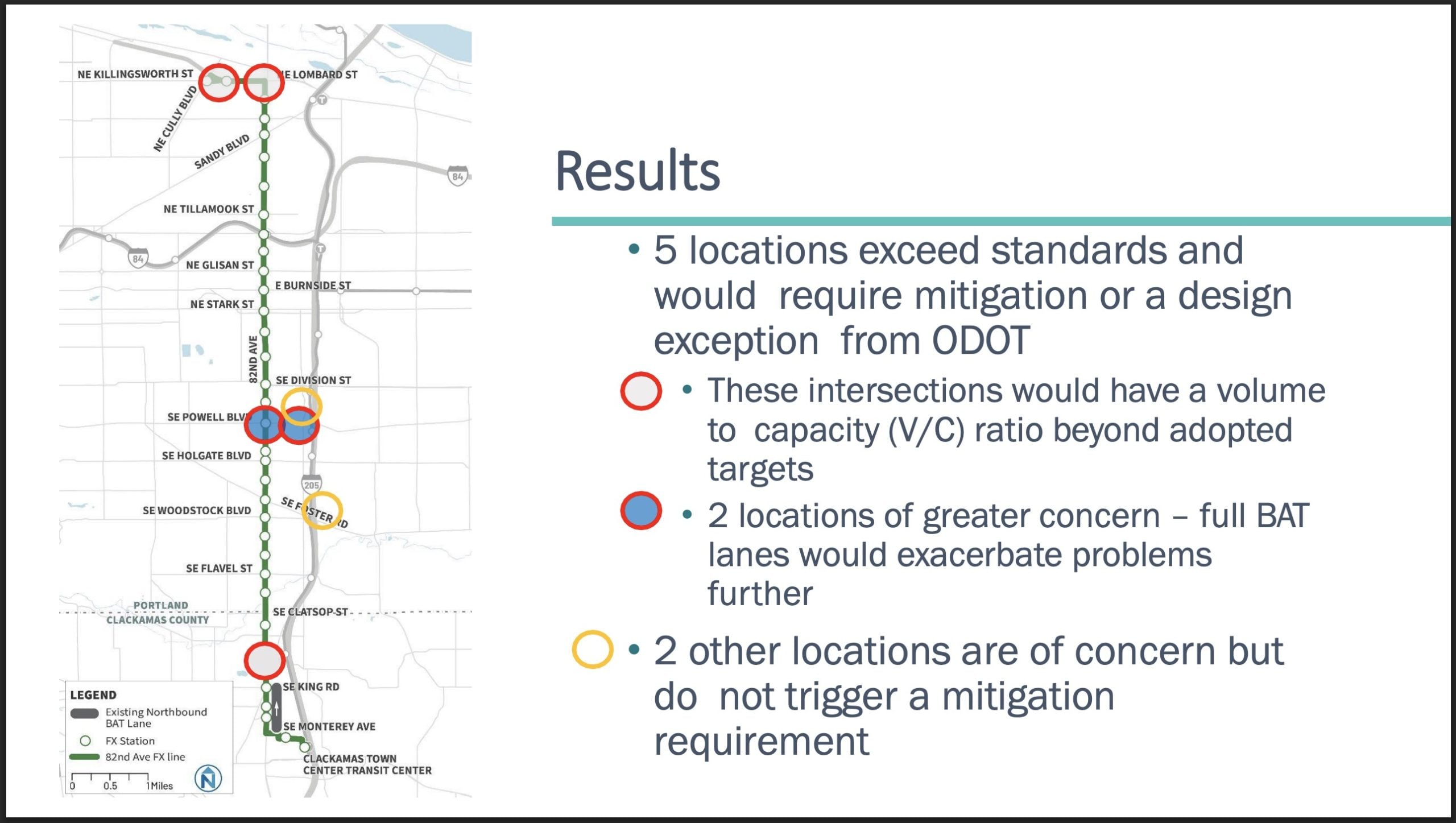
According to a presentation ODOT will share at the 82nd Avenue Transit Project Policy & Budget Committee meeting Friday, they found seven locations where this might become an issue. ODOT says five of those seven locations require some sort of mitigation (such as a change in the design) or must receive a design exception.
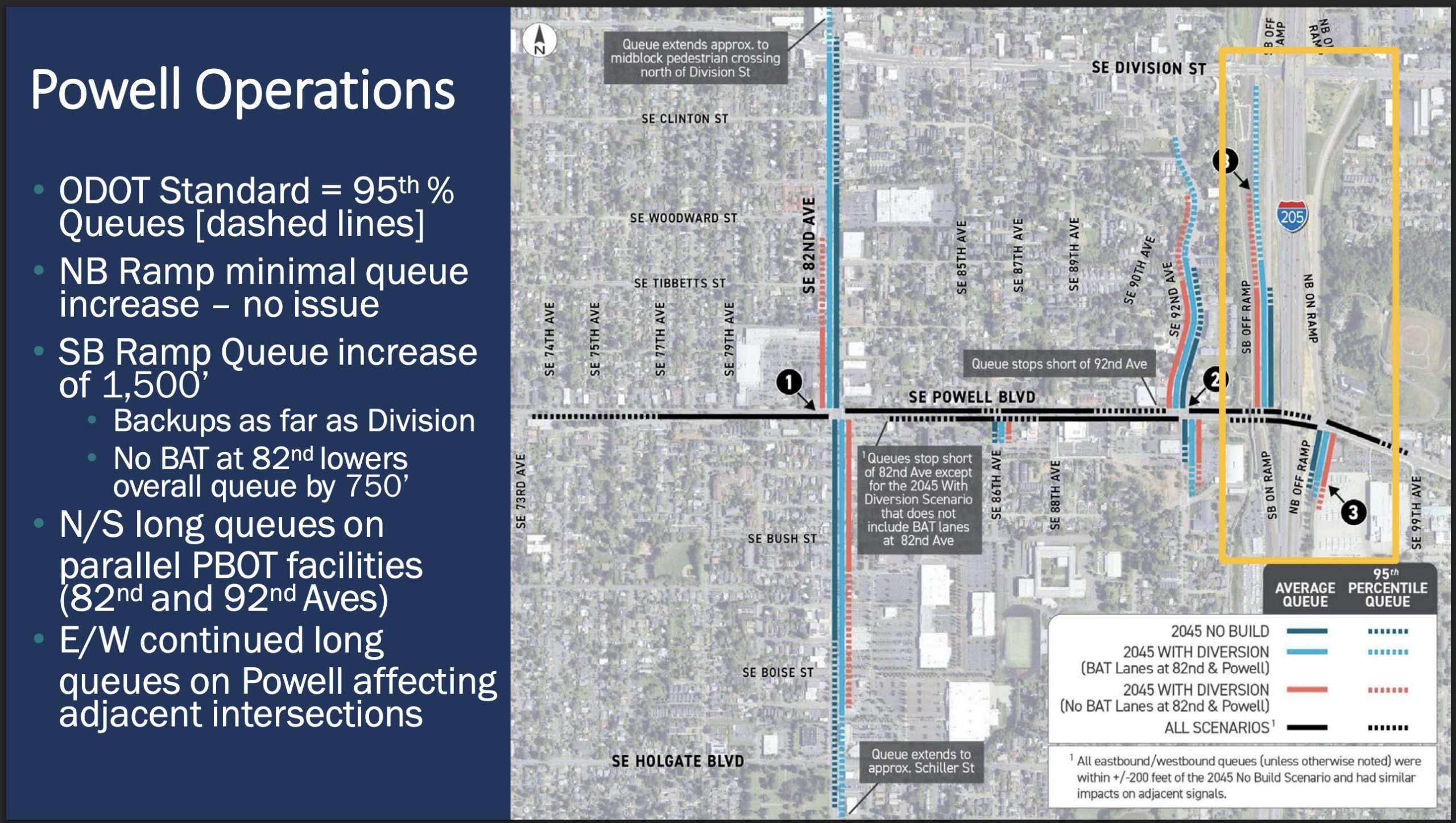
We got a hint of these challenges at the December TriMet Board of Directors meeting when TriMet Interim Director of Major Projects Michael Kiser mentioned congestion from diversion at specific intersections under the “More Bat” scenario and said, “Maybe we pull the BAT lanes back in those areas.”
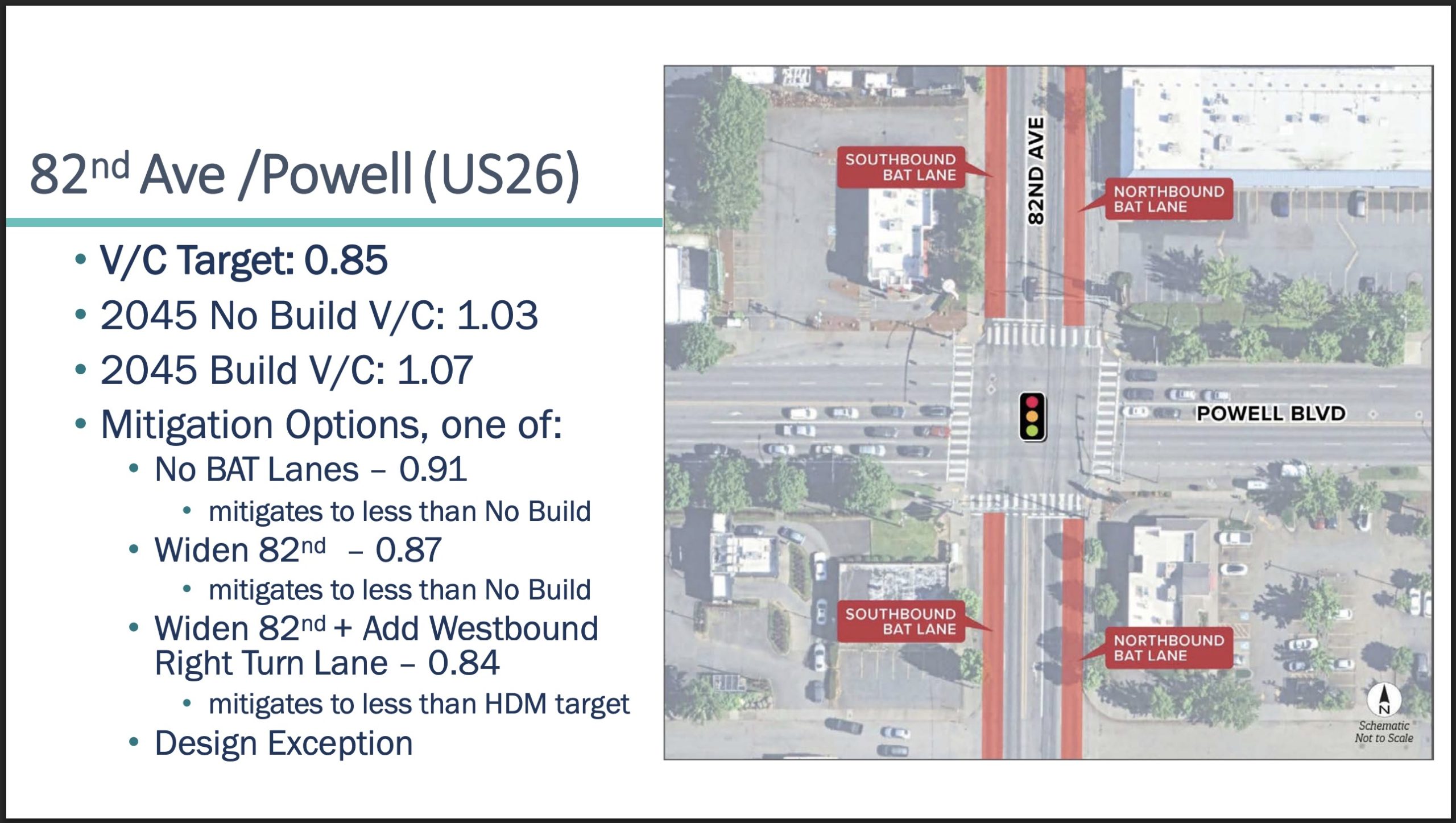
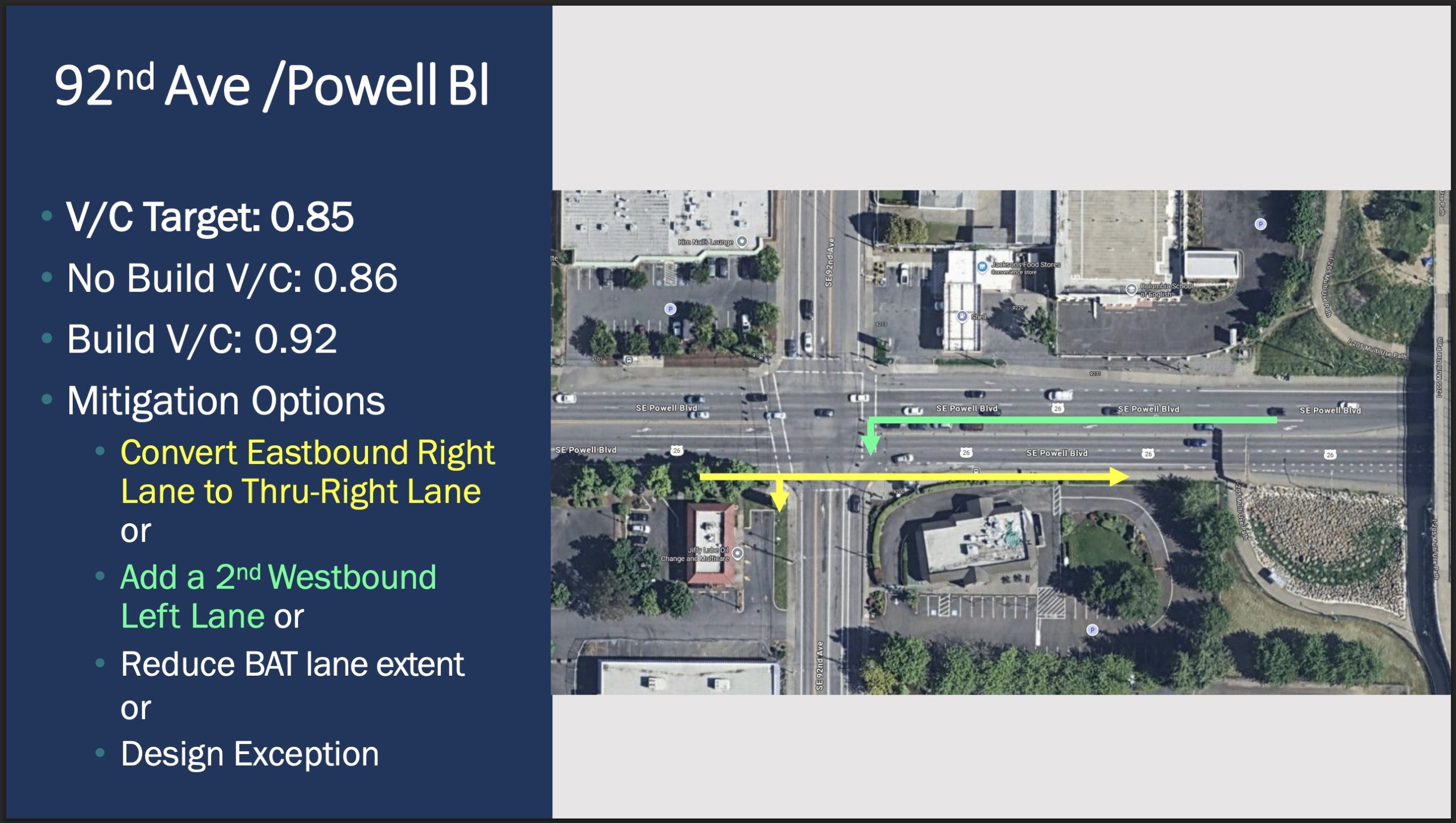
Now we know more precisely which areas he was talking about. Below is the list of locations ODOT has flagged for more scrutiny along with their assessment of what must happen if “More BAT” moves forward (see slides above or the full presentation for more):
• 82nd Ave at Powell Bl: Requires mitigation or DE (this is the most acute concern from ODOT and the location the project team wants to drop the BAT lane)
• 82nd Ave at Lombard St: Requires DE or mitigation
• Cully Bl at Lombard St: Requires DE or mitigation
• 82nd Ave at Johnson Creek Bl: Requires DE or mitigation
• SE Powell Blvd at SE 92nd Ave: Requires mitigation or DE
• I-205 SB off-ramp to Powel: No mitigation or DE required but extensive queues
• I-205 NB on-ramp at SE Foster Rd: No mitigation or DE required
Keep in mind that “mitigation” would always lead to higher project costs (something TriMet has already flagged as a concern) and that needing a “DE” or design exception requires a leap of faith because ODOT could ultimately deny it. While these are clearly risks to doing “More BAT,” it’s important to remember that TriMet’s own studies show “More BAT” provides the most overall transit benefit and would provide improvements in pedestrian safety and comfort because the lanes would create buffer between humans on the sidewalk and people driving cars.
The project team will share more about these ODOT traffic studies and concerns at the Policy & Budget meeting tomorrow. TriMet says no final decision will be made about bus lanes at that meeting and that the Policy & Budget Committee will make a final recommendation on BAT lanes at their meeting on February 13th.
Find out how to take part in tomorrow’s meeting on TriMet’s website.

Thanks for reading.
BikePortland has served this community with independent community journalism since 2005. We rely on subscriptions from readers like you to survive. Your financial support is vital in keeping this valuable resource alive and well.
Please subscribe today to strengthen and expand our work.
“ODOT worries that if more space on 82nd is dedicated to bus travel, less of it will be available for car users, and the resulting diversion and congestion could cause backups near and/or on highways.”
ODOT is essentially saying that 82nd should remain an accessory highway forever.
ODOT is similarly hogging Barbur Boulevard which has huge potential as a transit corridor and an active transportation route. Why are we stuck in a single digit percentage of bike trips? It’s purely because of the willful blindness of agencies that have the word Transportation in their names. We reserve our most valuable transportation asset, the physical space that a person could move through, for a hypothetical increase in the least efficient mode of transport.
Probably has more to do with the uncomfortable riding weather throughout most of the late fall, winter, and early spring.
Barbur will never be a high volume bike route no matter how much ODOT stops “hogging” the road. The best facility in the world can’t fix “hill” or “rain”.
Barbur is pretty flat so it would make a great bike route imo. Rain is easily solved with the right clothing.
Either we define “flat” differently (my definition does not include streets with a significant climb), or there are two Barburs in Portland.
E bikes: still 2 wheels, still good, no hill concerns. Added bonus is the best part of your day going downhill.
E-bikes and raingear > car
“E-bikes and raingear > car”
For some people on some trips. You can look at how empty the greenways are on a rainy day to see how many other bike riders agree with you.
We’re not talking about Greenways, we’re talking about Barbur. You said that “The best facility in the world can’t fix “hill” or “rain”.” To which, I offered 2 simple solutions “e-bike” and “raingear”.
E-bike + raingear + best facility in the world = high-volume bike route.
You did. And I offered a way you can see how well those solutions work in practice. (I’m thinking at a systems level; for some individuals, I’m sure your solutions are great.)
This is maddening. 82nd was transferred to the city because of ODOTs policy of prioritizing throughput over safety. The idea that we can’t reduce throughput and increase safety on 82nd because it might cause some people to use 205 instead of 82nd is absurd. Drivers shouldn’t be using 82nd to cut-through the city to save a few minutes avoiding 205.
What’s the point of transferring it to the city if their prioritization of throughput over safety will still apply?
Can anyone elaborate on why the BAT lanes are more expensive? They seems like just paint a few signs. Do they have unique signalizations and is that really that much of a increase in cost?
Primarily because there are 2 intersections that would need to be widened to accommodate bus movements.
thanks! 2 intersections in a 10 mile corrridor…
This sounds confusing. Maybe needs some edits?
Was supposed to say “withOUT them”. I’ve edited.
I’m not sure I understand how ODOT has jurisdiction over this. It’s not like they can refuse to let apartment buildings be built just because they’ll lead to more traffic. This isn’t much different – people making land use choices on land they don’t control that affects overall traffic patterns.
Either way, ODOT is under specific instruction from the state legislature to move toward transferring roads in the city, or at least Powell specifically, to Portland. So why get in the way of something the city wants over a road that the city should be controlling?
While I’m at it, who’s paying for ODOT staff to spend time modeling the traffic outcomes of a TriMet project on a road no longer in their jurisdiction, and create presentations to try to stop a transit project from being too good? Based on my work experiences with ODOT, I’m sure this took more people and more labor hours than many of us can imagine.
Any time a roadway impacts a state-owned facility (in this case, I-205 and Lombard), ODOT has veto power. For example, when a PBOT street is an overpass of an ODOT freeway, ODOT gets to sign off and/or change the design. This has always been the case. It is often one of the silent things ODOT does that really screws over our network.
Yeah, I follow – thanks for responding. And since they’re altering intersections, that’s ODOT R.O.W. It’s an abuse of their scope though for sure.
This gets into a huge can of worms, but really our overwhelmingly Dem. state gov’t needs to overhaul the mission of ODOT to make clear that something like this is not what they should be doing.
Without getting too specific, I’ve worked on a project where another city was creating a new intersection with an ODOT highway. The biggest online meetings I’ve ever been on, and everyone at ODOT was clueless about what was going on while the couple of private consultants kept reiterating all the steps that had been taken, and what was needed next from ODOT. And everyone there was being paid by that city, since it was their project. And that’s all without the complication of the opposing philosophies between a city-oriented transit network and a highway department. It’s so frustrating, I could rant all day.
Maybe we need a defang ODOT movement.
ODOT seems to cite legislation whenever they want to do something unpopular. I once attended a presentation where an ODOT rep was asked why ODOT wouldn’t take very simple steps to keep a footpath open during a highway project and the rep responded: “Because we’re not required to.”
So how about the powerful Portland legislators get together and sponsor legislation that specifically does not allow ODOT to nix local projects that are consistent with larger state goals? (like GHG reduction).
ODOT already has to coordinate with municipal governments for many of its projects according to OAR 731-015-0075. That gives local government an effective veto over certain ODOT projects when those projects are not compatible with adopted municipal plans. This is what’s at issue in NMF v ODOT in relation to the Rose Quarter project. However, it seems like that’s a one-way street, and local governments aren’t able to bully ODOT into accepting a project that encroaches on an ODOT facility, which is what’s at issue here with the BAT lanes on 82nd.
Ultimately, ODOT’s thinking won’t change unless its governing statutes and leadership changes. Right now, the state wants ODOT to be almost entirely focused on moving cars and trucks down highways to the detriment of the rest of the transportation system. 4 of 30 Senate districts represent central Portland, and all other large cities in Oregon are generally cracked for gerrymandering purposes such that their senators and representatives are largely representing suburban constituents. As long as suburbanite and rural voters hold a supermajority of the Legislative Assembly, we’re going to have a sprawl-minded state transportation agency.
ODOT also still owns Powell Blvd, including the intersection and signal at Powell & 82nd.
if TriMet decides to capitulate to cars, what happens to the $55.5 million in PCEF money that has flowed to 82nd Ave ?
“in December 2024, TriMet won $55.5 million from PCEF for their 82nd Avenue Transit project.”
https://www.opb.org/article/2024/12/18/portlands-climate-action-fund-awards-dollar300-million-to-large-scale-projects
https://www.portland.gov/bps/cleanenergy/news/2025/9/8/82nd-ave-motion-tour-community-led-and-climate-investments
https://www.portland.gov/bps/cleanenergy/documents/pcef-82nd-ave-tour-guide/download
It will probably be used for nicer stops and signal upgrades for transit signal priority. If they don’t do bus lanes it will be mostly the same situation as FX2 on outer Division.
ODOT has chutzpah, that’s for sure
Be strong, Trimet! The new lanes won’t drive any customers away! Look no further than Hillsdale to see an example of rose lanes that haven’t hurt business at all. And the business owners in Hillsdale made all of the same threats and even did a petition drive.
All the rose lanes have done is speed buses up and make right turns (into the strip mall) much more relaxing – and cycling in the bike lane is also more relaxing. The impact on traffic in Hillsdale is negligible: a bit more waiting time during rush hour but not much.
Trimet should know a red herring when they see it.
I can’t really think of being deterred from going anywhere I needed something because driving was a pita to get there, but I have definitely been deterred from biking/walking/bussing somewhere because that would have been a pita.
I avoid going over the river into Washington many times each year because of traffic on the bridges. I’d be surprised if other people don’t take traffic into consideration when considering activities, businesses to visit, etc.
If I get lunch with my dad, my brother and my nephew, I have to cross a bridge, or they have to cross a bridge (and we all live very close to 205, it’s always the 205 bridge for us). So I/we don’t have the luxury to just blow that off. I will grant you that bridge traffic nowadays does suck. Not that long ago, in my adult life, you could get over to Vancouver pretty quick, or vise versa, if you needed to do such a thing.
Such a good point. When traffic is backed up on I-5 or I-205 and you need to drive to the airport, you add extra travel time by leaving earlier. Traffic doesn’t stop anyone from going anywhere.
Your example is a necessary trip. There are lots of unnecessary trips, trips that can be combined with others and trips that can be done at other times. People choose all the time to avoid driving during rush hour for one of those trips.
That’s why when something occurs to limit road space, e.g. construction or a bridge collapsing, cities aren’t instantly thrust into gridlock until it’s repaired.
In a reasonable place there would be a high frequency bus line to the airport. Instead we pretend that a MAX train every 15 minutes is enough transit. The airport operates for 24 hours but good luck catching a train if your plane is late.
“good luck catching a train if your plane is late.”
That’s a scenario were on-demand personalized transportation is a real advantage.
It’s a shame all that bussing never happened.
What I don’t understand about the logic of the “congestion will cause customers to go elsewhere argument” is:
Genuinely, help me make sense of this.
I can’t – and no one can, cuz it makes no sense. As you say, there are no direct comparisons – just a vague sense that “people will make different choices if conditions change.” But any objective look at data will show Trimet that the claim doesn’t hold up.
The sheer audacity to demand that a transit improvement project must also improve driving.
An 82nd Ave with fewer driving lanes will greatly improve driver safety; four-lane (former or otherwise) highways, with a ‘suicide lane’ in the middle, should not coexist near businesses and living things.
We would be better off if Trimet could veto ODOT projects that slow transit times, like the rose quarter freeway expansion.
This exactly. We need to reorient the state transportation systems for the 21st Century. This is the sort of thing our Democratic legislature should be focusing on instead of compromised funding mechanisms that disincentivize hybrid and electric cars…
ODOT clearly believes they have an irrevocable eminent domain that prioritizes the rate of vehicles per minute over every other human need or experience.
What does Cully Bl at Lombard St have to do with traffic impacts on 82nd?
Cully/Lombard is part of the project area since that’s where the FX72 will terminate
That’s the northern endpoint of the project. The 72 bus runs along 82nd and turns along Lombard to Killingsworth.
https://trimet.org/82nd/
Who actually chooses 82nd to drive down? the only reason i ever drove down 82nd was for the joanns and the hobbytown. both are closed now so unless i have to im taking 205.
Lots of people do it to avoid 205 during rush hour. I live off 82nd and my wife works in the trades. Her route constantly changes based on traffic conditions on 205 and 84.
This is important. I don’t know if traffic planners import the feedback effect of navigation apps into their modeling but Waze, etc, tread on alternative transportation routes and neighborhoods constantly. It’s why I keep pushing for greenway diverters midway between collectors.
Lots of Asian stores and restaurants along 82nd that we have to go 82nd to get to. Once more, like 99 Ranch, come out east then we likely won’t need to go 82nd for much of anything.
That slide on 82nd/Powell is so insane to read. Widen 82nd and no BAT lanes? What on earth are we talking about here? Those are not options! ODOT is broke. It’s ridiculous that they would even suggest that in a public-facing presentation.
It’s also worth saying that a V/C of 1.07 means that at peak hours, it takes vehicles more than one light cycle 7% of the time (on average). At 82nd and Powell, that seems fine to me. V/C ratio goals always encourage traffic engineers to widen, widen, widen. I’m sure that the 0.85 standard is some system wide, maybe MUTCD thing. Feels like a fine place to make an exception, but I’m (thankfully) not a traffic engineer.
And the “mitigation” options at 92nd both involve widening Powell. All to prevent V/C from being 0.92? Seems like that kind of policy of widening roads because someone may have to wait an extra light cycle during peak hours might be contributing to ODOT’s generally bad financial outlook. 100% of the mitigation efforts they employ are “more car capacity”.
No mention of if more people can travel along 82nd with increased bus capacity, no mention of pedestrian/cyclist benefits, no mention of city goals. Just “we would need to widen Powell Blvd if you did this”. Feels like extortion to me.
It feels like that mindset is baked into the cake at this point. We love to build half-ass transit projects, then point to them and be like “See? We built this and it didn’t make traffic evaporate across the entire metro area. Transit must be a waste of money because people want to drive! Looks like there’s no other option than to widen the road.”
The Powell spot could be helped with a pedestrian scramble that blocks all traffic for at least 20 seconds. That way cars turning wouldn’t have to wait for the slow walking cart pushers and Pokémon Go Players. I used to take the 82nd bus from Holgate to PCC cascade for years. 82nd is a huge thoroughfare due to ease of driving thats not a standstill highway.
Also while we’re at it, let’s trash all the left turn yield at lighted intersections too. Driving is hard…! Lol
I have been a bike or bus person from 1999 to 2020 so have seen both parts of the issue.
Pah. A transit agency worthy of the name would be fronting the notion that an uncompromised transit development can increase throughput of humans, and that the increased human carrying capacity of 82nd Avenue could free intersections and reduce congestion on the parallel “Interstate” a kilometer away.
One reason that the bus on 82nd carries the most passengers of any line has to be that it intersects with the MAX line, which has the most frequent possible connections of any transit corridor in the whole system, even without the Green line.
To activate the full capacity of the FX72 we need real high frequency bus lines for passengers to transfer to. I’m all for “Full BAT” and such things but in a climate where we are chopping bus routes instead of building them out, what are the chances?
ODOT and TriMet are drinking car-aid from the same cup.