

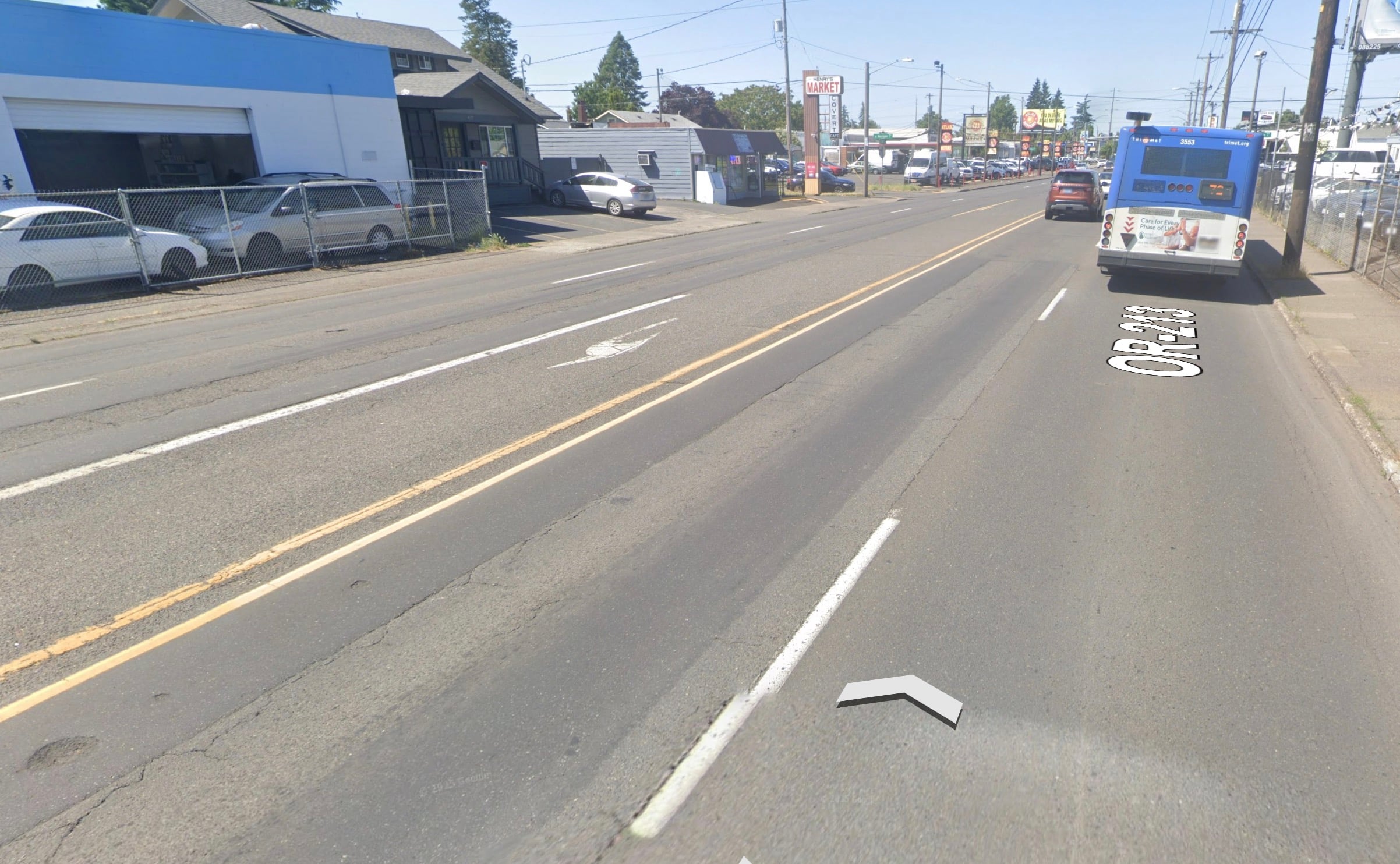
Lines have been clearly drawn in the debate over what type of bus service is right for 82nd Avenue. In three letters sent to TriMet today, influential politicians and high-profile advocacy groups made their positions known. At issue is the agency’s $350 million 82nd Avenue Transit Project, envisioned as a major upgrade for a key East Portland arterial that’s in dire need of a way to move people more safely and efficiently.
As BikePortland has reported, a rupture has formed between two transit options under consideration: one option would keep the central (highest traffic) segment of the street relatively unchanged from its current four-lane cross-section, and the other option would construct semi-dedicated, “Business Access and Transit” (BAT) lanes along the entire 10-mile project corridor between Clackamas County and the Columbia River. The two options are known as “Some BAT” (build semi-dedicated bus lanes only on each end of the corridor) and “More BAT” (build them on the entire corridor) respectively.
In mid-October, TriMet staff shocked many project watchers when they released a recommendation for the “Some BAT” option. Advocates who expected a big bus upgrade felt betrayed, some elected officials were caught off-guard, and even a TriMet board member voiced disagreement with the decision.
TriMet tried to do damage control, saying the recommendation was only meant to start a conversation and delaying the final decision. But it’s clear that TriMet is nervous about two elements of the “More BAT” option: a higher ($8 million) project cost increase they say could jeopardize delivery, and vehement opposition from business owners. At the project’s Policy & Budget Advisory Committee meeting on November 7th, TriMet made it clear that they won’t push for the “More BAT” option unless partner agencies bring more funding and political capital the table.
With an update on the project expected to come at a TriMet Board meeting this Wednesday, groups on both sides of this issue are making their voices heard.
A letter signed by 14 elected officials and sent to TriMet GM Sam DeSue and the agency’s Board of Directors stated that nothing short of the “More BAT” option is acceptable. “We are concerned by the news that TriMet is considering a watered-down proposal… Anything short of full BAT lanes for this corridor significantly hampers the catalytic potential to spur new housing growth, support local businesses, and greater local and regional mobility,” the letter reads. Among its signees are six Portland city councilors, four Metro councilors, and four Oregon legislators.
Another letter in support of BAT lanes was signed by leaders of 32 local nonprofit organizations. The organizations who signed onto the letter go far beyond the typical transportation groups and includes: Native American Youth and Family Center, AARP, Coalition of Communities of Color, The Grotto, African Youth and Community Organization, Vestal Elementary School, ROSE Community Development, South Tabor Neighborhood Association, and JOIN.
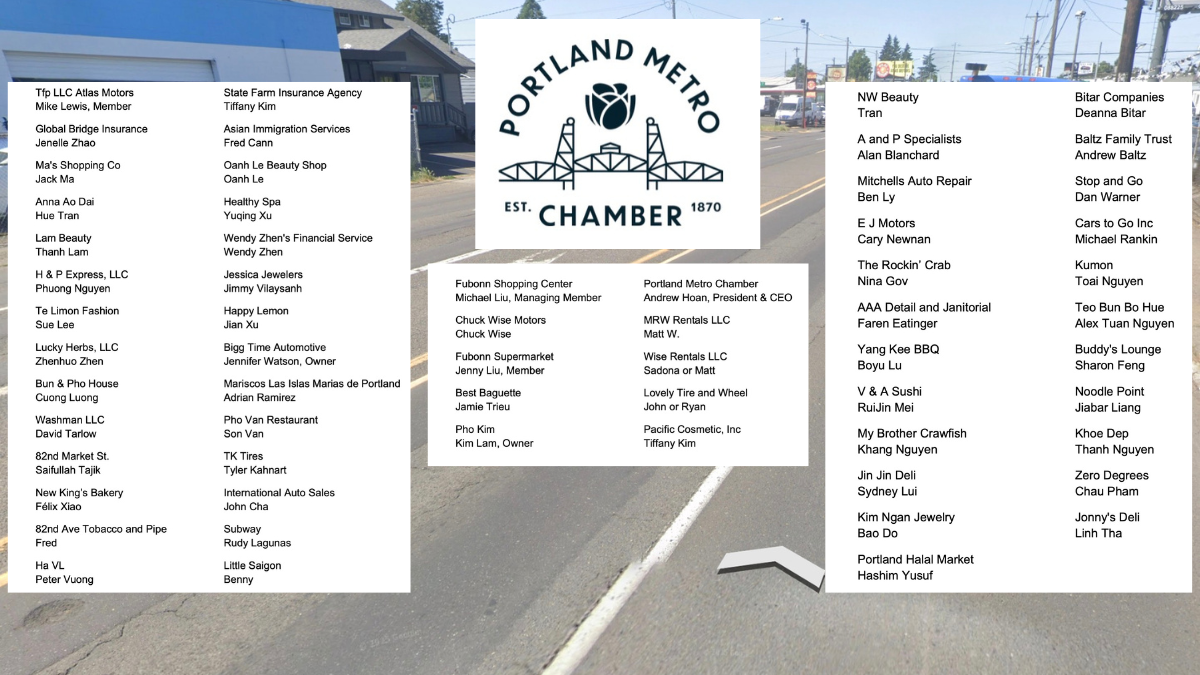
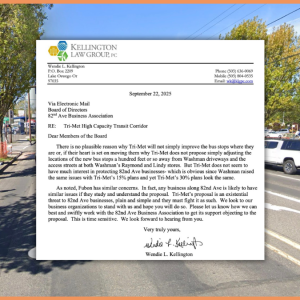
Throwing cold water on the BAT lane idea is a letter from Portland Metro Chamber signed by the owners of 61 businesses located along the project corridor. They say TriMet should stick with the “Some BAT” option and that if new bus lanes were created along the entire corridor, there would be a, “significant increase in traffic congestion.” They want more studies to ensure businesses would not be harmed and they believe the full BAT lane design is only a marginal upgrade that isn’t worth the extra cost and potential project delays. This business coalition fears that BAT lanes would devastate some businesses. Here’s more from the letter:
“As business owners, we are deeply worried about the loss of safe and effective access to businesses and the potential catastrophic loss to a major mode of transportation to the corridor during critical business hours. We agree that improvements to transit could lead to an increase in customers of some businesses (but not all) who choose to use this mode, but there is no existing analysis that justifies the damage of increased car congestion to existing customers’ transportation choices. Customer surveys conducted by businesses on the street have found that over 90% of current customers arrive by car. Finally, we are concerned that the proposal includes untenable bus stop locations that block driveways, prevent safe and effective access to business destinations, and cause unsafe visual obstructions to vehicles exiting business driveways.”
The Federal Transit Administration will not award the project federal funding if it scores poorly on congestion relief and adverse effects on existing businesses. This is no time to be driven by ideological rigidity given the current economic and political climate.”
These concerns echo those already made by lawyers who represent several of the businesses who signed onto the letter. Two law firms have already written TriMet detailing their objections and have threatened to sue the agency if full BAT lanes are installed.
It’s unclear whether or not TriMet will make a decision about the BAT lanes at Wednesday’s board meeting. The agency has previously said we shouldn’t expect that to happen until early next year.
Thanks for reading.
BikePortland has served this community with independent community journalism since 2005. We rely on subscriptions from readers like you to survive. Your financial support is vital in keeping this valuable resource alive and well.
Please subscribe today to strengthen and expand our work.
It’s unfortunate that these businesses can’t imagine a nicer corridor where it’s easy and safe for people to patronize their business outside of a car.
I can understand the car related businesses, but as an occasional visitor to some of these restaurants and grocery stores, I’ll be going somewhere else if that’s how they want to play it.
Will you though? Where else are you going to get good Asian food ingredients? Are you going to go all the way to Uwajimaya in Beaverton? 🙂
Jose has you there, Nick! There aren’t any other Asian markets in Portland! Not near Fubonn anyways! Very embarrassing.
H Mart on Belmont
Have you noticed that the old Walmart is now Hong Phat II and the closed Fred Meyer is now Shun Fat, both with lots and lots of inventory?
I thought the same thing as Nick….I just won’t go there. It is shortsighted on the part of these businesses. And yes, I will go all the way to Beaverton
There are other Asian markets with good ingredients in Portland. Several on 82nd. I go to them frequently.
99 Ranch, H-Mart, or any of the half dozen asian grocers on 82nd that haven’t explicitly signed on as being opposed to bus lanes. Maybe they are; but they aren’t threatening to sure TriMet or flaunting that nobody takes the bus to their stores. If I can’t find what I need at any of those places, then yes, I will hop on MAX (or really the 54 bus) to Beaverton.
There’s another on foster rd – thai cam video and food
well thankfully hong phat didn’t sign and that’s where i go anyway!!
It’s so sad. The businesses I’ve contacted (and very much love and had very pleasant conversations with) that are on the Portland Metro Chamber letter are largely unaware of what the letter contains. I urge people to not jump the gun. If you have a favorite restaurant on the list, give them a call and tell them how much you’ve enjoyed their place. A lot of these restaurants are family owned and have a tight budget and any change like this represents a risk.
This is so typical. I remember when the bad actor at the Laurelhurst put names of businesses on the list opposing changes to 28th that never agreed to be on the list. Those businesses then had to speak out to say they supported the bike lanes. I imagine at least half of the businesses are not fully informed about what this list means.
H Mart?
I really enjoyed 99 Ranch Market on SE Washington when I was in there a few weeks ago. Turns out Fubonn isn’t the only game in the Jade, let alone the larger eastside area.
I’m sure they will continue to serve their community and do just fine without your patronage.
Shawn has you there, Nick! They’ll do juuuust fine if you make a personal choice based on your principles and shop elsewhere! Your pathetic protest is useless and will do no good! Very embarrassing.
It’s true.
I don’t disagree at all. But you say that to Nick to discount his position. Let Nick do what he wants, eh? I won’t go to Fubonn anymore either, I hardly think they’ll collapse…I just don’t want to give them my money now. Others will, I won’t. C’est la vie.
If we don’t get “More BAT” I’ll continue to try to avoid 82nd; it’s terribly unpleasant.
As someone who lives a scant 9 blocks away from 82nd, I and my family will also continue to avoid 82nd as much as possible. With the exception of driving to make a trip to a particular destination or crossing at Tillamook or Fremont, we just don’t really interact with the road. It’s a situation that won’t necessarily end with the “More BAT” option, but it would certainly be the best incremental improvement. A safer 82nd is an 82nd that I can go out with the family on a recreational ride and make an impromptu stop at a shop or restaurant we hadn’t noticed or wouldn’t have stopped at if we were driving.
Michael Liu and Fubonn have lost me as a customer for good. Yeah, I sometimes take my car there but as a driver I recognize the benefits of bus lanes to broader society. I also recognize that the car congestion is going to be there regardless of whether 82nd has 3 lanes for cars or 13 lanes for cars. It really disgusts me that someone would spend so much time, effort, and money to ‘fight’ something that is unambiguously good.
It is the same energy as people who argue against free school lunches.
Same. Hong Phat and Shun Fat are just as good as Fubonn and, for me at least, work better with my bike route home anyways. I simply can’t give Fubonn money in the future for actively working against what I feel will make 82nd a much better place.
Yeah, I don’t get it either. You would think that any local business would be eager for BAT lanes – they effectively force through-traffic into the faster left lane and restrict the right lane to local traffic, right turns, and bus stops.
I am however concerned by the faster traffic on the left lanes and how they will interact with crossing pedestrians and bicyclists.
What these businesses seem to say is they want 2 lanes in each direction, with the usual crashes and congestion. I’d prefer only one lane of traffic and protected bike lanes. The BAT is a compromise, basically 1.5 or so lanes, so of course everyone is upset.
Because the other options are garbage duh! I would know as I frequent several of them regularly by foot or bike.
1/5th of the businesses signing onto this cater to automobiles by selling, washing, or repairing them which makes sense but what’s up with the insurance offices? Do they really think their business is generated by the amount of auto traffic on the street or that by having to drive there slightly slower it will at all affect their customer base? It’s not like I need to visit my state farm insurance adjusters office every week. Just more car brained nonsense.
Exactly. in Brent Toderian’s words, you can’t justify a bridge by the number of people swimming across a river. You build transit (and bike lanes, and housing, and parks and schools) in anticipation of future users, not current ones.
Here’s the letter StrongTowns PDX wrote in support of full BAT, which we think will help in many ways including mobility in and around the corridor.
https://substack.com/@strongtownspdx/note/p-178141691?r=17ky4
Glad to see some common sense out there. Portland wants to be a Big City but the way it’s designed and actually works is a small town. These Bus Lanes have shown to be nominally more efficient
Yet the travel times by cars and other ICE vehicles has gone up and increased emissions because of these “improvements”.
I’m also not seeing any reports of significant changes in car/bus/bike/walking across Portland, even with all these “ improvements”.
As a biker, single occupant in a car, bus rider and avid walker. It seems Portland has not figured out how to move people around town based on how they want/have to get around
“Common sense” once again followed by “just making stuff up based on my feels.”
I hear you – but there is a freeway a couple minute drive from 82nd. Lots of cars on 82nd going through that should be using the freeway. Maybe people just need to be a little smarter about getting around.
There is no common sense here at all. In todays times, common sense has come to mean things that right wingers like, no matter how illogical it is.
“Right Whingers”
Really? Because the other ‘side’ doesn’t spew that term at any and every opportunity?
The term is generally dead the way it is tossed out there these days – so we agree there is none.
The “avid walker” has entered the chat.
“We plan, build, manage and maintain an effective and safe transportation system that provides people and businesses access and mobility.” This is from the PBOT site.
“Connect people with valued mobility options that are safe, convenient, reliable, accessible and welcoming for all.” From TriMet.
Those statements are fairly clear about what they stand for and strive to do. It doesn’t say that they need to water everything down so they don’t upset *current* business owners on streets where human scaling and transit boosting projects are proposed. This shit annoys me to no end. Imagine if no one ever did anything tough in anticipation of a better future. In the short term, yeah, construction for this project might sting, but we’ve seen 1000 times over that changes to our streets simply does not kill business.
Right on, PTB. Look no further than Hillsdale, in SW, where business owners used the same playbook to oppose the rose lanes there. The rose lanes went in and businesses are just fine. The ones on 82nd will be fine also.
Yet another example of everyone clapping each other on the backs and nodding along when they say they want to achieve Vision Zero and mitigate climate change, but when it comes to actually doing Vision Zero shit or cutting emissions it’s suddenly all wringing of hands and hemming and hawing.
Easy- do a pilot for a year of analysis. We also know from experience that a lot of those businesses that signed the letter were probably lied to about what the BAT lanes are, given that the Wash-man and the owner of Fubon and Chamber guy essentially lied at public hearings.
Yes, please. Pilot nearly every major capital project. The added expense is nothing compared to the bikelash (“Buslash”?) that precludes and delays even basic infrastructure changes in Portland. Even if the pilot is 10 blocks, it’ll be worth showing folks how it works.
We should do a pilot of the IBR and Rose Quarter widening so we can all see how all those interchanges work, whether extending the Max to Vancouver helps, or how suitable the caps are for housing.
Oh yeah, totally the same thing. Exactly the same scale and cost. Why didn’t I think of that. Doo, dee, dooo…
“Pilot nearly every major capital project” — that’s the comment you should be responding to, not my sarcastic take on it.
You and I agree on this.
I’d like to up-vote your comment but I’m not sure how much hardscape the new configuration will require (I’m guessing a lot since PPB doesn’t enforce driving rules). If it’s expensive to install, then it has to be permanent. We’ve seen how easy it is to remove bike infra that is cheaply installed.
The BAT elements are mostly paint and signs.
https://trimet.org/82nd/design.htm#design
The main design element that really requires hard infrastructure changes is the TSP (transit signal priority). It’s a fairly basic/cheap capital project that consists mostly of red paint, so any pilot would have to exclude the signal timing change.
If 62 business owner wanted to dump cow manure in the street, would TriMet listen to them? It is so inane and vapidly ignorant to accept the input of businesses and money on a project that is about safety.
the words “human” “life” “empathy” “sympathy” “crash” “bicycle” “walk” do not appear in this putrid letter.
but the word “business” appears 25 times.
No consideration for safety, no consideration for speed, no consideration for mode shift, for bicycling, for walking.
It’s just NIMBY NIMBY NIMBY
MONEY MONEY MONEY
ENTITLED ENTITLED ENTITLED
PRIVILEGE PRIVILEGE PRIVILEGE
82nd Ave will never be safe because of BUSINESSES that care about above human life, liberty or the pursuit of happiness.
Washman – “transit is a detriment to our business.”
how about death of other people? nope. nothing. crickets.
Metro Chamber and these 62 businesses clearly think money is more important than people
61 buisness owners equals 61 people, more or less. 61 people should not have more power than everyone else simply because they own a buisness. We should just ignore them since they are a tiny indignificant minority.
“Indignificant” is my word of 2025! It describes people who are indignant but also insignificant. LOL.
oops you said the word “minority”. Careful, that gets bike lanes removed overnight.
Yeah, we all want 82nd to chill out a bit — less ‘Mad Max: Portland Drift’ and more ‘mate, let’s just get where we’re going without a near-death experience.’ But we’ve gotta find a middle ground here. Some of these businesses are already doing it tough in the Portland Doom Loop, and blasting them for worrying about survival isn’t exactly helping anyone.
Sure, better transit would be beaut, but only if the buses themselves feel safe enough that hopping on doesn’t feel like a side quest in a dodgy video game. And yeah, fewer cars blasting past at warp speed would be lovely — but maybe we don’t need to run every small business over with ideology on the way there.
We can fix the street, make the buses usable, and keep the shops alive. It’s not that wild — just takes a bit of balance, a bit of listening, and maybe a cold one to take the edge off.
Full BAT is the middle ground.
Please don’t drink and drive.
I ride the buses all the time and they feel safe. They’re statistically safer than driving a car.
Can you share those statistics?
“This study shows that city bus is a safer mode than car, for vehicle occupants but also for pedestrians and cyclists traveling along these bus routes.”
https://pmc.ncbi.nlm.nih.gov/articles/PMC5906382/
Thanks. In Portland over the past couple of years, a disproportionate number of people have been getting killed in, around, or by TriMet vehicles, but maybe that’s mostly a Max thing, and it might just be a Portland thing.
The study, which I haven’t read closely, looks like it mostly focuses on traffic-specific fatalities, which are only part of the picture. I’m much more likely to have my ear chewed off on transit than I am in my car or on my bike, for example.
Yes, sensational “big city crimes” get the headlines, though the everyday, mass destruction and death caused by our traffic system is more dangerous.
There are 10-12,000 crashes in the Metro area every year.
How many people, Watts?
Hand wavey wishy washy feels for me, demands of evidence and citations and rigorous scientific studies for thee.
So far in 2025, the number appears to be one. Not a very good sample size for claiming disproportionate impact.
If car-based VMT is 50x that of buses, then 1 bus fatality is equivalent to 50 car fatalities in terms of relative danger.
The data is hard to find, but in 2015 Metro says we had around 43 million VMT for cars. If buses/trains travel 860,000 miles per day, that gets us to 50x. AI says TriMet vehicles travel about 85,000 miles per day. If that’s true, that would make one TriMet death statistically equivalent to about 500 car based deaths.
It’s definitely hand-wavey and wishy-washy, but you don’t need the exact numbers to see that it doesn’t take many TriMet involved deaths to make my claim true. There were 5 in 2023, and 3 (I think) in 2024. That’s not counting any of the murders of passengers we hear about occasionally. If the number for 2025 is 1, then that would be about as much death as 500 car-based fatalities, and we’re on track to see about 10% of that.
Driving causes a significantly higher death toll than does transit for the same dogs kill significantly more people than do bears.
I made a claim, and I did not cite specific data to support it, but I stand by it.
What are the real world implications of that calculation? Not much. I’m not proposing banning transit because it’s too dangerous, or putting spikes in Max driver booths, or closing streets to buses (though I do wish TriMet would not run buses along bike routes).
It’s just a fact about the world that I find interesting. If you don’t, that’s ok.
“AI says …” If that’s your standard for evaluating facts, then I think we can all safely ignore any statistics you might come up with. And once again, you fail to understand what sample size means.
If your only critique of what I wrote is that I got the number 85,000 from AI, then it’s feeling pretty solid.
“Hey, I’m not proposing anything! I just think it’s interesting! I’m just asking questions!” Sure, Jan.
I think there’s an important structural issue here that rarely gets discussed: many of the nonprofits weighing in on projects like 82nd Avenue are funded overwhelmingly with taxpayer dollars, routed to them through elected officials. Then those same nonprofits turn around and lobby for those officials’ preferred policies — and often help re-elect them.
That creates a circular “closed ecosystem” where public money flows to organizations that then help reinforce the political status quo. Whether you support BAT lanes or not, that dynamic should concern anyone who cares about transparency and independent civic advocacy.
Nonprofits can play a valuable role, especially when representing marginalized communities. But when they are almost entirely dependent on government grants, they aren’t truly independent voices — they end up functioning more like political extensions of the same officials who fund them. And when they dominate the public comment landscape, it can drown out small businesses, residents, and everyday workers who don’t have paid staff to write letters or testify.
You don’t have to be anti-transit or anti-government to see the problem. Healthy policy-making requires real pluralism and accountability. Portland’s long-standing practice of using taxpayer-funded nonprofits as political validators has not always produced better outcomes — and it’s worth asking whether it’s contributing to some of the dysfunction we keep seeing in local projects.
We deserve a process where advocacy groups are heard because they represent their communities, not because they’re financially tethered to the officials running the show.
Are you mad about the 32 local profits that support the transit lanes? Per Jonathan they include:”Native American Youth and Family Center, AARP, Coalition of Communities of Color, The Grotto, African Youth and Community Organization, Vestal Elementary School, ROSE Community Development, South Tabor Neighborhood Association, and JOIN.” Are you really asserting that all 32 of these groups are financially tethered to TriMet?? Or to the elected officials who support the transit lanes? And that they’re advocating for the transit lanes just to win these officials’ approval?? That seems like… a stretch.
Ironically, the main “advocacy group” mentioned in the article is PBA (or whatever they’ve rebranded themselves as in an attempt to distance themselves from their awful reputation, I can’t keep track). As near as I can tell most of your comments align with their official stances so I doubt they’re the group you’re upset about, even though they’re the ones with outsized influence in our local politics and have unhealthy “financial tethers” to local officials. Thankfully with the change in our local government structure I’m seeing that maybe the strangle-hold grip they have on our local politics is finally loosening. Maybe that’s what you’re really upset about?
Karstan mate, I don’t think this is some yarn about nonprofit villains stroking cats in secret lairs. It’s just a structural problem Portland’s perfected: taxpayer money goes to nonprofits → nonprofits cheer for the policies of the folks who fund them → everyone pats each other on the back for achieving “community consensus.” And then, of course, those same nonprofits help re-elect the people cutting the checks.
On top of that, there’s not exactly an abundance of funding transparency, accountability, or performance metrics in this whole setup.
And sure, business groups throw their weight around — absolutely. But here’s the key difference: business groups aren’t funded by taxpayers. If a business lobby wants to torch its own money on a bad idea, well, that’s their problem. When nonprofits do the same with public money, it’s fair to at least raise an eyebrow.
I wouldn’t say these 32 groups are puppets, or that every one of them is riding the taxpayer gravy train, or that City Hall has a drawer full of puppet strings. I’m just saying: when your rent, staff, and office snacks come from government grants, you’re naturally going to be… let’s call it “politely supportive.” Nobody bites the hand that signs their grant renewal.
Doesn’t make anyone evil. Just makes the chorus a lot less independent than the pamphlets would have you believe.
Business groups are funded by taxpayers.
“Public documents show the Clean & Safe contract pays for nearly 50% of the chamber’s executives salaries.”
https://www.opb.org/article/2024/11/01/proposal-expand-portland-downtown-district-mixed-reactions/
Got some sources to back that up? Nonprofits get funding from a myriad of sources, including local, state, and federal grants, but also a ton of donations. To draw the line between an organization getting government funding and “reinforcing the status quo” is quite the stretch. The David Douglas School district is government funded but consistently stands in the way of East Portland street safety improvements.
What about those business downers making donations to get people elected? Is that not a conflict of interest?
More likely, those nonprofits signed on because the people they serve use the bus to get around. It’s not that deep.
Business interests are “heard because they are financially tethered to the officials running the show.” That is how things get done in America. Why would you expect some pesky thing like “reprensentation” to matter in this instance?
We deserve a process that prioritizes safety over speed, community over convenience, and benevolence over business
Definitely. This is generally what we have.
Take a look at some of the budgets of these non profits. Families for Safe Streets, AARP, Etc. It’s easy to disregard them by waving a hand and saying their support for transit is contingent on funding by special interests in the city government. But it’s also false. Many don’t receive city funding. All non-profits by their very definition are required to disclose their funding sources.
Non profits are often given money from the city for issuing grants. Grants are contingent on reporting how money was used, and do not require the support of transit projects or other political interests. Future grants are contingent on successfully meeting the goals of, say, providing business loans and reporting on the subsequent success of those businesses. Because non-profits are an integral part of the community, they are generally a better steward of funds and are better connected to the community. Would you rather the city issue grants itself without having the capacity to do so effectively?
So, according to this theory, because some not-for-profits are partially funded by the city/county, their funding is contingent on their supporting transit, and any business who received city funding for a grant through a non-profit would also be forced to support transit? This also means that any (all cosigned 32???) non-profit(s) who receive money from the city/county are not advocating for community members, but rather puppets for city officials who are pushing a transit project agenda that also happens to directly benefit the community. This theory might sound good as a sound bite on Fox news re govt waste, but in this reality it’s not a thing.
Some not-for profits wouldn’t be solvent without a modicum of city/county funding, and their decisions regarding transit are largely not contingent on city/county funding. The South Tabor NA or even APANO, for example, who received money from Prosper Portland for business grants during COVID, is an incredibly important pillar of the Jade Dist who has maintained the night market among a hundred other community-led efforts. “Jade” would literally not exist without them.
Do we want non-profits to be politically independent and support a,
YES! Are they mostly already doing that? Yeah. Neighborhood associations and groups from the hood tend to do that. Call one up and join or ask one to find out.
I’m so grateful these business are standing up for the overwhelming majority that drive cars and prefer it that way.
It’s absolutely unreasonable to make these roads worse for the majority to satisfy an extreme small minority of extreme bus activists.
There should be exactly ZERO bike infrastructure on 82nd. Please keep your toys on the side street while the rest of us conduct our business.
Citations needed.
You need a citation to prove the overwhelming majority in Portland prefers cars?
Look outside your window or take a walk…..
Yes I do because I have never heard someone be excited to drive across portland. However i have heard plenty of people go i would take the Max if it didnt take 2 hours to get to where i want to go. From my house its 40ish minutes to drive to Clackamas Town center and 2 hours on the Max. People drive because our transit is shit.
When you see people driving on 82nd–which is notorious for being unfriendly/unsafe to all other modes–you have no idea if they’d still prefer driving if those other options were available as safe, decent alternatives.
Similarly, when businesses there say the vast majority of their customers arrive by car, they don’t know if that would still be true if the alternatives were improved.
If you cut bus service and blocked some more sidewalks and removed some crosswalks, it would mean an even higher percentage of customers would drive. Driving would be their preference given those conditions, but it doesn’t mean it would be if the conditions were improved for the other modes.
Ahh yes, the old “everything is the way it is because that’s how we want it to be”. The status quo is right and good.
Yeah! Fuck those service workers, elderly people, school kids, and disabled people who rely on the bus to get around!! They deserve to sit in the same McSUV as the rest of us!!!!
This is the invisible, missing, and often overlooked, ~30 of the US that can’t drive. And as qqq said above, if we removed buses and sidewalks, even more people would be forced to drive or simply not travel at all.
Why might that be that most people prefer driving on 82nd?:
https://maps.app.goo.gl/kHarzQ3neiuENNeb7
People under 16 can’t drive, some people can’t afford to drive, some people do not have a driver license, some people choose not to drive and some households have only one car.
In state of Oregon, non-drivers are 15%-20% of the population. https://www.oregon.gov/odot/state-of-the-system/pages/mobility.aspx
The percentage is probably higher in city of Portland
https://bikeportland.org/2013/07/30/low-car-households-account-for-60-of-portland-growth-since-2005-91282
Many, if not the majority of, Portlanders want to drive less and they want to take transit more.
And close to half want to ride bicycles.
From the 2022 Portland Insights Survey: “Respondents’ desire to increase their utilization of various transportation options, assuming it would be
affordable and safe, was highest for Riding Public Transportation (60.2%) and Biking (45.4%)
Roads should be safer.
Unsafe roads should be changed when they are obviously not safe.
Roads are for everyone, including people who walk, bike, bus, or use a wheelchair.
Complicating the picture slightly, many people who do not drive (for example, many children) still rely on cars for transportation because someone else is driving them.
Ability and inclination to drive oneself is not inaccurate measure of “people who drive”.
Radical Leftist Take: People should have more than one viable way to get where they’re going.
Memo to the Trimet board:
Exactly the same thing happened when the rose lanes were scheduled for Hillsdale. Business owners opposed them and said traffic gridlock would sink their businesses.
But nothing of the sort has happened – businesses are doing just fine and traffic is still moving. What has really improved are bus-travel times thru Hillsdale, since transit riders (rightly) have priority over SOVs.
Please do your job and prioritize transit. Traffic will still move and businesses will be just fine.
The thing that’s wild to me is that all this hullabaloo is over a couple of minutes of potential delay to car drivers. Hell, driving from my place to 82nd varies by a couple of minutes even if I go at the same time every day. That variability is just what you’re getting yourself into when you drive a car. Really, for any mode of transportation, manage your time well and 99% of the time you’ll get where you need to be on time.
It’s also over a very small improvement in transit performance — which would probably be negated or reversed if people ride bikes (and all the other vehicles people ride in bike lanes these days) in the bus lane, as the settlement with BikeLoud calls for.
In terms of performance, for any mode, the project is very low stakes.
I think, for a lot of folks, it’s the symbolism that’s important. That’s what I’m hearing in most of the comments here.
PDX Real is saying threats are being made against businesses that signed the letter. (See attachment)
Honestly, I doubt Portland’s bike activists are out there making serious threats — most of them can barely organize a group ride that starts on time. But I’ll admit there’s that tiny concern in the back of my mind. We’ve all seen how fired-up things can get in Portland.
I mean… remember that Bike Portland meeting with Mayor Wilson that got completely derailed by that group of extremely intense activists? If someone can shut down a whole event with pure chaotic energy, I guess it’s not impossible that a few folks might be getting a little overheated. Stay peaceful peeps.
Are you really going to take anything PDX Real posts at face value?
Oh Maus, mate… I reckon Angela Todd’s a bit of a wild ride, sure, but she’s tapping into a whole vibe of folks who just want a bit more common sense and livable streets in Portland. She’s flying solo on the internet, just like you, so yeah, there will be a sprinkle of bias or a dash of hurry in how stuff gets posted. Not sure about the “threats” she’s reporting—could be a bit of drama, could be something real, but I don’t see her making stuff up
I said “bending” – not making stuff up. But in this business that is often a distinction without a difference. Did you hear about the time where Todd did a big investigative hit piece of a city hall staffer… Even sharing serious criminal allegations, only to realize after emailing the story out to thousands of people and smearing the person’s name in teasers on her platform for days, that she actually had the wrong guy!?
And yes, we are similar in some ways, but very very different in other ways.
never confuse popularity on the internet with actually doing the important work of trusted community journalism.
Oh Maus, mate… I reckon Angela Todd’s a bit of a wild ride, sure, but she’s tapping into a whole vibe of folks who just want a bit more common sense and livable streets in Portland. She’s flying solo on the internet, just like you, so yeah, there might be a sprinkle of bias or a dash of hurry in how stuff gets posted. Not sure about the “threats” she’s reporting—could be a bit of drama, could be something real—but I don’t see her making stuff up
Did they cite this comment section as evidence of “threats”? Like a threat to do business elsewhere?
they bend facts and play fast and loose with details like that all the time Chris. Not really worth asking IMO.
Where is PBOT and Metro? We have been hearing these doomsday predictions for decades. Doesn’t PBOT have a presentation prepared showing before conditions and some facts about vehicles and businesses for streets like Foster, Outer Division, Division Mainstreet (Chavez-11th), etc. Next slide: a bunch of community/business comments about how the proposed will be the end of the world. Next slide: post occupancy analysis- how is the street doing? What happened to traffic on year 1, 2, 5? What happened to businesses? What do the stats say about pedestrian injury/death? Transit ridership? If this works and we can demonstrate that works, THAT should be the message. It is almost useless to hear “these people are worried about changes’ rebutted with “these people want changes”. I wish PBOT would just be professional organization for once- this is so predictable! The fact that they are not out with a campaign explaining their recent street reform successes makes me worry that they may not have been successes. I really hope that is not the case
It is completely understandable that those businesses would oppose bus lanes. They know what works for them better than anyone else. if the built landscape is going to change to become less car dependent, some businesses and some people are going to suffer. The exact thing happened when the built landscape changed the other way – from less car dependent to more car dependent – some businesses and some people suffered. That suffering was ignored then just like it is being ignored now. What should have happened then is what should happen now – those who suffer from change should be compensated. Easier said then done, but that does not mean is should not be done, nor that we should not be striving to find a way to do it. We will never find a way if we ignore reality.
A lot of evidence shows that businesses do not know what works better for them when it comes to creating multi-modal infrastructure. Time and time again, business owners have opposed similar changes, only to later refuse to go back after the changes have been in place for a while.
They will be compensated by the increased business they get from having a safer street for customers. A possible exception may be the few automotive businesses, but should we really hold the public hostage to the interests of a small minority?
I’m not convinced “More BAT” will be slower or inconvenient for car drivers. One can still drive dangerously fast and erratically on a single lane.
Considering Jonathan’s track record with the Asian community maybe it’s best for him to sit this one out.
Hi,
Interesting comment. I’m proud of my record around that story. It was an honest mistake that I apologized for and then I met in person both people most directly impacted by my story and even they didn’t think it was as big of a deal as all the folks who wanted to cancel me for it. If folks are curious, here’s one of the stories Te Wei’s comment refers to – https://bikeportland.org/2013/04/01/activists-suspect-ride-participant-is-an-undercover-portland-police-bureau-captain-84949
Woof.
I’ve lived in the Montavilla neighborhood, 2 blocks off 82nd, for 25 years now. My children attended McDaniel (Madison) HS. This is my community, and I am 100% in favor of fullBAT lanes.
The opposition of some of the local business owners (NOT business leaders, btw) is discouraging but hardly surprising given the deep entrenchment of Car Culture that has been a feature of 82nd since it was paved.
I’ll repeat what I said in an earlier post: call their bluff and let them sue. They’ll have to prove the BAT lanes harmed their businesses, which they probably won’t be able to do.
No one is proposing eliminating cars from 82nd; the BAT lanes will make the corridor more inclusive and safe.
This. I’ve taken the 72 from N Killingsworth plenty of times for trips to East Portland, and the 72 gets congested once it goes from N and NE Killingsworth to 82nd Ave. I’ve been there on the 72 and it surely is hell on 82nd Ave.
Who the hell thinks BAT lanes would banish cars? My dad had driven on 82nd Ave and that stretch is dangerous. Why complain about bus lanes when you still have car lanes retained and updated, yet complain about how dangerous 82nd Ave is? People who complain about 82nd Ave being dangerous yet complain about BAT bus lanes on 82nd Ave are contradicting themselves.
I have question for the 14 elected officials backing the full BAT plan. Do you have a plan to fund the 8 million TriMet says it needs to fully fund the full BAT option. Were talking about an agency that is planning on reducing service because they do not have enough funding for there current services. New shiny things are nice to have, but if winds up degrading services in other parts of the city how does that fit into a modern transportation system advocates want to see.
The capital budget (build stuff) is different form the operations budget. Bus lanes make operations more efficient because one bus/driver can run its route faster, meaning more frequent buses and better service for the same cost.
That’s the way it should work but in Portland’s history it’s not always the case.
https://www.oregonlive.com/politics/2017/12/portland_prepared_to_pay_10_mi.html
From the text above.
But it’s clear that TriMet is nervous about two elements of the “More BAT” option: a higher ($8 million) project cost increase they say could jeopardize delivery, and vehement opposition from business owners. At the project’s Policy & Budget Advisory Committee meeting on November 7th, TriMet made it clear that they won’t push for the “More BAT” option unless partner agencies bring more funding and political capital the table.
So that is my question do the elected officials have a plan for the shortfall. dw is certain TriMet will not use operational money. Let’s hope not.
They can’t use operation dollars to pay for capital improvements. Those are two different pots of money. The article you linked talks about the city getting in trouble for doing that.
This is a same misinformed argument as the people who think that ODOT can use money earmarked for, say, reconstructing a bridge to pay snow plow drivers. It just doesn’t work that way – at least not until there’s some structural legal change that makes it that way.
61 Businesses opposed to BAT lanes on 82nd Ave:
It’s kind of misleading to say an ‘average’ increase in travel time. That’s like saying the average insurance premium will go up by whatever amount after December. The real story is how much it goes up in the extreme. The doubling and tripling of premiums not the ones that mostly stay the same. In the same sense you have to realize the impact on traffic during times of higher throughput stress not just the small increase in mid day or evening and overnight times.
So if the average increase is 4-5 minutes then the high traffic times maybe see a 15-20 minute increase and all other times just 1 minute. So an average of 5 tells us something but not the story of the user that is significant affected on a daily basis.
The bus average will be more accurate because its dedicated lane means it will not be affected nearly as much by traffic volume.
It’s 3-4 minute average increase in car travel time during peak times. Nice try with the “both sides” thing though.
Your comment focuses on travel time, which is a different subject from business health. That’s fine, but those two can be opposite goals, in that slowing traffic down can make things better for businesses, and vice versa.
Thanks, now I know which businesses I should never give my money to.
One of the more frustrating elements of these discussions is the narrow framing that is defined by operational parties like Trimet or PBOT and ignores many of the people that are most impacted and the leaders that have cohesive city-wide vision.
This is being framed as a transit issue because Trimet is operationally involved. It is a transportation issue because PBOT operationally involved. And, the businesses on the street frame it as a business issue, because they think they own the street forever and instinctually grasp all knowledge. The arguments put forward by the 61 cowards are extremely narrow in scope relative to the broader consequences of redesigning 82nd.
82nd is currently a pulsating turd of sensorial despair. It is caustic to anyone that is not cocooned in tightly sealed vehicle. Even when enclosed in modern comforts, people are stressed like shock-collared animals. It is an arena that brings out the worst in humans and sets the stage for them to kill each other, anonymously, dispassionately.
A cursory accounting of Michael Liu’s and the Chamber regular’s personal expenditures on the avoidance of experiences like 82nd would reveal the substantial resources that they expend to live outside of this zone of filth. What is missing are the voices of all of the people that have to endure this crap, that are numb to the noise and the stench and the repetitive fight or flight twitching that cages the mind and cranks on the body. Liu’s got his. Tarlow’s got his. The paranoia of losing their ability to fully escape this trash pit, or the ability to blow a year’s salary of one of their employees on a vacation in a car-free oasis has them fighting with shadows.
The threat that they have pushed is that by making 82nd better, cleaner, and safer, like an actual residential road for the actual residents that live and breath 82nd, 82nd will actually be more 82nd-y. All the pain and frustration will be dialed up. 82nd is the unserviced port-a-potty that we all hold our breath and use for eternity. Try to improve it by decreasing the accumulation of one thousand poops per minute, and you might get locked inside. What’s worse, this extra suffering is just for some losers that ride the bus.
Living in the grey water delusions of stupid greedy men is oppressively intoxicating and gross. If the Trimet Board holds their nose and turns their back on 82nd, they’ll only be thinking about a few minutes here or there on a bus of perpetual disappointment. The Trimet board showed up with a collection of fine ropes, and is impatiently waiting for their hands to be tied. If PBOT shrinks into the corner, it is just another day of letting Portlanders hurt each other. Transportation is easily tucked away in packets of minutes, and vehicle throughput and pretending that we don’t know why people keep getting killed by cars.
The leadership that we are missing from the city, is the leadership that realizes that cleaning up car sewers is the fastest path to shared prosperity; That a livable 82nd might be new for Portland, but it is the low hanging fruit solution that has been demonstrated again and again across the world, and it is pure negligence to leave East Portland as a festering dumping ground under their watch. The leadership we are missing from transportation agencies is the leadership to realize that this is bigger than the “narrow scope” that they use to run away from doing important work.
It’s so funny that we see this over and over again, most recently in my memory with the “Foster Needs 4 Lanes” sign hung on a local gun store.
Businesses pay good money for ads that get more eyeball time from consumers, to get their business name to the front of passer-by’s minds. It’s well proven now that these “road diets” actually _increase_ business as well as slow traffic down. What do slowed drivers do? They spend more time looking around and perhaps notice your business for the first time. You could even spruce up your sign for a little extra visibility.
How is this not a win for everyone? Well, save for the Jerrys (h/t to Primus) who won’t tolerate the extra 42 seconds a trip on 82nd will take them. Oh and by the by? 82nd currently isn’t the fastest way to get anywhere already.
Yep Andrew, Foster is a great case study. The execrable signs on Euroclassic will be burned into my memory forever. What is the result of the drama of 4 to 3 lanes (plus crap bike lanes)? The Foster Theater recently opened. A new outdoor store opened. One of the best Italian bakeries in the city. An actual bodega?!? And people still drive on it, just slower.
Slowed drivers look. They also allow others outside cars to exist, which creates an atmosphere, which increases business exposure and ultimately profit. And the slowing of a few seconds gets all that crazy increase in business.
If the PBA (Metro Chamber) were actually informed and followed the evidence on how to increase business sustainability and profit in the long term, this project would be a godsend. Or they could just look at streets like Foster that have had similar successful results.
Pacific Plaza at 82nd & Division has been empty/an empty lot/old closed restaurant for about a decade. This is exactly the kind of property that would benefit from less traffic, slower car speeds, and increased foot traffic due to its central location and proximity to the PCC campus.
https://maps.app.goo.gl/g9gdWAeX8TkBcJ78A